EP3737112B1 - Casque audio avec restitution de basses eméliorée - Google Patents
Casque audio avec restitution de basses eméliorée Download PDFInfo
- Publication number
- EP3737112B1 EP3737112B1 EP20173144.5A EP20173144A EP3737112B1 EP 3737112 B1 EP3737112 B1 EP 3737112B1 EP 20173144 A EP20173144 A EP 20173144A EP 3737112 B1 EP3737112 B1 EP 3737112B1
- Authority
- EP
- European Patent Office
- Prior art keywords
- bass port
- end opening
- headphones
- air flow
- chamber
- Prior art date
- Legal status (The legal status is an assumption and is not a legal conclusion. Google has not performed a legal analysis and makes no representation as to the accuracy of the status listed.)
- Active
Links
Images



Classifications
-
- H—ELECTRICITY
- H04—ELECTRIC COMMUNICATION TECHNIQUE
- H04R—LOUDSPEAKERS, MICROPHONES, GRAMOPHONE PICK-UPS OR LIKE ACOUSTIC ELECTROMECHANICAL TRANSDUCERS; DEAF-AID SETS; PUBLIC ADDRESS SYSTEMS
- H04R1/00—Details of transducers, loudspeakers or microphones
- H04R1/20—Arrangements for obtaining desired frequency or directional characteristics
- H04R1/22—Arrangements for obtaining desired frequency or directional characteristics for obtaining desired frequency characteristic only
- H04R1/28—Transducer mountings or enclosures modified by provision of mechanical or acoustic impedances, e.g. resonator, damping means
- H04R1/2803—Transducer mountings or enclosures modified by provision of mechanical or acoustic impedances, e.g. resonator, damping means for loudspeaker transducers
-
- H—ELECTRICITY
- H04—ELECTRIC COMMUNICATION TECHNIQUE
- H04R—LOUDSPEAKERS, MICROPHONES, GRAMOPHONE PICK-UPS OR LIKE ACOUSTIC ELECTROMECHANICAL TRANSDUCERS; DEAF-AID SETS; PUBLIC ADDRESS SYSTEMS
- H04R1/00—Details of transducers, loudspeakers or microphones
- H04R1/20—Arrangements for obtaining desired frequency or directional characteristics
- H04R1/22—Arrangements for obtaining desired frequency or directional characteristics for obtaining desired frequency characteristic only
- H04R1/28—Transducer mountings or enclosures modified by provision of mechanical or acoustic impedances, e.g. resonator, damping means
-
- H—ELECTRICITY
- H04—ELECTRIC COMMUNICATION TECHNIQUE
- H04R—LOUDSPEAKERS, MICROPHONES, GRAMOPHONE PICK-UPS OR LIKE ACOUSTIC ELECTROMECHANICAL TRANSDUCERS; DEAF-AID SETS; PUBLIC ADDRESS SYSTEMS
- H04R1/00—Details of transducers, loudspeakers or microphones
- H04R1/10—Earpieces; Attachments therefor ; Earphones; Monophonic headphones
- H04R1/1041—Mechanical or electronic switches, or control elements
-
- H—ELECTRICITY
- H04—ELECTRIC COMMUNICATION TECHNIQUE
- H04R—LOUDSPEAKERS, MICROPHONES, GRAMOPHONE PICK-UPS OR LIKE ACOUSTIC ELECTROMECHANICAL TRANSDUCERS; DEAF-AID SETS; PUBLIC ADDRESS SYSTEMS
- H04R1/00—Details of transducers, loudspeakers or microphones
- H04R1/10—Earpieces; Attachments therefor ; Earphones; Monophonic headphones
- H04R1/1083—Reduction of ambient noise
Definitions
- the present invention relates to headphones. More particularly, the present invention relates to headphones with acoustic enhancement and method for the same.
- EP3035700A1 and US2016/295315A1 describe a headphone and acoustic characteristic adjustment method.
- US2014/226847A1 discloses an earphone.
- the headphones further include an acoustic chamber configured to prevent ambient noise from substantially mixing with the analog audio reproduction.
- the acoustic chamber substantially encircles and covers a backside of the driver unit except for where the secondary bass port couples to the primary bass port of the driver.
- the acoustic chamber and the secondary bass port are configured for collectively tuning the sound pressure levels in the frequency response and the backside of the driver unit corresponds to an exterior side of the housing.
- the exterior side of the housing is opposite of the interior side of the housing and the second end opening of the primary bass port does not open to the acoustic chamber.
- the headphones have a corresponding frequency response.
- the method includes: 1) providing a driver unit with a housing having an interior side for integrating together a magnet, a diaphragm, and a primary bass port, the primary bass port being substantially surrounded by the magnet and having a primary bass port chamber with a first end opening facing towards the diaphragm and a second end opening facing opposite of the first end opening, the diaphragm being located on a front side of the driver unit and configured for analog audio reproduction; 2) providing a secondary bass port having a secondary bass port chamber with a third end opening and a fourth end opening, the secondary bass port being coupled at the third end opening to the primary bass port at the second end opening, and the fourth end opening having substantially unimpeded air flow, and 3) providing an acoustic chamber configured to prevent ambient noise from substantially mixing with the analog audio reproduction, the acoustic chamber substantially encircling and covering a backside of the driver unit except for where the secondary
- Some of the advantages of the present invention include: 1) efficient tuning of a sound signature; 2) easy adjustability/customization/configuration of the sound signature; 3) easy adaptability to different headphones' hardware configurations; 4) cost savings.
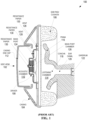
- FIG. 1 is a front view cross-section of a conventional headphone 100.
- the components of headphone 100 that are shown in the front view cross-section i.e., the view of the headphone as worn by a user facing outward
- Headphone 100 may be any type of headphone including but not limited to on-ear, over-the-ear, and in-ear headphones.
- headphone 100 is an over-the-ear type headphone that includes a casing 104 and an ear pad/cushion 106 attached thereon.
- Casing 104 houses a driver 108, an acoustic chamber 110, and optionally (not shown) a printed circuit board assembly (e.g., PCBA for digital signal processing) and battery (e.g., for powering PCBA or driver) within acoustic chamber 110.
- Ear pad/cushion 106 is configured to seal against a user's head and around the user's ear when headphone 100 is worn by the user.
- Ear pad/cushion 106 may be constructed with any pliable material such as foam, rubber, or sponge.
- Casing 104 includes a casing end cap 112 that is removable such that access to the interior and interior components (e.g., PCBA, battery, driver, etc.) of casing 104 is possible.
- Casing 104 may be constructed with any material including but not limited to plastic, metal, non-metals, or any combination of them.
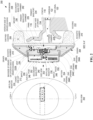
- headphone 200 includes secondary bass port 240 having a secondary bass port chamber 242 with a third end opening 244C and a fourth end opening 244D.
- Secondary bass port 240 is coupled at third end opening 244C to primary bass port 224 at second end opening 244B.
- Fourth end opening 244D has substantially unimpeded air flow.
- secondary bass port 240 is configured for tuning the sound pressure levels in the frequency response. Specifically, secondary bass port 240 is configured for tuning the sound pressure levels within a frequency range of about 100 Hz to 4 kHz in the frequency response. Further, secondary bass port chamber 242 has a corresponding air flow resistance such that lowering the air flow resistance results in increasing sound pressure levels between about 100 Hz and 300 Hz in the frequency response for worse vocal clarity and increasing the air flow resistance results in decreasing sound pressure levels between about 100 Hz and 300 Hz in the frequency response for better vocal clarity. Further details will be provided in FIG. 6 .
- headphones can be defined by their sound signatures, which are related to their frequency response. Tuning the frequency response can be a complicated and time consuming process where consideration must be given to different variables of the headphone. Therefore, it would be beneficial if tuning the frequency response can be limited to fewer considerations or variables. The more variables that can stay constant and/or predictable, the less complicated is the tuning of the frequency response. This is especially true in cases where different design versions of headphones are developed and the constant or predictable variable contributes a known value to the frequency response and hence the sound signature.
- the size of secondary bass port 340 can be fixed or adjusted in advance or in real time to achieve the desired frequency response. Adjustments may be made with a sizable secondary bass port 340.
- secondary bass port 340 may be sizable with a collapsible tube and/or expandable tube. Secondary bass port 340 may be sizable by adjusting any of its physical dimensions (e.g., diameter, length, height, width, etc.). Adjustments can be implemented via local control (e.g., on the headphone) or remote control (e.g., smartphone), mechanical or electrical systems, servo based or non-servo based systems, discrete selection (e.g., pushbuttons) or continuous selection (e.g., slider), or via any combination of these techniques.
- Adjustments may be done with a user switch similar to user switch 248.
- a longer secondary bass port 340 than as shown in FIG. 3 can also be integrated into casing 304, especially in casing end cap 312.
- secondary bass port 340 can be expanded in length by winding/coiling inside casing end cap 312 before having fourth end opening 244D open to air.
- secondary bass port 340 and/or secondary bass port chamber 342 can compensate for sound pressure levels that would otherwise be contributed from other headphone components (e.g., acoustic chamber 110). Therefore, the other headphone components can be minimized and the overall headphone size reduced.
- conventional acoustic chamber 110 requires a larger volume and size for a larger bass level.
- the bass level is correspondingly reduced. Accordingly, the present invention is advantageously able to generate the larger bass level even for a smaller headphone with the implementation of acoustic chamber 210 of smaller volume and size, secondary bass port 240/340, and secondary bass port chamber 242/342.
- user switch 402 corresponds to three discrete selections, which are implemented by selection buttons A, B, and C.
- Selection button A corresponds to an opened bass port hole 404 (e.g., when no air flow resistance is applied at fourth end opening 244D of secondary bass port 240, 340).
- Selection button C corresponds to a closed bass port hole 406 (e.g., when maximum air flow resistance is applied at fourth end opening 244D of secondary bass port 240, 340).
- Selection button B corresponds to a bass port hole with air flow resistor applied 408 (e.g., when any degree of air flow resistance is applied at fourth end opening 244D via air flow resistor 230 of secondary bass port 240, 340).
- the present invention covers any number of selection buttons corresponding to any number/level of air flow resistance applications/implementations.
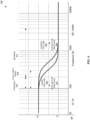
- FIG. 5 is a diagram 500 showing sound pressure levels based on varying air flow resistance at a secondary bass port end opening according to various embodiments of the present invention.
- Diagram 500 shows a sound pressure level (dB) vs. frequency (Hz) plot based on varying air flow resistance at a secondary bass port end opening. The plot is illustrative but not exhaustive. The effect of vary air flow resistance at a secondary bass port end opening is shown in diagram 500. Specifically, by applying different air flow resistances at end openings of secondary bass port 240, 340, different corresponding sound pressure levels within a frequency range in the frequency response can be achieved.
- secondary bass port 240, 340 or secondary bass port chamber 242, 342 has a corresponding air flow resistance such that lowering the air flow resistance results in increasing sound pressure levels between about 100 Hz and 300 Hz in the frequency response for worse vocal clarity and increasing the air flow resistance results in decreasing sound pressure levels between about 100 Hz and 300 Hz in the frequency response for better vocal clarity.
- the lowering or increasing of air flow resistance is due to varying the length of secondary bass port 240, 340.
- a plot curve having optimized vocal clarity may correspond to a secondary bass port 240, 340 with a length for increasing the sound pressure levels within a vocal clarity range 614 (e.g., 100 Hz to 300 Hz) and/or increasing the sound pressure levels within other mid-range frequencies (e.g., above 300 Hz to 1.5 kHz or 4 kHz) in the frequency response of headphone 200, 300.
- the midpoint between the peak and trough of plot curve for optimized vocal clarity is at about 300 Hz.
- Vocal clarity range 614 may encompass portions of upper bass range 610 (e.g., 100 Hz to 200 Hz) and lower mid-range (e.g., above 200 Hz to 300 Hz) of mid-range 612 (e.g., 200 Hz to 4 kHz).
- upper bass range 610 e.g., 100 Hz to 200 Hz
- lower mid-range e.g., above 200 Hz to 300 Hz
- mid-range 612 e.g., 200 Hz to 4 kHz.
- plot curve 606 shows an increase (e.g., 6 dB to 10 dB) of the sound pressure levels within vocal clarity range 614 (e.g., 100 Hz to 300 Hz) and an increase (e.g., 0 dB to ⁇ 6 dB) of the sound pressure levels within the mid-range (e.g., above 300 Hz to 1.5 kHz) in the frequency response of headphone 200, 300.
- an increase e.g., 6 dB to 10 dB
- the sound pressure levels within vocal clarity range 614 e.g., 100 Hz to 300 Hz
- an increase e.g., 0 dB to ⁇ 6 dB
- plot curve 608 shows an increase (e.g., 9 dB to 10 dB) of the sound pressure levels within vocal clarity range 614 (e.g., 100 Hz to 300 Hz) and an increase (e.g., 0 dB to ⁇ 9 dB) of the sound pressure levels within the mid-range (e.g., above 300 Hz to 1.5 kHz) in the frequency response of headphone 200, 300.
- plot curve 606 may be deemed to have a better balance of tuning the sound pressure levels in the frequency response for optimized vocal clarity.
Landscapes
- Physics & Mathematics (AREA)
- Engineering & Computer Science (AREA)
- Acoustics & Sound (AREA)
- Signal Processing (AREA)
- Health & Medical Sciences (AREA)
- Otolaryngology (AREA)
- Headphones And Earphones (AREA)
- Circuit For Audible Band Transducer (AREA)
Claims (10)
- Casque audio (200 ; 300) avec amélioration acoustique, le casque audio ayant une réponse en fréquence correspondante, comprenant :une unité de commande (208) avec un boîtier (232) ayant un côté intérieur (232A) pour intégrer ensemble un aimant (236), un diaphragme (238), et un port de basse primaire (224), le port de basse primaire étant sensiblement entouré par l'aimant et ayant une chambre de port de basse primaire (226) avec une première ouverture d'extrémité (244A) orientée vers le diaphragme et une deuxième ouverture d'extrémité (244B) orientée à l'opposé de la première ouverture d'extrémité, le diaphragme étant situé sur le côté intérieur de l'unité de commande et configuré pour une reproduction audio analogique ; etun port de basse secondaire (240 ; 340) ayant une chambre de port de basse secondaire (242 ; 342) avec une troisième ouverture d'extrémité (244C) et une quatrième ouverture d'extrémité (244D), le port de basse secondaire étant couplé à la troisième ouverture d'extrémité au port de basse primaire à la deuxième ouverture d'extrémité, et la quatrième ouverture d'extrémité ayant un flux d'air sensiblement sans entrave, comprenant en outre :
une chambre acoustique (210) configurée pour empêcher le bruit ambiant de se mélanger sensiblement à la reproduction audio analogique, la chambre acoustique entourant et couvrant sensiblement une face arrière (232B) de l'unité de commande (208) à l'exception de l'endroit où le port de basse secondaire (240) se couple au port de basse primaire (224) de l'unité de commande (208), dans lequel la chambre acoustique et le port de basse secondaire sont configurés pour accorder collectivement les niveaux de pression sonore dans la réponse en fréquence et la face arrière de l'unité de commande correspond à un côté extérieur (232B) du boîtier (232), le côté extérieur du boîtier étant opposé au côté intérieur (232A) du boîtier, dans lequel la deuxième ouverture d'extrémité (244B) du port de basse primaire (224) ne débouche pas sur la chambre acoustique. - Casque audio selon la revendication 1, dans lequel une résistance au flux d'air (230) est configurée pour appliquer une résistance au flux d'air fixe soit à la deuxième ouverture d'extrémité (244B) du port de basse primaire (224), soit à la troisième ouverture d'extrémité (244C) du port de basse secondaire (240).
- Casque audio selon la revendication 2, dans lequel la résistance au flux d'air (230) est d'une construction perméable aux gaz, la construction perméable aux gaz étant choisie dans un groupe constitué de papier, de tissu, de mousse, de maille et de feutre.
- Casque audio selon la revendication 1, dans lequel le port de basse secondaire (240 ; 340) est dimensionnable en temps réel.
- Casque audio selon la revendication 1, dans lequel le port de basse secondaire (240 ; 340) est configuré pour accorder des niveaux de pression sonore dans la réponse en fréquence.
- Casque audio selon la revendication 5, dans lequel le port de basse secondaire (240 ; 340) est configuré pour régler les niveaux de pression sonore dans une plage de fréquences d'environ 100 Hz à 4 kHz dans la réponse en fréquence, et/ou dans lequel la chambre de port de basse secondaire (240 ; 340) a une résistance au flux d'air correspondante de sorte qu'une réduction de la résistance au flux d'air entraîne une augmentation des niveaux de pression sonore entre environ 100 Hz et 300 Hz dans la réponse en fréquence pour une moins bonne clarté vocale et une augmentation de la résistance au flux d'air entraîne une diminution des niveaux de pression sonore entre environ 100 Hz et 300 Hz dans la réponse en fréquence pour une meilleure clarté vocale.
- Casque audio selon la revendication 1, dans lequel le port de basse secondaire (240) comprend une pluralité de sections qui divisent la chambre de port de basse secondaire (242) en sous-chambres, chaque sous-chambre ayant une section transversale différente, et dans lequel optionnellement au moins deux de la pluralité de sections sont construites à partir de matériaux différents, le matériau étant choisi dans le groupe constitué par le plastique, le feutre d'éthylène-acétate de vinyle (EVA), le métal, le non-métal, le caoutchouc, la mousse, et l'éponge.
- Casque audio selon la revendication 1, dans lequel l'unité de commande (208) est une unité de commande dynamique, et/ou dans lequel le casque audio est choisi dans le groupe constitué par les casques intra-auriculaires, les casques supra-auriculaires, les casques circum-auriculaires, les casques à dos ouvert, les casques à dos semi-ouvert, et les casques à dos fermé.
- Casque audio selon la revendication 1, dans lequel le port de basse primaire (224) est un tube sensiblement droit et le port de basse secondaire (240) est une structure creuse de forme sensiblement quelconque choisie dans le groupe constitué d'un tube droit, d'un tube enroulé, d'une structure creuse à section transversale polygonale droite/enroulée, d'une structure creuse cylindrique droite/enroulée, d'un tube évasé et de toute combinaison de ceux-ci.
- Procédé d'amélioration acoustique, le procédé comprenant la fourniture d'un casque audio (200 ; 300) ayant une réponse en fréquence correspondante, dans lequel la fourniture dudit casque audio comprend les étapes consistant à :fournir une unité de commande (208) avec un boîtier (232) ayant un côté intérieur (232A) pour intégrer ensemble un aimant (236), un diaphragme (238), et un port de basse primaire (224), le port de basse primaire étant sensiblement entouré par l'aimant et ayant une chambre de port de basse primaire (226) avec une première ouverture d'extrémité (244A) orientée vers le diaphragme et une deuxième ouverture d'extrémité (244B) orientée à l'opposé de la première ouverture d'extrémité, le diaphragme étant situé sur le côté intérieur de l'unité de commande et configuré pour la reproduction audio analogique ;fournir un port de basse secondaire (240 ; 340) ayant une chambre de port de basse secondaire (242 ; 342) avec une troisième ouverture d'extrémité (244C) et une quatrième ouverture d'extrémité (244D), le port de basse secondaire étant couplé à la troisième ouverture d'extrémité au port de basse primaire à la deuxième ouverture d'extrémité, et la quatrième ouverture d'extrémité ayant un flux d'air sensiblement sans entrave ; etfournir une chambre acoustique (210) configurée pour empêcher le bruit ambiant de se mélanger sensiblement à la reproduction audio analogique, la chambre acoustique entourant et couvrant sensiblement une face arrière (232B) de l'unité de commande (208) à l'exception de l'endroit où le port de basse secondaire (240) se couple au port de basse primaire (224) de l'unité de commande (208), dans lequel la chambre acoustique et le port de basse secondaire sont configurés pour accorder collectivement les niveaux de pression sonore dans la réponse en fréquence et la face arrière de l'unité de commande correspond à un côté extérieur (232B) du boîtier (232), le côté extérieur du boîtier étant opposé au côté intérieur (232A) du boîtier, dans lequel la deuxième ouverture d'extrémité (244B) du port de basse primaire (224) ne débouche pas sur la chambre acoustique.
Applications Claiming Priority (1)
| Application Number | Priority Date | Filing Date | Title |
|---|---|---|---|
| US16/405,404 US11082768B2 (en) | 2019-05-07 | 2019-05-07 | Apparatus with acoustic enhancement and method for the same |
Publications (2)
| Publication Number | Publication Date |
|---|---|
| EP3737112A1 EP3737112A1 (fr) | 2020-11-11 |
| EP3737112B1 true EP3737112B1 (fr) | 2024-07-10 |
Family
ID=70553986
Family Applications (1)
| Application Number | Title | Priority Date | Filing Date |
|---|---|---|---|
| EP20173144.5A Active EP3737112B1 (fr) | 2019-05-07 | 2020-05-06 | Casque audio avec restitution de basses eméliorée |
Country Status (4)
| Country | Link |
|---|---|
| US (1) | US11082768B2 (fr) |
| EP (1) | EP3737112B1 (fr) |
| CN (1) | CN111918161B (fr) |
| SG (1) | SG10202004178RA (fr) |
Families Citing this family (5)
| Publication number | Priority date | Publication date | Assignee | Title |
|---|---|---|---|---|
| TWI740220B (zh) * | 2019-09-26 | 2021-09-21 | 美律實業股份有限公司 | 耳罩結構 |
| JP7532991B2 (ja) * | 2020-07-31 | 2024-08-14 | ヤマハ株式会社 | ヘッドフォン |
| US11336983B1 (en) * | 2021-03-18 | 2022-05-17 | Em-Tech Co., Ltd. | Receiver module having pressure equilibrium structure |
| US11805348B2 (en) | 2022-02-28 | 2023-10-31 | Zachary Arthur Mehrbach | Acoustical damping system for headphones |
| TWI825641B (zh) * | 2022-03-29 | 2023-12-11 | 致伸科技股份有限公司 | 耳機裝置 |
Family Cites Families (7)
| Publication number | Priority date | Publication date | Assignee | Title |
|---|---|---|---|---|
| TWI469652B (zh) | 2013-02-08 | 2015-01-11 | Cotron Corp | 耳機 |
| TWI524783B (zh) * | 2013-03-20 | 2016-03-01 | 固昌通訊股份有限公司 | 耳機 |
| WO2015022817A1 (fr) * | 2013-08-12 | 2015-02-19 | ソニー株式会社 | Casque d'écoute et procédé d'ajustement de caractéristique acoustique |
| WO2015076006A1 (fr) | 2013-11-19 | 2015-05-28 | ソニー株式会社 | Casque d'écoute et procédé de réglage de caractéristiques acoustiques |
| US10034112B2 (en) * | 2014-07-25 | 2018-07-24 | Skullcandy, Inc. | Mass port plug for customizing headphone drivers, and related methods |
| CN107517430B (zh) * | 2016-06-17 | 2020-01-21 | 声电电子科技(惠州)有限公司 | 一种双华司微型扬声器 |
| WO2018187663A1 (fr) * | 2017-04-07 | 2018-10-11 | Correlated Magnetics Research, Llc | Aimant de haut-parleur et ensemble écouteur |
-
2019
- 2019-05-07 US US16/405,404 patent/US11082768B2/en active Active
-
2020
- 2020-05-06 EP EP20173144.5A patent/EP3737112B1/fr active Active
- 2020-05-06 SG SG10202004178RA patent/SG10202004178RA/en unknown
- 2020-05-06 CN CN202010372548.4A patent/CN111918161B/zh active Active
Also Published As
| Publication number | Publication date |
|---|---|
| US20200359126A1 (en) | 2020-11-12 |
| EP3737112A1 (fr) | 2020-11-11 |
| US11082768B2 (en) | 2021-08-03 |
| CN111918161B (zh) | 2025-10-03 |
| SG10202004178RA (en) | 2020-12-30 |
| CN111918161A (zh) | 2020-11-10 |
Similar Documents
| Publication | Publication Date | Title |
|---|---|---|
| EP3737112B1 (fr) | Casque audio avec restitution de basses eméliorée | |
| US11234085B2 (en) | Earpieces and related articles and devices | |
| US7634099B2 (en) | High-fidelity earpiece with adjustable frequency response | |
| US7489794B2 (en) | Earpiece with acoustic vent for driver response optimization | |
| USRE48214E1 (en) | Custom fit in-ear monitors utilizing a single piece driver module | |
| US20110031060A1 (en) | Earpiece | |
| CN109218888A (zh) | 具有通风室的质量加载耳塞 | |
| CN112788459B (zh) | 与管道结合成一体的接收器模块 | |
| WO2010007440A2 (fr) | Oreillette | |
| US10721549B2 (en) | Direct-radiating earphone drivers | |
| CN110036651B (zh) | 具有可关闭的端口的扬声器外壳 | |
| CN113810813B (zh) | 耳机本体、耳机及使用耳机本体调整声压级的方法 | |
| US10448147B2 (en) | Acoustic device having multiple diaphragms | |
| US9668042B1 (en) | Adjustable acoustic bass earbud | |
| JP2019145964A (ja) | イヤホン | |
| RU2680663C2 (ru) | Внутриканальный наушник | |
| JP6508687B1 (ja) | 密閉型イヤホン | |
| HK40044489A (en) | Apparatus with acoustic enhancement and method for the same | |
| US20080199035A1 (en) | In-Ear Phone | |
| US12143767B1 (en) | Earphone bidirectional pressure port | |
| KR20200091189A (ko) | 복수 진동판을 가진 음향기기 | |
| JPH11136781A (ja) | 位相反転形スピーカキャビネット | |
| CN111225307B (zh) | 耳机低音增强装置及具备该装置的耳机 | |
| CN120529886A (zh) | 可调节耳塞 |
Legal Events
| Date | Code | Title | Description |
|---|---|---|---|
| PUAI | Public reference made under article 153(3) epc to a published international application that has entered the european phase |
Free format text: ORIGINAL CODE: 0009012 |
|
| STAA | Information on the status of an ep patent application or granted ep patent |
Free format text: STATUS: THE APPLICATION HAS BEEN PUBLISHED |
|
| AK | Designated contracting states |
Kind code of ref document: A1 Designated state(s): AL AT BE BG CH CY CZ DE DK EE ES FI FR GB GR HR HU IE IS IT LI LT LU LV MC MK MT NL NO PL PT RO RS SE SI SK SM TR |
|
| AX | Request for extension of the european patent |
Extension state: BA ME |
|
| STAA | Information on the status of an ep patent application or granted ep patent |
Free format text: STATUS: REQUEST FOR EXAMINATION WAS MADE |
|
| 17P | Request for examination filed |
Effective date: 20210505 |
|
| RBV | Designated contracting states (corrected) |
Designated state(s): AL AT BE BG CH CY CZ DE DK EE ES FI FR GB GR HR HU IE IS IT LI LT LU LV MC MK MT NL NO PL PT RO RS SE SI SK SM TR |
|
| STAA | Information on the status of an ep patent application or granted ep patent |
Free format text: STATUS: EXAMINATION IS IN PROGRESS |
|
| 17Q | First examination report despatched |
Effective date: 20220627 |
|
| P01 | Opt-out of the competence of the unified patent court (upc) registered |
Effective date: 20230520 |
|
| GRAP | Despatch of communication of intention to grant a patent |
Free format text: ORIGINAL CODE: EPIDOSNIGR1 |
|
| STAA | Information on the status of an ep patent application or granted ep patent |
Free format text: STATUS: GRANT OF PATENT IS INTENDED |
|
| INTG | Intention to grant announced |
Effective date: 20240205 |
|
| GRAS | Grant fee paid |
Free format text: ORIGINAL CODE: EPIDOSNIGR3 |
|
| GRAA | (expected) grant |
Free format text: ORIGINAL CODE: 0009210 |
|
| STAA | Information on the status of an ep patent application or granted ep patent |
Free format text: STATUS: THE PATENT HAS BEEN GRANTED |
|
| AK | Designated contracting states |
Kind code of ref document: B1 Designated state(s): AL AT BE BG CH CY CZ DE DK EE ES FI FR GB GR HR HU IE IS IT LI LT LU LV MC MK MT NL NO PL PT RO RS SE SI SK SM TR |
|
| REG | Reference to a national code |
Ref country code: CH Ref legal event code: EP |
|
| REG | Reference to a national code |
Ref country code: DE Ref legal event code: R096 Ref document number: 602020033622 Country of ref document: DE |
|
| REG | Reference to a national code |
Ref country code: NL Ref legal event code: FP |
|
| REG | Reference to a national code |
Ref country code: LT Ref legal event code: MG9D |
|
| PG25 | Lapsed in a contracting state [announced via postgrant information from national office to epo] |
Ref country code: PT Free format text: LAPSE BECAUSE OF FAILURE TO SUBMIT A TRANSLATION OF THE DESCRIPTION OR TO PAY THE FEE WITHIN THE PRESCRIBED TIME-LIMIT Effective date: 20241111 |
|
| REG | Reference to a national code |
Ref country code: AT Ref legal event code: MK05 Ref document number: 1703084 Country of ref document: AT Kind code of ref document: T Effective date: 20240710 |
|
| PG25 | Lapsed in a contracting state [announced via postgrant information from national office to epo] |
Ref country code: PT Free format text: LAPSE BECAUSE OF FAILURE TO SUBMIT A TRANSLATION OF THE DESCRIPTION OR TO PAY THE FEE WITHIN THE PRESCRIBED TIME-LIMIT Effective date: 20241111 |
|
| PG25 | Lapsed in a contracting state [announced via postgrant information from national office to epo] |
Ref country code: NO Free format text: LAPSE BECAUSE OF FAILURE TO SUBMIT A TRANSLATION OF THE DESCRIPTION OR TO PAY THE FEE WITHIN THE PRESCRIBED TIME-LIMIT Effective date: 20241010 |
|
| PG25 | Lapsed in a contracting state [announced via postgrant information from national office to epo] |
Ref country code: FI Free format text: LAPSE BECAUSE OF FAILURE TO SUBMIT A TRANSLATION OF THE DESCRIPTION OR TO PAY THE FEE WITHIN THE PRESCRIBED TIME-LIMIT Effective date: 20240710 Ref country code: GR Free format text: LAPSE BECAUSE OF FAILURE TO SUBMIT A TRANSLATION OF THE DESCRIPTION OR TO PAY THE FEE WITHIN THE PRESCRIBED TIME-LIMIT Effective date: 20241011 Ref country code: PL Free format text: LAPSE BECAUSE OF FAILURE TO SUBMIT A TRANSLATION OF THE DESCRIPTION OR TO PAY THE FEE WITHIN THE PRESCRIBED TIME-LIMIT Effective date: 20240710 |
|
| PG25 | Lapsed in a contracting state [announced via postgrant information from national office to epo] |
Ref country code: BG Free format text: LAPSE BECAUSE OF FAILURE TO SUBMIT A TRANSLATION OF THE DESCRIPTION OR TO PAY THE FEE WITHIN THE PRESCRIBED TIME-LIMIT Effective date: 20240710 |
|
| PG25 | Lapsed in a contracting state [announced via postgrant information from national office to epo] |
Ref country code: LV Free format text: LAPSE BECAUSE OF FAILURE TO SUBMIT A TRANSLATION OF THE DESCRIPTION OR TO PAY THE FEE WITHIN THE PRESCRIBED TIME-LIMIT Effective date: 20240710 |
|
| PG25 | Lapsed in a contracting state [announced via postgrant information from national office to epo] |
Ref country code: AT Free format text: LAPSE BECAUSE OF FAILURE TO SUBMIT A TRANSLATION OF THE DESCRIPTION OR TO PAY THE FEE WITHIN THE PRESCRIBED TIME-LIMIT Effective date: 20240710 Ref country code: IS Free format text: LAPSE BECAUSE OF FAILURE TO SUBMIT A TRANSLATION OF THE DESCRIPTION OR TO PAY THE FEE WITHIN THE PRESCRIBED TIME-LIMIT Effective date: 20241110 |
|
| PG25 | Lapsed in a contracting state [announced via postgrant information from national office to epo] |
Ref country code: HR Free format text: LAPSE BECAUSE OF FAILURE TO SUBMIT A TRANSLATION OF THE DESCRIPTION OR TO PAY THE FEE WITHIN THE PRESCRIBED TIME-LIMIT Effective date: 20240710 |
|
| PG25 | Lapsed in a contracting state [announced via postgrant information from national office to epo] |
Ref country code: RS Free format text: LAPSE BECAUSE OF FAILURE TO SUBMIT A TRANSLATION OF THE DESCRIPTION OR TO PAY THE FEE WITHIN THE PRESCRIBED TIME-LIMIT Effective date: 20241010 Ref country code: ES Free format text: LAPSE BECAUSE OF FAILURE TO SUBMIT A TRANSLATION OF THE DESCRIPTION OR TO PAY THE FEE WITHIN THE PRESCRIBED TIME-LIMIT Effective date: 20240710 |
|
| PG25 | Lapsed in a contracting state [announced via postgrant information from national office to epo] |
Ref country code: RS Free format text: LAPSE BECAUSE OF FAILURE TO SUBMIT A TRANSLATION OF THE DESCRIPTION OR TO PAY THE FEE WITHIN THE PRESCRIBED TIME-LIMIT Effective date: 20241010 Ref country code: PL Free format text: LAPSE BECAUSE OF FAILURE TO SUBMIT A TRANSLATION OF THE DESCRIPTION OR TO PAY THE FEE WITHIN THE PRESCRIBED TIME-LIMIT Effective date: 20240710 Ref country code: NO Free format text: LAPSE BECAUSE OF FAILURE TO SUBMIT A TRANSLATION OF THE DESCRIPTION OR TO PAY THE FEE WITHIN THE PRESCRIBED TIME-LIMIT Effective date: 20241010 Ref country code: LV Free format text: LAPSE BECAUSE OF FAILURE TO SUBMIT A TRANSLATION OF THE DESCRIPTION OR TO PAY THE FEE WITHIN THE PRESCRIBED TIME-LIMIT Effective date: 20240710 Ref country code: IS Free format text: LAPSE BECAUSE OF FAILURE TO SUBMIT A TRANSLATION OF THE DESCRIPTION OR TO PAY THE FEE WITHIN THE PRESCRIBED TIME-LIMIT Effective date: 20241110 Ref country code: HR Free format text: LAPSE BECAUSE OF FAILURE TO SUBMIT A TRANSLATION OF THE DESCRIPTION OR TO PAY THE FEE WITHIN THE PRESCRIBED TIME-LIMIT Effective date: 20240710 Ref country code: GR Free format text: LAPSE BECAUSE OF FAILURE TO SUBMIT A TRANSLATION OF THE DESCRIPTION OR TO PAY THE FEE WITHIN THE PRESCRIBED TIME-LIMIT Effective date: 20241011 Ref country code: FI Free format text: LAPSE BECAUSE OF FAILURE TO SUBMIT A TRANSLATION OF THE DESCRIPTION OR TO PAY THE FEE WITHIN THE PRESCRIBED TIME-LIMIT Effective date: 20240710 Ref country code: ES Free format text: LAPSE BECAUSE OF FAILURE TO SUBMIT A TRANSLATION OF THE DESCRIPTION OR TO PAY THE FEE WITHIN THE PRESCRIBED TIME-LIMIT Effective date: 20240710 Ref country code: BG Free format text: LAPSE BECAUSE OF FAILURE TO SUBMIT A TRANSLATION OF THE DESCRIPTION OR TO PAY THE FEE WITHIN THE PRESCRIBED TIME-LIMIT Effective date: 20240710 Ref country code: AT Free format text: LAPSE BECAUSE OF FAILURE TO SUBMIT A TRANSLATION OF THE DESCRIPTION OR TO PAY THE FEE WITHIN THE PRESCRIBED TIME-LIMIT Effective date: 20240710 |
|
| REG | Reference to a national code |
Ref country code: DE Ref legal event code: R097 Ref document number: 602020033622 Country of ref document: DE |
|
| PG25 | Lapsed in a contracting state [announced via postgrant information from national office to epo] |
Ref country code: SM Free format text: LAPSE BECAUSE OF FAILURE TO SUBMIT A TRANSLATION OF THE DESCRIPTION OR TO PAY THE FEE WITHIN THE PRESCRIBED TIME-LIMIT Effective date: 20240710 Ref country code: RO Free format text: LAPSE BECAUSE OF FAILURE TO SUBMIT A TRANSLATION OF THE DESCRIPTION OR TO PAY THE FEE WITHIN THE PRESCRIBED TIME-LIMIT Effective date: 20240710 Ref country code: DK Free format text: LAPSE BECAUSE OF FAILURE TO SUBMIT A TRANSLATION OF THE DESCRIPTION OR TO PAY THE FEE WITHIN THE PRESCRIBED TIME-LIMIT Effective date: 20240710 |
|
| PG25 | Lapsed in a contracting state [announced via postgrant information from national office to epo] |
Ref country code: EE Free format text: LAPSE BECAUSE OF FAILURE TO SUBMIT A TRANSLATION OF THE DESCRIPTION OR TO PAY THE FEE WITHIN THE PRESCRIBED TIME-LIMIT Effective date: 20240710 |
|
| PG25 | Lapsed in a contracting state [announced via postgrant information from national office to epo] |
Ref country code: CZ Free format text: LAPSE BECAUSE OF FAILURE TO SUBMIT A TRANSLATION OF THE DESCRIPTION OR TO PAY THE FEE WITHIN THE PRESCRIBED TIME-LIMIT Effective date: 20240710 |
|
| PG25 | Lapsed in a contracting state [announced via postgrant information from national office to epo] |
Ref country code: SK Free format text: LAPSE BECAUSE OF FAILURE TO SUBMIT A TRANSLATION OF THE DESCRIPTION OR TO PAY THE FEE WITHIN THE PRESCRIBED TIME-LIMIT Effective date: 20240710 Ref country code: IT Free format text: LAPSE BECAUSE OF FAILURE TO SUBMIT A TRANSLATION OF THE DESCRIPTION OR TO PAY THE FEE WITHIN THE PRESCRIBED TIME-LIMIT Effective date: 20240710 |
|
| PLBE | No opposition filed within time limit |
Free format text: ORIGINAL CODE: 0009261 |
|
| STAA | Information on the status of an ep patent application or granted ep patent |
Free format text: STATUS: NO OPPOSITION FILED WITHIN TIME LIMIT |
|
| PGFP | Annual fee paid to national office [announced via postgrant information from national office to epo] |
Ref country code: NL Payment date: 20250526 Year of fee payment: 6 |
|
| 26N | No opposition filed |
Effective date: 20250411 |
|
| PGFP | Annual fee paid to national office [announced via postgrant information from national office to epo] |
Ref country code: DE Payment date: 20250529 Year of fee payment: 6 |
|
| PGFP | Annual fee paid to national office [announced via postgrant information from national office to epo] |
Ref country code: GB Payment date: 20250527 Year of fee payment: 6 |
|
| PGFP | Annual fee paid to national office [announced via postgrant information from national office to epo] |
Ref country code: FR Payment date: 20250526 Year of fee payment: 6 |
|
| PG25 | Lapsed in a contracting state [announced via postgrant information from national office to epo] |
Ref country code: SE Free format text: LAPSE BECAUSE OF FAILURE TO SUBMIT A TRANSLATION OF THE DESCRIPTION OR TO PAY THE FEE WITHIN THE PRESCRIBED TIME-LIMIT Effective date: 20240710 |
|
| REG | Reference to a national code |
Ref country code: CH Ref legal event code: H13 Free format text: ST27 STATUS EVENT CODE: U-0-0-H10-H13 (AS PROVIDED BY THE NATIONAL OFFICE) Effective date: 20251223 |
|
| PG25 | Lapsed in a contracting state [announced via postgrant information from national office to epo] |
Ref country code: LU Free format text: LAPSE BECAUSE OF NON-PAYMENT OF DUE FEES Effective date: 20250506 |
|
| PG25 | Lapsed in a contracting state [announced via postgrant information from national office to epo] |
Ref country code: CH Free format text: LAPSE BECAUSE OF NON-PAYMENT OF DUE FEES Effective date: 20250531 |
|
| PG25 | Lapsed in a contracting state [announced via postgrant information from national office to epo] |
Ref country code: MC Free format text: LAPSE BECAUSE OF FAILURE TO SUBMIT A TRANSLATION OF THE DESCRIPTION OR TO PAY THE FEE WITHIN THE PRESCRIBED TIME-LIMIT Effective date: 20240710 |