EP3735515B1 - Mechanism for transforming reciprocal to rotational motion or vice versa, and mechanism applications - Google Patents
Mechanism for transforming reciprocal to rotational motion or vice versa, and mechanism applications Download PDFInfo
- Publication number
- EP3735515B1 EP3735515B1 EP18719170.5A EP18719170A EP3735515B1 EP 3735515 B1 EP3735515 B1 EP 3735515B1 EP 18719170 A EP18719170 A EP 18719170A EP 3735515 B1 EP3735515 B1 EP 3735515B1
- Authority
- EP
- European Patent Office
- Prior art keywords
- cam unit
- cam
- crests
- undulated
- motion
- Prior art date
- Legal status (The legal status is an assumption and is not a legal conclusion. Google has not performed a legal analysis and makes no representation as to the accuracy of the status listed.)
- Active
Links
Images







Classifications
-
- F—MECHANICAL ENGINEERING; LIGHTING; HEATING; WEAPONS; BLASTING
- F01—MACHINES OR ENGINES IN GENERAL; ENGINE PLANTS IN GENERAL; STEAM ENGINES
- F01B—MACHINES OR ENGINES, IN GENERAL OR OF POSITIVE-DISPLACEMENT TYPE, e.g. STEAM ENGINES
- F01B9/00—Reciprocating-piston machines or engines characterised by connections between pistons and main shafts, not specific to groups F01B1/00 - F01B7/00
- F01B9/04—Reciprocating-piston machines or engines characterised by connections between pistons and main shafts, not specific to groups F01B1/00 - F01B7/00 with rotary main shaft other than crankshaft
- F01B9/06—Reciprocating-piston machines or engines characterised by connections between pistons and main shafts, not specific to groups F01B1/00 - F01B7/00 with rotary main shaft other than crankshaft the piston motion being transmitted by curved surfaces
-
- C—CHEMISTRY; METALLURGY
- C11—ANIMAL OR VEGETABLE OILS, FATS, FATTY SUBSTANCES OR WAXES; FATTY ACIDS THEREFROM; DETERGENTS; CANDLES
- C11B—PRODUCING, e.g. BY PRESSING RAW MATERIALS OR BY EXTRACTION FROM WASTE MATERIALS, REFINING OR PRESERVING FATS, FATTY SUBSTANCES, e.g. LANOLIN, FATTY OILS OR WAXES; ESSENTIAL OILS; PERFUMES
- C11B1/00—Production of fats or fatty oils from raw materials
- C11B1/02—Pretreatment
- C11B1/04—Pretreatment of vegetable raw material
-
- C—CHEMISTRY; METALLURGY
- C11—ANIMAL OR VEGETABLE OILS, FATS, FATTY SUBSTANCES OR WAXES; FATTY ACIDS THEREFROM; DETERGENTS; CANDLES
- C11B—PRODUCING, e.g. BY PRESSING RAW MATERIALS OR BY EXTRACTION FROM WASTE MATERIALS, REFINING OR PRESERVING FATS, FATTY SUBSTANCES, e.g. LANOLIN, FATTY OILS OR WAXES; ESSENTIAL OILS; PERFUMES
- C11B1/00—Production of fats or fatty oils from raw materials
- C11B1/06—Production of fats or fatty oils from raw materials by pressing
-
- F—MECHANICAL ENGINEERING; LIGHTING; HEATING; WEAPONS; BLASTING
- F01—MACHINES OR ENGINES IN GENERAL; ENGINE PLANTS IN GENERAL; STEAM ENGINES
- F01B—MACHINES OR ENGINES, IN GENERAL OR OF POSITIVE-DISPLACEMENT TYPE, e.g. STEAM ENGINES
- F01B23/00—Adaptations of machines or engines for special use; Combinations of engines with devices driven thereby
- F01B23/10—Adaptations for driving, or combinations with, electric generators
-
- F—MECHANICAL ENGINEERING; LIGHTING; HEATING; WEAPONS; BLASTING
- F02—COMBUSTION ENGINES; HOT-GAS OR COMBUSTION-PRODUCT ENGINE PLANTS
- F02B—INTERNAL-COMBUSTION PISTON ENGINES; COMBUSTION ENGINES IN GENERAL
- F02B75/00—Other engines
- F02B75/32—Engines characterised by connections between pistons and main shafts and not specific to preceding main groups
-
- F—MECHANICAL ENGINEERING; LIGHTING; HEATING; WEAPONS; BLASTING
- F16—ENGINEERING ELEMENTS AND UNITS; GENERAL MEASURES FOR PRODUCING AND MAINTAINING EFFECTIVE FUNCTIONING OF MACHINES OR INSTALLATIONS; THERMAL INSULATION IN GENERAL
- F16D—COUPLINGS FOR TRANSMITTING ROTATION; CLUTCHES; BRAKES
- F16D11/00—Clutches in which the members have interengaging parts
- F16D11/02—Clutches in which the members have interengaging parts disengaged by a contact of a part mounted on the clutch with a stationarily-mounted member
- F16D11/04—Clutches in which the members have interengaging parts disengaged by a contact of a part mounted on the clutch with a stationarily-mounted member with clutching members movable only axially
-
- F—MECHANICAL ENGINEERING; LIGHTING; HEATING; WEAPONS; BLASTING
- F16—ENGINEERING ELEMENTS AND UNITS; GENERAL MEASURES FOR PRODUCING AND MAINTAINING EFFECTIVE FUNCTIONING OF MACHINES OR INSTALLATIONS; THERMAL INSULATION IN GENERAL
- F16H—GEARING
- F16H25/00—Gearings comprising primarily only cams, cam-followers and screw-and-nut mechanisms
- F16H25/08—Gearings comprising primarily only cams, cam-followers and screw-and-nut mechanisms for interconverting rotary motion and reciprocating motion
-
- F—MECHANICAL ENGINEERING; LIGHTING; HEATING; WEAPONS; BLASTING
- F16—ENGINEERING ELEMENTS AND UNITS; GENERAL MEASURES FOR PRODUCING AND MAINTAINING EFFECTIVE FUNCTIONING OF MACHINES OR INSTALLATIONS; THERMAL INSULATION IN GENERAL
- F16H—GEARING
- F16H25/00—Gearings comprising primarily only cams, cam-followers and screw-and-nut mechanisms
- F16H25/08—Gearings comprising primarily only cams, cam-followers and screw-and-nut mechanisms for interconverting rotary motion and reciprocating motion
- F16H25/12—Gearings comprising primarily only cams, cam-followers and screw-and-nut mechanisms for interconverting rotary motion and reciprocating motion with reciprocation along the axis of rotation, e.g. gearings with helical grooves and automatic reversal
-
- F—MECHANICAL ENGINEERING; LIGHTING; HEATING; WEAPONS; BLASTING
- F16—ENGINEERING ELEMENTS AND UNITS; GENERAL MEASURES FOR PRODUCING AND MAINTAINING EFFECTIVE FUNCTIONING OF MACHINES OR INSTALLATIONS; THERMAL INSULATION IN GENERAL
- F16H—GEARING
- F16H25/00—Gearings comprising primarily only cams, cam-followers and screw-and-nut mechanisms
- F16H25/08—Gearings comprising primarily only cams, cam-followers and screw-and-nut mechanisms for interconverting rotary motion and reciprocating motion
- F16H25/12—Gearings comprising primarily only cams, cam-followers and screw-and-nut mechanisms for interconverting rotary motion and reciprocating motion with reciprocation along the axis of rotation, e.g. gearings with helical grooves and automatic reversal
- F16H25/125—Gearings comprising primarily only cams, cam-followers and screw-and-nut mechanisms for interconverting rotary motion and reciprocating motion with reciprocation along the axis of rotation, e.g. gearings with helical grooves and automatic reversal having the cam on an end surface of the rotating element
-
- F—MECHANICAL ENGINEERING; LIGHTING; HEATING; WEAPONS; BLASTING
- F16—ENGINEERING ELEMENTS AND UNITS; GENERAL MEASURES FOR PRODUCING AND MAINTAINING EFFECTIVE FUNCTIONING OF MACHINES OR INSTALLATIONS; THERMAL INSULATION IN GENERAL
- F16H—GEARING
- F16H48/00—Differential gearings
- F16H48/12—Differential gearings without gears having orbital motion
- F16H48/14—Differential gearings without gears having orbital motion with cams
- F16H48/142—Differential gearings without gears having orbital motion with cams consisting of linked clutches using axially movable inter-engaging parts
-
- Y—GENERAL TAGGING OF NEW TECHNOLOGICAL DEVELOPMENTS; GENERAL TAGGING OF CROSS-SECTIONAL TECHNOLOGIES SPANNING OVER SEVERAL SECTIONS OF THE IPC; TECHNICAL SUBJECTS COVERED BY FORMER USPC CROSS-REFERENCE ART COLLECTIONS [XRACs] AND DIGESTS
- Y02—TECHNOLOGIES OR APPLICATIONS FOR MITIGATION OR ADAPTATION AGAINST CLIMATE CHANGE
- Y02T—CLIMATE CHANGE MITIGATION TECHNOLOGIES RELATED TO TRANSPORTATION
- Y02T10/00—Road transport of goods or passengers
- Y02T10/10—Internal combustion engine [ICE] based vehicles
- Y02T10/12—Improving ICE efficiencies
Definitions
- the invention relates to a mechanism for transforming reciprocal to rotational motion or vice versa according to claim 1. It relates also to applications for the mechanism, as in fluid flow control valves, in piston engines, such as motors or pumps/compressors, in automation systems as well as in clutches, differentials, rotation/reciprocation speed increasing-reducing device and electromechanical couples in power generators/electric motors.
- the most known and widespread straight-line reciprocal to rotational motion transformation mechanism is the piston - piston rod - crank mechanism. It finds widespread application in piston engines (motors or pumps/compressors) operating usually with air, water (liquid or steam), oil and fuels in a liquid or gaseous state (e.g. hydrocarbons, hydrogen etc).
- piston engines motors or pumps/compressors
- air, water liquid or steam
- oil and fuels in a liquid or gaseous state (e.g. hydrocarbons, hydrogen etc).
- the flow control of each working fluid is achieved by valves of various types, opening and closing using many different ways or mechanisms (e.g. gravity, springs, rods, camshafts etc.).
- a disadvantage of the mechanism comprises also the piston inability to rest at the Top Dead Centre (TDC) and the Bottom Dead Centre (BDC) for a certain time interval, in order for the combustion to improve and the efficiency to increase, as well as to allow adequate time for cylinder exhaust gases sweeping/flushing out to take place in the two-stroke engines, respectively.
- TDC Top Dead Centre
- BDC Bottom Dead Centre
- the present invention concerns a simple mechanism for transforming rectilinear reciprocating motion to rotational, or vice versa, without a crankshaft and piston rod, being also able to provide the possibility of delaying the inversion of motion at the extreme positions of reciprocation (TDC and BDC).
- TDC and BDC extreme positions of reciprocation
- it allows the provision of a valve configuration with simple apertures for fluid flow control.
- products that can incorporate said mechanism and/or valve configuration with simple apertures, such as e.g. piston engines (motors or pumps/compressors), clutches, differentials, rotation/reciprocation speed increasing-reducing device, electromechanical couples in power generators/electric motors and automations.
- a mechanism for transforming reciprocal to rotational motion including a first annular component and a second annular component coaxially mounted the first one adjacent the second along a longitudinal axis, wherein both of them are capable of rotating round the longitudinal axis and reciprocating along the longitudinal axis, wherein the side of the first annular component adjacent the second annular component is in continuous contact, in at least one point, with the neighbouring side of the second annular component, wherein the contacting sides are smooth undulated surfaces formed as a geometric locus of the radii passing through smooth undulated curves of the external cylindrical surface of the first and second annular components, starting from their external surface and terminating in their internal surface, being characterized by n (natural number ⁇ 0) repeated pairs of crests and valleys, wherein said crests/valleys are symmetric relative to the level defined by the highest/lowest point of the crest/valley (respectively) and the longitudinal axis.
- the crests of the undulated surface of the first annular component may be in contact with the crests of the undulated surface of the second annular component and in this position the points of contact are located on a plane perpendicular to the longitudinal axis, relative to which the undulated surfaces of the first annular component and the second annular component are symmetrical.
- the crests of each and every undulated surface are smaller than the geometrically similar valleys with a similarity ratio of 1:3, such that, when the crests enter the valleys of the other, and crest edges come into contact with the lowest point of the valleys of the opposite undulated surface, there is free space left between the undulated surfaces, resulting, when lubricated, in achieving friction and wear minimization owing to dynamic lubrication.
- each point of the contacting undulated surfaces will trace, in relation to the other, an undulated trajectory and will execute at the same time, in relation to the other, a reciprocating motion n-times the frequency, wherein n is the number of crests/valleys, of the corresponding rotational motion frequency, between a TDC (Top Dead Centre) and a BDC (Bottom Dead Centre), this relative motion being executed by each component connected firmly to one of the annular components, while each component, e.g.
- a piston connected to one of the annular components, in such a way that this connected component is free not to follow the rotation of the component to which it is connected, executes reciprocating motion only relative to the other annular component so that rotational motion is transformed to reciprocating motion of the component with or without coexisting rotation, whereas, conversely, the forced reciprocating motion of one annular component relative to the other is transformed to rotational motion of the component with or without the coexistence of reciprocating motion.
- edges of the crests and valleys of the undulated surfaces of the two annular components may be points or straight sections perpendicular to the longitudinal axis, wherein if the edges of the crests and valleys are points, in case of relative rotational motion between the two annular components at constant speed, a generally simple and in special cases harmonic reciprocation results, whereas if the edges of the crests and valleys are straight sections, in the case of relative rotational motion between the two annular components at constant speed, a reciprocation results with a delay in the reversal of motion in the TDC and BDC proportional to the length of the straight sections.
- the reciprocating motion will be harmonic in case the planar spread of these curves comprises sinusoidal curves without straight sections in the crests perpendicular to the longitudinal axis.
- the second annular component may function as a rotor and the first as a stator or vice versa.
- applications are presented wherein the second annular component functions as a rotor and the first as stator.
- An additional mechanism is provided, in many applications, forcing the second annular component to be pushed on to the first annular component, such that the contacting undulated surfaces are in continuous contact relative to each other.
- Figure 1 the motion transformation mechanism is shown, according to the invention, comprising a first annular component 1 and a second annular component 3 coaxially located, the first beside the second, along a longitudinal axis ⁇ A, the two components being able to rotate around the longitudinal axis ⁇ A and to reciprocate along the longitudinal axis ⁇ A.
- Side A of the first annular component 1 adjacent the second annular component 3 is in continuous contact in at least one point with neighbouring side ⁇ ⁇ of the second annular component 3, such that the second annular component 3 can move relative to the first annular component 1 being in continuous contact in at least one point with neighbouring side A of the first annular element 1.
- the contacting sides are smooth undulated surfaces A, ⁇ , shaped as a geometric locus of the radii passing through the undulated curves ⁇ and ⁇ , respectively, of the external cylindrical surface of the first and second annular component 1, 3, starting off from their external surface and terminating in their internal surface and being characterized by n (natural number ⁇ 0) repeated pairs of geometrically similar crests and valleys with a similarity ratio 1:3, wherein the crests/valleys are symmetric as regards the level defined by the upper/lower point of the crest/valley (respectively) and the longitudinal axis ⁇ A.
- n 2.
- each point of the undulated surfaces A, ⁇ ⁇ will trace, in relation to the other, an undulated trajectory and will execute at the same time a reciprocating motion with a frequency n-times, wherein n is the number of crests/valleys, the corresponding rotational motion frequency, between a TDC (Top Dead Centre) and a BDC (Bottom Dead Centre), this relative motion being executed by each component connected firmly to one of the annular components 1 or 3, on the other hand each component connected to one of the annular components 1 or 3, such that this connected component is free not to follow the rotation of the component to which it is connected, executes reciprocating motion only, relative to the other annular component, so that rotational motion is transformed to reciprocating motion of the component with or without coexisting rotation, whereas, conversely the forced relative reciprocating motion of one annular component 1 or 3 relative to the other is transformed to rotation
- the crests of each and every undulated surface A, ⁇ are smaller than the geometrically similar valleys with a similarity ratio of 1:3, such that, when they enter the valleys of the other, and points of the crests come into contact with points of the opposite undulated surface, there is free space left between the undulated surfaces, resulting, when lubricated, in achieving friction and wear minimization owing to dynamic lubrication.
- a motion transformation mechanism is shown, according to the invention, differing from the mechanism of figure 1 in that it comprises an additional mechanism forcing the second annular component 3 to be pushed onto the first annular component 1, in order for the undulated surface ⁇ ⁇ to be in continuous contact with undulated surface A.
- the additional mechanism comprises a third annular component 2, coaxially mounted in relation to the first and the second annular components 1, 3 such that the second annular component 3 is located between the first and the third annular component 1, 2, the adjacent side thereof, being the one towards the second annular component 3, is undulated surface B characterized by the same undulated curve A of the first annular component 1, and by being its mirror-image in space and in continuous contact in at least one point with its adjacent side of the second annular component 3, which is also undulated surface ⁇ ⁇ characterized by having the same undulated curve-shape with the first annular component 1 of the adjacent side ⁇ ⁇ of the second annular component 3, but located symmetric to surface ⁇ ⁇ and displaced distally with the crests located opposite the valleys of surface ⁇ ⁇ , such that the second annular component 3 may rotate relative to the first and third annular components 1, 2 and in continuous contact in at least one point with one side of the first and with one side of the third annular component 1,2.
- the second annular component 3 is connected to a piston 4 either firmly, or in such a way that the second annular component 3 and the piston 4 are free to rotate independently around the longitudinal axis ⁇ A. Furthermore, a cylindrical liner 5 is shown (dismantled in the extension of longitudinal axis ⁇ A), inside which moves -in circumferential contact- cylindrical piston 4 covered by a cover 8.
- the second annular component 3 functions as a rotor, whereas first and third annular components 1, 2 function as stators.
- piston 4 is concave and connected firmly to the second annular component 3, and at least one aperture O 4 is located on piston surface 4, in case of rotational motion of the second annular component 3, aperture O 4 , tracing a wavy trajectory E, will meet at least one aperture Os of fixed liner 5 found inside, or crosses trajectory E.
- the common points of apertures O 4 and O 5 allow for periodic communication between the interior of piston 4 and the exterior of liner 5, for the time duration the apertures of piston 4 and liner 5 are communicating.
- a very simple arrangement of fluid flow control valves is created, between the internal space and the external environment, in a cylinder of a piston engine, through concave piston 4 and liner 5.
- This motion in case rotor 3 rotates with a constant velocity, is analyzed in a smooth circular motion with the same frequency and a reciprocal motion between TDC (Top Dead Centre) and BDC (Bottom Dead Centre) with double (generally n-times) frequency.
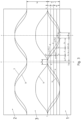
- the edges of the crests and valleys are points or straight sections perpendicular to the longitudinal axis as depicted in Figure 3 , wherein if the edges of the crests and valleys are points, in the case of relative rotational motion of rotor 3 between two annular components 1,3 with constant velocity, results a simple and/or harmonic reciprocation, whereas if the edges of the crests and valleys are straight sections, in the case of relative rotational motion of rotor 3 between two annular components 1,3 with constant velocity, results a reciprocal motion with an inversion delay in TDC and BDC.
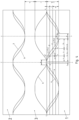
- curves ⁇ and ⁇ are the same and in the same relative and absolute location as those of Figure 3
- curves ⁇ ⁇ and ⁇ are the same and in the same relative location as those of Figure 3
- the second annular component 3 may be rotating relative to the first and third annular component 1, 2 continuously contacting, at least at one point, one side of the first and one side of the third annular component 1, 2.
- a geometric shape ⁇ 2 is similar to some other geometric shape ⁇ 1 (as regards a common coordinates system), provided that the coordinates of ⁇ 2 result from the corresponding coordinates of ⁇ 1 by multiplying them with the similarity ratio.
- the similarity ratio may be greater, lesser or equal to one; therefore we may get enlargement, shortening or equality to ⁇ 1 , respectively.
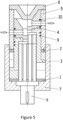
- Figures 5 , 6 and 7 show applications in piston engines (motors or pumps/compressors) having an integrated motion transformation mechanism, according to the invention, comprising an additional mechanism with a third annular component 2 and a valve array according to the invention.
- Said engines comprise one or more cylinders (in parallel and/or opposing arrangement for the neutralization of the inertial forces), wherein the second annular component 3, functioning as rotor, is firmly connected to a cylindrical piston 4 rotating and reciprocating simultaneously.
- Said engines comprise auxiliary systems (lubrication, refrigeration, fuel, starter etc.) known from the state of the art.
- the first and the third annular components 1, 2 operate as stators and are firmly mounted onto a body 7, while rotor 3 is rotating and reciprocating axially according to the invention, moving by means of a spline from an axis 6 coinciding with the axis of the cylinder of the piston engine in Figure 5 , or from axis 6 moving via axle 11 located outside the cylinder, in parallel to its axis, as it arises from Figure 7 , wherein motion is transmitted to the axis through an axle 11 via gearwheels 12, 15.
- motion is transmitted to the rotor by an axle 11 via gear 12 and rack in the rotor external surface 3.
- the length of the gear rack 12 allows the continuous engagement of the rotor rack 3 as it reciprocates while rotating.
- Indicator 16 shows a body cover 7.
- each valve with apertures (one aperture in the liner and one on the piston) of the type of the present invention one aperture is circular and the other oblong, when fluid is uncompressed.
- the number of valve apertures (both suction and compression) of the type of the present invention is double the number n of crests/valleys, whereas the number of valves of 4-stroke ICEs is equal to n.
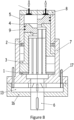
- FIGs 8 , 9 and 10 applications are shown in piston engines (motors or pumps/compressors) with an integrated motion transformation mechanism according to the invention including additional mechanism with a third annular component 2, wherein the second annular component 3 functioning as a rotor is firmly connected to piston 4 rotating and reciprocating simultaneously in combination with conventional/classic valves 18.
- Said engines are constituted by one or more cylinders (in parallel and/or opposing arrangement, for the neutralization of the inertial forces) with a common axle 11 and auxiliary systems (lubrication, refrigeration, fuel, starter etc.) from the state of the art.
- Figure 8 differs from Figure 5 in that the valve arrangement according to the invention has been replaced by conventional/classic valves 18.
- a disk-shaped cam 13 can be distinguished fitted directly above axis 6 plus rods 17 required in case of an ICE.
- Figure 9 differs from Figure 6 in that the valve arrangement according to the invention has been replaced by conventional/classic valves 18.
- a disk-shaped cam 13 can be distinguished fitted directly above axle 11 plus rods 17 required in case of an ICE.
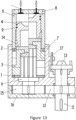
- Figure 10 differs from Figure 7 in that the valve arrangement according to the invention has been replaced by conventional/classic valves 18, while in the case of an ICE a disk-shaped cam 13 fitted directly above axle 11 and rods 17 are provided.
- Figures 11 , 12 and 13 differ from Figures 8 , 9 and 10 , respectively, in that piston 4 is connected in such a way to rotor 3 so as to be free not to follow the rotation of rotor 3, causing the rotation of axis 6 or axle 11, and to execute only reciprocating motion inside liner 5. This is achieved through linearly sliding elements 14 (wedges, balls etc.).
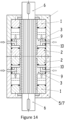
- FIG 14 another application of a double-effect piston engine (engine or pump/compressor) according to the present invention, wherein the working fluid operates between stators 1 and 2, rotor 3 and a cylindrical liner-body 5/7.
- a double-effect, two-cylinder piston engine is shown, with a motion transformation mechanism, valves with apertures or conventional, rotor 3, rotation on axis 6 with a sliding spline, wherein the role of the piston is effected by rotor 3, since the working fluid operates between the two stators 1 and 2, rotor 3 and cylindrical liner-body 5/7.
- the engine may function, with simple apertures as valves according to the invention on the stator 3 and the liner-body 5/7, but also with various types of conventional/classic valves above the liner-body 5/7.
- the indication is to combine, as in Figure 14 , two opposing stators 3 with the corresponding stators 1 and 2 in the same liner-body 5/7, or to combine suitably more cylinders, as in Figure 15 .
- the cases of 2-stroke ICEs, hydraulic motors and pumps/compressors are of particular interest.
- the present invention applies to all kinds of engines and automations wherein transformation of rotational to reciprocal motion or the reverse is taking place, such as in mechanical presses, nail making machines, sewing machines, printing machines etc.
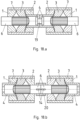
- FIG 16.a the arrangement of a clutch is shown comprising a first annular component 1 connected to axis 6 with an axially slipping spline, a component (secondary axis) 4 connected firmly to the second annular component 3, at the same time a special mechanism, according to the state of the art, may exert an axial force F on the first annular component 1 and forces its crests to enter the valleys of the second annular component 3. In this condition the rotation of axis 6 is transferred totally to the secondary axis 4. If the axial force F on the first annular component 1 is lifted, it will recede and disengage from the second annular component 3, in which case the transfer of rotation from axis 6 to secondary axis 4 will be interrupted.
- FIG 16.b a more effective clutch arrangement is shown, wherein axis 6 is connected via a sliding spline to rotor 3, i.e. with the second annular component, stator 2, i.e. the third annular component, is connected firmly to component (secondary axis) 4, on the other hand in this initial position/condition rotor 3 slides simultaneously and moves freely between stators 1 and 2, without affecting their kinematic condition.
- a special mechanism may exert an axial force F on stator 1, forcing the first and third annular components 1 and 2 to approaching sufficiently each other.
- stators 1 and 2 are connected externally to a liner 7: the first with axially sliding wedges 14, and the third enabled to rotate only slightly.
- the special mechanism exerting force F enjoys wide application in the current state of the art, it may be somewhat equivalent to the mechanisms encountered in the clutches of all sorts of vehicles (cars, trucks, tractors etc.) and it may work mechanically and/or hydraulically, and/or pneumatically etc.
- a feature/advantage of such a clutch is the simple and compact construction, but mainly, the transfer of motion with mechanical engagement, not friction, resulting in the (almost complete) lack of wear, on account of the absence of friction during the sliding action of the cooperating parts, due to the hydrodynamic lubrication thereof.
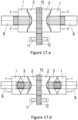
- FIG. 17 an arrangement for a differential is shown, comprising two mirror-image symmetric sections, each one of them consisting of a first annular component 1 and a second annular component 3 connected to an axis 6 with a sliding spline.
- a special mechanism exerts force F on the first annular component 1 and keeps it engaged with the second annular component 3.
- Each one of the two annular components 3 is connected firmly to a gearwheel 15 moving through axis 11 via the cooperating gearwheel 12. As long as the resistance of two the axes 6 in motion is the same, the first annular components 1 remain engaged with the second annular components 3, and the rotation of gearwheel 15 is transferred to its full effect to axes 6.
- FIG 17.b a more effective differential arrangement is provided as a combination of the arrangements presented in Figures 16.b and 17.a , the combined descriptions of which provide the operating mode of this particular type of differential.
- the differential arrangement comprises two mirror-image symmetric sections, each one consisting of the second annular component 3, functioning as a rotor, connected to an axis 6 by means of a sliding spline, a first annular component 1 and a third annular component 2. In this initial position/condition rotor 3 slides, and at the same time moves freely, between stators 1 and 2 without affecting their kinematic condition.
- a special mechanism exerts a force F on the first annular component 1 moving to the third annular component 2, entrapping and immobilizing second annular component 3 between the first and the third component 1 and 2, such that the third annular component 2 is engaged firmly and moving simultaneously to axis 6.
- the two mirror-image symmetric sections are connected firmly via third annular components 2 to a gearwheel 15, moving from one axis 11 via a cooperating gearwheel 12.
- the operation of the arrangement as a differential is determined by the entrapping and immobilization or not of the second annular component 3.
- the first annular component 1 is connected to a body 7 via the use of axial sliding 14, and the third annular component 2 is connected to body 7 having the capability of slight circumferential sliding.
- the special mechanism of exerting force F may operate mechanically and/or hydraulically, and/or pneumatically etc., with or without electronic assistance.
- a feature/advantage of such a differential is the simple and compact construction, but mainly, the transfer of motion via mechanical engagement, not friction, resulting in the (almost complete) lack of wear, owing to the absence of friction during the sliding action of the cooperating parts, because of the hydrodynamic lubrication thereof, as well as the ability to operate as an "LSD" differential.
- axis 6 of the first mechanism rotates with N 1 rotations
- a feature/advantage of such an increasing-reducing device is the in-line (coaxial) arrangement and the capability, in addition to increase/reduce the no. of rotations, to achieve the increase/reduction of the no. of reciprocations as well, with or without altering the path length.
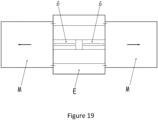
- Figure 19 shows the coupling of an electrical engine (power generator/electric motor) with two similar engines M (motors or pumps/compressors, respectively) as those described in the applications reported in Figures 5 , 8 and 11 of the present invention.
- the bodies of engines M are mounted coaxially onto the body (stator) of the electrical engine E: one on the right and the other on the left.
- the rotor axis of the electrical engine E is abolished and it is substituted by axes 6 of engines M, and in doing so they get synchronized relative to each other, resulting in operating with pistons moving in opposing directions in order for the inertial forces of reciprocation to balance out.
- This type of coupling corresponds to Figure 15.a , however it offers an advantage over it, since the parallel axis is absent, having been substituted by the electrical engine rotor.
- a feature/advantage of such an electromechanical pair is its simplicity, the particularly small size/weight, the high power concentration and the compactness (compact) of the construction compared to other conventional cases.
- the described engines of the present invention may function as 2-stroke petrol engines with clean fuel (no lubricant addition).
- Fuel injection with spraying is required, input of air using a compressor (turbo), a construction allowing the delay of motion inversion in TDC and BDC according to the present invention, and valves with apertures according to the present invention, or controlled by a disk-shaped cam, and regulated (a possibility also provided by the present invention) to operate in the following order: as soon as the expansion phase is completed and just before the piston reaches BDC, the output valve opens and most of the exhaust gases escape, then the input valve opens and the incoming air under pressure forces out the remainder of the exhaust gases (sweeping/flushing), the outlet valve closes followed by the inlet valve once the cylinder is filled with air, and motion inversion starts towards TDC. Next come compression phase, injection, ignition and combustion of the fuel and, finally, expansion, and a new identical cycle starts all over again.
- a feature/advantage of such a 2-stroke petrol engine is its small size/weight, roughly half that of a conventional 2-stroke petrol engine of the same power output, plus its non-polluting operation, i.e. the emission of exhaust gases comparable quality-wise to those of a 4-stroke petrol engine, contrary to the polluting exhaust gases of the conventional 2-stroke petrol engines.
- the described engine may also operate the same way as a diesel engine.
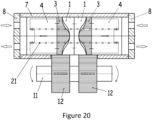
- Figure 20 the application of a mechanism in a two cylinder piston engine is shown, corresponding to that of Figure 15.a , wherein the cylinders are coaxial, mounted in a mirror-image arrangement, with two components 4 moving in opposing directions -functioning as pistons- for balancing the inertial forces of reciprocation and characterized in that each cylinder operates with a pair of annular components with undulated surfaces transforming motion on their adjacent sides, according to the present invention, and their continuous contact ensures a force being exerted continuously onto the piston, as it moves from TDC to BDC and vice versa.
- each cylinder comprises a first annular component 1 functioning as stator, a second annular component 3 functioning as rotor connected firmly to a piston 4.
- the stators 1 are connected firmly between them and with a common body 7.
- Each rotor 3 carries an external rack cooperating with a gearwheel 12 mounted on a common axis 11, parallel to the longitudinal axis of the cylinders.
- Gearwheels 12 synchronize rotors 3 and transfer motion to axis 11.
- a force is exerted on pistons 4, as they move between TDC and BDC, which is due to the pressure of the working fluid and/or the assistance of a pulling spring 21, keeping the undulated surfaces of rotors 3 in contact with the corresponding stators 1.
- the pulling spring 21 connects pistons (4) between them through apertures in the stators 1, therefore it acts assisting their recovery, holding rotors 3 in continuous contact with the corresponding stators 1, a fact particularly important during the period of time the engine is not operating, thus avoiding its detuning.
- Each cylinder comprises valves according to the invention or conventional/classic valves 18, in combination with a disk-shaped cams 13, and rods 17.
- Such engines are the 2-stroke ICEs, the hydraulic and air motors, wherein the force onto the piston is due to the pressure of the working fluid.
- Pumps/compressors constitute a similar case, wherein the force onto the piston at the phase of suction is exerted exclusively by the pulling spring 21; as regards remaining elements, the same apply as set out in the case of motors.
- a feature/advantage of such an engine is its simplicity, the particularly small size/weight, the high power concentration and the compactness of construction compared to other conventional cases.
Landscapes
- Engineering & Computer Science (AREA)
- General Engineering & Computer Science (AREA)
- Mechanical Engineering (AREA)
- Chemical & Material Sciences (AREA)
- Life Sciences & Earth Sciences (AREA)
- Chemical Kinetics & Catalysis (AREA)
- Oil, Petroleum & Natural Gas (AREA)
- Wood Science & Technology (AREA)
- Organic Chemistry (AREA)
- Combustion & Propulsion (AREA)
- Transmission Devices (AREA)
- Apparatuses For Generation Of Mechanical Vibrations (AREA)
Description
- The invention relates to a mechanism for transforming reciprocal to rotational motion or vice versa according to
claim 1. It relates also to applications for the mechanism, as in fluid flow control valves, in piston engines, such as motors or pumps/compressors, in automation systems as well as in clutches, differentials, rotation/reciprocation speed increasing-reducing device and electromechanical couples in power generators/electric motors. - The most known and widespread straight-line reciprocal to rotational motion transformation mechanism is the piston - piston rod - crank mechanism. It finds widespread application in piston engines (motors or pumps/compressors) operating usually with air, water (liquid or steam), oil and fuels in a liquid or gaseous state (e.g. hydrocarbons, hydrogen etc). The flow control of each working fluid is achieved by valves of various types, opening and closing using many different ways or mechanisms (e.g. gravity, springs, rods, camshafts etc.).
- A serious disadvantage of the piston - piston rod - crank mechanism, as well as the engines based thereon, is the complexity and the large number of moving parts. The same applies also to the kinematic properties relating to the position, speed and acceleration of the moving parts as well as the vibrations caused by the inertial forces being developed. This is why balancing the mechanism is imperative; however balancing does not completely solve the problem due to the higher order harmonics remaining. Moreover, in the ICEs (Internal Combustion Engines), a disadvantage of the mechanism comprises also the piston inability to rest at the Top Dead Centre (TDC) and the Bottom Dead Centre (BDC) for a certain time interval, in order for the combustion to improve and the efficiency to increase, as well as to allow adequate time for cylinder exhaust gases sweeping/flushing out to take place in the two-stroke engines, respectively.
- The present invention concerns a simple mechanism for transforming rectilinear reciprocating motion to rotational, or vice versa, without a crankshaft and piston rod, being also able to provide the possibility of delaying the inversion of motion at the extreme positions of reciprocation (TDC and BDC). At the same time, it allows the provision of a valve configuration with simple apertures for fluid flow control. It also concerns products that can incorporate said mechanism and/or valve configuration with simple apertures, such as e.g. piston engines (motors or pumps/compressors), clutches, differentials, rotation/reciprocation speed increasing-reducing device, electromechanical couples in power generators/electric motors and automations.
- According to the invention a mechanism for transforming reciprocal to rotational motion is proposed, or vice versa, including a first annular component and a second annular component coaxially mounted the first one adjacent the second along a longitudinal axis, wherein both of them are capable of rotating round the longitudinal axis and reciprocating along the longitudinal axis, wherein the side of the first annular component adjacent the second annular component is in continuous contact, in at least one point, with the neighbouring side of the second annular component, wherein the contacting sides are smooth undulated surfaces formed as a geometric locus of the radii passing through smooth undulated curves of the external cylindrical surface of the first and second annular components, starting from their external surface and terminating in their internal surface, being characterized by n (natural number ≠ 0) repeated pairs of crests and valleys, wherein said crests/valleys are symmetric relative to the level defined by the highest/lowest point of the crest/valley (respectively) and the longitudinal axis.
- According to the invention the crests of the undulated surface of the first annular component may be in contact with the crests of the undulated surface of the second annular component and in this position the points of contact are located on a plane perpendicular to the longitudinal axis, relative to which the undulated surfaces of the first annular component and the second annular component are symmetrical.
- In addition the crests of each and every undulated surface are smaller than the geometrically similar valleys with a similarity ratio of 1:3, such that, when the crests enter the valleys of the other, and crest edges come into contact with the lowest point of the valleys of the opposite undulated surface, there is free space left between the undulated surfaces, resulting, when lubricated, in achieving friction and wear minimization owing to dynamic lubrication.
- With the proposed mechanism if the first annular component and the second annular component are forced into rotational motion relative to each other, remaining at the same time in continuous contact, then each point of the contacting undulated surfaces will trace, in relation to the other, an undulated trajectory and will execute at the same time, in relation to the other, a reciprocating motion n-times the frequency, wherein n is the number of crests/valleys, of the corresponding rotational motion frequency, between a TDC (Top Dead Centre) and a BDC (Bottom Dead Centre), this relative motion being executed by each component connected firmly to one of the annular components, while each component, e.g. a piston, connected to one of the annular components, in such a way that this connected component is free not to follow the rotation of the component to which it is connected, executes reciprocating motion only relative to the other annular component so that rotational motion is transformed to reciprocating motion of the component with or without coexisting rotation, whereas, conversely, the forced reciprocating motion of one annular component relative to the other is transformed to rotational motion of the component with or without the coexistence of reciprocating motion.
- The edges of the crests and valleys of the undulated surfaces of the two annular components may be points or straight sections perpendicular to the longitudinal axis, wherein if the edges of the crests and valleys are points, in case of relative rotational motion between the two annular components at constant speed, a generally simple and in special cases harmonic reciprocation results, whereas if the edges of the crests and valleys are straight sections, in the case of relative rotational motion between the two annular components at constant speed, a reciprocation results with a delay in the reversal of motion in the TDC and BDC proportional to the length of the straight sections. The reciprocating motion will be harmonic in case the planar spread of these curves comprises sinusoidal curves without straight sections in the crests perpendicular to the longitudinal axis.
- Note 1: In the previous paragraph, but also in the subsequent description as well as in the claims, whenever -for simplicity and brevity reasons in expression-reference is made to "points or straight sections" of the crest and valley edges and to "curves" of the frontal undulated surfaces of the annular components, in reality, this reference implies the planar spread of the undulated curves of the external surfaces of the first, second and, whenever provided, third annular component from which initiate the radii forming the adjacent (neighbouring) undulated surfaces of the annular components.
- Note 2: In the description as well as in the claims, whenever reference is made to contact "in at least one point" between the first and second or second and third
annular components annular components - The second annular component may function as a rotor and the first as a stator or vice versa. In the present description, applications are presented wherein the second annular component functions as a rotor and the first as stator.
- An additional mechanism is provided, in many applications, forcing the second annular component to be pushed on to the first annular component, such that the contacting undulated surfaces are in continuous contact relative to each other.
-
Figures 1 - 20 show the operating principle of the mechanism and its applications. These drawings do not follow precisely the principles of mechanical engineering drawing. These illustrations have not been drawn in great detail, and comprise simplifications, the major ones being the following:- a.
Figures 5 to 13 do not show views, only half-elevations: the arrangement with the rotor and piston position in TDC appears on the right and on the left the same in BDC. - b. Certain components known to the skilled artisan in the field are shown as a single integral part, however, in reality they are complexes of more than one component.
- c. Usual engine parts, known to the skilled artisan in the field (e.g. screws, ball-bearings, bushings, gaskets, flanges etc.) are not shown.
- d. Small axial lines indicate that the neighbouring components are firmly connected together.
- a.
-
Figures 1 ,2 ,3 and4 show in a simplified way the operating principle upon which the present invention is based, whereas inFigure 2 (above) a simple array of valves is shown in a simplified way, controlling the fluid flow, according to the present invention. -
Figure 5 shows the cylinder of a piston engine having a mechanism of transforming the motion according to the invention, valves with apertures, rotor cooperating with an axle through a spline, plus a piston reciprocating while rotating. -
Figure 6 shows the cylinder ofFigure 5 , the difference being that the stator is also a gearwheel cooperating with the rotating axle. -
Figure 7 shows the cylinder ofFigure 5 , the difference being that the axle is connected to a gearwheel cooperating with the rotating axle. -
Figure 8 shows the cylinder of an internal combustion piston engine having a mechanism of transforming the motion according to the invention, conventional valves, rotor cooperating with an axle through a spline, disc-shaped cam on the axle plus a piston reciprocating while rotating. -
Figure 9 shows the cylinder ofFigure 8 , the difference being that the stator is also a gearwheel cooperating with the rotating axle. -
Figure 10 shows the cylinder ofFigure 8 , the difference being that the axle is connected to a gearwheel cooperating with the rotating axle. -
Figure 11 shows the cylinder offigure 8 , the difference being that the piston reciprocates without rotating. -
Figure 12 shows the cylinder offigure 9 , the difference being that the piston reciprocates without rotating. -
Figure 13 shows the cylinder offigure 10 , the difference being that the piston reciprocates without rotating. -
Figure 14 shows a mirror-image symmetric, two-cylinder, double-effect piston engine, with a motion transformation mechanism according to the invention, valves with apertures or conventional, rotor cooperating with an axle through a spline, wherein the rotor is also a substitute for the piston, since the working fluid operates between the two stators, the rotor and a cylindrical body. -
Figure 15 shows multi-cylinder arrangements based onFigures 5 to 14 , wherein absolute neutralisation is achieved of the inertial forces resulting from the reciprocating masses of the rotor and the piston. -
Figure 16 shows arrangements of clutches based on the motion transformation mechanism according to the invention. -
Figure 17 shows arrangements of differentials based on the motion transformation mechanism according to the invention. -
Figure 18 shows arrangements of rotation/reciprocation speed increasing-reducing device based on the motion transformation mechanism according to the invention. -
Figure 19 shows the coupling of an electrical engine (power generator/electric motor) with two engines (motors or pumps/compressors, respectively) based on the motion transformation mechanism according to the invention. -
Figure 20 presents engines based on the motion transformation mechanism according to the invention, with two mirror-image symmetric cylinders, a pair of undulated surfaces per cylinder plus a mechanism forcing them into contact using pressure and the assistance of a spring. - In
Figure 1 the motion transformation mechanism is shown, according to the invention, comprising a firstannular component 1 and a secondannular component 3 coaxially located, the first beside the second, along a longitudinal axis ΔA, the two components being able to rotate around the longitudinal axis ΔA and to reciprocate along the longitudinal axis ΔA. Side A of the firstannular component 1 adjacent the secondannular component 3 is in continuous contact in at least one point with neighbouring side Γα of the secondannular component 3, such that the secondannular component 3 can move relative to the firstannular component 1 being in continuous contact in at least one point with neighbouring side A of the firstannular element 1. The contacting sides are smooth undulated surfaces A, Γα, shaped as a geometric locus of the radii passing through the undulated curves α and γα, respectively, of the external cylindrical surface of the first and secondannular component Figure 1 to 4 , n=2. - If the first
annular component 1 and the secondannular component 3 are forced into rotational motion relative to each other, remaining at the same time in continuous contact, then each point of the undulated surfaces A, Γα will trace, in relation to the other, an undulated trajectory and will execute at the same time a reciprocating motion with a frequency n-times, wherein n is the number of crests/valleys, the corresponding rotational motion frequency, between a TDC (Top Dead Centre) and a BDC (Bottom Dead Centre), this relative motion being executed by each component connected firmly to one of theannular components annular components annular component - According to
Figure 1 , the crests of each and every undulated surface A, Γα are smaller than the geometrically similar valleys with a similarity ratio of 1:3, such that, when they enter the valleys of the other, and points of the crests come into contact with points of the opposite undulated surface, there is free space left between the undulated surfaces, resulting, when lubricated, in achieving friction and wear minimization owing to dynamic lubrication. - In
Figure 2 a motion transformation mechanism is shown, according to the invention, differing from the mechanism offigure 1 in that it comprises an additional mechanism forcing the secondannular component 3 to be pushed onto the firstannular component 1, in order for the undulated surface Γα to be in continuous contact with undulated surface A. The additional mechanism comprises a thirdannular component 2, coaxially mounted in relation to the first and the secondannular components annular component 3 is located between the first and the thirdannular component annular component 3, is undulated surface B characterized by the same undulated curve A of the firstannular component 1, and by being its mirror-image in space and in continuous contact in at least one point with its adjacent side of the secondannular component 3, which is also undulated surface Γβ characterized by having the same undulated curve-shape with the firstannular component 1 of the adjacent side Γα of the secondannular component 3, but located symmetric to surface Γα and displaced distally with the crests located opposite the valleys of surface Γα, such that the secondannular component 3 may rotate relative to the first and thirdannular components annular component - In the example of
Figure 2 the secondannular component 3 is connected to apiston 4 either firmly, or in such a way that the secondannular component 3 and thepiston 4 are free to rotate independently around the longitudinal axis ΔA. Furthermore, acylindrical liner 5 is shown (dismantled in the extension of longitudinal axis ΔA), inside which moves -in circumferential contact-cylindrical piston 4 covered by acover 8. In this example the secondannular component 3 functions as a rotor, whereas first and thirdannular components - If
piston 4 is concave and connected firmly to the secondannular component 3, and at least one aperture O4 is located onpiston surface 4, in case of rotational motion of the secondannular component 3, aperture O4, tracing a wavy trajectory E, will meet at least one aperture Os offixed liner 5 found inside, or crosses trajectory E. The common points of apertures O4 and O5 allow for periodic communication between the interior ofpiston 4 and the exterior ofliner 5, for the time duration the apertures ofpiston 4 andliner 5 are communicating. Thus, a very simple arrangement of fluid flow control valves is created, between the internal space and the external environment, in a cylinder of a piston engine, throughconcave piston 4 andliner 5. - In
Figure 3 spreads are shown of the undulated curves α, γα/γβ and β, respectively, of the external cylindrical surfaces of the first, second and thirdannular components Figure 2 . - From
Figures 3 emerges that the crests of the undulated surface of the firstannular component 1 may be in contact with the crests of the undulated surface of the secondannular component 3 and that in this location the undulated surfaces A, Γα of the firstannular component 1 and the secondannular component 3 are both in symmetry to a plane connecting together their points of contact, whereas in this location the crests of the undulated surface B of the thirdannular component 2 are in contact with the valleys of the opposite undulated surface Γβ of the secondannular component 3 and the crests of the undulated surface of the secondannular component 3 are in contact with the valleys of the opposite undulated surface of the thirdannular component 2. - From
Figure 3 it emerges that providedrotor 3 is rotated, each point ofrotor 3 andpiston 4, which is firmly connected to the rotor, will be moved tracing a closed undulated trajectory, with a spread similar to curve ω, (with equal crests and valleys that are geometrically similar to the crests and valleys of the undulated curves α, γα/γβ and β with similarity ratios 2:1 and 2:3, respectively), traced bypoint 3 of each crest of curve γα ofrotor 3. This motion, incase rotor 3 rotates with a constant velocity, is analyzed in a smooth circular motion with the same frequency and a reciprocal motion between TDC (Top Dead Centre) and BDC (Bottom Dead Centre) with double (generally n-times) frequency. - According to the invention, the edges of the crests and valleys are points or straight sections perpendicular to the longitudinal axis as depicted in
Figure 3 , wherein if the edges of the crests and valleys are points, in the case of relative rotational motion ofrotor 3 between twoannular components rotor 3 between twoannular components - In
Figure 4 spreads are shown of the undulated curves α, γα/γβ and β, respectively, of the external cylindrical surfaces of the first, second and thirdannular components Figure 2 , the only difference being that the thirdannular component 3 is symmetrical to the plane perpendicular to the longitudinal axis ΔA. In relation toFigure 3 , curves α and γα are the same and in the same relative and absolute location as those ofFigure 3 , on the other hand curves γβ and β are the same and in the same relative location as those ofFigure 3 , however, in a different position in relation to curves α and γα, resulting in the crests and valleys of the secondannular element 3 being symmetric and located opposite crests and valleys, respectively. Also in this particular case, the secondannular component 3 may be rotating relative to the first and thirdannular component annular component - In
Figures 3 and4 , for curves α, γα and, in case there is the additional mechanism comprising the thirdannular component 2, for curves β and γβ the following apply: - 1. It is about the same smooth, periodic, undulated curve in different locations with number n (natural ≠ 0) of repeated pairs of geometrically similar crests 12345 and valleys 56789 with a similarity ratio of 1:3 (in
Figures 1 ,2 ,3 and4 : n =2). - 2. Curve γα is symmetric to α relative to axis ξ-ξ. In
Figure 3 curve β results by the axial displacement (by d) of γα, while γβ by axial (L+d) and circumferential displacement by 90□ (generally 360□/2n) of α. InFigure 4 curve β results by the axial (L+d) and circumferential displacement by 90□ (generally 360□/2n) of γα, while γβ by axial displacement (2L+d) of α. - 3. Each crest 12345 is symmetrical relative to axis µ-µ and each valley 56789 relative to axis v-v. The crests and valleys are expressed in the systems of coordinates x1-y1 and x2-y2, with common origin,
point 5, and opposite axes, from the similar equations y1=f(x1) and y2=f(x2), respectively. The crests occupy 1/4 and the valleys theremainder 3/4 of the total height L of the undulated curves α, β, γα and γβ. - 4. Sections 234 and 678 may be straight, wherein: 678≥234≥0
- 5. When crests of one curve enter the valleys of the other, leave free space between their curves, i.e. the size of the crests is smaller than that of the geometric similar valleys with a similarity ratio of 1:3.
- 6. If the external surface of
rotor 3 moves to one direction, while those of thestators rotor 3, it is proved that it will move tracing an undulated trajectory like ω, (with equal crests and valleys that are geometrically similar to the crests and valleys of the undulated curves α, γα/γβ and β with similarity ratios 2:1 and 2:3, respectively), with or without straight sections in its crests and valleys (Figures 3 or4 ), as described below insection 9. Curve ω is expressed in the system of coordinates x-y, the point in the middle of height L being the origin and in equal distance from axes µ-µ and v-v, from equation y=f(x) which is similar to equations y1=f(x1) and y2=f(x2). The total height of curve ω is equal to the total height L of the undulated curves α, β, γα and γβ. - 7. Referring to
Figures 3 and4 , two characteristic pairs of equations are mentioned as an example, describing parts 45 and 56 of curve α respectively:- a.


- b.


section 3. - a.
- 8. In the case of the curves of previous section, trajectory ω traced by each point of the spread of external surface of
rotor 3 will be derived, respectively, from equations:- a.

- b.

section 3. - a.
- 9. If sections 234 and 678 are straight with a length (precisely) of c and 3c, respectively, between the curved sections of the trajectory or curvilinear motion ω, described by the previous equations of
passage 8, interposed equally are equal sections oflength 2c, corresponding to equal time intervals of delay in motion inversion in TDC and BDC. A different relation (ratio) of the lengths of sections 234 and 678 poses problems, such as to bring about the insertion of unequal straight sections, i.e. a different motion inversion delay in TDC and BDC, possibly causing problems of timing in multi-cylinder engines. Generally, equal delay time intervals in motion inversion in TDC and BDC result in case the crest edges are straight sections of length c and the valley edges are straight sections of length 3c, respectively. - Remark: In order to achieve a - desirable - smooth periodic undulated trajectory or curvilinear motion ω (of all the points of the external surface of rotor 3) with equal crests and valleys, we specify the undulated curves α, γα/γβ and β, such that the crests and the valleys are similar to the crests/valleys of curve ω with a similarity ratio of 1:2 and 3:2, respectively. Then,
rotor 3 rotates and reciprocates smoothly, sliding - continuously contacting - simultaneously bothstators stator 3 motion is blocked. - Definition: We say that a geometric shape Σ2 is similar to some other geometric shape Σ1 (as regards a common coordinates system), provided that the coordinates of Σ2 result from the corresponding coordinates of Σ1 by multiplying them with the similarity ratio. The similarity ratio may be greater, lesser or equal to one; therefore we may get enlargement, shortening or equality to Σ1, respectively.
-
Figures 5 ,6 and7 show applications in piston engines (motors or pumps/compressors) having an integrated motion transformation mechanism, according to the invention, comprising an additional mechanism with a thirdannular component 2 and a valve array according to the invention. Said engines comprise one or more cylinders (in parallel and/or opposing arrangement for the neutralization of the inertial forces), wherein the secondannular component 3, functioning as rotor, is firmly connected to acylindrical piston 4 rotating and reciprocating simultaneously. Said engines comprise auxiliary systems (lubrication, refrigeration, fuel, starter etc.) known from the state of the art. - The first and the third
annular components body 7, whilerotor 3 is rotating and reciprocating axially according to the invention, moving by means of a spline from anaxis 6 coinciding with the axis of the cylinder of the piston engine inFigure 5 , or fromaxis 6 moving viaaxle 11 located outside the cylinder, in parallel to its axis, as it arises fromFigure 7 , wherein motion is transmitted to the axis through anaxle 11 viagearwheels Figure 6 motion is transmitted to the rotor by anaxle 11 viagear 12 and rack in the rotorexternal surface 3. The length of thegear rack 12 allows the continuous engagement of therotor rack 3 as it reciprocates while rotating.Indicator 16 shows abody cover 7. - In
Figures 5 ,6 and7 the cylinder is supplemented by acylindrical liner 5, inside which moves -circumferentially contacting-piston 4 covered by acylinder cover 8. Included also arepiston rings 9 andvalve spring 10. - In each valve with apertures (one aperture in the liner and one on the piston) of the type of the present invention, one aperture is circular and the other oblong, when fluid is uncompressed. In addition, in applications wherein there are piston hydraulic engines or pumps/compressors and 2-stroke ICEs, the number of valve apertures (both suction and compression) of the type of the present invention is double the number n of crests/valleys, whereas the number of valves of 4-stroke ICEs is equal to n.
- In
Figures 8 ,9 and10 applications are shown in piston engines (motors or pumps/compressors) with an integrated motion transformation mechanism according to the invention including additional mechanism with a thirdannular component 2, wherein the secondannular component 3 functioning as a rotor is firmly connected topiston 4 rotating and reciprocating simultaneously in combination with conventional/classic valves 18. Said engines are constituted by one or more cylinders (in parallel and/or opposing arrangement, for the neutralization of the inertial forces) with acommon axle 11 and auxiliary systems (lubrication, refrigeration, fuel, starter etc.) from the state of the art. -
Figure 8 differs fromFigure 5 in that the valve arrangement according to the invention has been replaced by conventional/classic valves 18. A disk-shapedcam 13 can be distinguished fitted directly aboveaxis 6 plusrods 17 required in case of an ICE. -
Figure 9 differs fromFigure 6 in that the valve arrangement according to the invention has been replaced by conventional/classic valves 18. A disk-shapedcam 13 can be distinguished fitted directly aboveaxle 11 plusrods 17 required in case of an ICE. -
Figure 10 differs fromFigure 7 in that the valve arrangement according to the invention has been replaced by conventional/classic valves 18, while in the case of an ICE a disk-shapedcam 13 fitted directly aboveaxle 11 androds 17 are provided. -
Figures 11 ,12 and13 differ fromFigures 8 ,9 and10 , respectively, in thatpiston 4 is connected in such a way torotor 3 so as to be free not to follow the rotation ofrotor 3, causing the rotation ofaxis 6 oraxle 11, and to execute only reciprocating motion insideliner 5. This is achieved through linearly sliding elements 14 (wedges, balls etc.). - Since the piston executes reciprocating motion only inside
liner 5, the mechanism described may be combined only with conventional/classic valves 18 and, in case of (ICEs), with a disk-shapedcam 13 fitted directly aboveaxis 6 oraxle 11, plusrods 17. - In
Figure 14 another application of a double-effect piston engine (engine or pump/compressor) according to the present invention, wherein the working fluid operates betweenstators rotor 3 and a cylindrical liner-body 5/7. Specifically, a double-effect, two-cylinder piston engine is shown, with a motion transformation mechanism, valves with apertures or conventional,rotor 3, rotation onaxis 6 with a sliding spline, wherein the role of the piston is effected byrotor 3, since the working fluid operates between the twostators rotor 3 and cylindrical liner-body 5/7. - As in
Figures 5 to 13 , the engine may function, with simple apertures as valves according to the invention on thestator 3 and the liner-body 5/7, but also with various types of conventional/classic valves above the liner-body 5/7. - In order to neutralize the inertial forces, the indication is to combine, as in
Figure 14 , two opposingstators 3 with the correspondingstators body 5/7, or to combine suitably more cylinders, as inFigure 15 . In this application, the cases of 2-stroke ICEs, hydraulic motors and pumps/compressors are of particular interest. - The engines presented in
Figures 5 to 14 execute in each of their rotation so many reciprocations as the number n of crests/valleys existing in each undulated surface ofstators rotor 3. The case in which n = 1 is infrequent due to the emergence of asymmetric internal forces causing friction forces betweenpiston 4 andliner 5 and relative wear. Usually n = 2, thus in 4-stroke ICEs embodying the present invention, each operation cycle is completed in one rotation versus two rotations in the conventional ICEs. This has as a result the doubling (roughly) of power for the same cylinder capacity engines. The effect is opposite -in combination with the absence of piston rod and classic camshaft- in the size/weight of the engine: it is decreased (roughly) by 50% for the same power output. The above apply and are generalized accordingly for n>2. - The same also holds in 2-stroke ICEs wherein once again the power is doubled or the size/weight is decreased by half compared to the conventional 2-stroke engines for the same cylinder capacity or power, respectively.
- Finally, in all ICEs incorporating the present invention and using a disk-shaped cam, the absolute control is made feasible of the stroke, timing and duration of activation of the conventional/classic valves, owing to the fact that there are no restrictions in choosing the position and configuring the shape and size of the cams.
- In
Figure 15 , arrangements are shown based on the applications corresponding toFigures 5 to 14 , wherein absolute neutralisation is achieved of the inertial forces resulting from the reciprocating masses ofrotor 3 andpiston 4 without balancing: the arrows show the relative motion in the various cylinders. Whenever it is feasible, the combustion is carried out consecutively in the various cylinders and shared equally in each rotation ofaxle 11, for reasons of smoothening-out power flow. - Specifically, in
figure 15 the following interesting cases are set out: - a. 2 cylinders placed in opposing arrangement, with the working fluid chambers at the ends, and with a power output from a parallel axle with two output positions. The specific arrangement constitutes a simple unit of autonomous operation (SUAO) with the reciprocating inertial forces balanced completely.
- b. 2 cylinders placed in opposing arrangement, with the working fluid chambers unified or not in the centre, and with a power output from a parallel axle with two output positions. In ICEs, the unified chambers case is at a disadvantage relative to the separate chambers case, due to half of the combustions talking place, resulting in greater fluctuations in the power flow curve. This arrangement constitutes another version of a simple unit of autonomous operation (SUAO).
- c. 4-Cylinder or multi-cylinder engine composed by units from case 15.a for smoother operation, and/or greater power with a single output.
- d. 4-Cylinder or multi-cylinder engine composed by units from
Figure 15.b for smoother operation, and/or greater power with a single output. - e. 4 Cylinders arranged in parallel on the same level, with two power outputs constituting the extension of
axes 6. - f. 4 Cylinders arranged in parallel on the same level, with a parallel power output at the centre with two ends.
- g. 4 Cylinders arranged in parallel and in a circle (every 90□), with a parallel power output at the centre with two ends.
- h. 4 Cylinders arranged in parallel and in a circle (crosswise), with a parallel power output at the centre with two ends.
- Moreover, for the applications of
Figures 5 to 14 , the following remarks are in effect: - 1. The working fluid operates inside
liner 5, between the free surface ofpiston 4 andcover 8. - 2. In
Figures 5 ,7 ,8 ,10 ,11 ,13 and14 ,axis 6 coincides with the cylinder axis. - 3. In
Figures 6 ,9 and12 ,axle 11 is positioned outside the cylinder, in parallel to its axis. The motion fromaxle 11 torotor 3 is transmitted viagear 12 and rack on therotor 3 external surface. Reverse applies as well. The length of thegear rack 12 allows the continuous engagement of therotor rack 3 as it reciprocates while rotating. - 4. In
Figures 8 and11 , whereinconventional valves 18 are used, the disk-shapedcam 13 is positioned ontoaxis 6. - 5. In
Figures 9 ,10 ,12 and13 , whereinconventional valves 18 are also used, the disk-shapedcam 13 is positioned ontoaxle 11, and on its disk it bears only one set of cams. These cases are recommended for multi-cylinder engines provided that the cylinders are arranged in parallel and an equal distance (circularly) round the single axle 11 (seeFigures 15 g and 15h ). - 6. In
Figures 7 ,10 and13 ,axle 11 is driven byaxis 6 via a pair ofgearwheels - 7. In
Figures 8 to 13 , when reference is made to applications in piston hydraulic motors or pumps/compressors, suitable conventional/classic valves are used according to the specific configuration. µalves, piston-rods and the crankshaft disk (referring to ICEs) are abolished. - 8. In
Figures 5 ,6 ,7 and14 , when reference is made to applications in piston hydraulic motors or pumps, in each pair of valves with apertures (present invention type) one is circular and the other oblong, when the fluid is uncompressed. - 9. In
Figures 5 ,6 ,7 and14 , when reference is made to applications in piston hydraulic motors or pumps/compressors and 2-stroke ICEs, the number of valve apertures (present invention type) is double that of the no. of valves in 4-stroke ICEs. - 10. In
Figures 5 ,7 ,8 ,10 ,11 ,13 and14 rotation and the simultaneous reciprocation ofrotor 3 are achieved with a spline aboveaxis 6, whereas inFigures 6 ,9 and12 viagearwheel 12 and external rack onrotor 3. - In the cases described by means of the illustrations of
Figures 5 to 14 , the transformation of rotational to reciprocating motion and vice versa is carried out due to the sliding of surfaces Γα and Γβ of the secondannular component 3, which may also function as a rotor, onto surfaces A and B, respectively, of the first and thirdannular components Figures 2 ,3 and4 . The same result emerges also in case surfaces Γβ and B are eliminated and the secondannular component 3 is forced to be pushed onto the firstannular component 1, in order for surface Γα to be in continuous contact with A. This may be achieved e.g. in the following ways replacing the third annular component 2: - 1. Using spring(s) exerting pressure on
rotor 3, in combination with bearings, except in special cases (as in the case ofFigure 20 ). - 2. With two diametrically opposed rollers, mounted on
rotor 3, rolling onto a suitable undulated surface formed onstator 2, similar to surface B (Figure 2 ), in order for the axes of the rollers to trace curve ω ofFigure 3 or4 . - 3. Using pressure (hydraulic or pneumatic) on
rotor 3. - 4. Using an arrangement of magnetic/electromagnetic force on
rotor 3. - 5. Using the force of gravity (only for engines with vertical cylinders).
- Finally, the present invention applies to all kinds of engines and automations wherein transformation of rotational to reciprocal motion or the reverse is taking place, such as in mechanical presses, nail making machines, sewing machines, printing machines etc.
- In
Figure 16.a the arrangement of a clutch is shown comprising a firstannular component 1 connected toaxis 6 with an axially slipping spline, a component (secondary axis) 4 connected firmly to the secondannular component 3, at the same time a special mechanism, according to the state of the art, may exert an axial force F on the firstannular component 1 and forces its crests to enter the valleys of the secondannular component 3. In this condition the rotation ofaxis 6 is transferred totally to thesecondary axis 4. If the axial force F on the firstannular component 1 is lifted, it will recede and disengage from the secondannular component 3, in which case the transfer of rotation fromaxis 6 tosecondary axis 4 will be interrupted. - In
Figure 16.b a more effective clutch arrangement is shown, whereinaxis 6 is connected via a sliding spline torotor 3, i.e. with the second annular component,stator 2, i.e. the third annular component, is connected firmly to component (secondary axis) 4, on the other hand in this initial position/condition rotor 3 slides simultaneously and moves freely betweenstators stator 1, forcing the first and thirdannular components rotor 3 is immobilized betweenstators axis 6 is transferred in full effect to thesecondary axis 4. If the axial force F onstator 1 is lifted, by the special mechanism, it will recede to its initial position/condition,rotor 3 will be released and start moving again by sliding betweenstators axis 6 tosecondary axis 4 will be interrupted. - Optionally,
stators wedges 14, and the third enabled to rotate only slightly. - The special mechanism exerting force F enjoys wide application in the current state of the art, it may be somewhat equivalent to the mechanisms encountered in the clutches of all sorts of vehicles (cars, trucks, tractors etc.) and it may work mechanically and/or hydraulically, and/or pneumatically etc.
- A feature/advantage of such a clutch is the simple and compact construction, but mainly, the transfer of motion with mechanical engagement, not friction, resulting in the (almost complete) lack of wear, on account of the absence of friction during the sliding action of the cooperating parts, due to the hydrodynamic lubrication thereof.
- In
Figure 17.a an arrangement for a differential is shown, comprising two mirror-image symmetric sections, each one of them consisting of a firstannular component 1 and a secondannular component 3 connected to anaxis 6 with a sliding spline. A special mechanism, according to the state of the art, exerts force F on the firstannular component 1 and keeps it engaged with the secondannular component 3. Each one of the twoannular components 3 is connected firmly to agearwheel 15 moving throughaxis 11 via the cooperatinggearwheel 12. As long as the resistance of two theaxes 6 in motion is the same, the firstannular components 1 remain engaged with the secondannular components 3, and the rotation ofgearwheel 15 is transferred to its full effect toaxes 6. Should the resistance grow in one of theaxes 6, the corresponding firstannular component 1 will recede and the no. of rotations of thecorresponding axis 6 will be decreased, at the same time theother axis 6 will continue moving normally until equilibrium in the resistances of theiraxes 6 returns, and previous operation is restored. That is to say, the arrangement functions as a simple differential. In order to avoid the disadvantage of the immobilization of oneaxis 6 and the rotation of only the other one, in case the resistance of the latter is zero, it is imperative that control of forces F and rotations ofaxes 6 is exercised by means of electronic assistance. In this case both axes may be blocked completely and both axes may be rotating with the same speed: limited slip differential "LSD". - In
Figure 17.b a more effective differential arrangement is provided as a combination of the arrangements presented inFigures 16.b and17.a , the combined descriptions of which provide the operating mode of this particular type of differential. The differential arrangement comprises two mirror-image symmetric sections, each one consisting of the secondannular component 3, functioning as a rotor, connected to anaxis 6 by means of a sliding spline, a firstannular component 1 and a thirdannular component 2. In this initial position/condition rotor 3 slides, and at the same time moves freely, betweenstators annular component 1 moving to the thirdannular component 2, entrapping and immobilizing secondannular component 3 between the first and thethird component annular component 2 is engaged firmly and moving simultaneously toaxis 6. The two mirror-image symmetric sections are connected firmly via thirdannular components 2 to agearwheel 15, moving from oneaxis 11 via a cooperatinggearwheel 12. The operation of the arrangement as a differential is determined by the entrapping and immobilization or not of the secondannular component 3. Thus, for as long as the resistance of twoaxes 6 during motion is the same, the secondannular components 3 remain in engagement with the thirdannular components 2 and the rotation of thegearwheel 15 is transported to its full effect toaxes 6, on the other hand if the resistance grows on one of theaxes 6, the corresponding firstannular component 1 will recede slightly, the corresponding secondannular component 3 will be released and it will begin to slide simultaneously and to move freely between the first and the thirdannular components corresponding axis 6 will decrease until the balance of theaxes 6 resistances is restored, and the arrangement returns back to its initial position/operating condition. - Optionally, the first
annular component 1 is connected to abody 7 via the use of axial sliding 14, and the thirdannular component 2 is connected tobody 7 having the capability of slight circumferential sliding. - The special mechanism of exerting force F, just as in the differential arrangement applications of
Figures 16.a and 16.b , may operate mechanically and/or hydraulically, and/or pneumatically etc., with or without electronic assistance. - A feature/advantage of such a differential is the simple and compact construction, but mainly, the transfer of motion via mechanical engagement, not friction, resulting in the (almost complete) lack of wear, owing to the absence of friction during the sliding action of the cooperating parts, because of the hydrodynamic lubrication thereof, as well as the ability to operate as an "LSD" differential.
- In
Figure 18.a a first mechanism for the transformation of rotational to reciprocal motion or vice versa is shown, according to the present invention, with n = n1 number of crests and valleys, wherein a first and a thirdannular component body 7, while the secondannular component 3 is moved by anaxis 6 with a sliding spline and functions as a rotor firmly connected to apiston 4 turning and reciprocating axially, connected coaxially via apin 19 to a second similar mechanism, with the same reciprocation path L and a number of crests and valleys n = n2 ≠ n1, viapistons 4 in such a way as to allow for rotation relative to each other, however, not axial displacement. In this case, ifaxis 6 of the first mechanism rotates with N1 rotations, thenaxis 6 of the second mechanism will be rotating with N2 = N1 x (n1/n2) rotations, i.e., the pair of mechanisms functions as a rotation speed increasing-reducing device. - In
Figure 18.b , respectively, axes 6 of the two mechanisms are connected coaxially viawedges 14 of acoupler 20 in a fixed way, therefore the pair of mechanisms functions as a reciprocating speed increasing-reducing device. In the latter case, it may function also and/or as a reciprocation-path length increasing-reducing device L, provided the reciprocation-path length L1 of the first mechanism differs from the reciprocation-path length L2 of the second. - A feature/advantage of such an increasing-reducing device is the in-line (coaxial) arrangement and the capability, in addition to increase/reduce the no. of rotations, to achieve the increase/reduction of the no. of reciprocations as well, with or without altering the path length.
-
Figure 19 shows the coupling of an electrical engine (power generator/electric motor) with two similar engines M (motors or pumps/compressors, respectively) as those described in the applications reported inFigures 5 ,8 and11 of the present invention. The bodies of engines M are mounted coaxially onto the body (stator) of the electrical engine E: one on the right and the other on the left. The rotor axis of the electrical engine E is abolished and it is substituted byaxes 6 of engines M, and in doing so they get synchronized relative to each other, resulting in operating with pistons moving in opposing directions in order for the inertial forces of reciprocation to balance out. This type of coupling corresponds toFigure 15.a , however it offers an advantage over it, since the parallel axis is absent, having been substituted by the electrical engine rotor. - A feature/advantage of such an electromechanical pair is its simplicity, the particularly small size/weight, the high power concentration and the compactness (compact) of the construction compared to other conventional cases.
- In
Figures 5 to 14 , the described engines of the present invention may function as 2-stroke petrol engines with clean fuel (no lubricant addition). Fuel injection with spraying is required, input of air using a compressor (turbo), a construction allowing the delay of motion inversion in TDC and BDC according to the present invention, and valves with apertures according to the present invention, or controlled by a disk-shaped cam, and regulated (a possibility also provided by the present invention) to operate in the following order: as soon as the expansion phase is completed and just before the piston reaches BDC, the output valve opens and most of the exhaust gases escape, then the input valve opens and the incoming air under pressure forces out the remainder of the exhaust gases (sweeping/flushing), the outlet valve closes followed by the inlet valve once the cylinder is filled with air, and motion inversion starts towards TDC. Next come compression phase, injection, ignition and combustion of the fuel and, finally, expansion, and a new identical cycle starts all over again. - A feature/advantage of such a 2-stroke petrol engine is its small size/weight, roughly half that of a conventional 2-stroke petrol engine of the same power output, plus its non-polluting operation, i.e. the emission of exhaust gases comparable quality-wise to those of a 4-stroke petrol engine, contrary to the polluting exhaust gases of the conventional 2-stroke petrol engines.
- The described engine may also operate the same way as a diesel engine.
- In both cases (petrol engine or diesel engine) its size/weight is roughly one quarter the corresponding conventional 4-stroke engine size/weight.
- In
Figure 20 the application of a mechanism in a two cylinder piston engine is shown, corresponding to that ofFigure 15.a , wherein the cylinders are coaxial, mounted in a mirror-image arrangement, with twocomponents 4 moving in opposing directions -functioning as pistons- for balancing the inertial forces of reciprocation and characterized in that each cylinder operates with a pair of annular components with undulated surfaces transforming motion on their adjacent sides, according to the present invention, and their continuous contact ensures a force being exerted continuously onto the piston, as it moves from TDC to BDC and vice versa. - More specifically, in
Figure 20 , each cylinder comprises a firstannular component 1 functioning as stator, a secondannular component 3 functioning as rotor connected firmly to apiston 4. Thestators 1 are connected firmly between them and with acommon body 7. Eachrotor 3 carries an external rack cooperating with agearwheel 12 mounted on acommon axis 11, parallel to the longitudinal axis of the cylinders.Gearwheels 12 synchronizerotors 3 and transfer motion toaxis 11. A force is exerted onpistons 4, as they move between TDC and BDC, which is due to the pressure of the working fluid and/or the assistance of a pullingspring 21, keeping the undulated surfaces ofrotors 3 in contact with the correspondingstators 1. The pullingspring 21 connects pistons (4) between them through apertures in thestators 1, therefore it acts assisting their recovery, holdingrotors 3 in continuous contact with the correspondingstators 1, a fact particularly important during the period of time the engine is not operating, thus avoiding its detuning. Each cylinder comprises valves according to the invention or conventional/classic valves 18, in combination with a disk-shapedcams 13, androds 17. Such engines are the 2-stroke ICEs, the hydraulic and air motors, wherein the force onto the piston is due to the pressure of the working fluid. Pumps/compressors constitute a similar case, wherein the force onto the piston at the phase of suction is exerted exclusively by the pullingspring 21; as regards remaining elements, the same apply as set out in the case of motors. - A feature/advantage of such an engine is its simplicity, the particularly small size/weight, the high power concentration and the compactness of construction compared to other conventional cases.
- The advantages of the mechanisms of the present invention, in comparison to the disadvantages of the already existing ones, as well as the advantages of their implementation in piston engines (motors or pumps/compressors) and in automations are the following:
- 1. The exceptionally simple construction and the very small number of components required for their implementation.
- 2. The minimal number of moving components: only
axle 11 oraxis 6,rotor 3 andpiston 4. - 3. The possibility of implementing the valve arrangement with simple apertures without additional components and/or mechanisms.
- 4. The possibility of combining with
conventional valves 18 and cams (ICE) in a disk-shapedcam 13 ontoaxis 6 oraxle 11. The cams may be shaped in suitable configurations, so that they may open and close the valves more effectively in the predetermined times. - 5. The possibility of achieving an absolutely harmonic reciprocation without higher order harmonics.
- 6. The reciprocating motion of
piston 4 may be realized in various ways and described by simple mathematical equations. Typical cases of equations are the sinusoidal and the polyonymic. - 7. The possibility of delaying the piston motion inversion in TDC and BDC for better combustion and improved efficiency.
- 8. The possibility of neutralizing completely the inertial forces of the reciprocating motion without balancing, only with the proper cylinder arrangement.
- 9. The substantial absence of friction and wear between
piston 4 andliner 5 due to the entire lack of transverse forces between them. - 10. The sub-multiple force (half being the maximum, for n=2), exerted at the points of contact of the undulated sliding surfaces A, B and Γα/Γβ of
stators rotor 3, in relation to the force exerted at the point of contact of the gudgeon pin-piston rod of a conventional engine. - 11. The minimization of friction and wear of the sliding undulated surfaces A, B and Γα/Γβ of
stators rotor 3 respectively, because of the dynamic lubrication developed due to the favourable geometry. - 12. The manufacturing capability of antipollution technology 2-stroke ICEs of a size/weight/cost roughly 50% that of the conventional 2-stroke ICEs or 25% that of the conventional 4-stroke ICEs.
- 13. The compact construction of multi-cylinder engines: it is possible to arrange the cylinders in line with one (
Figure 15.f ) or two opposing axles (Figure 15.e ), or crosswise and crossways with a central axle (Figures 15.g and h , respectively). - 14. The roughly 50% size and/or volume reduction for the same power output and, consequently, the doubling of the power concentration. Reverse applies as well.
- 15. The roughly 50% reduction of the cost, due to the corresponding reduction of the size and/or volume for the same power output.
-
- 1. First annular component, stator.
- 2. Third annular component, stator.
- 3. Second annular component, rotor.
- 4. Piston or secondary clutch axis.
- 5. Liner.
- 6. Axle with sliding spline.
- 7. Body.
- 8. Cylinder cover.
- 9. Piston rings.
- 10. µalve spring (aperture).
- 11. Axle (common).
- 12. Axle gearwheel.
- 13. Cam disk.
- 14. Sliding element (wedge).
- 15. Axis gearwheel.
- 16. Body cover.
- 17. µalve rod.
- 18. Conventional/classic valve.
- 19. Coupling pin.
- 20. Coupler.
- 21. Pulling spring.
Claims (18)
- A mechanism for transforming rotating to reciprocating motion, and vice versa, the mechanism comprising:a first cam unit (1), anda second cam unit (3) opposing the first cam unit (1) and in contact with the first cam unit (1),wherein the cam units (1,3) are identical and able to rotate in relation to each other around, and to reciprocate in relation to each other along, a longitudinal axis (ΔA), and the linear and the rotational relative movements are coupled to each other by the shape of the cam surfaces of the cam units (1,3), and the shape of each cam surface is defined by at least one crest and one valley,characterized in that:
the at least one valley has the same geometrical shape as the at least one crest, scaled by a factor of 3, such that the curvature of the crest and valley is geometrically identical, but with the valley being larger with a ratio of 3:1, resulting in a trajectory of reciprocation being symmetric for both ends of the linear motion. - Mechanism for transforming rotating to reciprocating motion, and vice versa according to claim 1, wherein side (A) of the first cam unit (1) adjacent to the second cam unit (3) is in continuous contact, in at least one point, with the neighbouring side (Γα) of the second cam unit (3), such that the second cam unit (3) is able to move coaxially in relation to the first cam unit (1) in continuous contact in at least one point with the adjacent side (A) of the first cam unit (1), wherein the contacting sides are smooth undulated surfaces (A, Γα) formed as a geometric locus of the radii passing through smooth undulated curves (α, γα), respectively, of the external cylindrical surface of the first and second cam unit (1, 3), starting from their external surface and characterized by n (natural number ≠ 0) repeated pairs of geometrically similar crests and valleys with the similarity ratio 1:3,wherein the crests of the undulated surface of the first cam unit (1) may be in contact with the crests of the undulated surface of the second cam unit (3) and wherein in this position the points of contact are located on a plane perpendicular to the longitudinal axis, relative to which the undulated surfaces (A, Γα) of the first cam unit (1) and the second cam unit (3) are symmetric,wherein the crests of each and every undulated surface (A, Γα) are smaller than the geometrically similar valleys with the similarity ratio of 1:3, such that, when they enter the valleys of the other, and crest edges come into contact with the lowest point of the opposite undulated surface, there is free space left between the undulated surfaces, resulting, when lubricated, in achieving friction and wear minimization due to dynamic lubrication,such that if the first cam unit (1) and the second cam unit (3) are forced into rotational movement relative to each other, remaining at the same time in continuous contact, then every point of the undulated surfaces (A, Γα) will trace, in relation to the other, an undulated trajectory and at the same time will execute, in relation to the other, a reciprocating motion with a frequency n-times, wherein n is the number of crests/valleys, the corresponding rotational motion frequency, between a TDC (Top Dead Centre) and a BDC (Bottom Dead Centre), this relative motion being executed by each component connected firmly to one of the cam units (1, 3), while each component connected to one of the cam units (1, 3), such that this connected component is free not to follow the rotation of the component to which it is connected, executes reciprocating motion only, relative to the other annular component so that rotational motion is transformed to reciprocating motion of the component with or without coexisting rotation, whereas, conversely the forced relative reciprocating motion of one cam unit (1, 3) relative to the other is transformed to rotational motion of the component with or without the coexistence of reciprocating motion,wherein the edges of the crests and valleys in a planar spread of the undulated curves of the external surfaces of the first and second cam unit are points or straight sections vertical to the longitudinal axis, wherein if the edges of the crests and valleys are points, in the case of relative rotational motion between the two cam units (1,3) at constant speed, a simple and/or harmonic reciprocation results, on the other hand if the edges of the crests and valleys are straight sections, in case of relative rotational motion between the two cam units (1,3) with constant speed, a reciprocation results with a delay in the reversal of motion in the TDC and BDC, wherein if the edges of the crests are straight sections of length c, and the edges of the valleys are straight sections of length 3c, respectively, the result is equal time intervals of delay in motion inversion in TDC and BDC.
- Mechanism transforming rotating to reciprocating motion, and vice versa, according to claim 2 characterized in that the second cam unit (3) is connected to a cylindrical component (4) either firmly, or in such a way that the second cam unit (3) and the cylindrical component (4) have the freedom to rotate round the longitudinal axis, or remain motionless independently one from the other.
- Mechanism transforming rotating to reciprocating motion, and vice versa, according to claim 3 characterized by a cylindrical liner (5), inside which moves -in circumferential contact- cylindrical piston (4) covered by a cover (8).
- Mechanism transforming rotating to reciprocating motion, and vice versa, according to claim 4 characterized in that the cylindrical component is a concave piston (4) connected firmly to the second cam unit (3) and in that on the surface of piston (4) there is at least one aperture (O4) which upon tracing a undulated trajectory (E) will meet at least one aperture (05) on liner (5) located inside or cross trajectory (E), allowing for the periodic communication between the interior of piston (4) and the exterior of liner (5), for as long as the apertures of piston (4) and liner (5) share common points, creating a very simple valve arrangement controlling the fluid flow between the internal space of a piston engine cylinder and the external environment, through the concave piston (4) and liner (5).
- Mechanism transforming rotating to reciprocating motion, and vice versa, according to claim 2, 3, 4 or 5 characterized by an additional mechanism forcing the second cam unit (3) to be pushed onto the first cam unit (1), in order for the undulated surface (Γα) of the second annular component (3) to be in continuous contact with undulated surface (A) of the first cam unit (1).
- Mechanism transforming rotating to reciprocating motion, and vice versa, according to claim 6 characterized in that the additional mechanism comprises a third cam unit (2), coaxially mounted in relation to the first and the second cam units (1, 3) such that the second cam unit (3) is located between the first and the third cam unit (1, 2), the adjacent side thereof, being the one towards the second cam unit (3), is undulated surface (B) characterized by the same undulated surface of the first cam unit (1), and by being its mirror image in space and in continuous contact in at least one point with a side of the second cam unit (3) adjacent to it, which is also undulated surface (Γβ) characterized by having the same undulated surface as side (Γα) of the second cam unit (3) being adjacent to the first cam unit (1), however located symmetrically to surface (Γα) and displaced distally with the crests located opposite the valleys of surface (Γα), such that the second cam unit (3) may move relative to the first and third cam unit (1, 2), and in continuous contact in at least one point with one side of the first, and with one side of the third cam unit (1, 2),
wherein the crests of the undulated surface of the first cam unit (1) may be in contact with the crests of the undulated surface of the second cam unit (3) and that in this location the undulated surfaces (A, Γα) of the first cam unit (1) and the second cam unit (3) are both in symmetry to a plane connecting together their points of contact, whereas in this location the crests of the undulated surface (B) of the third cam unit (2) are in contact with the valleys of the opposite undulated surface (Γβ) of the second cam unit (3) and the crests of the undulated surface of the second cam unit (3) are in contact with the valleys of the opposite undulated surface of the third cam unit (2), as a result of the geometrically similar crests and valleys with the similarity ratio 1:3 without blocking the motion of the second cam unit (3) between the first cam unit (1) and the third cam unit (2). - Mechanism transforming rotating to reciprocating motion, and vice versa, according to claim 6 characterized in that the additional mechanism comprises a third cam unit (2), coaxially mounted in relation to the first and the second cam units (1, 3) such that the second cam unit (3) is located between the first and the third cam unit (1, 2), the adjacent side thereof, being the one towards the second cam unit (3), is undulated surface (B) characterized by the same undulated surface of the first cam unit (1), being in mirror-image symmetry to surface (A) and displaced distally such that its crests are located opposite the valleys of surface (A) and in continuous contact in at least one point with a side of the second cam unit (3) adjacent to it, which is also undulated surface (Γβ) characterized by having the same undulated surface of the adjacent to the first cam unit (1) side (Γα) of the second cam unit (3), however in mirror-image symmetry in space relative to it, such that the second cam unit (3) may move relative to the first and third cam units (1, 2) and in continuous contact in at least one point with one side of the first and with one side of the third cam unit (1, 2),
wherein the crests of the undulated surface of the first cam unit (1) may be in contact with the crests of the undulated surface of the second cam unit (3) and that in this location the undulated surfaces (A, Γα) of the first cam unit (1) and the second cam unit (3) are both in symmetry to a plane connecting together their points of contact, whereas in this location the crests of the undulated surface (B) of the third cam unit (2) are in contact with the valleys of the opposite undulated surface (Γβ) of the second cam unit (3) and the crests of the undulated surface of the second cam unit (3) are in contact with the valleys of the opposite undulated surface of the third cam unit (2), as a result of the geometrically similar crests and valleys with the similarity ratio 1:3 without blocking the motion of the second cam unit (3) between the first cam unit (1) and the third cam unit (2). - Piston engine cylinder arrangement having a mechanism according to claim 7 or 8, wherein the first and the third cam units (1, 2) operate as stators and are firmly mounted onto a body (7), while the second cam unit (3) functions as a rotor, either connected firmly to piston (4) rotating and reciprocating axially, or connected with the possibility of rotating with piston (4) reciprocating only axially, moving by means of a spline from an axis (6) coinciding with the axis of the piston engine cylinder or moving from axis (6) through axle (11) mounted outside the cylinder, parallel to its axis, wherein motion is transmitted to axis (6) from axle (11) by means of gear wheels (12, 15) or moving by an axle (11) through gearwheel (12) and rack on the external surface of rotor (3), wherein valves are provided according to claim 5, or conventional/classic valves (18) and, in case of ICEs, conventional/classic valves (18) in combination with disk-shaped cam (13) and rods (17).
- Piston engine cylinder arrangement having a mechanism according to claim 9, wherein the engine operates as a 2-stroke petrol engine with clean fuel without lubricant addition, wherein fuel injection is required, input of air with a compressor (turbo), equal time intervals of delay in motion inversion in TDC and BDC according to claim 1 and valves with apertures according to claim 4, or controlled by a disk-shaped cam (13) and rods (17), wherein the valves operate in the following order: as soon as the expansion phase is completed and just before the piston reaches BDC, the output valve opens and most of the exhaust gases escape, then the input valve opens and the incoming air under pressure forces out the remainder of the exhaust gases (sweeping/flushing), the outlet valve then closes followed by the inlet valve once the cylinder is filled with air, and motion inversion starts towards TDC, followed by the compression phase, injection, fuel ignition and combustion, and finally expansion, whereupon the same cycle starts all over again.
- Clutch arrangement having a mechanism according to claim 7 or 8 wherein an axis (6) is connected through a sliding spline, to the second cam unit (3) functioning as rotor, wherein the third cam unit (2) is connected firmly to a component (4), wherein a mechanism may exert an axial force (F) onto the first cam unit (1), forcing the first and the third cam units (1, 2) to approach sufficiently one another, wherein in this situation the second cam unit (3) is immobilized between the first and third cam unit (1, 2), whereupon the rotation of axis (6) is transferred in its full effect to component (4), on the other hand if the axial force (F) on the first cam unit (1) is lifted by the mechanism, it will recede to his initial position, whereupon the second cam unit (3) will be released and begin moving again sliding between the first and the third cam unit (1, 2) and thus the transfer of rotation from axis (6) to element (4) will be interrupted, wherein the first and third cam unit are optionally connected to an external liner (7), the first with axially sliding wedges (14) and the third with the possibility of only slight rotation.
- Differential arrangement having a mechanism according to claim 7 or 8 comprising two mirror-image symmetric sections, each one consisting of a second cam unit (3), functioning as a rotor, connected to an axis (6) by means of a sliding spline, a first cam unit (1), a third cam unit (2), a mechanism exerting the required force (F) on the first cam unit (1) in order to approach sufficiently the third cam unit (2), entrapping and immobilizing the second cam unit (3) between the first and the third cam unit (1, 2), such that the third cam unit (2) is engaged and moving simultaneously to axis (6), wherein each one of the two cam units (2) is connected firmly to a gearwheel (15), moving by means of an axis (11) through a cooperating gearwheel (12), such that, for as long as the resistance of two axes (6) during motion is the same, the second cam units (3) remain in engagement with the third cam units (2) and the rotation of the gearwheel (15) is transferred to its full effect to axes (6), on the other hand if the resistance grows on one of the axes (6), the corresponding first cam unit (1) will recede slightly, the corresponding second cam unit (3) will be released and it will begin to move sliding between the first and the third cam unit (1, 2), whereupon the number of rotations of the corresponding axis (6) will be reduced until the balance of the axes (6) resistances is restored and their number of rotations equalizes, wherein each first cam unit (1) is optionally connected to a body (7) using axial sliding (14), and each third cam unit (2) is connected to body (7) being capable of slight circumferential sliding.
- Device having a mechanism according to claim 7 or 8 wherein the device is increasing/reducing the number of rotations wherein a mechanism for the transformation of rotational to reciprocal motion, or vice versa, with n = n1 number of crests/valleys, in which a first and a third cam units (1, 2) function as stators and are mounted firmly on a body (7), while the second cam unit (3) functions as a rotor firmly connected to a piston (4), rotating and reciprocating axially and moving by an axis (6) with a sliding spline, is connected coaxially to another similar mechanism, with the same reciprocation path (L) and a number of crests and valleys n = n2 ≠ ni, via pistons (4) and coupling pin (19) in a way allowing rotation relative to each other, however not the axial displacement, wherein if axis (6) of the first mechanism is rotating with N1 rotations, then axis (6) of the second mechanism will rotate with N2 = N1 × (n1/n2) rotations, i.e., the pair of mechanisms functions as a rotation speed increasing-reducing device.
- Device having a mechanism according to claim 7 or 8 wherein the device is increasing/reducing the number of reciprocations wherein a mechanism for the transformation of rotational to reciprocal motion, or vice versa, with n = n1 number of crests/valleys, in which a first and a third cam unit (1, 2) function as stators and are mounted firmly on a body (7), while the second cam unit (3) functions as a rotor firmly connected to a piston (4), rotating and reciprocating axially and moving by an axis (6) with a sliding spline, is connected coaxially via axes (6) and a coupler (20) with wedges (14) firmly to another similar mechanism, with a number of crests/valleys n = n2 ≠ n1, whereupon the pair of mechanisms functions as a device increasing/reducing reciprocating speed and/or the reciprocation path lengths, in case the reciprocation path (L1) of one mechanism differs from the reciprocation path (L2) of the other.
- Coupling device having at least one mechanism according to claim 7 or 8 coupling an electrical engine (E) with two similar engines (M) with cylinders according to claim 9 or 10 the axes (6) of which coincide with the axes of their cylinders, wherein the bodies of engines M are mounted coaxially on the body (stator) of electrical engine E: one on the right and the other on the left, wherein the rotor axis of the electrical engine (E) is abolished and substituted by axes (6) of the two engines (M), and in doing so they get synchronized relative to each other, resulting in operating with pistons moving in opposing directions in order for the inertial forces of reciprocation to balance out.
- A two cylinder engine having a mechanism according to claim 2, 3, 4, 5 or 6, characterized in that each cylinder operates with a pair of annular components with undulated surfaces transforming motion on their adjacent sides, the cylinders are coaxial, mounted in a mirror-image arrangement, with components moving in opposing directions functioning as pistons (4) for balancing the inertial forces of reciprocation, wherein each cylinder comprises a first cam unit (1) functioning as stator and a second cam unit (3) functioning as rotor, connected firmly to a piston (4), wherein stators (1) are connected firmly relative to each other and with a common body (7), wherein each rotor (3) bears external rack (indentation) cooperating with one gearwheel (12) of a pair of gearwheels mounted on a common axis (11) parallel to the longitudinal axis of the cylinders, wherein the pair of gearwheels (12) synchronizes the rotors (3) and transfers motion to axis (11), whereupon a force is exerted on pistons (4) as they move between TDC and BDC, which is due to the pressure of the working fluid and/or the assistance of pulling spring (21), thus keeping the undulated surfaces of rotors (3) in contact with the corresponding stators (1), wherein pulling spring (21) connects pistons (4) to each other via apertures on the stators (1) and acts assisting their recovery, keeping the rotors (3) in continuous contact with the corresponding stators (1), which is particularly important during the period of time the engine is not operating, thus avoiding its detuning, wherein each cylinder comprises valves according to claim 5 or conventional/classic valves (18) and, in case of ICEs, conventional/classic valves (18) in combination with disk-shaped cam (13) and rods (17).
- Piston engine cylinder arrangement having a mechanism according to claim 7 or 8, characterized in that the cylinder comprises a first and a third cam unit (1,2) functioning as stators and a second cam unit (3) functioning as a rotor, wherein the stators (1,2) are connected firmly to a common body, wherein the rotor (3) plays the role of the piston and the working fluid flows between stators (1, 2), rotor (3) and the common body, wherein valves are provided according to claim 5 on rotor (3) and common body or conventional/classic valves (18) on the common body and, in the case of ICEs, conventional/classic valves (18) in combination with disk-shaped cam (13) and rods (17), also, on the common body.
- Two cylinder, double effect piston engine having a mechanism according to claim 7 or 8, characterized in that the cylinders are coaxial, mounted in a mirror-image arrangement, with components moving in opposing directions to balance the inertial forces of reciprocation, wherein each cylinder comprises a first and a third cam unit (1,2) functioning as stators and a second cam unit (3) functioning as a rotor, moving by means of a spline from a common axis (6) coinciding with the cylinder axis of the piston engine, wherein the stators (1,2) are connected firmly to a common body (5/7), and in addition the stators (2) are connected relative to each other, wherein rotor (3) plays the role of the piston and the working fluid flows between stators (1, 2), rotor (3) and cylindrical liner-body (5/7), wherein valves are provided according to claim 4 on rotor (3) and liner-body (5/7) or conventional/classic valves (18) on liner-body (5/7) and, in the case of ICEs, conventional/classic valves (18) in combination with disk-shaped cam (13) and rods (17), also, on liner-body (5/7).
Applications Claiming Priority (2)
| Application Number | Priority Date | Filing Date | Title |
|---|---|---|---|
| GR20180100001A GR20180100001A (en) | 2018-01-03 | 2018-01-03 | Mechanism converting the oscillatory motion into rotary and vice versa - applications of said mechanism |
| PCT/EP2018/060281 WO2019134763A1 (en) | 2018-01-03 | 2018-04-23 | Mechanism for transforming reciprocal to rotational motion or vice versa, and mechanism applications |
Publications (3)
| Publication Number | Publication Date |
|---|---|
| EP3735515A1 EP3735515A1 (en) | 2020-11-11 |
| EP3735515B1 true EP3735515B1 (en) | 2023-10-11 |
| EP3735515C0 EP3735515C0 (en) | 2023-10-11 |
Family
ID=62028031
Family Applications (1)
| Application Number | Title | Priority Date | Filing Date |
|---|---|---|---|
| EP18719170.5A Active EP3735515B1 (en) | 2018-01-03 | 2018-04-23 | Mechanism for transforming reciprocal to rotational motion or vice versa, and mechanism applications |
Country Status (15)
| Country | Link |
|---|---|
| US (2) | US11220907B2 (en) |
| EP (1) | EP3735515B1 (en) |
| JP (1) | JP7142096B2 (en) |
| KR (1) | KR102556680B1 (en) |
| CN (1) | CN111566314B (en) |
| AU (1) | AU2018399079B2 (en) |
| CA (1) | CA3087621A1 (en) |
| ES (1) | ES2963265T3 (en) |
| GR (1) | GR20180100001A (en) |
| IL (1) | IL275620B2 (en) |
| MX (1) | MX2020007073A (en) |
| PL (1) | PL3735515T3 (en) |
| RU (1) | RU2767240C2 (en) |
| WO (1) | WO2019134763A1 (en) |
| ZA (1) | ZA202003530B (en) |
Families Citing this family (15)
| Publication number | Priority date | Publication date | Assignee | Title |
|---|---|---|---|---|
| GR20180100001A (en) * | 2018-01-03 | 2019-09-06 | Γεωργιτζικη, Ελπιδα Γεωργιου | Mechanism converting the oscillatory motion into rotary and vice versa - applications of said mechanism |
| US11703039B2 (en) * | 2020-08-07 | 2023-07-18 | Ridge Tool Company | Wobble plate pump drive with gear box |
| CN112245981A (en) * | 2020-09-28 | 2021-01-22 | 浙江海洋大学 | An improved oilfield sedimentation tank sludge discharge device and method |
| ES3041760T3 (en) | 2020-10-13 | 2025-11-14 | Shanghai Flexiv Robotics Tech Co Ltd | Gripper and robotic arm |
| CN112171710B (en) * | 2020-10-13 | 2022-08-12 | 上海非夕机器人科技有限公司 | Grippers and Robots |
| CN112774762B (en) * | 2021-01-11 | 2022-07-29 | 河南圣特粮业有限公司 | Rice processing equipment with buffing function |
| CN114081575B (en) * | 2021-12-28 | 2025-01-24 | 上海利格泰医用设备有限公司 | Disposable electric bone rasp |
| CN115070667B (en) * | 2022-06-29 | 2024-03-22 | 富鼎电子科技(嘉善)有限公司 | Assembling device |
| CN217814822U (en) * | 2022-07-06 | 2022-11-15 | 浙江千机智能科技有限公司 | Reciprocating transmission assembly and power mechanism |
| CN116009257A (en) * | 2022-10-28 | 2023-04-25 | 上海曼恒数字技术股份有限公司 | A diopter adjustment system suitable for head-mounted display equipment |
| CN116036981B (en) * | 2022-12-07 | 2025-07-04 | 江西抚州国泰特种化工有限责任公司 | A device for oil-water mixing emulsification |
| KR20250061851A (en) * | 2023-10-29 | 2025-05-08 | 주진우 | Coaxial Rotating Cylinder Engine |
| CN117547738A (en) | 2023-12-11 | 2024-02-13 | 深圳市予一电子科技有限公司 | Beauty therapy device |
| WO2025231253A1 (en) * | 2024-05-01 | 2025-11-06 | Terrament, Llc | Linear drive conveyance system (ldcs) |
| CN120841416B (en) * | 2025-09-22 | 2026-01-06 | 江西云杉智能科技有限公司 | An unmanned forklift with adjustable outrigger width |
Family Cites Families (26)
| Publication number | Priority date | Publication date | Assignee | Title |
|---|---|---|---|---|
| FR370319A (en) * | 1906-10-09 | 1907-02-04 | John Anthony Penso | Heat engine without crank |
| GB191227071A (en) * | 1912-11-25 | 1914-02-25 | Peter Von Ditmar | Improvements in Internal Combustion Motors. |
| GB191327071A (en) | 1913-11-25 | 1914-12-10 | Renault Courtney Acutt | An Improved Apparatus for Suspending Pictures, Plaques, and other Articles on Walls. |
| FR669007A (en) * | 1928-01-24 | 1929-11-09 | Mechanical transformation of reciprocating motion into rotational motion | |
| SU34466A1 (en) * | 1932-05-30 | 1934-02-28 | П.М. Соколов | Coupling coupling |
| US2401466A (en) * | 1945-05-23 | 1946-06-04 | Cecil B Davis | Internal-combustion engine |
| US7438027B1 (en) * | 1971-07-08 | 2008-10-21 | Hinderks Mitja V | Fluid transfer in reciprocating devices |
| DE2902025C2 (en) * | 1979-01-19 | 1981-03-26 | Anton 8501 Wendelstein Wolf | Device with a rotatable shaft and a sliding element arranged non-rotatably on this |
| JPS58206801A (en) * | 1982-05-28 | 1983-12-02 | Takeji Yamamura | Rotary engine |
| US4854837A (en) * | 1987-09-15 | 1989-08-08 | Cordray International Corporation | Rotary actuated pump or motor |
| GB2213549A (en) | 1987-12-10 | 1989-08-16 | Kevin Wilcox | Improvements in or relating to mechanisms for translating reciprocating motion into rotary motion and vice versa |
| US5036809A (en) | 1989-09-13 | 1991-08-06 | Cir-Com Development Corp. | Circular rotary engine |
| RU2047024C1 (en) * | 1990-04-11 | 1995-10-27 | Борис Борисович Лопатик | Mechanism for converting reciprocation into rotation and vice versa |
| CA2046599A1 (en) * | 1989-12-14 | 1991-06-15 | Boris B. Lopatik | Device for mutual conversion of reciprocating and rotary motions |
| DE19953168A1 (en) | 1999-11-04 | 2001-05-10 | Peter Schnabl | Rotary lobe machine |
| US7392775B2 (en) * | 2004-01-20 | 2008-07-01 | Helical Cam, Llc | Helical cam device and method |
| US7299740B2 (en) * | 2004-09-13 | 2007-11-27 | Haldex Brake Corporation | Reciprocating axial displacement device |
| JP2006206801A (en) | 2005-01-31 | 2006-08-10 | Toyo Ink Mfg Co Ltd | Colored resin composition for microorganism-disintegrating resin |
| GB0716849D0 (en) * | 2007-08-30 | 2007-10-10 | Fisher Hugh E | Improved tool |
| JP2009068421A (en) | 2007-09-13 | 2009-04-02 | Kayseven Co Ltd | Fluid suction delivery device |
| RU2482301C1 (en) * | 2011-12-30 | 2013-05-20 | Александр Алексеевич Семенов | Opposed internal combustion engine without piston rod |
| CN104295395A (en) | 2013-07-16 | 2015-01-21 | 磊擎动力技术有限公司 | Piston mechanism assembly |
| US9303741B2 (en) * | 2013-12-06 | 2016-04-05 | Kan Cui | Linear-to-rotary actuator |
| US9447067B2 (en) * | 2014-10-03 | 2016-09-20 | Amphastar Pahmaceuticals, Inc. | Method of preparing intermediate of salmeterol |
| EP3018672B1 (en) | 2014-11-07 | 2017-03-01 | Gorlan Team, S.L.U. | Actuating method and device for a helicoidal switch |
| GR20180100001A (en) * | 2018-01-03 | 2019-09-06 | Γεωργιτζικη, Ελπιδα Γεωργιου | Mechanism converting the oscillatory motion into rotary and vice versa - applications of said mechanism |
-
2018
- 2018-01-03 GR GR20180100001A patent/GR20180100001A/en active IP Right Grant
- 2018-04-23 AU AU2018399079A patent/AU2018399079B2/en active Active
- 2018-04-23 US US16/314,151 patent/US11220907B2/en active Active
- 2018-04-23 KR KR1020207021635A patent/KR102556680B1/en active Active
- 2018-04-23 EP EP18719170.5A patent/EP3735515B1/en active Active
- 2018-04-23 CN CN201880085309.1A patent/CN111566314B/en active Active
- 2018-04-23 RU RU2020123318A patent/RU2767240C2/en active
- 2018-04-23 WO PCT/EP2018/060281 patent/WO2019134763A1/en not_active Ceased
- 2018-04-23 CA CA3087621A patent/CA3087621A1/en active Pending
- 2018-04-23 ES ES18719170T patent/ES2963265T3/en active Active
- 2018-04-23 IL IL275620A patent/IL275620B2/en unknown
- 2018-04-23 JP JP2020537493A patent/JP7142096B2/en active Active
- 2018-04-23 MX MX2020007073A patent/MX2020007073A/en unknown
- 2018-04-23 PL PL18719170.5T patent/PL3735515T3/en unknown
-
2020
- 2020-06-12 ZA ZA2020/03530A patent/ZA202003530B/en unknown
-
2021
- 2021-10-15 US US17/502,880 patent/US11414992B2/en active Active
Also Published As
| Publication number | Publication date |
|---|---|
| AU2018399079A1 (en) | 2020-07-02 |
| RU2767240C2 (en) | 2022-03-17 |
| WO2019134763A1 (en) | 2019-07-11 |
| PL3735515T3 (en) | 2024-03-11 |
| US11220907B2 (en) | 2022-01-11 |
| ZA202003530B (en) | 2023-09-27 |
| MX2020007073A (en) | 2020-09-09 |
| IL275620A (en) | 2020-08-31 |
| KR102556680B1 (en) | 2023-07-17 |
| BR112020012686A2 (en) | 2020-11-24 |
| US20220106881A1 (en) | 2022-04-07 |
| US20210199010A1 (en) | 2021-07-01 |
| KR20200103068A (en) | 2020-09-01 |
| IL275620B2 (en) | 2024-05-01 |
| AU2018399079B2 (en) | 2024-03-14 |
| GR1009568B (en) | 2019-08-06 |
| US11414992B2 (en) | 2022-08-16 |
| IL275620B1 (en) | 2024-01-01 |
| JP2021509939A (en) | 2021-04-08 |
| CA3087621A1 (en) | 2019-07-11 |
| EP3735515A1 (en) | 2020-11-11 |
| ES2963265T3 (en) | 2024-03-26 |
| GR20180100001A (en) | 2019-09-06 |
| CN111566314B (en) | 2022-07-12 |
| EP3735515C0 (en) | 2023-10-11 |
| RU2020123318A (en) | 2022-02-03 |
| CN111566314A (en) | 2020-08-21 |
| JP7142096B2 (en) | 2022-09-26 |
| RU2020123318A3 (en) | 2022-02-03 |
Similar Documents
| Publication | Publication Date | Title |
|---|---|---|
| US11414992B2 (en) | Mechanism for transforming reciprocal to rotational motion or vice versa, and mechanism applications | |
| US5673665A (en) | Engine with rack gear-type piston rod | |
| US20080271711A1 (en) | Four-Stroke Free Piston Engine | |
| US4934344A (en) | Modified four stroke cycle and mechanism | |
| US6401686B1 (en) | Apparatus using oscillating rotating pistons | |
| JPH11159339A (en) | Internal combustion engine for converting reciprocating motion of piston to rotating motion by rack and pinion mechanism | |
| US20010017122A1 (en) | Internal-combustion engine with improved reciprocating action | |
| US5359908A (en) | System for reversibly transforming rotary motion into self-guided rectilinear motion | |
| EP0320171A1 (en) | Power transmission apparatus | |
| RU2349813C1 (en) | Two-shaft connecting rod gear | |
| US20080184963A1 (en) | Connecting rod free piston machine | |
| JPH03149319A (en) | Crankless engine | |
| BR112020012686B1 (en) | MECHANISM FOR TRANSFORMING RECIPROCAL MOVEMENT INTO ROTATIONAL OR VICE VERSA AND APPLICATIONS THEREOF | |
| KR930021430A (en) | Power train | |
| RU2026499C1 (en) | Heat engine | |
| RU415U1 (en) | Internal combustion engine | |
| RU2172841C2 (en) | Piston engine | |
| Rahman | Design of Revetec Engine Cam with Cycloidal Motion Profile | |
| JPH062567A (en) | Power transmitting device | |
| JPS6312833A (en) | Opposed piston engine |
Legal Events
| Date | Code | Title | Description |
|---|---|---|---|
| STAA | Information on the status of an ep patent application or granted ep patent |
Free format text: STATUS: UNKNOWN |
|
| STAA | Information on the status of an ep patent application or granted ep patent |
Free format text: STATUS: THE INTERNATIONAL PUBLICATION HAS BEEN MADE |
|
| PUAI | Public reference made under article 153(3) epc to a published international application that has entered the european phase |
Free format text: ORIGINAL CODE: 0009012 |
|
| STAA | Information on the status of an ep patent application or granted ep patent |
Free format text: STATUS: REQUEST FOR EXAMINATION WAS MADE |
|
| 17P | Request for examination filed |
Effective date: 20200709 |
|
| AK | Designated contracting states |
Kind code of ref document: A1 Designated state(s): AL AT BE BG CH CY CZ DE DK EE ES FI FR GB GR HR HU IE IS IT LI LT LU LV MC MK MT NL NO PL PT RO RS SE SI SK SM TR |
|
| AX | Request for extension of the european patent |
Extension state: BA ME |
|
| DAV | Request for validation of the european patent (deleted) | ||
| DAX | Request for extension of the european patent (deleted) | ||
| STAA | Information on the status of an ep patent application or granted ep patent |
Free format text: STATUS: EXAMINATION IS IN PROGRESS |
|
| 17Q | First examination report despatched |
Effective date: 20210601 |
|
| REG | Reference to a national code |
Ref country code: DE Ref legal event code: R079 Free format text: PREVIOUS MAIN CLASS: F01B0009060000 Ipc: C11B0001040000 Ref country code: DE Ref legal event code: R079 Ref document number: 602018059122 Country of ref document: DE Free format text: PREVIOUS MAIN CLASS: F01B0009060000 Ipc: C11B0001040000 |
|
| RIC1 | Information provided on ipc code assigned before grant |
Ipc: F16H 25/12 20060101ALI20230606BHEP Ipc: F01B 9/06 20060101ALI20230606BHEP Ipc: C11B 1/06 20060101ALI20230606BHEP Ipc: C11B 1/04 20060101AFI20230606BHEP |
|
| GRAP | Despatch of communication of intention to grant a patent |
Free format text: ORIGINAL CODE: EPIDOSNIGR1 |
|
| STAA | Information on the status of an ep patent application or granted ep patent |
Free format text: STATUS: GRANT OF PATENT IS INTENDED |
|
| INTG | Intention to grant announced |
Effective date: 20230719 |
|
| GRAS | Grant fee paid |
Free format text: ORIGINAL CODE: EPIDOSNIGR3 |
|
| GRAA | (expected) grant |
Free format text: ORIGINAL CODE: 0009210 |
|
| STAA | Information on the status of an ep patent application or granted ep patent |
Free format text: STATUS: THE PATENT HAS BEEN GRANTED |
|
| AK | Designated contracting states |
Kind code of ref document: B1 Designated state(s): AL AT BE BG CH CY CZ DE DK EE ES FI FR GB GR HR HU IE IS IT LI LT LU LV MC MK MT NL NO PL PT RO RS SE SI SK SM TR |
|
| REG | Reference to a national code |
Ref country code: GB Ref legal event code: FG4D |
|
| REG | Reference to a national code |
Ref country code: CH Ref legal event code: EP |
|
| REG | Reference to a national code |
Ref country code: DE Ref legal event code: R096 Ref document number: 602018059122 Country of ref document: DE |
|
| REG | Reference to a national code |
Ref country code: IE Ref legal event code: FG4D |
|
| U01 | Request for unitary effect filed |
Effective date: 20231024 |
|
| U07 | Unitary effect registered |
Designated state(s): AT BE BG DE DK EE FI FR IT LT LU LV MT NL PT SE SI Effective date: 20231030 |
|
| REG | Reference to a national code |
Ref country code: GR Ref legal event code: EP Ref document number: 20240400010 Country of ref document: GR Effective date: 20240209 |
|
| REG | Reference to a national code |
Ref country code: ES Ref legal event code: FG2A Ref document number: 2963265 Country of ref document: ES Kind code of ref document: T3 Effective date: 20240326 |
|
| PG25 | Lapsed in a contracting state [announced via postgrant information from national office to epo] |
Ref country code: IS Free format text: LAPSE BECAUSE OF FAILURE TO SUBMIT A TRANSLATION OF THE DESCRIPTION OR TO PAY THE FEE WITHIN THE PRESCRIBED TIME-LIMIT Effective date: 20240211 |
|
| U20 | Renewal fee for the european patent with unitary effect paid |
Year of fee payment: 7 Effective date: 20240314 |
|
| PG25 | Lapsed in a contracting state [announced via postgrant information from national office to epo] |
Ref country code: IS Free format text: LAPSE BECAUSE OF FAILURE TO SUBMIT A TRANSLATION OF THE DESCRIPTION OR TO PAY THE FEE WITHIN THE PRESCRIBED TIME-LIMIT Effective date: 20240211 |
|
| PG25 | Lapsed in a contracting state [announced via postgrant information from national office to epo] |
Ref country code: RS Free format text: LAPSE BECAUSE OF FAILURE TO SUBMIT A TRANSLATION OF THE DESCRIPTION OR TO PAY THE FEE WITHIN THE PRESCRIBED TIME-LIMIT Effective date: 20231011 Ref country code: NO Free format text: LAPSE BECAUSE OF FAILURE TO SUBMIT A TRANSLATION OF THE DESCRIPTION OR TO PAY THE FEE WITHIN THE PRESCRIBED TIME-LIMIT Effective date: 20240111 Ref country code: HR Free format text: LAPSE BECAUSE OF FAILURE TO SUBMIT A TRANSLATION OF THE DESCRIPTION OR TO PAY THE FEE WITHIN THE PRESCRIBED TIME-LIMIT Effective date: 20231011 |
|
| REG | Reference to a national code |
Ref country code: DE Ref legal event code: R097 Ref document number: 602018059122 Country of ref document: DE |
|
| PG25 | Lapsed in a contracting state [announced via postgrant information from national office to epo] |
Ref country code: SK Free format text: LAPSE BECAUSE OF FAILURE TO SUBMIT A TRANSLATION OF THE DESCRIPTION OR TO PAY THE FEE WITHIN THE PRESCRIBED TIME-LIMIT Effective date: 20231011 |
|
| PG25 | Lapsed in a contracting state [announced via postgrant information from national office to epo] |
Ref country code: SM Free format text: LAPSE BECAUSE OF FAILURE TO SUBMIT A TRANSLATION OF THE DESCRIPTION OR TO PAY THE FEE WITHIN THE PRESCRIBED TIME-LIMIT Effective date: 20231011 Ref country code: SK Free format text: LAPSE BECAUSE OF FAILURE TO SUBMIT A TRANSLATION OF THE DESCRIPTION OR TO PAY THE FEE WITHIN THE PRESCRIBED TIME-LIMIT Effective date: 20231011 |
|
| PLBE | No opposition filed within time limit |
Free format text: ORIGINAL CODE: 0009261 |
|
| STAA | Information on the status of an ep patent application or granted ep patent |
Free format text: STATUS: NO OPPOSITION FILED WITHIN TIME LIMIT |
|
| 26N | No opposition filed |
Effective date: 20240712 |
|
| PG25 | Lapsed in a contracting state [announced via postgrant information from national office to epo] |
Ref country code: MC Free format text: LAPSE BECAUSE OF FAILURE TO SUBMIT A TRANSLATION OF THE DESCRIPTION OR TO PAY THE FEE WITHIN THE PRESCRIBED TIME-LIMIT Effective date: 20231011 |
|
| PG25 | Lapsed in a contracting state [announced via postgrant information from national office to epo] |
Ref country code: MC Free format text: LAPSE BECAUSE OF FAILURE TO SUBMIT A TRANSLATION OF THE DESCRIPTION OR TO PAY THE FEE WITHIN THE PRESCRIBED TIME-LIMIT Effective date: 20231011 |
|
| PG25 | Lapsed in a contracting state [announced via postgrant information from national office to epo] |
Ref country code: IE Free format text: LAPSE BECAUSE OF NON-PAYMENT OF DUE FEES Effective date: 20240423 |
|
| PGFP | Annual fee paid to national office [announced via postgrant information from national office to epo] |
Ref country code: GR Payment date: 20250331 Year of fee payment: 8 |
|
| U20 | Renewal fee for the european patent with unitary effect paid |
Year of fee payment: 8 Effective date: 20250411 |
|
| PGFP | Annual fee paid to national office [announced via postgrant information from national office to epo] |
Ref country code: PL Payment date: 20250414 Year of fee payment: 8 |
|
| PGFP | Annual fee paid to national office [announced via postgrant information from national office to epo] |
Ref country code: GB Payment date: 20250423 Year of fee payment: 8 Ref country code: ES Payment date: 20250519 Year of fee payment: 8 |
|
| PGFP | Annual fee paid to national office [announced via postgrant information from national office to epo] |
Ref country code: CH Payment date: 20250501 Year of fee payment: 8 |
|
| PGFP | Annual fee paid to national office [announced via postgrant information from national office to epo] |
Ref country code: RO Payment date: 20250414 Year of fee payment: 8 |
|
| PGFP | Annual fee paid to national office [announced via postgrant information from national office to epo] |
Ref country code: TR Payment date: 20250415 Year of fee payment: 8 |
|
| PGFP | Annual fee paid to national office [announced via postgrant information from national office to epo] |
Ref country code: CZ Payment date: 20250410 Year of fee payment: 8 |
|
| PG25 | Lapsed in a contracting state [announced via postgrant information from national office to epo] |
Ref country code: CY Free format text: LAPSE BECAUSE OF FAILURE TO SUBMIT A TRANSLATION OF THE DESCRIPTION OR TO PAY THE FEE WITHIN THE PRESCRIBED TIME-LIMIT; INVALID AB INITIO Effective date: 20180423 |
|
| PG25 | Lapsed in a contracting state [announced via postgrant information from national office to epo] |
Ref country code: HU Free format text: LAPSE BECAUSE OF FAILURE TO SUBMIT A TRANSLATION OF THE DESCRIPTION OR TO PAY THE FEE WITHIN THE PRESCRIBED TIME-LIMIT; INVALID AB INITIO Effective date: 20180423 |