EP3734707B1 - Rechargeable lithium battery - Google Patents
Rechargeable lithium battery Download PDFInfo
- Publication number
- EP3734707B1 EP3734707B1 EP20172132.1A EP20172132A EP3734707B1 EP 3734707 B1 EP3734707 B1 EP 3734707B1 EP 20172132 A EP20172132 A EP 20172132A EP 3734707 B1 EP3734707 B1 EP 3734707B1
- Authority
- EP
- European Patent Office
- Prior art keywords
- active material
- lithium battery
- rechargeable lithium
- positive active
- flake
- Prior art date
- Legal status (The legal status is an assumption and is not a legal conclusion. Google has not performed a legal analysis and makes no representation as to the accuracy of the status listed.)
- Active
Links
Images


Classifications
-
- H—ELECTRICITY
- H01—ELECTRIC ELEMENTS
- H01M—PROCESSES OR MEANS, e.g. BATTERIES, FOR THE DIRECT CONVERSION OF CHEMICAL ENERGY INTO ELECTRICAL ENERGY
- H01M10/00—Secondary cells; Manufacture thereof
- H01M10/05—Accumulators with non-aqueous electrolyte
- H01M10/052—Li-accumulators
-
- H—ELECTRICITY
- H01—ELECTRIC ELEMENTS
- H01M—PROCESSES OR MEANS, e.g. BATTERIES, FOR THE DIRECT CONVERSION OF CHEMICAL ENERGY INTO ELECTRICAL ENERGY
- H01M4/00—Electrodes
- H01M4/02—Electrodes composed of, or comprising, active material
- H01M4/36—Selection of substances as active materials, active masses, active liquids
- H01M4/362—Composites
- H01M4/364—Composites as mixtures
-
- H—ELECTRICITY
- H01—ELECTRIC ELEMENTS
- H01M—PROCESSES OR MEANS, e.g. BATTERIES, FOR THE DIRECT CONVERSION OF CHEMICAL ENERGY INTO ELECTRICAL ENERGY
- H01M4/00—Electrodes
- H01M4/02—Electrodes composed of, or comprising, active material
- H01M4/13—Electrodes for accumulators with non-aqueous electrolyte, e.g. for lithium-accumulators; Processes of manufacture thereof
- H01M4/136—Electrodes based on inorganic compounds other than oxides or hydroxides, e.g. sulfides, selenides, tellurides, halogenides or LiCoFy
-
- H—ELECTRICITY
- H01—ELECTRIC ELEMENTS
- H01M—PROCESSES OR MEANS, e.g. BATTERIES, FOR THE DIRECT CONVERSION OF CHEMICAL ENERGY INTO ELECTRICAL ENERGY
- H01M10/00—Secondary cells; Manufacture thereof
- H01M10/05—Accumulators with non-aqueous electrolyte
- H01M10/052—Li-accumulators
- H01M10/0525—Rocking-chair batteries, i.e. batteries with lithium insertion or intercalation in both electrodes; Lithium-ion batteries
-
- H—ELECTRICITY
- H01—ELECTRIC ELEMENTS
- H01M—PROCESSES OR MEANS, e.g. BATTERIES, FOR THE DIRECT CONVERSION OF CHEMICAL ENERGY INTO ELECTRICAL ENERGY
- H01M10/00—Secondary cells; Manufacture thereof
- H01M10/42—Methods or arrangements for servicing or maintenance of secondary cells or secondary half-cells
- H01M10/4235—Safety or regulating additives or arrangements in electrodes, separators or electrolyte
-
- H—ELECTRICITY
- H01—ELECTRIC ELEMENTS
- H01M—PROCESSES OR MEANS, e.g. BATTERIES, FOR THE DIRECT CONVERSION OF CHEMICAL ENERGY INTO ELECTRICAL ENERGY
- H01M4/00—Electrodes
- H01M4/02—Electrodes composed of, or comprising, active material
- H01M4/13—Electrodes for accumulators with non-aqueous electrolyte, e.g. for lithium-accumulators; Processes of manufacture thereof
-
- H—ELECTRICITY
- H01—ELECTRIC ELEMENTS
- H01M—PROCESSES OR MEANS, e.g. BATTERIES, FOR THE DIRECT CONVERSION OF CHEMICAL ENERGY INTO ELECTRICAL ENERGY
- H01M4/00—Electrodes
- H01M4/02—Electrodes composed of, or comprising, active material
- H01M4/13—Electrodes for accumulators with non-aqueous electrolyte, e.g. for lithium-accumulators; Processes of manufacture thereof
- H01M4/131—Electrodes based on mixed oxides or hydroxides, or on mixtures of oxides or hydroxides, e.g. LiCoOx
-
- H—ELECTRICITY
- H01—ELECTRIC ELEMENTS
- H01M—PROCESSES OR MEANS, e.g. BATTERIES, FOR THE DIRECT CONVERSION OF CHEMICAL ENERGY INTO ELECTRICAL ENERGY
- H01M4/00—Electrodes
- H01M4/02—Electrodes composed of, or comprising, active material
- H01M4/13—Electrodes for accumulators with non-aqueous electrolyte, e.g. for lithium-accumulators; Processes of manufacture thereof
- H01M4/133—Electrodes based on carbonaceous material, e.g. graphite-intercalation compounds or CFx
-
- H—ELECTRICITY
- H01—ELECTRIC ELEMENTS
- H01M—PROCESSES OR MEANS, e.g. BATTERIES, FOR THE DIRECT CONVERSION OF CHEMICAL ENERGY INTO ELECTRICAL ENERGY
- H01M4/00—Electrodes
- H01M4/02—Electrodes composed of, or comprising, active material
- H01M4/36—Selection of substances as active materials, active masses, active liquids
- H01M4/362—Composites
- H01M4/366—Composites as layered products
-
- H—ELECTRICITY
- H01—ELECTRIC ELEMENTS
- H01M—PROCESSES OR MEANS, e.g. BATTERIES, FOR THE DIRECT CONVERSION OF CHEMICAL ENERGY INTO ELECTRICAL ENERGY
- H01M4/00—Electrodes
- H01M4/02—Electrodes composed of, or comprising, active material
- H01M4/36—Selection of substances as active materials, active masses, active liquids
- H01M4/48—Selection of substances as active materials, active masses, active liquids of inorganic oxides or hydroxides
- H01M4/50—Selection of substances as active materials, active masses, active liquids of inorganic oxides or hydroxides of manganese
- H01M4/505—Selection of substances as active materials, active masses, active liquids of inorganic oxides or hydroxides of manganese of mixed oxides or hydroxides containing manganese for inserting or intercalating light metals, e.g. LiMn2O4 or LiMn2OxFy
-
- H—ELECTRICITY
- H01—ELECTRIC ELEMENTS
- H01M—PROCESSES OR MEANS, e.g. BATTERIES, FOR THE DIRECT CONVERSION OF CHEMICAL ENERGY INTO ELECTRICAL ENERGY
- H01M4/00—Electrodes
- H01M4/02—Electrodes composed of, or comprising, active material
- H01M4/36—Selection of substances as active materials, active masses, active liquids
- H01M4/48—Selection of substances as active materials, active masses, active liquids of inorganic oxides or hydroxides
- H01M4/52—Selection of substances as active materials, active masses, active liquids of inorganic oxides or hydroxides of nickel, cobalt or iron
- H01M4/525—Selection of substances as active materials, active masses, active liquids of inorganic oxides or hydroxides of nickel, cobalt or iron of mixed oxides or hydroxides containing iron, cobalt or nickel for inserting or intercalating light metals, e.g. LiNiO2, LiCoO2 or LiCoOxFy
-
- H—ELECTRICITY
- H01—ELECTRIC ELEMENTS
- H01M—PROCESSES OR MEANS, e.g. BATTERIES, FOR THE DIRECT CONVERSION OF CHEMICAL ENERGY INTO ELECTRICAL ENERGY
- H01M4/00—Electrodes
- H01M4/02—Electrodes composed of, or comprising, active material
- H01M4/36—Selection of substances as active materials, active masses, active liquids
- H01M4/58—Selection of substances as active materials, active masses, active liquids of inorganic compounds other than oxides or hydroxides, e.g. sulfides, selenides, tellurides, halogenides or LiCoFy; of polyanionic structures, e.g. phosphates, silicates or borates
- H01M4/5825—Oxygenated metallic salts or polyanionic structures, e.g. borates, phosphates, silicates, olivines
-
- H—ELECTRICITY
- H01—ELECTRIC ELEMENTS
- H01M—PROCESSES OR MEANS, e.g. BATTERIES, FOR THE DIRECT CONVERSION OF CHEMICAL ENERGY INTO ELECTRICAL ENERGY
- H01M4/00—Electrodes
- H01M4/02—Electrodes composed of, or comprising, active material
- H01M4/62—Selection of inactive substances as ingredients for active masses, e.g. binders, fillers
-
- H—ELECTRICITY
- H01—ELECTRIC ELEMENTS
- H01M—PROCESSES OR MEANS, e.g. BATTERIES, FOR THE DIRECT CONVERSION OF CHEMICAL ENERGY INTO ELECTRICAL ENERGY
- H01M4/00—Electrodes
- H01M4/02—Electrodes composed of, or comprising, active material
- H01M4/62—Selection of inactive substances as ingredients for active masses, e.g. binders, fillers
- H01M4/621—Binders
- H01M4/622—Binders being polymers
-
- H—ELECTRICITY
- H01—ELECTRIC ELEMENTS
- H01M—PROCESSES OR MEANS, e.g. BATTERIES, FOR THE DIRECT CONVERSION OF CHEMICAL ENERGY INTO ELECTRICAL ENERGY
- H01M50/00—Constructional details or processes of manufacture of the non-active parts of electrochemical cells other than fuel cells, e.g. hybrid cells
- H01M50/40—Separators; Membranes; Diaphragms; Spacing elements inside cells
- H01M50/46—Separators, membranes or diaphragms characterised by their combination with electrodes
-
- H—ELECTRICITY
- H01—ELECTRIC ELEMENTS
- H01M—PROCESSES OR MEANS, e.g. BATTERIES, FOR THE DIRECT CONVERSION OF CHEMICAL ENERGY INTO ELECTRICAL ENERGY
- H01M4/00—Electrodes
- H01M4/02—Electrodes composed of, or comprising, active material
- H01M2004/021—Physical characteristics, e.g. porosity, surface area
-
- H—ELECTRICITY
- H01—ELECTRIC ELEMENTS
- H01M—PROCESSES OR MEANS, e.g. BATTERIES, FOR THE DIRECT CONVERSION OF CHEMICAL ENERGY INTO ELECTRICAL ENERGY
- H01M4/00—Electrodes
- H01M4/02—Electrodes composed of, or comprising, active material
- H01M2004/026—Electrodes composed of, or comprising, active material characterised by the polarity
- H01M2004/027—Negative electrodes
-
- H—ELECTRICITY
- H01—ELECTRIC ELEMENTS
- H01M—PROCESSES OR MEANS, e.g. BATTERIES, FOR THE DIRECT CONVERSION OF CHEMICAL ENERGY INTO ELECTRICAL ENERGY
- H01M50/00—Constructional details or processes of manufacture of the non-active parts of electrochemical cells other than fuel cells, e.g. hybrid cells
- H01M50/10—Primary casings; Jackets or wrappings
- H01M50/102—Primary casings; Jackets or wrappings characterised by their shape or physical structure
- H01M50/107—Primary casings; Jackets or wrappings characterised by their shape or physical structure having curved cross-section, e.g. round or elliptic
-
- H—ELECTRICITY
- H01—ELECTRIC ELEMENTS
- H01M—PROCESSES OR MEANS, e.g. BATTERIES, FOR THE DIRECT CONVERSION OF CHEMICAL ENERGY INTO ELECTRICAL ENERGY
- H01M50/00—Constructional details or processes of manufacture of the non-active parts of electrochemical cells other than fuel cells, e.g. hybrid cells
- H01M50/40—Separators; Membranes; Diaphragms; Spacing elements inside cells
- H01M50/409—Separators, membranes or diaphragms characterised by the material
- H01M50/411—Organic material
- H01M50/414—Synthetic resins, e.g. thermoplastics or thermosetting resins
- H01M50/417—Polyolefins
-
- Y—GENERAL TAGGING OF NEW TECHNOLOGICAL DEVELOPMENTS; GENERAL TAGGING OF CROSS-SECTIONAL TECHNOLOGIES SPANNING OVER SEVERAL SECTIONS OF THE IPC; TECHNICAL SUBJECTS COVERED BY FORMER USPC CROSS-REFERENCE ART COLLECTIONS [XRACs] AND DIGESTS
- Y02—TECHNOLOGIES OR APPLICATIONS FOR MITIGATION OR ADAPTATION AGAINST CLIMATE CHANGE
- Y02E—REDUCTION OF GREENHOUSE GAS [GHG] EMISSIONS, RELATED TO ENERGY GENERATION, TRANSMISSION OR DISTRIBUTION
- Y02E60/00—Enabling technologies; Technologies with a potential or indirect contribution to GHG emissions mitigation
- Y02E60/10—Energy storage using batteries
Definitions
- This disclosure relates to a rechargeable lithium battery.
- a portable information device such as a cell phone, a laptop, smart phone, and the like or an electric vehicle has used a rechargeable lithium battery having high energy density and easy portability as a driving power source.
- a rechargeable lithium battery having high energy density and easy portability as a driving power source.
- research on use of a rechargeable lithium battery as a power source for a hybrid or electric vehicle or a power storage by using high energy density characteristics has recently been actively made.
- One of the main research tasks of such a rechargeable lithium battery is to improve the safety of the rechargeable battery. For example, if the rechargeable lithium battery is exothermic due to internal short circuit, overcharge and overdischarge, and the like, and an electrolyte decomposition reaction and thermal runaway phenomenon occur, an internal pressure inside the battery may rise rapidly to cause battery explosion. Among these, when the internal short circuit of the rechargeable lithium battery occurs, there is a high risk of explosion because the high electrical energy stored in each electrode is conducted in the shorted positive electrode and negative electrode.
- LFP lithium iron phosphate
- LiFePO 4 lithium iron phosphate
- a rechargeable lithium battery having high capacity and high stability is provided.
- An embodiment provides a rechargeable lithium battery including an electrode assembly including a positive electrode including a positive current collector and a positive active material layer disposed on the positive current collector; a negative electrode including a negative current collector, a negative active material layer disposed on the negative current collector, and a negative electrode functional layer disposed on the negative active material layer; and a separator, wherein the positive active material layer includes a first positive active material including lithium and at least one of a composite oxide of a metal selected from cobalt, manganese, and nickel, and a second positive active material including a compound represented by Chemical Formula 1, the negative electrode functional layer includes flake-shaped polyethylene particles, wherein a ratio of the long axis length relative to the short axis length of the flake-shaped polyethylene particles is 1.1 to 4.5. [Chemical Formula 1] Li a Fe 1-x1 M x1 PO 4
- a rechargeable lithium battery may be classified into a lithium ion battery, a lithium ion polymer battery, and a lithium polymer battery depending on kinds of a separator and an electrolyte. It also may be classified to be cylindrical, prismatic, coin-type, pouch-type, and the like depending on shapes. In addition, it may be bulk type and thin film type depending on sizes. Structures and manufacturing methods for lithium ion batteries pertaining to this disclosure are well known in the art.
- FIG. 1 schematically shows a structure of a rechargeable lithium battery according to an embodiment.
- a rechargeable lithium battery 100 includes a battery cell including a positive electrode 114, a negative electrode 112 facing the positive electrode 114, a separator 113 disposed between the positive electrode 114 and the negative electrode 112, and an electrolyte (not shown) impregnating the positive electrode 114, negative electrode 112, and separator 113, a battery case 120 containing the battery cell, and a sealing member 140 sealing the battery case 120.
- a rechargeable lithium battery includes an electrode assembly including a positive electrode, a negative electrode, and a separator.
- the positive electrode includes a positive current collector and a positive active material layer disposed on the positive current collector and the positive active material layer may include a first positive active material including lithium and at least one of a composite oxide of a metal selected from cobalt, manganese, and nickel, and a second positive active material including a compound represented by Chemical Formula 1.
- the first positive active material may include a high capacity material having a high energy density per unit content, thereby realizing high capacity of the rechargeable lithium battery.
- the capacity of the rechargeable lithium battery is specifically greater than or equal to 3.5 Ah, more specifically may be greater than or equal to 4.0 Ah, or greater than or equal to 5.0 Ah.
- the second positive active material may be represented by Chemical Formula 1, and may prevent thermal runaway when an event occurs as a low heat generating stability material, thereby improving stability of the rechargeable battery.
- Chemical Formula 1 Li a Fe 1-x1 M x1 PO 4
- the negative electrode may include a negative current collector, a negative active material layer disposed on the negative current collector, and a negative electrode functional layer disposed on the negative active material layer, and the negative electrode functional layer may include flake-shaped polyethylene particles.
- the flake-shaped polyethylene particles exhibit a reaction rate as a temperature increases, and accordingly, when a negative electrode having a negative electrode functional layer including the same is used along with a second positive electrode including a positive active material, a shut-down function may be more effectively realized, and accordingly, an additional electrical/chemical reaction may be prevented, and resultantly, a rechargeable battery having much improved safety may be realized.
- the electrode assembly may be applied to a battery case having a volume of greater than or equal to 24 cm 3 , and when the battery case have the aforementioned minimum volume, high capacity of the rechargeable battery may be more effectively realized.
- the battery case may be a cylindrical case having a diameter of greater than or equal to 21 mm and a height of greater than or equal to 70 mm.
- the first positive active material may be included in an amount of 80 wt% to 97 wt%, and specifically 80 wt% to 95 wt%, for example 85 to 97 wt% or 85 to 94 wt% based on a total weight of the positive active material layer.
- the positive active material layer may further include a positive electrode functional layer disposed on the positive active material layer.
- the first positive active material may be included in the positive active material layer
- the second positive active material may be included in the positive electrode functional layer.
- the first positive active material and the second positive active material may be included in a weight ratio of 97: 3 to 80:20 or a weight ratio of 80:20 to 95: 5.
- the first positive active material may be included in the positive active material layer
- the second positive active material may be included in the positive active material layer and the positive electrode functional layer, respectively.
- the first positive active material and the second positive active material may be included in a weight ratio of 85:15 to 94: 6.
- the second positive active material of the positive electrode functional layer may be included in an amount of 20 parts by weight to 120 parts by weight based on 100 parts by weight of the second positive active material of the positive active material layer.
- the first positive active material may include one of LiCoO 2 and Li b M 1 1-y1-z1 M 2 y1 M 3 z1 O 2 with 0.9 ⁇ b ⁇ 1.8, 0 ⁇ y1 ⁇ 1, 0 ⁇ z1 ⁇ 1, 0 ⁇ y1+z1 ⁇ 1, M 1 , M 2 , and M 3 are metals independently selected from Ni, Co, Mn, Al, Sr, Mg, and La.
- the first positive active material may include LiCoO 2 .
- M 1 may be Ni
- M 2 and M 3 may independently be a metal such as Co, Mn, Al, Sr, Mg, or La.
- M 1 may be Ni
- M 2 may be Co
- M 3 may be Mn or Al.
- the second positive active material may include LiFePO 4 .
- the positive active material layer may optionally further include a positive electrode conductive material and a positive electrode binder.
- the amounts of the positive electrode conductive material and the positive electrode binder may be 1 wt% to 5 wt% based on a total weight of the positive active material layer, respectively.
- the positive electrode conductive material is used to impart conductivity to the positive electrode, and may be used as long as it is an electron conductive material without causing chemical change in the battery.
- the positive conductive material may include a carbon-based material such as natural graphite, artificial graphite, carbon black, acetylene black, ketjen black, and a carbon fiber; a metal-based material of a metal powder or a metal fiber including copper, nickel, aluminum, and silver; a conductive polymer such as a polyphenylene derivative; or a mixture thereof.
- the positive electrode binder adheres positively to the positive active material, and also serves to adhere the positive active materials to the current collector well.
- Examples thereof may be polyvinyl alcohol, carboxylmethyl cellulose, hydroxypropyl cellulose, diacetyl cellulose, polyvinylchloride, carboxylated polyvinylchloride, polyvinylfluoride, an ethylene oxide-containing polymer, polyvinylpyrrolidone, polyurethane, polytetrafluoroethylene, polyvinylidene fluoride, polyethylene, polypropylene, a styrene-butadiene rubber, an acrylated styrene-butadiene rubber, an epoxy resin, and nylon.
- the positive current collector may include aluminum or nickel.
- the electrolyte includes a non-aqueous organic solvent and a lithium salt.
- the non-aqueous organic solvent serves as a medium for transporting ions taking part in the electrochemical reaction of a battery.
- the non-aqueous organic solvent may include a carbonate-based, ester-based, ether-based, ketone-based, alcohol-based, or aprotic solvent.
- the carbonate-based solvent may include dimethyl carbonate (DMC), diethyl carbonate (DEC), dipropyl carbonate (DPC), methylpropyl carbonate (MPC), ethylpropyl carbonate (EPC), methylethyl carbonate (MEC), ethylene carbonate (EC), propylene carbonate (PC), butylene carbonate (BC), and the like and the ester-based solvent may include methyl acetate, ethyl acetate, n-propyl acetate, dimethylacetate, methylpropionate, ethylpropionate, y - butyrolactone, decanolide, valerolactone, mevalonolactone, caprolactone, and the like.
- the ether-based solvent may include dibutyl ether, tetraglyme, diglyme, dimethoxyethane, 2-methyltetrahydrofuran, tetrahydrofuran, and the like and the ketone-based solvent may include cyclohexanone, and the like.
- the alcohol-based solvent include ethyl alcohol, isopropyl alcohol, and so on, and examples of the aprotic solvent include nitriles such as R-CN (wherein R is a C2 to C20 linear, branched, or cyclic hydrocarbon group that may include a double bond, an aromatic ring, or an ether bond), amides such as dimethylformamide, dioxolanes such as 1,3-dioxolane, sulfolanes, and so on.
- R-CN wherein R is a C2 to C20 linear, branched, or cyclic hydrocarbon group that may include a double bond, an aromatic ring, or an ether bond
- amides such as dimethylformamide
- dioxolanes such as 1,3-dioxolane
- sulfolanes and so on.
- the non-aqueous organic solvent may be used alone or in a mixture of two or more.
- the mixture ratio can be controlled in accordance with a desirable battery performance.
- the carbonate-based solvent may include a mixture of a cyclic carbonate and a chain carbonate.
- the cyclic carbonate and the chain carbonate are mixed together at a volume ratio of 1 : 1 to 1 : 9, and when the mixture is used as an electrolyte, the electrolyte performance may be enhanced.
- the non-aqueous organic solvent of the present disclosure may further include an aromatic hydrocarbon-based organic solvent in addition to the carbonate-based solvent.
- the carbonate-based solvent and the aromatic hydrocarbon-based organic solvent may be mixed in a volume ratio of 1: 1 to 30: 1.
- aromatic hydrocarbon-based organic solvent an aromatic hydrocarbon-based compound of Chemical Formula 2 may be used.
- R 1 to R 6 are the same or different and are selected from hydrogen, a halogen, a C1 to C10 alkyl group, a haloalkyl group, and a combination thereof.
- aromatic hydrocarbon-based organic solvent may be selected from benzene, fluorobenzene, 1,2-difluorobenzene, 1,3-difluorobenzene, 1,4-difluorobenzene, 1,2,3-trifluorobenzene, 1,2,4-trifluorobenzene, chlorobenzene, 1,2-dichlorobenzene, 1,3-dichlorobenzene, 1,4-dichlorobenzene, 1,2,3-trichlorobenzene, 1,2,4-trichlorobenzene, iodobenzene, 1,2-diiodobenzene, 1,3-diiodobenzene, 1,4-diiodobenzene, 1,2,3-triiodobenzene, 1,2,4-triiodobenzene, toluene, fluorotoluene, 2,3-difluorotoluene, 2,4-di
- the electrolyte may further include vinylene carbonate or an ethylene carbonate-based compound of Chemical Formula 3 in order to improve cycle-life of a battery.
- R 7 and R 8 may be the same or different and may be selected from hydrogen, a halogen group, a cyano group (CN), a nitro group (NO 2 ), and a fluorinated C1 to C5 alkyl group, wherein at least one of R 7 and R 8 is selected from a halogen group, a cyano group (CN), a nitro group (NO 2 ), and a fluorinated C1 to C5 alkyl group, provided that R 7 and R 8 are not both hydrogen.
- Examples of the ethylene carbonate-based compound may include difluoro ethylenecarbonate, chloroethylene carbonate, dichloroethylene carbonate, bromoethylene carbonate, dibromoethylene carbonate, nitroethylene carbonate, cyanoethylene carbonate, or fluoroethylene carbonate.
- the amount of the cycle-life improvement additive may be used within an appropriate range.
- the lithium salt dissolved in a non-aqueous organic solvent supplies a battery with lithium ions, basically operates the rechargeable lithium battery, and improves transportation of the lithium ions between a positive electrode and a negative electrode.
- the lithium salt include at least one supporting salt selected from LiPF 6 , LiBF 4 , LiSbF 6 , LiAsF 6 , LiN(SO 2 C 2 F 5 ) 2 , Li(CF 3 SO 2 ) 2 N, LiN(SO 3 C 2 F 5 ) 2 , LiC 4 F 9 SO 3 , LiClO 4 , LiAlO 2 , LiAlCl 4 , LiN(C x F 2x+1 SO 2 )(C y F 2y+1 SO 2 ) wherein, x and y are natural numbers, LiCI, Lil, and LiB(C 2 O 4 ) 2 (lithium bis(oxalato) borate, LiBOB).
- a concentration of the lithium salt may range from 0.1 M to 2.0 M.
- the polyethylene is generally HDPE (high density polyethylene, density: 0.94 g/cm 3 to 0.965 g/cm 3 ), MDPE (medium density polyethylene, density: 0.925 g/cm 3 to 0.94 g/cm 3 ), LDPE (low density polyethylene, density: 0.91 g/cm 3 to 0.925 g/cm 3 ), and VLDPE (very low density polyethylene, density: 0.85 g/cm 3 to 0.91 g/cm 3 ).
- the flake-shaped polyethylene particles may be used alone or in combination of two or more polyethylene polymers such as HDPE, MDPE, or LDPE.
- the average particle size (D50) of the flake-shaped polyethylene particles included in the negative electrode functional layer disposed on the negative active material layer may be 1 ⁇ m to 8 ⁇ m, and specifically 2 ⁇ m to 6 ⁇ m.
- the average particle size (D50) may be measured by a well-known method for a person of an ordinary skill in the art, for example, as a particle size analyzer, or from TEM or SEM photographs.
- a dynamic light-scattering measurement device is used to perform a data analysis, and the number of particles is counted for each particle size range. From this, the D50 value may be easily obtained through a calculation.
- the particle size of a flake-shaped polyethylene particle may be determined by a dynamic light-scattering measurement method. Specifically, the size may be measured by ISO 13320 through the analysis of the light-scattering properties of the particles. For the non-spherical particles, a size distribution is reported, where the predicted scattering pattern for the volumetric sum of spherical particles matches the measured scattering pattern.
- a ratio of the long axis length relative to the short axis length of the flake-shaped polyethylene particles is 1.1 to 4.5.
- a ratio of the long axis length relative to the short axis length of the flake-shaped polyethylene particles may be 1.2 to 3.5.
- the ratio may refer to the aspect ratio of the minimum to the maximum Feret diameter.
- a thickness of the flake-shaped polyethylene particles may be 0.2 ⁇ m to 4 ⁇ m, specifically, 0.3 ⁇ m to 2.5 ⁇ m, for example may be 0.3 ⁇ m to 1.5 ⁇ m.
- the polyethylene particles according to this disclosure are flake-shaped, as seen in FIG. 3 , and the average particle size may be defined as (D50) described above.
- ion channels may be effectively closed even in a small amount.
- a reaction rate may be increased according to temperature under the same reaction conditions, compared with the case of including spherical polyethylene particles, thereby improving stability improvement effect of the rechargeable lithium battery.
- the flake-shaped polyethylene particles before melting an area covering pores is thinner and wider than that of the spherical shape polyethylene particles before melting.
- a reaction rate is faster because the flake-shaped polyethylene particles have a larger area than that of the electrode plate closed by the melted spherical polyethylene particles.
- the polyethylene particles included in the negative electrode functional layer during thermal runaway of the battery is melted to close the ion channels, thereby limiting the movement of the ions to implement a shut-down function may prevent additional electrochemical reactions.
- the flake-shaped polyethylene particles according to the embodiment are disposed in a thin and wide shape on the pores in a composition for the negative electrode functional layer, the flake-shaped polyethylene particles melts more rapidly during thermal runaway due to thermal/physical impact, thereby suppressing passage of ions.
- the negative electrode functional layer may further include inorganic particles and a binder.
- a weight ratio of a sum amount of the flake-shaped polyethylene particles and the inorganic particles to an amount of the binder may be in the range of 80:20 to 99: 1, and specifically, may be 85:15 to 97: 3.
- the flake-shaped polyethylene particles and the inorganic particles may be included in a weight ratio of 95:5 to 10:90, and specifically in a weight ratio of 30:70 to 70:30.
- the inorganic particles may include, for example, Al 2 O 3 , SiO 2 , TiO 2 , SnO 2 , CeO 2 , MgO, NiO, CaO, GaO, ZnO, ZrO 2 , Y 2 O 3 , SrTiO 3 , BaTiO 3 , Mg(OH) 2 , boehmite, or a combination thereof.
- Organic particles such as an acrylic compound, an imide compound, an amide compound, or a combination thereof may be further included in addition to the inorganic particles.
- the inorganic particles may be spherical, flake-shaped, cubic, or amorphous.
- the inorganic particles may have an average particle diameter of 1 nm to 2500 nm, for example 100 nm to 2000 nm, or 200 nm to 1000 nm, or 300 nm to 800 nm.
- the average particle diameter of the inorganic particle may be an average particle size (D 50 ) at a volume ratio of 50% in a cumulative size-distribution curve.
- the particle size may be determined by a dynamic light-scattering measurement method, for example ISO 13320.
- the negative electrode functional layer may have a thickness of 1 ⁇ m to 10 ⁇ m, and specifically 3 ⁇ m to 10 ⁇ m.
- a ratio of the thickness of the negative active material layer to the thickness of the negative electrode functional layer may be 50: 1 to 10: 1, and specifically 30: 1 to 10: 1.
- the thermal stability may be significantly improved while maintaining excellent cycle-life characteristics.
- thermal safety may be improved while minimizing the decrease in energy density.
- the negative current collector may include one selected from a copper foil, a nickel foil, a stainless steel foil, a titanium foil, a nickel foam, a copper foam, a polymer substrate coated with a conductive metal, and a combination thereof.
- the negative active material may include a material that reversibly intercalates/deintercalates lithium ions, a lithium metal, a lithium metal alloy, a material capable of doping/dedoping lithium, or a transition metal oxide.
- Examples of the material capable of reversibly intercalating/deintercalating the lithium ions may include a carbonaceous material, that is, a carbon-based negative active material generally used in a rechargeable lithium battery.
- Examples of the carbon-based negative active material may be crystalline carbon, amorphous carbon, or a combination thereof.
- the crystalline carbon may be graphite such as non-shaped, sheet-shaped, flake-shaped, spherical shape, or fiber shaped natural graphite or artificial graphite, and the amorphous carbon may be a soft carbon, a hard carbon, a mesophase pitch carbonization product, fired coke, and the like.
- the lithium metal alloy includes an alloy of lithium and a metal selected from Na, K, Rb, Cs, Fr, Be, Mg, Ca, Sr, Si, Sb, Pb, In, Zn, Ba, Ra, Ge, Al, and Sn.
- the material capable of doping/dedoping lithium may be a silicon-based material or a tin-based material, for example, Si, SiO x (0 ⁇ x ⁇ 2), a Si-Q alloy (wherein Q is an element selected from an alkali metal, an alkaline-earth metal, a Group 13 element, a Group 14 element, a Group 15 element, a Group 16 element, a transition metal, a rare earth element, and a combination thereof, but not Si), a Si-carbon composite, Sn, SnO 2 , a Sn-R alloy (wherein R is an element selected from an alkali metal, an alkaline-earth metal, a Group 13 element, a Group 14 element, a Group 15 element, a Group 16 element, a transition metal, a rare earth element, and a combination thereof, but not Sn), a Sn-carbon composite and the like.
- the elements Q and R may be selected from Mg, Ca, Sr, Ba, Ra, Sc, Y, Ti, Zr, Hf, Rf, V, Nb, Ta, Db, Cr, Mo, W, Sg, Tc, Re, Bh, Fe, Pb, Ru, Os, Hs, Rh, Ir, Pd, Pt, Cu, Ag, Au, Zn, Cd, B, Al, Ga, Sn, In, Ge, P, As, Sb, Bi, S, Se, Te, Po, and a combination thereof.
- the transition metal oxide may include a lithium titanium oxide.
- an amount of the negative active material is 95 wt% to 99 wt% based on a total weight of the negative active material layer.
- the negative active material layer may optionally further include a negative electrode conductive material and a negative electrode binder.
- Each amount of the negative electrode conductive material and negative electrode binder may be 1 wt% to 5 wt% based on a total weight of the negative active material layer.
- the negative electrode conductive material is used to impart conductivity to the negative electrode, and types of the negative electrode conductive material is the same as types of the positive electrode conductive material described above.
- the negative electrode binder improves binding properties of negative active material particles with one another and with a current collector.
- the negative electrode binder may be a non-water-soluble binder, a water-soluble binder, an amphiphilic binder (water-soluble/non-water-soluble binder), or a combination thereof.
- the non-water-soluble binder may be polyvinylchloride, carboxylated polyvinylchloride, polyvinylfluoride, an ethylene oxide-containing polymer, polyvinylpyrrolidone, polyurethane, polytetrafluoroethylene, polyvinylidene fluoride, polyethylene, polypropylene, polyamideimide, polyimide, or a combination thereof.
- the water-soluble binder may be a styrene-butadiene rubber, an acrylated styrene-butadiene rubber, polyvinyl alcohol, sodium polyacrylate, a copolymer of propylene and a C2 to C8 olefin, a copolymer of (meth)acrylic acid and (meth)acrylic acid alkyl ester, or a combination thereof.
- the amphiphilic binder may be an acrylated styrene-based rubber.
- a cellulose-based compound may be further used to provide viscosity as a thickener.
- the cellulose-based compound includes one or more of carboxylmethyl cellulose, hydroxypropylmethyl cellulose, methyl cellulose, or alkali metal salts thereof.
- the alkali metals may be Na, K, or Li.
- the thickener may be included in an amount of 0.1 parts by weight to 3 parts by weight based on 100 parts by weight of the negative active material.
- the rechargeable lithium battery according to an example embodiment of the present invention includes the negative electrode and the positive electrode included in a battery cell having a volume of greater than or equal to 24 cm 3 , and simultaneously includes a negative electrode functional layer including the flake-shaped polyethylene particles on the negative electrode along with the positive active material layer including first and second positive active materials, and thereby high capacity is realized, and simultaneously, a heat increasing rate due to a thermal/physical impact is reduced, and accordingly, an effective shut-down may be obtained.
- the separator 113 may be disposed between the positive electrode 114 and the negative electrode 112 as described above.
- the separator 113 may be, for example, selected from a glass fiber, polyester, polyethylene, polypropylene, polytetrafluoroethylene, or a combination thereof. It may have a form of a non-woven fabric or a woven fabric.
- a polyolefin-based polymer separator such as polyethylene and polypropylene is mainly used.
- a coated separator including a ceramic component or a polymer material may be used.
- it may have a mono-layered or multi-layered structure.
- a positive active material prepared by mixing LiCoO 2 /LiFePO 4 in a weight ratio of 9:1 as first/second positive active materials, 3 wt% of a polyvinylidene fluoride binder, and 2 wt% of a ketjen black conductive material were mixed in an N-methylpyrrolidone solvent to prepare positive active material slurry.
- the positive active material slurry was coated on both surfaces of an aluminum current collector and then, dried and compressed to manufacture a positive electrode having a positive active material layer.
- negative active material slurry 98 wt% of graphite, 0.8 wt% of carboxylmethyl cellulose, and 1.2 wt% of a styrene-butadiene rubber were mixed in pure water to prepare negative active material slurry.
- the negative active material slurry was coated on both surfaces of a copper current collector and then, dried and compressed to manufacture negative electrode having a negative active material layer.
- PE polyethylene
- the PE/ alumina slurry was coated on both surfaces of the negative electrode and then, dried and compressed to manufacture a negative electrode having a coating layer including the flake-shaped PE particles.
- Each tab was connected to the positive and negative electrodes, and a polyethylene separator was disposed between the negative and positive electrodes to manufacture a wound-type electrode assembly.
- the electrode assembly was inserted in a 21700 type cylindrical battery case, an electrolyte prepared by dissolving 1 M of LiPF 6 in ethylenecarbonate (EC) and dimethylcarbonate (DMC) mixed in a volume ratio of 1:1 was injected thereinto, and the can was sealed to assemble a rechargeable lithium battery cell having capacity of 3.5 Ah.
- EC ethylenecarbonate
- DMC dimethylcarbonate
- D50 average particle diameter
- a positive electrode was manufactured by using LiCoO 2 alone instead of the LiCoO 2 /LiFePO 4 mixture as positive active material, and 98 wt% of graphite, 0.8 wt% of carboxylmethyl cellulose, and 1.2 wt% of a styrene-butadiene rubber were mixed in pure water to prepare negative active material slurry, the negative active material slurry was coated on both surfaces of a copper current collector and dried and compressed to manufacture a negative electrode having a negative active material layer and thus assemble a rechargeable lithium battery cell having capacity of 3.5 Ah.
- a rechargeable battery cell having capacity of 3.0 Ah was manufactured according to the same method as Comparative Example 2.
- the heat safety was evaluated by welding each tab into the positive and negative electrodes of the cells and using a device attached with a thermocouple in the center of the cells to measure a temperature. Subsequently, the cells were five times wound with a filament wire, through which a current was made to flow to apply predetermined power (90 W, 50 W, and 20 W), and then, the cells were outwardly examined to find when the cells were deformed, and the results are provided in FIG. 2 , and time and temperature where the cells were deformed were measured and shown in Table 1.
- FIG. 2 shows results of heat safety evaluation for the rechargeable lithium battery cells according to Example 1 and Comparative Example 1.
- the rechargeable lithium battery cell according to Example 1 relatively maintained a shape under low power of 20 W and 50 W but deformed under high power of 95 W, but the rechargeable lithium battery cell of Comparative Example 1 was deformed under the low power of 20 W and 50 W as well as the high power of 95 W.
- Example 1 Comparative Example 1 Difference 95 W 92 95 -3 100.8 122.4 -22 50 W 220 210 10 143.1 146.9 -4 20 W 758 723 35 160.3 153.5 7 20 W 758 716 42 168.7 167.5 1
- the time that the rechargeable lithium battery cell of Example 1 was deformed, for example, exploded and the like was delayed 40 seconds under 20 W and 10 seconds under 50 W compared with the rechargeable lithium battery cell of Comparative Example 1, and the temperature that the rechargeable lithium battery cell of Example 1 was deformed, for example, exploded and the like was low and specifically, 4°C under 50 W and 22°C under 90 W, compared with the rechargeable lithium battery cell of Comparative Example 1, which exhibited improved safety of the rechargeable lithium battery cell of the present invention.
- the rechargeable battery cells of Example 1 and Comparative Example 1 were charged at 0.5 C under a cut-off of 0.05 C up to a maximum voltage and aged for 24 hours and then, evaluated as follows.
- a full-charged cell was put on a steel plate (a thickness ⁇ 5 cm).
- the rechargeable battery cell including the negative electrode including the negative electrode functional layer including flake-shaped polyethylene and the positive electrode including the first and second active material according to Example 1 secured safety even at high-capacity, but the rechargeable battery cell including no second positive active material and negative electrode functional layer according to Comparative Example 2 exhibited deteriorated safety when designed to have high capacity, and according to Comparative Example 3 exhibited deteriorated capacity when designed to have capacity as to secure safety.
Landscapes
- Chemical & Material Sciences (AREA)
- Chemical Kinetics & Catalysis (AREA)
- Electrochemistry (AREA)
- General Chemical & Material Sciences (AREA)
- Engineering & Computer Science (AREA)
- Inorganic Chemistry (AREA)
- Materials Engineering (AREA)
- Manufacturing & Machinery (AREA)
- Composite Materials (AREA)
- Crystallography & Structural Chemistry (AREA)
- Secondary Cells (AREA)
- Battery Electrode And Active Subsutance (AREA)
- Steroid Compounds (AREA)
Description
- This disclosure relates to a rechargeable lithium battery.
- A portable information device such as a cell phone, a laptop, smart phone, and the like or an electric vehicle has used a rechargeable lithium battery having high energy density and easy portability as a driving power source. In addition, research on use of a rechargeable lithium battery as a power source for a hybrid or electric vehicle or a power storage by using high energy density characteristics has recently been actively made.
- One of the main research tasks of such a rechargeable lithium battery is to improve the safety of the rechargeable battery. For example, if the rechargeable lithium battery is exothermic due to internal short circuit, overcharge and overdischarge, and the like, and an electrolyte decomposition reaction and thermal runaway phenomenon occur, an internal pressure inside the battery may rise rapidly to cause battery explosion. Among these, when the internal short circuit of the rechargeable lithium battery occurs, there is a high risk of explosion because the high electrical energy stored in each electrode is conducted in the shorted positive electrode and negative electrode.
- In addition to the damage of the rechargeable lithium battery, the explosion may cause fatal damages to the user. Therefore, it is urgent to develop a technique capable of improving stability of the rechargeable lithium battery. Examples for rechargeable lithium batteries with shutdown approach may be found in
CN 106 848 383 A ,US 2014/272489 A1 orUS 6 511 517 B1 . - On the other hand, LFP (lithium iron phosphate; LiFePO4) is used as a low heat-generating safety material, but an average potential thereof is relatively low, accompanied by a decrease in capacity when discharging. Therefore, there is a need for technology development to improve these problems.
- A rechargeable lithium battery having high capacity and high stability is provided.
- An embodiment provides a rechargeable lithium battery including an electrode assembly including a positive electrode including a positive current collector and a positive active material layer disposed on the positive current collector; a negative electrode including a negative current collector, a negative active material layer disposed on the negative current collector, and a negative electrode functional layer disposed on the negative active material layer; and a separator, wherein the positive active material layer includes a first positive active material including lithium and at least one of a composite oxide of a metal selected from cobalt, manganese, and nickel, and a second positive active material including a compound represented by Chemical Formula 1, the negative electrode functional layer includes flake-shaped polyethylene particles, wherein a ratio of the long axis length relative to the short axis length of the flake-shaped polyethylene particles is 1.1 to 4.5.
[Chemical Formula 1] LiaFe1-x1Mx1PO4
- In Chemical Formula 1, 0.90 ≤ a ≤ 1.8, 0 ≤ x1 ≤ 0.7, and M is at least one of Mn, Co, and Ni, according to the
independent claim 1. - It is possible to secure stability capable of implementing an early shut-down function for a high-capacity rechargeable lithium battery.
-
-
FIG. 1 schematically shows a structure of a rechargeable lithium battery according to an embodiment of the present disclosure. -
FIG. 2 shows results of heat safety evaluation for the rechargeable lithium battery cells according to Example 1 and Comparative Example 1. -
FIG. 3 is a SEM photograph of polyethylene particles of a negative electrode functional layer according to an embodiment. -
FIG. 4 is a SEM photograph of a negative electrode composition according to an embodiment. - Hereinafter, referring to the drawings, embodiments of the present invention are described in detail. In the following description of the present disclosure, the well-known functions or constructions will not be described in order to clarify the present disclosure.
- In order to clearly illustrate the present disclosure, the description and relationships are omitted, and throughout the disclosure, the same or similar configuration elements are designated by the same reference numerals. Also, since the size and thickness of each configuration shown in the drawing are arbitrarily shown for better understanding and ease of description, the present disclosure is not necessarily limited thereto.
- A rechargeable lithium battery may be classified into a lithium ion battery, a lithium ion polymer battery, and a lithium polymer battery depending on kinds of a separator and an electrolyte. It also may be classified to be cylindrical, prismatic, coin-type, pouch-type, and the like depending on shapes. In addition, it may be bulk type and thin film type depending on sizes. Structures and manufacturing methods for lithium ion batteries pertaining to this disclosure are well known in the art.
- Hereinafter, as an example of a rechargeable lithium battery, a cylindrical rechargeable lithium battery is for example described.
FIG. 1 schematically shows a structure of a rechargeable lithium battery according to an embodiment. Referring toFIG. 1 , arechargeable lithium battery 100 according to an embodiment includes a battery cell including apositive electrode 114, anegative electrode 112 facing thepositive electrode 114, aseparator 113 disposed between thepositive electrode 114 and thenegative electrode 112, and an electrolyte (not shown) impregnating thepositive electrode 114,negative electrode 112, andseparator 113, abattery case 120 containing the battery cell, and asealing member 140 sealing thebattery case 120. - Hereinafter, a detailed configuration of the
rechargeable lithium battery 100 according to an embodiment of the present invention is described. - A rechargeable lithium battery according to an embodiment includes an electrode assembly including a positive electrode, a negative electrode, and a separator.
- The positive electrode includes a positive current collector and a positive active material layer disposed on the positive current collector and the positive active material layer may include a first positive active material including lithium and at least one of a composite oxide of a metal selected from cobalt, manganese, and nickel, and a second positive active material including a compound represented by Chemical Formula 1.
- The first positive active material may include a high capacity material having a high energy density per unit content, thereby realizing high capacity of the rechargeable lithium battery. The capacity of the rechargeable lithium battery is specifically greater than or equal to 3.5 Ah, more specifically may be greater than or equal to 4.0 Ah, or greater than or equal to 5.0 Ah.
- The second positive active material may be represented by Chemical Formula 1, and may prevent thermal runaway when an event occurs as a low heat generating stability material, thereby improving stability of the rechargeable battery.
[Chemical Formula 1] LiaFe1-x1Mx1PO4
- In Chemical Formula 1, 0.90 ≤ a ≤ 1.8, 0 ≤ x1 ≤ 0.7, and M is at least one of Mn, Co, and Ni.
- The negative electrode may include a negative current collector, a negative active material layer disposed on the negative current collector, and a negative electrode functional layer disposed on the negative active material layer, and the negative electrode functional layer may include flake-shaped polyethylene particles.
- The flake-shaped polyethylene particles exhibit a reaction rate as a temperature increases, and accordingly, when a negative electrode having a negative electrode functional layer including the same is used along with a second positive electrode including a positive active material, a shut-down function may be more effectively realized, and accordingly, an additional electrical/chemical reaction may be prevented, and resultantly, a rechargeable battery having much improved safety may be realized.
- The electrode assembly may be applied to a battery case having a volume of greater than or equal to 24 cm3, and when the battery case have the aforementioned minimum volume, high capacity of the rechargeable battery may be more effectively realized.
- In an example embodiment, the battery case may be a cylindrical case having a diameter of greater than or equal to 21 mm and a height of greater than or equal to 70 mm.
- The first positive active material may be included in an amount of 80 wt% to 97 wt%, and specifically 80 wt% to 95 wt%, for example 85 to 97 wt% or 85 to 94 wt% based on a total weight of the positive active material layer.
- When the first positive active material and the second positive active material satisfy the above ranges, high capacity and safety may be secured.
- The positive active material layer may further include a positive electrode functional layer disposed on the positive active material layer.
- For example, the first positive active material may be included in the positive active material layer, and the second positive active material may be included in the positive electrode functional layer.
- In this case, the first positive active material and the second positive active material may be included in a weight ratio of 97: 3 to 80:20 or a weight ratio of 80:20 to 95: 5.
- For example, the first positive active material may be included in the positive active material layer, and the second positive active material may be included in the positive active material layer and the positive electrode functional layer, respectively.
- In this case, the first positive active material and the second positive active material may be included in a weight ratio of 85:15 to 94: 6.
- In this case, the second positive active material of the positive electrode functional layer may be included in an amount of 20 parts by weight to 120 parts by weight based on 100 parts by weight of the second positive active material of the positive active material layer.
- The first positive active material may include one of LiCoO2 and LibM1 1-y1-z1M2 y1M3 z1O2 with 0.9≤b≤1.8, 0≤y1≤1, 0≤z1≤1, 0≤y1+z1≤1, M1, M2, and M3 are metals independently selected from Ni, Co, Mn, Al, Sr, Mg, and La.
- For example, the first positive active material may include LiCoO2.
- For example, M1 may be Ni, and M2 and M3 may independently be a metal such as Co, Mn, Al, Sr, Mg, or La.
- More specifically, M1 may be Ni, M2 may be Co, and M3 may be Mn or Al.
- The second positive active material may include LiFePO4.
- The positive active material layer may optionally further include a positive electrode conductive material and a positive electrode binder.
- The amounts of the positive electrode conductive material and the positive electrode binder may be 1 wt% to 5 wt% based on a total weight of the positive active material layer, respectively.
- The positive electrode conductive material is used to impart conductivity to the positive electrode, and may be used as long as it is an electron conductive material without causing chemical change in the battery. Examples of the positive conductive material may include a carbon-based material such as natural graphite, artificial graphite, carbon black, acetylene black, ketjen black, and a carbon fiber; a metal-based material of a metal powder or a metal fiber including copper, nickel, aluminum, and silver; a conductive polymer such as a polyphenylene derivative; or a mixture thereof.
- The positive electrode binder adheres positively to the positive active material, and also serves to adhere the positive active materials to the current collector well. Examples thereof may be polyvinyl alcohol, carboxylmethyl cellulose, hydroxypropyl cellulose, diacetyl cellulose, polyvinylchloride, carboxylated polyvinylchloride, polyvinylfluoride, an ethylene oxide-containing polymer, polyvinylpyrrolidone, polyurethane, polytetrafluoroethylene, polyvinylidene fluoride, polyethylene, polypropylene, a styrene-butadiene rubber, an acrylated styrene-butadiene rubber, an epoxy resin, and nylon.
- The positive current collector may include aluminum or nickel.
- The electrolyte includes a non-aqueous organic solvent and a lithium salt.
- The non-aqueous organic solvent serves as a medium for transporting ions taking part in the electrochemical reaction of a battery.
- The non-aqueous organic solvent may include a carbonate-based, ester-based, ether-based, ketone-based, alcohol-based, or aprotic solvent. The carbonate-based solvent may include dimethyl carbonate (DMC), diethyl carbonate (DEC), dipropyl carbonate (DPC), methylpropyl carbonate (MPC), ethylpropyl carbonate (EPC), methylethyl carbonate (MEC), ethylene carbonate (EC), propylene carbonate (PC), butylene carbonate (BC), and the like and the ester-based solvent may include methyl acetate, ethyl acetate, n-propyl acetate, dimethylacetate, methylpropionate, ethylpropionate, y - butyrolactone, decanolide, valerolactone, mevalonolactone, caprolactone, and the like. The ether-based solvent may include dibutyl ether, tetraglyme, diglyme, dimethoxyethane, 2-methyltetrahydrofuran, tetrahydrofuran, and the like and the ketone-based solvent may include cyclohexanone, and the like. The alcohol-based solvent include ethyl alcohol, isopropyl alcohol, and so on, and examples of the aprotic solvent include nitriles such as R-CN (wherein R is a C2 to C20 linear, branched, or cyclic hydrocarbon group that may include a double bond, an aromatic ring, or an ether bond), amides such as dimethylformamide, dioxolanes such as 1,3-dioxolane, sulfolanes, and so on.
- The non-aqueous organic solvent may be used alone or in a mixture of two or more. When the non-aqueous organic solvent is used in a mixture, the mixture ratio can be controlled in accordance with a desirable battery performance.
- The carbonate-based solvent may include a mixture of a cyclic carbonate and a chain carbonate. The cyclic carbonate and the chain carbonate are mixed together at a volume ratio of 1 : 1 to 1 : 9, and when the mixture is used as an electrolyte, the electrolyte performance may be enhanced.
- The non-aqueous organic solvent of the present disclosure may further include an aromatic hydrocarbon-based organic solvent in addition to the carbonate-based solvent. In this case, the carbonate-based solvent and the aromatic hydrocarbon-based organic solvent may be mixed in a volume ratio of 1: 1 to 30: 1.
- As the aromatic hydrocarbon-based organic solvent, an aromatic hydrocarbon-based compound of Chemical Formula 2 may be used.

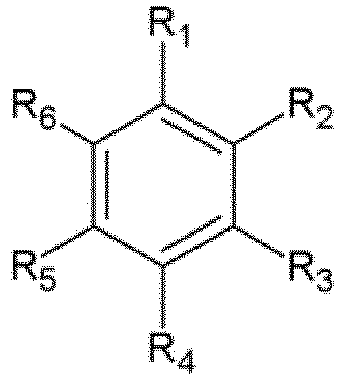
- In Chemical Formula 2, R1 to R6 are the same or different and are selected from hydrogen, a halogen, a C1 to C10 alkyl group, a haloalkyl group, and a combination thereof.
- Specific examples of the aromatic hydrocarbon-based organic solvent may be selected from benzene, fluorobenzene, 1,2-difluorobenzene, 1,3-difluorobenzene, 1,4-difluorobenzene, 1,2,3-trifluorobenzene, 1,2,4-trifluorobenzene, chlorobenzene, 1,2-dichlorobenzene, 1,3-dichlorobenzene, 1,4-dichlorobenzene, 1,2,3-trichlorobenzene, 1,2,4-trichlorobenzene, iodobenzene, 1,2-diiodobenzene, 1,3-diiodobenzene, 1,4-diiodobenzene, 1,2,3-triiodobenzene, 1,2,4-triiodobenzene, toluene, fluorotoluene, 2,3-difluorotoluene, 2,4-difluorotoluene, 2,5-difluorotoluene, 2,3,4-trifluorotoluene, 2,3,5-trifluorotoluene, chlorotoluene, 2,3-dichlorotoluene, 2,4-dichlorotoluene, 2,5-dichlorotoluene, 2,3,4-trichlorotoluene, 2,3,5-trichlorotoluene, iodotoluene, 2,3-diiodotoluene, 2,4-diiodotoluene, 2,5-diiodotoluene, 2,3,4-triiodotoluene, 2,3,5-triiodotoluene, xylene, and a combination thereof.
- The electrolyte may further include vinylene carbonate or an ethylene carbonate-based compound of Chemical Formula 3 in order to improve cycle-life of a battery.

- In Chemical Formula 3, R7 and R8 may be the same or different and may be selected from hydrogen, a halogen group, a cyano group (CN), a nitro group (NO2), and a fluorinated C1 to C5 alkyl group, wherein at least one of R7 and R8 is selected from a halogen group, a cyano group (CN), a nitro group (NO2), and a fluorinated C1 to C5 alkyl group, provided that R7 and R8 are not both hydrogen.
- Examples of the ethylene carbonate-based compound may include difluoro ethylenecarbonate, chloroethylene carbonate, dichloroethylene carbonate, bromoethylene carbonate, dibromoethylene carbonate, nitroethylene carbonate, cyanoethylene carbonate, or fluoroethylene carbonate. The amount of the cycle-life improvement additive may be used within an appropriate range.
- The lithium salt dissolved in a non-aqueous organic solvent supplies a battery with lithium ions, basically operates the rechargeable lithium battery, and improves transportation of the lithium ions between a positive electrode and a negative electrode. Examples of the lithium salt include at least one supporting salt selected from LiPF6, LiBF4, LiSbF6, LiAsF6, LiN(SO2C2F5)2, Li(CF3SO2)2N, LiN(SO3C2F5)2, LiC4F9SO3, LiClO4, LiAlO2, LiAlCl4, LiN(CxF2x+1SO2)(CyF2y+1SO2) wherein, x and y are natural numbers, LiCI, Lil, and LiB(C2O4)2 (lithium bis(oxalato) borate, LiBOB). A concentration of the lithium salt may range from 0.1 M to 2.0 M. When the lithium salt is included at the above concentration range, an electrolyte may have excellent performance and lithium ion mobility due to optimal electrolyte conductivity and viscosity.
- The polyethylene is generally HDPE (high density polyethylene, density: 0.94 g/cm3 to 0.965 g/cm3), MDPE (medium density polyethylene, density: 0.925 g/cm3 to 0.94 g/cm3), LDPE (low density polyethylene, density: 0.91 g/cm3 to 0.925 g/cm3), and VLDPE (very low density polyethylene, density: 0.85 g/cm3 to 0.91 g/cm3).
- The flake-shaped polyethylene particles may be used alone or in combination of two or more polyethylene polymers such as HDPE, MDPE, or LDPE.
- The average particle size (D50) of the flake-shaped polyethylene particles included in the negative electrode functional layer disposed on the negative active material layer may be 1 µm to 8 µm, and specifically 2 µm to 6 µm.
- As used herein, when a definition is not otherwise provided, the average particle size (D50) may be measured by a well-known method for a person of an ordinary skill in the art, for example, as a particle size analyzer, or from TEM or SEM photographs. Alternatively, a dynamic light-scattering measurement device is used to perform a data analysis, and the number of particles is counted for each particle size range. From this, the D50 value may be easily obtained through a calculation.
- More precisely, the particle size of a flake-shaped polyethylene particle may be determined by a dynamic light-scattering measurement method. Specifically, the size may be measured by ISO 13320 through the analysis of the light-scattering properties of the particles. For the non-spherical particles, a size distribution is reported, where the predicted scattering pattern for the volumetric sum of spherical particles matches the measured scattering pattern.
- On the other hand, a ratio of the long axis length relative to the short axis length of the flake-shaped polyethylene particles is 1.1 to 4.5. For example, a ratio of the long axis length relative to the short axis length of the flake-shaped polyethylene particles may be 1.2 to 3.5. Specifically, the ratio may refer to the aspect ratio of the minimum to the maximum Feret diameter. The Aspect Ratio ψA (0 < ψA≤ 1) is defined by the ratio of the Minimum to the Maximum Feret Diameter ψA = xFeret min / xFeret max. It gives an indication for the elongation of the particle.
- In addition, a thickness of the flake-shaped polyethylene particles may be 0.2 µm to 4 µm, specifically, 0.3 µm to 2.5 µm, for example may be 0.3 µm to 1.5 µm.
- The polyethylene particles according to this disclosure are flake-shaped, as seen in
FIG. 3 , and the average particle size may be defined as (D50) described above. - When the size and thickness of the flake-shaped polyethylene particles are within the above range, ion channels may be effectively closed even in a small amount.
- When the negative electrode functional layer including the flake-shaped polyethylene particles is provided, a reaction rate may be increased according to temperature under the same reaction conditions, compared with the case of including spherical polyethylene particles, thereby improving stability improvement effect of the rechargeable lithium battery. In the case of the flake-shaped polyethylene particles before melting, an area covering pores is thinner and wider than that of the spherical shape polyethylene particles before melting. When the polyethylene particles are melted at a predetermined temperature or more to close ion channels, a reaction rate is faster because the flake-shaped polyethylene particles have a larger area than that of the electrode plate closed by the melted spherical polyethylene particles.
- That is, the polyethylene particles included in the negative electrode functional layer during thermal runaway of the battery is melted to close the ion channels, thereby limiting the movement of the ions to implement a shut-down function may prevent additional electrochemical reactions.
- For example, as shown in
FIG. 4 , since the flake-shaped polyethylene particles according to the embodiment are disposed in a thin and wide shape on the pores in a composition for the negative electrode functional layer, the flake-shaped polyethylene particles melts more rapidly during thermal runaway due to thermal/physical impact, thereby suppressing passage of ions. - The negative electrode functional layer may further include inorganic particles and a binder.
- A weight ratio of a sum amount of the flake-shaped polyethylene particles and the inorganic particles to an amount of the binder may be in the range of 80:20 to 99: 1, and specifically, may be 85:15 to 97: 3.
- The flake-shaped polyethylene particles and the inorganic particles may be included in a weight ratio of 95:5 to 10:90, and specifically in a weight ratio of 30:70 to 70:30.
- When the amounts of the flake-shaped polyethylene particles and the inorganic particles are in the above range, cycle-life characteristics and output characteristics of a battery may be secured.
- The inorganic particles may include, for example, Al2O3, SiO2, TiO2, SnO2, CeO2, MgO, NiO, CaO, GaO, ZnO, ZrO2, Y2O3, SrTiO3, BaTiO3, Mg(OH)2, boehmite, or a combination thereof. Organic particles such as an acrylic compound, an imide compound, an amide compound, or a combination thereof may be further included in addition to the inorganic particles.
- The inorganic particles may be spherical, flake-shaped, cubic, or amorphous. The inorganic particles may have an average particle diameter of 1 nm to 2500 nm, for example 100 nm to 2000 nm, or 200 nm to 1000 nm, or 300 nm to 800 nm. The average particle diameter of the inorganic particle may be an average particle size (D50) at a volume ratio of 50% in a cumulative size-distribution curve. The particle size may be determined by a dynamic light-scattering measurement method, for example ISO 13320.
- The negative electrode functional layer may have a thickness of 1 µm to 10 µm, and specifically 3 µm to 10 µm.
- In addition, a ratio of the thickness of the negative active material layer to the thickness of the negative electrode functional layer may be 50: 1 to 10: 1, and specifically 30: 1 to 10: 1.
- When the ratio of the thickness of the negative active material layer to the thickness of the negative electrode functional layer is within the above range, the thermal stability may be significantly improved while maintaining excellent cycle-life characteristics.
- In particular, when the ratio of the thickness of the negative electrode functional layer is included in the above range, thermal safety may be improved while minimizing the decrease in energy density.
- The negative current collector may include one selected from a copper foil, a nickel foil, a stainless steel foil, a titanium foil, a nickel foam, a copper foam, a polymer substrate coated with a conductive metal, and a combination thereof.
- The negative active material may include a material that reversibly intercalates/deintercalates lithium ions, a lithium metal, a lithium metal alloy, a material capable of doping/dedoping lithium, or a transition metal oxide.
- Examples of the material capable of reversibly intercalating/deintercalating the lithium ions may include a carbonaceous material, that is, a carbon-based negative active material generally used in a rechargeable lithium battery. Examples of the carbon-based negative active material may be crystalline carbon, amorphous carbon, or a combination thereof. The crystalline carbon may be graphite such as non-shaped, sheet-shaped, flake-shaped, spherical shape, or fiber shaped natural graphite or artificial graphite, and the amorphous carbon may be a soft carbon, a hard carbon, a mesophase pitch carbonization product, fired coke, and the like.
- The lithium metal alloy includes an alloy of lithium and a metal selected from Na, K, Rb, Cs, Fr, Be, Mg, Ca, Sr, Si, Sb, Pb, In, Zn, Ba, Ra, Ge, Al, and Sn.
- The material capable of doping/dedoping lithium may be a silicon-based material or a tin-based material, for example, Si, SiOx (0<x<2), a Si-Q alloy (wherein Q is an element selected from an alkali metal, an alkaline-earth metal, a Group 13 element, a Group 14 element, a Group 15 element, a Group 16 element, a transition metal, a rare earth element, and a combination thereof, but not Si), a Si-carbon composite, Sn, SnO2, a Sn-R alloy (wherein R is an element selected from an alkali metal, an alkaline-earth metal, a Group 13 element, a Group 14 element, a Group 15 element, a Group 16 element, a transition metal, a rare earth element, and a combination thereof, but not Sn), a Sn-carbon composite and the like. At least one of these materials may be mixed with SiO2. The elements Q and R may be selected from Mg, Ca, Sr, Ba, Ra, Sc, Y, Ti, Zr, Hf, Rf, V, Nb, Ta, Db, Cr, Mo, W, Sg, Tc, Re, Bh, Fe, Pb, Ru, Os, Hs, Rh, Ir, Pd, Pt, Cu, Ag, Au, Zn, Cd, B, Al, Ga, Sn, In, Ge, P, As, Sb, Bi, S, Se, Te, Po, and a combination thereof.
- The transition metal oxide may include a lithium titanium oxide.
- In the negative active material layer, an amount of the negative active material is 95 wt% to 99 wt% based on a total weight of the negative active material layer.
- The negative active material layer may optionally further include a negative electrode conductive material and a negative electrode binder.
- Each amount of the negative electrode conductive material and negative electrode binder may be 1 wt% to 5 wt% based on a total weight of the negative active material layer.
- The negative electrode conductive material is used to impart conductivity to the negative electrode, and types of the negative electrode conductive material is the same as types of the positive electrode conductive material described above.
- The negative electrode binder improves binding properties of negative active material particles with one another and with a current collector. The negative electrode binder may be a non-water-soluble binder, a water-soluble binder, an amphiphilic binder (water-soluble/non-water-soluble binder), or a combination thereof.
- The non-water-soluble binder may be polyvinylchloride, carboxylated polyvinylchloride, polyvinylfluoride, an ethylene oxide-containing polymer, polyvinylpyrrolidone, polyurethane, polytetrafluoroethylene, polyvinylidene fluoride, polyethylene, polypropylene, polyamideimide, polyimide, or a combination thereof.
- The water-soluble binder may be a styrene-butadiene rubber, an acrylated styrene-butadiene rubber, polyvinyl alcohol, sodium polyacrylate, a copolymer of propylene and a C2 to C8 olefin, a copolymer of (meth)acrylic acid and (meth)acrylic acid alkyl ester, or a combination thereof.
- The amphiphilic binder may be an acrylated styrene-based rubber.
- When the water-soluble binder is used as a negative electrode binder, a cellulose-based compound may be further used to provide viscosity as a thickener. The cellulose-based compound includes one or more of carboxylmethyl cellulose, hydroxypropylmethyl cellulose, methyl cellulose, or alkali metal salts thereof. The alkali metals may be Na, K, or Li. The thickener may be included in an amount of 0.1 parts by weight to 3 parts by weight based on 100 parts by weight of the negative active material.
- The rechargeable lithium battery according to an example embodiment of the present invention includes the negative electrode and the positive electrode included in a battery cell having a volume of greater than or equal to 24 cm3, and simultaneously includes a negative electrode functional layer including the flake-shaped polyethylene particles on the negative electrode along with the positive active material layer including first and second positive active materials, and thereby high capacity is realized, and simultaneously, a heat increasing rate due to a thermal/physical impact is reduced, and accordingly, an effective shut-down may be obtained.
- On the other hand, the
separator 113 may be disposed between thepositive electrode 114 and thenegative electrode 112 as described above. Theseparator 113 may be, for example, selected from a glass fiber, polyester, polyethylene, polypropylene, polytetrafluoroethylene, or a combination thereof. It may have a form of a non-woven fabric or a woven fabric. For example, in a rechargeable lithium battery, a polyolefin-based polymer separator such as polyethylene and polypropylene is mainly used. In order to ensure the heat resistance or mechanical strength, a coated separator including a ceramic component or a polymer material may be used. Optionally, it may have a mono-layered or multi-layered structure. - Hereinafter, the above aspects of the present disclosure are illustrated in more detail with reference to examples. However, these examples are exemplary, and the present disclosure is not limited thereto.
- 95 wt% of a positive active material prepared by mixing LiCoO2/LiFePO4 in a weight ratio of 9:1 as first/second positive active materials, 3 wt% of a polyvinylidene fluoride binder, and 2 wt% of a ketjen black conductive material were mixed in an N-methylpyrrolidone solvent to prepare positive active material slurry. The positive active material slurry was coated on both surfaces of an aluminum current collector and then, dried and compressed to manufacture a positive electrode having a positive active material layer.
- 98 wt% of graphite, 0.8 wt% of carboxylmethyl cellulose, and 1.2 wt% of a styrene-butadiene rubber were mixed in pure water to prepare negative active material slurry. The negative active material slurry was coated on both surfaces of a copper current collector and then, dried and compressed to manufacture negative electrode having a negative active material layer.
- 48 wt% of flake-shaped polyethylene (PE) particles having an average particle size D50 of 2 µm (a long axis length/a short axis length = 2, a thickness = 0.6 µm), 47 wt% of alumina (an average particle diameter (D50) = 0.7 µm), and 5 wt% of an acrylated styrene-based rubber binder were mixed in an alcohol-based solvent to prepare PE/alumina slurry.
- The PE/ alumina slurry was coated on both surfaces of the negative electrode and then, dried and compressed to manufacture a negative electrode having a coating layer including the flake-shaped PE particles.
- Each tab was connected to the positive and negative electrodes, and a polyethylene separator was disposed between the negative and positive electrodes to manufacture a wound-type electrode assembly. The electrode assembly was inserted in a 21700 type cylindrical battery case, an electrolyte prepared by dissolving 1 M of LiPF6 in ethylenecarbonate (EC) and dimethylcarbonate (DMC) mixed in a volume ratio of 1:1 was injected thereinto, and the can was sealed to assemble a rechargeable lithium battery cell having capacity of 3.5 Ah.
- A rechargeable lithium battery cell was manufactured according to the same method as Example 1 except that the negative electrode was manufactured by using 48 wt% of spherical shape PE particles having an average particle diameter (D50) of 2 µm instead of 48 wt% of the flake-shaped PE particles having an average particle size D50 of 2 µm (a long axis length/a short axis length = 2, a thickness = 0.6 µm).
- A positive electrode was manufactured by using LiCoO2 alone instead of the LiCoO2/LiFePO4 mixture as positive active material, and
98 wt% of graphite, 0.8 wt% of carboxylmethyl cellulose, and 1.2 wt% of a styrene-butadiene rubber were mixed in pure water to prepare negative active material slurry, the negative active material slurry was coated on both surfaces of a copper current collector and dried and compressed to manufacture a negative electrode having a negative active material layer and thus assemble a rechargeable lithium battery cell having capacity of 3.5 Ah. - A rechargeable battery cell having capacity of 3.0 Ah was manufactured according to the same method as Comparative Example 2.
- A heat safety evaluation of the rechargeable lithium battery cells according to Example 1 and Comparative Example 1 was performed, and the results are shown in Table 1 and
FIG. 2 . - The heat safety was evaluated by welding each tab into the positive and negative electrodes of the cells and using a device attached with a thermocouple in the center of the cells to measure a temperature. Subsequently, the cells were five times wound with a filament wire, through which a current was made to flow to apply predetermined power (90 W, 50 W, and 20 W), and then, the cells were outwardly examined to find when the cells were deformed, and the results are provided in
FIG. 2 , and time and temperature where the cells were deformed were measured and shown in Table 1. -
FIG. 2 shows results of heat safety evaluation for the rechargeable lithium battery cells according to Example 1 and Comparative Example 1. - Referring to
FIG. 2 , the rechargeable lithium battery cell according to Example 1 relatively maintained a shape under low power of 20 W and 50 W but deformed under high power of 95 W, but the rechargeable lithium battery cell of Comparative Example 1 was deformed under the low power of 20 W and 50 W as well as the high power of 95 W.[Table 1] Power (W) Time to deformation (sec) Temperature at deformation (°C) Example 1 Comparative Example 1 Difference Example 1 Comparative Example 1 Difference 95 W 92 95 -3 100.8 122.4 -22 50 W 220 210 10 143.1 146.9 -4 20 W 758 723 35 160.3 153.5 7 20 W 758 716 42 168.7 167.5 1 - Referring to Table 1, the time that the rechargeable lithium battery cell of Example 1 was deformed, for example, exploded and the like was delayed 40 seconds under 20 W and 10 seconds under 50 W compared with the rechargeable lithium battery cell of Comparative Example 1, and
the temperature that the rechargeable lithium battery cell of Example 1 was deformed, for example, exploded and the like was low and specifically, 4°C under 50 W and 22°C under 90 W, compared with the rechargeable lithium battery cell of Comparative Example 1, which exhibited improved safety of the rechargeable lithium battery cell of the present invention. - The rechargeable battery cells of Example 1 and Comparative Example 1 were charged at 0.5 C under a cut-off of 0.05 C up to a maximum voltage and aged for 24 hours and then, evaluated as follows.
- A full-charged cell was put on a steel plate (a thickness ≥ 5 cm).
- A round bar ( φ 15mm) was placed in the center of a specimen, wherein the round bar should be placed in a vertical direction with an electrode.
- A cylindrical cell was evaluated by placing the round bar in the center like a seesaw shape.
- A cylinder weight of 9 kg was dropped from 610 mm high to the bar, and the result was examined and provided in Table 2.
- Evaluation criteria are as follows.
-
- L1: No influence on appearance
- L2: Scratches on appearance but no leakage
- L3: Leakage
- L4: Fire
- L5: Explosion
- Referring to Table 2, the rechargeable battery cell including the negative electrode including the negative electrode functional layer including flake-shaped polyethylene and the positive electrode including the first and second active material according to Example 1 secured safety even at high-capacity, but the rechargeable battery cell including no second positive active material and negative electrode functional layer according to Comparative Example 2 exhibited deteriorated safety when designed to have high capacity, and according to Comparative Example 3 exhibited deteriorated capacity when designed to have capacity as to secure safety.
| Cell capacity (Ah) | Collision safety | |
| Example 1 | 3.5 | L2 |
| Comparative Example 2 | 3.5 | L4 |
| Comparative Example 3 | 3.0 | L2 |
Claims (13)
- A rechargeable lithium battery (100), comprisingan electrode assembly comprisinga positive electrode (114) comprising a positive current collector and a positive active material layer disposed on the positive current collector;a negative electrode (112) comprising a negative current collector, a negative active material layer disposed on the negative current collector, and a negative electrode functional layer disposed on the negative active material layer; anda separator (113);wherein the positive active material layer comprises a first positive active material comprising lithium and at least one of a composite oxide of a metal selected from cobalt, manganese, and nickel, and a second positive active material comprising a compound represented by Chemical Formula 1:
[Chemical Formula 1] LiaFe1-x1Mx1PO4
wherein, in Chemical Formula 1, 0.90 ≤ a ≤ 1.8, 0 ≤ x1 ≤ 0.7, and M is at least one of Mn, Co, and Ni,the negative electrode functional layer comprises flake-shaped polyethylene particles, wherein a ratio of the long axis length relative to the short axis length of the flake-shaped polyethylene particles is 1.1 to 4.5. - The rechargeable lithium battery of claim 1 , wherein the electrode assembly is to be applied to a battery case (120) having a volume of greater than or equal to 24 cm3.
- The rechargeable lithium battery of claim 2, wherein the battery case (120) is a cylindrical case having a diameter of greater than or equal to 21 mm and a height of greater than or equal to 70 mm.
- The rechargeable lithium battery of any one of the preceding claims, wherein the first positive active material is included in an amount of 80 wt% to 97 wt% based on a total weight of the positive active material layer.
- The rechargeable lithium battery of any one of the preceding claims, wherein the first positive active material and the second positive active material are included in a weight ratio of 97 : 3 to 80 : 20.
- The rechargeable lithium battery of any one of the preceding claims, wherein the first positive active material comprises one of LiCoO2 and LibM1 1-y1-z1M2 y1M3 z1O2 with 0.9≤b≤1.8, 0 ≤y1≤1, 0≤z1≤1, 0≤y1+z1≤1, M1, M2, and M3 are metals independently selected from Ni, Co, Mn, Al, Sr, Mg, and La.
- The rechargeable lithium battery of any one of the preceding claims, wherein the second positive active material comprises LiFePO4.
- The rechargeable lithium battery of any one of the preceding claims, wherein an average particle size (D50) of the flake-shaped polyethylene particle is 1 µm to 8 µm determined by a dynamic light-scattering measurement method.
- The rechargeable lithium battery of any one of the preceding claims, wherein a thickness of the flake-shaped polyethylene particles is 0.2 µm to 4 µm.
- The rechargeable lithium battery of any one of the preceding claims, wherein the negative electrode functional layer further comprises an inorganic particle and a binder.
- The rechargeable lithium battery of claim 10, wherein a weight ration of a sum amount of the flake-shaped polyethylene particles and the inorganic particles to an amount of the binder is in the range of 80:20 to 99: 1.
- The rechargeable lithium battery of claim 10, wherein the flake-shaped polyethylene particles and the inorganic particles are included in a weight ratio of 95:5 to 10:90.
- The rechargeable lithium battery of any one of the preceding claims, wherein the negative electrode functional layer has a thickness of 1 µm to 10 µm.
Applications Claiming Priority (1)
| Application Number | Priority Date | Filing Date | Title |
|---|---|---|---|
| KR1020190052574A KR102425514B1 (en) | 2019-05-03 | 2019-05-03 | Lithium secondary battery |
Publications (2)
| Publication Number | Publication Date |
|---|---|
| EP3734707A1 EP3734707A1 (en) | 2020-11-04 |
| EP3734707B1 true EP3734707B1 (en) | 2022-04-06 |
Family
ID=70480140
Family Applications (1)
| Application Number | Title | Priority Date | Filing Date |
|---|---|---|---|
| EP20172132.1A Active EP3734707B1 (en) | 2019-05-03 | 2020-04-29 | Rechargeable lithium battery |
Country Status (4)
| Country | Link |
|---|---|
| US (1) | US11710820B2 (en) |
| EP (1) | EP3734707B1 (en) |
| KR (1) | KR102425514B1 (en) |
| CN (1) | CN111883819B (en) |
Families Citing this family (24)
| Publication number | Priority date | Publication date | Assignee | Title |
|---|---|---|---|---|
| KR102259218B1 (en) | 2018-07-03 | 2021-05-31 | 삼성에스디아이 주식회사 | Electrode for lithium secondary battery, and lithium secondary battery including the same |
| KR102259219B1 (en) | 2018-07-03 | 2021-05-31 | 삼성에스디아이 주식회사 | Lithium secondary battery |
| KR102323950B1 (en) | 2018-12-12 | 2021-11-08 | 삼성에스디아이 주식회사 | Electrode for rechargeable lithium battery and rechargeable lithium battery including same |
| KR102425513B1 (en) | 2019-05-03 | 2022-07-25 | 삼성에스디아이 주식회사 | Lithium secondary battery |
| KR102487628B1 (en) | 2019-05-03 | 2023-01-12 | 삼성에스디아이 주식회사 | Rechargeable lithium battery |
| KR102492831B1 (en) | 2019-05-03 | 2023-01-26 | 삼성에스디아이 주식회사 | Lithium secondary battery |
| KR102425515B1 (en) | 2019-05-03 | 2022-07-25 | 삼성에스디아이 주식회사 | Lithium secondary battery |
| KR102425514B1 (en) | 2019-05-03 | 2022-07-25 | 삼성에스디아이 주식회사 | Lithium secondary battery |
| KR102492832B1 (en) | 2019-05-03 | 2023-01-26 | 삼성에스디아이 주식회사 | Lithium secondary battery |
| US11771935B2 (en) | 2019-09-05 | 2023-10-03 | Samsung Sdi Co., Ltd. | Energy storage module |
| US12288895B2 (en) | 2019-09-05 | 2025-04-29 | Samsung Sdi Co., Ltd. | Energy storage module |
| US11735788B2 (en) | 2019-09-05 | 2023-08-22 | Samsung Sdi Co., Ltd. | Energy storage module including insulation spacers and an extinguisher sheet |
| US11728541B2 (en) | 2019-09-05 | 2023-08-15 | Samsung Sdi Co., Ltd. | Energy storage module |
| US11569546B2 (en) | 2019-09-05 | 2023-01-31 | Samsung Sdi Co., Ltd. | Energy storage module |
| US11764438B2 (en) * | 2019-09-05 | 2023-09-19 | Samsung Sdi Co., Ltd. | Energy storage module having extinguisher sheet |
| US12355098B2 (en) | 2019-09-05 | 2025-07-08 | Samsung Sdi Co., Ltd. | Energy storage module |
| US11799167B2 (en) * | 2019-09-05 | 2023-10-24 | Samsung Sdi Co., Ltd. | Energy storage module having extinguisher sheet |
| US11735795B2 (en) | 2019-09-05 | 2023-08-22 | Samsung Sdi Co., Ltd. | Energy storage module |
| US12090354B2 (en) | 2019-09-05 | 2024-09-17 | Samsung Sdi Co., Ltd. | Energy storage module |
| US11764430B2 (en) | 2019-09-05 | 2023-09-19 | Samsung Sdi Co., Ltd. | Energy storage module |
| US12300848B2 (en) | 2019-09-05 | 2025-05-13 | Samsung Sdi Co., Ltd. | Energy storage module including extinguisher sheet |
| US12057598B2 (en) | 2019-09-05 | 2024-08-06 | Samsung Sdi Co., Ltd. | Energy storage module including extinguisher sheet |
| US11848461B2 (en) | 2019-09-05 | 2023-12-19 | Samsung Sdi Co., Ltd. | Energy storage module |
| KR20240173549A (en) * | 2023-06-05 | 2024-12-12 | 삼성에스디아이 주식회사 | Rechargeable battery |
Family Cites Families (125)
| Publication number | Priority date | Publication date | Assignee | Title |
|---|---|---|---|---|
| JPS5110670B1 (en) | 1971-07-07 | 1976-04-06 | ||
| JPS5637061Y2 (en) | 1975-07-16 | 1981-08-31 | ||
| JP3397351B2 (en) | 1992-12-18 | 2003-04-14 | キヤノン株式会社 | Prismatic or sheet type battery and manufacturing method thereof |
| US20080081347A1 (en) | 1998-08-25 | 2008-04-03 | Binax, Inc. | EIA for Monitoring Legionella Pneumophila Presence in Water Samples |
| TW431001B (en) | 1998-08-31 | 2001-04-21 | Toshiba Corp | Nonaqueous electrolytic secondary battery and manufacture method thereof |
| US6465125B1 (en) | 1998-09-17 | 2002-10-15 | Kabushiki Kaisha Toshiba | Nonaqueous electrolyte secondary battery and method of manufacturing nonaqueous electrolyte secondary battery |
| KR100318377B1 (en) | 1999-02-19 | 2001-12-22 | 김순택 | Lithium ion secondary battery |
| US6391495B1 (en) | 1998-11-25 | 2002-05-21 | Samsung Display Devices Co., Ltd. | Negative active material for lithium secondary battery, method of preparing the same and lithium secondary battery comprising the same |
| JP4412778B2 (en) | 1999-01-20 | 2010-02-10 | 三洋電機株式会社 | Polymer electrolyte battery |
| DE19918109A1 (en) * | 1999-04-22 | 2000-10-26 | Nbt Gmbh | Process for the production of a secondary lithium cell with a heat-sensitive protective mechanism |
| JP2001135359A (en) | 1999-08-24 | 2001-05-18 | Japan Storage Battery Co Ltd | Non-aqueous electrolyte battery |
| CN1236517C (en) * | 2000-02-29 | 2006-01-11 | 皇家菲利浦电子有限公司 | Lithium battery |
| JP3959929B2 (en) | 2000-04-25 | 2007-08-15 | ソニー株式会社 | Positive electrode and non-aqueous electrolyte battery |
| US6476678B1 (en) | 2000-08-04 | 2002-11-05 | Maxim Integrated Products, Inc. | High performance amplifier circuits using separate power supplies |
| DE10238945B4 (en) | 2002-08-24 | 2013-01-03 | Evonik Degussa Gmbh | Electric separator with shut-off mechanism, process for its preparation, use of the separator in lithium batteries and battery with the separator |
| JP2004111157A (en) | 2002-09-17 | 2004-04-08 | Matsushita Electric Ind Co Ltd | Secondary battery and method of manufacturing the same |
| KR20050035074A (en) | 2003-10-10 | 2005-04-15 | 엘에스전선 주식회사 | Lithium secondary battery having ptc powder and manufacturing method thereof |
| TWI251359B (en) | 2003-10-10 | 2006-03-11 | Lg Cable Ltd | Lithium secondary battery having PTC powder and manufacturing method thereof |
| KR100788565B1 (en) | 2004-06-21 | 2007-12-26 | 삼성에스디아이 주식회사 | Electrolyte for rechargeable lithium ion battery and rechargeable lithium ion battery comprising same |
| JP4527605B2 (en) | 2004-06-21 | 2010-08-18 | 三星エスディアイ株式会社 | Electrolytic solution for lithium ion secondary battery and lithium ion secondary battery including the same |
| JP2006134770A (en) | 2004-11-08 | 2006-05-25 | Sony Corp | Positive electrode and battery |
| JP4743747B2 (en) | 2004-12-08 | 2011-08-10 | 日立マクセル株式会社 | Separator, manufacturing method thereof, and nonaqueous electrolyte battery |
| US11050095B2 (en) | 2004-12-08 | 2021-06-29 | Maxell Holdings, Ltd. | Separator for electrochemical device, and electrochemical device |
| KR20060091486A (en) | 2005-02-15 | 2006-08-21 | 삼성에스디아이 주식회사 | Cathode active material, manufacturing method thereof, and cathode and lithium battery employing the same |
| CN100474685C (en) | 2005-03-25 | 2009-04-01 | 北京大学 | Polymer lithium ion secondary battery and preparation method thereof |
| WO2006132474A1 (en) | 2005-06-04 | 2006-12-14 | Ls Cable Ltd. | Ptc powder, lithium secondary battery having ptc powder and manufacturing method thereof |
| US20070057228A1 (en) | 2005-09-15 | 2007-03-15 | T/J Technologies, Inc. | High performance composite electrode materials |
| JP4151852B2 (en) | 2005-12-08 | 2008-09-17 | 日立マクセル株式会社 | Electrochemical element separator and manufacturing method thereof, and electrochemical element and manufacturing method thereof |
| JP4724223B2 (en) | 2006-09-07 | 2011-07-13 | 日立マクセル株式会社 | Manufacturing method of battery separator |
| US8293405B2 (en) | 2007-05-21 | 2012-10-23 | Panasonic Corporation | Rechargeable lithium ion battery and method for producing the same |
| JP4977079B2 (en) | 2007-05-21 | 2012-07-18 | パナソニック株式会社 | Method for producing lithium ion secondary battery |
| US20100266905A1 (en) | 2007-09-19 | 2010-10-21 | Lg Chem, Ltd. | Non-aqueous electrolyte lithium secondary battery |
| KR20090106841A (en) | 2008-04-07 | 2009-10-12 | 삼성에스디아이 주식회사 | Electrode assembly and secondary battery having same |
| CN101478042B (en) | 2008-11-05 | 2010-12-15 | 比亚迪股份有限公司 | Positive pole active substance, positive pole and battery |
| CN102272987A (en) | 2009-01-06 | 2011-12-07 | 株式会社Lg化学 | Positive electrode active material for lithium secondary battery |
| US8557437B2 (en) * | 2009-03-25 | 2013-10-15 | Tdk Corporation | Electrode comprising protective layer for lithium ion secondary battery and lithium ion secondary battery |
| JP5444781B2 (en) * | 2009-03-25 | 2014-03-19 | Tdk株式会社 | Electrode for lithium ion secondary battery and lithium ion secondary battery |
| JP2010225539A (en) * | 2009-03-25 | 2010-10-07 | Tdk Corp | Electrode for lithium ion secondary battery, and lithium ion secondary battery |
| JP2010225545A (en) * | 2009-03-25 | 2010-10-07 | Tdk Corp | Electrode for lithium ion secondary battery, and lithium ion secondary battery |
| JP5359444B2 (en) * | 2009-03-25 | 2013-12-04 | Tdk株式会社 | Lithium ion secondary battery |
| CN102770991A (en) | 2010-02-24 | 2012-11-07 | 日立麦克赛尔能源株式会社 | Positive electrode material, method of production therefor, positive electrode for nonaqueous rechargeable battery, and nonaqueous rechargeable battery |
| CN101783417A (en) | 2010-03-05 | 2010-07-21 | 深圳市睿德电子实业有限公司 | Low-pressure injection molding encapsulation method of polymer battery and low-pressure injection molding polymer battery |
| EP2549569A4 (en) | 2010-03-18 | 2014-08-06 | Nec Energy Devices Ltd | LITHIUM-ION SECONDARY BATTERY |
| JP5110670B2 (en) | 2011-02-28 | 2012-12-26 | パナソニック株式会社 | Nonaqueous electrolyte secondary battery |
| JP5906578B2 (en) | 2011-04-07 | 2016-04-20 | 日立化成株式会社 | Positive electrode mixture for lithium ion secondary battery, positive electrode for lithium ion secondary battery and lithium ion secondary battery using the same |
| CN102280614B (en) | 2011-07-07 | 2013-08-28 | 天津大学 | Preparation method of sulfur positive electrode of lithium sulfur battery |
| CN103828099B (en) | 2011-07-25 | 2018-04-20 | A123系统有限责任公司 | blended cathode material |
| US10461358B2 (en) | 2011-10-11 | 2019-10-29 | Samsung Sdi Co., Ltd. | Rechargeable lithium battery |
| US10446824B2 (en) | 2011-11-15 | 2019-10-15 | Toyota Jidosha Kabushiki Kaisha | Nonaqueous electrolyte secondary battery |
| KR20130104088A (en) | 2012-03-12 | 2013-09-25 | 삼성에스디아이 주식회사 | Electrode assembly and lithium recheabable battery comprising the same |
| JP2013191391A (en) | 2012-03-13 | 2013-09-26 | Nissan Motor Co Ltd | Secondary battery |
| EP2838151B1 (en) * | 2012-04-13 | 2017-08-23 | LG Chem, Ltd. | System of secondary cell including mixed cathode material, and apparatus and method for secondary cell management |
| US9003999B2 (en) | 2012-07-10 | 2015-04-14 | Bischoff Holdings, Inc. | Liquid consumption counters |
| JP6220784B2 (en) | 2012-07-13 | 2017-10-25 | 古河電気工業株式会社 | Current collector, electrode, secondary battery and capacitor |
| JP6287862B2 (en) | 2012-12-27 | 2018-03-07 | 日本ゼオン株式会社 | Slurry for porous membrane of secondary battery separator, porous membrane for secondary battery separator and method for producing the same, separator for secondary battery, and secondary battery |
| US8999553B2 (en) * | 2013-03-15 | 2015-04-07 | Ford Global Technologies, Llc | Rechargeable battery with shutdown layer comprising a low melting point material and an electrically conductive material |
| JP6197384B2 (en) | 2013-06-06 | 2017-09-20 | 日立化成株式会社 | Positive electrode for lithium ion secondary battery and method for producing the same |
| US10381690B2 (en) | 2013-08-14 | 2019-08-13 | Samsung Sdi Co., Ltd. | Negative electrode for rechargeable lithium battery and rechargeable lithium battery including the same |
| KR101893227B1 (en) | 2013-11-01 | 2018-08-30 | 주식회사 엘지화학 | Nonaqueous electrolyte and lithium secondary battery containing the same |
| JP2015115168A (en) | 2013-12-11 | 2015-06-22 | 日立化成株式会社 | Electrode for lithium ion secondary batteries, and lithium ion secondary battery arranged by use thereof |
| US10283747B2 (en) | 2014-03-17 | 2019-05-07 | Kabushiki Kaisha Toshiba | Nonaqueous electrolyte secondary battery and battery pack |
| KR101612062B1 (en) | 2014-05-08 | 2016-04-27 | 울산과학기술원 | Composite electrode-composite electrolyte assembly, method of manufacturing the same, and electrochemical device having the same |
| WO2015190833A1 (en) | 2014-06-13 | 2015-12-17 | 주식회사 엘지화학 | Negative electrode active material and method for preparing same |
| KR20160025052A (en) | 2014-08-25 | 2016-03-08 | 에스케이이노베이션 주식회사 | Cathode active material for secondary battery and secondary battery comprising the same |
| KR101714892B1 (en) | 2014-08-26 | 2017-03-09 | 주식회사 엘지화학 | Surface coated cathode active material, preparation method thereof and lithium secondary battery comprising the same |
| KR20160029176A (en) | 2014-09-04 | 2016-03-15 | 에스케이이노베이션 주식회사 | Anode active material for secondary battery and secondary battery comprising the same |
| CN104347880A (en) | 2014-10-14 | 2015-02-11 | 东莞新能源科技有限公司 | Fast-charge Li-ion battery |
| CN104393267A (en) | 2014-10-24 | 2015-03-04 | 上海四驱新能源科技有限公司 | Preparation method of high-stability lithium metal microsphere powder |
| CN104466186B (en) | 2014-11-17 | 2017-02-22 | 深圳市振华新材料股份有限公司 | Microcapsules and cathode materials for batteries and their preparation and application |
| KR102253020B1 (en) | 2014-11-19 | 2021-05-14 | 삼성에스디아이 주식회사 | Separator for rechargeable lithium battery and rechargeable lithium battery including the same |
| US10601071B2 (en) | 2014-12-02 | 2020-03-24 | Polyplus Battery Company | Methods of making and inspecting a web of vitreous lithium sulfide separator sheet and lithium electrode assemblies |
| KR101764266B1 (en) | 2014-12-02 | 2017-08-04 | 주식회사 엘지화학 | Electrolyte Solution for Lithium Secondary Battery with Improved Low Temperature Performance and Lithium Secondary Battery Comprising The Same |
| US10763509B2 (en) | 2015-02-10 | 2020-09-01 | Hitachi Chemical Company, Ltd. | Positive electrode for lithium ion secondary battery, electrode for lithium ion secondary battery, electrode active material layer including polyolefin particles, and lithium ion secondary battery |
| JP6587235B2 (en) | 2015-03-12 | 2019-10-09 | セイコーインスツル株式会社 | Nonaqueous electrolyte secondary battery |
| JP2016181487A (en) | 2015-03-25 | 2016-10-13 | 株式会社東芝 | Electrode for nonaqueous electrolyte battery, nonaqueous electrolyte secondary battery, and battery pack |
| KR101684082B1 (en) | 2015-03-30 | 2016-12-08 | 한국교통대학교산학협력단 | Lithium cathode active materials, anode active materials coated with polymer and lithiumsecondary battery using the same, and preparation method thereof |
| CN104779377A (en) | 2015-04-02 | 2015-07-15 | 深圳市沃特玛电池有限公司 | Method for improving safety performance of ternary battery |
| CN104916811A (en) | 2015-04-24 | 2015-09-16 | 深圳市格瑞普电池有限公司 | Non-diaphragm lithium ion battery and pole piece thereof |
| JP6451506B2 (en) | 2015-05-28 | 2019-01-16 | トヨタ自動車株式会社 | Electrode manufacturing method |
| WO2017006480A1 (en) | 2015-07-09 | 2017-01-12 | 日産自動車株式会社 | Nonaqueous electrolyte secondary battery |
| KR102110054B1 (en) | 2015-07-23 | 2020-05-12 | 히타치가세이가부시끼가이샤 | Lithium ion secondary battery |
| CN108352486A (en) | 2015-11-11 | 2018-07-31 | 帝人株式会社 | Diaphragm for non-water system secondary battery and non-aqueous secondary battery |
| PL3376562T3 (en) | 2015-11-11 | 2020-06-01 | Teijin Limited | Separator for non-aqueous secondary cell, and non-aqueous secondary cell |
| KR101913898B1 (en) | 2015-11-24 | 2018-10-31 | 주식회사 엘지화학 | Coating material for cathode active material, preparation method thereof, and lithium secondary battery comprising same |
| CN113782817B (en) | 2015-12-22 | 2024-04-12 | 中央硝子株式会社 | Electrolyte for nonaqueous electrolyte battery and nonaqueous electrolyte battery using same |
| KR101774683B1 (en) | 2016-01-26 | 2017-09-19 | 현대자동차주식회사 | Electorde active material slurry, preparation method thereof, and all solid secondary battery comprising the same |
| KR20170094720A (en) | 2016-02-11 | 2017-08-21 | 주식회사 엘지화학 | Electrode with improved safety and method of making the same |
| KR102067786B1 (en) | 2016-03-21 | 2020-01-17 | 주식회사 엘지화학 | Surface coated positive electrode active particle and secondary batterty comprising the same |
| KR20180007618A (en) | 2016-07-13 | 2018-01-23 | 삼성에스디아이 주식회사 | Negative active material for rechargeable lithium battery and rechargeable lithium battery including same |
| CN105977447B (en) | 2016-07-21 | 2018-08-21 | 苏州协鑫集成科技工业应用研究院有限公司 | Negative plate and preparation method thereof and battery |
| WO2018057704A1 (en) | 2016-09-22 | 2018-03-29 | Apple Inc. | Integrated electrical feedthroughs for walls of battery housings |
| JP6536524B2 (en) | 2016-10-03 | 2019-07-03 | トヨタ自動車株式会社 | Separator integrated electrode plate and storage element using the same |
| KR101876826B1 (en) | 2016-10-07 | 2018-07-10 | 한국생산기술연구원 | Cathode composite and all solid lithium secondary battery comprising the same |
| KR102314082B1 (en) | 2016-10-26 | 2021-10-15 | 삼성에스디아이 주식회사 | Electrode for rechargeable lithium battery and rechargeable lithium battery including the same |
| KR20180049986A (en) | 2016-11-04 | 2018-05-14 | 삼성에스디아이 주식회사 | Positive electrode for rechargeable lithium battery and rechargeable lithium battery including same |
| JP6688206B2 (en) | 2016-11-22 | 2020-04-28 | 本田技研工業株式会社 | Electrode mixture layer |
| JP2018106879A (en) * | 2016-12-26 | 2018-07-05 | トヨタ自動車株式会社 | Negative electrode with insulating layer |
| WO2018130467A1 (en) | 2017-01-13 | 2018-07-19 | Lumileds Holding B.V. | Array with light emitting diodes and varying lens |
| KR102296814B1 (en) | 2017-02-22 | 2021-08-31 | 삼성에스디아이 주식회사 | Electrode assembly, manufacturing method of same and rechargeable battery including same |
| JP6206611B1 (en) | 2017-03-03 | 2017-10-04 | Tdk株式会社 | Negative electrode and lithium ion secondary battery |
| CN106848383A (en) * | 2017-03-06 | 2017-06-13 | 曙鹏科技(深圳)有限公司 | A kind of lithium ion battery of high security and preparation method thereof |
| JP2018156854A (en) | 2017-03-17 | 2018-10-04 | パナソニックIpマネジメント株式会社 | Alkaline battery |
| JP2018156876A (en) | 2017-03-21 | 2018-10-04 | 三井化学株式会社 | Positive electrode for lithium ion secondary battery |
| SG10201702726QA (en) | 2017-04-03 | 2018-11-29 | Airbus Singapore Private Ltd | Conductive carbon coated polymer for high temperature lithium ion battery shutdown deposited through 3d printing technique |
| KR20190043957A (en) | 2017-10-19 | 2019-04-29 | 삼성에스디아이 주식회사 | Electrode for rechargeable lithium battery and rechargeable lithium battery including same |
| KR102519116B1 (en) | 2017-10-19 | 2023-04-05 | 삼성에스디아이 주식회사 | Electrode for rechargeable lithium battery and rechargeable lithium battery including same |
| JP6993180B2 (en) | 2017-11-08 | 2022-02-04 | 三星エスディアイ株式会社 | A method for producing a composition for forming a porous insulating layer, an electrode for a non-aqueous electrolyte secondary battery, a non-aqueous electrolyte secondary battery, and an electrode for a non-aqueous electrolyte secondary battery. |
| EP3483948B1 (en) | 2017-11-08 | 2021-10-06 | Samsung SDI Co., Ltd. | Composition for preparing porous insulating layer, electrode for non-aqueous rechargeable lithium battery, non-aqueous rechargeable lithium battery, method of preparing electrode for non-aqueous rechargeable lithium battery |
| KR102259218B1 (en) | 2018-07-03 | 2021-05-31 | 삼성에스디아이 주식회사 | Electrode for lithium secondary battery, and lithium secondary battery including the same |
| KR102259219B1 (en) * | 2018-07-03 | 2021-05-31 | 삼성에스디아이 주식회사 | Lithium secondary battery |
| KR102646854B1 (en) | 2018-10-19 | 2024-03-11 | 삼성에스디아이 주식회사 | Battery module |
| KR102323950B1 (en) | 2018-12-12 | 2021-11-08 | 삼성에스디아이 주식회사 | Electrode for rechargeable lithium battery and rechargeable lithium battery including same |
| KR102487628B1 (en) | 2019-05-03 | 2023-01-12 | 삼성에스디아이 주식회사 | Rechargeable lithium battery |
| KR102492832B1 (en) | 2019-05-03 | 2023-01-26 | 삼성에스디아이 주식회사 | Lithium secondary battery |
| KR102425513B1 (en) | 2019-05-03 | 2022-07-25 | 삼성에스디아이 주식회사 | Lithium secondary battery |
| KR102487627B1 (en) | 2019-05-03 | 2023-01-12 | 삼성에스디아이 주식회사 | Negative elecrode for rechargeable lithium battery and rechargeable lithium battery including same |
| KR102425514B1 (en) | 2019-05-03 | 2022-07-25 | 삼성에스디아이 주식회사 | Lithium secondary battery |
| KR102425515B1 (en) | 2019-05-03 | 2022-07-25 | 삼성에스디아이 주식회사 | Lithium secondary battery |
| KR102492831B1 (en) | 2019-05-03 | 2023-01-26 | 삼성에스디아이 주식회사 | Lithium secondary battery |
| US11569546B2 (en) * | 2019-09-05 | 2023-01-31 | Samsung Sdi Co., Ltd. | Energy storage module |
| US11764430B2 (en) | 2019-09-05 | 2023-09-19 | Samsung Sdi Co., Ltd. | Energy storage module |
| US11764438B2 (en) | 2019-09-05 | 2023-09-19 | Samsung Sdi Co., Ltd. | Energy storage module having extinguisher sheet |
| US11799167B2 (en) | 2019-09-05 | 2023-10-24 | Samsung Sdi Co., Ltd. | Energy storage module having extinguisher sheet |
| US12288895B2 (en) | 2019-09-05 | 2025-04-29 | Samsung Sdi Co., Ltd. | Energy storage module |
| US11848461B2 (en) | 2019-09-05 | 2023-12-19 | Samsung Sdi Co., Ltd. | Energy storage module |
-
2019
- 2019-05-03 KR KR1020190052574A patent/KR102425514B1/en active Active
-
2020
- 2020-04-29 EP EP20172132.1A patent/EP3734707B1/en active Active
- 2020-04-30 CN CN202010360974.6A patent/CN111883819B/en active Active
- 2020-05-01 US US16/864,858 patent/US11710820B2/en active Active
Also Published As
| Publication number | Publication date |
|---|---|
| EP3734707A1 (en) | 2020-11-04 |
| US11710820B2 (en) | 2023-07-25 |
| CN111883819B (en) | 2024-10-18 |
| CN111883819A (en) | 2020-11-03 |
| US20200350568A1 (en) | 2020-11-05 |
| KR102425514B1 (en) | 2022-07-25 |
| KR20200127790A (en) | 2020-11-11 |
Similar Documents
| Publication | Publication Date | Title |
|---|---|---|
| EP3734707B1 (en) | Rechargeable lithium battery | |
| EP3734704B1 (en) | Rechargeable lithium battery | |
| EP3734705B1 (en) | Rechargeable lithium battery | |
| EP3734703B1 (en) | Rechargeable lithium battery | |
| EP3734702B1 (en) | Rechargeable lithium battery | |
| US12334517B2 (en) | Rechargeable lithium battery | |
| EP3734706B1 (en) | Negative electrode for rechargeable lithium battery and rechargeable lithium battery comprising same | |
| EP3739673A1 (en) | Rechargeable lithium battery | |
| EP3591738B1 (en) | Electrode for rechargeable lithium battery, and rechargeable lithium battery including the same | |
| EP3553851B1 (en) | Electrode assembly and rechargeable battery including same | |
| EP4443586A1 (en) | Additive for rechargeable lithium battery, electrolyte including same and rechargeable lithium battery | |
| EP4607645A1 (en) | Additive for rechargeable lithium battery, electrolyte for rechargeable lithium battery including same, and rechargeable lithium battery |
Legal Events
| Date | Code | Title | Description |
|---|---|---|---|
| PUAI | Public reference made under article 153(3) epc to a published international application that has entered the european phase |
Free format text: ORIGINAL CODE: 0009012 |
|
| STAA | Information on the status of an ep patent application or granted ep patent |
Free format text: STATUS: REQUEST FOR EXAMINATION WAS MADE |
|
| 17P | Request for examination filed |
Effective date: 20200429 |
|
| AK | Designated contracting states |
Kind code of ref document: A1 Designated state(s): AL AT BE BG CH CY CZ DE DK EE ES FI FR GB GR HR HU IE IS IT LI LT LU LV MC MK MT NL NO PL PT RO RS SE SI SK SM TR |
|
| AX | Request for extension of the european patent |
Extension state: BA ME |
|
| REG | Reference to a national code |
Ref country code: DE Ref legal event code: R079 Ref document number: 602020002508 Country of ref document: DE Free format text: PREVIOUS MAIN CLASS: H01M0002160000 Ipc: H01M0050460000 |
|
| GRAP | Despatch of communication of intention to grant a patent |
Free format text: ORIGINAL CODE: EPIDOSNIGR1 |
|
| STAA | Information on the status of an ep patent application or granted ep patent |
Free format text: STATUS: GRANT OF PATENT IS INTENDED |
|
| RIC1 | Information provided on ipc code assigned before grant |
Ipc: H01M 4/36 20060101ALN20211001BHEP Ipc: H01M 10/42 20060101ALI20211001BHEP Ipc: H01M 4/62 20060101ALI20211001BHEP Ipc: H01M 4/58 20100101ALI20211001BHEP Ipc: H01M 4/525 20100101ALI20211001BHEP Ipc: H01M 4/505 20100101ALI20211001BHEP Ipc: H01M 4/13 20100101ALI20211001BHEP Ipc: H01M 50/411 20210101ALI20211001BHEP Ipc: H01M 50/46 20210101AFI20211001BHEP |
|
| INTG | Intention to grant announced |
Effective date: 20211026 |
|
| GRAS | Grant fee paid |
Free format text: ORIGINAL CODE: EPIDOSNIGR3 |
|
| GRAA | (expected) grant |
Free format text: ORIGINAL CODE: 0009210 |
|
| STAA | Information on the status of an ep patent application or granted ep patent |
Free format text: STATUS: THE PATENT HAS BEEN GRANTED |
|
| AK | Designated contracting states |
Kind code of ref document: B1 Designated state(s): AL AT BE BG CH CY CZ DE DK EE ES FI FR GB GR HR HU IE IS IT LI LT LU LV MC MK MT NL NO PL PT RO RS SE SI SK SM TR |
|
| REG | Reference to a national code |
Ref country code: GB Ref legal event code: FG4D |
|
| REG | Reference to a national code |
Ref country code: CH Ref legal event code: EP |
|
| REG | Reference to a national code |
Ref country code: AT Ref legal event code: REF Ref document number: 1482248 Country of ref document: AT Kind code of ref document: T Effective date: 20220415 |
|
| REG | Reference to a national code |
Ref country code: DE Ref legal event code: R096 Ref document number: 602020002508 Country of ref document: DE |
|
| REG | Reference to a national code |
Ref country code: IE Ref legal event code: FG4D |
|
| REG | Reference to a national code |
Ref country code: LT Ref legal event code: MG9D |
|
| REG | Reference to a national code |
Ref country code: NL Ref legal event code: MP Effective date: 20220406 |
|
| REG | Reference to a national code |
Ref country code: AT Ref legal event code: MK05 Ref document number: 1482248 Country of ref document: AT Kind code of ref document: T Effective date: 20220406 |
|
| PG25 | Lapsed in a contracting state [announced via postgrant information from national office to epo] |
Ref country code: NL Free format text: LAPSE BECAUSE OF FAILURE TO SUBMIT A TRANSLATION OF THE DESCRIPTION OR TO PAY THE FEE WITHIN THE PRESCRIBED TIME-LIMIT Effective date: 20220406 |
|
| PG25 | Lapsed in a contracting state [announced via postgrant information from national office to epo] |
Ref country code: SE Free format text: LAPSE BECAUSE OF FAILURE TO SUBMIT A TRANSLATION OF THE DESCRIPTION OR TO PAY THE FEE WITHIN THE PRESCRIBED TIME-LIMIT Effective date: 20220406 Ref country code: PT Free format text: LAPSE BECAUSE OF FAILURE TO SUBMIT A TRANSLATION OF THE DESCRIPTION OR TO PAY THE FEE WITHIN THE PRESCRIBED TIME-LIMIT Effective date: 20220808 Ref country code: NO Free format text: LAPSE BECAUSE OF FAILURE TO SUBMIT A TRANSLATION OF THE DESCRIPTION OR TO PAY THE FEE WITHIN THE PRESCRIBED TIME-LIMIT Effective date: 20220706 Ref country code: LT Free format text: LAPSE BECAUSE OF FAILURE TO SUBMIT A TRANSLATION OF THE DESCRIPTION OR TO PAY THE FEE WITHIN THE PRESCRIBED TIME-LIMIT Effective date: 20220406 Ref country code: HR Free format text: LAPSE BECAUSE OF FAILURE TO SUBMIT A TRANSLATION OF THE DESCRIPTION OR TO PAY THE FEE WITHIN THE PRESCRIBED TIME-LIMIT Effective date: 20220406 Ref country code: GR Free format text: LAPSE BECAUSE OF FAILURE TO SUBMIT A TRANSLATION OF THE DESCRIPTION OR TO PAY THE FEE WITHIN THE PRESCRIBED TIME-LIMIT Effective date: 20220707 Ref country code: FI Free format text: LAPSE BECAUSE OF FAILURE TO SUBMIT A TRANSLATION OF THE DESCRIPTION OR TO PAY THE FEE WITHIN THE PRESCRIBED TIME-LIMIT Effective date: 20220406 Ref country code: ES Free format text: LAPSE BECAUSE OF FAILURE TO SUBMIT A TRANSLATION OF THE DESCRIPTION OR TO PAY THE FEE WITHIN THE PRESCRIBED TIME-LIMIT Effective date: 20220406 Ref country code: BG Free format text: LAPSE BECAUSE OF FAILURE TO SUBMIT A TRANSLATION OF THE DESCRIPTION OR TO PAY THE FEE WITHIN THE PRESCRIBED TIME-LIMIT Effective date: 20220706 Ref country code: AT Free format text: LAPSE BECAUSE OF FAILURE TO SUBMIT A TRANSLATION OF THE DESCRIPTION OR TO PAY THE FEE WITHIN THE PRESCRIBED TIME-LIMIT Effective date: 20220406 |
|
| PG25 | Lapsed in a contracting state [announced via postgrant information from national office to epo] |
Ref country code: RS Free format text: LAPSE BECAUSE OF FAILURE TO SUBMIT A TRANSLATION OF THE DESCRIPTION OR TO PAY THE FEE WITHIN THE PRESCRIBED TIME-LIMIT Effective date: 20220406 Ref country code: PL Free format text: LAPSE BECAUSE OF FAILURE TO SUBMIT A TRANSLATION OF THE DESCRIPTION OR TO PAY THE FEE WITHIN THE PRESCRIBED TIME-LIMIT Effective date: 20220406 Ref country code: LV Free format text: LAPSE BECAUSE OF FAILURE TO SUBMIT A TRANSLATION OF THE DESCRIPTION OR TO PAY THE FEE WITHIN THE PRESCRIBED TIME-LIMIT Effective date: 20220406 Ref country code: IS Free format text: LAPSE BECAUSE OF FAILURE TO SUBMIT A TRANSLATION OF THE DESCRIPTION OR TO PAY THE FEE WITHIN THE PRESCRIBED TIME-LIMIT Effective date: 20220806 |
|
| REG | Reference to a national code |
Ref country code: BE Ref legal event code: MM Effective date: 20220430 |
|
| REG | Reference to a national code |
Ref country code: DE Ref legal event code: R097 Ref document number: 602020002508 Country of ref document: DE |
|
| PG25 | Lapsed in a contracting state [announced via postgrant information from national office to epo] |
Ref country code: SM Free format text: LAPSE BECAUSE OF FAILURE TO SUBMIT A TRANSLATION OF THE DESCRIPTION OR TO PAY THE FEE WITHIN THE PRESCRIBED TIME-LIMIT Effective date: 20220406 Ref country code: SK Free format text: LAPSE BECAUSE OF FAILURE TO SUBMIT A TRANSLATION OF THE DESCRIPTION OR TO PAY THE FEE WITHIN THE PRESCRIBED TIME-LIMIT Effective date: 20220406 Ref country code: RO Free format text: LAPSE BECAUSE OF FAILURE TO SUBMIT A TRANSLATION OF THE DESCRIPTION OR TO PAY THE FEE WITHIN THE PRESCRIBED TIME-LIMIT Effective date: 20220406 Ref country code: MC Free format text: LAPSE BECAUSE OF FAILURE TO SUBMIT A TRANSLATION OF THE DESCRIPTION OR TO PAY THE FEE WITHIN THE PRESCRIBED TIME-LIMIT Effective date: 20220406 Ref country code: LU Free format text: LAPSE BECAUSE OF NON-PAYMENT OF DUE FEES Effective date: 20220429 Ref country code: EE Free format text: LAPSE BECAUSE OF FAILURE TO SUBMIT A TRANSLATION OF THE DESCRIPTION OR TO PAY THE FEE WITHIN THE PRESCRIBED TIME-LIMIT Effective date: 20220406 Ref country code: DK Free format text: LAPSE BECAUSE OF FAILURE TO SUBMIT A TRANSLATION OF THE DESCRIPTION OR TO PAY THE FEE WITHIN THE PRESCRIBED TIME-LIMIT Effective date: 20220406 Ref country code: CZ Free format text: LAPSE BECAUSE OF FAILURE TO SUBMIT A TRANSLATION OF THE DESCRIPTION OR TO PAY THE FEE WITHIN THE PRESCRIBED TIME-LIMIT Effective date: 20220406 |
|
| PLBE | No opposition filed within time limit |
Free format text: ORIGINAL CODE: 0009261 |
|
| STAA | Information on the status of an ep patent application or granted ep patent |
Free format text: STATUS: NO OPPOSITION FILED WITHIN TIME LIMIT |
|
| PG25 | Lapsed in a contracting state [announced via postgrant information from national office to epo] |
Ref country code: BE Free format text: LAPSE BECAUSE OF NON-PAYMENT OF DUE FEES Effective date: 20220430 |
|
| 26N | No opposition filed |
Effective date: 20230110 |
|
| PG25 | Lapsed in a contracting state [announced via postgrant information from national office to epo] |
Ref country code: AL Free format text: LAPSE BECAUSE OF FAILURE TO SUBMIT A TRANSLATION OF THE DESCRIPTION OR TO PAY THE FEE WITHIN THE PRESCRIBED TIME-LIMIT Effective date: 20220406 |
|
| PG25 | Lapsed in a contracting state [announced via postgrant information from national office to epo] |
Ref country code: IE Free format text: LAPSE BECAUSE OF NON-PAYMENT OF DUE FEES Effective date: 20220429 |
|
| PG25 | Lapsed in a contracting state [announced via postgrant information from national office to epo] |
Ref country code: SI Free format text: LAPSE BECAUSE OF FAILURE TO SUBMIT A TRANSLATION OF THE DESCRIPTION OR TO PAY THE FEE WITHIN THE PRESCRIBED TIME-LIMIT Effective date: 20220406 |
|
| P01 | Opt-out of the competence of the unified patent court (upc) registered |
Effective date: 20230528 |
|
| REG | Reference to a national code |
Ref country code: CH Ref legal event code: PL |
|
| PG25 | Lapsed in a contracting state [announced via postgrant information from national office to epo] |
Ref country code: LI Free format text: LAPSE BECAUSE OF NON-PAYMENT OF DUE FEES Effective date: 20230430 Ref country code: IT Free format text: LAPSE BECAUSE OF FAILURE TO SUBMIT A TRANSLATION OF THE DESCRIPTION OR TO PAY THE FEE WITHIN THE PRESCRIBED TIME-LIMIT Effective date: 20220406 Ref country code: CH Free format text: LAPSE BECAUSE OF NON-PAYMENT OF DUE FEES Effective date: 20230430 |
|
| PG25 | Lapsed in a contracting state [announced via postgrant information from national office to epo] |
Ref country code: MK Free format text: LAPSE BECAUSE OF FAILURE TO SUBMIT A TRANSLATION OF THE DESCRIPTION OR TO PAY THE FEE WITHIN THE PRESCRIBED TIME-LIMIT Effective date: 20220406 Ref country code: CY Free format text: LAPSE BECAUSE OF FAILURE TO SUBMIT A TRANSLATION OF THE DESCRIPTION OR TO PAY THE FEE WITHIN THE PRESCRIBED TIME-LIMIT Effective date: 20220406 |
|
| PG25 | Lapsed in a contracting state [announced via postgrant information from national office to epo] |
Ref country code: HU Free format text: LAPSE BECAUSE OF FAILURE TO SUBMIT A TRANSLATION OF THE DESCRIPTION OR TO PAY THE FEE WITHIN THE PRESCRIBED TIME-LIMIT; INVALID AB INITIO Effective date: 20200429 |
|
| PG25 | Lapsed in a contracting state [announced via postgrant information from national office to epo] |
Ref country code: MT Free format text: LAPSE BECAUSE OF FAILURE TO SUBMIT A TRANSLATION OF THE DESCRIPTION OR TO PAY THE FEE WITHIN THE PRESCRIBED TIME-LIMIT Effective date: 20220406 |
|
| PG25 | Lapsed in a contracting state [announced via postgrant information from national office to epo] |
Ref country code: BG Free format text: LAPSE BECAUSE OF FAILURE TO SUBMIT A TRANSLATION OF THE DESCRIPTION OR TO PAY THE FEE WITHIN THE PRESCRIBED TIME-LIMIT Effective date: 20220406 |
|
| PG25 | Lapsed in a contracting state [announced via postgrant information from national office to epo] |
Ref country code: BG Free format text: LAPSE BECAUSE OF FAILURE TO SUBMIT A TRANSLATION OF THE DESCRIPTION OR TO PAY THE FEE WITHIN THE PRESCRIBED TIME-LIMIT Effective date: 20220406 |
|
| PGFP | Annual fee paid to national office [announced via postgrant information from national office to epo] |
Ref country code: DE Payment date: 20250408 Year of fee payment: 6 |
|
| PGFP | Annual fee paid to national office [announced via postgrant information from national office to epo] |
Ref country code: GB Payment date: 20250403 Year of fee payment: 6 |
|
| PGFP | Annual fee paid to national office [announced via postgrant information from national office to epo] |
Ref country code: FR Payment date: 20250409 Year of fee payment: 6 |
|
| PG25 | Lapsed in a contracting state [announced via postgrant information from national office to epo] |
Ref country code: TR Free format text: LAPSE BECAUSE OF FAILURE TO SUBMIT A TRANSLATION OF THE DESCRIPTION OR TO PAY THE FEE WITHIN THE PRESCRIBED TIME-LIMIT Effective date: 20220406 |