EP3733654B1 - Einstufige synthese von glycidol aus glycerin in einem gasphasen-festbettreaktor mit kontinuierlicher strömung über einen alkalimetallgeförderten aluminosilikat-zeolith-katalysator - Google Patents
Einstufige synthese von glycidol aus glycerin in einem gasphasen-festbettreaktor mit kontinuierlicher strömung über einen alkalimetallgeförderten aluminosilikat-zeolith-katalysator Download PDFInfo
- Publication number
- EP3733654B1 EP3733654B1 EP20171608.1A EP20171608A EP3733654B1 EP 3733654 B1 EP3733654 B1 EP 3733654B1 EP 20171608 A EP20171608 A EP 20171608A EP 3733654 B1 EP3733654 B1 EP 3733654B1
- Authority
- EP
- European Patent Office
- Prior art keywords
- zeolite
- hsz
- glycerol
- cbv
- glycidol
- Prior art date
- Legal status (The legal status is an assumption and is not a legal conclusion. Google has not performed a legal analysis and makes no representation as to the accuracy of the status listed.)
- Active
Links
Images




Classifications
-
- C—CHEMISTRY; METALLURGY
- C07—ORGANIC CHEMISTRY
- C07D—HETEROCYCLIC COMPOUNDS
- C07D301/00—Preparation of oxiranes
- C07D301/02—Synthesis of the oxirane ring
Definitions
- the present invention relates to a process for the production of glycidol from glycerol in a fixed-bed continuous flow reactor in the presence of a heterogeneous alkali metal-promoted aluminosilicate zeolite catalyst.
- the method comprises conversion of glycerol to glycidol at a temperature greater than 250 °C, glycerol concentration 1-60 wt%, total gas hourly space velocity 1000-2500 h -1 , weight of catalyst 0.5-5.0 g.
- Glycerol is the major chemical for future biorefineries. According to recent studies, glycerol was detected as one of the top 12 most important bio-based chemicals in the world. Glycerol has unique substance and can be dehydrated, oxidized, reduced, halogenated, etherified, and esterified to obtain alternative commodity chemicals. The development of novel, selective chemistry to provide new applications for glycerol-derived products remains a key challenge. Therefore, new uses for glycerol need to be found.
- the glycidol received a special attention as a valuable product from glycerol with many potential applications as an important monomer and semi-product in the synthesis of surface-active agents, high-boiling polar solvent, polyurethanes, polyamides, polycarbonates, polyesters, surfactants, lubricating oils, components of cosmetic preparations for skin moisturizing and purifying, hair shampoo, toothpaste, laundering detergents, disinfectants and etc.
- One of the most important applications of glycidol is the synthesis of analgesic and antiviral drugs, where the latter is the active compound fighting with the human immunodeficiency virus (HIV).
- HIV human immunodeficiency virus
- the first method is epoxidation of allyl alcohol with hydrogen peroxide
- the second is the reaction of epichlorohydrin with a caustic agent.
- the current problems of industrial production processes of glycidol are following: these methods consist of three stages, allyl alcohol is extremely toxic, epichlorohydrin is made from hydrocarbon feedstocks such as propylene (the raw material source is not renewable), toxic byproducts such as hydrochloric acid, expensive purification steps are necessary.
- glycidol production was realized in liquid-phase from glycerol via glycerol carbonate stage, which is including of a two-step reaction: the synthesis of glycerol carbonate from glycerol and the decarboxylation of glycerol carbonate to glycidol and CO 2 .
- the first stage of the glycerol carbonate synthesis can be realized with urea ( Y. Endah, M. Kim, J. Choi, J. Jae, S. Lee, H. Lee, Catal. Today 293-294 (2017) 136-141 ) or dimethyl carbonate ( S. Kondawar, C. Patil, C. Rode, ACS Sustain. Chem. Eng.
- the first step includes the dehydration of glycerol to acrolein over acidic catalyst, such as H-ZSM-5 zeolite catalyst.
- the second step includes the hydrogenation of acrolein to allyl alcohol over a transition metal catalysts, such as Cd, Ag or Fe supported on a SiO 2 or Al 2 O 3 support.
- the third step includes the epoxidation of allyl alcohol to glycidol with hydrogen peroxide over a titanium molecular sieve catalyst, such as TS-1, or Au containing catalyst.
- a transition metal catalyst such as Cd, Ag or Fe supported on a SiO 2 or Al 2 O 3 support.
- the third step includes the epoxidation of allyl alcohol to glycidol with hydrogen peroxide over a titanium molecular sieve catalyst, such as TS-1, or Au containing catalyst.
- this method has obvious disadvantages, such as three different steps that include three different catalysts with own reaction conditions.
- glycidol from glycerol was studied more in liquid-phase conditions, mild temperatures, and low concentrations to avoid degradation of the highly reactive substrate. Moreover, the possibility to obtain glycidol from glycerol through the one-step reaction in the industrially more attractive continuous operation rather than in batch mode has not been investigated until now. Comparing with batch reactor the fixed-bed reactor technology is the most efficient reactor type for the synthesis.
- the fixed-bed continuous flow reactor was chosen by us due to the glycerol conversion and glycidol selectivity can be easily modified with parameters such as gas hourly space velocity (GHSV), temperature reaction, and catalyst weight in comparison with the batch-type reactor.
- GHSV gas hourly space velocity
- the present invention solves the problems outlined above and provides the method as defined in claim 1.
- Preferred embodiments of the method are disclosed in claims from 2 to 8, as well as in the following description.
- the present invention relates to the use of alkali metal promoted aluminosilicate zeolite heterogeneous catalysts for the direct conversion of glycerol (GL) to glycidol (GLD) in the gas-phase fixed-bed continuous flow reactor.
- ZSM-5 HSZ-800-840NHA, HSZ-800-890HOA, CBV 2314, CBV 3024E, CBV 5524G, CBV 8014, CBV 28014
- Mordenite CBV 10A, CBV 21A, HSZ-600-620HOA, HSZ-600-642NAA, HSZ-600-640HOA, HSZ-600-660HOA, HSZ-600-690HOA
- USY HSZ-300-320NAA, HSZ-300-320HOA, HSZ-300-331HSA, HSZ-300-330HUA, HSZ-300-341NHA, HSZ-300-350HUA, HSZ-300-360HUA, HSZ-300-385HUA, HSZ-300-390HUA
- Zeolite L Zeolite L
- Ferrierite HSZ-700-720KOA, CP914C
- Zeolite L Zeolite L
- Ferrierite HS
- Preferred catalysts are based on the ZSM-5 aluminosilicate zeolite promoted with CsNO 3 .
- the suitable amount of alkali metal in the catalysts of the present invention is in the range of from 1 to 60 weight percent relative to the zeolite support.
- the following examples merely illustrate the invention. It is to be understood that the preferred embodiments described for the catalyst as such of course also are applicable to the use of the catalyst in the process of the present invention.
- alkali metal promoted aluminosilicate zeolite catalysts are xCs-zeolite, xLi-zeolite, xNa-zeolite, xK-zeolite, xRb-zeolite, preferably xCs-zeolite, wherein the alkali metal are supported on a ZSM-5 (HSZ-800-840NHA, HSZ-800-890HOA, CBV 2314, CBV 3024E, CBV 5524G, CBV 8014, CBV 28014), Mordenite (CBV 10A, CBV 21A, HSZ-600-620HOA, HSZ-600-642NAA, HSZ-600-640HOA, HSZ-600-660HOA, HSZ-600-690HOA), USY (HSZ-300-320NAA, HSZ-300-320HOA, HSZ-300-331HSA, HSZ-300-330HUA, HSZ-300-341NHA
- alkali metals to be employed in accordance with the present invention are preferably employed as oxide, nitrate, sulfate, chloride, phosphate, carbonate, iodate, bromide, fluoride, oxalate, or acetic salts, wherein nitrate salts are most preferably.
- the catalysts in accordance with the present invention preferably are aluminosilicate zeolite ZSM-5 and cesium alkali metal supported on this material.
- the suitable amount of alkali metal in the zeolite support of the present invention is in the range of from 1 to 60 weight percent relative to the support.
- the catalysts disclosed herein, in particular the xCs-zeolite, xLi-zeolite, xNa-zeolite, xK-zeolite, xRb-zeolite catalytic system disclosed herein has particularly shown to efficiently gas-phase glycerol conversion in a fixed-bed reactor.
- the superior and unexpected activity is attributed to the presence of Lewis and Brönsted acid-base sites, and synergetic interaction between alkali species, preferably Cs species, and zeolite support.
- the suitable balance between acidity-basicity of the catalyst samples are the key parameter to the high selectivity for the desired glycidol production.
- the xCs-ZSM-5 zeolite catalytic system disclosed here shows first time high activity and selectivity of GLD from GL in a gas-phase fixed-bed continuous flow reactor - higher than other catalysts tested or reported in the literature for the gas-phase conversion of GL to GLD.
- the catalyst according to the present invention shows in the production of GLD from GL in the gas-phase fixed-bed continuous flow reactor conversion of the GL of more than 86 mol% and a yield of GLD of above 40 mol%.
- these following catalysts have been evaluated in relation with the catalytic conversion of GL to GLD, including ZSM-5 (HSZ-800-840NHA, HSZ-800-890HOA, CBV 2314, CBV 3024E, CBV 5524G, CBV 8014, CBV 28014), Mordenite (CBV 10A, CBV 21A, HSZ-600-620HOA, HSZ-600-642NAA, HSZ-600-640HOA, HSZ-600-660HOA, HSZ-600-690HOA), USY (HSZ-300-320NAA, HSZ-300-320HOA, HSZ-300-331HSA, HSZ-300-330HUA, HSZ-300-341NHA, HSZ-300-350HUA, HSZ-300-360HUA, HSZ-300-385HUA, HSZ-300-390HUA), Zeolite L (HSZ-500-500KOA
- the process in accordance with the present invention comprises the step of converting a starting material, selected GL solution, preferably obtained from renewable resources (bio-based) to GLD in the presence of a heterogeneous catalysts as defined above, preferably selected among catalysts based on zeolite, preferably selected among ZSM-5 (HSZ-800-840NHA, HSZ-800-890HOA, CBV 2314, CBV 3024E, CBV 5524G, CBV 8014, CBV 28014), Mordenite (CBV 10A, CBV 21A, HSZ-600-620HOA, HSZ-600-642NAA, HSZ-600-640HOA, HSZ-600-660HOA, HSZ-600-690HOA), USY (HSZ-300-320NAA, HSZ-300-320HOA, HSZ-300-331HSA, HSZ-300-330HUA, HSZ-300-341NHA, HSZ-300-350HUA, HSZ-
- the alkali metals to be employed in accordance with the present invention are preferably selected among Li, Na, K, Rb, Cs, most preferably Cs.
- These alkali metals are preferably employed as compounds selected among oxide, nitrate, sulfate, chloride, phosphate, carbonate, iodate, bromide, fluoride, oxalate, acetate salts, wherein nitrate salts are preferred.
- the starting materials to be converted in accordance with the present invention typically are provided in a polar solvent, preferably water. It has been found that the concentration of the starting material in the polar solvent preferably is at least 1 wt% and not more than 60 wt%, preferably 10 to 35 wt%. It has been found that the amount of catalyst in the gas-phase reaction in fixed-bed continuous flow reactor is not less than 0.5 g and not higher than 5.0 g.
- the gas hourly space velocity is in the range of from 1000-1250 h -1 .
- a preferred combination of reaction conditions is a temperature of from 330 to 360 °C and a gas hourly space velocity of from 1000 to 1250 h -1 .
- the reaction is carried out with a carrier gas, which is nitrogen, due to its abundance and low cost.
- the process disclosed here is carried out at a temperature greater than 250 °C, typically at a temperature from 250 °C to 450 °C, preferably from 300 to 350 °C, more preferably from 330 to 360 °C, such as 350 °C.
- the reaction may be carried out in any suitable reactors known to the skilled person, but stainless steel reactors (fixed-bed continuous flow reactor) are in particular suitable.
- the catalyst used herein is capable to show in the production of GLD from GL in the gas-phase fixed-bed continuous flow reactor conversion of the GL of more than 86 mol% and a yield of GLD of above 40 mol%.
- the catalytic conversion of glycerol was performed using a stainless steel fixed-bed continuous flow reactor under the standard operation conditions.
- the novel process of the present invention was carried out at a temperature greater than 250 °C, most preferably between 250 and 450 °C, especially between 330 and 360°C.
- the reactions were carried out under atmospheric pressure.
- the reaction should be conducted under conditions where the gas hourly space velocity of the feedstock solution over the catalyst is appropriate to generate the desired products.
- the gas hourly space velocity is in the range of between 1000-1250 h -1 .
- the preparation of the alkali metal promoted aluminosilicate zeolite catalysts has involved the impregnation of zeolite support using the wet impregnation method with solutions 0.01 M of alkali metal.
- the zeolite support were calcined at 550 °C in air for 6 h to convert the powder from the ammonium form to its protonated form and/or to completely remove any organic residues from the protonated form.
- the alkali metal solution was added to the corresponding zeolite with vigorous stirring and 80 °C. Stirring continued until suspension turned into a slurry. Then samples were dried overnight at 110 °C, and calcined at 550 °C for 6 hours.
- the gas-phase conversion of GL into GLD ( Fig. 1 ) was studied in an automated laboratory fixed-bed microactivity reactor (Microactivity-Reference, PID Eng&Tech).
- 0.5 g of the alkali metal promoted aluminosilicate zeolite catalyst was placed in a packed bed tubular reactor and stabilized with glass wool on both sides.
- the glycerol of 1-60 wt% aqueous solution was kept at room temperature in a reservoir tank (3) outside of the hot box. It was injected into the hot box with a 307 HPLC Piston Pump (4) (Gilson Inc.).
- the N 2 gas was introduced into the hot box (6) with mass flow controllers (FT1).
- the glycerol aqueous solution was entered to the hot box (6) was vaporized, since the inside temperature was held at 140 °C, with the help of an electric convection heater (5), controlled by the temperature controller, TIC.
- the reactor was a stainless steel tube (9 mm internal diameter, 305 mm long). The catalyst was packed inside of the tube (9) and insulated with a 15 mm layer of glass wool at the top and bottom (10).
- the temperature of the packed-bed was measured with a thermocouple with the TIC controller. After leaving the reactor tube, the outlet stream was conducted through the six-port bypass valve (12) and into the Peltier cell (13). The product was cooled down inside the internal storage. The liquid level in the storage was controlled with a level controller (LIC) and the excess product was sent into absorber placed below the reactor. The collected liquid samples were then analyzed by gas chromatography GC (Agilent GC-7890A) with measurement repeatability of the relative standard deviation (RSD) ⁇ 5% equipped with FID detector. Hydrogen used as carrier gas with a flow rate of 1 mL/min. The capillary column was 30m ⁇ 0.25mm ⁇ 0.25 ⁇ m DB-WAX Ultra Inert. To achieve effective product separation, the column was held at 40 °C for 4 min before the temperature was ramped up to 200 °C at a rate of 12 °C/min and remained there for 10 min. The split ratio was 1:150.
- n G L in and n G L out are the input and output flows of glycerol (mol/min)
- n i is the flow of the products i (mol/min)
- Z GL 3 (the number of carbon atoms in the GL molecule)
- Z i represents the number of carbon atoms in the products.
- the values in this article are in mole percent. The mass balance was calculated for each experiment and was usually above 92%, where the difference in mass balance was in the range of the experimental error. The studied conversion and selectivity figures were calculated by the values of three measurements.
- Fig. 2 presents a possible reaction pathway for glycerol conversion by intramolecular dehydration and transfer hydrogenation reactions with the participation of basic sites.
- the catalysts were characterized by XRD, N 2 physisorption, STEM-EDX, SEM, pyridine-DRIFT, CO 2 -TPD, NH 3 -TPD, and TGA techniques. Some additional examples are presented below.
- Fig. 4 The SEM images in Fig. 4 provide a view on the morphologies and particles sizes of the parent and CsNOs impregnated zeolites.
- Fig. 4A and B show the particles size less than 50 nm for the HZSM-5(30) and 20CsZSM-5(30) catalysts, while HZSM-5(1500) and 20CsZSM-5(1500) samples exhibit the particles size in the range of 1-2 ⁇ m ( Fig. 4C and D ).
- all crystalline zeolites are agglomerated and composed of cube nanocrystals.
- the framework of the zeolite support has suffered from alkali dissolution after CsNO 3 impregnation ( Fig. 4B and D ).
- Fig. 5 shows the TEM images and elements mapping of the 20CsZSM-5(1500) catalyst. It is clear that Cs species are homogeneously distributed into the zeolite framework and most of these species are located inside of the zeolite crystals ( Fig. 5B ).
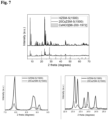
- Fig. 7 shows the XRD patterns of the HZSM-5 and CsZSM-5 catalysts with SiO 2 /Al 2 O 3 molar ratio of 30 and 1500.
- the intensity of diffraction peaks assigned to MFI framework was changed and also the lattice parameters were modified after alkali-treatment.
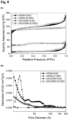
- Fig. 8 show that the incorporation of Cs metal species to the parent HZSM-5(1500) zeolites decreased the BET surface areas, microporous and mesoporous surface areas, and pore volumes. Only the pore diameter was increased in the case of 20CsZSM-5(30) catalyst compared to the HZSM-5(30), namely from 6.4 to 24.6 nm. This observation can be explained by the higher dissolution of zeolite frameworks caused by interaction between alkali metal - zeolite support with lower SiO 2 /Al 2 O 3 ratio.
- the crystallite size calculated from different individual reflections in XRD patterns by the Scherrer equation, exhibited a decrease from 91.5 to 78.7 nm for the CsZSM-5(1500) catalyst.
- Zeolites crystallite size decreasing can lead to improvement of catalytic activity and selectivity.
- CsZSM-5(30) catalyst showed negligible trend of the crystallite size increase from 57.4 to 61.6 nm.
- the crystallinity of the CsZSM-5(30) and CsZSM-5(1500) catalysts was decreased from 100 to 33.4% and 34.6%, respectively.
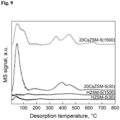
- Fig. 9 shows the CO 2 -TPD results of the parent HZSM-5 and alkali-treated zeolites. It was found that CsNO 3 impregnated zeolites have relatively high basicity. The small desorption peak at the temperature of 45 and 135 °C is present for the HZSM-5(30) and HZSM-5(1500) zeolites, respectively. These peaks indicate on the presence of surface basic sites that was due to the interaction between the framework of HZSM-5 and CO 2 . It is known that zeolites can include acid and basic sites, where the latter can appear from the negative charge in the Si-O-Al species. Zeolites basicity depends on their chemical composition (on framework and nonframework atoms) and the structure type influences the oxygen basicity. ZSM-5 alkali-promoted zeolites showed basic properties due to a high charge on oxygen, which relates to Cs + cation with the lowest electronegativity (0.79) and thus, weak acidity.
- Fig. 10 shows the NH 3 -TPD signals of the HZSM-5 and CsZSM-5 zeolite catalysts.
- the acidic sites for the Cs promoted zeolite catalysts were not detected by NH 3 -TPD analysis.
- the NH 3 -TPD profile clearly indicates that when CsNO 3 was loaded onto the zeolite framework, the surface acidity decreased (or totally disappeared) but the surface basicity increased, which is also in agreement with previous reports.
- the 20CsZSM-5(30) and 20CsZSM-5(1500) samples exhibit three main desorption peaks with representing weak (45-55 °C), medium (350-450 °C) and strong ( ⁇ 640 °C) basic sites. These data clearly indicate that the addition of CsNO 3 to HZSM-5 increase the intensity of the CO 2 desorption peak and improve the surface basicity, which is in good agreement with the literature.
- the total basicity increased from 0.9 to 18.2 ⁇ mol CO2 /g catalyst after CsNO 3 impregnation to HZSM-5(30) zeolite and from 1.1 to 17.3 ⁇ mol CO2 /g catalyst when HZSM-5(1500) zeolite support was impregnated.
- HZSM-5(30) catalyst exhibits usual desorption spectrum with two distinct desorption peaks of the NH 3 -TPD profile containing a low-temperature peak at 200 °C related to weak acid sites and a high-temperature peak at 400 °C corresponding to strong acid sites. It was shown that with the rising SiO 2 /Al 2 O 3 ratio of HZSM-5 zeolites from 30 to 1500, the acid sites almost completely disappeared. This shows that HZSM-5(1500) zeolite has a very weak acidic character. Only a small peak was detected at 150 °C, which is related to weak acid sites and also correlated with Pyr-DRIFT analysis below.
- DRIFTS Pyridine diffuse reflectance infrared Fourier transform spectroscopy
- the LAS peak of 20CsZSM-5(30) shifts to lower frequencies, indicating weakening of its total acidity (0.23 mmol/g) compared to pristine HZSM-5(30) with 0.63 mmol/g.
- This increasing of LAS over the 20CsZSM-5(30) catalyst can be explained by the weak Lewis acidity of Cs + in combination with alumina interaction. This increase of LAS was also observed in the literature, when the loading of CsNO 3 was above 10 wt%.
- the absence of LAS over the 20CsZSM-5(1500) catalyst can be attributed to the very low content of alumina in the HZSM-5(1500) zeolite support.
Landscapes
- Chemical & Material Sciences (AREA)
- Organic Chemistry (AREA)
- Catalysts (AREA)
Claims (8)
- Verfahren zur Herstellung von Glycidol (GLD), umfassend die Schritte:(a) Zuführen eines Ausgangsmaterials über einen heterogenen Katalysator in einen kontinuierlichen Festbett-Strömungsreaktor,(b) Erhitzen der Mischung auf eine Temperatur größer als 250 °C, um Glycidol zu erhalten,(c) Fließen von N2 als ein Trägergas und Glycerin (GL) als eine Beschickung mit einer stündlichen Gesamtgasraumgeschwindigkeit von 1000-2500 h-1, und(d) Sammeln des GLD-Produkts,wobei das Ausgangsmaterial eine GL-Lösung ist,wobei der Katalysator mindestens eine Alkalimetallverbindung in einer Menge von 1 bis 60 Gew.-% umfasst, die auf einem Aluminosilikat-Zeolith aufgebracht ist.
- Verfahren nach Anspruch 1, wobei die Konzentration von GL in der Lösung im Bereich von 1 bis 60 Gew.-% liegt.
- Verfahren nach einem der vorhergehenden Ansprüche, wobei die Alkalimetalle ausgewählt sind aus Lithium (Li), Natrium (Na), Kalium (K), Rubidium (Rb), und Cäsium (Cs).
- Verfahren nach einem der vorhergehenden Ansprüche, wobei der Zeolith ausgewählt ist aus der Gruppe bestehend aus ZSM-5, Mordenit, USY, Zeolith L, Ferrierit, Zeolith Beta und Zeolith Y, vorzugsweise ZSM-5.
- Verfahren nach einem der vorhergehenden Ansprüche, wobei die Alkalimetallverbindungen ausgewählt sind aus der Gruppe bestehend aus Cs-Oxiden, CsNOs, Cs2SO4, CSF, CsCI, CsBr, Csl, Cs3PO4, Cs2COs, Cs2C2O4, CH3CO2Cs (mit unterschiedlicher Cs-Beladung, vorzugsweise von 1 bis 60), Li-Oxiden, LiNO3, Li2SO4, LiF, LiCI, LiBr, Lil, Li3PO4, Li2CO3, Li2C2O4, CH3CO2Li (mit unterschiedlicher Li-Beladung, vorzugsweise von 1 bis 60), Na-Oxiden, NaNO3, Na2SO4, NaF, NaCl, NaBr, NaI, Na3PO4, Na2CO3, Na2C2O4, CH3CO2Na (mit unterschiedlicher Na-Beladung, vorzugsweise von 1 bis 60), K-Oxiden, KNO3, K2SO4, KF, KCI, KBr, Kl, K3PO4, K2CO3, K2C2O4, CH3CO2K (mit unterschiedlicher K-Beladung, vorzugsweise von 1 bis 60), Rb-Oxiden, RbNO3, Rb2SO4, RbF, RbCl, RbBr, Rbl, Rb3PO4, Rb2CO3, Rb2C2O4, und CH3CO2Rb (mit unterschiedlicher Rb-Beladung, vorzugsweise von 1 bis 60).
- Verfahren nach einem der vorhergehenden Ansprüche, wobei der Katalysator ausgewählt ist aus der Gruppe bestehend aus xLi-Zeolith, xNa-Zeolith, xK-Zeolith, xRb-Zeolith und xCs-Zeolith, vorzugsweise xCs-ZSM-5-Aluminosilikat-Zeolith.
- Verfahren nach einem der vorhergehenden Ansprüche, wobei die Menge der Katalysatoren im Bereich von 0,5 bis 5 g liegt.
- Verfahren nach einem der vorangehenden Ansprüche, wobei die Temperatur von 250 bis 450 °C liegt.
Applications Claiming Priority (1)
| Application Number | Priority Date | Filing Date | Title |
|---|---|---|---|
| LU101204A LU101204B1 (en) | 2019-04-30 | 2019-04-30 | One-step synthesis of glycidol from glycerol in gas-phase fixed-bed continuous flow reactor over alkali metal promoted aluminosilicate zeolite catalyst |
Publications (3)
| Publication Number | Publication Date |
|---|---|
| EP3733654A1 EP3733654A1 (de) | 2020-11-04 |
| EP3733654C0 EP3733654C0 (de) | 2024-04-24 |
| EP3733654B1 true EP3733654B1 (de) | 2024-04-24 |
Family
ID=66530397
Family Applications (1)
| Application Number | Title | Priority Date | Filing Date |
|---|---|---|---|
| EP20171608.1A Active EP3733654B1 (de) | 2019-04-30 | 2020-04-27 | Einstufige synthese von glycidol aus glycerin in einem gasphasen-festbettreaktor mit kontinuierlicher strömung über einen alkalimetallgeförderten aluminosilikat-zeolith-katalysator |
Country Status (3)
| Country | Link |
|---|---|
| EP (1) | EP3733654B1 (de) |
| LU (1) | LU101204B1 (de) |
| PL (1) | PL3733654T3 (de) |
Family Cites Families (2)
| Publication number | Priority date | Publication date | Assignee | Title |
|---|---|---|---|---|
| WO2007132926A1 (en) * | 2006-05-12 | 2007-11-22 | Nippon Shokubai Co., Ltd. | Production method of acrolein |
| AP3760A (en) | 2010-06-29 | 2016-07-31 | Ael Mining Services Ltd | Epoxidation of glycerol and derivatives therefrom |
-
2019
- 2019-04-30 LU LU101204A patent/LU101204B1/en not_active IP Right Cessation
-
2020
- 2020-04-27 PL PL20171608.1T patent/PL3733654T3/pl unknown
- 2020-04-27 EP EP20171608.1A patent/EP3733654B1/de active Active
Non-Patent Citations (2)
| Title |
|---|
| KOSTYNIUK ANDRII ET AL: "One-step synthesis of ethanol from glycerol in a gas phase packed bed reactor over hierarchical alkali-treated zeolite catalyst materials", GREEN CHEMISTRY, vol. 22, no. 3, 10 February 2020 (2020-02-10), GB, pages 753 - 765, XP055929078, ISSN: 1463-9262, DOI: 10.1039/C9GC03262B * |
| RAMLI ZAINAB ET AL: "Effect Of Loaded Alkali Metals On The Structural, Basicity And Catalytic Activity Of Zeolite Beta", JURNAL TEKNOLOGI, vol. 42, no. C, 1 June 2005 (2005-06-01), pages 43 - 55, XP093047818, Retrieved from the Internet <URL:https://www.researchgate.net/profile/Zainab-Ramli-2/publication/44785843_Effect_Of_Loaded_Alkali_Metals_On_The_Structural_Basicity_And_Catalytic_Activity_Of_Zeolite_Beta/links/57d0cb1a08ae601b39a06350/Effect-Of-Loaded-Alkali-Metals-On-The-Structural-Basicity-And-Catalytic-Activity-Of-Zeolite-Beta.pd> * |
Also Published As
| Publication number | Publication date |
|---|---|
| EP3733654C0 (de) | 2024-04-24 |
| LU101204B1 (en) | 2020-10-30 |
| EP3733654A1 (de) | 2020-11-04 |
| PL3733654T3 (pl) | 2024-10-21 |
Similar Documents
| Publication | Publication Date | Title |
|---|---|---|
| Chieregato et al. | One-pot glycerol oxidehydration to acrylic acid on multifunctional catalysts: Focus on the influence of the reaction parameters in respect to the catalytic performance | |
| Banu et al. | Hydrogenolysis of sorbitol over Ni and Pt loaded on NaY | |
| JP6084963B2 (ja) | 1,3−ブタジエンの製造方法 | |
| JP6082035B2 (ja) | 酢酸とジメチルエーテルを製造するプロセス | |
| US20190105634A1 (en) | Metal oxide catalyst systems for conversion of ethanol to butadiene | |
| Kondawar et al. | Carbonylation of glycerol with urea to glycerol carbonate over supported Zn catalysts | |
| KR20110004872A (ko) | 글리세린으로부터의 아크롤레인 또는 아크릴산의 제조방법 | |
| US10328420B2 (en) | Dehydration-hydrolysis processes and catalysts therefor | |
| Patil et al. | Improving 1, 3-butadiene yield by Cs promotion in ethanol conversion | |
| Burt et al. | Production of 1, 6-hexanediol from tetrahydropyran-2-methanol by dehydration–hydration and hydrogenation | |
| EP3604260A1 (de) | Einstufiges verfahren zur herstellung von butadien | |
| US20100240938A1 (en) | Process for producing triptane | |
| Wang et al. | Synergistic effects between acid and base sites and kinetic for synthesis of methylacrolein on the Cs-P/γ-Al2O3 catalyst | |
| US7759525B2 (en) | Process for preparing partial oxidation products of lower alcohols by direct oxidation of a lower alcohol and catalysts for use in that process | |
| WO2013008279A1 (en) | Process for preparing catalyst used in production of acrolein and/or acrylic acid and process for preparing acrolein and/or acrylic acid by dehydration reaction of glycerin | |
| Minambres et al. | Liquid and gas-phase Meerwein–Ponndorf–Verley reduction of crotonaldehyde on ZrO2 catalysts modified with Al2O3, Ga2O3 and In2O3 | |
| EP3973035B1 (de) | Verfahren zur herstellung von c2 bis c5 paraffinen mittels hybridkatalysator bestehend aus einem hochsauren mikroporösen kristallinen komponent | |
| ES2391809T3 (es) | Método para producir óxidos de alquileno | |
| Amusa et al. | Enhancing the selectivity of light olefins through synergistic VOx/ZSM-5 composite in the oxidative cracking of hexane | |
| EP3733654A1 (de) | Einstufige synthese von glycidol aus glycerin in einem gasphasen-festbettreaktor mit kontinuierlicher strömung über einen alkalimetallgeförderten aluminosilikat-zeolith-katalysator | |
| Gamman et al. | Synthesis of methyl isobutyl ketone over Pd/MgO/SiO2 | |
| KR20010102372A (ko) | 아세트산 제조용 촉매, 이의 제조방법 및 이를 이용한아세트산의 제조방법 | |
| JP2011026214A (ja) | N−アルキル−tert−ブチルアミンの製造方法 | |
| CN103551184B (zh) | 沸石包覆氧化物催化剂的制备及其在甲醇制丙烯反应中的应用 | |
| EP3733635B1 (de) | Nachhaltige herstellung von allylalkohol: gasphasenumwandlung von glycerin über metallgeförderte aluminosilikat-zeolith-katalysatoren in einem festbett-durchlaufreaktor |
Legal Events
| Date | Code | Title | Description |
|---|---|---|---|
| PUAI | Public reference made under article 153(3) epc to a published international application that has entered the european phase |
Free format text: ORIGINAL CODE: 0009012 |
|
| STAA | Information on the status of an ep patent application or granted ep patent |
Free format text: STATUS: REQUEST FOR EXAMINATION WAS MADE |
|
| 17P | Request for examination filed |
Effective date: 20200427 |
|
| AK | Designated contracting states |
Kind code of ref document: A1 Designated state(s): AL AT BE BG CH CY CZ DE DK EE ES FI FR GB GR HR HU IE IS IT LI LT LU LV MC MK MT NL NO PL PT RO RS SE SI SK SM TR |
|
| AX | Request for extension of the european patent |
Extension state: BA ME |
|
| STAA | Information on the status of an ep patent application or granted ep patent |
Free format text: STATUS: EXAMINATION IS IN PROGRESS |
|
| 17Q | First examination report despatched |
Effective date: 20220615 |
|
| P01 | Opt-out of the competence of the unified patent court (upc) registered |
Effective date: 20230505 |
|
| GRAP | Despatch of communication of intention to grant a patent |
Free format text: ORIGINAL CODE: EPIDOSNIGR1 |
|
| STAA | Information on the status of an ep patent application or granted ep patent |
Free format text: STATUS: GRANT OF PATENT IS INTENDED |
|
| INTG | Intention to grant announced |
Effective date: 20230905 |
|
| GRAJ | Information related to disapproval of communication of intention to grant by the applicant or resumption of examination proceedings by the epo deleted |
Free format text: ORIGINAL CODE: EPIDOSDIGR1 |
|
| STAA | Information on the status of an ep patent application or granted ep patent |
Free format text: STATUS: EXAMINATION IS IN PROGRESS |
|
| GRAP | Despatch of communication of intention to grant a patent |
Free format text: ORIGINAL CODE: EPIDOSNIGR1 |
|
| STAA | Information on the status of an ep patent application or granted ep patent |
Free format text: STATUS: GRANT OF PATENT IS INTENDED |
|
| INTC | Intention to grant announced (deleted) | ||
| INTG | Intention to grant announced |
Effective date: 20231201 |
|
| GRAS | Grant fee paid |
Free format text: ORIGINAL CODE: EPIDOSNIGR3 |
|
| GRAA | (expected) grant |
Free format text: ORIGINAL CODE: 0009210 |
|
| STAA | Information on the status of an ep patent application or granted ep patent |
Free format text: STATUS: THE PATENT HAS BEEN GRANTED |
|
| AK | Designated contracting states |
Kind code of ref document: B1 Designated state(s): AL AT BE BG CH CY CZ DE DK EE ES FI FR GB GR HR HU IE IS IT LI LT LU LV MC MK MT NL NO PL PT RO RS SE SI SK SM TR |
|
| REG | Reference to a national code |
Ref country code: GB Ref legal event code: FG4D |
|
| REG | Reference to a national code |
Ref country code: CH Ref legal event code: EP |
|
| REG | Reference to a national code |
Ref country code: DE Ref legal event code: R096 Ref document number: 602020029406 Country of ref document: DE |
|
| REG | Reference to a national code |
Ref country code: IE Ref legal event code: FG4D |
|
| P04 | Withdrawal of opt-out of the competence of the unified patent court (upc) registered |
Effective date: 20240529 |
|
| U01 | Request for unitary effect filed |
Effective date: 20240524 |
|
| U07 | Unitary effect registered |
Designated state(s): AT BE BG DE DK EE FI FR IT LT LU LV MT NL PT SE SI Effective date: 20240604 |
|
| U20 | Renewal fee for the european patent with unitary effect paid |
Year of fee payment: 5 Effective date: 20240529 |
|
| PG25 | Lapsed in a contracting state [announced via postgrant information from national office to epo] |
Ref country code: IS Free format text: LAPSE BECAUSE OF FAILURE TO SUBMIT A TRANSLATION OF THE DESCRIPTION OR TO PAY THE FEE WITHIN THE PRESCRIBED TIME-LIMIT Effective date: 20240824 |
|
| PG25 | Lapsed in a contracting state [announced via postgrant information from national office to epo] |
Ref country code: HR Free format text: LAPSE BECAUSE OF FAILURE TO SUBMIT A TRANSLATION OF THE DESCRIPTION OR TO PAY THE FEE WITHIN THE PRESCRIBED TIME-LIMIT Effective date: 20240424 |
|
| PG25 | Lapsed in a contracting state [announced via postgrant information from national office to epo] |
Ref country code: GR Free format text: LAPSE BECAUSE OF FAILURE TO SUBMIT A TRANSLATION OF THE DESCRIPTION OR TO PAY THE FEE WITHIN THE PRESCRIBED TIME-LIMIT Effective date: 20240725 |
|
| PG25 | Lapsed in a contracting state [announced via postgrant information from national office to epo] |
Ref country code: ES Free format text: LAPSE BECAUSE OF FAILURE TO SUBMIT A TRANSLATION OF THE DESCRIPTION OR TO PAY THE FEE WITHIN THE PRESCRIBED TIME-LIMIT Effective date: 20240424 |
|
| PG25 | Lapsed in a contracting state [announced via postgrant information from national office to epo] |
Ref country code: NO Free format text: LAPSE BECAUSE OF FAILURE TO SUBMIT A TRANSLATION OF THE DESCRIPTION OR TO PAY THE FEE WITHIN THE PRESCRIBED TIME-LIMIT Effective date: 20240724 Ref country code: IS Free format text: LAPSE BECAUSE OF FAILURE TO SUBMIT A TRANSLATION OF THE DESCRIPTION OR TO PAY THE FEE WITHIN THE PRESCRIBED TIME-LIMIT Effective date: 20240824 Ref country code: HR Free format text: LAPSE BECAUSE OF FAILURE TO SUBMIT A TRANSLATION OF THE DESCRIPTION OR TO PAY THE FEE WITHIN THE PRESCRIBED TIME-LIMIT Effective date: 20240424 Ref country code: GR Free format text: LAPSE BECAUSE OF FAILURE TO SUBMIT A TRANSLATION OF THE DESCRIPTION OR TO PAY THE FEE WITHIN THE PRESCRIBED TIME-LIMIT Effective date: 20240725 Ref country code: ES Free format text: LAPSE BECAUSE OF FAILURE TO SUBMIT A TRANSLATION OF THE DESCRIPTION OR TO PAY THE FEE WITHIN THE PRESCRIBED TIME-LIMIT Effective date: 20240424 Ref country code: RS Free format text: LAPSE BECAUSE OF FAILURE TO SUBMIT A TRANSLATION OF THE DESCRIPTION OR TO PAY THE FEE WITHIN THE PRESCRIBED TIME-LIMIT Effective date: 20240724 |
|
| REG | Reference to a national code |
Ref country code: CH Ref legal event code: PL |
|
| RAP2 | Party data changed (patent owner data changed or rights of a patent transferred) |
Owner name: D.O.T.W. B.V. |
|
| U1K | Transfer of rights of the unitary patent after the registration of the unitary effect |
Owner name: D.O.T.W. B.V.; NL |
|
| P05 | Withdrawal of opt-out of the competence of the unified patent court (upc) changed |
Free format text: CASE NUMBER: APP_31949/2024 Effective date: 20240604 |
|
| PG25 | Lapsed in a contracting state [announced via postgrant information from national office to epo] |
Ref country code: CZ Free format text: LAPSE BECAUSE OF FAILURE TO SUBMIT A TRANSLATION OF THE DESCRIPTION OR TO PAY THE FEE WITHIN THE PRESCRIBED TIME-LIMIT Effective date: 20240424 |
|
| PG25 | Lapsed in a contracting state [announced via postgrant information from national office to epo] |
Ref country code: RO Free format text: LAPSE BECAUSE OF FAILURE TO SUBMIT A TRANSLATION OF THE DESCRIPTION OR TO PAY THE FEE WITHIN THE PRESCRIBED TIME-LIMIT Effective date: 20240424 Ref country code: SK Free format text: LAPSE BECAUSE OF FAILURE TO SUBMIT A TRANSLATION OF THE DESCRIPTION OR TO PAY THE FEE WITHIN THE PRESCRIBED TIME-LIMIT Effective date: 20240424 |
|
| REG | Reference to a national code |
Ref country code: DE Ref legal event code: R097 Ref document number: 602020029406 Country of ref document: DE |
|
| PG25 | Lapsed in a contracting state [announced via postgrant information from national office to epo] |
Ref country code: SM Free format text: LAPSE BECAUSE OF FAILURE TO SUBMIT A TRANSLATION OF THE DESCRIPTION OR TO PAY THE FEE WITHIN THE PRESCRIBED TIME-LIMIT Effective date: 20240424 |
|
| PG25 | Lapsed in a contracting state [announced via postgrant information from national office to epo] |
Ref country code: SM Free format text: LAPSE BECAUSE OF FAILURE TO SUBMIT A TRANSLATION OF THE DESCRIPTION OR TO PAY THE FEE WITHIN THE PRESCRIBED TIME-LIMIT Effective date: 20240424 Ref country code: SK Free format text: LAPSE BECAUSE OF FAILURE TO SUBMIT A TRANSLATION OF THE DESCRIPTION OR TO PAY THE FEE WITHIN THE PRESCRIBED TIME-LIMIT Effective date: 20240424 Ref country code: RO Free format text: LAPSE BECAUSE OF FAILURE TO SUBMIT A TRANSLATION OF THE DESCRIPTION OR TO PAY THE FEE WITHIN THE PRESCRIBED TIME-LIMIT Effective date: 20240424 Ref country code: CZ Free format text: LAPSE BECAUSE OF FAILURE TO SUBMIT A TRANSLATION OF THE DESCRIPTION OR TO PAY THE FEE WITHIN THE PRESCRIBED TIME-LIMIT Effective date: 20240424 Ref country code: MC Free format text: LAPSE BECAUSE OF FAILURE TO SUBMIT A TRANSLATION OF THE DESCRIPTION OR TO PAY THE FEE WITHIN THE PRESCRIBED TIME-LIMIT Effective date: 20240424 Ref country code: CH Free format text: LAPSE BECAUSE OF NON-PAYMENT OF DUE FEES Effective date: 20240430 |
|
| PLBE | No opposition filed within time limit |
Free format text: ORIGINAL CODE: 0009261 |
|
| STAA | Information on the status of an ep patent application or granted ep patent |
Free format text: STATUS: NO OPPOSITION FILED WITHIN TIME LIMIT |
|
| GBPC | Gb: european patent ceased through non-payment of renewal fee |
Effective date: 20240724 |
|
| 26N | No opposition filed |
Effective date: 20250127 |
|
| PG25 | Lapsed in a contracting state [announced via postgrant information from national office to epo] |
Ref country code: IE Free format text: LAPSE BECAUSE OF NON-PAYMENT OF DUE FEES Effective date: 20240427 |
|
| PG25 | Lapsed in a contracting state [announced via postgrant information from national office to epo] |
Ref country code: GB Free format text: LAPSE BECAUSE OF NON-PAYMENT OF DUE FEES Effective date: 20240724 |
|
| U20 | Renewal fee for the european patent with unitary effect paid |
Year of fee payment: 6 Effective date: 20250327 |
|
| PGFP | Annual fee paid to national office [announced via postgrant information from national office to epo] |
Ref country code: PL Payment date: 20250418 Year of fee payment: 6 |
|
| PG25 | Lapsed in a contracting state [announced via postgrant information from national office to epo] |
Ref country code: CY Free format text: LAPSE BECAUSE OF FAILURE TO SUBMIT A TRANSLATION OF THE DESCRIPTION OR TO PAY THE FEE WITHIN THE PRESCRIBED TIME-LIMIT; INVALID AB INITIO Effective date: 20200427 |
|
| PG25 | Lapsed in a contracting state [announced via postgrant information from national office to epo] |
Ref country code: HU Free format text: LAPSE BECAUSE OF FAILURE TO SUBMIT A TRANSLATION OF THE DESCRIPTION OR TO PAY THE FEE WITHIN THE PRESCRIBED TIME-LIMIT; INVALID AB INITIO Effective date: 20200427 |
|
| U20 | Renewal fee for the european patent with unitary effect paid |
Year of fee payment: 7 Effective date: 20260331 |