EP3733274B1 - Material injection scheduling method for producing precursor having concentration gradient - Google Patents
Material injection scheduling method for producing precursor having concentration gradient Download PDFInfo
- Publication number
- EP3733274B1 EP3733274B1 EP18894714.7A EP18894714A EP3733274B1 EP 3733274 B1 EP3733274 B1 EP 3733274B1 EP 18894714 A EP18894714 A EP 18894714A EP 3733274 B1 EP3733274 B1 EP 3733274B1
- Authority
- EP
- European Patent Office
- Prior art keywords
- feed tank
- feed
- flow rate
- feeding
- mixer
- Prior art date
- Legal status (The legal status is an assumption and is not a legal conclusion. Google has not performed a legal analysis and makes no representation as to the accuracy of the status listed.)
- Active
Links
Images




Classifications
-
- H—ELECTRICITY
- H01—ELECTRIC ELEMENTS
- H01M—PROCESSES OR MEANS, e.g. BATTERIES, FOR THE DIRECT CONVERSION OF CHEMICAL ENERGY INTO ELECTRICAL ENERGY
- H01M4/00—Electrodes
- H01M4/02—Electrodes composed of, or comprising, active material
- H01M4/13—Electrodes for accumulators with non-aqueous electrolyte, e.g. for lithium-accumulators; Processes of manufacture thereof
- H01M4/134—Electrodes based on metals, Si or alloys
-
- B—PERFORMING OPERATIONS; TRANSPORTING
- B01—PHYSICAL OR CHEMICAL PROCESSES OR APPARATUS IN GENERAL
- B01J—CHEMICAL OR PHYSICAL PROCESSES, e.g. CATALYSIS OR COLLOID CHEMISTRY; THEIR RELEVANT APPARATUS
- B01J19/00—Chemical, physical or physico-chemical processes in general; Their relevant apparatus
- B01J19/0053—Details of the reactor
- B01J19/0066—Stirrers
-
- B—PERFORMING OPERATIONS; TRANSPORTING
- B01—PHYSICAL OR CHEMICAL PROCESSES OR APPARATUS IN GENERAL
- B01J—CHEMICAL OR PHYSICAL PROCESSES, e.g. CATALYSIS OR COLLOID CHEMISTRY; THEIR RELEVANT APPARATUS
- B01J4/00—Feed or outlet devices; Feed or outlet control devices
- B01J4/008—Feed or outlet control devices
-
- B—PERFORMING OPERATIONS; TRANSPORTING
- B01—PHYSICAL OR CHEMICAL PROCESSES OR APPARATUS IN GENERAL
- B01J—CHEMICAL OR PHYSICAL PROCESSES, e.g. CATALYSIS OR COLLOID CHEMISTRY; THEIR RELEVANT APPARATUS
- B01J4/00—Feed or outlet devices; Feed or outlet control devices
- B01J4/02—Feed or outlet devices; Feed or outlet control devices for feeding measured, i.e. prescribed quantities of reagents
-
- H—ELECTRICITY
- H01—ELECTRIC ELEMENTS
- H01M—PROCESSES OR MEANS, e.g. BATTERIES, FOR THE DIRECT CONVERSION OF CHEMICAL ENERGY INTO ELECTRICAL ENERGY
- H01M10/00—Secondary cells; Manufacture thereof
- H01M10/04—Construction or manufacture in general
- H01M10/0404—Machines for assembling batteries
-
- H—ELECTRICITY
- H01—ELECTRIC ELEMENTS
- H01M—PROCESSES OR MEANS, e.g. BATTERIES, FOR THE DIRECT CONVERSION OF CHEMICAL ENERGY INTO ELECTRICAL ENERGY
- H01M10/00—Secondary cells; Manufacture thereof
- H01M10/05—Accumulators with non-aqueous electrolyte
- H01M10/054—Accumulators with insertion or intercalation of metals other than lithium, e.g. with magnesium or aluminium
-
- H—ELECTRICITY
- H01—ELECTRIC ELEMENTS
- H01M—PROCESSES OR MEANS, e.g. BATTERIES, FOR THE DIRECT CONVERSION OF CHEMICAL ENERGY INTO ELECTRICAL ENERGY
- H01M10/00—Secondary cells; Manufacture thereof
- H01M10/05—Accumulators with non-aqueous electrolyte
- H01M10/058—Construction or manufacture
-
- H—ELECTRICITY
- H01—ELECTRIC ELEMENTS
- H01M—PROCESSES OR MEANS, e.g. BATTERIES, FOR THE DIRECT CONVERSION OF CHEMICAL ENERGY INTO ELECTRICAL ENERGY
- H01M4/00—Electrodes
- H01M4/02—Electrodes composed of, or comprising, active material
- H01M4/13—Electrodes for accumulators with non-aqueous electrolyte, e.g. for lithium-accumulators; Processes of manufacture thereof
- H01M4/139—Processes of manufacture
- H01M4/1395—Processes of manufacture of electrodes based on metals, Si or alloys
-
- H—ELECTRICITY
- H01—ELECTRIC ELEMENTS
- H01M—PROCESSES OR MEANS, e.g. BATTERIES, FOR THE DIRECT CONVERSION OF CHEMICAL ENERGY INTO ELECTRICAL ENERGY
- H01M4/00—Electrodes
- H01M4/02—Electrodes composed of, or comprising, active material
- H01M4/13—Electrodes for accumulators with non-aqueous electrolyte, e.g. for lithium-accumulators; Processes of manufacture thereof
- H01M4/131—Electrodes based on mixed oxides or hydroxides, or on mixtures of oxides or hydroxides, e.g. LiCoOx
-
- H—ELECTRICITY
- H01—ELECTRIC ELEMENTS
- H01M—PROCESSES OR MEANS, e.g. BATTERIES, FOR THE DIRECT CONVERSION OF CHEMICAL ENERGY INTO ELECTRICAL ENERGY
- H01M4/00—Electrodes
- H01M4/02—Electrodes composed of, or comprising, active material
- H01M4/36—Selection of substances as active materials, active masses, active liquids
- H01M4/362—Composites
-
- H—ELECTRICITY
- H01—ELECTRIC ELEMENTS
- H01M—PROCESSES OR MEANS, e.g. BATTERIES, FOR THE DIRECT CONVERSION OF CHEMICAL ENERGY INTO ELECTRICAL ENERGY
- H01M4/00—Electrodes
- H01M4/02—Electrodes composed of, or comprising, active material
- H01M4/36—Selection of substances as active materials, active masses, active liquids
- H01M4/48—Selection of substances as active materials, active masses, active liquids of inorganic oxides or hydroxides
- H01M4/50—Selection of substances as active materials, active masses, active liquids of inorganic oxides or hydroxides of manganese
- H01M4/505—Selection of substances as active materials, active masses, active liquids of inorganic oxides or hydroxides of manganese of mixed oxides or hydroxides containing manganese for inserting or intercalating light metals, e.g. LiMn2O4 or LiMn2OxFy
-
- H—ELECTRICITY
- H01—ELECTRIC ELEMENTS
- H01M—PROCESSES OR MEANS, e.g. BATTERIES, FOR THE DIRECT CONVERSION OF CHEMICAL ENERGY INTO ELECTRICAL ENERGY
- H01M4/00—Electrodes
- H01M4/02—Electrodes composed of, or comprising, active material
- H01M4/36—Selection of substances as active materials, active masses, active liquids
- H01M4/48—Selection of substances as active materials, active masses, active liquids of inorganic oxides or hydroxides
- H01M4/52—Selection of substances as active materials, active masses, active liquids of inorganic oxides or hydroxides of nickel, cobalt or iron
- H01M4/525—Selection of substances as active materials, active masses, active liquids of inorganic oxides or hydroxides of nickel, cobalt or iron of mixed oxides or hydroxides containing iron, cobalt or nickel for inserting or intercalating light metals, e.g. LiNiO2, LiCoO2 or LiCoOxFy
-
- Y—GENERAL TAGGING OF NEW TECHNOLOGICAL DEVELOPMENTS; GENERAL TAGGING OF CROSS-SECTIONAL TECHNOLOGIES SPANNING OVER SEVERAL SECTIONS OF THE IPC; TECHNICAL SUBJECTS COVERED BY FORMER USPC CROSS-REFERENCE ART COLLECTIONS [XRACs] AND DIGESTS
- Y02—TECHNOLOGIES OR APPLICATIONS FOR MITIGATION OR ADAPTATION AGAINST CLIMATE CHANGE
- Y02P—CLIMATE CHANGE MITIGATION TECHNOLOGIES IN THE PRODUCTION OR PROCESSING OF GOODS
- Y02P70/00—Climate change mitigation technologies in the production process for final industrial or consumer products
- Y02P70/50—Manufacturing or production processes characterised by the final manufactured product
Definitions
- the present invention relates to a material injection scheduling method for producing a precursor having a concentration gradient, and more particularly, to a material injection scheduling method for producing a precursor having a concentration gradient in which two materials are mixed with each other in advance using a mixer and injected into a reactor.
- a rechargeable lithium secondary battery has a significantly higher energy density than a conventional battery, but has a disadvantage in that a thermal property is poor due to an unstable crystal structure of a cathode active material at a high temperature. Therefore, as a method for solving such a disadvantage, a method for producing a precursor whose metal composition has a concentration gradient has been studied.
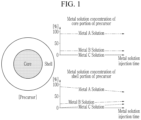
- the precursor having the concentration gradient refers to a precursor in which a core portion is formed of a material having the same composition ratio, and a shell portion is formed so that a composition ratio gradually changes radially.
- metal solutions having different composition ratios are injected from a Q1 feed tank to a Q2 feed tank, the metal solutions are continuously injected from the Q1 feed tank to the Q2 feed tank at a fixed constant flow rate during a reaction time, and the entire metal solutions mixed within a given reaction time are injected from the Q2 feed tank to a reactor, such that the concentration gradient is adjusted.
- the present invention has been made in an effort to provide a material injection scheduling method having advantages of producing a precursor having a uniform concentration gradient.
- step 8 substituting each time values making a difference in the feed flow rate of the material of the first feed tank constant; (d) a step of correcting the feed flow rate of the material of the first feed tank by calculating a difference between the injection amount and the flow rate of the first feed tank for each time calculated in step (b), and the values of the difference are arranged to time in reverse order to be subtracted from the injection amount calculated in step (c); and (e) a step of calculating a feed flow rate of the material of the second feed tank by subtracting the feed flow rate of the material of the first feed tank corrected in the step (d) from the feed flow rate of the mixer.
- the material injection scheduling method may further include, between the step (a) and the step (b), (f) a step of calculating a time taken for feeding the entire material of the first feed tank in consideration of an amount of the material of the first feed tank injected into the mixer in advance.
- the material injection scheduling method may further include, between the step (b) and the step (c), (e) a step of determining whether or not the difference in the feed flow rate of the material of the first feed tank is the same between feeding steps other than between a first feeding step and a second feeding step and between a last feeding step and a feeding step just before the last feeding step.
- step (e) If it is determined in the step (e) that the difference in the feed flow rate of the material of the first feed tank is not the same between feeding steps other than between the first feeding step and the second feeding step and between the last feeding step and the feeding step just before the last feeding step, the step (b) may be performed again.
- the material injection scheduling method may further include, between the step (e) and the step (c), (f) a step of summing the feed flow rates of the material of the first feed tank in all feeding steps; and (g) a step of determining whether or not a sum of the feed flow rates of the material of the first feed tank is greater than a total amount of the material to be injected from the first feed tank into the mixer.
- the step (c) is not performed and the pattern calculated in the step (b) may be determined to be an injection schedule of the material of the first feed tank, and if the sum of the feed flow rates of the material of the first feed tank is greater than the total amount of the material to be injected from the first feed tank into the mixer in the step (g), the step (c) may be performed.
- the material injection scheduling method may further include, between the step (d) and the step (e), (h) a step of determining whether or not a difference between the sum of the feed flow rates of the material of the first feed tank and the total amount of the material to be injected from the first feed tank into the mixer is a predetermined value or less.
- step (c) and the step (d) may be performed again.
- the material of the first feed tank may be a mixed solution of nickel and cobalt
- the material of the second feed tank may be a mixed solution of nickel, cobalt, and manganese.
- a precursor having a uniform concentration gradient may be produced even though a reaction time is changed, such that the quality of the precursor may be improved, and preliminary verification for the concentration gradient may be performed, such that a variation in precursor quality may be minimized.
- FIG. 3 is a conceptual diagram illustrating an apparatus for producing a precursor having a concentration gradient.
- FIG. 4 is a graph illustrating an injection amount of a material depending on a reaction time ideal for the apparatus for producing a precursor having a concentration gradient.
- FIG. 5 is a graph illustrating an injection amount of a material depending on a reaction time ideal for the apparatus for producing a precursor.
- FIG. 6 is a graph illustrating an injection amount of a material depending on a reaction time when a feed amount of a material of a Q1 feed tank is simply calculated in a pattern in which it gradually decreases during a total process time.
- the apparatus for producing a precursor having a concentration gradient includes two feed tanks Q1 and Q2 storing metal solutions having different composition ratios, a plurality of mixers Q3 mixing the metal solutions having different composition ratios injected from the two feed tanks Q1 and Q2, and a plurality of reactors A, B, C, and D connected to the plurality of mixers Q3 in a one-to-one corresponding manner and receiving the mixed metal solutions from the mixer Q3.
- the mixer Q3 and the reactors A, B, C, and D are illustrated as four, respectively, but the number of them may be increased or decreased as necessary.
- the metal solutions having different composition ratios injected from the two feed tanks Q1 and Q2 are mixed in the mixer Q3 in advance and then injected into the reactors A, B, C and D to perform the process.
- a production capacity may be effectively increased or decreased only with the increase or decrease in the number of the mixer Q3 and the reactors A, B, C and D.
- an injection amount of the mixed materials injected from the mixer Q3 into the reactors A, B, C, and D is constant, but in the feed flow rate injected from the two feed tanks Q1 and Q2 into the mixer Q3, the injection amount is required to be sequentially changed in a opposite pattern to each other in order to create a concentration gradient.
- FIG. 4 is a graph showing the most ideal schedule of the feed flow rate injected from the two feed tanks Q1 and Q2 to the mixer Q3.
- the reaction starts in a state in which the metal solution of the first feed tank Q1 is filled at a predetermined amount (500 kg in the embodiment) in advance.
- the injection amount of the material of the first feed tank Q1 is 500 kg or less than that of a second feed tank Q2, and after all the materials contained in the first feed tank Q1 are consumed, 500 kg of the material contained in the mixer Q3 is injected into the reactor.
- a graph for material feeding as shown in FIG. 5 , is to be created.
- a core portion of the precursor has a constant composition, without change in the composition, and a shell portion thereof has a specific slope for the change in concentration for each metal solution.
- the injection amount of the material of the first feed tank Q1 is calculated to be in a pattern that it gradually decreases for a total reaction time.
- FIG. 6 shows a material injection schedule for 30-hour reaction, and the feed flow rate from the mixer Q3 into the reactors A, B, C, and D is fixed at 221.77 kg/h.
- the injection amount of the core composition solution is to be decreased by a constant flow rate difference.
- the flow rate of the core composition solution to be injected for 1 hour in the second injection step is calculated by using the feed flow rate per hour of the mixer Q3, 221.77kg/h, and an injection amount of the core composition solution obtained by subtracting 500 kg injected into the mixer Q3 in advance from the total amount of the core composition solution (an amount of the material injected from the first feed tank Q1) as a basis for the calculation.
- the feed flow rate per hour of the mixer Q3, 221.77kg/h is an amount calculated based on the total amount of the core composition solution, not based on the amount of the material injected from the first feed tank Q1.
- a degree of decrease in the flow rate of the core composition solution injected for 2 hours may be calculated to be large compared to a degree of decrease in the flow rate of the core composition solution after 2 hours.
- Table 1 shows the detailed values of the flow rate for the injection schedule up to the initial 6 hours in FIG. 6 .
- Injection time (Hour) Gradient Difference Final injection amount of core Q1 Q2 Q3 1 29.51 221.77 0 221.77 2 7.80 192.26 29.51 221.77 3 7.80 184.46 37.31 221.77 4 7.80 176.65 45.11 221.77 5 7.80 168.85 52.92 221.77 6 7.80 161.04 60.72 221.77 7 7.80 153.24 68.53 221.77
- the difference between the first injection flow rate and the second injection flow rate is 29.51 kg/h, and after the second flow rate, it constantly decrease at a slope of 7.80 kg/h.
- this rapid change in the first injection flow rate and the second injection flow rate causes the concentration of the portion in contact with the core of the precursor to change rapidly compared to that of other portions.
- the following material injection scheduling method is provided.
- FIG. 7 is a flow chart of a material injection scheduling method for producing a precursor having a concentration gradient according to an exemplary embodiment of the present invention.
- FIG. 8 is a graph illustrating a process of modifying an injection schedule of a feed amount of a material of a Q1 feed tank through the material injection scheduling method for producing a precursor having a concentration gradient according to an exemplary embodiment of the present invention.
- the feed flow rate of Q3 is calculated by dividing the sum of the total amount of the material of Q1 and the total amount of the material of Q2 by the total process time (Tr) (S2).
- the time (TQ1) required for feeding the entire materials of the Q1 feed tank is calculated by subtracting the time required to consume the material of Q1 stored in Q3 in advance from the total process time (Tr) (value obtained by dividing the amount of the material of Q1 stored in Q3 in advance by the feed flow rate of Q3) (S3).
- the flow rate of the material to be fed from the Q1 feed tank into the Q3 feed tank is calculated in a pattern in which it gradually decreases (S4).
- the flow rate of Q1 (FQ1t) for each time (for feeding step) is calculated using Equation 2 below.
- FQ1t 2 ⁇ (total amount of material of Q1-amount of material of Q1 sotred in Q3 in advance-amount of material of Q1 injected in advance)/(time required for feeding entire materials of Q1 feed tank(TQ1)-time already taken for injection into Q1
- the change in the flow rate of the material to be fed from the Q1 feed tank into the Q3 calculated through the above process may be represented as S4 in the graph of FIG. 8 .
- step (S4) is performed again, and if it is determined to be ⁇ YES', the material injection scheduling method proceeds to next step (S6).
- step (S4) the flow rate of Q1 (FQ1t) for each time (for each feeding step) calculated in step (S4) is summed (S6).
- step (S6) it is determined whether or not the sum of the flow rate of Q1 (FQ1t) calculated in step (S6) is greater than the total amount of feeding of Q1 (total amount of material of Q1 - amount of material of Q1 stored in Q3 in advance) (S7).
- the flow rate of Q1 (FQ1t) calculated in step (S6) is determined as a feeding schedule of Q1 and the material injection scheduling method proceeds to step (S11), and if it is determined to be ⁇ YES', the material injection scheduling method proceeds to step (S8).
- a difference between the optimum amount calculated in step (S8) and the flow rate of Q1 (FQ1t) for each time (for each feeding step) calculated in step (S4) is calculated, and the values of the difference are arranged to feeding step in reverse order to be subtracted from the optimum amount calculated in step (S8), such that a corrected flow rate of Q1 in each feeding step is obtained (S9).
- the corrected flow rate of Q1 in each feeding step may be represented as S9 in the graph of FIG. 8 .
- step (S10) it is determined whether or not the value obtained by subtracting the total amount of feeding of Q1 from the sum of the corrected flow rates of Q1 in each feeding step is smaller than a predetermined value set in advance (S10).
- steps (S8 and S9) are performed again, and if it is determined to be ⁇ YES', the corrected flow rate of Q1 is determined as the feeding schedule of Q1 and the material injection scheduling method proceeds to step (S11).
- the feed flow rate of Q2 is calculated by subtracting the feed schedule of Q1 determined in step S10 from the feed flow rate of Q3 (S11).
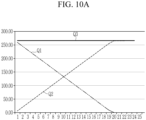
- FIG. 9A , FIG. 10A , and FIG. 11A show the results obtained by calculating the material injection schedule of the co-precipitation process with reaction times of 22 hours, 25 hours, and 30 hours, respectively, according to an embodiment of the present invention.
- FIG. 9B , FIG. 10B , and FIG. 11B when the schedule obtained through the material injection scheduling method according to the embodiment of the present invention is used, a precursor may be formed to have a uniform concentration gradient even in the vicinity of the core.
Landscapes
- Chemical & Material Sciences (AREA)
- Chemical Kinetics & Catalysis (AREA)
- Engineering & Computer Science (AREA)
- Electrochemistry (AREA)
- General Chemical & Material Sciences (AREA)
- Organic Chemistry (AREA)
- Manufacturing & Machinery (AREA)
- Materials Engineering (AREA)
- Battery Electrode And Active Subsutance (AREA)
- Inorganic Compounds Of Heavy Metals (AREA)
- Physical Or Chemical Processes And Apparatus (AREA)
- Carbon Steel Or Casting Steel Manufacturing (AREA)
- Control Of Non-Electrical Variables (AREA)
Description
- This application claims priority to and the benefit of
Korean Patent Application No. 10-2017-0180061 filed in the Korean Intellectual Property Office on December 26, 2017 - The present invention relates to a material injection scheduling method for producing a precursor having a concentration gradient, and more particularly, to a material injection scheduling method for producing a precursor having a concentration gradient in which two materials are mixed with each other in advance using a mixer and injected into a reactor.
- An apparatus for producing such a precursor is also disclosed but not claimed. The invention is as disclosed in the appended claims.
- A rechargeable lithium secondary battery has a significantly higher energy density than a conventional battery, but has a disadvantage in that a thermal property is poor due to an unstable crystal structure of a cathode active material at a high temperature. Therefore, as a method for solving such a disadvantage, a method for producing a precursor whose metal composition has a concentration gradient has been studied.
- The precursor having the concentration gradient, as shown in
FIG. 1 , refers to a precursor in which a core portion is formed of a material having the same composition ratio, and a shell portion is formed so that a composition ratio gradually changes radially. - In order to produce such a precursor having the concentration gradient, conventionally, as shown in
FIG. 2 , metal solutions having different composition ratios are injected from a Q1 feed tank to a Q2 feed tank, the metal solutions are continuously injected from the Q1 feed tank to the Q2 feed tank at a fixed constant flow rate during a reaction time, and the entire metal solutions mixed within a given reaction time are injected from the Q2 feed tank to a reactor, such that the concentration gradient is adjusted. That is, it has been used the method of producing the precursor having the concentration gradient by separately preparing metal solutions having different composition ratios for the respective feed tanks, injecting the metal solution of the other feed tank into one of the feed tanks, mixing the metal solution of the other feed tank with the metal solution of one feed tank, and then feeding the mixed metal solutions to the reactor. However, such a conventional manner has a limitation in increasing productivity of a manufacturing facility because the Q1 feed tank, the Q2 feed tank and the reactor need to be configured in one set.
US 2016/118662 A1 discloses a process for producing spherical particles of transition metal carbonates, transition metal hydroxides or transition metal carbonates hydroxides. - The present invention has been made in an effort to provide a material injection scheduling method having advantages of producing a precursor having a uniform concentration gradient.
- An exemplary embodiment of the present invention provides a material injection scheduling method for producing a precursor having a concentration gradient used for creating a material injection schedule in an apparatus for producing a precursor having a concentration gradient mixing materials of a first feed tank and a second feed tank with each other in advance in a mixer and injecting the mixed material into a reactor, the method including: (a) a step of calculating a feed flow rate of the mixer by dividing a sum of a total amount of the material of the first feed tank and a total amount of the material of the second feed tank by a total process time; (b) a step of calculating a feed flow rate of the material of the first feed tank during the total process time in a pattern in which it gradually decreases for each
time using Equation 2 below:
a flow rate of the first feed tank for each time = 2 x (total amount of material of the first feed tank - amount of material of the first feed tank stored in the mixer in advance - amount of material of the first feed tank injected in advance) / (time required for feeding entire materials of the first feed tank - time already taken for injection into the first feed tank) -------Equation 2; (c) a step of calculating an injection amount by creating an Equation representing a linear (S8) shown inFIG. 8 and substituting each time values making a difference in the feed flow rate of the material of the first feed tank constant; (d) a step of correcting the feed flow rate of the material of the first feed tank by calculating a difference between the injection amount and the flow rate of the first feed tank for each time calculated in step (b), and the values of the difference are arranged to time in reverse order to be subtracted from the injection amount calculated in step (c); and (e) a step of calculating a feed flow rate of the material of the second feed tank by subtracting the feed flow rate of the material of the first feed tank corrected in the step (d) from the feed flow rate of the mixer. - The material injection scheduling method may further include, between the step (a) and the step (b), (f) a step of calculating a time taken for feeding the entire material of the first feed tank in consideration of an amount of the material of the first feed tank injected into the mixer in advance.
- The material injection scheduling method may further include, between the step (b) and the step (c), (e) a step of determining whether or not the difference in the feed flow rate of the material of the first feed tank is the same between feeding steps other than between a first feeding step and a second feeding step and between a last feeding step and a feeding step just before the last feeding step.
- If it is determined in the step (e) that the difference in the feed flow rate of the material of the first feed tank is not the same between feeding steps other than between the first feeding step and the second feeding step and between the last feeding step and the feeding step just before the last feeding step, the step (b) may be performed again.
- The material injection scheduling method may further include, between the step (e) and the step (c), (f) a step of summing the feed flow rates of the material of the first feed tank in all feeding steps; and (g) a step of determining whether or not a sum of the feed flow rates of the material of the first feed tank is greater than a total amount of the material to be injected from the first feed tank into the mixer.
- If the sum of the feed flow rates of the material of the first feed tank is not greater than the total amount of the material to be injected from the first feed tank into the mixer in the step (g), the step (c) is not performed and the pattern calculated in the step (b) may be determined to be an injection schedule of the material of the first feed tank, and if the sum of the feed flow rates of the material of the first feed tank is greater than the total amount of the material to be injected from the first feed tank into the mixer in the step (g), the step (c) may be performed.
- The material injection scheduling method may further include, between the step (d) and the step (e), (h) a step of determining whether or not a difference between the sum of the feed flow rates of the material of the first feed tank and the total amount of the material to be injected from the first feed tank into the mixer is a predetermined value or less.
- If the difference between the sum of the feed flow rates of the material of the first feed tank and the total amount of the material to be injected from the first feed tank into the mixer is not the predetermined value or less in the step (h), the step (c) and the step (d) may be performed again.
- The material of the first feed tank may be a mixed solution of nickel and cobalt, and the material of the second feed tank may be a mixed solution of nickel, cobalt, and manganese.
- When a material injection scheduling method according to an exemplary embodiment of the present invention is used, a precursor having a uniform concentration gradient may be produced even though a reaction time is changed, such that the quality of the precursor may be improved, and preliminary verification for the concentration gradient may be performed, such that a variation in precursor quality may be minimized.
-
-
FIG. 1 is a conceptual diagram of a precursor having a concentration gradient. -
FIG. 2 is a view schematically illustrating an apparatus for producing a precursor having a concentration gradient according to the prior art. -
FIG. 3 is a conceptual diagram illustrating an apparatus for producing a precursor having a concentration gradient. -
FIG. 4 is a graph illustrating an injection amount of a material depending on a reaction time ideal for the apparatus for producing a precursor having a concentration gradient. -
FIG. 5 is a graph illustrating an injection amount of a material depending on a reaction time ideal for the apparatus for producing a precursor. -
FIG. 6 is a graph illustrating an injection amount of a material depending on a reaction time when a feed amount of a material of a Q1 feed tank is simply calculated in a pattern in which it gradually decreases during a total process time. -
FIG. 7 is a flow chart of a material injection scheduling method for producing a precursor having a concentration gradient according to an exemplary embodiment of the present invention. -
FIG. 8 is a graph illustrating a process of modifying an injection schedule of a feed amount of a material of a Q1 feed tank through the material injection scheduling method for producing a precursor having a concentration gradient according to an exemplary embodiment of the present invention. -
FIG. 9A is a graph illustrating a material injection schedule in a co-precipitation process having a reaction time of 22 hours, created using the material injection scheduling method for producing a precursor having a concentration gradient according to an exemplary embodiment of the present invention. -
FIG. 9B is a graph illustrating a composition ratio of a shell portion of a precursor prepared according to the material injection schedule ofFIG. 9A . -
FIG. 10A is a graph illustrating a material injection schedule in a co-precipitation process having a reaction time of 25 hours, created using the material injection scheduling method for producing a precursor having a concentration gradient according to an exemplary embodiment of the present invention. -
FIG. 10B is a graph illustrating a composition ratio of a shell portion of a precursor prepared according to the material injection schedule ofFIG. 10A . -
FIG. 11A is a graph illustrating a material injection schedule in a co-precipitation process having a reaction time of 30 hours, created using the material injection scheduling method for producing a precursor having a concentration gradient according to an exemplary embodiment of the present invention. -
FIG. 11B is a graph illustrating a composition ratio of a shell portion of a precursor prepared according to the material injection schedule ofFIG. 11A . - Hereinafter, embodiments of the present invention will be described on detail with reference to the accompanying drawing so that those skilled in the art may easily practice the present invention.
- Portion unrelated to the description will be omitted to obviously describe the present disclosure, and same or similar portions will be denoted by same or similar reference numerals throughout the specification.
-
FIG. 3 is a conceptual diagram illustrating an apparatus for producing a precursor having a concentration gradient.FIG. 4 is a graph illustrating an injection amount of a material depending on a reaction time ideal for the apparatus for producing a precursor having a concentration gradient.FIG. 5 is a graph illustrating an injection amount of a material depending on a reaction time ideal for the apparatus for producing a precursor.FIG. 6 is a graph illustrating an injection amount of a material depending on a reaction time when a feed amount of a material of a Q1 feed tank is simply calculated in a pattern in which it gradually decreases during a total process time. - Referring to
FIG. 3 , the apparatus for producing a precursor having a concentration gradient includes two feed tanks Q1 and Q2 storing metal solutions having different composition ratios, a plurality of mixers Q3 mixing the metal solutions having different composition ratios injected from the two feed tanks Q1 and Q2, and a plurality of reactors A, B, C, and D connected to the plurality of mixers Q3 in a one-to-one corresponding manner and receiving the mixed metal solutions from the mixer Q3. In the present exemplary embodiment, the mixer Q3 and the reactors A, B, C, and D are illustrated as four, respectively, but the number of them may be increased or decreased as necessary. In the apparatus for producing a precursor having a concentration gradient, the metal solutions having different composition ratios injected from the two feed tanks Q1 and Q2 are mixed in the mixer Q3 in advance and then injected into the reactors A, B, C and D to perform the process. In the apparatus, a production capacity may be effectively increased or decreased only with the increase or decrease in the number of the mixer Q3 and the reactors A, B, C and D. - In the apparatus for producing a precursor having a concentration gradient, an injection amount of the mixed materials injected from the mixer Q3 into the reactors A, B, C, and D is constant, but in the feed flow rate injected from the two feed tanks Q1 and Q2 into the mixer Q3, the injection amount is required to be sequentially changed in a opposite pattern to each other in order to create a concentration gradient. The flow rate injected from the mixer Q3 into the reactor may be simply expressed as
Equation 1 below:Feed flow rate of Q3=(total amount of Q1+total amount of O2)/reaction time - The feed flow rate of the mixer Q3 is always constantly injected throughout the reaction time, but the feed flow rate injected from the two feed tanks Q1 and Q2 to the mixer Q3 is to be the mixing ratio at which the concentration gradient is created in the mixer (Q3), and thus the injection schedules thereof are different from each other.
FIG. 4 is a graph showing the most ideal schedule of the feed flow rate injected from the two feed tanks Q1 and Q2 to the mixer Q3. - However, in the mixer Q3, the reaction starts in a state in which the metal solution of the first feed tank Q1 is filled at a predetermined amount (500 kg in the embodiment) in advance. As a result, during the reaction, the injection amount of the material of the first feed tank Q1 is 500 kg or less than that of a second feed tank Q2, and after all the materials contained in the first feed tank Q1 are consumed, 500 kg of the material contained in the mixer Q3 is injected into the reactor. Thus, a graph for material feeding, as shown in
FIG. 5 , is to be created. - However, in order to change a precursor concentration, as shown in
FIG. 1 , a core portion of the precursor has a constant composition, without change in the composition, and a shell portion thereof has a specific slope for the change in concentration for each metal solution. In order to ensure that the injection amount of the material of the first feed tank Q1 is constantly changed for each time zone, the injection amount of the material of the first feed tank Q1 is calculated to be in a pattern that it gradually decreases for a total reaction time. However, due to 500 kg of the initial material of the first feed tank Q1 injected into the mixer Q3 in advance, as shown inFIG. 6 , the difference between an injection flow rate for 1 hour in the first injection step and an injection flow rate for 1 hour in the second injection step, and the difference in the injection flow rate for 1 hour between the injection steps after the second injection step are differently calculated. This difference causes the concentration of the portion in contact with the core of the precursor formed by the initial reaction to change rapidly compared to other portions. In detail,FIG. 6 shows a material injection schedule for 30-hour reaction, and the feed flow rate from the mixer Q3 into the reactors A, B, C, and D is fixed at 221.77 kg/h. In order to initially fix a composition ratio of the core portion of the precursor, only the core composition solution is to be injected for 1 hour, and thereafter, the injection amount of the core composition solution is to be decreased by a constant flow rate difference. Herein, in calculating the decreased injection amount of the core composition solution, the flow rate of the core composition solution to be injected for 1 hour in the second injection step is calculated by using the feed flow rate per hour of the mixer Q3, 221.77kg/h, and an injection amount of the core composition solution obtained by subtracting 500 kg injected into the mixer Q3 in advance from the total amount of the core composition solution (an amount of the material injected from the first feed tank Q1) as a basis for the calculation. However, the feed flow rate per hour of the mixer Q3, 221.77kg/h is an amount calculated based on the total amount of the core composition solution, not based on the amount of the material injected from the first feed tank Q1. Thus, a degree of decrease in the flow rate of the core composition solution injected for 2 hours may be calculated to be large compared to a degree of decrease in the flow rate of the core composition solution after 2 hours. Table 1 below shows the detailed values of the flow rate for the injection schedule up to the initial 6 hours inFIG. 6 .[Table 1] Injection time (Hour) Gradient Difference Final injection amount of core Q1 Q2 Q3 1 29.51 221.77 0 221.77 2 7.80 192.26 29.51 221.77 3 7.80 184.46 37.31 221.77 4 7.80 176.65 45.11 221.77 5 7.80 168.85 52.92 221.77 6 7.80 161.04 60.72 221.77 7 7.80 153.24 68.53 221.77 - Referring to Table 1, the difference between the first injection flow rate and the second injection flow rate is 29.51 kg/h, and after the second flow rate, it constantly decrease at a slope of 7.80 kg/h. However, this rapid change in the first injection flow rate and the second injection flow rate causes the concentration of the portion in contact with the core of the precursor to change rapidly compared to that of other portions. In order to solve this problem, in an exemplary embodiment of the present invention, the following material injection scheduling method is provided.
-
FIG. 7 is a flow chart of a material injection scheduling method for producing a precursor having a concentration gradient according to an exemplary embodiment of the present invention.FIG. 8 is a graph illustrating a process of modifying an injection schedule of a feed amount of a material of a Q1 feed tank through the material injection scheduling method for producing a precursor having a concentration gradient according to an exemplary embodiment of the present invention. - Referring
FIG. 7 , first, the total process time (Tr), the total amount of the material of Q1 (total amount of the core material, a mixed solution of nickel and cobalt is used in this embodiment), the total amount of the material of Q2 (a mixed solution of nickel, cobalt and manganese is used in this embodiment), and the amount of the material of Q1 stored in Q3 in advance are checked (S1). - Next, the feed flow rate of Q3 is calculated by dividing the sum of the total amount of the material of Q1 and the total amount of the material of Q2 by the total process time (Tr) (S2).
- Next, the time (TQ1) required for feeding the entire materials of the Q1 feed tank is calculated by subtracting the time required to consume the material of Q1 stored in Q3 in advance from the total process time (Tr) (value obtained by dividing the amount of the material of Q1 stored in Q3 in advance by the feed flow rate of Q3) (S3).
- Next, during the total process time (Tr), the flow rate of the material to be fed from the Q1 feed tank into the Q3 feed tank is calculated in a pattern in which it gradually decreases (S4). Herein, the flow rate of Q1 (FQ1t) for each time (for feeding step) is calculated using
Equation 2 below.FQ1t=2×(total amount of material of Q1-amount of material of Q1 sotred in Q3 in advance-amount of material of Q1 injected in advance)/(time required for feeding entire materials of Q1 feed tank(TQ1)-time already taken for injection into Q1 - The change in the flow rate of the material to be fed from the Q1 feed tank into the Q3 calculated through the above process may be represented as S4 in the graph of
FIG. 8 . - Next, it is determined whether or not the difference in the flow rate of the material to be fed from the Q1 feed tank into the Q3 feed tank is the same between feeding steps other than between the first feeding step and the second feeding step (for 1 hour and 2 hours after starting material feed of Q1) and between the last feeding step and the feeding step just before the last feeding step (S5). Herein, if it is determined to be 'NO', step (S4) is performed again, and if it is determined to be `YES', the material injection scheduling method proceeds to next step (S6).
- Next, the flow rate of Q1 (FQ1t) for each time (for each feeding step) calculated in step (S4) is summed (S6).
- Next, it is determined whether or not the sum of the flow rate of Q1 (FQ1t) calculated in step (S6) is greater than the total amount of feeding of Q1 (total amount of material of Q1 - amount of material of Q1 stored in Q3 in advance) (S7). Here, if it is determined to be 'NO', the flow rate of Q1 (FQ1t) calculated in step (S6) is determined as a feeding schedule of Q1 and the material injection scheduling method proceeds to step (S11), and if it is determined to be `YES', the material injection scheduling method proceeds to step (S8).
- Next, an optimum amount making the difference in the flow rate of Q1 (FQ1t) constant even in the first and second feed steps (for 1 hour and 2 hours after starting material feeding of Q1) is calculated (S8). These optimum amounts is calculated by creating an Equation representing a linear (S8) shown in
FIG. 8 and substituting each time values. - Next, a difference between the optimum amount calculated in step (S8) and the flow rate of Q1 (FQ1t) for each time (for each feeding step) calculated in step (S4) is calculated, and the values of the difference are arranged to feeding step in reverse order to be subtracted from the optimum amount calculated in step (S8), such that a corrected flow rate of Q1 in each feeding step is obtained (S9). The corrected flow rate of Q1 in each feeding step may be represented as S9 in the graph of
FIG. 8 . - Next, it is determined whether or not the value obtained by subtracting the total amount of feeding of Q1 from the sum of the corrected flow rates of Q1 in each feeding step is smaller than a predetermined value set in advance (S10). Herein, if it is determined to be 'NO', steps (S8 and S9) are performed again, and if it is determined to be `YES', the corrected flow rate of Q1 is determined as the feeding schedule of Q1 and the material injection scheduling method proceeds to step (S11).
- Next, the feed flow rate of Q2 is calculated by subtracting the feed schedule of Q1 determined in step S10 from the feed flow rate of Q3 (S11).
- When the material injection scheduling method as described above is used, a precursor having a uniform concentration gradient may be produced even though the reaction time is changed.
FIG. 9A ,FIG. 10A , andFIG. 11A show the results obtained by calculating the material injection schedule of the co-precipitation process with reaction times of 22 hours, 25 hours, and 30 hours, respectively, according to an embodiment of the present invention. As can be seen inFIG. 9B ,FIG. 10B , andFIG. 11B , when the schedule obtained through the material injection scheduling method according to the embodiment of the present invention is used, a precursor may be formed to have a uniform concentration gradient even in the vicinity of the core.
Claims (9)
- A material injection scheduling method for producing a precursor having a concentration gradient using an apparatus for producing a precursor having a concentration gradient mixing materials of a first feed tank (Q1) and a second feed tank (Q2) with each other in advance in a mixer (Q3) and injecting the mixed material into a reactor, the method comprising:(a) a step of calculating a feed flow rate of the mixer (Q3) by dividing a sum of a total amount of the material of the first feed tank (Q1) and a total amount of the material of the second feed tank (Q2) by a total process time (Tr);(b) a step of calculating a feed flow rate of the material of the first feed tank (Q1) during the total process time (Tr) in a pattern in which it gradually decreases for each time using Equation 2 below:
a flow rate (FQ1t) of the first feed tank (Q1) for each time = 2 x (total amount of material of the first feed tank (Q1) - amount of material of the first feed tank (Q1) stored in the mixer (Q3) in advance - amount of material of the first feed tank (Q1) injected in advance) / (time (TQ1) required for feeding entire materials of the first feed tank (Q1) - time already taken for injection into the first feed tank (Q1)) (c) a step of calculating an injection amount by creating an Equation representing a linear (S8) shown in Fig. 8 and substituting each time values making a difference in the feed flow rate of the material of the first feed tank (Q1) constant;(d) a step of correcting the feed flow rate of the material of the first feed tank (Q1) by calculating a difference between the injection amount and the flow rate (FQ11) of the first feed tank (Q1) for each time calculated in step (b), and the values of the difference are arranged to time in reverse order to be subtracted from the injection amount calculated in step (c); and(e) a step of calculating a feed flow rate of the material of the second feed tank (Q2) by subtracting the feed flow rate of the material of the first feed tank (Q1) corrected in the step (d) from the feed flow rate of the mixer (Q3). - The method of claim 1, further comprising, between the step (a) and the step (b),
(f) a step of calculating a time taken for feeding the entire material of the first feed tank (Q1) in consideration of an amount of the material of the first feed tank (Q1) injected into the mixer (Q3) in advance. - The method of claim 2, further comprising, between the (b) step and the step (c),
(e) a step of determining whether or not the difference in the feed flow rate of the material of the first feed tank (Q1) is the same between feeding steps other than between a first feeding step and a second feeding step and between a last feeding step and a feeding step just before the last feeding step. - The method of claim 3, wherein: if it is determined in the step (e) that the difference in the feed flow rate of the material of the first feed tank (Q1) is not the same between feeding steps other than between the first feeding step and the second feeding step and between the last feeding step and the feeding step just before the last feeding step, the step (b) is performed again.
- The method of claim 4, further comprising, between the step (e) and the step (c),(f) a step of summing the feed flow rates of the material of the first feed tank (Q1) in all feeding steps; and(g) a step of determining whether or not a sum of the feed flow rates of the material of the first feed tank (Q1) is greater than a total amount of the material to be injected from the first feed tank (Q1) into the mixer (Q3).
- The method of claim 5, wherein: if the sum of the feed flow rates of the material of the first feed tank (Q1) is not greater than the total amount of the material to be injected from the first feed tank (Q1) into the mixer (Q3) in the step (g), the step (c) is not performed and the pattern calculated in the step (b) is determined to be an injection schedule of the material of the first feed tank (Q1), and if the sum of the feed flow rates of the material of the first feed tank (Q1) is greater than the total amount of the material to be injected from the first feed tank (Q1) into the mixer (Q3) in the step (g), the step (c) is performed.
- The method of claim 6, further comprising, between the step (d) and the step (e), (h) a step of determining whether or not a difference between the sum of the feed flow rates of the material of the first feed tank (Q1) and the total amount of the material to be injected from the first feed tank (Q1) into the mixer (Q3) is a predetermined value or less.
- The method of claim 7, wherein: if the difference between the sum of the feed flow rates of the material of the first feed tank (Q1) and the total amount of the material to be injected from the first feed tank (Q1) into the mixer (Q3) is not the predetermined value or less in the step (h), the step (c) and the step (d) are performed again.
- The method of claim 1, wherein: the material of the first feed tank (Q1) is a mixed solution of nickel and cobalt, and the material of the second feed tank (Q2) is a mixed solution of nickel, cobalt, and manganese.
Applications Claiming Priority (2)
| Application Number | Priority Date | Filing Date | Title |
|---|---|---|---|
| KR1020170180061A KR102008875B1 (en) | 2017-12-26 | 2017-12-26 | Aparatus for manufacturing precursor with graded concentration and scheduling method of supplying base material |
| PCT/KR2018/015779 WO2019132331A1 (en) | 2017-12-26 | 2018-12-12 | Apparatus for producing precursor having concentration gradient and material injection scheduling method therefor |
Publications (4)
| Publication Number | Publication Date |
|---|---|
| EP3733274A1 EP3733274A1 (en) | 2020-11-04 |
| EP3733274A4 EP3733274A4 (en) | 2021-03-03 |
| EP3733274B1 true EP3733274B1 (en) | 2024-08-07 |
| EP3733274B8 EP3733274B8 (en) | 2024-09-18 |
Family
ID=67067720
Family Applications (1)
| Application Number | Title | Priority Date | Filing Date |
|---|---|---|---|
| EP18894714.7A Active EP3733274B8 (en) | 2017-12-26 | 2018-12-12 | Material injection scheduling method for producing precursor having concentration gradient |
Country Status (7)
| Country | Link |
|---|---|
| US (1) | US12255310B2 (en) |
| EP (1) | EP3733274B8 (en) |
| JP (1) | JP7062768B2 (en) |
| KR (1) | KR102008875B1 (en) |
| CN (1) | CN111683743B (en) |
| PL (1) | PL3733274T3 (en) |
| WO (1) | WO2019132331A1 (en) |
Families Citing this family (3)
| Publication number | Priority date | Publication date | Assignee | Title |
|---|---|---|---|---|
| KR102008875B1 (en) | 2017-12-26 | 2019-08-08 | 주식회사 포스코 | Aparatus for manufacturing precursor with graded concentration and scheduling method of supplying base material |
| KR20220159228A (en) | 2021-05-25 | 2022-12-02 | (주)에코프로머티리얼즈 | Apparatus comprising multi reactors for cathode active material precursor preparing of lithium ion secondary battery, and cathode active material precursor of lithium ion secondary battery prepared from it |
| KR20260005468A (en) * | 2024-07-03 | 2026-01-12 | 고려아연 주식회사 | Manufacturing method for positive electrode active material precursor |
Family Cites Families (25)
| Publication number | Priority date | Publication date | Assignee | Title |
|---|---|---|---|---|
| JP4752135B2 (en) | 2001-05-25 | 2011-08-17 | 株式会社Gsユアサ | Lithium battery |
| GB2410741A (en) | 2004-02-07 | 2005-08-10 | Phoenix Chemicals Ltd | Making chloramine |
| DE102006055218A1 (en) * | 2006-11-21 | 2008-05-29 | Bayer Technology Services Gmbh | Continuous process for the synthesis of nanoscale metal-containing nanoparticles and nanoparticle dispersion |
| DE102008029804A1 (en) | 2008-06-24 | 2010-07-08 | Süd-Chemie AG | Mixed oxide containing a lithium manganese spinel and process for its preparation |
| KR101185366B1 (en) * | 2010-01-14 | 2012-09-24 | 주식회사 에코프로 | A method of preparing positive active material precursor and positive active material for lithium battery with concentration grandients using batch reactor |
| KR101292756B1 (en) | 2011-01-05 | 2013-08-02 | 한양대학교 산학협력단 | Cathod active material, method for preparing the same, lithium secondary battery comprising the same |
| US9281515B2 (en) | 2011-03-08 | 2016-03-08 | Gholam-Abbas Nazri | Lithium battery with silicon-based anode and silicate-based cathode |
| US9070944B2 (en) | 2011-08-12 | 2015-06-30 | Applied Materials, Inc. | Particle synthesis apparatus and methods |
| US9520593B2 (en) * | 2012-03-31 | 2016-12-13 | Iucf-Hyu (Industry-University Cooperation Foundation Hanyang University) | Method of preparing cathode active material precursor for lithium rechargeable battery, cathode active material precursor for lithium rechargeable battery prepared thereby, and cathode active material formed using the cathode active material precursor |
| KR101565298B1 (en) | 2012-11-27 | 2015-11-03 | 주식회사 엘지화학 | Apparatus for Manufacturing Ignored Compound and Method for Manufacturing Ignored Compound Using the Same |
| KR101596272B1 (en) | 2013-01-03 | 2016-02-22 | 주식회사 엘지화학 | Device For Manufacturing of Lithium Composite Transition Metal Oxide, Method of Manufacturing Lithium Composite Transition Metal Oxide Using the Same and Lithium Composite Transition Metal Oxide Manufactured the Method |
| WO2014180719A1 (en) | 2013-05-08 | 2014-11-13 | Basf Se | Spherical particles, production thereof and use |
| CN105377765B (en) | 2013-05-08 | 2018-01-26 | 巴斯夫欧洲公司 | Spheric granules, it is prepared and purposes |
| KR101746899B1 (en) | 2013-05-31 | 2017-06-14 | 한양대학교 산학협력단 | Manufacturing method of cathod active material for lithium rechargeable batteries and cathod active material made by the same |
| CN104347866B (en) * | 2013-07-26 | 2016-12-28 | 比亚迪股份有限公司 | A kind of anode material of lithium battery and preparation method thereof |
| KR101692826B1 (en) | 2014-06-10 | 2017-01-17 | 주식회사 엘지화학 | Cathode Active Material with Modified Surface and Method for Preparing the Same |
| KR101702572B1 (en) | 2014-08-22 | 2017-02-13 | 주식회사 포스코이에스엠 | Manufacturing method of cobalt free concentration gradient cathod active material and cobalt free concentration gradient cathod active material made by the same |
| KR20160077388A (en) * | 2014-12-22 | 2016-07-04 | 주식회사 포스코 | Precursor preparation reactor used for lithium battery materials |
| KR101953155B1 (en) | 2014-12-31 | 2019-02-28 | 주식회사 에코프로비엠 | Manufacturing method of precusor and cathod active material with concentration gradient and precusor and cathod active material with concentration gradient made by the same |
| CN204429248U (en) | 2014-12-31 | 2015-07-01 | 山东玉皇新能源科技有限公司 | For the synthesis of the charging system of gradient ternary material |
| KR101760490B1 (en) * | 2015-12-17 | 2017-07-21 | 주식회사 포스코 | Apparatus and method for manufacturing precursor |
| KR101897232B1 (en) | 2016-12-23 | 2018-09-11 | 주식회사 포스코 | Apparatus of image detector for detecting particulate in liquid |
| CN107346824B (en) | 2017-05-27 | 2020-06-09 | 山东玉皇新能源科技有限公司 | Preparation method and application of gradient ternary cathode material |
| KR102023063B1 (en) | 2017-12-15 | 2019-09-19 | 주식회사 포스코 | Manufacturing method of positive active material precursor for secondary battery and manufacturing apparatus using the same |
| KR102008875B1 (en) | 2017-12-26 | 2019-08-08 | 주식회사 포스코 | Aparatus for manufacturing precursor with graded concentration and scheduling method of supplying base material |
-
2017
- 2017-12-26 KR KR1020170180061A patent/KR102008875B1/en active Active
-
2018
- 2018-12-12 WO PCT/KR2018/015779 patent/WO2019132331A1/en not_active Ceased
- 2018-12-12 CN CN201880088511.XA patent/CN111683743B/en active Active
- 2018-12-12 JP JP2020535244A patent/JP7062768B2/en active Active
- 2018-12-12 EP EP18894714.7A patent/EP3733274B8/en active Active
- 2018-12-12 PL PL18894714.7T patent/PL3733274T3/en unknown
- 2018-12-12 US US16/957,458 patent/US12255310B2/en active Active
Also Published As
| Publication number | Publication date |
|---|---|
| JP7062768B2 (en) | 2022-05-06 |
| PL3733274T3 (en) | 2024-11-04 |
| EP3733274A1 (en) | 2020-11-04 |
| CN111683743B (en) | 2022-08-09 |
| WO2019132331A1 (en) | 2019-07-04 |
| US12255310B2 (en) | 2025-03-18 |
| JP2021509083A (en) | 2021-03-18 |
| EP3733274A4 (en) | 2021-03-03 |
| US20200373556A1 (en) | 2020-11-26 |
| EP3733274B8 (en) | 2024-09-18 |
| KR20190078240A (en) | 2019-07-04 |
| CN111683743A (en) | 2020-09-18 |
| KR102008875B1 (en) | 2019-08-08 |
Similar Documents
| Publication | Publication Date | Title |
|---|---|---|
| EP3733274B1 (en) | Material injection scheduling method for producing precursor having concentration gradient | |
| EP3007253A1 (en) | Anode active material for lithium cell and method for manufacturing same | |
| US20160190573A1 (en) | Lithium composite oxide and manufacturing method therefor | |
| US9190179B2 (en) | Method of controlling solubility of additives at and near grain boundaries, and method of manufacturing sintered nuclear fuel pellet having large grain size using the same | |
| KR20160077388A (en) | Precursor preparation reactor used for lithium battery materials | |
| KR20150115831A (en) | Nickel-cobalt composite hydroxide and process for manufacturing same | |
| WO1998037023A1 (en) | Method for producing lithium transition metalates | |
| Huang et al. | Local Cation-Ordered Superlattice Stabilizing Ni-Rich Single-Crystalline Cathodes | |
| CN111139516A (en) | Preparation method of single crystal type lithium manganate material and precursor thereof | |
| CN114267842A (en) | High-performance ternary cathode material, preparation method thereof and lithium ion battery | |
| JPH1160245A (en) | Method for producing double structure nickel hydroxide | |
| US10629903B2 (en) | Method for preparing transition metal composite oxide, transition metal composite oxide prepared thereby, and lithium composite oxide prepared using same | |
| KR101904305B1 (en) | Co-precipitation reactor in tandem | |
| KR101919517B1 (en) | Co-precipitation reactor for composing a big concentrat gradient precurs and this method | |
| KR102076035B1 (en) | Elemental coating on oxide materials for lithium rechargeable battery | |
| KR101760490B1 (en) | Apparatus and method for manufacturing precursor | |
| JPWO2022029544A5 (en) | ||
| KR20140087319A (en) | Manufacturing method of lithium complex oxide, and lithium complex oxide made by the same | |
| KR20230122704A (en) | Method for manufacturing a cathode active material in the form of primary particles from lithium composite metal oxide in the form of secondary particles | |
| Carmack et al. | Internal gelation as applied to the production of uranium nitride space nuclear fuel | |
| JP2001221889A (en) | Manufacturing method and sintering container for nuclear fuel pellets | |
| JP2006234405A (en) | Coated fuel particles, overcoat particles and methods for their production | |
| KR100715516B1 (en) | Method for producing sulphate sintered body having coarse grain or single crystal | |
| EP4699986A1 (en) | Manufacturing method for positive electrode active material precursor | |
| JP2759467B2 (en) | Method for producing paste for lead storage battery |
Legal Events
| Date | Code | Title | Description |
|---|---|---|---|
| STAA | Information on the status of an ep patent application or granted ep patent |
Free format text: STATUS: THE INTERNATIONAL PUBLICATION HAS BEEN MADE |
|
| PUAI | Public reference made under article 153(3) epc to a published international application that has entered the european phase |
Free format text: ORIGINAL CODE: 0009012 |
|
| STAA | Information on the status of an ep patent application or granted ep patent |
Free format text: STATUS: REQUEST FOR EXAMINATION WAS MADE |
|
| 17P | Request for examination filed |
Effective date: 20200724 |
|
| AK | Designated contracting states |
Kind code of ref document: A1 Designated state(s): AL AT BE BG CH CY CZ DE DK EE ES FI FR GB GR HR HU IE IS IT LI LT LU LV MC MK MT NL NO PL PT RO RS SE SI SK SM TR |
|
| AX | Request for extension of the european patent |
Extension state: BA ME |
|
| A4 | Supplementary search report drawn up and despatched |
Effective date: 20210129 |
|
| RIC1 | Information provided on ipc code assigned before grant |
Ipc: B01J 4/00 20060101ALI20210125BHEP Ipc: B01J 19/00 20060101ALI20210125BHEP Ipc: B01J 4/02 20060101AFI20210125BHEP |
|
| DAV | Request for validation of the european patent (deleted) | ||
| DAX | Request for extension of the european patent (deleted) | ||
| RAP3 | Party data changed (applicant data changed or rights of an application transferred) |
Owner name: RESEARCH INSTITUTE OF INDUSTRIAL SCIENCE & TECHNOLOGY Owner name: POSCO HOLDINGS INC. |
|
| STAA | Information on the status of an ep patent application or granted ep patent |
Free format text: STATUS: EXAMINATION IS IN PROGRESS |
|
| 17Q | First examination report despatched |
Effective date: 20230223 |
|
| RAP1 | Party data changed (applicant data changed or rights of an application transferred) |
Owner name: RESEARCH INSTITUTE OF INDUSTRIAL SCIENCE & TECHNOLOGY Owner name: POSCO CO., LTD |
|
| GRAP | Despatch of communication of intention to grant a patent |
Free format text: ORIGINAL CODE: EPIDOSNIGR1 |
|
| STAA | Information on the status of an ep patent application or granted ep patent |
Free format text: STATUS: GRANT OF PATENT IS INTENDED |
|
| INTG | Intention to grant announced |
Effective date: 20240314 |
|
| GRAS | Grant fee paid |
Free format text: ORIGINAL CODE: EPIDOSNIGR3 |
|
| GRAA | (expected) grant |
Free format text: ORIGINAL CODE: 0009210 |
|
| STAA | Information on the status of an ep patent application or granted ep patent |
Free format text: STATUS: THE PATENT HAS BEEN GRANTED |
|
| AK | Designated contracting states |
Kind code of ref document: B1 Designated state(s): AL AT BE BG CH CY CZ DE DK EE ES FI FR GB GR HR HU IE IS IT LI LT LU LV MC MK MT NL NO PL PT RO RS SE SI SK SM TR |
|
| REG | Reference to a national code |
Ref country code: GB Ref legal event code: FG4D |
|
| REG | Reference to a national code |
Ref country code: CH Ref legal event code: EP |
|
| REG | Reference to a national code |
Ref country code: DE Ref legal event code: R081 Ref document number: 602018072941 Country of ref document: DE Owner name: POSCO HOLDINGS INC., KR Free format text: FORMER OWNERS: POSCO CO., LTD, POHANG-SI, GYEONGSANGBUK-DO, KR; RESEARCH INSTITUTE OF INDUSTRIAL SCIENCE & TECHNOLOGY, POHANG-SI, GYEONGSANGBUK-DO, KR |
|
| REG | Reference to a national code |
Ref country code: IE Ref legal event code: FG4D |
|
| REG | Reference to a national code |
Ref country code: DE Ref legal event code: R096 Ref document number: 602018072941 Country of ref document: DE |
|
| REG | Reference to a national code |
Ref country code: CH Ref legal event code: PK Free format text: BERICHTIGUNG B8 |
|
| RAP2 | Party data changed (patent owner data changed or rights of a patent transferred) |
Owner name: RESEARCH INSTITUTE OF INDUSTRIAL SCIENCE &TECHNOLOGY Owner name: POSCO HOLDINGS INC. |
|
| REG | Reference to a national code |
Ref country code: LT Ref legal event code: MG9D |
|
| REG | Reference to a national code |
Ref country code: NL Ref legal event code: MP Effective date: 20240807 |
|
| PG25 | Lapsed in a contracting state [announced via postgrant information from national office to epo] |
Ref country code: NO Free format text: LAPSE BECAUSE OF FAILURE TO SUBMIT A TRANSLATION OF THE DESCRIPTION OR TO PAY THE FEE WITHIN THE PRESCRIBED TIME-LIMIT Effective date: 20241107 |
|
| REG | Reference to a national code |
Ref country code: AT Ref legal event code: MK05 Ref document number: 1710349 Country of ref document: AT Kind code of ref document: T Effective date: 20240807 |
|
| PG25 | Lapsed in a contracting state [announced via postgrant information from national office to epo] |
Ref country code: GR Free format text: LAPSE BECAUSE OF FAILURE TO SUBMIT A TRANSLATION OF THE DESCRIPTION OR TO PAY THE FEE WITHIN THE PRESCRIBED TIME-LIMIT Effective date: 20241108 Ref country code: NL Free format text: LAPSE BECAUSE OF FAILURE TO SUBMIT A TRANSLATION OF THE DESCRIPTION OR TO PAY THE FEE WITHIN THE PRESCRIBED TIME-LIMIT Effective date: 20240807 Ref country code: PT Free format text: LAPSE BECAUSE OF FAILURE TO SUBMIT A TRANSLATION OF THE DESCRIPTION OR TO PAY THE FEE WITHIN THE PRESCRIBED TIME-LIMIT Effective date: 20241209 Ref country code: FI Free format text: LAPSE BECAUSE OF FAILURE TO SUBMIT A TRANSLATION OF THE DESCRIPTION OR TO PAY THE FEE WITHIN THE PRESCRIBED TIME-LIMIT Effective date: 20240807 |
|
| PG25 | Lapsed in a contracting state [announced via postgrant information from national office to epo] |
Ref country code: BG Free format text: LAPSE BECAUSE OF FAILURE TO SUBMIT A TRANSLATION OF THE DESCRIPTION OR TO PAY THE FEE WITHIN THE PRESCRIBED TIME-LIMIT Effective date: 20240807 |
|
| PG25 | Lapsed in a contracting state [announced via postgrant information from national office to epo] |
Ref country code: LV Free format text: LAPSE BECAUSE OF FAILURE TO SUBMIT A TRANSLATION OF THE DESCRIPTION OR TO PAY THE FEE WITHIN THE PRESCRIBED TIME-LIMIT Effective date: 20240807 |
|
| PG25 | Lapsed in a contracting state [announced via postgrant information from national office to epo] |
Ref country code: AT Free format text: LAPSE BECAUSE OF FAILURE TO SUBMIT A TRANSLATION OF THE DESCRIPTION OR TO PAY THE FEE WITHIN THE PRESCRIBED TIME-LIMIT Effective date: 20240807 Ref country code: IS Free format text: LAPSE BECAUSE OF FAILURE TO SUBMIT A TRANSLATION OF THE DESCRIPTION OR TO PAY THE FEE WITHIN THE PRESCRIBED TIME-LIMIT Effective date: 20241207 |
|
| PG25 | Lapsed in a contracting state [announced via postgrant information from national office to epo] |
Ref country code: HR Free format text: LAPSE BECAUSE OF FAILURE TO SUBMIT A TRANSLATION OF THE DESCRIPTION OR TO PAY THE FEE WITHIN THE PRESCRIBED TIME-LIMIT Effective date: 20240807 |
|
| PG25 | Lapsed in a contracting state [announced via postgrant information from national office to epo] |
Ref country code: RS Free format text: LAPSE BECAUSE OF FAILURE TO SUBMIT A TRANSLATION OF THE DESCRIPTION OR TO PAY THE FEE WITHIN THE PRESCRIBED TIME-LIMIT Effective date: 20241107 Ref country code: ES Free format text: LAPSE BECAUSE OF FAILURE TO SUBMIT A TRANSLATION OF THE DESCRIPTION OR TO PAY THE FEE WITHIN THE PRESCRIBED TIME-LIMIT Effective date: 20240807 |
|
| PG25 | Lapsed in a contracting state [announced via postgrant information from national office to epo] |
Ref country code: RS Free format text: LAPSE BECAUSE OF FAILURE TO SUBMIT A TRANSLATION OF THE DESCRIPTION OR TO PAY THE FEE WITHIN THE PRESCRIBED TIME-LIMIT Effective date: 20241107 Ref country code: PT Free format text: LAPSE BECAUSE OF FAILURE TO SUBMIT A TRANSLATION OF THE DESCRIPTION OR TO PAY THE FEE WITHIN THE PRESCRIBED TIME-LIMIT Effective date: 20241209 Ref country code: NO Free format text: LAPSE BECAUSE OF FAILURE TO SUBMIT A TRANSLATION OF THE DESCRIPTION OR TO PAY THE FEE WITHIN THE PRESCRIBED TIME-LIMIT Effective date: 20241107 Ref country code: NL Free format text: LAPSE BECAUSE OF FAILURE TO SUBMIT A TRANSLATION OF THE DESCRIPTION OR TO PAY THE FEE WITHIN THE PRESCRIBED TIME-LIMIT Effective date: 20240807 Ref country code: LV Free format text: LAPSE BECAUSE OF FAILURE TO SUBMIT A TRANSLATION OF THE DESCRIPTION OR TO PAY THE FEE WITHIN THE PRESCRIBED TIME-LIMIT Effective date: 20240807 Ref country code: IS Free format text: LAPSE BECAUSE OF FAILURE TO SUBMIT A TRANSLATION OF THE DESCRIPTION OR TO PAY THE FEE WITHIN THE PRESCRIBED TIME-LIMIT Effective date: 20241207 Ref country code: HR Free format text: LAPSE BECAUSE OF FAILURE TO SUBMIT A TRANSLATION OF THE DESCRIPTION OR TO PAY THE FEE WITHIN THE PRESCRIBED TIME-LIMIT Effective date: 20240807 Ref country code: GR Free format text: LAPSE BECAUSE OF FAILURE TO SUBMIT A TRANSLATION OF THE DESCRIPTION OR TO PAY THE FEE WITHIN THE PRESCRIBED TIME-LIMIT Effective date: 20241108 Ref country code: FI Free format text: LAPSE BECAUSE OF FAILURE TO SUBMIT A TRANSLATION OF THE DESCRIPTION OR TO PAY THE FEE WITHIN THE PRESCRIBED TIME-LIMIT Effective date: 20240807 Ref country code: ES Free format text: LAPSE BECAUSE OF FAILURE TO SUBMIT A TRANSLATION OF THE DESCRIPTION OR TO PAY THE FEE WITHIN THE PRESCRIBED TIME-LIMIT Effective date: 20240807 Ref country code: BG Free format text: LAPSE BECAUSE OF FAILURE TO SUBMIT A TRANSLATION OF THE DESCRIPTION OR TO PAY THE FEE WITHIN THE PRESCRIBED TIME-LIMIT Effective date: 20240807 Ref country code: AT Free format text: LAPSE BECAUSE OF FAILURE TO SUBMIT A TRANSLATION OF THE DESCRIPTION OR TO PAY THE FEE WITHIN THE PRESCRIBED TIME-LIMIT Effective date: 20240807 |
|
| PG25 | Lapsed in a contracting state [announced via postgrant information from national office to epo] |
Ref country code: SM Free format text: LAPSE BECAUSE OF FAILURE TO SUBMIT A TRANSLATION OF THE DESCRIPTION OR TO PAY THE FEE WITHIN THE PRESCRIBED TIME-LIMIT Effective date: 20240807 Ref country code: DK Free format text: LAPSE BECAUSE OF FAILURE TO SUBMIT A TRANSLATION OF THE DESCRIPTION OR TO PAY THE FEE WITHIN THE PRESCRIBED TIME-LIMIT Effective date: 20240807 Ref country code: RO Free format text: LAPSE BECAUSE OF FAILURE TO SUBMIT A TRANSLATION OF THE DESCRIPTION OR TO PAY THE FEE WITHIN THE PRESCRIBED TIME-LIMIT Effective date: 20240807 |
|
| PG25 | Lapsed in a contracting state [announced via postgrant information from national office to epo] |
Ref country code: CZ Free format text: LAPSE BECAUSE OF FAILURE TO SUBMIT A TRANSLATION OF THE DESCRIPTION OR TO PAY THE FEE WITHIN THE PRESCRIBED TIME-LIMIT Effective date: 20240807 |
|
| PG25 | Lapsed in a contracting state [announced via postgrant information from national office to epo] |
Ref country code: SK Free format text: LAPSE BECAUSE OF FAILURE TO SUBMIT A TRANSLATION OF THE DESCRIPTION OR TO PAY THE FEE WITHIN THE PRESCRIBED TIME-LIMIT Effective date: 20240807 |
|
| REG | Reference to a national code |
Ref country code: DE Ref legal event code: R097 Ref document number: 602018072941 Country of ref document: DE |
|
| PLBE | No opposition filed within time limit |
Free format text: ORIGINAL CODE: 0009261 |
|
| STAA | Information on the status of an ep patent application or granted ep patent |
Free format text: STATUS: NO OPPOSITION FILED WITHIN TIME LIMIT |
|
| PG25 | Lapsed in a contracting state [announced via postgrant information from national office to epo] |
Ref country code: MC Free format text: LAPSE BECAUSE OF FAILURE TO SUBMIT A TRANSLATION OF THE DESCRIPTION OR TO PAY THE FEE WITHIN THE PRESCRIBED TIME-LIMIT Effective date: 20240807 |
|
| 26N | No opposition filed |
Effective date: 20250508 |
|
| REG | Reference to a national code |
Ref country code: CH Ref legal event code: PL |
|
| PG25 | Lapsed in a contracting state [announced via postgrant information from national office to epo] |
Ref country code: LU Free format text: LAPSE BECAUSE OF NON-PAYMENT OF DUE FEES Effective date: 20241212 |
|
| GBPC | Gb: european patent ceased through non-payment of renewal fee |
Effective date: 20241212 |
|
| PG25 | Lapsed in a contracting state [announced via postgrant information from national office to epo] |
Ref country code: SE Free format text: LAPSE BECAUSE OF FAILURE TO SUBMIT A TRANSLATION OF THE DESCRIPTION OR TO PAY THE FEE WITHIN THE PRESCRIBED TIME-LIMIT Effective date: 20240807 |
|
| REG | Reference to a national code |
Ref country code: BE Ref legal event code: MM Effective date: 20241231 |
|
| PG25 | Lapsed in a contracting state [announced via postgrant information from national office to epo] |
Ref country code: GB Free format text: LAPSE BECAUSE OF NON-PAYMENT OF DUE FEES Effective date: 20241212 Ref country code: BE Free format text: LAPSE BECAUSE OF NON-PAYMENT OF DUE FEES Effective date: 20241231 |
|
| PG25 | Lapsed in a contracting state [announced via postgrant information from national office to epo] |
Ref country code: CH Free format text: LAPSE BECAUSE OF NON-PAYMENT OF DUE FEES Effective date: 20241231 |
|
| PG25 | Lapsed in a contracting state [announced via postgrant information from national office to epo] |
Ref country code: IE Free format text: LAPSE BECAUSE OF NON-PAYMENT OF DUE FEES Effective date: 20241212 |
|
| PG25 | Lapsed in a contracting state [announced via postgrant information from national office to epo] |
Ref country code: IT Free format text: LAPSE BECAUSE OF NON-PAYMENT OF DUE FEES Effective date: 20241212 |
|
| PGFP | Annual fee paid to national office [announced via postgrant information from national office to epo] |
Ref country code: FR Payment date: 20251223 Year of fee payment: 8 |
|
| PGFP | Annual fee paid to national office [announced via postgrant information from national office to epo] |
Ref country code: PL Payment date: 20251209 Year of fee payment: 8 |
|
| PGFP | Annual fee paid to national office [announced via postgrant information from national office to epo] |
Ref country code: DE Payment date: 20251222 Year of fee payment: 8 |
|
| PG25 | Lapsed in a contracting state [announced via postgrant information from national office to epo] |
Ref country code: IT Free format text: LAPSE BECAUSE OF NON-PAYMENT OF DUE FEES Effective date: 20241212 |
|
| PGFP | Annual fee paid to national office [announced via postgrant information from national office to epo] |
Ref country code: IT Payment date: 20251223 Year of fee payment: 8 |
|
| PGRI | Patent reinstated in contracting state [announced from national office to epo] |
Ref country code: IT Effective date: 20250430 |