EP3728083B1 - Teleskopförderer - Google Patents
Teleskopförderer Download PDFInfo
- Publication number
- EP3728083B1 EP3728083B1 EP18812055.4A EP18812055A EP3728083B1 EP 3728083 B1 EP3728083 B1 EP 3728083B1 EP 18812055 A EP18812055 A EP 18812055A EP 3728083 B1 EP3728083 B1 EP 3728083B1
- Authority
- EP
- European Patent Office
- Prior art keywords
- conveyor
- belt
- belt conveyor
- hold
- ramp
- Prior art date
- Legal status (The legal status is an assumption and is not a legal conclusion. Google has not performed a legal analysis and makes no representation as to the accuracy of the status listed.)
- Active
Links
Images






Classifications
-
- B—PERFORMING OPERATIONS; TRANSPORTING
- B65—CONVEYING; PACKING; STORING; HANDLING THIN OR FILAMENTARY MATERIAL
- B65G—TRANSPORT OR STORAGE DEVICES, e.g. CONVEYORS FOR LOADING OR TIPPING, SHOP CONVEYOR SYSTEMS OR PNEUMATIC TUBE CONVEYORS
- B65G21/00—Supporting or protective framework or housings for endless load-carriers or traction elements of belt or chain conveyors
- B65G21/10—Supporting or protective framework or housings for endless load-carriers or traction elements of belt or chain conveyors movable, or having interchangeable or relatively movable parts; Devices for moving framework or parts thereof
- B65G21/14—Supporting or protective framework or housings for endless load-carriers or traction elements of belt or chain conveyors movable, or having interchangeable or relatively movable parts; Devices for moving framework or parts thereof to allow adjustment of length or configuration of load-carrier or traction element
-
- B—PERFORMING OPERATIONS; TRANSPORTING
- B65—CONVEYING; PACKING; STORING; HANDLING THIN OR FILAMENTARY MATERIAL
- B65G—TRANSPORT OR STORAGE DEVICES, e.g. CONVEYORS FOR LOADING OR TIPPING, SHOP CONVEYOR SYSTEMS OR PNEUMATIC TUBE CONVEYORS
- B65G15/00—Conveyors having endless load-conveying surfaces, i.e. belts and like continuous members, to which tractive effort is transmitted by means other than endless driving elements of similar configuration
- B65G15/22—Conveyors having endless load-conveying surfaces, i.e. belts and like continuous members, to which tractive effort is transmitted by means other than endless driving elements of similar configuration comprising a series of co-operating units
- B65G15/24—Conveyors having endless load-conveying surfaces, i.e. belts and like continuous members, to which tractive effort is transmitted by means other than endless driving elements of similar configuration comprising a series of co-operating units in tandem
-
- B—PERFORMING OPERATIONS; TRANSPORTING
- B65—CONVEYING; PACKING; STORING; HANDLING THIN OR FILAMENTARY MATERIAL
- B65G—TRANSPORT OR STORAGE DEVICES, e.g. CONVEYORS FOR LOADING OR TIPPING, SHOP CONVEYOR SYSTEMS OR PNEUMATIC TUBE CONVEYORS
- B65G15/00—Conveyors having endless load-conveying surfaces, i.e. belts and like continuous members, to which tractive effort is transmitted by means other than endless driving elements of similar configuration
- B65G15/22—Conveyors having endless load-conveying surfaces, i.e. belts and like continuous members, to which tractive effort is transmitted by means other than endless driving elements of similar configuration comprising a series of co-operating units
- B65G15/26—Conveyors having endless load-conveying surfaces, i.e. belts and like continuous members, to which tractive effort is transmitted by means other than endless driving elements of similar configuration comprising a series of co-operating units extensible, e.g. telescopic
-
- B—PERFORMING OPERATIONS; TRANSPORTING
- B65—CONVEYING; PACKING; STORING; HANDLING THIN OR FILAMENTARY MATERIAL
- B65G—TRANSPORT OR STORAGE DEVICES, e.g. CONVEYORS FOR LOADING OR TIPPING, SHOP CONVEYOR SYSTEMS OR PNEUMATIC TUBE CONVEYORS
- B65G21/00—Supporting or protective framework or housings for endless load-carriers or traction elements of belt or chain conveyors
- B65G21/02—Supporting or protective framework or housings for endless load-carriers or traction elements of belt or chain conveyors consisting essentially of struts, ties, or like structural elements
-
- B—PERFORMING OPERATIONS; TRANSPORTING
- B65—CONVEYING; PACKING; STORING; HANDLING THIN OR FILAMENTARY MATERIAL
- B65G—TRANSPORT OR STORAGE DEVICES, e.g. CONVEYORS FOR LOADING OR TIPPING, SHOP CONVEYOR SYSTEMS OR PNEUMATIC TUBE CONVEYORS
- B65G39/00—Rollers, e.g. drive rollers, or arrangements thereof incorporated in roller-ways or other types of mechanical conveyors
-
- B—PERFORMING OPERATIONS; TRANSPORTING
- B65—CONVEYING; PACKING; STORING; HANDLING THIN OR FILAMENTARY MATERIAL
- B65G—TRANSPORT OR STORAGE DEVICES, e.g. CONVEYORS FOR LOADING OR TIPPING, SHOP CONVEYOR SYSTEMS OR PNEUMATIC TUBE CONVEYORS
- B65G47/00—Article or material-handling devices associated with conveyors; Methods employing such devices
- B65G47/52—Devices for transferring articles or materials between conveyors i.e. discharging or feeding devices
-
- B—PERFORMING OPERATIONS; TRANSPORTING
- B65—CONVEYING; PACKING; STORING; HANDLING THIN OR FILAMENTARY MATERIAL
- B65G—TRANSPORT OR STORAGE DEVICES, e.g. CONVEYORS FOR LOADING OR TIPPING, SHOP CONVEYOR SYSTEMS OR PNEUMATIC TUBE CONVEYORS
- B65G2207/00—Indexing codes relating to constructional details, configuration and additional features of a handling device, e.g. Conveyors
- B65G2207/14—Combination of conveyors
-
- B—PERFORMING OPERATIONS; TRANSPORTING
- B65—CONVEYING; PACKING; STORING; HANDLING THIN OR FILAMENTARY MATERIAL
- B65G—TRANSPORT OR STORAGE DEVICES, e.g. CONVEYORS FOR LOADING OR TIPPING, SHOP CONVEYOR SYSTEMS OR PNEUMATIC TUBE CONVEYORS
- B65G47/00—Article or material-handling devices associated with conveyors; Methods employing such devices
- B65G47/34—Devices for discharging articles or materials from conveyor
- B65G47/46—Devices for discharging articles or materials from conveyor and distributing, e.g. automatically, to desired points
- B65G47/51—Devices for discharging articles or materials from conveyor and distributing, e.g. automatically, to desired points according to unprogrammed signals, e.g. influenced by supply situation at destination
- B65G47/5104—Devices for discharging articles or materials from conveyor and distributing, e.g. automatically, to desired points according to unprogrammed signals, e.g. influenced by supply situation at destination for articles
- B65G47/5109—Devices for discharging articles or materials from conveyor and distributing, e.g. automatically, to desired points according to unprogrammed signals, e.g. influenced by supply situation at destination for articles first In - First Out systems: FIFO
- B65G47/5113—Devices for discharging articles or materials from conveyor and distributing, e.g. automatically, to desired points according to unprogrammed signals, e.g. influenced by supply situation at destination for articles first In - First Out systems: FIFO using endless conveyors
- B65G47/5118—Devices for discharging articles or materials from conveyor and distributing, e.g. automatically, to desired points according to unprogrammed signals, e.g. influenced by supply situation at destination for articles first In - First Out systems: FIFO using endless conveyors with variable accumulation capacity
- B65G47/5131—Devices for discharging articles or materials from conveyor and distributing, e.g. automatically, to desired points according to unprogrammed signals, e.g. influenced by supply situation at destination for articles first In - First Out systems: FIFO using endless conveyors with variable accumulation capacity by relative displacement between conveyors or conveyor parts and bridging means therebetween
Definitions
- the invention relates to a telescopic conveyor with two or more belt conveyors arranged one above the other and movable in the longitudinal direction relative to one another and with a bridging device which bridges the height difference to be overcome at the transfer end between two belt conveyors arranged one above the other.
- Telescopic conveyor devices are known from the prior art, which consist of two or more conveyor belts, also referred to synonymously as belt conveyors, which can be moved in the longitudinal direction in relation to one another in order to be able to adjust a conveyor path by moving apart along its length up to a maximum length and / or to be able to move the conveyor together in a space-saving manner when not in use.
- the ends come to lie on top of one another in layers so that the conveyed goods can only be transported in one direction, namely from the upper belt conveyor to the lower one, if no auxiliary device is provided is.
- a reversal of the conveying direction is not easy to accomplish, since the conveyed goods, especially if they are small articles, cannot overcome this step or abutting edge.
- the separate bridging device has a frame which, if necessary, is attached in the area of the level-like transition from one conveyor belt to the adjacent conveyor belt and has at least one rotatable roller, seen in the transport direction, which divides the total height to be overcome into at least one partial height to be overcome.
- a telescopic conveyor comprises at least two belt conveyors which are arranged one above the other and can be moved relative to one another in the longitudinal direction.
- a belt conveyor comprises a frame and a circulating belt, which is deflected on end pulleys.
- One of these pulleys is at one end ("first end") of each belt conveyor, which - except for the top belt conveyor - comes to lie under the belt conveyor above, and the second pulley is at the second end, which is the transfer end of each belt conveyor is defined, which - except for the lowest belt conveyor - ends on a belt conveyor arranged below.
- the conveyed goods are transferred between belt conveyors lying one above the other and directly adjacent.
- a bridging device is between each two adjacent belt conveyors provided. This serves to bridge the height difference to be overcome between the two belt conveyors arranged directly one above the other. According to the state of the art, this bridging has hitherto only been partially or incompletely possible.
- the bridging is perfected and completed.
- the height difference or the gap between the two belts between which goods are transferred is designed so ideally small and harmonious that the goods do not get stuck or receive an impulse from a step at the transfer point, which makes them jump off the belt conveyor leaves or at least undesirably moved on the belt conveyor that takes over the goods.
- the bridging device is therefore provided at the respective transfer end of a belt conveyor to the following belt conveyor.
- the bridging device according to the invention has for this purpose a ramp with a predetermined slope (predetermined by the height to be overcome) and a first deflection roller which is arranged at the higher end of the ramp - that is, which is adjacent to the belt conveyor above it. Furthermore, the bridging device has a first hold-down device at a position below the first deflection roller, and a second hold-down device at the foot of the ramp.
- the circulating belt of the respective lower belt conveyor is thus guided from a conveying level on which the transported goods are conveyed virtually parallel to the floor, under the second hold-down device at the foot of the ramp, over this with the gradient and from there it is deflected over the first deflection roller and through under the first hold-down device back to the aforementioned conveyor level of this belt conveyor.
- the slope of the ramp continues steplessly tangentially along the immediately next higher belt conveyor, which is guided over its second terminal pulley - that is, above the belt conveyor with the first conveying level just described.
- conveyor systems such as the telescopic conveyor according to the invention are often also attached to so-called tables - the table legs are on the factory floor, which can have unevenness in the millimeter range. Such unevennesses are compensated for by the bridging device and ramp according to the invention. Even when conveying onto a means of transport, unevenness must be compensated for, which is also advantageously achieved continuously with the device according to the invention.
- the bridging device ensures a steady and thus stepless transition for the goods to be transported - this is basically achieved by the fact that a tangential plane of the first deflection roller, which is arranged at the higher end of the ramp, and preferably also the Tangential plane of the corresponding second deflection roller of the belt conveyor located above, which basically does not belong to the bridging device, but which helps to make it work, is in alignment with the inclined plane formed by the ramp.
- the foot of the ramp means the transition of each belt from its floor level conveying level to the slope of the ramp. So that the tape does not lift there, it must be held down; also at the point at which it can be guided back into the conveying level at the end of the incline: therefore, hold-down devices are provided at these two positions.
- the first hold-down device which is located under and in a suitable manner in front of (i.e. advantageously not under the ramp) the first deflection roller of the overhead end of the ramp, can advantageously be a hold-down roller, but a hold-down pin or a hold-down rod are also conceivable.
- the second hold-down device at the foot of the ramp can be a hold-down pin or a hold-down bar or a bar - in order not to disturb the goods, two hold-down pins, bars or bar sections can be attached opposite one another across the width of the belt, the length of which is only so short that the conveyor belt is reliably held down and safely guided over the ramp. A pair of these elements then forms the hold-down device.
- belt conveyor This could also have been called “conveyor belt”; What is meant herein by “a belt conveyor” is a device which has a frame which has at least two lateral frame parts, for example profile elements such as, for. B. profile rails and, if necessary, also T-nuts, which are connected to each other via the two-ended rotating rollers and their holding devices.
- the circulating belt is guided over the circulating rollers; everything is known to the person skilled in the art, including with regard to the drive of the rollers.
- telescopic conveyor can be pulled out using a handle that is present on a lowermost of the belt conveyors of a telescopic conveyor, so that the frames of each belt conveyor, which are movable relative to one another, can be pulled out like a drawer can be and thereby take the next upper frame via the sliding blocks / drivers ("telescope"), is state of the art.
- so-called universal straps can be pulled out at both ends or in both directions; it is therefore also possible for a conveyor located at the top to have a pull-out handle. Pulling out can also be done by motor instead of manually, then instead of the handle there is a correspondingly driven pull-out device.
- Such telescopic conveyors which can be extended via a drive, are used, for example, to move the belt conveyor into a transport vehicle from which or into which it is to be conveyed.
- the second end pulley of an upper belt conveyor of a telescopic conveyor ("upper” in relation to an adjacent belt conveyor underneath) is structurally assigned to the upper frame in any case; the bridging device of a lower belt conveyor can then also be arranged on this and fastened to it, so that it is longitudinally movable with respect to the frame of the respective lower belt conveyor.
- the transfer device with the circulating belt of the lower belt conveyor guided over it remains at the transfer end of the belt conveyor arranged adjacent above it.
- the attachment of the bridging device of the lower belt conveyor and the second end pulley of the adjacent upper belt conveyor can be formed by two side frame elements, preferably even by an angle element connected to each side frame element.
- the incline and length of the ramp as well as the positioning of the deflection rollers are adapted to the height difference to be overcome between the belt conveyors adjacent to one another.
- the bridging device can be manufactured to be optimally adapted to different intended conveying speeds.
- One embodiment also provides that the slope of the ramp and the position of the rollers can be varied for adaptation.
- the bridging device of the lower belt conveyor and the second end pulley of the adjacent upper belt conveyor located above can be swivel-jointly connected to one another, the swivel joint connects the two side frame elements with the adjoining angle elements, so that the ramp is movable in such a way that unevenness, predominantly in the millimeter range can be compensated.
- the inclined plane provided by the ramp can be formed by a plate or a plurality of transverse rollers arranged in a continuously rising manner.
- the device according to the invention relates to a telescopic conveyor in which the height difference at the transfer end between two directly above one another and thus adjacent belt conveyors can be overcome by a bridging device without an abutting edge, so that conveyed articles of almost any size, shape and also made of elastic material or even small and angular objects can be transported from a lower to an upper belt conveyor or vice versa without interference or at least with very little interference.
- Fig. 1 shows a telescopic conveyor 1 'from the prior art.
- the telescopic conveyor 1 ' has three belt conveyors 10' which are arranged one above the other and overlapping.
- the length of the telescopic conveyor 1 ' is variable and is adjusted by pulling apart and pushing together the belt conveyors 10' which are movable in the longitudinal direction in relation to one another.
- each belt conveyor 10 ' has a frame which is shown in FIG Fig. 1 is not indexed.
- such frames are formed by profile elements
- the arrangement of the individual frames positioned one above the other is designed, for example as a profile rail with a longitudinal groove, that the frame of a belt conveyor with a counter-profile element, which is also supported by a rail or z.
- T-nuts can be formed, which are attached to a sub-frame, slidably arranged on the sub-frame and slidable on the frame above it / are (not shown).
- Each belt conveyor 10 ' has a circulating belt 12 which is deflected around a deflection roller 13 at a first end A of the belt conveyor 10' and around a deflection roller 14 'at a second end B.
- the second end B of each belt conveyor 10 ' is referred to as the transfer end, at which there is a conventional bridging device 2' which only partially bridges the height difference H to be overcome between two belt conveyors 10 'arranged one above the other.
- the bridging device 2 ' is formed here by a bent end section of the circulating belt 12, which is achieved by a lowered arrangement and a reduced diameter of the deflecting roller 14' at the transfer end B. As in Fig.
- Figures 2 to 10 show telescopic conveyor 1 according to the invention or details thereof. It is noted that the number of belt conveyors 10 of the telescopic conveyor 1 according to the invention is not limited to the number of belt conveyors 10 shown by way of example with the figures. It is readily apparent that a telescopic conveyor 1 according to the invention, starting from two telescopic belt conveyors 10 arranged one above the other, can have any number of telescopic belt conveyors 10 arranged one above the other, in each of which a bridging device 2 according to the invention is arranged between adjacent belt conveyors 10.
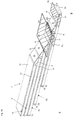
- FIGs 2 to 4b show a telescopic conveyor 1 according to the invention, Fig. 5 and 9 Details of it.
- the telescopic conveyor 1 shows five belt conveyors 10, which are arranged overlapping one above the other and can be moved relative to one another in the longitudinal direction.
- the two lower belt conveyors 10 are shown partially extended, which is only one possible usage arrangement.
- Each belt conveyor 10 has a frame 11, which per se can be designed as in the prior art (and can be mounted on a table, also not shown) and a circulating belt 12 which is deflected at end deflection rollers 13, 14.
- the letter “A” shows the side of the first ends of each belt conveyor 10 with the first deflection roller 13
- the letter “B” illustrates the side of the second ends or transfer ends of each belt conveyor 10 with the second deflection roller 14 , 14 are mounted in roller holders 15.
- Fig 4b shows an example of the conveying mechanism from a lower belt conveyor 10 to an overlying belt conveyor 10: Goods (not shown) are conveyed on the circulating belt 12 of the lower belt conveyor 10 and move on a level E1. Along the ramp 3, the goods pass an incline S and are transferred to the following circulating belt 12 of the belt conveyor 10 above: They now continue to run on the next level E2. Both levels E1, E2 are usually arranged parallel to the floor.
- the belt conveyor 10, which lies in plane E1 is deflected downwards via the deflection roller 4 after passing the ramp 3 and passes under the hold-down roller 5 to continue on level E1. This is the case for all circulating belts 12 which are guided over a bridging device 2.
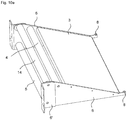
- FIG. 10a This (including a deflection roller 14 which interacts with the bridging device 2) is also shown individually in detail in one embodiment Figure 10a shown. It enables a joint-free transition between two adjacent, stacked belt conveyors 10 of a telescopic conveyor 1.
- one of the bridging devices 2 according to the invention is, see for example.
- Fig. 2 and 3 arranged between two adjacent belt conveyors 10 arranged one above the other. It bridges the height difference H (in Fig. 3 shown) between the two superposed belt conveyors 10 completely and with a steady rise or fall, without forming an abutting edge. As Fig. 3 shows, the remaining gap that still exists between the two belt conveyors between which a transfer takes place is minimized.
- the bridging device 2 also improves the transport from an upper to a lower belt conveyor 10 Avoided abutting edge, so that the articles are conveyed in a more controlled manner when transitioning from an upper to a lower belt conveyor and do not jump or roll away.
- each belt conveyor 10 has a drive roller 17 in the middle area.
- the deflection rollers required for this are omitted here, but are evident from the illustrated guidance of the circulating belt 12 around the drive roller 17, since every change in direction of the belt 12 requires a corresponding deflection means.
- the bridging device 2 has a ramp 3, 3 'which, as in FIG Figures 2 to 5 , 9 and 10 , by an ascending plate 3 or, as in Figures 6 and 7 , can be formed by a plurality of transverse rollers 3 'arranged in a continuously increasing manner.
- the plate 3, which forms the inclined plane of the ramp can also be composed of several parts, which can optionally also be arranged at a distance from one another, as long as they lie in a common plane.
- the alternative embodiment of the ramp 3 ' is not limited to the number of three shown by a plurality of ascending transverse rollers 3'.
- more or fewer transverse rollers 3 ' can be used to form the inclined plane of the ramp, also depending on the height difference H to be overcome.
- a first deflection roller 4 is arranged at the upper end of the ramp 3, 3 'so that a tangential plane of this deflection roller 4 is aligned with the inclined plane provided by the ramp 3, 3'.
- a second deflecting roller 14 is also provided, which is adjacent to the first deflecting roller 4 on the side facing away from the ramp 3, 3 ', but is arranged slightly above it, so that this second deflecting roller 14 also has a tangential plane that coincides with that of the ramp 3 , 3 'provided inclined plane aligns.
- a hold-down roller 5 is arranged below the two deflecting rollers 4, 14, so that the circulating belt 12 of the lower belt conveyor 10 is guided over the ramp 3, 3 ', deflected around the first deflecting roller 4 and passed under the holding-down roller 5, while the circulating belt 12 of the belt conveyor 10 arranged adjacent above it is deflected around the second deflection roller 14 of the bridging device 2, which thus forms the deflection roller 14 at the transfer end of the respective upper belt conveyor 10.
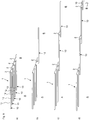
- the bridging device 2 is connected to the second deflection roller 14 with the respective upper belt conveyor 10, while it is longitudinally movable in relation to the frame 11 of the respective lower belt conveyor 10, so that it remains at the respective transfer end B of the respective upper belt conveyor 10 when the belt conveyor 10 is telescoped .
- This is shown in the sequence a) to d) in FIG Fig. 8 shown, in which only the circulating belt 12 is shown for the sake of clarity.
- the area of the transfer device 2 is indicated by dashed lines.
- the block arrow in Figure 8d there next to the letter "B", should be like in Figures 5 to 7 only indicate that the corresponding end of the conveyor belt A, B is outside the display area.
- the telescoping of the telescopic conveyor 1 can be done manually.
- a handle is provided on the lowermost belt conveyor 10 at the second end B, on which, as in FIG Fig. 8 outlined, first the lowermost belt conveyor 10 can be pulled out. If the lowest belt conveyor 10 is completely extended, if the handle 16 is pulled further, the next upper belt conveyor 10 will be pulled out with a forced coupling, etc. When pushing together, the lowest belt conveyor 10 will be pushed in completely before the next upper belt conveyor 10 is pushed in.
- the telescopic conveyor 1 can also be designed so that when the lowest belt conveyor 10 is extended, the upper belt conveyor 10 is also extended successively, similar to a multiple cable mechanism, before the lowest belt conveyor 10 is completely extended.
- a telescopic conveyor 1 can also be extended and retracted automatically if the telescopic belt conveyor 10 is equipped / connected with corresponding hydraulic, pneumatic, electrical and / or mechanical drive and transmission elements and a corresponding control.
- the lock-up device 2 is, see Figure 10a and 10b , laterally bounded by a frame element 6, between which the ramp 3, 3 ', the deflection rollers 4, 14 and the hold-down roller 5 are attached.
- the frame element 6 is here supplemented by an angle piece 6 ', which is also used for attachment to the frame 11 of the respective upper belt conveyor 10, such as. Am Fig. 4 and 5 you can see.
- the angle piece 6 ' overlaps a part of the frame element 6, which is rounded at the upper end to accommodate the deflection rollers 4, 14 like a tab, as in FIG Fig. 10 can be seen, so that the angle piece 6 ′ holds the second deflection roller 14 together with the frame element 6.
- the hold-down roller 5 is only held by the supplementary angle piece 6 '.
- the two lateral frame elements 6 are pivotably connected to the angle piece 6 'so that the ramp 3 is movable and can compensate for uneven floors - the pulley 14 then forms the axis (axis of rotation DA) around which the ramp 3 is pivoted can be, see block arrows.
- the frame element 6 at the lower end of the ramp 3 has a receptacle 8 for a hold-down device 7 (see e.g. Fig. 5 ), which serves to hold down the circulating belt 12 guided over the ramp 3 at its edge so that the belt 12 rests against the ramp 3.
- the hold-down device 7 preferably does not extend across the circulating belt 12, since it would otherwise also form an abutting edge.
- the hold-down device can optionally also be formed in one piece with the frame element, so that there is no need for a receiving device therefor.
- Fig. 9 shows a detail D of the transition between two adjacent belt conveyors 10, as provided by the bridging device 2 according to the invention with the ramp 3, the deflection rollers 4, 14 and the hold-down roller 5 with the described guidance of the circulating belts 12.
- the bridging devices 2 of adjacent belt conveyors 10 come to lie directly adjacent to one another, the ramps 3 and thus the circulating belts 12 of adjacent belt conveyors 10 being aligned with one another with the constant gradient.
- the frame 11 can be seen, on the end face of which the bridging device 2 is attached to the angle piece 6 ', not shown here.
- the frame 11 here consists of several profiles with profile grooves, for. B. profile groove 18, z. B. for mounting the drive roller 17.
Landscapes
- Engineering & Computer Science (AREA)
- Mechanical Engineering (AREA)
- Structure Of Belt Conveyors (AREA)
- Framework For Endless Conveyors (AREA)
Priority Applications (1)
| Application Number | Priority Date | Filing Date | Title |
|---|---|---|---|
| PL18812055T PL3728083T3 (pl) | 2017-12-21 | 2018-10-25 | Przenośnik teleskopowy |
Applications Claiming Priority (2)
| Application Number | Priority Date | Filing Date | Title |
|---|---|---|---|
| DE102017011880.9A DE102017011880B4 (de) | 2017-12-21 | 2017-12-21 | Teleskopförderer |
| PCT/EP2018/000489 WO2019120597A1 (de) | 2017-12-21 | 2018-10-25 | Teleskopförderer |
Publications (2)
| Publication Number | Publication Date |
|---|---|
| EP3728083A1 EP3728083A1 (de) | 2020-10-28 |
| EP3728083B1 true EP3728083B1 (de) | 2021-08-11 |
Family
ID=64572282
Family Applications (1)
| Application Number | Title | Priority Date | Filing Date |
|---|---|---|---|
| EP18812055.4A Active EP3728083B1 (de) | 2017-12-21 | 2018-10-25 | Teleskopförderer |
Country Status (9)
| Country | Link |
|---|---|
| US (1) | US10899548B2 (pl) |
| EP (1) | EP3728083B1 (pl) |
| JP (1) | JP2021508307A (pl) |
| CN (1) | CN111566024A (pl) |
| CA (1) | CA3087157A1 (pl) |
| DE (1) | DE102017011880B4 (pl) |
| PL (1) | PL3728083T3 (pl) |
| RU (1) | RU2020123926A (pl) |
| WO (1) | WO2019120597A1 (pl) |
Families Citing this family (8)
| Publication number | Priority date | Publication date | Assignee | Title |
|---|---|---|---|---|
| WO2019155260A1 (en) * | 2018-02-09 | 2019-08-15 | Cyborgline Sa | Conveying apparatus for long pasta |
| US11891251B2 (en) | 2020-11-24 | 2024-02-06 | Fmh Conveyors Llc | Raised belt transfer unit |
| CN112320388A (zh) * | 2020-11-27 | 2021-02-05 | 深圳市格雷柏智能装备股份有限公司 | 一种伸缩装卸设备 |
| US11952221B2 (en) * | 2020-12-15 | 2024-04-09 | Express Scripts Strategic Development, Inc. | Dynamic package sortation device |
| CN113844913A (zh) * | 2021-08-27 | 2021-12-28 | 中国人民解放军92228部队 | 码头物资运输装置 |
| CN115676312B (zh) * | 2022-12-29 | 2023-03-14 | 衡水巴迈隆木业有限公司 | 一种颗粒板制造用木材原料输送机 |
| CN119018655A (zh) * | 2024-10-29 | 2024-11-26 | 昆山同日机器人智能科技有限公司 | 一种智能装车机器人 |
| US12448215B1 (en) * | 2025-06-03 | 2025-10-21 | Visionnav Robotics Usa Inc. | Autonomous mobile machine, method for controlling autonomous mobile machine, and controller |
Family Cites Families (23)
| Publication number | Priority date | Publication date | Assignee | Title |
|---|---|---|---|---|
| GB758504A (en) | 1953-11-10 | 1956-10-03 | Mikrovaerk As | A delivery arrangement in plants for moulding chocolate and similar confectionery |
| FR1267843A (fr) * | 1960-06-13 | 1961-07-28 | Siebert Lefevre Ets | élévateur télescopique perfectionné |
| US3332819A (en) | 1961-12-29 | 1967-07-25 | Sicmpelkamp Eugen | Apparatus for separating conveyed sheets |
| US3664488A (en) * | 1969-11-25 | 1972-05-23 | Vyzk Ustav Pozemnick Staveb | Collapsible belt conveyor |
| US3825107A (en) * | 1971-07-26 | 1974-07-23 | M Mahacek | Extendible conveyor system |
| US3826353A (en) * | 1972-08-04 | 1974-07-30 | C Greasley | Conveyors |
| JPS5416457Y2 (pl) * | 1975-05-14 | 1979-06-28 | ||
| CH655286A5 (de) * | 1982-05-03 | 1986-04-15 | Sig Schweiz Industrieges | Vorrichtung zum wahlweisen umlenken von gegenstaenden auf eines von zwei foerderbaendern, verfahren zu ihrem betrieb und verwendung. |
| DE4342534C1 (de) * | 1993-12-14 | 1995-01-26 | Caljan Loading Systems | Teleskopförderbahn zum Fördern und Vermessen von Stückgut |
| JPH10120139A (ja) * | 1996-10-18 | 1998-05-12 | Atex Co Ltd | 搬送角度を変更可能にしたコンベア装置 |
| US6481563B1 (en) * | 1999-12-29 | 2002-11-19 | Rapistan Systems Advertising Corp. | Extendable conveyor with additional boom section |
| CA2426913A1 (en) * | 2000-10-20 | 2002-05-23 | Wavexpress, Inc. | Broadcast browser including multi-media tool overlay and method of providing a coverged multi-media display including user-enhanced data |
| DE10345998B4 (de) | 2003-10-02 | 2013-07-25 | Telair International Ab | System zum Be- und Entladen eines Laderaums eines Flugzeugs mit Stückgut |
| DE102006008583B3 (de) * | 2006-02-24 | 2007-08-09 | Gawronski Industrievertretungen Gmbh | Förderer mit Förderbändern zum Transportieren von Gegenständen |
| DE202006015281U1 (de) | 2006-10-04 | 2007-03-08 | Msk-Verpackungs-Systeme Gmbh | Vorrichtung zum Anheben einer Lage, bestehend aus einer Vielzahl an Behältern o.dgl. |
| DE102009018163B4 (de) | 2009-04-22 | 2011-03-24 | Gawronski Gmbh Industrievertretungen | Separate Vorrichtung für einen Förderer zum Transportieren von Gegenständen |
| US8496104B2 (en) * | 2010-12-03 | 2013-07-30 | Siemens Industry, Inc. | Extendible conveyor systems and methods |
| US8978871B1 (en) * | 2013-05-22 | 2015-03-17 | Amazon Technologies, Inc. | Conveyor system |
| US9326543B2 (en) * | 2013-08-27 | 2016-05-03 | McEntire Produce, Inc. | System and process for processing fresh produce |
| ES2596259T3 (es) * | 2013-08-29 | 2017-01-05 | Caljan Rite-Hite Aps | Transportador extensible |
| DE102015003239A1 (de) * | 2015-03-10 | 2016-09-15 | Beumer Gmbh & Co. Kg | Vorrichtung zum Be- oder Entladen einen Transportbehälters |
| US9828184B1 (en) * | 2016-12-15 | 2017-11-28 | Next Era Belting, Inc. | Portable multi-sectioned boom concrete conveyor assembly |
| US10435246B2 (en) * | 2017-08-30 | 2019-10-08 | Rite-Hite Holding Corporation | Extendible fences for extendible conveyors |
-
2017
- 2017-12-21 DE DE102017011880.9A patent/DE102017011880B4/de not_active Expired - Fee Related
-
2018
- 2018-10-25 JP JP2020554365A patent/JP2021508307A/ja active Pending
- 2018-10-25 EP EP18812055.4A patent/EP3728083B1/de active Active
- 2018-10-25 WO PCT/EP2018/000489 patent/WO2019120597A1/de not_active Ceased
- 2018-10-25 PL PL18812055T patent/PL3728083T3/pl unknown
- 2018-10-25 CA CA3087157A patent/CA3087157A1/en active Pending
- 2018-10-25 CN CN201880081572.3A patent/CN111566024A/zh active Pending
- 2018-10-25 US US16/955,947 patent/US10899548B2/en active Active
- 2018-10-25 RU RU2020123926A patent/RU2020123926A/ru unknown
Also Published As
| Publication number | Publication date |
|---|---|
| RU2020123926A (ru) | 2022-01-21 |
| DE102017011880A1 (de) | 2019-06-27 |
| CA3087157A1 (en) | 2019-06-27 |
| EP3728083A1 (de) | 2020-10-28 |
| CN111566024A (zh) | 2020-08-21 |
| DE102017011880B4 (de) | 2020-06-04 |
| PL3728083T3 (pl) | 2022-01-17 |
| WO2019120597A1 (de) | 2019-06-27 |
| US20200331702A1 (en) | 2020-10-22 |
| US10899548B2 (en) | 2021-01-26 |
| JP2021508307A (ja) | 2021-03-04 |
Similar Documents
| Publication | Publication Date | Title |
|---|---|---|
| EP3728083B1 (de) | Teleskopförderer | |
| EP1275603B1 (de) | Speichervorrichtung | |
| DE69506670T2 (de) | Förderanlage zum Erzeugen von Zwischenräumen | |
| EP1493692B1 (de) | Vorrichtung zum Strecken und Lösen eines über Umlenkmittel geführten endlosen Transportbandes | |
| EP2826731B1 (de) | Transportroboter mit Einzugsvorrichtung für Transportgüter | |
| EP1464595B1 (de) | Fördersystem, insbesondere eine Flughafen-Gepäckförderanlage, für Behälter | |
| DE202011106265U1 (de) | Fördervorrichtung | |
| EP2878554A1 (de) | Teleskopförderband | |
| EP0512446B1 (de) | Anordnung zum Umformen eines angeförderten mehrspurigen und dicht gepackten Behälterstroms in mehrere parallele, jeweils durch Einteilelemente voneinander getrennte Behälterreihen | |
| EP2314529B1 (de) | Transporteinheit mit Stauröllchenketten | |
| DE102014105929B4 (de) | Schiebevorrichtung für eine Palettiervorrichtung | |
| EP2511211B1 (de) | Kreuzung zwischen zwei Transportstrecken, welche zum liegenden Transport von flächigen Erzeugnissen ausgebildet sind | |
| WO2012175161A1 (de) | Transporteur | |
| DE102013003587B4 (de) | Ausschleusvorrichtung für den Einsatz in einer Förderanlage, Ausschleusmodul zur Verwendung in einer Förderanlage und Förderanlage | |
| WO2018015060A1 (de) | Transportvorrichtung | |
| DE3006266C2 (de) | Umkehrvorrichtung für Buchblocks, Bücher, Zeitschriften o.dgl. Produkte | |
| DE102016113376A1 (de) | Transportvorrichtung | |
| DE102010031668A1 (de) | Falt- und Stapel-Anlage für Wellpappebahnen | |
| EP1362817B1 (de) | Einrichtung zum Ausstossen von auf einem Tisch gestapelten Druckerzeugnissen. | |
| EP1398141A2 (de) | Faltmaschine | |
| DE102009052336A1 (de) | Ladevorrichtung für Werkstoffstangen | |
| EP0252461A1 (de) | Anordnung zum Umformen eines angeförderten mehrspurigen Flaschenstromes in einen abzufördernden einspurigen Flaschenstrom | |
| DE19533887C2 (de) | Vorrichtung zum Abstellen von mehreren Fahrzeugen oder dergleichen übereinander | |
| DE3048777A1 (de) | "werkstueckfoerderer, insbesondere fuer kleinteile" | |
| DE29613678U1 (de) | Führungsvorrichtung für eine Energieführungskette |
Legal Events
| Date | Code | Title | Description |
|---|---|---|---|
| STAA | Information on the status of an ep patent application or granted ep patent |
Free format text: STATUS: UNKNOWN |
|
| STAA | Information on the status of an ep patent application or granted ep patent |
Free format text: STATUS: THE INTERNATIONAL PUBLICATION HAS BEEN MADE |
|
| PUAI | Public reference made under article 153(3) epc to a published international application that has entered the european phase |
Free format text: ORIGINAL CODE: 0009012 |
|
| STAA | Information on the status of an ep patent application or granted ep patent |
Free format text: STATUS: REQUEST FOR EXAMINATION WAS MADE |
|
| 17P | Request for examination filed |
Effective date: 20200716 |
|
| AK | Designated contracting states |
Kind code of ref document: A1 Designated state(s): AL AT BE BG CH CY CZ DE DK EE ES FI FR GB GR HR HU IE IS IT LI LT LU LV MC MK MT NL NO PL PT RO RS SE SI SK SM TR |
|
| AX | Request for extension of the european patent |
Extension state: BA ME |
|
| DAV | Request for validation of the european patent (deleted) | ||
| DAX | Request for extension of the european patent (deleted) | ||
| GRAP | Despatch of communication of intention to grant a patent |
Free format text: ORIGINAL CODE: EPIDOSNIGR1 |
|
| STAA | Information on the status of an ep patent application or granted ep patent |
Free format text: STATUS: GRANT OF PATENT IS INTENDED |
|
| RIC1 | Information provided on ipc code assigned before grant |
Ipc: B65G 15/26 20060101ALI20210316BHEP Ipc: B65G 15/24 20060101ALI20210316BHEP Ipc: B65G 21/14 20060101AFI20210316BHEP |
|
| INTG | Intention to grant announced |
Effective date: 20210415 |
|
| GRAS | Grant fee paid |
Free format text: ORIGINAL CODE: EPIDOSNIGR3 |
|
| GRAA | (expected) grant |
Free format text: ORIGINAL CODE: 0009210 |
|
| STAA | Information on the status of an ep patent application or granted ep patent |
Free format text: STATUS: THE PATENT HAS BEEN GRANTED |
|
| AK | Designated contracting states |
Kind code of ref document: B1 Designated state(s): AL AT BE BG CH CY CZ DE DK EE ES FI FR GB GR HR HU IE IS IT LI LT LU LV MC MK MT NL NO PL PT RO RS SE SI SK SM TR |
|
| REG | Reference to a national code |
Ref country code: CH Ref legal event code: EP |
|
| REG | Reference to a national code |
Ref country code: DE Ref legal event code: R096 Ref document number: 502018006586 Country of ref document: DE |
|
| REG | Reference to a national code |
Ref country code: IE Ref legal event code: FG4D Free format text: LANGUAGE OF EP DOCUMENT: GERMAN Ref country code: AT Ref legal event code: REF Ref document number: 1419195 Country of ref document: AT Kind code of ref document: T Effective date: 20210915 |
|
| REG | Reference to a national code |
Ref country code: SK Ref legal event code: T3 Ref document number: E 38301 Country of ref document: SK |
|
| REG | Reference to a national code |
Ref country code: LT Ref legal event code: MG9D |
|
| REG | Reference to a national code |
Ref country code: NL Ref legal event code: MP Effective date: 20210811 |
|
| PG25 | Lapsed in a contracting state [announced via postgrant information from national office to epo] |
Ref country code: RS Free format text: LAPSE BECAUSE OF FAILURE TO SUBMIT A TRANSLATION OF THE DESCRIPTION OR TO PAY THE FEE WITHIN THE PRESCRIBED TIME-LIMIT Effective date: 20210811 Ref country code: SE Free format text: LAPSE BECAUSE OF FAILURE TO SUBMIT A TRANSLATION OF THE DESCRIPTION OR TO PAY THE FEE WITHIN THE PRESCRIBED TIME-LIMIT Effective date: 20210811 Ref country code: FI Free format text: LAPSE BECAUSE OF FAILURE TO SUBMIT A TRANSLATION OF THE DESCRIPTION OR TO PAY THE FEE WITHIN THE PRESCRIBED TIME-LIMIT Effective date: 20210811 Ref country code: ES Free format text: LAPSE BECAUSE OF FAILURE TO SUBMIT A TRANSLATION OF THE DESCRIPTION OR TO PAY THE FEE WITHIN THE PRESCRIBED TIME-LIMIT Effective date: 20210811 Ref country code: LT Free format text: LAPSE BECAUSE OF FAILURE TO SUBMIT A TRANSLATION OF THE DESCRIPTION OR TO PAY THE FEE WITHIN THE PRESCRIBED TIME-LIMIT Effective date: 20210811 Ref country code: BG Free format text: LAPSE BECAUSE OF FAILURE TO SUBMIT A TRANSLATION OF THE DESCRIPTION OR TO PAY THE FEE WITHIN THE PRESCRIBED TIME-LIMIT Effective date: 20211111 Ref country code: PT Free format text: LAPSE BECAUSE OF FAILURE TO SUBMIT A TRANSLATION OF THE DESCRIPTION OR TO PAY THE FEE WITHIN THE PRESCRIBED TIME-LIMIT Effective date: 20211213 Ref country code: NO Free format text: LAPSE BECAUSE OF FAILURE TO SUBMIT A TRANSLATION OF THE DESCRIPTION OR TO PAY THE FEE WITHIN THE PRESCRIBED TIME-LIMIT Effective date: 20211111 Ref country code: HR Free format text: LAPSE BECAUSE OF FAILURE TO SUBMIT A TRANSLATION OF THE DESCRIPTION OR TO PAY THE FEE WITHIN THE PRESCRIBED TIME-LIMIT Effective date: 20210811 |
|
| PG25 | Lapsed in a contracting state [announced via postgrant information from national office to epo] |
Ref country code: LV Free format text: LAPSE BECAUSE OF FAILURE TO SUBMIT A TRANSLATION OF THE DESCRIPTION OR TO PAY THE FEE WITHIN THE PRESCRIBED TIME-LIMIT Effective date: 20210811 Ref country code: GR Free format text: LAPSE BECAUSE OF FAILURE TO SUBMIT A TRANSLATION OF THE DESCRIPTION OR TO PAY THE FEE WITHIN THE PRESCRIBED TIME-LIMIT Effective date: 20211112 |
|
| PG25 | Lapsed in a contracting state [announced via postgrant information from national office to epo] |
Ref country code: NL Free format text: LAPSE BECAUSE OF FAILURE TO SUBMIT A TRANSLATION OF THE DESCRIPTION OR TO PAY THE FEE WITHIN THE PRESCRIBED TIME-LIMIT Effective date: 20210811 |
|
| PG25 | Lapsed in a contracting state [announced via postgrant information from national office to epo] |
Ref country code: DK Free format text: LAPSE BECAUSE OF FAILURE TO SUBMIT A TRANSLATION OF THE DESCRIPTION OR TO PAY THE FEE WITHIN THE PRESCRIBED TIME-LIMIT Effective date: 20210811 |
|
| REG | Reference to a national code |
Ref country code: DE Ref legal event code: R097 Ref document number: 502018006586 Country of ref document: DE |
|
| PG25 | Lapsed in a contracting state [announced via postgrant information from national office to epo] |
Ref country code: SM Free format text: LAPSE BECAUSE OF FAILURE TO SUBMIT A TRANSLATION OF THE DESCRIPTION OR TO PAY THE FEE WITHIN THE PRESCRIBED TIME-LIMIT Effective date: 20210811 Ref country code: RO Free format text: LAPSE BECAUSE OF FAILURE TO SUBMIT A TRANSLATION OF THE DESCRIPTION OR TO PAY THE FEE WITHIN THE PRESCRIBED TIME-LIMIT Effective date: 20210811 Ref country code: EE Free format text: LAPSE BECAUSE OF FAILURE TO SUBMIT A TRANSLATION OF THE DESCRIPTION OR TO PAY THE FEE WITHIN THE PRESCRIBED TIME-LIMIT Effective date: 20210811 Ref country code: AL Free format text: LAPSE BECAUSE OF FAILURE TO SUBMIT A TRANSLATION OF THE DESCRIPTION OR TO PAY THE FEE WITHIN THE PRESCRIBED TIME-LIMIT Effective date: 20210811 |
|
| PLBE | No opposition filed within time limit |
Free format text: ORIGINAL CODE: 0009261 |
|
| STAA | Information on the status of an ep patent application or granted ep patent |
Free format text: STATUS: NO OPPOSITION FILED WITHIN TIME LIMIT |
|
| REG | Reference to a national code |
Ref country code: BE Ref legal event code: MM Effective date: 20211031 |
|
| PG25 | Lapsed in a contracting state [announced via postgrant information from national office to epo] |
Ref country code: MC Free format text: LAPSE BECAUSE OF FAILURE TO SUBMIT A TRANSLATION OF THE DESCRIPTION OR TO PAY THE FEE WITHIN THE PRESCRIBED TIME-LIMIT Effective date: 20210811 |
|
| 26N | No opposition filed |
Effective date: 20220512 |
|
| PG25 | Lapsed in a contracting state [announced via postgrant information from national office to epo] |
Ref country code: LU Free format text: LAPSE BECAUSE OF NON-PAYMENT OF DUE FEES Effective date: 20211025 Ref country code: BE Free format text: LAPSE BECAUSE OF NON-PAYMENT OF DUE FEES Effective date: 20211031 |
|
| PG25 | Lapsed in a contracting state [announced via postgrant information from national office to epo] |
Ref country code: IE Free format text: LAPSE BECAUSE OF NON-PAYMENT OF DUE FEES Effective date: 20211025 |
|
| PG25 | Lapsed in a contracting state [announced via postgrant information from national office to epo] |
Ref country code: CY Free format text: LAPSE BECAUSE OF FAILURE TO SUBMIT A TRANSLATION OF THE DESCRIPTION OR TO PAY THE FEE WITHIN THE PRESCRIBED TIME-LIMIT Effective date: 20210811 |
|
| PG25 | Lapsed in a contracting state [announced via postgrant information from national office to epo] |
Ref country code: HU Free format text: LAPSE BECAUSE OF FAILURE TO SUBMIT A TRANSLATION OF THE DESCRIPTION OR TO PAY THE FEE WITHIN THE PRESCRIBED TIME-LIMIT; INVALID AB INITIO Effective date: 20181025 |
|
| PG25 | Lapsed in a contracting state [announced via postgrant information from national office to epo] |
Ref country code: SI Free format text: LAPSE BECAUSE OF FAILURE TO SUBMIT A TRANSLATION OF THE DESCRIPTION OR TO PAY THE FEE WITHIN THE PRESCRIBED TIME-LIMIT Effective date: 20210811 |
|
| PG25 | Lapsed in a contracting state [announced via postgrant information from national office to epo] |
Ref country code: MK Free format text: LAPSE BECAUSE OF FAILURE TO SUBMIT A TRANSLATION OF THE DESCRIPTION OR TO PAY THE FEE WITHIN THE PRESCRIBED TIME-LIMIT Effective date: 20210811 |
|
| PG25 | Lapsed in a contracting state [announced via postgrant information from national office to epo] |
Ref country code: MT Free format text: LAPSE BECAUSE OF FAILURE TO SUBMIT A TRANSLATION OF THE DESCRIPTION OR TO PAY THE FEE WITHIN THE PRESCRIBED TIME-LIMIT Effective date: 20210811 |
|
| REG | Reference to a national code |
Ref country code: AT Ref legal event code: MM01 Ref document number: 1419195 Country of ref document: AT Kind code of ref document: T Effective date: 20231025 |
|
| PGFP | Annual fee paid to national office [announced via postgrant information from national office to epo] |
Ref country code: DE Payment date: 20240930 Year of fee payment: 7 |
|
| PGFP | Annual fee paid to national office [announced via postgrant information from national office to epo] |
Ref country code: PL Payment date: 20241014 Year of fee payment: 7 |
|
| PGFP | Annual fee paid to national office [announced via postgrant information from national office to epo] |
Ref country code: GB Payment date: 20241024 Year of fee payment: 7 |
|
| PG25 | Lapsed in a contracting state [announced via postgrant information from national office to epo] |
Ref country code: AT Free format text: LAPSE BECAUSE OF NON-PAYMENT OF DUE FEES Effective date: 20231025 |
|
| PGFP | Annual fee paid to national office [announced via postgrant information from national office to epo] |
Ref country code: FR Payment date: 20241024 Year of fee payment: 7 |
|
| PGFP | Annual fee paid to national office [announced via postgrant information from national office to epo] |
Ref country code: CZ Payment date: 20241011 Year of fee payment: 7 |
|
| PGFP | Annual fee paid to national office [announced via postgrant information from national office to epo] |
Ref country code: SK Payment date: 20241014 Year of fee payment: 7 |
|
| PGFP | Annual fee paid to national office [announced via postgrant information from national office to epo] |
Ref country code: IT Payment date: 20241031 Year of fee payment: 7 |
|
| PG25 | Lapsed in a contracting state [announced via postgrant information from national office to epo] |
Ref country code: AT Free format text: LAPSE BECAUSE OF NON-PAYMENT OF DUE FEES Effective date: 20231025 |
|
| PGFP | Annual fee paid to national office [announced via postgrant information from national office to epo] |
Ref country code: CH Payment date: 20241101 Year of fee payment: 7 |
|
| PG25 | Lapsed in a contracting state [announced via postgrant information from national office to epo] |
Ref country code: TR Free format text: LAPSE BECAUSE OF FAILURE TO SUBMIT A TRANSLATION OF THE DESCRIPTION OR TO PAY THE FEE WITHIN THE PRESCRIBED TIME-LIMIT Effective date: 20210811 |