EP3726080B1 - Gleitelement und lager - Google Patents
Gleitelement und lager Download PDFInfo
- Publication number
- EP3726080B1 EP3726080B1 EP18888609.7A EP18888609A EP3726080B1 EP 3726080 B1 EP3726080 B1 EP 3726080B1 EP 18888609 A EP18888609 A EP 18888609A EP 3726080 B1 EP3726080 B1 EP 3726080B1
- Authority
- EP
- European Patent Office
- Prior art keywords
- weight
- resin composition
- less
- friction force
- zinc
- Prior art date
- Legal status (The legal status is an assumption and is not a legal conclusion. Google has not performed a legal analysis and makes no representation as to the accuracy of the status listed.)
- Active
Links
Images


Classifications
-
- F—MECHANICAL ENGINEERING; LIGHTING; HEATING; WEAPONS; BLASTING
- F16—ENGINEERING ELEMENTS AND UNITS; GENERAL MEASURES FOR PRODUCING AND MAINTAINING EFFECTIVE FUNCTIONING OF MACHINES OR INSTALLATIONS; THERMAL INSULATION IN GENERAL
- F16C—SHAFTS; FLEXIBLE SHAFTS; ELEMENTS OR CRANKSHAFT MECHANISMS; ROTARY BODIES OTHER THAN GEARING ELEMENTS; BEARINGS
- F16C33/00—Parts of bearings; Special methods for making bearings or parts thereof
- F16C33/02—Parts of sliding-contact bearings
- F16C33/04—Brasses; Bushes; Linings
- F16C33/06—Sliding surface mainly made of metal
- F16C33/12—Structural composition; Use of special materials or surface treatments, e.g. for rust-proofing
- F16C33/128—Porous bearings, e.g. bushes of sintered alloy
-
- F—MECHANICAL ENGINEERING; LIGHTING; HEATING; WEAPONS; BLASTING
- F16—ENGINEERING ELEMENTS AND UNITS; GENERAL MEASURES FOR PRODUCING AND MAINTAINING EFFECTIVE FUNCTIONING OF MACHINES OR INSTALLATIONS; THERMAL INSULATION IN GENERAL
- F16F—SPRINGS; SHOCK-ABSORBERS; MEANS FOR DAMPING VIBRATION
- F16F9/00—Springs, vibration-dampers, shock-absorbers, or similarly-constructed movement-dampers using a fluid or the equivalent as damping medium
- F16F9/32—Details
- F16F9/36—Special sealings, including sealings or guides for piston-rods
- F16F9/366—Special sealings, including sealings or guides for piston-rods functioning as guide only, e.g. bushings
-
- C—CHEMISTRY; METALLURGY
- C08—ORGANIC MACROMOLECULAR COMPOUNDS; THEIR PREPARATION OR CHEMICAL WORKING-UP; COMPOSITIONS BASED THEREON
- C08F—MACROMOLECULAR COMPOUNDS OBTAINED BY REACTIONS ONLY INVOLVING CARBON-TO-CARBON UNSATURATED BONDS
- C08F214/00—Copolymers of compounds having one or more unsaturated aliphatic radicals, each having only one carbon-to-carbon double bond, and at least one being terminated by a halogen
- C08F214/18—Monomers containing fluorine
- C08F214/26—Tetrafluoroethene
-
- C—CHEMISTRY; METALLURGY
- C08—ORGANIC MACROMOLECULAR COMPOUNDS; THEIR PREPARATION OR CHEMICAL WORKING-UP; COMPOSITIONS BASED THEREON
- C08K—Use of inorganic or non-macromolecular organic substances as compounding ingredients
- C08K3/00—Use of inorganic substances as compounding ingredients
- C08K3/02—Elements
- C08K3/04—Carbon
-
- C—CHEMISTRY; METALLURGY
- C08—ORGANIC MACROMOLECULAR COMPOUNDS; THEIR PREPARATION OR CHEMICAL WORKING-UP; COMPOSITIONS BASED THEREON
- C08K—Use of inorganic or non-macromolecular organic substances as compounding ingredients
- C08K7/00—Use of ingredients characterised by shape
- C08K7/02—Fibres or whiskers
-
- C—CHEMISTRY; METALLURGY
- C08—ORGANIC MACROMOLECULAR COMPOUNDS; THEIR PREPARATION OR CHEMICAL WORKING-UP; COMPOSITIONS BASED THEREON
- C08K—Use of inorganic or non-macromolecular organic substances as compounding ingredients
- C08K7/00—Use of ingredients characterised by shape
- C08K7/02—Fibres or whiskers
- C08K7/04—Fibres or whiskers inorganic
- C08K7/06—Elements
-
- F—MECHANICAL ENGINEERING; LIGHTING; HEATING; WEAPONS; BLASTING
- F16—ENGINEERING ELEMENTS AND UNITS; GENERAL MEASURES FOR PRODUCING AND MAINTAINING EFFECTIVE FUNCTIONING OF MACHINES OR INSTALLATIONS; THERMAL INSULATION IN GENERAL
- F16C—SHAFTS; FLEXIBLE SHAFTS; ELEMENTS OR CRANKSHAFT MECHANISMS; ROTARY BODIES OTHER THAN GEARING ELEMENTS; BEARINGS
- F16C17/00—Sliding-contact bearings for exclusively rotary movement
- F16C17/02—Sliding-contact bearings for exclusively rotary movement for radial load only
-
- F—MECHANICAL ENGINEERING; LIGHTING; HEATING; WEAPONS; BLASTING
- F16—ENGINEERING ELEMENTS AND UNITS; GENERAL MEASURES FOR PRODUCING AND MAINTAINING EFFECTIVE FUNCTIONING OF MACHINES OR INSTALLATIONS; THERMAL INSULATION IN GENERAL
- F16C—SHAFTS; FLEXIBLE SHAFTS; ELEMENTS OR CRANKSHAFT MECHANISMS; ROTARY BODIES OTHER THAN GEARING ELEMENTS; BEARINGS
- F16C33/00—Parts of bearings; Special methods for making bearings or parts thereof
- F16C33/02—Parts of sliding-contact bearings
- F16C33/04—Brasses; Bushes; Linings
- F16C33/06—Sliding surface mainly made of metal
- F16C33/12—Structural composition; Use of special materials or surface treatments, e.g. for rust-proofing
- F16C33/121—Use of special materials
-
- F—MECHANICAL ENGINEERING; LIGHTING; HEATING; WEAPONS; BLASTING
- F16—ENGINEERING ELEMENTS AND UNITS; GENERAL MEASURES FOR PRODUCING AND MAINTAINING EFFECTIVE FUNCTIONING OF MACHINES OR INSTALLATIONS; THERMAL INSULATION IN GENERAL
- F16C—SHAFTS; FLEXIBLE SHAFTS; ELEMENTS OR CRANKSHAFT MECHANISMS; ROTARY BODIES OTHER THAN GEARING ELEMENTS; BEARINGS
- F16C33/00—Parts of bearings; Special methods for making bearings or parts thereof
- F16C33/02—Parts of sliding-contact bearings
- F16C33/04—Brasses; Bushes; Linings
- F16C33/06—Sliding surface mainly made of metal
- F16C33/14—Special methods of manufacture; Running-in
-
- F—MECHANICAL ENGINEERING; LIGHTING; HEATING; WEAPONS; BLASTING
- F16—ENGINEERING ELEMENTS AND UNITS; GENERAL MEASURES FOR PRODUCING AND MAINTAINING EFFECTIVE FUNCTIONING OF MACHINES OR INSTALLATIONS; THERMAL INSULATION IN GENERAL
- F16C—SHAFTS; FLEXIBLE SHAFTS; ELEMENTS OR CRANKSHAFT MECHANISMS; ROTARY BODIES OTHER THAN GEARING ELEMENTS; BEARINGS
- F16C33/00—Parts of bearings; Special methods for making bearings or parts thereof
- F16C33/02—Parts of sliding-contact bearings
- F16C33/04—Brasses; Bushes; Linings
- F16C33/20—Sliding surface consisting mainly of plastics
-
- F—MECHANICAL ENGINEERING; LIGHTING; HEATING; WEAPONS; BLASTING
- F16—ENGINEERING ELEMENTS AND UNITS; GENERAL MEASURES FOR PRODUCING AND MAINTAINING EFFECTIVE FUNCTIONING OF MACHINES OR INSTALLATIONS; THERMAL INSULATION IN GENERAL
- F16C—SHAFTS; FLEXIBLE SHAFTS; ELEMENTS OR CRANKSHAFT MECHANISMS; ROTARY BODIES OTHER THAN GEARING ELEMENTS; BEARINGS
- F16C33/00—Parts of bearings; Special methods for making bearings or parts thereof
- F16C33/02—Parts of sliding-contact bearings
- F16C33/04—Brasses; Bushes; Linings
- F16C33/20—Sliding surface consisting mainly of plastics
- F16C33/201—Composition of the plastic
-
- F—MECHANICAL ENGINEERING; LIGHTING; HEATING; WEAPONS; BLASTING
- F16—ENGINEERING ELEMENTS AND UNITS; GENERAL MEASURES FOR PRODUCING AND MAINTAINING EFFECTIVE FUNCTIONING OF MACHINES OR INSTALLATIONS; THERMAL INSULATION IN GENERAL
- F16C—SHAFTS; FLEXIBLE SHAFTS; ELEMENTS OR CRANKSHAFT MECHANISMS; ROTARY BODIES OTHER THAN GEARING ELEMENTS; BEARINGS
- F16C33/00—Parts of bearings; Special methods for making bearings or parts thereof
- F16C33/02—Parts of sliding-contact bearings
- F16C33/04—Brasses; Bushes; Linings
- F16C33/20—Sliding surface consisting mainly of plastics
- F16C33/203—Multilayer structures, e.g. sleeves comprising a plastic lining
- F16C33/206—Multilayer structures, e.g. sleeves comprising a plastic lining with three layers
-
- F—MECHANICAL ENGINEERING; LIGHTING; HEATING; WEAPONS; BLASTING
- F16—ENGINEERING ELEMENTS AND UNITS; GENERAL MEASURES FOR PRODUCING AND MAINTAINING EFFECTIVE FUNCTIONING OF MACHINES OR INSTALLATIONS; THERMAL INSULATION IN GENERAL
- F16C—SHAFTS; FLEXIBLE SHAFTS; ELEMENTS OR CRANKSHAFT MECHANISMS; ROTARY BODIES OTHER THAN GEARING ELEMENTS; BEARINGS
- F16C33/00—Parts of bearings; Special methods for making bearings or parts thereof
- F16C33/02—Parts of sliding-contact bearings
- F16C33/04—Brasses; Bushes; Linings
- F16C33/20—Sliding surface consisting mainly of plastics
- F16C33/208—Methods of manufacture, e.g. shaping, applying coatings
-
- C—CHEMISTRY; METALLURGY
- C08—ORGANIC MACROMOLECULAR COMPOUNDS; THEIR PREPARATION OR CHEMICAL WORKING-UP; COMPOSITIONS BASED THEREON
- C08K—Use of inorganic or non-macromolecular organic substances as compounding ingredients
- C08K3/00—Use of inorganic substances as compounding ingredients
- C08K3/02—Elements
- C08K3/08—Metals
- C08K2003/0893—Zinc
-
- C—CHEMISTRY; METALLURGY
- C08—ORGANIC MACROMOLECULAR COMPOUNDS; THEIR PREPARATION OR CHEMICAL WORKING-UP; COMPOSITIONS BASED THEREON
- C08K—Use of inorganic or non-macromolecular organic substances as compounding ingredients
- C08K3/00—Use of inorganic substances as compounding ingredients
- C08K3/18—Oxygen-containing compounds, e.g. metal carbonyls
- C08K3/20—Oxides; Hydroxides
- C08K3/22—Oxides; Hydroxides of metals
- C08K2003/2265—Oxides; Hydroxides of metals of iron
-
- C—CHEMISTRY; METALLURGY
- C08—ORGANIC MACROMOLECULAR COMPOUNDS; THEIR PREPARATION OR CHEMICAL WORKING-UP; COMPOSITIONS BASED THEREON
- C08K—Use of inorganic or non-macromolecular organic substances as compounding ingredients
- C08K3/00—Use of inorganic substances as compounding ingredients
- C08K3/30—Sulfur-, selenium- or tellurium-containing compounds
- C08K2003/3009—Sulfides
-
- F—MECHANICAL ENGINEERING; LIGHTING; HEATING; WEAPONS; BLASTING
- F16—ENGINEERING ELEMENTS AND UNITS; GENERAL MEASURES FOR PRODUCING AND MAINTAINING EFFECTIVE FUNCTIONING OF MACHINES OR INSTALLATIONS; THERMAL INSULATION IN GENERAL
- F16C—SHAFTS; FLEXIBLE SHAFTS; ELEMENTS OR CRANKSHAFT MECHANISMS; ROTARY BODIES OTHER THAN GEARING ELEMENTS; BEARINGS
- F16C2204/00—Metallic materials; Alloys
- F16C2204/50—Alloys based on zinc
-
- F—MECHANICAL ENGINEERING; LIGHTING; HEATING; WEAPONS; BLASTING
- F16—ENGINEERING ELEMENTS AND UNITS; GENERAL MEASURES FOR PRODUCING AND MAINTAINING EFFECTIVE FUNCTIONING OF MACHINES OR INSTALLATIONS; THERMAL INSULATION IN GENERAL
- F16C—SHAFTS; FLEXIBLE SHAFTS; ELEMENTS OR CRANKSHAFT MECHANISMS; ROTARY BODIES OTHER THAN GEARING ELEMENTS; BEARINGS
- F16C2208/00—Plastics; Synthetic resins, e.g. rubbers
- F16C2208/02—Plastics; Synthetic resins, e.g. rubbers comprising fillers, fibres
-
- F—MECHANICAL ENGINEERING; LIGHTING; HEATING; WEAPONS; BLASTING
- F16—ENGINEERING ELEMENTS AND UNITS; GENERAL MEASURES FOR PRODUCING AND MAINTAINING EFFECTIVE FUNCTIONING OF MACHINES OR INSTALLATIONS; THERMAL INSULATION IN GENERAL
- F16C—SHAFTS; FLEXIBLE SHAFTS; ELEMENTS OR CRANKSHAFT MECHANISMS; ROTARY BODIES OTHER THAN GEARING ELEMENTS; BEARINGS
- F16C2208/00—Plastics; Synthetic resins, e.g. rubbers
- F16C2208/20—Thermoplastic resins
- F16C2208/30—Fluoropolymers
-
- F—MECHANICAL ENGINEERING; LIGHTING; HEATING; WEAPONS; BLASTING
- F16—ENGINEERING ELEMENTS AND UNITS; GENERAL MEASURES FOR PRODUCING AND MAINTAINING EFFECTIVE FUNCTIONING OF MACHINES OR INSTALLATIONS; THERMAL INSULATION IN GENERAL
- F16C—SHAFTS; FLEXIBLE SHAFTS; ELEMENTS OR CRANKSHAFT MECHANISMS; ROTARY BODIES OTHER THAN GEARING ELEMENTS; BEARINGS
- F16C2208/00—Plastics; Synthetic resins, e.g. rubbers
- F16C2208/20—Thermoplastic resins
- F16C2208/30—Fluoropolymers
- F16C2208/32—Polytetrafluorethylene [PTFE]
-
- F—MECHANICAL ENGINEERING; LIGHTING; HEATING; WEAPONS; BLASTING
- F16—ENGINEERING ELEMENTS AND UNITS; GENERAL MEASURES FOR PRODUCING AND MAINTAINING EFFECTIVE FUNCTIONING OF MACHINES OR INSTALLATIONS; THERMAL INSULATION IN GENERAL
- F16C—SHAFTS; FLEXIBLE SHAFTS; ELEMENTS OR CRANKSHAFT MECHANISMS; ROTARY BODIES OTHER THAN GEARING ELEMENTS; BEARINGS
- F16C2208/00—Plastics; Synthetic resins, e.g. rubbers
- F16C2208/20—Thermoplastic resins
- F16C2208/30—Fluoropolymers
- F16C2208/34—Polyvinylidenefluoride [PVDF]
-
- F—MECHANICAL ENGINEERING; LIGHTING; HEATING; WEAPONS; BLASTING
- F16—ENGINEERING ELEMENTS AND UNITS; GENERAL MEASURES FOR PRODUCING AND MAINTAINING EFFECTIVE FUNCTIONING OF MACHINES OR INSTALLATIONS; THERMAL INSULATION IN GENERAL
- F16C—SHAFTS; FLEXIBLE SHAFTS; ELEMENTS OR CRANKSHAFT MECHANISMS; ROTARY BODIES OTHER THAN GEARING ELEMENTS; BEARINGS
- F16C2326/00—Articles relating to transporting
- F16C2326/01—Parts of vehicles in general
- F16C2326/05—Vehicle suspensions, e.g. bearings, pivots or connecting rods used therein
-
- F—MECHANICAL ENGINEERING; LIGHTING; HEATING; WEAPONS; BLASTING
- F16—ENGINEERING ELEMENTS AND UNITS; GENERAL MEASURES FOR PRODUCING AND MAINTAINING EFFECTIVE FUNCTIONING OF MACHINES OR INSTALLATIONS; THERMAL INSULATION IN GENERAL
- F16C—SHAFTS; FLEXIBLE SHAFTS; ELEMENTS OR CRANKSHAFT MECHANISMS; ROTARY BODIES OTHER THAN GEARING ELEMENTS; BEARINGS
- F16C2361/00—Apparatus or articles in engineering in general
- F16C2361/53—Spring-damper, e.g. gas springs
-
- F—MECHANICAL ENGINEERING; LIGHTING; HEATING; WEAPONS; BLASTING
- F16—ENGINEERING ELEMENTS AND UNITS; GENERAL MEASURES FOR PRODUCING AND MAINTAINING EFFECTIVE FUNCTIONING OF MACHINES OR INSTALLATIONS; THERMAL INSULATION IN GENERAL
- F16F—SPRINGS; SHOCK-ABSORBERS; MEANS FOR DAMPING VIBRATION
- F16F2222/00—Special physical effects, e.g. nature of damping effects
- F16F2222/04—Friction
-
- F—MECHANICAL ENGINEERING; LIGHTING; HEATING; WEAPONS; BLASTING
- F16—ENGINEERING ELEMENTS AND UNITS; GENERAL MEASURES FOR PRODUCING AND MAINTAINING EFFECTIVE FUNCTIONING OF MACHINES OR INSTALLATIONS; THERMAL INSULATION IN GENERAL
- F16F—SPRINGS; SHOCK-ABSORBERS; MEANS FOR DAMPING VIBRATION
- F16F2224/00—Materials; Material properties
- F16F2224/02—Materials; Material properties solids
- F16F2224/0241—Fibre-reinforced plastics [FRP]
Definitions
- the present invention relates to a sliding member slidably supporting a mated member and a bearing using the sliding member.
- a sliding material having a so-called bimetal structure namely, a two-layer structure in which a Cu-based alloy powder is sintered on a steel plate as a back plate has been often used as a sliding member.
- a surface of a metal layer on which the Cu-based alloy powder has been sintered becomes a sliding surface, so that good slidability is ensured by adding lead (Pb) to the Cu-based alloy powder which has been used in the past.
- a past sliding member using the resin material has a three-layer structure in which a Cu-based alloy powder is sintered on a steel plate as a back plate so as to be porous and the porous layer is impregnated with a resin composition in which an additive is mixed with a resin, followed by being baked (for example see Patent Literature 2).
- a surface of the resin layer is a sliding surface.
- a fluororesin such as polytetrafluoroethylene (PTFE) has been generally used.
- a sliding member impregnated with such PTFE has been used in, for example, a sliding portion of a shock absorber or the like used in a vehicle or the like.
- a bearing having a multi-layer structure which contains a resin composition containing a polytetrafluoroethylene resin, carbon fibers, and a calcium compound, has been proposed (for example, see Patent literature 3).
- a cylindrical internal circumference is a bearing bush including a porous sintered layer and a resin layer, and a sliding surface of the bearing bush is formed of a fluororesin composition obtained by blending a thermoplastic resin, carbon fibers, and molybdenum disulfide in a fluororesin (for example, see Patent literature 4).
- the remainder of the sliding member containing the resin composition is made only of fluororesins (for example, see Patent literatures 5 to 8).
- the sliding member is used in a guide bushing for guiding a piston rod to which a motion of a suspension mechanism that displaces following a variation of a road surface or the like is transferred to make a reciprocating motion.
- the shock absorber damps vibration utilizing viscosity resistance of a liquid therein against any input from outside.
- any friction force generated by the guide bushing which guides the reciprocating motion of the piston rod has an influence on ride quality of a vehicle or the like.
- An object of the present invention is to provide a sliding member that enables the relationship between the static friction force and the dynamic friction force to be controlled, and a bearing using the sliding member.
- the present inventors have found that the static friction force can become large and the relationship between the static friction force and the dynamic friction force can be controlled, by containing a predetermined amount of pitch-based carbon fibers in a resin composition forming a sliding layer.
- the present invention provides a sliding member comprising: a metallic substrate; a porous layer formed on a surface of the metallic substrate; and a sliding layer that covers the porous layer, wherein the porous layer is made of a metal itself or an alloy composition, wherein the sliding layer is made of a lead-free resin composition, wherein the resin composition consists of a pitch-based carbon fiber and a fluororesin, and assuming weight of the resin composition as 100, more than 10 weight% and 35 weight% or less of the pitch-based carbon fiber is contained.
- the resin composition contains more than 10 weight% and 17 weight% or less of the pitch-based carbon fiber.
- the present invention provides a sliding member comprising: a lead-free resin composition, wherein assuming weight of the resin composition as 100, the resin composition contains more than 10 weight% and 35 weight% or less of a pitch-based carbon fiber, wherein the resin composition further contains any of or a combination of two or more of an aramid fiber, an iron oxide, molybdenum disulfide, a graphite, and zinc, zinc alloy or zinc compound, more than 0 weight% and 14 weight% or less of the aramid fiber is contained when the aramid fiber is added; more than 0 weight% and 37 weight% or less of the iron oxide is contained when the iron oxide is added; more than 0 weight% and 20 weight% or less of the molybdenum disulfide is contained when the molybdenum disulfide is added; more than 0 weight% and 10 weight% or less of the graphite is contained when the graphite is added; more than 0 weight% and 40 weight% or less of the zinc, zinc alloy or zinc compound is contained when
- the present invention provides a sliding member comprising: a metallic substrate; a porous layer formed on a surface of the metallic substrate; and a sliding layer that covers the porous layer, wherein the porous layer is made of a metal itself or an alloy composition, wherein the sliding layer is made of a lead-free resin composition, wherein assuming weight of the resin composition as 100, the resin composition contains more than 10 weight% and 35 weight% or less of a pitch-based carbon fiber, wherein the resin composition further contains any of or a combination of two or more of an aramid fiber, an iron oxide, molybdenum disulfide, a graphite, and zinc, zinc alloy or zinc compound, more than 0 weight% and 14 weight% or less of the aramid fiber is contained when the aramid fiber is added; more than 0 weight% and 37 weight% or less of the iron oxide is contained when the iron oxide is added; more than 0 weight% and 20 weight% or less of the molybdenum disulfide is contained when the molybdenum
- the pitch-based carbon fiber has a fiber diameter of 5 ⁇ m or more and 20 ⁇ m or less, a fiber length of 10 ⁇ m or more and 150 ⁇ m or less, and an aspect ratio of 2 or more and 20 or less.
- the fluororesin is polytetrafluoroethylene.
- the present invention provides a bearing comprising: a metallic substrate; a porous layer formed on a surface of the metallic substrate; and a sliding layer that covers the porous layer, the sliding layer being a cylindrical internal circumference and annular innermost layer, wherein the porous layer is made of a metal itself or an alloy composition, wherein the sliding layer is made of a lead-free resin composition, wherein the resin composition consists of a pitch-based carbon fiber and a fluororesin, and assuming weight of the resin composition as 100, more than 10 weight% and 35 weight% or less of the pitch-based carbon fiber is contained.
- the present invention provides a bearing comprising: a metallic substrate; a porous layer formed on a surface of the metallic substrate; and a sliding layer that covers the porous layer, the sliding layer being a cylindrical internal circumference and annular innermost layer, wherein the porous layer is made of a metal itself or an alloy composition, wherein the sliding layer is made of a lead-free resin composition, wherein assuming weight of the resin composition as 100, the resin composition contains more than 10 weight% and 35 weight% or less of a pitch-based carbon fiber, wherein the resin composition further contains any of or a combination of two or more of an aramid fiber, an iron oxide, molybdenum disulfide, a graphite, and zinc, zinc alloy or zinc compound, more than 0 weight% and 14 weight% or less of the aramid fiber is contained when the aramid fiber is added; more than 0 weight% and 37 weight% or less of the iron oxide is contained when the iron oxide is added; more than 0 weight% and 20 weight% or less of the moly
- the static friction force can be increased, and the rate of change of the dynamic friction force in relation to the static friction force can be reduced, and further, abrasion can be prevented. Accordingly, when the sliding member of the present invention is applied to a shock absorber, the ride quality can be improved.
- the sliding member in the present embodiment is formed of a lead-free resin composition.
- the resin composition contains a fluororesin, and contains a pitch-based carbon fiber as an essential additive.
- the resin composition contains more than 10 weight% and 35 weight% or less of the pitch-based carbon fiber, and the remainder is the fluororesin.
- the pitch-based carbon fiber has a fiber diameter of 5 ⁇ m or more and 20 ⁇ m or less, a fiber length of 10 ⁇ m or more and 150 ⁇ m or less, and an aspect ratio of 2 or more and 20 or less.
- the sliding member in the present embodiment is used so as to cover a surface of a metallic substrate and cover a metallic porous layer formed on a surface of the metallic substrate.
- FIG. 1 is a sectional view of a sliding member, as an example, in the present embodiment.
- a sliding member 1 in the present embodiment contains a metallic substrate 2, a porous layer 3 formed on a surface of the metallic substrate 2, the porous layer being made of a metal itself or an alloy composition, and a sliding layer 5 in which the porous layer 3 is covered with a resin composition 4.
- the porous layer 3 is formed by sintering a metallic powder on a surface of the metallic substrate 2.
- a copper plated steel plate in which copper (Cu) has been plated on an iron (Fe)-based plate is used as the metallic substrate 2.
- Cu copper
- Fe iron
- the metallic powder forming the porous layer 3 Cu itself or an alloy containing Cu as a main component is used, and a Cu-Sn based alloy powder is used in this embodiment.
- the Cu-Sn based alloy powder is sprayed on the copper plated steel plate with a desired thickness thereof and the copper plated steel plate on which the Cu-Sn based alloy powder has been sprayed is sintered in a sintering furnace.
- the porous layer 3 made of a Cu-Sn based alloy with a desired thickness thereof is formed on the copper plated steel plate.
- the porous layer 3 is impregnated with the resin composition 4 so as to have a predetermined thickness thereof and the porous layer 3 that has been impregnated with the resin composition 4 is baked, and then, the sliding layer 5 is formed.
- the resin composition 4 a resin and additives are mixed.
- the resin polytetrafluoroethylene (PTFE) is used as an example of the fluororesin.
- the resin composition 4 contains a pitch-based carbon fiber as an essential additive.
- the resin composition 4 may include any of or a combination of two or more of an aramid fiber, an iron oxide, molybdenum disulfide, a graphite, and zinc, zinc alloy or zinc compound.
- a predetermined amount of the resin composition 4 is supplied onto the porous layer 3 formed on the surface of the metallic substrate 2, and the resin composition 4 is pressed on the porous layer 3, so that the porous layer 3 is impregnated with the resin composition 4.
- the amount of the resin composition 4 supplied onto the porous layer 3 is an amount of the resin composition 4 which covers the porous layer 3 with a thickness such that the porous layer 3 is not exposed from a surface of the sliding layer 5 after the resin composition 4 is baked, which is described later.
- the resin composition 4 When the resin composition 4 is heated at a temperature which exceeds a melting point of a resin contained in the resin composition 4, the resin is melted and an organic solvent is volatilized, and then, the resin is hardened and the sliding layer 5 is formed.
- the term “bake” is referred to as “heating the resin composition 4 at a predetermined temperature to form the sliding layer 5".
- the melting point of polytetrafluoroethylene used as the resin is 327°C.
- the sliding layer 5 is baked using the baking furnace in this embodiment by heating the resin composition 4 at a temperature which exceeds the melting point of polytetrafluoroethylene.
- all of the metallic powders for forming the porous layer 3 may have a particle diameter within a range of about 15 ⁇ m to 180 ⁇ m, preferably about 25 ⁇ m to 150 ⁇ m.
- a thickness T 1 of the porous layer 3 formed by using the metallic powders having such a particle diameter may be set to be about 0.06 mm to 0.35 mm.
- the thickness of the porous layer 3 is a thickness such that at least two pieces of the metallic powders are laid in piles and sintered.
- a thickness T 2 of the sliding layer 5 may be set to be about 0.08 mm to 0.43 mm.
- the thickness T 2 of the sliding layer 5 is referred to as "a thickness of the sliding layer 5 from a surface of the metallic substrate 2".
- the thickness of the sliding layer 5 is set to be averagely larger than the thickness of the porous layer 3 so that the porous layer 3 is not exposed.
- the thickness T 2 of the sliding layer 5 is set to be 0.3 mm.
- FIG. 2 is a perspective view of a bearing, as an example, in the present embodiment
- FIG. 3 is a sectional view of the bearing, as an example, in the present embodiment, in which the sliding member 1 in the present embodiment is used.
- a bearing 7 in the present embodiment is configured such that the sliding member 1 shown in FIG. 1 is annularly formed with the sliding layer 5 being inwardly arranged.
- the bearing 7 supports a rod 8 as a mated member with the sliding layer 5 forming a cylindrical internal circumference.
- the bearing 7 is configured so that the rod 8 is slid under a linear motion.
- the bearing 7 in the present embodiment is used for a vibration damping apparatus such as a shock absorber used for a vehicle or the like and is used as a sliding portion of a guide bushing for guiding a piston rod which reciprocates, in the shock absorber, with a motion of a suspension mechanism that displaces following a variation of a road surface or the like being transferred to the sliding portion.
- a vibration damping apparatus such as a shock absorber used for a vehicle or the like and is used as a sliding portion of a guide bushing for guiding a piston rod which reciprocates, in the shock absorber, with a motion of a suspension mechanism that displaces following a variation of a road surface or the like being transferred to the sliding portion.
- the rod 8 which is a piston rod, is a sliding mated member and the resin composition 4 forming the sliding layer 5 contacts the mated member directly or via a fluid such as oil.
- a surface thereof made of a stainless steel or Fe is configured to be covered with Cr (chromium) or Ti (titanium) by means of a method such as a plating method.
- the mated member of the sliding member 1 may be made of Cr, Ti themselves or their alloy.
- FIG. 4 is a graph showing a relationship between a static friction force and a dynamic friction force.
- a vertical axis indicates a friction force (N) and a horizontal axis indicates a stroke (mm).
- N friction force
- mm stroke
- the piston rod reciprocates based on the fact that the suspension follows the variations of the road surface or the like. Based on the fact that the piston rod reciprocates, there is a state where the piston rod stands still.
- a pitch-based carbon fiber is added to the resin composition 4 forming the sliding layer 5 which contacts the rod 8 as the piston rod and guides the reciprocating motion of the piston rod.
- the resin composition 4 is described in detail.
- the fluororesin which is a base resin of the resin composition 4 is a common synthetic resin having an excellent sliding characteristic to maintain a sufficient heat-resisting property for heat generated when any sliding friction occurs. Therefore, PTFE resins, PFA copolymer resins, FEP copolymer resins, and ETFE copolymer resins are often used as the base resin of the resin composition of the sliding member.
- D-210C or F-201 of POLYFLON (registered trademark) manufactured by Daikin Industries, Ltd; AD911D of Fluon (registered trademark) manufactured by Asahi Glass Co., Ltd; 31JR or 6C-J of Teflon (registered trademark) manufactured by Chemours-Mitsui Fluoro products Co., Ltd and the like are exemplified.
- the pitch-based carbon fiber is an essential additive to the resin composition 4 forming the sliding layer 5 in order to improve the value of the static fiction force and the rate of change in the dynamic friction force in relation to the static friction force.
- the pitch-based carbon fiber is used as a function-imparting material and a reinforcing material for the resin composition 4 forming the sliding layer 5 which contacts the mated member directly or via a fluid such as oil.
- the resin composition 4 contains more than 10 weight% and 35 weight% or less of the pitch-based carbon fiber. It is also preferable that the pitch-based carbon fiber has a fiber diameter of 5 ⁇ m or more and 20 ⁇ m or less, a fiber length of 10 ⁇ m or more and 150 ⁇ m or less, and an aspect ratio of 2 or more and 20 or less.
- the pitch-based carbon fiber has high strength, high modulus, excellent abrasion resistance, a high specific frequency, and an excellent vibration damping and absorbing performance. These characteristics of the pitch-based carbon fiber allow the static friction force to increase and allow the rate of change in the dynamic friction force in relation to the static friction force to be reduced, by containing a predetermined amount of the pitch-based carbon fiber in the resin composition 4. This enables the value of the static friction force and the rate of change in the dynamic friction force in relation to the static friction force to be improved, thereby improving sliding characteristics.
- the rate of change in the dynamic friction force in relation to the static friction force is large and self-abrasion quantity also increases.
- the static friction force is excessive. This may block its dispersiveness and deteriorate impregnation into the porous layer.
- the pitch-based carbon fiber has a fiber length of more than 150 ⁇ m, the impregnation into the porous layer deteriorates and the pitch-based carbon fiber may be left out from the resin composition 4. It is to be noted that as the pitch-based carbon fiber on the market, DONACARBO manufactured by Osaka Gas Chemicals Co., Ltd., DIALEAD manufactured by Mitsubishi Chemical Corporation and the like are exemplified.
- the aramid fiber is not an essential additive for the resin composition 4 forming the sliding layer 5, but a predetermined amount of aramid fibers may be added in the resin composition 4 for improving the value of the static fiction force and the rate of change in the dynamic friction force in relation to the static friction force to improve the sliding characteristics. It is preferable that more than 0 weight% and 14 weight% or less of the aramid fiber is contained when the aramid fiber is added.
- the resin composition 4 allows the abrasion resistance to be enhanced without hindering the value of the static friction force and the rate of change in the dynamic friction force in relation to the static friction force from being improved when the pitch-based carbon fiber is added, allows the value of the static friction force to be made large and allows the rate of change in the dynamic friction force in relation to the static friction force to be reduced.
- Kevlar registered trademark
- Twaron registered trademark
- iron oxide (FeO 2 , Fe 2 O 3 ) is not an essential additive for the resin composition 4 forming the sliding layer 5, but a predetermined amount of iron oxide may be contained in the resin composition 4. It is preferable that more than 0 weight% and 37 weight% or less of the iron oxide is contained when the iron oxide is added.
- the resin composition 4 allows the slidability to be reduced without hindering the value of the static friction force and the rate of change in the dynamic friction force in relation to the static friction force from being improved when the pitch-based carbon fiber is added, allows the value of the static friction force to be made large and allows the rate of change in the dynamic friction force in relation to the static friction force to be reduced.
- molybdenum disulfide (MoS 2 ) is not an essential additive for the resin composition 4 forming the sliding layer 5, but a predetermined amount of molybdenum disulfide may be contained in the resin composition 4. It is preferable that more than 0 weight% and 20 weight% or less of the molybdenum disulfide is contained when the molybdenum disulfide is added.
- the resin composition 4 allows the frictional resistance to be reduced without hindering the value of the static friction force and the rate of change in the dynamic friction force in relation to the static friction force from being improved when the pitch-based carbon fiber is added.
- the graphite (C) is not an essential additive for the resin composition 4 forming the sliding layer 5, but a predetermined amount of graphite may be contained in the resin composition 4. It is preferable that more than 0 weight% and 10 weight% or less of the graphite is contained when the graphite is added.
- the resin composition 4 allows the frictional resistance to be reduced without hindering the value of the static friction force and the rate of change in the dynamic friction force in relation to the static friction force from being improved when the pitch-based carbon fiber is added.
- zinc (Zn), a zinc alloy (Zn alloy), or a zinc compound (Zn compound) is not an essential additive for the resin composition 4 forming the sliding layer 5, but a predetermined amount of the Zn, Zn alloy or Zn compound may be contained in the resin composition 4. It is preferable that more than 0 weight% and 40 weight% or less of the Zn, Zn alloy or Zn compound is contained when the Zn, Zn alloy or Zn compound is added.
- a particle diameter of Zn, Zn alloy or Zn compound is preferably 1 ⁇ m or more and 50 ⁇ m or less, more preferably 1 ⁇ m or more and 25 ⁇ m or less, taking into consideration dispersiveness to the fluororesin and a thickness of the resin layer made of the resin composition.
- the Zn alloy contains 3.5 weight% or more and 4.3 weight% or less of Al, 0.75 weight% or more and 1.25 weight% or less of Cu, 0.020 weight% or more and 0.06 weight% or less of Mg, 0.10 weight% or less of Fe, and the remainder being Zn and inevitable impurities.
- the Zn alloy contains 3.5 weight% or more and 4.3 weight% or less of Al, 0.25 weight% or less of Cu, 0.020 weight% or more and 0.06 weight% or less of Mg, 0.10 weight% or less of Fe, and the remainder being Zn and inevitable impurities.
- the Zn compound include ZnO, ZnS, ZnSO 4 , and the like.
- the resin composition 4 allows the rate of change in the dynamic friction force in relation to the static friction force to be reduced without hindering the value of the static friction force and the rate of change in the dynamic friction force in relation to the static friction force from being improved when the pitch-based carbon fiber is added.
- Adding the Zn, Zn alloy or Zn compound deteriorates the impregnation into the porous layer in the impregnation step when the additive amount of the Zn, Zn alloy or Zn compound exceeds 40 weight%, so that the abrasion resistance deteriorates.
- the guide bushings were prepared using the sliding members having compositions in Examples 1 to 7 and Comparison Examples 1 to 3, as shown in Table 1, and their static friction forces and their rates of change in the dynamic friction force in relation to the static friction force were measured.
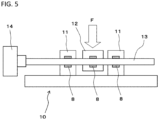
- FIG. 5 shows a configuration example of a testing machine for measuring the static friction force and the dynamic friction force.
- a testing machine 10 guide bushings 8 to be tested were mounted on bearing bases 11 and a load portion 12. Any traverse loads were applied to the load portion 12, via the guide bushing 8, between the bearing bases 11 supporting a rod 13 through the guide bushings 8. A friction force when vibrating the rod 13, to which the traverse load had been applied, by a vibrator (not shown), was measured by a load cell 14.
- Examples 1 to 7 a pitch-based carbon fiber having a fiber diameter of 13 ⁇ m, an average fiber length of 40 ⁇ m and an aspect ratio of 3 was used.
- Comparison Example 2 a pitch-based carbon fiber having a fiber diameter of 14.5 ⁇ m, an average fiber length of 130 ⁇ m, and an aspect ratio of 9 was used.
- Comparison Example 3 the pitch-based carbon fiber which was the same as those in Examples 1 to 7 was used.
- Example 3 It has further been found that, in the resin composition in Example 3 containing 11 weight% of the pitch-based carbon fiber, 14.2 weight% of the zinc alloy, and the remainder being the fluororesin, the static friction force could be made to be a desired one and the rate of change in the dynamic friction force in relation to the static friction force could be reduced.
- the zinc alloy an alloy having the above composition can be selected and used as appropriate.
- Zn-3.89Al-0.05Cu-0.05Mg-0.01Fe was used.
- the static friction force could be made to be a desired one and the rate of change in the dynamic friction force in relation to the static friction force can be reduced.
- the static friction force could be made to be a desired one and the rate of change in the dynamic friction force in relation to the static friction force could be reduced.
- the static friction force can be made large to be a desired one and the rate of change in the dynamic friction force in relation to the static friction force can be reduced. It has been found that taking the value of the static friction force into consideration, more than 10 weight% and 17 weight% or less of the pitch-based carbon fiber is preferably contained and the value of the static friction force can be further improved to a desired one.
- the effect of improving the value of the static friction force and effect of improving the rate of change in the dynamic friction force in relation to the static friction force are not hindered even if the resin composition contains any of or a combination of two or more of an aramid fiber, an iron oxide, molybdenum disulfide, a graphite, and zinc, zinc alloy or zinc compound, and the sliding characteristic is improved.
Landscapes
- Engineering & Computer Science (AREA)
- General Engineering & Computer Science (AREA)
- Mechanical Engineering (AREA)
- Chemical & Material Sciences (AREA)
- Medicinal Chemistry (AREA)
- Chemical Kinetics & Catalysis (AREA)
- Health & Medical Sciences (AREA)
- Polymers & Plastics (AREA)
- Organic Chemistry (AREA)
- Manufacturing & Machinery (AREA)
- Metallurgy (AREA)
- Sliding-Contact Bearings (AREA)
- Fluid-Damping Devices (AREA)
- Compositions Of Macromolecular Compounds (AREA)
Claims (8)
- Ein Gleitelement, umfassend:eine bleifreie Harzzusammensetzung,wobei die Harzzusammensetzung, ausgehend von einem Gewicht der Harzzusammensetzung von 100, mehr als 10 Gew.-% und 35 Gew.-% oder weniger einer Kohlenstofffaser auf Pechbasis enthält,wobei die Harzzusammensetzung weiterhin eine Aramidfaser, ein Eisenoxid, Molybdändisulfid, einen Graphit und Zink, eine Zinklegierung oder eine Zinkverbindung oder eine Kombination von zwei oder mehr davon enthält,mehr als 0 Gew.-% und 14 Gew.-% oder weniger der Aramidfaser enthalten ist, wenn die Aramidfaser zugesetzt wird;mehr als 0 Gew.-% und 37 Gew.-% oder weniger des Eisenoxids enthalten ist, wenn das Eisenoxid zugesetzt ist;mehr als 0 Gew.-% und 20 Gew.-% oder weniger des Molybdändisulfids enthalten ist, wenn das Molybdändisulfid zugesetzt ist;mehr als 0 Gew.-% und 10 Gew.-% oder weniger des Graphits enthalten ist, wenn der Graphit zugesetzt ist;mehr als 0 Gew.-% und 40 Gew.-% oder weniger des Zinks, der Zinklegierung oder der Zinkverbindung enthalten ist, wenn das Zink, die Zinklegierung oder die Zinkverbindung zugesetzt ist, und der Rest ein Fluorharz ist.
- Ein Gleitelement nach Anspruch 1, umfassend:ein metallisches Substrat;eine poröse Schicht, die auf einer Oberfläche des metallischen Substrats ausgebildet ist; und eine Gleitschicht, die die poröse Schicht bedeckt,wobei die poröse Schicht aus einem Metall selbst oder einer Legierungszusammensetzunghergestellt ist, wobei die Gleitschicht aus einer bleifreien Harzzusammensetzung hergestellt ist, wobei unter der Annahme, dass das Gewicht der Harzzusammensetzung 100 beträgt, die Harzzusammensetzung mehr als 10 Gew.-% und 35 Gew.-% oder weniger einer Kohlenstofffaser auf Pechbasis enthält,wobei die Harzzusammensetzung weiterhin eine Aramidfaser, ein Eisenoxid, Molybdändisulfid, einen Graphit und Zink, eine Zinklegierung oder eine Zinkverbindung oder eine Kombination von zwei oder mehr davon enthält,mehr als 0 Gew.-% und 14 Gew.-% oder weniger der Aramidfaser enthalten ist, wenn die Aramidfaser zugesetzt wird;mehr als 0 Gew.-% und 37 Gew.-% oder weniger des Eisenoxids enthalten ist, wenn das Eisenoxid zugesetzt ist;mehr als 0 Gew.-% und 20 Gew.-% oder weniger des Molybdändisulfids enthalten ist, wenn das Molybdändisulfid zugesetzt ist;mehr als 0 Gew.-% und 10 Gew.-% oder weniger des Graphits enthalten ist, wenn der Graphit zugesetzt ist;mehr als 0 Gew.-% und 40 Gew.-% oder weniger des Zinks, der Zinklegierung oder der Zinkverbindung enthalten ist, wenn das Zink, die Zinklegierung oder die Zinkverbindung zugesetzt ist, und der Rest ein Fluorharz ist.
- Ein Gleitelement, umfassend:ein metallisches Substrat;eine poröse Schicht, die auf einer Oberfläche des metallischen Substrats gebildet ist; undeine Gleitschicht, die die poröse Schicht bedeckt,wobei die poröse Schicht aus einem Metall selbst oder einer Legierungszusammensetzung hergestellt ist,wobei die Gleitschicht aus einer bleifreien Harzzusammensetzung hergestellt ist,wobei die Harzzusammensetzung aus einer Kohlenstofffaser auf Pechbasis und einem Fluorharz besteht, und unter der Annahme, dass das Gewicht der Harzzusammensetzung 100 beträgt, mehr als 10 Gew.-% und 35 Gew.-% oder weniger der Kohlenstofffaser auf Pechbasis enthalten sind und der Rest der Harzzusammensetzung nur Fluorharz ist.
- Das Gleitelement nach Anspruch 3,
wobei die Harzzusammensetzung mehr als 10 Gew.-% und 17 Gew.-% oder weniger der Kohlenstofffaser auf Pechbasis enthält. - Das Gleitelement nach einem der Ansprüche 1 bis 4,
wobei die Kohlenstofffaser auf Pechbasis einen Faserdurchmesser von 5 µm oder mehr und 20 µm oder weniger, eine Faserlänge von 10 µm oder mehr und 150 µm oder weniger und ein Seitenverhältnis von 2 oder mehr und 20 oder weniger aufweist. - Das Gleitelement nach einem der Ansprüche 1 bis 4,
wobei das Fluorharz Polytetrafluorethylen ist. - Ein Lager, umfassend das Gleitelement nach Anspruch 2, wobei
die Gleitschicht einen zylindrischen Innenumfang und eine ringförmige innerste Schicht aufweist. - Ein Lager, das das Gleitelement nach Anspruch 3 umfasst, wobei
die Gleitschicht einen zylindrischen Innenumfang und eine ringförmige innerste Schicht aufweist.
Applications Claiming Priority (3)
| Application Number | Priority Date | Filing Date | Title |
|---|---|---|---|
| JP2017241146 | 2017-12-15 | ||
| JP2018232479A JP6551595B2 (ja) | 2017-12-15 | 2018-12-12 | 摺動部材及び軸受 |
| PCT/JP2018/045857 WO2019117244A1 (ja) | 2017-12-15 | 2018-12-13 | 摺動部材及び軸受 |
Publications (3)
| Publication Number | Publication Date |
|---|---|
| EP3726080A1 EP3726080A1 (de) | 2020-10-21 |
| EP3726080A4 EP3726080A4 (de) | 2021-09-15 |
| EP3726080B1 true EP3726080B1 (de) | 2024-09-11 |
Family
ID=67179397
Family Applications (1)
| Application Number | Title | Priority Date | Filing Date |
|---|---|---|---|
| EP18888609.7A Active EP3726080B1 (de) | 2017-12-15 | 2018-12-13 | Gleitelement und lager |
Country Status (2)
| Country | Link |
|---|---|
| EP (1) | EP3726080B1 (de) |
| JP (1) | JP6551595B2 (de) |
Family Cites Families (9)
| Publication number | Priority date | Publication date | Assignee | Title |
|---|---|---|---|---|
| JPH05332365A (ja) * | 1992-05-25 | 1993-12-14 | Senju Metal Ind Co Ltd | ドライベアリングおよびその製造方法 |
| JP2568793B2 (ja) * | 1992-10-12 | 1997-01-08 | 大同メタル工業株式会社 | 複合摺動部材 |
| JP2002295600A (ja) * | 2001-03-29 | 2002-10-09 | Ntn Corp | チェーンブッシュ、チェーン用連結ピンおよびチェーン |
| JP5076276B2 (ja) * | 2005-01-17 | 2012-11-21 | オイレス工業株式会社 | 複層摺動部材 |
| JP5342883B2 (ja) * | 2009-01-07 | 2013-11-13 | Ntn株式会社 | 複層軸受 |
| JP5514445B2 (ja) * | 2009-01-07 | 2014-06-04 | Ntn株式会社 | 座席のリクライニング装置用軸受ブッシュおよび座席のリクライニング装置 |
| JP2011137528A (ja) * | 2009-12-29 | 2011-07-14 | Ntn Corp | 複層軸受 |
| US20150147012A1 (en) * | 2013-11-27 | 2015-05-28 | Emerson Climate Technologies, Inc. | Bearing performance for compressors using high energy refrigerants with sulfur-based oil additives |
| JP6323607B1 (ja) * | 2017-12-15 | 2018-05-16 | 千住金属工業株式会社 | 摺動部材及び軸受 |
-
2018
- 2018-12-12 JP JP2018232479A patent/JP6551595B2/ja active Active
- 2018-12-13 EP EP18888609.7A patent/EP3726080B1/de active Active
Also Published As
| Publication number | Publication date |
|---|---|
| EP3726080A1 (de) | 2020-10-21 |
| JP2019108980A (ja) | 2019-07-04 |
| JP6551595B2 (ja) | 2019-07-31 |
| EP3726080A4 (de) | 2021-09-15 |
Similar Documents
| Publication | Publication Date | Title |
|---|---|---|
| EP3499060A1 (de) | Gleitelement und lager | |
| US11261914B2 (en) | Sliding member and bearing | |
| CN102272469B (zh) | 多层轴承 | |
| KR101487120B1 (ko) | 미끄럼 이동 부재 및 베어링 | |
| JP3635096B2 (ja) | プレーンベアリング材料 | |
| KR100583031B1 (ko) | 오버레이 재료 및 다층 복합 재료 | |
| EP3751162B1 (de) | Gleitelement und lager | |
| EP1839846B1 (de) | Mehrlagiges gleitelement | |
| US20160319867A1 (en) | Plain bearing material and a plain bearing composite material, comprising zinc sulphide and barium sulphate | |
| KR100499537B1 (ko) | 철산화물첨가제를포함하는복합베어링 | |
| JPH058219B2 (de) | ||
| EP3287651B1 (de) | Mehrschichtiges gleitelement und zahnstangenlenkvorrichtung für ein auto damit | |
| JP2010159809A (ja) | 座席のリクライニング装置用軸受ブッシュおよび座席のリクライニング装置 | |
| JP6256569B1 (ja) | 摺動部材及び軸受 | |
| EP3726080B1 (de) | Gleitelement und lager | |
| US12612944B2 (en) | Sliding member and bearing | |
| US20250198461A1 (en) | Sliding member and bearing |
Legal Events
| Date | Code | Title | Description |
|---|---|---|---|
| STAA | Information on the status of an ep patent application or granted ep patent |
Free format text: STATUS: THE INTERNATIONAL PUBLICATION HAS BEEN MADE |
|
| PUAI | Public reference made under article 153(3) epc to a published international application that has entered the european phase |
Free format text: ORIGINAL CODE: 0009012 |
|
| STAA | Information on the status of an ep patent application or granted ep patent |
Free format text: STATUS: REQUEST FOR EXAMINATION WAS MADE |
|
| 17P | Request for examination filed |
Effective date: 20200615 |
|
| AK | Designated contracting states |
Kind code of ref document: A1 Designated state(s): AL AT BE BG CH CY CZ DE DK EE ES FI FR GB GR HR HU IE IS IT LI LT LU LV MC MK MT NL NO PL PT RO RS SE SI SK SM TR |
|
| AX | Request for extension of the european patent |
Extension state: BA ME |
|
| DAV | Request for validation of the european patent (deleted) | ||
| DAX | Request for extension of the european patent (deleted) | ||
| A4 | Supplementary search report drawn up and despatched |
Effective date: 20210817 |
|
| RIC1 | Information provided on ipc code assigned before grant |
Ipc: F16F 9/32 20060101ALI20210811BHEP Ipc: F16C 33/14 20060101ALI20210811BHEP Ipc: F16C 33/12 20060101ALI20210811BHEP Ipc: F16C 17/02 20060101ALI20210811BHEP Ipc: C08L 27/12 20060101ALI20210811BHEP Ipc: C08K 7/02 20060101ALI20210811BHEP Ipc: C08K 3/00 20180101ALI20210811BHEP Ipc: F16C 33/20 20060101AFI20210811BHEP |
|
| GRAP | Despatch of communication of intention to grant a patent |
Free format text: ORIGINAL CODE: EPIDOSNIGR1 |
|
| STAA | Information on the status of an ep patent application or granted ep patent |
Free format text: STATUS: GRANT OF PATENT IS INTENDED |
|
| INTG | Intention to grant announced |
Effective date: 20240419 |
|
| GRAS | Grant fee paid |
Free format text: ORIGINAL CODE: EPIDOSNIGR3 |
|
| GRAA | (expected) grant |
Free format text: ORIGINAL CODE: 0009210 |
|
| STAA | Information on the status of an ep patent application or granted ep patent |
Free format text: STATUS: THE PATENT HAS BEEN GRANTED |
|
| AK | Designated contracting states |
Kind code of ref document: B1 Designated state(s): AL AT BE BG CH CY CZ DE DK EE ES FI FR GB GR HR HU IE IS IT LI LT LU LV MC MK MT NL NO PL PT RO RS SE SI SK SM TR |
|
| REG | Reference to a national code |
Ref country code: GB Ref legal event code: FG4D |
|
| REG | Reference to a national code |
Ref country code: CH Ref legal event code: EP |
|
| REG | Reference to a national code |
Ref country code: DE Ref legal event code: R096 Ref document number: 602018074389 Country of ref document: DE |
|
| REG | Reference to a national code |
Ref country code: IE Ref legal event code: FG4D |
|
| REG | Reference to a national code |
Ref country code: LT Ref legal event code: MG9D |
|
| PG25 | Lapsed in a contracting state [announced via postgrant information from national office to epo] |
Ref country code: NO Free format text: LAPSE BECAUSE OF FAILURE TO SUBMIT A TRANSLATION OF THE DESCRIPTION OR TO PAY THE FEE WITHIN THE PRESCRIBED TIME-LIMIT Effective date: 20241211 |
|
| REG | Reference to a national code |
Ref country code: NL Ref legal event code: MP Effective date: 20240911 |
|
| PG25 | Lapsed in a contracting state [announced via postgrant information from national office to epo] |
Ref country code: FI Free format text: LAPSE BECAUSE OF FAILURE TO SUBMIT A TRANSLATION OF THE DESCRIPTION OR TO PAY THE FEE WITHIN THE PRESCRIBED TIME-LIMIT Effective date: 20240911 Ref country code: GR Free format text: LAPSE BECAUSE OF FAILURE TO SUBMIT A TRANSLATION OF THE DESCRIPTION OR TO PAY THE FEE WITHIN THE PRESCRIBED TIME-LIMIT Effective date: 20241212 |
|
| PG25 | Lapsed in a contracting state [announced via postgrant information from national office to epo] |
Ref country code: BG Free format text: LAPSE BECAUSE OF FAILURE TO SUBMIT A TRANSLATION OF THE DESCRIPTION OR TO PAY THE FEE WITHIN THE PRESCRIBED TIME-LIMIT Effective date: 20240911 |
|
| PG25 | Lapsed in a contracting state [announced via postgrant information from national office to epo] |
Ref country code: LV Free format text: LAPSE BECAUSE OF FAILURE TO SUBMIT A TRANSLATION OF THE DESCRIPTION OR TO PAY THE FEE WITHIN THE PRESCRIBED TIME-LIMIT Effective date: 20240911 |
|
| PG25 | Lapsed in a contracting state [announced via postgrant information from national office to epo] |
Ref country code: HR Free format text: LAPSE BECAUSE OF FAILURE TO SUBMIT A TRANSLATION OF THE DESCRIPTION OR TO PAY THE FEE WITHIN THE PRESCRIBED TIME-LIMIT Effective date: 20240911 |
|
| PG25 | Lapsed in a contracting state [announced via postgrant information from national office to epo] |
Ref country code: RS Free format text: LAPSE BECAUSE OF FAILURE TO SUBMIT A TRANSLATION OF THE DESCRIPTION OR TO PAY THE FEE WITHIN THE PRESCRIBED TIME-LIMIT Effective date: 20241211 Ref country code: ES Free format text: LAPSE BECAUSE OF FAILURE TO SUBMIT A TRANSLATION OF THE DESCRIPTION OR TO PAY THE FEE WITHIN THE PRESCRIBED TIME-LIMIT Effective date: 20240911 |
|
| PG25 | Lapsed in a contracting state [announced via postgrant information from national office to epo] |
Ref country code: RS Free format text: LAPSE BECAUSE OF FAILURE TO SUBMIT A TRANSLATION OF THE DESCRIPTION OR TO PAY THE FEE WITHIN THE PRESCRIBED TIME-LIMIT Effective date: 20241211 Ref country code: NO Free format text: LAPSE BECAUSE OF FAILURE TO SUBMIT A TRANSLATION OF THE DESCRIPTION OR TO PAY THE FEE WITHIN THE PRESCRIBED TIME-LIMIT Effective date: 20241211 Ref country code: LV Free format text: LAPSE BECAUSE OF FAILURE TO SUBMIT A TRANSLATION OF THE DESCRIPTION OR TO PAY THE FEE WITHIN THE PRESCRIBED TIME-LIMIT Effective date: 20240911 Ref country code: HR Free format text: LAPSE BECAUSE OF FAILURE TO SUBMIT A TRANSLATION OF THE DESCRIPTION OR TO PAY THE FEE WITHIN THE PRESCRIBED TIME-LIMIT Effective date: 20240911 Ref country code: GR Free format text: LAPSE BECAUSE OF FAILURE TO SUBMIT A TRANSLATION OF THE DESCRIPTION OR TO PAY THE FEE WITHIN THE PRESCRIBED TIME-LIMIT Effective date: 20241212 Ref country code: FI Free format text: LAPSE BECAUSE OF FAILURE TO SUBMIT A TRANSLATION OF THE DESCRIPTION OR TO PAY THE FEE WITHIN THE PRESCRIBED TIME-LIMIT Effective date: 20240911 Ref country code: ES Free format text: LAPSE BECAUSE OF FAILURE TO SUBMIT A TRANSLATION OF THE DESCRIPTION OR TO PAY THE FEE WITHIN THE PRESCRIBED TIME-LIMIT Effective date: 20240911 Ref country code: BG Free format text: LAPSE BECAUSE OF FAILURE TO SUBMIT A TRANSLATION OF THE DESCRIPTION OR TO PAY THE FEE WITHIN THE PRESCRIBED TIME-LIMIT Effective date: 20240911 |
|
| REG | Reference to a national code |
Ref country code: AT Ref legal event code: MK05 Ref document number: 1722925 Country of ref document: AT Kind code of ref document: T Effective date: 20240911 |
|
| PG25 | Lapsed in a contracting state [announced via postgrant information from national office to epo] |
Ref country code: NL Free format text: LAPSE BECAUSE OF FAILURE TO SUBMIT A TRANSLATION OF THE DESCRIPTION OR TO PAY THE FEE WITHIN THE PRESCRIBED TIME-LIMIT Effective date: 20240911 |
|
| PG25 | Lapsed in a contracting state [announced via postgrant information from national office to epo] |
Ref country code: PT Free format text: LAPSE BECAUSE OF FAILURE TO SUBMIT A TRANSLATION OF THE DESCRIPTION OR TO PAY THE FEE WITHIN THE PRESCRIBED TIME-LIMIT Effective date: 20250113 Ref country code: IS Free format text: LAPSE BECAUSE OF FAILURE TO SUBMIT A TRANSLATION OF THE DESCRIPTION OR TO PAY THE FEE WITHIN THE PRESCRIBED TIME-LIMIT Effective date: 20250111 |
|
| PG25 | Lapsed in a contracting state [announced via postgrant information from national office to epo] |
Ref country code: RO Free format text: LAPSE BECAUSE OF FAILURE TO SUBMIT A TRANSLATION OF THE DESCRIPTION OR TO PAY THE FEE WITHIN THE PRESCRIBED TIME-LIMIT Effective date: 20240911 Ref country code: SM Free format text: LAPSE BECAUSE OF FAILURE TO SUBMIT A TRANSLATION OF THE DESCRIPTION OR TO PAY THE FEE WITHIN THE PRESCRIBED TIME-LIMIT Effective date: 20240911 |
|
| PG25 | Lapsed in a contracting state [announced via postgrant information from national office to epo] |
Ref country code: EE Free format text: LAPSE BECAUSE OF FAILURE TO SUBMIT A TRANSLATION OF THE DESCRIPTION OR TO PAY THE FEE WITHIN THE PRESCRIBED TIME-LIMIT Effective date: 20240911 Ref country code: AT Free format text: LAPSE BECAUSE OF FAILURE TO SUBMIT A TRANSLATION OF THE DESCRIPTION OR TO PAY THE FEE WITHIN THE PRESCRIBED TIME-LIMIT Effective date: 20240911 |
|
| PG25 | Lapsed in a contracting state [announced via postgrant information from national office to epo] |
Ref country code: PL Free format text: LAPSE BECAUSE OF FAILURE TO SUBMIT A TRANSLATION OF THE DESCRIPTION OR TO PAY THE FEE WITHIN THE PRESCRIBED TIME-LIMIT Effective date: 20240911 Ref country code: CZ Free format text: LAPSE BECAUSE OF FAILURE TO SUBMIT A TRANSLATION OF THE DESCRIPTION OR TO PAY THE FEE WITHIN THE PRESCRIBED TIME-LIMIT Effective date: 20240911 |
|
| PG25 | Lapsed in a contracting state [announced via postgrant information from national office to epo] |
Ref country code: SK Free format text: LAPSE BECAUSE OF FAILURE TO SUBMIT A TRANSLATION OF THE DESCRIPTION OR TO PAY THE FEE WITHIN THE PRESCRIBED TIME-LIMIT Effective date: 20240911 |
|
| REG | Reference to a national code |
Ref country code: DE Ref legal event code: R097 Ref document number: 602018074389 Country of ref document: DE |
|
| PG25 | Lapsed in a contracting state [announced via postgrant information from national office to epo] |
Ref country code: MC Free format text: LAPSE BECAUSE OF FAILURE TO SUBMIT A TRANSLATION OF THE DESCRIPTION OR TO PAY THE FEE WITHIN THE PRESCRIBED TIME-LIMIT Effective date: 20240911 |
|
| PG25 | Lapsed in a contracting state [announced via postgrant information from national office to epo] |
Ref country code: DK Free format text: LAPSE BECAUSE OF FAILURE TO SUBMIT A TRANSLATION OF THE DESCRIPTION OR TO PAY THE FEE WITHIN THE PRESCRIBED TIME-LIMIT Effective date: 20240911 |
|
| PLBE | No opposition filed within time limit |
Free format text: ORIGINAL CODE: 0009261 |
|
| STAA | Information on the status of an ep patent application or granted ep patent |
Free format text: STATUS: NO OPPOSITION FILED WITHIN TIME LIMIT |
|
| REG | Reference to a national code |
Ref country code: CH Ref legal event code: PL |
|
| PG25 | Lapsed in a contracting state [announced via postgrant information from national office to epo] |
Ref country code: LU Free format text: LAPSE BECAUSE OF NON-PAYMENT OF DUE FEES Effective date: 20241213 |
|
| 26N | No opposition filed |
Effective date: 20250612 |
|
| PG25 | Lapsed in a contracting state [announced via postgrant information from national office to epo] |
Ref country code: SE Free format text: LAPSE BECAUSE OF FAILURE TO SUBMIT A TRANSLATION OF THE DESCRIPTION OR TO PAY THE FEE WITHIN THE PRESCRIBED TIME-LIMIT Effective date: 20240911 |
|
| P01 | Opt-out of the competence of the unified patent court (upc) registered |
Free format text: CASE NUMBER: UPC_APP_3044_3726080/2025 Effective date: 20250811 |
|
| REG | Reference to a national code |
Ref country code: BE Ref legal event code: MM Effective date: 20241231 |
|
| PG25 | Lapsed in a contracting state [announced via postgrant information from national office to epo] |
Ref country code: BE Free format text: LAPSE BECAUSE OF NON-PAYMENT OF DUE FEES Effective date: 20241231 |
|
| PG25 | Lapsed in a contracting state [announced via postgrant information from national office to epo] |
Ref country code: CH Free format text: LAPSE BECAUSE OF NON-PAYMENT OF DUE FEES Effective date: 20241231 |
|
| PG25 | Lapsed in a contracting state [announced via postgrant information from national office to epo] |
Ref country code: IE Free format text: LAPSE BECAUSE OF NON-PAYMENT OF DUE FEES Effective date: 20241213 |
|
| PGFP | Annual fee paid to national office [announced via postgrant information from national office to epo] |
Ref country code: DE Payment date: 20251028 Year of fee payment: 8 |
|
| PGFP | Annual fee paid to national office [announced via postgrant information from national office to epo] |
Ref country code: GB Payment date: 20251030 Year of fee payment: 8 |
|
| PGFP | Annual fee paid to national office [announced via postgrant information from national office to epo] |
Ref country code: IT Payment date: 20251121 Year of fee payment: 8 |
|
| PGFP | Annual fee paid to national office [announced via postgrant information from national office to epo] |
Ref country code: FR Payment date: 20251110 Year of fee payment: 8 |