EP3722237B1 - Zusammenklappbare und verstellbare spule - Google Patents
Zusammenklappbare und verstellbare spule Download PDFInfo
- Publication number
- EP3722237B1 EP3722237B1 EP19215226.2A EP19215226A EP3722237B1 EP 3722237 B1 EP3722237 B1 EP 3722237B1 EP 19215226 A EP19215226 A EP 19215226A EP 3722237 B1 EP3722237 B1 EP 3722237B1
- Authority
- EP
- European Patent Office
- Prior art keywords
- reel
- flange
- legs
- links
- link
- Prior art date
- Legal status (The legal status is an assumption and is not a legal conclusion. Google has not performed a legal analysis and makes no representation as to the accuracy of the status listed.)
- Active
Links
Images








Classifications
-
- B—PERFORMING OPERATIONS; TRANSPORTING
- B65—CONVEYING; PACKING; STORING; HANDLING THIN OR FILAMENTARY MATERIAL
- B65H—HANDLING THIN OR FILAMENTARY MATERIAL, e.g. SHEETS, WEBS, CABLES
- B65H75/00—Storing webs, tapes, or filamentary material, e.g. on reels
- B65H75/02—Cores, formers, supports, or holders for coiled, wound, or folded material, e.g. reels, spindles, bobbins, cop tubes, cans, mandrels or chucks
- B65H75/18—Constructional details
- B65H75/22—Constructional details collapsible; with removable parts
- B65H75/2209—Constructional details collapsible; with removable parts collapsible by use of hinged or slidable parts; foldable without removing parts
-
- B—PERFORMING OPERATIONS; TRANSPORTING
- B65—CONVEYING; PACKING; STORING; HANDLING THIN OR FILAMENTARY MATERIAL
- B65H—HANDLING THIN OR FILAMENTARY MATERIAL, e.g. SHEETS, WEBS, CABLES
- B65H75/00—Storing webs, tapes, or filamentary material, e.g. on reels
- B65H75/02—Cores, formers, supports, or holders for coiled, wound, or folded material, e.g. reels, spindles, bobbins, cop tubes, cans, mandrels or chucks
- B65H75/18—Constructional details
- B65H75/24—Constructional details adjustable in configuration, e.g. expansible
- B65H75/241—Constructional details adjustable in configuration, e.g. expansible axially adjustable reels or bobbins
-
- B—PERFORMING OPERATIONS; TRANSPORTING
- B65—CONVEYING; PACKING; STORING; HANDLING THIN OR FILAMENTARY MATERIAL
- B65H—HANDLING THIN OR FILAMENTARY MATERIAL, e.g. SHEETS, WEBS, CABLES
- B65H75/00—Storing webs, tapes, or filamentary material, e.g. on reels
- B65H75/02—Cores, formers, supports, or holders for coiled, wound, or folded material, e.g. reels, spindles, bobbins, cop tubes, cans, mandrels or chucks
- B65H75/04—Kinds or types
- B65H75/08—Kinds or types of circular or polygonal cross-section
- B65H75/14—Kinds or types of circular or polygonal cross-section with two end flanges
Definitions
- the present disclosure relates generally to a reel for power cables, conduits, or tubings and, in particular embodiments, to a collapsible and adjustable reel.
- Reels are used for storing and dispensing a wide variety of cables and the like.
- Power cables especially for medium voltage (MV) or high voltage (HV) transport, may comprise from one to three insulated metal electric conductors collectively protected by one or more layers. Depending on the amount of current carried and, accordingly, on the conductor cross-section, such cables can weigh from 2 up to 100 Kg/m. Length from 100 m to 3000 m or more of such cables are to be wound on reel for transport. For this reason, reels for cable storage/transport should be robust and are bulky, accordingly.
- MV medium voltage
- HV high voltage
- Reels for storing/carrying power cables typically include a hollow tubular core extending between spaced-apart end portions that are circular in shape. In general, power cables wound around the core are held in place by the end portions. Reels bearing cables for industrial transport and storage vary greatly in size and such variance can increase the costs associated with transporting and storing wires and cables on reels.
- FR 793 172 A discloses improvements to hose reels and provides means by which, in the event of a fire, the hose can be quickly unwound, water being able to flow through the orifice of this hose before it is fully unrolled, which saves significant time.
- EP 0 745 549 A1 discloses a drum consisting of two side plates connected by a central body with spacers made from two articulated members which are connected to the side plates so that the plates are brought together when the spacers are bent and moved apart again as they are straightened.
- the side plates of the drum are also connected by guides which keep the plates parallel to one another as they are moved together or apart.
- the guides are in the form of telescopic tubes, sliding one inside the other, and can incorporate rotary screw and nut motors, driven by an external chain and sprocket mechanism, to draw the drum's side plates together or move them apart.
- the guides are spaced evenly round the drum.
- GB 467 787 A discloses a reel according to the preamble of claim 1.
- the present disclosure relates to a reel, comprising:
- the first flange comprises a pair of first brackets extending from a first major surface of the first flange, and/or the second flange comprises a pair of second brackets.
- the plurality of segmented structures of the reel of the disclosure comprises at least three segmented structures.
- the plurality of links comprises at least three links.
- the plurality of links in the first stable arrangement, is fully-extended end-to-end, and an angle subtended between adjacent links of the plurality of links is about 0 degrees.
- adjacent links of the plurality of links are rotated about an intermediate pivot rod pivotably joining the adjacent links, and an angle subtended between the adjacent links is about 90 degrees.
- each link of the plurality of links of the present reel comprises:
- the plurality of links comprises a first terminal link, an adjacent link, and a second terminal link, wherein:
- the planar region of the first terminal link is accommodated within a space between the at least one first bracket, and the at least one second bracket is accommodated within a space between the second legs of the second terminal link.
- the plurality of links comprises immediately adjacent links, and the second legs of a first one of the immediately adjacent links are accommodated within a space between the first legs of a second one of the immediately adjacent links.
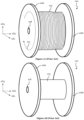
- Figures 1A to 1C show various views of a conventional non-collapsible reel 100.
- Figure 1A shows a reel 100 bearing a cable 102;
- Figures 1B and 1C show the reel 100 without the cable 102.
- the term "cable 102" will encompass cable, conduit, or tubing.
- the reel 100 is shown in a three-dimensional view relative to a three-dimensional coordinate system including a first axis AX1 ( e . g ., x-axis), a second axis AX2 ( e . g ., y-axis), and a third axis AX3 ( e .
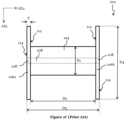
- Figure 1C shows a two-dimensional view of the reel 100 in the AX1-AX2 plane of the AX1, AX2, AX3 coordinate system ( e . g ., Figure 1C is a top-down view of the reel 100 shown in Figure 1B ).
- the cable 102 may be an optical cable ( e . g ., including one or more optical fibers within an outer jacket), an electrical cable ( e . g ., for high-voltage power distribution), or the like.
- the cable 102 may weigh between 2 kilograms/meter and 100 kilograms/meter ( e . g ., about 30 kilograms/meter).
- the cable 102 is wrapped around a central member 104 of the reel 100.
- the central member 104 e . g ., a drum or spool
- the central member 104 is a substantially cylindrical shape and is disposed between opposing end portions 106a, 106b of the reel 100.
- the central member 104 may be secured to the end portions 106a, 106b by screws, bolts, nails, or a weld, as examples, depending on the material of the central member 104 and the end portions 106a, 106b.
- the elements used to secure the end portions 106a, 106b and the central member 104 to each other are not shown in Figures 1A to 1C for the sake of simplicity.
- the end portions 106a, 106b are circular in shape and have an opening 108 that extends through a central region of the end portions 106a, 106b and through a central region of the central member 104 (see, e.g., Figure 1C ).
- the opening 108 is configured to accommodate a support rod, and the cable 102 is pulled on/from the reel 100 as it rotates about the axis of the support rod.
- a direction of rotation of the reel 100 is illustratively shown as arrow 110 in Figure 1A .
- each of the end portions 106a, 106b includes a first major surface 112 that is inward-facing. Stated differently, the first major surface 112 of the first end portion 106a is directed to the first major surface 112 of the second end portion 106b, with the central member 104 being disposed between and contacting the first major surfaces 112 of the end portions 106a, 106b.
- Each of the end portions 106a, 106b includes a second major surface 114 that is outward-facing. In other words, the second major surface 114 of the first end portion 106a and the second major surface 114 of the second end portion 106b is directed away from the central member 104 and forms outward-facing surfaces of the reel 100.
- the central member 104 of the reel 100 has a first dimension D1 along the first axis AX1 and a second dimension D2 along the second axis AX2.
- the first dimension D1 corresponds to a maximum diametric extent of the central member 104 along the first axis AX1 and is indicative of an outer diameter of the central member 104.
- the second dimension D2 corresponds to a maximum longitudinal extent of the central member 104 along the second axis AX2 and is indicative of a distance separating the first major surfaces 112 of the end portions 106a, 106b.
- the second major surfaces 114 of the end portions 106a, 106b are separated by a third dimension D3 along the second axis AX2.
- a difference between the third dimension D3 and the first dimension D1 (e . g ., calculated as D1 subtracted from D3) is equal to twice a thickness T of each of the end portions 106a, 106b along the second axis AX2.
- a widest lateral extent of respective end portions 106a, 106b along the first axis AX1 is represented by a fourth dimension D4, which corresponds to an outer diameter of each of the end portions 106a, 106b.
- At least one of the dimensions D1, D2, D3, or D4 and/or the material of the reel 100 determine a maximum load (e . g ., a maximum weight of the cable 102) that can be safely supported by the reel 100 during its use or transport.
- the end portions 106a, 106b and the central member 104 are made of plywood, timber, plastic, or metal, depending on the weight and the type of cable 102 and whether the reel 100 is designed to be reusable and/or returnable. Additionally, the choice of material for the reel 100 depends on whether the reel 100 and the cable 102 are being stored indoors or outdoors.
- a plastic reel 100 can have a fourth dimension D4 between 400 mm and 1000 mm and can carry loads of up to 850 kilograms; a plywood reel 100 can have a fourth dimension D4 between 125 mm and 1500 mm and can carry loads of up to 2 tons; a timber reel 100 can have a fourth dimension D4 between 250 mm and 4500 mm and can carry loads of up to 60 tons; and a metal reel 100 ( e . g ., iron or steel) can have a fourth dimension D4 between 630 mm and 10000 mm and can carry loads of up to 250 tons.
- power cable industrial uses of the reel 100 require that the reel 100 be robust and hold loads of at least 200 kg, but usually metal or timber reel 100 are chosen as they can be suitable for a wide variety of cables and can stand even long-term outdoor storage.
- a feature of the conventional reel 100 is that once the reel 100 is manufactured having a given size for a given maximum load and from a given material, the first dimension D1 and the second dimension D2 of the reel 100 are fixed and non-adjustable.
- the reel 100 cannot be collapsed when the reel 100 is empty ( e . g ., when the reel 100 is not carrying any cable 102) and its size cannot be varied to support different amounts ( e . g ., lengths) or types of cable 102 below its maximum load.
- a dismountable reel has been envisioned (e.g. in German patent application DE 10220265C1 ), where the end portions 106a, 106b are separable from the central member 104 prior to its transportation or storage. Separation of the end portions 106a, 106b from the central member 104 involves a process of loosening the elements (e . g ., screws, bolts, or nails) that secure the end portions 106a, 106b and the central member 104 to each other and subsequently pulling apart the end portions 106a, 106b and the central member 104 to dismantle the reel 100.
- the elements e . g ., screws, bolts, or nails
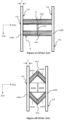
- Figures 2A to 2C show a second example of a proposed solution.
- the example of Figures 2A to 2C (e.g., proposed in US Patent Application Publication No. 2005/0051664 ) is a fully-collapsible reel where the central member 104 is replaced by a plurality of support units 200 that circumscribe an imaginary cylinder in the three-dimensional AX1, AX2, AX3 coordinate system.
- Figures 2A to 2C show side views of the fully-collapsible reel in the AX1-AX2 plane.
- each support unit 200 includes a pair of interconnected end-to-end leg segments 200a, 200b that are joined to each other by a pivot pin 202.
- Each support unit 200 is also hingedly/pivotably connected (via further pivot pins) to the opposing first major surfaces 112 of the end portions 106a, 106b.
- each support unit 200 is fully extended, thereby forming a substantially flat surface F across each support unit 200, thereby allowing the reel of Figure 2A to support and carry a cable 102.
- each support unit 200 is foldable about its respective pivot pin 202, thereby moving the pivot pins 202 radially and bringing the end portions 106a, 106b in progressively closer proximity to each other.
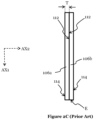
- the leg segments 200a, 200b are gradually accommodated into recesses formed in the end portions 106a, 106b until the opposing first major surfaces 112 of the end portions 106a, 106b are abutting or physically contacting each other, as shown in Figure 2C .
- the reel, when fully collapsed, is no thicker than twice the thickness T of each of the end portions 106a, 106b, as illustrated in Figure 2C .
- the fully-collapsible reel of Figures 2A to 2C suffers from several disadvantages, including the feature that the reel only has two structurally stable configurations, namely, the fully-extended state of Figure 2A and the fully-collapsed state of Figure 2C .
- the partially-collapsed state of Figure 2C is not structurally stable due, at least in part, to the support units 200 not being in a locked position while folded about its respective pivot pin 202.
- the structure of Figure 2B is not amenable to supporting a cable 102 since each of the leg segments 200a, 200b forms a non-flat surface between the end portions 106a, 106b. Consequently, the reel proposed in Figures 2A to 2C , while fully-collapsible, is still non-adjustable since its size cannot be varied to safely support different lengths or types of cable 02 below its maximum load.
- reels that are adjustable in size so as to support cables 102 of different sizes, lengths or weights during transportation or storage.
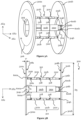
- Figures 3A, 3B , 4A, and 4B illustrate a collapsible and adjustable reel 300, in accordance with an embodiment of the present disclosure.
- Figures 3A, 3B , 4A, and 4B show an empty reel 300; however, it is understood that the reel 300 is configured to support or carry the cable 102 described above in reference to Figure 1A .
- Figures 3A and 3B illustrate the reel 300 in a fully-extended position
- Figures 4A and 4B illustrate the reel 300 in a collapsed (e.g., partially collapsed) and adjusted position relative to Figures 3A and 3B .
- the embodiment reel 300 is adjustable in size and is structurally stable at each of the adjusted sizes.
- the reel 300 includes opposing flanges 302a, 302b, which are circular in shape and that have an opening 304 that extends through a central region of each of the flanges 302a, 302b.
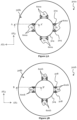
- Figures 5A and 5B show views of inward-facing surfaces of the flanges 302a, 302b, in accordance with an embodiment
- Figures 5C and 5D show views of inward-facing surfaces of the flanges 302a, 302b, in accordance with another embodiment.
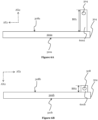
- Figures 6A and 6B show cross-sections of a portion of the flanges 302a, 302b.
- each segmented structure 312 includes a plurality of links 312a, 312b, 312c, and Figures 7A to 7D show the structure of each link of a segmented structure 312.
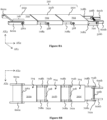
- Each segmented structure 312 can be fully-extended (as in Figures 3A and 3B ), and Figures 8A to 8D show the structure of a fully-extended segmented structure 312.
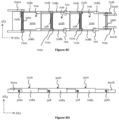
- Each segmented structure 312 can be pivotably-collapsed in size (as in Figures 4A and 4B ), and Figure 9 shows the structure of a pivotably-collapsed segmented structure 312.
- Figures 5A, 5B , 6A, 6B , 7A to 7D , 8A to 8D , and 9 will be discussed in greater detail below.
- Figures 3A, 3B , 4A, and 4B show the reel 300 in a three-dimensional view relative to the three-dimensional AX1, AX2, AX3 coordinate system.
- Figures 3B and 4B show two-dimensional views of the reel 300 in the AX1-AX2 plane of the AX1, AX2, AX3 coordinate system.
- the reel 300 includes opposing flanges 302a, 302b, which may be coaxial and circular in shape.
- the opening 304 that extends through the central region of the flanges 302a, 302b is configured to accommodate a support rod so that when the reel 300 is loaded with/unloaded of the cable 102, the cable 102 may be wound on/pulled from the reel 300 as it rotates about the axis of the support rod.
- a direction of rotation of the reel 300 is illustratively shown as arrow 306 in Figure 3A .
- the reel 300 and the support rod may be positioned on a stand. Additionally or alternatively, the reel 300 and the support rod may be supported for rotation on a body of a mobile vehicle ( e . g ., a truck).
- the entire reel 300 can be formed from the same material, at least in power cable industrial uses.
- the flanges 302a, 302b may be formed from a metal-containing material ( e . g ., iron or steel) or timber depending on the desired size, weight, and durability of the reel 300.
- each of the flanges 302a, 302b includes a respective first major surface 308a, 308b that is inward-facing such that the first major surface 308a of a first flange 302a is directed towards the first major surface 308b of a second flange 302b.
- Each of the flanges 302a, 302b includes a respective second major surface 310a, 310b that is outward-facing and that collectively form outward-facing surfaces of the reel 300.
- a widest diametric extent of each of the flanges 302a, 302b along the first axis AX1 may be represented by dimension D5, which may correspond to an outer diameter of each of the flanges 302a, 302b.
- the dimension D5 may be between 100 mm and 6000 mm ( e . g ., in cases where the reel 300 is configured for industrial use).
- Each of the flanges 302a, 302b may have the thickness T' along the second axis AX2, which may be between 1 mm and 30 mm.
- the flanges 302a, 302b are mechanically coupled to each other by the plurality of segmented structures 312, as illustrated in Figures 3A and 3B .
- a first end 314a of each segmented structure 312 is pivotably coupled to the first flange 302a by a respective first end pivot rod 316a
- second ends 314b of each segmented structure 312 is pivotably coupled to the second flange 302b by a respective second end pivot rod 316b.
- brackets 600a and 600b extend from the first major surface 308a of the first flange 302a and from the first major surface 308b of the second flange 302b, respectively.
- first end 314a of each segmented structure 312 may be pivotably coupled to a respective bracket 600a of the first flange 302a (by first end pivot rod 316a) and the second ends 314b of each segmented structure 312 may be pivotably coupled to a respective bracket 600b of the second flange 302b (by second end pivot rod 316b), as illustrated in Figures 3A and 3B .
- Each segmented structure 312 includes the plurality of segments 312a, 312b, 312c (which may also be referred to as "links") that are pivotably coupled to each other by intermediate pivot rods 318. There are at least three links 312a, 312b, 312c that form each segmented structure 312.
- the plurality of segmented structures 312 and the pivot rods 316a, 316b, 318 are formed from the same material as the flanges 302a, 302b since, as mentioned above, the entire reel 300 is formed from the same material.
- FIG. 3A A comparison between Figures 3A and 4A and between Figures 3B and 4B shows that in order to adjust or vary the size of the reel 300, the first end 314a of each segmented structure 312 pivots about its respective first end pivot rod 316a, the second ends 314b of each segmented structure 312 pivot about their respective second end pivot rod 316b, and each of the plurality of links 312a, 312b, 312c of each segmented structure 312 pivots about its intermediate pivot rods 318.
- the structure and spatial properties of the brackets 600a of the first flange 302a and the brackets 600b of the second flange 302b are described.
- Figure 5A shows a view of the first major surface 308a of the first flange 302a
- Figure 5B shows a view of the first major surface 308b of the second flange 302b
- the first flange 302a includes a plurality of brackets 600a disposed along a circumference of the opening 304 of the first flange 302a.
- Each bracket 600a may be spaced along the circumference of the opening 304 so that the first ends 314a of the plurality of segmented structures 312 are equally spaced along the circumference of the opening 304.
- Eight brackets 600a (e.g.
- brackets 600a are shown in the example of Figure 5A ; however, in other embodiments, other quantities of brackets 600a are possible (although it is noted that there are at least six brackets 600a since there are at least three segmented structures 312).
- first separation distance S1 which may be between 10 mm and 1000 mm.
- the first end 314a of each of the segmented structures 312 is accommodated within the first separation distance S1, as illustrated in Figure 3B .
- Each bracket 600a may include an opening 504 extending therethrough, with nearest-neighbor brackets 600a having openings 504 (see also Figure 6A ) that are aligned so as to receive respective first end pivot rod 316a.
- the second flange 302b includes a plurality of brackets 600b disposed along a circumference of the opening 304 of the second flange 302b.
- Each bracket 600b may be spaced along the circumference of the opening 304 so that the second ends 314b of the plurality of segmented structures 312 are equally spaced along the circumference of the opening 304.
- the number of brackets 600b of the second flange 302b may be equal to the number of brackets 600a of the first flange 302a.
- Opposing surfaces of nearest-neighbor brackets 600b are separated by a second separation distance S2.
- the second separation distance S2 may be between 10 mm and 1000 mm.
- the second separation distance S2 may be equal to the first separation distance D1, and in such embodiments, the second ends 314b of each of the segmented structures 312 may be accommodated within the second separation distance S2.
- the second separation distance S2 is less than the first separation distance D1, and in such embodiments, nearest-neighbor brackets 600b are accommodated within a space between second ends 314b of a given segmented structure 312.
- Each bracket 600b may include an opening 508 extending therethrough, with nearest-neighbor brackets 600b having openings 508 that are aligned so as to receive respective second end pivot rod 316b.
- FIG. 5A and 5B illustrates the first flange 302a having a pair of brackets 600a that are aligned so as to receive respective first end pivot rod 316a.
- FIG. 5C other embodiments are possible where the respective first end pivot rod 316a is received by a single bracket 601 having the opening 504 therethrough.
- the brackets 601 of Figure 5C are equally spaced along the circumference of the opening 304.
- the first flange 302a includes four brackets 601; however, in other embodiments, other quantities of brackets 601 are possible (although it is noted that there are at least three brackets 601 since there are at least three segmented structures 312).
- FIG. 5D A similar arrangement is seen in the embodiment of Figure 5D , which illustrates that the respective second end pivot rod 316b may be received by a single bracket 603 having the opening 508 therethrough.
- the brackets 603 of Figure 5D are equally spaced along the circumference of the opening 304.
- the second flange 302b includes four brackets 603; however, in other embodiments, other quantities of brackets 603 are possible (although it is noted that there are at least three brackets 603 since there are at least three segmented structures 312).
- the description and figures that follow are directed to the embodiment of Figures 5A and 5B with the brackets 600a, 600b arranged as pairs.
- Figure 6A shows a cross-sectional view of a bracket 600a of the first flange 302a along the line A-A' in Figure 5A
- Figure 6B shows a cross-sectional view of a bracket 600b of the second flange 302b along the line B-B' in Figure 5B
- the bracket 600a extends or protrudes from the first major surface 308a of the first flange 302a and may be formed from the same material as the first flange 302a.
- the bracket 600a may have a height BH1 that may be between 10 mm and 200 mm, while the opening 504 of the bracket 600a may have a diameter of between 1 mm and 30 mm to accommodate the first end pivot rod 316a that pivotably couples the bracket 600a to its respective segmented structure 312. Since the bracket 600a is pivotably coupled to its respective segmented structure 312, the height BH1 of the bracket 600a may depend, at least in part, on a location of an opening within the respective segmented structure 312 that accommodates the first end pivot rod 316a. The location of the opening within the respective segmented structure 312 that accommodates the first end pivot rod 316a is described in greater detail below in reference to Figures 7A to 7D , 8A to 8D , and 9 .
- the bracket 600b extends or protrudes from the first major surface 308b of the second flange 302b and may be formed from the same material as the second flange 302b.
- the bracket 600b may have a height BH2 that may be less than the height BH1 of the bracket 600a, while the opening 508 of the bracket 600b may have a diameter that is equal to the diameter of the opening 504 of the bracket 600a so as to accommodate the second end pivot rod 316b that pivotably couples the bracket 600b to its respective segmented structure 312.
- the height BH2 of the bracket 600b may depend, at least in part, on a location of an opening within the second ends 314b that accommodates the second end pivot rod 316b.
- the location of the opening within the second ends 314b that accommodates the second end pivot rod 316b is described in greater detail below in reference to Figures 7A to 7D , 8A to 8D , and 9 .
- each segmented structure 312 includes a plurality of links 312a, 312b, 312c that are pivotably coupled to each other by intermediate pivot rods 318.
- Figures 7A to 7D show various views of a single link 312a of the segmented structure 312, in accordance with an embodiment. It is noted that the structure of the single link 312a is identical to the structure of the other links 312b, 312c of the segmented structure 312.
- Figure 7A shows a three-dimensional view of the link 312a relative to the AX1, AX2, AX3 coordinate system
- Figures 7B to 7D show various two-dimensional views of the link 312a in different planes of the AX1, AX2, AX3 coordinate system.
- the link 312a includes a planar region 702 having a first major surface 704 (see Figures 7A and 7B ) and a second major surface 706 (see Figures 7A and 7C ) opposite the first major surface 704.
- the juxtaposition of major surfaces 704 and 706 of the planar region 702 of the link 312a is also seen in Figure 7D .
- the planar region 702 may have a first dimension L1 along the first axis AX1 and a second dimension L2 along the second axis AX2.
- the first dimension L1 may be between 1 mm to 30 mm, while the second dimension L2 may be between 5 mm and 2000 mm.
- Figures 7A to 7D also show that the link 312a further includes a first sidewall 708a and a second sidewall 708b at opposite sides of the second major surface 706 of the planar region 702.
- the first sidewall 708a and the second sidewall 708b may be integral with the planar region 702 of the link 312a and serve to pivotably couple the link 312a to an adjacent link or to one of the flanges 302a, 302b.
- the first sidewall 708a includes a first end 710a that is located within the perimeter of the planar region 702; the first sidewall 708a also includes a second end 712a, opposite the first end 710a, that extends outside the perimeter of the planar region 702.
- the second sidewall 708b includes a first end 710b that is located within the perimeter of the planar region 702; the second sidewall 708b also includes a second end 712b, opposite the first end 710b, that extends outside the perimeter of the planar region 702.
- the second ends 712a, 712b of the sidewalls 708a, 708b may be located 10 mm and 200 mm from the closest edge of the planar region 702 (indicated in Figures 7B and 7C as third dimension L3 along the second axis AX2).
- the link 312a additionally includes through-holes 714 that extend through the first sidewall 708a and the second sidewall 708b.
- the first sidewall 708a includes a through-hole 714 proximate the first end 710a of the first sidewall 708a and another through-hole 714 proximate the second end 712a of the first sidewall 708a.
- the second sidewall 708b includes a through-hole 714 proximate the first end 710b of the second sidewall 708b and another through-hole 714 proximate the second end 712b of the second sidewall 708b.
- the through-holes 714 at the first ends 710a, 710b of the sidewalls 708a, 708b are aligned to accommodate an intermediate pivot rod 318 (e.g., when first ends 710a, 710b are coupled to an adjacent link) or a first end pivot rod 316a ( e . g ., when first ends 710a, 710b are coupled to a bracket 600a of the first flange 302a).
- the through-holes 714 at the second ends 712a, 712b of the sidewalls 708a, 708b are aligned to accommodate an intermediate pivot rod 318 ( e .
- a diameter of the through-holes 714 and the diameters of openings 504, 508 of the brackets 600a, 600b may be at least 10 mm (300 mm at most), while the diameters of the first end pivot rods 316a, second end pivot rods 316b, and intermediate pivot rods 318 are less than the diameter of the through-holes 714 and the diameters of openings 504, 508 of the brackets 600a, 600b.
- each sidewall 708a, 708b includes a central region 716 disposed within the perimeter of the planar region 702, a first leg 718 extending from the central region 716 across a portion of the second major surface 706 of the planar region 702, and a second leg 720 protruding outside the perimeter of the planar region 702. Extremities of the first legs 718 form the first ends 710a, 710b of the sidewalls 708a, 708b, while extremities of the second legs 720 form the second ends 712a, 712b of the sidewalls 708a, 708b.
- the first leg 718 and the second leg 720 of a respective sidewall 708a, 708b are not aligned but are, instead, offset from each other to form a stepped structure 722 at the second major surface 706 of the planar region 702 and within the perimeter thereof.
- the stepped structures 722 function to accommodate second ends 712a, 712b of an adjacent link.
- Figure 7D shows an overhang 722 formed by the portion of the planar region 702 that protrudes over the first ends 710a, 710b.
- the overhang 722 forms the first end 314a of the segmented structure 312. It is further noted that when the link 312a is the link in closest proximity to second flange 302b, the second ends 712a, 712b of the sidewalls 708a, 708b form the second ends 314b of the segmented structure 312.
- a segmented structure of the plurality of segmented structures 312 may be formed by pivotably coupling the plurality of links 312a, 312b, 312c end-to-end.
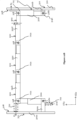
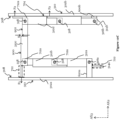
- Figures 8A to 8D show various views of a single segmented structure 312, including links 312a, 312b, 312c, when the reel 300 is in a fully-extended position, while Figure 9 shows a view of the single segmented structure 312 when the reel 300 is in a partially-collapsed and adjusted position.
- Figure 8A shows a three-dimensional view of the segmented structure 312 relative to the AX1, AX2, AX3 coordinate system
- Figures 8B to 8D and 9 show various two-dimensional views of the segmented structure 312 in different planes of the AX1, AX2, AX3 coordinate system.
- a pair of brackets 600a of the first flange 302a are pivotably coupled to the link 312a by the first end pivot rod 316a, with the brackets 600a overlying the sidewalls 708a, 708b of the link 312a.
- the first end pivot rod 316a passes through the through-holes of the first ends 710a, 710b of link 312a and through the openings of the brackets 600a.
- the second ends 712a, 712b of link 312a are pivotably coupled to link 312b by an intermediate pivot rod 318.
- first ends 710a, 710b of link 312b are coupled by intermediate pivot rod 318 to second ends 712a, 712b of link 312a.
- the intermediate pivot rod 318 passes through the through-holes of the first ends 710a, 710b of link 312b and the through-holes of second ends 712a, 712b of link 312a, thereby pivotably securing links 312a and 312b together.
- second ends 712a, 712b of link 312b are pivotably coupled to link 312c by another intermediate pivot rod 318.
- brackets 600b of second flange 302b are pivotably coupled to the link 312c by the second end pivot rod 316b, with the second ends 712a, 712b of link 312c overlying brackets 600b of the second flange 302b.
- the second end pivot rod 316b passes through the through-holes of the second ends 712a, 712b of link 312c and the openings of brackets 600b, thereby pivotably securing link 312c and brackets 600b together.
- the intermediate pivot rods 318 serve as fulcrums around which immediately adjacent links rotate.
- the first and second end pivot rods 316a, 316b serve as fulcrums around which the ends 314a, 314b of the segmented structures 312 rotate.
- the first end 314a of segmented structure 312, formed by the overhang 722 of link 312a rotates (e.g., by about 90 degrees) about the first end pivot rod 316a and the second ends 712a, 712b of link 312a rotate (e.g., by about 90 degrees) about intermediate pivot rod 318 between links 312a and 312b so as to bring an edge of the overhang 722 of link 312b in contact (e.g., physical contact) with the first major surface 308 of first flange 302a.
- the planar region 702 of link 312c rotates ( e .
- a substantially flat surface 900, 902 is formed between first and second flanges 302a, 302b, which allows for the adjusted reel 300 of Figures 4A and 4B to robustly support a cable of varying sizes, lengths or weights during transportation or storage.
- a step S is formed between a surface 900 and surface 902, and the step S may be between 10 mm and 1000 mm, thus causing negligible variation in the flatness of the surface 900, 902 in comparison with a size of the cable 102.
- Structural stability of the adjusted reel 300 is maintained by an outward force F1 being exerted by the overhang 722 of link 312b of each segmented structure 312 onto the first major surface 308a of first flange 302a and by another outward force F2 being exerted by the planar region 702 of link 312c of each segmented structure 312 onto the first major surface 308b of second flange 302b.
- segmented structures 312 are shown in the reel 300 of Figures 3A, 3B , 4A, and 4B .
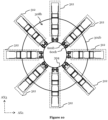
- the number of segmented structures 312 that are arranged along a perimeter of the openings 304 may differ for other embodiments (e.g. as shown in Figure 10 ), with an increased number of segmented structures 312 arranged along the perimeter of the openings 304 causing an increase in a maximum weight limit of the reel 300.
- each segmented structure 312 having three links 312a, 312b, 312c.
- more than three links may be possible in other embodiments, with an increased number of links causing an increase in a distance between the first major surfaces 308 of the flanges 302a, 302b.
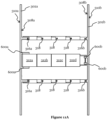
- Figure 11A shows an embodiment where each segmented structure 312 is fully-extended and includes four links 312a, 312b, 312d.
- Figure 11B shows an adjustment or partial collapse of the segmented structure 312 shown in Figure 11A , where terminal links 312a, 312d rotate about their respective end pivot rods 316a, 316b and intermediate pivot rods 318 to form the segmented structure 312 shown in Figure 11B , which causes a change in the distance between the first major surfaces 308a, 308b of the flanges 302a, 302b compared to Figure 11A .
- each segmented structure 312 may determine the number of possible sizes of the reel 300.
- Figure 12A shows an embodiment where five links 312a to 312e form a single segmented structure 312 in a fully-extended state.
- Such a segmented structure 312 may have two other configurations when the reel 300 is partially collapsed or adjusted.
- Figure 12B three links 312b, 312c, 312d provide the substantially flat surface 900, 902 between first and second flanges 302a, 302b, while in Figure 12C , link 312C provides the substantially flat surface 900, 902 between first and second flanges 302a, 302b.
- each of the configurations shown in Figures 12A to 12C has a different distance between major surfaces 308 of first and second flanges 302a, 302b and each configuration is structurally stable (e.g. for at least the reasons discussed above in reference to Figure 9 ). Consequently, in the embodiment of Figures 12A to 12C , the reel 300 can have three different sizes, each of which is structurally stable and configured to support cables 102 of varying sizes, lengths or weights during transportation or storage.
- various embodiments of the reel 300 shown in Figures 3A, 3B , 4A, 4B , 5A, 5B , 6A, 6B , 7A to 7D , 8A to 8D , 9 , 10 , 11A , 11B , and 12A to 12C require less space to store and transport when empty or loaded below its maximum capacity/load. Additionally, in comparison to the above-described dismountable reel, the reel 300 can be easily collapsed without the need to dismantle the reel.
- the reel 300 has a modular structure, which allows it to be adjusted to different reel sizes in order to support cables 102 of varying sizes, lengths or weights during transportation or storage, while maintaining structural stability at each of the different reel sizes.
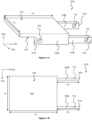
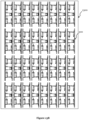
- Figure 13A shows a given area 1300 storing a particular number of conventional reels 100, with the same area 1301 in Figure 13B being able to store a greater number of reels 300 by virtue of their collapsible and adjustable nature.
- Figure 14A shows a truck 1400 carrying a particular number of conventional reels 100, with the same truck 1400 in Figure 14B being able to store a greater number of reels 300 by virtue of their collapsible and adjustable nature.
- a collapsible and adjustable reel is proposed, where the collapsible and adjustable reel includes two opposed flanges 302a, 302b and a plurality (e.g. at least three) segmented structures 312, each of which includes at least three links 312a, 312b, 312c joined end-to-end by respective pivot pins 318 and configured to be folded (e.g., in a radially inward direction) independently one another.
- the proposed collapsible and adjustable reel can be partially collapsed and used for transporting cables when the reel is empty or loaded below its maximum capacity/load.
Landscapes
- Storage Of Web-Like Or Filamentary Materials (AREA)
Claims (10)
- Eine Spule (300), die Folgendes umfasst:Einen ersten Flansch (302a) mit mindestens einem ersten Bügel (600a; 601), der sich von einer ersten Hauptfläche (308a) des ersten Flansches (302a) aus erstreckt;einen zweiten Flansch (302b), der mindestens einen zweiten Bügel (600b; 603) umfasst, der sich von einer ersten Hauptfläche (308b) des zweiten Flansches (302b) aus erstreckt, wobei die erste Hauptfläche (308b) des zweiten Flansches (302b) auf die erste Hauptfläche (308a) des ersten Flansches (302a) gerichtet ist; undeine Vielzahl von segmentierten Strukturen (312), die jeweils eine Vielzahl von Gliedern (312a, 312b, 312c) umfassen, die schwenkbar mit dem mindestens einen ersten Bügel (600a; 601) durch eine erste Endschwenkstange (316a) und mit dem mindestens einen zweiten Bügel (600b) durch eine zweite Endschwenkstange (316b) gekoppelt sind, dadurch gekennzeichnet, dass die Vielzahl von Gliedern (312a, 312b, 312c) mindestens drei Glieder umfasst und so konfiguriert ist, dass sie eine erste stabile Anordnung und eine zweite stabile Anordnung aufweist, die sich von der ersten stabilen Anordnung unterscheidet, wobei:In der ersten stabilen Anordnung der erste Flansch (302a) und der zweite Flansch (302b) durch einen ersten Abstand getrennt sind, wobei die Spule so konfiguriert ist, dass sie eine erste maximale Kabellast trägt; undin der zweiten stabilen Anordnung der erste Flansch und der zweite Flansch um einen zweiten Abstand getrennt sind, der geringer ist als der erste Abstand, wobei die Spule so konfiguriert ist, dass sie eine zweite maximale Kabellast trägt, die geringer ist als die erste maximale Kabellast.
- Die Spule nach Anspruch 1, wobei der erste Flansch (302a) ein Paar von ersten Bügeln (600a) umfasst, die sich von der ersten Hauptfläche (308a) des ersten Flansches (302a) erstrecken, und/oder wobei der zweite Flansch (302b) ein Paar von zweiten Bügeln (600b; 603) umfasst.
- Die Spule nach Anspruch 1, wobei die Vielzahl der segmentierten Strukturen (312) mindestens drei segmentierte Strukturen umfasst.
- Die Spule nach Anspruch 1, wobei in der ersten stabilen Anordnung die Vielzahl von Gliedern (312a, 312b, 312c) vollständig von Ende zu Ende gestreckt ist und wobei ein Winkel zwischen benachbarten Gliedern der Vielzahl von Gliedern (312a, 312b, 312c) etwa 0 Grad beträgt.
- Die Spule nach Anspruch 1, wobei in der zweiten stabilen Anordnung benachbarte Glieder der Vielzahl von Gliedern um eine dazwischenliegende Schwenkstange (318) gedreht werden, die die benachbarten Glieder schwenkbar verbindet, und wobei ein zwischen den benachbarten Gliedern eingeschlossener Winkel etwa 90 Grad beträgt.
- Die Spule nach Anspruch 1, wobei jedes Glied der Vielzahl von Gliedern (312a, 312b, 312c) Folgendes umfasst:Einen ebenen Bereich (702); undparallele Seitenwände (708a, 708b), die sich von gegenüberliegenden Kanten des ebenen Bereichs erstrecken, wobei die parallelen Seitenwände erste Schenkel (718), die innerhalb eines Umfangs des ebenen Bereichs angeordnet sind, und zweite Schenkel (720), die außerhalb des Umfangs des ebenen Bereichs angeordnet sind, umfassen.
- Die Spule nach Anspruch 6, wobei die Vielzahl von Gliedern (312a, 312b, 312c) ein erstes Endglied, ein benachbartes Endglied und ein zweites Endglied umfasst, wobei:Die ersten Schenkel des ersten Endglieds schwenkbar mit der mindestens einen ersten Halterung (600a; 601) durch die erste Endschwenkstange (316a) verbunden sind, die sich durch ausgerichtete Öffnungen (714) in den ersten Schenkeln des ersten Endglieds und der mindestens einen ersten Halterung (600a) erstreckt; die zweiten Schenkel des ersten Endglieds schwenkbar mit den ersten Schenkeln des benachbarten Endglieds durch eine erste Zwischenschwenkstange verbunden sind, die sich durch ausgerichtete Öffnungen in den zweiten Schenkeln des ersten Endglieds und den ersten Schenkeln des benachbarten Endglieds erstreckt;die zweiten Schenkel des benachbarten Endglieds sind schwenkbar mit den ersten Schenkeln des zweiten Endglieds durch eine zweite Zwischenschwenkstange verbunden, die sich durch fluchtende Öffnungen in den zweiten Schenkeln des benachbarten Endglieds und den ersten Schenkeln des zweiten Endglieds erstreckt; unddie zweiten Schenkel der zweiten Endverbindung schwenkbar mit der mindestens einen zweiten Halterung (600b; 603) durch die zweite Endschwenkstange (316b) gekoppelt sind, die sich durch fluchtende Öffnungen in den zweiten Schenkeln der zweiten Endverbindung und der mindestens einen zweiten Halterung (600b) erstreckt.
- Die Spule nach Anspruch 7, wobei der ebene Bereich des ersten Endglieds in einem Raum zwischen dem mindestens einen ersten Bügel (600a) untergebracht ist, und wobei der mindestens eine zweite Bügel (600b) in einem Raum zwischen den zweiten Schenkeln des zweiten Endglieds untergebracht ist.
- Die Spule nach Anspruch 7, wobei in der zweiten stabilen Anordnung:Der ebene Bereich des ersten Endglieds zur ersten Hauptfläche (308a) des ersten Flansches (302a) gerichtet und von dieser beabstandet ist;eine Kante des ebenen Bereichs des benachbarten Endglieds in physischem Kontakt mit der ersten Hauptfläche (308a) des ersten Flansches (302a) steht; undder ebene Bereich des zweiten Endgliedes zur ersten Hauptfläche (308b) des zweiten Flansches (302b) gerichtet ist und mit dieser in physischem Kontakt steht.
- Die Spule nach Anspruch 6, wobei die Vielzahl von Endgliedern unmittelbar benachbarte Endglieder umfasst, und wobei die zweiten Schenkel eines ersten der unmittelbar benachbarten Endglieder in einem Raum zwischen den ersten Schenkeln eines zweiten der unmittelbar benachbarten Glieder untergebracht sind.
Applications Claiming Priority (1)
| Application Number | Priority Date | Filing Date | Title |
|---|---|---|---|
| US16/231,706 US10822193B2 (en) | 2018-12-24 | 2018-12-24 | Collapsible and adjustable reel |
Publications (3)
| Publication Number | Publication Date |
|---|---|
| EP3722237A1 EP3722237A1 (de) | 2020-10-14 |
| EP3722237B1 true EP3722237B1 (de) | 2023-06-07 |
| EP3722237C0 EP3722237C0 (de) | 2023-06-07 |
Family
ID=68886824
Family Applications (1)
| Application Number | Title | Priority Date | Filing Date |
|---|---|---|---|
| EP19215226.2A Active EP3722237B1 (de) | 2018-12-24 | 2019-12-11 | Zusammenklappbare und verstellbare spule |
Country Status (5)
| Country | Link |
|---|---|
| US (1) | US10822193B2 (de) |
| EP (1) | EP3722237B1 (de) |
| AU (1) | AU2019279966B2 (de) |
| CA (1) | CA3064750C (de) |
| NZ (1) | NZ760060A (de) |
Families Citing this family (5)
| Publication number | Priority date | Publication date | Assignee | Title |
|---|---|---|---|---|
| US11485604B2 (en) | 2020-09-23 | 2022-11-01 | Mmg Industries, Inc. | Disassembable reel apparatus and method |
| CN112850531B (zh) * | 2021-01-07 | 2022-03-29 | 安徽理工大学 | 一种内置永磁电机滚筒 |
| CN113979212B (zh) * | 2021-12-28 | 2022-03-08 | 常州恒益轻工机械有限公司 | 一种材料利用率高的特种纤维服装生产线及其生产工艺 |
| CN115838097B (zh) * | 2022-11-17 | 2024-01-23 | 国网四川省电力公司眉山供电公司 | 一种自动收线器 |
| CN116495566B (zh) * | 2023-04-28 | 2023-12-22 | 国网江苏省电力有限公司盐城供电分公司 | 光伏输电导体收卷设备 |
Family Cites Families (21)
| Publication number | Priority date | Publication date | Assignee | Title |
|---|---|---|---|---|
| US1742584A (en) * | 1926-04-22 | 1930-01-07 | Dewey C Daubmeyer | Reel |
| US1913477A (en) * | 1929-12-23 | 1933-06-13 | Dewey C Daubmeyer | Reel |
| GB366509A (en) * | 1930-07-30 | 1932-02-01 | William Henry Lebreton | Improvements in reels, drums, bobbins and the like |
| FR793172A (fr) * | 1935-07-30 | 1936-01-18 | Perfectionnements aux dévidoirs de tuyaux | |
| GB467787A (en) * | 1936-11-02 | 1937-06-23 | Benjamin Walter Wicks | Improvements in reels or drums for cables and the like |
| US2909340A (en) * | 1957-04-12 | 1959-10-20 | Grant E Whitaker | Collapsible wire reel |
| US3791606A (en) * | 1971-12-27 | 1974-02-12 | W Brown | Collapsible cable spool |
| USD277260S (en) * | 1982-07-21 | 1985-01-22 | Percy O. Rucks | Collapsible reel |
| DE3536555A1 (de) * | 1985-10-12 | 1987-04-23 | Bohnacker Metall Rudolf | Wickeltrommel zur lagerung und zum transport von strangfoermigem gut |
| US5169086A (en) * | 1991-03-18 | 1992-12-08 | Reel Rotation, Inc. | Collapsible reel for wire and cable packaging and system for stacking and transporting the same |
| FR2708582B1 (fr) * | 1993-07-30 | 1995-10-13 | Ems Societe | Touret pliable. |
| FR2708583B1 (fr) * | 1993-07-30 | 1995-10-13 | Ems Societe | Touret pliable. |
| US5649677A (en) * | 1994-09-20 | 1997-07-22 | Culp; Barney L. | Collapsible spool |
| FR2734802B1 (fr) * | 1995-06-02 | 1997-07-18 | Nave Atel | Touret |
| JPH0929933A (ja) * | 1995-07-20 | 1997-02-04 | Sakurai Graphic Syst:Kk | 印刷機における被印刷体の把持機構 |
| DE10220265C1 (de) | 2002-05-07 | 2003-12-11 | Jean Marie Delage | Zerlegbare Kabeltrommel von großer Aufnahmekapazität bei einfacher Wickelgutprüfung |
| US6913222B2 (en) * | 2003-09-05 | 2005-07-05 | Donald J. Maxwell | Lightweight collapsible reel for cable, conduit or tubing |
| US20060060689A1 (en) * | 2004-09-23 | 2006-03-23 | Fuller Kevin S | Collapsible reel |
| IL166105A0 (en) * | 2005-01-03 | 2006-01-15 | Elgo Irrigation Ltd | Collapsible reel cart |
| WO2012056480A1 (en) * | 2010-10-25 | 2012-05-03 | Tait S.R.L. A Socio Unico | Spool for storing a filiform element such as a cable, a rope or the like |
| DE102011053621A1 (de) * | 2011-09-14 | 2013-03-14 | Heinrich Wocken | Haspel zum Auf- und Abwickeln von langgestreckten Materialien und Haspelanlage mit zumindest einer solchen Haspel oder für zumindest eine solche Haspel |
-
2018
- 2018-12-24 US US16/231,706 patent/US10822193B2/en active Active
-
2019
- 2019-12-11 EP EP19215226.2A patent/EP3722237B1/de active Active
- 2019-12-11 AU AU2019279966A patent/AU2019279966B2/en active Active
- 2019-12-11 NZ NZ760060A patent/NZ760060A/en unknown
- 2019-12-12 CA CA3064750A patent/CA3064750C/en active Active
Also Published As
| Publication number | Publication date |
|---|---|
| NZ760060A (en) | 2025-10-31 |
| US10822193B2 (en) | 2020-11-03 |
| AU2019279966A1 (en) | 2020-07-09 |
| EP3722237C0 (de) | 2023-06-07 |
| US20200198923A1 (en) | 2020-06-25 |
| EP3722237A1 (de) | 2020-10-14 |
| CA3064750A1 (en) | 2020-06-24 |
| AU2019279966B2 (en) | 2025-06-26 |
| CA3064750C (en) | 2025-09-23 |
Similar Documents
| Publication | Publication Date | Title |
|---|---|---|
| EP3722237B1 (de) | Zusammenklappbare und verstellbare spule | |
| US11850988B2 (en) | Installation trailer for coiled flexible pipe and method of utilizing same | |
| US6352215B1 (en) | Payoff device for a reeless package | |
| US10889461B1 (en) | Expandable coil deployment system for drum assembly and method of using same | |
| RU2380264C2 (ru) | Устройство для наматывания и разматывания шлангов и кабелей | |
| PL168767B1 (pl) | Sposób manipulacji ciaglym, gietkim wyrobem oraz urzadzenie do manipulacji ciaglym, gietkim wyrobem PL | |
| US20050253015A1 (en) | Unwinding apparatus for reeling off coiled material | |
| US8459585B1 (en) | Wire transport system with improved racking resistance | |
| US11767044B1 (en) | Wire caddy for transporting and dispensing wire or cable | |
| EP0491400A1 (de) | Zerlegbare Spule aus Metall | |
| CN102897590B (zh) | 一种展放架 | |
| KR102207411B1 (ko) | 접이식 파이프 풀림기 | |
| US4296891A (en) | Expandable core for rolls of tubing | |
| CN220906755U (zh) | 放线用装置 | |
| HK40010337A (en) | Installation trailer for coiled flexible pipe and method of utilizing same | |
| HU186029B (en) | Cable drum formed with sides settable clos to each other for transporting and storing in empty condition | |
| OA19057A (en) | Installation trailer for coiled flexible pipe and method of utilizing same. | |
| JP2019085214A (ja) | 送り出し兼用巻取り機 | |
| ITBO20000085A1 (it) | Bobina portacavi . | |
| AU2004205347B1 (en) | A Frame Assembly to Support at Least One Reel |
Legal Events
| Date | Code | Title | Description |
|---|---|---|---|
| PUAI | Public reference made under article 153(3) epc to a published international application that has entered the european phase |
Free format text: ORIGINAL CODE: 0009012 |
|
| STAA | Information on the status of an ep patent application or granted ep patent |
Free format text: STATUS: THE APPLICATION HAS BEEN PUBLISHED |
|
| AK | Designated contracting states |
Kind code of ref document: A1 Designated state(s): AL AT BE BG CH CY CZ DE DK EE ES FI FR GB GR HR HU IE IS IT LI LT LU LV MC MK MT NL NO PL PT RO RS SE SI SK SM TR |
|
| AX | Request for extension of the european patent |
Extension state: BA ME |
|
| STAA | Information on the status of an ep patent application or granted ep patent |
Free format text: STATUS: REQUEST FOR EXAMINATION WAS MADE |
|
| 17P | Request for examination filed |
Effective date: 20210408 |
|
| RBV | Designated contracting states (corrected) |
Designated state(s): AL AT BE BG CH CY CZ DE DK EE ES FI FR GB GR HR HU IE IS IT LI LT LU LV MC MK MT NL NO PL PT RO RS SE SI SK SM TR |
|
| GRAP | Despatch of communication of intention to grant a patent |
Free format text: ORIGINAL CODE: EPIDOSNIGR1 |
|
| STAA | Information on the status of an ep patent application or granted ep patent |
Free format text: STATUS: GRANT OF PATENT IS INTENDED |
|
| INTG | Intention to grant announced |
Effective date: 20220927 |
|
| GRAS | Grant fee paid |
Free format text: ORIGINAL CODE: EPIDOSNIGR3 |
|
| GRAA | (expected) grant |
Free format text: ORIGINAL CODE: 0009210 |
|
| STAA | Information on the status of an ep patent application or granted ep patent |
Free format text: STATUS: THE PATENT HAS BEEN GRANTED |
|
| AK | Designated contracting states |
Kind code of ref document: B1 Designated state(s): AL AT BE BG CH CY CZ DE DK EE ES FI FR GB GR HR HU IE IS IT LI LT LU LV MC MK MT NL NO PL PT RO RS SE SI SK SM TR |
|
| REG | Reference to a national code |
Ref country code: GB Ref legal event code: FG4D |
|
| REG | Reference to a national code |
Ref country code: CH Ref legal event code: EP Ref country code: AT Ref legal event code: REF Ref document number: 1574488 Country of ref document: AT Kind code of ref document: T Effective date: 20230615 |
|
| REG | Reference to a national code |
Ref country code: DE Ref legal event code: R096 Ref document number: 602019029957 Country of ref document: DE |
|
| U01 | Request for unitary effect filed |
Effective date: 20230609 |
|
| U07 | Unitary effect registered |
Designated state(s): AT BE BG DE DK EE FI FR IT LT LU LV MT NL PT SE SI Effective date: 20230622 |
|
| REG | Reference to a national code |
Ref country code: NO Ref legal event code: T2 Effective date: 20230607 |
|
| REG | Reference to a national code |
Ref country code: LT Ref legal event code: MG9D |
|
| PG25 | Lapsed in a contracting state [announced via postgrant information from national office to epo] |
Ref country code: ES Free format text: LAPSE BECAUSE OF FAILURE TO SUBMIT A TRANSLATION OF THE DESCRIPTION OR TO PAY THE FEE WITHIN THE PRESCRIBED TIME-LIMIT Effective date: 20230607 |
|
| PG25 | Lapsed in a contracting state [announced via postgrant information from national office to epo] |
Ref country code: RS Free format text: LAPSE BECAUSE OF FAILURE TO SUBMIT A TRANSLATION OF THE DESCRIPTION OR TO PAY THE FEE WITHIN THE PRESCRIBED TIME-LIMIT Effective date: 20230607 Ref country code: HR Free format text: LAPSE BECAUSE OF FAILURE TO SUBMIT A TRANSLATION OF THE DESCRIPTION OR TO PAY THE FEE WITHIN THE PRESCRIBED TIME-LIMIT Effective date: 20230607 Ref country code: GR Free format text: LAPSE BECAUSE OF FAILURE TO SUBMIT A TRANSLATION OF THE DESCRIPTION OR TO PAY THE FEE WITHIN THE PRESCRIBED TIME-LIMIT Effective date: 20230908 |
|
| PG25 | Lapsed in a contracting state [announced via postgrant information from national office to epo] |
Ref country code: SK Free format text: LAPSE BECAUSE OF FAILURE TO SUBMIT A TRANSLATION OF THE DESCRIPTION OR TO PAY THE FEE WITHIN THE PRESCRIBED TIME-LIMIT Effective date: 20230607 |
|
| PG25 | Lapsed in a contracting state [announced via postgrant information from national office to epo] |
Ref country code: IS Free format text: LAPSE BECAUSE OF FAILURE TO SUBMIT A TRANSLATION OF THE DESCRIPTION OR TO PAY THE FEE WITHIN THE PRESCRIBED TIME-LIMIT Effective date: 20231007 |
|
| PG25 | Lapsed in a contracting state [announced via postgrant information from national office to epo] |
Ref country code: SM Free format text: LAPSE BECAUSE OF FAILURE TO SUBMIT A TRANSLATION OF THE DESCRIPTION OR TO PAY THE FEE WITHIN THE PRESCRIBED TIME-LIMIT Effective date: 20230607 Ref country code: SK Free format text: LAPSE BECAUSE OF FAILURE TO SUBMIT A TRANSLATION OF THE DESCRIPTION OR TO PAY THE FEE WITHIN THE PRESCRIBED TIME-LIMIT Effective date: 20230607 Ref country code: RO Free format text: LAPSE BECAUSE OF FAILURE TO SUBMIT A TRANSLATION OF THE DESCRIPTION OR TO PAY THE FEE WITHIN THE PRESCRIBED TIME-LIMIT Effective date: 20230607 Ref country code: IS Free format text: LAPSE BECAUSE OF FAILURE TO SUBMIT A TRANSLATION OF THE DESCRIPTION OR TO PAY THE FEE WITHIN THE PRESCRIBED TIME-LIMIT Effective date: 20231007 Ref country code: CZ Free format text: LAPSE BECAUSE OF FAILURE TO SUBMIT A TRANSLATION OF THE DESCRIPTION OR TO PAY THE FEE WITHIN THE PRESCRIBED TIME-LIMIT Effective date: 20230607 |
|
| U20 | Renewal fee for the european patent with unitary effect paid |
Year of fee payment: 5 Effective date: 20231227 |
|
| PG25 | Lapsed in a contracting state [announced via postgrant information from national office to epo] |
Ref country code: PL Free format text: LAPSE BECAUSE OF FAILURE TO SUBMIT A TRANSLATION OF THE DESCRIPTION OR TO PAY THE FEE WITHIN THE PRESCRIBED TIME-LIMIT Effective date: 20230607 |
|
| REG | Reference to a national code |
Ref country code: DE Ref legal event code: R097 Ref document number: 602019029957 Country of ref document: DE |
|
| PLBE | No opposition filed within time limit |
Free format text: ORIGINAL CODE: 0009261 |
|
| STAA | Information on the status of an ep patent application or granted ep patent |
Free format text: STATUS: NO OPPOSITION FILED WITHIN TIME LIMIT |
|
| 26N | No opposition filed |
Effective date: 20240308 |
|
| REG | Reference to a national code |
Ref country code: CH Ref legal event code: PL |
|
| PG25 | Lapsed in a contracting state [announced via postgrant information from national office to epo] |
Ref country code: MC Free format text: LAPSE BECAUSE OF FAILURE TO SUBMIT A TRANSLATION OF THE DESCRIPTION OR TO PAY THE FEE WITHIN THE PRESCRIBED TIME-LIMIT Effective date: 20230607 |
|
| GBPC | Gb: european patent ceased through non-payment of renewal fee |
Effective date: 20231211 |
|
| PG25 | Lapsed in a contracting state [announced via postgrant information from national office to epo] |
Ref country code: MC Free format text: LAPSE BECAUSE OF FAILURE TO SUBMIT A TRANSLATION OF THE DESCRIPTION OR TO PAY THE FEE WITHIN THE PRESCRIBED TIME-LIMIT Effective date: 20230607 |
|
| REG | Reference to a national code |
Ref country code: IE Ref legal event code: MM4A |
|
| PG25 | Lapsed in a contracting state [announced via postgrant information from national office to epo] |
Ref country code: IE Free format text: LAPSE BECAUSE OF NON-PAYMENT OF DUE FEES Effective date: 20231211 |
|
| PG25 | Lapsed in a contracting state [announced via postgrant information from national office to epo] |
Ref country code: GB Free format text: LAPSE BECAUSE OF NON-PAYMENT OF DUE FEES Effective date: 20231211 |
|
| PG25 | Lapsed in a contracting state [announced via postgrant information from national office to epo] |
Ref country code: CH Free format text: LAPSE BECAUSE OF NON-PAYMENT OF DUE FEES Effective date: 20231231 |
|
| PG25 | Lapsed in a contracting state [announced via postgrant information from national office to epo] |
Ref country code: IE Free format text: LAPSE BECAUSE OF NON-PAYMENT OF DUE FEES Effective date: 20231211 Ref country code: GB Free format text: LAPSE BECAUSE OF NON-PAYMENT OF DUE FEES Effective date: 20231211 Ref country code: CH Free format text: LAPSE BECAUSE OF NON-PAYMENT OF DUE FEES Effective date: 20231231 |
|
| U20 | Renewal fee for the european patent with unitary effect paid |
Year of fee payment: 6 Effective date: 20241227 |
|
| PG25 | Lapsed in a contracting state [announced via postgrant information from national office to epo] |
Ref country code: CY Free format text: LAPSE BECAUSE OF FAILURE TO SUBMIT A TRANSLATION OF THE DESCRIPTION OR TO PAY THE FEE WITHIN THE PRESCRIBED TIME-LIMIT; INVALID AB INITIO Effective date: 20191211 |
|
| PG25 | Lapsed in a contracting state [announced via postgrant information from national office to epo] |
Ref country code: HU Free format text: LAPSE BECAUSE OF FAILURE TO SUBMIT A TRANSLATION OF THE DESCRIPTION OR TO PAY THE FEE WITHIN THE PRESCRIBED TIME-LIMIT; INVALID AB INITIO Effective date: 20191211 |
|
| PG25 | Lapsed in a contracting state [announced via postgrant information from national office to epo] |
Ref country code: TR Free format text: LAPSE BECAUSE OF FAILURE TO SUBMIT A TRANSLATION OF THE DESCRIPTION OR TO PAY THE FEE WITHIN THE PRESCRIBED TIME-LIMIT Effective date: 20230607 |
|
| PGFP | Annual fee paid to national office [announced via postgrant information from national office to epo] |
Ref country code: NO Payment date: 20251231 Year of fee payment: 7 |