EP3714044B1 - Zusammensetzungen und verfahren zur steigerung der produktion, des wachstums, der ausbreitung oder der onkolytischen und immuntherapeutischen wirksamkeit von interferon-empfindlichen viren - Google Patents
Zusammensetzungen und verfahren zur steigerung der produktion, des wachstums, der ausbreitung oder der onkolytischen und immuntherapeutischen wirksamkeit von interferon-empfindlichen viren Download PDFInfo
- Publication number
- EP3714044B1 EP3714044B1 EP18880792.9A EP18880792A EP3714044B1 EP 3714044 B1 EP3714044 B1 EP 3714044B1 EP 18880792 A EP18880792 A EP 18880792A EP 3714044 B1 EP3714044 B1 EP 3714044B1
- Authority
- EP
- European Patent Office
- Prior art keywords
- cells
- virus
- cancer
- cell
- tumor
- Prior art date
- Legal status (The legal status is an assumption and is not a legal conclusion. Google has not performed a legal analysis and makes no representation as to the accuracy of the status listed.)
- Active
Links
Images
















Classifications
-
- A—HUMAN NECESSITIES
- A61—MEDICAL OR VETERINARY SCIENCE; HYGIENE
- A61K—PREPARATIONS FOR MEDICAL, DENTAL OR TOILETRY PURPOSES
- A61K35/00—Medicinal preparations containing materials or reaction products thereof with undetermined constitution
- A61K35/66—Microorganisms or materials therefrom
- A61K35/76—Viruses; Subviral particles; Bacteriophages
- A61K35/766—Rhabdovirus, e.g. vesicular stomatitis virus
-
- A—HUMAN NECESSITIES
- A61—MEDICAL OR VETERINARY SCIENCE; HYGIENE
- A61K—PREPARATIONS FOR MEDICAL, DENTAL OR TOILETRY PURPOSES
- A61K31/00—Medicinal preparations containing organic active ingredients
- A61K31/21—Esters, e.g. nitroglycerine, selenocyanates
- A61K31/215—Esters, e.g. nitroglycerine, selenocyanates of carboxylic acids
- A61K31/22—Esters, e.g. nitroglycerine, selenocyanates of carboxylic acids of acyclic acids, e.g. pravastatin
- A61K31/225—Polycarboxylic acids
-
- A—HUMAN NECESSITIES
- A61—MEDICAL OR VETERINARY SCIENCE; HYGIENE
- A61K—PREPARATIONS FOR MEDICAL, DENTAL OR TOILETRY PURPOSES
- A61K35/00—Medicinal preparations containing materials or reaction products thereof with undetermined constitution
- A61K35/66—Microorganisms or materials therefrom
- A61K35/76—Viruses; Subviral particles; Bacteriophages
- A61K35/768—Oncolytic viruses not provided for in groups A61K35/761 - A61K35/766
-
- A—HUMAN NECESSITIES
- A61—MEDICAL OR VETERINARY SCIENCE; HYGIENE
- A61K—PREPARATIONS FOR MEDICAL, DENTAL OR TOILETRY PURPOSES
- A61K39/00—Medicinal preparations containing antigens or antibodies
- A61K39/12—Viral antigens
-
- A—HUMAN NECESSITIES
- A61—MEDICAL OR VETERINARY SCIENCE; HYGIENE
- A61P—SPECIFIC THERAPEUTIC ACTIVITY OF CHEMICAL COMPOUNDS OR MEDICINAL PREPARATIONS
- A61P35/00—Antineoplastic agents
-
- C—CHEMISTRY; METALLURGY
- C07—ORGANIC CHEMISTRY
- C07C—ACYCLIC OR CARBOCYCLIC COMPOUNDS
- C07C69/00—Esters of carboxylic acids; Esters of carbonic or haloformic acids
- C07C69/52—Esters of acyclic unsaturated carboxylic acids having the esterified carboxyl group bound to an acyclic carbon atom
- C07C69/593—Dicarboxylic acid esters having only one carbon-to-carbon double bond
- C07C69/60—Maleic acid esters; Fumaric acid esters
-
- C—CHEMISTRY; METALLURGY
- C12—BIOCHEMISTRY; BEER; SPIRITS; WINE; VINEGAR; MICROBIOLOGY; ENZYMOLOGY; MUTATION OR GENETIC ENGINEERING
- C12N—MICROORGANISMS OR ENZYMES; COMPOSITIONS THEREOF; PROPAGATING, PRESERVING, OR MAINTAINING MICROORGANISMS; MUTATION OR GENETIC ENGINEERING; CULTURE MEDIA
- C12N15/00—Mutation or genetic engineering; DNA or RNA concerning genetic engineering, vectors, e.g. plasmids, or their isolation, preparation or purification; Use of hosts therefor
- C12N15/09—Recombinant DNA-technology
- C12N15/63—Introduction of foreign genetic material using vectors; Vectors; Use of hosts therefor; Regulation of expression
- C12N15/79—Vectors or expression systems specially adapted for eukaryotic hosts
- C12N15/85—Vectors or expression systems specially adapted for eukaryotic hosts for animal cells
- C12N15/86—Viral vectors
-
- C—CHEMISTRY; METALLURGY
- C12—BIOCHEMISTRY; BEER; SPIRITS; WINE; VINEGAR; MICROBIOLOGY; ENZYMOLOGY; MUTATION OR GENETIC ENGINEERING
- C12N—MICROORGANISMS OR ENZYMES; COMPOSITIONS THEREOF; PROPAGATING, PRESERVING, OR MAINTAINING MICROORGANISMS; MUTATION OR GENETIC ENGINEERING; CULTURE MEDIA
- C12N7/00—Viruses; Bacteriophages; Compositions thereof; Preparation or purification thereof
-
- A—HUMAN NECESSITIES
- A61—MEDICAL OR VETERINARY SCIENCE; HYGIENE
- A61K—PREPARATIONS FOR MEDICAL, DENTAL OR TOILETRY PURPOSES
- A61K39/00—Medicinal preparations containing antigens or antibodies
- A61K2039/58—Medicinal preparations containing antigens or antibodies raising an immune response against a target which is not the antigen used for immunisation
- A61K2039/585—Medicinal preparations containing antigens or antibodies raising an immune response against a target which is not the antigen used for immunisation wherein the target is cancer
-
- C—CHEMISTRY; METALLURGY
- C12—BIOCHEMISTRY; BEER; SPIRITS; WINE; VINEGAR; MICROBIOLOGY; ENZYMOLOGY; MUTATION OR GENETIC ENGINEERING
- C12N—MICROORGANISMS OR ENZYMES; COMPOSITIONS THEREOF; PROPAGATING, PRESERVING, OR MAINTAINING MICROORGANISMS; MUTATION OR GENETIC ENGINEERING; CULTURE MEDIA
- C12N2710/00—MICROORGANISMS OR ENZYMES; COMPOSITIONS THEREOF; PROPAGATING, PRESERVING, OR MAINTAINING MICROORGANISMS; MUTATION OR GENETIC ENGINEERING; CULTURE MEDIA dsDNA viruses
- C12N2710/00011—Details
- C12N2710/10011—Adenoviridae
- C12N2710/10311—Mastadenovirus, e.g. human or simian adenoviruses
- C12N2710/10332—Use of virus as therapeutic agent, other than vaccine, e.g. as cytolytic agent
-
- C—CHEMISTRY; METALLURGY
- C12—BIOCHEMISTRY; BEER; SPIRITS; WINE; VINEGAR; MICROBIOLOGY; ENZYMOLOGY; MUTATION OR GENETIC ENGINEERING
- C12N—MICROORGANISMS OR ENZYMES; COMPOSITIONS THEREOF; PROPAGATING, PRESERVING, OR MAINTAINING MICROORGANISMS; MUTATION OR GENETIC ENGINEERING; CULTURE MEDIA
- C12N2710/00—MICROORGANISMS OR ENZYMES; COMPOSITIONS THEREOF; PROPAGATING, PRESERVING, OR MAINTAINING MICROORGANISMS; MUTATION OR GENETIC ENGINEERING; CULTURE MEDIA dsDNA viruses
- C12N2710/00011—Details
- C12N2710/10011—Adenoviridae
- C12N2710/10311—Mastadenovirus, e.g. human or simian adenoviruses
- C12N2710/10351—Methods of production or purification of viral material
-
- C—CHEMISTRY; METALLURGY
- C12—BIOCHEMISTRY; BEER; SPIRITS; WINE; VINEGAR; MICROBIOLOGY; ENZYMOLOGY; MUTATION OR GENETIC ENGINEERING
- C12N—MICROORGANISMS OR ENZYMES; COMPOSITIONS THEREOF; PROPAGATING, PRESERVING, OR MAINTAINING MICROORGANISMS; MUTATION OR GENETIC ENGINEERING; CULTURE MEDIA
- C12N2740/00—Reverse transcribing RNA viruses
- C12N2740/00011—Details
- C12N2740/10011—Retroviridae
- C12N2740/16011—Human Immunodeficiency Virus, HIV
- C12N2740/16041—Use of virus, viral particle or viral elements as a vector
- C12N2740/16043—Use of virus, viral particle or viral elements as a vector viral genome or elements thereof as genetic vector
-
- C—CHEMISTRY; METALLURGY
- C12—BIOCHEMISTRY; BEER; SPIRITS; WINE; VINEGAR; MICROBIOLOGY; ENZYMOLOGY; MUTATION OR GENETIC ENGINEERING
- C12N—MICROORGANISMS OR ENZYMES; COMPOSITIONS THEREOF; PROPAGATING, PRESERVING, OR MAINTAINING MICROORGANISMS; MUTATION OR GENETIC ENGINEERING; CULTURE MEDIA
- C12N2740/00—Reverse transcribing RNA viruses
- C12N2740/00011—Details
- C12N2740/10011—Retroviridae
- C12N2740/16011—Human Immunodeficiency Virus, HIV
- C12N2740/16111—Human Immunodeficiency Virus, HIV concerning HIV env
- C12N2740/16134—Use of virus or viral component as vaccine, e.g. live-attenuated or inactivated virus, VLP, viral protein
-
- C—CHEMISTRY; METALLURGY
- C12—BIOCHEMISTRY; BEER; SPIRITS; WINE; VINEGAR; MICROBIOLOGY; ENZYMOLOGY; MUTATION OR GENETIC ENGINEERING
- C12N—MICROORGANISMS OR ENZYMES; COMPOSITIONS THEREOF; PROPAGATING, PRESERVING, OR MAINTAINING MICROORGANISMS; MUTATION OR GENETIC ENGINEERING; CULTURE MEDIA
- C12N2760/00—MICROORGANISMS OR ENZYMES; COMPOSITIONS THEREOF; PROPAGATING, PRESERVING, OR MAINTAINING MICROORGANISMS; MUTATION OR GENETIC ENGINEERING; CULTURE MEDIA ssRNA viruses negative-sense
- C12N2760/00011—Details
- C12N2760/16011—Orthomyxoviridae
- C12N2760/16111—Influenzavirus A, i.e. influenza A virus
- C12N2760/16134—Use of virus or viral component as vaccine, e.g. live-attenuated or inactivated virus, VLP, viral protein
-
- C—CHEMISTRY; METALLURGY
- C12—BIOCHEMISTRY; BEER; SPIRITS; WINE; VINEGAR; MICROBIOLOGY; ENZYMOLOGY; MUTATION OR GENETIC ENGINEERING
- C12N—MICROORGANISMS OR ENZYMES; COMPOSITIONS THEREOF; PROPAGATING, PRESERVING, OR MAINTAINING MICROORGANISMS; MUTATION OR GENETIC ENGINEERING; CULTURE MEDIA
- C12N2760/00—MICROORGANISMS OR ENZYMES; COMPOSITIONS THEREOF; PROPAGATING, PRESERVING, OR MAINTAINING MICROORGANISMS; MUTATION OR GENETIC ENGINEERING; CULTURE MEDIA ssRNA viruses negative-sense
- C12N2760/00011—Details
- C12N2760/16011—Orthomyxoviridae
- C12N2760/16111—Influenzavirus A, i.e. influenza A virus
- C12N2760/16151—Methods of production or purification of viral material
-
- C—CHEMISTRY; METALLURGY
- C12—BIOCHEMISTRY; BEER; SPIRITS; WINE; VINEGAR; MICROBIOLOGY; ENZYMOLOGY; MUTATION OR GENETIC ENGINEERING
- C12N—MICROORGANISMS OR ENZYMES; COMPOSITIONS THEREOF; PROPAGATING, PRESERVING, OR MAINTAINING MICROORGANISMS; MUTATION OR GENETIC ENGINEERING; CULTURE MEDIA
- C12N2760/00—MICROORGANISMS OR ENZYMES; COMPOSITIONS THEREOF; PROPAGATING, PRESERVING, OR MAINTAINING MICROORGANISMS; MUTATION OR GENETIC ENGINEERING; CULTURE MEDIA ssRNA viruses negative-sense
- C12N2760/00011—Details
- C12N2760/20011—Rhabdoviridae
- C12N2760/20211—Vesiculovirus, e.g. vesicular stomatitis Indiana virus
- C12N2760/20232—Use of virus as therapeutic agent, other than vaccine, e.g. as cytolytic agent
-
- C—CHEMISTRY; METALLURGY
- C12—BIOCHEMISTRY; BEER; SPIRITS; WINE; VINEGAR; MICROBIOLOGY; ENZYMOLOGY; MUTATION OR GENETIC ENGINEERING
- C12N—MICROORGANISMS OR ENZYMES; COMPOSITIONS THEREOF; PROPAGATING, PRESERVING, OR MAINTAINING MICROORGANISMS; MUTATION OR GENETIC ENGINEERING; CULTURE MEDIA
- C12N2760/00—MICROORGANISMS OR ENZYMES; COMPOSITIONS THEREOF; PROPAGATING, PRESERVING, OR MAINTAINING MICROORGANISMS; MUTATION OR GENETIC ENGINEERING; CULTURE MEDIA ssRNA viruses negative-sense
- C12N2760/00011—Details
- C12N2760/20011—Rhabdoviridae
- C12N2760/20211—Vesiculovirus, e.g. vesicular stomatitis Indiana virus
- C12N2760/20251—Methods of production or purification of viral material
-
- Y—GENERAL TAGGING OF NEW TECHNOLOGICAL DEVELOPMENTS; GENERAL TAGGING OF CROSS-SECTIONAL TECHNOLOGIES SPANNING OVER SEVERAL SECTIONS OF THE IPC; TECHNICAL SUBJECTS COVERED BY FORMER USPC CROSS-REFERENCE ART COLLECTIONS [XRACs] AND DIGESTS
- Y02—TECHNOLOGIES OR APPLICATIONS FOR MITIGATION OR ADAPTATION AGAINST CLIMATE CHANGE
- Y02A—TECHNOLOGIES FOR ADAPTATION TO CLIMATE CHANGE
- Y02A50/00—TECHNOLOGIES FOR ADAPTATION TO CLIMATE CHANGE in human health protection, e.g. against extreme weather
- Y02A50/30—Against vector-borne diseases, e.g. mosquito-borne, fly-borne, tick-borne or waterborne diseases whose impact is exacerbated by climate change
Definitions
- the present invention relates to compounds, methods, and compositions that enhance interferon-sensitive virus production, infection, growth, and/or spread, and/or potentiate the oncolytic and immunotherapeutic activity of oncolytic viruses.
- Genetically attenuated viruses form the basis of a growing number of biotechnology and pharmaceutical platforms. Genetically attenuated viruses can be generated either from direct genetic engineering or indirectly by genetic selection. For example, but not meant to be limiting, attenuation can be species specific wherein a virus adapted for growth in one host by serial passaging (e.g. eggs) leads to maladaptation and consequent attenuation in another host (e.g. humans). Similarly, genetic selection of viruses can be carried out in a cancer cell, rendering the virus maladapted for replication in a normal cell. Such a replicating virus adapted or genetically engineered for attenuation in normal cells but optimally growing in cancer cells is often referred to as an oncolytic virus.
- Attenuation will involve the incapacity of the selected or engineered virus to overcome the intended host cell's antiviral defense mechanisms, a key mediator of which is the antiviral cytokine interferon (IFN).
- IFN antiviral cytokine interferon
- viral strains rendered safe for the production of either live attenuated or inactivated vaccines e.g. influenza, modified vaccinia ankara
- viral vectors rendered replication incompetent from either partial (e.g. Adenovirus) or complete removal of viral genes (e.g. Lentiviruses or retroviruses), making the virus dependent on supplementation of essential viral genes / functions in trans e.g.
- a non-replicating virus also referred to as a replication incompetent virus or a replication defective virus, is defined as a virus that can be produced from a first cell, assisted by non-viral components such as, for example but not limited to, plasmids, that ultimately leads to the formation of virus particles that can infect a second cell, but that cannot subsequently replicate the second cell.
- OV oncolytic viruses
- small RNA viruses e.g. rhabdoviruses
- DNA viruses e.g. poxviruses, herpesviruses
- HSV-1 herpes-simplex virus-1
- Oncolytic viruses are self-amplifying biotherapeutic agents that have been selected or engineered to preferentially infect and kill cancer cells. When effective, OVs lead to tumor eradication not only by direct lysis of cancer cells but also through downstream generation of anti-cancer immune responses, vascular shutdown, and therapeutic transgene expression. For this reason, they are considered as immunotherapeutics.
- OVs exploit cellular defects that are inherent to the cancerous phenotype. This includes dysfunctional anti-viral responses such as type 1 interferon response, immune evasion, increased cell proliferation and metabolism, and leaky tumor vasculature.
- the biological environment ensuing from tumorigenesis is well suited to support the growth of genetically attenuated OVs that are otherwise harmless to normal cells.
- OVs stand to be an attractive therapeutic modality for cancer because of their curative potential and their relatively mild side effects amounting to acute flu-like symptoms.
- heterogeneity in the clinical response to OVs remains a significant hurdle to overcome, as demonstrated in several human clinical trials. This heterogeneity in response may be attributed to factors that impede effective OV delivery and spread within tumors.
- OVs can also boost antitumor immunity by directing immune responses to the tumor [4-7].
- This immunostimulatory effect can be further enhanced by integrating immune stimulatory genes into the viral genome[6-9], such as T-VEC, a herpes simplex virus type 1 based OV recently approved for treatment of melanoma by the US Food and Drug Administration (FDA) [10-12].
- FDA US Food and Drug Administration
- Fumaric acid esters such as dimethylfumarate (DMF) are ester derivatives of fumaric acid [13]. Fumaric acid is an intermediate in the citric acid cycle, which is a basic cellular process that generates energy in the mitochondria. Fumaric acid esters (FAE) are a class of compounds with known anti-inflammatory and neuroprotective effects [14, 15, 17]. The mechanisms involved have yet to be fully elucidated, but is thought to be mediated through the activation of the antioxidative transcription factor nuclear factor (erythroid-derived 2)-like 2 (NRF2) pathway [15], the inhibition of NF-xB [16] as well as functional depletion of glutathione (GSH) [18-19].
- DMF dimethylfumarate
- FAEs (marketed as Fumaderm ® , Psorinovo ® ) were first approved as a treatment for psoriasis in Germany. Recently, dimethyl fumarate (DMF), an FAE marketed as Tecfidera ® , was approved by the U.S. Food and Drug Administration (FDA) and the European Medicines Agency for the treatment of relapsing forms of multiple sclerosis and relapsing-remitting multiple sclerosis [20]. Clinical studies on the long-term use of DMF have not revealed any severe long-term adverse effects [20-22]. Recent reports suggest that DMF has anticancer potential, shown to suppress tumor growth and metastasis [23-28]in addition to sensitizing tumors to chemotherapy [26, 29].
- DMF dimethyl fumarate
- FDA U.S. Food and Drug Administration
- DMF is currently under clinical evaluation for the treatment of Chronic Lymphocytic Leukemia and Cutaneous T Cell Lymphoma (e.g. NCT02546440, NCT02784834).
- US2012230958 discloses the enhancing effect of Sorafenib, in vivo, on the oncolytic effect of vaccinia virus JX-594 and applications in cancer therapy.
- the present invention relates to compositions and methods that enhance interferon-sensitive virus production, infection, growth, and/or spread, and/or potentiate the oncolytic and/or immunotherapeutic activity of oncolytic viruses.
- FMAEs Fumaric and Maleic Acid Esters
- a method of enhancing or increasing the production, growth, infection, spread, or titer, of an interferon-sensitive virus in an immortalized cell, cancer cell or tumor cell comprising administering a FMAE compound of Formula III to the cell prior to, concurrently with, or after infection of the immortalized, cancer or tumor cell with the interferon-sensitive virus.
- a method of enhancing, increasing or potentiating the production, infection, spread, titer, or the oncolytic activity of an oncolytic virus in cancer or tumor cells comprising administering one or more FMAE-containing compounds of Formula III selected from the group consisting of: Dimethylfumarate (DMF), diethylfumarate (DEF), monoethyl fumarate, monomethyl fumarate (MMF), and derivatives thereof.
- DMF Dimethylfumarate
- DEF diethylfumarate
- MMF monoethyl fumarate
- compounds for viral enhancement may include those defined by formula (I), (II), a combination thereof, fumaric acid esters or maleic acid esters, pharmaceutically acceptable addition salts thereof, or racemic or stereochemically isomeric forms thereof, wherein R1 and R2 may be the same or different and may be independently selected from, for example, OH, O - , and (C 1-6 )alkoxy, or a pharmaceutically acceptable salt thereof.
- compounds for viral enhancement may include one or more compounds defined by formula (I) and/or (II), wherein R1 and R2 which may be the same or different and may be independently selected from a linear, branched or cyclic, saturated or unsaturated (C 1-2 )alkoxy, or (C 3-20 )alkoxy, and wherein said radicals may optionally be substituted with halogen, hydroxy, (C 1-4 ) alkyl, nitro or cyano, for example.
- R1 and R2 which may be the same or different and may be independently selected from a linear, branched or cyclic, saturated or unsaturated (C 1-2 )alkoxy, or (C 3-20 )alkoxy, and wherein said radicals may optionally be substituted with halogen, hydroxy, (C 1-4 ) alkyl, nitro or cyano, for example.
- compounds of Formulae (I) and/or (II) may also exist in several tautomeric forms including the enol form, the keto form, and mixtures thereof. Accordingly, the chemical structures depicted herein encompass all possible tautomeric forms.
- compounds selected from a compound of Formulae (I) and/or (II) may include isotopically labeled compounds, where one or more atoms have an atomic mass different from the atomic mass conventionally found in nature.
- isotopes that may be incorporated into the compounds disclosed herein include, but are not limited to, 2H, 3H, 11C, 13C, 14C, 15N, 180, 170, etc.
- example compounds may include compounds defined by formula (I) and/or (II), wherein R1 and R2 are both OH, or O - .
- compounds as described herein, or combinations of one or more compounds as described herein, or compositions comprising at least one compound of Formula III as described herein may be administered to cells prior to, or concurrently with, or following infection of the cells with the virus. Subsequently, the cells, one or more compounds and virus may be grown or cultured.
- the FMAE-containing compound of Formula III or combination of compounds may be present in a composition comprising the compound(s) and one or more of a carrier, diluent or excipient.
- a composition comprising one or more FMAE-containing compounds of Formula III, and one or more of a) an interferon-sensitive virus, a genetically modified interferon sensitive virus, an attenuated interferon-sensitive virus, an oncolytic interferon-sensitive virus, an interferon-sensitive virus-based cancer vaccine or cancer gene therapy vector, b) one or more cancer cells, c) a pharmaceutically acceptable carrier, diluent or excipient, d) non-cancer cells; e) cell culture media; f) one or more cancer therapeutics; or any combination of a)-f).
- the present invention also contemplates embodiments wherein any one or a combination of a)-f) are specifically excluded from the composition or kit. Any component or group of components may be excluded if desired.
- kits comprising one or more of FMAE-containing compounds, and one or more of a) an interferon-sensitive virus, a genetically modified interferon-sensitive virus, an attenuated interferon-sensitive virus, an oncolytic interferon-sensitive virus, an interferon-sensitive virus-based cancer vaccine or cancer gene therapy vector, b) one or more cancer cells, c) a pharmaceutically acceptable carrier, diluent or excipient, d) non-cancer cells; e) cell culture media; f) one or more cancer therapeutics, g) a cell culture plate or multi-well dish; h) an apparatus to deliver the compound to a cell, medium or to a subject; i) instructions for using the compound or any component in the kit, of a)-i).
- kits wherein any one or a combination thereof of a)-i) are specifically excluded.
- the cells may be cancer cells in vitro.
- the cancer cells may be from a mammalian subject.
- the mammalian subject may be a human subject.
- the cells may be non-cancer cells in vitro.
- an in vitro method of increasing the oncolytic activity of an oncolytic interferon-sensitive oncolytic virus in cancer or tumor cells comprising administering a FMAE-containing compound of Formula III, or a combination of said FMAE containing compounds to said cancer or tumor cells prior to, concurrently with or after the oncolytic virus.
- cancer or tumor cells are in vitro.
- the cancer or tumor cells may be from a mammalian subj ect.
- the mammalian subject is a human subject.
- FMAE-containing compounds in the manufacture of a medicament for enhancing or increasing the infection, spread, titer, cytotoxicity or immunotherapeutic activity of an oncolytic interferon-sensitive virus in cancer or tumor cells.
- the FMAE-containing compound of Formula III enhances or increases interferon-sensitive virus infection, growth, spread or any combination thereof in infection-resistant cells.
- the FMAE-containing compound of Formula III enhances or increases interferon-sensitive virus infection, growth, spread or any combination thereof in cancer cells or tumors in vivo without inducing virus spread to major organs.
- the FMAE-containing compound of Formula III enhances virally induced cancer cell death in vivo and/or in vitro.
- the interferon-sensitive virus may be any suitable virus known in the art which is interferon-sensitive or which is rendered interferon-sensitive, examples including, but not limited to, replicating or non-replicating viruses, such as: newcastle disease virus, polio virus, mumps virus, measles virus, influenza virus, Maraba virus (such as MG-1), Rabies virus, Rotavirus, Hepatitis A virus, Rubella virus, Dengue virus, Chikungunya virus, Respiratory Syncitial Virus, LCMV, lentivirus, replicating retrovirus, adenovirus, herpes simplex virus or rhabdovirus, or a variant or derivative thereof.
- replicating or non-replicating viruses such as: newcastle disease virus, polio virus, mumps virus, measles virus, influenza virus, Maraba virus (such as MG-1), Rabies virus, Rotavirus, Hepatitis A virus, Rubella virus, Dengue virus, Chikungunya virus, Respir
- the interferon-sensitive virus is an oncolytic interferon-sensitive virus.
- Representative example may be any suitable oncolytic virus known in the art which preferentially infects and lyses cancer or tumor cells as compared to non-cancer or normal cells.
- viruses known in the art which may be engineered to be used as oncolytic viruses may be employed herein and include, without limitation, reovirus, newcastle disease virus, polio virus, mumps virus, measles virus, influenza virus, rhabdoviruses such as vesicular stomatitis virus, adenovirus, herpes simplex virus and derivatives/variants thereof.
- the virus is a Vesicular stomatitis virus (VSV), or a related rhabdovirus variant/derivative thereof for example, selected under specific growth conditions, one that has been subjected to a range of selection pressures, one that has been genetically modified using recombinant techniques known within the art, or a combination thereof.
- VSV Vesicular stomatitis virus
- the virus may be VSV ⁇ 51 [30].
- viruses such as Maraba (MG-1, for example), Rabies, Rotavirus, Influenza, Hepatitis A, Mumps, Measles, Rubella, Reovirus, Dengue Virus, Chikungunya Virus, Respiratory Syncitial Virus, LCMV, lentivirus, or replicating retrovirus, for example.
- viruses such as Maraba (MG-1, for example), Rabies, Rotavirus, Influenza, Hepatitis A, Mumps, Measles, Rubella, Reovirus, Dengue Virus, Chikungunya Virus, Respiratory Syncitial Virus, LCMV, lentivirus, or replicating retrovirus, for example.
- the one or more types of immortalized cells may be immortalized cells in vitro or in vivo from any cell, cell line, tissue or organism, not limited to, human, rat, mouse, cat, dog, pig, primate, horse and the like, for example, without limitation: Vero, HEK-293 cells, EB-66 cells, EbX cells, PER.C6 cells, AGE1.CR, Age1.CS, Age1.HN, Age1.RO, QOR2/2E11, UMNSAH-DF1, CHO, hybridoma cells, sf9 cells, or R4 cells.
- the one or more types of cancer or tumor cells may be cancer or tumor cells in vitro or in vivo from any cell, cell line, tissue or organism, for example, but not limited to human, rat, mouse, cat, dog, pig, primate, horse and the like, for example tumor forming cells such as, but not limited to 293-T cells, BHK21 cells, or MDCK cells.
- the one or more cancer or tumor cells comprise human cancer or tumor cells, for example, but not limited to lymphoblastic leukemia, myeloid leukemia, adrenocortical carcinoma, AIDS-related cancers, AIDS-related lymphoma, anal cancer, appendix cancer, astrocytoma, atypical teratoid/rhabdoid tumor, basal cell carcinoma, bile duct cancer, bladder cancer, bone cancer, osteosarcoma, malignant fibrous histiocytoma, brain stem glioma, brain tumor, cerebellar astrocytoma, cerebral astrocytoma/malignant glioma, craniopharyngioma, ependymoblastoma, medulloblastoma, pineal parenchymal tumors of intermediate differentiation, supratentorial primitive neuroectodermal tumors and pineoblastoma, visual pathway and hypothalamic glioma, spinal cord tumors, breast
- the present disclosure also provides a composition comprising the FMAE-containing compound(s) as described herein, and an acceptable carrier, diluent or excipient.
- the carrier is a pharmaceutically acceptable carrier.
- the cells are cancer cells, tumor cells or cells which have been immortalized. More preferably, the cells are cancer cells from a mammalian, still more preferably a human subject and the method is practiced in vitro. In another separate embodiment, the cells are in vitro immortalized cells.
- cancer cells are in vivo cancer cells.
- the cancer cells are in vitro cancer cells.
- the cells may be from a mammalian subject, preferably a human subject.
- kits comprising a FMAE-containing compound and a medium for growing, culturing or infecting cells with a virus and optionally, one or more cells which are capable of being infected by the virus, and/or one or more viruses.
- the kit may also comprise instructions for using any component or combination of components and/or practicing any method as described herein.
- the present invention also provides a method of enhancing or increasing the infection, spread and/or titer, or oncolytic activity of a virus in cells comprising, administering a FMAE-containing compound of Formula III as described herein to the cells prior to, after or concurrently with the virus.
- the method is practiced in vitro.
- the present invention also provides a method of enhancing or increasing the spread of an oncolytic virus in tumor or cancer cells comprising, administering a compound as described above to the cancer or tumor cells prior to, after or concurrently with the oncolytic virus.
- the cancer or tumor cells are in vitro, preferably from a mammalian subject such as, but not limited to, a human subject.
- Also provided is a method of enhancing or increasing the oncolytic activity of an oncolytic virus in cancer or tumor cells comprising, administering a compound as described above to the cancer or tumor cells prior to, concurrently with or after the oncolytic virus.
- the cancer or tumor cells are in vitro, preferably from a mammalian subject such as, but not limited to a human subject.
- the present invention also contemplates a method of producing a virus by growing the virus in an appropriate medium in the presence of a FMAE-containing compound of Formula III as described above.
- the present invention also contemplates a method of producing an attenuated interferon-sensitive virus by growing the virus in an appropriate medium in the presence of a FMAE-containing compound of Formula III as described above.
- the present invention also contemplates a method of producing a genetically modified virus by growing the virus in an appropriate medium in the presence of a FMAE-containing compound of Formula III as described above.
- the present invention also contemplates a method of producing an oncolytic virus by growing the virus in an appropriate medium in the presence of a FMAE-containing compound of Formula III as described above.
- the present invention also contemplates a method of producing a live virus vaccine by growing the virus in an appropriate medium in the presence of a FMAE-containing compound of Formula III as described above.
- the present invention also contemplates a method of producing a virus-based gene therapy vector by growing the virus in an appropriate medium in the presence of a FMAE-containing compound of Formula III as described above.
- an in vitro method of enhancing or increasing one or more of the production, infection, spread, or titer, and/or the oncolytic or immunotherapeutic activity of an interferon-sensitive virus in a cell comprising administering a FMAE-containing compound of Formula III to said cells prior to, after, or concurrently with infection of the cells with the virus.
- a method of enhancing or increasing the production, infection, spread, titer of an interferon-sensitive virus in immortalized cells, in vitro comprising administering a FMAE-containing compound of Formula III to said cells prior to, after, or concurrently with infection of the cells with the virus.
- the interferon-sensitive virus production, infection, spread, titer is potentiated as compared to the infection, spread, titer of the virus in the absence of the FMAE-containing compound of Formula III.
- a method of enhancing or increasing the production, infection, spread, titer, or the oncolytic or immunotherapeutic activity of an oncolytic interferon-sensitive virus in cancer cells or tumor cells comprising administering a FMAE-containing compound of Formula III to said cells prior to, after, or concurrently with infection of the cells with the virus.
- the oncolytic virus oncolytic activity is potentiated in cancer or tumor cells as compared to the oncolytic activity of the virus alone or the therapeutic activity of the FMAE-containing compound alone.
- the FMAE-containing compound of Formula III enhances interferon-sensitive virus infection, growth or spread in infection-resistant cells.
- the present disclosure contemplates viral enhancement as meaning that the result of the treatment is an increase in the capacity of the virus to infect (including transduction), or grow or replicate in a cell, to spread within one or more tissues, to produce a virus-encoded transgene from a cell, to lead to death of the infected cell or its neighbouring uninfected cells directly from a virally encoded component or indirectly through an immune response.
- viral enhancement it is also meant that the treatment leads to an increase in the yield of virus produced from a cell, either by increasing the virus' intrinsic capacity to infect, replicate, or spread, or its capacity to be produced with the help of additional components provided in trans (e.g. transfected plasmids).
- the FMAE-containing compound of Formula III enhances or increases interferon-sensitive oncolytic virus infection, growth or spread in cancer cells and tumors in vivo without inducing virus spread to major organs.
- the FMAE-containing compound of Formula III enhances or increases virally induced cancer cell death in vivo and in vitro.
- compositions comprising one or more of the FMAE-containing compounds of Formula III, and one or more of a) an interferon-sensitive virus, a genetically modified interferon-sensitive virus, an attenuated interferon-sensitive virus, an oncolytic interferon-sensitive virus, an interferon-sensitive virus-based vaccine or gene therapy vector b) one or more cancer cells, c) a carrier, diluent or excipient, d) a pharmaceutically acceptable carrier, diluent or excipient, e) non-cancer cells; f) cell culture media; g) one or more cancer therapeutics; or any combination of a)-g).
- the present invention also contemplates embodiments wherein any one or a combination of a-g) are specifically excluded from the composition or kit. Any component or group of components may be excluded if desired.
- kits comprising one or more of the FMAE-containing compounds, and one or more of a) an interferon-sensitive virus, a genetically modified interferon-sensitive virus, an attenuated interferon-sensitive virus, an oncolytic interferon-sensitive virus, an interferon-sensitive virus-based vaccine or gene therapy vector, b) one or more cancer cells, c) a pharmaceutically acceptable carrier, diluent or excipient, d) non-cancer cells; e) cell culture media; f) one or more cancer therapeutics, g) a cell culture plate or multi-well dish; h) an apparatus to deliver the compound to a cell, medium or to a subject; i) instructions for using the compound or any component in the kit, j) a carrier diluent or excipient, or any combination of a)-j).
- the present disclosure also contemplates kits wherein any one or a combination thereof of a)-j) are specifically excluded.
- enhancing or increasing viral activity, production, oncolytic activity, or cytotoxicity may include enhancing or increasing at least one of viral infection and/or rate thereof, viral production and/or rate thereof, viral titer and/or rate at which full titer may be reached, viral spread and/or rate thereof, cell lysis and/or rate thereof, viral cytotoxicity and/or rate thereof, or any combination thereof, as compared to when the one or more compounds are not used.
- enhancing or increasing the immunotherapeutic activity of an oncolytic virus may include enhancing or increasing the systemic antitumor immune response through the up-regulation of many cytokines, including higher expression of cytokines induced or expressed by the virus in presence of the FMAE-containing compounds.
- FMAE-containing compounds may include organic compounds which may be the cis or trans isomer of methyl or ethyl esters of maleic or fumaric acids. Mixtures of cis and trans isomers are also contemplated.
- Suitable Fumaric and Maleic Acid Ester (FMAE) compound may include:
- a Fumaric and Maleic Acid Ester (FMAE) compound of Formula III may include any suitable fumaric or maleic acid derivative containing at least one ester moiety, and an ⁇ - ⁇ unsaturated carbon.
- FMAE compounds may include those of Formula (III) or Formula (IV): wherein R a and R b may be the same or different, and wherein at least one of R a and R b are selected to provide an ester functionality which is hydrolysable in vivo.
- FMAE compounds may include those of Formula (III) or Formula (IV):
- FMAE compounds may also include any suitable salt, ester, prodrug, functional mimic, precursor, or other suitable derivative of the FMAE compounds above.
- Oncolytic viruses may include viruses that preferentially infect and lyse cancer or tumor cells as compared to non-cancer or normal cells, tumor cells including any cells that can form a tumor.
- oncolytic viruses known in the art include, without limitation, reovirus, newcastle disease virus, adenovirus, herpes virus, polio virus, mumps virus, measles virus, influenza virus, vaccinia virus, rhabdoviruses such as vesicular stomatitis virus and derivatives/variants thereof.
- the virus in the presence of an FMAE-containing compound, or derivative thereof, as described herein preferentially infects and lyses cancer cells or tumor cells as compared to the virus alone and as compared to normal cells alone or in the presence of the FMAE-containing compound or derivative.
- an interferon-sensitive virus may be any suitable virus known in the art which is interferon-sensitive or which is rendered interferon-sensitive, examples including, without limitation, replicating or non-replicating viruses such as: newcastle disease virus, polio virus, mumps virus, measles virus, influenza virus, Maraba virus (such as MG-1), Rabies virus, Rotavirus, Hepatitis A virus, Rubella virus, Dengue virus, Chikungunya virus, Respiratory Syncitial Virus, LCMV, lentivirus, replicating retrovirus, adenovirus, herpes simplex virus or rhabdovirus, or a variant or derivative thereof.
- the virus in the presence of an FMAE-containing compound, or derivative thereof, as described herein.
- interferon-sensitive viruses may include viruses for which viral replication is controlled or inhibited by the action of antiviral type I or type III interferon in normal or interferon-responsive cancer cells.
- interferon-sensitive it is meant that following biologically relevant interferon treatment of cells that exhibit a normal capacity to respond to said interferon treatment and that are otherwise permissive to said virus, the virus, which can be either wild-type or its attenuated derivative strain rendered as such through genetic engineering and/or selection, experiences a reduction in its capacity to transduce, infect, replicate in, grow in, spread in, express transgene from, produce viral progeny from, or kill said cells.
- Figure 5J provides an example of a means of testing interferon-sensitivity of a virus, where the live virus growth in the presence or absence of interferon in an infected cell determines the virus's interferon-sensitivity.
- a virus that does not grow in cells pre-treated with any interferon including but not limited to Type 1 IFN, but thrives in untreated cells would be considered interferon-sensitive.
- the viral growth decrease on interferon-sensitive cells following treatment with interferon may be of any detectable decrease, smaller decreases being associated with weaker effects, and larger decreases being associated with stronger effects.
- Cytotoxic/oncolytic activity of the virus may be present, observed or demonstrated in vitro, in vivo, or both. In an embodiment, which is not meant to be limiting in any manner, the virus exhibits cytotoxic/oncolytic activity in vivo.
- a derivative or variant of a virus it is meant a virus obtained by selecting the virus under different growth conditions, one that has been subjected to a range of selection pressures, that has been genetically modified using recombinant techniques known within the art, or one that has been engineered to be replication defective and/or express transgenes, or any combination thereof.
- examples of such viruses are known in the art, for example from United States Patent Applications 20040115170 , 20040170607 , 20020037543 , WO 00/62735 ; United States Patents 7,052,832 , 7,063,835 , 7,122,182 and others.
- the virus is a Vesicular stomatitis virus (VSV), or a related rhabdovirus variant/derivative thereof, for example, selected under specific growth conditions, one that has been subjected to a range of selection pressures, one that has been genetically modified using recombinant techniques known within the art, or a combination thereof.
- VSV Vesicular stomatitis virus
- the virus is VSV ⁇ 51 [30].
- the one or more types of cancer or tumor cells may be cancer or tumor or tumor-forming cells in vitro or in vivo from any cell, cell line, tissue or organism, for example, but not limited to human, rat, mouse, cat, dog, pig, primate, horse and the like, for example but not limited to tumor-forming cells such as 293-T cells, BHK21 cells, or MDCK cells.
- the one or more cancer or tumor cells comprise human cancer or tumor cells, for example, but not limited to lymphoblastic leukemia, myeloid leukemia, adrenocortical carcinoma, AIDS-related cancers, AIDS-related lymphoma, anal cancer, appendix cancer, astrocytoma, atypical teratoid/rhabdoid tumor, basal cell carcinoma, bile duct cancer, bladder cancer, bone cancer, osteosarcoma, malignant fibrous histiocytoma, brain stem glioma, brain tumor, cerebellar astrocytoma, cerebral astrocytoma/malignant glioma, craniopharyngioma, ependymoblastoma, medulloblastoma, pineal parenchymal tumors of intermediate differentiation, supratentorial primitive neuroectodermal tumors and pineoblastoma, visual pathway and hypothalamic glioma, spinal cord tumors, breast
- a pharmaceutical composition comprising one or more FMAE-containing compounds of Formula III and a pharmaceutically acceptable carrier, diluent or excipient, optionally containing other solutes such as dissolved salts and the like.
- the solution comprises enough saline, glucose or the like to make the solution isotonic.
- Administration of such compositions may be via any number of routes depending upon whether local and/or systemic treatment is desired and upon the area to be treated.
- the compound is for administration locally to the area to be treated.
- Administration may be topical (including ophthalmic and to mucous membranes including vaginal and rectal delivery), pulmonary (e.g. by inhalation or insufflation of powders or aerosols, including by nebulizer), intratracheal, intranasal, epidermal and transdermal, oral or parenteral.
- Parenteral administration includes intravenous, intraarterial, subcutaneous, intraperitoneal or intramuscular injection or infusion, or intracranial, e.g.
- the FMAE-containing compounds may be formulated in a tablet or capsule for oral administration.
- Alternate dosage forms, including slow-release, sustained-release, extended release, as would be known in the art are also contemplated.
- the compounds can be formulated into an aqueous or partially aqueous solution, which can then be utilized in the form of an aerosol.
- the modulators can be formulated as dusting powders, creams or lotions in pharmaceutically acceptable vehicles, which are applied to affected portions of the skin.
- the dosage requirements for the FMAE-containing compounds of the present invention may vary with the particular compositions employed, the route of administration and the particular subject being treated. Dosage requirements can be determined by standard clinical techniques known to a worker skilled in the art. Typically, treatment will be generally initiated with small dosages less than the optimum dose of the compound or compound/virus. Thereafter, the dosage is increased until the optimum or satisfactory effect under the circumstances is reached. In general, the FMAE-containing compound or pharmaceutical compositions comprising the FMAE-containing compound are administered at a concentration that will generally afford effective results without causing significant harmful or deleterious side effects. Administration can be either as a single unit dose or, if desired, the dosage can be divided into convenient subunits that are administered at suitable times throughout the day.
- the FMAE-containing compound may be for employing in sequential administration, for example, before, after or both before and after administration of an interferon-sensitive virus, for example, but not limited to an attenuated virus, a genetically modified virus, a vaccine virus, a gene therapy vector or an oncolytic virus.
- an interferon-sensitive virus for example, but not limited to an attenuated virus, a genetically modified virus, a vaccine virus, a gene therapy vector or an oncolytic virus.
- the FMAE-containing compound may be for administration concurrently or in combination with a virus as described above, for example in combination with an oncolytic virus.
- the FMAE-containing compound may be for use with an oncolytic virus as described above and in combination with one or more cancer therapeutics or cancer therapies as is known to a person of skill in the art, for example but not limited to interferon therapy, interleukin therapy, colony stimulating factor therapy, immunotherapy, immune checkpoint inhibitor therapy, chemotherapeutic drugs, for example, but not limited to 5-fluorodeoxyuridine amsacrine, bleomycin, busulfan, capecitabine, carboplatin, carmustine, chlorambucil, cisplatin, cladribine, clofarabine, crisantaspase, cyclophosphamide, cytarabine, dacarbazine, dactinomycin, daunorubicin, docetaxel, doxorubicin, epirubicin, etoposide, fludarabine, fluorouracil, gemcitabine, gliadel, hydroxycarbamide, idarubicin,
- the present invention also contemplates methods and uses of the compositions as described herein for increasing or enhancing the spread of an interferon-sensitive virus, for example, a genetically modified virus, an attenuated virus, a vaccine virus, a gene therapy vector, or an oncolytic virus in one or more cells, for example, but not limited to one or more types of immortalized, cancer or tumor cells, increasing or enhancing the cytotoxicity/oncolytic activity of an oncolytic virus against one or more cancer or tumor cells, increasing or enhancing the production, yield or reproductive capacity of a virus, for example, a genetically modified virus, an attenuated virus, a vaccine virus, a gene therapy vector, an oncolytic virus, or, any combination of the above.
- the compositions reduces the viability of a cancer or tumor cell by either killing the cancer or tumor cell or limiting its growth for a period of time.
- the cells may be cancer cells in vitro.
- the cancer cells may be from a mammalian subject.
- the mammalian subject may be a human subject.
- the cells are immortalized cells in vitro.
- the present invention also contemplates in vitro methods and uses of the compositions as described herein for increasing or enhancing the production, infection, growth and spread of an interferon-sensitive virus, for example, a genetically modified virus, an attenuated virus, a vaccine virus, a gene therapy vector, or an oncolytic virus in one or more cells, for example, but not limited to one or more types of immortalized, cancer or tumor cells, increasing or enhancing the production, yield or reproductive capacity of a virus, for example, a genetically modified virus, an attenuated virus, a vaccine virus, a gene therapy vector, an oncolytic virus, or, any combination of the above.
- an interferon-sensitive virus for example, a genetically modified virus, an attenuated virus, a vaccine virus, a gene therapy vector, or an oncolytic virus in one or more cells, for example, but not limited to one or more types of immortalized, cancer or tumor cells, increasing or enhancing the production, yield or reproductive capacity of a virus, for example, a genetically modified
- DMF and various fumaric and maleic acid esters were observed as enhancing viral infection of several oncolytic viruses (OV) in cancer cell lines as well as in human tumor biopsies, improving therapeutic outcomes in resistant syngeneic and xenograft tumor models.
- Durable responses including enhanced spread and oncolysis, were observed, even in example models otherwise refractory to OV and drug monotherapies.
- the observed ability of DMF to enhance viral spread may be due to its ability to inhibit type I IFN production and response, which may be associated with its ability to block nuclear translocation of transcription factor NF-kB, thereby providing assistance in overcoming innate cancer cell immune response.
- FMAEs improved viral spread/growth in tumor cells as compared with virus growth in normal tissues, which may be advantageous in targeting cancer, for example.
- FMAE treatment was observed as reducing innate immune response to infection with oncolytic virus, thereby enhancing viral efficacy.
- DMF and various fumaric and maleic acid esters (FMAEs) including MMF can increase or enhance the production, yield or reproductive capacity of viruses in immortalized non-cancer cells.
- DMF treatment was found to enhance the productivity of attenuated replication competent interferon-sensitive Influenza A H1N1 FM/1/47 virus in immortalized non-cancerous Vero African green monkey kidney cells.
- MMF was observed to enhance the production of a replication defective lentivirus following transfection of 293T cells with plasmids encoding viral packaging proteins.
- Example1 Dimethyl fumarate enhances tumor-specific viral spread and oncolysis in vitro.
- VSV ⁇ 51 oncolytic vesicular stomatitis virus
- MOI multiplicity of infection
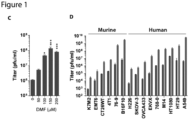
- Fig. 1B Virus-encoded GFP expression was also greatly enhanced as visualized by microscopy
- DMF robustly enhanced infection in a panel of human and murine cancer cell lines (sarcoma, osteosarcoma, breast, colon, melanoma, ovarian) with a wide range of sensitivity to VSV ⁇ 51 ( Fig. 1D ).
- DMF also improved viral output of oncolytic herpes virus (HSV-1 mutant N212) and Sindbis virus following treatment in 786-0 cells ( Fig. 1 , E and F).
- HSV-1 mutant N212 oncolytic herpes virus
- Sindbis virus Sindbis virus following treatment in 786-0 cells
- Pretreatment of human lung adenocarcinoma A549 cells with DMF increased luciferase transgene expression of non-replicating adenovirus, E1A-deleted Ad5 over the course of 7 days by up to 20-fold ( Fig. 1G ).
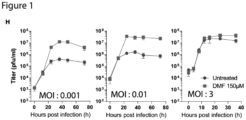
- Single and multi-step growth curves performed in 786-0 cells revealed that DMF enhanced the viral output of VSV ⁇ 51 when using a low MOI, but not when using a high MOI ( Fig. 1H ), indicating DMF inhibits mechanisms that impinge on viral spread rather than virus output per infected cell.
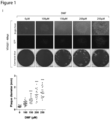
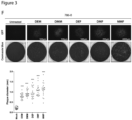
- 786-0 cell monolayers were infected with VSV ⁇ 51 and overlaid with agarose to generate defined plaques of virus replication foci.
- DMF substantially increased the average plaque diameter of VSV ⁇ 51 on fluorescent imaging and Coomassie Blue staining of infected cell monolayers ( Fig. 1I ).
- we pretreated cancer cells with DMF prior to infection with a low MOI of VSV ⁇ 51 and cell viability was assessed with the metabolic dye alamarBlue ® , 48 hours post-infection.
- Combined treatment with DMF and VSV ⁇ 51 led to what appears to be a synergistic decrease in cell viability in human 786-0 as well murine CT26WT and B16F10 cells ( Fig. 1J ).
- Example 2 Dimethyl fumarate enhances tumor-specific infection ex vivo and in human clinical samples.
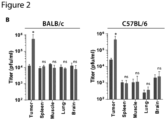
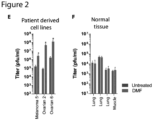
- DMF increased VSV ⁇ 51 infection by > 10-fold ex vivo in primary human melanoma, lung, prostate and ovarian tumor samples as observed by plaque assay and microscopy ( Fig. 2 , C and D), as well as in various melanoma and ovarian patient-derived cancer cell lines ( Fig. 2E ). Similar to the murine normal tissue cores, DMF did not improve virus growth in human normal lung and muscle tissues from various patients ( Fig. 2F ).
- Example 4 Dimethyl fumarate improves therapeutic efficacy of oncolytic rhabdoviruses in mouse preclinical models.
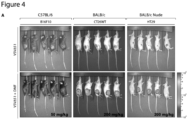
- mice were injected intratumorally with DMF for 4 hours, and subsequently infected with VSV ⁇ 51 expressing luciferase.
- DMF enhanced virus-associated luciferase gene expression specifically in tumors 24 hours after the first injection of virus, as assessed using an in vivo imaging system (IVIS) ( Fig. 4A , B ).
- IVIS in vivo imaging system
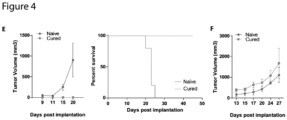
- the combination therapy led to considerable delay in tumor progression ( Fig. 4C ), as well as significantly prolonged survival compared with either monotherapy ( Fig. 4D ).
- the combination therapy led to complete remission in approximately 20% of the mice in both the CT26WT and B 16F 10 models.
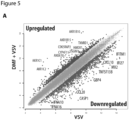
- microarray gene expression analysis was performed on 786-0 cells 24 hours following infection with VSV ⁇ 51 in the presence or absence of DMF, DEM, DEF, DMM.
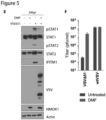
- wtVSV is known to robustly inhibit Type I IFN production, and therefore the effect of DMF may be expected to be redundant in the context of wtVSV if a Type I IFN response is indeed involved in eliciting the pro-viral effects of DMF.
- FMAEs or mock
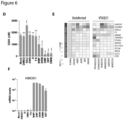
- hmox1 expression as determined by real-time PCR was consistently up-regulated well over 100-fold by FMAEs ( Fig. 6F ), but not by treatment with FA, DMS, or S ( Fig. 6F ).
- DMF and other FMAEs have been shown to induce nuclear translocation of NRF2 via covalent modification of KEAP1, which leads to the induction of antioxidant genes [41].
- This is consistent with our observation of the induction of hmox1 and other NRF2 target genes by FMAEs but not FA, DMS, or S ( Fig. 6 E and F ).
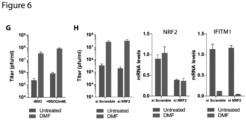
- siRNA knockout against NRF2 was performed.
- Example 7 MMF increases lentivirus produced from 293-T cells
- Figure 7 shows that MMF treatment of 293T cells that were transfected with a 4-plasmid 3rd generation replication incompetent lentivirus system, wherein the resulting lentivirus encodes luciferase, resulted in a 2.4 fold increase in virus yield compared to media or vehicle (DMSO) alone.
- the titer of virus was determined by luciferase expression following transfer of lentivirus-containing supernatants to permissive HT1080 cells. This indicates that MMF significantly increases the production of replication incompetent lentivirus made by co-transfection of plasmids in immortalized cells.
- Example 8 DMF increases influenza virus titer in VeroSF cells
- Figure 8 shows that DMF treatment of VeroSF cells, which are Vero cells adapted to grow in serum-free media, led to a 3.0-3.8X fold increase (compared to DMSO vehicle and Media alone respectively) of influenza A H1N1 FM/1/47 yield.
- virus nucleoprotein antigen was quantified by ELISA compared to a standard control and this data was used to estimate virus titer.
- Ovarian cancer primary cultures were derived from the ascites of individuals with ovarian cancer during routine paracentesis according to Ottawa Health Science Network Research Ethics Board (OHSN-REB) protocol number 20140075-01H. These cells were maintained in complete Dulbecco's Modified Eagle's medium supplemented with 10% fetal bovine serum. These cultures have been characterized and cryopreserved for use as experimental models. Melanoma primary cultures were derived from excised surgical specimens. The surgeries were performed at the Ottawa Hospital and specimens were taken following the receipt of patient consent according to the OHSN-REB # 20120559-01. Primary cultures were maintained in Roswell Park Memorial Institute (RPMI)-1640 medium supplemented with 10% fetal bovine serum.
- RPMI Roswell Park Memorial Institute
- Rhabodviruses The Indiana serotype of VSV (VSV ⁇ 51 or wild type) was used throughout this study and was propagated in Vero cells. VSV ⁇ 51-expressing GFP or firefly luciferase are recombinant derivatives of VSV ⁇ 51 described previously [30]. All viruses were propagated on Vero cells and purified on 5-50% Optiprep (Sigma, St Louis, MO) gradient and all virus titers were quantified by the standard plaque assay on Vero cells as previously described [46]. The number of infectious virus particles was expressed as plaque-forming unit (PFU) per milliliter (ml). Adenovirus.
- PFU plaque-forming unit
- Ad5-luciferase (adenovirus serotype 5 expressing firefly-luciferase) were used in these studies.
- Herpes simplex virus The HSV-1 N212 expressing GFP. HSV virus titres were quantified by the standard plaque assay on Vero cells as previously described.
- Sindbis virus The Sindbis virus was quantified by the standard plaque assay in Vero cells. Plaques were counted 3 days postinfection.
- Lentivirus The Lentivirus with luciferase reporter gene system were quantified using a Biotek plate reader following the addition of luciferin to supernatants.
- Influenza Influenza A/FM/1/47 viruses were used, and absorbance values were obtained by ELISA.
- 786-0 cells were plated at a density of 1 ⁇ 10 6 in 6-well dishes and allowed to adhere overnight. The next day, cells were pretreated for 4 hours with DEM(350 ⁇ M), DEF(350 ⁇ M), DMM(300 ⁇ M), DMF(200 ⁇ M) or the vehicle. Following pre-treatment, the cells were infected with VSV ⁇ 51 at an MOI of 0.01 or mock-infected. 24 hours post-infection, RNA was collected using an RNA-easy kit (Qiagen).
- RNA quality was measured using Agilent 2100 Bioanalyzer (Agilent Technologies) before hybridization to Affymetrix Human PrimeView Array (The Centre for Applied Genomics, The Hospital for Sick Children, Toronto, Canada).
- Microarray data was processed using Transcriptome Analysis Console (TAC) 3.0 under default parameters of Gene Level Differential Expression Analysis. Fold change in gene expression was calculated for each gene in relation to uninfected, untreated control. Heatmaps of normalized expression values were generated using R package pheatmap. Volcano plots of gene expression values were generated using R. Gene ontology enrichment analysis was evaluated using GOrilla [47] following correction for multiple hypothesis testing (Benjamini-Hochberg). Raw and processed microarray data have been deposited in NCBI-Gene Expression Omnibus database (GSE97328).
- CT26WT model Six-week-old female BALB/c mice obtained from Charles River Laboratories were given subcutaneous tumors by injecting 5 ⁇ 10 5 syngeneic CT26WT cells suspended in 100 ⁇ l PBS. 11 days post-implantation, tumors were treated intratumorally (i.t.) once with 200 mg/kg of DMF (dissolved in DMSO) or the vehicle alone. 4 hours later, tumors were intratumorally injected with 1 ⁇ 10 8 PFU (in 25 ⁇ l PBS) of VSV ⁇ 51-expressing firefly luciferase. HT29 model.
- mice Six-week-old female BALB/c nude mice were given subcutaneous tumors by injecting 5 ⁇ 10 6 syngeneic HT29 cells suspended in 100 ⁇ l serum-free DMEM and 100 ⁇ l Geltrex (Thermo Fisher). When tumors grew to approximately 5 mm x 5 mm (11 days post-implantation), mice were treated intratumorally once with 200 mg/kg of DMF (dissolved in DMSO) or the vehicle as indicated. Four hours later, tumors were injected intratumorally with 1 ⁇ 10 8 PFU of VSV ⁇ 51-expressing firefly luciferase. B16F10 model.
- mice Six-week-old female C57BL/6 mice obtained from Charles River Laboratories were given subcutaneous tumors by injecting 5 x 10 5 syngeneic B16F10 cells suspended in 100 ⁇ l PBS. 11 days post-implantation, tumors were treated intratumorally (i.t.) once with 50 mg/kg of DMF (dissolved in DMSO) or the vehicle alone. 4 hours later, tumors were intratumorally injected with 1 ⁇ 10 8 PFU (in 25 ⁇ l PBS) of VSV ⁇ 51-expressing firefly luciferase. Tumor sizes were measured every other day using an electronic caliper. Tumor volume was calculated as (length 2 x width)/2. For survival studies, mice were culled when tumors had reached 1,500 mm 3 .
- an IVIS Perkin Elmer
- the bioluminescent signal intensities in each mouse were quantified using Living Image ® v2.50.1 software. Sample size in all animal experiments was greater than n ⁇ 5. Mice were randomized to the different treatment groups according to tumor size in all experiments. Mice with no palpable tumors on initial treatment day were excluded from study. The investigators were not blinded to allocation during experiments and outcome assessment. All experiments were performed in accordance with the University of Ottawa Animal Care and Veterinary Services guidelines for animal care under the protocol OHRI-2265 and OHRI-2264.
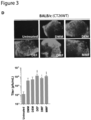
- mice were implanted with subcutaneous CT26WT. Mice were sacrificed after tumors had reached at least 10mm x 10mm in size. Tumor, lung, spleen and brain tissue were extracted from the mice, cut into 2mm thick slices and cored into 2mm x 2mm pieces using a punch biopsy. Each tissue core was incubated in 1 mL of Dulbecco's Modified Eagle's Medium (DMEM) supplemented with 10% fetal bovine serum, 30 mM HEPES and were incubated at 37 °C in a 5% CO 2 humidified incubator. Cores were treated for 4 hours with indicated concentrations of chemical compounds. Subsequently the cores were then infected VSV ⁇ 51-GFP. GFP pictures were taken for each core 24 hours post infection.
- DMEM Dulbecco's Modified Eagle's Medium
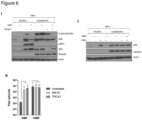
- Blots were blocked with 5% BSA or milk and probed with antibodies specific for phospho-Stat1 (Tyr701, #9171, Cell Signalling Technology, used at 1:1000) and Stat1 (#9172, Cell Signalling Technology, used at 1:1000), Stat2 (#72604, Cell Signalling Technology, used at 1:1000), phospho-Stat2 (#88410S, Cell Signalling Technology, used at 1:1000), IFITM1 (#60074-1-Ig, Proteintech Group, used at 1:1000, in 5% milk), VSV (a gift from Dr Earl Brown, used at 1:2000), HMOX1(#70081, Cell Signalling Technology, used at 1:2000) or ⁇ -Actin (#4970, Cell Signalling Technology, used at 1:1000).
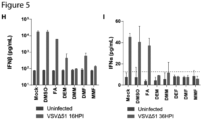
- ELISA 786-0 cells plated in 12-well dishes were pretreated with compound or the vehicle for 4h, and subsequently infected with VSV ⁇ 51-GFP at indicated MOI or left uninfected. Cell supernatants were collected at different times post infection as indicated. IFN alpha and IFN beta quantifications were performed using the Verikine Human IFN alpha or IFN beta ELISA kit (PBL Assay Science) as per the manufacturer's instructions. Absorbance values at 450 nM were measured on a Multiskan Ascent Microplate Reader (MXT Lab Systems).
- Quantitative real-time PCR 786-0 cells were treated for 6 h with indicated chemical compound or the vehicle . Cells were collected and RNA extraction was performed using the Qiagen RNeasy kit (Qiagen). RNA quantity and purity was assessed using a NanoDrop ND-1000 spectrophotometer (Thermo Scientific) RNA was converted to cDNA with RevertAid H Minus First Strand cDNA Synthesis Kit (Thermo Scientific). Real-time PCR reactions were performed according to the manufacturer's protocol with the QuantiTect SYBR Green PCR kit (Qiagen) on a 7500 Fast Real-Time PCR system (Applied Biosystems). Gene expression relative to GAPDH or b-actin. Fold induction was calculated relative to the untreated/uninfected samples for each gene. List of qPCR primers used:
- siRNA 786-0 cells, plated in 12-well dishes, were transfected with small interfering RNAs (100 nM) against NRF2 (ON-TARGETplus NFE2L2 siRNA #L-003755-00-0005, GE Dharmacon) or with a non-targeting scramble siRNA (GE Dharmacon). Transfections were carried out according to manufacturer's protocol (Oligofectamine, Life Technologies).
- Glutathione Assay 786-0 cells plated in a 96-well plate were pretreated with FMAEs or the vehicle for 4 h, and the glutathione levels were determined using the GSH-Glo TM Glutathione Assay kit (Promega) as per the manufacturer's instructions.
- the luminescence-based assay is based on the conversion of a luciferin derivative into luciferin in the presence of glutathione, catalyzed by glutathione S-transferase (GST).
- GST glutathione S-transferase
- the signal generated in a coupled reaction with firefly luciferase is proportional to the amount of glutathione present in the sample.
- the assay result is normalized using GSH standard solution provided with the kit. Luciferase expression was then measured on a SynergyMx Microplate Reader (BioTek).
Landscapes
- Health & Medical Sciences (AREA)
- Chemical & Material Sciences (AREA)
- Life Sciences & Earth Sciences (AREA)
- Organic Chemistry (AREA)
- General Health & Medical Sciences (AREA)
- Medicinal Chemistry (AREA)
- Genetics & Genomics (AREA)
- Virology (AREA)
- Veterinary Medicine (AREA)
- Public Health (AREA)
- Animal Behavior & Ethology (AREA)
- Pharmacology & Pharmacy (AREA)
- Engineering & Computer Science (AREA)
- Zoology (AREA)
- Wood Science & Technology (AREA)
- Bioinformatics & Cheminformatics (AREA)
- Microbiology (AREA)
- Epidemiology (AREA)
- General Engineering & Computer Science (AREA)
- Biotechnology (AREA)
- Biomedical Technology (AREA)
- Biochemistry (AREA)
- Immunology (AREA)
- Mycology (AREA)
- Emergency Medicine (AREA)
- Chemical Kinetics & Catalysis (AREA)
- Nuclear Medicine, Radiotherapy & Molecular Imaging (AREA)
- General Chemical & Material Sciences (AREA)
- Physics & Mathematics (AREA)
- Biophysics (AREA)
- Plant Pathology (AREA)
- Molecular Biology (AREA)
- Oncology (AREA)
- Medicines That Contain Protein Lipid Enzymes And Other Medicines (AREA)
- Medicines Containing Material From Animals Or Micro-Organisms (AREA)
- Acyclic And Carbocyclic Compounds In Medicinal Compositions (AREA)
- Micro-Organisms Or Cultivation Processes Thereof (AREA)
- Medicines Containing Antibodies Or Antigens For Use As Internal Diagnostic Agents (AREA)
- Medicinal Preparation (AREA)
Claims (17)
- In-vitro-Verfahren zur Steigerung der Produktion, der Infektion, des Wachstums, der Ausbreitung oder des Titers eines Interferon-empfindlichen Virus in einer immortalisierten Zelle, einer Krebszelle oder einer Tumorzelle, wobei das Verfahren Folgendes umfasst:das Verabreichen einer Verbindung der Formel (III),
 wobei Ra und Rb jeweils unabhängig voneinander für Wasserstoff; ein lineares, verzweigtes oder zyklisches, gesättigtes oder ungesättigtes Alkyl, das gegebenenfalls mit einem oder mehreren Halogenen, Hydroxyl, Nitro oder Cyano substituiert ist, stehen; oder abwesend sind;wobei, wenn einer von Ra und Rb abwesend ist oder für Wasserstoff steht, das andere vorhanden ist und nicht für Wasserstoff steht,an die immortalisierte Krebs- oder Tumorzelle vor, gleichzeitig mit oder nach der Infektion der immortalisierten Krebs- oder Tumorzelle mit dem Interferon-empfindlichen Virus.
 - Verfahren nach Anspruch 1, wobei das Interferonempfindliche Virus ein genetechnisch Interferonempfindlich gemachtes nicht-Interferon-empfindliches Virus, ein abgeschwächtes Interferon-empfindliches Virus, ein Interferon-empfindliches onkolytisches Virus oder ein nicht-replizierendes Interferon-empfindliches Virus ist.
- Verfahren nach Anspruch 2, wobei eine onkolytische Aktivität, eine Zelltodaktivität und/oder eine zytotoxische Aktivität des Interferon-empfindlichen onkolytischen Virus in der Krebszelle oder der Tumorzelle verstärkt oder erhöht wird.
- Verfahren nach Anspruch 2, wobei eine immuntherapeutische Aktivität des Interferon-empfindlichen onkolytischen Virus in der Krebszelle oder der Tumorzelle verstärkt, erhöht oder potenziert wird, einschließlich der Hochregulierung von viruskodierten Transgenen und/oder Zytokinen.
- Verfahren nach Anspruch 1, wobei die Verbindung der Formel (III) die folgende Struktur aufweise oder diese umfasst: Dimethylfumarat (DMF), Diethylfumarat (DEF), Monoethylfumarat oder Monomethylfumarat (MMF) oder ein pharmazeutisch akzeptables Salz, Solvat, Hydrat, eine reduzierte oder oxidierte Form davon.
- Verfahren nach Anspruch 1, wobei das Interferonempfindliche Virus ein Reovirus, Newcastle-Disease-Virus, Polio-Virus, Mumps-Virus, Masern-Virus, Influenza-Virus, Maraba-Virus (wie z. B. MG-1), Tollwut-Virus, Rotavirus, Hepatitis-A-Virus, Röteln-Virus, Dengue-Virus, Chikungunya-Virus, Respiratory-Syncitial-Virus, LCMV, Lentivirus, replizierendes Retrovirus, Adenovirus, Herpes-Simplex-Virus oder Rhabdovirus ist, oder eine Variante oder ein Derivat davon, wobei die Variante oder das Derivat ein Virus ist, das durch Selektion des Virus unter verschiedenen Wachstumsbedingungen erhalten wurde, ein Virus, das einer Reihe von Selektionsdrücken unterworfen wurde, ein Virus, das unter Verwendung von Rekombinationstechniken gentechnisch modifiziert wurde, oder ein Virus, das so manipuliert wurde, dass es replikationsdefekt ist und/oder Transgene exprimiert, oder eine Kombination davon.
- Verfahren nach Anspruch 2, wobei das Interferonempfindliche onkolytische Virus ein Rhabdovirus umfasst, das ein vesikuläres Stomatitisvirus oder ein Derivat oder eine Variante davon ist, wobei die Variante oder das Derivat ein Virus ist, das durch Selektion des Virus unter verschiedenen Wachstumsbedingungen erhalten wurde, ein Virus, das einer Reihe von Selektionsdrücken unterworfen wurde, ein Virus, das unter Verwendung von Rekombinationstechniken gentechnisch modifiziert wurde, oder ein Virus, das so manipuliert wurde, dass es replikationsdefekt ist und/oder Transgene exprimiert, oder eine Kombination davon.
- Verfahren nach Anspruch 1, wobei das Interferonempfindliche Virus ein Virus umfasst, das unter spezifischen Wachstumsbedingungen selektiert wurde, einem oder mehreren Selektionsdrücken unterworfen wurde, unter Verwendung einer Rekombinationstechnik gentechnisch modifiziert wurde, oder eine beliebige Kombination davon.
- Verfahren nach Anspruch 1, wobei die Zelle eine Säugetierzelle ist.
- Verfahren nach Anspruch 9, wobei die Zelle human ist.
- Verfahren nach Anspruch 1, wobei die immortalisierte Zelle, die Krebszelle oder die Tumorzelle lymphoblastische Leukämiezellen, myeloische Leukämiezellen, Nebennierenrindenkarzinom, AIDS-bedingte Krebszellen, AIDS-bedingte Lymphomzellen, Analkrebszellen, Blinddarmkrebszellen, Astrozytomzellen, atypische teratoide/rhabdoide Tumorzellen, Basalzellkarzinom, Gallengangskrebszellen, Blasenkrebszellen, Knochenkrebszellen, Osteosarkomzellen, Zellen des malignen fibrösen Histiozytoms, Hirnstamm-Gliomzellen, Hirntumorzellen, Kleinhirnastrozytomzellen, Zellen des zerebralen Astrozytoms/malignen Glioms, Kraniopharyngiomzellen, Ependymoblastomzellen, Medulloblastomzellen, Zellen von Pinealparenchymtumoren intermediärer Differenzierung, Zellen von supratentoriellen primitiven neuroektodermalen .Tumoren und Pineoblastom, Zellen der Sehbahn und des hypothalamischen Glioms, Tumorzellen des Rückenmarks, Brustkrebszellen, Bronchialtumorzellen, Burkitt-Lymphomzellen, Karzinoidtumorzellen, Lymphomzellen des zentralen Nervensystems, Gebärmutterhalskrebszellen, Chordomzellen, chronische lymphatische Leukämiezellen, chronische myeloische Leukämiezellen, Zellen der chronischen myeloproliferativen Erkrankung, Dickdarmkrebszellen, kutanes T-Zell-Lymphom, embryonale Tumorzellen, Endometriumkrebszellen, Ependymoblastomzellen, Ependymomzellen, Speiseröhrenkrebszellen, extrakranieller Keimzelltumor, extragonadaler Keimzelltumor, extrahepatische Gallengangskrebszellen, Augenkrebszellen, intraokulare Melanomzellen, Retinoblastomzellen, Gallenblasenkrebszellen, Magenkrebszellen, gastrointestinale karzinoide Tumorzellen, gastrointestinale Stromatumorzellen (GIST), gastrointestinaler Stromazelltumor Keimzelltumore, extrakranielle Tumorzellen, extragonadale Tumorzellen, Ovarialtumorzellen, gestationale trophoblastische Tumorzellen, Gliomzellen, Haarzellenleukämie, Kopf- und Halskrebszellen, Leberkrebszellen, Histiozytosezellen, Langerhans-Zellkrebs, Hypopharynxkrebszellen, Inselzelltumoren, Kaposi-Sarkomzellen, Kehlkopfkrebszellen, lymphatische Leukämiezellen, Lippen- und Mundhöhlenkrebszellen, nichtkleinzellige Lungenkrebszellen, kleinzellige Lungenkrebszellen, Hodgkin-Lymphomzellen, Non-Hodgkin-Lymphomzellen, Medulloepitheliomzellen, Melanomzellen, intraokulare Melanomzellen, Merkelzellkarzinom, Mesotheliomzellen, metastasierende Plattenepithelkarzinomzellen, Mundkrebszellen, Zellen des multiplen endokrinen Neoplasiesyndroms, Zellen des multiplen Myeloms/Plasmazellneoplasmas, Krebszellen der Nasenhöhle und der Nasennebenhöhlen, Nasopharynxkrebszellen, Neuroblastomzellen, orale Krebszellen, oropharyngeale Krebszellen, Bauchspeicheldrüsenkrebszellen, Nebenschilddrüsenkrebszellen, Peniskrebszellen, Rachenkrebszellen, Pharynxkrebszellen, Phäochromozytomzellen, Pinealparenchymtumorzellen, Pineoblastom und supratentorielle primitive neuroektodermale Tumorzellen, Hypophysentumorzellen, pleuropulmonale Blastomzellen, Prostatakrebszellen, Rektumkrebszellen, Nierenkrebszellen, Nierenbecken- und Harnleiterkrebszellen, Übergangszellkrebs, Atemwegskrebszellen, Rhabdomyosarkomzellen, Speicheldrüsenkrebszellen, Uterussarkomzellen, Hautkrebszellen, Merkelzellkarzinom, Dünndarmkrebszellen, Weichteilsarkomzellen, Plattenepithelkarzinom, Plattenepithel-Halskrebszellen, supratentorielle primitive neuroektodermale Tumorzellen, T-Zell-Lymphomzellen, Hodenkrebszellen, Kehlkopfkrebszellen, Thymom- und Thymuskarzinomzellen, Schilddrüsenkrebszellen, trophoblastische Tumorzellen, Harnröhrenkrebszellen, Gebärmutterkrebszellen, Vaginalkrebszellen, Vulvakrebszellen oder Wilms-Tumorzellen.
- Verbindung der Formel (III),
 wobei Ra und Rb jeweils unabhängig voneinander für Wasserstoff; ein lineares, verzweigtes oder zyklisches, gesättigtes oder ungesättigtes Alkyl, das gegebenenfalls mit einem oder mehreren Halogenen, Hydroxyl, Nitro oder Cyano substituiert ist, stehen; oder abwesend sind;wobei, wenn einer von Ra und Rb abwesend ist oder für Wasserstoff steht, der andere vorhanden ist und nicht für Wasserstoff steht,zur Verwendung bei der Behandlung eines Tumors oder eines Krebses, wobei die Verbindung zur Verabreichung an ein Subjekt vor, nach oder gleichzeitig mit der Verabreichung eines Interferon-empfindlichen onkolytischen Virus an das Subjekt dient.
 - Zusammensetzung, umfassend ein Interferon-empfindliches Virus und mindestens eine Verbindung der Formel (III)
 wobei Ra und Rb jeweils unabhängig voneinander für Wasserstoff; ein lineares, verzweigtes oder zyklisches, gesättigtes oder ungesättigtes Alkyl, das gegebenenfalls mit einem oder mehreren Halogenen, Hydroxyl, Nitro oder Cyano substituiert ist, stehen; oder abwesend sind;wobei, wenn einer von Ra und Rb abwesend ist oder für Wasserstoff steht, der andere vorhanden ist und nicht für Wasserstoff steht.
 - Verfahren zur Herstellung eines Interferon-empfindlichen Virus, das Folgendes umfasst:Kultivieren einer immortalisierten Zelle, einer Krebszelle oder einer Tumorzelle mit dem Interferon-empfindlichen Virus oder mit einem Interferon-empfindlichen Virus, das für ein Transgen und/oder ein Zytokin kodiert, in einem geeigneten Medium in Gegenwart von mindestens einer Verbindung der Formel (III)
 wobei Ra und Rb jeweils unabhängig voneinander für Wasserstoff; ein lineares, verzweigtes oder zyklisches, gesättigtes oder ungesättigtes Alkyl, das gegebenenfalls mit einem oder mehreren Halogenen, Hydroxyl, Nitro oder Cyano substituiert ist, stehen; oder abwesend sind;wobei, wenn einer von Ra und Rb abwesend ist oder für Wasserstoff steht, der andere vorhanden ist und nicht für Wasserstoff steht; unddas Herstellen des Interferon-empfindlichen Virus aus der immortalisierten Zelle, dem Krebs oder der Tumorzelle.
 - Verfahren nach Anspruch 14, wobei das Interferonempfindliche Virus ein abgeschwächtes Virus, ein gentechnisch modifiziertes Virus, ein nicht-replizierendes Virus oder ein onkolytisches Virus ist.
- Verfahren zur Herstellung eines Impfstoffs, das Folgendes umfasst:das Kultivieren einer immortalisierten Zelle, einer Krebszelle oder einer Tumorzelle mit einem Interferon-empfindlichen Virus oder mit einem Interferon-empfindlichen Virus, das für ein Transgen und/oder ein Zytokin kodiert, in einem geeigneten Medium in Gegenwart von mindestens einer Verbindung der Formel (III)
 wobei Ra und Rb jeweils unabhängig voneinander für Wasserstoff; ein lineares, verzweigtes oder zyklisches, gesättigtes oder ungesättigtes Alkyl, das gegebenenfalls mit einem oder mehreren Halogenen, Hydroxyl, Nitro oder Cyano substituiert ist, stehen; oder abwesend sind;wobei, wenn einer von Ra und Rb abwesend ist oder für Wasserstoff steht, der andere vorhanden ist und nicht für Wasserstoff steht;das Herstellen des Interferon-empfindlichen Virus aus der immortalisierten Zelle, dem Krebs oder der Tumorzelle; unddas Herstellen des Impfstoffs mit dem produzierten Interferon-empfindlichen Virus oder mit der mit der Zelle, die mit dem Interferon-empfindlichen Virus kultiviert wurde.
 - Verfahren nach Anspruch 15, wobei das produzierte Virus ein Interferon-empfindlicher Krebs-Gentherapievektor auf Virusbasis ist.
Priority Applications (1)
| Application Number | Priority Date | Filing Date | Title |
|---|---|---|---|
| EP24188307.3A EP4431598A3 (de) | 2017-11-24 | 2018-11-23 | Zusammensetzungen und verfahren zur erhöhung der produktion, des wachstums, des aufstrichs oder der onkolytischen und immuntherapeutischen wirksamkeit von interferonempfindlichen viren |
Applications Claiming Priority (2)
| Application Number | Priority Date | Filing Date | Title |
|---|---|---|---|
| US201762590456P | 2017-11-24 | 2017-11-24 | |
| PCT/CA2018/051492 WO2019100163A1 (en) | 2017-11-24 | 2018-11-23 | Compositions and methods for enhancing production, growth, spread, or oncolytic and immunotherapeutic efficacy of interferon-sensitive viruses |
Related Child Applications (2)
| Application Number | Title | Priority Date | Filing Date |
|---|---|---|---|
| EP24188307.3A Division EP4431598A3 (de) | 2017-11-24 | 2018-11-23 | Zusammensetzungen und verfahren zur erhöhung der produktion, des wachstums, des aufstrichs oder der onkolytischen und immuntherapeutischen wirksamkeit von interferonempfindlichen viren |
| EP24188307.3A Division-Into EP4431598A3 (de) | 2017-11-24 | 2018-11-23 | Zusammensetzungen und verfahren zur erhöhung der produktion, des wachstums, des aufstrichs oder der onkolytischen und immuntherapeutischen wirksamkeit von interferonempfindlichen viren |
Publications (4)
| Publication Number | Publication Date |
|---|---|
| EP3714044A1 EP3714044A1 (de) | 2020-09-30 |
| EP3714044A4 EP3714044A4 (de) | 2021-11-24 |
| EP3714044B1 true EP3714044B1 (de) | 2025-01-01 |
| EP3714044C0 EP3714044C0 (de) | 2025-01-01 |
Family
ID=66630411
Family Applications (2)
| Application Number | Title | Priority Date | Filing Date |
|---|---|---|---|
| EP18880792.9A Active EP3714044B1 (de) | 2017-11-24 | 2018-11-23 | Zusammensetzungen und verfahren zur steigerung der produktion, des wachstums, der ausbreitung oder der onkolytischen und immuntherapeutischen wirksamkeit von interferon-empfindlichen viren |
| EP24188307.3A Pending EP4431598A3 (de) | 2017-11-24 | 2018-11-23 | Zusammensetzungen und verfahren zur erhöhung der produktion, des wachstums, des aufstrichs oder der onkolytischen und immuntherapeutischen wirksamkeit von interferonempfindlichen viren |
Family Applications After (1)
| Application Number | Title | Priority Date | Filing Date |
|---|---|---|---|
| EP24188307.3A Pending EP4431598A3 (de) | 2017-11-24 | 2018-11-23 | Zusammensetzungen und verfahren zur erhöhung der produktion, des wachstums, des aufstrichs oder der onkolytischen und immuntherapeutischen wirksamkeit von interferonempfindlichen viren |
Country Status (11)
| Country | Link |
|---|---|
| US (2) | US12076353B2 (de) |
| EP (2) | EP3714044B1 (de) |
| JP (2) | JP7505977B2 (de) |
| KR (1) | KR102475845B1 (de) |
| CN (1) | CN111373032A (de) |
| AU (2) | AU2018373508A1 (de) |
| BR (1) | BR112020009907A2 (de) |
| CA (1) | CA3079100C (de) |
| ES (1) | ES3014482T3 (de) |
| SG (1) | SG11202003842UA (de) |
| WO (1) | WO2019100163A1 (de) |
Families Citing this family (5)
| Publication number | Priority date | Publication date | Assignee | Title |
|---|---|---|---|---|
| PT3518948T (pt) * | 2016-10-03 | 2023-07-17 | Ottawa Hospital Res Inst | Composições e métodos para melhorar o crescimento, a propagração e a eficácia imunoterapêutica de oncolítica de vírus de rna oncolíticos |
| WO2022232944A1 (en) * | 2021-05-07 | 2022-11-10 | Ottawa Hospital Research Institute | Pharmaceutical compositions comprising vanadium salts |
| CN113368246B (zh) * | 2021-05-12 | 2023-05-26 | 中山大学 | 一种增效的抗肿瘤药物 |
| CN115896035B (zh) * | 2022-12-22 | 2024-04-16 | 苏州沃美生物有限公司 | 一种应用于病毒扩增的Vero细胞株、其构建方法及应用 |
| CN119157868B (zh) * | 2024-09-14 | 2025-05-16 | 中国科学院水生生物研究所 | 富马酸在防治草鱼呼肠孤病毒感染的用途 |
Family Cites Families (11)
| Publication number | Priority date | Publication date | Assignee | Title |
|---|---|---|---|---|
| JP2003530301A (ja) | 1999-04-15 | 2003-10-14 | ウェルスタット バイオロジクス コーポレイション | ウイルスを用いた新生物の処置 |
| US8147822B1 (en) | 1999-09-17 | 2012-04-03 | Wellstat Biologics Corporation | Oncolytic virus |
| DE60115600T2 (de) | 2000-01-21 | 2006-07-20 | Biovex Ltd. | Virusstämme für die onkolytische behandlung von krebs |
| HK1052950B (en) | 2000-06-26 | 2005-06-24 | Wellstat Biologics Corporation | Purging of cells using viruses |
| BR0115235A (pt) | 2000-11-09 | 2003-10-14 | Oncolytics Biotech Inc | Métodos de determinar a suscetibilidade de uma célula à infecção por reovìrus, e, uso de uma composição compreendendo um ou mais reovìrus |
| EP1385466B1 (de) | 2001-05-11 | 2011-03-09 | Wellstat Biologics Corporation | Onkolytische virustherapie |
| US20040115170A1 (en) | 2001-11-30 | 2004-06-17 | Brown Earl Garnet | Oncolytic virus |
| BR112012005774B8 (pt) * | 2009-09-14 | 2023-02-14 | Jennerex Inc | uso de um inibidor de quinase antiangiogênico no tratamento de câncer |
| US9504679B2 (en) | 2011-12-19 | 2016-11-29 | Bjoern Colin Kahrs | Pharmaceutical compositions comprising glitazones and Nrf2 activators |
| CN103768045B (zh) * | 2013-10-30 | 2015-10-07 | 苏州大学附属第一医院 | 富马酸二甲酯在制备治疗蛛网膜下腔出血后早期脑损伤药物的应用 |
| CN107088190A (zh) * | 2016-11-23 | 2017-08-25 | 中南大学湘雅医院 | 富马酸酯在制备治疗肝病药物中的应用 |
-
2018
- 2018-11-23 EP EP18880792.9A patent/EP3714044B1/de active Active
- 2018-11-23 BR BR112020009907-4A patent/BR112020009907A2/pt unknown
- 2018-11-23 SG SG11202003842UA patent/SG11202003842UA/en unknown
- 2018-11-23 US US16/763,013 patent/US12076353B2/en active Active
- 2018-11-23 JP JP2020501152A patent/JP7505977B2/ja active Active
- 2018-11-23 ES ES18880792T patent/ES3014482T3/es active Active
- 2018-11-23 CN CN201880075378.4A patent/CN111373032A/zh active Pending
- 2018-11-23 KR KR1020207016003A patent/KR102475845B1/ko active Active
- 2018-11-23 CA CA3079100A patent/CA3079100C/en active Active
- 2018-11-23 WO PCT/CA2018/051492 patent/WO2019100163A1/en not_active Ceased
- 2018-11-23 EP EP24188307.3A patent/EP4431598A3/de active Pending
- 2018-11-23 AU AU2018373508A patent/AU2018373508A1/en not_active Abandoned
-
2024
- 2024-05-31 US US18/680,187 patent/US12440525B2/en active Active
- 2024-06-13 JP JP2024095767A patent/JP2024123072A/ja active Pending
-
2025
- 2025-05-13 AU AU2025203443A patent/AU2025203443A1/en active Pending
Also Published As
| Publication number | Publication date |
|---|---|
| AU2018373508A1 (en) | 2020-04-30 |
| SG11202003842UA (en) | 2020-06-29 |
| KR20200085816A (ko) | 2020-07-15 |
| ES3014482T3 (en) | 2025-04-22 |
| WO2019100163A1 (en) | 2019-05-31 |
| CN111373032A (zh) | 2020-07-03 |
| EP3714044A1 (de) | 2020-09-30 |
| JP7505977B2 (ja) | 2024-06-25 |
| US12076353B2 (en) | 2024-09-03 |
| KR102475845B1 (ko) | 2022-12-09 |
| US20240307469A1 (en) | 2024-09-19 |
| EP4431598A2 (de) | 2024-09-18 |
| US20200276253A1 (en) | 2020-09-03 |
| US12440525B2 (en) | 2025-10-14 |
| EP3714044C0 (de) | 2025-01-01 |
| CA3079100A1 (en) | 2019-05-31 |
| BR112020009907A2 (pt) | 2020-11-03 |
| EP4431598A3 (de) | 2024-12-18 |
| EP3714044A4 (de) | 2021-11-24 |
| JP2024123072A (ja) | 2024-09-10 |
| CA3079100C (en) | 2023-09-19 |
| AU2025203443A1 (en) | 2025-06-26 |
| JP2021504293A (ja) | 2021-02-15 |
Similar Documents
| Publication | Publication Date | Title |
|---|---|---|
| US12440525B2 (en) | Compositions and methods for enhancing production, growth, spread, or oncolytic and immunotherapeutic efficacy of interferon-sensitive viruses | |
| CN105886476B (zh) | 用于增强病毒效力的组合物和方法 | |
| MacTavish et al. | Enhancement of vaccinia virus based oncolysis with histone deacetylase inhibitors | |
| WO2014198002A1 (en) | A bacterium producing an interferon binding protein and uses thereof | |
| JP2011510638A (ja) | トリサイトカインをコードする弱毒化腫瘍退縮パラミクソウイルス | |
| EP3518948B1 (de) | Zusammensetzungen und verfahren zur verstärkung des wachstums sowie der onkolytischen und immunotherapeutischen wirksamkeit von onkolytischen rna-viren | |
| JP2018518986A (ja) | 腫瘍溶解性hsv1ベクターおよび使用法 | |
| US20210154249A1 (en) | Coxsackie virus b for treating tumors | |
| Bian et al. | Tumor-targeted gene transfer in vivo via recombinant Newcastle disease virus modified by a bispecific fusion protein | |
| JP6857730B2 (ja) | CDK9を標的とするRNAiエフェクターを発現するH−1 PV | |
| JP2023526905A (ja) | マイクロrnaで調節及び制御可能な単離された組換え腫瘍溶解性ポックスウイルス及びその使用 | |
| WO2016047645A1 (ja) | 腫瘍治療用遺伝子改変麻疹ウイルス | |
| CA3034983C (en) | Compositions and methods for enhancing growth, spread, and oncolytic and immunotherapeutic efficacy of oncolytic rna viruses | |
| CN106822085B (zh) | 表达trail的溶瘤腺病毒联合槲皮素在抑制肝癌癌细胞增殖中的用途 | |
| Diallo et al. | Enhancement of vaccinia virus based oncolysis with histone deacetylase inhibitors | |
| MacTavish et al. | Enhancement of Vaccinia Virus Based Oncolysis with Histone Deacetylase | |
| HK40011661B (zh) | 用於提高溶瘤rna病毒的生长、传播和溶瘤与免疫治疗效果的组合物和方法 | |
| CA3070628A1 (en) | Enterovirus d68 (ev-d68) for treatment of tumor |
Legal Events
| Date | Code | Title | Description |
|---|---|---|---|
| STAA | Information on the status of an ep patent application or granted ep patent |
Free format text: STATUS: THE INTERNATIONAL PUBLICATION HAS BEEN MADE |
|
| PUAI | Public reference made under article 153(3) epc to a published international application that has entered the european phase |
Free format text: ORIGINAL CODE: 0009012 |
|
| STAA | Information on the status of an ep patent application or granted ep patent |
Free format text: STATUS: REQUEST FOR EXAMINATION WAS MADE |
|
| 17P | Request for examination filed |
Effective date: 20200519 |
|
| AK | Designated contracting states |
Kind code of ref document: A1 Designated state(s): AL AT BE BG CH CY CZ DE DK EE ES FI FR GB GR HR HU IE IS IT LI LT LU LV MC MK MT NL NO PL PT RO RS SE SI SK SM TR |
|
| AX | Request for extension of the european patent |
Extension state: BA ME |
|
| DAV | Request for validation of the european patent (deleted) | ||
| DAX | Request for extension of the european patent (deleted) | ||
| REG | Reference to a national code |
Ref country code: HK Ref legal event code: DE Ref document number: 40038553 Country of ref document: HK |
|
| A4 | Supplementary search report drawn up and despatched |
Effective date: 20211027 |
|
| RIC1 | Information provided on ipc code assigned before grant |
Ipc: C12N 7/00 20060101ALI20211021BHEP Ipc: C12N 5/09 20100101ALI20211021BHEP Ipc: C07C 69/60 20060101ALI20211021BHEP Ipc: A61P 35/00 20060101ALI20211021BHEP Ipc: A61K 35/76 20150101ALI20211021BHEP Ipc: A61K 31/225 20060101ALI20211021BHEP Ipc: C12N 7/04 20060101AFI20211021BHEP |
|
| STAA | Information on the status of an ep patent application or granted ep patent |
Free format text: STATUS: EXAMINATION IS IN PROGRESS |
|
| GRAP | Despatch of communication of intention to grant a patent |
Free format text: ORIGINAL CODE: EPIDOSNIGR1 |
|
| STAA | Information on the status of an ep patent application or granted ep patent |
Free format text: STATUS: GRANT OF PATENT IS INTENDED |
|
| 17Q | First examination report despatched |
Effective date: 20240206 |
|
| INTG | Intention to grant announced |
Effective date: 20240229 |
|
| GRAJ | Information related to disapproval of communication of intention to grant by the applicant or resumption of examination proceedings by the epo deleted |
Free format text: ORIGINAL CODE: EPIDOSDIGR1 |
|
| STAA | Information on the status of an ep patent application or granted ep patent |
Free format text: STATUS: EXAMINATION IS IN PROGRESS |
|
| GRAP | Despatch of communication of intention to grant a patent |
Free format text: ORIGINAL CODE: EPIDOSNIGR1 |
|
| STAA | Information on the status of an ep patent application or granted ep patent |
Free format text: STATUS: GRANT OF PATENT IS INTENDED |
|
| INTC | Intention to grant announced (deleted) | ||
| INTG | Intention to grant announced |
Effective date: 20240719 |
|
| GRAS | Grant fee paid |
Free format text: ORIGINAL CODE: EPIDOSNIGR3 |
|
| GRAA | (expected) grant |
Free format text: ORIGINAL CODE: 0009210 |
|
| STAA | Information on the status of an ep patent application or granted ep patent |
Free format text: STATUS: THE PATENT HAS BEEN GRANTED |
|
| AK | Designated contracting states |
Kind code of ref document: B1 Designated state(s): AL AT BE BG CH CY CZ DE DK EE ES FI FR GB GR HR HU IE IS IT LI LT LU LV MC MK MT NL NO PL PT RO RS SE SI SK SM TR |
|
| REG | Reference to a national code |
Ref country code: GB Ref legal event code: FG4D |
|
| REG | Reference to a national code |
Ref country code: DE Ref legal event code: R096 Ref document number: 602018078238 Country of ref document: DE |
|
| REG | Reference to a national code |
Ref country code: CH Ref legal event code: EP |
|
| REG | Reference to a national code |
Ref country code: IE Ref legal event code: FG4D |
|
| U01 | Request for unitary effect filed |
Effective date: 20250122 |
|
| U07 | Unitary effect registered |
Designated state(s): AT BE BG DE DK EE FI FR IT LT LU LV MT NL PT RO SE SI Effective date: 20250129 |
|
| REG | Reference to a national code |
Ref country code: ES Ref legal event code: FG2A Ref document number: 3014482 Country of ref document: ES Kind code of ref document: T3 Effective date: 20250422 |
|
| PG25 | Lapsed in a contracting state [announced via postgrant information from national office to epo] |
Ref country code: PL Free format text: LAPSE BECAUSE OF FAILURE TO SUBMIT A TRANSLATION OF THE DESCRIPTION OR TO PAY THE FEE WITHIN THE PRESCRIBED TIME-LIMIT Effective date: 20250101 |
|
| PG25 | Lapsed in a contracting state [announced via postgrant information from national office to epo] |
Ref country code: NO Free format text: LAPSE BECAUSE OF FAILURE TO SUBMIT A TRANSLATION OF THE DESCRIPTION OR TO PAY THE FEE WITHIN THE PRESCRIBED TIME-LIMIT Effective date: 20250401 Ref country code: IS Free format text: LAPSE BECAUSE OF FAILURE TO SUBMIT A TRANSLATION OF THE DESCRIPTION OR TO PAY THE FEE WITHIN THE PRESCRIBED TIME-LIMIT Effective date: 20250501 |
|
| PG25 | Lapsed in a contracting state [announced via postgrant information from national office to epo] |
Ref country code: HR Free format text: LAPSE BECAUSE OF FAILURE TO SUBMIT A TRANSLATION OF THE DESCRIPTION OR TO PAY THE FEE WITHIN THE PRESCRIBED TIME-LIMIT Effective date: 20250101 |
|
| PG25 | Lapsed in a contracting state [announced via postgrant information from national office to epo] |
Ref country code: GR Free format text: LAPSE BECAUSE OF FAILURE TO SUBMIT A TRANSLATION OF THE DESCRIPTION OR TO PAY THE FEE WITHIN THE PRESCRIBED TIME-LIMIT Effective date: 20250402 |
|
| PG25 | Lapsed in a contracting state [announced via postgrant information from national office to epo] |
Ref country code: CZ Free format text: LAPSE BECAUSE OF FAILURE TO SUBMIT A TRANSLATION OF THE DESCRIPTION OR TO PAY THE FEE WITHIN THE PRESCRIBED TIME-LIMIT Effective date: 20250101 |
|
| PG25 | Lapsed in a contracting state [announced via postgrant information from national office to epo] |
Ref country code: SM Free format text: LAPSE BECAUSE OF FAILURE TO SUBMIT A TRANSLATION OF THE DESCRIPTION OR TO PAY THE FEE WITHIN THE PRESCRIBED TIME-LIMIT Effective date: 20250101 |
|
| PG25 | Lapsed in a contracting state [announced via postgrant information from national office to epo] |
Ref country code: SK Free format text: LAPSE BECAUSE OF FAILURE TO SUBMIT A TRANSLATION OF THE DESCRIPTION OR TO PAY THE FEE WITHIN THE PRESCRIBED TIME-LIMIT Effective date: 20250101 |
|
| PLBE | No opposition filed within time limit |
Free format text: ORIGINAL CODE: 0009261 |
|
| STAA | Information on the status of an ep patent application or granted ep patent |
Free format text: STATUS: NO OPPOSITION FILED WITHIN TIME LIMIT |
|
| REG | Reference to a national code |
Ref country code: CH Ref legal event code: L10 Free format text: ST27 STATUS EVENT CODE: U-0-0-L10-L00 (AS PROVIDED BY THE NATIONAL OFFICE) Effective date: 20251112 |
|
| REG | Reference to a national code |
Ref country code: CH Ref legal event code: U11 Free format text: ST27 STATUS EVENT CODE: U-0-0-U10-U11 (AS PROVIDED BY THE NATIONAL OFFICE) Effective date: 20251201 |
|
| 26N | No opposition filed |
Effective date: 20251002 |
|
| U20 | Renewal fee for the european patent with unitary effect paid |
Year of fee payment: 8 Effective date: 20251126 |
|
| PGFP | Annual fee paid to national office [announced via postgrant information from national office to epo] |
Ref country code: GB Payment date: 20251125 Year of fee payment: 8 |
|
| PGFP | Annual fee paid to national office [announced via postgrant information from national office to epo] |
Ref country code: CH Payment date: 20251201 Year of fee payment: 8 |
|
| PGFP | Annual fee paid to national office [announced via postgrant information from national office to epo] |
Ref country code: IE Payment date: 20251124 Year of fee payment: 8 |
|
| PGFP | Annual fee paid to national office [announced via postgrant information from national office to epo] |
Ref country code: ES Payment date: 20251209 Year of fee payment: 8 |