EP3708018A1 - Schuheinlegesohlen-rohling und verfahren zum individuellen anpassen eines solchen schuheinlegesohlen-rohlings - Google Patents
Schuheinlegesohlen-rohling und verfahren zum individuellen anpassen eines solchen schuheinlegesohlen-rohlings Download PDFInfo
- Publication number
- EP3708018A1 EP3708018A1 EP19161972.5A EP19161972A EP3708018A1 EP 3708018 A1 EP3708018 A1 EP 3708018A1 EP 19161972 A EP19161972 A EP 19161972A EP 3708018 A1 EP3708018 A1 EP 3708018A1
- Authority
- EP
- European Patent Office
- Prior art keywords
- base body
- shoe insole
- blanket
- layer
- shoe
- Prior art date
- Legal status (The legal status is an assumption and is not a legal conclusion. Google has not performed a legal analysis and makes no representation as to the accuracy of the status listed.)
- Granted
Links
Images

Classifications
-
- A—HUMAN NECESSITIES
- A43—FOOTWEAR
- A43B—CHARACTERISTIC FEATURES OF FOOTWEAR; PARTS OF FOOTWEAR
- A43B7/00—Footwear with health or hygienic arrangements
- A43B7/14—Footwear with health or hygienic arrangements with foot-supporting parts
- A43B7/1405—Footwear with health or hygienic arrangements with foot-supporting parts with pads or holes on one or more locations, or having an anatomical or curved form
- A43B7/1455—Footwear with health or hygienic arrangements with foot-supporting parts with pads or holes on one or more locations, or having an anatomical or curved form with special properties
- A43B7/1464—Footwear with health or hygienic arrangements with foot-supporting parts with pads or holes on one or more locations, or having an anatomical or curved form with special properties with adjustable pads to allow custom fit
-
- A—HUMAN NECESSITIES
- A43—FOOTWEAR
- A43B—CHARACTERISTIC FEATURES OF FOOTWEAR; PARTS OF FOOTWEAR
- A43B17/00—Insoles for insertion, e.g. footbeds or inlays, for attachment to the shoe after the upper has been joined
- A43B17/003—Insoles for insertion, e.g. footbeds or inlays, for attachment to the shoe after the upper has been joined characterised by the material
- A43B17/006—Insoles for insertion, e.g. footbeds or inlays, for attachment to the shoe after the upper has been joined characterised by the material multilayered
-
- A—HUMAN NECESSITIES
- A43—FOOTWEAR
- A43B—CHARACTERISTIC FEATURES OF FOOTWEAR; PARTS OF FOOTWEAR
- A43B7/00—Footwear with health or hygienic arrangements
-
- A—HUMAN NECESSITIES
- A43—FOOTWEAR
- A43B—CHARACTERISTIC FEATURES OF FOOTWEAR; PARTS OF FOOTWEAR
- A43B9/00—Footwear characterised by the assembling of the individual parts
-
- A—HUMAN NECESSITIES
- A61—MEDICAL OR VETERINARY SCIENCE; HYGIENE
- A61F—FILTERS IMPLANTABLE INTO BLOOD VESSELS; PROSTHESES; DEVICES PROVIDING PATENCY TO, OR PREVENTING COLLAPSING OF, TUBULAR STRUCTURES OF THE BODY, e.g. STENTS; ORTHOPAEDIC, NURSING OR CONTRACEPTIVE DEVICES; FOMENTATION; TREATMENT OR PROTECTION OF EYES OR EARS; BANDAGES, DRESSINGS OR ABSORBENT PADS; FIRST-AID KITS
- A61F5/00—Orthopaedic methods or devices for non-surgical treatment of bones or joints; Nursing devices ; Anti-rape devices
- A61F5/01—Orthopaedic devices, e.g. long-term immobilising or pressure directing devices for treating broken or deformed bones such as splints, casts or braces
- A61F5/14—Special medical insertions for shoes for flat-feet, club-feet or the like
Definitions
- the invention relates to a shoe insole blank, especially a shoe insole blank, which can be used in orthopedics for individual adaptation to the sole of the foot of a wearer of the shoe insole.
- Such shoe insole blanks can be produced from a wide variety of materials, with the use of PU foam plastic being widespread recently.
- These blanks can be produced from a PU foam plastic sheet material by removing material using milling and / or grinding or, preferably, by means of the RIM process, with the foam plastic being created within a foam mold by combining a polyol with an isocyanate within the closed foam mold.
- a so-called milling block can also be produced, which can be machined by milling or grinding in order to insert an orthopedically effective footbed on the upper side of the blank.
- a shoe insole blank with an orthopedically effective footbed formed directly by the foam mold is created in the foaming mold.
- Such shoe insole blanks used in orthopedics usually have a preformed orthopedically effective footbed, which is individually adapted to the foot shape and / or the inner shape of the wearer of the shoe insert by orthopedic surgeons and / or orthopedic technicians.
- a preformed orthopedically effective footbed which is individually adapted to the foot shape and / or the inner shape of the wearer of the shoe insert by orthopedic surgeons and / or orthopedic technicians.
- the shoe insole blanks are provided with suitable covers on the upper side and / or underside. These blankets can be applied over the whole area or only partially, in a single layer or in multiple layers, to the base body of the shoe insole blank.
- EP 1 967 086 B1 A milling block that can be produced using the RIM process is known, in which an orthopedically effective footbed is introduced on the upper side by milling and / or grinding can be.
- EP 2 929 792 B1 shows an orthopedic shoe insole blank which can be produced using the RIM process and has an essentially shoe insole-like basic shape, which shows a three-dimensional footbed formed from the shoe plastic on an upper side. In the latter process, the three-dimensionally shaped footbed is formed directly during the RIM foaming process through the appropriate design of the foaming mold.
- blankets can be applied both on the upper side and on the lower side.
- such a blanket should only be applied when the shoe insole has been adapted to the individual foot shape of the wearer of the shoe insole, that is to say the base body has been completely machined.
- the state of the art, in particular EP 2 929 792 B1 suggests to provide the blanket with a TPU layer on the back before it is applied to the three-dimensionally shaped footbed - i.e. after it has been adapted to the foot shape of the footbed - by means of which the blanket can be attached to the foam plastic without any additional additives or adhesives can be ironed on.
- This TPU layer is heated during the ironing process at the same time as the shoe insole blank to such an extent that both the material of the shoe insole blank and the TPU layer are heated above their respective melting temperature and can thus fuse or weld to one another.
- both the material of the shoe insole blank and the TPU layer are heated above their respective melting temperature and can thus fuse or weld to one another.
- the object of the invention to provide an orthopedically effective shoe insole blank which has a three-dimensional footbed and which is provided with a blanket which can be detached from the base body of the shoe insole blank for individual adaptation of the shoe insole blank without the base body being removed or the ceiling is damaged.
- the detached blanket should be able to be attached to the base body again after adjustment work and be firmly connected to the base body in such a way that the blanket does not slip or even come off under normal conditions of use of the shoe insert.
- the removal and reapplication of the ceiling should be possible with simple means without the need for costly aids.
- an orthopedic shoe insole blank according to claim 1 which has a shoe insole-like base body made of PU foam plastic having.
- the base body of the shoe insert blank has a three-dimensional, orthopedically effective footbed on the upper side.
- a cover is connected to the PU foam plastic of the base body solely by means of a PU layer applied either to the base body or on a ceiling.
- the base body can have a cover applied by means of such a PU layer on both the top and the bottom.
- the shoe insole blank according to the invention has a special PU layer between the base body and the upper or lower cover, which can be activated at temperatures above 40 ° C and below the melting temperature of the PU foam plastic to form an adhesive bond, the activated one PU layer remains so viscous that it does not penetrate into the material of the respective ceiling.
- a PU layer is used as an adhesive to apply a cover to the top and / or bottom of the base body made of PU material
- the polyurethane (PU) used for the PU layer at temperatures above approx. 40 ° C, preferably above 50 ° C can be activated, d. H. whose adhesive properties increase sharply above the activation temperature.
- the activation temperature should be below the melting temperature of the PU material from which the base body is made. In this way, after the PU layer has been activated, the blanket can be applied to the base body without welding to the PU foam plastic of the base body.
- the blanket adheres so well to the PU base body that under normal conditions of use, in particular normal use temperatures, the shoe insert does not slip or detach from the PU base body.
- the material pairing of an adhesion-promoting PU layer selected according to the invention for applying a cover to a PU base body has a favorable effect on the adhesion of the cover to the base body.
- a PU compound is to be used as an adhesion-promoting PU layer which, above the activation temperature but below the melting temperature, assumes a viscous, pasty and at the same time sticky state, so that the PU layer material does not enter the material of the activated state Ceiling penetrates, especially if the ceiling material is a textile or a textile-like material.
- the PU layer can be applied using a suitable heat source, such as a hot air dryer, infrared lamps, Microwave or simply heated to activation temperature by an oven.
- a suitable heat source such as a hot air dryer, infrared lamps, Microwave or simply heated to activation temperature by an oven.
- the layer thickness of the PU layer is very thin compared to the thickness of the ceiling or the base body, so that the PU layer is heated quickly.
- the base body can be brought together with the blanket, this being done either by means of a suitable device or by hand. This is particularly possible because the PU layer is thin, and so the energy required for activation avoids unnecessary heating of the ceiling or the base body, which means that these two components are only slightly heated and so are held in the hand during the joining phase can.
- activation can be at temperatures between 40 ° C and around 100 ° C. Even if an activation temperature below 50 ° C. appears possible and is covered by the concept of the invention, it should preferably not be below this in order not to reduce the firm hold of the blanket on the PU foam plastic base body.
- the body temperature of humans is around 37 ° C, so that on hot summer days when walking on hot asphalt, temperatures of over 40 ° C in the shoe can occur, which could possibly result in relative movement between the blanket and the body of the shoe insole. It is therefore preferred that the activation temperature of the PU compound used is above 50 ° C. so that such relative movements, i.e. H. the ceiling cannot slip.
- the selection of the activation temperature below the melting temperature of the PU foam plastic of the base body prevents, on the one hand, that the energy input when gluing the ceiling to the base body is not too high and, on the other hand, the materials used for the ceiling and for the base body are not melted, which will be discussed later would prevent nondestructive removal.
- This is furthermore preferred so that, after being heated or activated by hand, the blanket can be positioned on the base body during the cooling phase and can also be held in place manually.
- a viscous PU compound with an activation temperature below about 100 ° C. also enables the blanket to be detached again from the base body of the shoe insole blank.
- the shoe insole blank with the blanket applied to it is heated to a temperature which is below the melting temperature of the materials used for the blanket or the PU base body, ie the PU foam plastic, but above the activation temperature of the PU layer material, the The ceiling can be detached from the base body in a non-destructive manner, with neither the base body nor the ceiling being damaged.
- a reliable connection of the blanket to the shoe insole base body is achieved under normal conditions, which is achieved with simple means, in particular can be done by hand.
- the gluing as well as the detachment and re-gluing of the ceiling to the PU base body should be mentioned here.
- the possibility of reapplying the blanket to the base body after a previous detachment offers diverse possibilities for the individual adaptation of the shoe insole blank to the individual shape of the sole of the foot of the wearer of the shoe insole.
- the material used according to the invention for the preferably thin and thermally activatable PU layer is, for example, a PU-containing material that has PU cast material, a PU-based adhesive, thermoplastic polyurethane (TPU) or another chemical composition that has shows good adhesion behavior with the foam plastic of the base body below 40 ° C.
- the material of the PU layer used according to the invention softens above the activation temperature in such a way that it can be applied to the PU foam plastic of the basic body, possibly with plastic deformation of the PU layer and, if necessary after renewed thermal activation, from the PU basic body can be removed again without damaging the body or the ceiling.
- the cover can be applied to the base body in the manner of an adhesive label and detached from it again.
- a shoe insole blank with a basic shape for an orthopedic footbed with an applied blanket can be delivered "preassembled" by the manufacturer of the blank to shoe orthopedic surgeons or orthopedic technicians, without the need to send two separate components, as was customary in the prior art.
- the usually complex cutting of the blanket by the orthopedic surgeon or orthopedic technician can be dispensed with, since this cutting can already be done by the manufacturer of the shoe insert blank.
- the orthopedic technician still has the option of being able to process the shoe insole base body on all surfaces by removing the blanket at least partially or completely after heating the blank and connecting the blanket to the base body again by activating the viscous PU layer.
- the basic shape which is provided by the manufacturer of the shoe insole blanks, can be individually adapted to the sole of a wearer of a shoe insole or to the shoe in which the shoe insole is to be placed, with comfort or functional Blankets are already available as a sole component in a suitable shape and size.
- the use according to the invention of a viscous PU compound for gluing a blanket to the base body of a shoe insert blank is preferably applied to the back of the blanket, i.e. the side that comes into contact with the base body of the shoe insole blank. It is further preferred that the connection between the PU layer and the ceiling is more stable than the connection between the PU layer and the PU base body, so that the PU layer essentially remains on the ceiling after the cover is detached from the base body.
- the base body can also be orthopedically adapted to the sole of the foot of the wearer of the shoe insole on the previously covered surface, for example by milling, grinding, hot forming, plastic forming or cutting and / or also by applying a pad.
- the same blanket can then be re-applied to the base body by simply heating the PU layer to activation temperature.
- the base body is designed in a foam mold as a milling block or as an already pre-contoured shoe insole blank using the RIM process.
- the idea of the invention here also includes a partial form of a shoe insole, in particular a half sole, the blanket optionally completing the shoe sole form.
- the PU layer that provides hold is only applied in the area in which the base body and the cover overlap. Further examples of this are arch wedges or heel wedges or similar elements used in orthopedics that have an orthopedic effect on the wearer of the shoe insole.
- an orthopedic surgeon or an orthopedic technician is provided with a simple option for processing a basic shape for a shoe insole blank, in which he can edit the shoe insole base body made of PU material, which has already been provided with a blanket, on all sides and thus customize the basic shape the sole of the foot of the wearer can adapt to the shoe insole.
- the idea of the invention also encompasses the adaptation of the shoe insole blank according to the invention to the inner shoe shape into which the shoe insole is to be inserted. It is further preferred to achieve an optimal orthopedic result when adapting to both sides.
- the shoe orthopedic surgeon is relieved of the effort of cutting and applying glue or similar aids to connect the blanket to the shoe insole base body, which is not the only thing makes work easier, but also avoids the cumbersome and often unclean handling of adhesives, with the associated soiling of the shoe insole and the tools or devices at the orthopedic surgeon.
- the shoe orthopedic technician or shoe orthopedic technician can, after heating the blank shoe insole according to the invention with the blanket applied, to a temperature below the melting temperature of the PU foam plastic of the base body, detach the blanket from the base body and attach the base body to the sole shape of the wearer or to the inner shape of the shoe the shoe insole is to be inserted, and after re-heating / activating the PU layer to a temperature above 40 ° C, but below the melting temperature of the PU base material, apply the cover again to the base body using pressure.
- the orthopedic surgeon or shoe orthopedic technician can put the same blanket, which he previously detached from the base body of the shoe insole, back onto the processed base body without having to apply an adhesive such as hot glue or the like again to it.
- the PU layer reaches the activation temperature, so that he can, for example, manually press the blanket onto the base body.
- the blanket After falling below the activation temperature, the blanket is firmly bonded to the base body as a shoe insert, which is individually adapted to the shape of the foot.
- the orthopedic surgeon or orthopedic specialist is free to choose his means both for detaching and for reapplying the blanket.
- a simple oven in which he can heat the sole with the applied blanket, or in which he only heats the blanket, is sufficient for the inventive detachment and reapplication of the blanket.
- Other heat sources are of course also available to the person skilled in the art, such as, for example, a microwave oven, a hot air blower, a simple heated plate, etc.
- a person skilled in the art will find diverse solutions for this, all of which are encompassed by the inventive concept.
- Automated application of the blanket, in particular at the manufacturer of the shoe insole blank, is within the ability of the relevant specialist and is available with various options, such as, for. B. a modification of an ironing device or by means of an infrared or microwave path and a downstream press conceivable.
- the delivery of the blank shoe insole according to the invention with a blanket that has not been applied is covered by the concept of the invention, the blanket or base body being provided with a PU layer that is above a temperature of 40 ° C, preferably above 50 ° C, for bonding with the shoe insole base body is provided.
- the blanket or base body being provided with a PU layer that is above a temperature of 40 ° C, preferably above 50 ° C, for bonding with the shoe insole base body is provided.
- a separate delivery of the ceiling and the base body it is preferred to use one to provide the PU compound applied to the two parts with a protective film.
- the idea of the invention consequently also includes the delivery of the shoe insole base body with an applied PU layer that can be activated according to the invention, but without a cover, since such a layer can be added, for example, by the orthopedic surgeon to complete the shoe insole according to the invention.
- Figure 1 shows schematically a perspective view of a first embodiment according to the invention.
- the foam plastic shoe insole blank 1 shown has a three-dimensionally designed orthopedically effective footbed on its upper side 3.
- the base body 2 is made of PU foam plastic material and was preferably produced using the RIM foaming process.
- An upper cover 5 is applied to the base body 2 only in partial areas so that, for example, the forefoot area 10 and the area of the heel recess 14 are not covered.
- the upper cover 5 was applied to the PU foam plastic material of the base body 2 by means of a PU layer 7.
- the PU layer provided for connecting the top cover 5 to the top 3 of the base body 2 is so thin in relation to the layer thicknesses of the top cover 5 and the base body 2 that it is in Figure 1 appears as a line.
- the PU layer as explained in detail above, is a PU mass which can be activated by means of heat, which shows a significant increase in the adhesive properties at temperatures preferably above 40 ° C, but is / remains so viscous that the material of the PU layer does not penetrate into the material upper cover 5.
- the adhesion activation temperature of the material of the PU layer is below the melting temperature of the PU foam plastic material of the base body 2.
- Figure 2 shows a longitudinal section through a second embodiment of the invention.
- the main body in the embodiment of Figure 2 designed in the manner of a half-sole, ie it only extends from the heel area 12 to the metatarsal area 11, the forefoot area 10 not being supported by the base body 2.
- a foot-supporting arch is formed by the base body 2 in the metatarsal region, so that the base body 2 has an orthopedic function at least as a result.
- the shoe insole blank according to FIG Figure 2 an upper cover 5 and a lower cover 6, which are each connected by means of a PU layer 7 to the respective upper side 3 and the lower side 4 to the base body 2 formed in the heel and middle area.
- the two mutually facing sides of the upper cover 5 and the lower cover 6 are connected to one another, for example, directly via a PU layer 7 that was previously applied either to the upper cover 5 or the lower cover 6.
- a one-sided application of the PU layer 7 is sufficient for a connection between two PU components according to the invention that can be detached again by means of heat.
- This also means that in this exemplary embodiment - if one of the two covers 5 or 6 is not made of PU material - that cover 5 or 6 preferably also has a PU layer, which then does not necessarily have an adhesion-promoting PU layer according to FIG of the invention.
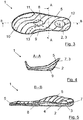
- Figure 3 shows a plan view of a further embodiment of the invention.
- the illustrated orthopedic shoe insole blank 1 is covered over the entire surface with an upper cover 5 on the upper side 3, with the exception of the heel recess 14 in the heel region 12.
- Dashed lines in FIG Figure 3 indicated that the shoe insole blank 1 according to the invention has both a pad 8 and an arch wedge 9 in the metatarsal region 11.
- the person skilled in the art recognizes the arch wedge 9 in the section AA across the shoe insole blank 1, which is shown in FIG Figure 4 is shown. From this representation, the person skilled in the art also recognizes that the upper cover 5 is applied to the upper side 3 of the base body 2 by means of a PU layer 7.
- FIG. 5 shown longitudinal section of the shoe insole blank 1 according to Figure 3 illustrates the full-surface covering of the upper side 3 of the base body 2 with an upper cover 5, which is attached to the base body by means of a PU layer 7 to promote adhesion.
- the pad 8 arranged in the metatarsal area 11 can also be seen in section.
- the specialist has many options to adapt the shoe insole orthopedically as well as creatively with simple means, since he only needs to heat the PU layer above activation temperature to apply the blanket, or - if he has an already applied blanket from the base body or from another blanket want to solve - you only have to ensure that the shoe insole parts are heated to the point where the activation temperature in the PU layer is reached.
- simple options such as an oven, a hot air blower or a hot plate, etc. are sufficient.
Landscapes
- Health & Medical Sciences (AREA)
- Public Health (AREA)
- General Health & Medical Sciences (AREA)
- Epidemiology (AREA)
- Engineering & Computer Science (AREA)
- Life Sciences & Earth Sciences (AREA)
- Wood Science & Technology (AREA)
- Materials Engineering (AREA)
- Chemical & Material Sciences (AREA)
- Nursing (AREA)
- Orthopedic Medicine & Surgery (AREA)
- Biomedical Technology (AREA)
- Heart & Thoracic Surgery (AREA)
- Vascular Medicine (AREA)
- Animal Behavior & Ethology (AREA)
- Veterinary Medicine (AREA)
- Footwear And Its Accessory, Manufacturing Method And Apparatuses (AREA)
Abstract
Description
- Die Erfindung betrifft einen Schuheinlegesohlen-Rohling, speziell einen Schuheinlegesohlen-Rohling, welcher in der Orthopädie für die individuelle Anpassung an die Fußsohle eines Trägers der Schuheinlegesohle verwendbar ist.
- Solche Schuheinlegesohlen-Rohlinge können aus verschiedenartigsten Materialen hergestellt werden, wobei in neuerer Zeit die Verwendung von PU-Schaumkunststoff weit verbreitet ist. Dabei können diese Rohlinge aus einem PU-Schaumkunststoff-Plattenmaterial durch Materialabtrag mittels Fräsen und/oder Schleifen hergestellt werden oder bevorzugt mittels RIM-Verfahren, wobei hier der Schaumkunststoff innerhalb einer Schäumform durch das Zusammenbringen eines Polyols mit einem Isocyanat innerhalb der geschlossenen Schäumform entsteht. Dabei kann auch ein sog. Fräsblock erzeugt werden, der zum Einbringen eines orthopädisch wirksamen Fußbettes auf der Oberseite des Rohlings mittels Fräsen oder Schleifen bearbeitbar ist. In einer anderen Ausführungsform entsteht in der Ausschäumform ein Schuheinlegesohlen-Rohling mit einem direkt durch die Schäumform ausgebildeten orthopädisch wirksamen Fußbett. Derartige in der Orthopädie verwendeten Schuheinlegesohlen-Rohlinge weisen dabei üblicherweise ein vorgeformtes orthopädisch wirksames Fußbett auf, welches insbesondere durch Orthopäden und/oder Orthopädietechniker individuell an die Fußform und/oder Schuhinnenform des Trägers der Schuheinlage angepasst wird. Dabei gibt es je nach zu behandelnder Fußfehlstellung bzw. Fußform verschiedene Grundformen, von denen ausgehend der Orthopäde bzw. der Orthopädietechniker die Sohle individuell anpassen kann.
- Zur Erhöhung des Tragekomforts als auch zum Erreichen weiterer gewünschter orthopädischer und nicht-orthopädischer Eigenschaften der Schuheinlegesohle, beispielsweise einer Rutschfestigkeit innerhalb des Schuhs, werden die Schuheinlegesohlen-Rohlinge auf der Oberseite und/oder Unterseite mit geeigneten Decken versehen. Diese Decken können dabei ganzflächig oder auch nur teilweise, einlagig oder mehrlagig auf den Grundkörper des Schuheinlegesohlen-Rohlings aufgebracht sein.
- Aus
EP 1 967 086 B1 ist ein im RIM-Verfahren erzeugbarer Fräsblock bekannt, bei welchem durch Fräsen und/oder Schleifen auf der Oberseite ein orthopädisch wirksames Fußbett eingebracht werden kann. Weiter ist inEP 2 929 792 B1 eine im RIM-Verfahren herstellbarer orthopädischer Schuheinlegesohlen-Rohling mit einer im Wesentlichen schuheinlegesohlen-artigen Grundform gezeigt, der auf einer Oberseite ein aus dem Schuhkunststoff dreidimensional geformtes Fußbett zeigt. Bei letzterem Verfahren wird das dreidimensional geformte Fußbett durch die geeignete Ausbildung der Ausschäumform direkt während des RIM-Schäumvorganges ausgebildet. - Bei den aus zuvor genannten Stand der Technik bekannten Schuheinlegesohlen-Rohlingen können sowohl auf der Oberseite als auch auf der Unterseite Decken aufgebracht werden. Hier sollte jedoch das Aufbringen einer solchen Decke erst dann erfolgen, wenn die Schuheinlegesohle der individuellen Fußform des Trägers der Schuheinlegesohle angepasst ist, also der Grundkörper fertig bearbeitet ist. Der Stand der Technik, insbesondere
EP 2 929 792 B1 , schlägt hierzu vor, die Decke vor dem Aufbringen auf das dreidimensional geformte Fußbett - also nach dem Anpassen an die Fußform des Fußbettes - auf der Rückseite mit einer TPU-Schicht zu versehen, mittels welcher die Decke ohne weitere Hilfs- oder Klebstoffe auf den Schaumkunststoff aufgebügelt werden kann. Diese TPU-Schicht wird dabei während des Bügelvorgangs gleichzeitig mit dem Schuheinlegesohlen-Rohling soweit erhitzt, dass sowohl das Material des Schuheinlegesohlen-Rohlings als auch die TPU-Schicht über deren jeweilige Schmelztemperatur erwärmt werden und so miteinander verschmelzen bzw. verschweißen können. Somit ist die einmal aufgebrachte Decke nicht wieder zerstörungsfrei vom Schuheinlegesohlen-Grundkörper ablösbar. Eine weitere Anpassung des Schuheinlegesohlen-Körpers auf derjenigen Ober- oder Unterseite, auf den die Decke aufgebracht ist, ist somit nicht mehr ohne Weiteres möglich. - Es ist daher Aufgabe der Erfindung einen orthopädisch wirksamen Schuheinlegesohlen-Rohling bereitzustellen, welcher ein dreidimensional ausgebildetes Fußbett aufweist und der mit einer Decke versehen ist, welche zur individuellen Anpassung des Schuheinlegesohlen-Rohlings vom Grundkörper des Schuheinlegesohlen-Rohlings ablösbar ist, ohne dass dabei der Grundkörper oder die Decke beschädigt wird. Weiter soll die abgelöste Decke nach einer Anpassungsarbeit wieder auf den Grundkörper aufgebracht werden können und derart fest mit dem Grundkörper verbunden sein, dass die Decke bei normalen Einsatzbedingungen der Schuheinlage nicht verrutscht oder sich gar ablöst. Darüber hinaus soll das Ablösen als auch das erneute Aufbringen der Decke mit einfachen Mitteln möglich sein, ohne dass kostenintensive Hilfsmittel von Nöten sind.
- Die erfindungsgemäße Aufgabe wird mit einem Orthopädie-Schuheinlegesohlen-Rohling gemäß Anspruch 1 gelöst, der einen schuheinlegesohlen-artigen Grundkörper aus PU-Schaumkunststoff aufweist. Der Grundkörper des Schuheinlege-Rohlings weist auf der Oberseite ein dreidimensionales, orthopädisch wirksames Fußbett auf. Auf das PU-Schaumkunststoffmaterial des Grundkörpers ist allein mittels einer - entweder auf den Grundkörper oder auf einer Decke - aufgebrachten PU-Schicht eine Decke mit dem PU-Schaumkunststoff des Grundkörpers verbunden. Dabei kann der Grundkörper sowohl auf der Oberseite als auch auf der Unterseite eine mittels einer solchen PU-Schicht aufgebrachte Decke aufweisen. Der erfindungsgemäße Schuheinlegesohlen-Rohling weist hierzu eine spezielle PU-Schicht zwischen dem Grundkörper und der Ober- bzw. Unterdecke auf, die bereits bei Temperaturen über 40°C und unterhalb der Schmelztemperatur des PU-Schaumkunststoffes zum Ausbilden einer Haftverbindung aktivierbar ist, wobei die aktivierte PU-Schicht derart zähflüssig bleibt, dass sie nicht in das Material der jeweiligen Decke eindringt.
- Erfindungsgemäß wird zum Aufbringen einer Decke auf die Ober- und/oder Unterseite des Grundkörpers aus PU-Material eine PU-Schicht als Haftmittel verwendet, wobei das für die PU-Schicht verwendete Polyurethan (PU) bei Temperaturen oberhalb von ca. 40°C, bevorzugt oberhalb von 50°C, aktivierbar ist, d. h. dessen Hafteigenschaften oberhalb der Aktivierungstemperatur stark ansteigen. Weiter soll die Aktivierungstemperatur unterhalb der Schmelztemperatur des PU-Materials liegen, aus dem der Grundkörper besteht. Damit kann die Decke nach Aktivieren der PU-Schicht auf den Grundköper aufgebracht werden, ohne dass es zu einem Verschweißen mit dem PU-Schaumkunststoff des Grundkörpers kommt. Nach einem Abkühlen der PU-Schicht haftet die Decke derart gut auf dem PU-Grundkörper, dass es bei normalen Einsatzbedingungen, insbesondere normalen Einsatztemperaturen, der Schuheinlage nicht zu einem Verrutschen oder Ablösen der Decke vom PU-Grundkörper kommt. Dabei wirkt sich die erfindungsgemäß gewählte Material-Paarung einer haftvermittelnden PU-Schicht zum Aufbringen einer Decke auf einen PU-Grundkörper günstig für die Adhäsion der Decke auf den Grundkörper aus.
- Erfindungsgemäß soll eine PU-Masse als haftvermittelnde PU-Schicht verwendet werden, die oberhalb der Aktivierungstemperatur, aber unterhalb der Schmelztemperatur einen zählflüssigen, pastösen und gleichzeitig klebrigen Zustands annimmt, und zwar so dass das PU-Schichtmaterial auch im aktivierten Zustand nicht in das Material der Decke eindringt, insbesondere wenn das Deckenmaterial ein Textil oder ein textilähnliches Material ist.
- Für die Verwirklichung der erfindungsgemäßen Idee ist es dabei unerheblich, ob die aktivierbare PU-Schicht vor dem Zusammenbringen des Grundkörpers und der Decke auf den Grundkörper oder auf die Rückseite der jeweiligen Decke aufgetragen wurde. In beiden Fällen kann die PU-Schicht beispielsweise über eine geeignete Wärmequelle, wie einen Heißluftfön, Infrarotlampen, Mikrowelle oder einfach durch einen Ofen auf Aktivierungstemperatur erwärmt werden. Dabei ist erfindungsgemäß die Schichtdicke der PU-Schicht im Vergleich zur Dicke der Decke bzw. des Grundkörpers sehr dünn, so dass ein Erwärmen der PU-Schicht schnell vonstattengeht. Nach der Erwärmung der PU-Schicht oberhalb der Aktivierungstemperatur kann der Grundkörper mit der Decke zusammengebracht werden, wobei dies sowohl mittels einer geeigneten Vorrichtung als auch händisch erfolgen kann. Dies ist insbesondere deshalb möglich, weil die PU-Schicht dünn ist, und so die zur Aktivierung benötigte Energie eine unnötige Aufheizung der Decke oder des Grundkörpers vermeidet, wodurch diese beiden Bauteile nur leicht erwärmt werden, und so während der Fügephase in der Hand gehalten werden können.
- Je nach verwendeter PU-Masse kann die Aktivierung bei Temperaturen zwischen 40°C und etwa 100°C betragen. Auch wenn eine Aktivierungstemperatur unterhalb 50°C möglich erscheint und vom Erfindungsgedanken umfasst ist, so sollte diese bevorzugt nicht unterschritten werden, um den festen Halt der Decke auf den PU-Schaumkunststoffgrundkörper nicht zu verringern. Die Körpertemperatur des Menschen liegt bei etwa 37°C, so dass es in heißen Sommertagen beim Gehen auf heißem Asphalt durchaus zu Temperaturen über 40°C im Schuh kommen kann, wodurch gegebenenfalls eine Relativbewegung zwischen der Decke und Schuheinlegesohlengrundkörper auftreten könnte. Es ist daher bevorzugt, dass die Aktivierungstemperatur der verwendeten PU-Masse oberhalb von 50°C liegt, damit solche Relativbewegungen, d. h. ein Verrutschen der Decke ausgeschlossen bleiben.
- Die Wahl der Aktivierungstemperatur unterhalb der Schmelztemperatur des PU-Schaumkunststoffs des Grundkörpers vermeidet einerseits, dass der Energieeintrag beim Verkleben der Decke mit dem Grundkörper nicht zu hoch wird und andererseits die verwendeten Materialen für die Decke als auch für den Grundkörper nicht angeschmolzen werden, was ein späteres zerstörungsfreies Ablösen verhindern würde. Dies ist darüber hinaus weiter bevorzugt, damit die Decke nach einem Erwärmen bzw. Aktivieren per Hand auf dem Grundkörper während der Abkühlphase positionierbar und auch manuell festhaltbar ist.
- Die Verwendung einer zähflüssigen PU-Masse mit einer Aktivierungstemperatur unterhalb von etwa 100°C ermöglicht weiterhin ein erneutes Ablösen der Decke vom Grundkörper des Schuheinlegesohlen-Rohlings. Nachdem der Schuheinlegesohlen-Rohling mit der darauf aufgebrachten Decke auf eine Temperatur erwärmt wird, die unterhalb der Schmelztemperatur der verwendeten Materialen für die Decke oder des PU-Grundkörpers, d. h. des PU-Schaumkunststoffs liegt, jedoch oberhalb der Aktivierungstemperatur des PU-Schichtmaterials, kann die Decke zerstörungsfrei vom Grundkörper abgelöst werden, wobei weder der Grundkörper noch die Decke beschädigt wird.
- Mit der erfindungsgemäßen Verwendung einer zähflüssigen PU-Schicht, welche bei Temperaturen oberhalb etwa 40°C jedoch unterhalb von etwa 100°C aktivierbar ist, wird somit eine unter Normalbedingungen zuverlässige Verbindung der Decke mit dem Schuheinlegesohlen-Grundkörper erreicht, die mit einfachen Mitteln, insbesondere per Hand, bewerkstelligt werden kann. Hierbei ist insbesondere das Verkleben als auch das Ablösen und das erneute Verkleben der Decke mit dem PU-Grundkörper zu nennen. Speziell die Möglichkeit des erneuten Aufbringens der Decke auf den Grundkörper nach einem vorangegangenen Ablösen bietet vielfältige Möglichkeiten bei der individuellen Anpassung des Schuheinlegesohlen-Rohlings an die individuelle Fußsohlenform des Trägers der Schuheinlegesohle.
- Bei dem erfindungsgemäß verwendeten Material für die bevorzugt dünne und thermisch aktivierbare PU-Schicht handelt es beispielsweise um ein PU-haltiges Material, das PU-Gussmaterial, einen Kleber auf PU-Basis, thermoplastisches Polyurethan (TPU) oder eine sonstige chemische Zusammensetzung aufweist, die unterhalb von 40°C ein gutes Adhäsionsverhalten mit dem Schaumkunststoff des Grundkörpers zeigt. Jedoch erweicht das Material der erfindungsgemäß verwendeten PU-Schicht oberhalb der Aktivierungstemperatureine derart, dass es sich auf den PU-Schaumkunststoff des Grundköpers ggf. unter plastischer Verformung der PU-Schicht auftragen lässt und, ggf. nach erneutem thermischen Aktivieren, von dem PU-Grundköper wieder abziehen lässt, ohne dass dabei der Grundköper oder die Decke zu Schaden kommt. Mit anderen Worten, oberhalb der Aktivierungstemperatur lässt sich die Decke in Art eines Haftetiketts auf den Grundkörper aufbringen und von diesem wieder lösen.
- So kann ein Schuheinlegesohlen-Rohling mit einer Grundform für ein orthopädisches Fußbett mit aufgebrachter Decke vom Hersteller des Rohlings "vormontiert" an Schuhorthopäden bzw. Orthopädietechniker ausgeliefert werden, ohne dass hierbei zwei separate Bauteile, wie bisher im Stand der Technik üblich, versendet werden müssen. Ferner kann der meist aufwendige Zuschnitt der Decke beim Orthopäden bzw. Orthopädietechniker entfallen, da dieser Zuschnitt bereits beim Hersteller des Schuheinlege-Rohlings erfolgen kann. Dem Orthopädietechniker bietet sich trotzdem die Möglichkeit den Schuheinlegesohlen-Grundkörper auf allen Oberflächen bearbeiten zu können, indem er die Decke nach Erwärmen des Rohlings zumindest teilweise oder komplett entfernen kann und durch Aktivieren der zähflüssigen PU-Schicht die Decke wieder mit dem Grundkörper verbinden kann. So ist durch geringen Aufwand die Grundform, welche vom Hersteller der Schuheinlegesohlen-Rohlinge zur Verfügung gestellt wird, individuell an die Fußsohle eines Trägers einer Schuheinlegesohle bzw. auch an den Schuh, in den die Schuheinlegesohle hineingelegt werden soll, einfach anpassbar, wobei Komfort oder funktionale Decken bereits in geeigneter Form und Größe als Sohlenkomponente zur Verfügung stehen.
- Dies spart insbesondere beim Schuhorthopädietechniker einen erhöhten Arbeitsaufwand für die Vervollständigung einer Schuheinlegesohle, um die individuellen Bedürfnisse und Wünsche des Trägers der Schuheinlegesohle zu erfüllen.
- In einer bevorzugten Ausführungsform wird die erfindungsgemäße Verwendung einer zähflüssigen PU-Masse zum Verkleben einer Decke mit dem Grundkörper eines Schuheinlege-Rohlings bevorzugt auf die Rückseite der Decke aufgetragen, also die Seite, die mit dem Grundkörper des Schuheinlegesohlen-Rohlings in Kontakt kommt. Dabei ist weiter bevorzugt, dass die Verbindung zwischen der PU-Schicht und der Decke stabiler ist als die Verbindung zwischen PU-Schicht und PU-Grundkörper, damit nach einem Ablösen der Decke vom Grundkörper die PU-Schicht im Wesentlichen auf der Decke verbleibt. Somit kann der Grundkörper nach Ablösen der Decke auch auf der zuvor verdeckten Oberfläche beispielsweise durch Fräsen, Schleifen, Warmverformen, einem plastischen Verformen oder Zuschneiden und/oder auch durch Aufbringen einer Pelotte orthopädisch an die Fußsohle des Trägers der Schuheinlegesohle angepasst werden. Anschließend kann dieselbe Decke wieder auf den Grundkörper aufgebracht werden, indem lediglich die PU-Schicht auf Aktivierungstemperatur erwärmt wird.
- In einer weiteren bevorzugten Ausführungsform ist der Grundkörper mittels RIM-Verfahren in einer Schäumform als Fräsblock oder als bereits vorkonturierter Schuheinlegesohlen-Rohling ausgebildet. Vom Erfindungsgedanken ist hierbei auch eine Teilform einer Schuheinlegesohle, insbesondere eine Halbsohle umfasst, wobei gegebenenfalls die Decke die Schuhsohlenform komplettiert. Selbstredend ist hierbei bevorzugt, dass die haltvermittelnde PU-Schicht nur in dem Bereich aufgetragen ist, in dem der Grundkörper und die Decke einander überlappen. Weitere Beispiele hierfür sind Gewölbe- oder Fersenkeile oder ähnliche in der Orthopädie verwendete Elemente, die eine orthopädische Wirkung auf den Träger der Schuheinlegesohle haben.
- Insgesamt wird einem Orthopäden bzw. einem Orthopädietechniker eine einfache Möglichkeit zur Bearbeitung einer Grundform für einen Schuheinlegesohlen-Rohling zur Verfügung gestellt, bei dem er den bereits mit einer Decke versehenen Schuheinlegesohlen-Grundkörper aus PU-Material auf allen Seiten bearbeiten und so die Grundform individuell an die Fußsohle des Trägers der Schuheinlegsohle anpassen kann. Auch die Anpassung des erfindungsgemäßen Schuheinlegesohlen-Rohlings an die Schuhinnenform, in die die Schuheinlegesohle eingelegt werden soll, ist vom Erfindungsgedanken umfasst. Weiter bevorzugt wird bei der Anpassung an beide Seiten ein optimales orthopädisches Ergebnis erreicht. Dabei wird dem Schuhorthopäden der Aufwand des Zuschneidens und Auftragens von Kleber oder ähnlichen Hilfsmitteln zum Verbinden der Decke mit dem Schuheinlegesohlen-Grundkörper abgenommen, was nicht nur eine Arbeitserleichterung darstellt, sondern auch das umständliche und oft unsaubere Handling von Klebstoffen vermeidet, mit dem damit verbundenen Verschmutzen der Schuheinlage und der Werkzeuge bzw. Vorrichtungen beim Orthopäden.
- Der Schuhorthopäde bzw. Schuhorthopädietechniker kann, nach Erwärmen des erfindungsgemäßen Schuheinlegesohlen-Rohlings mit aufgebrachter Decke auf eine Temperatur unterhalb der Schmelztemperatur des PU-Schaumkunststoffes des Grundkörpers, die Decke vom Grundkörper ablösen, den Grundkörper an die Fußsohlenform des Trägers bzw. an die Schuhinnenform in den die Schuheinlegesohle eingelegt werden soll, anpassen und nach erneutem Erwärmen/Aktivieren der PU-Schicht auf eine Temperatur oberhalb von 40°C, jedoch unterhalb von der Schmelztemperatur des PU-Grundkörpermaterials, die Decke mittels Druck erneut auf den Grundkörper aufbringen. Hier kann der Orthopäde bzw. Schuhorthopädietechniker dieselbe Decke, die er zuvor vom Grundkörper der Schuheinlegsohle gelöst hat, wieder auf den bearbeiteten Grundkörper aufbringen, ohne dass er diese erneut mit einem Klebstoff, wie beispielsweise Heißkleber oder ähnlichem, versehen muss. Er muss lediglich dafür sorgen, dass die PU-Schicht die Aktivierungstemperatur erreicht, wodurch er die Decke beispielsweise manuell auf den Grundkörper drücken kann. Nach Unterschreiten der Aktivierungstemperatur erhält er einen festen Verbund der Decke mit dem Grundkörper als Schuheinlage, die individuell an die Fußform angepasst ist. Dabei ist der Orthopäde bzw. Orthopädiefachmann in der Wahl seiner Mittel sowohl für das Ablösen als auch für das erneute Aufbringen der Decke frei. Beispielsweise ist ein einfacher Ofens ausreichend, in dem er die Sohle mit der aufgebrachten Decke erwärmen kann, oder in dem er auch nur die Decke erwärmt, für das erfindungsgemäße Ablösen und erneute Aufbringen der Decke. Andere Wärmequellen stehen dem Fachmann dabei selbstredend ebenfalls zur Verfügung, wie beispielsweise ein Mikrowellenofen, ein Heißluftfön, eine einfache erwärmte Platte, etc. Insbesondere ein Fachmann wird hierfür vielfältige Lösungen finden, die allesamt vom Erfindungsgedanken umfasst sind.
- Auch eine automatisierte Aufbringung der Decke, insbesondere beim Hersteller des Schuheinlegesohlen-Rohlings ist im Bereich des Könnens des einschlägigen Fachmanns und ist mit verschiedenen Möglichkeiten, wie z. B. einer Abwandlung einer Bügelvorrichtung oder mittels einer Infrarot- oder Mikrowellenstrecke und nachgeschalteter Presse vorstellbar.
- Selbstredend ist die Auslieferung des erfindungsgemäßen Schuheinlagesohlen-Rohlings mit nicht-aufgebrachter Decke vom Erfindungsgedanken umfasst, wobei die Decke oder Grundkörper mit einer PU-Schicht versehen ist, die oberhalb einer Temperatur von 40°C, bevorzugt oberhalb 50°C, für das Verbinden mit dem Schuheinlegesohle-Grundkörper vorgesehen ist. Bei einer solchen separaten Auslieferung von Decke und Grundkörper ist es bevorzugt, die auf einen der beiden Teile aufgebrachte PU-Masse mit einer Schutzfolie zu versehen. Konsequenterweise umfasst der Erfindungsgedanke auch die eine Auslieferung des Schuheinlegesohlen-Grundkörpers mit einer aufgebrachten erfindungsgemäß aktivierbaren PU-Schicht, jedoch ohne Decke, da eine solche beispielsweise beim Orthopäden zum Vervollständigen der erfindungsgemäßen Schuheinlegesohle hinzugefügt werden kann.
- Im Folgenden werden zur Veranschaulichung des Erfindungsgedankens schematisch einige Ausführungsbeispiele eines erfindungsgemäßen Schuheinlegesohlen-Rohlings mit einem dreidimensional ausgebildeten, orthopädischen Fußbett dargestellt, wobei diese Ausführungsformen rein der Erläuterung des Erfindungsgedankens dienen und diesen nicht einschränken. Es zeigen:
- Figur 1
- einen Schuheinlegesohlen-Rohling gemäß der Erfindung in einer ersten Ausführungsform
- Figur 2
- einen erfindungsgemäßen Schuheinlegesohlen-Rohling gemäß einer zweiten Ausführungsform
- Figur 3
- einen erfindungsgemäßen Schuheinlegesohlen-Rohling gemäß einer zweiten Ausführungsform
- Figur 4
- einen Querschnitt durch den erfindungsgemäßen Schuheinlegesohlen-Rohling gemäß
Figur 3 längs der Linie A-A - Figur 5
- einen Längsschnitt durch den erfindungsgemäßen Schuheinlegesohlen-Rohling gemäß
Figur 3 längs der Linie B-B; -
Figur 1 zeigt schematisch eine perspektivische Ansicht eines ersten Ausführungsbeispiels gemäß der Erfindung. Der inFigur 1 gezeigte Schaumkunststoff-Schuheinlegesohlen-Rohling 1 weist auf seiner Oberseite 3 ein dreidimensional ausgebildetes orthopädisch wirksames Fußbett auf. Dabei ist der Grundkörper 2 aus PU-Schaumkunststoffmaterial ausgebildet und wurde bevorzugt im RIM-Schäumverfahren erstellt. Auf den Grundkörper 2 nur ist in Teilbereichen eine Oberdecke 5 aufgebracht, sodass beispielsweise der Vorderfußbereich 10 und der Bereich der Fersenmulde 14 nicht bedeckt sind. Die Oberdecke 5 wurde mittels einer PU-Schicht 7 auf das PU-Schaumkunststoffmaterial des Grundkörpers 2 aufgebracht. Dabei ist die zum Verbinden der Oberdecke 5 mit der Oberseite 3 des Grundkörpers 2 vorgesehene PU-Schicht im Verhältnis zu den Schichtdicken der Oberdecke 5 und des Grundkörpers 2 derart dünn, dass sie inFigur 1 als Linie erscheint. Die PU-Schicht, wie oben ausführlich erläutert, ist dabei eine mittels Wärme aktivierbare PU-Masse, welche bei Temperaturen bevorzugt oberhalb von 40° C einen deutlichen Anstieg der Adhäsionseigenschaften zeigt, jedoch derart zähflüssig ist/bleibt, dass das Material der PU-Schicht nicht in das Material Oberdecke 5 eindringt. Wie oben ebenfalls bereits ausgeführt, liegt die Adhäsionsaktivierungstemperatur des Materials der PU-Schicht unterhalb der Schmelztemperatur des PU-Schaumkunststoffmaterials des Grundkörpers 2. Damit wird eine Adhäsion zwischen Oberdecke 5 und Grundkörper 2 erreicht, ohne dass die Schmelztemperatur eines der beiden Adhäsionspartner überschritten wird. Weiter findet dadurch beim Verbinden bzw. Aufbringen der Oberdecke 5 auf den Grundkörper 2 kein Verschweißen der PU-Materialien der PU-Schicht und dem PU-Schaumkunststoff des Grundköpers 2 statt. -
Figur 2 zeigt einen Längsschnitt durch ein zweites Ausführungsbeispiel der Erfindung. Im Unterschied zum Ausführungsbeispiel derFigur 1 ist der Grundkörper im Ausführungsbeispiel derFigur 2 in Art einer Halbsohle ausgebildet, d. h. er erstreckt sich lediglich vom Fersenbereich 12 bis zum Mittelfußbereich 11, wobei der Vorderfußbereich 10 vom Grundkörper 2 nicht unterstützt wird. InFigur 2 ist jedoch deutlich erkennbar, dass durch den Grundkörper 2 im Mittelfußbereich ein Fußstützendes Gewölbe ausgebildet wird, sodass der Grundkörper 2 zumindest hierdurch eine orthopädische Funktion aufweist. Als weiteren Unterschied zeigt der Schuheinlegesohlen-Rohling gemäßFigur 2 eine Oberdecke 5 als auch eine Unterdecke 6, welche jeweils mittels einer PU-Schicht 7 mit der jeweiligen Oberseite 3 bzw. der Unterseite 4 mit dem im Fersen- und Mittelbereich ausgebildeten Grundkörper 2 verbunden sind. Im Vorderfußbereich 10 sind die beiden zueinander weisenden Seiten der Oberdecke 5 und der Unterdecke 6 bspw. direkt über eine PU-Schicht 7 miteinander verbunden, die zuvor entweder auf die Oberdecke 5 oder die Unterdecke 6 aufgetragen wurde. Wie oben bereits ausgeführt, reicht ein einseitiger Auftrag der PU-Schicht 7 für eine erfindungsgemäße mittels Wärme wieder lösbare Verbindung zweier PU-Bauteile. Das bedeutet weiter, dass in diesem Ausführungsbeispiel - falls eine der beiden Decken 5 oder 6 nicht aus PU-Material besteht - diejenige Decke 5 oder 6 vorzugsweise ebenfalls eine PU-Schicht aufweist, die dann nicht zwingend eine mittels Wärme aktivierbare haftvermittelnde PU-Schicht gemäß der Erfindung sein muss. -
Figur 3 zeigt eine Draufsicht eines weiteren Ausführungsbeispiels der Erfindung. Der inFigur 3 dargestellte orthopädische Schuheinlegesohlen-Rohling 1 ist auf der Oberseite 3 vollflächig mit einer Oberdecke 5 bezogen, mit Ausnahme der Fersenmulde 14 im Fersenbereich 12. Mit gestrichelten Linien ist inFigur 3 angedeutet, dass der erfindungsgemäße Schuheinlegesohlen-Rohling 1 im Mittelfußbereich 11 sowohl eine Pelotte 8 als auch einen Gewölbekeil 9 aufweist. Den Gewölbekeil 9 erkennt der Fachmann im Schnitt A-A quer durch den Schuheinlegesohlen-Rohling 1, der inFigur 4 dargestellt ist. Aus dieser Darstellung erkennt der Fachmann ebenfalls, dass die Oberdecke 5 mittels einer PU-Schicht 7 auf die Oberseite 3 des Grundkörpers 2 aufgebracht ist. - Der in
Figur 5 dargestellte Längsschnitt des Schuheinlegesohlen-Rohlings 1 gemäßFigur 3 verdeutlicht den vollflächigen Bezug der Oberseite 3 des Grundkörpers 2 mit einer Oberdecke 5, welche haftvermittelnd mittels einer PU-Schicht 7 auf den Grundkörper aufgezogen ist. InFigur 5 erkennt man weiterhin die im Mittelfußbereich 11 angeordnete Pelotte 8 im Schnitt. - Auch wenn der in den
Figuren 3 bis 5 dargestellte Schuheinlegesohlen-Rohling 1 keine Unterdecke aufweist, so erkennt zumindest der einschlägige Fachmann, dass eine Unterdecke - wie beispielsweise inFigur 2 gezeigt - ebenfalls auf den Schuheinlegesohlen-Rohling 1 gemäß denFiguren 3 bis 5 mit einer erfindungsgemäßen PU-Schicht aufgezogen werden kann. Der Fachmann erkennt weiter, dass auch - beispielsweise wie inFigur 1 angedeutet - teilflächige Decken auf bereits vorhandene Decken aufgezogen werden können. Dies ist beispielsweise mit dem inFigur 2 gezeigten Längsschnitt im Vorderfußbereich 10 verwirklicht, da man dort die Unterdecke beispielsweise nur teilflächig ausbilden könnte oder Durchbrüche/Öffnungen in der Oberdecke im Vorderfußbereich belässt, sodass durch diese Öffnungen in der Oberdecke die Unterdecke sichtbar ist. Allgemein sind dem Fachmann keine Grenzen gesetzt, wie er Kombinationen zum Beziehen des PU-Schaumkunststoffgrundkörpers 2 auf dessen Oberseite 3 oder Unterseite 4 gestalten kann, wobei Kombinationen von ein- oder mehrlagigen Oberdecken 5 und Unterdecken 6 genauso im Bereich des Könnens des einschlägigen Fachmann sind. - Insgesamt wird mit der erfindungsgemäßen Verwendung einer wärmeaktivierbaren PU-Schicht zum Erreichen einer Adhäsion zwischen einer Schuhsohlendecke und einem Schuhsohlengrundkörper eine, insbesondere für die Orthopädie einfache, kostengünstige, jedoch flexible und saubere Lösung angeboten, einen Schuheinlegesohlen-Rohling individuell an die Fußsohle des Trägers der Schuheinlegesohle bzw. an die Schuhinnenform, in den die Schuheinlegesohle eingelegt werden soll, orthopädisch anzupassen. Dabei erhält der Fachmann viele Möglichkeiten, die Schuheinlegesohle orthopädisch, wie gestalterisch mit einfachen Mitteln anzupassen, da er entweder zum Aufbringen der Decke lediglich die PU-Schicht über Aktivierungstemperatur erwärmen muss, oder - wenn er eine bereits aufgebrachte Decke vom Grundkörper oder von einer anderen Decke lösen will - nur dafür Sorge tragen muss, dass die Schuheinlegesohlen-Teile soweit erwärmt werden, dass die Aktivierungstemperatur in der PU-Schicht erreicht wird. Hierzu reichen ihm einfache Möglichkeiten, wie ein Ofen, ein Heißluftföhn oder eine Wärmeplatte, etc.
- Auch wenn im Rahmen dieser Erfindungsbeschreibung nicht alle Kombinationen und Möglichkeiten, die im Bereich des fachmännischen Könnens liegen, beschrieben werden können, so sind diese jedoch selbstredend vom Erfindungsgedanken umfasst.
-
- 1
- Schuheinlagesohlen-Rohling
- 2
- Grundkörper
- 3
- Oberseite
- 4
- Unterseite
- 5
- Oberdecke
- 6
- Unterdecke
- 7
- PU-Schicht
- 8
- Pelotte
- 9
- Gewölbekeil
- 10
- Vorderfußbereich
- 11
- Mittelfußbereich
- 12
- Fersenbereich
- 13
- Gewölbereich
- 14
- Fersenmulde
Claims (13)
- Orthopädischer Schuheinlegesohlen-Rohling (1), der aufweist:• einen Schuheinlegesohlen-artigen Grundköper (2) aus PU-Schaumkunststoff,• ein auf der Oberseite (3) des Grundköpers (2) ausgebildetes, dreidimensionales Fußbett, und• eine auf der Ober- und/oder Unterseite (3, 4) aufgebrachte Decke (5, 6), die allein mittels einer PU-Schicht mit dem PU-Schaumkunststoff des Grundkörpers verbunden ist,dadurch gekennzeichnet, dass• die PU- Schicht ein zum Verbinden der Decke (5, 6) mit dem Grundkörper bei Temperaturen über 40°C und unterhalb der Schmelztemperatur des PU-Schaumkunststoffs aktivierbares PU-Material ist, das im aktivierten Zustand derart zähflüssig ist, dass es nicht in das Material der Decke (5, 6) eindringt, und• die Decke (5, 6) nach Erwärmen des Schuheinlegesohlen-Rohlings (1) auf eine Temperatur unterhalb der Schmelztemperatur des PU-Schaumkunststoffs vom Grundkörper abgelöst werden kann, wobei weder der Grundkörper noch die Decke (5, 6) beschädigt wird.
- Schuheinlegesohlen-Rohling (1) nach Anspruch 1, wobei der Grundköper (2) mittels RIM-Verfahren in einer oder mehreren Materialhärten hergestellt wurde.
- Schuheinlegesohlen-Rohling (1) nach einem der Ansprüche 1 oder 2, wobei der Grundkörper (2) vor einem Aufbringen der Decke (5, 6) durch Fräsen und/oder Schleifen bearbeitet wurde.
- Schuheinlegesohlen-Rohling (1) nach einem der Ansprüche 1 bis 3, wobei der Grundköper (2) nach einem Ablösen der Decke (5, 6) an die Fußsohlen-Form eines Trägers der Schuheinlegesohle anpassbar ist und die zuvor abgelöste Decke (5, 6) nach dem Anpassen des Grundköpers durch Erwärmen der PU-Schicht auf über 40°C und unterhalb der Schmelztemperatur des PU-Schaumkunststoffs wieder auf den Grundköper (2) aufgebracht werden kann.
- Schuheinlegesohlen-Rohling (1) nach einem der Ansprüche 1 bis 4, wobei die Decke (5, 6) mit der auf über 40°C und unterhalb der Schmelztemperatur des PU-Schaumkunststoffs erwärmten PU-Schicht von Hand auf den Grundkörper aufgebracht und festgedrückt werden kann.
- Schuheinlegesohlen-Rohling (1) nach einem der Ansprüche 1 bis 5, wobei das Deckenmaterial Leder, Alcantara, ein gewebtes oder gewirktes Textil, ein Vlies, Fell oder ein anderes fachübliches Deckenmaterial oder eine Schutzschicht bzw. Schutzfolie ist.
- Schuheinlegesohlen-Rohling (1) nach einem der Ansprüche 1 bis 6, wobei das Material der PU-Schicht ein Thermoplastisches Polyurethan (TPU) ist.
- Verfahren zum individuellen Anpassen eines mit einer Decke (5, 6) versehenen Schuheinlegesohlen-Rohlings (1) nach einem der Ansprüche 1 bis 7 an die Fußsohlen-Form eines Trägers der Schuheinlegesohle und/oder Schuhinnenform in die die Schuheinlegesohle eingelegt werden soll, mit den folgenden Schritten:a) Erwärmen des Schuheinlegesohlen-Rohling (1)s auf eine Temperatur unterhalb der Schmelztemperatur des PU-Schaumkunststoff des Grundköpers (2);b) Ablösen der Decke (5, 6) vom Grundkörper (2);c) Anpassen des Grundköpers an die Fußsohlen-Form und /oder Schuhinnenform;d) Erwärmen der Decke (5, 6) zumindest auf der Seite, die mit dem Grundköper (2) in Kontakt kommen soll, auf eine Temperatur oberhalb von 40°C, jedoch unterhalb der Schmelztemperatur des PU-Schaumkunststoffs des Grundköpers,e) Aufbringen mittels Druck der im Schritt d) erwärmten Decke (5, 6) auf den Grundköper(2);
- Verfahren nach Anspruch 8, bei dem das Erwärmen in den Schritten a) und/oder d) mittels eines Ofen, einer erwärmten Platte oder Walze, in einem Heißluftstrom oder mittels Mikro-wellen erfolgt.
- Verfahren nach Anspruch 8 oder 9, bei dem das Ablösen im Schritt b) manuell erfolgt.
- Verfahren nach einem der Ansprüche 8 bis 10, bei dem das Aufbringen im Schritt e) von Hand erfolgt.
- Verfahren nach einem der Ansprüche 8 bis 11, bei dem die Decke (5, 6) nach dem Schritt c) mit der PU-Schicht zum Grundköper (2) weisend auf den Grundköper (2) gelegt wird und die Schritte d) und e) durch eine Bügelvorrichtung vorgenommen werden.
- Verfahren nach einem der Ansprüche 8 bis 12, bei dem das Anpassen des Grundköpers an die Fußsohlen-Form des Trägers durch Fräsen, Schleifen, Warmverformen, plastisch Verformen, Zuschneiden des Grundköpers und/oder durch Aufbringen einer Pelotte auf den Grundköper (2) erfolgt.
Priority Applications (6)
| Application Number | Priority Date | Filing Date | Title |
|---|---|---|---|
| PL19161972T PL3708018T3 (pl) | 2019-03-11 | 2019-03-11 | Półfabrykat wkładki do buta i sposób do indywidualnego dopasowywania takiego półfabrykatu wkładki do buta |
| ES19161972T ES2874193T3 (es) | 2019-03-11 | 2019-03-11 | Pieza en bruto de plantilla para calzado y procedimiento para la adaptación individual de una pieza en bruto de plantilla para calzado de este tipo |
| EP19161972.5A EP3708018B1 (de) | 2019-03-11 | 2019-03-11 | Schuheinlegesohlen-rohling und verfahren zum individuellen anpassen eines solchen schuheinlegesohlen-rohlings |
| LTEP19161972.5T LT3708018T (lt) | 2019-03-11 | 2019-03-11 | Batų vidpadžio ruošinys ir jo pritaikymo būdas |
| PT191619725T PT3708018T (pt) | 2019-03-11 | 2019-03-11 | Sola de sapato em branco e método para personalizar a mesma |
| RU2020109869A RU2736253C1 (ru) | 2019-03-11 | 2020-03-06 | Заготовка обувной стельки и способ индивидуальной подгонки заготовки обувной стельки |
Applications Claiming Priority (1)
| Application Number | Priority Date | Filing Date | Title |
|---|---|---|---|
| EP19161972.5A EP3708018B1 (de) | 2019-03-11 | 2019-03-11 | Schuheinlegesohlen-rohling und verfahren zum individuellen anpassen eines solchen schuheinlegesohlen-rohlings |
Publications (2)
| Publication Number | Publication Date |
|---|---|
| EP3708018A1 true EP3708018A1 (de) | 2020-09-16 |
| EP3708018B1 EP3708018B1 (de) | 2021-03-10 |
Family
ID=65763388
Family Applications (1)
| Application Number | Title | Priority Date | Filing Date |
|---|---|---|---|
| EP19161972.5A Active EP3708018B1 (de) | 2019-03-11 | 2019-03-11 | Schuheinlegesohlen-rohling und verfahren zum individuellen anpassen eines solchen schuheinlegesohlen-rohlings |
Country Status (6)
| Country | Link |
|---|---|
| EP (1) | EP3708018B1 (de) |
| ES (1) | ES2874193T3 (de) |
| LT (1) | LT3708018T (de) |
| PL (1) | PL3708018T3 (de) |
| PT (1) | PT3708018T (de) |
| RU (1) | RU2736253C1 (de) |
Cited By (3)
| Publication number | Priority date | Publication date | Assignee | Title |
|---|---|---|---|---|
| RU2793919C1 (ru) * | 2021-04-06 | 2023-04-10 | Шпаннрит ГмбХ | Заготовка ортопедической стельки для обуви |
| CN116261988A (zh) * | 2021-12-14 | 2023-06-16 | 耐克创新有限合伙公司 | 用于鞋类物品的鞋底结构 |
| EP4353115A1 (de) * | 2022-10-10 | 2024-04-17 | Spannrit GmbH | Orthopädischer pur-schaumkunststoff-schuheinlegesohlenrohling |
Families Citing this family (1)
| Publication number | Priority date | Publication date | Assignee | Title |
|---|---|---|---|---|
| RU204293U1 (ru) * | 2021-01-09 | 2021-05-19 | Дмитрий Юрьевич Барышов | Заготовка для индивидуальной ортопедической стельки |
Citations (5)
| Publication number | Priority date | Publication date | Assignee | Title |
|---|---|---|---|---|
| DE20023245U1 (de) * | 1999-01-20 | 2003-06-12 | Spannrit Schuhkomponenten Gmbh, 63801 Kleinostheim | Schuheinlagensystem |
| WO2007086806A1 (en) * | 2006-01-25 | 2007-08-02 | New2Ell Pte Ltd | Customizing fitting insole to fit shape and features of individuals |
| EP1967086A1 (de) | 2007-03-05 | 2008-09-10 | Spannrit Schuhkomponenten GmbH | Schaumkunststoff-Schuheinlegesohle |
| DE102009035354A1 (de) * | 2009-07-30 | 2011-02-10 | Horn, Pascal | Orthopädische Einlage für einen Sicherheitsschuh |
| EP2929792A1 (de) | 2014-04-10 | 2015-10-14 | Spannrit Schuhkomponenten GmbH | Schaumkunststoff-Schuheinlegesohlen-Rohling mit einer Decke und Verfahren zum aufbringen derselbigen |
Family Cites Families (4)
| Publication number | Priority date | Publication date | Assignee | Title |
|---|---|---|---|---|
| US6782640B2 (en) * | 2001-09-12 | 2004-08-31 | Craig D. Westin | Custom conformable device |
| US7426794B2 (en) * | 2004-01-05 | 2008-09-23 | Robert John Swensen | Insole support system |
| US7707751B2 (en) * | 2006-06-16 | 2010-05-04 | Schering-Plough Healthcare Products, Inc. | Adjustable orthotic |
| RU2531452C9 (ru) * | 2013-08-21 | 2019-02-04 | Эльмар Маисович Султанов | Заготовка для индивидуальной ортопедической стельки и способ ее изготовления |
-
2019
- 2019-03-11 PT PT191619725T patent/PT3708018T/pt unknown
- 2019-03-11 EP EP19161972.5A patent/EP3708018B1/de active Active
- 2019-03-11 ES ES19161972T patent/ES2874193T3/es active Active
- 2019-03-11 LT LTEP19161972.5T patent/LT3708018T/lt unknown
- 2019-03-11 PL PL19161972T patent/PL3708018T3/pl unknown
-
2020
- 2020-03-06 RU RU2020109869A patent/RU2736253C1/ru active
Patent Citations (5)
| Publication number | Priority date | Publication date | Assignee | Title |
|---|---|---|---|---|
| DE20023245U1 (de) * | 1999-01-20 | 2003-06-12 | Spannrit Schuhkomponenten Gmbh, 63801 Kleinostheim | Schuheinlagensystem |
| WO2007086806A1 (en) * | 2006-01-25 | 2007-08-02 | New2Ell Pte Ltd | Customizing fitting insole to fit shape and features of individuals |
| EP1967086A1 (de) | 2007-03-05 | 2008-09-10 | Spannrit Schuhkomponenten GmbH | Schaumkunststoff-Schuheinlegesohle |
| DE102009035354A1 (de) * | 2009-07-30 | 2011-02-10 | Horn, Pascal | Orthopädische Einlage für einen Sicherheitsschuh |
| EP2929792A1 (de) | 2014-04-10 | 2015-10-14 | Spannrit Schuhkomponenten GmbH | Schaumkunststoff-Schuheinlegesohlen-Rohling mit einer Decke und Verfahren zum aufbringen derselbigen |
Cited By (7)
| Publication number | Priority date | Publication date | Assignee | Title |
|---|---|---|---|---|
| RU2793919C1 (ru) * | 2021-04-06 | 2023-04-10 | Шпаннрит ГмбХ | Заготовка ортопедической стельки для обуви |
| RU2793919C9 (ru) * | 2021-04-06 | 2023-06-08 | Шпаннрит ГмбХ | Заготовка ортопедической стельки для обуви |
| CN116261988A (zh) * | 2021-12-14 | 2023-06-16 | 耐克创新有限合伙公司 | 用于鞋类物品的鞋底结构 |
| US12604946B2 (en) | 2021-12-14 | 2026-04-21 | Nike, Inc. | Sole structure for article of footwear |
| EP4353115A1 (de) * | 2022-10-10 | 2024-04-17 | Spannrit GmbH | Orthopädischer pur-schaumkunststoff-schuheinlegesohlenrohling |
| WO2024079032A1 (de) * | 2022-10-10 | 2024-04-18 | Spannrit Gmbh | Orthopädischer pur-schaumkunststoff-schuheinlegesohlenrohling |
| US12593892B2 (en) | 2022-10-10 | 2026-04-07 | Spannrit Gmbh | Orthopedic PUR foam plastic shoe insole blank |
Also Published As
| Publication number | Publication date |
|---|---|
| ES2874193T3 (es) | 2021-11-04 |
| LT3708018T (lt) | 2021-07-12 |
| PT3708018T (pt) | 2021-06-01 |
| EP3708018B1 (de) | 2021-03-10 |
| PL3708018T3 (pl) | 2021-09-20 |
| RU2736253C1 (ru) | 2020-11-12 |
Similar Documents
| Publication | Publication Date | Title |
|---|---|---|
| EP3708018B1 (de) | Schuheinlegesohlen-rohling und verfahren zum individuellen anpassen eines solchen schuheinlegesohlen-rohlings | |
| DE102018202805A1 (de) | Verbund-Sportartikel | |
| EP2575525B1 (de) | Vorrichtung und verfahren zum anpassen eines schuhs | |
| DE2314963A1 (de) | Brandsohle und verfahren zu ihrer herstellung | |
| DE2523114A1 (de) | Verfahren und vorrichtung zur herstellung nahtloser buestenhalterkoerbchen | |
| AT512305B1 (de) | Vorrichtung und Verfahren zur Herstellung einer an einen Fuß bzw. ein Bein eines Benutzers angepassten Schale eines Schischuhs | |
| DE19506128C2 (de) | Verfahren zum Befestigen von Polstern an medizinischen Bandagen und seine Verwendung | |
| DE69830908T2 (de) | Verfahren zum Herstellen von profilierten und laminierten Materialen | |
| DE102010015145B4 (de) | Thermoplastisch verformbare Schuheinlegesohle | |
| EP2929792B1 (de) | Schaumkunststoff-Schuheinlegesohlen-Rohling mit einer Decke und Verfahren zum aufbringen derselbigen | |
| DE4401849A1 (de) | Formteil, insbesondere Zuschnitt für einen Innenschuh | |
| EP1887899B1 (de) | Orthopädisch zugerichteter schuh | |
| EP0264898A2 (de) | Verfahren zum Herstellen eines Schuhes | |
| AT516116A1 (de) | Verfahren zur Herstellung einer mehrschichtigen Folie | |
| EP2636327B1 (de) | Schuhsohlenkunststoff | |
| EP1021967B1 (de) | Schuheinlagensystem | |
| EP4070681B1 (de) | Orthopädischer schuheinlegesohlenrohling | |
| DE60311880T2 (de) | Verfahren zum herstellen von schuhen | |
| EP4152998B1 (de) | Einlegesohle | |
| DE60104663T2 (de) | Verfahren zur Herstellung eines orthopädischen Gegenstandes auf Basis eines Silikonelastomers und so hergestellter orthopädischer Gegenstand | |
| DE3114534A1 (de) | Verfahren zur herstellung einer schuheinlage, insbesondere einer orthopaedischen schuheinlage und eine nach diesem verfahren hergestellte schuheinlage | |
| EP4643701A1 (de) | Deckenmaterial für schuheinlegesohlen, schuheinlegesohle mit einem solchen deckenmaterial und herstellverfahren eines bzw. einer solchen | |
| DE19902147C2 (de) | Anatomisch deformter Rohling, Schuheinlagensystem und Verfahren zur Herstellung eines anatomisch geformten Rohlings | |
| EP3183983A1 (de) | Innenschuh mit einem knöchelverstärkungselement aus kunststoff-material | |
| DE20023245U1 (de) | Schuheinlagensystem |
Legal Events
| Date | Code | Title | Description |
|---|---|---|---|
| STAA | Information on the status of an ep patent application or granted ep patent |
Free format text: STATUS: EXAMINATION IS IN PROGRESS |
|
| PUAI | Public reference made under article 153(3) epc to a published international application that has entered the european phase |
Free format text: ORIGINAL CODE: 0009012 |
|
| 17P | Request for examination filed |
Effective date: 20200227 |
|
| AK | Designated contracting states |
Kind code of ref document: A1 Designated state(s): AL AT BE BG CH CY CZ DE DK EE ES FI FR GB GR HR HU IE IS IT LI LT LU LV MC MK MT NL NO PL PT RO RS SE SI SK SM TR |
|
| AX | Request for extension of the european patent |
Extension state: BA ME |
|
| GRAP | Despatch of communication of intention to grant a patent |
Free format text: ORIGINAL CODE: EPIDOSNIGR1 |
|
| STAA | Information on the status of an ep patent application or granted ep patent |
Free format text: STATUS: GRANT OF PATENT IS INTENDED |
|
| INTG | Intention to grant announced |
Effective date: 20201006 |
|
| GRAS | Grant fee paid |
Free format text: ORIGINAL CODE: EPIDOSNIGR3 |
|
| GRAA | (expected) grant |
Free format text: ORIGINAL CODE: 0009210 |
|
| STAA | Information on the status of an ep patent application or granted ep patent |
Free format text: STATUS: THE PATENT HAS BEEN GRANTED |
|
| AK | Designated contracting states |
Kind code of ref document: B1 Designated state(s): AL AT BE BG CH CY CZ DE DK EE ES FI FR GB GR HR HU IE IS IT LI LT LU LV MC MK MT NL NO PL PT RO RS SE SI SK SM TR |
|
| REG | Reference to a national code |
Ref country code: GB Ref legal event code: FG4D Free format text: NOT ENGLISH |
|
| REG | Reference to a national code |
Ref country code: CH Ref legal event code: EP Ref country code: AT Ref legal event code: REF Ref document number: 1368804 Country of ref document: AT Kind code of ref document: T Effective date: 20210315 |
|
| REG | Reference to a national code |
Ref country code: DE Ref legal event code: R096 Ref document number: 502019000942 Country of ref document: DE |
|
| REG | Reference to a national code |
Ref country code: IE Ref legal event code: FG4D Free format text: LANGUAGE OF EP DOCUMENT: GERMAN |
|
| REG | Reference to a national code |
Ref country code: PT Ref legal event code: SC4A Ref document number: 3708018 Country of ref document: PT Date of ref document: 20210601 Kind code of ref document: T Free format text: AVAILABILITY OF NATIONAL TRANSLATION Effective date: 20210526 |
|
| REG | Reference to a national code |
Ref country code: DE Ref legal event code: R082 Ref document number: 502019000942 Country of ref document: DE Representative=s name: KUHNEN & WACKER PATENT- UND RECHTSANWALTSBUERO, DE |
|
| REG | Reference to a national code |
Ref country code: RO Ref legal event code: EPE |
|
| REG | Reference to a national code |
Ref country code: SK Ref legal event code: T3 Ref document number: E 37253 Country of ref document: SK |
|
| PG25 | Lapsed in a contracting state [announced via postgrant information from national office to epo] |
Ref country code: NO Free format text: LAPSE BECAUSE OF FAILURE TO SUBMIT A TRANSLATION OF THE DESCRIPTION OR TO PAY THE FEE WITHIN THE PRESCRIBED TIME-LIMIT Effective date: 20210610 Ref country code: GR Free format text: LAPSE BECAUSE OF FAILURE TO SUBMIT A TRANSLATION OF THE DESCRIPTION OR TO PAY THE FEE WITHIN THE PRESCRIBED TIME-LIMIT Effective date: 20210611 Ref country code: FI Free format text: LAPSE BECAUSE OF FAILURE TO SUBMIT A TRANSLATION OF THE DESCRIPTION OR TO PAY THE FEE WITHIN THE PRESCRIBED TIME-LIMIT Effective date: 20210310 Ref country code: HR Free format text: LAPSE BECAUSE OF FAILURE TO SUBMIT A TRANSLATION OF THE DESCRIPTION OR TO PAY THE FEE WITHIN THE PRESCRIBED TIME-LIMIT Effective date: 20210310 Ref country code: BG Free format text: LAPSE BECAUSE OF FAILURE TO SUBMIT A TRANSLATION OF THE DESCRIPTION OR TO PAY THE FEE WITHIN THE PRESCRIBED TIME-LIMIT Effective date: 20210610 |
|
| REG | Reference to a national code |
Ref country code: NL Ref legal event code: MP Effective date: 20210310 |
|
| PG25 | Lapsed in a contracting state [announced via postgrant information from national office to epo] |
Ref country code: SE Free format text: LAPSE BECAUSE OF FAILURE TO SUBMIT A TRANSLATION OF THE DESCRIPTION OR TO PAY THE FEE WITHIN THE PRESCRIBED TIME-LIMIT Effective date: 20210310 Ref country code: RS Free format text: LAPSE BECAUSE OF FAILURE TO SUBMIT A TRANSLATION OF THE DESCRIPTION OR TO PAY THE FEE WITHIN THE PRESCRIBED TIME-LIMIT Effective date: 20210310 |
|
| PG25 | Lapsed in a contracting state [announced via postgrant information from national office to epo] |
Ref country code: NL Free format text: LAPSE BECAUSE OF FAILURE TO SUBMIT A TRANSLATION OF THE DESCRIPTION OR TO PAY THE FEE WITHIN THE PRESCRIBED TIME-LIMIT Effective date: 20210310 |
|
| PG25 | Lapsed in a contracting state [announced via postgrant information from national office to epo] |
Ref country code: SM Free format text: LAPSE BECAUSE OF FAILURE TO SUBMIT A TRANSLATION OF THE DESCRIPTION OR TO PAY THE FEE WITHIN THE PRESCRIBED TIME-LIMIT Effective date: 20210310 Ref country code: EE Free format text: LAPSE BECAUSE OF FAILURE TO SUBMIT A TRANSLATION OF THE DESCRIPTION OR TO PAY THE FEE WITHIN THE PRESCRIBED TIME-LIMIT Effective date: 20210310 |
|
| PG25 | Lapsed in a contracting state [announced via postgrant information from national office to epo] |
Ref country code: IS Free format text: LAPSE BECAUSE OF FAILURE TO SUBMIT A TRANSLATION OF THE DESCRIPTION OR TO PAY THE FEE WITHIN THE PRESCRIBED TIME-LIMIT Effective date: 20210710 |
|
| REG | Reference to a national code |
Ref country code: DE Ref legal event code: R097 Ref document number: 502019000942 Country of ref document: DE |
|
| REG | Reference to a national code |
Ref country code: BE Ref legal event code: MM Effective date: 20210331 |
|
| PLBE | No opposition filed within time limit |
Free format text: ORIGINAL CODE: 0009261 |
|
| STAA | Information on the status of an ep patent application or granted ep patent |
Free format text: STATUS: NO OPPOSITION FILED WITHIN TIME LIMIT |
|
| PG25 | Lapsed in a contracting state [announced via postgrant information from national office to epo] |
Ref country code: DK Free format text: LAPSE BECAUSE OF FAILURE TO SUBMIT A TRANSLATION OF THE DESCRIPTION OR TO PAY THE FEE WITHIN THE PRESCRIBED TIME-LIMIT Effective date: 20210310 Ref country code: AL Free format text: LAPSE BECAUSE OF FAILURE TO SUBMIT A TRANSLATION OF THE DESCRIPTION OR TO PAY THE FEE WITHIN THE PRESCRIBED TIME-LIMIT Effective date: 20210310 Ref country code: LU Free format text: LAPSE BECAUSE OF NON-PAYMENT OF DUE FEES Effective date: 20210311 Ref country code: IE Free format text: LAPSE BECAUSE OF NON-PAYMENT OF DUE FEES Effective date: 20210311 Ref country code: MC Free format text: LAPSE BECAUSE OF FAILURE TO SUBMIT A TRANSLATION OF THE DESCRIPTION OR TO PAY THE FEE WITHIN THE PRESCRIBED TIME-LIMIT Effective date: 20210310 |
|
| 26N | No opposition filed |
Effective date: 20211213 |
|
| PG25 | Lapsed in a contracting state [announced via postgrant information from national office to epo] |
Ref country code: IS Free format text: LAPSE BECAUSE OF FAILURE TO SUBMIT A TRANSLATION OF THE DESCRIPTION OR TO PAY THE FEE WITHIN THE PRESCRIBED TIME-LIMIT Effective date: 20210710 Ref country code: FR Free format text: LAPSE BECAUSE OF NON-PAYMENT OF DUE FEES Effective date: 20210510 |
|
| PG25 | Lapsed in a contracting state [announced via postgrant information from national office to epo] |
Ref country code: BE Free format text: LAPSE BECAUSE OF NON-PAYMENT OF DUE FEES Effective date: 20210331 |
|
| REG | Reference to a national code |
Ref country code: CH Ref legal event code: PL |
|
| PG25 | Lapsed in a contracting state [announced via postgrant information from national office to epo] |
Ref country code: LI Free format text: LAPSE BECAUSE OF NON-PAYMENT OF DUE FEES Effective date: 20220331 Ref country code: CH Free format text: LAPSE BECAUSE OF NON-PAYMENT OF DUE FEES Effective date: 20220331 |
|
| P01 | Opt-out of the competence of the unified patent court (upc) registered |
Effective date: 20230523 |
|
| PG25 | Lapsed in a contracting state [announced via postgrant information from national office to epo] |
Ref country code: CY Free format text: LAPSE BECAUSE OF FAILURE TO SUBMIT A TRANSLATION OF THE DESCRIPTION OR TO PAY THE FEE WITHIN THE PRESCRIBED TIME-LIMIT Effective date: 20210310 |
|
| PG25 | Lapsed in a contracting state [announced via postgrant information from national office to epo] |
Ref country code: SI Free format text: LAPSE BECAUSE OF FAILURE TO SUBMIT A TRANSLATION OF THE DESCRIPTION OR TO PAY THE FEE WITHIN THE PRESCRIBED TIME-LIMIT Effective date: 20210310 Ref country code: HU Free format text: LAPSE BECAUSE OF FAILURE TO SUBMIT A TRANSLATION OF THE DESCRIPTION OR TO PAY THE FEE WITHIN THE PRESCRIBED TIME-LIMIT; INVALID AB INITIO Effective date: 20190311 |
|
| PG25 | Lapsed in a contracting state [announced via postgrant information from national office to epo] |
Ref country code: RO Free format text: LAPSE BECAUSE OF NON-PAYMENT OF DUE FEES Effective date: 20230311 |
|
| PG25 | Lapsed in a contracting state [announced via postgrant information from national office to epo] |
Ref country code: MK Free format text: LAPSE BECAUSE OF FAILURE TO SUBMIT A TRANSLATION OF THE DESCRIPTION OR TO PAY THE FEE WITHIN THE PRESCRIBED TIME-LIMIT Effective date: 20210310 |
|
| PG25 | Lapsed in a contracting state [announced via postgrant information from national office to epo] |
Ref country code: TR Free format text: LAPSE BECAUSE OF FAILURE TO SUBMIT A TRANSLATION OF THE DESCRIPTION OR TO PAY THE FEE WITHIN THE PRESCRIBED TIME-LIMIT Effective date: 20210310 |
|
| PG25 | Lapsed in a contracting state [announced via postgrant information from national office to epo] |
Ref country code: MT Free format text: LAPSE BECAUSE OF FAILURE TO SUBMIT A TRANSLATION OF THE DESCRIPTION OR TO PAY THE FEE WITHIN THE PRESCRIBED TIME-LIMIT Effective date: 20210310 |
|
| PGFP | Annual fee paid to national office [announced via postgrant information from national office to epo] |
Ref country code: ES Payment date: 20250401 Year of fee payment: 7 |
|
| PGFP | Annual fee paid to national office [announced via postgrant information from national office to epo] |
Ref country code: PT Payment date: 20251104 Year of fee payment: 8 |
|
| PGFP | Annual fee paid to national office [announced via postgrant information from national office to epo] |
Ref country code: CZ Payment date: 20251105 Year of fee payment: 8 |
|
| PGFP | Annual fee paid to national office [announced via postgrant information from national office to epo] |
Ref country code: LV Payment date: 20251104 Year of fee payment: 8 |
|
| PGFP | Annual fee paid to national office [announced via postgrant information from national office to epo] |
Ref country code: PL Payment date: 20251105 Year of fee payment: 8 |
|
| PGFP | Annual fee paid to national office [announced via postgrant information from national office to epo] |
Ref country code: SK Payment date: 20251104 Year of fee payment: 8 |
|
| PGFP | Annual fee paid to national office [announced via postgrant information from national office to epo] |
Ref country code: GB Payment date: 20260326 Year of fee payment: 8 Ref country code: LT Payment date: 20260106 Year of fee payment: 8 |
|
| PGFP | Annual fee paid to national office [announced via postgrant information from national office to epo] |
Ref country code: DE Payment date: 20251105 Year of fee payment: 8 |
|
| PGFP | Annual fee paid to national office [announced via postgrant information from national office to epo] |
Ref country code: AT Payment date: 20260121 Year of fee payment: 8 |
|
| PGFP | Annual fee paid to national office [announced via postgrant information from national office to epo] |
Ref country code: RO Payment date: 20260303 Year of fee payment: 8 Ref country code: IT Payment date: 20260319 Year of fee payment: 8 |