EP3707718B1 - Auswahl einer grundfrequenz - Google Patents
Auswahl einer grundfrequenz Download PDFInfo
- Publication number
- EP3707718B1 EP3707718B1 EP18795669.3A EP18795669A EP3707718B1 EP 3707718 B1 EP3707718 B1 EP 3707718B1 EP 18795669 A EP18795669 A EP 18795669A EP 3707718 B1 EP3707718 B1 EP 3707718B1
- Authority
- EP
- European Patent Office
- Prior art keywords
- estimate
- lag
- pitch
- ltpf
- frame
- Prior art date
- Legal status (The legal status is an assumption and is not a legal conclusion. Google has not performed a legal analysis and makes no representation as to the accuracy of the status listed.)
- Active
Links
Images






Classifications
-
- G—PHYSICS
- G10—MUSICAL INSTRUMENTS; ACOUSTICS
- G10L—SPEECH ANALYSIS TECHNIQUES OR SPEECH SYNTHESIS; SPEECH RECOGNITION; SPEECH OR VOICE PROCESSING TECHNIQUES; SPEECH OR AUDIO CODING OR DECODING
- G10L19/00—Speech or audio signals analysis-synthesis techniques for redundancy reduction, e.g. in vocoders; Coding or decoding of speech or audio signals, using source filter models or psychoacoustic analysis
- G10L19/04—Speech or audio signals analysis-synthesis techniques for redundancy reduction, e.g. in vocoders; Coding or decoding of speech or audio signals, using source filter models or psychoacoustic analysis using predictive techniques
- G10L19/08—Determination or coding of the excitation function; Determination or coding of the long-term prediction parameters
- G10L19/09—Long term prediction, i.e. removing periodical redundancies, e.g. by using adaptive codebook or pitch predictor
-
- G—PHYSICS
- G10—MUSICAL INSTRUMENTS; ACOUSTICS
- G10L—SPEECH ANALYSIS TECHNIQUES OR SPEECH SYNTHESIS; SPEECH RECOGNITION; SPEECH OR VOICE PROCESSING TECHNIQUES; SPEECH OR AUDIO CODING OR DECODING
- G10L19/00—Speech or audio signals analysis-synthesis techniques for redundancy reduction, e.g. in vocoders; Coding or decoding of speech or audio signals, using source filter models or psychoacoustic analysis
- G10L19/005—Correction of errors induced by the transmission channel, if related to the coding algorithm
-
- G—PHYSICS
- G10—MUSICAL INSTRUMENTS; ACOUSTICS
- G10L—SPEECH ANALYSIS TECHNIQUES OR SPEECH SYNTHESIS; SPEECH RECOGNITION; SPEECH OR VOICE PROCESSING TECHNIQUES; SPEECH OR AUDIO CODING OR DECODING
- G10L19/00—Speech or audio signals analysis-synthesis techniques for redundancy reduction, e.g. in vocoders; Coding or decoding of speech or audio signals, using source filter models or psychoacoustic analysis
- G10L19/04—Speech or audio signals analysis-synthesis techniques for redundancy reduction, e.g. in vocoders; Coding or decoding of speech or audio signals, using source filter models or psychoacoustic analysis using predictive techniques
- G10L19/16—Vocoder architecture
- G10L19/18—Vocoders using multiple modes
- G10L19/22—Mode decision, i.e. based on audio signal content versus external parameters
-
- G—PHYSICS
- G10—MUSICAL INSTRUMENTS; ACOUSTICS
- G10L—SPEECH ANALYSIS TECHNIQUES OR SPEECH SYNTHESIS; SPEECH RECOGNITION; SPEECH OR VOICE PROCESSING TECHNIQUES; SPEECH OR AUDIO CODING OR DECODING
- G10L19/00—Speech or audio signals analysis-synthesis techniques for redundancy reduction, e.g. in vocoders; Coding or decoding of speech or audio signals, using source filter models or psychoacoustic analysis
- G10L19/04—Speech or audio signals analysis-synthesis techniques for redundancy reduction, e.g. in vocoders; Coding or decoding of speech or audio signals, using source filter models or psychoacoustic analysis using predictive techniques
- G10L19/26—Pre-filtering or post-filtering
-
- G—PHYSICS
- G10—MUSICAL INSTRUMENTS; ACOUSTICS
- G10L—SPEECH ANALYSIS TECHNIQUES OR SPEECH SYNTHESIS; SPEECH RECOGNITION; SPEECH OR VOICE PROCESSING TECHNIQUES; SPEECH OR AUDIO CODING OR DECODING
- G10L25/00—Speech or voice analysis techniques not restricted to a single one of groups G10L15/00 - G10L21/00
- G10L25/03—Speech or voice analysis techniques not restricted to a single one of groups G10L15/00 - G10L21/00 characterised by the type of extracted parameters
- G10L25/06—Speech or voice analysis techniques not restricted to a single one of groups G10L15/00 - G10L21/00 characterised by the type of extracted parameters the extracted parameters being correlation coefficients
-
- G—PHYSICS
- G10—MUSICAL INSTRUMENTS; ACOUSTICS
- G10L—SPEECH ANALYSIS TECHNIQUES OR SPEECH SYNTHESIS; SPEECH RECOGNITION; SPEECH OR VOICE PROCESSING TECHNIQUES; SPEECH OR AUDIO CODING OR DECODING
- G10L25/00—Speech or voice analysis techniques not restricted to a single one of groups G10L15/00 - G10L21/00
- G10L25/90—Pitch determination of speech signals
-
- H—ELECTRICITY
- H03—ELECTRONIC CIRCUITRY
- H03M—CODING; DECODING; CODE CONVERSION IN GENERAL
- H03M7/00—Conversion of a code where information is represented by a given sequence or number of digits to a code where the same, similar or subset of information is represented by a different sequence or number of digits
- H03M7/30—Compression; Expansion; Suppression of unnecessary data, e.g. redundancy reduction
- H03M7/3059—Digital compression and data reduction techniques where the original information is represented by a subset or similar information, e.g. lossy compression
- H03M7/3064—Segmenting
-
- H—ELECTRICITY
- H03—ELECTRONIC CIRCUITRY
- H03M—CODING; DECODING; CODE CONVERSION IN GENERAL
- H03M7/00—Conversion of a code where information is represented by a given sequence or number of digits to a code where the same, similar or subset of information is represented by a different sequence or number of digits
- H03M7/30—Compression; Expansion; Suppression of unnecessary data, e.g. redundancy reduction
- H03M7/60—General implementation details not specific to a particular type of compression
- H03M7/6005—Decoder aspects
-
- H—ELECTRICITY
- H03—ELECTRONIC CIRCUITRY
- H03M—CODING; DECODING; CODE CONVERSION IN GENERAL
- H03M7/00—Conversion of a code where information is represented by a given sequence or number of digits to a code where the same, similar or subset of information is represented by a different sequence or number of digits
- H03M7/30—Compression; Expansion; Suppression of unnecessary data, e.g. redundancy reduction
- H03M7/60—General implementation details not specific to a particular type of compression
- H03M7/6011—Encoder aspects
Definitions
- Examples of methods and apparatus are here provided which are capable of performing a low complexity pitch detection procedure, e.g., for long term postfiltering, LTPF, encoding.
- examples are capable of selecting a pitch lag for an information signal, e.g. audio signal, e.g., for performing LTPF.
- an information signal e.g. audio signal, e.g., for performing LTPF.
- Transform-based audio codecs generally introduce inter-harmonic noise when processing harmonic audio signals, particularly at low delay and low bitrate. This inter-harmonic noise is generally perceived as a very annoying artefact, significantly reducing the performance of the transform-based audio codec when subjectively evaluated on highly tonal audio material.
- LTPF Long Term Post Filtering
- IIR infinite impulse response
- the post-filter parameters (a pitch lag and/or a gain per frame) are estimated at the encoder-side and encoded in a bitstream when the gain is non-zero.
- the case of the zero gain is signalled with one bit and corresponds to an inactive post-filter, used when the signal does not contain a harmonic part.
- LTPF was first introduced in the 3GPP EVS standard [1] and later integrated to the MPEG-H 3D-audio standard [2]. Corresponding patents are [3] and [4].
- a pitch detection algorithm estimates one pitch lag per frame. It is usually performed at a low sampling rate (e.g. 6.4kHz) in order to reduce the complexity. It should ideally provide an accurate, stable and continuous estimation.
- pitch detection algorithm Another important characteristic of a pitch detection algorithm is its computational complexity. When implemented in an audio codec targeting low power devices or even ultra-low power devices, its computational complexity should be as low as possible.
- US 6 507 814 B1 In US 6 507 814 B1 , four pitch lag candidates are determined and the final pitch lag is selected on the basis of a normalized correlation wherein a weighting of the correlation may be applied. However, US 6 507 814 B1 does not disclose searching for the lag which maximizes a second correlation function in a second subinterval which contains the pitch lag selected for the previous frame.
- LTPF encoder There is an example of a LTPF encoder that can be found in the public domain. It is described in the 3GPP EVS standard [1]. This implementation is using a pitch detection algorithm described in Sec. 5.1.10 of the standard specifications. This pitch detection algorithm has a good performance and works nicely with LTPF because it gives a very stable and continuous pitch contour. Its main drawback is however its relatively high complexity.
- YIN a pitch detection algorithm often recognized as one of the most accurate. YIN is however very complex, even significantly more than the one in [1].
- an apparatus for encoding an information signal including a plurality of frames comprising:
- a transform coder to generate a representation of the information signal or a processed version thereof may be implemented.
- the second estimator is configured to: obtain the second estimate by searching the lag which maximizes a second correlation function in a second subinterval which contains the pitch lag selected for the previous frame.
- the second subinterval contains lags within a distance less than a pre-defined lag number threshold from the pitch lag selected for the previous frame.
- the second estimator is configured to: search for a maximum value among the second correlation function values to associate the second estimate to the lag associated to the maximum value among the second correlation function values.
- the first estimator is configured to: obtain the first estimate as the lag that maximizes a first correlation function associated to the current frame.
- the first correlation function is restricted to lags in a first subinterval.
- the first subinterval contains a number of lags greater than the second subinterval, and/or at least some of the lags in the second subinterval are comprised in the first subinterval.
- the first estimator is configured to: weight the correlation measurement values of the first correlation function using a monotonically decreasing weight function before searching for the lag that maximizes the first correlation function.
- the second and first correlation function is a normalized autocorrelation function.
- k max w ( k ) being a weighting function
- k min and k max being associated to a minimum lag and a maximum lag
- R being an autocorrelation measurement value estimated on the basis of the information signal or a processed version thereof
- N being the frame length.
- LTPF long term postfiltering
- the information signal is an audio signal.
- the apparatus is configured to obtain the first correlation measurement as a measurement of harmonicity of the current frame and the second correlation measurement as a measurement of harmonicity of the current frame restricted to a subinterval defined for the previous frame.
- the apparatus is configured to obtain the first and second correlation measurements using the same correlation function up to a weighting function.
- the apparatus is configured to obtain the first correlation measurement as the normalized version of the first estimate up to a weighting function.
- the apparatus is configured to obtain the second correlation measurement as the normalized version of the second estimate.
- a system comprising an encoder side and a decoder side, the encoder side being as above, the decoder side comprising a long term postfiltering tool controlled on the basis of the pitch lag estimate selected by the selector.
- the method may comprise using the selected lag for packet lost concealment, PLC.
- Examples of low-complexity pitch detection procedures, systems, and apparatus, e.g., for LTPF encoding and/or decoding, are disclosed.
- An information signal here an audio signal
- TD time domain
- the TD representation comprises a plurality of frames, each associated to a plurality of samples.
- the frames may be seen in a sequence one after the other one, so that a current frame is temporally before a subsequent frame and is temporally after a previous frame. It is possible to operate iteratively, so that operations performed on the previous frame are repeated for the current frame.
- LTPF long term postfiltering
- Fig. 1a shows a portion of an apparatus 10 for encoding an information signal.
- the apparatus 10 comprises a first estimator 11 configured to perform a first estimation process to obtain a first estimate 14 (T 1 ) for a current frame 13.
- the apparatus 10 comprises a second estimator 12 configured to perform a second estimation process obtains a second estimate 16 (T 2 ) for the current frame 13).
- the apparatus 10 comprises a selector 17 configured to perform a selection 18 between the first estimate 14 and the second estimate 16 on the basis of at least one correlation measurement (the element represented by the switch 17a is controlled by the element 17).
- An output (final) estimate 19 (T best ) is chosen between the first estimate 14 and the second estimate 16 and may be, for example, provided to a decoder, e.g., for performing LTPF.
- the output (final) estimate 19 will be used as the pitch lag for the LTPF.
- the final estimate (selected value) 19 may also be input to a register 19' and be used, when performing an iteration on the subsequent frame, as an input 19" (T prev ) to the second estimator 12 regarding a previously operated selection. For each frame 13, the second estimator 12 obtains the second estimate 16 on the basis of the previously final estimate 19" for the previous frame.
- Fig. 1b shows a method 100 (e.g., for determining a final pitch lag to be used for LPTF) for a signal divided into frames.
- the method comprises performing a first estimation (pitch lag estimation) for a current frame at step S101.
- the method comprises performing a second estimation for the current frame at step S102, the second estimation being based on the selection operated at the previous frame (e.g., the final pitch lag chosen for the LTPF at the previous frame).
- the method comprises selecting between the first estimate 14 and the second estimate 16 on the basis of at least one correlation measurement at step S103.
- the frames are updated: the frame that was the "current frame” becomes the "previous frame”, while a new (subsequent) frame becomes the new "current frame”.
- the method may be iterated.
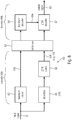
- Fig. 2 shows a portion of an apparatus 10 (which may be the same of that of Fig. 1a ) for encoding an information signal.
- a first measurer 21 may measure a first correlation (e.g., a normalized correlation) 23 associated to the current frame 13 (e.g., the normalized autocorrelation of the first estimate T 1 ).
- a second measurer 22 may measure a second correlation (e.g., a normalized correlation) 25 associated to the current frame 13 (e.g., the normalized autocorrelation of the second estimate T 2 ).
- the first normalized correlation 23 is downscaled at scaler 26 by a predetermined value ⁇ which may be, for example, a value between 0.8 and 0.9, more in particular 0.84 and 0.86, and which may be 0.85.
- the second correlation (e.g., a normalized correlation) 25 associated to the current frame 13 is compared to the scaled first correlation 24 (in examples, useful to understand the invention, the scaler 26 is optional and the first correlation is not scaled).
- the selection 18 between the first estimate 14 (T 1 ) and the second estimate 16 (T 2 ) is based on the comparison performed at the comparer 27.
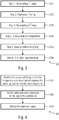
- Step 1 Resampling 1 st stage (step S31)
- the resampling can be implemented using e.g. a classic upsampling+low-pass+downsampling approach.
- the present step is optional in some examples.
- Step S21 High-pass filtering
- the resampled signal is then high-pass filtered using e.g. a 2-order IIR filter with 3dB-cutoff at 50Hz.
- the resulting signal is noted x 1 ( n ).
- the present step is optional in some examples.
- Step 3 Resampling 2 nd stage (step S33)
- the signal x 1 ( n ) is further downsampled by a factor of 2 using e.g. a 4-order FIR low-pass filter followed by a decimator.
- the present step is optional in some examples.
- An autocorrelation process may be performed.
- T min and T max may therefore constitute the extremeities of a first interval where the first estimate (pitch lag of the current frame) is to be found.
- Step 5 Autocorrelation weighting (step S35)
- the autocorrelation may be weighted in order to emphasize the lower pitch lags
- Step 6 First estimation (step S36)
- the first estimate T 1 may be provided as output 14 of the first estimator 11. This may be an estimate of pitch lag for the present frame.
- R ( T ) (or its weighted version R w ( T )) is an example of a first correlation function whose maximum value is associated to the first pitch lag estimate 14 (T 1 ).
- the second estimator 12 (and/or step S102) which may be used, in examples, for providing a second estimate 16 on the basis of the current frame 13 and the previously selected (output) estimate 19" (pitch lag obtained for the previous frame) are here discussed.
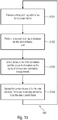
- the method 40 is shown in Fig. 4 .
- the second estimate 16 may be different from the first estimate 14.
- the estimated pitch lag may be different, in some examples, from the pitch lag as previously estimated.
- the search is restricted to a restricted group of lags, which are within a particular second subinterval 52.
- the search is based on the lag 51 which corresponds to the (previously) selected value 19".
- the search is restricted to the lags, in the second subinterval 52, which are within a value ⁇ (which may be, for example, chosen among, 2, 3, 4, 5, 6, 7, 8, 9, 10 or another positive natural number; in some examples, ⁇ may be a percentage of the length of the frame, so that, if the frame has N samples, ⁇ is a percentage between 1% and 30%, in particular 15% and 25%, of N).
- ⁇ may be a pre-defined lag number threshold or a predefined percentage.
- step S42 autocorrelation values within the subinterval 52 are calculated, e.g., by the second measurer 22.
- the value T 2 is provided as output 16 of the second estimator 12.
- first estimate 14 and the second estimate 16 may be significantly different from each other.
- R ( T ) (whose domain is here restricted between T prev - ⁇ and T prev + ⁇ ) is an example of a second correlation function whose maximum value is associated to the second pitch lag estimate 16 (T 2 ).
- the first measurer 21 and/or the second measurer 22 performs correlation measurements.
- the first measurer 21 and the second measurer 22 performs autocorrelation measurements.
- the correlation and/or autocorrelation measurements are normalized. An example, is here provided.
- the first correlation measurement 23 is normcorr(T 1 ), where T 1 is the first estimate 14, and the second correlation measurement 25 is normcorr(T 2 ), where T 2 is the second estimate 16.
- first correlation measurement 23 is the normalized value of R(T 1 ) (or R w (T 1 )), while the second correlation measurement 25 is the normalized value of R(T 2 ).
- T best ⁇ T 1 if normcorr T 2 ⁇ ⁇ normcorr T 1 T 2 otherwise ⁇ normcorr(T 1 ) may be seen as a pitch lag selection threshold 24: if normcorr(T 2 ) ⁇ ⁇ normcorr(T 1 ), the selector chooses T 1 , otherwise the selector chooses T 2 .
- the value T best may be therefore the selected output value 19 (as either T 1 or T 2 ) and provided to the decoder (e.g., for LTPF) and that will be used, as 19", by the second estimator 12 for obtaining the second estimate 16.
- the method 40 associated to the method 30, increases the performances with respect to a technique only based on the method 30.
- the method 40 finds a second maximum for the autocorrelation function. It is not the global maximum like in the method 30, but a local maximum in the neighbourhood of the pitch lag of the previous frame. This second pitch lag, if selected, produces a smooth and continuous pitch contour. We however don't select this second pitch lag in all cases. If there is an expected change in the fundamental frequency for example, it is better to keep the global maximum.
- the final selection is whether to select the first pitch lag T 1 (14) found with method 30 or the second pitch lag T 2 (16) found with method 40.
- This decision is based on a measure of periodicity.
- the second pitch lag T 2 is then chosen if its corresponding normalized correlation is higher than the normalized correlation of the first pitch lag T 1 , scaled by a parameter ⁇ .
- This parameter ⁇ ⁇ 1 makes the decision even smoother by selecting T 2 (16) even when its normalized correlation is slightly below the normalized correlation of the first pitch lag T 1 (14).
- Fig. 5(1) An example of first estimation is shown in Fig. 5(1) : there is chosen the pitch-lag which corresponds to the maximum of the auto-correlation function.
- the auto-correlation function is weighted, as in Fig. 5(2) , putting less emphasis to the higher pitch-lags. This is for example used in [7].
- the global maximum of the weighted autocorrelation is then assumed to correspond to the pitch-lag of the signal.
- the first estimation has also the advantage of a relatively low complexity if the number of lags of the autocorrelation function (first subinterval) is relatively low.
- Figure 5(1) shows the (non-weighted) autocorrelation of the input signal.
- the first peak 53 corresponds to the pitch-lag, and the other ones correspond to multiples 53' of this pitch-lag.
- the first estimation works in several cases. However, there are some cases where it produces an unstable estimate.
- One of this cases is a polyphonic music signal which contains a mix of several tones with different pitches.
- the first estimator 11 could in that case estimate in one frame the pitch of one of the tones (or even maybe a multiple of it), and in the next frame possibly the pitch of another tone (or a multiple of it). So even if the signal is stable (the pitch of the different tones does not change from one frame to the next), the pitch detected by the first estimation can be unstable (the pitch changes significantly from one frame to the next).
- Figure 5(3) shows the weighted autocorrelation and its maximum in a frame of a stable multi-pitch signal. A pitch lag 19" is correctly retrieved at "20" in correspondence with the peak 54.
- Figure 5(4) shows the same in the subsequent frame.
- the first three peaks 54', 54", and 54'" have a very close amplitude. So very slight changes between the two consecutive frames can significantly change the global maximum and the estimated pitch-lag.
- the solution adopted in the present invention solves these instability problems.
- the present solution selects, besides the pitch lag associated to the peak in the frame, a pitch-lag which is close to the pitch-lag of the previous frame.
- Figure 5(3) corresponds to the previous frame and Figure 5(4) corresponds to the current frame.
- a second estimation is performed (e.g., by the second estimator 12) by estimating a second pitch-lag T 2 which maximizes the autocorrelation function around a subinterval 52 the pitch-lag of the previous frame (T prev - ⁇ , T prev + ⁇ ).
- this second pitch-lag T 2 would be 20 (the first pitch-lag being 40).
- T prev - ⁇ ⁇ T 2 ⁇ T prev + ⁇ this is not a generate rule.
- T prev - ⁇ ⁇ T 2 ⁇ T prev + ⁇ the autocorrelation is not weighted.
- this second pitch-lag T 2 we want to select either the first pitch-lag T 1 or the second pitch-lag T 2 based on some criteria. This criteria is based on the normalized correlation (NC), e.g., as measured by the selector 17, which is generally considered a good measure of how periodic is a signal at some particular pitch-lag (a NC of 0 means not periodic at all, a NC of 1 means perfectly periodic).
- NC normalized correlation
- the additional steps provided on top of the first estimation have a very low complexity. Therefore, the proposed invention has low complexity.
- Fig. 6 shows a block scheme relating to the operations for encoding/decoding.
- the scheme shows a system 60 comprising an encoder 60a (which may comprise the apparatus 10) and a decoder 60b.
- the encoder 60a obtains an input information signal 61 (which may be and audio signal and/or may be divided between frames, such as the current frame 13 and the previous frame) and prepares a bitstream 63.
- the decoder 60b obtains the bitstream 63 (e.g., wirelessly, e.g., using Bluetooth) to generate an output signal 68 (e.g., an audio signal).
- the encoder 60a may generate, using a transform coder 62, a frequency domain representation 63a (or a processed version thereof) of the information signal 61 and provide it to the decoder 60b in the bitstream 63.
- the decoder 60b may comprise a transform decoder for obtaining outputs signal 64a.
- the encoder 60a may generate, using a detection unit 65, data useful for performing LTPF at the decoder 60b. These data may comprise a pitch lag estimate (e.g., 19) and/or a gain information. These data may be encoded in the bitstream 63 as data 63b in control fields.
- the data 63b (which may comprise the final estimate 19 of the pitch lag) may be prepared by a LTPF coder 66 (which, in some examples, may decide whether to encode the data 63b).
- LTPF coder 66 which, in some examples, may decide whether to encode the data 63b.
- These data may be used by an LTPF decoder 67 which may apply them to the output signal 64a from the transform decoder 64 to obtain the outputs signal 68.
- the input signal at sampling rate f s may be resampled to a fixed sampling rate of 12.8kHz.
- x(n) is the input signal
- x 12.8 (n) is the resampled signal at 12.8kHz
- tab_resamp_filter[239] ⁇ -2.043055832879108e-05, -4.463458936757081e-05, -7.163663994481459e-05, -1.001011132655914e-04, -1.283728480660395e-04, -1.545438297704662e-04, -1.765445671257668e-04, -1.922569599584802e-04, -1.996438192500382e-04, -1.968886856400547e-04, -1.825383318834690e-04, -1.556394266046803e-04, -1.158603651792638e-04, -6.358930335348977e-05, +2.810064795067786e-19, +7.292180213001337e-05, +1.523970757644272e-04, +2.34920
- pitch detection technique is here discussed (other techniques may be used).
- the second estimate 16 of the pitch lag T 2 may be the lag that maximizes the non-weighted autocorrelation in the neighborhood of the pitch lag (19") estimated in the previous frame
- T prev is the final pitch lag estimated in the previous frame (and its selection therefore conditioned by the previously selected pitch lag).
- normcorr x 6.4 ,64 ,T 1 T 2 otherwise with normcorr(x, L, T) is the normalized correlation of the signal x of length L at lag
- Each normalized correlation 23 or 25 may be at least one of the measurements obtained by the signal first or second measurer 21 or 22.
- pitch_present is 0, no more bits are encoded, resulting in a LTPF bitstream of only one bit.
- pitch_present 1
- two more parameters are encoded, one pitch-lag parameter encoded on 9 bits, and one bit to signal the activation of LTPF.
- pitch lag parameter index ⁇ pitch _ int + 283 if pitch _ int ⁇ 157 2 pitch _ int + pitch _ fr 2 + 126 if 157 > pitch _ int ⁇ 127 4 pitch _ int + pitch _ fr ⁇ 128 if 127 > pitch _ int
- the LTPF activation bit is then set according to:
- the decoded signal in the frequency domain may be postfiltered in the time-domain using a IIR filter whose parameters may depend on LTPF bitstream data "pitch_index" and "ltpf_active".
- a transition mechanism may be applied on the first quarter of the current frame.
- x ⁇ (n) is the filter input signal (i.e. the decoded signal after MDCT synthesis)
- x ltp ⁇ f n is the filter output signal.
- the solution according to the examples above are transparent to the decoder. There is no need for signalling to the decoder, for example, that the first estimate or the second estimate has been selected.
- the decoder does not need to know that the present invention has been implemented. Therefore, the invention permits to increase the compatibility with the legacy systems.
- the pitch lag T best (19) as obtained by the apparatus 10, 60a, or 110 above may be used, at the decoder (e.g., 60b) for implementing a packet loss concealment (PLC) (also known as error concealment).
- PLC packet loss concealment
- PLC is used in audio codecs to conceal lost or corrupted packets during the transmission from the encoder to the decoder.
- PLC may be performed at the decoder side and extrapolate the decoded signal either in the transform-domain or in the time-domain.
- the pitch lag may be the main parameter used in pitch-based PLC. This parameter can be estimated at the encoder-side and encoded into the bitstream. In this case, the pitch lag of the last good frames are used to conceal the current lost frame.
- a corrupted frame does not provide a correct audible output and shall be discarded.
- each decoded frame at the decoder its validity may be verified.
- each frame may have a field carrying a cyclical redundancy code (CRC) which is verified by performing predetermined operations provided by a predetermined algorithm. The procedure may be repeated to verify whether the calculated result corresponds to the value on the CRC field. If a frame has not been properly decoded (e.g., in view of interference in the transmission), it is assumed that some errors have affected the frame. Therefore, if the verification provides a result of incorrect decoding, the frame is held non-properly decoded (invalid, corrupted).
- CRC cyclical redundancy code
- a concealment strategy may be used to provide an audible output: otherwise, something like an annoying audible hole could be heard. Therefore, it is necessary to find some form of frame which "fills the gap" kept open by the non-properly decoded frame.
- the purpose of the frame loss concealment procedure is to conceal the effect of any unavailable or corrupted frame for decoding.
- a frame loss concealment procedure may comprise concealment methods for the various signal types. Best possible codec performance in error-prone situations with frame losses may be obtained through selecting the most suitable method.
- One of the packet loss concealment methods may be, for example, TCX Time Domain Concealment.
- the TCX Time Domain Concealment method is a pitch-based PLC technique operating in the time domain. It is best suited for signals with a dominant harmonic structure.
- An example of the procedure is as follow: the synthesized signal of the last decoded frames is inverse filtered with the LP filter as described in Section 8.2.1 to obtain the periodic signal as described in Section 8.2.2.
- the random signal is generated by a random generator with approximately uniform distribution in Section 8.2.3.
- the two excitation signals are summed up to form the total excitation signal as described in Section 8.2.4, which is adaptively faded out with the attenuation factor described in Section 8.2.6 and finally filtered with the LP filter to obtain the synthesized concealed time signal.
- the LTPF may also be applied on the synthesized concealed time signal as described in Section 8.3. To get a proper overlap with the first good frame after a lost frame, the time domain alias cancelation signal is generated in Section 8.2.5.
- the TCX Time Domain Concealment method is operating in the excitation domain.
- An autocorrelation function may be calculated on 80 equidistant frequency domain bands. Energy is pre-emphasized with the fixed pre-emphasis factor ⁇ f s ⁇ 8000 0.62 16000 0.72 24000 0.82 32000 0.92 48000 0.92
- a Levinson Durbin operation may be used to obtain the LP filter, a c (k), for the concealed frame.
- the LP filter may be calculated only in the first lost frame after a good frame and remains in subsequently lost frames.
- the values pitch-int and pitch_fr are the pitch lag values transmitted in the bitstream.
- the pre-emphasized signal, x pre (k), is further filtered with the calculated inverse LP filter to obtain the prior excitation signal excp(k).
- the first pitch cycle of exc p ' k is first low pass filtered with an 11-tap linear phase FIR (finite impulse response) filter described in the table below f s
- g p is bounded by 0 ⁇ g p ⁇ 1.
- the formed periodic excitation, exc p (k), is attenuated sample-by-sample throughout the frame starting with one and ending with an attenuation factor, ⁇ , to obtain exp p ⁇ k .
- the gain of pitch is calculated only in the first lost frame after a good frame and is set to ⁇ for further consecutive frame losses.
- the excitation signal is high pass filtered with an 11-tap linear phase FIR filter described in the table below to get exc n,HP (k).
- f High pass FIR filter coefficients 8000 - 16000 ⁇ 0, -0.0205, -0.0651, -0.1256, -0.1792, 0.8028, -0.1792, -0.1256, -0.0651, - 0.0205, 0 ⁇ 24000 - 48000 ⁇ -0.0517, -0.0587, -0.0820, -0.1024, -0.1164, 0.8786, -0.1164, -0.1024, -0.0820, -0.0587, -0.0517 ⁇
- g n is first normalized and then multiplied by (1.1 - 0.75g p ) to get g n ⁇ .
- the formed random excitation, exc n (k), is attenuated uniformly with g n ⁇ from the first sample to sample five and following sample-by-sample throughout the frame starting with g n ⁇ and ending with g n ⁇ ⁇ ⁇ to obtain exc n ⁇ k .
- the gain of noise, g n is calculated only in the first lost frame after a good frame and is set to g n ⁇ ⁇ for further consecutive frame losses.
- the random excitation, exc n ⁇ k is added to the periodic excitation, exc p ⁇ k , to form the total excitation signal exc t (k).
- the final synthesized signal for the concealed frame is obtained by filtering the total excitation with the LP filter from Section 8.2.1 and post-processed with the de-emphasis filter.
- the time domain alias cancelation part x TDAC (k) may be generated.
- the constructed signal fades out to zero.
- the fade out speed is controlled by an attenuation factor, ⁇ , which is dependent on the previous attenuation factor, ⁇ -1 , the gain of pitch, g p , calculated on the last correctly received frame, the number of consecutive erased frames, nbLostCmpt, and the stability, ⁇ .
- the following procedure may be used to compute the attenuation factor, ⁇
- the factor ⁇ is bounded by 0 ⁇ ⁇ ⁇ 1, with larger values of ⁇ corresponding to more stable signals. This limits energy and spectral envelope fluctuations. If there are no two adjacent scalefactor vectors present, the factor ⁇ is set to 0.8.
- Fig. 9 shows a general example of a method 100' which may be used for operating the decoder 60b.
- an encoded version of a signal may be decoded.
- the frame may be received (e.g., via a Bluetooth connection) and/or obtained from a storage unit.
- the pitch lag T best (selected between T 1 and T 2 as discussed above) may be used for both PLC and LTPF.
- step S102' the validity of the frame is checked (for example with CRC, parity, etc.). If the invalidity of the frame is acknowledged, concealment is performed (see below). Otherwise, if the frame is held valid, at step S103' it is checked whether pitch information is encoded in the frame. In some examples, the pitch information is encoded only if the harmonicity has been acknowledged as being over a particular threshold (which may indicate, for example, harmonicity sufficiently high for performing LTPF and/or PLC, for example).
- step S104' If at S103' it is acknowledged that the pitch information is actually encoded, then the pitch information is decoded and stored at step S104'. Otherwise, the cycle ends and a new frame may be decoded at S101'.
- step S105' it is checked whether the LTPF is enabled. If it is verified that the LTPF is enabled, then LTPF is performed at step S106. Otherwise, the LTPF is skipped; the cycle ends; and a new frame may be decoded at S101'.
- step S107' it is verified whether the pitch information of the previous frame (or a pitch information of one of the previous frames) is stored in the memory (i.e., it is at disposal).
- step S108 error concealment may be performed at step S108.
- MDCT or MDST
- frame resolution repetition with signal scrambling, and/or TCX time domain concealment, and/or phase ECU may be performed.
- a different concealment technique per se known and not implying the use of a pitch information provided by the encoder, may be used at step S109'.
- Some of these techniques may be based on estimating the pitch information and/or other harmonicity information at the decoder. In some examples, no concealment technique may be performed in this case. After having performed the concealment, the cycle ends and a new frame may be decoded at S101'.
- the pitch lag used by the PLC is the value 19 (t best ) prepared by the apparatus 10 and/or 60b, on the basis of the selection between the estimations T 1 and T 2 , as discussed above.
- Fig. 7 shows an apparatus 110 which may implement the apparatus 10 and/or 60a perform at least some steps of the methods above.
- the apparatus 110 comprises a processor 111 and a non-transitory memory unit 112 storing instructions (e.g., a program) which, when executed by the processor 111, causes the processor 111 to perform a first estimation 112a (e.g., such as to implement the first estimator 11), a second estimation 112b (e.g., such as to implement the second estimator 12), and a selection 112c (e.g., such as to implement the selector 18).
- the apparatus 110 may comprise an input unit 116, which may obtain an input information signal (e.g., an audio signal).
- the apparatus may store a bitstream, for example in the storage space 128.
- Fig. 8 shows an apparatus 120 which may implement the decoder 60b, and/or perform an LTPF filtering, for example.
- the apparatus 120 may comprise a processor 121 and a non-transitory memory unit 122 storing instructions 122a (e.g., a program) which, when executed by the processor 121, may cause the processor 121 to perform, inter alia, an LTPF filtering operation, e.g., on the basis of a parameter obtained from the encoder.
- the apparatus 120 may comprise an input unit 126, which may obtain a decoded representation of an information signal (e.g., an audio signal).
- the processor 121 may therefore perform processes to obtain a decoded representation of the information signal.
- This decoded representation may be provided to external units using an output unit 127.
- the output unit 127 may comprise, for example, a communication unit to communicate to external devices (e.g., using wireless communication, such as Bluetooth) and/or external storage spaces.
- the processor 121 may save the decoded representation of the audio signal in a local storage space 128.
- the systems 110 and 120 may be the same device.
- examples may be implemented in hardware.
- the implementation may be performed using a digital storage medium, for example a floppy disk, a Digital Versatile Disc (DVD), a Blu-Ray Disc, a Compact Disc (CD), a Read-only Memory (ROM), a Programmable Read-only Memory (PROM), an
- EPROM Erasable and Programmable Read-only Memory
- EEPROM Electrically Erasable Programmable Read-Only Memory
- flash memory having electronically readable control signals stored thereon, which cooperate (or are capable of cooperating) with a programmable computer system such that the respective method is performed. Therefore, the digital storage medium may be computer readable.
- examples may be implemented as a computer program product with program instructions, the program instructions being operative for performing one of the methods when the computer program product runs on a computer.
- the program instructions may for example be stored on a machine readable medium.
- Examples comprise the computer program for performing one of the methods described herein, stored on a machine readable carrier.
- an example of method is, therefore, a computer program having a program instructions for performing one of the methods described herein, when the computer program runs on a computer.
- a further example of the methods is, therefore, a data carrier medium (or a digital storage medium, or a computer-readable medium) comprising, recorded thereon, the computer program for performing one of the methods described herein.
- the data carrier medium, the digital storage medium or the recorded medium are tangible and/or non-transitionary, rather than signals which are intangible and transitory.
- a further example comprises a processing unit, for example a computer, or a programmable logic device performing one of the methods described herein.
- a further example comprises a computer having installed thereon the computer program for performing one of the methods described herein.
- a further example comprises an apparatus or a system transferring (for example, electronically or optically) a computer program for performing one of the methods described herein to a receiver.
- the receiver may, for example, be a computer, a mobile device, a memory device or the like.
- the apparatus or system may, for example, comprise a file server for transferring the computer program to the receiver.
- a programmable logic device for example, a field programmable gate array
- a field programmable gate array may cooperate with a microprocessor in order to perform one of the methods described herein.
- the methods may be performed by any appropriate hardware apparatus.
Landscapes
- Engineering & Computer Science (AREA)
- Computational Linguistics (AREA)
- Signal Processing (AREA)
- Health & Medical Sciences (AREA)
- Audiology, Speech & Language Pathology (AREA)
- Human Computer Interaction (AREA)
- Physics & Mathematics (AREA)
- Acoustics & Sound (AREA)
- Multimedia (AREA)
- Theoretical Computer Science (AREA)
- Compression, Expansion, Code Conversion, And Decoders (AREA)
Claims (22)
- Eine Vorrichtung (10, 60a, 110) zum Codieren eines Audiosignals, das eine Mehrzahl von Rahmen umfasst, wobei die Vorrichtung folgende Merkmale aufweist:einen ersten Schätzer (11), der dazu ausgebildet ist, einen ersten Schätzwert (14, T1) zu erhalten, wobei der erste Schätzwert ein Schätzwert einer Tonhöhenverzögerung für einen aktuellen Rahmen (13) ist, wobei der erste Schätzwert (14) als die Verzögerung (T1) erhalten wird, die eine dem aktuellen Rahmen (13) zugeordnete erste Korrelationsfunktion maximiert;einen zweiten Schätzer (12), der dazu ausgebildet ist, einen zweiten Schätzwert (16, T2) zu erhalten, wobei der zweite Schätzwert ein weiterer Schätzwert einer Tonhöhenverzögerung für den aktuellen Rahmen (13) ist, wobei der zweite Schätzer (12) durch die Tonhöhenverzögerung (51, 19") konditioniert wird, die an dem vorherigen Rahmen ausgewählt ist, um den zweiten Schätzwert (16, T2) für den aktuellen Rahmen (13) zu erhalten, wobei der zweite Schätzer (12) dazu ausgebildet ist, den zweiten Schätzwert (16, T2) zu erhalten, indem er die Verzögerung sucht, die eine zweite Korrelationsfunktion in einem zweiten Teilintervall (52) maximiert, das die für den vorherigen Rahmen ausgewählte Tonhöhenverzögerung (51, 19") enthält,einen Selektor (17), der dazu ausgebildet ist, einen ausgewählten Wert (19, Tbest) zu wählen (S103), indem er eine Auswahl zwischen dem ersten Schätzwert (14, T1) und dem zweiten Schätzwert (16, T2) auf der Basis einer ersten und einer zweiten Korrelationsmessung (23, 25) durchführt, wobei der Selektor (17) dazu ausgebildet ist, einen Vergleich zwischen Folgenden durchzuführen:eine herunterskalierte Version (24) einer ersten normierten Autokorrelationsmessung (23), die dem aktuellen Rahmen (13) zugeordnet ist und die bei einer Verzögerung, die dem ersten Schätzwert (14, T1) entspricht, erhalten wird; undeine zweite normierte Autokorrelationsmessung (25), die dem aktuellen Rahmen (13) zugeordnet ist und die bei einer Verzögerung erhalten wird, die dem zweiten Schätzwert (16, T2) entspricht,um den ersten Schätzwert (14, T1) auszuwählen, wenn die zweite normierte Autokorrelationsmessung (25) geringer ist als die herunterskalierte Version (24) der ersten normierten Autokorrelationsmessung (23) und/oderum den zweiten Schätzwert (16, T2) auszuwählen, wenn die zweite normierte Autokorrelationsmessung (25) größer ist als die herunterskalierte Version (24) der ersten normierten Autokorrelationsmessung (23).
- Die Vorrichtung (60a) gemäß Anspruch 1, die ferner folgende Merkmale aufweist:eine Erfassungseinheit (10, 65), die den ersten Schätzer, den zweiten Schätzer und den Selektor (17) aufweist; undein Langzeit-Nachfilterungswerkzeug (LTPF-Werkzeug, LTPF = long-term post filtering) (66), das dazu ausgebildet ist, Daten zu codieren, die nützlich zum Durchführen einer LTPF an einem Decodierer (60b) sind, wobei die Daten, die nützlich zum Durchführen einer LTPF sind, den ausgewählten Wert (19, Tbest) umfassen.
- Die Vorrichtung gemäß Anspruch 1, die ferner in Verarbeitungsrichtung nach dem Selektor (17) ein Langzeit-Nachfilterungswerkzeug (LTPF-Werkzeug, LTPF = long-term post filtering) (66) zum Steuern eines Langzeit-Nachfilters (67) an einer Decodiervorrichtung (60b) aufweist.
- Die Vorrichtung gemäß einem der vorhergehenden Ansprüche, die dazu ausgebildet ist, die Harmonizität des ausgewählten Werts (19, Tbest) mit einem vorbestimmten Langzeit-Nachfilterungs(LTPF)-Schwellwert zu vergleichen, um ein Codieren des ausgewählten Werts (19, Tbest) zu vermeiden, falls die Harmonizität des ausgewählten Werts (19, Tbest) unter dem vorbestimmten Schwellwert liegt.
- Die Vorrichtung gemäß einem der vorhergehenden Ansprüche, bei der:das zweite Teilintervall (52) Verzögerungen (T) innerhalb eines Abstands von weniger als einem vordefinierten Verzögerungsanzahlschwellwert von der für den vorherigen Rahmen ausgewählten Tonhöhenverzögerung (51, 19") enthält.
- Die Vorrichtung gemäß einem der vorhergehenden Ansprüche, bei der der zweite Schätzer (12) dazu ausgebildet ist:
unter den zweiten Korrelationsfunktionswerten einen maximalen Wert zu suchen, um den zweiten Schätzwert (16) der Verzögerung (T2) zuzuordnen, die dem maximalen Wert unter den zweiten Korrelationsfunktionswerten zugeordnet ist. - Die Vorrichtung gemäß einem der vorhergehenden Ansprüche, bei der die erste Korrelationsfunktion auf Verzögerungen in einem ersten Teilintervall beschränkt ist.
- Die Vorrichtung gemäß Anspruch 7, bei der das erste Teilintervall eine größere Anzahl von Verzögerungen aufweist als das zweite Teilintervall (52) und/oder zumindest manche der Verzögerungen in dem zweiten Teilintervall (52) in dem ersten Teilintervall enthalten sind.
- Die Vorrichtung gemäß einem der vorhergehenden Ansprüche, bei der der erste Schätzer (11) dazu ausgebildet ist:
die Korrelationsmesswerte der ersten Korrelationsfunktion unter Verwendung einer monotonisch abnehmenden Gewichtsfunktion vor dem Suchen nach der Verzögerung (T1), die die erste Korrelationsfunktion maximiert, zu gewichten. - Die Vorrichtung gemäß einem der vorhergehenden Ansprüche, bei der der erste Schätzer (11) dazu ausgebildet ist, den ersten Schätzwert T 1 durch Durchführen zumindest mancher der folgenden Operationen zu erhalten:


- Die Vorrichtung gemäß einem der vorhergehenden Ansprüche, bei der der zweite Schätzer (12) dazu ausgebildet ist, den zweiten Schätzwert T 2 zu erhalten, indem er Folgendes durchführt:


- Die Vorrichtung gemäß einem der vorhergehenden Ansprüche, bei der der Selektor (17) dazu ausgebildet ist, eine Auswahl des Tonhöhenverzögerungsschätzwerts Tcurr bezüglich

wobei T 1 der erste Schätzwert ist, T 2 der zweite Schätzwert ist, x ein Wert des Audiosignals oder einer verarbeiteten Version desselben ist, normcorr(x, N, T) die normierte Korrelationsmessung des Signals x der Länge N bei der Verzögerung T, ist, wobei α ein Herunterskalierkoeffizient ist. - Die Vorrichtung gemäß einem der vorhergehenden Ansprüche, die dazu ausgebildet ist, die erste und die zweite normierte Autokorrelationsmessung unter Verwendung derselben Korrelationsfunktion bis zu einer Gewichtungsfunktion zu erhalten.
- Die Vorrichtung gemäß einem der vorhergehenden Ansprüche, die dazu ausgebildet ist, die erste normierte Autokorrelationsmessung als die normierte Version des ersten Schätzwerts bis zu einer Gewichtungsfunktion zu erhalten.
- Die Vorrichtung gemäß einem der vorhergehenden Ansprüche, die dazu ausgebildet ist, die zweite normierte Autokorrelationsmessung als die normierte Version des zweiten Schätzwerts zu erhalten.
- Die Vorrichtung gemäß einem der vorhergehenden Ansprüche, die ferner einen Transformationscodierer (62) aufweist, der dazu ausgebildet ist, eine Darstellung (63a) des Informationssignals (61) oder einer verarbeiteten Version desselben zu erzeugen.
- Ein System (60), das eine Codiererseite (10, 60a) und eine Decodiererseite (60b) aufweist, wobei die Codiererseite die Vorrichtung gemäß einem der vorhergehenden Ansprüche aufweist, wobei die Decodiererseite ein Langzeit-Nachfilterungswerkzeug (67) aufweist, das auf der Basis des durch den Selektor (17) ausgewählten Tonhöhenverzögerungsschätzwerts gesteuert wird.
- Ein Verfahren (100) zum Bestimmen einer Tonhöhenverzögerung für ein in Rahmen unterteiltes Audiosignal, wobei das Verfahren folgende Schritte aufweist:Durchführen einer ersten Schätzung für einen aktuellen Rahmen (S101), um einen ersten Schätzwert (14) als die Verzögerung (T1) zu erhalten, die eine dem aktuellen Rahmen (13) zugeordnete erste Korrelationsfunktion maximiert;Durchführen einer zweiten Schätzung für den aktuellen Rahmen (S102), der durch Suchen nach der Verzögerung (T2) erhalten wird, die eine zweite Korrelationsfunktion in einem zweiten Teilintervall (52) maximiert, das die für den vorherigen Rahmen ausgewählte Tonhöhenverzögerung (51, 19") enthält, wobei das Durchführen der zweiten Schätzung auf der Basis des Ergebnisses eines an dem vorherigen Rahmen durchgeführten Auswahlschrittes erhalten wird; undAuswählen zwischen dem ersten Schätzwert (14, T1), der bei der ersten Schätzung erhalten wird, und des zweiten Schätzwerts (16, T2), der bei der zweiten Schätzung erhalten wird, auf der Basis einer ersten und einer zweiten normierten Autokorrelationsmessung (S103), wobei das Auswählen ein Durchführen eines Vergleichs zwischen Folgenden umfasst:eine herunterskalierte Version (24) der ersten normierten Autokorrelationsmessung (23), die dem aktuellen Rahmen (13) zugeordnet ist und die bei einer Verzögerung, die dem ersten Schätzwert (14, T1) entspricht, erhalten wird; undeine zweite normierte Autokorrelationsmessung (25), die dem aktuellen Rahmen (13) zugeordnet ist und die bei einer Verzögerung erhalten wird, die dem zweiten Schätzwert (16, T2) entspricht; undAuswählen des ersten Schätzwerts (14, T1), wenn die zweite normierte Autokorrelationsmessung (25) geringer ist als die herunterskalierte Version (24) der ersten normierten Autokorrelationsmessung (23) und/oder Auswählen des zweiten Schätzwerts (16, T2), wenn die zweite normierte Autokorrelationsmessung (25) größer ist als die herunterskalierte Version der ersten normierten Autokorrelationsmessung (23).
- Das Verfahren gemäß Anspruch 18, das ferner eine Verwendung der ausgewählten Verzögerung für Langzeit-Nachfilterung, LTPF, aufweist.
- Ein Verfahren (100) zum Codieren eines Bitstroms für ein in Rahmen unterteiltes Audiosignal, das folgende Schritte aufweist:Durchführen des Verfahrens gemäß Anspruch 18 oder 19; undCodieren von Daten, die nützlich zum Durchführen einer Langzeit-Nachfilterung, LTPF, an dem Decodierer (60b) sind, wobei die zum Durchführen der LTPF nützlichen Daten den ausgewählten Wert (19,Tbest) umfassen.
- Das Verfahren gemäß einem der Ansprüche 18 bis 20, das ferner eine Verwendung der ausgewählten Verzögerung für eine Maskierung von Datenpaketverlust, PLC (packet loss concealment) aufweist.
- Ein Programm, das Anweisungen aufweist, die, wenn sie durch einen Prozessor (111) ausgeführt werden, den Prozessor dazu veranlassen, ein Verfahren gemäß einem der Ansprüche 18 bis 21 durchzuführen.
Priority Applications (1)
| Application Number | Priority Date | Filing Date | Title |
|---|---|---|---|
| PL18795669T PL3707718T3 (pl) | 2017-11-10 | 2018-11-05 | Wybieranie opóźnienia wysokości tonu |
Applications Claiming Priority (2)
| Application Number | Priority Date | Filing Date | Title |
|---|---|---|---|
| EP17201091.0A EP3483886A1 (de) | 2017-11-10 | 2017-11-10 | Auswahl einer grundfrequenz |
| PCT/EP2018/080195 WO2019091922A1 (en) | 2017-11-10 | 2018-11-05 | Selecting pitch lag |
Publications (2)
| Publication Number | Publication Date |
|---|---|
| EP3707718A1 EP3707718A1 (de) | 2020-09-16 |
| EP3707718B1 true EP3707718B1 (de) | 2021-10-13 |
Family
ID=60301906
Family Applications (2)
| Application Number | Title | Priority Date | Filing Date |
|---|---|---|---|
| EP17201091.0A Withdrawn EP3483886A1 (de) | 2017-11-10 | 2017-11-10 | Auswahl einer grundfrequenz |
| EP18795669.3A Active EP3707718B1 (de) | 2017-11-10 | 2018-11-05 | Auswahl einer grundfrequenz |
Family Applications Before (1)
| Application Number | Title | Priority Date | Filing Date |
|---|---|---|---|
| EP17201091.0A Withdrawn EP3483886A1 (de) | 2017-11-10 | 2017-11-10 | Auswahl einer grundfrequenz |
Country Status (18)
| Country | Link |
|---|---|
| US (1) | US11380341B2 (de) |
| EP (2) | EP3483886A1 (de) |
| JP (1) | JP7079325B2 (de) |
| KR (1) | KR102426050B1 (de) |
| CN (1) | CN111566733B (de) |
| AR (1) | AR114388A1 (de) |
| AU (1) | AU2018363670B2 (de) |
| CA (1) | CA3082175C (de) |
| ES (1) | ES2900058T3 (de) |
| MX (1) | MX2020004786A (de) |
| MY (1) | MY204547A (de) |
| PL (1) | PL3707718T3 (de) |
| PT (1) | PT3707718T (de) |
| RU (1) | RU2742739C1 (de) |
| SG (1) | SG11202004203WA (de) |
| TW (1) | TWI728277B (de) |
| WO (1) | WO2019091922A1 (de) |
| ZA (1) | ZA202002521B (de) |
Families Citing this family (2)
| Publication number | Priority date | Publication date | Assignee | Title |
|---|---|---|---|---|
| US11756530B2 (en) * | 2019-10-19 | 2023-09-12 | Google Llc | Self-supervised pitch estimation |
| US11699209B2 (en) * | 2020-10-22 | 2023-07-11 | Huawei Cloud Computing Technologies Co., Ltd. | Method and apparatus for embedding and extracting digital watermarking for numerical data |
Family Cites Families (184)
| Publication number | Priority date | Publication date | Assignee | Title |
|---|---|---|---|---|
| DE3639753A1 (de) | 1986-11-21 | 1988-06-01 | Inst Rundfunktechnik Gmbh | Verfahren zum uebertragen digitalisierter tonsignale |
| US5012517A (en) | 1989-04-18 | 1991-04-30 | Pacific Communication Science, Inc. | Adaptive transform coder having long term predictor |
| US5233660A (en) * | 1991-09-10 | 1993-08-03 | At&T Bell Laboratories | Method and apparatus for low-delay celp speech coding and decoding |
| JPH05281996A (ja) * | 1992-03-31 | 1993-10-29 | Sony Corp | ピッチ抽出装置 |
| IT1270438B (it) * | 1993-06-10 | 1997-05-05 | Sip | Procedimento e dispositivo per la determinazione del periodo del tono fondamentale e la classificazione del segnale vocale in codificatori numerici della voce |
| US5581653A (en) | 1993-08-31 | 1996-12-03 | Dolby Laboratories Licensing Corporation | Low bit-rate high-resolution spectral envelope coding for audio encoder and decoder |
| JP3402748B2 (ja) * | 1994-05-23 | 2003-05-06 | 三洋電機株式会社 | 音声信号のピッチ周期抽出装置 |
| JPH0811644A (ja) | 1994-06-27 | 1996-01-16 | Nissan Motor Co Ltd | ルーフモール取付構造 |
| US6167093A (en) | 1994-08-16 | 2000-12-26 | Sony Corporation | Method and apparatus for encoding the information, method and apparatus for decoding the information and method for information transmission |
| EP0732687B2 (de) | 1995-03-13 | 2005-10-12 | Matsushita Electric Industrial Co., Ltd. | Vorrichtung zur Erweiterung der Sprachbandbreite |
| US5781888A (en) | 1996-01-16 | 1998-07-14 | Lucent Technologies Inc. | Perceptual noise shaping in the time domain via LPC prediction in the frequency domain |
| WO1997027578A1 (en) * | 1996-01-26 | 1997-07-31 | Motorola Inc. | Very low bit rate time domain speech analyzer for voice messaging |
| US5812971A (en) | 1996-03-22 | 1998-09-22 | Lucent Technologies Inc. | Enhanced joint stereo coding method using temporal envelope shaping |
| JPH1091194A (ja) | 1996-09-18 | 1998-04-10 | Sony Corp | 音声復号化方法及び装置 |
| US6570991B1 (en) | 1996-12-18 | 2003-05-27 | Interval Research Corporation | Multi-feature speech/music discrimination system |
| KR100261253B1 (ko) | 1997-04-02 | 2000-07-01 | 윤종용 | 비트율 조절이 가능한 오디오 부호화/복호화 방법및 장치 |
| GB2326572A (en) | 1997-06-19 | 1998-12-23 | Softsound Limited | Low bit rate audio coder and decoder |
| AU9404098A (en) | 1997-09-23 | 1999-04-12 | Voxware, Inc. | Scalable and embedded codec for speech and audio signals |
| JP3344962B2 (ja) | 1998-03-11 | 2002-11-18 | 松下電器産業株式会社 | オーディオ信号符号化装置、及びオーディオ信号復号化装置 |
| US6507814B1 (en) * | 1998-08-24 | 2003-01-14 | Conexant Systems, Inc. | Pitch determination using speech classification and prior pitch estimation |
| US7272556B1 (en) | 1998-09-23 | 2007-09-18 | Lucent Technologies Inc. | Scalable and embedded codec for speech and audio signals |
| US6636829B1 (en) * | 1999-09-22 | 2003-10-21 | Mindspeed Technologies, Inc. | Speech communication system and method for handling lost frames |
| US7099830B1 (en) | 2000-03-29 | 2006-08-29 | At&T Corp. | Effective deployment of temporal noise shaping (TNS) filters |
| US6735561B1 (en) | 2000-03-29 | 2004-05-11 | At&T Corp. | Effective deployment of temporal noise shaping (TNS) filters |
| EP1139665A1 (de) | 2000-03-29 | 2001-10-04 | Deutsche Thomson-Brandt Gmbh | Verfahren und Gerät für die Ausgabeverzögerungsänderung während der Video- oder Tonkodierung |
| US6665638B1 (en) * | 2000-04-17 | 2003-12-16 | At&T Corp. | Adaptive short-term post-filters for speech coders |
| US7395209B1 (en) | 2000-05-12 | 2008-07-01 | Cirrus Logic, Inc. | Fixed point audio decoding system and method |
| AU2001270365A1 (en) | 2001-06-11 | 2002-12-23 | Ivl Technologies Ltd. | Pitch candidate selection method for multi-channel pitch detectors |
| US7353168B2 (en) | 2001-10-03 | 2008-04-01 | Broadcom Corporation | Method and apparatus to eliminate discontinuities in adaptively filtered signals |
| US6785645B2 (en) | 2001-11-29 | 2004-08-31 | Microsoft Corporation | Real-time speech and music classifier |
| US20030187663A1 (en) | 2002-03-28 | 2003-10-02 | Truman Michael Mead | Broadband frequency translation for high frequency regeneration |
| US7447631B2 (en) | 2002-06-17 | 2008-11-04 | Dolby Laboratories Licensing Corporation | Audio coding system using spectral hole filling |
| US7433824B2 (en) | 2002-09-04 | 2008-10-07 | Microsoft Corporation | Entropy coding by adapting coding between level and run-length/level modes |
| US7502743B2 (en) | 2002-09-04 | 2009-03-10 | Microsoft Corporation | Multi-channel audio encoding and decoding with multi-channel transform selection |
| JP4287637B2 (ja) | 2002-10-17 | 2009-07-01 | パナソニック株式会社 | 音声符号化装置、音声符号化方法及びプログラム |
| CN1748247B (zh) * | 2003-02-11 | 2011-06-15 | 皇家飞利浦电子股份有限公司 | 音频编码 |
| KR20030031936A (ko) | 2003-02-13 | 2003-04-23 | 배명진 | 피치변경법을 이용한 단일 음성 다중 목소리 합성기 |
| US20040162866A1 (en) | 2003-02-19 | 2004-08-19 | Malvar Henrique S. | System and method for producing fast modulated complex lapped transforms |
| JP2006527864A (ja) | 2003-06-17 | 2006-12-07 | 松下電器産業株式会社 | 受信機器、送信機器および伝送システム |
| CN100508030C (zh) | 2003-06-30 | 2009-07-01 | 皇家飞利浦电子股份有限公司 | 一种编码/解码音频信号的方法及相应设备 |
| US7620545B2 (en) | 2003-07-08 | 2009-11-17 | Industrial Technology Research Institute | Scale factor based bit shifting in fine granularity scalability audio coding |
| KR100550003B1 (ko) * | 2003-07-11 | 2006-02-08 | 학교법인연세대학교 | 상호부호화기에서 개회로 피치 추정 방법 및 그 장치 |
| BRPI0412717A (pt) * | 2003-07-18 | 2006-09-26 | Koninkl Philips Electronics Nv | métodos para codificar um sinal e para decodificar um fluxo de áudio, codoficador de áudio, reprodutor de áudio, sistema de áudio, fluxo de áudio, e, meio de armazenagem |
| US7983909B2 (en) | 2003-09-15 | 2011-07-19 | Intel Corporation | Method and apparatus for encoding audio data |
| US7009533B1 (en) | 2004-02-13 | 2006-03-07 | Samplify Systems Llc | Adaptive compression and decompression of bandlimited signals |
| KR20050087956A (ko) | 2004-02-27 | 2005-09-01 | 삼성전자주식회사 | 무손실 오디오 부호화/복호화 방법 및 장치 |
| ATE390683T1 (de) | 2004-03-01 | 2008-04-15 | Dolby Lab Licensing Corp | Mehrkanalige audiocodierung |
| DE102004009949B4 (de) | 2004-03-01 | 2006-03-09 | Fraunhofer-Gesellschaft zur Förderung der angewandten Forschung e.V. | Vorrichtung und Verfahren zum Ermitteln eines Schätzwertes |
| DE102004009954B4 (de) | 2004-03-01 | 2005-12-15 | Fraunhofer-Gesellschaft zur Förderung der angewandten Forschung e.V. | Vorrichtung und Verfahren zum Verarbeiten eines Multikanalsignals |
| CN1930607B (zh) | 2004-03-05 | 2010-11-10 | 松下电器产业株式会社 | 差错隐藏装置以及差错隐藏方法 |
| US7392195B2 (en) | 2004-03-25 | 2008-06-24 | Dts, Inc. | Lossless multi-channel audio codec |
| US7933767B2 (en) * | 2004-12-27 | 2011-04-26 | Nokia Corporation | Systems and methods for determining pitch lag for a current frame of information |
| US8260611B2 (en) | 2005-04-01 | 2012-09-04 | Qualcomm Incorporated | Systems, methods, and apparatus for highband excitation generation |
| US7539612B2 (en) | 2005-07-15 | 2009-05-26 | Microsoft Corporation | Coding and decoding scale factor information |
| US7546240B2 (en) | 2005-07-15 | 2009-06-09 | Microsoft Corporation | Coding with improved time resolution for selected segments via adaptive block transformation of a group of samples from a subband decomposition |
| KR20070037945A (ko) | 2005-10-04 | 2007-04-09 | 삼성전자주식회사 | 오디오 신호의 부호화/복호화 방법 및 장치 |
| US20070118361A1 (en) | 2005-10-07 | 2007-05-24 | Deepen Sinha | Window apparatus and method |
| KR100888474B1 (ko) | 2005-11-21 | 2009-03-12 | 삼성전자주식회사 | 멀티채널 오디오 신호의 부호화/복호화 장치 및 방법 |
| US7805297B2 (en) | 2005-11-23 | 2010-09-28 | Broadcom Corporation | Classification-based frame loss concealment for audio signals |
| US9123350B2 (en) | 2005-12-14 | 2015-09-01 | Panasonic Intellectual Property Management Co., Ltd. | Method and system for extracting audio features from an encoded bitstream for audio classification |
| US8255207B2 (en) | 2005-12-28 | 2012-08-28 | Voiceage Corporation | Method and device for efficient frame erasure concealment in speech codecs |
| US8345890B2 (en) | 2006-01-05 | 2013-01-01 | Audience, Inc. | System and method for utilizing inter-microphone level differences for speech enhancement |
| CN101395661B (zh) | 2006-03-07 | 2013-02-06 | 艾利森电话股份有限公司 | 音频编码和解码的方法和设备 |
| US8150065B2 (en) | 2006-05-25 | 2012-04-03 | Audience, Inc. | System and method for processing an audio signal |
| JP2009539132A (ja) | 2006-05-30 | 2009-11-12 | コーニンクレッカ フィリップス エレクトロニクス エヌ ヴィ | オーディオ信号の線形予測符号化 |
| CN1983909B (zh) * | 2006-06-08 | 2010-07-28 | 华为技术有限公司 | 一种丢帧隐藏装置和方法 |
| US8015000B2 (en) | 2006-08-03 | 2011-09-06 | Broadcom Corporation | Classification-based frame loss concealment for audio signals |
| WO2008021247A2 (en) | 2006-08-15 | 2008-02-21 | Dolby Laboratories Licensing Corporation | Arbitrary shaping of temporal noise envelope without side-information |
| FR2905510B1 (fr) | 2006-09-01 | 2009-04-10 | Voxler Soc Par Actions Simplif | Procede d'analyse en temps reel de la voix pour le controle en temps reel d'un organe numerique et dispositif associe |
| CN101140759B (zh) | 2006-09-08 | 2010-05-12 | 华为技术有限公司 | 语音或音频信号的带宽扩展方法及系统 |
| US7752038B2 (en) | 2006-10-13 | 2010-07-06 | Nokia Corporation | Pitch lag estimation |
| DE102006049154B4 (de) | 2006-10-18 | 2009-07-09 | Fraunhofer-Gesellschaft zur Förderung der angewandten Forschung e.V. | Kodierung eines Informationssignals |
| KR101292771B1 (ko) | 2006-11-24 | 2013-08-16 | 삼성전자주식회사 | 오디오 신호의 오류은폐방법 및 장치 |
| JPWO2008072701A1 (ja) | 2006-12-13 | 2010-04-02 | パナソニック株式会社 | ポストフィルタおよびフィルタリング方法 |
| FR2912249A1 (fr) | 2007-02-02 | 2008-08-08 | France Telecom | Codage/decodage perfectionnes de signaux audionumeriques. |
| JP4871894B2 (ja) | 2007-03-02 | 2012-02-08 | パナソニック株式会社 | 符号化装置、復号装置、符号化方法および復号方法 |
| EP2015293A1 (de) | 2007-06-14 | 2009-01-14 | Deutsche Thomson OHG | Verfahren und Vorrichtung zur Kodierung und Dekodierung von Audiosignalen über adaptiv geschaltete temporäre Auflösung in einer Spektraldomäne |
| US20110022924A1 (en) * | 2007-06-14 | 2011-01-27 | Vladimir Malenovsky | Device and Method for Frame Erasure Concealment in a PCM Codec Interoperable with the ITU-T Recommendation G. 711 |
| JP4928366B2 (ja) * | 2007-06-25 | 2012-05-09 | 日本電信電話株式会社 | ピッチ探索装置、パケット消失補償装置、それらの方法、プログラム及びその記録媒体 |
| JP4572218B2 (ja) | 2007-06-27 | 2010-11-04 | 日本電信電話株式会社 | 音楽区間検出方法、音楽区間検出装置、音楽区間検出プログラム及び記録媒体 |
| US10795949B2 (en) | 2007-07-26 | 2020-10-06 | Hamid Hatami-Hanza | Methods and systems for investigation of compositions of ontological subjects and intelligent systems therefrom |
| WO2009027606A1 (fr) | 2007-08-24 | 2009-03-05 | France Telecom | Codage/decodage par plans de symboles, avec calcul dynamique de tables de probabilites |
| EP2186087B1 (de) | 2007-08-27 | 2011-11-30 | Telefonaktiebolaget L M Ericsson (PUBL) | Verbesserte transformationskodierung von sprach- und audiosignalen |
| CN100524462C (zh) | 2007-09-15 | 2009-08-05 | 华为技术有限公司 | 对高带信号进行帧错误隐藏的方法及装置 |
| JP5547081B2 (ja) | 2007-11-02 | 2014-07-09 | 華為技術有限公司 | 音声復号化方法及び装置 |
| WO2009066869A1 (en) | 2007-11-21 | 2009-05-28 | Electronics And Telecommunications Research Institute | Frequency band determining method for quantization noise shaping and transient noise shaping method using the same |
| JP5485909B2 (ja) | 2007-12-31 | 2014-05-07 | エルジー エレクトロニクス インコーポレイティド | オーディオ信号処理方法及び装置 |
| US8386271B2 (en) | 2008-03-25 | 2013-02-26 | Microsoft Corporation | Lossless and near lossless scalable audio codec |
| RU2475868C2 (ru) | 2008-06-13 | 2013-02-20 | Нокиа Корпорейшн | Способ и устройство для маскирования ошибок кодированных аудиоданных |
| EP2144230A1 (de) | 2008-07-11 | 2010-01-13 | Fraunhofer-Gesellschaft zur Förderung der angewandten Forschung e.V. | Audiokodierungs-/Audiodekodierungsschema geringer Bitrate mit kaskadierten Schaltvorrichtungen |
| EP2311034B1 (de) | 2008-07-11 | 2015-11-04 | Fraunhofer-Gesellschaft zur Förderung der angewandten Forschung e.V. | Toncodierer und decodierer zur codierung von rahmen abgetasteter tonsignale |
| EP2144231A1 (de) | 2008-07-11 | 2010-01-13 | Fraunhofer-Gesellschaft zur Förderung der angewandten Forschung e.V. | Audiokodierungs-/-dekodierungschema geringer Bitrate mit gemeinsamer Vorverarbeitung |
| PL2346029T3 (pl) | 2008-07-11 | 2013-11-29 | Fraunhofer Ges Forschung | Koder sygnału audio, sposób kodowania sygnału audio i odpowiadający mu program komputerowy |
| US8577673B2 (en) * | 2008-09-15 | 2013-11-05 | Huawei Technologies Co., Ltd. | CELP post-processing for music signals |
| KR20130069833A (ko) | 2008-10-08 | 2013-06-26 | 프라운호퍼 게젤샤프트 쭈르 푀르데룽 데어 안겐반텐 포르슝 에. 베. | 다중 분해능 스위치드 오디오 부호화/복호화 방법 |
| GB2466673B (en) | 2009-01-06 | 2012-11-07 | Skype | Quantization |
| MX2011007925A (es) | 2009-01-28 | 2011-08-17 | Dten Forschung E V Fraunhofer Ges Zur Foeerderung Der Angewan | Codificador de audio, decodificador de audio, información de audio codificada, métodos para la codificación y decodificación de una señal de audio y programa de computadora. |
| JP4945586B2 (ja) | 2009-02-02 | 2012-06-06 | 株式会社東芝 | 信号帯域拡張装置 |
| US20100223061A1 (en) | 2009-02-27 | 2010-09-02 | Nokia Corporation | Method and Apparatus for Audio Coding |
| JP4932917B2 (ja) | 2009-04-03 | 2012-05-16 | 株式会社エヌ・ティ・ティ・ドコモ | 音声復号装置、音声復号方法、及び音声復号プログラム |
| FR2944664A1 (fr) * | 2009-04-21 | 2010-10-22 | Thomson Licensing | Dispositif et procede de traitement d'images |
| US8352252B2 (en) | 2009-06-04 | 2013-01-08 | Qualcomm Incorporated | Systems and methods for preventing the loss of information within a speech frame |
| US8428938B2 (en) | 2009-06-04 | 2013-04-23 | Qualcomm Incorporated | Systems and methods for reconstructing an erased speech frame |
| KR20100136890A (ko) | 2009-06-19 | 2010-12-29 | 삼성전자주식회사 | 컨텍스트 기반의 산술 부호화 장치 및 방법과 산술 복호화 장치 및 방법 |
| CN101958119B (zh) | 2009-07-16 | 2012-02-29 | 中兴通讯股份有限公司 | 一种改进的离散余弦变换域音频丢帧补偿器和补偿方法 |
| ES2441069T3 (es) | 2009-10-08 | 2014-01-31 | Fraunhofer-Gesellschaft zur Förderung der angewandten Forschung e.V. | Decodificador multimodo para señal de audio, codificador multimodo para señal de audio, procedimiento y programa de computación que usan un modelado de ruido en base a linealidad-predicción-codificación |
| WO2011044700A1 (en) | 2009-10-15 | 2011-04-21 | Voiceage Corporation | Simultaneous time-domain and frequency-domain noise shaping for tdac transforms |
| ES2531013T3 (es) | 2009-10-20 | 2015-03-10 | Fraunhofer Ges Forschung | Codificador de audio, decodificador de audio, método para codificar información de audio, método para decodificar información de audio y programa de computación que usa la detección de un grupo de valores espectrales previamente decodificados |
| EP2473995B9 (de) | 2009-10-20 | 2016-12-21 | Fraunhofer-Gesellschaft zur Förderung der angewandten Forschung e.V. | Audiosignalcodierer, audiosignaldecodierer, verfahren zur bereitstellung einer codierten darstellung eines audioinhalts, verfahren zur bereitstellung einer decodierten darstellung eines audioinhalts und computerprogramm zur verwendung in anwendungen mit niedrigen verzögerungen |
| US7978101B2 (en) | 2009-10-28 | 2011-07-12 | Motorola Mobility, Inc. | Encoder and decoder using arithmetic stage to compress code space that is not fully utilized |
| US8207875B2 (en) | 2009-10-28 | 2012-06-26 | Motorola Mobility, Inc. | Encoder that optimizes bit allocation for information sub-parts |
| US9020812B2 (en) | 2009-11-24 | 2015-04-28 | Lg Electronics Inc. | Audio signal processing method and device |
| BR122021008581B1 (pt) | 2010-01-12 | 2022-08-16 | Fraunhofer-Gesellschaft zur Förderung der angewandten Forschung e.V. | Codificador de áudio, decodificador de áudio, método de codificação e informação de áudio, e método de decodificação de uma informação de áudio que utiliza uma tabela hash que descreve tanto valores de estado significativos como limites de intervalo |
| US20110196673A1 (en) | 2010-02-11 | 2011-08-11 | Qualcomm Incorporated | Concealing lost packets in a sub-band coding decoder |
| EP2375409A1 (de) | 2010-04-09 | 2011-10-12 | Fraunhofer-Gesellschaft zur Förderung der angewandten Forschung e.V. | Audiocodierer, Audiodecodierer und zugehörige Verfahren zur Verarbeitung von Mehrkanal-Audiosignalen mithilfe einer komplexen Vorhersage |
| FR2961980A1 (fr) | 2010-06-24 | 2011-12-30 | France Telecom | Controle d'une boucle de retroaction de mise en forme de bruit dans un codeur de signal audionumerique |
| KR101696632B1 (ko) | 2010-07-02 | 2017-01-16 | 돌비 인터네셔널 에이비 | 선택적인 베이스 포스트 필터 |
| CN103119646B (zh) | 2010-07-20 | 2016-09-07 | 弗劳恩霍夫应用研究促进协会 | 音频编码器、音频解码器、编码音频信息的方法以及解码音频信息的方法 |
| US9082416B2 (en) * | 2010-09-16 | 2015-07-14 | Qualcomm Incorporated | Estimating a pitch lag |
| US8738385B2 (en) | 2010-10-20 | 2014-05-27 | Broadcom Corporation | Pitch-based pre-filtering and post-filtering for compression of audio signals |
| MY165853A (en) | 2011-02-14 | 2018-05-18 | Fraunhofer Ges Forschung | Linear prediction based coding scheme using spectral domain noise shaping |
| US9270807B2 (en) * | 2011-02-23 | 2016-02-23 | Digimarc Corporation | Audio localization using audio signal encoding and recognition |
| SG194199A1 (en) | 2011-03-18 | 2013-12-30 | Fraunhofer Ges Forschung | Frame element positioning in frames of a bitstream representing audio content |
| CN103620675B (zh) | 2011-04-21 | 2015-12-23 | 三星电子株式会社 | 对线性预测编码系数进行量化的设备、声音编码设备、对线性预测编码系数进行反量化的设备、声音解码设备及其电子装置 |
| WO2012152764A1 (en) | 2011-05-09 | 2012-11-15 | Dolby International Ab | Method and encoder for processing a digital stereo audio signal |
| FR2977439A1 (fr) | 2011-06-28 | 2013-01-04 | France Telecom | Fenetres de ponderation en codage/decodage par transformee avec recouvrement, optimisees en retard. |
| FR2977969A1 (fr) | 2011-07-12 | 2013-01-18 | France Telecom | Adaptation de fenetres de ponderation d'analyse ou de synthese pour un codage ou decodage par transformee |
| US9363339B2 (en) | 2011-07-12 | 2016-06-07 | Hughes Network Systems, Llc | Staged data compression, including block level long range compression, for data streams in a communications system |
| WO2013107602A1 (en) | 2012-01-20 | 2013-07-25 | Fraunhofer-Gesellschaft zur Förderung der angewandten Forschung e.V. | Apparatus and method for audio encoding and decoding employing sinusoidal substitution |
| JP5947971B2 (ja) * | 2012-04-05 | 2016-07-06 | 華為技術有限公司Huawei Technologies Co.,Ltd. | マルチチャネルオーディオ信号の符号化パラメータを決定する方法及びマルチチャネルオーディオエンコーダ |
| US20130282373A1 (en) | 2012-04-23 | 2013-10-24 | Qualcomm Incorporated | Systems and methods for audio signal processing |
| US9026451B1 (en) | 2012-05-09 | 2015-05-05 | Google Inc. | Pitch post-filter |
| ES3017132T3 (en) | 2012-06-08 | 2025-05-12 | Samsung Electronics Co Ltd | Method and apparatus for concealing frame error and method and apparatus for audio decoding |
| GB201210373D0 (en) | 2012-06-12 | 2012-07-25 | Meridian Audio Ltd | Doubly compatible lossless audio sandwidth extension |
| FR2992766A1 (fr) | 2012-06-29 | 2014-01-03 | France Telecom | Attenuation efficace de pre-echos dans un signal audionumerique |
| CN102779526B (zh) * | 2012-08-07 | 2014-04-16 | 无锡成电科大科技发展有限公司 | 语音信号中基音提取及修正方法 |
| US9406307B2 (en) | 2012-08-19 | 2016-08-02 | The Regents Of The University Of California | Method and apparatus for polyphonic audio signal prediction in coding and networking systems |
| US9293146B2 (en) | 2012-09-04 | 2016-03-22 | Apple Inc. | Intensity stereo coding in advanced audio coding |
| CN107731237B (zh) | 2012-09-24 | 2021-07-20 | 三星电子株式会社 | 时域帧错误隐藏设备 |
| CN103714821A (zh) | 2012-09-28 | 2014-04-09 | 杜比实验室特许公司 | 基于位置的混合域数据包丢失隐藏 |
| US9401153B2 (en) * | 2012-10-15 | 2016-07-26 | Digimarc Corporation | Multi-mode audio recognition and auxiliary data encoding and decoding |
| ITBO20120619A1 (it) | 2012-11-09 | 2014-05-10 | Tissue Machinery Co Spa | Apparato e metodo di confezionamento di pannolini o altri oggetti sanitari morbidi piatti ripiegati. |
| US9318116B2 (en) | 2012-12-14 | 2016-04-19 | Disney Enterprises, Inc. | Acoustic data transmission based on groups of audio receivers |
| EP2757558A1 (de) | 2013-01-18 | 2014-07-23 | Fraunhofer-Gesellschaft zur Förderung der angewandten Forschung e.V. | Niveaueinstellung der Zeitbereichsebene zur Audiosignaldekodierung oder -kodierung |
| FR3001593A1 (fr) | 2013-01-31 | 2014-08-01 | France Telecom | Correction perfectionnee de perte de trame au decodage d'un signal. |
| MY198868A (en) | 2013-02-05 | 2023-10-02 | Ericsson Telefon Ab L M | Method and appartus for controlling audio frame loss concealment |
| TWI530941B (zh) | 2013-04-03 | 2016-04-21 | 杜比實驗室特許公司 | 用於基於物件音頻之互動成像的方法與系統 |
| ES2635555T3 (es) * | 2013-06-21 | 2017-10-04 | Fraunhofer-Gesellschaft zur Förderung der angewandten Forschung e.V. | Aparato y método para el desvanecimiento de señales mejorado en diferentes dominios durante el ocultamiento de errores |
| MX352092B (es) | 2013-06-21 | 2017-11-08 | Fraunhofer Ges Forschung | Aparato y método para mejorar el ocultamiento del libro de códigos adaptativo en la ocultación similar a acelp empleando una resincronización de pulsos mejorada. |
| EP2830054A1 (de) | 2013-07-22 | 2015-01-28 | Fraunhofer Gesellschaft zur Förderung der angewandten Forschung e.V. | Audiocodierer, Audiodecodierer und zugehörige Verfahren unter Verwendung von Zweikanalverarbeitung in einem intelligenten Lückenfüllkontext |
| EP2830055A1 (de) | 2013-07-22 | 2015-01-28 | Fraunhofer-Gesellschaft zur Förderung der angewandten Forschung e.V. | Kontextbasierte Entropiecodierung von Probenwerten einer spektralen Hüllkurve |
| RU2638734C2 (ru) | 2013-10-18 | 2017-12-15 | Фраунхофер-Гезелльшафт Цур Фердерунг Дер Ангевандтен Форшунг Е.Ф. | Кодирование спектральных коэффициентов спектра аудиосигнала |
| US9906858B2 (en) | 2013-10-22 | 2018-02-27 | Bongiovi Acoustics Llc | System and method for digital signal processing |
| PT3063759T (pt) | 2013-10-31 | 2018-03-22 | Fraunhofer Ges Forschung | Descodificador de áudio e método para fornecer uma informação de áudio descodificada utilizando uma dissimulação de erros que modifica um sinal de excitação de domínio de tempo |
| JP6396459B2 (ja) | 2013-10-31 | 2018-09-26 | フラウンホーファー−ゲゼルシャフト・ツール・フェルデルング・デル・アンゲヴァンテン・フォルシュング・アインゲトラーゲネル・フェライン | 周波数領域における時間的予備整形雑音の挿入によるオーディオ帯域幅拡張 |
| EP3483881B1 (de) | 2013-11-13 | 2024-10-02 | Fraunhofer-Gesellschaft zur Förderung der angewandten Forschung e.V. | Codierer zur codierung eines audiosignals, audioübertragungssystem und verfahren zur bestimmung von korrekturwerten |
| GB2524333A (en) | 2014-03-21 | 2015-09-23 | Nokia Technologies Oy | Audio signal payload |
| BR122020015614B1 (pt) | 2014-04-17 | 2022-06-07 | Voiceage Evs Llc | Método e dispositivo para interpolar parâmetros de filtro de predição linear em um quadro de processamento de sinal sonoro atual seguindo um quadro de processamento de sinal sonoro anterior |
| US9396733B2 (en) | 2014-05-06 | 2016-07-19 | University Of Macau | Reversible audio data hiding |
| NO2780522T3 (de) | 2014-05-15 | 2018-06-09 | ||
| EP2963646A1 (de) | 2014-07-01 | 2016-01-06 | Fraunhofer-Gesellschaft zur Förderung der angewandten Forschung e.V. | Decodierer und Verfahren zur Decodierung eines Audiosignals, Codierer und Verfahren zur Codierung eines Audiosignals |
| US9685166B2 (en) * | 2014-07-26 | 2017-06-20 | Huawei Technologies Co., Ltd. | Classification between time-domain coding and frequency domain coding |
| CN107112022B (zh) | 2014-07-28 | 2020-11-10 | 三星电子株式会社 | 用于时域数据包丢失隐藏的方法 |
| EP2980799A1 (de) | 2014-07-28 | 2016-02-03 | Fraunhofer-Gesellschaft zur Förderung der angewandten Forschung e.V. | Vorrichtung und Verfahren zur Verarbeitung eines Audiosignals mit Verwendung einer harmonischen Nachfilterung |
| SG11201509526SA (en) * | 2014-07-28 | 2017-04-27 | Fraunhofer Ges Forschung | Apparatus and method for selecting one of a first encoding algorithm and a second encoding algorithm using harmonics reduction |
| EP2980796A1 (de) | 2014-07-28 | 2016-02-03 | Fraunhofer-Gesellschaft zur Förderung der angewandten Forschung e.V. | Verfahren und Vorrichtung zur Verarbeitung eines Audiosignals, Audiodecodierer und Audiocodierer |
| EP2980798A1 (de) | 2014-07-28 | 2016-02-03 | Fraunhofer-Gesellschaft zur Förderung der angewandten Forschung e.V. | Harmonizitätsabhängige Steuerung eines harmonischen Filterwerkzeugs |
| EP2988300A1 (de) | 2014-08-18 | 2016-02-24 | Fraunhofer-Gesellschaft zur Förderung der angewandten Forschung e.V. | Schalten von Abtastraten bei Audioverarbeitungsvorrichtungen |
| WO2016142002A1 (en) | 2015-03-09 | 2016-09-15 | Fraunhofer-Gesellschaft Zur Foerderung Der Angewandten Forschung E.V. | Audio encoder, audio decoder, method for encoding an audio signal and method for decoding an encoded audio signal |
| EP3067886A1 (de) | 2015-03-09 | 2016-09-14 | Fraunhofer-Gesellschaft zur Förderung der angewandten Forschung e.V. | Audiocodierer zur codierung eines mehrkanalsignals und audiodecodierer zur decodierung eines codierten audiosignals |
| US10296959B1 (en) | 2015-03-30 | 2019-05-21 | Audible, Inc. | Automated recommendations of audio narrations |
| US9886963B2 (en) | 2015-04-05 | 2018-02-06 | Qualcomm Incorporated | Encoder selection |
| US10049684B2 (en) | 2015-04-05 | 2018-08-14 | Qualcomm Incorporated | Audio bandwidth selection |
| JP6422813B2 (ja) | 2015-04-13 | 2018-11-14 | 日本電信電話株式会社 | 符号化装置、復号装置、これらの方法及びプログラム |
| US9978400B2 (en) | 2015-06-11 | 2018-05-22 | Zte Corporation | Method and apparatus for frame loss concealment in transform domain |
| US10847170B2 (en) | 2015-06-18 | 2020-11-24 | Qualcomm Incorporated | Device and method for generating a high-band signal from non-linearly processed sub-ranges |
| US9837089B2 (en) | 2015-06-18 | 2017-12-05 | Qualcomm Incorporated | High-band signal generation |
| KR20170000933A (ko) * | 2015-06-25 | 2017-01-04 | 한국전기연구원 | 시간 지연 추정을 이용한 풍력 터빈의 피치 제어 시스템 |
| US9830921B2 (en) | 2015-08-17 | 2017-11-28 | Qualcomm Incorporated | High-band target signal control |
| EP3343558A4 (de) | 2015-09-04 | 2018-07-04 | Samsung Electronics Co., Ltd. | Signalverarbeitungsverfahren und vorrichtungen zur verbesserung der tonqualität |
| US9978381B2 (en) * | 2016-02-12 | 2018-05-22 | Qualcomm Incorporated | Encoding of multiple audio signals |
| US10219147B2 (en) | 2016-04-07 | 2019-02-26 | Mediatek Inc. | Enhanced codec control |
| US10283143B2 (en) | 2016-04-08 | 2019-05-07 | Friday Harbor Llc | Estimating pitch of harmonic signals |
| CN107945809B (zh) * | 2017-05-02 | 2021-11-09 | 大连民族大学 | 一种复调音乐多音高估计方法 |
-
2017
- 2017-11-10 EP EP17201091.0A patent/EP3483886A1/de not_active Withdrawn
-
2018
- 2018-11-05 MY MYPI2020002303A patent/MY204547A/en unknown
- 2018-11-05 WO PCT/EP2018/080195 patent/WO2019091922A1/en not_active Ceased
- 2018-11-05 JP JP2020524874A patent/JP7079325B2/ja active Active
- 2018-11-05 AU AU2018363670A patent/AU2018363670B2/en active Active
- 2018-11-05 PT PT187956693T patent/PT3707718T/pt unknown
- 2018-11-05 SG SG11202004203WA patent/SG11202004203WA/en unknown
- 2018-11-05 KR KR1020207015835A patent/KR102426050B1/ko active Active
- 2018-11-05 PL PL18795669T patent/PL3707718T3/pl unknown
- 2018-11-05 MX MX2020004786A patent/MX2020004786A/es unknown
- 2018-11-05 RU RU2020119049A patent/RU2742739C1/ru active
- 2018-11-05 CN CN201880085502.5A patent/CN111566733B/zh active Active
- 2018-11-05 EP EP18795669.3A patent/EP3707718B1/de active Active
- 2018-11-05 ES ES18795669T patent/ES2900058T3/es active Active
- 2018-11-05 CA CA3082175A patent/CA3082175C/en active Active
- 2018-11-08 TW TW107139704A patent/TWI728277B/zh active
- 2018-11-12 AR ARP180103301A patent/AR114388A1/es active IP Right Grant
-
2020
- 2020-05-07 US US16/869,000 patent/US11380341B2/en active Active
- 2020-05-07 ZA ZA2020/02521A patent/ZA202002521B/en unknown
Also Published As
| Publication number | Publication date |
|---|---|
| AU2018363670A1 (en) | 2020-05-21 |
| JP2021502596A (ja) | 2021-01-28 |
| ZA202002521B (en) | 2021-10-27 |
| MX2020004786A (es) | 2020-08-13 |
| US11380341B2 (en) | 2022-07-05 |
| CN111566733A (zh) | 2020-08-21 |
| JP7079325B2 (ja) | 2022-06-01 |
| PT3707718T (pt) | 2021-12-27 |
| WO2019091922A1 (en) | 2019-05-16 |
| BR112020009114A2 (pt) | 2020-10-13 |
| ES2900058T3 (es) | 2022-03-15 |
| TW201923755A (zh) | 2019-06-16 |
| CA3082175C (en) | 2022-11-01 |
| EP3707718A1 (de) | 2020-09-16 |
| AU2018363670B2 (en) | 2021-02-18 |
| EP3483886A1 (de) | 2019-05-15 |
| CN111566733B (zh) | 2023-08-01 |
| KR20200083565A (ko) | 2020-07-08 |
| SG11202004203WA (en) | 2020-06-29 |
| KR102426050B1 (ko) | 2022-07-28 |
| CA3082175A1 (en) | 2019-05-16 |
| TWI728277B (zh) | 2021-05-21 |
| RU2742739C1 (ru) | 2021-02-10 |
| AR114388A1 (es) | 2020-09-02 |
| PL3707718T3 (pl) | 2022-02-21 |
| MY204547A (en) | 2024-09-03 |
| US20200273475A1 (en) | 2020-08-27 |
Similar Documents
| Publication | Publication Date | Title |
|---|---|---|
| JP7568695B2 (ja) | ハーモニックフィルタツールのハーモニック依存制御 | |
| KR101981548B1 (ko) | 시간 도메인 여기 신호를 기초로 하는 오류 은닉을 사용하여 디코딩된 오디오 정보를 제공하기 위한 오디오 디코더 및 방법 | |
| KR101854296B1 (ko) | 시간 도메인 여기 신호를 변형하는 오류 은닉을 사용하여 디코딩된 오디오 정보를 제공하기 위한 오디오 디코더 및 방법 | |
| KR101698905B1 (ko) | 정렬된 예견 부를 사용하여 오디오 신호를 인코딩하고 디코딩하기 위한 장치 및 방법 | |
| EP3707714B1 (de) | Audiokodierung und -dekodierung mit selektiver nachfilterung | |
| WO2004008437A2 (en) | Audio coding | |
| JP2017526950A (ja) | 低遅延符号化/復号のための補間による音声信号のリサンプリング | |
| EP3707718B1 (de) | Auswahl einer grundfrequenz | |
| JP2018511086A (ja) | オーディオ信号を符号化するためのオーディオエンコーダー及び方法 | |
| JP3559485B2 (ja) | 音声信号の後処理方法および装置並びにプログラムを記録した記録媒体 | |
| HK40038010A (en) | Selecting pitch lag | |
| HK40038010B (en) | Selecting pitch lag | |
| HK40026702A (en) | Encoding and decoding audio signals | |
| HK40026702B (en) | Encoding and decoding audio signals |
Legal Events
| Date | Code | Title | Description |
|---|---|---|---|
| STAA | Information on the status of an ep patent application or granted ep patent |
Free format text: STATUS: UNKNOWN |
|
| STAA | Information on the status of an ep patent application or granted ep patent |
Free format text: STATUS: THE INTERNATIONAL PUBLICATION HAS BEEN MADE |
|
| PUAI | Public reference made under article 153(3) epc to a published international application that has entered the european phase |
Free format text: ORIGINAL CODE: 0009012 |
|
| STAA | Information on the status of an ep patent application or granted ep patent |
Free format text: STATUS: REQUEST FOR EXAMINATION WAS MADE |
|
| 17P | Request for examination filed |
Effective date: 20200424 |
|
| AK | Designated contracting states |
Kind code of ref document: A1 Designated state(s): AL AT BE BG CH CY CZ DE DK EE ES FI FR GB GR HR HU IE IS IT LI LT LU LV MC MK MT NL NO PL PT RO RS SE SI SK SM TR |
|
| AX | Request for extension of the european patent |
Extension state: BA ME |
|
| DAV | Request for validation of the european patent (deleted) | ||
| DAX | Request for extension of the european patent (deleted) | ||
| GRAP | Despatch of communication of intention to grant a patent |
Free format text: ORIGINAL CODE: EPIDOSNIGR1 |
|
| STAA | Information on the status of an ep patent application or granted ep patent |
Free format text: STATUS: GRANT OF PATENT IS INTENDED |
|
| INTG | Intention to grant announced |
Effective date: 20210428 |
|
| REG | Reference to a national code |
Ref country code: HK Ref legal event code: DE Ref document number: 40038010 Country of ref document: HK |
|
| GRAS | Grant fee paid |
Free format text: ORIGINAL CODE: EPIDOSNIGR3 |
|
| GRAA | (expected) grant |
Free format text: ORIGINAL CODE: 0009210 |
|
| STAA | Information on the status of an ep patent application or granted ep patent |
Free format text: STATUS: THE PATENT HAS BEEN GRANTED |
|
| AK | Designated contracting states |
Kind code of ref document: B1 Designated state(s): AL AT BE BG CH CY CZ DE DK EE ES FI FR GB GR HR HU IE IS IT LI LT LU LV MC MK MT NL NO PL PT RO RS SE SI SK SM TR |
|
| REG | Reference to a national code |
Ref country code: GB Ref legal event code: FG4D |
|
| REG | Reference to a national code |
Ref country code: CH Ref legal event code: EP |
|
| REG | Reference to a national code |
Ref country code: DE Ref legal event code: R096 Ref document number: 602018025084 Country of ref document: DE |
|
| REG | Reference to a national code |
Ref country code: IE Ref legal event code: FG4D |
|
| REG | Reference to a national code |
Ref country code: AT Ref legal event code: REF Ref document number: 1438771 Country of ref document: AT Kind code of ref document: T Effective date: 20211115 |
|
| REG | Reference to a national code |
Ref country code: PT Ref legal event code: SC4A Ref document number: 3707718 Country of ref document: PT Date of ref document: 20211227 Kind code of ref document: T Free format text: AVAILABILITY OF NATIONAL TRANSLATION Effective date: 20211216 |
|
| REG | Reference to a national code |
Ref country code: FI Ref legal event code: FGE |
|
| REG | Reference to a national code |
Ref country code: SE Ref legal event code: TRGR |
|
| REG | Reference to a national code |
Ref country code: NL Ref legal event code: FP |
|
| REG | Reference to a national code |
Ref country code: LT Ref legal event code: MG9D |
|
| REG | Reference to a national code |
Ref country code: ES Ref legal event code: FG2A Ref document number: 2900058 Country of ref document: ES Kind code of ref document: T3 Effective date: 20220315 Ref country code: AT Ref legal event code: MK05 Ref document number: 1438771 Country of ref document: AT Kind code of ref document: T Effective date: 20211013 |
|
| RAP4 | Party data changed (patent owner data changed or rights of a patent transferred) |
Owner name: FRAUNHOFER-GESELLSCHAFT ZUR FOERDERUNG DER ANGEWANDTEN FORSCHUNG E.V. |
|
| PG25 | Lapsed in a contracting state [announced via postgrant information from national office to epo] |
Ref country code: RS Free format text: LAPSE BECAUSE OF FAILURE TO SUBMIT A TRANSLATION OF THE DESCRIPTION OR TO PAY THE FEE WITHIN THE PRESCRIBED TIME-LIMIT Effective date: 20211013 Ref country code: LT Free format text: LAPSE BECAUSE OF FAILURE TO SUBMIT A TRANSLATION OF THE DESCRIPTION OR TO PAY THE FEE WITHIN THE PRESCRIBED TIME-LIMIT Effective date: 20211013 Ref country code: BG Free format text: LAPSE BECAUSE OF FAILURE TO SUBMIT A TRANSLATION OF THE DESCRIPTION OR TO PAY THE FEE WITHIN THE PRESCRIBED TIME-LIMIT Effective date: 20220113 Ref country code: AT Free format text: LAPSE BECAUSE OF FAILURE TO SUBMIT A TRANSLATION OF THE DESCRIPTION OR TO PAY THE FEE WITHIN THE PRESCRIBED TIME-LIMIT Effective date: 20211013 |
|
| PG25 | Lapsed in a contracting state [announced via postgrant information from national office to epo] |
Ref country code: IS Free format text: LAPSE BECAUSE OF FAILURE TO SUBMIT A TRANSLATION OF THE DESCRIPTION OR TO PAY THE FEE WITHIN THE PRESCRIBED TIME-LIMIT Effective date: 20220213 Ref country code: NO Free format text: LAPSE BECAUSE OF FAILURE TO SUBMIT A TRANSLATION OF THE DESCRIPTION OR TO PAY THE FEE WITHIN THE PRESCRIBED TIME-LIMIT Effective date: 20220113 Ref country code: LV Free format text: LAPSE BECAUSE OF FAILURE TO SUBMIT A TRANSLATION OF THE DESCRIPTION OR TO PAY THE FEE WITHIN THE PRESCRIBED TIME-LIMIT Effective date: 20211013 Ref country code: HR Free format text: LAPSE BECAUSE OF FAILURE TO SUBMIT A TRANSLATION OF THE DESCRIPTION OR TO PAY THE FEE WITHIN THE PRESCRIBED TIME-LIMIT Effective date: 20211013 Ref country code: GR Free format text: LAPSE BECAUSE OF FAILURE TO SUBMIT A TRANSLATION OF THE DESCRIPTION OR TO PAY THE FEE WITHIN THE PRESCRIBED TIME-LIMIT Effective date: 20220114 |
|
| REG | Reference to a national code |
Ref country code: CH Ref legal event code: PL |
|
| REG | Reference to a national code |
Ref country code: DE Ref legal event code: R097 Ref document number: 602018025084 Country of ref document: DE |
|
| PG25 | Lapsed in a contracting state [announced via postgrant information from national office to epo] |
Ref country code: SM Free format text: LAPSE BECAUSE OF FAILURE TO SUBMIT A TRANSLATION OF THE DESCRIPTION OR TO PAY THE FEE WITHIN THE PRESCRIBED TIME-LIMIT Effective date: 20211013 Ref country code: SK Free format text: LAPSE BECAUSE OF FAILURE TO SUBMIT A TRANSLATION OF THE DESCRIPTION OR TO PAY THE FEE WITHIN THE PRESCRIBED TIME-LIMIT Effective date: 20211013 Ref country code: RO Free format text: LAPSE BECAUSE OF FAILURE TO SUBMIT A TRANSLATION OF THE DESCRIPTION OR TO PAY THE FEE WITHIN THE PRESCRIBED TIME-LIMIT Effective date: 20211013 Ref country code: MC Free format text: LAPSE BECAUSE OF FAILURE TO SUBMIT A TRANSLATION OF THE DESCRIPTION OR TO PAY THE FEE WITHIN THE PRESCRIBED TIME-LIMIT Effective date: 20211013 Ref country code: LU Free format text: LAPSE BECAUSE OF NON-PAYMENT OF DUE FEES Effective date: 20211105 Ref country code: EE Free format text: LAPSE BECAUSE OF FAILURE TO SUBMIT A TRANSLATION OF THE DESCRIPTION OR TO PAY THE FEE WITHIN THE PRESCRIBED TIME-LIMIT Effective date: 20211013 Ref country code: DK Free format text: LAPSE BECAUSE OF FAILURE TO SUBMIT A TRANSLATION OF THE DESCRIPTION OR TO PAY THE FEE WITHIN THE PRESCRIBED TIME-LIMIT Effective date: 20211013 Ref country code: CZ Free format text: LAPSE BECAUSE OF FAILURE TO SUBMIT A TRANSLATION OF THE DESCRIPTION OR TO PAY THE FEE WITHIN THE PRESCRIBED TIME-LIMIT Effective date: 20211013 |
|
| PLBE | No opposition filed within time limit |
Free format text: ORIGINAL CODE: 0009261 |
|
| STAA | Information on the status of an ep patent application or granted ep patent |
Free format text: STATUS: NO OPPOSITION FILED WITHIN TIME LIMIT |
|
| 26N | No opposition filed |
Effective date: 20220714 |
|
| PG25 | Lapsed in a contracting state [announced via postgrant information from national office to epo] |
Ref country code: IE Free format text: LAPSE BECAUSE OF NON-PAYMENT OF DUE FEES Effective date: 20211105 Ref country code: AL Free format text: LAPSE BECAUSE OF FAILURE TO SUBMIT A TRANSLATION OF THE DESCRIPTION OR TO PAY THE FEE WITHIN THE PRESCRIBED TIME-LIMIT Effective date: 20211013 |
|
| PG25 | Lapsed in a contracting state [announced via postgrant information from national office to epo] |
Ref country code: SI Free format text: LAPSE BECAUSE OF FAILURE TO SUBMIT A TRANSLATION OF THE DESCRIPTION OR TO PAY THE FEE WITHIN THE PRESCRIBED TIME-LIMIT Effective date: 20211013 |
|
| P01 | Opt-out of the competence of the unified patent court (upc) registered |
Effective date: 20230517 |
|
| PG25 | Lapsed in a contracting state [announced via postgrant information from national office to epo] |
Ref country code: CY Free format text: LAPSE BECAUSE OF FAILURE TO SUBMIT A TRANSLATION OF THE DESCRIPTION OR TO PAY THE FEE WITHIN THE PRESCRIBED TIME-LIMIT Effective date: 20211013 |
|
| PG25 | Lapsed in a contracting state [announced via postgrant information from national office to epo] |
Ref country code: LI Free format text: LAPSE BECAUSE OF NON-PAYMENT OF DUE FEES Effective date: 20220630 Ref country code: HU Free format text: LAPSE BECAUSE OF FAILURE TO SUBMIT A TRANSLATION OF THE DESCRIPTION OR TO PAY THE FEE WITHIN THE PRESCRIBED TIME-LIMIT; INVALID AB INITIO Effective date: 20181105 Ref country code: CH Free format text: LAPSE BECAUSE OF NON-PAYMENT OF DUE FEES Effective date: 20220630 |
|
| PG25 | Lapsed in a contracting state [announced via postgrant information from national office to epo] |
Ref country code: MK Free format text: LAPSE BECAUSE OF FAILURE TO SUBMIT A TRANSLATION OF THE DESCRIPTION OR TO PAY THE FEE WITHIN THE PRESCRIBED TIME-LIMIT Effective date: 20211013 |
|
| PG25 | Lapsed in a contracting state [announced via postgrant information from national office to epo] |
Ref country code: MT Free format text: LAPSE BECAUSE OF FAILURE TO SUBMIT A TRANSLATION OF THE DESCRIPTION OR TO PAY THE FEE WITHIN THE PRESCRIBED TIME-LIMIT Effective date: 20211013 |
|
| PGFP | Annual fee paid to national office [announced via postgrant information from national office to epo] |
Ref country code: PT Payment date: 20251028 Year of fee payment: 8 |
|
| PGFP | Annual fee paid to national office [announced via postgrant information from national office to epo] |
Ref country code: NL Payment date: 20251119 Year of fee payment: 8 |
|
| PGFP | Annual fee paid to national office [announced via postgrant information from national office to epo] |
Ref country code: DE Payment date: 20251118 Year of fee payment: 8 |
|
| PGFP | Annual fee paid to national office [announced via postgrant information from national office to epo] |
Ref country code: GB Payment date: 20251120 Year of fee payment: 8 |
|
| PGFP | Annual fee paid to national office [announced via postgrant information from national office to epo] |
Ref country code: IT Payment date: 20251128 Year of fee payment: 8 Ref country code: FI Payment date: 20251118 Year of fee payment: 8 |
|
| PGFP | Annual fee paid to national office [announced via postgrant information from national office to epo] |
Ref country code: FR Payment date: 20251125 Year of fee payment: 8 |
|
| PGFP | Annual fee paid to national office [announced via postgrant information from national office to epo] |
Ref country code: TR Payment date: 20251031 Year of fee payment: 8 Ref country code: BE Payment date: 20251118 Year of fee payment: 8 |
|
| PGFP | Annual fee paid to national office [announced via postgrant information from national office to epo] |
Ref country code: SE Payment date: 20251119 Year of fee payment: 8 |
|
| PGFP | Annual fee paid to national office [announced via postgrant information from national office to epo] |
Ref country code: PL Payment date: 20251031 Year of fee payment: 8 |
|
| PGFP | Annual fee paid to national office [announced via postgrant information from national office to epo] |
Ref country code: ES Payment date: 20251216 Year of fee payment: 8 |