EP3707705B1 - Audiodecoder mit auswahlfunktion für unterschiedliche verlustmaskierungswerkzeuge - Google Patents
Audiodecoder mit auswahlfunktion für unterschiedliche verlustmaskierungswerkzeuge Download PDFInfo
- Publication number
- EP3707705B1 EP3707705B1 EP18796670.0A EP18796670A EP3707705B1 EP 3707705 B1 EP3707705 B1 EP 3707705B1 EP 18796670 A EP18796670 A EP 18796670A EP 3707705 B1 EP3707705 B1 EP 3707705B1
- Authority
- EP
- European Patent Office
- Prior art keywords
- audio signal
- loss concealment
- plc
- audio
- loss
- Prior art date
- Legal status (The legal status is an assumption and is not a legal conclusion. Google has not performed a legal analysis and makes no representation as to the accuracy of the status listed.)
- Active
Links
Images



Classifications
-
- G—PHYSICS
- G10—MUSICAL INSTRUMENTS; ACOUSTICS
- G10L—SPEECH ANALYSIS TECHNIQUES OR SPEECH SYNTHESIS; SPEECH RECOGNITION; SPEECH OR VOICE PROCESSING TECHNIQUES; SPEECH OR AUDIO CODING OR DECODING
- G10L19/00—Speech or audio signals analysis-synthesis techniques for redundancy reduction, e.g. in vocoders; Coding or decoding of speech or audio signals, using source filter models or psychoacoustic analysis
- G10L19/005—Correction of errors induced by the transmission channel, if related to the coding algorithm
-
- G—PHYSICS
- G10—MUSICAL INSTRUMENTS; ACOUSTICS
- G10L—SPEECH ANALYSIS TECHNIQUES OR SPEECH SYNTHESIS; SPEECH RECOGNITION; SPEECH OR VOICE PROCESSING TECHNIQUES; SPEECH OR AUDIO CODING OR DECODING
- G10L19/00—Speech or audio signals analysis-synthesis techniques for redundancy reduction, e.g. in vocoders; Coding or decoding of speech or audio signals, using source filter models or psychoacoustic analysis
- G10L19/02—Speech or audio signals analysis-synthesis techniques for redundancy reduction, e.g. in vocoders; Coding or decoding of speech or audio signals, using source filter models or psychoacoustic analysis using spectral analysis, e.g. transform vocoders or subband vocoders
-
- G—PHYSICS
- G10—MUSICAL INSTRUMENTS; ACOUSTICS
- G10L—SPEECH ANALYSIS TECHNIQUES OR SPEECH SYNTHESIS; SPEECH RECOGNITION; SPEECH OR VOICE PROCESSING TECHNIQUES; SPEECH OR AUDIO CODING OR DECODING
- G10L19/00—Speech or audio signals analysis-synthesis techniques for redundancy reduction, e.g. in vocoders; Coding or decoding of speech or audio signals, using source filter models or psychoacoustic analysis
- G10L19/04—Speech or audio signals analysis-synthesis techniques for redundancy reduction, e.g. in vocoders; Coding or decoding of speech or audio signals, using source filter models or psychoacoustic analysis using predictive techniques
- G10L19/06—Determination or coding of the spectral characteristics, e.g. of the short-term prediction coefficients
-
- G—PHYSICS
- G10—MUSICAL INSTRUMENTS; ACOUSTICS
- G10L—SPEECH ANALYSIS TECHNIQUES OR SPEECH SYNTHESIS; SPEECH RECOGNITION; SPEECH OR VOICE PROCESSING TECHNIQUES; SPEECH OR AUDIO CODING OR DECODING
- G10L19/00—Speech or audio signals analysis-synthesis techniques for redundancy reduction, e.g. in vocoders; Coding or decoding of speech or audio signals, using source filter models or psychoacoustic analysis
- G10L19/04—Speech or audio signals analysis-synthesis techniques for redundancy reduction, e.g. in vocoders; Coding or decoding of speech or audio signals, using source filter models or psychoacoustic analysis using predictive techniques
- G10L19/16—Vocoder architecture
- G10L19/167—Audio streaming, i.e. formatting and decoding of an encoded audio signal representation into a data stream for transmission or storage purposes
-
- G—PHYSICS
- G10—MUSICAL INSTRUMENTS; ACOUSTICS
- G10L—SPEECH ANALYSIS TECHNIQUES OR SPEECH SYNTHESIS; SPEECH RECOGNITION; SPEECH OR VOICE PROCESSING TECHNIQUES; SPEECH OR AUDIO CODING OR DECODING
- G10L25/00—Speech or voice analysis techniques not restricted to a single one of groups G10L15/00 - G10L21/00
- G10L25/78—Detection of presence or absence of voice signals
- G10L25/81—Detection of presence or absence of voice signals for discriminating voice from music
-
- G—PHYSICS
- G10—MUSICAL INSTRUMENTS; ACOUSTICS
- G10L—SPEECH ANALYSIS TECHNIQUES OR SPEECH SYNTHESIS; SPEECH RECOGNITION; SPEECH OR VOICE PROCESSING TECHNIQUES; SPEECH OR AUDIO CODING OR DECODING
- G10L25/00—Speech or voice analysis techniques not restricted to a single one of groups G10L15/00 - G10L21/00
- G10L25/90—Pitch determination of speech signals
-
- H—ELECTRICITY
- H03—ELECTRONIC CIRCUITRY
- H03M—CODING; DECODING; CODE CONVERSION IN GENERAL
- H03M7/00—Conversion of a code where information is represented by a given sequence or number of digits to a code where the same, similar or subset of information is represented by a different sequence or number of digits
- H03M7/30—Compression; Expansion; Suppression of unnecessary data, e.g. redundancy reduction
- H03M7/3059—Digital compression and data reduction techniques where the original information is represented by a subset or similar information, e.g. lossy compression
-
- H—ELECTRICITY
- H03—ELECTRONIC CIRCUITRY
- H03M—CODING; DECODING; CODE CONVERSION IN GENERAL
- H03M7/00—Conversion of a code where information is represented by a given sequence or number of digits to a code where the same, similar or subset of information is represented by a different sequence or number of digits
- H03M7/30—Compression; Expansion; Suppression of unnecessary data, e.g. redundancy reduction
- H03M7/60—General implementation details not specific to a particular type of compression
- H03M7/6005—Decoder aspects
-
- H—ELECTRICITY
- H04—ELECTRIC COMMUNICATION TECHNIQUE
- H04L—TRANSMISSION OF DIGITAL INFORMATION, e.g. TELEGRAPHIC COMMUNICATION
- H04L65/00—Network arrangements, protocols or services for supporting real-time applications in data packet communication
- H04L65/60—Network streaming of media packets
- H04L65/75—Media network packet handling
- H04L65/756—Media network packet handling adapting media to device capabilities
-
- G—PHYSICS
- G10—MUSICAL INSTRUMENTS; ACOUSTICS
- G10L—SPEECH ANALYSIS TECHNIQUES OR SPEECH SYNTHESIS; SPEECH RECOGNITION; SPEECH OR VOICE PROCESSING TECHNIQUES; SPEECH OR AUDIO CODING OR DECODING
- G10L19/00—Speech or audio signals analysis-synthesis techniques for redundancy reduction, e.g. in vocoders; Coding or decoding of speech or audio signals, using source filter models or psychoacoustic analysis
- G10L19/02—Speech or audio signals analysis-synthesis techniques for redundancy reduction, e.g. in vocoders; Coding or decoding of speech or audio signals, using source filter models or psychoacoustic analysis using spectral analysis, e.g. transform vocoders or subband vocoders
- G10L19/028—Noise substitution, i.e. substituting non-tonal spectral components by noisy source
Definitions
- the present application is concerned with an audio decoder supporting a set of different loss concealment tools.
- Packet loss concealment is used in audio codecs to conceal lost or corrupted packets during the transmission from the encoder to the decoder.
- PLC is performed at the decoder side and works by extrapolating the decoded signal either in the transform-domain or in the time-domain.
- the concealed signal should be artifact-free and should have the same spectral characteristics as the missing signal.
- Error robust audio codecs as described in [2] and [4], have generally multiple concealment methods for the various signal types like speech as an example for a monophonic signal, music as an example for polyphonic signal or noise signal.
- the selection is based on a set of signal features, which are either transmitted and decoded from the bit stream or estimated in the decoder.
- Pitch-based PLC techniques generally produce good results for speech and monophonic signals. These approaches assume that the signal is locally stationary and recover the lost signal by synthesizing a periodic signal using an extrapolated pitch period. These techniques are widely used in CELP-based speech coding such as in ITU-T G.718 [2]. They can also be used for PCM coding such as in ITU-T G.711 [3] and more recently they were applied to DECT-based audio coding, the best example being TCX time domain concealment, TCX TD-PLC, in the 3GPP EVS standard [4].
- the pitch-lag is the main parameter used in pitch-based PLC. This parameter can be estimated at the encoder-side and encoded into the bit stream. In this case, the pitch-lag of the last good frame is used to conceal the current lost frame such as in [2] and [4]. If there is no pitch-lag in the bitstream, it can be estimated at the decoder-side by running a pitch detection algorithm on the decoded signal such as in [3].
- frame repetition with sign scrambling For non-periodic, non-tonal, noise-like signals, a low complexity technique called frame repetition with sign scrambling has been found to be effective. It is based on repeating the last frame and multiplying the spectral coefficients with a randomly generated sign to conceal the lost frame.
- MDCT frame repetition with sign scrambling can be found in the 3GPP EVS standard [4].
- tonal polyphonic signals or complex music signals a method is used which is based on predicting the phase of the spectral coefficients of any detected tonal component. This method shows a consistent improvement for stationary tonal signals.
- a tonal component consists of a peak that also existed in the previous received frame(s).
- the phase of the spectral coefficients belonging to the tonal components is determined from the power spectrum of the last received frame(s).
- tonal MDCT concealment can be found in the 3GPP EVS standard [4].
- a system and method for performing frame loss concealment (FLC) when portions of a bit stream representing an audio signal are lost are described within the context of a digital communication system.
- the system and method utilizes a plurality of different FLC techniques, wherein each technique is tuned or designed for a different kind of audio signal.
- a previously-decoded audio signal corresponding to one or more previously-received good frames is analyzed. Based on the result of the analysis, the FLC technique that is most likely to perform well for the previously-decoded audio signal is chosen to perform the FLC operation for the current lost frame.
- the plurality of different FLC techniques include an FLC technique designed for music, such as a frame repeat FLC technique, and an FLC technique designed for speech, such as a periodic waveform extrapolation (PWE) technique.
- PWE periodic waveform extrapolation
- the object of the present application is to provide an audio decoding concept which allows an audio decoder which comprises a set of different loss concealment tools to achieve an improved loss concealment.
- the idea of the present invention is based on the finding that an assignment of one of phase set of different loss concealment tools of an audio decoder to a portion of the audio signal to be decoded from a data stream, which portion is affected by loss, that is the selection out of the set of different loss concealment tools, may be made in a manner leading to a more pleasant loss concealment if the assignment/selection is done based on two measures: A first measure which is determined measures a spectral position of a spectral centroid of a spectrum of the audio signal and a second measure which is determined measures a temporal predictability of the audio signal. The assigned or selected loss concealment tool may then be used to recover the portion of the audio signal.
- one of first and second loss concealment tools may be assigned to the lost portion with a first being configured to recover the audio signal by audio signal synthesis using a periodic signal of a periodicity which depends on a pitch value derived from the data stream, and the second loss concealment tool may be configured to recover the audio signal by detecting tonal spectral components of the audio signal, performing phase detection at the tonal spectral components and audio signal synthesis by combining the signals of periodicities which depend on the tonal spectral components at adjustment of a mutual phase shift between the signals depending on the phase detection.
- one of a tonal frequency domain PLC tool and a tonal time domain PLC tool may be assigned to the lost portion.
- the assignment/selection for a lost portion is performed in stages: A third measure measuring a tonality of the spectrum of the audio signal is determined and one of a first and second subsets of one or more loss concealment tools out of the set of different loss concealment tools is assigned to the lost portion, and merely if the first subset of one or more loss concealment tools is assigned to the lost portion, the assignment of the one PLC tool for the lost portion is performed based on the first and second measures out of this first subset. Otherwise, the assignment/selection is performed out of the second subset.
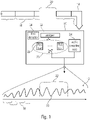
- Fig. 1 shows an audio decoder in accordance with an embodiment of the present application.
- the audio decoder 10 is configured to decode an audio signal 12 from a data stream 14.
- the audio signal 12 may be encoded into data stream 14 in accordance with any suitable audio codec such as a time-domain based audio codec or a frequency-domain audio codec.
- the audio signal 12 may be coded into data stream 14 in units of temporal portions 16 of frames 18, respectively.
- the audio signal 12 may be temporally sub-divided into overlapping or non-overlapping temporal portions or intervals 16, each of which corresponds to a certain one of frames 18 which data stream 14 is sub-divided into.
- Each frame 18 encodes a corresponding temporal portion 16.
- a portion 18 may contain information on linear prediction coefficients describing a spectral envelope of the audio signal within the corresponding portion 16.
- frame 18 may have encoded thereinto spectral coefficients describing a spectrum of the audio signal 12 within portion 16 which is to be shaped, for instance, by audio decoder 10 according to the linear prediction coefficients contained in that frame.
- An overlap add process might also be applied by the audio decoder 10 in reconstructing the audio signal 12 from the data stream 14.
- the possibilities would also apply with the examples presented herein merely serving for ease of understanding.
- the data stream 14 may be received by the audio decoder 10 in a packetized form, i.e., in units of packets.
- the sub-division of data stream 14 into frame 18 itself represents a kind of packetization, i.e., the frames 18 represent packets.
- data stream 14 may be packed into packets of a transport stream or media file format, but this circumstance is not inspected in further detail here. Rather, it should suffice to state that the reception of the data stream 14 by audio decoder 10 is liable to data or signal loss, called packet loss in the following. That is, some continuous portion 20 of the data stream 14 might have got lost during transmission, thus not received by audio decoder 10, so that the corresponding portion is missing and not available for the audio decoder 10.
- audio decoder 10 misses information in the data stream 14 so as to reconstruct a portion 22 corresponding to portion 20.
- the audio decoder 10 is not able to reconstruct portion 22 from data stream 14 in accordance with a normal audio decoding process implemented, for instance, in an audio decoding core 24 of the audio decoder, as portion 20 of data stream 14 is missing.
- audio decoder 10 comprises a set 26 of PLC tools 28 so as to recover or synthesize the audio signal 12 within portion 22 by a substitute signal 30.
- the PLC tools 28 comprised by set 26 differs in their suitability for different audio signal characteristics.
- audio decoder 10 comprises an assigner 32 which assigns one of the set 26 of packet loss concealment tools 28 to portion 22 of the audio signal 12 which is affected by a packet loss such as the lost portion 22 of data stream 14.
- the assigner 32 tries to assign the best PLC tool 28 to portion 22, namely the one which leads to the lowest annoyance.
- the audio decoder 10 recovers this portion 22 of the audio signal using the assigned PLC tool 28, thereby substituting the audio signal 12 within this portion 22, as it would have been reconstructed from the audio data stream 14 if the corresponding data stream portion 22 would not have got lost, by a substitute signal 30 obtained using the PLC tool 28 assigned for portion 22 by assigner 32.
- the assignment of a particular PLC tool 28 to a certain lost portion 22 should be made signal dependent in order to render the lost concealment as least annoying as possible.
- Signal dependency is restricted to portions of data stream 14 preceding the lost data stream portion 20 and, in accordance with the embodiment described herein, the assigner 32 acts as follows.
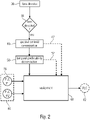
- Fig. 2 shows that the whole assignment process for a certain missing portion 22 might possibly be triggered by a loss detector 34 possibly present in audio decoder 10.
- loss detector 34 possibly present in audio decoder 10.
- a determination 40 is performed in order to determine a first measure 42 which measures a spectral position of a spectral centroid of a spectrum of the audio signal. That is, assigner 32 determines a spectral position of a center of mass of a spectrum of the audio signal, see Fig. 3 .
- the audio decoder retrieves from a portion 44 preceding the lost portion 20 of data stream 14, preceding in data stream order, a spectrum 46 of the audio signal.
- a spectrum 46 of the audio signal As described above with respect to Fig. 1 , it might be that data stream 14 has audio signal 12 encoded thereinto in spectral domain anyway so that no spectral decomposition is necessary for assigner 32 to obtain spectrum 46.
- spectral coefficients of a most recently received frame 18 or more than one most recently retrieved frame 18 of data stream 14, prior to the lost portion 20, is used to obtain spectrum 46. If more than one frame 18 is used, it could be that spectrum 46 used by assigner 32 is obtained by averaging.
- the center of mass of this spectrum 46 is determined, i.e., a measure 42 measuring a spectral position 48 of spectrum 46. Later on, a specific example is presented.
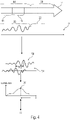
- the assignment process triggered by loss detection comprises a determination 50 of a temporal predictability of the audio signal so as to obtain a measure 52 of this temporal predictability, see Fig. 4 for details.
- the temporal predictability detection 50 may rely on the decoded signal or the audio signal 12 as derived from the data stream 14 up to the signal portion 22 which is missing owing to the loss of portion 20 of data stream 14.
- the temporal predictability detection 50 may be based on the audio signal 12 within portion 50 which immediately precedes lost portion 22, the loss of which is to be concealed, and which is decoded from portion 44 of data stream 14.
- the temporal predictability detection 50 may be done in a manner so that measure 52 is a measure for a self-similarity or autocorrelation of the signal portion 50 as illustrated at 54 in Fig. 4 .
- the mutual shift s for which the self-similarity of signal 50 is measured by measure 52 may be determined by assigner 32 in different manners. For instance, assigner 32 may inspect a corresponding pitch parameter conveyed in one or more of the frames 18 within portion 44 preceding lost portion 20 of data stream 14. That is, the mutual shift s at which the self-similarity may be measured may correspond to a pitch period with a pitch being determined based on a parameter in data stream 14, namely portion 44. The self-similarity or correlation 56 at that pitch period shift may be used as the second measure 52.
- an assignment 60 is performed. This assignment 60 selects one of two PLC tools 28 for concealment of loss of portion 22. This PLC tool, i.e., the assigned one 62, is then used for the concealment of the loss of portion 22.
- the number of PLC tools 28, between which the selection by assignment 60 is performed may be greater than two.
- the PLC tool PLC 1 of Fig. 2 may be described as 1 using which the substitute signal 30, i.e., the audio signal estimate within portion 22, is obtained or recovered using tonal time domain packet loss concealment.
- PLC 1 may be a packet loss concealment dedicated for audio signal recovery of monophonic portions.
- PLC 1 may recover an audio signal within a missing portion 22 of an audio signal 12 using a periodic signal of a periodicity which depends on a pitch parameter or pitch value derived from the data stream, namely from portion 44 of data stream 14, i.e., the portion 44 preceding the lost portion 20 of data stream 14.
- the second PLC tool PLC 2 may be dedicated for the recovery of audio signals of polyphonic type.
- the concealment of this second PLC tool PLC 2 may be based on tonal frequency domain packet loss concealment.
- Fig. 5 illustrates PLC 1.
- a pitch parameter or pitch value 66 conveyed in a frame 18 within portion 44 preceding lost portion 20 of data stream 14 is used to set a periodicity or period length 68 of a periodic signal 70 which is then used to form a substitute or used to conceal the loss within portion 22 of audio signal 12.
- the pitch parameter or pitch value 66 may be present in data stream 14 in order to be used by audio decoder 10 in case of normal audio decoding, i.e., no signal loss, for controlling, for instance, a harmonic filter tool or the like. That is, parameter 66 may be present in data stream 14 anyway.
- PLC tool 28 performing PLC 1 according to Fig. 5 could determine the pitch period 68 by analysis such as by analyzing the decoded signal 50 in front of the lost portion 22 or by analyzing the most recent accessible version of the spectrum such as spectrum 46 depicted in Fig. 3 .
- Fig. 6 illustrates PLC 2 in accordance with an embodiment.
- the PLC tool 28, responsible for performing PLC 2 uses, for instance, one or two or more most recently obtained spectra as obtained from portion 44 of data stream 14 so as to detect or determine tonal spectral components therein, i.e., peaks 72 in the spectrum 46 or peaks 72 in spectrum 46 occurring at that position or a sufficiently similar position in the spectrum of a certain number of consecutive spectra or frames 18, respectively.
- Sufficiently similar positions may be ones the spectral distance of which is below a certain threshold.
- the spectral positions of the peaks 72 represent the tonal spectral components and here, at these spectral locations, the phase detection is performed by use of, for instance, or by evaluation of, for instance, a power spectrum of the audio signal. Then, within the temporal portion 22 within which the signal loss is to be concealed, a combination of signals, periodicities of which depend on the tonal spectral components, is formed so as to yield the supplement signal 30, wherein a mutual phase shift between the combined signals is adjusted depending on the phase detection. For instance, a phase is determined for each tonal component 72 or merely phase differences between these tonal components are determined, and a signal is formed as the substitute 30 within portion 22 which is synthesized by these tonal components 72 with obeying the phase differences or phases. The combination may be formed in spectral domain with deriving the substitute signal 30 by inverse transformation, or in time-domain directly by adding, for instance, appropriately mutually shifted signals, the mutual shift reflecting the mutual phase shift determined.
- the assignment 60 may be done in a manner so that PLC 1 is chosen or assigned to portion 22 the more likely the lower the spectral position 48 is and the higher the temporal predictability is and, vice versa, PLC 2 is assigned or selected the more likely the higher the spectral position 48 is and the lower the temporal predictability is.
- a higher spectral position corresponds to a higher frequency and a lower spectral position to a lower frequency.
- Fig. 7 shows the fact that the assignment process of Fig. 2 may be extended.
- the assignment 60 has been done by restricting the assignment or selection of assignment 60 onto a subset 80 of PLC tools 28.
- the set 26 of PLC tools 28 may contain a further subset of one or more PLC tools 28, such as subset 82 and, when triggered by loss detection 36, a tonality detection 84 may be used by assigner 32 first in order to determine whether portion 22 relates to a tonal portion or not.
- the tonality determination 84 yields a tonality measure or indicator 86 and this tonality measure indicator 86 may be obtained in 84 by use of one or more parameters within portion 44 of data stream 14, for instance such as by inspecting whether or not a most recent frame 18 within portion 44 comprises a certain pitch parameter such as a pitch value 66 as described in Fig. 5 . In case of absence, this may be interpreted as an indication that the audio signal is currently non-tonal and, in case of presence of the pitch parameter 66, this may be interpreted as indicating that the audio signal is currently tonal. This indication is then the tonality measure 86.
- Fig. 7 illustrates the case where one PLC tool 28 is comprised by subset 82 and this one is chosen. However, even here, a further selection out of subset 82 may follow. If tonality is confirmed at 88, the assignment 60 based on determinations 40 and 50 is performed with respect to subset 80 as described above with respect to Fig. 2 .
- PLC 3 may be a non-tonal PLC such as a PLC which recovers an audio signal for a portion 22 by use of frame repetition with or without replicate modification, when the replicate modification may, as indicated above, involve sign scrambling, i.e., a random sign flip of spectral coefficients of a most recently received spectrum such as spectrum 46 which is then inversely transformed and used to derive substitute signal 30.
- sign scrambling i.e., a random sign flip of spectral coefficients of a most recently received spectrum such as spectrum 46 which is then inversely transformed and used to derive substitute signal 30.
- Fig. 8 visualizes a decision tree for selecting among the PLC tools 28 in accordance with a manner which corresponds, for instance, to Fig. 7 .
- Decisions A and B are made to decide which of three PLC methods PLC 1 to PLC 3, which are designed for different signal types, are to be used for a certain missing signal portion 22 in order to get the best concealment performance.
- the first decision, decision A is based on tonality. If the signal turns out to be non-tonal, PLC 3 is used for concealment. If tonal, decision B is made.
- Decision B checks the tonal signal characteristics based on measures 42 and 52 in the manner described above with respect to Figs. 2 and 7 and, depending on the characteristics, chooses one of PLC 1 or PLC 2.
- PLC 1 may be a tonal time domain PLC for monophone and/or speech signals
- PLC 2 may be a tonal frequency domain PLC for a polyphone and/or music signals.
- the decision tree of Fig. 8 visualizes decisions, which may be taken between three PLC methods for different signal types to get the best concealment performance.
- the decision A which may correspond to check 88 of Fig. 7 , may be done by inspecting a signal type classification, i.e. by using it as an indication of, or by deriving therefrom a tonality indicator.
- the signal type classification is possibly present in each frame 18 and indicates a frame class of each frame. It could be calculated on encoder side and transmitted in the bitstream 14 to the audio decoder. Even alternatively, it could be calculated on decoder side.
- the calculation of the frame class is very complex and may require that all features are calculated in every frame due to a frame dependency of the frame class. Therefore, for low-complexity applications, it may be preferred if a simpler approach is used.
- the presence or absence of some pitch parameter 66 may be used as indicator 86.
- a PLC classifier represented by assigner 32, which may operate on a frame-by-frame basis without any inter-frame dependencies and thus necessitates merely a low complexity. It may calculate its classification features 42 and 52 only in case of a frame loss, as detected or checked at 38, and therefore does not add an immanent complexity offset in the error-free frames among frames 18.
- the decision A may be done based on a tonality indicator 86, which can be the presence of a pitch value in the last good received audio frame.
- the decision B may be done by using the spectral centroid 48 and a long term prediction gain 56 calculated on the last good received audio frame.
- the decision B may switch between a pitch-based time domain concealment method PLC#1, best suited for monophonically and speech-like signals, and frequency domain methods PLC#2, best suited for polyphone or complex music signals.
- a weighted combination of both features 42 and 52 may be used for decision B and assignment process 60 and results in a reliable discrimination of speech/monophonic and polyphonic/complex music signals.
- the complexity may be kept low.
- the audio decoder receives a corrupted frame or if the frame is lost, i.e. encounters a lost portion 20, as detected at 38, the following may be done, wherein reference is also made to Fig. 2 :
- the features 42 and 52 may be calculated based on the last good frame in the following manner:
- Alternatives are setting w 1 , w 2 and ⁇ so that 1 4 ⁇ w 1 ⁇ 3 4 , ⁇ 2 ⁇ w 2 ⁇ ⁇ 1 2 , and ⁇ 1 2 ⁇ ⁇ ⁇ ⁇ 1 16 .
- the weights may be normalized here to be in the range [-1:1]
- the PLC#1 e.g. time domain pitch-based PLC method
- the PLC#2 may be chosen if class > 0 in 60 and PLC#2, such as a frequency domain tonal concealment, otherwise.
- the spectrum, the spectral centroid of which is measured to obtain the first measure 42 might be a so called weighted version such as a pre-emphasized version. Such weighting is used, for instance, to adapt the quantization noise to the psychoacoustic masking threshold.
- the first measure 42 measuring a spectral position 48 of a spectral centroid of a psychoacoustic scaled spectrum of the audio signal. This might be especially advantageous in cases where the normal audio decoding coded underlying audio decoding core 24 involves that data stream 14 has audio signal 12 encoded thereinto in spectral domain anyway, namely in the weighted domain.
- the spectrum, the spectral centroid of which is measured to obtain the first measure 42 is not necessarily one represented at a spectral resolution as high as the spectral resolution used in the audio decoding core 24 to transition to time domain. Rather, it may be higher or lower. Even additionally or alternatively, it should be noted that the audio signal's spectrum also manifests itself in scale factors. Such scale factors might be transmitted in the data stream 14 along with spectral coefficients in order to, together, form a coded representation of the audio signal's spectrum. For a certain portion 22, the spectral coefficients are scaled according to the scale factors. There are more spectral coefficients than scaler factors.
- Each scale factor for instance, is assigned to one of several spectral bands, so called scale factor bands, into which the audio signal's bandwidth is partitioned.
- the scale factors thus, define the spectrum of the audio signal for a certain portion in terms of envelope at some spectral resolution reduced compared to the one at which the quantized spectral coefficients are coded in the data stream 14. It could even be that the spectral resolution at which the scale factors are coded in the data stream 14 is even lower than a spectral resolution at which the decoding core 24 performs the dequantization of the spectral coefficients.
- the decoding core 24 might subject the scale factors coded into the data stream 14 to spectral interpolation to obtain interpolated scale factors of higher spectral resolution as the ones coded into the data stream, and use the interpolated scale factors for dequantization. Either one of the scale factors coded into the data stream and the interpolated scale factors might be used as the spectrum of the audio signal the spectral centroid of which is measured by the first measure 42.
- centroid measurement becomes quite computational efficient to be determined as the number of computational operations to be performed to determine the first measure is low compared to performing the centroid measurement at any higher resolution such as at the one at which the spectral coefficient are coded or some other resolution in case of obtaining the spectrum for the centroid measurement by subjecting the decoded audio signal to an extra spectral decomposition which would even further increase the efforts.
- first and second measures could be computed as follows based on coded down-sampled scale factors SNS (spectral noise shaping):
- the second measure would be computed as the self-similarity of the decoded audio time signal at the most recently received portion with itself, mutually shifted at the pitch.
- band indices defining for each band the lower and upper frequency border in a manner so that the band widths defined by the difference between the associated lower and upper border differ from each other such as increase with increasing frequency although the difference is optional.
- the band indices might be defined in dependency of the sampling rate/frequency of the audio signal.
- scfQ -1 ( k ) is the scale factor vector stored in the bitstream of the last good frame and g tilt is a predetermined tilt factor which might be set by default and, possibly, depending on the sample frequency of the audio signal.
- the term 2 scfQ -1 ( k ) is applied to get the scalefactors coded in the logarithmic domain back in the linear domain.
- the term 1 10 k g tilt 150 is applied to inverse the encoder side pre-emphasis filter, which is called de-emphasis filter.
- the scale factor vector is calculated at encoder side and transmitted in the bitstream. It is determined on the energies per band of the MDCT coefficients, where the bands are non-uniform and follow the perceptually-relevant bark scale (smaller in low-frequencies, larger in high-frequencies). After smoothing, pre-emphasing and transforming the energies to logarithmic domain, they are, at the encoder side, downsampled from 64 parameters to 16 parameters to form the scale factor vector, which afterwards is coded and transmitted in the bitstream.
- sc is a measure for a spectral position 48 of a spectral centroid of a spectrum 46 of the audio signal, here determined based on the spectrally coarse sampled version thereof, namely the SNS parameters.
- an audio decoder for decoding an audio signal 12 from a data stream 14, which comprises a set 26 of different loss concealment tools 28 might be configured to determine 40 a first measure 42 measuring a spectral position 48 of a spectral centroid of a spectrum 46 of the audio signal by deriving the spectrum from scale factors in a most recent non-lost portion of the data stream, determine 50 a second measure 52 measuring a temporal predictability of the audio signal, assign 32 one 62 of the set 26 of different loss concealment tools 28 to a portion 22 of the audio signal 12 affected by loss based on the first and second measures, and recover the portion 22 of the audio signal using the one loss concealment tool 62 assigned to the portion 22.
- the derivation of the spectrum might involve, as described, subjecting the scaler factors coded in the data stream to spectral interpolation. Additionally or alternatively, they may be subject to de-emphasis filtering, i.e. they might be multiplied by a de-emphasis filter's transfer function. The resulting scale factors may then be subject to spectral centroid measurement. All the other details described above may then be applied as well.
- the set 26 of different loss concealment tools may comprise a first loss concealment tool for audio signal recovery of monophonic portions, and a second loss concealment tool for audio signal recovery of polyphonic portions, and the audio decoder may be configured to, in assigning the one of the set of different loss concealment tools to the portion of the audio signal based on the first and second measures, assign the first loss concealment tool to the portion the more likely the lower the spectral position of the spectral centroid is and the higher the temporal predictability is, and assign the second loss concealment tool to the portion the more likely the higher the spectral position of the spectral centroid is and the lower the temporal predictability is.
- the audio decoder is configured to, in assigning one of the set of different loss concealment tools to a portion 22 of the audio signal affected by loss based on the first and second measures, perform a summation over the first and second measures 42, 52 so as to obtain a scalar sum value and subjecting the scalar sum value to thresholding.
- aspects have been described in the context of an apparatus, it is clear that these aspects also represent a description of the corresponding method, where a block or device corresponds to a method step or a feature of a method step. Analogously, aspects described in the context of a method step also represent a description of a corresponding block or item or feature of a corresponding apparatus.
- Some or all of the method steps may be executed by (or using) a hardware apparatus, like for example, a microprocessor, a programmable computer or an electronic circuit. In some embodiments, one or more of the most important method steps may be executed by such an apparatus.
- embodiments of the invention can be implemented in hardware or in software.
- the implementation can be performed using a digital storage medium, for example a floppy disk, a DVD, a Blu-Ray, a CD, a ROM, a PROM, an EPROM, an EEPROM or a FLASH memory, having electronically readable control signals stored thereon, which cooperate (or are capable of cooperating) with a programmable computer system such that the respective method is performed. Therefore, the digital storage medium may be computer readable.
- Some embodiments according to the invention comprise a data carrier having electronically readable control signals, which are capable of cooperating with a programmable computer system, such that one of the methods described herein is performed.
- embodiments of the present invention can be implemented as a computer program product with a program code, the program code being operative for performing one of the methods when the computer program product runs on a computer.
- the program code may for example be stored on a machine readable carrier.
- inventions comprise the computer program for performing one of the methods described herein, stored on a machine readable carrier.
- an embodiment of the inventive method is, therefore, a computer program having a program code for performing one of the methods described herein, when the computer program runs on a computer.
- a further embodiment of the inventive methods is, therefore, a data carrier (or a digital storage medium, or a computer-readable medium) comprising, recorded thereon, the computer program for performing one of the methods described herein.
- the data carrier, the digital storage medium or the recorded medium are typically tangible and/or non-transitionary.
- a further embodiment of the inventive method is, therefore, a data stream or a sequence of signals representing the computer program for performing one of the methods described herein.
- the data stream or the sequence of signals may for example be configured to be transferred via a data communication connection, for example via the Internet.
- a further embodiment comprises a processing means, for example a computer, or a programmable logic device, configured to or adapted to perform one of the methods described herein.
- a processing means for example a computer, or a programmable logic device, configured to or adapted to perform one of the methods described herein.
- a further embodiment comprises a computer having installed thereon the computer program for performing one of the methods described herein.
- a further embodiment according to the invention comprises an apparatus or a system configured to transfer (for example, electronically or optically) a computer program for performing one of the methods described herein to a receiver.
- the receiver may, for example, be a computer, a mobile device, a memory device or the like.
- the apparatus or system may, for example, comprise a file server for transferring the computer program to the receiver.
- a programmable logic device for example a field programmable gate array
- a field programmable gate array may cooperate with a microprocessor in order to perform one of the methods described herein.
- the methods are preferably performed by any hardware apparatus.
- the apparatus described herein may be implemented using a hardware apparatus, or using a computer, or using a combination of a hardware apparatus and a computer.
- the apparatus described herein, or any components of the apparatus described herein, may be implemented at least partially in hardware and/or in software.
- the methods described herein may be performed using a hardware apparatus, or using a computer, or using a combination of a hardware apparatus and a computer.
Landscapes
- Engineering & Computer Science (AREA)
- Multimedia (AREA)
- Physics & Mathematics (AREA)
- Signal Processing (AREA)
- Audiology, Speech & Language Pathology (AREA)
- Computational Linguistics (AREA)
- Health & Medical Sciences (AREA)
- Human Computer Interaction (AREA)
- Acoustics & Sound (AREA)
- Spectroscopy & Molecular Physics (AREA)
- Computer Networks & Wireless Communication (AREA)
- Theoretical Computer Science (AREA)
- Compression, Expansion, Code Conversion, And Decoders (AREA)
- Electrophonic Musical Instruments (AREA)
- Stereo-Broadcasting Methods (AREA)
- Two-Way Televisions, Distribution Of Moving Picture Or The Like (AREA)
Claims (19)
- Audiodecodierer zum Decodieren eines Audiosignals (12) von einem Datenstrom (14), wobei der Audiodecodierer einen Satz (26) von unterschiedlichen Verlustverschleierungswerkzeugen (28) aufweist und konfiguriert ist zumBestimmen einer ersten Messung (42), die eine Spektralposition (48) eines Spektralschwerpunkts eines Spektrums (46) des Audiosignals misst,Bestimmen einer zweiten Messung (92), die eine zeitliche Vorhersagbarkeit des Audiosignals misst, wobei die zweite Messung eine Messung für Selbstähnlichkeit oder Autokorrelation ist oder ein langfristiger Vorhersagegewinn ist,Zuweisen (32) eines (62) des Satzes (26) von unterschiedlichen Verlustverschleierungswerkzeugen (28) zu einem Abschnitt (22) des Audiosignals (12), der durch Verlust beeinträchtigt ist, basierend auf der ersten und zweiten Messung, undWiedergewinnen des Abschnitts (22) des Audiosignals unter Verwendung des einen Verlustverschleierungswerkzeugs (62), das dem Abschnitt (22) zugewiesen ist,dadurch gekennzeichnet, dassder Audiodecodierer konfiguriert ist, beim Zuweisen eines des Satzes von unterschiedlichen Verlustverschleierungswerkzeugen zu einem Abschnitt (22) des Audiosignals, der durch Verlust beeinträchtigt ist, basierend auf der ersten und zweiten Messung, eine Summenbildung über die erste und zweite Messung (42, 52) durchzuführen, um einen skalaren Summenwert zu erhalten und den skalaren Summenwert einer Schwellenwertbildung zu unterziehen.
- Audiodecodierer gemäß Anspruch 1, bei dem der Satz (26) von unterschiedlichen Verlustverschleierungswerkzeugen (28) eines oder mehrere der folgenden Merkmale umfasst:ein erstes Verlustverschleierungswerkzeug (PLC#1) für Audiosignalwiedergewinnung durch Audiosignalsynthese unter Verwendung eines periodischen Signals (70) einer Periodizität (68), die von einem Tonhöhenwert (66) abhängt, der von dem Datenstrom abgeleitet ist, undein zweites Verlustverschleierungswerkzeug (PLC#2) für Audiosignalwiedergewinnung durch Erfassen von tonalen Spektralkomponenten (72) des Audiosignals, Durchführen von Phasenerfassung an den tonalen Spektralkomponenten (22) und Audiosignalsynthese durch Kombinieren der Signale von Periodizitäten, die von den tonalen Spektralkomponenten (72) abhängen, mit einem Einstellen einer gegenseitigen Phasenverschiebung zwischen den Signalen in Abhängigkeit von der Phasenerfassung, undein drittes Verlustverschleierungswerkzeug (PLC#3) für Audiosignalwiedergewinnung durch die Verwendung von Rahmenwiederholung mit oder ohne Replikatmodifikation.
- Audiodecodierer gemäß Anspruch 1 oder 2, bei dem der Satz (26) von unterschiedlichen Verlustverschleierungswerkzeugen folgende Merkmale umfasst:ein erstes Verlustverschleierungswerkzeug (PLC#1) für Audiosignalwiedergewinnung von monophonen Abschnitten, undein zweites Verlustverschleierungswerkzeug (PLC#2) für Audiosignalwiedergewinnung von polyphonen Abschnitten.
- Audiodecodierer gemäß Anspruch 1 oder 2, bei dem der Satz (26) von unterschiedlichen Verlustverschleierungswerkzeugen folgende Merkmale aufweist:ein erstes Verlustverschleierungswerkzeug (PLC#1) für Audiosignalwiedergewinnung unter Verwendung von tonaler Zeitbereich-Paketverlustverschleierung, undein zweites Verlustverschleierungswerkzeug (PLC#2) für Audiosignalwiedergewinnung unter Verwendung von tonaler Frequenzbereich-Paketverlustverschleierung.
- Audiodecodierer gemäß Anspruch 1 oder 2, bei dem der Satz von unterschiedlichen Verlustverschleierungswerkzeugen folgende Merkmale aufweist:ein erstes Verlustverschleierungswerkzeug (PLC#1) für Audiosignalwiedergewinnung durch Audiosignalsynthese unter Verwendung eines periodischen Signals einer Periodizität, die von einem Tonhöhenabstand abhängt, der von dem Datenstrom abgeleitet ist, undein zweites Verlustverschleierungswerkzeug (PLC#2) für Audiosignalwiedergewinnung durch Erfassen von tonalen Spektralkomponenten des Audiosignals, Durchführen von Phasenerfassung an den tonalen Spektralkomponenten und Audiosignalsynthese durch Kombinieren der Signale von Periodizitäten, die von den tonalen Spektralkomponenten abhängen, mit einem Einstellen einer gegenseitigen Phasenverschiebung zwischen den Signalen in Abhängigkeit von der Phasenerfassung.
- Audiodecodierer gemäß Anspruch 5, wobei der Audiodecodierer konfiguriert ist zum Ableiten des Tonhöhenwerts (66) von dem Datenstrom durch Verwenden eines aktuellsten Tonhöhenparameters, der in dem Datenstrom als der Tonhöhenwert übertragen wird.
- Audiodecodierer gemäß Anspruch 5 oder 6, wobei der Audiodecodierer konfiguriert zum
Durchführen der Erfassung der tonalen Spektralkomponenten (72) durch Identifizieren von an derselben Stelle angeordneten Spitzen in einem oder mehreren aufeinanderfolgenden Spektren (46), die von einem aktuellsten nicht verlorenen Abschnitt des Datenstroms abgeleitet sind. - Audiodecodierer gemäß Anspruch 7, bei dem der aktuellste nicht verlorene Abschnitt des Datenstroms in dem Spektralbereich in den Datenstrom (14) codiert ist.
- Audiodecodierer gemäß einem der Ansprüche 3 bis 8,
wobei der Audiodecodierer konfiguriert ist, beim Zuweisen des einen des Satzes von unterschiedlichen Verlustverschleierungswerkzeugen zu dem Abschnitt des Audiosignals basierend auf der ersten und zweiten Messung das erste Verlustverschleierungswerkzeug dem Abschnitt zuzuweisen, umso eher, je niedriger die spektrale Position des Spektralmittelwerts ist und je höher die zeitliche Vorhersagbarkeit ist, und das zweite Verlustverschleierungswerkzeugs dem Abschnitt zuzuweisen, umso eher, je höher die spektrale Position des Spektralmittelwerts ist und je niedriger die zeitliche Vorhersagbarkeit ist. - Audiodecodierer gemäß einem der vorhergehenden Ansprüche, konfiguriert zumDurchführen von Verlusterfassung (36), um Abschnitte (62) zu erfassen, die durch Verlust beeinträchtigt sind,Durchführen der Bestimmung der ersten und zweiten Messung (42; 52) für den Abschnitt (22), der auf die Verlusterfassung anspricht, die den Abschnitt (22) erfasst, der durch Verlust beeinträchtigt ist, und Nichtdurchführen der Bestimmung für Abschnitte, die nicht durch Verlust beeinträchtigt sind.
- Audiodecodierer gemäß einem der Ansprüche 1 bis 10, der ferner konfiguriert ist zumBestimmen (84) eines Tonalitätsindikators (86), der eine Tonalität des Audiosignals anzeigt,Zuweisen eines des ersten und zweiten Teilsatzes (80, 82) von einem oder mehreren Verlustverschleierungswerkzeugen des Satzes (26) von unterschiedlichen Verlustverschleierungswerkzeugen, die voneinander getrennt sind, zu dem Abschnitt (22) des Audiosignals basierend auf dem Tonalitätsindikator (86), undDurchführen der Zuweisung des einen des Satzes von unterschiedlichen Verlustverschleierungswerkzeugen zu dem Abschnitt des Audiosignals basierend auf der ersten und zweiten Messung durch Zuweisen (60) des Satzes von verschiedenen Verlustverschleierungswerkzeugen zu dem Abschnitt des Audiosignals basierend auf der ersten und zweiten Messung von dem ersten Teilsatz (80) von einem oder mehreren Verlustverschleierungswerkzeugen, falls der erste Teilsatz (80) dem Abschnitt (22) zugewiesen ist, mit einem Durchführen der Wiedergewinnung des Abschnitts (22) des Audiosignals unter Verwendung des einen Verlustverschleierungswerkzeugs (62), das dem Abschnitt (22) zugewiesen ist, und Durchführen der Wiedergewinnung des Abschnitts (22) des Audiosignals unter Verwendung von einem des zweiten Teilsatzes (82) der Verlustverschleierungswerkzeuge, falls der zweite Teilsatz (82) der Verlustverschleierungswerkzeuge dem Abschnitt zugewiesen ist.
- Audiodecodierer gemäß Anspruch 11, wobei der Audiodecodierer konfiguriert ist zum
Verwenden eines Parameters, der in dem Datenstrom als dritte Messung übertragen wird. - Audiodecodierer gemäß Anspruch 11 oder 12, wobei der Audiodecodierer konfiguriert ist zum
Verwenden eines Vorliegens oder eines Nichtvorliegens eines Tonhöhenparameters (66) in einem aktuellsten nicht verlorenen Rahmen des Datenstroms als die dritte Messung (86). - Audiodecodierer gemäß einem der Ansprüche 11 bis 13, bei dem der Satz (26) von unterschiedlichen Verlustverschleierungswerkzeugen folgende Merkmale aufweist:ein erstes Verlustverschleierungswerkzeug (PLC#1) für Audiosignalwiedergewinnung durch Audiosignalsynthese unter Verwendung eines periodischen Signals einer Periodizität, die von einem Tonhöhenwert abhängt, der von dem Datenstrom abgeleitet ist, undein zweites Verlustverschleierungswerkzeug (PLC#2) für Audiosignalwiedergewinnung durch Erfassen von tonalen Spektralkomponenten des Audiosignals, Durchführen von Phasenerfassung an den tonalen Spektralkomponenten und Audiosignalsynthese durch Kombinieren der Signale von Periodizitäten, die von den tonalen Spektralkomponenten abhängen, mit einem Einstellen einer gegenseitigen Phasenverschiebung zwischen den Signalen in Abhängigkeit von der Phasenerfassung, undein drittes Verlustverschleierungswerkzeug (PLC#3) für Audiosignalwiedergewinnung durch Verwendung von Rahmenwiederholung mit oder ohne Replikatmodifikation,wobei das dritte Verlustverschleierungswerkzeug in dem zweiten Teilsatz (82) enthalten ist, und das zweite und das erste und zweite Verlustverschleierungswerkzeug in dem ersten Teilsatz (80) enthalten sind.
- Audiodecodierer gemäß einem der vorhergehenden Ansprüche, konfiguriert zum Bestimmen (40) der ersten Messung (42) durch eine gewichtete Summe von Spektralkomponentenpositionswerten, jeweils gewichtet unter Verwendung des Spektrums des Audiosignals an dem jeweiligen Spektralkomponentenpositionswert.
- Audiodecodierer gemäß einem der vorhergehenden Ansprüche, konfiguriert zum Bestimmen (50) der zweiten Messung (52) durch eine Korrelationsmessung, die eine Selbstähnlichkeit des Audiosignals misst.
- Audiodecodierer gemäß einem der vorhergehenden Ansprüche, konfiguriert zum Bestimmen (50) der zweiten Messung (52) durch Ableiten einer Tonhöhe von dem Audiosignal und Bestimmen der zweiten Messung als eine Korrelationsmessung, die eine Autokorrelation des Audiosignals an einer/mehreren zeitlichen Verschiebung(en) misst, die von der Tonhöhe abhängt/abhängen.
- Verfahren zum Durchführen von Verlustverschleierung beim Audiodecodieren eines Audiosignals (12) von einem Datenstrom (14), wobei das Verfahren folgende Schritte aufweist:Bestimmen (40) einer ersten Messung (42), die eine Spektralposition (48) eines Spektralschwerpunkts eines Spektrums (46) des Audiosignals misst,Bestimmen (50) einer zweiten Messung (92), die eine zeitliche Vorhersagbarkeit des Audiosignals misst, wobei die zweite Messung eine Messung für Selbstähnlichkeit oder Autokorrelation ist oder ein langfristiger Vorhersagegewinn ist,Zuweisen (32) eines (62) des Satzes (26) von unterschiedlichen Verlustverschleierungswerkzeugen (28) zu einem Abschnitt (22) des Audiosignals (12), der durch Verlust beeinträchtigt ist, basierend auf der ersten und zweiten Messung, undWiedergewinnen des Abschnitts (22) des Audiosignals unter Verwendung des einen Verlustverschleierungswerkzeugs (62), das dem Abschnitt (22) zugewiesen ist,dadurch gekennzeichnet, dassdas Zuweisen eines des Satzes von unterschiedlichen Verlustverschleierungswerkzeugen zu einem Abschnitt (22) des Audiosignals, der durch Verlust beeinträchtigt ist, basierend auf der ersten und zweiten Messung, ein Durchführen einer Summenbildung über die erste und zweite Messung (42, 52) aufweist, um einen skalaren Summenwert zu erhalten und den skalaren Summenwert einer Schwellenwertbildung zu unterziehen.
- Computerprogramm mit einem Programmcode zum Durchführen, wenn dasselbe auf einem Prozessor läuft, eines Verfahrens gemäß Anspruch 18.
Priority Applications (1)
| Application Number | Priority Date | Filing Date | Title |
|---|---|---|---|
| EP22202282.4A EP4152316B1 (de) | 2017-11-10 | 2018-11-05 | Audiodecoder mit unterstützung eines satzes verschiedener verlustmaskierungswerkzeuge |
Applications Claiming Priority (2)
| Application Number | Priority Date | Filing Date | Title |
|---|---|---|---|
| EP17201142.1A EP3483878A1 (de) | 2017-11-10 | 2017-11-10 | Audiodecoder mit auswahlfunktion für unterschiedliche verlustmaskierungswerkzeuge |
| PCT/EP2018/080198 WO2019091924A1 (en) | 2017-11-10 | 2018-11-05 | Audio decoder supporting a set of different loss concealment tools |
Related Child Applications (1)
| Application Number | Title | Priority Date | Filing Date |
|---|---|---|---|
| EP22202282.4A Division EP4152316B1 (de) | 2017-11-10 | 2018-11-05 | Audiodecoder mit unterstützung eines satzes verschiedener verlustmaskierungswerkzeuge |
Publications (2)
| Publication Number | Publication Date |
|---|---|
| EP3707705A1 EP3707705A1 (de) | 2020-09-16 |
| EP3707705B1 true EP3707705B1 (de) | 2022-10-19 |
Family
ID=60301924
Family Applications (3)
| Application Number | Title | Priority Date | Filing Date |
|---|---|---|---|
| EP17201142.1A Withdrawn EP3483878A1 (de) | 2017-11-10 | 2017-11-10 | Audiodecoder mit auswahlfunktion für unterschiedliche verlustmaskierungswerkzeuge |
| EP18796670.0A Active EP3707705B1 (de) | 2017-11-10 | 2018-11-05 | Audiodecoder mit auswahlfunktion für unterschiedliche verlustmaskierungswerkzeuge |
| EP22202282.4A Active EP4152316B1 (de) | 2017-11-10 | 2018-11-05 | Audiodecoder mit unterstützung eines satzes verschiedener verlustmaskierungswerkzeuge |
Family Applications Before (1)
| Application Number | Title | Priority Date | Filing Date |
|---|---|---|---|
| EP17201142.1A Withdrawn EP3483878A1 (de) | 2017-11-10 | 2017-11-10 | Audiodecoder mit auswahlfunktion für unterschiedliche verlustmaskierungswerkzeuge |
Family Applications After (1)
| Application Number | Title | Priority Date | Filing Date |
|---|---|---|---|
| EP22202282.4A Active EP4152316B1 (de) | 2017-11-10 | 2018-11-05 | Audiodecoder mit unterstützung eines satzes verschiedener verlustmaskierungswerkzeuge |
Country Status (19)
| Country | Link |
|---|---|
| US (1) | US11315580B2 (de) |
| EP (3) | EP3483878A1 (de) |
| JP (1) | JP7073492B2 (de) |
| KR (1) | KR102424897B1 (de) |
| CN (1) | CN111630591B (de) |
| AR (1) | AR113571A1 (de) |
| AU (1) | AU2018363136B2 (de) |
| CA (1) | CA3082268C (de) |
| ES (2) | ES3013896T3 (de) |
| FI (1) | FI3707705T3 (de) |
| MX (1) | MX2020004791A (de) |
| MY (1) | MY207091A (de) |
| PL (2) | PL4152316T3 (de) |
| PT (1) | PT3707705T (de) |
| RU (1) | RU2759092C1 (de) |
| SG (1) | SG11202004223RA (de) |
| TW (2) | TWI704554B (de) |
| WO (1) | WO2019091924A1 (de) |
| ZA (1) | ZA202002522B (de) |
Family Cites Families (170)
| Publication number | Priority date | Publication date | Assignee | Title |
|---|---|---|---|---|
| DE3639753A1 (de) | 1986-11-21 | 1988-06-01 | Inst Rundfunktechnik Gmbh | Verfahren zum uebertragen digitalisierter tonsignale |
| US5012517A (en) | 1989-04-18 | 1991-04-30 | Pacific Communication Science, Inc. | Adaptive transform coder having long term predictor |
| US5233660A (en) | 1991-09-10 | 1993-08-03 | At&T Bell Laboratories | Method and apparatus for low-delay celp speech coding and decoding |
| JPH05281996A (ja) | 1992-03-31 | 1993-10-29 | Sony Corp | ピッチ抽出装置 |
| IT1270438B (it) | 1993-06-10 | 1997-05-05 | Sip | Procedimento e dispositivo per la determinazione del periodo del tono fondamentale e la classificazione del segnale vocale in codificatori numerici della voce |
| US5581653A (en) | 1993-08-31 | 1996-12-03 | Dolby Laboratories Licensing Corporation | Low bit-rate high-resolution spectral envelope coding for audio encoder and decoder |
| JP3402748B2 (ja) | 1994-05-23 | 2003-05-06 | 三洋電機株式会社 | 音声信号のピッチ周期抽出装置 |
| JPH0811644A (ja) | 1994-06-27 | 1996-01-16 | Nissan Motor Co Ltd | ルーフモール取付構造 |
| US6167093A (en) | 1994-08-16 | 2000-12-26 | Sony Corporation | Method and apparatus for encoding the information, method and apparatus for decoding the information and method for information transmission |
| EP0732687B2 (de) | 1995-03-13 | 2005-10-12 | Matsushita Electric Industrial Co., Ltd. | Vorrichtung zur Erweiterung der Sprachbandbreite |
| US5781888A (en) | 1996-01-16 | 1998-07-14 | Lucent Technologies Inc. | Perceptual noise shaping in the time domain via LPC prediction in the frequency domain |
| WO1997027578A1 (en) | 1996-01-26 | 1997-07-31 | Motorola Inc. | Very low bit rate time domain speech analyzer for voice messaging |
| US5812971A (en) | 1996-03-22 | 1998-09-22 | Lucent Technologies Inc. | Enhanced joint stereo coding method using temporal envelope shaping |
| JPH1091194A (ja) | 1996-09-18 | 1998-04-10 | Sony Corp | 音声復号化方法及び装置 |
| US6570991B1 (en) * | 1996-12-18 | 2003-05-27 | Interval Research Corporation | Multi-feature speech/music discrimination system |
| KR100261253B1 (ko) | 1997-04-02 | 2000-07-01 | 윤종용 | 비트율 조절이 가능한 오디오 부호화/복호화 방법및 장치 |
| GB2326572A (en) | 1997-06-19 | 1998-12-23 | Softsound Limited | Low bit rate audio coder and decoder |
| WO1999016050A1 (en) | 1997-09-23 | 1999-04-01 | Voxware, Inc. | Scalable and embedded codec for speech and audio signals |
| JP3344962B2 (ja) | 1998-03-11 | 2002-11-18 | 松下電器産業株式会社 | オーディオ信号符号化装置、及びオーディオ信号復号化装置 |
| US6507814B1 (en) | 1998-08-24 | 2003-01-14 | Conexant Systems, Inc. | Pitch determination using speech classification and prior pitch estimation |
| US7272556B1 (en) | 1998-09-23 | 2007-09-18 | Lucent Technologies Inc. | Scalable and embedded codec for speech and audio signals |
| EP1139665A1 (de) | 2000-03-29 | 2001-10-04 | Deutsche Thomson-Brandt Gmbh | Verfahren und Gerät für die Ausgabeverzögerungsänderung während der Video- oder Tonkodierung |
| US6735561B1 (en) | 2000-03-29 | 2004-05-11 | At&T Corp. | Effective deployment of temporal noise shaping (TNS) filters |
| US6665638B1 (en) | 2000-04-17 | 2003-12-16 | At&T Corp. | Adaptive short-term post-filters for speech coders |
| US7395209B1 (en) | 2000-05-12 | 2008-07-01 | Cirrus Logic, Inc. | Fixed point audio decoding system and method |
| US7512535B2 (en) | 2001-10-03 | 2009-03-31 | Broadcom Corporation | Adaptive postfiltering methods and systems for decoding speech |
| US6785645B2 (en) * | 2001-11-29 | 2004-08-31 | Microsoft Corporation | Real-time speech and music classifier |
| US20030187663A1 (en) | 2002-03-28 | 2003-10-02 | Truman Michael Mead | Broadband frequency translation for high frequency regeneration |
| US7447631B2 (en) | 2002-06-17 | 2008-11-04 | Dolby Laboratories Licensing Corporation | Audio coding system using spectral hole filling |
| US7502743B2 (en) | 2002-09-04 | 2009-03-10 | Microsoft Corporation | Multi-channel audio encoding and decoding with multi-channel transform selection |
| US7433824B2 (en) | 2002-09-04 | 2008-10-07 | Microsoft Corporation | Entropy coding by adapting coding between level and run-length/level modes |
| JP4287637B2 (ja) | 2002-10-17 | 2009-07-01 | パナソニック株式会社 | 音声符号化装置、音声符号化方法及びプログラム |
| EP1595247B1 (de) | 2003-02-11 | 2006-09-13 | Koninklijke Philips Electronics N.V. | Audiocodierung |
| KR20030031936A (ko) | 2003-02-13 | 2003-04-23 | 배명진 | 피치변경법을 이용한 단일 음성 다중 목소리 합성기 |
| DE602004031939D1 (de) | 2003-06-17 | 2011-05-05 | Panasonic Corp | Empfangsvorrichtung, sendevorrichtung und übertragungssystem |
| WO2004114134A1 (en) * | 2003-06-23 | 2004-12-29 | Agency For Science, Technology And Research | Systems and methods for concealing percussive transient errors in audio data |
| US7620545B2 (en) | 2003-07-08 | 2009-11-17 | Industrial Technology Research Institute | Scale factor based bit shifting in fine granularity scalability audio coding |
| WO2005027096A1 (en) | 2003-09-15 | 2005-03-24 | Zakrytoe Aktsionernoe Obschestvo Intel | Method and apparatus for encoding audio |
| US7009533B1 (en) | 2004-02-13 | 2006-03-07 | Samplify Systems Llc | Adaptive compression and decompression of bandlimited signals |
| KR20050087956A (ko) | 2004-02-27 | 2005-09-01 | 삼성전자주식회사 | 무손실 오디오 부호화/복호화 방법 및 장치 |
| DE102004009949B4 (de) | 2004-03-01 | 2006-03-09 | Fraunhofer-Gesellschaft zur Förderung der angewandten Forschung e.V. | Vorrichtung und Verfahren zum Ermitteln eines Schätzwertes |
| CA2992065C (en) | 2004-03-01 | 2018-11-20 | Dolby Laboratories Licensing Corporation | Reconstructing audio signals with multiple decorrelation techniques |
| DE102004009954B4 (de) | 2004-03-01 | 2005-12-15 | Fraunhofer-Gesellschaft zur Förderung der angewandten Forschung e.V. | Vorrichtung und Verfahren zum Verarbeiten eines Multikanalsignals |
| ATE523876T1 (de) | 2004-03-05 | 2011-09-15 | Panasonic Corp | Fehlerverbergungseinrichtung und fehlerverbergungsverfahren |
| US7392195B2 (en) | 2004-03-25 | 2008-06-24 | Dts, Inc. | Lossless multi-channel audio codec |
| RU2386179C2 (ru) | 2005-04-01 | 2010-04-10 | Квэлкомм Инкорпорейтед | Способ и устройство для кодирования речевых сигналов с расщеплением полосы |
| US7539612B2 (en) | 2005-07-15 | 2009-05-26 | Microsoft Corporation | Coding and decoding scale factor information |
| US7546240B2 (en) | 2005-07-15 | 2009-06-09 | Microsoft Corporation | Coding with improved time resolution for selected segments via adaptive block transformation of a group of samples from a subband decomposition |
| KR20070037945A (ko) | 2005-10-04 | 2007-04-09 | 삼성전자주식회사 | 오디오 신호의 부호화/복호화 방법 및 장치 |
| KR100888474B1 (ko) | 2005-11-21 | 2009-03-12 | 삼성전자주식회사 | 멀티채널 오디오 신호의 부호화/복호화 장치 및 방법 |
| US7805297B2 (en) * | 2005-11-23 | 2010-09-28 | Broadcom Corporation | Classification-based frame loss concealment for audio signals |
| US9123350B2 (en) * | 2005-12-14 | 2015-09-01 | Panasonic Intellectual Property Management Co., Ltd. | Method and system for extracting audio features from an encoded bitstream for audio classification |
| US8255207B2 (en) * | 2005-12-28 | 2012-08-28 | Voiceage Corporation | Method and device for efficient frame erasure concealment in speech codecs |
| US8781842B2 (en) | 2006-03-07 | 2014-07-15 | Telefonaktiebolaget Lm Ericsson (Publ) | Scalable coding with non-casual predictive information in an enhancement layer |
| US8150065B2 (en) | 2006-05-25 | 2012-04-03 | Audience, Inc. | System and method for processing an audio signal |
| WO2007138511A1 (en) | 2006-05-30 | 2007-12-06 | Koninklijke Philips Electronics N.V. | Linear predictive coding of an audio signal |
| CN1983909B (zh) | 2006-06-08 | 2010-07-28 | 华为技术有限公司 | 一种丢帧隐藏装置和方法 |
| US8015000B2 (en) * | 2006-08-03 | 2011-09-06 | Broadcom Corporation | Classification-based frame loss concealment for audio signals |
| WO2008021247A2 (en) | 2006-08-15 | 2008-02-21 | Dolby Laboratories Licensing Corporation | Arbitrary shaping of temporal noise envelope without side-information |
| FR2905510B1 (fr) | 2006-09-01 | 2009-04-10 | Voxler Soc Par Actions Simplif | Procede d'analyse en temps reel de la voix pour le controle en temps reel d'un organe numerique et dispositif associe |
| CN101140759B (zh) | 2006-09-08 | 2010-05-12 | 华为技术有限公司 | 语音或音频信号的带宽扩展方法及系统 |
| DE102006049154B4 (de) | 2006-10-18 | 2009-07-09 | Fraunhofer-Gesellschaft zur Förderung der angewandten Forschung e.V. | Kodierung eines Informationssignals |
| KR101292771B1 (ko) * | 2006-11-24 | 2013-08-16 | 삼성전자주식회사 | 오디오 신호의 오류은폐방법 및 장치 |
| CN101548319B (zh) | 2006-12-13 | 2012-06-20 | 松下电器产业株式会社 | 后置滤波器以及滤波方法 |
| FR2912249A1 (fr) | 2007-02-02 | 2008-08-08 | France Telecom | Codage/decodage perfectionnes de signaux audionumeriques. |
| JP4871894B2 (ja) | 2007-03-02 | 2012-02-08 | パナソニック株式会社 | 符号化装置、復号装置、符号化方法および復号方法 |
| EP2015293A1 (de) | 2007-06-14 | 2009-01-14 | Deutsche Thomson OHG | Verfahren und Vorrichtung zur Kodierung und Dekodierung von Audiosignalen über adaptiv geschaltete temporäre Auflösung in einer Spektraldomäne |
| US20110022924A1 (en) | 2007-06-14 | 2011-01-27 | Vladimir Malenovsky | Device and Method for Frame Erasure Concealment in a PCM Codec Interoperable with the ITU-T Recommendation G. 711 |
| JP4928366B2 (ja) | 2007-06-25 | 2012-05-09 | 日本電信電話株式会社 | ピッチ探索装置、パケット消失補償装置、それらの方法、プログラム及びその記録媒体 |
| JP4572218B2 (ja) | 2007-06-27 | 2010-11-04 | 日本電信電話株式会社 | 音楽区間検出方法、音楽区間検出装置、音楽区間検出プログラム及び記録媒体 |
| EP2183851A1 (de) | 2007-08-24 | 2010-05-12 | France Telecom | Codierung/decodierung durch symbolpläne mit dynamischer berechnung von wahrscheinlichkeitstabellen |
| EP2186087B1 (de) | 2007-08-27 | 2011-11-30 | Telefonaktiebolaget L M Ericsson (PUBL) | Verbesserte transformationskodierung von sprach- und audiosignalen |
| CN100524462C (zh) | 2007-09-15 | 2009-08-05 | 华为技术有限公司 | 对高带信号进行帧错误隐藏的方法及装置 |
| WO2009056027A1 (en) | 2007-11-02 | 2009-05-07 | Huawei Technologies Co., Ltd. | An audio decoding method and device |
| WO2009066869A1 (en) | 2007-11-21 | 2009-05-28 | Electronics And Telecommunications Research Institute | Frequency band determining method for quantization noise shaping and transient noise shaping method using the same |
| CA2711047C (en) | 2007-12-31 | 2015-08-04 | Lg Electronics Inc. | A method and an apparatus for processing an audio signal |
| BRPI0915358B1 (pt) | 2008-06-13 | 2020-04-22 | Nokia Technologies Oy | método e aparelho para a ocultação de erro de quadro em dados de áudio codificados usando codificação de extensão |
| EP2346029B1 (de) | 2008-07-11 | 2013-06-05 | Fraunhofer-Gesellschaft zur Förderung der angewandten Forschung e.V. | Vorrichtung und Verfahren zur Audiokodierung und korrespondierendes Computerprogramm |
| EP2144231A1 (de) | 2008-07-11 | 2010-01-13 | Fraunhofer-Gesellschaft zur Förderung der angewandten Forschung e.V. | Audiokodierungs-/-dekodierungschema geringer Bitrate mit gemeinsamer Vorverarbeitung |
| CN102105930B (zh) | 2008-07-11 | 2012-10-03 | 弗朗霍夫应用科学研究促进协会 | 用于编码采样音频信号的帧的音频编码器和解码器 |
| EP2144230A1 (de) | 2008-07-11 | 2010-01-13 | Fraunhofer-Gesellschaft zur Förderung der angewandten Forschung e.V. | Audiokodierungs-/Audiodekodierungsschema geringer Bitrate mit kaskadierten Schaltvorrichtungen |
| US8577673B2 (en) | 2008-09-15 | 2013-11-05 | Huawei Technologies Co., Ltd. | CELP post-processing for music signals |
| KR20130133917A (ko) | 2008-10-08 | 2013-12-09 | 프라운호퍼 게젤샤프트 쭈르 푀르데룽 데어 안겐반텐 포르슝 에. 베. | 다중 분해능 스위치드 오디오 부호화/복호화 방법 |
| GB2466673B (en) | 2009-01-06 | 2012-11-07 | Skype | Quantization |
| CA2750795C (en) | 2009-01-28 | 2015-05-26 | Fraunhofer-Gesellschaft Zur Foerderung Der Angewandten Forschung E.V. | Audio encoder, audio decoder, encoded audio information, methods for encoding and decoding an audio signal and computer program |
| WO2010086020A1 (en) * | 2009-01-30 | 2010-08-05 | Telefonaktiebolaget Lm Ericsson (Publ) | Audio signal quality prediction |
| JP4945586B2 (ja) * | 2009-02-02 | 2012-06-06 | 株式会社東芝 | 信号帯域拡張装置 |
| US20100223061A1 (en) | 2009-02-27 | 2010-09-02 | Nokia Corporation | Method and Apparatus for Audio Coding |
| EP2239732A1 (de) * | 2009-04-09 | 2010-10-13 | Fraunhofer-Gesellschaft zur Förderung der Angewandten Forschung e.V. | Vorrichtung und Verfahren zur Erzeugung eines synthetischen Audiosignals und zur Kodierung eines Audiosignals |
| JP4932917B2 (ja) | 2009-04-03 | 2012-05-16 | 株式会社エヌ・ティ・ティ・ドコモ | 音声復号装置、音声復号方法、及び音声復号プログラム |
| FR2944664A1 (fr) | 2009-04-21 | 2010-10-22 | Thomson Licensing | Dispositif et procede de traitement d'images |
| US8428938B2 (en) | 2009-06-04 | 2013-04-23 | Qualcomm Incorporated | Systems and methods for reconstructing an erased speech frame |
| US8352252B2 (en) * | 2009-06-04 | 2013-01-08 | Qualcomm Incorporated | Systems and methods for preventing the loss of information within a speech frame |
| KR20100136890A (ko) | 2009-06-19 | 2010-12-29 | 삼성전자주식회사 | 컨텍스트 기반의 산술 부호화 장치 및 방법과 산술 복호화 장치 및 방법 |
| CN101958119B (zh) | 2009-07-16 | 2012-02-29 | 中兴通讯股份有限公司 | 一种改进的离散余弦变换域音频丢帧补偿器和补偿方法 |
| PL2471061T3 (pl) | 2009-10-08 | 2014-03-31 | Fraunhofer Ges Forschung | Działający w wielu trybach dekoder sygnału audio, działający w wielu trybach koder sygnału audio, sposoby i program komputerowy stosujące kształtowanie szumu oparte o kodowanie z wykorzystaniem predykcji liniowej |
| PL2489041T3 (pl) | 2009-10-15 | 2020-11-02 | Voiceage Corporation | Jednoczesne kształtowanie szumu w dziedzinie czasu i w dziedzinie częstotliwości dla przekształcenia tdac |
| RU2591663C2 (ru) | 2009-10-20 | 2016-07-20 | Фраунхофер-Гезелльшафт цур Фёрдерунг дер ангевандтен Форшунг Е.Ф. | Аудио кодер, аудио декодер, способ кодирования аудио информации, способ декодирования аудио информации и компьютерная программа, использующая обнаружение группы ранее декодированных спектральных значений |
| BR112012009032B1 (pt) | 2009-10-20 | 2021-09-21 | Fraunhofer-Gesellschaft zur Förderung der angewandten Forschung e. V. | Codificador de sinal de áudio, decodificador de sinal de áudio, método para prover uma representação codificada de um conteúdo de áudio, método para prover uma representação decodificada de um conteúdo de áudio para uso em aplicações de baixo retardamento |
| US8207875B2 (en) | 2009-10-28 | 2012-06-26 | Motorola Mobility, Inc. | Encoder that optimizes bit allocation for information sub-parts |
| US7978101B2 (en) | 2009-10-28 | 2011-07-12 | Motorola Mobility, Inc. | Encoder and decoder using arithmetic stage to compress code space that is not fully utilized |
| CN102648493B (zh) | 2009-11-24 | 2016-01-20 | Lg电子株式会社 | 音频信号处理方法和设备 |
| WO2011086067A1 (en) | 2010-01-12 | 2011-07-21 | Fraunhofer Gesellschaft zur Förderung der angewandten Forschung e.V. | Audio encoder, audio decoder, method for encoding and decoding an audio information, and computer program obtaining a context sub-region value on the basis of a norm of previously decoded spectral values |
| US20110196673A1 (en) * | 2010-02-11 | 2011-08-11 | Qualcomm Incorporated | Concealing lost packets in a sub-band coding decoder |
| EP2375409A1 (de) | 2010-04-09 | 2011-10-12 | Fraunhofer-Gesellschaft zur Förderung der angewandten Forschung e.V. | Audiocodierer, Audiodecodierer und zugehörige Verfahren zur Verarbeitung von Mehrkanal-Audiosignalen mithilfe einer komplexen Vorhersage |
| FR2961980A1 (fr) | 2010-06-24 | 2011-12-30 | France Telecom | Controle d'une boucle de retroaction de mise en forme de bruit dans un codeur de signal audionumerique |
| CN105261371B (zh) | 2010-07-02 | 2019-12-03 | 杜比国际公司 | 选择性低音后置滤波器 |
| EP4131258B1 (de) | 2010-07-20 | 2025-05-14 | Fraunhofer-Gesellschaft zur Förderung der angewandten Forschung e.V. | Audiodecoder, audiodecodierverfahren und computerprogramm |
| US9082416B2 (en) | 2010-09-16 | 2015-07-14 | Qualcomm Incorporated | Estimating a pitch lag |
| US8738385B2 (en) | 2010-10-20 | 2014-05-27 | Broadcom Corporation | Pitch-based pre-filtering and post-filtering for compression of audio signals |
| TWI488177B (zh) | 2011-02-14 | 2015-06-11 | Fraunhofer Ges Forschung | 使用頻譜域雜訊整形之基於線性預測的編碼方案 |
| US9270807B2 (en) | 2011-02-23 | 2016-02-23 | Digimarc Corporation | Audio localization using audio signal encoding and recognition |
| KR101748756B1 (ko) | 2011-03-18 | 2017-06-19 | 프라운호퍼 게젤샤프트 쭈르 푀르데룽 데어 안겐반텐 포르슝 에.베. | 오디오 콘텐츠를 표현하는 비트스트림의 프레임들 내의 프레임 요소 배치 |
| RU2669139C1 (ru) | 2011-04-21 | 2018-10-08 | Самсунг Электроникс Ко., Лтд. | Устройство для квантования коэффициентов кодирования с линейным предсказанием, устройство кодирования звука, устройство для деквантования коэффициентов кодирования с линейным предсказанием, устройство декодирования звука, и электронное устройство для этого |
| EP2707873B1 (de) | 2011-05-09 | 2015-04-08 | Dolby International AB | Verfahren und codierer zur verarbeitung eines digitalen stereotonsignals |
| FR2977439A1 (fr) | 2011-06-28 | 2013-01-04 | France Telecom | Fenetres de ponderation en codage/decodage par transformee avec recouvrement, optimisees en retard. |
| FR2977969A1 (fr) | 2011-07-12 | 2013-01-18 | France Telecom | Adaptation de fenetres de ponderation d'analyse ou de synthese pour un codage ou decodage par transformee |
| US9363339B2 (en) | 2011-07-12 | 2016-06-07 | Hughes Network Systems, Llc | Staged data compression, including block level long range compression, for data streams in a communications system |
| BR112013026452B1 (pt) * | 2012-01-20 | 2021-02-17 | Fraunhofer-Gellschaft Zur Förderung Der Angewandten Forschung E.V. | aparelho e método para codificação e decodificação de áudio empregando substituição sinusoidal |
| WO2013149672A1 (en) | 2012-04-05 | 2013-10-10 | Huawei Technologies Co., Ltd. | Method for determining an encoding parameter for a multi-channel audio signal and multi-channel audio encoder |
| US20130282372A1 (en) | 2012-04-23 | 2013-10-24 | Qualcomm Incorporated | Systems and methods for audio signal processing |
| US9026451B1 (en) | 2012-05-09 | 2015-05-05 | Google Inc. | Pitch post-filter |
| CN104718571B (zh) * | 2012-06-08 | 2018-09-18 | 三星电子株式会社 | 用于隐藏帧错误的方法和设备以及用于音频解码的方法和设备 |
| GB201210373D0 (en) | 2012-06-12 | 2012-07-25 | Meridian Audio Ltd | Doubly compatible lossless audio sandwidth extension |
| FR2992766A1 (fr) | 2012-06-29 | 2014-01-03 | France Telecom | Attenuation efficace de pre-echos dans un signal audionumerique |
| CN102779526B (zh) | 2012-08-07 | 2014-04-16 | 无锡成电科大科技发展有限公司 | 语音信号中基音提取及修正方法 |
| US9406307B2 (en) | 2012-08-19 | 2016-08-02 | The Regents Of The University Of California | Method and apparatus for polyphonic audio signal prediction in coding and networking systems |
| US9293146B2 (en) | 2012-09-04 | 2016-03-22 | Apple Inc. | Intensity stereo coding in advanced audio coding |
| US9280975B2 (en) | 2012-09-24 | 2016-03-08 | Samsung Electronics Co., Ltd. | Frame error concealment method and apparatus, and audio decoding method and apparatus |
| CN103714821A (zh) * | 2012-09-28 | 2014-04-09 | 杜比实验室特许公司 | 基于位置的混合域数据包丢失隐藏 |
| US9401153B2 (en) | 2012-10-15 | 2016-07-26 | Digimarc Corporation | Multi-mode audio recognition and auxiliary data encoding and decoding |
| EP2757558A1 (de) | 2013-01-18 | 2014-07-23 | Fraunhofer-Gesellschaft zur Förderung der angewandten Forschung e.V. | Niveaueinstellung der Zeitbereichsebene zur Audiosignaldekodierung oder -kodierung |
| FR3001593A1 (fr) * | 2013-01-31 | 2014-08-01 | France Telecom | Correction perfectionnee de perte de trame au decodage d'un signal. |
| PT3125239T (pt) * | 2013-02-05 | 2019-09-12 | Ericsson Telefon Ab L M | Método e aparelho para controlo de ocultação de perda de trama de áudio |
| TWI530941B (zh) | 2013-04-03 | 2016-04-21 | 杜比實驗室特許公司 | 用於基於物件音頻之互動成像的方法與系統 |
| CN105453173B (zh) | 2013-06-21 | 2019-08-06 | 弗朗霍夫应用科学研究促进协会 | 利用改进的脉冲再同步化的似acelp隐藏中的自适应码本的改进隐藏的装置及方法 |
| EP2830063A1 (de) | 2013-07-22 | 2015-01-28 | Fraunhofer-Gesellschaft zur Förderung der angewandten Forschung e.V. | Vorrichtung, Verfahren und Computerprogramm zum Dekodieren eines kodierten Audiosignals |
| EP2830055A1 (de) | 2013-07-22 | 2015-01-28 | Fraunhofer-Gesellschaft zur Förderung der angewandten Forschung e.V. | Kontextbasierte Entropiecodierung von Probenwerten einer spektralen Hüllkurve |
| MX357135B (es) * | 2013-10-18 | 2018-06-27 | Fraunhofer Ges Forschung | Codificación de coeficientes espectrales de un espectro de una señal de audio. |
| US9906858B2 (en) | 2013-10-22 | 2018-02-27 | Bongiovi Acoustics Llc | System and method for digital signal processing |
| ES2755166T3 (es) * | 2013-10-31 | 2020-04-21 | Fraunhofer Ges Forschung | Decodificador de audio y método para proporcionar una información de audio decodificada usando una ocultación de error que modifica una señal de excitación de dominio de tiempo |
| RU2666468C2 (ru) | 2013-10-31 | 2018-09-07 | Фраунхофер-Гезелльшафт Цур Фердерунг Дер Ангевандтен Форшунг Е.Ф. | Расширение полосы пропускания аудио посредством вставки шума с предварительно приданной формой по времени в частотной области |
| EP3069338B1 (de) | 2013-11-13 | 2018-12-19 | Fraunhofer Gesellschaft zur Förderung der Angewand | Kodierer zum kodieren eines audiosignals, audioübertragungssytem und verfahren zum bestimmen von korrekturwerten |
| GB2524333A (en) | 2014-03-21 | 2015-09-23 | Nokia Technologies Oy | Audio signal payload |
| KR102222838B1 (ko) * | 2014-04-17 | 2021-03-04 | 보이세지 코포레이션 | 다른 샘플링 레이트들을 가진 프레임들간의 전환시 사운드 신호의 선형 예측 인코딩 및 디코딩을 위한 방법, 인코더 및 디코더 |
| US9396733B2 (en) | 2014-05-06 | 2016-07-19 | University Of Macau | Reversible audio data hiding |
| NO2780522T3 (de) | 2014-05-15 | 2018-06-09 | ||
| EP2963648A1 (de) | 2014-07-01 | 2016-01-06 | Fraunhofer-Gesellschaft zur Förderung der angewandten Forschung e.V. | Audioprozessor und Verfahren zur Verarbeitung eines Audiosignals mit vertikaler Phasenkorrektur |
| US9685166B2 (en) | 2014-07-26 | 2017-06-20 | Huawei Technologies Co., Ltd. | Classification between time-domain coding and frequency domain coding |
| EP3176781A4 (de) | 2014-07-28 | 2017-12-27 | Samsung Electronics Co., Ltd. | Verfahren und vorrichtung zur maskierung von paketverlust sowie decodierungsverfahren und -vorrichtung damit |
| EP2980799A1 (de) | 2014-07-28 | 2016-02-03 | Fraunhofer-Gesellschaft zur Förderung der angewandten Forschung e.V. | Vorrichtung und Verfahren zur Verarbeitung eines Audiosignals mit Verwendung einer harmonischen Nachfilterung |
| EP2980796A1 (de) | 2014-07-28 | 2016-02-03 | Fraunhofer-Gesellschaft zur Förderung der angewandten Forschung e.V. | Verfahren und Vorrichtung zur Verarbeitung eines Audiosignals, Audiodecodierer und Audiocodierer |
| BR112015029172B1 (pt) | 2014-07-28 | 2022-08-23 | Fraunhofer-Gesellschaft zur Föerderung der Angewandten Forschung E.V. | Aparelho e método para selecionar um dentre um primeiro algoritmo de codificação e um segundo algoritmo de codificação com o uso de redução de harmônicos |
| EP2980798A1 (de) | 2014-07-28 | 2016-02-03 | Fraunhofer-Gesellschaft zur Förderung der angewandten Forschung e.V. | Harmonizitätsabhängige Steuerung eines harmonischen Filterwerkzeugs |
| EP2988300A1 (de) | 2014-08-18 | 2016-02-24 | Fraunhofer-Gesellschaft zur Förderung der angewandten Forschung e.V. | Schalten von Abtastraten bei Audioverarbeitungsvorrichtungen |
| EP3067887A1 (de) | 2015-03-09 | 2016-09-14 | Fraunhofer-Gesellschaft zur Förderung der angewandten Forschung e.V. | Audiocodierer zur codierung eines mehrkanalsignals und audiodecodierer zur decodierung eines codierten audiosignals |
| WO2016142002A1 (en) | 2015-03-09 | 2016-09-15 | Fraunhofer-Gesellschaft Zur Foerderung Der Angewandten Forschung E.V. | Audio encoder, audio decoder, method for encoding an audio signal and method for decoding an encoded audio signal |
| US10049684B2 (en) | 2015-04-05 | 2018-08-14 | Qualcomm Incorporated | Audio bandwidth selection |
| US9886963B2 (en) | 2015-04-05 | 2018-02-06 | Qualcomm Incorporated | Encoder selection |
| JP6422813B2 (ja) | 2015-04-13 | 2018-11-14 | 日本電信電話株式会社 | 符号化装置、復号装置、これらの方法及びプログラム |
| US9978400B2 (en) * | 2015-06-11 | 2018-05-22 | Zte Corporation | Method and apparatus for frame loss concealment in transform domain |
| US10847170B2 (en) | 2015-06-18 | 2020-11-24 | Qualcomm Incorporated | Device and method for generating a high-band signal from non-linearly processed sub-ranges |
| US9837089B2 (en) | 2015-06-18 | 2017-12-05 | Qualcomm Incorporated | High-band signal generation |
| KR20170000933A (ko) | 2015-06-25 | 2017-01-04 | 한국전기연구원 | 시간 지연 추정을 이용한 풍력 터빈의 피치 제어 시스템 |
| US9830921B2 (en) | 2015-08-17 | 2017-11-28 | Qualcomm Incorporated | High-band target signal control |
| KR102824667B1 (ko) | 2015-09-04 | 2025-06-25 | 삼성전자주식회사 | 음질 향상을 위한 신호 처리방법 및 장치 |
| US9978381B2 (en) | 2016-02-12 | 2018-05-22 | Qualcomm Incorporated | Encoding of multiple audio signals |
| US10219147B2 (en) | 2016-04-07 | 2019-02-26 | Mediatek Inc. | Enhanced codec control |
| US10283143B2 (en) | 2016-04-08 | 2019-05-07 | Friday Harbor Llc | Estimating pitch of harmonic signals |
| CN107945809B (zh) | 2017-05-02 | 2021-11-09 | 大连民族大学 | 一种复调音乐多音高估计方法 |
-
2017
- 2017-11-10 EP EP17201142.1A patent/EP3483878A1/de not_active Withdrawn
-
2018
- 2018-11-05 ES ES22202282T patent/ES3013896T3/es active Active
- 2018-11-05 MY MYPI2020002209A patent/MY207091A/en unknown
- 2018-11-05 PL PL22202282.4T patent/PL4152316T3/pl unknown
- 2018-11-05 JP JP2020526135A patent/JP7073492B2/ja active Active
- 2018-11-05 WO PCT/EP2018/080198 patent/WO2019091924A1/en not_active Ceased
- 2018-11-05 ES ES18796670T patent/ES2933273T3/es active Active
- 2018-11-05 PT PT187966700T patent/PT3707705T/pt unknown
- 2018-11-05 EP EP18796670.0A patent/EP3707705B1/de active Active
- 2018-11-05 KR KR1020207015512A patent/KR102424897B1/ko active Active
- 2018-11-05 FI FIEP18796670.0T patent/FI3707705T3/fi active
- 2018-11-05 PL PL18796670.0T patent/PL3707705T3/pl unknown
- 2018-11-05 AU AU2018363136A patent/AU2018363136B2/en active Active
- 2018-11-05 CN CN201880086169.XA patent/CN111630591B/zh active Active
- 2018-11-05 EP EP22202282.4A patent/EP4152316B1/de active Active
- 2018-11-05 CA CA3082268A patent/CA3082268C/en active Active
- 2018-11-05 SG SG11202004223RA patent/SG11202004223RA/en unknown
- 2018-11-05 MX MX2020004791A patent/MX2020004791A/es unknown
- 2018-11-05 RU RU2020118968A patent/RU2759092C1/ru active
- 2018-11-09 TW TW107139910A patent/TWI704554B/zh active
- 2018-11-09 TW TW109131872A patent/TWI776236B/zh active
- 2018-11-12 AR ARP180103302A patent/AR113571A1/es active IP Right Grant
-
2020
- 2020-05-06 US US16/867,834 patent/US11315580B2/en active Active
- 2020-05-07 ZA ZA2020/02522A patent/ZA202002522B/en unknown
Also Published As
Similar Documents
| Publication | Publication Date | Title |
|---|---|---|
| US11581003B2 (en) | Harmonicity-dependent controlling of a harmonic filter tool | |
| US8990073B2 (en) | Method and device for sound activity detection and sound signal classification | |
| US20080033718A1 (en) | Classification-Based Frame Loss Concealment for Audio Signals | |
| EP4152316B1 (de) | Audiodecoder mit unterstützung eines satzes verschiedener verlustmaskierungswerkzeuge | |
| HK40036968A (en) | Audio decoder supporting a set of different loss concealment tools | |
| HK40036968B (en) | Audio decoder supporting a set of different loss concealment tools | |
| JP2006510938A (ja) | 音声符号化における正弦波の選択 | |
| BR112020009117B1 (pt) | Decodificador de áudio que suporta um conjunto de diferentes ferramentas de ocultação de perda | |
| HK1261305B (en) | Harmonicity-dependent controlling of a harmonic filter tool | |
| HK1261305A1 (en) | Harmonicity-dependent controlling of a harmonic filter tool |
Legal Events
| Date | Code | Title | Description |
|---|---|---|---|
| STAA | Information on the status of an ep patent application or granted ep patent |
Free format text: STATUS: UNKNOWN |
|
| STAA | Information on the status of an ep patent application or granted ep patent |
Free format text: STATUS: THE INTERNATIONAL PUBLICATION HAS BEEN MADE |
|
| PUAI | Public reference made under article 153(3) epc to a published international application that has entered the european phase |
Free format text: ORIGINAL CODE: 0009012 |
|
| STAA | Information on the status of an ep patent application or granted ep patent |
Free format text: STATUS: REQUEST FOR EXAMINATION WAS MADE |
|
| 17P | Request for examination filed |
Effective date: 20200430 |
|
| AK | Designated contracting states |
Kind code of ref document: A1 Designated state(s): AL AT BE BG CH CY CZ DE DK EE ES FI FR GB GR HR HU IE IS IT LI LT LU LV MC MK MT NL NO PL PT RO RS SE SI SK SM TR |
|
| AX | Request for extension of the european patent |
Extension state: BA ME |
|
| DAV | Request for validation of the european patent (deleted) | ||
| DAX | Request for extension of the european patent (deleted) | ||
| REG | Reference to a national code |
Ref country code: HK Ref legal event code: DE Ref document number: 40036968 Country of ref document: HK |
|
| RAP3 | Party data changed (applicant data changed or rights of an application transferred) |
Owner name: FRAUNHOFER-GESELLSCHAFT ZUR FOERDERUNG DER ANGEWANDTEN FORSCHUNG E.V. |
|
| GRAP | Despatch of communication of intention to grant a patent |
Free format text: ORIGINAL CODE: EPIDOSNIGR1 |
|
| STAA | Information on the status of an ep patent application or granted ep patent |
Free format text: STATUS: GRANT OF PATENT IS INTENDED |
|
| INTG | Intention to grant announced |
Effective date: 20220503 |
|
| GRAS | Grant fee paid |
Free format text: ORIGINAL CODE: EPIDOSNIGR3 |
|
| GRAA | (expected) grant |
Free format text: ORIGINAL CODE: 0009210 |
|
| STAA | Information on the status of an ep patent application or granted ep patent |
Free format text: STATUS: THE PATENT HAS BEEN GRANTED |
|
| AK | Designated contracting states |
Kind code of ref document: B1 Designated state(s): AL AT BE BG CH CY CZ DE DK EE ES FI FR GB GR HR HU IE IS IT LI LT LU LV MC MK MT NL NO PL PT RO RS SE SI SK SM TR |
|
| REG | Reference to a national code |
Ref country code: GB Ref legal event code: FG4D |
|
| REG | Reference to a national code |
Ref country code: CH Ref legal event code: EP |
|
| REG | Reference to a national code |
Ref country code: IE Ref legal event code: FG4D |
|
| REG | Reference to a national code |
Ref country code: DE Ref legal event code: R096 Ref document number: 602018042029 Country of ref document: DE |
|
| REG | Reference to a national code |
Ref country code: AT Ref legal event code: REF Ref document number: 1526066 Country of ref document: AT Kind code of ref document: T Effective date: 20221115 |
|
| REG | Reference to a national code |
Ref country code: PT Ref legal event code: SC4A Ref document number: 3707705 Country of ref document: PT Date of ref document: 20221219 Kind code of ref document: T Free format text: AVAILABILITY OF NATIONAL TRANSLATION Effective date: 20221209 |
|
| REG | Reference to a national code |
Ref country code: NL Ref legal event code: FP |
|
| REG | Reference to a national code |
Ref country code: FI Ref legal event code: FGE |
|
| REG | Reference to a national code |
Ref country code: ES Ref legal event code: FG2A Ref document number: 2933273 Country of ref document: ES Kind code of ref document: T3 Effective date: 20230203 |
|
| REG | Reference to a national code |
Ref country code: SE Ref legal event code: TRGR |
|
| REG | Reference to a national code |
Ref country code: LT Ref legal event code: MG9D |
|
| REG | Reference to a national code |
Ref country code: AT Ref legal event code: MK05 Ref document number: 1526066 Country of ref document: AT Kind code of ref document: T Effective date: 20221019 |
|
| PG25 | Lapsed in a contracting state [announced via postgrant information from national office to epo] |
Ref country code: NO Free format text: LAPSE BECAUSE OF FAILURE TO SUBMIT A TRANSLATION OF THE DESCRIPTION OR TO PAY THE FEE WITHIN THE PRESCRIBED TIME-LIMIT Effective date: 20230119 Ref country code: LT Free format text: LAPSE BECAUSE OF FAILURE TO SUBMIT A TRANSLATION OF THE DESCRIPTION OR TO PAY THE FEE WITHIN THE PRESCRIBED TIME-LIMIT Effective date: 20221019 Ref country code: AT Free format text: LAPSE BECAUSE OF FAILURE TO SUBMIT A TRANSLATION OF THE DESCRIPTION OR TO PAY THE FEE WITHIN THE PRESCRIBED TIME-LIMIT Effective date: 20221019 |
|
| PG25 | Lapsed in a contracting state [announced via postgrant information from national office to epo] |
Ref country code: RS Free format text: LAPSE BECAUSE OF FAILURE TO SUBMIT A TRANSLATION OF THE DESCRIPTION OR TO PAY THE FEE WITHIN THE PRESCRIBED TIME-LIMIT Effective date: 20221019 Ref country code: LV Free format text: LAPSE BECAUSE OF FAILURE TO SUBMIT A TRANSLATION OF THE DESCRIPTION OR TO PAY THE FEE WITHIN THE PRESCRIBED TIME-LIMIT Effective date: 20221019 Ref country code: IS Free format text: LAPSE BECAUSE OF FAILURE TO SUBMIT A TRANSLATION OF THE DESCRIPTION OR TO PAY THE FEE WITHIN THE PRESCRIBED TIME-LIMIT Effective date: 20230219 Ref country code: HR Free format text: LAPSE BECAUSE OF FAILURE TO SUBMIT A TRANSLATION OF THE DESCRIPTION OR TO PAY THE FEE WITHIN THE PRESCRIBED TIME-LIMIT Effective date: 20221019 Ref country code: GR Free format text: LAPSE BECAUSE OF FAILURE TO SUBMIT A TRANSLATION OF THE DESCRIPTION OR TO PAY THE FEE WITHIN THE PRESCRIBED TIME-LIMIT Effective date: 20230120 |
|
| P01 | Opt-out of the competence of the unified patent court (upc) registered |
Effective date: 20230517 |
|
| REG | Reference to a national code |
Ref country code: CH Ref legal event code: PL |
|
| REG | Reference to a national code |
Ref country code: DE Ref legal event code: R097 Ref document number: 602018042029 Country of ref document: DE |
|
| PG25 | Lapsed in a contracting state [announced via postgrant information from national office to epo] |
Ref country code: SM Free format text: LAPSE BECAUSE OF FAILURE TO SUBMIT A TRANSLATION OF THE DESCRIPTION OR TO PAY THE FEE WITHIN THE PRESCRIBED TIME-LIMIT Effective date: 20221019 Ref country code: RO Free format text: LAPSE BECAUSE OF FAILURE TO SUBMIT A TRANSLATION OF THE DESCRIPTION OR TO PAY THE FEE WITHIN THE PRESCRIBED TIME-LIMIT Effective date: 20221019 Ref country code: MC Free format text: LAPSE BECAUSE OF FAILURE TO SUBMIT A TRANSLATION OF THE DESCRIPTION OR TO PAY THE FEE WITHIN THE PRESCRIBED TIME-LIMIT Effective date: 20221019 Ref country code: LI Free format text: LAPSE BECAUSE OF NON-PAYMENT OF DUE FEES Effective date: 20221130 Ref country code: EE Free format text: LAPSE BECAUSE OF FAILURE TO SUBMIT A TRANSLATION OF THE DESCRIPTION OR TO PAY THE FEE WITHIN THE PRESCRIBED TIME-LIMIT Effective date: 20221019 Ref country code: DK Free format text: LAPSE BECAUSE OF FAILURE TO SUBMIT A TRANSLATION OF THE DESCRIPTION OR TO PAY THE FEE WITHIN THE PRESCRIBED TIME-LIMIT Effective date: 20221019 Ref country code: CZ Free format text: LAPSE BECAUSE OF FAILURE TO SUBMIT A TRANSLATION OF THE DESCRIPTION OR TO PAY THE FEE WITHIN THE PRESCRIBED TIME-LIMIT Effective date: 20221019 Ref country code: CH Free format text: LAPSE BECAUSE OF NON-PAYMENT OF DUE FEES Effective date: 20221130 |
|
| PLBE | No opposition filed within time limit |
Free format text: ORIGINAL CODE: 0009261 |
|
| STAA | Information on the status of an ep patent application or granted ep patent |
Free format text: STATUS: NO OPPOSITION FILED WITHIN TIME LIMIT |
|
| PG25 | Lapsed in a contracting state [announced via postgrant information from national office to epo] |
Ref country code: SK Free format text: LAPSE BECAUSE OF FAILURE TO SUBMIT A TRANSLATION OF THE DESCRIPTION OR TO PAY THE FEE WITHIN THE PRESCRIBED TIME-LIMIT Effective date: 20221019 Ref country code: LU Free format text: LAPSE BECAUSE OF NON-PAYMENT OF DUE FEES Effective date: 20221105 Ref country code: AL Free format text: LAPSE BECAUSE OF FAILURE TO SUBMIT A TRANSLATION OF THE DESCRIPTION OR TO PAY THE FEE WITHIN THE PRESCRIBED TIME-LIMIT Effective date: 20221019 |
|
| 26N | No opposition filed |
Effective date: 20230720 |
|
| PG25 | Lapsed in a contracting state [announced via postgrant information from national office to epo] |
Ref country code: IE Free format text: LAPSE BECAUSE OF NON-PAYMENT OF DUE FEES Effective date: 20221105 |
|
| PG25 | Lapsed in a contracting state [announced via postgrant information from national office to epo] |
Ref country code: SI Free format text: LAPSE BECAUSE OF FAILURE TO SUBMIT A TRANSLATION OF THE DESCRIPTION OR TO PAY THE FEE WITHIN THE PRESCRIBED TIME-LIMIT Effective date: 20221019 |
|
| PG25 | Lapsed in a contracting state [announced via postgrant information from national office to epo] |
Ref country code: CY Free format text: LAPSE BECAUSE OF FAILURE TO SUBMIT A TRANSLATION OF THE DESCRIPTION OR TO PAY THE FEE WITHIN THE PRESCRIBED TIME-LIMIT Effective date: 20221019 |
|
| PG25 | Lapsed in a contracting state [announced via postgrant information from national office to epo] |
Ref country code: MK Free format text: LAPSE BECAUSE OF FAILURE TO SUBMIT A TRANSLATION OF THE DESCRIPTION OR TO PAY THE FEE WITHIN THE PRESCRIBED TIME-LIMIT Effective date: 20221019 Ref country code: HU Free format text: LAPSE BECAUSE OF FAILURE TO SUBMIT A TRANSLATION OF THE DESCRIPTION OR TO PAY THE FEE WITHIN THE PRESCRIBED TIME-LIMIT; INVALID AB INITIO Effective date: 20181105 |
|
| PG25 | Lapsed in a contracting state [announced via postgrant information from national office to epo] |
Ref country code: BG Free format text: LAPSE BECAUSE OF FAILURE TO SUBMIT A TRANSLATION OF THE DESCRIPTION OR TO PAY THE FEE WITHIN THE PRESCRIBED TIME-LIMIT Effective date: 20221019 |
|
| PG25 | Lapsed in a contracting state [announced via postgrant information from national office to epo] |
Ref country code: MT Free format text: LAPSE BECAUSE OF FAILURE TO SUBMIT A TRANSLATION OF THE DESCRIPTION OR TO PAY THE FEE WITHIN THE PRESCRIBED TIME-LIMIT Effective date: 20221019 |
|
| PGFP | Annual fee paid to national office [announced via postgrant information from national office to epo] |
Ref country code: PT Payment date: 20251028 Year of fee payment: 8 |
|
| PGFP | Annual fee paid to national office [announced via postgrant information from national office to epo] |
Ref country code: NL Payment date: 20251119 Year of fee payment: 8 |
|
| PGFP | Annual fee paid to national office [announced via postgrant information from national office to epo] |
Ref country code: DE Payment date: 20251118 Year of fee payment: 8 |
|
| PGFP | Annual fee paid to national office [announced via postgrant information from national office to epo] |
Ref country code: GB Payment date: 20251120 Year of fee payment: 8 |
|
| PGFP | Annual fee paid to national office [announced via postgrant information from national office to epo] |
Ref country code: IT Payment date: 20251128 Year of fee payment: 8 Ref country code: FI Payment date: 20251118 Year of fee payment: 8 |
|
| PGFP | Annual fee paid to national office [announced via postgrant information from national office to epo] |
Ref country code: FR Payment date: 20251125 Year of fee payment: 8 |
|
| PGFP | Annual fee paid to national office [announced via postgrant information from national office to epo] |
Ref country code: TR Payment date: 20251031 Year of fee payment: 8 Ref country code: BE Payment date: 20251118 Year of fee payment: 8 |
|
| PGFP | Annual fee paid to national office [announced via postgrant information from national office to epo] |
Ref country code: SE Payment date: 20251119 Year of fee payment: 8 |
|
| PGFP | Annual fee paid to national office [announced via postgrant information from national office to epo] |
Ref country code: PL Payment date: 20251031 Year of fee payment: 8 |
|
| PGFP | Annual fee paid to national office [announced via postgrant information from national office to epo] |
Ref country code: ES Payment date: 20251216 Year of fee payment: 8 |