EP3705113A1 - Rinse-free hair-protecting cosmetic preparation - Google Patents
Rinse-free hair-protecting cosmetic preparation Download PDFInfo
- Publication number
- EP3705113A1 EP3705113A1 EP18873822.3A EP18873822A EP3705113A1 EP 3705113 A1 EP3705113 A1 EP 3705113A1 EP 18873822 A EP18873822 A EP 18873822A EP 3705113 A1 EP3705113 A1 EP 3705113A1
- Authority
- EP
- European Patent Office
- Prior art keywords
- hair
- group
- polyoxyalkylene
- rinse
- shampoo
- Prior art date
- Legal status (The legal status is an assumption and is not a legal conclusion. Google has not performed a legal analysis and makes no representation as to the accuracy of the status listed.)
- Withdrawn
Links
- 239000002537 cosmetic Substances 0.000 title claims abstract description 59
- 210000004209 hair Anatomy 0.000 claims abstract description 166
- 229920001296 polysiloxane Polymers 0.000 claims abstract description 67
- 230000001681 protective effect Effects 0.000 claims abstract description 47
- XLYOFNOQVPJJNP-UHFFFAOYSA-N water Substances O XLYOFNOQVPJJNP-UHFFFAOYSA-N 0.000 claims abstract description 34
- 150000001875 compounds Chemical class 0.000 claims abstract description 23
- -1 siloxane chain Chemical group 0.000 claims abstract description 22
- 125000000217 alkyl group Chemical group 0.000 claims abstract description 17
- 125000001997 phenyl group Chemical group [H]C1=C([H])C([H])=C(*)C([H])=C1[H] 0.000 claims abstract description 6
- LFQSCWFLJHTTHZ-UHFFFAOYSA-N Ethanol Chemical compound CCO LFQSCWFLJHTTHZ-UHFFFAOYSA-N 0.000 claims description 25
- 125000004432 carbon atom Chemical group C* 0.000 claims description 19
- 239000003995 emulsifying agent Substances 0.000 claims description 14
- 125000004435 hydrogen atom Chemical group [H]* 0.000 claims description 11
- 150000005846 sugar alcohols Polymers 0.000 claims description 6
- 125000002252 acyl group Chemical group 0.000 claims description 5
- 125000001183 hydrocarbyl group Chemical group 0.000 claims 1
- 239000002453 shampoo Substances 0.000 abstract description 37
- 239000000203 mixture Substances 0.000 description 22
- 239000000243 solution Substances 0.000 description 20
- 230000000052 comparative effect Effects 0.000 description 19
- KFZMGEQAYNKOFK-UHFFFAOYSA-N Isopropanol Chemical compound CC(C)O KFZMGEQAYNKOFK-UHFFFAOYSA-N 0.000 description 18
- 238000000635 electron micrograph Methods 0.000 description 15
- 238000000034 method Methods 0.000 description 11
- 238000011156 evaluation Methods 0.000 description 10
- BASFCYQUMIYNBI-UHFFFAOYSA-N platinum Chemical compound [Pt] BASFCYQUMIYNBI-UHFFFAOYSA-N 0.000 description 10
- SCVFZCLFOSHCOH-UHFFFAOYSA-M potassium acetate Chemical compound [K+].CC([O-])=O SCVFZCLFOSHCOH-UHFFFAOYSA-M 0.000 description 10
- 238000005406 washing Methods 0.000 description 10
- 230000015572 biosynthetic process Effects 0.000 description 9
- 238000003786 synthesis reaction Methods 0.000 description 9
- 238000001035 drying Methods 0.000 description 8
- 125000002496 methyl group Chemical group [H]C([H])([H])* 0.000 description 8
- PUPZLCDOIYMWBV-UHFFFAOYSA-N (+/-)-1,3-Butanediol Chemical compound CC(O)CCO PUPZLCDOIYMWBV-UHFFFAOYSA-N 0.000 description 7
- 229910052739 hydrogen Inorganic materials 0.000 description 7
- 239000001257 hydrogen Substances 0.000 description 7
- 230000000694 effects Effects 0.000 description 6
- 125000001495 ethyl group Chemical group [H]C([H])([H])C([H])([H])* 0.000 description 6
- 150000002430 hydrocarbons Chemical group 0.000 description 6
- 239000003223 protective agent Substances 0.000 description 6
- XMSXQFUHVRWGNA-UHFFFAOYSA-N Decamethylcyclopentasiloxane Chemical compound C[Si]1(C)O[Si](C)(C)O[Si](C)(C)O[Si](C)(C)O[Si](C)(C)O1 XMSXQFUHVRWGNA-UHFFFAOYSA-N 0.000 description 5
- 239000003054 catalyst Substances 0.000 description 5
- 239000004205 dimethyl polysiloxane Substances 0.000 description 5
- 235000013870 dimethyl polysiloxane Nutrition 0.000 description 5
- 229920005645 diorganopolysiloxane polymer Polymers 0.000 description 5
- 239000007788 liquid Substances 0.000 description 5
- 229910052697 platinum Inorganic materials 0.000 description 5
- 229920000435 poly(dimethylsiloxane) Polymers 0.000 description 5
- 235000011056 potassium acetate Nutrition 0.000 description 5
- 150000003839 salts Chemical class 0.000 description 5
- 210000004243 sweat Anatomy 0.000 description 5
- 239000000843 powder Substances 0.000 description 4
- 229940058015 1,3-butylene glycol Drugs 0.000 description 3
- 0 CC(C)N(*)C(C)(C)O Chemical compound CC(C)N(*)C(C)(C)O 0.000 description 3
- DNIAPMSPPWPWGF-UHFFFAOYSA-N Propylene glycol Chemical compound CC(O)CO DNIAPMSPPWPWGF-UHFFFAOYSA-N 0.000 description 3
- 230000001680 brushing effect Effects 0.000 description 3
- 235000019437 butane-1,3-diol Nutrition 0.000 description 3
- 125000000484 butyl group Chemical group [H]C([*])([H])C([H])([H])C([H])([H])C([H])([H])[H] 0.000 description 3
- 125000002091 cationic group Chemical group 0.000 description 3
- 238000006243 chemical reaction Methods 0.000 description 3
- 229940125904 compound 1 Drugs 0.000 description 3
- 229940125782 compound 2 Drugs 0.000 description 3
- 229940125898 compound 5 Drugs 0.000 description 3
- 230000002349 favourable effect Effects 0.000 description 3
- 239000012456 homogeneous solution Substances 0.000 description 3
- 239000004615 ingredient Substances 0.000 description 3
- 239000003921 oil Substances 0.000 description 3
- 125000001147 pentyl group Chemical group C(CCCC)* 0.000 description 3
- 239000000049 pigment Substances 0.000 description 3
- 229920000642 polymer Polymers 0.000 description 3
- 238000006116 polymerization reaction Methods 0.000 description 3
- 125000001436 propyl group Chemical group [H]C([*])([H])C([H])([H])C([H])([H])[H] 0.000 description 3
- 230000002633 protecting effect Effects 0.000 description 3
- VXNZUUAINFGPBY-UHFFFAOYSA-N 1-Butene Chemical group CCC=C VXNZUUAINFGPBY-UHFFFAOYSA-N 0.000 description 2
- LYCAIKOWRPUZTN-UHFFFAOYSA-N Ethylene glycol Chemical compound OCCO LYCAIKOWRPUZTN-UHFFFAOYSA-N 0.000 description 2
- PEDCQBHIVMGVHV-UHFFFAOYSA-N Glycerine Chemical compound OCC(O)CO PEDCQBHIVMGVHV-UHFFFAOYSA-N 0.000 description 2
- VQTUBCCKSQIDNK-UHFFFAOYSA-N Isobutene Chemical group CC(C)=C VQTUBCCKSQIDNK-UHFFFAOYSA-N 0.000 description 2
- 229920003171 Poly (ethylene oxide) Polymers 0.000 description 2
- VYPSYNLAJGMNEJ-UHFFFAOYSA-N Silicium dioxide Chemical group O=[Si]=O VYPSYNLAJGMNEJ-UHFFFAOYSA-N 0.000 description 2
- FAPWRFPIFSIZLT-UHFFFAOYSA-M Sodium chloride Chemical compound [Na+].[Cl-] FAPWRFPIFSIZLT-UHFFFAOYSA-M 0.000 description 2
- 125000002777 acetyl group Chemical group [H]C([H])([H])C(*)=O 0.000 description 2
- 238000007259 addition reaction Methods 0.000 description 2
- 150000001298 alcohols Chemical class 0.000 description 2
- 239000012874 anionic emulsifier Substances 0.000 description 2
- 229920001400 block copolymer Polymers 0.000 description 2
- 239000011248 coating agent Substances 0.000 description 2
- 229940126214 compound 3 Drugs 0.000 description 2
- 125000002704 decyl group Chemical group [H]C([H])([H])C([H])([H])C([H])([H])C([H])([H])C([H])([H])C([H])([H])C([H])([H])C([H])([H])C([H])([H])C([H])([H])* 0.000 description 2
- 125000000118 dimethyl group Chemical group [H]C([H])([H])* 0.000 description 2
- 239000000839 emulsion Substances 0.000 description 2
- 230000003699 hair surface Effects 0.000 description 2
- 125000003187 heptyl group Chemical group [H]C([*])([H])C([H])([H])C([H])([H])C([H])([H])C([H])([H])C([H])([H])C([H])([H])[H] 0.000 description 2
- 125000004051 hexyl group Chemical group [H]C([H])([H])C([H])([H])C([H])([H])C([H])([H])C([H])([H])C([H])([H])* 0.000 description 2
- 230000002209 hydrophobic effect Effects 0.000 description 2
- 230000001771 impaired effect Effects 0.000 description 2
- 239000012875 nonionic emulsifier Substances 0.000 description 2
- 125000001400 nonyl group Chemical group [H]C([*])([H])C([H])([H])C([H])([H])C([H])([H])C([H])([H])C([H])([H])C([H])([H])C([H])([H])C([H])([H])[H] 0.000 description 2
- GLDOVTGHNKAZLK-UHFFFAOYSA-N octadecan-1-ol Chemical compound CCCCCCCCCCCCCCCCCCO GLDOVTGHNKAZLK-UHFFFAOYSA-N 0.000 description 2
- 125000002347 octyl group Chemical group [H]C([*])([H])C([H])([H])C([H])([H])C([H])([H])C([H])([H])C([H])([H])C([H])([H])C([H])([H])[H] 0.000 description 2
- 229920005604 random copolymer Polymers 0.000 description 2
- 230000003252 repetitive effect Effects 0.000 description 2
- 239000000344 soap Substances 0.000 description 2
- 239000011780 sodium chloride Substances 0.000 description 2
- 239000007787 solid Substances 0.000 description 2
- HLZKNKRTKFSKGZ-UHFFFAOYSA-N tetradecan-1-ol Chemical compound CCCCCCCCCCCCCCO HLZKNKRTKFSKGZ-UHFFFAOYSA-N 0.000 description 2
- AFFLGGQVNFXPEV-UHFFFAOYSA-N 1-decene Chemical group CCCCCCCCC=C AFFLGGQVNFXPEV-UHFFFAOYSA-N 0.000 description 1
- UIVPNOBLHXUKDX-UHFFFAOYSA-N 3,5,5-trimethylhexyl 3,5,5-trimethylhexanoate Chemical compound CC(C)(C)CC(C)CCOC(=O)CC(C)CC(C)(C)C UIVPNOBLHXUKDX-UHFFFAOYSA-N 0.000 description 1
- WSNKEJIFARPOSQ-UHFFFAOYSA-N 3-[4-(aminomethyl)-6-(trifluoromethyl)pyridin-2-yl]oxy-N-(1-benzothiophen-2-ylmethyl)benzamide Chemical compound NCC1=CC(=NC(=C1)C(F)(F)F)OC=1C=C(C(=O)NCC2=CC3=C(S2)C=CC=C3)C=CC=1 WSNKEJIFARPOSQ-UHFFFAOYSA-N 0.000 description 1
- 241000195940 Bryophyta Species 0.000 description 1
- 239000004215 Carbon black (E152) Substances 0.000 description 1
- 229920002134 Carboxymethyl cellulose Polymers 0.000 description 1
- 239000004375 Dextrin Substances 0.000 description 1
- 229920001353 Dextrin Polymers 0.000 description 1
- 241000196324 Embryophyta Species 0.000 description 1
- 229920002907 Guar gum Polymers 0.000 description 1
- 239000004909 Moisturizer Substances 0.000 description 1
- 239000004372 Polyvinyl alcohol Substances 0.000 description 1
- 229920002125 Sokalan® Polymers 0.000 description 1
- 229920002472 Starch Polymers 0.000 description 1
- 230000001133 acceleration Effects 0.000 description 1
- 230000002378 acidificating effect Effects 0.000 description 1
- 125000002947 alkylene group Chemical group 0.000 description 1
- 125000000129 anionic group Chemical group 0.000 description 1
- 230000001166 anti-perspirative effect Effects 0.000 description 1
- 230000002421 anti-septic effect Effects 0.000 description 1
- 239000003963 antioxidant agent Substances 0.000 description 1
- 230000003078 antioxidant effect Effects 0.000 description 1
- 239000003213 antiperspirant Substances 0.000 description 1
- 239000007864 aqueous solution Substances 0.000 description 1
- 239000000440 bentonite Substances 0.000 description 1
- 229910000278 bentonite Inorganic materials 0.000 description 1
- SVPXDRXYRYOSEX-UHFFFAOYSA-N bentoquatam Chemical compound O.O=[Si]=O.O=[Al]O[Al]=O SVPXDRXYRYOSEX-UHFFFAOYSA-N 0.000 description 1
- 238000004061 bleaching Methods 0.000 description 1
- 239000007844 bleaching agent Substances 0.000 description 1
- 239000001768 carboxy methyl cellulose Substances 0.000 description 1
- 235000010948 carboxy methyl cellulose Nutrition 0.000 description 1
- 239000008112 carboxymethyl-cellulose Substances 0.000 description 1
- 239000001913 cellulose Substances 0.000 description 1
- 229920002678 cellulose Polymers 0.000 description 1
- 239000003795 chemical substances by application Substances 0.000 description 1
- 230000003750 conditioning effect Effects 0.000 description 1
- 238000007796 conventional method Methods 0.000 description 1
- 239000002826 coolant Substances 0.000 description 1
- 239000006071 cream Substances 0.000 description 1
- 125000004122 cyclic group Chemical group 0.000 description 1
- 239000002781 deodorant agent Substances 0.000 description 1
- 239000007854 depigmenting agent Substances 0.000 description 1
- 235000019425 dextrin Nutrition 0.000 description 1
- GUJOJGAPFQRJSV-UHFFFAOYSA-N dialuminum;dioxosilane;oxygen(2-);hydrate Chemical compound O.[O-2].[O-2].[O-2].[Al+3].[Al+3].O=[Si]=O.O=[Si]=O.O=[Si]=O.O=[Si]=O GUJOJGAPFQRJSV-UHFFFAOYSA-N 0.000 description 1
- 229940105990 diglycerin Drugs 0.000 description 1
- GPLRAVKSCUXZTP-UHFFFAOYSA-N diglycerol Chemical compound OCC(O)COCC(O)CO GPLRAVKSCUXZTP-UHFFFAOYSA-N 0.000 description 1
- LQZZUXJYWNFBMV-UHFFFAOYSA-N dodecan-1-ol Chemical compound CCCCCCCCCCCCO LQZZUXJYWNFBMV-UHFFFAOYSA-N 0.000 description 1
- 239000010696 ester oil Substances 0.000 description 1
- 238000009472 formulation Methods 0.000 description 1
- 239000003205 fragrance Substances 0.000 description 1
- 238000001879 gelation Methods 0.000 description 1
- 235000011187 glycerol Nutrition 0.000 description 1
- PCHJSUWPFVWCPO-UHFFFAOYSA-N gold Chemical group [Au] PCHJSUWPFVWCPO-UHFFFAOYSA-N 0.000 description 1
- 239000010931 gold Substances 0.000 description 1
- 229910052737 gold Inorganic materials 0.000 description 1
- 239000000665 guar gum Substances 0.000 description 1
- 235000010417 guar gum Nutrition 0.000 description 1
- 229960002154 guar gum Drugs 0.000 description 1
- 229920000591 gum Polymers 0.000 description 1
- 239000003676 hair preparation Substances 0.000 description 1
- 239000008266 hair spray Substances 0.000 description 1
- 230000003741 hair volume Effects 0.000 description 1
- 229930195733 hydrocarbon Natural products 0.000 description 1
- 150000002431 hydrogen Chemical group 0.000 description 1
- 238000005984 hydrogenation reaction Methods 0.000 description 1
- 230000007062 hydrolysis Effects 0.000 description 1
- 238000006460 hydrolysis reaction Methods 0.000 description 1
- WGCNASOHLSPBMP-UHFFFAOYSA-N hydroxyacetaldehyde Natural products OCC=O WGCNASOHLSPBMP-UHFFFAOYSA-N 0.000 description 1
- 229920000592 inorganic polymer Polymers 0.000 description 1
- 229940100554 isononyl isononanoate Drugs 0.000 description 1
- 238000002844 melting Methods 0.000 description 1
- 230000008018 melting Effects 0.000 description 1
- 229910052751 metal Inorganic materials 0.000 description 1
- 239000002184 metal Substances 0.000 description 1
- 229920000609 methyl cellulose Polymers 0.000 description 1
- 239000001923 methylcellulose Substances 0.000 description 1
- 244000005700 microbiome Species 0.000 description 1
- 239000011859 microparticle Substances 0.000 description 1
- 230000001333 moisturizer Effects 0.000 description 1
- 229910052901 montmorillonite Inorganic materials 0.000 description 1
- 235000011929 mousse Nutrition 0.000 description 1
- 229940043348 myristyl alcohol Drugs 0.000 description 1
- GOQYKNQRPGWPLP-UHFFFAOYSA-N n-heptadecyl alcohol Natural products CCCCCCCCCCCCCCCCCO GOQYKNQRPGWPLP-UHFFFAOYSA-N 0.000 description 1
- 239000003002 pH adjusting agent Substances 0.000 description 1
- 229920001495 poly(sodium acrylate) polymer Polymers 0.000 description 1
- 229920002401 polyacrylamide Polymers 0.000 description 1
- 229920000058 polyacrylate Polymers 0.000 description 1
- 229920002451 polyvinyl alcohol Polymers 0.000 description 1
- 238000002203 pretreatment Methods 0.000 description 1
- 230000002265 prevention Effects 0.000 description 1
- 125000001501 propionyl group Chemical group O=C([*])C([H])([H])C([H])([H])[H] 0.000 description 1
- QQONPFPTGQHPMA-UHFFFAOYSA-N propylene Natural products CC=C QQONPFPTGQHPMA-UHFFFAOYSA-N 0.000 description 1
- 125000004805 propylene group Chemical group [H]C([H])([H])C([H])([*:1])C([H])([H])[*:2] 0.000 description 1
- 229920002545 silicone oil Polymers 0.000 description 1
- NNMHYFLPFNGQFZ-UHFFFAOYSA-M sodium polyacrylate Chemical compound [Na+].[O-]C(=O)C=C NNMHYFLPFNGQFZ-UHFFFAOYSA-M 0.000 description 1
- 239000007790 solid phase Substances 0.000 description 1
- 239000002904 solvent Substances 0.000 description 1
- 239000008107 starch Substances 0.000 description 1
- 235000019698 starch Nutrition 0.000 description 1
- 238000007740 vapor deposition Methods 0.000 description 1
- 229920002554 vinyl polymer Polymers 0.000 description 1
- 239000011782 vitamin Substances 0.000 description 1
- 229940088594 vitamin Drugs 0.000 description 1
- 229930003231 vitamin Natural products 0.000 description 1
- 235000013343 vitamin Nutrition 0.000 description 1
- 229920003170 water-soluble synthetic polymer Polymers 0.000 description 1
- 238000009736 wetting Methods 0.000 description 1
- 239000000230 xanthan gum Substances 0.000 description 1
- 229920001285 xanthan gum Polymers 0.000 description 1
- 235000010493 xanthan gum Nutrition 0.000 description 1
- 229940082509 xanthan gum Drugs 0.000 description 1
Images


Classifications
-
- A—HUMAN NECESSITIES
- A61—MEDICAL OR VETERINARY SCIENCE; HYGIENE
- A61K—PREPARATIONS FOR MEDICAL, DENTAL OR TOILETRY PURPOSES
- A61K8/00—Cosmetics or similar toiletry preparations
- A61K8/18—Cosmetics or similar toiletry preparations characterised by the composition
- A61K8/72—Cosmetics or similar toiletry preparations characterised by the composition containing organic macromolecular compounds
- A61K8/84—Cosmetics or similar toiletry preparations characterised by the composition containing organic macromolecular compounds obtained by reactions otherwise than those involving only carbon-carbon unsaturated bonds
- A61K8/89—Polysiloxanes
- A61K8/891—Polysiloxanes saturated, e.g. dimethicone, phenyl trimethicone, C24-C28 methicone or stearyl dimethicone
- A61K8/894—Polysiloxanes saturated, e.g. dimethicone, phenyl trimethicone, C24-C28 methicone or stearyl dimethicone modified by a polyoxyalkylene group, e.g. cetyl dimethicone copolyol
-
- A—HUMAN NECESSITIES
- A61—MEDICAL OR VETERINARY SCIENCE; HYGIENE
- A61K—PREPARATIONS FOR MEDICAL, DENTAL OR TOILETRY PURPOSES
- A61K8/00—Cosmetics or similar toiletry preparations
- A61K8/18—Cosmetics or similar toiletry preparations characterised by the composition
- A61K8/72—Cosmetics or similar toiletry preparations characterised by the composition containing organic macromolecular compounds
- A61K8/84—Cosmetics or similar toiletry preparations characterised by the composition containing organic macromolecular compounds obtained by reactions otherwise than those involving only carbon-carbon unsaturated bonds
- A61K8/89—Polysiloxanes
- A61K8/891—Polysiloxanes saturated, e.g. dimethicone, phenyl trimethicone, C24-C28 methicone or stearyl dimethicone
- A61K8/893—Polysiloxanes saturated, e.g. dimethicone, phenyl trimethicone, C24-C28 methicone or stearyl dimethicone modified by an alkoxy or aryloxy group, e.g. behenoxy dimethicone or stearoxy dimethicone
-
- A—HUMAN NECESSITIES
- A61—MEDICAL OR VETERINARY SCIENCE; HYGIENE
- A61K—PREPARATIONS FOR MEDICAL, DENTAL OR TOILETRY PURPOSES
- A61K8/00—Cosmetics or similar toiletry preparations
- A61K8/18—Cosmetics or similar toiletry preparations characterised by the composition
- A61K8/30—Cosmetics or similar toiletry preparations characterised by the composition containing organic compounds
- A61K8/33—Cosmetics or similar toiletry preparations characterised by the composition containing organic compounds containing oxygen
- A61K8/34—Alcohols
-
- A—HUMAN NECESSITIES
- A61—MEDICAL OR VETERINARY SCIENCE; HYGIENE
- A61K—PREPARATIONS FOR MEDICAL, DENTAL OR TOILETRY PURPOSES
- A61K8/00—Cosmetics or similar toiletry preparations
- A61K8/18—Cosmetics or similar toiletry preparations characterised by the composition
- A61K8/30—Cosmetics or similar toiletry preparations characterised by the composition containing organic compounds
- A61K8/33—Cosmetics or similar toiletry preparations characterised by the composition containing organic compounds containing oxygen
- A61K8/34—Alcohols
- A61K8/345—Alcohols containing more than one hydroxy group
-
- A—HUMAN NECESSITIES
- A61—MEDICAL OR VETERINARY SCIENCE; HYGIENE
- A61Q—SPECIFIC USE OF COSMETICS OR SIMILAR TOILETRY PREPARATIONS
- A61Q5/00—Preparations for care of the hair
-
- A—HUMAN NECESSITIES
- A61—MEDICAL OR VETERINARY SCIENCE; HYGIENE
- A61Q—SPECIFIC USE OF COSMETICS OR SIMILAR TOILETRY PREPARATIONS
- A61Q5/00—Preparations for care of the hair
- A61Q5/12—Preparations containing hair conditioners
-
- C—CHEMISTRY; METALLURGY
- C08—ORGANIC MACROMOLECULAR COMPOUNDS; THEIR PREPARATION OR CHEMICAL WORKING-UP; COMPOSITIONS BASED THEREON
- C08G—MACROMOLECULAR COMPOUNDS OBTAINED OTHERWISE THAN BY REACTIONS ONLY INVOLVING UNSATURATED CARBON-TO-CARBON BONDS
- C08G65/00—Macromolecular compounds obtained by reactions forming an ether link in the main chain of the macromolecule
- C08G65/02—Macromolecular compounds obtained by reactions forming an ether link in the main chain of the macromolecule from cyclic ethers by opening of the heterocyclic ring
- C08G65/32—Polymers modified by chemical after-treatment
- C08G65/329—Polymers modified by chemical after-treatment with organic compounds
- C08G65/336—Polymers modified by chemical after-treatment with organic compounds containing silicon
-
- C—CHEMISTRY; METALLURGY
- C08—ORGANIC MACROMOLECULAR COMPOUNDS; THEIR PREPARATION OR CHEMICAL WORKING-UP; COMPOSITIONS BASED THEREON
- C08G—MACROMOLECULAR COMPOUNDS OBTAINED OTHERWISE THAN BY REACTIONS ONLY INVOLVING UNSATURATED CARBON-TO-CARBON BONDS
- C08G77/00—Macromolecular compounds obtained by reactions forming a linkage containing silicon with or without sulfur, nitrogen, oxygen or carbon in the main chain of the macromolecule
- C08G77/42—Block-or graft-polymers containing polysiloxane sequences
- C08G77/46—Block-or graft-polymers containing polysiloxane sequences containing polyether sequences
Definitions
- the present invention relates to a non-rinse-off hair protective cosmetic, particularly a non-rinse-off hair protective cosmetic for protecting hair from damage due to friction by brushing and so on and damage due to heat of a dryer.
- silicone-blended shampoos have been used conventionally.
- comparatively highly viscous silicones or gum-like highly viscous silicones have been blended into rinsing liquids and conditioners.
- silicone components blended into shampoos, rinsing liquids, and conditioners are water-soluble silicones such as polyether-modified silicone, these silicone components are washed off during rinsing.
- dimethyl silicones and amino-modified silicones are blended, a large portion of each component is washed off, and only a small portion in the formulation remains on hair.
- Non-rinse-off hair cosmetics include hair oil, hair spray, hair cream, hair mousse, hair wax, split hair-coating agent, etc.
- hair oil highly viscous to gum-like dimethyl silicones and amino-modified silicones are blended in some cases (Patent Documents 1, 2, 3).
- healthy hair is hydrophobic because the surface is covered with the cuticle.
- hair damaged by bleaching or salt water in the sea (what is called damaged hair) has the cuticle deteriorated or peeled at the damaged portion. It is known that such damaged hair is hydrophilic. Even when a hydrophobic, highly-viscous silicone is applied to such hair, the hair surface cannot be protected uniformly.
- Patent Document 4 discloses a hair cosmetic containing a combination of a highly viscous dimethylpolysiloxane and a highly viscous polyether-modified silicone compatible with decamethylcyclopentasiloxane, which make it possible to impart favorable smoothness in both drying and wetting states.
- the cosmetic such as a shampoo will be supposedly used after rinsing, and it cannot be said that the attachment efficiency to hair is high.
- Patent Documents 5, 6 also disclose methods utilizing highly viscous polyether-modified silicone as emulsion.
- Patent Document 5 suggests that the silicone is utilizable for cosmetic usage, too.
- these are methods utilizing emulsion, but are not applied to a non-rinse type hair cosmetic, and a cosmetic excellent in hair protecting performance is not suggested, either.
- An object of the present invention is to provide a non-rinse-off hair protective cosmetic which is excellent in hair protection performance and resistant to water but easily removable with a shampoo or the like after use.
- the present invention provides a non-rinse-off hair protective cosmetic comprising a polyoxyalkylene-modified organopolysiloxane compound which has:
- Such a non-rinse-off hair protective cosmetic incorporating a polyoxyalkylene group-containing organopolysiloxane with a certain structure is thus excellent in adhesion to hair and can uniformly protect the hair cuticle layer. Moreover, the hair protective cosmetic does not flow off by sweat, rain, or the like, but is easily removable by shampoo.
- the inventive non-rinse-off hair protective cosmetic comprises:
- Such a non-rinse-off hair protective cosmetic can be a transparent homogeneous solution even without a nonionic emulsifier, an anionic emulsifier, a cationic emulsifier, or an amphoteric emulsifier.
- the inventive non-rinse-off hair protective cosmetic is excellent in adhesion to hair, and the protected hair is excellent in smoothness. Accordingly, the inventive cosmetic is capable of preventing damage due to friction by brushing and so on and damage due to heat of a dryer, and is also effective in split-hair prevention.
- the protective ingredient left on the palm can be easily removed by washing with a soap.
- the ingredient has water resistance and does not flow off by sweat or rain, but can be washed off by shampoo after use.
- the protective ingredient does not accumulate on hair even after the repetitive use.
- the inventive cosmetic is useful as a hair protective cosmetic excellent in functionality and pleasant to use.
- the present inventors have diligently investigated to achieve the foregoing object and consequently found that when a polyoxyalkylene-modified silicone having a certain polyoxyalkylene group at a molecular terminal and a high viscosity and a relatively low HLB within a certain viscosity range and a certain HLB range is used as a coating agent, a non-rinse-off hair protective cosmetic is obtained which has excellent adhesion to hair and excellent water resistance, and which can be easily washed off after use and consequently does not accumulate. This finding has led to the completion of the present invention.
- the present invention is a non-rinse-off hair protective cosmetic comprising a polyoxyalkylene-modified organopolysiloxane compound which has:
- the number of structural units of the general formula (2) in one molecule is 50 or more, and the upper limit is preferably 1000. More preferably, the number is 60 or more, and the upper limit is 500.
- the viscosity is 50,000 mPa ⁇ s or more, and as the upper limit, the polyoxyalkylene-modified organopolysiloxane compound may be semi-solid with no flowability. If the viscosity is less than 50,000 mPa ⁇ s, the adhesion to hair is lowered.
- the viscosity is preferably 100,000 mPa ⁇ s or more, further preferably 200,000 mPa ⁇ s or more. This viscosity is a viscosity at 25°C which is measured with a rotary viscometer (manufactured by Toki Sangyo Co., Ltd., model TVB-10 viscometer).
- the HLB of the polyoxyalkylene-modified organopolysiloxane compound is a numerical value obtained from the following calculation formula, and ranges from 1.0 to 7.0.
- HLB Mass of Polyoxyethylene Unit in Polyoxyalkylene ⁇ Modified Organopolysiloxane Compound Molecular Weight of Polyoxyalkylene ⁇ Modified Organopolysiloxane Compound ⁇ 20
- the HLB is preferably 2.0 to 7.0, more preferably 2.0 to 6.0.
- R 1 's each independently represent an alkyl group having 1 to 10 carbon atoms or a phenyl group.
- the alkyl group having 1 to 10 carbon atoms may be linear, branched, or cyclic, and is preferably a linear alkyl group.
- Specific examples of R 1 include methyl, ethyl, propyl, butyl, pentyl, hexyl, heptyl, octyl, nonyl, and decyl groups.
- R 1 is preferably a methyl group, an ethyl group, or a phenyl group.
- R 2 's each represent a divalent hydrocarbon group having 2 to 10 carbon atoms. Specific examples thereof include a phenylenepropylene group, and linear or branched alkylene groups such as ethylene, propylene, trimethylene, n-butylene, isobutylene, s-butylene, n-octylene, 2-ethylhexylene, and n-decylene groups.
- R 2 is a propylene, n-butylene, or isobutylene group.
- R 3 's each represent a hydrogen atom or a group selected from an alkyl group having 1 to 10 carbon atoms and an acyl group.
- the alkyl group include methyl, ethyl, propyl, butyl, pentyl, hexyl, heptyl, octyl, nonyl, and decyl groups.
- the acyl group include an acetyl group, a propionyl group, etc.
- R 3 is preferably a hydrogen atom, a methyl group, an ethyl group, or an acetyl group.
- R 4 is a hydrogen atom or an alkyl group having 1 to 5 carbon atoms. Specific examples of the alkyl group include methyl, ethyl, propyl, butyl, pentyl groups, etc. Preferably, R 4 is a hydrogen atom, a methyl group, or an ethyl group.
- a is a number of 10 to 150.
- "b” is a number of 0 to 75.
- "c” is a number of 0 to 75.
- a/(a+b+c) is 0.5 to 0.9. If a/(a+b+c) is less than 0.5, the washability by shampoo is insufficient. If a/(a+b+c) is more than 0.9, the water resistance is lowered.
- "a” is a number of 10 to 100
- "b” is a number of 0 to 50
- "c” is a number of 0 to 50, satisfying that a/(a+b+c) is 0.6 to 0.85.
- each unit "a", "b", and “c” may be either a block copolymer or a random copolymer.
- Each “d” is independently a number of 5 to 100.
- Each “e” is independently a number of 0 to 50.
- Each “f” is independently a number of 0 to 50.
- d/(d+e+f) is 0.5 to 0.9. If d/(d+e+f) is less than 0.5, the washability by shampoo is insufficient. If d/(d+e+f) is more than 0.9, the water resistance is lowered.
- “d” is a number of 5 to 50
- "e” is a number of 0 to 25
- “f” is a number of 0 to 25, satisfying that d/(d+e+f) is 0.6 to 0.85.
- each unit "d", “e”, and “f” may be either a block copolymer or a random copolymer.
- the polyoxyalkylene-modified organopolysiloxane of the present invention may contain, besides a compound (the following general formula (5)) composed of the structural unit of the general formula (1) and the structural units of the general formula (2), ones containing a branched structural unit of a R 1 SiO (3/2) unit (for example, the following general formula (6)) or a SiO 2 unit (for example, the following general formula (7)).
- a compound the following general formula (5)
- a compound the following general formula (5)
- a compound the following general formula (5)
- a compound the following general formula (5)
- "y” and “z” each preferably represent a number of 1 to 5.
- “y” and “z” are preferably 5 or less because there are not too many branched structural units to be crosslinked.
- “y” and “z” are more preferably 1 to 3.
- the polyoxyalkylene-modified organopolysiloxane compound used in the present invention can be obtained according to a conventional method of addition reaction between an organopolysiloxane having a Si-H group at a molecular terminal and a polyoxyalkylene compound having a terminal unsaturated group.
- a polyoxyalkylene-modified diorganopolysiloxane compound shown by the general formula (5) is produced.
- This compound can be obtained by reaction of a diorganohydrogenpolysiloxane shown by the following general formula (8) and a polyoxyalkylene compound containing a terminal unsaturated group shown by the following general formula (9) or (10).
- each R 1 , R 3 , R 4 , "a", “b”, “c”, “d”, “e”, “f”, and x 1 are as defined above.
- R 6 represents hydrogen or a methyl group.
- R 5 represents a divalent hydrocarbon group having 0 to 8 carbon atoms when R 6 is hydrogen, and represents a divalent hydrocarbon group having 0 to 7 carbon atoms when R 6 is a methyl group.
- the polyoxyalkylene-modified organopolysiloxane compound obtained by addition reaction may be subjected to a deodorant process according to a known method such as hydrolysis of the unreacted unsaturated terminal group with acidic aqueous solution and hydrogenation thereof.
- the inventive non-rinse-off hair protective cosmetic is used without rinsing off after directly applied to hair, and protects the cuticle layer by the application to any of the whole surface of hair or a portion thereof.
- the inventive hair protective cosmetic is excellent in adhesion to hair and the protected hair is excellent in smoothness. Thus, damage due to friction by brushing and so on and damage due to heat of a dryer can be prevented, and split hair can also be prevented effectively.
- the hair protective cosmetic does not flow off by sweat, rain, or the like, but is easily removable by shampoo.
- the inventive non-rinse-off hair protective cosmetic contains, based on 100 parts by mass of the polyoxyalkylene-modified organopolysiloxane (a component (A)), 50 to 400 parts by mass of a component (B) that is a water-soluble monohydric alcohol or polyhydric alcohol, and 100 to 1000 parts by mass of a component (C) that is water, but does not contain an emulsifier.
- a hair protective cosmetic can be a transparent homogeneous solution without a nonionic emulsifier, an anionic emulsifier, a cationic emulsifier, or an amphoteric emulsifier.
- the range is preferable. Further preferably, the range is 50 to 300 parts by mass.
- the refreshing feeling upon application to hair is improved.
- the range is preferable. Further preferably, the range is 120 to 800 parts by mass.
- component (B) examples include lower alcohols such as ethanol and 2-propanol; and polyhydric alcohols such as propylene glycol, butylene glycol, dibutylene glycol, glycerin, and diglycerin.
- lower alcohols such as ethanol and 2-propanol
- polyhydric alcohols such as propylene glycol, butylene glycol, dibutylene glycol, glycerin, and diglycerin.
- a preferable mode of the present invention is as described above but is not limited to the hair protective cosmetic which contains, based on 100 parts by mass of the component (A) polyoxyalkylene-modified organopolysiloxane, 50 to 400 parts by mass of the component (B) water-soluble monohydric alcohol or polyhydric alcohol, and 100 to 1000 parts by mass of the component (C) water, but which does not contain an emulsifier.
- the inventive non-rinse-off hair protective cosmetic is prepared, known component(s) for cosmetics may be blended.
- oils such as silicone oil, hydrocarbon oil, and ester oil; higher alcohols such as lauryl alcohol, myristyl alcohol, and stearyl alcohol; salts such as inorganic salts, organic salts, and amine hydrochloride; plant polymers such as arabia gum, guar gum, and starch; microorganism-derived polymers such as xanthan gum and dextrin; cellulose polymers such as methylcellulose, methylhydroxypropylcellulose, and carboxymethyl cellulose; vinyl polymers such as carboxyvinyl polymers; acrylic polymers such as sodium polyacrylate and polyacryl amide; inorganic polymers such as bentonite, montmorillonite, and silicic anhydride; water-soluble synthetic polymers such as polyvinyl alcohol and polyoxyethylene; powders such as inorganic powder, organic powder, metal salt powder, colored pigment, pearl pigment, and natural pigment; and other components used for ordinal cosmetics, such as an ultraviolet light protective agent, an antiperspirant, an oil-soluble
- an emulsifier generally used for cosmetic usage for example, polyether-modified silicones (low viscosity products) known as nonionic emulsifiers, nonionic emulsifiers other than polyether-modified silicones, an anionic emulsifiers, cationic emulsifiers, and amphoteric emulsifiers.
- compositions shown in Table 1 below hair protective cosmetics were prepared, and hairs were treated by the following method and observed through electron microscope and photographed.
- acceleration voltage 5.0 kV
- magnification 500-power
- 1000-power 1000-power
- pre-treatment vapor deposition of gold microparticles
- the electron micrographs were judged according to the following criteria.
- Table 1 shows the compositions and the evaluation results of the hair protective cosmetics. Note that the composition of each hair protective cosmetic is shown in mass%. [Table 1]
- Example 1 Example 2
- Example 3 Example 4
- Example 5 Composition of hair protective cosmetic Compound 1 20 - - - - Compound 2 - 20 - - - Compound 3 - - 20 - - Compound 4 - - - 20 - Compound 5 - - -
- FIG. 1 shows an electron micrograph ( ⁇ 1000) before the treatment in Example 1
- FIG. 2 shows an electron micrograph ( ⁇ 1000) after the treatment in Example 1
- FIG. 3 shows an electron micrograph ( ⁇ 1000) after the shampoo in Example 1.
- hair protective cosmetics were prepared. The treatment was performed therewith by the above-described method, and Table 2 also shows the evaluation results through the electron micrograph observation. [Table 2]
- Example 6 Example 7
- Example 8 Example 9
- Example 10 Composition of hair protective cosmetic Compound 1 10 30 10 - - Compound 2 - - - 10 - Compound 5 - - - - 10 Ethanol 27 21 - - - 1,3-BG - - 27 27 27 27 Water 63 49 63 63 63 Evaluation After treatment Excellent Excellent Excellent Excellent Excellent After water washing Excellent Excellent Excellent Excellent Excellent Excellent After shampoo Excellent Excellent Excellent Excellent Excellent Excellent Excellent Excellent Excellent Excellent Excellent Excellent Excellent Excellent Excellent Excellent Excellent Excellent Excellent Excellent Excellent Excellent Excellent Excellent Excellent Excellent Excellent Excellent Excellent Excellent Excellent Excellent Excellent Excellent Excellent Excellent Excellent Excellent Excellent Excellent Excellent Excellent Excellent Excellent Excellent Excellent Excellent Excellent Excellent Excellent Excellent Excellent Excellent Excellent Excellent Excellent Excellent Excellent Excellent Excellent Excellent Excellent Excellent Excellent Excellent Excellent Excellent Excellent Excellent Excellent Excellent Excellent Excellent Excellent Excellent Excellent Excellent Excellent Excellent Excellent Excellent Excellent Excellent Excellent Excellent Excellent Excellent Excellent Excellent Excellent Excellent Excellent Excellent Excellent Excellent Excellent Excellent Excellent Excellent Excellent Excellent Excellent Excellent Excellent Excellent
- Comparative Example 1 Comparative Example 2 Comparative Example 3 Composition of hair protective cosmetic Highly-polymerized silicone solution*1) 50 - - Highly-polymerized silicone solution*2) - 50 - Highly-polymerized silicone solution*3) - - 50 Decamethylcyclopentasiloxane 50 50 50 Evaluation After treatment Excellent Excellent Excellent After water washing Excellent Excellent Excellent After shampoo (1st time) Bad Bad Bad After shampoo (2nd time) Bad Bad Bad *1) composition composed of gum-like dimethylpolysiloxane (25 mass%) having a polymerization degree of 5000 and isononyl isononanoate (75 mass%) *2) composition composed of gum-like dimethylpolysiloxane (20 mass%) having a polymerization degree of 5000 and decamethylcyclopentasiloxane (80 mass%) *3) composition composed of dimethylpolysiloxane (30 mass%) having a viscosity of 1,000,000 mPa ⁇ s at 25°C and dimethylpolysiloxane (
- compositions shown in Table 4 hair protective cosmetics were prepared. The treatment was performed therewith by the above-described method, and the evaluation results through the electron micrograph observation are shown.
- Comparative Example 4 Comparative Example 5 Comparative Example 6 Comparative Example 7 Composition of hair protective cosmetic Polyether-modified silicone 1 20 - - - Polyether-modified silicone 2 - 20 - - Polyether-modified silicone 3 - - 20 - Polyether-modified silicone 4 - - - 20 Ethanol 24 24 24 24 24 24 Water 56 56 56 56 56 56 56 56 56 56 56 56 56 56 56 56 56 Evaluation After treatment Fair Fair Fair Fair Fair After water washing Fair Bad Bad Fair After shampoo Excellent - - Excellent
- Polyether-modified silicone 1 polyether-modified silicone shown by the following structural formula and having an HLB of 3.9 and a viscosity of 400 mPa ⁇ s at 25°C
- Polyether-modified silicone 2 polyether-modified silicone shown by the following structural formula and having an HLB of 6.0 and a viscosity of 1500 mPa ⁇ s at 25°C
- Polyether-modified silicone 3 polyether-modified silicone shown by the following structural formula and having an HLB of 6.5 and a melting point of 45°C
- Polyether-modified silicone 4 polyether-modified silicone shown by the following structural formula and having an HLB of 5.4 and a viscosity of 38,000 mPa ⁇ s at 25°C
- compositions shown in Table 5 hair protective cosmetics were prepared, and the effects on bleached Damaged hair 1 and saline-treated Damaged hair 2 were examined.
- the hair treatment methods were described below.
- Table 5 shows the evaluation results through the electron micrograph observation. Note that FIG. 4 shows electron micrographs ( ⁇ 500) before the treatment, after the treatment, and after the shampoo in Example 11 (Damaged hair 1) and Example 12 (Damaged hair 2); and FIG. 5 shows electron micrographs ( ⁇ 500) before the treatment, after the treatment, and after the shampoo in Comparative Example 8 (Damaged hair 1) and Comparative Example 9 (Damaged hair 2).
- the inventive hair protective cosmetics were excellent in adhesion to hair and removability after the shampoo with respect to both Damaged hairs 1 and 2 (Examples 11, 12). Meanwhile, when the highly-polymerized silicone solution was used, the adhesion to hair was insufficient, and the removability after the shampoo was inferior (Comparative Examples 8, 9).
Landscapes
- Health & Medical Sciences (AREA)
- Life Sciences & Earth Sciences (AREA)
- Veterinary Medicine (AREA)
- Animal Behavior & Ethology (AREA)
- General Health & Medical Sciences (AREA)
- Public Health (AREA)
- Epidemiology (AREA)
- Birds (AREA)
- Chemical & Material Sciences (AREA)
- Emergency Medicine (AREA)
- Dermatology (AREA)
- Polymers & Plastics (AREA)
- Organic Chemistry (AREA)
- Medicinal Chemistry (AREA)
- Chemical Kinetics & Catalysis (AREA)
- General Chemical & Material Sciences (AREA)
- Cosmetics (AREA)
- Compositions Of Macromolecular Compounds (AREA)
- Silicon Polymers (AREA)
Abstract
Description
- The present invention relates to a non-rinse-off hair protective cosmetic, particularly a non-rinse-off hair protective cosmetic for protecting hair from damage due to friction by brushing and so on and damage due to heat of a dryer.
- To provide hair with glossiness and to smoothly run fingers or a comb through the hair, silicone-blended shampoos have been used conventionally. Moreover, to impart conditioning effect, comparatively highly viscous silicones or gum-like highly viscous silicones have been blended into rinsing liquids and conditioners. Nevertheless, when silicone components blended into shampoos, rinsing liquids, and conditioners are water-soluble silicones such as polyether-modified silicone, these silicone components are washed off during rinsing. Additionally, when dimethyl silicones and amino-modified silicones are blended, a large portion of each component is washed off, and only a small portion in the formulation remains on hair.
- Non-rinse-off hair cosmetics include hair oil, hair spray, hair cream, hair mousse, hair wax, split hair-coating agent, etc. To enhance the hair protecting effect, highly viscous to gum-like dimethyl silicones and amino-modified silicones are blended in some cases (
Patent Documents - However, when highly viscous to gum-like silicones having high water repellency are blended in shampoo, it is hard to wash off the silicones. After the repetitive use, the silicones accumulate on hair and impair the hair volume. Moreover, in a case of a cosmetic product to be applied to hair by hand, there is such a problem that even if the hand is washed with soap after the use, the cosmetic is not sufficiently washed down.
- Meanwhile, healthy hair is hydrophobic because the surface is covered with the cuticle. However, hair damaged by bleaching or salt water in the sea (what is called damaged hair) has the cuticle deteriorated or peeled at the damaged portion. It is known that such damaged hair is hydrophilic. Even when a hydrophobic, highly-viscous silicone is applied to such hair, the hair surface cannot be protected uniformly.
- Conventional polyether-modified silicones having high polyoxyethylene polymerization degree have high hydrophilicity even in the solid phase and are easily washed off, but also flow off by sweat or rain. Patent Document 4 discloses a hair cosmetic containing a combination of a highly viscous dimethylpolysiloxane and a highly viscous polyether-modified silicone compatible with decamethylcyclopentasiloxane, which make it possible to impart favorable smoothness in both drying and wetting states. However, in this case also, the cosmetic such as a shampoo will be supposedly used after rinsing, and it cannot be said that the attachment efficiency to hair is high.
- Similarly, Patent Documents 5, 6 also disclose methods utilizing highly viscous polyether-modified silicone as emulsion. Patent Document 5 suggests that the silicone is utilizable for cosmetic usage, too. However, these are methods utilizing emulsion, but are not applied to a non-rinse type hair cosmetic, and a cosmetic excellent in hair protecting performance is not suggested, either.
-
- Patent Document 1: Japanese Patent Laid-Open Publication (Kokai) No.
H5-4907 - Patent Document 2: Japanese Patent Laid-Open Publication (Kokai) No.
H5-85918 - Patent Document 3: Japanese Patent Laid-Open Publication (Kokai) No.
H5-246824 - Patent Document 4: Japanese Patent Laid-Open Publication (Kokai) No.
2004-217816 - Patent Document 5: Japanese Patent Laid-Open Publication (Kokai) No.
2016-128538 - Patent Document 6: Japanese Patent Laid-Open Publication (Kokai) No.
2017-125139 - The present invention has been made in view of the above-described circumstances. An object of the present invention is to provide a non-rinse-off hair protective cosmetic which is excellent in hair protection performance and resistant to water but easily removable with a shampoo or the like after use.
- To achieve the object, the present invention provides a non-rinse-off hair protective cosmetic comprising a polyoxyalkylene-modified organopolysiloxane compound which has:
- a terminal to which a siloxane chain having a polyoxyalkylene group shown by the following general formula (1) is bonded;
- 50 or more structural units shown by the following general formula (2) per molecule;
- a viscosity of 50,000 mPa·s or more at 25°C; and
- an HLB of 1.0 to 7.0,


- Such a non-rinse-off hair protective cosmetic incorporating a polyoxyalkylene group-containing organopolysiloxane with a certain structure is thus excellent in adhesion to hair and can uniformly protect the hair cuticle layer. Moreover, the hair protective cosmetic does not flow off by sweat, rain, or the like, but is easily removable by shampoo.
- More preferably, in this case, the inventive non-rinse-off hair protective cosmetic comprises:
- (A) 100 parts by mass of the polyoxyalkylene-modified organopolysiloxane compound;
- (B) 50 to 400 parts by mass of a water-soluble monohydric alcohol or polyhydric alcohol; and
- (C) 100 to 1000 parts by mass of water,
- Such a non-rinse-off hair protective cosmetic can be a transparent homogeneous solution even without a nonionic emulsifier, an anionic emulsifier, a cationic emulsifier, or an amphoteric emulsifier.
- The inventive non-rinse-off hair protective cosmetic is excellent in adhesion to hair, and the protected hair is excellent in smoothness. Accordingly, the inventive cosmetic is capable of preventing damage due to friction by brushing and so on and damage due to heat of a dryer, and is also effective in split-hair prevention.
- Additionally, when the inventive non-rinse-off hair protective cosmetic is put on the palm and then applied to hair, the protective ingredient left on the palm can be easily removed by washing with a soap. Moreover, after the application, the ingredient has water resistance and does not flow off by sweat or rain, but can be washed off by shampoo after use. Hence, the protective ingredient does not accumulate on hair even after the repetitive use.
- Further, because favorable adhesions to not only healthy hair but also damaged hair are exhibited, the inventive cosmetic is useful as a hair protective cosmetic excellent in functionality and pleasant to use.
-
-
FIG. 1 is an electron micrograph of hair (ordinal hair) before treatment in Example 1. -
FIG. 2 is an electron micrograph of the hair (ordinal hair) after the treatment in Example 1. -
FIG. 3 is an electron micrograph of the hair (ordinal hair) after a shampoo in Example 1. -
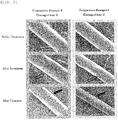
FIG. 4 shows electron micrographs for observing treatment effects on damaged hairs in Examples 11, 12. -
FIG. 5 shows electron micrographs for observing treatment effects on damaged hairs in Comparative Examples 8, 9. - The present inventors have diligently investigated to achieve the foregoing object and consequently found that when a polyoxyalkylene-modified silicone having a certain polyoxyalkylene group at a molecular terminal and a high viscosity and a relatively low HLB within a certain viscosity range and a certain HLB range is used as a coating agent, a non-rinse-off hair protective cosmetic is obtained which has excellent adhesion to hair and excellent water resistance, and which can be easily washed off after use and consequently does not accumulate. This finding has led to the completion of the present invention.
- Specifically, the present invention is a non-rinse-off hair protective cosmetic comprising a polyoxyalkylene-modified organopolysiloxane compound which has:
- a terminal to which a siloxane chain having a polyoxyalkylene group shown by the following general formula (1) is bonded;
- 50 or more structural units shown by the following general formula (2) per molecule;
- a viscosity of 50,000 mPa·s or more at 25°C; and
- an HLB of 1.0 to 7.0,


- The number of structural units of the general formula (2) in one molecule is 50 or more, and the upper limit is preferably 1000. More preferably, the number is 60 or more, and the upper limit is 500.
- The viscosity is 50,000 mPa·s or more, and as the upper limit, the polyoxyalkylene-modified organopolysiloxane compound may be semi-solid with no flowability. If the viscosity is less than 50,000 mPa·s, the adhesion to hair is lowered. The viscosity is preferably 100,000 mPa·s or more, further preferably 200,000 mPa·s or more. This viscosity is a viscosity at 25°C which is measured with a rotary viscometer (manufactured by Toki Sangyo Co., Ltd., model TVB-10 viscometer).
- In the present invention, the HLB of the polyoxyalkylene-modified organopolysiloxane compound is a numerical value obtained from the following calculation formula, and ranges from 1.0 to 7.0.

- If the HLB is less than 1.0, the washability by shampoo is insufficient. If the HLB is more than 7.0, the water resistance is lowered. The HLB is preferably 2.0 to 7.0, more preferably 2.0 to 6.0.
- R1's each independently represent an alkyl group having 1 to 10 carbon atoms or a phenyl group. The alkyl group having 1 to 10 carbon atoms may be linear, branched, or cyclic, and is preferably a linear alkyl group. Specific examples of R1 include methyl, ethyl, propyl, butyl, pentyl, hexyl, heptyl, octyl, nonyl, and decyl groups. R1 is preferably a methyl group, an ethyl group, or a phenyl group.
- R2's each represent a divalent hydrocarbon group having 2 to 10 carbon atoms. Specific examples thereof include a phenylenepropylene group, and linear or branched alkylene groups such as ethylene, propylene, trimethylene, n-butylene, isobutylene, s-butylene, n-octylene, 2-ethylhexylene, and n-decylene groups. Preferably, R2 is a propylene, n-butylene, or isobutylene group.
- R3's each represent a hydrogen atom or a group selected from an alkyl group having 1 to 10 carbon atoms and an acyl group. Specific examples of the alkyl group include methyl, ethyl, propyl, butyl, pentyl, hexyl, heptyl, octyl, nonyl, and decyl groups. Specific examples of the acyl group include an acetyl group, a propionyl group, etc. R3 is preferably a hydrogen atom, a methyl group, an ethyl group, or an acetyl group.
- R4 is a hydrogen atom or an alkyl group having 1 to 5 carbon atoms. Specific examples of the alkyl group include methyl, ethyl, propyl, butyl, pentyl groups, etc. Preferably, R4 is a hydrogen atom, a methyl group, or an ethyl group.
- "a" is a number of 10 to 150. "b" is a number of 0 to 75. "c" is a number of 0 to 75. a/(a+b+c) is 0.5 to 0.9. If a/(a+b+c) is less than 0.5, the washability by shampoo is insufficient. If a/(a+b+c) is more than 0.9, the water resistance is lowered. Preferably, "a" is a number of 10 to 100, "b" is a number of 0 to 50, and "c" is a number of 0 to 50, satisfying that a/(a+b+c) is 0.6 to 0.85. Additionally, each unit "a", "b", and "c" may be either a block copolymer or a random copolymer.
- Each "d" is independently a number of 5 to 100. Each "e" is independently a number of 0 to 50. Each "f" is independently a number of 0 to 50. d/(d+e+f) is 0.5 to 0.9. If d/(d+e+f) is less than 0.5, the washability by shampoo is insufficient. If d/(d+e+f) is more than 0.9, the water resistance is lowered. Preferably, "d" is a number of 5 to 50, "e" is a number of 0 to 25, and "f" is a number of 0 to 25, satisfying that d/(d+e+f) is 0.6 to 0.85. Additionally, each unit "d", "e", and "f" may be either a block copolymer or a random copolymer.
- The polyoxyalkylene-modified organopolysiloxane of the present invention may contain, besides a compound (the following general formula (5)) composed of the structural unit of the general formula (1) and the structural units of the general formula (2), ones containing a branched structural unit of a R1SiO(3/2) unit (for example, the following general formula (6)) or a SiO2 unit (for example, the following general formula (7)).
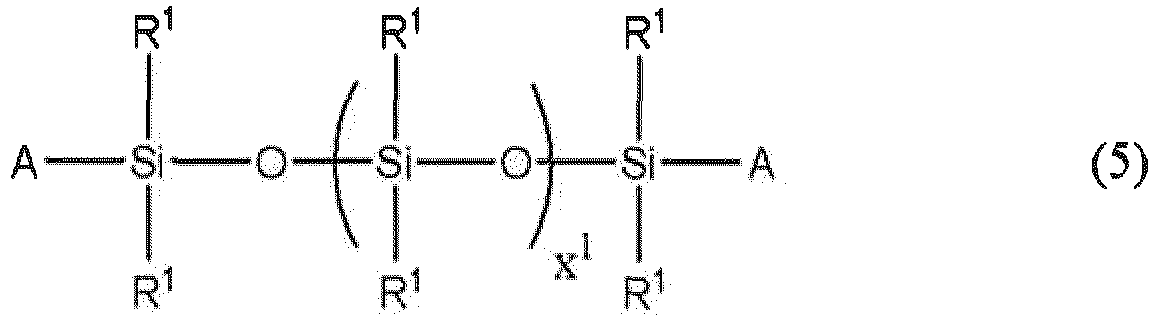


- In the above formulae, "y" and "z" each preferably represent a number of 1 to 5. "y" and "z" are preferably 5 or less because there are not too many branched structural units to be crosslinked. "y" and "z" are more preferably 1 to 3.
- The polyoxyalkylene-modified organopolysiloxane compound used in the present invention can be obtained according to a conventional method of addition reaction between an organopolysiloxane having a Si-H group at a molecular terminal and a polyoxyalkylene compound having a terminal unsaturated group.
- Specifically, description will be given of an example in which a polyoxyalkylene-modified diorganopolysiloxane compound shown by the general formula (5) is produced. This compound can be obtained by reaction of a diorganohydrogenpolysiloxane shown by the following general formula (8) and a polyoxyalkylene compound containing a terminal unsaturated group shown by the following general formula (9) or (10).


- The polyoxyalkylene-modified organopolysiloxane compound obtained by addition reaction may be subjected to a deodorant process according to a known method such as hydrolysis of the unreacted unsaturated terminal group with acidic aqueous solution and hydrogenation thereof.
- The inventive non-rinse-off hair protective cosmetic is used without rinsing off after directly applied to hair, and protects the cuticle layer by the application to any of the whole surface of hair or a portion thereof. The inventive hair protective cosmetic is excellent in adhesion to hair and the protected hair is excellent in smoothness. Thus, damage due to friction by brushing and so on and damage due to heat of a dryer can be prevented, and split hair can also be prevented effectively. Moreover, the hair protective cosmetic does not flow off by sweat, rain, or the like, but is easily removable by shampoo.
- Preferably, the inventive non-rinse-off hair protective cosmetic contains, based on 100 parts by mass of the polyoxyalkylene-modified organopolysiloxane (a component (A)), 50 to 400 parts by mass of a component (B) that is a water-soluble monohydric alcohol or polyhydric alcohol, and 100 to 1000 parts by mass of a component (C) that is water, but does not contain an emulsifier. Such a hair protective cosmetic can be a transparent homogeneous solution without a nonionic emulsifier, an anionic emulsifier, a cationic emulsifier, or an amphoteric emulsifier.
- Note that, without the water of the component (C), a transparent homogeneous solution can be formed using only the components (A) and (B). Nevertheless, to improve the pleasantness of use, the above composition ratio is preferable.
- With 50 parts by mass or more of the component (B), there is no fear that the transparency of the composition is impaired. With 400 parts by mass or less, there is no fear that the adhesion to hair is lowered. Thus, this range is preferable. Further preferably, the range is 50 to 300 parts by mass.
- With 100 parts by mass or more of the component (C), the refreshing feeling upon application to hair is improved. With 1000 parts by mass or less, there is no fear that the transparency of the composition is impaired. Thus, this range is preferable. Further preferably, the range is 120 to 800 parts by mass.
- Specific examples of the component (B) include lower alcohols such as ethanol and 2-propanol; and polyhydric alcohols such as propylene glycol, butylene glycol, dibutylene glycol, glycerin, and diglycerin.
- A preferable mode of the present invention is as described above but is not limited to the hair protective cosmetic which contains, based on 100 parts by mass of the component (A) polyoxyalkylene-modified organopolysiloxane, 50 to 400 parts by mass of the component (B) water-soluble monohydric alcohol or polyhydric alcohol, and 100 to 1000 parts by mass of the component (C) water, but which does not contain an emulsifier. When the inventive non-rinse-off hair protective cosmetic is prepared, known component(s) for cosmetics may be blended.
- Specific examples thereof include oils such as silicone oil, hydrocarbon oil, and ester oil; higher alcohols such as lauryl alcohol, myristyl alcohol, and stearyl alcohol; salts such as inorganic salts, organic salts, and amine hydrochloride; plant polymers such as arabia gum, guar gum, and starch; microorganism-derived polymers such as xanthan gum and dextrin; cellulose polymers such as methylcellulose, methylhydroxypropylcellulose, and carboxymethyl cellulose; vinyl polymers such as carboxyvinyl polymers; acrylic polymers such as sodium polyacrylate and polyacryl amide; inorganic polymers such as bentonite, montmorillonite, and silicic anhydride; water-soluble synthetic polymers such as polyvinyl alcohol and polyoxyethylene; powders such as inorganic powder, organic powder, metal salt powder, colored pigment, pearl pigment, and natural pigment; and other components used for ordinal cosmetics, such as an ultraviolet light protective agent, an antiperspirant, an oil-soluble gelation agent, a moisturizer, an antioxidant, a fragrance, an antiseptic, a pH adjuster, a cooling agent, a skin-whitening agent, and vitamins.
- Additionally, it is also possible to blend what is called an emulsifier generally used for cosmetic usage, for example, polyether-modified silicones (low viscosity products) known as nonionic emulsifiers, nonionic emulsifiers other than polyether-modified silicones, an anionic emulsifiers, cationic emulsifiers, and amphoteric emulsifiers.
- Hereinafter, the present invention will be more specifically described by showing Examples and Comparative Examples, but the present invention is not limited to the following Examples.
- Into a flask, 753.4 g of methyl hydrogen polysiloxane shown by the following formula (11), 331.4 g of a polyoxyalkylene compound shown by the following formula (12), and 1085.0 g of 2-propanol were introduced. To these, 0.11 g of Karstedt catalyst (platinum concentration: 3%) and 0.24 g of 10% potassium acetate solution in ethanol were added, and the reaction was carried out at 80°C for 5 hours. After the reaction, the solvent was removed under reduced pressure to give polyoxyalkylene-modified diorganopolysiloxane shown by the following formula (13) (hereinafter referred to as Compound 1). The calculated HLB value was 4.0, and the viscosity at 25°C was 844,000 mPa·s.


- 679.4 g of methyl hydrogen polysiloxane shown by the following formula (14), 331.4 g of a polyoxyalkylene compound shown by the formula (12), and 1050.0 g of 2-propanol were prepared. To these, 0.11 g of Karstedt catalyst (platinum concentration: 3%) and 0.24 g of 10% potassium acetate solution in ethanol were added to give a polyoxyalkylene-modified diorganopolysiloxane shown by the following formula (15) (hereinafter referred to as Compound 2) as in Synthesis Example 1. The calculated HLB value was 4.2, and the viscosity at 25°C was 421,000 mPa·s.


- 297.3 g of methyl hydrogen polysiloxane shown by the following formula (16), 33.1 g of a polyoxyalkylene compound shown by the formula (12), 660.0 g of 2-propanol, 0.03 g of Karstedt catalyst (platinum concentration: 3%), and 0.06 g of 10% potassium acetate solution in ethanol were added together to give a polyoxyalkylene-modified diorganopolysiloxane shown by the following formula (17) (hereinafter referred to as Compound 3) as in Synthesis Example 1. The calculated HLB value was 1.3, and the viscosity at 25°C was 2,960,000 mPa·s.


- 150.7 g of methyl hydrogen polysiloxane shown by the following formula (18) (x1+x2=200), 49.7 g of a polyoxyalkylene compound shown by the formula (12), 300.0 g of 2-propanol, 0.03 g of Karstedt catalyst (platinum concentration: 3%), and 0.06 g of 10% potassium acetate solution in ethanol were added together to give a semi-solid polyoxyalkylene-modified organopolysiloxane shown by the following formula (19) (hereinafter referred to as Compound 4) as in Synthesis Example 1. The calculated HLB value was 3.2.


- 75.3 g of methyl hydrogen polysiloxane shown by the formula (11), 33.6 g of a polyoxyalkylene compound shown by the following formula (20), 110.0 g of 2-propanol, 0.02 g of Karstedt catalyst (platinum concentration: 3%), and 0.04 g of 10% potassium acetate solution in ethanol were added together to give a polyoxyalkylene-modified diorganopolysiloxane shown by the following formula (21) (hereinafter referred to as Compound 5) as in Synthesis Example 1. The calculated HLB value was 3.9, and the viscosity at 25°C was 547,000 mPa·s.


- According to compositions shown in Table 1 below, hair protective cosmetics were prepared, and hairs were treated by the following method and observed through electron microscope and photographed.
-
- 1. About 1.5 g of commercially available hairs (ordinal hairs) were tied on each one end to prepare a hair bundle, and this was observed through electron microscope and photographed (before treatment).
- 2. The hair bundle was introduced into a vessel containing a protective agent solution (hair protective cosmetic), and was soaked for 5 minutes.
- 3. The hair bundle was taken out, and the excess liquid attached thereto was wiped out. Then, the hair bundle was dried being hung with the hair ends pointing downward. After drying, the hair bundle was observed through electron microscope and photographed (after treatment).
- 4. The hair bundle was introduced into a vessel containing water, and washed for 5 minutes with shaking. The excess water drops were wiped out with a towel. Then, the hair bundle was dried being hung with the hair ends pointing downward. After drying, the hair bundle was observed through electron microscope and photographed (after water washing).
- 5. The hair bundle was introduced into a solution of commercially available non-silicone shampoo, and washed for 5 minutes with shaking. After the shampoo components were rinsed off, the excess water drops were wiped out with a towel, and the hair bundle was dried being hung with the bundled end pointing downward. After drying, the hair bundle was observed through electron microscope and photographed (after shampoo).
- a desk-top scanning electron microscope (manufactured by JEOL Ltd., JCM-6000Plus)
- acceleration voltage: 5.0 kV, magnification: 500-power, 1000-power, pre-treatment: vapor deposition of gold microparticles
- The electron micrographs were judged according to the following criteria.
-
- Excellent: uniformly adhered to the whole surface of the hair.
- Fair: found partially non-adhered to the hair. Otherwise, found that the adhesion was uneven.
- Bad: clearly found not uniformly adhered.
-
- Excellent: remained uniformly adhered to the whole surface of the hair.
- Fair: found partially non-adhered to the hair.
- Bad: clearly found removed from the hair.
-
- Excellent: clearly removed from the hair, and no protective agent was found remaining.
- Fair: a portion of the protective agent was found remaining.
- Bad: found not removed from the hair and noticeably remaining.
- Table 1 shows the compositions and the evaluation results of the hair protective cosmetics. Note that the composition of each hair protective cosmetic is shown in mass%.
[Table 1] Example 1 Example 2 Example 3 Example 4 Example 5 Composition of hair protective cosmetic Compound 1 20 - - - - Compound 2 - 20 - - - Compound 3 - - 20 - - Compound 4 - - - 20 - Compound 5 - - - - 20 Ethanol 24 24 24 24 24 Water 56 56 56 56 56 Evaluation After treatment Excellent Excellent Excellent Excellent Excellent After water washing Excellent Excellent Excellent Excellent Excellent After shampoo Excellent Excellent Excellent to Fair Excellent Excellent - The electron micrograph observations confirmed the adhesion to the whole surface of the hair after the treatment. Moreover, the hair protective cosmetics were not removed after the water washing, and kept the favorable adhesion. This suggested that the hair protective cosmetics do not flow off by sweat or rain. Further, it was verified that after the shampoo, the hair protective cosmetics were sufficiently removed from the hair surface and did not remain. Note that
FIG. 1 shows an electron micrograph (×1000) before the treatment in Example 1,FIG. 2 shows an electron micrograph (×1000) after the treatment in Example 1, andFIG. 3 shows an electron micrograph (×1000) after the shampoo in Example 1. - According to compositions shown in Table 2 below, hair protective cosmetics were prepared. The treatment was performed therewith by the above-described method, and Table 2 also shows the evaluation results through the electron micrograph observation.
[Table 2] Example 6 Example 7 Example 8 Example 9 Example 10 Composition of hair protective cosmetic Compound 1 10 30 10 - - Compound 2 - - - 10 - Compound 5 - - - - 10 Ethanol 27 21 - - - 1,3-BG - - 27 27 27 Water 63 49 63 63 63 Evaluation After treatment Excellent Excellent Excellent Excellent Excellent After water washing Excellent Excellent Excellent Excellent Excellent After shampoo Excellent Excellent Excellent Excellent Excellent - As shown in Table 2, the effects did not change even when the concentration of the polyoxyalkylene-modified silicone was reduced and/or when 1,3-BG (1,3-butylene glycol) was used as polyhydric alcohol.
- Various highly-polymerized silicone compositions which had been conventionally used as hair protective cosmetics were used to treat hairs as described above. Table 3 shows the evaluation results. Incidentally, since these compositions were not uniformly dispersed in the aqueous alcohol solution, a volatile decamethylcyclopentasiloxane solution was used.
[Table 3] Comparative Example 1 Comparative Example 2 Comparative Example 3 Composition of hair protective cosmetic Highly-polymerized silicone solution*1) 50 - - Highly-polymerized silicone solution*2) - 50 - Highly-polymerized silicone solution*3) - - 50 Decamethylcyclopentasiloxane 50 50 50 Evaluation After treatment Excellent Excellent Excellent After water washing Excellent Excellent Excellent After shampoo (1st time) Bad Bad Bad After shampoo (2nd time) Bad Bad Bad *1) composition composed of gum-like dimethylpolysiloxane (25 mass%) having a polymerization degree of 5000 and isononyl isononanoate (75 mass%)
*2) composition composed of gum-like dimethylpolysiloxane (20 mass%) having a polymerization degree of 5000 and decamethylcyclopentasiloxane (80 mass%)
*3) composition composed of dimethylpolysiloxane (30 mass%) having a viscosity of 1,000,000 mPa·s at 25°C and dimethylpolysiloxane (70 mass%) having a viscosity of 20 mPa·s - As shown in Table 3, when the treatment was performed in the same manner with the conventional highly-polymerized silicone solutions, the compositions were uniformly applied after the treatment, and did not fall off even after the water washing. However, it was found that the compositions noticeably remained after the shampoo. Further, even after shampooing was carried out one more time, the remaining did not change.
- According to compositions shown in Table 4, hair protective cosmetics were prepared. The treatment was performed therewith by the above-described method, and the evaluation results through the electron micrograph observation are shown.
[Table 4] Comparative Example 4 Comparative Example 5 Comparative Example 6 Comparative Example 7 Composition of hair protective cosmetic Polyether-modified silicone 120 - - - Polyether-modified silicone 2 - 20 - - Polyether-modified silicone 3 - - 20 - Polyether-modified silicone 4 - - - 20 Ethanol 24 24 24 24 Water 56 56 56 56 Evaluation After treatment Fair Fair Fair Fair After water washing Fair Bad Bad Fair After shampoo Excellent - - Excellent -

-

-

-

- As shown in Table 4, all resulted in inferior uniform applications after the treatment. In Comparative Examples 5 and 6, the cosmetics were removed from the hairs at the stage after the water washing. In Comparative Examples 4 and 7, the removal was observed at the stage after the shampoo.
- According to compositions shown in Table 5, hair protective cosmetics were prepared, and the effects on bleached
Damaged hair 1 and saline-treatedDamaged hair 2 were examined. The hair treatment methods were described below. -
- 1. A hair bundle was prepared from commercially available hairs (ordinal hairs) as described above, and soaked in a commercially available bleach for 45 minutes.
- 2. The hair bundle was taken out, sufficiently rinsed, and then the excess water drops were wiped out with a towel. The hair bundle was dried being hung with the hair ends pointing downward. After drying, the hair bundle was observed through electron microscope and photographed (before treatment).
- 3. The hair bundle was introduced into a vessel containing a protective agent solution (hair protective cosmetic), and was soaked for 5 minutes.
- 4. The hair bundle was taken out, and the excess liquid attached thereto was wiped out. Then, the hair bundle was dried being hung with the hairs pointing downward. The dried hairs were observed through electron microscope and photographed (after treatment).
- 5. The hairs were introduced into a solution of commercially available non-silicone shampoo, and washed for 5 minutes with shaking. After the shampoo components were rinsed off, the excess water drops were wiped out with a towel, and the hair bundle was dried being hung with the bundled end pointing downward. After drying, the hair bundle was observed through electron microscope and photographed (after shampoo).
-
- 1. A hair bundle was prepared from commercially available hairs (ordinal hairs) as described above, and soaked in saline with a concentration of 3.5 mass% for 45 minutes.
- 2. The hair bundle was taken out, sufficiently rinsed, and then the excess water drops were wiped out with a towel. The hair bundle was dried being hung with the hair ends pointing downward. After drying, the hair bundle was observed through electron microscope and photographed (before treatment).
- 3. The hair bundle was introduced into a vessel containing a protective agent solution (hair protective cosmetic), and was soaked for 5 minutes.
- 4. The hair bundle was taken out, and the excess liquid attached thereto was wiped out. Then, the hair bundle was dried being hung with the hairs pointing downward. The dried hairs were observed through electron microscope and photographed (after treatment).
- 5. The hairs were introduced into a solution of commercially available non-silicone shampoo, and washed for 5 minutes with shaking. After the shampoo components were rinsed off, the excess water drops were wiped out with a towel, and the hair bundle was dried being hung with the bundled end pointing downward. After drying, the hair bundle was observed through electron microscope and photographed (after shampoo).
- Table 5 shows the evaluation results through the electron micrograph observation. Note that
FIG. 4 shows electron micrographs (×500) before the treatment, after the treatment, and after the shampoo in Example 11 (Damaged hair 1) and Example 12 (Damaged hair 2); andFIG. 5 shows electron micrographs (×500) before the treatment, after the treatment, and after the shampoo in Comparative Example 8 (Damaged hair 1) and Comparative Example 9 (Damaged hair 2).[Table 5] Damaged hair 1Damaged hair 2Example 11 Comparative Example 8 Example 12 Comparative Example 9 Composition of hair protective cosmetic Compound 1 20 - 20 - Highly-polymerized silicone solution (above *1) - 50 - 50 Decamethylcyclope ntasiloxane - 50 - 50 Ethanol 24 - 24 - Water 56 - 56 - Evaluation After treatment Excellent Fair Excellent Fair After shampoo Excellent Bad Excellent Bad - As a result, the inventive hair protective cosmetics were excellent in adhesion to hair and removability after the shampoo with respect to both
Damaged hairs 1 and 2 (Examples 11, 12). Meanwhile, when the highly-polymerized silicone solution was used, the adhesion to hair was insufficient, and the removability after the shampoo was inferior (Comparative Examples 8, 9). - It should be noted that the present invention is not limited to the above-described embodiments. The embodiments are just examples, and any examples that have substantially the same feature and demonstrate the same functions and effects as those in the technical concept disclosed in claims of the present invention are included in the technical scope of the present invention.
Claims (2)
- A non-rinse-off hair protective cosmetic comprising a polyoxyalkylene-modified organopolysiloxane compound which has:a terminal to which a siloxane chain having a polyoxyalkylene group shown by the following general formula (1) is bonded;50 or more structural units shown by the following general formula (2) per molecule;a viscosity of 50,000 mPa·s or more at 25°C; andan HLB of 1.0 to 7.0,


- The non-rinse-off hair protective cosmetic according to claim 1, comprising:(A) 100 parts by mass of the polyoxyalkylene-modified organopolysiloxane compound;(B) 50 to 400 parts by mass of a water-soluble monohydric alcohol or polyhydric alcohol; and(C) 100 to 1000 parts by mass of water,wherein the non-rinse-off hair protective cosmetic does not contain an emulsifier.
Applications Claiming Priority (2)
| Application Number | Priority Date | Filing Date | Title |
|---|---|---|---|
| JP2017212499A JP6947607B2 (en) | 2017-11-02 | 2017-11-02 | Hair protection cosmetics that do not wash away |
| PCT/JP2018/038787 WO2019087793A1 (en) | 2017-11-02 | 2018-10-18 | Rinse-free hair-protecting cosmetic preparation |
Publications (2)
| Publication Number | Publication Date |
|---|---|
| EP3705113A1 true EP3705113A1 (en) | 2020-09-09 |
| EP3705113A4 EP3705113A4 (en) | 2021-08-18 |
Family
ID=66331746
Family Applications (1)
| Application Number | Title | Priority Date | Filing Date |
|---|---|---|---|
| EP18873822.3A Withdrawn EP3705113A4 (en) | 2017-11-02 | 2018-10-18 | Rinse-free hair-protecting cosmetic preparation |
Country Status (6)
| Country | Link |
|---|---|
| US (1) | US11160748B2 (en) |
| EP (1) | EP3705113A4 (en) |
| JP (1) | JP6947607B2 (en) |
| KR (1) | KR102649161B1 (en) |
| CN (1) | CN111356442B (en) |
| WO (1) | WO2019087793A1 (en) |
Family Cites Families (21)
| Publication number | Priority date | Publication date | Assignee | Title |
|---|---|---|---|---|
| JPH054907A (en) | 1991-06-13 | 1993-01-14 | Shiseido Co Ltd | Hair cosmetic |
| JP3081049B2 (en) | 1991-07-26 | 2000-08-28 | 株式会社資生堂 | Hair composition |
| JPH05246824A (en) | 1991-12-20 | 1993-09-24 | Shiseido Co Ltd | Hair cosmetic |
| US5393452A (en) * | 1992-11-09 | 1995-02-28 | General Electric Company | 2 in 1 shampoo system and conditioner comprising a silicon-polyether copolymer |
| US5565194A (en) * | 1994-03-04 | 1996-10-15 | Th. Goldschmidt Ag. | Polysiloxane-polyoxyalkylene block copolymers and their use as additives for hair cosmetics |
| DE4407189A1 (en) * | 1994-03-04 | 1995-09-07 | Goldschmidt Ag Th | Polysiloxane-polyoxyalkylene block copolymers and their use as additives for hair cosmetics |
| FR2818901B1 (en) * | 2001-01-02 | 2004-01-23 | Oreal | COSMETIC COMPOSITIONS CONTAINING POLYETHER BLOCK SILICONE AND POLYETHER SILICONE AND USES THEREOF |
| TW200413018A (en) * | 2002-12-26 | 2004-08-01 | Shiseido Co Ltd | Oil-in-water type emulsified cosmetic |
| JP3948666B2 (en) | 2003-01-16 | 2007-07-25 | 信越化学工業株式会社 | Oil-in-water organopolysiloxane emulsion and hair cosmetic using the same |
| JP5667332B2 (en) * | 2006-09-14 | 2015-02-12 | 東レ・ダウコーニング株式会社 | Composition for cosmetic production, cosmetic and method for producing water-containing cosmetic |
| JP2010095466A (en) * | 2008-10-16 | 2010-04-30 | Dow Corning Toray Co Ltd | Oil-in-water emulsion cosmetic and method for producing the same |
| JP5841311B2 (en) * | 2009-12-21 | 2016-01-13 | 東レ・ダウコーニング株式会社 | Oily raw material thickener or gelling agent, gel composition containing the same, and method for producing cosmetic or external preparation |
| JP2013119596A (en) * | 2011-12-07 | 2013-06-17 | Shin-Etsu Chemical Co Ltd | Silicone-modified wax, composition and cosmetic containing the same, and production method of silicone-modified wax |
| JP5830368B2 (en) * | 2011-12-16 | 2015-12-09 | 東レ・ダウコーニング株式会社 | Process for producing organopolysiloxane-polyoxyalkylene block copolymer |
| JP6369888B2 (en) * | 2011-12-27 | 2018-08-08 | 東レ・ダウコーニング株式会社 | Novel liquid organopolysiloxane and use thereof |
| JP6369887B2 (en) * | 2011-12-27 | 2018-08-08 | 東レ・ダウコーニング株式会社 | Novel co-modified organopolysiloxane, treatment agent containing the same, and external preparation |
| JP5583710B2 (en) * | 2012-03-22 | 2014-09-03 | 信越化学工業株式会社 | Novel organopolysiloxane, cosmetic containing the same, and method for producing organopolysiloxane |
| JP5841488B2 (en) * | 2012-05-11 | 2016-01-13 | 信越化学工業株式会社 | Block-type modified organopolysiloxane, method for using the organopolysiloxane, cosmetics, and method for producing the organopolysiloxane |
| US9610239B2 (en) * | 2012-10-11 | 2017-04-04 | Dow Corning Corporation | Aqueous silicone polyether microemulsions |
| JP6613566B2 (en) * | 2015-01-09 | 2019-12-04 | 信越化学工業株式会社 | Polyoxyalkylene-modified diorganopolysiloxane compound, method for producing the same, and organopolysiloxane emulsion composition |
| JP6601229B2 (en) * | 2016-01-15 | 2019-11-06 | 信越化学工業株式会社 | Organopolysiloxane emulsion composition and resin composition |
-
2017
- 2017-11-02 JP JP2017212499A patent/JP6947607B2/en active Active
-
2018
- 2018-10-18 EP EP18873822.3A patent/EP3705113A4/en not_active Withdrawn
- 2018-10-18 WO PCT/JP2018/038787 patent/WO2019087793A1/en not_active Ceased
- 2018-10-18 KR KR1020207012199A patent/KR102649161B1/en active Active
- 2018-10-18 US US16/754,155 patent/US11160748B2/en active Active
- 2018-10-18 CN CN201880070957.XA patent/CN111356442B/en active Active
Also Published As
| Publication number | Publication date |
|---|---|
| JP6947607B2 (en) | 2021-10-13 |
| KR20200083467A (en) | 2020-07-08 |
| JP2019085346A (en) | 2019-06-06 |
| CN111356442B (en) | 2023-03-14 |
| EP3705113A4 (en) | 2021-08-18 |
| KR102649161B1 (en) | 2024-03-20 |
| US11160748B2 (en) | 2021-11-02 |
| US20200337984A1 (en) | 2020-10-29 |
| WO2019087793A1 (en) | 2019-05-09 |
| CN111356442A (en) | 2020-06-30 |
Similar Documents
| Publication | Publication Date | Title |
|---|---|---|
| EP2505187B1 (en) | Hair cosmetic | |
| CN104220039A (en) | Hair care composition comprising metathesized unsaturated polyol ester | |
| RU2000107833A (en) | COSMETIC COMPOSITIONS CONTAINING A BLOCK-COPOLYMER OF AN AMINATED POLYOXYLKYLENE SILICONE AND A CONDITIONING AGENT, AND ALSO APPLICATION OF THE INDICATED COMPOSITIONS | |
| CN103946445A (en) | Aminofunctional silicone compositions | |
| EP3049050A1 (en) | Hair conditioning compositions comprising low viscosity emulsified silicone polymers | |
| CA2323946A1 (en) | Cosmetic compositions containing a dimethicone/vinyl dimethicone copolymer in aqueous emulsion and an associative thickener and their uses | |
| KR20020089579A (en) | Leave-on or Rinse-out Hair Care Conditioner Compositions Containing Silicone Quaternary Compounds and Thickeners | |
| JP2009516025A (en) | Swellable silicone composition and preparation method thereof | |
| JP5928367B2 (en) | Method for producing cosmetic containing crosslinkable silicone rubber emulsion | |
| CA2323951C (en) | Cosmetic compositions containing a dimethicone/vinyl dimethicone copolymer emulsion and a silicone and their uses | |
| KR20160021226A (en) | Silicone modified by long-chain hydrocarbon group-containing diglycerin derivative, and use thereof | |
| EP0749299B1 (en) | Hair conditioning composition | |
| EP3450483A1 (en) | Novel organopolysiloxane or acid neutralization salt thereof, and uses of these | |
| WO2006137004A2 (en) | Hair conditioning composition comprising gel matrix and high molecular weight water-soluble cationic polymer | |
| MX2010014083A (en) | Cosmetic composition comprising at least one volatile linear alkane, at least one cationic surfactant whereby the two components are in a specific ratio. | |
| EP1347737A1 (en) | Cosmetic composition comprising a volatile silicone, a silicone surfactant and a cationic surfactant | |
| KR102180163B1 (en) | High-purity monoalkenyl-containing glycerin derivative, and method for producing same | |
| US11160748B2 (en) | Non-rinse-off hair protective cosmetic | |
| JP2012240915A (en) | Hair cosmetic | |
| JP3442814B2 (en) | Detergent composition | |
| GB2592722A (en) | Anhydrous agent for treating keratin fibres | |
| CN109310617B (en) | Antiperspirant or deodorant cosmetic | |
| WO2018121966A1 (en) | Oil-in-water type silicone emulsion composition | |
| JP2006265205A (en) | Hair conditioning composition | |
| CN1241542C (en) | Emulsion composition |
Legal Events
| Date | Code | Title | Description |
|---|---|---|---|
| STAA | Information on the status of an ep patent application or granted ep patent |
Free format text: STATUS: THE INTERNATIONAL PUBLICATION HAS BEEN MADE |
|
| PUAI | Public reference made under article 153(3) epc to a published international application that has entered the european phase |
Free format text: ORIGINAL CODE: 0009012 |
|
| STAA | Information on the status of an ep patent application or granted ep patent |
Free format text: STATUS: REQUEST FOR EXAMINATION WAS MADE |
|
| 17P | Request for examination filed |
Effective date: 20200424 |
|
| AK | Designated contracting states |
Kind code of ref document: A1 Designated state(s): AL AT BE BG CH CY CZ DE DK EE ES FI FR GB GR HR HU IE IS IT LI LT LU LV MC MK MT NL NO PL PT RO RS SE SI SK SM TR |
|
| AX | Request for extension of the european patent |
Extension state: BA ME |
|
| DAV | Request for validation of the european patent (deleted) | ||
| DAX | Request for extension of the european patent (deleted) | ||
| A4 | Supplementary search report drawn up and despatched |
Effective date: 20210720 |
|
| RIC1 | Information provided on ipc code assigned before grant |
Ipc: A61K 8/894 20060101AFI20210714BHEP Ipc: A61K 8/34 20060101ALI20210714BHEP Ipc: A61Q 5/12 20060101ALI20210714BHEP Ipc: C08G 77/46 20060101ALI20210714BHEP |
|
| RAP3 | Party data changed (applicant data changed or rights of an application transferred) |
Owner name: SHIN-ETSU CHEMICAL CO., LTD. |
|
| STAA | Information on the status of an ep patent application or granted ep patent |
Free format text: STATUS: EXAMINATION IS IN PROGRESS |
|
| 17Q | First examination report despatched |
Effective date: 20230714 |
|
| STAA | Information on the status of an ep patent application or granted ep patent |
Free format text: STATUS: THE APPLICATION HAS BEEN WITHDRAWN |
|
| 18W | Application withdrawn |
Effective date: 20231009 |