EP3699253A1 - Granulat für einen thermochemischen wärmespeicher und verfahren zum herstellen von granulat für einen thermochemischen wärmespeicher - Google Patents
Granulat für einen thermochemischen wärmespeicher und verfahren zum herstellen von granulat für einen thermochemischen wärmespeicher Download PDFInfo
- Publication number
- EP3699253A1 EP3699253A1 EP20158137.8A EP20158137A EP3699253A1 EP 3699253 A1 EP3699253 A1 EP 3699253A1 EP 20158137 A EP20158137 A EP 20158137A EP 3699253 A1 EP3699253 A1 EP 3699253A1
- Authority
- EP
- European Patent Office
- Prior art keywords
- granules
- layer
- granulate
- deposited
- thermochemical heat
- Prior art date
- Legal status (The legal status is an assumption and is not a legal conclusion. Google has not performed a legal analysis and makes no representation as to the accuracy of the status listed.)
- Granted
Links
Images

Classifications
-
- C—CHEMISTRY; METALLURGY
- C09—DYES; PAINTS; POLISHES; NATURAL RESINS; ADHESIVES; COMPOSITIONS NOT OTHERWISE PROVIDED FOR; APPLICATIONS OF MATERIALS NOT OTHERWISE PROVIDED FOR
- C09K—MATERIALS FOR MISCELLANEOUS APPLICATIONS, NOT PROVIDED FOR ELSEWHERE
- C09K5/00—Heat-transfer, heat-exchange or heat-storage materials, e.g. refrigerants; Materials for the production of heat or cold by chemical reactions other than by combustion
- C09K5/16—Materials undergoing chemical reactions when used
-
- B—PERFORMING OPERATIONS; TRANSPORTING
- B01—PHYSICAL OR CHEMICAL PROCESSES OR APPARATUS IN GENERAL
- B01J—CHEMICAL OR PHYSICAL PROCESSES, e.g. CATALYSIS OR COLLOID CHEMISTRY; THEIR RELEVANT APPARATUS
- B01J20/00—Solid sorbent compositions or filter aid compositions; Sorbents for chromatography; Processes for preparing, regenerating or reactivating thereof
- B01J20/28—Solid sorbent compositions or filter aid compositions; Sorbents for chromatography; Processes for preparing, regenerating or reactivating thereof characterised by their form or physical properties
- B01J20/28002—Solid sorbent compositions or filter aid compositions; Sorbents for chromatography; Processes for preparing, regenerating or reactivating thereof characterised by their form or physical properties characterised by their physical properties
- B01J20/28004—Sorbent size or size distribution, e.g. particle size
-
- B—PERFORMING OPERATIONS; TRANSPORTING
- B01—PHYSICAL OR CHEMICAL PROCESSES OR APPARATUS IN GENERAL
- B01J—CHEMICAL OR PHYSICAL PROCESSES, e.g. CATALYSIS OR COLLOID CHEMISTRY; THEIR RELEVANT APPARATUS
- B01J20/00—Solid sorbent compositions or filter aid compositions; Sorbents for chromatography; Processes for preparing, regenerating or reactivating thereof
- B01J20/28—Solid sorbent compositions or filter aid compositions; Sorbents for chromatography; Processes for preparing, regenerating or reactivating thereof characterised by their form or physical properties
- B01J20/28054—Solid sorbent compositions or filter aid compositions; Sorbents for chromatography; Processes for preparing, regenerating or reactivating thereof characterised by their form or physical properties characterised by their surface properties or porosity
- B01J20/28088—Pore-size distribution
- B01J20/28092—Bimodal, polymodal, different types of pores or different pore size distributions in different parts of the sorbent
-
- B—PERFORMING OPERATIONS; TRANSPORTING
- B01—PHYSICAL OR CHEMICAL PROCESSES OR APPARATUS IN GENERAL
- B01J—CHEMICAL OR PHYSICAL PROCESSES, e.g. CATALYSIS OR COLLOID CHEMISTRY; THEIR RELEVANT APPARATUS
- B01J20/00—Solid sorbent compositions or filter aid compositions; Sorbents for chromatography; Processes for preparing, regenerating or reactivating thereof
- B01J20/30—Processes for preparing, regenerating, or reactivating
- B01J20/32—Impregnating or coating ; Solid sorbent compositions obtained from processes involving impregnating or coating
- B01J20/3202—Impregnating or coating ; Solid sorbent compositions obtained from processes involving impregnating or coating characterised by the carrier, support or substrate used for impregnation or coating
- B01J20/3204—Inorganic carriers, supports or substrates
-
- B—PERFORMING OPERATIONS; TRANSPORTING
- B01—PHYSICAL OR CHEMICAL PROCESSES OR APPARATUS IN GENERAL
- B01J—CHEMICAL OR PHYSICAL PROCESSES, e.g. CATALYSIS OR COLLOID CHEMISTRY; THEIR RELEVANT APPARATUS
- B01J20/00—Solid sorbent compositions or filter aid compositions; Sorbents for chromatography; Processes for preparing, regenerating or reactivating thereof
- B01J20/30—Processes for preparing, regenerating, or reactivating
- B01J20/32—Impregnating or coating ; Solid sorbent compositions obtained from processes involving impregnating or coating
- B01J20/3231—Impregnating or coating ; Solid sorbent compositions obtained from processes involving impregnating or coating characterised by the coating or impregnating layer
- B01J20/3234—Inorganic material layers
- B01J20/3236—Inorganic material layers containing metal, other than zeolites, e.g. oxides, hydroxides, sulphides or salts
-
- B—PERFORMING OPERATIONS; TRANSPORTING
- B01—PHYSICAL OR CHEMICAL PROCESSES OR APPARATUS IN GENERAL
- B01J—CHEMICAL OR PHYSICAL PROCESSES, e.g. CATALYSIS OR COLLOID CHEMISTRY; THEIR RELEVANT APPARATUS
- B01J20/00—Solid sorbent compositions or filter aid compositions; Sorbents for chromatography; Processes for preparing, regenerating or reactivating thereof
- B01J20/30—Processes for preparing, regenerating, or reactivating
- B01J20/32—Impregnating or coating ; Solid sorbent compositions obtained from processes involving impregnating or coating
- B01J20/3291—Characterised by the shape of the carrier, the coating or the obtained coated product
- B01J20/3293—Coatings on a core, the core being particle or fiber shaped, e.g. encapsulated particles, coated fibers
-
- F—MECHANICAL ENGINEERING; LIGHTING; HEATING; WEAPONS; BLASTING
- F25—REFRIGERATION OR COOLING; COMBINED HEATING AND REFRIGERATION SYSTEMS; HEAT PUMP SYSTEMS; MANUFACTURE OR STORAGE OF ICE; LIQUEFACTION SOLIDIFICATION OF GASES
- F25B—REFRIGERATION MACHINES, PLANTS OR SYSTEMS; COMBINED HEATING AND REFRIGERATION SYSTEMS; HEAT PUMP SYSTEMS
- F25B37/00—Absorbers; Adsorbers
-
- F—MECHANICAL ENGINEERING; LIGHTING; HEATING; WEAPONS; BLASTING
- F28—HEAT EXCHANGE IN GENERAL
- F28D—HEAT-EXCHANGE APPARATUS, NOT PROVIDED FOR IN ANOTHER SUBCLASS, IN WHICH THE HEAT-EXCHANGE MEDIA DO NOT COME INTO DIRECT CONTACT
- F28D20/00—Heat storage plants or apparatus in general; Regenerative heat-exchange apparatus not covered by groups F28D17/00 or F28D19/00
- F28D20/003—Heat storage plants or apparatus in general; Regenerative heat-exchange apparatus not covered by groups F28D17/00 or F28D19/00 using thermochemical reactions
Definitions
- the invention relates to granules, which can be used in particular in a heat storage device operating according to the thermochemical principle, and to a method for producing granules for a thermochemical heat storage device.
- the granules consist of a sorbent material that binds water in an exothermic reaction and gives off heat in the process.
- the binding of the water in the granulate takes place primarily on the inner surface of the granulate, which is why porous, sorbent material is preferably used. If, on the other hand, heat is supplied to the granules, the water stored in the granules is released in the form of water vapor to the surroundings of the granules.
- thermochemical heat accumulator In the case of a thermochemical heat accumulator, the bulk of granules is in a container. The granulate is dried in a desorption phase. As a result of the supply of heat, the water bound to the granulate is driven out and flows as hot water vapor to a heat exchanger in which the water vapor condenses. The energy released in the process can, for example, be transferred to a heating circuit as useful heat. This process can be continued until the granules stop releasing water. The heat exchanger with the condensed water is often arranged below the granulate bed. During the adsorption phase of a thermochemical heat accumulator, the water that was previously condensed in the heat exchanger is evaporated again. The water vapor flows up to the granulate, is adsorbed by it and releases adsorption heat, which can also be used for a heating circuit.
- thermochemical heat storage are mainly silicates such as zeolites or metal hydrides.
- granulate material suitable for a heat storage device can also consist of hydrophilic and porous metal-organic framework structures. On the basis Such materials are also referred to as MOFs in the English technical term "metal-organic framework" used for this purpose.
- thermochemical heat accumulator can be designed in various ways. For example, the energy gained with solar cells over a summer can be used to dry the granulate of a heat storage tank in its desorption phase, while in winter the adsorption phase of the heat storage tank is carried out and the adsorption heat obtained is used for heating.
- a thermochemical heat accumulator can also be operated in a day-night cycle, so that the desorption phase is carried out in daylight and the adsorption phase in the dark.
- Even shorter cycles can be implemented if two thermochemical heat storage systems are coupled in opposite directions, for example ( Paul Feddeck, Dr. Franz Meyer, "Heating with Zeolite Heater", Sepinfo 02/05, BINE Information Service ). That is, if a first heat storage device generates adsorption heat in its adsorption phase, the granules of a second heat storage device are dried with this adsorption heat and vice versa.
- the granules are provided with an electrically conductive layer maximum 30 ⁇ m thick ( DE 10 2014 104 719 A1 ).
- the granulate is then heated by means of a current flow and in this way the granulate is dried in the desorption phases.
- thermochemical heat accumulators have in common that their time spans for passing through the adsorption and desorption phases are limited, especially by the relatively poor thermal conductivity of the available granulate. If the time cycles of thermochemical heat accumulators are to be shortened even further, the primary aim is to increase the thermal conductivity of the entire bulk granulate.
- the invention is therefore based on the technical problem of creating a granulate for a thermochemical heat store and a method for producing granulate for a thermochemical heat store, by means of which the disadvantages from the prior art can be overcome.
- the granulate according to the invention should have better thermal conductivity compared to the prior art, so that shorter adsorption and desorption cycles are made possible in thermochemical heat storage devices.
- a granulate according to the invention for a thermochemical heat store comprises granulate grains made of a sorbent material, the granulate grains having an outer layer with a layer thickness greater than 30 ⁇ m and the layer material comprising at least one of the elements aluminum, copper and magnesium.
- the aforementioned chemical elements have good thermal conductivity, so that granules adjoining one another in a bed, which are provided with such a layer, can better conduct the heat into and out of the bed than is possible in the prior art is. This enables shorter cycles for the adsorption phase and desorption phase in thermochemical heat storage systems compared to the prior art.
- Aluminum is particularly suitable as a layer material for the outer layer in the case of granules according to the invention.
- Aluminum is relatively inexpensive, has good thermal conductivity and can be easily deposited on granules using suitable processes.
- the outer layer of the granules therefore has an aluminum mass fraction of at least 50%.
- thermochemical heat storage such as, for example, silicates, metal hydrides, MOFs and / or also those materials which are known by the English-language technical term "Selective Water Sorbents".
- granules made of zeolites are particularly suitable because they are characterized by a suitable porosity, have good sorption properties and can be produced inexpensively.
- the grains used for granules according to the invention have the same dimensions as the grain sizes used in the prior art and have an average diameter in the range from 0.2 mm to 20 mm.
- Granules according to the invention with an average diameter in the range from 1 mm to 5 mm are particularly suitable for thermochemical heat storage.
- the outer layer of the granules must be at least 30 ⁇ m thick. Layer thicknesses in the range from 50 ⁇ m to 200 ⁇ m are particularly suitable.
- An essential function of granules for a thermochemical heat storage is the sorption capacity of water, which must not be significantly impaired by an outer layer of the granules in the granules according to the invention. For this it is necessary that the outer layer on the granulate grains has a porosity which still enables sorption of water. It has been shown that a porosity of the outer layer of at least 2% is sufficient to ensure good sorption capacity of the granulate. In one embodiment, the outer layer of the granules therefore has a porosity of at least 2%. A porosity of 2% is to be understood as meaning that 2% of the layer volume consists of pores.
- a layer with a layer thickness greater than 30 ⁇ m is deposited on the granules, the layer material having at least one of the elements aluminum, copper and magnesium.
- the layer is preferably deposited with a layer thickness of 50 ⁇ m to 200 ⁇ m. In one embodiment, the layer is deposited with a porosity greater than 2%.
- the layer on the granules can be deposited, for example, by means of chemical or physical vapor deposition.
- Thermal evaporation of the layer material is particularly suitable for depositing a layer on granules, because thermal evaporation only creates a relatively loose layer structure with sufficient porosity that does not significantly impair the sorption capacity of the granules.
- the layer is deposited on the granules by means of thermal evaporation of aluminum.
- FIG. 1 a device is shown schematically with which the method according to the invention can be carried out.
- a drum 11 is arranged within a vacuum chamber 10 and is mounted rotatably about its drum axis.
- Granules 12 made of a sorbent material, which according to the invention are to be coated with aluminum, are located inside the drum 11.
- a vessel 13 which does not rotate with the drum 11 and from which aluminum is thermally evaporated is also fastened inside the drum 11.
- an aluminum wire 14 is fed into the vessel 13 in such a way that aluminum is continuously evaporated out of the vessel 13.
- the vessel 13 is arranged upside down inside the drum 11, so that the aluminum evaporates from top to bottom.
- the evaporation process of the aluminum is carried out while the drum 11 rotates and thus the granules 12 are constantly mixed. In this way, the granules 12 are coated all around with a relatively loose structure of aluminum.
- the coating process is continued until an outer aluminum layer with a layer thickness greater than 30 ⁇ m has been deposited on the granules 12.
- a layer with a is preferred on the granules 12 Layer thickness of 50 ⁇ m to 200 ⁇ m deposited.
- granules according to the invention for a thermochemical heat storage are available, which are characterized by good sorption capacity and good thermal conductivity.
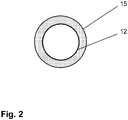
- a granulate grain 12 of granulate according to the invention is shown schematically in section, which has an outer layer 15 made of aluminum with a layer thickness greater than 30 ⁇ m.
- the granules 12 have an average diameter of 0.2 mm to 20 mm and can consist, for example, of a silicate, of a metal hydride, of MOFs and / or of selective water sorbents.
Landscapes
- Chemical & Material Sciences (AREA)
- Organic Chemistry (AREA)
- Chemical Kinetics & Catalysis (AREA)
- Analytical Chemistry (AREA)
- Engineering & Computer Science (AREA)
- Thermal Sciences (AREA)
- Physics & Mathematics (AREA)
- Inorganic Chemistry (AREA)
- Mechanical Engineering (AREA)
- General Engineering & Computer Science (AREA)
- Combustion & Propulsion (AREA)
- Materials Engineering (AREA)
- Solid-Sorbent Or Filter-Aiding Compositions (AREA)
Abstract
Description
- Die Erfindung betrifft Granulat, welches insbesondere bei einem nach dem thermochemischen Prinzip wirkenden Wärmespeicher verwendet werden kann sowie ein Verfahren zum Herstellen von Granulat für einen thermochemischen Wärmespeicher.
- Eine oftmals nur lose Schüttung aus Granulatkörnern stellt die Basis bei gängigen thermochemischen Wärmespeichern dar. Dabei bestehen die Granulatkörner aus einem sorptionsfähigen Material, welches bei einer exothermen Reaktion Wasser bindet und dabei Wärme abgibt. Das Binden des Wassers im Granulat erfolgt vornehmlich an der inneren Oberfläche des Granulats, weshalb bevorzugt poröses, sorptionsfähiges Material verwendet wird. Wird dem Granulat hingegen Wärme zugeführt, dann wird das im Granulat gespeicherte Wasser in Form von Wasserdampf an die Umgebung der Granulatkörner abgegeben.
- Bei einem thermochemischen Wärmespeicher befindet sich die Schüttung aus Granulatkörnern in einem Behältnis. In einer Desorptionsphase wird das Granulat getrocknet. Infolge von Wärmezufuhr wird das am Granulat gebundene Wasser ausgetrieben und strömt als heißer Wasserdampf zu einem Wärmetauscher, in welchem der Wasserdampf kondensiert. Die dabei frei werdende Energie kann beispielsweise als Nutzwärme an einen Heizkreislauf abgegeben werden. Dieser Vorgang kann so lange fortgeführt werden, bis das Granulat kein Wasser mehr abgibt. Der Wärmetauscher mit dem kondensierten Wasser ist oftmals unterhalb der Granulatschüttung angeordnet. Bei der Adsorptionsphase eines thermochemischen Wärmespeichers wird das im Wärmetauscher zuvor kondensierte Wasser wieder verdampft. Der Wasserdampf strömt nach oben zum Granulat, wird von diesem adsorbiert und setzt dabei Adsorptionswärme frei, welche ebenfalls für einen Heizkreislauf verwendet werden kann.
- Als Granulat für thermochemische Wärmespeicher werden vornehmlich Silikate, wie zum Beispiel Zeolithe, oder Metallhydride verwendet. In
DE 10 2006 043 648 A1 wird aufgezeigt, dass für einen Wärmespeicher geeignetes Granulatmaterial auch aus hydrophilen und porösen metallorganischen Gerüststrukturen bestehen kann. In Anlehnung an den hierfür verwendeten englischen Fachbegriff "metal-organic framework" werden derartige Materialien auch als MOFs bezeichnet. - Der Zeitzyklus, mit welchem ein thermochemischer Wärmespeicher betrieben wird, kann verschiedenartig ausgelegt sein. So kann zum Beispiel die über einen Sommer hinweg mit Solarzellen gewonnene Energie verwendet werden, um das Granulat eines Wärmespeichers in seiner Desorptionsphase zu trocken, während im Winter die Adsorptionsphase des Wärmespeichers durchgeführt und die dabei gewonnene Adsorptionswärme zum Heizen verwendet wird. Alternativ kann ein thermochemischer Wärmespeicher auch im Tag-Nacht-Zyklus betrieben werden, so dass bei Tageslicht die Desorptionsphase und bei Dunkelheit die Adsorptionsphase durchgeführt wird. Noch kürzere Zyklen können umgesetzt werden, wenn zwei thermochemische Wärmespeicher beispielsweise gegenläufig gekoppelt werden (Paul Feddeck, Dr. Franz Meyer, "Heizen mit Zeolith-Heizgerät", Projektinfo 02/05, BINE Informationsdienst). D.h, wenn ein erster Wärmespeicher in seiner Adsorptionsphase Adsorptionswärme erzeugt, wird mit dieser Adsorptionswärme das Granulat eines zweiten Wärmespeichers getrocknet und umgekehrt.
- Bei einer weiteren Ausgestaltungsform von Wärmespeichern werden die Granulatkörner mit einer maximal 30 µm dicken elektrisch leitfähigen Schicht versehen (
DE 10 2014 104 719 A1 ). Hierbei wird dann das Granulat mittels Stromdurchfluss erhitzt und auf diese Weise in den Desorptionsphasen das Granulat getrocknet. - Allen thermochemischen Wärmespeichern ist gemein, dass deren Zeitspannen für das Durchlaufen von Adsorptions- und Desorptionsphasen nach unten hin, vor allem durch die relativ schlechte Wärmeleitfähigkeit des zur Verfügung stehenden Granulats, limitiert sind. Sollen die Zeitzyklen von thermochemischen Wärmespeichern noch weiter verkürzt werden, so gilt es vornehmlich die Wärmeleitfähigkeit der gesamten Granulatschüttung zu erhöhen.
- Aus Ulrik Neupert et. al, "Energiespeicher - Technische Grundlagen und energiewirtschaftliches Potenzial, Seiten 70 - 84, ist es bekannt, das Behältnis für die Granulatschüttung mit senkrechten Lamellen aus Metall zu durchziehen, welche die Wärme schneller in die Granulatschüttung hinein- bzw. aus der Granulatschüttung herausleitet. Einerseits ist dann jedoch beim Herstellen eines Wärmespeichers ein erhöhter Aufwand zu betreiben, andererseits wird damit die Wärmeleitfähigkeit der gesamten Granulatschüttung aber auch nur unwesentlich erhöht, weil lediglich die an die Metalllamellen angrenzenden Granulatkörner die Metalllamellen punktuell berühren. Darüber hinaus wird durch die Lamellen die Durchströmbarkeit des Wärmespeichers mit dem Arbeitsmedium Wasserdampf herabgesetzt.
- Der Erfindung liegt daher das technische Problem zugrunde, ein Granulat für einen thermochemischen Wärmespeicher und ein Verfahren zum Herstellen von Granulat für einen thermochemischen Wärmespeicher zu schaffen, mittels deren die Nachteile aus dem Stand der Technik überwunden werden können. Insbesondere soll das erfindungsgemäße Granulat eine bessere Wärmeleitfähigkeit gegenüber dem Stand der Technik aufweisen, so dass kürzere Adsorptions- und Desorptions-Zyklen bei thermochemischen Wärmespeichern ermöglicht werden.
- Die Lösung des technischen Problems ergibt sich durch Gegenstände mit den Merkmalen der unabhängigen Patentansprüche 1 und 8. Weitere vorteilhafte Ausgestaltungen der Erfindung ergeben sich aus den abhängigen Ansprüchen.
- Ein erfindungsgemäßes Granulat für einen thermochemischen Wärmespeicher umfasst Granulatkörner aus einem sorptionsfähigen Material, wobei die Granulatkörner eine äußere Schicht mit einer Schichtdicke größer als 30 µm aufweisen und wobei das Schichtmaterial mindestens eines der Elemente Aluminium, Kupfer und Magnesium umfasst. Die zuvor genannten chemischen Elemente weisen eine gute Wärmeleitfähigkeit auf, so dass in einer Schüttung aneinandergrenzende Granulatkörner, welche mit einer solchen Schicht versehen sind, die Wärme besser in die Schüttung hinein- und auch wieder aus der Schüttung herausleiten können als dies im Stand der Technik möglich ist. Dadurch sind kürzere Zyklen für Adsorptionsphase und Desorptionsphase bei thermochemischen Wärmespeichern gegenüber dem Stand der Technik möglich.
- Besonders geeignet als Schichtmaterial für die äußere Schicht bei erfindungsgemäßem Granulat ist Aluminium. Aluminium ist relativ preiswert, weist eine gute Wärmeleitfähigkeit auf und lässt sich mit geeigneten Verfahren gut auf Granulatkörnern abscheiden. Bei einer Ausführungsform weist die äußere Schicht der Granulatkörner deshalb einen Aluminium-Masseanteil von mindestens 50 % auf.
- Als Granulatkörner für ein erfindungsgemäßes Granulat sind alle Materialien verwendbar, die auch im Stand der Technik als Granulat für thermochemische Wärmespeicher verwendet werden, wie zum Beispiel Silikate, Metallhydride, MOFs und/oder auch solche Materialien, die unter dem englischsprachigen Fachbegriff "Selective Water Sorbents" bekannt sind. Besonders geeignet sind zum Beispiel Granulatkörner aus Zeolithen, weil sich diese durch eine geeignete Porosität auszeichnen, gute Sorptionseigenschaften aufweisen und preiswert herstellbar sind.
- Die für erfindungsgemäßes Granulat verwendeten Körner weisen die gleichen Abmessungen auf, wie die im Stand der Technik verwendeten Korngrößen und haben einen mittleren Durchmesser im Bereich von 0,2 mm bis 20 mm. Besonders geeignet für thermochemische Wärmespeicher sind erfindungsgemäße Granulatkörner mit einem mittleren Durchmesser im Bereich von 1 mm bis 5 mm.
- Damit eine gute Wärmeleitung innerhalb einer Schüttung aus erfindungsgemäßem Granulat ausgebildet werden kann, muss die äußere Schicht der Granulatkörner mindestens 30 µm dick sein. Besonders geeignet sind Schichtdicken im Bereich von 50 µm bis 200 µm.
- Eine wesentliche Funktion von Granulat für einen thermochemischen Wärmespeicher ist das Sorptionsvermögen von Wasser, welches durch eine äußere Schicht der Granulatkörner beim erfindungsgemäßen Granulat nicht wesentlich beeinträchtigt werden darf. Hierfür ist es erforderlich, dass die äußere Schicht auf den Granulatkörnern eine Porosität aufweist, welche eine Sorption von Wasser weiterhin ermöglicht. Es hat sich gezeigt, dass eine Porosität der äußeren Schicht von mindestens 2 % hinreichend ist, um eine gute Sorptionsfähigkeit des Granulats zu gewährleisten. Bei einer Ausführungsform weist die äußere Schicht der Granulatkörner daher eine Porosität von mindestens 2 % auf. Unter einer Porosität von 2 % ist zu verstehen, dass 2% des Schichtvolumens aus Poren bestehen.
- Beim erfindungsgemäßen Verfahren zum Herstellen von Granulat für einen thermochemischen Wärmespeicher, umfassend Granulatkörner aus einem sorptionsfähigen Material, wird auf den Granulatkörnern eine Schicht mit einer Schichtdicke größer 30 µm abgeschieden, wobei das Schichtmaterial mindestens eines der Elemente Aluminium, Kupfer und Magnesium aufweist. Dabei wird die Schicht bevorzugt mit einer Schichtdicke von 50 µm bis 200 µm abgeschieden. Bei einer Ausführungsform wird die Schicht mit einer Porosität größer als 2 % abgeschieden.
- Die Schicht auf den Granulatkörnern kann beispielsweise mittels chemischer oder physikalischer Dampfabscheidung abgeschieden werden. Besonders geeignet zum Abscheiden einer Schicht auf Granulatkörnern ist das thermische Verdampfen des Schichtmaterials, weil beim thermischen Verdampfen lediglich ein relativ lockeres Schichtgefüge entsteht, das eine hinreichende Porosität aufweist, welche das Sorptionsvermögen des Granulats nicht wesentlich beeinträchtigt.
- Bei einer weiteren Ausführungsform wird die Schicht auf den Granulatkörnern mittels thermischen Verdampfens von Aluminium abgeschieden.
- Die Erfindung wird nachfolgend anhand von Ausführungsbeispielen näher beschrieben. Die Fig. zeigen:
- Fig. 1
- eine schematische Schnittdarstellung einer Vorrichtung, welche zum Ausführen des erfindungsgemäßen Verfahrens geeignet ist;
- Fig. 2
- eine schematische Schnittdarstellung eines Granulatkorns von erfindungsgemäßem Granulat.
- In
Fig. 1 ist eine Vorrichtung schematisch dargestellt, mit der das erfindungsgemäße Verfahren ausgeführt werden kann. Innerhalb einer Vakuumkammer 10 ist eine Trommel 11 angeordnet, welche um ihre Trommelachse drehbar gelagert ist. Innerhalb der Trommel 11 befinden sich Granulatkörner 12 aus einem sorptionsfähigen Material, welche erfindungsgemäß mit Aluminium beschichtet werden sollen. Innerhalb der Trommel 11 ist ferner ein sich nicht mit der Trommel 11 mitdrehendes Gefäß 13 befestigt, aus dem Aluminium thermisch verdampft wird. Dazu wird ein Aluminiumdraht 14 derart in das Gefäß 13 nachgeführt, dass kontinuierlich Aluminium aus dem Gefäß 13 heraus verdampft wird. - Das Gefäß 13 ist innerhalb der Trommel 11 kopfüber angeordnet, so dass eine Verdampfung des Aluminiums von oben nach unten erfolgt. Der Verdampfungsprozess des Aluminiums wird durchgeführt, während sich die Trommel 11 dreht und somit die Granulatkörner 12 ständig durchgemischt werden. Auf diese Weise werden die Granulatkörner 12 rundherum mit einem relativ lockeren Gefüge aus Aluminium beschichtet. Der Beschichtungsprozess wird so lange fortgesetzt, bis eine äußere Aluminiumschicht mit einer Schichtdicke größer als 30 µm auf den Granulatkörnern 12 abgeschieden ist. Bevorzugt wird auf den Granulatkörnern 12 eine Schicht mit einer Schichtdicke von 50 µm bis 200 µm abgeschieden. Als Ergebnis des Beschichtungsvorgangs liegt erfindungsgemäßes Granulat für einen thermochemischen Wärmespeicher vor, welches sich durch eine gute Sorptionsfähigkeit und eine gute Wärmeleitfähigkeit auszeichnet.
- In
Fig. 2 ist ein Granulatkorn 12 von erfindungsgemäßem Granulat schematisch im Schnitt dargestellt, welches eine äußere Schicht 15 aus Aluminium mit einer Schichtdicke größer als 30 µm aufweist. Die Granulatkörner 12 weisen einen mittleren Durchmesser von 0,2 mm bis 20 mm auf und können beispielsweise aus einem Silikat, aus einem Metallhydrid, aus MOFs und/oder aus Selective Water Sorbents bestehen.
Claims (13)
- Granulat für einen thermochemischen Wärmespeicher, umfassend Granulatkörner (12) aus einem sorptionsfähigen Material, dadurch gekennzeichnet, dass die Granulatkörner eine äußere Schicht (15) mit einer Schichtdicke größer als 30 µm aufweisen, wobei das Schichtmaterial mindestens eines der Elemente Aluminium, Kupfer und Magnesium umfasst.
- Granulat nach Anspruch 1, dadurch gekennzeichnet, dass die Granulatkörner (12) einen mittleren Durchmesser im Bereich von 0,2 mm bis 20 mm aufweisen.
- Granulat nach Anspruch 2, dadurch gekennzeichnet, dass die Granulatkörner einen mittleren Durchmesser im Bereich von 1 mm bis 5 mm aufweisen.
- Granulat nach einem der vorhergehenden Ansprüche, dadurch gekennzeichnet, dass die Granulatkörner (12) aus einem Silikat, aus einem Metallhydrid, aus MOFs und/oder aus Selective Water Sorbents bestehen.
- Granulat nach einem der vorhergehenden Ansprüche, dadurch gekennzeichnet, dass die äußere Schicht (15) der Granulatkörner (12) eine Schichtdicke von 50 µm bis 200 µm aufweist.
- Granulat nach Anspruch 5, dadurch gekennzeichnet, dass die äußere Schicht der Granulatkörner eine Porosität von mindestens 2 % aufweist.
- Granulat nach einem der vorhergehenden Ansprüche, dadurch gekennzeichnet, dass die äußere Schicht einen Aluminium-Masseanteil von mindestens 50 % aufweist.
- Verfahren zum Herstellen von Granulat für einen thermochemischen Wärmespeicher, umfassend Granulatkörner (12) aus einem sorptionsfähigen Material, dadurch gekennzeichnet, dass auf den Granulatkörnern (12) eine Schicht (15) mit einer Schichtdicke größer als 30 µm abgeschieden wird, wobei das Schichtmaterial mindestens eines der Elemente Aluminium, Kupfer und Magnesium aufweist.
- Verfahren nach Anspruch 8, dadurch gekennzeichnet, dass die Schicht (15) mit einer Schichtdicke von 50 µm bis 200 µm abgeschieden wird.
- Verfahren nach Anspruch 8 oder 9, dadurch gekennzeichnet, dass die Schicht mit einer Porosität größer als 2 % abgeschieden wird.
- Verfahren nach einem der Ansprüche 8 bis 10, dadurch gekennzeichnet, dass die Schicht (15) mittels chemischer oder physikalischer Dampfabscheidung abgeschieden wird.
- Verfahren nach Anspruch 10, dadurch gekennzeichnet, dass die Schicht (15) mittels thermischen Verdampfens abgeschieden wird.
- Verfahren nach Anspruch 11, dadurch gekennzeichnet, dass die Schicht (15) mittels thermischen Verdampfens von Aluminium abgeschieden wird.
Applications Claiming Priority (1)
| Application Number | Priority Date | Filing Date | Title |
|---|---|---|---|
| DE102019104083.3A DE102019104083A1 (de) | 2019-02-19 | 2019-02-19 | Granulat für einen thermochemischen Wärmespeicher und Verfahren zum Herstellen von Granulat für einen thermochemischen Wärmespeicher |
Publications (2)
| Publication Number | Publication Date |
|---|---|
| EP3699253A1 true EP3699253A1 (de) | 2020-08-26 |
| EP3699253B1 EP3699253B1 (de) | 2021-09-15 |
Family
ID=69770367
Family Applications (1)
| Application Number | Title | Priority Date | Filing Date |
|---|---|---|---|
| EP20158137.8A Active EP3699253B1 (de) | 2019-02-19 | 2020-02-19 | Granulat für einen thermochemischen wärmespeicher und verfahren zum herstellen von granulat für einen thermochemischen wärmespeicher |
Country Status (3)
| Country | Link |
|---|---|
| EP (1) | EP3699253B1 (de) |
| DE (1) | DE102019104083A1 (de) |
| ES (1) | ES2896915T3 (de) |
Citations (4)
| Publication number | Priority date | Publication date | Assignee | Title |
|---|---|---|---|---|
| DE102006043648A1 (de) | 2006-08-11 | 2008-02-14 | Albert-Ludwig-Universität Freiburg | Adsorbens, Verfahren zu dessen Herstellung und Verwendung in Wärmespeichern und Wärmepumpen |
| US20140175328A1 (en) * | 2009-05-04 | 2014-06-26 | Laird Technologies, Inc. | Process for uniform and higher loading of metallic fillers into a polymer matrix using a highly porous host material |
| DE102014104719A1 (de) | 2014-03-13 | 2015-09-17 | Ebitschenergietechnik Gmbh | Elektrothermisches Laden eines thermochemischen Wärmespeichers |
| DE102015108095A1 (de) * | 2015-05-21 | 2016-11-24 | Deutsches Zentrum für Luft- und Raumfahrt e.V. | Wärmespeichervorrichtung und Verfahren zur Wärmespeicherung |
-
2019
- 2019-02-19 DE DE102019104083.3A patent/DE102019104083A1/de not_active Withdrawn
-
2020
- 2020-02-19 EP EP20158137.8A patent/EP3699253B1/de active Active
- 2020-02-19 ES ES20158137T patent/ES2896915T3/es active Active
Patent Citations (4)
| Publication number | Priority date | Publication date | Assignee | Title |
|---|---|---|---|---|
| DE102006043648A1 (de) | 2006-08-11 | 2008-02-14 | Albert-Ludwig-Universität Freiburg | Adsorbens, Verfahren zu dessen Herstellung und Verwendung in Wärmespeichern und Wärmepumpen |
| US20140175328A1 (en) * | 2009-05-04 | 2014-06-26 | Laird Technologies, Inc. | Process for uniform and higher loading of metallic fillers into a polymer matrix using a highly porous host material |
| DE102014104719A1 (de) | 2014-03-13 | 2015-09-17 | Ebitschenergietechnik Gmbh | Elektrothermisches Laden eines thermochemischen Wärmespeichers |
| DE102015108095A1 (de) * | 2015-05-21 | 2016-11-24 | Deutsches Zentrum für Luft- und Raumfahrt e.V. | Wärmespeichervorrichtung und Verfahren zur Wärmespeicherung |
Non-Patent Citations (1)
| Title |
|---|
| ULRIK NEUPERT, ENERGIESPEICHER - TECHNISCHE GRUNDLAGEN UND ENERGIEWIRTSCHAFTLICHES POTENZIAL, pages 70 - 84 |
Also Published As
| Publication number | Publication date |
|---|---|
| DE102019104083A1 (de) | 2020-08-20 |
| ES2896915T3 (es) | 2022-02-28 |
| EP3699253B1 (de) | 2021-09-15 |
Similar Documents
| Publication | Publication Date | Title |
|---|---|---|
| DE69702522T2 (de) | Adsorber für Wärmepumpen | |
| EP0892225B1 (de) | Gerät der Klimatechnik sowie dessen Komponenten | |
| DE60013228T2 (de) | Sorptionsfähige verbundwerkstoffe die unabhängig sind von aktivierungsbehandlungen und verfahren zur herstellung | |
| DE69504980T2 (de) | Verbundgegenstände für quecksilbertrennung von fluiden | |
| DE112011103811B4 (de) | Festkörpersorptionskühlung | |
| EP1987300B1 (de) | Adsorptions-wärmepumpe, adsorptions-kältemaschine und adsorberelemente hierfür | |
| DE69218454T2 (de) | Waermespeicher, verfahren zu dessen herstellung und mit solchem waermespeicher versehenes energiesystem | |
| WO1999003565A1 (de) | Verfahren und anlage zur entfernung gasförmiger organischer stoffe aus der luft | |
| DE19734887A1 (de) | Vorrichtung zur Gewinnung von Wasser aus der Luft | |
| DE2427968C3 (de) | Wärmerohr | |
| DE10159652C2 (de) | Verfahren zur Wärmeübertragung sowie Wärmeübertrager hierfür | |
| DE102005003543A1 (de) | Feuchtigkeits- und/oder Wärmeaustauschvorrichtung, z.B. Plattenwärmetauscher, Sorptionsrotor, Adsorptionsentfeuchtungsrotor oder dgl. | |
| EP3699253B1 (de) | Granulat für einen thermochemischen wärmespeicher und verfahren zum herstellen von granulat für einen thermochemischen wärmespeicher | |
| DE602005005114T2 (de) | Thermochemischer Reaktor für Kühl- und/oder Heizgerät | |
| DE112017003771T5 (de) | Wärmespeichersystem, Wärmespeicherbehälter, den Wärmespeicherbehälter verwendende Wärmespeichervorrichtung und die Wärmespeichervorrichtung verwendende Wärmevorrichtung | |
| EP0054298B1 (de) | Verfahren und Vorrichtung zur optimierten Wärmeübertragung von Trägern reversibler, heterogener Verdampfungsvorgänge | |
| WO2006097493A2 (de) | Sorbierender formkörper, verfahren zur herstellung und verwendung | |
| DE10047503A1 (de) | Sorptionsreaktor | |
| WO2015007274A1 (de) | Adsorptionskältemaschine mit einem adsorptionsmittel und verfahren zur erzeugung von kälte und verwendung eines dealuminierten zeolithen als adsorptionsmittel in einer adsorptionskältemaschine | |
| DE4444252B4 (de) | Verfahren und Vorrichtung zum Entfernen störender Gase oder Dämpfe aus Sorptionssystemen | |
| DE3512805A1 (de) | Waermeenergie-aufnehmer | |
| DE102005007516A1 (de) | Adsorptionskühlvorrichtung | |
| DE102006028372A1 (de) | Wärmeübertrager, insbesondere Sorptions-, Reaktions- und/oder Wärmerohr | |
| DE102024109484A1 (de) | Adsorptionskältemaschine mit metallorganischen Gerüstverbindungen als Adsorptionsmaterial | |
| DE60024909T2 (de) | Verfahren zum Einbau einer Klimaanlage |
Legal Events
| Date | Code | Title | Description |
|---|---|---|---|
| PUAI | Public reference made under article 153(3) epc to a published international application that has entered the european phase |
Free format text: ORIGINAL CODE: 0009012 |
|
| STAA | Information on the status of an ep patent application or granted ep patent |
Free format text: STATUS: THE APPLICATION HAS BEEN PUBLISHED |
|
| AK | Designated contracting states |
Kind code of ref document: A1 Designated state(s): AL AT BE BG CH CY CZ DE DK EE ES FI FR GB GR HR HU IE IS IT LI LT LU LV MC MK MT NL NO PL PT RO RS SE SI SK SM TR |
|
| AX | Request for extension of the european patent |
Extension state: BA ME |
|
| STAA | Information on the status of an ep patent application or granted ep patent |
Free format text: STATUS: REQUEST FOR EXAMINATION WAS MADE |
|
| 17P | Request for examination filed |
Effective date: 20201201 |
|
| RBV | Designated contracting states (corrected) |
Designated state(s): AL AT BE BG CH CY CZ DE DK EE ES FI FR GB GR HR HU IE IS IT LI LT LU LV MC MK MT NL NO PL PT RO RS SE SI SK SM TR |
|
| GRAP | Despatch of communication of intention to grant a patent |
Free format text: ORIGINAL CODE: EPIDOSNIGR1 |
|
| STAA | Information on the status of an ep patent application or granted ep patent |
Free format text: STATUS: GRANT OF PATENT IS INTENDED |
|
| RIC1 | Information provided on ipc code assigned before grant |
Ipc: B01J 20/28 20060101ALI20210428BHEP Ipc: F25B 37/00 20060101ALI20210428BHEP Ipc: F28D 20/00 20060101ALI20210428BHEP Ipc: B01J 20/32 20060101ALI20210428BHEP Ipc: C09K 5/16 20060101AFI20210428BHEP |
|
| INTG | Intention to grant announced |
Effective date: 20210514 |
|
| GRAS | Grant fee paid |
Free format text: ORIGINAL CODE: EPIDOSNIGR3 |
|
| GRAA | (expected) grant |
Free format text: ORIGINAL CODE: 0009210 |
|
| STAA | Information on the status of an ep patent application or granted ep patent |
Free format text: STATUS: THE PATENT HAS BEEN GRANTED |
|
| AK | Designated contracting states |
Kind code of ref document: B1 Designated state(s): AL AT BE BG CH CY CZ DE DK EE ES FI FR GB GR HR HU IE IS IT LI LT LU LV MC MK MT NL NO PL PT RO RS SE SI SK SM TR |
|
| REG | Reference to a national code |
Ref country code: CH Ref legal event code: EP |
|
| REG | Reference to a national code |
Ref country code: DE Ref legal event code: R096 Ref document number: 502020000183 Country of ref document: DE |
|
| REG | Reference to a national code |
Ref country code: IE Ref legal event code: FG4D Free format text: LANGUAGE OF EP DOCUMENT: GERMAN |
|
| REG | Reference to a national code |
Ref country code: AT Ref legal event code: REF Ref document number: 1430528 Country of ref document: AT Kind code of ref document: T Effective date: 20211015 |
|
| REG | Reference to a national code |
Ref country code: NL Ref legal event code: FP |
|
| REG | Reference to a national code |
Ref country code: LT Ref legal event code: MG9D |
|
| PG25 | Lapsed in a contracting state [announced via postgrant information from national office to epo] |
Ref country code: NO Free format text: LAPSE BECAUSE OF FAILURE TO SUBMIT A TRANSLATION OF THE DESCRIPTION OR TO PAY THE FEE WITHIN THE PRESCRIBED TIME-LIMIT Effective date: 20211215 Ref country code: HR Free format text: LAPSE BECAUSE OF FAILURE TO SUBMIT A TRANSLATION OF THE DESCRIPTION OR TO PAY THE FEE WITHIN THE PRESCRIBED TIME-LIMIT Effective date: 20210915 Ref country code: FI Free format text: LAPSE BECAUSE OF FAILURE TO SUBMIT A TRANSLATION OF THE DESCRIPTION OR TO PAY THE FEE WITHIN THE PRESCRIBED TIME-LIMIT Effective date: 20210915 Ref country code: LT Free format text: LAPSE BECAUSE OF FAILURE TO SUBMIT A TRANSLATION OF THE DESCRIPTION OR TO PAY THE FEE WITHIN THE PRESCRIBED TIME-LIMIT Effective date: 20210915 Ref country code: BG Free format text: LAPSE BECAUSE OF FAILURE TO SUBMIT A TRANSLATION OF THE DESCRIPTION OR TO PAY THE FEE WITHIN THE PRESCRIBED TIME-LIMIT Effective date: 20211215 Ref country code: SE Free format text: LAPSE BECAUSE OF FAILURE TO SUBMIT A TRANSLATION OF THE DESCRIPTION OR TO PAY THE FEE WITHIN THE PRESCRIBED TIME-LIMIT Effective date: 20210915 Ref country code: RS Free format text: LAPSE BECAUSE OF FAILURE TO SUBMIT A TRANSLATION OF THE DESCRIPTION OR TO PAY THE FEE WITHIN THE PRESCRIBED TIME-LIMIT Effective date: 20210915 |
|
| PG25 | Lapsed in a contracting state [announced via postgrant information from national office to epo] |
Ref country code: LV Free format text: LAPSE BECAUSE OF FAILURE TO SUBMIT A TRANSLATION OF THE DESCRIPTION OR TO PAY THE FEE WITHIN THE PRESCRIBED TIME-LIMIT Effective date: 20210915 Ref country code: GR Free format text: LAPSE BECAUSE OF FAILURE TO SUBMIT A TRANSLATION OF THE DESCRIPTION OR TO PAY THE FEE WITHIN THE PRESCRIBED TIME-LIMIT Effective date: 20211216 |
|
| REG | Reference to a national code |
Ref country code: ES Ref legal event code: FG2A Ref document number: 2896915 Country of ref document: ES Kind code of ref document: T3 Effective date: 20220228 |
|
| RAP4 | Party data changed (patent owner data changed or rights of a patent transferred) |
Owner name: FRAUNHOFER-GESELLSCHAFT ZUR FOERDERUNG DER ANGEWANDTEN FORSCHUNG E.V. |
|
| PG25 | Lapsed in a contracting state [announced via postgrant information from national office to epo] |
Ref country code: IS Free format text: LAPSE BECAUSE OF FAILURE TO SUBMIT A TRANSLATION OF THE DESCRIPTION OR TO PAY THE FEE WITHIN THE PRESCRIBED TIME-LIMIT Effective date: 20220115 Ref country code: SM Free format text: LAPSE BECAUSE OF FAILURE TO SUBMIT A TRANSLATION OF THE DESCRIPTION OR TO PAY THE FEE WITHIN THE PRESCRIBED TIME-LIMIT Effective date: 20210915 Ref country code: SK Free format text: LAPSE BECAUSE OF FAILURE TO SUBMIT A TRANSLATION OF THE DESCRIPTION OR TO PAY THE FEE WITHIN THE PRESCRIBED TIME-LIMIT Effective date: 20210915 Ref country code: RO Free format text: LAPSE BECAUSE OF FAILURE TO SUBMIT A TRANSLATION OF THE DESCRIPTION OR TO PAY THE FEE WITHIN THE PRESCRIBED TIME-LIMIT Effective date: 20210915 Ref country code: PT Free format text: LAPSE BECAUSE OF FAILURE TO SUBMIT A TRANSLATION OF THE DESCRIPTION OR TO PAY THE FEE WITHIN THE PRESCRIBED TIME-LIMIT Effective date: 20220117 Ref country code: PL Free format text: LAPSE BECAUSE OF FAILURE TO SUBMIT A TRANSLATION OF THE DESCRIPTION OR TO PAY THE FEE WITHIN THE PRESCRIBED TIME-LIMIT Effective date: 20210915 Ref country code: EE Free format text: LAPSE BECAUSE OF FAILURE TO SUBMIT A TRANSLATION OF THE DESCRIPTION OR TO PAY THE FEE WITHIN THE PRESCRIBED TIME-LIMIT Effective date: 20210915 Ref country code: CZ Free format text: LAPSE BECAUSE OF FAILURE TO SUBMIT A TRANSLATION OF THE DESCRIPTION OR TO PAY THE FEE WITHIN THE PRESCRIBED TIME-LIMIT Effective date: 20210915 Ref country code: AL Free format text: LAPSE BECAUSE OF FAILURE TO SUBMIT A TRANSLATION OF THE DESCRIPTION OR TO PAY THE FEE WITHIN THE PRESCRIBED TIME-LIMIT Effective date: 20210915 |
|
| REG | Reference to a national code |
Ref country code: DE Ref legal event code: R097 Ref document number: 502020000183 Country of ref document: DE |
|
| PLBE | No opposition filed within time limit |
Free format text: ORIGINAL CODE: 0009261 |
|
| STAA | Information on the status of an ep patent application or granted ep patent |
Free format text: STATUS: NO OPPOSITION FILED WITHIN TIME LIMIT |
|
| PG25 | Lapsed in a contracting state [announced via postgrant information from national office to epo] |
Ref country code: DK Free format text: LAPSE BECAUSE OF FAILURE TO SUBMIT A TRANSLATION OF THE DESCRIPTION OR TO PAY THE FEE WITHIN THE PRESCRIBED TIME-LIMIT Effective date: 20210915 |
|
| 26N | No opposition filed |
Effective date: 20220616 |
|
| PG25 | Lapsed in a contracting state [announced via postgrant information from national office to epo] |
Ref country code: SI Free format text: LAPSE BECAUSE OF FAILURE TO SUBMIT A TRANSLATION OF THE DESCRIPTION OR TO PAY THE FEE WITHIN THE PRESCRIBED TIME-LIMIT Effective date: 20210915 |
|
| PG25 | Lapsed in a contracting state [announced via postgrant information from national office to epo] |
Ref country code: MC Free format text: LAPSE BECAUSE OF FAILURE TO SUBMIT A TRANSLATION OF THE DESCRIPTION OR TO PAY THE FEE WITHIN THE PRESCRIBED TIME-LIMIT Effective date: 20210915 |
|
| REG | Reference to a national code |
Ref country code: BE Ref legal event code: MM Effective date: 20220228 |
|
| PG25 | Lapsed in a contracting state [announced via postgrant information from national office to epo] |
Ref country code: LU Free format text: LAPSE BECAUSE OF NON-PAYMENT OF DUE FEES Effective date: 20220219 |
|
| PG25 | Lapsed in a contracting state [announced via postgrant information from national office to epo] |
Ref country code: FR Free format text: LAPSE BECAUSE OF NON-PAYMENT OF DUE FEES Effective date: 20220228 |
|
| PG25 | Lapsed in a contracting state [announced via postgrant information from national office to epo] |
Ref country code: IT Free format text: LAPSE BECAUSE OF FAILURE TO SUBMIT A TRANSLATION OF THE DESCRIPTION OR TO PAY THE FEE WITHIN THE PRESCRIBED TIME-LIMIT Effective date: 20210915 Ref country code: IE Free format text: LAPSE BECAUSE OF NON-PAYMENT OF DUE FEES Effective date: 20220219 |
|
| PG25 | Lapsed in a contracting state [announced via postgrant information from national office to epo] |
Ref country code: BE Free format text: LAPSE BECAUSE OF NON-PAYMENT OF DUE FEES Effective date: 20220228 |
|
| P01 | Opt-out of the competence of the unified patent court (upc) registered |
Effective date: 20230524 |
|
| REG | Reference to a national code |
Ref country code: CH Ref legal event code: PL |
|
| PG25 | Lapsed in a contracting state [announced via postgrant information from national office to epo] |
Ref country code: LI Free format text: LAPSE BECAUSE OF NON-PAYMENT OF DUE FEES Effective date: 20230228 Ref country code: CH Free format text: LAPSE BECAUSE OF NON-PAYMENT OF DUE FEES Effective date: 20230228 |
|
| PG25 | Lapsed in a contracting state [announced via postgrant information from national office to epo] |
Ref country code: MK Free format text: LAPSE BECAUSE OF FAILURE TO SUBMIT A TRANSLATION OF THE DESCRIPTION OR TO PAY THE FEE WITHIN THE PRESCRIBED TIME-LIMIT Effective date: 20210915 Ref country code: CY Free format text: LAPSE BECAUSE OF FAILURE TO SUBMIT A TRANSLATION OF THE DESCRIPTION OR TO PAY THE FEE WITHIN THE PRESCRIBED TIME-LIMIT Effective date: 20210915 |
|
| PG25 | Lapsed in a contracting state [announced via postgrant information from national office to epo] |
Ref country code: HU Free format text: LAPSE BECAUSE OF FAILURE TO SUBMIT A TRANSLATION OF THE DESCRIPTION OR TO PAY THE FEE WITHIN THE PRESCRIBED TIME-LIMIT; INVALID AB INITIO Effective date: 20200219 |
|
| PG25 | Lapsed in a contracting state [announced via postgrant information from national office to epo] |
Ref country code: TR Free format text: LAPSE BECAUSE OF FAILURE TO SUBMIT A TRANSLATION OF THE DESCRIPTION OR TO PAY THE FEE WITHIN THE PRESCRIBED TIME-LIMIT Effective date: 20210915 |
|
| PG25 | Lapsed in a contracting state [announced via postgrant information from national office to epo] |
Ref country code: MT Free format text: LAPSE BECAUSE OF FAILURE TO SUBMIT A TRANSLATION OF THE DESCRIPTION OR TO PAY THE FEE WITHIN THE PRESCRIBED TIME-LIMIT Effective date: 20210915 |
|
| GBPC | Gb: european patent ceased through non-payment of renewal fee |
Effective date: 20240219 |
|
| PG25 | Lapsed in a contracting state [announced via postgrant information from national office to epo] |
Ref country code: GB Free format text: LAPSE BECAUSE OF NON-PAYMENT OF DUE FEES Effective date: 20240219 |
|
| PG25 | Lapsed in a contracting state [announced via postgrant information from national office to epo] |
Ref country code: GB Free format text: LAPSE BECAUSE OF NON-PAYMENT OF DUE FEES Effective date: 20240219 |
|
| PGFP | Annual fee paid to national office [announced via postgrant information from national office to epo] |
Ref country code: NL Payment date: 20260218 Year of fee payment: 7 |
|
| PGFP | Annual fee paid to national office [announced via postgrant information from national office to epo] |
Ref country code: ES Payment date: 20260319 Year of fee payment: 7 |
|
| PGFP | Annual fee paid to national office [announced via postgrant information from national office to epo] |
Ref country code: DE Payment date: 20260217 Year of fee payment: 7 |
|
| PGFP | Annual fee paid to national office [announced via postgrant information from national office to epo] |
Ref country code: AT Payment date: 20260216 Year of fee payment: 7 |