EP3694040B1 - Gelpolymerelektrolytzusammensetzung, daraus hergestellter gelpolymerelektrolyt und lithiumsekundärbatterie enthaltend den gelpolymerelektrolyten - Google Patents
Gelpolymerelektrolytzusammensetzung, daraus hergestellter gelpolymerelektrolyt und lithiumsekundärbatterie enthaltend den gelpolymerelektrolyten Download PDFInfo
- Publication number
- EP3694040B1 EP3694040B1 EP19736166.0A EP19736166A EP3694040B1 EP 3694040 B1 EP3694040 B1 EP 3694040B1 EP 19736166 A EP19736166 A EP 19736166A EP 3694040 B1 EP3694040 B1 EP 3694040B1
- Authority
- EP
- European Patent Office
- Prior art keywords
- group
- carbon atoms
- polymer electrolyte
- gel polymer
- unsubstituted
- Prior art date
- Legal status (The legal status is an assumption and is not a legal conclusion. Google has not performed a legal analysis and makes no representation as to the accuracy of the status listed.)
- Active
Links
Images


Classifications
-
- H—ELECTRICITY
- H01—ELECTRIC ELEMENTS
- H01M—PROCESSES OR MEANS, e.g. BATTERIES, FOR THE DIRECT CONVERSION OF CHEMICAL ENERGY INTO ELECTRICAL ENERGY
- H01M10/00—Secondary cells; Manufacture thereof
- H01M10/42—Methods or arrangements for servicing or maintenance of secondary cells or secondary half-cells
- H01M10/4235—Safety or regulating additives or arrangements in electrodes, separators or electrolyte
-
- C—CHEMISTRY; METALLURGY
- C08—ORGANIC MACROMOLECULAR COMPOUNDS; THEIR PREPARATION OR CHEMICAL WORKING-UP; COMPOSITIONS BASED THEREON
- C08F—MACROMOLECULAR COMPOUNDS OBTAINED BY REACTIONS ONLY INVOLVING CARBON-TO-CARBON UNSATURATED BONDS
- C08F222/00—Copolymers of compounds having one or more unsaturated aliphatic radicals, each having only one carbon-to-carbon double bond, and at least one being terminated by a carboxyl radical and containing at least one other carboxyl radical in the molecule; Salts, anhydrides, esters, amides, imides, or nitriles thereof
- C08F222/10—Esters
- C08F222/1006—Esters of polyhydric alcohols or polyhydric phenols
- C08F222/106—Esters of polycondensation macromers
-
- H—ELECTRICITY
- H01—ELECTRIC ELEMENTS
- H01M—PROCESSES OR MEANS, e.g. BATTERIES, FOR THE DIRECT CONVERSION OF CHEMICAL ENERGY INTO ELECTRICAL ENERGY
- H01M10/00—Secondary cells; Manufacture thereof
- H01M10/05—Accumulators with non-aqueous electrolyte
- H01M10/052—Li-accumulators
-
- H—ELECTRICITY
- H01—ELECTRIC ELEMENTS
- H01M—PROCESSES OR MEANS, e.g. BATTERIES, FOR THE DIRECT CONVERSION OF CHEMICAL ENERGY INTO ELECTRICAL ENERGY
- H01M10/00—Secondary cells; Manufacture thereof
- H01M10/05—Accumulators with non-aqueous electrolyte
- H01M10/052—Li-accumulators
- H01M10/0525—Rocking-chair batteries, i.e. batteries with lithium insertion or intercalation in both electrodes; Lithium-ion batteries
-
- H—ELECTRICITY
- H01—ELECTRIC ELEMENTS
- H01M—PROCESSES OR MEANS, e.g. BATTERIES, FOR THE DIRECT CONVERSION OF CHEMICAL ENERGY INTO ELECTRICAL ENERGY
- H01M10/00—Secondary cells; Manufacture thereof
- H01M10/05—Accumulators with non-aqueous electrolyte
- H01M10/056—Accumulators with non-aqueous electrolyte characterised by the materials used as electrolytes, e.g. mixed inorganic/organic electrolytes
- H01M10/0564—Accumulators with non-aqueous electrolyte characterised by the materials used as electrolytes, e.g. mixed inorganic/organic electrolytes the electrolyte being constituted of organic materials only
- H01M10/0565—Polymeric materials, e.g. gel-type or solid-type
-
- H—ELECTRICITY
- H01—ELECTRIC ELEMENTS
- H01M—PROCESSES OR MEANS, e.g. BATTERIES, FOR THE DIRECT CONVERSION OF CHEMICAL ENERGY INTO ELECTRICAL ENERGY
- H01M2300/00—Electrolytes
- H01M2300/0017—Non-aqueous electrolytes
- H01M2300/0025—Organic electrolyte
- H01M2300/0045—Room temperature molten salts comprising at least one organic ion
-
- H—ELECTRICITY
- H01—ELECTRIC ELEMENTS
- H01M—PROCESSES OR MEANS, e.g. BATTERIES, FOR THE DIRECT CONVERSION OF CHEMICAL ENERGY INTO ELECTRICAL ENERGY
- H01M2300/00—Electrolytes
- H01M2300/0017—Non-aqueous electrolytes
- H01M2300/0065—Solid electrolytes
- H01M2300/0082—Organic polymers
-
- H—ELECTRICITY
- H01—ELECTRIC ELEMENTS
- H01M—PROCESSES OR MEANS, e.g. BATTERIES, FOR THE DIRECT CONVERSION OF CHEMICAL ENERGY INTO ELECTRICAL ENERGY
- H01M2300/00—Electrolytes
- H01M2300/0085—Immobilising or gelification of electrolyte
-
- Y—GENERAL TAGGING OF NEW TECHNOLOGICAL DEVELOPMENTS; GENERAL TAGGING OF CROSS-SECTIONAL TECHNOLOGIES SPANNING OVER SEVERAL SECTIONS OF THE IPC; TECHNICAL SUBJECTS COVERED BY FORMER USPC CROSS-REFERENCE ART COLLECTIONS [XRACs] AND DIGESTS
- Y02—TECHNOLOGIES OR APPLICATIONS FOR MITIGATION OR ADAPTATION AGAINST CLIMATE CHANGE
- Y02E—REDUCTION OF GREENHOUSE GAS [GHG] EMISSIONS, RELATED TO ENERGY GENERATION, TRANSMISSION OR DISTRIBUTION
- Y02E60/00—Enabling technologies; Technologies with a potential or indirect contribution to GHG emissions mitigation
- Y02E60/10—Energy storage using batteries
Definitions
- the present invention relates to a gel polymer electrolyte composition having improved flame retardancy, a gel polymer electrolyte prepared thereby, and a lithium secondary battery including the gel polymer electrolyte.
- a lithium secondary battery has a structure, in which an electrode assembly including a positive electrode, a negative electrode, and a separator disposed between the positive electrode and the negative electrode is stacked or wound, and is configured by accommodating the electrode assembly into a battery case and injecting a non-aqueous electrolyte solution thereinto. Charging and discharging of the lithium secondary battery proceeds while a process is repeated in which lithium ions of the positive electrode are intercalated into and deintercalated from the negative electrode.
- a liquid electrolyte solution including an organic solvent, in which an electrolyte salt is dissolved has been mainly used as the non-aqueous electrolyte solution.
- the liquid electrolyte solution is disadvantageous in that the possibility of volatizing the organic solvent is not only high, but stability is also low due to combustion caused by increases in ambient temperature and temperature of the battery itself.
- a driving voltage of the battery in order to improve the energy density of the lithium secondary battery, a driving voltage of the battery must be increased, but, since the liquid electrolyte solution is oxidized and decomposed under a high-voltage condition of 4.3 V or more, an unstable film having a nonuniform composition is formed on a surface of the positive electrode. Since the formed film is not stably maintained during repeated charge and discharge to induce continuous oxidative decomposition of the electrolyte solution, this continuous decomposition reaction forms a thick resistive layer on the surface of the positive electrode and consumes lithium ions and electrons which contribute to reversible capacity, and thus, this causes a problem of reducing capacity of the positive electrode.
- the gel polymer electrolyte has excellent electrochemical stability in comparison to the liquid electrolyte solution, a thickness of the secondary battery may not only be constantly maintained, but the leakage of the electrolyte solution may also be prevented, and thus, a lithium secondary battery having improved stability may be prepared.
- the gel polymer electrolyte since the non-aqueous organic solvent included in the gel polymer electrolyte degrades battery lifetime while it causes irreversible capacity by being oxidatively decomposed at high temperature and high voltage due to poor oxidation resistance, the gel polymer electrolyte is disadvantageous in that it is not easy to secure flame retardancy similar to the liquid electrolyte solution.
- EP 3 648 227 A1 and EP 3 648 230 A1 disclose a gel polymer electrolyte composition for a lithium secondary battery comprising a lithium salt, an ionic liquid in an amount of 1-50 wt%, a polymerization initiator and an oligomer.
- WO 2016/053064 A1 and KR 2016 0040128 A relate to a gel polymer electrolyte which comprises a polymer network and an electrolyte solution impregnated on the polymer network, wherein the polymer network is formed by an oligomer bound in a three-dimensional structure having an acrylate or acrylic acid-containing monomer, a urethane-containing monomer and a siloxane-containing monomer.
- KR 2017 0052388 A discloses a polymer electrolyte comprising a liquid electrolyte immersed in a polymer matrix, wherein the liquid electrolyte is an ionic liquid.
- US 2012/308882 A1 relates to an imidazoliumbased ionic liquid having high electrochemical stability and a low melting point.
- An aspect of the present invention provides a gel polymer electrolyte composition having improved flame retardancy.
- Another aspect of the present invention provides a gel polymer electrolyte which is prepared by polymerizing the gel polymer electrolyte composition.
- Another aspect of the present invention provides a lithium secondary battery in which high-temperature stability is improved by including the gel polymer electrolyte.
- a gel polymer electrolyte composition for a lithium secondary battery which includes a lithium salt, an ionic liquid, a polymerization initiator, and an oligomer, represented by Formula 1; wherein the ionic liquid is included in an amount of 60 wt% or more based on a total weight of the gel polymer electrolyte composition for a lithium secondary battery.
- the lithium salt may include Li + as a cation, and may include at least one selected from the group consisting of BF 4 - , PF 6 - , ClO 4 - , bis(fluorosulfonyl)imide (N(SO 2 F) 2 - ; FSI), (bis) trifluoromethanesulfonimide (N(SO 2 CF 3 ) 2 - , TFSI), bisperfluoroethanesulfonimide (N(SO 2 C 2 F 5 ) 2 - ), and oxalyldifluoroborate (BF 2 (C 2 O 4 ) - , ODFB) as an anion.
- BF 4 - PF 6 - , ClO 4 -
- bis(fluorosulfonyl)imide N(SO 2 F) 2 - ; FSI), (bis) trifluoromethanesulfonimide (N(SO 2 CF 3 ) 2 -
- the ionic liquid may include the same anion as the anion of the lithium salt as an anion component, and may include at least one selected from the group consisting of ca tions represented by Formulae 2 to 6 below as a cation component.
- R 1 , R 2 , R 3 , and R 4 are each independently hydrogen or an alkyl group having 1 to 5 carbon atoms.
- R 5 and R 6 are each independently an alkyl group having 1 to 5 carbon atoms.
- R 7 and R 8 are each independently an alkyl group having 1 to 5 carbon atoms.
- R 9 , R 10 , R 11 , and R 12 are each independently an alkyl group having 1 to 5 carbon atoms.
- R 13 , R 14 , R 15 , and R 16 are each independently an alkyl group having 1 to 5 carbon atoms.
- the oligomer represented by Formula 1 may be included in an amount of 0.2 wt% to 30 wt% based on a total weight of the gel polymer electrolyte composition for a lithium secondary battery.
- a gel polymer electrolyte which is prepared by polymerizing the gel polymer electrolyte composition of the present invention.
- a lithium secondary battery including the gel polymer electrolyte of the present invention.
- a gel polymer electrolyte for a lithium secondary battery having improved high-temperature storage stability and a lithium secondary battery including the same may be prepared by using a gel polymer electrolyte composition for a lithium secondary battery in which flame retardancy is improved by including an ionic liquid instead of including a non-aqueous organic solvent.
- the expressions "a” and “b” in the description of "a to b carbon atoms” in the specification each denote the number of carbon atoms included in a specific functional group. That is, the functional group may include “a” to “b” carbon atoms.
- the expression “alkylene group having 1 to 5 carbon atoms” denotes an alkylene group including 1 to 5 carbon atoms, that is, -CH 2 -, -CH 2 CH 2 -, -CH 2 CH 2 CH 2 -, -CH 2 (CH 2 )CH-, - CH(CH 2 )CH 2 -, and -CH(CH 2 )CH 2 CH 2 -.
- alkylene group denotes a branched or unbranched divalent unsaturated hydrocarbon group.
- the alkylene group may be unsubstituted or substituted.
- the alkylene group may include a methylene group, an ethylene group, a propylene group, an isopropylene group, a butylene group, an isobutylene group, a tertbutylene group, a pentylene group, and 3-pentylene group.
- substitution denotes that at least one hydrogen bonded to carbon is substituted with an element other than hydrogen, for example, an alkyl group having 1 to 2 carbon atoms.
- the gel polymer electrolyte composition for a lithium secondary battery of the present invention does not contain a non-aqueous organic solvent.
- any lithium salt typically used in an electrolyte for a lithium secondary battery may be used as the lithium salt without limitation, and, specifically, the lithium salt may include Li + as a cation, and may include at least one selected from the group consisting of BF 4 - , PF 6 - , ClO 4 - , bis (fluorosulfonyl) imide (N(SO 2 F) 2 - ; FSI), (bis) trifluoromethanesulfonimide (N(SO 2 CF 3 ) 2 - , TFSI), bisperfluoroethanesulfonimide (N(SO 2 C 2 F 5 ) 2 - , BETI), and oxalyldifluoroborate (BF 2 (C 2 O 4 ) - , ODFB) as an anion.
- the lithium salt may include Li + as a cation, and may include at least one selected from the group consisting of BF 4 - , PF 6 - ,
- the lithium salt may include at least one selected from the group consisting of LiBF 4 , LiPF 6 , LiClO 4 LiN (SO 2 F) 2 , LiN(SO 2 CF 3 ) 2 , LiN(SO 2 C 2 F 5 ) 2 , and LiBF 2 (C 2 O 4 ).
- the lithium salt may be appropriately changed in a normally usable range, but may specifically be included in a concentration of 0.8 M to 3 M, for example, 1.0 M to 2.5 M in the gel polymer electrolyte composition. In a case in which the concentration of the lithium salt is greater than 3 M, since viscosity of an electrolyte is increased, a lithium ion-transfer effect may be reduced.
- the gel polymer electrolyte composition of the present invention includes an ionic liquid with high oxidation stability and low possibility of ignition as a main solvent. That is, since the gel polymer electrolyte composition of the present invention includes the ionic liquid containing the same anion component as the anion of the lithium salt, as the main solvent, instead of a non-aqueous organic solvent oxidatively decomposed at high temperature and high voltage due to low oxidation resistance, oxidation resistance and flame retardancy of the gel polymer electrolyte may be secured.
- the ionic liquid may include the same anion component as the anion of the lithium salt, specifically, at least one selected from the group consisting of BF 4 - , PF 6 - , ClO 4 - , bis(fluorosulfonyl) imide (N(SO 2 F) 2 - ; FSI), (bis) trifluoromethanesulfonimide (N(SO 2 CF 3 ) 2 - , TFSI), bisperfluoroethanesulfonimide (N(SO 2 C 2 F 5 ) 2 - , BETI), and oxalyldifluoroborate (BF 2 (C 2 O 4 ) - , ODFB) as an anion component.
- BF 4 - , PF 6 - , ClO 4 - bis(fluorosulfonyl) imide
- FSI bis(fluorosulfonyl) imide
- FSI bis(fluorosulfonyl
- the ionic liquid may include at least one selected from the group consisting of cations represented by Formulae 2 to 6 below as a cation component.
- R 1 , R 2 , R 3 , and R 4 are each independently hydrogen or an alkyl group having 1 to 5 carbon atoms.
- R 5 and R 6 are each independently an alkyl group having 1 to 5 carbon atoms.
- R 7 and R 8 are each independently an alkyl group having 1 to 5 carbon atoms.
- R 9 , R 10 , R 11 , and R 12 are each independently an alkyl group having 1 to 5 carbon atoms.
- R 13 , R 14 , R 15 , and R 16 are each independently an alkyl group having 1 to 5 carbon atoms.
- the cation represented by Formula 2 may include at least one selected from the group consisting of cations represented by Formulae 2a and 2b below.
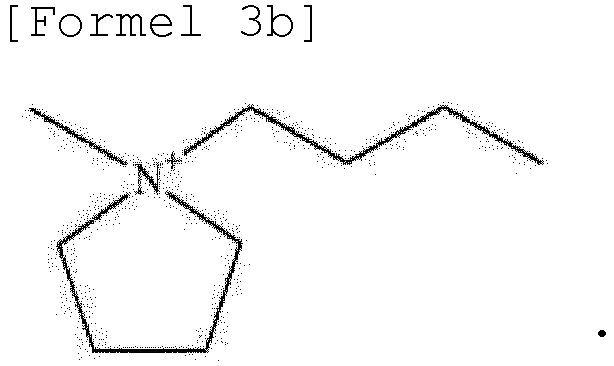
- the cation represented by Formula 3 may include at least one selected from the group consisting of cations represented by Formulae 3a and 3b below.
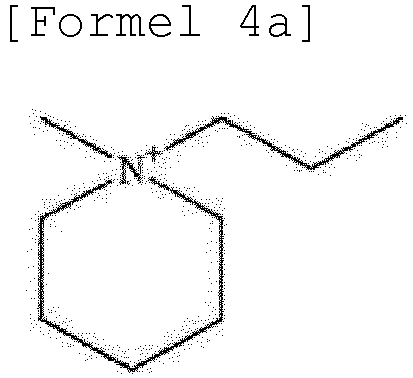
- the cation represented by Formula 4 may include at least one selected from the group consisting of cations represented by Formulae 4a and 4b below.
- R 9 , R 10 , R 11 , and R 12 may each independently be an alkyl group having 1 to 3 carbon atoms.
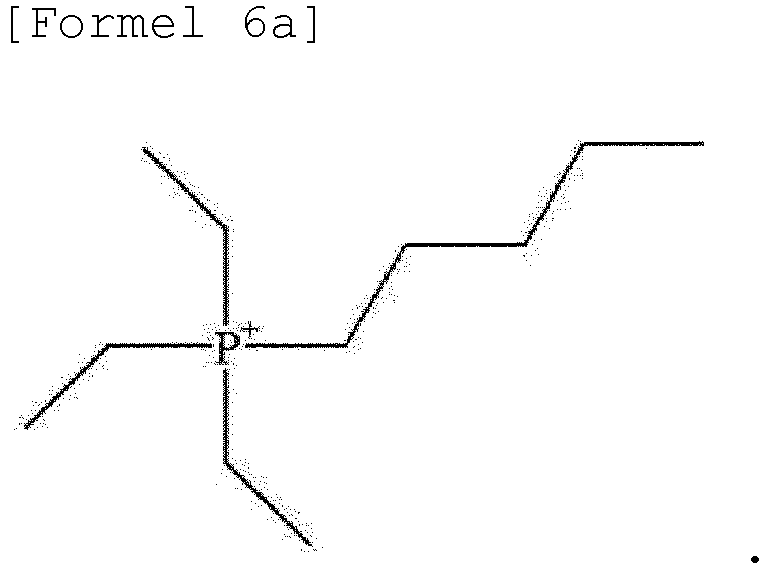
- cation represented by Formula 6 may be a cation represented by Formula 6a below.
- the ionic liquid, as the main solvent of the gel polymer electrolyte composition for a lithium secondary battery, is included in an amount of 60 wt% or more based on a total weight of the gel polymer electrolyte composition for a lithium secondary battery.
- the gel polymer electrolyte composition of the present invention includes a polymerization initiator.
- a conventional polymerization initiator capable of generating radicals by heat and light may be used as the polymerization initiator.
- an azo-based polymerization initiator or a peroxide-based polymerization initiator may be used as the above polymerization initiator, and representative examples of the polymerization initiator may be at least one peroxide compound selected from the group consisting of benzoyl peroxide, acetyl peroxide, dilauryl peroxide, di-tert-butyl peroxide, t-butyl peroxy-2-ethylhexanoate, cumyl hydroperoxide, and hydrogen peroxide, or at least one azo compound selected from the group consisting of 2,2'-azobis(2-cyanobutane), dimethyl 2,2'-azobis(2-methylpropionate), 2,2'-azobis(methylbutyronitrile), 2,2'-azobis(iso-butyronitrile) (AIBN), and 2,2'-azobisdimethylvaleronit
- the polymerization initiator may form a radical by being decomposed by heat in the battery, for a non-limiting example, at a temperature of 30°C to 100°C, for example, 60°C to 80°C, or by being decomposed at room temperature (5°C to 30°C).
- the polymerization initiator may be included in an amount of about 0.01 part by weight to about 20 parts by weight, for example, 5 parts by weight based on total 100 parts by weight of the oligomer.
- the amount of the polymerization initiator included is within the above range, since a gelation reaction is easily performed, it is possible to prevent the occurrence of gelation during the injection of the composition into the battery or to prevent the remaining unreacted polymerization initiator from causing a side reaction after the polymerization reaction.
- nitrogen or oxygen gas may be generated in the process of radical generation by heat.
- This gas generation is most likely to lead to a gas trap or gas bubbling phenomenon in a gel polymer electrolyte formation process. Since the gas generation causes defects in the gel polymer electrolyte, it results in degradation of the electrolyte.
- the polymerization initiator is included in an amount within the above range, it is possible to more effectively prevent a disadvantage such as generation of a large amount of gas.
- the gel polymer electrolyte composition for a lithium secondary battery of the present invention may include an oligomer represented by Formula 1 below as a polymerizable compound capable of forming a polymer network.
- R a , R b , R c , and R d may each independently be an unsubstituted or substituted alkyl group having 1 to 2 carbon atoms
- R 0 may be an unsubstituted or substituted alkylene group having 1 to 5 carbon atoms
- R' and R" may each independently be hydrogen or an alkyl group having 1 to 2 carbon atoms
- R e may be an unsubstituted or substituted alkylene group having 1 to 3 carbon atoms
- m and o may each independently be an integer of 2 to 4.
- the aliphatic hydrocarbon group of R comprises (a) at least one alicyclic hydrocarbon group or (b) at least one linear hydrocarbon group, wherein the alicyclic hydrocarbon group is selected from the group consisting of an unsubstituted or substituted cycloalkylene group having 4 to 20 carbon atoms, an unsubstituted or substituted cycloalkenylene group having 4 to 20 carbon atoms, and an unsubstituted or substituted heterocycloalkylene group having 2 to 20 carbon atoms, and wherein in the linear hydrocarbon group is selected from the group consisting of an unsubstituted or substituted alkylene group having 1 to 20 carbon atoms, an unsubstituted or substituted alkoxylene group having 1 to 20 carbon atoms, an unsubstituted or substituted alkenylene group having 2 to 20 carbon atoms, and an unsubstituted or substituted alkynylene group having 2 to 20 carbon atoms, and
- R is an aliphatic hydrocarbon group
- the aliphatic hydrocarbon group may include (a) at least one alicyclic hydrocarbon group or (b) at least one linear hydrocarbon group, wherein the alicyclic hydrocarbon group selected is from the group consisting of an unsubstituted or substituted cycloalkylene group having 4 to 10 carbon atoms, an unsubstituted or substituted cycloalkenylene group having 4 to 10 carbon atoms, and an unsubstituted or substituted heterocycloalkylene group having 2 to 10 carbon atomsm
- the linear hydrocarbon group is selected from the group consisting of an unsubstituted or substituted alkylene group having 1 to 10 carbon atoms, an unsubstituted or substituted alkoxylene group having 1 to 10 carbon atoms, an unsubstituted or substituted alkenylene group having 2 to 10 carbon atoms, and an unsubstituted or substituted alkyny
- R is an aliphatic hydrocarbon group, wherein the aliphatic hydrocarbon group may include at least one selected from the group consisting of an unsubstituted or substituted cycloalkylene group having 4 to 10 carbon atoms, an unsubstituted or substituted cycloalkenylene group having 4 to 10 carbon atoms, and an unsubstituted or substituted heterocycloalkylene group having 2 to 10 carbon atoms.
- the oligomer represented by Formula 1 may be an oligomer represented by Formula 1a below.
- the oligomer represented by Formula 1 possesses the ability to dissociate the lithium salt, the oligomer may improve lithium ion mobility, and may suppress gas generation and ignition during overcharge by particularly controlling a side reaction of lithium ions (Li + ) and a decomposition reaction of the lithium salt.
- the oligomer represented by Formula 1 may be included in an amount of 0.2 wt% to 30 wt%, particularly 0.5 wt% to 20 wt%, and more particularly 1 wt% to 10 wt% based on the total weight of the gel polymer electrolyte composition for a lithium secondary battery.
- a gel polymer electrolyte may be prepared in which mechanical strength may be ensured by forming a stable network structure. If the amount of the oligomer is 30 wt% or less, for example, 20 wt% or less, wettability may be secured by preventing an increase in resistance due to the addition of the excessive amount of the oligomer and, simultaneously, the decrease in ionic conductivity may be prevented by improving the mobility of lithium ions.
- the amount of the oligomer is less than 0.2 wt%, for example, 0.1 wt%, since the amount of the oligomer is excessively small, a gel may not be formed. Also, in a case in which the amount of the oligomer is greater than 30 wt%, the oligomer is not completely dissolved, but remains in the ionic liquid to cause the increase in resistance. Particularly, since the oligomer has a low dielectric constant, the lithium salt is difficult to be uniformly dissolved in the gel polymer electrolyte composition when the amount of the oligomer is increased, and the ionic conductivity may be reduced because the lithium ion mobility is reduced due to a dense polymer matrix structure formed after curing.
- a weight-average molecular weight (Mw) of the oligomer represented by Formula 1 may be controlled by the number of repeating units, and may be in a range of about 1,000 g/mol to about 100,000 g/mol, particularly 1,000 g/mol to 50,000 g/mol, and more particularly 1,000 g/mol to 10,000 g/mol.
- the weight-average molecular weight of the oligomer is within the above range, formation of a polymer matrix (network) may be facilitated to form a stable gel polymer electrolyte.
- high-temperature durability of the secondary battery may be effectively improved by suppressing ignition due to overcharge.
- the weight-average molecular weight of the oligomer is less than 1,000 g/mol, the formation of the polymer matrix may be difficult and mechanical strength of the gel polymer electrolyte may be reduced. If the weight-average molecular weight is greater than 100,000 g/mol, since physical properties of the oligomer itself become rigid and an affinity to an electrolyte solvent is reduced, dissolution is difficult, and thus, performance of the lithium secondary battery may be degraded.
- the weight-average molecular weight may denote a standard polystyrene-equivalent value measured by gel permeation chromatography (GPC), and, unless otherwise specified, a molecular weight may denote the weight-average molecular weight.
- GPC gel permeation chromatography
- the GPC conditions are as follows: the weight-average molecular weight is measured by using 1200 series by Agilent Technologies, a PL mixed B column by Agilent Technologies may be used in this case, and tetrahydrofuran (THF) may be used as a solvent.
- the oligomer represented by Formula 1 is electrochemically stable by exhibiting a balanced affinity for a positive electrode or separator (SRS layer), as a hydrophilic part, and a negative electrode or separator fabric, as a hydrophobic part, in the secondary battery, the oligomer may be a great help in improving the performance of the lithium secondary battery.
- SRS layer positive electrode or separator
- the oligomer may be a great help in improving the performance of the lithium secondary battery.
- the oligomer represented by Formula 1 contains a siloxane group (-Si-O-) and a urethane group (-NH-C(O)O-), as a hydrophobic portion, as well as an acrylate-based functional group as a hydrophilic portion capable of forming a crosslink at both ends by itself, the oligomer represented by Formula 1 acts as a surfactant in the battery to be able to reduce surface resistance of an electrode interface. Therefore, the electrolyte for a lithium secondary battery including the oligomer represented by Formula 1 may secure a better wetting effect.
- the oligomer represented by Formula 1 since the oligomer represented by Formula 1 possesses the ability to dissociate the lithium salt, the oligomer may improve lithium ion mobility. Particularly, since it contains a siloxane group (-Si-O-) having relatively high electrochemical stability and low reactivity with Li ions as a main chain repeating unit, it may control the side reaction of lithium ions (Li + ) and the decomposition reaction of the lithium salt, and thus, the generation of gas, such as CO or CO 2 , may be reduced during overcharge. Accordingly, stability of the secondary battery may be improved by suppressing ignition during the overcharge.
- a siloxane group -Si-O-
- a gel polymer electrolyte prepared by the gel polymer electrolyte composition of the present invention including the oligomer represented by Formula 1 instead of a polymer having a skeleton of alkylene oxide, such as ethylene oxide, propylene oxide, or butylene oxide, which has been commercialized during the preparation of a conventional gel polymer electrolyte, or dialkyl siloxane, fluorosiloxane, or a graft polymer and a block copolymer having units thereof, since a side reaction with the electrode is reduced, an effect of stabilizing an interface between the electrode and the electrolyte may be achieved, and thus, an effect of inhibiting corrosion of a current collector may be improved.
- alkylene oxide such as ethylene oxide, propylene oxide, or butylene oxide
- the oligomer represented by Formula 1 does not include a fluorine element.
- a fluorine element since the oligomer is not easily dissolved in the ionic liquid, as the main solvent, due to the hydrophobic fluorine element, the preparation of a gel polymer electrolyte may not be possible during thermal polymerization.
- the gel polymer electrolyte composition according to the embodiment of the present invention may further include an additional additive which may form a stable film on surfaces of the negative electrode and the positive electrode while not significantly increasing initial resistance in addition to the effect from the ionic liquid and oligomer, or which may act as a complementary agent for suppressing the decomposition of the solvent in the gel polymer electrolyte composition and improving the mobility of lithium ions.
- an additional additive which may form a stable film on surfaces of the negative electrode and the positive electrode while not significantly increasing initial resistance in addition to the effect from the ionic liquid and oligomer, or which may act as a complementary agent for suppressing the decomposition of the solvent in the gel polymer electrolyte composition and improving the mobility of lithium ions.
- the additional additive is not particularly limited as long as it is an additive for forming a solid electrolyte interface (SEI) which may form a stable film on the surfaces of the positive electrode and the negative electrode.
- SEI solid electrolyte interface
- the additive for forming an SEI may include at least one additive for forming an SEI which is selected from the group consisting of a halogen-substituted carbonate compound, a nitrile compound, a cyclic carbonate compound, a phosphate compound, a borate compound, a sultone compound, a cyclic sulfite compound, and a lithium salt compound.
- the halogen-substituted carbonate compound may include fluoroethylene carbonate (FEC) and may be included in an amount of 5 wt% or less based on the total weight of the gel polymer electrolyte composition. In a case in which the amount of the halogen-substituted carbonate compound is greater than 5 wt%, cell swelling performance may deteriorate.
- FEC fluoroethylene carbonate
- the nitrile compound may include at least one compound selected from the group consisting of succinonitrile, adiponitrile (Adn), acetonitrile, propionitrile, butyronitrile, valeronitrile, caprylonitrile, heptanenitrile, cyclopentane carbonitrile, cyclohexane carbonitrile, 2-fluorobenzonitrile, 4-fluorobenzonitrile, difluorobenzonitrile, trifluorobenzonitrile, phenylacetonitrile, 2-fluorophenylacetonitrile, and 4-fluorophenylacetonitrile.
- Adn succinonitrile
- Adn adiponitrile
- acetonitrile propionitrile
- butyronitrile valeronitrile
- caprylonitrile caprylonitrile
- heptanenitrile cyclopentane carbonitrile
- 2-fluorobenzonitrile 4-fluorobenzon
- the nitrile compound may act as a complementary agent for forming the negative electrode SEI, may play a role in suppressing the decomposition of the solvent in the electrolyte, and may play a role in improving the mobility of the lithium ions.
- the nitrile compound may be included in an amount of 8 wt% or less based on the total weight of the gel polymer electrolyte composition.
- the total amount of the nitrile compound in the non-aqueous electrolyte solution is greater than 8 wt%, since the resistance is increased due to an increase in the film formed on the surface of the electrode, battery performance may deteriorate.
- the carbonate compound may improve durability of the battery by forming a stable SEI mainly on the surface of the negative electrode during battery activation.
- the cyclic carbonate compound may include vinylene carbonate (VC) or vinyl ethylene carbonate, and may be included in an amount of 3 wt% or less based on the total weight of the gel polymer electrolyte composition. In a case in which the amount of the cyclic carbonate compound in the gel polymer electrolyte composition is greater than 3 wt%, cell swelling inhibition performance and initial resistance may deteriorate.
- the phosphate compound may improve the durability of the battery.
- the phosphate compound may include at least one compound selected from the group consisting of lithium difluoro bis(oxalato)phosphate (LiDFOP), lithium difluorophosphate (LiDFP, LiPO 2 F 2 ), lithium tetrafluoro(oxalato)phosphate (LiTFOP), trimethylsilyl phosphite (TMSPi), tris(2,2,2-trifluoroethyl) phosphate (TFEPa), and tris(trifluoroethyl)phosphite (TFEPi), and the phosphate compound may be included in an amount of 3 wt% or less based on the total weight of the gel polymer electrolyte composition.
- the borate compound may improve the mobility of lithium ions, may reduce the interfacial resistance of the SEI, and may dissociate a material, such as LiF, which may be formed during the battery reaction but is not well separated, and thus, a problem, such as generation of hydrofluoric acid gas, may be solved.
- the borate compound may include lithium bis(oxalato)borate (LiBOB, LiB(C 2 O 4 ) 2 ), lithium oxalyldifluoroborate, or tris(trimethylsilyl)borate (TMSB), and the borate compound may be included in an amount of 3 wt% or less based on the total weight of the gel polymer electrolyte composition.
- LiBOB lithium bis(oxalato)borate
- LiB(C 2 O 4 ) 2 lithium oxalyldifluoroborate
- TMSB tris(trimethylsilyl)borate
- Typical examples of the sultone compound may be 1,3-propane sultone (PS) and 1,4-butane sultone, and unsaturated sultone may include ethene sultone, 1,3-propene sultone, 1,4-butene sultone, or 1-methyl-1,3-propene sultone.
- PS 1,3-propane sultone
- 1,4-butane sultone 1,4-butane sultone
- unsaturated sultone may include ethene sultone, 1,3-propene sultone, 1,4-butene sultone, or 1-methyl-1,3-propene sultone.
- Typical examples of the cyclic sulfite compound may be ethylene sulfite (Esa), methyl ethylene sulfite, ethyl ethylene sulfite, 4,5-dimethyl ethylene sulfite, 4,5-diethyl ethylene sulfite, propylene sulfite, 4,5-dimethyl propylene sulfite, 4,5-diethyl propylene sulfite, 4,6-dimethyl propylene sulfite, 4,6-diethyl propylene sulfite, or 1,3-butylene glycol sulfite.
- Esa ethylene sulfite
- methyl ethylene sulfite ethyl ethylene sulfite
- 4,5-dimethyl ethylene sulfite 4,5-diethyl ethylene sulfite
- propylene sulfite 4,5-dimethyl propylene sulfite,
- the lithium salt compound is a compound different from the lithium salt included in the gel polymer electrolyte composition, wherein the lithium salt compound may include at least one compound selected from the group consisting of LiODFB and LiBF 4 and may be included in an amount of 3 wt% or less based on the total weight of the gel polymer electrolyte composition.
- Two or more additives for forming an SEI may be mixed and used, and the additive for forming an SEI may be included in an amount of 20 wt% or less, and particularly 0.01 wt% to 10 wt%, for example, 0.1 wt% to 5.0 wt% based on a total amount of the gel polymer electrolyte composition.
- the amount of the additive for forming an SEI is less than 0.01 wt%, high-temperature storage characteristics and gas generation reducing effect to be achieved from the additive may be insignificant, and, in a case in which the amount of the additive for forming an SEI is greater than 20 wt%, the side reaction in the gel polymer electrolyte composition during charge and discharge of the battery may excessively occur.
- the additive for forming an SEI may not be sufficiently decomposed so that it may be present in the form of an unreacted material or precipitates in the gel polymer electrolyte composition at room temperature. Accordingly, resistance may be increased to degrade life characteristics of the secondary battery.
- the additives are compounds capable of suppressing the occurrence of the side reaction in the positive electrode and negative electrode films, wherein, in a case in which at least one of the additives is included in an amount of 10 wt% or less, the additive does not affect oxidation stability of the electrolyte and a calorific value due to an electrolyte decomposition reaction, and, since the additive is mostly consumed and decomposed to protect the surface of the negative electrode during initial activation, the additive does not remain.
- the gel polymer electrolyte composition of the present invention does not include a non-aqueous organic solvent used in a non-aqueous electrolyte solution.
- the non-aqueous organic solvent may include a carbonate-based organic solvent, an ether-based organic solvent, or an ester-based organic solvent.
- the carbonate-based organic solvent among the organic solvents may include at least one selected from a cyclic carbonate-based organic solvent and a linear carbonate-based organic solvent.
- the cyclic carbonate-based organic solvent may include ethylene carbonate (EC), propylene carbonate (PC), 1,2-butylene carbonate, 2,3-butylene carbonate, 1,2-pentylene carbonate, 2,3-pentylene carbonate, vinylene carbonate, or fluoroethylene carbonate (FEC).
- the linear carbonate-based organic solvent may include dimethyl carbonate (DMC), diethyl carbonate (DEC), dipropyl carbonate, ethylmethyl carbonate (EMC), methylpropyl carbonate, or ethylpropyl carbonate.
- DMC dimethyl carbonate
- DEC diethyl carbonate
- EMC ethylmethyl carbonate
- methylpropyl carbonate or ethylpropyl carbonate.
- the ether-based organic solvent may include dimethyl ether, diethyl ether, dipropyl ether, methylethyl ether, methylpropyl ether, or ethylpropyl ether.
- the ester-based organic solvent may include at least one selected from the group consisting of a linear ester-based organic solvent and a cyclic ester-based organic solvent.
- linear ester-based organic solvent may be methyl acetate, ethyl acetate, propyl acetate, methyl propionate, ethyl propionate, propyl propionate, or butyl propionate.
- the cyclic ester-based organic solvent may include butyrolactone, valerolactone, or caprolactone.
- the non-aqueous organic solvent as described above is oxidatively decomposed at high temperature and high voltage to cause irreversible capacity, there is a concern that the non-aqueous organic solvent may reduce stability at high temperature and high voltage. Thus, it is desirable that the non-aqueous organic solvent is not included in the gel polymer electrolyte composition of the present invention in terms of ensuring the stability of the secondary battery.
- a gel polymer electrolyte which is prepared by polymerizing the gel polymer electrolyte composition for a lithium secondary battery of the present invention in an inert atmosphere, may be provided.
- the gel polymer electrolyte of the present invention should have an elastic modulus of at least 1,000 Pa or more to be able to maintain in the form of a gel, and, specifically, it is desirable to have an elastic modulus of 5,000 Pa or more, for example, 6,000 Pa to 60,000 Pa in order to exhibit excellent performance in the lithium secondary battery.
- the elastic modulus was measured in a frequency range of 0.1 Hz to 10 Hz using a rotational rheometer (DHR2).
- the gel polymer electrolyte may be prepared by curing the gel polymer electrolyte composition by thermal polymerization.
- the gel polymer electrolyte may be formed by in-situ polymerization of the gel polymer electrolyte composition in the secondary battery.
- the gel polymer electrolyte may be prepared by the steps of:
- an in-situ polymerization reaction in the lithium secondary battery may be performed by using electron beam (E-beam), ⁇ -ray, and room temperature or high temperature aging processes, and, according to an embodiment of the present invention, the in-situ polymerization reaction may be performed by thermal polymerization.
- E-beam electron beam
- ⁇ -ray ⁇ -ray
- room temperature or high temperature aging processes room temperature or high temperature aging processes
- thermal polymerization may be performed by thermal polymerization.
- polymerization time required may be in a range of about 2 minutes to about 48 hours
- thermal polymerization temperature may be in a range of 60°C to 100°C, for example, 60°C to 80°C.
- the polymerization initiator as well as the oligomer and ionic liquid is added to the non-aqueous organic solvent, in which the lithium salt is dissolved, and mixed, and the mixture is then injected into a battery cell.
- the gel polymer electrolyte of the present invention may be prepared by performing thermal polymerization in which the battery cell is heated to about 60°C to about 80°C for 1 hour to 20 hours.
- a lithium secondary battery including the gel polymer electrolyte of the present invention.
- the lithium secondary battery according to the embodiment of the present invention has a charge voltage ranging from 3.0 V to 5.0 V, and thus, capacity characteristics of the lithium secondary battery may be excellent in both normal and high voltage ranges. Also, the stability at high temperature and high voltage may be further improved.
- the lithium secondary battery of the present invention may include an electrode assembly in which a positive electrode, a separator, and a negative electrode are sequentially stacked, and, in this case, those prepared by typical methods may be used as the positive electrode, the negative electrode, and the separator which constitute the electrode assembly.
- the positive electrode may be prepared by forming a positive electrode material mixture layer on a positive electrode collector.
- the positive electrode collector is not particularly limited so long as it has conductivity without causing adverse chemical changes in the battery, and, for example, stainless steel, aluminum, nickel, titanium, fired carbon, or aluminum or stainless steel that is surface-treated with one of carbon, nickel, titanium, silver, or the like may be used.
- the positive electrode material mixture layer may be prepared by coating the positive electrode collector with a positive electrode slurry including a positive electrode active material, a binder, a conductive agent, and a solvent, and then drying and rolling the coated positive electrode collector.
- the positive electrode active material is a compound capable of reversibly intercalating and deintercalating lithium, wherein the positive electrode active material may specifically include a lithium composite metal oxide including lithium and at least one metal such as cobalt, manganese, nickel, or aluminum.
- the lithium composite metal oxide may include lithium-manganese-based oxide (e.g., LiMnO 2 , LiMn 2 O 4 , etc.), lithium-cobalt-based oxide (e.g., LiCoO 2 , etc.), lithium-nickel-based oxide (e.g., LiNiO 2 , etc.), lithium-nickel-manganese-based oxide (e.g., LiNi 1-y Mn y O 2 (where 0 ⁇ Y ⁇ 1), LiMn 2-z Ni z O 4 (where 0 ⁇ Z ⁇ 2), etc.), lithium-nickel-cobalt-based oxide (e.g., LiNi 1-Y1 Co Y1 O 2 (where 0 ⁇ Y1 ⁇ 1)), lithium-
- the lithium composite metal oxide may include LiCoO 2 , LiMnO 2 , LiNiO 2 , lithium nickel manganese cobalt oxide (e.g., Li(Ni 1/3 Mn 1/3 Co 1/3 )O 2 , Li(Ni 0.6 Mn 0.2 Co 0.2 )O 2 , Li (Ni 0.5 Mn 0.3 Co 0.2 )O 2 , Li(Ni 0.7 Mn 0.15 Co 0.15 )O 2 , and Li(Ni 0.8 Mn 0.1 Co 0.1 )O 2 ), or lithium nickel cobalt aluminum oxide (e.g., LiNi 0.8 Co 0.15 Al 0.05 O 2 , etc.).
- LiCoO 2 LiMnO 2 , LiNiO 2
- lithium nickel manganese cobalt oxide e.g., Li(Ni 1/3 Mn 1/3 Co 1/3 )O 2 , Li(Ni 0.6 Mn 0.2 Co 0.2 )O 2 , Li (Ni 0.5 Mn 0.3 Co 0.2 )O 2
- the positive electrode active material may be included in an amount of 80 wt% to 99 wt%, for example, 85 wt% to 95 wt% based on a total weight of solid content in the positive electrode slurry. In a case in which the amount of the positive electrode active material is 80 wt% or less, since energy density is decreased, capacity may be reduced.
- the binder is a component that assists in the binding between the active material and the conductive agent and in the binding with the current collector, wherein the binder is commonly added in an amount of 1 wt% to 30 wt% based on the total weight of the solid content in the positive electrode slurry.
- binder may be polyvinylidene fluoride (PVDF), polyvinyl alcohol, carboxymethylcellulose (CMC), starch, hydroxypropylcellulose, regenerated cellulose, polyvinylpyrrolidone, tetrafluoroethylene, polyethylene, polypropylene, an ethylene-propylene-diene terpolymer, a sulfonated-ethylene-propylene-diene terpolymer, a styrenebutadiene rubber, a fluoro rubber, various copolymers, and the like.
- PVDF polyvinylidene fluoride
- CMC carboxymethylcellulose
- starch starch
- hydroxypropylcellulose regenerated cellulose
- polyvinylpyrrolidone polyvinylpyrrolidone
- tetrafluoroethylene polyethylene
- polypropylene an ethylene-propylene-diene terpolymer
- any conductive agent may be used as the conductive agent without particular limitation so long as it has conductivity without causing adverse chemical changes in the battery, and, for example, a conductive material, such as: carbon powder such as carbon black, acetylene black, Ketjen black, channel black, furnace black, lamp black, or thermal black; graphite powder such as natural graphite with a well-developed crystal structure, artificial graphite, or graphite; conductive fibers such as carbon fibers or metal fibers; metal powder such as fluorocarbon powder, aluminum powder, and nickel powder; conductive whiskers such as zinc oxide whiskers and potassium titanate whiskers; conductive metal oxide such as titanium oxide; or polyphenylene derivatives, may be used.
- a conductive material such as: carbon powder such as carbon black, acetylene black, Ketjen black, channel black, furnace black, lamp black, or thermal black; graphite powder such as natural graphite with a well-developed crystal structure, artificial graphite, or graphite; conductive fibers such
- the conductive agent is commonly added in an amount of 1 wt% to 30 wt% based on the total weight of the solid content in the positive electrode slurry.
- the solvent may include an organic solvent, such as N-methyl-2-pyrrolidone (NMP), and may be used in an amount such that desirable viscosity is obtained when the positive electrode active material as well as selectively the binder and the conductive agent are included.
- NMP N-methyl-2-pyrrolidone
- the solvent may be included in an amount such that a concentration of the solid content in the slurry including the positive electrode active material as well as selectively the binder and the conductive agent is in a range of 10 wt% to 60 wt%, for example, 20 wt% to 55 wt%.
- the negative electrode may be prepared by forming a negative electrode material mixture layer on a negative electrode collector.
- the negative electrode material mixture layer may be formed by coating the negative electrode collector with a slurry including a negative electrode active material, a binder, a conductive agent, and a solvent, and then drying and rolling the coated negative electrode collector.
- the negative electrode collector generally has a thickness of 3 ⁇ m to 500 ⁇ m.
- the negative electrode collector is not particularly limited so long as it has high conductivity without causing adverse chemical changes in the battery, and, for example, copper, stainless steel, aluminum, nickel, titanium, fired carbon, copper or stainless steel that is surface-treated with one of carbon, nickel, titanium, silver, or the like, an aluminum-cadmium alloy, or the like may be used.
- the negative electrode collector may have fine surface roughness to improve bonding strength with the negative electrode active material, and the negative electrode collector may be used in various shapes such as a film, a sheet, a foil, a net, a porous body, a foam body, a non-woven fabric body, and the like.
- the negative electrode active material may include at least one selected from the group consisting of lithium metal, a carbon material capable of reversibly intercalating/deintercalating lithium ions, metal or an alloy of lithium and the metal, a metal composite oxide, a material which may be doped and undoped with lithium, and a transition metal oxide.
- a carbon-based negative electrode active material generally used in a lithium ion secondary battery may be used without particular limitation, and, as a typical example, crystalline carbon, amorphous carbon, or both thereof may be used.
- the crystalline carbon may be graphite such as irregular, planar, flaky, spherical, or fibrous natural graphite or artificial graphite
- examples of the amorphous carbon may be soft carbon (low-temperature sintered carbon) or hard carbon, mesophase pitch carbide, and fired cokes.
- a metal selected from the group consisting of copper (Cu), nickel (Ni), sodium (Na), potassium (K), rubidium (Rb), cesium (Cs), francium (Fr), beryllium (Be), magnesium (Mg), calcium (Ca), strontium (Sr), silicon (Si), antimony (Sb), lead (Pb), indium (In), zinc (Zn), barium (Ba), radium (Ra), germanium (Ge), aluminum (Al), and tin (Sn), or an alloy of lithium and the metal may be used.
- the material which may be doped and undoped with lithium, may include Si, SiO x8 (0 ⁇ x8 ⁇ 2), a Si-Y alloy (where Y is an element selected from the group consisting of alkali metal, alkaline earth metal, a Group 13 element, a Group 14 element, transition metal, a rare earth element, and a combination thereof, and is not Si), Sn, SnO 2 , and Sn-Y (where Y is an element selected from the group consisting of alkali metal, alkaline earth metal, a Group 13 element, a Group 14 element, transition metal, a rare earth element, and a combination thereof, and is not Sn), and a mixture of SiO 2 and at least one thereof may also be used.
- the element Y may be selected from the group consisting of Mg, Ca, Sr, Ba, Ra, scandium (Sc), yttrium (Y), Ti, zirconium (Zr), hafnium (Hf), rutherfordium (Rf), V, niobium (Nb), Ta, dubidium (Db), Cr, Mo, tungsten (W), seaborgium (Sg), technetium (Tc), rhenium (Re), bohrium (Bh), Fe, Pb, ruthenium (Ru), osmium (Os), hassium (Hs), rhodium (Rh), iridium (Ir), palladium (Pd), platinum (Pt), Cu, silver (Ag), gold (Au), Zn, cadmium (Cd), B, Al, gallium (Ga), Sn, In, Ge, P, arsenic (As), Sb, bismuth (Bi), sulfur (S), selenium (Se), telluri
- the transition metal oxide may include lithiumcontaining titanium composite oxide (LTO), vanadium oxide, and lithium vanadium oxide.
- LTO lithiumcontaining titanium composite oxide
- vanadium oxide vanadium oxide
- lithium vanadium oxide lithium vanadium oxide
- the negative electrode active material may be included in an amount of 80 wt% to 99 wt% based on a total weight of solid content in the negative electrode slurry.
- the binder is a component that assists in the binding between the conductive agent, the active material, and the current collector, wherein the binder is commonly added in an amount of 1 wt% to 30 wt% based on the total weight of the solid content in the negative electrode slurry.
- binder may be polyvinylidene fluoride (PVDF), polyvinyl alcohol, carboxymethylcellulose (CMC), starch, hydroxypropylcellulose, regenerated cellulose, polyvinylpyrrolidone, tetrafluoroethylene, polyethylene, polypropylene, an ethylene-propylene-diene polymer, a sulfonated-ethylene-propylene-diene terpolymer, a styrenebutadiene rubber, a fluoro rubber, and various copolymers thereof.
- PVDF polyvinylidene fluoride
- CMC carboxymethylcellulose
- starch starch
- hydroxypropylcellulose regenerated cellulose
- polyvinylpyrrolidone polyvinylpyrrolidone
- tetrafluoroethylene polyethylene
- polypropylene an ethylene-propylene-diene polymer
- sulfonated-ethylene-propylene-diene terpolymer
- the conductive agent is a component for further improving the conductivity of the negative electrode active material, wherein the conductive agent may be added in an amount of 1 wt% to 20 wt% based on the total weight of the solid content in the negative electrode slurry.
- Any conductive agent may be used without particular limitation so long as it has conductivity without causing adverse chemical changes in the battery, and, for example, a conductive material, such as: carbon powder such as carbon black, acetylene black, Ketjen black, channel black, furnace black, lamp black, or thermal black; graphite powder such as natural graphite with a well-developed crystal structure, artificial graphite, or graphite; conductive fibers such as carbon fibers or metal fibers; metal powder such as fluorocarbon powder, aluminum powder, and nickel powder; conductive whiskers such as zinc oxide whiskers and potassium titanate whiskers; conductive metal oxide such as titanium oxide; or polyphenylene derivatives, may be used.
- the solvent may include water or an organic solvent, such as NMP and alcohol, and may be used in an amount such that desirable viscosity is obtained when the negative electrode active material as well as selectively the binder and the conductive agent are included.
- the solvent may be included in an amount such that a concentration of the solid content in the slurry including the negative electrode active material as well as selectively the binder and the conductive agent is in a range of 50 wt% to 75 wt%, for example, 50 wt% to 70 wt%.
- the separator plays a role in blocking an internal short circuit between both electrodes and impregnating the electrolyte, wherein, after mixing a polymer resin, a filler, and a solvent to prepare a separator composition, the separator composition is directly coated on the electrode and dried to form a separator film, or, after the separator composition is cast on a support and dried, the separator may be prepared by laminating a separator film peeled from the support on the electrode.
- a typically used porous polymer film for example, a porous polymer film prepared from a polyolefin-based polymer, such as an ethylene homopolymer, a propylene homopolymer, an ethylene/butene copolymer, an ethylene/hexene copolymer, and an ethylene/methacrylate copolymer, may be used alone or in a lamination therewith as the separator.
- a typical porous nonwoven fabric for example, a nonwoven fabric formed of high melting point glass fibers or polyethylene terephthalate fibers may be used, but the present invention is not limited thereto.
- the porous separator may generally have a pore diameter of 0.01 ⁇ m to 50 ⁇ m and a porosity of 5% to 95%. Also, the porous separator may generally have a thickness of 5 ⁇ m to 300 ⁇ m.
- a shape of the lithium secondary battery of the present invention is not particularly limited, but a cylindrical type using a can, a prismatic type, a pouch type, or a coin type may be used.
- Mw weight-average molecular weight
- EMI-FIS ethylmethylimidazolium-bis(fluorosulfonyl)imide
- NCM LiNi 1/3 Co 1/3 Mn 1/3 O 2
- carbon black as a conductive agent
- PVDF polyvinylidene fluoride
- NMP N-methyl-2-pyrrolidone
- a negative electrode active material graphite
- PVDF as a binder
- carbon black as a conductive agent
- a weight ratio of 96:3:1 to NMP, as a solvent was added in a weight ratio of 96:3:1 to NMP, as a solvent, to prepare a negative electrode mixture slurry.
- Cu copper
- An electrode assembly was prepared by sequentially stacking the positive electrode, a separator formed of three layers of polypropylene/polyethylene/polypropylene (PP/PE/PP), and the negative electrode.
- PP/PE/PP polypropylene/polyethylene/polypropylene
- a gel polymer electrolyte composition for a lithium secondary battery and a lithium secondary battery including a gel polymer electrolyte prepared therefrom were prepared in the same manner as in Example 1 except that methylpropylpyrrolidinium-bis(fluorosulfonyl)imide (Pyr13-FSI) was used as a solvent during the preparation of the gel polymer electrolyte composition for a lithium secondary battery (see Table 1 below).
- Mw weight-average molecular weight
- Mw weight-average molecular weight
- dimethyl 2,2'-azobis(2-methylpropionate) CAS No. 2589-57-3
- EMI-FIS ethylmethylimidazolium-bis(fluorosulfonyl)imide
- EMI-FIS ethylmethylimidazolium-bis(fluorosulfonyl)imide
- EC ethylene carbonate
- EMC ethyl methyl carbonate
- a gel polymer electrolyte composition for a lithium secondary battery and a lithium secondary battery including a gel polymer electrolyte prepared therefrom were prepared in the same manner as in Example 1 except that an oligomer represented by the following Formula 7 was used as the oligomer during the preparation of the gel polymer electrolyte composition for a lithium secondary battery (see Table 1 below).
- the gel polymer electrolytes prepared by using the gel polymer electrolyte compositions of Examples 1 to 4 had a gel strength of about 7,000 Pa or more.
- the gel polymer electrolyte prepared by using the gel polymer electrolyte composition of Comparative Example 1 including the non-aqueous organic solvent as a main solvent had a gel strength of 3,500 Pa, wherein it may be understood that its gel strength was degraded in comparison to those of the gel polymer electrolytes prepared by using the gel polymer electrolyte compositions of Examples 1 to 4.
- the gel polymer electrolyte prepared by using the gel polymer electrolyte composition of Comparative Example 2 including the oligomer of Formula 7 had a gel strength of 2,900 Pa, wherein it may be understood that its gel strength was degraded in comparison to those of the gel polymer electrolytes prepared by using the gel polymer electrolyte compositions of Examples 1 to 4.
- the lithium secondary batteries prepared in Examples 1 and 2 and the lithium secondary batteries prepared in Comparative Examples 1 and 2 were respectively fully charged to 4.2 V, and then disassembled to separate a positive electrode. After a positive electrode active material layer was scraped off from the positive electrode obtained from each lithium secondary battery to obtain powder, the powder was loaded into a differential scanning calorimeter (DSC, DSC-01, METTLER TOLEDO) and exothermic onset points were measured while heating from 25°C to 400°C at a heating rate of 10°C/min, and the results thereof are presented in FIG. 1 .
- the axis of abscissas represents exothermic temperature
- the axis of ordinates represents a point at a heat flow of 20 W/g.
- a structure of the positive electrode in a fully charged state is in a state in which lithium is deintercalated, wherein, since the positive electrode is structurally unstable, an oxygen radical is generated while the structure is collapsed when the positive electrode is left standing at a high temperature. Since the oxygen radical generated in this case has very high reactivity, the oxygen radical causes an exothermic reaction while reacting with the electrolyte.
- an oxidative decomposition potential (1 mA current generation potential) was 5.6 V or more, but an oxidative decomposition potential of the gel polymer electrolyte of Comparative Example 1 containing the carbonate-based solvent was 5.0 V.
- oxidation resistance of the gel polymer electrolyte of the example of the present invention was better than that of the gel polymer electrolyte of Comparative Example 1, and it is expected that an effect of preventing corrosion of the current collector may also be improved by such physical properties.
- Each of the gel polymer electrolyte compositions prepared in Examples 1, 2, 4, and 6 and each of the gel polymer electrolyte compositions for a lithium secondary battery prepared in Comparative Examples 1 and 2 were coated on a first steel use stainless (SUS) layer and cured to prepare gel polymer electrolytes.
- SUS steel use stainless
- Each of the prepared gel polymer electrolytes was covered with a second SUS layer to prepare a multilayer structure composed of first SUS layer/gel polymer electrolyte/second SUS layer, resistance was then measured in a frequency range of 0.1 Hz to 100 MHz using a VMP3 measurement instrument and a precision impedance analyzer (4294A) at 25°C, an ionic conductivity value was calculated by dividing the resistance by an area of the stainless steel electrode and a thickness of the gel polymer electrolyte (see Equation 1 below). The results thereof are presented in Table 5 below.
- Equation 1 R represents resistance, A represents an area of the stainless steel electrode, and I represents a thickness of the gel polymer electrolyte.
- Ionic conductivity (S/cm, 25°C) Example 1 9.5 ⁇ 10 -3
- Example 2 6.5 ⁇ 10 -3
- Example 4 10.5 ⁇ 10 -3
- Example 6 (reference) 0.2 ⁇ 10 -3 Comparative Example 1 5.3 ⁇ 10 -3 Comparative Example 2 4.8 ⁇ 10 -3
- ionic conductivities of the gel polymer electrolytes prepared by using the gel polymer electrolyte compositions of Examples 1, 2, and 4 were mostly high at 6.5 ⁇ 10 -3 S/cm or more.
- the ionic conductivity of the gel polymer electrolyte composition of Example 1 which included the ionic liquid having viscosity lower than that of the gel polymer electrolyte composition of Example 2, was higher.
- ionic conductivity of the gel polymer electrolyte of Comparative Example 1 which included the non-aqueous organic solvent as a main solvent, was 5.3 ⁇ 10 -3 S/cm, wherein it may be understood that the ionic conductivity was lower than those of the gel polymer electrolytes of Examples 1, 2, and 4. That is, since the gel polymer electrolyte of Comparative Example 1 without the ionic liquid had no advantage by an effect of ion hopping, one of lithium ion transfer phenomena by the ionic liquid, and the ion conductivity was expressed only by the simple movement of lithium ions, it may be understood that the ionic conductivity was lower than those of the gel polymer electrolytes of Examples 1, 2, and 4.
- initial discharge capacity of the lithium secondary battery of Comparative Example 1 which included the gel polymer electrolyte containing the non-aqueous organic solvent as a main solvent, was 1.05 Ah, but initial discharge capacities of the lithium secondary batteries of Examples 1, 2, and 4, which included the gel polymer electrolytes including the ionic liquid as a main solvent, were improved to 1.1 Ah.
- the gel polymer electrolyte of the present invention including the ionic liquid exhibited excellent ion transfer characteristics, it may be understood that the initial discharge capacity of the lithium secondary battery including the same is higher.
- lithium secondary battery of Example 6 which included the gel polymer electrolyte in which the amount of the oligomer was excessively large, since ion transfer characteristics were very poor, it may be understood that initial discharge capacity was lower than those of the lithium secondary batteries of Examples 1, 2, and 4.
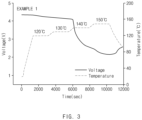
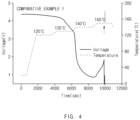
- Hot box tests were performed in which the lithium secondary battery prepared in Example 1 and the lithium secondary battery prepared in Comparative Example 1 were heated to 150°C at a heating rate of 5°C/min in a fully charged state, i.e., a state of charge (SOC) of 100%, and were then respectively left standing for 30 minutes to confirm the presence of ignition.
- SOC state of charge
- FIG. 3 illustrates the results of the hot box test of the lithium secondary battery of Example 1
- FIG. 4 illustrates the results of the hot box test of the lithium secondary battery of Comparative Example 1.
- the lithium secondary battery of Example 1 may suppress the generation of oxygen radicals by preventing the collapse of the positive structure even during high-temperature storage in a fully charged state, an exothermic reaction was reduced, and thus, it may be understood that ignition did not occur even during high-temperature storage at 150°C.
Landscapes
- Chemical & Material Sciences (AREA)
- Engineering & Computer Science (AREA)
- Chemical Kinetics & Catalysis (AREA)
- Manufacturing & Machinery (AREA)
- Electrochemistry (AREA)
- General Chemical & Material Sciences (AREA)
- Dispersion Chemistry (AREA)
- Condensed Matter Physics & Semiconductors (AREA)
- Physics & Mathematics (AREA)
- General Physics & Mathematics (AREA)
- Inorganic Chemistry (AREA)
- Health & Medical Sciences (AREA)
- Medicinal Chemistry (AREA)
- Polymers & Plastics (AREA)
- Organic Chemistry (AREA)
- Materials Engineering (AREA)
- Secondary Cells (AREA)
Claims (15)
- Gelpolymerelektrolytzusammensetzung für eine Lithium-Sekundärbatterie, wobei die Gelpolymerelektrolytzusammensetzung umfasst:ein Lithiumsalz, eine ionische Flüssigkeit, einen Polymerisationsinitiator undein Oligomer, dargestellt durch die Formel 1:
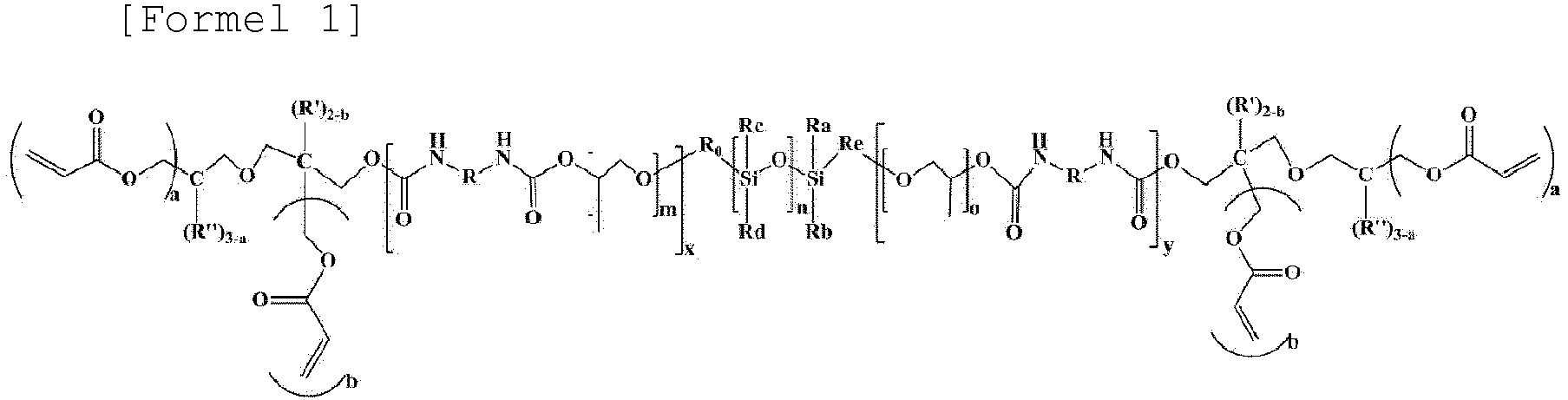 worin in Formel 1,R eine aliphatische Kohlenwasserstoffgruppe oder eine aromatische Kohlenwasserstoffgruppe ist,Ra, Rb, Rc und Rd jeweils unabhängig eine unsubstituierte oder substituierte Alkylgruppe mit 1 bis 3 Kohlenstoffatomen sind,R0 eine unsubstituierte oder substituierte Alkylengruppe mit 1 bis 5 Kohlenstoffatomen oder
 worin R01 eine unsubstituierte oder substituierte Alkylgruppe mit 1 bis 10 Kohlenstoffatomen, eine unsubstituierte oder substituierte Alkenylgruppe mit 2 bis 10 Kohlenstoffatomen, eine Cycloalkylgruppe mit 3 bis 10 Kohlenstoffatomen, eine Cycloalkylgruppe mit 3 bis 10 Kohlenstoffatomen, die ein Heteroatom aufweist, eine unsubstituierte oder substituierte Arylgruppe oder eine unsubstituierte oder substituierte Heteroarylgruppe ist, R02 Wasserstoff oder eine unsubstituierte oder substituierte Alkylgruppe mit 1 bis 3 Kohlenstoffatomen ist,R' und R" jeweils unabhängig Wasserstoff oder eine Alkylgruppe mit 1 bis 3 Kohlenstoffatomen sind,Re eine unsubstituierte oder substituierte Alkylengruppe mit 1 bis 5 Kohlenstoffatomen ist,a eine ganze Zahl von 1 bis 3 ist,b eine ganze Zahl von 0 bis 2 ist,n, m, o, x und y Zahlen von Wiederholungseinheiten sind,n eine ganze Zahl von 1 bis 10 ist,m und o jeweils unabhängig eine ganze Zahl von 1 bis 5 sind, undx und y jeweils unabhängig eine ganze Zahl von 1 bis 15 sind;wobei die ionische Flüssigkeit in einer Menge von 60 Gew.-% oder mehr, bezogen auf das Gesamtgewicht der Gelpolymerelektrolytzusammensetzung für eine Lithium-Sekundärbatterie, enthalten ist.
 - Gelpolymerelektrolytzusammensetzung für eine Lithium-Sekundärbatterie gemäß Anspruch 1, wobei das Lithiumsalz Li+ als Kation umfasst, und
mindestens ein Anion, das ausgewählt ist aus einer Gruppe bestehend aus BF4 -, PF6 -, ClO4 -, Bis(fluorsulfonyl)imid (N(SO2F)2 -; FSI), (Bis) trifluormethansulfonimid (N(SO2CF3)2 -, TFSI), Bisperfluorethansulfonimid (N(SO2C2F5)2 -), und Oxalyldifluoroborat (BF2(C2O4 -, ODFB). - Gelpolymerelektrolytzusammensetzung für eine Lithium-Sekundärbatterie gemäß Anspruch 1, wobei die ionische Flüssigkeit umfasst: eine anionische Komponente, die die gleiche ist wie ein Anion des Lithiumsalzes, und eine kationische Komponente, die mindestens eines umfasst, das ausgewählt ist aus einer Gruppe bestehend aus Kationen, dargestellt durch die Formeln 2 bis 6:
 worin in Formel 2,R1, R2, R3 und R4 jeweils unabhängig Wasserstoff oder eine Alkylgruppe mit 1 bis 5 Kohlenstoffatomen sind,
 worin in Formel 3,R5 und R6 jeweils unabhängig eine Alkylgruppe mit 1 bis 5 Kohlenstoffatomen sind,
 worin in Formel 4,R7 und R8 jeweils unabhängig eine Alkylgruppe mit 1 bis 5 Kohlenstoffatomen sind,
 worin in Formel 5,R9, R10, R11 und R12 jeweils unabhängig eine Alkylgruppe mit 1 bis 5 Kohlenstoffatomen sind,
 worin in Formel 6,R13, R14, R15 und R16 jeweils unabhängig eine Alkylgruppe mit 1 bis 5 Kohlenstoffatomen sind.
 - Gelpolymerelektrolytzusammensetzung für eine Lithium-Sekundärbatterie gemäß Anspruch 3, wobei das durch die Formel 2 dargestellte Kation mindestens eines ist, das ausgewählt ist aus einer Gruppe bestehend aus Kationen, dargestellt durch die Formeln 2a und 2b:
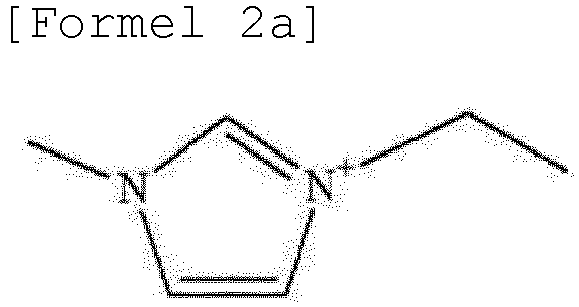

- Gelpolymerelektrolytzusammensetzung für eine Lithium-Sekundärbatterie gemäß Anspruch 3, wobei die durch die Formel 3 dargestellte kationische Komponente mindestens eines umfasst, das ausgewählt ist aus einer Gruppe bestehend aus Kationen, dargestellt durch die Formeln 3a und 3b:

- Gelpolymerelektrolytzusammensetzung für eine Lithium-Sekundärbatterie gemäß Anspruch 3, wobei die durch die Formel 4 dargestellte kationische Komponente mindestens eines umfasst, das ausgewählt ist aus einer Gruppe bestehend aus Kationen, dargestellt durch die Formeln 4a und 4b:

- Gelpolymerelektrolytzusammensetzung für eine Lithium-Sekundärbatterie gemäß Anspruch 3, wobei in Formel 5 R9, R10, R11 und R12 jeweils unabhängig eine Alkylgruppe mit 1 bis 3 Kohlenstoffatomen sind.
- Gelpolymerelektrolytzusammensetzung für eine Lithium-Sekundärbatterie gemäß Anspruch 3, wobei die durch die Formel 6 dargestellte kationische Komponente ein Kation umfasst, dargestellt durch die Formel 6a:
- Gelpolymerelektrolytzusammensetzung für eine Lithium-Sekundärbatterie gemäß Anspruch 1, wobei in Formel 1 Ra, Rb, Rc und Rd jeweils unabhängig eine unsubstituierte oder substituierte Alkylgruppe mit 1 bis 2 Kohlenstoffatomen sind,R0 eine unsubstituierte oder substituierte Alkylengruppe mit 1 bis 5 Kohlenstoffatomen ist,R' und R" jeweils unabhängig Wasserstoff oder eine Alkylgruppe mit 1 bis 2 Kohlenstoffatomen sind,Re eine unsubstituierte oder substituierte Alkylengruppe mit 1 bis 3 Kohlenstoffatomen ist, undm und o sind jeweils unabhängig eine ganze Zahl von 2 bis 4 sind.
- Gelpolymerelektrolytzusammensetzung für eine Lithium-Sekundärbatterie gemäß Anspruch 1, wobei in Formel 1 die aliphatische Kohlenwasserstoffgruppe von R (a) mindestens eine alicyclische Kohlenwasserstoffgruppe oder (b) mindestens eine lineare Kohlenwasserstoffgruppe umfasst,wobei die alicyclische Kohlenwasserstoffgruppe ausgewählt ist aus einer Gruppe bestehend aus einer unsubstituierten oder substituierten Cycloalkylengruppe mit 4 bis 20 Kohlenstoffatomen, einer unsubstituierten oder substituierten Cycloalkenylengruppe mit 4 bis 20 Kohlenstoffatomen und einer unsubstituierten oder substituierten Heterocycloalkylengruppe mit 2 bis 20 Kohlenstoffatomen, undwobei die lineare Kohlenwasserstoffgruppe ausgewählt ist aus einer Gruppe bestehend aus einer unsubstituierten oder substituierten Alkylengruppe mit 1 bis 20 Kohlenstoffatomen, einer unsubstituierten oder substituierten Alkoxylengruppe mit 1 bis 20 Kohlenstoffatomen, einer unsubstituierten oder substituierten Alkenylengruppe mit 2 bis 20 Kohlenstoffatomen und einer unsubstituierten oder substituierten Alkinylengruppe mit 2 bis 20 Kohlenstoffatomen, unddie aromatische Kohlenwasserstoffgruppe von R mindestens eines umfasst, das ausgewählt ist aus einer Gruppe bestehend aus einer unsubstituierten oder substituierten Arylengruppe mit 6 bis 20 Kohlenstoffatomen und einer unsubstituierten oder substituierten Heteroarylengruppe mit 2 bis 20 Kohlenstoffatomen.
- Gelpolymerelektrolytzusammensetzung für eine Lithium-Sekundärbatterie gemäß Anspruch 1, wobei in Formel 1 R eine aliphatische Kohlenwasserstoffgruppe ist,wobei die aliphatische Kohlenwasserstoffgruppe (a) mindestens eine alicyclische Kohlenwasserstoffgruppe oder (b) mindestens eine lineare Kohlenwasserstoffgruppe umfasst,wobei die alicyclische Kohlenwasserstoffgruppe ausgewählt ist aus einer Gruppe bestehend aus einer unsubstituierten oder substituierten Cycloalkylengruppe mit 4 bis 10 Kohlenstoffatomen, einer unsubstituierten oder substituierten Cycloalkenylengruppe mit 4 bis 10 Kohlenstoffatomen und einer unsubstituierten oder substituierten Heterocycloalkylengruppe mit 2 bis 10 Kohlenstoffatomen, undwobei die lineare Kohlenwasserstoffgruppe ausgewählt ist aus einer Gruppe bestehend aus einer unsubstituierten oder substituierten Alkylengruppe mit 1 bis 10 Kohlenstoffatomen, einer unsubstituierten oder substituierten Alkoxylengruppe mit 1 bis 10 Kohlenstoffatomen, einer unsubstituierten oder substituierten Alkenylengruppe mit 2 bis 10 Kohlenstoffatomen und einer unsubstituierten oder substituierten Alkinylengruppe mit 2 bis 10 Kohlenstoffatomen.
- Gelpolymerelektrolytzusammensetzung für eine Lithium-Sekundärbatterie gemäß Anspruch 1, wobei das durch die Formel 1 dargestellte Oligomer ein durch die Formel 1a dargestelltes Oligomer ist:
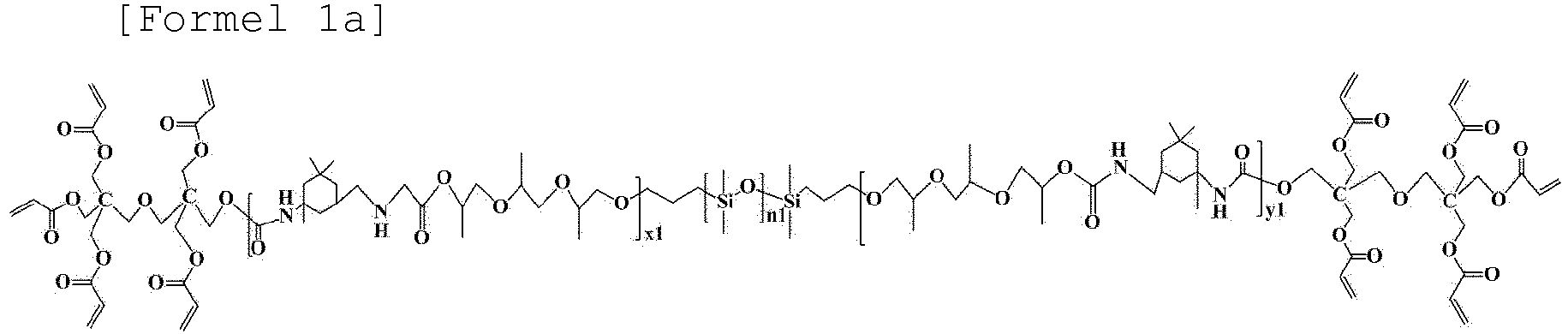 worin in Formel 1a,n1, x1 und y1 Zahlen von Wiederholungseinheiten sind,n1 eine ganze Zahl von 1 oder 10 ist,x1 eine ganze Zahl von 1 bis 15 ist, undy1 eine ganze Zahl von 1 bis 15 ist.
 - Gelpolymerelektrolytzusammensetzung für eine Lithium-Sekundärbatterie gemäß Anspruch 1, wobei das durch die Formel 1 dargestellte Oligomer in einer Menge von 0,2 Gew.-% bis 30 Gew.-%, bezogen auf das Gesamtgewicht der Gelpolymerelektrolytzusammensetzung für eine Lithium-Sekundärbatterie, enthalten ist.
- Gelpolymerelektrolyt, hergestellt durch Polymerisation der Gelpolymerelektrolytzusammensetzung für eine Lithium-Sekundärbatterie gemäß Anspruch 1.
- Lithium-Sekundärbatterie, umfassend den Gelpolymerelektrolyten gemäß Anspruch 14.
Applications Claiming Priority (2)
| Application Number | Priority Date | Filing Date | Title |
|---|---|---|---|
| KR20180000795 | 2018-01-03 | ||
| PCT/KR2019/000109 WO2019135624A1 (ko) | 2018-01-03 | 2019-01-03 | 겔 폴리머 전해질 조성물, 이에 의해 제조된 겔 폴리머 전해질 및 이를 포함하는 리튬 이차전지 |
Publications (3)
| Publication Number | Publication Date |
|---|---|
| EP3694040A1 EP3694040A1 (de) | 2020-08-12 |
| EP3694040A4 EP3694040A4 (de) | 2020-12-16 |
| EP3694040B1 true EP3694040B1 (de) | 2025-06-18 |
Family
ID=67254355
Family Applications (1)
| Application Number | Title | Priority Date | Filing Date |
|---|---|---|---|
| EP19736166.0A Active EP3694040B1 (de) | 2018-01-03 | 2019-01-03 | Gelpolymerelektrolytzusammensetzung, daraus hergestellter gelpolymerelektrolyt und lithiumsekundärbatterie enthaltend den gelpolymerelektrolyten |
Country Status (5)
| Country | Link |
|---|---|
| EP (1) | EP3694040B1 (de) |
| KR (1) | KR102275859B1 (de) |
| CN (1) | CN111344890A (de) |
| ES (1) | ES3036895T3 (de) |
| HU (1) | HUE071924T2 (de) |
Families Citing this family (3)
| Publication number | Priority date | Publication date | Assignee | Title |
|---|---|---|---|---|
| EP3826096B1 (de) * | 2018-09-21 | 2024-04-10 | LG Energy Solution, Ltd. | Zusammensetzung für einen gelpolymerelektrolyt und lithiumsekundärbatterie mit daraus hergestelltem gel-polymerelektrolyt |
| EP4195351A4 (de) * | 2020-12-24 | 2025-03-12 | LG Energy Solution, Ltd. | Zusammensetzung für elektrolyt einer lithiumsekundärbatterie, gelpolymerelektrolyt und lithiumsekundärbatterie damit |
| CN116435583A (zh) * | 2023-04-20 | 2023-07-14 | 欣旺达电动汽车电池有限公司 | 一种二次电池及其制备方法和用电设备 |
Family Cites Families (7)
| Publication number | Priority date | Publication date | Assignee | Title |
|---|---|---|---|---|
| CA2625271A1 (en) | 2008-03-11 | 2009-09-11 | Hydro-Quebec | Method for preparing an electrochemical cell having a gel electrolyte |
| JP5778625B2 (ja) * | 2011-06-03 | 2015-09-16 | 株式会社半導体エネルギー研究所 | イオン液体、及びイオン液体を含む蓄電装置 |
| KR101737223B1 (ko) * | 2014-10-02 | 2017-05-17 | 주식회사 엘지화학 | 젤 폴리머 전해질 및 이를 포함하는 리튬 이차전지 |
| WO2016053064A1 (ko) * | 2014-10-02 | 2016-04-07 | 주식회사 엘지화학 | 젤 폴리머 전해질 및 이를 포함하는 리튬 이차전지 |
| KR102547797B1 (ko) * | 2015-11-04 | 2023-06-26 | 삼성전자주식회사 | 고분자 전해질 및 이를 포함하는 전지 |
| CN111183544B (zh) * | 2017-12-01 | 2023-04-25 | 株式会社Lg新能源 | 凝胶聚合物电解质组合物和包括该凝胶聚合物电解质组合物的锂二次电池 |
| PL3648227T3 (pl) * | 2017-12-01 | 2022-10-03 | Lg Energy Solution, Ltd. | Kompozycja żelowego elektrolitu polimerowego i zawierający ją akumulator litowy |
-
2019
- 2019-01-03 CN CN201980005649.3A patent/CN111344890A/zh active Pending
- 2019-01-03 EP EP19736166.0A patent/EP3694040B1/de active Active
- 2019-01-03 HU HUE19736166A patent/HUE071924T2/hu unknown
- 2019-01-03 ES ES19736166T patent/ES3036895T3/es active Active
- 2019-01-03 KR KR1020190000622A patent/KR102275859B1/ko active Active
Also Published As
| Publication number | Publication date |
|---|---|
| CN111344890A (zh) | 2020-06-26 |
| EP3694040A1 (de) | 2020-08-12 |
| HUE071924T2 (hu) | 2025-10-28 |
| KR20190083312A (ko) | 2019-07-11 |
| KR102275859B1 (ko) | 2021-07-12 |
| ES3036895T3 (en) | 2025-09-25 |
| EP3694040A4 (de) | 2020-12-16 |
Similar Documents
| Publication | Publication Date | Title |
|---|---|---|
| EP3561936B1 (de) | Elektrolyt für lithiumsekundärbatterie sowie lithiumsekundärbatterie damit | |
| EP3531491B1 (de) | Elektrolyt für lithiumsekundärbatterie und lithiumsekundärbatterie denselben umfassend | |
| EP3648227B1 (de) | Gelpolymerelektrolytzusammensetzung und lithiumsekundärbatterie diese umfassend | |
| EP3780224B1 (de) | Wärmehärtbare elektrolytzusammensetzung für lithium-sekundärbatterie, daraus hergestellter gelpolymerelektrolyt, und lithium-sekundärbatterie umfassend den elektrolyten | |
| EP3826096B1 (de) | Zusammensetzung für einen gelpolymerelektrolyt und lithiumsekundärbatterie mit daraus hergestelltem gel-polymerelektrolyt | |
| EP3780223B1 (de) | Wärmehärtbare elektrolytzusammensetzung für lithium-sekundärbatterie, daraus hergestellter gelpolymerelektrolyt und lithium-sekundärbatterie denselben umfassend | |
| EP3734737B1 (de) | Zusammensetzung für einen gelpolymerelektrolyt und lithium-sekundärbatterie mit daraus hergestelltem gel-polymerelektrolyt | |
| EP3863099B1 (de) | Zusammensetzung für einen gelpolymerelektrolyt und lithiumsekundärbatterie umfassend daraus hergestellten gel-polymerelektrolyt | |
| US11342585B2 (en) | Gel polymer electrolyte composition and lithium secondary battery including the same | |
| US11316194B2 (en) | Gel polymer electrolyte composition, gel polymer electrolyte prepared thereby, and lithium secondary battery including the gel polymer electrolyte | |
| EP3694040B1 (de) | Gelpolymerelektrolytzusammensetzung, daraus hergestellter gelpolymerelektrolyt und lithiumsekundärbatterie enthaltend den gelpolymerelektrolyten | |
| EP3467927B1 (de) | Zusammensetzung für gel-polymer-elektrolyt und lithiumsekundärbatterie damit | |
| EP3648230B1 (de) | Gelpolymerelektrolytzusammensetzung und lithiumsekundärbatterie diese enthaltend | |
| US11978854B2 (en) | Composition for polymer electrolyte and lithium secondary battery including polymer electrolyte prepared therefrom | |
| EP3846272B1 (de) | Polymerelektrolytzusammensetzung und lithiumsekundärbatterie umfassend daraus hergestellten polymerelektrolyt |
Legal Events
| Date | Code | Title | Description |
|---|---|---|---|
| STAA | Information on the status of an ep patent application or granted ep patent |
Free format text: STATUS: THE INTERNATIONAL PUBLICATION HAS BEEN MADE |
|
| PUAI | Public reference made under article 153(3) epc to a published international application that has entered the european phase |
Free format text: ORIGINAL CODE: 0009012 |
|
| STAA | Information on the status of an ep patent application or granted ep patent |
Free format text: STATUS: REQUEST FOR EXAMINATION WAS MADE |
|
| 17P | Request for examination filed |
Effective date: 20200506 |
|
| AK | Designated contracting states |
Kind code of ref document: A1 Designated state(s): AL AT BE BG CH CY CZ DE DK EE ES FI FR GB GR HR HU IE IS IT LI LT LU LV MC MK MT NL NO PL PT RO RS SE SI SK SM TR |
|
| AX | Request for extension of the european patent |
Extension state: BA ME |
|
| A4 | Supplementary search report drawn up and despatched |
Effective date: 20201118 |
|
| RIC1 | Information provided on ipc code assigned before grant |
Ipc: H01M 10/42 20060101ALI20201112BHEP Ipc: H01M 10/052 20100101ALI20201112BHEP Ipc: C08F 218/00 20060101ALI20201112BHEP Ipc: H01M 10/0565 20100101AFI20201112BHEP |
|
| DAV | Request for validation of the european patent (deleted) | ||
| DAX | Request for extension of the european patent (deleted) | ||
| RAP1 | Party data changed (applicant data changed or rights of an application transferred) |
Owner name: LG ENERGY SOLUTION LTD. |
|
| RAP3 | Party data changed (applicant data changed or rights of an application transferred) |
Owner name: LG ENERGY SOLUTION, LTD. |
|
| STAA | Information on the status of an ep patent application or granted ep patent |
Free format text: STATUS: EXAMINATION IS IN PROGRESS |
|
| 17Q | First examination report despatched |
Effective date: 20231102 |
|
| GRAP | Despatch of communication of intention to grant a patent |
Free format text: ORIGINAL CODE: EPIDOSNIGR1 |
|
| STAA | Information on the status of an ep patent application or granted ep patent |
Free format text: STATUS: GRANT OF PATENT IS INTENDED |
|
| RIC1 | Information provided on ipc code assigned before grant |
Ipc: C08F 222/10 20060101ALI20250114BHEP Ipc: H01M 10/42 20060101ALI20250114BHEP Ipc: C08F 218/00 20060101ALI20250114BHEP Ipc: H01M 10/052 20100101ALI20250114BHEP Ipc: H01M 10/0565 20100101AFI20250114BHEP |
|
| INTG | Intention to grant announced |
Effective date: 20250205 |
|
| GRAS | Grant fee paid |
Free format text: ORIGINAL CODE: EPIDOSNIGR3 |
|
| GRAA | (expected) grant |
Free format text: ORIGINAL CODE: 0009210 |
|
| STAA | Information on the status of an ep patent application or granted ep patent |
Free format text: STATUS: THE PATENT HAS BEEN GRANTED |
|
| AK | Designated contracting states |
Kind code of ref document: B1 Designated state(s): AL AT BE BG CH CY CZ DE DK EE ES FI FR GB GR HR HU IE IS IT LI LT LU LV MC MK MT NL NO PL PT RO RS SE SI SK SM TR |
|
| REG | Reference to a national code |
Ref country code: GB Ref legal event code: FG4D |
|
| REG | Reference to a national code |
Ref country code: CH Ref legal event code: EP |
|
| REG | Reference to a national code |
Ref country code: DE Ref legal event code: R096 Ref document number: 602019071242 Country of ref document: DE |
|
| REG | Reference to a national code |
Ref country code: CH Ref legal event code: EP |
|
| P01 | Opt-out of the competence of the unified patent court (upc) registered |
Free format text: CASE NUMBER: APP_26881/2025 Effective date: 20250605 |
|
| REG | Reference to a national code |
Ref country code: IE Ref legal event code: FG4D |
|
| REG | Reference to a national code |
Ref country code: ES Ref legal event code: FG2A Ref document number: 3036895 Country of ref document: ES Kind code of ref document: T3 Effective date: 20250925 |
|
| PG25 | Lapsed in a contracting state [announced via postgrant information from national office to epo] |
Ref country code: FI Free format text: LAPSE BECAUSE OF FAILURE TO SUBMIT A TRANSLATION OF THE DESCRIPTION OR TO PAY THE FEE WITHIN THE PRESCRIBED TIME-LIMIT Effective date: 20250618 |
|
| REG | Reference to a national code |
Ref country code: LT Ref legal event code: MG9D |
|
| PG25 | Lapsed in a contracting state [announced via postgrant information from national office to epo] |
Ref country code: NO Free format text: LAPSE BECAUSE OF FAILURE TO SUBMIT A TRANSLATION OF THE DESCRIPTION OR TO PAY THE FEE WITHIN THE PRESCRIBED TIME-LIMIT Effective date: 20250918 Ref country code: GR Free format text: LAPSE BECAUSE OF FAILURE TO SUBMIT A TRANSLATION OF THE DESCRIPTION OR TO PAY THE FEE WITHIN THE PRESCRIBED TIME-LIMIT Effective date: 20250919 |
|
| PG25 | Lapsed in a contracting state [announced via postgrant information from national office to epo] |
Ref country code: BG Free format text: LAPSE BECAUSE OF FAILURE TO SUBMIT A TRANSLATION OF THE DESCRIPTION OR TO PAY THE FEE WITHIN THE PRESCRIBED TIME-LIMIT Effective date: 20250618 |
|
| PG25 | Lapsed in a contracting state [announced via postgrant information from national office to epo] |
Ref country code: HR Free format text: LAPSE BECAUSE OF FAILURE TO SUBMIT A TRANSLATION OF THE DESCRIPTION OR TO PAY THE FEE WITHIN THE PRESCRIBED TIME-LIMIT Effective date: 20250618 |
|
| PG25 | Lapsed in a contracting state [announced via postgrant information from national office to epo] |
Ref country code: RS Free format text: LAPSE BECAUSE OF FAILURE TO SUBMIT A TRANSLATION OF THE DESCRIPTION OR TO PAY THE FEE WITHIN THE PRESCRIBED TIME-LIMIT Effective date: 20250918 |
|
| REG | Reference to a national code |
Ref country code: NL Ref legal event code: MP Effective date: 20250618 |
|
| REG | Reference to a national code |
Ref country code: HU Ref legal event code: AG4A Ref document number: E071924 Country of ref document: HU |
|
| PG25 | Lapsed in a contracting state [announced via postgrant information from national office to epo] |
Ref country code: LV Free format text: LAPSE BECAUSE OF FAILURE TO SUBMIT A TRANSLATION OF THE DESCRIPTION OR TO PAY THE FEE WITHIN THE PRESCRIBED TIME-LIMIT Effective date: 20250618 |
|
| PG25 | Lapsed in a contracting state [announced via postgrant information from national office to epo] |
Ref country code: NL Free format text: LAPSE BECAUSE OF FAILURE TO SUBMIT A TRANSLATION OF THE DESCRIPTION OR TO PAY THE FEE WITHIN THE PRESCRIBED TIME-LIMIT Effective date: 20250618 |
|
| PG25 | Lapsed in a contracting state [announced via postgrant information from national office to epo] |
Ref country code: PT Free format text: LAPSE BECAUSE OF FAILURE TO SUBMIT A TRANSLATION OF THE DESCRIPTION OR TO PAY THE FEE WITHIN THE PRESCRIBED TIME-LIMIT Effective date: 20251020 |
|
| REG | Reference to a national code |
Ref country code: AT Ref legal event code: MK05 Ref document number: 1805070 Country of ref document: AT Kind code of ref document: T Effective date: 20250618 |
|
| PG25 | Lapsed in a contracting state [announced via postgrant information from national office to epo] |
Ref country code: IS Free format text: LAPSE BECAUSE OF FAILURE TO SUBMIT A TRANSLATION OF THE DESCRIPTION OR TO PAY THE FEE WITHIN THE PRESCRIBED TIME-LIMIT Effective date: 20251018 |
|
| PGFP | Annual fee paid to national office [announced via postgrant information from national office to epo] |
Ref country code: GB Payment date: 20251222 Year of fee payment: 8 |
|
| PG25 | Lapsed in a contracting state [announced via postgrant information from national office to epo] |
Ref country code: AT Free format text: LAPSE BECAUSE OF FAILURE TO SUBMIT A TRANSLATION OF THE DESCRIPTION OR TO PAY THE FEE WITHIN THE PRESCRIBED TIME-LIMIT Effective date: 20250618 Ref country code: SM Free format text: LAPSE BECAUSE OF FAILURE TO SUBMIT A TRANSLATION OF THE DESCRIPTION OR TO PAY THE FEE WITHIN THE PRESCRIBED TIME-LIMIT Effective date: 20250618 |
|
| PGFP | Annual fee paid to national office [announced via postgrant information from national office to epo] |
Ref country code: FR Payment date: 20251223 Year of fee payment: 8 |
|
| PGFP | Annual fee paid to national office [announced via postgrant information from national office to epo] |
Ref country code: BE Payment date: 20251229 Year of fee payment: 8 |
|
| PG25 | Lapsed in a contracting state [announced via postgrant information from national office to epo] |
Ref country code: CZ Free format text: LAPSE BECAUSE OF FAILURE TO SUBMIT A TRANSLATION OF THE DESCRIPTION OR TO PAY THE FEE WITHIN THE PRESCRIBED TIME-LIMIT Effective date: 20250618 |
|
| PG25 | Lapsed in a contracting state [announced via postgrant information from national office to epo] |
Ref country code: PL Free format text: LAPSE BECAUSE OF FAILURE TO SUBMIT A TRANSLATION OF THE DESCRIPTION OR TO PAY THE FEE WITHIN THE PRESCRIBED TIME-LIMIT Effective date: 20250618 |
|
| PG25 | Lapsed in a contracting state [announced via postgrant information from national office to epo] |
Ref country code: EE Free format text: LAPSE BECAUSE OF FAILURE TO SUBMIT A TRANSLATION OF THE DESCRIPTION OR TO PAY THE FEE WITHIN THE PRESCRIBED TIME-LIMIT Effective date: 20250618 |
|
| PG25 | Lapsed in a contracting state [announced via postgrant information from national office to epo] |
Ref country code: RO Free format text: LAPSE BECAUSE OF FAILURE TO SUBMIT A TRANSLATION OF THE DESCRIPTION OR TO PAY THE FEE WITHIN THE PRESCRIBED TIME-LIMIT Effective date: 20250618 Ref country code: SK Free format text: LAPSE BECAUSE OF FAILURE TO SUBMIT A TRANSLATION OF THE DESCRIPTION OR TO PAY THE FEE WITHIN THE PRESCRIBED TIME-LIMIT Effective date: 20250618 |
|
| PGFP | Annual fee paid to national office [announced via postgrant information from national office to epo] |
Ref country code: HU Payment date: 20260129 Year of fee payment: 8 |