EP3690396B1 - Method and device for providing advanced pedestrian assistance system to protect pedestrian distracted by their smartphone - Google Patents
Method and device for providing advanced pedestrian assistance system to protect pedestrian distracted by their smartphone Download PDFInfo
- Publication number
- EP3690396B1 EP3690396B1 EP20150873.6A EP20150873A EP3690396B1 EP 3690396 B1 EP3690396 B1 EP 3690396B1 EP 20150873 A EP20150873 A EP 20150873A EP 3690396 B1 EP3690396 B1 EP 3690396B1
- Authority
- EP
- European Patent Office
- Prior art keywords
- pedestrian
- information
- smartphone
- referring
- hazardous
- Prior art date
- Legal status (The legal status is an assumption and is not a legal conclusion. Google has not performed a legal analysis and makes no representation as to the accuracy of the status listed.)
- Active
Links
Images



Classifications
-
- G—PHYSICS
- G06—COMPUTING OR CALCULATING; COUNTING
- G06Q—INFORMATION AND COMMUNICATION TECHNOLOGY [ICT] SPECIALLY ADAPTED FOR ADMINISTRATIVE, COMMERCIAL, FINANCIAL, MANAGERIAL OR SUPERVISORY PURPOSES; SYSTEMS OR METHODS SPECIALLY ADAPTED FOR ADMINISTRATIVE, COMMERCIAL, FINANCIAL, MANAGERIAL OR SUPERVISORY PURPOSES, NOT OTHERWISE PROVIDED FOR
- G06Q50/00—Information and communication technology [ICT] specially adapted for implementation of business processes of specific business sectors, e.g. utilities or tourism
- G06Q50/10—Services
- G06Q50/26—Government or public services
- G06Q50/265—Personal security, identity or safety
-
- G—PHYSICS
- G01—MEASURING; TESTING
- G01C—MEASURING DISTANCES, LEVELS OR BEARINGS; SURVEYING; NAVIGATION; GYROSCOPIC INSTRUMENTS; PHOTOGRAMMETRY OR VIDEOGRAMMETRY
- G01C21/00—Navigation; Navigational instruments not provided for in groups G01C1/00 - G01C19/00
- G01C21/20—Instruments for performing navigational calculations
-
- G—PHYSICS
- G08—SIGNALLING
- G08B—SIGNALLING SYSTEMS, e.g. PERSONAL CALLING SYSTEMS; ORDER TELEGRAPHS; ALARM SYSTEMS
- G08B21/00—Alarms responsive to a single specified undesired or abnormal condition and not otherwise provided for
- G08B21/02—Alarms for ensuring the safety of persons
-
- G—PHYSICS
- G08—SIGNALLING
- G08B—SIGNALLING SYSTEMS, e.g. PERSONAL CALLING SYSTEMS; ORDER TELEGRAPHS; ALARM SYSTEMS
- G08B31/00—Predictive alarm systems characterised by extrapolation or other computation using updated historic data
-
- G—PHYSICS
- G08—SIGNALLING
- G08G—TRAFFIC CONTROL SYSTEMS
- G08G1/00—Traffic control systems for road vehicles
- G08G1/005—Traffic control systems for road vehicles including pedestrian guidance indicator
-
- G—PHYSICS
- G08—SIGNALLING
- G08G—TRAFFIC CONTROL SYSTEMS
- G08G1/00—Traffic control systems for road vehicles
- G08G1/07—Controlling traffic signals
-
- G—PHYSICS
- G08—SIGNALLING
- G08G—TRAFFIC CONTROL SYSTEMS
- G08G1/00—Traffic control systems for road vehicles
- G08G1/09—Arrangements for giving variable traffic instructions
- G08G1/095—Traffic lights
-
- G—PHYSICS
- G08—SIGNALLING
- G08G—TRAFFIC CONTROL SYSTEMS
- G08G1/00—Traffic control systems for road vehicles
- G08G1/16—Anti-collision systems
- G08G1/166—Anti-collision systems for active traffic, e.g. moving vehicles, pedestrians, bikes
-
- H—ELECTRICITY
- H04—ELECTRIC COMMUNICATION TECHNIQUE
- H04M—TELEPHONIC COMMUNICATION
- H04M1/00—Substation equipment, e.g. for use by subscribers
- H04M1/72—Mobile telephones; Cordless telephones, i.e. devices for establishing wireless links to base stations without route selection
- H04M1/724—User interfaces specially adapted for cordless or mobile telephones
- H04M1/72403—User interfaces specially adapted for cordless or mobile telephones with means for local support of applications that increase the functionality
- H04M1/72409—User interfaces specially adapted for cordless or mobile telephones with means for local support of applications that increase the functionality by interfacing with external accessories
- H04M1/72412—User interfaces specially adapted for cordless or mobile telephones with means for local support of applications that increase the functionality by interfacing with external accessories using two-way short-range wireless interfaces
-
- H—ELECTRICITY
- H04—ELECTRIC COMMUNICATION TECHNIQUE
- H04M—TELEPHONIC COMMUNICATION
- H04M1/00—Substation equipment, e.g. for use by subscribers
- H04M1/72—Mobile telephones; Cordless telephones, i.e. devices for establishing wireless links to base stations without route selection
- H04M1/724—User interfaces specially adapted for cordless or mobile telephones
- H04M1/72448—User interfaces specially adapted for cordless or mobile telephones with means for adapting the functionality of the device according to specific conditions
-
- H—ELECTRICITY
- H04—ELECTRIC COMMUNICATION TECHNIQUE
- H04M—TELEPHONIC COMMUNICATION
- H04M1/00—Substation equipment, e.g. for use by subscribers
- H04M1/72—Mobile telephones; Cordless telephones, i.e. devices for establishing wireless links to base stations without route selection
- H04M1/724—User interfaces specially adapted for cordless or mobile telephones
- H04M1/72448—User interfaces specially adapted for cordless or mobile telephones with means for adapting the functionality of the device according to specific conditions
- H04M1/72457—User interfaces specially adapted for cordless or mobile telephones with means for adapting the functionality of the device according to specific conditions according to geographic location
-
- H—ELECTRICITY
- H04—ELECTRIC COMMUNICATION TECHNIQUE
- H04N—PICTORIAL COMMUNICATION, e.g. TELEVISION
- H04N7/00—Television systems
- H04N7/18—Closed-circuit television [CCTV] systems, i.e. systems in which the video signal is not broadcast
-
- H—ELECTRICITY
- H04—ELECTRIC COMMUNICATION TECHNIQUE
- H04M—TELEPHONIC COMMUNICATION
- H04M2201/00—Electronic components, circuits, software, systems or apparatus used in telephone systems
- H04M2201/34—Microprocessors
-
- H—ELECTRICITY
- H04—ELECTRIC COMMUNICATION TECHNIQUE
- H04M—TELEPHONIC COMMUNICATION
- H04M2250/00—Details of telephonic subscriber devices
- H04M2250/10—Details of telephonic subscriber devices including a GPS signal receiver
-
- H—ELECTRICITY
- H04—ELECTRIC COMMUNICATION TECHNIQUE
- H04M—TELEPHONIC COMMUNICATION
- H04M2250/00—Details of telephonic subscriber devices
- H04M2250/12—Details of telephonic subscriber devices including a sensor for measuring a physical value, e.g. temperature or motion
-
- H—ELECTRICITY
- H04—ELECTRIC COMMUNICATION TECHNIQUE
- H04M—TELEPHONIC COMMUNICATION
- H04M2250/00—Details of telephonic subscriber devices
- H04M2250/52—Details of telephonic subscriber devices including functional features of a camera
Definitions
- the present disclosure relates to a method for providing an Advanced Pedestrian Assistance System to protect at least one pedestrian preoccupied with at least one smartphone, and a smartphone using the same.
- Document KR 101862986 B1 discloses a smartphone that generates an alert when there is a risk of colliding with an obstacle, wherein the alert levels are based on a distance to the obstacle.
- the method further includes a step of: (d) the smartphone instructing the control unit to transmit at least part of the 1-st information and the 2-nd information to at least part of connected devices near the pedestrian that include at least one vehicle, at least one CCTV, at least one another smartphone of at least one another pedestrian, and at least one traffic signal all of which are near the pedestrian, wherein at least part of the connected devices are at least part of the hazardous objects.
- the smartphone instructs the control unit to transmit at least part of the 1-st information and the 2-nd information to at least part of the connected devices near the pedestrian, to thereby allow the connected devices to behave in a direction of lowering a degree of risk of collision between the hazardous objects and the pedestrian, by referring to at least part of the acquired 1-st information and the acquired 2-nd information.
- the smartphone instructs the control unit to generate information on a traffic light of interest of the pedestrian, by referring to (i) traffic light location information and traffic light status information near the pedestrian included in the 3-rd information, and (ii) the location information and the velocity information of the pedestrian included in the 1-st information, and to generate and transmit an additional traffic light notification to the pedestrian via the smartphone by referring to the information on the traffic light of interest.
- the 3-rd information includes (i) a location and a velocity of the vehicle near the pedestrian, (ii) locations and velocities of the hazardous objects near the pedestrian acquired by referring to the CCTV near the pedestrian, (iii) a location and a velocity of said at least one another pedestrian, and (iv) traffic light location information and traffic light status information near the pedestrian.
- the smartphone if at least one area, on the High Definition Map, corresponding to the images acquired by the phone cameras is detected as less than or equal to a threshold value by using the control unit, instructs the control unit to transmit an unavailability notification of detection to the pedestrian via the smartphone.
- the smartphone determines at least one cause of the area being less than or equal to the threshold value, by referring to at least part of occlusion information, on at least one blocking object interfering with at least one lens of the phone cameras, generated by at least one segmenting unit, and angle information on an angle between a normal vector defining a plane of movement of the pedestrian and a central axis of at least one virtual viewing frustum of the phone cameras in a 3D space whose center lies at the pedestrian, and transmits each of separate warnings according to each corresponding cause to the pedestrian via the smartphone.
- the smartphone instructs the control unit to determine probabilities of the degree of risk of collision between the pedestrian and the hazardous objects near the pedestrian within a threshold time by referring to the 1-st information and the 2-nd information, to thereby generate the degree of pedestrian safety.
- the smartphone instructs the control unit to transmit an additional notification giving a behavioral guide to the pedestrian for improving the degree of pedestrian safety via the smartphone.
- the smartphone instructs the control unit to determine whether the pedestrian will move into one of the hazardous areas by referring to the location information and the velocity information of the pedestrian, and information on the hazardous areas, included in the 1-st information and the 2-nd information, to thereby generate the degree of pedestrian safety.
- the smartphone instructs the control unit to (i) generate a pedestrian movement model capable of estimating a change of a moving velocity of the pedestrian, (ii) calculate one or more probabilities of the pedestrian moving into each of nearby areas, by referring to the pedestrian movement model, and (iii) generate the degree of pedestrian safety by referring to the probabilities of the pedestrian and whether each of the nearby areas corresponds to each of the hazardous areas.
- the smartphone instructs the detecting unit to (i) detect the hazardous objects near the pedestrian in each of the images by using at least one convolutional layer, at least one RPN, and at least one FC layer in the detecting unit, and (ii) acquire the 2-nd information on the detected hazardous objects, by referring to calibration information related to at least one focal length of the phone cameras and the 1-st information.
- Any images referred to in the present disclosure may include images related to any roads paved or unpaved, in which case the objects on the roads or near the roads may include vehicles, persons, animals, plants, buildings, flying objects like planes or drones, or any other obstacles which may appear in a road-related scene, but the scope of the present disclosure is not limited thereto.
- said any images referred to in the present disclosure may include images not related to any roads, such as images related to alleyway, land lots, sea, lakes, rivers, mountains, forests, deserts, sky, or any indoor space
- the objects in said any images may include vehicles, persons, animals, plants, buildings, flying objects like planes or drones, ships, amphibious planes or ships, or any other obstacles which may appear in a scene related to alleyway, land lots, sea, lakes, rivers, mountains, forests, deserts, sky, or any indoor space, but the scope of the present disclosure is not limited thereto.
- Fig. 1 is a drawing schematically illustrating a configuration of at least one smartphone for providing an Advanced Pedestrian Assistance System to protect at least one pedestrian preoccupied with the smartphone in accordance with one example embodiment of the present disclosure.
- the smartphone 100 may include the Advanced Pedestrian Assistance System 200 and at least one DB 300, which are components to be described in detail later.
- the Advanced Pedestrian Assistance System 200 is referred to as the APAS 200 below.
- Processes of input, output and computation of the APAS 200 and the DB 300 may be respectively performed by a communication part 110 and a processor 120.
- a communication part 110 and a processor 120 may be respectively performed by a communication part 110 and a processor 120.
- a memory 115 may have stored various instructions to be described later, and the processor 120 may execute the instructions stored in the memory 115 and may perform processes of the present disclosure by executing the instructions to be disclosed later.
- Such description of the smartphone 100 does not exclude an integrated device including any combination of a processor, a memory, a medium, or any other computing components.
- the smartphone 100 may exchange data with one or more phone cameras 400 and one or more connected devices 500, and this process is explained along with the APAS 200 in detail later.
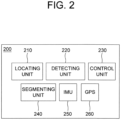
- Fig. 2 is a drawing schematically illustrating a configuration of the Advanced Pedestrian Assistance System to protect the pedestrian preoccupied with the smartphone in accordance with one example embodiment of the present disclosure.
- APAS 200 may include at least one locating unit 210, at least one detecting unit 220, at least one control unit 230, at least one segmenting unit 240, at least one IMU (inertial Measurement Unit) 250, and at least one GPS (Global Positioning System) 260.
- the IMU 250 may generate sensor information that can be inputted into each of the units above, and the locating unit 210, the detecting unit 220 and the control unit 230 may protect the pedestrian who uses the smartphone 100, by using information generated from the GPS 260, one or more images acquired from the phone cameras 400, and information acquired from the connected devices 500, as well as the sensor data.
- the segmenting unit 240 may be used for detecting whether any object is blocking a view of the phone cameras 400, to be described later.
- a general configuration of the smartphone 100 and the APAS 200 included therein is described above, and detailed operation of the APAS 200 is described below.
- the smartphone 100 may instruct the locating unit 210 to acquire information of the High Definition Map in the DB 300, location information from the GPS 260, and sensor data from the IMU 250.
- the sensor data from the IMU 250 may include information generated by sensors capable of measuring inertia of the smartphone 100, for example, at least one acceleration sensor or at least one gyroscope sensor. If such information is acquired, the smartphone 100 may instruct the locating unit 210 to acquire 1-st information including at least part of location information and velocity information of the pedestrian using the smartphone 100, and location information and velocity information of the smartphone 100, by referring to at least part of the information acquired from the High Definition Map, the GPS, and the acceleration sensor and the gyroscope sensor included the IMU.
- the location information of the pedestrian will be similar to the location information of the smartphone, and the velocity information of the pedestrian will be similar to the velocity information of the smartphone. But in some cases, a difference between moving velocities of the smartphone 100 and the pedestrian is so large that a correction may be needed. A process for such correction is described below.
- the smartphone 100 may instruct the locating unit 220 to calculate each distance of each of eyes of the pedestrian from a crossing point between a line connecting the eyes and a line passing through a nose of the pedestrian, by using the images acquired by the phone cameras 400, and to calculate an angle representing how much the smartphone 100 is leaning away from a body of the pedestrian by referring to a ratio between said each distance. This may be calculated by referring to a Gaussian distribution model representing a relation between the angle and the ratio. Thereafter, the velocity information of the pedestrian may be calculated by integrating the velocity information of the smartphone and a vector corresponding to the angle.
- the smartphone 100 may instruct the detecting unit 220 to acquire 2-nd information including each of hazard statuses of each of hazardous areas near the pedestrian and location information and velocity information of hazardous objects, by referring to at least part of the images acquired by phone cameras 400 linked with the smartphone 100 and the 1-st information.
- the hazardous areas may mean areas that can be dangerous for the pedestrian, for example, a road or an area near a construction site.
- the hazardous objects may mean every object that can collide with the pedestrian, near the pedestrian. This includes other pedestrians as well as objects like vehicles, street lights, and utility poles. Operations on at least part of the images and the 1-st information for acquisition of the 2-nd information are described below.
- the detecting unit 220 may be comprised of a CNN, and may acquire the 2-nd information by at least one neural network operation. That is, the detecting unit 220 may detect the objects near the pedestrian included in each of the images acquired by the phone cameras 400, by using at least one convolutional layer, at least one RPN, and at least one FC layer. Thereafter, the 2-nd information may be acquired by using the location information and the velocity information of the hazardous objects, by referring to calibration information related to a focal length of the phone cameras 400 and the location information and the velocity speed information of the smartphone included in the 1-st information.
- the detecting unit 220 may acquire location information of the phone cameras 400 linked with the smartphone 100 by referring to the location information of the smartphone. Specifically, a type or a model of the smartphone 100 may be identified, and information on how far the phone cameras 400 are located from a center of the smartphone 100 may be acquired by referring to a design of the smartphone 100, then the location information of the phone cameras 400 may be calculated by referring to the location information of the smartphone and the acquired information on how far the phone cameras 400 are located.
- each of 2D distances of each of the hazardous objects from each center of each of the images may be calculated, each of 3D distances of each of the hazardous objects from the phone cameras 400 may be calculated by additionally referring to the focal length, and the location information of each of the hazardous objects may be acquired by referring to the 3D distances and the location information of the phone cameras 400.
- the velocity information of the hazardous objects may be calculated by referring to each of the relative velocities and velocity information on the phone cameras 400 calculated by using the velocity information of the smartphone.
- the smartphone 100 may instruct the control unit 230 to generate at least one degree of pedestrian safety by referring to the 1-st information and the 2-nd information, and transmit a hazard alert to the pedestrian via the smartphone 100 by referring to the degree of pedestrian safety.
- the hazardous areas and the hazardous objects are taken into consideration when generating the degree of pedestrian safety, and a process for the hazardous areas is described.
- the smartphone 100 may instruct the control unit 230 to determine whether the pedestrian will move into one of the hazardous areas by referring to the location information and the velocity information of the pedestrian, and information on the hazardous areas, included in the 1-st information and the 2-nd information, to thereby generate the degree of pedestrian safety.
- the smartphone 100 may instruct the control unit 230 to (i) generate a pedestrian movement model capable of estimating a change of a moving velocity of the pedestrian, (ii) calculate one or more probabilities of the pedestrian moving into each of nearby areas, by referring to the pedestrian movement model, and (iii) generate the degree of pedestrian safety by referring to the probabilities of pedestrian movement and whether each of the nearby areas corresponds to each of the hazardous areas.
- the pedestrian movement model may include two detailed models one of which estimates the moving speed of the pedestrian and the other of which estimates a moving direction of the pedestrian.
- the detailed model for estimation of the moving speed of the pedestrian may be a Gaussian distribution model which is a specific first distribution having a mean value of a change of acceleration of 0 and a predetermined variance, with an absolute value of the acceleration of the pedestrian generated by the acceleration sensor in the IMU 250 as a reference point.
- the detailed model for estimation of the moving direction of the pedestrian may be a specific second distribution having a mean value of a change of the moving direction of 0 and a predetermined variance, with information on the moving direction included in the acceleration of the pedestrian as a reference point. Examples of the process are described by referring to Fig. 3 .
- Fig. 3 is a drawing schematically illustrating a process of calculating the degree of pedestrian safety by referring to the probabilities of the pedestrian moving into each of nearby areas, performed by the Advanced Pedestrian Assistance System to protect the pedestrian preoccupied with the smartphone in accordance with one example embodiment of the present disclosure.
- the probabilities of the pedestrian moving into nearby areas are calculated by the processes above. According to the distribution model above, a probability of the pedestrian moving with an initial speed and an initial direction will be the highest, therefore the probability of moving into an area in the front may be calculated as 0.8, and each probability of moving into areas on the left and right may be calculated as 0.15 and 0.05.
- a letter S of Fig. 3 may mean the area is safe, and a letter D may mean the area is dangerous, and in the example of Fig. 3 , the probability of the pedestrian moving into the hazardous areas is relatively low at 0.2, then the APAS 200 may estimate the degree of pedestrian safety as somewhat high.
- the smartphone 100 may instruct the control unit 230 to determine probabilities of at least one degree of risk of collision between the pedestrian and the hazardous objects near the pedestrian within a threshold time by referring to the 1-st information and the 2-nd information, to thereby generate the degree of pedestrian safety.
- the smartphone 100 may instruct the control unit 230 to generate a hazardous objects movement model capable of estimating changes of moving velocities of the hazardous objects and the pedestrian movement model as aforementioned. And both probabilities of the pedestrian moving into each of nearby areas within the threshold time by referring to the pedestrian movement model, and probabilities of the hazardous objects moving into each of nearby areas within the threshold time by referring to the hazardous objects movement model, may be calculated. Thereafter, the degree of pedestrian safety may be generated by referring to the probabilities of the pedestrian movement and the probabilities of the hazardous objects movement.
- the hazardous objects movement model may be generated in the way similar to generation of the pedestrian movement model, by referring to the location information and the velocity information of the hazardous objects included in the 2-nd information.
- the probabilities of the pedestrian movement and the probabilities of the hazardous object movement may be functions of time representing respective probabilities of the pedestrian and the hazardous objects being present at each position, and the control unit 230 may generate the degree of pedestrian safety by referring to a result of integration of multiplications of the two respective probabilities over the threshold time. Examples of the processes are decreased by referring to Fig. 4 .
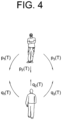
- Fig. 4 is a drawing schematically illustrating a process of calculating the degree of pedestrian safety by referring to the probabilities of the degree of risk of collision between the pedestrian and the hazardous objects, performed by the Advanced Pedestrian Assistance System to protect the pedestrian preoccupied with the smartphone in accordance with one example embodiment of the present disclosure.
- each of the probabilities of the pedestrian movement is p 1 ( t ), p 2 ( t ), and p 3 ( t )
- each of the corresponding probabilities of the hazardous object movement is q 1 (t), q 2 (t), and q 3 ( t ).
- the control unit 230 may multiply each probabilities and integrate them. Its formula is as follows. ⁇ 0 T p 1 t q 1 t + p 2 t q 2 t + p 3 t q 3 t dt
- T in the above formula may be the threshold time.
- the result of the integration may represent the degree of risk of collision between the pedestrian and the hazardous objects, and the control unit 230 may calculate the degree of pedestrian safety by referring to the degree of risk of collision.
- the smartphone 100 may instruct the control unit 230 to transmit an additional notification giving a behavioral guide to the pedestrian for evading the hazardous objects. For example, if one of the hazardous objects is moving in a first specific direction, the behavioral guide for moving in a second specific direction may be given to the pedestrian to avoid it.
- the smartphone 100 may instruct the control unit 230 to calculate the degree of pedestrian safety, to thereby provide safety of the pedestrian.
- the degree of pedestrian safety is calculated by using only information generated by the smartphone 100 itself and its phone cameras 400, therefore it is easily anticipated that calculation of the degree of pedestrian safety using additional information acquired from connected devices 500 near the pedestrian will make the pedestrian safer. Accordingly, a process of using information acquired from the connected devices 500 is described below.
- the smartphone 100 may instruct the control unit 230 to calculate the degree of pedestrian safety by referring to 3-rd information.
- the 3-rd information may include information on surroundings of the pedestrian generated by the smartphone 100 instructing the control unit 230 to communicate with at least part of connected devices near the pedestrian that include at least one vehicle, at least one CCTV, at least one another smartphone of at least one another pedestrian, and at least one traffic signal all of which are near the pedestrian, where at least part of the connected devices may be at least part of the hazardous objects.
- the 3-rd information may include the location information and the velocity information of the hazardous objects shown in videos generated by the CCTV.
- the 3-rd information may include two types of detailed information one of which is (3_1)-st information and the other of which is (3_2)-nd information.
- the (3_1)-st information may include location information and velocity information of a 1-st specific hazardous object included in both of at least one virtual viewing frustum of the phone cameras 400 linked with the smartphone 100 and at least one virtual viewing frustum of at least one external camera linked with the connected devices 500
- the (3_2)-nd information may include location information and velocity information of a 2-nd specific hazardous object excluded from the virtual viewing frustum of the phone cameras 400 linked with the smartphone 100 but included in the virtual viewing frustum of the external camera linked with the connected devices 500.
- the (3_1)-st information and the (3_2)-nd information may play different roles and specifically the smartphone 100 may instruct the control unit 230 to verify a reliability of the 2-nd information, created by the smartphone 100, by referring to the (3_1)-st information, and acquire information on at least one undetected hazardous object, which the smartphone 100 did not detect, by referring to the (3_2)-nd information.
- the degree of pedestrian safety becomes more accurate by using the (3_1)-st information, and more information is utilized for the degree of pedestrian safety by using the (3_2)-nd information. Examples of the (3_1)-st information and the (3_2)-nd information are described by referring to Figs. 5A and 5B .
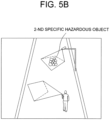
- Figs. 5A and 5B are drawings schematically illustrating a situation related to the (3_1)-st information and the (3_2)-nd information acquired by the Advanced Pedestrian Assistance System to protect the pedestrian preoccupied with the smartphone in accordance with one example embodiment of the present disclosure.
- Fig. 5A shows an example of the situation related to the (3_1)-st information
- the 1-st specific hazardous object is shown as detected by both of the phone cameras 400 linked with the smartphone 100 and the camera linked with the CCTV.
- the 2-nd information acquired by the smartphone 100 via the detecting unit 220 may be verified by using the 3-rd information on the 1-st specific hazardous object.
- Fig. 5B shows an example of the situation related to the (3_2)-nd information
- the 2-nd specific hazardous object is shown as detected by the camera linked with the CCTV but not by the phone cameras 400 linked with the smartphone 100.
- the 2-nd information does not include any information on the 2-nd specific hazardous object, therefore the smartphone 100 may additionally acquire the information on the 2-nd specific hazardous object by referring to the (3_2)-nd information.
- the smartphone 100 may instruct the control unit 230 to give information on the traffic light, as well as the hazard alert by referring to the degree of pedestrian safety, as described below.
- the smartphone 100 may instruct the control unit 230 to generate information on a traffic light of interest of the pedestrian, by referring to (i) traffic light location information and traffic light status information near the pedestrian included in the 3-rd information, and (ii) the location information and the velocity information of the pedestrian included in the 1-st information, and to generate and transmit an additional traffic light notification to the pedestrian via the smartphone 100 by referring to the information on the traffic light of interest.
- the control unit 230 may generate a virtual route for the pedestrian by referring to the location information and the velocity information of the pedestrian, and acquire the traffic light location information and the traffic light status information near the virtual route of the pedestrian by referring to the 3-rd information.
- the smartphone 100 may use information acquired from the connected devices 500.
- the connected devices 500 may use information generated by the smartphone 100.
- the smartphone 100 may instruct the control unit 230 to transmit at least part of the 1-st information and the 2-nd information to at least part of the connected devices 500 near the pedestrian.
- the smartphone 100 may allow the connected devices to behave in a direction of lowering the degree of risk of collision between the hazardous objects and the pedestrian, by referring to at least part of the acquired 1-st information and the acquired 2-nd information.
- some objects identical or similar to the smartphone 100 may utilize at least part of the 1-st information and the 2-nd information in the way similar to the smartphone 100 uses the 3-rd information.
- the smartphone 100 to provide such the APAS 200 to the pedestrian, acquisition of sufficient information by using the phone cameras 400 is required, but it may not be possible due to usage pattern of the smartphone 100 by the pedestrian. In this case, the pedestrian needs to be notified of the situation and his/her behavior must be corrected, as described below.
- the smartphone 100 may instruct the control unit 230 to transmit an unavailability notification of detection to the pedestrian via the smartphone 100. This is because the area, corresponding to the images acquired by the phone cameras 400, on the High Definition Map must be large for acquisition of information on more of the hazardous objects by the smartphone 100.
- At least one lens of the phone cameras 400 may be blocked by at least one object, e.g., a finger, or the pedestrian may be holding the smartphone 100 almost paralleled to the ground. Solutions for the two cases differ, and a method for distinguishing the two is need, as described below.
- the smartphone 100 may determine at least one cause of the area on the High Definition Map being less than or equal to the threshold value, by referring to at least part of occlusion information, due to at least one blocking object interfering with at least one lens of the phone cameras, generated by at least one segmenting unit 240, and angle information on an angle between a normal vector defining a plane of movement of the pedestrian and a central axis of at least one virtual viewing frustum of the phone cameras in a 3D space whose center lies at the pedestrian. Thereafter, each of separate warnings according to each corresponding cause may be transmitted to the pedestrian via the smartphone.
- the segmenting unit 240 may segment, by pixel, at least one region on the images acquired by the phone cameras 400, to thereby determine whether there is any blocking object interfering with the lens.
- This may be comprised of the CNN which may have calculated one or more losses by referring to inputted images having the blocking object, inputted images not having the blocking object, and their corresponding GTs, to thereby learn parameters of the CNN by backpropagating the losses.
- the angle information may be generated by referring to information created by the acceleration sensor and the gyroscope sensor in the IMU 250. A process of utilizing the angle information is described by referring to Fig. 6 .
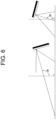
- Fig. 6 is a drawing schematically illustrating the angle information between each of central axes of viewing frustums from the phone cameras and the ground, used by the Advanced Pedestrian Assistance System to protect the pedestrian preoccupied with the smartphone in accordance with one example embodiment of the present disclosure.
- the smartphone 100 may instruct the control unit 230 to transmit a notification telling the pedestrian to hold the smartphone 100 in a tilted position to the pedestrian via the smartphone 100.
- the smartphone 100 may instruct the control unit 230 to transmit a notification telling the pedestrian to remove the blocking object.
- communication parts of the smartphone may perform transmission of image data, for example, images described above like the original image, original labels, and additional labels, etc.
- processors and/or memories of the smartphone may retain data for feature maps and performing operations, and that the processors of the smartphone may perform convolution operations, deconvolution operations, and loss value operations, but the scope of the present disclosure is not limited thereto.
- the present disclosure has an effect providing the Advanced Pedestrian Assistance System to protect the pedestrian preoccupied with the smartphone, to thereby protect the pedestrian and others around the pedestrian.
- the method in accordance with the present disclosure can be used for surveillance or a military purpose.
- the embodiments of the present disclosure as explained above can be implemented in a form of executable program command through a variety of computer means recordable to computer readable media.
- the computer readable media may include solely or in combination, program commands, data files, and data structures.
- the program commands recorded to the media may be components specially designed for the present disclosure or may be usable to a skilled human in a field of computer software.
- Computer readable media include magnetic media such as hard disk, floppy disk, and magnetic tape, optical media such as CD-ROM and DVD, magneto-optical media such as floptical disk and hardware devices such as ROM, RAM, and flash memory specially designed to store and carry out program commands.
- Program commands include not only a machine language code made by a complier but also a high level code that can be used by an interpreter etc., which is executed by a computer.
- the aforementioned hardware device can work as more than a software module to perform the action of the present disclosure and they can do the same in the opposite case.
Landscapes
- Engineering & Computer Science (AREA)
- Physics & Mathematics (AREA)
- General Physics & Mathematics (AREA)
- Business, Economics & Management (AREA)
- Signal Processing (AREA)
- Computer Networks & Wireless Communication (AREA)
- Human Computer Interaction (AREA)
- Remote Sensing (AREA)
- Radar, Positioning & Navigation (AREA)
- Emergency Management (AREA)
- Tourism & Hospitality (AREA)
- Development Economics (AREA)
- Economics (AREA)
- Human Resources & Organizations (AREA)
- Marketing (AREA)
- Primary Health Care (AREA)
- Strategic Management (AREA)
- General Business, Economics & Management (AREA)
- Theoretical Computer Science (AREA)
- Multimedia (AREA)
- General Health & Medical Sciences (AREA)
- Health & Medical Sciences (AREA)
- Educational Administration (AREA)
- Computing Systems (AREA)
- Computer Security & Cryptography (AREA)
- Environmental & Geological Engineering (AREA)
- Automation & Control Theory (AREA)
- Traffic Control Systems (AREA)
Description
- The present disclosure relates to a method for providing an Advanced Pedestrian Assistance System to protect at least one pedestrian preoccupied with at least one smartphone, and a smartphone using the same.
- Recently, Smombie, or smartphone zombie, is everywhere, and there are many pedestrians who are so focused on their smartphones as to be in danger because they cannot pay attention to their surroundings. Such smombies can be a huge social problem because they can put themselves at risk and be a risk to others.
- To protect them, there has been a smartphone application that simply warns the user, for example, when the user stays on the screen for a long period of time when walking. But since it is too simple an application, it cannot warn the user of many dangerous situations that can happen to Smombies. Document
KR 101862986 B1 - That is, there is no comprehensive and sophisticated warning system for safety of the smombies and for those around the smombies.
- It is an object of the present disclosure to solve all the aforementioned problems.
- It is another object of the present disclosure to provide an Advanced Pedestrian Assistance System to protect at least one pedestrian preoccupied with at least one smartphone, to thereby protect the pedestrian and others around the pedestrian.
- In accordance with one aspect of the present invention, there is provided a method according to claim 1.
- As one example, the method further includes a step of: (d) the smartphone instructing the control unit to transmit at least part of the 1-st information and the 2-nd information to at least part of connected devices near the pedestrian that include at least one vehicle, at least one CCTV, at least one another smartphone of at least one another pedestrian, and at least one traffic signal all of which are near the pedestrian, wherein at least part of the connected devices are at least part of the hazardous objects.
- As one example, at the step of (d), the smartphone instructs the control unit to transmit at least part of the 1-st information and the 2-nd information to at least part of the connected devices near the pedestrian, to thereby allow the connected devices to behave in a direction of lowering a degree of risk of collision between the hazardous objects and the pedestrian, by referring to at least part of the acquired 1-st information and the acquired 2-nd information.
- As one example, at the step of (c), the smartphone instructs the control unit to generate information on a traffic light of interest of the pedestrian, by referring to (i) traffic light location information and traffic light status information near the pedestrian included in the 3-rd information, and (ii) the location information and the velocity information of the pedestrian included in the 1-st information, and to generate and transmit an additional traffic light notification to the pedestrian via the smartphone by referring to the information on the traffic light of interest.
- As one example, the 3-rd information includes (i) a location and a velocity of the vehicle near the pedestrian, (ii) locations and velocities of the hazardous objects near the pedestrian acquired by referring to the CCTV near the pedestrian, (iii) a location and a velocity of said at least one another pedestrian, and (iv) traffic light location information and traffic light status information near the pedestrian.
- As one example, the smartphone, if at least one area, on the High Definition Map, corresponding to the images acquired by the phone cameras is detected as less than or equal to a threshold value by using the control unit, instructs the control unit to transmit an unavailability notification of detection to the pedestrian via the smartphone.
- As one example, the smartphone determines at least one cause of the area being less than or equal to the threshold value, by referring to at least part of occlusion information, on at least one blocking object interfering with at least one lens of the phone cameras, generated by at least one segmenting unit, and angle information on an angle between a normal vector defining a plane of movement of the pedestrian and a central axis of at least one virtual viewing frustum of the phone cameras in a 3D space whose center lies at the pedestrian, and transmits each of separate warnings according to each corresponding cause to the pedestrian via the smartphone.
- As one example, at the step of (c), the smartphone instructs the control unit to determine probabilities of the degree of risk of collision between the pedestrian and the hazardous objects near the pedestrian within a threshold time by referring to the 1-st information and the 2-nd information, to thereby generate the degree of pedestrian safety.
- As one example, the smartphone instructs the control unit to transmit an additional notification giving a behavioral guide to the pedestrian for improving the degree of pedestrian safety via the smartphone.
- According to another aspect of the present invention, there is provided a method according to claim 10.
- As one example, at the step of (c), the smartphone instructs the control unit to determine whether the pedestrian will move into one of the hazardous areas by referring to the location information and the velocity information of the pedestrian, and information on the hazardous areas, included in the 1-st information and the 2-nd information, to thereby generate the degree of pedestrian safety.
- As one example, the smartphone instructs the control unit to (i) generate a pedestrian movement model capable of estimating a change of a moving velocity of the pedestrian, (ii) calculate one or more probabilities of the pedestrian moving into each of nearby areas, by referring to the pedestrian movement model, and (iii) generate the degree of pedestrian safety by referring to the probabilities of the pedestrian and whether each of the nearby areas corresponds to each of the hazardous areas.
- As one example, at the step of (b), the smartphone instructs the detecting unit to (i) detect the hazardous objects near the pedestrian in each of the images by using at least one convolutional layer, at least one RPN, and at least one FC layer in the detecting unit, and (ii) acquire the 2-nd information on the detected hazardous objects, by referring to calibration information related to at least one focal length of the phone cameras and the 1-st information.
- The above and other objects and features of the present disclosure will become apparent from the following description of preferred embodiments given in conjunction with the accompanying drawings.
- The following drawings to be used to explain example embodiments of the present disclosure are only part of example embodiments of the present disclosure and other drawings can be obtained base on the drawings by those skilled in the art of the present disclosure without inventive work.
-
Fig. 1 is a drawing schematically illustrating a configuration of at least one smartphone for providing an Advanced Pedestrian Assistance System to protect at least one pedestrian preoccupied with the smartphone in accordance with one example embodiment of the present disclosure. -
Fig. 2 is a drawing schematically illustrating a configuration of the Advanced Pedestrian Assistance System to protect the pedestrian preoccupied with the smartphone in accordance with one example embodiment of the present disclosure. -
Fig. 3 is a drawing schematically illustrating a process of calculating at least one degree of pedestrian safety by referring to one or more probabilities of the pedestrian moving into each of nearby areas, performed by the Advanced Pedestrian Assistance System to protect the pedestrian preoccupied with the smartphone in accordance with one example embodiment of the present disclosure. -
Fig. 4 is a drawing schematically illustrating a process of calculating the degree of pedestrian safety by referring to probabilities of a degree of risk of collision between the pedestrian and one or more hazardous objects, performed by the Advanced Pedestrian Assistance System to protect the pedestrian preoccupied with the smartphone in accordance with one example embodiment of the present disclosure. -
Figs. 5A and5B are drawings schematically illustrating a situation related to (3_1)-st information and (3_2)-nd information acquired by the Advanced Pedestrian Assistance System to protect the pedestrian preoccupied with the smartphone in accordance with one example embodiment of the present disclosure. -
Fig. 6 is a drawing schematically illustrating angle information between each of central axes of viewing frustums from phone cameras and the ground, used by the Advanced Pedestrian Assistance System to protect the pedestrian preoccupied with the smartphone in accordance with one example embodiment of the present disclosure. - Detailed explanation on the present disclosure to be made below refer to attached drawings and diagrams illustrated as specific embodiment examples under which the present disclosure may be implemented to make clear of purposes, technical solutions, and advantages of the present disclosure. These embodiments are described in sufficient detail to enable those skilled in the art to practice the disclosure.
- Besides, in the detailed description and claims of the present disclosure, a term "include" and its variations are not intended to exclude other technical features, additions, components or steps. Other objects, benefits, and features of the present disclosure will be revealed to one skilled in the art, partially from the specification and partially from the implementation of the present disclosure. The following examples and drawings will be provided as examples but they are not intended to limit the present disclosure.
- Any images referred to in the present disclosure may include images related to any roads paved or unpaved, in which case the objects on the roads or near the roads may include vehicles, persons, animals, plants, buildings, flying objects like planes or drones, or any other obstacles which may appear in a road-related scene, but the scope of the present disclosure is not limited thereto. As another example, said any images referred to in the present disclosure may include images not related to any roads, such as images related to alleyway, land lots, sea, lakes, rivers, mountains, forests, deserts, sky, or any indoor space, in which case the objects in said any images may include vehicles, persons, animals, plants, buildings, flying objects like planes or drones, ships, amphibious planes or ships, or any other obstacles which may appear in a scene related to alleyway, land lots, sea, lakes, rivers, mountains, forests, deserts, sky, or any indoor space, but the scope of the present disclosure is not limited thereto.
- To allow those skilled in the art to carry out the present disclosure easily, the example embodiments of the present disclosure by referring to attached diagrams will be explained in detail as shown below.
-
Fig. 1 is a drawing schematically illustrating a configuration of at least one smartphone for providing an Advanced Pedestrian Assistance System to protect at least one pedestrian preoccupied with the smartphone in accordance with one example embodiment of the present disclosure. - By referring to
Fig. 1 , thesmartphone 100 may include the Advanced Pedestrian Assistance System 200 and at least one DB 300, which are components to be described in detail later. The Advanced Pedestrian Assistance System 200 is referred to as the APAS 200 below. Processes of input, output and computation of the APAS 200 and the DB 300 may be respectively performed by acommunication part 110 and aprocessor 120. However, detailed communication schematics between thecommunication part 110 and theprocessor 120 are omitted inFig. 1 . Herein, amemory 115 may have stored various instructions to be described later, and theprocessor 120 may execute the instructions stored in thememory 115 and may perform processes of the present disclosure by executing the instructions to be disclosed later. Such description of thesmartphone 100 does not exclude an integrated device including any combination of a processor, a memory, a medium, or any other computing components. - Also, the
smartphone 100 may exchange data with one ormore phone cameras 400 and one or more connecteddevices 500, and this process is explained along with the APAS 200 in detail later. -
Fig. 2 is a drawing schematically illustrating a configuration of the Advanced Pedestrian Assistance System to protect the pedestrian preoccupied with the smartphone in accordance with one example embodiment of the present disclosure. - APAS 200 may include at least one locating
unit 210, at least one detectingunit 220, at least onecontrol unit 230, at least onesegmenting unit 240, at least one IMU (inertial Measurement Unit) 250, and at least one GPS (Global Positioning System) 260. As will be explained later, basically the IMU 250 may generate sensor information that can be inputted into each of the units above, and the locatingunit 210, the detectingunit 220 and thecontrol unit 230 may protect the pedestrian who uses thesmartphone 100, by using information generated from theGPS 260, one or more images acquired from thephone cameras 400, and information acquired from the connecteddevices 500, as well as the sensor data. The segmentingunit 240 may be used for detecting whether any object is blocking a view of thephone cameras 400, to be described later. - A general configuration of the
smartphone 100 and the APAS 200 included therein is described above, and detailed operation of the APAS 200 is described below. - First, the
smartphone 100 may instruct the locatingunit 210 to acquire information of the High Definition Map in the DB 300, location information from theGPS 260, and sensor data from the IMU 250. The sensor data from the IMU 250 may include information generated by sensors capable of measuring inertia of thesmartphone 100, for example, at least one acceleration sensor or at least one gyroscope sensor. If such information is acquired, thesmartphone 100 may instruct the locatingunit 210 to acquire 1-st information including at least part of location information and velocity information of the pedestrian using thesmartphone 100, and location information and velocity information of thesmartphone 100, by referring to at least part of the information acquired from the High Definition Map, the GPS, and the acceleration sensor and the gyroscope sensor included the IMU. - In many cases, the location information of the pedestrian will be similar to the location information of the smartphone, and the velocity information of the pedestrian will be similar to the velocity information of the smartphone. But in some cases, a difference between moving velocities of the
smartphone 100 and the pedestrian is so large that a correction may be needed. A process for such correction is described below. - First, the
smartphone 100 may instruct the locatingunit 220 to calculate each distance of each of eyes of the pedestrian from a crossing point between a line connecting the eyes and a line passing through a nose of the pedestrian, by using the images acquired by thephone cameras 400, and to calculate an angle representing how much thesmartphone 100 is leaning away from a body of the pedestrian by referring to a ratio between said each distance. This may be calculated by referring to a Gaussian distribution model representing a relation between the angle and the ratio. Thereafter, the velocity information of the pedestrian may be calculated by integrating the velocity information of the smartphone and a vector corresponding to the angle. - Thereafter, the
smartphone 100 may instruct the detectingunit 220 to acquire 2-nd information including each of hazard statuses of each of hazardous areas near the pedestrian and location information and velocity information of hazardous objects, by referring to at least part of the images acquired byphone cameras 400 linked with thesmartphone 100 and the 1-st information. The hazardous areas may mean areas that can be dangerous for the pedestrian, for example, a road or an area near a construction site. The hazardous objects may mean every object that can collide with the pedestrian, near the pedestrian. This includes other pedestrians as well as objects like vehicles, street lights, and utility poles. Operations on at least part of the images and the 1-st information for acquisition of the 2-nd information are described below. - First, the detecting
unit 220 may be comprised of a CNN, and may acquire the 2-nd information by at least one neural network operation. That is, the detectingunit 220 may detect the objects near the pedestrian included in each of the images acquired by thephone cameras 400, by using at least one convolutional layer, at least one RPN, and at least one FC layer. Thereafter, the 2-nd information may be acquired by using the location information and the velocity information of the hazardous objects, by referring to calibration information related to a focal length of thephone cameras 400 and the location information and the velocity speed information of the smartphone included in the 1-st information. - Upon close look at a process of acquiring the location information of the hazardous objects, the detecting
unit 220 may acquire location information of thephone cameras 400 linked with thesmartphone 100 by referring to the location information of the smartphone. Specifically, a type or a model of thesmartphone 100 may be identified, and information on how far thephone cameras 400 are located from a center of thesmartphone 100 may be acquired by referring to a design of thesmartphone 100, then the location information of thephone cameras 400 may be calculated by referring to the location information of the smartphone and the acquired information on how far thephone cameras 400 are located. If the location information of thephone cameras 400 is acquired, each of 2D distances of each of the hazardous objects from each center of each of the images may be calculated, each of 3D distances of each of the hazardous objects from thephone cameras 400 may be calculated by additionally referring to the focal length, and the location information of each of the hazardous objects may be acquired by referring to the 3D distances and the location information of thephone cameras 400. - After calculating each of relative velocities between the
phone cameras 400 and the hazardous objects by referring to the multiple images, acquired consecutively by thephone cameras 400, the velocity information of the hazardous objects may be calculated by referring to each of the relative velocities and velocity information on thephone cameras 400 calculated by using the velocity information of the smartphone. - After acquisition of the location information and the velocity information of the hazardous objects, the
smartphone 100 may instruct thecontrol unit 230 to generate at least one degree of pedestrian safety by referring to the 1-st information and the 2-nd information, and transmit a hazard alert to the pedestrian via thesmartphone 100 by referring to the degree of pedestrian safety. - The hazardous areas and the hazardous objects are taken into consideration when generating the degree of pedestrian safety, and a process for the hazardous areas is described.
- The
smartphone 100 may instruct thecontrol unit 230 to determine whether the pedestrian will move into one of the hazardous areas by referring to the location information and the velocity information of the pedestrian, and information on the hazardous areas, included in the 1-st information and the 2-nd information, to thereby generate the degree of pedestrian safety. Specifically, thesmartphone 100 may instruct thecontrol unit 230 to (i) generate a pedestrian movement model capable of estimating a change of a moving velocity of the pedestrian, (ii) calculate one or more probabilities of the pedestrian moving into each of nearby areas, by referring to the pedestrian movement model, and (iii) generate the degree of pedestrian safety by referring to the probabilities of pedestrian movement and whether each of the nearby areas corresponds to each of the hazardous areas. - The pedestrian movement model may include two detailed models one of which estimates the moving speed of the pedestrian and the other of which estimates a moving direction of the pedestrian. The detailed model for estimation of the moving speed of the pedestrian may be a Gaussian distribution model which is a specific first distribution having a mean value of a change of acceleration of 0 and a predetermined variance, with an absolute value of the acceleration of the pedestrian generated by the acceleration sensor in the
IMU 250 as a reference point. The detailed model for estimation of the moving direction of the pedestrian may be a specific second distribution having a mean value of a change of the moving direction of 0 and a predetermined variance, with information on the moving direction included in the acceleration of the pedestrian as a reference point. Examples of the process are described by referring toFig. 3 . -
Fig. 3 is a drawing schematically illustrating a process of calculating the degree of pedestrian safety by referring to the probabilities of the pedestrian moving into each of nearby areas, performed by the Advanced Pedestrian Assistance System to protect the pedestrian preoccupied with the smartphone in accordance with one example embodiment of the present disclosure. - By referring to
Fig. 3 , the probabilities of the pedestrian moving into nearby areas are calculated by the processes above. According to the distribution model above, a probability of the pedestrian moving with an initial speed and an initial direction will be the highest, therefore the probability of moving into an area in the front may be calculated as 0.8, and each probability of moving into areas on the left and right may be calculated as 0.15 and 0.05. A letter S ofFig. 3 may mean the area is safe, and a letter D may mean the area is dangerous, and in the example ofFig. 3 , the probability of the pedestrian moving into the hazardous areas is relatively low at 0.2, then theAPAS 200 may estimate the degree of pedestrian safety as somewhat high. - The process of calculating the degree of pedestrian safety by referring to the hazardous areas is described above, and a process of calculating the degree of pedestrian safety by referring to the hazardous objects is described below.
- The
smartphone 100 may instruct thecontrol unit 230 to determine probabilities of at least one degree of risk of collision between the pedestrian and the hazardous objects near the pedestrian within a threshold time by referring to the 1-st information and the 2-nd information, to thereby generate the degree of pedestrian safety. Specifically, thesmartphone 100 may instruct thecontrol unit 230 to generate a hazardous objects movement model capable of estimating changes of moving velocities of the hazardous objects and the pedestrian movement model as aforementioned. And both probabilities of the pedestrian moving into each of nearby areas within the threshold time by referring to the pedestrian movement model, and probabilities of the hazardous objects moving into each of nearby areas within the threshold time by referring to the hazardous objects movement model, may be calculated. Thereafter, the degree of pedestrian safety may be generated by referring to the probabilities of the pedestrian movement and the probabilities of the hazardous objects movement. - The hazardous objects movement model may be generated in the way similar to generation of the pedestrian movement model, by referring to the location information and the velocity information of the hazardous objects included in the 2-nd information.
- The probabilities of the pedestrian movement and the probabilities of the hazardous object movement may be functions of time representing respective probabilities of the pedestrian and the hazardous objects being present at each position, and the
control unit 230 may generate the degree of pedestrian safety by referring to a result of integration of multiplications of the two respective probabilities over the threshold time. Examples of the processes are decreased by referring toFig. 4 . -
Fig. 4 is a drawing schematically illustrating a process of calculating the degree of pedestrian safety by referring to the probabilities of the degree of risk of collision between the pedestrian and the hazardous objects, performed by the Advanced Pedestrian Assistance System to protect the pedestrian preoccupied with the smartphone in accordance with one example embodiment of the present disclosure. - By referring to
Fig. 4 , each of the probabilities of the pedestrian movement is p 1(t),p 2(t), and p 3(t), and each of the corresponding probabilities of the hazardous object movement is q 1(t), q 2(t), and q 3(t). Herein, thecontrol unit 230 may multiply each probabilities and integrate them. Its formula is as follows.
- T in the above formula may be the threshold time.
- The result of the integration may represent the degree of risk of collision between the pedestrian and the hazardous objects, and the
control unit 230 may calculate the degree of pedestrian safety by referring to the degree of risk of collision. - Herein, if the degree of pedestrian safety is calculated to be low due to the hazardous objects, a behavior for improving the degree of pedestrian safety may be suggested, in addition to a notification, to the pedestrian. That is, the
smartphone 100 may instruct thecontrol unit 230 to transmit an additional notification giving a behavioral guide to the pedestrian for evading the hazardous objects. For example, if one of the hazardous objects is moving in a first specific direction, the behavioral guide for moving in a second specific direction may be given to the pedestrian to avoid it. - As such, the
smartphone 100 may instruct thecontrol unit 230 to calculate the degree of pedestrian safety, to thereby provide safety of the pedestrian. However, in the description above, the degree of pedestrian safety is calculated by using only information generated by thesmartphone 100 itself and itsphone cameras 400, therefore it is easily anticipated that calculation of the degree of pedestrian safety using additional information acquired fromconnected devices 500 near the pedestrian will make the pedestrian safer. Accordingly, a process of using information acquired from the connecteddevices 500 is described below. - That is, the
smartphone 100 may instruct thecontrol unit 230 to calculate the degree of pedestrian safety by referring to 3-rd information. Herein, the 3-rd information may include information on surroundings of the pedestrian generated by thesmartphone 100 instructing thecontrol unit 230 to communicate with at least part of connected devices near the pedestrian that include at least one vehicle, at least one CCTV, at least one another smartphone of at least one another pedestrian, and at least one traffic signal all of which are near the pedestrian, where at least part of the connected devices may be at least part of the hazardous objects. For example, the 3-rd information may include the location information and the velocity information of the hazardous objects shown in videos generated by the CCTV. - The 3-rd information may include two types of detailed information one of which is (3_1)-st information and the other of which is (3_2)-nd information.
- The (3_1)-st information may include location information and velocity information of a 1-st specific hazardous object included in both of at least one virtual viewing frustum of the
phone cameras 400 linked with thesmartphone 100 and at least one virtual viewing frustum of at least one external camera linked with theconnected devices 500, and the (3_2)-nd information may include location information and velocity information of a 2-nd specific hazardous object excluded from the virtual viewing frustum of thephone cameras 400 linked with thesmartphone 100 but included in the virtual viewing frustum of the external camera linked with theconnected devices 500. - The (3_1)-st information and the (3_2)-nd information may play different roles and specifically the
smartphone 100 may instruct thecontrol unit 230 to verify a reliability of the 2-nd information, created by thesmartphone 100, by referring to the (3_1)-st information, and acquire information on at least one undetected hazardous object, which thesmartphone 100 did not detect, by referring to the (3_2)-nd information. The degree of pedestrian safety becomes more accurate by using the (3_1)-st information, and more information is utilized for the degree of pedestrian safety by using the (3_2)-nd information. Examples of the (3_1)-st information and the (3_2)-nd information are described by referring toFigs. 5A and5B . -
Figs. 5A and5B are drawings schematically illustrating a situation related to the (3_1)-st information and the (3_2)-nd information acquired by the Advanced Pedestrian Assistance System to protect the pedestrian preoccupied with the smartphone in accordance with one example embodiment of the present disclosure. -
Fig. 5A shows an example of the situation related to the (3_1)-st information, and the 1-st specific hazardous object is shown as detected by both of thephone cameras 400 linked with thesmartphone 100 and the camera linked with the CCTV. In this case, the 2-nd information acquired by thesmartphone 100 via the detectingunit 220 may be verified by using the 3-rd information on the 1-st specific hazardous object. -
Fig. 5B shows an example of the situation related to the (3_2)-nd information, and the 2-nd specific hazardous object is shown as detected by the camera linked with the CCTV but not by thephone cameras 400 linked with thesmartphone 100. Herein, the 2-nd information does not include any information on the 2-nd specific hazardous object, therefore thesmartphone 100 may additionally acquire the information on the 2-nd specific hazardous object by referring to the (3_2)-nd information. - Also, the
smartphone 100 may instruct thecontrol unit 230 to give information on the traffic light, as well as the hazard alert by referring to the degree of pedestrian safety, as described below. - That is, the
smartphone 100 may instruct thecontrol unit 230 to generate information on a traffic light of interest of the pedestrian, by referring to (i) traffic light location information and traffic light status information near the pedestrian included in the 3-rd information, and (ii) the location information and the velocity information of the pedestrian included in the 1-st information, and to generate and transmit an additional traffic light notification to the pedestrian via thesmartphone 100 by referring to the information on the traffic light of interest. Specifically, thecontrol unit 230 may generate a virtual route for the pedestrian by referring to the location information and the velocity information of the pedestrian, and acquire the traffic light location information and the traffic light status information near the virtual route of the pedestrian by referring to the 3-rd information. - As such, the
smartphone 100 may use information acquired from the connecteddevices 500. Conversely, theconnected devices 500 may use information generated by thesmartphone 100. - That is, the
smartphone 100 may instruct thecontrol unit 230 to transmit at least part of the 1-st information and the 2-nd information to at least part of the connecteddevices 500 near the pedestrian. As such, thesmartphone 100 may allow the connected devices to behave in a direction of lowering the degree of risk of collision between the hazardous objects and the pedestrian, by referring to at least part of the acquired 1-st information and the acquired 2-nd information. Among theconnected devices 500, some objects identical or similar to thesmartphone 100 may utilize at least part of the 1-st information and the 2-nd information in the way similar to thesmartphone 100 uses the 3-rd information. - Meanwhile, to allow the
smartphone 100 to provide such theAPAS 200 to the pedestrian, acquisition of sufficient information by using thephone cameras 400 is required, but it may not be possible due to usage pattern of thesmartphone 100 by the pedestrian. In this case, the pedestrian needs to be notified of the situation and his/her behavior must be corrected, as described below. - That is, if at least one area, on the High Definition Map, corresponding to the images acquired by the
phone cameras 400 is detected as less than or equal to a threshold value by using thecontrol unit 230, thesmartphone 100 may instruct thecontrol unit 230 to transmit an unavailability notification of detection to the pedestrian via thesmartphone 100. This is because the area, corresponding to the images acquired by thephone cameras 400, on the High Definition Map must be large for acquisition of information on more of the hazardous objects by thesmartphone 100. - However, if the area on the High Definition Map is determined as falling below the threshold value, then at least one lens of the
phone cameras 400 may be blocked by at least one object, e.g., a finger, or the pedestrian may be holding thesmartphone 100 almost paralleled to the ground. Solutions for the two cases differ, and a method for distinguishing the two is need, as described below. - Specifically, the
smartphone 100 may determine at least one cause of the area on the High Definition Map being less than or equal to the threshold value, by referring to at least part of occlusion information, due to at least one blocking object interfering with at least one lens of the phone cameras, generated by at least onesegmenting unit 240, and angle information on an angle between a normal vector defining a plane of movement of the pedestrian and a central axis of at least one virtual viewing frustum of the phone cameras in a 3D space whose center lies at the pedestrian. Thereafter, each of separate warnings according to each corresponding cause may be transmitted to the pedestrian via the smartphone. - The segmenting
unit 240 may segment, by pixel, at least one region on the images acquired by thephone cameras 400, to thereby determine whether there is any blocking object interfering with the lens. This may be comprised of the CNN which may have calculated one or more losses by referring to inputted images having the blocking object, inputted images not having the blocking object, and their corresponding GTs, to thereby learn parameters of the CNN by backpropagating the losses. - The angle information may be generated by referring to information created by the acceleration sensor and the gyroscope sensor in the
IMU 250. A process of utilizing the angle information is described by referring toFig. 6 . -
Fig. 6 is a drawing schematically illustrating the angle information between each of central axes of viewing frustums from the phone cameras and the ground, used by the Advanced Pedestrian Assistance System to protect the pedestrian preoccupied with the smartphone in accordance with one example embodiment of the present disclosure. - By referring to the
Fig. 6 , if an angle θ2 between a normal vector defining a plane of movement of the pedestrian and a central axis of the virtual viewing frustum of the phone camera in a 3D space whose center lies at the pedestrian is large, the virtual viewing frustum will cover a small surface on the ground, and if the angle θ1 is small, the virtual viewing frustum will cover a large surface on the ground. - Therefore, if the area is small and the angle θ2 is larger than a threshold angle, it means that the pedestrian is holding the
smartphone 100 almost parallel to the ground, thus thesmartphone 100 may instruct thecontrol unit 230 to transmit a notification telling the pedestrian to hold thesmartphone 100 in a tilted position to the pedestrian via thesmartphone 100. Conversely, if the area is small and the angle θ1 is smaller than the threshold angle, and if the blocking object is occupying an area, on the images, larger than a threshold area by referring to the occlusion information generated by the segmentingunit 240, then thesmartphone 100 may instruct thecontrol unit 230 to transmit a notification telling the pedestrian to remove the blocking object. - By providing the APAS in the comprehensive and sophisticated way as above, the safety of the pedestrian is guaranteed.
- As can be understood by those skilled in the art, it is clear that communication parts of the smartphone may perform transmission of image data, for example, images described above like the original image, original labels, and additional labels, etc., and that processors and/or memories of the smartphone may retain data for feature maps and performing operations, and that the processors of the smartphone may perform convolution operations, deconvolution operations, and loss value operations, but the scope of the present disclosure is not limited thereto.
- The present disclosure has an effect providing the Advanced Pedestrian Assistance System to protect the pedestrian preoccupied with the smartphone, to thereby protect the pedestrian and others around the pedestrian.
- The method in accordance with the present disclosure can be used for surveillance or a military purpose.
- The embodiments of the present disclosure as explained above can be implemented in a form of executable program command through a variety of computer means recordable to computer readable media. The computer readable media may include solely or in combination, program commands, data files, and data structures. The program commands recorded to the media may be components specially designed for the present disclosure or may be usable to a skilled human in a field of computer software. Computer readable media include magnetic media such as hard disk, floppy disk, and magnetic tape, optical media such as CD-ROM and DVD, magneto-optical media such as floptical disk and hardware devices such as ROM, RAM, and flash memory specially designed to store and carry out program commands. Program commands include not only a machine language code made by a complier but also a high level code that can be used by an interpreter etc., which is executed by a computer. The aforementioned hardware device can work as more than a software module to perform the action of the present disclosure and they can do the same in the opposite case.
- As seen above, the present disclosure has been explained by specific matters such as detailed components, limited embodiments, and drawings. They have been provided only to help more general understanding of the present disclosure. It, however, will be understood by those skilled in the art that various changes and modification may be made from the description without departing from the scope of the invention as defined in the following claims.
Claims (13)
- A method for providing an Advanced Pedestrian Assistance System (200) to protect at least one pedestrian preoccupied with at least one smartphone (100), comprising steps of:(a) the smartphone (100) instructing at least one locating unit (210) to acquire 1-st information including at least part of location information and velocity information of the pedestrian and location information and velocity information of the smartphone (100), by referring to at least part of information acquired from at least one High Definition Map, at least one GPS (260), and at least one acceleration sensor and at least one gyroscope sensor included in at least one IMU (250);(b) the smartphone (100) instructing at least one detecting unit (220) to acquire 2-nd information including each of hazard statuses of each of hazardous areas near the pedestrian and location information and velocity information of hazardous objects, by referring to at least part of images acquired by one or more phone cameras (400) linked with the smartphone (100) and the 1-st information; and(c) the smartphone (100) instructing at least one control unit (230) to calculate at least one degree of pedestrian safety of the pedestrian by referring to the 1-st information and the 2-nd information, and to transmit a hazard alert to the pedestrian via the smartphone (100),characterized in that:at the step of (c), the smartphone (100) instructs the control unit (230) to determine the degree of pedestrian safety by additionally referring to 3-rd information, andwherein the 3-rd information includes information on surroundings of the pedestrian generated by the smartphone (100) instructing the control unit (230) to communicate with at least part of connected devices (500) near the pedestrian that include at least one vehicle, at least one CCTV, at least one another smartphone (100) of at least one another pedestrian, and at least one traffic signal all of which are near the pedestrian, wherein at least part of the connected devices (500) are at least part of the hazardous objects,wherein the 3-rd information includes at least part of (3_1)-st information and (3_2)-nd information,wherein the (3_1)-st information includes location information and velocity information of a 1-st specific hazardous object included in both of at least one virtual viewing frustum of the phone cameras (400) linked with the smartphone (100) and at least one virtual viewing frustum of at least one external camera linked with the connected devices (500),wherein the (3_2)-nd information includes location information and velocity information of a 2-nd specific hazardous object excluded from the virtual viewing frustum of the phone cameras (400) linked with the smartphone (100) but included in the virtual viewing frustum of the external camera linked with the connected devices (500), andwherein the smartphone (100) instructs the control unit (230) to verify a reliability of the 2-nd information by referring to the (3_1)-st information, and acquire information on at least one undetected hazardous object by referring to the (3_2)-nd information.
- The method of Claim 1, wherein the method further comprises a step of: (d) the smartphone (100) instructing the control unit (230) to transmit at least part of the 1-st information and the 2-nd information to at least part of connected devices (500) near the pedestrian that include at least one vehicle, at least one CCTV, at least one another smartphone (100) of at least one another pedestrian, and at least one traffic signal all of which are near the pedestrian, wherein at least part of the connected devices (500) are at least part of the hazardous objects.
- The method of Claim 2, wherein, at the step of (d), the smartphone (100) instructs the control unit (230) to transmit at least part of the 1-st information and the 2-nd information to at least part of the connected devices (500) near the pedestrian, to thereby allow the connected devices (500) to behave in a direction of lowering a degree of risk of collision between the hazardous objects and the pedestrian, by referring to at least part of the acquired 1-st information and the acquired 2-nd information.
- The method of Claim 1, wherein, at the step of (c), the smartphone (100) instructs the control unit (230) to generate information on a traffic light of interest of the pedestrian, by referring to (i) traffic light location information and traffic light status information near the pedestrian included in the 3-rd information, and (ii) the location information and the velocity information of the pedestrian included in the 1-st information, and to generate and transmit an additional traffic light notification to the pedestrian via the smartphone (100) by referring to the information on the traffic light of interest.
- The method of Claim 1, wherein the 3-rd information includes (i) a location and a velocity of the vehicle near the pedestrian, (ii) locations and velocities of the hazardous objects near the pedestrian acquired by referring to the CCTV near the pedestrian, (iii) a location and a velocity of said at least one another pedestrian, and (iv) traffic light location information and traffic light status information near the pedestrian.
- The method of Claim 1, wherein the smartphone (100), if at least one area, on the High Definition Map, corresponding to the images acquired by the phone cameras (400) is detected as smaller than or equal to a threshold value by using the control unit (230), instructs the control unit (230) to transmit an unavailability notification of detection to the pedestrian via the smartphone (100).
- The method of Claim 6, wherein the smartphone (100) determines at least one cause of the area being less than or equal to the threshold value, by referring to at least part of occlusion information, on at least one blocking object interfering with at least one lens of the phone cameras (400), generated by at least one segmenting unit (240), and angle information on an angle between a normal vector defining a plane of movement of the pedestrian and a central axis of at least one virtual viewing frustum of the phone cameras (400) in a 3D space whose center lies at the pedestrian, and transmits each of separate warnings according to each corresponding cause to the pedestrian via the smartphone (100).
- The method of Claim 1, wherein, at the step of (c), the smartphone (100) instructs the control unit (230) to determine probabilities of the degree of risk of collision between the pedestrian and the hazardous objects near the pedestrian within a threshold time by referring to the 1-st information and the 2-nd information, to thereby generate the degree of pedestrian safety.
- The method of Claim 8, wherein the smartphone (100) instructs the control unit (230) to transmit an additional notification giving a behavioral guide to the pedestrian for improving the degree of pedestrian safety via the smartphone (100).
- A method for providing an Advanced Pedestrian Assistance System (200) to protect at least one pedestrian preoccupied with at least one smartphone (100), comprising steps of:(a) the smartphone (100) instructing at least one locating unit (210) to acquire 1-st information including at least part of location information and velocity information of the pedestrian and location information and velocity information of the smartphone (100), by referring to at least part of information acquired from at least one High Definition Map, at least one GPS (260), and at least one acceleration sensor and at least one gyroscope sensor included in at least one IMU (250);(b) the smartphone (100) instructing at least one detecting unit (220) to acquire 2-nd information including each of hazard statuses of each of hazardous areas near the pedestrian and location information and velocity information of hazardous objects, by referring to at least part of images acquired by one or more phone cameras (400) linked with the smartphone (100) and the 1-st information; and(c) the smartphone (100) instructing at least one control unit (230) to calculate at least one degree of pedestrian safety of the pedestrian by referring to the 1-st information and the 2-nd information, and to transmit a hazard alert to the pedestrian via the smartphone (100),wherein, at the step of (c), the smartphone (100) instructs the control unit (230) to determine probabilities of the degree of risk of collision between the pedestrian and the hazardous objects near the pedestrian within a threshold time by referring to the 1-st information and the 2-nd information, to thereby generate the degree of pedestrian safety, andcharacterized in thatthe smartphone (100) instructs the control unit (230) to (i) generate a pedestrian movement model capable of estimating a change of a moving velocity of the pedestrian, by referring to acceleration sensor information included in the 1-st information, (ii) calculate one or more probabilities of the pedestrian moving into each of nearby areas within the threshold time, by referring to the pedestrian movement model, (iii) generate a hazardous objects movement model capable of estimating changes of moving velocities of the hazardous objects, by referring to at least part of the 2-nd information, (iv) calculate one or more probabilities of the hazardous objects moving into each of nearby areas within the threshold time, by referring to the hazardous objects movement model, and (v) generate the degree of pedestrian safety by referring to the probabilities of the pedestrian and the probabilities of the hazardous objects.
- The method of Claim 1 or claim 10, wherein, at the step of (c), the smartphone (100) instructs the control unit (230) to determine whether the pedestrian will move into one of the hazardous areas by referring to the location information and the velocity information of the pedestrian, and information on the hazardous areas, included in the 1-st information and the 2-nd information, to thereby generate the degree of pedestrian safety.
- The method of Claim 11, wherein the smartphone (100) instructs the control unit (230) to (i) generate a pedestrian movement model capable of estimating a change of a moving velocity of the pedestrian, (ii) calculate one or more probabilities of the pedestrian moving into each of nearby areas, by referring to the pedestrian movement model, and (iii) generate the degree of pedestrian safety by referring to the probabilities of the pedestrian and whether each of the nearby areas corresponds to each of the hazardous areas.
- The method of Claim 1 or claim 10, wherein, at the step of (b), the smartphone (100) instructs the detecting unit (220) to (i) detect the hazardous objects near the pedestrian in each of the images by using at least one convolutional layer, at least one RPN, and at least one FC layer in the detecting unit (220), and (ii) acquire the 2-nd information on the detected hazardous objects, by referring to calibration information related to at least one focal length of the phone cameras (400) and the 1-st information.
Applications Claiming Priority (1)
| Application Number | Priority Date | Filing Date | Title |
|---|---|---|---|
| US16/263,006 US10565863B1 (en) | 2019-01-31 | 2019-01-31 | Method and device for providing advanced pedestrian assistance system to protect pedestrian preoccupied with smartphone |
Publications (3)
| Publication Number | Publication Date |
|---|---|
| EP3690396A1 EP3690396A1 (en) | 2020-08-05 |
| EP3690396B1 true EP3690396B1 (en) | 2024-10-09 |
| EP3690396C0 EP3690396C0 (en) | 2024-10-09 |
Family
ID=69156281
Family Applications (1)
| Application Number | Title | Priority Date | Filing Date |
|---|---|---|---|
| EP20150873.6A Active EP3690396B1 (en) | 2019-01-31 | 2020-01-09 | Method and device for providing advanced pedestrian assistance system to protect pedestrian distracted by their smartphone |
Country Status (5)
| Country | Link |
|---|---|
| US (1) | US10565863B1 (en) |
| EP (1) | EP3690396B1 (en) |
| JP (1) | JP6935947B2 (en) |
| KR (1) | KR102337352B1 (en) |
| CN (1) | CN111508222B (en) |
Families Citing this family (8)
| Publication number | Priority date | Publication date | Assignee | Title |
|---|---|---|---|---|
| US12002345B2 (en) * | 2020-05-22 | 2024-06-04 | Wipro Limited | Environment-based-threat alerting to user via mobile phone |
| FR3112641A1 (en) | 2020-07-17 | 2022-01-21 | CopSonic | METHOD OF INDICATING A TRAFFIC HAZARD TO THE USER OF A SMARTPHONE |
| US11488467B1 (en) | 2020-09-02 | 2022-11-01 | Wm Intellectual Property Holdings, L.L.C. | System and method for oncoming vehicle detection and alerts for a waste collection vehicle |
| CN112671977A (en) * | 2020-12-25 | 2021-04-16 | 深圳市九洲电器有限公司 | Safety early warning method and device, storage medium and electronic equipment |
| JP7571767B2 (en) * | 2022-06-21 | 2024-10-23 | トヨタ自動車株式会社 | Notification system and method |
| CN115188188B (en) * | 2022-07-08 | 2023-09-05 | 重庆交通大学 | Pedestrian crossing risk assessment method under waiting time mobile phone distraction condition |
| DE102022210507A1 (en) * | 2022-10-05 | 2024-04-11 | Continental Automotive Technologies GmbH | Alarm system to warn vulnerable road users in a given road section |
| WO2024150966A1 (en) * | 2023-01-13 | 2024-07-18 | 삼성전자주식회사 | Electronic device for outputting notification information, and operation method thereof |
Citations (3)
| Publication number | Priority date | Publication date | Assignee | Title |
|---|---|---|---|---|
| CN104848858A (en) * | 2015-06-01 | 2015-08-19 | 北京极智嘉科技有限公司 | Two-dimensional code and vision-inertial integrated navigation system and method for robot |
| US20160154408A1 (en) * | 2010-09-24 | 2016-06-02 | Irobot Corporation | Systems and methods for vslam optimization |
| EP2903787B1 (en) * | 2012-10-05 | 2019-05-15 | iRobot Corporation | Robot management systems for determining docking station pose including mobile robots and methods using same |
Family Cites Families (19)
| Publication number | Priority date | Publication date | Assignee | Title |
|---|---|---|---|---|
| JP2010287161A (en) * | 2009-06-15 | 2010-12-24 | Toyota Infotechnology Center Co Ltd | Pedestrian detection system |
| RU2495775C2 (en) * | 2011-12-29 | 2013-10-20 | Федеральное государственное бюджетное образовательное учреждение высшего профессионального образования Марийский государственный технический университет | Method of increasing pedestrian crossing safety |
| US10591608B2 (en) * | 2014-01-24 | 2020-03-17 | Savari, Inc. | Positioning quality filter for the V2X technologies |
| JP6429368B2 (en) * | 2013-08-02 | 2018-11-28 | 本田技研工業株式会社 | Inter-vehicle communication system and method |
| JP2015197785A (en) * | 2014-04-01 | 2015-11-09 | 独立行政法人交通安全環境研究所 | Pedestrian support system and pedestrian support program |
| KR101616450B1 (en) * | 2014-06-09 | 2016-05-11 | (주) 펀매직 | Device and method for embodying virtual button using camera and computer readable recording medium therefor |
| US9947215B2 (en) * | 2014-09-26 | 2018-04-17 | Harman International Industries, Incorporated | Pedestrian information system |
| US9896030B2 (en) * | 2015-04-30 | 2018-02-20 | Honda Motor Co., Ltd. | System and method for vehicle collision mitigation with vulnerable road user context sensing |
| KR20170025179A (en) * | 2015-08-27 | 2017-03-08 | 엘지전자 주식회사 | The pedestrian crash prevention system and operation method thereof |
| KR101751032B1 (en) * | 2015-11-20 | 2017-06-26 | 유한회사 청텍 | User environment dangers detection apparatus using image sensor |
| CN106816035B (en) * | 2015-12-02 | 2020-04-10 | 中国移动通信集团公司 | Pedestrian-oriented warning method and device |
| KR101916993B1 (en) * | 2015-12-24 | 2018-11-08 | 엘지전자 주식회사 | Display apparatus for vehicle and control method thereof |
| JP6169747B2 (en) * | 2016-04-11 | 2017-07-26 | 富士通テン株式会社 | Mobile device |
| JP6325601B2 (en) * | 2016-05-25 | 2018-05-16 | 京セラ株式会社 | Electronic device, control method, and control program |
| CN106790992A (en) * | 2016-11-21 | 2017-05-31 | 广东欧珀移动通信有限公司 | Safety reminder method and smart phone |
| KR101862986B1 (en) * | 2017-03-15 | 2018-05-30 | 인하대학교 산학협력단 | Smombie guardian: system and method to generate alerts for smartphone user of situational awareness while walking |
| US10349011B2 (en) * | 2017-08-14 | 2019-07-09 | GM Global Technology Operations LLC | System and method for improved obstacle awareness in using a V2X communications system |
| CN108492625A (en) * | 2018-03-25 | 2018-09-04 | 张小莲 | A kind of pedestrian's intelligent collision traffic management control system based on NB-IoT |
| KR101906569B1 (en) * | 2018-07-11 | 2018-12-05 | 권성국 | Crosswalk pedestrian safety system |
-
2019
- 2019-01-31 US US16/263,006 patent/US10565863B1/en active Active
- 2019-11-15 KR KR1020190147103A patent/KR102337352B1/en active Active
-
2020
- 2020-01-09 EP EP20150873.6A patent/EP3690396B1/en active Active
- 2020-01-15 JP JP2020004612A patent/JP6935947B2/en active Active
- 2020-01-16 CN CN202010046100.3A patent/CN111508222B/en active Active
Patent Citations (3)
| Publication number | Priority date | Publication date | Assignee | Title |
|---|---|---|---|---|
| US20160154408A1 (en) * | 2010-09-24 | 2016-06-02 | Irobot Corporation | Systems and methods for vslam optimization |
| EP2903787B1 (en) * | 2012-10-05 | 2019-05-15 | iRobot Corporation | Robot management systems for determining docking station pose including mobile robots and methods using same |
| CN104848858A (en) * | 2015-06-01 | 2015-08-19 | 北京极智嘉科技有限公司 | Two-dimensional code and vision-inertial integrated navigation system and method for robot |
Also Published As
| Publication number | Publication date |
|---|---|
| KR20200095338A (en) | 2020-08-10 |
| EP3690396C0 (en) | 2024-10-09 |
| US10565863B1 (en) | 2020-02-18 |
| KR102337352B1 (en) | 2021-12-10 |
| CN111508222B (en) | 2022-08-12 |
| CN111508222A (en) | 2020-08-07 |
| JP2020126612A (en) | 2020-08-20 |
| EP3690396A1 (en) | 2020-08-05 |
| JP6935947B2 (en) | 2021-09-15 |
Similar Documents
| Publication | Publication Date | Title |
|---|---|---|
| US10565863B1 (en) | Method and device for providing advanced pedestrian assistance system to protect pedestrian preoccupied with smartphone | |
| KR102373487B1 (en) | Learning method and learning device for determining whether to switch mode of vehicle from manual driving mode to autonomous driving mode by performing trajectory-based behavior analysis on recent driving route | |
| US10604156B2 (en) | System and method for adjusting a road boundary | |
| KR102682524B1 (en) | Localization method and apparatus of displaying virtual object in augmented reality | |
| EP3690722A1 (en) | Autonomous driving assistance glasses that assist in autonomous driving by recognizing humans' status and driving environment through image analysis based on deep neural network | |
| US10168174B2 (en) | Augmented reality for vehicle lane guidance | |
| US10031526B1 (en) | Vision-based driving scenario generator for autonomous driving simulation | |
| US11125566B2 (en) | Method and apparatus for determining a vehicle ego-position | |
| KR102572219B1 (en) | Navigation information fusion framework (FUSION FRAMEWORK) and batch alignment (BATCH ALIGNMENT) for autonomous driving | |
| CN114612877B (en) | System and method for estimating future path | |
| US8564657B2 (en) | Object motion detection system based on combining 3D warping techniques and a proper object motion detection | |
| CN111507162B (en) | Blind spot warning method and device based on collaboration between vehicles | |
| JP7194130B2 (en) | A method and apparatus for detecting emergency vehicles in real time and planning driving routes to deal with situations expected to be caused by emergency vehicles. | |
| CN106546977A (en) | Radar for vehicle is perceived and is positioned | |
| KR102373492B1 (en) | Method for correcting misalignment of camera by selectively using information generated by itself and information generated by other entities and device using the same | |
| KR20180050823A (en) | Generating method and apparatus of 3d lane model | |
| US10907972B2 (en) | 3D localization device | |
| KR20220054743A (en) | Metric back-propagation for subsystem performance evaluation | |
| CN113433965B (en) | Unmanned aerial vehicle obstacle avoidance method and device, storage medium and electronic equipment | |
| CN120970629A (en) | Driver assistance systems and methods | |
| JP6959667B2 (en) | A method for learning the occurrence of an LDW alarm by referring to information on ADAS, V2X, or driving conditions used for driver safety, which are required to meet Level 4 and Level 5 of autonomous vehicles. Device | |
| JP7179687B2 (en) | Obstacle detector | |
| US11845429B2 (en) | Localizing and updating a map using interpolated lane edge data | |
| CN115946723A (en) | Method, device, vehicle and storage medium for determining driving strategy | |
| US20250155254A1 (en) | Localization with point to line matching |
Legal Events
| Date | Code | Title | Description |
|---|---|---|---|
| PUAI | Public reference made under article 153(3) epc to a published international application that has entered the european phase |
Free format text: ORIGINAL CODE: 0009012 |
|
| STAA | Information on the status of an ep patent application or granted ep patent |
Free format text: STATUS: REQUEST FOR EXAMINATION WAS MADE |
|
| 17P | Request for examination filed |
Effective date: 20200209 |
|
| AK | Designated contracting states |
Kind code of ref document: A1 Designated state(s): AL AT BE BG CH CY CZ DE DK EE ES FI FR GB GR HR HU IE IS IT LI LT LU LV MC MK MT NL NO PL PT RO RS SE SI SK SM TR |
|
| AX | Request for extension of the european patent |
Extension state: BA ME |
|
| RBV | Designated contracting states (corrected) |
Designated state(s): AL AT BE BG CH CY CZ DE DK EE ES FI FR GB GR HR HU IE IS IT LI LT LU LV MC MK MT NL NO PL PT RO RS SE SI SK SM TR |
|
| GRAP | Despatch of communication of intention to grant a patent |
Free format text: ORIGINAL CODE: EPIDOSNIGR1 |
|
| STAA | Information on the status of an ep patent application or granted ep patent |
Free format text: STATUS: GRANT OF PATENT IS INTENDED |
|
| RIC1 | Information provided on ipc code assigned before grant |
Ipc: G08G 1/16 20060101ALI20240423BHEP Ipc: G08G 1/095 20060101ALI20240423BHEP Ipc: G08G 1/005 20060101ALI20240423BHEP Ipc: G01C 21/20 20060101AFI20240423BHEP |
|
| INTG | Intention to grant announced |
Effective date: 20240529 |
|
| GRAS | Grant fee paid |
Free format text: ORIGINAL CODE: EPIDOSNIGR3 |
|
| GRAA | (expected) grant |
Free format text: ORIGINAL CODE: 0009210 |
|
| STAA | Information on the status of an ep patent application or granted ep patent |
Free format text: STATUS: THE PATENT HAS BEEN GRANTED |
|
| AK | Designated contracting states |
Kind code of ref document: B1 Designated state(s): AL AT BE BG CH CY CZ DE DK EE ES FI FR GB GR HR HU IE IS IT LI LT LU LV MC MK MT NL NO PL PT RO RS SE SI SK SM TR |
|
| REG | Reference to a national code |
Ref country code: CH Ref legal event code: EP |
|
| REG | Reference to a national code |
Ref country code: DE Ref legal event code: R096 Ref document number: 602020038882 Country of ref document: DE |
|
| REG | Reference to a national code |
Ref country code: IE Ref legal event code: FG4D |
|
| U01 | Request for unitary effect filed |
Effective date: 20241023 |
|
| U07 | Unitary effect registered |
Designated state(s): AT BE BG DE DK EE FI FR IT LT LU LV MT NL PT RO SE SI Effective date: 20241106 |
|
| U20 | Renewal fee for the european patent with unitary effect paid |
Year of fee payment: 6 Effective date: 20250106 |
|
| PG25 | Lapsed in a contracting state [announced via postgrant information from national office to epo] |
Ref country code: IS Free format text: LAPSE BECAUSE OF FAILURE TO SUBMIT A TRANSLATION OF THE DESCRIPTION OR TO PAY THE FEE WITHIN THE PRESCRIBED TIME-LIMIT Effective date: 20250209 Ref country code: HR Free format text: LAPSE BECAUSE OF FAILURE TO SUBMIT A TRANSLATION OF THE DESCRIPTION OR TO PAY THE FEE WITHIN THE PRESCRIBED TIME-LIMIT Effective date: 20241009 |
|
| PG25 | Lapsed in a contracting state [announced via postgrant information from national office to epo] |
Ref country code: ES Free format text: LAPSE BECAUSE OF FAILURE TO SUBMIT A TRANSLATION OF THE DESCRIPTION OR TO PAY THE FEE WITHIN THE PRESCRIBED TIME-LIMIT Effective date: 20241009 |
|
| PG25 | Lapsed in a contracting state [announced via postgrant information from national office to epo] |
Ref country code: NO Free format text: LAPSE BECAUSE OF FAILURE TO SUBMIT A TRANSLATION OF THE DESCRIPTION OR TO PAY THE FEE WITHIN THE PRESCRIBED TIME-LIMIT Effective date: 20250109 |
|
| PG25 | Lapsed in a contracting state [announced via postgrant information from national office to epo] |
Ref country code: GR Free format text: LAPSE BECAUSE OF FAILURE TO SUBMIT A TRANSLATION OF THE DESCRIPTION OR TO PAY THE FEE WITHIN THE PRESCRIBED TIME-LIMIT Effective date: 20250110 |
|
| PG25 | Lapsed in a contracting state [announced via postgrant information from national office to epo] |
Ref country code: PL Free format text: LAPSE BECAUSE OF FAILURE TO SUBMIT A TRANSLATION OF THE DESCRIPTION OR TO PAY THE FEE WITHIN THE PRESCRIBED TIME-LIMIT Effective date: 20241009 |
|
| PG25 | Lapsed in a contracting state [announced via postgrant information from national office to epo] |
Ref country code: RS Free format text: LAPSE BECAUSE OF FAILURE TO SUBMIT A TRANSLATION OF THE DESCRIPTION OR TO PAY THE FEE WITHIN THE PRESCRIBED TIME-LIMIT Effective date: 20250109 |
|
| PG25 | Lapsed in a contracting state [announced via postgrant information from national office to epo] |
Ref country code: SM Free format text: LAPSE BECAUSE OF FAILURE TO SUBMIT A TRANSLATION OF THE DESCRIPTION OR TO PAY THE FEE WITHIN THE PRESCRIBED TIME-LIMIT Effective date: 20241009 |
|
| PG25 | Lapsed in a contracting state [announced via postgrant information from national office to epo] |
Ref country code: SK Free format text: LAPSE BECAUSE OF FAILURE TO SUBMIT A TRANSLATION OF THE DESCRIPTION OR TO PAY THE FEE WITHIN THE PRESCRIBED TIME-LIMIT Effective date: 20241009 |
|
| PG25 | Lapsed in a contracting state [announced via postgrant information from national office to epo] |
Ref country code: CZ Free format text: LAPSE BECAUSE OF FAILURE TO SUBMIT A TRANSLATION OF THE DESCRIPTION OR TO PAY THE FEE WITHIN THE PRESCRIBED TIME-LIMIT Effective date: 20241009 |
|
| PLBE | No opposition filed within time limit |
Free format text: ORIGINAL CODE: 0009261 |
|
| STAA | Information on the status of an ep patent application or granted ep patent |
Free format text: STATUS: NO OPPOSITION FILED WITHIN TIME LIMIT |
|
| REG | Reference to a national code |
Ref country code: CH Ref legal event code: PL |
|
| PG25 | Lapsed in a contracting state [announced via postgrant information from national office to epo] |
Ref country code: MC Free format text: LAPSE BECAUSE OF FAILURE TO SUBMIT A TRANSLATION OF THE DESCRIPTION OR TO PAY THE FEE WITHIN THE PRESCRIBED TIME-LIMIT Effective date: 20241009 |
|
| 26N | No opposition filed |
Effective date: 20250710 |
|
| GBPC | Gb: european patent ceased through non-payment of renewal fee |
Effective date: 20250109 |
|
| PG25 | Lapsed in a contracting state [announced via postgrant information from national office to epo] |
Ref country code: GB Free format text: LAPSE BECAUSE OF NON-PAYMENT OF DUE FEES Effective date: 20250109 |
|
| PG25 | Lapsed in a contracting state [announced via postgrant information from national office to epo] |
Ref country code: CH Free format text: LAPSE BECAUSE OF NON-PAYMENT OF DUE FEES Effective date: 20250131 |
|
| PG25 | Lapsed in a contracting state [announced via postgrant information from national office to epo] |
Ref country code: IE Free format text: LAPSE BECAUSE OF NON-PAYMENT OF DUE FEES Effective date: 20250109 |
|
| U20 | Renewal fee for the european patent with unitary effect paid |
Year of fee payment: 7 Effective date: 20251212 |