EP3681920B1 - Long lasting cosmetic compositions - Google Patents
Long lasting cosmetic compositions Download PDFInfo
- Publication number
- EP3681920B1 EP3681920B1 EP18783194.6A EP18783194A EP3681920B1 EP 3681920 B1 EP3681920 B1 EP 3681920B1 EP 18783194 A EP18783194 A EP 18783194A EP 3681920 B1 EP3681920 B1 EP 3681920B1
- Authority
- EP
- European Patent Office
- Prior art keywords
- molar ratio
- monomer
- repeating unit
- unit resulting
- cationic
- Prior art date
- Legal status (The legal status is an assumption and is not a legal conclusion. Google has not performed a legal analysis and makes no representation as to the accuracy of the status listed.)
- Active
Links
Images






Classifications
-
- A—HUMAN NECESSITIES
- A61—MEDICAL OR VETERINARY SCIENCE; HYGIENE
- A61K—PREPARATIONS FOR MEDICAL, DENTAL OR TOILETRY PURPOSES
- A61K8/00—Cosmetics or similar toiletry preparations
- A61K8/18—Cosmetics or similar toiletry preparations characterised by the composition
- A61K8/72—Cosmetics or similar toiletry preparations characterised by the composition containing organic macromolecular compounds
- A61K8/84—Cosmetics or similar toiletry preparations characterised by the composition containing organic macromolecular compounds obtained by reactions otherwise than those involving only carbon-carbon unsaturated bonds
- A61K8/87—Polyurethanes
-
- A—HUMAN NECESSITIES
- A45—HAND OR TRAVELLING ARTICLES
- A45D—HAIRDRESSING OR SHAVING EQUIPMENT; EQUIPMENT FOR COSMETICS OR COSMETIC TREATMENTS, e.g. FOR MANICURING OR PEDICURING
- A45D7/00—Processes of waving, straightening or curling hair
- A45D7/06—Processes of waving, straightening or curling hair combined chemical and thermal
-
- A—HUMAN NECESSITIES
- A61—MEDICAL OR VETERINARY SCIENCE; HYGIENE
- A61K—PREPARATIONS FOR MEDICAL, DENTAL OR TOILETRY PURPOSES
- A61K8/00—Cosmetics or similar toiletry preparations
- A61K8/18—Cosmetics or similar toiletry preparations characterised by the composition
- A61K8/30—Cosmetics or similar toiletry preparations characterised by the composition containing organic compounds
- A61K8/33—Cosmetics or similar toiletry preparations characterised by the composition containing organic compounds containing oxygen
- A61K8/36—Carboxylic acids; Salts or anhydrides thereof
- A61K8/361—Carboxylic acids having more than seven carbon atoms in an unbroken chain; Salts or anhydrides thereof
-
- A—HUMAN NECESSITIES
- A61—MEDICAL OR VETERINARY SCIENCE; HYGIENE
- A61Q—SPECIFIC USE OF COSMETICS OR SIMILAR TOILETRY PREPARATIONS
- A61Q5/00—Preparations for care of the hair
-
- A—HUMAN NECESSITIES
- A61—MEDICAL OR VETERINARY SCIENCE; HYGIENE
- A61Q—SPECIFIC USE OF COSMETICS OR SIMILAR TOILETRY PREPARATIONS
- A61Q5/00—Preparations for care of the hair
- A61Q5/04—Preparations for permanent waving or straightening the hair
-
- A—HUMAN NECESSITIES
- A61—MEDICAL OR VETERINARY SCIENCE; HYGIENE
- A61Q—SPECIFIC USE OF COSMETICS OR SIMILAR TOILETRY PREPARATIONS
- A61Q5/00—Preparations for care of the hair
- A61Q5/06—Preparations for styling the hair, e.g. by temporary shaping or colouring
-
- C—CHEMISTRY; METALLURGY
- C08—ORGANIC MACROMOLECULAR COMPOUNDS; THEIR PREPARATION OR CHEMICAL WORKING-UP; COMPOSITIONS BASED THEREON
- C08G—MACROMOLECULAR COMPOUNDS OBTAINED OTHERWISE THAN BY REACTIONS ONLY INVOLVING UNSATURATED CARBON-TO-CARBON BONDS
- C08G18/00—Polymeric products of isocyanates or isothiocyanates
- C08G18/06—Polymeric products of isocyanates or isothiocyanates with compounds having active hydrogen
- C08G18/08—Processes
- C08G18/0804—Manufacture of polymers containing ionic or ionogenic groups
- C08G18/0809—Manufacture of polymers containing ionic or ionogenic groups containing cationic or cationogenic groups
-
- C—CHEMISTRY; METALLURGY
- C08—ORGANIC MACROMOLECULAR COMPOUNDS; THEIR PREPARATION OR CHEMICAL WORKING-UP; COMPOSITIONS BASED THEREON
- C08G—MACROMOLECULAR COMPOUNDS OBTAINED OTHERWISE THAN BY REACTIONS ONLY INVOLVING UNSATURATED CARBON-TO-CARBON BONDS
- C08G18/00—Polymeric products of isocyanates or isothiocyanates
- C08G18/06—Polymeric products of isocyanates or isothiocyanates with compounds having active hydrogen
- C08G18/28—Polymeric products of isocyanates or isothiocyanates with compounds having active hydrogen characterised by the compounds used containing active hydrogen
- C08G18/30—Low-molecular-weight compounds
- C08G18/32—Polyhydroxy compounds; Polyamines; Hydroxyamines
- C08G18/3203—Polyhydroxy compounds
- C08G18/3206—Polyhydroxy compounds aliphatic
-
- C—CHEMISTRY; METALLURGY
- C08—ORGANIC MACROMOLECULAR COMPOUNDS; THEIR PREPARATION OR CHEMICAL WORKING-UP; COMPOSITIONS BASED THEREON
- C08G—MACROMOLECULAR COMPOUNDS OBTAINED OTHERWISE THAN BY REACTIONS ONLY INVOLVING UNSATURATED CARBON-TO-CARBON BONDS
- C08G18/00—Polymeric products of isocyanates or isothiocyanates
- C08G18/06—Polymeric products of isocyanates or isothiocyanates with compounds having active hydrogen
- C08G18/28—Polymeric products of isocyanates or isothiocyanates with compounds having active hydrogen characterised by the compounds used containing active hydrogen
- C08G18/30—Low-molecular-weight compounds
- C08G18/32—Polyhydroxy compounds; Polyamines; Hydroxyamines
- C08G18/3271—Hydroxyamines
- C08G18/3275—Hydroxyamines containing two hydroxy groups
-
- C—CHEMISTRY; METALLURGY
- C08—ORGANIC MACROMOLECULAR COMPOUNDS; THEIR PREPARATION OR CHEMICAL WORKING-UP; COMPOSITIONS BASED THEREON
- C08G—MACROMOLECULAR COMPOUNDS OBTAINED OTHERWISE THAN BY REACTIONS ONLY INVOLVING UNSATURATED CARBON-TO-CARBON BONDS
- C08G18/00—Polymeric products of isocyanates or isothiocyanates
- C08G18/06—Polymeric products of isocyanates or isothiocyanates with compounds having active hydrogen
- C08G18/28—Polymeric products of isocyanates or isothiocyanates with compounds having active hydrogen characterised by the compounds used containing active hydrogen
- C08G18/40—High-molecular-weight compounds
- C08G18/42—Polycondensates having carboxylic or carbonic ester groups in the main chain
- C08G18/46—Polycondensates having carboxylic or carbonic ester groups in the main chain having heteroatoms other than oxygen
-
- C—CHEMISTRY; METALLURGY
- C08—ORGANIC MACROMOLECULAR COMPOUNDS; THEIR PREPARATION OR CHEMICAL WORKING-UP; COMPOSITIONS BASED THEREON
- C08G—MACROMOLECULAR COMPOUNDS OBTAINED OTHERWISE THAN BY REACTIONS ONLY INVOLVING UNSATURATED CARBON-TO-CARBON BONDS
- C08G18/00—Polymeric products of isocyanates or isothiocyanates
- C08G18/06—Polymeric products of isocyanates or isothiocyanates with compounds having active hydrogen
- C08G18/28—Polymeric products of isocyanates or isothiocyanates with compounds having active hydrogen characterised by the compounds used containing active hydrogen
- C08G18/65—Low-molecular-weight compounds having active hydrogen with high-molecular-weight compounds having active hydrogen
- C08G18/66—Compounds of groups C08G18/42, C08G18/48, or C08G18/52
- C08G18/6633—Compounds of group C08G18/42
- C08G18/6637—Compounds of group C08G18/42 with compounds of group C08G18/32 or polyamines of C08G18/38
- C08G18/6648—Compounds of group C08G18/42 with compounds of group C08G18/32 or polyamines of C08G18/38 with compounds of group C08G18/3225 or C08G18/3271 and/or polyamines of C08G18/38
- C08G18/6655—Compounds of group C08G18/42 with compounds of group C08G18/32 or polyamines of C08G18/38 with compounds of group C08G18/3225 or C08G18/3271 and/or polyamines of C08G18/38 with compounds of group C08G18/3271
-
- C—CHEMISTRY; METALLURGY
- C08—ORGANIC MACROMOLECULAR COMPOUNDS; THEIR PREPARATION OR CHEMICAL WORKING-UP; COMPOSITIONS BASED THEREON
- C08G—MACROMOLECULAR COMPOUNDS OBTAINED OTHERWISE THAN BY REACTIONS ONLY INVOLVING UNSATURATED CARBON-TO-CARBON BONDS
- C08G18/00—Polymeric products of isocyanates or isothiocyanates
- C08G18/06—Polymeric products of isocyanates or isothiocyanates with compounds having active hydrogen
- C08G18/70—Polymeric products of isocyanates or isothiocyanates with compounds having active hydrogen characterised by the isocyanates or isothiocyanates used
- C08G18/72—Polyisocyanates or polyisothiocyanates
- C08G18/74—Polyisocyanates or polyisothiocyanates cyclic
- C08G18/75—Polyisocyanates or polyisothiocyanates cyclic cycloaliphatic
- C08G18/751—Polyisocyanates or polyisothiocyanates cyclic cycloaliphatic containing only one cycloaliphatic ring
- C08G18/752—Polyisocyanates or polyisothiocyanates cyclic cycloaliphatic containing only one cycloaliphatic ring containing at least one isocyanate or isothiocyanate group linked to the cycloaliphatic ring by means of an aliphatic group
- C08G18/753—Polyisocyanates or polyisothiocyanates cyclic cycloaliphatic containing only one cycloaliphatic ring containing at least one isocyanate or isothiocyanate group linked to the cycloaliphatic ring by means of an aliphatic group containing one isocyanate or isothiocyanate group linked to the cycloaliphatic ring by means of an aliphatic group having a primary carbon atom next to the isocyanate or isothiocyanate group
- C08G18/755—Polyisocyanates or polyisothiocyanates cyclic cycloaliphatic containing only one cycloaliphatic ring containing at least one isocyanate or isothiocyanate group linked to the cycloaliphatic ring by means of an aliphatic group containing one isocyanate or isothiocyanate group linked to the cycloaliphatic ring by means of an aliphatic group having a primary carbon atom next to the isocyanate or isothiocyanate group and at least one isocyanate or isothiocyanate group linked to a secondary carbon atom of the cycloaliphatic ring, e.g. isophorone diisocyanate
-
- A—HUMAN NECESSITIES
- A61—MEDICAL OR VETERINARY SCIENCE; HYGIENE
- A61K—PREPARATIONS FOR MEDICAL, DENTAL OR TOILETRY PURPOSES
- A61K2800/00—Properties of cosmetic compositions or active ingredients thereof or formulation aids used therein and process related aspects
- A61K2800/40—Chemical, physico-chemical or functional or structural properties of particular ingredients
- A61K2800/54—Polymers characterized by specific structures/properties
- A61K2800/542—Polymers characterized by specific structures/properties characterized by the charge
- A61K2800/5426—Polymers characterized by specific structures/properties characterized by the charge cationic
Definitions
- Polyurethanes are a well-known class of synthetic polymers with broad utility in multiple industries. This versatility is derived from the ability to prepare polyurethanes from a large and diverse set of potential monomers. These diverse monomer options allow the realization of an equally diverse set of physical properties. Hence, the resulting polyurethanes can be in many different forms including e.g., soft foams, elastomers, adhesive films, or hard plastics, and can be used in many different types of products including bedding, foot wear, adhesives, and automobile parts. Among these many forms of polyurethanes, waterborne polyurethanes (WBPUs) have been used as film forming agents in commercially available personal care products.
- WBPUs waterborne polyurethanes
- WO 2017/155906 discloses cosmetic compositions comprising WBPUs or WBPU-Us.
- JP 2004 256694 discloses cationic acrylic-urethane copolymer water dispersions.
- US 2005/0169873 discloses a styling cosmetic composition comprising water and at least one cationic polyurethane of elastic nature.
- EP 3020454 discloses a hair styling composition containing at least one propellant gas and/or a thickener and an aqueous dispersion of a cationically hydrophilized polyurethane urea.
- Avalure UR 450 (PPG-17/IPDI/DMPA Copolymer), Baycusan C1004 (Polyurethane-35), Baycusan C1008 (Polyurethane-48), and Polyderm PE/PA ED (Polyurethane-58), on the other hand, are very flexible (i.e., do not lack elasticity). These products, however, have poor initial curl hold and elicit a gummy feeling.
- WBPUs flaking upon touching or combing (e.g., dusty micro-flakes shown on hair fibers); undesirable tactile feelings upon touch (e.g., brittle, stiff, or tacky, gummy); poor humidity resistance (e.g., styling resins absorb moisture and weigh down hair resulting in a loss of style); lack of movement (e.g., plastic-like mold shape; hair curls don't move with motion; can't easily comb through; gummy; lack of bounciness); and short-lived hair styles (e.g., hair styles, curls, waves, etc. don't last long - on average styles typically last less than a half day).
- flaking upon touching or combing e.g., dusty micro-flakes shown on hair fibers
- undesirable tactile feelings upon touch e.g., brittle, stiff, or tacky, gummy
- poor humidity resistance e.g., styling resins absorb moisture and weigh down hair resulting in a loss of style
- lack of movement e.g.
- WBPU-based personal care products including e.g., ones that provide enhanced hold, high humidity curl retention, and/or positive sensory attributes.
- the disclosed cationic polyurethanes can be used in a two-wave hair styling process comprising anionic polyurethanes. Applying and fixing the disclosed cationic polyurethanes to the hair prior to the application of anionic polyurethanes was found to enhance hold, high humidity curl retention, and positive sensory attributes. See e.g., FIG. 2 to FIG. 6 .
- the disclosed cationic polyurethanes can serve as additives for conditioners or leave-in-conditioners.
- the disclosed cationic polyurethanes were found to provide better hold, improve stylability, minimize flyaways, and to sustain natural curl enhancement. See e.g., FIG. 7 to FIG. 10 .
- a composition, process, or method described herein that "consists essentially of" a cationic polyurethane and other components means that the recited cationic polyurethane is the only polyurethane present in the recited composition, process, or method.
- "consists essentially of” or “consisting essentially of” is open ended for all terms except for the inclusion of additional polyurethanes, i.e., only the recited cationic polyurethane is present.
- composition, process, or method described herein that "consists of” a cationic polyurethane and other components means that only the recited components are present. In other words, “consisting of' excludes any element, step, or ingredient not specified. "Consists of” and “consisting of” are used interchangeably.
- cationic polyurethanes refer to thermoplastic polymers comprising carbamate (urethane) groups and which bear an overall net positive charge at pH ⁇ 7. In some aspects, the cationic polyurethanes described herein bear an overall net positive charge at pH from about 3.7 to about 6.5, from about 3.7 to about 6.0, or from about 3.7 to about 5.5. Unless otherwise specified, cationic polyurethanes, when used herein, include amphoteric/cationic polyurethanes. In one aspect, however, cationic polyurethanes do not encompass amphoteric/cationic polyurethanes.
- anionic polyurethanes refer to thermoplastic polymers comprising carbamate (urethane) groups and which bear an overall net negative charge at pH ⁇ 7. Unless otherwise specified, anionic polyurethanes, when used herein, include amphoteric/anionic polyurethanes. In one aspect, however, anionic polyurethanes do not encompass amphoteric/anionic polyurethanes.
- amphoteric polyurethanes refer to thermoplastic polymers comprising carbamate (urethane) groups and which can act as a cationic or anionic polyurethane.
- An “amphoteric/cationic polyurethane” means that the described amphoteric species is one which is acting as an acid under the defined methods and/or conditions.
- an “amphoteric/anionic polyurethane” means that the described amphoteric species is one which is acting as a base under the defined methods and/or conditions.
- Young's modulus (or the modulus of elasticity, tensile modulus) is a measure of the stiffness of a solid polymer film. Young's modulus, E, can be calculated by dividing the tensile stress by the extensional strain in the elastic (initial, linear) portion of the stress-strain curve. The Young's modulus of the cationic polyurethane can be determined by a protocol defined to measure mechanical properties, and is developed in reference to ASTM D638, ASTM D412, test guidelines as described below in Example 2.
- the "elongation at break (also known as fracture strain, ultimate elongation)" is the ratio between changed length and initial length after breakage of the solid polymer film.
- the elongation at break of the cationic polyurethane can be determined by a protocol defined to measure mechanical properties, and is developed in reference to ASTM D638, ASTM D412, test guidelines as described below in Example 2.
- the "moisture uptake” is the measure of water adsorbed by the solid polymer film.
- the method for determining the moisture uptake of the solid polymer film is provided in
- the "sensory score” is determined by the performance of the hair fixative.
- the tress with the composition applied is blow dried for 90 seconds.
- the tresses are prepared in duplicate and blinded randomly and evaluated for natural feeling and overall sensory attributes on a scale of -2 to 2 by trained sensory analysts under blinded conditions.
- Sensory analysts are licensed hair stylists and cosmetic scientists with significant long-term experience evaluating sensory attributes of hair.
- Sensory analysts assign a score of -2 to tresses deemed entirely undesirable, a score of +2 to entirely soft, natural feeling and appearing hair, and intermediate scores between these two extremes.
- WBPU properties that have been found to result in hair treatment compositions having substantially improved performance.
- Those properties include e.g., a combination of certain mechanical properties, a combination of certain chemical properties, or a combination of both mechanical and chemical properties.
- the combination of mechanical properties described herein include the Young's modulus (above 150 MPa), the elongation at break (from 15% to 300%), and hydrophobicity (moisture uptake less than 10%).
- the Young's modulus of the cationic polyurethane is above 150 MPa.
- the Young's modulus of the cationic polyurethane in the disclosed compositions may be above about 160 MPa, above about 170 MPa, above about 180 MPa, above about 190 MPa, above about 200 MPa, above about 210 MPa, above about 220 MPa, above about 230 MPa, above about 240 MPa, above about 250 MPa, above about 260 MPa, above about 270 MPa, above about 280 MPa, above about 290 MPa, above about 300 MPa, above about 310 MPa, above about 320 MPa, above about 330 MPa, above about 340 MPa, above about 350 MPa, above about 360 MPa, above about 370 MPa, above about 380 MPa, above about 390 MPa, above about 400 MPa, above about 410 MPa, above about 420 MPa, above about 430 MPa, above about 440 MPa, above about 450 MPa, above about 460 MPa,
- the Young's modulus of the cationic polyurethane should be between 150 MPa and about 500 MPa.
- the Young's modulus of the cationic polyurethane in the disclosed compositions may be between 150 MPa and about 400 MPa, between 150 MPa and about 350 MPa, between about 170 MPa and about 390 MPa, between about 180 MPa and about 320 MPa, between about 190 MPa and about 300 MPa, between about 200 MPa and about 290 MPa, or between about 210 MPa and about 280 MPa.
- the elongation at break of the cationic polyurethane is from 15% to 300%.
- the elongation at break of the cationic polyurethane in the disclosed composition may be from about 20% to 300%, from about 25% to 300%, from about 40% to about 280%, from about 100% to about 280%, from about 100% to about 250%, from about 150% to about 250%, from about 200% to about 250%, from about 210% to about 250%, about 30% to about 150%, from 15% to about 150%, from about 150% to 300%, from about 50% to about 250%; from about 75% to about 225%, or from about 100 to about 200%.
- the elongation break may be optionally combined with one or more of the Young's modulus values described in the paragraph above or any one of the Young's modulus values described in the remainder of the disclosure.
- the moisture uptake of the cationic polyurethane is less than 10%.
- the moisture uptake of the cationic polyurethane in the disclosed compositions may be less than about 9.5%, less than about 9%, less than about 8.5%, less than about 8%, less than about 7.5%, less than about 7%, less than about 6.5%, less than about 6%, less than about 5.5%, less than about 5%, less than about 4.5%, less than about 4%, less than about 3.5%, less than about 3%, less than about 2.5%, less than about 2%, less than about 1.5%, less than about 1%, less than about 0.5%, or is about 0%.
- the moisture uptake of the cationic polyurethane in the disclosed compositions should be from about 0% to 10%.
- the moisture uptake may be from about 0% to about 8%, from about 2% to about 8%, or from about 3% to about 7%.
- the moisture uptake may be optionally combined with one or more of the Young's modulus values, one or more of the elongation break values, or both as described in the paragraphs above or in the remainder of the disclosure.
- cationic polyurethanes having the Young's modulus, elongation at break, and moisture uptake described above have improved performance (e.g., enhanced hold, high humidity curl retention, positive sensory attributes, improved stylability, natural curl enhancement, and minimization of flyaways.
- indicators may be used to identify the capability of cationic polyurethanes to provide long lasting, moisture-resistant hold hair product with favorable sensory attributes.
- Such indicators include e.g., change in tress length and sensory score.
- the cationic polyurethane may be selected such that the composition, after being applied to a curled hair tress and dried thereon, provides less than about 80% change in tress length as measured by the high humidity mechanical stress test.
- the cationic polyurethane may be selected such that the composition, after being applied to a curled hair tress and dried thereon, provides less than about 75%, about 70%, about 65%, about 60%, about 55%, about 50%, about 45%, about 40%, about 35%, about 30%, about 25%, about 20%, about 15%, about 10%, about 5%, or about 0% change in tress length as measured by the high humidity mechanical stress test.
- the change in tress length as described herein may also be combined with any one of the Young's modulus values, elongation at break values, and moisture uptake values described above and herein.
- the cationic polyurethane may be selected such that the composition, after being applied to a hair tress and dried thereon, provides a sensory score of at least about 0.
- the cationic polyurethanes in the disclosed compositions may be selected such that the composition, after being applied to a hair tress and dried thereon, provides a sensory score of at least about 0.1, about 0.2, about 0.3, about 0.4, about 0.5, about 0.6, about 0.7, about 0.8, about 0.9, about 1.0, about 1.1, about 1.2, about 1.3, about 1.4, or about 1.5.
- the sensory score feature as described herein may also be combined with any one of the change in tress length values, the Young's modulus values, the elongation at break values, and the moisture uptake values described above and herein.
- a hair treatment composition comprising a cationic polyurethane having a Young's modulus above 150 MPa, an elongation at break from 15% to 300%, and a moisture uptake of less than 10%.
- composition consisting essentially of a cationic polyurethane; a neutralizer; and an oil, wherein the cationic polyurethane has a Young's modulus above 150 MPa; an elongation at break from 15% to 300%; and a moisture uptake of less than 10%.
- the cationic polyurethane in the provided compositions is a salt of the formula: [W, V, Y and Z]X - , wherein W is the product formed from polycarbonate polyol monomer; V is the product formed from polyisocyanate monomer; Y is the product formed from C 1-8 alkyldiol monomer; Z is the product formed from C 1-8 aminoalkyldiol monomer; X is a neutralizing ion; the molecular weight of W is 1,000 g/mol; the molar ratio of V:W is 1:0.18 to 1:0.32; the molar ratio of V:Y is 1:0.24 to 1:0.72; and the molar ratio of V:Z is 1:0.08 to 1:0.47.
- the cationic polyurethane in the provided compositions is a salt of the formula: [W, V, Y and Z]X - , wherein W is the product formed from polycarbonate polyol monomer; V is the product formed from polyisocyanate monomer; Y is the product formed from C 1-8 alkyldiol monomer; Z is the product formed from C 1-8 aminoalkyldiol monomer; X is a neutralizing ion; the molecular weight of W is 2,000 g/mol; the molar ratio of V:W is 1:0.08 to 1:0.18; the molar ratio of V:Y is 1:0.36 to 1:0.82; and the molar ratio of V:Z is 1:0.08 to 1:0.49.
- W is the product formed from polycarbonate polyol monomer
- V is the product formed from polyisocyanate monomer
- Y is the product formed from C 1-8 alkyldiol monomer
- Z is the product formed from C
- the cationic polyurethane in the provided compositions is a salt of the formula: [W, V, Y and Z]X - , wherein W is the product formed from polycarbonate polyol monomer; V is the product formed from polyisocyanate monomer; Y is the product formed from C 1-8 alkyldiol monomer; Z is the product formed from C 1-8 aminoalkyldiol monomer; X is a neutralizing ion; the molecular weight of W is 3,000 g/mol; the molar ratio of V:W is 1:0.05 to 1:0.13; the molar ratio of V:Y is 1:0.4 to 1:0.85; and the molar ratio of V:Z is 1:0.08 to 1:0.49.
- the cationic polyurethane in the provided compositions is a salt of the formula: [W, V, Y, Z, and Z 1 ]X - , wherein W is the product formed from polycarbonate polyol monomer; V is the product formed from polyisocyanate monomer; Y is the product formed from C 1-8 alkyldiol monomer; Z is the product formed from C 1-8 aminoalkyldiol monomer; Z 1 is the product formed from ethoxylated polyol monomer; X is a neutralizing ion; the molecular weight of W is 3,000 g/mol; the molar ratio of V:W is 1:0.05 to 1:0.13; the molar ratio of V:Y is 1:0.36 to 1:0.83; the molar ratio of V:Z is 1:0.09 to 1:0.52; and the molar ratio of V:Z 1 is 1:0 to 1:0.03.
- the cationic polyurethane in the provided compositions is a salt of the formula: [W, V, Y, Z, and Z 2 ]X - , wherein W is the product formed from polycarbonate polyol monomer; V is the product formed from polyisocyanate monomer; Y is the product formed from C 1-8 alkyldiol monomer; Z is the product formed from C 1-8 aminoalkyldiol monomer; Z 2 is the product formed from hydroxylated alkyl acid monomer; X is a neutralizing ion; and the molecular weight of W is 3,000 g/mol; the molar ratio of V:W is 1:0.05 to 1:0.13; the molar ratio of V:Y is 1:0.3 to 1:0.56; the molar ratio of V:Z is 1:0.09 to 1:0.5; and the molar ratio of V:Z 2 is 1:0.05 to 1:0.35.
- V is the product formed from isophorone diisocyanate monomer; Y is the product formed from 1,4-butanediol monomer; and Z is the product formed from 3-(dimethylamino)-1,2-propanediol monomer.
- the cationic polyurethane is a salt of the formula: or wherein n is 6 to 21 and m is 19 to 31.
- the cationic polyurethane in the provided compositions is selected from PU-363, PU-399, PU-400, PU-377, PU-404, PU-378, PU-383, PU-398, PU-401, PU-402, PU-403, PU-385, PU-376, PU-408, PU-409, PU-396, PU-413, PU-414, PU-362, and PU-372.
- the cationic polyurethane is selected from PU-362, PU-376, PU-377, PU-378, and PU-404.
- the cationic polyurethane is selected from PU-363, PU-377, and PU-378.
- a hair treatment composition comprising a cationic polyurethane having the formula: or wherein n is 6 to 21 and m is 19 to 31.
- a hair treatment composition consisting essentially of a cationic polyurethane having the formula: or w herein n is 6 to 21 and m is 19 to 31; a neutralizer; and an oil.
- the cationic polyurethane is dispersed in water.
- the cationic polyurethane is in the form of a particle.
- the cationic polyurethane comprises uniform particles having an average particle diameter of about 20 to about 80 nm.
- the cationic polyurethane comprises bimodal or multimodal particles having an average particle diameter of about 100 to about 300 nm.
- the cationic polyurethane is present in an amount of 25% to 35% based on the total weight of the composition.
- compositions described herein further comprise a neutralizer.
- the neutralizer may be e.g., an acid neutralizer such as lactic acid.
- the neutralizer:C 1-8 aminoalkyldiol monomer ratio is from about 0.8 to about 1.2.
- compositions described herein further comprise an oil.
- Oils for use in the disclosed compositions can be selected from mineral, animal, plant or synthetic oils.
- the oil is linoleic acid or a mixture of fatty acids. Examples include, but are not limited to fragrance oils, emollients, monoterpenoids, fatty alcohols, fatty acids, fatty esters, fatty ethers, fluorinated small molecules (e.g., perfluoromethylcyclopentane, perfluoroperhydrophenanthrene, perfluoro-1,3-dimethylcyclohexane, perfluoromethyldecalin, and perfluoroperhydrobenzyltetralin), and mixtures thereof.
- the oil is present in an amount ranging from about 0.2 to about 1.65% based on the total weight of the composition. In another aspect, the oil is present in an amount of about 0.2 to about 0.25% based on the total weight of the composition.
- the disclosed compositions are applied to the hair with water.
- compositions when applied to the hair, change the texture and appearance.
- the disclosed compositions when applied to the hair, improve hold, i.e., hair that is formed into a given curl or style retains that curl or style over time.
- the disclosed compositions when applied to the hair, provide sufficient stylability, i.e., the composition applied to hair supplies sufficient rigidity and flexibility to form and maintain a style.
- the disclosed compositions when applied to the hair, minimize flyaways, i.e., there are minimal individual hair fibers that do not conform to the given curl or style.
- the disclosed compositions when applied to the hair, preserves curl shape, i.e., hair that is formed into a given curl retains that curl over time.
- the disclosed compositions when applied to the hair, provides natural curl enhancement, i.e., hair that naturally tends to curl displays a more defined and less diffused curl pattern.
- compositions described herein may further comprise an antioxidant.
- Antioxidants that may be suitable with the compositions described herein include, but are not limited to, açai oil, alpha lipoic acid, green and white tea, retinol, vitamin C, Vitamin E, butylated hydroxytoluene, butylated hydroxyanisole, coenzyme Q10 (Co Q-10), isoflavones, polyphenols, curcumin, turmeric, pomegranate, rosemary, glutathione, selenium, and zinc.
- compositions described herein may be used for hair products (e.g., permanent chemicals, hair colors, hair sprays, and gels).
- the composition is used e.g., in a conventional manner for providing hairstyle/hold benefits.
- an effective amount of a composition described herein may be sprayed or applied onto dry or damp hair before and/or after the hair is styled.
- effective amount means an amount sufficient to provide the hair hold and style performance desired according to the length and texture of the hair.
- the present disclosure provides a method of fixing hair comprising the step of applying a polyurethane disclosed herein. In one aspect, the present disclosure provides a method of retaining the curl of hair comprising the step of applying polyurethane disclosed herein.
- the present disclosure also includes a method to determine the curl retention of a hair tress.
- the method of measuring the curl retention of a hair tress includes the steps of a) measuring the length of the hair tress; b) applying a composition comprising a waterborne polyurethane disclosed herein to the hair tress; c) blow drying the hair tress for 90 seconds without brushing; d) curling the hair tress with a 3/4 inch curling rod at 370 °F for 10 seconds; e) mechanically manipulating the hair tress by pulling, combing and brushing; f) measuring the length of the curled hair tress.
- the method of measuring the curl retention of a hair tress includes the steps of a) measuring the length of the hair tress; b) applying the composition comprising a waterborne polyurethane disclosed herein to the hair tress; c) blow drying the hair tress for 90 seconds without brushing; d) curling the hair tress with a 3/4 inch curling rod at 370 °F for 10 seconds; e) subjecting the hair tress to humidity; f) measuring the length of the curled hair tress.
- the curled hair tress is subjected to 60%, 70%, 75%, 80% or 90% relative humidity for 3, 5, 10, 15, 20, 25, 30, 35, 40, 45, 50, 55, 60, 75, 90, 105,120, 180 or 210 minutes at a temperature of 25 °C.
- the method of measuring the curl retention of a hair tress includes the steps of a) measuring the length of the hair tress; b) applying the composition comprising a waterborne polyurethane disclosed herein to the hair tress; c) blow drying the hair tress for 90 seconds without brushing; d) curling the hair tress with a 3/4 inch curling rod at 370 °F for 10 seconds; e) subjecting the hair tress to humidity; f) brushing the hair tress; g) measuring the length of the curled hair tress.
- the curled hair tress is subjected to 60%, 70%, 75%, 80% or 90% relative humidity for 2, 4, 8, 16, 32, or 48 hours at a temperature of 25 °C and brushed 1, 3, 5, 8, 10, 13, 15, or 20 times.
- the method of evaluating the curl retention of a hair tress includes the steps of a) applying the composition comprising a polyurethane disclosed herein to the hair tress; b) blow drying the hair tress for 90 seconds without brushing; c) blinding the prepared hair tress; d) evaluating the sensory properties of the tress in a blinded fashion.
- the prepared tress is graded on a scale of -2 to 2 for natural feeling and overall sensory attributes.
- the cationic polymers described herein are for use in a conditioner or leave-in-conditioner.
- a method for styling hair comprising a) applying a cationic polyurethane-based composition described herein (the so-called "first wave”; b) heating the hair to a temperature sufficient to induce curl; and c) applying an anionic polyurethane having a Young's modulus above 150 MPa, an elongation at break from 15% to 300%, and a moisture uptake of less than 10% (the so-called "second wave”).
- steps a), b), and c) are repeated.
- Cationic waterborne polyurethanes were synthesized primarily using polycarbonate diol, 1,4-butanediol (BD), isophorone diisocyanate (IPDI), and 3-(dimethylamino)-1,2-propanediol (DMAPD); selectively, the nonionic chain extenders Tegomer D3403 (ethoxylated polyether-1,3-diol) and 2,2-bis(hydroxymethyl)butyric acid (DMBA) were incorporated in cationic waterborne polyurethanes respectively to achieve desired physical properties. A mild acid, lactic acid, was used as a neutralizer. For each monomer, the molar ratio to NCO is listed in Table 1.
- a beneficial oil could be also incorporated into cationic waterborne polyurethanes to provide improved sensory attributes.
- inventive cationic waterborne polyurethanes possessed optimal physical properties as defined herein: (1) Young's modulus > 150 MPa, (2) Elongation at break between 15% and 300%, and (3) Water uptake (a) below 10% for WBPUs without additive (b) below 8% for WBPUs with additive. See Table 2.
- Particle size and distribution of cationic waterborne polyurethanes can be divided by two types. Depending on chemical compositions, one type of cationic waterborne polyurethanes showed uniform particle size distribution and average particle diameter was in the range of about 20 to about 80 nm. The other type of cationic waterborne polyurethane showed large particle size and bimodal/multimodal particle size distribution as indicated by average particle sizes in the range of 100 to approximately 300 nm and large standard deviation of particle size. See Table 3. Table 3.
- the Young's modulus is a measure of the ability of a material to withstand changes in length when under uniaxial tension or compression. A higher Young's modulus typically indicates that the material is more rigid.
- the elongation at break also known as fracture strain, is the ratio between changed length and initial length after breakage of the test specimen. A higher elongation at break expresses the capability of a material to resist fracture.
- the Young's modulus and elongation at break of the composition should be such that the composition provides rigidity to the hair but is not brittle.
- Young's modulus and the elongation at break were made to several commercially available polyurethane products.
- the Young's modulus and the elongation at break can be determined by a protocol defined to measure mechanical properties is developed in compliance with ASTM D638, ASTM D412, test guidelines.
- ASTM D638, ASTM D412, test guidelines can be used to determine the Young's modulus and elongation at break (or ultimate elongation) of dry film of polyurethanes. Testing requires approximately 10-20 min per sample to complete.
- % moisture uptake Wf ⁇ Wpd ⁇ Wi ⁇ Wpd Wi ⁇ Wpd ⁇ 100 %
- IEP isoelectric point
- p 388 the pH at which a molecule or a substance carries no net electrical charge
- the surface of hair bears a net negative charge at pHs above its IEP, where most hair care products are formulated.
- Anionic WBPUs which are often used in different hair care products, are therefore more likely to bind to hair surfaces by polar and Van der Waals interactions (see Chemical and Physical Behavior of Human Hair).
- cationic WBPUs that carry opposite charges such as those described herein can bind to hair surfaces through the formation of ionic bonds.
- a new two-wave styling technology in which cationic and anionic WBPUs are used together to create synergistic styling properties.
- the detailed mechanism is shown in FIG. 1 .
- Hair surface naturally bears a net negative charge. Therefore cationic WBPUs, when applied as the first layer, are readily attracted to hair surface, providing strong hold to hair and creating the so-called a first wave styling.
- a second layer of anionic WBPU particles is then deposited. The ionic interaction between the cationic and anionic WBPUs further enhances the hold and provides a second wave of styling.
- Both cationic and anionic WBPUs can be applied as either aqueous dispersions ( FIG. 3 ) or in different styling formulations ( FIG. 4 ).
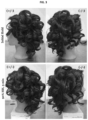
- the results in FIG. 3 and FIG. 4 show that two-wave styling (cationic followed by anionic (+/-)) led to superior performance (better hold and high humidity curl retention). Performance using only anionic WBPU dispersions in both waves is shown by (-/-). All dispersions were applied at a 3 wt % WBPU concentration.
- the two-wave styling (+/-) was carried out using a representative cationic PU 377, and anionic WBPU dispersions as the second wave.
- Anionic dispersions that can be used are found in PCT/US2017/021025 .
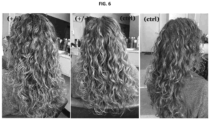
- the two-wave styling (+/-) was carried out using NoFrizz Conditioner (available from Living Proof, Cambridge MA) containing a cationic WBPU (PU 377) as the first wave and an anionic WBPU dispersion as the second wave, and showed better performance compared to using the control NoFrizz conditioner as the first wave and anionic WBPU as the second wave (Ctrl/-).
- the two-wave styling (cationic followed by anionic (+/-)) was carried out using the cationic WBPU dispersion PU 377, as the first wave and the anionic WBPU dispersion as the second wave, which showed better performance compared to using only the anionic WBPU dispersions in both waves (-/-). All dispersions were applied at a 3 wt% WBPU concentration.
- a consumer In order to create a long-lasting hairstyle, a consumer must typically expend additional time and energy applying dedicated styling products to their hair after shampooing and conditioning. For many consumers, spending the time to apply these additional styling products is not feasible or desirable. Thus, there is a need in the market for more user-friendly, time-saving styling products.
- the cationic polyurethanes described herein can be leveraged to address this problem.
- Hair conditioners are typically low pH ( ⁇ 7) formulations containing smoothening and conditioning molecules functionalized with positively charged quaternium functional groups, and are therefore incompatible with traditional anionic styling polymers used widely in the industry.
- ⁇ 7 pH
- the cationic polyurethanes described herein are formulated in conditioners or leave-in-conditioners, the formulations were found to provide excellent style hold in addition to smoothing and conditioning. See e.g., FIG. 7 and FIG. 8 .
- Table 4 shows an exemplary list of conditioners and leave-in-conditioners comprising the disclosed cationic polyurethanes.
- Table 4 Cationic WBPU Incorporated Wt% WBPU Type of Formulation 363 5 Conditioner 362 5 Conditioner 376 5 Conditioner 377 5 Conditioner 378 5 Conditioner 377 10 Conditioner 377 5 Leave-In Conditioner 404 10 Conditioner
- FIG. 7 shows an example of the curls generated using a hot curling iron after washing with either conditioner containing 5% cationic polyurethane PU 363 (left) or with the same conditioner base without a cationic polyurethane. Because the cationic polyurethane styling polymer can be formulated directly into the conditioner, the consumer can achieve long-lasting styles without needing a separate styling product.
- conditioners containing the disclosed cationic polyurethanes can provide hold and stylability for blowout styles in which a stylist brushes the hair while blow drying in order to provide bounce, body and shape to the hair.
- FIG. 8 shows the superior stylability of hair washed with a conditioner containing a cationic polyurethane PU 363 (left) vs. hair washed with a conditioner without a cationic WBPU (right).
- conditioner containing 5% amphoteric/cationic polyurethane PU 362 provides significant flyaway minimization (right) compared to control conditioner (left).
- conditioners containing cationic polyurethanes as described herein preserve curl shape in naturally curly-haired consumers.
- FIG. 10 shows the relative curl enhancement that can be attained with use of the amphoteric/cationic polyurethane PU 362 conditioner (right), in contrast to the poor curl enhancement observed with use of a blank conditioner (left).
Landscapes
- Health & Medical Sciences (AREA)
- Chemical & Material Sciences (AREA)
- Chemical Kinetics & Catalysis (AREA)
- Medicinal Chemistry (AREA)
- Polymers & Plastics (AREA)
- Organic Chemistry (AREA)
- Life Sciences & Earth Sciences (AREA)
- General Health & Medical Sciences (AREA)
- Animal Behavior & Ethology (AREA)
- Public Health (AREA)
- Veterinary Medicine (AREA)
- Epidemiology (AREA)
- Birds (AREA)
- Engineering & Computer Science (AREA)
- Manufacturing & Machinery (AREA)
- Emergency Medicine (AREA)
- Physics & Mathematics (AREA)
- Thermal Sciences (AREA)
- Cosmetics (AREA)
- Polyurethanes Or Polyureas (AREA)
Description
- Polyurethanes are a well-known class of synthetic polymers with broad utility in multiple industries. This versatility is derived from the ability to prepare polyurethanes from a large and diverse set of potential monomers. These diverse monomer options allow the realization of an equally diverse set of physical properties. Hence, the resulting polyurethanes can be in many different forms including e.g., soft foams, elastomers, adhesive films, or hard plastics, and can be used in many different types of products including bedding, foot wear, adhesives, and automobile parts. Among these many forms of polyurethanes, waterborne polyurethanes (WBPUs) have been used as film forming agents in commercially available personal care products.
- For example,
WO 2017/155906 discloses cosmetic compositions comprising WBPUs or WBPU-Us.JP 2004 256694 US 2005/0169873 discloses a styling cosmetic composition comprising water and at least one cationic polyurethane of elastic nature.EP 3020454 discloses a hair styling composition containing at least one propellant gas and/or a thickener and an aqueous dispersion of a cationically hydrophilized polyurethane urea. - A problem with the use of WBPUs has been the lack of performance and overall consistency in application. For example, common polyurethane products such as Luviset® P.U.R (Polyurethane-1), DynamX, and DynamX/H2O (Polyurethane-14 and AMP-Acrylates Copolymer) lack elasticity. This leads to an undesirable stiff feeling when applied to hair. Avalure UR 450 (PPG-17/IPDI/DMPA Copolymer), Baycusan C1004 (Polyurethane-35), Baycusan C1008 (Polyurethane-48), and Polyderm PE/PA ED (Polyurethane-58), on the other hand, are very flexible (i.e., do not lack elasticity). These products, however, have poor initial curl hold and elicit a gummy feeling. Other problems associated with the use of WBPUs include e.g., flaking upon touching or combing (e.g., dusty micro-flakes shown on hair fibers); undesirable tactile feelings upon touch (e.g., brittle, stiff, or tacky, gummy); poor humidity resistance (e.g., styling resins absorb moisture and weigh down hair resulting in a loss of style); lack of movement (e.g., plastic-like mold shape; hair curls don't move with motion; can't easily comb through; gummy; lack of bounciness); and short-lived hair styles (e.g., hair styles, curls, waves, etc. don't last long - on average styles typically last less than a half day).
- There is therefore a need for improved and more consistent WBPU-based personal care products including e.g., ones that provide enhanced hold, high humidity curl retention, and/or positive sensory attributes.
- The invention is set out in the appended set of claims. A specific combination of selection markers for cationic polyurethanes have now been identified that result in hair treatment compositions which have substantially improved performance and which can be used in a variety of applications. Markers for these cationic polymers include a Young's modulus above 150 MPa, an elongation at break from 15% to 300%, and a moisture uptake of less than 10%.
- In one aspect, the disclosed cationic polyurethanes can be used in a two-wave hair styling process comprising anionic polyurethanes. Applying and fixing the disclosed cationic polyurethanes to the hair prior to the application of anionic polyurethanes was found to enhance hold, high humidity curl retention, and positive sensory attributes. See e.g.,
FIG. 2 to FIG. 6 . - In another aspect, the disclosed cationic polyurethanes can serve as additives for conditioners or leave-in-conditioners. When used in this manner, the disclosed cationic polyurethanes were found to provide better hold, improve stylability, minimize flyaways, and to sustain natural curl enhancement. See e.g.,
FIG. 7 to FIG. 10 . -
-
FIG. 1 is an illustration of a two-wave styling process using the cationic polyurethanes described herein. -
FIG. 2a shows an example of hair tresses before and after high humidity test styled using two-wave cationic/anionic application described herein.FIG. 2b shows the lengths of curls measured before and after high humidity testing for tresses treated either with two-wave styling with cationic and anionic WBPUs vs. one-wave application of either cationic or anionic WBPUs. The best initial hold and the best curl retention after high humidity was observed in set B (two-wave styling; cationic WBPU followed by anionic WBPU; (+)/(-)) as opposed to the tresses styled using (+) or (-) WBPUs alone or in the opposite order ((-)/(+)). -
FIG. 3 shows the results of mannequin testing using aqueous dispersions of cationic polyurethanes using the two-wave method described herein. The two-wave styling (+/-) was applied on the left side using a representative cationic WBPU PU 377 as the first wave and anionic WBPU as the second wave, showing better curl hold, curl shape, and curl definition compared to the application on the right side of anionic WBPU in both waves (-/-). A blinded, trained sensory evaluator determined that the curls generated using the (+/-) two-wave treatment was aesthetically preferable to the curls generated using the (-/-) treatment. -
FIG. 4 shows the results of mannequin testing using cationic polyurethanes in different styling formulations using the two-wave method described herein. The two-wave styling (+/-) applied on the right side of the mannequin head showed better initial curl hold, curl shape, and better curl retention after humidity testing than the application on the left where a control formulation as the first wave and anionic WBPU as the second wave (Ctrl/-) was used. The curls made with the (Ctrl/-) treatment fell significantly compared to the two-wave (+/-) treatment. A blinded, trained sensory evaluator determined that the style obtained using the (+/-) two-wave treatment was aesthetically preferable to the style obtained using the (Ctrl/-) treatment. -
FIG. 5 shows in vivo testing showing better initial hold and high humidity curl retention using aqueous dispersions of cationic polyurethanes by two-wave styling described herein. Curls on the left side of the panelist head showed better curl retention after humidity test with (+/-) two-wave styling application, while curls on the right side of the panelist head lost their shape and fell more loosely where the (-/-) application was performed. A blinded, trained sensory evaluator determined that the curls generated using the (+/-) two-wave treatment were aesthetically preferable to the curls generated using the (-/-) treatment. -
FIG. 6 shows in vivo testing showing better natural curl definition using cationic polyurethanes in different styling formulations by two-wave styling described herein. Natural curls of the panelist are enhanced and appear less frizzy on the left side where (+/-) two-wave styling was applied, while curls on the right side of the panelist appear less defined and less desirable where a control formulation only was applied. A blinded, trained sensory evaluator determined that the style obtained with the (+/-) two-wave treatment was aesthetically preferable to the style obtained with the control treatment. -
FIG. 7 shows an example of the curls generated using a hot curling iron, on hair washed with conditioner containing 5% cationic polyurethane (left) or with the same conditioner without a cationic polyurethane. The curl hold is significantly better on the left side of the panelist where the formulation with cationic polyurethane was applied-the curls have better definition, shape and bounce. Curls are limper and looser on the right side where conditioner base alone was applied. A blinded, trained sensory evaluator determined that the curls generated using conditioner containing cationic WBPU was aesthetically preferable to the curls generated using the conditioner alone. -
FIG. 8 illustrates the blowout stylability performance of hair washed with conditioner comprising 5% cationic polyurethane as described herein. The style on the left, which was done on hair treated with the conditioner containing cationic WBPU, shows better body and shape after styling with a round brush-the hair curls naturally where the brush was used, which is a desirable effect of a blowout style. The blowout style done on the hair treated with conditioner alone (right) has less style definition, more frizziness, and less volume. A blinded, trained sensory evaluator determined that the style obtained using conditioner containing cationic WBPU was aesthetically preferable to the style obtained using the conditioner alone. -
FIG. 9 shows minimization of flyaways on hair treated with conditioner comprising 5% cationic polyurethane as described herein applied on the right side of the panelist. The hair treated with the conditioner comprising cationic polyurethane (right) lies smoother after drying and has improved shine and manageability. A blinded, trained sensory evaluator determined that this style obtained using conditioner containing cationic WBPU was aesthetically preferable to the style obtained using the conditioner alone. -
FIG. 10 shows natural curl retention on hair treated with conditioner comprising 5% cationic polyurethane as described herein. The hair treated with the conditioner comprising cationic polyurethane (right) shows better natural curls enhancement and manageability compared to the hair treated with the conditioner alone, which was frizzier and had poor curl shape. A blinded, trained sensory evaluator determined that this style obtained using conditioner containing cationic WBPU was aesthetically preferable to the style obtained using the conditioner alone. - A composition, process, or method described herein that "consists essentially of" a cationic polyurethane and other components means that the recited cationic polyurethane is the only polyurethane present in the recited composition, process, or method. Thus, "consists essentially of" or "consisting essentially of" is open ended for all terms except for the inclusion of additional polyurethanes, i.e., only the recited cationic polyurethane is present.
- A composition, process, or method described herein that "consists of" a cationic polyurethane and other components means that only the recited components are present. In other words, "consisting of' excludes any element, step, or ingredient not specified. "Consists of" and "consisting of" are used interchangeably.
- "Comprising" is inclusive or open-ended and does not exclude additional, unrecited elements or method steps.
- As used herein, "cationic polyurethanes" refer to thermoplastic polymers comprising carbamate (urethane) groups and which bear an overall net positive charge at pH ≤ 7. In some aspects, the cationic polyurethanes described herein bear an overall net positive charge at pH from about 3.7 to about 6.5, from about 3.7 to about 6.0, or from about 3.7 to about 5.5. Unless otherwise specified, cationic polyurethanes, when used herein, include amphoteric/cationic polyurethanes. In one aspect, however, cationic polyurethanes do not encompass amphoteric/cationic polyurethanes.
- As used herein, "anionic polyurethanes" refer to thermoplastic polymers comprising carbamate (urethane) groups and which bear an overall net negative charge at pH ≥ 7. Unless otherwise specified, anionic polyurethanes, when used herein, include amphoteric/anionic polyurethanes. In one aspect, however, anionic polyurethanes do not encompass amphoteric/anionic polyurethanes.
- As used herein, "amphoteric polyurethanes" refer to thermoplastic polymers comprising carbamate (urethane) groups and which can act as a cationic or anionic polyurethane. An "amphoteric/cationic polyurethane" means that the described amphoteric species is one which is acting as an acid under the defined methods and/or conditions. Similarly, an "amphoteric/anionic polyurethane" means that the described amphoteric species is one which is acting as a base under the defined methods and/or conditions.
- "Young's modulus (or the modulus of elasticity, tensile modulus)" is a measure of the stiffness of a solid polymer film. Young's modulus, E, can be calculated by dividing the tensile stress by the extensional strain in the elastic (initial, linear) portion of the stress-strain curve. The Young's modulus of the cationic polyurethane can be determined by a protocol defined to measure mechanical properties, and is developed in reference to ASTM D638, ASTM D412, test guidelines as described below in Example 2.
- The "elongation at break (also known as fracture strain, ultimate elongation)" is the ratio between changed length and initial length after breakage of the solid polymer film. The elongation at break of the cationic polyurethane can be determined by a protocol defined to measure mechanical properties, and is developed in reference to ASTM D638, ASTM D412, test guidelines as described below in Example 2.
- The "moisture uptake" is the measure of water adsorbed by the solid polymer film. The method for determining the moisture uptake of the solid polymer film is provided in
- The "sensory score" is determined by the performance of the hair fixative. In particular, the tress with the composition applied is blow dried for 90 seconds. The tresses are prepared in duplicate and blinded randomly and evaluated for natural feeling and overall sensory attributes on a scale of -2 to 2 by trained sensory analysts under blinded conditions. Sensory analysts are licensed hair stylists and cosmetic scientists with significant long-term experience evaluating sensory attributes of hair. Sensory analysts assign a score of -2 to tresses deemed entirely undesirable, a score of +2 to entirely soft, natural feeling and appearing hair, and intermediate scores between these two extremes.
- Provided herein are specific combinations of WBPU properties that have been found to result in hair treatment compositions having substantially improved performance. Those properties include e.g., a combination of certain mechanical properties, a combination of certain chemical properties, or a combination of both mechanical and chemical properties.
- The combination of mechanical properties described herein include the Young's modulus (above 150 MPa), the elongation at break (from 15% to 300%), and hydrophobicity (moisture uptake less than 10%).
- The Young's modulus of the cationic polyurethane is above 150 MPa. For example, the Young's modulus of the cationic polyurethane in the disclosed compositions may be above about 160 MPa, above about 170 MPa, above about 180 MPa, above about 190 MPa, above about 200 MPa, above about 210 MPa, above about 220 MPa, above about 230 MPa, above about 240 MPa, above about 250 MPa, above about 260 MPa, above about 270 MPa, above about 280 MPa, above about 290 MPa, above about 300 MPa, above about 310 MPa, above about 320 MPa, above about 330 MPa, above about 340 MPa, above about 350 MPa, above about 360 MPa, above about 370 MPa, above about 380 MPa, above about 390 MPa, above about 400 MPa, above about 410 MPa, above about 420 MPa, above about 430 MPa, above about 440 MPa, above about 450 MPa, above about 460 MPa, above about 470 MPa, above about 480 MPa, above about 490 MPa, above about 500 MPa, above about 510 MPa, above about 520 MPa, above about 530 MPa, above about 540 MPa, or above 550 MPa. In other aspects, the Young's modulus of the cationic polyurethane should be between 150 MPa and about 500 MPa. For example, the Young's modulus of the cationic polyurethane in the disclosed compositions may be between 150 MPa and about 400 MPa, between 150 MPa and about 350 MPa, between about 170 MPa and about 390 MPa, between about 180 MPa and about 320 MPa, between about 190 MPa and about 300 MPa, between about 200 MPa and about 290 MPa, or between about 210 MPa and about 280 MPa.
- The elongation at break of the cationic polyurethane is from 15% to 300%. For example, the elongation at break of the cationic polyurethane in the disclosed composition may be from about 20% to 300%, from about 25% to 300%, from about 40% to about 280%, from about 100% to about 280%, from about 100% to about 250%, from about 150% to about 250%, from about 200% to about 250%, from about 210% to about 250%, about 30% to about 150%, from 15% to about 150%, from about 150% to 300%, from about 50% to about 250%; from about 75% to about 225%, or from about 100 to about 200%. The elongation break may be optionally combined with one or more of the Young's modulus values described in the paragraph above or any one of the Young's modulus values described in the remainder of the disclosure.
- The moisture uptake of the cationic polyurethane is less than 10%. For example, the moisture uptake of the cationic polyurethane in the disclosed compositions may be less than about 9.5%, less than about 9%, less than about 8.5%, less than about 8%, less than about 7.5%, less than about 7%, less than about 6.5%, less than about 6%, less than about 5.5%, less than about 5%, less than about 4.5%, less than about 4%, less than about 3.5%, less than about 3%, less than about 2.5%, less than about 2%, less than about 1.5%, less than about 1%, less than about 0.5%, or is about 0%. In one aspect, the moisture uptake of the cationic polyurethane in the disclosed compositions should be from about 0% to 10%. For example, the moisture uptake may be from about 0% to about 8%, from about 2% to about 8%, or from about 3% to about 7%. The moisture uptake may be optionally combined with one or more of the Young's modulus values, one or more of the elongation break values, or both as described in the paragraphs above or in the remainder of the disclosure.
- As shown in the Exemplification section below, cationic polyurethanes having the Young's modulus, elongation at break, and moisture uptake described above have improved performance (e.g., enhanced hold, high humidity curl retention, positive sensory attributes, improved stylability, natural curl enhancement, and minimization of flyaways.
- In addition to the Young's modulus, elongation at break, and moisture uptake, other indicators may be used to identify the capability of cationic polyurethanes to provide long lasting, moisture-resistant hold hair product with favorable sensory attributes. Such indicators include e.g., change in tress length and sensory score.
- Thus, in certain aspects, the cationic polyurethane may be selected such that the composition, after being applied to a curled hair tress and dried thereon, provides less than about 80% change in tress length as measured by the high humidity mechanical stress test. For example, the cationic polyurethane may be selected such that the composition, after being applied to a curled hair tress and dried thereon, provides less than about 75%, about 70%, about 65%, about 60%, about 55%, about 50%, about 45%, about 40%, about 35%, about 30%, about 25%, about 20%, about 15%, about 10%, about 5%, or about 0% change in tress length as measured by the high humidity mechanical stress test. The change in tress length as described herein may also be combined with any one of the Young's modulus values, elongation at break values, and moisture uptake values described above and herein.
- In other aspects, the cationic polyurethane may be selected such that the composition, after being applied to a hair tress and dried thereon, provides a sensory score of at least about 0. For example, the cationic polyurethanes in the disclosed compositions may be selected such that the composition, after being applied to a hair tress and dried thereon, provides a sensory score of at least about 0.1, about 0.2, about 0.3, about 0.4, about 0.5, about 0.6, about 0.7, about 0.8, about 0.9, about 1.0, about 1.1, about 1.2, about 1.3, about 1.4, or about 1.5. The sensory score feature as described herein may also be combined with any one of the change in tress length values, the Young's modulus values, the elongation at break values, and the moisture uptake values described above and herein.
- As shown in the Exemplification section below, cationic polyurethanes having the Young's modulus, elongation at break, and moisture uptake described above, and optionally one or more of the alternative indicators (e.g., sensory score, change in tress length, etc.) provide hair styling products with improved mechanical properties, sensory properties and performance.
- Provided herein is a hair treatment composition comprising a cationic polyurethane having a Young's modulus above 150 MPa, an elongation at break from 15% to 300%, and a moisture uptake of less than 10%. Also provided are composition consisting essentially of a cationic polyurethane; a neutralizer; and an oil, wherein the cationic polyurethane has a Young's modulus above 150 MPa; an elongation at break from 15% to 300%; and a moisture uptake of less than 10%.
- In some aspects, the cationic polyurethane in the provided compositions is a salt of the formula: [W, V, Y and Z]X-, wherein W is the product formed from polycarbonate polyol monomer; V is the product formed from polyisocyanate monomer; Y is the product formed from C1-8alkyldiol monomer; Z is the product formed from C1-8aminoalkyldiol monomer; X is a neutralizing ion; the molecular weight of W is 1,000 g/mol; the molar ratio of V:W is 1:0.18 to 1:0.32; the molar ratio of V:Y is 1:0.24 to 1:0.72; and the molar ratio of V:Z is 1:0.08 to 1:0.47. In one alternative, the cationic polyurethane in the provided compositions is a salt of the formula: [W, V, Y and Z]X-, wherein W is the product formed from polycarbonate polyol monomer; V is the product formed from polyisocyanate monomer; Y is the product formed from C1-8alkyldiol monomer; Z is the product formed from C1-8aminoalkyldiol monomer; X is a neutralizing ion; the molecular weight of W is 2,000 g/mol; the molar ratio of V:W is 1:0.08 to 1:0.18; the molar ratio of V:Y is 1:0.36 to 1:0.82; and the molar ratio of V:Z is 1:0.08 to 1:0.49. In another alternative, the cationic polyurethane in the provided compositions is a salt of the formula: [W, V, Y and Z]X-, wherein W is the product formed from polycarbonate polyol monomer; V is the product formed from polyisocyanate monomer; Y is the product formed from C1-8alkyldiol monomer; Z is the product formed from C1-8aminoalkyldiol monomer; X is a neutralizing ion; the molecular weight of W is 3,000 g/mol; the molar ratio of V:W is 1:0.05 to 1:0.13; the molar ratio of V:Y is 1:0.4 to 1:0.85; and the molar ratio of V:Z is 1:0.08 to 1:0.49.
- In one alternative the cationic polyurethane is a salt of the formula: [W, V, Y, Z, and Z1]X-, wherein W is the product formed from polycarbonate polyol monomer; V is the product formed from polyisocyanate monomer; Y is the product formed from C1-8alkyldiol monomer; Z is the product formed from C1-8aminoalkyldiol monomer; Z1 is the product formed from ethoxylated polyol monomer; X is a neutralizing ion; the molecular weight of W is 1,000 g/mol; the molar ratio of V:W is 1:0.19 to 1:0.33; the molar ratio of V:Y is 1:0.19 to 1:0.7; the molar ratio of V:Z is 1:0.08 to 1:0.49; and the molar ratio of V:Z1 is 1:0 to 1:0.03. In another alternative, the cationic polyurethane in the provided compositions is a salt of the formula: [W, V, Y, Z, and Z1]X-, wherein W is the product formed from polycarbonate polyol monomer; V is the product formed from polyisocyanate monomer; Y is the product formed from C1-8alkyldiol monomer; Z is the product formed from C1-8aminoalkyldiol monomer; Z1 is the product formed from ethoxylated polyol monomer; X is a neutralizing ion; the molecular weight of W is 2,000 g/mol; the molar ratio of V:W is 1:0.09 to 1:0.18; the molar ratio of V:Y is 1:0.31 to 1:0.8; the molar ratio of V:Z is 1:0.09 to 1:0.51; and the molar ratio of V:Z1 is 1:0 to 1:0.03. In another alternative, the cationic polyurethane in the provided compositions is a salt of the formula: [W, V, Y, Z, and Z1]X-, wherein W is the product formed from polycarbonate polyol monomer; V is the product formed from polyisocyanate monomer; Y is the product formed from C1-8alkyldiol monomer; Z is the product formed from C1-8aminoalkyldiol monomer; Z1 is the product formed from ethoxylated polyol monomer; X is a neutralizing ion; the molecular weight of W is 3,000 g/mol; the molar ratio of V:W is 1:0.05 to 1:0.13; the molar ratio of V:Y is 1:0.36 to 1:0.83; the molar ratio of V:Z is 1:0.09 to 1:0.52; and the molar ratio of V:Z1 is 1:0 to 1:0.03. In another alternative, the cationic polyurethane in the provided compositions is a salt of the formula: [W, V, Y, Z, and Z2]X-, wherein W is the product formed from polycarbonate polyol monomer; V is the product formed from polyisocyanate monomer; Y is the product formed from C1-8alkyldiol monomer; Z is the product formed from C1-8aminoalkyldiol monomer; Z2 is the product formed from hydroxylated alkyl acid monomer; X is a neutralizing ion; the molecular weight of W is 1,000 g/mol the molar ratio of V:W is 1:0.19 to 1:0.33; the molar ratio of V:Y is 1:0.14 to 1:0.44; the molar ratio of V:Z is 1:0.08 to 1:0.47; and the molar ratio of V:Z2 is 1:0.05 to 1:0.33. In another alternative, the cationic polyurethane in the provided compositions is a salt of the formula: [W, V, Y, Z, and Z2]X-, wherein W is the product formed from polycarbonate polyol monomer; V is the product formed from polyisocyanate monomer; Y is the product formed from C1-8alkyldiol monomer; Z is the product formed from C1-8aminoalkyldiol monomer; Z2 is the product formed from hydroxylated alkyl acid monomer; X is a neutralizing ion; the molecular weight of W is 2,000 g/mol; the molar ratio of V:W is 1:0.09 to 1:0.18; the molar ratio of V:Y is 1:0.26 to 1:0.53; the molar ratio of V:Z is 1:0.09 to 1:0.49; and the molar ratio of V:Z2 is 1:0.05 to 1:0.35. In another alternative, the cationic polyurethane in the provided compositions is a salt of the formula: [W, V, Y, Z, and Z2]X-, wherein W is the product formed from polycarbonate polyol monomer; V is the product formed from polyisocyanate monomer; Y is the product formed from C1-8alkyldiol monomer; Z is the product formed from C1-8aminoalkyldiol monomer; Z2 is the product formed from hydroxylated alkyl acid monomer; X is a neutralizing ion; and the molecular weight of W is 3,000 g/mol; the molar ratio of V:W is 1:0.05 to 1:0.13; the molar ratio of V:Y is 1:0.3 to 1:0.56; the molar ratio of V:Z is 1:0.09 to 1:0.5; and the molar ratio of V:Z2 is 1:0.05 to 1:0.35.
- In yet another alternative, V is the product formed from isophorone diisocyanate monomer; Y is the product formed from 1,4-butanediol monomer; and Z is the product formed from 3-(dimethylamino)-1,2-propanediol monomer. In yet another alternative, the cationic polyurethane is a salt of the formula:


- In some aspects, the cationic polyurethane in the provided compositions is selected from PU-363, PU-399, PU-400, PU-377, PU-404, PU-378, PU-383, PU-398, PU-401, PU-402, PU-403, PU-385, PU-376, PU-408, PU-409, PU-396, PU-413, PU-414, PU-362, and PU-372. In another aspect, the cationic polyurethane is selected from PU-362, PU-376, PU-377, PU-378, and PU-404. In yet another aspect, the cationic polyurethane is selected from PU-363, PU-377, and PU-378.
- Also provided is a hair treatment composition comprising a cationic polyurethane having the formula:


- Further provided is a hair treatment composition consisting essentially of a cationic polyurethane having the formula:


- In some aspects, the cationic polyurethane is dispersed in water.
- In some aspects, the cationic polyurethane is in the form of a particle.
- In some aspects, the cationic polyurethane comprises uniform particles having an average particle diameter of about 20 to about 80 nm.
- In some aspects, the cationic polyurethane comprises bimodal or multimodal particles having an average particle diameter of about 100 to about 300 nm.
- The cationic polyurethane is present in an amount of 25% to 35% based on the total weight of the composition.
- In some aspects, the compositions described herein further comprise a neutralizer. The neutralizer may be e.g., an acid neutralizer such as lactic acid. In some aspects, the neutralizer:C1-8aminoalkyldiol monomer ratio is from about 0.8 to about 1.2.
- In some aspects, the compositions described herein further comprise an oil. Oils for use in the disclosed compositions can be selected from mineral, animal, plant or synthetic oils. In one aspect, the oil is linoleic acid or a mixture of fatty acids. Examples include, but are not limited to fragrance oils, emollients, monoterpenoids, fatty alcohols, fatty acids, fatty esters, fatty ethers, fluorinated small molecules (e.g., perfluoromethylcyclopentane, perfluoroperhydrophenanthrene, perfluoro-1,3-dimethylcyclohexane, perfluoromethyldecalin, and perfluoroperhydrobenzyltetralin), and mixtures thereof. In another aspect, the oil is present in an amount ranging from about 0.2 to about 1.65% based on the total weight of the composition. In another aspect, the oil is present in an amount of about 0.2 to about 0.25% based on the total weight of the composition.
- In one aspect, the disclosed compositions are applied to the hair with water.
- In one aspect, the disclosed compositions, when applied to the hair, change the texture and appearance.
- In one aspect, the disclosed compositions, when applied to the hair, improve hold, i.e., hair that is formed into a given curl or style retains that curl or style over time.
- In one aspect, the disclosed compositions, when applied to the hair, provide sufficient stylability, i.e., the composition applied to hair supplies sufficient rigidity and flexibility to form and maintain a style.
- In one aspect, the disclosed compositions, when applied to the hair, minimize flyaways, i.e., there are minimal individual hair fibers that do not conform to the given curl or style.
- In one aspect, the disclosed compositions, when applied to the hair, preserves curl shape, i.e., hair that is formed into a given curl retains that curl over time.
- In one aspect, the disclosed compositions, when applied to the hair, provides natural curl enhancement, i.e., hair that naturally tends to curl displays a more defined and less diffused curl pattern.
- The compositions described herein may further comprise an antioxidant. Antioxidants that may be suitable with the compositions described herein include, but are not limited to, açai oil, alpha lipoic acid, green and white tea, retinol, vitamin C, Vitamin E, butylated hydroxytoluene, butylated hydroxyanisole, coenzyme Q10 (Co Q-10), isoflavones, polyphenols, curcumin, turmeric, pomegranate, rosemary, glutathione, selenium, and zinc.
- The compositions described herein may be used for hair products (e.g., permanent chemicals, hair colors, hair sprays, and gels).
- In one aspect, the composition is used e.g., in a conventional manner for providing hairstyle/hold benefits.
- In an exemplary aspect, an effective amount of a composition described herein may be sprayed or applied onto dry or damp hair before and/or after the hair is styled. As used herein "effective amount" means an amount sufficient to provide the hair hold and style performance desired according to the length and texture of the hair.
- In one aspect, the present disclosure provides a method of fixing hair comprising the step of applying a polyurethane disclosed herein. In one aspect, the present disclosure provides a method of retaining the curl of hair comprising the step of applying polyurethane disclosed herein.
- In one aspect, the present disclosure also includes a method to determine the curl retention of a hair tress. In one aspect, the method of measuring the curl retention of a hair tress includes the steps of a) measuring the length of the hair tress; b) applying a composition comprising a waterborne polyurethane disclosed herein to the hair tress; c) blow drying the hair tress for 90 seconds without brushing; d) curling the hair tress with a 3/4 inch curling rod at 370 °F for 10 seconds; e) mechanically manipulating the hair tress by pulling, combing and brushing; f) measuring the length of the curled hair tress.
- In one aspect, the method of measuring the curl retention of a hair tress, includes the steps of a) measuring the length of the hair tress; b) applying the composition comprising a waterborne polyurethane disclosed herein to the hair tress; c) blow drying the hair tress for 90 seconds without brushing; d) curling the hair tress with a 3/4 inch curling rod at 370 °F for 10 seconds; e) subjecting the hair tress to humidity; f) measuring the length of the curled hair tress. In one aspect, the curled hair tress is subjected to 60%, 70%, 75%, 80% or 90% relative humidity for 3, 5, 10, 15, 20, 25, 30, 35, 40, 45, 50, 55, 60, 75, 90, 105,120, 180 or 210 minutes at a temperature of 25 °C.
- In one aspect, the method of measuring the curl retention of a hair tress, includes the steps of a) measuring the length of the hair tress; b) applying the composition comprising a waterborne polyurethane disclosed herein to the hair tress; c) blow drying the hair tress for 90 seconds without brushing; d) curling the hair tress with a 3/4 inch curling rod at 370 °F for 10 seconds; e) subjecting the hair tress to humidity; f) brushing the hair tress; g) measuring the length of the curled hair tress. In a particular aspect, the curled hair tress is subjected to 60%, 70%, 75%, 80% or 90% relative humidity for 2, 4, 8, 16, 32, or 48 hours at a temperature of 25 °C and brushed 1, 3, 5, 8, 10, 13, 15, or 20 times.
- In one aspect, the method of evaluating the curl retention of a hair tress, includes the steps of a) applying the composition comprising a polyurethane disclosed herein to the hair tress; b) blow drying the hair tress for 90 seconds without brushing; c) blinding the prepared hair tress; d) evaluating the sensory properties of the tress in a blinded fashion. In one aspect, the prepared tress is graded on a scale of -2 to 2 for natural feeling and overall sensory attributes.
- In one aspect, the cationic polymers described herein are for use in a conditioner or leave-in-conditioner.
- In one aspect, provided is a method for styling hair comprising a) applying a cationic polyurethane-based composition described herein (the so-called "first wave"; b) heating the hair to a temperature sufficient to induce curl; and c) applying an anionic polyurethane having a Young's modulus above 150 MPa, an elongation at break from 15% to 300%, and a moisture uptake of less than 10% (the so-called "second wave"). In one aspect, steps a), b), and c) are repeated.
- Cationic waterborne polyurethanes were synthesized primarily using polycarbonate diol, 1,4-butanediol (BD), isophorone diisocyanate (IPDI), and 3-(dimethylamino)-1,2-propanediol (DMAPD); selectively, the nonionic chain extenders Tegomer D3403 (ethoxylated polyether-1,3-diol) and 2,2-bis(hydroxymethyl)butyric acid (DMBA) were incorporated in cationic waterborne polyurethanes respectively to achieve desired physical properties. A mild acid, lactic acid, was used as a neutralizer. For each monomer, the molar ratio to NCO is listed in Table 1. Moreover, a beneficial oil could be also incorporated into cationic waterborne polyurethanes to provide improved sensory attributes.
Table 1 PU Name NCO Polyol (molar ratio to NCO) Other diol segment (molar ratio to NCO) Ionic chain extender (molar ratio to NCO) Nonionic chain extender (molar ratio to NCO) Neut. Degree of Neut. Oil 363 IPDI PCD1K_0.2 9 BD_0.27 DMAPD_0.45 N/A Lactic acid 100% N/A 399 IPDI PCD1K_0.2 9 BD 0.26 DMAPD_0.44 N/A Lactic acid 100% N/A 400 IPDI PCD1K_0.2 0 BD_0.42 DMAPD_0.38 N/A Lactic acid 100% N/A 377 IPDI PCD1K_0.2 8 BD_0.42 DMAPD_0.30 N/A Lactic acid 100% N/A 404 IPDI PCD1K_0.2 9 BD_0.41 DMAPD_0.30 N/A Lactic acid 100% N/A 378 IPDI PCD1K_0.2 8 BD_0.51 DMAPD_0.21 N/A Lactic acid 100% N/A 383 IPDI PCD1K_0.2 8 BD_0.61 DMAPD_0.12 N/A Lactic acid 100% N/A 398 IPDI PCD1K_0.2 9 BD_0.58 DMAPD_0.12 Tegomer 0.0049 Lactic acid 100% N/A 401 IPDI PCD1K_0.2 9 BD_0.60 DMAPD_0.12 N/A Lactic acid 100% N/A 402 IPDI PCD3K_0.1 0 BD_0.78 DMAPD_0.12 N/A Lactic acid 100% N/A 403 IPDI PCD1K_0.3 0 BD_0.26 DMAPD_0.44 N/A Lactic acid 80% N/A 385 IPDI PCD1K_0.2 8 BD_0.61 DMAPD_0.12 N/A Lactic acid 110% N/A 376 IPDI PCD1K_0.2 9 BD_ 0.27 DMAPD_0.45 N/A Lactic acid 100% Linoleic acid 408 IPDI PCD1K_0.2 8 BD_0.42 DMAPD_0.30 N/A Lactic acid 100% Linoleic acid 409 IPDI PCD1K_0.2 8 BD_0.42 DMAPD_0.30 N/A Lactic acid 100% Mixture of FAs 396 IPDI PCD1K_0.2 8 BD_0.61 DMAPD_0.12 N/A Lactic acid 100% Linoleic acid 413 IPDI PCD1K_0.2 0 BD_0.56 DMAPD_0.25 N/A Lactic acid 100% N/A 414 IPDI PCD1K_0.2 9 BD_0.56 DMAPD_0.16 N/A Lactic acid 100% N/A 355 IPDI PCD1K_0.2 9 BD_0.27 DMBA_0.22 DMAPD _0.22 Na2CO3 100% N/A 362 IPDI PCD1K_0.2 9 BD_0.27 DMAPD_0.22 DMBA_0 .22 Lactic acid 100% N/A 372 IPDI PCD1K_0.2 9 BD_0.27 DMAPD_0.22 DMBA_0 .22 Lactic acid 100% Linoleic acid PCD1K = polycarbonate diol with molecular weight at 1,000 g/mol; PCD3K = polycarbonate diol with molecular weight at 3,000 g/mol. - Overall, inventive cationic waterborne polyurethanes possessed optimal physical properties as defined herein: (1) Young's modulus > 150 MPa, (2) Elongation at break between 15% and 300%, and (3) Water uptake (a) below 10% for WBPUs without additive (b) below 8% for WBPUs with additive. See Table 2.
Table 2 PU Name Young's Modulus (MPa) Elongation at break (%) Water Uptake (%) 363 218 ± 21 292 ± 21 8.01 ± 0.20 399 268 ± 10 255 ± 43 7.72 ± 0.26 400 326 ± 2 24 ± 23 7.55 ± 0.40 377 253 ± 10 95 ± 10 5.23 ± 0.40 404 173 ± 22 253 ± 41 5.27 ± 0.37 378 228 ± 15 163 ± 22 3.26 ± 0.33 383 198 ± 12 172 ± 48 2.46 ± 0.16 398 145 ± 11 242 ± 10 2.86 ± 0.25 402 170 ± 7 47 ± 7 1.51 ± 0.17 376 266 ± 12 307 ± 25 7.51 ± 0.21 355 318 ± 24 62 ± 21 5.91 ± 0.47 362 295 ± 10 170 ± 41 2.88 ± 0.93 372 319 ± 42 150 ± 45 2.87 ± 0.56 413 340 10 6.22 ± 0.08 414 146 ± 12 216 ± 6 3.61 ± 0.11 - Particle size and distribution of cationic waterborne polyurethanes can be divided by two types. Depending on chemical compositions, one type of cationic waterborne polyurethanes showed uniform particle size distribution and average particle diameter was in the range of about 20 to about 80 nm. The other type of cationic waterborne polyurethane showed large particle size and bimodal/multimodal particle size distribution as indicated by average particle sizes in the range of 100 to approximately 300 nm and large standard deviation of particle size. See Table 3.
Table 3. PU Name Particle Size (TEM, nm) 363 29.8 ± 3.9 399 29.9 ± 4.3 400 29.6 ± 5.0 377 34.1 ± 7.5 378 36.6 ± 10.7 383 150.3 ± 112.9 398 111.2 ± 45.4 402 139.6 ± 50.6 376 21.3 ± 4.5 355 41.3 ± 18.3 362 57.0 ± 15.6 372 79.7 ± 29.7 413 60.1 ± 16.7 414 106.2 ± 25.2 - The Young's modulus is a measure of the ability of a material to withstand changes in length when under uniaxial tension or compression. A higher Young's modulus typically indicates that the material is more rigid. The elongation at break, also known as fracture strain, is the ratio between changed length and initial length after breakage of the test specimen. A higher elongation at break expresses the capability of a material to resist fracture. For a composition applied to hair to hold the shape of the hair, the Young's modulus and elongation at break of the composition should be such that the composition provides rigidity to the hair but is not brittle.
- A comparison of Young's modulus and the elongation at break for the some of the polyurethanes disclosed herein was made to several commercially available polyurethane products. The Young's modulus and the elongation at break can be determined by a protocol defined to measure mechanical properties is developed in compliance with ASTM D638, ASTM D412, test guidelines. In particular, the following protocol can be used to determine the Young's modulus and elongation at break (or ultimate elongation) of dry film of polyurethanes. Testing requires approximately 10-20 min per sample to complete.
-
- > 25 g polyurethane aqueous dispersion
- 1 clean rectangular mold (2 mm x 20 mm x 45 mm) grooved on Teflon sheet per sample
- 1 clean razor blade
- Scotch tape
- Universal Testing Machine mounted with extension grip geometry
-
- 1. Prepare 25 g of 10 wt% WBPU solution from their respective stock solution.
- 2. Apply 2.5 mL prepared solution in each mold (2 mm x 20 mm x 45 mm) and allow drying for 2 days to give WBPU film.
- 3. After it dries out, use a spatula to remove film from the mold.
- 4. Use the razor blade to cut corners and get film with around 15 mm width and around 150-300 micron thickness. Make sure that the film is free of air bubbles.
- 5. Label the test film.
- 6. Cut four pieces of tape (20mm) per sample and adhere them to both sides of the specimen strip and make a dog-bone shaped sample to improve hold of sample in grip. Store the prepared test films in desiccators for 1-2 hour to fully dry them. Take one sample out of desiccators at a time for testing.
-
- 1. Balance the load registering on the universal testing machine so that it reads 0 Newtons.
- 2. Use calipers to set a distance of 20 mm between the top and bottom extension grip geometries.
- 3. Mount a sample in the extension grips and secure tightly, ensuring that the scotch tape is not visible, and that the sample is as close to vertical as possible in both vertical planes.
- 4. Stretch the sample slightly, by separating the geometries until a force of 2-5 N is registered.
- 5. Begin a tensile testing run on the universal testing machine at a speed of 100 mm/minute, stopping the test upon sample fracture.
- 6. Elongation at break is calculated at the elongation at which the material fractures.
- 7. Young's modulus is calculated as the modulus during the initial, elastic portion of deformation by calculating the slope of a linear fit to that region with an R value > 0.99.
- a) low modulus and high elongation (Avalure UR 450, C1004, Polyderm PE/PA ED, Polyderm PE/PA), which leads to inferior curl hold (e.g., hold is temporary, transient, or short-lived) or
- b) high modulus and low elongation (DynamX, DynamX/H2O, Luviset PUR), which leads to a brittle material with low performance (e.g., resin is brittle or fractures) after manipulation.
- The moisture uptake properties, under highly humid environment, of WBPU dry films have been linked to their long lasting hold performance. As such, it is important to be able to reproducibly and accurately evaluate such moisture uptake properties to enable predictive in vitro and in vivo evaluation of WBPU dry films. The following protocol can be used to determine moisture uptake ability of WBPU dry films under high humid environment. Test requires about 2-3 days per sample set to complete
-
- >15 g WBPU solution
- 1 clean cell culture petri dish (60 mm dia x 15 mm H) per sample
- Humidity chamber with flexibility to control temperature and relative humidity (RH)
-
- 1. Prepare 15 g of 10 wt% WBPU solution from their respective stock solution.
- 2. Label cell culture petri dishes for each sample and measure their empty weight (Wpd).
- 3. Apply 4 mL prepared solution in each petri dish (3 samples per WBPU and allow to equilibrate for 20 hours at 25 °C and 50 % RH in humidity chamber.
- 4. After equilibration, measure and record sample weight (Wi ).
- 5. Place the samples to humidity chamber at 25 °C and 90 % RH and allow equilibration to high humidity for 20 hours.
- 6. Measure and record final sample weight (Wf ).
- Calculate % moisture uptake using the following equation:

- Since the isoelectric point (IEP, the pH at which a molecule or a substance carries no net electrical charge) of hair is about 3.67 (see Chemical and Physical Behavior of Human Hair, 5th ed.; p 388), the surface of hair bears a net negative charge at pHs above its IEP, where most hair care products are formulated. Anionic WBPUs which are often used in different hair care products, are therefore more likely to bind to hair surfaces by polar and Van der Waals interactions (see Chemical and Physical Behavior of Human Hair). By contrast, cationic WBPUs that carry opposite charges such as those described herein can bind to hair surfaces through the formation of ionic bonds. To achieve more enhanced performance, a new two-wave styling technology was developed, in which cationic and anionic WBPUs are used together to create synergistic styling properties. The detailed mechanism is shown in
FIG. 1 . Hair surface naturally bears a net negative charge. Therefore cationic WBPUs, when applied as the first layer, are readily attracted to hair surface, providing strong hold to hair and creating the so-called a first wave styling. To take advantage of the excess positive charges of the cationic WBPU particles, a second layer of anionic WBPU particles is then deposited. The ionic interaction between the cationic and anionic WBPUs further enhances the hold and provides a second wave of styling. - To test the two-wave styling concept, systematic in vitro testing of cationic and anionic WBPUs was conducted. In all in vitro testing, a cationic WBPU was applied to a tress as an aqueous dispersion at 3 wt% polymer, and then an anionic WBPU was applied as an aqueous dispersions at 3 wt% polymer. The tress was blow dried for 90 seconds, then curled using ¾" curling rod at 370 °F for 10 seconds and cooled in coiled formation. The tress was then subjected to 75% relative humidity at 25 °C for 15 minutes and then mechanically stressed by extending the tress to its original length, holding for 1 second, and releasing. Results show that both excellent high humidity curl retention and good sensory properties could be achieved.
- As a preliminary screening, cationic and anionic WBPUs that were applied either in the first or second wave were tested alone. Results showed that cationic WBPU PU 363 showed better curl length and curl shape retention after high humidity. This was attributed to the strong ionic interactions between the WBPU, which has a relatively high cationic charge density, and inherently anionic hair surfaces. Further screening of all cationic WBPUs of different cationic charge densities showed that cationic WBPUs with higher charge densities provide better high heat curl retention (PU 363, PU 377, and PU 378).
- When applied in a two-wave process where a cationic WBPU is first applied to the hair tress, a curl is styled, followed by the application of spray carrying an anionic WBPU; excellent high humidity curl retention was achieved.
FIG. 2a shows an example of hair tresses before and after high humidity test styled using two-wave cationic/anionic WBPU application as described above. Set B, where 0.8 g of the cationic WBPU PU 363 was applied initially at a 3 wt% polymer concentration followed by 0.4 g of anionic WBPU, also at 3 wt% solid polymer concentration, showed the best initial hold and curl retention after high humidity as opposed to the tresses styled using cationic (+) alone or anionic (-) alone WBPUs only or anionic followed by cationic ((-)/(+)) WBPU application (FIG. 2b ). This supports two-wave styling concept where at first strong ionic interactions are formed between anionic hair surfaces and cationic WBPU dispersions followed by additional ionic interactions of cationic WBPU dispersions with anionic WBPU dispersions creating long-lasting curl style. - In addition to the testing on hair tresses, extensive mannequin testing was conducted to evaluate the hold, sensory properties, and visual effects of the cationic polyurethanes. Both cationic and anionic WBPUs can be applied as either aqueous dispersions (
FIG. 3 ) or in different styling formulations (FIG. 4 ). The results inFIG. 3 andFIG. 4 show that two-wave styling (cationic followed by anionic (+/-)) led to superior performance (better hold and high humidity curl retention). Performance using only anionic WBPU dispersions in both waves is shown by (-/-). All dispersions were applied at a 3 wt % WBPU concentration. The two-wave styling (+/-) was carried out using a representative cationic PU 377, and anionic WBPU dispersions as the second wave. Anionic dispersions that can be used are found inPCT/US2017/021025 . InFIG. 4 , the two-wave styling (+/-) was carried out using NoFrizz Conditioner (available from Living Proof, Cambridge MA) containing a cationic WBPU (PU 377) as the first wave and an anionic WBPU dispersion as the second wave, and showed better performance compared to using the control NoFrizz conditioner as the first wave and anionic WBPU as the second wave (Ctrl/-). - To validate the in vitro results, and to assess performance under normal hair care product use conditions, cationic and anionic WBPUs were applied as either 3 wt% aqueous dispersions or in different styling formulations. Although performance differences are less pronounced when compared with highly controlled in vitro testing, two-wave styling did consistently show improved performance compared to other styling methods, e.g., only anionic WBPU in both waves, in achieving strong hold and high humidity curl retention. See
FIG. 5 . The two-wave styling (cationic followed by anionic (+/-)) was carried out using the cationic WBPU dispersion PU 377, as the first wave and the anionic WBPU dispersion as the second wave, which showed better performance compared to using only the anionic WBPU dispersions in both waves (-/-). All dispersions were applied at a 3 wt% WBPU concentration. - When the cationic and the anionic WBPUs were incorporated into NoFrizz Conditioner or Curl Defining Styling Cream (available from Living Proof, Cambridge MA), respectively, the two-wave styling provided much better natural curl definition compared to the current formulations. See
FIG. 6 . The two-wave styling (+/-) was carried out using NoFrizz Conditioner containing a cationic WBPU (PU 377) as the first wave and Curl Defining Styling Cream containing an anionic WBPU as the second wave, and showed much better curl definition compared to using NoFrizz Conditioner as the first wave and Curl Defining Styling Cream as the second wave (Ctrl). - In order to create a long-lasting hairstyle, a consumer must typically expend additional time and energy applying dedicated styling products to their hair after shampooing and conditioning. For many consumers, spending the time to apply these additional styling products is not feasible or desirable. Thus, there is a need in the market for more user-friendly, time-saving styling products. The cationic polyurethanes described herein can be leveraged to address this problem.
- Hair conditioners are typically low pH (< 7) formulations containing smoothening and conditioning molecules functionalized with positively charged quaternium functional groups, and are therefore incompatible with traditional anionic styling polymers used widely in the industry. However, when the cationic polyurethanes described herein are formulated in conditioners or leave-in-conditioners, the formulations were found to provide excellent style hold in addition to smoothing and conditioning. See e.g.,
FIG. 7 andFIG. 8 . - Table 4 shows an exemplary list of conditioners and leave-in-conditioners comprising the disclosed cationic polyurethanes.
Table 4 Cationic WBPU Incorporated Wt% WBPU Type of Formulation 363 5 Conditioner 362 5 Conditioner 376 5 Conditioner 377 5 Conditioner 378 5 Conditioner 377 10 Conditioner 377 5 Leave-In Conditioner 404 10 Conditioner - When conditioners containing the disclosed cationic polyurethanes are used in place of conditioners without the cationic polyurethanes, curl hold was significantly improved.
FIG. 7 shows an example of the curls generated using a hot curling iron after washing with either conditioner containing 5% cationic polyurethane PU 363 (left) or with the same conditioner base without a cationic polyurethane. Because the cationic polyurethane styling polymer can be formulated directly into the conditioner, the consumer can achieve long-lasting styles without needing a separate styling product. - In addition to curl hold, conditioners containing the disclosed cationic polyurethanes can provide hold and stylability for blowout styles in which a stylist brushes the hair while blow drying in order to provide bounce, body and shape to the hair.
FIG. 8 , for example, shows the superior stylability of hair washed with a conditioner containing a cationic polyurethane PU 363 (left) vs. hair washed with a conditioner without a cationic WBPU (right). - The incorporation of the disclosed cationic polyurethanes into conditioner also improves the smooth appearance of hair and minimizes flyaways, presumably by providing a thin, stiff coating around the hair fiber and serving as a hydrophobic layer that helps hairs maintain their straight style after blow drying.
FIG. 9 , for example, shows that conditioner containing 5% amphoteric/cationic polyurethane PU 362 provides significant flyaway minimization (right) compared to control conditioner (left). - Finally, conditioners containing cationic polyurethanes as described herein preserve curl shape in naturally curly-haired consumers.
FIG. 10 , for example, shows the relative curl enhancement that can be attained with use of the amphoteric/cationic polyurethane PU 362 conditioner (right), in contrast to the poor curl enhancement observed with use of a blank conditioner (left).
Claims (10)
- A hair treatment composition comprising a cationic polyurethane, wherein the cationic polyurethane is:(a) a salt of the formula: [W, V, Y and Z]X-, whereinW is a repeating unit resulting from polycarbonate polyol monomer;V is a repeating unit resulting from polyisocyanate monomer;Y is a repeating unit resulting from C1-8alkyldiol monomer;Z is a repeating unit resulting from C1-8aminoalkyldiol monomer; andX is a neutralizing ion; whereinthe molecular weight of W is 1,000 g/mol;the molar ratio of V:W is 1:0.18 to 1:0.32;the molar ratio of V:Y is 1:0.24 to 1:0.72; andthe molar ratio of V:Z is 1:0.08 to 1:0.47; orthe molecular weight of W is 2,000 g/mol;the molar ratio of V:W is 1:0.08 to 1:0.18;the molar ratio of V:Y is 1:0.36 to 1:0.82; andthe molar ratio of V:Z is 1:0.08 to 1:0.49; orthe molecular weight of W is 3,000 g/mol;the molar ratio of V:W is 1:0.05 to 1:0.13;the molar ratio of V:Y is 1:0.4 to 1:0.85; andthe molar ratio of V:Z is 1:0.08 to 1:0.49; or(b) a salt of the formula: [W, V, Y, Z, and Z1]X-, whereinW is a repeating unit resulting from polycarbonate polyol monomer;V is a repeating unit resulting from polyisocyanate monomer;Y is a repeating unit resulting from C1-8alkyldiol monomer;Z is a repeating unit resulting from C1-8aminoalkyldiol monomer;Z1 is a repeating unit resulting from ethoxylated polyol monomer; andX is a neutralizing ion; whereinthe molecular weight of W is 1,000 g/mol;the molar ratio of V:W is 1:0.19 to 1:0.33;the molar ratio of V:Y is 1:0.19 to 1:0.7;the molar ratio of V:Z is 1:0.08 to 1:0.49; andthe molar ratio of V:Z1 is 1:0 to 1:0.03; orthe molecular weight of W is 2,000 g/mol;the molar ratio of V:W is 1:0.09 to 1:0.18;the molar ratio of V:Y is 1:0.31 to 1:0.8;the molar ratio of V:Z is 1:0.09 to 1:0.51; andthe molar ratio of V:Z1 is 1:0 to 1:0.03; orthe molecular weight of W is 3,000 g/mol;the molar ratio of V:W is 1:0.05 to 1:0.13;the molar ratio of V:Y is 1:0.36 to 1:0.83;the molar ratio of V:Z is 1:0.09 to 1:0.52; andthe molar ratio of V:Z1 is 1:0 to 1:0.03; or(c) a salt of the formula: [W, V, Y, Z, and Z2]X-, whereinW is a repeating unit resulting from polycarbonate polyol monomer;V is a repeating unit resulting from polyisocyanate monomer;Y is a repeating unit resulting from C1-8alkyldiol monomer;Z is a repeating unit resulting from C1-8aminoalkyldiol monomer;Z2 is a repeating unit resulting from hydroxylated alkyl acid monomer; andX is a neutralizing ion; whereinthe molecular weight of W is 1,000 g/mol;the molar ratio of V:W is 1:0.19 to 1:0.33;the molar ratio of V:Y is 1:0.14 to 1:0.44;the molar ratio of V:Z is 1:0.08 to 1:0.47; andthe molar ratio of V:Z2 is 1:0.05 to 1:0.33; orthe molecular weight of W is 2,000 g/mol;the molar ratio of V:W is 1:0.09 to 1:0.18;the molar ratio of V:Y is 1:0.26 to 1:0.53;the molar ratio of V:Z is 1:0.09 to 1:0.49; andthe molar ratio of V:Z2 is 1:0.05 to 1:0.35; orthe molecular weight of W is 3,000 g/mol;the molar ratio of V:W is 1:0.05 to 1:0.13;the molar ratio of V:Y is 1:0.3 to 1:0.56;the molar ratio of V:Z is 1:0.09 to 1:0.5; andthe molar ratio of V:Z2 is 1:0.05 to 1:0.35;wherein the cationic polyurethane has a Young's modulus above 150 MPa as measured according to the description, an elongation at break from 15% to 300% as measured according to the description, and a moisture uptake of less than 10% as measured according to the description; andthe cationic polyurethane is present in an amount of 25% to 35% based on the total weight of the composition.
- The composition of Claim 1, wherein the cationic polyurethane is a salt of the formula: [W, V, Y and Z]X-, whereinW is a repeating unit resulting from polycarbonate polyol monomer;V is a repeating unit resulting from polyisocyanate monomer;Y is a repeating unit resulting from C1-8alkyldiol monomer;Z is a repeating unit resulting from C1-8aminoalkyldiol monomer; andX is a neutralizing ion; whereinthe molecular weight of W is 1,000 g/mol;the molar ratio of V:W is 1:0.18 to 1:0.32;the molar ratio of V:Y is 1:0.24 to 1:0.72; andthe molar ratio of V:Z is 1:0.08 to 1:0.47; orthe molecular weight of W is 2,000 g/mol;the molar ratio of V:W is 1:0.08 to 1:0.18;the molar ratio of V:Y is 1:0.36 to 1:0.82; andthe molar ratio of V:Z is 1:0.08 to 1:0.49; orthe molecular weight of W is 3,000 g/mol;the molar ratio of V:W is 1:0.05 to 1:0.13;the molar ratio of V:Y is 1:0.4 to 1:0.85; andthe molar ratio of V:Z is 1:0.08 to 1:0.49.
- The composition of Claim 1, wherein the cationic polyurethane is a salt of the formula: [W, V, Y, Z, and Z1]X-, whereinW is a repeating unit resulting from polycarbonate polyol monomer;V is a repeating unit resulting from polyisocyanate monomer;Y is a repeating unit resulting from C1-8alkyldiol monomer;Z is a repeating unit resulting from C1-8aminoalkyldiol monomer;Z1 is a repeating unit resulting from ethoxylated polyol monomer; andX is a neutralizing ion; whereinthe molecular weight of W is 1,000 g/mol;the molar ratio of V:W is 1:0.19 to 1:0.33;the molar ratio of V:Y is 1:0.19 to 1:0.7;the molar ratio of V:Z is 1:0.08 to 1:0.49; andthe molar ratio of V:Z1 is 1:0 to 1:0.03; orthe molecular weight of W is 2,000 g/mol;the molar ratio of V:W is 1:0.09 to 1:0.18;the molar ratio of V:Y is 1:0.31 to 1:0.8;the molar ratio of V:Z is 1:0.09 to 1:0.51; andthe molar ratio of V:Z1 is 1:0 to 1:0.03; orthe molecular weight of W is 3,000 g/mol;the molar ratio of V:W is 1:0.05 to 1:0.13;the molar ratio of V:Y is 1:0.36 to 1:0.83;the molar ratio of V:Z is 1:0.09 to 1:0.52; andthe molar ratio of V:Z1 is 1:0 to 1:0.03.
- The composition of Claim 1, wherein the cationic polyurethane is a salt of the formula: [W, V, Y, Z, and Z2]X-, whereinW is a repeating unit resulting from polycarbonate polyol monomer;V is a repeating unit resulting from polyisocyanate monomer;Y is a repeating unit resulting from C1-8alkyldiol monomer;Z is a repeating unit resulting from C1-8aminoalkyldiol monomer;Z2 is a repeating unit resulting from hydroxylated alkyl acid monomer; andX is a neutralizing ion; whereinthe molecular weight of W is 1,000 g/mol;the molar ratio of V:W is 1:0.19 to 1:0.33;the molar ratio of V:Y is 1:0.14 to 1:0.44;the molar ratio of V:Z is 1:0.08 to 1:0.47; andthe molar ratio of V:Z2 is 1:0.05 to 1:0.33; orthe molecular weight of W is 2,000 g/mol;the molar ratio of V:W is 1:0.09 to 1:0.18;the molar ratio of V:Y is 1:0.26 to 1:0.53;the molar ratio of V:Z is 1:0.09 to 1:0.49; andthe molar ratio of V:Z2 is 1:0.05 to 1:0.35; orthe molecular weight of W is 3,000 g/mol;the molar ratio of V:W is 1:0.05 to 1:0.13;the molar ratio of V:Y is 1:0.3 to 1:0.56;the molar ratio of V:Z is 1:0.09 to 1:0.5; andthe molar ratio of V:Z2 is 1:0.05 to 1:0.35.
- The composition of any one of Claims 1 to 4, whereinV is a repeating unit resulting from isophorone diisocyanate monomer;Y is a repeating unit resulting from 1,4-butanediol monomer; andZ is a repeating unit resulting from 3-(dimethylamino)-1,2-propanediol monomer.
- The composition of Claim 1, wherein the cationic polyurethane is a salt of the formula:



- The composition of any one of Claims 1 to 6, wherein the cationic polyurethane is dispersed in water.
- The composition of any one of Claims 1 to 7, wherein the cationic polyurethane is in the form of a particle.
- The composition of any one of Claims 1 to 8, wherein the cationic polyurethane comprises uniform particles having an average particle diameter of 20 to 80 nm as measured according to the description.
- The composition of any one of Claims 1 to 9, wherein the composition further comprises a neutralizer.
Applications Claiming Priority (3)
| Application Number | Priority Date | Filing Date | Title |
|---|---|---|---|
| US201762557823P | 2017-09-13 | 2017-09-13 | |
| US201862655273P | 2018-04-10 | 2018-04-10 | |
| PCT/US2018/050538 WO2019055440A1 (en) | 2017-09-13 | 2018-09-12 | Long lasting cosmetic compositions |
Publications (2)
| Publication Number | Publication Date |
|---|---|
| EP3681920A1 EP3681920A1 (en) | 2020-07-22 |
| EP3681920B1 true EP3681920B1 (en) | 2025-06-25 |
Family
ID=63794627
Family Applications (1)
| Application Number | Title | Priority Date | Filing Date |
|---|---|---|---|
| EP18783194.6A Active EP3681920B1 (en) | 2017-09-13 | 2018-09-12 | Long lasting cosmetic compositions |
Country Status (7)
| Country | Link |
|---|---|
| US (2) | US10987300B2 (en) |
| EP (1) | EP3681920B1 (en) |
| JP (1) | JP7244495B2 (en) |
| CN (1) | CN111133023B (en) |
| AU (1) | AU2018333932B2 (en) |
| CA (1) | CA3074843A1 (en) |
| WO (1) | WO2019055440A1 (en) |
Families Citing this family (4)
| Publication number | Priority date | Publication date | Assignee | Title |
|---|---|---|---|---|
| US11622929B2 (en) | 2016-03-08 | 2023-04-11 | Living Proof, Inc. | Long lasting cosmetic compositions |
| US10842729B2 (en) | 2017-09-13 | 2020-11-24 | Living Proof, Inc. | Color protectant compositions |
| AU2018370210B2 (en) | 2017-11-20 | 2024-09-26 | Living Proof, Inc. | Properties for achieving long-lasting cosmetic performance |
| BR112020021902B1 (en) | 2018-04-27 | 2024-02-20 | Living Proof, Inc | POLYURETHANE-UREA COSMETIC COMPOSITIONS FOR HAIR TREATMENT, METHOD FOR PRESERVING WAVELIES IN HUMAN HAIR AND THE USES OF POLYURETHANE-UREA |
Family Cites Families (434)
| Publication number | Priority date | Publication date | Assignee | Title |
|---|---|---|---|---|
| US3104424A (en) | 1961-08-22 | 1963-09-24 | Koppers Co Inc | Pressure pot expandable polystyrene mold filling device |
| US3262686A (en) | 1963-08-09 | 1966-07-26 | Robert A Kraus | Arrangement for expanding plastic material |
| BE757421A (en) | 1969-10-14 | 1971-04-13 | Scott Paper Co | INCOMBUSTIBLE POLYURETHANE FOAM |
| US4071614A (en) | 1975-06-03 | 1978-01-31 | Colgate Palmolive Company | Dentifrice containing encapsulated flavoring |
| GB2045618B (en) | 1979-04-03 | 1983-05-11 | Hisamitsu Pharmaceutical Co | Adhesive plaster |
| JPS56141514A (en) * | 1980-04-04 | 1981-11-05 | Nec Corp | Length measuring device |
| US5110852A (en) | 1982-07-16 | 1992-05-05 | Rijksuniversiteit Te Groningen | Filament material polylactide mixtures |
| US4950542A (en) | 1986-04-30 | 1990-08-21 | Barker Robert S | Articles having aroma |
| GB8804164D0 (en) | 1988-02-23 | 1988-03-23 | Tucker J M | Bandage for administering physiologically active compound |
| DE69025404T2 (en) | 1989-08-08 | 1996-07-04 | Stepan Co | CYCLIC AMIDOCARBOXY SURFACE ACTIVE CONNECTIONS, PRODUCTION AND THEIR USE |
| US5733572A (en) | 1989-12-22 | 1998-03-31 | Imarx Pharmaceutical Corp. | Gas and gaseous precursor filled microspheres as topical and subcutaneous delivery vehicles |
| US5290543A (en) | 1991-04-24 | 1994-03-01 | Revlon Consumer Products Corporation | Long wearing nail enamel topcoat and related methods |
| US5335373A (en) | 1991-11-29 | 1994-08-09 | Dresdner Jr Karl P | Protective medical gloves and methods for their use |
| JPH06362A (en) | 1992-06-23 | 1994-01-11 | Lion Corp | Production of microcapsules |
| US5357636A (en) | 1992-06-30 | 1994-10-25 | Dresdner Jr Karl P | Flexible protective medical gloves and methods for their use |
| DE4225045A1 (en) | 1992-07-29 | 1994-02-03 | Basf Ag | Use of water-soluble or water-dispersible polyurethanes as auxiliaries in cosmetic and pharmaceutical preparations and polyurethanes which contain copolymerized polylactic acid polyols |
| US5460620A (en) | 1992-07-31 | 1995-10-24 | Creative Products Resource, Inc. | Method of applying in-tandem applicator pads for transdermal delivery of a therapeutic agent |
| US5281654A (en) | 1993-01-14 | 1994-01-25 | Rohm And Haas Company | Polyurethane mixture |
| US5626840A (en) | 1993-04-06 | 1997-05-06 | National Starch And Chemical Investment Holding Corporation | Use of polyurethanes with carboxylate functionality for hair fixative applications |
| FR2708199B1 (en) | 1993-07-28 | 1995-09-01 | Oreal | New cosmetic compositions and uses. |
| US6106813A (en) | 1993-08-04 | 2000-08-22 | L'oreal | Polyester polyurethanes, process for preparing them, produced from the said polyester polyurethanes and their use in cosmetic compositions |
| ATE186037T1 (en) | 1993-09-08 | 1999-11-15 | Pq Holding Inc | HOLLOW BOROSILICATE MICROBALLS AND PRODUCTION METHOD |
| GB9322962D0 (en) | 1993-11-08 | 1994-01-05 | Gillette Co | Antiperspirants |
| FR2722116B1 (en) | 1994-07-11 | 1996-08-23 | Oreal | OIL-IN-WATER EMULSION WITHOUT SURFACTANT, STABILIZED BY HOLLOW THERMOPLASTIC PARTICLES |
| EP0777464A1 (en) | 1994-08-26 | 1997-06-11 | The Procter & Gamble Company | Personal cleansing compositions |
| US5534265A (en) | 1994-08-26 | 1996-07-09 | The Procter & Gamble Company | Thickened nonabrasive personal cleansing compositions |
| US5540853A (en) | 1994-10-20 | 1996-07-30 | The Procter & Gamble Company | Personal treatment compositions and/or cosmetic compositions containing enduring perfume |
| US5849310A (en) | 1994-10-20 | 1998-12-15 | The Procter & Gamble Company | Personal treatment compositions and/or cosmetic compositions containing enduring perfume |
| US6298558B1 (en) | 1994-10-31 | 2001-10-09 | The Gillette Company | Skin engaging member |
| DE4438849A1 (en) | 1994-11-02 | 1996-05-09 | Henkel Kgaa | Hair fixative |
| DE19510474A1 (en) | 1995-03-27 | 1996-10-02 | Basf Ag | New hair fixatives |
| FR2733683B1 (en) | 1995-05-05 | 1997-06-06 | Oreal | NAIL VARNISH COMPOSITION COMPRISING A CROSSLINKED POLYESTER |
| EP0745372B2 (en) | 1995-05-30 | 2002-05-29 | L'oreal | Use of colloidal silicic acid to reinforce keratineous fibres |
| US5912299A (en) | 1995-06-07 | 1999-06-15 | The Sherwin-Williams Company | Coating compositions from oil modified polyurethane dispersions |
| FR2736057B1 (en) | 1995-06-27 | 1997-08-01 | Oreal | POLYCONDENSATES POLYURETHANE AND / OR POLYUREA SEQUENCES WITH SILICON GRAFTS, COSMETIC COMPOSITIONS CONTAINING THEM AND USES THEREOF |
| FR2740334B1 (en) | 1995-10-25 | 1997-12-05 | Oreal | COSMETIC COMPOSITION CONTAINING A MONOESTER OF C4-C10 ACID AND C16-C18 ALCOHOL AND HOLLOW PARTICLES |
| DE19541326A1 (en) | 1995-11-06 | 1997-05-07 | Basf Ag | Water-soluble or water-dispersible polyurethanes having terminal acid groups, their preparation and their use |
| US6086903A (en) | 1996-02-26 | 2000-07-11 | The Proctor & Gamble Company | Personal treatment compositions and/or cosmetic compositions containing enduring perfume |
| US5900457A (en) | 1996-03-05 | 1999-05-04 | H.B. Fuller Licensing & Financing, Inc. | Aqueous polyurethane dispersions formed from polyisocyanates having a methylene bridge |
| US5846551A (en) | 1996-06-10 | 1998-12-08 | E-L Management Corp. | Water-based makeup compositions and methods for their preparation |
| FR2750045B1 (en) | 1996-06-19 | 1998-07-24 | Oreal | USE OF COLLOIDAL SILICIC ACID IN A NAIL VARNISH COMPOSITION |
| US5716621A (en) | 1996-07-03 | 1998-02-10 | Pharmadyn, Inc. | Nonocclusive drug delivery device and process for its manufacture |
| US5932200A (en) | 1996-08-14 | 1999-08-03 | Tyndale Plains-Hunter, Ltd. | Polyether polyurethane polymers, gels, solutions and uses thereof |
| US5993972A (en) | 1996-08-26 | 1999-11-30 | Tyndale Plains-Hunter, Ltd. | Hydrophilic and hydrophobic polyether polyurethanes and uses therefor |
| JP3813258B2 (en) | 1996-09-06 | 2006-08-23 | 大日本印刷株式会社 | Packaging bag |
| US6130309A (en) | 1996-09-20 | 2000-10-10 | Tyndale Plains-Hunter, Ltd. | Hydrophilic polyether polyurethanes containing carboxylic acid |
| US6007793A (en) | 1996-09-20 | 1999-12-28 | Helene Curtis, Inc. | Hair spray compositions containing carboxylated polyurethane resins |
| US6132704A (en) | 1996-09-20 | 2000-10-17 | Helene Curtis, Inc. | Hair styling gels |
| DE19640092A1 (en) | 1996-09-28 | 1998-04-16 | Beiersdorf Ag | Structures with lipid double membranes, in the lipophilic area of which longer-chain molecules are immersed or which are docked to such molecules through hydrophobic interactions |
| FR2757051B1 (en) | 1996-12-16 | 1999-04-02 | Oreal | ANHYDROUS COSMETIC COMPOSITION COMPRISING A FATTY COMPONENT AND A POLYMERIC DYE |
| FR2757049B1 (en) | 1996-12-16 | 1999-01-22 | Oreal | COSMETIC COMPOSITION IN EMULSION FORM COMPRISING A POLYMERIC DYE |
| US6126930A (en) | 1997-02-13 | 2000-10-03 | The Procter & Gamble Company | Spray compositions |
| FR2760360B1 (en) | 1997-03-04 | 1999-12-24 | Oreal | REMODELABLE STYLING COMPOSITION |
| FR2760361B1 (en) | 1997-03-10 | 1999-12-10 | Oreal | PHOTOPROTECTIVE COSMETIC COMPOSITIONS CONTAINING A SYSTEM FILTERING UV RAYS, A DISPERSION OF NON-FILMOGENOUS POLYMER PARTICLES AND A FAT PHASE |
| WO1999012519A1 (en) | 1997-09-05 | 1999-03-18 | The Procter & Gamble Company | Cleansing and conditioning products for skin or hair with improved deposition of conditioning ingredients |
| FR2772600B1 (en) | 1997-12-22 | 2000-03-17 | Oreal | NON-TRANSFER COSMETIC COMPOSITION COMPRISING A DISPERSION OF POLYMER PARTICLES IN A FATTY LIQUID PHASE |
| FR2772602B1 (en) | 1997-12-22 | 2000-01-28 | Oreal | NON-TRANSFER COSMETIC COMPOSITION COMPRISING A DISPERSION OF POLYMER PARTICLES IN A LIQUID FAT PHASE AND A LIPOSOLUBLE POLYMER |
| FR2772603B1 (en) | 1997-12-22 | 2000-01-28 | Oreal | LONG-LASTING PULVERULENT COSMETIC COMPOSITION COMPRISING A DISPERSION OF POLYMER PARTICLES IN A LIQUID FAT PHASE |
| CZ287497B6 (en) | 1997-12-30 | 2000-12-13 | Galena, A. S. | Topic eye preparations containing immunosuppressive substances |
| FR2773472B1 (en) | 1998-01-13 | 2002-10-11 | Oreal | TICTORIAL COMPOSITION AND METHODS FOR DYEING KERATINIC FIBERS USING THE SAME |
| JP2000256141A (en) | 1998-02-24 | 2000-09-19 | Sanyo Chem Ind Ltd | Hair treatment agent and hair treatment method |
| US5968494A (en) | 1998-02-24 | 1999-10-19 | National Starch And Chemical Investment Holding Corporation | Polyurethanes with carboxylate functionality for hair fixative applications |
| DE19807908A1 (en) | 1998-02-25 | 1999-08-26 | Basf Ag | Cosmetic agent |
| AU2952399A (en) | 1998-04-24 | 1999-11-16 | Procter & Gamble Company, The | Nail polish compositions |
| AU2952999A (en) | 1998-04-24 | 1999-11-16 | Procter & Gamble Company, The | Nail polish compositions |
| AU2952299A (en) | 1998-04-24 | 1999-11-16 | Procter & Gamble Company, The | Nail polish compositions |
| AU2952799A (en) | 1998-04-24 | 1999-11-16 | Procter & Gamble Company, The | Nail polish compositions |
| US6136300A (en) | 1998-05-01 | 2000-10-24 | The Procter & Gamble Company | Long wear nail polish having adhesion, toughness, and hardness |
| JP3025673B2 (en) | 1998-05-14 | 2000-03-27 | 花王株式会社 | Sebum removal method |
| DE19821732A1 (en) * | 1998-05-14 | 1999-11-18 | Basf Ag | Crosslinked, water-soluble or water-dispersible polyurethanes |
| DE19821731A1 (en) | 1998-05-14 | 1999-11-18 | Basf Ag | Cosmetic agent |
| DE19824484A1 (en) | 1998-06-02 | 1999-12-09 | Bayer Ag | High-solids polyurethane dispersions with high application security |
| FR2779643B1 (en) | 1998-06-11 | 2000-08-11 | Oreal | COSMETIC COMPOSITION COMPRISING AT LEAST ONE ADHESIVE POLYMER AND AT LEAST ONE FIXING POLYMER |
| FR2780276B1 (en) | 1998-06-30 | 2002-02-01 | Oreal | VARNISH COMPOSITION FOR MAKEUP AND / OR NAIL CARE CONTAINING A VOLATILE FLUORINATED COMPOUND |
| JP2002523582A (en) | 1998-08-26 | 2002-07-30 | ビーエーエスエフ アクチェンゲゼルシャフト | Urethane (meth) acrylate containing radically polymerizable siloxane and polymer based thereon |
| DE19841147A1 (en) | 1998-09-09 | 2000-03-16 | Henkel Kgaa | Kiselsäureester |
| US6156325A (en) | 1998-09-16 | 2000-12-05 | L'oreal | Nail enamel composition containing a urea-modified thixotropic agent |
| FR2783415B1 (en) | 1998-09-18 | 2000-11-03 | Oreal | COSMETIC COMPOSITION IN THE FORM OF AN EMULSION COMPRISING A DISPERSION OF SURFACE-STABILIZED POLYMER PARTICLES IN A LIQUID FAT PHASE |
| CA2344396A1 (en) | 1998-09-18 | 2000-03-30 | Lavipharm Laboratories, Inc. | Transdermal devices comprising essential oils for aromatherapy |
| GB2357697A (en) | 1998-09-30 | 2001-07-04 | Avon Prod Inc | Compositions having a sunscreen for use in personal cleansing products |
| FR2785530B1 (en) | 1998-11-09 | 2000-12-15 | Oreal | COSMETIC COMPOSITION WITHOUT TRANSFER COMPRISING A DISPERSION OF POLYMER PARTICLES AND A SPECIFIC RHEOLOGICAL AGENT |
| FR2785529A1 (en) | 1998-11-09 | 2000-05-12 | Oreal | COSMETIC NON-TRANSFER COMPOSITION COMPRISING A DISPERSION OF POLYMER PARTICLES IN A LIQUID FATTY PHASE |
| FR2785527B1 (en) | 1998-11-10 | 2000-12-15 | Oreal | HYDROPHILIC CONTINUOUS PHASE COSMETIC COMPOSITION CONTAINING BISMUTH VANADATE |
| WO2000040628A1 (en) | 1998-12-30 | 2000-07-13 | The B.F. Goodrich Company | Branched/block copolymers for treatment of keratinous substrates |
| EP1035144B1 (en) | 1999-03-12 | 2006-03-22 | Basf Aktiengesellschaft | Watersoluble or waterdispersable polymeric salts |
| FR2792191B1 (en) | 1999-04-16 | 2004-04-30 | Oreal | COSMETIC COMPOSITION COMPRISING THE ASSOCIATION OF A PARTICULAR ESTER AND A SILICONE COMPOUND |
| FR2792194B1 (en) | 1999-04-16 | 2001-06-01 | Oreal | COSMETIC COMPOSITION IN ANHYDROUS FORM COMPRISING A DISPERSION OF SURFACE STABILIZED POLYMER PARTICLES |
| US6277401B1 (en) | 1999-05-07 | 2001-08-21 | U.S. Dermatologics, Inc. | Drug delivery device |
| FR2793683B1 (en) | 1999-05-20 | 2003-07-25 | Oreal | CARE AND MAKEUP ANHYDROUS COMPOSITION CONTAINING FIBERS AND POLYOLS |
| FR2794970B1 (en) | 1999-06-21 | 2001-08-03 | Oreal | MASCARA COMPRISING A DISPERSED POLYMER IN A LIQUID FAT PHASE |
| FR2795640B1 (en) | 1999-07-01 | 2001-08-31 | Oreal | CARE OR MAKE-UP COMPOSITION CONTAINING FIBERS AND A HYDROPHILIC ORGANOPOLYSILOXANE |
| WO2001001962A1 (en) | 1999-07-05 | 2001-01-11 | Idea Ag. | A method for the improvement of transport across adaptable semi-permeable barriers |
| DE50013433D1 (en) | 1999-07-13 | 2006-10-19 | Clr Chemisches Lab Dr Kurt Ric | UV RADIATION ABSORBENT AND / OR REFLECTIVE EFFECT TO PROTECT HARMFUL UV RADIATION AND STRENGTHEN NATURAL SKIN RESTORATION |
| DE19941365A1 (en) | 1999-08-31 | 2001-03-01 | Basf Ag | Cosmetic agent based on urethane and / or urea group-containing oligomers |
| FR2798061A1 (en) | 1999-09-07 | 2001-03-09 | Oreal | COSMETIC COMPOSITION COMPRISING PARTICLE DISPERSIONS OF POLYMERS IN A LIQUID FATTY PHASE |
| FR2798849B1 (en) | 1999-09-29 | 2001-11-23 | Oreal | COMPOSITION FOR WASHING KERATIN MATERIALS, BASED ON A DETERGENT SURFACE-ACTIVE AGENT, A DIALKYL DIALLYL AMMONIUM HOMOPOLYMER AND AN ACRYLIC TERPOLYMER |
| FR2798846B1 (en) | 1999-09-29 | 2001-11-23 | Oreal | COMPOSITION FOR WASHING KERATINIC MATERIALS, BASED ON A TENSIO-ACTIVE DETERGENT, A POLYORGANOSILOXANE, A CATIONIC POLYMER AND AN ACRYLIC TERPOLYMER |
| FR2798845B1 (en) | 1999-09-29 | 2001-11-23 | Oreal | COMPOSITION FOR WASHING KERATIN MATERIALS, BASED ON A DETERGENT SURFACTANT, A POLYORGANOSILOXANE AND AN ACRYLIC TERPOLYMER |
| FR2798853B1 (en) | 1999-09-29 | 2001-11-23 | Oreal | COMPOSITION FOR WASHING KERATIN MATERIALS, BASED ON A DETERGENT SURFACE-ACTIVE AGENT, A CATIONIC POLYMER OF VINYL LACTAME AND AN ACRYLIC TERPOLYMER |
| FR2799120B1 (en) | 1999-10-01 | 2001-11-30 | Oreal | MATERIAL COMPRISING AN ORGANIC UV-A FILTER AND METHOD FOR MOVING THE MAXIMUM ABSORPTION WAVELENGTH |
| FR2799964B1 (en) | 1999-10-22 | 2002-07-26 | Oreal | EMULSIONS CONTAINING AT LEAST ONE INSOLUBLE ORGANIC UV FILTER AND AN ASSOCIATIVE POLYMER |
| FR2801209A1 (en) | 1999-11-19 | 2001-05-25 | Oreal | Cosmetic or dermatological composition comprises aqueous phase(s), oil phase(s), a UV photoprotective system and mono- or poly-carboxylic naphthalene acid(s) |
| FR2801502B1 (en) | 1999-11-25 | 2002-01-18 | Oreal | ANHYDROUS DEODORANT COSMETIC COMPOSITION |
| WO2001041745A1 (en) | 1999-12-10 | 2001-06-14 | Lectec Corporation | Anti pruritic patch |
| DE60019541T2 (en) | 1999-12-28 | 2006-03-09 | L'oreal | Structured long-lasting preparation containing a polymer and pasty fatty substances |
| JP3850612B2 (en) | 1999-12-28 | 2006-11-29 | 花王株式会社 | Solid powder cosmetic |
| EP1244476B1 (en) | 1999-12-30 | 2006-05-31 | Acrymed | Methods and compositions for improved delivery devices |
| FR2806274B1 (en) | 2000-03-14 | 2002-09-20 | Oreal | BALL APPLICATOR CONTAINING A HAIR COMPOSITION |
| DE10012949A1 (en) | 2000-03-16 | 2001-09-27 | Henkel Kgaa | Mixtures of cyclic and linear silicic esters of lower alcohols and fragrance and/or biocide alcohols are used as fragrance and/or biocide in liquid or solid laundry and other detergents and in skin and hair cosmetics |
| MXPA02009634A (en) | 2000-03-31 | 2003-03-12 | Procter & Gamble | COSMETIC COMPOSITIONS, TO BE APPLIED WITHOUT RINING, TO INCREASE THE HAIR VOLUME. |
| AU2000243472A1 (en) | 2000-04-13 | 2002-01-30 | National Starch And Chemical Investment Holding Corporation | Cosmetic resin composition and cosmetic using the same |
| US6884853B1 (en) | 2000-04-13 | 2005-04-26 | National Starch And Chemical Investment Holding Corporation | Cosmetic resin composition |
| WO2001078691A1 (en) | 2000-04-13 | 2001-10-25 | Lectec Corporation | Therapeutic patch containing a liquid or gel organic compound as a carrier |
| US6692729B1 (en) | 2000-04-13 | 2004-02-17 | National Startch And Chemical Investment Holding Corporation | Cosmetic resin composition and cosmetic using the same |
| DE10022247A1 (en) | 2000-05-08 | 2001-11-15 | Basf Ag | Polyurethane used as rheology-modifier e.g. in cosmetics or pharmaceuticals, based on di-isocyanate, polyether-polyol and long-chain mono-alcohol, -thiol or -amine |
| DE10024396B4 (en) | 2000-05-17 | 2006-07-27 | Beiersdorf Ag | Plaster cover for children |
| ATE270039T1 (en) | 2000-05-18 | 2004-07-15 | Laszlo Rozsa | DELAYED RELEASE COMPOSITION CONTAINING AN ACTIVE INGREDIENT IN A PLASTIC CARRIER AND MOLDED PRODUCTS THEREOF |
| FR2808999B1 (en) | 2000-05-19 | 2002-11-01 | Oreal | COSMETIC COMPOSITION IN POWDER FORM COMPRISING A PARTICULAR BINDER |
| FR2808998B1 (en) | 2000-05-19 | 2002-07-05 | Oreal | COSMETIC MAKEUP COMPOSITION COMPRISING A PARTICULAR BINDING PHASE |
| DE10028764A1 (en) | 2000-06-09 | 2001-12-20 | Henkel Kgaa | Carbamate compound, useful as a fragrant additive for cleaning, washing and dishwashing agents, is prepared by reaction of free isocyanate group containing compound with fragrant alcohol |
| DE10028718A1 (en) | 2000-06-09 | 2001-12-13 | Henkel Kgaa | Cosmetic pens |
| JP4083960B2 (en) | 2000-07-10 | 2008-04-30 | 雪ヶ谷化学工業株式会社 | Rubber elastic sponge excellent in moist feeling and method for producing the same |
| US6485950B1 (en) | 2000-07-14 | 2002-11-26 | Council Of Scientific And Industrial Research | Isozyme of autoclavable superoxide dismutase (SOD), a process for the identification and extraction of the SOD in cosmetic, food and pharmaceutical compositions |
| US6576702B2 (en) * | 2000-07-20 | 2003-06-10 | Noveon Ip Holdings Corp. | Plasticized waterborne polyurethane dispersions and manufacturing process |
| FR2811884B1 (en) | 2000-07-21 | 2003-01-31 | Oreal | USE IN COSMETICS OF STARCH BETAINATES AND COMPOSITION COMPRISING SAME WITH AT LEAST ONE BENEFICIAL AGENT FOR KERATINIC MATERIALS |
| US6517821B1 (en) | 2000-07-27 | 2003-02-11 | L'oreal | Reshapable hair styling composition comprising aqueous colloidal dispersions of sulfonated polyurethane urea |
| US6613314B1 (en) | 2000-07-27 | 2003-09-02 | L'oreal | Reshapable hair styling composition comprising polyurethane dispersions |
| US6433073B1 (en) | 2000-07-27 | 2002-08-13 | 3M Innovative Properties Company | Polyurethane dispersion in alcohol-water system |
| FR2815350B1 (en) * | 2000-10-17 | 2006-12-29 | Oreal | CATIONIC POLYURETHANES WITH ELASTIC CHARACTERISTICS |
| WO2002039961A1 (en) | 2000-11-15 | 2002-05-23 | L'oreal | Cosmetic composition comprising a dispersion of polymer particles and a dispersion of pigments |
| FR2816834B1 (en) | 2000-11-20 | 2005-06-24 | Oreal | KERATINIC FIBER TREATMENT COMPOSITION CONSISTING OF A CATIONIC ASSOCIATIVE POLYURETHANE POLYMER AND A PROTECTIVE OR CONDITIONER |
| AU1788202A (en) | 2000-11-28 | 2002-06-11 | Avon Prod Inc | Anhydrous insect repellent composition |
| WO2002043490A1 (en) | 2000-11-28 | 2002-06-06 | Avon Products, Inc. | Foaming insect repellent compositions |
| US6719959B1 (en) | 2000-11-28 | 2004-04-13 | Avon Products, Inc. | Extended duration insect repellent composition and method of application to the skin |
| US6555096B2 (en) | 2000-12-04 | 2003-04-29 | L'oreal S.A. | Nail enamel composition containing a urea-modified thixotropic agent in a solvent system |
| WO2002045663A1 (en) | 2000-12-04 | 2002-06-13 | L'oreal S.A. | Nail enamel composition containing a urea-modified thixotropic agent |
| WO2002047626A1 (en) | 2000-12-12 | 2002-06-20 | L'oreal Sa | Cosmetic composition comprising heteropolymers and a solid substance and method of using same |
| WO2002047624A1 (en) | 2000-12-12 | 2002-06-20 | L'oreal Sa | Cosmetic compositions containing at least one heteropolymer and at least one gelling agent and methods of using the same |
| US20020107314A1 (en) | 2000-12-12 | 2002-08-08 | Carlos Pinzon | Compositions containing heteropolymers and oil-soluble esters and methods of using same |
| US20020111330A1 (en) | 2000-12-12 | 2002-08-15 | Carlos Pinzon | Compositions containing heteropolymers and methods of using same |
| WO2002047623A1 (en) | 2000-12-12 | 2002-06-20 | L'oreal Sa | Composition comprising at least one heteropolymer and at least one inert filler and methods for use |
| US20030082126A9 (en) | 2000-12-12 | 2003-05-01 | Pinzon Carlos O. | Cosmetic compositions containing heteropolymers and oil-soluble cationic surfactants and methods of using same |
| US7276547B2 (en) | 2000-12-12 | 2007-10-02 | L'oreal S.A. | Compositions comprising heteropolymers and at least one oil-soluble polymers chosen from alkyl celluloses and alkylated guar gums |
| US8080257B2 (en) | 2000-12-12 | 2011-12-20 | L'oreal S.A. | Cosmetic compositions containing at least one hetero polymer and at least one film-forming silicone resin and methods of using |
| WO2002047628A1 (en) | 2000-12-13 | 2002-06-20 | L'oréal | Composition structured with a polymer containing a heteroatom and an organogelator |
| DE10063343A1 (en) | 2000-12-19 | 2002-06-20 | Beiersdorf Ag | Photoprotective cosmetic or dermatological emulsion comprises an asymmetric triazine ultraviolet filter and a partially neutralized saturated fatty acid mono- and/or diglyceride citrate ester |
| EP1370206A4 (en) | 2001-01-09 | 2006-04-05 | Lavipharm Lab Inc | Devices for local and systemic delivery of active substances and methods of manufacturing thereof |
| FR2819403B1 (en) | 2001-01-12 | 2004-10-15 | Oreal | COSMETIC COMPOSITIONS CONTAINING A FRUCTANE, A POLYSACCHARIDE AND A BENEFICIAL AGENT AND USES THEREOF |
| US6706674B2 (en) | 2001-01-17 | 2004-03-16 | The Andrew Jergens Company | Nonaqueous hair styling composition and method of use |
| GB0101736D0 (en) | 2001-01-23 | 2001-03-07 | Unilever Plc | Cosmetic composition |
| US7700082B2 (en) | 2001-01-26 | 2010-04-20 | 3M Innovative Properties Company | Silylated polyurethane-urea compositions for use in cosmetic applications |
| US6520186B2 (en) | 2001-01-26 | 2003-02-18 | L'oreal | Reshapable hair styling composition comprising silicon-containing polycondensates |
| FR2822058A1 (en) | 2001-03-13 | 2002-09-20 | Oreal | SOLID COMPOSITION CONTAINING AT LEAST 75% BY WEIGHT OF SOLID PARTICLES AND AT LEAST ONE NON-VOLATILE LIQUID OIL |
| US6830758B2 (en) | 2001-04-02 | 2004-12-14 | Lectec Corporation | Psoriasis patch |
| US20030026815A1 (en) | 2001-06-05 | 2003-02-06 | Scott Alic Anthony | Film forming cosmetic compositions |
| FR2825621B1 (en) | 2001-06-12 | 2003-09-05 | Fiabila | COSMETIC COMPOSITION FOR NAILS, PHTHALATE FREE, CAMPHOR FREE OR AROMATIC SOLVENT |
| US20020192273A1 (en) | 2001-06-15 | 2002-12-19 | Teri Buseman | Therapeutic patch useful for the treatment of hemorrhoids |
| US6800716B2 (en) | 2001-08-20 | 2004-10-05 | Alzo International | Polymeric urethane ester quats and their use in personal care compositions |
| US20030064086A1 (en) | 2001-08-31 | 2003-04-03 | Danuvio Carrion | Cosmetic compositions comprising nanoparticles and processes for using the same |
| ATE332120T1 (en) | 2001-10-01 | 2006-07-15 | Procter & Gamble | SHAMPOO WITH HOLLOW PARTICLES |
| MXPA04003199A (en) | 2001-10-03 | 2004-07-27 | Procter & Gamble | Hair styling composition containing particles. |
| US20030158079A1 (en) | 2001-10-19 | 2003-08-21 | The Procter & Gamble Company | Controlled benefit agent delivery system |
| US20030134772A1 (en) | 2001-10-19 | 2003-07-17 | Dykstra Robert Richard | Benefit agent delivery systems |
| US20030198659A1 (en) | 2001-10-25 | 2003-10-23 | Hoffmann Michael P. | Fibrous pest control |
| US20040071757A1 (en) | 2001-11-20 | 2004-04-15 | David Rolf | Inhalation antiviral patch |
| US6531118B1 (en) | 2001-12-11 | 2003-03-11 | Avon Products, Inc. | Topical compositions with a reversible photochromic ingredient |
| DE10163142A1 (en) | 2001-12-20 | 2003-07-10 | Henkel Kgaa | Polymeric fragrance capsules and their manufacture |
| FR2833960B1 (en) * | 2001-12-20 | 2007-04-13 | Oreal | CATIONIC POLYURETHANES OR SELF-ADHESIVE AMPHOTERS |
| US20030152533A1 (en) | 2001-12-27 | 2003-08-14 | Avon Products, Inc. | Novel ingredient and use of same |
| FR2835529B1 (en) | 2002-02-07 | 2006-06-30 | Oreal | HYDROCARBON SKELETON COPOLYMERS AND COSMETIC OR DERMATOLOGICAL COMPOSITIONS COMPRISING THE SAME |
| DE10214971A1 (en) | 2002-04-04 | 2003-10-16 | Basf Ag | Cross-linked polyurethanes |
| US6897281B2 (en) | 2002-04-05 | 2005-05-24 | Noveon Ip Holdings Corp. | Breathable polyurethanes, blends, and articles |
| US6750291B2 (en) | 2002-04-12 | 2004-06-15 | Pacific Corporation | Film-forming agent for drug delivery and preparation for percutaneous administration containing the same |
| US7008979B2 (en) | 2002-04-30 | 2006-03-07 | Hydromer, Inc. | Coating composition for multiple hydrophilic applications |
| DE20207329U1 (en) | 2002-05-10 | 2002-10-24 | Schwan-Stabilo Cosmetics GmbH & Co., 90562 Heroldsberg | preparation |
| JP4268123B2 (en) | 2002-05-10 | 2009-05-27 | フォルミュール ダイヤマンセル インコーポレイティド | Nail cosmetic composition |
| US20040247549A1 (en) | 2002-06-12 | 2004-12-09 | L'oreal S.A. | Cosmetic emulsions containing at least one hetero polymer and at least one sunscreen and methods of using the same |
| US8956160B2 (en) | 2002-07-02 | 2015-02-17 | Ranir, Llc | Device and method for delivering an oral care agent |
| CN100349627C (en) | 2002-09-06 | 2007-11-21 | 艾博特公司 | Medical devices containing rapamycin analogs |
| US20100233146A1 (en) | 2002-09-09 | 2010-09-16 | Reactive Surfaces, Ltd. | Coatings and Surface Treatments Having Active Enzymes and Peptides |
| US6800274B2 (en) | 2002-09-17 | 2004-10-05 | The C.P. Hall Company | Photostabilizers, UV absorbers, and methods of photostabilizing a sunscreen composition |
| WO2005014777A2 (en) | 2002-10-16 | 2005-02-17 | Board Of Regents, The University Of Texas System | Methods and compositions for increasing the efficacy of biologically-active ingredients |
| US20060193789A1 (en) | 2002-10-25 | 2006-08-31 | Foamix Ltd. | Film forming foamable composition |
| KR101111990B1 (en) * | 2002-10-31 | 2012-02-17 | 다우 글로벌 테크놀로지스 엘엘씨 | Polyurethane dispersion and articles prepared therefrom |
| US7087700B2 (en) | 2002-11-01 | 2006-08-08 | Alzo International, Inc. | Polymeric urethane ester tertiary amines and related personal care formulations |
| EP1417886A1 (en) | 2002-11-06 | 2004-05-12 | Ciba SC Holding AG | Substituted phenols as useful repellents for insects |
| DE10251797A1 (en) | 2002-11-07 | 2004-05-19 | Bayer Ag | Polyurethane resin with a high carbonate group content |
| EP1419759B1 (en) | 2002-11-18 | 2012-12-26 | Rohm And Haas Company | Durable hold hair styling compositions and method for styling hair |
| WO2004050028A2 (en) | 2002-11-27 | 2004-06-17 | Kobo Products, Inc. | Density-controlled particulate suspensions for foodstuff, cosmetic, pharmaceutical and other uses |
| US7326256B2 (en) | 2002-12-06 | 2008-02-05 | L'ORéAL S.A. | Composition for the oxidation dyeing of keratin fibers, comprising at least one non-oxyalkenylated fatty alcohol, at least one oxidation dye, at least one associative polymer, and at least one amide of an alkanolamine and a C14-C30 fatty acid |
| JP2006511602A (en) | 2002-12-17 | 2006-04-06 | ロレアル | Transparent or translucent care and / or makeup cosmetic composition structured with a silicone polymer |
| US20040120915A1 (en) | 2002-12-19 | 2004-06-24 | Kaiyuan Yang | Multifunctional compositions for surface applications |
| US7192989B2 (en) | 2002-12-20 | 2007-03-20 | Akzo Nobel N.V. | Method and expansion device for preparing expanded thermoplastic microspheres |
| DE10260873A1 (en) | 2002-12-23 | 2004-07-15 | Beiersdorf Ag | Self-adhesive polymer matrix containing marine algae extract and glycerin |
| US20040166133A1 (en) | 2003-01-21 | 2004-08-26 | L'oreal | Method of making a mascara composition comprising polyamide polymer and at least one solid substance having a melting point of 45oC or greater |
| EP1589940A1 (en) | 2003-02-03 | 2005-11-02 | DSM IP Assets B.V. | Novel stabilized cinnamic ester sunscreen compositions |
| JP2004256694A (en) | 2003-02-26 | 2004-09-16 | Nicca Chemical Co Ltd | Cationic acrylic-urethane copolymer water dispersion and coating agent, adhesive and ink jet recording material containing the copolymer |
| DE502004000736D1 (en) | 2003-03-21 | 2006-07-27 | Goldschmidt Gmbh | Process for the preparation of organically modified polyorganosiloxanes |
| US9079152B2 (en) | 2003-05-11 | 2015-07-14 | Ben Gurion University Of The Negev Research And Development Authority | Encapsulated essential oils |
| JP2007500196A (en) | 2003-05-24 | 2007-01-11 | バイヤースドルフ・アクチエンゲゼルシヤフト | Tissue culture medium used as a cosmetic ingredient |
| FR2855410B1 (en) | 2003-05-28 | 2007-05-18 | Oreal | COSMETIC COMPOSITION FOR MAKE UP AND / OR CARE OF THE SKIN, IN PARTICULAR THE FACE. |
| US20050014674A1 (en) | 2003-05-28 | 2005-01-20 | L'oreal | Cosmetic compositions for making up and/or caring for skin |
| US20050008667A1 (en) | 2003-05-28 | 2005-01-13 | L'oreal | Cosmetic compositions for making up and/or caring for skin |
| FR2855409B1 (en) | 2003-05-28 | 2007-05-25 | Oreal | COSMETIC COMPOSITION FOR MAKE UP AND / OR CARE OF THE SKIN, IN PARTICULAR THE FACE. |
| US7959903B2 (en) | 2003-08-01 | 2011-06-14 | L'oreal | Oil-in-water photoprotective emulsions containing gemini surfactants and associative polymers |
| JP4125201B2 (en) | 2003-08-05 | 2008-07-30 | ロレアル | Cosmetic composition containing porous particles encapsulating an optically active substance |
| US7481996B2 (en) | 2003-08-06 | 2009-01-27 | Kao Corporation | Aerosol cosmetic composition |
| WO2005017134A2 (en) | 2003-08-19 | 2005-02-24 | Council Of Scientific And Industrial Research | Isozyme of autoclavable superoxide dismutase (sod) derived from curcuma longa l |
| US7226607B2 (en) | 2003-09-11 | 2007-06-05 | The Procter & Gamble Company | Compositions comprising a dispersant and microcapsules containing an active material and a stabilizer |
| WO2005033200A1 (en) | 2003-10-01 | 2005-04-14 | Polyplastics Co., Ltd. | Polyacetal resin composition |
| FR2861291A1 (en) | 2003-10-24 | 2005-04-29 | Oreal | CAPILLARY COSMETIC COMPOSITION BASED ON FIXING POLYMERS AND COMPOUNDS LIKELY TO INFLATE UNDER THE ACTION OF HEAT. |
| US7998465B2 (en) | 2003-10-24 | 2011-08-16 | L'oreal S.A. | Heat-swelling cosmetic composition |
| FR2863884B1 (en) * | 2003-12-19 | 2007-06-29 | Oreal | CURING COMPOSITION COMPRISING, IN A MAJORITALLY AQUEOUS ENVIRONMENT, AN ELASTIC CATIONIC POLYURETHANE, METHODS USING SAME AND USES THEREOF |
| CA2555126A1 (en) | 2004-02-03 | 2005-08-25 | Alzo International, Inc. | Polyurethane emulsifiers |
| US9016221B2 (en) | 2004-02-17 | 2015-04-28 | University Of Florida Research Foundation, Inc. | Surface topographies for non-toxic bioadhesion control |
| US20050220741A1 (en) | 2004-03-22 | 2005-10-06 | Christophe Dumousseaux | Cosmetic composition comprising concave particles |
| FR2867675B1 (en) | 2004-03-22 | 2006-06-02 | Oreal | COSMETIC COMPOSITION COMPRISING CONCAVED PARTICLES |
| FR2867676B1 (en) | 2004-03-22 | 2006-06-02 | Oreal | COSMETIC COMPOSITION COMPRISING CONCAVED PARTICLES |
| US20050220740A1 (en) | 2004-03-22 | 2005-10-06 | Christophe Dumousseaux | Cosmetic composition comprising concave particles |
| US7511081B2 (en) | 2004-03-26 | 2009-03-31 | Do-Gyun Kim | Recycled method for a wasted polymer which is mixed polyester polyamide and reclaimed materials thereof |
| US7972589B2 (en) | 2004-05-17 | 2011-07-05 | Akzo Nobel N.V. | Hair fixative film |
| US20070189980A1 (en) | 2004-06-07 | 2007-08-16 | Jie Zhang | Compositions and methods for treating alopecia |
| US8741333B2 (en) | 2004-06-07 | 2014-06-03 | Nuvo Research Inc. | Compositions and methods for treating dermatitis or psoriasis |
| US20050287100A1 (en) | 2004-06-08 | 2005-12-29 | Lebre Caroline | Cosmetic composition comprising a semi-crystalline polymer and a dispersion of polymer in fatty phase |
| FR2871057B1 (en) | 2004-06-08 | 2006-07-28 | Oreal | COSMETIC COMPOSITION CONTAINING AN ESTER AND A FILMOGENIC AGENT |
| US20070183997A9 (en) | 2004-06-08 | 2007-08-09 | Lebre Caroline | Composition comprising particles of at least one polymer dispersed in at least one fatty phase and at least one apolar oil |
| US20050287183A1 (en) | 2004-06-08 | 2005-12-29 | Lebre Caroline | Cosmetic composition comprising at least one apolar wax and a dispersion of polymer particles in a fatty phase |
| US20060078519A1 (en) | 2004-06-08 | 2006-04-13 | Bertrand Lion | Compositions comprising particles of at least one polymer dispersed in a fatty phase |
| US20050287103A1 (en) | 2004-06-08 | 2005-12-29 | Vanina Filippi | Cosmetic composition comprising at least one ester and at least one film-forming polymer |
| US20050276831A1 (en) | 2004-06-10 | 2005-12-15 | Dihora Jiten O | Benefit agent containing delivery particle |
| DE102004036146A1 (en) | 2004-07-26 | 2006-03-23 | Basf Ag | Crosslinked polytetrahydrofuran-containing polyurethanes |
| DE102004037752A1 (en) | 2004-08-04 | 2006-03-16 | Cognis Deutschland Gmbh & Co. Kg | Equipped fibers and textile fabrics |
| US20060045893A1 (en) | 2004-08-27 | 2006-03-02 | Yu Warren Hwa-Lin | Long-wearing cosmetic compositions |
| US20060045890A1 (en) | 2004-08-27 | 2006-03-02 | Gonzalez Anthony D | Topical skin care compositions |
| DE102004042848A1 (en) | 2004-09-04 | 2006-03-09 | Wella Ag | Hair treatment composition containing a polymer combination |
| FR2875503B1 (en) * | 2004-09-21 | 2006-12-22 | Oreal | CATIONIC OR CATIONABLE POLYURETHANE WITH ELASTIC CHARACTER. |
| US20060083762A1 (en) | 2004-10-13 | 2006-04-20 | Gaelle Brun | Uses of compositions comprising electrophilic monomers and micro-particles or nanoparticles |
| US20060216250A1 (en) | 2004-10-20 | 2006-09-28 | Schultz Thomas M | Nail polish compositions comprising a water or alcohol soluble polyamide |
| US7659233B2 (en) | 2004-10-25 | 2010-02-09 | Conopco, Inc. | Personal care compositions with silicones and dihydroxypropyl trialkyl ammonium salts |
| US20060099550A1 (en) | 2004-11-10 | 2006-05-11 | Ranir/Dcp Corporation | Device and method for delivering an oral care agent |
| WO2006062740A2 (en) | 2004-11-22 | 2006-06-15 | Nu-Tein Co., Inc. | Topical skin patch containing xanthophylls |
| US20060134049A1 (en) | 2004-12-17 | 2006-06-22 | Keenan Andrea C | Hair styling compositions |
| US20060165746A1 (en) | 2005-01-24 | 2006-07-27 | Arie Markus | Formulations containing microencapsulated essential oils |
| KR101083956B1 (en) | 2005-03-30 | 2011-11-16 | 아지노모토 가부시키가이샤 | Cosmetic powder |
| FR2883738B1 (en) | 2005-03-31 | 2007-05-18 | Oreal | COLORING COMPOSITION COMPRISING A NONIONIC ASSOCIATIVE POLYMER, METHOD FOR COLORING KERATIN FIBERS USING THE SAME |
| FR2883736B1 (en) | 2005-03-31 | 2007-05-25 | Oreal | COLORING COMPOSITION COMPRISING A FATTY ACID ESTER AND METHOD FOR COLORING KERATIN FIBERS USING THE SAME |
| US8956162B2 (en) | 2005-04-11 | 2015-02-17 | Sylphar N.V. | Strip for the delivery of oral care compositions |
| JP4784971B2 (en) | 2005-04-14 | 2011-10-05 | 憲司 中村 | Makeup tools |
| US8877216B2 (en) | 2005-05-23 | 2014-11-04 | Dow Corning Corporation | Cosmetic and skin-care compositions comprising saccharide-siloxane copolymers |
| US20070197704A1 (en) | 2005-05-27 | 2007-08-23 | The Procter & Gamble Company | Moisture resistant hair styling composition containing two copolymers |
| FR2886840B1 (en) | 2005-06-10 | 2007-07-20 | Oreal | ANHYDROUS COSMETIC COMPOSITION CONTAINING RETICULATED POLYROTAXANE AND OIL |
| US7348299B2 (en) | 2005-06-14 | 2008-03-25 | Conopco, Inc. | Cleansing bar with distributed polymeric network providing enhanced delivery |
| DE102005030431A1 (en) | 2005-06-30 | 2007-01-11 | Henkel Kgaa | Hot melt adhesive containing adhesive base polymer, tackifier resin and perfume, optionally with other components, used in packaging material for consumer goods, food and cosmetics |
| DE102005033520B4 (en) | 2005-07-14 | 2007-12-20 | Schwan-Stabilo Cosmetics Gmbh & Co. Kg | Preparation, in particular cosmetic preparation, process for their preparation and their use |
| US8343523B2 (en) | 2005-08-22 | 2013-01-01 | Quick-Med Technologies, Inc. | Disinfectant with durable activity based on alcohol-soluble quaternary ammonium polymers and copolymers |
| DE102005050654A1 (en) | 2005-10-20 | 2007-04-26 | LABTEC Gesellschaft für technologische Forschung und Entwicklung mbH | lip paving |
| FR2892931A1 (en) | 2005-11-09 | 2007-05-11 | Oreal | COSMETIC BILOUCHE PRODUCT, USES THEREOF, AND MAKE-UP KIT CONTAINING THE SAME |
| US20070105977A1 (en) | 2005-11-10 | 2007-05-10 | Gabriel Gregory B | Kneadable Hand Putty as a Delivery System for Skin Conditioning and/or Thermal Therapy Agents |
| CN101378729B (en) | 2005-12-14 | 2013-09-11 | 扎尔斯制药公司 | Compositions and methods for treating dermatological conditions |
| FR2894817B1 (en) | 2005-12-20 | 2008-05-09 | Oreal | A METHOD OF MAKE-UP OR CARE OF KERATINIC MATERIALS COMPRISING THE APPLICATION OF COMPOUNDS A AND B OF WHICH AT LEAST ONE IS SILICONE |
| US9393218B2 (en) | 2005-12-23 | 2016-07-19 | Epinamics Gmbh | Use of film-forming hair care polymers from the group of polyurethanes and pharmaceutical preparations and patches that contain these polymers |
| JP5243262B2 (en) | 2005-12-23 | 2013-07-24 | エピナミクス・ゲー・エム・ベー・ハー | Use of polyurethane group hair care film-forming polymers, and pharmaceutical formulations and patches containing the polymers |
| EP1800671A1 (en) | 2005-12-23 | 2007-06-27 | Bayer Schering Pharma Aktiengesellschaft | Use of film-forming hair care polymers and pharmaceutical preparations and patches comprising such polymers |
| DE102006002156A1 (en) | 2006-01-17 | 2007-07-19 | Bayer Materialscience Ag | Polyurethane-polyurea dispersions based on polyether-polycarbonate polyols |
| US8273702B2 (en) | 2006-02-17 | 2012-09-25 | Wake Forest University Health Sciences | Wound healing compositions containing keratin biomaterials |
| EP1998788A4 (en) | 2006-03-01 | 2011-08-03 | Ruey J Yu | Composition and method for topical treatment of tar-responsive dermatological disorders |
| FR2898603B1 (en) | 2006-03-20 | 2010-06-11 | Oreal | NOVEL POLYURETHANES, COMPOSITIONS COMPRISING THEM AND COSMETIC TREATMENT METHOD |
| US20070251026A1 (en) | 2006-04-12 | 2007-11-01 | Boris Lalleman | Unsaturated fatty substances for protecting the color of artificially dyed keratin fibers with respect to washing; and dyeing processes |
| US20100008880A1 (en) | 2006-05-03 | 2010-01-14 | John Castro | Clear Cosmetic Compositions And Methods Of Using |
| WO2007128776A1 (en) | 2006-05-04 | 2007-11-15 | Basf Se | Neutralized acid group-containing polymers and the use thereof |
| KR100781604B1 (en) | 2006-06-13 | 2007-12-03 | 한불화장품주식회사 | Method for preparing hollow multi-microcapsules containing poorly soluble active ingredients using polyhydric alcohols and cosmetic compositions containing same |
| FR2902006B1 (en) | 2006-06-13 | 2009-06-05 | Oreal | COSMETIC COMPOSITION FOR LIPS ASSOCIATING A SURFACTANT PHOSPHATE AND A SILICONE POLYMER |
| AU2007260924A1 (en) | 2006-06-21 | 2007-12-27 | The Board Of Trustees Of The Leland Stanford Junior University | Compositions and methods for joining non-conjoined lumens |
| FR2902655B1 (en) | 2006-06-23 | 2008-11-28 | Oreal | TOPICAL COMPOSITON WITH COLD EFFECT |
| WO2008006677A1 (en) | 2006-07-13 | 2008-01-17 | L'oreal | Fluid cosmetic composition with a water-soluble heat-induced gelling polymer, a continuous aqueous phase, an oily phase and organic uv-screening agent |
| FR2903599B1 (en) | 2006-07-13 | 2012-08-31 | Oreal | AQUEOUS CONTINUOUS PHASE COSMETIC COMPOSITION COMPRISING AT LEAST ONE THERMOGELIFYING POLYMER, AT LEAST ONE VOLATILE ORGANIC SOLVENT MISCIBLE IN WATER AND AT LEAST ONE UV RADIATION ABSORBING AGENT. |
| US20080044445A1 (en) | 2006-08-16 | 2008-02-21 | Rubin Patti D | Cosmetic Composition and Carrier |
| WO2008024408A2 (en) | 2006-08-22 | 2008-02-28 | Theraquest Biosciences, Inc. | Pharmaceutical formulations of cannabinoids for application to the skin and method of use |
| US7744911B2 (en) | 2006-08-25 | 2010-06-29 | Avon Products, Inc | Water based clear sunscreen and insect repellent composition |
| US20080175875A1 (en) | 2006-09-25 | 2008-07-24 | Hari Babu Sunkara | Cosmetic compositions |
| ES3028289T3 (en) | 2006-11-22 | 2025-06-18 | Procter & Gamble | A process of using a consumer product for treating fabric |
| KR100847222B1 (en) | 2007-01-04 | 2008-07-17 | 주식회사 엘지생활건강 | Phase change skin beauty patch with increased absorption |
| US7445770B2 (en) | 2007-03-14 | 2008-11-04 | Bayer Materialscience Llc | Polyurethane dispersions for use in personal care products |
| US7907346B2 (en) | 2007-03-16 | 2011-03-15 | Transitions Optical, Inc. | Photochromic materials and photochromic compositions and articles including the same |
| US20080254074A1 (en) | 2007-04-11 | 2008-10-16 | Conopco, Inc., D/B/A Unilever | Composition and method for regulating sebum flow |
| WO2008133982A2 (en) | 2007-04-27 | 2008-11-06 | Lectec Corporation | Adhesive patch with aversive agent |
| FR2916969B1 (en) | 2007-06-05 | 2009-10-02 | Oreal | KIT COMPRISING X AND Y FUNCTIONALIZED ALCOXYSILANE COMPOUNDS. |
| WO2009014347A2 (en) | 2007-07-20 | 2009-01-29 | G1 Biztech Co., Ltd | Stabilized antioxidant-containing particles, process for preparing the same, and composition comprising the same |
| CN101130082A (en) | 2007-07-27 | 2008-02-27 | 许川山 | Novel photosensitive agent with function of carrying oxygen |
| US7452525B1 (en) | 2007-08-08 | 2008-11-18 | Yuliya Berezkin | Polyurethane dispersions based on polycarbonate polyols and suitable for use in personal care products |
| US20090049623A1 (en) | 2007-08-20 | 2009-02-26 | Mark Anthony Brown | Method for Preventing Color Loss in Oxidatively Dyed Hair |
| EP2033618A1 (en) | 2007-08-30 | 2009-03-11 | Wella Aktiengesellschaft | Leave-in hair styling product with particles for improving hair volume |
| US20090056734A1 (en) | 2007-08-31 | 2009-03-05 | Rebecca Bacon | Hair texturizer and conditioner |
| CA2699058A1 (en) | 2007-09-24 | 2009-04-02 | Dow Global Technologies Inc. | Personal care compositions including polyurethane dispersions |
| FR2921831B1 (en) | 2007-10-05 | 2014-05-09 | Oreal | COSMETIC OR DERMATOLOGICAL COMPOSITION COMPRISING A POLYMER CONTAINING JUNCTION GROUPS, AND COSMETIC PROCESSING METHOD |
| WO2009049208A1 (en) | 2007-10-12 | 2009-04-16 | The University Of North Carolina At Chapel Hill | Use of nitric oxide to enhance the efficacy of silver and other topical wound care agents |
| US20090105195A1 (en) | 2007-10-17 | 2009-04-23 | O'brien Chris | Composition comprising microbicidal active ingredients |
| US20090112141A1 (en) | 2007-10-31 | 2009-04-30 | Derr Michael J | Method and apparatus for providing a medical dressing |
| KR20090058294A (en) | 2007-12-04 | 2009-06-09 | 주식회사 바이오레인 | Adhesive sheet type cosmetic of sponge containing skin protection composition, and its manufacturing method |
| KR100955768B1 (en) | 2008-01-24 | 2010-04-30 | 주식회사 엘지생활건강 | 2-form active ingredient skin delivery system |
| US8784854B2 (en) | 2008-03-20 | 2014-07-22 | Amorepacific Corporation | Cosmetic product comprising UV-blocking cosmetic composition impregnated into expanded urethane foam |
| EP2105127A1 (en) | 2008-03-26 | 2009-09-30 | Bayer MaterialScience AG | Hair fixing composition |
| US20110027211A1 (en) | 2008-03-26 | 2011-02-03 | Bayer Materialscience Ag | Hair styling composition |
| FR2930144A1 (en) | 2008-04-18 | 2009-10-23 | Oreal | NAIL VARNISH IN THE FORM OF EMULSION, COMPRISING A PARTICULAR GELIFYING AGENT |
| ITVA20080025A1 (en) | 2008-04-24 | 2009-10-25 | Lamberti Spa | CATIONIC POLYURETHANS FILMANTI IN WATER DISPERSION |
| US20090285866A1 (en) | 2008-05-13 | 2009-11-19 | Afriat Isabelle R | Self-healing polymer compositions |
| CN102088949B (en) | 2008-06-06 | 2013-05-01 | 路博润高级材料公司 | Ester Compounds for Personal Care Products |
| US9030724B2 (en) | 2008-07-03 | 2015-05-12 | Chromera, Inc. | Flexible and printable electrooptic devices |
| US20100003198A1 (en) | 2008-07-07 | 2010-01-07 | Patrick John Stolmeier | Antimicrobial Topical and Other Preparations Containing Fluorescent or Illumination Dye and Tracer Agents or Compounds |
| EP3434264A1 (en) | 2008-07-18 | 2019-01-30 | Biomod Concepts Inc. | Microparticle for releasing an acitve agent |
| EP2145616A1 (en) | 2008-07-18 | 2010-01-20 | Bayer MaterialScience AG | PUD for hair dye |
| WO2010037402A1 (en) | 2008-10-02 | 2010-04-08 | Dako Denmark A/S | Molecular vaccines for infectious disease |
| JP2010132568A (en) | 2008-12-02 | 2010-06-17 | Kracie Home Products Ltd | Hair cosmetic |
| WO2010076483A1 (en) | 2008-12-16 | 2010-07-08 | L'oreal | Cosmetic composition containing a polyester, an organic oil and water |
| FR2940093B1 (en) | 2008-12-22 | 2011-02-25 | Oreal | DETERGENT COSMETIC COMPOSITION COMPRISING FOUR SURFACTANTS, PARTICULATE CATIONIC POLYMER AND SOLAR FILTER |
| JP5715962B2 (en) | 2009-01-30 | 2015-05-13 | バイヤースドルフ・アクチエンゲゼルシヤフトBeiersdorf Aktiengesellschaft | Cosmetic or dermatological preparation comprising collagen, chitosan, glycosylaminoglycan and cell growth-promoting peptide and / or cell complex |
| EP2359797A4 (en) | 2009-03-10 | 2012-08-22 | Shoichi Nakamura | COVER FOR PRESSURIZED BATH IN GAS MIST |
| US8067355B2 (en) | 2009-04-08 | 2011-11-29 | Appleton Papers Inc. | Benefit agent containing delivery particles |
| US8946499B2 (en) | 2009-04-27 | 2015-02-03 | Avery Dennison Corporation | Systems, methods and materials for delivery and debonding on demand |
| US20100297036A1 (en) | 2009-05-22 | 2010-11-25 | Feuillette Laetitia | Pressurized cosmetic composition comprising at least one anionic polyurethane elastomer and at least one propellant |
| WO2011002825A1 (en) | 2009-06-30 | 2011-01-06 | The Procter & Gamble Company | Rinse added aminosilicone containing compositions and methods of using same |
| JP5756604B2 (en) | 2009-07-21 | 2015-07-29 | リー ヘイル ダニー | Compositions for removable gel applications for nails and methods for their use |
| BR112012002335A2 (en) | 2009-08-04 | 2016-05-31 | Oreal | compound pigment and method for preparing it |
| WO2011016140A1 (en) | 2009-08-04 | 2011-02-10 | L'oreal | Composite pigment and method for preparation thereof |
| WO2011016531A1 (en) | 2009-08-05 | 2011-02-10 | Jsr株式会社 | Curable composition for nail decoration, method for forming nail decoration, and method for removing nail decoration |
| EP2467421B1 (en) | 2009-08-21 | 2017-05-17 | Lubrizol Advanced Materials, Inc. | Hydrolytically stable polyurethane nanocomposites |
| AU2010292353A1 (en) | 2009-09-14 | 2012-05-03 | Elc Management Llc | Cosmetic compositions containing thiomers for hair color retention |
| FR2950351B1 (en) | 2009-09-23 | 2011-11-18 | Arkema France | COMPOSITION COMPRISING A MIXTURE OF ELASTOMER AND SUPRAMOLECULAR POLYMER |
| JP5517537B2 (en) | 2009-09-25 | 2014-06-11 | 株式会社リンレイ | Releasable floor coating composition |
| US8623388B2 (en) | 2009-10-29 | 2014-01-07 | The Procter & Gamble Company | Denture care composition |
| KR101627304B1 (en) | 2009-11-24 | 2016-06-03 | 모멘티브 퍼포먼스 머티리얼즈 게엠베하 | Hydrophilic/lipophilic modified polysiloxanes as emulsifiers |
| KR101221734B1 (en) | 2009-12-03 | 2013-01-11 | 주식회사 엘지생활건강 | Cosmetic composition of multi-pore patch for skin improvement of two-form type using lyophilization |
| CN102712882A (en) | 2009-12-18 | 2012-10-03 | 宝洁公司 | Composition comprising encapsulates, and process for making them |
| US9474729B2 (en) | 2010-01-14 | 2016-10-25 | Hydromer, Inc. | Topical antimicrobial compositions and methods of using same |
| EP3437629A1 (en) | 2010-01-22 | 2019-02-06 | Dai-Ichi Kogyo Seiyaku Co., Ltd. | Viscous composition |
| KR20110094688A (en) | 2010-02-17 | 2011-08-24 | 삼성전자주식회사 | Electrophotographic toner |
| JP2011173851A (en) | 2010-02-25 | 2011-09-08 | Kazki International:Kk | Patch for beautification |
| FR2957347B1 (en) | 2010-03-11 | 2013-05-10 | Jean Michel Roux | HYDROXYL AND HYDROGEN OLIGOMERS FROM CONJUGATED LINOLEIC ACID, AND THEIR APPLICATIONS |
| EP2555741A4 (en) | 2010-04-07 | 2015-10-07 | Isp Investments Inc | Sprayable composition comprising high molecular weight charged polymer |
| US20110256311A1 (en) | 2010-04-15 | 2011-10-20 | The Coca Cola Company | Method of coating a container using a semi-permanent coating composition capable of blocking ultraviolet light |
| US9186642B2 (en) | 2010-04-28 | 2015-11-17 | The Procter & Gamble Company | Delivery particle |
| US20110272320A1 (en) | 2010-05-06 | 2011-11-10 | Ali Abdelaziz Alwattari | Aerosol Shave Composition Comprising A Hydrophobical Agent Forming At Least One Microdroplet |
| DE102010038912A1 (en) | 2010-08-04 | 2012-02-09 | Huhtamaki Ronsberg Zn Der Huhtamaki Deutschland Gmbh & Co. Kg | Bag-on-valve system with a product container for corrosive products, product containers for a bag-on-valve system, film laminate for the production of a product container and use of the film laminate for a bag-on-valve system |
| KR20130100290A (en) | 2010-08-30 | 2013-09-10 | 프레지던트 앤드 펠로우즈 오브 하바드 칼리지 | Shear controlled release for stenotic lesions and thrombolytic therapies |
| JP2012057110A (en) * | 2010-09-11 | 2012-03-22 | Konishi Co Ltd | Quaternary ammonium group-containing silylated urethane-based polymer, and method for producing the same |
| US9576694B2 (en) | 2010-09-17 | 2017-02-21 | Drexel University | Applications for alliform carbon |
| FR2966465B1 (en) | 2010-10-21 | 2012-11-02 | Arkema France | COMPOSITION COMPRISING A MIXTURE OF THERMOPLASTIC POLYCONDENSATE AND SUPRAMOLECULAR POLYMER, AND METHOD OF MANUFACTURE |
| US9175125B2 (en) | 2010-10-22 | 2015-11-03 | Basf Se | Polyurethane thickeners |
| US8871817B2 (en) | 2010-10-22 | 2014-10-28 | Basf Se | Polyurethane thickeners |
| KR20140004091A (en) * | 2010-10-29 | 2014-01-10 | 루브리졸 어드밴스드 머티어리얼스, 인코포레이티드 | Aqueous cationic polyurethane dispersions |
| FR2967062B1 (en) | 2010-11-09 | 2020-11-06 | Oreal | USE OF POMEGRANATE EXTRACT TO PREVENT AND / OR TREAT PERIOCULAR POUCHES |
| KR101847385B1 (en) | 2010-11-12 | 2018-04-10 | 닛산 가가쿠 고교 가부시키 가이샤 | Gel sheet comprising lipidic peptide type gelling agent and polymeric compound |
| WO2012087510A1 (en) | 2010-12-22 | 2012-06-28 | Avon Products, Inc. | Cosmetic adhesive composition |
| MX2013009842A (en) | 2011-03-01 | 2014-03-12 | Merz Pharma Gmbh & Co Kgaa | Composition comprising peroxisome proliferator-activated receptor-gamma (ppar). |
| BR112013023027A2 (en) | 2011-03-07 | 2016-08-16 | Creative Neail Design Inc | compositions and methods for UV curable nail polishes |
| JP2014508791A (en) | 2011-03-25 | 2014-04-10 | バイエル・インテレクチュアル・プロパティ・ゲゼルシャフト・ミット・ベシュレンクテル・ハフツング | Cosmetic polyurethaneurea copolymer composition |
| CA2830784A1 (en) | 2011-03-25 | 2012-10-04 | Bayer Intellectual Property Gmbh | Polyurethane urea mixture for hair cosmetics |
| EP2508168A1 (en) | 2011-04-06 | 2012-10-10 | The Procter and Gamble Company | Cosmetic composition comprising polymer comprising direct crosslinks |
| US20140066496A1 (en) | 2011-04-11 | 2014-03-06 | The Governing Council Of The University Of Toronto | Composition and Methods for Anti-Macrofouling Treatment of Polymers |
| JP5323282B2 (en) | 2011-05-25 | 2013-10-23 | 株式会社 資生堂 | Shampoo composition |
| FR2976178B1 (en) | 2011-06-09 | 2013-09-27 | Oreal | SOLAR ANHYDROUS CREAM COMPRISING A NON-EMULSIFYING ORGANOSOLYSILOXANE ELASTOMER, A MATIFYING AGENT, AN ORGANIC NON-SILICONE OIL THICKENER |
| ES2786103T3 (en) | 2011-06-29 | 2020-10-08 | Sol Gel Tech Ltd | Stabilized topical formulations containing core-shell microcapsules |
| US20140142191A1 (en) | 2011-07-20 | 2014-05-22 | Theracoat Ltd. | Production of thermoreversible hydrogels for therapeutic applications |
| EP2753298B1 (en) | 2011-09-07 | 2016-03-16 | Akzo Nobel Chemicals International B.V. | Hair fixative compositions |
| US8790669B2 (en) | 2011-09-30 | 2014-07-29 | L'oreal | Cosmetic compositions comprising latex film formers |
| US8497338B2 (en) | 2011-10-31 | 2013-07-30 | Momentive Performance Materials Inc. | Process of manufacturing organosilicon products with improved quality using heterogeneous precious metal catalysts |
| US9593141B2 (en) | 2011-11-09 | 2017-03-14 | President And Fellows Of Harvard College | Lin28/let-7 crystal structures, purification protocols, and molecular probes suitable for screening assays and therapeutics |
| TWI625129B (en) | 2011-11-10 | 2018-06-01 | 歐米亞國際公司 | Novel coated controlled release active agent carrier |
| EP3075376A1 (en) | 2011-11-10 | 2016-10-05 | Omya International AG | New coated controlled release active agent carriers |
| US9023757B2 (en) | 2012-01-27 | 2015-05-05 | Celanese Acetate Llc | Substituted cellulose acetates and uses thereof |
| EP2630950A1 (en) | 2012-02-21 | 2013-08-28 | Kao Germany GmbH | Hair treatment method |
| WO2013138637A1 (en) | 2012-03-15 | 2013-09-19 | Temptime Corporation | Robust, ultraviolet-protected ambient condition history indicator and method of making same |
| US20130239344A1 (en) | 2012-03-19 | 2013-09-19 | P.H. Glatfelter Company | Dry wipes comprising microencapsulated cleaning composition |
| US20150119497A1 (en) | 2012-03-29 | 2015-04-30 | Sanyo Chemical Industries, Ltd. | Vinyl resin and resin composition |
| WO2013149323A1 (en) | 2012-04-02 | 2013-10-10 | Ntegrity | Natural products for skin care |
| BR112014027647B1 (en) | 2012-05-07 | 2020-12-22 | Evonik Operations Gmbh | process for separating components in an essential oil |
| CN104684546A (en) | 2012-06-07 | 2015-06-03 | 哈佛大学校长及研究员协会 | Nanotherapeutics for drug targeting |
| EP2680002A1 (en) | 2012-06-29 | 2014-01-01 | Bio-Rad Innovations | Method for diagnosing invasive Candida infections |
| WO2014003844A1 (en) | 2012-06-29 | 2014-01-03 | University Of South Florida | Biocompatible polyacrylate compositions and methods of use |
| EP2867675B1 (en) | 2012-06-29 | 2017-11-29 | Koninklijke Philips N.V. | Processing of fluids containing interfering particles |
| KR101740833B1 (en) | 2012-07-18 | 2017-05-26 | 신현우 | The composition of cosmetic patch and cosmetic pack having two -component type |
| US9370191B2 (en) | 2012-08-07 | 2016-06-21 | Pardis Kelly | Cosmetic formulation |
| BR102012022034B1 (en) | 2012-08-31 | 2020-02-18 | Biolab Sanus Farmacêutica Ltda. | FINASTERIDE POLYMERIC NANOPARTICLE, WATER SUSPENSION CONTAINING THE SAME, COMPOSITION FOR THE TREATMENT OF ALOPECIA, PROCESS OF PREPARATION OF THIS COMPOSITION, AND ITS USE |
| CN102895164A (en) | 2012-09-25 | 2013-01-30 | 石磊 | Moisture mask and preparation method thereof |
| US9687465B2 (en) | 2012-11-27 | 2017-06-27 | Sol-Gel Technologies Ltd. | Compositions for the treatment of rosacea |
| EP2925296B1 (en) | 2012-11-27 | 2021-01-06 | Sol-Gel Technologies Ltd. | Compositions for the treatment of rosacea |
| KR20140078356A (en) | 2012-12-17 | 2014-06-25 | 코웨이 주식회사 | Liquid type cosmetic compostion with improving skin tone and texture, and covering blemish and wrinke instantly |
| EP2746311B1 (en) | 2012-12-19 | 2016-09-21 | Rohm and Haas Company | Waterborne two component polyurethane coating compositions comprising alicyclic rigid polyols |
| US8734772B1 (en) | 2012-12-28 | 2014-05-27 | L'oreal | Photo-curable resin for cosmetic application |
| KR20140093349A (en) | 2013-01-15 | 2014-07-28 | 주식회사 제닉 | Oil in Water Solid Cosmetics Composition and Method for preparing thereof |
| US9249252B2 (en) | 2013-04-26 | 2016-02-02 | Solazyme, Inc. | Low polyunsaturated fatty acid oils and uses thereof |
| BR102013010477A2 (en) | 2013-04-29 | 2015-11-17 | Brasil Bio Fuels S A | Acetal esters produced from purified glycerin for use and applications such as emollients, lubricants, plasticizers, solvents, coalescents, humectants, polymerization monomers, biofuel additives |
| US9884004B2 (en) | 2013-06-28 | 2018-02-06 | L'oreal | Compositions and methods for treating hair |
| US9975981B2 (en) | 2013-08-07 | 2018-05-22 | Japan Coating Resin Corporation | Polyurethane, urethane-(meth)acrylic composite resin, and aqueous dispersion of urethane-(meth)acrylic composite resin |
| DE102013217244A1 (en) | 2013-08-29 | 2015-03-05 | Beiersdorf Ag | Emulsifier-free, skin-conditioning and active ingredient-containing cosmetic or dermatological preparation |
| DE102013217247A1 (en) | 2013-08-29 | 2015-03-05 | Beiersdorf Ag | Emulsifier-free, skin-conditioning cosmetic or dermatological preparation with sunscreen filters |
| DE102013217242A1 (en) | 2013-08-29 | 2015-03-05 | Beiersdorf Ag | Emulsifier-free, skin-conditioning, cosmetic or dermatological preparation with peeling active ingredients |
| DE102013217239A1 (en) | 2013-08-29 | 2015-03-05 | Beiersdorf Ag | Emulsifier-free, skin-conditioning cosmetic or dermatological preparation with repellents |
| BR102013022835A2 (en) | 2013-09-03 | 2015-08-11 | Fundação Universidade Fed De Mato Grosso Do Sul | Cosmetic and / or pharmaceutical composition to promote cell regeneration and stimulate angiogenesis |
| US20150071978A1 (en) | 2013-09-06 | 2015-03-12 | Alice Chang | Clothing and covering system with various functions |
| CN105899651B (en) | 2013-10-04 | 2020-02-07 | 宝洁公司 | Benefit agent containing delivery particles based on styrene maleic anhydride copolymers |
| EP2859794B1 (en) | 2013-10-08 | 2016-12-21 | In2Care Holding B.V. | A complex of structures for delivering pesticidal agents to arthropods |
| US20150190450A1 (en) | 2014-01-05 | 2015-07-09 | Alice Chang | Ingredient for consumption and application |
| US20150283041A1 (en) | 2014-04-02 | 2015-10-08 | L'oreal | Compositions for altering the appearance of hair |
| BR112016025760A8 (en) | 2014-05-05 | 2021-05-04 | Resinate Mat Group Inc | process, polyester polyols, polyurethane and curable resin |
| US11857658B2 (en) | 2014-05-29 | 2024-01-02 | Edgewell Personal Care Brands, Llc | Cosmetic compositions with enhanced color retention for improved skin appearance |
| EP3154510B1 (en) | 2014-06-11 | 2022-01-19 | L'oreal | Composition for protecting keratin materials from sun |
| EP2979685B1 (en) | 2014-07-29 | 2017-07-12 | Coty Germany Gmbh | Film forming complex, cosmetic composition comprising it and their use as peel-off film mask |
| CN104188877A (en) | 2014-08-06 | 2014-12-10 | 明光市国星凹土有限公司 | Modified attapulgite with aroma and preparation method thereof |
| EP2995321B1 (en) | 2014-09-15 | 2017-07-26 | Procter & Gamble International Operations SA | A consumer goods product comprising chitin nanofibrils, lignin and a polymer or co-polymer |
| US9636293B2 (en) | 2014-10-13 | 2017-05-02 | L'oréal | Latex nail compositions having low amounts of photo-initiator |
| DE102014221366A1 (en) | 2014-10-21 | 2016-04-21 | Henkel Ag & Co. Kgaa | Use of a combination of polyurethane-2 / polymethyl methacrylate and polyvinylpyrrolidone |
| CA2965525A1 (en) | 2014-10-31 | 2016-05-06 | Lubrizol Advanced Materials, Inc. | Thermoplastic polyurethane film for delivery of active agents to skin surfaces |
| EP3218479A1 (en) | 2014-11-11 | 2017-09-20 | Nanocore ApS | Method for identification of molecules with desired characteristics |
| JP6388401B2 (en) | 2014-11-13 | 2018-09-12 | 株式会社マンダム | Non aerosol spray products |
| EP3020454A1 (en) * | 2014-11-17 | 2016-05-18 | Covestro Deutschland AG | Polyurethane urea substances for hair styling compositions |
| JP6626106B2 (en) | 2014-11-26 | 2019-12-25 | ザ ジレット カンパニー リミテッド ライアビリティ カンパニーThe Gillette Company Llc | Skin engaging member containing ethylene vinyl acetate |
| US20180263869A1 (en) | 2014-12-05 | 2018-09-20 | Susan HALPERN CHIRCH | Photosensitive capsules, sunscreen compositions comprising the capsules, and methods of use |
| FR3029777B1 (en) | 2014-12-15 | 2019-11-29 | L'oreal | USE OF THE ASSOCIATION OF AN ASSOCIATIVE NON-IONIC POLYURETHANE POLYETHER AND A CYCLOHEXANOL DERIVATIVE AS A SKIN-REFRESHING AGENT |
| US9295632B1 (en) | 2014-12-17 | 2016-03-29 | L'oreal | Compositions comprising latex polymers and methods for altering the color of hair |
| US9750678B2 (en) | 2014-12-19 | 2017-09-05 | L'oreal | Hair coloring compositions comprising latex polymers |
| US20160175238A1 (en) | 2014-12-19 | 2016-06-23 | L'oreal | Hair cosmetic composition containing a polyurethane latex polymer and a silicone-organic polymer compound |
| WO2016100885A1 (en) | 2014-12-19 | 2016-06-23 | L'oreal | Hair cosmetic composition |
| US10813853B2 (en) | 2014-12-30 | 2020-10-27 | L'oreal | Compositions and methods for hair |
| WO2016112320A1 (en) | 2015-01-09 | 2016-07-14 | Living Proof, Inc. | Hair compositions and methods of use thereof |
| WO2016115257A2 (en) | 2015-01-14 | 2016-07-21 | Lawter, Inc. | Plasticizers derived from polycyclic acids or dimer fatty acids |
| ES2844577T3 (en) | 2015-02-26 | 2021-07-22 | Edgewell Personal Care Brands Llc | Sunscreen Compositions with Enhanced Water Resistance |
| DE102015204154A1 (en) | 2015-03-09 | 2016-09-15 | Henkel Ag & Co. Kgaa | Means and methods for temporary deformation of keratinous fibers |
| CN105213260A (en) | 2015-10-27 | 2016-01-06 | 桂林瑞丰环保微生物应用研究所 | Low stimulation nial polish of a kind of environmental protection and preparation method thereof |
| CN105561841A (en) | 2016-01-25 | 2016-05-11 | 上海三强容器南通有限公司 | Hygiene-grade rotating-anchor-type and fixing-type combined blade stirrer |
| US11622929B2 (en) | 2016-03-08 | 2023-04-11 | Living Proof, Inc. | Long lasting cosmetic compositions |
| WO2018089722A1 (en) | 2016-11-11 | 2018-05-17 | Living Proof, Inc. | Process for expanding expandable polymeric microspheres |
| US10842729B2 (en) * | 2017-09-13 | 2020-11-24 | Living Proof, Inc. | Color protectant compositions |
| AU2018370210B2 (en) | 2017-11-20 | 2024-09-26 | Living Proof, Inc. | Properties for achieving long-lasting cosmetic performance |
-
2018
- 2018-09-12 US US16/128,620 patent/US10987300B2/en active Active
- 2018-09-12 AU AU2018333932A patent/AU2018333932B2/en not_active Ceased
- 2018-09-12 CA CA3074843A patent/CA3074843A1/en active Pending
- 2018-09-12 EP EP18783194.6A patent/EP3681920B1/en active Active
- 2018-09-12 CN CN201880059403.XA patent/CN111133023B/en active Active
- 2018-09-12 WO PCT/US2018/050538 patent/WO2019055440A1/en not_active Ceased
- 2018-09-12 JP JP2020515019A patent/JP7244495B2/en active Active
-
2023
- 2023-10-06 US US18/377,654 patent/US20240325282A1/en not_active Abandoned
Also Published As
| Publication number | Publication date |
|---|---|
| US20240325282A1 (en) | 2024-10-03 |
| CN111133023A (en) | 2020-05-08 |
| US10987300B2 (en) | 2021-04-27 |
| AU2018333932B2 (en) | 2024-05-02 |
| JP7244495B2 (en) | 2023-03-22 |
| JP2020533366A (en) | 2020-11-19 |
| EP3681920A1 (en) | 2020-07-22 |
| CA3074843A1 (en) | 2019-03-21 |
| WO2019055440A1 (en) | 2019-03-21 |
| BR112020004215A2 (en) | 2020-09-01 |
| AU2018333932A1 (en) | 2020-03-12 |
| CN111133023B (en) | 2022-10-18 |
| US20190076347A1 (en) | 2019-03-14 |
Similar Documents
| Publication | Publication Date | Title |
|---|---|---|
| US20240325282A1 (en) | Long lasting cosmetic compositions | |
| US11707426B2 (en) | Color protectant compositions | |
| US12048760B2 (en) | Long lasting cosmetic compositions | |
| US20120255574A1 (en) | Cosmetic Composition Comprising Polymer Comprising Direct Crosslinks | |
| JP6960937B2 (en) | Long-lasting cosmetic composition | |
| CA3097988C (en) | Long lasting cosmetic compositions | |
| BR112020004215B1 (en) | HAIR TREATMENT COMPOSITIONS COMPRISING CATIONIC POLYURETHANE, ITS USES AND METHOD FOR STYLING HAIR | |
| CA3016464C (en) | Long lasting cosmetic compositions |
Legal Events
| Date | Code | Title | Description |
|---|---|---|---|
| STAA | Information on the status of an ep patent application or granted ep patent |
Free format text: STATUS: UNKNOWN |
|
| STAA | Information on the status of an ep patent application or granted ep patent |
Free format text: STATUS: THE INTERNATIONAL PUBLICATION HAS BEEN MADE |
|
| PUAI | Public reference made under article 153(3) epc to a published international application that has entered the european phase |
Free format text: ORIGINAL CODE: 0009012 |
|
| STAA | Information on the status of an ep patent application or granted ep patent |
Free format text: STATUS: REQUEST FOR EXAMINATION WAS MADE |
|
| 17P | Request for examination filed |
Effective date: 20200305 |
|
| AK | Designated contracting states |
Kind code of ref document: A1 Designated state(s): AL AT BE BG CH CY CZ DE DK EE ES FI FR GB GR HR HU IE IS IT LI LT LU LV MC MK MT NL NO PL PT RO RS SE SI SK SM TR |
|
| AX | Request for extension of the european patent |
Extension state: BA ME |
|
| RIN1 | Information on inventor provided before grant (corrected) |
Inventor name: VILLANUEVA, DINARA A. Inventor name: SPENGLER, ERIC G. Inventor name: KANG, SOO-YOUNG Inventor name: TSENG, LING-FANG Inventor name: TURNER, SARA A. Inventor name: JI, ZHAOXIA |
|
| DAV | Request for validation of the european patent (deleted) | ||
| DAX | Request for extension of the european patent (deleted) | ||
| STAA | Information on the status of an ep patent application or granted ep patent |
Free format text: STATUS: EXAMINATION IS IN PROGRESS |
|
| 17Q | First examination report despatched |
Effective date: 20220701 |
|
| P01 | Opt-out of the competence of the unified patent court (upc) registered |
Effective date: 20230523 |
|
| GRAP | Despatch of communication of intention to grant a patent |
Free format text: ORIGINAL CODE: EPIDOSNIGR1 |
|
| STAA | Information on the status of an ep patent application or granted ep patent |
Free format text: STATUS: GRANT OF PATENT IS INTENDED |
|
| RIC1 | Information provided on ipc code assigned before grant |
Ipc: A61K 8/87 20060101ALI20250107BHEP Ipc: A61Q 5/06 20060101ALI20250107BHEP Ipc: C08G 18/75 20060101ALI20250107BHEP Ipc: C08G 18/08 20060101ALI20250107BHEP Ipc: C08G 18/32 20060101ALI20250107BHEP Ipc: C08G 18/46 20060101ALI20250107BHEP Ipc: A61Q 5/00 20060101ALI20250107BHEP Ipc: C08G 18/66 20060101AFI20250107BHEP |
|
| INTG | Intention to grant announced |
Effective date: 20250117 |
|
| GRAS | Grant fee paid |
Free format text: ORIGINAL CODE: EPIDOSNIGR3 |
|
| GRAA | (expected) grant |
Free format text: ORIGINAL CODE: 0009210 |
|
| STAA | Information on the status of an ep patent application or granted ep patent |
Free format text: STATUS: THE PATENT HAS BEEN GRANTED |
|
| AK | Designated contracting states |
Kind code of ref document: B1 Designated state(s): AL AT BE BG CH CY CZ DE DK EE ES FI FR GB GR HR HU IE IS IT LI LT LU LV MC MK MT NL NO PL PT RO RS SE SI SK SM TR |
|
| REG | Reference to a national code |
Ref country code: GB Ref legal event code: FG4D |
|
| REG | Reference to a national code |
Ref country code: CH Ref legal event code: EP |
|
| REG | Reference to a national code |
Ref country code: CH Ref legal event code: EP |
|
| REG | Reference to a national code |
Ref country code: IE Ref legal event code: FG4D |
|
| REG | Reference to a national code |
Ref country code: DE Ref legal event code: R096 Ref document number: 602018082942 Country of ref document: DE |
|
| PG25 | Lapsed in a contracting state [announced via postgrant information from national office to epo] |
Ref country code: FI Free format text: LAPSE BECAUSE OF FAILURE TO SUBMIT A TRANSLATION OF THE DESCRIPTION OR TO PAY THE FEE WITHIN THE PRESCRIBED TIME-LIMIT Effective date: 20250625 |
|
| PGFP | Annual fee paid to national office [announced via postgrant information from national office to epo] |
Ref country code: DE Payment date: 20250919 Year of fee payment: 8 |
|
| REG | Reference to a national code |
Ref country code: LT Ref legal event code: MG9D |
|
| PG25 | Lapsed in a contracting state [announced via postgrant information from national office to epo] |
Ref country code: GR Free format text: LAPSE BECAUSE OF FAILURE TO SUBMIT A TRANSLATION OF THE DESCRIPTION OR TO PAY THE FEE WITHIN THE PRESCRIBED TIME-LIMIT Effective date: 20250926 Ref country code: NO Free format text: LAPSE BECAUSE OF FAILURE TO SUBMIT A TRANSLATION OF THE DESCRIPTION OR TO PAY THE FEE WITHIN THE PRESCRIBED TIME-LIMIT Effective date: 20250925 |
|
| PG25 | Lapsed in a contracting state [announced via postgrant information from national office to epo] |
Ref country code: BG Free format text: LAPSE BECAUSE OF FAILURE TO SUBMIT A TRANSLATION OF THE DESCRIPTION OR TO PAY THE FEE WITHIN THE PRESCRIBED TIME-LIMIT Effective date: 20250625 |
|
| PGFP | Annual fee paid to national office [announced via postgrant information from national office to epo] |
Ref country code: GB Payment date: 20250916 Year of fee payment: 8 |
|
| PG25 | Lapsed in a contracting state [announced via postgrant information from national office to epo] |
Ref country code: HR Free format text: LAPSE BECAUSE OF FAILURE TO SUBMIT A TRANSLATION OF THE DESCRIPTION OR TO PAY THE FEE WITHIN THE PRESCRIBED TIME-LIMIT Effective date: 20250625 |
|
| PGFP | Annual fee paid to national office [announced via postgrant information from national office to epo] |
Ref country code: FR Payment date: 20250922 Year of fee payment: 8 |
|
| PG25 | Lapsed in a contracting state [announced via postgrant information from national office to epo] |
Ref country code: RS Free format text: LAPSE BECAUSE OF FAILURE TO SUBMIT A TRANSLATION OF THE DESCRIPTION OR TO PAY THE FEE WITHIN THE PRESCRIBED TIME-LIMIT Effective date: 20250925 |
|
| PG25 | Lapsed in a contracting state [announced via postgrant information from national office to epo] |
Ref country code: LV Free format text: LAPSE BECAUSE OF FAILURE TO SUBMIT A TRANSLATION OF THE DESCRIPTION OR TO PAY THE FEE WITHIN THE PRESCRIBED TIME-LIMIT Effective date: 20250625 |
|
| REG | Reference to a national code |
Ref country code: NL Ref legal event code: MP Effective date: 20250625 |
|
| PG25 | Lapsed in a contracting state [announced via postgrant information from national office to epo] |
Ref country code: NL Free format text: LAPSE BECAUSE OF FAILURE TO SUBMIT A TRANSLATION OF THE DESCRIPTION OR TO PAY THE FEE WITHIN THE PRESCRIBED TIME-LIMIT Effective date: 20250625 |
|
| PG25 | Lapsed in a contracting state [announced via postgrant information from national office to epo] |
Ref country code: PT Free format text: LAPSE BECAUSE OF FAILURE TO SUBMIT A TRANSLATION OF THE DESCRIPTION OR TO PAY THE FEE WITHIN THE PRESCRIBED TIME-LIMIT Effective date: 20251027 |
|
| REG | Reference to a national code |
Ref country code: AT Ref legal event code: MK05 Ref document number: 1806394 Country of ref document: AT Kind code of ref document: T Effective date: 20250625 |
|
| PG25 | Lapsed in a contracting state [announced via postgrant information from national office to epo] |
Ref country code: IS Free format text: LAPSE BECAUSE OF FAILURE TO SUBMIT A TRANSLATION OF THE DESCRIPTION OR TO PAY THE FEE WITHIN THE PRESCRIBED TIME-LIMIT Effective date: 20251025 |
|
| PG25 | Lapsed in a contracting state [announced via postgrant information from national office to epo] |
Ref country code: AT Free format text: LAPSE BECAUSE OF FAILURE TO SUBMIT A TRANSLATION OF THE DESCRIPTION OR TO PAY THE FEE WITHIN THE PRESCRIBED TIME-LIMIT Effective date: 20250625 Ref country code: SM Free format text: LAPSE BECAUSE OF FAILURE TO SUBMIT A TRANSLATION OF THE DESCRIPTION OR TO PAY THE FEE WITHIN THE PRESCRIBED TIME-LIMIT Effective date: 20250625 |
|
| PG25 | Lapsed in a contracting state [announced via postgrant information from national office to epo] |
Ref country code: CZ Free format text: LAPSE BECAUSE OF FAILURE TO SUBMIT A TRANSLATION OF THE DESCRIPTION OR TO PAY THE FEE WITHIN THE PRESCRIBED TIME-LIMIT Effective date: 20250625 |
|
| PG25 | Lapsed in a contracting state [announced via postgrant information from national office to epo] |
Ref country code: PL Free format text: LAPSE BECAUSE OF FAILURE TO SUBMIT A TRANSLATION OF THE DESCRIPTION OR TO PAY THE FEE WITHIN THE PRESCRIBED TIME-LIMIT Effective date: 20250625 |
|
| PG25 | Lapsed in a contracting state [announced via postgrant information from national office to epo] |
Ref country code: EE Free format text: LAPSE BECAUSE OF FAILURE TO SUBMIT A TRANSLATION OF THE DESCRIPTION OR TO PAY THE FEE WITHIN THE PRESCRIBED TIME-LIMIT Effective date: 20250625 |
|
| PG25 | Lapsed in a contracting state [announced via postgrant information from national office to epo] |
Ref country code: SK Free format text: LAPSE BECAUSE OF FAILURE TO SUBMIT A TRANSLATION OF THE DESCRIPTION OR TO PAY THE FEE WITHIN THE PRESCRIBED TIME-LIMIT Effective date: 20250625 |
|
| PG25 | Lapsed in a contracting state [announced via postgrant information from national office to epo] |
Ref country code: ES Free format text: LAPSE BECAUSE OF FAILURE TO SUBMIT A TRANSLATION OF THE DESCRIPTION OR TO PAY THE FEE WITHIN THE PRESCRIBED TIME-LIMIT Effective date: 20250625 |
|
| PG25 | Lapsed in a contracting state [announced via postgrant information from national office to epo] |
Ref country code: RO Free format text: LAPSE BECAUSE OF FAILURE TO SUBMIT A TRANSLATION OF THE DESCRIPTION OR TO PAY THE FEE WITHIN THE PRESCRIBED TIME-LIMIT Effective date: 20250625 |
|
| REG | Reference to a national code |
Ref country code: DE Ref legal event code: R097 Ref document number: 602018082942 Country of ref document: DE |
|
| PG25 | Lapsed in a contracting state [announced via postgrant information from national office to epo] |
Ref country code: DK Free format text: LAPSE BECAUSE OF FAILURE TO SUBMIT A TRANSLATION OF THE DESCRIPTION OR TO PAY THE FEE WITHIN THE PRESCRIBED TIME-LIMIT Effective date: 20250625 |
|
| PG25 | Lapsed in a contracting state [announced via postgrant information from national office to epo] |
Ref country code: IT Free format text: LAPSE BECAUSE OF FAILURE TO SUBMIT A TRANSLATION OF THE DESCRIPTION OR TO PAY THE FEE WITHIN THE PRESCRIBED TIME-LIMIT Effective date: 20250625 |
|
| PLBE | No opposition filed within time limit |
Free format text: ORIGINAL CODE: 0009261 |
|
| STAA | Information on the status of an ep patent application or granted ep patent |
Free format text: STATUS: NO OPPOSITION FILED WITHIN TIME LIMIT |
|
| REG | Reference to a national code |
Ref country code: CH Ref legal event code: H13 Free format text: ST27 STATUS EVENT CODE: U-0-0-H10-H13 (AS PROVIDED BY THE NATIONAL OFFICE) Effective date: 20260504 |
|
| REG | Reference to a national code |
Ref country code: CH Ref legal event code: L10 Free format text: ST27 STATUS EVENT CODE: U-0-0-L10-L00 (AS PROVIDED BY THE NATIONAL OFFICE) Effective date: 20260507 |
|
| PG25 | Lapsed in a contracting state [announced via postgrant information from national office to epo] |
Ref country code: LU Free format text: LAPSE BECAUSE OF NON-PAYMENT OF DUE FEES Effective date: 20250912 |
|
| REG | Reference to a national code |
Ref country code: BE Ref legal event code: MM Effective date: 20250930 |
|
| 26N | No opposition filed |
Effective date: 20260326 |
|
| PG25 | Lapsed in a contracting state [announced via postgrant information from national office to epo] |
Ref country code: LT Free format text: LAPSE BECAUSE OF FAILURE TO SUBMIT A TRANSLATION OF THE DESCRIPTION OR TO PAY THE FEE WITHIN THE PRESCRIBED TIME-LIMIT Effective date: 20250625 |
|
| PG25 | Lapsed in a contracting state [announced via postgrant information from national office to epo] |
Ref country code: MC Free format text: LAPSE BECAUSE OF FAILURE TO SUBMIT A TRANSLATION OF THE DESCRIPTION OR TO PAY THE FEE WITHIN THE PRESCRIBED TIME-LIMIT Effective date: 20250625 |
|
| PG25 | Lapsed in a contracting state [announced via postgrant information from national office to epo] |
Ref country code: CH Free format text: LAPSE BECAUSE OF NON-PAYMENT OF DUE FEES Effective date: 20250930 Ref country code: IE Free format text: LAPSE BECAUSE OF NON-PAYMENT OF DUE FEES Effective date: 20250912 Ref country code: BE Free format text: LAPSE BECAUSE OF NON-PAYMENT OF DUE FEES Effective date: 20250930 |
|
| PG25 | Lapsed in a contracting state [announced via postgrant information from national office to epo] |
Ref country code: SE Free format text: LAPSE BECAUSE OF FAILURE TO SUBMIT A TRANSLATION OF THE DESCRIPTION OR TO PAY THE FEE WITHIN THE PRESCRIBED TIME-LIMIT Effective date: 20250625 |