EP3681507B1 - Ursolic acid morpholine and diethanolamine salts - Google Patents
Ursolic acid morpholine and diethanolamine salts Download PDFInfo
- Publication number
- EP3681507B1 EP3681507B1 EP18856299.5A EP18856299A EP3681507B1 EP 3681507 B1 EP3681507 B1 EP 3681507B1 EP 18856299 A EP18856299 A EP 18856299A EP 3681507 B1 EP3681507 B1 EP 3681507B1
- Authority
- EP
- European Patent Office
- Prior art keywords
- ursolic acid
- salt
- treating
- subject
- composition
- Prior art date
- Legal status (The legal status is an assumption and is not a legal conclusion. Google has not performed a legal analysis and makes no representation as to the accuracy of the status listed.)
- Active
Links
Images


Classifications
-
- A—HUMAN NECESSITIES
- A61—MEDICAL OR VETERINARY SCIENCE; HYGIENE
- A61K—PREPARATIONS FOR MEDICAL, DENTAL OR TOILETRY PURPOSES
- A61K31/00—Medicinal preparations containing organic active ingredients
- A61K31/185—Acids; Anhydrides, halides or salts thereof, e.g. sulfur acids, imidic, hydrazonic or hydroximic acids
- A61K31/19—Carboxylic acids, e.g. valproic acid
-
- A—HUMAN NECESSITIES
- A23—FOODS OR FOODSTUFFS; TREATMENT THEREOF, NOT COVERED BY OTHER CLASSES
- A23L—FOODS, FOODSTUFFS OR NON-ALCOHOLIC BEVERAGES, NOT OTHERWISE PROVIDED FOR; PREPARATION OR TREATMENT THEREOF
- A23L29/00—Foods or foodstuffs containing additives; Preparation or treatment thereof
- A23L29/03—Organic compounds
-
- A—HUMAN NECESSITIES
- A23—FOODS OR FOODSTUFFS; TREATMENT THEREOF, NOT COVERED BY OTHER CLASSES
- A23L—FOODS, FOODSTUFFS OR NON-ALCOHOLIC BEVERAGES, NOT OTHERWISE PROVIDED FOR; PREPARATION OR TREATMENT THEREOF
- A23L33/00—Modifying nutritive qualities of foods; Dietetic products; Preparation or treatment thereof
- A23L33/10—Modifying nutritive qualities of foods; Dietetic products; Preparation or treatment thereof using additives
-
- A—HUMAN NECESSITIES
- A23—FOODS OR FOODSTUFFS; TREATMENT THEREOF, NOT COVERED BY OTHER CLASSES
- A23L—FOODS, FOODSTUFFS OR NON-ALCOHOLIC BEVERAGES, NOT OTHERWISE PROVIDED FOR; PREPARATION OR TREATMENT THEREOF
- A23L33/00—Modifying nutritive qualities of foods; Dietetic products; Preparation or treatment thereof
- A23L33/10—Modifying nutritive qualities of foods; Dietetic products; Preparation or treatment thereof using additives
- A23L33/105—Plant extracts, their artificial duplicates or their derivatives
-
- A—HUMAN NECESSITIES
- A61—MEDICAL OR VETERINARY SCIENCE; HYGIENE
- A61K—PREPARATIONS FOR MEDICAL, DENTAL OR TOILETRY PURPOSES
- A61K31/00—Medicinal preparations containing organic active ingredients
- A61K31/185—Acids; Anhydrides, halides or salts thereof, e.g. sulfur acids, imidic, hydrazonic or hydroximic acids
- A61K31/19—Carboxylic acids, e.g. valproic acid
- A61K31/192—Carboxylic acids, e.g. valproic acid having aromatic groups, e.g. sulindac, 2-aryl-propionic acids, ethacrynic acid
-
- A—HUMAN NECESSITIES
- A61—MEDICAL OR VETERINARY SCIENCE; HYGIENE
- A61K—PREPARATIONS FOR MEDICAL, DENTAL OR TOILETRY PURPOSES
- A61K45/00—Medicinal preparations containing active ingredients not provided for in groups A61K31/00 - A61K41/00
- A61K45/06—Mixtures of active ingredients without chemical characterisation, e.g. antiphlogistics and cardiaca
-
- A—HUMAN NECESSITIES
- A61—MEDICAL OR VETERINARY SCIENCE; HYGIENE
- A61P—SPECIFIC THERAPEUTIC ACTIVITY OF CHEMICAL COMPOUNDS OR MEDICINAL PREPARATIONS
- A61P21/00—Drugs for disorders of the muscular or neuromuscular system
-
- A—HUMAN NECESSITIES
- A61—MEDICAL OR VETERINARY SCIENCE; HYGIENE
- A61P—SPECIFIC THERAPEUTIC ACTIVITY OF CHEMICAL COMPOUNDS OR MEDICINAL PREPARATIONS
- A61P3/00—Drugs for disorders of the metabolism
-
- A—HUMAN NECESSITIES
- A61—MEDICAL OR VETERINARY SCIENCE; HYGIENE
- A61P—SPECIFIC THERAPEUTIC ACTIVITY OF CHEMICAL COMPOUNDS OR MEDICINAL PREPARATIONS
- A61P3/00—Drugs for disorders of the metabolism
- A61P3/04—Anorexiants; Antiobesity agents
-
- A—HUMAN NECESSITIES
- A61—MEDICAL OR VETERINARY SCIENCE; HYGIENE
- A61P—SPECIFIC THERAPEUTIC ACTIVITY OF CHEMICAL COMPOUNDS OR MEDICINAL PREPARATIONS
- A61P3/00—Drugs for disorders of the metabolism
- A61P3/06—Antihyperlipidemics
-
- A—HUMAN NECESSITIES
- A61—MEDICAL OR VETERINARY SCIENCE; HYGIENE
- A61P—SPECIFIC THERAPEUTIC ACTIVITY OF CHEMICAL COMPOUNDS OR MEDICINAL PREPARATIONS
- A61P3/00—Drugs for disorders of the metabolism
- A61P3/08—Drugs for disorders of the metabolism for glucose homeostasis
- A61P3/10—Drugs for disorders of the metabolism for glucose homeostasis for hyperglycaemia, e.g. antidiabetics
-
- C—CHEMISTRY; METALLURGY
- C07—ORGANIC CHEMISTRY
- C07C—ACYCLIC OR CARBOCYCLIC COMPOUNDS
- C07C62/00—Compounds having carboxyl groups bound to carbon atoms of rings other than six—membered aromatic rings and containing any of the groups OH, O—metal, —CHO, keto, ether, groups, groups, or groups
- C07C62/30—Unsaturated compounds
- C07C62/32—Unsaturated compounds containing hydroxy or O-metal groups
-
- C—CHEMISTRY; METALLURGY
- C07—ORGANIC CHEMISTRY
- C07J—STEROIDS
- C07J63/00—Steroids in which the cyclopenta(a)hydrophenanthrene skeleton has been modified by expansion of only one ring by one or two atoms
- C07J63/008—Expansion of ring D by one atom, e.g. D homo steroids
-
- A—HUMAN NECESSITIES
- A23—FOODS OR FOODSTUFFS; TREATMENT THEREOF, NOT COVERED BY OTHER CLASSES
- A23V—INDEXING SCHEME RELATING TO FOODS, FOODSTUFFS OR NON-ALCOHOLIC BEVERAGES AND LACTIC OR PROPIONIC ACID BACTERIA USED IN FOODSTUFFS OR FOOD PREPARATION
- A23V2002/00—Food compositions, function of food ingredients or processes for food or foodstuffs
-
- A—HUMAN NECESSITIES
- A23—FOODS OR FOODSTUFFS; TREATMENT THEREOF, NOT COVERED BY OTHER CLASSES
- A23V—INDEXING SCHEME RELATING TO FOODS, FOODSTUFFS OR NON-ALCOHOLIC BEVERAGES AND LACTIC OR PROPIONIC ACID BACTERIA USED IN FOODSTUFFS OR FOOD PREPARATION
- A23V2200/00—Function of food ingredients
- A23V2200/30—Foods, ingredients or supplements having a functional effect on health
-
- C—CHEMISTRY; METALLURGY
- C07—ORGANIC CHEMISTRY
- C07C—ACYCLIC OR CARBOCYCLIC COMPOUNDS
- C07C2603/00—Systems containing at least three condensed rings
- C07C2603/02—Ortho- or ortho- and peri-condensed systems
- C07C2603/52—Ortho- or ortho- and peri-condensed systems containing five condensed rings
Definitions
- the present invention provides novel diethanolamine and morpholine salts of ursolic acid, which exhibit superior efficacy and properties.
- Compositions comprising the salts, and methods employing the salts are also provided.
- Ursolic acid is a pentacyclic triterpene acid.
- a range of biological effects of ursolic acid are discussed in WO 2011/146768 , EP 1321145 and WO 2012/170546 .
- ursolic acid inhibits the STAT3 activation pathway, reduces matrix metalloproteinase-9 expression via the glucocorticoid receptor, inhibits protein tyrosine phosphatases, acts as an insulin mimetic, activates PPAR ⁇ , inhibits NF-kB transcription factors, translocates hormone-sensitive lipase to stimulate lipolysis and inhibits the hepatic polyol pathway, among other effects.
- the present invention provides novel ursolic acid diethanolamine and morpholine salts, as well as related compositions and methods.
- the salts exhibit superior properties, including effects on skeletal muscle, as compared to ursolic acid per se and other ursolic acid salts.
- Certain embodiments of the presently-disclosed ursolic acid salts, compositions comprising the salts, and methods employing the salts have several features, no single one of which is solely responsible for their desirable attributes. Without limiting the scope of the ursolic acid salts, compositions comprising the salts, and methods employing the salts as defined by the claims that follow, their more prominent features will now be discussed briefly. After considering this discussion, and particularly after reading the section of this specification entitled "Detailed Description of the Invention," one will understand how the features of the various embodiments disclosed herein provide a number of advantages over the current state of the art.
- embodiments of the invention provide unexpectedly superior properties compared to, e.g., native ursolic acid and other ursolic acid salts, including, e.g., efficaciousness in stimulating skeletal muscle hypertrophy, increasing lean muscle mass, decreasing fat mass, increasing skeletal muscle fiber size, decreasing adipocyte size, reducing obesity and/or blood glucose, improving glucose tolerance, etc.
- the invention provides an ursolic acid salt selected from ursolic acid diethanolamine salt and ursolic acid morpholine salt.
- the invention provides a composition comprising an ursolic acid salt selected from ursolic acid diethanolamine salt and ursolic acid morpholine salt, and a further agent.
- the invention provides an ursolic acid salt selected from ursolic acid diethanolamine salt and ursolic acid morpholine salt for use in:
- the invention provides a non-therapeutic method of:
- the invention provides an ursolic acid salt selected from ursolic acid diethanolamine salt and ursolic acid morpholine salt.
- inventive ursolic acid salts can be synthesized by techniques known in the art.
- the starting materials of the compounds of this invention are available from commercial sources or can themselves be synthesized using reagents and techniques known in the art. Non-limiting synthesis embodiments are described herein.
- Ursolic acid which has the formula is commercially available, and is present in various plants from which it can be extracted, including apples, basil, bilberries, cranberries, elder flower, peppermint, rosemary, lavender, oregano, thyme, hawthorn, and prunes.
- the inventive ursolic acid salt is ursolic acid diethanolamine salt of formula
- the inventive ursolic acid salt is ursolic acid morpholine salt of formula
- the invention provides a composition comprising an ursolic acid salt selected from ursolic acid diethanolamine salt and ursolic acid morpholine salt, and a further agent.
- the further agent is a component, in addition to the ursolic acid salt, that is present in the composition.
- the further agent comprises an excipient, binder, diluent, carrier, other delivery vehicle or system, filler, salt, buffer, preservative, antioxidant, stabilizer, sweetening agent, or flavor agent.
- the further agent is a physiologically acceptable agent.
- a physiologically acceptable agent is an agent that does not show significant toxicity to an intended subject at the dose of administration.
- the term physiologically acceptable agent comprises generally regarded as safe (GRAS) substances. GRAS substances are listed by the Food and Drug Administration in the Code of Federal Regulations (CFR) at 21 CFR. ⁇ 182 and 21 CFR ⁇ 184.
- the term physiologically acceptable agent also comprises pharmaceutically acceptable agents.
- pharmaceutically acceptable refers to a component that is, within the scope of sound medical judgment, suitable for use in contact with the tissues of a subject (e.g., human or other animal) without undue toxicity, irritation, allergic response and the like, and is commensurate with a reasonable benefit/risk ratio.
- the inventive composition is formulated for pharmaceutical use (i.e., is "a pharmaceutical composition").
- Pharmaceutical compositions comprise a pharmaceutically acceptable carrier, adjuvant, or vehicle that is “acceptable” in the sense of being compatible with the other ingredients of the formulation and not deleterious to the recipient thereof in amounts typically used in medicaments.
- Pharmaceutically acceptable carriers, adjuvants and vehicles that can be used in the pharmaceutical compositions of this invention include, but are not limited to, ion exchangers, alumina, aluminum stearate, lecithin, serum proteins, such as human serum albumin, buffer substances such as phosphates, glycine, sorbic acid, potassium sorbate, partial glyceride mixtures of saturated vegetable fatty acids, water, salts or electrolytes, such as protamine sulfate, disodium hydrogen phosphate, potassium hydrogen phosphate, sodium chloride, zinc salts, colloidal silica, magnesium trisilicate, polyvinyl pyrrolidone, cellulose-based substances, polyethylene glycol, sodium carboxymethylcellulose, polyacrylates, waxes, polyethylene-polyoxypropylene-block polymers, polyethylene glycol and wool fat.
- ion exchangers alumina, aluminum stearate, lecithin
- serum proteins such as human serum albumin
- buffer substances such as phosphat
- the composition is a pharmaceutical composition, nutraceutical composition, food composition, or dietary supplement.
- the composition is in the form of, or comprises a non-naturally occurring oral delivery vehicle.
- delivery vehicles exclude naturally occurring vehicles such as plants and fruits.
- Oral delivery vehicles include, but are not limited to capsules, pills, tablets, cachets, syrups, foods, and beverages.
- the composition is in the form of one or more tablets; caplets; capsules, such as soft elastic gelatin capsules; cachets; troches; lozenges; dispersions; suppositories; ointments; cataplasms (poultices); pastes; powders; dressings; creams; plasters; solutions; patches; aerosols (e.g., nasal sprays or inhalers); gels; liquid dosage forms suitable for oral or mucosal administration to a subject, including suspensions (e.g., aqueous or nonaqueous liquid suspensions, oil-in-water emulsions, or a water-in-oil liquid emulsions), solutions, and elixirs; liquid dosage forms suitable for parenteral administration to a patient; and sterile solids (e.g., crystalline or amorphous solids) that can be reconstituted to provide liquid dosage forms suitable for parenteral administration to a subject.
- suspensions e.g., aqueous or
- the invention provides an ursolic acid salt selected from ursolic acid diethanolamine salt and ursolic acid morpholine salt for use in:
- the invention provides a non-therapeutic method of:
- the ursolic acid salts described herein are useful for, inter alia , the same indications as ursolic acid per se.
- the term "subject" refers to an animal that is the target of administration.
- the subject is a human.
- the subject is a non-human animal.
- the subject is a non-rodent animal.
- the subject is a non-human, and/or non-rodent animal.
- the subject is a vertebrate and/or an amphibian.
- the subject is a human, non-human primate, horse, pig, rabbit, dog, sheep, goat, cow, cat, guinea pig, hamster, ferret, fish, bird, or rodent.
- the subject is a human or a domesticated animal.
- the subject is a domesticated animal, such as a domesticated fish, domesticated crustacean, or domesticated mollusk.
- the domesticated animal is poultry.
- the poultry is selected from chicken, turkey, duck, and goose.
- the domesticated animal is livestock.
- the livestock animal is selected from a pig, cow, horse, goat, bison, and sheep.
- the domestic animal includes rodents.
- the domestic animal excludes some or all rodents.
- the domestic animal excludes mice and rats.
- treatment refers to the management (e.g., medical management) of a patient/subject with the intent to cure, ameliorate, stabilize, or forestall a disease, pathological condition, or disorder.
- the term includes administering an inventive compound and/or composition to a subject with the purpose to cure, heal, alleviate, relieve, alter, remedy, ameliorate, improve, or affect a disease state, condition, or disorder, the symptoms of the disease state, condition, or disorder or the predisposition toward the disease state, condition, or disorder.
- treatment and various forms thereof include the use for aesthetic and self-improvement purposes.
- such uses include, but are not limited to, the administration of the disclosed compound in nutraceuticals, medicinal food, energy bar, energy drink, supplements (such as multivitamins).
- This term includes active treatment, that is, treatment directed specifically toward the improvement of a disease, pathological condition, or disorder, and also includes causal treatment, that is, treatment directed toward removal of the cause of the associated disease, pathological condition, or disorder.
- this term includes palliative treatment, that is, treatment designed for the relief of symptoms rather than the curing of the disease, pathological condition, or disorder; preventative treatment, that is, treatment directed to minimizing or partially or completely inhibiting the development of the associated disease, pathological condition, or disorder; and supportive treatment, that is, treatment employed to supplement another specific therapy directed toward the improvement of the associated disease, pathological condition, or disorder.
- the term covers any treatment of a subject, and includes: (i) impeding the disease from occurring in a subject that can be predisposed to the disease but has not yet been diagnosed as having it; (ii) inhibiting the disease, i.e., arresting its development; or (iii) relieving the disease, i.e., causing regression of the disease.
- the term additionally includes forestalling or impeding the onset, recurrence or intensification of a disease state, condition, or disorder disclosed herein, and ameliorating and/or reducing the occurrence of symptoms of a disease state, condition, or disorder.
- Embodiments of the inventive ursolic acid salts for use typically comprise administering an effective amount (e.g., a therapeutically effective amount) of the salt to a subject in need thereof.
- an effective amount e.g., a therapeutically effective amount
- the term "therapeutically effective amount” or “effective amount” refers to an amount that is effective to elicit the desired biological or medical response, including the amount of a compound that, when administered to a subject for treating a disorder, is sufficient to effect such treatment of the disorder.
- the effective amount can vary depending on the compound, the disorder, and its severity, and the age, weight, etc. of the subject to be treated.
- the effective amount may be in one or more doses (for example, a single dose or multiple doses may be required to achieve the desired treatment endpoint).
- An effective amount may be considered to be given in an effective amount if, in conjunction with one or more other agents, a desirable or beneficial result may be or is achieved.
- a subject in need of treatment includes a subject that is at risk of needing the treatment.
- an "at risk" subject is one that is at risk of developing a condition or disorder to be treated. This may be shown, for example, by one or more risk factors, which are measurable parameters that correlate with development of a condition or disorder and are known in the art.
- the subject has been identified to be in need of treatment for a condition or disorder, or has been diagnosed with a condition or disorder prior to administering an inventive salt to the subject. In some embodiments, the subject has not been diagnosed with a condition or disorder prior to administering an inventive salt to the subject. In some embodiments, the subject has not been diagnosed with cancer or diabetes. In other embodiments, the subject may have been diagnosed with a condition or disorder such as cancer or diabetes.
- diagnosisd means having been subjected to a physical examination by a person of skill, for example, a physician, and found to have a condition that can be diagnosed or treated by the inventive ursolic acid salts, compositions, or methods/uses disclosed herein.
- diagnostic a muscle atrophy disorder means having been subjected to a physical examination by a person of skill, for example, a physician, and found to have a condition that can be diagnosed or treated by a compound or composition that can promote muscle health, promote normal muscle function, and/or promote healthy aging muscles.
- diagnosis with a need for promoting muscle health refers to having been subjected to a physical examination by a person of skill, for example, a physician, and found to have a condition characterized by muscle atrophy or other disease wherein promoting muscle health, promoting normal muscle function, and/or promoting healthy aging muscles would be beneficial to the subject.
- a diagnosis can be in reference to a disorder, such as muscle atrophy, and the like, as discussed herein.
- the phrase "identified to be in need of treatment for a condition or disorder," or the like, refers to selection of a subject based upon need for treatment of the disorder.
- a subject can be identified as having a need for treatment of a disorder (e.g., a disorder related to muscle atrophy) based upon an earlier diagnosis by a person of skill and thereafter subjected to treatment for the disorder.
- subjects intended for consumption e.g., fish, production livestock, etc.
- the inventive ursolic acid salts are administered in a dosage ranging from about 0.001 to about 500 mg/kg of subject body weight (e.g., 0.001, 0.002, 0.003, 0.004, 0.005, 0.006, 0.007, 0.008, 0.009, 0.01, 0.02, 0.03, 0.04, 0.05, 0.06, 0.07, 0.08, 0.09, 0.10, 0.11, 0.12, 0.13, 0.14, 0.15, 0.16, 0.17, 0.18, 0.19, 0.20, 0.21, 0.22, 0.23, 0.24, 0.25, 0.26, 0.27, 0.28, 0.29, 0.30, 0.31, 0.32, 0.33, 0.34, 0.35, 0.36, 0.37, 0.38, 0.39, 0.40, 0.41, 0.42, 0.43, 0.44, 0.45, 0.46, 0.47, 0.48, 0.49, 0.50, 0.51, 0.52, 0.53, 0.54, 0.55, 0.56, 0.57, 0.58, 0.59, 0.60, 0.61,
- the inventive ursolic acid salts are administered in an amount of 1 to 2,000 mg (e.g., 1, 2, 3, 4, 5, 6, 7, 8, 9, 10, 11, 12, 13, 14, 15, 16, 17, 18, 19, 20, 21, 22, 23, 24, 25, 26, 27, 28, 29, 30, 31, 32, 33, 34, 35, 36, 37, 38, 39, 40, 41, 42, 43, 44, 45, 46, 47, 48, 49, 50, 51, 52, 53, 54, 55, 56, 57, 58, 59, 60, 61, 62, 63, 64, 65, 66, 67, 68, 69, 70, 71, 72, 73, 74, 75, 76, 77, 78, 79, 80, 81, 82, 83, 84, 85, 86, 87, 88, 89, 90, 91, 92, 93, 94, 95, 96, 97, 98, 99, 100, 101, 102, 103, 104, 105, 106, 107, 108,
- the ursolic acid salt is administered in an amount that is greater than 50, 75, 100, 150, 200, 250, 300, 400, 500, 600, 750, 800, 900, 1000, 1100, 1200, 1300, 1400, or 1500 mg.
- Ursolic acid (1.0450 g) and diethanolamine (208.6 mg) were dissolved in THF:MeOH (10:1) and allowed to stand, then concentrated and dried to yield a white solid, the diethanolamine salt of ursolic acid (965.0 mg). This product was used as the ursolic acid diethanolamine salt in the testing described below.
- Ursolic acid (1.0715 g) was dissolved in 20 mL of THF. Morpholine (224 mg) was added, and stirred for 1.5 hours. 8 mL of hexanes was added and the homogeneous solution became cloudy. The salt was stirred at room temperature for 12 hours. No significant amount of the salt had formed. The solution was concentrated in vacuo, and the stirred residue gave a white powder that was isolated by filtration and dried in vacuo to give the morpholine salt of ursolic acid (867.1 mg). This product was used as the ursolic acid morpholine salt in the testing described below.
- ursolic acid-ethanolamine salt ursolic acid-tris(hydroxymethyl)aminomethane salt, hereinafter referred to as ursolic acid-"tris" salt
- ursolic acid-lysine salt ursolic acid-diethanolamine salt
- ursolic acid-morpholine salt ursolic acid-piperazine salt.
- the ursolic acid-diethanolamine salt and ursolic acid-morpholine salt were prepared as described above.
- Ursolic acid was commercially obtained, and was used as a starting material to make the other ursolic acid salts according to techniques analogous to those above and known in the art.
- the doses of ursolic acid salts were molar-matched to either 0.050% ursolic acid (i.e. 0.057% ursolic acid-ethanolamine salt, 0.063% ursolic acid-tris salt, 0.066% ursolic acid-lysine salt, 0.059% ursolic acid-morpholine salt, and 0.059% ursolic acid-piperazine salt) or to 0.048% ursolic acid (i.e.
- Weight-matched cohorts of 8-week old male C57BL/6 mice were randomized to receive ad libitum access to either standard chow (control) or standard chow supplemented with 0.059% ursolic acid-morpholine salt. After mice had consumed these diets for 7 weeks, in vivo, grip strength was measured, mice were weighed, body composition was assessed by NMR, and quadriceps muscles were dissected for histological analysis of skeletal muscle fiber cross-sectional diameter. The results are shown below in Table II. Body weight data, grip strength data, and NMR data (lean mass, fat mass, % lean and % fat) are means ⁇ SEM from 14-15 mice per cohort.
- Muscle fiber diameter data are means ⁇ SEM from >4200 muscle fibers per diet. * P ⁇ 0.05; ** P ⁇ 0.01; *** P ⁇ 0.001 TABLE II Control Ursolic Acid-Morpholine Salt Initial Body Wt (g) 26.1 ⁇ 0.4 26.3 ⁇ 0.3 Final Grip Strength (g) 165.5 ⁇ 3.3 181.9 ⁇ 2.4*** Final Body Wt (g) 35.6 ⁇ 0.8 34.6 ⁇ 1.0 Final Lean Mass (g) 19.6 ⁇ 0.3 20.8 ⁇ 0.3** Final Fat Mass (g) 10.2 ⁇ 0.9 7.8 ⁇ 1.2 Final % Lean 55.3 ⁇ 1.4 61.0 ⁇ 2.2* Final % Fat 28.0 ⁇ 2.1 21.4 ⁇ 2.9* Muscle fiber diameter ( ⁇ m) 39.7 ⁇ 0.1 44.8 ⁇ 0.2***
- FIG. 1A is a photomicrograph of quadriceps skeletal muscle fibers from the control group.
- FIG. 1B is a photomicrograph of quadriceps skeletal muscle fibers from the ursolic acid-morpholine salt group. A comparison of FIGS. 1A and 1B shows that ursolic acid-morpholine salt increased skeletal muscle fiber size.
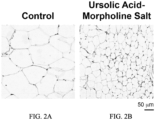
- FIG. 2A is a photomicrograph of adipocytes from retroperitoneal fat pads from the control group.
- FIG. 2B is a photomicrograph of adipocytes from retroperitoneal fat pads from the ursolic acid-morpholine salt group. A comparison of FIGS. 2A and 2B shows that ursolic acid-morpholine salt decreased adipocyte size.
- mice Weight-matched cohorts of 8-week old male C57BL/6 mice were randomized to receive ad libitum access to either high-fat chow (control) or high-fat chow supplemented with 0.059% ursolic acid-morpholine salt. Just prior to starting these diets, mice were weighed and subjected to body composition analysis by NMR. After mice had consumed the diets for 9 weeks, body weight and body composition were re-assessed, retroperitoneal and epididymal fat pads were dissected and weighed, and non-fasting blood glucose was measured. The results are shown below in Table III. Data are means ⁇ SEM from 15 mice per cohort. * P ⁇ 0.05; ** P ⁇ 0.01.
- mice Weight-matched cohorts of 8-week old male C57BL/6 mice were randomized to receive ad libitum access to either high-fat chow (control) or high-fat chow supplemented with 0.059% ursolic acid-morpholine salt. After mice had consumed the diets for 8 weeks, mice were fasted for 6 hours and then subjected to glucose tolerance testing. Results are shown in FIG. 3 , which is a graph depicting glucose tolerance testing results. Data are means ⁇ SEM from 15 mice per cohort. As evident from FIG.
- the area under the curve (AUC) for mice treated with ursolic acid-morpholine salt is significantly lower than the AUC for control mice (37,122 ⁇ 1,339; P ⁇ 0.01), indicating that ursolic acid-morpholine salt significantly improved glucose tolerance (i.e. reduced glucose intolerance).
- mice Weight-matched cohorts of 8-week old male C57BL/6 mice were randomized to receive ad libitum access to either standard chow (control), standard chow supplemented with 0.060% ursolic acid-diethanolamine salt, or standard chow supplemented with 0.180% ursolic acid-diethanolamine salt. After mice had consumed these diets for 7 weeks, mice were weighed and body composition was assessed by NMR. Results are shown below in Table IV. Data are means ⁇ SEM from 15 mice per cohort. * P ⁇ 0.05.
- mice Weight-matched cohorts of 8-week old male C57BL/6 mice were randomized to receive ad libitum access to either high-fat chow (control), high-fat chow supplemented with 0.050% ursolic acid, or high-fat chow supplemented with a molar-matched dose of ursolic acid-morpholine salt (0.059%). Just prior to starting these diets, mice were weighed and subjected to body composition analysis by NMR.
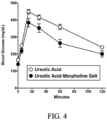
- mice Weight-matched cohorts of 8-week old male C57BL/6 mice were randomized to receive ad libitum access to either high-fat chow supplemented with 0.050% ursolic acid, or high-fat chow supplemented with a molar-matched dose of ursolic acid-morpholine salt (0.059%). After mice had consumed the diets for 7 weeks, mice were fasted for 6 hours and then subjected to glucose tolerance testing. Results are shown in FIG. 4 , which is a graph depicting glucose tolerance testing results. Data are means ⁇ SEM from 10 mice per cohort.
- the fasting blood glucose for mice treated with ursolic acid-morpholine salt (140.6 ⁇ 7.8 mg/dL) is significantly lower than the fasting blood glucose for mice treated with ursolic acid (166.3 ⁇ 3.7; P ⁇ 0.01).
- the area under the curve (AUC) for mice treated with ursolic acid-morpholine salt (32,606 ⁇ 2,471) is significantly lower than the AUC for mice treated with ursolic acid (40,585 ⁇ 1,357; P ⁇ 0.01), indicating that ursolic acid-morpholine salt significantly reduced glucose intolerance relative to a molar-matched dose of ursolic acid.
- the terms “comprise” (and any form of comprise, such as “comprises” and “comprising"), “have” (and any form of have, such as “has” and “having"), “include” (and any form of include, such as “includes” and “including”), “contain” (and any form contain, such as “contains” and “containing”), and any other grammatical variant thereof, are open-ended linking verbs.
- a method or composition that "comprises”, “has”, “includes” or “contains” one or more steps or elements possesses those one or more steps or elements, but is not limited to possessing only those one or more steps or elements.
- a step of a method or an element of an article that "comprises", “has”, “includes” or “contains” one or more features possesses those one or more features, but is not limited to possessing only those one or more features.
- each range is intended to be a shorthand format for presenting information, where the range is understood to encompass each discrete point within the range as if the same were fully set forth herein.
Landscapes
- Health & Medical Sciences (AREA)
- Chemical & Material Sciences (AREA)
- Life Sciences & Earth Sciences (AREA)
- Organic Chemistry (AREA)
- Engineering & Computer Science (AREA)
- General Health & Medical Sciences (AREA)
- Animal Behavior & Ethology (AREA)
- Veterinary Medicine (AREA)
- Public Health (AREA)
- Medicinal Chemistry (AREA)
- Pharmacology & Pharmacy (AREA)
- Diabetes (AREA)
- Nuclear Medicine, Radiotherapy & Molecular Imaging (AREA)
- General Chemical & Material Sciences (AREA)
- Chemical Kinetics & Catalysis (AREA)
- Bioinformatics & Cheminformatics (AREA)
- Hematology (AREA)
- Obesity (AREA)
- Nutrition Science (AREA)
- Polymers & Plastics (AREA)
- Food Science & Technology (AREA)
- Mycology (AREA)
- Epidemiology (AREA)
- Botany (AREA)
- Neurology (AREA)
- Emergency Medicine (AREA)
- Endocrinology (AREA)
- Child & Adolescent Psychology (AREA)
- Orthopedic Medicine & Surgery (AREA)
- Physical Education & Sports Medicine (AREA)
- Pharmaceuticals Containing Other Organic And Inorganic Compounds (AREA)
- Coloring Foods And Improving Nutritive Qualities (AREA)
- Steroid Compounds (AREA)
- Acyclic And Carbocyclic Compounds In Medicinal Compositions (AREA)
- Medicines That Contain Protein Lipid Enzymes And Other Medicines (AREA)
Description
- This application claims the benefit of
U.S. Provisional Application Numbers 62/558,004 (filed September 13, 2017 62/649,938 (filed March 29, 2018 - The present invention provides novel diethanolamine and morpholine salts of ursolic acid, which exhibit superior efficacy and properties. Compositions comprising the salts, and methods employing the salts are also provided.
- Ursolic acid is a pentacyclic triterpene acid. A range of biological effects of ursolic acid are discussed in
WO 2011/146768 ,EP 1321145 andWO 2012/170546 . At the molecular level, ursolic acid inhibits the STAT3 activation pathway, reduces matrix metalloproteinase-9 expression via the glucocorticoid receptor, inhibits protein tyrosine phosphatases, acts as an insulin mimetic, activates PPARα, inhibits NF-kB transcription factors, translocates hormone-sensitive lipase to stimulate lipolysis and inhibits the hepatic polyol pathway, among other effects. - Briefly, the present invention provides novel ursolic acid diethanolamine and morpholine salts, as well as related compositions and methods. The salts exhibit superior properties, including effects on skeletal muscle, as compared to ursolic acid per se and other ursolic acid salts.
- Certain embodiments of the presently-disclosed ursolic acid salts, compositions comprising the salts, and methods employing the salts have several features, no single one of which is solely responsible for their desirable attributes. Without limiting the scope of the ursolic acid salts, compositions comprising the salts, and methods employing the salts as defined by the claims that follow, their more prominent features will now be discussed briefly. After considering this discussion, and particularly after reading the section of this specification entitled "Detailed Description of the Invention," one will understand how the features of the various embodiments disclosed herein provide a number of advantages over the current state of the art. For example, embodiments of the invention provide unexpectedly superior properties compared to, e.g., native ursolic acid and other ursolic acid salts, including, e.g., efficaciousness in stimulating skeletal muscle hypertrophy, increasing lean muscle mass, decreasing fat mass, increasing skeletal muscle fiber size, decreasing adipocyte size, reducing obesity and/or blood glucose, improving glucose tolerance, etc.
- In a first aspect, the invention provides an ursolic acid salt selected from ursolic acid diethanolamine salt and ursolic acid morpholine salt.
- In a second aspect, the invention provides a composition comprising an ursolic acid salt selected from ursolic acid diethanolamine salt and ursolic acid morpholine salt, and a further agent.
- In a third aspect, the invention provides an ursolic acid salt selected from ursolic acid diethanolamine salt and ursolic acid morpholine salt for use in:
- (i) treating skeletal muscle atrophy;
- (ii) treating sarcopenia;
- (iii) treating cachexia;
- (iv) reducing fat;
- (v) treating obesity;
- (vi) treating diabetes;
- (vii) lowering blood glucose;
- (viii) treating pre-diabetes;
- In a fourth aspect, the invention provides a non-therapeutic method of:
- (i) increasing skeletal muscle mass;
- (ii) increasing strength;
- (iii) treating weakness;
- (iv) promoting muscle growth;
- (v) promoting normal muscle function;
- (vi) improving muscle function;
- (vii) promoting muscle health;
- (viii) promoting healthy aging in muscles; or
- (ix) increasing the ratio of skeletal muscle to fat;
- These and other features and advantages of this invention will become apparent from the following detailed description of the various aspects of the invention taken in conjunction with the appended claims and the accompanying drawings.
- The present invention will hereinafter be described in conjunction with the following drawing figures, and:
-
FIGS. 1A and 1B are photomicrographs of quadriceps skeletal muscle fibers from control and test mice, respectively, after 7 weeks of ad libitum access to either standard chow (control) or standard chow supplemented with 0.059% ursolic acid-morpholine salt. -
FIGS. 2A and 2B are photomicrographs of adipocytes from retroperitoneal fat pads from control and test mice, respectively, after 7 weeks of ad libitum access to either standard chow (control) or standard chow supplemented with 0.059% ursolic acid-morpholine salt. -
FIG. 3 is a chart depicting glucose tolerance testing results from control and test mice after 8 weeks of ad libitum access to either high-fat chow (control) or high-fat chow supplemented with 0.059% ursolic acid-morpholine salt. -
FIG. 4 is a graph depicting glucose tolerance testing results. - Aspects of the present invention and certain features, advantages, and details thereof, are explained more fully below. Descriptions of well-known materials, equipment, processing techniques, etc., are omitted so as to not unnecessarily obscure the invention in detail.
- In a first aspect, the invention provides an ursolic acid salt selected from ursolic acid diethanolamine salt and ursolic acid morpholine salt.
- The inventive ursolic acid salts can be synthesized by techniques known in the art. The starting materials of the compounds of this invention are available from commercial sources or can themselves be synthesized using reagents and techniques known in the art. Non-limiting synthesis embodiments are described herein.
- Ursolic acid, which has the formula

- In some embodiments, the inventive ursolic acid salt is ursolic acid diethanolamine salt of formula

- In some embodiments, the inventive ursolic acid salt is ursolic acid morpholine salt of formula

- In a second aspect, the invention provides a composition comprising an ursolic acid salt selected from ursolic acid diethanolamine salt and ursolic acid morpholine salt, and a further agent.
- The further agent is a component, in addition to the ursolic acid salt, that is present in the composition. Persons having ordinary skill in the art are familiar with various types of further agents that may be included in a composition. For example, in some non-limiting embodiments, the further agent comprises an excipient, binder, diluent, carrier, other delivery vehicle or system, filler, salt, buffer, preservative, antioxidant, stabilizer, sweetening agent, or flavor agent.
- In some embodiments, the further agent is a physiologically acceptable agent. As used herein, a physiologically acceptable agent is an agent that does not show significant toxicity to an intended subject at the dose of administration. The term physiologically acceptable agent comprises generally regarded as safe (GRAS) substances. GRAS substances are listed by the Food and Drug Administration in the Code of Federal Regulations (CFR) at 21 CFR. § 182 and 21 CFR § 184. The term physiologically acceptable agent also comprises pharmaceutically acceptable agents.
- The term "pharmaceutically acceptable," as used herein, refers to a component that is, within the scope of sound medical judgment, suitable for use in contact with the tissues of a subject (e.g., human or other animal) without undue toxicity, irritation, allergic response and the like, and is commensurate with a reasonable benefit/risk ratio.
- In some embodiments, the inventive composition is formulated for pharmaceutical use (i.e., is "a pharmaceutical composition"). Pharmaceutical compositions comprise a pharmaceutically acceptable carrier, adjuvant, or vehicle that is "acceptable" in the sense of being compatible with the other ingredients of the formulation and not deleterious to the recipient thereof in amounts typically used in medicaments.
- Pharmaceutically acceptable carriers, adjuvants and vehicles that can be used in the pharmaceutical compositions of this invention include, but are not limited to, ion exchangers, alumina, aluminum stearate, lecithin, serum proteins, such as human serum albumin, buffer substances such as phosphates, glycine, sorbic acid, potassium sorbate, partial glyceride mixtures of saturated vegetable fatty acids, water, salts or electrolytes, such as protamine sulfate, disodium hydrogen phosphate, potassium hydrogen phosphate, sodium chloride, zinc salts, colloidal silica, magnesium trisilicate, polyvinyl pyrrolidone, cellulose-based substances, polyethylene glycol, sodium carboxymethylcellulose, polyacrylates, waxes, polyethylene-polyoxypropylene-block polymers, polyethylene glycol and wool fat.
- In some embodiments, the composition is a pharmaceutical composition, nutraceutical composition, food composition, or dietary supplement.
- In some embodiments, the composition is in the form of, or comprises a non-naturally occurring oral delivery vehicle. Such delivery vehicles exclude naturally occurring vehicles such as plants and fruits. Oral delivery vehicles include, but are not limited to capsules, pills, tablets, cachets, syrups, foods, and beverages.
- In some embodiments, the composition is in the form of one or more tablets; caplets; capsules, such as soft elastic gelatin capsules; cachets; troches; lozenges; dispersions; suppositories; ointments; cataplasms (poultices); pastes; powders; dressings; creams; plasters; solutions; patches; aerosols (e.g., nasal sprays or inhalers); gels; liquid dosage forms suitable for oral or mucosal administration to a subject, including suspensions (e.g., aqueous or nonaqueous liquid suspensions, oil-in-water emulsions, or a water-in-oil liquid emulsions), solutions, and elixirs; liquid dosage forms suitable for parenteral administration to a patient; and sterile solids (e.g., crystalline or amorphous solids) that can be reconstituted to provide liquid dosage forms suitable for parenteral administration to a subject.
- In a third aspect, the invention provides an ursolic acid salt selected from ursolic acid diethanolamine salt and ursolic acid morpholine salt for use in:
- (i) treating skeletal muscle atrophy;
- (ii) treating sarcopenia;
- (iii) treating cachexia;
- (iv) reducing fat;
- (v) treating obesity;
- (vi) treating diabetes;
- (vii) lowering blood glucose;
- (viii) treating pre-diabetes;
- In a fourth aspect, the invention provides a non-therapeutic method of:
- (i) increasing skeletal muscle mass;
- (ii) increasing strength;
- (iii) treating weakness;
- (iv) promoting muscle growth;
- (v) promoting normal muscle function;
- (vi) improving muscle function;
- (vii) promoting muscle health;
- (viii) promoting healthy aging in muscles; or
- (ix) increasing the ratio of skeletal muscle to fat;
- Various uses as described in the foregoing paragraph are described relative to ursolic acid per se in the following references:
- 1. Wozniak, L., Skapska, S., and Marszalek, K. (2015) Ursolic Acid--A Pentacyclic Triterpenoid with a Wide Spectrum of Pharmacological Activities.
- 2. Liu, J. (2005) Oleanolic acid and ursolic acid: research perspectives.
- 3. Sultana, N. (2011) Clinically useful anticancer, antitumor, and antiwrinkle agent, ursolic acid and related derivatives as medicinally important natural product. J Enzyme Inhib Med Chem 26, 616-642
- 4. Liu, J. (1995) Pharmacology of oleanolic acid and ursolic acid. J Ethnopharmacol 49, 57-68
- 5. Shanmugam, M. K., Dai, X., Kumar, A. P., Tan, B. K., Sethi, G., and Bishayee, A. (2013) Ursolic acid in cancer prevention and treatment: molecular targets, pharmacokinetics and clinical studies. Biochem Pharmacol 85, 1579-1587
- 6. Kashyap, D., Tuli, H. S., and Sharma, A. K. (2016) Ursolic acid (UA): A metabolite with promising therapeutic potential. Life Sci 146, 201-213
- 7. Lopez-Hortas, L., Perez-Larran, P., Gonzalez-Munoz, M. J., Falque, E., and Dominguez, H. (2018) Recent developments on the extraction and application of ursolic acid. A review. Food Res Int 103, 130-149
- 8. Pironi, A. M., de Araujo, P. R., Fernandes, M. A., Salgado, H. R. N., and Chorilli, M. (2018) Characteristics, Biological Properties and Analytical Methods of Ursolic Acid: A Review. Crit Rev Anal Chem 48, 86-93
- 9. Cargnin, S. T., and Gnoatto, S. B. (2017) Ursolic acid from apple pomace and traditional plants: A valuable triterpenoid with functional properties. Food Chem 220, 477-489
- 10. Lee, S. U., Park, S. J., Kwak, H. B., Oh, J., Min, Y. K., and Kim, S. H. (2008) Anabolic activity of ursolic acid in bone: Stimulating osteoblast differentiation in vitro and inducing new bone formation in vivo. Pharmacol Res 58, 290-296
- 11. Lu, J., Zheng, Y. L., Wu, D. M., Luo, L., Sun, D. X., and Shan, Q. (2007) Ursolic acid ameliorates cognition deficits and attenuates oxidative damage in the brain of senescent mice induced by D-galactose. Biochem Pharmacol 74, 1078-1090
- 12. Wang, X. T., Gong, Y., Zhou, B., Yang, J. J., Cheng, Y., Zhao, J. G., and Qi, M. Y. (2018) Ursolic acid ameliorates oxidative stress, inflammation and fibrosis in diabetic cardiomyopathy rats. Biomed Pharmacother 97, 1461-1467
- 13. Zhou, Y., Li, J. S., Zhang, X., Wu, Y. J., Huang, K., and Zheng, L. (2010) Ursolic acid inhibits early lesions of diabetic nephropathy. Int J Mol Med 26, 565-570
- 14. Ling, C., Jinping, L., Xia, L., and Renyong, Y. (2013) Ursolic Acid provides kidney protection in diabetic rats. Curr Ther Res Clin Exp 75, 59-63
- 15. Ding, H., Wang, H., Zhu, L., and Wei, W. (2017) Ursolic Acid Ameliorates Early Brain Injury After Experimental Traumatic Brain Injury in Mice by Activating the Nrf2 Pathway. Neurochem Res 42, 337-346
- 16. Ma, J. Q., Ding, J., Zhang, L., and Liu, C. M. (2015) Protective effects of ursolic acid in an experimental model of liver fibrosis through Nrf2/ARE pathway. Clin Res Hepatol Gastroenterol 39, 188-197
- 17. Zhang, T., Su, J., Wang, K., Zhu, T., and Li, X. (2014) Ursolic acid reduces oxidative stress to alleviate early brain injury following experimental subarachnoid hemorrhage. Neurosci Lett 579, 12-17
- 18. Hwang, T. L., Shen, H. I., Liu, F. C., Tsai, H. I., Wu, Y. C., Chang, F. R., and Yu, H. P. (2014) Ursolic acid inhibits superoxide production in activated neutrophils and attenuates trauma-hemorrhage shock-induced organ injury in rats. PLoS One 9, e111365
- 19. Martinez-Abundis, E., Mendez-Del Villar, M., Perez-Rubio, K. G., Zuniga, L. Y., Cortez-Navarrete, M., Ramirez-Rodriguez, A., and Gonzalez-Ortiz, M. (2016) Novel nutraceutic therapies for the treatment of metabolic syndrome. World J Diabetes 7, 142-152
- 20. Somova, L. O., Nadar, A., Rammanan, P., and Shode, F. O. (2003) Cardiovascular, antihyperlipidemic and antioxidant effects of oleanolic and ursolic acids in experimental hypertension. Phytomedicine 10, 115-121
- 21. Somova, L. I., Shode, F. O., Ramnanan, P., and Nadar, A. (2003) Antihypertensive, antiatherosclerotic and antioxidant activity of triterpenoids isolated from Olea europaea, subspecies africana leaves. J Ethnopharmacol 84, 299-305
- In some embodiments, the ursolic acid salts described herein are useful for, inter alia, the same indications as ursolic acid per se.
- As used herein, the term "subject" refers to an animal that is the target of administration. In some embodiments, the subject is a human. In other embodiments, the subject is a non-human animal. In some embodiments, the subject is a non-rodent animal. In some embodiments, the subject is a non-human, and/or non-rodent animal. In some embodiments, the subject is a vertebrate and/or an amphibian. In some embodiments, the subject is a human, non-human primate, horse, pig, rabbit, dog, sheep, goat, cow, cat, guinea pig, hamster, ferret, fish, bird, or rodent. In some embodiments, the subject is a human or a domesticated animal. In some embodiments, the subject is a domesticated animal, such as a domesticated fish, domesticated crustacean, or domesticated mollusk. In some embodiments, the domesticated animal is poultry. In some embodiments, the poultry is selected from chicken, turkey, duck, and goose. In some embodiments, the domesticated animal is livestock. In some embodiments, the livestock animal is selected from a pig, cow, horse, goat, bison, and sheep. In some embodiments, the domestic animal includes rodents. In other embodiments, the domestic animal excludes some or all rodents. In some embodiments, the domestic animal excludes mice and rats.
- As used herein, the term "treatment" and various forms thereof (e.g., "treating") refer to the management (e.g., medical management) of a patient/subject with the intent to cure, ameliorate, stabilize, or forestall a disease, pathological condition, or disorder. The term includes administering an inventive compound and/or composition to a subject with the purpose to cure, heal, alleviate, relieve, alter, remedy, ameliorate, improve, or affect a disease state, condition, or disorder, the symptoms of the disease state, condition, or disorder or the predisposition toward the disease state, condition, or disorder. The term "treatment" and various forms thereof include the use for aesthetic and self-improvement purposes. For example, such uses include, but are not limited to, the administration of the disclosed compound in nutraceuticals, medicinal food, energy bar, energy drink, supplements (such as multivitamins). This term includes active treatment, that is, treatment directed specifically toward the improvement of a disease, pathological condition, or disorder, and also includes causal treatment, that is, treatment directed toward removal of the cause of the associated disease, pathological condition, or disorder. In addition, this term includes palliative treatment, that is, treatment designed for the relief of symptoms rather than the curing of the disease, pathological condition, or disorder; preventative treatment, that is, treatment directed to minimizing or partially or completely inhibiting the development of the associated disease, pathological condition, or disorder; and supportive treatment, that is, treatment employed to supplement another specific therapy directed toward the improvement of the associated disease, pathological condition, or disorder. In various embodiments, the term covers any treatment of a subject, and includes: (i) impeding the disease from occurring in a subject that can be predisposed to the disease but has not yet been diagnosed as having it; (ii) inhibiting the disease, i.e., arresting its development; or (iii) relieving the disease, i.e., causing regression of the disease. The term additionally includes forestalling or impeding the onset, recurrence or intensification of a disease state, condition, or disorder disclosed herein, and ameliorating and/or reducing the occurrence of symptoms of a disease state, condition, or disorder.
- Embodiments of the inventive ursolic acid salts for use typically comprise administering an effective amount (e.g., a therapeutically effective amount) of the salt to a subject in need thereof. As used herein, the term "therapeutically effective amount" or "effective amount" refers to an amount that is effective to elicit the desired biological or medical response, including the amount of a compound that, when administered to a subject for treating a disorder, is sufficient to effect such treatment of the disorder. The effective amount can vary depending on the compound, the disorder, and its severity, and the age, weight, etc. of the subject to be treated. The effective amount may be in one or more doses (for example, a single dose or multiple doses may be required to achieve the desired treatment endpoint). An effective amount may be considered to be given in an effective amount if, in conjunction with one or more other agents, a desirable or beneficial result may be or is achieved. A subject in need of treatment includes a subject that is at risk of needing the treatment. As used herein, an "at risk" subject is one that is at risk of developing a condition or disorder to be treated. This may be shown, for example, by one or more risk factors, which are measurable parameters that correlate with development of a condition or disorder and are known in the art.
- In some embodiments, the subject has been identified to be in need of treatment for a condition or disorder, or has been diagnosed with a condition or disorder prior to administering an inventive salt to the subject. In some embodiments, the subject has not been diagnosed with a condition or disorder prior to administering an inventive salt to the subject. In some embodiments, the subject has not been diagnosed with cancer or diabetes. In other embodiments, the subject may have been diagnosed with a condition or disorder such as cancer or diabetes.
- As used herein, the term "diagnosed" means having been subjected to a physical examination by a person of skill, for example, a physician, and found to have a condition that can be diagnosed or treated by the inventive ursolic acid salts, compositions, or methods/uses disclosed herein. For example, "diagnosed with a muscle atrophy disorder" means having been subjected to a physical examination by a person of skill, for example, a physician, and found to have a condition that can be diagnosed or treated by a compound or composition that can promote muscle health, promote normal muscle function, and/or promote healthy aging muscles. As a further example, "diagnosed with a need for promoting muscle health" refers to having been subjected to a physical examination by a person of skill, for example, a physician, and found to have a condition characterized by muscle atrophy or other disease wherein promoting muscle health, promoting normal muscle function, and/or promoting healthy aging muscles would be beneficial to the subject. Such a diagnosis can be in reference to a disorder, such as muscle atrophy, and the like, as discussed herein.
- As used herein, the phrase "identified to be in need of treatment for a condition or disorder," or the like, refers to selection of a subject based upon need for treatment of the disorder. For example, a subject can be identified as having a need for treatment of a disorder (e.g., a disorder related to muscle atrophy) based upon an earlier diagnosis by a person of skill and thereafter subjected to treatment for the disorder. As another example, subjects intended for consumption (e.g., fish, production livestock, etc.) may be identified to be in need of treatment for, e.g., increasing muscle mass, in order to increase the average amount of meat that can be obtained per animal.
- In some embodiments, the inventive ursolic acid salts are administered in a dosage ranging from about 0.001 to about 500 mg/kg of subject body weight (e.g., 0.001, 0.002, 0.003, 0.004, 0.005, 0.006, 0.007, 0.008, 0.009, 0.01, 0.02, 0.03, 0.04, 0.05, 0.06, 0.07, 0.08, 0.09, 0.10, 0.11, 0.12, 0.13, 0.14, 0.15, 0.16, 0.17, 0.18, 0.19, 0.20, 0.21, 0.22, 0.23, 0.24, 0.25, 0.26, 0.27, 0.28, 0.29, 0.30, 0.31, 0.32, 0.33, 0.34, 0.35, 0.36, 0.37, 0.38, 0.39, 0.40, 0.41, 0.42, 0.43, 0.44, 0.45, 0.46, 0.47, 0.48, 0.49, 0.50, 0.51, 0.52, 0.53, 0.54, 0.55, 0.56, 0.57, 0.58, 0.59, 0.60, 0.61, 0.62, 0.63, 0.64, 0.65, 0.66, 0.67, 0.68, 0.69, 0.70, 0.71, 0.72, 0.73, 0.74, 0.75, 0.76, 0.77, 0.78, 0.79, 0.80, 0.81, 0.82, 0.83, 0.84, 0.85, 0.86, 0.87, 0.88, 0.89, 0.90, 0.91, 0.92, 0.93, 0.94, 0.95, 0.96, 0.97, 0.98, 0.99, 1.0, 1.1, 1.2, 1.3, 1.4, 1.5, 1.6, 1.7, 1.8, 1.9, 2.0, 2.1, 2.2, 2.3, 2.4, 2.5, 2.6, 2.7, 2.8, 2.9, 3.0, 3.1, 3.2, 3.3, 3.4, 3.5, 3.6, 3.7, 3.8, 3.9, 4.0, 4.1, 4.2, 4.3, 4.4, 4.5, 4.6, 4.7, 4.8, 4.9, 5.0, 5.1, 5.2, 5.3, 5.4, 5.5, 5.6, 5.7, 5.8, 5.9, 6.0, 6.1, 6.2, 6.3, 6.4, 6.5, 6.6, 6.7, 6.8, 6.9, 7.0, 7.1, 7.2, 7.3, 7.4, 7.5, 7.6, 7.7, 7.8, 7.9, 8.0, 8.1, 8.2, 8.3, 8.4, 8.5, 8.6, 8.7, 8.8, 8.9, 9.0, 9.1, 9.2, 9.3, 9.4, 9.5, 9.6, 9.7, 9.8, 9.9, 10.0, 10.1, 10.2, 10.3, 10.4, 10.5, 10.6, 10.7, 10.8, 10.9, 11.0, 11.1, 11.2, 11.3, 11.4, 11.5, 11.6, 11.7, 11.8, 11.9, 12.0, 12.1, 12.2, 12.3, 12.4, 12.5, 12.6, 12.7, 12.8, 12.9, 13.0, 13.1, 13.2, 13.3, 13.4, 13.5, 13.6, 13.7, 13.8, 13.9, 14.0, 14.1, 14.2, 14.3, 14.4, 14.5, 14.6, 14.7, 14.8, 14.9, 15.0, 16.1, 16.2, 16.3, 16.4, 16.5, 16.6, 16.7, 16.8, 16.9, 17.0, 17.1, 17.2, 17.3, 17.4, 17.5, 17.6, 17.7, 17.8, 17.9, 18.0, 18.1, 18.2, 18.3, 18.4, 18.5, 18.6, 18.7, 18.8, 18.9, 19.0, 19.1, 19.2, 19.3, 19.4, 19.5, 19.6, 19.7, 19.8, 19.9, 20, 21, 22, 23, 24, 25, 26, 27, 28, 29, 30, 31, 32, 33, 34, 35, 36, 37, 38, 39, 40, 41, 42, 43, 44, 45, 46, 47, 48, 49, 50, 51, 52, 53, 54, 55, 56, 57, 58, 59, 60, 61, 62, 63, 64, 65, 66, 67, 68, 69, 70, 71, 72, 73, 74, 75, 76, 77, 78, 79, 80, 81, 82, 83, 84, 85, 86, 87, 88, 89, 90, 91, 92, 93, 94, 95, 96, 97, 98, 99, 100, 101, 102, 103, 104, 105, 106, 107, 108, 109, 110, 111, 112, 113, 114, 115, 116, 117, 118, 119, 120, 121, 122, 123, 124, 125, 126, 127, 128, 129, 130, 131, 132, 133, 134, 135, 136, 137, 138, 139, 140, 141, 142, 143, 144, 145, 146, 147, 148, 149, 150, 151, 152, 153, 154, 155, 156, 157, 158, 159, 160, 161, 162, 163, 164, 165, 166, 167, 168, 169, 170, 171, 172, 173, 174, 175, 176, 177, 178, 179, 180, 181, 182, 183, 184, 185, 186, 187, 188, 189, 190, 191, 192, 193, 194, 195, 196, 197, 198, 199, 200, 201, 202, 203, 204, 205, 206, 207, 208, 209, 210, 211, 212, 213, 214, 215, 216, 217, 218, 219, 220, 221, 222, 223, 224, 225, 226, 227, 228, 229, 230, 231, 232, 233, 234, 235, 236, 237, 238, 239, 240, 241, 242, 243, 244, 245, 246, 247, 248, 249, 250, 251, 252, 253, 254, 255, 256, 257, 258, 259, 260, 261, 262, 263, 264, 265, 266, 267, 268, 269, 270, 271, 272, 273, 274, 275, 276, 277, 278, 279, 280, 281, 282, 283, 284, 285, 286, 287, 288, 289, 290, 291, 292, 293, 294, 295, 296, 297, 298, 299, 300, 301, 302, 303, 304, 305, 306, 307, 308, 309, 310, 311, 312, 313, 314, 315, 316, 317, 318, 319, 320, 321, 322, 323, 324, 325, 326, 327, 328, 329, 330, 331, 332, 333, 334, 335, 336, 337, 338, 339, 340, 341, 342, 343, 344, 345, 346, 347, 348, 349, 350, 351, 352, 353, 354, 355, 356, 357, 358, 359, 360, 361, 362, 363, 364, 365, 366, 367, 368, 369, 370, 371, 372, 373, 374, 375, 376, 377, 378, 379, 380, 381, 382, 383, 384, 385, 386, 387, 388, 389, 390, 391, 392, 393, 394, 395, 396, 397, 398, 399, 400, 401, 402, 403, 404, 405, 406, 407, 408, 409, 410, 411, 412, 413, 414, 415, 416, 417, 418, 419, 420, 421, 422, 423, 424, 425, 426, 427, 428, 429, 430, 431, 432, 433, 434, 435, 436, 437, 438, 439, 440, 441, 442, 443, 444, 445, 446, 447, 448, 449, 450, 451, 452, 453, 454, 455, 456, 457, 458, 459, 460, 461, 462, 463, 464, 465, 466, 467, 468, 469, 470, 471, 472, 473, 474, 475, 476, 477, 478, 479, 480, 481, 482, 483, 484, 485, 486, 487, 488, 489, 490, 491, 492, 493, 494, 495, 496, 497, 498, 499, or 500 mg/kg), including any and all ranges and subranges therein (e.g., 0.001 to 100 mg/kg, 0.01 to 75 mg/kg, 0.05 to 20 mg/kg, 0.1 to 10 mg/kg, etc.).
- In some embodiments, the inventive ursolic acid salts are administered in an amount of 1 to 2,000 mg (e.g., 1, 2, 3, 4, 5, 6, 7, 8, 9, 10, 11, 12, 13, 14, 15, 16, 17, 18, 19, 20, 21, 22, 23, 24, 25, 26, 27, 28, 29, 30, 31, 32, 33, 34, 35, 36, 37, 38, 39, 40, 41, 42, 43, 44, 45, 46, 47, 48, 49, 50, 51, 52, 53, 54, 55, 56, 57, 58, 59, 60, 61, 62, 63, 64, 65, 66, 67, 68, 69, 70, 71, 72, 73, 74, 75, 76, 77, 78, 79, 80, 81, 82, 83, 84, 85, 86, 87, 88, 89, 90, 91, 92, 93, 94, 95, 96, 97, 98, 99, 100, 101, 102, 103, 104, 105, 106, 107, 108, 109, 110, 111, 112, 113, 114, 115, 116, 117, 118, 119, 120, 121, 122, 123, 124, 125, 126, 127, 128, 129, 130, 131, 132, 133, 134, 135, 136, 137, 138, 139, 140, 141, 142, 143, 144, 145, 146, 147, 148, 149, 150, 151, 152, 153, 154, 155, 156, 157, 158, 159, 160, 161, 162, 163, 164, 165, 166, 167, 168, 169, 170, 171, 172, 173, 174, 175, 176, 177, 178, 179, 180, 181, 182, 183, 184, 185, 186, 187, 188, 189, 190, 191, 192, 193, 194, 195, 196, 197, 198, 199, 200, 201, 202, 203, 204, 205, 206, 207, 208, 209, 210, 211, 212, 213, 214, 215, 216, 217, 218, 219, 220, 221, 222, 223, 224, 225, 226, 227, 228, 229, 230, 231, 232, 233, 234, 235, 236, 237, 238, 239, 240, 241, 242, 243, 244, 245, 246, 247, 248, 249, 250, 251, 252, 253, 254, 255, 256, 257, 258, 259, 260, 261, 262, 263, 264, 265, 266, 267, 268, 269, 270, 271, 272, 273, 274, 275, 276, 277, 278, 279, 280, 281, 282, 283, 284, 285, 286, 287, 288, 289, 290, 291, 292, 293, 294, 295, 296, 297, 298, 299, 300, 301, 302, 303, 304, 305, 306, 307,308,309,310,311,312,313,314,315,316,317,318,319,320,321,322,323,324,325, 326, 327, 328, 329, 330, 331, 332, 333, 334, 335, 336, 337, 338, 339, 340, 341, 342, 343, 344, 345, 346, 347, 348, 349, 350, 351, 352, 353, 354, 355, 356, 357, 358, 359, 360, 361, 362, 363, 364, 365, 366, 367, 368, 369, 370, 371, 372, 373, 374, 375, 376, 377, 378, 379, 380, 381, 382, 383, 384, 385, 386, 387, 388, 389, 390, 391, 392, 393, 394, 395, 396, 397, 398, 399, 400, 401, 402, 403, 404, 405, 406, 407, 408, 409, 410, 411, 412, 413, 414, 415, 416, 417, 418, 419, 420, 421, 422, 423, 424, 425, 426, 427, 428, 429, 430, 431, 432, 433, 434, 435, 436, 437, 438, 439, 440, 441, 442, 443, 444, 445, 446, 447, 448, 449, 450, 451, 452, 453, 454, 455, 456, 457, 458, 459, 460, 461, 462, 463, 464, 465, 466, 467, 468, 469, 470, 471, 472, 473, 474, 475, 476, 477, 478, 479, 480, 481, 482, 483, 484, 485, 486, 487, 488, 489, 490, 491, 492, 493, 494, 495, 496, 497, 498, 499, 500, 1000, 1010, 1020, 1030, 1040, 1050, 1060, 1070, 1080, 1090, 1100, 1110, 1120, 1130, 1140, 1150, 1160, 1170, 1180, 1190, 1200, 1210, 1220, 1230, 1240, 1250, 1260, 1270, 1280, 1290, 1300, 1310, 1320, 1330, 1340, 1350, 1360, 1370, 1380, 1390, 1400, 1410, 1420, 1430, 1440, 1450, 1460, 1470, 1480, 1490, 1500, 1510, 1520, 1530, 1540, 1550, 1560, 1570, 1580, 1590, 1600, 1610, 1620, 1630, 1640, 1650, 1660, 1670, 1680, 1690, 1700, 1710, 1720, 1730, 1740, 1750, 1760, 1770, 1780, 1790, 1800, 1810, 1820, 1830, 1840, 1850, 1860, 1870, 1880, 1890, 1900, 1910, 1920, 1930, 1940, 1950, 1960, 1970, 1980, 1990, or 2000 mg), including any and all ranges and subranges therein (e.g., 20 to 1900 mg, 50 to 1800 mg, 75 to 1700 mg, 100 to 1600 mg, etc.). Thus, in some embodiments where the ursolic acid salt is administered in a composition, the composition will contain such amount of the compound.
- In some embodiments, the ursolic acid salt is administered in an amount that is greater than 50, 75, 100, 150, 200, 250, 300, 400, 500, 600, 750, 800, 900, 1000, 1100, 1200, 1300, 1400, or 1500 mg.
- The invention will now be illustrated, but not limited, by reference to the specific embodiments described in the following examples.
-

- Ursolic acid (1.0450 g) and diethanolamine (208.6 mg) were dissolved in THF:MeOH (10:1) and allowed to stand, then concentrated and dried to yield a white solid, the diethanolamine salt of ursolic acid (965.0 mg). This product was used as the ursolic acid diethanolamine salt in the testing described below.
-

- Ursolic acid (1.0715 g) was dissolved in 20 mL of THF. Morpholine (224 mg) was added, and stirred for 1.5 hours. 8 mL of hexanes was added and the homogeneous solution became cloudy. The salt was stirred at room temperature for 12 hours. No significant amount of the salt had formed. The solution was concentrated in vacuo, and the stirred residue gave a white powder that was isolated by filtration and dried in vacuo to give the morpholine salt of ursolic acid (867.1 mg). This product was used as the ursolic acid morpholine salt in the testing described below.
- Weight-matched cohorts of 8-week old male C57BL/6 mice were randomized to receive ad libitum access to either standard chow (control) or standard chow supplemented with either 0.050% ursolic acid, 0.200% ursolic acid, or one of the indicated ursolic acid salts: ursolic acid-ethanolamine salt; ursolic acid-tris(hydroxymethyl)aminomethane salt, hereinafter referred to as ursolic acid-"tris" salt; ursolic acid-lysine salt; ursolic acid-diethanolamine salt; ursolic acid-morpholine salt; or ursolic acid-piperazine salt. The ursolic acid-diethanolamine salt and ursolic acid-morpholine salt were prepared as described above. Ursolic acid was commercially obtained, and was used as a starting material to make the other ursolic acid salts according to techniques analogous to those above and known in the art. The doses of ursolic acid salts were molar-matched to either 0.050% ursolic acid (i.e. 0.057% ursolic acid-ethanolamine salt, 0.063% ursolic acid-tris salt, 0.066% ursolic acid-lysine salt, 0.059% ursolic acid-morpholine salt, and 0.059% ursolic acid-piperazine salt) or to 0.048% ursolic acid (i.e. 0.060% ursolic acid-diethanolamine salt). After mice had consumed these diets for 6 weeks, in vivo grip strength was measured. The results are shown below in Table I. Data are means ± SEM from 12 mice per cohort. **P < 0.01 by one-way ANOVA with Dunnett's post test.
TABLE I Diet Grip Strength (% Change vs. Control) Control 0.0 ± 1.9 0.050% Ursolic Acid 7.7 ± 1.9 0.200% Ursolic Acid 9.9 ± 2.2** 0.057% Ursolic Acid-Ethanolamine Salt 2.8 ± 1.6 0.063% Ursolic Acid-Tris Salt 5.2 ± 1.6 0.066% Ursolic Acid-Lysine Salt 7.2 ± 2.3 0.060% Ursolic Acid-Diethanolamine Salt 11.7 ± 2.5** 0.059% Ursolic Acid-Morpholine Salt 11.3 ± 2.1** 0.059% Ursolic Acid-Piperazine Salt 3.7 ± 2.5 - As evidenced by the data from Table I, not all salts of ursolic acid exhibit statistically significant improvement in strength. Indeed, many may be less efficacious than the free acid at the same dose. Ursolic acid-diethanolamine salt and ursolic acid-morpholine salt were unexpectedly more potent and efficacious than native ursolic acid and other ursolic acid salts.
- Weight-matched cohorts of 8-week old male C57BL/6 mice were randomized to receive ad libitum access to either standard chow (control) or standard chow supplemented with 0.059% ursolic acid-morpholine salt. After mice had consumed these diets for 7 weeks, in vivo, grip strength was measured, mice were weighed, body composition was assessed by NMR, and quadriceps muscles were dissected for histological analysis of skeletal muscle fiber cross-sectional diameter. The results are shown below in Table II. Body weight data, grip strength data, and NMR data (lean mass, fat mass, % lean and % fat) are means ± SEM from 14-15 mice per cohort. Muscle fiber diameter data are means ± SEM from >4200 muscle fibers per diet. *P < 0.05; **P < 0.01; ***P < 0.001
TABLE II Control Ursolic Acid-Morpholine Salt Initial Body Wt (g) 26.1 ± 0.4 26.3 ± 0.3 Final Grip Strength (g) 165.5 ± 3.3 181.9 ± 2.4*** Final Body Wt (g) 35.6 ± 0.8 34.6 ± 1.0 Final Lean Mass (g) 19.6 ± 0.3 20.8 ± 0.3** Final Fat Mass (g) 10.2 ± 0.9 7.8 ± 1.2 Final % Lean 55.3 ± 1.4 61.0 ± 2.2* Final % Fat 28.0 ± 2.1 21.4 ± 2.9* Muscle fiber diameter (µm) 39.7 ± 0.1 44.8 ± 0.2*** - The data in Table II demonstrate that ursolic acid-morpholine salt stimulated skeletal muscle hypertrophy, increased lean mass and decreased fat mass.
- Weight-matched cohorts of 8-week old male C57BL/6 mice were randomized to receive ad libitum access to either standard chow (control) or standard chow supplemented with 0.059% ursolic acid-morpholine salt. After mice had consumed these diets for 7 weeks, quadriceps muscles were dissected, fixed, cross-sectioned, stained with hematoxylin and eosin, and subjected to photomicrography.
FIG. 1A is a photomicrograph of quadriceps skeletal muscle fibers from the control group.FIG. 1B is a photomicrograph of quadriceps skeletal muscle fibers from the ursolic acid-morpholine salt group. A comparison ofFIGS. 1A and 1B shows that ursolic acid-morpholine salt increased skeletal muscle fiber size. - Weight-matched cohorts of 8-week old male C57BL/6 mice were randomized to receive ad libitum access to either standard chow (control) or standard chow supplemented with 0.059% ursolic acid-morpholine salt. After mice had consumed these diets for 7 weeks, retroperitoneal fat pads were dissected, fixed, cross-sectioned, stained with hematoxylin and eosin, and subjected to photomicrography.
FIG. 2A is a photomicrograph of adipocytes from retroperitoneal fat pads from the control group.FIG. 2B is a photomicrograph of adipocytes from retroperitoneal fat pads from the ursolic acid-morpholine salt group. A comparison ofFIGS. 2A and 2B shows that ursolic acid-morpholine salt decreased adipocyte size. - Weight-matched cohorts of 8-week old male C57BL/6 mice were randomized to receive ad libitum access to either high-fat chow (control) or high-fat chow supplemented with 0.059% ursolic acid-morpholine salt. Just prior to starting these diets, mice were weighed and subjected to body composition analysis by NMR. After mice had consumed the diets for 9 weeks, body weight and body composition were re-assessed, retroperitoneal and epididymal fat pads were dissected and weighed, and non-fasting blood glucose was measured. The results are shown below in Table III. Data are means ± SEM from 15 mice per cohort. *P < 0.05; **P < 0.01.
TABLE III Control Ursolic Acid-Morpholine Salt Initial Body Wt (g) 24.0 ± 0.5 23.8 ± 0.4 Initial Lean Mass (g) 16.5 ± 0.4 16.7 ± 0.4 Initial Fat Mass (g) 2.0 ± 0.2 1.7 ± 0.2 Initial % Lean 68.7 ± 0.8 70.0 ± 0.7 Initial % Fat 8.4 ± 0.9 7.4 ± 0.8 Final Body Wt (g) 41.6 ± 1.0 38.9 ± 1.2* Final Lean Mass (g) 20.3 ± 0.6 21.3 ± 0.6 Final Fat Mass (g) 16.5 ± 0.9 12.8 ± 1.4* Final % Lean 49.0 ± 1.1 55.3 ± 2.4* Final % Fat 39.4 ± 1.6 31.8 ± 3.1* Retroperitoneal Fat Pad Wt (mg) 929.4 ± 52.0 731.8 ± 86.9* Epididymal Fat Pad Wt (mg) 2257.0 ± 84.6 1804.0 ± 161.5** Blood Glucose (mg/dL) 198.1 ± 6.1 177.7 ± 9.9* - The data in Table III demonstrate, inter alia, that ursolic acid-morpholine salt reduced obesity in diet-induced obese mice.
- Weight-matched cohorts of 8-week old male C57BL/6 mice were randomized to receive ad libitum access to either high-fat chow (control) or high-fat chow supplemented with 0.059% ursolic acid-morpholine salt. After mice had consumed the diets for 8 weeks, mice were fasted for 6 hours and then subjected to glucose tolerance testing. Results are shown in
FIG. 3 , which is a graph depicting glucose tolerance testing results. Data are means ± SEM from 15 mice per cohort. As evident fromFIG. 3 , the area under the curve (AUC) for mice treated with ursolic acid-morpholine salt (31,383 ± 1,869) is significantly lower than the AUC for control mice (37,122 ± 1,339; P < 0.01), indicating that ursolic acid-morpholine salt significantly improved glucose tolerance (i.e. reduced glucose intolerance). - Weight-matched cohorts of 8-week old male C57BL/6 mice were randomized to receive ad libitum access to either standard chow (control), standard chow supplemented with 0.060% ursolic acid-diethanolamine salt, or standard chow supplemented with 0.180% ursolic acid-diethanolamine salt. After mice had consumed these diets for 7 weeks, mice were weighed and body composition was assessed by NMR. Results are shown below in Table IV. Data are means ± SEM from 15 mice per cohort. *P < 0.05.
TABLE IV Control 0.060% Ursolic Acid-Diethanolamine Salt 0.180% Ursolic Acid-Diethanolamine Salt Initial Body Wt (g) 22.8 ± 0.3 23.0 ± 0.3 22.8 ± 0.3 Final Body Wt (g) 31.8 ± 0.9 31.7 ± 0.5 30.7 ± 0.5 Final Lean Mass (g) 19.3 ± 0.3 20.3 ± 0.4* 20.0 ± 0.3 Final Fat Mass (g) 7.1 ± 1.0 5.3 ± 0.7 4.4 ± 0.6* Final % Lean 61.2 ± 2.0 64.2 ± 1.6 65.5 ± 1.4* Final % Fat 21.4 ± 2.5 16.6 ± 2.0 14.1 ± 1.8* - The Table IV data establish that ursolic acid-diethanolamine salt increased lean mass and decreased fat mass.
- Weight-matched cohorts of 8-week old male C57BL/6 mice were randomized to receive ad libitum access to either high-fat chow (control), high-fat chow supplemented with 0.050% ursolic acid, or high-fat chow supplemented with a molar-matched dose of ursolic acid-morpholine salt (0.059%). Just prior to starting these diets, mice were weighed and subjected to body composition analysis by NMR. After mice had consumed the diets for 8 weeks, body weight and body composition were re-assessed, retroperitoneal and epididymal fat pads were dissected and weighed, and skeletal muscles (tibialis anterior, gastrocnemius, soleus, quadriceps and triceps) were dissected and weighed. In each mouse, the total dissected skeletal muscle weight (combined weight of bilateral tibialis anterior, gastrocnemius, soleus, quadriceps and triceps muscles) was normalized to the final body weight. Data are means ± SEM from 10 mice per cohort. Different letters denote statistically significant differences (P < 0.05 by one-way ANOVA with Tukey's post test). Results are summarized in Table V.
TABLE V Control 0.050% Ursolic Acid 0.059% Ursolic Acid-Morpholine Salt Initial Body Wt (g) 23.4 ± 0.3 a 23.2 ± 0.3 a 23.4 ± 0.6 a Initial Lean Mass (g) 16.0 ± 0.3 a 15.9 ± 0.4 a 15.9 ± 0.5 a Initial Fat Mass (g) 1.6 ± 0.2 a 1.2 ± 0.1 a 1.3 ± 0.1 a Initial % Lean 68.1 ± 0.6 a 68.5 ± 0.8 a 68.0 ± 0.7 a Initial % Fat 6.8 ± 0.8 a 5.3 ± 0.6 a 5.6 ± 0.6 a Final Body Wt (g) 42.3 ± 0.7 a 40.8 ± 0.5 a 36.6 ± 0.9 b Final Lean Mass (g) 20.9 ± 0.3 a 20.6 ± 0.3 a 20.9 ± 0.7 a Final Fat Mass (g) 17.3 ± 0.8 a 16.3 ± 0.3 a 11.6 ± 1.2 b Final % Lean 49.6 ± 1.0 a 50.4 ± 0.5 a 57.3 ± 2.1 b Final % Fat 40.9 ± 1.5 a 39.8 ± 0.7 a 31.4 ± 2.8 b Retroperitoneal Fat Pad Wt (mg) 1041.0 ± 57.7 a 986.1 ± 21.8 a 709.8 ± 72.2 b Epididymal Fat Pad Wt (mg) 2449.9 ± 90.0 a 2208.6 ± 52.0 a 1713.8 ± 139.8 b Skeletal Muscle Wt (mg / g Final Body Wt) 24.8 ± 0.6 a 25.5 ± 0.4 a 29.1 ± 1.0 b - Weight-matched cohorts of 8-week old male C57BL/6 mice were randomized to receive ad libitum access to either high-fat chow supplemented with 0.050% ursolic acid, or high-fat chow supplemented with a molar-matched dose of ursolic acid-morpholine salt (0.059%). After mice had consumed the diets for 7 weeks, mice were fasted for 6 hours and then subjected to glucose tolerance testing. Results are shown in
FIG. 4 , which is a graph depicting glucose tolerance testing results. Data are means ± SEM from 10 mice per cohort. The fasting blood glucose for mice treated with ursolic acid-morpholine salt (140.6 ± 7.8 mg/dL) is significantly lower than the fasting blood glucose for mice treated with ursolic acid (166.3 ± 3.7; P < 0.01). In addition, the area under the curve (AUC) for mice treated with ursolic acid-morpholine salt (32,606 ± 2,471) is significantly lower than the AUC for mice treated with ursolic acid (40,585 ± 1,357; P < 0.01), indicating that ursolic acid-morpholine salt significantly reduced glucose intolerance relative to a molar-matched dose of ursolic acid. - As used herein, the terms "comprise" (and any form of comprise, such as "comprises" and "comprising"), "have" (and any form of have, such as "has" and "having"), "include" (and any form of include, such as "includes" and "including"), "contain" (and any form contain, such as "contains" and "containing"), and any other grammatical variant thereof, are open-ended linking verbs. As a result, a method or composition that "comprises", "has", "includes" or "contains" one or more steps or elements possesses those one or more steps or elements, but is not limited to possessing only those one or more steps or elements. Likewise, a step of a method or an element of an article that "comprises", "has", "includes" or "contains" one or more features possesses those one or more features, but is not limited to possessing only those one or more features.
- As used herein, the terms "comprising," "has," "including," "containing," and other grammatical variants thereof encompass the terms "consisting of" and "consisting essentially of."
- The phrase "consisting essentially of" or grammatical variants thereof when used herein are to be taken as specifying the stated features, integers, steps or components but do not preclude the addition of one or more additional features, integers, steps, components or groups thereof but only if the additional features, integers, steps, components or groups thereof do not materially alter the basic and novel characteristics of the claimed compositions or methods.
- Where one or more ranges are referred to throughout this specification, each range is intended to be a shorthand format for presenting information, where the range is understood to encompass each discrete point within the range as if the same were fully set forth herein.
Claims (15)
- An ursolic acid salt selected from ursolic acid diethanolamine salt and ursolic acid morpholine salt.
- The ursolic acid salt according to claim 1, wherein the salt is ursolic acid diethanolamine salt of formula

- The ursolic acid salt according to claim 1, wherein the salt is ursolic acid morpholine salt of formula

- A composition comprising a salt according to any one of claims 1-3, and a further agent.
- The composition according to claim 4, comprising 25 to 1,500 mg of the salt.
- The composition according to claim 4, comprising 50 to 1,000 mg of the salt.
- The composition according to claim 4, wherein the further agent comprises a physiologically acceptable carrier.
- The composition according to claim 4, wherein the composition is a pharmaceutical composition, nutraceutical composition, food composition, or dietary supplement.
- The composition according to claim 8, comprising 25 to 1,500 mg of the salt.
- An ursolic acid salt according to any one of claims 1 to 3 for use in a method for:(i) treating skeletal muscle atrophy;(ii) treating sarcopenia;(iii) treating cachexia;(iv) reducing fat;(v) treating obesity;(vi) treating diabetes;(vii) lowering blood glucose; or(viii) treating pre-diabetesin a subject.
- A non-therapeutic method of:(i) increasing skeletal muscle mass;(ii) increasing strength;(iii) treating weakness;(iv) promoting muscle growth;(v) promoting normal muscle function;(vi) improving muscle function;(vii) promoting muscle health;(viii) promoting healthy aging in muscles; or(ix) increasing the ratio of skeletal muscle to fat;in a subject, said method comprising administering to a subject an effective amount of an ursolic acid salt according to any one of claims 1 to 3.
- A composition according to any one of claims 4 to 9 for use in a method for:(i) treating skeletal muscle atrophy;(ii) treating sarcopenia;(iii) treating cachexia;(iv) reducing fat;(v) treating obesity;(vi) treating diabetes;(vii) lowering blood glucose; or(viii) treating pre-diabetesin a subject.
- A non-therapeutic method of:(i) increasing skeletal muscle mass;(ii) increasing strength;(iii) treating weakness;(iv) promoting muscle growth;(v) promoting normal muscle function;(vi) improving muscle function;(vii) promoting muscle health;(viii) promoting healthy aging in muscles; or(ix) increasing the ratio of skeletal muscle to fat;in a subject, said method comprising administering to a subject an effective amount of the composition according to any one of claims 4 to 9.
- A salt for use according to claim 10, a composition for use according to claim 12 or a method according to claim 11 or 13, wherein the subject is a human, non-human primate, horse, pig, rabbit, dog, sheep, goat, cow, cat, guinea pig, hamster, ferret, fish, bird, or rodent.
- A salt for use according to claim 10, a composition for use according to claim 12 or a method according to claim 11 or 13, wherein the subject has not been diagnosed with diabetes or cancer.
Applications Claiming Priority (3)
| Application Number | Priority Date | Filing Date | Title |
|---|---|---|---|
| US201762558004P | 2017-09-13 | 2017-09-13 | |
| US201862649938P | 2018-03-29 | 2018-03-29 | |
| PCT/US2018/049742 WO2019055280A1 (en) | 2017-09-13 | 2018-09-06 | Ursolic acid morpholine and diethanolamine salts |
Publications (5)
| Publication Number | Publication Date |
|---|---|
| EP3681507A1 EP3681507A1 (en) | 2020-07-22 |
| EP3681507A4 EP3681507A4 (en) | 2021-06-09 |
| EP3681507B1 true EP3681507B1 (en) | 2024-02-07 |
| EP3681507C0 EP3681507C0 (en) | 2024-02-07 |
| EP3681507B8 EP3681507B8 (en) | 2024-03-13 |
Family
ID=65723021
Family Applications (1)
| Application Number | Title | Priority Date | Filing Date |
|---|---|---|---|
| EP18856299.5A Active EP3681507B8 (en) | 2017-09-13 | 2018-09-06 | Ursolic acid morpholine and diethanolamine salts |
Country Status (9)
| Country | Link |
|---|---|
| US (4) | US20200207802A1 (en) |
| EP (1) | EP3681507B8 (en) |
| JP (2) | JP7670482B2 (en) |
| KR (1) | KR102757622B1 (en) |
| CN (1) | CN111093673B (en) |
| AU (1) | AU2018331280B2 (en) |
| CA (1) | CA3075173A1 (en) |
| IL (1) | IL273078B2 (en) |
| WO (1) | WO2019055280A1 (en) |
Families Citing this family (8)
| Publication number | Priority date | Publication date | Assignee | Title |
|---|---|---|---|---|
| WO2019055280A1 (en) | 2017-09-13 | 2019-03-21 | Emmyon, Inc. | Ursolic acid morpholine and diethanolamine salts |
| KR20200066013A (en) | 2018-11-30 | 2020-06-09 | 씨제이제일제당 (주) | Feed additive composition and feed composition comprising the same |
| JP7525254B2 (en) * | 2019-11-14 | 2024-07-30 | ミヨシ油脂株式会社 | Organic ammonium salt and biological sample treatment agent using the same |
| WO2021099503A1 (en) * | 2019-11-19 | 2021-05-27 | Nutreco Ip Assets B.V. | Animal feed and methods for improving animal performance and productivity |
| CN113143934B (en) * | 2021-04-19 | 2021-11-30 | 南通大学 | Application of ursolic acid derivative in preparing medicine for preventing or treating cardiovascular diseases |
| CN114317551A (en) * | 2022-02-19 | 2022-04-12 | 陈利国 | Gene acting on hypertension blood stasis and detection primer thereof |
| WO2024145502A1 (en) * | 2022-12-29 | 2024-07-04 | The Board Of Regents Of The University Of Texas System | Synthetic triterpenoids and compositions thereof in weight management, skeletal muscle function, and appetite suppression |
| WO2026090182A1 (en) | 2024-10-23 | 2026-04-30 | Emmyon, Inc. | Glp-1 receptor agonist and ursolic acid combinations and use thereof for increasing weight loss while improving muscle mass and strength |
Family Cites Families (19)
| Publication number | Priority date | Publication date | Assignee | Title |
|---|---|---|---|---|
| JPH1129467A (en) | 1997-07-09 | 1999-02-02 | Shiseido Co Ltd | Protease inhibitor |
| WO2002009719A1 (en) * | 2000-07-31 | 2002-02-07 | The Nisshin Oillio, Ltd. | Antitumor agents |
| KR20030064799A (en) | 2000-11-30 | 2003-08-02 | 닛신 오일리오 가부시키가이샤 | Beautifying foods and drinks and peroral beautifying preparations |
| JPWO2002078468A1 (en) | 2001-03-30 | 2004-08-19 | 日清オイリオ株式会社 | Food and drink for vascular disorders |
| JP3981292B2 (en) | 2002-04-19 | 2007-09-26 | 日華化学株式会社 | Load stress reducing fiber material |
| DE102004009155A1 (en) | 2004-02-20 | 2005-09-01 | Beiersdorf Ag | Skin care product containing ursolic acid and ginkgo extract |
| WO2011115069A1 (en) | 2010-03-19 | 2011-09-22 | 第一三共株式会社 | Exhaustive searching for crystals |
| CN102241723B (en) * | 2010-05-11 | 2015-06-03 | 上海开拓者医药发展有限公司 | Ursolate as well as preparation method and crystal thereof |
| WO2011146768A1 (en) * | 2010-05-20 | 2011-11-24 | University Of Iowa Research Foundation | Methods for inhibiting muscle atrophy |
| CN101891795A (en) * | 2010-07-29 | 2010-11-24 | 福州大学 | Diethanolamine ursolic acid derivatives with antitumor activity and preparation method thereof |
| KR101220782B1 (en) * | 2010-09-14 | 2013-01-09 | 제주대학교 산학협력단 | Novel Triterpenoid and Use Thereof |
| HRP20151212T1 (en) * | 2011-01-31 | 2015-12-04 | Bristol-Myers Squibb Company | C-28 amines of c-3 modified betulinic acid derivatives as hiv maturation inhibitors |
| JP6001060B2 (en) | 2011-06-06 | 2016-10-05 | ユニバーシティ オブ アイオワ リサーチ ファウンデーション | Methods for inhibiting muscle atrophy |
| CN102516351A (en) * | 2011-11-22 | 2012-06-27 | 福州大学 | Ursolic acid derivative with anti-cancer activity and preparation method thereof |
| US8906889B2 (en) * | 2012-02-15 | 2014-12-09 | Bristol-Myers Squibb Company | C-3 cycloalkenyl triterpenoids with HIV maturation inhibitory activity |
| US8889854B2 (en) * | 2012-05-07 | 2014-11-18 | Bristol-Myers Squibb Company | C-17 bicyclic amines of triterpenoids with HIV maturation inhibitory activity |
| CN110437298A (en) | 2013-12-04 | 2019-11-12 | 盖尔梅德研究与发展有限公司 | ARAMCHOL salt |
| JP6716468B2 (en) * | 2014-05-05 | 2020-07-01 | ザ ボード オブ リージェンツ オブ ザ ユニバーシティー オブ テキサス システム | Methods and compositions comprising ursolic acid and/or resveratrol for treating obesity, diabetes or cancer |
| WO2019055280A1 (en) | 2017-09-13 | 2019-03-21 | Emmyon, Inc. | Ursolic acid morpholine and diethanolamine salts |
-
2018
- 2018-09-06 WO PCT/US2018/049742 patent/WO2019055280A1/en not_active Ceased
- 2018-09-06 EP EP18856299.5A patent/EP3681507B8/en active Active
- 2018-09-06 IL IL273078A patent/IL273078B2/en unknown
- 2018-09-06 CA CA3075173A patent/CA3075173A1/en active Pending
- 2018-09-06 CN CN201880059850.5A patent/CN111093673B/en active Active
- 2018-09-06 JP JP2020515112A patent/JP7670482B2/en active Active
- 2018-09-06 AU AU2018331280A patent/AU2018331280B2/en active Active
- 2018-09-06 KR KR1020207010311A patent/KR102757622B1/en active Active
-
2020
- 2020-03-06 US US16/811,730 patent/US20200207802A1/en not_active Abandoned
-
2023
- 2023-06-06 JP JP2023093517A patent/JP2023123515A/en active Pending
-
2024
- 2024-10-09 US US18/910,781 patent/US12264178B2/en active Active
-
2025
- 2025-02-21 US US19/060,293 patent/US12391726B2/en active Active
- 2025-07-24 US US19/279,782 patent/US20250346627A1/en active Pending
Also Published As
| Publication number | Publication date |
|---|---|
| EP3681507B8 (en) | 2024-03-13 |
| JP2023123515A (en) | 2023-09-05 |
| US20250346627A1 (en) | 2025-11-13 |
| KR20200052925A (en) | 2020-05-15 |
| US20250034203A1 (en) | 2025-01-30 |
| US20250188114A1 (en) | 2025-06-12 |
| EP3681507A1 (en) | 2020-07-22 |
| IL273078B2 (en) | 2025-06-01 |
| US20200207802A1 (en) | 2020-07-02 |
| US12264178B2 (en) | 2025-04-01 |
| US12391726B2 (en) | 2025-08-19 |
| CN111093673A (en) | 2020-05-01 |
| JP2020533377A (en) | 2020-11-19 |
| IL273078A (en) | 2020-04-30 |
| CA3075173A1 (en) | 2019-03-21 |
| AU2018331280A1 (en) | 2020-03-26 |
| JP7670482B2 (en) | 2025-04-30 |
| AU2018331280B2 (en) | 2023-05-25 |
| EP3681507C0 (en) | 2024-02-07 |
| KR102757622B1 (en) | 2025-01-21 |
| EP3681507A4 (en) | 2021-06-09 |
| WO2019055280A1 (en) | 2019-03-21 |
| CN111093673B (en) | 2025-07-29 |
| IL273078B1 (en) | 2025-02-01 |
Similar Documents
| Publication | Publication Date | Title |
|---|---|---|
| US12264178B2 (en) | Ursolic acid morpholine and diethanolamine salts | |
| EP2517711B1 (en) | Hyperlipemia-ameliorating agent, anemia-ameliorating composition, uric-acid-level-reducing composition, and foods and beverages | |
| Yang et al. | Cinnamaldehyde attenuates pressure overload-induced cardiac hypertrophy | |
| WO2007006135A1 (en) | Dietary supplement for enhancing skeletal muscle mass, decreasing muscle protein degradation, downregulation of muscle catabolism pathways, and decreasing catabolism of muscle cells | |
| JP2007536250A (en) | Nutritional composition for increasing creatine uptake in skeletal muscle | |
| Zhang et al. | Quercus dentata Thunb. leaves extract inhibits CaOx crystallization and ameliorates ethylene glycol-induced CaOx kidney stones via the OPN/CD44 and NLRP3 pathways | |
| HK40024449B (en) | Ursolic acid morpholine and diethanolamine salts | |
| HK40024449A (en) | Ursolic acid morpholine and diethanolamine salts | |
| EP3897619B1 (en) | Use of carnosol for increasing muscle protein synthesis | |
| Weng et al. | KS370G, a synthetic caffeamide derivative, improves left ventricular hypertrophy and function in pressure-overload mice heart | |
| Jambour et al. | Cardiotoxicity of hydroalcoholic extract of Lepidium draba in isoproterenol-induced heart failure in rats | |
| JP2011032256A (en) | Pharmaceutical composition and health food, produced by prevention of mengen reaction occurring at the time of taking saponin-containing galenical such as medicinal carrot and by process for increasing absorptivity of crude drug (method for causing chicken egg protein to absorb active constituent of galenical) | |
| Li et al. | Preparation and characterization of tea leaf exosome-like nanoparticles (ELNs) and its protective effect on the skin senescence in mice. | |
| EP4431106A2 (en) | Pharmaceutical composition for preventing or treating muscle diseases | |
| CA3123346C (en) | Use of carnosol for increasing muscle protein synthesis | |
| KR102065150B1 (en) | A composition for preventing or treating obesity comprising isotretinoin-peptide conjugate as an effective ingredient | |
| CN104800830B (en) | A kind of product that the oligopeptides for Pain Treatment is combined or combined with pethidine | |
| JP2003277286A (en) | Biological collagen synthesis promoter | |
| Moosa | Effect of Aqueous Extract of Tribulus terrestris orally administration on some Biochemical Parameters in Castrated Male Rabbits: Abeer Uthman Moosa1; Rasha Hussein Kuba7 and Yasser AH AL-Issa |
Legal Events
| Date | Code | Title | Description |
|---|---|---|---|
| STAA | Information on the status of an ep patent application or granted ep patent |
Free format text: STATUS: THE INTERNATIONAL PUBLICATION HAS BEEN MADE |
|
| PUAI | Public reference made under article 153(3) epc to a published international application that has entered the european phase |
Free format text: ORIGINAL CODE: 0009012 |
|
| STAA | Information on the status of an ep patent application or granted ep patent |
Free format text: STATUS: REQUEST FOR EXAMINATION WAS MADE |
|
| 17P | Request for examination filed |
Effective date: 20200306 |
|
| AK | Designated contracting states |
Kind code of ref document: A1 Designated state(s): AL AT BE BG CH CY CZ DE DK EE ES FI FR GB GR HR HU IE IS IT LI LT LU LV MC MK MT NL NO PL PT RO RS SE SI SK SM TR |
|
| AX | Request for extension of the european patent |
Extension state: BA ME |
|
| REG | Reference to a national code |
Ref country code: HK Ref legal event code: DE Ref document number: 40024449 Country of ref document: HK |
|
| DAV | Request for validation of the european patent (deleted) | ||
| DAX | Request for extension of the european patent (deleted) | ||
| A4 | Supplementary search report drawn up and despatched |
Effective date: 20210507 |
|
| RIC1 | Information provided on ipc code assigned before grant |
Ipc: A61K 31/56 20060101AFI20210430BHEP Ipc: C07C 279/26 20060101ALI20210430BHEP Ipc: A61P 3/00 20060101ALI20210430BHEP Ipc: A61P 3/04 20060101ALI20210430BHEP Ipc: A61P 3/06 20060101ALI20210430BHEP Ipc: A61P 3/10 20060101ALI20210430BHEP Ipc: A61P 21/00 20060101ALI20210430BHEP Ipc: A23L 33/10 20160101ALI20210430BHEP Ipc: A23L 33/105 20160101ALI20210430BHEP Ipc: A61K 31/19 20060101ALI20210430BHEP Ipc: C07C 62/32 20060101ALI20210430BHEP |
|
| STAA | Information on the status of an ep patent application or granted ep patent |
Free format text: STATUS: EXAMINATION IS IN PROGRESS |
|
| 17Q | First examination report despatched |
Effective date: 20230522 |
|
| GRAP | Despatch of communication of intention to grant a patent |
Free format text: ORIGINAL CODE: EPIDOSNIGR1 |
|
| STAA | Information on the status of an ep patent application or granted ep patent |
Free format text: STATUS: GRANT OF PATENT IS INTENDED |
|
| INTG | Intention to grant announced |
Effective date: 20231108 |
|
| GRAS | Grant fee paid |
Free format text: ORIGINAL CODE: EPIDOSNIGR3 |
|
| GRAA | (expected) grant |
Free format text: ORIGINAL CODE: 0009210 |
|
| STAA | Information on the status of an ep patent application or granted ep patent |
Free format text: STATUS: THE PATENT HAS BEEN GRANTED |
|
| REG | Reference to a national code |
Ref country code: DE Ref legal event code: R081 Ref document number: 602018065019 Country of ref document: DE Owner name: EMMYON, INC., ROCHESTER, US Free format text: FORMER OWNER: EMMYON, INC., CORALVILLE, IA, US |
|
| AK | Designated contracting states |
Kind code of ref document: B1 Designated state(s): AL AT BE BG CH CY CZ DE DK EE ES FI FR GB GR HR HU IE IS IT LI LT LU LV MC MK MT NL NO PL PT RO RS SE SI SK SM TR |
|
| REG | Reference to a national code |
Ref country code: GB Ref legal event code: FG4D |
|
| REG | Reference to a national code |
Ref country code: CH Ref legal event code: PK Free format text: BERICHTIGUNG B8 Ref country code: CH Ref legal event code: EP |
|
| RAP4 | Party data changed (patent owner data changed or rights of a patent transferred) |
Owner name: EMMYON, INC. |
|
| REG | Reference to a national code |
Ref country code: IE Ref legal event code: FG4D |
|
| REG | Reference to a national code |
Ref country code: DE Ref legal event code: R096 Ref document number: 602018065019 Country of ref document: DE |
|
| U01 | Request for unitary effect filed |
Effective date: 20240207 |
|
| U07 | Unitary effect registered |
Designated state(s): AT BE BG DE DK EE FI FR IT LT LU LV MT NL PT SE SI Effective date: 20240216 |
|
| PG25 | Lapsed in a contracting state [announced via postgrant information from national office to epo] |
Ref country code: IS Free format text: LAPSE BECAUSE OF FAILURE TO SUBMIT A TRANSLATION OF THE DESCRIPTION OR TO PAY THE FEE WITHIN THE PRESCRIBED TIME-LIMIT Effective date: 20240607 |
|
| PG25 | Lapsed in a contracting state [announced via postgrant information from national office to epo] |
Ref country code: GR Free format text: LAPSE BECAUSE OF FAILURE TO SUBMIT A TRANSLATION OF THE DESCRIPTION OR TO PAY THE FEE WITHIN THE PRESCRIBED TIME-LIMIT Effective date: 20240508 |
|
| PG25 | Lapsed in a contracting state [announced via postgrant information from national office to epo] |
Ref country code: RS Free format text: LAPSE BECAUSE OF FAILURE TO SUBMIT A TRANSLATION OF THE DESCRIPTION OR TO PAY THE FEE WITHIN THE PRESCRIBED TIME-LIMIT Effective date: 20240507 Ref country code: HR Free format text: LAPSE BECAUSE OF FAILURE TO SUBMIT A TRANSLATION OF THE DESCRIPTION OR TO PAY THE FEE WITHIN THE PRESCRIBED TIME-LIMIT Effective date: 20240207 |
|
| PG25 | Lapsed in a contracting state [announced via postgrant information from national office to epo] |
Ref country code: ES Free format text: LAPSE BECAUSE OF FAILURE TO SUBMIT A TRANSLATION OF THE DESCRIPTION OR TO PAY THE FEE WITHIN THE PRESCRIBED TIME-LIMIT Effective date: 20240207 |
|
| PG25 | Lapsed in a contracting state [announced via postgrant information from national office to epo] |
Ref country code: RS Free format text: LAPSE BECAUSE OF FAILURE TO SUBMIT A TRANSLATION OF THE DESCRIPTION OR TO PAY THE FEE WITHIN THE PRESCRIBED TIME-LIMIT Effective date: 20240507 Ref country code: NO Free format text: LAPSE BECAUSE OF FAILURE TO SUBMIT A TRANSLATION OF THE DESCRIPTION OR TO PAY THE FEE WITHIN THE PRESCRIBED TIME-LIMIT Effective date: 20240507 Ref country code: IS Free format text: LAPSE BECAUSE OF FAILURE TO SUBMIT A TRANSLATION OF THE DESCRIPTION OR TO PAY THE FEE WITHIN THE PRESCRIBED TIME-LIMIT Effective date: 20240607 Ref country code: HR Free format text: LAPSE BECAUSE OF FAILURE TO SUBMIT A TRANSLATION OF THE DESCRIPTION OR TO PAY THE FEE WITHIN THE PRESCRIBED TIME-LIMIT Effective date: 20240207 Ref country code: GR Free format text: LAPSE BECAUSE OF FAILURE TO SUBMIT A TRANSLATION OF THE DESCRIPTION OR TO PAY THE FEE WITHIN THE PRESCRIBED TIME-LIMIT Effective date: 20240508 Ref country code: ES Free format text: LAPSE BECAUSE OF FAILURE TO SUBMIT A TRANSLATION OF THE DESCRIPTION OR TO PAY THE FEE WITHIN THE PRESCRIBED TIME-LIMIT Effective date: 20240207 |
|
| PG25 | Lapsed in a contracting state [announced via postgrant information from national office to epo] |
Ref country code: PL Free format text: LAPSE BECAUSE OF FAILURE TO SUBMIT A TRANSLATION OF THE DESCRIPTION OR TO PAY THE FEE WITHIN THE PRESCRIBED TIME-LIMIT Effective date: 20240207 |
|
| PG25 | Lapsed in a contracting state [announced via postgrant information from national office to epo] |
Ref country code: PL Free format text: LAPSE BECAUSE OF FAILURE TO SUBMIT A TRANSLATION OF THE DESCRIPTION OR TO PAY THE FEE WITHIN THE PRESCRIBED TIME-LIMIT Effective date: 20240207 |
|
| U20 | Renewal fee for the european patent with unitary effect paid |
Year of fee payment: 7 Effective date: 20240820 |
|
| PG25 | Lapsed in a contracting state [announced via postgrant information from national office to epo] |
Ref country code: SM Free format text: LAPSE BECAUSE OF FAILURE TO SUBMIT A TRANSLATION OF THE DESCRIPTION OR TO PAY THE FEE WITHIN THE PRESCRIBED TIME-LIMIT Effective date: 20240207 |
|
| PG25 | Lapsed in a contracting state [announced via postgrant information from national office to epo] |
Ref country code: CZ Free format text: LAPSE BECAUSE OF FAILURE TO SUBMIT A TRANSLATION OF THE DESCRIPTION OR TO PAY THE FEE WITHIN THE PRESCRIBED TIME-LIMIT Effective date: 20240207 |
|
| PG25 | Lapsed in a contracting state [announced via postgrant information from national office to epo] |
Ref country code: SK Free format text: LAPSE BECAUSE OF FAILURE TO SUBMIT A TRANSLATION OF THE DESCRIPTION OR TO PAY THE FEE WITHIN THE PRESCRIBED TIME-LIMIT Effective date: 20240207 |
|
| PG25 | Lapsed in a contracting state [announced via postgrant information from national office to epo] |
Ref country code: SM Free format text: LAPSE BECAUSE OF FAILURE TO SUBMIT A TRANSLATION OF THE DESCRIPTION OR TO PAY THE FEE WITHIN THE PRESCRIBED TIME-LIMIT Effective date: 20240207 Ref country code: SK Free format text: LAPSE BECAUSE OF FAILURE TO SUBMIT A TRANSLATION OF THE DESCRIPTION OR TO PAY THE FEE WITHIN THE PRESCRIBED TIME-LIMIT Effective date: 20240207 Ref country code: RO Free format text: LAPSE BECAUSE OF FAILURE TO SUBMIT A TRANSLATION OF THE DESCRIPTION OR TO PAY THE FEE WITHIN THE PRESCRIBED TIME-LIMIT Effective date: 20240207 Ref country code: CZ Free format text: LAPSE BECAUSE OF FAILURE TO SUBMIT A TRANSLATION OF THE DESCRIPTION OR TO PAY THE FEE WITHIN THE PRESCRIBED TIME-LIMIT Effective date: 20240207 |
|
| U1N | Appointed representative for the unitary patent procedure changed after the registration of the unitary effect |
Representative=s name: SCHLICH; GB |
|
| REG | Reference to a national code |
Ref country code: DE Ref legal event code: R097 Ref document number: 602018065019 Country of ref document: DE |
|
| PLBE | No opposition filed within time limit |
Free format text: ORIGINAL CODE: 0009261 |
|
| STAA | Information on the status of an ep patent application or granted ep patent |
Free format text: STATUS: NO OPPOSITION FILED WITHIN TIME LIMIT |
|
| 26N | No opposition filed |
Effective date: 20241108 |
|
| PG25 | Lapsed in a contracting state [announced via postgrant information from national office to epo] |
Ref country code: MC Free format text: LAPSE BECAUSE OF FAILURE TO SUBMIT A TRANSLATION OF THE DESCRIPTION OR TO PAY THE FEE WITHIN THE PRESCRIBED TIME-LIMIT Effective date: 20240207 |
|
| PG25 | Lapsed in a contracting state [announced via postgrant information from national office to epo] |
Ref country code: IE Free format text: LAPSE BECAUSE OF NON-PAYMENT OF DUE FEES Effective date: 20240906 |
|
| U20 | Renewal fee for the european patent with unitary effect paid |
Year of fee payment: 8 Effective date: 20250820 |
|
| REG | Reference to a national code |
Ref country code: CH Ref legal event code: U11 Free format text: ST27 STATUS EVENT CODE: U-0-0-U10-U11 (AS PROVIDED BY THE NATIONAL OFFICE) Effective date: 20251001 |
|
| PGFP | Annual fee paid to national office [announced via postgrant information from national office to epo] |
Ref country code: GB Payment date: 20250822 Year of fee payment: 8 |
|
| PGFP | Annual fee paid to national office [announced via postgrant information from national office to epo] |
Ref country code: CH Payment date: 20251001 Year of fee payment: 8 |
|
| PG25 | Lapsed in a contracting state [announced via postgrant information from national office to epo] |
Ref country code: CY Free format text: LAPSE BECAUSE OF FAILURE TO SUBMIT A TRANSLATION OF THE DESCRIPTION OR TO PAY THE FEE WITHIN THE PRESCRIBED TIME-LIMIT; INVALID AB INITIO Effective date: 20180906 |
|
| PG25 | Lapsed in a contracting state [announced via postgrant information from national office to epo] |
Ref country code: HU Free format text: LAPSE BECAUSE OF FAILURE TO SUBMIT A TRANSLATION OF THE DESCRIPTION OR TO PAY THE FEE WITHIN THE PRESCRIBED TIME-LIMIT; INVALID AB INITIO Effective date: 20180906 |