EP3673029B1 - Zusammensetzungen mit polyaziridinvernetzern zur behandlung unterirdischer formationen - Google Patents
Zusammensetzungen mit polyaziridinvernetzern zur behandlung unterirdischer formationen Download PDFInfo
- Publication number
- EP3673029B1 EP3673029B1 EP18769924.4A EP18769924A EP3673029B1 EP 3673029 B1 EP3673029 B1 EP 3673029B1 EP 18769924 A EP18769924 A EP 18769924A EP 3673029 B1 EP3673029 B1 EP 3673029B1
- Authority
- EP
- European Patent Office
- Prior art keywords
- composition
- alkyl
- group
- alkylene
- maleic anhydride
- Prior art date
- Legal status (The legal status is an assumption and is not a legal conclusion. Google has not performed a legal analysis and makes no representation as to the accuracy of the status listed.)
- Active
Links
Classifications
-
- C—CHEMISTRY; METALLURGY
- C09—DYES; PAINTS; POLISHES; NATURAL RESINS; ADHESIVES; COMPOSITIONS NOT OTHERWISE PROVIDED FOR; APPLICATIONS OF MATERIALS NOT OTHERWISE PROVIDED FOR
- C09K—MATERIALS FOR MISCELLANEOUS APPLICATIONS, NOT PROVIDED FOR ELSEWHERE
- C09K8/00—Compositions for drilling of boreholes or wells; Compositions for treating boreholes or wells, e.g. for completion or for remedial operations
- C09K8/50—Compositions for plastering borehole walls, i.e. compositions for temporary consolidation of borehole walls
- C09K8/504—Compositions based on water or polar solvents
- C09K8/506—Compositions based on water or polar solvents containing organic compounds
- C09K8/508—Compositions based on water or polar solvents containing organic compounds macromolecular compounds
- C09K8/512—Compositions based on water or polar solvents containing organic compounds macromolecular compounds containing cross-linking agents
-
- C—CHEMISTRY; METALLURGY
- C04—CEMENTS; CONCRETE; ARTIFICIAL STONE; CERAMICS; REFRACTORIES
- C04B—LIME, MAGNESIA; SLAG; CEMENTS; COMPOSITIONS THEREOF, e.g. MORTARS, CONCRETE OR LIKE BUILDING MATERIALS; ARTIFICIAL STONE; CERAMICS; REFRACTORIES; TREATMENT OF NATURAL STONE
- C04B26/00—Compositions of mortars, concrete or artificial stone, containing only organic binders, e.g. polymer or resin concrete
- C04B26/02—Macromolecular compounds
- C04B26/04—Macromolecular compounds obtained by reactions only involving carbon-to-carbon unsaturated bonds
-
- C—CHEMISTRY; METALLURGY
- C08—ORGANIC MACROMOLECULAR COMPOUNDS; THEIR PREPARATION OR CHEMICAL WORKING-UP; COMPOSITIONS BASED THEREON
- C08L—COMPOSITIONS OF MACROMOLECULAR COMPOUNDS
- C08L35/00—Compositions of homopolymers or copolymers of compounds having one or more unsaturated aliphatic radicals, each having only one carbon-to-carbon double bond, and at least one being terminated by a carboxyl radical, and containing at least one other carboxyl radical in the molecule, or of salts, anhydrides, esters, amides, imides or nitriles thereof; Compositions of derivatives of such polymers
-
- C—CHEMISTRY; METALLURGY
- C09—DYES; PAINTS; POLISHES; NATURAL RESINS; ADHESIVES; COMPOSITIONS NOT OTHERWISE PROVIDED FOR; APPLICATIONS OF MATERIALS NOT OTHERWISE PROVIDED FOR
- C09K—MATERIALS FOR MISCELLANEOUS APPLICATIONS, NOT PROVIDED FOR ELSEWHERE
- C09K8/00—Compositions for drilling of boreholes or wells; Compositions for treating boreholes or wells, e.g. for completion or for remedial operations
- C09K8/42—Compositions for cementing, e.g. for cementing casings into boreholes; Compositions for plugging, e.g. for killing wells
- C09K8/44—Compositions for cementing, e.g. for cementing casings into boreholes; Compositions for plugging, e.g. for killing wells containing organic binders only
-
- C—CHEMISTRY; METALLURGY
- C09—DYES; PAINTS; POLISHES; NATURAL RESINS; ADHESIVES; COMPOSITIONS NOT OTHERWISE PROVIDED FOR; APPLICATIONS OF MATERIALS NOT OTHERWISE PROVIDED FOR
- C09K—MATERIALS FOR MISCELLANEOUS APPLICATIONS, NOT PROVIDED FOR ELSEWHERE
- C09K8/00—Compositions for drilling of boreholes or wells; Compositions for treating boreholes or wells, e.g. for completion or for remedial operations
- C09K8/50—Compositions for plastering borehole walls, i.e. compositions for temporary consolidation of borehole walls
- C09K8/504—Compositions based on water or polar solvents
- C09K8/506—Compositions based on water or polar solvents containing organic compounds
- C09K8/508—Compositions based on water or polar solvents containing organic compounds macromolecular compounds
- C09K8/5083—Compositions based on water or polar solvents containing organic compounds macromolecular compounds obtained by reactions only involving carbon-to-carbon unsaturated bonds
-
- E—FIXED CONSTRUCTIONS
- E21—EARTH OR ROCK DRILLING; MINING
- E21B—EARTH OR ROCK DRILLING; OBTAINING OIL, GAS, WATER, SOLUBLE OR MELTABLE MATERIALS OR A SLURRY OF MINERALS FROM WELLS
- E21B33/00—Sealing or packing boreholes or wells
- E21B33/10—Sealing or packing boreholes or wells in the borehole
- E21B33/13—Methods or devices for cementing, for plugging holes, crevices or the like
- E21B33/138—Plastering the borehole wall; Injecting into the formation
Definitions
- This document relates to methods and compositions used in treating subterranean formations.
- compositions to seal off undesirable fluid paths such as gas flow channels, for example behind casings, pipe microannuli, and fractured cement sheaths are based on non-aqueous epoxy monomers mixed with amines, or polymerizable hydrocarbon-based monomers. While these solutions have a reasonable success rate, their toxicity is of major concern, especially when the treated zones are near populated areas or aquifers. Although less toxic formulations are known, using such formulations at low temperatures, for example, 4 °C (40 degrees Fahrenheit (°F)), and reliably controlling gel times in such formulations at elevated temperatures has been problematic. Improved sealing of flow channels in certain materials, such as set cement, would improve well productivity and decrease well maintenance costs.
- WO 2017/048719 describes compositions including a maleic anhydride copolymer or a salt thereof and an amine crosslinker.
- the present application provides, inter alia, an easy to apply water-based sealing composition for treating subterranean formations. These compositions represent relatively environmentally friendlier alternatives to currently used fluids based on epoxy systems and monomers.
- the wide application temperature window (for example, 4 °C - 93 °C (40 °F - 200 °F)) makes the fluid compositions useful for both onshore and offshore applications.
- the sealing compositions described in this document have controllable gel times, and contain cross-linkable resins and at least one crosslinker. Prior to crosslinking, the sealing composition is a thin fluid that flows freely into the porous space within the subterranean formation. Upon chemical reaction between the crosslinker and the resin, the composition becomes a stiff gel thereby forming a gel plug in the porous space of the subterranean formation.
- the present application provides a method of treating a subterranean formation comprising:
- forming the sealant occurs near a casing, a casing-casing annulus, a tubing-casing annulus, or a casing-formation annulus.
- the sealant is a gel plug.
- the crosslinking of the composition occurs in contact with a set cement.
- the subterranean formation comprises a wellbore comprising a cement sheath.
- forming the sealant occurs in at least one of: a fracture in the cement sheath and a microannulus.
- forming the sealant prevents or retards undesired loss or flow of a wellbore fluid into the subterranean formation or of a formation fluid into the wellbore.
- the maleic anhydride copolymer, or a salt thereof, and the polyaziridine crosslinker, or a salt thereof remain in an uncrosslinked state until placement in an appropriate location in the wellbore.
- the providing comprises top-down squeezing the composition down an annulus.
- the providing comprises injecting the composition downhole.
- forming the sealant comprises a conformance control, a wellbore plug and abandonment, or thermal wellbore isolation gel system.
- the present application provides a composition for treating a subterranean formation, the composition comprising:
- the composition comprises an aqueous carrier solvent.
- the gel time control agent accelerates or retards formation of the gel from the maleic anhydride copolymer and the polyaziridine crosslinker in the absence of a set cement.
- the gel time control agent is selected form the group consisting of citric acid, trisodium phosphate, and a combination thereof.
- Implementations of the first and second general aspects may include one or more of the following features.
- the salt of the maleic anhydride copolymer is an ammonium salt, an alkali metal salt, or an alkali earth metal salt.
- each R 1 is H, and each R 2 is independently selected from the group consisting of -H, -OCH 3 , and -CH 3 ; or each R 2 is H, and each R 1 is independently selected from the group consisting of -H, -OCH 3 , and -CH 3 .
- the repeat unit I has formula:
- the polyaziridine crosslinker has formula: or a salt thereof, wherein:
- the polyaziridine crosslinker is a compound of formula: or a salt thereof.
- an amount of the polyaziridine crosslinker in the composition is in a range of about 0.1 wt.% to about 20 wt.% relative to an amount of the maleic anhydride copolymer.
- pH of the composition is in a range of about 5 to about 9.
- viscosity of the composition is from about 80 mPa ⁇ s (80 cP) to about 120 mPa ⁇ s (120 cP).
- a combined amount of the maleic anhydride copolymer and the polyaziridine crosslinker in the composition is in a range of about 10 wt.% to about 30 wt.% relative to a weight of the composition.
- the composition comprises an amine crosslinker.
- the amine crosslinker is selected from the group consisting of a polyamine, a polyethyleneimine, and a combination thereof.
- the amine crosslinker is tetraethylenepentamine (TEPA).
- the composition has gel time of less than about 1.5 hours at about 21 °C (70 °F).
- the composition has gel time of less than about 3 hours at about 4 °C (40 °F).
- Fractures and microannuli within and around the cement sheath can lead to annular influx of unwanted water, reservoir liquids, or gas from the formation that can travel to the surface. This can result in leaks in wells that have been plugged, or lead to annular pressure buildup in producing wells, which can then require well shut-in until remediated to prevent casing collapse or wellbore failure. Leaking wells pose a costly environmental hazard, and curtailing or shutting in a producing well has substantial financial impact that in some cases can reach hundreds of millions of dollars per well per year.
- the present application provides a resin composition for sealing such microfractures and annuli, to prevent unwanted flow and return wells to a desired safe and profitable state.
- the water based fluid compositions described in this document are designed for deepest possible penetration into microfractures and annuli to provide the best seal against unwanted fluid flow.
- These treatment fluids are solids-free with low viscosity during the pumping stage, and exhibit a rapid, nearly right angle set at the desired temperature.
- the water soluble treatment compositions contain a resin that can be crosslinked with a polyaziridine crosslinker to provide controllable gel times that can be tuned to meet operational needs.
- An example would be a resin system designed for use in 49 °C (120 °F) conditions with a gel set time achieved in one hour.
- the term "compound” can include all stereoisomers, geometric isomers, tautomers, and isotopes of the structures named or depicted. Compounds in this document identified by name or structure as one particular tautomeric form are intended to include other tautomeric forms unless otherwise specified.
- C n-m indicates a range which includes the endpoints, wherein n and m are integers and indicate the number of carbon atoms. Examples include C 1-4 , C 1-6 , and the like.
- the phrase "optionally substituted” means unsubstituted or substituted.
- substituted means that a hydrogen atom is removed and replaced by a substituent. It is to be understood that substitution at a given atom is limited by valency.
- C n-m alkyl refers to a monovalent saturated hydrocarbon group that can be straight-chain (linear) or branched, having n to m carbons.
- alkyl moieties include, but are not limited to, chemical groups such as methyl, ethyl, n-propyl, isopropyl, n -butyl, tert -butyl, isobutyl, sec -butyl; higher homologs such as 2-methyl-1-butyl, n -pentyl, 3-pentyl, n -hexyl, 1,2,2-trimethylpropyl, and the like.
- the alkyl group contains from 1 to 6 carbon atoms, from 1 to 4 carbon atoms, from 1 to 3 carbon atoms, or 1 to 2 carbon atoms.
- C n-m alkylene means a bivalent saturated branched, or straight chain (linear) chemical group containing only carbon and hydrogen atoms, such as methylene, ethylene, n-propylene, iso-propylene, n-butylene, iso-butylene, sec-butylene, tert-butylene, n-pentylene, iso-pentylene, sec-pentylene and neo-pentylene.
- Alkylene groups can either be unsubstituted or substituted with one or more substituents.
- alkylene groups include 1 to 9 carbon atoms (for example, 1 to 6 carbon atoms, 1 to 4 carbon atoms, or 1 to 2 carbon atoms).
- C n-m alkenyl refers to an alkyl group having one or more double carbon-carbon bonds and having n to m carbons.
- Example alkenyl groups include, but are not limited to, ethenyl, n -propenyl, isopropenyl, n -butenyl, sec- butenyl, and the like.
- the alkenyl moiety contains 2 to 6, 2 to 4, or 2 to 3 carbon atoms.
- C n-m alkenylene refers to a divalent alkenyl group.
- C n-m alkynyl means a straight or branched chain chemical group containing only carbon and hydrogen , containing n to m carbon atoms and containing at least one carbon-carbon triple bond, such as ethynyl, 1-propynyl, 1-butynyl, 2-butynyl, and the like.
- alkynyl groups can either be unsubstituted or substituted with one or more substituents.
- alkynyl groups will comprise 2 to 9 carbon atoms (for example, 2 to 6 carbon atoms, 2 to 4 carbon atoms, or 2 carbon atoms).
- C n-m alkynylene refers to a divalent alkynyl group.
- C n-m alkoxy refers to a group of formula -O-C n-m alkyl, wherein the alkyl group contains n to m carbon atoms.
- Examplary alkoxy groups include, but are not limited to, methoxy, ethoxy, propoxy (for example, n -propoxy and isopropoxy), butoxy (for example, n -butoxy and tert -butoxy), and the like.
- the alkoxy group has 1 to 6, 1 to 4, or 1 to 3 carbon atoms.
- halo refers to a halogen atom such as F, Cl, Br, or I. In some embodiments, a halo is F, Cl, or Br. In other embodiments, halo is F, Cl, or I. In other embodiments, halo is F, I, or Br.
- C n-m haloalkyl refers to an alkyl group having from one halogen atom to 2s+1 halogen atoms which can be the same or different, where "s" is the number of carbon atoms in the alkyl group, wherein the alkyl group has n to m carbon atoms.
- the haloalkyl group is fluorinated only.
- the alkyl group has 1 to 6, 1 to 4, or 1 to 3 carbon atoms.
- C n-m haloalkoxy refers to a group of formula -O-haloalkyl having n to m carbon atoms.
- An example haloalkoxy group is OCF 3 .
- the haloalkoxy group is fluorinated only.
- the alkyl group has 1 to 6, 1 to 4, or 1 to 3 carbon atoms.
- C n-m alkylamino refers to a group of formula -NH(alkyl), wherein the alkyl group has n to m carbon atoms. In some embodiments, the alkyl group has 1 to 6, 1 to 4, or 1 to 3 carbon atoms.
- alkylamino groups include, but are not limited to, N-methylamino, N-ethylamino, N-propylamino (for example, N-( n -propyl)amino and N-isopropylamino), N-butylamino (for example, N-( n -butyl)amino and N-( tert -butyl)amino), and the like.
- dialkylamino refers to a group of formula -N(alkyl) 2 , wherein each alkyl group independently has n to m carbon atoms. In some embodiments, each alkyl group has 1 to 6, 1 to 4, or 1 to 3 carbon atoms.
- dialkylamino groups include, but are not limited to, N,N-methylethylamino, N,N-diethylamino, N,N-propylethylamino, N,N-butylisopropylamino, and the like.
- amino refers to a NH 2 group. In some embodiments, the term “amino” also refers to the corresponding ammonium ion salts.
- solvent refers to a liquid that can dissolve a solid, another liquid, or a gas.
- solvents are silicones, organic compounds, water, alcohols, ionic liquids, and supercritical fluids.
- number-average molecular weight refers to the ordinary arithmetic mean of the molecular weight of individual molecules in a sample. It is defined as the total weight of all molecules in a sample divided by the total number of molecules in the sample.
- M n the number-average molecular weight
- the number-average molecular weight can be measured by a variety of well-known methods including gel permeation chromatography, spectroscopic end group analysis, and osmometry. If unspecified, molecular weights of polymers described in this document are number-average molecular weights.
- weight-average molecular weight refers to M w , which is equal to ⁇ M i 2 n i , / ⁇ M i n i , where n i is the number of molecules of molecular weight Mi.
- the weight-average molecular weight can be determined using light scattering, small angle neutron scattering, X-ray scattering, and sedimentation velocity.
- room temperature refers to a temperature of about 15 degrees Celsius (°C) to about 28 °C.
- standard temperature and pressure refers to 20 °C and 101 Kilopascals (kPa).
- degree of polymerization is the number of repeating units in a polymer.
- polymer refers to a molecule having at least one hundred units of at least one repeat unit and can include copolymers.
- copolymer refers to a polymer that includes at least two different repeating units.
- a copolymer can include any suitable number of repeating units.
- downhole refers to under the surface of the earth, such as a location within or fluidly connected to a wellbore.
- drilling fluid refers to fluids, slurries, or muds used in drilling operations downhole, such as during the formation of the wellbore.
- stimulation fluid refers to fluids or slurries used downhole during stimulation activities of the well that can increase the production of a well, including perforation activities.
- a stimulation fluid can include a fracturing fluid or an acidizing fluid.
- a clean-up fluid refers to fluids or slurries used downhole during clean-up activities of the well, such as any treatment to remove material obstructing the flow of desired material from the subterranean formation.
- a clean-up fluid can be an acidification treatment to remove material formed by one or more perforation treatments.
- a clean-up fluid can be used to remove a filter cake.
- fracturing fluid refers to fluids or slurries used downhole during fracturing operations.
- spotting fluid refers to fluids or slurries used downhole during spotting operations, and can be any fluid designed for localized treatment of a downhole region.
- a spotting fluid can include a lost circulation material for treatment of a specific section of the wellbore, such as to seal off fractures in the wellbore and prevent sag.
- a spotting fluid can include a water control material.
- a spotting fluid can be designed to free a stuck piece of drilling or extraction equipment, can reduce torque and drag with drilling lubricants, prevent differential sticking, promote wellbore stability, and can help to control mud weight.
- cementing fluid refers to fluids or slurries used downhole during the completion phase of a well, including cementing compositions.
- Remedial treatment fluid refers to fluids or slurries used downhole for remedial treatment of a well.
- Remedial treatments can include treatments designed to increase or maintain the production rate of a well, such as stimulation or clean-up treatments.
- the term "abandonment fluid” refers to fluids or slurries used downhole during or preceding the abandonment phase of a well.
- an acidizing fluid refers to fluids or slurries used downhole during acidizing treatments.
- an acidizing fluid is used in a clean-up operation to remove material obstructing the flow of desired material, such as material formed during a perforation operation.
- an acidizing fluid can be used for damage removal.
- cementing fluid refers to fluids or slurries used during cementing operations of a well.
- a cementing fluid can include an aqueous mixture including at least one of cement and cement kiln dust.
- a cementing fluid can include a curable resinous material such as a polymer that is in an at least partially uncured state.
- water control material refers to a solid or liquid material that interacts with aqueous material downhole, such that hydrophobic material can more easily travel to the surface and such that hydrophilic material (including water) can less easily travel to the surface.
- a water control material can be used to treat a well to cause the proportion of water produced to decrease and to cause the proportion of hydrocarbons produced to increase, such as by selectively binding together material between water-producing subterranean formations and the wellbore while still allowing hydrocarbon-producing formations to maintain output.
- packer fluid refers to fluids or slurries that can be placed in the annular region of a well between tubing and outer casing uphole of a packer.
- the packer fluid can provide hydrostatic pressure in order to lower differential pressure across the sealing element, lower differential pressure on the wellbore and casing to prevent collapse, and protect metals and elastomers from corrosion.
- fluid refers to liquids and gels, unless otherwise indicated.
- a subterranean material or “subterranean formation” refers to any material under the surface of the earth, including under the surface of the bottom of the ocean.
- a subterranean formation or material can be any section of a wellbore and any section of a subterranean petroleum- or water-producing formation or region in fluid contact with the wellbore. Placing a material in a subterranean formation can include contacting the material with any section of a wellbore or with any subterranean region in fluid contact therewith.
- Subterranean materials can include any materials placed into the wellbore such as cement, drill shafts, liners, tubing, casing, or screens; placing a material in a subterranean formation can include contacting with such subterranean materials.
- a subterranean formation or material can be any below-ground region that can produce liquid or gaseous petroleum materials, water, or any section below-ground in fluid contact therewith.
- a subterranean formation or material can be at least one of an area desired to be fractured, a fracture or an area surrounding a fracture, and a flow pathway or an area surrounding a flow pathway, wherein a fracture or a flow pathway can be optionally fluidly connected to a subterranean petroleum- or water-producing region, directly or through one or more fractures or flow pathways.
- treatment of a subterranean formation can include any activity directed to extraction of water or petroleum materials from a subterranean petroleum- or water-producing formation or region, for example, including drilling, stimulation, hydraulic fracturing, clean-up, acidizing, completion, cementing, remedial treatment, abandonment, and the like.
- a "flow pathway" downhole can include any suitable subterranean flow pathway through which two subterranean locations are in fluid connection.
- the flow pathway can be sufficient for petroleum or water to flow from one subterranean location to the wellbore or vice-versa.
- a flow pathway can include at least one of a hydraulic fracture, and a fluid connection across a screen, across gravel pack, across proppant, including across resin-bonded proppant or proppant deposited in a fracture, and across sand.
- a flow pathway can include a natural subterranean passageway through which fluids can flow.
- a flow pathway can be a water source and can include water.
- a flow pathway can be a petroleum source and can include petroleum.
- a flow pathway can be sufficient to divert from a wellbore, fracture, or flow pathway connected thereto at least one of water, a downhole fluid, or a produced hydrocarbon.
- a carrier fluid refers to any suitable fluid for suspending, dissolving, mixing, or emulsifying with one or more materials to form a composition.
- the carrier fluid can be at least one of crude oil, dipropylene glycol methyl ether, dipropylene glycol dimethyl ether, dipropylene glycol methyl ether, dipropylene glycol dimethyl ether, dimethyl formamide, diethylene glycol methyl ether, ethylene glycol butyl ether, diethylene glycol butyl ether, butylglycidyl ether, propylene carbonate, D-limonene, a C 2 -C 40 fatty acid C 1 -C 10 alkyl ester (for example, a fatty acid methyl ester), 2-butoxy ethanol, butyl acetate, butyl lactate, furfuryl acetate, dimethyl sulfoxide, dimethyl formamide, a petroleum distillation product of fraction (for example, diesel, ke
- the fluid can form about 0.001 weight percent (wt%) to about 99.999 wt% of a composition, or a mixture including the same, or about 0.001 wt% or less, 0.01 wt%, 0.1, 1, 2, 3, 4, 5, 6, 8, 10, 15, 20, 25, 30, 35, 40, 45, 50, 55, 60, 65, 70, 75, 80, 85, 90, 95, 96, 97, 98, 99, 99.9, 99.99, or about 99.999 wt% or more.
- compositions including a maleic anhydride copolymer containing at least one hydrolyzed repeat unit, and a polyaziridine crosslinker containing at least two aziridine moieties.
- the composition includes a carrier fluid such as an aqueous carrier fluid.
- the composition also includes at least one additional crosslinking reagent such as an amine crosslinker (for example, tetraethylenepentaamine (TEPA)).
- TEPA tetraethylenepentaamine
- the composition also includes at least one additional ingredient such as a gel time control agent.
- maleic anhydride copolymers the polyaziridines, the additional crosslinking reagents, the additional ingredients and the carrier fluids are described later.
- the maleic anhydride copolymer includes repeat units I and II: Each R 1 is independently selected from the group consisting of -H, -O(C 1 -C 5 )alkyl, and -(C 1 -C 5 )alkyl. Each R 2 is independently selected from the group consisting of -H, -O(C 1 -C 5 )alkyl, and -(C 1 -C 5 )alkyl.
- the maleic anhydride copolymer further includes at least one hydrolyzed repeat unit selected from repeat units III and IV :
- Each R 5 is independently selected from -OM and NH 2 , provided that at least one of R 5 is NH 2 ; and M is H, an alkali or alkaline earth metal ion, or an ammonium ion.
- the present disclosure provides a salt of the hydrolyzed maleic anhydride copolymer, such as an ammonium salt, an alkali metal salt, or an alkali earth metal salt.
- the salt is formed between an anion of a carboxyl group of the hydrolyzed repeat unit III or IV , and an ammonium cation (NH 4 + ), an alkali metal cation, or an alkali earth metal cation.
- Suitable examples of alkali metal cations include Na + and K + .
- Suitable examples of alkali earth metal cations include Mg 2+ , and Ca 2+ .
- the repeat unit IV had formulae IVA and IVB , respectively, as shown below:
- the "hydrolyzed" repeat units III and IV can be formed by a reaction of a repeat unit II with water, for example, as follows:
- hydrolyzed maleic anhydride copolymers can be produced by exposing a maleic anhydride copolymer including repeat units I and II to a sodium hydroxide solution.
- a maleic anhydride copolymer including repeat units I and II can hydrolyze a portion of the maleic anhydride functional groups to provide the 1,2-dicarboxylic acid repeat unit III , for example, as its sodium salt.
- Other suitable basic solutions can also be used to hydrolyze at least a portion of the maleic anhydride repeat units II of the maleic anhydride copolymer.
- the ratio of repeat units III to II can be increased, in one example, by increasing the equivalents of sodium hydroxide used in the hydrolysis reaction or increasing the reaction time, or both.
- acid catalyzed hydrolysis can be used to produce the 1,2-dicarboxylic acid repeat unit III from at least a portion of the maleic anhydride repeat units II present in the maleic anhydride copolymer.
- the repeat unit of formula IV has formula IVA or IVB
- the repeat unit can be referred to as an "ammonolyzed" repeat unit, and can be obtained by reacting a repeat unit of formula II with ammonium hydroxide.
- the repeat unit of Formula IVA can be obtained as follows:
- repeat units III and IV a carboxylic acid repeat unit and a repeat unit containing a carboxylic acid and an amide groups.
- the ratio of repeat units IV to II can be increased by increasing the equivalents of ammonium hydroxide used in the hydrolysis reaction (for example, hydrolysis/ammonolysis) or increasing the reaction time, or both.
- the at least one hydrolyzed repeat unit in the maleic anhydride copolymer includes repeat unit III.
- the ratio of repeat unit III to repeat unit II is about 1:10 to about 10:1.
- the ratio of repeat unit III to repeat unit II can be about 8:1 to about 1:8, about 6:1 to about 1:6, about 4:1 to about 1:4, about 2:1 to about 1:2, or about 10:1, 9:1, 8:1, 7:1, 6:1, 5:1, 4:1, 3:1, 2:1, 1:1, 1:2, 1:3, 1:4, 1:5, 1:6, 1:7, 1:8, 1:9, or 1:10.
- the ratio of repeat unit III to repeat unit II is about 1:2. In some embodiments, the ratio of repeat unit III to repeat unit II is about 2:1.
- the at least one hydrolyzed repeat unit in the maleic anhydride copolymer includes repeat unit IV.
- the ratio of repeat unit IV to repeat unit II is about 1:10 to about 10:1.
- the ratio of repeat unit IV to repeat unit II can be about 8:1 to about 1:8, about 6:1 to about 1:6, about 4:1 to about 1:4, about 2:1 to about 1:2, or about 10:1, 9:1, 8:1, 7:1, 6:1, 5:1, 4:1, 3:1, 2:1, 1:1, 1:2, 1:3, 1:4, 1:5, 1:6, 1:7, 1:8, 1:9, or 1:10.
- the ratio of repeat unit IV to repeat unit II is about 1:2.
- the maleic anhydride copolymer includes repeat units III and IV.
- the ratio of repeat unit III to repeat unit II can be about 1:10 to about 10:1, and the ratio of the repeat unit IV to repeat unit II can about 1:10 to about 10:1.
- the ratio of repeat unit III to repeat unit II can be about 8:1 to about 1:8, about 6:1 to about 1:6, about 4:1 to about 1:4, about 2:1 to about 1:2, or about 10:1, 9:1, 8:1, 7:1, 6:1, 5:1, 4:1, 3:1, 2:1, 1:1, 1:2, 1:3, 1:4, 1:5, 1:6, 1:7, 1:8, 1:9, or 1:10
- the ratio of repeat unit IV to repeat unit II can be about 8:1 to about 1:8, about 6:1 to about 1:6, about 4:1 to about 1:4, about 2:1 to about 1:2, or about 10:1, 9:1, 8:1, 7:1, 6:1, 5:1, 4:1, 3:1, 2:1, 1:1, 1:2, 1:3, 1:4, 1:5, 1:6, 1:7, 1:8, 1:9, or 1:10.
- each R 1 in unit I is independently selected from the group consisting of -H, -OCH 3 , and -CH 3 and each R 2 is independently selected from the group consisting of -H, -OCH 3 , and -CH 3 .
- each R 1 can be H
- each R 2 can be independently selected from the group consisting of -H, -OCH 3 , and -CH 3 .
- repeat unit I is selected from the group consisting of: and combinations thereof.
- repeat unit I can have the structure:
- repeat unit I has the structure:
- the distribution of repeat unit I and any of the units II, III or IV can be alternating, random or in blocks, in which case the resulting copolymers are referred to as alternating, random or block copolymers, respectively.
- the copolymer is an alternating copolymer, with alternating repeat unit I and any of the repeat units II, III or IV.
- the maleic anhydride copolymer includes at least one repeat unit of formula V: or a salt thereof.
- the maleic anhydride copolymer includes at least one repeat unit of formula VI: or a salt thereof.
- the maleic anhydride copolymer includes at least one repeat unit of formula VI: or a salt thereof.
- the maleic anhydride copolymer, or a salt thereof includes the repeat units:
- the maleic anhydride copolymer, or a salt thereof includes the repeat units:
- the maleic anhydride copolymer, or a salt thereof includes the repeat units:
- the maleic anhydride copolymer, or a salt thereof includes the repeat units:
- the maleic anhydride copolymer, or a salt thereof includes the repeat units:
- the maleic anhydride copolymer, or a salt thereof includes the repeat units:
- the maleic anhydride copolymer has a weight-average molecular weight of about 10,000 Daltons (Da) to about 500,000 Da.
- the maleic anhydride copolymer can have a weight-average molecular weight of about 10,000-100,000 Da, about 20,000-90,000 Da, about 30,000-70,000 Da, about 40,000-60,000 Da, or a weight-average molecular weight of about 45,000-55,000 Da or a weight-average molecular weight of about 10,000 Da, 20,000 Da, 30,000 Da, 40,000 Da, 50,000 Da, 60,000 Da, 70,000 Da, 80,000 Da, 90,000 Da or about 100,000 Da.
- the maleic anhydride copolymer can have a weight-average molecular weight of about 100,000-500,000 Da, about 200,000-400,000 Da, about 250,000-350,000 Da or a weight-average molecular weight of about 100,000 Da, 150,000 Da, 200,000 Da, 250,000 Da, 300,000 Da, 350,000 Da, 400,000 Da, 450,000 Da or about 500,000 Da.
- the maleic anhydride copolymer can have a weight-average molecular weight of about 50,000 Da.
- the maleic anhydride copolymer has a weight-average molecular weight of about 300,000 Da.
- the maleic anhydride copolymer has a number-average molecular weight of about 10,000 Da to about 500,000 Da.
- the maleic anhydride copolymer can have a number-average molecular weight of about 10,000-100,000 Da, about 20,000-90,000 Da, about 30,000-70,000 Da, about 40,000-60,000 Da, or a number-average molecular weight of about 45,000-55,000 Da or a number-average molecular weight of about 10,000 Da, 20,000 Da, 30,000 Da, 40,000 Da, 50,000 Da, 60,000 Da, 70,000 Da, 80,000 Da, 90,000 Da or about 100,000 Da.
- the maleic anhydride copolymer can have a number-average molecular weight of about 100,000-500,000 Da, about 200,000-400,000 Da, about 250,000-350,000 Da or a number-average molecular weight of about 100,000 Da, 150,000 Da, 200,000 Da, 250,000 Da, 300,000 Da, 350,000 Da, 400,000 Da, 450,000 Da or about 500,000 Da.
- the maleic anhydride copolymer can have a number-average molecular weight of about 50,000 Da.
- the maleic anhydride copolymer has a number-average molecular weight of about 300,000 Da.
- maleic anhydride copolymers examples include ISOBAM ® polymers from Kuraray Company (Tokyo, Japan), ethylene-maleic anhydride copolymers and propylene-maleic anhydride copolymers from Honeywell Corporation (USA), and ZEMAC ® copolymers from Vertellus (Spain).
- the maleic anhydride copolymer is an amide-ammonium type ISOBAM ® copolymer, such as ISOBAM ® 104 or ISOBAM ® 110.
- the composition contains a polyaziridine crosslinker, capable of chemically reacting with the hydrolyzed repeat unit within the maleic anhydride copolymer, thereby covalently crosslinking the repeat units of the copolymer.
- the polyaziridine crosslinker in the composition containing a crosslinkable maleic anhydride copolymer is a compound of formula: or a salt thereof.
- each of the -C 1-6 alkylene-, -C 1-6 alkenylene-, -C 1-6 alkynylene-, and -C 1-4 alkylene- groups of L 1 or L 2 is optionally substituted with 1, 2, or 3 substituents.
- substituents is independently -halo, -CN, -OH, -C 1-3 alkyl, -C 1-3 alkoxy, -C 1-3 haloalkyl, -C 1-3 haloalkoxy, -amino, -C 1-3 alkylamino, or -di(C 1-3 alkyl)amino.
- Each R 3 is selected form the group consisting of -H, -C 1-6 alkyl, -C 1-6 alkenyl, - C 1-6 alkynyl, -NH 2 , -halo, -CN, -OH, -C 1-3 alkoxy, -C 1-3 haloalkyl, -C 1-3 haloalkoxy, - amino, -C 1-3 alkylamino, -di(C 1-3 alkyl)amino, -(O-C 1-4 alkylene) p -H, and -(C 1-4 alkylene-O-) p -C 1-6 alkyl.
- Each R 4 is independently an aziridine moiety (a) or (b), as shown below:
- each of (a) and (b) is optionally substituted with 1, 2, 3, or 4 substituents.
- Each of these optional substituents of (a) or (b) is independently halo, CN, OH, amino, C 1-3 alkylamino, di(C 1-3 alkyl)amino, -C 1-3 alkyl, C 1-3 alkoxy, C 1-3 haloalkyl, or C 1-3 haloalkoxy.
- "p” at each occurrence is independently an integer from 0 to 40 (for example, 10, 20, 30, or 40); "x” at each occurrence is independently an integer from 0 to 10 (for example, 0, 1, 2, 3, 4, 5, or 6); “y” at each occurrence is independently an integer from 0 to 10 (for example, 0, 1, 2, 3, 4, 5, or 6); "m” is an integer from 2 to 4 (for example, 2, 3, or 4); and "n” is an integer from 0 to 2 (for example, 0, 1, or 2); provided that a sum of m and n is 4.
- L 1 is selected form the group consisting of -C 1-6 alkylene-, -C 1-6 alkenylene-, -(O-C 1-3 alkylene) p -, and -(C 1-3 alkylene-O-) p -.
- p is an integer form 0 to 30, from 0 to 20, or from 0 to 10. In other embodiments, p is an integer from 1 to 40, from 1 to 30, from 1 to 20, or from 1 to 10.
- x is 1, 2, or 3.
- x is 1.
- L 1 is -C 1-6 alkylene-
- R 3 is NH 2 , OH, -C 1-3 alkoxy, -C 1-3 haloalkoxy, or a polyethylene glycol (PEG) moiety.
- PEG polyethylene glycol
- L 1 at first occurrence is -C 1-6 alkylene-
- L 1 at second occurrence is -NH-
- R 3 can be -C 1-6 alkyl, -OH, -C 1-3 alkoxy, -C 1-3 haloalkyl, -C 1-3 haloalkoxy, - amino, -C 1-3 alkylamino, or -di(C 1-3 alkyl)amino.
- R 3 can also be a group of formula - (O-C 1-4 alkylene) p -H, or a group of formula -(C 1-4 alkylene-O-) p -C 1-6 alkyl, such as a polyethylene glycol (PEG) group or a polypropylene glycol (PPG) group.
- PEG polyethylene glycol
- PPG polypropylene glycol
- each R 3 is independently H, -NH 2 , -C 1-3 alkyl, -OH, -C 1-3 alkoxy, -C 1-3 haloalkyl, -C 1-3 haloalkoxy, -(O-C 1-3 alkylene) p -H, or -(C 1-3 alkylene-O-) p -C 1-3 alkyl.
- y is an integer from 0 to 5 (for example, y is 0, 1, 2, 3, 4, or 5).
- L 2 at first occurrence is -C 1-6 alkylene-
- L 2 at second occurrence is -O-
- L 2 at third occurrence -C( O)-
- L 2 at fourth occurrence is - C 1-6 alkylene-
- n is 2 and m is 2. In other embodiments, n is 1 and m is 3. In yet other embodiments, n is 0 and m is 4.
- each R 4 in the polyaziridine crosslinker is an aziridine group of formula (a):
- each R 4 in the polyaziridine crosslinker is an aziridine group of formula (b):
- the polyaziridine crosslinker contains at least two R 4 groups. In some embodiments, all of the R 4 groups in the crosslinker have formula (a). In other embodiments, all of the R 4 groups in the crosslinker have formula (b). In yet other embodiments, one of the R 4 groups in the crosslinker have formula (a), and the remaining R 4 groups in the crosslinker have formula (b). In yet other embodiments, one of the R 4 groups in the crosslinker have formula (b), and the remaining R 4 groups in the crosslinker have formula (a).
- each of (a) and (b) is optionally substituted with 1 or 2 substituents.
- each of these optional substituents can be C 1-3 alkyl, C 1-3 alkoxy, C 1-3 haloalkyl, or C 1-3 haloalkoxy.
- the polyaziridine crosslinker is a compound of formula: or a salt thereof, where y, L 1 , L 2 , and R 3 are as described earlier.
- the polyaziridine crosslinker is a compound of formula: or a salt thereof, where y, L 1 , L 2 , and R 3 are as described earlier.
- the polyaziridine crosslinker is any of the following compounds:
- the polyaziridine is water soluble. In some embodiments, both the crosslinkable copolymer and the polyaziridine are water soluble. Examples of commercially available polyaziridines include PZ-28 and PZ-33 available from Polyaziridine, LLC. Medford, New Jersey, USA, HD-105 from Shanghai Holdenchem CO, Ltd, Shanghai, China, and Crosslinker CX-100 from DSM Coating Resins, LLc, The Netherlands, nd Xama 7 available from ichemco Co, Italy.
- the composition can also include reaction products of the maleic anhydride copolymer and the polyaziridine crosslinker.
- the product of this crosslinking reaction is a gel (for example, the composition comprising the reaction products is a gel).
- the crosslinking reaction occurs between at least two hydrolyzed repeat units of the maleic anhydride copolymer and the polyaziridine crosslinker.
- the crosslinking reaction occurs between carboxyl groups of at least two hydrolyzed repeat units of the copolymer, and at least two aziridine groups of the polyfunctional crosslinker.
- the crosslinking reaction between the copolymer and the polyaziridine crosslinker occurs as shown in the following scheme:
- the aziridine moiety in the crosslinker reacts with a carboxyl group of a hydrolyzed repeat unit forming an ester product.
- the remaining aziridine rings of the polyfunctional crosslinker can further react with a carboxyl group of the same hydrolyzed repeat unit, or with a carboxyl group of a different hydrolyzed repeat unit within the maleic anhydride copolymer, thereby forming a crosslinked network.
- the presence of the products of the crosslinking reaction between a maleic anhydride copolymer and a polyaziridine crosslinking reagent contributes to the composition becoming a gel.
- composition when the composition is a gel, at least about 10%, about 25%, about 50%, about 75%, or about 100% of the total amount of polyaziridine crosslinker in the composition, has reacted with the hydrolyzed repeat units of the maleic anhydride copolymer.
- the crosslinking reaction to form a gel can occur at a temperature in the range of about -1 °C (30 °F) to about 93 °C (200 °F), about 2 °C (35 °F) to about 66 °C (150 °F), about 4 °C (40 °F) to about 49 °C (120 °F), about 4 °C (40 °F) to about 38 °C (100 °F), or about 4 °C (40 °F) to about 21 °C (70 °F).
- the crosslinking reaction to form a gel can occur at about -1 °C (30 °F), about 2 °C (35 °F), about 4 °C (40 °F), about 7 °C (45 °F), about 10 °C (50 °F), about 16 °C (60 °F), about 21 °C (70 °F), about 27 °C (80 °F), or about 38 °C (100 °F).
- the crosslinking reaction can occur at a variable temperature, for example at a temperature rising from about 4 °C (40 °F) to about 21 °C (70 °F), or from about 21 °C (70 °F) to about 38 °C (100 °F).
- the composition has a gel time of less than about 24 hours at about 21 °C (70 °F).
- the composition can have a gel time of less than about 24 hours at about 21 °C (70 °F) when the maleic anhydride copolymer and polyaziridine crosslinker are about 1% to about 5%, about 5% to about 10%, about 10% to about 20%, or about 20% to about 30% by weight of the composition.
- the composition can have a gel time of less than about 24 hours at about 21 °C (70 °F) when the maleic anhydride copolymer and polyaziridine crosslinker are about 10% to about 20% by weight of composition and the carrier fluid is aqueous (for example, drilling fluid).
- the composition can have a gel time of less than about 24 hours, less than about 20 hours, less than about 12 hours, less than about 8 hours, less than about 6 hours, less than about 4 hours, less than about 2 hours, or less than about 1 hour and 30 minutes (1.5 hours) at about 21 °C (70 °F).
- the composition can have a gel time of more than about 1 minute, more than about 2 minutes, more than about 5 minutes, more than about 10 minutes, more than about 15 minutes, or more than about 20 minutes at about 21 °C (70 °F).
- the composition can have a gel time of about 25 minutes, about 30 minutes, about 35 minutes, about 40 minutes, about 1 hour, about 1 hour and 10 minutes, or about 1 hour and 25 minutes at about 21 °C (70 °F).
- the composition has a gel time of less than about 24 hours at about 4 °C (40 °F).
- the composition can have a gel time of less than about 20 hours at about 4 °C (40 °F) when the maleic anhydride copolymer and polyaziridine crosslinker are about 1% to about 5%, about 5% to about 10%, about 10% to about 20%, or about 20% to about 30% by weight of the composition.
- the composition can have a gel time of less than about 18 hours at about 4 °C (40 °F) when the maleic anhydride copolymer and polyaziridine crosslinker are about 10% to about 20% by weight of composition and the carrier fluid is aqueous (for example, drilling mud or a pill).
- the composition can have a gel time of less than about 24 hours, less than about 20 hours, less than about 12 hours, less than about 8 hours, less than about 6 hours, less than about 4 hours, less than about 4 hours, or less than about 2 hours, at about 4 °C (40 °F).
- the composition can have a gel time of more than about 1 minute, more than about 2 minutes, more than about 5 minutes, more than about 10 minutes, more than about 15 minutes, more than about 20 minutes, more than 30 minutes, more than 45 minutes, more than 1 hour, or more than 1 hour and 30 minutes at about 4°C (40 °F).
- the composition can have a gel time of about 25 minutes, about 30 minutes, about 35 minutes, about 40 minutes, about 1 hour, about 1 hour and 10 minutes, or about 1 hour and 30 minutes at about 4 °C (40 °F).
- the composition has a gel time in a range of about 1 minute to about 4 hours, about 5 minutes to about 3 hours, about 10 minutes to about 2.5 hours, about 10 minutes to about 2 hours, or about 10 minutes to about 1.5 hours, at an operational temperature (for example, about -1 °C (30 °F), about 4 °C (40 °F), about 10 °C (50 °F), about 16 °C (60 °F), about 21 °C (70 °F), about 27 °C (80 °F), about 38 °C (100 °F), about 49 °C (120 °F), about 66 °C (150 °F), or about 93 °C (200 °F), or a variable temperature such as temperature rising from about 4 °C (40 °F) to about 38 °C (100 °F)).
- an operational temperature for example, about -1 °C (30 °F), about 4 °C (40 °F), about 10 °C (50 °F), about 16 °C
- the gel time of the composition can be adjusted according to operational temperature and operational needs, for example, by using gel time control agents and gel stabilizing agents as described earlier.
- the gel time can be defined as the time at which slope of the curve (viscosity versus time) increases sharply.
- a "stiff gel” can be defined as a gel that when taken out of its container retains its shape and does not deform.
- a “ringing gel” can be defined as a gel that when a container containing the gel is gently tapped on a hard surface, it will vibrate like a tuning fork.
- a “lipping or weaker gel” can be defined as a gel that when a container holding the gel is tilted, the gel will deform and tend to extend, elastically, in the direction of the tilt.
- the composition comprising a crosslinked reaction product can form a sealant (for example, a sealant gel).
- a sealant for example, a sealant gel
- the sealant is a stiff gel, a ringing gel, or a lipping gel.
- the compositions for treating a subterranean formation also includes an additional crosslinking agent, such as an amine crosslinker or an aminosilane crosslinker, or a combination thereof.
- an additional crosslinking agent such as an amine crosslinker or an aminosilane crosslinker, or a combination thereof.
- the amine crosslinker includes at least one of a polyalkyleneimine, polyetheramine, polyalkylenepolyamine, aliphatic amine, polyfunctional aliphatic amine, arylalkylamine, heteroarylalkylamine, chitosan.
- the amine crosslinker can include at least one of polyethyleneimine, ethylenediamine, diethylenetriamine (DETA), triethylenetetraamine (TETA), tetraethylenepentaamine (TEPA), 1,2-propylenediamine, 1,3-propylenediamine, dipropylenetriamine, tripropylenetetramine, tetrapropylenepentamine, ethylene propylene triamine, ethylene dipropylene tetramine, diethylene propylene pentamine, ethylene tripropylene pentamine, diethylene dipropylene pentamine, triethylene propylene pentamine, polyethylenimine (for example, EPOMIN ® from Nippon Shokubai, LUPASOL TM from BASF, LUPAMINE TM from BASF, etc.), poly(ethyleneoxy)amine (for example, JEFFAMINE ® EDR-148 from Huntsman Corporation), and poly(propyleneoxy)amine (for example, JEFFAMINE ® T
- the amine crosslinker can be selected from the group consisting of polyethyleneimine, poly(ethyleneoxy)amine, and TEPA.
- the amine crosslinker is a polyetheramine.
- the amine crosslinker is an aliphatic amine.
- the amine crosslinker is TEPA.
- Suitable aminosilane crosslinkers include aminosilanes having at least a single primary amine group, such as aminoalkoxysilanes, and aminoalkyaminoalkylalkoxysilanes.
- suitable aminoalkoxysilanes include aminotrialkoxysilanes, such as 3-aminopropyltriethoxy-silane, 2-aminoethyl-3-aminopropyl-trimethoxysilane, and N 1 -(3-trimethoxysilylpropyl)-diethylenetriamine, depicted below.
- a carrier fluid can be admixed with the composition containing a crosslinkable maleic anhydride copolymer and a polyaziridine crosslinker.
- the carrier fluid can include water, brine, produced water, flowback water, brackish water, Arab-D-brine, sea water, or combinations thereof.
- the composition including the maleic anhydride copolymer, polyaziridine crosslinker, optionally an additional crosslinking reagent, and optionally an additional ingredient such as a gel time control agent can be combined with any suitable downhole fluid before, during, or after the placement of the composition in a subterranean formation or the contacting of the composition and a subterranean material.
- the suitable downhole fluid is the carrier fluid.
- the composition can be combined with a downhole fluid uphole of the surface, and then the combined composition can be placed in a subterranean formation or contacted with a subterranean material.
- the composition can be injected into a subterranean formation to combine with a downhole fluid.
- the downhole fluid include a drilling fluid, a stimulation fluid, a fracturing fluid, a spotting fluid, a clean-up fluid, a completion fluid, a remedial treatment fluid, an abandonment fluid, a pill, an acidizing fluid, a cementing fluid, a packer fluid, or a combination thereof.
- a drilling fluid also known as a drilling mud or simply "mud," is a specially designed fluid that is circulated through a wellbore as the wellbore is being drilled to facilitate the drilling operation.
- the drilling fluid can be water-based or oil-based.
- the drilling fluid can carry cuttings up from beneath and around the bit, transport them up the annulus, and allow their separation.
- a drilling fluid can cool and lubricate the drill head as well as reduce friction between the drill string and the sides of the hole.
- the drilling fluid aids in support of the drill pipe and drill head, and provides a hydrostatic head to maintain the integrity of the wellbore walls and prevent well blowouts.
- Specific drilling fluid systems can be selected to optimize a drilling operation in accordance with the characteristics of a particular geological formation.
- the drilling fluid can be formulated to prevent unwanted influxes of formation fluids from permeable rocks and also to form a thin, low permeability filter cake that temporarily seals pores, other openings, and formations penetrated by the bit.
- solid particles are suspended in a water or brine solution containing other components.
- Oils or other non-aqueous liquids can be emulsified in the water or brine or at least partially solubilized (for less hydrophobic non-aqueous liquids), but water is the continuous phase.
- a drilling fluid can be admixed as a carrier fluid with the composition containing a crosslinkable maleic anhydride copolymer and a polyaziridine crosslinking agent.
- a pill is a relatively small quantity (for example, less than about 79500 L (500 oil barrels (bbl)), or less than about 31800 L (200 bbl)) of drilling fluid used to accomplish a specific task that the regular drilling fluid cannot perform.
- a pill can be a high-viscosity pill to, for example, help lift cuttings out of a vertical wellbore.
- a pill can be a freshwater pill to, for example, dissolve a salt formation.
- Another example is a pipe-freeing pill to, for example, destroy filter cake and relieve differential sticking forces.
- a pill is a lost circulation material pill to, for example, plug a thief zone.
- a pill can include any component described in this document as a component of a drilling fluid.
- a pill can be admixed as a carrier fluid with the composition containing a crosslinkable maleic anhydride copolymer and a polyaziridine crosslinking agent.
- the composition containing a maleic anhydride copolymer and a polyaziridine crosslinker also includes an additional component.
- an additive can be classified under more than one category.
- sodium hydrogen phosphate can be considered as salt of a weak acid, namely phosphoric acid and a strong base, namely sodium hydroxide. It is also a buffer, because it has both acid and base components that can function as a buffering agent.
- the same compound can also function as a calcium precipitating agent, since calcium phosphate that is formed in the reaction between calcium hydroxide or calcium silicate both, of which are components of set cement and sodium hydrogen phosphate, is insoluble in water.
- citric acid and an organic base such as ethanolamine or an inorganic base such as sodium hydroxide or sodium phosphate forms a buffer system that contains partially neutralized citric acid.
- the resulting citrate salt is a calcium chelating agent, as well as calcium precipitating agent while functioning as a component of the buffer system.
- the partially neutralized citric acid can also act as an agent reactive with hydroxide present as calcium hydroxide in set cement.
- the additional component in the composition is a gel time control agent.
- the gel time control agent can accelerate or retard the crosslinking of the maleic anhydride copolymer and the polyaziridine and thus can accelerate or retard the gelling of the composition.
- Suitable gel time control agents include salts that yield a basic solution when dissolved in water, salts that yield an acidic solution when dissolved in water, uncharged organic molecules that yield a basic solution when dissolved in water, uncharged organic molecules that yield an acidic solution when dissolved in water (for example, citric acid), and pH buffers.
- Salts and uncharged organic molecules that yield a basic solution when dissolved in water can retard the gel time (decelerate gelling) of the composition.
- Salts and uncharged organic molecules that yield an acidic solution when dissolved in water can shorten the gel time (accelerate gelling) of the composition.
- Buffers prepared from Bronsted acids and Bronsted bases, such as citric acid and sodium hydroxide, or Bronsted acids and Lewis bases, such as citric acid and monoethanolamine, and buffers produced from Lewis acids and Lewis bases, such as boric acid and monoethanolamine, can retard or accelerate the gel time of the composition.
- compositions can be formulated with a buffer to achieve a gel time suitable for specific downhole requirements.
- suitable Bronsted acids include mineral acids such as hydrochloric acid, sulfuric acid, phosphoric acid, and nitric acid, and organic acids such as tartaric acid and benzene sulfonic acid, methane sulfonic acid, and the like.
- Bronsted bases include sodium carbonate, sodium bicarbonate, potassium hydroxide ammonium hydroxide, and the like.
- Lewis bases include diethanolamine, triethanolamine, triisopropanolamine, and dimethylaminoethanol.
- the gel time control agent accelerates the crosslinking reaction as described later and therefore accelerates formation of the gel from the maleic anhydride and the polyaziridine crosslinker. In some aspects of these embodiments, the acceleration occurs in the absence of set cement. In other aspects of these embodiments, the acceleration occurs in the presence of set cement. In some embodiments, the gel time control agent retards the crosslinking reaction as described later, and therefore retards formation of the gel from the maleic anhydride and the polyaziridine crosslinker. In some aspects of these embodiments, the retardation of the crosslinking reaction occurs in the absence of set cement. In other aspects of these embodiments, the retardation of the crosslinking reaction occurs in the presence of set cement.
- the additional component in the composition is a gel stabilizing agent. That is, the composition containing a maleic anhydride copolymer and a polyaziridine crosslinker also includes a gel stabilizing agent.
- the gel stabilizing agent can include a calcium chelating agent, a calcium precipitating agent, a pH buffer, an agent reactive with hydroxide, or an acid generating agent. Examples of acid generating materials include monomeric and polymeric organic esters and anhydrides. Examples of such materials include triethyl citrate, diethyl tartrate, poly(lactic acid) and succinic anhydride.
- the gel stabilizing agent initiates the crosslinking of the crosslinkable components of the composition, and stabilizing the gel of the composition.
- the gel stabilizing agent is a salt formed by a reaction between a weak acid and a base.
- the base can be strong or weak, organic or inorganic.
- the gel stabilizing agent is a buffer solution formed from a weak organic acid and a weak organic base.
- examples of such gel stabilizing agents include sodium hexametaphosphate, sodium tetraborate (synthetic or mineral borax), disodium hydrogen phosphate, sodium carbonate, sodium phosphate, the pentasodium salt of amino tris(methylene phosphonic acid), and a solution of ethanolamine and citric acid.
- the composition containing a maleic anhydride copolymer and a polyaziridine crosslinker also includes an inorganic salt.
- the salt can be about 1% to about 10% by weight of the composition.
- the salt can be selected from NaCl, NaBr, KCl, KBr, CaCl 2 , MgCl 2 , NaNO 3 , KNO 3 , NaC 2 H 3 O 2 , KC 2 H 3 O 2 , NaCHO 2 , KCHO 2 , or combinations thereof.
- the salt can be selected from the group consisting of NaCl, KCl, and combinations thereof.
- the composition can include one or more organic solvents.
- organic solvents include dipropylene glycol methyl ether, dipropylene glycol dimethyl ether, dimethyl formamide, diethylene glycol methyl ether, ethylene glycol butyl ether, diethylene glycol butyl ether, propylene carbonate, D-limonene, a C 2 -C 40 fatty acid C 1 -C 10 alkyl ester, 2-butoxy ethanol, butyl acetate, furfuryl acetate, dimethyl sulfoxide, dimethyl formamide, diesel, kerosene, mineral oil, a hydrocarbon including an internal olefin, a hydrocarbon including an alpha olefin, xylenes, an ionic liquid, methyl ethyl ketone, and cyclohexanone.
- the composition can further include a viscosifier, in addition to the maleic anhydride copolymer and polyaziridine crosslinker.
- the viscosifier can be present in any suitable concentration, such as more, less, or an equal concentration as compared to the concentration of the maleic anhydride copolymer and polyaziridine crosslinker.
- the viscosifier can include at least one of a substituted or unsubstituted polysaccharide.
- the viscosifier can include a polymer including at least one monomer selected from the group consisting of ethylene glycol, acrylamide, vinyl acetate, 2-acrylamidomethylpropane sulfonic acid or its salts, trimethylammoniumethyl acrylate halide, and trimethylammoniumethyl methacrylate halide.
- an amount of a maleic anhydride copolymer in the composition is in the range of about 1 wt.% to about 50 wt.%, about 1 wt.% to about 40 wt.%, about 1 wt.% to about 30 wt.%, about 1 wt.% to about 20 wt.%, about 1 wt.% to about 18wt.%, about 1 wt.% to about 15 wt.%, about 1 wt.% to about 12 wt.%, about 1 wt.% to about 10 wt.%, or about 1 wt.% to about 5 wt.%, based on the weight of the composition.
- the amount of the maleic anhydride copolymer in the composition is about 1 wt.%, about 5 wt.%, about 7 wt.%, about 10 wt.%, about 12 wt.%, about 15 wt.%, about 20 wt.%, about 25 wt.%, about 30 wt.%, about 35 wt.%, about 40 wt.%, or about 50 wt.%, based on the weight of the composition.
- an amount of a polyaziridine crosslinker in the composition is in the range of about 0.1 wt.% to about 25 wt.%, about 0.1 wt.% to about 15 wt.%, about 0.1 wt.% to about 10 wt.%, about 0.1 wt.% to about 5 wt.%, about 0.5 wt.% to about 5 wt.%, or about 1 wt.% to about 4 wt.%, based on the weight of the composition.
- the amount of polyaziridine crosslinker in the composition is about 0.1 wt.%, about 0.25 wt.%, about 0.4 wt.%, about 0.5 wt.%, about 0.75 wt.%, about 1 wt.%, about 1.25 wt.%, about 1.5 wt.%, about 2 wt.%, about 2.5 wt.%, about 4 wt.%, about 5 wt.%, or about 10 wt.%, based on the weight of the composition.
- an amount of a polyaziridine crosslinker in the composition is in the range of about 1 wt.% to about 50 wt.%, about 1 wt.% to about 40 wt.%, about 1 wt.% to about 30 wt.%, about 1 wt.% to about 20 wt.%, about 1 wt.% to about 18wt.%, about 1 wt.% to about 15 wt.%, about 1 wt.% to about 12 wt.%, about 1 wt.% to about 10 wt.%, about 1 wt.% to about 7 wt.%, about 1 wt.% to about 5 wt.%, or about 1 wt.% to about 3 wt.%, based on the weight of the maleic anhydride copolymer.
- an amount of the polyaziridine crosslinker in the composition is about 0.1 wt.%, about 0.5 wt.%, about 1 wt.%, about 2 wt.%, about 5 wt.%, about 7 wt.%, about 10 wt.%, about 12 wt.%, about 13 wt.%, about 15 wt.%, about 20 wt.%, about 25 wt.%, or about 30 wt.% based on the weight of the maleic anhydride copolymer.
- the ratio of the maleic anhydride copolymer to the polyaziridine crosslinker is about 50:1 to about 1:1.
- the weight ratio of the crosslinkable polymer to the amine crosslinker can be about 40:1 to about 1:1, about 30:1 to about 1:1, about 20:1 to about 1:1, about 15:1 to about 1:1, about 10:1 to about 1:1, about 9:1 to about 1:1, about 7:1 to about 1:1, about 5:1 to about 1:1, about 4:1 to about 1:1, about 3:1 to about 1:1, or about 2:1 to about 1:1, or about 50:1, about 40:1, about 30:1, about 20:1, about 15:1, about 10:1, about 9:1, about 8:1, about 7:1, about 6:1, about 5:1, about 4:1, about 3:1, about 2:1, or about 1:1.
- the ratio of the maleic anhydride copolymer to the amine crosslinker can be varied based on the desired properties of the crosslinked product to be formed, such as the desired gel time.
- a combined amount of a maleic anhydride copolymer and a polyaziridine crosslinker in the composition is in a range of about 5 wt.% to about 50 wt.%, or about 10 wt.% to about 30 wt.% relative to a weight of the composition.
- an amount of the salt in the composition can be about 1% to about 10% by weight of the composition.
- the aqueous carrier when the composition includes an aqueous carrier, is about 1% to about 99% by weight of the composition. In some embodiments, the aqueous carrier is about 5% to about 99% by weight of the composition.
- the aqueous carrier can be about 10%-98%, 20%-98%, 30%-98%, 40%-98%, 50%-98%, 60%-98%, 70%-98%, 80%-98%, or about 85%-98% by weight of the composition or about 10%, 20%, 30%, 40%, 50%, 60%, 70%, 80%, 85%, 90%, 91%, 92%, 93%, 94%, 95%, 96%, 97%, or about 98% by weight of the composition.
- the aqueous carrier can be about 90% by weight of the composition.
- the aqueous carrier can be about 95% of the composition by weight of the composition.
- the weight ratio of the maleic anhydride copolymer to the amine crosslinker can be about 50:1 to about 1:1, about 40:1 to about 1:1, about 30:1 to about 1:1, about 20:1 to about 1:1, about 15:1 to about 1:1, about 10:1 to about 1:1, about 7:1 to about 1:1, or about 5:1 to about 1:1.
- the weight ratio of the maleic anhydride copolymer to the amine crosslinker (for example, TEPA) can be about 20:1, about 15:1, about 10:1, about 7:1, or about 5:1.
- the amount of the amine crosslinker is in the range of about 0.1 wt.% to about 25 wt.%, about 0.1 wt.% to about 15 wt.%, about 0.1 wt.% to about 10 wt.%, about 0.1 wt.% to about 5 wt.%, about 0.5 wt.% to about 5 wt.%, or about 1 wt.% to about 4 wt.%, based on the weight of the composition.
- the amount of polyaziridine crosslinker in the composition is about 0.1 wt.%, about 0.25 wt.%, about 0.4 wt.%, about 0.5 wt.%, about 0.75 wt.%, about 1 wt.%, about 1.25 wt.%, about 1.5 wt.%, about 2 wt.%, about 2.5 wt.%, about 4 wt.%, about 5 wt.%, or about 10 wt.%, based on the weight of the composition.
- the amount of the amine crosslinker is about 1 wt.%, about 2 wt.%, about 5 wt.%, about 7 wt.%, about 10 wt.%, about 12 wt.%, about 13 wt.%, about 15 wt.%, or about 20 wt.%, based on the weight of the maleic anhydride copolymer.
- an amount of the additional ingredient in the composition is in the range of about 0.1 wt.% to about 20 wt.%, based on the weight of the composition.
- the gel stabilizing agent can be about 0.5% to about 10% of the composition by weight. In some cases, the gel stabilizing agent is about 0.5% to about 2.5% of the composition by weight.
- an amount of the gel time control agent is in the range of about 0.1 wt.% to about 10 wt.%, or about 0.5 wt.% to about 5 wt. %, based on the weight of the composition.
- the gel time control agent is about 0.5 wt.%, about 1 wt.%, about 2 wt.%, about 3 wt.%, about 4 wt.%, or about 5 wt.%.
- the composition includes a citric acid as a gel time control agent.
- the composition includes trisodium phosphate (TSP) as gel time control agent.
- TSP trisodium phosphate
- the composition includes a combination of citric acid and trisodium phosphate as gel time control agent.
- the composition includes a maleic anhydride copolymer (for example, ISOBAM ® 104), a polyaziridine crosslinker (for example, PZ-33), optionally an itional amine crosslinker (for example, TEPA), a carrier fluid (for example, water), and optionally a gel time control agent (for example, citric acid, TSP, or combination thereof).
- a maleic anhydride copolymer for example, ISOBAM ® 104
- a polyaziridine crosslinker for example, PZ-33
- an itional amine crosslinker for example, TEPA
- carrier fluid for example, water
- a gel time control agent for example, citric acid, TSP, or combination thereof.
- the composition can have a basic pH or an acidic pH.
- the pH of the composition affect rate of a crosslinking reaction as described later, and therefore, can be shortening or prolonging the time at which the composition becomes a gel.
- the composition a pH of about 3 to 10, about 5 to about 7, about 7 to about 10, about 8 to about 9, or about 5 to about 9.
- the composition has a pH of about 3 to about 6, about 3 to about 7, or about 4 to about 6.
- the composition can have a basic pH.
- the composition can have a pH of about 7 to about 9, about 7 to about 11, about 7.5 to about 10, or about 8 to about 9.
- the composition has a pH of about 8 to about 9.
- the composition can have a pH of about 5, about 7, about 7.5, about 8, about 8.5, about 9, about 10, or about 11.
- the composition can have low viscosity, medium viscosity, or can be highly viscous.
- the viscosity of the composition affects the ability of the composition to freely flow into the pores of a subterranean formation prior to crosslinking and forming a gel.
- the low or medium viscous composition can flow into and occupy cracks clefts in the cement sheath, or in microannuli, or both.
- the viscosity of the composition is in the range of about 10 mPa ⁇ s (10 centipoise (cP)) to about 200 mPa ⁇ s (200 cP), about 10 mPa ⁇ s (10 cP) to about 180 mPa ⁇ s (180 cP), about 10 mPa ⁇ s (10 cP) to about mPa ⁇ s (150 cP), about 20 mPa ⁇ s (20 cP) to about 200 mPa ⁇ s (200 cP), about 20 mPa ⁇ s (20 to about 180 mPa ⁇ s (180 cP), about 20 mPa ⁇ s (20 cP) to about 150 mPa ⁇ s (150 cP), about 50 mPa ⁇ s (50 cP) to about 200 mPa ⁇ s (200 cP), 10 mPa ⁇ s (10 centipo
- the viscosity of the composition is about 50 mPa ⁇ s (50 cP), about 80 mPa ⁇ s (80 cP), about 100 mPa ⁇ s (100 cP), about 120 mPa ⁇ s (120 cP), about 150 mPa ⁇ s (150 cP), or about 200 mPa ⁇ s (200 cP). In some embodiments, the viscosity of the composition is less than about 100 mPa ⁇ s (100 cP).
- Also provided in this disclosure is a method of treating a subterranean formation including providing to a subterranean formation a composition described earlier and crosslinking composition (for example, allowing the crosslinking reaction between hydrolyzed repeat units of maleic anhydride copolymer and the polyaziridine crosslinker to occur) to form a sealant.
- a composition described earlier and crosslinking composition for example, allowing the crosslinking reaction between hydrolyzed repeat units of maleic anhydride copolymer and the polyaziridine crosslinker to occur
- the providing occurs uphole of the surface.
- the providing can also occur in the subterranean formation.
- the subterranean formation can contain a wellbore containing a steel casing or multiple casings, a cement sheath in the annuli, and optionally a packer and a production tubing.
- the cement sheath, the casings, and the production tubing in the wellbore can experience annular pressure buildup due to, for example, gas flow through microchannels in the annulus, forming microannuli, and fractures (for example, microfractures), cracks and clefts within or around the cement sheath, the casing, or the production tubing. This can result in unwanted fluids entering the wellbore, and also in loss of recoverable fluids in producing wells, which can require remediation and well shut off, in some cases with substantial financial impact.
- the gel as described earlier, can seal such fractures and microannuli, for example, to prevent unwanted flow of fluids, and to return the well to the desired producing condition.
- sealing the fractured wellbore includes forming a gel plug in the desired locations.
- the composition as described earlier in an uncrosslinked state be placed (for example, freely flow) into an appropriate location in the wellbore (for example, microannuli or microfractures in a cement sheath of a wellbore), followed by crosslinking the maleic anhydride copolymer and the polyaziridine crosslinking reagent (for example, in contact with set cement) after a predetermined gel time, thereby forming a gel plug sealing the microannuli or the microfractures.
- forming the sealant occurs near at least one of a casing, a casing-casing annulus, a tubing-casing annulus, or a casing-formation annulus. In some embodiments, forming the sealant occurs in a void (for example, cracks, microannuli, etc.) in at least one of a cement, cement sheath, and pipe.
- a void for example, cracks, microannuli, etc.
- forming the sealant prevents or retards undesired loss or flow of wellbore fluid into the formation or of formation fluids into the wellbore. In some embodiments, the sealant prevents or retards undesired loss or leak of fluid into the formation.
- the composition including the maleic anhydride copolymer, polyaziridine crosslinker, and gel stabilizing agent is provided in a weighted or unweighted "pill" for introduction into the wellbore.
- Such "pills” typically comprise the composition blended with a required amount of water, base oil, water base drilling fluid, or non-aqueous base drilling fluid and in some cases a weighting agent such as barite, calcium carbonate, or a salt.
- the amount of the composition used in the pill depends on the size of the subterranean fracture, opening, or lost circulation zone to be treated. Multiple pills or treatments can be used if needed.
- drilling is stopped while the pill including the composition is introduced into the wellbore.
- the composition can enter lost circulation zones or porous or fractured portions of the formation where it will prevent or retard the entry of drilling and other wellbore fluids. Further, pressure can be used to squeeze the pill into the lost circulation zone and de-fluidize a slurry.
- the composition including the maleic anhydride copolymer, polyaziridine crosslinker, and gel stabilizing agent also contains loss circulation materials capable of packing inside the loss circulation zone and forming a solid bridge across the loss circulation zone while the resin sets (for example, crosslinking reaction occurs) in and around the packed block thereby enhancing the effectiveness of the loss circulation material.
- Servicing a wellbore includes providing a composition including a maleic anhydride copolymer and a polyaziridine crosslinker (and optionally a gel time control agent) within a portion of at least one of a wellbore and a subterranean formation.
- the composition is introduced into at least one of a wellbore and a subterranean formation using a pump.
- the composition can be introduced to an appropriate location by top-down squeezing down the annulus.
- the composition can be introduced to an appropriate location by injecting the composition downhole. Any conventional injection can be used to inject the composition in a certain location in a wellbore.
- the maleic anhydride copolymer, the polyaziridine crosslinker, and optionally the gel time control agent can be pumped together from at least one source or simultaneously from at least two different sources.
- the maleic anhydride copolymer can be pumped first and the polyaziridine crosslinker and the gel time control agent can be pumped second.
- the polyaziridine crosslinker and gel time control agent can be pumped first and the maleic anhydride copolymer can be pumped second.
- the gel time control agent can be pumped with the maleic anhydride copolymer and the polyaziridine crosslinker can be pumped separately.
- the maleic anhydride copolymer, the polyaziridine crosslinker, and optionally the gel time control agent can all be pumped separately.
- the composition forming a sealant such as a stiff gel plug
- a conformance control a wellbore plug and abandonment, or thermal wellbore isolation gel system.
- the polymer used in this study was a poly(maleic anhydride/isobutylene)copolymer with a monomer ratio of 1:1 and a weight-average molecular weight of 5 ⁇ 10 4 partially hydrolyzed with ammonium hydroxide to generate amide-ammonium type of hydrolyzed functional groups, obtained from a commercial source (ISOBAM 104 from Kuraray Co., Ltd.).
- a polyaziridine crosslinker (trade name PZ-33) was used, supplied by Polyaziridine LLC.
- TEPA tetraethylenepentamine
- Gel time control agents such as trisodium phosphate (TSP) and citric acid, were obtained from various commercial suppliers.
- a general procedure included dissolving the copolymer in water to prepare a solution.
- a crosslinker was added in specified weight ratio with stirring.
- the solution mixtures were either kept in glass test tubes or kept in an oven at specified temperature, and observed for visible signs of gelation. Alternately, the gel times were measured using Brookfield Viscometer (DV2+ Model) supplied by Brookfield Engineering Laboratories, Inc. (Massachussetts, USA), and viscosity was monitored as a function of time at a specific temperature using a #3 spindle.
- Example 1 Isobam 104, PZ-33 crosslinker and TSP gel time control agent at 21 °C (70 °F)
- Example 2 Isobam 104, PZ-33 crosslinker and TSP gel time control agent at 4 °C (40 °F)
- Example 3 Isobam 104, PZ-33 crosslinker, and TSP and citric acid gel time control agents at 21 °C (70 °F)
- Example 4 Isobam 104, PZ-33 and TEPA crosslinkers, and TSP and citric acid gel time control agents at 21 °C (70 °F)
- Example 5 Isobam 104, PZ-33 and TEPA crosslinkers, and TSP and citric acid gel time control agents at 21 °C (70 °F)
- Example 6 Isobam 104, PZ-33 crosslinker, and TSP and citric acid gel time control agents at 4 °C (40 °F)
- Example 7 Isobam 104, PZ-33, TEPA crosslinkers, and TSP and citric acid gel time control agents at 21 °C (70 °F).
- Example 8 Isobam 104, PZ-33, TEPA crosslinkers, and TSP and citric acid gel time control agents at 21 °C (70 °F). Presence of Set Cement (cement soaked lhr in 5% TSP solution)
- Example 9 Isobam 104, PZ-33, TEPA crosslinkers, and TSP and citric acid gel time control agents at 21 °C (70 °F). Presence of Set Cement (cement soaked lhr in 5% TSP solution)
- tri-functional aziridine PZ-33 is capable of cross-linking the maleic-co-isobutylene polymer.
- Various additive combinations can affect the gel times and are also present for stability in the cement matrix.
- the formulations can be used without any additional ingredients.
- Unexpected synergy between the dual crosslinkers namely polyaziridine and TEPA has shown improved long-term temperature stability.
- Other appropriate additional crosslinkers can be of the polyamine and polyethyleneimine family.
- Example 7 and 8 have identical chemical composition; however, the formulation of Example 8 cures in the presence of set cement. The gel times are not effected by exposure to set cement with these exemplified formulation parameters. The formulation of Example 9 has cured in the presence of set cement.
Landscapes
- Chemical & Material Sciences (AREA)
- Life Sciences & Earth Sciences (AREA)
- General Life Sciences & Earth Sciences (AREA)
- Engineering & Computer Science (AREA)
- Organic Chemistry (AREA)
- Materials Engineering (AREA)
- Chemical Kinetics & Catalysis (AREA)
- Ceramic Engineering (AREA)
- Geology (AREA)
- Mining & Mineral Resources (AREA)
- Medicinal Chemistry (AREA)
- Structural Engineering (AREA)
- Polymers & Plastics (AREA)
- Health & Medical Sciences (AREA)
- Fluid Mechanics (AREA)
- Geochemistry & Mineralogy (AREA)
- Environmental & Geological Engineering (AREA)
- Physics & Mathematics (AREA)
- Addition Polymer Or Copolymer, Post-Treatments, Or Chemical Modifications (AREA)
- Sealing Material Composition (AREA)
- Processes Of Treating Macromolecular Substances (AREA)
- Compositions Of Macromolecular Compounds (AREA)
Claims (23)
- Verfahren zur Behandlung einer unterirdischen Formation, umfassend:i) zu einer unterirdischen Formation Zuführen einer Zusammensetzung, die umfasst:
ein Maleinsäureanhydrid-Copolymer, umfassend:Wiederholungseinheiten I und II: wenigstens eine Wiederholungseinheit ausgewählt aus Wiederholungseinheiten III und IV:
 wobei jedes R5 unabhängig ausgewählt ist aus -OH und NH2, mit der Maßgabe, dass wenigstens eines der R5 NH2 ist,oder ein Salz davon; undeinen Polyaziridin-Vernetzer, der wenigstens zwei Aziridineinheiten umfasst, oder ein Salz davon; undii) Vernetzen des Maleinsäureanhydrid-Copolymers oder eines Salzes davon und des Polyaziridin-Vernetzers oder eines Salzes davon, um ein Dichtmittel zu bilden.
 - Verfahren gemäß Anspruch 1, wobei das Salz des Maleinsäureanhydrid-Copolymers ein Ammoniumsalz, ein Alkalimetallsalz oder ein Erdalkalimetallsalz ist.
- Verfahren gemäß Anspruch 1, wobei:jedes R1 H ist und jedes R2 unabhängig ausgewählt ist aus der Gruppe bestehend aus -H, -OCH3 und -CH3; oderjedes R2 H ist und jedes R1 unabhängig ausgewählt ist aus der Gruppe bestehend aus -H, -OCH3 und -CH3.
- Verfahren gemäß Anspruch 1, wobei die Wiederholungseinheit I die Formel:

- Verfahren gemäß Anspruch 1, wobei der Polyaziridin-Vernetzer die Formel:
 L1 und L2 bei jedem Auftreten jeweils unabhängig ausgewählt sind aus der Gruppe bestehend aus -C1-6Alkylen-, -C1-6Alkenylen-, -C1-6Alkinylen-, -(O-C1-4Alkylen)p-, -(C1-4Alkylen-O-)p-, -O-, -S-, NH- und -C(=O)-, wobei das -C1-6Alkylen-, -C1-6Alkenylen-, -C1-6Alkinylen- und -C1-4Alkylen- jeweils gegebenenfalls unabhängig mit 1, 2 oder 3 Substituenten unabhängig ausgewählt aus der Gruppe bestehend aus -Halogen, -CN, -OH, -C1-3Alkyl, -C1-3Alkoxy, -C1-3Halogenalkyl, -C1-3Halogenalkoxy, -Amino, -C1-3Alkylamino und -Di(C1-3alkyl)amino substituiert ist;jedes R3 ausgewählt ist aus der Gruppe bestehend aus -H, -C1-6Alkyl, -C1-6Alkenyl, -C1-6Alkinyl, -Halogen, -CN, -OH, -C1-3Alkoxy, -C1-3Halogenalkyl, -C1-3Halogenalkoxy, -Amino, -C1-3Alkylamino, -Di(C1-3alkyl)amino, -(O-C1-4Alkylen)p-H und -(C1-4Alkylen-O-)p-C1-6alkyl;jedes R4 ausgewählt ist aus der Gruppe bestehend aus:
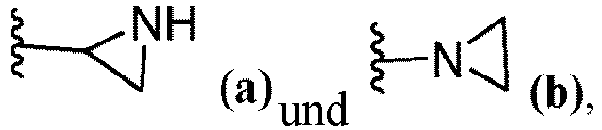 wobei jedes von (a) und (b) gegebenenfalls mit 1, 2, 3 oder 4 Substituenten unabhängig ausgewählt aus der Gruppe bestehend aus Halogen, CN, OH, Amino, C1-3Alkylamino, Di(C1-3alkyl)amino, -C1-3Alkyl, C1-3Alkoxy, C1-3Halogenalkyl und C1-3Halogenalkoxy substituiert ist;p bei jedem Auftreten unabhängig eine ganze Zahl von 0 bis 40 ist;x und y bei jedem Auftreten jeweils unabhängig eine ganze Zahl von 0 bis 10 sind;m eine ganze Zahl von 2 bis 4 ist; undn eine ganze Zahl von 0 bis 4 ist;mit der Maßgabe, dass die Summe von m und n 4 ist.
 - Verfahren gemäß Anspruch 5, wobei:m 3 ist und n 1 ist;x 1 ist und L1 ausgewählt ist aus der Gruppe bestehend aus -C1-6Alkylen-,-C1-6Alkenylen-, -(O-C1-3Alkylen)p- und -(C1-3Alkylen-O-)p-;jedes p eine ganze Zahl von 1 bis 20 ist;R3 ausgewählt ist aus der Gruppe bestehend aus H, -C1-3Alkyl, -OH, -C1-3Alkoxy, -C1-3Halogenalkyl, -C1-3Halogenalkoxy, -(O-C1-3Alkylen)p-H und -(C1-3Alkylen-O-)p-C1-3alkyl;jedes y eine ganze Zahl von 0 bis 5 ist und jedes L2 unabhängig ausgewählt ist aus C1-4Alkylen-, -O-, NH- und -C(=O)-; undjedes R4 ausgewählt ist aus der Gruppe bestehend aus:

- Verfahren gemäß Anspruch 6, wobei der Polyaziridin-Vernetzer eine Verbindung PZ-33 der Formel:

- Verfahren gemäß Anspruch 1, wobei die Menge des Polyaziridin-Vernetzers in der Zusammensetzung in dem Bereich von 0,1 Gew.-% bis 20 Gew.-%, bezogen auf die Menge des Maleinsäureanhydrid-Copolymers, beträgt.
- Verfahren gemäß Anspruch 1, wobei der pH-Wert der Zusammensetzung in einem Bereich von 5 bis 9 liegt.
- Verfahren gemäß Anspruch 1, wobei die Viskosität der Zusammensetzung von 80 mPa∗s (80 cP) bis 120 mPa∗s (120 cP) beträgt.
- Verfahren gemäß Anspruch 1, wobei die kombinierte Menge des Maleinsäureanhydrid-Copolymers und des Polyaziridin-Vernetzers in der Zusammensetzung in einem Bereich von 10 Gew.-% bis 30 Gew.-%, bezogen auf das Gewicht der Zusammensetzung, beträgt.
- Verfahren gemäß Anspruch 1, wobei die Zusammensetzung ferner einen Amin-Vernetzer umfasst, wobei der Amin-Vernetzer ausgewählt ist aus der Gruppe bestehend aus einem Polyamin, einem Polyethylenimin und einer Kombination davon; oder Tetraethylenpentamin (TEPA).
- Verfahren gemäß Anspruch 1, wobei die Zusammensetzung aufweist:i) eine Gelierzeit von weniger als 1,5 Stunden bei 21 °C (70 °F); oderii) eine Gelierzeit von weniger als 3 Stunden bei 4 °C (40 °F).
- Verfahren gemäß Anspruch 1, wobei Bilden des Dichtmittelsi) in der Nähe eines Gehäuses, eines Gehäuse-Gehäuse-Ringraums, eines Rohr-Gehäuse-Ringraums oder eines Gehäuse-Formation-Ringraums erfolgt; oderii) eine Konformitätssteuerung, eine(n) Bohrloch-Stopfen und -Stilllegung oder ein thermisches Bohrlochisolations-Gelsystem umfasst.
- Verfahren gemäß Anspruch 1, wobei das Dichtmittel ein Gelpfropfen ist.
- Verfahren gemäß Anspruch 1, wobei das Vernetzen der Zusammensetzung in Kontakt mit einem abgebundenen Zement erfolgt.
- Verfahren gemäß Anspruch 1, wobei die unterirdische Formation ein Bohrloch umfasst, das eine Zementhülle umfasst, und wobei Bilden des Dichtmittels gegebenenfallsi) in wenigstens einem von: einem Riss in der Zementhülle und einem Mikroringraum erfolgt; oderii) unerwünschten Verlust oder Fluss eines Bohrlochfluids in die unterirdische Formation oder eines Formationsfluids in das Bohrloch verhindert oder verzögert.
- Verfahren gemäß Anspruch 17, wobei das Maleinsäureanhydrid-Copolymer oder ein Salz davon und der Polyaziridin-Vernetzer oder ein Salz davon bis zur Platzierung an einer geeigneten Stelle in dem Bohrloch in einem unvernetzten Zustand bleiben.
- Verfahren gemäß Anspruch 17, wobei das Bereitstellen wenigstens eines voni) Drücken der Zusammensetzung von oben nach unten einen Ringraum hinab; oderii) Einspritzen der Zusammensetzung im Bohrloch umfasst.
- Zusammensetzung zur Behandlung einer unterirdischen Formation, wobei die Zusammensetzung umfasst:
ein Maleinsäureanhydrid-Copolymer, umfassend:Wiederholungseinheiten I und II: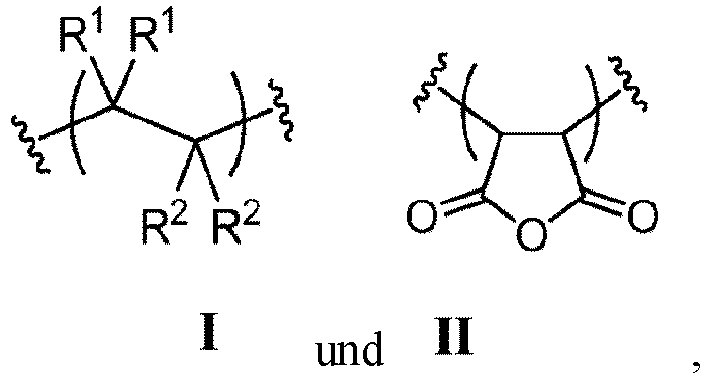 wenigstens eine Wiederholungseinheit ausgewählt aus Wiederholungseinheiten III und IV:
 wobei jedes R5 unabhängig ausgewählt ist aus -OH und NH2,oder ein Salz davon;einen Polyaziridin-Vernetzer, der wenigstens zwei Aziridineinheiten umfasst, oder ein Salz davon; undein Gelierzeit-steuemdes Mittel.
 - Zusammensetzung gemäß Anspruch 20, umfassend ein wässriges Trägerlösungsmittel.
- Zusammensetzung gemäß Anspruch 20, wobei das Gelierzeit-steuernde Mittel Bilden des Gels aus dem Maleinsäureanhydrid-Copolymer und dem Polyaziridin-Vernetzer ohne Vorhandensein eines abgebundenen Zements beschleunigt oder verzögert.
- Zusammensetzung gemäß Anspruch 20, wobei das Gelierzeit-steuernde Mittel ausgewählt ist aus der Gruppe bestehend aus Citronensäure, Trinatriumphosphat und einer Kombination davon.
Applications Claiming Priority (2)
| Application Number | Priority Date | Filing Date | Title |
|---|---|---|---|
| US15/682,836 US9932512B1 (en) | 2017-08-22 | 2017-08-22 | Compositions with polyaziridine crosslinkers for treating subterranean formations |
| PCT/US2018/047260 WO2019040456A1 (en) | 2017-08-22 | 2018-08-21 | COMPOSITIONS CONTAINING POLYAZIRIDINE CROSSLINKING AGENTS FOR THE TREATMENT OF UNDERGROUND FORMATIONS |
Publications (2)
| Publication Number | Publication Date |
|---|---|
| EP3673029A1 EP3673029A1 (de) | 2020-07-01 |
| EP3673029B1 true EP3673029B1 (de) | 2022-04-20 |
Family
ID=61724947
Family Applications (1)
| Application Number | Title | Priority Date | Filing Date |
|---|---|---|---|
| EP18769924.4A Active EP3673029B1 (de) | 2017-08-22 | 2018-08-21 | Zusammensetzungen mit polyaziridinvernetzern zur behandlung unterirdischer formationen |
Country Status (6)
| Country | Link |
|---|---|
| US (2) | US9932512B1 (de) |
| EP (1) | EP3673029B1 (de) |
| CN (1) | CN111194345A (de) |
| CA (1) | CA3073486A1 (de) |
| SA (1) | SA520411332B1 (de) |
| WO (1) | WO2019040456A1 (de) |
Families Citing this family (6)
| Publication number | Priority date | Publication date | Assignee | Title |
|---|---|---|---|---|
| CN109890933B (zh) * | 2016-11-04 | 2022-03-08 | 沙特阿拉伯石油公司 | 控制用于封堵流动通道的补注水性树脂组合物的凝胶时间 |
| EP3535345A1 (de) | 2016-11-04 | 2019-09-11 | Saudi Arabian Oil Company | Zusammensetzungen und verfahren zum abdichten von strömungskanälen in kontakt mit erhärtetem zement |
| US10526458B1 (en) * | 2018-12-18 | 2020-01-07 | Saudi Arabian Oil Company | Gellable, non-aqueous oil well treatment fluids comprising elastomeric maleic anhydride copolymers |
| US11111753B2 (en) | 2019-06-25 | 2021-09-07 | Saudi Arabian Oil Company | Polymer gel compositions for treating aqueous zones in subterranean formations and methods of treating the aqueous zones |
| US11795367B2 (en) | 2020-07-15 | 2023-10-24 | Saudi Arabian Oil Company | Water-based resin with elasticity for applications in cementing and subterranean structures |
| US11708522B1 (en) | 2022-03-08 | 2023-07-25 | Saudi Arabian Oil Company | Water-based hydrogel polymer composition and methods of treating subterranean formations or cement constructions comprising contaminants |
Family Cites Families (17)
| Publication number | Priority date | Publication date | Assignee | Title |
|---|---|---|---|---|
| US4288493A (en) * | 1979-07-16 | 1981-09-08 | Minnesota Mining And Manufacturing Company | Water-activatable crosslinked adhesive and energy control film made therewith |
| JPS59145228A (ja) | 1983-02-08 | 1984-08-20 | C I Kasei Co Ltd | 耐圧縮性をもつ水膨張性ゴムシール材の製造方法 |
| US4605698A (en) | 1983-07-13 | 1986-08-12 | Diamond Shamrock Chemicals Company | Polyfunctional aziridines for use in crosslinking applications |
| DE19616120A1 (de) * | 1996-04-23 | 1997-10-30 | Basf Ag | Verfahren zur Herstellung von feinteiligen wasserunlöslichen Polymerisaten von Aziridinen, modifizierte, wasserunlösliche Polymerisate von Aziridinen und ihre Verwendung |
| US6217432B1 (en) * | 1998-05-19 | 2001-04-17 | 3M Innovative Properties Company | Abrasive article comprising a barrier coating |
| JP2003105254A (ja) | 2001-09-28 | 2003-04-09 | Nippon Nsc Ltd | 水性シーラー組成物 |
| US8377853B2 (en) | 2006-04-20 | 2013-02-19 | M-I L.L.C. | Aqueous gels for well bore strengthening |
| JP4986779B2 (ja) * | 2007-09-13 | 2012-07-25 | 株式会社リコー | 感熱記録材料 |
| WO2010015639A1 (en) | 2008-08-05 | 2010-02-11 | M-I Drilling Fluids Uk Limited | Aziridine crosslinking agents for producing non-aqueous gels and polymer beads for oilfield applications |
| JP5155074B2 (ja) | 2008-09-10 | 2013-02-27 | 三洋化成工業株式会社 | 水性液用ゲル化剤、水性液ゲル及び水性液ゲルの製造方法 |
| GB0917134D0 (en) | 2009-09-30 | 2009-11-11 | M I Drilling Fluids Uk Ltd | Crosslinking agents for producing gels and polymer beads for oilfield applications |
| KR101367710B1 (ko) * | 2011-11-10 | 2014-02-28 | 주식회사 엘지화학 | 하이브리드 에멀션 점착제 |
| US20160215208A1 (en) * | 2013-10-31 | 2016-07-28 | Preferred Technology, Llc | Proppant Solids with Water Absorbent Materials and Methods of Making the Same |
| CN104974738B (zh) * | 2014-04-10 | 2019-05-31 | 中国石油化工股份有限公司 | 一种水基冻胶压裂液及其应用 |
| US20160333260A1 (en) * | 2015-05-13 | 2016-11-17 | Preferred Technology, Llc | Compositions and methods for re-fracturing wells |
| EP3350279B1 (de) * | 2015-09-14 | 2020-04-01 | Saudi Arabian Oil Company | Maleinsäureanhydrid-polymere und verfahren zur behandlung unterirdischer formationen |
| GB2558488B (en) | 2015-10-08 | 2022-02-02 | M I Drilling Fluids Uk Ltd | Self sealing fluids |
-
2017
- 2017-08-22 US US15/682,836 patent/US9932512B1/en active Active
-
2018
- 2018-03-20 US US15/926,200 patent/US10113100B1/en active Active
- 2018-08-21 CA CA3073486A patent/CA3073486A1/en active Pending
- 2018-08-21 EP EP18769924.4A patent/EP3673029B1/de active Active
- 2018-08-21 WO PCT/US2018/047260 patent/WO2019040456A1/en not_active Ceased
- 2018-08-21 CN CN201880065334.3A patent/CN111194345A/zh active Pending
-
2020
- 2020-02-20 SA SA520411332A patent/SA520411332B1/ar unknown
Also Published As
| Publication number | Publication date |
|---|---|
| CA3073486A1 (en) | 2019-02-28 |
| US10113100B1 (en) | 2018-10-30 |
| EP3673029A1 (de) | 2020-07-01 |
| WO2019040456A1 (en) | 2019-02-28 |
| CN111194345A (zh) | 2020-05-22 |
| SA520411332B1 (ar) | 2022-12-04 |
| US9932512B1 (en) | 2018-04-03 |
Similar Documents
| Publication | Publication Date | Title |
|---|---|---|
| EP3673029B1 (de) | Zusammensetzungen mit polyaziridinvernetzern zur behandlung unterirdischer formationen | |
| US10329891B2 (en) | Treating a subterranean formation with a composition having multiple curing stages | |
| AU2012203119B2 (en) | Gellable treatment fluids comprising quaternary ammonium salt gel-time modifiers and methods for use thereof | |
| US20180127557A1 (en) | Water-based sealing compositions with aminosilane crosslinkers | |
| NO20170210A1 (en) | Compatibilized resin-cement composite compositions | |
| AU2014384678A1 (en) | Crosslinker-coated proppant particulates for use in treatment fluids comprising gelling agents | |
| US11674368B2 (en) | Salting out inhibitors for use in treatment fluids | |
| CA2933962C (en) | Methods for improving the distribution of a sealant composition in a wellbore and treatment fluids providing the same | |
| EP3350279B1 (de) | Maleinsäureanhydrid-polymere und verfahren zur behandlung unterirdischer formationen | |
| US10767099B2 (en) | Compositions and methods for sealing off flow channels in contact with wet cement | |
| US11248167B2 (en) | Acid diversion in naturally fractured formations | |
| EP3535343A1 (de) | Steuerung der gelzeiten von heilenden wässrigen harzzusammensetzungen zur abdichtung von strömungskanälen | |
| Elkarsani | Development of a new cost-effective polymer gel for water control in oil and gas wells |
Legal Events
| Date | Code | Title | Description |
|---|---|---|---|
| STAA | Information on the status of an ep patent application or granted ep patent |
Free format text: STATUS: UNKNOWN |
|
| STAA | Information on the status of an ep patent application or granted ep patent |
Free format text: STATUS: THE INTERNATIONAL PUBLICATION HAS BEEN MADE |
|
| PUAI | Public reference made under article 153(3) epc to a published international application that has entered the european phase |
Free format text: ORIGINAL CODE: 0009012 |
|
| STAA | Information on the status of an ep patent application or granted ep patent |
Free format text: STATUS: REQUEST FOR EXAMINATION WAS MADE |
|
| 17P | Request for examination filed |
Effective date: 20200311 |
|
| AK | Designated contracting states |
Kind code of ref document: A1 Designated state(s): AL AT BE BG CH CY CZ DE DK EE ES FI FR GB GR HR HU IE IS IT LI LT LU LV MC MK MT NL NO PL PT RO RS SE SI SK SM TR |
|
| AX | Request for extension of the european patent |
Extension state: BA ME |
|
| DAV | Request for validation of the european patent (deleted) | ||
| DAX | Request for extension of the european patent (deleted) | ||
| GRAP | Despatch of communication of intention to grant a patent |
Free format text: ORIGINAL CODE: EPIDOSNIGR1 |
|
| STAA | Information on the status of an ep patent application or granted ep patent |
Free format text: STATUS: GRANT OF PATENT IS INTENDED |
|
| GRAS | Grant fee paid |
Free format text: ORIGINAL CODE: EPIDOSNIGR3 |
|
| INTG | Intention to grant announced |
Effective date: 20220216 |
|
| GRAA | (expected) grant |
Free format text: ORIGINAL CODE: 0009210 |
|
| STAA | Information on the status of an ep patent application or granted ep patent |
Free format text: STATUS: THE PATENT HAS BEEN GRANTED |
|
| AK | Designated contracting states |
Kind code of ref document: B1 Designated state(s): AL AT BE BG CH CY CZ DE DK EE ES FI FR GB GR HR HU IE IS IT LI LT LU LV MC MK MT NL NO PL PT RO RS SE SI SK SM TR |
|
| REG | Reference to a national code |
Ref country code: GB Ref legal event code: FG4D |
|
| REG | Reference to a national code |
Ref country code: CH Ref legal event code: EP |
|
| REG | Reference to a national code |
Ref country code: DE Ref legal event code: R096 Ref document number: 602018034208 Country of ref document: DE |
|
| REG | Reference to a national code |
Ref country code: IE Ref legal event code: FG4D |
|
| REG | Reference to a national code |
Ref country code: AT Ref legal event code: REF Ref document number: 1485155 Country of ref document: AT Kind code of ref document: T Effective date: 20220515 |
|
| REG | Reference to a national code |
Ref country code: NO Ref legal event code: T2 Effective date: 20220420 |
|
| REG | Reference to a national code |
Ref country code: LT Ref legal event code: MG9D |
|
| REG | Reference to a national code |
Ref country code: NL Ref legal event code: MP Effective date: 20220420 |
|
| REG | Reference to a national code |
Ref country code: AT Ref legal event code: MK05 Ref document number: 1485155 Country of ref document: AT Kind code of ref document: T Effective date: 20220420 |
|
| PG25 | Lapsed in a contracting state [announced via postgrant information from national office to epo] |
Ref country code: NL Free format text: LAPSE BECAUSE OF FAILURE TO SUBMIT A TRANSLATION OF THE DESCRIPTION OR TO PAY THE FEE WITHIN THE PRESCRIBED TIME-LIMIT Effective date: 20220420 |
|
| PG25 | Lapsed in a contracting state [announced via postgrant information from national office to epo] |
Ref country code: SE Free format text: LAPSE BECAUSE OF FAILURE TO SUBMIT A TRANSLATION OF THE DESCRIPTION OR TO PAY THE FEE WITHIN THE PRESCRIBED TIME-LIMIT Effective date: 20220420 Ref country code: PT Free format text: LAPSE BECAUSE OF FAILURE TO SUBMIT A TRANSLATION OF THE DESCRIPTION OR TO PAY THE FEE WITHIN THE PRESCRIBED TIME-LIMIT Effective date: 20220822 Ref country code: LT Free format text: LAPSE BECAUSE OF FAILURE TO SUBMIT A TRANSLATION OF THE DESCRIPTION OR TO PAY THE FEE WITHIN THE PRESCRIBED TIME-LIMIT Effective date: 20220420 Ref country code: HR Free format text: LAPSE BECAUSE OF FAILURE TO SUBMIT A TRANSLATION OF THE DESCRIPTION OR TO PAY THE FEE WITHIN THE PRESCRIBED TIME-LIMIT Effective date: 20220420 Ref country code: GR Free format text: LAPSE BECAUSE OF FAILURE TO SUBMIT A TRANSLATION OF THE DESCRIPTION OR TO PAY THE FEE WITHIN THE PRESCRIBED TIME-LIMIT Effective date: 20220721 Ref country code: FI Free format text: LAPSE BECAUSE OF FAILURE TO SUBMIT A TRANSLATION OF THE DESCRIPTION OR TO PAY THE FEE WITHIN THE PRESCRIBED TIME-LIMIT Effective date: 20220420 Ref country code: ES Free format text: LAPSE BECAUSE OF FAILURE TO SUBMIT A TRANSLATION OF THE DESCRIPTION OR TO PAY THE FEE WITHIN THE PRESCRIBED TIME-LIMIT Effective date: 20220420 Ref country code: BG Free format text: LAPSE BECAUSE OF FAILURE TO SUBMIT A TRANSLATION OF THE DESCRIPTION OR TO PAY THE FEE WITHIN THE PRESCRIBED TIME-LIMIT Effective date: 20220720 Ref country code: AT Free format text: LAPSE BECAUSE OF FAILURE TO SUBMIT A TRANSLATION OF THE DESCRIPTION OR TO PAY THE FEE WITHIN THE PRESCRIBED TIME-LIMIT Effective date: 20220420 |
|
| PG25 | Lapsed in a contracting state [announced via postgrant information from national office to epo] |
Ref country code: RS Free format text: LAPSE BECAUSE OF FAILURE TO SUBMIT A TRANSLATION OF THE DESCRIPTION OR TO PAY THE FEE WITHIN THE PRESCRIBED TIME-LIMIT Effective date: 20220420 Ref country code: PL Free format text: LAPSE BECAUSE OF FAILURE TO SUBMIT A TRANSLATION OF THE DESCRIPTION OR TO PAY THE FEE WITHIN THE PRESCRIBED TIME-LIMIT Effective date: 20220420 Ref country code: LV Free format text: LAPSE BECAUSE OF FAILURE TO SUBMIT A TRANSLATION OF THE DESCRIPTION OR TO PAY THE FEE WITHIN THE PRESCRIBED TIME-LIMIT Effective date: 20220420 Ref country code: IS Free format text: LAPSE BECAUSE OF FAILURE TO SUBMIT A TRANSLATION OF THE DESCRIPTION OR TO PAY THE FEE WITHIN THE PRESCRIBED TIME-LIMIT Effective date: 20220820 |
|
| REG | Reference to a national code |
Ref country code: DE Ref legal event code: R097 Ref document number: 602018034208 Country of ref document: DE |
|
| PG25 | Lapsed in a contracting state [announced via postgrant information from national office to epo] |
Ref country code: SM Free format text: LAPSE BECAUSE OF FAILURE TO SUBMIT A TRANSLATION OF THE DESCRIPTION OR TO PAY THE FEE WITHIN THE PRESCRIBED TIME-LIMIT Effective date: 20220420 Ref country code: SK Free format text: LAPSE BECAUSE OF FAILURE TO SUBMIT A TRANSLATION OF THE DESCRIPTION OR TO PAY THE FEE WITHIN THE PRESCRIBED TIME-LIMIT Effective date: 20220420 Ref country code: RO Free format text: LAPSE BECAUSE OF FAILURE TO SUBMIT A TRANSLATION OF THE DESCRIPTION OR TO PAY THE FEE WITHIN THE PRESCRIBED TIME-LIMIT Effective date: 20220420 Ref country code: EE Free format text: LAPSE BECAUSE OF FAILURE TO SUBMIT A TRANSLATION OF THE DESCRIPTION OR TO PAY THE FEE WITHIN THE PRESCRIBED TIME-LIMIT Effective date: 20220420 Ref country code: DK Free format text: LAPSE BECAUSE OF FAILURE TO SUBMIT A TRANSLATION OF THE DESCRIPTION OR TO PAY THE FEE WITHIN THE PRESCRIBED TIME-LIMIT Effective date: 20220420 Ref country code: CZ Free format text: LAPSE BECAUSE OF FAILURE TO SUBMIT A TRANSLATION OF THE DESCRIPTION OR TO PAY THE FEE WITHIN THE PRESCRIBED TIME-LIMIT Effective date: 20220420 |
|
| PLBE | No opposition filed within time limit |
Free format text: ORIGINAL CODE: 0009261 |
|
| STAA | Information on the status of an ep patent application or granted ep patent |
Free format text: STATUS: NO OPPOSITION FILED WITHIN TIME LIMIT |
|
| REG | Reference to a national code |
Ref country code: DE Ref legal event code: R119 Ref document number: 602018034208 Country of ref document: DE |
|
| 26N | No opposition filed |
Effective date: 20230123 |
|
| PG25 | Lapsed in a contracting state [announced via postgrant information from national office to epo] |
Ref country code: MC Free format text: LAPSE BECAUSE OF FAILURE TO SUBMIT A TRANSLATION OF THE DESCRIPTION OR TO PAY THE FEE WITHIN THE PRESCRIBED TIME-LIMIT Effective date: 20220420 Ref country code: AL Free format text: LAPSE BECAUSE OF FAILURE TO SUBMIT A TRANSLATION OF THE DESCRIPTION OR TO PAY THE FEE WITHIN THE PRESCRIBED TIME-LIMIT Effective date: 20220420 |
|
| REG | Reference to a national code |
Ref country code: CH Ref legal event code: PL |
|
| PG25 | Lapsed in a contracting state [announced via postgrant information from national office to epo] |
Ref country code: LU Free format text: LAPSE BECAUSE OF NON-PAYMENT OF DUE FEES Effective date: 20220821 Ref country code: LI Free format text: LAPSE BECAUSE OF NON-PAYMENT OF DUE FEES Effective date: 20220831 Ref country code: CH Free format text: LAPSE BECAUSE OF NON-PAYMENT OF DUE FEES Effective date: 20220831 |
|
| REG | Reference to a national code |
Ref country code: BE Ref legal event code: MM Effective date: 20220831 |
|
| PG25 | Lapsed in a contracting state [announced via postgrant information from national office to epo] |
Ref country code: SI Free format text: LAPSE BECAUSE OF FAILURE TO SUBMIT A TRANSLATION OF THE DESCRIPTION OR TO PAY THE FEE WITHIN THE PRESCRIBED TIME-LIMIT Effective date: 20220420 |
|
| P01 | Opt-out of the competence of the unified patent court (upc) registered |
Effective date: 20230528 |
|
| PG25 | Lapsed in a contracting state [announced via postgrant information from national office to epo] |
Ref country code: IE Free format text: LAPSE BECAUSE OF NON-PAYMENT OF DUE FEES Effective date: 20220821 Ref country code: FR Free format text: LAPSE BECAUSE OF NON-PAYMENT OF DUE FEES Effective date: 20220831 Ref country code: DE Free format text: LAPSE BECAUSE OF NON-PAYMENT OF DUE FEES Effective date: 20230301 |
|
| PG25 | Lapsed in a contracting state [announced via postgrant information from national office to epo] |
Ref country code: BE Free format text: LAPSE BECAUSE OF NON-PAYMENT OF DUE FEES Effective date: 20220831 |
|
| PG25 | Lapsed in a contracting state [announced via postgrant information from national office to epo] |
Ref country code: IT Free format text: LAPSE BECAUSE OF FAILURE TO SUBMIT A TRANSLATION OF THE DESCRIPTION OR TO PAY THE FEE WITHIN THE PRESCRIBED TIME-LIMIT Effective date: 20220420 |
|
| PG25 | Lapsed in a contracting state [announced via postgrant information from national office to epo] |
Ref country code: CY Free format text: LAPSE BECAUSE OF FAILURE TO SUBMIT A TRANSLATION OF THE DESCRIPTION OR TO PAY THE FEE WITHIN THE PRESCRIBED TIME-LIMIT Effective date: 20220420 |
|
| PG25 | Lapsed in a contracting state [announced via postgrant information from national office to epo] |
Ref country code: MK Free format text: LAPSE BECAUSE OF FAILURE TO SUBMIT A TRANSLATION OF THE DESCRIPTION OR TO PAY THE FEE WITHIN THE PRESCRIBED TIME-LIMIT Effective date: 20220420 Ref country code: HU Free format text: LAPSE BECAUSE OF FAILURE TO SUBMIT A TRANSLATION OF THE DESCRIPTION OR TO PAY THE FEE WITHIN THE PRESCRIBED TIME-LIMIT; INVALID AB INITIO Effective date: 20180821 |
|
| PG25 | Lapsed in a contracting state [announced via postgrant information from national office to epo] |
Ref country code: TR Free format text: LAPSE BECAUSE OF FAILURE TO SUBMIT A TRANSLATION OF THE DESCRIPTION OR TO PAY THE FEE WITHIN THE PRESCRIBED TIME-LIMIT Effective date: 20220420 |
|
| PG25 | Lapsed in a contracting state [announced via postgrant information from national office to epo] |
Ref country code: MT Free format text: LAPSE BECAUSE OF FAILURE TO SUBMIT A TRANSLATION OF THE DESCRIPTION OR TO PAY THE FEE WITHIN THE PRESCRIBED TIME-LIMIT Effective date: 20220420 |
|
| PG25 | Lapsed in a contracting state [announced via postgrant information from national office to epo] |
Ref country code: BG Free format text: LAPSE BECAUSE OF FAILURE TO SUBMIT A TRANSLATION OF THE DESCRIPTION OR TO PAY THE FEE WITHIN THE PRESCRIBED TIME-LIMIT Effective date: 20220420 |
|
| PG25 | Lapsed in a contracting state [announced via postgrant information from national office to epo] |
Ref country code: BG Free format text: LAPSE BECAUSE OF FAILURE TO SUBMIT A TRANSLATION OF THE DESCRIPTION OR TO PAY THE FEE WITHIN THE PRESCRIBED TIME-LIMIT Effective date: 20220420 |
|
| PGFP | Annual fee paid to national office [announced via postgrant information from national office to epo] |
Ref country code: NO Payment date: 20250827 Year of fee payment: 8 |
|
| PGFP | Annual fee paid to national office [announced via postgrant information from national office to epo] |
Ref country code: GB Payment date: 20250821 Year of fee payment: 8 |