EP3671187B1 - Photonischer sensorchip, verpackte photonische sensorvorrichtung und anordnung - Google Patents
Photonischer sensorchip, verpackte photonische sensorvorrichtung und anordnung Download PDFInfo
- Publication number
- EP3671187B1 EP3671187B1 EP19218716.9A EP19218716A EP3671187B1 EP 3671187 B1 EP3671187 B1 EP 3671187B1 EP 19218716 A EP19218716 A EP 19218716A EP 3671187 B1 EP3671187 B1 EP 3671187B1
- Authority
- EP
- European Patent Office
- Prior art keywords
- photonic
- sensor chip
- active
- photonic sensor
- waveguide
- Prior art date
- Legal status (The legal status is an assumption and is not a legal conclusion. Google has not performed a legal analysis and makes no representation as to the accuracy of the status listed.)
- Active
Links
Images





Classifications
-
- G—PHYSICS
- G02—OPTICS
- G02B—OPTICAL ELEMENTS, SYSTEMS OR APPARATUS
- G02B6/00—Light guides; Structural details of arrangements comprising light guides and other optical elements, e.g. couplings
- G02B6/10—Light guides; Structural details of arrangements comprising light guides and other optical elements, e.g. couplings of the optical waveguide type
- G02B6/12—Light guides; Structural details of arrangements comprising light guides and other optical elements, e.g. couplings of the optical waveguide type of the integrated circuit kind
- G02B6/122—Basic optical elements, e.g. light-guiding paths
- G02B6/1225—Basic optical elements, e.g. light-guiding paths comprising photonic band-gap structures or photonic lattices
-
- G—PHYSICS
- G01—MEASURING; TESTING
- G01N—INVESTIGATING OR ANALYSING MATERIALS BY DETERMINING THEIR CHEMICAL OR PHYSICAL PROPERTIES
- G01N15/00—Investigating characteristics of particles; Investigating permeability, pore-volume or surface-area of porous materials
- G01N15/10—Investigating individual particles
- G01N15/14—Optical investigation techniques, e.g. flow cytometry
- G01N15/1456—Optical investigation techniques, e.g. flow cytometry without spatial resolution of the texture or inner structure of the particle, e.g. processing of pulse signals
-
- G—PHYSICS
- G01—MEASURING; TESTING
- G01N—INVESTIGATING OR ANALYSING MATERIALS BY DETERMINING THEIR CHEMICAL OR PHYSICAL PROPERTIES
- G01N15/00—Investigating characteristics of particles; Investigating permeability, pore-volume or surface-area of porous materials
- G01N15/10—Investigating individual particles
- G01N15/14—Optical investigation techniques, e.g. flow cytometry
- G01N15/1484—Optical investigation techniques, e.g. flow cytometry microstructural devices
-
- G—PHYSICS
- G01—MEASURING; TESTING
- G01N—INVESTIGATING OR ANALYSING MATERIALS BY DETERMINING THEIR CHEMICAL OR PHYSICAL PROPERTIES
- G01N21/00—Investigating or analysing materials by the use of optical means, i.e. using sub-millimetre waves, infrared, visible or ultraviolet light
- G01N21/17—Systems in which incident light is modified in accordance with the properties of the material investigated
- G01N21/55—Specular reflectivity
- G01N21/552—Attenuated total reflection
- G01N21/553—Attenuated total reflection and using surface plasmons
-
- G—PHYSICS
- G01—MEASURING; TESTING
- G01N—INVESTIGATING OR ANALYSING MATERIALS BY DETERMINING THEIR CHEMICAL OR PHYSICAL PROPERTIES
- G01N21/00—Investigating or analysing materials by the use of optical means, i.e. using sub-millimetre waves, infrared, visible or ultraviolet light
- G01N21/75—Systems in which material is subjected to a chemical reaction, the progress or the result of the reaction being investigated
- G01N21/77—Systems in which material is subjected to a chemical reaction, the progress or the result of the reaction being investigated by observing the effect on a chemical indicator
- G01N21/7703—Systems in which material is subjected to a chemical reaction, the progress or the result of the reaction being investigated by observing the effect on a chemical indicator using reagent-clad optical fibres or optical waveguides
-
- G—PHYSICS
- G01—MEASURING; TESTING
- G01N—INVESTIGATING OR ANALYSING MATERIALS BY DETERMINING THEIR CHEMICAL OR PHYSICAL PROPERTIES
- G01N31/00—Investigating or analysing non-biological materials by the use of the chemical methods specified in the subgroup; Apparatus specially adapted for such methods
- G01N31/22—Investigating or analysing non-biological materials by the use of the chemical methods specified in the subgroup; Apparatus specially adapted for such methods using chemical indicators
- G01N31/223—Investigating or analysing non-biological materials by the use of the chemical methods specified in the subgroup; Apparatus specially adapted for such methods using chemical indicators for investigating presence of specific gases or aerosols
-
- G—PHYSICS
- G01—MEASURING; TESTING
- G01N—INVESTIGATING OR ANALYSING MATERIALS BY DETERMINING THEIR CHEMICAL OR PHYSICAL PROPERTIES
- G01N33/00—Investigating or analysing materials by specific methods not covered by groups G01N1/00 - G01N31/00
- G01N33/02—Food
- G01N33/04—Dairy products
-
- G—PHYSICS
- G01—MEASURING; TESTING
- G01N—INVESTIGATING OR ANALYSING MATERIALS BY DETERMINING THEIR CHEMICAL OR PHYSICAL PROPERTIES
- G01N33/00—Investigating or analysing materials by specific methods not covered by groups G01N1/00 - G01N31/00
- G01N33/48—Biological material, e.g. blood, urine; Haemocytometers
- G01N33/50—Chemical analysis of biological material, e.g. blood, urine; Testing involving biospecific ligand binding methods; Immunological testing
- G01N33/53—Immunoassay; Biospecific binding assay; Materials therefor
- G01N33/543—Immunoassay; Biospecific binding assay; Materials therefor with an insoluble carrier for immobilising immunochemicals
- G01N33/54366—Apparatus specially adapted for solid-phase testing
- G01N33/54373—Apparatus specially adapted for solid-phase testing involving physiochemical end-point determination, e.g. wave-guides, FETS, gratings
-
- G—PHYSICS
- G02—OPTICS
- G02B—OPTICAL ELEMENTS, SYSTEMS OR APPARATUS
- G02B6/00—Light guides; Structural details of arrangements comprising light guides and other optical elements, e.g. couplings
- G02B6/10—Light guides; Structural details of arrangements comprising light guides and other optical elements, e.g. couplings of the optical waveguide type
- G02B6/12—Light guides; Structural details of arrangements comprising light guides and other optical elements, e.g. couplings of the optical waveguide type of the integrated circuit kind
- G02B6/12004—Combinations of two or more optical elements
-
- B—PERFORMING OPERATIONS; TRANSPORTING
- B01—PHYSICAL OR CHEMICAL PROCESSES OR APPARATUS IN GENERAL
- B01L—CHEMICAL OR PHYSICAL LABORATORY APPARATUS FOR GENERAL USE
- B01L2300/00—Additional constructional details
- B01L2300/08—Geometry, shape and general structure
- B01L2300/0861—Configuration of multiple channels and/or chambers in a single devices
- B01L2300/0877—Flow chambers
-
- B—PERFORMING OPERATIONS; TRANSPORTING
- B01—PHYSICAL OR CHEMICAL PROCESSES OR APPARATUS IN GENERAL
- B01L—CHEMICAL OR PHYSICAL LABORATORY APPARATUS FOR GENERAL USE
- B01L2300/00—Additional constructional details
- B01L2300/08—Geometry, shape and general structure
- B01L2300/0887—Laminated structure
-
- G—PHYSICS
- G01—MEASURING; TESTING
- G01N—INVESTIGATING OR ANALYSING MATERIALS BY DETERMINING THEIR CHEMICAL OR PHYSICAL PROPERTIES
- G01N15/00—Investigating characteristics of particles; Investigating permeability, pore-volume or surface-area of porous materials
- G01N15/10—Investigating individual particles
- G01N2015/1006—Investigating individual particles for cytology
-
- G—PHYSICS
- G01—MEASURING; TESTING
- G01N—INVESTIGATING OR ANALYSING MATERIALS BY DETERMINING THEIR CHEMICAL OR PHYSICAL PROPERTIES
- G01N15/00—Investigating characteristics of particles; Investigating permeability, pore-volume or surface-area of porous materials
- G01N15/10—Investigating individual particles
- G01N15/14—Optical investigation techniques, e.g. flow cytometry
- G01N15/1434—Optical arrangements
- G01N2015/1438—Using two lasers in succession
-
- G—PHYSICS
- G01—MEASURING; TESTING
- G01N—INVESTIGATING OR ANALYSING MATERIALS BY DETERMINING THEIR CHEMICAL OR PHYSICAL PROPERTIES
- G01N21/00—Investigating or analysing materials by the use of optical means, i.e. using sub-millimetre waves, infrared, visible or ultraviolet light
- G01N21/75—Systems in which material is subjected to a chemical reaction, the progress or the result of the reaction being investigated
- G01N21/77—Systems in which material is subjected to a chemical reaction, the progress or the result of the reaction being investigated by observing the effect on a chemical indicator
- G01N2021/7756—Sensor type
- G01N2021/7763—Sample through flow
-
- G—PHYSICS
- G01—MEASURING; TESTING
- G01N—INVESTIGATING OR ANALYSING MATERIALS BY DETERMINING THEIR CHEMICAL OR PHYSICAL PROPERTIES
- G01N21/00—Investigating or analysing materials by the use of optical means, i.e. using sub-millimetre waves, infrared, visible or ultraviolet light
- G01N21/17—Systems in which incident light is modified in accordance with the properties of the material investigated
- G01N21/25—Colour; Spectral properties, i.e. comparison of effect of material on the light at two or more different wavelengths or wavelength bands
- G01N21/251—Colorimeters; Construction thereof
- G01N21/253—Colorimeters; Construction thereof for batch operation, i.e. multisample apparatus
-
- G—PHYSICS
- G01—MEASURING; TESTING
- G01N—INVESTIGATING OR ANALYSING MATERIALS BY DETERMINING THEIR CHEMICAL OR PHYSICAL PROPERTIES
- G01N21/00—Investigating or analysing materials by the use of optical means, i.e. using sub-millimetre waves, infrared, visible or ultraviolet light
- G01N21/75—Systems in which material is subjected to a chemical reaction, the progress or the result of the reaction being investigated
- G01N21/77—Systems in which material is subjected to a chemical reaction, the progress or the result of the reaction being investigated by observing the effect on a chemical indicator
- G01N21/7703—Systems in which material is subjected to a chemical reaction, the progress or the result of the reaction being investigated by observing the effect on a chemical indicator using reagent-clad optical fibres or optical waveguides
- G01N21/7746—Systems in which material is subjected to a chemical reaction, the progress or the result of the reaction being investigated by observing the effect on a chemical indicator using reagent-clad optical fibres or optical waveguides the waveguide coupled to a cavity resonator
-
- G—PHYSICS
- G01—MEASURING; TESTING
- G01N—INVESTIGATING OR ANALYSING MATERIALS BY DETERMINING THEIR CHEMICAL OR PHYSICAL PROPERTIES
- G01N2201/00—Features of devices classified in G01N21/00
- G01N2201/02—Mechanical
- G01N2201/022—Casings
- G01N2201/0221—Portable; cableless; compact; hand-held
-
- G—PHYSICS
- G01—MEASURING; TESTING
- G01N—INVESTIGATING OR ANALYSING MATERIALS BY DETERMINING THEIR CHEMICAL OR PHYSICAL PROPERTIES
- G01N33/00—Investigating or analysing materials by specific methods not covered by groups G01N1/00 - G01N31/00
- G01N33/02—Food
- G01N33/025—Fruits or vegetables
-
- G—PHYSICS
- G01—MEASURING; TESTING
- G01N—INVESTIGATING OR ANALYSING MATERIALS BY DETERMINING THEIR CHEMICAL OR PHYSICAL PROPERTIES
- G01N33/00—Investigating or analysing materials by specific methods not covered by groups G01N1/00 - G01N31/00
- G01N33/02—Food
- G01N33/12—Meat; Fish
-
- G—PHYSICS
- G02—OPTICS
- G02B—OPTICAL ELEMENTS, SYSTEMS OR APPARATUS
- G02B6/00—Light guides; Structural details of arrangements comprising light guides and other optical elements, e.g. couplings
- G02B6/10—Light guides; Structural details of arrangements comprising light guides and other optical elements, e.g. couplings of the optical waveguide type
- G02B6/12—Light guides; Structural details of arrangements comprising light guides and other optical elements, e.g. couplings of the optical waveguide type of the integrated circuit kind
- G02B2006/12035—Materials
- G02B2006/12061—Silicon
-
- G—PHYSICS
- G02—OPTICS
- G02B—OPTICAL ELEMENTS, SYSTEMS OR APPARATUS
- G02B6/00—Light guides; Structural details of arrangements comprising light guides and other optical elements, e.g. couplings
- G02B6/10—Light guides; Structural details of arrangements comprising light guides and other optical elements, e.g. couplings of the optical waveguide type
- G02B6/12—Light guides; Structural details of arrangements comprising light guides and other optical elements, e.g. couplings of the optical waveguide type of the integrated circuit kind
- G02B2006/12083—Constructional arrangements
- G02B2006/121—Channel; buried or the like
-
- G—PHYSICS
- G02—OPTICS
- G02B—OPTICAL ELEMENTS, SYSTEMS OR APPARATUS
- G02B6/00—Light guides; Structural details of arrangements comprising light guides and other optical elements, e.g. couplings
- G02B6/10—Light guides; Structural details of arrangements comprising light guides and other optical elements, e.g. couplings of the optical waveguide type
- G02B6/12—Light guides; Structural details of arrangements comprising light guides and other optical elements, e.g. couplings of the optical waveguide type of the integrated circuit kind
- G02B2006/12133—Functions
-
- G—PHYSICS
- G02—OPTICS
- G02B—OPTICAL ELEMENTS, SYSTEMS OR APPARATUS
- G02B6/00—Light guides; Structural details of arrangements comprising light guides and other optical elements, e.g. couplings
- G02B6/10—Light guides; Structural details of arrangements comprising light guides and other optical elements, e.g. couplings of the optical waveguide type
- G02B6/12—Light guides; Structural details of arrangements comprising light guides and other optical elements, e.g. couplings of the optical waveguide type of the integrated circuit kind
- G02B2006/12133—Functions
- G02B2006/12138—Sensor
-
- G—PHYSICS
- G02—OPTICS
- G02B—OPTICAL ELEMENTS, SYSTEMS OR APPARATUS
- G02B6/00—Light guides; Structural details of arrangements comprising light guides and other optical elements, e.g. couplings
- G02B6/10—Light guides; Structural details of arrangements comprising light guides and other optical elements, e.g. couplings of the optical waveguide type
- G02B6/12—Light guides; Structural details of arrangements comprising light guides and other optical elements, e.g. couplings of the optical waveguide type of the integrated circuit kind
- G02B6/12007—Light guides; Structural details of arrangements comprising light guides and other optical elements, e.g. couplings of the optical waveguide type of the integrated circuit kind forming wavelength selective elements, e.g. multiplexer, demultiplexer
- G02B6/12009—Light guides; Structural details of arrangements comprising light guides and other optical elements, e.g. couplings of the optical waveguide type of the integrated circuit kind forming wavelength selective elements, e.g. multiplexer, demultiplexer comprising arrayed waveguide grating [AWG] devices, i.e. with a phased array of waveguides
- G02B6/12019—Light guides; Structural details of arrangements comprising light guides and other optical elements, e.g. couplings of the optical waveguide type of the integrated circuit kind forming wavelength selective elements, e.g. multiplexer, demultiplexer comprising arrayed waveguide grating [AWG] devices, i.e. with a phased array of waveguides characterised by the optical interconnection to or from the AWG devices, e.g. integration or coupling with lasers or photodiodes
- G02B6/12021—Comprising cascaded AWG devices; AWG multipass configuration; Plural AWG devices integrated on a single chip
Definitions
- the present invention relates to a photonic sensor chip, to a packaged photonic sensor device and to a photonic sensor arrangement.
- Photonic sensors have contributed to major advances in food diagnostics, environmental monitoring, veterinary diagnostics and medical technology through rapid and accurate analysis of a wide range of particles in a fluid or a gas.
- great progress has been made in recent years in photonic sensor technology for bioanalytics.
- SPR Surface plasmon resonance
- This technology is quite expensive in terms of equipment and total costs regarding chips and service, and known sensors based on SPR are rather bulky.
- US 2015/0125111 A1 discloses a process for integrating an optical waveguide into a CMOS integrated circuit using conventional in-foundry processes and minimal post-foundry processing.
- the process comprises that a silicon diffusion region and silicon ridges are etched away to form a recess in a silicon substrate.
- a waveguide core material such as a dielectric with a refractive index higher than that of the dielectric layer, is deposited within the recess.
- a photonic sensor chip according to claim 1 is provided.
- the photonic sensor chip comprises:
- the photonic sensor chip includes at least one cavity extending from the back side through an entire depth of the semiconductor substrate.
- the cavity provides access to the active surface of the photonic particle sensor element from the back side of the semiconductor substrate.
- the photonic particle sensor element despite the arrangement of the photonic particle sensor element on the front side of the semiconductor substrate, it has an active-surface element for capturing particles that is exposed for access from the back side of the semiconductor substrate.
- particles to be detected by the photonic particle sensor include, depending on a particular application purpose of a given embodiment, toxins, bacteria, viruses, allergens, antibiotics, hormones and other particles such as molecules.
- the photonic sensor chip allows, by means of its structure, fabricating the photonic particle sensor element independent from the constraints of device structure fabrication on the front side of the semiconductor substrate.
- the active surface of the active-surface element facing towards the back side of the semiconductor substrate and configured for capturing selected particles can be fabricated after fabrication of any front side structures.
- fabrication steps required for forming the active-surface element can be performed separately from fabrication processes for manufacturing the photonic plane on the front side of the semiconductor substrate. This allows using materials in the fabrication of the active-surface element that are not compatible with standard front-end-of-line (FEOL) technology such as NMOS, PMOS, CMOS or BiCMOS, whereas the photonic plane on the front side of the semiconductor substrate can be fabricated using such highly developed and cost-efficient FEOL technology.
- FEOL front-end-of-line
- the structure of the photonic sensor chip makes sure that, in operation, a fluid or gas which transports particles to be detected will not get in contact with the front side of the semiconductor substrate.
- potential exposure of the photonic sensor chip to a fluid or gas or to chemical reactions is restricted to the back side of the semiconductor substrate.
- This allows including integrated microelectronic components and complete electronic circuits on the front side of the photonic sensor chip, which will be described further below in more detail in the context of preferred embodiments. Therefore, the proposed photonic sensor chip is advantageously suited for integration in known semiconductor photonics concepts, including for instance complex device structures with integrated photonic, electro-optical, optoelectronic and electronic components on different levels.
- the photonic particle sensor element comprises a waveguide arranged in the photonic plane for guiding the optical input wave to the active-surface element and for guiding the resulting optical output wave from the active-surface element to a light detector of the photonic particle sensor element.
- the waveguide guides the optical input wave in a defined manner to the active-surface element, and guides the resulting optical output wave to a light detector of the photonic particle sensor element.
- the photonic sensor chip further comprises an electrically drivable phase shifter element.
- the phase shifter element is configured to set and maintain a predetermined phase shift to be effected by the active-surface element alone, i.e., without influence by particles to be detected.
- the photonic sensor chip is able to adapt the phase shift in order to improve the desired signal, i.e. desired information provided by the active-surface element with the optical output wave.
- a signal-to-noise ratio of the optical output wave can be increased to improve the detectability of interaction between the optical input wave and the particles captured by the active-surface element.
- the photonic sensor chip further comprises a control unit.
- the control unit receives the output signal of the light detector and is configured to drive the operation of the photonic particle sensor element on the photonic sensor chip.
- the control unit is configured to drive operation of the phase shifter element in dependence on the received output signal, in order to set and maintain a predetermined phase shift effected by the active-surface element alone.
- the light detector receives a signal indicative of a phase shift with respect to a stabilized reference phase.
- a stabilized intensity is achieved, and an intensity change is reliably attributable to a useful signal.
- the photonic particle sensor element includes a photonic resonator, or interferometer structure, preferably in integrated form within the photonic sensor chip.
- the photonic particle sensor element is configured to exhibit a change of a resonance condition of the photonic resonator or interferomenter structure, for instance in the form of a change of an optical resonance wavelength, in dependence on a type of particle captured.
- the light amount at the output of the photonic resonator or interferometer structure and detected by the light detector thus depends on the phase shift effected in presence of the captured particles and exhibits a resonance peak or resonance dip.
- the change of the resonance condition thus forms a "finger print" of a given type of captured particle.
- the resonance condition of the photonic particle sensor element can be changed by the phase shifter element as a result of the operation of the control unit.
- a control of the resonance condition is achieved in that the optical resonance of the photonic particle sensor element can be shifted.
- Such resonance control allows using a cost-effective monochromatic light source. Further, fabrication tolerances can change the resonance conditions that can be compensated by the phase shifter.
- the control unit is configured to control a shift of the optical resonance of the photonic particle sensor element such that the optical input wave received by the photonic particle sensor element lies on a resonance flank in absence of any captured particle.
- Captured particles thus cause either an increase or decrease of the light amount detected by the light detector, in dependence on a positive or negative phase shift effected by the particles.
- the resonance peak is used as the reference phase in absence of captured particles. In this alternative, captured particles always cause the same sign or direction of change of the light amount, irrespective of the sign of the phase shift effected by the captured particles.
- Suitable electrically drivable phase shifter elements are an electrically drivable heating element embedded in the electrical interconnect stack, or an electrically drivable doped waveguide.
- the heating element or the doped waveguide is suitably connected via the electrical interconnects.
- the heating element is preferably a resistance heater formed in the first metal layer of the interconnect stack in a lateral region coinciding or overlapping with that of the waveguide.
- the heating element changes the resonance condition of the photonic particle sensor element via the thermo-optical effect.
- the control unit receives a feedback signal from the light detector. This is particularly useful in embodiments providing resonance control.
- the feedback signal can be used in a tuning process for tuning the phase shift effected by the phase shifter element in controlling the resonance condition of the optical resonance of the photonic particle sensor element to a desired spectral position.
- the waveguide is doped in pn- or pin-diode configuration.
- the doped waveguide shifts the resonant condition of the photonic particle sensor element via changes in charge carrier density.
- the phase shifter element comprises both, a heating element and a doped waveguide.
- the heating element is used, beside resonance calibration, for optimum adjustment of temperature during the measuring process, in particular where a binding affinity of biomolecules is temperature dependent.
- the photonic sensor chip further comprises a data acquisition unit configured to sample an output signal of the light detector.
- the photonic sensor chip of this embodiment is advantageous due to its compact design.
- an electrical interconnect stack is preferably arranged on top of the photonic plane and comprises electrical interconnects for conducting electrical operating power and to conduct electronic signals to and from the control unit and the data acquisition unit.
- the electrical interconnect stack typically comprises the electrical interconnects on different metal planes which are separated from each other by a respective dielectric material layer and conductive vias, for conducting electrical operating power, and for conducting electronic signals to and from the control unit and the data acquisition unit.
- Such lab-on-a-chip design allows fabrication of particularly small and cost-effective solutions suitable for flexible application of the photonic sensor chip, e.g., in on-site diagnostics, for instance in dairy farming or mobile blood diagnostic equipment.
- a microfluidic substrate is connected to the back side of the semiconductor substrate and comprises at least one microfluidic channel connecting an inlet for the fluid and an outlet for the fluid with the cavity.
- the connection of the microfluidic substrate on the back side of the semiconductor substrate according to the present embodiment is simpler in comparison to providing the microfluidics on the front side of the semiconductor substrate for access to the photonic particle sensor element.
- the microfluidic substrate is made of a plastic, glass, quartz or a semiconductor, enabling an application-specific material selection for the microfluidic substrate.
- the connection of the microfluidic substrate to the semiconductor substrate can be realized by wafer bonding for many of the materials mentioned. Wafer bonding is a well-known and reliable technique. The ability to use a wafer bonding technique thus forms an additional advantage of the of the structure of the photonic sensor chip which substantially simplifies the fabrication process.
- the semiconductor substrate is a silicon substrate, which for instance is formed from an industry-standard silicon wafer.
- the waveguide in the photonic plane is arranged on a local island-like silicon-on-insulator (SOI) structure that is embedded in the bulk of the silicon substrate. This allows flexibly combining the advantages of using an SOI substrate for the photonic components and of using a silicon substrate surface for the microelectronic components and electrical connection lines.
- SOI silicon-on-insulator
- the active-surface element comprises a waveguide section of the waveguide.
- the waveguide section comprises at least one functionalized surface section configured for capturing the selected particles by selective interaction, and has an optical path length that depends on an amount of particles captured by the active surface.
- the waveguide section in some of these embodiments, has a ring resonator geometry.
- the waveguide section is a ring assisted Mach-Zehnder interferometer or a Fabry-Perot resonator with photonic crystals. All of these waveguide sections have the similarity that they provide an optical signal conveying the information on detected particles in a manner that is suitable for converting into an electrical signal by the light detector.
- the photonic particle sensor element comprises a plurality of active-surface elements optically arranged in a series connection and upstream of the light detector.
- Such arrangement of active-surface elements optically arranged in a series connection allows to increase the signal-to-noise ratio of the resulting optical output wave to be transformed into a corresponding electrical signal by the light detector.
- the waveguide is a strip waveguide, a slot waveguide, a rib waveguide or a strip-loaded slot waveguide on top of an insulating material layer.
- the photonic sensor chip comprises a plurality of photonic particle sensor element arranged in parallel.
- a plurality of active-surface elements or respective series of identical active-surface elements
- Such a parallel arrangements of photonic particle sensor elements enables the detection of different selected particles in parallel.
- the functionalized surface section of the waveguide section different functionalization methods are possible.
- the functionalized surface section is functionalized chemically.
- specific antibodies or ligands are covalently bonded to the surface of the waveguide section that forms the active surface element, resulting in a functionalized surface section.
- the functionalized surface section is functionalized physically.
- the surface of the waveguide section forming the active-surface element has a roughness suitable for capturing particles. The roughness can be established in the fabrication process by physical treatment of the active-surface element, e.g., by ion bombardment.
- a highly reflective metal e.g. gold
- This layer stack is suitable for application in a surface plasmon resonance spectroscopy technique. It is a further advantage of the photonic sensor chip of the present invention that such intermediate layer of gold can be deployed, even if industry standard fabrication processes are used for front side fabrication. Gold is a material that must not be used in standard FEOL processing.
- the waveguide is substantially made of silicon nitride, silicon oxynitride or germanium.
- silicon either polysilicon or amorphous silicon can be used, depending on the requirements of the given application case.
- waveguides made of crystalline silicon are used.
- the photonic sensor chip comprises at least one light source, e.g., a vertical-cavity surface-emitting laser source or a light-emitting diode, connected to the waveguide and configured to generate and emit the optical input wave.
- the light source is arranged in the photonic plane.
- the light source is arranged in the interconnect stack or on top of the interconnect stack.
- the light source is attached to the photonic sensor chip by a bonding technique, for example, via die-to wafer or wafer-to-wafer bonding.
- a packaged photonic sensor device comprises:
- the photonic sensor chip can be arranged on a carrier and packaged by state of the art solutions, including a hole for providing access to the active-surface element of the particle sensor element of the photonic sensor chip.
- a photonic sensor arrangement comprises:
- the optical input wave is coupled into the photonic plane of the photonic sensor chip, for instance, by an optical fiber.
- the optical input wave is coupled into the photonic plane of the photonic sensor chip by a free-steel optic using a suitable lens.
- the package of the photonic sensor device must take the respective coupling of light into account.
- This embodiment allows an immediate verification of the analysed particles. For example, a cross-check of allergens or germ content in food.
- a cross-check of allergens or germ content in food is used for quality assurance in food industry.
- such photonic sensor arrangement is used in medicine diagnostic, e.g. for analysing blood composition.
- the presence of toxins in ambient atmosphere can be detected.
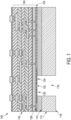
- Fig. 1 shows a schematic cross-sectional view of an embodiment of a photonic sensor chip 100.
- the photonic sensor chip 100 comprises a semiconductor substrate 112 having a front side 114 and a back side 116.
- the photonic sensor chip 100 includes a cavity 118 extending from the back side 116 through an entire depth of the semiconductor substrate 112, which is for example a silicon substrate.
- the cavity 118 provides access to the active surface of the photonic particle sensor element 120 from the back side 116 of the semiconductor substrate 112.
- a photonic particle sensor element 120 is arranged on the front side 114 of the semiconductor substrate in a photonic plane 124.
- the photonic particle sensor element 120 comprises an active-surface element 122 for capturing particles that is exposed for access from the back side 116 of the semiconductor substrate 100.
- the active-surface element 122 comprises a waveguide section 134 of a waveguide, which waveguide serves for guiding an optical input wave in a defined manner to the active-surface element 122, and further for guiding a resulting optical output wave to a light detector (not shown here), which is in this example a photodiode, of the photonic particle sensor element.
- the waveguide is embedded in oxide layers.
- the electrical interconnect stack 130 comprises electrical interconnects 132 for conducting electrical operating power to the electro-optical and electronic components, including the light detector, and to conduct electronic signals to and from the electro-optical and electronic components to their respective destinations on chip or to an interface to external circuits.
- the opto-electronic and electronic components are fabricated using known front-end-of-line (FEOL) such as NMOS, PMOS, CMOS or BiCMOS, or a photodiode as light detector and the interconnect stack 132 can be fabricated using standard back-end-of-line (BEOL) technologies.
- FEOL front-end-of-line
- BEOL back-end-of-line
- the electronic components 126 can for instance form a circuit section or a complete circuit of a control unit, a data acquisition unit or other electrical circuitry.
- the shown photonic sensor chip 100 makes sure that, in operation, a fluid or gas which transports particles to be detected at the active-surface element 122 in the cavity 118 will not get in contact with the front side 114 of the semiconductor substrate 112.
- the measuring solution is applied directly to the sensor surface as a drop.
- potential exposure of the photonic sensor chip 100 to a fluid or gas or to chemical reactions is restricted to the back side 116 of the semiconductor substrate 112.
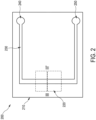
- Figs. 2 and 3 show two schematic views of another embodiment of a photonic sensor chip 200 that includes a microfluidic substrate 210.
- the photonic sensor chip 200 of the present embodiment comprises a photonic sensor core 220, which in the present example is a photonic sensor chip 100 as shown and explained in the context of the description of Fig. 1 .
- a microfluidic substrate 210 is attached to the photonic sensor core 220 on the back side 216 of its semiconductor substrate 212.
- the microfluidic substrate 210 comprises a microfluidic channel 230, which in the present example connects an inlet 240 for a fluid and an outlet 250 for the fluid with the cavity 218. Since the back of the photonic sensor core 220 is formed by a planar silicon surface, the integration of microfluidics is considerably simplified compared to frontal integration.
- connection of the microfluidic substrate 210 to the semiconductor substrate 212 can be realized by wafer bonding for many of the materials mentioned.
- the ability to use a wafer bonding technique thus forms an additional advantage of the of the structure of the photonic sensor chip 200 which substantially simplifies the fabrication process.
- microfluidic system 210 on the back side 216 of the semiconductor substrate 212 allows at least one fluid or gas to contact the active surface of the active-surface element 222 for allowing a detection of particles contained in the fluid or gas. Further, the use of microfluidics can increase the sensitivity of the measurement.
- a biosensor resulting from this design can implement a laboratory diagnostic procedure integrated on a chip (lab-on-a-chip) and, in contrast to conventional on-site diagnostic procedures, is characterized by its miniaturization, sensitivity, parallelization and diversification possibilities.
- the advantage of the photonic measurement method proposed here over other label-free technologies that have already been developed is, on the one hand, the high inherent sensitivity of the measurement principle, the independence of the measurement signal from the amount of bound water and the possibility of producing cost-effective disposable chips.
- This approach combines the advantages of optical sensor technology (as with SPR) with the possibilities of chip production (as with SAW). In this way, components are provided that are suitable for practical use in bioanalytics.
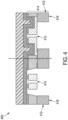
- FIG. 4 shows a schematic cross-sectional view of different embodiments having different waveguide types 400, as used in embodiments of the photonic sensor chip.
- Two different types of slot waveguides 410 are presented in Fig. 4 . Both types of the slot waveguide 410 are fabricated from the back side 416 of the semiconductor substrate 412 of a photonic sensor chip. Both slot waveguide 400s are located on an island-like silicon-on-insulator (SOI) structure 414.
- SOI silicon-on-insulator
- Fig. 5 shows a functionalized silicon waveguide section 500 for specific application using a photonic sensor chip.
- the waveguide 510 in this embodiment is made of silicon. Silicon can be functionalized with organosilanes, which have an organic group at one end.
- amino-propyl-triethoxisilane (APTES) 512 is used to chemically react in a silanization with the silicon waveguide 510.
- APTES has an amino-group at the end, which is not bonded to the silicon waveguide 510.
- the amino-group is covalently bonding biotin 514.
- Streptavidin molecules which have a high affinity for biotin 514, are bonding to the biotin 514. Thus, a streptavidin 516 layer is formed.
- the streptavidin layer 516 can bind a biotinylated anti-CRP-complex 518, such that the waveguide section 500 has a functionalized surface section, which is suitable for specific detection of CRP molecules 520.
- a biotinylated anti-CRP-complex 518 such that the waveguide section 500 has a functionalized surface section, which is suitable for specific detection of CRP molecules 520.
- other anti-complexes can be bonded.
- biosensor designs are photonic devices that allow the conversion of a refractive index change into an evaluable signal.
- transducer components are Mach-Zehnder interferometers, ring resonators and Fabry-Perot resonators.
- Fig. 6 shows illustrations of two different optical ring resonators 600 for use in a photonic sensor chip. Both ring resonator geometries form hybrid waveguide ring resonators.
- the ring resonators comprise a channel waveguide 610, such as in the upper example, or a slot waveguide 620, cf. the lower example.
- the detection limit for ring resonators is currently 10 -5 RIU (refractive index unit).
- the waveguide section 650 of the active-surface element is functionalized with specific ligands, as described above.
- Chip-integrated photonic sensors such as optical ring resonators 600 can contribute to major advances in food diagnostics, environmental monitoring, veterinary diagnostics and medical technology through rapid and accurate analysis of a wide range of substances and offer the prospect of cost-effective on-site analysis.
- Fig. 7 shows a diagram of functionalized surface sections of different waveguides 700 capturing particles using in a photonic sensor chip.
- the upper left diagram shows a channel waveguide 710 arranged on the active-surface element, which has a functionalized surface section 716 functionalized with specific ligands 712.
- the functionalized surface 716 section is exposed to a fluid or gas without selected particles to be captured.
- the upper right diagram shows the mentioned channel waveguide 710 exposed to a fluid or gas with selected particles 714 to be captured.
- the selected particles 714 were captured by the specific ligands 712.
- the same principle works for a slot waveguide 720, which is shown in the lower row.
- Fig. 8 shows transmission spectrum 800 of measurement of the situations shown in Fig. 7 with a photonic sensor chip.
- ⁇ (shown as red line in Fig. 8 ) resulting in a resulting optical output wave 820 from the active-surface element to a light detector, which is shifted by ⁇ .
- the magnitude of the wavelength shift provides information about the amount of captured specific particles and thus about its concentration in the solution to be analysed.
- the optical input wave is guided in the silicon waveguide and interacts only through an evanescent field with the captured specific particles.
- silicon slit waveguides ensure a significantly increased interaction between the guided optical input wave and the captured specific particle, as a large part of the optical input wave up to 75 % is guided in the slit and in the vicinity of the silicon webs where the captured specific particle is located.
- slot waveguides show a 3.5-fold greater light-particle interaction compared to channel waveguides.
- Fig. 9 shows an embodiment of a photonic sensor arrangement 900.
- the photonic sensor arrangement comprises a packaged photonic sensor device 910 and a light source for generating the optical input wave, and an optical coupling element 914 for coupling the optical input wave into the photonic plane of the photonic sensor chip 916.
- the packaged photonic sensor device can generally be packaged using state of the art solutions, and includes a hole for providing access to the active-surface element of the particle sensor element of the photonic sensor chip a usage of the inventive photonic sensor chip cost-effective.
- the packaged photonic sensor device can be used as disposable product.
- the light source and the optical element are arranged inside a housing 918.
- the optical input wave is coupled into the photonic plane of the photonic sensor chip, for instance, by an optical fiber.
- the housing 918 also includes a data transmission unit configured to receive the output signal from the data acquisition unit and to transmit the output signal to an external device an interface unit configured to receive the output signal from the data acquisition unit and to indicate an amount of particles captured by the active surface.
- a data transmission unit configured to receive the output signal from the data acquisition unit and to transmit the output signal to an external device
- an interface unit configured to receive the output signal from the data acquisition unit and to indicate an amount of particles captured by the active surface.
- the photonic biosensor allows the selective and label-free detection of proteins or substances in general for which a specific capture molecule exists. Such evidence is relevant in many areas. Examples are the detection of proteins in food, toxins in the environment as well as the detection of substances in various body fluids in medical diagnostics or therapy monitoring.
- the sensor can also be used as a sensor without functionalizing the silicon surface. For example, it can be used as a gas sensor in which a change in refractive index is measured. An application for temperature measurement is also conceivable.
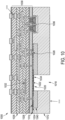
- Fig. 10 shows a schematic cross-sectional view of an embodiment of a photonic sensor chip 1000.
- the photonic sensor chip 1000 has a semiconductor substrate 1012 having a front side 1014 and a back side 1016.
- the photonic sensor chip 1000 includes a cavity 1018 extending from the back side 1016 through an entire depth of the semiconductor substrate 1012, which is for example a silicon substrate.
- the cavity 1018 provides access to the active surface of the photonic particle sensor element 1020 from the back side 1016 of the semiconductor substrate 1012.
- a photonic particle sensor element 1020 is arranged on the front side 1014 of the semiconductor substrate 1012 in a photonic plane 1024.
- the photonic particle sensor element 1020 comprises an active-surface element 1022 for capturing particles that is exposed for access from the back side 1016 of the semiconductor substrate 1012.
- the active-surface element 1022 comprises a waveguide section 1034 of a waveguide.
- An optical input wave is coupled into the photonic plane 1024 using a grating coupler 1026 arranged in the photonic plane 1024.
- the waveguide serves for guiding the optical input wave to the active-surface element, and further for guiding a resulting optical output wave to a light detector 1028, which in the present embodiment is a Ge-photodiode and is also arranged in the photonic plane 1024.
- FEOL front-end-of-line
- BEOL back-end-of-line
- the FEOL fabrication involves manufacturing NMOS devices, PMOS devices and SiGe:C HBTs.
- the FEOL fabrication also involves manufacturing of the Ge-photodiode.
- the electronic components can for instance form a circuit section or a complete circuit of a control unit, a data acquisition unit or other electrical circuitry.
- the photonic sensor chip 1000 is thus a SiGe BiCMOS device 1036.
- a thermal heating element 1032 is arranged in a metal layer of an interconnect stack 1035 located above the functionalized surface section of the active-surface element. Locating the thermal heating element 1032 above the functionalized surface section of the active-surface element allows calibrating the resonance condition of the photonic particle sensor element 1020 and stabilizing the temperature during measurements at the same time. For calibration the optical resonance of the photonic particle sensor element is shifted such that, the optical input wave received by the photonic particle sensor element lies on the resonance flank or the resonance peak. Stabilization of the temperature during the measurement is essential due to very specific binding affinities of biomolecules, which shall be captured by the photonic particle sensor element 1020.
- the electrical interconnect stack 1035 comprises electrical interconnects 1038 for conducting electrical operating power to the mentioned electro-optical and electronic components and to conduct electronic signals to and from the electro-optical and electronic components to their respective destinations on chip or to an interface to external circuits.
- the waveguide in the photonic plane 1024 is arranged on a local island-like silicon-on-insulator (SOI) structure 1040 that is embedded in the bulk of the silicon substrate 1012.
- SOI silicon-on-insulator
- the SiGe BiCMOS 1036 is located next to the local island SOI 1040 on the bulk of silicon substrate 1012.
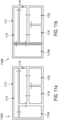
- Fig. 11a shows a block diagram an embodiment of a packaged photonic sensor device 1100A.
- the packaged photonic sensor device 1100A comprises a photonic sensor chip 1110A and an electronic control chip arranged on a carrier 1114.
- the electronic control chip electrically connected to the photonic sensor chip 1110A.
- the photonic sensor chip 1110A of the present embodiment is a photonic sensor chip 1110A as shown and explained in the context of the description of Fig. 1 .
- the electronic control chip comprises a control unit 1112, which is configured to drive operation of the at least one photonic particle sensor element on the photonic sensor chip, and a data acquisition unit 1116, which is configured to sample an output signal of the light detector.
- a data transmission unit 1118 configured to receive the output signal from the data acquisition unit and an interface unit 1120 configured to receive the output signal from the data acquisition unit 1116 and to indicate an amount of particles captured by the active surface are arranged in the electronic control chip.
- Fig. 11b shows a block diagram another embodiment of a packaged photonic sensor device 1100B.
- a photonic sensor chip 1110B and an electronic control chip 1111 are separately provided in separate chips, which may be individually packaged or provided in a system-on-chip and provided together in one package.
- Fig. 11a For further details regarding the functionality of the photonic sensor chip 1110B and of the electronic control chip 1111 of this embodiment, reference is made to the description of Fig. 11a .
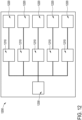
- Figs. 12 to 14 show different possibilities to arrange a plurality of active-surface elements in the photonic sensor chip.
- Fig. 12 shows a possibility to arrange five active-surface elements in parallel 1200.
- Each active-surface element 1210 is arranged upstream of a photodiode 1220, which is used as light detector.
- One laser 1230 is used as light source for all active-surface elements 1210.
- An optical input wave transmitted by the laser can be splited to respective active-surface elements 1210.
- Such a parallel arrangement enables the detection of different selected particles in parallel.
- the signal-to-noise ratio of an optical output wave to be transformed into a corresponding electrical signal received by the light detector can be increased by using a series connection of active-surface elements.
- Fig. 13 shows a possible arrangement to derive benefit of a parallel arrangement 1300 of the active-surface elements 1310 and a series connection of active-surface elements 1315.
- three active-surface elements in series connection are arranged upstream of respective photodiodes 1320.
- the arrangement of laser 1330 and photodiodes 1320 remains the same as in Fig. 12 .
- Fig. 14 displays an exemplarily arrangement 1400, where five lasers 1430A to 1430E and five photodiodes 1420A to 1420E are arranged in parallel. In between, three identical active-surface elements 1415A to 1415E are optically arranged in a series connection. Such arrangement of active-surface elements 1415A to 1415E allows to increase the signal-to-noise ratio of the resulting optical output wave to be transformed into a corresponding electrical signal by the photodiode due to the series connection. This arrangement 1400 also enables to detect of different selected particles in parallel due to the parallel connection.
- allergens in food such as peanuts
- toxins e.g. snake venom, toxic insects, scorpions, spiders, blue-green algae, mould poisons or poisonous fungi
- Table 1 Further applications of the photonic sensor chip are listed Table 1 below and can be followed or applied on the basis of the results obtained.
- the left column of the following table lists different analytes, and the right column list possible occurrences of the respective analytes.
- a cow is milked at least twice a day.
- the fresh raw milk is automatically piped into the cooling tank of the production plant.
- the raw milk is collected every one to two days from the producer in the milk collection truck. Depending on the vehicle type, this can hold between 10,000 and 25,000 litres.
- the smell, colour and temperature of the raw milk have been checked, it is pumped from the cooling tank into the milk collection truck.
- Milk samples are automatically taken and analysed in an independent laboratory or in the dairy. Once it arrives at the dairy, the raw milk is subjected to microbiological and chemical-physical checks for cleanliness, smell, taste, appearance, purity, fat content, acidity, germ content and weight. The milk is then pumped into large storage tanks.
- the solution proposed here considerably simplifies the development of a connection technique and the handling of the sensor, since the sensor surface is separated from the electronics and the light injection. This allows an analyte to interact with the sensor from the rear and does not interfere with further chip build-up. It is thus possible to manufacture the chip from the front with all the usual process steps, which also allows monolithic integration of the sensor.
- the photonic sensor is manufactured together with optoelectronic components (e.g. photodiodes) and electronic components (e.g. heating element).
- the bioanalytic part is accessible through the rear opening in the form of a cavity connecting to the optical sensor.
- a wafer, on which the photonic components are located is etched from the reverse side in such a way that the areas with the sensor surfaces are exposed and can be functionalized with antibodies.
- microfluidics on the back of the chip. Since the back of the chip consists of a planar silicon surface, the integration of microfluidics is considerably simplified compared to frontal integration.
Landscapes
- Chemical & Material Sciences (AREA)
- Health & Medical Sciences (AREA)
- Physics & Mathematics (AREA)
- Life Sciences & Earth Sciences (AREA)
- Immunology (AREA)
- General Physics & Mathematics (AREA)
- Engineering & Computer Science (AREA)
- General Health & Medical Sciences (AREA)
- Pathology (AREA)
- Biochemistry (AREA)
- Analytical Chemistry (AREA)
- Molecular Biology (AREA)
- Dispersion Chemistry (AREA)
- Food Science & Technology (AREA)
- Microelectronics & Electronic Packaging (AREA)
- Optics & Photonics (AREA)
- Plasma & Fusion (AREA)
- Chemical Kinetics & Catalysis (AREA)
- Medicinal Chemistry (AREA)
- Biomedical Technology (AREA)
- Hematology (AREA)
- Urology & Nephrology (AREA)
- Biophysics (AREA)
- Biotechnology (AREA)
- Cell Biology (AREA)
- Microbiology (AREA)
- Investigating Or Analysing Materials By Optical Means (AREA)
Claims (14)
- Photonischer Sensorchip (100, 200, 1000) aufweisend- ein Halbleitersubstrat (112, 212, 1012) mit einer Vorderseite (114, 214, 1014) und einer Rückseite (116, 216, 1016);- mindestens einen Hohlraum (118, 218, 1018), der sich von der Rückseite (116, 216, 1016) durch die gesamte Tiefe des Halbleitersubstrats (112, 212, 1012) erstreckt;- eine Front-End-of-Line, nachfolgend FEOL, hergestellte photonische Ebene (124, 1024), die auf der Vorderseite (114, 214, 1014) des Halbleitersubstrats (112, 212, 1012) angeordnet ist und einen FEOL-Wellenleiter aus kristallinem Silizium aufweist;- einen Back-End-of-Line, nachfolgend BEOL, hergestellten elektrischen Verbindungsstapel (130) auf der photonischen FEOL-Ebene (124),- in der FEOL photonischen Ebene, mindestens ein photonisches Partikelsensorelement (120, 1020) mit einem aktiven-Oberflächenelement (122, 222, 1022), das eine freiliegende aktive Oberfläche aufweist, die der Rückseite (116, 216, 1016) des Halbleitersubstrats (112, 212, 1012) zugewandt und ausgebildet ist, ausgewählte Partikel aus mindestens einem Fluid oder Gas einzufangen, dem die aktive Oberfläche aussetzbar ist, wobei der mindestens eine Hohlraum (118, 218, 1018) einen Zugang zu der aktiven Oberfläche von der Rückseite (116, 216, 1016) des Halbleitersubstrats (112, 212, 1012) bereitstellt; wobei- das photonische Partikelsensorelement (120, 1020) ausgebildet ist, eine optische Eingangswelle über die photonische Ebene (124, 1024) zu empfangen , Partikel, die von dem aktiven-Oberflächenelement (122, 222, 1022) eingefangen wurden, einer Wechselwirkung mit der optischen Eingangswelle auszusetzen, und eine resultierende optische Ausgangswelle mit einer Spektralkomponente bereitzustellen, die indikativ für die Wechselwirkung zwischen der optischen Eingangswelle und den eingefangenen Partikeln ist; und wobei- der FEOL-Wellenleiter in der FEOL photonischen Ebene (1024) angeordnet ist und in Abschnitten außerhalb des Hohlraums zwischen dem Halbleitersubstrat (112, 212, 1012) und dem BEOL elektrischen Verbindungsstapel (130) eingebettet ist und sich von den Abschnitten außerhalb des Hohlraums in den Hohlraum zu und von dem aktiven-Oberflächenelement erstreckt , zum Leiten der optischen Eingangswelle zu dem aktiven-Oberflächenelement (1022) und zum Leiten der resultierenden optischen Ausgangswelle von dem aktiven-Oberflächenelement (1022) zu einem Lichtdetektor (1028) des photonischen Partikelsensorelements (1020), der ausgebildet ist, als Reaktion auf den Empfang der optischen Ausgangswelle ein Ausgangssignal zu erzeugen; wobei der photonische Sensorchip weiterhin aufweist- ein elektrisch ansteuerbares Phasenverschiebungselement (1032), das ausgebildet ist, eine vorbestimmte Phasenverschiebung einzustellen und beizubehalten, die allein durch das aktive-Oberflächenelement (1022) ohne Einfluss von zu detektierenden Partikeln bewirkt wird.
- Photonischer Sensorchip (100) nach Anspruch 1, weiterhin aufweisend- eine Steuereinheit (1112), die ausgebildet ist, das Ausgangssignal des Lichtdetektors (1028) zu empfangen und ausgebildet ist, den Betrieb des mindestens einen photonischen Partikelsensorelements (1022) zu steuern; und wobei- die Steuereinheit (1112) ausgebildet ist, den Betrieb des Phasenverschiebungselements (1032) in Abhängigkeit von dem empfangenen Ausgangssignal des Lichtdetektors zu steuern, um die vorbestimmte Phasenverschiebung einzustellen und beizubehalten, die von dem aktiven-Oberflächenelement (1022) ohne Einfluss durch zu detektierende Partikel bewirkt werden soll.
- Photonischer Sensorchip (200) nach Anspruch 1 oder 2, wobei das elektrisch ansteuerbare Phasenverschiebungselement ein elektrisch ansteuerbares Heizelement , das in den elektrischen Verbindungsstapel eingebettet ist, oder einen elektrisch ansteuerbaren dotierten Wellenleiter aufweist.
- Photonischer Sensorchip (100) nach Anspruch 2 oder 3, weiterhin aufweisend- eine Datenerfassungseinheit (1116), die zum Abtasten eines Ausgangssignals des Lichtdetektors (1028) ausgebildet ist; und wobei- der elektrische Verbindungsstapel (1030) elektrische Verbindungen (1038) zum Leiten elektrischer Betriebsenergie und zum Leiten elektronischer Signale zu und von der Steuereinheit und der Datenerfassungseinheit (1116) aufweist.
- Photonischer Sensorchip (200) nach einem beliebigen dervorstehenden Ansprüche, aufweisend ein mikrofluidisches Substrat (210), das mit der Rückseite (216) des Halbleitersubstrates (212) verbunden ist, wobei das mikrofluidische Substrat (210) mindestens einen mikrofluidischen Kanal (230) aufweist, der sich zwischen einem Einlass (240) für das Fluid und einem Auslass (250) für das Fluid erstreckt und den Einlass (240) und den Auslass (250) mit dem Hohlraum (218) verbindet.
- Photonischer Sensorchip (200) nach Anspruch 5, wobei das mikrofluidische Substrat (210) aus einem Kunststoff, Glas oder Halbleiter hergestellt ist.
- Photonischer Sensorchip (100, 200, 1000) nach einem beliebigen der vorstehenden Ansprüche, wobei das aktive-Oberflächenelement (122, 222, 1022) einen Wellenleiterabschnitt (134, 650, 1034) des FEOL-Wellenleiters (510, 610) aufweist, wobei der Wellenleiterabschnitt (134, 650, 1034)- mindestens einen funktionalisierten Oberflächenabschnitt (500) aufweist, der ausgebildet ist, die ausgewählten Partikel durch selektive Wechselwirkung einzufangen, und- eine optische Weglänge hat, die von der Menge der von der aktiven Oberfläche eingefangenen Partikel abhängt.
- Photonischer Sensorchip (100, 200, 1000) nach Anspruch 7, wobei das photonische Partikelsensorelement (120, 1020) eine Vielzahl von aktiven-Oberflächenelementen (122, 222, 1022) aufweist, die optisch in einer Reihenschaltung und stromaufwärts des Lichtdetektors (1028) angeordnet sind.
- Photonischer Sensorchip (100, 200, 1000) nach einem beliebigen der vorstehenden Ansprüche, wobei der funktionalisierte Oberflächenabschnitt (500) chemisch funktionalisiert ist.
- Photonischer Sensorchip (100, 200, 1000) nach einem beliebigen der vorstehenden Ansprüche, wobei der funktionalisierte Oberflächenabschnitt (500) physikalisch funktionalisiert ist.
- Photonischer Sensorchip (100, 200, 1000) nach mindestens einem der vorstehenden Ansprüche, weiterhin aufweisend- mindestens eine Lichtquelle (1230, 1330, 1430), die mit dem FEOL-Wellenleiter verbunden und ausgebildet ist, die optische Eingangswelle zu erzeugen und auszusenden.
- Gehäuste photonische Sensorvorrichtung (1100), aufweisend- einen photonischen Sensorchip (100, 200, 1000) nach Anspruch 4, wenn er von Anspruch 2 abhängig ist, oder nach mindestens einem der Ansprüche 5 bis 11, wenn er von Anspruch 4 abhängig ist;- einen Träger (1114) und einen elektronischen Steuerchip (1111), der elektrisch mit dem photonischen Sensorchip (100, 200, 1000) verbunden ist, der auf dem Träger (1114) angeordnet ist und eine Steuereinheit (1112) aufweist, die ausgebildet ist, den Betrieb des mindestens einen photonischen Partikelsensorelements auf dem photonischen Sensorchip (100, 200, 1000) zu steuern, und die Datenerfassungseinheit (1116), die ausgebildet ist, ein Ausgangssignal des Lichtdetektors abzutasten;- ein Gehäuse, das den photonischen Sensorchip (100, 200, 1000) und den elektronischen Steuerchip (1111) umschließt und eine Öffnung zur Umgebungsatmosphäre aufweist, die der Rückseite des Halbleitersubstrats (112, 212, 1012) des photonischen Sensorchips (100, 200, 1000) zugewandt ist, um einen Zugang zu der freiliegenden aktiven Oberfläche des mindestens einen photonischen Partikelsensorelements für das mindestens eine Fluid bereitzustellen.
- Photonische Sensoranordnung (900), die aufweist,- eine gehäuste photonische Sensorvorrichtung (1100, 910) nach Anspruch 12, und- eine Lichtquelle (1230, 1330, 1430) zum Erzeugen der optischen Eingangswelle, und ein optisches Kopplungselement (914) zum Koppeln der optischen Eingangswelle in die photonische Ebene (124) des photonischen Sensorchips (100).
- Photonische Sensoranordnung (900) nach Anspruch 13, die eine gedruckte Leiterplatte aufweist und auf der gedruckten Leiterplatte- eine Datenübertragungseinheit (1118), die ausgebildet ist, das Ausgangssignal von der Datenerfassungseinheit (1116) zu empfangen und das Ausgangssignal an eine externe Vorrichtung zu übertragen; und- eine Schnittstelleneinheit (1120), die ausgebildet ist, das Ausgangssignal von der Datenerfassungseinheit (1116) zu empfangen und auf eine Menge von Partikeln, die von der aktiven Oberfläche eingefangen wurden, hinzuweisen.
Applications Claiming Priority (2)
| Application Number | Priority Date | Filing Date | Title |
|---|---|---|---|
| EP18215524 | 2018-12-21 | ||
| EP19166562.9A EP3671186A1 (de) | 2018-12-21 | 2019-04-01 | Photonischer sensorchip, verpackte photonische sensorvorrichtung und anordnung |
Publications (3)
| Publication Number | Publication Date |
|---|---|
| EP3671187A1 EP3671187A1 (de) | 2020-06-24 |
| EP3671187C0 EP3671187C0 (de) | 2025-03-19 |
| EP3671187B1 true EP3671187B1 (de) | 2025-03-19 |
Family
ID=64959157
Family Applications (2)
| Application Number | Title | Priority Date | Filing Date |
|---|---|---|---|
| EP19166562.9A Withdrawn EP3671186A1 (de) | 2018-12-21 | 2019-04-01 | Photonischer sensorchip, verpackte photonische sensorvorrichtung und anordnung |
| EP19218716.9A Active EP3671187B1 (de) | 2018-12-21 | 2019-12-20 | Photonischer sensorchip, verpackte photonische sensorvorrichtung und anordnung |
Family Applications Before (1)
| Application Number | Title | Priority Date | Filing Date |
|---|---|---|---|
| EP19166562.9A Withdrawn EP3671186A1 (de) | 2018-12-21 | 2019-04-01 | Photonischer sensorchip, verpackte photonische sensorvorrichtung und anordnung |
Country Status (2)
| Country | Link |
|---|---|
| US (1) | US11092742B2 (de) |
| EP (2) | EP3671186A1 (de) |
Families Citing this family (12)
| Publication number | Priority date | Publication date | Assignee | Title |
|---|---|---|---|---|
| KR102877061B1 (ko) | 2018-05-22 | 2025-10-27 | 플럭서스, 인크. | 도파로 구조체의 제조 |
| WO2022095883A1 (en) * | 2020-11-04 | 2022-05-12 | The University Of Hong Kong | Optical soft skin system for multimodal sensing |
| CN112838076A (zh) * | 2021-01-04 | 2021-05-25 | 长江存储科技有限责任公司 | 封装结构 |
| EP4036639A1 (de) | 2021-02-02 | 2022-08-03 | IHP GmbH - Innovations for High Performance Microelectronics / Leibniz-Institut für innovative Mikroelektronik | Verfahren zur herstellung eines elektrooptischen phasenschiebers auf basis von ferroelektrischen materialien |
| US12242107B2 (en) * | 2022-10-07 | 2025-03-04 | Fluxus, Inc. | Optofluidic devices |
| EP4598679A1 (de) * | 2022-10-07 | 2025-08-13 | Fluxus, Inc. | Optofluidische vorrichtungen |
| US20250149477A1 (en) * | 2023-11-03 | 2025-05-08 | Taiwan Semiconductor Manufacturing Company Limited | Photonic assembly for enhanced bonding yield and methods for forming the same |
| WO2025140845A1 (en) | 2023-12-28 | 2025-07-03 | Ihp Gmbh - Innovations For High Performance Microelectronics / Leibniz-Institut Für Innovative Mikroelektronik | Biosensor system and method for detecting a target analyte in a fluid sample |
| GR1010873B (el) | 2023-12-28 | 2025-02-06 | Αριστοτελειο Πανεπιστημιο Θεσσαλονικης-Ειδικος Λογαριαμος Κονδυλιων Ερευνας, | Συμβολομετρικη οπτικη συσκευη ανιχνευσης ολοκληρωμενη σε φωτονικα κυκλωματα |
| WO2025140847A1 (en) * | 2023-12-28 | 2025-07-03 | Ihp Gmbh - Innovations For High Performance Microelectronics / Leibniz-Institut Für Innovative Mikroelektronik | Chip-integrated luminescence detection for chemical, biological or biochemical sensing |
| EP4579215A1 (de) * | 2023-12-28 | 2025-07-02 | IHP GmbH - Innovations for High Performance Microelectronics / Leibniz-Institut für innovative Mikroelektronik | Chipintegrierte lumineszenzdetektion für chemische, biologische oder biochemische messung |
| EP4588567A1 (de) | 2023-12-28 | 2025-07-23 | IHP GmbH - Innovations for High Performance Microelectronics / Leibniz-Institut für innovative Mikroelektronik | Biosensorsystem und verfahren zum nachweis eines zielanalyten in einer flüssigen probe |
Citations (1)
| Publication number | Priority date | Publication date | Assignee | Title |
|---|---|---|---|---|
| US20150125111A1 (en) * | 2013-10-22 | 2015-05-07 | Massachusetts Institute Of Technology | Waveguide formation using cmos fabrication techniques |
Family Cites Families (15)
| Publication number | Priority date | Publication date | Assignee | Title |
|---|---|---|---|---|
| US7145660B2 (en) | 2003-08-13 | 2006-12-05 | Lambda Crossing, Ltd. | Micro-resonator based optical sensor |
| EP1918693A1 (de) * | 2006-10-31 | 2008-05-07 | Honeywell International, Inc. | Optische Wellenleitersensorvorrichtungen und Verfahren zu ihrer Herstellung und Verwendung |
| US20090087137A1 (en) * | 2007-10-02 | 2009-04-02 | My The Doan | Planar lightwave circuits with air filled trenches |
| EP2208048A1 (de) * | 2007-11-05 | 2010-07-21 | Koninklijke Philips Electronics N.V. | Biosensorkartusche |
| KR20120016297A (ko) * | 2009-06-01 | 2012-02-23 | 코넬 유니버시티 | 미소구를 이용한 통합 광학유체 시스템 |
| EP2515099A1 (de) * | 2011-04-21 | 2012-10-24 | Fraunhofer Gesellschaft zur Förderung der angewandten Wissenschaft E.V. | Verfahren zum Erfassen von Molekülen und optischer Sensor |
| EP2581730A1 (de) | 2011-10-10 | 2013-04-17 | Fraunhofer-Gesellschaft zur Förderung der angewandten Forschung | Optischer Resonator und Sensoranordnung sowie Messverfahren |
| US9417186B2 (en) * | 2012-08-30 | 2016-08-16 | Infineon Technologies Ag | Opto-electronic sensor |
| KR102074945B1 (ko) * | 2013-03-14 | 2020-02-07 | 삼성전자 주식회사 | 광 바이오센서 및 바이오 센싱 시스템 |
| CN107209107A (zh) * | 2015-04-30 | 2017-09-26 | 惠普发展公司有限责任合伙企业 | 微流体光学流体传感器 |
| DE102016103646B4 (de) * | 2016-01-22 | 2023-03-02 | Infineon Technologies Ag | Integriertes photoakustisches gassensormodul |
| US10141710B2 (en) | 2016-02-18 | 2018-11-27 | Oracle International Corporation | Ring-resonator-based laser with multiple wavelengths |
| GR1009480B (el) * | 2017-02-17 | 2019-03-19 | Amo Gmbh | Μεθοδος κατασκευης ολοκληρωμενου πλασμο-φωτονικου βιοαισθητηρα και συσκευη για το σκοπο αυτο |
| US11073465B2 (en) * | 2017-08-21 | 2021-07-27 | The Board Of Trustees Of The University Of Illinois | Real-time sensing of flowing nanoparticles with electro-opto-mechanics |
| CN208520750U (zh) * | 2018-07-27 | 2019-02-19 | 京东方科技集团股份有限公司 | 一种光谱检测装置 |
-
2019
- 2019-04-01 EP EP19166562.9A patent/EP3671186A1/de not_active Withdrawn
- 2019-12-18 US US16/718,595 patent/US11092742B2/en active Active
- 2019-12-20 EP EP19218716.9A patent/EP3671187B1/de active Active
Patent Citations (1)
| Publication number | Priority date | Publication date | Assignee | Title |
|---|---|---|---|---|
| US20150125111A1 (en) * | 2013-10-22 | 2015-05-07 | Massachusetts Institute Of Technology | Waveguide formation using cmos fabrication techniques |
Also Published As
| Publication number | Publication date |
|---|---|
| EP3671187C0 (de) | 2025-03-19 |
| US11092742B2 (en) | 2021-08-17 |
| EP3671186A1 (de) | 2020-06-24 |
| US20200200972A1 (en) | 2020-06-25 |
| EP3671187A1 (de) | 2020-06-24 |
Similar Documents
| Publication | Publication Date | Title |
|---|---|---|
| EP3671187B1 (de) | Photonischer sensorchip, verpackte photonische sensorvorrichtung und anordnung | |
| US7920267B2 (en) | Micro integrated planar optical waveguide type SPR sensor | |
| US5834777A (en) | NDIR gas sensor | |
| CN107991479B (zh) | 片上磁粒子检测的数字控制 | |
| US7671996B2 (en) | Surface plasmon resonance sensor and biochip | |
| Lee et al. | A centrifugally actuated point-of-care testing system for the surface acoustic wave immunosensing of cardiac troponin I | |
| EP0855591A2 (de) | Verbesserte Sensoranordnungen | |
| WO2016065487A1 (en) | System, method and apparatus for pathogen detection | |
| US10422895B2 (en) | Passive waveguide structures and integrated detection and/or imaging systems incorporating the same | |
| JP2015535087A (ja) | 統合多重化測光モジュールのためのシステムおよび方法 | |
| US11366060B2 (en) | Apparatus for detecting fluorescent light emitted from a sample, a biosensor system, and a detector for detecting supercritical angle fluorescent light | |
| Duval et al. | Breakthroughs in photonics 2012: 2012 breakthroughs in lab-on-a-chip and optical biosensors | |
| Gong et al. | Ammonia-trapping multilayer polymer urease film amplifier coated surface plasmon resonance sensor for ultra-sensitive urea detection | |
| Adamopoulos et al. | Fully integrated electronic-photonic sensor for label-free refractive index sensing in advanced zero-change CMOS-SOI process | |
| EP1064095A1 (de) | Verfahren und vorrichtung zur bestimmung von proteinen | |
| US20040110305A1 (en) | Method of mixing a sample with a reagent in a chemistry | |
| WO2007064820A2 (en) | An integrated sensing system approach for handheld spectral measurements | |
| CN114631015A (zh) | 测试装置、组合件及方法 | |
| Angelopoulou et al. | Multiplexed detection of food contaminants with a portable reader based on all-in-one monolithic photonic chips | |
| US9976950B2 (en) | Optical detector module, measurement system and method of detecting presence of a substance in a test material | |
| US20220082558A1 (en) | Optical sensor, system and method for detecting pathogenic germs | |
| EP4579215A1 (de) | Chipintegrierte lumineszenzdetektion für chemische, biologische oder biochemische messung | |
| US20130329214A1 (en) | Application of spectral linewidth variation using optical filter | |
| Minas | Lab-on-a-chip devices for chemical analysis | |
| US7259848B2 (en) | Process measuring point |
Legal Events
| Date | Code | Title | Description |
|---|---|---|---|
| PUAI | Public reference made under article 153(3) epc to a published international application that has entered the european phase |
Free format text: ORIGINAL CODE: 0009012 |
|
| STAA | Information on the status of an ep patent application or granted ep patent |
Free format text: STATUS: THE APPLICATION HAS BEEN PUBLISHED |
|
| AK | Designated contracting states |
Kind code of ref document: A1 Designated state(s): AL AT BE BG CH CY CZ DE DK EE ES FI FR GB GR HR HU IE IS IT LI LT LU LV MC MK MT NL NO PL PT RO RS SE SI SK SM TR |
|
| AX | Request for extension of the european patent |
Extension state: BA ME |
|
| STAA | Information on the status of an ep patent application or granted ep patent |
Free format text: STATUS: REQUEST FOR EXAMINATION WAS MADE |
|
| 17P | Request for examination filed |
Effective date: 20210111 |
|
| RBV | Designated contracting states (corrected) |
Designated state(s): AL AT BE BG CH CY CZ DE DK EE ES FI FR GB GR HR HU IE IS IT LI LT LU LV MC MK MT NL NO PL PT RO RS SE SI SK SM TR |
|
| STAA | Information on the status of an ep patent application or granted ep patent |
Free format text: STATUS: EXAMINATION IS IN PROGRESS |
|
| 17Q | First examination report despatched |
Effective date: 20220811 |
|
| GRAP | Despatch of communication of intention to grant a patent |
Free format text: ORIGINAL CODE: EPIDOSNIGR1 |
|
| STAA | Information on the status of an ep patent application or granted ep patent |
Free format text: STATUS: GRANT OF PATENT IS INTENDED |
|
| RIC1 | Information provided on ipc code assigned before grant |
Ipc: G01N 15/1434 20240101ALN20240920BHEP Ipc: G01N 33/12 20060101ALN20240920BHEP Ipc: G01N 33/02 20060101ALN20240920BHEP Ipc: G01N 15/10 20060101ALN20240920BHEP Ipc: G01N 21/552 20140101ALN20240920BHEP Ipc: G01N 21/25 20060101ALN20240920BHEP Ipc: G02B 6/12 20060101ALI20240920BHEP Ipc: G01N 33/543 20060101ALI20240920BHEP Ipc: G01N 33/04 20060101ALI20240920BHEP Ipc: G01N 15/14 20060101ALI20240920BHEP Ipc: G01N 21/77 20060101AFI20240920BHEP |
|
| INTG | Intention to grant announced |
Effective date: 20241010 |
|
| GRAS | Grant fee paid |
Free format text: ORIGINAL CODE: EPIDOSNIGR3 |
|
| GRAA | (expected) grant |
Free format text: ORIGINAL CODE: 0009210 |
|
| STAA | Information on the status of an ep patent application or granted ep patent |
Free format text: STATUS: THE PATENT HAS BEEN GRANTED |
|
| AK | Designated contracting states |
Kind code of ref document: B1 Designated state(s): AL AT BE BG CH CY CZ DE DK EE ES FI FR GB GR HR HU IE IS IT LI LT LU LV MC MK MT NL NO PL PT RO RS SE SI SK SM TR |
|
| REG | Reference to a national code |
Ref country code: GB Ref legal event code: FG4D |
|
| REG | Reference to a national code |
Ref country code: CH Ref legal event code: EP |
|
| REG | Reference to a national code |
Ref country code: IE Ref legal event code: FG4D |
|
| REG | Reference to a national code |
Ref country code: DE Ref legal event code: R096 Ref document number: 602019067433 Country of ref document: DE |
|
| RAP4 | Party data changed (patent owner data changed or rights of a patent transferred) |
Owner name: IHP GMBH - LEIBNIZ INSTITUTE FOR HIGH PERFORMANCEMICROELECTRONICS/ LEIBNIZ-INSTITUT FUER INNOVATIVEMIKROELEKTRONIK |
|
| U01 | Request for unitary effect filed |
Effective date: 20250417 |
|
| U07 | Unitary effect registered |
Designated state(s): AT BE BG DE DK EE FI FR IT LT LU LV MT NL PT RO SE SI Effective date: 20250424 |
|
| PG25 | Lapsed in a contracting state [announced via postgrant information from national office to epo] |
Ref country code: RS Free format text: LAPSE BECAUSE OF FAILURE TO SUBMIT A TRANSLATION OF THE DESCRIPTION OR TO PAY THE FEE WITHIN THE PRESCRIBED TIME-LIMIT Effective date: 20250619 |
|
| PG25 | Lapsed in a contracting state [announced via postgrant information from national office to epo] |
Ref country code: NO Free format text: LAPSE BECAUSE OF FAILURE TO SUBMIT A TRANSLATION OF THE DESCRIPTION OR TO PAY THE FEE WITHIN THE PRESCRIBED TIME-LIMIT Effective date: 20250619 |
|
| PG25 | Lapsed in a contracting state [announced via postgrant information from national office to epo] |
Ref country code: HR Free format text: LAPSE BECAUSE OF FAILURE TO SUBMIT A TRANSLATION OF THE DESCRIPTION OR TO PAY THE FEE WITHIN THE PRESCRIBED TIME-LIMIT Effective date: 20250319 |
|
| PG25 | Lapsed in a contracting state [announced via postgrant information from national office to epo] |
Ref country code: GR Free format text: LAPSE BECAUSE OF FAILURE TO SUBMIT A TRANSLATION OF THE DESCRIPTION OR TO PAY THE FEE WITHIN THE PRESCRIBED TIME-LIMIT Effective date: 20250620 |
|
| PG25 | Lapsed in a contracting state [announced via postgrant information from national office to epo] |
Ref country code: SM Free format text: LAPSE BECAUSE OF FAILURE TO SUBMIT A TRANSLATION OF THE DESCRIPTION OR TO PAY THE FEE WITHIN THE PRESCRIBED TIME-LIMIT Effective date: 20250319 |
|
| PG25 | Lapsed in a contracting state [announced via postgrant information from national office to epo] |
Ref country code: ES Free format text: LAPSE BECAUSE OF FAILURE TO SUBMIT A TRANSLATION OF THE DESCRIPTION OR TO PAY THE FEE WITHIN THE PRESCRIBED TIME-LIMIT Effective date: 20250319 |
|
| PG25 | Lapsed in a contracting state [announced via postgrant information from national office to epo] |
Ref country code: PL Free format text: LAPSE BECAUSE OF FAILURE TO SUBMIT A TRANSLATION OF THE DESCRIPTION OR TO PAY THE FEE WITHIN THE PRESCRIBED TIME-LIMIT Effective date: 20250319 |
|
| PG25 | Lapsed in a contracting state [announced via postgrant information from national office to epo] |
Ref country code: CZ Free format text: LAPSE BECAUSE OF FAILURE TO SUBMIT A TRANSLATION OF THE DESCRIPTION OR TO PAY THE FEE WITHIN THE PRESCRIBED TIME-LIMIT Effective date: 20250319 |
|
| PG25 | Lapsed in a contracting state [announced via postgrant information from national office to epo] |
Ref country code: SK Free format text: LAPSE BECAUSE OF FAILURE TO SUBMIT A TRANSLATION OF THE DESCRIPTION OR TO PAY THE FEE WITHIN THE PRESCRIBED TIME-LIMIT Effective date: 20250319 |
|
| PG25 | Lapsed in a contracting state [announced via postgrant information from national office to epo] |
Ref country code: IS Free format text: LAPSE BECAUSE OF FAILURE TO SUBMIT A TRANSLATION OF THE DESCRIPTION OR TO PAY THE FEE WITHIN THE PRESCRIBED TIME-LIMIT Effective date: 20250719 |