EP3668874B1 - Pyrrolobenzodiazepine conjugates - Google Patents
Pyrrolobenzodiazepine conjugates Download PDFInfo
- Publication number
- EP3668874B1 EP3668874B1 EP18758581.5A EP18758581A EP3668874B1 EP 3668874 B1 EP3668874 B1 EP 3668874B1 EP 18758581 A EP18758581 A EP 18758581A EP 3668874 B1 EP3668874 B1 EP 3668874B1
- Authority
- EP
- European Patent Office
- Prior art keywords
- group
- alkyl
- methyl
- groups
- alkenyl
- Prior art date
- Legal status (The legal status is an assumption and is not a legal conclusion. Google has not performed a legal analysis and makes no representation as to the accuracy of the status listed.)
- Active
Links
- 0 CC(C)Cc(cc1)ccc1N*C(*)=O Chemical compound CC(C)Cc(cc1)ccc1N*C(*)=O 0.000 description 8
- VOJXWVNLAGSXBL-UHFFFAOYSA-N CC(C)c1c[n](C(C)C)nn1 Chemical compound CC(C)c1c[n](C(C)C)nn1 VOJXWVNLAGSXBL-UHFFFAOYSA-N 0.000 description 1
- OZCMFICUPNSDFY-UHFFFAOYSA-N CCCCCC(C)(C)NCC Chemical compound CCCCCC(C)(C)NCC OZCMFICUPNSDFY-UHFFFAOYSA-N 0.000 description 1
- JAEZLUVYMBEHPL-BQBZGAKWSA-N CCC[C@@](C)(C1)[C@H]1N Chemical compound CCC[C@@](C)(C1)[C@H]1N JAEZLUVYMBEHPL-BQBZGAKWSA-N 0.000 description 1
- SEEYREPSKCQBBF-UHFFFAOYSA-N CN(C(C=C1)=O)C1=O Chemical compound CN(C(C=C1)=O)C1=O SEEYREPSKCQBBF-UHFFFAOYSA-N 0.000 description 1
- KYEACNNYFNZCST-UHFFFAOYSA-N CN(C(CC1)=O)C1=O Chemical compound CN(C(CC1)=O)C1=O KYEACNNYFNZCST-UHFFFAOYSA-N 0.000 description 1
Images


Classifications
-
- A—HUMAN NECESSITIES
- A61—MEDICAL OR VETERINARY SCIENCE; HYGIENE
- A61K—PREPARATIONS FOR MEDICAL, DENTAL OR TOILETRY PURPOSES
- A61K47/00—Medicinal preparations characterised by the non-active ingredients used, e.g. carriers or inert additives; Targeting or modifying agents chemically bound to the active ingredient
- A61K47/50—Medicinal preparations characterised by the non-active ingredients used, e.g. carriers or inert additives; Targeting or modifying agents chemically bound to the active ingredient the non-active ingredient being chemically bound to the active ingredient, e.g. polymer-drug conjugates
- A61K47/51—Medicinal preparations characterised by the non-active ingredients used, e.g. carriers or inert additives; Targeting or modifying agents chemically bound to the active ingredient the non-active ingredient being chemically bound to the active ingredient, e.g. polymer-drug conjugates the non-active ingredient being a modifying agent
- A61K47/68—Medicinal preparations characterised by the non-active ingredients used, e.g. carriers or inert additives; Targeting or modifying agents chemically bound to the active ingredient the non-active ingredient being chemically bound to the active ingredient, e.g. polymer-drug conjugates the non-active ingredient being a modifying agent the modifying agent being an antibody, an immunoglobulin or a fragment thereof, e.g. an Fc-fragment
- A61K47/6801—Drug-antibody or immunoglobulin conjugates defined by the pharmacologically or therapeutically active agent
- A61K47/6803—Drugs conjugated to an antibody or immunoglobulin, e.g. cisplatin-antibody conjugates
-
- A—HUMAN NECESSITIES
- A61—MEDICAL OR VETERINARY SCIENCE; HYGIENE
- A61K—PREPARATIONS FOR MEDICAL, DENTAL OR TOILETRY PURPOSES
- A61K45/00—Medicinal preparations containing active ingredients not provided for in groups A61K31/00 - A61K41/00
- A61K45/06—Mixtures of active ingredients without chemical characterisation, e.g. antiphlogistics and cardiaca
-
- A—HUMAN NECESSITIES
- A61—MEDICAL OR VETERINARY SCIENCE; HYGIENE
- A61K—PREPARATIONS FOR MEDICAL, DENTAL OR TOILETRY PURPOSES
- A61K47/00—Medicinal preparations characterised by the non-active ingredients used, e.g. carriers or inert additives; Targeting or modifying agents chemically bound to the active ingredient
- A61K47/50—Medicinal preparations characterised by the non-active ingredients used, e.g. carriers or inert additives; Targeting or modifying agents chemically bound to the active ingredient the non-active ingredient being chemically bound to the active ingredient, e.g. polymer-drug conjugates
- A61K47/51—Medicinal preparations characterised by the non-active ingredients used, e.g. carriers or inert additives; Targeting or modifying agents chemically bound to the active ingredient the non-active ingredient being chemically bound to the active ingredient, e.g. polymer-drug conjugates the non-active ingredient being a modifying agent
- A61K47/54—Medicinal preparations characterised by the non-active ingredients used, e.g. carriers or inert additives; Targeting or modifying agents chemically bound to the active ingredient the non-active ingredient being chemically bound to the active ingredient, e.g. polymer-drug conjugates the non-active ingredient being a modifying agent the modifying agent being an organic compound
- A61K47/545—Heterocyclic compounds
-
- A—HUMAN NECESSITIES
- A61—MEDICAL OR VETERINARY SCIENCE; HYGIENE
- A61K—PREPARATIONS FOR MEDICAL, DENTAL OR TOILETRY PURPOSES
- A61K47/00—Medicinal preparations characterised by the non-active ingredients used, e.g. carriers or inert additives; Targeting or modifying agents chemically bound to the active ingredient
- A61K47/50—Medicinal preparations characterised by the non-active ingredients used, e.g. carriers or inert additives; Targeting or modifying agents chemically bound to the active ingredient the non-active ingredient being chemically bound to the active ingredient, e.g. polymer-drug conjugates
- A61K47/51—Medicinal preparations characterised by the non-active ingredients used, e.g. carriers or inert additives; Targeting or modifying agents chemically bound to the active ingredient the non-active ingredient being chemically bound to the active ingredient, e.g. polymer-drug conjugates the non-active ingredient being a modifying agent
- A61K47/68—Medicinal preparations characterised by the non-active ingredients used, e.g. carriers or inert additives; Targeting or modifying agents chemically bound to the active ingredient the non-active ingredient being chemically bound to the active ingredient, e.g. polymer-drug conjugates the non-active ingredient being a modifying agent the modifying agent being an antibody, an immunoglobulin or a fragment thereof, e.g. an Fc-fragment
- A61K47/6801—Drug-antibody or immunoglobulin conjugates defined by the pharmacologically or therapeutically active agent
- A61K47/6803—Drugs conjugated to an antibody or immunoglobulin, e.g. cisplatin-antibody conjugates
- A61K47/68035—Drugs conjugated to an antibody or immunoglobulin, e.g. cisplatin-antibody conjugates the drug being a pyrrolobenzodiazepine
-
- A—HUMAN NECESSITIES
- A61—MEDICAL OR VETERINARY SCIENCE; HYGIENE
- A61K—PREPARATIONS FOR MEDICAL, DENTAL OR TOILETRY PURPOSES
- A61K47/00—Medicinal preparations characterised by the non-active ingredients used, e.g. carriers or inert additives; Targeting or modifying agents chemically bound to the active ingredient
- A61K47/50—Medicinal preparations characterised by the non-active ingredients used, e.g. carriers or inert additives; Targeting or modifying agents chemically bound to the active ingredient the non-active ingredient being chemically bound to the active ingredient, e.g. polymer-drug conjugates
- A61K47/51—Medicinal preparations characterised by the non-active ingredients used, e.g. carriers or inert additives; Targeting or modifying agents chemically bound to the active ingredient the non-active ingredient being chemically bound to the active ingredient, e.g. polymer-drug conjugates the non-active ingredient being a modifying agent
- A61K47/68—Medicinal preparations characterised by the non-active ingredients used, e.g. carriers or inert additives; Targeting or modifying agents chemically bound to the active ingredient the non-active ingredient being chemically bound to the active ingredient, e.g. polymer-drug conjugates the non-active ingredient being a modifying agent the modifying agent being an antibody, an immunoglobulin or a fragment thereof, e.g. an Fc-fragment
- A61K47/6835—Medicinal preparations characterised by the non-active ingredients used, e.g. carriers or inert additives; Targeting or modifying agents chemically bound to the active ingredient the non-active ingredient being chemically bound to the active ingredient, e.g. polymer-drug conjugates the non-active ingredient being a modifying agent the modifying agent being an antibody, an immunoglobulin or a fragment thereof, e.g. an Fc-fragment the modifying agent being an antibody or an immunoglobulin bearing at least one antigen-binding site
- A61K47/6851—Medicinal preparations characterised by the non-active ingredients used, e.g. carriers or inert additives; Targeting or modifying agents chemically bound to the active ingredient the non-active ingredient being chemically bound to the active ingredient, e.g. polymer-drug conjugates the non-active ingredient being a modifying agent the modifying agent being an antibody, an immunoglobulin or a fragment thereof, e.g. an Fc-fragment the modifying agent being an antibody or an immunoglobulin bearing at least one antigen-binding site the antibody targeting a determinant of a tumour cell
-
- A—HUMAN NECESSITIES
- A61—MEDICAL OR VETERINARY SCIENCE; HYGIENE
- A61K—PREPARATIONS FOR MEDICAL, DENTAL OR TOILETRY PURPOSES
- A61K47/00—Medicinal preparations characterised by the non-active ingredients used, e.g. carriers or inert additives; Targeting or modifying agents chemically bound to the active ingredient
- A61K47/50—Medicinal preparations characterised by the non-active ingredients used, e.g. carriers or inert additives; Targeting or modifying agents chemically bound to the active ingredient the non-active ingredient being chemically bound to the active ingredient, e.g. polymer-drug conjugates
- A61K47/51—Medicinal preparations characterised by the non-active ingredients used, e.g. carriers or inert additives; Targeting or modifying agents chemically bound to the active ingredient the non-active ingredient being chemically bound to the active ingredient, e.g. polymer-drug conjugates the non-active ingredient being a modifying agent
- A61K47/68—Medicinal preparations characterised by the non-active ingredients used, e.g. carriers or inert additives; Targeting or modifying agents chemically bound to the active ingredient the non-active ingredient being chemically bound to the active ingredient, e.g. polymer-drug conjugates the non-active ingredient being a modifying agent the modifying agent being an antibody, an immunoglobulin or a fragment thereof, e.g. an Fc-fragment
- A61K47/6835—Medicinal preparations characterised by the non-active ingredients used, e.g. carriers or inert additives; Targeting or modifying agents chemically bound to the active ingredient the non-active ingredient being chemically bound to the active ingredient, e.g. polymer-drug conjugates the non-active ingredient being a modifying agent the modifying agent being an antibody, an immunoglobulin or a fragment thereof, e.g. an Fc-fragment the modifying agent being an antibody or an immunoglobulin bearing at least one antigen-binding site
- A61K47/6851—Medicinal preparations characterised by the non-active ingredients used, e.g. carriers or inert additives; Targeting or modifying agents chemically bound to the active ingredient the non-active ingredient being chemically bound to the active ingredient, e.g. polymer-drug conjugates the non-active ingredient being a modifying agent the modifying agent being an antibody, an immunoglobulin or a fragment thereof, e.g. an Fc-fragment the modifying agent being an antibody or an immunoglobulin bearing at least one antigen-binding site the antibody targeting a determinant of a tumour cell
- A61K47/6855—Medicinal preparations characterised by the non-active ingredients used, e.g. carriers or inert additives; Targeting or modifying agents chemically bound to the active ingredient the non-active ingredient being chemically bound to the active ingredient, e.g. polymer-drug conjugates the non-active ingredient being a modifying agent the modifying agent being an antibody, an immunoglobulin or a fragment thereof, e.g. an Fc-fragment the modifying agent being an antibody or an immunoglobulin bearing at least one antigen-binding site the antibody targeting a determinant of a tumour cell the tumour determinant being from breast cancer cell
-
- A—HUMAN NECESSITIES
- A61—MEDICAL OR VETERINARY SCIENCE; HYGIENE
- A61P—SPECIFIC THERAPEUTIC ACTIVITY OF CHEMICAL COMPOUNDS OR MEDICINAL PREPARATIONS
- A61P35/00—Antineoplastic agents
-
- C—CHEMISTRY; METALLURGY
- C07—ORGANIC CHEMISTRY
- C07D—HETEROCYCLIC COMPOUNDS
- C07D519/00—Heterocyclic compounds containing more than one system of two or more relevant hetero rings condensed among themselves or condensed with a common carbocyclic ring system not provided for in groups C07D453/00 or C07D455/00
-
- C—CHEMISTRY; METALLURGY
- C07—ORGANIC CHEMISTRY
- C07K—PEPTIDES
- C07K16/00—Immunoglobulins [IG], e.g. monoclonal or polyclonal antibodies
-
- C—CHEMISTRY; METALLURGY
- C07—ORGANIC CHEMISTRY
- C07K—PEPTIDES
- C07K16/00—Immunoglobulins [IG], e.g. monoclonal or polyclonal antibodies
- C07K16/18—Immunoglobulins [IG], e.g. monoclonal or polyclonal antibodies against material from animals or humans
- C07K16/32—Immunoglobulins [IG], e.g. monoclonal or polyclonal antibodies against material from animals or humans against translation products of oncogenes
-
- A—HUMAN NECESSITIES
- A61—MEDICAL OR VETERINARY SCIENCE; HYGIENE
- A61K—PREPARATIONS FOR MEDICAL, DENTAL OR TOILETRY PURPOSES
- A61K39/00—Medicinal preparations containing antigens or antibodies
- A61K2039/505—Medicinal preparations containing antigens or antibodies comprising antibodies
-
- C—CHEMISTRY; METALLURGY
- C07—ORGANIC CHEMISTRY
- C07K—PEPTIDES
- C07K2317/00—Immunoglobulins specific features
- C07K2317/20—Immunoglobulins specific features characterized by taxonomic origin
- C07K2317/24—Immunoglobulins specific features characterized by taxonomic origin containing regions, domains or residues from different species, e.g. chimeric, humanized or veneered
-
- C—CHEMISTRY; METALLURGY
- C07—ORGANIC CHEMISTRY
- C07K—PEPTIDES
- C07K2317/00—Immunoglobulins specific features
- C07K2317/50—Immunoglobulins specific features characterized by immunoglobulin fragments
- C07K2317/52—Constant or Fc region; Isotype
-
- C—CHEMISTRY; METALLURGY
- C07—ORGANIC CHEMISTRY
- C07K—PEPTIDES
- C07K2317/00—Immunoglobulins specific features
- C07K2317/50—Immunoglobulins specific features characterized by immunoglobulin fragments
- C07K2317/52—Constant or Fc region; Isotype
- C07K2317/53—Hinge
-
- C—CHEMISTRY; METALLURGY
- C07—ORGANIC CHEMISTRY
- C07K—PEPTIDES
- C07K2317/00—Immunoglobulins specific features
- C07K2317/70—Immunoglobulins specific features characterized by effect upon binding to a cell or to an antigen
- C07K2317/73—Inducing cell death, e.g. apoptosis, necrosis or inhibition of cell proliferation
Definitions
- the present invention relates to conjugates comprising pyrrolobenzodiazepines and related dimers (PBDs), and the precursor drug linkers used to make such conjugates.
- PBDs pyrrolobenzodiazepines and related dimers
- PBDs pyrrolobenzodiazepines
- Family members include abbeymycin ( Hochlowski, et al., J. Antibiotics, 40, 145-148 (1987 )), chicamycin ( Konishi, et al., J. Antibiotics, 37, 200-206 (1984 )), DC-81 ( Japanese Patent 58-180 487 ; Thurston, et al., Chem. Brit., 26, 767-772 (1990 ); Bose, et al., Tetrahedron, 48, 751-758 (1992 )), mazethramycin ( Kuminoto, et al., J. Antibiotics, 33, 665-667 (1980 )), neothramycins A and B ( Takeuchi, et al., J.
- the PBD dimers are thought to form sequence-selective DNA lesions such as the palindromic 5'-Pu-GATC-Py-3' interstrand cross-link ( Smellie, M., et al., Biochemistry, 42, 8232-8239 (2003 ); Martin, C., et al., Biochemistry, 44, 4135-4147 ) which is thought to be mainly responsible for their biological activity.
- PBD dimer is SG2000 (SJG-136): ( Gregson, S., et al., J. Med. Chem., 44, 737-748 (2001 ); Alley, M.C., et al., Cancer Research, 64, 6700-6706 (2004 ); Hartley, J.A., et al., Cancer Research, 64, 6693-6699 (2004 )) which has been involved in clinical trials as a standalone agent, for example, NCT02034227 investigating its use in treating Acute Myeloid Leukemia and Chronic Lymphocytic Leukemia (see: https://www.clinicaltrials.gov/ct2/show/NCT02034227).
- Dimeric PBD compounds bearing C2 aryl substituents such as SG2202 (ZC-207), are disclosed in WO 2005/085251 : and in WO2006/111759 , bisulphites of such PBD compounds, for example SG2285 (ZC-423):
- WO 2007/085930 describes the preparation of dimer PBD compounds having linker groups for connection to a cell binding agent, such as an antibody.
- the linker is present in the bridge linking the monomer PBD units of the dimer.
- Dimer PBD compounds having linker groups for connection to a cell binding agent, such as an antibody are described in WO 2011/130598 .
- the linker in these compounds is attached to one of the available N10 positions, and are generally cleaved by action of an enzyme on the linker group. If the non-bound N10 position is protected with a capping group, the capping groups exemplified have the same cleavage trigger as the linker to the antibody.
- WO 2014/057074 describes two specific PBD dimer conjugates bound via the N10 position on one monomer, the other PBD monomer being in imine form.
- One of the drug-linkers disclosed is SG3249, Tesirine: which, when conjugated to anti-DLL3 rovalpituzumab, is know as rovalpituzumab-tesirine (Rova-T), currently under evaluation for the treatment of small cell lung cancer ( Tiberghien, A.C., et al., ACS Med. Chem. Lett., 2016, 7 (11), 983-987; DOI: 10.1021/acsmedchemlett.6b00062 ).
- WO 2015/052322 describes a specific PBD dimer conjugate bound via the N10 position on one monomer, the other PBD monomer being in imine form. It also describes a specific PBD dimer conjugate bound via the N10 position on one monomer, the other PBD monomer having a capping group with the same cleavage trigger as the linker to the antibody:
- WO 2016/166300 describes site specific antibody drug conjugates.
- WO 2017/137553 describes conjugates comprising a specific pyrrolobenzodiazepine (PBD), and the precursor drug linker used to make such conjugates.
- PBD pyrrolobenzodiazepine
- Masterson L et al, Bioorgainc medicinal chemistry letters, vol 6, no.2, page 252-256 describes the synthesis and biological evalutation of PBD prodrugs for use in antibody-directed enzyme prodrug therapy.
- the present invention provides PBDs, and related PBD dimer conjugates wherein the PBDs are conjugated to antibodies that are modified so as to have at least one free conjugation site on each heavy chain, and where the conjugation is via each N10 group of the PBD via a linker.
- the present inventors have found such conjugates to be surpisingly effective, despite the expectation that it was not possible to link a single PBD or related dimer to a single antibody by two linkers.
- the present invention also provided PBD and related dimer drug linkers, suitable for conjugating to a modified antibodies, where both N10 groups bear linking groups.
- a first aspect of the present invention provides a conjugate of formula I:
- Ab is a modified antibody having at least one free conjugation site on each heavy chain;
- D represents either group D1 or D2: ;
- the dotted line indicates the optional presence of a double bond between C2 and C3; when there is a double bond present between C2 and C3,
- R 2 is selected from the group consisting of:
- ADCs which effectivelty have a drug antibody ratio (DAR) of 1 could offer significant advantages including reduced off-target toxicity and an enhanced therapeutic window by reducing the minimal effective dose requirement over ADCs consisting of heterogeneous mixtures with higher DARs.
- DAR drug antibody ratio
- a second aspect of the present invention comprises a compound with the formula II: and salts and solvates thereof,
- the third aspect provides a conjugate of the first aspect of the invention for use in the treatment of a proliferative disease.
- a conjugate of the first aspect of the invention can be synthesised by conjugating a compound (drug linker) of the second aspect of the invention with an antibody as defined in the first aspect of the invention.
- substituted refers to a parent group which bears one or more substituents.
- substituted is used herein in the conventional sense and refers to a chemical moiety which is covalently attached to, or if appropriate, fused to, a parent group.
- substituents are well known, and methods for their formation and introduction into a variety of parent groups are also well known.
- C 1-12 alkyl refers to a monovalent moiety obtained by removing a hydrogen atom from a carbon atom of a hydrocarbon compound having from 1 to 12 carbon atoms, which may be aliphatic or alicyclic, and which may be saturated or unsaturated (e.g. partially unsaturated, fully unsaturated).
- C 1-4 alkyl as used herein, pertains to a monovalent moiety obtained by removing a hydrogen atom from a carbon atom of a hydrocarbon compound having from 1 to 4 carbon atoms, which may be aliphatic or alicyclic, and which may be saturated or unsaturated (e.g. partially unsaturated, fully unsaturated).
- alkyl includes the sub-classes alkenyl, alkynyl, cycloalkyl, etc., discussed below.
- saturated alkyl groups include, but are not limited to, methyl (C 1 ), ethyl (C 2 ), propyl (C 3 ), butyl (C 4 ), pentyl (C 5 ), hexyl (C 6 ) and heptyl (C 7 ).
- saturated linear alkyl groups include, but are not limited to, methyl (C 1 ), ethyl (C 2 ), n-propyl (C 3 ), n-butyl (C 4 ), n-pentyl (amyl) (C 5 ), n-hexyl (C 6 ) and n-heptyl (C 7 ).
- saturated branched alkyl groups include iso-propyl (C 3 ), iso-butyl (C 4 ), sec-butyl (C 4 ), tert-butyl (C 4 ), iso-pentyl (C 5 ), and neo-pentyl (C 5 ).
- C 2-12 Alkenyl The term "C 2-12 alkenyl" as used herein, pertains to an alkyl group having one or more carbon-carbon double bonds.
- C 2-12 alkynyl The term "C 2-12 alkynyl" as used herein, pertains to an alkyl group having one or more carbon-carbon triple bonds.
- unsaturated alkynyl groups include, but are not limited to, ethynyl (-C ⁇ CH) and 2-propynyl (propargyl, -CH 2 -C ⁇ CH).
- C 3-12 cycloalkyl refers to an alkyl group which is also a cyclyl group; that is, a monovalent moiety obtained by removing a hydrogen atom from an alicyclic ring atom of a cyclic hydrocarbon (carbocyclic) compound, which moiety has from 3 to 7 carbon atoms, including from 3 to 7 ring atoms.
- cycloalkyl groups include, but are not limited to, those derived from:
- C 3-20 heterocyclyl refers to a monovalent moiety obtained by removing a hydrogen atom from a ring atom of a heterocyclic compound, which moiety has from 3 to 20 ring atoms, of which from 1 to 10 are ring heteroatoms.
- each ring has from 3 to 7 ring atoms, of which from 1 to 4 are ring heteroatoms.
- the prefixes e.g. C 3-20 , C 3-7 , C 5-6 , etc.
- the term "C 5-6 heterocyclyl”, as used herein, pertains to a heterocyclyl group having 5 or 6 ring atoms.
- monocyclic heterocyclyl groups include, but are not limited to, those derived from:
- substituted monocyclic heterocyclyl groups include those derived from saccharides, in cyclic form, for example, furanoses (C 5 ), such as arabinofuranose, lyxofuranose, ribofuranose, and xylofuranse, and pyranoses (C 6 ), such as allopyranose, altropyranose, glucopyranose, mannopyranose, gulopyranose, idopyranose, galactopyranose, and talopyranose.
- furanoses C 5
- arabinofuranose such as arabinofuranose, lyxofuranose, ribofuranose, and xylofuranse
- pyranoses C 6
- allopyranose altropyranose
- glucopyranose glucopyranose
- mannopyranose gulopyranose
- idopyranose galactopyranose
- C 5-20 aryl refers to a monovalent moiety obtained by removing a hydrogen atom from an aromatic ring atom of an aromatic compound, which moiety has from 3 to 20 ring atoms.
- C 5-7 aryl pertains to a monovalent moiety obtained by removing a hydrogen atom from an aromatic ring atom of an aromatic compound, which moiety has from 5 to 7 ring atoms and the term “C 5-10 aryl”, as used herein, pertains to a monovalent moiety obtained by removing a hydrogen atom from an aromatic ring atom of an aromatic compound, which moiety has from 5 to 10 ring atoms.
- each ring has from 5 to 7 ring atoms.
- the prefixes e.g. C 3-20 , C 5-7 , C 5-6 , C 5-10 , etc.
- the prefixes denote the number of ring atoms, or range of number of ring atoms, whether carbon atoms or heteroatoms.
- the term "C 5-6 aryl” as used herein, pertains to an aryl group having 5 or 6 ring atoms.
- the ring atoms may be all carbon atoms, as in "carboaryl groups".
- carboaryl groups include, but are not limited to, those derived from benzene (i.e. phenyl) (C 6 ), naphthalene (C 10 ), azulene (C 10 ), anthracene (C 14 ), phenanthrene (C 14 ), naphthacene (C 18 ), and pyrene (C 16 ).
- benzene i.e. phenyl
- C 10 naphthalene
- azulene C 10
- anthracene C 14
- phenanthrene C 14
- naphthacene C 18
- pyrene C 16
- aryl groups which comprise fused rings include, but are not limited to, groups derived from indane (e.g. 2,3-dihydro-1H-indene) (C 9 ), indene (C 9 ), isoindene (C 9 ), tetraline (1,2,3,4-tetrahydronaphthalene (C 10 ), acenaphthene (C 12 ), fluorene (C 13 ), phenalene (C 13 ), acephenanthrene (C 15 ), and aceanthrene (C 16 ).
- indane e.g. 2,3-dihydro-1H-indene
- indene C 9
- isoindene C 9
- tetraline (1,2,3,4-tetrahydronaphthalene C 10
- acenaphthene C 12
- fluorene C 13
- phenalene C 13
- acephenanthrene C 15
- aceanthrene
- the ring atoms may include one or more heteroatoms, as in "heteroaryl groups".
- heteroaryl groups include, but are not limited to, those derived from:
- heteroaryl which comprise fused rings, include, but are not limited to:
- C 3-12 alkylene refers to a bidentate moiety obtained by removing two hydrogen atoms, either both from the same carbon atom, or one from each of two different carbon atoms, of a hydrocarbon compound having from 3 to 12 carbon atoms (unless otherwise specified), which may be aliphatic or alicyclic, and which may be saturated, partially unsaturated, or fully unsaturated.
- alkylene includes the sub-classes alkenylene, alkynylene, cycloalkylene, etc., discussed below.
- linear saturated C 3-12 alkylene groups include, but are not limited to, -(CH 2 ) n -where n is an integer from 3 to 12, for example, -CH 2 CH 2 CH 2 - (propylene), -CH 2 CH 2 CH 2 CH 2 - (butylene), -CH 2 CH 2 CH 2 CH 2 CH 2 - (pentylene) and -CH 2 CH 2 CH 2 CH- 2 CH 2 CH 2 CH 2 - (heptylene).
- Examples of branched saturated C 3-12 alkylene groups include, but are not limited to, -CH(CH 3 )CH 2 -, -CH(CH 3 )CH 2 CH 2 -, -CH(CH 3 )CH 2 CH 2 CH 2 -, -CH 2 CH(CH 3 )CH 2 -, -CH 2 CH(CH 3 )CH 2 CH 2 -, -CH(CH 2 CH 3 )-, -CH(CH 2 CH 3 )CH 2 -, and -CH 2 CH(CH 2 CH 3 )CH 2 -.
- C 3-12 cycloalkylenes examples include, but are not limited to, cyclopentylene (e.g. cyclopent-1,3-ylene), and cyclohexylene (e.g. cyclohex-1,4-ylene).
- C 3-12 cycloalkylenes examples include, but are not limited to, cyclopentenylene (e.g. 4-cyclopenten-1,3-ylene), cyclohexenylene (e.g. 2-cyclohexen-1,4-ylene; 3-cyclohexen-1,2-ylene; 2,5-cyclohexadien-1,4-ylene).
- cyclopentenylene e.g. 4-cyclopenten-1,3-ylene
- cyclohexenylene e.g. 2-cyclohexen-1,4-ylene; 3-cyclohexen-1,2-ylene; 2,5-cyclohexadien-1,4-ylene.
- the Ligand Units for use in the present invention are Cell Binding Agents, more specifically modified antibodies, or antigen binding fragments thereof, having at least one conjugation site on each heavy chain.
- Examples of particular modified antibodies suitable for use according to the present invention are disclosed in WO 2012/064733 (filed as PCT/US2011/059775 ).
- antibody herein is used in the broadest sense and specifically covers monoclonal antibodies, polyclonal antibodies, dimers, multimers, multispecific antibodies (e.g., bispecific antibodies), and antibody fragments, so long as they exhibit the desired biological activity ( Miller et a/ (2003) Jour. of Immunology 170:4854-4861 ).
- Antibodies may be murine, human, humanized, chimeric, or derived from other species.
- An antibody is a protein generated by the immune system that is capable of recognizing and binding to a specific antigen. ( Janeway, C., Travers, P., Walport, M., Shlomchik (2001) Immuno Biology, 5th Ed., Garland Publishing, New York ).
- a target antigen generally has numerous binding sites, also called epitopes, recognized by CDRs on multiple antibodies. Each antibody that specifically binds to a different epitope has a different structure. Thus, one antigen may have more than one corresponding antibody.
- An antibody includes a full-length immunoglobulin molecule or an immunologically active portion of a full-length immunoglobulin molecule, i.e. , a molecule that contains an antigen binding site that immunospecifically binds an antigen of a target of interest or part thereof, such targets including but not limited to, cancer cell or cells that produce autoimmune antibodies associated with an autoimmune disease.
- the immunoglobulin can be of any type (e.g.
- immunoglobulins can be derived from any species, including human, murine, or rabbit origin.
- Antibody fragments comprise a portion of a full length antibody, generally the antigen binding or variable region thereof.
- Examples of antibody fragments include F(ab') 2 , and scFv fragments, and dimeric epitope-binding fragments of any of the above which immunospecifically bind to cancer cell antigens, viral antigens or microbial antigens, singlechain antibody molecules; and multispecific antibodies formed from antibody fragments.
- Modified antibodies suitable for use in the present invention include those wherein the native interchain cysteine residues have been substituted for amino acid residues lacking thiol groups.
- the antibodies may comprise at least one additional substitutions in each heavy chain of an amino acid residue comprising a reactive group suitable for conjugation to a linker.
- the additionally substituted amino acid may be a cysteine or a non-natural amino acid.
- the position that is substituted may be selected from those set forth below: Antibody Isotype IgG1 IgG2 IgG3 IgG4 Position (Kabat EU) and Corresponding Amino Acid 239 Ser Ser Ser Ser Ser 282 Val Val Val Val 289 Thr Thr Thr Thr 297 Asn Asn Asn Asn 312 Asp Asp Asp Asp 324 Ser Ser Ser Ser Ser Ser 330 Ala Ala Ala Ser 335 Thr Thr Thr Thr 337 Ser Ser Ser Ser Ser Ser 339 Ala Thr Thr Ala 356 Glu Glu Glu Glu 359 Thr Thr Thr Thr 361 Asn Asn Asn Asn Asn Asn 383 Ser Ser Ser Ser Ser Ser Ser 384 Asn Asn Ser Asn 398 Leu Leu Leu Leu 400 Ser Ser Ser Ser Ser Ser 422 Val Val Ile Val 440 Ser Ser Ser Ser Ser Ser Ser 442 Ser Ser Ser Ser Ser Ser Ser Ser Ser Ser Ser Ser Ser Ser Ser 282 Val Val Val 289 Thr Thr
- modified antibodies suitable for use in the present invention include the Flexmab structeries disclosed in WO 2012/064733 .
- Such Flexmabs have cysteines with free thiol groups in the hinge region of the antibody that may be used as conjugation sites for linking through the N10 groups of the PBDs of the present invention.
- modified antibodies suitable for use in the present invention include those where cysteines have been inserted in selected sites in antibodies. These are described in Dimasi, N., et al., Molecular Pharmaceutics, 2017, 14, 1501-1516 (DOI: 10.1021/acs.molpharmaceut.6b00995 ) and WO2015/157595 .
- antibodies which have been modified by insertion of a cysteine after the S239 position are of use.
- the antibody may be to a tumour-associated antigen, for example: HER2 (ErbB2); EPHA2 (EPH receptor A2); CD19; IL2RA (Interleukin 2 receptor, alpha).
- HER2 ErbB2
- EPHA2 EPH receptor A2
- CD19 CD19
- IL2RA Interleukin 2 receptor, alpha
- Tumour-associate antigens and cognate antibodies for use in embodiments of the present invention are listed below, and are described in more detail on pages 14 to 86 of WO 2017/186894 .
- the Ligand unit may be connected to the Linker unit through a disulfide bond.
- connection between the Ligand unit and the Drug Linker is formed between a thiol group of a cysteine residue of the Ligand unit and a maleimide group of the Drug Linker unit.
- Other possible groups for linking, and the resulting linking groups, are shown below.
- the cysteine residues of the Ligand unit may be available for reaction with the functional group of the Linker unit to form a connection.
- the thiol groups of the antibody may participate in interchain disulfide bonds. These interchain bonds may be converted to free thiol groups by e.g. treatment of the antibody with DTT prior to reaction with the functional group of the Linker unit.
- the cysteine residue is introduced into the heavy or light chain of an antibody.
- Positions for cysteine insertion by substitution in antibody heavy or light chains include those described in Published U.S. Application No. 2007-0092940 and International Patent Publication WO2008/070593 .
- the compounds of the present invention may be used in a method of therapy.
- a subject in need of treatment may be administered a therapeutically-effective amount of a conjugate of formula I .
- the term "therapeutically effective amount" is an amount sufficient to show benefit to a patient. Such benefit may be at least amelioration of at least one symptom.
- the actual amount administered, and rate and time-course of administration, will depend on the nature and severity of what is being treated. Prescription of treatment, e.g. decisions on dosage, is within the responsibility of general practitioners and other medical doctors.
- a conjugate may be administered alone or in combination with other treatments, either simultaneously or sequentially dependent upon the condition to be treated.
- treatments and therapies include, but are not limited to, chemotherapy (the administration of active agents, including, e.g. drugs; surgery; and radiation therapy.
- compositions according to the present invention may comprise, in addition to the active ingredient, i.e. a conjugate of formula I, a pharmaceutically acceptable excipient, carrier, buffer, stabiliser or other materials well known to those skilled in the art. Such materials should be non-toxic and should not interfere with the efficacy of the active ingredient.
- a pharmaceutically acceptable excipient e.g. cutaneous, subcutaneous, or intravenous.
- compositions for oral administration may be in tablet, capsule, powder or liquid form.
- a tablet may comprise a solid carrier or an adjuvant.
- Liquid pharmaceutical compositions generally comprise a liquid carrier such as water, petroleum, animal or vegetable oils, mineral oil or synthetic oil. Physiological saline solution, dextrose or other saccharide solution or glycols such as ethylene glycol, propylene glycol or polyethylene glycol may be included.
- a capsule may comprise a solid carrier such a gelatin.
- the active ingredient will be in the form of a parenterally acceptable aqueous solution which is pyrogen-free and has suitable pH, isotonicity and stability.
- a parenterally acceptable aqueous solution which is pyrogen-free and has suitable pH, isotonicity and stability.
- isotonic vehicles such as Sodium Chloride Injection, Ringer's Injection, Lactated Ringer's Injection.
- Preservatives, stabilisers, buffers, antioxidants and/or other additives may be included, as required.
- the Conjugates can be used to treat proliferative disease and autoimmune disease.
- proliferative disease pertains to an unwanted or uncontrolled cellular proliferation of excessive or abnormal cells which is undesired, such as, neoplastic or hyperplastic growth, whether in vitro or in vivo.
- proliferative conditions include, but are not limited to, benign, pre-malignant, and malignant cellular proliferation, including but not limited to, neoplasms and tumours (e.g., histocytoma, glioma, astrocyoma, osteoma), cancers (e.g. lung cancer, small cell lung cancer, gastrointestinal cancer, bowel cancer, colon cancer, breast carinoma, ovarian carcinoma, prostate cancer, testicular cancer, liver cancer, kidney cancer, bladder cancer, pancreatic cancer, brain cancer, sarcoma, osteosarcoma, Kaposi's sarcoma, melanoma), leukemias, psoriasis, bone diseases, fibroproliferative disorders (e.g.
- cancers of interest include, but are not limited to, haematological; malignancies such as leukemias and lymphomas, such as non-Hodgkin lymphoma, and subtypes such as DLBCL, marginal zone, mantle zone, and follicular, Hodgkin lymphoma, AML, and other cancers of B or T cell origin.
- autoimmune disease examples include the following: rheumatoid arthritis, autoimmune demyelinative diseases (e.g., multiple sclerosis, allergic encephalomyelitis), psoriatic arthritis, endocrine ophthalmopathy, uveoretinitis, systemic lupus erythematosus, myasthenia gravis, Graves' disease, glomerulonephritis, autoimmune hepatological disorder, inflammatory bowel disease (e.g., Crohn's disease), anaphylaxis, allergic reaction, Sjögren's syndrome, type I diabetes mellitus, primary biliary cirrhosis, Wegener's granulomatosis, fibromyalgia, polymyositis, dermatomyositis, multiple endocrine failure, Schmidt's syndrome, autoimmune uveitis, Addison's disease, adrenalitis, thyroiditis, Hashimoto's thyroiditis, autoimmune thyroid disease
- the autoimmune disease is a disorder of B lymphocytes (e.g., systemic lupus erythematosus, Goodpasture's syndrome, rheumatoid arthritis, and type I diabetes), Th1-lymphocytes (e.g., rheumatoid arthritis, multiple sclerosis, psoriasis, Sjögren's syndrome, Hashimoto's thyroiditis, Graves' disease, primary biliary cirrhosis, Wegener's granulomatosis, tuberculosis, or graft versus host disease), or Th2-lymphocytes (e.g., atopic dermatitis, systemic lupus erythematosus, atopic asthma, rhinoconjunctivitis, allergic rhinitis, Omenn's syndrome, systemic sclerosis, or chronic graft versus host disease).
- disorders involving dendritic cells involve disorders of Th1-lymphocyte
- the Conjugate may be administered in the range from about 0.01 to about 10 mg/kg per dose.
- the Conjugate may be administered in the range from about 0.01 to about 5 mg/kg per dose.
- the Conjugate may be administerd in the range from about 0.05 to about 5 mg/kg per dose.
- the Conjugate may be administerd in the range from about 0.1 to about 5 mg/kg per dose.
- the Conjugate may be administered in the range from about 0.1 to about 4 mg/kg per dose.
- the Conjugate may be administered in the range from about 0.05 to about 3 mg/kg per dose.
- the Conjugate may be administered in the range from about 0.1 to about 3 mg/kg per dose.
- the Conjugate may be administered in the range from about 0.1 to about 2 mg/kg per dose.
- the drug loading (p) is the average number of PBD drugs per cell binding agent, e.g. antibody. In the present invention, this is always 1. However, any composition may comprise antibodies where a PBD is conjugated and antibodies where a PBD is not conjugated. Thus for a composition, the drug loading (or DAR) may be less than 1, for example 0.75 and higher, 0.80 and higher, 0.85 and higher, 0.90 and higher or 0.95 or higher.
- R pre-L1 is a precursor of R L1
- R pre-L2 is a precursor of R L2 - this method is particularly applicable to compounds of formula I where R L1 and R L2 are of formula IIIa.
- R pre-L1 and R pre-L2 will typically be portions of R L1 and R L2 , such as a group of formula IIIa': . In such as case, the reaction involves adding the group G L .
- the compounds of Formula 2 may be made by deprotecting compounds of Formula 3: where R 2 , R 6 , R 7 , R 9 , R 11a , R 6' , R 7' , R 9' , R 11a' , Y, Y' and R" are as defined for compounds of formula I, R pre-L1Prot is a protected version of R pre-L1 , R pre-L2Prot is a protected version of R pre-L2 and the Prot represents an appropriate carboxy/hydroxy protecting group.
- Compounds of formula 3 may be made by ring-closure of compounds of Formula 4: where the ring closure is carried out by oxidation, e.g. Swern.
- Compounds of formula 4 can be synthesised from compounds of formula 5: by addition of the two amino protecting groups. If the groups are different, step-wise addition can be achieved by simple protection of one amino group (e.g. by Fmoc), followed by installation of a desired protecting group at the other amino group. This can be followed by removal of the simple protecting group, and then installation of the other desired amino protecting group.
- step-wise addition can be achieved by simple protection of one amino group (e.g. by Fmoc), followed by installation of a desired protecting group at the other amino group. This can be followed by removal of the simple protecting group, and then installation of the other desired amino protecting group.
- Compounds of Formula 5 can be synthesised by known methods, such as those disclosed in WO 2011/130598 .
- Antibodies can be conjugated to the Drug Linker compound generally as described in Doronina et al., Nature Biotechnology, 2003, 21, 778-784 ). Briefly, antibodies (4-5 mg/mL) in PBS containing 50 mM sodium borate at pH 7.4 are reduced with tris(carboxyethyl)phosphine hydrochloride (TCEP) at 37 °C. The progress of the reaction, which reduces interchain disulfides, is monitored by reaction with 5,5'-dithiobis(2-nitrobenzoic acid) and allowed to proceed until the desired level of thiols/mAb is achieved. The reduced antibody is then cooled to 0°C and alkylated with 3 equivalents of drug-linker per antibodyl.
- TCEP tris(carboxyethyl)phosphine hydrochloride
- the reaction is quenched by the addition of 5 equivalents of N-acetyl cysteine. Quenched drug-linker is removed by gel filtration over a PD-10 column. The ADC is then sterile-filtered through a 0.22 ⁇ m syringe filter. Protein concentration can be determined by spectral analysis at 280 nm and 329 nm, respectively, with correction for the contribution of drug absorbance at 280 nm. Size exclusion chromatography can be used to determine the extent of antibody aggregation, and RP-HPLC can be used to determine the levels of remaining NAC-quenched drug-linker.
- R 6' R 7' , R 9' , R 11a' and Y' are selected from the same groups as R 6 , R 7 , R 9 , R 11a and Y respectively. In some embodiments, R 6' , R 7' , R 9' , R 11a' and Y' are the same as R 6 , R 7 , R 9 , R 11a and Y respectively.
- R 12 is the same as R 2 .
- Y and Y' are both O.
- R" is a C 3-7 alkylene group with no substituents. In some of these embodiments, R" is a C 3 , C 5 or C 7 alkylene. In particulae, R" may be a C 3 or C 5 alkylene.
- R" is a group of formula: where r is 1 or 2.
- R 9 is H.
- R 6 is selected from H, OH, OR, SH, NH 2 , nitro and halo, and may be selected from H or halo. In some of these embodiments R 6 is H.
- R 7 is selected from H, OH, OR, SH, SR, NH 2 , NHR, NRR', and halo.
- R 7 is selected from H, OH and OR, where R is selected from optionally substituted C 1-7 alkyl, C 3-10 heterocyclyl and C 5-10 aryl groups.
- R may be more preferably a C 1-4 alkyl group, which may or may not be substituted.
- a substituent of interest is a C 5-6 aryl group (e.g. phenyl). Particularly preferred substituents at the 7- positions are OMe and OCH 2 Ph.
- Other substituents of particular interest are dimethylamino (i.e.
- D and D' are D1 and D'1 respectively.
- D and D' are D2 and D'2 respectively.
- R 2 is selected from:
- R 2 When R 2 is a C 5-10 aryl group, it may be a C 5-7 aryl group.
- a C 5-7 aryl group may be a phenyl group or a C 5-7 heteroaryl group, for example furanyl, thiophenyl and pyridyl.
- R 2 is preferably phenyl.
- R 2 is preferably thiophenyl, for example, thiophen-2-yl and thiophen-3-yl.
- R 2 When R 2 is a C 5-10 aryl group, it may be a C 8-10 aryl, for example a quinolinyl or isoquinolinyl group.
- the quinolinyl or isoquinolinyl group may be bound to the PBD core through any available ring position.
- the quinolinyl may be quinolin-2-yl, quinolin-3-yl, quinolin-4yl, quinolin-5-yl, quinolin-6-yl, quinolin-7-yl and quinolin-8-yl. Of these quinolin-3-yl and quinolin-6-yl may be preferred.
- the isoquinolinyl may be isoquinolin-1-yl, isoquinolin-3-yl, isoquinolin-4yl, isoquinolin-5-yl, isoquinolin-6-yl, isoquinolin-7-yl and isoquinolin-8-yl. Of these isoquinolin-3-yl and isoquinolin-6-yl may be preferred.
- R 2 is a C 5-10 aryl group, it may bear any number of substituent groups. It preferably bears from 1 to 3 substituent groups, with 1 and 2 being more preferred, and singly substituted groups being most preferred.
- the substituents may be any position.
- R 2 is C 5-7 aryl group
- a single substituent is preferably on a ring atom that is not adjacent the bond to the remainder of the compound, i.e. it is preferably ⁇ or ⁇ to the bond to the remainder of the compound. Therefore, where the C 5-7 aryl group is phenyl, the substituent is preferably in the meta- or para- positions, and more preferably is in the para-position.
- R 2 is a C 8-10 aryl group, for example quinolinyl or isoquinolinyl, it may bear any number of substituents at any position of the quinoline or isoquinoline rings. In some embodiments, it bears one, two or three substituents, and these may be on either the proximal and distal rings or both (if more than one substituent).
- R 2 substituents, when R 2 is a C 5-10 aryl group
- R 2 when R 2 is a C 5-10 aryl group is halo, it is preferably F or Cl, more preferably Cl.
- R 2 when R 2 is a C 5-10 aryl group is ether, it may in some embodiments be an alkoxy group, for example, a C 1-7 alkoxy group (e.g. methoxy, ethoxy) or it may in some embodiments be a C 5-7 aryloxy group (e.g phenoxy, pyridyloxy, furanyloxy).
- the alkoxy group may itself be further substituted, for example by an amino group (e.g. dimethylamino).
- R 2 when R 2 is a C 5-10 aryl group is C 1-7 alkyl, it may preferably be a C 1-4 alkyl group (e.g. methyl, ethyl, propryl, butyl).
- a substituent on R 2 when R 2 is a C 5-10 aryl group is C 3-7 heterocyclyl, it may in some embodiments be C 6 nitrogen containing heterocyclyl group, e.g. morpholino, thiomorpholino, piperidinyl, piperazinyl. These groups may be bound to the rest of the PBD moiety via the nitrogen atom. These groups may be further substituted, for example, by C 1-4 alkyl groups. If the C 6 nitrogen containing heterocyclyl group is piperazinyl, the said further substituent may be on the second nitrogen ring atom.
- R 2 when R 2 is a C 5-10 aryl group is bis-oxy-C 1-3 alkylene, this is preferably bis-oxy-methylene or bis-oxy-ethylene.
- R 2 when R 2 is a C 5-10 aryl group is ester, this is preferably methyl ester or ethyl ester.
- R 2 is a C 5-10 aryl group
- substituents when R 2 is a C 5-10 aryl group include methoxy, ethoxy, fluoro, chloro, cyano, bis-oxy-methylene, methyl-piperazinyl, morpholino and methylthiophenyl.
- Other particularly preferred substituents for R 2 are dimethylaminopropyloxy and carboxy.
- R 2 groups when R 2 is a C 5-10 aryl group include, but are not limited to, 4-methoxy-phenyl, 3-methoxyphenyl, 4-ethoxy-phenyl, 3-ethoxy-phenyl, 4-fluoro-phenyl, 4-chloro-phenyl, 3,4-bisoxymethylene-phenyl, 4-methylthiophenyl, 4-cyanophenyl, 4-phenoxyphenyl, quinolin-3-yl and quinolin-6-yl, isoquinolin-3-yl and isoquinolin-6-yl, 2-thienyl, 2-furanyl, methoxynaphthyl, and naphthyl.
- Another possible substituted R 12 group is 4-nitrophenyl.
- R 12 groups of particular interest include 4-(4-methylpiperazin-1-yl)phenyl and 3,4-bisoxymethylene-phenyl.
- R 2 is C 1-5 saturated aliphatic alkyl, it may be methyl, ethyl, propyl, butyl or pentyl. In some embodiments, it may be methyl, ethyl or propyl (n-pentyl or isopropyl). In some of these embodiments, it may be methyl. In other embodiments, it may be butyl or pentyl, which may be linear or branched.
- R 2 When R 2 is C 3-6 saturated cycloalkyl, it may be cyclopropyl, cyclobutyl, cyclopentyl or cyclohexyl. In some embodiments, it may be cyclopropyl.
- each of R 11 , R 12 and R 13 are independently selected from H, C 1-3 saturated alkyl, C 2-3 alkenyl, C 2-3 alkynyl and cyclopropyl, where the total number of carbon atoms in the R 2 group is no more than 5. In some embodiments, the total number of carbon atoms in the R 2 group is no more than 4 or no more than 3.
- one of R 11 , R 12 and R 13 is H, with the other two groups being selected from H, C 1-3 saturated alkyl, C 2-3 alkenyl, C 2-3 alkynyl and cyclopropyl.
- two of R 11 , R 12 and R 13 are H, with the other group being selected from H, C 1-3 saturated alkyl, C 2-3 alkenyl, C 2-3 alkynyl and cyclopropyl.
- the groups that are not H are selected from methyl and ethyl. In some of these embodiments, the groups that re not H are methyl.
- R 11 is H.
- R 12 is H.
- R 13 is H.
- R 11 and R 12 are H.
- R 11 and R 13 are H.
- R 12 and R 13 are H.
- R 2 group of particular interest is:
- R 15a and R 15b are H and the other is selected from: phenyl, which phenyl is optionally substituted by a group selected from halo, methyl, methoxy; pyridyl; and thiophenyl.
- the group which is not H is optionally substituted phenyl.
- the phenyl optional substituent is halo, it is preferably fluoro.
- the phenyl group is unsubstituted.
- R 14 is selected from: H; C 1-3 saturated alkyl; C 2-3 alkenyl; C 2-3 alkynyl; cyclopropyl; phenyl, which phenyl is optionally substituted by a group selected from halo methyl, methoxy; pyridyl; and thiophenyl. If the phenyl optional substituent is halo, it is preferably fluoro. In some embodiment, the phenyl group is unsubstituted.
- R 14 is selected from H, methyl, ethyl, ethenyl and ethynyl. In some of these embodiments, R 14 is selected from H and methyl.
- R 2 is H or , where R 16a and R 16b are independently selected from H, F, C 1-4 saturated alkyl, C 2-3 alkenyl, which alkyl and alkenyl groups are optionally substituted by a group selected from C 1-4 alkyl amido and C 1-4 alkyl ester; or, when one of R 16a and R 16b is H, the other is selected from nitrile and a C 1-4 alkyl ester.
- R 2 is H.
- R 2 is
- R 16a and R 16b are both H.
- R 16a and R 16b are both methyl.
- R 16a and R 16b are H, and the other is selected from C 1-4 saturated alkyl, C 2-3 alkenyl, which alkyl and alkenyl groups are optionally substituted.
- the group which is not H is selected from methyl and ethyl.
- R 22 is selected from:
- R 22 When R 22 is a C 5-10 aryl group, it may be a C 5-7 aryl group.
- a C 5-7 aryl group may be a phenyl group or a C 5-7 heteroaryl group, for example furanyl, thiophenyl and pyridyl.
- R 22 is preferably phenyl.
- R 22 is preferably thiophenyl, for example, thiophen-2-yl and thiophen-3-yl.
- R 22 When R 22 is a C 5-10 aryl group, it may be a C 8-10 aryl, for example a quinolinyl or isoquinolinyl group.
- the quinolinyl or isoquinolinyl group may be bound to the PBD core through any available ring position.
- the quinolinyl may be quinolin-2-yl, quinolin-3-yl, quinolin-4yl, quinolin-5-yl, quinolin-6-yl, quinolin-7-yl and quinolin-8-yl. Of these quinolin-3-yl and quinolin-6-yl may be preferred.
- the isoquinolinyl may be isoquinolin-1-yl, isoquinolin-3-yl, isoquinolin-4yl, isoquinolin-5-yl, isoquinolin-6-yl, isoquinolin-7-yl and isoquinolin-8-yl. Of these isoquinolin-3-yl and isoquinolin-6-yl may be preferred.
- R 22 When R 22 is a C 5-10 aryl group, it may bear any number of substituent groups. It preferably bears from 1 to 3 substituent groups, with 1 and 2 being more preferred, and singly substituted groups being most preferred.
- the substituents may be any position.
- R 22 is C 5-7 aryl group
- a single substituent is preferably on a ring atom that is not adjacent the bond to the remainder of the compound, i.e. it is preferably ⁇ or ⁇ to the bond to the remainder of the compound. Therefore, where the C 5-7 aryl group is phenyl, the substituent is preferably in the meta- or para- positions, and more preferably is in the para-position.
- R 22 is a C 8-10 aryl group, for example quinolinyl or isoquinolinyl, it may bear any number of substituents at any position of the quinoline or isoquinoline rings. In some embodiments, it bears one, two or three substituents, and these may be on either the proximal and distal rings or both (if more than one substituent).
- R 22 substituents , when R 22 is a C 5-10 aryl group
- R 22 when R 22 is a C 5-10 aryl group is halo, it is preferably F or Cl, more preferably Cl.
- R 22 when R 22 is a C 5-10 aryl group is ether, it may in some embodiments be an alkoxy group, for example, a C 1-7 alkoxy group (e.g. methoxy, ethoxy) or it may in some embodiments be a C 5-7 aryloxy group (e.g phenoxy, pyridyloxy, furanyloxy).
- the alkoxy group may itself be further substituted, for example by an amino group (e.g. dimethylamino).
- R 22 when R 22 is a C 5-10 aryl group is C 1-7 alkyl, it may preferably be a C 1-4 alkyl group (e.g. methyl, ethyl, propryl, butyl).
- a substituent on R 22 when R 22 is a C 5-10 aryl group is C 3-7 heterocyclyl, it may in some embodiments be C 6 nitrogen containing heterocyclyl group, e.g. morpholino, thiomorpholino, piperidinyl, piperazinyl. These groups may be bound to the rest of the PBD moiety via the nitrogen atom. These groups may be further substituted, for example, by C 1-4 alkyl groups. If the C 6 nitrogen containing heterocyclyl group is piperazinyl, the said further substituent may be on the second nitrogen ring atom.
- R 22 when R 22 is a C 5-10 aryl group is bis-oxy-C 1-3 alkylene, this is preferably bis-oxy-methylene or bis-oxy-ethylene.
- R 22 when R 22 is a C 5-10 aryl group is ester, this is preferably methyl ester or ethyl ester.
- R 22 is a C 5-10 aryl group
- substituents when R 22 is a C 5-10 aryl group include methoxy, ethoxy, fluoro, chloro, cyano, bis-oxy-methylene, methyl-piperazinyl, morpholino and methylthiophenyl.
- Other particularly preferred substituents for R 22 are dimethylaminopropyloxy and carboxy.
- Particularly preferred substituted R 22 groups when R 22 is a C 5-10 aryl group include, but are not limited to, 4-methoxy-phenyl, 3-methoxyphenyl, 4-ethoxy-phenyl, 3-ethoxy-phenyl, 4-fluoro-phenyl, 4-chloro-phenyl, 3,4-bisoxymethylene-phenyl, 4-methylthiophenyl, 4-cyanophenyl, 4-phenoxyphenyl, quinolin-3-yl and quinolin-6-yl, isoquinolin-3-yl and isoquinolin-6-yl, 2-thienyl, 2-furanyl, methoxynaphthyl, and naphthyl.
- Another possible substituted R 22 group is 4-nitrophenyl.
- R 22 groups of particular interest include 4-(4-methylpiperazin-1-yl)phenyl and 3,4-bisoxymethylene-phenyl.
- R 22 is C 1-5 saturated aliphatic alkyl, it may be methyl, ethyl, propyl, butyl or pentyl. In some embodiments, it may be methyl, ethyl or propyl (n-pentyl or isopropyl). In some of these embodiments, it may be methyl. In other embodiments, it may be butyl or pentyl, which may be linear or branched.
- R 22 When R 22 is C 3-6 saturated cycloalkyl, it may be cyclopropyl, cyclobutyl, cyclopentyl or cyclohexyl. In some embodiments, it may be cyclopropyl.
- each of R 31 , R 32 and R 33 are independently selected from H, C 1-3 saturated alkyl, C 2-3 alkenyl, C 2-3 alkynyl and cyclopropyl, where the total number of carbon atoms in the R 22 group is no more than 5. In some embodiments, the total number of carbon atoms in the R 22 group is no more than 4 or no more than 3.
- one of R 31 , R 32 and R 33 is H, with the other two groups being selected from H, C 1-3 saturated alkyl, C 2-3 alkenyl, C 2-3 alkynyl and cyclopropyl.
- two of R 31 , R 32 and R 33 are H, with the other group being selected from H, C 1-3 saturated alkyl, C 2-3 alkenyl, C 2-3 alkynyl and cyclopropyl.
- the groups that are not H are selected from methyl and ethyl. In some of these embodiments, the groups that re not H are methyl.
- R 31 is H.
- R 32 is H.
- R 33 is H.
- R 31 and R 32 are H.
- R 31 and R 33 are H.
- R 32 and R 33 are H.
- R 22 group of particular interest is:
- R 22 is , one of R 25a and R 25b is H and the other is selected from: phenyl, which phenyl is optionally substituted by a group selected from halo, methyl, methoxy; pyridyl; and thiophenyl.
- the group which is not H is optionally substituted phenyl.
- the phenyl optional substituent is halo, it is preferably fluoro.
- the phenyl group is unsubstituted.
- R 24 is selected from: H; C 1-3 saturated alkyl; C 2-3 alkenyl; C 2-3 alkynyl; cyclopropyl; phenyl, which phenyl is optionally substituted by a group selected from halo methyl, methoxy; pyridyl; and thiophenyl. If the phenyl optional substituent is halo, it is preferably fluoro. In some embodiment, the phenyl group is unsubstituted.
- R 24 is selected from H, methyl, ethyl, ethenyl and ethynyl. In some of these embodiments, R 24 is selected from H and methyl.
- R 22 is H or , where R 26a and R 26b are independently selected from H, F, C 1-4 saturated alkyl, C 2-3 alkenyl, which alkyl and alkenyl groups are optionally substituted by a group selected from C 1-4 alkyl amido and C 1-4 alkyl ester; or, when one of R 26a and R 26b is H, the other is selected from nitrile and a C 1-4 alkyl ester.
- R 22 is H.
- R 22 is
- R 26a and R 26b are both H.
- R 26a and R 26b are both methyl.
- R 26a and R 26b are H, and the other is selected from C 1-4 saturated alkyl, C 2-3 alkenyl, which alkyl and alkenyl groups are optionally substituted.
- the group which is not H is selected from methyl and ethyl.
- R 11a is OH
- R 11a is OR A , where R A is C 1-4 alkyl. In some of these embodiments, R A is methyl.
- R 2a and R 22a are the same and are selected from:
- both R 2 and R 22 comprise no more than 3 carbon atoms.
- R 2 may be selected from:
- R 2 may be selected from:
- R 22 may be selected from:
- R 22 may be selected from:
- both R 2 and R 22 comprise no more than 2 carbon atoms.
- R 2 may be selected from:
- R 2 may be selected from:
- R 22 may be selected from:
- R 22 may be selected from:
- both R 2 and R 22 comprise no more than 1 carbon atom.
- R 2 may be methyl.
- R 2 may be selected from: (i) H; and (ii)
- R 22 may be methyl.
- R 22 may be selected from: (i) H; and (ii)
- the use of the glucuronide capping unit in these drug linkers is believed to be particularly advantageous, as it significantly increases the hydrophilicity of the drug linker, making the drug linkers easier to conjugate to a ligand unit.
- R LL1 and R LL2 are of formula IIIa'. In some embodiments, R L1 and R L2 are of formula Ilia.
- G L may be selected from (G L1-1 ) (G L6 ) (G L1-2 ) (G L7 ) (G L2 ) (G L8 ) (G L3-1 ) (G L9 ) where the NO 2 group is optional (G L3-2 ) (G L10 ) where the NO 2 group is optional (G L3-3 ) (G L11 ) where the NO 2 group is optional (G L3-4 ) (G L12 ) where the NO 2 group is optional (G L4 ) (G L13 )
- Hal I, Br, Cl (G L5 ) where Ar represents a C 5-6 arylene group, e.g. phenylene, and X represents C 1-4 alkyl
- G L is selected from G L1-1 and G L1-2 . In some of these embodiments, G L is G L1-1 .
- G LL may be selected from: (G LL1-1 ) (G LL8-1 ) (G LL1-2 ) (G LL8-2 ) (G LL2 ) (Q LL9-1 ) (Q LL3-1 ) (Q LL9-2 ) (Q LL3-2 ) G L10 (Q LL-4 ) G L11 (G LL5 ) G L12 (G LL6 ) G L13 (G LL7 ) where Ar represents a C 5-6 arylene group, e.g. phenylene and X represents C 1-4 alkyl.
- Ar represents a C 5-6 arylene group, e.g. phenylene and X represents C 1-4 alkyl.
- G LL is selected from G LL1-1 and G LL1-2 . In some of these embodiments, G LL is G LL1-1 .
- a may be 0, 1, 2, 3, 4 or 5. In some embodiments, a is 0 to 3. In some of these embodiments, a is 0 or 1. In further embodiments, a is 0.
- b may be 0, 1, 2, 3, 4, 5, 6, 7, 8, 9, 10, 11, 12, 13, 14, 15 or 16. In some embodiments, b is 0 to 12. In some of these embodiments, b is 0 to 8, and may be 0, 2, 4 or 8.
- c may be 0 or 1.
- d may be 0, 1, 2, 3, 4 or 5. In some embodiments, d is 0 to 3. In some of these embodiments, d is 1 or 2. In further embodiments, d is 2.
- a is 0, c is 1 and d is 2, and b may be from 0 to 8. In some of these embodiments, b is 0, 4 or 8.
- Q X is an amino acid residue.
- the amino acid may a natural amino acids or a non-natural amino acid.
- Q X is selected from: Phe, Lys, Val, Ala, Cit, Leu, Ile, Arg, and Trp, where Cit is citrulline.
- Q X comprises a dipeptide residue.
- the amino acids in the dipeptide may be any combination of natural amino acids and non-natural amino acids.
- the dipeptide comprises natural amino acids.
- the linker is a cathepsin labile linker
- the dipeptide is the site of action for cathepsin-mediated cleavage. The dipeptide then is a recognition site for cathepsin.
- Q X is selected from:
- Q X is selected from:
- Q X is selected from CO -Phe-Lys- NH , CO -Val-Cit- NH and CO -Val-Ala- NH .
- dipeptide combinations of interest include:
- dipeptide combinations may be used, including those described by Dubowchik et al., Bioconjugate Chemistry, 2002, 13,855-869 .
- Q X is a tripeptide residue.
- the amino acids in the tripeptide may be any combination of natural amino acids and non-natural amino acids.
- the tripeptide comprises natural amino acids.
- the linker is a cathepsin labile linker
- the tripeptide is the site of action for cathepsin-mediated cleavage. The tripeptide then is a recognition site for cathepsin.
- the amino acid side chain is chemically protected, where appropriate.
- the side chain protecting group may be a group as discussed below.
- Protected amino acid sequences are cleavable by enzymes. For example, a dipeptide sequence comprising a Boc side chain-protected Lys residue is cleavable by cathepsin.
- R L1 and R L2 are the same.
- R LL1 and R LL2 are the same.
- the first aspect of the invention comprises a conjugate of formula Id: where m is an integer from 2 to 8.
- the Drug linker (D L ) is of formula (Id'): where m is an integer from 2 to 8.
- R L1 and R L2 are different.
- R LL1 and R LL2 are different.
- differences may only be in the G groups, such that the remainder of the linking groups are the same (so that the cleavage triggers are the same).
- the C11 substituent may be in the following stereochemical arrangement relative to neighbouring groups:
- the C11 substituent may be in the following stereochemical arrangement relative to neighbouring groups:
- Compounds of particular interest include those of the examples.
- the analytical LC/MS conditions were as follows: Positive mode electrospray mass spectrometry was performed using a Shimadzu Nexera ® /Prominence ® LCMS-2020. Mobile phases used were solvent A (H 2 O with 0.1% formic acid) and solvent B (CH 3 CN with 0.1% formic acid). Gradient for routine 3-minute run: Initial composition 5% B held over 25 seconds, then increased from 5% B to 100% B over a 1 minute 35 seconds' period. The composition was held for 50 seconds at 100% B, then returned to 5% B in 5 seconds and held there for 5 seconds. The total duration of the gradient run was 3.0 minutes.
- the preparative HPLC conditions were as follows: Reverse-phase ultra-fast high-performance liquid chromatography (UFLC) was carried out on a Shimazdzu Prominence ® machine using a Phenomenex ® Gemini NX 5 ⁇ C18 column (at 50 °C) 150 ⁇ 21.2 mm. Eluents used were solvent A (H 2 O with 0.05% formic acid) and solvent B (CH 3 CN with 0.05% formic acid). All UFLC experiments were performed with gradient conditions: Initial composition 13% B, the composition was then increased to 100% B over a total of 17 minutes at a gradient suitable to effect the desired separation, then held for 1 minute at 100% B, then returned to 13% B in 0.1 minute and held there for 1.9 minutes. The total duration of the gradient run was 20.0 minutes. Flow rate was 20.0 mL/minute and detection was at 254 and 280 nm.
- Potassium carbonate (5.03 g, 36.44 mmol, 1.1 eq.) was added to a stirred solution of phenol (2) (14 g, 33.13 mmol, 1.0 eq.) and 1,5 diiodopentane (21.46 g, 9.86 mL, 66.26 mmol, 2.0 eq.) in DMF (250 mL). The solution was heated at 70°C for 3.5h. The solution was poured into a mixture of ice/water (800 mL) and extracted with EtOAc (4 ⁇ 500 mL).
- Zinc dust (19.9 g, 304 mmol, 40 eq.) was treated with 1M HCI (100 mL) and stirred for 10 minutes at room temperature. The mixture was then sonicated for 10 minutes and the activated Zinc collected by vacuum filtration then washed with 1M HCI (50 mL), H 2 O (to pH 6 to 7), MeOH and dried in vacuo on the filter pad. The activated zinc was added to a vigorously stirred solution of the bis nitro compound (3) (6.94 g, 7.6 mmol, 1.0 eq.) in EtOH/H 2 O/EtOAc (60 mL/4 mL/60 mL) at room temperature.
- the reaction mixture was treated drop-wise with a solution of 5% v / v HCO 2 H in MeOH (76 mL). A colour change from green to metallic grey and an exotherm to 42 °C were observed. Once the exotherm had subsided to 30°C LC/MS indicated that the reaction was not complete. A further portion of 5% v / v HCO 2 H in MeOH (20 mL) was added and a further exotherm was observed (34°C) The reaction mixture was allowed to cool to room temperature at which point analysis by LC/MS revealed complete conversion to desired product. The mixture was filtered through celite ® and the pad washed with EtOAc.
- Triethylamine (0.171 g, 235 ⁇ L, 1.69 mmol, 4.4 eq.) was added via syringe to a stirred solution of bis aniline (4) (0.33 g, 0.38 mmol, 1.0 eq.) and triphosgene (0.082 g, 0.28 mmol, 0.72 eq.) in dry THF under an argon atmosphere.
- the resultant suspension was heated to 40°C and after 5 min sampled in MeOH for LC/MS as the bis methyl carbamate (MS (ES + ) m/z (relative intensity) 969 ([ M + H] + ⁇ , 80); 992 ([ M + Na]) + ⁇ , 100).
- Pd(PPh 3 ) 4 (8 mg,7 ⁇ mol, 0.04 eq.) was added to a stirred solution of bis-alloc derivative (8) (0.25 g, 0.176 mmol 1.0 eq.) and pyrrolidine (31 mg, 36 ⁇ L 0.44 mmol, 2.5 eq.) in dry DCM (10 mL). The solution was stirred at room temperature for 2h. The reaction mixture was partitioned between saturated NH 4 Cl solution (50 mL) and DCM (50 mL). The DCM was separated and washed with saturated brine (100 mL), dried (MgSO 4 ) and evaporated under reduced pressure.
- Triphosgene (472 mg, 1.59 mmol, 0.72 eq) was added in one portion to a mixture of 13 (1.77 g, 2.21 mmol) and triethylamine (1.35 mL, 9.69 mmol, 4.38 eq) in dichloromethane (3.6 mL).
- Paratoluenesulfonic acid hydrate (277 mg, 1.46 mmol, 1 eq) was added in one portion to a mixture of 14 (2.34 g, 1.46 mmol) in tetrahydrofuran (53.0 mL) and water (5.00 mL) at 0 °C (ice/water bath). The reaction mixture was allowed to stir at 20 °C for 7 h until completion as monitored by LCMS. The reaction mixture was partitioned between ethyl acetate and water, and washed with NaHCO 3 , then brine. The organics were dried over magnesium sulfate and concentrated under vacuum.
- the residue was dry loaded on a samplet (10g) with acetone, followed by chromatography with a 50g ultra column on a biotage isolera system. Gradient with 10% MeOH in DCM / DCM, from 20% up to 63% in 8 CV. Elution and hold around 60%. The impure front fractions were repurified using the same system on a 25g column. All pure fractions were pooled.
- the residue was dissolved in acetone. Addition of heptane caused the precipitation of a white product. The volatiles were evaporated to leave the product 16 as a white powder after hard vacuum.
- Tetrakis(triphenylphosphine)palladium(0) (10.0 mg, 0.00865 mmol, 0.034 eq) was added to a mixture of 16 (350 mg, 0.254 mmol) and pyrrolidine (65.0 ⁇ L, 0.780 mmol, 3.07 eq) in dichloromethane (7.50 mL) and methanol (0.5 mL).
- the reaction mixture was stirred under argon at room temperature for 1h30 minutes and was found complete by LCMS Ammonium chloride in water (30 mL, 34.3 mmol, 6 mass%) was added and the mixture was stirred vigorously. The mixture was then decanted in a biotage phase separation cartridge. The DCM layer was evaporated to dryness under vacuum.
- Triphosgene (816 mg, 2.75 mmol, 0.72 eq) was added in one portion to a mixture of 19 (3.15 g, 3.82 mmol) and triethylamine (2.34 mL, 16.8 mmol, 4.4 eq) in dichloromethane (75 mL) at 0°C.
- the ice batch was removed, and after 15 min, alcohol 5 (3.17 g, 8.40 mmol, 2.2 eq) was added in one portion as a fine powder, followed by triethylamine (1.17 mL, 8.39 mmol, 2.2 eq) and dibutyltin dilaurate (229 ⁇ L, 0.383 mmol, 0.1 eq).
- the reaction mixture was allowed to stir at 37 °C for 1h, followed by stirring at room temperature overnight.
- the organic phase was diluted with DCM (100 mL) and washed with water (200 mL), saturated ammonium chloride (100 mL), and brine (50 mL), followed by drying over magnesium sulfate.
- the volatiles were removed by evaporation under reduced pressure.
- the crude product was dry-loaded on silica gel and eluted on a 340g Ultra, with a gradient of ethyl acetate - acetone, from 20% up to 100% in 7CV.
- Bis-TBS ether 20 (4.00 g, 2.45 mmol) and paratoluenesulfonic acid hydrate (300 mg, 1.58 mmol) were dissolved in a mixture of 2-methyltetrahydrofuran (25.0 mL, 249 mmol, 100 mass%), acetic acid (4.00 mL, 69.8 mmol, 100 mass%) and water (4.00 mL, 222 mmol, 100 mass%).
- the mixture was heated at 40C. After 2h, completion was observed by LCMS.
- the reaction mixture was partitioned between ethyl acetate (150 mL) and water (200 mL), then washed with saturated NaHCO 3 (150 mL), and brine (100 mL).
- Tetrakis(triphenylphosphine)palladium(0) (8.2 mg, 0.0071 mmol, 100 mass%) was added to a mixture of 22 (250 mg, 0.179 mmol) and pyrrolidine (37.0 ⁇ L, 0.444 mmol, 2.49 eq) in DCM (7.50 mL) and methanol (0.5 mL). The reaction mixture was stirred under argon at room temperature for 1h30 minutes and was found complete by LCMS.
- Compound 25 is described in Tiberghien et al, ACS Med. Chem. Lett., 2016, 7 (11), pp 983-987 .
- Compound 26 is described in Smits and Zemribo, Org. Lett., 2013, 15 (17), pp 4406-4409 .
- TIPS protected phenol 29 (10.0 g, 16.9 mmol) was dissolved in a mixture of ethyl acetate (20.0 mL) and DMF (20.0 mL) at 40°C. A solution of lithium acetate (0.668 g, 10.1 mmol, 0.6 eq ) in water (3.0 mL) was added. The reaction was allowed to proceed at 40°C for 4h at which point completion was observed by LCMS. The reaction mixture was partitioned between 2-MeTHF (200 mL) and 2% citric acid in water (200 mL). The organic phase was washed with brine (70 mL) and dried over magnesium sulfate. The volatiles were removed under vacuum.
- Zinc (20.6 g, 315 mmol, 74 eq) was added to a mixture of ethanol (64.0 mL), water (4.00 mL), and formic acid (4.00 mL, 106 mmol, 25 eq) at 10 °C (ice bath), and stirred vigorously.
- a solution of 31 (4.00 g, 4.25 mmol) in ethanol (16.0 mL) was added dropwise with a pipette, whilst keeping the temperature below 35 °C.
- the zinc mass was occasionally stirred manually.
- the reaction was allowed to proceed further for 30 min at room temperature, when completion was reached.
- the mixture was diluted with ethyl acetate (200 mL). The solids were removed by filtration over celite.
- Triphosgene (0.461 g, 1.55 mmol, 0.72 eq) was added in one portion to a mixture of 32 (1.90 g, 2.16 mmol) and triethylamine (1.32 g, 13.0 mmol, 6 eq) in DCM (45 mL) at 0°C.
- the ice batch was removed, and after 15 min, 5 (1.79 g, 4.74 mmol, 2.2 eq) was added in one portion as a fine powder, followed by triethylamine (0.661 g, 6.53 mmol, 3 eq) and dibutyltin dilaurate (0.129 mL, 0.215 mmol, 0.1 eq).
- Bis-TBS ether 33 (3.00 g, 1.78 mmol) was dissolved in a mixture of 2-methyltetrahydrofuran (9 mL), acetic acid (9 mL) and water (1.5 mL). The mixture was heated at 40 °C for 2h. LCMS monitoring indicated an unsatisfactory rate of reaction (40 %) completion. Paratoluenesulfonic acid hydrate (203 mg, 1.07 mmol, 0.6 eq) was added, which accelerated the reaction. Completion was observed in 30 min.
- the reaction mixture was decanted in a phase separator and the DCM phase was dried under reduce pressure.
- MEK 60 mL was added and the residue DMF was removed by azeotroping under reduce pressure (2 times) to give the crude product as a solid.
- This was redissolved in DCM (5 to 10 mL) and loaded on a 100g Ultra column. Gradient from 75/25 DCM/10% MeOH in DCM up to 40/60 (elution around 50/50). The pure fractions were combined to give 35 (1.35 g, 0.927 mmol, 62.4% Yield) as a white product.
- Tetrakis(triphenylphosphine)palladium(0) (10.0 mg, 0.0086 mmol, 0.01 eq) was added to a mixture of 35 (1.33 g, 0.914 mmol) and pyrrolidine (190 ⁇ L, 2.28 mmol, 2.5 eq) in DCM (7.50 mL) and methanol (0.5 mL). The reaction mixture was stirred under argon at room temperature for 1h30 minutes and was found complete by LCMS. Ammonium chloride in water (30 mL, 6 mass%) was added and the mixture was stirred vigorously. The mixture was then decanted in a biotage phase separation cartridge. The DCM layer was evaporated to dryness under vacuum.
- the DCM layer was evaporated to dryness under vacuum and the crude residue was purified by chromatography (25g Ultra gradient 15/85 to 100/0 of 20% MeOH in DCM / DCM in 12CV; hold at elution around 48%). The fractions were analysed by TLC (10% MeOH in DCM). The pure fractions were pooled. The solvent was removed by evaporation. The residue was purified further by reverse phase preparative HPLC (gradient 15 to 75% water/acetonitrile + 0.01% formic acid) followed by freeze-drying and aliquoted from DCM to give 37 (516 mg, 0.212 mmol, 69.4% Yield) as a white foam. The purity was 97.65%.
- SKBR-3 HER2 + , 1.5 ⁇ 10 6 receptors/cell
- MDA-MB-453 HER2 + , 7.7 ⁇ 10 4 receptors/cell
- MCF-7 HER2 -
- 293F cells Invitrogen
- SKBR-3, MDA-MB-453, and MCF-7 cells were cultured in a 37°C incubator with 5% CO 2 .
- 293F cells were cultured in shake flasks (2 L, Corning) at 37°C with 8% CO 2 and rotation at 120 rpm. All reagents were purchased from Sigma Aldrich, VWR, or JT Baker unless otherwise specified and used without additional purification.
- the Herceptin wild-type antibody was used as the template to engineer the Herceptin-Flexmab.
- the light chain of the Herceptin-Flexmab consists of two mutations, F118C and C214V, whereas the heavy chain contains three mutations, L124C, C216V, and C225V (see Figures 3 and 5 - in figure 5 , C represent engineered cysteines,V represent cysteine to valine mutations and C represents cysteine used for conjugation/rebridging ).
- the F118C mutation in the light chain forms a disulfide bond with the L124C mutation in the heavy chain. This engineered disulfide is not solvent exposed, but serves to preserve the covalent linkage between the light and heavy chains.
- the C222 hinge cysteine was left unmodified and served as the location for site-specific conjugation with the pBD-based drug linker.
- the light chain and heavy chain sequences for the Herceptin-Flexmab were codon-optimized for mammalian expression and procured from GeneArt (Life Technologies).
- the optimized Herceptin-Flexmab construct was subcloned with standard molecular biology techniques using the BssHII/Nhel sites (light chain) and the Sall/Notl sites (heavy chain) into a Medlmmune proprietary mammalian expression vector which contains an IgG light chain signal peptide for secretion and cytomegalovirus promoters for recombinant expression.
- the completed mammalian expression plasmid, pOE-Herceptin-Flexmab was confirmed by DNA sequencing.
- the negative control NIP228-Flexmab antibody was generated as described for the Herceptin-Flexmab while using the wild-type NIP228 antibody (Medlmmune proprietary) as a template.
- Herceptin-Flexmab and NIP228-Flexmab antibodies were conducted according to previously published methods ( Dimasi, N., et al., Journal of Molecular Biology, 2009, 393, 672-692; DOI: 10.1016/j.jmb.2009.08.032 ).
- the antibodies were formulated into conjugation buffer (1X PBS, 0.1 mM EDTA, pH 7.2) using Slide-A-Lyzer dialysis cassettes at 4°C (10 kDa MWCO, Thermo) and concentrated to 8.0 mg/mL (Herceptin-Flexmab) and 5.52 mg/mL (NIP228-Flexmab) using Vivaspin concentrators (10 kDa MWCO, GE Healthcare). Final concentrations were determined using a Nanodrop spectrophotometer (A 280 , Thermo). Transient expression yields after 6 days were 500 mg/L and 150 mg/L for Herceptin-Flexmab and NIP228-Flexmab, respectively.
- Herceptin-Flexmab (15 mg, 100 nmoles) in conjugation buffer (1X PBS, 1 mM EDTA, pH 7.2, 3 mL) was reduced using TCEP (3 eq., 300 nmoles, Thermo) for 2 h at room temperature. Following reduction, DMSO (10% v/v, 300 ⁇ L) was added to the reduced antibody, followed by the addition of compound 10 (3 eq., 300 nmoles). The conjugation reaction was allowed to proceed at room temperature for 3 h. Excess compound 10 was quenched using N-acetyl cysteine (5 eq.
- the eluted ADC was dialyzed overnight at 4°C into conjugation buffer using a Slide-A-Lyzer dialysis cassette (10 kDa MWCO) and diluted 1:5 with HIC buffer A (25 mM Tris-HCl, 1.5M (NH 4 ) 2 SO 4 , pH 8).
- HIC buffer A 25 mM Tris-HCl, 1.5M (NH 4 ) 2 SO 4 , pH 8.
- the ADC was loaded onto a semi-preparative hydrophobic interaction chromatography (HIC) column (HiTrap Butyl-S FF, GE Healthcare) at 1 mL/min using an AKTA Pure FPLC and washed with 20 column volumes of HIC buffer A.
- HIC buffer A 25 mM Tris-HCl, 1.5M (NH 4 ) 2 SO 4 , pH 8
- the ADC was eluted using a linear gradient of HIC buffer B (25 mM Tris-HCl, 5% isopropyl alcohol) over 45 mins at 1 mL/min.
- Purified Herceptin-Flexmab- 10 was dialyzed into conjugation buffer overnight at 4°C, concentrated using a Vivaspin concentrator (10 kDa MWCO) to 2 mg/mL, and sterile filtered through a 0.2 ⁇ m syringe filter (Pall Corporation). The process is shown schematically in Figure 4 . The highlighted V's represent valine mutations.
- Analytical hydrophobic interaction chromatography was used to assess the conjugation efficiencies of compound 10 onto the Herceptin-Flexmab and NIP228-Flexmab antibodies and to evaluate drug-to-antibody ratios (DARs) for each ADC.
- ADCs 500 ⁇ g in 50 ⁇ L
- DARs drug-to-antibody ratios
- HIC buffer A 25 mM Tris-HCl, 1.5M (NH4)2 SO4, pH 8) and the ADCs were eluted using a linear gradient of HIC buffer B (25 mM Tris-HCl, 5% isopropyl alcohol, pH 7, 5-100%) over 13 mins at 0.8 mL/min.
- Absorbance was measured at 280 nm and 330 nm and eluted peaks were manually integrated to determine conjugation efficiency of each ADC. Conjugation efficiencies and DARs were calculated based on Equation 1 and Equation 2, respectively.
- Conjucation Efficiency Area Conjugated Area Unconjugated + Area Conjugated ⁇ 100
- DAR Area DAR 1 + 2 Area DAR 2 + n Area DAR ... n Area DAR 0 + Area DAR 1 + Area DAR 2 + Area DAR ... n ADC Area DAR0 Area DAR1 Area DAR2 Eff conj DAR Herceptin-Flexmab3-10 138.4 1285.9 N/A 90.3 0.90 NIP228-Flexmab3-10 118.1 1191.4 N/A 90.1 0.90
- Size-exclusion chromatography HPLC was conducted on the parental antibodies and ADCs to analyze purity and aggregation using an Agilent 1200 series HPLC.
- Samples (100 ⁇ g in 100 ⁇ L conjugation buffer) were injected onto a TSK Gel column (G3000SW, 8 mm I.D. ⁇ 30 cm ⁇ 5 ⁇ m, Tosoh Bioscience) using 0.1 M NaPO 4 , 0.1M NaSO 4 , 10% isopropanol, pH 6.8 as the mobile phase at a flow rate of 1 mL/min.
- Absorbance of eluted peaks were measured at 280 nm followed by manual integration to determine purity and percent aggregation of each sample.
- the Herceptin-Flexmab and Herceptin-Flexmab- 10 eluted with retention times (T R ) of 8.65 mins and 8.66 mins, and 9.01 mins, respectively.
- rRP-HPLC reduced reverse-phase HPLC
- ADCs were treated with dithiothreitol (DTT, 50 mM) for 30 minutes at room temperature.
- DTT dithiothreitol
- the ADCs were injected onto a PLRP-S column (1000 ⁇ , 2.1 mm ⁇ 50 mm, Agilent) and eluted using a gradient mobile phase of RP-HPLC solvent A (0.1% trifluoroacetic acid in water) and RP-HPLC solvent B (0.1% trifluoroacetic acid in acetonitrile) consisting of 5% solvent B - 100% solvent B over 25 mins. Gradient elutions were conducted at 80°C using a flow rate of 1 mL/min. Absorbance was measured at 280 nm .
- the chromatograms for the negative controls NIP228-Flexmab and NIP228-Flexmab-10 were also overlaid for comparative analysis.
- T R 20.35 mins.
- LCMS Intact and reduced reverse-phase liquid chromatography mass spectrometry
- the antibody or ADC was loaded onto a Zorbax 300 Diphenyl Rapid Resolution HD column (2.1 mm ⁇ 50 mm ⁇ 1.8 ⁇ m) and eluted using a flow rate of 0.5 mL/min consisting of a step gradient of 1-80% Solvent B (0.1% formic acid in acetonitrile) after 2 mins (Solvent A: 0.1 formic acid in water). Data was acquired and analyzed using MassHunter software (Agilent).
- Purified Herceptin-Flexmab produced a peak at 147,985.36 Da (GOf calc: 147,980.8 Da).
- LCMS revealed the molecular weight of the Herceptin-Flexmab3-10 as 150,396.71 Da (GOf calc: 150,394.03 Da).
- Analysis of the NIP228-Flexmab by LCMS revealed a peak at 146,770.36 Da (GOf calc: 146743.98 Da).
- Conjugation of the compound 10 payload produced a peak with MW of 149,199.75 Da (GOf calc: 149,152.65 Da).
- DSC Differential scanning calorimetry
- Antibodies and ADCs were extensively dialyzed into 25 mM Histidine pH 6 at 4°C and formulated at 0.5 mg/mL.
- DSC experiments were carried out using a MicroCal VP-DSC instrument (Malvern). The raw data was normalized for concentration and scan rate (1°C/min). Data analysis and deconvolution were carried out using the Origin 7 software (Malvern). Deconvolution analysis was conducted using a non-two-state model and the best fits were obtained using 10-15 iteration cycles. The denaturation temperatures, Tm, corresponding to the maximum of the transition peaks were determined for each construct.
- the NIP228 antibody displayed a third T m transition temperature for the CH3 domain at 81.92°C.
- Binding affinities and specificities of the Herceptin-Flexmab and NIP228-Flexmab ADCs were confirmed using flow cytometry.
- SKBR-3 (HER2 + ) and MCF-7 (HER2 - ) cells were dissociated from their flask with TrypLE (Life Technologies) trypsin, and resuspended in their respective growth media. Cells were counted on a ViCell cell counter (Beckman Coulter) and brought to a concentration of 1 ⁇ 10 6 cells/mL. Cells were transferred in duplicate to wells (5 ⁇ 10 4 cells/well) of a 96-well plate (Falcon) and centrifuged at 1200 rpm at 4°C.
- Pelleted cells were resuspended in 180 ⁇ L of flow cytometry buffer (PBS pH 7.2, 2% FBS, on ice) and antibody or ADC was individually added to cells (20 ⁇ L of serial dilution: 200 ⁇ g/ml-0.01 ⁇ g/mL; final concentration 20 ⁇ g/mL-0.001 ⁇ g/mL).
- Antibodies and cells were incubated at 4°C for 1 hour, after which they were washed with flow cytometry buffer and pelleted by centrifugation (2x, 1200 rpm).
- cell pellets were resuspended in AlexaFluor 647-conjugated anti-human secondary antibody (150 ⁇ L, 8 ⁇ g/mL, in PBS pH 7.2, 2% FBS) and incubated at 4°C for 1 hour. Cells were washed with flow cytometry buffer and centrifuged (2x, 1200 rpm), followed by resuspension in 135 ⁇ L of flow cytometry buffer. DAPI was added (15 ⁇ L from 10X stock, 1 ⁇ M final, Sigma Aldrich) to each cell suspension to act as a live/dead stain.
- AlexaFluor 647-conjugated anti-human secondary antibody 150 ⁇ L, 8 ⁇ g/mL, in PBS pH 7.2, 2% FBS
- DAPI was added (15 ⁇ L from 10X stock, 1 ⁇ M final, Sigma Aldrich) to each cell suspension to act as a live/dead stain.
- Fluorescence data from the cells was collected using a LSRII flow cytometer (Beckton Dickson) and data was analyzed using FlowJo analysis software (Version 9, FlowJo, LLC). Binding curves were generated using GraphPad Prism (Version 6, GraphPad Software, Inc.).
- Mouse serum (Jackson Immunoresearch Labs) was filtered through a 0.2 ⁇ m syringe filter (Pall Corporation) into sterile polypropylene tubes and kept on ice.
- Anti-human IgG (Fc-specific) agarose (Sigma Aldrich) was used to affinity capture the ADCs from mouse serum. For each time point, 50 ⁇ L of anti-human Fc agarose beads were mixed with 300 ⁇ L of PBS and 100 ⁇ L of serum sample for 30 min at room temperature under continuous rotation. The beads were washed three times with 1 ⁇ PBS to remove any unbound serum proteins and the ADCs were eluted using 100 ⁇ L IgG elution buffer (Thermo Scientific) and neutralized with 20 ⁇ L 1 M Tris pH 8. Individual samples (20 ⁇ L) were analyzed by LCMS as described above and the raw data was analyzed using Masshunter software.
- SKBR-3, MDA-MD-453, and MCF-7 cells were maintained as described above.
- cells were dissociated from their flask with TrypLE trypsin, and resuspended in growth media.
- Cells were counted on a ViCell cell counter and brought to a concentration of 1.0 ⁇ 10 5 cells/mL in their respective growth media.
- Cell suspensions (100 ⁇ L, 1.0 ⁇ 10 4 cells/well) were transferred to wells of a white wall, clear bottom 96-well plate (Corning). Cells were allowed to adhere overnight in a 37°C incubator with 5% CO 2 .
- serial dilutions of ADCs were prepared with a range of 30 ⁇ g/mL- 1.5 ng/mL and 50 ⁇ L of each dilution was added to the wells in triplicate (10 ⁇ g/mL-0.5 ng/mL final ADC concentrations, 150 ⁇ L total volume/well). Appropriate untreated wells were also added to each plate to serve as controls.
- plates were removed from the incubator and allowed to equilibrate to room temperature. Plates were centrifuged (1300 rpm, 5 mins) and supernatants were aspirated.
- Figure 1 shows the effect of a single dose at 1.0 mg/kg ( ⁇ ) compared to non-treatment ( ⁇ )
- Figure 2 shows the effect of a single dose at 0.3 mg/kg ( ⁇ ) compared to non-treatment ( ⁇ )
- TK Toxicokinetic Satellite animals (3 per group) were included in each treatment arm to measure plasma concentration of total antibody and ADC.
- the Therapeutic Index can be calculated by dividing the maximum tolerated single dose (MTD) of non-targeted ADC in rat, by the minimal effective single dose (MED) of the a targeted ADC.
- the MED is the single dose necessary to achieve tumour stasis in an in vivo model at 28 days (for NCI-N87 xenograft).
- the calculated Therapeutic Index is at least 13.3.
- Herceptin and R347 antibodies engineered to have cysteine inserted between the 239 and 240 positions were produced following the methods described in Dimasi, N., et al., Molecular Pharmaceutics, 2017, 14, 1501-1516 (DOI: 10.1021/acs.molpharmaceut.6b00995 ).
- DTT (100 molar equivalent/antibody, 26.7 micromole) was added to a solution of Herceptin-C239i antibody (40 mg, 266.7 nanomole) in PBS, 1 mM EDTA, pH 7.4 and the final volume was made up to 8 mL. The reduction was carried out at room temperature for 4 hrs with gentle shaking, before DTT was removed by spin filtration using Amicon Ultracell 30 kDa MWCO spin filter.
- DHAA (L)-dehydroascorbic acid (DHAA, 20 molar equivalent/antibody, 5.3 micromole, 106.7 ⁇ L at 50 mM in DMSO) was added to the reduced antibody (5 mg/mL, 8 mL) in PBS, 1mM EDTA, pH 7.4, and the reoxidation took place at room temperature for overnight with gentle shaking.
- the DHAA was removed by filtration through a 0.22 ⁇ m membrane filter, and Compound 10 was added as a DMSO solution (3 molar equivalent/antibody, 0.8 micromole, in 0.9 mL DMSO) to 8.1 mL of the reoxidised antibody (40 mg, 266.7 nanomole) in PBS, 1mM EDTA, pH 7.4, for a 10% ( v / v ) final DMSO concentration. The solution was left to react at room temperature for 4 hrs with gentle shaking.
- the conjugation was quenched by the addition of N-acetyl cysteine (4 micromoles, 40 ⁇ L at 100 mM), and purified by hydrophobic interaction chromatography using FPLC and HP-Butyl column (5mL) with a gradient run of 1 M (NH4) 2 SO 4 , 25 mM Potassium Phosphate pH 6.0, and 25 mM Potassium Phosphate pH 6.0.
- Fractions containing over 95% DAR1 were pooled, concentrated, buffer exchanged to PBS, pH 7.4, by spin filtration using 15 mL Amicon Ultracell 50 kDa MWCO spin filter, sterile filtered and analysed.
- DTT (100 molar equivalent/antibody, 133.3 micromole) was added to a solution of R347-Maia antibody (200 mg, 1.33 micromole) in PBS, 1 mM EDTA, pH 7.4 and the final volume was made up to 40 mL. The reduction was carried out at room temperature for 4 hrs with gentle shaking, before DTT was removed by tangential flow filtration (30kDa fiber filter).
- DHAA (L)-dehydroascorbic acid (DHAA, 20 molar equivalent/antibody, 26.7 micromole, 533.3 ⁇ L at 50 mM in DMSO) was added to the reduced antibody (4 mg/mL, 50 mL) in PBS, 1mM EDTA, pH 7.4, and the reoxidation took place at room temperature for overnight with gentle shaking.
- the DHAA was removed by filtration through a 0.22 ⁇ m membrane filter, and Compound 10 was added as a DMSO solution (2 molar equivalent/antibody, 2.67 micromole, in 5.6 mL DMSO) to 50.5 mL of the reoxidised antibody (200 mg, 1.33 micromole) in PBS, 1mM EDTA, pH 7.4, for a 10% ( v / v ) final DMSO concentration. The solution was left to react at room temperature for 4 hrs with gentle shaking.
- the conjugation was quenched by the addition of N-acetyl cysteine (6.7 micromoles, 66.7 ⁇ L at 100 mM), and purified by hydrophobic interaction chromatography using FPLC and HP-Butyl column (5mL) with a gradient run of 1 M (NH4) 2 SO 4 , 25 mM Potassium Phosphate pH 6.0, and 25 mM Potassium Phosphate pH 6.0.
- Fractions containing over 95% DAR1 were pooled, concentrated, buffer exchanged to 25 mM Histidine, 200 mM Sucrose, pH 6.0, by spin filtration using 15 mL Amicon Ultracell 50 kDa MWCO spin filter, sterile filtered and analysed.
- DTT (100 molar equivalent/antibody, 3.3 micromole) was added to a solution of 1C1-Maia antibody (5 mg, 33.3 nanomole) in PBS, 1 mM EDTA, pH 7.4 and the final volume was made up to 2.5 mL. The reduction was carried out at room temperature for 5 hrs with gentle shaking, before DTT was removed by spin filtration using Amicon Ultracell 30 kDa MWCO spin filter.
- DHAA (L)-dehydroascorbic acid (DHAA, 20 molar equivalent/antibody, 0.67 micromole, 13.3 ⁇ L at 50 mM in DMSO) was added to the reduced antibody (2 mg/mL, 2.5 mL) in PBS, 1mM EDTA, pH 7.4, and the reoxidation took place at room temperature for overnight with gentle shaking.
- the DHAA was removed by filtration through a 0.22 ⁇ m membrane filter, and Compound 10 was added as a DMSO solution (3 molar equivalent/antibody, 0.1 micromole, in 0.27 mL DMSO) to 2.5 mL of the reoxidised antibody (5 mg, 33.3 nanomole) in PBS, 1mM EDTA, pH 7.4, for a 10% ( v / v ) final DMSO concentration. The solution was left to react at room temperature for 5 hrs with gentle shaking.
- the conjugation was quenched by the addition of N-acetyl cysteine (2 micromoles, 39.6 ⁇ L at 100 mM), and purified by preparative size exclusion chromatography using FPLC and Superdex 200 26/600 column with PBS pH 7.4 as an elution buffer. Fractions containing over 95% monomers were pooled, concentrated, buffer exchanged to 25 mM Histidine, 200 mM Sucrose, pH 6.0 by spin filtration using 15 mL Amicon Ultracell 50 kDa MWCO spin filter, sterile filtered and analysed.
- DTT 100 molar equivalent/antibody, 3.3 micromole
- Herceptin-Maia antibody 5 mg, 33.3 nanomole
- PBS PBS
- 1 mM EDTA pH 7.4
- the reduction was carried out at room temperature for 5 hrs with gentle shaking, before DTT was removed by spin filtration using Amicon Ultracell 30 kDa MWCO spin filter.
- DHAA (L)-dehydroascorbic acid (DHAA, 20 molar equivalent/antibody, 0.67 micromole, 13.3 ⁇ L at 50 mM in DMSO) was added to the reduced antibody (2 mg/mL, 2.5 mL) in PBS, 1mM EDTA, pH 7.4, and the reoxidation took place at room temperature for overnight with gentle shaking.
- the DHAA was removed by filtration through a 0.22 ⁇ m membrane filter, and Compound 11 was added as a DMSO solution (1.5 molar equivalent/antibody, 0.05 micromole, in 0.27 mL DMSO) to 2.5 mL of the reoxidised antibody (5 mg, 33.3 nanomole) in PBS, 1mM EDTA, pH 7.4, for a 10% ( v / v ) final DMSO concentration. The solution was left to react at room temperature for overnight with gentle shaking.
- the conjugation was quenched by the addition of N-acetyl cysteine (2 micromoles, 39.6 ⁇ L at 100 mM), and purified by preparative size exclusion chromatography using FPLC and Superdex 200 26/600 column with PBS pH 7.4 as an elution buffer. Fractions containing over 95% monomers were pooled, concentrated, buffer exchanged to 25 mM Histidine, 200 mM Sucrose, pH 6.0 by spin filtration using 15 mL Amicon Ultracell 50 kDa MWCO spin filter, sterile filtered and analysed.
- DTT (100 molar equivalent/antibody, 3.3 micromole) was added to a solution of 1C1-Maia antibody (5 mg, 33.3 nanomole) in PBS, 1 mM EDTA, pH 7.4 and the final volume was made up to 2.5 mL. The reduction was carried out at room temperature for 5 hrs with gentle shaking, before DTT was removed by spin filtration using Amicon Ultracell 30 kDa MWCO spin filter.
- DHAA (L)-dehydroascorbic acid (DHAA, 20 molar equivalent/antibody, 0.67 micromole, 13.3 ⁇ L at 50 mM in DMSO) was added to the reduced antibody (2 mg/mL, 2.5 mL) in PBS, 1mM EDTA, pH 7.4, and the reoxidation took place at room temperature for overnight with gentle shaking.
- the DHAA was removed by filtration through a 0.22 ⁇ m membrane filter, and Compound 11 was added as a DMSO solution (1.5 molar equivalent/antibody, 0.05 micromole, in 0.27 mL DMSO) to 2.5 mL of the reoxidised antibody (5 mg, 33.3 nanomole) in PBS, 1mM EDTA, pH 7.4, for a 10% ( v / v ) final DMSO concentration. The solution was left to react at room temperature for overnight with gentle shaking.
- the conjugation was quenched by the addition of N-acetyl cysteine (2 micromoles, 39.6 ⁇ L at 100 mM), and purified by preparative size exclusion chromatography using FPLC and Superdex 200 26/600 column with PBS pH 7.4 as an elution buffer. Fractions containing over 95% monomers were pooled, concentrated, buffer exchanged to 25 mM Histidine, 200 mM Sucrose, pH 6.0 by spin filtration using 15 mL Amicon Ultracell 50 kDa MWCO spin filter, sterile filtered and analysed.
- PC3 cells in a T75 flask were aspirated and the flask rinsed with PBS (about 20 ml) and emptied. Trypsin-EDTA (5 ml) was added, the flask returned to the 37 °C gassed incubator for up to about 5 minutes, then rapped sharply to dislodge and dissociate cells from the plastic.
- the cell suspension was transferred to a sterile 50 ml screw-top centrifuge tube, diluted with growth medium to a final volume of 15 ml, then centrifuged (400g for 5 min). The supernatant was aspirated and the pellet re-suspended in 10ml culture medium.
- the cell concentration and viability are measured of trypan blue cell stained cells, using the LUNA II. Cells were diluted to 1500 cells/well, dispensed (50 ⁇ l /well) into white 96 well flat bottom plates and incubated overnight before use.
- a stock solution (1 ml) of antibody drug conjugate (ADC) (20 ⁇ g/ml) was made by dilution of filter-sterilised ADC into cell culture medium.
- a set of 8x 10-fold dilutions of stock ADC were made in a 24 well plate by serial transfer of 100 ⁇ l onto 900 ⁇ l of cell culture medium.
- ADC dilution was dispensed (50 ⁇ l/ well) into 4 replicate wells of the 96-well plate, containing 50 ⁇ l cell suspension seeded the previous day. Control wells received 50 ⁇ l cell culture medium.
- the 96-well plate containing cells and ADCs was incubated at 37 °C in a CO 2 -gassed incubator for 6 days.
- Cell growth medium for PC3 was: F12K with glutamine, 10% (v/v) HyClone TM Fetal Bovine Serum.
- the in vitro activity of ADCs was measured in the Her2-expressing cell line NCI-N87 and the Her2 negative cell line MDA-MB-468.
- the concentration and viability of cells from a sub-confluent (80-90% confluency) T75 flask are measured by trypan blue staining, and counted using the LUNA-II TM Automated Cell Counter. Cells were diluted to 2 ⁇ 10 5 /ml, dispensed (50 ⁇ l per well) into 96-well flat-bottom plates.
- a stock solution (1 ml) of antibody drug conjugate (ADC) (20 ⁇ g/ml) was made by dilution of filter-sterilised ADC into cell culture medium.
- a set of 8x 10-fold dilutions of stock ADC were made in a 24-well plate by serial transfer of 100 ⁇ l into 900 ⁇ l of cell culture medium.
- ADC dilution was dispensed (50 ⁇ l per well) into 4 replicate wells of the 96-well plate, containing 50 ⁇ l cell suspension seeded the previously. Control wells received 50 ⁇ l cell culture medium.
- the 96-well plate containing cells and ADCs was incubated at 37C in a CO2-gassed incubator for the exposure time.
- MTS MTS (Promega) was dispensed (20 ⁇ l per well) into each well and incubated for 4 hours at 37C in the CO2-gassed incubator. Well absorbance was measured at 490 nm. Percentage cell survival was calculated from the mean absorbance in the 4 ADC-treated wells compared to the mean absorbance in the 4 control untreated wells (100%). IC 50 was determined from the dose-response data using GraphPad Prism using the non-linear curve fit algorithm: sigmoidal dose-response curve with variable slope.
- ADC incubation times were 4 days with MDA-MB-468 and 7 days for NCI-N87.
- MDA-MB-468 and NCI-N87 were cultured in RPMI 1640 with Glutamax + 10% (v/v) HyClone TM Fetal Bovine Serum.
- EC50 ( ⁇ g/ml) NCI-N87 MDA-MB-468 HerC239i- 10 ADC 0.0002893 14.9 HerC239i- 11 ADC 0.0005823 11.4
- mice Female severe combined immune-deficient mice (Fox Chase SCID ® , C.B-17/Icr-Prkdcscid, Charles River) were ten weeks old with a body weight (BW) range of 16.2 to 21.9 grams on Day 1 of the study. The animals were fed ad libitum water (reverse osmosis, 1 ppm CI), and NIH 31 Modified and Irradiated Lab Diet ® consisting of 18.0% crude protein, 5.0% crude fat, and 5.0% crude fibre. The mice were housed on irradiated Enricho'cobs TM Laboratory Animal Bedding in static micro-isolators on a 12-hour light cycle at 20 ⁇ 22°C (68 ⁇ 72°F) and 40 ⁇ 60% humidity.
- CR Discovery Services specifically complies with the recommendations of the Guide for Care and Use of Laboratory Animals with respect to restraint, husbandry, surgical procedures, feed and fluid regulation, and veterinary care.
- the animal care and use program at CR Discovery Services is accredited by the Association for Assessment and Accreditation of Laboratory Animal Care International (AAALAC), which assures compliance with accepted standards for the care and use of laboratory animals.
- AALAC Laboratory Animal Care International
- JIMT-1 human breast carcinoma cells were cultured in Dulbecco's Modified Eagle's Medium (DMEM) containing 10% fetal bovine serum, 2 mM glutamine, 100 units/ml penicillin G sodium, 100 ⁇ g/mL streptomycin sulfate, and 25 ⁇ g/mL gentamicin.
- DMEM Dulbecco's Modified Eagle's Medium
- the cells were cultured in tissue culture flasks in a humidified incubator at 37 °C, in an atmosphere of 5% CO 2 and 95% air.
- JIMT-1 cells were harvested during log phase growth and resuspended in phosphate buffered saline (PBS) at a concentration of 1 ⁇ 10 8 cells/ml in 50% MatrigelTM (BD Biosciences).
- HerC239i- 10 ADC and HerC239i- SG3249 ADC were administered intravenously in a single dose of 0.3 mg/kg on Day 1.
- a vehicle-treated group served as tumour growth controls. Tumours were measured twice per week.
- HerC239i- SG3249 is a conjugate made from SG32349, as described, for example, in Dimasi, N., et al., Molecular Pharmaceutics, 2017, 14, 1501-1516 (DOI: 10.1021/acs.molpharmaceut.6b00995 ).
- HerC239i- 10 ADC demonstrates an equivalent activity to HerC239i- SG3249 ADC, despite only have halve as many PBD dimer warheads.
Landscapes
- Health & Medical Sciences (AREA)
- Chemical & Material Sciences (AREA)
- Life Sciences & Earth Sciences (AREA)
- Medicinal Chemistry (AREA)
- General Health & Medical Sciences (AREA)
- Bioinformatics & Cheminformatics (AREA)
- Engineering & Computer Science (AREA)
- Organic Chemistry (AREA)
- Animal Behavior & Ethology (AREA)
- Public Health (AREA)
- Veterinary Medicine (AREA)
- Pharmacology & Pharmacy (AREA)
- Epidemiology (AREA)
- Immunology (AREA)
- Cell Biology (AREA)
- Oncology (AREA)
- Biophysics (AREA)
- Genetics & Genomics (AREA)
- Molecular Biology (AREA)
- Proteomics, Peptides & Aminoacids (AREA)
- Biochemistry (AREA)
- Nuclear Medicine, Radiotherapy & Molecular Imaging (AREA)
- General Chemical & Material Sciences (AREA)
- Chemical Kinetics & Catalysis (AREA)
- Peptides Or Proteins (AREA)
- Medicinal Preparation (AREA)
- Pharmaceuticals Containing Other Organic And Inorganic Compounds (AREA)
- Medicines Containing Antibodies Or Antigens For Use As Internal Diagnostic Agents (AREA)
- Nitrogen Condensed Heterocyclic Rings (AREA)
Description
- The present invention relates to conjugates comprising pyrrolobenzodiazepines and related dimers (PBDs), and the precursor drug linkers used to make such conjugates.
- Some pyrrolobenzodiazepines (PBDs) have the ability to recognise and bond to specific sequences of DNA; the preferred sequence is PuGPu. The first PBD antitumour antibiotic, anthramycin, was discovered in 1965 (Leimgruber, et al., J. Am. Chem. Soc., 87, 5793-5795 (1965); Leimgruber, et al., J. Am. Chem. Soc., 87, 5791-5793 (1965)). Since then, a number of naturally occurring PBDs have been reported, and over 10 synthetic routes have been developed to a variety of analogues (Thurston, et al., Chem. Rev. 1994, 433-465 (1994)). Family members include abbeymycin (Hochlowski, et al., J. Antibiotics, 40, 145-148 (1987)), chicamycin (Konishi, et al., J. Antibiotics, 37, 200-206 (1984)), DC-81 (
Japanese Patent 58-180 487 
- They differ in the number, type and position of substituents, in both their aromatic A rings and pyrrolo C rings, and in the degree of saturation of the C ring. In the B-ring there is either an imine (N=C), a carbinolamine (NH-CH(OH)), or a carbinolamine methyl ether (NH-CH(OMe)) at the N10-C11 position which is the electrophilic centre responsible for alkylating DNA. All of the known natural products have an (S)-configuration at the chiral C11a position which provides them with a right-handed twist when viewed from the C ring towards the A ring. This gives them the appropriate three-dimensional shape for isohelicity with the minor groove of B-form DNA, leading to a snug fit at the binding site (Kohn, In Antibiotics III. Springer-Verlag, New York, pp. 3-11 (1975); Hurley and Needham-VanDevanter, Acc. Chem. Res., 19, 230-237 (1986)). Their ability to form an adduct in the minor groove, enables them to interfere with DNA processing, hence their use as antitumour agents.
- It has been previously disclosed that the biological activity of this molecules can be potentiated by joining two PBD units together through their C8/C'-hydroxyl functionalities via a flexible alkylene linker (Bose, D.S., et al., J. Am. Chem. Soc., 114, 4939-4941 (1992); Thurston, D.E., et al., J. Org. Chem., 61, 8141-8147 (1996)). The PBD dimers are thought to form sequence-selective DNA lesions such as the palindromic 5'-Pu-GATC-Py-3' interstrand cross-link (Smellie, M., et al., Biochemistry, 42, 8232-8239 (2003); Martin, C., et al., Biochemistry, 44, 4135-4147) which is thought to be mainly responsible for their biological activity.
- One example of a PBD dimer is SG2000 (SJG-136):

- Dimeric PBD compounds bearing C2 aryl substituents, such as SG2202 (ZC-207), are disclosed in
WO 2005/085251 :
WO2006/111759 , bisulphites of such PBD compounds, for example SG2285 (ZC-423):
- These compounds have been shown to be highly useful cytotoxic agents (Howard, P.W., et al., Bioorg. Med. Chem. (2009), doi: 10.1016/j.bmcl.2009.09.012).
-
WO 2007/085930 describes the preparation of dimer PBD compounds having linker groups for connection to a cell binding agent, such as an antibody. The linker is present in the bridge linking the monomer PBD units of the dimer. - Dimer PBD compounds having linker groups for connection to a cell binding agent, such as an antibody, are described in
WO 2011/130598 . The linker in these compounds is attached to one of the available N10 positions, and are generally cleaved by action of an enzyme on the linker group. If the non-bound N10 position is protected with a capping group, the capping groups exemplified have the same cleavage trigger as the linker to the antibody. -
WO 2014/057074 describes two specific PBD dimer conjugates bound via the N10 position on one monomer, the other PBD monomer being in imine form. One of the drug-linkers disclosed is SG3249, Tesirine:
-
WO 2015/052322 describes a specific PBD dimer conjugate bound via the N10 position on one monomer, the other PBD monomer being in imine form. It also describes a specific PBD dimer conjugate bound via the N10 position on one monomer, the other PBD monomer having a capping group with the same cleavage trigger as the linker to the antibody:
-
WO 2016/166300 describes site specific antibody drug conjugates.WO 2017/137553 describes conjugates comprising a specific pyrrolobenzodiazepine (PBD), and the precursor drug linker used to make such conjugates. Masterson L et al, Bioorgainc medicinal chemistry letters, vol 6, no.2, page 252-256 describes the synthesis and biological evalutation of PBD prodrugs for use in antibody-directed enzyme prodrug therapy. - The present invention provides PBDs, and related PBD dimer conjugates wherein the PBDs are conjugated to antibodies that are modified so as to have at least one free conjugation site on each heavy chain, and where the conjugation is via each N10 group of the PBD via a linker. The present inventors have found such conjugates to be surpisingly effective, despite the expectation that it was not possible to link a single PBD or related dimer to a single antibody by two linkers.
- The present invention also provided PBD and related dimer drug linkers, suitable for conjugating to a modified antibodies, where both N10 groups bear linking groups.
- A first aspect of the present invention provides a conjugate of formula I:

- Wherein
Ab is a modified antibody having at least one free conjugation site on each heavy chain; D represents either group D1 or D2:
- (ia) C5-10 aryl group, optionally substituted by one or more substituents selected from the group comprising: halo, nitro, cyano, ether, carboxy, ester, C1-7 alkyl, C3-7 heterocyclyl and
- bis-oxy-C1-3 alkylene;
- (ib) C1-5 saturated aliphatic alkyl;
- (ic) C3-6 saturated cycloalkyl;
- (id)

- (ie)

- (if)

- when there is a single bond present between C2 and C3,
- R2 is selected from H, OH, F, diF and

- D' represents either group D'1 or D'2:

- wherein the dotted line indicates the optional presence of a double bond between C2' and C3';
- when there is a double bond present between C2' and C3', R12 is selected from the group consisting of:
- (iia) C5-10 aryl group, optionally substituted by one or more substituents selected from the group comprising: halo, nitro, cyano, ether, carboxy, ester, C1-7 alkyl, C3-7 heterocyclyl and bis-oxy-C1-3 alkylene;
- (iib) C1-5 saturated aliphatic alkyl;
- (iic) C3-6 saturated cycloalkyl;
- (iid)

- (iie)

- (iif)
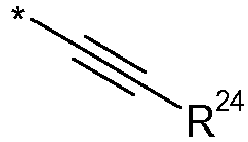
- when there is a single bond present between C2' and C3',
- R12 is selected from H, OH, F, diF and

- R6 and R9 are independently selected from H, R, OH, OR, SH, SR, NH2, NHR, NRR', nitro, Me3Sn and halo;
- where R and R' are independently selected from optionally substituted C1-12 alkyl, C3-20 heterocyclyl and C5-20 aryl groups;
- R7 is selected from H, R, OH, OR, SH, SR, NH2, NHR, NRR', nitro, Me3Sn and halo;
- R" is a C3-12 alkylene group, which chain may be interrupted by one or more heteroatoms, e.g. O, S, NRN2 (where RN2 is H or C1-4 alkyl), and/or aromatic rings, e.g. benzene or pyridine;
- Y and Y' are selected from O, S, or NH;
- R11a is selected from OH, ORA, where RA is C1-4 alkyl;
- R6', R7', R9' and R11a' are selected from the same groups as R6, R7, R9 and R11a respectively;
and - RLL1 and RLL2 are linkers connected to the antibody at different sites which are independently selected from:
- (iiia):

- Q is:

- X is:

- where a = 0 to 5, b = 0 to 16, c = 0 or 1, d = 0 to 5;
- GLL is a linker connected to the antibody;
- wherein the term alkyl includes the sub-classes alkenyl, alkynyl and cycloalkyl, the term alkylene includes the sub-classes alkenylene, alkynylene, cycloalkylene, the term alkenyl pertains to an alkyl group having one or more carbon-carbon double bonds and the term alkynyl pertains to an alkyl group having one or more carbon-carbon triple bonds.
- (iiia):
- It is thought that such ADCs which effectivelty have a drug antibody ratio (DAR) of 1 could offer significant advantages including reduced off-target toxicity and an enhanced therapeutic window by reducing the minimal effective dose requirement over ADCs consisting of heterogeneous mixtures with higher DARs.
- A second aspect of the present invention comprises a compound with the formula II:

- wherein D, R2, R6, R7, R9, R11a, Y, R", Y', D', R6', R7', R9', R11a' and R12 (including the presence or absence of double bonds between C2 and C3 and C2' and C3' respectively) are as defined in the first aspect of the invention;
- RL is a linker for connecting to a cell binding agent, which is selected from:
- (iiia):

- where Q and X are as defined in the first aspect and GL is a linker for connecting to an antibody.
- (iiia):
- The third aspect provides a conjugate of the first aspect of the invention for use in the treatment of a proliferative disease.
- One of ordinary skill in the art is readily able to determine whether or not a candidate conjugate treats a proliferative condition for any particular cell type. For example, assays which may conveniently be used to assess the activity offered by a particular compound are described in the examples below.
- A conjugate of the first aspect of the invention can be synthesised by conjugating a compound (drug linker) of the second aspect of the invention with an antibody as defined in the first aspect of the invention.
-
- Figure 1 shows the effect of a single dose of a conjugate of the invention compared to non-treatment in a NCl-N87 xenograft model;
- Figure 2 shows the effect of a lower single dose of the same conjugate of the invention compared to non-treatment in a NCl-N87 xenograft model.
-
Figure 3 shows schematic representations of (A) modified antibodies suitable for use in the present invention, (B) an antibody drug conjugate comprising a PBD of the present invention. -
Figure 4 shows a schematic representation of the conjugation of a modified antibody toCompound 10. -
Figure 5 shows the heavy and light chain sequences of a Herceptin-Flexmab. -
Figure 6 shows the activity of a conjugate of the present invention compared to a conjugate not of the present invention. - The phrase "optionally substituted" as used herein, pertains to a parent group which may be unsubstituted or which may be substituted.
- Unless otherwise specified, the term "substituted" as used herein, pertains to a parent group which bears one or more substituents. The term "substituent" is used herein in the conventional sense and refers to a chemical moiety which is covalently attached to, or if appropriate, fused to, a parent group. A wide variety of substituents are well known, and methods for their formation and introduction into a variety of parent groups are also well known.
- Examples of substituents are described in more detail below.
- C1-12 alkyl: The term "C1-12 alkyl" as used herein, pertains to a monovalent moiety obtained by removing a hydrogen atom from a carbon atom of a hydrocarbon compound having from 1 to 12 carbon atoms, which may be aliphatic or alicyclic, and which may be saturated or unsaturated (e.g. partially unsaturated, fully unsaturated). The term "C1-4 alkyl" as used herein, pertains to a monovalent moiety obtained by removing a hydrogen atom from a carbon atom of a hydrocarbon compound having from 1 to 4 carbon atoms, which may be aliphatic or alicyclic, and which may be saturated or unsaturated (e.g. partially unsaturated, fully unsaturated). Thus, the term "alkyl" includes the sub-classes alkenyl, alkynyl, cycloalkyl, etc., discussed below.
- Examples of saturated alkyl groups include, but are not limited to, methyl (C1), ethyl (C2), propyl (C3), butyl (C4), pentyl (C5), hexyl (C6) and heptyl (C7).
- Examples of saturated linear alkyl groups include, but are not limited to, methyl (C1), ethyl (C2), n-propyl (C3), n-butyl (C4), n-pentyl (amyl) (C5), n-hexyl (C6) and n-heptyl (C7).
- Examples of saturated branched alkyl groups include iso-propyl (C3), iso-butyl (C4), sec-butyl (C4), tert-butyl (C4), iso-pentyl (C5), and neo-pentyl (C5).
- C2-12 Alkenyl: The term "C2-12 alkenyl" as used herein, pertains to an alkyl group having one or more carbon-carbon double bonds.
- Examples of unsaturated alkenyl groups include, but are not limited to, ethenyl (vinyl, - CH=CH2), 1-propenyl (-CH=CH-CH3), 2-propenyl (allyl, -CH-CH=CH2), isopropenyl (1-methylvinyl, -C(CH3)=CH2), butenyl (C4), pentenyl (C5), and hexenyl (C6).
- C2-12 alkynyl: The term "C2-12 alkynyl" as used herein, pertains to an alkyl group having one or more carbon-carbon triple bonds.
- Examples of unsaturated alkynyl groups include, but are not limited to, ethynyl (-C≡CH) and 2-propynyl (propargyl, -CH2-C≡CH).
- C3-12 cycloalkyl: The term "C3-12 cycloalkyl" as used herein, pertains to an alkyl group which is also a cyclyl group; that is, a monovalent moiety obtained by removing a hydrogen atom from an alicyclic ring atom of a cyclic hydrocarbon (carbocyclic) compound, which moiety has from 3 to 7 carbon atoms, including from 3 to 7 ring atoms.
- Examples of cycloalkyl groups include, but are not limited to, those derived from:
- saturated monocyclic hydrocarbon compounds:
cyclopropane (C3), cyclobutane (C4), cyclopentane (C5), cyclohexane (C6), cycloheptane (C7), methylcyclopropane (C4), dimethylcyclopropane (C5), methylcyclobutane (C5), dimethylcyclobutane (C6), methylcyclopentane (C6), dimethylcyclopentane (C7) and methylcyclohexane (C7); - unsaturated monocyclic hydrocarbon compounds:
cyclopropene (C3), cyclobutene (C4), cyclopentene (C5), cyclohexene (C6), methylcyclopropene (C4), dimethylcyclopropene (C5), methylcyclobutene (C5), dimethylcyclobutene (C6), methylcyclopentene (C6), dimethylcyclopentene (C7) and methylcyclohexene (C7); and - saturated polycyclic hydrocarbon compounds:
norcarane (C7), norpinane (C7), norbornane (C7). - C3-20 heterocyclyl: The term "C3-20 heterocyclyl" as used herein, pertains to a monovalent moiety obtained by removing a hydrogen atom from a ring atom of a heterocyclic compound, which moiety has from 3 to 20 ring atoms, of which from 1 to 10 are ring heteroatoms. Preferably, each ring has from 3 to 7 ring atoms, of which from 1 to 4 are ring heteroatoms.
- In this context, the prefixes (e.g. C3-20, C3-7, C5-6, etc.) denote the number of ring atoms, or range of number of ring atoms, whether carbon atoms or heteroatoms. For example, the term "C5-6heterocyclyl", as used herein, pertains to a heterocyclyl group having 5 or 6 ring atoms.
- Examples of monocyclic heterocyclyl groups include, but are not limited to, those derived from:
- N1: aziridine (C3), azetidine (C4), pyrrolidine (tetrahydropyrrole) (C5), pyrroline (e.g., 3-pyrroline, 2,5-dihydropyrrole) (C5), 2H-pyrrole or 3H-pyrrole (isopyrrole, isoazole) (C5),
- piperidine (C6), dihydropyridine (C6), tetrahydropyridine (C6), azepine (C7);
- O1: oxirane (C3), oxetane (C4), oxolane (tetrahydrofuran) (C5), oxole (dihydrofuran) (C5), oxane (tetrahydropyran) (C6), dihydropyran (C6), pyran (C6), oxepin (C7);
- S1: thiirane (C3), thietane (C4), thiolane (tetrahydrothiophene) (C5), thiane (tetrahydrothiopyran) (C6), thiepane (C7);
- O2: dioxolane (C5), dioxane (C6), and dioxepane (C7);
- O3: trioxane (C6);
- N2: imidazolidine (C5), pyrazolidine (diazolidine) (C5), imidazoline (C5), pyrazoline (dihydropyrazole) (C5), piperazine (C6);
- N1O1: tetrahydrooxazole (C5), dihydrooxazole (C5), tetrahydroisoxazole (C5), dihydroisoxazole (C5), morpholine (C6), tetrahydrooxazine (C6), dihydrooxazine (C6), oxazine (C6);
- N1S1: thiazoline (C5), thiazolidine (C5), thiomorpholine (C6);
- N2O1: oxadiazine (C6);
- O1S1: oxathiole (C5) and oxathiane (thioxane) (C6); and,
- N1O1S1: oxathiazine (C6).
- Examples of substituted monocyclic heterocyclyl groups include those derived from saccharides, in cyclic form, for example, furanoses (C5), such as arabinofuranose, lyxofuranose, ribofuranose, and xylofuranse, and pyranoses (C6), such as allopyranose, altropyranose, glucopyranose, mannopyranose, gulopyranose, idopyranose, galactopyranose, and talopyranose.
- C5-20 aryl: The term "C5-20 aryl", as used herein, pertains to a monovalent moiety obtained by removing a hydrogen atom from an aromatic ring atom of an aromatic compound, which moiety has from 3 to 20 ring atoms. The term "C5-7 aryl", as used herein, pertains to a monovalent moiety obtained by removing a hydrogen atom from an aromatic ring atom of an aromatic compound, which moiety has from 5 to 7 ring atoms and the term "C5-10 aryl", as used herein, pertains to a monovalent moiety obtained by removing a hydrogen atom from an aromatic ring atom of an aromatic compound, which moiety has from 5 to 10 ring atoms. Preferably, each ring has from 5 to 7 ring atoms.
- In this context, the prefixes (e.g. C3-20, C5-7, C5-6, C5-10, etc.) denote the number of ring atoms, or range of number of ring atoms, whether carbon atoms or heteroatoms. For example, the term "C5-6 aryl" as used herein, pertains to an aryl group having 5 or 6 ring atoms.
- The ring atoms may be all carbon atoms, as in "carboaryl groups".
- Examples of carboaryl groups include, but are not limited to, those derived from benzene (i.e. phenyl) (C6), naphthalene (C10), azulene (C10), anthracene (C14), phenanthrene (C14), naphthacene (C18), and pyrene (C16).
- Examples of aryl groups which comprise fused rings, at least one of which is an aromatic ring, include, but are not limited to, groups derived from indane (e.g. 2,3-dihydro-1H-indene) (C9), indene (C9), isoindene (C9), tetraline (1,2,3,4-tetrahydronaphthalene (C10), acenaphthene (C12), fluorene (C13), phenalene (C13), acephenanthrene (C15), and aceanthrene (C16).
- Alternatively, the ring atoms may include one or more heteroatoms, as in "heteroaryl groups". Examples of monocyclic heteroaryl groups include, but are not limited to, those derived from:
- N1: pyrrole (azole) (C5), pyridine (azine) (C6);
- O1: furan (oxole) (C5);
- S1: thiophene (thiole) (C5);
- N1O1: oxazole (C5), isoxazole (C5), isoxazine (C6);
- N2O1: oxadiazole (furazan) (C5);
- N3O1: oxatriazole (C5);
- N1S1: thiazole (C5), isothiazole (C5);
- N2: imidazole (1,3-diazole) (C5), pyrazole (1,2-diazole) (C5), pyridazine (1,2-diazine) (C6), pyrimidine (1,3-diazine) (C6) (e.g., cytosine, thymine, uracil), pyrazine (1,4-diazine) (C6);
- N3: triazole (C5), triazine (C6); and,
- N4: tetrazole (C5).
- Examples of heteroaryl which comprise fused rings, include, but are not limited to:
- C9 (with 2 fused rings) derived from benzofuran (O1), isobenzofuran (O1), indole (N1), isoindole (N1), indolizine (N1), indoline (N1), isoindoline (N1), purine (N4) (e.g., adenine, guanine), benzimidazole (N2), indazole (N2), benzoxazole (N1O1), benzisoxazole (N1O1), benzodioxole (O2), benzofurazan (N2O1), benzotriazole (N3), benzothiofuran (S1), benzothiazole (N1S1), benzothiadiazole (N2S);
- C10 (with 2 fused rings) derived from chromene (O1), isochromene (O1), chroman (O1), isochroman (O1), benzodioxan (O2), quinoline (N1), isoquinoline (N1), quinolizine (N1), benzoxazine (N1O1), benzodiazine (N2), pyridopyridine (N2), quinoxaline (N2), quinazoline (N2), cinnoline (N2), phthalazine (N2), naphthyridine (N2), pteridine (N4);
- C11 (with 2 fused rings) derived from benzodiazepine (N2);
- C13 (with 3 fused rings) derived from carbazole (N1), dibenzofuran (O1), dibenzothiophene (S1), carboline (N2), perimidine (N2), pyridoindole (N2); and,
- C14 (with 3 fused rings) derived from acridine (N1), xanthene (O1), thioxanthene (S1), oxanthrene (O2), phenoxathiin (O1S1), phenazine (N2), phenoxazine (N1O1), phenothiazine (N1S1), thianthrene (S2), phenanthridine (N1), phenanthroline (N2), phenazine (N2).
- The above groups, whether alone or part of another substituent, may themselves optionally be substituted with one or more groups selected from themselves and the additional substituents listed below.
- Halo: -F, -Cl, -Br, and -I.
- Hydroxy: -OH.
- Ether: -OR, wherein R is an ether substituent, for example, a C1-7 alkyl group (also referred to as a C1-7 alkoxy group, discussed below), a C3-20 heterocyclyl group (also referred to as a C3-20 heterocyclyloxy group), or a C5-20 aryl group (also referred to as a C5-20 aryloxy group), preferably a C1-7alkyl group.
- Alkoxy: -OR, wherein R is an alkyl group, for example, a C1-7 alkyl group. Examples of C1-7 alkoxy groups include, but are not limited to, -OMe (methoxy), -OEt (ethoxy), -O(nPr) (n-propoxy), -O(iPr) (isopropoxy), -O(nBu) (n-butoxy), -O(sBu) (sec-butoxy), -O(iBu) (isobutoxy), and -O(tBu) (tert-butoxy).
- Acetal: -CH(OR1)(OR2), wherein R1 and R2 are independently acetal substituents, for example, a C1-7 alkyl group, a C3-20 heterocyclyl group, or a C5-20 aryl group, preferably a C1-7 alkyl group, or, in the case of a "cyclic" acetal group, R1 and R2, taken together with the two oxygen atoms to which they are attached, and the carbon atoms to which they are attached, form a heterocyclic ring having from 4 to 8 ring atoms. Examples of acetal groups include, but are not limited to, -CH(OMe)2, -CH(OEt)2, and -CH(OMe)(OEt).
- Hemiacetal: -CH(OH)(OR1), wherein R1 is a hemiacetal substituent, for example, a C1-7 alkyl group, a C3-20 heterocyclyl group, or a C5-20 aryl group, preferably a C1-7 alkyl group. Examples of hemiacetal groups include, but are not limited to, -CH(OH)(OMe) and - CH(OH)(OEt).
- Ketal: -CR(OR1)(OR2), where R1 and R2 are as defined for acetals, and R is a ketal substituent other than hydrogen, for example, a C1-7 alkyl group, a C3-20 heterocyclyl group, or a C5-20 aryl group, preferably a C1-7 alkyl group. Examples ketal groups include, but are not limited to, -C(Me)(OMe)2, -C(Me)(OEt)2, -C(Me)(OMe)(OEt), -C(Et)(OMe)2,-C(Et)(OEt)2, and -C(Et)(OMe)(OEt).
- Hemiketal: -CR(OH)(OR1), where R1 is as defined for hemiacetals, and R is a hemiketal substituent other than hydrogen, for example, a C1-7 alkyl group, a C3-20 heterocyclyl group, or a C5-20 aryl group, preferably a C1-7 alkyl group. Examples of hemiacetal groups include, but are not limited to, -C(Me)(OH)(OMe), -C(Et)(OH)(OMe), -C(Me)(OH)(OEt), and -C(Et)(OH)(OEt).
- Oxo (keto, -one): =O.
- Thione (thioketone): =S.
- Imino (imine): =NR, wherein R is an imino substituent, for example, hydrogen, C1-7alkyl group, a C3-20 heterocyclyl group, or a C5-20 aryl group, preferably hydrogen or a C1-7 alkyl group. Examples of ester groups include, but are not limited to, =NH, =NMe, =NEt, and =NPh.
- Formyl (carbaldehyde, carboxaldehyde): -C(=O)H.
- Acyl (keto): -C(=O)R, wherein R is an acyl substituent, for example, a C1-7 alkyl group (also referred to as C1-7 alkylacyl or C1-7 alkanoyl), a C3-20 heterocyclyl group (also referred to as C3-20 heterocyclylacyl), or a C5-20 aryl group (also referred to as C5-20 arylacyl), preferably a C1-7 alkyl group. Examples of acyl groups include, but are not limited to, -C(=O)CH3 (acetyl), -C(=O)CH2CH3 (propionyl), -C(=O)C(CH3)3 (t-butyryl), and -C(=O)Ph (benzoyl, phenone).
- Carboxy (carboxylic acid): -C(=O)OH.
- Thiocarboxy (thiocarboxylic acid): -C(=S)SH.
- Thiolocarboxy (thiolocarboxylic acid): -C(=O)SH.
- Thionocarboxy (thionocarboxylic acid): -C(=S)OH.
- Imidic acid: -C(=NH)OH.
- Hydroxamic acid: -C(=NOH)OH.
- Ester (carboxylate, carboxylic acid ester, oxycarbonyl): -C(=O)OR, wherein R is an ester substituent, for example, a C1-7 alkyl group, a C3-20 heterocyclyl group, or a C5-20 aryl group, preferably a C1-7 alkyl group. Examples of ester groups include, but are not limited to, -C(=O)OCH3, -C(=O)OCH2CH3, -C(=O)OC(CH3)3, and -C(=O)OPh.
- Acyloxy (reverse ester): -OC(=O)R, wherein R is an acyloxy substituent, for example, a C1-7 alkyl group, a C3-20 heterocyclyl group, or a C5-20 aryl group, preferably a C1-7 alkyl group. Examples of acyloxy groups include, but are not limited to, -OC(=O)CH3 (acetoxy), -OC(=O)CH2CH3, -OC(=O)C(CH3)3, -OC(=O)Ph, and -OC(=O)CH2Ph.
- Oxycarboyloxy: -OC(=O)OR, wherein R is an ester substituent, for example, a C1-7 alkyl group, a C3-20 heterocyclyl group, or a C5-20 aryl group, preferably a C1-7 alkyl group. Examples of ester groups include, but are not limited to, -OC(=O)OCH3, -OC(=O)OCH2CH3, -OC(=O)OC(CH3)3, and -OC(=O)OPh.
- Amino: -NR1R2, wherein R1 and R2 are independently amino substituents, for example, hydrogen, a C1-7 alkyl group (also referred to as C1-7 alkylamino or di-C1-7 alkylamino), a C3-20 heterocyclyl group, or a C5-20 aryl group, preferably H or a C1-7 alkyl group, or, in the case of a "cyclic" amino group, R1 and R2, taken together with the nitrogen atom to which they are attached, form a heterocyclic ring having from 4 to 8 ring atoms. Amino groups may be primary (-NH2), secondary (-NHR1), or tertiary (-NHR1R2), and in cationic form, may be quaternary (-+NR1R2R3). Examples of amino groups include, but are not limited to, -NH2, -NHCH3, -NHC(CH3)2, -N(CH3)2, -N(CH2CH3)2, and -NHPh. Examples of cyclic amino groups include, but are not limited to, aziridino, azetidino, pyrrolidino, piperidino, piperazino, morpholino, and thiomorpholino.
- Amido (carbamoyl, carbamyl, aminocarbonyl, carboxamide): -C(=O)NR1R2, wherein R1 and R2 are independently amino substituents, as defined for amino groups. Examples of amido groups include, but are not limited to, -C(=O)NH2, -C(=O)NHCH3, -C(=O)N(CH3)2, -C(=O)NHCH2CH3, and -C(=O)N(CH2CH3)2, as well as amido groups in which R1 and R2, together with the nitrogen atom to which they are attached, form a heterocyclic structure as in, for example, piperidinocarbonyl, morpholinocarbonyl, thiomorpholinocarbonyl, and piperazinocarbonyl.
- Thioamido (thiocarbamyl): -C(=S)NR1R2, wherein R1 and R2 are independently amino substituents, as defined for amino groups. Examples of amido groups include, but are not limited to, -C(=S)NH2, -C(=S)NHCH3, -C(=S)N(CH3)2, and -C(=S)NHCH2CH3.
- Acylamido (acylamino): -NR1C(=O)R2, wherein R1 is an amide substituent, for example, hydrogen, a C1-7 alkyl group, a C3-20 heterocyclyl group, or a C5-20 aryl group, preferably hydrogen or a C1-7 alkyl group, and R2 is an acyl substituent, for example, a C1-7 alkyl group, a C3-20 heterocyclyl group, or a C5-20aryl group, preferably hydrogen or a C1-7 alkyl group. Examples of acylamide groups include, but are not limited to, -NHC(=O)CH3 , -NHC(=O)CH2CH3, and -NHC(=O)Ph. R1 and R2 may together form a cyclic structure, as in, for example, succinimidyl, maleimidyl, and phthalimidyl:

- Aminocarbonyloxy: -OC(=O)NR1R2, wherein R1 and R2 are independently amino substituents, as defined for amino groups. Examples of aminocarbonyloxy groups include, but are not limited to, -OC(=O)NH2, -OC(=O)NHMe, -OC(=O)NMe2, and -OC(=O)NEt2.
- Ureido: -N(R1)CONR2R3 wherein R2 and R3 are independently amino substituents, as defined for amino groups, and R1 is a ureido substituent, for example, hydrogen, a C1-7 alkyl group, a C3-20 heterocyclyl group, or a C5-20 aryl group, preferably hydrogen or a C1-7 alkyl group. Examples of ureido groups include, but are not limited to, -NHCONH2,-NHCONHMe, -NHCONHEt, -NHCONMe2, -NHCONEt2, -NMeCONH2, -NMeCONHMe, -NMeCONHEt, -NMeCONMe2, and -NMeCONEt2.
- Guanidino: -NH-C(=NH)NH2.
- Tetrazolyl: a five membered aromatic ring having four nitrogen atoms and one carbon atom,

- Imino: =NR, wherein R is an imino substituent, for example, for example, hydrogen, a C1-7 alkyl group, a C3-20 heterocyclyl group, or a C5-20 aryl group, preferably H or a C1-7alkyl group. Examples of imino groups include, but are not limited to, =NH, =NMe, and =NEt.
- Amidine (amidino): -C(=NR)NR2, wherein each R is an amidine substituent, for example, hydrogen, a C1-7 alkyl group, a C3-20 heterocyclyl group, or a C5-20 aryl group, preferably H or a C1-7 alkyl group. Examples of amidine groups include, but are not limited to, -C(=NH)NH2, -C(=NH)NMe2, and -C(=NMe)NMe2.
- Nitro: -NO2.
- Nitroso: -NO.
- Azido: -N3.
- Cyano (nitrile, carbonitrile): -CN.
- Isocyano: -NC.
- Cyanato: -OCN.
- Isocyanato: -NCO.
- Thiocyano (thiocyanato): -SCN.
- Isothiocyano (isothiocyanato): -NCS.
- Sulfhydryl (thiol, mercapto): -SH.
- Thioether (sulfide): -SR, wherein R is a thioether substituent, for example, a C1-7 alkyl group (also referred to as a C1-7alkylthio group), a C3-20 heterocyclyl group, or a C5-20 aryl group, preferably a C1-7 alkyl group. Examples of C1-7 alkylthio groups include, but are not limited to, -SCH3 and -SCH2CH3.
- Disulfide: -SS-R, wherein R is a disulfide substituent, for example, a C1-7 alkyl group, a C3-20 heterocyclyl group, or a C5-20 aryl group, preferably a C1-7 alkyl group (also referred to herein as C1-7 alkyl disulfide). Examples of C1-7 alkyl disulfide groups include, but are not limited to, -SSCH3 and -SSCH2CH3.
- Sulfine (sulfinyl, sulfoxide): -S(=O)R, wherein R is a sulfine substituent, for example, a C1-7 alkyl group, a C3-20 heterocyclyl group, or a C5-20 aryl group, preferably a C1-7 alkyl group. Examples of sulfine groups include, but are not limited to, -S(=O)CH3 and -S(=O)CH2CH3.
- Sulfone (sulfonyl): -S(=O)2R, wherein R is a sulfone substituent, for example, a C1-7 alkyl group, a C3-20 heterocyclyl group, or a C5-20 aryl group, preferably a C1-7 alkyl group, including, for example, a fluorinated or perfluorinated C1-7 alkyl group. Examples of sulfone groups include, but are not limited to, -S(=O)2CH3 (methanesulfonyl, mesyl), -S(=O)2CF3 (triflyl), -S(=O)2CH2CH3 (esyl), -S(=O)2C4F9 (nonaflyl), -S(=O)2CH2CF3 (tresyl), -S(=O)2CH2CH2NH2 (tauryl), -S(=O)2Ph (phenylsulfonyl, besyl), 4-methylphenylsulfonyl (tosyl), 4-chlorophenylsulfonyl (closyl), 4-bromophenylsulfonyl (brosyl), 4-nitrophenyl (nosyl), 2-naphthalenesulfonate (napsyl), and 5-dimethylamino-naphthalen-1-ylsulfonate (dansyl).
- Sulfinic acid (sulfino): -S(=O)OH, -SO2H.
- Sulfonic acid (sulfo): -S(=O)2OH, -SO3H.
- Sulfinate (sulfinic acid ester): -S(=O)OR; wherein R is a sulfinate substituent, for example, a C1-7 alkyl group, a C3-20 heterocyclyl group, or a C5-20 aryl group, preferably a C1-7 alkyl group. Examples of sulfinate groups include, but are not limited to, -S(=O)OCH3 (methoxysulfinyl; methyl sulfinate) and -S(=O)OCH2CH3 (ethoxysulfinyl; ethyl sulfinate).
- Sulfonate (sulfonic acid ester): -S(=O)2OR, wherein R is a sulfonate substituent, for example, a C1-7 alkyl group, a C3-20 heterocyclyl group, or a C5-20 aryl group, preferably a C1-7 alkyl group. Examples of sulfonate groups include, but are not limited to, -S(=O)2OCH3 (methoxysulfonyl; methyl sulfonate) and -S(=O)2OCH2CH3 (ethoxysulfonyl; ethyl sulfonate).
- Sulfinyloxy: -OS(=O)R, wherein R is a sulfinyloxy substituent, for example, a C1-7 alkyl group, a C3-20 heterocyclyl group, or a C5-20 aryl group, preferably a C1-7 alkyl group. Examples of sulfinyloxy groups include, but are not limited to, -OS(=O)CH3 and -OS(=O)CH2CH3.
- Sulfonyloxy: -OS(=O)2R, wherein R is a sulfonyloxy substituent, for example, a C1-7 alkyl group, a C3-20 heterocyclyl group, or a C5-20 aryl group, preferably a C1-7 alkyl group. Examples of sulfonyloxy groups include, but are not limited to, -OS(=O)2CH3 (mesylate) and -OS(=O)2CH2CH3 (esylate).
- Sulfate: -OS(=O)2OR; wherein R is a sulfate substituent, for example, a C1-7 alkyl group, a C3-20 heterocyclyl group, or a C5-20 aryl group, preferably a C1-7 alkyl group. Examples of sulfate groups include, but are not limited to, -OS(=O)2OCH3 and -SO(=O)2OCH2CH3.
- Sulfamyl (sulfamoyl; sulfinic acid amide; sulfinamide): -S(=O)NR1R2, wherein R1 and R2 are independently amino substituents, as defined for amino groups. Examples of sulfamyl groups include, but are not limited to, -S(=O)NH2, -S(=O)NH(CH3), -S(=O)N(CH3)2, -S(=O)NH(CH2CH3), -S(=O)N(CH2CH3)2, and -S(=O)NHPh.
- Sulfonamido (sulfinamoyl; sulfonic acid amide; sulfonamide): -S(=O)2NR1R2, wherein R1 and R2 are independently amino substituents, as defined for amino groups. Examples of sulfonamido groups include, but are not limited to, -S(=O)2NH2, -S(=O)2NH(CH3), -S(=O)2N(CH3)2, -S(=O)2NH(CH2CH3), -S(=O)2N(CH2CH3)2, and -S(=O)2NHPh.
- Sulfamino: -NR1S(=O)2OH, wherein R1 is an amino substituent, as defined for amino groups. Examples of sulfamino groups include, but are not limited to, -NHS(=O)2OH and -N(CH3)S(=O)2OH.
- Sulfonamino: -NR1S(=O)2R, wherein R1 is an amino substituent, as defined for amino groups, and R is a sulfonamino substituent, for example, a C1-7 alkyl group, a C3-20 heterocyclyl group, or a C5-20 aryl group, preferably a C1-7 alkyl group. Examples of sulfonamino groups include, but are not limited to, -NHS(=O)2CH3 and -N(CH3)S(=O)2C6H5.
- Sulfinamino: -NR1S(=O)R, wherein R1 is an amino substituent, as defined for amino groups, and R is a sulfinamino substituent, for example, a C1-7 alkyl group, a C3-20 heterocyclyl group, or a C5-20 aryl group, preferably a C1-7 alkyl group. Examples of sulfinamino groups include, but are not limited to, -NHS(=O)CH3 and -N(CH3)S(=O)C6H5.
- Phosphino (phosphine): -PR2, wherein R is a phosphino substituent, for example, -H, a C1-7 alkyl group, a C3-20 heterocyclyl group, or a C5-20 aryl group, preferably -H, a C1-7 alkyl group, or a C5-20 aryl group. Examples of phosphino groups include, but are not limited to, -PH2, -P(CH3)2, -P(CH2CH3)2, -P(t-Bu)2, and -P(Ph)2.
- Phospho: -P(=O)2.
- Phosphinyl (phosphine oxide): -P(=O)R2, wherein R is a phosphinyl substituent, for example, a C1-7 alkyl group, a C3-20 heterocyclyl group, or a C5-20 aryl group, preferably a C1-7 alkyl group or a C5-20 aryl group. Examples of phosphinyl groups include, but are not limited to, -P(=O)(CH3)2, -P(=O)(CH2CH3)2, -P(=O)(t-Bu)2, and -P(=O)(Ph)2.
- Phosphonic acid (phosphono): -P(=O)(OH)2.
- Phosphonate (phosphono ester): -P(=O)(OR)2, where R is a phosphonate substituent, for example, -H, a C1-7 alkyl group, a C3-20 heterocyclyl group, or a C5-20 aryl group, preferably -H, a C1-7 alkyl group, or a C5-20 aryl group. Examples of phosphonate groups include, but are not limited to, -P(=O)(OCH3)2, -P(=O)(OCH2CH3)2, -P(=O)(O-t-Bu)2, and -P(=O)(OPh)2.
- Phosphoric acid (phosphonooxy): -OP(=O)(OH)2.
- Phosphate (phosphonooxy ester): -OP(=O)(OR)2, where R is a phosphate substituent, for example, -H, a C1-7 alkyl group, a C3-20 heterocyclyl group, or a C5-20 aryl group, preferably - H, a C1-7 alkyl group, or a C5-20 aryl group. Examples of phosphate groups include, but are not limited to, -OP(=O)(OCH3)2, -OP(=O)(OCH2CH3)2, -OP(=O)(O-t-Bu)2, and -OP(=O)(OPh)2.
- Phosphorous acid: -OP(OH)2.
- Phosphite: -OP(OR)2, where R is a phosphite substituent, for example, -H, a C1-7 alkyl group, a C3-20 heterocyclyl group, or a C5-20 aryl group, preferably -H, a C1-7 alkyl group, or a C5-20 aryl group. Examples of phosphite groups include, but are not limited to, -OP(OCH3)2, -OP(OCH2CH3)2, -OP(O-t-Bu)2, and -OP(OPh)2.
- Phosphoramidite: -OP(OR1)-NR2 2, where R1 and R2 are phosphoramidite substituents, for example, -H, a (optionally substituted) C1-7 alkyl group, a C3-20 heterocyclyl group, or a C5-20 aryl group, preferably -H, a C1-7 alkyl group, or a C5-20 aryl group. Examples of phosphoramidite groups include, but are not limited to, -OP(OCH2CH3)-N(CH3)2, -OP(OCH2CH3)-N(i-Pr)2, and -OP(OCH2CH2CN)-N(i-Pr)2.
- Phosphoramidate: -OP(=O)(OR1)-NR2 2, where R1 and R2 are phosphoramidate substituents, for example, -H, a (optionally substituted) C1-7 alkyl group, a C3-20 heterocyclyl group, or a C5-20 aryl group, preferably -H, a C1-7 alkyl group, or a C5-20 aryl group. Examples of phosphoramidate groups include, but are not limited to, -OP(=O)(OCH2CH3)-N(CH3)2, -OP(=O)(OCH2CH3)-N(i-Pr)2, and -OP(=O)(OCH2CH2CN)-N(i-Pr)2.
- C3-12 alkylene: The term "C3-12 alkylene", as used herein, pertains to a bidentate moiety obtained by removing two hydrogen atoms, either both from the same carbon atom, or one from each of two different carbon atoms, of a hydrocarbon compound having from 3 to 12 carbon atoms (unless otherwise specified), which may be aliphatic or alicyclic, and which may be saturated, partially unsaturated, or fully unsaturated. Thus, the term "alkylene" includes the sub-classes alkenylene, alkynylene, cycloalkylene, etc., discussed below.
- Examples of linear saturated C3-12 alkylene groups include, but are not limited to, -(CH2)n-where n is an integer from 3 to 12, for example, -CH2CH2CH2- (propylene), -CH2CH2CH2CH2- (butylene), -CH2CH2CH2CH2CH2- (pentylene) and -CH2CH2CH2CH-2CH2CH2CH2- (heptylene).
- Examples of branched saturated C3-12 alkylene groups include, but are not limited to, -CH(CH3)CH2-, -CH(CH3)CH2CH2-, -CH(CH3)CH2CH2CH2-, -CH2CH(CH3)CH2-, -CH2CH(CH3)CH2CH2-, -CH(CH2CH3)-, -CH(CH2CH3)CH2-, and -CH2CH(CH2CH3)CH2-.
- Examples of linear partially unsaturated C3-12 alkylene groups (C3-12 alkenylene, and alkynylene groups) include, but are not limited to, -CH=CH-CH2-, -CH2-CH=CH2-, -CH=CH-CH2-CH2-, -CH=CH-CH2-CH2-CH2-, -CH=CH-CH=CH-, -CH=CH-CH=CH-CH2-,-CH=CH-CH=CH-CH2-CH2-, -CH=CH-CH2-CH=CH-, -CH=CH-CH2-CH2-CH=CH-, and -CH2-C≡C-CH2-.
- Examples of branched partially unsaturated C3-12 alkylene groups (C3-12 alkenylene and alkynylene groups) include, but are not limited to, -C(CH3)=CH-, -C(CH3)=CH-CH2-, -CH=CH-CH(CH3)- and -C≡C-CH(CH3)-.
- Examples of alicyclic saturated C3-12 alkylene groups (C3-12 cycloalkylenes) include, but are not limited to, cyclopentylene (e.g. cyclopent-1,3-ylene), and cyclohexylene (e.g. cyclohex-1,4-ylene).
- Examples of alicyclic partially unsaturated C3-12 alkylene groups (C3-12 cycloalkylenes) include, but are not limited to, cyclopentenylene (e.g. 4-cyclopenten-1,3-ylene), cyclohexenylene (e.g. 2-cyclohexen-1,4-ylene; 3-cyclohexen-1,2-ylene; 2,5-cyclohexadien-1,4-ylene).
- The Ligand Units for use in the present invention are Cell Binding Agents, more specifically modified antibodies, or antigen binding fragments thereof, having at least one conjugation site on each heavy chain. Examples of particular modified antibodies suitable for use according to the present invention are disclosed in
WO 2012/064733 (filed asPCT/US2011/059775 ). - The term "antibody" herein is used in the broadest sense and specifically covers monoclonal antibodies, polyclonal antibodies, dimers, multimers, multispecific antibodies (e.g., bispecific antibodies), and antibody fragments, so long as they exhibit the desired biological activity (Miller et a/ (2003) Jour. of Immunology 170:4854-4861). Antibodies may be murine, human, humanized, chimeric, or derived from other species. An antibody is a protein generated by the immune system that is capable of recognizing and binding to a specific antigen. (Janeway, C., Travers, P., Walport, M., Shlomchik (2001) Immuno Biology, 5th Ed., Garland Publishing, New York). A target antigen generally has numerous binding sites, also called epitopes, recognized by CDRs on multiple antibodies. Each antibody that specifically binds to a different epitope has a different structure. Thus, one antigen may have more than one corresponding antibody. An antibody includes a full-length immunoglobulin molecule or an immunologically active portion of a full-length immunoglobulin molecule, i.e., a molecule that contains an antigen binding site that immunospecifically binds an antigen of a target of interest or part thereof, such targets including but not limited to, cancer cell or cells that produce autoimmune antibodies associated with an autoimmune disease. The immunoglobulin can be of any type (e.g. IgG, IgE, IgM, IgD, and IgA), class (e.g. IgG1, IgG2, IgG3, IgG4, IgA1 and IgA2) or subclass of immunoglobulin molecule. The immunoglobulins can be derived from any species, including human, murine, or rabbit origin.
- "Antibody fragments" comprise a portion of a full length antibody, generally the antigen binding or variable region thereof. Examples of antibody fragments include F(ab')2, and scFv fragments, and dimeric epitope-binding fragments of any of the above which immunospecifically bind to cancer cell antigens, viral antigens or microbial antigens, singlechain antibody molecules; and multispecific antibodies formed from antibody fragments.
- Modified antibodies suitable for use in the present invention include those wherein the native interchain cysteine residues have been substituted for amino acid residues lacking thiol groups. The antibodies may comprise at least one additional substitutions in each heavy chain of an amino acid residue comprising a reactive group suitable for conjugation to a linker. The additionally substituted amino acid may be a cysteine or a non-natural amino acid. The position that is substituted may be selected from those set forth below:
Antibody Isotype IgG1 IgG2 IgG3 IgG4 Position (Kabat EU) and Corresponding Amino Acid 239 Ser Ser Ser Ser 282 Val Val Val Val 289 Thr Thr Thr Thr 297 Asn Asn Asn Asn 312 Asp Asp Asp Asp 324 Ser Ser Ser Ser 330 Ala Ala Ala Ser 335 Thr Thr Thr Thr 337 Ser Ser Ser Ser 339 Ala Thr Thr Ala 356 Glu Glu Glu Glu 359 Thr Thr Thr Thr 361 Asn Asn Asn Asn 383 Ser Ser Ser Ser 384 Asn Asn Ser Asn 398 Leu Leu Leu Leu 400 Ser Ser Ser Ser 422 Val Val Ile Val 440 Ser Ser Ser Ser 442 Ser Ser Ser Ser - Examples of modified antibodies suitable for use in the present invention include the Flexmab structuires disclosed in
WO 2012/064733 . Such Flexmabs have cysteines with free thiol groups in the hinge region of the antibody that may be used as conjugation sites for linking through the N10 groups of the PBDs of the present invention. - Other examples of modified antibodies suitable for use in the present invention include those where cysteines have been inserted in selected sites in antibodies. These are described in Dimasi, N., et al., Molecular Pharmaceutics, 2017, 14, 1501-1516 (DOI: 10.1021/acs.molpharmaceut.6b00995) and
WO2015/157595 . In particular, antibodies which have been modified by insertion of a cysteine after the S239 position (ie. between positions 239 and 240) are of use. - Reference is made to the listed on pages 60 to 62 of
WO 2012/064733 . In some embodiments, the antibody may be to a tumour-associated antigen, for example: HER2 (ErbB2); EPHA2 (EPH receptor A2); CD19; IL2RA (Interleukin 2 receptor, alpha). - Tumour-associate antigens and cognate antibodies for use in embodiments of the present invention are listed below, and are described in more detail on pages 14 to 86 of
WO 2017/186894 . - (1) BMPR1B (bone morphogenetic protein receptor-type IB)
- (2) E16 (LAT1, SLC7A5)
- (3) STEAP1 (six transmembrane epithelial antigen of prostate)
- (4) 0772P (CA125, MUC16)
- (5) MPF (MPF, MSLN, SMR, megakaryocyte potentiating factor, mesothelin)
- (6) Napi3b (NAPI-3B, NPTIIb, SLC34A2, solute carrier family 34 (sodium phosphate), member 2, type II sodium-dependent phosphate transporter 3b)
- (7) Sema 5b (FLJ10372, KIAA1445, Mm.42015, SEMA5B, SEMAG, Semaphorin 5b Hlog, 25 sema domain, seven thrombospondin repeats (
type 1 and type 1-like), transmembrane domain (TM) and short cytoplasmic domain, (semaphorin) 5B) - (8) PSCA hlg (2700050C12Rik, C530008O16Rik, RIKEN cDNA 2700050C12, RIKEN cDNA 2700050C12 gene)
- (9) ETBR (Endothelin type B receptor)
- (10) MSG783 (RNF124, hypothetical protein FLJ20315)
- (11) STEAP2 (HGNC_8639, IPCA-1, PCANAP1, STAMP1, STEAP2, STMP, prostate cancer associated
gene 1, prostate cancer associatedprotein 1, six transmembrane epithelial antigen of prostate 2, six transmembrane prostate protein) - (12) TrpM4 (BR22450, FLJ20041, TRPM4, TRPM4B, transient receptor
potential cation 5 channel, subfamily M, member 4) - (13) CRIPTO (CR, CR1, CRGF, CRIPTO, TDGF1, teratocarcinoma-derived growth factor)
- (14) CD21 (CR2 (Complement receptor 2) or C3DR (C3d/Epstein Barr virus receptor) or Hs.73792)
- (15) CD79b (CD79B, CD79β, IGb (immunoglobulin-associated beta), B29)
- (16) FcRH2 (IFGP4, IRTA4, SPAP1A (SH2 domain containing phosphatase anchor protein 1a), SPAP1B, SPAP1C)
- (17) HER2 (ErbB2)
- (18) NCA (CEACAM6)
- (19) MDP (DPEP1)
- (20) IL20R-alpha (IL20Ra, ZCYTOR7)
- (21) Brevican (BCAN, BEHAB)
- (22) EphB2R (DRT, ERK, Hek5, EPHT3, Tyro5)
- (23) ASLG659 (B7h)
- (24) PSCA (Prostate stem cell antigen precursor)
- (25) GEDA
- (26) BAFF-R (B cell -activating factor receptor, BLyS receptor 3, BR3)
- (27) CD22 (B-cell receptor CD22-B isoform, BL-CAM, Lyb-8, Lyb8, SIGLEC-2, FLJ22814)
- (27a) CD22 (CD22 molecule)
- (28) CD79a (CD79A, CD79alpha), immunoglobulin-associated alpha, a B cell-specific protein that covalently interacts with Ig beta (CD79B) and forms a complex on the surface with Ig M molecules, transduces a signal involved in B-cell differentiation), pl: 4.84, MW: 25028 TM: 2 [P] Gene Chromosome: 19q13.2).
- (29) CXCR5 (Burkitt's
lymphoma receptor 1, a G protein-coupled receptor that is activated by the CXCL13 chemokine, functions in lymphocyte migration and humoral defense, plays a role in HIV-2 infection and perhaps development of AIDS, lymphoma, myeloma, and leukemia); 372 aa, pi: 8.54 MW: 41959 TM: 7 [P] Gene Chromosome: 11q23.3, - (30) HLA-DOB (Beta subunit of MHC class II molecule (Ia antigen) that binds peptides and 20 presents them to CD4+ T lymphocytes); 273 aa, pi: 6.56, MW: 30820.TM: 1 [P] Gene Chromosome: 6p21.3)
- (31) P2X5 (Purinergic receptor P2X ligand-gated
ion channel 5, an ion channel gated by extracellular ATP, may be involved in synaptic transmission and neurogenesis, deficiency may contribute to the pathophysiology of idiopathic detrusor instability); 422 aa), pi: 7.63, MW: 47206 TM: 1 [P] Gene Chromosome: 17p13.3). - (32) CD72 (B-cell differentiation antigen CD72, Lyb-2); 359 aa, pi: 8.66, MW: 40225, TM: 1 5 [P] Gene Chromosome: 9p13.3).
- (33) LY64 (Lymphocyte antigen 64 (RP105), type I membrane protein of the leucine rich repeat (LRR) family, regulates B-cell activation and apoptosis, loss of function is associated with increased disease activity in patients with systemic lupus erythematosis); 661 aa, pi: 6.20, MW: 74147 TM: 1 [P] Gene Chromosome: 5q12).
- (34) FcRH1 (Fc receptor-
like protein 1, a putative receptor for the immunoglobulin Fc domain that contains C2 type Ig-like and ITAM domains, may have a role in B-lymphocyte differentiation); 429 aa, pi: 5.28, MW: 46925 TM: 1 [P] Gene Chromosome: 1q21-1q22) - (35) IRTA2 (Immunoglobulin superfamily receptor translocation associated 2, a putative immunoreceptor with possible roles in B cell development and lymphomagenesis; deregulation of the gene by translocation occurs in some B cell malignancies); 977 aa, pi: 6.88, MW: 106468, TM: 1 [P] Gene Chromosome: 1q21)
- (36) TENB2 (TMEFF2, tomoregulin, TPEF, HPP1, TR, putative transmembrane proteoglycan, related to the EGF/heregulin family of growth factors and follistatin); 374 aa)
- (37) PSMA- FOLH1 (Folate hydrolase (prostate-specific membrane antigen) 1)
- (38) SST ( Somatostatin Receptor; note that there are5 subtypes)
- (38.1) SSTR2 (Somatostatin receptor 2)
- (38.2) SSTR5 (Somatostatin receptor 5)
- (38.3) SSTR1
- (38.4) SSTR3
- (38.5) SSTR4
- AvB6 - Both subunits (39+40)
- (39) ITGAV (Integrin, alpha V)
- (40) ITGB6 (Integrin, beta 6)
- (41) CEACAM5 (Carcinoembryonic antigen-related cell adhesion molecule 5)
- (42) MET (met proto-oncogene; hepatocyte growth factor receptor)
- (43) MUC1 (
Mucin 1, cell surface associated) - (44) CA9 (Carbonic anhydrase IX)
- (45) EGFRvIII ( Epidermal growth factor receptor (EGFR), transcript variant 3,
- (46) CD33 (CD33 molecule)
- (47) CD19 (CD19 molecule)
- (48) IL2RA (Interleukin 2 receptor, alpha); NCBI Reference Sequence: NM_000417.2);
- (49) AXL (AXL receptor tyrosine kinase)
- (50) CD30 - TNFRSF8 (Tumor necrosis factor receptor superfamily, member 8)
- (51) BCMA (B-cell maturation antigen) - TNFRSF17 (Tumor necrosis factor receptor superfamily, member 17)
- (52) CT Ags - CTA (Cancer Testis Antigens)
- (53) CD174 (Lewis Y) - FUT3 (fucosyltransferase 3 (galactoside 3(4)-L-fucosyltransferase, Lewis blood group)
- (54) CLEC14A (C-type lectin domain family 14, member A; Genbank accession no. NM175060)
- (55) GRP78 - HSPA5 (heat shock 70kDa protein 5 (glucose-regulated protein, 78kDa)
- (56) CD70 (CD70 molecule) L08096
- (57) Stem Cell specific antigens. For example:
- 5T4 (see entry (63) below)
- CD25 (see entry (48) above)
- CD32
- LGR5/GPR49
- Prominin/CD133
- (58) ASG-5
- (59) ENPP3 (Ectonucleotide pyrophosphatase/phosphodiesterase 3)
- (60) PRR4 (Proline rich 4 (lacrimal))
- (61) GCC - GUCY2C (guanylate cyclase 2C (heat stable enterotoxin receptor)
- (62) Liv-1 - SLC39A6 (Solute carrier family 39 (zinc transporter), member 6)
- (63) 5T4, Trophoblast glycoprotein, TPBG - TPBG (trophoblast glycoprotein)
- (64) CD56 - NCMA1 (Neural cell adhesion molecule 1)
- (65) CanAg (Tumor associated antigen CA242)
- (66) FOLR1 (Folate Receptor 1)
- (67) GPNMB (Glycoprotein (transmembrane) nmb)
- (68) TIM-1 - HAVCR1 (Hepatitis A virus cellular receptor 1)
- (69) RG-1/Prostate tumor target Mindin - Mindin/RG-1
- (70) B7-H4 - VTCN1 (V-set domain containing T
cell activation inhibitor 1 - (71) PTK7 (PTK7 protein tyrosine kinase 7)
- (72) CD37 (CD37 molecule)
- (73) CD138 - SDC1 (syndecan 1)
- (74) CD74 (CD74 molecule, major histocompatibility complex, class II invariant chain)
- (75) Claudins - CLs (Claudins)
- (76) EGFR (Epidermal growth factor receptor)
- (77) Her3 (ErbB3) - ERBB3 (v-erb-b2 erythroblastic leukemia viral oncogene homolog 3 (avian))
- (78) RON - MST1R (macrophage stimulating 1 receptor (c-met-related tyrosine kinase))
- (79) EPHA2 (EPH receptor A2)
- (80) CD20 - MS4A1 (membrane-spanning 4-domains, subfamily A, member 1)
- (81) Tenascin C - TNC (Tenascin C)
- (82) FAP (Fibroblast activation protein, alpha)
- (83) DKK-1 (Dickkopf 1 homolog (Xenopus laevis)
- (84) CD52 (CD52 molecule)
- (85) CS1 - SLAMF7 (SLAM family member 7)
- (86) Endoglin - ENG (Endoglin)
- (87) Annexin A1 - ANXA1 (Annexin A1)
- (88) V-CAM (CD106) - VCAM1 (Vascular cell adhesion molecule 1)
- The Ligand unit may be connected to the Linker unit through a disulfide bond.
- In one embodiment, the connection between the Ligand unit and the Drug Linker is formed between a thiol group of a cysteine residue of the Ligand unit and a maleimide group of the Drug Linker unit. Other possible groups for linking, and the resulting linking groups, are shown below.
- The cysteine residues of the Ligand unit may be available for reaction with the functional group of the Linker unit to form a connection. In other embodiments, for example where the Ligand unit is an antibody, the thiol groups of the antibody may participate in interchain disulfide bonds. These interchain bonds may be converted to free thiol groups by e.g. treatment of the antibody with DTT prior to reaction with the functional group of the Linker unit.
- In some embodiments, the cysteine residue is introduced into the heavy or light chain of an antibody. Positions for cysteine insertion by substitution in antibody heavy or light chains include those described in Published
U.S. Application No. 2007-0092940 and International Patent PublicationWO2008/070593 . - The compounds of the present invention may be used in a method of therapy. A subject in need of treatment may be administered a therapeutically-effective amount of a conjugate of formula I. The term "therapeutically effective amount" is an amount sufficient to show benefit to a patient. Such benefit may be at least amelioration of at least one symptom. The actual amount administered, and rate and time-course of administration, will depend on the nature and severity of what is being treated. Prescription of treatment, e.g. decisions on dosage, is within the responsibility of general practitioners and other medical doctors.
- A conjugate may be administered alone or in combination with other treatments, either simultaneously or sequentially dependent upon the condition to be treated. Examples of treatments and therapies include, but are not limited to, chemotherapy (the administration of active agents, including, e.g. drugs; surgery; and radiation therapy.
- Pharmaceutical compositions according to the present invention, and for use in accordance with the present invention, may comprise, in addition to the active ingredient, i.e. a conjugate of formula I, a pharmaceutically acceptable excipient, carrier, buffer, stabiliser or other materials well known to those skilled in the art. Such materials should be non-toxic and should not interfere with the efficacy of the active ingredient. The precise nature of the carrier or other material will depend on the route of administration, which may be oral, or by injection, e.g. cutaneous, subcutaneous, or intravenous.
- Pharmaceutical compositions for oral administration may be in tablet, capsule, powder or liquid form. A tablet may comprise a solid carrier or an adjuvant. Liquid pharmaceutical compositions generally comprise a liquid carrier such as water, petroleum, animal or vegetable oils, mineral oil or synthetic oil. Physiological saline solution, dextrose or other saccharide solution or glycols such as ethylene glycol, propylene glycol or polyethylene glycol may be included. A capsule may comprise a solid carrier such a gelatin.
- For intravenous, cutaneous or subcutaneous injection, or injection at the site of affliction, the active ingredient will be in the form of a parenterally acceptable aqueous solution which is pyrogen-free and has suitable pH, isotonicity and stability. Those of relevant skill in the art are well able to prepare suitable solutions using, for example, isotonic vehicles such as Sodium Chloride Injection, Ringer's Injection, Lactated Ringer's Injection. Preservatives, stabilisers, buffers, antioxidants and/or other additives may be included, as required.
- The Conjugates can be used to treat proliferative disease and autoimmune disease. The term "proliferative disease" pertains to an unwanted or uncontrolled cellular proliferation of excessive or abnormal cells which is undesired, such as, neoplastic or hyperplastic growth, whether in vitro or in vivo.
- Examples of proliferative conditions include, but are not limited to, benign, pre-malignant, and malignant cellular proliferation, including but not limited to, neoplasms and tumours (e.g., histocytoma, glioma, astrocyoma, osteoma), cancers (e.g. lung cancer, small cell lung cancer, gastrointestinal cancer, bowel cancer, colon cancer, breast carinoma, ovarian carcinoma, prostate cancer, testicular cancer, liver cancer, kidney cancer, bladder cancer, pancreatic cancer, brain cancer, sarcoma, osteosarcoma, Kaposi's sarcoma, melanoma), leukemias, psoriasis, bone diseases, fibroproliferative disorders (e.g. of connective tissues), and atherosclerosis. Other cancers of interest include, but are not limited to, haematological; malignancies such as leukemias and lymphomas, such as non-Hodgkin lymphoma, and subtypes such as DLBCL, marginal zone, mantle zone, and follicular, Hodgkin lymphoma, AML, and other cancers of B or T cell origin.
- Examples of autoimmune disease include the following: rheumatoid arthritis, autoimmune demyelinative diseases (e.g., multiple sclerosis, allergic encephalomyelitis), psoriatic arthritis, endocrine ophthalmopathy, uveoretinitis, systemic lupus erythematosus, myasthenia gravis, Graves' disease, glomerulonephritis, autoimmune hepatological disorder, inflammatory bowel disease (e.g., Crohn's disease), anaphylaxis, allergic reaction, Sjögren's syndrome, type I diabetes mellitus, primary biliary cirrhosis, Wegener's granulomatosis, fibromyalgia, polymyositis, dermatomyositis, multiple endocrine failure, Schmidt's syndrome, autoimmune uveitis, Addison's disease, adrenalitis, thyroiditis, Hashimoto's thyroiditis, autoimmune thyroid disease, pernicious anemia, gastric atrophy, chronic hepatitis, lupoid hepatitis, atherosclerosis, subacute cutaneous lupus erythematosus, hypoparathyroidism, Dressler's syndrome, autoimmune thrombocytopenia, idiopathic thrombocytopenic purpura, hemolytic anemia, pemphigus vulgaris, pemphigus, dermatitis herpetiformis, alopecia arcata, pemphigoid, scleroderma, progressive systemic sclerosis, CREST syndrome (calcinosis, Raynaud's phenomenon, esophageal dysmotility, sclerodactyly, and telangiectasia), male and female autoimmune infertility, ankylosing spondolytis, ulcerative colitis, mixed connective tissue disease, polyarteritis nedosa, systemic necrotizing vasculitis, atopic dermatitis, atopic rhinitis, Goodpasture's syndrome, Chagas' disease, sarcoidosis, rheumatic fever, asthma, recurrent abortion, antiphospholipid syndrome, farmer's lung, erythema multiforme, post cardiotomy syndrome, Cushing's syndrome, autoimmune chronic active hepatitis, bird-fancier's lung, toxic epidermal necrolysis, Alport's syndrome, alveolitis, allergic alveolitis, fibrosing alveolitis, interstitial lung disease, erythema nodosum, pyoderma gangrenosum, transfusion reaction, Takayasu's arteritis, polymyalgia rheumatica, temporal arteritis, schistosomiasis, giant cell arteritis, ascariasis, aspergillosis, Sampter's syndrome, eczema, lymphomatoid granulomatosis, Behcet's disease, Caplan's syndrome, Kawasaki's disease, dengue, encephalomyelitis, endocarditis, endomyocardial fibrosis, endophthalmitis, erythema elevatum et diutinum, psoriasis, erythroblastosis fetalis, eosinophilic faciitis, Shulman's syndrome, Felty's syndrome, filariasis, cyclitis, chronic cyclitis, heterochronic cyclitis, Fuch's cyclitis, IgA nephropathy, Henoch-Schonlein purpura, graft versus host disease, transplantation rejection, cardiomyopathy, Eaton-Lambert syndrome, relapsing polychondritis, cryoglobulinemia, Waldenstrom's macroglobulemia, Evan's syndrome, and autoimmune gonadal failure.
- In some embodiments, the autoimmune disease is a disorder of B lymphocytes (e.g., systemic lupus erythematosus, Goodpasture's syndrome, rheumatoid arthritis, and type I diabetes), Th1-lymphocytes (e.g., rheumatoid arthritis, multiple sclerosis, psoriasis, Sjögren's syndrome, Hashimoto's thyroiditis, Graves' disease, primary biliary cirrhosis, Wegener's granulomatosis, tuberculosis, or graft versus host disease), or Th2-lymphocytes (e.g., atopic dermatitis, systemic lupus erythematosus, atopic asthma, rhinoconjunctivitis, allergic rhinitis, Omenn's syndrome, systemic sclerosis, or chronic graft versus host disease). Generally, disorders involving dendritic cells involve disorders of Th1-lymphocytes or Th2-lymphocytes. In some embodiments, the autoimmunie disorder is a T cell-mediated immunological disorder.
- The Conjugate may be administered in the range from about 0.01 to about 10 mg/kg per dose. The Conjugate may be administered in the range from about 0.01 to about 5 mg/kg per dose. The Conjugate may be administerd in the range from about 0.05 to about 5 mg/kg per dose. The Conjugate may be administerd in the range from about 0.1 to about 5 mg/kg per dose. The Conjugate may be administered in the range from about 0.1 to about 4 mg/kg per dose. The Conjugate may be administered in the range from about 0.05 to about 3 mg/kg per dose. The Conjugate may be administered in the range from about 0.1 to about 3 mg/kg per dose. The Conjugate may be administered in the range from about 0.1 to about 2 mg/kg per dose.
- The drug loading (p) is the average number of PBD drugs per cell binding agent, e.g. antibody. In the present invention, this is always 1. However, any composition may comprise antibodies where a PBD is conjugated and antibodies where a PBD is not conjugated. Thus for a composition, the drug loading (or DAR) may be less than 1, for example 0.75 and higher, 0.80 and higher, 0.85 and higher, 0.90 and higher or 0.95 or higher.
- The synthesis of PBD compounds is extensively discussed in the following references:
- a)
WO 00/12508 - b)
WO 2005/023814 (pages 3 to 10); - c)
WO 2004/043963 (pages 28 to 29); and - d)
WO 2005/085251 (pages 30 to 39). - Compounds of the present invention of formula I:


- The compounds of Formula 2 may be made by deprotecting compounds of Formula 3:

- Compounds of formula 3 may be made by ring-closure of compounds of Formula 4:

- Compounds of formula 4 can be synthesised from compounds of formula 5:

- Compounds of formula I where RL1 and RL2 are of formula IIIb, may be synthesised in a similar manner, although the complete RL1 and/or RL2 group may be installed starting from a compound of
Formula 5, rather than with the use of a protected precursor. - Compounds of
Formula 5 can be synthesised by known methods, such as those disclosed inWO 2011/130598 . - Antibodies can be conjugated to the Drug Linker compound generally as described in Doronina et al., Nature Biotechnology, 2003, 21, 778-784). Briefly, antibodies (4-5 mg/mL) in PBS containing 50 mM sodium borate at pH 7.4 are reduced with tris(carboxyethyl)phosphine hydrochloride (TCEP) at 37 °C. The progress of the reaction, which reduces interchain disulfides, is monitored by reaction with 5,5'-dithiobis(2-nitrobenzoic acid) and allowed to proceed until the desired level of thiols/mAb is achieved. The reduced antibody is then cooled to 0°C and alkylated with 3 equivalents of drug-linker per antibodyl. After 1 hour, the reaction is quenched by the addition of 5 equivalents of N-acetyl cysteine. Quenched drug-linker is removed by gel filtration over a PD-10 column. The ADC is then sterile-filtered through a 0.22 µm syringe filter. Protein concentration can be determined by spectral analysis at 280 nm and 329 nm, respectively, with correction for the contribution of drug absorbance at 280 nm. Size exclusion chromatography can be used to determine the extent of antibody aggregation, and RP-HPLC can be used to determine the levels of remaining NAC-quenched drug-linker.
- The following preferences may apply to all aspects of the invention as described above, or may relate to a single aspect. The preferences may be combined together in any combination.
- R6' R7', R9', R11a' and Y' are selected from the same groups as R6, R7, R9, R11a and Y respectively. In some embodiments, R6', R7' , R9', R11a' and Y' are the same as R6, R7, R9, R11a and Y respectively.
- In some embodiments, R12 is the same as R2.
- In some embodiments, Y and Y' are both O.
- In some embodiments, R" is a C3-7 alkylene group with no substituents. In some of these embodiments, R" is a C3, C5 or C7 alkylene. In particulae, R" may be a C3 or C5 alkylene.
- In other embodiments, R" is a group of formula:

- In some embodiments, R9 is H.
- In some embodiments, R6 is selected from H, OH, OR, SH, NH2, nitro and halo, and may be selected from H or halo. In some of these embodiments R6 is H.
- In some embodiments, R7 is selected from H, OH, OR, SH, SR, NH2, NHR, NRR', and halo. In some of these embodiments R7 is selected from H, OH and OR, where R is selected from optionally substituted C1-7 alkyl, C3-10 heterocyclyl and C5-10 aryl groups. R may be more preferably a C1-4 alkyl group, which may or may not be substituted. A substituent of interest is a C5-6 aryl group (e.g. phenyl). Particularly preferred substituents at the 7- positions are OMe and OCH2Ph. Other substituents of particular interest are dimethylamino (i.e. ―NMe2); -(OC2H4)qOMe, where q is from 0 to 2; nitrogen-containing C6 heterocyclyls, including morpholino, piperidinyl and N-methyl-piperazinyl.
- These embodiments and preferences apply to R9', R6' and R7' respectively.
- In some embodiments, D and D' are D1 and D'1 respectively.
- In some embodiments, D and D' are D2 and D'2 respectively.
- When there is a double bond present between C2 and C3, R2 is selected from:
- (a) C5-10 aryl group, optionally substituted by one or more substituents selected from the group comprising: halo, nitro, cyano, ether, C1-7 alkyl, C3-7 heterocyclyl and bis-oxy-C1-3 alkylene;
- (b) C1-5 saturated aliphatic alkyl;
- (c) C3-6 saturated cycloalkyl;


- When R2 is a C5-10 aryl group, it may be a C5-7 aryl group. A C5-7 aryl group may be a phenyl group or a C5-7 heteroaryl group, for example furanyl, thiophenyl and pyridyl. In some embodiments, R2 is preferably phenyl. In other embodiments, R2 is preferably thiophenyl, for example, thiophen-2-yl and thiophen-3-yl.
- When R2 is a C5-10 aryl group, it may be a C8-10 aryl, for example a quinolinyl or isoquinolinyl group. The quinolinyl or isoquinolinyl group may be bound to the PBD core through any available ring position. For example, the quinolinyl may be quinolin-2-yl, quinolin-3-yl, quinolin-4yl, quinolin-5-yl, quinolin-6-yl, quinolin-7-yl and quinolin-8-yl. Of these quinolin-3-yl and quinolin-6-yl may be preferred. The isoquinolinyl may be isoquinolin-1-yl, isoquinolin-3-yl, isoquinolin-4yl, isoquinolin-5-yl, isoquinolin-6-yl, isoquinolin-7-yl and isoquinolin-8-yl. Of these isoquinolin-3-yl and isoquinolin-6-yl may be preferred.
- When R2 is a C5-10 aryl group, it may bear any number of substituent groups. It preferably bears from 1 to 3 substituent groups, with 1 and 2 being more preferred, and singly substituted groups being most preferred. The substituents may be any position.
- Where R2 is C5-7 aryl group, a single substituent is preferably on a ring atom that is not adjacent the bond to the remainder of the compound, i.e. it is preferably β or γ to the bond to the remainder of the compound. Therefore, where the C5-7 aryl group is phenyl, the substituent is preferably in the meta- or para- positions, and more preferably is in the para-position.
- Where R2 is a C8-10 aryl group, for example quinolinyl or isoquinolinyl, it may bear any number of substituents at any position of the quinoline or isoquinoline rings. In some embodiments, it bears one, two or three substituents, and these may be on either the proximal and distal rings or both (if more than one substituent).
- If a substituent on R2 when R2 is a C5-10 aryl group is halo, it is preferably F or Cl, more preferably Cl.
- If a substituent on R2 when R2 is a C5-10 aryl group is ether, it may in some embodiments be an alkoxy group, for example, a C1-7 alkoxy group (e.g. methoxy, ethoxy) or it may in some embodiments be a C5-7 aryloxy group (e.g phenoxy, pyridyloxy, furanyloxy). The alkoxy group may itself be further substituted, for example by an amino group (e.g. dimethylamino).
- If a substituent on R2 when R2 is a C5-10 aryl group is C1-7 alkyl, it may preferably be a C1-4 alkyl group (e.g. methyl, ethyl, propryl, butyl).
- If a substituent on R2 when R2 is a C5-10 aryl group is C3-7 heterocyclyl, it may in some embodiments be C6 nitrogen containing heterocyclyl group, e.g. morpholino, thiomorpholino, piperidinyl, piperazinyl. These groups may be bound to the rest of the PBD moiety via the nitrogen atom. These groups may be further substituted, for example, by C1-4 alkyl groups. If the C6 nitrogen containing heterocyclyl group is piperazinyl, the said further substituent may be on the second nitrogen ring atom.
- If a substituent on R2 when R2 is a C5-10 aryl group is bis-oxy-C1-3 alkylene, this is preferably bis-oxy-methylene or bis-oxy-ethylene.
- If a substituent on R2 when R2 is a C5-10 aryl group is ester, this is preferably methyl ester or ethyl ester.
- Particularly preferred substituents when R2 is a C5-10 aryl group include methoxy, ethoxy, fluoro, chloro, cyano, bis-oxy-methylene, methyl-piperazinyl, morpholino and methylthiophenyl. Other particularly preferred substituents for R2 are dimethylaminopropyloxy and carboxy.
- Particularly preferred substituted R2 groups when R2 is a C5-10 aryl group include, but are not limited to, 4-methoxy-phenyl, 3-methoxyphenyl, 4-ethoxy-phenyl, 3-ethoxy-phenyl, 4-fluoro-phenyl, 4-chloro-phenyl, 3,4-bisoxymethylene-phenyl, 4-methylthiophenyl, 4-cyanophenyl, 4-phenoxyphenyl, quinolin-3-yl and quinolin-6-yl, isoquinolin-3-yl and isoquinolin-6-yl, 2-thienyl, 2-furanyl, methoxynaphthyl, and naphthyl. Another possible substituted R12 group is 4-nitrophenyl. R12 groups of particular interest include 4-(4-methylpiperazin-1-yl)phenyl and 3,4-bisoxymethylene-phenyl.
- When R2 is C1-5 saturated aliphatic alkyl, it may be methyl, ethyl, propyl, butyl or pentyl. In some embodiments, it may be methyl, ethyl or propyl (n-pentyl or isopropyl). In some of these embodiments, it may be methyl. In other embodiments, it may be butyl or pentyl, which may be linear or branched.
- When R2 is C3-6 saturated cycloalkyl, it may be cyclopropyl, cyclobutyl, cyclopentyl or cyclohexyl. In some embodiments, it may be cyclopropyl.
- When R2 is

- In some embodiments, one of R11, R12 and R13 is H, with the other two groups being selected from H, C1-3 saturated alkyl, C2-3 alkenyl, C2-3 alkynyl and cyclopropyl.
- In other embodiments, two of R11, R12 and R13 are H, with the other group being selected from H, C1-3 saturated alkyl, C2-3 alkenyl, C2-3 alkynyl and cyclopropyl.
- In some embodiments, the groups that are not H are selected from methyl and ethyl. In some of these embodiments, the groups that re not H are methyl.
- In some embodiments, R11 is H.
- In some embodiments, R12 is H.
- In some embodiments, R13 is H.
- In some embodiments, R11 and R12 are H.
- In some embodiments, R11 and R13 are H.
- In some embodiments, R12 and R13 are H.
- An R2 group of particular interest is:

- When R2 is

- When R2 is

- In some embodiments, R14 is selected from H, methyl, ethyl, ethenyl and ethynyl. In some of these embodiments, R14 is selected from H and methyl.
- When there is a single bond present between C2 and C3,
- R2 is H or

- In some embodiments, R2 is H.
- In some embodiments, R2 is

- In some embodiments, it is preferred that R16a and R16b are both H.
- In other embodiments, it is preferred that R16a and R16b are both methyl.
- In further embodiments, it is preferred that one of R16a and R16b is H, and the other is selected from C1-4 saturated alkyl, C2-3 alkenyl, which alkyl and alkenyl groups are optionally substituted. In these further embodiment, it may be further preferred that the group which is not H is selected from methyl and ethyl.
- When there is a double bond present between C2' and C3', R22 is selected from:
- (a) C5-10 aryl group, optionally substituted by one or more substituents selected from the group comprising: halo, nitro, cyano, ether, C1-7 alkyl, C3-7 heterocyclyl and bis-oxy-C1-3 alkylene;
- (b) C1-5 saturated aliphatic alkyl;
- (c) C3-6 saturated cycloalkyl;
- (d)

- (e)

- (f)

- When R22 is a C5-10 aryl group, it may be a C5-7 aryl group. A C5-7 aryl group may be a phenyl group or a C5-7 heteroaryl group, for example furanyl, thiophenyl and pyridyl. In some embodiments, R22 is preferably phenyl. In other embodiments, R22 is preferably thiophenyl, for example, thiophen-2-yl and thiophen-3-yl.
- When R22 is a C5-10 aryl group, it may be a C8-10 aryl, for example a quinolinyl or isoquinolinyl group. The quinolinyl or isoquinolinyl group may be bound to the PBD core through any available ring position. For example, the quinolinyl may be quinolin-2-yl, quinolin-3-yl, quinolin-4yl, quinolin-5-yl, quinolin-6-yl, quinolin-7-yl and quinolin-8-yl. Of these quinolin-3-yl and quinolin-6-yl may be preferred. The isoquinolinyl may be isoquinolin-1-yl, isoquinolin-3-yl, isoquinolin-4yl, isoquinolin-5-yl, isoquinolin-6-yl, isoquinolin-7-yl and isoquinolin-8-yl. Of these isoquinolin-3-yl and isoquinolin-6-yl may be preferred.
- When R22 is a C5-10 aryl group, it may bear any number of substituent groups. It preferably bears from 1 to 3 substituent groups, with 1 and 2 being more preferred, and singly substituted groups being most preferred. The substituents may be any position.
- Where R22 is C5-7 aryl group, a single substituent is preferably on a ring atom that is not adjacent the bond to the remainder of the compound, i.e. it is preferably β or γ to the bond to the remainder of the compound. Therefore, where the C5-7 aryl group is phenyl, the substituent is preferably in the meta- or para- positions, and more preferably is in the para-position.
- Where R22 is a C8-10 aryl group, for example quinolinyl or isoquinolinyl, it may bear any number of substituents at any position of the quinoline or isoquinoline rings. In some embodiments, it bears one, two or three substituents, and these may be on either the proximal and distal rings or both (if more than one substituent).
- If a substituent on R22 when R22 is a C5-10 aryl group is halo, it is preferably F or Cl, more preferably Cl.
- If a substituent on R22 when R22 is a C5-10 aryl group is ether, it may in some embodiments be an alkoxy group, for example, a C1-7 alkoxy group (e.g. methoxy, ethoxy) or it may in some embodiments be a C5-7 aryloxy group (e.g phenoxy, pyridyloxy, furanyloxy). The alkoxy group may itself be further substituted, for example by an amino group (e.g. dimethylamino).
- If a substituent on R22 when R22 is a C5-10 aryl group is C1-7 alkyl, it may preferably be a C1-4 alkyl group (e.g. methyl, ethyl, propryl, butyl).
- If a substituent on R22 when R22 is a C5-10 aryl group is C3-7 heterocyclyl, it may in some embodiments be C6 nitrogen containing heterocyclyl group, e.g. morpholino, thiomorpholino, piperidinyl, piperazinyl. These groups may be bound to the rest of the PBD moiety via the nitrogen atom. These groups may be further substituted, for example, by C1-4 alkyl groups. If the C6 nitrogen containing heterocyclyl group is piperazinyl, the said further substituent may be on the second nitrogen ring atom.
- If a substituent on R22 when R22 is a C5-10 aryl group is bis-oxy-C1-3 alkylene, this is preferably bis-oxy-methylene or bis-oxy-ethylene.
- If a substituent on R22 when R22 is a C5-10 aryl group is ester, this is preferably methyl ester or ethyl ester.
- Particularly preferred substituents when R22 is a C5-10 aryl group include methoxy, ethoxy, fluoro, chloro, cyano, bis-oxy-methylene, methyl-piperazinyl, morpholino and methylthiophenyl. Other particularly preferred substituents for R22 are dimethylaminopropyloxy and carboxy.
- Particularly preferred substituted R22 groups when R22 is a C5-10 aryl group include, but are not limited to, 4-methoxy-phenyl, 3-methoxyphenyl, 4-ethoxy-phenyl, 3-ethoxy-phenyl, 4-fluoro-phenyl, 4-chloro-phenyl, 3,4-bisoxymethylene-phenyl, 4-methylthiophenyl, 4-cyanophenyl, 4-phenoxyphenyl, quinolin-3-yl and quinolin-6-yl, isoquinolin-3-yl and isoquinolin-6-yl, 2-thienyl, 2-furanyl, methoxynaphthyl, and naphthyl. Another possible substituted R22 group is 4-nitrophenyl. R22 groups of particular interest include 4-(4-methylpiperazin-1-yl)phenyl and 3,4-bisoxymethylene-phenyl.
- When R22 is C1-5 saturated aliphatic alkyl, it may be methyl, ethyl, propyl, butyl or pentyl. In some embodiments, it may be methyl, ethyl or propyl (n-pentyl or isopropyl). In some of these embodiments, it may be methyl. In other embodiments, it may be butyl or pentyl, which may be linear or branched.
- When R22 is C3-6 saturated cycloalkyl, it may be cyclopropyl, cyclobutyl, cyclopentyl or cyclohexyl. In some embodiments, it may be cyclopropyl.
- When R22 is
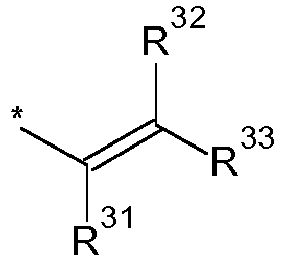
- In some embodiments, one of R31, R32 and R33 is H, with the other two groups being selected from H, C1-3 saturated alkyl, C2-3 alkenyl, C2-3 alkynyl and cyclopropyl.
- In other embodiments, two of R31, R32 and R33 are H, with the other group being selected from H, C1-3 saturated alkyl, C2-3 alkenyl, C2-3 alkynyl and cyclopropyl.
- In some embodiments, the groups that are not H are selected from methyl and ethyl. In some of these embodiments, the groups that re not H are methyl.
- In some embodiments, R31 is H.
- In some embodiments, R32 is H.
- In some embodiments, R33 is H.
- In some embodiments, R31 and R32 are H.
- In some embodiments, R31 and R33 are H.
- In some embodiments, R32 and R33 are H.
- An R22 group of particular interest is:

- When R22 is

- When R22 is

- In some embodiments, R24 is selected from H, methyl, ethyl, ethenyl and ethynyl. In some of these embodiments, R24 is selected from H and methyl.
- When there is a single bond present between C2' and C3',
- R22 is H or

- In some embodiments, R22 is H.
- In some embodiments, R22 is

- In some embodiments, it is preferred that R26a and R26b are both H.
- In other embodiments, it is preferred that R26a and R26b are both methyl.
- In further embodiments, it is preferred that one of R26a and R26b is H, and the other is selected from C1-4 saturated alkyl, C2-3 alkenyl, which alkyl and alkenyl groups are optionally substituted. In these further embodiment, it may be further preferred that the group which is not H is selected from methyl and ethyl.
- In some embodiments, R11a is OH.
- In some embodiments, R11a is ORA, where RA is C1-4 alkyl. In some of these embodiments, RA is methyl.
- In some embodiments of the first aspect of the present invention are of formula la-1, la-2 or la-3:


- (a)

- (b)

- (c)

- (d)

- (e)

- (f)

- (g)

- (h)
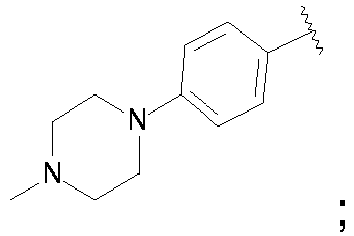
- In some embodiments of the present invention both R2 and R22 comprise no more than 3 carbon atoms.
- Thus in these embodiments where there is a double bond present between C2 and C3, R2 may be selected from:
- (i) Methyl;

- (ii) Ethyl;

- (iii) Propyl;

- (iv) Cyclopropyl;
- Thus in these embodiments where there is no double bond present between C2 and C3, R2 may be selected from:
- (i) H; (iii)


- Thus in these embodiments where there is a double bond present between C2' and C3', R22 may be selected from:
- (i) Methyl;

- (ii) Ethyl;

- (iii) Propyl;

- (iv) Cyclopropyl;
- Thus in these embodiments where there is no double bond present between C2' and C3', R22 may be selected from:
- (i) H;

- (ii)

- In some of these embodiments both R2 and R22 comprise no more than 2 carbon atoms.
- Thus in these embodiments where there is a double bond present between C2 and C3, R2 may be selected from:
- (i) Methyl; (vi)

- (ii) Ethyl; and
- Thus in these embodiments where there is no double bond present between C2 and C3, R2 may be selected from:
- (i) H; (iii)

- (ii)

- Thus in these embodiments where there is a double bond present between C2' and C3', R22 may be selected from:
- (i) Methyl; (vi)

- (ii) Ethyl; and
- Thus in these embodiments where there is no double bond present between C2' and C3', R22 may be selected from:
- (i) H; (iii)
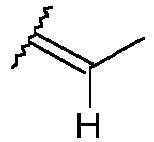
- (ii)
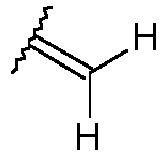
- In further of these embodiments both R2 and R22 comprise no more than 1 carbon atom.
- Thus in these embodiments where there is a double bond present between C2 and C3, R2 may be methyl. Thus in these embodiments where there is no double bond present between C2 and C3, R2 may be selected from: (i) H; and (ii)

- Thus in these embodiments where there is a double bond present between C2' and C3', R22 may be methyl. Thus in these embodiments where there is no double bond present between C2' and C3', R22 may be selected from: (i) H; and (ii)

- Without wishing to be bound by theory, where the substituent at the C2 position of the PBD dimers are small, the use of the glucuronide capping unit in these drug linkers is believed to be particularly advantageous, as it significantly increases the hydrophilicity of the drug linker, making the drug linkers easier to conjugate to a ligand unit.
- These embodiments and preferences also apply to the second aspect of the invention.
- In some embodiments, RLL1 and RLL2 are of formula IIIa'. In some embodiments, RL1 and RL2 are of formula Ilia.
- GL may be selected from
(GL1-1) 
(GL6) 
(GL1-2) 
(GL7) 
(GL2) 
(GL8) 
(GL3-1) 
(GL9) 
where the NO2 group is optional (GL3-2) 
(GL10) 
where the NO2 group is optional (GL3-3) 
(GL11) 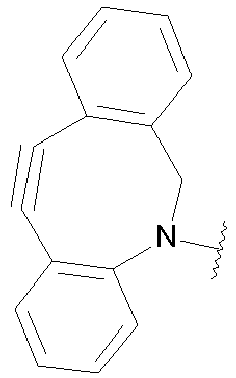
where the NO2 group is optional (GL3-4) 
(GL12) 
where the NO2 group is optional (GL4) 
(GL13) 
Where Hal = I, Br, Cl (GL5) 
- In some embodiments, GL is selected from GL1-1 and GL1-2. In some of these embodiments, GL is GL1-1.
- GLL may be selected from:
(GLL1-1) 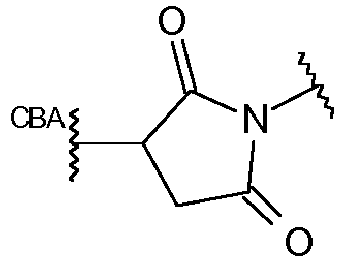
(GLL8-1) 
(GLL1-2) 
(GLL8-2) 
(GLL2) 
(QLL9-1) 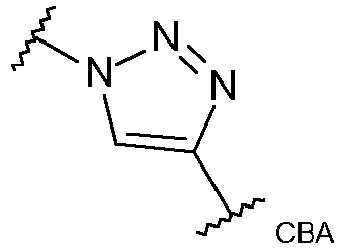
(QLL3-1) 
(QLL9-2) 
(QLL3-2) 
GL10 
(QLL-4) 
GL11 
(GLL5) 
GL12 
(GLL6) 
GL13 
(GLL7) 
- In some embodiments, GLL is selected from GLL1-1 and GLL1-2. In some of these embodiments, GLL is GLL1-1.
- X is:

- a may be 0, 1, 2, 3, 4 or 5. In some embodiments, a is 0 to 3. In some of these embodiments, a is 0 or 1. In further embodiments, a is 0.
- b may be 0, 1, 2, 3, 4, 5, 6, 7, 8, 9, 10, 11, 12, 13, 14, 15 or 16. In some embodiments, b is 0 to 12. In some of these embodiments, b is 0 to 8, and may be 0, 2, 4 or 8.
- c may be 0 or 1.
- d may be 0, 1, 2, 3, 4 or 5. In some embodiments, d is 0 to 3. In some of these embodiments, d is 1 or 2. In further embodiments, d is 2.
- In some embodiments of X, a is 0, c is 1 and d is 2, and b may be from 0 to 8. In some of these embodiments, b is 0, 4 or 8.
- In one embodiment, QX is an amino acid residue. The amino acid may a natural amino acids or a non-natural amino acid.
- In one embodiment, QX is selected from: Phe, Lys, Val, Ala, Cit, Leu, Ile, Arg, and Trp, where Cit is citrulline.
- In one embodiment, QX comprises a dipeptide residue. The amino acids in the dipeptide may be any combination of natural amino acids and non-natural amino acids. In some embodiments, the dipeptide comprises natural amino acids. Where the linker is a cathepsin labile linker, the dipeptide is the site of action for cathepsin-mediated cleavage. The dipeptide then is a recognition site for cathepsin.
- In one embodiment, QX is selected from:
- CO-Phe-Lys-NH,
- CO-Val-Ala-NH,
- CO-Val-Lys-NH,
- CO-Ala-Lys-NH,
- CO-Val-Cit-NH,
- CO-Phe-Cit-NH,
- CO-Leu-Cit-NH,
- CO-lle-Cit-NH,
- CO-Phe-Arg-NH, and
- CO-Trp-Cit-NH;
- Preferably, QX is selected from:
- CO-Phe-Lys-NH,
- CO-Val-Ala-NH,
- CO-Val-Lys-NH,
- CO-Ala-Lys-NH,
- CO-Val-Cit-NH.
- Most preferably, QX is selected from CO-Phe-Lys-NH, CO-Val-Cit-NH and CO-Val-Ala-NH.
- Other dipeptide combinations of interest include:
- CO-Gly-Gly-NH,
- CO-Pro-Pro-NH, and
- CO-Val-Glu-NH.
- Other dipeptide combinations may be used, including those described by Dubowchik et al., Bioconjugate Chemistry, 2002, 13,855-869.
- In some embodiments, QX is a tripeptide residue. The amino acids in the tripeptide may be any combination of natural amino acids and non-natural amino acids. In some embodiments, the tripeptide comprises natural amino acids. Where the linker is a cathepsin labile linker, the tripeptide is the site of action for cathepsin-mediated cleavage. The tripeptide then is a recognition site for cathepsin.
- In one embodiment, the amino acid side chain is chemically protected, where appropriate. The side chain protecting group may be a group as discussed below. Protected amino acid sequences are cleavable by enzymes. For example, a dipeptide sequence comprising a Boc side chain-protected Lys residue is cleavable by cathepsin.
- Protecting groups for the side chains of amino acids are well known in the art and are described in the Novabiochem Catalog, and as described above.
- In some embodiments, RL1 and RL2 are the same.
- In some embodiments, RLL1 and RLL2 are the same.
- In one particular embodiment, the first aspect of the invention comprises a conjugate of formula Id:

- In one particular embodiment, the second aspect of the invention, the Drug linker (DL) is of formula (Id'):

- In some embodiments, RL1 and RL2 are different.
- In some embodiments, RLL1 and RLL2 are different.
- In particular, in embodiments where the linking groups are different, differences may only be in the G groups, such that the remainder of the linking groups are the same (so that the cleavage triggers are the same).
- In some embodiments of the present invention, the C11 substituent may be in the following stereochemical arrangement relative to neighbouring groups:

- In other embodiments, the C11 substituent may be in the following stereochemical arrangement relative to neighbouring groups:

- Compounds of particular interest include those of the examples.
- Flash chromatography was performed using silica gel under pressure. Fractions were checked for purity using thin-layer chromatography (TLC) using Merck Kieselgel 60 F254 silica gel, with fluorescent indicator on aluminium plates. Visualisation of TLC was achieved with UV light or iodine vapour unless otherwise stated. Extraction and chromatography solvents were bought and used without further purification from VWR U.K. All fine chemicals were purchased from Sigma-Aldrich unless otherwise stated. Pegylated reagents were obtained from Quanta biodesign US via Stratech UK or from Pierce Scientific via Thermo Fisher
- 1H and 13C NMR spectra were obtained on a
Bruker Avance ® 400 spectrometer. Coupling constants are quoted in hertz (Hz). Chemical shifts are recorded in parts per million (ppm) downfield from tetramethylsilane. Spin multiplicities are described as s (singlet), bs (broad singlet), d (doublet), t (triplet), and m (multiplet). - The analytical LC/MS conditions (for reaction monitoring and purity determination) were as follows: Positive mode electrospray mass spectrometry was performed using a Shimadzu Nexera®/Prominence® LCMS-2020. Mobile phases used were solvent A (H2O with 0.1% formic acid) and solvent B (CH3CN with 0.1% formic acid). Gradient for routine 3-minute run:
Initial composition 5% B held over 25 seconds, then increased from 5% B to 100% B over a 1 minute 35 seconds' period. The composition was held for 50 seconds at 100% B, then returned to 5% B in 5 seconds and held there for 5 seconds. The total duration of the gradient run was 3.0 minutes. Gradient for 15-minute run:Initial composition 5% B held over 1.25 minutes, then increased from 5% B to 100% B over an 8.75 minute period. The composition was held for 2.5 minutes at 100% B, then returned to 5% B in 30 seconds and held there for 2 minutes. The total duration of the gradient run was 15.0 minutes. Flow rate was 0.8 mL/minute (for 3-minute run) and 0.5 mL/minute (for 15-minute run). Detection was at 254 nm. Columns: Waters Acquity UPLC® BEH Shield RP18 1.7µm 2.1 × 50 mm at 50 °C fitted with Waters Acquity UPLC® BEH Shield RP18 VanGuard Pre-column, 130A, 1.7µm, 2.1 mm × 5 mm (routine 3-minute run); and Waters Acquity UPLC CSH C18, 1.7µ, 2.1 × 100mm fitted with Waters Acquity UPLC® BEH Shield RP18 VanGuard Pre-column, 130A, 1.7µm, 2.1 mm × 5 mm (15 minute run). - The preparative HPLC conditions were as follows: Reverse-phase ultra-fast high-performance liquid chromatography (UFLC) was carried out on a Shimazdzu Prominence® machine using a Phenomenex® Gemini NX 5µ C18 column (at 50 °C) 150 × 21.2 mm. Eluents used were solvent A (H2O with 0.05% formic acid) and solvent B (CH3CN with 0.05% formic acid). All UFLC experiments were performed with gradient conditions: Initial composition 13% B, the composition was then increased to 100% B over a total of 17 minutes at a gradient suitable to effect the desired separation, then held for 1 minute at 100% B, then returned to 13% B in 0.1 minute and held there for 1.9 minutes. The total duration of the gradient run was 20.0 minutes. Flow rate was 20.0 mL/minute and detection was at 254 and 280 nm.
-


- Lithium acetate dihydrate (3.52 g, 34.5 mmol, 1.0 eq.) was added to a stirred solution of TIPS ether (1) (19.96 g, 34.5 mmol, 1.0 eq.) in DMF/H2O (300 mL/4 mL). The resultant red solution was stirred at room temperature for 3.5h. The reaction mixture was diluted with EtOAc (600 mL) and washed with 1M citric acid solution (2 × 250 mL), H2O (2 × 250 mL), saturated brine (300 mL) and dried (MgSO4). The solvent was evaporated under reduced pressure to afford the product as a yellow solid (14.57 g, 100%). The product was used without further purification. Analytical Data: LC/MS, RT 1.74 min; MS (ES+) m/z (relative intensity) 423 ([M + H]+·, 100); 445 ([M + Na])+, 75).
- Potassium carbonate (5.03 g, 36.44 mmol, 1.1 eq.) was added to a stirred solution of phenol (2) (14 g, 33.13 mmol, 1.0 eq.) and 1,5 diiodopentane (21.46 g, 9.86 mL, 66.26 mmol, 2.0 eq.) in DMF (250 mL). The solution was heated at 70°C for 3.5h. The solution was poured into a mixture of ice/water (800 mL) and extracted with EtOAc (4 × 500 mL). The combined extracts were washed with H2O (2 × 250 mL), saturated brine (400 mL), dried (MgSO4) and evaporated under reduced pressure to give a brown oil. Purification by flash column chromatography [n-heptane/EtOAc 40% to 80% in 10% increments] gave the product as a yellow foam (12.7 g, 85%). Analytical Data: LC/MS, RT 2.16 min; MS (ES+) m/z (relative intensity) 913 ([M + H]+·, 100); 935 ([M + Na])+·, 100).
- Zinc dust (19.9 g, 304 mmol, 40 eq.) was treated with 1M HCI (100 mL) and stirred for 10 minutes at room temperature. The mixture was then sonicated for 10 minutes and the activated Zinc collected by vacuum filtration then washed with 1M HCI (50 mL), H2O (to pH 6 to 7), MeOH and dried in vacuo on the filter pad. The activated zinc was added to a vigorously stirred solution of the bis nitro compound (3) (6.94 g, 7.6 mmol, 1.0 eq.) in EtOH/H2O/EtOAc (60 mL/4 mL/60 mL) at room temperature. The reaction mixture was treated drop-wise with a solution of 5% v/v HCO2H in MeOH (76 mL). A colour change from green to metallic grey and an exotherm to 42 °C were observed. Once the exotherm had subsided to 30°C LC/MS indicated that the reaction was not complete. A further portion of 5% v/v HCO2H in MeOH (20 mL) was added and a further exotherm was observed (34°C) The reaction mixture was allowed to cool to room temperature at which point analysis by LC/MS revealed complete conversion to desired product. The mixture was filtered through celite® and the pad washed with EtOAc. The filtrate was washed with saturated aqueous NaHCO3 (2 × 300 mL), water (300 mL), saturated brine (300 mL), dried (MgSO4), filtered and evaporated in vacuo to provide the bis-aniline as a yellow foam (6.22g, 96%). The product was used without further purification. Analytical Data: LC/MS, RT 2.12 min; MS (ES+) m/z (relative intensity) 853 ([M + H]+·, 15).
- Triethylamine (0.171 g, 235 µL, 1.69 mmol, 4.4 eq.) was added via syringe to a stirred solution of bis aniline (4) (0.33 g, 0.38 mmol, 1.0 eq.) and triphosgene (0.082 g, 0.28 mmol, 0.72 eq.) in dry THF under an argon atmosphere. The resultant suspension was heated to 40°C and after 5 min sampled in MeOH for LC/MS as the bis methyl carbamate (MS (ES+) m/z (relative intensity) 969 ([M + H]+·, 80); 992 ([M + Na])+·, 100). Dibutyltin dilaurate (0.024 g, 23 µL, 38 µmol, 0.1 eq.) then solid linker (5) (0.319 g, 0.85 mmol, 2.2 eq.) and trimethylamine (0.085 g, 118 µL, 0.85 mmol, 2.2 eq.) were added and the mixture heated at 40°C with stirring under an argon atmosphere for 5h. The reaction mixture was allowed to cool, filtered and the THF evaporated under reduced pressure. The residue was purified by flash column chromatography [CHCl3/
MeOH 0%, 1%, 1.5%, 2%, gradient elution] to give the product as a yellow foam (0.42 g, 66%). Analytical Data: LC/MS, RT 2.16 min; MS (ES+) m/z (relative intensity) 1660 ([M + H]+·, 60); 1682 ([M + Na])+, 65). - p-Toluenesulfonic acid (0.296 g, 1.7 mmol, 2.2 eq.) was added to a stirred solution of bis-tert-butyldimethylsilyl ether (6) (1.26 g, 0.76 mmol, 1.0 eq.) in 10% v/v H2O in THF. The solution was stirred at room temperature for 18h. The reaction mixture was diluted with EtOAc (100 mL) and washed with saturated NaHCO3 solution (2 × 100 mL), H2O (100 mL), saturated brine (100 mL), dried (MgSO4) and evaporated under reduced pressure. The residue was purified by flash column chromatography [CHCl3/
MeOH 0% to 5% in 1% increments] to give the product as a white foam (0.896 g, 92%). Analytical Data: LC/MS, RT 1.61 min; MS (ES+) m/z (relative intensity) 1432 ([M + H]+·, 5); 1454 ([M + Na])+, 5). - Dess-Martin periodinane (0.24 g, 0.57 mmol, 2.0 eq.) was added to a stirred solution of bis-alcohol (7) in dry DCM (20 mL). The resultant white suspension was stirred at room temperature for 24h. The reaction mixture was diluted with DCM (100 mL) and extracted with saturated NaHCO3 solution (2 × 100 mL), water (100 mL), saturated brine (100 mL), dried (MgSO4) and evaporated under reduced pressure. Purification by flash column chromatography [CHCl3/
MeOH 0% to 3% in 0.5% increments] gave the product as a white foam (0.28 g, 69%). Analytical Data: LC/MS, RT 1.58 min; MS (ES+) m/z (relative intensity) 1428 ([M + H]+·, 20); 1450 ([M + Na])+, 30). - Pd(PPh3)4 (8 mg,7 µmol, 0.04 eq.) was added to a stirred solution of bis-alloc derivative (8) (0.25 g, 0.176 mmol 1.0 eq.) and pyrrolidine (31 mg, 36 µL 0.44 mmol, 2.5 eq.) in dry DCM (10 mL). The solution was stirred at room temperature for 2h. The reaction mixture was partitioned between saturated NH4Cl solution (50 mL) and DCM (50 mL). The DCM was separated and washed with saturated brine (100 mL), dried (MgSO4) and evaporated under reduced pressure. The solid residue was triturated/sonicated with Et2O (3 × 15 mL) and dried under vacuum to give the product as a white solid (0.207 g, 93%). The product was used without further purification. Analytical Data: LC/MS, RT 1.06 min; MS (ES+) m/z (relative intensity) 630 ([M + 2H]+·, 100).
- EDCI.HCI (56 mg, 0.29 mmol, 3 eq.) was added to a stirred solution of bis-amine (9) (0.123 g, 98 µmol, 1.0 eq.) and MaldPEG®OH (0.128 g, 0.22 mmol, 2.2 eq.) in CHCl3 (15 mL). The reaction mixture was stirred at room temperature for 30 min then diluted with CHCl3 (50 mL) washed with H2O (100 mL), saturated brine (100 mL), dried (MgSO4) and evaporated under reduced pressure. Purification by preparative HPLC followed by lyophilisation gave the product as a white foam (0.047 g, 20%). Analytical Data: LC/MS, RT 6.61 min; MS (ES+) m/z (relative intensity) 1205 ([M + 2H]+·, 55).
-

- DIPEA (30 mg, 42 µL, 0.23 mmol, 3 eq.) was added to a stirred solution of bis-amine (9) (98 mg, 78 µmol, 1.0 eq.) and MalPEG4OSu (88 mg, 0.17 mmol, 2.2 eq.) in CHCl3 (10 mL). The reaction mixture was stirred at room temperature for 72h then diluted with CHCl3 (50 mL) washed with H2O (100 mL), saturated brine (100 mL), dried (MgSO4) and evaporated under reduced pressure. Purification by preparative HPLC followed by lyophilisation gave the product as a white foam (0.043 g, 25%). Analytical Data: LC/MS, RT 6.11 min; MS (ES+) m/z (relative intensity) 1028 ([M + 2H]+·, 80).
-

- EDCI.HCI (50 mg, 0.26 mmol, 3 eq.) was added to a stirred solution of bis-amine (9) (0.109 g, 86.5 µmol, 1.0 eq.) and MCOSu (40 mg, 0.19 mmol, 2.2 eq.) in CHCl3 (10 mL). The reaction mixture was stirred at room temperature for 30 min then diluted with CHCl3 (50 mL) washed with H2O (100 mL), saturated brine (100 mL), dried (MgSO4) and evaporated under reduced pressure. Purification by preparative HPLC followed by lyophilisation gave the product as a white foam (0.045 g, 32%). Analytical Data: LC/MS, RT 6.82 min; MS (ES+) m/z (relative intensity) 1646 ([M + H]+·, 20); 1667 ([M + Na])+, 30).
-
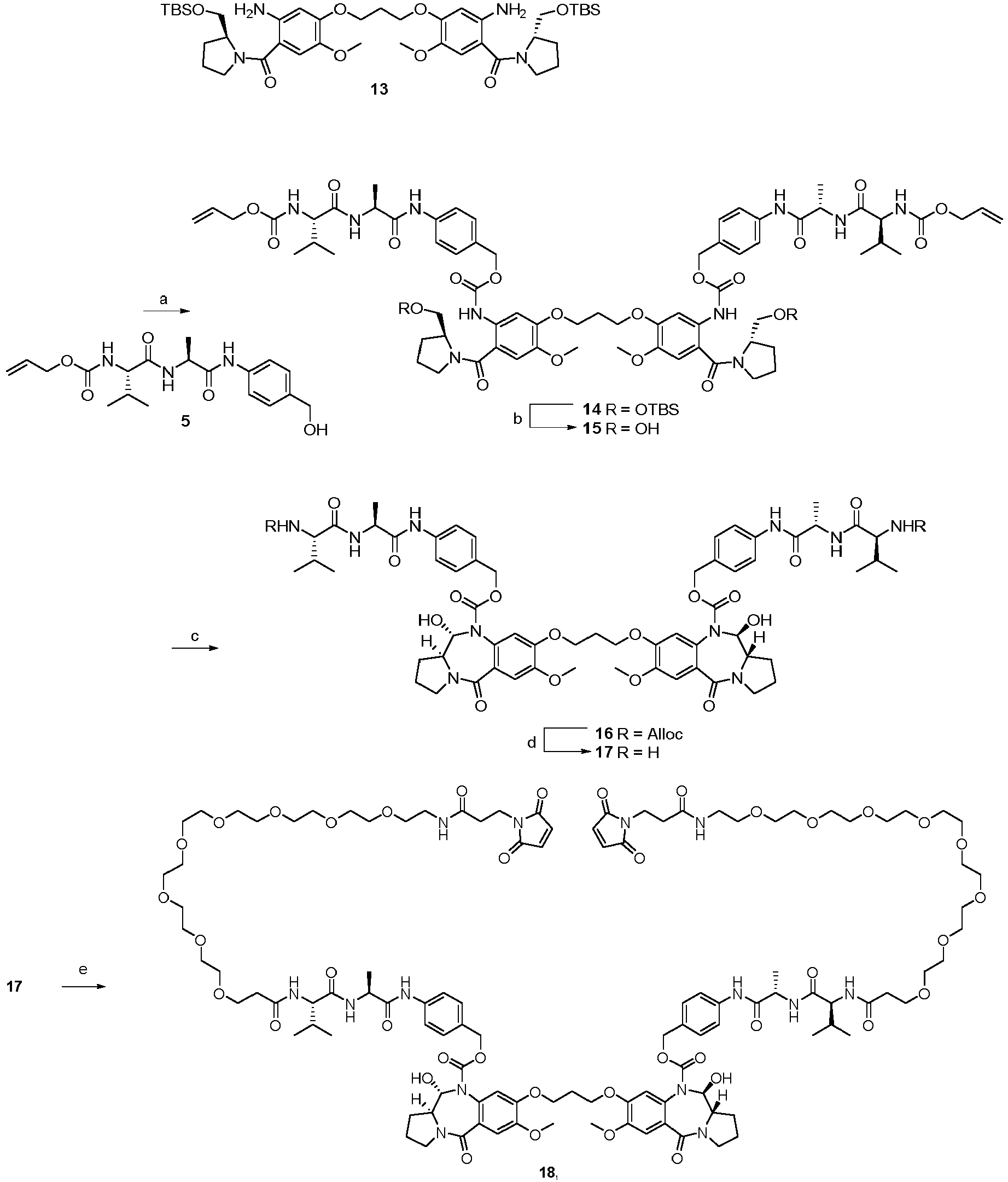
- Triphosgene (472 mg, 1.59 mmol, 0.72 eq) was added in one portion to a mixture of 13 (1.77 g, 2.21 mmol) and triethylamine (1.35 mL, 9.69 mmol, 4.38 eq) in dichloromethane (3.6 mL). After 10 min, 5 (1.83 g, 4.85 mmol, 2.19 eq) was added in one portion as a fine powder, followed by triethylamine (0.68 mL, 4.9 mmol, 2.2 eq) and dibutyltin dilaurate (132 µL, 0.221 mmol, 0.1 eq) The reaction mixture was allowed to stir at 37 °C for 4h, followed by stirring at room temperature overnight. The organic phase was washed with water and decanted in a filtration cartridge. The DCM was removed by evaporation, and the residue was dry loaded on silica gel, followed by chromatography with a 50g ultra biotage cartridge (gradient DCM / DCM:MeOH 90:10, from 5% up to 32%, elution at 32%). The pure fractions were combined to yield the product 14 (2.35 g, 1.46 mmol, 66.2% Yield). Analytical Data: LC/MS, 3 min lipophilic method, RT 2.24 min; MS (ES+) m/z (relative intensity) 1608.9 ([M + H]+·, 100);
- Paratoluenesulfonic acid hydrate (277 mg, 1.46 mmol, 1 eq) was added in one portion to a mixture of 14 (2.34 g, 1.46 mmol) in tetrahydrofuran (53.0 mL) and water (5.00 mL) at 0 °C (ice/water bath). The reaction mixture was allowed to stir at 20 °C for 7 h until completion as monitored by LCMS. The reaction mixture was partitioned between ethyl acetate and water, and washed with NaHCO3, then brine. The organics were dried over magnesium sulfate and concentrated under vacuum. The residue was purified by chromatography (50 g ultra, dry loaded on a samplet, DCM versus DCM:MeOH 90:10, gradient from 20% to 64%, elution around 64%. Pure fractions were combined and concentrated under vacuum to give the product 15 (1.60 g, 1.16 mmol, 79.7% Yield) as a white solid.
Analytical Data: LC/MS, 3 min lipophilic method, RT 1.50 min; MS (ES+) m/z (relative intensity) 1380.9 ([M + H]+·, 100); - Stahl Tempo 0.2M Solution (2.10 mL, 0.420 mmol, 0.44 eq) followed by tetrakisacetonitrile copper(I) triflate (160 mg, 0.425 mmol, 0.44 eq) was added to a solution of 15 (1.32 g, 0.957 mmol) in DMF (4.00 mL) in a 500 mL flask. The reaction mixture was stirred rapidly and heated at 40 °C for 5h, then 35 °C for 18h under an air balloon, at which point completion was observed by LCMS. The solvents were removed by evaporation. Traces of DMF were removed by a second evaporation with butanone, followed by hard vacuum. The residue was dry loaded on a samplet (10g) with acetone, followed by chromatography with a 50g ultra column on a biotage isolera system. Gradient with 10% MeOH in DCM / DCM, from 20% up to 63% in 8 CV. Elution and hold around 60%. The impure front fractions were repurified using the same system on a 25g column. All pure fractions were pooled. The residue was dissolved in acetone. Addition of heptane caused the precipitation of a white product. The volatiles were evaporated to leave the product 16 as a white powder after hard vacuum. (892 mg, 0.648 mmol, 67.8% Yield) Analytical Data: LC/MS, 3 min lipophilic method, RT 1.42 min; MS (ES+) m/z (relative intensity) 1376.6 ([M + H]+·, 100);
- Tetrakis(triphenylphosphine)palladium(0) (10.0 mg, 0.00865 mmol, 0.034 eq) was added to a mixture of 16 (350 mg, 0.254 mmol) and pyrrolidine (65.0 µL, 0.780 mmol, 3.07 eq) in dichloromethane (7.50 mL) and methanol (0.5 mL). The reaction mixture was stirred under argon at room temperature for 1h30 minutes and was found complete by LCMS Ammonium chloride in water (30 mL, 34.3 mmol, 6 mass%) was added and the mixture was stirred vigorously. The mixture was then decanted in a biotage phase separation cartridge. The DCM layer was evaporated to dryness under vacuum. The residue was dissolved in chloroform (20 mL) and the solvent removed by evaporation under vacuum at 35°C. This cycle was repeated a second time, followed by drying under hard vacuum (3 mbar) to give the crude product 17 (307 mg, 0.254 mmol, 100%) as a white solid which was used directly in the next step without further purification. Analytical Data: LC/MS, 3 min lipophilic method, 2 peaks, RT 0.22 min; MS (ES+) m/z (relative intensity) 604.9 ([M + 2H]2+·, 100); 1208.2 ([M + H]+·, 10);
- Chloroform (10.00 mL) and methanol (0.4 mL) were added to crude 17 (307 mg, 0.254 mmol) followed by mal-amido-peg8-acid (339 mg, 0.561 mmol, 2.2 eq) and EDCI (107 mg, 0.558 mmol, 2.19 eq). The reaction was allowed to proceed at room temperature for 45 min when completion was observed by LCMS. Ammonium chloride in water (30 mL, 6 mass%) was added and the mixture was stirred vigorously. The mixture was decanted in a biotage phase separation cartridge. The DCM layer was evaporated to dryness under vacuum. The volatiles were removed by rotoevaporation and the crude residue was purified by chromatography (50g Ultra, Biotage, gradient 30/70 to 100/0 of 16% MeOH in DCM / DCM in 10CV; Elution at more than 10% of MeOH). All fractions were analysed by TLC (10% MeOH in DCM). The pure fractions were pooled. The solvent was removed by evaporation to give 18 (200 mg). LCMS analysis showed traces of mal-peg8-acid, and the material was purified further by preparative HPLC, freeze-dried, aliquoted in dichloromethane, and dried under high vacuum to give 18 as a white solid. The purity was 99.45%. (B, 110 mg, 0.0467 mmol, 18.3% Yield). Analytical Data: LC/MS, 15 min method, RT 5.90 min; MS (ES+) m/z (relative intensity) 1179.5 ([M + 2H]2+., 100); 1H NMR (400 MHz, DMSO-d6) δ 9.92 (s, 2H), 8.16 (d, J = 6.9 Hz, 2H), 7.99 (t, J = 5.7 Hz, 2H), 7.86 (d, J = 8.7 Hz, 2H), 7.55 (s, 4H), 7.18 (s, 4H), 7.07 (s, 2H), 7.00 (s, 4H), 6.79 (s, 2H), 6.50 (s, 2H), 5.48 (s, 2H), 5.23 - 4.77 (m, 4H), 4.39 (t, J = 7.0 Hz, 2H), 4.22 (dd, J = 8.7, 6.6 Hz, 2H), 4.10 (s, 4H), 3.77 (s, 6H), 3.64 - 3.55 (m, 8H), 3.55 - 3.42 (m, 56H), 3.37 (t, J = 5.9 Hz, 6H), 3.28 (t, J = 8.3 Hz, 2H), 3.15 (q, J = 5.8 Hz, 4H), 2.49 - 2.37 (m, 4H), 2.37 - 2.30 (m, 4H), 2.17 (s, 2H), 2.09 - 1.73 (m, 10H), 1.30 (d, J = 7.0 Hz, 6H), 0.85 (dd, J = 15.3, 6.7 Hz, 12H).
-


- Triphosgene (816 mg, 2.75 mmol, 0.72 eq) was added in one portion to a mixture of 19 (3.15 g, 3.82 mmol) and triethylamine (2.34 mL, 16.8 mmol, 4.4 eq) in dichloromethane (75 mL) at 0°C. The ice batch was removed, and after 15 min, alcohol 5 (3.17 g, 8.40 mmol, 2.2 eq) was added in one portion as a fine powder, followed by triethylamine (1.17 mL, 8.39 mmol, 2.2 eq) and dibutyltin dilaurate (229 µL, 0.383 mmol, 0.1 eq). The reaction mixture was allowed to stir at 37 °C for 1h, followed by stirring at room temperature overnight. The organic phase was diluted with DCM (100 mL) and washed with water (200 mL), saturated ammonium chloride (100 mL), and brine (50 mL), followed by drying over magnesium sulfate. The volatiles were removed by evaporation under reduced pressure. The crude product was dry-loaded on silica gel and eluted on a 340g Ultra, with a gradient of ethyl acetate - acetone, from 20% up to 100% in 7CV. Rapid elution in 2CV at around 30% acetone gave pure fractions which were dried under vacuum to give 20 (4.00 g, 2.45 mmol, 100 mass%, 64.2% Yield). Analytical Data: LC/MS, 3 min lipophilic method, RT 2.34 min; MS (ES+) m/z (relative intensity) 1661.1 ([M + H]+., 100);
- Bis-TBS ether 20 (4.00 g, 2.45 mmol) and paratoluenesulfonic acid hydrate (300 mg, 1.58 mmol) were dissolved in a mixture of 2-methyltetrahydrofuran (25.0 mL, 249 mmol, 100 mass%), acetic acid (4.00 mL, 69.8 mmol, 100 mass%) and water (4.00 mL, 222 mmol, 100 mass%). The mixture was heated at 40C. After 2h, completion was observed by LCMS. The reaction mixture was partitioned between ethyl acetate (150 mL) and water (200 mL), then washed with saturated NaHCO3 (150 mL), and brine (100 mL). The organics were dried over magnesium sulfate and concentrated under vacuum. The residue was purified by chromatography (100 g ultra, dry loaded on 10g samplet, ethyl acetate / acetone, gradient from 85/15 to 0/100, elution around 80% acetone. The pure fractions were combined and concentrated under vacuum to give the pure product 21 (960 mg, 0.684 mmol, 27.9% Yield) as a white solid. Analytical Data: LC/MS, 3 min lipophilic method, RT 1.54 min; MS (ES+) m/z (relative intensity) 1402.3 ([M + H]+., 100);
- Stahl Tempo 0.2M Solution (1.34 mL, 0.268 mmol, 0.4 eq) followed by Tetrakisacetonitrile copper(I) triflate (190 mg, 0.504 mmol, 0.75 eq) was added to a solution of alcohol 21 (940 mg, 0.670 mmol) in DMF (3.00 mL) and DCM (13.0 mL) in a 500 mL flask. The reaction mixture was stirred rapidly and heated at 37 °C for 5h (almost complete), followed by -20 °C for 96h, at which point the reaction mixture was diluted with dichloromethane (60 mL) and water (60 mL) and stirred for 5 min. The reaction mixture was decanted in a phase separator and the DCM phase was dried under reduce pressure. MEK (60 mL) was added and the residual DMF was removed by azeotroping with MEK under reduce pressure (2 times) to give the crude product as a solid. This was redissolved in DCM/isopropanol 80/20 (5 to 10 mL) and loaded onto a Biotage samplet (10g), dried and loaded on a 100g Ultra column. Gradient from 88/12 DCM/20% MeOH in DCM up to 70/30 in 10 CV. The pure fractions were combined to give pure 22 (602 mg, 0.430 mmol, 64.2% Yield) as a white product. Analytical Data: LC/MS, 3 min lipophilic method, RT 1.51 min; MS (ES+) m/z (relative intensity) 1401.5 ([M + H]+., 100);
- Tetrakis(triphenylphosphine)palladium(0) (8.2 mg, 0.0071 mmol, 100 mass%) was added to a mixture of 22 (250 mg, 0.179 mmol) and pyrrolidine (37.0 µL, 0.444 mmol, 2.49 eq) in DCM (7.50 mL) and methanol (0.5 mL). The reaction mixture was stirred under argon at room temperature for 1h30 minutes and was found complete by LCMS.
- Ammonium chloride in water (30 mL, 6 mass%) was added and the mixture was stirred vigorously. The mixture was then decanted in a biotage phase separation cartridge. The DCM layer was evaporated to dryness under vacuum. The residue was dissolved in chloroform (20 mL) and the solvent removed by rotoevaporation under vacuum at 35°C. This cycle was repeated a second time, followed by drying under hard vacuum (3 mbar, on rotoevaporator) to give the crude product 23 (220 mg, 0.179 mmol, 100%) as a white solid which was used directly in the next step without further purification. Analytical Data: LC/MS, 3 min method, 2 peaks, RT 1.15 min; MS (ES+) m/z (relative intensity) 616.9 ([M + 2H]2+., 100); 1232.1 ([M + H]+., 10).
- Chloroform (4.1 mL) and methanol (0.2 mL) were added to 23, followed by mal-amido-peg8-acid (238 mg, 0.394 mmol, 2.2 eq) and EDCI (85.0 mg, 0.443 mmol, 2.48 eq). The reaction was allowed to proceed at room temperature for 45 min when completion was observed by LCMS. The reaction mixture was concentrated (2 mL), loaded on a 3g biotage silica samplet and dried under vacuum. The samplet was loaded on a 25g Ultra Biotage column, and eluted (
gradient 10/90 to 58/42 of 20% MeOH in DCM / DCM in 12CV; Elution at around 55% of 20% MeOH). All fractions were analysed by TLC (10% MeOH in DCM). The pure fractions were pooled. The solvent was removed by evaporation to give 24 (250 mg, 0.105 mmol, 58.8% Yield). Analytical Data: LC/MS, 15 min method, RT 6.20 min; MS (ES+) m/z (relative intensity) 1191.5 ([M + 2H]2+., 100); 1H NMR(400 MHz, DMSO-d6) δ 9.92 (s, 2H), 8.16 (d, J = 6.9 Hz, 2H), 7.99 (t, J = 5.5 Hz, 2H), 7.86 (d, J = 8.6 Hz, 2H), 7.68 - 7.42 (m, 4H), 7.39 - 7.11 (m, 4H), 7.07 (s, 2H), 7.00 (s, 4H), 6.81 (s, 2H), 6.60 (s, 2H), 5.46 - 5.30 (m, 2H), 5.21 - 4.79 (m, 8H), 4.39 (t, J = 7.0 Hz, 2H), 4.22 (dd, J = 8.7, 6.7 Hz, 2H), 4.15 - 3.88 (m, 8H), 3.77 (s, 6H), 3.65 - 3.55 (m, 8H), 3.54 - 3.40 (m, 58H), 3.37 (t, J = 5.9 Hz, 4H), 3.15 (q, J = 5.8 Hz, 4H), 2.95 - 2.79 (m, 2H), 2.57 - 2.52 (m, 2H), 2.49 - 2.37 (m, 4H), 2.37 - 2.29 (m, 4H), 2.22 - 2.10 (m, 2H), 2.03 - 1.88 (m, 2H), 1.30 (d, J = 7.0 Hz, 6H), 0.85 (dd, J = 15.3, 6.7 Hz, 12H). -

- Compound 25 is described in Tiberghien et al, ACS Med. Chem. Lett., 2016, 7 (11), pp 983-987.
Compound 26 is described in Smits and Zemribo, Org. Lett., 2013, 15 (17), pp 4406-4409. - 25 (325g, 1.2 eq) and 26 (1.0 eq.) were dissolved in DCM (3.25 L) and cooled to -40°C. T3P (2 eq) was added portionwise at -40°C, followed by DIEA (6.0eq). The mixture was stirred for 1h at -40°C. Reaction completion was observed by LCMS. Aqueous acetic acid (10%, 3.25 L) was added at 0°C. The organic phase was separated and washed a second time with aqueous acetic acid (10%, 3.25 L), followed by brine (3.25 L). The volatiles were removed under vacuum to leave the crude product 27 as a brown oil, which was purified by silica gel chromatography (petroleum ether/EtOAc, gradient from 100/1 to 10/1, collection from 20/1. (591 g, purity 87.6% by LC, 70% by NMR, yield = 60%). RT: 6.374 min.
-
- Column :Agilent Poroshell 120 EC- C18 4.6*100mm,2.7um
- Mobile phase A: 0.05% TFA in Water
- Mobile phase B: 0.05% TFA in ACN
- Diluent: ACN
- Flow rate: 1.0 mL/min
- Injection volume: 1 µL
- Column temperature: 40 °C
- Detector: 220 nm
- Run Time: 8.1 minutes
- Post time: 2 minutes
- 27 (591g, 1 eq) was dissolved to DCM and cooled to 0°C. Lithium borohydride (2.0 eq) was added portionwise. The reaction mixture was stirred at 0°C for 6h. Reaction completion was observed by LCMS. Aqueous acetic acid (10%, 5.9 L) was added at 0°C. The organic phase was separated and washed a second time with aqueous acetic acid (10%, 5.9 L), followed by brine (5.9 L). The volatiles were removed under vacuum to leave a residue which was purified by flash chromatography (petroleum ether/EtOAc, gradient from 50/1 to 1/1. Collection from 5/1) to give 28 as an off white solid (250 g, 64% yield). RT: 7.922 min.
- 28 (250g, 1 eq) and imidazole (2 eq) were dissolved in DCM (1.5 L, 6 V) at room temperature. TBSCI (1.5 eq) was added portionwise whilst keeping the temperature below 30°C. The reaction mixture was allowed to stir at 25°C for 1 hour, when disappearance of starting material was observed by HPLC. The mixture was filtered through cotton wool. The filter cake was washed with DCM (500 mL). The filtrate was washed with aqueous acetic acid (10%, 2.5 L) at 10°C, followed by brine (2.5 L). The organic phase was dried with anhydrous sodium sulphate and concentrated under vacuum to give the
product 29 as a yellow oil which was found sufficiently pure to be used in the next step (285 g, 92.2% yield). RT: 11.002 min. MS (ES+) m/z (relative intensity) 663.4 ([M + H]+., 100); -
- Column: Agilent Poroshell 120 EC- C18 4.6*100mm,2.7um
- Mobile phase A: 0.05% TFA in Water
- Mobile phase B: 0.05% TFA in ACN
- Diluent: ACN
- Flow rate: 1.0 mL/min
- Injection volume: 2 µL
- Column temperature: 40 °C
- Detector: 220 nm
- Run Time: 12.1 minutes
- Post time: 2 minutes
-

- TIPS protected phenol 29 (10.0 g, 16.9 mmol) was dissolved in a mixture of ethyl acetate (20.0 mL) and DMF (20.0 mL) at 40°C. A solution of lithium acetate (0.668 g, 10.1 mmol, 0.6 eq ) in water (3.0 mL) was added. The reaction was allowed to proceed at 40°C for 4h at which point completion was observed by LCMS. The reaction mixture was partitioned between 2-MeTHF (200 mL) and 2% citric acid in water (200 mL). The organic phase was washed with brine (70 mL) and dried over magnesium sulfate. The volatiles were removed under vacuum. The solid residue was precipitated by addition of diethyl ether (50 mL) and hexane (200 mL). The product was collected by filtration, washed with a little diethyl ether and dried overnight under vacuum to give 30 as a pale yellow solid. (5.8 g, 13 mmol, 79% Yield). Analytical Data: LC/MS, 3 min lipophilic method, RT 1.82 min; MS (ES+) m/z (relative intensity) 437.8 ([M + H]+., 100);
- 1,5-dibromopentane (0.986 g, 4.29 mmol, 0.5 eq) followed by potassium carbonate (1.30 g, 9.41 mmol, 1.1 eq) was added to a solution of 30 (3.74 g, 8.57 mmol) and tetrabutylammonium iodide (0.63 g, 1.7 mmol, 0.2 eq) in acetone (20.0 mL) in a 100 mL round-bottomed flask. The reaction mixture was stirred rapidly and heated at 60 °C for 2h, and then allowed to stir at 45 °C overnight. The reaction was found complete by LCMS. The mixture was partitioned in ethyl acetate (150 mL) and water (200 mL, then washed with brine (100 mL), dried over magnesium sulfate. The volatiles were removed under vacuum to give the product 31 (4.04 g, 4.29 mmol, 100% Yield), which was used in the next step without further purification. Analytical Data: LC/MS, 3 min lipophilic method, RT 2.39 min; MS (ES+) m/z (relative intensity) 942.3 ([M + H]+., 100);
- Zinc (20.6 g, 315 mmol, 74 eq) was added to a mixture of ethanol (64.0 mL), water (4.00 mL), and formic acid (4.00 mL, 106 mmol, 25 eq) at 10 °C (ice bath), and stirred vigorously. To this mixture, a solution of 31 (4.00 g, 4.25 mmol) in ethanol (16.0 mL) was added dropwise with a pipette, whilst keeping the temperature below 35 °C. The zinc mass was occasionally stirred manually. The reaction was allowed to proceed further for 30 min at room temperature, when completion was reached. The mixture was diluted with ethyl acetate (200 mL). The solids were removed by filtration over celite. The sinter was rinsed with ethyl acetate (200 mL). The filtrate was washed with water (300 mL), saturated sodium bicarbonate (150 mL), brine (100 mL), and dried over magnesium sulphate. The volatiles were removed by evaporation and the residue was purified by automated flash chromatography (100 g ultra, biotage, ethyl acetate / hexane gradient from 30% up 80% in 8 CV, elution from 58% from 10 CV, to give 32 (1.94 g, 2.20 mmol, 51.8% Yield) as a pale yellow foam. Analytical Data: LC/MS, 3 min lipophilic method, RT 2.29 min; MS (ES+) m/z (relative intensity) 882.4 ([M + H]+., 100);
- Triphosgene (0.461 g, 1.55 mmol, 0.72 eq) was added in one portion to a mixture of 32 (1.90 g, 2.16 mmol) and triethylamine (1.32 g, 13.0 mmol, 6 eq) in DCM (45 mL) at 0°C. The ice batch was removed, and after 15 min, 5 (1.79 g, 4.74 mmol, 2.2 eq) was added in one portion as a fine powder, followed by triethylamine (0.661 g, 6.53 mmol, 3 eq) and dibutyltin dilaurate (0.129 mL, 0.215 mmol, 0.1 eq). The reaction mixture was allowed to stir at 37 °C for 4h, followed by stirring at room temperature overnight. The organic phase was diluted with DCM (100 mL) and washed with water (200 mL), saturated ammonium chloride (100 mL), and brine (50 mL), followed by drying over magnesium sulfate. The volatiles were removed by evaporation under reduced pressure to give 3 (3.00 g, 1.78 mmol, 82% Yield). The crude product was reacted directly in the next step.
Analytical Data: LC/MS, 3 min lipophilic method, RT 2.31 min; MS (ES+) m/z (relative intensity) 1689.6 ([M + H]+., 100); - Bis-TBS ether 33 (3.00 g, 1.78 mmol) was dissolved in a mixture of 2-methyltetrahydrofuran (9 mL), acetic acid (9 mL) and water (1.5 mL). The mixture was heated at 40 °C for 2h. LCMS monitoring indicated an unsatisfactory rate of reaction (40 %) completion. Paratoluenesulfonic acid hydrate (203 mg, 1.07 mmol, 0.6 eq) was added, which accelerated the reaction. Completion was observed in 30 min.
- The reaction mixture was partitioned between ethyl acetate (150 mL) and water (200 mL), then washed with saturated NaHCO3 (150 mL), and brine (100 mL). The organics were dried over magnesium sulfate and concentrated under vacuum. The residue was purified by chromatography (50 g ultra, dry loaded on loose silica gel, ethyl acetate / acetone, gradient from 85/15 to 0/100, elution around 55% acetone. Pure fractions were combined and concentrated under vacuum to give the pure product 34 (2.20 g, 1.51 mmol, 84.8% Yield) as a white solid. Analytical Data: LC/MS, 3 min lipophilic method, RT 1.67 min; MS (ES+) m/z (relative intensity) 1461.6 ([M + H]+., 100);
- Stahl Tempo 0.2M Solution (3.50 mL, 0.700 mmol, 0.47 eq) followed by tetrakisacetonitrile copper(I) triflate (290 mg, 0.770 mmol, 0.52 eq) was added to a solution of 34 (2.17 g, 1.49 mmol) in DMF (3.00 mL) in a 500 mL flask. The reaction mixture was stirred rapidly and heated at 40 °C for 5h (completion), followed by 30 °C for 18h under an air balloon, at which point the reaction mixture was diluted with dichloromethane (60 mL) and water (60 mL) and stirred for 5 min. The reaction mixture was decanted in a phase separator and the DCM phase was dried under reduce pressure. MEK (60 mL) was added and the residue DMF was removed by azeotroping under reduce pressure (2 times) to give the crude product as a solid. This was redissolved in DCM (5 to 10 mL) and loaded on a 100g Ultra column. Gradient from 75/25 DCM/10% MeOH in DCM up to 40/60 (elution around 50/50). The pure fractions were combined to give 35 (1.35 g, 0.927 mmol, 62.4% Yield) as a white product. Analytical Data: LC/MS, 3 min lipophilic method, RT 1.63 min; MS (ES+) m/z (relative intensity) 1457.3 ([M + H]+., 100); 15 min method, RT 7.52 min; MS (ES+) m/z (relative intensity) 1456.6 ([M + H]+., 100);
- Tetrakis(triphenylphosphine)palladium(0) (10.0 mg, 0.0086 mmol, 0.01 eq) was added to a mixture of 35 (1.33 g, 0.914 mmol) and pyrrolidine (190 µL, 2.28 mmol, 2.5 eq) in DCM (7.50 mL) and methanol (0.5 mL). The reaction mixture was stirred under argon at room temperature for 1h30 minutes and was found complete by LCMS. Ammonium chloride in water (30 mL, 6 mass%) was added and the mixture was stirred vigorously. The mixture was then decanted in a biotage phase separation cartridge. The DCM layer was evaporated to dryness under vacuum. The residue was dissolved in chloroform (20 mL) and the solvent removed by evaporation under vacuum at 35°C. This cycle was repeated a second time, followed by drying under hard vacuum (3 mbar) to give crude 36 (1.17 g, 0.914 mmol, 100% Yield) as white solid. Analytical Data: LC/MS, 3 min method, RT 1.23 min, 2 peaks; MS (ES+) m/z (relative intensity) 645.0 ([M + 2H]2+., 100); 1288.8 ([M + H]+., 10).
- DCM (10.00 mL) and methanol (0.4 mL) were added to 36 (393 mg, 0.305 mmol), followed by mal-amido-peg8-acid (380 mg, 0.628 mmol, 2.06 eq) and EDCI (128 mg, 0.668 mmol, 2.2 eq). The reaction was allowed to proceed at room temperature for 4h when completion was observed by LCMS. Ammonium chloride in water (30 mL, 6 mass%) was added and the mixture was stirred vigorously. The mixture was decanted in a biotage phase separation cartridge. The DCM layer was evaporated to dryness under vacuum and the crude residue was purified by chromatography (
25g Ultra gradient 15/85 to 100/0 of 20% MeOH in DCM / DCM in 12CV; hold at elution around 48%). The fractions were analysed by TLC (10% MeOH in DCM). The pure fractions were pooled. The solvent was removed by evaporation. The residue was purified further by reverse phase preparative HPLC (gradient 15 to 75% water/acetonitrile + 0.01% formic acid) followed by freeze-drying and aliquoted from DCM to give 37 (516 mg, 0.212 mmol, 69.4% Yield) as a white foam. The purity was 97.65%. Analytical Data: LC/MS, 15 min method, RT 6.61 min; MS (ES+) m/z (relative intensity) 1219.7 ([M + 2H]2+., 100); 1H NMR (400 MHz, DMSO-d6) δ 9.92 (s, 2H), 8.17 (d, J = 6.9 Hz, 2H), 8.01 (t, J = 5.6 Hz, 2H), 7.87 (d, J = 8.7 Hz, 2H), 7.72 - 7.44 (m, 4H), 7.39 - 7.10 (m, 4H), 7.05 (s, 2H), 7.00 (s, 4H), 6.76 (s, 2H), 6.66 - 6.46 (m, 2H), 5.56 (d, J = 7.1 Hz, 2H), 5.34 (dd, J = 9.7, 5.9 Hz, 2H), 5.21 - 4.70 (m, 4H), 4.39 (t, J = 7.0 Hz, 2H), 4.22 (dd, J = 8.7, 6.7 Hz, 2H), 4.15 - 4.01 (m, 2H), 3.94 (d, J = 15.3 Hz, 4H), 3.86 - 3.72 (m, 8H), 3.60 (t, J = 7.3 Hz, 8H), 3.55 ― 3.42 (m, 58H), 3.37 (t, J = 5.9 Hz, 4H), 3.15 (q, J = 5.8 Hz, 4H), 2.76 - 2.56 (m, 4H), 2.46 (t, J = 6.8 Hz, 2H), 2.40 (t, J = 6.5 Hz, 2H), 2.36 - 2.29 (m, 4H), 1.96 (q, J = 6.7 Hz, 2H), 1.78 (s, 4H), 1.66 (d, J = 6.6 Hz, 6H), 1.57 (d, J = 8.6 Hz, 2H), 1.30 (d, J = 7.0 Hz, 6H), 0.85 (dd, J = 15.2, 6.7 Hz, 12H). - Cell lines SKBR-3 (HER2+, 1.5×10⁶ receptors/cell), MDA-MB-453 (HER2+, 7.7×10⁴ receptors/cell), and MCF-7 (HER2-) were obtained from ATCC and maintained in T175 tissue culture flasks (Corning) using the manufacturer's recommended media (SKBR-3: McCoys 5A + 10% FBS, MDA-MB-453: DMEM + 10% FBS, and MCF-7: DMEM + 10% FBS ). 293F cells (Invitrogen) used for transfection were maintained in 293F Freestyle media (Invitrogen). SKBR-3, MDA-MB-453, and MCF-7 cells were cultured in a 37°C incubator with 5% CO2. 293F cells were cultured in shake flasks (2 L, Corning) at 37°C with 8% CO2 and rotation at 120 rpm. All reagents were purchased from Sigma Aldrich, VWR, or JT Baker unless otherwise specified and used without additional purification.
- The Herceptin wild-type antibody was used as the template to engineer the Herceptin-Flexmab. The light chain of the Herceptin-Flexmab consists of two mutations, F118C and C214V, whereas the heavy chain contains three mutations, L124C, C216V, and C225V (see
Figures 3 and5 - infigure 5 , C represent engineered cysteines,V represent cysteine to valine mutations and C represents cysteine used for conjugation/rebridging ). The F118C mutation in the light chain forms a disulfide bond with the L124C mutation in the heavy chain. This engineered disulfide is not solvent exposed, but serves to preserve the covalent linkage between the light and heavy chains. The C222 hinge cysteine was left unmodified and served as the location for site-specific conjugation with the pBD-based drug linker. The light chain and heavy chain sequences for the Herceptin-Flexmab were codon-optimized for mammalian expression and procured from GeneArt (Life Technologies). The optimized Herceptin-Flexmab construct was subcloned with standard molecular biology techniques using the BssHII/Nhel sites (light chain) and the Sall/Notl sites (heavy chain) into a Medlmmune proprietary mammalian expression vector which contains an IgG light chain signal peptide for secretion and cytomegalovirus promoters for recombinant expression. The completed mammalian expression plasmid, pOE-Herceptin-Flexmab was confirmed by DNA sequencing. The negative control NIP228-Flexmab antibody was generated as described for the Herceptin-Flexmab while using the wild-type NIP228 antibody (Medlmmune proprietary) as a template. - Expression and purification of Herceptin-Flexmab and NIP228-Flexmab antibodies was conducted according to previously published methods (Dimasi, N., et al., Journal of Molecular Biology, 2009, 393, 672-692; DOI: 10.1016/j.jmb.2009.08.032). Following transient 293F expression and protein-A purification, the antibodies were formulated into conjugation buffer (1X PBS, 0.1 mM EDTA, pH 7.2) using Slide-A-Lyzer dialysis cassettes at 4°C (10 kDa MWCO, Thermo) and concentrated to 8.0 mg/mL (Herceptin-Flexmab) and 5.52 mg/mL (NIP228-Flexmab) using Vivaspin concentrators (10 kDa MWCO, GE Healthcare). Final concentrations were determined using a Nanodrop spectrophotometer (A280, Thermo). Transient expression yields after 6 days were 500 mg/L and 150 mg/L for Herceptin-Flexmab and NIP228-Flexmab, respectively.
- Herceptin-Flexmab (15 mg, 100 nmoles) in conjugation buffer (1X PBS, 1 mM EDTA, pH 7.2, 3 mL) was reduced using TCEP (3 eq., 300 nmoles, Thermo) for 2 h at room temperature. Following reduction, DMSO (10% v/v, 300 µL) was added to the reduced antibody, followed by the addition of compound 10 (3 eq., 300 nmoles). The conjugation reaction was allowed to proceed at room temperature for 3 h.
Excess compound 10 was quenched using N-acetyl cysteine (5 eq. overcompound 10, 1.5 µmoles, Sigma Aldrich) and the ADC was dialyzed against three buffer exchanges of conjugation buffer at 4°C using a Slide-A-Lyzer dialysis cassette (10 kDa MWCO, Thermo). The ADC was diluted 1:5 with DI-H2O and loaded onto a type II ceramic hydroxyapatite column (Bio-Rad) at 5 mL/min using an AKTA Pure FPLC (GE Healthcare) and the column was washed with 20 column volumes of CHT buffer A (10 mM NaPO3, pH 7). Elution of the ADC was performed using a linear gradient of CHT buffer B (0-2 M NaCl in 10 mM NaPO3, pH 7) over 20 mins. The eluted ADC was dialyzed overnight at 4°C into conjugation buffer using a Slide-A-Lyzer dialysis cassette (10 kDa MWCO) and diluted 1:5 with HIC buffer A (25 mM Tris-HCl, 1.5M (NH4)2 SO4, pH 8). The ADC was loaded onto a semi-preparative hydrophobic interaction chromatography (HIC) column (HiTrap Butyl-S FF, GE Healthcare) at 1 mL/min using an AKTA Pure FPLC and washed with 20 column volumes of HIC buffer A. The ADC was eluted using a linear gradient of HIC buffer B (25 mM Tris-HCl, 5% isopropyl alcohol) over 45 mins at 1 mL/min. Purified Herceptin-Flexmab-10 was dialyzed into conjugation buffer overnight at 4°C, concentrated using a Vivaspin concentrator (10 kDa MWCO) to 2 mg/mL, and sterile filtered through a 0.2 µm syringe filter (Pall Corporation). The process is shown schematically inFigure 4 . The highlighted V's represent valine mutations. - The site-specific conjugation of
compound 10 to NIP228-Flexmab and subsequent purification was performed as described for Herceptin-Flexmab-10. - SDS-PAGE was used to confirm the molecular weights of the Herceptin-Flexmab, Herceptin-Flexmab-10, NIP228-Flexmab, and NIP228-Flexmab-10 constructs. Samples (2 µg, parental or conjugated) were mixed 1:4 with LDS Bolt sample buffer (Invitrogen), 1:10 with NuPAGE reducing buffer (Invitrogen), and heated to 70°C for 10 minutes followed by loading into a 10% Bis-tris Bolt gel (Invitrogen). Gels were electrophoresed at 150 V and stained using Simply Blue staining reagent (Invitrogen) and destained using DI-H2O. Gels were imaged using a Gel Doc EZ Imaging system (Bio-RAD).
- Reduced SDS-PAGE was used to confirm molecular weight of the purified Herceptin-Flexmab and NIP228-Flexmab antibodies and ADCs. The results demonstrates separation of light (LC) and heavy chains (HC) of the Herceptin-Flexmab with molecular weights of -25 kDa and 50 kDa, respectively. Conjugation of the dual-
maleimide compound 10 payload to the Herceptin-Flexmab resulted in very efficient bridging of the heavy chains with the presence of a 100 kDa band. Similar results were observed with the NIP228-Flexmab, with clear identification of the light and heavy chains under reducing conditions. Highly efficient disulfide bridging of the NIP228-Flexmab heavy chains withcompound 10 was observed. No aggregation was observed for either antibody or ADC. - Analytical hydrophobic interaction chromatography was used to assess the conjugation efficiencies of
compound 10 onto the Herceptin-Flexmab and NIP228-Flexmab antibodies and to evaluate drug-to-antibody ratios (DARs) for each ADC. ADCs (500 µg in 50 µL) were individually loaded onto a Proteomix HIC Butyl-NP5 column (4.6 mm I.D. × 3.5 cm × 5 µm, Sepax) using HIC buffer A (25 mM Tris-HCl, 1.5M (NH4)2 SO4, pH 8) and the ADCs were eluted using a linear gradient of HIC buffer B (25 mM Tris-HCl, 5% isopropyl alcohol, pH 7, 5-100%) over 13 mins at 0.8 mL/min. Absorbance was measured at 280nm and 330nm and eluted peaks were manually integrated to determine conjugation efficiency of each ADC. Conjugation efficiencies and DARs were calculated based onEquation 1 and Equation 2, respectively.

ADC AreaDAR0 AreaDAR1 AreaDAR2 Eff conj DAR Herceptin-Flexmab3-10 138.4 1285.9 N/A 90.3 0.90 NIP228-Flexmab3-10 118.1 1191.4 N/A 90.1 0.90 - Size-exclusion chromatography HPLC (SEC-HPLC) was conducted on the parental antibodies and ADCs to analyze purity and aggregation using an Agilent 1200 series HPLC. Samples (100 µg in 100 µL conjugation buffer) were injected onto a TSK Gel column (G3000SW, 8 mm I.D. × 30 cm × 5 µm, Tosoh Bioscience) using 0.1 M NaPO4, 0.1M NaSO4, 10% isopropanol, pH 6.8 as the mobile phase at a flow rate of 1 mL/min. Absorbance of eluted peaks were measured at 280nm followed by manual integration to determine purity and percent aggregation of each sample.
- Following protein A purification, each antibody yielded high monomeric contents in excess of 98%, and these characteristic were maintained following the conjugation of the
compound 10 payload to generate the DAR=1 ADCs. The Herceptin-Flexmab and Herceptin-Flexmab-10 eluted with retention times (TR) of 8.65 mins and 8.66 mins, and 9.01 mins, respectively. The NIP228-Flexmab and NIP228-Flexmab-10 eluted with a TR=8.52 mins and 8.54 mins respectively. - To confirm site-specific conjugation of
compound 10 onto the heavy chain of the antibodies, reduced reverse-phase HPLC (rRP-HPLC) was utilized. ADCs were treated with dithiothreitol (DTT, 50 mM) for 30 minutes at room temperature. Following reduction, the ADCs were injected onto a PLRP-S column (1000Å, 2.1 mm × 50 mm, Agilent) and eluted using a gradient mobile phase of RP-HPLC solvent A (0.1% trifluoroacetic acid in water) and RP-HPLC solvent B (0.1% trifluoroacetic acid in acetonitrile) consisting of 5% solvent B - 100% solvent B over 25 mins. Gradient elutions were conducted at 80°C using a flow rate of 1 mL/min. Absorbance was measured at 280nm. - The chromatograms of the Herceptin-Flexmab and Herceptin-Flexmab-10 ADC were overlaid. The light chains of both species co-eluted (Herceptin-Flexmab-10 TR = 17.57 mins; Herceptin-Flexmab TR = 17.54 mins), however there was a marked shift in retention time for the heavy chain of the Herceptin-Flexmab-10 (TR = 21.31 mins) when compared to the unconjugated Herceptin-Flexmab antibody (TR = 19.75 mins). A small amount of unconjugated heavy chain was also visible on the Herceptin-Flexmab-10 chromatogram (TR = 19.97 mins).
- The chromatograms for the negative controls NIP228-Flexmab and NIP228-Flexmab-10 were also overlaid for comparative analysis. The heavy chain of the NIP228-Flexmab-10 ADC showed a shift in retention time (TR=21.57 mins) when compared to the heavy chain of the NIP228-Flexmab (TR=20.09 mins). A small amount of unconjugated heavy chain was visible for the NIP228-Flexmab-10 (TR=20.35 mins).
- Intact and reduced reverse-phase liquid chromatography mass spectrometry (LCMS) was utilized to confirm molecular weights of the Herceptin-Flexmab and NIP228-Flexmab antibodies and ADCs. Approximately 2 µg (4 µL) of antibody or ADC was injected onto an Agilent 1200 series HPLC connected in series to an Agilent 6520 Accurate-Mass Time-of-Flight (TOF) LC-MS. The antibody or ADC was loaded onto a
Zorbax 300 Diphenyl Rapid Resolution HD column (2.1 mm × 50 mm × 1.8 µm) and eluted using a flow rate of 0.5 mL/min consisting of a step gradient of 1-80% Solvent B (0.1% formic acid in acetonitrile) after 2 mins (Solvent A: 0.1 formic acid in water). Data was acquired and analyzed using MassHunter software (Agilent). - Purified Herceptin-Flexmab produced a peak at 147,985.36 Da (GOf calc: 147,980.8 Da). Following conjugation of the
compound 10 payload (MW: 2408.67 Da), LCMS revealed the molecular weight of the Herceptin-Flexmab3-10 as 150,396.71 Da (GOf calc: 150,394.03 Da). Analysis of the NIP228-Flexmab by LCMS revealed a peak at 146,770.36 Da (GOf calc: 146743.98 Da). Conjugation of thecompound 10 payload produced a peak with MW of 149,199.75 Da (GOf calc: 149,152.65 Da). - Antibodies and ADCs were extensively dialyzed into 25 mM Histidine pH 6 at 4°C and formulated at 0.5 mg/mL. DSC experiments were carried out using a MicroCal VP-DSC instrument (Malvern). The raw data was normalized for concentration and scan rate (1°C/min). Data analysis and deconvolution were carried out using the Origin 7 software (Malvern). Deconvolution analysis was conducted using a non-two-state model and the best fits were obtained using 10-15 iteration cycles. The denaturation temperatures, Tm, corresponding to the maximum of the transition peaks were determined for each construct.
- Results from DSC experiments revealed the Tm transition temperatures for the CH2 and Fab domains of the Herceptin (
CH2 T m1=68.95°C, Fab Tm2=81.43°C) and NIP228 (CH2 T m1=69.09°C, Fab Tm2=74.22°C) wild-type antibodies (Wakankar, A.A., et al., Bioconjugate Chemistry, 2010, 21, 1588-1595; DOI: 10.1021/bc900434c). The NIP228 antibody displayed a third Tm transition temperature for the CH3 domain at 81.92°C. The introduction of the Flexmab technology into these antibodies caused these Tm transition temperatures to reverse, with the Fab domain having a lower Tm transition temperature compared to the CH2 domain (Herceptin-Flexmab Fab T m1=68.21°C,CH2 T m1=81.05°C; NIP228-Flexmab Fab T m1=66.58°C, CH2 Tm3=81.85°C). As seen with the NIP228 wild-type antibody, we observed a third Tm transition temperature on the NIP228-Flexmab for the CH3 domain (Tm2=76.28°C). As expected, following conjugation ofcompound 10 to the Herceptin-Flexmab and NIP228-Flexmab antibodies, very minimal changes were observed in the Tm transition temperatures. (Herceptin-Flexmab-10Fab T m1=67.83°C,CH2 T m1=81.11°C; NIP228-Flexmab-10Fab T m1=66.11°C, CH2 Tm3=82.19°C). The third Tm transition temperature for the CH3 domain of NIP228-Flexmab-10 (Tm2=78.78°C) was minimally changed compared to the NIP228-Flexmab. - Binding affinities and specificities of the Herceptin-Flexmab and NIP228-Flexmab ADCs were confirmed using flow cytometry. On the study day, SKBR-3 (HER2+) and MCF-7 (HER2-) cells were dissociated from their flask with TrypLE (Life Technologies) trypsin, and resuspended in their respective growth media. Cells were counted on a ViCell cell counter (Beckman Coulter) and brought to a concentration of 1×10⁶ cells/mL. Cells were transferred in duplicate to wells (5×10⁴ cells/well) of a 96-well plate (Falcon) and centrifuged at 1200 rpm at 4°C. Pelleted cells were resuspended in 180 µL of flow cytometry buffer (PBS pH 7.2, 2% FBS, on ice) and antibody or ADC was individually added to cells (20 µL of serial dilution: 200 µg/ml-0.01 µg/mL; final concentration 20 µg/mL-0.001 µg/mL). Antibodies and cells were incubated at 4°C for 1 hour, after which they were washed with flow cytometry buffer and pelleted by centrifugation (2x, 1200 rpm). After the final spin, cell pellets were resuspended in AlexaFluor 647-conjugated anti-human secondary antibody (150 µL, 8 µg/mL, in PBS pH 7.2, 2% FBS) and incubated at 4°C for 1 hour. Cells were washed with flow cytometry buffer and centrifuged (2x, 1200 rpm), followed by resuspension in 135 µL of flow cytometry buffer. DAPI was added (15 µL from 10X stock, 1 µM final, Sigma Aldrich) to each cell suspension to act as a live/dead stain. Fluorescence data from the cells was collected using a LSRII flow cytometer (Beckton Dickson) and data was analyzed using FlowJo analysis software (Version 9, FlowJo, LLC). Binding curves were generated using GraphPad Prism (Version 6, GraphPad Software, Inc.).
- The Herceptin-Flexmab-10 ADC showed high affinity (EC50=0.24 µg/mL) and selectivity to the SKBR-3 cell line whereas no binding was observed towards the MCF-7 cell line.
- Mouse serum (Jackson Immunoresearch Labs) was filtered through a 0.2 µm syringe filter (Pall Corporation) into sterile polypropylene tubes and kept on ice. ADC (200 µg) was added to mouse serum to a final concentration of 200 µg/mL and samples were incubated at 37°C. PBS was used as a negative control. Aliquots of 200 µL were taken from each sample at T=0, 24, 72, and 148 hours of incubation. The T=0 time point was placed on dry ice within the first minutes after the addition of ADC to serum. Samples were stored at -80°C until subjected to affinity capture and analysis by LCMS. Anti-human IgG (Fc-specific) agarose (Sigma Aldrich) was used to affinity capture the ADCs from mouse serum. For each time point, 50 µL of anti-human Fc agarose beads were mixed with 300 µL of PBS and 100 µL of serum sample for 30 min at room temperature under continuous rotation. The beads were washed three times with 1× PBS to remove any unbound serum proteins and the ADCs were eluted using 100 µL IgG elution buffer (Thermo Scientific) and neutralized with 20 µL 1
M Tris pH 8. Individual samples (20 µL) were analyzed by LCMS as described above and the raw data was analyzed using Masshunter software. - After seven days of incubation, LCMS revealed that less than 1% of the
compound 10 payload was lost from Herceptin-Flexmab-10. Such good stabliy in vitro suggests that off-target toxicity could be reduced in vivo. - SKBR-3, MDA-MD-453, and MCF-7 cells were maintained as described above. On the day prior to treatment, cells were dissociated from their flask with TrypLE trypsin, and resuspended in growth media. Cells were counted on a ViCell cell counter and brought to a concentration of 1.0×10⁵ cells/mL in their respective growth media. Cell suspensions (100 µL, 1.0×10⁴ cells/well) were transferred to wells of a white wall, clear bottom 96-well plate (Corning). Cells were allowed to adhere overnight in a 37°C incubator with 5% CO2. On the treatment day, serial dilutions of ADCs were prepared with a range of 30 µg/mL- 1.5 ng/mL and 50 µL of each dilution was added to the wells in triplicate (10 µg/mL-0.5 ng/mL final ADC concentrations, 150 µL total volume/well). Appropriate untreated wells were also added to each plate to serve as controls. On
day 5, plates were removed from the incubator and allowed to equilibrate to room temperature. Plates were centrifuged (1300 rpm, 5 mins) and supernatants were aspirated. Media (SKBR-3: McCoy's 5A, MDA-MB-453 and MCF-7: DMEM) without phenol red or FBS was added to each well (50 µL), followed by the addition of CellTiter-Glo® reagent (50 µL). Plates were shaken for 1 hour in the dark at room temperature and luminescence was measured using a Envision™ plate reader (PerkinElmer). Percent viability was calculated as: (Unknown/Avg controls)*100. Experimental data was plotted using GraphPad Prism to generate IC50 curves. - After 3 days of incubation on MDA-MB-453 cells (low HER2 expression; 7.7×10⁴ HER2 receptors/cell), Herceptin-Flexmab-10 showed an IC50 = 1.08 nM with ~90% cell viability. After 5 days, Herceptin-Flexmab-10 had an IC50 = 0.0375 nM with ~35% cell viability.
- After 3 days of incubation on SKBR-3 cells (high HER2 expression; 1.5×10⁶ HER2 receptors/cell) Herceptin-Flexmab-10 showed an IC50 = 0.229 nM with ~30% cell viability. After 5 days, Herceptin-Flexmab-10 had an IC50 = 0.0355 nM with ∼5% cell viability.
- All studies involved the use of animals were performed humanely under a protocol approved by the Medlmmune Institutional Animal Care and Use Committee in a facility accredited by AAALAC International.
- NCI-N87 cells (5×10⁶) in 50% Matrigel were inoculated subcutaneously into 4-6 week old female athymic nude mice (Harlan). When tumors reached 200 mm3, mice were randomized assigned into groups, 5 mice per group. ADCs were administered IV at the indicated doses and dosed at
day 5 post cell inoculation. Tumor volumes were measured twice weekly with calipers. The tumor volumes were calculated using the formula ½ × L × W2 (L = length; W = width). Body weights were measured to assess tolerability of the treatments. The tumor growth and body weight curves were plotted using Prism5 software (GraphPad, La Jolla, CA). Tumor volumes are expressed as mean ± SEM. - Figure 1 shows the effect of a single dose at 1.0 mg/kg (◆) compared to non-treatment (●)
- the dose yielded tumor regression followed by tumor stasis for 55 days.
- Figure 2 shows the effect of a single dose at 0.3 mg/kg (◆) compared to non-treatment (●)
- the dose also yielded tumor regression followed by tumor stasis for 55 days.
- Male Sprague Dawley rats (8-12 weeks old, 5 per group) were administered a single IV injection (Day 1) of 0.75, 1.5, 3, or 4 mg/kg of Herceptin-Flexmab-10 and rats were evaluated for 21 days. Toxicokinetic (TK) satellite animals (3 per group) were included in each treatment arm to measure plasma concentration of total antibody and ADC. Control rats (5 per group) were administered a single IV injection of vehicle control on
Day 1. All main study animals were evaluated for clinical signs, changes in body weight, clinical pathology, gross pathology with organ weights, and microscopic observations. All TK satellite animals were evaluated for clinical signs, changes in body weight, and pharmacokinetic analysis. Hematology and serum chemistry samples were collected and analyzed onDays Day 22 only. Blood samples for pharmacokinetic analysis were collected in K2 EDTA tubes prior to dosing and at multiple time points onDays - Doses as high as 4 mg/kg of Herceptin-Flexmab-10 were well tolerated.
- The Therapeutic Index can be calculated by dividing the maximum tolerated single dose (MTD) of non-targeted ADC in rat, by the minimal effective single dose (MED) of the a targeted ADC. The MED is the single dose necessary to achieve tumour stasis in an in vivo model at 28 days (for NCI-N87 xenograft). Thus for Herceptin-Flexmab-10 the calculated Therapeutic Index is at least 13.3.
- Herceptin and R347 antibodies engineered to have cysteine inserted between the 239 and 240 positions were produced following the methods described in Dimasi, N., et al., Molecular Pharmaceutics, 2017, 14, 1501-1516 (DOI: 10.1021/acs.molpharmaceut.6b00995).
- DTT (100 molar equivalent/antibody, 26.7 micromole) was added to a solution of Herceptin-C239i antibody (40 mg, 266.7 nanomole) in PBS, 1 mM EDTA, pH 7.4 and the final volume was made up to 8 mL. The reduction was carried out at room temperature for 4 hrs with gentle shaking, before DTT was removed by spin filtration using Amicon Ultracell 30 kDa MWCO spin filter. (L)-dehydroascorbic acid (DHAA, 20 molar equivalent/antibody, 5.3 micromole, 106.7 µL at 50 mM in DMSO) was added to the reduced antibody (5 mg/mL, 8 mL) in PBS, 1mM EDTA, pH 7.4, and the reoxidation took place at room temperature for overnight with gentle shaking. The DHAA was removed by filtration through a 0.22 µm membrane filter, and
Compound 10 was added as a DMSO solution (3 molar equivalent/antibody, 0.8 micromole, in 0.9 mL DMSO) to 8.1 mL of the reoxidised antibody (40 mg, 266.7 nanomole) in PBS, 1mM EDTA, pH 7.4, for a 10% (v/v) final DMSO concentration. The solution was left to react at room temperature for 4 hrs with gentle shaking. The conjugation was quenched by the addition of N-acetyl cysteine (4 micromoles, 40 µL at 100 mM), and purified by hydrophobic interaction chromatography using FPLC and HP-Butyl column (5mL) with a gradient run of 1 M (NH4)2SO4, 25 mM Potassium Phosphate pH 6.0, and 25 mM Potassium Phosphate pH 6.0. Fractions containing over 95% DAR1 were pooled, concentrated, buffer exchanged to PBS, pH 7.4, by spin filtration using 15 mL Amicon Ultracell 50 kDa MWCO spin filter, sterile filtered and analysed. - UHPLC analysis on a Shimadzu Prominence system using a Proteomix HIC Butyl-NP5, 5 µm, non-porous, 4.6x35 mm (Sepax) column eluting with a gradient of 1.5M ammonium sulphate, 25 mM sodium acetate, pH 7.4 and 25 mM sodium acetate, pH 7.4 with 20% acetonitrile (v/v) on a neat sample of HerC239i-10 ADC at 214 nm shows singly conjugated
Compound 10 only, consistent with a drug-per-antibody ratio (DAR) of 1.00 molecules ofCompound 10 per antibody. - UHPLC analysis on a Shimadzu Prominence system using a Tosoh Bioscience TSKgel SuperSW mAb HTP 4 µm 4.6 × 150 mm column (with a 4 µm 3.0 × 20 mm guard column) eluting with 0.3 mL/minute sterile-filtered SEC buffer containing 200 mM potassium phosphate pH 6.95, 250 mM potassium chloride and 10% isopropanol (v/v) on a neat sample of HerC239i-10 ADC at 280 nm shows a monomer purity of 99%. UHPLC SEC analysis gives a concentration of final HerC239i-10 ADC at 1.71 mg/mL in 11.1 mL, obtained mass of HerC239i-10 ADC is 18.9 mg (47% yield).
- DTT (100 molar equivalent/antibody, 133.3 micromole) was added to a solution of R347-Maia antibody (200 mg, 1.33 micromole) in PBS, 1 mM EDTA, pH 7.4 and the final volume was made up to 40 mL. The reduction was carried out at room temperature for 4 hrs with gentle shaking, before DTT was removed by tangential flow filtration (30kDa fiber filter). (L)-dehydroascorbic acid (DHAA, 20 molar equivalent/antibody, 26.7 micromole, 533.3 µL at 50 mM in DMSO) was added to the reduced antibody (4 mg/mL, 50 mL) in PBS, 1mM EDTA, pH 7.4, and the reoxidation took place at room temperature for overnight with gentle shaking. The DHAA was removed by filtration through a 0.22 µm membrane filter, and
Compound 10 was added as a DMSO solution (2 molar equivalent/antibody, 2.67 micromole, in 5.6 mL DMSO) to 50.5 mL of the reoxidised antibody (200 mg, 1.33 micromole) in PBS, 1mM EDTA, pH 7.4, for a 10% (v/v) final DMSO concentration. The solution was left to react at room temperature for 4 hrs with gentle shaking. The conjugation was quenched by the addition of N-acetyl cysteine (6.7 micromoles, 66.7 µL at 100 mM), and purified by hydrophobic interaction chromatography using FPLC and HP-Butyl column (5mL) with a gradient run of 1 M (NH4)2SO4, 25 mM Potassium Phosphate pH 6.0, and 25 mM Potassium Phosphate pH 6.0. Fractions containing over 95% DAR1 were pooled, concentrated, buffer exchanged to 25 mM Histidine, 200 mM Sucrose, pH 6.0, by spin filtration using 15 mL Amicon Ultracell 50 kDa MWCO spin filter, sterile filtered and analysed. - UHPLC analysis on a Shimadzu Prominence system using a Proteomix HIC Butyl-NP5, 5 µm, non-porous, 4.6×35 mm (Sepax) column eluting with a gradient of 1.5M ammonium sulphate, 25 mM sodium acetate, pH 7.4 and 25 mM sodium acetate, pH 7.4 with 20% acetonitrile (v/v) on a neat sample of R347C239i-10 ADC at 214 nm shows singly conjugated
Compound 10 only, consistent with a drug-per-antibody ratio (DAR) of 1.00 molecules ofCompound 10 per antibody. - UHPLC analysis on a Shimadzu Prominence system using a Tosoh Bioscience TSKgel SuperSW mAb HTP 4 µm 4.6 × 150 mm column (with a 4 µm 3.0 × 20 mm guard column) eluting with 0.3 mL/minute sterile-filtered SEC buffer containing 200 mM potassium phosphate pH 6.95, 250 mM potassium chloride and 10% isopropanol (v/v) on a neat sample of R347C239i-10 ADC at 280 nm shows a monomer purity of 99%. UHPLC SEC analysis gives a concentration of final R347C239i-10 ADC at 1.72 mg/mL in 55 mL, obtained mass of R347C239i-10 ADC is 94.5 mg (47% yield).
- DTT (100 molar equivalent/antibody, 3.3 micromole) was added to a solution of 1C1-Maia antibody (5 mg, 33.3 nanomole) in PBS, 1 mM EDTA, pH 7.4 and the final volume was made up to 2.5 mL. The reduction was carried out at room temperature for 5 hrs with gentle shaking, before DTT was removed by spin filtration using Amicon Ultracell 30 kDa MWCO spin filter. (L)-dehydroascorbic acid (DHAA, 20 molar equivalent/antibody, 0.67 micromole, 13.3 µL at 50 mM in DMSO) was added to the reduced antibody (2 mg/mL, 2.5 mL) in PBS, 1mM EDTA, pH 7.4, and the reoxidation took place at room temperature for overnight with gentle shaking. The DHAA was removed by filtration through a 0.22 µm membrane filter, and
Compound 10 was added as a DMSO solution (3 molar equivalent/antibody, 0.1 micromole, in 0.27 mL DMSO) to 2.5 mL of the reoxidised antibody (5 mg, 33.3 nanomole) in PBS, 1mM EDTA, pH 7.4, for a 10% (v/v) final DMSO concentration. The solution was left to react at room temperature for 5 hrs with gentle shaking. The conjugation was quenched by the addition of N-acetyl cysteine (2 micromoles, 39.6 µL at 100 mM), and purified by preparative size exclusion chromatography using FPLC andSuperdex 200 26/600 column with PBS pH 7.4 as an elution buffer. Fractions containing over 95% monomers were pooled, concentrated, buffer exchanged to 25 mM Histidine, 200 mM Sucrose, pH 6.0 by spin filtration using 15 mL Amicon Ultracell 50 kDa MWCO spin filter, sterile filtered and analysed. - UHPLC analysis on a Shimadzu Prominence system using a Proteomix HIC Butyl-NP5, 5 µm, non-porous, 4.6×35 mm (Sepax) column eluting with a gradient of 1.5M ammonium sulphate, 25 mM sodium acetate, pH 7.4 and 25 mM sodium acetate, pH 7.4 with 20% acetonitrile (v/v) on a neat sample of 1C1C239i-10 ADC at 214 nm shows unconjugated antibody and a mixture of singly conjugated and doubly
conjugated Compound 10, consistent with a drug-per-antibody ratio (DAR) of 1.04 molecules ofCompound 10 per antibody. - UHPLC analysis on a Shimadzu Prominence system using a Tosoh Bioscience TSKgel SuperSW mAb HTP 4 µm 4.6 × 150 mm column (with a 4 µm 3.0 × 20 mm guard column) eluting with 0.3 mL/minute sterile-filtered SEC buffer containing 200 mM potassium phosphate pH 6.95, 250 mM potassium chloride and 10% isopropanol (v/v) on a neat sample of 1C1C239i-10 ADC at 280 nm shows a monomer purity of 100%. UHPLC SEC analysis gives a concentration of final 1C1C239i-10 ADC at 1.45 mg/mL in 2.3 mL, obtained mass of 1C1C239i-10 ADC is 3.34 mg (67% yield).
- DTT (100 molar equivalent/antibody, 3.3 micromole) was added to a solution of Herceptin-Maia antibody (5 mg, 33.3 nanomole) in PBS, 1 mM EDTA, pH 7.4 and the final volume was made up to 2.5 mL. The reduction was carried out at room temperature for 5 hrs with gentle shaking, before DTT was removed by spin filtration using Amicon Ultracell 30 kDa MWCO spin filter. (L)-dehydroascorbic acid (DHAA, 20 molar equivalent/antibody, 0.67 micromole, 13.3 µL at 50 mM in DMSO) was added to the reduced antibody (2 mg/mL, 2.5 mL) in PBS, 1mM EDTA, pH 7.4, and the reoxidation took place at room temperature for overnight with gentle shaking. The DHAA was removed by filtration through a 0.22 µm membrane filter, and Compound 11 was added as a DMSO solution (1.5 molar equivalent/antibody, 0.05 micromole, in 0.27 mL DMSO) to 2.5 mL of the reoxidised antibody (5 mg, 33.3 nanomole) in PBS, 1mM EDTA, pH 7.4, for a 10% (v/v) final DMSO concentration. The solution was left to react at room temperature for overnight with gentle shaking. The conjugation was quenched by the addition of N-acetyl cysteine (2 micromoles, 39.6 µL at 100 mM), and purified by preparative size exclusion chromatography using FPLC and
Superdex 200 26/600 column with PBS pH 7.4 as an elution buffer. Fractions containing over 95% monomers were pooled, concentrated, buffer exchanged to 25 mM Histidine, 200 mM Sucrose, pH 6.0 by spin filtration using 15 mL Amicon Ultracell 50 kDa MWCO spin filter, sterile filtered and analysed. - UHPLC analysis on a Shimadzu Prominence system using a Proteomix HIC Butyl-NP5, 5 µm, non-porous, 4.6×35 mm (Sepax) column eluting with a gradient of 1.5M ammonium sulphate, 25 mM sodium acetate, pH 7.4 and 25 mM sodium acetate, pH 7.4 with 20% acetonitrile (v/v) on a neat sample of HerC239i-11 ADC at 214 nm shows unconjugated antibody and a mixture of singly conjugated and doubly conjugated Compound 11, consistent with a drug-per-antibody ratio (DAR) of 1.10 molecules of Compound 11 per antibody.
- UHPLC analysis on a Shimadzu Prominence system using a Tosoh Bioscience TSKgel SuperSW mAb HTP 4 µm 4.6 × 150 mm column (with a 4 µm 3.0 × 20 mm guard column) eluting with 0.3 mL/minute sterile-filtered SEC buffer containing 200 mM potassium phosphate pH 6.95, 250 mM potassium chloride and 10% isopropanol (v/v) on a sample of HerC239i-11 ADC at 280 nm shows a monomer purity of 99%. UHPLC SEC analysis gives a concentration of final HerC239i-11 ADC at 1.29 mg/mL in 4.0 mL, obtained mass of HerC239i-11 ADC is 3.23 mg (65% yield).
- DTT (100 molar equivalent/antibody, 3.3 micromole) was added to a solution of 1C1-Maia antibody (5 mg, 33.3 nanomole) in PBS, 1 mM EDTA, pH 7.4 and the final volume was made up to 2.5 mL. The reduction was carried out at room temperature for 5 hrs with gentle shaking, before DTT was removed by spin filtration using Amicon Ultracell 30 kDa MWCO spin filter. (L)-dehydroascorbic acid (DHAA, 20 molar equivalent/antibody, 0.67 micromole, 13.3 µL at 50 mM in DMSO) was added to the reduced antibody (2 mg/mL, 2.5 mL) in PBS, 1mM EDTA, pH 7.4, and the reoxidation took place at room temperature for overnight with gentle shaking. The DHAA was removed by filtration through a 0.22 µm membrane filter, and Compound 11 was added as a DMSO solution (1.5 molar equivalent/antibody, 0.05 micromole, in 0.27 mL DMSO) to 2.5 mL of the reoxidised antibody (5 mg, 33.3 nanomole) in PBS, 1mM EDTA, pH 7.4, for a 10% (v/v) final DMSO concentration. The solution was left to react at room temperature for overnight with gentle shaking. The conjugation was quenched by the addition of N-acetyl cysteine (2 micromoles, 39.6 µL at 100 mM), and purified by preparative size exclusion chromatography using FPLC and
Superdex 200 26/600 column with PBS pH 7.4 as an elution buffer. Fractions containing over 95% monomers were pooled, concentrated, buffer exchanged to 25 mM Histidine, 200 mM Sucrose, pH 6.0 by spin filtration using 15 mL Amicon Ultracell 50 kDa MWCO spin filter, sterile filtered and analysed. - UHPLC analysis on a Shimadzu Prominence system using a Proteomix HIC Butyl-NP5, 5 µm, non-porous, 4.6×35 mm (Sepax) column eluting with a gradient of 1.5M ammonium sulphate, 25 mM sodium acetate, pH 7.4 and 25 mM sodium acetate, pH 7.4 with 20% acetonitrile (v/v) on a neat sample of 1C1C239i-11 ADC at 214 nm shows unconjugated antibody and a mixture of singly conjugated and doubly conjugated Compound 11, consistent with a drug-per-antibody ratio (DAR) of 1.05 molecules of Compound 11 per antibody.
- UHPLC analysis on a Shimadzu Prominence system using a Tosoh Bioscience TSKgel SuperSW mAb HTP 4 µm 4.6 × 150 mm column (with a 4 µm 3.0 × 20 mm guard column) eluting with 0.3 mL/minute sterile-filtered SEC buffer containing 200 mM potassium phosphate pH 6.95, 250 mM potassium chloride and 10% isopropanol (v/v) on a sample of 1C1C239i-11 ADC at 280 nm shows a monomer purity of 99%. UHPLC SEC analysis gives a concentration of final 1C1C239i-11 ADC at 1.50 mg/mL in 2.2 mL, obtained mass of 1C1C239i-11 ADC is 3.3 mg (66% yield).
- Additional conjugations were carried out to the following antibodies with Compound 10: RSV- C239i; B7H4-E02- C239i; PSMA- C239i; and CDH6-50B- C239i.
- Medium from sub-confluent (80-90% confluency) PC3 cells in a T75 flask was aspirated and the flask rinsed with PBS (about 20 ml) and emptied. Trypsin-EDTA (5 ml) was added, the flask returned to the 37 °C gassed incubator for up to about 5 minutes, then rapped sharply to dislodge and dissociate cells from the plastic. The cell suspension was transferred to a sterile 50 ml screw-top centrifuge tube, diluted with growth medium to a final volume of 15 ml, then centrifuged (400g for 5 min). The supernatant was aspirated and the pellet re-suspended in 10ml culture medium. Repeated pipetting may be necessary to produce monodisperse cell suspensions. The cell concentration and viability are measured of trypan blue cell stained cells, using the LUNA II. Cells were diluted to 1500 cells/well, dispensed (50 µl /well) into white 96 well flat bottom plates and incubated overnight before use.
- A stock solution (1 ml) of antibody drug conjugate (ADC) (20µg/ml) was made by dilution of filter-sterilised ADC into cell culture medium. A set of 8x 10-fold dilutions of stock ADC were made in a 24 well plate by serial transfer of 100 µl onto 900 µl of cell culture medium. ADC dilution was dispensed (50 µl/ well) into 4 replicate wells of the 96-well plate, containing 50 µl cell suspension seeded the previous day. Control wells received 50 µl cell culture medium. The 96-well plate containing cells and ADCs was incubated at 37 °C in a CO2-gassed incubator for 6 days. At the end of the incubation period, plates were equilibrated to room temperature for 30min before CellTiter-Glo (Promega) was dispensed (100 µl per well) into each well. Plates were placed on an orbital shaker for 2 min before stabilisation at room temperature for 10 min. Well luminescence was measured and percentage cell survival was calculated from the mean luminescence in the 4 ADC-treated wells compared to the mean luminescence in the 4 control untreated wells (100%). IC50 was determined from the dose-response data using GraphPad Prism using the non-linear curve fit algorithm: sigmoidal dose response, X is log(concentration). Cell growth medium for PC3 was: F12K with glutamine, 10% (v/v) HyClone™ Fetal Bovine Serum.
ADC EC50 (µg/ml) 1C1C239i-10 ADC 0.002247 1C1C239i-11 ADC 0.003987 - The in vitro activity of ADCs was measured in the Her2-expressing cell line NCI-N87 and the Her2 negative cell line MDA-MB-468.
- The concentration and viability of cells from a sub-confluent (80-90% confluency) T75 flask are measured by trypan blue staining, and counted using the LUNA-II™ Automated Cell Counter. Cells were diluted to 2×10⁵/ml, dispensed (50 µl per well) into 96-well flat-bottom plates.
- A stock solution (1 ml) of antibody drug conjugate (ADC) (20 µg/ml) was made by dilution of filter-sterilised ADC into cell culture medium. A set of 8x 10-fold dilutions of stock ADC were made in a 24-well plate by serial transfer of 100 µl into 900 µl of cell culture medium. ADC dilution was dispensed (50 µl per well) into 4 replicate wells of the 96-well plate, containing 50 µl cell suspension seeded the previously. Control wells received 50 µl cell culture medium. The 96-well plate containing cells and ADCs was incubated at 37C in a CO2-gassed incubator for the exposure time.
- At the end of the incubation period, cell viability was measured by MTS assay. MTS (Promega) was dispensed (20 µl per well) into each well and incubated for 4 hours at 37C in the CO2-gassed incubator. Well absorbance was measured at 490 nm. Percentage cell survival was calculated from the mean absorbance in the 4 ADC-treated wells compared to the mean absorbance in the 4 control untreated wells (100%). IC50 was determined from the dose-response data using GraphPad Prism using the non-linear curve fit algorithm: sigmoidal dose-response curve with variable slope.
- ADC incubation times were 4 days with MDA-MB-468 and 7 days for NCI-N87. MDA-MB-468 and NCI-N87 were cultured in RPMI 1640 with Glutamax + 10% (v/v) HyClone™ Fetal Bovine Serum.
EC50 (µg/ml) NCI-N87 MDA-MB-468 HerC239i-10 ADC 0.0002893 14.9 HerC239i-11 ADC 0.0005823 11.4 - Female severe combined immune-deficient mice (Fox Chase SCID®, C.B-17/Icr-Prkdcscid, Charles River) were ten weeks old with a body weight (BW) range of 16.2 to 21.9 grams on
Day 1 of the study. The animals were fed ad libitum water (reverse osmosis, 1 ppm CI), and NIH 31 Modified and Irradiated Lab Diet® consisting of 18.0% crude protein, 5.0% crude fat, and 5.0% crude fibre. The mice were housed on irradiated Enricho'cobs™ Laboratory Animal Bedding in static micro-isolators on a 12-hour light cycle at 20―22°C (68―72°F) and 40―60% humidity. CR Discovery Services specifically complies with the recommendations of the Guide for Care and Use of Laboratory Animals with respect to restraint, husbandry, surgical procedures, feed and fluid regulation, and veterinary care. The animal care and use program at CR Discovery Services is accredited by the Association for Assessment and Accreditation of Laboratory Animal Care International (AAALAC), which assures compliance with accepted standards for the care and use of laboratory animals. - JIMT-1 human breast carcinoma cells were cultured in Dulbecco's Modified Eagle's Medium (DMEM) containing 10% fetal bovine serum, 2 mM glutamine, 100 units/ml penicillin G sodium, 100 µg/mL streptomycin sulfate, and 25 µg/mL gentamicin. The cells were cultured in tissue culture flasks in a humidified incubator at 37 °C, in an atmosphere of 5% CO2 and 95% air.
- On the day of implant, JIMT-1 cells were harvested during log phase growth and resuspended in phosphate buffered saline (PBS) at a concentration of 1 × 10⁸ cells/ml in 50% MatrigelTM (BD Biosciences). Xenografts were initiated by subcutaneously implanting 1 × 10⁷ JIMT-1 cells (0.1 ml suspension) into the right flank of each test animal. Tumours were monitored as their volumes approached the target range of 100 to 150 mm3 and were measured in two dimensions using calipers. Tumour volume was calculated using the formula:

- Fourteen days after tumour implantation, designated as
Day 1 of the study, the animals were sorted into groups (n=10) with individual tumour volumes of 75 to 162 mm3 and group mean tumour volumes of 115 to 117 mm3. - HerC239i-10 ADC and HerC239i-SG3249 ADC were administered intravenously in a single dose of 0.3 mg/kg on
Day 1. A vehicle-treated group served as tumour growth controls. Tumours were measured twice per week. - HerC239i-SG3249 is a conjugate made from SG32349, as described, for example, in Dimasi, N., et al., Molecular Pharmaceutics, 2017, 14, 1501-1516 (DOI: 10.1021/acs.molpharmaceut.6b00995).
- The effect on tumour volume is shown in
Figure 6 where:Vehicle ● HerC239i-SG3249 ◆ HerC239i-10 ADC ▲ - HerC239i-10 ADC demonstrates an equivalent activity to HerC239i-SG3249 ADC, despite only have halve as many PBD dimer warheads.
RLL1, RLL2 and R11a are as defined above.
| Time (min) | 0.0 | 4.0 | 8.0 | 8.1 |
| % Mobile Phase A | 80 | 0 | 0 | 95 |
| % Mobile Phase B | 20 | 100 | 100 | 5 |
| Time (min) | 0.0 | 6.0 | 12.0 | 12.1 |
| % Mobile Phase A | 80 | 0 | 0 | 80 |
| % Mobile Phase B | 20 | 100 | 100 | 20 |
Claims (23)
- A conjugate of formula I:

Ab is a modified antibody having at least one free conjugation site on each heavy chain D represents either group D1 or D2: (ia) C5-10 aryl group, optionally substituted by one or more substituents selected from the group comprising: halo, nitro, cyano, ether, carboxy, ester, C1-7 alkyl, C3-7 heterocyclyl and bis-oxy-C1-3 alkylene;(ib) C1-5 saturated aliphatic alkyl;(ic) C3-6 saturated cycloalkyl;(id)
 (ie)
(ie) (if)
(if) when there is a single bond present between C2 and C3,R2 is selected from H, OH, F, diF and
 D' represents either group D'1 or D'2:
 wherein the dotted line indicates the optional presence of a double bond between C2' and C3';when there is a double bond present between C2' and C3', R22 is selected from the group consisting of:(iia) C5-10 aryl group, optionally substituted by one or more substituents selected from the group comprising: halo, nitro, cyano, ether, carboxy, ester, C1-7 alkyl, C3-7 heterocyclyl and bis-oxy-C1-3 alkylene;(iib) C1-5 saturated aliphatic alkyl;(iic) C3-6 saturated cycloalkyl;(iid)
 (iie)
(iie) (iif)
(iif)
when there is a single bond present between C2' and C3',R22 is selected from H, OH, F, diF and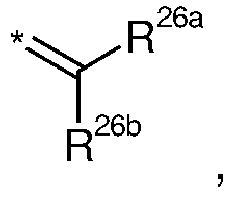 R6 and R9 are independently selected from H, R, OH, OR, SH, SR, NH2, NHR, NRR', nitro, Me3Sn and halo;where R and R' are independently selected from optionally substituted C1-12 alkyl, C3-20 heterocyclyl and C5-20 aryl groups;R7 is selected from H, R, OH, OR, SH, SR, NH2, NHR, NRR', nitro, Me3Sn and halo;R" is a C3-12 alkylene group, which chain may be interrupted by one or more heteroatoms, e.g. O, S, NRN2, where RN2 is H or C1-4 alkyl, and/or aromatic rings, e.g. benzene or pyridine;Y and Y' are selected from O, S, or NH;R11a is selected from OH, ORA, where RA is C1-4 alkyl;R6', R7', R9' and R11a' are selected from the same groups as R6, R7, R9 and R11a respectively;
andRLL1 and RLL2 are linkers connected to the antibody at different sites which are independently of formula IIIa': Q is:
Q is: X is:
X is: GLL is selected from:where Ar represents a C5-6 arylene group, e.g. phenylene and X represents C1-4 alkyl; where CBA represents a cell binding agent which is a modified antibody having at least one free conjugation site on each heavy chain;
(GLL1-1) 
(QLL8-1) 
(GLL1-2) 
(GLL8-2) 
(GLL2) 
(GLL9-1) 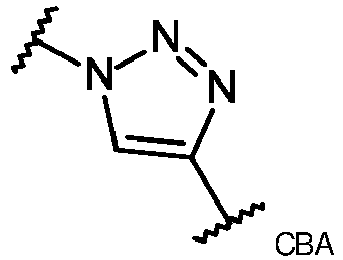
(GLL3-1) 
(GLL9-2) 
(GLL3-2) 
GL10 
(GLL-4) 
GL11 
(GLL5) 
GL12 
(GLL6) 
GL13 
(GLL7) 
wherein the term alkyl includes the sub-classes alkenyl, alkynyl and cycloalkyl, the term alkylene includes the sub-classes alkenylene, alkynylene, cycloalkylene, the term alkenyl pertains to an alkyl group having one or more carbon-carbon double bonds and the term alkynyl pertains to an alkyl group having one or more carbon-carbon triple bonds. - A conjugate according to claim 1, wherein:a) both Y and Y' are O; and/orb) R" is C3-7 alkylene or a group of formula:
 c) R9 is H; and/ord) R6 is H; and/ore) R7 is selected from H, OH, OR or C1-4 alkyloxy group.
 - A conjugate according to either claim 1 or 2, wherein D is D1, there is a double bond between C2 and C3, and R2 is:a) a C5-7 aryl group wherein R2 optionally bears one to three substituent groups selected from methoxy, ethoxy, fluoro, chloro, cyano, bis-oxy-methylene, methyl-piperazinyl, morpholino and methyl-thiophenyl; orb) a C8-10 aryl group wherein R2 optionally bears one to three substituent groups selected from methoxy, ethoxy, fluoro, chloro, cyano, bis-oxy-methylene, methyl-piperazinyl, morpholino and methyl-thiophenyl; orc) a C1-5 saturated aliphatic alkyl group, optionally wherein R2 is methyl, ethyl or propyl; ord) a group of formula:
 i) the total number of carbon atoms in the R2 group is no more than 4;ii) one of R11, R12 and R13 is H, with the other two groups being selected from H, C1-3 saturated alkyl, C2-3 alkenyl, C2-3 alkynyl and cyclopropyl; oriii) two of R11, R12 and R13 are H, with the other group being selected from H, C1-3 saturated alkyl, C2-3 alkenyl, C2-3 alkynyl and cyclopropyl; ore) a group of formula:
 f) the group:
 g) a group of formula:
 h) C3-6 saturated cycloalkyl group, optionally wherein R2 is cyclopropyl.
 - A conjugate according to either claim 1 or 2, wherein D is D1, there is a single bond between C2 and C3, and R2 is:a) H; or,b)
 c)
c) d)
d)
- A conjugate according to any one of claims 1 to 4, wherein D' is D'1, there is a double bond between C2' and C3', and R22 is:a) a C5-7 aryl group wherein wherein R22 optionally bears one to three substituent groups selected from methoxy, ethoxy, fluoro, chloro, cyano, bis-oxy-methylene, methyl-piperazinyl, morpholino and methyl-thiophenyl; orb) a C8-10 aryl group wherein wherein R22 optionally bears one to three substituent groups selected from methoxy, ethoxy, fluoro, chloro, cyano, bis-oxy-methylene, methyl-piperazinyl, morpholino and methyl-thiophenyl; orc) a C1-5 saturated aliphatic alkyl group; ord) a C3-6 saturated cycloalkyl group; ore) a group of formula:
 i) the total number of carbon atoms in the R22 group is no more than 4; orii) one of R31, R32 and R33 is H, with the other two groups being selected from H, C1-3 saturated alkyl, C2-3 alkenyl, C2-3 alkynyl and cyclopropyl; oriii) two of R31, R32 and R33 are H, with the other group being selected from H, C1-3 saturated alkyl, C2-3 alkenyl, C2-3 alkynyl and cyclopropyl; orf) a group of formula:
 g) the group:
 h) a group of formula:
- A conjugate according to any one of claims 1 to 4, wherein D' is D'1, there is a single bond between C2' and C3', and R22 is:a) H; orb)
 c)
c)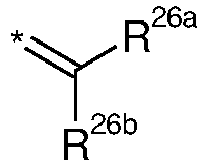 d)
d)
- A conjuagte according to any one of claims 1 to 6, wherein R11a is:a) OH; orb) ORA, where RA is C1-4 alkyl.
- A conjugate according to any one of claims 1 to 7, wherein:a) R6' is selected from the same groups as R6, R7' is selected from the same groups as R7, R9' is selected from the same groups as R9, R11a' is selected from the same groups as R11a and Y' is selected from the same groups as Y; and/orb) R6' is the same group as R6, R7' is the same group as R7, R9' is the same group as R9, R11a' is the same group as R11a and Y' is the same group as Y; and/orc) R22 is the same group as R2.
- A conjugate according to claim 1, which is of formula Ia-1, Ia-2 or Ia-3:


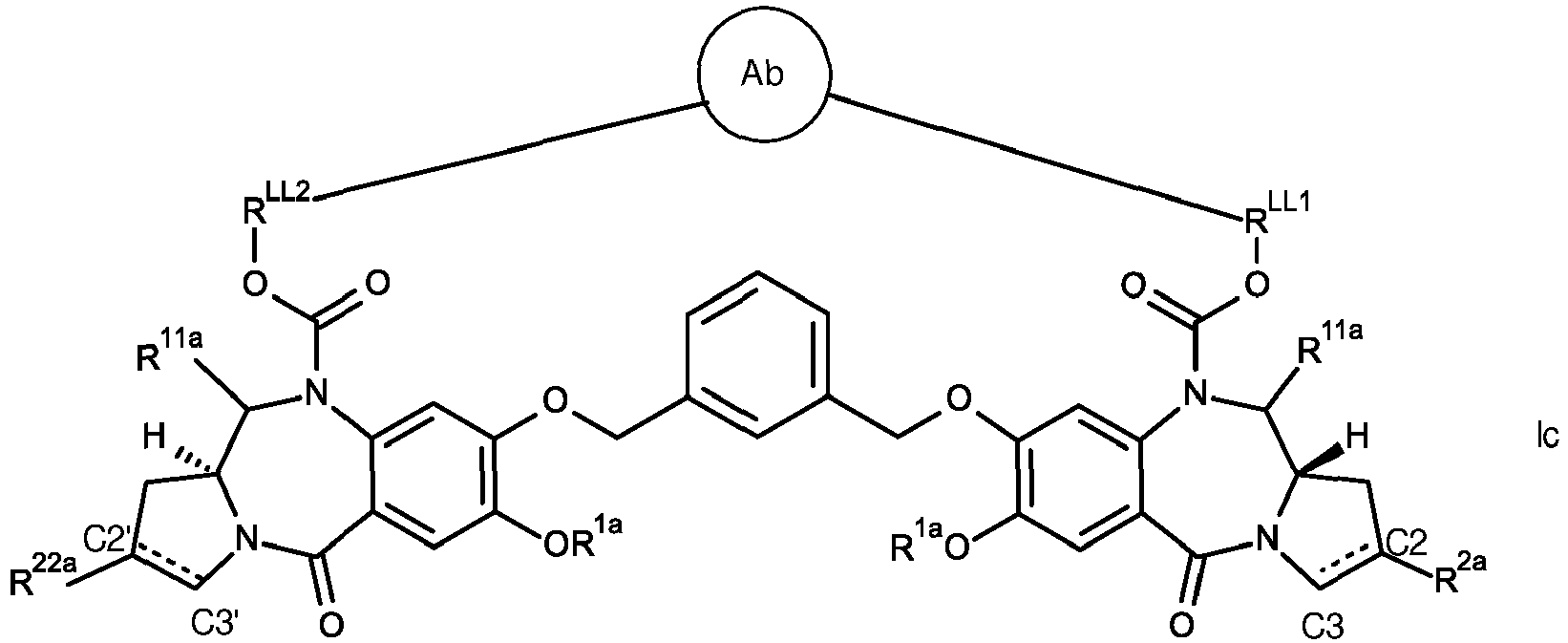 (a)
(a) (b)
(b) (c)
(c) (d)
(d)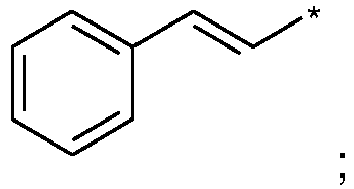 (e)
(e) (f)
(f) (g)
(g) (h)RLL1, RLL2 and R11a are as defined in claim 1.
- A conjugate according to any one of claims 1 to 9, wherein RLL1 is of formula IIIa', and Qx is:a) an amino acid residue selected from Phe, Lys, Val, Ala, Cit, Leu, Ile, Arg, and Trp; orb) a dipeptide residue selected from:CO-Phe-Lys-NH,CO-Val-Ala-NH,CO-Val-Lys-NH,CO-Ala-Lys-NH,CO-Val-Cit-NH,CO-Phe-Cit-NH,CO-Leu-Cit-NH,CO-Ile-Cit-NH,CO-Phe-Arg-NH, andCO-Trp-Cit-NH; orc) a tripeptide residue.
- A conjugate according to any one of claims 1 to 10, wherein RLL1 is of formula IIIa' and:a) a is 0 to 3; and/orb) b is 0 to 12; and/orc) d is 0 to 3.
- A conjugate according to any one of claims 1 to 11, wherein RLL1 is of formula IIIa' and a is 0, c is 1 and d is 2, and b is from 0 to 8 optionally wherein b is 0, 4 or 8.
- A conjugate according to any one of claims 1 to 9, wherein RLL2 is of formula IIIa', and Qx is:a) an amino acid residue selected from Phe, Lys, Val, Ala, Cit, Leu, Ile, Arg, and Trp; orb) a dipeptide residue selected from:CO-Phe-Lys-NH,CO-Val-Ala-NH,CO-Val-Lys-NH,CO-Ala-Lys-NH,CO-Val-Cit-NH,CO-Phe-Cit-NH,CO-Leu-Cit-NH,CO-Ile-Cit-NH,CO-Phe-Arg-NH, andCO-Trp-Cit-NH; orc) a tripeptide residue.
- A conjugate according to any one of claims 1 to 13, wherein RLL2 is of formula IIIa' and:a) a is 0 to 3; and/orb) b is 0 to 12; and/orc) d is 0 to 3.
- A conjugate according to any one of claims 1 to 13, wherein RLL2 is of formula IIIa' and a is 0, c is 1 and d is 2, and b is from 0 to 8.
- A conjugate according to claim 1 of formula Id:

- The conjugate according to any preceding claim wherein:a) the modified antibody having at least one free conjugation site on each heavy chain is an IgG1, IgG2, IgG3 or IgG4 antibody; and optionallyb) the modified antibody having at least one free conjugation site on each heavy chain is a human antibody; orc) the modified antibody having at least one free conjugation site on each heavy chain is a humanized antibody;
- The conjugate according to claim 17:a) wherein the modified antibody has been modified so that the native interchain cysteine residues have been substituted for amino acid residues lacking thiol groups; and/orb) wherein the modified antibody comprises at least one additional substitutions in each heavy chain of an amino acid residue, wherein the additionally substituted amino acid is a cysteine or a non-natural amino acid; and/orc) wherein the modified antibody has been modified to have at least one additional substitution in each heavy chain of an amino acid wherein the position that is substituted is selected from those set forth below:
Antibody Isotype IgG1 IgG2 IgG3 IgG4 Position (Kabat EU) and Corresponding Amino Acid 239 Ser Ser Ser Ser 282 Val Val Val Val 289 Thr Thr Thr Thr 297 Asn Asn Asn Asn 312 Asp Asp Asp Asp 324 Ser Ser Ser Ser 330 Ala Ala Ala Ser 335 Thr Thr Thr Thr 337 Ser Ser Ser Ser 339 Ala Thr Thr Ala 356 Glu Glu Glu Glu 359 Thr Thr Thr Thr 361 Asn Asn Asn Asn 383 Ser Ser Ser Ser 384 Asn Asn Ser Asn 398 Leu Leu Leu Leu 400 Ser Ser Ser Ser 422 Val Val Ile Val 440 Ser Ser Ser Ser 442 Ser Ser Ser Ser SEQ ID NO: 1 2 3 4 - The conjugate according to any one of claims 1 to 18, for use in therapy.
- A pharmaceutical composition comprising the conjugate of any one of claims 1 to 18 a pharmaceutically acceptable diluent, carrier or excipient.
- The conjugate according to any one of claims 1 to 18 or the pharmaceutical composition according to claim 20, for use in the treatment of a proliferative disease in a subject, optionally wherein the disease treated is cancer.
- A compound of formula II:
 wherein D, R2, R6, R7, R9, R11a, Y, R", Y', D', R6', R7', R9', R11a' and R12 (including the presence or absence of double bonds between C2 and C3 and C2' and C3' respectively) are as defined in any one of claims 1 to 9;RL1 and RL2 are linkers for connecting to a cell binding agent, which are independently of formula IIIa:
 where Q and X are as defined in any one of claims 1, 10 to 12 and 13 to 15 and GL is selected from:
(GL1-1) 
(GL6) 
(GL1-2) 
(GL7) 
(GL2) 
(GL8) 
(GL3-1) 
(GL9) 
where the NO2 group is optional (GL3-2) 
(GL10) 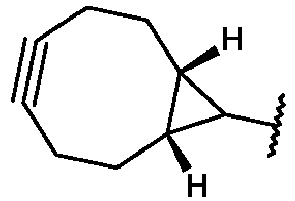
where the NO2 group is optional (GL3-3) 
(GL11) 
where the NO2 group is optional (GL3-4) 
(GL12) 
where the NO2 group is optional (GL4) 
(GL13) 
Where Hal = I, Br, Cl (GL5) 
- A compound according to claim 22, wherein the compound is of formula Id':

Priority Applications (5)
| Application Number | Priority Date | Filing Date | Title |
|---|---|---|---|
| HRP20220311TT HRP20220311T1 (en) | 2017-08-18 | 2018-08-17 | Pyrrolobenzodiazepine conjugates |
| SM20220225T SMT202200225T1 (en) | 2017-08-18 | 2018-08-17 | Pyrrolobenzodiazepine conjugates |
| RS20220169A RS62928B1 (en) | 2017-08-18 | 2018-08-17 | Pyrrolobenzodiazepine conjugates |
| SI201830604T SI3668874T1 (en) | 2017-08-18 | 2018-08-17 | Pyrrolobenzodiazepine conjugates |
| PL18758581T PL3668874T3 (en) | 2017-08-18 | 2018-08-17 | Pyrrolobenzodiazepine conjugates |
Applications Claiming Priority (2)
| Application Number | Priority Date | Filing Date | Title |
|---|---|---|---|
| US201762547303P | 2017-08-18 | 2017-08-18 | |
| PCT/EP2018/072298 WO2019034764A1 (en) | 2017-08-18 | 2018-08-17 | Pyrrolobenzodiazepine conjugates |
Publications (2)
| Publication Number | Publication Date |
|---|---|
| EP3668874A1 EP3668874A1 (en) | 2020-06-24 |
| EP3668874B1 true EP3668874B1 (en) | 2021-12-22 |
Family
ID=63294219
Family Applications (1)
| Application Number | Title | Priority Date | Filing Date |
|---|---|---|---|
| EP18758581.5A Active EP3668874B1 (en) | 2017-08-18 | 2018-08-17 | Pyrrolobenzodiazepine conjugates |
Country Status (26)
| Country | Link |
|---|---|
| US (1) | US11649250B2 (en) |
| EP (1) | EP3668874B1 (en) |
| JP (1) | JP7220203B2 (en) |
| KR (2) | KR102312910B1 (en) |
| CN (1) | CN111065638B (en) |
| AU (1) | AU2018316532B2 (en) |
| BR (1) | BR112020003003A2 (en) |
| CL (1) | CL2020000395A1 (en) |
| CO (1) | CO2020001751A2 (en) |
| CY (1) | CY1125053T1 (en) |
| DK (1) | DK3668874T3 (en) |
| EA (1) | EA039276B1 (en) |
| ES (1) | ES2906965T3 (en) |
| HR (1) | HRP20220311T1 (en) |
| IL (1) | IL272625B2 (en) |
| LT (1) | LT3668874T (en) |
| MX (1) | MX384245B (en) |
| MY (1) | MY194477A (en) |
| PL (1) | PL3668874T3 (en) |
| PT (1) | PT3668874T (en) |
| RS (1) | RS62928B1 (en) |
| SG (1) | SG11202000358YA (en) |
| SI (1) | SI3668874T1 (en) |
| SM (1) | SMT202200225T1 (en) |
| WO (1) | WO2019034764A1 (en) |
| ZA (1) | ZA202000397B (en) |
Families Citing this family (12)
| Publication number | Priority date | Publication date | Assignee | Title |
|---|---|---|---|---|
| WO2021144313A1 (en) | 2020-01-13 | 2021-07-22 | Synaffix B.V. | Via cycloaddition bilaterally functionalized antibodies |
| CN115243727A (en) * | 2020-01-13 | 2022-10-25 | 西纳福克斯股份有限公司 | Double-sided functionalized antibodies via cycloaddition |
| CN115768483A (en) * | 2020-01-13 | 2023-03-07 | 西纳福克斯股份有限公司 | Conjugates of antibodies and immune cell adaptors |
| JP2024506022A (en) | 2021-02-08 | 2024-02-08 | シンアフィックス ビー.ブイ. | multifunctional antibodies |
| GB202105186D0 (en) | 2021-04-12 | 2021-05-26 | Medimmune Ltd | Pyrrolobenzodiazepine conjugates |
| US20230201366A1 (en) | 2021-11-19 | 2023-06-29 | Adc Therapeutics Sa | Anti-psma conjugates |
| WO2023088963A1 (en) | 2021-11-19 | 2023-05-25 | Adc Therapeutics Sa | Anti-il-13ralpha2 conjugates |
| AU2023298568A1 (en) | 2022-06-30 | 2025-01-09 | Toray Industries, Inc. | Pharmaceutical composition for cancer treatment and/or prevention |
| WO2024038065A1 (en) | 2022-08-15 | 2024-02-22 | Synaffix B.V. | Anthracyclins and conjugates thereof |
| EP4389152A1 (en) | 2022-12-23 | 2024-06-26 | Synaffix B.V. | Conjugates of pbd prodrugs |
| WO2024218162A1 (en) | 2023-04-17 | 2024-10-24 | Synaffix B.V. | Cleavable immune cell engagers |
| EP4450093A1 (en) | 2023-04-17 | 2024-10-23 | Synaffix B.V. | Cleavable immune cell engagers |
Family Cites Families (424)
| Publication number | Priority date | Publication date | Assignee | Title |
|---|---|---|---|---|
| US3361742A (en) | 1964-12-07 | 1968-01-02 | Hoffmann La Roche | 5-oxo-1h-pyrrolo-[2, 1-c][1, 4]-benzodiazepin-2-crylamides |
| US3523941A (en) | 1967-03-06 | 1970-08-11 | Hoffmann La Roche | Benzodiazepine compounds and process for their preparation |
| US3524849A (en) | 1967-10-27 | 1970-08-18 | Hoffmann La Roche | Process for the preparation of pyrrolo-benzodiazepine acrylamides and intermediates useful therein |
| IL33558A (en) | 1968-12-30 | 1973-10-25 | Fujisawa Pharmaceutical Co | Antibiotic pyrrolo-benzodiazepine compound,its derivatives and processes for their production |
| JPS4843755B1 (en) | 1969-06-26 | 1973-12-20 | ||
| FR2027356A1 (en) | 1968-12-30 | 1970-09-25 | Fujisawa Pharmaceutical Co | Benzodiazepinone antibiotics |
| JPS585916B2 (en) | 1977-12-27 | 1983-02-02 | 株式会社ミドリ十字 | New benzodiazepine compounds |
| JPS5615289A (en) | 1979-07-17 | 1981-02-14 | Green Cross Corp:The | Novel benzodiazepinnbased compound 3 |
| JPS57131791A (en) | 1980-12-31 | 1982-08-14 | Fujisawa Pharmaceut Co Ltd | Benzodiazepine derivative and its preparation |
| CA1173441A (en) | 1981-02-27 | 1984-08-28 | Hoffmann-La Roche Limited | Imidazodiazepines |
| CA1185602A (en) | 1981-02-27 | 1985-04-16 | Emilio Kyburz | Imidazodiazepines |
| CA1184175A (en) | 1981-02-27 | 1985-03-19 | Walter Hunkeler | Imidazodiazepines |
| JPS58180487A (en) | 1982-04-16 | 1983-10-21 | Kyowa Hakko Kogyo Co Ltd | Antibiotic dc-81 and its preparation |
| US4427588A (en) | 1982-11-08 | 1984-01-24 | Bristol-Myers Company | Process for conversion of oxotomaymycin to tomaymycin |
| US4427587A (en) | 1982-11-10 | 1984-01-24 | Bristol-Myers Company | Total synthesis of antitumor antibiotics BBM-2040A and BBM-2040B |
| JPS59152329A (en) | 1983-02-17 | 1984-08-31 | Green Cross Corp:The | Local disorder inhibitor |
| US4816567A (en) | 1983-04-08 | 1989-03-28 | Genentech, Inc. | Recombinant immunoglobin preparations |
| FR2586683B1 (en) | 1985-08-29 | 1988-07-01 | Centre Nat Rech Scient | NOVEL NEOTHRAMYCIN DERIVATIVES, THEIR PREPARATION PROCESS AND THEIR APPLICATION AS MEDICAMENTS |
| US5583024A (en) | 1985-12-02 | 1996-12-10 | The Regents Of The University Of California | Recombinant expression of Coleoptera luciferase |
| JP2660201B2 (en) | 1988-08-05 | 1997-10-08 | 塩野義製薬株式会社 | Novel pyrrolo [1,4] benzodiazepine derivatives and senile dementia drugs |
| AU6355090A (en) | 1989-08-23 | 1991-04-03 | Scripps Clinic And Research Foundation | Compositions and methods for detection and treatment of epstein-barr virus infection and immune disorders |
| JPH053790A (en) | 1990-04-19 | 1993-01-14 | Fujisawa Pharmaceut Co Ltd | Dehydropeptidase-I |
| US5256643A (en) | 1990-05-29 | 1993-10-26 | The Government Of The United States | Human cripto protein |
| WO1992007574A1 (en) | 1990-10-25 | 1992-05-14 | Tanox Biosystems, Inc. | Glycoproteins associated with membrane-bound immunoglobulins as antibody targets on b cells |
| US5440021A (en) | 1991-03-29 | 1995-08-08 | Chuntharapai; Anan | Antibodies to human IL-8 type B receptor |
| US5543503A (en) | 1991-03-29 | 1996-08-06 | Genentech Inc. | Antibodies to human IL-8 type A receptor |
| ES2149772T5 (en) | 1991-03-29 | 2008-02-16 | Genentech, Inc. | HUMAN RECEPTORS PF4A AND ITS USE. |
| FR2676058B1 (en) | 1991-04-30 | 1994-02-25 | Hoechst Lab | GLYCOSYLATED PRODUCTS, THEIR PREPARATION PROCESS AND THEIR USE IN THE TREATMENT OF CANCERS. |
| FR2676230B1 (en) | 1991-05-07 | 1993-08-27 | Centre Nat Rech Scient | NOVEL PYRROLO [1,4] -BENZODIAZEPINES DERIVATIVES, PROCESS FOR THEIR PREPARATION AND MEDICAMENTS CONTAINING THEM. |
| JP3050424B2 (en) | 1991-07-12 | 2000-06-12 | 塩野義製薬株式会社 | Human endothelin receptor |
| US5264557A (en) | 1991-08-23 | 1993-11-23 | The United States Of America As Represented By The Department Of Health And Human Services | Polypeptide of a human cripto-related gene, CR-3 |
| US5362852A (en) | 1991-09-27 | 1994-11-08 | Pfizer Inc. | Modified peptide derivatives conjugated at 2-hydroxyethylamine moieties |
| US6011146A (en) | 1991-11-15 | 2000-01-04 | Institut Pasteur | Altered major histocompatibility complex (MHC) determinant and methods of using the determinant |
| US6153408A (en) | 1991-11-15 | 2000-11-28 | Institut Pasteur And Institut National De La Sante Et De La Recherche Medicale | Altered major histocompatibility complex (MHC) determinant and methods of using the determinant |
| GB9205051D0 (en) | 1992-03-09 | 1992-04-22 | Cancer Res Campaign Tech | Pyrrolobenzodiazepine derivatives,their preparation,and compositions containing them |
| FR2696176B1 (en) | 1992-09-28 | 1994-11-10 | Synthelabo | Piperidine derivatives, their preparation and their therapeutic application. |
| IL107366A (en) | 1992-10-23 | 2003-03-12 | Chugai Pharmaceutical Co Ltd | Genes coding for megakaryocyte potentiator |
| US5644033A (en) | 1992-12-22 | 1997-07-01 | Health Research, Inc. | Monoclonal antibodies that define a unique antigen of human B cell antigen receptor complex and methods of using same for diagnosis and treatment |
| US5801005A (en) | 1993-03-17 | 1998-09-01 | University Of Washington | Immune reactivity to HER-2/neu protein for diagnosis of malignancies in which the HER-2/neu oncogene is associated |
| US5869445A (en) | 1993-03-17 | 1999-02-09 | University Of Washington | Methods for eliciting or enhancing reactivity to HER-2/neu protein |
| US6214345B1 (en) | 1993-05-14 | 2001-04-10 | Bristol-Myers Squibb Co. | Lysosomal enzyme-cleavable antitumor drug conjugates |
| GB9316162D0 (en) | 1993-08-04 | 1993-09-22 | Zeneca Ltd | Fungicides |
| US5773223A (en) | 1993-09-02 | 1998-06-30 | Chiron Corporation | Endothelin B1, (ETB1) receptor polypeptide and its encoding nucleic acid methods, and uses thereof |
| EP0647450A1 (en) | 1993-09-09 | 1995-04-12 | BEHRINGWERKE Aktiengesellschaft | Improved prodrugs for enzyme mediated activation |
| US5750370A (en) | 1995-06-06 | 1998-05-12 | Human Genome Sciences, Inc. | Nucleic acid encoding human endothlein-bombesin receptor and method of producing the receptor |
| JPH08336393A (en) | 1995-04-13 | 1996-12-24 | Mitsubishi Chem Corp | Process for producing optically active γ-substituted-β-hydroxybutyric acid ester |
| US5707829A (en) | 1995-08-11 | 1998-01-13 | Genetics Institute, Inc. | DNA sequences and secreted proteins encoded thereby |
| US20020193567A1 (en) | 1995-08-11 | 2002-12-19 | Genetics Institute, Inc. | Secreted proteins and polynucleotides encoding them |
| JP3646191B2 (en) | 1996-03-19 | 2005-05-11 | 大塚製薬株式会社 | Human gene |
| US6218519B1 (en) | 1996-04-12 | 2001-04-17 | Pro-Neuron, Inc. | Compounds and methods for the selective treatment of cancer and bacterial infections |
| SK157498A3 (en) | 1996-05-17 | 1999-10-08 | Schering Corp | Isolated and recombinant nucleic acid, bas-1 protein or peptide thereof, and agent, antibody, expression vector, host cell and method of their use |
| AU739028B2 (en) | 1996-09-27 | 2001-10-04 | Bristol-Myers Squibb Company | Hydrolyzable prodrugs for delivery of anticancer drugs to metastatic cells |
| US6759509B1 (en) | 1996-11-05 | 2004-07-06 | Bristol-Myers Squibb Company | Branched peptide linkers |
| US5945511A (en) | 1997-02-20 | 1999-08-31 | Zymogenetics, Inc. | Class II cytokine receptor |
| US20030185830A1 (en) | 1997-02-25 | 2003-10-02 | Corixa Corporation | Compositions and methods for the therapy and diagnosis of prostate cancer |
| US7033827B2 (en) | 1997-02-25 | 2006-04-25 | Corixa Corporation | Prostate-specific polynucleotide compositions |
| US6541212B2 (en) | 1997-03-10 | 2003-04-01 | The Regents Of The University Of California | Methods for detecting prostate stem cell antigen protein |
| US6261791B1 (en) | 1997-03-10 | 2001-07-17 | The Regents Of The University Of California | Method for diagnosing cancer using specific PSCA antibodies |
| EP2343085B1 (en) | 1997-03-10 | 2014-12-10 | The Regents of The University of California | Antibody against prostate stem cell antigen (PSCA) |
| US6555339B1 (en) | 1997-04-14 | 2003-04-29 | Arena Pharmaceuticals, Inc. | Non-endogenous, constitutively activated human protein-coupled receptors |
| US6319688B1 (en) | 1997-04-28 | 2001-11-20 | Smithkline Beecham Corporation | Polynucleotide encoding human sodium dependent phosphate transporter (IPT-1) |
| US6890749B2 (en) | 1997-05-15 | 2005-05-10 | Abbott Laboratories | Reagents and methods useful for detecting diseases of the prostate |
| WO1998051824A1 (en) | 1997-05-15 | 1998-11-19 | Abbott Laboratories | Reagents and methods useful for detecting disease of the urinary tract |
| US6602677B1 (en) | 1997-09-19 | 2003-08-05 | Promega Corporation | Thermostable luciferases and methods of production |
| US20030060612A1 (en) | 1997-10-28 | 2003-03-27 | Genentech, Inc. | Compositions and methods for the diagnosis and treatment of tumor |
| US20020034749A1 (en) | 1997-11-18 | 2002-03-21 | Billing-Medel Patricia A. | Reagents and methods useful for detecting diseases of the breast |
| US6110695A (en) | 1997-12-02 | 2000-08-29 | The Regents Of The University Of California | Modulating the interaction of the chemokine, B Lymphocyte Hemoattractant, and its Receptor, BLR1 |
| CA2323071C (en) | 1998-03-13 | 2011-06-21 | The Burnham Institute | Molecules that home to various selected organs or tissues |
| US6534482B1 (en) | 1998-05-13 | 2003-03-18 | Epimmune, Inc. | Expression vectors for stimulating an immune response and methods of using the same |
| US20030064397A1 (en) | 1998-05-22 | 2003-04-03 | Incyte Genomics, Inc. | Transmembrane protein differentially expressed in prostate and lung tumors |
| HK1040052B (en) | 1998-05-22 | 2006-09-15 | 第一制药株式会社 | Drug composites |
| US20020187472A1 (en) | 2001-03-09 | 2002-12-12 | Preeti Lal | Steap-related protein |
| JP4568429B2 (en) | 1998-07-08 | 2010-10-27 | イー インク コーポレイション | Method for obtaining an improved color in a microencapsulated electrophoretic device |
| GB9818732D0 (en) | 1998-08-27 | 1998-10-21 | Univ Portsmouth | Collection of compounds |
| GB9818730D0 (en) | 1998-08-27 | 1998-10-21 | Univ Portsmouth | Collections of compounds |
| WO2000012130A1 (en) | 1998-08-27 | 2000-03-09 | Smithkline Beecham Corporation | Rp105 agonists and antagonists |
| GB9818731D0 (en) | 1998-08-27 | 1998-10-21 | Univ Portsmouth | Compounds |
| PT1109812E (en) | 1998-08-27 | 2005-09-30 | Spirogen Ltd | PYRROLOBENZODIAZEPINAS |
| JP4689781B2 (en) | 1998-09-03 | 2011-05-25 | 独立行政法人科学技術振興機構 | Amino acid transport protein and its gene |
| WO2000020579A1 (en) | 1998-10-02 | 2000-04-13 | Mcmaster University | Spliced form of erbb-2/neu oncogene |
| US6962980B2 (en) | 1999-09-24 | 2005-11-08 | Corixa Corporation | Compositions and methods for the therapy and diagnosis of ovarian cancer |
| US6858710B2 (en) | 1998-12-17 | 2005-02-22 | Corixa Corporation | Compositions and methods for the therapy and diagnosis of ovarian cancer |
| US20020119158A1 (en) | 1998-12-17 | 2002-08-29 | Corixa Corporation | Compositions and methods for the therapy and diagnosis of ovarian cancer |
| US20030091580A1 (en) | 2001-06-18 | 2003-05-15 | Mitcham Jennifer L. | Compositions and methods for the therapy and diagnosis of ovarian cancer |
| US6468546B1 (en) | 1998-12-17 | 2002-10-22 | Corixa Corporation | Compositions and methods for therapy and diagnosis of ovarian cancer |
| HK1041009B (en) | 1998-12-30 | 2009-05-08 | Beth Israel Deaconess Medical Center, Inc. | Characterization of the soc/crac calcium channel protein family |
| US20030190669A1 (en) | 1998-12-30 | 2003-10-09 | Genentech, Inc. | Secreted and transmembrane polypeptides and nucleic acids encoding the same |
| AU780109B2 (en) | 1999-01-29 | 2005-03-03 | Corixa Corporation | HER-2/neu fusion proteins |
| GB9905124D0 (en) | 1999-03-05 | 1999-04-28 | Smithkline Beecham Biolog | Novel compounds |
| AU3395900A (en) | 1999-03-12 | 2000-10-04 | Human Genome Sciences, Inc. | Human lung cancer associated gene sequences and polypeptides |
| US7304126B2 (en) | 1999-05-11 | 2007-12-04 | Genentech, Inc. | Secreted and transmembrane polypeptides and nucleic acids encoding the same |
| US6268488B1 (en) | 1999-05-25 | 2001-07-31 | Barbas, Iii Carlos F. | Prodrug activation using catalytic antibodies |
| WO2000075655A1 (en) | 1999-06-03 | 2000-12-14 | Takeda Chemical Industries, Ltd. | Screening method with the use of cd100 |
| BRPI0012196B8 (en) | 1999-06-25 | 2021-05-25 | Genentech Inc | industrialized article |
| US6302318B1 (en) | 1999-06-29 | 2001-10-16 | General Electric Company | Method of providing wear-resistant coatings, and related articles |
| US20030119113A1 (en) | 1999-07-20 | 2003-06-26 | Genentech, Inc. | Secreted and transmembrane polypeptides and nucleic acids encoding the same |
| US7297770B2 (en) | 1999-08-10 | 2007-11-20 | Genentech, Inc. | PRO6496 polypeptides |
| US7294696B2 (en) | 1999-08-17 | 2007-11-13 | Genentech Inc. | PRO7168 polypeptides |
| US6909006B1 (en) | 1999-08-27 | 2005-06-21 | Spirogen Limited | Cyclopropylindole derivatives |
| CA2380355A1 (en) | 1999-09-01 | 2001-03-08 | Genentech, Inc. | Secreted and transmembrane polypeptides and nucleic acids encoding the same |
| US20030232056A1 (en) | 1999-09-10 | 2003-12-18 | Corixa Corporation | Compositions and methods for the therapy and diagnosis of ovarian cancer |
| US20030206918A1 (en) | 1999-09-10 | 2003-11-06 | Corixa Corporation | Compositions and methods for the therapy and diagnosis of ovarian cancer |
| US20030129192A1 (en) | 1999-09-10 | 2003-07-10 | Corixa Corporation | Compositions and methods for the therapy and diagnosis of ovarian cancer |
| US6750054B2 (en) | 2000-05-18 | 2004-06-15 | Lexicon Genetics Incorporated | Human semaphorin homologs and polynucleotides encoding the same |
| BR0015224A (en) | 1999-10-29 | 2002-07-09 | Genentech Inc | Isolated prostatic stem cell (psca) anti-antigen, monoclonal anti-psca antibody, isolated nucleic acid, expression vector, cell, host cell, antibody production method, in vitro method composition to kill a cancer cell that expresses psca , use of an anti-psca monoclonal antibody and industrialized article |
| CA2393126C (en) | 1999-11-29 | 2016-05-24 | The Trustees Of Columbia University In The City Of New York | Isolation of five novel genes coding for new fc receptors-type melanoma involved in the pathogenesis of lymphoma/melanoma |
| AU1807401A (en) | 1999-11-30 | 2001-06-12 | Corixa Corporation | Compositions and methods for therapy and diagnosis of breast cancer |
| AU2087401A (en) | 1999-12-10 | 2001-06-18 | Epimmune, Inc. | Inducing cellular immune responses to her2/neu using peptide and nucleic acid compositions |
| NZ502058A (en) | 1999-12-23 | 2003-11-28 | Ovita Ltd | Isolated mutated nucleic acid molecule for regulation of ovulation rate |
| US6610286B2 (en) | 1999-12-23 | 2003-08-26 | Zymogenetics, Inc. | Method for treating inflammation using soluble receptors to interleukin-20 |
| EP2295079A3 (en) | 1999-12-23 | 2011-03-23 | ZymoGenetics, L.L.C. | Method for treating inflammation |
| DE60045139D1 (en) | 1999-12-23 | 2010-12-02 | Zymogenetics Inc | Soluble interleukin-20 receptor |
| US7608681B2 (en) | 1999-12-24 | 2009-10-27 | Genentech, Inc. | Methods and compositions for prolonging elimination half-times of bioactive compounds |
| US20040001827A1 (en) | 2002-06-28 | 2004-01-01 | Dennis Mark S. | Serum albumin binding peptides for tumor targeting |
| US7297333B2 (en) | 2000-01-20 | 2007-11-20 | Genentech, Inc. | Anti-PRO10268 antibodies |
| US20030224379A1 (en) | 2000-01-21 | 2003-12-04 | Tang Y. Tom | Novel nucleic acids and polypeptides |
| AU2001234493A1 (en) | 2000-01-21 | 2001-07-31 | Corixa Corporation | Compounds and methods for prevention and treatment of her-2/neu associated malignancies |
| AU2001243142A1 (en) | 2000-02-03 | 2001-08-14 | Hyseq, Inc. | Novel nucleic acids and polypeptides |
| US20030104562A1 (en) | 2000-02-11 | 2003-06-05 | Genentech, Inc. | Secreted and transmembrane polypeptides and nucleic acids encoding the same |
| AU2001238596A1 (en) | 2000-02-22 | 2001-09-03 | Millennium Pharmaceuticals, Inc. | 18607, a novel human calcium channel |
| US20030219806A1 (en) | 2000-02-22 | 2003-11-27 | Millennium Pharmaceuticals, Inc. | Novel 18607, 15603, 69318, 12303, 48000, 52920, 5433, 38554, 57301, 58324, 55063, 52991, 59914, 59921 and 33751 molecules and uses therefor |
| US20040052793A1 (en) | 2001-02-22 | 2004-03-18 | Carter Paul J. | Caspase activivated prodrugs therapy |
| US20040002068A1 (en) | 2000-03-01 | 2004-01-01 | Corixa Corporation | Compositions and methods for the detection, diagnosis and therapy of hematological malignancies |
| US20040005561A1 (en) | 2000-03-01 | 2004-01-08 | Corixa Corporation | Compositions and methods for the detection, diagnosis and therapy of hematological malignancies |
| AU2001245280A1 (en) | 2000-03-07 | 2001-09-17 | Hyseq, Inc. | Novel nucleic acids and polypeptides |
| EP1268526A4 (en) | 2000-03-24 | 2004-09-08 | Fahri Saatcioglu | Novel prostate-specific or testis-specific nucleic acid molecules, polypeptides, and diagnostic and therapeutic methods |
| JP2003530325A (en) | 2000-03-31 | 2003-10-14 | イーペーエフ ファルマシューティカルス ゲゼルシャフト ミット ベシュレンクテル ハフツング | Diagnostics and agents for the investigation of cell surface proteomes of tumors and inflammatory cells, and the treatment of tumor and inflammatory diseases, preferably with the aid of specific chemokine receptor analysis and chemokine receptor / ligand interactions |
| AU2001253140A1 (en) | 2000-04-03 | 2001-10-15 | The Government Of The United States Of America, As Represented By The Secretary Of The Department Of Health And Human Services | Tumor markers in ovarian cancer |
| AU2001249885A1 (en) | 2000-04-07 | 2001-10-23 | Arena Pharmaceuticals, Inc. | Non-endogenous, constitutively activated known g protein-coupled receptors |
| AU2001274888A1 (en) | 2000-05-19 | 2001-12-03 | Human Genome Sciences, Inc. | Nucleic acids, proteins, and antibodies |
| WO2001094641A2 (en) | 2000-06-09 | 2001-12-13 | Idec Pharmaceuticals Corporation | Gene targets and ligands that bind thereto for treatment and diagnosis of ovarian carcinomas |
| AU2001268471A1 (en) | 2000-06-16 | 2002-01-02 | Incyte Genomics, Inc. | G-protein coupled receptors |
| WO2002002587A1 (en) | 2000-06-30 | 2002-01-10 | Human Genome Sciences, Inc. | B7-like polynucleotides, polypeptides, and antibodies |
| EP1383892A2 (en) | 2000-06-30 | 2004-01-28 | Incyte Genomics, Inc. | Human extracellular matrix and cell adhesion polypeptides |
| MXPA02012749A (en) | 2000-06-30 | 2003-10-06 | Amgen Inc | B7-like molecules and uses thereof. |
| AU2002214531A1 (en) | 2000-07-03 | 2002-01-30 | Curagen Corporation | Proteins and nucleic acids encoding same |
| US20040044179A1 (en) | 2000-07-25 | 2004-03-04 | Genentech, Inc. | Secreted and transmembrane polypeptides and nucleic acids encoding the same |
| AU2001283507A1 (en) | 2000-07-27 | 2002-02-13 | Mayo Foundation For Medical Education And Research | B7-h3 and b7-h4, novel immunoregulatory molecules |
| CA2417671A1 (en) | 2000-07-28 | 2002-02-07 | Ulrich Wissenbach | Trp8, trp9 and trp10, novel markers for cancer |
| US7229623B1 (en) | 2000-08-03 | 2007-06-12 | Corixa Corporation | Her-2/neu fusion proteins |
| PL365789A1 (en) | 2000-08-14 | 2005-01-10 | Corixa Corporation | Compositions and methods of treatment and diagnosis of Her-2 / neu-related cancers |
| WO2002013847A2 (en) | 2000-08-14 | 2002-02-21 | Corixa Corporation | Methods for diagnosis and therapy of hematological and virus-associated malignancies |
| GB0020953D0 (en) | 2000-08-24 | 2000-10-11 | Smithkline Beecham Biolog | Vaccine |
| MXPA03001645A (en) | 2000-08-24 | 2004-05-14 | Genentech Inc | Compositions and methods for the diagnosis and treatment of tumor. |
| EP1346040A2 (en) | 2000-09-11 | 2003-09-24 | Nuvelo, Inc. | Novel nucleic acids and polypeptides |
| US20030119121A1 (en) | 2000-09-15 | 2003-06-26 | Genentech, Inc. | Secreted and transmembrane polypeptides and nucleic acids encoding the same |
| EP1803733B1 (en) | 2000-09-15 | 2010-03-10 | ZymoGenetics, Inc. | Polypeptides comprising the extracellular domains of IL-20RA and/or IL-20RB |
| US6613567B1 (en) | 2000-09-15 | 2003-09-02 | Isis Pharmaceuticals, Inc. | Antisense inhibition of Her-2 expression |
| CA2422814A1 (en) | 2000-09-18 | 2002-03-21 | Biogen, Inc. | Cripto mutant and uses thereof |
| UA83458C2 (en) | 2000-09-18 | 2008-07-25 | Байоджен Айдек Ма Інк. | The isolated polypeptide baff-r (the receptor of the factor of activation of b-cells of the family tnf) |
| DK1320522T3 (en) | 2000-09-19 | 2006-04-03 | Moses Lee | Achiral analogs of CC-1065 and of duocarmycins as well as preparations and methods for their use |
| CA2425569A1 (en) | 2000-10-13 | 2002-04-18 | Eos Biotechnology, Inc. | Methods of diagnosis of prostate cancer, compositions and methods of screening for modulators of prostate cancer |
| JP2004516826A (en) | 2000-11-07 | 2004-06-10 | ザイモジェネティクス,インコーポレイティド | Human tumor necrosis factor receptor |
| US20020150573A1 (en) | 2000-11-10 | 2002-10-17 | The Rockefeller University | Anti-Igalpha-Igbeta antibody for lymphoma therapy |
| US20040018194A1 (en) | 2000-11-28 | 2004-01-29 | Francisco Joseph A. | Recombinant anti-CD30 antibodies and uses thereof |
| WO2002061087A2 (en) | 2000-12-19 | 2002-08-08 | Lifespan Biosciences, Inc. | Antigenic peptides, such as for g protein-coupled receptors (gpcrs), antibodies thereto, and systems for identifying such antigenic peptides |
| EP1357828A2 (en) | 2001-01-12 | 2003-11-05 | University of Medicine and Dentistry of New Jersey | Bone morphogenetic protein-2 in the treatment and diagnosis of cancer |
| US20030119126A1 (en) | 2001-01-16 | 2003-06-26 | Genentech, Inc. | Secreted and transmembrane polypeptides and nucleic acids encoding the same |
| US20030119119A1 (en) | 2001-01-16 | 2003-06-26 | Genentech, Inc. | Secreted and transmembrane polypeptides and nucleic acids encoding the same |
| US7754208B2 (en) | 2001-01-17 | 2010-07-13 | Trubion Pharmaceuticals, Inc. | Binding domain-immunoglobulin fusion proteins |
| EP1425302A2 (en) | 2001-01-24 | 2004-06-09 | Protein Design Labs | Methods of diagnosis of breast cancer, compositions and methods of screening for modulators of breast cancer |
| AU2002251841A1 (en) | 2001-01-30 | 2002-08-12 | Corixa Corporation | Compositions and methods for the therapy and diagnosis of pancreatic cancer |
| US20040170994A1 (en) | 2001-02-12 | 2004-09-02 | Callen David Frederick | DNA sequences for human tumour suppressor genes |
| AU2002258518A1 (en) | 2001-03-14 | 2002-09-24 | Millennium Pharmaceuticals, Inc. | Nucleic acid molecules and proteins for the identification, assessment, prevention, and therapy of ovarian cancer |
| EP1243276A1 (en) | 2001-03-23 | 2002-09-25 | Franciscus Marinus Hendrikus De Groot | Elongated and multiple spacers containing activatible prodrugs |
| US20040236091A1 (en) | 2001-03-28 | 2004-11-25 | Chicz Roman M. | Translational profiling |
| US6362331B1 (en) | 2001-03-30 | 2002-03-26 | Council Of Scientific And Industrial Research | Process for the preparation of antitumor agents |
| WO2003008537A2 (en) | 2001-04-06 | 2003-01-30 | Mannkind Corporation | Epitope sequences |
| US6820011B2 (en) | 2001-04-11 | 2004-11-16 | The Regents Of The University Of Colorado | Three-dimensional structure of complement receptor type 2 and uses thereof |
| AU2002254615A1 (en) | 2001-04-17 | 2002-10-28 | The Board Of Trustees Of The University Of Arkansas | Repeat sequences of the ca125 gene and their use for diagnostic and therapeutic interventions |
| JP2005527180A (en) | 2001-04-18 | 2005-09-15 | プロテイン デザイン ラブス, インコーポレイテッド | Lung cancer diagnosis method, composition of lung cancer modifier and screening method |
| AU2002334799B2 (en) | 2001-04-26 | 2009-05-07 | Biogen Ma Inc. | Cripto-specific antibodies |
| ES2321065T3 (en) | 2001-04-26 | 2009-06-02 | Biogen Idec Ma Inc. | BLOCKING ANTIBODIES OF CRYPT AND USES OF THE SAME. |
| US6884869B2 (en) | 2001-04-30 | 2005-04-26 | Seattle Genetics, Inc. | Pentapeptide compounds and uses related thereto |
| CA2446788A1 (en) | 2001-05-09 | 2002-11-14 | Corixa Corporation | Compositions and methods for the therapy and diagnosis of prostate cancer |
| US20030078399A1 (en) | 2001-05-11 | 2003-04-24 | Sloan-Kettering Institute For Cancer Research | Nucleic acid sequence encoding ovarian antigen, CA125, and uses thereof |
| EA010594B1 (en) | 2001-05-24 | 2008-10-30 | Займодженетикс, Инк. | Taci-immunoglobulin fusion proteins |
| US7157558B2 (en) | 2001-06-01 | 2007-01-02 | Genentech, Inc. | Polypeptide encoded by a polynucleotide overexpresses in tumors |
| WO2003000842A2 (en) | 2001-06-04 | 2003-01-03 | Curagen Corporation | Novel proteins and nucleic acids encoding same |
| AU2002314901A1 (en) | 2001-06-04 | 2002-12-16 | Eos Biotechnology, Inc. | Methods of diagnosis and treatment of androgen-dependent prostate cancer, prostate cancer undergoing androgen-withdrawal, and androgen-independent prostate cancer |
| EP1402053A4 (en) | 2001-06-05 | 2005-05-11 | Exelixis Inc | CHDS AS MODULATORS OF THE MECHANISM OF ACTION OF P53 AND USES THEREOF |
| ATE483976T1 (en) | 2001-06-05 | 2010-10-15 | Exelixis Inc | GFATS AS P53 PATHWAY MODIFIERS AND METHODS OF USE |
| US7235358B2 (en) | 2001-06-08 | 2007-06-26 | Expression Diagnostics, Inc. | Methods and compositions for diagnosing and monitoring transplant rejection |
| US7125663B2 (en) | 2001-06-13 | 2006-10-24 | Millenium Pharmaceuticals, Inc. | Genes, compositions, kits and methods for identification, assessment, prevention, and therapy of cervical cancer |
| WO2002102235A2 (en) | 2001-06-18 | 2002-12-27 | Eos Biotechnology Inc. | Methods of diagnosis of ovarian cancer, compositions and methods of screening for modulators of ovarian cancer |
| US7189507B2 (en) | 2001-06-18 | 2007-03-13 | Pdl Biopharma, Inc. | Methods of diagnosis of ovarian cancer, compositions and methods of screening for modulators of ovarian cancer |
| AU2002322280A1 (en) | 2001-06-21 | 2003-01-21 | Millennium Pharmaceuticals, Inc. | Compositions, kits, and methods for identification, assessment, prevention, and therapy of breast cancer |
| WO2003002717A2 (en) | 2001-06-28 | 2003-01-09 | Schering Corporation | Biological activity of ak155 |
| WO2003004529A2 (en) | 2001-07-02 | 2003-01-16 | Licentia Ltd. | Ephrin-tie receptor materials and methods |
| US20040076955A1 (en) | 2001-07-03 | 2004-04-22 | Eos Biotechnology, Inc. | Methods of diagnosis of bladder cancer, compositions and methods of screening for modulators of bladder cancer |
| WO2003003984A2 (en) | 2001-07-05 | 2003-01-16 | Curagen Corporation | Novel proteins and nucleic acids encoding same |
| WO2003055439A2 (en) | 2001-07-18 | 2003-07-10 | The Regents Of The University Of California | Her2/neu target antigen and use of same to stimulate an immune response |
| US20030108963A1 (en) | 2001-07-25 | 2003-06-12 | Millennium Pharmaceuticals, Inc. | Novel genes, compositions, kit, and methods for identification, assessment, prevention and therapy of prostate cancer |
| CA2453995A1 (en) | 2001-08-03 | 2003-02-20 | Genentech, Inc. | Tacis and br3 polypeptides and uses thereof |
| EP1478772A2 (en) | 2001-08-14 | 2004-11-24 | The General Hospital Corporation | Nucleic acid and amino acid sequences involved in pain |
| US20030092013A1 (en) | 2001-08-16 | 2003-05-15 | Vitivity, Inc. | Diagnosis and treatment of vascular disease |
| WO2003018621A2 (en) | 2001-08-23 | 2003-03-06 | Oxford Biomedica (Uk) Limited | Genes |
| US6902930B2 (en) | 2001-08-29 | 2005-06-07 | Vanderbilt University | Human Mob-5 (IL-24) receptors and uses thereof |
| US20030124579A1 (en) | 2001-09-05 | 2003-07-03 | Eos Biotechnology, Inc. | Methods of diagnosis of ovarian cancer, compositions and methods of screening for modulators of ovarian cancer |
| AU2002336446B2 (en) | 2001-09-06 | 2008-03-06 | Agensys, Inc. | Nucleic acid and corresponding protein entitled STEAP-1 useful in treatment and detection of cancer |
| WO2003025138A2 (en) | 2001-09-17 | 2003-03-27 | Protein Design Labs, Inc. | Methods of diagnosis of cancer compositions and methods of screening for modulators of cancer |
| IL160933A0 (en) | 2001-09-18 | 2004-08-31 | Proteologics Inc | Methods and compositions for treating ?cap associated diseases |
| ES2431929T3 (en) | 2001-09-18 | 2013-11-28 | Genentech, Inc. | Compositions and procedures for the diagnosis and treatment of tumors |
| WO2003025148A2 (en) | 2001-09-19 | 2003-03-27 | Nuvelo, Inc. | Novel nucleic acids and polypeptides |
| WO2003026577A2 (en) | 2001-09-24 | 2003-04-03 | Seattle Genetics, Inc. | P-amidobenzylethers in drug delivery agents |
| US7091186B2 (en) | 2001-09-24 | 2006-08-15 | Seattle Genetics, Inc. | p-Amidobenzylethers in drug delivery agents |
| AU2002327792A1 (en) | 2001-09-28 | 2003-04-07 | Bing Yang | Diagnosis and treatment of diseases caused by mutations in cd72 |
| AU2002362436A1 (en) | 2001-10-03 | 2003-04-14 | Rigel Pharmaceuticals, Inc. | Modulators of lymphocyte activation and migration |
| AU2002362454A1 (en) | 2001-10-03 | 2003-04-14 | Origene Technologies, Inc. | Regulated breast cancer genes |
| WO2003034984A2 (en) | 2001-10-19 | 2003-05-01 | Genentech, Inc. | Compositions and methods for the diagnosis and treatment of inflammatory bowel disorders |
| US20050123925A1 (en) | 2002-11-15 | 2005-06-09 | Genentech, Inc. | Compositions and methods for the diagnosis and treatment of tumor |
| CA2465268A1 (en) | 2001-10-24 | 2003-05-01 | National Jewish Medical And Research Center | Three-dimensional structures of tall-1 and its cognate receptors and modified proteins and methods related thereto |
| CA2463143A1 (en) | 2001-10-31 | 2003-07-10 | Alcon, Inc. | Bone morphogenic proteins (bmp), bmp receptors and bmp binding proteins and their use in the diagnosis and treatment of glaucoma |
| WO2003042661A2 (en) | 2001-11-13 | 2003-05-22 | Protein Design Labs, Inc. | Methods of diagnosis of cancer, compositions and methods of screening for modulators of cancer |
| US20030232350A1 (en) | 2001-11-13 | 2003-12-18 | Eos Biotechnology, Inc. | Methods of diagnosis of cancer, compositions and methods of screening for modulators of cancer |
| JP2005511627A (en) | 2001-11-20 | 2005-04-28 | シアトル ジェネティクス,インコーポレーテッド | Treatment of immunological diseases using anti-CD30 antibodies |
| AU2002339691A1 (en) | 2001-11-29 | 2003-06-10 | Genset | Agonists and antagonists of prolixin for the treatment of metabolic disorders |
| WO2003048202A2 (en) | 2001-12-03 | 2003-06-12 | Asahi Kasei Pharma Corporation | Nf-kappab activating genes |
| EP1461428B1 (en) | 2001-12-03 | 2012-03-21 | Alexion Pharmaceuticals, Inc. | Method for producing hybrid antibodies |
| EP1504099A4 (en) | 2001-12-10 | 2006-05-10 | Nuvelo Inc | NEW NUCLEIC ACIDS AND POLYPEPTIDES |
| AU2003202542A1 (en) | 2002-01-07 | 2003-07-24 | Euroscreen S.A. | Ligand for g-protein coupled receptor gpr43 and uses thereof |
| US20030134790A1 (en) | 2002-01-11 | 2003-07-17 | University Of Medicine And Dentistry Of New Jersey | Bone Morphogenetic Protein-2 And Bone Morphogenetic Protein-4 In The Treatment And Diagnosis Of Cancer |
| US20050041271A1 (en) | 2002-01-16 | 2005-02-24 | Ito Tomoyoshi | Moving image holography reproducing device and color moving image holography reproducing device |
| US7452675B2 (en) | 2002-01-25 | 2008-11-18 | The Queen's Medical Center | Methods of screening for TRPM4b modulators |
| DE60334364D1 (en) | 2002-02-21 | 2010-11-11 | Univ California | TREATMENT PROCEDURE USING ANTI-CD22 ANTIBODIES |
| US20040258678A1 (en) | 2002-02-22 | 2004-12-23 | Genentech, Inc. | Compositions and methods for the treatment of immune related diseases |
| WO2003074662A2 (en) | 2002-03-01 | 2003-09-12 | Exelixis, Inc. | SCDs AS MODIFIERS OF THE p53 PATHWAY AND METHODS OF USE |
| WO2003097803A2 (en) | 2002-05-15 | 2003-11-27 | Avalon Pharmaceuticals | Cancer-linked gene as target for chemotherapy |
| US20050220798A1 (en) | 2002-06-04 | 2005-10-06 | Reinhard Ebner | Cancer-linked gene as target for chemotherapy |
| US6660856B2 (en) | 2002-03-08 | 2003-12-09 | Kaohsiung Medical University | Synthesis of pyrrolo[2,1-c][1,4]benzodiazepine analogues |
| EP2258712A3 (en) | 2002-03-15 | 2011-05-04 | Multicell Immunotherapeutics, Inc. | Compositions and Methods to Initiate or Enhance Antibody and Major-histocompatibility Class I or Class II-restricted T Cell Responses by Using Immunomodulatory, Non-coding RNA Motifs |
| WO2004000997A2 (en) | 2002-03-19 | 2003-12-31 | Curagen Corporation | Therapeutic polypeptides, nucleic acids encoding same, and methods of use |
| JP2005534286A (en) | 2002-03-21 | 2005-11-17 | サネシス ファーマシューティカルズ, インコーポレイテッド | Identification of kinase inhibitors |
| US7193069B2 (en) | 2002-03-22 | 2007-03-20 | Research Association For Biotechnology | Full-length cDNA |
| WO2003089624A2 (en) | 2002-03-25 | 2003-10-30 | Uab Research Foundation | Fc receptor homolog, reagents, and uses thereof |
| AU2003222103A1 (en) | 2002-03-28 | 2003-10-13 | Idec Pharmaceuticals Corporation | Novel gene targets and ligands that bind thereto for treatment and diagnosis of colon carcinomas |
| US20030194704A1 (en) | 2002-04-03 | 2003-10-16 | Penn Sharron Gaynor | Human genome-derived single exon nucleic acid probes useful for gene expression analysis two |
| CA2481503A1 (en) | 2002-04-05 | 2003-10-23 | Agensys, Inc. | Nucleic acid and corresponding protein entitled 98p4b6 useful in treatment and detection of cancer |
| US20040101874A1 (en) | 2002-04-12 | 2004-05-27 | Mitokor Inc. | Targets for therapeutic intervention identified in the mitochondrial proteome |
| CA2481507A1 (en) | 2002-04-16 | 2003-10-30 | Genentech, Inc. | Compositions and methods for the diagnosis and treatment of tumor |
| US20030224467A1 (en) | 2002-04-17 | 2003-12-04 | Osborne C. Kent | AIB1 as a prognostic marker and predictor of resistance to endocrine therapy |
| AU2003228869A1 (en) | 2002-05-03 | 2003-11-17 | Incyte Corporation | Transporters and ion channels |
| AU2003232453A1 (en) | 2002-05-30 | 2003-12-19 | David K. Bol | Human solute carrier family 7 member 11 (hslc7a11) |
| AU2003240495A1 (en) | 2002-06-04 | 2003-12-19 | Incyte Corporation | Diagnostics markers for lung cancer |
| SG145559A1 (en) | 2002-06-06 | 2008-09-29 | Oncotherapy Science Inc | Genes and polypeptides relating to human colon cancers |
| WO2003104270A2 (en) | 2002-06-06 | 2003-12-18 | Ingenium Pharmaceuticals Ag | Dudulin 2 genes, expression products, non-human animal model: uses in human hematological disease |
| AU2003249691A1 (en) | 2002-06-07 | 2003-12-22 | Avalon Pharmaceuticals, Inc | Cancer-linked gene as target for chemotherapy |
| AU2003245441A1 (en) | 2002-06-12 | 2003-12-31 | Avalon Pharmaceuticals, Inc. | Cancer-linked gene as target for chemotherapy |
| US20040249130A1 (en) | 2002-06-18 | 2004-12-09 | Martin Stanton | Aptamer-toxin molecules and methods for using same |
| US20040022727A1 (en) | 2002-06-18 | 2004-02-05 | Martin Stanton | Aptamer-toxin molecules and methods for using same |
| AU2003245615A1 (en) | 2002-06-20 | 2004-01-06 | The Regents Of The University Of California | Compositions and methods for modulating lymphocyte activity |
| EP2365004B1 (en) | 2002-06-21 | 2016-01-06 | Johns Hopkins University School of Medicine | Membrane associated tumor endothelium markers |
| DE10229834A1 (en) | 2002-07-03 | 2004-01-29 | Zinser Textilmaschinen Gmbh | Drafting system for spinning machines with a downstream compacting device |
| WO2004009622A2 (en) | 2002-07-19 | 2004-01-29 | Cellzome Ag | Protein complexes of cellular networks underlying the development of cancer and other diseases |
| US20050043516A1 (en) | 2002-07-25 | 2005-02-24 | Genentech, Inc. | TACI antibodies and uses thereof |
| EP1575514A2 (en) | 2002-07-31 | 2005-09-21 | Seattle Genetics, Inc. | Anti-cd20 antibody-drug conjugates for the treatment of cancer and immune disorders |
| ES2544527T3 (en) | 2002-07-31 | 2015-09-01 | Seattle Genetics, Inc. | Drug conjugates and their use to treat cancer, an autoimmune disease or an infectious disease |
| WO2004015426A1 (en) | 2002-08-06 | 2004-02-19 | Bayer Healthcare Ag | Diagnostics and therapeutics for diseases associated with human cxc chemokine receptor 5(cxcr5) |
| JP2004121218A (en) | 2002-08-06 | 2004-04-22 | Jenokkusu Soyaku Kenkyusho:Kk | Method for testing bronchial asthma or chronic obstructive pulmonary disease |
| AU2003259913A1 (en) | 2002-08-19 | 2004-03-03 | Genentech, Inc. | Compositions and methods for the diagnosis and treatment of tumor |
| US7504211B2 (en) | 2002-08-27 | 2009-03-17 | Bristol-Myers Squibb Company | Methods of using EPHA2 for predicting activity of compounds that interact with and/or modulate protein tyrosine kinases and/or protein tyrosine kinase pathways in breast cells |
| WO2004020595A2 (en) | 2002-08-29 | 2004-03-11 | Five Prime Therapeutics, Inc. | Novel human polypeptides encoded by polynucleotides |
| US20050271615A1 (en) | 2002-08-30 | 2005-12-08 | Doron Shabat | Self-immolative dendrimers releasing many active moieties upon a single activating event |
| AU2002951346A0 (en) | 2002-09-05 | 2002-09-26 | Garvan Institute Of Medical Research | Diagnosis of ovarian cancer |
| US20040180354A1 (en) | 2002-09-06 | 2004-09-16 | Simard John J.L. | Epitope sequences |
| AU2003300776A1 (en) | 2002-09-09 | 2004-05-25 | Omeros Corporation | G protein coupled receptors and uses thereof |
| JP2004113151A (en) | 2002-09-27 | 2004-04-15 | Sankyo Co Ltd | Oncogene and its application |
| CA2500978A1 (en) | 2002-10-03 | 2004-04-15 | Mcgill University | Antibodies and cyclic peptides which bind cea (carcinoembryonic antigen) and their use as cancer therapeutics |
| US20060183120A1 (en) | 2002-10-04 | 2006-08-17 | Teh Bin T | Molecular sub-classification of kidney tumors and the discovery of new diagnostic markers |
| US20040138269A1 (en) | 2002-10-11 | 2004-07-15 | Sugen, Inc. | Substituted pyrroles as kinase inhibitors |
| AU2003295401B2 (en) | 2002-11-08 | 2010-04-29 | Genentech, Inc. | Compositions and methods for the treatment of natural killer cell related diseases |
| EP1578940A4 (en) | 2002-11-13 | 2007-12-12 | Genentech Inc | METHODS AND COMPOSITIONS FOR DIAGNOSING DYSPLASIA |
| US7705045B2 (en) | 2002-11-14 | 2010-04-27 | Syntarga, B.V. | Prodrugs built as multiple self-elimination-release spacers |
| GB0226593D0 (en) | 2002-11-14 | 2002-12-24 | Consultants Ltd | Compounds |
| WO2004045553A2 (en) | 2002-11-15 | 2004-06-03 | The Board Of Trustees Of The University Of Arkansas | Ca125 gene and its use for diagnostic and therapeutic interventions |
| CN100594037C (en) | 2002-11-15 | 2010-03-17 | Musc研究发展基金会 | Complement modulator directed through complement receptor 2 |
| WO2004046342A2 (en) | 2002-11-20 | 2004-06-03 | Biogen Idec Inc. | Novel gene targets and ligands that bind thereto for treatment and diagnosis of carcinomas |
| AU2003294462C1 (en) | 2002-11-21 | 2011-06-30 | University Of Utah Research Foundation | Purinergic modulation of smell |
| US20040253606A1 (en) | 2002-11-26 | 2004-12-16 | Protein Design Labs, Inc. | Methods of detecting soft tissue sarcoma, compositions and methods of screening for soft tissue sarcoma modulators |
| US20070154886A1 (en) | 2002-12-06 | 2007-07-05 | Macina Roberto A | Composition, splice variants and methods relating to ovarian specific genes and proteins |
| US20040157278A1 (en) | 2002-12-13 | 2004-08-12 | Bayer Corporation | Detection methods using TIMP 1 |
| ES2388280T3 (en) | 2002-12-20 | 2012-10-11 | Abbott Biotherapeutics Corp. | Antibodies that react to GPR64 and use them |
| WO2004058309A1 (en) | 2002-12-23 | 2004-07-15 | Human Genome Sciences, Inc. | Neutrokine-alpha conjugate, neutrokine-alpha complex, and uses thereof |
| JP2007520995A (en) | 2003-01-08 | 2007-08-02 | ブリストル−マイヤーズ スクイブ カンパニー | Biomarkers and methods for determining susceptibility to epidermal growth factor receptor modulators |
| US20050227301A1 (en) | 2003-01-10 | 2005-10-13 | Polgen | Cell cycle progression proteins |
| US20050181375A1 (en) | 2003-01-10 | 2005-08-18 | Natasha Aziz | Novel methods of diagnosis of metastatic cancer, compositions and methods of screening for modulators of metastatic cancer |
| WO2004065577A2 (en) | 2003-01-14 | 2004-08-05 | Bristol-Myers Squibb Company | Polynucleotides and polypeptides associated with the nf-kb pathway |
| JP2007520996A (en) | 2003-01-15 | 2007-08-02 | ミレニアム・ファーマシューティカルズ・インコーポレイテッド | 44390, 54181, 211, 5687, 884, 1405, 636, 4421, 5410, 30905, 2045, 16405, 18560, 2047, 33751, 52721, 14063, 20739, 32544, 43239, 44373, 51164, 53010, 16852, 1587, 2207, 22245, 2387, 52908, 69112, 14990, 18547, 115, 579, 15985, 15625, 760, 18603, 2395, 2554, 8675, 32720, 4809, 14303, 16816, 17827, 32620, 577, 619, 1423, 2158, 8263, 15402, 16209, 16386, 21165, 30911, 41897, 1643, 2543, 9626, 13 31,32409,84260,2882,8203,32678 or methods and compositions for treating urological disorders using 55,053 |
| CA2516128A1 (en) | 2003-02-14 | 2004-09-02 | Sagres Discovery, Inc. | Therapeutic targets in cancer |
| US20030224411A1 (en) | 2003-03-13 | 2003-12-04 | Stanton Lawrence W. | Genes that are up- or down-regulated during differentiation of human embryonic stem cells |
| EP1608664B1 (en) | 2003-03-31 | 2009-01-28 | Council of Scientific and Industrial Research | Non-cross-linking pyrrolo[2,1-c][1,4]benzodiazepines as potential antitumour agents and process thereof |
| GB0321295D0 (en) | 2003-09-11 | 2003-10-15 | Spirogen Ltd | Synthesis of protected pyrrolobenzodiazepines |
| GB0416511D0 (en) | 2003-10-22 | 2004-08-25 | Spirogen Ltd | Pyrrolobenzodiazepines |
| ATE516288T1 (en) | 2003-10-22 | 2011-07-15 | Us Gov Health & Human Serv | PYRROLOBENZODIAZEPINE DERIVATIVES, COMPOSITIONS CONTAINING SAME AND RELATED METHODS |
| EP3434275A1 (en) | 2003-11-06 | 2019-01-30 | Seattle Genetics, Inc. | Assay for cancer cells based on the use of auristatin conjugates with antibodies |
| AU2005214988A1 (en) | 2004-02-17 | 2005-09-01 | Absalus, Inc. | Super-humanized antibodies against respiratory syncytial virus |
| EP1718667B1 (en) | 2004-02-23 | 2013-01-09 | Genentech, Inc. | Heterocyclic self-immolative linkers and conjugates |
| GB0404578D0 (en) | 2004-03-01 | 2004-04-07 | Spirogen Ltd | Pyrrolobenzodiazepines |
| CA2558195C (en) | 2004-03-01 | 2012-11-06 | Spirogen Limited | 11-hydroxy-5h-pyrrolo[2,1-c][1,4]benzodiazepin-5-one derivatives as key intermediates for the preparation of c2 substituted pyrrolobenzodiazepines |
| GB0404577D0 (en) | 2004-03-01 | 2004-04-07 | Spirogen Ltd | Pyrrolobenzodiazepines |
| GB0404574D0 (en) | 2004-03-01 | 2004-04-07 | Spirogen Ltd | Amino acids |
| DE102004010943A1 (en) | 2004-03-03 | 2005-09-29 | Degussa Ag | Process for the preparation of N-protected 4-ketproline derivatives |
| EP1723152B1 (en) | 2004-03-09 | 2015-02-11 | Spirogen Sàrl | Pyrrolobenzodiazepines |
| FR2869231B1 (en) | 2004-04-27 | 2008-03-14 | Sod Conseils Rech Applic | THERAPEUTIC COMPOSITION CONTAINING AT LEAST ONE PYRROLOBENZODIAZEPINE DERIVATIVE AND FLUDARABINE |
| JP5248107B2 (en) | 2004-05-11 | 2013-07-31 | ザ、ジェネラル、ホスピタル、コーポレイション | Method for producing oxidation-resistant polymeric material |
| GB0410725D0 (en) | 2004-05-13 | 2004-06-16 | Spirogen Ltd | Pyrrolobenzodiazepine therapeutic agents |
| ES2579805T3 (en) | 2004-09-23 | 2016-08-16 | Genentech, Inc. | Antibodies and conjugates engineered with cysteine |
| AU2005316844A1 (en) | 2004-11-29 | 2006-06-22 | Seattle Genetics, Inc. | Engineered antibodies and immunoconjugates |
| EP1831418A2 (en) | 2004-12-24 | 2007-09-12 | Showa Denko Kabushiki Kaisha | Production method of thermoelectric semiconductor alloy, thermoelectric conversion module and thermoelectric power generating device |
| EP2388271A3 (en) | 2005-02-03 | 2012-08-01 | Antitope Limited | Human Antibodies and Proteins |
| EP1871418B1 (en) | 2005-04-19 | 2014-03-19 | Seattle Genetics, Inc. | Humanized anti-cd70 binding agents and uses thereof |
| EP1879901B1 (en) | 2005-04-21 | 2009-12-23 | Spirogen Limited | Pyrrolobenzodiazepines |
| GB0508084D0 (en) | 2005-04-21 | 2005-06-01 | Spirogen Ltd | Pyrrolobenzodiazepines |
| ATE427949T1 (en) | 2005-10-05 | 2009-04-15 | Spirogen Ltd | 4-A4-(5-OXO-2,3,5,11A-TETRAHYDRO-5H-PYRROLO A2, 1-CUA1,4UBENZODIAZEPINE-8-YLOXY)-BUTYRYLAMINOU-1 - PYRROLE-2-CARBONATE ALKYL ESTER DERIVATIVES AND RELATED COMPOUND FOR THE TREATMENT OF A PROLIFERATIVE DISEASE |
| US20070154906A1 (en) | 2005-10-05 | 2007-07-05 | Spirogen Ltd. | Methods to identify therapeutic candidates |
| CN103524392B (en) | 2005-10-07 | 2018-06-01 | 埃克塞利希斯股份有限公司 | As for treating the azetidine of the MEK inhibitor of proliferative disease |
| ATE527262T1 (en) | 2006-01-25 | 2011-10-15 | Sanofi Sa | NEW CYTOTOXIC AGENTS CONTAINING TOMAYMYCIN DERIVATIVES |
| EA020324B1 (en) | 2006-07-18 | 2014-10-30 | Санофи-Авентис | ANTIBODIES TO EphA2 EFRIN RECEPTOR AND THEIR APPLICATION |
| PL2383297T3 (en) | 2006-08-14 | 2013-06-28 | Xencor Inc | Optimized antibodies that target CD19 |
| US20080112961A1 (en) | 2006-10-09 | 2008-05-15 | Macrogenics, Inc. | Identification and Engineering of Antibodies with Variant Fc Regions and Methods of Using Same |
| EP1914242A1 (en) | 2006-10-19 | 2008-04-23 | Sanofi-Aventis | Novel anti-CD38 antibodies for the treatment of cancer |
| WO2008050140A2 (en) | 2006-10-27 | 2008-05-02 | Spirogen Limited | Compounds for treatment of parasitic infection |
| DK2099823T4 (en) | 2006-12-01 | 2022-05-09 | Seagen Inc | Target binding agent variants and uses thereof |
| TW200902554A (en) | 2007-05-08 | 2009-01-16 | Genentech Inc | Cysteine engineered anti-MUC16 antibodies and antibody drug conjugates |
| SI2019104T1 (en) | 2007-07-19 | 2013-12-31 | Sanofi | Cytotoxic agents comprising new tomaymycin derivatives and their therapeutic use |
| AU2008312457B2 (en) | 2007-10-19 | 2014-04-17 | Genentech, Inc. | Cysteine engineered anti-TENB2 antibodies and antibody drug conjugates |
| GB0722087D0 (en) | 2007-11-09 | 2007-12-19 | Spirogen Ltd | Polyamides |
| GB0722088D0 (en) | 2007-11-09 | 2007-12-19 | Spirogen Ltd | Pyrrolobenzodiazepines |
| EP2265283B1 (en) | 2008-03-18 | 2014-09-03 | Seattle Genetics, Inc. | Auristatin drug linker conjugates |
| EP2109244A1 (en) | 2008-04-09 | 2009-10-14 | Siemens Aktiengesellschaft | Method for security-oriented transmission, security switch device and control unit |
| EP2281006B1 (en) | 2008-04-30 | 2017-08-02 | Immunogen, Inc. | Cross-linkers and their uses |
| JP2011524421A (en) | 2008-06-16 | 2011-09-01 | イミュノジェン・インコーポレーテッド | New synergies |
| GB0813432D0 (en) | 2008-07-22 | 2008-08-27 | Spirogen Ltd | Pyrrolobenzodiazepines |
| GB0819095D0 (en) | 2008-10-17 | 2008-11-26 | Spirogen Ltd | Pyrrolobenzodiazepines |
| GB0819097D0 (en) | 2008-10-17 | 2008-11-26 | Spirogen Ltd | Pyrrolobenzodiazepines |
| CN102365021B (en) | 2009-02-05 | 2015-07-15 | 伊缪诺金公司 | Novel benzodiazepine derivatives |
| JP2012518404A (en) | 2009-02-23 | 2012-08-16 | グレンマーク・ファーマシューティカルズ・エスエー | Humanized antibodies that bind to CD19 and uses thereof |
| JP5382792B2 (en) | 2009-08-14 | 2014-01-08 | 独立行政法人理化学研究所 | Method for simultaneously measuring primary and secondary photosensitivity anisotropy in optical second-order nonlinear thin film, apparatus for executing the method, and program for causing computer to execute the method |
| FR2949469A1 (en) | 2009-08-25 | 2011-03-04 | Sanofi Aventis | ANTICANCER DERIVATIVES, THEIR PREPARATION AND THEIR THERAPEUTIC APPLICATION |
| AR078254A1 (en) | 2009-09-01 | 2011-10-26 | Abbott Lab | IMMUNOGLOBULINS WITH DUAL VARIABLE DOMAIN AND USES OF THE SAME |
| US20110070227A1 (en) | 2009-09-18 | 2011-03-24 | Anna-Marie Novotney-Barry | Treatment of Autoimmune and Inflammatory Diseases |
| WO2011038159A2 (en) | 2009-09-24 | 2011-03-31 | Seattle Genetics, Inc. | Dr5 ligand drug conjugates |
| EP2534158B1 (en) | 2010-02-09 | 2014-01-08 | Bristol-Myers Squibb Company | Benzylpyrrolidinone derivatives as modulators of chemokine receptor activity |
| AR080155A1 (en) | 2010-02-10 | 2012-03-14 | Immunogen Inc | ANTI-CD20 ANTIBODIES AND ITS USE |
| US9173961B2 (en) | 2010-02-10 | 2015-11-03 | Immunogen, Inc. | CD20 antibodies and uses thereof |
| ES2623057T3 (en) | 2010-04-15 | 2017-07-10 | Medimmune Limited | Pyrrolobenzodiazepines used to treat proliferative diseases |
| WO2011130615A2 (en) | 2010-04-15 | 2011-10-20 | Dr. Reddy's Laboratories Ltd. | Preparation of lacosamide |
| WO2011130598A1 (en) * | 2010-04-15 | 2011-10-20 | Spirogen Limited | Pyrrolobenzodiazepines and conjugates thereof |
| GB201006340D0 (en) | 2010-04-15 | 2010-06-02 | Spirogen Ltd | Synthesis method and intermediates |
| JP5870400B2 (en) | 2010-04-15 | 2016-03-01 | シアトル ジェネティクス,インコーポレーテッド | Targeted pyrrolobenzodiazepine conjugates |
| CA2956934C (en) | 2010-04-21 | 2019-07-09 | Syntarga B.V. | Novel conjugates of cc-1065 analogs and bifunctional linkers |
| FR2963007B1 (en) | 2010-07-26 | 2013-04-05 | Sanofi Aventis | ANTICANCER DERIVATIVES, THEIR PREPARATION AND THEIR THERAPEUTIC APPLICATION |
| JP6014596B2 (en) | 2010-11-09 | 2016-10-25 | メディミューン,エルエルシー | Antibody scaffold for homogeneous conjugation |
| KR20140010076A (en) | 2011-02-15 | 2014-01-23 | 이뮤노젠 아이엔씨 | Cytotoxic benzodiazepine derivatives |
| US9135118B2 (en) | 2011-03-07 | 2015-09-15 | Aptare, Inc. | System to catalog and search point-in-time instances of a file system |
| SG11201400770SA (en) | 2011-09-20 | 2014-04-28 | Spirogen Sarl | Pyrrolobenzodiazepines as unsymmetrical dimeric pbd compounds for inclusion in targeted conjugates |
| CN103998449A (en) | 2011-10-14 | 2014-08-20 | 斯皮罗根有限公司 | Pyrrolobenzodiazepines |
| PT2750713E (en) | 2011-10-14 | 2016-01-20 | Genentech Inc | Pyrrolobenzodiazepines and conjugates thereof |
| SG11201401021TA (en) | 2011-10-14 | 2014-08-28 | Spirogen Sarl | Pyrrolobenzodiazepines |
| MX358757B (en) | 2011-10-14 | 2018-09-03 | Seattle Genetics Inc | Pyrrolobenzodiazepines and targeted conjugates. |
| US9526798B2 (en) | 2011-10-14 | 2016-12-27 | Seattle Genetics, Inc. | Pyrrolobenzodiazepines and targeted conjugates |
| US9102704B2 (en) | 2011-10-14 | 2015-08-11 | Spirogen Sarl | Synthesis method and intermediates useful in the preparation of pyrrolobenzodiazepines |
| JP2013194140A (en) | 2012-03-19 | 2013-09-30 | Fuji Xerox Co Ltd | Polyester resin for toner, electrostatic charge image development toner, electrostatic charge image developer, toner cartridge, process cartridge, image forming apparatus and image forming method |
| IN2014MN02092A (en) | 2012-04-30 | 2015-09-04 | Spirogen Sarl | |
| EP2855481A1 (en) | 2012-04-30 | 2015-04-08 | UCL Business PLC | Pyrrolobenzodiazepines |
| US9062577B2 (en) | 2012-05-14 | 2015-06-23 | Southwest Research Institute | Diesel engine operation for fast transient response and low emissions |
| WO2013177481A1 (en) | 2012-05-25 | 2013-11-28 | Immunogen, Inc. | Benzodiazepines and conjugates thereof |
| CN104540524A (en) | 2012-07-09 | 2015-04-22 | 基因泰克公司 | Immunoconjugates comprising anti-CD22 antibodies |
| AR091700A1 (en) | 2012-07-09 | 2015-02-25 | Genentech Inc | ANTI-CD79B ANTIBODIES AND IMMUNOCATION |
| RU2015106673A (en) | 2012-08-02 | 2016-09-20 | Дженентек, Инк. | ANTIBODIES TO TYPE B ENDOTHELIN RECEPTOR (ETBR) AND IMMUNOCONJUGATES |
| HK1211208A1 (en) | 2012-08-22 | 2016-05-20 | Immunogen, Inc. | Cytotoxic benzodiazepine derivative |
| WO2014057120A1 (en) | 2012-10-12 | 2014-04-17 | Adc Therapeutics Sàrl | Pyrrolobenzodiazepine-antibody conjugates |
| WO2014057114A1 (en) | 2012-10-12 | 2014-04-17 | Adc Therapeutics Sàrl | Pyrrolobenzodiazepine-anti-psma antibody conjugates |
| US9745303B2 (en) | 2012-10-12 | 2017-08-29 | Medimmune Limited | Synthesis and intermediates of pyrrolobenzodiazepine derivatives for conjugation |
| ES2738310T3 (en) | 2012-10-12 | 2020-01-21 | Medimmune Ltd | Pyrrolobenzodiazepines and conjugates thereof |
| US9931414B2 (en) | 2012-10-12 | 2018-04-03 | Medimmune Limited | Pyrrolobenzodiazepine-antibody conjugates |
| AU2013328621B2 (en) | 2012-10-12 | 2016-12-01 | Adc Therapeutics Sa | Pyrrolobenzodiazepine-anti-HER2 antibody conjugates |
| BR112015008251B1 (en) | 2012-10-12 | 2023-09-26 | Medimmune Limited | PYRROLOBENZODIAZEPINES, CONJUGATES THEREOF, COMPOSITION AND PHARMACEUTICAL COMPOSITION COMPRISING THE CONJUGATES, USE OF THE CONJUGATES FOR THE TREATMENT OF A PROLIFERATIVE DISEASE AND METHOD FOR PREPARING THE CONJUGATES |
| ES2649990T3 (en) * | 2012-10-12 | 2018-01-16 | Medimmune Limited | Anti-CD22-pyrrolobenzodiazepine antibody conjugates |
| NZ707486A (en) * | 2012-10-12 | 2018-09-28 | Adc Therapeutics Sa | Pyrrolobenzodiazepine - anti-psma antibody conjugates |
| WO2014057118A1 (en) | 2012-10-12 | 2014-04-17 | Adc Therapeutics Sarl | Pyrrolobenzodiazepine-anti-cd22 antibody conjugates |
| EP2906296B1 (en) | 2012-10-12 | 2018-03-21 | ADC Therapeutics SA | Pyrrolobenzodiazepine-antibody conjugates |
| US20140121126A1 (en) | 2012-10-25 | 2014-05-01 | Memorial Sloan-Kettering Cancer Center | Methods of detecting axl and gas6 in cancer patients |
| AU2012395148B2 (en) | 2012-11-24 | 2016-10-27 | Hangzhou Dac Biotech Co., Ltd. | Hydrophilic linkers and their uses for conjugation of drugs to cell binding molecules |
| BR112015014669B1 (en) | 2012-12-21 | 2023-09-26 | Medimmune Limited | PYRROLOBENZODIAZEPINE COMPOUNDS, CONJUGATES COMPRISING THE SAME AND USE THEREOF TO TREAT A PROLIFERATIVE DISEASE |
| HK1216176A1 (en) | 2012-12-21 | 2016-10-21 | Medlmmune Limited | Unsymmetrical pyrrolobenzodiazepines-dimers for use in the treatment of proliferative and autoimmune diseases |
| MX2015010682A (en) | 2013-02-22 | 2016-05-31 | Stemcentrx Inc | Novel antibody conjugates and uses thereof. |
| AU2014244245C1 (en) | 2013-03-13 | 2018-04-19 | Genentech, Inc. | Pyrrolobenzodiazepines and conjugates thereof |
| CN105142674B (en) | 2013-03-13 | 2018-11-13 | 麦迪穆有限责任公司 | Pyrrolobenzodiazepines and their conjugates |
| CA2905181C (en) | 2013-03-13 | 2020-06-02 | Medimmune Limited | Pyrrolobenzodiazepines and conjugates thereof for providing targeted therapy |
| US20160106861A1 (en) | 2013-04-26 | 2016-04-21 | Spirogen Sarl | Axl antibody-drug conjugate and its use for the treatment of cancer |
| RU2016111137A (en) | 2013-08-28 | 2017-10-03 | ЭББВИ СТЕМСЕНТРКС ЭлЭлСи | DESIGNED CONJUGATES AGAINST DLL3 AND METHODS OF APPLICATION |
| NL2011583C2 (en) | 2013-10-10 | 2015-04-13 | Wwinn B V | Module, system and method for detecting acoustical failure of a sound source. |
| AU2014333776B2 (en) | 2013-10-11 | 2021-01-28 | Cellectis | Methods and kits for detecting nucleic acid sequences of interest using DNA-binding protein domain |
| WO2015052533A1 (en) | 2013-10-11 | 2015-04-16 | Spirogen Sàrl | Pyrrolobenzodiazepine-antibody conjugates |
| EP3054983B1 (en) | 2013-10-11 | 2019-03-20 | Medimmune Limited | Pyrrolobenzodiazepine-antibody conjugates |
| DE102013220528B4 (en) | 2013-10-11 | 2015-05-07 | Continental Automotive Gmbh | Injection valve and method for operating an injection valve |
| GB201317981D0 (en) | 2013-10-11 | 2013-11-27 | Spirogen Sarl | Pyrrolobenzodiazepines and conjugates thereof |
| GB201318069D0 (en) | 2013-10-11 | 2013-11-27 | Maersk Olie & Gas | Seismic data processing method and apparatus |
| EP3054986B1 (en) | 2013-10-11 | 2019-03-20 | Medimmune Limited | Pyrrolobenzodiazepine-antibody conjugates |
| GB201317982D0 (en) | 2013-10-11 | 2013-11-27 | Spirogen Sarl | Pyrrolobenzodiazepines and conjugates thereof |
| EP3054985B1 (en) | 2013-10-11 | 2018-12-26 | Medimmune Limited | Pyrrolobenzodiazepine-antibody conjugates |
| KR102337414B1 (en) | 2013-12-16 | 2021-12-10 | 제넨테크, 인크. | Peptidomimetic compounds and antibody-drug conjugates thereof |
| WO2015112822A1 (en) | 2014-01-24 | 2015-07-30 | Kolltan Pharmaceuticals, Inc. | Antibody-drug conjugates targeting kit receptor and uses thereof |
| SMT201900160T1 (en) | 2014-04-11 | 2019-05-10 | Medimmune Llc | Conjugated compounds comprising cysteine-engineered antibodies |
| GB201406767D0 (en) | 2014-04-15 | 2014-05-28 | Cancer Rec Tech Ltd | Humanized anti-Tn-MUC1 antibodies anf their conjugates |
| US10188746B2 (en) | 2014-09-10 | 2019-01-29 | Medimmune Limited | Pyrrolobenzodiazepines and conjugates thereof |
| MA40579A (en) | 2014-09-12 | 2016-03-17 | Genentech Inc | ANTI-CLL-1 ANTIBODIES AND IMMUNOCONJUGATES |
| GB201416112D0 (en) | 2014-09-12 | 2014-10-29 | Medimmune Ltd | Pyrrolobenzodiazepines and conjugates thereof |
| JP2017533887A (en) | 2014-09-17 | 2017-11-16 | ジェネンテック, インコーポレイテッド | Pyrrolobenzodiazepines and their antibody disulfide conjugates |
| ES2740907T3 (en) | 2014-10-03 | 2020-02-07 | Synaffix Bv | Sulfamide linker, conjugates thereof and preparation methods |
| GB201506394D0 (en) * | 2015-04-15 | 2015-05-27 | Berkel Patricius H C Van And Howard Philip W | Site-specific antibody-drug conjugates |
| GB201506393D0 (en) | 2015-04-15 | 2015-05-27 | Berkel Patricius H C Van And Howard Philip W | Site-specific antibody-drug conjugates |
| GB201506407D0 (en) | 2015-04-15 | 2015-05-27 | Berkel Patricius H C Van And Howard Philip W | Site-specific antibody-drug conjugates |
| GB201506388D0 (en) | 2015-04-15 | 2015-05-27 | Berkel Patricius H C Van And Cancer Res Technology Ltd And Howard Philip W | Site-specific antibody-drug conjugates |
| GB201506399D0 (en) | 2015-04-15 | 2015-05-27 | Berkel Patricius H C Van And Howard Philip W | Site-specific antibody-drug conjugates |
| GB201506402D0 (en) | 2015-04-15 | 2015-05-27 | Berkel Patricius H C Van And Howard Philip W | Site-specific antibody-drug conjugates |
| GB201506409D0 (en) | 2015-04-15 | 2015-05-27 | Williams David G And Berkel Patricius H C Van And Howard Philip W | Humanized anti-axl antibodies and their conjugates |
| TW201709932A (en) | 2015-06-12 | 2017-03-16 | 西雅圖遺傳學公司 | CD123 antibody and its conjugate |
| KR20180088445A (en) * | 2015-12-04 | 2018-08-03 | 애브비 스템센트알엑스 엘엘씨 | Novel anti-claudin antibodies and methods of use |
| GB201602356D0 (en) * | 2016-02-10 | 2016-03-23 | Medimmune Ltd | Pyrrolobenzodiazepine Conjugates |
| GB201607478D0 (en) | 2016-04-29 | 2016-06-15 | Medimmune Ltd | Pyrrolobenzodiazepine Conjugates |
| EP3496763B1 (en) * | 2016-08-11 | 2026-04-01 | Genentech, Inc. | Pyrrolobenzodiazepine prodrugs and antibody conjugates thereof |
| EA202190189A1 (en) | 2018-07-05 | 2021-04-16 | Ханчжоу Дэк Биотек Ко., Лтд | A CROSS-LINKED DERIVATIVE OF PYRROLOBENZODIAZEPINE DIMER (PBD) AND ITS CONJUGATES |
-
2018
- 2018-08-17 RS RS20220169A patent/RS62928B1/en unknown
- 2018-08-17 BR BR112020003003-1A patent/BR112020003003A2/en active Search and Examination
- 2018-08-17 KR KR1020217007457A patent/KR102312910B1/en active Active
- 2018-08-17 SM SM20220225T patent/SMT202200225T1/en unknown
- 2018-08-17 EA EA202090148A patent/EA039276B1/en unknown
- 2018-08-17 CN CN201880053092.6A patent/CN111065638B/en active Active
- 2018-08-17 MY MYPI2020000600A patent/MY194477A/en unknown
- 2018-08-17 KR KR1020207003587A patent/KR102270107B1/en active Active
- 2018-08-17 JP JP2020509088A patent/JP7220203B2/en active Active
- 2018-08-17 DK DK18758581.5T patent/DK3668874T3/en active
- 2018-08-17 AU AU2018316532A patent/AU2018316532B2/en active Active
- 2018-08-17 US US16/639,667 patent/US11649250B2/en active Active
- 2018-08-17 HR HRP20220311TT patent/HRP20220311T1/en unknown
- 2018-08-17 PT PT187585815T patent/PT3668874T/en unknown
- 2018-08-17 MX MX2020001880A patent/MX384245B/en unknown
- 2018-08-17 SG SG11202000358YA patent/SG11202000358YA/en unknown
- 2018-08-17 SI SI201830604T patent/SI3668874T1/en unknown
- 2018-08-17 ES ES18758581T patent/ES2906965T3/en active Active
- 2018-08-17 PL PL18758581T patent/PL3668874T3/en unknown
- 2018-08-17 LT LTEPPCT/EP2018/072298T patent/LT3668874T/en unknown
- 2018-08-17 WO PCT/EP2018/072298 patent/WO2019034764A1/en not_active Ceased
- 2018-08-17 EP EP18758581.5A patent/EP3668874B1/en active Active
-
2020
- 2020-01-21 ZA ZA2020/00397A patent/ZA202000397B/en unknown
- 2020-02-12 IL IL272625A patent/IL272625B2/en unknown
- 2020-02-17 CL CL2020000395A patent/CL2020000395A1/en unknown
- 2020-02-17 CO CONC2020/0001751A patent/CO2020001751A2/en unknown
-
2022
- 2022-03-09 CY CY20221100196T patent/CY1125053T1/en unknown
Also Published As
Similar Documents
| Publication | Publication Date | Title |
|---|---|---|
| AU2018316532B2 (en) | Pyrrolobenzodiazepine conjugates | |
| AU2018255876A1 (en) | Pyrrolobenzodiazepine conjugates | |
| US20210283141A1 (en) | Pyrrolobenzodiazepine conjugates | |
| US20210380605A1 (en) | Pyrrolobenzodiazepine conjugates | |
| EP3710066B1 (en) | Pyrrolobenzodiazepine conjugates | |
| CA3070765C (en) | Pyrrolobenzodiazepine conjugates for the treatment of a proliferative disease | |
| US20210316006A1 (en) | Pyrrolobenzodiazepine conjugates | |
| HK40025650B (en) | Pyrrolobenzodiazepine conjugates | |
| HK40025650A (en) | Pyrrolobenzodiazepine conjugates | |
| EP3938372B1 (en) | Azetidobenzodiazepine dimers and conjugates comprising them for use in the treatment of cancer | |
| WO2022218973A2 (en) | Pyrrolobenzodiazepine conjugates | |
| WO2022218970A2 (en) | Pyrrolobenzodiazepine conjugates |
Legal Events
| Date | Code | Title | Description |
|---|---|---|---|
| REG | Reference to a national code |
Ref country code: HR Ref legal event code: TUEP Ref document number: P20220311T Country of ref document: HR |
|
| STAA | Information on the status of an ep patent application or granted ep patent |
Free format text: STATUS: UNKNOWN |
|
| STAA | Information on the status of an ep patent application or granted ep patent |
Free format text: STATUS: THE INTERNATIONAL PUBLICATION HAS BEEN MADE |
|
| PUAI | Public reference made under article 153(3) epc to a published international application that has entered the european phase |
Free format text: ORIGINAL CODE: 0009012 |
|
| STAA | Information on the status of an ep patent application or granted ep patent |
Free format text: STATUS: REQUEST FOR EXAMINATION WAS MADE |
|
| 17P | Request for examination filed |
Effective date: 20200311 |
|
| AK | Designated contracting states |
Kind code of ref document: A1 Designated state(s): AL AT BE BG CH CY CZ DE DK EE ES FI FR GB GR HR HU IE IS IT LI LT LU LV MC MK MT NL NO PL PT RO RS SE SI SK SM TR |
|
| AX | Request for extension of the european patent |
Extension state: BA ME |
|
| DAV | Request for validation of the european patent (deleted) | ||
| DAX | Request for extension of the european patent (deleted) | ||
| REG | Reference to a national code |
Ref country code: HK Ref legal event code: DE Ref document number: 40025650 Country of ref document: HK |
|
| STAA | Information on the status of an ep patent application or granted ep patent |
Free format text: STATUS: EXAMINATION IS IN PROGRESS |
|
| 17Q | First examination report despatched |
Effective date: 20210129 |
|
| REG | Reference to a national code |
Ref country code: DE Ref legal event code: R079 Ref document number: 602018028553 Country of ref document: DE Free format text: PREVIOUS MAIN CLASS: C07D0487040000 Ipc: A61K0031551700 |
|
| GRAP | Despatch of communication of intention to grant a patent |
Free format text: ORIGINAL CODE: EPIDOSNIGR1 |
|
| STAA | Information on the status of an ep patent application or granted ep patent |
Free format text: STATUS: GRANT OF PATENT IS INTENDED |
|
| RIC1 | Information provided on ipc code assigned before grant |
Ipc: A61K 31/5517 20060101AFI20210611BHEP Ipc: C07K 16/30 20060101ALI20210611BHEP Ipc: A61K 47/68 20170101ALI20210611BHEP Ipc: A61K 45/06 20060101ALI20210611BHEP Ipc: A61K 39/00 20060101ALI20210611BHEP Ipc: A61P 35/00 20060101ALI20210611BHEP Ipc: C07K 16/32 20060101ALI20210611BHEP Ipc: C07D 519/00 20060101ALI20210611BHEP Ipc: C07D 487/04 20060101ALI20210611BHEP |
|
| INTG | Intention to grant announced |
Effective date: 20210702 |
|
| RIN1 | Information on inventor provided before grant (corrected) |
Inventor name: DIMASI, NAZZARENO Inventor name: HOWARD, PHILIP WILSON Inventor name: MASTERSON, LUKE Inventor name: TIBERGHIEN, ARNAUD CHARLES Inventor name: VIJAYAKRISHNAN, BALAKUMAR Inventor name: WHITE, JASON |
|
| GRAS | Grant fee paid |
Free format text: ORIGINAL CODE: EPIDOSNIGR3 |
|
| GRAA | (expected) grant |
Free format text: ORIGINAL CODE: 0009210 |
|
| STAA | Information on the status of an ep patent application or granted ep patent |
Free format text: STATUS: THE PATENT HAS BEEN GRANTED |
|
| AK | Designated contracting states |
Kind code of ref document: B1 Designated state(s): AL AT BE BG CH CY CZ DE DK EE ES FI FR GB GR HR HU IE IS IT LI LT LU LV MC MK MT NL NO PL PT RO RS SE SI SK SM TR |
|
| REG | Reference to a national code |
Ref country code: GB Ref legal event code: FG4D |
|
| REG | Reference to a national code |
Ref country code: CH Ref legal event code: EP |
|
| REG | Reference to a national code |
Ref country code: DE Ref legal event code: R096 Ref document number: 602018028553 Country of ref document: DE |
|
| REG | Reference to a national code |
Ref country code: AT Ref legal event code: REF Ref document number: 1456633 Country of ref document: AT Kind code of ref document: T Effective date: 20220115 |
|
| REG | Reference to a national code |
Ref country code: IE Ref legal event code: FG4D |
|
| REG | Reference to a national code |
Ref country code: DK Ref legal event code: T3 Effective date: 20220209 |
|
| REG | Reference to a national code |
Ref country code: RO Ref legal event code: EPE |
|
| REG | Reference to a national code |
Ref country code: PT Ref legal event code: SC4A Ref document number: 3668874 Country of ref document: PT Date of ref document: 20220224 Kind code of ref document: T Free format text: AVAILABILITY OF NATIONAL TRANSLATION Effective date: 20220217 |
|
| REG | Reference to a national code |
Ref country code: SE Ref legal event code: TRGR |
|
| REG | Reference to a national code |
Ref country code: FI Ref legal event code: FGE |
|
| REG | Reference to a national code |
Ref country code: NL Ref legal event code: FP |
|
| REG | Reference to a national code |
Ref country code: ES Ref legal event code: FG2A Ref document number: 2906965 Country of ref document: ES Kind code of ref document: T3 Effective date: 20220421 |
|
| REG | Reference to a national code |
Ref country code: NO Ref legal event code: T2 Effective date: 20211222 |
|
| REG | Reference to a national code |
Ref country code: GR Ref legal event code: EP Ref document number: 20220400524 Country of ref document: GR Effective date: 20220418 |
|
| REG | Reference to a national code |
Ref country code: HR Ref legal event code: T1PR Ref document number: P20220311 Country of ref document: HR |
|
| REG | Reference to a national code |
Ref country code: EE Ref legal event code: FG4A Ref document number: E022098 Country of ref document: EE Effective date: 20220307 |
|
| REG | Reference to a national code |
Ref country code: HU Ref legal event code: AG4A Ref document number: E058446 Country of ref document: HU |
|
| REG | Reference to a national code |
Ref country code: HR Ref legal event code: ODRP Ref document number: P20220311 Country of ref document: HR Payment date: 20220727 Year of fee payment: 5 |
|
| REG | Reference to a national code |
Ref country code: DE Ref legal event code: R097 Ref document number: 602018028553 Country of ref document: DE |
|
| PLBE | No opposition filed within time limit |
Free format text: ORIGINAL CODE: 0009261 |
|
| STAA | Information on the status of an ep patent application or granted ep patent |
Free format text: STATUS: NO OPPOSITION FILED WITHIN TIME LIMIT |
|
| 26N | No opposition filed |
Effective date: 20220923 |
|
| REG | Reference to a national code |
Ref country code: AT Ref legal event code: UEP Ref document number: 1456633 Country of ref document: AT Kind code of ref document: T Effective date: 20211222 |
|
| P01 | Opt-out of the competence of the unified patent court (upc) registered |
Effective date: 20230329 |
|
| REG | Reference to a national code |
Ref country code: HR Ref legal event code: ODRP Ref document number: P20220311 Country of ref document: HR Payment date: 20230719 Year of fee payment: 6 |
|
| REG | Reference to a national code |
Ref country code: HR Ref legal event code: ODRP Ref document number: P20220311 Country of ref document: HR Payment date: 20240718 Year of fee payment: 7 |
|
| PGFP | Annual fee paid to national office [announced via postgrant information from national office to epo] |
Ref country code: NL Payment date: 20250723 Year of fee payment: 8 Ref country code: LU Payment date: 20250723 Year of fee payment: 8 |
|
| PGFP | Annual fee paid to national office [announced via postgrant information from national office to epo] |
Ref country code: HU Payment date: 20250815 Year of fee payment: 8 |
|
| REG | Reference to a national code |
Ref country code: HR Ref legal event code: ODRP Ref document number: P20220311 Country of ref document: HR Payment date: 20250730 Year of fee payment: 8 |
|
| PGFP | Annual fee paid to national office [announced via postgrant information from national office to epo] |
Ref country code: SM Payment date: 20250724 Year of fee payment: 8 |
|
| PGFP | Annual fee paid to national office [announced via postgrant information from national office to epo] |
Ref country code: ES Payment date: 20250901 Year of fee payment: 8 Ref country code: FI Payment date: 20250723 Year of fee payment: 8 Ref country code: PT Payment date: 20250725 Year of fee payment: 8 |
|
| PGFP | Annual fee paid to national office [announced via postgrant information from national office to epo] |
Ref country code: LT Payment date: 20250723 Year of fee payment: 8 Ref country code: DE Payment date: 20250724 Year of fee payment: 8 Ref country code: DK Payment date: 20250723 Year of fee payment: 8 |
|
| PGFP | Annual fee paid to national office [announced via postgrant information from national office to epo] |
Ref country code: MC Payment date: 20250728 Year of fee payment: 8 Ref country code: GR Payment date: 20250725 Year of fee payment: 8 Ref country code: NO Payment date: 20250725 Year of fee payment: 8 |
|
| PGFP | Annual fee paid to national office [announced via postgrant information from national office to epo] |
Ref country code: IT Payment date: 20250723 Year of fee payment: 8 Ref country code: PL Payment date: 20250725 Year of fee payment: 8 Ref country code: TR Payment date: 20250729 Year of fee payment: 8 |
|
| PGFP | Annual fee paid to national office [announced via postgrant information from national office to epo] |
Ref country code: BG Payment date: 20250724 Year of fee payment: 8 Ref country code: BE Payment date: 20250723 Year of fee payment: 8 Ref country code: GB Payment date: 20250725 Year of fee payment: 8 |
|
| PGFP | Annual fee paid to national office [announced via postgrant information from national office to epo] |
Ref country code: HR Payment date: 20250730 Year of fee payment: 8 |
|
| PGFP | Annual fee paid to national office [announced via postgrant information from national office to epo] |
Ref country code: AL Payment date: 20250825 Year of fee payment: 8 Ref country code: FR Payment date: 20250723 Year of fee payment: 8 Ref country code: AT Payment date: 20250725 Year of fee payment: 8 |
|
| PGFP | Annual fee paid to national office [announced via postgrant information from national office to epo] |
Ref country code: MT Payment date: 20250730 Year of fee payment: 8 Ref country code: CH Payment date: 20250901 Year of fee payment: 8 Ref country code: SE Payment date: 20250723 Year of fee payment: 8 |
|
| PGFP | Annual fee paid to national office [announced via postgrant information from national office to epo] |
Ref country code: EE Payment date: 20250806 Year of fee payment: 8 Ref country code: CZ Payment date: 20250730 Year of fee payment: 8 Ref country code: IE Payment date: 20250725 Year of fee payment: 8 Ref country code: RS Payment date: 20250806 Year of fee payment: 8 |
|
| PGFP | Annual fee paid to national office [announced via postgrant information from national office to epo] |
Ref country code: RO Payment date: 20250818 Year of fee payment: 8 |
|
| PGFP | Annual fee paid to national office [announced via postgrant information from national office to epo] |
Ref country code: SK Payment date: 20250729 Year of fee payment: 8 |
|
| PGFP | Annual fee paid to national office [announced via postgrant information from national office to epo] |
Ref country code: IS Payment date: 20250812 Year of fee payment: 8 |
|
| PGFP | Annual fee paid to national office [announced via postgrant information from national office to epo] |
Ref country code: LV Payment date: 20250723 Year of fee payment: 8 |
|
| PGFP | Annual fee paid to national office [announced via postgrant information from national office to epo] |
Ref country code: SI Payment date: 20250731 Year of fee payment: 8 |
|
| PGFP | Annual fee paid to national office [announced via postgrant information from national office to epo] |
Ref country code: MK Payment date: 20250728 Year of fee payment: 8 |
|
| PGFP | Annual fee paid to national office [announced via postgrant information from national office to epo] |
Ref country code: CY Payment date: 20250724 Year of fee payment: 8 |