EP3668510B1 - Formulations containing deuterated domperidone - Google Patents
Formulations containing deuterated domperidone Download PDFInfo
- Publication number
- EP3668510B1 EP3668510B1 EP19804996.7A EP19804996A EP3668510B1 EP 3668510 B1 EP3668510 B1 EP 3668510B1 EP 19804996 A EP19804996 A EP 19804996A EP 3668510 B1 EP3668510 B1 EP 3668510B1
- Authority
- EP
- European Patent Office
- Prior art keywords
- domperidone
- formulation
- pharmaceutical formulation
- pharmaceutical formulations
- medium chain
- Prior art date
- Legal status (The legal status is an assumption and is not a legal conclusion. Google has not performed a legal analysis and makes no representation as to the accuracy of the status listed.)
- Active
Links
- 0 C*C=C[C@@](C(C)N1)N(C2CCN(CCCN3*(cc*c4)c4NC3=O)CCC2)*1=* Chemical compound C*C=C[C@@](C(C)N1)N(C2CCN(CCCN3*(cc*c4)c4NC3=O)CCC2)*1=* 0.000 description 1
Images



Classifications
-
- A—HUMAN NECESSITIES
- A61—MEDICAL OR VETERINARY SCIENCE; HYGIENE
- A61K—PREPARATIONS FOR MEDICAL, DENTAL OR TOILETRY PURPOSES
- A61K31/00—Medicinal preparations containing organic active ingredients
- A61K31/33—Heterocyclic compounds
- A61K31/395—Heterocyclic compounds having nitrogen as a ring hetero atom, e.g. guanethidine or rifamycins
- A61K31/435—Heterocyclic compounds having nitrogen as a ring hetero atom, e.g. guanethidine or rifamycins having six-membered rings with one nitrogen as the only ring hetero atom
- A61K31/44—Non condensed pyridines; Hydrogenated derivatives thereof
- A61K31/445—Non condensed piperidines, e.g. piperocaine
- A61K31/4523—Non condensed piperidines, e.g. piperocaine containing further heterocyclic ring systems
- A61K31/454—Non condensed piperidines, e.g. piperocaine containing further heterocyclic ring systems containing a five-membered ring with nitrogen as a ring hetero atom, e.g. pimozide, domperidone
-
- A—HUMAN NECESSITIES
- A61—MEDICAL OR VETERINARY SCIENCE; HYGIENE
- A61K—PREPARATIONS FOR MEDICAL, DENTAL OR TOILETRY PURPOSES
- A61K31/00—Medicinal preparations containing organic active ingredients
- A61K31/075—Ethers or acetals
- A61K31/085—Ethers or acetals having an ether linkage to aromatic ring nuclear carbon
-
- A—HUMAN NECESSITIES
- A61—MEDICAL OR VETERINARY SCIENCE; HYGIENE
- A61K—PREPARATIONS FOR MEDICAL, DENTAL OR TOILETRY PURPOSES
- A61K47/00—Medicinal preparations characterised by the non-active ingredients used, e.g. carriers or inert additives; Targeting or modifying agents chemically bound to the active ingredient
- A61K47/06—Organic compounds, e.g. natural or synthetic hydrocarbons, polyolefins, mineral oil, petrolatum or ozokerite
- A61K47/08—Organic compounds, e.g. natural or synthetic hydrocarbons, polyolefins, mineral oil, petrolatum or ozokerite containing oxygen, e.g. ethers, acetals, ketones, quinones, aldehydes, peroxides
- A61K47/10—Alcohols; Phenols; Salts thereof, e.g. glycerol; Polyethylene glycols [PEG]; Poloxamers; PEG/POE alkyl ethers
-
- A—HUMAN NECESSITIES
- A61—MEDICAL OR VETERINARY SCIENCE; HYGIENE
- A61K—PREPARATIONS FOR MEDICAL, DENTAL OR TOILETRY PURPOSES
- A61K47/00—Medicinal preparations characterised by the non-active ingredients used, e.g. carriers or inert additives; Targeting or modifying agents chemically bound to the active ingredient
- A61K47/06—Organic compounds, e.g. natural or synthetic hydrocarbons, polyolefins, mineral oil, petrolatum or ozokerite
- A61K47/08—Organic compounds, e.g. natural or synthetic hydrocarbons, polyolefins, mineral oil, petrolatum or ozokerite containing oxygen, e.g. ethers, acetals, ketones, quinones, aldehydes, peroxides
- A61K47/14—Esters of carboxylic acids, e.g. fatty acid monoglycerides, medium-chain triglycerides, parabens or PEG fatty acid esters
-
- A—HUMAN NECESSITIES
- A61—MEDICAL OR VETERINARY SCIENCE; HYGIENE
- A61K—PREPARATIONS FOR MEDICAL, DENTAL OR TOILETRY PURPOSES
- A61K9/00—Medicinal preparations characterised by special physical form
- A61K9/10—Dispersions; Emulsions
-
- A—HUMAN NECESSITIES
- A61—MEDICAL OR VETERINARY SCIENCE; HYGIENE
- A61K—PREPARATIONS FOR MEDICAL, DENTAL OR TOILETRY PURPOSES
- A61K9/00—Medicinal preparations characterised by special physical form
- A61K9/20—Pills, tablets, discs, rods
- A61K9/2004—Excipients; Inactive ingredients
- A61K9/2013—Organic compounds, e.g. phospholipids, fats
-
- A—HUMAN NECESSITIES
- A61—MEDICAL OR VETERINARY SCIENCE; HYGIENE
- A61K—PREPARATIONS FOR MEDICAL, DENTAL OR TOILETRY PURPOSES
- A61K9/00—Medicinal preparations characterised by special physical form
- A61K9/20—Pills, tablets, discs, rods
- A61K9/2004—Excipients; Inactive ingredients
- A61K9/2022—Organic macromolecular compounds
- A61K9/2031—Organic macromolecular compounds obtained otherwise than by reactions only involving carbon-to-carbon unsaturated bonds, e.g. polyethylene glycol, polyethylene oxide, poloxamers
-
- A—HUMAN NECESSITIES
- A61—MEDICAL OR VETERINARY SCIENCE; HYGIENE
- A61K—PREPARATIONS FOR MEDICAL, DENTAL OR TOILETRY PURPOSES
- A61K9/00—Medicinal preparations characterised by special physical form
- A61K9/48—Preparations in capsules, e.g. of gelatin, of chocolate
- A61K9/4841—Filling excipients; Inactive ingredients
- A61K9/4858—Organic compounds
-
- A—HUMAN NECESSITIES
- A61—MEDICAL OR VETERINARY SCIENCE; HYGIENE
- A61K—PREPARATIONS FOR MEDICAL, DENTAL OR TOILETRY PURPOSES
- A61K9/00—Medicinal preparations characterised by special physical form
- A61K9/48—Preparations in capsules, e.g. of gelatin, of chocolate
- A61K9/4841—Filling excipients; Inactive ingredients
- A61K9/4866—Organic macromolecular compounds
-
- A—HUMAN NECESSITIES
- A61—MEDICAL OR VETERINARY SCIENCE; HYGIENE
- A61P—SPECIFIC THERAPEUTIC ACTIVITY OF CHEMICAL COMPOUNDS OR MEDICINAL PREPARATIONS
- A61P1/00—Drugs for disorders of the alimentary tract or the digestive system
- A61P1/04—Drugs for disorders of the alimentary tract or the digestive system for ulcers, gastritis or reflux esophagitis, e.g. antacids, inhibitors of acid secretion, mucosal protectants
-
- A—HUMAN NECESSITIES
- A61—MEDICAL OR VETERINARY SCIENCE; HYGIENE
- A61P—SPECIFIC THERAPEUTIC ACTIVITY OF CHEMICAL COMPOUNDS OR MEDICINAL PREPARATIONS
- A61P1/00—Drugs for disorders of the alimentary tract or the digestive system
- A61P1/08—Drugs for disorders of the alimentary tract or the digestive system for nausea, cinetosis or vertigo; Antiemetics
-
- C—CHEMISTRY; METALLURGY
- C07—ORGANIC CHEMISTRY
- C07B—GENERAL METHODS OF ORGANIC CHEMISTRY; APPARATUS THEREFOR
- C07B2200/00—Indexing scheme relating to specific properties of organic compounds
- C07B2200/05—Isotopically modified compounds, e.g. labelled
-
- C—CHEMISTRY; METALLURGY
- C07—ORGANIC CHEMISTRY
- C07B—GENERAL METHODS OF ORGANIC CHEMISTRY; APPARATUS THEREFOR
- C07B59/00—Introduction of isotopes of elements into organic compounds ; Labelled organic compounds per se
- C07B59/002—Heterocyclic compounds
Definitions
- This disclosure relates to pharmaceutical formulations containing d 4 -domperidone.
- Gastroparesis is a condition where motility of the stomach does not function or does not function properly, which prevents the stomach from emptying and interferes with digestion.
- Treatment of gastroparesis requires medications, e.g ., metoclopramide, erythromycin, or cisapride, to stimulate the stomach muscles.
- Metoclopramide poses serious side effects, such as development of movement disorders or adverse interactions with other medications; erythromycin is susceptible to loss of efficacy as patient drug tolerance increases; and cisapride has limited accessibility.
- Medications to control nausea and vomiting may also be administered to treat gastroparesis.
- the symptoms of gastroparesis also may be treated surgically, such as installing jejunostomy tubes, gastric venting tubes, or feeding tubes.
- Domperidone in both deuterated and non-deuterated forms, is an effective dopamine antagonist that does not readily cross the blood-brain barrier and may be used to treat gastroparesis ( US 2017/298046 A1 ). Safe and efficacious formulations of domperidone are needed.
- the disclosure provides pharmaceutical formulation comprising d 4 -domperidone of the formula (I): or a pharmaceutically acceptable salt thereof; a glyceryl stearate, and a medium chain triglyceride.
- the disclosure provides pharmaceutical formulations comprising d 4 -domperidone of the formula (I): or a pharmaceutically acceptable salt thereof; a stearoyl polyoxyl glyceride, a nonionic poly(ethylene oxide) polymer, and a medium chain triglyceride.
- the disclosure provides pharmaceutical formulations comprising d 4 -domperidone of the formula (I): or a pharmaceutically acceptable salt thereof; a nonionic poly(ethylene oxide) polymer, and a polyethylene glycol.
- the disclosure provides pharmaceutical formulations for use in treating a disorder that is gastroparesis, nausea apart from gastroparesis, vomiting apart from gastroparesis, nausea associated with gastroparesis, vomiting associated with gastroparesis, gastroesophageal reflux disease, insufficient lactation, or a combination thereof in a patient, comprising administering to the patient a formulation described herein.
- the disorder is gastroparesis.
- the disorder is gastroesophageal reflux disease.
- the disorder is insufficient lactation.
- the terms “subject” and “patient” are used interchangeably and typically refer to mammals.
- the patient or subject is a human.
- the patient or subject is a veterinary or farm animal, a domestic animal or pet, or animal used for conducting clinical research.
- Treating or variations thereof refers to eliminating or reducing at least one physical parameter of the disease or disorder.
- Domperidone refers to 5-chloro-1-(1-[3-(2-oxo-2,3-dihydro-1H-benzo[d]imidazol-1-yl)propyl]piperidin-4-yl)-1H-benzo[d]imidazol-2(3H)-one, which has the following structure:
- D 4 -domperidone refers to 1- ⁇ 3-[4-(5-chloro-2-oxo-2,3-dihydro-1H-1,3-benzodiazol-1-yl)piperidin-1yl]propyl ⁇ -2,3-dihydro(4,5,6,7-D4)-1H-1,3-benzodiazol-2-one, which has the following structure:
- d 4 -domperidone may also include, where noted, pharmaceutically acceptable salts, esters, hydrates, solvates, prodrug forms, and derivatives of these, which are broadly defined as d 4 -domperidone compounds that are modified or partially substituted, examples include but are not limited to adding a single atom, adding a reactive group, adding a functional group, forming a dimer or multimer, conjugating to another molecule such as an antibody, etc.
- “Pharmaceutically acceptable” refers to properties and/or substances that are acceptable to the patient from a pharmacological/toxicological vantage, and to the manufacturing pharmaceutical chemist from a physical/chemical vantage regarding composition, formulation, stability, patient acceptance, and bioavailability.
- a pharmaceutically acceptable salt includes salts with a pharmaceutically acceptable acid or base, e.g., inorganic acids, e.g., hydrochloric, sulfuric, phosphoric, diphosphoric, hydrobromic, hydroiodic and nitric acid and organic acids, for example citric, fumaric, maleic, malic, mandelic, ascorbic, oxalic, succinic, tartaric, benzoic, acetic, methanesulphonic, ethanesulphonic, benzenesulphonic, cyclohexylsulfamic (cyclamic) or p-toluenesulphonic acid.
- Pharmaceutically acceptable bases include alkali metal, e.g. sodium or potassium, and alkali earth metal, e.g. calcium or magnesium, hydroxides, and organic bases, e.g., alkyl amines, arylalkyl amines and heterocyclic amines.
- D refers to a stable isotope of hydrogen that is deuterium (heavy hydrogen or 2 H). Such instances of “D” include an amount of deuterium that is above the naturally occurring distribution of deuterium. In some embodiments, D has deuterium enrichment of no less than about 1%. In other embodiments, D has a deuterium enrichment of no less than about 5%. In further embodiments, D has a deuterium enrichment of no less than about 10%. In still other embodiments, D has a deuterium enrichment of no less than about 20%. In still other embodiments, D has a deuterium enrichment of no less than about 30%. In still other embodiments, D has a deuterium enrichment of no less than about 40%.
- D has a deuterium enrichment of no less than about 50%. In still other embodiments, D has a deuterium enrichment of no less than about 60%. In other embodiments, D has a deuterium enrichment of no less than about 70%. In further embodiments, D has a deuterium enrichment of no less than about 80%. In yet other embodiments, D has a deuterium enrichment of no less than about 90%. In still further embodiments, D has a deuterium enrichment of no less than about 98% of deuterium. In still further embodiments, D has a deuterium enrichment of no less than about 99% of deuterium. In still further embodiments, D has a deuterium enrichment of at least 99% of deuterium.
- compositions containing d 4 -domperidone described herein exhibit a variety of unexpected effects when administered to in vivo.
- these pharmaceutical formulations result in a reduced C max as compared to formulations containing domperidone.
- these pharmaceutical formulations result in a lowering of the AUC as compared to formulations containing domperidone.
- these pharmaceutical formulations result in a reduced C max and a comparable AUC.
- the described d 4 -domperidone formulations have much higher bioavailability as compared to non-deuterated domperidone.
- the pharmaceutical formulations contain about 1 to about 20% (w/w), based on the weight of the formulation, of d 4 -domperidone. In some embodiments, the pharmaceutical formulations contain about 2 to about 19% (w/w), about 3 to about 18% (w/w), about 4 to about 17% (w/w), about 5 to about 16% (w/w), about 6 to about 15% (w/w), about 7 to about 15% (w/w), about 8 to about 14% (w/w), about 9 to about 13% (w/w), about 10 to about 12% (w/w), about 5 to about 15% (w/w), about 5 to about 14% (w/w), about 5 to about 13% (w/w), about 5 to about 12% (w/w), about 5 to about 11% (w/w), about 5 to about 10% (w/w), about 5 to about 9% (w/w), about 1 to about 15% (w/w), or about 1 to about 10% (w/w) of d 4 -domperidone.
- the pharmaceutical formulations contain about 5 to about 12% (w/w) of d 4 -domperidone. In further embodiments, the pharmaceutical formulations contain about 1, about 2, about 3, about 4, about 5, about 6, about 7, about 8, about 9, about 10, about 11, about 12, about 13, about 14, about 15, about 16, about 17, about 18, about 19, or about 20% (w/w) of d 4 -domperidone. In still other embodiments the pharmaceutical formulations contain about 10% (w/w) of d 4 -domperidone.
- the amount of d 4 -domperidone in the pharmaceutical formulations may also be expressed by way of an amount.
- the pharmaceutical formulations contain about 1 to about 50 mg of d 4 -domperidone.
- the pharmaceutical formulations contain about 5 to about 45 mg, about 10 to about 40 mg, about 15 to about 35 mg, about 20 to about 30 mg, about 1 to about 45 mg, about 1 to about 40 mg, about 1 to about 35 mg, about 1 to about 30 mg, about 1 to about 25 mg, about 1 to about 20 mg, about 1 to about 15 mg, about 5 to about 50 mg, about 5 to about 40 mg, about 5 to about 35 mg, about 5 to about 30 mg, about 5 to about 25 mg, about 5 to about 20 mg, about 5 to about 15 mg, about 10 to about 50 mg, about 20 to about 50 mg, about 30 to about 50 mg, or about 40 to about 50 mg of d 4 -domperidone.
- the pharmaceutical formulations contain about 1, about 2, about 3, about 4, about 5, about 6, about 7, about 8, about 9, about 10, about 11, about 12, about 13, about 14, about 15, about 16, about 17, about 18, about 19, about 20, about 21, about 22, about 23, about 24, about 25, about 26, about 27, about 28, about 29, about 30, about 31, about 32, about 33, about 34, about 35, about 36, about 37, about 38, about 39, about 40, about 41, about 42, about 43, about 44, about 45, about 46, about 47, about 48, about 49, or about 50 mg of d 4 -domperidone.
- the present disclosure provides pharmaceutical formulations comprising d 4 -domperidone or a pharmaceutically acceptable salt thereof, a glyceryl stearate, and a medium chain triglyceride.
- the pharmaceutical formulations contain a glyceryl stearate.
- glyceryl stearate refers to a compound having glyceryl and stearate components as shown below, where the components are bound together to form a chemically stable molecule.
- the glyceryl stearate is a glyceryl palmitostearate. In other embodiments the glyceryl stearate is a glycerol distearate. In further embodiments, the glyceryl stearate is a glyceryl distearate. In yet other embodiments, the pharmaceutical formulation may contain combinations of glyceryl stearates. Thus, the pharmaceutical formulation may contain 1, 2, 3, 4, or more glyceryl stearates. In some embodiments, the pharmaceutical formulations contain glyceryl palmitostearate and glycerol distearate.
- the pharmaceutical formulations contain glyceryl palmitostearate and glyceryl distearate. In further embodiments, the pharmaceutical formulations contain glycerol distearate and glyceryl distearate. In yet other embodiments, the pharmaceutical formulations contain glyceryl palmitostearate, glycerol distearate, and glyceryl distearate. In still other embodiments, the glyceryl stearate is Precirol® ATO 5.
- the pharmaceutical formulations contain about 2 to about 20% (w/w), based on the weight of the formulation, of the glyceryl stearate. In some embodiments, the pharmaceutical formulations contain about 5 to about 15% (w/w) of the glyceryl stearate. In further embodiments, the pharmaceutical formulations contain about 6 to about 14% (w/w), about 7 to about 13% (w/w), about 8 to about 12% (w/w), about 9 to about 11% (w/w), or 5 to about 15% (w/w) of the glyceryl stearate.
- the pharmaceutical formulations contain about 5, about 6, about 7, about 8, about 9, about 10, about 11, about 12, about 13, about 14, or about 15% (w/w) of the glyceryl stearate. In yet further embodiments, the pharmaceutical formulations contain about 9% (w/w) of the glyceryl stearate. In still other embodiments, the pharmaceutical formulations contain about 10% (w/w) of the glyceryl stearate.
- medium chain triglyceride refers to triglycerides where the fatty acid moiety has an aliphatic tail of about 6 to about 12 carbon atoms. In some embodiments, the fatty acid moiety has an aliphatic tail of 6, 7, 8, 9, 10, 11, or 12 carbon atoms. In further embodiments, the fatty acid aliphatic tails are the same. In other embodiments, the fatty acid aliphatic tails are different. In still further embodiments, the fatty acid has an aliphatic tail of 6 carbon atoms, i.e., the medium chain triglyceride is caproic acid.
- the fatty acid has an aliphatic tail of about 8 carbon atoms, i.e., the medium chain triglyceride is caprylic acid. In other embodiments, the fatty acid has an aliphatic tail of about 10 carbon atoms, i.e., the medium chain triglyceride is capric acid. In further embodiments, the fatty acid has an aliphatic tail of about 12 carbon atoms, i.e ., the medium chain triglyceride is lauric acid.
- the medium chain triglyceride is present in the pharmaceutical formulation at about 70 to about 90% (w/w), based on the weight of the formulation.
- the pharmaceutical formulations contains about 72 to about 88% (w/w), about 74 to about 86 % (w/w), about 76 to about 84 % (w/w), about 78 to about 82% (w/w), about 70 to about 85% (w/w), about 70 to about 80% (w/w), about 75 to about 90% (w/w), about 75 to about 85% (w/w), about 75 to about 80% (w/w), about 80 to about 90% (w/w), about 80 to about 85% (w/w), or about 80 to about 90% (w/w) of the medium chain triglyceride.
- the pharmaceutical formulations contain about 80 to about 85% (w/w) of the medium chain triglyceride. In other embodiments, the pharmaceutical formulations contain about 70, about 71, about 72, about 73, about 74, about 75, about 76, about 77, about 78, about 79, about 80, about 81, about 82, about 83, about 84, about 85, about 86, about 87, about 88, about 89, or about 90% (w/w) of the medium chain triglyceride. In yet further embodiments, the pharmaceutical formulations contain about 90% (w/w) of the medium chain triglyceride. In still other embodiments, the pharmaceutical formulations contain about 91% (w/w) of the medium chain triglyceride.
- the pharmaceutical formulations contain about 1 to about 20% (w/w), of d 4 -domperidone or a pharmaceutically acceptable salt thereof, about 2 to about 20% (w/w) of the glyceryl stearate and about 70 to about 90% (w/w) of the medium chain triglyceride. In other aspects, the pharmaceutical formulations contain about 5 to about 15% (w/w) of d 4 -domperidone or a pharmaceutically acceptable salt thereof, about 5 to about 15% (w/w) of the glyceryl stearate, and about 80 to about 85% (w/w) of the medium chain triglyceride. In further aspects, the pharmaceutical formulations contain about 10% (w/w) of the glyceryl stearate and about 90% (w/w) of the medium chain triglyceride.
- the present disclosure also provides pharmaceutical formulations comprising d 4 -domperidone or a pharmaceutically acceptable salt thereof, a stearoyl polyoxyl glyceride, a nonionic poly(ethylene oxide) polymer, and a medium chain triglyceride.
- the pharmaceutical formulations contain a stearoyl polyoxyl glyceride.
- stearoyl polyoxyl glyceride refers to a mixture of glycerol esters and polyethylene glycol.
- the polyethylene glycol has a mean molecular weight (M n ) of about 350 to about 1700.
- the polyethylene glycol has a M n of about 400 to about 1500, about 500 to about 1400, about 600 to about 1300, about 700 to about 1200, about 800 to about 1100, about 400 to about 1300, about 400 to about 1100, about 400 to about 900, about 400 to about 700, about 500 to about 1500, about 700 to about 1500, about 900 to about 1500, about 1100 to about 1500, or about 1300 to about 1500.
- the polyethylene glycol has a M n of about 400, about 450, about 500, about 550, about 600, about 650, about 700, about 750, about 800, about 850, about 900, about 950, about 1000, about 1050,about 1100, about 1150, about 1200, about 1250, about 1300, about 1350, about 1400, about 1450, about 1500, about 1550, about 1600, about 1650, or about 1700.
- the polyethylene glycol has a M n of about 1450 to about 1550.
- the mixture of polyethylene glycol and glycerol esters is a Gelucire® product (available from Gattefosse) such as Gelucire® 44/14 (containing mono, di- and triglycerides and PEG-32 (molecular weight of about 1450 to about 1550) mono- and diesters of lauric acid (C 12 ) having a melting range of about 42.5 to about 47.5°C, or critical micelle concentration (CMC) of 72 ⁇ 53g/mL at about 25°C), Gelucire® 50/13 (containing mono, di- and triglycerides and PEG-32 (M n of about 1450 to about 1550) mono- and diesters of palmitic (C 16 ) and stearic (C 18 ) acids, a melting range of about 46 to about 51°C, hydrophile-lipophile balance (HLB) of about 13, CMC of about 100 mg/L at about 25°C), Gelucire® 43/01 (containing mono-, di-
- a stearoyl polyoxyl glyceride contains monoesters, diesters, and triesters of glycerol. In other embodiments, a stearoyl polyoxyl glyceride contains monoesters and diesters of polyethylene glycols. In further embodiments, the stearoyl polyoxyl glyceride contains (i) monoesters, diesters, and/or triesters of glycerol and (ii) monoesters and/or diesters of polyethylene glycols. In yet other embodiments, the stearoyl polyoxyl glyceride is a stearoyl polyoxyl-32 glyceride (containing 32 repeating oxyethylene units). In still further embodiments, the stearoyl polyoxyl glyceride is Gelucire® 50/13.
- the pharmaceutical formulations contain about 3 to about 15% (w/w), based on the weight of the formulation, of the stearoyl polyoxyl glyceride. In some embodiments, the pharmaceutical formulations contain about 4 to about 14% (w/w), about 5 to about 13% (w/w), about 6 to about 12% (w/w), about 7 to about 11% (w/w), about 8 to about 10% (w/w), about 5 to about 12% (w/w), about 5 to about 10% (w/w), or about 6 to about 8% (w/w) of the stearoyl polyoxyl glyceride.
- the pharmaceutical formulations contain about 3, about 4, about 5, about 6, about 7, about 8, about 9, about 10, about 11, about 12, about 13, about 14, or about 15% (w/w) of the stearoyl polyoxyl glyceride. In further embodiments, the pharmaceutical formulations contain about 7% (w/w) of the stearoyl polyoxyl glyceride.
- the pharmaceutical formulation also contains a nonionic poly(ethylene oxide) polymer.
- nonionic poly(ethylene oxide) refers to a polymer having the following structure that is a liquid at room temperature. In some embodiments, n is about 2,000 to about 100,000.
- n is about 2,000 to about 90,000; about 2,000 to about 80,000; about 2,000 to about 60,000; about 2,000 to about 40,000; about 2,000 to about 20,000; about 2,000 to about 10,000; about 2,000 to about 8,000; about 2,000 to about 6,000; about 2,000 to about 4,000; about 4,000 to about 100,000; about 8,000 to about 100,000; about 10,000 to about 100,000; about 20,000 to about 100,000; about 40,000 to about 100,000; about 60,000 to about 100,000; about 80,000 to about 100,000; about 4,000 to about 80,000; about 6,000 to about 60,000; about 8,000 to about 40,000; about 10,000 to about 20,000.
- n is about 2,000; 3,000; 4,000; 5,000; 6,000; 7,000; 8,000; 9,000; 10,000; 15,000; 20,000; 25,000; 30,000; 35,000; 40,000; 45,000; 50,000; 55,000; 60,000; 65,000; 70,000; 75,000; 80,000; 85,000; 90,000, 95,000; or 100,000.
- the nonionic poly(ethylene oxide) polymer has a molecular weight (M w ) of about 400,000 to about 8,000,000. In other embodiments, the nonionic poly(ethylene oxide) has a M w of about 500,000 to about 8,000,000, about 600,000 to about 8,000,000, about 700,000 to about 8,000,000, about 800,000 to about 8,000,000, about 900,000 to about 8,000,000, about 1,000,000 to about 8,000,000, about 2,000,000 to about 8,000,000, about 3,000,000 to about 8,000,000, about 4,000,000 to about 8,000,000, about 5,000,000 to about 8,000,000, about 6,000,000 to about 8,000,000.
- M w molecular weight
- the nonionic poly(ethylene oxide) polymer has a M w of about 500,000, about 600,000, about 700,000, about 800,000, about 900,000, about 1,000,000, about 2,000,000, about 3,000,000, about 4,000,000, about 5,000,000, about 6,000,000, about 7,000,000, or about 8,000,000.
- the nonionic poly(ethylene oxide) has a M w of about 7,000,000.
- the nonionic poly(ethylene oxide) is polyethylene oxide 303.
- the nonionic poly(ethylene oxide) is POLYOXTM WSR 303.
- the nonionic poly(ethylene oxide) polymer is present in the pharmaceutical formulations at about 5 to about 40% (w/w), based on the weight of the formulation.
- the pharmaceutical formulations contain about 10 to about 35% (w/w), about 15 to about 30% (w/w), about 20 to about 25% (w/w), about 5 to about 35% (w/w), about 5 to about 30% (w/w), about 5 to about 25% (w/w), about 5 to about 20% (w/w), about 5 to about 15% (w/w), about 5 to about 10% (w/w), about 10 to about 40% (w/w), about 10 to about 30% (w/w), about 10 to about 20% (w/w), about 10 to about 25% (w/w), about 5 to about 35 % (w/w), about 5 to about 30% (w/w), about 5 to about 25% (w/w), or about 5 to about 20% (w/w) of the nonionic poly(ethylene oxide) polymer.
- the pharmaceutical formulations contain about 12 to about 25% (w/w) of the nonionic poly(ethylene oxide) polymer. In other embodiments, the pharmaceutical formulations contain about 5, 6, 7, 8, 9, 10, 11, 12, 13, 14, 15, 16, 17, 18, 19, 20, 21, 22, 23, 24, 25, 26, 27, 28, 29, 30, 31, 32, 33, 34, 35, 36, 37, 38, 39, or 40% (w/w) of the nonionic poly(ethylene oxide) polymer. In further embodiments, the pharmaceutical formulations contain about 19% (w/w) of the nonionic poly(ethylene oxide) polymer.
- the pharmaceutical formulations further contain a medium chain triglyceride as defined above.
- the fatty acid moiety has an aliphatic tail of about 6, 7, 8, 9, 10, 11, or 12 carbon atoms.
- the medium chain triglyceride is caproic acid.
- the medium chain triglyceride is caprylic acid.
- the medium chain triglyceride is capric acid.
- the medium chain triglyceride is lauric acid.
- the medium chain triglyceride is present in the pharmaceutical formulation at about 40 to about 80% (w/w), based on the weight of the formulation.
- the pharmaceutical formulations contains about 45 to about 75% (w/w), about 50 to about 70% (w/w), about 55 to about 65% (w/w), about 50 to about 80% (w/w), about 60 to about 80% (w/w), about 70 to about 80% (w/w), about 40 to about 70% (w/w), about 40 to about 60% (w/w), or about 50 to about 70% (w/w) of the medium chain triglyceride.
- the pharmaceutical formulations contain about 50 to about 68% (w/w) of the medium chain triglyceride.
- the pharmaceutical formulations contain about 40, about 41, about 42, about 43, about 44, about 45, about 46, about 47, about 48, about 49, about 50, about 51, about 52, about 53, about 54, about 55, about 56, about 57, about 58, about 59, about 60, about 61, about 62, about 63, about 64, about 65, about 66, about 67, about 68, about 69, about 70, about 71, about 72, about 73, about 74, about 75, about 76, about 77, about 78, about 79, or about 80% (w/w) of the medium chain triglyceride.
- the pharmaceutical formulations contain about 64% (w/w) of the medium chain triglyceride.
- the pharmaceutical formulations contain about 1 to about 20% (w/w), based on the weight of the formulation, of d 4 -domperidone or a pharmaceutically acceptable salt thereof, about 3 to about 15% (w/w) stearoyl polyoxyl glyceride, about 5 to about 40% (w/w) of the nonionic poly(ethylene oxide) polymer, and about 40 to about 80% (w/w) of the medium chain triglyceride.
- the pharmaceutical formulations contain about 5 to about 10% (w/w), based on the weight of the formulation, of d 4 -domperidone or a pharmaceutically acceptable salt thereof, about 5 to about 10% (w/w) stearoyl polyoxyl glyceride, about 12 to about 25% (w/w) of the nonionic poly(ethylene oxide) polymer, and about 50 to about 68% (w/w) of the medium chain triglyceride.
- the present disclosure provides pharmaceutical formulations comprising d 4 -domperidone or a pharmaceutically acceptable salt thereof, a nonionic poly(ethylene oxide) polymer, and a polyethylene glycol.
- the pharmaceutical formulations contain a nonionic poly(ethylene oxide) polymer as defined above.
- the nonionic poly(ethylene oxide) is polyethylene oxide 303.
- the nonionic poly(ethylene oxide) is POLYOXTM WSR 303.
- the nonionic poly(ethylene oxide) polymer is present in the pharmaceutical formulations at about 5 to about 30% (w/w), based on the weight of the formulation.
- the pharmaceutical formulations contain about 10 to about 30% (w/w), about 15 to about 30% (w/w), about 20 to about 25% (w/w), about 5 to about 30% (w/w), about 5 to about 25% (w/w), about 5 to about 20% (w/w), about 5 to about 15% (w/w), about 5 to about 10% (w/w), about 10 to about 20% (w/w), about 10 to about 25% (w/w), or about 5 to about 20% (w/w) of the nonionic poly(ethylene oxide) polymer.
- the pharmaceutical formulations contain about 10 to about 20% (w/w) of the nonionic poly(ethylene oxide) polymer. In further embodiments, the pharmaceutical formulations contain about 5, about 6, about 7, about 8, about 9, about 10, about 11, about 12, about 13, about 14, about 15, about 16, about 17, about 18, about 19, about 20, about 21, about 22, about 23, about 24, about 25, about 26, about 27, about 28, about 29, or about 30% (w/w) of the nonionic poly(ethylene oxide) polymer. In still other embodiments, the pharmaceutical formulations contain about 15% (w/w) of the nonionic poly(ethylene oxide) polymer.
- the pharmaceutical formulations also contain polyethylene glycol.
- polyethylene glycol refers to chemical compound having the following structure that is a liquid at room temperature, wherein m is about 7 to about 20. In some embodiments, m is about 7 to about 15, about 7 to about 10, about 8 to about 15, about 8 to about 10, about 9 to about 15, or about 9 to about 13. In other embodiments, m is about m is about 8 to 9. In further embodiments, m is about 7, 8, 9, 10, 11, 12, 13, 14, 15, 16, 17, 18, 19, or about 20. In yet further embodiments, m is about 8. In still other embodiments, m is about 9.
- the polyethylene glycol has also a molecular weight (M w ) of about 300 to about 1,000.
- the polyethylene glycol has a M w of about 400 to about 900, about 500 to about 800, about 600 to about 700, about 300 to about 900, about 300 to about 800, about 300 to about 700, about 300 to about 600, about 300 to about 500, about 400 to about 1,000, about 500 to about 1,000, about 600 to about 1,000, about 700 to about 1,000, about 800 to about 1,000, or about 900 to about 1,000.
- the polyethylene glycol has a M w of about 400, about 450, about 500, about 550, 6 about 00, about 650, about 700, about 750, about 800, about 850, about 900, about 950, or about 1,000.
- the polyethylene glycol has a M w of about 400.
- the polyethylene glycol is polyethylene glycol 400.
- the pharmaceutical formulations contain about 70 to about 90% (w/w), based on the weight of the formulation, of the polyethylene glycol. In some embodiments, the pharmaceutical formulations contain about 70 to about 85% (w/w), about 70 to about 80% (w/w), about 70 to about 75% (w/w), about 75 to about 90% (w/w), about 80 to about 90% (w/w), or about 85 to about 90% (w/w) of the polyethylene glycol.
- the pharmaceutical formulations contain about 70, about 71, about 72, about 73, about 74, about 75, about 76, about 77, about 78, about 79, about 80, about 81, about 82, about 83, about 84, about 85, about 86, about 87, about 88, about 89, or about 90% (w/w). In further embodiments, the pharmaceutical formulations contain about 75% (w/w) of the polyethylene glycol.
- the pharmaceutical formulations contain about 1 to about 20% (w/w), based on the weight of the formulation, of d 4 -domperidone or a pharmaceutically acceptable salt thereof, about 5 to about 30% (w/w) of the nonionic poly(ethylene oxide) polymer and about 70 to about 90% (w/w) of the polyethylene glycol. In other aspects, the pharmaceutical formulations contain about 5 to about 10% (w/w), based on the weight of the formulation, of d 4 -domperidone or a pharmaceutically acceptable salt thereof, about 10 to about 20% (w/w) of the nonionic poly(ethylene oxide) polymer and about 70 to about 80% (w/w) of the polyethylene glycol.
- the pharmaceutical formulations described herein may also contain one or more antioxidants.
- the pharmaceutical formulations contain one antioxidant.
- the pharmaceutical formulations contain two antioxidants.
- the pharmaceutical formulations contain three antioxidants.
- the antioxidant may be selected by those skilled in the art.
- the antioxidant is ascorbic acid, ascorbyl palmitate, butylated hydroxyanisole (BHA), butylated hydroxytoluene (BHT), propyl gallate, potassium metabisulfite, sodium metabisulfite, sodium thiosulfate, or vitamin E.
- the antioxidant is BHA.
- the antioxidant is BHT.
- the antioxidant is BHA and BHT.
- the total amount of antioxidant in the pharmaceutical formulation is about 0.01 to about 0.5% (w/w), of the total weight of the formulation.
- amount of one or more antioxidant in the pharmaceutical formulation is about 0.01 to about 0.4, about 0.01 to about 0.3, about 0.01 to about 0.2, about 0.01 to about 0.1, about 0.01 to about 0.05, about 0.05 to about 0.4, about 0.05 to about 0.3, about 0.05 to about 0.2, about 0.05 to about 0.1% (w/w).
- the pharmaceutical formulations contain about 0.01, about 0.02, about 0.03, about 0.04, about 0.05, about 0.06, about 0.07, about 0.08, about 0.09, about 0.10, about 0.11, about 0.12, about 0.013, about 0.014, about 0.015, about 0.016, about 0.017, about 0.018, about 0.019, about 0.20, about 0.21, about 0.22, about 0.23, about 0.24, about 0.25, about 0.26, about 0.27, about 0.28, about 0.29, about 0.30, about 0.31, about 0.32, about 0.33, about 0.34, about 0.35, about 0.36, about 0.37, about 0.38, about 0.39, about 0.40, about 0.41, about 0.42, about 0.43, about 0.44, about 0.45, about 0.46, about 0.47, about 0.48, about 0.49, or about 0.50% (w/w).
- the pharmaceutical formulations contain about 0.1% (w/w) of the antioxidant. In still other embodiments, the pharmaceutical formulations contain about 0.05% (w/w) of the antioxidant. In yet further embodiments, the pharmaceutical formulations contain about 0.15% (w/w) of the antioxidant. In other embodiments, the pharmaceutical formulations contain about 0.1% (w/w) BHA. In further embodiments, the pharmaceutical formulations contain about 0.05% (w/w) of BHT. In yet other embodiments, the pharmaceutical formulations contain about 0.1% (w/w) BHA and 0.05% (w/w) of BHT.
- the d 4 -domperidone formulations described herein are useful in a variety of treatment methods including, without limitation, methods for treating a disorder that is gastroparesis, nausea apart from gastroparesis, vomiting apart from gastroparesis, nausea associated with gastroparesis, vomiting associated with gastroparesis, gastroesophageal reflux disease, insufficient lactation, nausea and/or vomiting associated with chemotherapy, or a combination thereof.
- the methods include administering to the patient a pharmaceutical formulation described herein.
- the methods are useful for treating gastroparesis.
- the methods are useful for treating nausea apart from gastroparesis.
- the methods are useful for treating vomiting apart from gastroparesis.
- the methods are useful for treating nausea associated with gastroparesis. In still further embodiments, the methods are useful for treating vomiting associated with gastroparesis. In other embodiments the methods are useful for treating gastroesophageal reflux disease. In further embodiments, the methods are useful for treating insufficient lactation. In still other embodiments, the methods are useful for treating nausea and/or vomiting associated with chemotherapy.
- the pharmaceutical formulations may be administered by any route that would be acceptable for administered of non-deuterated domperidone.
- the pharmaceutical formulations the administration is oral, transdermal, parenteral, or a combination thereof. In further embodiments, administration is oral.
- the pharmaceutical formulations may be formulated for administration in solid or liquid forms.
- the pharmaceutical formulations are formulated in the form of a tablet, caplet, capsule, powder, softgel, suspension or liquid, or a combination thereof.
- the pharmaceutical formulations are formulated in the form of a tablet.
- the pharmaceutical formulations are formulated in the form of a caplet.
- the pharmaceutical formulations are formulated in the form of a capsule.
- the pharmaceutical formulations are formulated in the form of a powder.
- the pharmaceutical formulations are formulated in the form of a softgel.
- the pharmaceutical formulations are formulated in the form of suspension.
- the pharmaceutical formulations are formulated in the form of a liquid.
- A-E Five formulations, i.e., A-E, containing d 4 -domperidone were prepared by combining the components identified in Table 1.
- Table 1 Ingredient Formulation (%) A B C D Tablet E d 4 -Domeridone 10.0 9.6 10.0 2.5 4.6 Precirol ATO 5 9.75 0 0 0 0 0 Gelucire 50/13 0 7.2 0 0 0 Cremophor RH40 0 0 0 0 13.9 PEO 303 0 19.4 15.0 20.0 0 PEG 400 0 0 75.0 0 6.9 Avicel PH 102 0 0 0 77.5 0 Compritol ATO 888 0 0 0 0 10.0 Oleic acid 0 0 0 0 64.6 MCT 80.25 63.8 0 0 0 0 0 Fill/Tablet Weight (mg) 100.0 104.0 100.0 400.0 217.0
- Formulations A-C and E were formulated as liquid or semi solid and filled into capsules and formulation D was compressed to form a tablet using a single station carver press.
- Example 1 the oral exposure of domperidone and d 4 -domperidone was evaluated in male Beagle dogs following oral administration of various capsule or tablet formulations of d 4 -domperidone as shown in Example 1 and a suspension formulation of domperidone prepared by combining 0.5% MethocelTM cellulose ether, 0.2% polysorbate 80 (Tween® 80), and 0.72% lactic acid.
- Each d 4 -domperidone formulation was dosed orally (PO) at 10 mg/dog, and the domperidone formulation was dosed orally at 1 mg/kg.
- Blood samples were collected up to 24 hours post-dose and plasma concentrations of domperidone or domperidone-d 4 were determined by LCMS/MS.
- Pharmacokinetic parameters were determined using Phoenix WinNonlin (v8.0) software. Average plasma concentrations and pharmacokinetic parameters are summarized in Table 2.
- Table 2 provides the measured C max , t max , MRT last , and AUC last and illustrate that Formulations A-C showed a significant reduction in C max , a longer MRT and comparable AUC as compared to Formulation F.
- Formulation D showed much lower C max and AUC and a much higher MRT compared to Formulation F.
- Formulation E showed a much higher C max and AUC compared to Formulation F. See, FIGs. 1-2 .
- the non-deuterated domperidone was evaluated using a formulation of 0.5% MethocelTM (hydroxy propyl methylcellulose), 0.2% polysorbate 80 (Tween® 80), and 0.72% lactic acid in sterile water for injection. USP.
- the d 4 -domperidone formulation was Formulation A, Example 1.
- formulations were prepared by mixing the appropriate amount of vehicle with the appropriate amount of non-deuterated domperidone to achieve a nominal concentration of 0.2, 1 and 4 mg/mL Beagle dogs were dosed at a volume of 5 mL/kg by gavage to provide doses of 1, 5 and 20 mg/kg and a vehicle control. See Table 3.
- the individual animal correction (QT c VdW) was calculated using Van de Water formula.
- QT c VdW When corrected with the Van de Water formula, QT c VdW was increased up to 23 and 21 msec at doses of 5 and 20 mg/kg, respectively after dosing with the non-deuterated domperidone.
- Table 4 indicates the change (% and ms) from the appropriate time-matched control for each non-deuterated domperidone treatment.
- Table 4 QT c Percent Change Treatme nt Segment 1 (0-6 hours) Segment 2 (7-24 hours) Maximum % Change/Time Duration of Effect (hours post dose) 1 mg /kg +6% (13 ms) +2% (4 ms) 6% (2 hours ) 1 - 2 5 mg/kg +11% (23 ms) +7% (15 ms) 11% (2 hours * ) 0.5 - 6 20 mg/kg +10% (21 ms) +7% (16 ms) 10% (2 hours * ) 0.5 - 4 ms - milliseconds * - statistically significant
- the animals were continuously monitored for at least 24 hours for body temperature and cardiovascular endpoints while on the stock colony (10 days prior to the first administration). These data were collected in 1-minute intervals. The first 24 hours of the data were used in the calculation of the QTc interval. Body temperature, blood pressure, heart rate (derived from blood pressure and ECG), and the ECG were monitored continuously from at least 2 hours predose until at least 24 hours post dose. Data were collected and analyzed in 1-minute intervals and are reported in 15-minute intervals.
- the QT c interval was calculated using a procedure based on the method described by Spence (" The heart rate corrected QT interval of conscious beagle dogs: a formula based on analysis of covariance," Toxicol Sci, 1998; 45:247 258 ) and modified by Miyazaki and Tagawa (" Rate-correction technique for QT interval in long term telemetry ECG recording in beagle dogs," Exp. Anim., 2002; 51:465 475 ). Blood samples (approximately 1 mL) were collected via jugular vein and 8 and 24 hours post dose to confirm exposure.
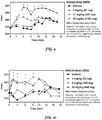
- FIGs. 9 and 10 illustrate the effect of different doses of d 4 -domperidone and non-deuterated domperidone on QT c change.
- the graphs demonstrate that at lower doses of the non-deuterated formulation there is a greater effect on QT c change as compared to the higher doses of the deuterated formulation. This is also graphically represented in Figs. 11 and 12 which shows the effect of QT c change at the maximal plasma concentration.
- Example 4 Comparison of PK parameters for suspension formulations of d 4 - domperidone and domperidone
- the C max and AUC values of domperidone and d 4 -domperidone dosed at different doses in dogs were compared.
- the data for non-deuterated domperidone was obtained as described in Heykants, "On the pharmacokinetics of domperidone in animals and man I. Plasma levels of domperidone in rats and dogs. Age related absorption and passage through the blood brain barrier in rats," European J. of Drug Metabolism and Pharmacokinetics, 1981, 6(1):27-36 , which is hereby incorporated by reference, where dogs were dosed capsules containing different amounts of domperidone.
- the d 4 -domperidone suspension formulation was prepared and contained 0.5% Methocel, 0.1% polysorbate 80 and 0.72% lactic acid. The d 4 -domperidone suspension was then administered to dogs as described in Example 2 or 3 at the different doses shown in Table 7.
- Table 7 Dose (mg/kg) d 4 - Domperidone Suspension Domperidone Suspension D 4 -Domperidone Suspension Domperidone Suspension C max AUC 2.5 - 94 - 700 3 356 - 1440 - 10 1570 322 6760 2600 40 5610 975 34200 8900
- the d 4 -domperidone formulation was dosed orally (PO) at 10 mg/dog and the domperidone formulation was dosed orally at 1 mg/kg.
- Blood samples were collected up to 24 hours post-dose and plasma concentrations of domperidone or d 4 -domperidone were determined by LCMS/MS.
- Pharmacokinetic parameters were determined using Phoenix WinNonlin (v8.0) software. Average plasma concentrations and pharmacokinetic parameters are summarized in Table 9.
- Formulation A Formulation B Formulation F (domperidone) Weight Dosed (mg) 10 10 10 Dose (mg/kg) 1 0.8 0.9 1 C max (ng/mL) 23.7 38.5 39.2 t max (hr) 3 3 0.67 MRT last (hr) 7.9 6.46 2.57 AUC last (hr ⁇ ng/mL) 350 1 415 1 129 1 dose normalized to 1 mg/kg
- the d 4 -domperidone formulation was dosed orally (PO) at 10 mg/dog, and the domperidone formulation was dosed orally at 1 mg/kg.
- Blood samples were collected up to 36 hours post dose and plasma concentrations of domperidone or d 4 -domperidone were determined by LCMS/MS.
- Pharmacokinetic parameters were determined using Phoenix WinNonlin (v8.0) software. Average plasma concentrations and pharmacokinetic parameters are summarized in Table 11.
- Formulation A shows similar AUC, significant reduction in C max and increase in mean residence time compared to non-deuterated domperidone.
- Table 12 Ingredient % mg/capsule d 4 -domperidone 10.00% 10.00 Precirol ATO 5 9.75% 9.75 Butylatedhydroxyanisole (BHA) 0.10% 0.10 Butylatedhydroxytoluene (BHT) 0.05% 0.05 Medium Chain Triglycerides (MCT) 80.1% 80.10 Total 100.0 mg
- D 4 -domperidone pharmaceutical formulations were prepared and encapsulated on a GMP encapsulation machine using the amounts noted in Tables 14-16. Specifically, the compounding activities were conducted under a nitrogen blanket and yellow light. See, FIG. 7 . The batches were then encapsulated using the 2C Oval die and 0.040" hole single bottom shot wedge at a temperature of about 38.7 to 51.7°C. Capsules were hand polished with a medium chain triglyceride/lecithin mixture (97% MCT/3%lecithin).
- Table 14 Formulation for d 4 -Domperidone Placebo Softgels Fill Ingredient Theoretical Quantity/capsule (mg) Theoretical Quantity (g) Medium Chain Triglycerides 90.1 4505.0 Glyceryl Distearate 9.75 487.5 Butylated Hydroxyanisole, NF 0.1 5.0 Butylated Hydroxytoluene, NF 0.05 2.5 Total 100.0 5000.0 Table 15: Formulation for d 4 -Domperidone 5 mg Softgels Fill Ingredient Theoretical Quantity/capsule (mg) Theoretical Quantity (g) d 4 -Domperidone 5.0 100.00 Medium Chain Triglycerides 85.1 1702.00 Glyceryl Distearate 9.75 195.00 Butylated hydroxyanisole, NF 0.1 2.00 Butylated hydroxytoluene, NF 0.05 1.00 Total 100.0 2000.00 Table 16: Formulation for d 4 -Domperidone 10 mg Softgels Fill Ingredient Theoretical
Landscapes
- Health & Medical Sciences (AREA)
- Chemical & Material Sciences (AREA)
- Life Sciences & Earth Sciences (AREA)
- Veterinary Medicine (AREA)
- Medicinal Chemistry (AREA)
- Pharmacology & Pharmacy (AREA)
- Animal Behavior & Ethology (AREA)
- General Health & Medical Sciences (AREA)
- Public Health (AREA)
- Epidemiology (AREA)
- Chemical Kinetics & Catalysis (AREA)
- General Chemical & Material Sciences (AREA)
- Engineering & Computer Science (AREA)
- Bioinformatics & Cheminformatics (AREA)
- Organic Chemistry (AREA)
- Nuclear Medicine, Radiotherapy & Molecular Imaging (AREA)
- Oil, Petroleum & Natural Gas (AREA)
- Hospice & Palliative Care (AREA)
- Otolaryngology (AREA)
- Molecular Biology (AREA)
- Biophysics (AREA)
- Dispersion Chemistry (AREA)
- Pharmaceuticals Containing Other Organic And Inorganic Compounds (AREA)
- Medicinal Preparation (AREA)
Applications Claiming Priority (2)
| Application Number | Priority Date | Filing Date | Title |
|---|---|---|---|
| US201862750491P | 2018-10-25 | 2018-10-25 | |
| PCT/US2019/058033 WO2020086947A1 (en) | 2018-10-25 | 2019-10-25 | Formulations containing deuterated domperidone |
Publications (2)
| Publication Number | Publication Date |
|---|---|
| EP3668510A1 EP3668510A1 (en) | 2020-06-24 |
| EP3668510B1 true EP3668510B1 (en) | 2021-01-13 |
Family
ID=68582416
Family Applications (1)
| Application Number | Title | Priority Date | Filing Date |
|---|---|---|---|
| EP19804996.7A Active EP3668510B1 (en) | 2018-10-25 | 2019-10-25 | Formulations containing deuterated domperidone |
Country Status (12)
| Country | Link |
|---|---|
| US (2) | US12514852B2 (https=) |
| EP (1) | EP3668510B1 (https=) |
| JP (2) | JP7583728B2 (https=) |
| KR (3) | KR20240068762A (https=) |
| CN (1) | CN113164463B (https=) |
| AU (1) | AU2019366993B2 (https=) |
| CA (1) | CA3117682A1 (https=) |
| ES (1) | ES2852623T3 (https=) |
| IL (1) | IL282575B (https=) |
| SG (1) | SG11202103284QA (https=) |
| WO (1) | WO2020086947A1 (https=) |
| ZA (1) | ZA202102115B (https=) |
Cited By (1)
| Publication number | Priority date | Publication date | Assignee | Title |
|---|---|---|---|---|
| US12514852B2 (en) | 2018-10-25 | 2026-01-06 | Cindome Pharma, Inc. | Formulations containing deuterated domperidone |
Families Citing this family (3)
| Publication number | Priority date | Publication date | Assignee | Title |
|---|---|---|---|---|
| WO2017136617A1 (en) * | 2016-02-04 | 2017-08-10 | Cinrx Pharma, Llc | Deuterated domperidone compositions and methods for therapy of disorders |
| EP4525868A1 (en) * | 2022-04-20 | 2025-03-26 | CinDome Pharma, Inc. | Deuterated domperidone for treating gastroparesis |
| CN120813355A (zh) * | 2023-03-23 | 2025-10-17 | 辛多美制药有限公司 | 用于治疗糖尿病性胃轻瘫的方法 |
Family Cites Families (12)
| Publication number | Priority date | Publication date | Assignee | Title |
|---|---|---|---|---|
| GB9702392D0 (en) | 1997-02-06 | 1997-03-26 | Boots Co Plc | Therapeutic agents |
| US6383471B1 (en) | 1999-04-06 | 2002-05-07 | Lipocine, Inc. | Compositions and methods for improved delivery of ionizable hydrophobic therapeutic agents |
| US20050220825A1 (en) | 2004-03-10 | 2005-10-06 | Adrian Funke | Molecular dispersions of drospirenone |
| CN1686128A (zh) * | 2005-04-19 | 2005-10-26 | 北京正大绿洲医药科技有限公司 | 多潘立酮滴丸及其制备方法 |
| AU2008245580A1 (en) | 2007-04-26 | 2008-11-06 | Craig A. Aronchick | Compositions and methods for transmucosal delivery of domperidone |
| CN102125528A (zh) | 2010-01-12 | 2011-07-20 | 上海中邦斯瑞生物药业技术有限公司 | 多潘立酮口崩片 |
| DE102010015143A1 (de) * | 2010-04-16 | 2011-10-20 | Cts Chemical Industries Ltd. | Stabile flüssige ölige gebrauchsfertige Formulierungen, Herstellung davon und Verwendung davon |
| US9034858B2 (en) * | 2010-11-30 | 2015-05-19 | Lipocine Inc. | High-strength testosterone undecanoate compositions |
| US9943513B1 (en) | 2015-10-07 | 2018-04-17 | Banner Life Sciences Llc | Opioid abuse deterrent dosage forms |
| WO2017136617A1 (en) * | 2016-02-04 | 2017-08-10 | Cinrx Pharma, Llc | Deuterated domperidone compositions and methods for therapy of disorders |
| KR20240068762A (ko) | 2018-10-25 | 2024-05-17 | 신돔 파마, 인크. | 중수소화 돔페리돈을 함유하는 제제 |
| WO2020086950A1 (en) | 2018-10-25 | 2020-04-30 | Cindome Pharma, Inc. | Formulations containing domperidone |
-
2019
- 2019-10-25 KR KR1020247014648A patent/KR20240068762A/ko active Pending
- 2019-10-25 EP EP19804996.7A patent/EP3668510B1/en active Active
- 2019-10-25 JP JP2021547550A patent/JP7583728B2/ja active Active
- 2019-10-25 KR KR1020217015511A patent/KR20210080495A/ko not_active Ceased
- 2019-10-25 CA CA3117682A patent/CA3117682A1/en active Pending
- 2019-10-25 AU AU2019366993A patent/AU2019366993B2/en active Active
- 2019-10-25 CN CN201980069226.8A patent/CN113164463B/zh active Active
- 2019-10-25 WO PCT/US2019/058033 patent/WO2020086947A1/en not_active Ceased
- 2019-10-25 US US17/287,571 patent/US12514852B2/en active Active
- 2019-10-25 KR KR1020237041657A patent/KR102667995B1/ko active Active
- 2019-10-25 SG SG11202103284QA patent/SG11202103284QA/en unknown
- 2019-10-25 ES ES19804996T patent/ES2852623T3/es active Active
-
2021
- 2021-03-29 ZA ZA2021/02115A patent/ZA202102115B/en unknown
- 2021-04-22 IL IL282575A patent/IL282575B/en unknown
-
2022
- 2022-12-09 JP JP2022196699A patent/JP7652751B2/ja active Active
-
2025
- 2025-12-03 US US19/407,389 patent/US20260083717A1/en active Pending
Non-Patent Citations (1)
| Title |
|---|
| None * |
Cited By (1)
| Publication number | Priority date | Publication date | Assignee | Title |
|---|---|---|---|---|
| US12514852B2 (en) | 2018-10-25 | 2026-01-06 | Cindome Pharma, Inc. | Formulations containing deuterated domperidone |
Also Published As
| Publication number | Publication date |
|---|---|
| KR20210080495A (ko) | 2021-06-30 |
| JP7652751B2 (ja) | 2025-03-27 |
| US12514852B2 (en) | 2026-01-06 |
| CN113164463B (zh) | 2022-09-20 |
| KR102667995B1 (ko) | 2024-05-23 |
| KR20240068762A (ko) | 2024-05-17 |
| NZ774559A (en) | 2025-02-28 |
| JP7583728B2 (ja) | 2024-11-14 |
| IL282575B (en) | 2022-05-01 |
| EP3668510A1 (en) | 2020-06-24 |
| CN113164463A (zh) | 2021-07-23 |
| JP2022512041A (ja) | 2022-02-01 |
| WO2020086947A1 (en) | 2020-04-30 |
| US20220110929A1 (en) | 2022-04-14 |
| AU2019366993B2 (en) | 2024-02-15 |
| ZA202102115B (en) | 2023-10-25 |
| ES2852623T3 (es) | 2021-09-14 |
| JP2023036663A (ja) | 2023-03-14 |
| IL282575A (en) | 2021-06-30 |
| CA3117682A1 (en) | 2020-04-30 |
| US20260083717A1 (en) | 2026-03-26 |
| SG11202103284QA (en) | 2021-05-28 |
| AU2019366993A1 (en) | 2021-05-06 |
| KR20230169456A (ko) | 2023-12-15 |
| BR112021007754A2 (pt) | 2021-07-27 |
Similar Documents
| Publication | Publication Date | Title |
|---|---|---|
| US20260083717A1 (en) | Formulations containing deuterated domperidone | |
| EP2367542B1 (en) | Oral dosage forms of bendamustine | |
| AU2024202861A1 (en) | Formulations containing domperidone | |
| HK40033044B (en) | Formulations containing deuterated domperidone | |
| HK40033044A (en) | Formulations containing deuterated domperidone | |
| RU2796537C2 (ru) | Составы, содержащие дейтерированный домперидон | |
| HK40033468B (en) | Formulations containing domperidone | |
| HK40033468A (en) | Formulations containing domperidone | |
| BR112021007754B1 (pt) | Formulações contendo domperidona deuterada e uso das mesmas | |
| BR112021007755B1 (pt) | Formulações contendo domperidona e uso das mesmas | |
| CN1903200A (zh) | 用于治疗核辐射和放疗、化疗致恶心呕吐和抗运动病的药剂 |
Legal Events
| Date | Code | Title | Description |
|---|---|---|---|
| STAA | Information on the status of an ep patent application or granted ep patent |
Free format text: STATUS: UNKNOWN |
|
| STAA | Information on the status of an ep patent application or granted ep patent |
Free format text: STATUS: THE INTERNATIONAL PUBLICATION HAS BEEN MADE |
|
| PUAI | Public reference made under article 153(3) epc to a published international application that has entered the european phase |
Free format text: ORIGINAL CODE: 0009012 |
|
| STAA | Information on the status of an ep patent application or granted ep patent |
Free format text: STATUS: REQUEST FOR EXAMINATION WAS MADE |
|
| 17P | Request for examination filed |
Effective date: 20200319 |
|
| AK | Designated contracting states |
Kind code of ref document: A1 Designated state(s): AL AT BE BG CH CY CZ DE DK EE ES FI FR GB GR HR HU IE IS IT LI LT LU LV MC MK MT NL NO PL PT RO RS SE SI SK SM TR |
|
| AX | Request for extension of the european patent |
Extension state: BA ME |
|
| GRAP | Despatch of communication of intention to grant a patent |
Free format text: ORIGINAL CODE: EPIDOSNIGR1 |
|
| STAA | Information on the status of an ep patent application or granted ep patent |
Free format text: STATUS: GRANT OF PATENT IS INTENDED |
|
| INTG | Intention to grant announced |
Effective date: 20200729 |
|
| GRAS | Grant fee paid |
Free format text: ORIGINAL CODE: EPIDOSNIGR3 |
|
| GRAA | (expected) grant |
Free format text: ORIGINAL CODE: 0009210 |
|
| STAA | Information on the status of an ep patent application or granted ep patent |
Free format text: STATUS: THE PATENT HAS BEEN GRANTED |
|
| AK | Designated contracting states |
Kind code of ref document: B1 Designated state(s): AL AT BE BG CH CY CZ DE DK EE ES FI FR GB GR HR HU IE IS IT LI LT LU LV MC MK MT NL NO PL PT RO RS SE SI SK SM TR |
|
| DAV | Request for validation of the european patent (deleted) | ||
| DAX | Request for extension of the european patent (deleted) | ||
| REG | Reference to a national code |
Ref country code: GB Ref legal event code: FG4D |
|
| REG | Reference to a national code |
Ref country code: CH Ref legal event code: EP |
|
| REG | Reference to a national code |
Ref country code: IE Ref legal event code: FG4D |
|
| REG | Reference to a national code |
Ref country code: DE Ref legal event code: R096 Ref document number: 602019002203 Country of ref document: DE |
|
| REG | Reference to a national code |
Ref country code: NL Ref legal event code: FP |
|
| REG | Reference to a national code |
Ref country code: AT Ref legal event code: REF Ref document number: 1354028 Country of ref document: AT Kind code of ref document: T Effective date: 20210215 |
|
| REG | Reference to a national code |
Ref country code: CH Ref legal event code: NV Representative=s name: STOLMAR AND PARTNER INTELLECTUAL PROPERTY S.A., CH |
|
| REG | Reference to a national code |
Ref country code: HK Ref legal event code: DE Ref document number: 40033044 Country of ref document: HK |
|
| REG | Reference to a national code |
Ref country code: NO Ref legal event code: T2 Effective date: 20210113 |
|
| REG | Reference to a national code |
Ref country code: SE Ref legal event code: TRGR |
|
| REG | Reference to a national code |
Ref country code: LT Ref legal event code: MG9D |
|
| PG25 | Lapsed in a contracting state [announced via postgrant information from national office to epo] |
Ref country code: HR Free format text: LAPSE BECAUSE OF FAILURE TO SUBMIT A TRANSLATION OF THE DESCRIPTION OR TO PAY THE FEE WITHIN THE PRESCRIBED TIME-LIMIT Effective date: 20210113 Ref country code: BG Free format text: LAPSE BECAUSE OF FAILURE TO SUBMIT A TRANSLATION OF THE DESCRIPTION OR TO PAY THE FEE WITHIN THE PRESCRIBED TIME-LIMIT Effective date: 20210413 Ref country code: FI Free format text: LAPSE BECAUSE OF FAILURE TO SUBMIT A TRANSLATION OF THE DESCRIPTION OR TO PAY THE FEE WITHIN THE PRESCRIBED TIME-LIMIT Effective date: 20210113 Ref country code: GR Free format text: LAPSE BECAUSE OF FAILURE TO SUBMIT A TRANSLATION OF THE DESCRIPTION OR TO PAY THE FEE WITHIN THE PRESCRIBED TIME-LIMIT Effective date: 20210414 Ref country code: LT Free format text: LAPSE BECAUSE OF FAILURE TO SUBMIT A TRANSLATION OF THE DESCRIPTION OR TO PAY THE FEE WITHIN THE PRESCRIBED TIME-LIMIT Effective date: 20210113 Ref country code: PT Free format text: LAPSE BECAUSE OF FAILURE TO SUBMIT A TRANSLATION OF THE DESCRIPTION OR TO PAY THE FEE WITHIN THE PRESCRIBED TIME-LIMIT Effective date: 20210513 |
|
| PG25 | Lapsed in a contracting state [announced via postgrant information from national office to epo] |
Ref country code: RS Free format text: LAPSE BECAUSE OF FAILURE TO SUBMIT A TRANSLATION OF THE DESCRIPTION OR TO PAY THE FEE WITHIN THE PRESCRIBED TIME-LIMIT Effective date: 20210113 Ref country code: PL Free format text: LAPSE BECAUSE OF FAILURE TO SUBMIT A TRANSLATION OF THE DESCRIPTION OR TO PAY THE FEE WITHIN THE PRESCRIBED TIME-LIMIT Effective date: 20210113 Ref country code: LV Free format text: LAPSE BECAUSE OF FAILURE TO SUBMIT A TRANSLATION OF THE DESCRIPTION OR TO PAY THE FEE WITHIN THE PRESCRIBED TIME-LIMIT Effective date: 20210113 |
|
| PG25 | Lapsed in a contracting state [announced via postgrant information from national office to epo] |
Ref country code: IS Free format text: LAPSE BECAUSE OF FAILURE TO SUBMIT A TRANSLATION OF THE DESCRIPTION OR TO PAY THE FEE WITHIN THE PRESCRIBED TIME-LIMIT Effective date: 20210513 |
|
| REG | Reference to a national code |
Ref country code: DE Ref legal event code: R097 Ref document number: 602019002203 Country of ref document: DE |
|
| PG25 | Lapsed in a contracting state [announced via postgrant information from national office to epo] |
Ref country code: SM Free format text: LAPSE BECAUSE OF FAILURE TO SUBMIT A TRANSLATION OF THE DESCRIPTION OR TO PAY THE FEE WITHIN THE PRESCRIBED TIME-LIMIT Effective date: 20210113 Ref country code: EE Free format text: LAPSE BECAUSE OF FAILURE TO SUBMIT A TRANSLATION OF THE DESCRIPTION OR TO PAY THE FEE WITHIN THE PRESCRIBED TIME-LIMIT Effective date: 20210113 Ref country code: CZ Free format text: LAPSE BECAUSE OF FAILURE TO SUBMIT A TRANSLATION OF THE DESCRIPTION OR TO PAY THE FEE WITHIN THE PRESCRIBED TIME-LIMIT Effective date: 20210113 |
|
| PLBE | No opposition filed within time limit |
Free format text: ORIGINAL CODE: 0009261 |
|
| STAA | Information on the status of an ep patent application or granted ep patent |
Free format text: STATUS: NO OPPOSITION FILED WITHIN TIME LIMIT |
|
| PG25 | Lapsed in a contracting state [announced via postgrant information from national office to epo] |
Ref country code: SK Free format text: LAPSE BECAUSE OF FAILURE TO SUBMIT A TRANSLATION OF THE DESCRIPTION OR TO PAY THE FEE WITHIN THE PRESCRIBED TIME-LIMIT Effective date: 20210113 Ref country code: RO Free format text: LAPSE BECAUSE OF FAILURE TO SUBMIT A TRANSLATION OF THE DESCRIPTION OR TO PAY THE FEE WITHIN THE PRESCRIBED TIME-LIMIT Effective date: 20210113 Ref country code: DK Free format text: LAPSE BECAUSE OF FAILURE TO SUBMIT A TRANSLATION OF THE DESCRIPTION OR TO PAY THE FEE WITHIN THE PRESCRIBED TIME-LIMIT Effective date: 20210113 |
|
| 26N | No opposition filed |
Effective date: 20211014 |
|
| PG25 | Lapsed in a contracting state [announced via postgrant information from national office to epo] |
Ref country code: AL Free format text: LAPSE BECAUSE OF FAILURE TO SUBMIT A TRANSLATION OF THE DESCRIPTION OR TO PAY THE FEE WITHIN THE PRESCRIBED TIME-LIMIT Effective date: 20210113 |
|
| PGFP | Annual fee paid to national office [announced via postgrant information from national office to epo] |
Ref country code: NO Payment date: 20211020 Year of fee payment: 3 |
|
| REG | Reference to a national code |
Ref country code: AT Ref legal event code: UEP Ref document number: 1354028 Country of ref document: AT Kind code of ref document: T Effective date: 20210113 |
|
| PG25 | Lapsed in a contracting state [announced via postgrant information from national office to epo] |
Ref country code: IS Free format text: LAPSE BECAUSE OF FAILURE TO SUBMIT A TRANSLATION OF THE DESCRIPTION OR TO PAY THE FEE WITHIN THE PRESCRIBED TIME-LIMIT Effective date: 20210513 |
|
| PG25 | Lapsed in a contracting state [announced via postgrant information from national office to epo] |
Ref country code: MC Free format text: LAPSE BECAUSE OF FAILURE TO SUBMIT A TRANSLATION OF THE DESCRIPTION OR TO PAY THE FEE WITHIN THE PRESCRIBED TIME-LIMIT Effective date: 20210113 |
|
| PG25 | Lapsed in a contracting state [announced via postgrant information from national office to epo] |
Ref country code: LU Free format text: LAPSE BECAUSE OF NON-PAYMENT OF DUE FEES Effective date: 20211025 |
|
| REG | Reference to a national code |
Ref country code: NO Ref legal event code: MMEP |
|
| P01 | Opt-out of the competence of the unified patent court (upc) registered |
Effective date: 20230511 |
|
| PG25 | Lapsed in a contracting state [announced via postgrant information from national office to epo] |
Ref country code: CY Free format text: LAPSE BECAUSE OF FAILURE TO SUBMIT A TRANSLATION OF THE DESCRIPTION OR TO PAY THE FEE WITHIN THE PRESCRIBED TIME-LIMIT Effective date: 20210113 |
|
| PG25 | Lapsed in a contracting state [announced via postgrant information from national office to epo] |
Ref country code: NO Free format text: LAPSE BECAUSE OF NON-PAYMENT OF DUE FEES Effective date: 20221031 Ref country code: HU Free format text: LAPSE BECAUSE OF FAILURE TO SUBMIT A TRANSLATION OF THE DESCRIPTION OR TO PAY THE FEE WITHIN THE PRESCRIBED TIME-LIMIT; INVALID AB INITIO Effective date: 20191025 |
|
| PG25 | Lapsed in a contracting state [announced via postgrant information from national office to epo] |
Ref country code: SI Free format text: LAPSE BECAUSE OF FAILURE TO SUBMIT A TRANSLATION OF THE DESCRIPTION OR TO PAY THE FEE WITHIN THE PRESCRIBED TIME-LIMIT Effective date: 20210113 |
|
| PG25 | Lapsed in a contracting state [announced via postgrant information from national office to epo] |
Ref country code: MK Free format text: LAPSE BECAUSE OF FAILURE TO SUBMIT A TRANSLATION OF THE DESCRIPTION OR TO PAY THE FEE WITHIN THE PRESCRIBED TIME-LIMIT Effective date: 20210113 |
|
| PG25 | Lapsed in a contracting state [announced via postgrant information from national office to epo] |
Ref country code: MT Free format text: LAPSE BECAUSE OF FAILURE TO SUBMIT A TRANSLATION OF THE DESCRIPTION OR TO PAY THE FEE WITHIN THE PRESCRIBED TIME-LIMIT Effective date: 20210113 |
|
| PGFP | Annual fee paid to national office [announced via postgrant information from national office to epo] |
Ref country code: IT Payment date: 20250922 Year of fee payment: 7 Ref country code: NL Payment date: 20250912 Year of fee payment: 7 |
|
| PGFP | Annual fee paid to national office [announced via postgrant information from national office to epo] |
Ref country code: BE Payment date: 20250917 Year of fee payment: 7 Ref country code: GB Payment date: 20250904 Year of fee payment: 7 |
|
| PGFP | Annual fee paid to national office [announced via postgrant information from national office to epo] |
Ref country code: FR Payment date: 20250908 Year of fee payment: 7 |
|
| PGFP | Annual fee paid to national office [announced via postgrant information from national office to epo] |
Ref country code: SE Payment date: 20250910 Year of fee payment: 7 |
|
| PGFP | Annual fee paid to national office [announced via postgrant information from national office to epo] |
Ref country code: IE Payment date: 20250827 Year of fee payment: 7 |
|
| REG | Reference to a national code |
Ref country code: CH Ref legal event code: U11 Free format text: ST27 STATUS EVENT CODE: U-0-0-U10-U11 (AS PROVIDED BY THE NATIONAL OFFICE) Effective date: 20251101 |
|
| PG25 | Lapsed in a contracting state [announced via postgrant information from national office to epo] |
Ref country code: TR Free format text: LAPSE BECAUSE OF FAILURE TO SUBMIT A TRANSLATION OF THE DESCRIPTION OR TO PAY THE FEE WITHIN THE PRESCRIBED TIME-LIMIT Effective date: 20210113 |
|
| PGFP | Annual fee paid to national office [announced via postgrant information from national office to epo] |
Ref country code: DE Payment date: 20250902 Year of fee payment: 7 |
|
| PGFP | Annual fee paid to national office [announced via postgrant information from national office to epo] |
Ref country code: AT Payment date: 20250925 Year of fee payment: 7 |
|
| PGFP | Annual fee paid to national office [announced via postgrant information from national office to epo] |
Ref country code: CH Payment date: 20251101 Year of fee payment: 7 |
|
| PGFP | Annual fee paid to national office [announced via postgrant information from national office to epo] |
Ref country code: ES Payment date: 20251106 Year of fee payment: 7 |