EP3661932B1 - Zusammensetzungen und verfahren zur stabilisierung von benzothiazol-luciferin-analoga - Google Patents
Zusammensetzungen und verfahren zur stabilisierung von benzothiazol-luciferin-analoga Download PDFInfo
- Publication number
- EP3661932B1 EP3661932B1 EP18755670.9A EP18755670A EP3661932B1 EP 3661932 B1 EP3661932 B1 EP 3661932B1 EP 18755670 A EP18755670 A EP 18755670A EP 3661932 B1 EP3661932 B1 EP 3661932B1
- Authority
- EP
- European Patent Office
- Prior art keywords
- alkyl
- groups
- optionally substituted
- composition
- compound
- Prior art date
- Legal status (The legal status is an assumption and is not a legal conclusion. Google has not performed a legal analysis and makes no representation as to the accuracy of the status listed.)
- Active
Links
- 0 C*1C2(*C2)CC*1 Chemical compound C*1C2(*C2)CC*1 0.000 description 3
- CFKPEOAUNUAAMI-RUFAERLGSA-N N=C/C=C(/C=CC=C1)\C1=N Chemical compound N=C/C=C(/C=CC=C1)\C1=N CFKPEOAUNUAAMI-RUFAERLGSA-N 0.000 description 1
- FHEOZBDBDVSFDR-UHFFFAOYSA-N Oc1ccc(CC(C(N2)=O)=NNC2=S)cc1 Chemical compound Oc1ccc(CC(C(N2)=O)=NNC2=S)cc1 FHEOZBDBDVSFDR-UHFFFAOYSA-N 0.000 description 1
- UFWIBTONFRDIAS-UHFFFAOYSA-N c(cc1)cc2c1cccc2 Chemical compound c(cc1)cc2c1cccc2 UFWIBTONFRDIAS-UHFFFAOYSA-N 0.000 description 1
Images

Classifications
-
- C—CHEMISTRY; METALLURGY
- C12—BIOCHEMISTRY; BEER; SPIRITS; WINE; VINEGAR; MICROBIOLOGY; ENZYMOLOGY; MUTATION OR GENETIC ENGINEERING
- C12Q—MEASURING OR TESTING PROCESSES INVOLVING ENZYMES, NUCLEIC ACIDS OR MICROORGANISMS; COMPOSITIONS OR TEST PAPERS THEREFOR; PROCESSES OF PREPARING SUCH COMPOSITIONS; CONDITION-RESPONSIVE CONTROL IN MICROBIOLOGICAL OR ENZYMOLOGICAL PROCESSES
- C12Q1/00—Measuring or testing processes involving enzymes, nucleic acids or microorganisms; Compositions therefor; Processes of preparing such compositions
- C12Q1/66—Measuring or testing processes involving enzymes, nucleic acids or microorganisms; Compositions therefor; Processes of preparing such compositions involving luciferase
-
- C—CHEMISTRY; METALLURGY
- C07—ORGANIC CHEMISTRY
- C07D—HETEROCYCLIC COMPOUNDS
- C07D253/00—Heterocyclic compounds containing six-membered rings having three nitrogen atoms as the only ring hetero atoms, not provided for by group C07D251/00
- C07D253/02—Heterocyclic compounds containing six-membered rings having three nitrogen atoms as the only ring hetero atoms, not provided for by group C07D251/00 not condensed with other rings
- C07D253/06—1,2,4-Triazines
-
- C—CHEMISTRY; METALLURGY
- C07—ORGANIC CHEMISTRY
- C07D—HETEROCYCLIC COMPOUNDS
- C07D417/00—Heterocyclic compounds containing two or more hetero rings, at least one ring having nitrogen and sulfur atoms as the only ring hetero atoms, not provided for by group C07D415/00
- C07D417/02—Heterocyclic compounds containing two or more hetero rings, at least one ring having nitrogen and sulfur atoms as the only ring hetero atoms, not provided for by group C07D415/00 containing two hetero rings
- C07D417/04—Heterocyclic compounds containing two or more hetero rings, at least one ring having nitrogen and sulfur atoms as the only ring hetero atoms, not provided for by group C07D415/00 containing two hetero rings directly linked by a ring-member-to-ring-member bond
Definitions
- the present invention relates to compositions and methods for stabilizing benzothiazole luciferin analogs.
- Luminescence is often used in biological assays as a measure of the activity of a reporter molecule.
- the reporter molecule links the luminescent measurement to a biological process of interest such as transcription (gene expression), translation (protein expression), protein-protein interactions, and so forth, thereby allowing for quantitative measurements of changes occurring in the biological process.
- the reporter molecule is typically a luminogenic enzyme (e.g., firefly luciferase, Renilla luciferase, Oplophorus luciferase, etc.) that, when provided with its luminogenic substrate, results in the production of light, i.e., luminescence.
- the luminogenic substrate e.g., a luciferin
- Such decomposition can be the result of the instability of the luminogenic substrate in solution over time in a temperature-dependent manner. This decomposition results in a waste of the luminogenic substrate and reduced sensitivity and reproducibility of luminescent measurements derived from biological assays that employed the decomposed luminogenic substrate. Additionally, the products from this decomposition often inhibit the luminescent reaction.
- D-luciferin is the natural substrate for firefly and click beetle luciferases. Luciferins and luciferin derivatives are thermally unstable when stored in solutions or moist environment at ambient temperature over time. Dehydroluciferins have been identified as the major breakdown products, which are potent inhibitors of luciferases and lead to decreased and inconsistent light output performance. Pro-luciferin analogs are widely used in analyte-dependent, firefly luciferase-based assay systems. Similarly to luciferins, the decomposition to the corresponding pro-dehydroluciferin analogs also affects the luminescence performance negatively. It is desirable to have methods to reduce the formation of breakdown products, especially for applications that require luciferins or luciferin derivatives to be stored in solutions at above ambient temperature over long period of time.
- composition comprising: (a) a benzothiazole luciferin analog, or a salt thereof; (b) an effective amount of a compound of formula (I) or a tautomer thereof, wherein
- the present disclosure also provides a kit comprising the components of the above composition.
- the present disclosure further provides a method for stabilizing a benzothiazole luciferin analog, the method comprising contacting the benzothiazole luciferin analog, or a salt thereof, with an effective amount of a compound of formula (I) or a tautomer thereof, whereby the benzothiazole luciferin analog, or salt thereof, is stabilized against decomposition, wherein the compound of formula (I) is wherein
- the present invention relates to a composition for stabilizing a benzothiazole luciferin analog.
- the benzothiazole luciferin analog is a compound of formula (II'), or a salt thereof: wherein
- the benzothiazole luciferin analog of formula (II') is a compound of formula (II), or salt thereof: wherein
- the composition may include the benzothiazole luciferin analog, a thionucleobase, and a liquid medium.
- the composition may or may not include or contain a luminogenic enzyme (e.g., a luciferase).
- the thionucleobase may be a compound of formula (I) or a tautomer thereof, wherein
- the thionucleobase may stabilize the benzothiazole luciferin analog against decomposition over time, in the presence of light, in the absence of light, and/or at different temperatures.
- the thionucleobase may stabilize the benzothiazole luciferin analog against decomposition into one or more decomposition products over time, in the presence of light, in the absence of light, and/or at different temperatures.
- inclusion of the thionucleobase in the composition may stabilize the benzothiazole luciferin analog against decomposition by suppressing or reducing the formation of the one or more decomposition products as compared to a composition that does not include the thionucleobase.
- This provides the capability of storing or incubating the benzothiazole luciferin analog for a period of time at a particular temperature, in the presence and/or in the absence of light, without significant decomposition of the benzothiazole luciferin analog before use of the benzothiazole luciferin analog in an assay.
- the present invention also relates to a method for stabilizing the benzothiazole luciferin analog.
- a method may stabilize the benzothiazole luciferin analog against decomposition and/or suppress or reduce the formation of the one or more decomposition products.
- the method may include contacting the benzothiazole luciferin analog with an effective amount of the thionucleobase (e.g., 0.1-500 mM) in the presence of a buffer solution. This contacting step may include forming the composition described above.
- alkyl refers to a linear or branched hydrocarbon radical, preferably having 1 to 30 carbon atoms, 1 to 10 carbon atoms, 1 to 6 carbon atoms or 1 to 4 carbon atoms.
- C 1 -C 4 -alkyl is defined to include alkyl groups having 1, 2, 3, or 4 carbons in a linear or branched arrangement.
- C 1 -C 4 -alkyl specifically includes methyl, ethyl, n-propyl, i-propyl, n-butyl, t-butyl, and i-butyl.
- C 1 -C 6 -alkyl is defined to include alkyl groups having 1, 2, 3, 4, 5 or 6 carbons in a linear or branched arrangement.
- C 1 -C 6 -alkyl specifically includes methyl, ethyl, n-propyl, i-propyl, n-butyl, t-butyl, i-butyl, pentyl and hexyl.
- alkylene refers to a divalent group derived from a straight or branched chain hydrocarbon.
- Representative examples of alkylene include, but are not limited to, -CH 2 -, - CH 2 CH 2 -, - CH 2 CH 2 CH 2 -, - CH 2 CH(CH 3 )CH 2 -, and - CH 2 CH(CH 3 )CH(CH 3 )CH 2 -.
- arylalkyl refers to an aryl group, as defined herein, appended to the parent molecular moiety through an alkyl group, as defined herein.
- the alkyl group may be C 1 -C 4 -alkyl.
- heteroarylalkyl refers to a heteroaryl group, as defined herein, appended to the parent molecular moiety through an alkyl group, as defined here.
- the alkyl group may be C 1 -C 4 -alkyl.
- cycloalkyl refers to a carbocyclic ring system containing three to ten carbon atoms, zero heteroatoms and zero double bonds.
- Representative examples of cycloalkyl include, but are not limited to, cyclopropyl, cyclobutyl, cyclopentyl, cyclohexyl, cycloheptyl, cyclooctyl, cyclononyl and cyclodecyl.
- aryl refers to monocyclic, bicyclic, or tricyclic aromatic radicals.
- Representative examples of the aryl groups include, but are not limited to, phenyl, dihydroindenyl, indenyl, naphthyl, dihydronaphthalenyl, and tetrahydronaphthalenyl.
- Aryl groups of the present invention are optionally substituted by one or more suitable substituents, preferably 1 to 5 suitable substituents, as defined herein.
- carboxylic acid refers to COOH
- the term "effective amount” refers to an amount of a thionucleobase compound of formula (I), as described herein, for periods of time necessary, to achieve the desired stabilization of a luciferin analog, as described herein, against decomposition into one or more decomposition products or degradants.
- esters refers to CO 2 R c , wherein R c is alkyl or aryl.
- heteroaryl refers to a monocyclic heteroaryl or a bicyclic heteroaryl.
- the monocyclic heteroaryl is a five- or six-membered ring.
- the five-membered ring contains two double bonds.
- the five-membered ring may contain one heteroatom selected from O or S; or one, two, three, or four nitrogen atoms and optionally one oxygen or sulfur atom.
- the six-membered ring contains three double bonds and one, two, three or four nitrogen atoms.
- monocyclic heteroaryl include, but are not limited to, furanyl, imidazolyl, isoxazolyl, isothiazolyl, oxadiazolyl, 1,3-oxazolyl, pyridinyl, pyridazinyl, pyrimidinyl, pyrazinyl, pyrazolyl, pyrrolyl, tetrazolyl, thiadiazolyl, 1,3-thiazolyl, thienyl, triazolyl, and triazinyl.
- the bicyclic heteroaryl includes a monocyclic heteroaryl fused to a phenyl, or a monocyclic heteroaryl fused to a monocyclic cycloalkyl, or a monocyclic heteroaryl fused to a monocyclic cycloalkenyl, or a monocyclic heteroaryl fused to a monocyclic heteroaryl, or a monocyclic heteroaryl fused to a monocyclic heterocycle.
- bicyclic heteroaryl groups include, but are not limited to, benzofuranyl, benzothienyl, benzoxazolyl, benzimidazolyl, benzoxadiazolyl, 6,7-dihydro-1,3-benzothiazolyl, imidazo[1,2-a]pyridinyl, indazolyl, indolyl, isoindolyl, isoquinolinyl, naphthyridinyl, pyridoimidazolyl, quinazolinyl, quinolinyl, thiazolo[5,4-b]pyridin-2-yl, thiazolo[5,4-d]pyrimidin-2-yl, and 5,6,7,8-tetrahydroquinolin-5-yl.
- Heteroaryl groups of the present invention may be unsubstituted or substituted by one or more suitable substituents, preferably 1 to 5 suitable substituents, as defined herein.
- heterocycle refers to a monocyclic heterocycle, a bicyclic heterocycle, or a tricyclic heterocycle.
- the monocyclic heterocycle is a three-, four-, five-, six-, seven-, or eight-membered ring containing at least one heteroatom independently selected from the group consisting of oxygen, nitrogen, phosphorus and sulfur.
- the three- or four-membered ring contains zero or one double bond, and one heteroatom selected from the group consisting of oxygen, nitrogen, phosphorus and sulfur.
- the five-membered ring contains zero or one double bond and one, two or three heteroatoms selected from the group consisting of oxygen, nitrogen, phosphorus and sulfur.
- the six-membered ring contains zero, one or two double bonds and one, two, or three heteroatoms selected from the group consisting of oxygen, nitrogen, phosphorus and sulfur.
- the seven- and eight-membered rings contains zero, one, two, or three double bonds and one, two, or three heteroatoms selected from the group consisting of oxygen, nitrogen, phosphorus and sulfur.
- monocyclic heterocycles include, but are not limited to, azetidinyl, azepanyl, aziridinyl, diazepanyl, 1,3-dioxanyl, 1,3-dioxolanyl, 1,3-dithiolanyl, 1,3-dithianyl, imidazolinyl, imidazolidinyl, isothiazolinyl, isothiazolidinyl, isoxazolinyl, isoxazolidinyl, morpholinyl, oxadiazolinyl, oxadiazolidinyl, oxazolinyl, oxazolidinyl, phosphinane, piperazinyl, piperidinyl, pyranyl, pyrazolinyl, pyrazolidinyl, pyrrolinyl, pyrrolidinyl, tetrahydrofuranyl, tetrahydropyr
- the bicyclic heterocycle is a monocyclic heterocycle fused to a phenyl group, or a monocyclic heterocycle fused to a monocyclic cycloalkyl, or a monocyclic heterocycle fused to a monocyclic cycloalkenyl, or a monocyclic heterocycle fused to a monocyclic heterocycle, or a bridged monocyclic heterocycle ring system in which two non-adjacent atoms of the ring are linked by an alkylene bridge of 1, 2, 3, or 4 carbon atoms, or an alkenylene bridge of two, three, or four carbon atoms.
- bicyclic heterocycles include, but are not limited to, benzopyranyl, benzothiopyranyl, chromanyl, 2,3-dihydrobenzofuranyl, 2,3-dihydrobenzothienyl, azabicyclo[2.2.1]heptyl (including 2-azabicyclo[2.2.1]hept-2-yl), 2,3-dihydro-1H-indolyl, isoindolinyl, octahydrocyclopenta[c]pyrrolyl, octahydropyrrolopyridinyl, 9-phosphabicyclo[3.3.1]nonane, 8-phosphabicyclo[3.2.1]octane, and tetrahydroisoquinolinyl.
- Tricyclic heterocycles are exemplified by a bicyclic heterocycle fused to a phenyl group, or a bicyclic heterocycle fused to a monocyclic cycloalkyl, or a bicyclic heterocycle fused to a monocyclic cycloalkenyl, or a bicyclic heterocycle fused to a monocyclic heterocycle, or a bicyclic heterocycle in which two non-adjacent atoms of the bicyclic ring are linked by an alkylene bridge of 1, 2, 3, or 4 carbon atoms, or an alkenylene bridge of two, three, or four carbon atoms.
- tricyclic heterocycles include, but are not limited to, octahydro-2,5-epoxypentalene, hexahydro-2H-2,5-methanocyclopenta[b]furan, hexahydro-1H-1,4-methanocyclopenta[c]furan, aza-admantane (1-azatricyclo[3.3.1.1 3,7 ]decane), oxa-adamantane (2-oxatricyclo[3.3.1.1 3,7 ]decane), and 2,4,6-trioxa-8-phosphatricyclo[3.3.1.13,7]decane.
- hydroxy refers to an -OH group.
- suitable substituent is intended to mean a chemically acceptable functional group e.g., a moiety that does not negate the activity of the inventive compounds.
- each substituent is selected independent of the other.
- Each substituent therefore, may be identical to or different from the other substituent(s).
- the term "light” may refer to visible light, white light (which may be a combination of the three primary colors red light, blue light, and yellow light), violet light, blue light, blue-green light, green light, yellow-green light, yellow light, orange light, red light, or near ultraviolet light, or any combination thereof.
- the term “light” may refer to light from a region of the electromagnetic spectrum, for example, but not limited to, the visible light region.
- the term “light” may also refer to light having a wavelength of about 380 nm to about 780 nm, or about 400 nm to about 700 nm.
- the term “light” may further refer to light from a fluorescent light bulb, a light-emitting diode (LED) bulb, an incandescent light bulb, or any combination thereof. In some embodiments, dark may be an absence of light.
- LED light-emitting diode
- each intervening number there between with the same degree of precision is explicitly contemplated.
- the numbers 7 and 8 are contemplated in addition to 6 and 9, and for the range 6.0-7.0, the number 6.0, 6.1, 6.2, 6.3, 6.4, 6.5, 6.6, 6.7, 6.8, 6.9, and 7.0 are explicitly contemplated.
- the present invention is directed to a composition
- a composition comprising a benzothiazole luciferin analog, a thionucleobase, and optionally a liquid medium.
- the composition may stabilize the benzothiazole luciferin analog against decomposition.
- the composition may stabilize the benzothiazole luciferin analog against decomposition as compared to a composition that does not contain the thionucleobase.
- the thionucleobase may reduce or suppress the formation of one or more decomposition products from the benzothiazole luciferin analog.
- the thionucleobase may stabilize the benzothiazole luciferin analog against decomposition to one or more decomposition products such as a benzothiazole dehydroluciferin.
- the present composition can be in a dry form, which is essentially free of any liquid or moisture.
- the composition can also be in a liquid form, which includes a liquid medium.
- the composition may stabilize the benzothiazole luciferin analog against decomposition in the absence of light (i.e., in the dark).
- the composition may increase the half-life of the benzothiazole luciferin analog in the absence of light as compared to a composition that does not contain the thionucleobase.
- the composition may stabilize the benzothiazole luciferin analog against decomposition in the presence of light.
- the composition may increase the half-life of the benzothiazole luciferin analog in the presence of light as compared to a composition that does not contain the thionucleobase.
- the composition may increase the half-life of the benzothiazole luciferin analog in the presence of light about 1.1-fold, 1.2-fold, 1.3-fold, 1.4-fold, 1.5-fold, 1.6-fold, 1.7-fold, 1.8-fold, 1.9-fold, 2.0-fold, 2.1-fold, 2.2-fold, 2.3-fold, 2.4-fold, 2.5-fold, 2.6-fold, 2.7-fold, 2.8-fold, 2.9-fold, 3.0-fold, 3.1-fold, 3.2-fold, 3.3-fold, 3.4-fold, 3.5-fold, 3.6-fold, 3.7-fold, 3.8-fold, 3.9-fold, 4.0-fold, 4.1-fold, 4.2-fold, 4.3-fold, 4.4-fold, 4.5-fold, 4.6-fold, 4.7-fold, 4.8-fold, 4.9-fold, or 5.0-fold as compared to the composition that does not contain the thionucleobase.
- the composition may stabilize the benzothiazole luciferin analog against decomposition at temperatures from about -120°C to about 80°C, about -110°C to about 80°C, about -100°C to about 80°C, about -90°C to about 80°C, about -85°C to about 80°C, about -80°C to about 80°C, about -75°C to about 80°C, about -70°C to about 80°C, about -65°C to about 80°C, about -60°C to about 80°C, about -55°C to about 80°C, about -50°C to about 80°C, about - 45°C to about 80°C, about -40°C to about 80°C, about -35°C to about 80°C, about -30°C to about 80°C, about -25°C to about 80°C, about -20°C to about 80°C, about -15°C to about 80°C, about -10°C to about 80°C,
- the composition may stabilize the benzothiazole luciferin analog against decomposition at about -120°C, -115°C, -110°C, -105°C, -100°C, -95°C, -90°C, -89°C, -88°C, - 87°C, -86°C, -85°C, -84°C, -83°C, -82°C, -81°C, -80°C, -79°C, -78°C, -77°C, -76°C, -75°C, - 74°C, -73°C, -72°C, -71°C, -70°C, -69°C, -68°C, -67°C, -66°C, -65°C, -64°C, -63°C, -62°C, - 61°C, -60°C, -59°C, -58
- the composition may stabilize the benzothiazole luciferin analog against decomposition for at least about 1 day, 2 days, 3 days, 4 days, 5 days, 6 days, 7 days, 8 days, 9 days, 10 days, 11 days, 12 days, 13 days, 14 days, 15 days, 16 days, 17 days, 18 days, 19 days, 20 days, 21 days, 22 days, 23 days, 24 days, 25 days, 26 days, 27 days, 28 days, 29 days, 30 days, 35 days, 40 days, 45 days, 50 days, 55 days, 60 days, 65 days, 70 days, 75 days, 80 days, 85 days, 90 days, 100 days, 110 days, 120 days, 130 days, 140 days, 150 days, 160 days, 170 days, 180 days, 190 days, 200 days, 210 days, 220 days, 230 days, 240 days, 250 days, 260 days, 270 days, 280 days, 290 days, 300 days, 310 days, 320 days, 330 days, 340 days, 350 days, 360 days, 1 year, 2 years, 3 years, 4
- the composition may increase the half-life of the benzothiazole luciferin analog by at least about 1.25-fold, 1.5-fold, 1.75-fold, 2-fold, 3-fold, 4-fold, 5-fold, 6-fold, 7-fold, 8-fold, 9-fold, 10-fold, 11-fold, 12-fold, 13-fold, 14-fold, 15-fold, 16-fold, 17-fold, 18-fold, 19-fold, 20-fold, 21-fold, 22-fold, 23-fold, 24-fold, or 25-fold as compared to the composition that does not include the thionucleobase.
- Benzothiazole luciferin analogs according to the invention include those described in WO2006/130551 , WO2014/159044 , US2007/0015790 , US2014/0304842 , US2018/0155762 , US5,098,828 , US7,692,022 , or US7,910,087 , which are incorporated by reference herein in their entireties.
- a benzothiazole luciferin analog as disclosed herein includes a compound of formula (II'), or a salt thereof.
- W 1 and W 2 are hydrogen.
- the benzothiazole luciferin analog is a compound of formula (II'), wherein W 1 is hydrogen and W 2 is C 1 -C 4 alkyl or arylalkyl.
- W 2 may be methyl, ethyl, propyl, isopropyl, n-butyl, i-butyl, t-butyl, or benzyl.
- the benzothiazole luciferin analog is a compound of formula (II'), wherein W 1 and W 2 are each independently C 1 -C 4 alkyl.
- W 1 and W 2 may be each independently methyl, ethyl, propyl, isopropyl, n-butyl, i-butyl, t-butyl, or benzyl.
- W 1 and W 2 are both methyl, ethyl, propyl, isopropyl, n-butyl, i-butyl, t-butyl, or benzyl.
- the benzothiazole luciferin analog is a compound of formula (II'), wherein W 1 and W 2 together with the carbon to which they are attached form a C 3 -C 8 cycloalkyl, optionally substituted with 1-4 substituents independently selected from the group consisting of C 1 -C 4 alkyl, C 1 -C 4 haloalkyl, halo, hydroxy, oxo, and -O(C 1 -C 4 alkyl).
- W 1 and W 2 together with the carbon to which they are attached may form
- the benzothiazole luciferin analog is a compound of formula (II'), wherein W 1 and W 2 together with the carbon to which they are attached form a 4- to 8-membered heterocycle, optionally substituted with a 1-4 substituents independently selected from the group consisting of C 1 -C 4 alkyl, C 1 -C 4 haloalkyl, halo, hydroxy, oxo, and -O(C 1 -C 4 alkyl).
- W 1 and W 2 together with the carbon to which they are attached may form
- the benzothiazole luciferin analog is a compound of formula (II), or salt thereof.
- the benzothiazole luciferin analog may be a benzothiazole luciferin, for example D-luciferin.
- the benzothiazole luciferin analog may be a benzothiazole luciferin such as an aminoluciferin, for example, the compound of formula (II') or formula (II) where R 1 , R 2 , R 3 , and R 5' are each H and R 4' is NH 2 .
- a benzothiazole luciferin is a substrate for a luciferase enzyme.
- the benzothiazole luciferin analog may be a benzothiazole proluciferin.
- a benzothiazole pro-luciferin does not support luminescence directly when combined with a luciferase, but can be converted into a benzothiazole luciferin by biotransformation, e.g., with a second enzyme.
- Benzothiazole pro-luciferins include, for example, a compound of formula (II') or formula (II) wherein R 4' is -OG 1 , -NHG 1 , or -N(C 1 -C 4 alkyl)G 1 ; and G 1 comprises an enzyme substrate, wherein biotransformation of the enzyme substrate by an enzyme converts G 1 to H.
- Another exemplary benzothiazole proluciferin includes a compound of formula (II') or formula (II), wherein R 1' is -C 2 alkylene-OH, R 2' is H, R 3' is H, R 5' is H, and R 4' is -OCH 3 .
- G 1 comprises an enzyme substrate, wherein biotransformation of the enzyme substrate by an enzyme converts G 1 to H.
- G 1 is G 2 -L 1 -;
- G 2 is the enzyme substrate and
- L 1 is a linker connecting G 2 to the remainder of the compound of formula (II') or formula (II) (i.e., the parent molecular moiety).
- G 2 is a group removable by an enzyme.
- L 1 is a bond or a divalent group composed of an arrangement of atoms stable under neutral ambient conditions, the atoms being selected from carbon, hydrogen, nitrogen, oxygen, sulfur, phosphorus, and silicon.
- the divalent group is an arrangement of one or more of -C 1-10 alkylene-, -C 2-10 alkylene-O-, C 3-8 cycloalkylene, -C(O)-, - O-, -S-, -S(O)-,-S(O) 2 -, -NH-, -N(C 1-4 alkyl)-, -N(COC 1-4 alkyl)-, an amino acid moiety, a protected amino acid moiety, and phenylene, wherein the C 3-8 cycloalkylene and phenylene are optionally independently substituted with 1-4 substituents independently selected from the group consisting of C 1-4 alkyl, C 1-4 haloalkyl, C 1-4 alkoxy, halo, cyano, or hydroxy.
- L 1 is C 1 -C 10 alkylene (e.g., C 2 -C 3 alkylene).
- Linker L 1 may be a linker between a benzothiazole luciferin and an enzyme substrate as disclosed in WO2006/130551 , WO2014/159044 , US2007/0015790 , or US2014/0304842 , which are incorporated herein by reference in their entireties.
- L 1 may be a traceless linker such as trimethyl lock, quinone methide, dipeptidyl, para-amino benzyloxycarbonyl, or alkylenediaminocarbonyl linkers as shown in Scheme 1.
- Enzymatic biotransformation of G 2 results in cleavage of the bond to the heteratom to which G 2 is attached to release the linker that may spontaneously self immolate to release a benzothiazole luciferin analog.
- Some traceless linkers e.g., alkylene linkers
- an enzyme substrate G 2 include a substrate for a protease, a cytochrome (CYP) P450 reductase, a monoamineoxidase (MAO), a flavin monooxygenase (FMO), glutathione S transferase (GST), a dealkylase (e.g., demethylase), a deacetylase, a deformylase, a sulfatase, a phosphatase (e.g., alkaline phosphatase (AP)), a beta-lactamase, and alcohol dehydrogenase, as described in WO2006/130551 or US2007/0015790 , which are incorporated herein by reference in their entireties.
- CYP cytochrome
- MAO monoamineoxidase
- FMO flavin monooxygenase
- GST glutathione S transferase
- dealkylase e.g., demethylase
- protease substrates include, but are not limited to, the peptides Z-DEVD-, Z-LETD-, GP-, Suc-LLVY-, Z-LRR-, Z-nLPnLD-, Z-QEVY-, VP-, Z-VDVAD-, Z-VEID-, Z-ATAD-, Z-IEPD-, Z-IETD-, Z-TSAVLQ-, and Z-VNSTLQ- as described by Cosby et al. in Cell Notes (2007) 18, pp. 9-11 , which is incorporated herein by reference in its entirety.
- L 1 is a bond, as the enzyme substrate is directly attached to the -X- and is cleaved directly.
- a benzothiazole luciferin analog include the compound of formula (II') or formula (II) wherein R 1' , R 2' , R 3' , and R 5' are H; R 4' is -XG or -XG 1 ; G, at each occurrence is independently H, C 1 -C 12 alkyl, or two G together with the nitrogen atom to which they are attached form a 4- to 8-membered monocyclic heterocyclic ring optionally substituted with 1-4 substituents independently selected from the group consisting of C 1 -C 4 alkyl, C 1 -C 4 haloalkyl, halo, hydroxy, oxo, and -O(C 1 -C 4 alkyl); and X and G 1 are as defined herein.
- R 4' is -XG; X is as defined herein; and at least one G together with one of R 3' or R 5' forms a 5- to 8-membered monocyclic heterocyclic ring optionally substituted with 1-4 substituents independently selected from the group consisting of C 1 -C 4 alkyl, C 1 -C 4 haloalkyl, halo, hydroxy, oxo, and -O(C 1 -C 4 alkyl).
- one G together with R 3' forms a 5- to 8-membered monocyclic heterocyclic ring optionally substituted as described herein.
- X is -NH- or -N(C 1 -C 2 alkyl)- (e.g., -N(CH 3 )-) and G together with R 3' forms a 5- to 8-membered monocyclic heterocyclic ring optionally substituted as described herein.
- the optionally substituted heterocyclic ring formed between G and R 3' is selected from the group consisting of
- the benzothiazole luciferin analog is In some embodiments, one G together with R 5' forms a 5- to 8-membered monocyclic heterocyclic ring optionally substituted as described herein.
- X is -NH- or -N(C 1 -C 12 alkyl)- (e.g., -N(CH 3 )-) and G together with R 5' forms a 5- to 8-membered monocyclic heterocyclic ring optionally substituted as described herein.
- the optionally substituted heterocyclic ring formed between G and R 5' is selected from the group consisting of
- X is -N(G)- and each G together with one of R 3' or R 5' forms a 5- to 8-membered monocyclic heterocyclic ring optionally substituted as described herein (e.g., ).
- R 1' , R 10' , R 11' , and n are as defined herein. In some embodiments is wherein R 1' and R 11' are as defined herein. In further embodiments, R 11' is -OH or -NH 2 , and R 1' is as defined herein. In a still further embodiment according to embodiments of (b), R 1' is H.
- the benzothiazole luciferin analog is In other embodiments, the benzothiazole luciferin analog is
- R 1' , R 10' , R 11' , and n are as defined herein.
- R 1' , R 10' , R 11' , and n are as defined herein.
- the present composition includes a liquid medium, and the benzothiazole luciferin analog may be present in the composition at about 0.5 mM to about 10 mM, about 0.75 mM to about 10 mM, about 1.0 mM to about 10 mM, about 0.5 mM to about 9 mM, about 0.5 mM to about 8 mM, about 0.5 mM to about 7 mM, about 0.5 mM to about 6 mM, about 0.5 mM to about 5 mM, about 0.5 mM to about 4 mM, about 0.5 mM to about 3 mM, or about 0.5 mM to about 2 mM.
- the benzothiazole luciferin analog may be present in the composition at about 0.5 mM, 0.6 mM, 0.7 mM, 0.8 mM, 0.9 mM, 1.0 mM, 1.1 mM, 1.2 mM, 1.25 mM, 1.3 mM, 1.4 mM, 1.5 mM, 1.6 mM, 1.7 mM, 1.8 mM, 1.9 mM, 2 mM, 2.5 mM, 3 mM, 3.5 mM, 4 mM, 4.5 mM, 5 mM, 5.5 mM, 6 mM, 6.5 mM, 7 mM, 7.5 mM, 8 mM, 8.5 mM, 9 mM, 9.5 mM, or 10 mM.
- the composition may include a thionucleobase.
- the thionucleobase may stabilize the benzothiazole luciferin analog against decomposition into one or more decomposition products.
- the thionucleobase may reduce or suppress the formation of the one or more decomposition products. Such stabilization, reduction, or suppression may be in the presence of light, in the absence of light, and/or at different temperatures as described above.
- the thionucleobase may be a compound of formula (I) or a tautomer thereof, wherein
- R 1 is alkyl, arylalkyl, heteroarylalkyl, cycloalkyl, carboxylic acid, ester, or oxo; wherein said alkyl, cycloalkyl, and arylalkyl, at each occurrence, are independently unsubstituted or substituted with 1, 2, or 3 functional groups independently selected from the group consisting of halogen, nitro, hydroxy, amino, alkylamino, and -COOH.
- R 2 is hydrogen, NR a R b , or imine; wherein R a and R b are each independently hydrogen or alkyl; wherein said imine is unsubstituted or substituted with a functional group independently selected from the group consisting of halogen, nitro, hydroxy, amino, and alkylamino.
- the compound of formula (I) may be ATT (6-methyl-3-thioxo-3,4-dihydro-1,2,4-triazin-5(2H)-one), which has the following structure:
- ATT may also be known as 6-Aza-2-thiothymine. ATT is commercially available, for example, from Sigma-Aldrich (catalog number 275514).
- the compound of formula (I) may be ATCA (5-oxo-3-thioxo-2,3,4,5-tetrahydro-1,2,4-triazine-6-carboxylic acid), which has the following structure:
- ATCA is commercially available, for example, from Sigma-Aldrich (catalog number S784028).
- the compound of formula (I) may be 3-(4-Amino-5-oxo-3-thioxo-2,3,4,5-tetrahydro-1,2,4-triazin-6-yl)propanoic acid, which has the following structure:
- This compound is commercially available, for example, from Sigma-Aldrich (catalog number OTV000379.
- the compound of formula (I) may be tetrahydro-2-methyl-3-thioxo-1,2,4-triazine-5,6-dione, which has the following structure:
- This compound may also be known as thiotriazinone and is commercially available, for example, from Sigma Aldrich (catalog number 549756).
- the compound of formula (I) may be 4-((2-furylmethylene)amino)-3-mercapto-6-methyl-1,2,4-triazin-5(4H)-one, which has the following structure:
- This compound is commercially available, for example, from Sigma Aldrich (catalog number L125016).
- the compound of formula (I) may be 6-benzyl-3-sulfanyl-1,2,4-triazin-5-ol, which has the following structure:
- This compound may also be known as b-ATT, benzyl-ATT, or TAK-0002.
- the compound of formula (I) may be 4-amino-3-mercapto-6-methyl-1,2,4-triazin-5(4H)-one, which has the following structure:
- This compound is commercially available, for example, from Sigma-Aldrich (catalog number PH125903).
- the compound of formula (I) may be 3-(5-oxo-3-thioxo-2,3,4,5-tetrahydro-1,2,4-triazin-6-yl)propanoic acid, which has the following structure:
- This compound is commercially available, for example, from Sigma-Aldrich (catalog number L151629).
- the compound of formula (I) may be (E)-6-methyl-4-((thiophen-2-ylmethylene)amino)-3-thioxo-3,4-dihydro-1,2,4-triazin-5(2 H )-one, which has the following structure:
- This compound is commercially available, for example, from Sigma Aldrich (catalog number L150819).
- the compound of formula (I) may be ( E )-6-methyl-4-((3-nitrobenzylidene)amino)-3-thioxo-3,4-dihydro-1,2,4-triazin-5(2 H )-one, which has the following structure:
- This compound is commercially available, for example, from Sigma Aldrich (catalog number L151238).
- the compound of formula (I) may be ( E )-4-((4-(diethylamino)benzylidene)amino)-6-methyl-3-thioxo-3,4-dihydro-1,2,4-triazin-5(2 H )-one, which has the following structure:
- This compound is commercially available, for example, from Sigma Aldrich (catalog number L151211).
- the compound of formula (I) may be ATCA ethyl ester, which has the following structure:
- This compound is commercially available, for example, from Sigma Aldrich (catalog number PH008592).
- the compound of formula (I) may be TAK-0021, which has the following structure:
- the compound of formula (I) may be TAK-0020, which has the following structure:
- the compound of formula (I) may be TAK-0018, which has the following structure:
- the compound of formula (I) may be TAK-0009, which has the following structure:
- the compound of formula (I) may be TAK-0014, which has the following structure:
- the compound of formula (I) may be TAK-0007, which has the following structure:
- the compound of formula (I) may be TAK-0008, which has the following structure:
- the compound of formula (I) may be TAK-0003, which has the following structure:
- the compound of formula (I) may be TAK-0004, which has the following structure:
- the compound of formula (I) may be 3-thioxo-6-(trifluoromethyl)-3,4-dihydro-1,2,4-triazin-5( 2H )-one, which has the following structure:
- the compound of formula (I) may be 6-cyclopropyl-3-thioxo-3,4-dihydro-1,2,4-triazin-5( 2H )-one, which has the following structure:
- the compound of formula (I) may be 6-(hydroxymethyl)-3-thioxo-3,4-dihydro-1,2,4-triazin-5( 2H )-one, which has the following structure:
- the thionucleobase may be present in the composition at an amount effective to stabilize the benzothiazole luciferin analog against decomposition.
- the present composition includes a liquid medium, and the effective amount of the thionucleobase in the composition to stabilize the luciferin analog against decomposition may be about 0.1 mM to about 500 mM, about 0.5 mM to about 500 mM, about 1 mM to about 500 mM, about 5 mM to about 500 mM, about 10 mM to about 500 mM, about 15 mM to about 500 mM, about 20 mM to about 500 mM, about 30 mM to about 500 mM, about 50 mM to about 500 nM, about 70 mM to about 500 mM, about 90 mM to about 500 mM, about 110 mM to about 500 mM, about 130 mM to about 500 mM, about 150 mM to about 500 mM, about 170 mM
- the effective amount of the thionucleobase in the composition to stabilize the benzothiazole luciferin analog against decomposition may be about 0.1 mM, 0.2 mM, 0.3 mM, 0.4 mM, 0.5 mM, 0.6 mM, 0.7 mM, 0.8 mM, 0.9 mM, 1.0 mM, 1.5 mM, 2.0 mM, 2.5 mM, 3.0 mM, 3.5 mM, 4.0 mM, 4.5 mM, 5.0 mM, 5.5 mM, 6.0 mM, 6.5 mM, 7.0 mM, 7.5 mM, 8.0 mM, 8.5 mM, 9.0 mM, 9.5 mM, 10 mM, 11 mM, 12 mM, 13 mM, 14 mM, 15 mM, 16 mM, 17 mM, 18 mM, 19 mM, 20 mM, 21 mM,
- the effective amount of the thionucleobase in the composition to stabilize the benzothiazole luciferin analog against decomposition may be greater than 0.1 mM, 0.5 mM, 1 mM, 2 mM, 5 mM, or 10 mM.
- the present composition contains a liquid medium, and the effective amount of the thionucleobase to stabilize the benzothiazole luciferin analog against decomposition is about 1 mM to about 10 mM, including about 2 mM to about 10 mM, about 3 mM to about 10 mM, about 4 mM to about 10 mM, about 5 mM to about 10 mM, about 6 mM to about 10 mM, about 7 mM to about 10 mM, about 8 mM to about 10 mM, and about 9 mM to about 10 mM.
- the effective amount of ATT to stabilize the benzothiazole luciferin analog against decomposition may be about 0.1 mM to about 500 mM, about 1 mM to about 500 mM, about 5 mM to about 500 mM, about 10 mM to about 500 mM, about 50 mM to about 500 mM, about 100 mM to about 500 mM, about 110 mM to about 500 mM, about 120 mM to about 500 mM, about 130 mM to about 500 mM, about 140 mM to about 500 mM, about 150 mM to about 500 mM, about 160 mM to about 500 mM, about 170 mM to about 500 mM, about 180 mM to about 500 mM, about 190 mM to about 500 mM, about 200 mM to about 500 mM, about 210 mM to about 500 mM, about 90 mM to about 500 mM, about 0.1 mM to about 500
- the effective amount of ATT to stabilize the benzothiazole luciferin analog against decomposition may be about 0.1 mM, 0.2 mM, 0.3 mM, 0.4 mM, 0.5 mM, 0.6 mM, 0.7 mM, 0.8 mM, 0.9 mM, 1.0 mM, 1.5 mM, 2.0 mM, 2.5 mM, 3.0 mM, 3.5 mM, 4.0 mM, 4.5 mM, 5.0 mM, 5.5 mM, 6.0 mM, 6.5 mM, 7.0 mM, 7.5 mM, 8.0 mM, 8.5 mM, 9.0 mM, 9.5 mM, 10 mM, 11 mM, 12 mM, 13 mM, 14 mM, 15 mM, 16 mM, 17 mM, 18 mM, 19 mM, 20
- the present composition contains a benzothiazole luciferin analog, ATT, and a liquid medium, and the effective amount of ATT to stabilize the benzothiazole luciferin analog against decomposition is about ImM to about 10 mM, including about 2 mM to about 10 mM, about 3 mM to about 10 mM, about 4 mM to about 10 mM, about 5 mM to about 10 mM, about 6 mM to about 10 mM, about 7 mM to about 10 mM, about 8 mM to about 10 mM, and about 9 mM to about 10 mM.
- the present composition contains a benzothiazole luciferin analog, ATT, and a liquid medium, and the effective amount of ATT to stabilize the benzothiazole luciferin analog against decomposition may be greater 10 mM, greater than about 25 mM, greater than about 50 mM, or greater than about 100 mM.
- the present composition can be in a dry form, which does not contain any liquid medium.
- the benzothiazole luciferin analog and the thionucleobase may be mixed to form a solid mixture.
- the benzothiazole luciferin analog and the thionucleobase may form a homogenous solid mixture, in which the two compounds are uniformly dispersed.
- the benzothiazole luciferin analog in the dry composition is a salt, which is soluble in water.
- the dry form compositions of these benzothiazole luciferin analogs, and the thionucleobase disclosed herein, may improve the stability of these benzothiazole luciferin analogs.
- luciferins in salt forms have a tendency to absorb H 2 O during storage.
- Pro-luciferins and other luciferin analogs, such as the benzothiazole luciferin analogs disclosed herein usually stored in freezers, may trap moisture during repeated use. In a moist environment, these compounds can degrade into the corresponding dehydro-compounds, which may affect the luminescent performance.
- the dry composition is a solid mixture that contains a benzothiazole luciferin analog, a thionucleobase, and other necessary ingredients, for example phosphate salts and detergents in solid form.
- the dry composition may be stored in solid form to extend the shelf life of the benzothiazole luciferin analog.
- simple reconstitution of the dry composition disclosed herein with an appropriate amount of a liquid medium may provide stock solution of the benzothiazole luciferin analog that is ready to use for biological applications.
- the solid mixture of the benzothiazole luciferin analog and the thionucleobase may be prepared by known methods, such as lyophilization using suitable freeze-drying instruments.
- the composition can be in a liquid form, which includes a liquid medium.
- each of the disclosed benzothiazole luciferin analog and thionucleobase is at least partially dissolved in the liquid medium, if present.
- the composition is in a liquid form, which includes a mixture of the disclosed benzothiazole luciferin analog and thionucleobase, both dissolved in a liquid medium.
- the liquid medium may include an organic solvent, an aqueous medium, or a mixture thereof.
- the liquid medium may be suitable as a solvent for dissolving the benzothiazole luciferin analog or the thionucleobase compound disclosed herein, or a mixture thereof.
- the liquid medium may be included in a biological assay system, in which the benzothiazole luciferin analog or the thionucleobase compound disclosed herein, or a mixture thereof, is used.
- the biological assay system includes various systems for enzymatic assays, cellular studies, and life animal studies known in the art.
- the liquid medium is an organic solvent that includes one or more organic substances.
- the organic solvent may be used to dissolve the compounds disclosed herein to form a solution. After dissolution, the compounds may be stored in the solution at a temperature for a period of time. The solution may be added to a biological assay system immediately or after storage for a period of time.
- the benzothiazole luciferin analog and the thionucleobase compound, dissolved in the organic solvent, may be added to the biological assay system separately or as a mixture.
- the organic solvent may be alcohol, propylene glycol, dimethyl sulfoxide (DMSO), acetonitrile, glycerol, or any combination thereof.
- the alcohol may be ethanol.
- the organic solvent may be a combination of alcohol and propylene glycol. In other embodiments, the organic solvent may be a combination of ethanol and propylene glycol. In still other embodiments, the organic solvent may be a ratio of 1:1 of ethanol propylene glycol (e.g., 50% (v/v) ethanol:50% (v/v) propylene glycol). In another embodiment, the organic solvent may be 40% (v/v) ethanol:60% (v/v) propylene glycol.
- the organic solvent may be a combination of alcohol and glycerol. In other embodiments, the organic solvent may be a combination of ethanol and glycerol. In still other embodiments, the organic solvent may be 85% (v/v) ethanol: 15% (v/v) glycerol.
- the liquid medium is an aqueous medium, such as a solution or buffer in water.
- the aqueous solution or buffer may be used to dissolve the compounds disclosed herein.
- the compounds After dissolution in the aqueous medium, the compounds may be stored in the solution at a temperature for a period of time.
- the solution may be added to a biological assay system immediately or after storage for a period of time.
- the benzothiazole luciferin analog and the thionucleobase compound, dissolved in the aqueous medium may be added to the biological assay system separately or as a mixture.
- Suitable aqueous media may include various buffers at approximately pH 6-10.
- suitable buffers include phosphate buffered saline (PBS), citrate, HEPES, MOPS, MES, and Tris-HCl.
- the composition includes a liquid medium and the thionucleobase compound is not ATT.
- the composition may include a thionucleobase compound other than ATT, and an organic solvent selected from the group consisting of alcohol, propylene glycol, dimethyl sulfoxide (DMSO), acetonitrile, glycerol, and any combination thereof.
- a thionucleobase compound other than ATT and an organic solvent selected from the group consisting of alcohol, propylene glycol, dimethyl sulfoxide (DMSO), acetonitrile, glycerol, and any combination thereof.
- DMSO dimethyl sulfoxide
- the composition includes ATT and a liquid medium that is free of DMSO.
- the composition may include ATT, and an organic solvent selected from the group consisting of alcohol, propylene glycol, acetonitrile, glycerol, and any combination thereof.
- the compounds disclosed herein are dissolved in a buffer containing a detergent.
- the detergent may include a cationic detergent (such as quaternary ammonium compounds), an anionic detergent (such as alkylbenznesulfonate compounds), a nonionic detergent (such as polysorbates and various polyoxyethylene-based compounds), or mixtures thereof.
- the detergent is a cationic detergent.
- the liquid medium is an aqueous medium or buffer suitable for bioluminescence determinations, such as phosphate buffers at approximately pH 6.0-8.0.
- aqueous medium or buffer suitable for bioluminescence determinations such as phosphate buffers at approximately pH 6.0-8.0.
- Such media may additionally contain enzymes and other reagents used for bioluminescence analysis, including, for example, luciferase enzymes, reducing agents, and detergents.
- the composition may or may not include a luminogenic enzyme, a variant thereof, a mutant thereof, or any combination thereof.
- the luminogenic enzyme may be naturally occurring, recombinant, or mutant.
- the luminogenic enzyme may use the luminogenic substrate described above (including derivatives or analogs thereof) as a substrate to catalyze a reaction that produces light or that leads to the production of light.
- the luminogenic enzyme may include a luciferin-utilizing luciferase.
- luciferases include, but are not limited to, luciferases found in various organisms such as beetles (e.g., Photinus pyralis and Photuris pennsylvanica (fireflies of North America), and Pyrophorus plagiophthalamus (the Jamaican click beetle)).
- the suitable luciferase may include Click Beetle Green luciferase, Click Beetle Red luciferase, and Firefly luciferase.
- the luciferase may include a recombinant luciferase, such as the Ultra-GloTM Luciferase (Promega Corp., Madison, WI).
- the method may stabilize the benzothiazole luciferin analog against decomposition.
- the method may stabilize the benzothiazole luciferin analog against decomposition to one or more decomposition products.
- the method may include contacting the benzothiazole luciferin analog with the effective amount of the thionucleobase.
- the contacting occurs in a solid mixture of the benzothiazole luciferin analog and the thionucleobase.
- a dry composition containing a benzothiazole luciferin analog and a thionucleobase may be prepared using known method, in which the benzothiazole luciferin analog and the thionucleobase form a solid mixture.
- the thionucleobase disclosed herein may improve the stability of the benzothiazole luciferin analog in a dry composition.
- the method may also include contacting the benzothiazole luciferin analog with the effective amount of the thionucleobase in the presence of a liquid medium.
- the liquid medium may include an organic solvent, an aqueous medium, or a mixture thereof as described above.
- the method includes a liquid medium and the thionucleobase compound is not ATT.
- the method may include contacting a benzothiazole luciferin analog with a thionucleobase compound other than ATT in a liquid medium that includes an organic solvent selected from the group consisting of alcohol, propylene glycol, dimethyl sulfoxide (DMSO), acetonitrile, glycerol, and any combination thereof.
- a liquid medium that includes an organic solvent selected from the group consisting of alcohol, propylene glycol, dimethyl sulfoxide (DMSO), acetonitrile, glycerol, and any combination thereof.
- the method includes ATT and a liquid medium that is free of DMSO.
- the method may include contacting a benzothiazole luciferin analog with ATT in a liquid medium that includes an organic solvent selected from the group consisting of alcohol, propylene glycol, acetonitrile, glycerol, and any combination thereof.
- the temperature range under which the thiothymine compounds may improve the stability of the benzothiazole luciferin analogs includes, but is not limited to temperatures from - 80°C to 60°C, from -40°C to 60°C, from -20°C to 60°C, from 0°C to 60°C, from 20°C to 60°C, from 30°C to 60°C, from 30°C to 45°C, and from 30°C to 40°C.
- the temperature range is one suitable for bioluminescence determinations, such as from 30°C to 40°C, or about 37°C.
- the contacting step may include forming the composition described above, thereby stabilizing the luminogenic substrate against decomposition.
- kits that includes the composition described above.
- the composition may be contained within a single container.
- the kit according to the present disclosure preferably includes instructions for storing the composition and/or the single container containing the composition. Instructions included in the kit of the present disclosure may be affixed to packaging material or may be included as a package insert. While instructions are typically written or printed materials, they are not limited to such. Any medium capable of storing such instructions and communicating them to an end user is contemplated by this disclosure. Such media include, but are not limited to, electronic storage media (e.g., magnetic discs, tapes, cartridges, chips), optical media (e.g., CD ROM), and the like. As used herein, the term "instructions" can include the address of an internet site that provides instructions.
- the present invention has multiple aspects, illustrated by the following non-limiting examples.
- ULTRA-GLOTM luciferase Promega, 0. 1mg/mL+0.1% PRIONEX in detection reagent buffer was prepared. The solution was divided into 2 portions with 0.25mM Racemic H-Luciferin added to one portion and 0.25mM racemic NH2 luciferin to the other portion. H-dehydroluciferin (0.25mM) was added to an aliquot of the racemic H-Luciferin solution, and NH2-dehydroluciferin (0.25mM) was added to an aliquot of the racemic NH2 luciferin solution.
- 2X serial dilutions of each of the dehydroluciferin samples were prepared using the racemic solutions as a diluent (500 ⁇ L of dehydroluciferin solution added to 500 ⁇ L of ULTRA-GLO +racemic luciferin).
- 50 ⁇ L of the H-dehydroluciferin titration series was then added to 50 ⁇ L 0.2 ⁇ M ATP and 50 ⁇ L of the NH2-dehydroluciferin titration was added to 50 ⁇ L of 0.2mM ATP.
- the final concentration of racemic substrates was 0.125mM and the final concentration of ATP was either 0.1mM (for NH2-dehydroluciferin) or 0.1 ⁇ M (for H-dehydroluciferin).
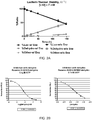
- dehydroluciferins were potent inhibitors of luciferases, which may account for the decreased light output after storage of luciferins stock solutions for a long period at ambient temperature.
- ATT The effect of ATT on luciferin stability was examined by comparing the degree of luciferin decomposition in the absence or presence of ATT.
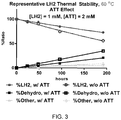
- Representative luciferins were reconstituted (at final concentration of 1.0 mM) in buffers containing various cationic detergents at pH 6.0, with or without ATT (Sigma, at a final concentration of 2.0 mM). The mixture was incubated at 60°C. Aliquots (20 ⁇ L) were taken out at various time points, diluted with H 2 O (180 ⁇ L), and analyzed by RP-HPLC. The percentages of the components were calculated based on UV absorbance at 330 nm. As demonstrated in FIG. 3 , ATT reduced dehydroluciferin formation and therefore improved luciferin thermal stability by preventing its decomposition.
- ATT also improved the stability of pro-luciferins.
- ATT was also shown to be compatible with additives that are commonly used in bioluminescence systems.
- a stock solution of a pro-luciferin compound, 2-hydroxyethyl ester of luciferin methyl ether, in DMSO was added to PBS buffer at pH 7.4 to reach a final concentration at 1.0 mM and 5% DMSO.
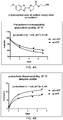
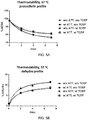
- the mixture was incubated at 37°C, with or without ATT (Sigma, at a final concentration of 8.0 mM), and with or without TCEP (Thermo Scientific, at a final concentration of 10 mM). Aliquots (20 ⁇ L) were taken out at various time points, diluted with H 2 O (180 ⁇ L), and analyzed by RP-HPLC.
- ATT improved the stability of the pro-luciferin compound in the presence of TCEP, a reducing agent commonly used in bioluminescence studies. Specifically, the presence of TCEP does not affect the ability of ATT to reduce the proluciferin decomposition (top panel) and the dehydro-compound production (bottom panel).
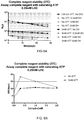
- Ultra-GloTM-based ATP detection reagent which includes the Ultra-GloTM enzyme, luciferin substrates, detergents for cell lysis, and other components in buffer, e.g. buffers containing various cationic detergents at pH 6.0, improved the complete reagent thermal stability at 37°C ( FIG. 6 ).
- T 80 the storage time during which the complete ATP detection reagent produced ⁇ 80% of the light output from the freshly made reagent
- a parameter reflecting reagent thermal stability was improved by 1 fold at 37°C after addition of ATT.
- the T 80 value in the absence of ATT (0 mM) was 4 days, whereas the T 80 value in the presence of ATT (3 mM) was 8 days ( FIG. 6A ).
- the combination of dehydroluciferin and ATT as additives further improved the reagent stability, increasing the T 80 value to 18 days ( FIG. 6B, at 3 mM ATT with 0.3 mM corresponding dehydro-compound).
- the thionucleotide compounds as disclosed herein did not interfere with the bioluminescence analysis systems, which include luminescence enzymes and luciferin analogs. Instead, the thionucleotide compounds improved the stability of the luciferin analogs, which in turn improved the signal of the bioluminescence analysis over an extended period of time as compared to systems without such compounds.
Landscapes
- Chemical & Material Sciences (AREA)
- Organic Chemistry (AREA)
- Life Sciences & Earth Sciences (AREA)
- Engineering & Computer Science (AREA)
- Zoology (AREA)
- Wood Science & Technology (AREA)
- Proteomics, Peptides & Aminoacids (AREA)
- Health & Medical Sciences (AREA)
- Immunology (AREA)
- Biochemistry (AREA)
- Biophysics (AREA)
- Microbiology (AREA)
- Molecular Biology (AREA)
- Analytical Chemistry (AREA)
- Physics & Mathematics (AREA)
- Biotechnology (AREA)
- Bioinformatics & Cheminformatics (AREA)
- General Engineering & Computer Science (AREA)
- General Health & Medical Sciences (AREA)
- Genetics & Genomics (AREA)
- Nitrogen Condensed Heterocyclic Rings (AREA)
- Plural Heterocyclic Compounds (AREA)
- Measuring Or Testing Involving Enzymes Or Micro-Organisms (AREA)
Claims (25)
- Zusammensetzung, die Folgendes umfasst:(a) ein Benzothiazol-Luciferin-Analogon oder ein Salz davon; und(b) eine wirksame Menge einer Verbindung von Formel (I) oder eines Tautomers davon,
 R1 Wasserstoff, optional substituiertes Alkyl, optional substituiertes Arylalkyl, optional substituiertes Heteroarylalkyl, optional substituiertes Cycloalkyl, optional substituiertes Aryl, optional substituiertes Heteroaryl, Carbonsäure, Ester, NRaRb optional substituiertes Imin, Hydroxy oder Oxo ist;R2 Wasserstoff, NRaRb optional substituiertes Imin, optional substituiertes Alkyl oder optional substituiertes Aryl ist;Ra und Rb bei jedem Auftreten jeweils unabhängig Wasserstoff, optional substituiertes Alkyl oder optional substituiertes Aryl sind; und(c) optional ein flüssiges Medium,wobei eine optional substituierte Gruppe aus Folgendem ausgewählt ist: Halogengruppen, Perfluoralkylgruppen, Perfluoralkoxygruppen, Alkylgruppen, Alkenylgruppen, Alkinylgruppen, Hydroxygruppen, Oxogruppen, Mercaptogruppen, Alkylthiogruppen, Alkoxygruppen, Nitrogruppen, Azidalkylgruppen, Aryl- oder Heteroarylgruppen, Aryloxy- oder Heteroaryloxygruppen, Aralkyl- oder Heteroaralkylgruppen, Aralkoxy- oder Heteroaralkoxygruppen, HO-(C=O)-Gruppen, heterocyclischen Gruppen, Cycloalkylgruppen, Aminogruppen, Alkyl- und Dialkylaminogruppen, Carbamoylgruppen, Alkylcarbonylgruppen, Alkylcarbonyloxygruppen, Alkoxycarbonylgruppen, Alkylaminocarbonylgruppen, Dialkylaminocarbonylgruppen, Arylcarbonylgruppen, Aryloxycarbonylgruppen, Alkylsulfonylgruppen und Arylsulfonylgruppen.wobei, wenn das flüssige Medium fehlt, das Benzothiazol-Luciferin-Analogon und die Verbindung von Formel (I) eine feste Mischung ausbilden;wobei, wenn das flüssige Medium vorhanden ist, und wenn die Verbindung von Formel (I) 6-Methyl-3-thioxo-3,4-dihydro-1,2,4-triazin-5(2H)-on (ATT) ist, das flüssige Medium frei von Dimethylsulfoxid (DMSO) ist, wobei das Benzothiazol-Luciferin-Analogon eine Verbindung von Formel (II') ist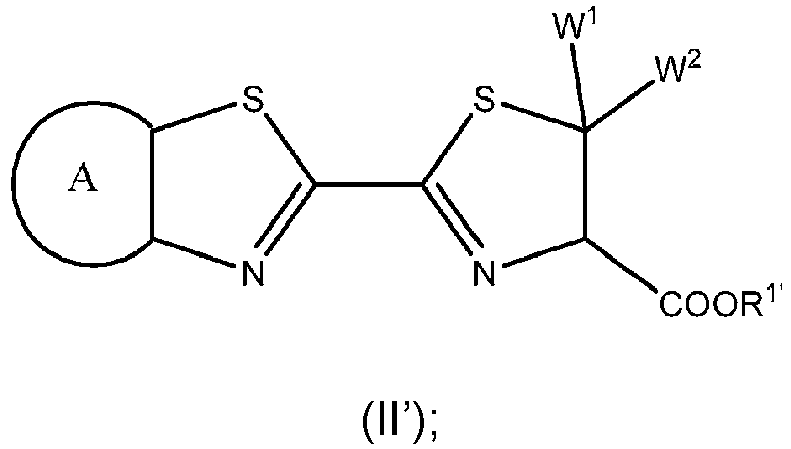

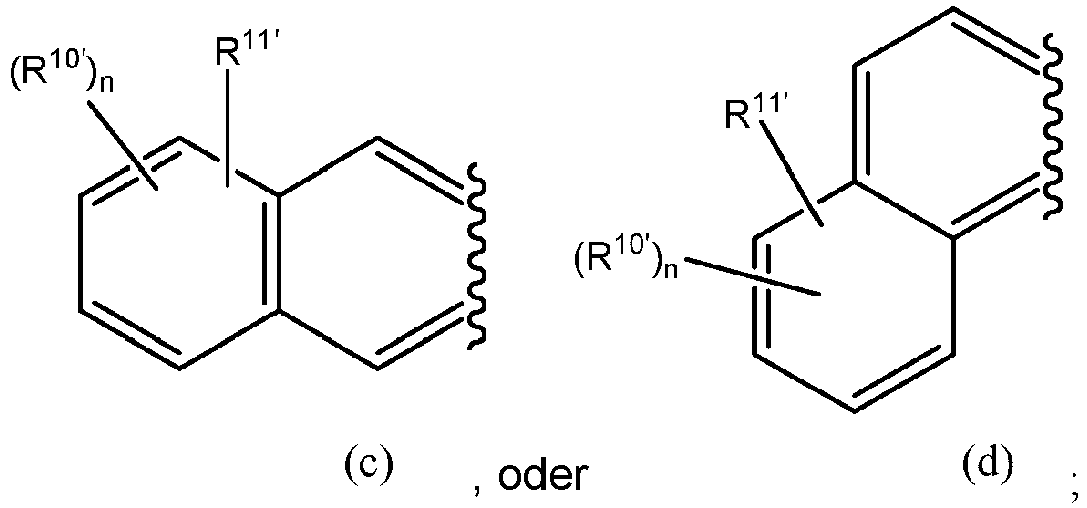 R1 H, C1-C4-Alkyl, -C2-C4-Alkylen-OH, -C2-C4-Alkylen-OC1-C4-alkyl, C3-C7-Cycloalkyl, Aryl, Benzyl oder substituiertes Benzyl, Heterocyclyl, Heteroaryl oder-(CH2)q-P(Ph)3 ist, wobei q eine ganze Zahl ausgewählt aus 1, 2, 3, 4, 5 und 6 ist;R2' Wasserstoff, Halogen, C1-C4-Alkyl oder C1-C4-Halogenalkyl ist;R3' Wasserstoff, Halogen, C1-C4-Alkyl oder C1-C4-Halogenalkyl ist;R4' -XG oder -XG1 ist;R5' Wasserstoff, Halogen, C1-C4-Alkyl oder C1-C4-Halogenalkyl ist;R10' bei jedem Auftreten unabhängig Halogen, -SO3H, C1-C10-Alkyl, -OH, -O(Cr C10-Alkyl), -NH2, -NH(C1-C10-Alkyl) oder -N(C1-C10-Alkyl)(C1-C10-alkyl) ist;R11' -OH, -O(C1-C10-Alkyl), -NH2, -NH(C1-C10-Alkyl), -N(C1-C10-Alkyl)(C1-C10-alkyl), -OG1, -NHG1 oder -N(C1-C10-Alkyl)G1 ist;n 0 bis 5 ist;X-O- oder -N(G)- ist;G bei jedem Auftreten unabhängig H, C1-C12-Alkyl ist oder zusammen mit einem von R3' oder R5' einen 5- bis 8-gliedrigen monocyclischen heterocyclischen Ring ausbildet, optional substituiert mit 1-4 Substituenten, die unabhängig aus der Gruppe ausgewählt sind, die aus C1-C4-Alkyl, C1-C4-Halogenalkyl, Halogen, Hydroxy, Oxo und -O(C1-C4-Alkyl) besteht; oder zwei G zusammen mit dem Stickstoffatom, an das sie gebunden sind, einen 4- bis 8-gliedrigen monocyclischen heterocyclischen Ring ausbilden, optional substituiert mit 1-4 Substituenten, die unabhängig aus der Gruppe ausgewählt sind, die aus C1-C4-Alkyl, C1-C4-Halogenalkyl, Halogen, Hydroxy, Oxo und -O(C1-C4-Alkyl) besteht;G1 ein Enzymsubstrat umfasst, wobei eine Biotransformation des Enzymsubstrats durch ein Enzym G1 in H umwandelt; undW1 und W2 jeweils unabhängig Wasserstoff, C1-C4-Alkyl oder Arylalkyl sind; oder W1 und W2 zusammen mit dem Kohlenstoff, an den sie gebunden sind, ein C3-C8-Cycloalkyl oder einen 4- bis 8-gliedrigen Heterocyclus ausbilden, wobei das Cycloalkyl und der Heterocyclus optional mit 1-4 Substituenten substituiert sind, die unabhängig aus der Gruppe ausgewählt sind, die aus C1-C4-Alkyl, C1-C4-Halogenalkyl, Halogen, Hydroxy, Oxo und -O(C1-C4-Alkyl) besteht;
 - Verfahren zum Stabilisieren eines Benzothiazol-Luciferin-Analogons, wobei das Verfahren ein Inberührungbringen eines Benzothiazol-Luciferin-Analogons oder eines Salzes davon mit einer wirksamen Menge einer Verbindung von Formel (I) oder eines Tautomers davon umfasst, wodurch das Benzothiazol-Luciferin-Analogon oder ein Salz davon gegen Zersetzung stabilisiert wird,
wobei die Verbindung von Formel I Folgende ist: R1 Wasserstoff, optional substituiertes Alkyl, optional substituiertes Arylalkyl, optional substituiertes Heteroarylalkyl, optional substituiertes Cycloalkyl, optional substituiertes Aryl, optional substituiertes Heteroaryl, Carbonsäure, Ester, NRaRb optional substituiertes Imin, Hydroxy oder Oxo ist;R2 Wasserstoff, NRaRb optional substituiertes Imin, optional substituiertes Alkyl oder optional substituiertes Aryl ist; undRa und Rb bei jedem Auftreten jeweils unabhängig Wasserstoff, optional substituiertes Alkyl oder optional substituiertes Aryl sind; wobei das Benzothiazol-Luciferin-Analogon eine Verbindung von Formel (II') ist

 R1 H, C1-C4-Alkyl, -C2-C4-Alkylen-OH, -C2-C4-Alkylen-OC1-C4-alkyl, C3-C7-Cycloalkyl, Aryl, Benzyl oder substituiertes Benzyl, Heterocyclyl, Heteroaryl oder-(CH2)q-P(Ph)3 ist, wobei q eine ganze Zahl ausgewählt aus 1, 2, 3, 4, 5 und 6 ist;R2' Wasserstoff, Halogen, Methyl oder Trifluormethyl ist;R3' Wasserstoff, Halogen, Methyl oder Trifluormethyl ist;R4' -XG oder -XG1 ist;R5' Wasserstoff, Halogen, Methyl oder Trifluormethyl ist;R10' bei jedem Auftreten unabhängig Halogen, -SO3H, C1-C10-Alkyl, -OH, -O(Cr C10-Alkyl), -NH2, -NH(C1-C10-Alkyl) oder -N(C1-C10-Alkyl)(C1-C10-alkyl) ist;R11' -OH, -O(C1-C10-Alkyl), -NH2, -NH(C1-C10-Alkyl), -N(C1-C10-Alkyl)(C1-C10-alkyl), -OG1, -NHG1 oder -N(C1-C10-Alkyl)G1 ist;n 0 bis 5 ist;X -O- oder -N(G)- ist;G bei jedem Auftreten unabhängig H, C1-C12-Alkyl ist oder zusammen mit einem von R3' oder R5' einen 5- bis 8-gliedrigen monocyclischen heterocyclischen Ring ausbildet, optional substituiert mit 1-4 Substituenten, die unabhängig aus der Gruppe ausgewählt sind, die aus C1-C4-Alkyl, C1-C4-Halogenalkyl, Halogen, Hydroxy, Oxo und -O(C1-C4-Alkyl) besteht; oder zwei G zusammen mit dem Stickstoffatom, an das sie gebunden sind, einen 4- bis 8-gliedrigen monocyclischen heterocyclischen Ring ausbilden, optional substituiert mit 1-4 Substituenten, die unabhängig aus der Gruppe ausgewählt sind, die aus C1-C4-Alkyl, C1-C4-Halogenalkyl, Halogen, Hydroxy, Oxo und -O(C1-C4-Alkyl) besteht;G1 ein Enzymsubstrat umfasst, wobei die Biotransformation des Enzymsubstrats durch ein Enzym G1 in H umwandelt; undW1 und W2 jeweils unabhängig Wasserstoff, C1-C4-Alkyl oder Arylalkyl sind; oder W1 und W2 zusammen mit dem Kohlenstoff, an den sie gebunden sind, ein C3-C8-Cycloalkyl oder einen 4- bis 8-gliedrigen Heterocyclus ausbilden, wobei das Cycloalkyl und der Heterocyclus optional mit 1-4 Substituenten substituiert sind, die unabhängig aus der Gruppe ausgewählt sind, die aus C1-C4-Alkyl, C1-C4-Halogenalkyl, Halogen, Hydroxy, Oxo und -O(C1-C4-Alkyl) besteht;wobei eine optional substituierte Gruppe aus Folgendem ausgewählt ist: Halogengruppen, Perfluoralkylgruppen, Perfluoralkoxygruppen, Alkylgruppen, Alkenylgruppen, Alkinylgruppen, Hydroxygruppen, Oxogruppen, Mercaptogruppen, Alkylthiogruppen, Alkoxygruppen, Nitrogruppen, Azidalkylgruppen, Aryl- oder Heteroarylgruppen, Aryloxy- oder Heteroaryloxygruppen, Aralkyl- oder Heteroaralkylgruppen, Aralkoxy- oder Heteroaralkoxygruppen, HO-(C=O)-Gruppen, heterocyclischen Gruppen, Cycloalkylgruppen, Aminogruppen, Alkyl- und Dialkylaminogruppen, Carbamoylgruppen, Alkylcarbonylgruppen, Alkylcarbonyloxygruppen, Alkoxycarbonylgruppen, Alkylaminocarbonylgruppen, Dialkylaminocarbonylgruppen, Arylcarbonylgruppen, Aryloxycarbonylgruppen, Alkylsulfonylgruppen und Arylsulfonylgruppen.
 - Zusammensetzung nach Anspruch 1, wobei die Zusammensetzung kein luminogenes Enzym enthält.
- Zusammensetzung nach Anspruch 1 oder 3, wobei das Benzothiazol-Luciferin-Analogon gegen Zersetzung stabilisiert ist.
- Zusammensetzung nach Anspruch 4, wobei das Benzothiazol-Luciferin-Analogon verglichen mit einer Zusammensetzung, die die Verbindung von Formel (I) oder das Tautomer davon nicht einschließt, gegen Zersetzung stabilisiert ist.
- Zusammensetzung nach Anspruch 4 oder 5 oder Verfahren nach Anspruch 2, wobei das Benzothiazol-Luciferin-Analogon gegen Zersetzung in Gegenwart von Licht stabilisiert ist.
- Zusammensetzung nach Anspruch 4 oder 5 oder Verfahren nach Anspruch 2, wobei das Benzothiazol-Luciferin-Analogon gegen Zersetzung in Abwesenheit von Licht stabilisiert ist.
- Zusammensetzung nach einem der Ansprüche 4-7 oder Verfahren nach den Ansprüchen 2, 6 oder 7, wobei das Benzothiazol-Luciferin-Analogon gegen Zersetzung bei Temperaturen von -80 °C bis 60 °C stabilisiert ist.
- Zusammensetzung nach einem der Ansprüche 1 oder 3-8, wobei R1 H ist.
- Zusammensetzung nach einem der Ansprüche 1 oder 3-9, wobei R2' H ist, R3' H ist und R5' H ist.
- Zusammensetzung nach einem der Ansprüche 6-10, wobei das Benzothiazol-Luciferin-Analogon verglichen mit einer Zusammensetzung, die die Verbindung von Formel (I) oder das Tautomer davon nicht einschließt, gegen Zersetzung in Gegenwart von Licht stabilisiert ist.
- Zusammensetzung nach einem der Ansprüche 6-11, wobei das Benzothiazol-Luciferin-Analogon verglichen mit einer Zusammensetzung, die die Verbindung von Formel (I) oder das Tautomer davon nicht einschließt, gegen Zersetzung in Abwesenheit von Licht stabilisiert ist.
- Verfahren nach einem der Ansprüche 2 oder 6-8, wobei das Inberührungbringen in einer festen Mischung des Benzothiazol-Luciferin-Analogons und der Verbindung von Formel (I) auftritt.
- Verfahren nach einem der Ansprüche 2 oder 6-8, wobei das Inberührungbringen in einem flüssigen Medium auftritt.
- Zusammensetzung nach Anspruch 1 oder Verfahren nach Anspruch 2, wobei W1 und W2 jeweils unabhängig C1-C4-Alkyl sind.
- Zusammensetzung nach Anspruch 1 oder Verfahren nach Anspruch 2, wobei das Benzothiazol-Luciferin-Analogon eine Verbindung von Formel (II) ist


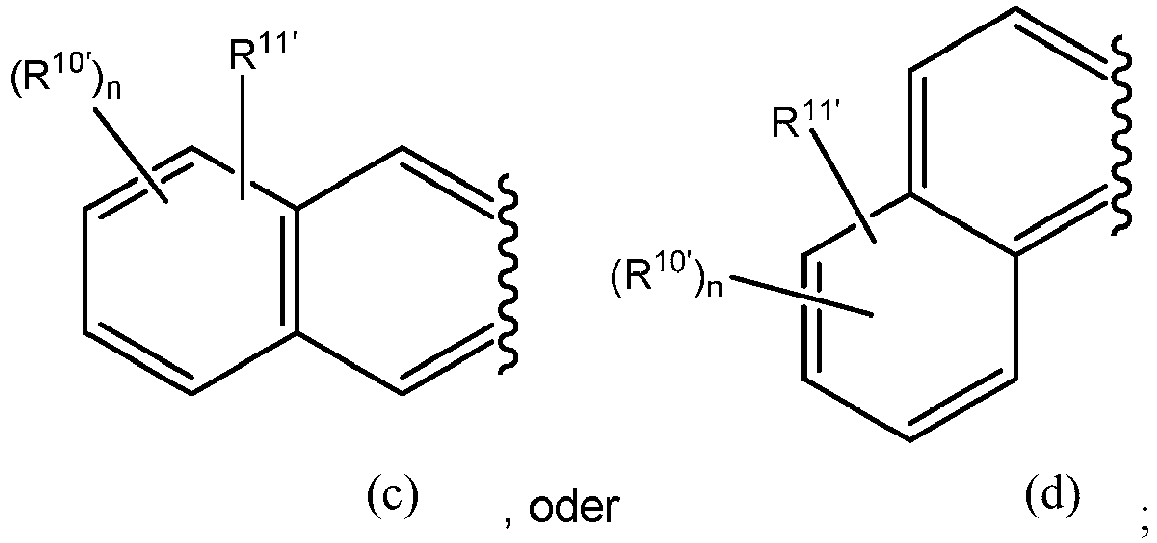 R1 H, C1-C4-Alkyl, -C2-C4-Alkylen-OH, -C2-C4-Alkylen-OC1-C4-alkyl, C3-C7-Cycloalkyl, Aryl, Benzyl oder substituiertes Benzyl, Heterocyclyl, Heteroaryl oder-(CH2)q-P(Ph)3 ist, wobei q eine ganze Zahl ausgewählt aus 1, 2, 3, 4, 5 und 6 ist;R2' Wasserstoff, Halogen, Methyl oder Trifluormethyl ist;R3' Wasserstoff, Halogen, Methyl oder Trifluormethyl ist;R4' -XG oder -XG1 ist;R5' Wasserstoff, Halogen, Methyl oder Trifluormethyl ist;R10' bei jedem Auftreten unabhängig Halogen, -SO3H, C1-C10-Alkyl, -OH, -O(Cr C10-Alkyl), -NH2, -NH(C1-C10-Alkyl) oder -N(C1-C10-Alkyl)(C1-C10-alkyl) ist;R11' -OH, -O(C1-C10-Alkyl), -NH2, -NH(C1-C10-Alkyl), -N(C1-C10-Alkyl)(C1-C10-alkyl), -OG1, -NHG1 oder -N(C1-C10-Alkyl)G1 ist;n 0 bis 5 ist;X-O- oder -N(G)- ist;G bei jedem Auftreten unabhängig H, C1-C12-Alkyl ist oder zusammen mit einem von R3' oder R5' einen 5- bis 8-gliedrigen monocyclischen heterocyclischen Ring ausbildet, optional substituiert mit 1-4 Substituenten, die unabhängig aus der Gruppe ausgewählt sind, die aus C1-C4-Alkyl, C1-C4-Halogenalkyl, Halogen, Hydroxy, Oxo und -O(C1-C4-Alkyl) besteht; oder zwei G zusammen mit dem Stickstoffatom, an das sie gebunden sind, einen 4- bis 8-gliedrigen monocyclischen heterocyclischen Ring ausbilden, optional substituiert mit 1-4 Substituenten, die unabhängig aus der Gruppe ausgewählt sind, die aus C1-C4-Alkyl, C1-C4-Halogenalkyl, Halogen, Hydroxy, Oxo und -O(C1-C4-Alkyl) besteht; undG1 ein Enzymsubstrat umfasst, wobei die Biotransformation des Enzymsubstrats durch ein Enzym G1 in H umwandelt.
 - Kit, das die Zusammensetzung nach einem der Ansprüche 1, 3-12 oder 15-16 in einem einzigen Behälter umfasst, wobei die Verbindung von Formel (I) das Benzothiazol-Luciferin-Analogon stabilisiert.
- Zusammensetzung nach einem der Ansprüche 1, 3-12 oder 15-16, Verfahren nach Anspruch 2, 6-8 oder 13-16 oder Kit nach Anspruch 17, wobei R4' -OH oder -NH2 ist.
- Zusammensetzung nach einem der Ansprüche 1, 3-12, 15-16 oder 18, Verfahren nach den Ansprüchen 2, 6-8, 13-16 oder 18 oder Kit nach den Ansprüchen 17-18, wobei die wirksame Menge der Verbindung von Formel (I) größer ist als 0,1 mM; optional wobei die wirksame Menge der Verbindung von Formel (I) größer ist als 1 mM.
- Zusammensetzung nach einem der Ansprüche 1, 3-12, 15-16 oder 18-19, Verfahren nach den Ansprüchen 2, 6-8, 13-16 oder 18-19 oder Kit nach den Ansprüchen 17-19, wobei die Verbindung von Formel (I) aus der Gruppe ausgewählt ist, die aus Folgendem besteht: ATT, ATCA, 3-(4-Amino-5-oxo-3-thioxo-2,3,4,5-tetrahydro-1,2,4-triazin-6-yl)propansäure, Tetrahydro-2-methyl-3-thioxo-1,2,4-triazin-5,6-dion, 4-((2-Furylmethylen)amino)-3-mercapto-6-methyl-1,2,4-triazin-5(4H)-on, 6-Benzyl-3-sulfanyl-1,2,4-triazin-5-ol, 4-Amino-3-mercapto-6-methyl-1,2,4-triazin-5(4H)-on 3-(5-Oxo-3-thioxo-2,3,4,5-tetrahydro-1 ,2,4-triazin-6-yl)propansäure, (E)-6-Methyl-4-((thiophen-2-ylmethylen)amino)-3-thioxo-3,4-dihydro-1,2,4-triazin-5(2H)-on, (E)-6-Methyl-4-((3-nitrobenzyliden)amino)-3-thioxo-3,4-dihydro-1,2,4-triazin-5(2H)-on, (E)-4-((4-(Diethylamino)benzyliden)amino)-6-methyl-3-thioxo-3,4-dihydro-1,2,4-triazin-5(2H)-on, ATCA-Ethylester, TAK-0014, TAK-0002, TAK-0021, TAK-0020, TAK-0018, TAK-0009, TAK-0007, TAK-0008, TAK-0003, TAK-0004, 3-Thioxo-6-(trifluormethyl)-3,4-dihydro-1,2,4-triazin-5(2H)-on, 6-Cyclopropyl-3-thioxo-3,4-dihydro-1,2,4-triazin-5(2H)-on und 6-(Hydroxymethyl)-3-thioxo-3,4-dihydro-1,2,4-triazin-5(2H)-on.
- Zusammensetzung nach einem der Ansprüche 1, 3-12, 15-16 oder 18-20, Verfahren nach den Ansprüchen 2, 6-8, 13-16 oder 18-20 oder Kit nach den Ansprüchen 17-20, wobei das flüssige Medium fehlt.
- Zusammensetzung nach einem der Ansprüche 1, 3-12, 15-16 oder 18-20, Verfahren nach den Ansprüchen 2, 6-8, 13-16 oder 18-20, oder Kit nach den Ansprüchen 17-20, wobei das flüssige Medium vorhanden ist.
- Zusammensetzung, Verfahren oder Kit nach Anspruch 22, wobei die Verbindung von Formel (I) nicht ATT ist; optional wobei das flüssige Medium ein organisches Lösungsmittel umfasst, das aus der Gruppe ausgewählt ist, die aus Alkohol, Propylenglycol, Dimethylsulfoxid (DMSO), Acetonitril, Glycerin und einer beliebigen Kombination davon besteht.
- Zusammensetzung, Verfahren oder Kit nach Anspruch 22, wobei die Verbindung von Formel(I) ATT ist und wobei das flüssige Medium ein organisches Lösungsmittel umfasst, das aus der Gruppe ausgewählt ist, die aus Alkohol, Propylenglycol, Acetonitril, Glycerin und einer beliebigen Kombination davon besteht.
- Verfahren nach einem der Ansprüche 2, 6-8, 13-16 oder 18-24 oder Kit nach den Ansprüchen 17-24, wobei R1' H ist, R2' H ist, R3' H ist und R5' H ist.
Applications Claiming Priority (2)
| Application Number | Priority Date | Filing Date | Title |
|---|---|---|---|
| US201762541350P | 2017-08-04 | 2017-08-04 | |
| PCT/US2018/045040 WO2019028272A1 (en) | 2017-08-04 | 2018-08-02 | COMPOSITIONS AND METHODS FOR STABILIZING LUCIFERIN BENZOTHIAZOLE ANALOGS |
Publications (2)
| Publication Number | Publication Date |
|---|---|
| EP3661932A1 EP3661932A1 (de) | 2020-06-10 |
| EP3661932B1 true EP3661932B1 (de) | 2021-10-06 |
Family
ID=63209736
Family Applications (1)
| Application Number | Title | Priority Date | Filing Date |
|---|---|---|---|
| EP18755670.9A Active EP3661932B1 (de) | 2017-08-04 | 2018-08-02 | Zusammensetzungen und verfahren zur stabilisierung von benzothiazol-luciferin-analoga |
Country Status (4)
| Country | Link |
|---|---|
| US (1) | US11136615B2 (de) |
| EP (1) | EP3661932B1 (de) |
| JP (1) | JP7350713B2 (de) |
| WO (1) | WO2019028272A1 (de) |
Families Citing this family (1)
| Publication number | Priority date | Publication date | Assignee | Title |
|---|---|---|---|---|
| US10400264B2 (en) | 2016-12-01 | 2019-09-03 | Promega Corporation | 5,5-disubstituted luciferins and their use in luciferase-based assays |
Family Cites Families (17)
| Publication number | Priority date | Publication date | Assignee | Title |
|---|---|---|---|---|
| DE3537877A1 (de) | 1985-10-24 | 1987-04-30 | Geiger Reinhard | Luciferin-derivate und immunoassays unter einsatz derartiger luciferin-derivate |
| US6602677B1 (en) | 1997-09-19 | 2003-08-05 | Promega Corporation | Thermostable luciferases and methods of production |
| JP4478231B2 (ja) | 1998-12-09 | 2010-06-09 | 栄研化学株式会社 | 生物発光試薬の安定化方法 |
| JP4379644B2 (ja) | 1999-03-08 | 2009-12-09 | 栄研化学株式会社 | ホタルルシフェリンの安定化方法 |
| JP4503724B2 (ja) | 1999-05-10 | 2010-07-14 | 栄研化学株式会社 | ホタルルシフェリンの安定化方法 |
| US7118878B1 (en) | 2000-06-09 | 2006-10-10 | Promega Corporation | Method for increasing luminescence assay sensitivity |
| EP1546162B1 (de) | 2002-09-20 | 2011-06-22 | Promega Corporation | Auf lumineszenz basierende verfahren und sonden zur messung der cytochrom-p450-aktivität |
| JPWO2006013837A1 (ja) | 2004-08-05 | 2008-05-29 | 東洋ビーネット株式会社 | ルシフェラーゼ発光方法および発光試薬 |
| EP2272972A1 (de) | 2005-05-31 | 2011-01-12 | Promega Corporation | Luminogene und fluorogene Verbindungen und Verfahren für den Nachweis von Molekülen oder Leiden |
| US7910087B2 (en) | 2007-03-02 | 2011-03-22 | University Of Massachusetts | Luciferins |
| JP6075723B2 (ja) | 2012-08-21 | 2017-02-08 | 栄研化学株式会社 | N−(2−アセトアミド)イミノ二酢酸を用いる発光増強方法 |
| JP2016509835A (ja) | 2013-02-22 | 2016-04-04 | プロメガ コーポレイションPromega Corporation | ルシフェラーゼ及びヌクレオシドホスフェートの発光検出のための安定化された配合物 |
| JP6495232B2 (ja) | 2013-03-12 | 2019-04-03 | プロメガ コーポレイションPromega Corporation | 赤方偏移ルシフェリン及びその使用方法 |
| BR112016027504B1 (pt) * | 2014-05-23 | 2023-04-18 | Promega Corporation | Composição e método para estabilizar um substrato luminogênico e kit que compreende a referida composição |
| US9732373B2 (en) * | 2014-09-11 | 2017-08-15 | Promega Corporation | Luciferase sequences utilizing infrared-emitting substrates to produce enhanced luminescence |
| WO2017057672A1 (ja) | 2015-09-30 | 2017-04-06 | 栄研化学株式会社 | ルシフェリンの安定化方法及び生物発光の測定方法 |
| US10400264B2 (en) | 2016-12-01 | 2019-09-03 | Promega Corporation | 5,5-disubstituted luciferins and their use in luciferase-based assays |
-
2018
- 2018-08-02 EP EP18755670.9A patent/EP3661932B1/de active Active
- 2018-08-02 WO PCT/US2018/045040 patent/WO2019028272A1/en not_active Ceased
- 2018-08-02 US US16/053,413 patent/US11136615B2/en active Active
- 2018-08-02 JP JP2020506187A patent/JP7350713B2/ja active Active
Also Published As
| Publication number | Publication date |
|---|---|
| US11136615B2 (en) | 2021-10-05 |
| JP7350713B2 (ja) | 2023-09-26 |
| US20190040449A1 (en) | 2019-02-07 |
| JP2020529442A (ja) | 2020-10-08 |
| WO2019028272A1 (en) | 2019-02-07 |
| EP3661932A1 (de) | 2020-06-10 |
Similar Documents
| Publication | Publication Date | Title |
|---|---|---|
| Ramsay et al. | In vitro effects of acetaminophen metabolites and analogs on the respiration of mouse liver mitochondria | |
| Boxer et al. | Evaluation of substituted N, N′-diarylsulfonamides as activators of the tumor cell specific M2 isoform of pyruvate kinase | |
| Na et al. | A General Approach to Site‐Specific, Intramolecular C− H Functionalization Using Dithiocarbamates | |
| US10400264B2 (en) | 5,5-disubstituted luciferins and their use in luciferase-based assays | |
| JP5079600B2 (ja) | シトクロムp450活性を測定するための発光を利用する方法およびプローブ | |
| Tisi et al. | Development of a thermostable firefly luciferase | |
| MA31108B1 (fr) | Derives substitues de spirochromanone en tant qu'inhibiteurs d'acc | |
| AU2001275325B2 (en) | Method for increasing luminescence assay sensitivity | |
| AR050917A1 (es) | Compuestos basados en 2-amido-tiazol que presentan actividad inhibidora de enzimas que utilizan atp, y composiciones y usos de los mismos | |
| CA2949447C (en) | Compositions and methods for stabilizing luminogenic substrates | |
| EP3661932B1 (de) | Zusammensetzungen und verfahren zur stabilisierung von benzothiazol-luciferin-analoga | |
| Kuday et al. | Synthesis and In Vitro Inhibition Effect of New Pyrido [2, 3‐d] Pyrimidine Derivatives on Erythrocyte Carbonic Anhydrase I and II | |
| EP4140991B1 (de) | Biolumineszenz-komplexe aus oplophorus-luciferase-hemmern | |
| Venkateswararao et al. | Exploration and Optimization of an Efficient One‐pot Sequential Synthesis of Di/tri‐substituted Thiazoles from α‐Bromoketones, Thioacids Salt, and Ammonium Acetate | |
| Begum et al. | Therapeutic utility of 1, 3-thiazines mini review | |
| Blair et al. | Engineering non-natural inhibitor sensitivity in protein tyrosine phosphatase H1 | |
| Sudhaharan et al. | A bifunctional luminogenic substrate for two luminescent enzymes: firefly luciferase and horseradish peroxidase | |
| Iyer et al. | In Vitro Studies on the Effects of Water Miscible Organic Co-Solvents on Select Drug Metabolizing Enzyme Activities. | |
| Gullapelli et al. | Synthesis and Antioxidant Evaluation of New Heterocyclic Compounds on Benzimidazole Nucleus |
Legal Events
| Date | Code | Title | Description |
|---|---|---|---|
| STAA | Information on the status of an ep patent application or granted ep patent |
Free format text: STATUS: UNKNOWN |
|
| STAA | Information on the status of an ep patent application or granted ep patent |
Free format text: STATUS: THE INTERNATIONAL PUBLICATION HAS BEEN MADE |
|
| PUAI | Public reference made under article 153(3) epc to a published international application that has entered the european phase |
Free format text: ORIGINAL CODE: 0009012 |
|
| STAA | Information on the status of an ep patent application or granted ep patent |
Free format text: STATUS: REQUEST FOR EXAMINATION WAS MADE |
|
| 17P | Request for examination filed |
Effective date: 20200304 |
|
| AK | Designated contracting states |
Kind code of ref document: A1 Designated state(s): AL AT BE BG CH CY CZ DE DK EE ES FI FR GB GR HR HU IE IS IT LI LT LU LV MC MK MT NL NO PL PT RO RS SE SI SK SM TR |
|
| AX | Request for extension of the european patent |
Extension state: BA ME |
|
| DAV | Request for validation of the european patent (deleted) | ||
| DAX | Request for extension of the european patent (deleted) | ||
| GRAP | Despatch of communication of intention to grant a patent |
Free format text: ORIGINAL CODE: EPIDOSNIGR1 |
|
| STAA | Information on the status of an ep patent application or granted ep patent |
Free format text: STATUS: GRANT OF PATENT IS INTENDED |
|
| INTG | Intention to grant announced |
Effective date: 20210426 |
|
| GRAS | Grant fee paid |
Free format text: ORIGINAL CODE: EPIDOSNIGR3 |
|
| GRAA | (expected) grant |
Free format text: ORIGINAL CODE: 0009210 |
|
| STAA | Information on the status of an ep patent application or granted ep patent |
Free format text: STATUS: THE PATENT HAS BEEN GRANTED |
|
| AK | Designated contracting states |
Kind code of ref document: B1 Designated state(s): AL AT BE BG CH CY CZ DE DK EE ES FI FR GB GR HR HU IE IS IT LI LT LU LV MC MK MT NL NO PL PT RO RS SE SI SK SM TR |
|
| REG | Reference to a national code |
Ref country code: GB Ref legal event code: FG4D |
|
| REG | Reference to a national code |
Ref country code: CH Ref legal event code: EP Ref country code: AT Ref legal event code: REF Ref document number: 1436140 Country of ref document: AT Kind code of ref document: T Effective date: 20211015 |
|
| REG | Reference to a national code |
Ref country code: IE Ref legal event code: FG4D |
|
| REG | Reference to a national code |
Ref country code: DE Ref legal event code: R096 Ref document number: 602018024683 Country of ref document: DE |
|
| REG | Reference to a national code |
Ref country code: LT Ref legal event code: MG9D |
|
| REG | Reference to a national code |
Ref country code: NL Ref legal event code: MP Effective date: 20211006 |
|
| REG | Reference to a national code |
Ref country code: AT Ref legal event code: MK05 Ref document number: 1436140 Country of ref document: AT Kind code of ref document: T Effective date: 20211006 |
|
| PG25 | Lapsed in a contracting state [announced via postgrant information from national office to epo] |
Ref country code: RS Free format text: LAPSE BECAUSE OF FAILURE TO SUBMIT A TRANSLATION OF THE DESCRIPTION OR TO PAY THE FEE WITHIN THE PRESCRIBED TIME-LIMIT Effective date: 20211006 Ref country code: LT Free format text: LAPSE BECAUSE OF FAILURE TO SUBMIT A TRANSLATION OF THE DESCRIPTION OR TO PAY THE FEE WITHIN THE PRESCRIBED TIME-LIMIT Effective date: 20211006 Ref country code: FI Free format text: LAPSE BECAUSE OF FAILURE TO SUBMIT A TRANSLATION OF THE DESCRIPTION OR TO PAY THE FEE WITHIN THE PRESCRIBED TIME-LIMIT Effective date: 20211006 Ref country code: BG Free format text: LAPSE BECAUSE OF FAILURE TO SUBMIT A TRANSLATION OF THE DESCRIPTION OR TO PAY THE FEE WITHIN THE PRESCRIBED TIME-LIMIT Effective date: 20220106 Ref country code: AT Free format text: LAPSE BECAUSE OF FAILURE TO SUBMIT A TRANSLATION OF THE DESCRIPTION OR TO PAY THE FEE WITHIN THE PRESCRIBED TIME-LIMIT Effective date: 20211006 |
|
| PG25 | Lapsed in a contracting state [announced via postgrant information from national office to epo] |
Ref country code: IS Free format text: LAPSE BECAUSE OF FAILURE TO SUBMIT A TRANSLATION OF THE DESCRIPTION OR TO PAY THE FEE WITHIN THE PRESCRIBED TIME-LIMIT Effective date: 20220206 Ref country code: SE Free format text: LAPSE BECAUSE OF FAILURE TO SUBMIT A TRANSLATION OF THE DESCRIPTION OR TO PAY THE FEE WITHIN THE PRESCRIBED TIME-LIMIT Effective date: 20211006 Ref country code: PT Free format text: LAPSE BECAUSE OF FAILURE TO SUBMIT A TRANSLATION OF THE DESCRIPTION OR TO PAY THE FEE WITHIN THE PRESCRIBED TIME-LIMIT Effective date: 20220207 Ref country code: PL Free format text: LAPSE BECAUSE OF FAILURE TO SUBMIT A TRANSLATION OF THE DESCRIPTION OR TO PAY THE FEE WITHIN THE PRESCRIBED TIME-LIMIT Effective date: 20211006 Ref country code: NO Free format text: LAPSE BECAUSE OF FAILURE TO SUBMIT A TRANSLATION OF THE DESCRIPTION OR TO PAY THE FEE WITHIN THE PRESCRIBED TIME-LIMIT Effective date: 20220106 Ref country code: NL Free format text: LAPSE BECAUSE OF FAILURE TO SUBMIT A TRANSLATION OF THE DESCRIPTION OR TO PAY THE FEE WITHIN THE PRESCRIBED TIME-LIMIT Effective date: 20211006 Ref country code: LV Free format text: LAPSE BECAUSE OF FAILURE TO SUBMIT A TRANSLATION OF THE DESCRIPTION OR TO PAY THE FEE WITHIN THE PRESCRIBED TIME-LIMIT Effective date: 20211006 Ref country code: HR Free format text: LAPSE BECAUSE OF FAILURE TO SUBMIT A TRANSLATION OF THE DESCRIPTION OR TO PAY THE FEE WITHIN THE PRESCRIBED TIME-LIMIT Effective date: 20211006 Ref country code: GR Free format text: LAPSE BECAUSE OF FAILURE TO SUBMIT A TRANSLATION OF THE DESCRIPTION OR TO PAY THE FEE WITHIN THE PRESCRIBED TIME-LIMIT Effective date: 20220107 Ref country code: ES Free format text: LAPSE BECAUSE OF FAILURE TO SUBMIT A TRANSLATION OF THE DESCRIPTION OR TO PAY THE FEE WITHIN THE PRESCRIBED TIME-LIMIT Effective date: 20211006 |
|
| REG | Reference to a national code |
Ref country code: DE Ref legal event code: R097 Ref document number: 602018024683 Country of ref document: DE |
|
| PG25 | Lapsed in a contracting state [announced via postgrant information from national office to epo] |
Ref country code: SM Free format text: LAPSE BECAUSE OF FAILURE TO SUBMIT A TRANSLATION OF THE DESCRIPTION OR TO PAY THE FEE WITHIN THE PRESCRIBED TIME-LIMIT Effective date: 20211006 Ref country code: SK Free format text: LAPSE BECAUSE OF FAILURE TO SUBMIT A TRANSLATION OF THE DESCRIPTION OR TO PAY THE FEE WITHIN THE PRESCRIBED TIME-LIMIT Effective date: 20211006 Ref country code: RO Free format text: LAPSE BECAUSE OF FAILURE TO SUBMIT A TRANSLATION OF THE DESCRIPTION OR TO PAY THE FEE WITHIN THE PRESCRIBED TIME-LIMIT Effective date: 20211006 Ref country code: EE Free format text: LAPSE BECAUSE OF FAILURE TO SUBMIT A TRANSLATION OF THE DESCRIPTION OR TO PAY THE FEE WITHIN THE PRESCRIBED TIME-LIMIT Effective date: 20211006 Ref country code: DK Free format text: LAPSE BECAUSE OF FAILURE TO SUBMIT A TRANSLATION OF THE DESCRIPTION OR TO PAY THE FEE WITHIN THE PRESCRIBED TIME-LIMIT Effective date: 20211006 Ref country code: CZ Free format text: LAPSE BECAUSE OF FAILURE TO SUBMIT A TRANSLATION OF THE DESCRIPTION OR TO PAY THE FEE WITHIN THE PRESCRIBED TIME-LIMIT Effective date: 20211006 |
|
| PLBE | No opposition filed within time limit |
Free format text: ORIGINAL CODE: 0009261 |
|
| STAA | Information on the status of an ep patent application or granted ep patent |
Free format text: STATUS: NO OPPOSITION FILED WITHIN TIME LIMIT |
|
| 26N | No opposition filed |
Effective date: 20220707 |
|
| PG25 | Lapsed in a contracting state [announced via postgrant information from national office to epo] |
Ref country code: AL Free format text: LAPSE BECAUSE OF FAILURE TO SUBMIT A TRANSLATION OF THE DESCRIPTION OR TO PAY THE FEE WITHIN THE PRESCRIBED TIME-LIMIT Effective date: 20211006 |
|
| PG25 | Lapsed in a contracting state [announced via postgrant information from national office to epo] |
Ref country code: SI Free format text: LAPSE BECAUSE OF FAILURE TO SUBMIT A TRANSLATION OF THE DESCRIPTION OR TO PAY THE FEE WITHIN THE PRESCRIBED TIME-LIMIT Effective date: 20211006 |
|
| PG25 | Lapsed in a contracting state [announced via postgrant information from national office to epo] |
Ref country code: MC Free format text: LAPSE BECAUSE OF FAILURE TO SUBMIT A TRANSLATION OF THE DESCRIPTION OR TO PAY THE FEE WITHIN THE PRESCRIBED TIME-LIMIT Effective date: 20211006 |
|
| REG | Reference to a national code |
Ref country code: CH Ref legal event code: PL |
|
| PG25 | Lapsed in a contracting state [announced via postgrant information from national office to epo] |
Ref country code: LU Free format text: LAPSE BECAUSE OF NON-PAYMENT OF DUE FEES Effective date: 20220802 Ref country code: LI Free format text: LAPSE BECAUSE OF NON-PAYMENT OF DUE FEES Effective date: 20220831 Ref country code: CH Free format text: LAPSE BECAUSE OF NON-PAYMENT OF DUE FEES Effective date: 20220831 |
|
| REG | Reference to a national code |
Ref country code: BE Ref legal event code: MM Effective date: 20220831 |
|
| PG25 | Lapsed in a contracting state [announced via postgrant information from national office to epo] |
Ref country code: IT Free format text: LAPSE BECAUSE OF FAILURE TO SUBMIT A TRANSLATION OF THE DESCRIPTION OR TO PAY THE FEE WITHIN THE PRESCRIBED TIME-LIMIT Effective date: 20211006 |
|
| PG25 | Lapsed in a contracting state [announced via postgrant information from national office to epo] |
Ref country code: IE Free format text: LAPSE BECAUSE OF NON-PAYMENT OF DUE FEES Effective date: 20220802 |
|
| PG25 | Lapsed in a contracting state [announced via postgrant information from national office to epo] |
Ref country code: BE Free format text: LAPSE BECAUSE OF NON-PAYMENT OF DUE FEES Effective date: 20220831 |
|
| PG25 | Lapsed in a contracting state [announced via postgrant information from national office to epo] |
Ref country code: MK Free format text: LAPSE BECAUSE OF FAILURE TO SUBMIT A TRANSLATION OF THE DESCRIPTION OR TO PAY THE FEE WITHIN THE PRESCRIBED TIME-LIMIT Effective date: 20211006 Ref country code: CY Free format text: LAPSE BECAUSE OF FAILURE TO SUBMIT A TRANSLATION OF THE DESCRIPTION OR TO PAY THE FEE WITHIN THE PRESCRIBED TIME-LIMIT Effective date: 20211006 |
|
| PG25 | Lapsed in a contracting state [announced via postgrant information from national office to epo] |
Ref country code: HU Free format text: LAPSE BECAUSE OF FAILURE TO SUBMIT A TRANSLATION OF THE DESCRIPTION OR TO PAY THE FEE WITHIN THE PRESCRIBED TIME-LIMIT; INVALID AB INITIO Effective date: 20180802 |
|
| PG25 | Lapsed in a contracting state [announced via postgrant information from national office to epo] |
Ref country code: TR Free format text: LAPSE BECAUSE OF FAILURE TO SUBMIT A TRANSLATION OF THE DESCRIPTION OR TO PAY THE FEE WITHIN THE PRESCRIBED TIME-LIMIT Effective date: 20211006 |
|
| PG25 | Lapsed in a contracting state [announced via postgrant information from national office to epo] |
Ref country code: MT Free format text: LAPSE BECAUSE OF FAILURE TO SUBMIT A TRANSLATION OF THE DESCRIPTION OR TO PAY THE FEE WITHIN THE PRESCRIBED TIME-LIMIT Effective date: 20211006 |
|
| PGFP | Annual fee paid to national office [announced via postgrant information from national office to epo] |
Ref country code: DE Payment date: 20250827 Year of fee payment: 8 |
|
| PGFP | Annual fee paid to national office [announced via postgrant information from national office to epo] |
Ref country code: GB Payment date: 20250827 Year of fee payment: 8 |
|
| PGFP | Annual fee paid to national office [announced via postgrant information from national office to epo] |
Ref country code: FR Payment date: 20250825 Year of fee payment: 8 |