EP3661697B1 - Bodenpad mit variabler schleifverteilung - Google Patents
Bodenpad mit variabler schleifverteilung Download PDFInfo
- Publication number
- EP3661697B1 EP3661697B1 EP18752261.0A EP18752261A EP3661697B1 EP 3661697 B1 EP3661697 B1 EP 3661697B1 EP 18752261 A EP18752261 A EP 18752261A EP 3661697 B1 EP3661697 B1 EP 3661697B1
- Authority
- EP
- European Patent Office
- Prior art keywords
- concentration
- abrasive
- radius
- pad
- substrate
- Prior art date
- Legal status (The legal status is an assumption and is not a legal conclusion. Google has not performed a legal analysis and makes no representation as to the accuracy of the status listed.)
- Active
Links
Images



Classifications
-
- B—PERFORMING OPERATIONS; TRANSPORTING
- B24—GRINDING; POLISHING
- B24D—TOOLS FOR GRINDING, BUFFING OR SHARPENING
- B24D11/00—Constructional features of flexible abrasive materials; Special features in the manufacture of such materials
- B24D11/04—Zonally-graded surfaces
-
- B—PERFORMING OPERATIONS; TRANSPORTING
- B24—GRINDING; POLISHING
- B24D—TOOLS FOR GRINDING, BUFFING OR SHARPENING
- B24D11/00—Constructional features of flexible abrasive materials; Special features in the manufacture of such materials
- B24D11/06—Connecting the ends of materials, e.g. for making abrasive belts
-
- B—PERFORMING OPERATIONS; TRANSPORTING
- B24—GRINDING; POLISHING
- B24D—TOOLS FOR GRINDING, BUFFING OR SHARPENING
- B24D3/00—Physical features of abrasive bodies, or sheets, e.g. abrasive surfaces of special nature; Abrasive bodies or sheets characterised by their constituents
- B24D3/02—Physical features of abrasive bodies, or sheets, e.g. abrasive surfaces of special nature; Abrasive bodies or sheets characterised by their constituents the constituent being used as bonding agent
- B24D3/20—Physical features of abrasive bodies, or sheets, e.g. abrasive surfaces of special nature; Abrasive bodies or sheets characterised by their constituents the constituent being used as bonding agent and being essentially organic
- B24D3/28—Resins or natural or synthetic macromolecular compounds
Definitions
- Non-woven floor pads have been commercially available for many years.
- the floor pads have a wide variety of types to provide many functions. Some pads are extremely abrasive and are desirably used for wax stripping and cleaning floor surfaces which are heavily encrusted with soil. Other floor pads are mildly abrasive and sometimes used for daily maintenance and floor polishing.
- the different abrasive properties of the pads are achieved by appropriate selection of the fibers, resin binders and abrasive materials used in their construction. Stripping and cleaning pads are used on a rotary machine at low rotational speed of 50rpm to 250rpm. Burnishing pads are normally used on a rotary machine at high rotational speed of 1500rpm to 3000rpm.
- a surface-treating article is provided as defined in claim 1.
- Preferred embodiments are defined in the dependent claims.
- the surface-treating articles described herein are able to achieve more uniform finishes when used on a work-surface due to the radially non-uniform abrasive grain distribution on the surface-treating articles.
- fine control of the finish on a work surface can be achieved.
- by placing more abrasives in a more effective working region a higher removal rate from a work surface can be achieved.
- values expressed in a range format should be interpreted in a flexible manner to include not only the numerical values explicitly recited as the limits of the range, but also to include all the individual numerical values or sub-ranges encompassed within that range as if each numerical value and sub-range is explicitly recited.
- a range of "about 0.1% to about 5%” or "about 0.1% to 5%” should be interpreted to include not just about 0.1% to about 5%, but also the individual values (e.g., 1%, 2%, 3%, and 4%) and the sub-ranges (e.g., 0.1% to 0.5%, 1.1% to 2.2%, 3.3% to 4.4%) within the indicated range.
- the acts can be carried out in any order without departing from the principles of the invention, except when a temporal or operational sequence is explicitly recited. Furthermore, specified acts can be carried out concurrently unless explicit claim language recites that they be carried out separately. For example, a claimed act of doing X and a claimed act of doing Y can be conducted simultaneously within a single operation, and the resulting process will fall within the literal scope of the claimed process.
- substantially refers to a majority of, or mostly, as in at least about 50%, 60%, 70%, 80%, 90%, 95%, 96%, 97%, 98%, 99%, 99.5%, 99.9%, 99.99%, or at least about 99.999% or more, or 100%.
- substantially free of can mean having none or having a trivial amount of, such that the amount of material present does not affect the material properties of the composition including the material, such that the composition is about 0 wt% to about 5 wt% of the material, or about 0 wt% to about 1 wt%, or about 5 wt% or less, or less than, equal to, or greater than about 4.5 wt%, 4, 3.5, 3, 2.5, 2, 1.5, 1, 0.9, 0.8, 0.7, 0.6, 0.5, 0.4, 0.3, 0.2, 0.1, 0.01, or about 0.001 wt% or less.
- substantially free of can mean having a trivial amount of, such that a composition is about 0 wt% to about 5 wt% of the material, or about 0 wt% to about 1 wt%, or about 5 wt% or less, or less than, equal to, or greater than about 4.5 wt%, 4, 3.5, 3, 2.5, 2, 1.5, 1, 0.9, 0.8, 0.7, 0.6, 0.5, 0.4, 0.3, 0.2, 0.1, 0.01, or about 0.001 wt% or less, or about 0 wt%.
- surface refers to a boundary or side of an object, wherein the boundary or side can have any perimeter shape and can have any three-dimensional shape, including flat, curved, or angular, wherein the boundary or side can be continuous or discontinuous.
- polymer refers to a molecule having at least one repeating unit and can include copolymers.
- abrasive refers to abrasive particles suitable for use as an abrasive coating on the surface-treating article described herein, abrasive particles within the interior of the surface-treating article, abrasive particles both on the surface and in the interior of the surface-treating article, or to resins and other polymeric materials on the surface, in the interior, or both on the surface and in the interior of the surface-treating article that have a hardness measured on the Mohs hardness scale that is greater than the hardness of the surface-treating article itself.
- Exemplary abrasive particles include both naturally occurring and synthetically formed particles, such as fused aluminum oxide based materials such as aluminum oxide, ceramic aluminum oxide (which may include one or more metal oxide modifiers and/or seeding or nucleating agents), heat-treated aluminum oxide, silicon carbide, co-fused alumina-zirconia, diamond, ceria, titanium diboride, cubic boron nitride, boron carbide, garnet, flint, emery, sol-gel derived abrasive particles, novaculite, pumice, rouge, sand, corundum, sandstone, tripoli, powdered feldspar, staurolite, ceramic iron oxide, glass powder, steel particles, and blends thereof.
- fused aluminum oxide based materials such as aluminum oxide, ceramic aluminum oxide (which may include one or more metal oxide modifiers and/or seeding or nucleating agents), heat-treated aluminum oxide, silicon carbide, co-fused alumina-zirconia, diamond, c
- Exemplary resins and polymeric materials suitable for use as an abrasive material in the surface-treating article described herein include melamine resin, polyester resin such as the condensation product of maleic and phthalic anhydrides and propylene glycol, synthetic polymers such as styrene-butadiene (SBR) copolymers, carboxylated-SBR copolymers, phenol-aldehyde resins, polyesters, polyamides, polyureas, polyvinylidene chloride, polyvinyl chloride, acrylic acid-methylmethacrylate copolymers, acetal copolymers, polyurethanes, and mixtures and cross-linked versions thereof.
- SBR styrene-butadiene
- carboxylated-SBR copolymers phenol-aldehyde resins
- polyesters polyamides
- polyureas polyureas
- polyvinylidene chloride polyvinyl chloride
- single abrasive formulation refers material that can contain a single abrasive as defined herein or a mixture of abrasives.
- a single abrasive formulation can contain a distribution of abrasive particle sizes and shapes of any one of the abrasive materials described herein.
- the single abrasive formulation can also include fillers such as talc, calcium carbonate, etc., which can also possess abrasive properties, but can have lower abrasiveness and lower hardness than the abrasive particles described above.
- the term "free of intentionally included abrasive" refers to a region may have some small amount of adventitiously deposited abrasive due to deposition of abrasive at an adjacent region.
- the term "radius” refers to a length on a circular surface that extends from the center of the surface to another portion of the surface, or to a length that originates at a point on the circular surface that is not the center of the surface and extends to another point on the surface.
- non-working region refers to a portion of the surface-treating article that does not touch a work-surface, such as a floor, when the surface-treating article is used to, for example, abrade or polish the work-surface.
- working region refers to a portion of the surface-treating article that is in contact with a work-surface, such as a floor, when the surface-treating article is used to, for example, abrade or polish the work-surface.
- a surface-treating article in some embodiments, includes a circular substrate with a first major surface and an abrasive disposed on the first major surface.
- the abrasive has a first concentration at a first radius measured from the center of the substrate, and the abrasive has a second concentration not equal to the first concentration at a second radius measured from the center of the substrate, where the first radius and the second radius have different lengths.
- the surface-treating article has a working region and a non-working region.
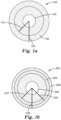
- FIG. 1a A surface-treating article according to some embodiments is shown in FIG. 1a .
- circular substrate (100) has a first radius (110) and a second radius (120), where the second radius is longer than the first radius.
- the two radii define an abrasive region (130) that has a first concentration at the edge corresponding to the end point of the first radius and a second concentration at the edge corresponding to the endpoint of the second radius.
- the concentration gradient in the abrasive region (130) can either increase from the first concentration to the second concentration (i.e. the first concentration is lower than the second concentration), or decrease from the first concentration to the second concentration (i.e. the first concentration is higher than the second concentration).
- the circular substrate (100) has a central region (140) that does not have any intentionally deposited abrasive.
- the pattern in FIG. 1a only indicates where abrasive is disposed on the surface-treating article, but does not illustrate a gradient of abrasive at different radii on the circular substrate.
- the circular substrate can have any size that is suitable for the abrading, scouring, finishing, sanding, or polishing applications that it is used for.
- the substrate can have a diameter of about 2.54 cm to about 127 cm, about 10.16 cm to about 101.6 cm, about 12.7 cm to about 76.2 cm, or about 15.24 cm to about 50.8 cm (1 inch to about 50 inches, or about 4 inches to about 40 inches, or about 5 inches to about 30 inches, or about 6 inches to about 20 inches), or any range or sub-range between these values.
- the substrate has a diameter of 2.54 cm, 5.08 cm, 10.16 cm, 15.24 cm, 20.32 cm, 25.4 cm, 30.48 cm, 35.56 cm, 40.64 cm, 45.72 cm, 50.8 cm, 63.5 cm, 76.2 cm, 88.9 cm, 101.6 cm, 114.3 cm, or 127 cm (1, 2, 4, 6, 8, 10, 12, 14, 16, 18, 20, 25, 30, 35, 40, 45, or 50 inches), or any range or sub-range between these values. In some embodiments, the substrate has a diameter of about 30.48 cm to about 68.58 cm (12 inches to about 27 inches).
- the substrate has a diameter of about 10.16 cm to about 68.58 cm (4 inches to about 27 inches)
- the circular substrate can have a thickness ranging from about 0.0254 cm to about 2.54 cm, about 0.254 cm to about 2.286 cm, about 0.508 cm to about 2.032 cm, about 0.762 cm to about 1.778 cm, or about 0.762 cm to about 1.524 cm (about 0.01 inches to about 1 inches, about 0.1 inches to about 0.9 inches, about 0.2 inches to about 0.8 inches, about 0.3 inches to about 0.7 inches, or about 0.3 inches to about 0.6 inches), or any range or sub-range between these values.
- the circular substrate has a thickness 0.127 cm, 0.254 cm, 0.381 cm, 0.508 cm, 0.762 cm, 1.016 cm, 1.27 cm, 1.524 cm, 1.778 cm, 2.032 cm, 2.286 cm, or 2.54 cm (0.05, 0.1, 0.15, 0.2, 0.3, 0.4, 0.5, 0.6, 0.7, 0.8, 0.9, or 1.0 inches), or any range or sub-range between these values.
- the substrate has a thickness of about 0.635 cm to about 2.54 cm (0.25 inches to about 1 inch).
- the substrate has a thickness of about 0.0635 cm to about 0.1778 cm (0.025 inches to about 0.07 inches).
- the substrate can include a web open, lofty, three-dimensional nonwoven fibers, including natural and synthetic fibers.
- the substrate comprises natural fiber (e.g., vegetable fibers such as hemp, jute, and the like; animal hair fibers, such as hog's hair), a polyamide (e.g., a nylon), a polyester (e.g., polyethylene terephthalate or polyethylene isophthalate), rayon, polyethylene, polypropylene, a synthetic fiber, or a combination thereof.
- Natural fibers include polymers derived from natural sources, such as polylactic acid derived from corn.
- the substrate can be a non-woven web, including a plurality of fibers, which are adhered to each other at their joints of mutual contact by a binder and/or by being melt-bonded.
- the substrate can be a variety of materials, including paper, woven fabrics, nonwoven fabrics, calendared nonwoven fabrics, polymeric films, stitch-bonded fabrics, open cell foams, closed cell foams, and combinations thereof.
- the abrasive includes abrasive grains.
- the abrasive grains can be any of the abrasive particle materials described herein, such as aluminum oxide, ceramic aluminum oxide, heat-treated aluminum oxide, silicon carbide, co-fused alumina-zirconia, diamond, ceria, titanium diboride, cubic boron nitride, boron carbide, garnet, flint, emery, sol-gel derived abrasive particles, novaculite, pumice, rouge, sand, corundum, sandstone, tripoli, powdered feldspar, staurolite, ceramic iron oxide, glass powder, steel particles, and blends thereof.
- the abrasive is a single abrasive formulation.
- the abrasive can also include resins.
- Exemplary resins suitable for use as an abrasive material in or on a major surface of the surface-treating article described herein include melamine resin, polyester resin such as the condensation product of maleic and phthalic anhydrides and propylene glycol, synthetic polymers such as styrene-butadiene (SBR) copolymers, carboxylated-SBR copolymers, phenol-aldehyde resins, polyesters, polyamides, polyureas, polyvinylidene chloride, polyvinyl chloride, acrylic acid-methylmethacrylate copolymers, acetal copolymers, polyurethanes, and mixtures and cross-linked versions thereof.
- SBR styrene-butadiene
- the substrate further includes a second major surface.
- the second major surface in some embodiments, can be the side of the surface-treating article opposite to the first major surface.
- the second major surface can have any suitable abrasive described herein disposed on it.
- the second major surface has a greater hardness than the substrate as measured on Mohs scale.
- the second major surface can have disposed on it any abrasive suitable for use in the first major surface, including melamine resin, polyester resin such as the condensation product of maleic and phthalic anhydrides and propylene glycol, synthetic polymers such as styrene-butadiene (SBR) copolymers, carboxylated-SBR copolymers, phenol-aldehyde resins, polyesters, polyamides, polyureas, polyvinylidene chloride, polyvinyl chloride, acrylic acid-methylmethacrylate copolymers, acetal copolymers, polyurethanes, and mixtures and cross-linked versions thereof.
- the substrate can also have resin or polymeric materials disposed within the interior of the surface-treating article. The resin or polymeric material can give the surface-treating article additional structural rigidity and provides finishing capability.
- the abrasive or single abrasive formulation can be applied to the surface of the substrate in a coating using any suitable coating techniques, such as spray coating or roll coating.
- any suitable coating techniques such as spray coating or roll coating.
- the abrasive when the abrasive is disposed on the first major surface or second major surface of the surface-treating article, it may penetrate into the interior of the surface-treating article to a depth less than the thickness of the surface-treating article.
- at least some of the abrasive or single abrasive formulation can be present in the interior of or throughout the surface-treating article.
- the abrasive or single abrasive formulation can be present on the first major surface, the second major surface, the interior of the surface-treating article, or any combination thereof.
- the coating containing the abrasive or single abrasive formulation can be deposited on the first or second major surface of the surface-treating article so that a radially non-uniform gradient of the abrasive or single abrasive formulation is formed.
- the coating can include the abrasive or single abrasive formulation, together with binders, fillers, crosslinkers, or other additives suitable for use in such substrates.
- Suitable additives can include an organic solvent, a surfactant, an emulsifier, a dispersant, a crosslinking agent, a catalyst, a rheology modifier, a density modifier, a cure modifier, a free radical initiator, a diluent, an antioxidant, a heat stabilizer, a flame retardant, a plasticizer, filler, a polishing aid, an inorganic particle, a pigment, a dye, an adhesion promoter, antistatic additives, or a combination thereof.
- the coating can be a curable coating composition.
- the first concentration and second concentration of the abrasive are greater than zero. In some embodiments, the first concentration is greater than the second concentration. In some embodiments, the second concertation is greater than the first concentration.
- the ratio of the first concentration to the second concentration can range from about 10:1 to about 1:10. In some embodiments, the ratio of the first concentration to the second concentration can range from about 9:1 to about 1:9, from about 8:1 to about 1:8, from about 7:1 to about 1:7, from about 6:1 to about 1: 6, from about 5:1 to about 1:5, from about 4:1 to about 1:4, from about 3:1 to about 1:3, from about 2:1 to about 1:2, or any range or sub-range between these values. In some embodiments, the ratio of the first concentration to the second concentration can range from about 2:1 to about 1.1:1. In some embodiments, ratio of the first concentration to the second concentration can range from about 1.8:1 to about 1.4:1. In some embodiments, the ratio of the first concentration to the second concentration ranges from about 1:1.2 to about 1:2.2. In some embodiments, the ratio of the first concentration to the second concentration ranges from about 1:1.5 to about 1:2.
- the length of the first radius is less than the length of the second radius.
- the second radius extends from the edge of the substrate to the end of the first radius.
- the first radius or the second radius can be from about 1,27 to about 63,5 cm, about 5.08 to about 53.34 cm, about 7.62 to about 48.26 cm, about 10.16 to about 43.18 cm, about 12.7 to about 40.64 cm, about 15.24 to about 33.02 cm, about 17.78 to about 27.94 cm (0.5 to about 25 inches, about 2 to about 21, about 3 to about 19, about 4 to about 17, about 5 to about 16, about 6 to about 13, or about 7 to about 11 inches) in length.
- the first radius is about 2.54 cm, 5.08 cm, 7.62 cm, 10.16 cm, 12.7 cm, 15.24 cm, 17.78 cm, 20.32 cm, 22.86 cm, 25.4 cm, 27.94 cm, or about 30.48 cm ( 1, 2, 3, 4, 5, 6, 7, 8, 9, 10, 11 or about 12 inches) in length.
- the second radius is about 2.54 cm, 5.08 cm, 7.62 cm, 10.16 cm, 12.7 cm, 15.24 cm, 17.78 cm, 20.32 cm, 22.86 cm, 25.4 cm, 27.94 cm, or about 30.48 cm ( 1, 2, 3, 4, 5, 6, 7, 8, 9, 10, 11 or about 12 inches) in length.
- the ratio of the first concentration to the second concentration ranges in a gradient distribution.
- a concentration of the abrasive at the first radius to the second radius decreases from the first concentration in a gradient distribution to the second concentration.
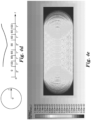
- FIG. 4d depicts a concentration gradient where the first concentration at a radius of 5,08cm (2 inches) decreases along a gradient to a lower concentration at a radius of 15,24cm (6 inches).
- a concentration of the abrasive at the first radius to the second radius increases from the first concentration in a gradient distribution to the second concentration.
- FIG. 3d depicts a concentration gradient where the first concentration at a radius of 5,08cm (2 inches) increases along a gradient to a higher concentration at a radius of 15,24cm (6 inches)
- the first concentration or the second concentration is a maximum abrasive concentration of the first major surface of the surface-treating article. In some embodiments, the first concentration or the second concentration is a minimum abrasive concentration of the first major surface of the surface-treating article.
- FIGS. 2d and 3d show both maximum and minimum first concentrations and second concentrations. In FIGS. 2d and 3d , the maximum concentration has been normalized to a value of 100.
- FIG. 3d shows a first concentration that is a minimum, and a second concentration that is a maximum. In FIG. 3d the minimum concentration is 60% of the maximum concentration.
- FIG. 4d shows a first concentration that is a maximum, and a second concentration that is a minimum. In FIG. 4d the minimum concentration is 55% of the maximum concentration.
- the first major surface includes a central region substantially free of intentionally included abrasive.
- the central region of the first major surface is the portion of the surface-treating article that is mounted on or attached to a machine or apparatus adapted to rotate and/or translate the surface-treating article to effect abrading or polishing a work-surface.
- the central region can be punched out. For this reason depositing any abrasive on this region is economically wasteful.
- the area of the central region can be from about 1% to about 15%, about 2% to about 13%, about 3% to about 11%, or about 4% to about 9% of the total area of the surface treating article.
- the central region can be 1%, 2%, 3%, 4%, 5%, 6%, 7%, 8%, 9%, 10%, 11%, 12%, 13%, 14%, or 15% of the total surface area of the surface-treating article, or any range or sub-range in between these values.
- the surface-treating article further includes an abrasive having a third concentration at a third radius measured from the center of the substrate.
- the first and third concentrations are both greater than the second concentration, and the length of the second radius is between the length of the first radius and the third radius. In some embodiments, the first and third concentrations are both less than the second concentration, and the length of the second radius is between the length of the first radius and the third radius.
- the gradient distribution of the abrasive can have a sinusoidal or parabolic shape, such that the maximum abrasive concentration occurs at the first concentration and the first radius, the minimum concentration occurs at a second concentration and the second radius, and a maximum concentration occurs at a third concentration and the third radius.
- the gradient distribution of the abrasive can also have a sinusoidal or parabolic shape, such that the minimum abrasive concentration occurs at the first concentration and the first radius, the maximum concentration occurs at a second concentration and the second radius, and the minimum concentration occurs at a third concentration and the third radius.
- FIG. 1b A surface-treating article having a first, second, and third concentration and radius is shown in FIG. 1b .
- circular substrate (200) has a first radius (210), a second radius (220), and a third radius (230), where the second radius is longer than the first radius, and the third radius is longer than the second radius.
- the three radii define abrasive regions (250 and 260) that have a first concentration at the edge corresponding to the end point of the first radius, a second concentration at the edge corresponding to the endpoint of the second radius, and a third concentration at the edge corresponding to the endpoint of the third radius.
- the concentration gradient in the abrasive region (250) can either increase from the first concentration to the second concentration (i.e.
- the circular substrate (200) has a central region (240) that does not have any intentionally deposited abrasive.
- the pattern in FIG. 1b only indicates where abrasive is disposed on the surface-treating article, but does not illustrate a gradient of abrasive at different radii on the circular substrate.
- the number of regions having a particular abrasive concentration is not limited, so that the surface-treating article can have a fourth concentration at a fourth radius, a fifth concentration at a fifth radius, and so forth.
- the concentration of abrasive can also be substantially zero at a particular radius, so that the surface-treating article can include regions of abrasive with a gradient distribution interspersed with regions where no abrasive is intentionally deposited. Regions having no abrasive can still have small adventitious amounts of abrasive at the edge where the abrasive-free region meets a region containing abrasive.
- the surface-treating article includes a circular substrate that can include natural fiber, a polyamide, a polyester, rayon, polyethylene, polypropylene, or a combination thereof and having a first major surface.
- the first major surface includes a single abrasive formulation having a first concentration at a first radius, and a single abrasive formulation having a second concentration at a second radius that is a different length than the first radius, where the ratio of the first concentration to the second concentration ranges from about 2:1 to about 1.1:1.
- the surface-treating article includes a circular substrate that can include natural fiber, a polyamide, a polyester, rayon, polyethylene, polypropylene, or a combination thereof and having a first major surface.
- the first major surface includes a single abrasive formulation having a first concentration at a first radius, and a single abrasive formulation having a second concentration at a second radius that is a different length than the first radius, where the ratio of the first concentration to the second concentration ranges from about 1:1.2 to about 1:2.2.
- a surface-treating article for controlling the amount of material removed from a work-surface.
- the surface-treating article includes a circular substrate having a first major surface.
- the first major surface includes an abrasive having a first concentration at a first radius measured from the center of the substrate, and the abrasive having a second concentration not equal to the first concentration at a second radius measured from the center of the substrate that is a different length than the first radius, where the amount of material removed from a work-surface by the surface-treating article is a function of the difference between the first concentration and the second concentration.
- the pattern of material removed from the work-surface by the surface-treating article is a function of the difference between the first concentration and the second concentration.
- the overall pattern of material removed from the work-surface is produce by a combination of regions of lower first concentration and higher second concentration or regions of higher first concentration and lower second concentration.
- the number of regions on the surface-treating article and the pattern of material removed from the work-surface will also depend on the number of non-radial abrasive gradient distributions on the entire surface of the surface-treating article.
- the work-surface can be any surface that requires controlled removal of material such as wood, stone, metal, ceramic, glass, mineral, cured polymer, or combinations thereof.
- the work-surface can include resilient floor, vinyl composition tile (VCT) tile, laminate, hardwood, seamless polymer floor, etc. and surfaces that have been treated with coatings.
- VCT vinyl composition tile
- Modeling was used to simulate the situation of a floor pad scrubbing on the floor.
- a 20 inch circular pad with uniform abrasive grain distribution was calculated first.
- the pad self-rotational speed of 200rpm and its translational speed of 0.366 m/s (72 feet per minute) were used in the modeling to simulate the actual conditions of a floor pad under the floor scrubbing machine.
- a pad having a uniform abrasive grain distribution was modeled. There were 800 abrasive grains in total and three randomizations of the abrasive grains were generated.
- FIGS. 1a-1c Three random uniform abrasive grain distributions on a circular pad are shown in FIGS. 1a-1c .
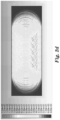
- FIG. 2d shows a representative modeling result. The pad was rotated courter clock-wise at a speed of 200 rpm and a translational speed of 0.366 m/s (72 feet per minute) (to the right). One side of the pad has higher density of scratches, and both center and edge of the pad have lower density of the pad. A pad with uniform abrasive grain distribution does not provide a uniform scratch pattern on the floor.
- a pad having a radially non-uniform abrasive grain distribution was modeled. There were 800 abrasive grains in total and three randomizations of the abrasive grains were generated.
- FIGS. 2a-2c Three random radially non-uniform random gradient distributions on a circular pad are shown in FIGS. 2a-2c .
- the center and edge of the pad have lower concentration of abrasive grains than the middle portion of the pad.
- the distribution is gradient distribution having a normalized maximum abrasive grain concentration at the portion in the distribution curve marked 100.
- the abrasive grain concentration decreases on either side of the maximum point in a continuous gradient.
- FIG. 3e A representative modeling result of the scratch pattern of a radially non-uniform grain distribution of 800 grains on a circular pad is shown in FIG. 3e .
- the pad was rotated courter clock-wise at a speed of 200 rpm and a translational speed of 0.366 m/s (72 feet per minute) (to the right).
- This embodiment shows a higher density of scratches in the middle (between center and edge of the pad), which is the most effective working area.
- a pad having a radially non-uniform abrasive grain distribution was modeled. There were 800 abrasive grains in total and three randomizations of the abrasive grains were generated.
- FIGS. 3a-3c Three random radially non-uniform random gradient distributions on a circular pad are shown in FIGS. 3a-3c .
- the center and edge of the pad have higher concentration of the abrasive grains than the middle portion of the pad.
- the distribution is gradient distribution having a normalized maximum abrasive grain concentration at the portions in the distribution curve marked 100.
- the abrasive grain concentration decreases between the maximum points in a continuous gradient.
- FIG. 4e A representative modeling result of the scratch pattern of a radially non-uniform grain distribution of 800 grains on the circular pad is shown in FIG. 4e .
- the pad is rotated courter clock-wise at a speed of 200 rpm and a translational speed of 72 feet per minute (to the right).
- This embodiment shows a more uniform distribution of scratches, which will allow a more uniform appearance on the floor.
- FIG. 5 plots Sample 1 (uniform grain distribution), Sample 2 (radially non-uniform gradient distribution with maximum abrasive concentration in the middle of the pad and minimum abrasive concertation at the center and edge of the pad), and Sample 3 (radially non-uniform gradient distribution with minimum abrasive concentration in the middle of the pad and maximum abrasive concertation at the center and edge of the pad).
- Standard deviations for Samples 1, 2, and 3 are 14.05, 18.55, and 9.48, respectively.
- the scratch pattern of Sample 3 is more uniform across the floor with smaller standard deviation, Sample 2 with more abrasive grains in the middle of the pad showed more scratches in the most effective working zone.
- 3M TM Aqua TM 3100 Floor Pad (50.8 cm - 20 inches) were used as a starting material. Such pads are available from 3M Company, St. Paul, MN, USA. The fibers constituting the pad are held together at their points of mutual contact by a primary polymer resin. The pad is flexible and resilient and contains polyester fibers.
- a homogenous polymer resin mixture was prepared, consisting of 292.5 grams of Phenol resin BB077a (available from Arclin USA, LLC, Roswell, Georgia, 300076), 511.2 grams of aluminum oxides 240f (available from Washington Mills, Niagara Falls, NY, 14302), and 196.3 grams of water.
- the resin mixture was evenly sprayed onto one of the surfaces of the 50.8 cm (20 inch) floor pad by hand using a standard type compressed air spray gun (normally used for spraying paint) with above mixture.
- the wet (uncured resin) add-on weight thereafter weighed 81 grams.
- test area was prepared by coating a bare vinyl composition tile (VCT) floor with 4 coats of Signature floor finish (available from Sealed Air, Charlotte, NC, 28273) at a rate of 49,08 square meter per liter (2000sq. ft per gallon) and allowed to cure 2 days before testing.
- VCT bare vinyl composition tile
- Signature floor finish available from Sealed Air, Charlotte, NC, 28273
- Each of Examples was mounted on a Tennant T300 auto scrubber filled with water only. After conditioning the pad by running for 15 linear feet, the sample was used to scrub a test lane at ⁇ 72 feet per minute at the high-pressure setting.
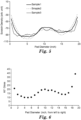
- FIG. 6 is a plot of 60° Gloss across the test lane on a vinyl composition tile (VCT) tile with signature floor finish after scrubbing with a floor pad having uniform abrasive grain distribution.
- VCT vinyl composition tile
Landscapes
- Engineering & Computer Science (AREA)
- Mechanical Engineering (AREA)
- Polishing Bodies And Polishing Tools (AREA)
- Cleaning Implements For Floors, Carpets, Furniture, Walls, And The Like (AREA)
Claims (11)
- Ein Bodenbehandlungspad, aufweisend:ein kreisförmiges Substrat (100, 200), aufweisend ein Gewebe aus offenen, voluminösen Vliesfasern, das Substrat aufweisend eine erste Hauptoberfläche (130);eine Beschichtung, die ein Schleifmittel und ein Harz enthält, die auf der ersten Hauptoberfläche (130) angeordnet ist;wobei das Schleifmittel an einem ersten Radius (110, 210), gemessen von der Mitte des Substrats, eine erste Konzentration aufweist,wobei das Schleifmittel an einem zweiten Radius (120, 220), gemessen von der Mitte des Substrats, eine zweite Konzentration aufweist, die ungleich der ersten Konzentration ist, wobei der erste Radius (110, 210) und der zweite Radius (120, 220) von unterschiedlicher Länge sind, und die Länge des ersten Radius (110, 210) kleiner als die Länge des zweiten Radius (120, 220) ist; undwobei die erste Konzentration und die zweite Konzentration größer als Null sind,dadurch gekennzeichnet, dass das Schleifmittel an einem dritten Radius, gemessen von der Mitte des Substrats, eine dritte Konzentration aufweist, wobei die erste und die dritte Konzentration beide größer als die zweite Konzentration sind, und die Länge des zweiten Radius zwischen der Länge des ersten Radius und des dritten Radius liegt.
- Das Bodenbehandlungspad nach Anspruch 1, wobei das Substrat eine Naturfaser, ein Polyamid, ein Polyester, Viskose, Polyethylen, Polypropylen, eine synthetische Faser oder eine Kombination davon aufweist.
- Das Bodenbehandlungspad nach Anspruch 1, wobei das Schleifmittel Schleifkörner aufweist.
- Das Bodenbehandlungspad nach Anspruch 1, wobei das Substrat ferner eine zweite Hauptoberfläche aufweist.
- Das Bodenbehandlungspad nach Anspruch 4, wobei die zweite Hauptoberfläche eine Schleifmittelbeschichtung aufweist, die Schleifteilchen enthält, die eine größere Härte als das Substrat aufweisen.
- Das Bodenbehandlungspad nach Anspruch 1, wobei die Beschichtung auf der ersten Hauptoberfläche in einem radial ungleichmäßigen Gradienten angeordnet ist.
- Das Bodenbehandlungspad nach Anspruch 1, wobei eine Konzentration des Schleifmittels an dem ersten Radius zu dem zweiten Radius von der ersten Konzentration in einer Gradientenverteilung zu der zweiten Konzentration abnimmt.
- Das Bodenbehandlungspad nach Anspruch 1, wobei eine Konzentration des Schleifmittels an dem ersten Radius zu dem zweiten Radius von der ersten Konzentration in einer Gradientenverteilung zu der zweiten Konzentration zunimmt.
- Das Bodenbehandlungspad nach Anspruch 1, wobei die erste Konzentration oder die zweite Konzentration eine maximale Schleifkonzentration der ersten Hauptoberfläche des Bodenbehandlungspads ist.
- Das Bodenbehandlungspad nach Anspruch 1, wobei die erste Konzentration oder die zweite Konzentration eine minimale Schleifkonzentration der ersten Hauptoberfläche des Bodenbehandlungspads ist.
- Das Bodenbehandlungspad nach Anspruch 1, wobei die erste Hauptoberfläche eine mittlere Region (140, 240) aufweist, die im Wesentlichen frei von absichtlich enthaltenem Schleifmittel ist.
Applications Claiming Priority (2)
| Application Number | Priority Date | Filing Date | Title |
|---|---|---|---|
| US201762539120P | 2017-07-31 | 2017-07-31 | |
| PCT/IB2018/055037 WO2019025883A1 (en) | 2017-07-31 | 2018-07-09 | VARIABLE ABRASIVE DISTRIBUTION FLOOR MAT |
Publications (2)
| Publication Number | Publication Date |
|---|---|
| EP3661697A1 EP3661697A1 (de) | 2020-06-10 |
| EP3661697B1 true EP3661697B1 (de) | 2025-02-19 |
Family
ID=63143295
Family Applications (1)
| Application Number | Title | Priority Date | Filing Date |
|---|---|---|---|
| EP18752261.0A Active EP3661697B1 (de) | 2017-07-31 | 2018-07-09 | Bodenpad mit variabler schleifverteilung |
Country Status (8)
| Country | Link |
|---|---|
| US (1) | US11806838B2 (de) |
| EP (1) | EP3661697B1 (de) |
| JP (1) | JP7262439B2 (de) |
| KR (1) | KR102619228B1 (de) |
| CA (1) | CA3071501A1 (de) |
| MX (1) | MX2020001195A (de) |
| TW (1) | TWI826383B (de) |
| WO (1) | WO2019025883A1 (de) |
Families Citing this family (3)
| Publication number | Priority date | Publication date | Assignee | Title |
|---|---|---|---|---|
| JP2023521096A (ja) * | 2020-04-07 | 2023-05-23 | サンーゴバン アブレイシブズ,インコーポレイティド | 固定研磨バフ |
| CN114378715B (zh) * | 2020-10-16 | 2023-05-30 | 万华化学集团电子材料有限公司 | 一种化学机械抛光垫及抛光方法 |
| US20240316724A1 (en) * | 2023-03-21 | 2024-09-26 | Taiwan Semiconductor Manufacturing Company, Ltd. | Multi-pattern in-pad surface for polish rate control |
Citations (1)
| Publication number | Priority date | Publication date | Assignee | Title |
|---|---|---|---|---|
| US20100266812A1 (en) * | 2009-04-17 | 2010-10-21 | 3M Innovative Properties Company | Planar abrasive articles made using transfer articles and method of making the same |
Family Cites Families (18)
| Publication number | Priority date | Publication date | Assignee | Title |
|---|---|---|---|---|
| DE1694594C3 (de) | 1960-01-11 | 1975-05-28 | Minnesota Mining And Manufacturing Co., Saint Paul, Minn. (V.St.A.) | Reinigungs- und Polierkörper |
| US6062958A (en) | 1997-04-04 | 2000-05-16 | Micron Technology, Inc. | Variable abrasive polishing pad for mechanical and chemical-mechanical planarization |
| CZ20003542A3 (cs) * | 1998-03-27 | 2001-12-12 | Norton Company | Brusný nástroj |
| US7201645B2 (en) | 1999-11-22 | 2007-04-10 | Chien-Min Sung | Contoured CMP pad dresser and associated methods |
| US20060059785A1 (en) * | 2002-09-24 | 2006-03-23 | Chien-Min Sung | Methods of maximizing retention of superabrasive particles in a metal matrix |
| TWI238753B (en) * | 2002-12-19 | 2005-09-01 | Miyanaga Kk | Diamond disk for grinding |
| US20050076577A1 (en) | 2003-10-10 | 2005-04-14 | Hall Richard W.J. | Abrasive tools made with a self-avoiding abrasive grain array |
| US10065283B2 (en) * | 2005-03-15 | 2018-09-04 | Twister Cleaning Technology Ab | Method and tool for maintenance of hard surfaces, and a method for manufacturing such a tool |
| DE602005001110T2 (de) | 2005-03-15 | 2008-01-10 | Htc Sweden Ab | Verfahren zur Instandhaltung harter Oberflächen |
| DK1877219T3 (da) * | 2005-03-15 | 2011-10-03 | Htc Sweden Ab | Fremgangsmåde til at vedligeholde en hård, glat gulvoverfladse omfattende et polymermateriale |
| CN102483540B (zh) | 2009-10-15 | 2014-10-15 | 夏普株式会社 | 液晶显示面板及其制造方法、液晶显示装置 |
| ITMI20110850A1 (it) * | 2011-05-16 | 2012-11-17 | Nicola Fiore | Utensile multi-abrasivo |
| WO2013181582A1 (en) | 2012-05-31 | 2013-12-05 | Ryan Webster | Diamond impregnated polishing pad with diamond pucks |
| TWI589404B (zh) | 2013-06-28 | 2017-07-01 | 聖高拜磨料有限公司 | 基於向日葵圖案之經塗佈的研磨製品 |
| JP6964588B2 (ja) | 2015-09-08 | 2021-11-10 | スリーエム イノベイティブ プロパティズ カンパニー | 砥粒凝集体を伴う砥粒回転ツール |
| USD843672S1 (en) | 2017-07-31 | 2019-03-19 | 3M Innovative Properties Company | Floor pad |
| USD843673S1 (en) | 2017-08-09 | 2019-03-19 | 3M Innovtive Properties Company | Floor pad |
| USD844272S1 (en) | 2017-08-09 | 2019-03-26 | 3M Innovative Properties Company | Floor pad |
-
2018
- 2018-07-09 MX MX2020001195A patent/MX2020001195A/es unknown
- 2018-07-09 US US16/635,332 patent/US11806838B2/en active Active
- 2018-07-09 WO PCT/IB2018/055037 patent/WO2019025883A1/en not_active Ceased
- 2018-07-09 EP EP18752261.0A patent/EP3661697B1/de active Active
- 2018-07-09 CA CA3071501A patent/CA3071501A1/en active Pending
- 2018-07-09 JP JP2020504696A patent/JP7262439B2/ja active Active
- 2018-07-09 KR KR1020207005879A patent/KR102619228B1/ko active Active
- 2018-07-19 TW TW107124889A patent/TWI826383B/zh active
Patent Citations (1)
| Publication number | Priority date | Publication date | Assignee | Title |
|---|---|---|---|---|
| US20100266812A1 (en) * | 2009-04-17 | 2010-10-21 | 3M Innovative Properties Company | Planar abrasive articles made using transfer articles and method of making the same |
Also Published As
| Publication number | Publication date |
|---|---|
| JP2020529329A (ja) | 2020-10-08 |
| WO2019025883A1 (en) | 2019-02-07 |
| KR102619228B1 (ko) | 2024-01-02 |
| EP3661697A1 (de) | 2020-06-10 |
| TW201909828A (zh) | 2019-03-16 |
| MX2020001195A (es) | 2020-03-20 |
| US20200156216A1 (en) | 2020-05-21 |
| US11806838B2 (en) | 2023-11-07 |
| BR112020002026A2 (pt) | 2020-10-06 |
| JP7262439B2 (ja) | 2023-04-21 |
| KR20200036911A (ko) | 2020-04-07 |
| TWI826383B (zh) | 2023-12-21 |
| CA3071501A1 (en) | 2019-02-07 |
Similar Documents
| Publication | Publication Date | Title |
|---|---|---|
| US20240343961A1 (en) | Shaped abrasive particles with sharp tips | |
| KR101671708B1 (ko) | 불균일한 개구들 분포를 가지는 연마물품 | |
| US20230038232A1 (en) | Floor Finish Removal Pad Assembly and Method of Removing Floor Finish | |
| EP3283258B1 (de) | Vliesschleifartikel und verfahren zur herstellung davon | |
| CN106029302B (zh) | 磨料制品及其使用方法 | |
| EP0562919B1 (de) | Verfahren zur Herstellung eines Polierwerkzeuges und nach diesem Verfahren hergestelltes Werkzeug | |
| CN102958649B (zh) | 非织造磨轮 | |
| US11691248B2 (en) | Abrasive articles including an anti-loading size layer | |
| US11806838B2 (en) | Floor pad with variable abrasive distribution | |
| US9358669B2 (en) | High adhesion resin-mineral systems | |
| CN113474122B (zh) | 磨料制品及其制备和使用方法 | |
| CN102666021B (zh) | 抗填塞磨料物品 | |
| EP3370918B1 (de) | Beschichteter schleifartikel | |
| US20180185986A1 (en) | Abrasive buffing articles | |
| BR112020002026B1 (pt) | Artigo para tratamento de superfícies | |
| US20230089669A1 (en) | Abrasive articles including an anti-loading size layer with enhanced manufacturability | |
| US20250187145A1 (en) | Nonwoven abrasive article and methods of making the same |
Legal Events
| Date | Code | Title | Description |
|---|---|---|---|
| STAA | Information on the status of an ep patent application or granted ep patent |
Free format text: STATUS: UNKNOWN |
|
| STAA | Information on the status of an ep patent application or granted ep patent |
Free format text: STATUS: THE INTERNATIONAL PUBLICATION HAS BEEN MADE |
|
| PUAI | Public reference made under article 153(3) epc to a published international application that has entered the european phase |
Free format text: ORIGINAL CODE: 0009012 |
|
| STAA | Information on the status of an ep patent application or granted ep patent |
Free format text: STATUS: REQUEST FOR EXAMINATION WAS MADE |
|
| 17P | Request for examination filed |
Effective date: 20200130 |
|
| AK | Designated contracting states |
Kind code of ref document: A1 Designated state(s): AL AT BE BG CH CY CZ DE DK EE ES FI FR GB GR HR HU IE IS IT LI LT LU LV MC MK MT NL NO PL PT RO RS SE SI SK SM TR |
|
| AX | Request for extension of the european patent |
Extension state: BA ME |
|
| DAV | Request for validation of the european patent (deleted) | ||
| DAX | Request for extension of the european patent (deleted) | ||
| STAA | Information on the status of an ep patent application or granted ep patent |
Free format text: STATUS: EXAMINATION IS IN PROGRESS |
|
| 17Q | First examination report despatched |
Effective date: 20230710 |
|
| GRAP | Despatch of communication of intention to grant a patent |
Free format text: ORIGINAL CODE: EPIDOSNIGR1 |
|
| STAA | Information on the status of an ep patent application or granted ep patent |
Free format text: STATUS: GRANT OF PATENT IS INTENDED |
|
| INTG | Intention to grant announced |
Effective date: 20240801 |
|
| P01 | Opt-out of the competence of the unified patent court (upc) registered |
Free format text: CASE NUMBER: APP_54807/2024 Effective date: 20241004 |
|
| GRAJ | Information related to disapproval of communication of intention to grant by the applicant or resumption of examination proceedings by the epo deleted |
Free format text: ORIGINAL CODE: EPIDOSDIGR1 |
|
| STAA | Information on the status of an ep patent application or granted ep patent |
Free format text: STATUS: EXAMINATION IS IN PROGRESS |
|
| GRAS | Grant fee paid |
Free format text: ORIGINAL CODE: EPIDOSNIGR3 |
|
| STAA | Information on the status of an ep patent application or granted ep patent |
Free format text: STATUS: GRANT OF PATENT IS INTENDED |
|
| GRAP | Despatch of communication of intention to grant a patent |
Free format text: ORIGINAL CODE: EPIDOSNIGR1 |
|
| INTC | Intention to grant announced (deleted) | ||
| GRAA | (expected) grant |
Free format text: ORIGINAL CODE: 0009210 |
|
| STAA | Information on the status of an ep patent application or granted ep patent |
Free format text: STATUS: THE PATENT HAS BEEN GRANTED |
|
| INTG | Intention to grant announced |
Effective date: 20250103 |
|
| AK | Designated contracting states |
Kind code of ref document: B1 Designated state(s): AL AT BE BG CH CY CZ DE DK EE ES FI FR GB GR HR HU IE IS IT LI LT LU LV MC MK MT NL NO PL PT RO RS SE SI SK SM TR |
|
| REG | Reference to a national code |
Ref country code: GB Ref legal event code: FG4D |
|
| REG | Reference to a national code |
Ref country code: CH Ref legal event code: EP |
|
| REG | Reference to a national code |
Ref country code: DE Ref legal event code: R096 Ref document number: 602018079314 Country of ref document: DE |
|
| REG | Reference to a national code |
Ref country code: IE Ref legal event code: FG4D |
|
| REG | Reference to a national code |
Ref country code: NL Ref legal event code: MP Effective date: 20250219 |
|
| PG25 | Lapsed in a contracting state [announced via postgrant information from national office to epo] |
Ref country code: RS Free format text: LAPSE BECAUSE OF FAILURE TO SUBMIT A TRANSLATION OF THE DESCRIPTION OR TO PAY THE FEE WITHIN THE PRESCRIBED TIME-LIMIT Effective date: 20250519 |
|
| PG25 | Lapsed in a contracting state [announced via postgrant information from national office to epo] |
Ref country code: FI Free format text: LAPSE BECAUSE OF FAILURE TO SUBMIT A TRANSLATION OF THE DESCRIPTION OR TO PAY THE FEE WITHIN THE PRESCRIBED TIME-LIMIT Effective date: 20250219 |
|
| PG25 | Lapsed in a contracting state [announced via postgrant information from national office to epo] |
Ref country code: PL Free format text: LAPSE BECAUSE OF FAILURE TO SUBMIT A TRANSLATION OF THE DESCRIPTION OR TO PAY THE FEE WITHIN THE PRESCRIBED TIME-LIMIT Effective date: 20250219 |
|
| PG25 | Lapsed in a contracting state [announced via postgrant information from national office to epo] |
Ref country code: ES Free format text: LAPSE BECAUSE OF FAILURE TO SUBMIT A TRANSLATION OF THE DESCRIPTION OR TO PAY THE FEE WITHIN THE PRESCRIBED TIME-LIMIT Effective date: 20250219 |
|
| REG | Reference to a national code |
Ref country code: LT Ref legal event code: MG9D |
|
| PG25 | Lapsed in a contracting state [announced via postgrant information from national office to epo] |
Ref country code: NO Free format text: LAPSE BECAUSE OF FAILURE TO SUBMIT A TRANSLATION OF THE DESCRIPTION OR TO PAY THE FEE WITHIN THE PRESCRIBED TIME-LIMIT Effective date: 20250519 Ref country code: IS Free format text: LAPSE BECAUSE OF FAILURE TO SUBMIT A TRANSLATION OF THE DESCRIPTION OR TO PAY THE FEE WITHIN THE PRESCRIBED TIME-LIMIT Effective date: 20250619 |
|
| PG25 | Lapsed in a contracting state [announced via postgrant information from national office to epo] |
Ref country code: NL Free format text: LAPSE BECAUSE OF FAILURE TO SUBMIT A TRANSLATION OF THE DESCRIPTION OR TO PAY THE FEE WITHIN THE PRESCRIBED TIME-LIMIT Effective date: 20250219 |
|
| PG25 | Lapsed in a contracting state [announced via postgrant information from national office to epo] |
Ref country code: HR Free format text: LAPSE BECAUSE OF FAILURE TO SUBMIT A TRANSLATION OF THE DESCRIPTION OR TO PAY THE FEE WITHIN THE PRESCRIBED TIME-LIMIT Effective date: 20250219 |
|
| PG25 | Lapsed in a contracting state [announced via postgrant information from national office to epo] |
Ref country code: LV Free format text: LAPSE BECAUSE OF FAILURE TO SUBMIT A TRANSLATION OF THE DESCRIPTION OR TO PAY THE FEE WITHIN THE PRESCRIBED TIME-LIMIT Effective date: 20250219 Ref country code: PT Free format text: LAPSE BECAUSE OF FAILURE TO SUBMIT A TRANSLATION OF THE DESCRIPTION OR TO PAY THE FEE WITHIN THE PRESCRIBED TIME-LIMIT Effective date: 20250620 |
|
| PG25 | Lapsed in a contracting state [announced via postgrant information from national office to epo] |
Ref country code: BG Free format text: LAPSE BECAUSE OF FAILURE TO SUBMIT A TRANSLATION OF THE DESCRIPTION OR TO PAY THE FEE WITHIN THE PRESCRIBED TIME-LIMIT Effective date: 20250219 Ref country code: GR Free format text: LAPSE BECAUSE OF FAILURE TO SUBMIT A TRANSLATION OF THE DESCRIPTION OR TO PAY THE FEE WITHIN THE PRESCRIBED TIME-LIMIT Effective date: 20250520 |
|
| REG | Reference to a national code |
Ref country code: AT Ref legal event code: MK05 Ref document number: 1767858 Country of ref document: AT Kind code of ref document: T Effective date: 20250219 |
|
| PG25 | Lapsed in a contracting state [announced via postgrant information from national office to epo] |
Ref country code: SE Free format text: LAPSE BECAUSE OF FAILURE TO SUBMIT A TRANSLATION OF THE DESCRIPTION OR TO PAY THE FEE WITHIN THE PRESCRIBED TIME-LIMIT Effective date: 20250219 |
|
| PG25 | Lapsed in a contracting state [announced via postgrant information from national office to epo] |
Ref country code: SM Free format text: LAPSE BECAUSE OF FAILURE TO SUBMIT A TRANSLATION OF THE DESCRIPTION OR TO PAY THE FEE WITHIN THE PRESCRIBED TIME-LIMIT Effective date: 20250219 |
|
| PG25 | Lapsed in a contracting state [announced via postgrant information from national office to epo] |
Ref country code: DK Free format text: LAPSE BECAUSE OF FAILURE TO SUBMIT A TRANSLATION OF THE DESCRIPTION OR TO PAY THE FEE WITHIN THE PRESCRIBED TIME-LIMIT Effective date: 20250219 |
|
| PGFP | Annual fee paid to national office [announced via postgrant information from national office to epo] |
Ref country code: DE Payment date: 20250620 Year of fee payment: 8 |
|
| PG25 | Lapsed in a contracting state [announced via postgrant information from national office to epo] |
Ref country code: IT Free format text: LAPSE BECAUSE OF FAILURE TO SUBMIT A TRANSLATION OF THE DESCRIPTION OR TO PAY THE FEE WITHIN THE PRESCRIBED TIME-LIMIT Effective date: 20250219 |
|
| PG25 | Lapsed in a contracting state [announced via postgrant information from national office to epo] |
Ref country code: AT Free format text: LAPSE BECAUSE OF FAILURE TO SUBMIT A TRANSLATION OF THE DESCRIPTION OR TO PAY THE FEE WITHIN THE PRESCRIBED TIME-LIMIT Effective date: 20250219 |
|
| PG25 | Lapsed in a contracting state [announced via postgrant information from national office to epo] |
Ref country code: CZ Free format text: LAPSE BECAUSE OF FAILURE TO SUBMIT A TRANSLATION OF THE DESCRIPTION OR TO PAY THE FEE WITHIN THE PRESCRIBED TIME-LIMIT Effective date: 20250219 Ref country code: EE Free format text: LAPSE BECAUSE OF FAILURE TO SUBMIT A TRANSLATION OF THE DESCRIPTION OR TO PAY THE FEE WITHIN THE PRESCRIBED TIME-LIMIT Effective date: 20250219 |
|
| PG25 | Lapsed in a contracting state [announced via postgrant information from national office to epo] |
Ref country code: RO Free format text: LAPSE BECAUSE OF FAILURE TO SUBMIT A TRANSLATION OF THE DESCRIPTION OR TO PAY THE FEE WITHIN THE PRESCRIBED TIME-LIMIT Effective date: 20250219 |
|
| PG25 | Lapsed in a contracting state [announced via postgrant information from national office to epo] |
Ref country code: SK Free format text: LAPSE BECAUSE OF FAILURE TO SUBMIT A TRANSLATION OF THE DESCRIPTION OR TO PAY THE FEE WITHIN THE PRESCRIBED TIME-LIMIT Effective date: 20250219 |
|
| REG | Reference to a national code |
Ref country code: DE Ref legal event code: R097 Ref document number: 602018079314 Country of ref document: DE |
|
| PLBE | No opposition filed within time limit |
Free format text: ORIGINAL CODE: 0009261 |
|
| STAA | Information on the status of an ep patent application or granted ep patent |
Free format text: STATUS: NO OPPOSITION FILED WITHIN TIME LIMIT |
|
| REG | Reference to a national code |
Ref country code: CH Ref legal event code: L10 Free format text: ST27 STATUS EVENT CODE: U-0-0-L10-L00 (AS PROVIDED BY THE NATIONAL OFFICE) Effective date: 20251231 |
|
| 26N | No opposition filed |
Effective date: 20251120 |
|
| REG | Reference to a national code |
Ref country code: CH Ref legal event code: H13 Free format text: ST27 STATUS EVENT CODE: U-0-0-H10-H13 (AS PROVIDED BY THE NATIONAL OFFICE) Effective date: 20260224 |
|
| PG25 | Lapsed in a contracting state [announced via postgrant information from national office to epo] |
Ref country code: LU Free format text: LAPSE BECAUSE OF NON-PAYMENT OF DUE FEES Effective date: 20250709 |
|
| GBPC | Gb: european patent ceased through non-payment of renewal fee |
Effective date: 20250709 |
|
| REG | Reference to a national code |
Ref country code: BE Ref legal event code: MM Effective date: 20250731 |
|
| PG25 | Lapsed in a contracting state [announced via postgrant information from national office to epo] |
Ref country code: GB Free format text: LAPSE BECAUSE OF NON-PAYMENT OF DUE FEES Effective date: 20250709 |
|
| PG25 | Lapsed in a contracting state [announced via postgrant information from national office to epo] |
Ref country code: BE Free format text: LAPSE BECAUSE OF NON-PAYMENT OF DUE FEES Effective date: 20250731 |
|
| PG25 | Lapsed in a contracting state [announced via postgrant information from national office to epo] |
Ref country code: FR Free format text: LAPSE BECAUSE OF NON-PAYMENT OF DUE FEES Effective date: 20250731 |
|
| PG25 | Lapsed in a contracting state [announced via postgrant information from national office to epo] |
Ref country code: CH Free format text: LAPSE BECAUSE OF NON-PAYMENT OF DUE FEES Effective date: 20250731 |