EP3653285A1 - Graphennanofensterstruktur und verfahren zur herstellung von hochreinem gas - Google Patents
Graphennanofensterstruktur und verfahren zur herstellung von hochreinem gas Download PDFInfo
- Publication number
- EP3653285A1 EP3653285A1 EP18831774.7A EP18831774A EP3653285A1 EP 3653285 A1 EP3653285 A1 EP 3653285A1 EP 18831774 A EP18831774 A EP 18831774A EP 3653285 A1 EP3653285 A1 EP 3653285A1
- Authority
- EP
- European Patent Office
- Prior art keywords
- nanowindow
- graphene
- permeating
- rim
- molecule
- Prior art date
- Legal status (The legal status is an assumption and is not a legal conclusion. Google has not performed a legal analysis and makes no representation as to the accuracy of the status listed.)
- Withdrawn
Links
Images


Classifications
-
- B—PERFORMING OPERATIONS; TRANSPORTING
- B01—PHYSICAL OR CHEMICAL PROCESSES OR APPARATUS IN GENERAL
- B01D—SEPARATION
- B01D67/00—Processes specially adapted for manufacturing semi-permeable membranes for separation processes or apparatus
- B01D67/0039—Inorganic membrane manufacture
- B01D67/0053—Inorganic membrane manufacture by inducing porosity into non porous precursor membranes
- B01D67/006—Inorganic membrane manufacture by inducing porosity into non porous precursor membranes by elimination of segments of the precursor, e.g. nucleation-track membranes, lithography or laser methods
-
- B—PERFORMING OPERATIONS; TRANSPORTING
- B01—PHYSICAL OR CHEMICAL PROCESSES OR APPARATUS IN GENERAL
- B01D—SEPARATION
- B01D53/00—Separation of gases or vapours; Recovering vapours of volatile solvents from gases; Chemical or biological purification of waste gases, e.g. engine exhaust gases, smoke, fumes, flue gases, aerosols
- B01D53/22—Separation of gases or vapours; Recovering vapours of volatile solvents from gases; Chemical or biological purification of waste gases, e.g. engine exhaust gases, smoke, fumes, flue gases, aerosols by diffusion
- B01D53/228—Separation of gases or vapours; Recovering vapours of volatile solvents from gases; Chemical or biological purification of waste gases, e.g. engine exhaust gases, smoke, fumes, flue gases, aerosols by diffusion characterised by specific membranes
-
- B—PERFORMING OPERATIONS; TRANSPORTING
- B01—PHYSICAL OR CHEMICAL PROCESSES OR APPARATUS IN GENERAL
- B01D—SEPARATION
- B01D69/00—Semi-permeable membranes for separation processes or apparatus characterised by their form, structure or properties; Manufacturing processes specially adapted therefor
- B01D69/02—Semi-permeable membranes for separation processes or apparatus characterised by their form, structure or properties; Manufacturing processes specially adapted therefor characterised by their properties
-
- B—PERFORMING OPERATIONS; TRANSPORTING
- B01—PHYSICAL OR CHEMICAL PROCESSES OR APPARATUS IN GENERAL
- B01D—SEPARATION
- B01D71/00—Semi-permeable membranes for separation processes or apparatus characterised by the material; Manufacturing processes specially adapted therefor
- B01D71/02—Inorganic material
- B01D71/021—Carbon
- B01D71/0211—Graphene or derivates thereof
-
- B—PERFORMING OPERATIONS; TRANSPORTING
- B01—PHYSICAL OR CHEMICAL PROCESSES OR APPARATUS IN GENERAL
- B01D—SEPARATION
- B01D71/00—Semi-permeable membranes for separation processes or apparatus characterised by the material; Manufacturing processes specially adapted therefor
- B01D71/02—Inorganic material
- B01D71/028—Molecular sieves
- B01D71/0281—Zeolites
-
- C—CHEMISTRY; METALLURGY
- C01—INORGANIC CHEMISTRY
- C01B—NON-METALLIC ELEMENTS; COMPOUNDS THEREOF; METALLOIDS OR COMPOUNDS THEREOF NOT COVERED BY SUBCLASS C01C
- C01B21/00—Nitrogen; Compounds thereof
- C01B21/04—Purification or separation of nitrogen
- C01B21/0405—Purification or separation processes
- C01B21/0433—Physical processing only
- C01B21/0438—Physical processing only by making use of membranes
- C01B21/0444—Physical processing only by making use of membranes characterised by the membrane
-
- C—CHEMISTRY; METALLURGY
- C01—INORGANIC CHEMISTRY
- C01B—NON-METALLIC ELEMENTS; COMPOUNDS THEREOF; METALLOIDS OR COMPOUNDS THEREOF NOT COVERED BY SUBCLASS C01C
- C01B32/00—Carbon; Compounds thereof
- C01B32/15—Nano-sized carbon materials
- C01B32/182—Graphene
- C01B32/194—After-treatment
-
- B—PERFORMING OPERATIONS; TRANSPORTING
- B01—PHYSICAL OR CHEMICAL PROCESSES OR APPARATUS IN GENERAL
- B01D—SEPARATION
- B01D2256/00—Main component in the product gas stream after treatment
- B01D2256/10—Nitrogen
-
- B—PERFORMING OPERATIONS; TRANSPORTING
- B01—PHYSICAL OR CHEMICAL PROCESSES OR APPARATUS IN GENERAL
- B01D—SEPARATION
- B01D2311/00—Details relating to membrane separation process operations and control
- B01D2311/26—Further operations combined with membrane separation processes
- B01D2311/2603—Application of an electric field, different from the potential difference across the membrane
-
- B—PERFORMING OPERATIONS; TRANSPORTING
- B01—PHYSICAL OR CHEMICAL PROCESSES OR APPARATUS IN GENERAL
- B01D—SEPARATION
- B01D2311/00—Details relating to membrane separation process operations and control
- B01D2311/26—Further operations combined with membrane separation processes
- B01D2311/2611—Irradiation
-
- B—PERFORMING OPERATIONS; TRANSPORTING
- B01—PHYSICAL OR CHEMICAL PROCESSES OR APPARATUS IN GENERAL
- B01D—SEPARATION
- B01D2325/00—Details relating to properties of membranes
- B01D2325/26—Electrical properties
-
- B—PERFORMING OPERATIONS; TRANSPORTING
- B01—PHYSICAL OR CHEMICAL PROCESSES OR APPARATUS IN GENERAL
- B01D—SEPARATION
- B01D53/00—Separation of gases or vapours; Recovering vapours of volatile solvents from gases; Chemical or biological purification of waste gases, e.g. engine exhaust gases, smoke, fumes, flue gases, aerosols
- B01D53/32—Separation of gases or vapours; Recovering vapours of volatile solvents from gases; Chemical or biological purification of waste gases, e.g. engine exhaust gases, smoke, fumes, flue gases, aerosols by electrical effects other than those provided for in group B01D61/00
- B01D53/323—Separation of gases or vapours; Recovering vapours of volatile solvents from gases; Chemical or biological purification of waste gases, e.g. engine exhaust gases, smoke, fumes, flue gases, aerosols by electrical effects other than those provided for in group B01D61/00 by electrostatic effects or by high-voltage electric fields
-
- C—CHEMISTRY; METALLURGY
- C01—INORGANIC CHEMISTRY
- C01B—NON-METALLIC ELEMENTS; COMPOUNDS THEREOF; METALLOIDS OR COMPOUNDS THEREOF NOT COVERED BY SUBCLASS C01C
- C01B2210/00—Purification or separation of specific gases
- C01B2210/0001—Separation or purification processing
- C01B2210/0009—Physical processing
- C01B2210/001—Physical processing by making use of membranes
- C01B2210/0012—Physical processing by making use of membranes characterised by the membrane
-
- C—CHEMISTRY; METALLURGY
- C01—INORGANIC CHEMISTRY
- C01P—INDEXING SCHEME RELATING TO STRUCTURAL AND PHYSICAL ASPECTS OF SOLID INORGANIC COMPOUNDS
- C01P2002/00—Crystal-structural characteristics
- C01P2002/50—Solid solutions
- C01P2002/52—Solid solutions containing elements as dopants
Definitions
- the present invention relates to a technology for separating molecules using a molecular sieve such as graphene.
- distillation is widely used in order to obtain high-purity products and supplies N 2 , O 2 , and noble gases of high purity to other industries; however, distillation is accompanied by a phase change of converting a liquid to a gas, and the energy consumed for this phase change is huge.
- Membrane-based separation technologies require small installation areas for equipment and have reduced mechanical complexity compared to conventional technologies based on phase separation. In particular, energy is reduced by 90% compared to distillation, and CO 2 emissions can be reduced to a large extent.
- nanowindows One of the most promising membranes is a single-layer graphene membrane having nanoscale-sized windows (nanowindows), and since the periphery of nanowindows is composed of a single layer of carbon atoms and is a very thin film, when substances permeate the nanowindows, the nanowindows bring about ultrafast permeation without becoming an obstacle to permeation.
- Graphene which is a two-dimensional material formed from a hexagonal crystal network of closely covalently bonded carbon atoms, is considered ever increasingly important in the field of new materials. Since synthesis processes are being continuously improved, it is expected to achieve mass production of almost defect-free graphene in the near future. Due to the one-atom thickness, fastness properties, chemical stability, and a property of being easily processable to a sieve, one of the most important use applications of graphene is the use as a separation membrane.
- Graphene with nanowindows has potential to become the most selective and highly energy-efficient membrane for molecular separation.
- graphene having nanowindows can realize permeation resistance with which the single-atom-thick wall thereof is almost negligible, and can therefore realize ultrafast molecular permeation.
- the present invention was achieved in order to solve the problems described above, and it is an object of the invention to provide a molecular sieve that has high selectivity and also enables high-speed molecular permeation.
- a graphene nanowindow structure has a nanowindow formed lacking a portion of carbon atoms in graphene; and one or more heteroatoms substituting for one or more carbon atoms that constitute a rim of this nanowindow, in which an electrostatic field is induced within the nanowindow by the heteroatoms, the rim of the nanowindow is relaxed in cooperation with a permeating molecule having a van der Waals' radius larger than the nanowindow, and the graphene nanowindow structure becomes permeable to the permeating molecule.
- a graphene nanowindow structure has a nanowindow formed lacking a portion of carbon atoms in graphene; and one or more heteroatoms substituting for one or more carbon atoms that constitute the a of this nanowindow, in which breathing vibration is induced in a rim of the nanowindow by the heteroatoms, the rim of the nanowindow is relaxed in cooperation with a permeating molecule having a van der Waals' radius larger than the nanowindow, and the graphene nanowindow structure becomes permeable to the permeating molecule.
- a graphene nanowindow structure has a nanowindow formed lacking a portion of carbon atoms in graphene; and one or more functional groups added to one or more carbon atoms that constitute a rim of this nanowindow, in which an electrostatic field is induced within the nanowindow by the functional groups, the rim of the nanowindow is relaxed in cooperation with a permeating molecule having a van der Waals' radius larger than the nanowindow, and the graphene nanowindow structure becomes permeable to the permeating molecule.
- a graphene nanowindow structure has a nanowindow formed lacking a portion of carbon atoms in graphene; and one or more functional groups added to one or more carbon atoms that constitute the a rim of this nanowindow, in which breathing vibration is induced in the rim of the nanowindow by the functional groups, the rim of the nanowindow is relaxed in cooperation with a permeating molecule having a van der Waals' radius larger than the nanowindow, and the graphene nanowindow structure becomes permeable to the permeating molecule.
- a graphene nanowindow structure can switch between a permeable state of being permeable to the permeating molecule and an impermeable state of being impermeable to the permeating molecule due to the electrostatic field, the impermeable state being obtainable from the permeable state by rotating the directions of the functional groups.
- a sixth aspect of the invention is a method for producing a highly pure gas by extracting permeating molecules from a mixed gas that includes permeating molecules and non-permeating molecules, the method including: supplying the mixed gas to a graphene that has a nanowindow having a van der Waals' radius smaller than the permeating molecules and the non-permeating molecules and also has, in a rim of this nanowindow, one or more of a functional group, a heteroatom, or a defective part, all of which cooperate with the permeating molecules; allowing the permeating molecules to permeate the nanowindow while preventing permeation of the non-permeating molecules, through relaxation of the nanowindow as a result of cooperation between the permeating molecules and the functional group, the heteroatom, or the defective part; and collecting the permeating molecules that have permeated the nanowindow.
- a molecular sieve having high selectivity and enabling high-speed molecular permeation, the molecular sieve having one or more heteroatoms substituting for one or more carbon atoms that constitute the rim of a nanowindow, in which an electrostatic field is induced within the nanowindow by the heteroatoms, the rim of the nanowindow is relaxed in cooperation with a permeating molecule having a van der Waals' radius larger than the nanowindow, and the permeating molecule is allowed to permeate.
- a molecular sieve having high selectivity and enabling high-speed molecular permeation, the molecular sieve having one or more heteroatoms substituting for one or more carbon atoms that constitute the rim of a nanowindow, in which breathing vibration is induced in the rim of the nanowindow by the heteroatoms, the rim of the nanowindow is relaxed in cooperation with a permeating molecule having a van der Waals' radius larger than the nanowindow, and the permeating molecule is allowed to permeate.
- a molecular sieve having high selectivity and enabling high-speed molecular permeation, the molecular sieve having one or more functional groups added to one or more carbon atoms that constitute the rim of a nanowindow, in which an electrostatic field is induced within the nanowindow by the functional groups, the rim of the nanowindow is relaxed in cooperation with a permeating molecule having a van der Waals' radius larger than the nanowindow, and the permeating molecule is allowed to permeate.
- a molecular sieve having high selectivity and enabling high-speed molecular permeation, the molecular sieve having one or more functional groups added to one or more carbon atoms that constitute the rim of a nanowindow, in which breathing vibration is induced in the rim of the nanowindow by the functional groups, the rim of the nanowindow is relaxed in cooperation with a permeating molecule having a van der Waals' radius larger than the nanowindow, and the permeating molecule is allowed to permeate.
- a permeable state of being permeable to the permeating molecule and an impermeable state of being impermeable to the permeating molecule due to the electrostatic field, the impermeable state being obtainable from the permeable state by rotating the directions of the functional groups, can be switched, and therefore, the selectivity of permeating molecules can be controlled.
- the mixed gas when the mixed gas is supplied to a graphene having a nanowindow having a van der Waals' radius smaller than the permeating molecules and the non-permeating molecules and having, in the rim of this nanowindow, one or more of a functional group, a heteroatom, or a defective part, all of which cooperate with the permeating molecules; the permeating molecules are allowed to permeate the nanowindow while the non-permeating molecules are not allowed to permeate, through relaxation of the nanowindow as a result of cooperation between the permeating molecules and the functional group, the heteroatom, or the defective part; and the permeating molecules that have permeated the nanowindow are collected, the energy consumption for producing a highly pure gas can be reduced to a large extent.
- the rim means the entire circumference of a nanowindow of graphene composed of carbon atoms and other atoms.
- An edge means atoms constituting a portion of the rim.
- a heteroatom means an atom other than hydrogen and carbon.
- heteroatom examples include oxygen (O), nitrogen (N), sulfur (S), phosphorus (P), chlorine (Cl), iodine (I), bromine (Br), and boron (B) atoms.
- a functional group refers in particular, among general functional groups that impart chemical characteristics, to a functional group added to an atom that constitutes the rim.
- a functional group containing a heteroatom is desired.
- examples include a hydroxyl group, a carboxyl group, and a carbonyl group.
- a flexible nanowindow having functional groups or heteroatoms at an edge of the rim exhibits a behavior that cannot be obtained with a rigid nanowindow having only carbon edges formed by a simple perforation treatment.
- a graphene membrane of the present invention becomes a flexible atomic framework by having functional groups or heteroatoms around the nanowindows.
- the chemical properties including a carbon functional group having a zigzag or armchair shape) of a nanowindow, particularly the rim thereof, become important factors for determining the permeation rate and selectivity of a graphene membrane for all permeable molecules.
- main air components (O 2 , N 2 , and Ar) will be selected as permeating molecules. It is because on the occasion of discussing the role of nanowindows and showing an auxiliary role of the rim, such a separation has an industrial value and represents good examples of molecular interactions of different types (representing dispersion only and dispersion + static electricity, respectively).
- Heteroatoms of the rim induce a strong electrostatic field within a nanowindow.
- Partial charges of the heteroatoms within the rim of a nanowindow induce an electrostatic field in the order of GV/m within a nanowindow.
- An interaction between a molecule having a polarized charge center such as N 2 , and this electric field brings stabilization of about 5 kJ ⁇ mol -1 , which assists in a permeation process of passing through a nanowindow.
- coordinated movement of surface functional groups at the rim of the nanowindow can accelerate permeation of a molecule having a polarized charge center.
- a nanowindow dynamically responds to permeating molecules. That is, the rim (circumference) can vibrate and relax during permeation of a molecule.
- a nanowindow When a nanowindow is considered to have a structure equivalent to the structure of a non-periodic polycyclic polyaromatic molecule, the effect of relaxation is expected to be very large. It is because the structure of such a non-periodic polycyclic polyaromatic molecule is much stronger than a periodic structure and causes phonon vibration. Introduction of flexibility through relaxation of the rim of the nanowindow is important because the introduction occurs in parallel to the permeation of a molecule.
- the geometric sizes and shapes of the nanowindow and a permeating molecule, as well as the chemical properties of the rim of a nanowindow and dynamics such as phonon vibration generally affect molecular permeation through the nanowindow.
- the roles of the edges and functional groups thereof of a nanowindow must be elucidated.
- Graphene was treated in air for 10 minutes at 600 K, and nanowindows having a desired size were formed. Furthermore, this graphene was immersed in a 1 mol/L aqueous solution of nitric acid for one hour at 300 K, and thereby heteroatoms were introduced. The graphene was washed with ultrapure water and then was transferred onto a membrane filter made of polycarbonate, the membrane filter was mounted on a membrane filter holder, and thereby a gas molecular membrane was obtained.
- the charge distribution of the nanowindow rim can be simply controlled by applying electric charge. For example, when the entire graphene is applied to an electron-rich state, the nanowindow rim is filled with electrons, and the nanowindow is in a closed state.
- the functional groups undergo active rotation or libration movement by thermal motion, and the nanowindow is in a closed state. Furthermore, due to the effect of phonon occurring as a result of irradiating the nanowindow rim with electromagnetic waves, the nanowindow is in a closed state.
- the nanowindow can be maintained in an open state.
- the electron distribution of the nanowindow rim or the functional groups changes (cooperates) as a result of an interaction between the electrons of the nanowindow rim or functional groups and the electrons of the permeating molecule
- Coulombic attraction is induced between the nanowindow rim or the functional groups and the permeating molecule (relaxation), and the steric hindrance of the nanowindow rim itself can be sufficiently overcome by the kinetic energy possessed by the permeating molecule.
- O 2 undergoes weak cooperation with the nanowindow rim or the functional groups, and relaxation also occurs. However, since the cooperation is weak, the effect of relaxation is small (O 2 can pass through a nanowindow having a smaller size than its own size).
- N 2 undergoes strong cooperation with the nanowindow rim or the functional groups, and strong relaxation occurs. Therefore, the effect of relaxation is large (N 2 can pass through a nanowindow smaller than its own size more easily than oxygen).
- Ar does not undergo cooperation with the nanowindow rim or the functional groups, and therefore, there is no effect of relaxation.
- nanowindows present in graphene particularly the rim thereof (including carbon functional groups having a zigzag or armchair shape) become important factors that determine the permeation rate and selectivity of a graphene membrane for all molecules capable of permeating.
- a graphene having nanowindows as a model for MD calculation has been modeled by removing carbon atoms from an original graphene layer formed by 640 carbon atoms. Next, exposed ends were passivated with a -H, -OH, or C-O-C terminals.
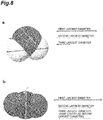
- the nanowindow structure is optimized using MOPAC2016 and PM7 methods, and in a case in which the nanowindow structure just touches the van der Waals 1 radius of rim edge atoms, the size of the nanowindow is determined as the radius of the largest sphere that is most suitable for the nanowindow.
- the effective molecular sizes of O 2 , N 2 , and Ar there is a plurality of options defining the size of a permeating molecule, such as the van der Waals' radius, the size determined from the Lennard-Jones (LJ) potential, or the effective molecular size calculated from the orientation-dependent dimension.
- a permeating molecule such as the van der Waals' radius, the size determined from the Lennard-Jones (LJ) potential, or the effective molecular size calculated from the orientation-dependent dimension.
- LJ Lennard-Jones
- hydroxyl, carboxyl, and carbonyl have several orientations with respect to a nanowindow. Dynamic orientations thereof change the shape of the nanowindow and strongly affect the permeation mechanism and selectivity thereof.
- HOOMD molecular dynamics simulation program package
- implementation of the PPPM method was employed.
- the time step used in all simulations was 1.1 fs.
- the dimensions of a simulation box in the x, y, and z directions were 42.63 ⁇ , 39.38 ⁇ , and 50.00 ⁇ , respectively.
- a graphene layer was disposed in the x-y plane.
- Periodic boundary conditions were used in all of the three directions.
- a reflective LJ wall was disposed at 25 ⁇ from the graphene plane.
- the graphene framework and the functional groups of the nanowindow were dealt with as a flexible structure for the MD simulations, except for a cross-section of nanowindow dihedral angle rotation.
- the system was equilibrated with a fully flexible framework at the system temperature.
- the framework was rapidly cooled and fixed at a certain time, and the energy was minimized during another equilibrium operation and collection.
- nanowindow used in the MD simulation
- a nanowindow including functional groups and having a fully flexible graphene framework was produced. This is a practically feasible nanowindow.
- Six different atomic models of the nanowindow were designed to have an opening size similar to the permeating molecule (see FIG. 1 ). Their "geometric" sizes were measured according to the van der Waals' radius of carbon atoms and heteroatoms of the rim.
- NW-w the opening size of an MD nanowindow
- w was set to the range of 2.57 to 3.78 ⁇ .
- a nanowindow is oxidized in air and is inactivated by H atoms or O atoms. This is a request from the fact that carbon edges that are not inactivated do not exist under conventional conditions.
- Heteroatoms were introduced as hydrogen (R-H), phenol (R-OH), and ether (R-O-R'). There are definitely various heteroatoms, and in the present experiment, the heteroatoms were limited to hydrogen (R-H), phenol (R-OH), and ether (R-O-R'), and MD simulations were performed, (iii) The opening size was set between 2.6 ⁇ and 3.8 ⁇ .
- O 2 , N 2 , and Ar can easily permeate nanowindows that are smaller by 10% than themselves, due to the presence of heteroatoms; (ii) an electrostatic field in the order of GV/m is formed within the nanowindow and helps permeation of molecules; and (iii) functional groups can be operated as gates for atoms and selectively limit the permeation of gases.
- the permeation rates were calculated for nanowindows of various sizes from MD simulations.
- the MD simulations were performed under the condition that there were two compartments separated by a graphene membrane, and that the graphene membrane had nanowindows. One of the two compartments was filled with gas. An MD simulation was started in a state that the other compartment was blank. The permeation rate can be determined as a rate constant.
- NW-3.78 ⁇ and NW-3.70 ⁇ have high permeation rates and low separation selectivity.
- nano-sized pores having a general slit shape or cylinder shape
- the pore diameter was smaller than the size of a molecule
- the molecule could not enter into the nanopores.
- nanowindows molecules larger than the nanowindows permeate the nanowindows.
- An energy profile (see FIG. 2 ) showing the force of an interaction between a nanowindow and a permeating molecule when the molecule permeates the nanowindow, generally has two minima of energy and one maximum of energy. The maximum of energy acts as a barrier when a molecule permeates a nanowindow.
- the energy barrier for permeating a nanowindow having a size similar to a permeating molecule is about 3 to 6 kJ/mol (Joules for every mol) (5 to 9 kT).
- O 2 and N 2 respectively face one of energy barriers of 5 kT and 20 kT.
- the energy contribution is balanced between the constituent elements.
- Ar exhibits ultra-low-speed permeation due to two continuous energy barriers. 21 kT is needed in order to modify functional groups at the time of moving from the basal plane to the upper part of the nanowindow, and then 15 kT is further needed in order to cross the graphene layer and modify the nanowindow.
- Heteroatoms of the rim induce a strong electrostatic field within a nanowindow.
- heteroatom to be introduced examples include nitrogen, oxygen, sulfur, phosphorus, chlorine, iodine, bromine, and boron, and in particular, oxygen and boron act effectively. Due to the difference in electronegativity, oxygen atoms are involved in a donor-like manner, and boron atoms are involved in an acceptor-like manner, with carbon atoms of the nanowindow rim, and an inhomogeneous electron distribution is imparted to the nanowindow rim.
- the rim of a nanowindow is not static and undergoes breathing vibration, and thus the rim behaves as if it breathes and relaxes. This vibration also causes relaxation by allowing the nanowindow rim or functional groups and the permeating molecule to cooperate, in the same manner as the electron distribution.
- Graphene has phonon movement and an intrinsic vibration mode, and generates cooperative vibration in the rim of a nanowindow. These vibrations change the effective size and/or shape of the nanowindow and determine the permeation characteristics thereof.
- the distribution of such a cooperative vibration in the rim can be evaluated by a 2D contour histogram of the distance between facing oxygen atoms (see MD simulation ( FIG. 4(a) , see the distance atom pair corresponding to FIG. 4(b) ).
- Free rotation of functional groups of nanowindows and the vibration of the rim form a kind of gate for permeating molecules.
- Functional groups outside the graphene plane can also dynamically switch the directions thereof.
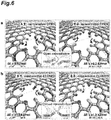
- An MD simulation set of N 2 permeation (see FIG. 5(a) ) through a flexible nanowindow of NW-3.30 ⁇ exhibited very large fluctuations in the permeation rate (10 ⁇ 5 ⁇ s -1 ), even for a simulation time of up to 20 nanoseconds.
- the nanowindow becomes a purely electrostatic gate for the permeation of N 2 as a result of twisting of the functional groups H-O1 and H-O2 (since H is modeled as a charging point that lacks dispersion interactions).
- H is modeled as a charging point that lacks dispersion interactions.
- the 01-02 distance is the shortest open distance, not only the 01-02 distance accomplishes a major role in permeation, but also the positions of H atoms behave as atomic gates for molecules that interact electrostatically. This shows that there is a high possibility of utilizing this effect by including other electrostatic functional groups within the rim of the nanowindow.
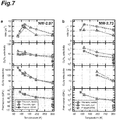
- the nanowindows of the present invention have highly selective and ultrafast permeability ( FIG. 7 ).
- the most selective one for oxygen is NW-2.97 ⁇ (see FIG. 1(c) ).
- the permeation rate constant thereof is 47 ⁇ s -1 , this corresponding to 600 m 3 STP ⁇ min -1 ⁇ m -2 , and the nanowindow has selectivity higher than 50 times (1,500 times for O 2 :Ar) for the O 2 :N 2 separation.
- Carbon molecular sieves can achieve about 30 times for the O 2 :N 2 selection ratio; however, the diffusion limitation is large, and the permeation rate is limited.
- Commercially available polymers such as polysulfone, polycarbonate, and polyimide can achieve permeation rate selection ratios of about 6 times for O 2 :N 2 .
- the present invention enables reduction to a large extent of the energy cost for molecular separation and the amount of CO 2 emission.
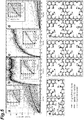
- a circle (O) represents the interaction when each molecule passes through the nanowindow, and a triangle ( ⁇ ), an inverse triangle ( ⁇ ), and a diamond shape ( ⁇ ) represent the details thereof.
- a triangle ( ⁇ ) represents the contribution of the intermolecular force between graphene and the molecule. The contribution of the intermolecular force was calculated from the Lennard-Jones potential.
- An inverse triangle ( ⁇ ) represents the contribution of an electrostatic interaction between the rim of the nanowindow and each molecule, and a diamond shape ( ⁇ ) represents the contribution from a bonding interaction.
- the axis of abscissa represents the distance between the molecule and the nanowindow upon permeating the nanowindow, and the axis of ordinate represents the intermolecular force (repulsive force).
- a lighter color of an atom means that the charge is closer to zero, a darker color of an atom means that the charge is strongly positive or negative.
- a lighter grey color means that the electric field is weaker, and a darker grey color means that the electric field is stronger.
- X-marks respectively represent the positions of atoms.
- FIG. 4 shows breathing vibration (a vibration contracting and expanding concentrically as if breathing occurs) of the nanowindow.
- the square color gradient of (a) corresponds to the distance when N 2 molecules permeate the nanowindow, and a darker mark corresponds to the N 2 center closer to the graphene plane. Therefore, the relationship between the distance of N 2 to the graphene and breathing vibration is shown.
- the shading of the background represents a distribution of the distances between 01-02 and the distances between 03-04, and a darker color represents that the frequency of the distance is high. Therefore, regarding the nanowindow of FIG. 4 , it is shown that the distance between 01-02 and the distance between 03-04 vibrate at an amplitude of about 3.5 ⁇ around 6.16 ⁇ and 6.54 ⁇ , respectively.
- a thin line represents the result of each execution
- a black line represents the average value of all executions
- a shaded area represents the standard deviation for each execution.
- An inserted small graph is linearization of all data including linear approximation with respect to the average.
- an arrow represents the orientation of O(1-2)-H functional group
- a black arrow represents an in-graphene plane orientation
- a blank arrow represents an orientation facing backward
- a broken line arrow represents an orientation facing forward.
- the axis of abscissa represents temperature (K), and the axis of ordinate represents, in order from the top, the permeation rate ( ⁇ s -1 ), the O 2 /N 2 selection ratio, the O 2 /Ar selection ratio, and permeance (GPU).
- a square ( ⁇ ) represents the result of an MD simulation of the flexible nanowindow of the present invention
- a triangle ( ⁇ ) represents the result of performing an MD simulation by regarding the entire system as a rigid body in order to make a comparison by excluding the effect of cooperation and relaxation of the nanowindow
- a wheel mark represents a conventional example.
Landscapes
- Chemical & Material Sciences (AREA)
- Inorganic Chemistry (AREA)
- Chemical Kinetics & Catalysis (AREA)
- Organic Chemistry (AREA)
- Engineering & Computer Science (AREA)
- Analytical Chemistry (AREA)
- General Chemical & Material Sciences (AREA)
- Oil, Petroleum & Natural Gas (AREA)
- Materials Engineering (AREA)
- Nanotechnology (AREA)
- Geology (AREA)
- Life Sciences & Earth Sciences (AREA)
- Physics & Mathematics (AREA)
- Optics & Photonics (AREA)
- Manufacturing & Machinery (AREA)
- Carbon And Carbon Compounds (AREA)
- Separation Using Semi-Permeable Membranes (AREA)
Applications Claiming Priority (2)
| Application Number | Priority Date | Filing Date | Title |
|---|---|---|---|
| JP2017138510 | 2017-07-14 | ||
| PCT/JP2018/025301 WO2019013059A1 (ja) | 2017-07-14 | 2018-07-04 | グラフェンのナノウィンドウ構造および高純度ガスの製造方法 |
Publications (2)
| Publication Number | Publication Date |
|---|---|
| EP3653285A1 true EP3653285A1 (de) | 2020-05-20 |
| EP3653285A4 EP3653285A4 (de) | 2021-03-31 |
Family
ID=65002596
Family Applications (1)
| Application Number | Title | Priority Date | Filing Date |
|---|---|---|---|
| EP18831774.7A Withdrawn EP3653285A4 (de) | 2017-07-14 | 2018-07-04 | Graphennanofensterstruktur und verfahren zur herstellung von hochreinem gas |
Country Status (5)
| Country | Link |
|---|---|
| US (1) | US11278849B2 (de) |
| EP (1) | EP3653285A4 (de) |
| JP (1) | JPWO2019013059A1 (de) |
| CN (1) | CN110869109A (de) |
| WO (1) | WO2019013059A1 (de) |
Cited By (1)
| Publication number | Priority date | Publication date | Assignee | Title |
|---|---|---|---|---|
| US12357941B2 (en) | 2021-02-05 | 2025-07-15 | Ge Infrastructure Technology Llc | Carbon dioxide capture with system of contactors each having fluidically-isolated, thermally-connected, parallel fluid domains |
Families Citing this family (5)
| Publication number | Priority date | Publication date | Assignee | Title |
|---|---|---|---|---|
| JP7095858B2 (ja) * | 2018-01-11 | 2022-07-05 | 株式会社寿ホールディングス | フィルターユニット |
| JP7283805B2 (ja) * | 2019-05-23 | 2023-05-30 | 株式会社寿ホールディングス | 流体の分離装置及び分離方法 |
| WO2021153515A1 (ja) * | 2020-01-29 | 2021-08-05 | 株式会社寿ホールディングス | 気体分離膜の製造方法及び気体分離膜 |
| CN115768724A (zh) * | 2020-06-19 | 2023-03-07 | 株式会社半导体能源研究所 | 石墨烯化合物、二次电池、移动体以及电子设备 |
| CN112802559B (zh) * | 2021-01-29 | 2022-03-29 | 华南理工大学 | 一种基于热力学循环原理的快速调试水溶液中石墨烯-离子平均力势场的方法 |
Family Cites Families (20)
| Publication number | Priority date | Publication date | Assignee | Title |
|---|---|---|---|---|
| JP2009073727A (ja) | 2007-08-29 | 2009-04-09 | Olympus Corp | カーボンナノチューブ加工方法及びそれによって加工されたカーボンナノチューブ |
| US8294132B2 (en) | 2010-03-30 | 2012-10-23 | Hewlett-Packard Development Company, L.P. | Graphene memristor having modulated graphene interlayer conduction |
| US8361321B2 (en) | 2010-08-25 | 2013-01-29 | Lockheed Martin Corporation | Perforated graphene deionization or desalination |
| US8979978B2 (en) * | 2012-01-26 | 2015-03-17 | Empire Technology Development Llc | Graphene membrane with regular angstrom-scale pores |
| CN104487382B (zh) * | 2012-01-27 | 2018-02-13 | 英派尔科技开发有限公司 | 穿过石墨烯膜的加速输送 |
| EP2825508A4 (de) * | 2012-03-15 | 2015-10-21 | Massachusetts Inst Technology | Graphenbasierter filter |
| US20130240355A1 (en) * | 2012-03-16 | 2013-09-19 | Lockheed Martin Corporation | Functionalization of graphene holes for deionization |
| US9527043B2 (en) * | 2012-05-17 | 2016-12-27 | Samsung Electronics Co., Ltd. | Gas separation membrane and method of preparing the same |
| US20150321147A1 (en) * | 2014-05-08 | 2015-11-12 | Lockheed Martin Corporation | Stacked two-dimensional materials and methods for producing structures incorporating same |
| US9610546B2 (en) * | 2014-03-12 | 2017-04-04 | Lockheed Martin Corporation | Separation membranes formed from perforated graphene and methods for use thereof |
| US9278318B2 (en) * | 2012-12-04 | 2016-03-08 | Empire Technology Development Llc | Graphene nanotube array for gas filtration |
| US9480952B2 (en) | 2013-03-14 | 2016-11-01 | Lockheed Martin Corporation | Methods for chemical reaction perforation of atomically thin materials |
| CA2932452A1 (en) | 2013-08-28 | 2015-03-05 | National Institute Of Aerospace Associates | Bulk preparation of holey carbon allotropes via controlled catalytic oxidation |
| EP3263210A1 (de) * | 2014-06-30 | 2018-01-03 | Shinshu University | Verfahren zum perforieren von kohlenstoffnanomaterial und verfahren zur herstellung eines filterformartikels |
| CN104649257A (zh) * | 2014-12-15 | 2015-05-27 | 南京工业大学 | 多孔径石墨烯膜的制造方法及气体分离元件 |
| DE102015005732A1 (de) * | 2015-05-07 | 2016-11-10 | Forschungszentrum Jülich GmbH | Kohlenstoffhaltige Membrane für die Wasser- und Gastrennung |
| WO2017049005A1 (en) * | 2015-09-16 | 2017-03-23 | Lockheed Martin Corporation | Separation membranes formed from perforated graphene and methods for use thereof |
| JP6054499B1 (ja) * | 2015-11-30 | 2016-12-27 | コリア インスティチュート オブ エナジー リサーチ | 多孔質グラフェンフィルタの製造方法、これを用いて製造される多孔質グラフェンフィルタ及びこれを用いたフィルタ装置 |
| US20180290106A1 (en) * | 2017-04-03 | 2018-10-11 | Purdue Research Foundation | System and methods of processing liquid therein |
| CN108854854B (zh) * | 2017-05-16 | 2021-07-20 | 厦门大学 | 一种功能流体门控系统 |
-
2018
- 2018-07-04 JP JP2019529079A patent/JPWO2019013059A1/ja active Pending
- 2018-07-04 EP EP18831774.7A patent/EP3653285A4/de not_active Withdrawn
- 2018-07-04 US US16/629,788 patent/US11278849B2/en not_active Expired - Fee Related
- 2018-07-04 CN CN201880046216.8A patent/CN110869109A/zh active Pending
- 2018-07-04 WO PCT/JP2018/025301 patent/WO2019013059A1/ja not_active Ceased
Cited By (1)
| Publication number | Priority date | Publication date | Assignee | Title |
|---|---|---|---|---|
| US12357941B2 (en) | 2021-02-05 | 2025-07-15 | Ge Infrastructure Technology Llc | Carbon dioxide capture with system of contactors each having fluidically-isolated, thermally-connected, parallel fluid domains |
Also Published As
| Publication number | Publication date |
|---|---|
| JPWO2019013059A1 (ja) | 2020-05-07 |
| EP3653285A4 (de) | 2021-03-31 |
| US20210060499A1 (en) | 2021-03-04 |
| CN110869109A (zh) | 2020-03-06 |
| WO2019013059A1 (ja) | 2019-01-17 |
| US11278849B2 (en) | 2022-03-22 |
Similar Documents
| Publication | Publication Date | Title |
|---|---|---|
| US11278849B2 (en) | Graphene nanowindow structure and method for producing highly pure gas | |
| Hoenig et al. | Controlling the structure of MoS2 membranes via covalent functionalization with molecular spacers | |
| Sun et al. | Recent advances in nanoporous graphene membrane for gas separation and water purification | |
| Safaei et al. | Progress and prospects of two-dimensional materials for membrane-based osmotic power generation | |
| Wang et al. | Molecular dynamics study on water desalination through functionalized nanoporous graphene | |
| Yang et al. | Rapid water permeation through carbon nanomembranes with sub-nanometer channels | |
| Chen et al. | Pyridinic nitrogen doped nanoporous graphene as desalination membrane: molecular simulation study | |
| Gai et al. | An ultrafast water transport forward osmosis membrane: porous graphene | |
| Villalobos et al. | Gas separation membranes with atom-thick nanopores: the potential of nanoporous single-layer graphene | |
| Sun et al. | Improved CO2/CH4 separation performance in negatively charged nanoporous graphene membranes | |
| Chen et al. | Tunable pore size from sub-nanometer to a few nanometers in large-area graphene nanoporous atomically thin membranes | |
| Wang et al. | Continuously tunable pore size for gas separation via a bilayer nanoporous graphene membrane | |
| Schlichting et al. | Selective etching of graphene membrane nanopores: from molecular sieving to extreme permeance | |
| Ang et al. | Free-standing graphene slit membrane for enhanced desalination | |
| Li et al. | Selective separation of metal ions via monolayer nanoporous graphene with carboxyl groups | |
| Zhou et al. | Single-to few-layered, graphene-based separation membranes | |
| Ghosh et al. | Ion transport through perforated graphene | |
| Liu et al. | Ultraflat graphene oxide membranes with newton-ring prepared by vortex shear field for Ion sieving | |
| Raffone et al. | Controlled pore generation in single-layer graphene oxide for membrane desalination | |
| Zhao et al. | Graphene oxide nanofiltration membranes with confined Na+ in two-dimensional nanochannels | |
| Aliprandi et al. | Punctured two-dimensional sheets for harvesting blue energy | |
| Yang et al. | Manipulating gas transport channels in graphene oxide membrane with swift heavy ion irradiation | |
| Zhang et al. | Nanoconfined ion and water transport through nanoporous atomically thin membranes: Fabrication and mechanism | |
| Fan et al. | Preparation, types, and applications of one-and two-dimensional nanochannels and their transport properties for water and ions | |
| Yu et al. | Ion transport through a nanoporous C 2 N membrane: the effect of electric field and layer number |
Legal Events
| Date | Code | Title | Description |
|---|---|---|---|
| STAA | Information on the status of an ep patent application or granted ep patent |
Free format text: STATUS: THE INTERNATIONAL PUBLICATION HAS BEEN MADE |
|
| PUAI | Public reference made under article 153(3) epc to a published international application that has entered the european phase |
Free format text: ORIGINAL CODE: 0009012 |
|
| STAA | Information on the status of an ep patent application or granted ep patent |
Free format text: STATUS: REQUEST FOR EXAMINATION WAS MADE |
|
| 17P | Request for examination filed |
Effective date: 20200109 |
|
| AK | Designated contracting states |
Kind code of ref document: A1 Designated state(s): AL AT BE BG CH CY CZ DE DK EE ES FI FR GB GR HR HU IE IS IT LI LT LU LV MC MK MT NL NO PL PT RO RS SE SI SK SM TR |
|
| AX | Request for extension of the european patent |
Extension state: BA ME |
|
| DAV | Request for validation of the european patent (deleted) | ||
| DAX | Request for extension of the european patent (deleted) | ||
| A4 | Supplementary search report drawn up and despatched |
Effective date: 20210303 |
|
| RIC1 | Information provided on ipc code assigned before grant |
Ipc: C01B 32/194 20170101ALI20210225BHEP Ipc: B01D 71/02 20060101AFI20210225BHEP Ipc: B01D 69/02 20060101ALI20210225BHEP Ipc: B01D 67/00 20060101ALI20210225BHEP Ipc: B01D 53/22 20060101ALI20210225BHEP |
|
| STAA | Information on the status of an ep patent application or granted ep patent |
Free format text: STATUS: THE APPLICATION HAS BEEN WITHDRAWN |
|
| 18W | Application withdrawn |
Effective date: 20221114 |