EP3640657A1 - Triaxial magnetic detection device and navigation body - Google Patents
Triaxial magnetic detection device and navigation body Download PDFInfo
- Publication number
- EP3640657A1 EP3640657A1 EP17913599.1A EP17913599A EP3640657A1 EP 3640657 A1 EP3640657 A1 EP 3640657A1 EP 17913599 A EP17913599 A EP 17913599A EP 3640657 A1 EP3640657 A1 EP 3640657A1
- Authority
- EP
- European Patent Office
- Prior art keywords
- magnetism
- retaining member
- circuit board
- triaxial
- fixed
- Prior art date
- Legal status (The legal status is an assumption and is not a legal conclusion. Google has not performed a legal analysis and makes no representation as to the accuracy of the status listed.)
- Granted
Links
Images






Classifications
-
- G—PHYSICS
- G01—MEASURING; TESTING
- G01R—MEASURING ELECTRIC VARIABLES; MEASURING MAGNETIC VARIABLES
- G01R33/00—Arrangements or instruments for measuring magnetic variables
- G01R33/02—Measuring direction or magnitude of magnetic fields or magnetic flux
- G01R33/0206—Three-component magnetometers
-
- G—PHYSICS
- G01—MEASURING; TESTING
- G01R—MEASURING ELECTRIC VARIABLES; MEASURING MAGNETIC VARIABLES
- G01R15/00—Details of measuring arrangements of the types provided for in groups G01R17/00 - G01R29/00, G01R33/00 - G01R33/26 or G01R35/00
- G01R15/14—Adaptations providing voltage or current isolation, e.g. for high-voltage or high-current networks
- G01R15/18—Adaptations providing voltage or current isolation, e.g. for high-voltage or high-current networks using inductive devices, e.g. transformers
- G01R15/188—Adaptations providing voltage or current isolation, e.g. for high-voltage or high-current networks using inductive devices, e.g. transformers comprising rotatable parts, e.g. moving coils
-
- G—PHYSICS
- G01—MEASURING; TESTING
- G01R—MEASURING ELECTRIC VARIABLES; MEASURING MAGNETIC VARIABLES
- G01R33/00—Arrangements or instruments for measuring magnetic variables
- G01R33/0047—Housings or packaging of magnetic sensors ; Holders
-
- G—PHYSICS
- G01—MEASURING; TESTING
- G01R—MEASURING ELECTRIC VARIABLES; MEASURING MAGNETIC VARIABLES
- G01R33/00—Arrangements or instruments for measuring magnetic variables
- G01R33/02—Measuring direction or magnitude of magnetic fields or magnetic flux
- G01R33/022—Measuring gradient
-
- G—PHYSICS
- G01—MEASURING; TESTING
- G01R—MEASURING ELECTRIC VARIABLES; MEASURING MAGNETIC VARIABLES
- G01R33/00—Arrangements or instruments for measuring magnetic variables
- G01R33/02—Measuring direction or magnitude of magnetic fields or magnetic flux
- G01R33/028—Electrodynamic magnetometers
- G01R33/0283—Electrodynamic magnetometers in which a current or voltage is generated due to relative movement of conductor and magnetic field
-
- G—PHYSICS
- G01—MEASURING; TESTING
- G01R—MEASURING ELECTRIC VARIABLES; MEASURING MAGNETIC VARIABLES
- G01R33/00—Arrangements or instruments for measuring magnetic variables
- G01R33/02—Measuring direction or magnitude of magnetic fields or magnetic flux
- G01R33/035—Measuring direction or magnitude of magnetic fields or magnetic flux using superconductive devices
- G01R33/0354—SQUIDS
- G01R33/0358—SQUIDS coupling the flux to the SQUID
-
- G—PHYSICS
- G01—MEASURING; TESTING
- G01R—MEASURING ELECTRIC VARIABLES; MEASURING MAGNETIC VARIABLES
- G01R33/00—Arrangements or instruments for measuring magnetic variables
- G01R33/02—Measuring direction or magnitude of magnetic fields or magnetic flux
- G01R33/10—Plotting field distribution ; Measuring field distribution
-
- G—PHYSICS
- G01—MEASURING; TESTING
- G01R—MEASURING ELECTRIC VARIABLES; MEASURING MAGNETIC VARIABLES
- G01R33/00—Arrangements or instruments for measuring magnetic variables
- G01R33/20—Arrangements or instruments for measuring magnetic variables involving magnetic resonance
- G01R33/28—Details of apparatus provided for in groups G01R33/44 - G01R33/64
- G01R33/32—Excitation or detection systems, e.g. using radio frequency signals
- G01R33/36—Electrical details, e.g. matching or coupling of the coil to the receiver
- G01R33/3628—Tuning/matching of the transmit/receive coil
-
- G—PHYSICS
- G01—MEASURING; TESTING
- G01C—MEASURING DISTANCES, LEVELS OR BEARINGS; SURVEYING; NAVIGATION; GYROSCOPIC INSTRUMENTS; PHOTOGRAMMETRY OR VIDEOGRAMMETRY
- G01C17/00—Compasses; Devices for ascertaining true or magnetic north for navigation or surveying purposes
-
- G—PHYSICS
- G01—MEASURING; TESTING
- G01C—MEASURING DISTANCES, LEVELS OR BEARINGS; SURVEYING; NAVIGATION; GYROSCOPIC INSTRUMENTS; PHOTOGRAMMETRY OR VIDEOGRAMMETRY
- G01C17/00—Compasses; Devices for ascertaining true or magnetic north for navigation or surveying purposes
- G01C17/02—Magnetic compasses
- G01C17/28—Electromagnetic compasses
- G01C17/30—Earth-inductor compasses
-
- G—PHYSICS
- G01—MEASURING; TESTING
- G01R—MEASURING ELECTRIC VARIABLES; MEASURING MAGNETIC VARIABLES
- G01R33/00—Arrangements or instruments for measuring magnetic variables
- G01R33/02—Measuring direction or magnitude of magnetic fields or magnetic flux
- G01R33/04—Measuring direction or magnitude of magnetic fields or magnetic flux using the flux-gate principle
Definitions
- the present invention relates to a triaxial magnetism detecting apparatus that detects the strengths of magnetic fields along three mutually perpendicular axes, and a satellite having the same.
- a magnetism detecting apparatus for mutually perpendicular three axes is configured by combining magnetism detectors that respectively detect magnetic field components along X, Y, and Z axes.
- magnetism detectors that respectively detect magnetic field components along X, Y, and Z axes.
- a Hall element that detects magnetic field components along X, Y, and Z axes.
- a parallel fluxgate sensor and the like are often used.
- the Hall element Since the Hall element is available at relatively low cost and easy to downsize, it is used for many applications such as digital cameras and mobile phones. Meanwhile, the fluxgate type magnetism detector has a high degree of detection sensitivity and can perform detection with a high resolution. Therefore, the fluxgate type magnetism detector is used for attitude control such as satellites and aircraft that require higher precision.
- the parallel fluxgate type magnetism detector is driven by an electric current passing through an excitation coil which is wound around a ring-shaped magnetic core.
- PTL 1 discloses adjusting the positions of magnetism detectors for three axes while turning them on a block for fixing the parallel fluxgate type magnetism detector to adjust the perpendicularity of the axes.
- the magnetism detectors for three axes need to be individually installed on an apparatus body while performing angular adjustment in a state where a uniform magnetic field strength is applied, resulting in a problem of a number of complicated steps including adjustment and installation.
- mechanism components are required for the angular adjustment for each magnetism detector, the size and mass of the apparatus increase.
- a problem also arises that a connection portion of a terminal pin that electrically connects the magnetism detector and a circuit board is susceptible to impact and vibration applied to the apparatus.
- the present invention has been made to solve the above problems.
- the present invention can provide a triaxial magnetism detecting apparatus having a high mechanical strength and being compact in size by integrating the arrangement configuration of magnetism detectors to reduce the number of components directly installed on the apparatus body and allowing easy angular adjustment of the magnetism detectors and easy installation of the magnetism detectors on the apparatus body, and a satellite.
- a triaxial magnetism detecting apparatus performing triaxial magnetism detection for mutually perpendicular X, Y, and Z axes
- the apparatus including: a body; a retaining member formed of a non-magnetic material, the retaining member being fixed on the body; a magnetism detector detecting a magnitude of a magnetic field component along one of X, Y, and Z axes, the magnetism detectors being fixed respectively on side faces of the retaining member that are perpendicular to a face being in contact with the body; and a circuit board to which an output signal of the magnetism detector is transmitted, the circuit board being fixed on the body, wherein the retaining member and the circuit board are separated from each other, and a terminal pin that electrically connects the magnetism detector and the circuit board is fixed to the retaining member between the magnetism detector and the circuit board.
- a shape of the retaining member is a rectangular parallelepiped.
- At least part of the retaining member is located inside a cutout or a hole provided on the circuit board.
- the circuit board includes a first board having a drive unit and a signal processing unit of the magnetism detector and a second board having a power unit electrically connected to the first board, and the second board is arranged between the first board and the body.
- the circuit board is fixed to the body to face an upper face of the retaining member.
- the retaining member is arranged between the circuit board and the body.
- an intermediate member fixed to the retaining member is further included, wherein the terminal pin is fixed to the intermediate member.
- the terminal pin includes an engagement portion fixed to a recess formed on the side face of the retaining member by fitting, a first connection portion fixed to the circuit board, a positioning portion provided on a lower portion of the engagement portion to come into contact with the retaining member, and a second connection portion fixed to the magnetism detector, and a width of the positioning portion in a direction where the terminal pin is inserted to or extracted from the retaining member is greater than a width of the first connection portion in the direction where the terminal pin is inserted to or extracted from the retaining member.
- the positioning portion comes into contact with a groove portion provided on the retaining member.
- the terminal pin has a shock absorption structure between the magnetism detector and the circuit board.
- the shock absorption structure is a structure in which the terminal pin bends in a substantially U shape.
- the magnetism detector includes a magnetic body in line segment form for passing an alternating current and a sensing coil wound around the magnetic body.
- the retaining member has a coil groove portion in which the sensing coil of the magnetism detector is arranged.
- a satellite having a triaxial magnetism detecting apparatus including: a body; a retaining member formed of a non-magnetic material, the retaining member being fixed on the body; a magnetism detector detecting a magnitude of a magnetic field component along one of X, Y, and Z axes, the magnetism detectors being fixed respectively on side faces of the retaining member that are perpendicular to a face being in contact with the body; and a circuit board to which an output signal of the magnetism detector is transmitted, the circuit board being fixed on the body, wherein the retaining member and the circuit board are separated from each other, and a terminal pin that electrically connects the magnetism detector and the circuit board is fixed to the retaining member between the magnetism detector and the circuit board.
- the present invention allows easy adjustment work since the magnetism detectors for three axes that detect the magnetic field components along X, Y, and Z axes are fixed on one retaining member, and angular adjustment of the three magnetism detectors can be performed separately from the installation of the magnetism detectors on the apparatus body. Furthermore, since the terminal pin connecting the magnetism detector and the circuit board is configured such that impact and vibration from the circuit board are not easily transmitted to the connection portion to the magnetism detector, the present invention can have a high impact resistance.
- FIG. 1A and FIG. 1B are respectively an exploded perspective view and an assembled perspective view of a triaxial magnetism detecting apparatus 10 according to the first embodiment of the present invention.
- FIG. 2 is a cross-sectional view (a cross section taken along II-II in FIG. 1B ) of the triaxial magnetism detecting apparatus 10 according to the first embodiment of the present invention.
- a power supply board 12, a circuit board 13, and a magnetism detecting unit 15 are fixed to a body 11; the circuit board 13 and the magnetism detecting unit 15 are horizontally connected; and a cover 16 is fixed to the body 11 by a screw to cover the components.
- the triaxial magnetism detecting apparatus 10 detects the magnitudes of magnetic fields in the mutually perpendicular X-axis, Y-axis, and Z-axis directions and outputs detection results from a connector 14.
- the detection results obtained by the triaxial magnetism detecting apparatus 10 can be used for, for example, attitude control of an apparatus having the triaxial magnetism detecting apparatus 10 mounted thereon and detection of change in magnetic field strength.
- the power supply board 12 and the circuit board 13 are arranged substantially in parallel in this order as viewed from the body 11, and are fixed to the body 11 by a screw via a spacer or the like such that the position of the circuit board 13 from the body 11 is not above the height of the magnetism detecting unit 15 fixed to the body 11.
- the power supply board 12 has a power unit configured to create a predetermined power to be supplied to the circuit board 13, and the circuit board 13 has a drive unit and a signal processing unit for a magnetism detector 152.
- a retaining member 151 of the magnetism detecting unit 15 is arranged inside a cutout or a hole provided for the circuit board 13 via a cavity, and the circuit board 13 and the magnetism detecting unit 15 are horizontally connected.
- a cutout or a hole may be provided also for the power supply board 12, and the retaining member 151 may be arranged inside thereof.
- the circuit board 13 is arranged in a lateral direction of the retaining member 151 with a predetermined distance, and the power supply board 12 is arranged below the circuit board 13 so as not to come into contact with the retaining member 151 and the magnetism detector 152.
- the height of the retaining member 151 is determined based on the height of the magnetism detector 152, particularly depending on a magnetism detector 152-3 for detecting magnetism along the Z-axis which requires the greatest height.
- an orthogonal fluxgate sensor is used for the magnetism detector 152 in the present embodiment. Since a straight line shape is required to some extent, the retaining member 151 also needs to have a certain height.
- the magnetism detector 152 is fixed by using the retaining member 151 as described above, since a terminal pin 153 extends to a top face portion of the retaining member 151, it is preferable to align the circuit board 13 with the top face portion of the retaining member 151 so that the height of the triaxial magnetism detecting apparatus 10 is suppressed and the length of the terminal pin 153 is not excessively extended.
- the power supply board 12 By providing the power supply board 12 in the thus produced space between the circuit board 13 and the body 11, it is possible to reduce the area of the circuit board 13 and allow downsizing of the triaxial magnetism detecting apparatus 10.
- FIG. 3A to FIG. 3D show configurations of the magnetism detecting unit 15 of the triaxial magnetism detecting apparatus 10 according to the first embodiment of the present invention.
- FIG. 3A is a perspective view of the magnetism detecting unit 15.
- FIG. 3B to FIG. 3D are views respectively showing side faces of the magnetism detecting unit 15 having installed thereon magnetism detectors 152-1 to 152-3 that detect magnetism in the mutually perpendicular X-axis, Y-axis, and Z-axis directions.
- the magnetism detecting unit 15 includes the retaining member 151 fixed on the body 11 by a screw 154, the magnetism detectors 152-1 to 152-3 respectively fixed on three faces of the retaining member 151 that are perpendicular to the face being in contact with the body 11, and the conductive terminal pin 153 that connects the magnetism detector 152 and the circuit board 13.
- two lead wires which are connected to a sensing coil 152B arranged around the magnetism detector 152-3 detecting magnetism along the Z-axis, adjacently extend to the left side in FIG. 3D , and the two terminal pins 153 of the magnetism detector 152-3 extend to the right side in FIG. 3D .
- the above-described arrangement allows improving the workability of the process of winding the lead wires extended from the sensing coil 152B on the terminal pins 153 shown in FIG. 4A .
- the retaining member 151 is made of a non-magnetic material in a rectangular parallelepiped, and three faces of the retaining member 151, to which the magnetism detectors 152-1 to 152-3 are fixed, cross their adjacent faces at right angles. It should be noted as long as the retaining member 151 has any shape with three faces perpendicular to each other, the retaining member 151 may be a polyhedron such as a right triangular pyramid or a right triangular prism, other than the rectangular parallelepiped. Furthermore, the retaining member 151 has a groove portion for arranging the sensing coil 152B on respective faces on which the magnetism detectors 152-1 to 152-3 are fixed.
- the groove portion may be used for positioning the sensing coil 152B or may be used for fixing the sensing coil 152B.
- the retaining member 151 may further have a groove portion that engages a positioning portion 153C of the terminal pin 153 to position or lock the terminal pin 153.
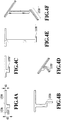
- FIG. 4A to FIG. 4F show configurations of the terminal pin 153 provided for the magnetism detecting unit 15.
- FIG. 4A is a side view of the terminal pin to be connected to the sensing coil of the magnetism detector 152.
- FIG. 4B is a side view of the terminal pin to be connected to the magnetic body of the magnetism detector 152 for the X-axis and the magnetic body of the magnetism detector 152 for the Y-axis.
- FIG. 4C is a side view of the terminal pin to be connected to an upper end of the magnetic body of the magnetism detector 152 for the Z-axis.
- FIG. 4D is a perspective view thereof.
- FIG. 4A is a side view of the terminal pin to be connected to the sensing coil of the magnetism detector 152.
- FIG. 4B is a side view of the terminal pin to be connected to the magnetic body of the magnetism detector 152 for the X-axis and the magnetic body of the magnetism detector 152 for the
- FIG. 4E is a side view of the terminal pin to be connected to a lower end of the magnetic body of the magnetism detector 152 for the Z-axis.
- FIG. 4F is a perspective view thereof. It should be noted that description of an engagement portion 153A, a first connection portion 153B, and a positioning portion 153C, which will be described later, is omitted in the description of FIG. 4B to FIG. 4F since they are common among FIG. 4A to FIG. 4F .
- the terminal pin 153 is made of a non-magnetic conductive material, in a substantially T shape, and is fixed on the face of the retaining member 151 on which the magnetism detector 152 is fixed.
- the terminal pin 153 includes the engagement portion 153A which is fixed to a recess of the retaining member 151 by fitting or the like, the first connection portion 153B which extends from the retaining member 151 and is horizontally connected to the circuit board 13, the positioning portion 153C which crosses the engagement portion 153A and the first connection portion 153B at right angles and is fixed to the retaining member 151, and a second connection portion 153D-153D" which is connected to the magnetism detector 152.
- the positioning portion 153C has a bottom face that comes into contact with the groove portion provided on the retaining member 151 in a direction perpendicular to an insertion-extraction direction of the terminal pin 153 to come into contact with the retaining member 151.
- the bottom face and the top face of the positioning portion 153C come into contact with the retaining member 151.
- the terminal pin 153 may be press-fitted into the retaining member 151.
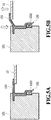
- FIG. 5A and FIG. 5B show deformation of the terminal pin 153 in a case where strong impact or vibration is applied to the triaxial magnetism detecting apparatus 10.
- the relative positional relationship between the circuit board 13 and the retaining member 151 changes.
- the retaining member 151 and the circuit board 13 are fixed to a position where the terminal pin 153 is free from stress.
- the circuit board 13 and the retaining member 151 may be displaced from each other in opposite directions.
- the circuit board 13 causes displacement of the first connection portion 153B from the retaining member 151
- the vicinity of the base of the first connection portion 153B of the terminal pin 153 acts as a fulcrum, whereby the vicinity of a coupling portion between the engagement portion 153A and the positioning portion 153C bends according to the principle of the lever, and a force is created to rotate the positioning portion 153C in a direction separating from the retaining member 151.
- the positioning portion 153C rotates in the direction separating from the retaining member 151, the positional relationship between the second connection portion 153D and the magnetism detector 152 changes, whereby stress is applied on a connection portion (electrode 152C) between the second connection portion 153D and the magnetism detector 152, and troubles may occur in the magnetism detector 152.
- the terminal pin 153 is formed such that a width d2 of the positioning portion 153C in the insertion-extraction direction of the terminal pin 153 is greater than a width d1 of the first connection portion 153B in the insertion-extraction direction of the terminal pin 153 (d2>d1). Since rigidity of the positioning portion 153C fixed to the retaining member 151 is greater than that of the first connection portion 153B, the vicinity of the coupling portion between the first connection portion 153B and the positioning portion 153C acts as a fulcrum, and the vicinity of the coupling portion between the first connection portion 153B and the positioning portion 153C tends to bend.
- the positioning portion 153C in a case where the positioning portion 153C is fixed to one of the faces of the retaining member 151 by an adhesive or the like, the positioning portion 153C will no longer move relative to the retaining member 151, and it is possible to further reduce the stress applied on the connection portion between the second connection portion 153D and the magnetism detector 151.
- the cavity between the retaining member 151 and the circuit board 13 is larger. Providing a large cavity allows the first connection portion 153B to tend to bend at the vicinity of the coupling portion with the circuit board 13 and the vicinity of the boundary of the positioning portion 153C, and the terminal pin 153 can produce a greater effect of reducing the stress caused by the force created in the magnetism detector 152. Meanwhile, since the magnetism detector 152 receives and outputs from and to the circuit board 13 a signal having a high frequency at a few MHz or higher, it is advantageous for the accuracy in magnetic detection that the terminal pin 153 has a short signal line connecting the circuit board 13 and the magnetism detector 152 to lower the impedance. For this reason, the cavity between the retaining member 151 and the circuit board 13 preferably has a length of about a few millimeters.
- FIG. 6 shows a configuration of an orthogonal fluxgate sensor as an example of the magnetism detector 152.
- the orthogonal fluxgate sensor includes a magnetic body 152A in line segment form for passing a high-frequency current and the sensing coil 152B made of a coil wound around the magnetic body 152A, for detecting change in magnetic flux around the magnetic body 152A.
- the magnetic body 152A is in line segment form and may be a magnetic wire or a magnetic thin film formed on a non-magnetic material.
- the sensing coil 152B may also be an air core coil or a bobbin coil, as well as a thin film coil formed on a magnetic thin film via an insulating layer.
- Electrodes 152C electrically connected to the magnetic body 152A are formed, and on an extension of the line segment of the magnetic body 152A, a marker 152D indicating the position of the magnetic body 152A is formed.
- forming the magnetic body 152A and the marker 152D with the same mask allows the marker 152D to be formed in an accurate position.
- FIG. 7A and FIG. 7B show an angular adjustment method for the orthogonal fluxgate sensor.
- the retaining member 151 is arranged to come into contact with a reference face provided on a jig 17, and the magnetism detector 152 is placed on the retaining member 151.
- a reference indicator e.g., a crosshair used in a microscope
- one of the markers 152D of the magnetism detector 152 are aligned with each other for temporary fixing ( FIG. 7A );
- a stage having the retaining member 151 and the jig 17 placed thereon is moved simultaneously with the reference face of the jig 17; and the position of the magnetism detector 152 is adjusted so that the other one of the markers 152D is aligned with the reference indicator ( FIG. 7B ).
- This method allows adjustment of the direction of magnetic field sensing from the appearance of the magnetism detector 152 without applying a uniform magnetic field strength.
- This orthogonal fluxgate sensor is compact and lightweight among other fluxgate sensors and can provide the magnetism detector 152 having a high degree of sensitivity with excellent perpendicularity of three axes.
- the magnetism detector 152 is not limited to the orthogonal fluxgate sensor, but may be a Hall element, an MR element, a parallel fluxgate sensor, and the like.
- the triaxial magnetism detecting apparatus 10 achieves downsizing of the apparatus in the following manner: the arrangement height is suppressed by arranging the magnetism detecting unit 15 inside a cutout or a hole provided for the circuit board 13 and horizontally connecting the circuit board 13 and the magnetism detecting unit 15; and the arrangement area is reduced by dividing the board into the power supply board 12 and the circuit board 13 and stacking the power supply board 12 and the circuit board 13. Furthermore, by employing the above structure, it is possible to have a mechanical strength to withstand the use under an environment in which strong vibration or impact is applied.
- FIG. 8A and FIG. 8B are respectively an exploded perspective view and an assembled perspective view of a triaxial magnetism detecting apparatus 20 according to the second embodiment of the present invention.
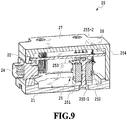
- FIG. 9 is a perspective cross-sectional view taken along IX-IX in FIG. 8B of the triaxial magnetism detecting apparatus 20 according to the second embodiment of the present invention.
- the second embodiment is characterized by the configuration that a magnetism detecting unit 25 is arranged between a body 21 and a circuit board 26 and stress caused by a force from the circuit board 26 is absorbed by an intermediate member 253.
- the magnetism detecting unit 25 and the circuit board 26 are fixed to the body 21; the magnetism detecting unit 25 is vertically connected to the circuit board 26; and a cover 27 is fixed to the body 21 by a screw to cover the components.
- the triaxial magnetism detecting apparatus 20 detects the magnitudes of magnetic fields in the mutually perpendicular X-axis, Y-axis, and Z-axis directions and outputs detection results from a connector 24.
- the circuit board 26 of the present embodiment corresponds to a component into which the power supply board 12 and the circuit board 13 of the first embodiment are integrated, and has a power unit, and a drive unit and a signal processing unit of a magnetism detector 252.
- the magnetism detecting unit 25 has a retaining member 251, a magnetism detector 252, an intermediate member 253, and a terminal pin 254, and is fixed to the body 21 by a screw 255-2.
- the circuit board 26 is arranged so that the magnetism detecting unit 25 is located between the circuit board 26 and the body 21, and is fixed to the body 21 via a fixing member 23 so that the retaining member 251 and the intermediate member 253 of the magnetism detecting unit 25 do not come into contact with the circuit board 26.
- the fixing member 23 may be part of the body 21 or may be a pillar separate from the body 21.
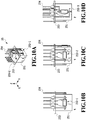
- FIG. 10A to FIG. 10D show configurations of the magnetism detecting unit 25.
- FIG. 10A is a perspective view of the magnetism detecting unit 25.
- FIG. 10B to FIG. 10D are side views showing the respective side faces of the magnetism detecting unit 25 having installed thereon magnetism detectors 252-1 to 252-3 that detect magnetism in mutually perpendicular X-axis, Y-axis, and Z-axis directions.
- the terminal pin 254 of the magnetism detecting unit 25 is used to electrically connect the circuit board 26 and the magnetism detector 252, and is fixed to the intermediate member 253 which is fixed to the retaining member 251 by a screw 255-1.
- a lower face of the intermediate member 253 and an upper face of the retaining member 251 may be in contact with each other or may be separated from each other via a spacer.
- the terminal pin 254 may be fixed to a through hole or a cutout of the intermediate member 253 by an adhesive, soldering, or the like.
- the terminal pin 254 has a wide portion that becomes wider adjacent to a portion to be fixed to the retaining member 251 or the intermediate member 253, so that an abutment on the intermediate member 253 is formed to make the fixing position clear and facilitate assembly.
- the intermediate member 253 is located between the magnetism detector 252 and the circuit board 26, and is arranged so as not to come into close contact with the circuit board 26 via a space.
- the intermediate member 253 is made of a non-magnetic material such as resin or non-magnetic metal, and is fixed to the retaining member 251 by the screw 255-2.
- the terminal pin 254 may also be fixed to an insertion portion provided on the retaining member 251 by fitting, an adhesive, soldering, or the like.
- the insertion portion provided on the retaining member 251 may have a substantially U shape or may be a through hole.
- the present embodiment in a case where impact, vibration, or the like is applied from the outside and the relative positional relationship between the magnetism detecting unit 25 and the circuit board 26 changes and a force is applied to the terminal pin 254, the force is absorbed by the intermediate member 253, and the stress caused by the force applied on the connection portion between the terminal pin 254 and the magnetism detector 252 can be greatly reduced.
- FIG. 11 shows a shock absorption structure 254SA of the terminal pin 254 according to the second embodiment of the present invention.
- the shock absorption structure 254SA is a substantially U-shaped structure having elasticity arranged between the magnetism detector 252 and the intermediate member 253.
- the shock absorption structure 254SA may have, for example, a U-shape structure, a V-shaped structure, or an S-shaped structure combining two U shapes.
- the terminal pin 254 can absorb the force, and the stress caused by the force applied on the connection portion between the magnetism detector 252 and the terminal pin 254 can be reduced.
- the triaxial magnetism detecting apparatus has a high impact resistance, and can be preferably applied to an apparatus which particularly produces strong vibrations.
- the triaxial magnetism detecting apparatus is installed on a satellite, particularly a space satellite, it is possible to ensure impact resistance to strong vibrations occurring at lift-off or the like.
- FIG. 12 shows a satellite as one of the examples of the satellite having the triaxial magnetism detecting apparatus according to the present invention mounted thereon.
- the satellite has a satellite body 31 on which a communication antenna 32, a solar panel 33, an optical system 34, a thruster 35, and the like are mounted.
- the magnetism detector 152 is installed on the retaining member 151 such that the lower face of the retaining member 151 comes into contact with a reference face provided on the jig 17, and the magnetism detectors 152-1 to 152-3 are installed on the retaining member 151.
- the three magnetism detectors 152-1 to 152-3 are fixed such that the lower face of the retaining member 151 perpendicular to the faces having the three magnetism detectors 152-1 to 152-3 installed thereon serves as a reference face.
- the triaxial magnetism detecting apparatus is mounted on the satellite (the satellite body 31 in this example) so that the reference face of the triaxial magnetism detecting apparatus matches the reference face of the satellite, whereby a detection angle of the triaxial magnetism detecting apparatus can be preferably maintained.
- the reference face of the satellite may match the reference face of other sensors mounted on the satellite.
- the retaining member 151 having the magnetism detector 152 installed thereon is installed on the body 11, but the body 11 may also be a member forming the satellite, for example, a sensor installation member provided inside the satellite or a member forming one side face of the satellite.
Landscapes
- Physics & Mathematics (AREA)
- General Physics & Mathematics (AREA)
- Condensed Matter Physics & Semiconductors (AREA)
- Engineering & Computer Science (AREA)
- Power Engineering (AREA)
- Measuring Magnetic Variables (AREA)
Abstract
Description
- The present invention relates to a triaxial magnetism detecting apparatus that detects the strengths of magnetic fields along three mutually perpendicular axes, and a satellite having the same.
- A magnetism detecting apparatus for mutually perpendicular three axes is configured by combining magnetism detectors that respectively detect magnetic field components along X, Y, and Z axes. For the magnetism detector, a Hall element, a parallel fluxgate sensor, and the like are often used.
- Since the Hall element is available at relatively low cost and easy to downsize, it is used for many applications such as digital cameras and mobile phones. Meanwhile, the fluxgate type magnetism detector has a high degree of detection sensitivity and can perform detection with a high resolution. Therefore, the fluxgate type magnetism detector is used for attitude control such as satellites and aircraft that require higher precision. The parallel fluxgate type magnetism detector is driven by an electric current passing through an excitation coil which is wound around a ring-shaped magnetic core.
- In using the Hall element and the parallel fluxgate type magnetism detector, an orientation direction in magnetic field sensing cannot be clearly confirmed from their appearance. For this reason, in adjusting perpendicularity in the X-, Y-, and Z-axis magnetic field sensing directions, it is needed to adjust arrangement angles while checking an output voltage in a state where a uniform magnetic field strength is applied by a Helmholtz coil or the like. PTL 1 discloses adjusting the positions of magnetism detectors for three axes while turning them on a block for fixing the parallel fluxgate type magnetism detector to adjust the perpendicularity of the axes.
-
- PTL 1: Japanese Patent No.
5639846 - PTL 2: Japanese Utility Model Laid-Open No.
H04-78582 - However, in the triaxial magnetism detecting apparatus, the magnetism detectors for three axes need to be individually installed on an apparatus body while performing angular adjustment in a state where a uniform magnetic field strength is applied, resulting in a problem of a number of complicated steps including adjustment and installation. Moreover, since mechanism components are required for the angular adjustment for each magnetism detector, the size and mass of the apparatus increase. Furthermore, a problem also arises that a connection portion of a terminal pin that electrically connects the magnetism detector and a circuit board is susceptible to impact and vibration applied to the apparatus.
- The present invention has been made to solve the above problems. The present invention can provide a triaxial magnetism detecting apparatus having a high mechanical strength and being compact in size by integrating the arrangement configuration of magnetism detectors to reduce the number of components directly installed on the apparatus body and allowing easy angular adjustment of the magnetism detectors and easy installation of the magnetism detectors on the apparatus body, and a satellite.
- To solve the above problems, according to the present invention, there is provided a triaxial magnetism detecting apparatus performing triaxial magnetism detection for mutually perpendicular X, Y, and Z axes, the apparatus including: a body; a retaining member formed of a non-magnetic material, the retaining member being fixed on the body; a magnetism detector detecting a magnitude of a magnetic field component along one of X, Y, and Z axes, the magnetism detectors being fixed respectively on side faces of the retaining member that are perpendicular to a face being in contact with the body; and a circuit board to which an output signal of the magnetism detector is transmitted, the circuit board being fixed on the body, wherein the retaining member and the circuit board are separated from each other, and a terminal pin that electrically connects the magnetism detector and the circuit board is fixed to the retaining member between the magnetism detector and the circuit board.
- According to another aspect of the present invention, a shape of the retaining member is a rectangular parallelepiped.
- According to another aspect of the present invention, at least part of the retaining member is located inside a cutout or a hole provided on the circuit board.
- According to another aspect of the present invention, the circuit board includes a first board having a drive unit and a signal processing unit of the magnetism detector and a second board having a power unit electrically connected to the first board, and the second board is arranged between the first board and the body.
- According to another aspect of the present invention, the circuit board is fixed to the body to face an upper face of the retaining member.
- According to another aspect of the present invention, the retaining member is arranged between the circuit board and the body.
- According to another aspect of the present invention, an intermediate member fixed to the retaining member is further included, wherein the terminal pin is fixed to the intermediate member.
- According to another aspect of the present invention, the terminal pin includes an engagement portion fixed to a recess formed on the side face of the retaining member by fitting, a first connection portion fixed to the circuit board, a positioning portion provided on a lower portion of the engagement portion to come into contact with the retaining member, and a second connection portion fixed to the magnetism detector, and a width of the positioning portion in a direction where the terminal pin is inserted to or extracted from the retaining member is greater than a width of the first connection portion in the direction where the terminal pin is inserted to or extracted from the retaining member.
- According to another aspect of the present invention, the positioning portion comes into contact with a groove portion provided on the retaining member.
- According to another aspect of the present invention, the terminal pin has a shock absorption structure between the magnetism detector and the circuit board.
- According to another aspect of the present invention, the shock absorption structure is a structure in which the terminal pin bends in a substantially U shape.
- According to another aspect of the present invention, the magnetism detector includes a magnetic body in line segment form for passing an alternating current and a sensing coil wound around the magnetic body.
- According to another aspect of the present invention, the retaining member has a coil groove portion in which the sensing coil of the magnetism detector is arranged.
- According to another aspect of the present invention, there is provided a satellite having a triaxial magnetism detecting apparatus, the apparatus including: a body; a retaining member formed of a non-magnetic material, the retaining member being fixed on the body; a magnetism detector detecting a magnitude of a magnetic field component along one of X, Y, and Z axes, the magnetism detectors being fixed respectively on side faces of the retaining member that are perpendicular to a face being in contact with the body; and a circuit board to which an output signal of the magnetism detector is transmitted, the circuit board being fixed on the body, wherein the retaining member and the circuit board are separated from each other, and a terminal pin that electrically connects the magnetism detector and the circuit board is fixed to the retaining member between the magnetism detector and the circuit board.
- The present invention allows easy adjustment work since the magnetism detectors for three axes that detect the magnetic field components along X, Y, and Z axes are fixed on one retaining member, and angular adjustment of the three magnetism detectors can be performed separately from the installation of the magnetism detectors on the apparatus body. Furthermore, since the terminal pin connecting the magnetism detector and the circuit board is configured such that impact and vibration from the circuit board are not easily transmitted to the connection portion to the magnetism detector, the present invention can have a high impact resistance.
-
- [
FIG. 1A] FIG. 1A is an exploded perspective view of a triaxial magnetism detecting apparatus according to a first embodiment of the present invention; - [
FIG. 1B] FIG. 1B is an assembled perspective view of the triaxial magnetism detecting apparatus according to the first embodiment of the present invention; - [
FIG. 2] FIG. 2 is a cross-sectional view of the triaxial magnetism detecting apparatus according to the first embodiment of the present invention; - [
FIG. 3A] FIG. 3A is a perspective view of a magnetism detecting unit; - [
FIG. 3B] FIG. 3B is a view showing a side face of a magnetism detecting unit having installed thereon a magnetism detector that detects magnetism in one of mutually perpendicular X-axis, Y-axis, and Z-axis directions; - [
FIG. 3C] FIG. 3C is a view showing a side face of a magnetism detecting unit having installed thereon a magnetism detector that detects magnetism in one of mutually perpendicular X-axis, Y-axis, and Z-axis directions; - [
FIG. 3D] FIG. 3D is a view showing a side face of a magnetism detecting unit having installed thereon a magnetism detector that detects magnetism in one of mutually perpendicular X-axis, Y-axis, and Z-axis directions; - [
FIG. 4A] FIG. 4A is a side view of a terminal pin to be connected to a sensing coil of a magnetism detector; - [
FIG. 4B] FIG. 4B is a side view of a terminal pin to be connected to a magnetic body of a magnetism detector for the X-axis and a magnetic body of a magnetism detector for the Y-axis; - [
FIG. 4C] FIG. 4C is a side view of a terminal pin to be connected to an upper end of a magnetic body of a magnetism detector for the Z-axis; - [
FIG. 4D] FIG. 4D is a perspective view of a terminal pin to be connected to an upper end of a magnetic body of a magnetism detector for the Z-axis; - [
FIG. 4E] FIG. 4E is a side view of a terminal pin to be connected to a lower end of a magnetic body of a magnetism detector for the Z-axis; - [
FIG. 4F] FIG. 4F is a perspective view of a terminal pin to be connected to a lower end of a magnetic body of a magnetism detector for the Z-axis; - [
FIG. 5A] FIG. 5A is a view showing deformation of a terminal pin in a case where strong impact or vibration is applied to a triaxial magnetism detecting apparatus; - [
FIG. 5B] FIG. 5B is a view showing deformation of a terminal pin in a case where strong impact or vibration is applied to a triaxial magnetism detecting apparatus; - [
FIG. 6] FIG. 6 is a view showing a configuration of an orthogonal fluxgate sensor as an example of the magnetism detector; - [
FIG. 7A] FIG. 7A is a view showing an angular adjustment method for an orthogonal fluxgate sensor; - [
FIG. 7B] FIG. 7B is a view showing an angular adjustment method for an orthogonal fluxgate sensor; - [
FIG. 8A] FIG. 8A is an exploded perspective view of a triaxial magnetism detecting apparatus according to a second embodiment of the present invention; - [
FIG. 8B] FIG. 8B is an assembled perspective view of the triaxial magnetism detecting apparatus according to the second embodiment of the present invention; - [
FIG. 9] FIG. 9 is a perspective cross-sectional view of the triaxial magnetism detecting apparatus according to the second embodiment of the present invention; - [
FIG. 10A] FIG. 10A is a perspective view of a magnetism detecting unit; - [
FIG. 10B] FIG. 10B is a view showing a side face of a magnetism detecting unit having installed thereon a magnetism detector that detects magnetism in one of mutually perpendicular X-axis, Y-axis, and Z-axis directions; - [
FIG. 10C] FIG. 10C is a view showing a side face of a magnetism detecting unit having installed thereon a magnetism detector that detects magnetism in one of mutually perpendicular X-axis, Y-axis, and Z-axis directions; - [
FIG. 10D] FIG. 10D is a view showing a side face of a magnetism detecting unit having installed thereon a magnetism detector that detects magnetism in one of mutually perpendicular X-axis, Y-axis, and Z-axis directions; - [
FIG. 11] FIG. 11 is a view showing a shock absorption structure of a terminal pin according to the second embodiment of the present invention; and - [
FIG. 12] FIG. 12 is a perspective view showing a satellite to which a triaxial magnetism detecting apparatus according to the present invention is applied. - Now, embodiments of the present invention will be described in detail.
-
FIG. 1A and FIG. 1B are respectively an exploded perspective view and an assembled perspective view of a triaxialmagnetism detecting apparatus 10 according to the first embodiment of the present invention.FIG. 2 is a cross-sectional view (a cross section taken along II-II inFIG. 1B ) of the triaxialmagnetism detecting apparatus 10 according to the first embodiment of the present invention. In the triaxialmagnetism detecting apparatus 10 of the present embodiment, apower supply board 12, acircuit board 13, and amagnetism detecting unit 15 are fixed to abody 11; thecircuit board 13 and themagnetism detecting unit 15 are horizontally connected; and acover 16 is fixed to thebody 11 by a screw to cover the components. By using themagnetism detecting unit 15, the triaxialmagnetism detecting apparatus 10 detects the magnitudes of magnetic fields in the mutually perpendicular X-axis, Y-axis, and Z-axis directions and outputs detection results from aconnector 14. The detection results obtained by the triaxialmagnetism detecting apparatus 10 can be used for, for example, attitude control of an apparatus having the triaxialmagnetism detecting apparatus 10 mounted thereon and detection of change in magnetic field strength. - The
power supply board 12 and thecircuit board 13 are arranged substantially in parallel in this order as viewed from thebody 11, and are fixed to thebody 11 by a screw via a spacer or the like such that the position of thecircuit board 13 from thebody 11 is not above the height of themagnetism detecting unit 15 fixed to thebody 11. Thepower supply board 12 has a power unit configured to create a predetermined power to be supplied to thecircuit board 13, and thecircuit board 13 has a drive unit and a signal processing unit for amagnetism detector 152. A retainingmember 151 of themagnetism detecting unit 15 is arranged inside a cutout or a hole provided for thecircuit board 13 via a cavity, and thecircuit board 13 and themagnetism detecting unit 15 are horizontally connected. Incidentally, a cutout or a hole may be provided also for thepower supply board 12, and the retainingmember 151 may be arranged inside thereof. - As shown in
FIG. 2 , thecircuit board 13 is arranged in a lateral direction of the retainingmember 151 with a predetermined distance, and thepower supply board 12 is arranged below thecircuit board 13 so as not to come into contact with the retainingmember 151 and themagnetism detector 152. The height of the retainingmember 151 is determined based on the height of themagnetism detector 152, particularly depending on a magnetism detector 152-3 for detecting magnetism along the Z-axis which requires the greatest height. As will be described later, an orthogonal fluxgate sensor is used for themagnetism detector 152 in the present embodiment. Since a straight line shape is required to some extent, the retainingmember 151 also needs to have a certain height. - In a case where the
magnetism detector 152 is fixed by using the retainingmember 151 as described above, since aterminal pin 153 extends to a top face portion of the retainingmember 151, it is preferable to align thecircuit board 13 with the top face portion of the retainingmember 151 so that the height of the triaxialmagnetism detecting apparatus 10 is suppressed and the length of theterminal pin 153 is not excessively extended. By providing thepower supply board 12 in the thus produced space between thecircuit board 13 and thebody 11, it is possible to reduce the area of thecircuit board 13 and allow downsizing of the triaxialmagnetism detecting apparatus 10. - Furthermore, by providing the
connector 14 on an end portion of thepower supply board 12 opposite to the retainingmember 151, it is possible to effectively use the space. -
FIG. 3A to FIG. 3D show configurations of themagnetism detecting unit 15 of the triaxialmagnetism detecting apparatus 10 according to the first embodiment of the present invention.FIG. 3A is a perspective view of themagnetism detecting unit 15.FIG. 3B to FIG. 3D are views respectively showing side faces of themagnetism detecting unit 15 having installed thereon magnetism detectors 152-1 to 152-3 that detect magnetism in the mutually perpendicular X-axis, Y-axis, and Z-axis directions. - The
magnetism detecting unit 15 includes the retainingmember 151 fixed on thebody 11 by ascrew 154, the magnetism detectors 152-1 to 152-3 respectively fixed on three faces of the retainingmember 151 that are perpendicular to the face being in contact with thebody 11, and the conductiveterminal pin 153 that connects themagnetism detector 152 and thecircuit board 13. Incidentally, as shown inFIG. 3D , two lead wires, which are connected to asensing coil 152B arranged around the magnetism detector 152-3 detecting magnetism along the Z-axis, adjacently extend to the left side inFIG. 3D , and the twoterminal pins 153 of the magnetism detector 152-3 extend to the right side inFIG. 3D . The above-described arrangement allows improving the workability of the process of winding the lead wires extended from thesensing coil 152B on the terminal pins 153 shown inFIG. 4A . - The retaining
member 151 is made of a non-magnetic material in a rectangular parallelepiped, and three faces of the retainingmember 151, to which the magnetism detectors 152-1 to 152-3 are fixed, cross their adjacent faces at right angles. It should be noted as long as the retainingmember 151 has any shape with three faces perpendicular to each other, the retainingmember 151 may be a polyhedron such as a right triangular pyramid or a right triangular prism, other than the rectangular parallelepiped. Furthermore, the retainingmember 151 has a groove portion for arranging thesensing coil 152B on respective faces on which the magnetism detectors 152-1 to 152-3 are fixed. The groove portion may be used for positioning thesensing coil 152B or may be used for fixing thesensing coil 152B. The retainingmember 151 may further have a groove portion that engages apositioning portion 153C of theterminal pin 153 to position or lock theterminal pin 153. -
FIG. 4A to FIG. 4F show configurations of theterminal pin 153 provided for themagnetism detecting unit 15.FIG. 4A is a side view of the terminal pin to be connected to the sensing coil of themagnetism detector 152.FIG. 4B is a side view of the terminal pin to be connected to the magnetic body of themagnetism detector 152 for the X-axis and the magnetic body of themagnetism detector 152 for the Y-axis.FIG. 4C is a side view of the terminal pin to be connected to an upper end of the magnetic body of themagnetism detector 152 for the Z-axis.FIG. 4D is a perspective view thereof.FIG. 4E is a side view of the terminal pin to be connected to a lower end of the magnetic body of themagnetism detector 152 for the Z-axis.FIG. 4F is a perspective view thereof. It should be noted that description of anengagement portion 153A, afirst connection portion 153B, and apositioning portion 153C, which will be described later, is omitted in the description ofFIG. 4B to FIG. 4F since they are common amongFIG. 4A to FIG. 4F . - The
terminal pin 153 is made of a non-magnetic conductive material, in a substantially T shape, and is fixed on the face of the retainingmember 151 on which themagnetism detector 152 is fixed. Theterminal pin 153 includes theengagement portion 153A which is fixed to a recess of the retainingmember 151 by fitting or the like, thefirst connection portion 153B which extends from the retainingmember 151 and is horizontally connected to thecircuit board 13, thepositioning portion 153C which crosses theengagement portion 153A and thefirst connection portion 153B at right angles and is fixed to the retainingmember 151, and asecond connection portion 153D-153D" which is connected to themagnetism detector 152. In the present embodiment, as will be described later, thepositioning portion 153C has a bottom face that comes into contact with the groove portion provided on the retainingmember 151 in a direction perpendicular to an insertion-extraction direction of theterminal pin 153 to come into contact with the retainingmember 151. In addition, it is preferable to have a structure that when theengagement portion 153A is inserted into the retainingmember 151, part of thepositioning portion 153C is similarly inserted into the retainingmember 151 to be engaged. In the present embodiment, with respect to the retainingmember 151, the bottom face and the top face of thepositioning portion 153C come into contact with the retainingmember 151. Note that theterminal pin 153 may be press-fitted into the retainingmember 151. -
FIG. 5A and FIG. 5B show deformation of theterminal pin 153 in a case where strong impact or vibration is applied to the triaxialmagnetism detecting apparatus 10. In a case where impact is applied to the triaxialmagnetism detecting apparatus 10 from the outside, the relative positional relationship between thecircuit board 13 and the retainingmember 151 changes. As shown inFIG. 5A , for example, before the impact is applied, the retainingmember 151 and thecircuit board 13 are fixed to a position where theterminal pin 153 is free from stress. However, in a case where the impact is applied from the outside, as shown inFIG. 5B , thecircuit board 13 and the retainingmember 151 may be displaced from each other in opposite directions. In this case, since thecircuit board 13 causes displacement of thefirst connection portion 153B from the retainingmember 151, the vicinity of the base of thefirst connection portion 153B of theterminal pin 153 acts as a fulcrum, whereby the vicinity of a coupling portion between theengagement portion 153A and thepositioning portion 153C bends according to the principle of the lever, and a force is created to rotate thepositioning portion 153C in a direction separating from the retainingmember 151. If thepositioning portion 153C rotates in the direction separating from the retainingmember 151, the positional relationship between thesecond connection portion 153D and themagnetism detector 152 changes, whereby stress is applied on a connection portion (electrode 152C) between thesecond connection portion 153D and themagnetism detector 152, and troubles may occur in themagnetism detector 152. - Accordingly, in the present embodiment, to suppress the displacement of the
positioning portion 153C from themagnetism detector 152, theterminal pin 153 is formed such that a width d2 of thepositioning portion 153C in the insertion-extraction direction of theterminal pin 153 is greater than a width d1 of thefirst connection portion 153B in the insertion-extraction direction of the terminal pin 153 (d2>d1). Since rigidity of thepositioning portion 153C fixed to the retainingmember 151 is greater than that of thefirst connection portion 153B, the vicinity of the coupling portion between thefirst connection portion 153B and thepositioning portion 153C acts as a fulcrum, and the vicinity of the coupling portion between thefirst connection portion 153B and thepositioning portion 153C tends to bend. Accordingly, stress caused by the force created due to the change in the positional relationship between thecircuit board 13 and the retainingmember 151 is absorbed by the bending of the vicinity of the coupling portion between thefirst connection portion 153B and thepositioning portion 153C. This can greatly reduce the stress applied on the connection portion between thesecond connection portion 153D and themagnetism detector 152. - It should be noted that in a case where the
positioning portion 153C is fixed to one of the faces of the retainingmember 151 by an adhesive or the like, thepositioning portion 153C will no longer move relative to the retainingmember 151, and it is possible to further reduce the stress applied on the connection portion between thesecond connection portion 153D and themagnetism detector 151. - As for the impact resistance, it is preferable that the cavity between the retaining
member 151 and thecircuit board 13 is larger. Providing a large cavity allows thefirst connection portion 153B to tend to bend at the vicinity of the coupling portion with thecircuit board 13 and the vicinity of the boundary of thepositioning portion 153C, and theterminal pin 153 can produce a greater effect of reducing the stress caused by the force created in themagnetism detector 152. Meanwhile, since themagnetism detector 152 receives and outputs from and to the circuit board 13 a signal having a high frequency at a few MHz or higher, it is advantageous for the accuracy in magnetic detection that theterminal pin 153 has a short signal line connecting thecircuit board 13 and themagnetism detector 152 to lower the impedance. For this reason, the cavity between the retainingmember 151 and thecircuit board 13 preferably has a length of about a few millimeters. -
FIG. 6 shows a configuration of an orthogonal fluxgate sensor as an example of themagnetism detector 152. The orthogonal fluxgate sensor includes amagnetic body 152A in line segment form for passing a high-frequency current and thesensing coil 152B made of a coil wound around themagnetic body 152A, for detecting change in magnetic flux around themagnetic body 152A. Themagnetic body 152A is in line segment form and may be a magnetic wire or a magnetic thin film formed on a non-magnetic material. Thesensing coil 152B may also be an air core coil or a bobbin coil, as well as a thin film coil formed on a magnetic thin film via an insulating layer. On both sides of themagnetic body 152A,electrodes 152C electrically connected to themagnetic body 152A are formed, and on an extension of the line segment of themagnetic body 152A, amarker 152D indicating the position of themagnetic body 152A is formed. Incidentally, forming themagnetic body 152A and themarker 152D with the same mask allows themarker 152D to be formed in an accurate position. - Since an orientation direction of the orthogonal fluxgate sensor in magnetic field sensing is determined to be the longitudinal direction of the
magnetic body 152A due to a diamagnetic field, it is possible to determine the orientation direction in magnetic field sensing from themarker 152D formed on the extension of the line segment of themagnetic body 152A.FIG. 7A and FIG. 7B show an angular adjustment method for the orthogonal fluxgate sensor. The retainingmember 151 is arranged to come into contact with a reference face provided on ajig 17, and themagnetism detector 152 is placed on the retainingmember 151. A reference indicator (e.g., a crosshair used in a microscope) provided on a microscope and one of themarkers 152D of themagnetism detector 152 are aligned with each other for temporary fixing (FIG. 7A ); a stage having the retainingmember 151 and thejig 17 placed thereon is moved simultaneously with the reference face of thejig 17; and the position of themagnetism detector 152 is adjusted so that the other one of themarkers 152D is aligned with the reference indicator (FIG. 7B ). This method allows adjustment of the direction of magnetic field sensing from the appearance of themagnetism detector 152 without applying a uniform magnetic field strength. This orthogonal fluxgate sensor is compact and lightweight among other fluxgate sensors and can provide themagnetism detector 152 having a high degree of sensitivity with excellent perpendicularity of three axes. - It should be noted that the
magnetism detector 152 is not limited to the orthogonal fluxgate sensor, but may be a Hall element, an MR element, a parallel fluxgate sensor, and the like. - The triaxial
magnetism detecting apparatus 10 according to the present embodiment achieves downsizing of the apparatus in the following manner: the arrangement height is suppressed by arranging themagnetism detecting unit 15 inside a cutout or a hole provided for thecircuit board 13 and horizontally connecting thecircuit board 13 and themagnetism detecting unit 15; and the arrangement area is reduced by dividing the board into thepower supply board 12 and thecircuit board 13 and stacking thepower supply board 12 and thecircuit board 13. Furthermore, by employing the above structure, it is possible to have a mechanical strength to withstand the use under an environment in which strong vibration or impact is applied. -
FIG. 8A and FIG. 8B are respectively an exploded perspective view and an assembled perspective view of a triaxialmagnetism detecting apparatus 20 according to the second embodiment of the present invention.FIG. 9 is a perspective cross-sectional view taken along IX-IX inFIG. 8B of the triaxialmagnetism detecting apparatus 20 according to the second embodiment of the present invention. The second embodiment is characterized by the configuration that amagnetism detecting unit 25 is arranged between abody 21 and acircuit board 26 and stress caused by a force from thecircuit board 26 is absorbed by anintermediate member 253. - In the triaxial
magnetism detecting apparatus 20 of the present embodiment, themagnetism detecting unit 25 and thecircuit board 26 are fixed to thebody 21; themagnetism detecting unit 25 is vertically connected to thecircuit board 26; and acover 27 is fixed to thebody 21 by a screw to cover the components. By using themagnetism detecting unit 25, the triaxialmagnetism detecting apparatus 20 detects the magnitudes of magnetic fields in the mutually perpendicular X-axis, Y-axis, and Z-axis directions and outputs detection results from aconnector 24. Incidentally, thecircuit board 26 of the present embodiment corresponds to a component into which thepower supply board 12 and thecircuit board 13 of the first embodiment are integrated, and has a power unit, and a drive unit and a signal processing unit of amagnetism detector 252. - The
magnetism detecting unit 25 has a retainingmember 251, amagnetism detector 252, anintermediate member 253, and aterminal pin 254, and is fixed to thebody 21 by a screw 255-2. Thecircuit board 26 is arranged so that themagnetism detecting unit 25 is located between thecircuit board 26 and thebody 21, and is fixed to thebody 21 via a fixingmember 23 so that the retainingmember 251 and theintermediate member 253 of themagnetism detecting unit 25 do not come into contact with thecircuit board 26. The fixingmember 23 may be part of thebody 21 or may be a pillar separate from thebody 21. -
FIG. 10A to FIG. 10D show configurations of themagnetism detecting unit 25.FIG. 10A is a perspective view of themagnetism detecting unit 25.FIG. 10B to FIG. 10D are side views showing the respective side faces of themagnetism detecting unit 25 having installed thereon magnetism detectors 252-1 to 252-3 that detect magnetism in mutually perpendicular X-axis, Y-axis, and Z-axis directions. - The
terminal pin 254 of themagnetism detecting unit 25 is used to electrically connect thecircuit board 26 and themagnetism detector 252, and is fixed to theintermediate member 253 which is fixed to the retainingmember 251 by a screw 255-1. A lower face of theintermediate member 253 and an upper face of the retainingmember 251 may be in contact with each other or may be separated from each other via a spacer. Theterminal pin 254 may be fixed to a through hole or a cutout of theintermediate member 253 by an adhesive, soldering, or the like. Theterminal pin 254 has a wide portion that becomes wider adjacent to a portion to be fixed to the retainingmember 251 or theintermediate member 253, so that an abutment on theintermediate member 253 is formed to make the fixing position clear and facilitate assembly. - The
intermediate member 253 is located between themagnetism detector 252 and thecircuit board 26, and is arranged so as not to come into close contact with thecircuit board 26 via a space. Theintermediate member 253 is made of a non-magnetic material such as resin or non-magnetic metal, and is fixed to the retainingmember 251 by the screw 255-2. - The
terminal pin 254 may also be fixed to an insertion portion provided on the retainingmember 251 by fitting, an adhesive, soldering, or the like. The insertion portion provided on the retainingmember 251 may have a substantially U shape or may be a through hole. - According to the present embodiment, in a case where impact, vibration, or the like is applied from the outside and the relative positional relationship between the
magnetism detecting unit 25 and thecircuit board 26 changes and a force is applied to theterminal pin 254, the force is absorbed by theintermediate member 253, and the stress caused by the force applied on the connection portion between theterminal pin 254 and themagnetism detector 252 can be greatly reduced. -
FIG. 11 shows a shock absorption structure 254SA of theterminal pin 254 according to the second embodiment of the present invention. The shock absorption structure 254SA is a substantially U-shaped structure having elasticity arranged between themagnetism detector 252 and theintermediate member 253. Other than the substantially U-shape structure shown inFIG. 11 , the shock absorption structure 254SA may have, for example, a U-shape structure, a V-shaped structure, or an S-shaped structure combining two U shapes. By providing the shock absorption structure 254SA for theterminal pin 254, even in a case where impact, vibration, or the like is applied to the triaxialmagnetism detecting apparatus 20 and the relative positional relationship between themagnetism detector 252 and theintermediate member 253 changes, thereby applying a force to theterminal pin 254, theterminal pin 254 can absorb the force, and the stress caused by the force applied on the connection portion between themagnetism detector 252 and theterminal pin 254 can be reduced. - As described above, the triaxial magnetism detecting apparatus according to the present invention has a high impact resistance, and can be preferably applied to an apparatus which particularly produces strong vibrations. For example, in a case where the triaxial magnetism detecting apparatus is installed on a satellite, particularly a space satellite, it is possible to ensure impact resistance to strong vibrations occurring at lift-off or the like.
-
FIG. 12 shows a satellite as one of the examples of the satellite having the triaxial magnetism detecting apparatus according to the present invention mounted thereon. The satellite has a satellite body 31 on which acommunication antenna 32, asolar panel 33, anoptical system 34, athruster 35, and the like are mounted. - As described above, in the triaxial magnetism detecting apparatus according to the present invention, the
magnetism detector 152 is installed on the retainingmember 151 such that the lower face of the retainingmember 151 comes into contact with a reference face provided on thejig 17, and the magnetism detectors 152-1 to 152-3 are installed on the retainingmember 151. In other words, the three magnetism detectors 152-1 to 152-3 are fixed such that the lower face of the retainingmember 151 perpendicular to the faces having the three magnetism detectors 152-1 to 152-3 installed thereon serves as a reference face. - The triaxial magnetism detecting apparatus is mounted on the satellite (the satellite body 31 in this example) so that the reference face of the triaxial magnetism detecting apparatus matches the reference face of the satellite, whereby a detection angle of the triaxial magnetism detecting apparatus can be preferably maintained. The reference face of the satellite may match the reference face of other sensors mounted on the satellite.
- Furthermore, the retaining
member 151 having themagnetism detector 152 installed thereon is installed on thebody 11, but thebody 11 may also be a member forming the satellite, for example, a sensor installation member provided inside the satellite or a member forming one side face of the satellite. -
- 10, 20 triaxial magnetism detecting apparatus
- 11, 21 body
- 12 power supply board
- 13, 26 circuit board
- 14, 24 connector
- 15, 25 magnetism detecting unit
- 16, 27 cover
- 17 jig
- 22 connector fixing member
- 23 spacer
- 151, 251 retaining member
- 152, 252 magnetism detector
- 152A magnetic body
- 152B sensing coil
- 153C electrode
- 153D marker
- 153, 254 terminal pin
- 153A engagement portion
- 153B first connection portion
- 153C positioning portion
- 153D second connection portion
- 154, 255 screw
- 253 intermediate member
- 254SA shock absorption structure
- 31 satellite body
- 32 communication antenna
- 33 solar panel
- 34 optical system
- 35 thruster
Claims (14)
- A triaxial magnetism detecting apparatus performing triaxial magnetism detection for mutually perpendicular X, Y, and Z axes, the apparatus comprising:a body;a retaining member formed of a non-magnetic material, the retaining member being fixed on the body;a magnetism detector detecting a magnitude of a magnetic field component along one of X, Y, and Z axes, the magnetism detectors being fixed respectively on side faces of the retaining member that are perpendicular to a face being in contact with the body; anda circuit board to which an output signal of the magnetism detector is transmitted, the circuit board being fixed on the body,wherein the retaining member and the circuit board are separated from each other, and a terminal pin that electrically connects the magnetism detector and the circuit board is fixed to the retaining member between the magnetism detector and the circuit board.
- The triaxial magnetism detecting apparatus according to claim 1, wherein a shape of the retaining member is a rectangular parallelepiped.
- The triaxial magnetism detecting apparatus according to claim 1, wherein at least part of the retaining member is located inside a cutout or a hole provided on the circuit board.
- The triaxial magnetism detecting apparatus according to claim 3, wherein the circuit board includes a first board having a drive unit and a signal processing unit of the magnetism detector and a second board having a power unit electrically connected to the first board, and
wherein the second board is arranged between the first board and the body. - The triaxial magnetism detecting apparatus according to claim 1, wherein the circuit board is fixed to the body to face an upper face of the retaining member.
- The triaxial magnetism detecting apparatus according to claim 5, wherein the retaining member is arranged between the circuit board and the body.
- The triaxial magnetism detecting apparatus according to claim 6, further comprising an intermediate member fixed to the retaining member, wherein the terminal pin is fixed to the intermediate member.
- The triaxial magnetism detecting apparatus according to any one of claims 1 to 7, wherein the terminal pin includes an engagement portion fixed to a recess formed on the side face of the retaining member by fitting, a first connection portion fixed to the circuit board, a positioning portion provided on a lower portion of the engagement portion to come into contact with the retaining member, and a second connection portion fixed to the magnetism detector, and
wherein a width of the positioning portion in a direction where the terminal pin is inserted to or extracted from the retaining member is larger than a width of the first connection portion in the direction where the terminal pin is inserted to or extracted from the retaining member. - The triaxial magnetism detecting apparatus according to claim 8, wherein the positioning portion comes into contact with a groove portion provided on the retaining member.
- The triaxial magnetism detecting apparatus according to any one of claims 1 to 9, wherein the terminal pin has a shock absorption structure between the magnetism detector and the circuit board.
- The triaxial magnetism detecting apparatus according to claim 10, wherein the shock absorption structure is a structure in which the terminal pin bends in a substantially U shape.
- The triaxial magnetism detecting apparatus according to any one of claims 1 to 11, wherein the magnetism detector includes a magnetic body in line segment form for passing alternating current and a sensing coil wound around the magnetic body.
- The triaxial magnetism detecting apparatus according to claim 12, wherein the retaining member has a coil groove portion in which the sensing coil of the magnetism detector is arranged.
- A satellite having a triaxial magnetism detecting apparatus, the apparatus comprising:a body;a retaining member formed of a non-magnetic material, the retaining member being fixed on the body;a magnetism detector detecting a magnitude of a magnetic field component along one of X, Y, and Z axes, the magnetism detectors being fixed respectively on side faces of the retaining member that are perpendicular to a face being in contact with the body; anda circuit board to which an output signal of the magnetism detector is transmitted, the circuit board being fixed on the body,wherein the retaining member and the circuit board are separated from each other, and a terminal pin that electrically connects the magnetism detector and the circuit board is fixed to the retaining member between the magnetism detector and the circuit board.
Applications Claiming Priority (2)
| Application Number | Priority Date | Filing Date | Title |
|---|---|---|---|
| JP2017117863A JP6932561B2 (en) | 2017-06-15 | 2017-06-15 | 3-axis magnetic detector and artificial satellite |
| PCT/JP2017/043374 WO2018230010A1 (en) | 2017-06-15 | 2017-12-01 | Triaxial magnetic detection device and navigation body |
Publications (3)
| Publication Number | Publication Date |
|---|---|
| EP3640657A1 true EP3640657A1 (en) | 2020-04-22 |
| EP3640657A4 EP3640657A4 (en) | 2021-03-03 |
| EP3640657B1 EP3640657B1 (en) | 2023-08-02 |
Family
ID=64660996
Family Applications (1)
| Application Number | Title | Priority Date | Filing Date |
|---|---|---|---|
| EP17913599.1A Active EP3640657B1 (en) | 2017-06-15 | 2017-12-01 | Triaxial magnetic detection device and satellite |
Country Status (4)
| Country | Link |
|---|---|
| US (1) | US11029371B2 (en) |
| EP (1) | EP3640657B1 (en) |
| JP (1) | JP6932561B2 (en) |
| WO (1) | WO2018230010A1 (en) |
Families Citing this family (4)
| Publication number | Priority date | Publication date | Assignee | Title |
|---|---|---|---|---|
| JP6815513B2 (en) | 2018-01-31 | 2021-01-20 | キヤノン電子株式会社 | Inspection equipment |
| CN114487495B (en) * | 2021-12-29 | 2025-12-23 | 宜昌测试技术研究所 | An orthogonality adjustment base and adjustment method for a three-component magnetic probe |
| US12082334B2 (en) * | 2022-04-14 | 2024-09-03 | Hamilton Sundstrand Corporation | Devices and methods to improve thermal conduction from SMT and chip on board components to chassis heat sinking |
| US20250052837A1 (en) * | 2023-08-08 | 2025-02-13 | Tdk Corporation | Magnetic field detection device and magnetic field detection device array |
Family Cites Families (24)
| Publication number | Priority date | Publication date | Assignee | Title |
|---|---|---|---|---|
| JPS5475397A (en) | 1977-11-30 | 1979-06-16 | Hisamitsu Shiyouji | Conveying of marine products in live condition |
| JPH0478582A (en) | 1990-07-20 | 1992-03-12 | Konica Corp | Thermal transfer recording material and method |
| JP2535764Y2 (en) | 1990-11-16 | 1997-05-14 | 株式会社トーキン | 3-axis magnetic sensor |
| US5278497A (en) | 1991-06-18 | 1994-01-11 | Mitsubishi Denki K.K. | Magnetic sensor having a magnet-sensitive plane of an MR element arranged perpendicular to both a substrate plane and a magnet |
| JPH052009U (en) * | 1991-06-26 | 1993-01-14 | 三菱電機株式会社 | Magnetic sensor |
| JP2001116814A (en) | 1999-10-22 | 2001-04-27 | Canon Electronics Inc | Magnetic impedance element |
| JP2002131342A (en) | 2000-10-19 | 2002-05-09 | Canon Electronics Inc | Current sensor |
| JP4160330B2 (en) | 2002-07-12 | 2008-10-01 | キヤノン電子株式会社 | Magnetic field detection circuit |
| JP4247821B2 (en) | 2003-04-11 | 2009-04-02 | キヤノン電子株式会社 | Current sensor |
| US6960912B2 (en) * | 2003-05-12 | 2005-11-01 | Vacuumschmelze Gmbh & Co. Kg | Magnetic field sensor device |
| US7271586B2 (en) * | 2003-12-04 | 2007-09-18 | Honeywell International Inc. | Single package design for 3-axis magnetic sensor |
| EP1770406A4 (en) * | 2004-07-16 | 2010-03-03 | Amosense Co Ltd | MAGNETIC SENSOR ASSEMBLY, GEOMAGNETIC SENSOR ASSEMBLY, AND PORTABLE TERMINAL |
| JP4804764B2 (en) * | 2005-02-01 | 2011-11-02 | シチズン電子株式会社 | Small magnetic sensor element that detects magnetic field in three dimensions |
| CN200941115Y (en) * | 2006-05-25 | 2007-08-29 | 刘芭 | Flux gate sensor and magnetic azimutch sensor |
| KR101107747B1 (en) * | 2009-07-30 | 2012-01-20 | (주)파트론 | Electronic compass package having a fluxgate device mounted in a flip bonding method and a manufacturing method thereof |
| CN102822685B (en) | 2010-03-26 | 2014-11-05 | 佳能电子株式会社 | A method for estimating the amount of current by detecting the magnetic field generated by the current |
| BR112012024811B1 (en) | 2010-04-01 | 2021-08-31 | Evonik Operations Gmbh | Active fabric softener composition, and its method of preparation |
| JP5639846B2 (en) | 2010-10-25 | 2014-12-10 | Necトーキン株式会社 | 3-axis magnetic sensor |
| US8459112B2 (en) * | 2011-06-09 | 2013-06-11 | Honeywell International Inc. | Systems and methods for three dimensional sensors |
| JP2013120177A (en) * | 2011-12-09 | 2013-06-17 | Sumitomo Wiring Syst Ltd | Current detector |
| JP5817508B2 (en) * | 2011-12-22 | 2015-11-18 | 住友電装株式会社 | Current detector |
| WO2013136751A1 (en) | 2012-03-16 | 2013-09-19 | キヤノン電子株式会社 | Measurement module, electronic apparatus, power source tap, power source unit, and embedded measurement module |
| JP6611072B2 (en) * | 2015-05-20 | 2019-11-27 | リコーイメージング株式会社 | Electronic orientation meter mounting structure and photographing apparatus |
| US9709640B2 (en) * | 2015-08-31 | 2017-07-18 | National Taiwan University | Single bridge magnetic field sensor |
-
2017
- 2017-06-15 JP JP2017117863A patent/JP6932561B2/en active Active
- 2017-12-01 EP EP17913599.1A patent/EP3640657B1/en active Active
- 2017-12-01 WO PCT/JP2017/043374 patent/WO2018230010A1/en not_active Ceased
-
2019
- 2019-12-13 US US16/713,192 patent/US11029371B2/en active Active
Also Published As
| Publication number | Publication date |
|---|---|
| WO2018230010A1 (en) | 2018-12-20 |
| JP2019002800A (en) | 2019-01-10 |
| EP3640657B1 (en) | 2023-08-02 |
| JP6932561B2 (en) | 2021-09-08 |
| EP3640657A4 (en) | 2021-03-03 |
| US11029371B2 (en) | 2021-06-08 |
| US20200116802A1 (en) | 2020-04-16 |
Similar Documents
| Publication | Publication Date | Title |
|---|---|---|
| US11029371B2 (en) | Triaxial magnetism detecting apparatus and satellite | |
| CN101900754B (en) | Current sensor | |
| EP2520945B1 (en) | Magnetic field detecting apparatus and current sensor | |
| KR101235524B1 (en) | Magnetic detection device | |
| KR100632458B1 (en) | Accelerometer | |
| CN108627782B (en) | Magnetic sensor | |
| JP2011242400A (en) | Vertical die chip-on-board | |
| AU2017375137B2 (en) | Three-dimensional magnetic field detection element and three-dimensional magnetic field detection device | |
| JP6316516B2 (en) | Magnetic sensor device | |
| CN107356249A (en) | A kind of micro- inertia component of tunnel magnetoresistive detection | |
| US20150160307A1 (en) | Orthogonal fluxgate sensor | |
| CN108267829B (en) | Optical element driving mechanism | |
| JP2017090068A (en) | Rotation angle detection device and angle sensor unit used therefor | |
| WO2018116852A1 (en) | Current sensor | |
| WO2014203862A2 (en) | Current sensor | |
| CN207395752U (en) | A kind of micro- inertia component of tunnel magnetoresistive detection | |
| JP7421459B2 (en) | Magnetic detection device and rotation detection device | |
| US5825115A (en) | Electric motor and indicating mechanism, in particular for indicating instruments in motor vehicles | |
| CN218213396U (en) | The structure of a microcomputer electromagnetic flux door sensor | |
| WO2014073196A1 (en) | Magnetic detecting unit and stroke detecting device using magnetic detecting unit | |
| JP2016003866A (en) | Gmi element for z-axis, and ultrathin three-dimensional gmi sensor | |
| JP4804764B2 (en) | Small magnetic sensor element that detects magnetic field in three dimensions | |
| US20260118376A1 (en) | Accelerometer | |
| KR101023082B1 (en) | Electronic compass with fluxgate element and method of manufacturing same | |
| JP4404364B2 (en) | Compact acceleration geomagnetic detector using magnetic acceleration sensor |
Legal Events
| Date | Code | Title | Description |
|---|---|---|---|
| STAA | Information on the status of an ep patent application or granted ep patent |
Free format text: STATUS: THE INTERNATIONAL PUBLICATION HAS BEEN MADE |
|
| PUAI | Public reference made under article 153(3) epc to a published international application that has entered the european phase |
Free format text: ORIGINAL CODE: 0009012 |
|
| STAA | Information on the status of an ep patent application or granted ep patent |
Free format text: STATUS: REQUEST FOR EXAMINATION WAS MADE |
|
| 17P | Request for examination filed |
Effective date: 20191213 |
|
| AK | Designated contracting states |
Kind code of ref document: A1 Designated state(s): AL AT BE BG CH CY CZ DE DK EE ES FI FR GB GR HR HU IE IS IT LI LT LU LV MC MK MT NL NO PL PT RO RS SE SI SK SM TR |
|
| AX | Request for extension of the european patent |
Extension state: BA ME |
|
| DAV | Request for validation of the european patent (deleted) | ||
| DAX | Request for extension of the european patent (deleted) | ||
| A4 | Supplementary search report drawn up and despatched |
Effective date: 20210203 |
|
| RIC1 | Information provided on ipc code assigned before grant |
Ipc: G01R 33/04 20060101ALN20210128BHEP Ipc: G01R 33/02 20060101AFI20210128BHEP Ipc: G01R 33/00 20060101ALI20210128BHEP |
|
| GRAP | Despatch of communication of intention to grant a patent |
Free format text: ORIGINAL CODE: EPIDOSNIGR1 |
|
| STAA | Information on the status of an ep patent application or granted ep patent |
Free format text: STATUS: GRANT OF PATENT IS INTENDED |
|
| RIC1 | Information provided on ipc code assigned before grant |
Ipc: G01R 33/04 20060101ALN20230202BHEP Ipc: G01R 33/00 20060101ALI20230202BHEP Ipc: G01R 33/02 20060101AFI20230202BHEP |
|
| RIC1 | Information provided on ipc code assigned before grant |
Ipc: G01R 33/04 20060101ALN20230209BHEP Ipc: G01R 33/00 20060101ALI20230209BHEP Ipc: G01R 33/02 20060101AFI20230209BHEP |
|
| INTG | Intention to grant announced |
Effective date: 20230220 |
|
| GRAS | Grant fee paid |
Free format text: ORIGINAL CODE: EPIDOSNIGR3 |
|
| GRAA | (expected) grant |
Free format text: ORIGINAL CODE: 0009210 |
|
| STAA | Information on the status of an ep patent application or granted ep patent |
Free format text: STATUS: THE PATENT HAS BEEN GRANTED |
|
| P01 | Opt-out of the competence of the unified patent court (upc) registered |
Effective date: 20230620 |
|
| AK | Designated contracting states |
Kind code of ref document: B1 Designated state(s): AL AT BE BG CH CY CZ DE DK EE ES FI FR GB GR HR HU IE IS IT LI LT LU LV MC MK MT NL NO PL PT RO RS SE SI SK SM TR |
|
| REG | Reference to a national code |
Ref country code: GB Ref legal event code: FG4D |
|
| REG | Reference to a national code |
Ref country code: CH Ref legal event code: EP |
|
| REG | Reference to a national code |
Ref country code: DE Ref legal event code: R096 Ref document number: 602017072334 Country of ref document: DE |
|
| REG | Reference to a national code |
Ref country code: IE Ref legal event code: FG4D |
|
| REG | Reference to a national code |
Ref country code: LT Ref legal event code: MG9D |
|
| REG | Reference to a national code |
Ref country code: NL Ref legal event code: MP Effective date: 20230802 |
|
| REG | Reference to a national code |
Ref country code: AT Ref legal event code: MK05 Ref document number: 1595399 Country of ref document: AT Kind code of ref document: T Effective date: 20230802 |
|
| PG25 | Lapsed in a contracting state [announced via postgrant information from national office to epo] |
Ref country code: GR Free format text: LAPSE BECAUSE OF FAILURE TO SUBMIT A TRANSLATION OF THE DESCRIPTION OR TO PAY THE FEE WITHIN THE PRESCRIBED TIME-LIMIT Effective date: 20231103 |
|
| PG25 | Lapsed in a contracting state [announced via postgrant information from national office to epo] |
Ref country code: IS Free format text: LAPSE BECAUSE OF FAILURE TO SUBMIT A TRANSLATION OF THE DESCRIPTION OR TO PAY THE FEE WITHIN THE PRESCRIBED TIME-LIMIT Effective date: 20231202 |
|
| PG25 | Lapsed in a contracting state [announced via postgrant information from national office to epo] |
Ref country code: SE Free format text: LAPSE BECAUSE OF FAILURE TO SUBMIT A TRANSLATION OF THE DESCRIPTION OR TO PAY THE FEE WITHIN THE PRESCRIBED TIME-LIMIT Effective date: 20230802 Ref country code: RS Free format text: LAPSE BECAUSE OF FAILURE TO SUBMIT A TRANSLATION OF THE DESCRIPTION OR TO PAY THE FEE WITHIN THE PRESCRIBED TIME-LIMIT Effective date: 20230802 Ref country code: PT Free format text: LAPSE BECAUSE OF FAILURE TO SUBMIT A TRANSLATION OF THE DESCRIPTION OR TO PAY THE FEE WITHIN THE PRESCRIBED TIME-LIMIT Effective date: 20231204 Ref country code: NO Free format text: LAPSE BECAUSE OF FAILURE TO SUBMIT A TRANSLATION OF THE DESCRIPTION OR TO PAY THE FEE WITHIN THE PRESCRIBED TIME-LIMIT Effective date: 20231102 Ref country code: NL Free format text: LAPSE BECAUSE OF FAILURE TO SUBMIT A TRANSLATION OF THE DESCRIPTION OR TO PAY THE FEE WITHIN THE PRESCRIBED TIME-LIMIT Effective date: 20230802 Ref country code: LV Free format text: LAPSE BECAUSE OF FAILURE TO SUBMIT A TRANSLATION OF THE DESCRIPTION OR TO PAY THE FEE WITHIN THE PRESCRIBED TIME-LIMIT Effective date: 20230802 Ref country code: LT Free format text: LAPSE BECAUSE OF FAILURE TO SUBMIT A TRANSLATION OF THE DESCRIPTION OR TO PAY THE FEE WITHIN THE PRESCRIBED TIME-LIMIT Effective date: 20230802 Ref country code: IS Free format text: LAPSE BECAUSE OF FAILURE TO SUBMIT A TRANSLATION OF THE DESCRIPTION OR TO PAY THE FEE WITHIN THE PRESCRIBED TIME-LIMIT Effective date: 20231202 Ref country code: HR Free format text: LAPSE BECAUSE OF FAILURE TO SUBMIT A TRANSLATION OF THE DESCRIPTION OR TO PAY THE FEE WITHIN THE PRESCRIBED TIME-LIMIT Effective date: 20230802 Ref country code: GR Free format text: LAPSE BECAUSE OF FAILURE TO SUBMIT A TRANSLATION OF THE DESCRIPTION OR TO PAY THE FEE WITHIN THE PRESCRIBED TIME-LIMIT Effective date: 20231103 Ref country code: FI Free format text: LAPSE BECAUSE OF FAILURE TO SUBMIT A TRANSLATION OF THE DESCRIPTION OR TO PAY THE FEE WITHIN THE PRESCRIBED TIME-LIMIT Effective date: 20230802 Ref country code: AT Free format text: LAPSE BECAUSE OF FAILURE TO SUBMIT A TRANSLATION OF THE DESCRIPTION OR TO PAY THE FEE WITHIN THE PRESCRIBED TIME-LIMIT Effective date: 20230802 |
|
| PG25 | Lapsed in a contracting state [announced via postgrant information from national office to epo] |
Ref country code: PL Free format text: LAPSE BECAUSE OF FAILURE TO SUBMIT A TRANSLATION OF THE DESCRIPTION OR TO PAY THE FEE WITHIN THE PRESCRIBED TIME-LIMIT Effective date: 20230802 |
|
| PG25 | Lapsed in a contracting state [announced via postgrant information from national office to epo] |
Ref country code: ES Free format text: LAPSE BECAUSE OF FAILURE TO SUBMIT A TRANSLATION OF THE DESCRIPTION OR TO PAY THE FEE WITHIN THE PRESCRIBED TIME-LIMIT Effective date: 20230802 |
|
| PG25 | Lapsed in a contracting state [announced via postgrant information from national office to epo] |
Ref country code: SM Free format text: LAPSE BECAUSE OF FAILURE TO SUBMIT A TRANSLATION OF THE DESCRIPTION OR TO PAY THE FEE WITHIN THE PRESCRIBED TIME-LIMIT Effective date: 20230802 Ref country code: RO Free format text: LAPSE BECAUSE OF FAILURE TO SUBMIT A TRANSLATION OF THE DESCRIPTION OR TO PAY THE FEE WITHIN THE PRESCRIBED TIME-LIMIT Effective date: 20230802 Ref country code: ES Free format text: LAPSE BECAUSE OF FAILURE TO SUBMIT A TRANSLATION OF THE DESCRIPTION OR TO PAY THE FEE WITHIN THE PRESCRIBED TIME-LIMIT Effective date: 20230802 Ref country code: EE Free format text: LAPSE BECAUSE OF FAILURE TO SUBMIT A TRANSLATION OF THE DESCRIPTION OR TO PAY THE FEE WITHIN THE PRESCRIBED TIME-LIMIT Effective date: 20230802 Ref country code: DK Free format text: LAPSE BECAUSE OF FAILURE TO SUBMIT A TRANSLATION OF THE DESCRIPTION OR TO PAY THE FEE WITHIN THE PRESCRIBED TIME-LIMIT Effective date: 20230802 Ref country code: CZ Free format text: LAPSE BECAUSE OF FAILURE TO SUBMIT A TRANSLATION OF THE DESCRIPTION OR TO PAY THE FEE WITHIN THE PRESCRIBED TIME-LIMIT Effective date: 20230802 Ref country code: SK Free format text: LAPSE BECAUSE OF FAILURE TO SUBMIT A TRANSLATION OF THE DESCRIPTION OR TO PAY THE FEE WITHIN THE PRESCRIBED TIME-LIMIT Effective date: 20230802 |
|
| REG | Reference to a national code |
Ref country code: DE Ref legal event code: R097 Ref document number: 602017072334 Country of ref document: DE |
|
| PG25 | Lapsed in a contracting state [announced via postgrant information from national office to epo] |
Ref country code: IT Free format text: LAPSE BECAUSE OF FAILURE TO SUBMIT A TRANSLATION OF THE DESCRIPTION OR TO PAY THE FEE WITHIN THE PRESCRIBED TIME-LIMIT Effective date: 20230802 |
|
| PLBE | No opposition filed within time limit |
Free format text: ORIGINAL CODE: 0009261 |
|
| STAA | Information on the status of an ep patent application or granted ep patent |
Free format text: STATUS: NO OPPOSITION FILED WITHIN TIME LIMIT |
|
| 26N | No opposition filed |
Effective date: 20240503 |
|
| PG25 | Lapsed in a contracting state [announced via postgrant information from national office to epo] |
Ref country code: SI Free format text: LAPSE BECAUSE OF FAILURE TO SUBMIT A TRANSLATION OF THE DESCRIPTION OR TO PAY THE FEE WITHIN THE PRESCRIBED TIME-LIMIT Effective date: 20230802 |
|
| REG | Reference to a national code |
Ref country code: CH Ref legal event code: PL |
|
| PG25 | Lapsed in a contracting state [announced via postgrant information from national office to epo] |
Ref country code: LU Free format text: LAPSE BECAUSE OF NON-PAYMENT OF DUE FEES Effective date: 20231201 |
|
| PG25 | Lapsed in a contracting state [announced via postgrant information from national office to epo] |
Ref country code: MC Free format text: LAPSE BECAUSE OF FAILURE TO SUBMIT A TRANSLATION OF THE DESCRIPTION OR TO PAY THE FEE WITHIN THE PRESCRIBED TIME-LIMIT Effective date: 20230802 |
|
| GBPC | Gb: european patent ceased through non-payment of renewal fee |
Effective date: 20231201 |
|
| REG | Reference to a national code |
Ref country code: BE Ref legal event code: MM Effective date: 20231231 |
|
| PG25 | Lapsed in a contracting state [announced via postgrant information from national office to epo] |
Ref country code: MC Free format text: LAPSE BECAUSE OF FAILURE TO SUBMIT A TRANSLATION OF THE DESCRIPTION OR TO PAY THE FEE WITHIN THE PRESCRIBED TIME-LIMIT Effective date: 20230802 Ref country code: LU Free format text: LAPSE BECAUSE OF NON-PAYMENT OF DUE FEES Effective date: 20231201 |
|
| REG | Reference to a national code |
Ref country code: IE Ref legal event code: MM4A |
|
| PG25 | Lapsed in a contracting state [announced via postgrant information from national office to epo] |
Ref country code: IE Free format text: LAPSE BECAUSE OF NON-PAYMENT OF DUE FEES Effective date: 20231201 |
|
| PG25 | Lapsed in a contracting state [announced via postgrant information from national office to epo] |
Ref country code: GB Free format text: LAPSE BECAUSE OF NON-PAYMENT OF DUE FEES Effective date: 20231201 |
|
| PG25 | Lapsed in a contracting state [announced via postgrant information from national office to epo] |
Ref country code: BE Free format text: LAPSE BECAUSE OF NON-PAYMENT OF DUE FEES Effective date: 20231231 |
|
| PG25 | Lapsed in a contracting state [announced via postgrant information from national office to epo] |
Ref country code: CH Free format text: LAPSE BECAUSE OF NON-PAYMENT OF DUE FEES Effective date: 20231231 |
|
| PG25 | Lapsed in a contracting state [announced via postgrant information from national office to epo] |
Ref country code: IE Free format text: LAPSE BECAUSE OF NON-PAYMENT OF DUE FEES Effective date: 20231201 Ref country code: GB Free format text: LAPSE BECAUSE OF NON-PAYMENT OF DUE FEES Effective date: 20231201 Ref country code: CH Free format text: LAPSE BECAUSE OF NON-PAYMENT OF DUE FEES Effective date: 20231231 Ref country code: BE Free format text: LAPSE BECAUSE OF NON-PAYMENT OF DUE FEES Effective date: 20231231 |
|
| PG25 | Lapsed in a contracting state [announced via postgrant information from national office to epo] |
Ref country code: BG Free format text: LAPSE BECAUSE OF FAILURE TO SUBMIT A TRANSLATION OF THE DESCRIPTION OR TO PAY THE FEE WITHIN THE PRESCRIBED TIME-LIMIT Effective date: 20230802 |
|
| PG25 | Lapsed in a contracting state [announced via postgrant information from national office to epo] |
Ref country code: BG Free format text: LAPSE BECAUSE OF FAILURE TO SUBMIT A TRANSLATION OF THE DESCRIPTION OR TO PAY THE FEE WITHIN THE PRESCRIBED TIME-LIMIT Effective date: 20230802 |
|
| PG25 | Lapsed in a contracting state [announced via postgrant information from national office to epo] |
Ref country code: CY Free format text: LAPSE BECAUSE OF FAILURE TO SUBMIT A TRANSLATION OF THE DESCRIPTION OR TO PAY THE FEE WITHIN THE PRESCRIBED TIME-LIMIT; INVALID AB INITIO Effective date: 20171201 |
|
| PG25 | Lapsed in a contracting state [announced via postgrant information from national office to epo] |
Ref country code: HU Free format text: LAPSE BECAUSE OF FAILURE TO SUBMIT A TRANSLATION OF THE DESCRIPTION OR TO PAY THE FEE WITHIN THE PRESCRIBED TIME-LIMIT; INVALID AB INITIO Effective date: 20171201 |
|
| PG25 | Lapsed in a contracting state [announced via postgrant information from national office to epo] |
Ref country code: TR Free format text: LAPSE BECAUSE OF FAILURE TO SUBMIT A TRANSLATION OF THE DESCRIPTION OR TO PAY THE FEE WITHIN THE PRESCRIBED TIME-LIMIT Effective date: 20230802 |
|
| PGFP | Annual fee paid to national office [announced via postgrant information from national office to epo] |
Ref country code: DE Payment date: 20251028 Year of fee payment: 9 |
|
| PGFP | Annual fee paid to national office [announced via postgrant information from national office to epo] |
Ref country code: FR Payment date: 20251110 Year of fee payment: 9 |