EP3640407A1 - Impregnated fabric with additives - Google Patents
Impregnated fabric with additives Download PDFInfo
- Publication number
- EP3640407A1 EP3640407A1 EP18200952.2A EP18200952A EP3640407A1 EP 3640407 A1 EP3640407 A1 EP 3640407A1 EP 18200952 A EP18200952 A EP 18200952A EP 3640407 A1 EP3640407 A1 EP 3640407A1
- Authority
- EP
- European Patent Office
- Prior art keywords
- scrim
- impregnation
- textile reinforcement
- base material
- producing
- Prior art date
- Legal status (The legal status is an assumption and is not a legal conclusion. Google has not performed a legal analysis and makes no representation as to the accuracy of the status listed.)
- Granted
Links
Images

Classifications
-
- E—FIXED CONSTRUCTIONS
- E04—BUILDING
- E04C—STRUCTURAL ELEMENTS; BUILDING MATERIALS
- E04C5/00—Reinforcing elements, e.g. for concrete; Auxiliary elements therefor
- E04C5/07—Reinforcing elements of material other than metal, e.g. of glass, of plastics, or not exclusively made of metal
-
- E—FIXED CONSTRUCTIONS
- E04—BUILDING
- E04G—SCAFFOLDING; FORMS; SHUTTERING; BUILDING IMPLEMENTS OR AIDS, OR THEIR USE; HANDLING BUILDING MATERIALS ON THE SITE; REPAIRING, BREAKING-UP OR OTHER WORK ON EXISTING BUILDINGS
- E04G23/00—Working measures on existing buildings
- E04G23/02—Repairing, e.g. filling cracks; Restoring; Altering; Enlarging
- E04G23/0218—Increasing or restoring the load-bearing capacity of building construction elements
-
- D—TEXTILES; PAPER
- D06—TREATMENT OF TEXTILES OR THE LIKE; LAUNDERING; FLEXIBLE MATERIALS NOT OTHERWISE PROVIDED FOR
- D06M—TREATMENT, NOT PROVIDED FOR ELSEWHERE IN CLASS D06, OF FIBRES, THREADS, YARNS, FABRICS, FEATHERS OR FIBROUS GOODS MADE FROM SUCH MATERIALS
- D06M15/00—Treating fibres, threads, yarns, fabrics, or fibrous goods made from such materials, with macromolecular compounds; Such treatment combined with mechanical treatment
- D06M15/19—Treating fibres, threads, yarns, fabrics, or fibrous goods made from such materials, with macromolecular compounds; Such treatment combined with mechanical treatment with synthetic macromolecular compounds
- D06M15/21—Macromolecular compounds obtained by reactions only involving carbon-to-carbon unsaturated bonds
- D06M15/263—Macromolecular compounds obtained by reactions only involving carbon-to-carbon unsaturated bonds of unsaturated carboxylic acids; Salts or esters thereof
Definitions
- the invention relates to a method for producing textile reinforcement from a scrim, an impregnation being applied to a thread or a strand of the scrim or to the scrim. Furthermore, the invention relates to such textile reinforcement.
- Reinforced concrete structures are an integral part of the infrastructure in almost every country in the world.
- many busy structures are also made of reinforced concrete, e.g. Parking garages, garages, highways, bridges, tunnels etc. A large number of these structures are used for 50 to 100 years (and sometimes even longer).
- de-icing salts add to the reinforced concrete structures.
- the de-icing salts are usually chloride-containing. In connection with water, solutions are created that trigger corrosion in the buildings. In many buildings, therefore, substantial, cost-intensive repair work must be carried out on the reinforcement after just 20-25 years.
- the contaminated covering concrete is usually removed, the reinforcing steel cleaned and provided with new corrosion protection (e.g. on a polymer or cement basis).
- new corrosion protection e.g. on a polymer or cement basis.
- the repaired area often only lasts for a few years (due to mechanical, thermal and / or hygric incompatibilities), so that timely further repairs are required, especially when the covering concrete is heavily used. This causes high costs, represents a significant intervention in the structure and, last but not least, leads to restrictions on use during the repair.
- cathodic corrosion protection One possibility to suppress corrosion and ideally to prevent it is the cathodic corrosion protection (KKS) of buildings.
- KS cathodic corrosion protection
- cathodic corrosion protection wins is becoming increasingly important as an economical repair process for components that are at risk or corroded.
- the invention is therefore based on the object of specifying a method for producing a textile reinforcement and a textile reinforcement which enables mechanical reinforcement for freely weathered and used structures and is easy to install.
- the textile reinforcement can also include glass, for example. If cathodic corrosion protection is also made possible as part of the mechanical reinforcement, it is advisable to use a carbon fabric or a fabric which is at least partially formed from carbon fibers.
- scrims are understood to mean a flat structure which consists of several layers of stretched threads which run essentially parallel. The individual layers are placed on top of each other and fixed together at the crossing points. If the threads of different layers are oriented in two different directions, one speaks of a biaxial fabric, if several layers with multiple orientations are provided, one speaks of a multiaxial fabric.
- scrim is also to be understood to mean a grid which likewise has a corresponding structure.
- a single stretched strand is understood as the thread of a scrim.
- This thread can consist of a number of carbon multifilaments, which together form a thread or strand.
- the impregnation comprises a base material to which an additive is added.
- the invention is based on the consideration that the provision of sufficient mechanical reinforcement and possibly a sufficiently high conductivity for cathodic corrosion protection can be achieved by suitable selection of an impregnation medium. It has been shown here that the scrim of the textile reinforcement can be particularly easily adapted to the specific requirements at the place of use if the impregnation and there the base medium used for the impregnation is modified by adding additives to increase the electrical, mechanical and thermal properties. It is possible, for example, to increase the electrical properties, in particular the conductivity, by adding carbon nanotubes, metal particles, salts (or ionic compounds) or graphite, while the thermal properties are increased by adding metals, carbon and Graphite particles can be influenced. To improve the mechanical properties, in particular also the bond with the solid mortar, it is possible to add hard materials, for example in the form of silicon carbide, quartz and ceramics.
- additives it is possible to modify the process parameters and possible processability of the scrim, in particular a carbon scrim. It is conceivable to use plasticizers, retarders or swelling agents to influence the properties of the fresh and solid mortar.
- the addition of additives can ensure that the strength of the mortar in the area of the scrim is particularly high, while it is comparatively low on the surface. This strength gradient, which drops away from the scrim, enables the scrim to be used particularly flexibly.
- the base material is preferably made by radical polymerization synthesized a monomer and a starter. It is now possible to add the additive to the monomer and / or the starter before the synthesis. This enables the impregnation to be modified even before the base material is synthesized. Additionally or alternatively, it is also possible to add the additive to the already synthesized base material before, as part of the impregnation and / or after the impregnation in the form of a sprinkling on the impregnated scrim.
- the starter is applied to the scrim in a first process and only then is the monomer applied, so that the base material is synthesized directly on the scrim.
- a polymethyl methacrylate as the base material for the impregnation has proven particularly advantageous. Since this base material can be introduced particularly well into the interstices of the scrim but also into the interstices of the fiber strands due to the low density.
- the epoxy resins, styrene-butadiene rubbers and acrylates or polyurethanes mentioned above are also quite conceivable.
- the surface of the impregnated scrim is roughened and thus enlarged.
- additives for example in the form of particles, are added to the coating medium, which bring about such an increase in surface area.
- granite, quartz powder, cement stone or conductive particles can be used.
- the enlarged surface leads to a non-positive and positive connection (reinforcing effect).
- conductive particles By adding conductive particles, the charge transfer can be optimized to improve the cathodic protection against corrosion.
- ionic compounds, concrete admixtures, mixtures of salts and microsilica (as a suspension or in solid form) or pozzolana reactives can be the hardening reaction kinetics influence, for example when using salts on the one hand to increase the conductivity in the border area and on the other hand to increase the mortar strength in the tissue environment.
- a coating can also be applied to the already impregnated scrim so that, like the particles, the surface is enlarged or the additives are better integrated.
- This coating can then either be the carrier medium for the particles or itself provide a higher bond.
- additives are also added to this coating medium to improve the electrical, thermal or mechanical properties before, during or after application to the impregnated scrim.
- the impregnation or coating can be applied in particular in the immersion bath process, an emulation process, a spray process or else coated or rolled.
- the advantages achieved by the invention are, in particular, that, by using an impregnation of the scrim tailored to the respective area of application and modified by an additive, in the case of a carbon scrim especially the carbon fibers, carbon threads or the entire carbon-containing scrim, the properties of the reinforcement the mortar in the immediate vicinity of the reinforcement can also be influenced.
- curved, freely weathered and used structures can be permanently protected from steel corrosion and mechanically reinforced at the same time.
- a particular advantage is that, with a suitable modification of the mechanical properties, it can be achieved that the carbon fabric used here as a thin-layer textile concrete can provide sufficient load-bearing capacity or an increased load capacity even without the combination with cathodic corrosion protection.
- the main advantages of the coating medium used are the improvement of the electrical, chemical and mechanical properties of the entire system, in particular the high mechanical strength and load absorption of the materials used (e.g. static and dynamic tensile, adhesive and Shear loads), long-term resistance to environmental influences, d. H. chemical inertness and temperature resistance in a temperature range from -20 ° C to 80 ° C.
- the load capacity behavior can be improved in the larger temperature range.
- the advantages lie in the flexible processability and deformability (drapability) with sufficient rigidity for laying the textile reinforcement. Connections across corners and edges can be made non-positively and electrically conductive. The rigidity also enables easy application during installation.
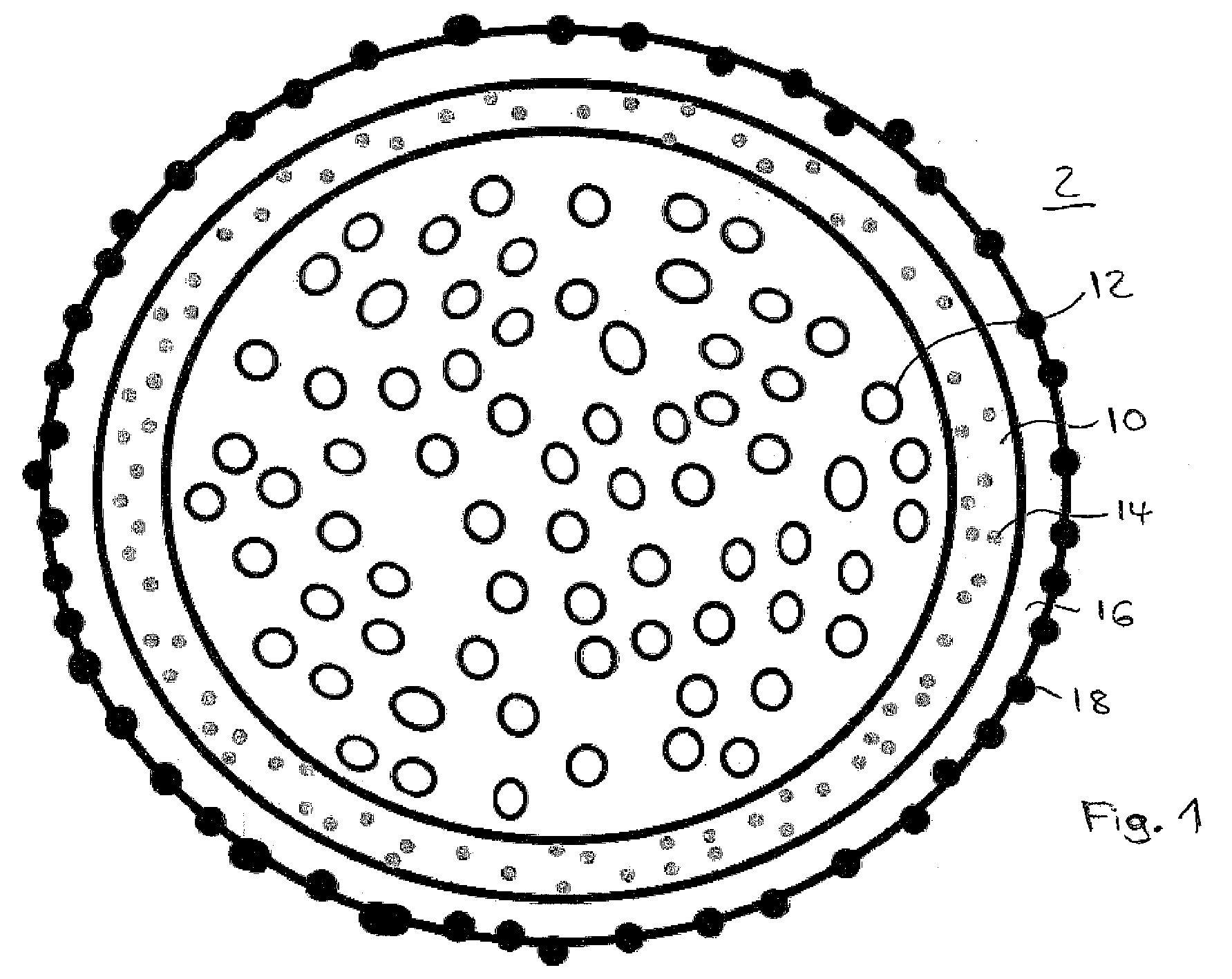
- a thread 2 of a scrim is shown in cross section.
- the thread 2 comprises a large number of individual carbon multifilaments 12, each of which has between several 1,000 and up to 100,000 individual filaments.
- the thread 2 is in the embodiment Fig. 1 provided with an impregnation 10, to which one or more additives 14 were added in the impregnation process in order to improve the electrical, mechanical or also thermal properties.
- the thread 2 has been coated with a coating medium 16.
- sanding occurred, so that the coating 16 serves as a carrier medium for the particles 18. The sanding increases the surface of the thread 2, which results in better bonding properties with the mortar.
- the clutch 1 after Fig. 2 comprises a plurality of threads 2 or strands, which are arranged in two planes.
- Each level comprises a number of threads 2 which are spaced apart and essentially parallel to one another.
- Each of these threads 2 comprises a number of carbon multifilaments, which in the present exemplary embodiment have been glued to form an elongated strand. However, it is also conceivable that these carbon multifilaments are sewn into a strand or connected in some other way.
- the threads 2 of two planes are essentially orthogonal to one another, which is why a lattice structure with square spaces is formed.
- the threads 2 are fixed at the crossing points 4 with a continuous sewing thread 6, but can also be glued or connected to one another in another way.
- the planes of the scrim 1 do not necessarily have to be arranged orthogonally to one another, but, depending on the intended use, can also be arranged offset at a different angle. It is also conceivable that more than two levels can be provided.
- a ribbon-shaped primary anode 8 is sewn along the entire length on a thread 2, whereby the anode system can be supplied with current over the entire length in contrast to contacting in a single point.
- the primary anode 8 is sewn into a thread 2 and is therefore essentially completely surrounded by carbon multifilaments.
- an impregnation 10 and then a coating according to the above statements are applied to the scrim 1.
- a scrim 1 for an anode system can be provided which has optimal mechanical, electrical and thermal properties for the respective application and place of use.
Landscapes
- Engineering & Computer Science (AREA)
- Architecture (AREA)
- Chemical Kinetics & Catalysis (AREA)
- Chemical & Material Sciences (AREA)
- Structural Engineering (AREA)
- Civil Engineering (AREA)
- Textile Engineering (AREA)
- Electrochemistry (AREA)
- Mechanical Engineering (AREA)
- Prevention Of Electric Corrosion (AREA)
- Working Measures On Existing Buildindgs (AREA)
- Reinforcement Elements For Buildings (AREA)
- Chemical Or Physical Treatment Of Fibers (AREA)
Abstract
Die Erfindung gibt ein Verfahren zur Herstellung einer Textilbewehrung aus einem Gelege, wobei eine Tränkung auf einen Faden des Geleges oder auf das Gelege aufgetragen wird, an, wobei die Textilbewehrung eine mechanische Verstärkung für frei bewitterte und befahrene Bauwerke ermöglicht und einfach zu verlegen ist. Dazu umfasst die Tränkung ein Basismaterial, welchem mindestens ein Additiv zugegeben wird.
Description
Die Erfindung bezieht sich auf ein Verfahren zur Herstellung einer Textilbewehrung aus einem Gelege, wobei eine Tränkung auf einen Faden oder eines Strangs des Geleges oder auf das Gelege aufgetragen wird. Weiterhin bezieht sich die Erfindung auf eine solche Textilbewehrung.The invention relates to a method for producing textile reinforcement from a scrim, an impregnation being applied to a thread or a strand of the scrim or to the scrim. Furthermore, the invention relates to such textile reinforcement.
Bauwerke aus Stahlbeton sind integraler Bestandteil der Infrastruktur in fast allen Ländern der Welt. Neben Wohn- und Arbeitsgebäuden sind auch viele befahrene Bauwerke aus Stahlbeton gebaut, z.B. Parkhäuser, Garagen, Autobahnen, Brücken, Tunnel usw. Eine Großzahl dieser Bauwerke wird 50 bis 100 Jahre (und teilweise noch länger) genutzt. Allerdings setzen neben der mechanischen Beanspruchung vor allem Tausalze den Stahlbeton-Bauwerken zu. Die Tausalze sind in der Regel chloridhaltig. Es entstehen daher in Verbindung mit Wasser Lösungen, die Korrosion in den Bauwerken auslösen. Bei vielen Bauwerken müssen deshalb bereits nach 20-25 Jahren substantielle, kostenintensive Instandsetzungsarbeiten an der Bewehrung durchgeführt werden.Reinforced concrete structures are an integral part of the infrastructure in almost every country in the world. In addition to residential and work buildings, many busy structures are also made of reinforced concrete, e.g. Parking garages, garages, highways, bridges, tunnels etc. A large number of these structures are used for 50 to 100 years (and sometimes even longer). However, in addition to mechanical stress, above all de-icing salts add to the reinforced concrete structures. The de-icing salts are usually chloride-containing. In connection with water, solutions are created that trigger corrosion in the buildings. In many buildings, therefore, substantial, cost-intensive repair work must be carried out on the reinforcement after just 20-25 years.
Dazu wird üblicherweise der kontaminierte Überdeckungsbeton abgetragen, der Bewehrungsstahl gereinigt und mit einem neuen Korrosionsschutz versehen (z.B. auf Polymer- oder Zementbasis). Der instandgesetzte Bereich hält häufig jedoch nur wenige Jahre (aufgrund mechanischer, thermischer und/oder hygrischer Inkompatibilitäten), so dass eine zeitnahe weitere Instandsetzung erforderlich wird, gerade dann, wenn der Überdeckungsbeton stark beansprucht wird. Dies verursacht hohe Kosten, stellt einen erheblichen Eingriff in das Bauwerk dar und führt nicht zuletzt zu Nutzungseinschränkungen während der Instandsetzung.For this purpose, the contaminated covering concrete is usually removed, the reinforcing steel cleaned and provided with new corrosion protection (e.g. on a polymer or cement basis). However, the repaired area often only lasts for a few years (due to mechanical, thermal and / or hygric incompatibilities), so that timely further repairs are required, especially when the covering concrete is heavily used. This causes high costs, represents a significant intervention in the structure and, last but not least, leads to restrictions on use during the repair.
Eine Möglichkeit die Korrosion zu unterdrücken und im Idealfall zu verhindern stellt der kathodische Korrosionsschutz (KKS) von Bauwerken dar. Als eine zum größten Teil zerstörungsfreie Instandsetzungsmethode gewinnt der kathodische Korrosionsschutz als wirtschaftliches Instandsetzungsverfahren korrosionsgefährdeter bzw. -geschädigter Bauteile zunehmend an Bedeutung.One possibility to suppress corrosion and ideally to prevent it is the cathodic corrosion protection (KKS) of buildings. As a largely non-destructive repair method, cathodic corrosion protection wins is becoming increasingly important as an economical repair process for components that are at risk or corroded.
Insbesondere bei befahrenen Stahlbetonbauwerken, muss aber neben dem Korrosionsschutz und aufgrund eines stetig steigenden Verkehrsaufkommens und immer schwerer werdenden Fahrzeugen (LKW, SUV) viele befahrene Bauwerke (Brücken, Parkbauten) nachträglich verstärkt werden. Hier gibt es eine Vielzahl an Verfahren, wie z. B. Vorspannung mit externen Spanngliedern, Querkraftverstärkung mit Spanngliedern oder Schublaschen aus Stahl, Aufbetonierung mit Verdübelung, Querschnittsergänzungen durch Spritzbeton mit zusätzlicher Betonstahlbewehrung und (geschlitzt) geklebte CFK-(Stahl-) Lamellen.Especially with reinforced concrete structures used, but in addition to corrosion protection and due to a steadily increasing volume of traffic and increasingly heavy vehicles (trucks, SUVs), many structures used (bridges, parking structures) have to be reinforced subsequently. There are a variety of processes here, such as: B. Prestressing with external tendons, shear force reinforcement with tendons or steel drawers, concreting with dowels, cross-sectional additions with shotcrete with additional reinforcing steel reinforcement and (slotted) glued CFRP (steel) slats.
Bislang ist allerdings kein Verfahren bekannt, das frei bewitterte und befahrene Stahlbetonbauwerke langfristig vor Stahlkorrosion schützt und gleichzeitig eine mechanische Verstärkung für das Bauwerk darstellt. Zwar werden vermehrt Verbundwerkstoffe aus Carbonbeton oder andere Textilbetone aus Basalt- oder AR-Glas-Faser verwendet, die in einem Epoxidharz oder Styrol-Butadien-Kautschuk getränkt werden, doch sind diese bislang in ihren Einsatzmöglichkeiten beschränkt, da sie beispielsweise nur für Innenbauten, in denen witterungsbedingte Einflüsse kaum auftreten, geeignet sind oder es fehlt ihnen an der oft notwendigen Formfreiheit.So far, however, no method is known that protects freely weathered and used reinforced concrete structures in the long term against steel corrosion and at the same time represents a mechanical reinforcement for the structure. Although composite materials made of carbon concrete or other textile concretes made of basalt or AR glass fiber, which are soaked in an epoxy resin or styrene-butadiene rubber, are increasingly being used, these have so far been limited in their possible uses, since they are only used, for example, in interior structures which weather-related influences hardly occur, are suitable or lack the often necessary freedom of form.
So erfüllen bisherige textile Carbonbewehrungen nur die Funktion der Bauwerksverstärkung oder des Korrosionsschutzes. Es gibt allerdings bereits Ansätze die Carbonfasern in Epoxidharz oder Styrol-Butadien-Kautschuk zu tränken, um ein stabiles Gelege zu erhalten. Gelege mit Epoxidharztränkung weisen dabei eine hohe Verbundfestigkeit auf. Gelege mit Styrol-Butadien-Kautschuk zeichnen sich dagegen insbesondere durch ihre gute Verarbeitbarkeit, Formbarkeit und insbesondere ausreichende Polarisationseigenschaften aus. Allerdings gibt es derzeit noch keine Tränkung, die einen ausgeprägten mechanischen Verbund und gleichzeitig eine gute Verarbeitbarkeit/Formbarkeit sowie vorteilhafte Polarisationseigenschaften aufweist.Previous carbon fiber reinforcements only fulfill the function of building reinforcement or corrosion protection. However, there are already attempts to soak the carbon fibers in epoxy resin or styrene-butadiene rubber in order to obtain a stable clutch. Scrims with epoxy resin impregnation have a high bond strength. On the other hand, scrims with styrene-butadiene rubber are characterized in particular by their good processability, formability and in particular adequate polarization properties. However, there is currently no impregnation which has a pronounced mechanical bond and at the same time good processability / formability and advantageous polarization properties.
Bisherige getränkte textile Bewehrungen haben zudem gemeinsam, dass sich eine Verlegung um Ecken und Kanten, bzw. bei spitzen Winkeln und engen Krümmungsradien (z. B. Übergang Boden zu Stütze) als sehr schwierig gestaltet. Die schlechte Biegsamkeit der textilen Bewehrung oder das Verursachen von Fehlstellen durch enge Krümmungsradien führt dazu, dass die Verstärkungs- und Korrosionsschutzeffekte nicht wie benötigt erzielt werden.Previously impregnated textile reinforcements also have in common that laying around corners and edges, or at acute angles and tight radii of curvature (e.g. transition from floor to column) is very difficult. The poor flexibility of the textile reinforcement or the creation of defects due to narrow radii of curvature means that the reinforcement and corrosion protection effects are not achieved as required.
Der Erfindung liegt daher die Aufgabe zugrunde ein Verfahren zur Herstellung einer Textilbewehrung und eine Textilbewehrung anzugeben, welche eine mechanische Verstärkung für frei bewitterte und befahrene Bauwerke ermöglicht und einfach zu verlegen ist.The invention is therefore based on the object of specifying a method for producing a textile reinforcement and a textile reinforcement which enables mechanical reinforcement for freely weathered and used structures and is easy to install.
Die Textilbewehrung kann dabei beispielsweise auch Glas umfassen. Sollte im Rahmen der mechanischen Verstärkung auch ein kathodischer Korrosionsschutz ermöglicht werden, bietet sich der Einsatz eines Carbongeleges bzw. eines Geleges welches zumindest zum Teil aus Carbonfasern gebildet wird an.The textile reinforcement can also include glass, for example. If cathodic corrosion protection is also made possible as part of the mechanical reinforcement, it is advisable to use a carbon fabric or a fabric which is at least partially formed from carbon fibers.
Unter Gelege wird dabei im Rahmen dieser Anmeldung ein Flächengebilde verstanden, welches aus mehreren Lagen von im Wesentlichen parallel verlaufenden gestreckten Fäden besteht. Dabei werden die einzelnen Lagen übereinandergelegt und an den Kreuzungspunkten miteinander fixiert. Sind die Fäden verschiedener Lagen in zwei unterschiedliche Richtungen ausgerichtet, spricht man von einem biaxialen Gelege, sind mehrere Lagen mit mehreren Ausrichtungen vorgesehen, wird von einem multiaxialen Gelege gesprochen. Im Rahmen dieser Anmeldung ist unter dem Begriff Gelege somit auch ein Gitter zu verstehen, welches ebenfalls einen entsprechenden Aufbau aufweist.In the context of this application, scrims are understood to mean a flat structure which consists of several layers of stretched threads which run essentially parallel. The individual layers are placed on top of each other and fixed together at the crossing points. If the threads of different layers are oriented in two different directions, one speaks of a biaxial fabric, if several layers with multiple orientations are provided, one speaks of a multiaxial fabric. In the context of this application, the term scrim is also to be understood to mean a grid which likewise has a corresponding structure.
Als Faden eines Geleges wird dabei ein einzelner gestreckter Strang verstanden. Dieser Faden kann dabei aus einer Anzahl von Carbonmultifilamenten bestehen, die zusammen einen Faden bzw. Strang bilden.A single stretched strand is understood as the thread of a scrim. This thread can consist of a number of carbon multifilaments, which together form a thread or strand.
Diese Aufgabe wird erfindungsgemäß gelöst, indem die Tränkung ein Basismaterial umfasst, welchem ein Additiv zugegeben wird.This object is achieved according to the invention in that the impregnation comprises a base material to which an additive is added.
Die Erfindung geht dabei von der Überlegung aus, dass die Bereitstellung einer ausreichenden mechanischen Verstärkung und gegebenenfalls einer genügend hohen Leitfähigkeit für den kathodischen Korrosionsschutz durch geeignete Auswahl eines Tränkungsmediums erzielt werden kann. Hierbei hat sich gezeigt, dass das Gelege der Textilbewehrung besonders leicht an die spezifischen Anforderungen am Einsatzort angepasst werden kann, wenn die Tränkung und dort das für die Tränkung verwendete Basismedium durch Zugabe von Additiven zur Erhöhung der elektrischen, mechanischen und thermischen Eigenschaften modifiziert wird. So ist es beispielsweise möglich, durch die Zugabe von Kohlenstoffnanoröhrchen (Carbon Nanotubes), Metallpartikeln, Salzen (bzw. ionischen Verbindungen) oder Graphit die elektrischen Eigenschaften, insbesondere die Leitfähigkeit zu erhöhen, während die thermischen Eigenschaften durch die Zugabe von Metallen, Carbon- und Grafitteilchen beeinflusst werden kann. Zur Verbesserung der mechanischen Eigenschaften, insbesondere auch des Verbundes mit dem Festmörtel, ist es möglich Hartstoffe, beispielsweise in Form von Siliziumcarbit, Quarzen und Keramiken, zuzufügen.The invention is based on the consideration that the provision of sufficient mechanical reinforcement and possibly a sufficiently high conductivity for cathodic corrosion protection can be achieved by suitable selection of an impregnation medium. It has been shown here that the scrim of the textile reinforcement can be particularly easily adapted to the specific requirements at the place of use if the impregnation and there the base medium used for the impregnation is modified by adding additives to increase the electrical, mechanical and thermal properties. It is possible, for example, to increase the electrical properties, in particular the conductivity, by adding carbon nanotubes, metal particles, salts (or ionic compounds) or graphite, while the thermal properties are increased by adding metals, carbon and Graphite particles can be influenced. To improve the mechanical properties, in particular also the bond with the solid mortar, it is possible to add hard materials, for example in the form of silicon carbide, quartz and ceramics.
Weiterhin ist es möglich durch die Zugabe der Additive die Prozessparameter und mögliche Verarbeitbarkeit des Geleges, insbesondere eines Carbongeleges, zu modifizieren. So ist es denkbar Verflüssiger, Verzögerer oder Quellmittel zu verwenden, um die Eigenschaften des Frisch- und Festmörtels zu beeinflussen.Furthermore, by adding the additives, it is possible to modify the process parameters and possible processability of the scrim, in particular a carbon scrim. It is conceivable to use plasticizers, retarders or swelling agents to influence the properties of the fresh and solid mortar.
Insbesondere kann durch die Zugabe von Additiven erreicht werden, dass die Festigkeit des Mörtels im Bereich des Geleges besonders hoch ist, während sie an der Oberfläche vergleichsweise niedrig ausgebildet ist. Dieser Festigkeitsgradient, der vom Gelege weg abfällt, ermöglicht einen besonders flexiblen Einsatz des Geleges.In particular, the addition of additives can ensure that the strength of the mortar in the area of the scrim is particularly high, while it is comparatively low on the surface. This strength gradient, which drops away from the scrim, enables the scrim to be used particularly flexibly.
Für eine besonders flexible und vielfältige Möglichkeit der Modifikation wird das Basismaterial in bevorzugter Ausführung durch radikalische Polymerisation aus einem Monomer und einem Starter synthetisiert. Hierbei besteht nun die Möglichkeit das Additiv vor der Synthetisierung bereits dem Monomer und/oder dem Starter zuzufügen. Dies ermöglicht eine Modifizierung der Tränkung bereits im Vorfeld der Synthetisierung des Basismaterials. Zusätzlich oder alternativ ist es aber auch möglich das Additiv dem bereits synthetisierten Basismaterial vor, im Rahmen der Tränkung und/oder auch nach der Tränkung in Form eines Aufstreuens auf das getränkte Gelege.For a particularly flexible and varied possibility of modification, the base material is preferably made by radical polymerization synthesized a monomer and a starter. It is now possible to add the additive to the monomer and / or the starter before the synthesis. This enables the impregnation to be modified even before the base material is synthesized. Additionally or alternatively, it is also possible to add the additive to the already synthesized base material before, as part of the impregnation and / or after the impregnation in the form of a sprinkling on the impregnated scrim.
In besonderen Form der Tränkung oder auch im Rahmen der späteren Beschichtung wird der Starter in einem ersten Prozess auf das Gelege aufgetragen und anschließend erst das Monomer aufgebracht, sodass die Synthetisierung des Basismaterials direkt an dem Gelege erfolgt.In a special form of impregnation or as part of the subsequent coating, the starter is applied to the scrim in a first process and only then is the monomer applied, so that the base material is synthesized directly on the scrim.
Besonders vorteilhaft hat sich dabei die Verwendung eines Polymethylmethacrylat als Basismaterials für die Tränkung herausgestellt. Da sich dieses Basismaterial aufgrund der geringen Dichte besonders gut in die Zwischenräume des Geleges aber auch in die Zwischenräume der Faserstränge eingebracht werden kann. Neben der Verwendung von Polymethylmethacrylaten als Basismaterial sind aber ganz allgemein auch die oben bereits erwähnten Epoxidharze, Styrol-Butadien-Kautschuke und Acrylate oder Polyurethane denkbar.The use of a polymethyl methacrylate as the base material for the impregnation has proven particularly advantageous. Since this base material can be introduced particularly well into the interstices of the scrim but also into the interstices of the fiber strands due to the low density. In addition to the use of polymethyl methacrylates as the base material, the epoxy resins, styrene-butadiene rubbers and acrylates or polyurethanes mentioned above are also quite conceivable.
Um einen festen Verbund zwischen getränkter Textilbewehrung und dem umgebenen Beton zu erzeugen, wird in bevorzugter Ausführung die Oberfläche des getränkten Geleges aufgeraut und damit vergrößert. Dazu werden dem Beschichtungsmedium Additive, beispielsweise in Form von Partikeln zugefügt, die eine solche Oberflächenvergrößerung bewirken. Dabei können insbesondere Granit, Quarzmehl, Zementstein oder leitfähige Partikel verwendet werden. Die vergrößerte Oberfläche führt zu einem kraft- und formschlüssigen Verbund (Verstärkungseffekt). Durch die Zugabe leitfähiger Partikel kann der Ladungsübergang optimiert werden, um den kathodischen Korrosionsschutz zu verbessern. Alternativ oder zusätzlich können auch ionische Verbindungen, Betonzusatzmittel, Mischungen aus Salzen und Mikrosilika (als Suspension oder auch in fester Form) oder puzzolanische Reaktive verwendet werden. Diese können die Erhärtungsreaktionskinektik beeinflussen, um beispielsweise bei der Verwendung von Salzen einerseits die Leitfähigkeit im Grenzbereich und andererseits die Mörtelfestigkeit in der Gewebeumgebung zu erhöhen.In order to produce a firm bond between the impregnated textile reinforcement and the surrounding concrete, in a preferred embodiment the surface of the impregnated scrim is roughened and thus enlarged. For this purpose, additives, for example in the form of particles, are added to the coating medium, which bring about such an increase in surface area. In particular, granite, quartz powder, cement stone or conductive particles can be used. The enlarged surface leads to a non-positive and positive connection (reinforcing effect). By adding conductive particles, the charge transfer can be optimized to improve the cathodic protection against corrosion. As an alternative or in addition, it is also possible to use ionic compounds, concrete admixtures, mixtures of salts and microsilica (as a suspension or in solid form) or pozzolana reactives. These can be the hardening reaction kinetics influence, for example when using salts on the one hand to increase the conductivity in the border area and on the other hand to increase the mortar strength in the tissue environment.
Neben oder zusätzlich zu der Vergrößerung der Oberfläche des Geleges durch Hinzugabe von Partikeln kann in vorteilhafter Ausführung auch eine Beschichtung auf das bereits getränkte Gelege aufgetragen werden, dass, wie auch die Partikel, die Oberfläche vergrößert bzw. die Additive besser eingebunden werden. Diese Beschichtung kann dann entweder das Trägermedium für die Partikel darstellen oder selbst für einen höheren Verbund sorgen. Auch diesem Beschichtungsmedium werden in bevorzugter Ausführung Additive zur Verbesserung der elektrischen, thermischen oder mechanischen Eigenschaften vor, während oder nach der Applikation auf das getränkte Gelege zugeführt.In addition to or in addition to enlarging the surface of the scrim by adding particles, in an advantageous embodiment a coating can also be applied to the already impregnated scrim so that, like the particles, the surface is enlarged or the additives are better integrated. This coating can then either be the carrier medium for the particles or itself provide a higher bond. In a preferred embodiment, additives are also added to this coating medium to improve the electrical, thermal or mechanical properties before, during or after application to the impregnated scrim.
Die Tränkung oder auch Beschichtung kann dabei insbesondere im Tauchbadverfahren, einem Emulationsverfahren, einem Spritzverfahren oder auch gestrichen oder gerollt aufgetragen werden.The impregnation or coating can be applied in particular in the immersion bath process, an emulation process, a spray process or else coated or rolled.
Die mit der Erfindung erzielten Vorteile bestehen insbesondere darin, dass durch die Verwendung von einer auf den jeweiligen Anwendungsbereich abgestimmten und durch ein Additiv modifizierten Tränkung des Geleges, bei einem Carbongelege insbesondere der Carbonfasern, Carbonfäden oder des ganzen, carbonhaltigen Geleges, die Eigenschaften der Bewehrung aber auch des Mörtels in der direkten Umgebung der Bewehrung beeinflusst werden können. So können neben ebenen Flächen auch gekrümmte, frei bewitterte und befahrene Bauwerke dauerhaft vor Stahlkorrosion geschützt und gleichzeitig mechanisch verstärkt werden. Ein besonderer Vorteil ist dabei, dass es bei geeigneter Modifizierung der mechanischen Eigenschaften erreicht werden kann, dass das hierbei genutzte Carbongelege als dünnschichtiger Textilbeton auch ohne die Kombination mit einem kathodischen Korrosionsschutz eine ausreichende Tragfähigkeit oder eine Traglasterhöhung bereitstellen kann. Hier kann es somit zusätzlich mit dem Abtragen von dünnen Altbelägen, die nicht weiter zur Tragfähigkeit notwendig sind (wie Estrich, Asphalt oder minderfestem Beton) zu einer Auflastverringerung, Traglasterhöhung und größeren Durchfahrtshöhen in Parkhäusern kommen.The advantages achieved by the invention are, in particular, that, by using an impregnation of the scrim tailored to the respective area of application and modified by an additive, in the case of a carbon scrim especially the carbon fibers, carbon threads or the entire carbon-containing scrim, the properties of the reinforcement the mortar in the immediate vicinity of the reinforcement can also be influenced. In addition to flat surfaces, curved, freely weathered and used structures can be permanently protected from steel corrosion and mechanically reinforced at the same time. A particular advantage is that, with a suitable modification of the mechanical properties, it can be achieved that the carbon fabric used here as a thin-layer textile concrete can provide sufficient load-bearing capacity or an increased load capacity even without the combination with cathodic corrosion protection. Here, it is also possible to remove thin old coverings that are no longer necessary for load-bearing capacity (such as screed, Asphalt or low-strength concrete) lead to a reduction in the load, increased payload and higher clearance heights in parking garages.
So führt die Erhöhung der Festigkeit in Fasernähe zu einer Verbesserung der Performance ohne eine zu hohe Schwindrissbildung zu bedingen. Weiterhin kann durch die Zugabe von Fließmitteln an der Faser das Eindringen in das Gewebe verbessert werden.Increasing the strength near the fibers leads to an improvement in performance without causing excessive shrinkage cracks. Furthermore, the addition of flow agents to the fiber can improve the penetration into the fabric.
Im Detail liegen die wesentlichen Vorteile des verwendeten Beschichtungsmediums in der Verbesserung der elektrischen, chemischen und mechanischen Eigenschaften des gesamten Systems, insbesondere in der hohen mechanische Belastbarkeit bzw. Lastaufnahme der eingesetzten Materialien (z. B. bei statischen und dynamischen Zug-, Haftzug- und Scherbelastungen), der langfristige Resistenz gegen Umwelteinflüsse, d. h. chemische Inertheit sowie Temperaturbeständigkeit in einem Temperaturspektrum von -20°C bis 80°C. Dabei kann das Traglastverhalten im größeren Temperaturbereich verbessert werden. Weiterhin liegen die Vorteile in der flexiblen Verarbeitbarkeit und Verformbarkeit (Drapierbarkeit) bei gleichzeitig ausreichender Steifigkeit zum Verlegen der Textilbewehrung. Verbindungen über Ecken und Kanten können kraftschlüssig und elektrisch leitend hergestellt werden. Durch die Steifigkeit wird darüber hinaus eine einfache Anwendung bei der Verlegung ermöglicht. Weitere Vorteile liegen in der hohen Verbundfestigkeit zwischen Beton und textiler Bewehrung (gegebenenfalls durch die zusätzliche Verwendung eines Coatings) und der optimierten Leitfähigkeit im "metallischen" Leiter (Carbon, Leiter 1. Ordnung) und guter Ladungsübergang auf den ionischen Leiter (Zementstein; Leiter 2. Ordnung).In detail, the main advantages of the coating medium used are the improvement of the electrical, chemical and mechanical properties of the entire system, in particular the high mechanical strength and load absorption of the materials used (e.g. static and dynamic tensile, adhesive and Shear loads), long-term resistance to environmental influences, d. H. chemical inertness and temperature resistance in a temperature range from -20 ° C to 80 ° C. The load capacity behavior can be improved in the larger temperature range. Furthermore, the advantages lie in the flexible processability and deformability (drapability) with sufficient rigidity for laying the textile reinforcement. Connections across corners and edges can be made non-positively and electrically conductive. The rigidity also enables easy application during installation. Further advantages are the high bond strength between concrete and textile reinforcement (if necessary through the additional use of a coating) and the optimized conductivity in the "metallic" conductor (carbon, 1st order conductor) and good charge transfer to the ionic conductor (cement block;
Ein nach dem obigen Verfahren hergestelltes Gelege ist in einem Ausführungsbeispiel der Erfindung in einer Zeichnung näher erläutert.A fabric produced according to the above method is explained in more detail in an embodiment of the invention in a drawing.
Darin zeigt:
-
Fig. 1 ein Querschnitt durch einen Faden des Geleges -
Fig. 2 ein Gelege mit einer eingenähten Primäranode
-
Fig. 1 a cross section through a thread of the scrim -
Fig. 2 a clutch with a sewn-in primary anode
In
Das Gelege 1 nach
Es ist selbstverständlich, dass die Ebenen des Geleges 1 nicht zwangsläufig orthogonal zueinander angeordnet sein müssen, sondern je nach Einsatzzweck auch in einem anderen Winkel versetzt angeordnet sein können. Ebenso ist es denkbar, dass mehr als zwei Ebenen vorgesehen sein können.It goes without saying that the planes of the scrim 1 do not necessarily have to be arranged orthogonally to one another, but, depending on the intended use, can also be arranged offset at a different angle. It is also conceivable that more than two levels can be provided.
Im Ausführungsbeispiel nach der
Zur Erhöhung der mechanischen, elektrischen und thermischen Eigenschaften, insbesondere zur Verbesserung der Verlegbarkeit und Aktivierung der mechanischen Eigenschaften des Geleges 1 und auch des im Mörtel eingebetteten Anodensystems ist auf dem Gelege 1 eine Tränkung 10 und anschließend eine Beschichtung entsprechend den obigen Ausführungen aufgetragen. Hierbei kann durch geeignete Wahl der Tränkungs- und Beschichtungsrezeptur und durch Zugabe von entsprechenden Additiven eine Gelege 1 für ein Anodensystem bereitgestellt werden, welches optimale mechanische, elektrische und thermische Eigenschaften für den jeweiligen Anwendungszweck und Einsatzort aufweist.In order to increase the mechanical, electrical and thermal properties, in particular to improve the ability to lay and activate the mechanical properties of the scrim 1 and also the anode system embedded in the mortar, an
- 11
- GelegeClutch
- 22nd
- Fadenthread
- 44th
- KreuzungspunktCrossing point
- 66
- NähfadenSewing thread
- 88th
- PrimäranodePrimary anode
- 1010th
- Tränkungimpregnation
- 1212th
- CarbonmultifilamenteCarbon multifilaments
- 1414
- AdditivAdditive
- 1616
- BeschichtungCoating
- 1818th
- Partikelparticle
Claims (7)
Priority Applications (2)
| Application Number | Priority Date | Filing Date | Title |
|---|---|---|---|
| EP18200952.2A EP3640407B1 (en) | 2018-10-17 | 2018-10-17 | Impregnated fabric with additives |
| US16/655,611 US20200123796A1 (en) | 2018-10-17 | 2019-10-17 | Impregnated nest with additives |
Applications Claiming Priority (1)
| Application Number | Priority Date | Filing Date | Title |
|---|---|---|---|
| EP18200952.2A EP3640407B1 (en) | 2018-10-17 | 2018-10-17 | Impregnated fabric with additives |
Publications (3)
| Publication Number | Publication Date |
|---|---|
| EP3640407A1 true EP3640407A1 (en) | 2020-04-22 |
| EP3640407B1 EP3640407B1 (en) | 2023-12-06 |
| EP3640407C0 EP3640407C0 (en) | 2023-12-06 |
Family
ID=63878525
Family Applications (1)
| Application Number | Title | Priority Date | Filing Date |
|---|---|---|---|
| EP18200952.2A Active EP3640407B1 (en) | 2018-10-17 | 2018-10-17 | Impregnated fabric with additives |
Country Status (2)
| Country | Link |
|---|---|
| US (1) | US20200123796A1 (en) |
| EP (1) | EP3640407B1 (en) |
Citations (3)
| Publication number | Priority date | Publication date | Assignee | Title |
|---|---|---|---|---|
| US5218810A (en) * | 1992-02-25 | 1993-06-15 | Hexcel Corporation | Fabric reinforced concrete columns |
| CA2192567C (en) * | 1994-06-10 | 2006-04-25 | Frederick P. Isley, Jr. | High strength fabric reinforced walls |
| RU177233U1 (en) * | 2016-08-03 | 2018-02-14 | Общество с ограниченной ответственностью "Знаменский Композитный Завод" | REINFORCING GRID POLYMER COMPOSITE PRE-STRESSED WITH NANO-ADDITIVES |
-
2018
- 2018-10-17 EP EP18200952.2A patent/EP3640407B1/en active Active
-
2019
- 2019-10-17 US US16/655,611 patent/US20200123796A1/en not_active Abandoned
Patent Citations (3)
| Publication number | Priority date | Publication date | Assignee | Title |
|---|---|---|---|---|
| US5218810A (en) * | 1992-02-25 | 1993-06-15 | Hexcel Corporation | Fabric reinforced concrete columns |
| CA2192567C (en) * | 1994-06-10 | 2006-04-25 | Frederick P. Isley, Jr. | High strength fabric reinforced walls |
| RU177233U1 (en) * | 2016-08-03 | 2018-02-14 | Общество с ограниченной ответственностью "Знаменский Композитный Завод" | REINFORCING GRID POLYMER COMPOSITE PRE-STRESSED WITH NANO-ADDITIVES |
Also Published As
| Publication number | Publication date |
|---|---|
| EP3640407B1 (en) | 2023-12-06 |
| US20200123796A1 (en) | 2020-04-23 |
| EP3640407C0 (en) | 2023-12-06 |
Similar Documents
| Publication | Publication Date | Title |
|---|---|---|
| DE69720656T2 (en) | METHOD FOR REINFORCING AN ASPHALT CONCRETE CONSTRUCTION | |
| EP3266951B1 (en) | Composite component having flat prefabricated concrete elements | |
| DE4315270A1 (en) | Steel fiber reinforced concrete with high flexural strength | |
| AT11192U1 (en) | USE OF A COMPOSITE MATERIAL, IN PARTICULAR AS KNITTED OR CROCHETED, THROUGH A GRAPHIC OR KETTLE FABRIC SYSTEM | |
| DE3876805T2 (en) | PRELOADED CONSTRUCTION ELEMENT IN COMPOSITE STRUCTURE AND PRODUCTION METHOD FOR THIS ELEMENT. | |
| EP2182139B1 (en) | Method for attaching a reinforcement or cladding to an existing builing part and building part with attached reinforcement or cladding | |
| EP3262211A1 (en) | Method of producing cathodic corrosion protection for protection of reinforcing steel in a ferroconcrete structure | |
| DE202008010803U1 (en) | Heat-insulating brick | |
| EP0732464A1 (en) | Method of manufacturing reinforced coatings, especially on concrete surfaces, and associated reinforcement net | |
| EP1289905B1 (en) | Cement-bound active substance | |
| EP3707303B1 (en) | Fibre products with a coating made formed from aqueous polymer dispersions | |
| DE60204809T2 (en) | Cement mortar, structure and method for reinforcing structural components | |
| EP3640407B1 (en) | Impregnated fabric with additives | |
| DE2930939C2 (en) | Process for the mechanical reinforcement of moldable and / or hardenable materials | |
| DE3607459C2 (en) | ||
| DE2322271A1 (en) | PROCESS FOR MECHANICAL STRENGTHENING OF MOLDABLE AND / OR HARDENABLE MASSES | |
| DE102010011713B4 (en) | Self-compacting concrete, process for its production and its use | |
| DE102007059560A1 (en) | Cylindrical container producing method, involves transferring concrete or lightweight pre-stressed concrete or self-compacting concrete with steel fiber in specific amount, and introducing obtained mixture into mold and hardening mixture | |
| DE3032533A1 (en) | Glass fibre reinforcing mesh for plaster walls - with sprinkled fibre shreds for better anchorage | |
| EP1686220B1 (en) | Lightweight construction panel | |
| DE102010061818B3 (en) | Self-compacting concrete for producing concrete layer, comprises portion of blast furnace cement that contains portion of Portland cement clinker and portion of blast furnace slag, Portland composite cement, and portion of limestone flour | |
| EP1669511A1 (en) | Lightweight construction element and manufacturing method | |
| DE202008017283U1 (en) | Asphalted traffic area | |
| EP3640370A1 (en) | Non-woven fabric with primary anode | |
| DE2710011A1 (en) | Prestressed concrete components with enveloped prestressing elements - uses tubes filled with mortar which harden after on site prestressing |
Legal Events
| Date | Code | Title | Description |
|---|---|---|---|
| PUAI | Public reference made under article 153(3) epc to a published international application that has entered the european phase |
Free format text: ORIGINAL CODE: 0009012 |
|
| STAA | Information on the status of an ep patent application or granted ep patent |
Free format text: STATUS: THE APPLICATION HAS BEEN PUBLISHED |
|
| AK | Designated contracting states |
Kind code of ref document: A1 Designated state(s): AL AT BE BG CH CY CZ DE DK EE ES FI FR GB GR HR HU IE IS IT LI LT LU LV MC MK MT NL NO PL PT RO RS SE SI SK SM TR |
|
| AX | Request for extension of the european patent |
Extension state: BA ME |
|
| STAA | Information on the status of an ep patent application or granted ep patent |
Free format text: STATUS: REQUEST FOR EXAMINATION WAS MADE |
|
| 17P | Request for examination filed |
Effective date: 20201021 |
|
| RBV | Designated contracting states (corrected) |
Designated state(s): AL AT BE BG CH CY CZ DE DK EE ES FI FR GB GR HR HU IE IS IT LI LT LU LV MC MK MT NL NO PL PT RO RS SE SI SK SM TR |
|
| STAA | Information on the status of an ep patent application or granted ep patent |
Free format text: STATUS: EXAMINATION IS IN PROGRESS |
|
| 17Q | First examination report despatched |
Effective date: 20220525 |
|
| GRAP | Despatch of communication of intention to grant a patent |
Free format text: ORIGINAL CODE: EPIDOSNIGR1 |
|
| STAA | Information on the status of an ep patent application or granted ep patent |
Free format text: STATUS: GRANT OF PATENT IS INTENDED |
|
| INTG | Intention to grant announced |
Effective date: 20230523 |
|
| GRAS | Grant fee paid |
Free format text: ORIGINAL CODE: EPIDOSNIGR3 |
|
| GRAA | (expected) grant |
Free format text: ORIGINAL CODE: 0009210 |
|
| STAA | Information on the status of an ep patent application or granted ep patent |
Free format text: STATUS: THE PATENT HAS BEEN GRANTED |
|
| AK | Designated contracting states |
Kind code of ref document: B1 Designated state(s): AL AT BE BG CH CY CZ DE DK EE ES FI FR GB GR HR HU IE IS IT LI LT LU LV MC MK MT NL NO PL PT RO RS SE SI SK SM TR |
|
| REG | Reference to a national code |
Ref country code: GB Ref legal event code: FG4D Free format text: NOT ENGLISH |
|
| REG | Reference to a national code |
Ref country code: DE Ref legal event code: R096 Ref document number: 502018013742 Country of ref document: DE |
|
| REG | Reference to a national code |
Ref country code: CH Ref legal event code: EP |
|
| REG | Reference to a national code |
Ref country code: IE Ref legal event code: FG4D Free format text: LANGUAGE OF EP DOCUMENT: GERMAN |
|
| U01 | Request for unitary effect filed |
Effective date: 20240104 |
|
| U07 | Unitary effect registered |
Designated state(s): AT BE BG DE DK EE FI FR IT LT LU LV MT NL PT SE SI Effective date: 20240112 |
|
| PG25 | Lapsed in a contracting state [announced via postgrant information from national office to epo] |
Ref country code: GR Free format text: LAPSE BECAUSE OF FAILURE TO SUBMIT A TRANSLATION OF THE DESCRIPTION OR TO PAY THE FEE WITHIN THE PRESCRIBED TIME-LIMIT Effective date: 20240307 |
|
| PG25 | Lapsed in a contracting state [announced via postgrant information from national office to epo] |
Ref country code: ES Free format text: LAPSE BECAUSE OF FAILURE TO SUBMIT A TRANSLATION OF THE DESCRIPTION OR TO PAY THE FEE WITHIN THE PRESCRIBED TIME-LIMIT Effective date: 20231206 |
|
| PG25 | Lapsed in a contracting state [announced via postgrant information from national office to epo] |
Ref country code: GR Free format text: LAPSE BECAUSE OF FAILURE TO SUBMIT A TRANSLATION OF THE DESCRIPTION OR TO PAY THE FEE WITHIN THE PRESCRIBED TIME-LIMIT Effective date: 20240307 Ref country code: ES Free format text: LAPSE BECAUSE OF FAILURE TO SUBMIT A TRANSLATION OF THE DESCRIPTION OR TO PAY THE FEE WITHIN THE PRESCRIBED TIME-LIMIT Effective date: 20231206 |
|
| PG25 | Lapsed in a contracting state [announced via postgrant information from national office to epo] |
Ref country code: RS Free format text: LAPSE BECAUSE OF FAILURE TO SUBMIT A TRANSLATION OF THE DESCRIPTION OR TO PAY THE FEE WITHIN THE PRESCRIBED TIME-LIMIT Effective date: 20231206 Ref country code: NO Free format text: LAPSE BECAUSE OF FAILURE TO SUBMIT A TRANSLATION OF THE DESCRIPTION OR TO PAY THE FEE WITHIN THE PRESCRIBED TIME-LIMIT Effective date: 20240306 Ref country code: HR Free format text: LAPSE BECAUSE OF FAILURE TO SUBMIT A TRANSLATION OF THE DESCRIPTION OR TO PAY THE FEE WITHIN THE PRESCRIBED TIME-LIMIT Effective date: 20231206 |
|
| PG25 | Lapsed in a contracting state [announced via postgrant information from national office to epo] |
Ref country code: IS Free format text: LAPSE BECAUSE OF FAILURE TO SUBMIT A TRANSLATION OF THE DESCRIPTION OR TO PAY THE FEE WITHIN THE PRESCRIBED TIME-LIMIT Effective date: 20240406 |
|
| PG25 | Lapsed in a contracting state [announced via postgrant information from national office to epo] |
Ref country code: CZ Free format text: LAPSE BECAUSE OF FAILURE TO SUBMIT A TRANSLATION OF THE DESCRIPTION OR TO PAY THE FEE WITHIN THE PRESCRIBED TIME-LIMIT Effective date: 20231206 |
|
| PG25 | Lapsed in a contracting state [announced via postgrant information from national office to epo] |
Ref country code: SK Free format text: LAPSE BECAUSE OF FAILURE TO SUBMIT A TRANSLATION OF THE DESCRIPTION OR TO PAY THE FEE WITHIN THE PRESCRIBED TIME-LIMIT Effective date: 20231206 |
|
| PG25 | Lapsed in a contracting state [announced via postgrant information from national office to epo] |
Ref country code: SM Free format text: LAPSE BECAUSE OF FAILURE TO SUBMIT A TRANSLATION OF THE DESCRIPTION OR TO PAY THE FEE WITHIN THE PRESCRIBED TIME-LIMIT Effective date: 20231206 Ref country code: SK Free format text: LAPSE BECAUSE OF FAILURE TO SUBMIT A TRANSLATION OF THE DESCRIPTION OR TO PAY THE FEE WITHIN THE PRESCRIBED TIME-LIMIT Effective date: 20231206 Ref country code: RO Free format text: LAPSE BECAUSE OF FAILURE TO SUBMIT A TRANSLATION OF THE DESCRIPTION OR TO PAY THE FEE WITHIN THE PRESCRIBED TIME-LIMIT Effective date: 20231206 Ref country code: IS Free format text: LAPSE BECAUSE OF FAILURE TO SUBMIT A TRANSLATION OF THE DESCRIPTION OR TO PAY THE FEE WITHIN THE PRESCRIBED TIME-LIMIT Effective date: 20240406 Ref country code: CZ Free format text: LAPSE BECAUSE OF FAILURE TO SUBMIT A TRANSLATION OF THE DESCRIPTION OR TO PAY THE FEE WITHIN THE PRESCRIBED TIME-LIMIT Effective date: 20231206 |
|
| PG25 | Lapsed in a contracting state [announced via postgrant information from national office to epo] |
Ref country code: PL Free format text: LAPSE BECAUSE OF FAILURE TO SUBMIT A TRANSLATION OF THE DESCRIPTION OR TO PAY THE FEE WITHIN THE PRESCRIBED TIME-LIMIT Effective date: 20231206 |
|
| PG25 | Lapsed in a contracting state [announced via postgrant information from national office to epo] |
Ref country code: PL Free format text: LAPSE BECAUSE OF FAILURE TO SUBMIT A TRANSLATION OF THE DESCRIPTION OR TO PAY THE FEE WITHIN THE PRESCRIBED TIME-LIMIT Effective date: 20231206 |
|
| REG | Reference to a national code |
Ref country code: DE Ref legal event code: R097 Ref document number: 502018013742 Country of ref document: DE |
|
| PLBE | No opposition filed within time limit |
Free format text: ORIGINAL CODE: 0009261 |
|
| STAA | Information on the status of an ep patent application or granted ep patent |
Free format text: STATUS: NO OPPOSITION FILED WITHIN TIME LIMIT |
|
| 26N | No opposition filed |
Effective date: 20240909 |
|
| U20 | Renewal fee for the european patent with unitary effect paid |
Year of fee payment: 7 Effective date: 20241031 |
|
| REG | Reference to a national code |
Ref country code: CH Ref legal event code: PL |
|
| GBPC | Gb: european patent ceased through non-payment of renewal fee |
Effective date: 20241017 |
|
| PG25 | Lapsed in a contracting state [announced via postgrant information from national office to epo] |
Ref country code: MC Free format text: LAPSE BECAUSE OF FAILURE TO SUBMIT A TRANSLATION OF THE DESCRIPTION OR TO PAY THE FEE WITHIN THE PRESCRIBED TIME-LIMIT Effective date: 20231206 |
|
| PG25 | Lapsed in a contracting state [announced via postgrant information from national office to epo] |
Ref country code: GB Free format text: LAPSE BECAUSE OF NON-PAYMENT OF DUE FEES Effective date: 20241017 |
|
| PG25 | Lapsed in a contracting state [announced via postgrant information from national office to epo] |
Ref country code: CH Free format text: LAPSE BECAUSE OF NON-PAYMENT OF DUE FEES Effective date: 20241031 |
|
| PG25 | Lapsed in a contracting state [announced via postgrant information from national office to epo] |
Ref country code: IE Free format text: LAPSE BECAUSE OF NON-PAYMENT OF DUE FEES Effective date: 20241017 |
|
| U20 | Renewal fee for the european patent with unitary effect paid |
Year of fee payment: 8 Effective date: 20251031 |
|
| U1K | Transfer of rights of the unitary patent after the registration of the unitary effect |
Owner name: KOCH CARBON CONSULTING GMBH; DE |
|
| PG25 | Lapsed in a contracting state [announced via postgrant information from national office to epo] |
Ref country code: CY Free format text: LAPSE BECAUSE OF FAILURE TO SUBMIT A TRANSLATION OF THE DESCRIPTION OR TO PAY THE FEE WITHIN THE PRESCRIBED TIME-LIMIT; INVALID AB INITIO Effective date: 20181017 |
|
| PG25 | Lapsed in a contracting state [announced via postgrant information from national office to epo] |
Ref country code: HU Free format text: LAPSE BECAUSE OF FAILURE TO SUBMIT A TRANSLATION OF THE DESCRIPTION OR TO PAY THE FEE WITHIN THE PRESCRIBED TIME-LIMIT; INVALID AB INITIO Effective date: 20181017 |
|
| PG25 | Lapsed in a contracting state [announced via postgrant information from national office to epo] |
Ref country code: TR Free format text: LAPSE BECAUSE OF FAILURE TO SUBMIT A TRANSLATION OF THE DESCRIPTION OR TO PAY THE FEE WITHIN THE PRESCRIBED TIME-LIMIT Effective date: 20231206 |