EP3638715B1 - Polybenzoxazine sulfuree utilisable pour le revetement de metal et son collage a du caoutchouc - Google Patents
Polybenzoxazine sulfuree utilisable pour le revetement de metal et son collage a du caoutchouc Download PDFInfo
- Publication number
- EP3638715B1 EP3638715B1 EP18737001.0A EP18737001A EP3638715B1 EP 3638715 B1 EP3638715 B1 EP 3638715B1 EP 18737001 A EP18737001 A EP 18737001A EP 3638715 B1 EP3638715 B1 EP 3638715B1
- Authority
- EP
- European Patent Office
- Prior art keywords
- polybenzoxazine
- formula
- benzoxazine
- rubber
- polybenzoxazine according
- Prior art date
- Legal status (The legal status is an assumption and is not a legal conclusion. Google has not performed a legal analysis and makes no representation as to the accuracy of the status listed.)
- Active
Links
Images


Classifications
-
- C—CHEMISTRY; METALLURGY
- C09—DYES; PAINTS; POLISHES; NATURAL RESINS; ADHESIVES; COMPOSITIONS NOT OTHERWISE PROVIDED FOR; APPLICATIONS OF MATERIALS NOT OTHERWISE PROVIDED FOR
- C09D—COATING COMPOSITIONS, e.g. PAINTS, VARNISHES OR LACQUERS; FILLING PASTES; CHEMICAL PAINT OR INK REMOVERS; INKS; CORRECTING FLUIDS; WOODSTAINS; PASTES OR SOLIDS FOR COLOURING OR PRINTING; USE OF MATERIALS THEREFOR
- C09D171/00—Coating compositions based on polyethers obtained by reactions forming an ether link in the main chain; Coating compositions based on derivatives of such polymers
-
- C—CHEMISTRY; METALLURGY
- C08—ORGANIC MACROMOLECULAR COMPOUNDS; THEIR PREPARATION OR CHEMICAL WORKING-UP; COMPOSITIONS BASED THEREON
- C08G—MACROMOLECULAR COMPOUNDS OBTAINED OTHERWISE THAN BY REACTIONS ONLY INVOLVING UNSATURATED CARBON-TO-CARBON BONDS
- C08G73/00—Macromolecular compounds obtained by reactions forming a linkage containing nitrogen with or without oxygen or carbon in the main chain of the macromolecule, not provided for in groups C08G12/00 - C08G71/00
- C08G73/06—Polycondensates having nitrogen-containing heterocyclic rings in the main chain of the macromolecule
-
- B—PERFORMING OPERATIONS; TRANSPORTING
- B60—VEHICLES IN GENERAL
- B60C—VEHICLE TYRES; TYRE INFLATION; TYRE CHANGING; CONNECTING VALVES TO INFLATABLE ELASTIC BODIES IN GENERAL; DEVICES OR ARRANGEMENTS RELATED TO TYRES
- B60C9/00—Reinforcements or ply arrangement of pneumatic tyres
- B60C9/0007—Reinforcements made of metallic elements, e.g. cords, yarns, filaments or fibres made from metal
-
- C—CHEMISTRY; METALLURGY
- C08—ORGANIC MACROMOLECULAR COMPOUNDS; THEIR PREPARATION OR CHEMICAL WORKING-UP; COMPOSITIONS BASED THEREON
- C08F—MACROMOLECULAR COMPOUNDS OBTAINED BY REACTIONS ONLY INVOLVING CARBON-TO-CARBON UNSATURATED BONDS
- C08F136/00—Homopolymers of compounds having one or more unsaturated aliphatic radicals, at least one having two or more carbon-to-carbon double bonds
- C08F136/02—Homopolymers of compounds having one or more unsaturated aliphatic radicals, at least one having two or more carbon-to-carbon double bonds the radical having only two carbon-to-carbon double bonds
- C08F136/04—Homopolymers of compounds having one or more unsaturated aliphatic radicals, at least one having two or more carbon-to-carbon double bonds the radical having only two carbon-to-carbon double bonds conjugated
- C08F136/14—Homopolymers of compounds having one or more unsaturated aliphatic radicals, at least one having two or more carbon-to-carbon double bonds the radical having only two carbon-to-carbon double bonds conjugated containing elements other than carbon and hydrogen
-
- C—CHEMISTRY; METALLURGY
- C08—ORGANIC MACROMOLECULAR COMPOUNDS; THEIR PREPARATION OR CHEMICAL WORKING-UP; COMPOSITIONS BASED THEREON
- C08G—MACROMOLECULAR COMPOUNDS OBTAINED OTHERWISE THAN BY REACTIONS ONLY INVOLVING UNSATURATED CARBON-TO-CARBON BONDS
- C08G65/00—Macromolecular compounds obtained by reactions forming an ether link in the main chain of the macromolecule
- C08G65/34—Macromolecular compounds obtained by reactions forming an ether link in the main chain of the macromolecule from hydroxy compounds or their metallic derivatives
- C08G65/38—Macromolecular compounds obtained by reactions forming an ether link in the main chain of the macromolecule from hydroxy compounds or their metallic derivatives derived from phenols
- C08G65/40—Macromolecular compounds obtained by reactions forming an ether link in the main chain of the macromolecule from hydroxy compounds or their metallic derivatives derived from phenols from phenols (I) and other compounds (II), e.g. OH-Ar-OH + X-Ar-X, where X is halogen atom, i.e. leaving group
-
- C—CHEMISTRY; METALLURGY
- C09—DYES; PAINTS; POLISHES; NATURAL RESINS; ADHESIVES; COMPOSITIONS NOT OTHERWISE PROVIDED FOR; APPLICATIONS OF MATERIALS NOT OTHERWISE PROVIDED FOR
- C09D—COATING COMPOSITIONS, e.g. PAINTS, VARNISHES OR LACQUERS; FILLING PASTES; CHEMICAL PAINT OR INK REMOVERS; INKS; CORRECTING FLUIDS; WOODSTAINS; PASTES OR SOLIDS FOR COLOURING OR PRINTING; USE OF MATERIALS THEREFOR
- C09D147/00—Coating compositions based on homopolymers or copolymers of compounds having one or more unsaturated aliphatic radicals, at least one having two or more carbon-to-carbon double bonds; Coating compositions based on derivatives of such polymers
-
- C—CHEMISTRY; METALLURGY
- C09—DYES; PAINTS; POLISHES; NATURAL RESINS; ADHESIVES; COMPOSITIONS NOT OTHERWISE PROVIDED FOR; APPLICATIONS OF MATERIALS NOT OTHERWISE PROVIDED FOR
- C09D—COATING COMPOSITIONS, e.g. PAINTS, VARNISHES OR LACQUERS; FILLING PASTES; CHEMICAL PAINT OR INK REMOVERS; INKS; CORRECTING FLUIDS; WOODSTAINS; PASTES OR SOLIDS FOR COLOURING OR PRINTING; USE OF MATERIALS THEREFOR
- C09D179/00—Coating compositions based on macromolecular compounds obtained by reactions forming in the main chain of the macromolecule a linkage containing nitrogen, with or without oxygen, or carbon only, not provided for in groups C09D161/00 - C09D177/00
- C09D179/02—Polyamines
-
- C—CHEMISTRY; METALLURGY
- C09—DYES; PAINTS; POLISHES; NATURAL RESINS; ADHESIVES; COMPOSITIONS NOT OTHERWISE PROVIDED FOR; APPLICATIONS OF MATERIALS NOT OTHERWISE PROVIDED FOR
- C09J—ADHESIVES; NON-MECHANICAL ASPECTS OF ADHESIVE PROCESSES IN GENERAL; ADHESIVE PROCESSES NOT PROVIDED FOR ELSEWHERE; USE OF MATERIALS AS ADHESIVES
- C09J147/00—Adhesives based on homopolymers or copolymers of compounds having one or more unsaturated aliphatic radicals, at least one having two or more carbon-to-carbon double bonds; Adhesives based on derivatives of such polymers
-
- C—CHEMISTRY; METALLURGY
- C09—DYES; PAINTS; POLISHES; NATURAL RESINS; ADHESIVES; COMPOSITIONS NOT OTHERWISE PROVIDED FOR; APPLICATIONS OF MATERIALS NOT OTHERWISE PROVIDED FOR
- C09J—ADHESIVES; NON-MECHANICAL ASPECTS OF ADHESIVE PROCESSES IN GENERAL; ADHESIVE PROCESSES NOT PROVIDED FOR ELSEWHERE; USE OF MATERIALS AS ADHESIVES
- C09J171/00—Adhesives based on polyethers obtained by reactions forming an ether link in the main chain; Adhesives based on derivatives of such polymers
-
- B—PERFORMING OPERATIONS; TRANSPORTING
- B60—VEHICLES IN GENERAL
- B60C—VEHICLE TYRES; TYRE INFLATION; TYRE CHANGING; CONNECTING VALVES TO INFLATABLE ELASTIC BODIES IN GENERAL; DEVICES OR ARRANGEMENTS RELATED TO TYRES
- B60C9/00—Reinforcements or ply arrangement of pneumatic tyres
- B60C9/0007—Reinforcements made of metallic elements, e.g. cords, yarns, filaments or fibres made from metal
- B60C2009/0014—Surface treatments of steel cords
-
- B—PERFORMING OPERATIONS; TRANSPORTING
- B60—VEHICLES IN GENERAL
- B60C—VEHICLE TYRES; TYRE INFLATION; TYRE CHANGING; CONNECTING VALVES TO INFLATABLE ELASTIC BODIES IN GENERAL; DEVICES OR ARRANGEMENTS RELATED TO TYRES
- B60C9/00—Reinforcements or ply arrangement of pneumatic tyres
- B60C9/0007—Reinforcements made of metallic elements, e.g. cords, yarns, filaments or fibres made from metal
- B60C2009/0021—Coating rubbers for steel cords
Definitions
- the present invention relates to thermosetting resins, which can be used in particular in adhesive systems intended in particular for bonding metal to rubber.
- Metal/rubber composites in particular for motor vehicle tires, are well known. They most often consist of a generally diene unsaturated rubber matrix, crosslinkable with sulphur, comprising metal reinforcing elements (or “reinforcements”) such as carbon steel wires, films, tapes or cables.
- these composites must in a known manner satisfy a large number of technical criteria, sometimes contradictory, such as uniformity, flexibility, endurance in bending and compression, resistance to traction, wear and corrosion, and to maintain these performances at a very high level for as long as possible.
- the manufacturers of metal/rubber composites are looking for new adhesive solutions to bond the metal reinforcements to the rubber compositions, while alleviating, at least in part, the aforementioned drawbacks.
- thermosetting type which at room temperature has the same adhesive performance, vis-à-vis metal and rubber, as the aforementioned polymers but which once thermoset (crosslinked) further improved thermal and chemical stability.
- its specific microstructure very advantageously makes it possible to adjust the flexibility of the molecule according to the particular applications targeted.
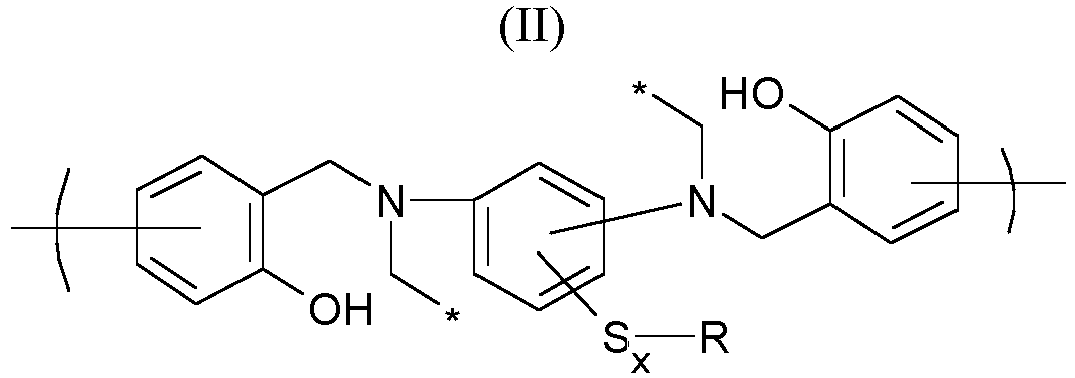
- the present invention relates to a sulfurized polybenzoxazine whose recurring units comprise a unit corresponding to formulas (I) or (II): in which the two oxazine rings are linked together by a central aromatic group whose benzene ring bears one, two, three or four groups of formula -S x -R in which "x" is an integer from 1 to 8 and R represents hydrogen or a hydrocarbon group comprising 1 to 10 carbon atoms and optionally a heteroatom chosen from O, S, N and P.
- the invention also relates to the use of such a polybenzoxazine as a polymeric coating for a substrate of which at least the surface is at least partially metallic, in particular for bonding such a substrate to rubber.
- the invention also relates to any substrate of which at least the surface is at least partly metallic, at least said metallic part being coated with the polymer according to the invention.
- benzoxazines are compounds of general formula:
- benzoxazine compounds or monomers can be synthesized in this way using various phenols and amines depending on their types of substituents. These substituent groups can then provide polymerizable sites and allow the synthesis of various benzoxazine polymers (or polybenzoxazines).
- Benzoxazines and polybenzoxazines which are derived therefrom are products that are well known today to those skilled in the art; to cite only a few examples of publication, we can mention the articles “Poloxazines - New high performance thermosetting resins: synthesis and properties”; NN Ghosh et al., Prog. Polym. Science. 32 (2007), 1344-1391 , Or " Recent Advancement on Polybenzoxazine - A newly Developed High Performance Thermoset”, Y. Yaggi et al., J. Polym. Science. Part A: Polym. Chem. : Flight. 47 (2009), 5565-5576 , as well as for example patents or patent applications US 5,543,516 , WO 2013/148408 .
- polybenzoxazines have the remarkable ability, at high temperature (for example, typically above 150° C. or even 200° C. depending on their particular microstructure), to open their oxazine rings and thus lead to structures of thermosetting polyphenolic resins.
- the specific polybenzoxazine object of the invention derives from a benzoxazine (called “Monomer M” in the present application) of the sulfur type which corresponds to the generic formula (A) which follows: formula (A) in which each benzene ring of the two oxazine rings carries at least one (that is to say one or more) radical G; benzoxazine itself therefore carries at least two G radicals.
- the two oxazine rings are linked together by a central aromatic group whose benzene ring or ring (also called central benzene ring or ring) carries a , two, three or four groups of formula -S x -R in which "x" is an integer from 1 to 8 and R represents hydrogen or a hydrocarbon group comprising 1 to 10 carbon atoms and optionally a heteroatom chosen from O (oxygen), S (sulfur), N (nitrogen) and P (phosphorus).
- the two nitrogen atoms of the oxazine rings are, relative to each other, in any position (i.e. ortho, meta or para) on the central benzene ring.
- these two nitrogen atoms are in the meta position with respect to each other; in other words, the starting benzoxazine (Monomer in this case denoted M-0) from which the polybenzoxazine of the invention is derived then preferably responds to the generic formula (A-0) which follows:
- the central benzene ring carries two groups of formula -S x -R, these two groups being more preferably in the meta position with respect to one another on the benzene ring.
- "x" is included in a range of 1 to 4, more preferentially equal to 1 or 2.
- R is preferentially an alkyl having more preferentially 1 to 5 carbon atoms, even more preferentially a methyl or an ethyl, in particular a methyl.
- polybenzoxazine of the invention (Polymer "P"), derived from the benzoxazine of formula (A) described above therefore has the essential characteristic of comprising recurring structural units comprising at least one unit corresponding to formula (I) (before opening of the oxazine rings) or formula (II) (after ring opening) below:
- polymer should be understood in the present application any homopolymer or copolymer, in particular block copolymer, with recurring structural units comprising at least one unit of formula (I) or (II) above; the polymer of the invention can of course comprise both units of formula (I) and units of formula (II).
- one or more hydrogen atoms of at least one or of each benzene ring of the two oxazine rings, as well than those of the central benzene ring could optionally also be substituted by various substituents (for example a methyl or ethyl group), in particular by functional groups (for example a vinyl group) capable of promoting the adhesion of the polymer to metal and/or rubber.
- substituents for example a methyl or ethyl group
- functional groups for example a vinyl group
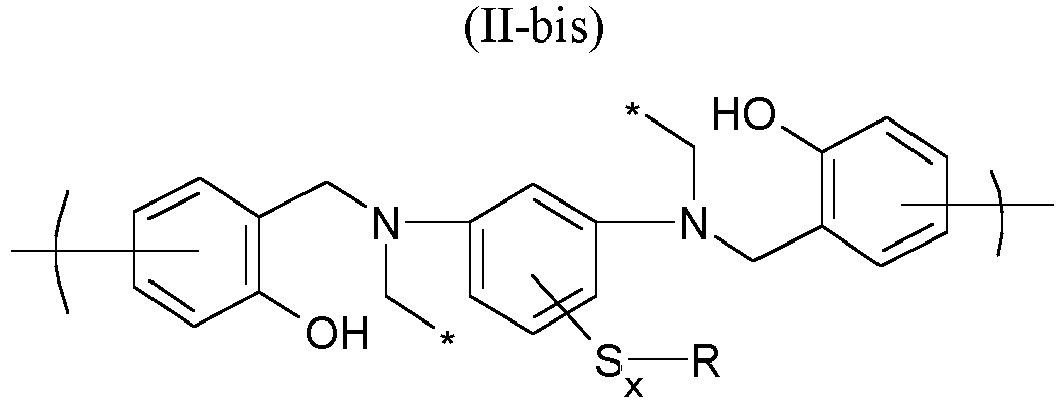
- the polybenzoxazine of the invention then comprises at least recurring structural units comprising (at least) one unit corresponding to formula (I-bis) (before opening of the oxazine rings) or formula (II-bis) ( after opening cycles) below:
- each benzene ring of the two oxazine rings preferably carries a single radical G or a maximum of two, more preferably one and only one radical G .
- the polybenzoxazine of the invention therefore has the essential characteristic of comprising at least recurring structural units comprising (at least) one unit corresponding to formula (Ia) (before opening of the oxazine rings) or formula ( II-a) (after opening the rings) below:
- x is equal to 1 and R represents a methyl.
- the polybenzoxazine of the invention comprises repeating units comprise at least one unit corresponding to the formulas (Ia-1) or (Ib-1) (before opening of the oxazine rings), (II-a-1) or (II-b-1) (after opening of the rings ) below :
- the (at least two) radicals G which are identical or different, represent a halogen such as bromine, chlorine, fluorine or iodine.
- halogenated phenol bearing at least one (i.e. one or more) halogen (represented by the symbol " Hal”), p-formaldehyde and sulfurized aromatic diamine specific to the picture 2 above, of a particular halogenated benzoxazine of formula (A-1) (Monomer denoted M-1) which can be used for the synthesis of a polybenzoxazine in accordance with the invention.
- This halogen (Hal) is more preferably bromine or chlorine, even more preferably bromine; the latter being even more preferably located in the para position of the oxygen of each oxazine ring.
- the (at least two) radicals G which are identical or different, represent a group chosen from -OR 1 , -SR 1 , -NR 2 R 3 ; R 1 , R 2 and R 3 , identical or different, representing an alkyl having 1 to 4 carbon atoms.
- the (at least two) radicals G represent an aliphatic hydrocarbon group (represented by the symbol "A") comprising 1 to 8 carbon atoms, or cycloaliphatic comprising 3 to 8 carbon atoms. carbon, or aromatic containing 6 to 12 carbon atoms, this hydrocarbon group, ethylenically saturated or unsaturated, possibly comprising one (at least one) heteroatom chosen from O, S, N and P.
- A aliphatic hydrocarbon group
- this hydrocarbon group ethylenically saturated or unsaturated, possibly comprising one (at least one) heteroatom chosen from O, S, N and P.
- the (at least two) "A" groups which are identical or different, represent an aliphatic hydrocarbon group, ethylenically saturated or unsaturated, comprising 1 to 6, in particular 1 to 4 carbon atoms, which may optionally comprise at least one (i.e. one or more) heteroatom selected from O, S, N and P.
- the polymer of the invention derives from a disulfurized benzoxazine which corresponds at least in part to one of the two formulas (A-5) and (A-5bis) (Monomers respectively noted M-5 and M-5bis) below:
- figure 7 is a special case of figure 6 , which describes another synthetic scheme, this time starting from a particular example of a phenol (Compound 1) corresponding to such a preferential definition (here, phenol bearing ethylenic unsaturation and a methoxyl group), of paraformaldehyde (Compound 2) and of the specific example of the preceding disulfurized aromatic diamine (Compound 3), of another example of benzoxazine of formula (A-5) (Monomer denoted M-5) which can be used for the synthesis of a sulfurized polybenzoxazine according to the invention.
- phenol compounds here, for example methoxyphenols
- A groups of the aliphatic hydrocarbon type, ethylenically saturated or unsaturated, comprising 1 to 6, in particular 1 to 4 carbon atoms, possibly comprising at least one (that is to say one or more) heteroatoms chosen from O, S, N and P
- the following compounds may be cited, for example:
- the polybenzoxazine polymer of the invention is capable of being obtained by polycondensation of a benzoxazine of formula (A) or (A-0) as it has been described in detail previously, as of first monomer, and, as second monomer, of an aromatic diol or thiol compound.
- the polybenzoxazine of the invention is characterized by repeating units comprising at least one unit corresponding to the particular formulas (I-1) (before opening of the oxazine rings) or (II-1) ( after opening cycles):
- the two nitrogen atoms of the oxazine rings are, relative to each other, in any position (i.e. ortho , meta or para) on the central benzene ring which separates them.
- the polybenzoxazine of the invention then comprises recurring structural units comprising (at least) one unit corresponding to formula (I-1bis) (before opening of the oxazine rings) or formula (II-1bis) (after opening cycles) below:
- one or more hydrogen atoms of at least one or of each aromatic nucleus Ar 1 and Ar 2 could be substituted by various substituents, identical or different, for example by functional groups capable of promoting the adhesion of the polymer to the metal and/or to the rubber.
- FIG 8 describes a general synthetic diagram of a sulfurized polybenzoxazine (Polymer denoted P-1) according to the invention of formula (I-1bis) above, from the halogenated benzoxazine of formula (A-6) (Monomer M- 6) above and another monomer of generic formula (B) (Monomer denoted “N”) of the aromatic diol or thiol type; as well as this example of sulfurized polybenzoxazine (Polymer denoted here P-1' of formula II -1 bis) according to the invention once its oxazine rings have been opened after heat treatment of the Polymer P-1.
- P-1 sulfurized polybenzoxazine
- the compound of formula (B) above corresponds to at least one of the particular formulas (B-1), (B-2) or (B-3) below:
- the polybenzoxazine polymer of the invention can be obtained by homopolymerization of a benzoxazine of formula (A) or (A-0) as described above.
- FIG 9 illustrates a diagram for the synthesis of another polybenzoxazine according to the invention (Polymer P-2' of formula II-2), with its open oxazine rings, obtained this time by simple homopolymerization of the particular halogenated benzoxazine of formula (A-5 ) (Monomer M-5) above.
- the polymer of the invention is derived from a polysulphide brominated benzoxazine which corresponds at least in part to one of the two formulas (A-7) and (A-7bis) (Monomers respectively denoted M-7 and M-7bis) below:
- each benzene ring of the two oxazine rings of the benzoxazine of formula (A) carries one and only one halogen (Hal), more preferably bromine, located in the para position of the oxygen of the oxazine ring.
- Hal halogen
- FIG 11 describes the synthesis of a sulfurized polybenzoxazine (Polymer P-3) according to the invention, from the particular halogenated benzoxazine of formula (A-7) (Monomer M-7) above and from another particular monomer of formula (B-1) (N-1 monomer) of the sulphur-containing aromatic diol type (carrying a thioether function), as well as the structure of this polymer once its oxazine rings have been opened (Polymer denoted P-3').
- the polybenzoxazine of the invention may comprise from ten to several hundreds, preferably from 50 to 300 structural units with units of formula (I) and/or (II), in particular structural units such as represented as examples to figure 8 , 9 And 11 .
- the polybenzoxazine of the invention is advantageously usable, as an adhesion primer or as a single adhesive layer, to coat a metal substrate, at least one substrate of which at least the surface is at least partly metallic, and to adhere in particular this substrate to rubber.
- the invention also relates to such a substrate, in particular made of steel such as carbon steel.
- the steel could be clear (that is to say uncoated) or be coated at least in part with at least one layer (therefore intermediate layer placed between steel and polybenzoxazine layer) of a second metal called metal of surface chosen from the group consisting of aluminium, copper, zinc and alloys of at least one of these metals with at least one other metal (belonging to this group or not).
- This surface metal is in particular brass.
- any known adhesive system for example a conventional textile adhesive of the RFL type comprising at least one diene elastomer such as natural rubber, or any equivalent adhesive known to confer adhesion.
- a conventional textile adhesive of the RFL type comprising at least one diene elastomer such as natural rubber, or any equivalent adhesive known to confer adhesion.
- satisfactory between rubber and conventional polymers such as polyester or polyamide, such as for example the adhesive compositions described in the patent applications WO 2013/017421 , WO 2013/017422 , WO 2013/017423 , WO 2015/007641 , WO 2015/007642 .
- a physical treatment may consist for example of a treatment by radiation such as an electron beam, or by plasma;
- a chemical treatment could for example consist of a preliminary passage in a bath of epoxy resin and/or of isocyanate compound.
- a round flask with three necks of 100 ml, equipped with a thermometer, a nitrogen inlet, a magnetic stirrer and a condenser is available for this synthesis.
- Compound 3 was isolated, by chromatography on silica gel, from the product “Ethacure 300” (supplier Albemarle, Belgium), available in the form of a relatively viscous liquid, of brownish color; it consists of approximately 96% of a mixture of 3,5-bis(methylthio)-2,4-toluenediamine and 3,5-bis(methylthio)2,6-toluenediamine isomers (weight ratio of approximately 4 /1 according to chromatographic analysis).
- This powder is placed in methanol (50 ml for 4 g of powder) and heated under reflux (65° C.) for 30 min. The solution is then allowed to cool to room temperature (approximately 20° C.) for crystallization of the monomer.
- the solid product obtained is isolated by filtration (Büchner filter).
- a round flask with three necks of 100 ml, equipped with a thermometer, a nitrogen inlet, a magnetic stirrer and a condenser is available for this synthesis.
- the synthesis is carried out according to the procedure schematized in figure 10 , as explained in detail below, from three compounds: a halogenated phenol (compound 4; 4-bromophenol; Aldrich product B75808), a p-formaldehyde (compound 2; Aldrich product 158127), and a disulfurized aromatic diamine ( compound 3; 3,5-bis(methylthio)-2,6-toluenediamine) in the presence of two solvents (anhydrous toluene and ethanol).
- a halogenated phenol compound 4; 4-bromophenol; Aldrich product B75808
- a p-formaldehyde compound 2; Aldrich product 158127
- a disulfurized aromatic diamine compound 3; 3,5-bis(methylthio)-2,6-toluenediamine
- Compound 3 was isolated, by chromatography on silica gel, from the product “Ethacure 300” (supplier Albemarle, Belgium), available in the form of a relatively viscous liquid, of brownish color; it consists of approximately 96% of a mixture of 3,5-bis(methylthio)-2,4-toluenediamine and 3,5-bis(methylthio)2,6-toluenediamine isomers (weight ratio of approximately 4 /1 according to chromatographic analysis).
- the final product is then placed in methanol (50 ml for 4.5 g of product) and heated under reflux (65° C.) for 30 min. The solution is then allowed to cool to room temperature (approximately 20° C.) for crystallization of the monomer.
- the solid product obtained is isolated by filtration (Büchner filter). A yellow powder is thus obtained, after drying in a vacuum oven at 50° C., overnight (reaction yield equal to about 82%).
- This synthesis is carried out according to the procedure schematized in figure 11 , as described in detail below, from two monomers: the benzoxazine obtained in the previous step (Monomer M-7) and the sulfur-containing aromatic diol of formula (B-1) (4,4'-thiodiphenol; Monomer N-1); this in the presence of sodium carbonate (Na 2 CO 3 ; Sigma Aldrich product 13418), solvents (anhydrous) DMA (N,N-dimethylacetamide; Sigma Aldrich product 38839) and toluene (Acros Organics product No. 364411000).
- the two monomers (M-7 and N-1) are dried beforehand under vacuum (10 mbar) at 60°C overnight, likewise for the sodium carbonate but at a temperature of 150°C.
- the synthesis is carried out in a round flask with four necks of 100 ml, equipped with a nitrogen inlet, a thermometer, a magnetic stirrer and a "Dean Stark” separator surmounted by a condenser and a distillation bridge (provided with a heating cap).
- the apparatus is dried under vacuum using a hot air gun until the thermometer reaches a temperature of at least 100°C in the reaction flask.
- the assembly is left to cool to ambient temperature (20° C.), then the apparatus is placed under a stream of nitrogen throughout the synthesis.
- Monomer M-7 (1 eq; 1.5 g or 2.79 mmol) of formula (A-7) is then introduced into the flask first, then Monomer N-1 of formula (B-1) (1 eq; 0.61 g or 2.79 mmol). 20 ml of DMA (solvent for the two monomers) are then added, then as base Na 2 CO 3 (3 eq; 0.89 g or 8.36 mol) suspended in 4 ml of toluene. The whole is purged under N 2 for 5 min, then the reaction medium is heated to 105°C.
- the distillation bridge of the Dean Stark apparatus is heated to 110°C (with the heating cap) in order to facilitate the azeotropic distillation (distillation water/ toluene) driving for about 90 min. Then the temperature of the reaction medium is gradually increased, in steps of 10° C. every 30 min, until it reaches 130° C. It is left at this temperature for 17 h, then it is left to cool to ambient temperature (20° C.). The reaction mixture is then distilled at 90° C.
- This Polymer P-3 in the form of a light yellow powder, was also analyzed by DSC ( Differential Scanning Calorimetry ) between -80°C and +350°C according to a ramp of 10°C/min (DSC apparatus "822-2" from Mettler Toledo; nitrogen atmosphere). The analysis showed on the first pass (between -80°C and +350°C) an apparent glass transition (Tg) at 163°C followed by an exotherm (corresponding to the opening of the oxazine cycles, and the crosslinking of the polymer) above 200°C, with two maxima at approximately 270°C and 299°C. During the second and third DSC runs conducted between -80°C and +350°C, no apparent glass transition was visible.
- DSC Differential Scanning Calorimetry
- the tape provided on the surface with its thin layer (thickness 5 to 10 ⁇ m) of polybenzoxazine thus formed was then subjected to a conventional sizing operation in two stages (two-bath sizing), immediately first by immersion in a first aqueous bath (about 94% water) based on epoxy resin (polyglycerol polyglycidyl ether, about 1%) and isocyanate compound (blocked caprolactam, about 5%), first gluing step followed by drying (2 min at 100°C) followed by heat treatment (5 min at 200°C).
- the ribbon thus treated was immersed in a second aqueous bath of RFL glue (approximately 81% by weight of water) based on resorcinol (approximately 2%), formalin (approximately 1%) and a rubber latex ( about 16% NR, SBR and VP-SBR rubbers); it was finally dried in the oven for 2 min at 130°C, then heat-treated for 5 min at 200°C.
- RFL glue approximately 81% by weight of water
- formalin approximately 16%
- a rubber latex about 16% NR, SBR and VP-SBR rubbers
- the metal/rubber composite specimen thus prepared was then placed under a press and the whole cured (vulcanized) at 150° C. for 30 min under a pressure of 20 bar.
- the polybenzoxazine according to the invention offers metal substrates the major advantage of being able to then be glued to rubber matrices using simple textile glues such as RFL glues, or even directly (that is to say without the use of such adhesives) to these rubber matrices, for example when the latter contain suitable functionalized unsaturated elastomers such as epoxidized elastomers.
- the polybenzoxazines of the invention have the remarkable capacity, at high temperature, of opening their oxazine rings and thus of leading to a resin structure thermosetting polyphenolic. This gives them better thermal stability.
- Their specific microstructure finally makes it possible, very advantageously, to adjust the flexibility of the molecule according to the particular applications targeted.
Landscapes
- Chemical & Material Sciences (AREA)
- Organic Chemistry (AREA)
- Chemical Kinetics & Catalysis (AREA)
- Engineering & Computer Science (AREA)
- Health & Medical Sciences (AREA)
- Wood Science & Technology (AREA)
- Materials Engineering (AREA)
- Life Sciences & Earth Sciences (AREA)
- Medicinal Chemistry (AREA)
- Polymers & Plastics (AREA)
- Mechanical Engineering (AREA)
- Heterocyclic Carbon Compounds Containing A Hetero Ring Having Nitrogen And Oxygen As The Only Ring Hetero Atoms (AREA)
- Phenolic Resins Or Amino Resins (AREA)
- Polyethers (AREA)
- Adhesives Or Adhesive Processes (AREA)
Description
- La présente invention est relative aux résines thermodurcissables, utilisables notamment dans les systèmes adhésifs destinés en particulier au collage de métal à du caoutchouc.
- Elle est plus particulièrement relative aux polymères à unités benzoxazine ou « polybenzoxazines » utilisables notamment comme couches adhésives dans des composites métal / caoutchouc destinés à la fabrication d'articles en caoutchouc tels que des bandages, pneumatiques ou non pneumatiques, pour véhicules automobiles.
- Les composites métal / caoutchouc, en particulier pour bandages pour véhicules automobiles, sont bien connus. Ils sont le plus souvent constitués d'une matrice en caoutchouc insaturé généralement diénique, réticulable au soufre, comportant des éléments de renforcement (ou « renforts ») métalliques tels que des fils, films, rubans ou câbles en acier au carbone.
- Soumis à des contraintes très importantes lors du roulage des bandages, notamment à des compressions, flexions ou variations de courbure répétées, ces composites doivent de manière connue satisfaire à un grand nombre de critères techniques, parfois contradictoires, tels qu'uniformité, flexibilité, endurance en flexion et en compression, résistance à la traction, à l'usure et à la corrosion, et maintenir ces performances à un niveau très élevé aussi longtemps que possible.
- On comprend aisément que l'interphase adhésive entre caoutchouc et renforts joue un rôle prépondérant dans la pérennité de ces performances. Le procédé traditionnel pour relier les compositions de caoutchouc à de l'acier au carbone consiste à revêtir la surface de l'acier avec du laiton (alliage cuivre-zinc), la liaison entre l'acier et la matrice de caoutchouc étant assurée par sulfuration du laiton lors de la vulcanisation ou cuisson du caoutchouc. Pour améliorer l'adhésion, on utilise en outre généralement, dans ces compositions de caoutchouc, des sels organiques ou des complexes de métal tels que des sels de cobalt, en tant qu'additifs promoteurs d'adhésion.
- Or, on sait que l'adhésion entre l'acier au carbone et la matrice de caoutchouc est susceptible de s'affaiblir au cours du temps, du fait de l'évolution progressive des sulfures formés sous l'effet des différentes sollicitations rencontrées, notamment mécaniques et/ou thermiques, le processus de dégradation ci-dessus pouvant être accéléré en présence d'humidité. D'autre part, l'utilisation de sels de cobalt rend les compositions de caoutchouc plus sensibles à l'oxydation et au vieillissement, et en augmente significativement le coût, sans compter qu'il est souhaitable de supprimer à terme l'emploi de tels sels de cobalt dans les compositions de caoutchouc, en raison de l'évolution récente de la réglementation européenne sur ce type de sels métalliques.
- Pour toutes les raisons exposées ci-dessus, les fabricants de composites métal / caoutchouc, en particulier les manufacturiers de bandages pour véhicules automobiles, sont à la recherche de solutions adhésives nouvelles pour faire coller les renforts métalliques aux compositions de caoutchouc, tout en palliant, au moins en partie, les inconvénients précités.
- C'est ainsi que les demandes
WO 2014/063963 ,WO 2014/063968 ,WO 2014/173838 ,WO 2014/173839 récemment publiées, déposées par les Demanderesses, ont décrit des polymères nouveaux à unités urée, uréthane ou thiourée, ainsi que leurs monomères de départ, qui répondent aux objectifs ci-dessus. Utilisés notamment comme primaire d'adhésion sur métal dans des composites métal / caoutchouc, ces polymères permettent très avantageusement de coller le métal aux matrices de caoutchouc en utilisant ensuite de simples colles textiles telles que des colles « RFL » (résorcinol-formaldéhyde-latex) ou autres compositions adhésives équivalentes, ou encore directement (c'est-à-dire sans emploi de telles colles) à ces matrices de caoutchouc lorsque ces dernières contiennent par exemple des élastomères insaturés fonctionnalisés appropriés tels que des élastomères époxydés. Ainsi peuvent être supprimés notamment les sels de cobalt (ou autres sels métalliques) dans les compositions de caoutchouc destinées à être reliées à des renforts métalliques laitonnés. - Poursuivant leurs recherches, les Demanderesses ont trouvé un polymère nouveau, du type thermodurcissable, qui à température ambiante présente les mêmes performances adhésives, vis-à-vis du métal et du caoutchouc, que les polymères précités mais qui présente une fois thermodurci (réticulé) une stabilité thermique et chimique encore améliorée. En outre, sa microstructure spécifique permet très avantageusement d'ajuster la flexibilité de la molécule selon les applications particulières visées.
- La présente invention concerne une polybenzoxazine sulfurée dont les unités récurrentes comportent un motif répondant aux formules (I) ou (II) :


- L'invention concerne également l'utilisation d'une telle polybenzoxazine comme revêtement polymérique d'un substrat dont au moins la surface est au moins en partie métallique, en particulier pour le collage d'un tel substrat à du caoutchouc.
- L'invention concerne également tout substrat dont au moins la surface est au moins en partie métallique, au moins ladite partie métallique étant revêtue du polymère selon l'invention.
- L'invention ainsi que ses avantages seront aisément compris à la lumière de la description détaillée et des exemples de réalisation qui suivent, ainsi que des
figures 1 à 11 qui représentent ou schématisent : - le principe général de synthèse d'un composé benzoxazine à partir de trois composés, phénol, formaldéhyde et amine (R résidu de l'amine) (
Fig. 1a ) ; - le mécanisme d'ouverture, par apport thermique, du cycle oxazine (« ring-opening ») d'un tel composé benzoxazine (
Fig. 1b ) ; - un schéma de synthèse général, à partir d'un phénol spécifique (le symbole « G » sera décrit en détail ultérieurement), de paraformaldéhyde et d'une diamine aromatique sulfurée spécifique, d'une benzoxazine de formule (A-0) (Monomère noté « M-0 ») utilisable pour la synthèse d'une polybenzoxazine sulfurée conforme à l'invention (
Fig. 2 ) ; - un schéma de synthèse possible, à partir d'un phénol halogéné (le symbole « Hal » représentant un halogène), de p-formaldéhyde et de la diamine aromatique sulfurée spécifique précédente, d'une benzoxazine halogénée particulière de formule (A-1) (Monomère noté M-1) utilisable pour la synthèse d'une polybenzoxazine conforme à l'invention (
Fig. 3 ) ; - un autre schéma de synthèse possible, à partir d'un autre phénol spécifique (le symbole « A » sera décrit en détail ultérieurement), de p-formaldéhyde et de la diamine aromatique sulfurée spécifique précédente, d'une autre benzoxazine de formule (A-2) (Monomère noté M-2) utilisable pour la synthèse d'une polybenzoxazine conforme à l'invention (
Fig. 4 ) ; - un autre schéma de synthèse possible, à partir d'un phénol halogéné, de p-formaldéhyde et d'un exemple particulier de diamine aromatique sulfurée, d'un autre exemple de benzoxazine halogénée particulière de formule (A-3) (Monomère noté M-3) utilisable pour la synthèse d'une polybenzoxazine conforme à l'invention (
Fig. 5 ) ; - un autre schéma de synthèse possible, à partir d'un autre phénol spécifique, de p-formaldéhyde et de l'exemple particulier de diamine aromatique sulfurée précédente, d'un autre exemple de benzoxazine de formule (A-4) (Monomère noté M-4) utilisable pour la synthèse d'une polybenzoxazine selon l'invention (
Fig. 6 ) ; - un autre schéma de synthèse possible, à partir d'un exemple particulier de phénol (Composé 1 ; méthoxyphénol porteur d'une insaturation éthylénique), de p-formaldéhyde (Composé 2) et de l'exemple particulier (Composé 3) de diamine aromatique disulfurée précédente, d'un autre exemple de benzoxazine de formule (A-5) (Monomère noté M-5) utilisable pour la synthèse d'une polybenzoxazine sulfurée selon l'invention (
Fig. 7 ) ; - un schéma de synthèse général d'un exemple de polybenzoxazine sulfurée (Polymère noté P-1) selon l'invention, à partir de la benzoxazine halogénée de formule (A-6) (Monomère M-6) précédente et d'un autre monomère de formule générique (B) (Monomère noté « N ») du type diol ou thiol aromatique ; ainsi que cet exemple de polybenzoxazine sulfurée (Polymère noté ici P-1') selon l'invention une fois ses cycles oxazine ouverts après traitement thermique du Polymère P-1 (
Fig. 8 ) ; - un schéma de synthèse d'une autre polybenzoxazine selon l'invention (Polymère P-2'), avec ses cycles oxazine ouverts, obtenu par homopolymérisation de la benzoxazine halogénée particulière de formule (A-5) (Monomère M-5) précédente (
Fig. 9 ) ; - un exemple de synthèse, à partir de phénol bromé (composé 4), p-formaldéhyde (composé 2) et d'une diamine aromatique disulfurée spécifique (composé 3), d'une benzoxazine bromée particulière de formule (A-7) (Monomère noté M-7) utilisable pour la synthèse de polybenzoxazines (Polymère P-3 et P-3' de la
figure 11 ) conformes à l'invention (Fig. 10 ) ; - enfin, un exemple de synthèse d'une polybenzoxazine sulfurée (Polymère P-3) selon l'invention, à partir de la benzoxazine halogénée particulière de formule (A-7) (Monomère M-7) précédente et d'un autre monomère particulier de formule (B-1) (Monomère N-1) du type diol aromatique soufré (porteur d'une fonction thioéther), ainsi que la structure de ce polymère une fois ses cycles oxazine ouverts (Polymère noté P-3') (
Fig. 11 ). - On rappellera tout d'abord que les benzoxazines sont des composés de formule générale :

- La
figure 1a annexée rappelle le principe général de synthèse d'une benzoxazine, ici à partir (réaction de condensation) d'une molécule de phénol, de deux molécules de formaldéhyde et d'une amine (R désignant le résidu de l'amine), avec élimination de deux molécules d'eau. - La
figure 1b rappelle quant à elle le mécanisme d'ouverture (« ring-opening ») du cycle oxazine d'un tel composé lors d'un apport thermique (représenté par le symbole Δ). - De nombreux composés ou monomères benzoxazines peuvent être ainsi synthétisés en utilisant divers phénols et amines selon leurs types de substituants. Ces groupes substituants peuvent fournir ensuite des sites polymérisables et permettre la synthèse de divers polymères benzoxazine (ou polybenzoxazines).
- Benzoxazines et polybenzoxazines qui en sont issues sont des produits aujourd'hui bien connus de l'homme du métier ; pour ne citer que quelques exemples de publication, on peut mentionner les articles « Polybenzoxazines - New high performance thermosetting resins : synthesis and properties » ; N.N. Ghosh et al., Prog. Polym. Sci. 32 (2007), 1344-1391, ou « Recent Advancement on Polybenzoxazine - A newly Developed High Performance Thermoset », Y. Yaggi et al., J. Polym. Sci. Part A: Polym. Chem. : Vol. 47 (2009), 5565-5576, ainsi que par exemple les brevets ou demandes de brevet
US 5 543 516 ,WO 2013/148408 . - Comme expliqué en détail dans les documents ci-dessus, les polybenzoxazines ont la capacité remarquable, à haute température (par exemple, typiquement supérieure à 150°C voire à 200°C selon leur microstructure particulière), d'ouvrir leurs cycles oxazine et de conduire ainsi à des structures de résines polyphénoliques thermodurcissables.
- La polybenzoxazine spécifique objet de l'invention dérive d'une benzoxazine (dénommée « Monomère M » dans la présente demande) du type sulfurée qui répond à la formule générique (A) qui suit :

- Les (au moins) deux radicaux G, identiques ou différents, sont choisis dans le groupe constitué par :
- les halogènes ;
- les groupements -OR1, -SR1, -NR2R3 ; R1, R2 et R3, identiques ou différents, représentant un alkyle ayant 1 à 4 atomes de carbone ; et
- les groupements hydrocarbonés aliphatiques comportant 1 à 8 atomes de carbone, ou cycloaliphatiques comportant 3 à 8 atomes de carbone, ou aromatiques comportant 6 à 12 atomes de carbone, ces groupements hydrocarbonés, éthyléniquement saturés ou insaturés, comportant en outre optionnellement au moins un hétéroatome choisi parmi O, S, N et P.
- Dans cette formule (A), comme précédemment décrit pour le polymère de l'invention, les deux cycles oxazine sont reliés entre eux par un groupe aromatique central dont le cycle ou noyau benzénique (dit aussi cycle ou noyau benzénique central) est porteur de un, deux, trois ou quatre groupements de formule -Sx-R dans laquelle « x » est un entier de 1 à 8 et R représente l'hydrogène ou un groupe hydrocarboné comportant 1 à 10 atomes de carbone et optionnellement un hétéroatome choisi parmi O (oxygène), S (soufre), N (azote) et P (phosphore).
- De même, on peut noter dans cette formule (A) que les deux atomes d'azote des cycles oxazine sont, l'un par rapport à l'autre, dans une position quelconque (c'est-à-dire ortho, méta ou para) sur le noyau benzénique central. Toutefois, de préférence, ces deux atomes d'azote sont en position méta l'un par rapport à l'autre ; en d'autres termes, la benzoxazine (Monomère dans ce cas noté M-0) de départ de laquelle dérive la polybenzoxazine de l'invention répond alors préférentiellement à la formule générique (A-0) qui suit :

- La
figure 2 annexée donne le schéma de synthèse général de cette benzoxazine de formule (A-0), sous apport thermique et avec élimination d'eau, à partir d'un phénol spécifique porteur d'au moins un (c'est-à-dire un ou plusieurs) radical G, de paraformaldéhyde et enfin d'une diamine aromatique sulfurée spécifique de formule :
- Préférentiellement, dans cette benzoxazine de formule (A) ou (A-0), le noyau benzénique central est porteur de deux groupements de formule -Sx-R, ces deux groupements étant plus préférentiellement en position méta l'un par rapport à l'autre sur le noyau benzénique. Selon un autre mode de réalisation préférentiel, « x » est compris dans un domaine de 1 à 4, plus préférentiellement égal à 1 ou 2. R est préférentiellement un alkyle ayant plus préférentiellement 1 à 5 atomes de carbone, encore plus préférentiellement un méthyle ou un éthyle, en particulier un méthyle.
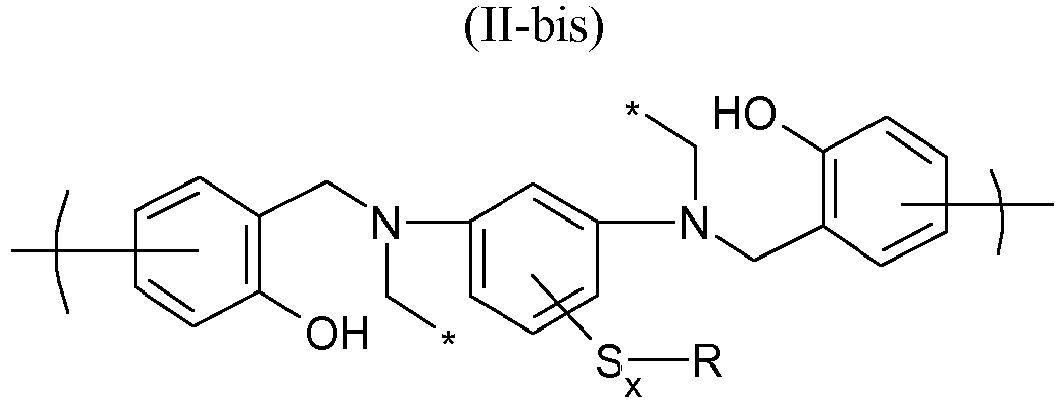
- La polybenzoxazine de l'invention (Polymère « P »), dérivant de la benzoxazine de formule (A) précédemment décrite a donc pour caractéristique essentielle de comporter des unités structurelles récurrentes comportant au moins un motif répondant aux formule (I) (avant ouverture des cycles oxazine) ou formule (II) (après ouverture des cycles) ci-dessous :


- Par polymère doit être entendu dans la présente demande tout homopolymère ou copolymère, notamment copolymère à blocs, avec des unités structurelles récurrentes comportant au moins un motif de formule (I) ou (II) ci-dessus ; le polymère de l'invention peut bien entendu comporter à la fois des motifs de formule (I) et des motifs de formule (II).
- Dans la formule (II) ci-dessus, l'homme du métier comprendra immédiatement que les deux symboles « * » (identiques ou différents) représentent un rattachement quelconque du motif à un atome de carbone ou à un hétéroatome (choisi de préférence parmi O, S, N et P), rattachement ou liaison résultant de l'ouverture des cycles oxazine lors d'un apport thermique (Δ) suffisant.
- En outre, dans les formules (I) et (II) ci-dessus, comme pour le monomère de formule (A), un ou plusieurs atomes d'hydrogène d'au moins un ou de chaque noyau benzénique des deux cycles oxazine, ainsi que ceux du cycle benzénique central, pourraient optionnellement être également substitués par divers substituants (à titre d'exemple un groupe méthyle ou éthyle), notamment par des groupes fonctionnels (à titre d'exemple un groupe vinyle) susceptibles de favoriser l'adhésion du polymère au métal et/ou au caoutchouc.
- De même, comme pour le monomère de formule (A) précédente, on peut noter dans ces formules (I) et (II) que les deux atomes d'azote des cycles oxazine sont, l'un par rapport à l'autre, dans une position quelconque (c'est-à-dire ortho, méta ou para) sur le noyau benzénique central qui les sépare.
- Toutefois, de préférence, ces deux atomes d'azote sont en position méta l'un par rapport à l'autre sur le noyau benzénique central; en d'autres termes, la polybenzoxazine de l'invention comporte alors au moins des unités structurelles récurrentes comportant (au moins) un motif répondant aux formule (I-bis) (avant ouverture des cycles oxazine) ou formule (II-bis) (après ouverture des cycles) ci-après :

- Dans les formules (A) ou (A-0) précédente, de préférence, chaque noyau benzénique des deux cycles oxazine est porteur d'un seul radical G ou au maximum de deux, plus préférentiellement d'un et d'un seul radical G.
- Ce dernier (radical G) est encore plus préférentiellement situé en position para de l'oxygène du cycle oxazine. Dans un tel cas, on comprendra que la polybenzoxazine de l'invention a donc pour caractéristique essentielle de comporter au moins des unités structurelles récurrentes comportent (au moins) un motif répondant aux formule (I-a) (avant ouverture des cycles oxazine) ou formule (II-a) (après ouverture des cycles) ci-dessous :


- Encore plus préférentiellement, « x » est égal à 1 et R représente un méthyle.
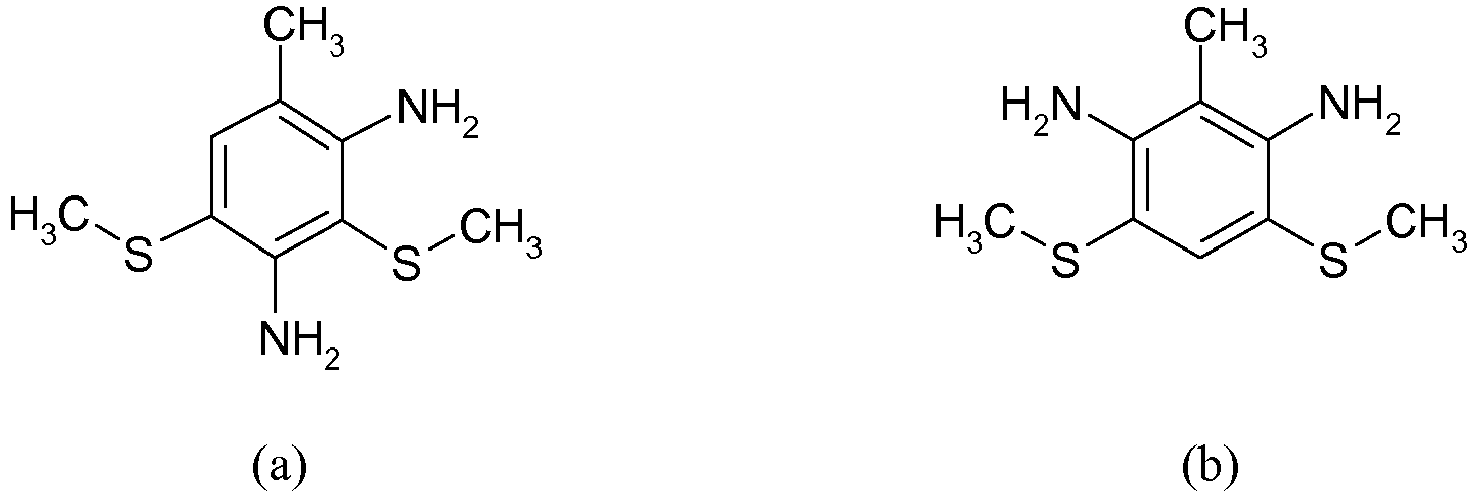
- Ainsi, à titre d'exemples de diamines aromatiques sulfurées convenant pour la synthèse d'une benzoxazine de formule (A) ou (A-0) dans laquelle, selon un mode de réalisation particulièrement préférentiel, « x » est égal à 1 et R représente un méthyle, on citera en particulier les composés 3,5-bis(méthylthio)-2,4-toluènediamine, 3,5-bis(méthylthio)-2,6-toluènediamine et leurs mélanges, répondant respectivement aux formules (a) et (b) ci-dessous :
- En d'autres termes, selon un mode de réalisation particulièrement préférentiel, si la benzoxazine de formule (A-0) est issue d'au moins un des deux isomères ci-dessus ou de leurs mélanges, alors la polybenzoxazine de l'invention comporte des unités récurrentes comportent au moins un motif répondant aux formules (I-a-1) ou (I-b-1) (avant ouverture des cycles oxazine), (II-a-1) ou (II-b-1) (après ouverture des cycles) ci-dessous :


- Selon un mode de réalisation préférentiel, les (au moins deux) radicaux G, identiques ou différents, représentent un halogène tel que brome, chlore, fluor ou iode.
- La
figure 3 annexée donne un schéma de synthèse général, sous apport thermique et avec élimination d'eau, à partir d'un phénol halogéné porteur d'au moins un (c'est-à-dire un ou plusieurs) halogène (représenté par le symbole « Hal »), p-formaldéhyde et de la diamine aromatique sulfurée spécifique de lafigure 2 précédente, d'une benzoxazine halogénée particulière de formule (A-1) (Monomère noté M-1) utilisable pour la synthèse d'une polybenzoxazine conforme à l'invention. Cet halogène (Hal) est plus préférentiellement le brome ou le chlore, encore plus préférentiellement le brome ; ce dernier étant plus préférentiellement encore situé en position para de l'oxygène de chaque cycle oxazine. - Selon un autre mode de réalisation préférentiel, les (au moins deux) radicaux G, identiques ou différents, représentent un groupement choisi parmi -OR1, -SR1, -NR2R3 ; R1, R2 et R3, identiques ou différents, représentant un alkyle ayant 1 à 4 atomes de carbone.
- Selon un autre mode de réalisation préférentiel, les (au moins deux) radicaux G, identiques ou différents, représentent un groupement hydrocarboné (représenté par le symbole « A ») aliphatique comportant 1 à 8 atomes de carbone, ou cycloaliphatique comportant 3 à 8 atomes de carbone, ou aromatique comportant 6 à 12 atomes de carbone, ce groupement « A » hydrocarboné, éthyléniquement saturé ou insaturé, pouvant comportant optionnellement un (au moins un) hétéroatome choisi parmi O, S, N et P.
- La
figure 4 annexée donne un schéma de synthèse général, sous apport thermique et avec élimination d'eau, à partir d'un phénol halogéné porteur d'au moins un (c'est-à-dire un ou plusieurs) tel groupement « A », de paraformaldéhyde et de la diamine aromatique sulfurée spécifique desfigures 2 et3 précédentes, d'une benzoxazine particulière de formule (A-2) (Monomère noté M-2) utilisable pour la synthèse d'une polybenzoxazine conforme à l'invention. - La
figure 5 donne un autre schéma de synthèse possible, à partir d'un phénol halogéné, de paraformaldéhyde et d'un exemple spécifique de diamine aromatique disulfurée, à savoir la 3,5-bis(méthylthio)-2,6-toluènediamine de formule (b) précédente, d'un autre exemple de benzoxazine halogénée particulière de formule (A-3) (Monomère noté M-3) utilisable pour la synthèse d'une polybenzoxazine conforme à l'invention. - La
figure 6 donne un autre schéma de synthèse possible, à partir d'un autre phénol (le symbole « A » a été décrit précédemment), de paraformaldéhyde et de la 3,5-bis(méthylthio)-2,6-toluènediamine de formule (b) précédente, d'un autre exemple de benzoxazine de formule (A-4) (Monomère noté M-4) utilisable pour la synthèse d'une polybenzoxazine selon l'invention. - Selon un mode de réalisation préférentiel, les (au moins deux) groupements « A », identiques ou différents, représentent un groupement hydrocarboné aliphatique, éthyléniquement saturé ou insaturé, comportant 1 à 6, en particulier 1 à 4 atomes de carbone, pouvant comporter optionnellement au moins un (c'est-à-dire un ou plusieurs) hétéroatome choisi parmi O, S, N et P.
- Ainsi, selon un autre mode de réalisation particulier et préférentiel, le polymère de l'invention dérive d'une benzoxazine disulfurée qui répond au moins en partie à l'une des deux formules (A-5) et (A-5bis) (Monomères respectivement notés M-5 et M-5bis) ci-dessous :

- La
figure 7 est un cas particulier de lafigure 6 , qui décrit un autre schéma de synthèse, à partir cette fois d'un exemple particulier d'un phénol (Composé 1) répondant à une telle définition préférentielle (ici, phénol porteur d'une insaturation éthylénique et d'un groupe méthoxyle), de paraformaldéhyde (Composé 2) et de l'exemple particulier de diamine aromatique disulfurée précédente (Composé 3), d'un autre exemple de benzoxazine de formule (A-5) (Monomère noté M-5) utilisable pour la synthèse d'une polybenzoxazine sulfurée selon l'invention. - L'homme du métier saura bien entendu adapter largement la formule spécifique (A) ou (A-0) de la benzoxazine servant de monomère de départ pour la synthèse de la polybenzoxazine selon l'invention, en faisant varier notamment les formules du phénol (porteur du radical ou des radicaux G) et de la diamine sulfurée (porteur du ou des groupements de formule -Sx-R).
- A titre d'exemples de diamines aromatiques sulfurées préférentielles, ont déjà été cités notamment les composés 3,5-bis(méthylthio)-2,4-toluènediamine, 3,5-bis(méthylthio)-2,6-toluènediamine et leurs mélanges.
- A titre d'exemples de composés phénols (ici, par exemple méthoxyphénols) porteurs de groupements « A » du type hydrocarbonés aliphatiques, éthyléniquement saturés ou insaturés, comportant 1 à 6, en particulier 1 à 4 atomes de carbone, pouvant comporter optionnellement au moins un (c'est-à-dire un ou plusieurs) hétéroatome choisi parmi O, S, N et P, peuvent être cités par exemple les composés suivants :


- Selon un mode de réalisation préférentiel, le polymère polybenzoxazine de l'invention est susceptible d'être obtenu par polycondensation d'une benzoxazine de formule (A) ou (A-0) telle qu'elle a été décrite en détail précédemment, à titre de premier monomère, et, à titre de deuxième monomère, d'un composé diol ou thiol aromatique.
- Ce composé diol ou thiol aromatique répond plus préférentiellement à la formule (B):
(B) HX1-Ar1-Z-Ar2-X2H
dans laquelle : - X1 et X2, identiques ou différents, représentent O ou S ;
- Ar1 et Ar2, identiques ou différents, représentent un groupe aromatique, de préférence phénylène ;
- Z représente O ou (S)n, le symbole « n » représentant un nombre entier égal ou supérieur à 1.
- Ainsi, selon un mode de réalisation particulièrement préférentiel, la polybenzoxazine de l'invention se caractérise par des unités récurrentes comportant au moins un motif répondant aux formules particulières (I-1) (avant ouverture des cycles oxazine) ou (II-1) (après ouverture des cycles) :


- Ici encore, on note bien entendu que, dans les formules ci-dessus, les deux atomes d'azote des cycles oxazine sont, l'un par rapport à l'autre, dans une position quelconque (c'est-à-dire ortho, méta ou para) sur le noyau benzénique central qui les sépare.
- Toutefois, plus préférentiellement encore, dans les formules (I-1) et (II-1) ci-dessus, ces deux atomes d'azote sont en position méta l'un par rapport à l'autre sur le noyau benzénique central qui les sépare. En d'autres termes, la polybenzoxazine de l'invention comporte alors des unités structurelles récurrentes comportant (au moins) un motif répondant aux formule (I-1bis) (avant ouverture des cycles oxazine) ou formule (II-1bis) (après ouverture des cycles) ci-après :


- Dans les formules (I-1), (II-1), (I-1bis), (II-1bis) ci-dessus, un ou plusieurs atomes d'hydrogène d'au moins un ou de chaque noyau aromatique Ar1 et Ar2 pourraient être substitués par divers substituants, identiques ou différents, par exemple par des groupes fonctionnels susceptibles de favoriser l'adhésion du polymère au métal et/ou au caoutchouc.
- La
figure 8 décrit un schéma de synthèse général d'une polybenzoxazine sulfurée (Polymère noté P-1) selon l'invention de formule (I-1bis) ci-dessus, à partir de la benzoxazine halogénée de formule (A-6) (Monomère M-6) précédente et d'un autre monomère de formule générique (B) (Monomère noté « N ») du type diol ou thiol aromatique ; ainsi que cet exemple de polybenzoxazine sulfurée (Polymère noté ici P-1' de formule II -1 bis) selon l'invention une fois ses cycles oxazine ouverts après traitement thermique du Polymère P-1. - Dans les formules générales (I-1), (II-1), (I-1bis) ou (II-1bis) ci-dessus, on a préférentiellement au moins une des caractéristiques suivantes qui est vérifiée :
- Ar1 et Ar2 représentent chacun un groupe phénylène non substitué ;
- X1 et X2 représentent chacun soit un atome de soufre, soit un atome d'oxygène ;
- Z représente O ou S (soit « n » égal à 1), plus préférentiellement S.
- Plus préférentiellement, c'est l'ensemble des caractéristiques préférentielles ci-dessus qui est vérifié simultanément.
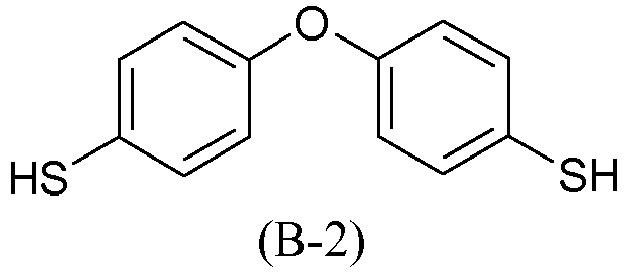
- A titre d'exemples préférentiels, le composé de formule (B) précédente répond à au moins une des formules particulières (B-1), (B-2) ou (B-3) ci-dessous :


- Selon un autre mode de réalisation particulier et préférentiel, le polymère polybenzoxazine de l'invention peut être obtenu par homopolymérisation d'une benzoxazine de formule (A) ou (A-0) telle que décrite supra.
- Ainsi, la
figure 9 illustre un schéma de synthèse d'une autre polybenzoxazine selon l'invention (Polymère P-2' de formule II-2), avec ses cycles oxazine ouverts, obtenue cette fois par simple homopolymérisation de la benzoxazine halogénée particulière de formule (A-5) (Monomère M-5) précédente. - Selon un autre mode de réalisation particulier et préférentiel, le polymère de l'invention dérive d'une benzoxazine bromée polysulfurée qui répond au moins en partie à l'une des deux formules (A-7) et (A-7bis) (Monomères respectivement notés M-7 et M-7bis) ci-dessous :

- La
figure 10 donne précisément un exemple de synthèse, à partir de phénol bromé (composé 4), p-formaldéhyde (composé 2) et de la 3,5-bis(méthylthio)-2,6-toluènediamine (composé 3), de cette benzoxazine bromée polysulfurée de formule (A-7) (Monomère noté M-7) utilisable pour la synthèse de polybenzoxazines (Polymère P-3 et P-3' de lafigure 11 ) conformes à l'invention. - Dans cet exemple de la
figure 10 , comme pour lesfigures 7 à 9 précédentes, on note en particulier que, selon un mode de réalisation particulièrement préférentiel de l'invention déjà indiqué, chaque noyau benzénique des deux cycles oxazine de la benzoxazine de formule (A) est porteur d'un et un seul halogène (Hal), plus préférentiellement du brome, situé en position para de l'oxygène du cycle oxazine. - Enfin, la
figure 11 décrit la synthèse d'une polybenzoxazine sulfurée (Polymère P-3) selon l'invention, à partir de la benzoxazine halogénée particulière de formule (A-7) (Monomère M-7) ci-dessus et d'un autre monomère particulier de formule (B-1) (Monomère N-1) du type diol aromatique soufré (porteur d'une fonction thioéther), ainsi que la structure de ce polymère une fois ses cycles oxazine ouverts (Polymère noté P-3'). - Les synthèses des
figures 10 et11 seront décrites plus en détail dans les exemples de réalisation qui suivent. - Typiquement, la polybenzoxazine de l'invention peut comporter de dix à plusieurs centaines, préférentiellement de 50 à 300 unités structurelles à motifs de formule (I) et/ou (II), en particulier d'unités structurelles telles que représentées à titre d'exemples aux
figures 8 ,9 et11 . - La polybenzoxazine de l'invention est avantageusement utilisable, à titre de primaire d'adhésion ou comme couche adhésive unique, pour revêtir un substrat en métal, tout au moins un substrat dont au moins la surface est au moins en partie métallique, et faire adhérer notamment ce substrat à du caoutchouc.
- L'invention concerne également un tel substrat, notamment en acier tel qu'un acier au carbone. L'acier pourrait être clair (c'est-à-dire non revêtu) ou bien être revêtu au moins en partie d'au moins une couche (donc couche intermédiaire disposée entre acier et couche polybenzoxazine) d'un second métal dit métal de surface choisi dans le groupe constitué par aluminium, cuivre, zinc et les alliages d'au moins un de ces métaux avec au moins un autre métal (appartenant à ce groupe ou pas). Ce métal de surface est en particulier du laiton.
- Pour faire adhérer le caoutchouc à la couche de polybenzoxazine, on pourra aussi utiliser tout système adhésif connu, par exemple une colle textile conventionnelle du type RFL comportant au moins un élastomère diénique tel que du caoutchouc naturel, ou toute colle équivalente connue pour conférer une adhésion satisfaisante entre du caoutchouc et des polymères conventionnels tels que polyester ou en polyamide, comme par exemple les compositions adhésives décrites dans les demandes de brevet
WO 2013/017421 ,WO 2013/017422 ,WO 2013/017423 ,WO 2015/007641 ,WO 2015/007642 . - Avant l'encollage ci-dessus, il pourra être avantageux d'activer la surface du polymère de l'invention, par exemple par voie physique et/ou chimique, pour améliorer sa prise de colle et/ou son adhésion finale au caoutchouc. Un traitement physique pourra consister par exemple en un traitement par un rayonnement tel qu'un faisceau d'électrons, ou par plasma ; un traitement chimique pourra par exemple consister en un passage préalable dans un bain de résine époxy et/ou de composé isocyanate.
- L'homme du métier comprendra aisément que la connexion entre le substrat métallique pourvu de sa couche de polybenzoxazine et la couche de caoutchouc avec laquelle il est au contact, sera assurée définitivement lors de la cuisson (réticulation) finale de l'article en caoutchouc concerné.
- Dans la présente demande, sauf indication expresse différente, tous les pourcentages (%) indiqués sont des % en masse.
- Les essais qui suivent décrivent tout d'abord la synthèse de deux exemples de composés benzoxazine (Monomères M-5 et M-7), puis celle d'une polybenzoxazine préférentielle (Polymère P-3) selon l'invention à partir du Monomère M-7. Enfin, des tests d'adhésion sont conduits pour illustrer l'excellente performance adhésive des polybenzoxazines de l'invention.
- On dispose pour cette synthèse d'un ballon rond à trois cols de 100 ml, équipé d'un thermomètre, d'une entrée d'azote, d'un agitateur magnétique et d'un réfrigérant.
- La synthèse est réalisée selon le mode opératoire schématisé à la
figure 7 , comme expliqué en détail ci-après, à partir de trois composés : un phénol spécifique porteur d'une insaturation éthylénique et d'un groupe méthoxyle (composé 1 ; « Eugenol », produit Aldrich E51791), paraformaldéhyde (composé 2 ; produit Aldrich 158127), et une diamine aromatique disulfurée (composé 3 ; 3,5-bis(méthylthio)2,6-toluènediamine), en présence de deux solvants (toluène et éthanol anhydres). - Le composé 3 a été isolé, par chromatographie sur gel silice, à partir du produit « Ethacure 300 » (fournisseur Albemarle, Belgique), disponible sous forme d'un liquide relativement visqueux, de couleur brunâtre ; il est constitué à environ 96% d'un mélange d'isomères 3,5-bis(méthylthio)-2,4-toluènediamine et de 3,5-bis(méthylthio)2,6-toluènediamine (rapport pondéral d'environ 4/1 d'après analyse chromatographique).
- On verse dans le ballon le composé 1 (2 eq ; 4,93 g soit 30 mmol) puis de l'éthanol (51 ml). La présence d'éthanol est ici importante, empêchant la formation de produit intermédiaire du type triazine, instable. Sous agitation, on introduit ensuite le composé 3 (1 eq ; 3,215 g soit 15 mmol), le composé 2 (4 eq ; 1,80 g soit 60 mmol) et enfin le toluène (102 ml). Le milieu réactionnel est chauffé (environ 75°C) à reflux pendant 4 h puis, après distillation de l'éthanol, à environ 100°C pendant 16 h ; enfin, les solvants et résidus volatils sont distillés à 40°C (sous vide de 20 mbar) pour évaporation. Le produit final est ensuite lavé (100 ml méthanol) et séché.
- Cette poudre est placée dans du méthanol (50 ml pour 4 g de poudre) et on chauffe à reflux (65°C) pendant 30 min. Puis on laisse la solution refroidir à température ambiante (environ 20°C) pour cristallisation du monomère. Le produit solide obtenu est isolé par filtration (filtre Büchner). On obtient ainsi, après un séchage à l'étuve sous vide à 50°C durant toute une nuit, une poudre dont le spectre RMN 1H (500 MHz) (solvant THF-d8) a confirmé la structure chimique du Monomère M-5 ainsi synthétisé, avec les résultats suivants:
2.07 (s, 3H), 2.38 (s, 6H), 3.25 (t, 4H), 3.71 (s, 6H), 3.94-4.01 (t, 2H), 4.58-4.64 (dd, 2H), 4.81-4.86 (dd, 2H), 4.96-5.05 (m, 6H), 5.85-5.97 (m, 2H), 6.37-6.40 (d, 2H), 6.55 (s, 2H), 6.72 (s, 1H). - On dispose pour cette synthèse d'un ballon rond à trois cols de 100 ml, équipé d'un thermomètre, d'une entrée d'azote, d'un agitateur magnétique et d'un réfrigérant.
- La synthèse est réalisée selon le mode opératoire schématisé à la
figure 10 , comme expliqué en détail ci-après, à partir de trois composés : un phénol halogéné (composé 4 ; 4-bromophénol ; produit Aldrich B75808), une p-formaldéhyde (composé 2 ; produit Aldrich 158127), et une diamine aromatique disulfurée (composé 3 ; 3,5-bis(méthylthio)-2,6-toluènediamine) en présence de deux solvants (toluène et éthanol anhydres). - Le composé 3 a été isolé, par chromatographie sur gel silice, à partir du produit « Ethacure 300 » (fournisseur Albemarle, Belgique), disponible sous forme d'un liquide relativement visqueux, de couleur brunâtre ; il est constitué à environ 96% d'un mélange d'isomères 3,5-bis(méthylthio)-2,4-toluènediamine et de 3,5-bis(méthylthio)2,6-toluènediamine (rapport pondéral d'environ 4/1 d'après analyse chromatographique).
- On verse dans le ballon le composé 4 (2 eq ; 2,6 g soit 15 mmol) puis de l'éthanol (23 ml). La présence d'éthanol est ici importante, empêchant la formation de produit intermédiaire du type triazine, instable. Sous agitation, on introduit ensuite le composé 3 (1 eq ; 1,6 g soit 7,5 mmol), le composé 2 (4 eq ; 0,90 g soit 30 mmol) et enfin le toluène (46 ml). Le milieu réactionnel est chauffé (environ 75°C) à reflux pendant 16 h, puis les solvants et résidus volatils sont distillés à 40°C sous vide (20 mbar) pour évaporation.
- Le produit final est ensuite placé dans du méthanol (50 ml pour 4,5 g de produit) et on chauffe à reflux (65°C) pendant 30 min. Puis on laisse la solution refroidir à température ambiante (environ 20°C) pour cristallisation du monomère. Le produit solide obtenu est isolé par filtration (filtre Büchner). On obtient ainsi une poudre jaune, après un séchage à l'étuve sous vide à 50°C, durant toute une nuit (rendement de réaction égal à environ 82%).
- Les spectres RMN 1H (500 MHz) du Monomère M-7 ainsi synthétisé, dissous dans un solvant deutéré, ont confirmé sa structure chimique, avec les résultats suivants :
- dans THF-d8 :
2.06 (s, 3H), 2.39 (s, 6H), 4.03-4.14 (t, 2H), 4.59-4.63 (d, 2H), 4.87-4.91 (dd, 2H), 5.01-5.05 (dd, 2H), 6.71-6.74 (d, 2H), 6.81 (s, 1H), 7.15-7.21 (m, 4H) ; - dans CD2Cl2 :
2.06 (s, 3H), 2.39(s, 6H), 4.03-4.14 (t, 2H), 4.53-4.58 (dd, 2H), 4.92-4.95 (dd, 2H), 5.00-5.04 (dd, 2H), 6.68 (s, 1H), 6.74-6.77(d, 2H), 7.14-7.15 (d, 2H), 7.21-7.24 (dd, 2H). - Cette synthèse est réalisée selon le mode opératoire schématisé à la
figure 11 , comme décrit en détail ci-après, à partir de deux monomères : la benzoxazine obtenue à l'étape précédente (Monomère M-7) et le diol aromatique soufré de formule (B-1) (4,4'-thiodiphénol ; Monomère N-1) ; ceci en présence de carbonate de sodium (Na2CO3 ; produit Sigma Aldrich 13418), de solvants (anhydres) DMA (N,N-diméthylacétamide ; produit Sigma Aldrich 38839) et toluène (produit Acros Organics N°364411000). Les deux monomères (M-7 et N-1) sont préalablement séchés sous vide (10 mbar) à 60°C toute la nuit, de même pour le carbonate de sodium mais à une température de 150°C. - La synthèse est conduite dans un ballon rond à quatre cols de 100 ml, équipé d'une entrée d'azote, d'un thermomètre, d'un agitateur magnétique et d'un séparateur « Dean Stark » surmonté d'un réfrigérant et d'un pont de distillation (pourvu d'une calotte chauffante). L'appareillage est séché sous vide en utilisant un pistolet à air chaud jusqu'à ce que le thermomètre atteigne une température d'au moins 100°C dans le ballon de réaction. On laisse l'ensemble refroidir à température ambiante (20°C), puis l'appareillage est mis sous courant d'azote pendant toute la synthèse.
- On introduit alors dans le ballon tout d'abord le Monomère M-7 (1 eq ; 1,5 g soit 2,79 mmol) de formule (A-7), puis le Monomère N-1 de formule (B-1) (1 eq ; 0,61 g soit 2,79 mmol). On ajoute ensuite 20 ml de DMA (solvant des deux monomères), puis à titre de base Na2CO3 (3 eq ; 0,89 g soit 8,36 mol) en suspension dans 4 ml de toluène. Le tout est purgé sous N2 pendant 5 min, puis on chauffe le milieu réactionnel à 105°C. Une fois cette température atteinte (température de calotte chauffante d'environ 115°C), le pont de distillation de l'appareillage Dean Stark est chauffé à 110°C (avec la calotte chauffante) afin de faciliter la distillation azéotropique (distillation eau/toluène) conduite pendant environ 90 min. Puis on augmente progressivement la température du milieu réactionnel, par pallier de 10°C toutes les 30 min, jusqu'à atteindre 130°C. On laisse à cette température durant 17 h, puis on laisse refroidir à température ambiante (20°C). Le mélange réactionnel est ensuite distillé à 90°C (vide 3 mbar) pour élimination des solvants et résidus volatils, puis le précipité solide ainsi obtenu est lavé avec 250 ml d'eau distillée ; au cours de ce lavage, pour extraire le carbonate, on ajoute de l'acide (HCl 1 % aqueux) goutte à goutte jusqu'à pH neutre. Le précipité est une nouvelle fois lavé avec 100 ml d'eau distillée, séché sous vide à 80°C pendant toute une nuit (environ 12 h).
- Le Polymère P-3 de la
Fig. 11 a été ainsi obtenu, comme attesté par l'analyse RMN 1H (500 MHz) dans le solvant THF-d8, qui a donné les résultats suivants :
1.92 (s, 3H), 2.26 (s, 6H), 3.74-3.81 (m, 4H), 4.01-4.03 (t, 2H), 4.75-5.01 (m, 2H), 6-15-6.75 (m, 4H), 6.90-7.45 (br, 11H). - Ce Polymère P-3, sous forme d'une poudre de couleur jaune clair, a été également analysé par DSC (Differential Scanning Calorimetry) entre -80°C et +350°C selon une rampe de 10°C/min (appareil DSC "822-2" de Mettler Toledo ; atmosphère azote). L'analyse a montré au premier passage (entre -80°C et +350°C) une transition vitreuse apparente (Tg) à 163°C suivie par une exothermie (correspondant à l'ouverture des cycles oxazine, et à la réticulation du polymère) au-delà de 200°C, avec deux maxima à environ 270°C et 299°C. Au cours des deuxième et troisième passages de DSC conduits entre -80°C et +350°C, aucune transition vitreuse apparente n'a été visible.
- Une partie (325 mg) du Polymère P-3 précédemment préparé a été dissoute dans 8 ml de DMPU (1,3-diméthyl-3,4,5,6-tetrahydro-2(1H)-pyrimidinone ; produit Sigma Aldrich 41661) avec 10% en poids d'accélérateur « DY 9577 ES » (produit Huntsman), ceci pour former une solution dont une fraction (0,6 ml) a été ensuite déposée de manière uniforme sur un ruban (film) en laiton de dimensions 10 cm x 2,5 cm et d'épaisseur 0,5 mm ; l'ensemble a été placé à l'étuve à 175°C (ventilation à l'air) durant 5 min, puis 5 min supplémentaires à 230°C sous vide afin d'une part d'éliminer toute trace de solvant et d'autre part d'ouvrir au moins en partie (c'est-à-dire totalement ou partiellement) les cycles oxazine du polymère, cette dernière étape s'accompagnant d'un changement prononcé de couleur du polymère, passant au orange foncé.
- Après refroidissement à température ambiante, le ruban pourvu en surface de sa fine couche (épaisseur 5 à 10 µm) de polybenzoxazine ainsi formée, a été ensuite soumis à une opération d'encollage conventionnelle en deux temps (encollage deux bains), tout d'abord par immersion dans un premier bain aqueux (environ 94% d'eau) à base de résine époxy (polyglycérol polyglycidyl éther, environ 1%) et de composé isocyanate (bloqué caprolactame, environ 5%), première étape d'encollage suivie d'un séchage (2 min à 100°C) puis d'un traitement thermique (5 min à 200°C). Puis le ruban ainsi traité a été immergé dans un second bain aqueux de colle RFL (environ 81% en poids d'eau) à base de résorcinol (environ 2%), formol (environ 1%) et d'un latex de caoutchouc (environ 16% de caoutchoucs NR, SBR et VP-SBR) ; il a été enfin séché au four pendant 2 min à 130°C, puis traité thermiquement 5 min à 200°C.
- Le ruban en laiton ainsi revêtu du film de polybenzoxazine puis encollé, a été ensuite placé entre deux couches de composition de caoutchouc conventionnelle pour armature de ceinture de bandage pour véhicule tourisme, composition à base de caoutchouc naturel, de noir de carbone et silice à titre de charge, et d'un système de vulcanisation (soufre et accélérateur sulfénamide) ; cette composition étant dépourvue de sel de cobalt. Puis l'éprouvette de composite métal / caoutchouc ainsi préparée a été placée sous presse et le tout cuit (vulcanisé) à 150°C pendant 30 min sous une pression de 20 bar.
- Après vulcanisation du caoutchouc, on a obtenu un excellent collage entre la matrice de caoutchouc et le ruban métallique malgré l'absence de sel de cobalt dans la matrice de caoutchouc : lors de tests de pelage (à 20°C), on a constaté en effet que la rupture se produisait systématiquement dans la matrice de caoutchouc elle-même et non à l'interphase entre métal et caoutchouc. D'autres essais de collage ont été conduits sur un ruban en acier clair (non revêtu) ; ils ont révélé eux aussi une excellente adhésion au caoutchouc (rupture systématique dans la matrice de caoutchouc).
- En conclusion, la polybenzoxazine selon l'invention offre aux substrats métalliques l'avantage majeur de pouvoir ensuite être collés à des matrices de caoutchouc en utilisant de simples colles textiles telles que des colles RFL, ou encore directement (c'est-à-dire sans emploi de telles colles) à ces matrices de caoutchouc, par exemple lorsque ces dernières contiennent des élastomères insaturés fonctionnalisés appropriés tels que des élastomères époxydés.
- Ainsi, peuvent être utilisés des substrats métalliques revêtus ou non de couches métalliques adhésives telles que du laiton, ainsi que des matrices de caoutchouc environnantes dépourvues de sels métalliques, en particulier de sels de cobalt.
- En outre, ceci constituant un avantage notable comparativement aux autres polymères connus décrits en introduction du présent mémoire, les polybenzoxazines de l'invention ont la capacité remarquable, à haute température, d'ouvrir leurs cycles oxazine et de conduire ainsi à une structure de résine polyphénolique thermodurcissable. Ceci leur confère une meilleure stabilité thermique. Leur microstructure spécifique permet enfin, très avantageusement, d'ajuster la flexibilité de la molécule selon les applications particulières visées.
Claims (15)
- Polybenzoxazine sulfurée dont les unités récurrentes comportent au moins un motif répondant aux formules (I) ou (II) :
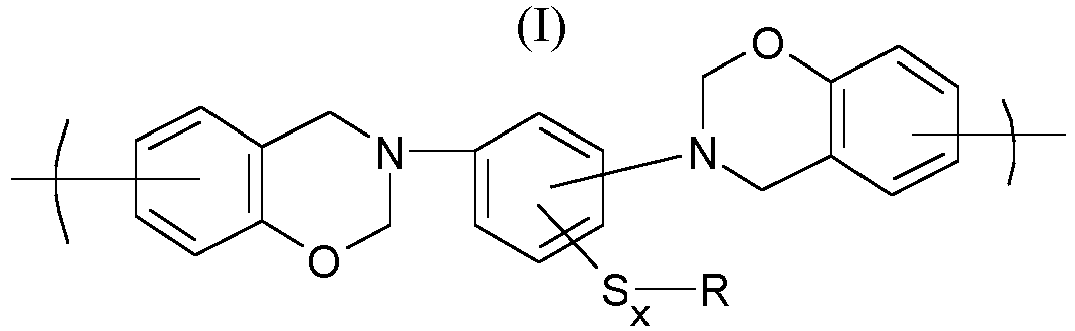
 dans lesquelles les deux cycles oxazine sont reliés entre eux par un groupe aromatique central dont le cycle benzénique est porteur de un, deux, trois ou quatre groupements de formule -Sx-R dans laquelle « x » est un entier de 1 à 8 et R représente l'hydrogène ou un groupe hydrocarboné comportant 1 à 10 atomes de carbone et optionnellement un hétéroatome choisi parmi O, S, N et P ;dans lesquelles les deux symboles « * » identiques ou différents représentent un rattachement quelconque du motif à un atome de carbone ou à un hétéroatome ; et dans lesquelles un ou plusieurs atomes d'hydrogène d'au moins un ou de chaque noyau benzénique des deux cycles oxazine, ainsi que ceux du cycle benzénique central, pourraient optionnellement être également substitués par divers substituants.
 - Polybenzoxazine selon la revendication 1, le cycle benzénique central étant porteur de deux groupements de formule -Sx-R.
- Polybenzoxazine selon la revendication 2, les deux groupements de formule -Sx-R étant en position méta l'un par rapport à l'autre sur le cycle benzénique central.
- Polybenzoxazine selon l'une quelconque des revendications 1 à 3, « x » étant compris dans un domaine de 1 à 4, de préférence égal à 1 ou 2.
- Polybenzoxazine selon l'une quelconque des revendications 1 à 4, R étant un alkyle ayant de préférence de 1 à 5 atomes de carbone.
- Polybenzoxazine selon la revendication 5, R représentant un méthyle ou un éthyle, de préférence un méthyle.
- Polybenzoxazine selon les revendications 4 et 6, « x » étant égal à 1 et R représentant un méthyle.
- Polybenzoxazine selon l'une quelconque des revendications 1 à 7, dont les unités récurrentes comportent au moins un motif répondant aux formules (I-bis) ou (II-bis) :

- Polybenzoxazine selon la revendication 8, dont les unités récurrentes comportent au moins un motif répondant aux formules (I-a) ou (II-a) :


- Polybenzoxazine selon la revendication 9, dont les unités récurrentes comportent au moins un motif répondant aux formules (I-a-1), (I-b-1), (II-a-1) ou (II-b-1) :


- Polybenzoxazine selon l'une quelconque des revendications 1 à 10, dont les unités récurrentes répondent au moins à l'une des formules (1-1) ou (II-1) ci-dessous :

 - X1 et X2, identiques ou différents, représentent O ou S ;- Ar1 et Ar2, identiques ou différents, représentent un groupe aromatique, de préférence phénylène ;- Z représente O ou (S)n, le symbole « n » représentant un nombre entier égal ou supérieur à 1.
 - Polybenzoxazine selon la revendication 11, dont les unités récurrentes répondent au moins à l'une des formules (I-1bis) ou (II-1bis) ci-dessous :


- Utilisation d'une polybenzoxazine selon l'une quelconque des revendications 1 à 12, comme revêtement polymérique d'un substrat dont au moins la surface est au moins en partie métallique.
- Utilisation selon la revendication 13, pour le collage du substrat à du caoutchouc.
- Substrat dont au moins la surface est au moins en partie métallique, au moins ladite partie métallique étant revêtue d'une polybenzoxazine selon l'une quelconque des revendications 1 à 12.
Applications Claiming Priority (2)
| Application Number | Priority Date | Filing Date | Title |
|---|---|---|---|
| FR1755352A FR3067714A1 (fr) | 2017-06-14 | 2017-06-14 | Polybenzoxazine sulfuree utilisable pour le revetement de metal et son collage a du caoutchouc |
| PCT/FR2018/051368 WO2018229416A1 (fr) | 2017-06-14 | 2018-06-12 | Polybenzoxazine sulfuree utilisable pour le revetement de metal et son collage a du caoutchouc |
Publications (2)
| Publication Number | Publication Date |
|---|---|
| EP3638715A1 EP3638715A1 (fr) | 2020-04-22 |
| EP3638715B1 true EP3638715B1 (fr) | 2023-08-23 |
Family
ID=60202088
Family Applications (1)
| Application Number | Title | Priority Date | Filing Date |
|---|---|---|---|
| EP18737001.0A Active EP3638715B1 (fr) | 2017-06-14 | 2018-06-12 | Polybenzoxazine sulfuree utilisable pour le revetement de metal et son collage a du caoutchouc |
Country Status (6)
| Country | Link |
|---|---|
| US (1) | US11624002B2 (fr) |
| EP (1) | EP3638715B1 (fr) |
| JP (1) | JP7365909B2 (fr) |
| CN (1) | CN110770279B (fr) |
| FR (1) | FR3067714A1 (fr) |
| WO (1) | WO2018229416A1 (fr) |
Families Citing this family (10)
| Publication number | Priority date | Publication date | Assignee | Title |
|---|---|---|---|---|
| FR3057872A1 (fr) | 2016-10-26 | 2018-04-27 | Compagnie Generale Des Etablissements Michelin | Polybenzoxazine utilisable pour le revetement de metal et son collage a du caoutchouc |
| FR3057802A1 (fr) | 2016-10-26 | 2018-04-27 | Compagnie Generale Des Etablissements Michelin | Renfort metallique ou metallise dont la surface est revetue d'une polybenzoxazine |
| CN110691778B (zh) | 2017-05-24 | 2023-06-30 | 米其林集团总公司 | 用于合成聚苯并噁嗪的卤代苯并噁嗪 |
| US10975044B2 (en) | 2017-05-24 | 2021-04-13 | Compagnie Generale Des Etablissements Michelin | Halogenated benzoxazine for use in the synthesis of polybenzoxazine |
| FR3067029A1 (fr) | 2017-05-31 | 2018-12-07 | Compagnie Generale Des Etablissements Michelin | Benzoxazine boree utilisable pour la synthese de polybenzoxazine |
| FR3067646A1 (fr) | 2017-06-14 | 2018-12-21 | Compagnie Generale Des Etablissements Michelin | Renfort metallique ou metallise dont la surface est revetue d'une polybenzoxazine sulfuree |
| FR3067713A1 (fr) | 2017-06-14 | 2018-12-21 | Compagnie Generale Des Etablissements Michelin | Benzoxazine sulfuree utilisable pour la synthese d'une polybenzoxazine |
| FR3089228A3 (fr) | 2018-11-30 | 2020-06-05 | Michelin & Cie | Collage d’un monobrin en composite verre-résine à une matrice thermoplastique |
| FR3089217A3 (fr) | 2018-11-30 | 2020-06-05 | Michelin & Cie | Matériau multi-composite à base de composite verre-résine |
| EP3888940B1 (fr) | 2020-04-01 | 2023-01-11 | The Goodyear Tire & Rubber Company | Composition de caoutchouc et produit en caoutchouc |
Family Cites Families (31)
| Publication number | Priority date | Publication date | Assignee | Title |
|---|---|---|---|---|
| US5543516A (en) | 1994-05-18 | 1996-08-06 | Edison Polymer Innovation Corporation | Process for preparation of benzoxazine compounds in solventless systems |
| US20030023007A1 (en) | 2001-07-27 | 2003-01-30 | Hycomp, Inc. | Enhancement of thermal properties of benzoxazine polymers by use of aromatic polyamines to incorporate internal benzoxazine groups within the monomer |
| US7649060B2 (en) | 2005-12-02 | 2010-01-19 | Henkel Corporation | Curable compositions |
| KR100950398B1 (ko) | 2005-09-29 | 2010-03-29 | 세키스이가가쿠 고교가부시키가이샤 | 열경화성 수지, 그것을 포함하는 열경화성 조성물, 및그로부터 얻어지는 성형체 |
| US8227390B2 (en) | 2007-11-28 | 2012-07-24 | Akebono Brake Industry Co., Ltd. | Binder resin for friction material, binder resin composition for friction material, composite material for friction material containing the same, friction material and production method thereof |
| JP2011526991A (ja) * | 2008-06-30 | 2011-10-20 | ヘンケル コーポレイション | 高性能接着剤およびそれらの使用方法 |
| JP2011016787A (ja) | 2009-06-08 | 2011-01-27 | Toyohashi Univ Of Technology | 液晶性ベンゾオキサジン系化合物及び液晶性ベンゾオキサジン系重合組成物 |
| JP2010265480A (ja) | 2010-08-04 | 2010-11-25 | Hitachi Chem Co Ltd | 新規な熱硬化性ベンゾオキサジン樹脂、その製造法及び硬化物 |
| WO2012135180A1 (fr) | 2011-03-28 | 2012-10-04 | 3M Innovative Properties Company | Composition durcissable, article, procédé de durcissement et produit réactionnel sec au toucher |
| FR2978771B1 (fr) | 2011-08-04 | 2013-09-27 | Michelin Soc Tech | Composition adhesive aqueuse a base de polyaldehyde et 2,2', 4,4'-tetrahydroxydiphenyl sulfide |
| FR2978770B1 (fr) | 2011-08-04 | 2013-09-27 | Michelin Soc Tech | Composition adhesive aqueuse a base de polyaldehyde et phloroglucinol |
| FR2978769B1 (fr) | 2011-08-04 | 2013-09-27 | Michelin Soc Tech | Composition adhesive aqueuse a base de polyaldehyde et de polyphenol |
| JP2013043950A (ja) | 2011-08-25 | 2013-03-04 | Gun Ei Chem Ind Co Ltd | 低誘電材料用熱硬化性樹脂 |
| GB201205574D0 (en) | 2012-03-29 | 2012-05-16 | Cytec Tech Corp | Benzoxazines and compositions containing the same |
| KR102103396B1 (ko) | 2012-10-24 | 2020-04-22 | 꽁빠니 제네날 드 에따블리세망 미쉘린 | 금속을 고무에 접착시키기 위한 접착 프라이머로서 특히 유용한 폴리우레아 |
| FR2997079B1 (fr) * | 2012-10-24 | 2015-01-23 | Michelin & Cie | Polyamine polyaromatique soufree utilisable pour la synthese de polyuree |
| FR3005050A1 (fr) | 2013-04-26 | 2014-10-31 | Michelin & Cie | Compose polyol soufre utilisable comme monomere pour la synthese de polyurethane |
| FR3005054B1 (fr) | 2013-04-26 | 2016-07-01 | Michelin & Cie | Polymere utilisable notamment comme primaire d'adhesion pour le collage de metal a du caoutchouc |
| FR3008707B1 (fr) | 2013-07-16 | 2017-11-10 | Michelin & Cie | Composition adhesive aqueuse a base d'aldehyde biosource et de polyphenol |
| TWI573820B (zh) * | 2014-06-30 | 2017-03-11 | 可隆股份有限公司 | 聚氧代氮代苯并環己烷前驅物及其製備方法 |
| US20170327973A1 (en) | 2014-12-03 | 2017-11-16 | National Institute Of Advanced Industrial Science And Technology | Carbon-Fiber Precursor Fiber, Carbon Fiber, and Method for Producing Carbon Fiber |
| JP2016124980A (ja) * | 2014-12-27 | 2016-07-11 | 三星電子株式会社Samsung Electronics Co.,Ltd. | 接着剤 |
| FR3045457B1 (fr) | 2015-12-16 | 2017-12-15 | Michelin & Cie | Renfort metallique ou metallise dont la surface est revetue d’une polybenzoxazine |
| FR3045619B1 (fr) * | 2015-12-16 | 2017-12-15 | Michelin & Cie | Polybenzoxazine utilisable pour le revetement de metal et son collage a du caoutchouc |
| FR3057872A1 (fr) | 2016-10-26 | 2018-04-27 | Compagnie Generale Des Etablissements Michelin | Polybenzoxazine utilisable pour le revetement de metal et son collage a du caoutchouc |
| FR3057802A1 (fr) | 2016-10-26 | 2018-04-27 | Compagnie Generale Des Etablissements Michelin | Renfort metallique ou metallise dont la surface est revetue d'une polybenzoxazine |
| US10975044B2 (en) | 2017-05-24 | 2021-04-13 | Compagnie Generale Des Etablissements Michelin | Halogenated benzoxazine for use in the synthesis of polybenzoxazine |
| CN110691778B (zh) | 2017-05-24 | 2023-06-30 | 米其林集团总公司 | 用于合成聚苯并噁嗪的卤代苯并噁嗪 |
| FR3067029A1 (fr) | 2017-05-31 | 2018-12-07 | Compagnie Generale Des Etablissements Michelin | Benzoxazine boree utilisable pour la synthese de polybenzoxazine |
| FR3067713A1 (fr) | 2017-06-14 | 2018-12-21 | Compagnie Generale Des Etablissements Michelin | Benzoxazine sulfuree utilisable pour la synthese d'une polybenzoxazine |
| FR3067646A1 (fr) | 2017-06-14 | 2018-12-21 | Compagnie Generale Des Etablissements Michelin | Renfort metallique ou metallise dont la surface est revetue d'une polybenzoxazine sulfuree |
-
2017
- 2017-06-14 FR FR1755352A patent/FR3067714A1/fr not_active Withdrawn
-
2018
- 2018-06-12 EP EP18737001.0A patent/EP3638715B1/fr active Active
- 2018-06-12 US US16/621,520 patent/US11624002B2/en active Active
- 2018-06-12 JP JP2019569236A patent/JP7365909B2/ja active Active
- 2018-06-12 CN CN201880039502.1A patent/CN110770279B/zh active Active
- 2018-06-12 WO PCT/FR2018/051368 patent/WO2018229416A1/fr not_active Ceased
Also Published As
| Publication number | Publication date |
|---|---|
| CN110770279A (zh) | 2020-02-07 |
| CN110770279B (zh) | 2022-09-16 |
| WO2018229416A1 (fr) | 2018-12-20 |
| EP3638715A1 (fr) | 2020-04-22 |
| JP2020523459A (ja) | 2020-08-06 |
| US20200095458A1 (en) | 2020-03-26 |
| US11624002B2 (en) | 2023-04-11 |
| JP7365909B2 (ja) | 2023-10-20 |
| FR3067714A1 (fr) | 2018-12-21 |
Similar Documents
| Publication | Publication Date | Title |
|---|---|---|
| EP3638652B1 (fr) | Benzoxazine sulfuree utilisable pour la synthese d'une polybenzoxazine | |
| EP3638715B1 (fr) | Polybenzoxazine sulfuree utilisable pour le revetement de metal et son collage a du caoutchouc | |
| EP3390566B1 (fr) | Polybenzoxazine utilisable pour le revêtement de métal et son collage à du caoutchouc | |
| EP3630736B1 (fr) | Benzoxazine halogénée utilisable pour la synthèse de polybenzoxazine | |
| EP3630737B1 (fr) | Benzoxazine borée utilisable pour la synthèse de polybenzoxazine | |
| EP3390567B1 (fr) | Renfort métallique ou métallisé dont la surface est revêtue d'une polybenzoxazine | |
| EP3638745B1 (fr) | Renfort metallique ou metallise dont la surface est revetue d'une polybenzoxazine sulfuree | |
| EP3532521B1 (fr) | Polybenzoxazine utilisable pour le revêtement de métal et son collage à du caoutchouc | |
| EP3638651A1 (fr) | Benzoxazine halogénée utilisable pour la synthèse de polybenzoxazine | |
| FR3045605A1 (fr) | Benzoxazine halogenee utilisable pour la synthese de polybenzoxazine |
Legal Events
| Date | Code | Title | Description |
|---|---|---|---|
| STAA | Information on the status of an ep patent application or granted ep patent |
Free format text: STATUS: UNKNOWN |
|
| STAA | Information on the status of an ep patent application or granted ep patent |
Free format text: STATUS: THE INTERNATIONAL PUBLICATION HAS BEEN MADE |
|
| PUAI | Public reference made under article 153(3) epc to a published international application that has entered the european phase |
Free format text: ORIGINAL CODE: 0009012 |
|
| STAA | Information on the status of an ep patent application or granted ep patent |
Free format text: STATUS: REQUEST FOR EXAMINATION WAS MADE |
|
| 17P | Request for examination filed |
Effective date: 20200114 |
|
| AK | Designated contracting states |
Kind code of ref document: A1 Designated state(s): AL AT BE BG CH CY CZ DE DK EE ES FI FR GB GR HR HU IE IS IT LI LT LU LV MC MK MT NL NO PL PT RO RS SE SI SK SM TR |
|
| AX | Request for extension of the european patent |
Extension state: BA ME |
|
| DAV | Request for validation of the european patent (deleted) | ||
| DAX | Request for extension of the european patent (deleted) | ||
| STAA | Information on the status of an ep patent application or granted ep patent |
Free format text: STATUS: EXAMINATION IS IN PROGRESS |
|
| 17Q | First examination report despatched |
Effective date: 20210902 |
|
| GRAP | Despatch of communication of intention to grant a patent |
Free format text: ORIGINAL CODE: EPIDOSNIGR1 |
|
| STAA | Information on the status of an ep patent application or granted ep patent |
Free format text: STATUS: GRANT OF PATENT IS INTENDED |
|
| INTG | Intention to grant announced |
Effective date: 20230403 |
|
| GRAS | Grant fee paid |
Free format text: ORIGINAL CODE: EPIDOSNIGR3 |
|
| GRAA | (expected) grant |
Free format text: ORIGINAL CODE: 0009210 |
|
| STAA | Information on the status of an ep patent application or granted ep patent |
Free format text: STATUS: THE PATENT HAS BEEN GRANTED |
|
| AK | Designated contracting states |
Kind code of ref document: B1 Designated state(s): AL AT BE BG CH CY CZ DE DK EE ES FI FR GB GR HR HU IE IS IT LI LT LU LV MC MK MT NL NO PL PT RO RS SE SI SK SM TR |
|
| REG | Reference to a national code |
Ref country code: GB Ref legal event code: FG4D Free format text: NOT ENGLISH |
|
| REG | Reference to a national code |
Ref country code: CH Ref legal event code: EP |
|
| REG | Reference to a national code |
Ref country code: IE Ref legal event code: FG4D Free format text: LANGUAGE OF EP DOCUMENT: FRENCH |
|
| REG | Reference to a national code |
Ref country code: DE Ref legal event code: R096 Ref document number: 602018055933 Country of ref document: DE |
|
| REG | Reference to a national code |
Ref country code: LT Ref legal event code: MG9D |
|
| REG | Reference to a national code |
Ref country code: NL Ref legal event code: MP Effective date: 20230823 |
|
| REG | Reference to a national code |
Ref country code: AT Ref legal event code: MK05 Ref document number: 1602542 Country of ref document: AT Kind code of ref document: T Effective date: 20230823 |
|
| PG25 | Lapsed in a contracting state [announced via postgrant information from national office to epo] |
Ref country code: GR Free format text: LAPSE BECAUSE OF FAILURE TO SUBMIT A TRANSLATION OF THE DESCRIPTION OR TO PAY THE FEE WITHIN THE PRESCRIBED TIME-LIMIT Effective date: 20231124 |
|
| PG25 | Lapsed in a contracting state [announced via postgrant information from national office to epo] |
Ref country code: IS Free format text: LAPSE BECAUSE OF FAILURE TO SUBMIT A TRANSLATION OF THE DESCRIPTION OR TO PAY THE FEE WITHIN THE PRESCRIBED TIME-LIMIT Effective date: 20231223 |
|
| PG25 | Lapsed in a contracting state [announced via postgrant information from national office to epo] |
Ref country code: SE Free format text: LAPSE BECAUSE OF FAILURE TO SUBMIT A TRANSLATION OF THE DESCRIPTION OR TO PAY THE FEE WITHIN THE PRESCRIBED TIME-LIMIT Effective date: 20230823 Ref country code: RS Free format text: LAPSE BECAUSE OF FAILURE TO SUBMIT A TRANSLATION OF THE DESCRIPTION OR TO PAY THE FEE WITHIN THE PRESCRIBED TIME-LIMIT Effective date: 20230823 Ref country code: PT Free format text: LAPSE BECAUSE OF FAILURE TO SUBMIT A TRANSLATION OF THE DESCRIPTION OR TO PAY THE FEE WITHIN THE PRESCRIBED TIME-LIMIT Effective date: 20231226 Ref country code: NO Free format text: LAPSE BECAUSE OF FAILURE TO SUBMIT A TRANSLATION OF THE DESCRIPTION OR TO PAY THE FEE WITHIN THE PRESCRIBED TIME-LIMIT Effective date: 20231123 Ref country code: NL Free format text: LAPSE BECAUSE OF FAILURE TO SUBMIT A TRANSLATION OF THE DESCRIPTION OR TO PAY THE FEE WITHIN THE PRESCRIBED TIME-LIMIT Effective date: 20230823 Ref country code: LV Free format text: LAPSE BECAUSE OF FAILURE TO SUBMIT A TRANSLATION OF THE DESCRIPTION OR TO PAY THE FEE WITHIN THE PRESCRIBED TIME-LIMIT Effective date: 20230823 Ref country code: LT Free format text: LAPSE BECAUSE OF FAILURE TO SUBMIT A TRANSLATION OF THE DESCRIPTION OR TO PAY THE FEE WITHIN THE PRESCRIBED TIME-LIMIT Effective date: 20230823 Ref country code: IS Free format text: LAPSE BECAUSE OF FAILURE TO SUBMIT A TRANSLATION OF THE DESCRIPTION OR TO PAY THE FEE WITHIN THE PRESCRIBED TIME-LIMIT Effective date: 20231223 Ref country code: HR Free format text: LAPSE BECAUSE OF FAILURE TO SUBMIT A TRANSLATION OF THE DESCRIPTION OR TO PAY THE FEE WITHIN THE PRESCRIBED TIME-LIMIT Effective date: 20230823 Ref country code: GR Free format text: LAPSE BECAUSE OF FAILURE TO SUBMIT A TRANSLATION OF THE DESCRIPTION OR TO PAY THE FEE WITHIN THE PRESCRIBED TIME-LIMIT Effective date: 20231124 Ref country code: FI Free format text: LAPSE BECAUSE OF FAILURE TO SUBMIT A TRANSLATION OF THE DESCRIPTION OR TO PAY THE FEE WITHIN THE PRESCRIBED TIME-LIMIT Effective date: 20230823 Ref country code: AT Free format text: LAPSE BECAUSE OF FAILURE TO SUBMIT A TRANSLATION OF THE DESCRIPTION OR TO PAY THE FEE WITHIN THE PRESCRIBED TIME-LIMIT Effective date: 20230823 |
|
| PG25 | Lapsed in a contracting state [announced via postgrant information from national office to epo] |
Ref country code: PL Free format text: LAPSE BECAUSE OF FAILURE TO SUBMIT A TRANSLATION OF THE DESCRIPTION OR TO PAY THE FEE WITHIN THE PRESCRIBED TIME-LIMIT Effective date: 20230823 |
|
| PG25 | Lapsed in a contracting state [announced via postgrant information from national office to epo] |
Ref country code: ES Free format text: LAPSE BECAUSE OF FAILURE TO SUBMIT A TRANSLATION OF THE DESCRIPTION OR TO PAY THE FEE WITHIN THE PRESCRIBED TIME-LIMIT Effective date: 20230823 |
|
| PG25 | Lapsed in a contracting state [announced via postgrant information from national office to epo] |
Ref country code: SM Free format text: LAPSE BECAUSE OF FAILURE TO SUBMIT A TRANSLATION OF THE DESCRIPTION OR TO PAY THE FEE WITHIN THE PRESCRIBED TIME-LIMIT Effective date: 20230823 Ref country code: RO Free format text: LAPSE BECAUSE OF FAILURE TO SUBMIT A TRANSLATION OF THE DESCRIPTION OR TO PAY THE FEE WITHIN THE PRESCRIBED TIME-LIMIT Effective date: 20230823 Ref country code: ES Free format text: LAPSE BECAUSE OF FAILURE TO SUBMIT A TRANSLATION OF THE DESCRIPTION OR TO PAY THE FEE WITHIN THE PRESCRIBED TIME-LIMIT Effective date: 20230823 Ref country code: EE Free format text: LAPSE BECAUSE OF FAILURE TO SUBMIT A TRANSLATION OF THE DESCRIPTION OR TO PAY THE FEE WITHIN THE PRESCRIBED TIME-LIMIT Effective date: 20230823 Ref country code: DK Free format text: LAPSE BECAUSE OF FAILURE TO SUBMIT A TRANSLATION OF THE DESCRIPTION OR TO PAY THE FEE WITHIN THE PRESCRIBED TIME-LIMIT Effective date: 20230823 Ref country code: CZ Free format text: LAPSE BECAUSE OF FAILURE TO SUBMIT A TRANSLATION OF THE DESCRIPTION OR TO PAY THE FEE WITHIN THE PRESCRIBED TIME-LIMIT Effective date: 20230823 Ref country code: SK Free format text: LAPSE BECAUSE OF FAILURE TO SUBMIT A TRANSLATION OF THE DESCRIPTION OR TO PAY THE FEE WITHIN THE PRESCRIBED TIME-LIMIT Effective date: 20230823 |
|
| REG | Reference to a national code |
Ref country code: DE Ref legal event code: R097 Ref document number: 602018055933 Country of ref document: DE |
|
| PG25 | Lapsed in a contracting state [announced via postgrant information from national office to epo] |
Ref country code: IT Free format text: LAPSE BECAUSE OF FAILURE TO SUBMIT A TRANSLATION OF THE DESCRIPTION OR TO PAY THE FEE WITHIN THE PRESCRIBED TIME-LIMIT Effective date: 20230823 |
|
| PLBE | No opposition filed within time limit |
Free format text: ORIGINAL CODE: 0009261 |
|
| STAA | Information on the status of an ep patent application or granted ep patent |
Free format text: STATUS: NO OPPOSITION FILED WITHIN TIME LIMIT |
|
| 26N | No opposition filed |
Effective date: 20240524 |
|
| PG25 | Lapsed in a contracting state [announced via postgrant information from national office to epo] |
Ref country code: SI Free format text: LAPSE BECAUSE OF FAILURE TO SUBMIT A TRANSLATION OF THE DESCRIPTION OR TO PAY THE FEE WITHIN THE PRESCRIBED TIME-LIMIT Effective date: 20230823 |
|
| PG25 | Lapsed in a contracting state [announced via postgrant information from national office to epo] |
Ref country code: BG Free format text: LAPSE BECAUSE OF FAILURE TO SUBMIT A TRANSLATION OF THE DESCRIPTION OR TO PAY THE FEE WITHIN THE PRESCRIBED TIME-LIMIT Effective date: 20230823 |
|
| PG25 | Lapsed in a contracting state [announced via postgrant information from national office to epo] |
Ref country code: BG Free format text: LAPSE BECAUSE OF FAILURE TO SUBMIT A TRANSLATION OF THE DESCRIPTION OR TO PAY THE FEE WITHIN THE PRESCRIBED TIME-LIMIT Effective date: 20230823 |
|
| PG25 | Lapsed in a contracting state [announced via postgrant information from national office to epo] |
Ref country code: MC Free format text: LAPSE BECAUSE OF FAILURE TO SUBMIT A TRANSLATION OF THE DESCRIPTION OR TO PAY THE FEE WITHIN THE PRESCRIBED TIME-LIMIT Effective date: 20230823 |
|
| REG | Reference to a national code |
Ref country code: CH Ref legal event code: PL |
|
| PG25 | Lapsed in a contracting state [announced via postgrant information from national office to epo] |
Ref country code: LU Free format text: LAPSE BECAUSE OF NON-PAYMENT OF DUE FEES Effective date: 20240612 |
|
| GBPC | Gb: european patent ceased through non-payment of renewal fee |
Effective date: 20240612 |
|
| PG25 | Lapsed in a contracting state [announced via postgrant information from national office to epo] |
Ref country code: IE Free format text: LAPSE BECAUSE OF NON-PAYMENT OF DUE FEES Effective date: 20240612 |
|
| PG25 | Lapsed in a contracting state [announced via postgrant information from national office to epo] |
Ref country code: CH Free format text: LAPSE BECAUSE OF NON-PAYMENT OF DUE FEES Effective date: 20240630 Ref country code: BE Free format text: LAPSE BECAUSE OF NON-PAYMENT OF DUE FEES Effective date: 20240630 |
|
| PG25 | Lapsed in a contracting state [announced via postgrant information from national office to epo] |
Ref country code: GB Free format text: LAPSE BECAUSE OF NON-PAYMENT OF DUE FEES Effective date: 20240612 |
|
| REG | Reference to a national code |
Ref country code: BE Ref legal event code: MM Effective date: 20240630 |
|
| PGFP | Annual fee paid to national office [announced via postgrant information from national office to epo] |
Ref country code: DE Payment date: 20250618 Year of fee payment: 8 |
|
| PGFP | Annual fee paid to national office [announced via postgrant information from national office to epo] |
Ref country code: FR Payment date: 20250626 Year of fee payment: 8 |
|
| PG25 | Lapsed in a contracting state [announced via postgrant information from national office to epo] |
Ref country code: CY Free format text: LAPSE BECAUSE OF FAILURE TO SUBMIT A TRANSLATION OF THE DESCRIPTION OR TO PAY THE FEE WITHIN THE PRESCRIBED TIME-LIMIT; INVALID AB INITIO Effective date: 20180612 |
|
| PG25 | Lapsed in a contracting state [announced via postgrant information from national office to epo] |
Ref country code: HU Free format text: LAPSE BECAUSE OF FAILURE TO SUBMIT A TRANSLATION OF THE DESCRIPTION OR TO PAY THE FEE WITHIN THE PRESCRIBED TIME-LIMIT; INVALID AB INITIO Effective date: 20180612 |