EP3634931B1 - Immersion cooling - Google Patents
Immersion cooling Download PDFInfo
- Publication number
- EP3634931B1 EP3634931B1 EP18812752.6A EP18812752A EP3634931B1 EP 3634931 B1 EP3634931 B1 EP 3634931B1 EP 18812752 A EP18812752 A EP 18812752A EP 3634931 B1 EP3634931 B1 EP 3634931B1
- Authority
- EP
- European Patent Office
- Prior art keywords
- immersion cooling
- cooling system
- working fluid
- generating component
- alkyl group
- Prior art date
- Legal status (The legal status is an assumption and is not a legal conclusion. Google has not performed a legal analysis and makes no representation as to the accuracy of the status listed.)
- Active
Links
Images
Classifications
-
- C—CHEMISTRY; METALLURGY
- C07—ORGANIC CHEMISTRY
- C07C—ACYCLIC OR CARBOCYCLIC COMPOUNDS
- C07C21/00—Acyclic unsaturated compounds containing halogen atoms
- C07C21/02—Acyclic unsaturated compounds containing halogen atoms containing carbon-to-carbon double bonds
- C07C21/18—Acyclic unsaturated compounds containing halogen atoms containing carbon-to-carbon double bonds containing fluorine
-
- C—CHEMISTRY; METALLURGY
- C07—ORGANIC CHEMISTRY
- C07C—ACYCLIC OR CARBOCYCLIC COMPOUNDS
- C07C211/00—Compounds containing amino groups bound to a carbon skeleton
- C07C211/01—Compounds containing amino groups bound to a carbon skeleton having amino groups bound to acyclic carbon atoms
- C07C211/20—Compounds containing amino groups bound to a carbon skeleton having amino groups bound to acyclic carbon atoms of an acyclic unsaturated carbon skeleton
- C07C211/24—Compounds containing amino groups bound to a carbon skeleton having amino groups bound to acyclic carbon atoms of an acyclic unsaturated carbon skeleton the carbon skeleton being further substituted by halogen atoms or by nitro or nitroso groups
-
- C—CHEMISTRY; METALLURGY
- C09—DYES; PAINTS; POLISHES; NATURAL RESINS; ADHESIVES; COMPOSITIONS NOT OTHERWISE PROVIDED FOR; APPLICATIONS OF MATERIALS NOT OTHERWISE PROVIDED FOR
- C09K—MATERIALS FOR MISCELLANEOUS APPLICATIONS, NOT PROVIDED FOR ELSEWHERE
- C09K5/00—Heat-transfer, heat-exchange or heat-storage materials, e.g. refrigerants; Materials for the production of heat or cold by chemical reactions other than by combustion
- C09K5/02—Materials undergoing a change of physical state when used
- C09K5/04—Materials undergoing a change of physical state when used the change of state being from liquid to vapour or vice versa
-
- C—CHEMISTRY; METALLURGY
- C09—DYES; PAINTS; POLISHES; NATURAL RESINS; ADHESIVES; COMPOSITIONS NOT OTHERWISE PROVIDED FOR; APPLICATIONS OF MATERIALS NOT OTHERWISE PROVIDED FOR
- C09K—MATERIALS FOR MISCELLANEOUS APPLICATIONS, NOT PROVIDED FOR ELSEWHERE
- C09K5/00—Heat-transfer, heat-exchange or heat-storage materials, e.g. refrigerants; Materials for the production of heat or cold by chemical reactions other than by combustion
- C09K5/08—Materials not undergoing a change of physical state when used
- C09K5/10—Liquid materials
-
- H—ELECTRICITY
- H05—ELECTRIC TECHNIQUES NOT OTHERWISE PROVIDED FOR
- H05K—PRINTED CIRCUITS; CASINGS OR CONSTRUCTIONAL DETAILS OF ELECTRIC APPARATUS; MANUFACTURE OF ASSEMBLAGES OF ELECTRICAL COMPONENTS
- H05K7/00—Constructional details common to different types of electric apparatus
- H05K7/20—Modifications to facilitate cooling, ventilating, or heating
- H05K7/2029—Modifications to facilitate cooling, ventilating, or heating using a liquid coolant with phase change in electronic enclosures
- H05K7/203—Modifications to facilitate cooling, ventilating, or heating using a liquid coolant with phase change in electronic enclosures by immersion
-
- H—ELECTRICITY
- H05—ELECTRIC TECHNIQUES NOT OTHERWISE PROVIDED FOR
- H05K—PRINTED CIRCUITS; CASINGS OR CONSTRUCTIONAL DETAILS OF ELECTRIC APPARATUS; MANUFACTURE OF ASSEMBLAGES OF ELECTRICAL COMPONENTS
- H05K7/00—Constructional details common to different types of electric apparatus
- H05K7/20—Modifications to facilitate cooling, ventilating, or heating
- H05K7/20709—Modifications to facilitate cooling, ventilating, or heating for server racks or cabinets; for data centers, e.g. 19-inch computer racks
- H05K7/208—Liquid cooling with phase change
-
- H—ELECTRICITY
- H05—ELECTRIC TECHNIQUES NOT OTHERWISE PROVIDED FOR
- H05K—PRINTED CIRCUITS; CASINGS OR CONSTRUCTIONAL DETAILS OF ELECTRIC APPARATUS; MANUFACTURE OF ASSEMBLAGES OF ELECTRICAL COMPONENTS
- H05K7/00—Constructional details common to different types of electric apparatus
- H05K7/20—Modifications to facilitate cooling, ventilating, or heating
- H05K7/20709—Modifications to facilitate cooling, ventilating, or heating for server racks or cabinets; for data centers, e.g. 19-inch computer racks
- H05K7/208—Liquid cooling with phase change
- H05K7/20809—Liquid cooling with phase change within server blades for removing heat from heat source
Definitions
- the present disclosure relates to an immersion cooling system and a method for cooling a heat generating component.
- US 2012/159976 A1 describes a chiller apparatus containing E-1,1,1,4,4,4-hexafluoro-2-butene.
- US 2013/160469 A1 discloses refrigerant compositions comprising E-1,1,1,4,4,5,5,5-octafluoro-2-pentene and optionally 1,1,1,2,3-pentafluoropropane.
- US 2015/014606 A1 teaches azeotrope-like compositions of Z-1,1,1,4,4,4-hexafluoro-2-butene and E-1,1,1,4,4,4-hexafluoro-2-butene.
- EP 1 951 838 A2 discloses fluoroolefin compositions useful as refrigerants or heat transfer fluids.
- the present inventions provides an immersion cooling system.
- the immersion cooling system includes a housing having an interior space; a heat-generating component disposed within the interior space, wherein the heat generating component comprises an electronic device; and a working fluid liquid disposed within the interior space such that the heat-generating component is in contact with the working fluid liquid.
- the working fluid comprises at least 50 % by weight of a compound having Structural Formula (IA)
- Each R f 1 and R f 2 is, independently, (i) a linear or branched perhalogenated acyclic alkyl group having 1-6 carbon atoms and optionally contains one or more catenated heteroatoms selected from O or N; or (ii) a perhalogenated 5-7 membered cyclic alkyl group having 3-7 carbon atoms and optionally contains one or more catenated heteroatoms selected from O or N.
- the working fluid is a fluid with a dielectric constant of less than 2.5, wherein said dielectric constant is measured by ASTM D150 at 25°C at 1 KHz.
- the invention further provides a method for cooling a heat generating component.
- the method includes at least partially immersing a heat generating component, wherein the heat generating component comprises an electronic device, in a working fluid; and transferring heat from the heat generating component using the working fluid.
- the working fluid includes at least 50% by weight of a compound having Structural Formula (IA)
- Each R f 1 and R f 2 is, independently, (i) a linear or branched perhalogenated acyclic alkyl group having 1-6 carbon atoms and optionally contains one or more catenated heteroatoms selected from O or N; or (ii) a perhalogenated 5-7 membered cyclic alkyl group having 3-7 carbon atoms and optionally contains one or more catenated heteroatoms selected from O or N.
- the working fluid has a dielectric constant of less than 2.5, wherein said dielectric constant is measured at 25°C at 1 KHz.
- Two-phase immersion cooling is an emerging cooling technology for the high-performance server computing market which relies on the heat absorbed in the process of vaporizing a liquid (the cooling fluid) to a gas (i.e., the heat of vaporization).
- the fluids used in this application must meet certain requirements to be viable in the application.
- the boiling temperature during operation should be in a range between for example 30°C-75°C. Generally, this range accommodates maintaining the server components at a sufficiently cool temperature while allowing heat to be dissipated efficiently to an ultimate heat sink (e.g., outside air).
- the fluid must be inert so that it is compatible with the materials of construction and the electrical components. Certain perfluorinated and partially fluorinated materials may meet this requirement.
- the fluid should be stable such that it does not react with common contaminants such as water or with reagents such as activated carbon or alumina that might be used to scrub the fluid during operation.
- the global warming potential (GWP, 100yr ITH) and ozone depletion potential (ODP) of the parent compound and its degradation products should be below acceptable limits, for example, less than 250 and 0.01, respectively.
- the fluids should have a dielectric constant (measured at room temperature (about 25°C) at 1 KHz) of less than 2.5, such that high frequency electronic components and connectors can be submerged in the fluids without significant loss of signal integrity.
- Single phase immersion cooling has a long history in computer server cooling. There is no phase change in single phase immersion. Instead the liquid warms and cools as it flows or is pumped to the computer server and a heat exchanger, respectively, thereby transferring heat away from the computer server.
- the fluids used in single phase immersion cooling of computer servers should meet the same requirements as outlined above with respect to two-phase immersion cooling, except that they typically have higher boiling temperatures exceeding about 40-75°C to limit evaporative losses.
- perfluorinated liquids may exhibit dielectric constants of 2.0 or less.
- these materials are often associated with high GWP, well outside of the requirement for many industrial applications, including two-phase and single-phase immersion cooling. Therefore, there continues to be a need for working fluids useful for two-phase and single phase immersion cooling that satisfy the dielectric constant requirement of the industry (less than 2.5), while also exhibiting GWPs (100yr ITH) that are below the acceptable limits for the industry (typically less than about 250).
- compositions, or working fluids that exhibit boiling points, reactivity, stability, GWPs, and dielectric constants that render them particularly suitable for use as cooling fluids in two-phase and single phase immersion cooling systems.
- catenated heteroatom means an atom other than carbon (for example, oxygen, nitrogen, or sulfur) that is bonded to at least two carbon atoms in a carbon chain (linear or branched or within a ring) so as to form a carbon-heteroatom-carbon linkage.
- fluoro- for example, in reference to a group or moiety, such as in the case of "fluoroalkylene” or “fluoroalkyl” or “fluorocarbon" or “fluorinated” means (i) partially fluorinated such that there is at least one carbon-bonded hydrogen atom, or (ii) perfluorinated.
- perfluoro- for example, in reference to a group or moiety, such as in the case of "perfluoroalkylene” or “perfluoroalkyl” or “perfluorocarbon" or “perfluorinated” means completely fluorinated such that, except as may be otherwise indicated, any carbon-bonded hydrogens are replaced by fluorine atoms.
- perhalogenated means completely halogenated such that, except as may be otherwise indicated, any carbon-bonded hydrogens are replaced by a halogen atom.
- the working fluid of the present disclosure includes a hydrofluoroolefin compound having the following Structural Formula (IA):
- alkylene segment of Structural Formula (IA) namely an alkylene segment in which each carbon of the segment is bonded to one hydrogen atom and one perhalogenated moiety in the E (or trans) configuration, provides surprisingly low dielectric constants of less than 2.5. No other hydrofluoroolefin structures have been found which provide similarly low dielectric constants.
- hydrofluorolefin compounds of the present disclosure have measured dielectric constants that render them particularly suitable for use as working fluids in immersion cooling systems, particularly those used for the immersion cooling of high performance computer server hardware or devices that operate at high frequencies (e.g, greater than 2 GHz, or greater than 3 GHz, or greater than 4 GHz, or greater than 5 GHz, or greater than 6 GHz, or greater than 7 GHz, or greater than 8 GHz, or greater than 9 GHz, or greater than 10 GHz).
- high frequencies e.g, greater than 2 GHz, or greater than 3 GHz, or greater than 4 GHz, or greater than 5 GHz, or greater than 6 GHz, or greater than 7 GHz, or greater than 8 GHz, or greater than 9 GHz, or greater than 10 GHz.
- the hydrofluoroolefin compounds of Structural Formula (IA) represent the E (or trans) isomer of a hydrofluoroolefin that can exist in two isomeric forms, the other isomeric form being the Z (or cis) isomer, depicted in Structural Formula (IB):
- Structural Formula (IA) has a significantly lower dielectric constant than its (Z) counterpart and, therefore, compositions rich in the (Z) isomer do not exhibit dielectric constants that would be suitable for use as working fluids in high performance server immersion cooling systems.
- Each R f 1 and R f 2 is, independently, (i) a linear or branched perhalogenated acyclic alkyl group having 1-6, 2 -5, or 3 - 4 carbon atoms and optionally contain one or more catenated heteroatoms selected from O or N; or (ii) a perhalogenated 5-7 membered cyclic alkyl group having 3-7 or 4-6 carbon atoms and optionally containing one or more catenated heteroatoms selected from O or N.
- each perhalogenated R f 1 and R f 2 may be substituted with only fluorine atoms or chlorine atoms.
- each perhalogenated R f 1 and R f 2 may be substituted with only fluorine atoms and one chlorine atom.
- each R f 1 and R f 2 may be, independently, (i) a linear or branched perfluorinated acyclic alkyl group having 1-6, 2 -5, or 3 - 4 carbon atoms and optionally contain one or more catenated heteroatoms selected from O or N; or (ii) a perfluorinated 5-7 membered cyclic alkyl group having 3-7 or 4-6 carbon atoms and optionally containing one or more catenated heteroatoms selected from O or N.
- R f 1 and R f 2 may be the same perfluorinated alkyl groups (acyclic or cyclic, including any catenated heteroatoms).
- the compositions of the present disclosure may be rich in the isomer of Structural Formula (IA) (the E isomer).
- the compositions of the present disclosure may include hydrofluoroolefins having Structural Formula (IA) in an amount of at least 85, 90, 95, 96, 97, 98, 99, or 99.5 weight percent, based on the total weight of the hydrofluoroolefins having Structural Formula (IA) and (IB) in the composition.
- representative examples of the compounds of general formula (I) include the following:
- the hydrofluoroolefin compounds of the present disclosure may be hydrophobic, relatively chemically unreactive, and thermally stable.
- the hydrofluoroolefin compounds may have a low environmental impact.
- the hydrofluoroolefin compounds of the present disclosure may have a zero, or near zero, ozone depletion potential (ODP) and a global warming potential (GWP, 100yr ITH) of less than 500, 300, 200, 100 or less than 10.
- ODP ozone depletion potential
- GWP global warming potential
- GWP global warming potential
- GWP is a relative measure of the global warming potential of a compound based on the structure of the compound.
Landscapes
- Chemical & Material Sciences (AREA)
- Engineering & Computer Science (AREA)
- Organic Chemistry (AREA)
- Thermal Sciences (AREA)
- Physics & Mathematics (AREA)
- Microelectronics & Electronic Packaging (AREA)
- Chemical Kinetics & Catalysis (AREA)
- Combustion & Propulsion (AREA)
- Materials Engineering (AREA)
- Computer Hardware Design (AREA)
- General Engineering & Computer Science (AREA)
- Cooling Or The Like Of Electrical Apparatus (AREA)
- Organic Low-Molecular-Weight Compounds And Preparation Thereof (AREA)
- Crystals, And After-Treatments Of Crystals (AREA)
Description
- The present disclosure relates to an immersion cooling system and a method for cooling a heat generating component.
- Various fluids for use in immersion cooling are described in, for example, P. E. Tuma, "Fluoroketone C2F5C(O)CF(CF3)2 as a Heat Transfer Fluid for Passive and Pumped 2-Phase Applications," 24th IEEE Semi-Therm Symposium, San Jose, CA, pp. 174-181, March 16-20, 2008; and Tuma, P. E., "Design Considerations Relating to Non-Thermal Aspects of Passive 2-Phase Immersion Cooling," to be published, Proc. 27th IEEE Semi-Therm Symposium, San Jose, CA, USA, Mar. 20-24, 2011.
US 2012/159976 A1 describes a chiller apparatus containing E-1,1,1,4,4,4-hexafluoro-2-butene.US 2013/160469 A1 discloses refrigerant compositions comprising E-1,1,1,4,4,5,5,5-octafluoro-2-pentene and optionally 1,1,1,2,3-pentafluoropropane.US 2015/014606 A1 teaches azeotrope-like compositions of Z-1,1,1,4,4,4-hexafluoro-2-butene and E-1,1,1,4,4,4-hexafluoro-2-butene.US 2013/098396 A1 describes 1,1,1,4,4,5,5,6,6,6-decafluorohex-2-ene isomer mixtures.EP 1 951 838 A2 discloses fluoroolefin compositions useful as refrigerants or heat transfer fluids. - The present inventions provides an immersion cooling system. The immersion cooling system includes a housing having an interior space; a heat-generating component disposed within the interior space, wherein the heat generating component comprises an electronic device; and a working fluid liquid disposed within the interior space such that the heat-generating component is in contact with the working fluid liquid. The working fluid comprises at least 50 % by weight of a compound having Structural Formula (IA)

- The invention further provides a method for cooling a heat generating component. The method includes at least partially immersing a heat generating component, wherein the heat generating component comprises an electronic device, in a working fluid; and transferring heat from the heat generating component using the working fluid. The working fluid includes at least 50% by weight of a compound having Structural Formula (IA)

- The above summary of the present disclosure is not intended to describe each embodiment of the present disclosure. The details of one or more embodiments of the disclosure are also set forth in the description below. Other features, objects, and advantages of the disclosure will be apparent from the description and from the claims.
- Large scale computer server systems can perform significant workloads and generate a large amount of heat during their operation. A significant portion of the heat is generated by the operation of these servers. Due in part to the large amount of heat generated, these servers are typically rack mounted and air-cooled via internal fans and/or fans attached to the back of the rack or elsewhere within the server ecosystem. As the need for access to greater and greater processing and storage resources continues to expand, the density of server systems (i.e., the amount of processing power and/or storage placed on a single server, the number of servers placed in a single rack, and/or the number of servers and or racks deployed on a single server farm), continue to increase. With the desire for increasing processing or storage density in these server systems, the thermal challenges that result remain a significant obstacle. Conventional cooling systems (e.g., fan based) require large amounts of power, and the cost of power required to drive such systems increases exponentially with the increase in server densities. Consequently, there exists a need for efficient, low power usage system for cooling the servers, while allowing for the desired increased processing and/or storage densities of the server systems.
- Two-phase immersion cooling is an emerging cooling technology for the high-performance server computing market which relies on the heat absorbed in the process of vaporizing a liquid (the cooling fluid) to a gas (i.e., the heat of vaporization). The fluids used in this application must meet certain requirements to be viable in the application. For example, the boiling temperature during operation should be in a range between for example 30°C-75°C. Generally, this range accommodates maintaining the server components at a sufficiently cool temperature while allowing heat to be dissipated efficiently to an ultimate heat sink (e.g., outside air). The fluid must be inert so that it is compatible with the materials of construction and the electrical components. Certain perfluorinated and partially fluorinated materials may meet this requirement. The fluid should be stable such that it does not react with common contaminants such as water or with reagents such as activated carbon or alumina that might be used to scrub the fluid during operation. The global warming potential (GWP, 100yr ITH) and ozone depletion potential (ODP) of the parent compound and its degradation products should be below acceptable limits, for example, less than 250 and 0.01, respectively. The fluids should have a dielectric constant (measured at room temperature (about 25°C) at 1 KHz) of less than 2.5, such that high frequency electronic components and connectors can be submerged in the fluids without significant loss of signal integrity.
- Single phase immersion cooling has a long history in computer server cooling. There is no phase change in single phase immersion. Instead the liquid warms and cools as it flows or is pumped to the computer server and a heat exchanger, respectively, thereby transferring heat away from the computer server. The fluids used in single phase immersion cooling of computer servers should meet the same requirements as outlined above with respect to two-phase immersion cooling, except that they typically have higher boiling temperatures exceeding about 40-75°C to limit evaporative losses.
- It is generally understood that perfluorinated liquids may exhibit dielectric constants of 2.0 or less. However, these materials are often associated with high GWP, well outside of the requirement for many industrial applications, including two-phase and single-phase immersion cooling. Therefore, there continues to be a need for working fluids useful for two-phase and single phase immersion cooling that satisfy the dielectric constant requirement of the industry (less than 2.5), while also exhibiting GWPs (100yr ITH) that are below the acceptable limits for the industry (typically less than about 250).
- Generally, the present disclosure is directed to compositions, or working fluids, that exhibit boiling points, reactivity, stability, GWPs, and dielectric constants that render them particularly suitable for use as cooling fluids in two-phase and single phase immersion cooling systems.
- As used herein, "catenated heteroatom" means an atom other than carbon (for example, oxygen, nitrogen, or sulfur) that is bonded to at least two carbon atoms in a carbon chain (linear or branched or within a ring) so as to form a carbon-heteroatom-carbon linkage.
- As used herein, "fluoro-" (for example, in reference to a group or moiety, such as in the case of "fluoroalkylene" or "fluoroalkyl" or "fluorocarbon") or "fluorinated" means (i) partially fluorinated such that there is at least one carbon-bonded hydrogen atom, or (ii) perfluorinated.
- As used herein, "perfluoro-" (for example, in reference to a group or moiety, such as in the case of "perfluoroalkylene" or "perfluoroalkyl" or "perfluorocarbon") or "perfluorinated" means completely fluorinated such that, except as may be otherwise indicated, any carbon-bonded hydrogens are replaced by fluorine atoms.
- As used herein, "perhalogenated" means completely halogenated such that, except as may be otherwise indicated, any carbon-bonded hydrogens are replaced by a halogen atom.
- As used herein, the singular forms "a", "an", and "the" include plural referents unless the content clearly dictates otherwise. As used in this specification and the appended embodiments, the term "or" is generally employed in its sense including "and/or" unless the content clearly dictates otherwise.
- As used herein, the recitation of numerical ranges by endpoints includes all numbers subsumed within that range (e.g. 1 to 5 includes 1, 1.5, 2, 2.75, 3, 3.8, 4, and 5).
- Unless otherwise indicated, all numbers expressing quantities or ingredients, measurement of properties and so forth used in the specification and embodiments are to be understood as being modified in all instances by the term "about." Accordingly, unless indicated to the contrary, the numerical parameters set forth in the foregoing specification and attached listing of embodiments can vary depending upon the desired properties sought to be obtained by those skilled in the art utilizing the teachings of the present disclosure. At the very least, and not as an attempt to limit the application of the doctrine of equivalents to the scope of the claimed embodiments, each numerical parameter should at least be construed in light of the number of reported significant digits and by applying ordinary rounding techniques.
- The working fluid of the present disclosure includes a hydrofluoroolefin compound having the following Structural Formula (IA):

- Surprisingly, it was discovered that the alkylene segment of Structural Formula (IA), namely an alkylene segment in which each carbon of the segment is bonded to one hydrogen atom and one perhalogenated moiety in the E (or trans) configuration, provides surprisingly low dielectric constants of less than 2.5. No other hydrofluoroolefin structures have been found which provide similarly low dielectric constants. Consequently, it has been discovered that the hydrofluorolefin compounds of the present disclosure have measured dielectric constants that render them particularly suitable for use as working fluids in immersion cooling systems, particularly those used for the immersion cooling of high performance computer server hardware or devices that operate at high frequencies (e.g, greater than 2 GHz, or greater than 3 GHz, or greater than 4 GHz, or greater than 5 GHz, or greater than 6 GHz, or greater than 7 GHz, or greater than 8 GHz, or greater than 9 GHz, or greater than 10 GHz).
- The hydrofluoroolefin compounds of Structural Formula (IA) represent the E (or trans) isomer of a hydrofluoroolefin that can exist in two isomeric forms, the other isomeric form being the Z (or cis) isomer, depicted in Structural Formula (IB):

- Each Rf 1 and Rf 2 is, independently, (i) a linear or branched perhalogenated acyclic alkyl group having 1-6, 2 -5, or 3 - 4 carbon atoms and optionally contain one or more catenated heteroatoms selected from O or N; or (ii) a perhalogenated 5-7 membered cyclic alkyl group having 3-7 or 4-6 carbon atoms and optionally containing one or more catenated heteroatoms selected from O or N. In some embodiments, each perhalogenated Rf 1 and Rf 2 may be substituted with only fluorine atoms or chlorine atoms. In some embodiments, each perhalogenated Rf 1 and Rf 2 may be substituted with only fluorine atoms and one chlorine atom.
- In some embodiments, each Rf 1 and Rf 2 may be, independently, (i) a linear or branched perfluorinated acyclic alkyl group having 1-6, 2 -5, or 3 - 4 carbon atoms and optionally contain one or more catenated heteroatoms selected from O or N; or (ii) a perfluorinated 5-7 membered cyclic alkyl group having 3-7 or 4-6 carbon atoms and optionally containing one or more catenated heteroatoms selected from O or N. In some embodiments, Rf 1 and Rf 2 may be the same perfluorinated alkyl groups (acyclic or cyclic, including any catenated heteroatoms).
- In some embodiments, the compositions of the present disclosure may be rich in the isomer of Structural Formula (IA) (the E isomer). In this regard, in some embodiments, the compositions of the present disclosure may include hydrofluoroolefins having Structural Formula (IA) in an amount of at least 85, 90, 95, 96, 97, 98, 99, or 99.5 weight percent, based on the total weight of the hydrofluoroolefins having Structural Formula (IA) and (IB) in the composition.
- In various embodiments, representative examples of the compounds of general formula (I) include the following:


- In some embodiments, the hydrofluoroolefin compounds of the present disclosure may be hydrophobic, relatively chemically unreactive, and thermally stable. The hydrofluoroolefin compounds may have a low environmental impact. In this regard, the hydrofluoroolefin compounds of the present disclosure may have a zero, or near zero, ozone depletion potential (ODP) and a global warming potential (GWP, 100yr ITH) of less than 500, 300, 200, 100 or less than 10. As used herein, GWP is a relative measure of the global warming potential of a compound based on the structure of the compound. The GWP of a compound, as defined by the Intergovernmental Panel on Climate Change (IPCC) in 1990 and updated in 2007, is calculated as the warming due to the release of 1 kilogram of a compound relative to the warming due to the release of 1 kilogram of CO2 over a specified integration time horizon (ITH).

- In this equation ai is the radiative forcing per unit mass increase of a compound in the atmosphere (the change in the flux of radiation through the atmosphere due to the IR absorbance of that compound), C is the atmospheric concentration of a compound, τ is the atmospheric lifetime of a compound, t is time, and i is the compound of interest. The commonly accepted ITH is 100 years representing a compromise between short-term effects (20 years) and longer-term effects (500 years or longer). The concentration of an organic compound, i, in the atmosphere is assumed to follow pseudo first order kinetics (i.e., exponential decay). The concentration of CO2 over that same time interval incorporates a more complex model for the exchange and removal of CO2 from the atmosphere (the Bern carbon cycle model).
- In some embodiments, the fluorine content in the hydrofluoroolefin compounds of the present disclosure may be sufficient to make the compounds non-flammable according to ASTM D-3278-96 e-1 test method ("Flash Point of Liquids by Small Scale Closed Cup Apparatus").
- In some embodiments, the hydrofluoroolefin compounds represented by Structural Formula (IA) can be synthesized by the methods described in
WO2009079525 ,WO 2015095285 ,US8148584 , J. Fluorine Chemistry, 24 (1984) 93-104, andWO2016196240 . - The working fluid of the present disclosure includes at least 50% by weight of the above-described hydrofluoroolefins, based on the total weight of the composition. In some embodiments, the working fluids of the present disclosure may include at least 70%, at least 80%, at least 90%, at least 95%, or at least 99% by weight of the above-described hydrofluoroolefins, based on the total weight of the composition. In addition to the hydrofluoroolefins, the compositions may include a total of up to 50%, up to 30%, up to 20%, up to 10%, up to 5%, or up to 1% by weight of one or more of the following components (individually or in any combination): ethers, alkanes, perfluoroalkenes, alkenes, haloalkenes, perfluorocarbons, perfluorinated tertiary amines, perfluoroethers, cycloalkanes, esters, perfluoroketones, ketones, oxiranes, aromatics, siloxanes, hydrochlorocarbons, hydrochlorofluorocarbons, hydrofluorocarbons, hydrofluoroolefins, hydrochloroolefins, hydrochlorofluoroolefins, hydrofluoroethers, or mixtures thereof based on the total weight of the working fluid; or alkanes, perfluoroalkenes, haloalkenes, perfluorocarbons, perfluorinated tertiary amines, perfluoroethers, cycloalkanes, perfluoroketones, aromatics, siloxanes, hydrochlorocarbons, hydrochlorofluorocarbons, hydrofluorocarbons, hydrofluoroolefins, , hydrochlorofluoroolefins, hydrofluoroethers, or mixtures thereof, based on the total weight of the working fluid. Such additional components can be chosen to modify or enhance the properties of a composition for a particular use.
- The working fluid of the present disclosure has a dielectric constant less that is than 2.5 as measured with ASTM D150 at room temperature. In some embodiments, the working fluids of the present disclosure may have dielectric constants that are less than 2.4, less than 2.3, less than 2.2, less than 2.1, less than 2.0, or less than 1.9, as measured in accordance with ASTM D150 at room temperature.
- In some embodiments, the working fluids of the present disclosure may have a boiling point between 30-75°C, or 35-75 °C, 40-75 °C, or 45-75 °C . In some embodiments, the working fluids of the present invention may have a boiling point greater than 40 °C, or greater than 50 °C, or greater than 60 °C, greater than 70 °C, or greater than 75°C.
- The present disclosure is directed to an immersion cooling system that includes the above-discussed hydrofluoroolefin-containing working fluids. The immersion cooling systems may be single-phase or two-phase immersion cooling systems.
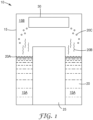
- In some embodiments, the immersion cooling systems may operate as two-phase vaporization-condensation cooling systems for cooling one or more heat generating components. As shown in
FIG. 1 , in some embodiments, a two-phaseimmersion cooling system 10 may include ahousing 10 having aninterior space 15. Within alower volume 15A ofinterior space 15, aliquid phase 20 of a hydrofluoroolefin-containing working fluid having an upperliquid surface 20A (i.e., the topmost level of the liquid phase 20) may be disposed. Theinterior space 15 may also include anupper volume 15B extending from theliquid surface 20A up to an upper portion 10A of thehousing 10. - In some embodiments, a
heat generating component 25 may be disposed within theinterior space 15 such that it is at least partially immersed (and up to fully immersed) in theliquid phase 20 of the working fluid. That is, whileheat generating component 25 is illustrated as being only partially submerged below the upperliquid surface 20A, in some embodiments, theheat generating component 25 may be fully submerged below theliquid surface 20A. In some embodiments, the heat generating components may include one or more electronic devices, such as computing servers. - In various embodiments, a heat exchanger 30 (e.g., a condenser) may be disposed within the
upper volume 15B. Generally, theheat exchanger 30 may be configured such that it is able to condense avapor phase 20B of the working fluid that is generated as a result of the heat that is produced by theheat generating element 25. For example, theheat exchanger 30 may have an external surface that is maintained at a temperature that is lower than the condensation temperature of a vapor phase of the working fluid. In this regard, at theheat exchanger 30, a risingvapor phase 20B of the working fluid may be condensed back to liquid phase or condensate 20C by releasing latent heat to theheat exchanger 30 as the risingvapor phase 20B comes into contact with theheat exchanger 30. The resulting condensate 20C may then be returned back to theliquid phase 20 disposed in the lower volume of 15A. - In some embodiments, the present disclosure may be directed to an immersion cooling system which operates by single phase immersion cooling. Generally, the single phase immersion cooling system is similar to that of the two phase system in that it may include a heat generating component disposed within the interior space of a housing such that it is at least partially immersed (and up to fully immersed) in the liquid phase of the working fluid. The single phase system may further include a pump and a heat exchanger, the pump operating to move the working fluid to and from the heat generating components and the heat exchanger, and the heat exchanger operating to cool the working fluid. The heat exchanger may be disposed within or external to the housing.
- While the present disclosure describes examples of suitable two-phase and single-phase immersion cooling systems, it is to be appreciated that the benefits and advantages of the hydrofluoroolefin-containing working fluids of the present disclosure may be realized in any known two-phase or single phase immersion cooling system.
- The present disclosure is further directed to methods for cooling heat generating components. The methods include at least partially immersing the heat generating component (e.g., a computer server) in the above-described working fluid. The method further includes transferring heat from the heat generating component using the above-described working fluid.
- The operation of the present disclosure will be further described with regard to the following detailed examples. These examples are offered to further illustrate various embodiments and techniques. It should be understood, however, that many variations and modifications may be made while remaining within the scope of the present disclosure.
- The present disclosure is more particularly described in the following examples that are intended as illustrations only, since numerous modifications and variations within the scope of the present disclosure will be apparent to those skilled in the art. Unless otherwise noted, all parts, percentages, and ratios reported in the following examples are on a weight basis. Reagents were purchased from Sigma Aldrich Company, St. Louis, MO, USA, unless otherwise indicated.
- Examples 1, 3, and 4, and Comparative Examples CE2, CE3, and CE4 were purchased from Synquest Laboratories, Alachua FL, USA, and used as received.
- To prepare Example 2, antimony pentafluoride (30 g, 138.41 mmol) was charged in a 600mL Parr reactor. The reactor was sealed and cooled in dry ice. Vacuum was then applied when the reactor was cold. Then 1,1-difluoro-N-(trifluoromethyl)methanimine (205 g, 1541.1 mmol, prepared by the decarboxylation of bis(trifluoromethyl)carbamic fluoride, which can be prepared by the electrochemical fluorination of dimethyl formamide) and (E)-1,3,3,3-tetrafluoroprop-1-ene (240 g, 2104.5 mmol, available from Honeywell) were then charged sequentially to the headspace of the reactor as liquids. The reactor was then placed in the stand, stirred and allowed to warm to room temperature. Once at room temperature, the heat on the reactor was gradually increased to 70°C. After holding for 16 hours the reactor was cooled, vented and poured over ice. The weight of crude fluorochemical product that was recovered was 138.g. Approximately 68% of the total mass recovered is the desired product according to GC analysis. The material was subsequently purified by fractional distillation and the structure was verified to be primarily the (E) isomer of 3,3,3-trifluoro-N,N-bis(trifluoromethyl)prop-1-en-1-amine by GC/MS and F19 and H1 NMR.
- To prepare Comparative Example CE1, in a 1L 3-neck round bottom flask equipped with overhead stirring, thermocouple, cold water condenser, dry N2 line and an addition funnel, sodium borohydride (5.23g,138 mmol) and diethylene glycol dimethyl ether (102g) were charged. The mixture was stirred to dissolve some of the borohydride. The mixture was then cooled down to -72 °C, 1,1,1,3,4,4,5,5,5-nonafluoro-2-(trifluoromethyl)pent-2-ene (103g, 343.285 mmol) was then added via addition funnel dropwise with stirring while maintaining the temperature between -72 °C to -63 °C. Once the addition was complete, the batch was stirred at -72 °C for another hour. Then reaction mixture was warmed to 15 °C, and quenched with 10g water and 400g 35% H3PO4. The reaction mixture was transferred to a separatory funnel, 90g product was collected. GC-MS results indicate the crude product consisted of monohydride and dihydride mainly. The desired monohydride was further purified by fractional distillation yielding the pure material. The boiling point of the material is 52°C. The structure was confirmed by GC/MS and F19 and H1 NMR.
- Dielectric constants were determined using ASTM D150 at room temperature with the average value reported at 1 KHz.
Example Chemical Structure Chemical Name Boiling point (°C, at 760 mm Hg) Dielectric Constant at 1 kHz % (E/Z) 1 
(E)-1,1,1,4,4,5,5,5-octafluoropent-2-ene 33 2.1 96%(E) 4%(Z) 2 
(E)-3,3,3-trifluoro-N,N-bis(trifluoromethyl)prop-1-en-1-amine 48 2.3 94%(E) 6%(Z) 3 
(E)-1,1,1,4,5,5,5-heptafluoro-4-(trifluoromethyl)pent-2-ene 50 1.85 98%(E) 2% (Z) 4 
(E)-1,1,1,2,2,3,3,4,4,7,7,8,8 ,9,9,10,10,10-octadecafluorodec-5-ene -140 1.93 98%(E) 2% (Z) Comparative Example Chemical Structure Chemical Name Boiling point (°C, at 760 mmHg) Dielectric Constant at 1kHz CE1 
1,1,1,4,4,5,5,5-octafluoro-2-(trifluoromethyl)pent-2-ene 52 3.0 CE2 
3,3,4,4,5,5,6,6,6-nonafluorohex-1-ene 59 5.8 CE3 
(Z)-3,3,4,4,5,5-hexafluorocyclopent-1-ene 72 20 CE4 
(Z)-1,1,1,4,4,4-hexafluorobut-2-ene 33 16.6
Claims (12)
- An immersion cooling system comprising:a housing having an interior space;a heat-generating component disposed within the interior space, wherein the heat generating component comprises an electronic device; anda working fluid liquid disposed within the interior space such that the heat-generating component is in contact with the working fluid liquid;wherein the working fluid comprises at least 50% by weight of a compound having Structural Formula (IA)
 wherein each Rf 1 and Rf 2 is, independently, (i) a linear or branched perhalogenated acyclic alkyl group having 1-6 carbon atoms and optionally contains one or more catenated heteroatoms selected from O or N; or (ii) a perhalogenated 5-7 membered cyclic alkyl group having 3-7 carbon atoms and optionally contains one or more catenated heteroatoms selected from O or N, and wherein the working fluid is a fluid with a dielectric constant of less than 2.5, wherein said dielectric constant is measured by ASTM D150 at 25°C at 1 KHz.
 - The immersion cooling system of claim 1, wherein each Rf 1 and Rf 2 is, independently, (i) a linear or branched perfluorinated acyclic alkyl group having 1-6 carbon atoms and optionally contains one or more catenated heteroatoms selected from O or N; or (ii) a perfluorinated 5-7 membered cyclic alkyl group having 3-7 carbon atoms and optionally contains one or more catenated heteroatoms selected from O or N.
- The immersion cooling system of claim 2, wherein Rf 1 and Rf 2 are the same perfluorinated alkyl group.
- The immersion cooling system of claim 1, wherein the working fluid further comprises a compound having Structural Formula (IB)

- The immersion cooling system of claim 1, wherein the working fluid is a fluid with a boiling point of 30 - 75°C at 760 mm Hg.
- The immersion cooling system of any one of claim 1, wherein the working fluid is a fluid with a boiling point of greater than 75°C at 760 mm Hg.
- The immersion cooling system of claim 1, wherein the electronic device comprises a computing server.
- The immersion cooling system of claim 7, wherein the computing server operates at frequency of greater than 3 GHz.
- The immersion cooling system of claim 1, wherein the immersion cooling system further comprises a heat exchanger disposed within the system such that upon vaporization of the working fluid liquid, the working fluid vapor contacts the heat exchanger.
- The immersion cooling system of claim 1, wherein the immersion cooling system comprises a two-phase immersion cooling system.
- The immersion cooling system of claim 1, wherein the immersion cooling system comprises a single-phase immersion cooling system.
- A method for cooling a heat generating component, the method comprising:at least partially immersing a heat generating component, wherein the heat generating component comprises an electronic device, in a working fluid; andtransferring heat from the heat generating component using the working fluid;wherein the working fluid comprises at least 50% by weight of a compound having Structural Formula (IA)
 wherein each Rf 1 and Rf 2 is, independently, (i) a linear or branched perhalogenated acyclic alkyl group having 1-6 carbon atoms and optionally contains one or more catenated heteroatoms selected from O or N; or (ii) a perhalogenated 5-7 membered cyclic alkyl group having 3-7 carbon atoms and optionally contains one or more catenated heteroatoms selected from O or N, and wherein the working fluid has a dielectric constant of less than 2.5, wherein said dielectric constant is measured at 25°C at 1 KHz.
Applications Claiming Priority (2)
| Application Number | Priority Date | Filing Date | Title |
|---|---|---|---|
| US201762516413P | 2017-06-07 | 2017-06-07 | |
| PCT/IB2018/053699 WO2018224908A1 (en) | 2017-06-07 | 2018-05-24 | Fluids for immersion cooling |
Publications (3)
| Publication Number | Publication Date |
|---|---|
| EP3634931A1 EP3634931A1 (en) | 2020-04-15 |
| EP3634931A4 EP3634931A4 (en) | 2020-12-23 |
| EP3634931B1 true EP3634931B1 (en) | 2024-12-11 |
Family
ID=64566172
Family Applications (1)
| Application Number | Title | Priority Date | Filing Date |
|---|---|---|---|
| EP18812752.6A Active EP3634931B1 (en) | 2017-06-07 | 2018-05-24 | Immersion cooling |
Country Status (7)
| Country | Link |
|---|---|
| US (2) | US11452238B2 (en) |
| EP (1) | EP3634931B1 (en) |
| JP (1) | JP7186185B2 (en) |
| KR (1) | KR102625643B1 (en) |
| CN (2) | CN110709373A (en) |
| TW (1) | TWI781178B (en) |
| WO (1) | WO2018224908A1 (en) |
Families Citing this family (44)
| Publication number | Priority date | Publication date | Assignee | Title |
|---|---|---|---|---|
| KR102625643B1 (en) * | 2017-06-07 | 2024-01-15 | 쓰리엠 이노베이티브 프로퍼티즈 컴파니 | Fluids for immersion cooling |
| EP3460558A1 (en) * | 2017-09-20 | 2019-03-27 | Max-Planck-Gesellschaft zur Förderung der Wissenschaften e.V. | Cryo-light microscope and immersion medium for cryo-light microscopy |
| WO2019082053A1 (en) * | 2017-10-24 | 2019-05-02 | 3M Innovative Properties Company | Hydrofluoroepoxide containing compositions and methods for using same |
| US11535579B2 (en) | 2017-12-13 | 2022-12-27 | 3M Innovative Properties Company | Hydrofluoroolefin ethers, compositions, apparatuses and methods for using same |
| JP7292280B2 (en) | 2017-12-13 | 2023-06-16 | スリーエム イノベイティブ プロパティズ カンパニー | Perfluorinated 1-Alkoxypropenes, Compositions, and Methods and Apparatus for Using Them |
| WO2019116264A1 (en) | 2017-12-13 | 2019-06-20 | 3M Innovative Properties Company | Perfluorinated 1-alkoxypropenes in dielectric fluids and electrical devices |
| US11895804B2 (en) | 2018-09-19 | 2024-02-06 | Tmgcore, Inc. | Fluid breakdown detection systems and processes useful for liquid immersion cooling |
| US12408308B2 (en) | 2018-11-16 | 2025-09-02 | Modine LLC | Hydrofire rods for liquid immersion cooling platform |
| US11785747B2 (en) | 2018-11-16 | 2023-10-10 | TMGCore. INC. | Methods and devices for testing immersion cooling controllers |
| JP7470693B2 (en) * | 2018-12-20 | 2024-04-18 | ソルベイ スペシャルティ ポリマーズ イタリー エス.ピー.エー. | Method for manufacturing semiconductor devices using heat transfer fluids containing fluorinated compounds having low GWP - Patent Application 20070123633 |
| US11032941B2 (en) * | 2019-03-28 | 2021-06-08 | Intel Corporation | Modular thermal energy management designs for data center computing |
| TWI696416B (en) * | 2019-09-12 | 2020-06-11 | 英業達股份有限公司 | Immersion cooling apparatus |
| JP2023511101A (en) * | 2020-01-23 | 2023-03-16 | ザ ケマーズ カンパニー エフシー リミテッド ライアビリティ カンパニー | Synthesis of (E)-1,1,1,4,5,5,5-heptafluoro-4-(trifluoromethyl)pent-2-ene |
| CN111475002A (en) * | 2020-03-05 | 2020-07-31 | 浙江诺亚氟化工有限公司 | Cooling liquid and application thereof in cooling system of electronic equipment |
| KR102552454B1 (en) * | 2020-03-10 | 2023-07-06 | 주식회사 물꼬방재기술 | System for preventing fire in energy storage system |
| CN115335497A (en) | 2020-03-30 | 2022-11-11 | 国际壳牌研究有限公司 | Thermal management system |
| BR112022019587A2 (en) | 2020-03-30 | 2022-11-16 | Shell Int Research | THERMAL LEAKAGE MANAGEMENT |
| CN111647391B (en) * | 2020-07-15 | 2022-01-21 | 浙江诺亚氟化工有限公司 | Multi-effect organic cooling liquid composition and application thereof |
| CN111777996B (en) * | 2020-07-16 | 2021-07-27 | 杭州师范大学 | A kind of organosilicon cooling liquid containing phase change component and its preparation method and application |
| JP2022030744A (en) * | 2020-08-07 | 2022-02-18 | ダイキン工業株式会社 | Immersion cooling device |
| US20230324322A1 (en) * | 2020-09-18 | 2023-10-12 | 3M Innovative Properties Company | Sensors For Contaminants |
| CN112276346B (en) * | 2020-10-22 | 2021-11-09 | 温州大学 | Automatic accurate focusing processing head of super high power laser cutting |
| WO2022087877A1 (en) * | 2020-10-28 | 2022-05-05 | Dow Global Technologies Llc | Alkylmethylsiloxane liquid immersion cooling media |
| US20230402680A1 (en) * | 2020-11-03 | 2023-12-14 | 3M Innovative Properties Company | Fluids for immersion cooling of electronic components |
| JP7555808B2 (en) * | 2020-12-11 | 2024-09-25 | Eneos株式会社 | Cooling liquid composition |
| US12035508B2 (en) | 2020-12-29 | 2024-07-09 | Modine LLC | Liquid immersion cooling platform and components thereof |
| CN112708398A (en) * | 2020-12-30 | 2021-04-27 | 兰洋(宁波)科技有限公司 | Cooling liquid for cooling integrated chip circuit board |
| US20220232734A1 (en) * | 2021-01-15 | 2022-07-21 | Microsoft Technology Licensing, Llc | Systems and methods for immersion cooling with an air-cooled condenser |
| US11903166B2 (en) | 2021-02-01 | 2024-02-13 | Microsoft Technology Licensing, Llc | Systems and methods for immersion cooling with subcooled spray |
| CN113717699B (en) * | 2021-07-15 | 2023-06-16 | 浙江巨化技术中心有限公司 | Composition, silicon-containing liquid refrigerant, preparation method of silicon-containing liquid refrigerant and immersed cooling system |
| EP4124640B1 (en) | 2021-07-27 | 2026-01-21 | Basf Se | Novel use for coolants with low electrical conductivity |
| CN113773812B (en) * | 2021-09-13 | 2023-07-04 | 浙江巨化技术中心有限公司 | Composition containing heterocyclic accelerator, application of composition to liquid coolant and immersed liquid cooling system |
| WO2023064270A1 (en) | 2021-10-11 | 2023-04-20 | TMGCore, INC | Methods and devices to employ air cooled computers in liquid immersion cooling |
| US11765859B2 (en) * | 2021-10-12 | 2023-09-19 | The Chemours Company Fc, Llc | Methods of immersion cooling with low-GWP fluids in immersion cooling systems |
| US12049239B2 (en) | 2021-11-12 | 2024-07-30 | Modine LLC | Distributed computing network comprised of autonomous vehicles carrying liquid immersion cooling platforms |
| KR102527625B1 (en) * | 2022-01-04 | 2023-05-02 | 퓨어만 주식회사 | Vapor chamber comprising fluorinated hydrocarbons as working fluids |
| US20230247795A1 (en) | 2022-01-28 | 2023-08-03 | The Research Foundation For The State University Of New York | Regenerative preheater for phase change cooling applications |
| US12534657B2 (en) | 2022-03-23 | 2026-01-27 | Nano And Advanced Materials Institute Limited | Two-phase immersion cooling |
| CN119213095A (en) | 2022-05-19 | 2024-12-27 | 国际壳牌研究有限公司 | Thermal Management System |
| KR20250061738A (en) | 2022-08-31 | 2025-05-08 | 더 케무어스 컴퍼니 에프씨, 엘엘씨 | Liquid regeneration and solid foam recycling/regeneration: compositions and methods |
| GB2623546A (en) * | 2022-10-19 | 2024-04-24 | Katrick Tech Limited | Cooling apparatus, system and method of manufacture |
| WO2025081368A1 (en) * | 2023-10-18 | 2025-04-24 | Dow Silicones Corporation | Immersion coolant apparatus |
| US20250203808A1 (en) * | 2023-12-15 | 2025-06-19 | Honeywell International Inc. | Refrigerants for and methods of cooling electronics |
| TW202543972A (en) * | 2023-12-20 | 2025-11-16 | 美商科慕Fc有限責任公司 | Single-phase heat transfer compositions and uses thereof |
Family Cites Families (30)
| Publication number | Priority date | Publication date | Assignee | Title |
|---|---|---|---|---|
| US4788352A (en) | 1986-07-21 | 1988-11-29 | Shell Oil Company | Trifluoroalkenes and a method for their preparation |
| ITMI20020012A1 (en) * | 2002-01-08 | 2003-07-08 | Ausimont Spa | USE OF FLUORINATED LIQUIDS |
| US7030391B2 (en) | 2004-06-04 | 2006-04-18 | Cfm Corporation | Ultraviolet sterilization device |
| US20060090881A1 (en) | 2004-10-29 | 2006-05-04 | 3M Innovative Properties Company | Immersion cooling apparatus |
| WO2007053697A2 (en) | 2005-11-01 | 2007-05-10 | E. I. Du Pont De Nemours And Company | Compositions comprising fluoroolefins and uses thereof |
| EP1951854B1 (en) | 2005-11-01 | 2019-07-03 | The Chemours Company FC, LLC | Method for depositing a fluorolubricant |
| EP1951382A1 (en) | 2005-11-10 | 2008-08-06 | Great Lakes Chemical Corporation | Fire extinguishing and fire suppression compositions comprising unsaturate flouorocarbons |
| AR067115A1 (en) | 2007-06-21 | 2009-09-30 | Du Pont | METHOD FOR DETECTING LEAKS IN A HEAT TRANSFER SYSTEM |
| CN101903313A (en) | 2007-12-17 | 2010-12-01 | 纳幕尔杜邦公司 | Process for the synthesis of 3-chloroperfluoro-2-pentene, octafluoro-2-pentyne and 1,1,1,4,4,5,5,5-octafluoro-2-pentene |
| JP4903295B2 (en) | 2008-04-21 | 2012-03-28 | ハードコア コンピューター、インク. | Case and rack system for liquid immersion cooling of arrayed electronic devices |
| US20090269521A1 (en) * | 2008-04-24 | 2009-10-29 | 3M Innovative Properties Company | Porous structured thermal transfer article |
| EP2478065B1 (en) | 2009-09-16 | 2016-04-13 | E. I. du Pont de Nemours and Company | Chiller apparatus containing trans-1,1,1,4,4,4-hexafluoro-2-butene and methods of producing cooling therein |
| US9010141B2 (en) * | 2010-04-19 | 2015-04-21 | Chilldyne, Inc. | Computer cooling system and method of use |
| US8369091B2 (en) * | 2010-06-29 | 2013-02-05 | International Business Machines Corporation | Interleaved, immersion-cooling apparatus and method for an electronic subsystem of an electronics rack |
| FR2968009B1 (en) * | 2010-11-25 | 2012-11-16 | Arkema France | REFRIGERANT FLUIDS CONTAINING (E) -1,1,1,4,4,4-HEXAFLUOROBUT-2-ENE |
| US20130098396A1 (en) * | 2011-10-19 | 2013-04-25 | E I Du Pont De Nemours And Company | Novel 1,1,1,4,4,5,5,6,6,6-decafluorohex-2-ene isomer mixtures and uses thereof |
| WO2013096426A1 (en) | 2011-12-21 | 2013-06-27 | E. I. Du Pont De Nemours And Company | Use of e-1,1,1,4,4,5,5,5-octafluoro-2-pentene and optionally 1,1,1,2,3-pentafluoropropane in chillers |
| WO2013096513A1 (en) | 2011-12-21 | 2013-06-27 | E. I. Du Pont De Nemours And Company | Use of e-1,1,1,4,4,5,5,5-octafluoro-2-pentene and optionally 1,1,1,2,3-pentafluoropropane in high temperature heat pumps |
| WO2013123184A1 (en) | 2012-02-17 | 2013-08-22 | E. I. Du Pont De Nemours And Company | Azeotrope-like compositions of z-1,1,1,4,4,4-hexafluoro-2-butene and e-1,1,1,4,4,4-hexafluoro-2-butene and uses thereof |
| JP2013187251A (en) | 2012-03-06 | 2013-09-19 | Sohki:Kk | Cooling system and method of electronic apparatus |
| EP3084152B1 (en) * | 2013-12-20 | 2023-05-31 | 3M Innovative Properties Company | Fluorinated olefins as working fluids and methods of using same |
| US9433132B2 (en) * | 2014-08-08 | 2016-08-30 | Intel Corporation | Recirculating dielectric fluid cooling |
| EP3197976B1 (en) | 2014-09-23 | 2020-12-09 | The Chemours Company FC, LLC | Use of (2e)-1,1,1,4,5,5,5-heptafluoro-4-(trifluoromethyl)pent-2-ene in high temperature heat pumps |
| US10104814B2 (en) * | 2014-11-03 | 2018-10-16 | General Electric Company | System and method for cooling electrical components of a power converter |
| JP6749347B2 (en) | 2015-06-05 | 2020-09-02 | スリーエム イノベイティブ プロパティズ カンパニー | Hydrofluoroolefin and method of using the same |
| GB2542844B (en) * | 2015-10-01 | 2021-06-16 | Iceotope Group Ltd | An immersion cooling system |
| WO2017081780A1 (en) | 2015-11-11 | 2017-05-18 | 株式会社ExaScaler | Electronic device cooling system |
| CN109661739B (en) | 2016-09-21 | 2021-11-02 | 宁德时代新能源科技股份有限公司 | Secondary battery and its cathode electrode |
| KR102625643B1 (en) | 2017-06-07 | 2024-01-15 | 쓰리엠 이노베이티브 프로퍼티즈 컴파니 | Fluids for immersion cooling |
| US20230402680A1 (en) * | 2020-11-03 | 2023-12-14 | 3M Innovative Properties Company | Fluids for immersion cooling of electronic components |
-
2018
- 2018-05-24 KR KR1020197038140A patent/KR102625643B1/en active Active
- 2018-05-24 CN CN201880037428.XA patent/CN110709373A/en active Pending
- 2018-05-24 WO PCT/IB2018/053699 patent/WO2018224908A1/en not_active Ceased
- 2018-05-24 CN CN202511877758.8A patent/CN121609615A/en active Pending
- 2018-05-24 JP JP2019567289A patent/JP7186185B2/en active Active
- 2018-05-24 EP EP18812752.6A patent/EP3634931B1/en active Active
- 2018-05-24 US US16/620,118 patent/US11452238B2/en active Active
- 2018-06-06 TW TW107119448A patent/TWI781178B/en active
-
2022
- 2022-08-04 US US17/880,768 patent/US20230021799A1/en not_active Abandoned
Also Published As
| Publication number | Publication date |
|---|---|
| JP2020527613A (en) | 2020-09-10 |
| JP7186185B2 (en) | 2022-12-08 |
| TWI781178B (en) | 2022-10-21 |
| EP3634931A1 (en) | 2020-04-15 |
| KR20200016881A (en) | 2020-02-17 |
| US11452238B2 (en) | 2022-09-20 |
| CN110709373A (en) | 2020-01-17 |
| US20230021799A1 (en) | 2023-01-26 |
| EP3634931A4 (en) | 2020-12-23 |
| TW201905160A (en) | 2019-02-01 |
| CN121609615A (en) | 2026-03-06 |
| KR102625643B1 (en) | 2024-01-15 |
| US20200178414A1 (en) | 2020-06-04 |
| WO2018224908A1 (en) | 2018-12-13 |
Similar Documents
| Publication | Publication Date | Title |
|---|---|---|
| EP3634931B1 (en) | Immersion cooling | |
| KR102515530B1 (en) | Heat transfer fluid and method of use thereof | |
| TWI816779B (en) | Fluorosulfones | |
| KR20200096927A (en) | Perfluorinated 1-alkoxypropene, composition, and method and apparatus for using same | |
| EP4496444A2 (en) | Catalysed synthesis of fluorinated alkenes and fluorinated alkene compositions | |
| JP7689661B2 (en) | Hydrofluoroethers and methods of using same | |
| JP2018506634A (en) | Hydrofluoroolefin and method of using the same | |
| EP1694796A1 (en) | Hydrofluoroether as a heat-transfer fluid | |
| US20250178989A1 (en) | Compositions and methods for making hfo-153-10mzz and hfo-153-10mczz | |
| KR102853204B1 (en) | Fluorinated aromatic substances and methods of using the same | |
| US11325893B2 (en) | Hydrofluoroethers and methods of using same | |
| WO2024132664A1 (en) | Use of hydrofluoroethers in heat transfer applications | |
| TWI885035B (en) | Chlorinated fluoroaromatics and methods of using same |
Legal Events
| Date | Code | Title | Description |
|---|---|---|---|
| STAA | Information on the status of an ep patent application or granted ep patent |
Free format text: STATUS: THE INTERNATIONAL PUBLICATION HAS BEEN MADE |
|
| PUAI | Public reference made under article 153(3) epc to a published international application that has entered the european phase |
Free format text: ORIGINAL CODE: 0009012 |
|
| STAA | Information on the status of an ep patent application or granted ep patent |
Free format text: STATUS: REQUEST FOR EXAMINATION WAS MADE |
|
| 17P | Request for examination filed |
Effective date: 20191210 |
|
| AK | Designated contracting states |
Kind code of ref document: A1 Designated state(s): AL AT BE BG CH CY CZ DE DK EE ES FI FR GB GR HR HU IE IS IT LI LT LU LV MC MK MT NL NO PL PT RO RS SE SI SK SM TR |
|
| AX | Request for extension of the european patent |
Extension state: BA ME |
|
| DAV | Request for validation of the european patent (deleted) | ||
| DAX | Request for extension of the european patent (deleted) | ||
| REG | Reference to a national code |
Ref country code: DE Ref legal event code: R079 Ref document number: 602018077552 Country of ref document: DE Free format text: PREVIOUS MAIN CLASS: C07C0021180000 Ipc: C09K0005100000 |
|
| A4 | Supplementary search report drawn up and despatched |
Effective date: 20201123 |
|
| RIC1 | Information provided on ipc code assigned before grant |
Ipc: C07C 21/18 20060101ALI20201117BHEP Ipc: C09K 5/10 20060101AFI20201117BHEP Ipc: H05K 7/20 20060101ALI20201117BHEP |
|
| STAA | Information on the status of an ep patent application or granted ep patent |
Free format text: STATUS: EXAMINATION IS IN PROGRESS |
|
| 17Q | First examination report despatched |
Effective date: 20210928 |
|
| TPAC | Observations filed by third parties |
Free format text: ORIGINAL CODE: EPIDOSNTIPA |
|
| TPAC | Observations filed by third parties |
Free format text: ORIGINAL CODE: EPIDOSNTIPA |
|
| GRAP | Despatch of communication of intention to grant a patent |
Free format text: ORIGINAL CODE: EPIDOSNIGR1 |
|
| STAA | Information on the status of an ep patent application or granted ep patent |
Free format text: STATUS: GRANT OF PATENT IS INTENDED |
|
| INTG | Intention to grant announced |
Effective date: 20240723 |
|
| GRAS | Grant fee paid |
Free format text: ORIGINAL CODE: EPIDOSNIGR3 |
|
| GRAA | (expected) grant |
Free format text: ORIGINAL CODE: 0009210 |
|
| STAA | Information on the status of an ep patent application or granted ep patent |
Free format text: STATUS: THE PATENT HAS BEEN GRANTED |
|
| P01 | Opt-out of the competence of the unified patent court (upc) registered |
Free format text: CASE NUMBER: APP_54803/2024 Effective date: 20241004 |
|
| AK | Designated contracting states |
Kind code of ref document: B1 Designated state(s): AL AT BE BG CH CY CZ DE DK EE ES FI FR GB GR HR HU IE IS IT LI LT LU LV MC MK MT NL NO PL PT RO RS SE SI SK SM TR |
|
| REG | Reference to a national code |
Ref country code: GB Ref legal event code: FG4D |
|
| REG | Reference to a national code |
Ref country code: CH Ref legal event code: EP |
|
| REG | Reference to a national code |
Ref country code: DE Ref legal event code: R096 Ref document number: 602018077552 Country of ref document: DE |
|
| REG | Reference to a national code |
Ref country code: IE Ref legal event code: FG4D |
|
| REG | Reference to a national code |
Ref country code: LT Ref legal event code: MG9D |
|
| PG25 | Lapsed in a contracting state [announced via postgrant information from national office to epo] |
Ref country code: HR Free format text: LAPSE BECAUSE OF FAILURE TO SUBMIT A TRANSLATION OF THE DESCRIPTION OR TO PAY THE FEE WITHIN THE PRESCRIBED TIME-LIMIT Effective date: 20241211 |
|
| PG25 | Lapsed in a contracting state [announced via postgrant information from national office to epo] |
Ref country code: FI Free format text: LAPSE BECAUSE OF FAILURE TO SUBMIT A TRANSLATION OF THE DESCRIPTION OR TO PAY THE FEE WITHIN THE PRESCRIBED TIME-LIMIT Effective date: 20241211 |
|
| PG25 | Lapsed in a contracting state [announced via postgrant information from national office to epo] |
Ref country code: BG Free format text: LAPSE BECAUSE OF FAILURE TO SUBMIT A TRANSLATION OF THE DESCRIPTION OR TO PAY THE FEE WITHIN THE PRESCRIBED TIME-LIMIT Effective date: 20241211 |
|
| REG | Reference to a national code |
Ref country code: NL Ref legal event code: MP Effective date: 20241211 |
|
| PG25 | Lapsed in a contracting state [announced via postgrant information from national office to epo] |
Ref country code: ES Free format text: LAPSE BECAUSE OF FAILURE TO SUBMIT A TRANSLATION OF THE DESCRIPTION OR TO PAY THE FEE WITHIN THE PRESCRIBED TIME-LIMIT Effective date: 20241211 |
|
| PG25 | Lapsed in a contracting state [announced via postgrant information from national office to epo] |
Ref country code: NO Free format text: LAPSE BECAUSE OF FAILURE TO SUBMIT A TRANSLATION OF THE DESCRIPTION OR TO PAY THE FEE WITHIN THE PRESCRIBED TIME-LIMIT Effective date: 20250311 |
|
| PG25 | Lapsed in a contracting state [announced via postgrant information from national office to epo] |
Ref country code: LV Free format text: LAPSE BECAUSE OF FAILURE TO SUBMIT A TRANSLATION OF THE DESCRIPTION OR TO PAY THE FEE WITHIN THE PRESCRIBED TIME-LIMIT Effective date: 20241211 Ref country code: GR Free format text: LAPSE BECAUSE OF FAILURE TO SUBMIT A TRANSLATION OF THE DESCRIPTION OR TO PAY THE FEE WITHIN THE PRESCRIBED TIME-LIMIT Effective date: 20250312 |
|
| PG25 | Lapsed in a contracting state [announced via postgrant information from national office to epo] |
Ref country code: RS Free format text: LAPSE BECAUSE OF FAILURE TO SUBMIT A TRANSLATION OF THE DESCRIPTION OR TO PAY THE FEE WITHIN THE PRESCRIBED TIME-LIMIT Effective date: 20250311 |
|
| PG25 | Lapsed in a contracting state [announced via postgrant information from national office to epo] |
Ref country code: NL Free format text: LAPSE BECAUSE OF FAILURE TO SUBMIT A TRANSLATION OF THE DESCRIPTION OR TO PAY THE FEE WITHIN THE PRESCRIBED TIME-LIMIT Effective date: 20241211 |
|
| REG | Reference to a national code |
Ref country code: AT Ref legal event code: MK05 Ref document number: 1750379 Country of ref document: AT Kind code of ref document: T Effective date: 20241211 |
|
| PG25 | Lapsed in a contracting state [announced via postgrant information from national office to epo] |
Ref country code: SM Free format text: LAPSE BECAUSE OF FAILURE TO SUBMIT A TRANSLATION OF THE DESCRIPTION OR TO PAY THE FEE WITHIN THE PRESCRIBED TIME-LIMIT Effective date: 20241211 |
|
| PG25 | Lapsed in a contracting state [announced via postgrant information from national office to epo] |
Ref country code: PL Free format text: LAPSE BECAUSE OF FAILURE TO SUBMIT A TRANSLATION OF THE DESCRIPTION OR TO PAY THE FEE WITHIN THE PRESCRIBED TIME-LIMIT Effective date: 20241211 |
|
| PGFP | Annual fee paid to national office [announced via postgrant information from national office to epo] |
Ref country code: DE Payment date: 20250423 Year of fee payment: 8 |
|
| PG25 | Lapsed in a contracting state [announced via postgrant information from national office to epo] |
Ref country code: IS Free format text: LAPSE BECAUSE OF FAILURE TO SUBMIT A TRANSLATION OF THE DESCRIPTION OR TO PAY THE FEE WITHIN THE PRESCRIBED TIME-LIMIT Effective date: 20250411 |
|
| PG25 | Lapsed in a contracting state [announced via postgrant information from national office to epo] |
Ref country code: PT Free format text: LAPSE BECAUSE OF FAILURE TO SUBMIT A TRANSLATION OF THE DESCRIPTION OR TO PAY THE FEE WITHIN THE PRESCRIBED TIME-LIMIT Effective date: 20250411 |
|
| PG25 | Lapsed in a contracting state [announced via postgrant information from national office to epo] |
Ref country code: EE Free format text: LAPSE BECAUSE OF FAILURE TO SUBMIT A TRANSLATION OF THE DESCRIPTION OR TO PAY THE FEE WITHIN THE PRESCRIBED TIME-LIMIT Effective date: 20241211 |
|
| PG25 | Lapsed in a contracting state [announced via postgrant information from national office to epo] |
Ref country code: AT Free format text: LAPSE BECAUSE OF FAILURE TO SUBMIT A TRANSLATION OF THE DESCRIPTION OR TO PAY THE FEE WITHIN THE PRESCRIBED TIME-LIMIT Effective date: 20241211 Ref country code: RO Free format text: LAPSE BECAUSE OF FAILURE TO SUBMIT A TRANSLATION OF THE DESCRIPTION OR TO PAY THE FEE WITHIN THE PRESCRIBED TIME-LIMIT Effective date: 20241211 |
|
| PG25 | Lapsed in a contracting state [announced via postgrant information from national office to epo] |
Ref country code: SK Free format text: LAPSE BECAUSE OF FAILURE TO SUBMIT A TRANSLATION OF THE DESCRIPTION OR TO PAY THE FEE WITHIN THE PRESCRIBED TIME-LIMIT Effective date: 20241211 |
|
| PG25 | Lapsed in a contracting state [announced via postgrant information from national office to epo] |
Ref country code: CZ Free format text: LAPSE BECAUSE OF FAILURE TO SUBMIT A TRANSLATION OF THE DESCRIPTION OR TO PAY THE FEE WITHIN THE PRESCRIBED TIME-LIMIT Effective date: 20241211 |
|
| PG25 | Lapsed in a contracting state [announced via postgrant information from national office to epo] |
Ref country code: IT Free format text: LAPSE BECAUSE OF FAILURE TO SUBMIT A TRANSLATION OF THE DESCRIPTION OR TO PAY THE FEE WITHIN THE PRESCRIBED TIME-LIMIT Effective date: 20241211 |
|
| REG | Reference to a national code |
Ref country code: DE Ref legal event code: R026 Ref document number: 602018077552 Country of ref document: DE |
|
| PLBI | Opposition filed |
Free format text: ORIGINAL CODE: 0009260 |
|
| PG25 | Lapsed in a contracting state [announced via postgrant information from national office to epo] |
Ref country code: SE Free format text: LAPSE BECAUSE OF FAILURE TO SUBMIT A TRANSLATION OF THE DESCRIPTION OR TO PAY THE FEE WITHIN THE PRESCRIBED TIME-LIMIT Effective date: 20241211 |
|
| PLAB | Opposition data, opponent's data or that of the opponent's representative modified |
Free format text: ORIGINAL CODE: 0009299OPPO |
|
| 26 | Opposition filed |
Opponent name: THE CHEMOURS COMPANY FC, LLC Effective date: 20250820 |
|
| PLAX | Notice of opposition and request to file observation + time limit sent |
Free format text: ORIGINAL CODE: EPIDOSNOBS2 |
|
| PG25 | Lapsed in a contracting state [announced via postgrant information from national office to epo] |
Ref country code: DK Free format text: LAPSE BECAUSE OF FAILURE TO SUBMIT A TRANSLATION OF THE DESCRIPTION OR TO PAY THE FEE WITHIN THE PRESCRIBED TIME-LIMIT Effective date: 20241211 |
|
| PGFP | Annual fee paid to national office [announced via postgrant information from national office to epo] |
Ref country code: LU Payment date: 20250923 Year of fee payment: 8 |
|
| PGFP | Annual fee paid to national office [announced via postgrant information from national office to epo] |
Ref country code: BE Payment date: 20250923 Year of fee payment: 8 Ref country code: GB Payment date: 20250923 Year of fee payment: 8 |
|
| PGFP | Annual fee paid to national office [announced via postgrant information from national office to epo] |
Ref country code: FR Payment date: 20250923 Year of fee payment: 8 |
|
| PGFP | Annual fee paid to national office [announced via postgrant information from national office to epo] |
Ref country code: CH Payment date: 20250923 Year of fee payment: 8 |
|
| PGFP | Annual fee paid to national office [announced via postgrant information from national office to epo] |
Ref country code: IE Payment date: 20250925 Year of fee payment: 8 |
|
| R26 | Opposition filed (corrected) |
Opponent name: THE CHEMOURS COMPANY FC, LLC Effective date: 20250820 |
|
| REG | Reference to a national code |
Ref country code: CH Ref legal event code: W10 Free format text: ST27 STATUS EVENT CODE: U-0-0-W10-W00 (AS PROVIDED BY THE NATIONAL OFFICE) Effective date: 20251224 |
|
| RAP2 | Party data changed (patent owner data changed or rights of a patent transferred) |
Owner name: SOLSTICE ADVANCED MATERIALS US, INC. |
|
| PLBB | Reply of patent proprietor to notice(s) of opposition received |
Free format text: ORIGINAL CODE: EPIDOSNOBS3 |
|
| PG25 | Lapsed in a contracting state [announced via postgrant information from national office to epo] |
Ref country code: MC Free format text: LAPSE BECAUSE OF FAILURE TO SUBMIT A TRANSLATION OF THE DESCRIPTION OR TO PAY THE FEE WITHIN THE PRESCRIBED TIME-LIMIT Effective date: 20241211 |