EP3630684B1 - Sequestriermittel, kits dafür und verfahren zur verwendung von sequestriermitteln und kits dafür - Google Patents
Sequestriermittel, kits dafür und verfahren zur verwendung von sequestriermitteln und kits dafür Download PDFInfo
- Publication number
- EP3630684B1 EP3630684B1 EP18810102.6A EP18810102A EP3630684B1 EP 3630684 B1 EP3630684 B1 EP 3630684B1 EP 18810102 A EP18810102 A EP 18810102A EP 3630684 B1 EP3630684 B1 EP 3630684B1
- Authority
- EP
- European Patent Office
- Prior art keywords
- polymer
- detergent
- acid
- aqueous solution
- kit
- Prior art date
- Legal status (The legal status is an assumption and is not a legal conclusion. Google has not performed a legal analysis and makes no representation as to the accuracy of the status listed.)
- Active
Links
Images



Classifications
-
- C—CHEMISTRY; METALLURGY
- C08—ORGANIC MACROMOLECULAR COMPOUNDS; THEIR PREPARATION OR CHEMICAL WORKING-UP; COMPOSITIONS BASED THEREON
- C08L—COMPOSITIONS OF MACROMOLECULAR COMPOUNDS
- C08L25/00—Compositions of, homopolymers or copolymers of compounds having one or more unsaturated aliphatic radicals, each having only one carbon-to-carbon double bond, and at least one being terminated by an aromatic carbocyclic ring; Compositions of derivatives of such polymers
- C08L25/02—Homopolymers or copolymers of hydrocarbons
- C08L25/04—Homopolymers or copolymers of styrene
- C08L25/08—Copolymers of styrene
-
- B—PERFORMING OPERATIONS; TRANSPORTING
- B01—PHYSICAL OR CHEMICAL PROCESSES OR APPARATUS IN GENERAL
- B01J—CHEMICAL OR PHYSICAL PROCESSES, e.g. CATALYSIS OR COLLOID CHEMISTRY; THEIR RELEVANT APPARATUS
- B01J20/00—Solid sorbent compositions or filter aid compositions; Sorbents for chromatography; Processes for preparing, regenerating or reactivating thereof
- B01J20/28—Solid sorbent compositions or filter aid compositions; Sorbents for chromatography; Processes for preparing, regenerating or reactivating thereof characterised by their form or physical properties
- B01J20/28002—Solid sorbent compositions or filter aid compositions; Sorbents for chromatography; Processes for preparing, regenerating or reactivating thereof characterised by their form or physical properties characterised by their physical properties
- B01J20/28011—Other properties, e.g. density, crush strength
-
- B—PERFORMING OPERATIONS; TRANSPORTING
- B01—PHYSICAL OR CHEMICAL PROCESSES OR APPARATUS IN GENERAL
- B01J—CHEMICAL OR PHYSICAL PROCESSES, e.g. CATALYSIS OR COLLOID CHEMISTRY; THEIR RELEVANT APPARATUS
- B01J20/00—Solid sorbent compositions or filter aid compositions; Sorbents for chromatography; Processes for preparing, regenerating or reactivating thereof
- B01J20/30—Processes for preparing, regenerating, or reactivating
- B01J20/32—Impregnating or coating ; Solid sorbent compositions obtained from processes involving impregnating or coating
- B01J20/3231—Impregnating or coating ; Solid sorbent compositions obtained from processes involving impregnating or coating characterised by the coating or impregnating layer
- B01J20/3242—Layers with a functional group, e.g. an affinity material, a ligand, a reactant or a complexing group
- B01J20/3268—Macromolecular compounds
- B01J20/327—Polymers obtained by reactions involving only carbon to carbon unsaturated bonds
-
- B—PERFORMING OPERATIONS; TRANSPORTING
- B01—PHYSICAL OR CHEMICAL PROCESSES OR APPARATUS IN GENERAL
- B01J—CHEMICAL OR PHYSICAL PROCESSES, e.g. CATALYSIS OR COLLOID CHEMISTRY; THEIR RELEVANT APPARATUS
- B01J20/00—Solid sorbent compositions or filter aid compositions; Sorbents for chromatography; Processes for preparing, regenerating or reactivating thereof
- B01J20/30—Processes for preparing, regenerating, or reactivating
- B01J20/32—Impregnating or coating ; Solid sorbent compositions obtained from processes involving impregnating or coating
- B01J20/3231—Impregnating or coating ; Solid sorbent compositions obtained from processes involving impregnating or coating characterised by the coating or impregnating layer
- B01J20/3242—Layers with a functional group, e.g. an affinity material, a ligand, a reactant or a complexing group
- B01J20/3268—Macromolecular compounds
- B01J20/328—Polymers on the carrier being further modified
-
- B—PERFORMING OPERATIONS; TRANSPORTING
- B01—PHYSICAL OR CHEMICAL PROCESSES OR APPARATUS IN GENERAL
- B01J—CHEMICAL OR PHYSICAL PROCESSES, e.g. CATALYSIS OR COLLOID CHEMISTRY; THEIR RELEVANT APPARATUS
- B01J20/00—Solid sorbent compositions or filter aid compositions; Sorbents for chromatography; Processes for preparing, regenerating or reactivating thereof
- B01J20/30—Processes for preparing, regenerating, or reactivating
- B01J20/32—Impregnating or coating ; Solid sorbent compositions obtained from processes involving impregnating or coating
- B01J20/3231—Impregnating or coating ; Solid sorbent compositions obtained from processes involving impregnating or coating characterised by the coating or impregnating layer
- B01J20/3287—Layers in the form of a liquid
-
- C—CHEMISTRY; METALLURGY
- C02—TREATMENT OF WATER, WASTE WATER, SEWAGE, OR SLUDGE
- C02F—TREATMENT OF WATER, WASTE WATER, SEWAGE, OR SLUDGE
- C02F1/00—Treatment of water, waste water, or sewage
- C02F1/26—Treatment of water, waste water, or sewage by extraction
-
- C—CHEMISTRY; METALLURGY
- C02—TREATMENT OF WATER, WASTE WATER, SEWAGE, OR SLUDGE
- C02F—TREATMENT OF WATER, WASTE WATER, SEWAGE, OR SLUDGE
- C02F1/00—Treatment of water, waste water, or sewage
- C02F1/48—Treatment of water, waste water, or sewage with magnetic or electric fields
- C02F1/488—Treatment of water, waste water, or sewage with magnetic or electric fields for separation of magnetic materials, e.g. magnetic flocculation
-
- C—CHEMISTRY; METALLURGY
- C02—TREATMENT OF WATER, WASTE WATER, SEWAGE, OR SLUDGE
- C02F—TREATMENT OF WATER, WASTE WATER, SEWAGE, OR SLUDGE
- C02F1/00—Treatment of water, waste water, or sewage
- C02F1/52—Treatment of water, waste water, or sewage by flocculation or precipitation of suspended impurities
- C02F1/54—Treatment of water, waste water, or sewage by flocculation or precipitation of suspended impurities using organic material
- C02F1/547—Tensides
-
- C—CHEMISTRY; METALLURGY
- C02—TREATMENT OF WATER, WASTE WATER, SEWAGE, OR SLUDGE
- C02F—TREATMENT OF WATER, WASTE WATER, SEWAGE, OR SLUDGE
- C02F1/00—Treatment of water, waste water, or sewage
- C02F1/52—Treatment of water, waste water, or sewage by flocculation or precipitation of suspended impurities
- C02F1/54—Treatment of water, waste water, or sewage by flocculation or precipitation of suspended impurities using organic material
- C02F1/56—Macromolecular compounds
-
- C—CHEMISTRY; METALLURGY
- C02—TREATMENT OF WATER, WASTE WATER, SEWAGE, OR SLUDGE
- C02F—TREATMENT OF WATER, WASTE WATER, SEWAGE, OR SLUDGE
- C02F1/00—Treatment of water, waste water, or sewage
- C02F1/66—Treatment of water, waste water, or sewage by neutralisation; pH adjustment
-
- C—CHEMISTRY; METALLURGY
- C08—ORGANIC MACROMOLECULAR COMPOUNDS; THEIR PREPARATION OR CHEMICAL WORKING-UP; COMPOSITIONS BASED THEREON
- C08L—COMPOSITIONS OF MACROMOLECULAR COMPOUNDS
- C08L31/00—Compositions of homopolymers or copolymers of compounds having one or more unsaturated aliphatic radicals, each having only one carbon-to-carbon double bond, and at least one being terminated by an acyloxy radical of a saturated carboxylic acid, of carbonic acid or of a haloformic acid; Compositions of derivatives of such polymers
- C08L31/06—Homopolymers or copolymers of esters of polycarboxylic acids
-
- C—CHEMISTRY; METALLURGY
- C02—TREATMENT OF WATER, WASTE WATER, SEWAGE, OR SLUDGE
- C02F—TREATMENT OF WATER, WASTE WATER, SEWAGE, OR SLUDGE
- C02F2101/00—Nature of the contaminant
- C02F2101/10—Inorganic compounds
- C02F2101/20—Heavy metals or heavy metal compounds
-
- C—CHEMISTRY; METALLURGY
- C02—TREATMENT OF WATER, WASTE WATER, SEWAGE, OR SLUDGE
- C02F—TREATMENT OF WATER, WASTE WATER, SEWAGE, OR SLUDGE
- C02F2101/00—Nature of the contaminant
- C02F2101/30—Organic compounds
-
- C—CHEMISTRY; METALLURGY
- C02—TREATMENT OF WATER, WASTE WATER, SEWAGE, OR SLUDGE
- C02F—TREATMENT OF WATER, WASTE WATER, SEWAGE, OR SLUDGE
- C02F2101/00—Nature of the contaminant
- C02F2101/30—Organic compounds
- C02F2101/32—Hydrocarbons, e.g. oil
- C02F2101/325—Emulsions
-
- C—CHEMISTRY; METALLURGY
- C02—TREATMENT OF WATER, WASTE WATER, SEWAGE, OR SLUDGE
- C02F—TREATMENT OF WATER, WASTE WATER, SEWAGE, OR SLUDGE
- C02F2103/00—Nature of the water, waste water, sewage or sludge to be treated
- C02F2103/06—Contaminated groundwater or leachate
-
- C—CHEMISTRY; METALLURGY
- C02—TREATMENT OF WATER, WASTE WATER, SEWAGE, OR SLUDGE
- C02F—TREATMENT OF WATER, WASTE WATER, SEWAGE, OR SLUDGE
- C02F2103/00—Nature of the water, waste water, sewage or sludge to be treated
- C02F2103/10—Nature of the water, waste water, sewage or sludge to be treated from quarries or from mining activities
-
- C—CHEMISTRY; METALLURGY
- C02—TREATMENT OF WATER, WASTE WATER, SEWAGE, OR SLUDGE
- C02F—TREATMENT OF WATER, WASTE WATER, SEWAGE, OR SLUDGE
- C02F2103/00—Nature of the water, waste water, sewage or sludge to be treated
- C02F2103/20—Nature of the water, waste water, sewage or sludge to be treated from animal husbandry
-
- C—CHEMISTRY; METALLURGY
- C02—TREATMENT OF WATER, WASTE WATER, SEWAGE, OR SLUDGE
- C02F—TREATMENT OF WATER, WASTE WATER, SEWAGE, OR SLUDGE
- C02F2103/00—Nature of the water, waste water, sewage or sludge to be treated
- C02F2103/32—Nature of the water, waste water, sewage or sludge to be treated from the food or foodstuff industry, e.g. brewery waste waters
-
- C—CHEMISTRY; METALLURGY
- C02—TREATMENT OF WATER, WASTE WATER, SEWAGE, OR SLUDGE
- C02F—TREATMENT OF WATER, WASTE WATER, SEWAGE, OR SLUDGE
- C02F2103/00—Nature of the water, waste water, sewage or sludge to be treated
- C02F2103/34—Nature of the water, waste water, sewage or sludge to be treated from industrial activities not provided for in groups C02F2103/12 - C02F2103/32
-
- C—CHEMISTRY; METALLURGY
- C02—TREATMENT OF WATER, WASTE WATER, SEWAGE, OR SLUDGE
- C02F—TREATMENT OF WATER, WASTE WATER, SEWAGE, OR SLUDGE
- C02F2305/00—Use of specific compounds during water treatment
- C02F2305/04—Surfactants, used as part of a formulation or alone
-
- C—CHEMISTRY; METALLURGY
- C02—TREATMENT OF WATER, WASTE WATER, SEWAGE, OR SLUDGE
- C02F—TREATMENT OF WATER, WASTE WATER, SEWAGE, OR SLUDGE
- C02F2305/00—Use of specific compounds during water treatment
- C02F2305/08—Nanoparticles or nanotubes
Definitions
- This invention is in the field of sequestering and more particular in the field of sequestering material from aqueous environments.
- This invention is based, at least in part, on the elucidation of properties of detergents and polymers that make them suitable for use together as sequestering agents.
- the present invention provides a new means to capture non-water moieties, including but not limited to organic contaminants and emulsified non-aqueous contaminants (NACs) from water, later removing them through a simple aggregation and filtration or electromagnetic process.
- the invention further removes contaminants that are suspended as well as dissolved in water.
- a clarifying agent is directly added to an aqueous solution, such as, but not limited to, contaminated water or a contaminated material.
- the organic contaminants are sequestered and wrapped into detergent-oil-polymer particles which facilitate their subsequent removal. Oil and detergent particles are removed through aggregation of the polymer by protonation or cationic chelation of maleic acid groups or other functional groups on the polymer.
- This polymer detergent combination results in the formation of a gel-like aggregate that are able to capture organic contaminants within minutes.
- the sequestering agent captures various contaminants including, but not limited to, hydrocarbons and heavy metals for a more targeted disposal of a lower volume of waste.
- the functionalized styrene malic acid (SMA) polymer is often particularly suitable for use due to the range of substances that can be removed.
- the polymer can also be regenerated and recycled from the waste, making the sequestering agent itself environmentally responsible. Specialty chemicals can also be removed from extraction mixtures with embodiments of the present invention.
- the present invention provides a sequestering agent for sequestering non-water moieties from an aqueous solution comprising: a) a detergent; and b) a polymer operable to stabilize formation of a detergent micelle thereby causing the detergent and polymer to self-assemble into a nanonet upon exposure to the aqueous solution, wherein the detergent and polymer are according to claim 1.
- the present invention provides a kit for sequestering non-water moieties from an aqueous solution, the kit comprising: a) a detergent; b) a polymer operable to stabilize formation of a detergent micelle thereby causing the detergent and polymer to self-assemble into a nanonet upon exposure to the aqueous solution; and c) a precipitation agent, wherein the detergent, polymer and precipitation agent are according to claim 3.
- Illustrative embodiments of the present invention provide a sequestering agent described herein further comprising a precipitation agent.
- Illustrative embodiments of the present invention provide a sequestering agent described herein wherein the precipitation agent is selected from the group consisting of: an acid, a divalent cation, and mixtures thereof.
- Illustrative embodiments of the present invention provide a sequestering agent described herein wherein the precipitation agent is selected from the group consisting of: acetic acid, malic acid, hydrochloric acid, sulfuric acid, phosphoric acid, citric acid, tartaric acid, fumaric acid and lactic acid.
- the precipitation agent is selected from the group consisting of: acetic acid, malic acid, hydrochloric acid, sulfuric acid, phosphoric acid, citric acid, tartaric acid, fumaric acid and lactic acid.
- Illustrative embodiments of the present invention provide a sequestering agent and/or kit described herein wherein the detergent is selected from the group consisting of: a non-ionic surfactant, an anionic surfactant, a cationic surfactant, a zwitterionic surfactant, and mixtures thereof.
- the detergent is selected from the group consisting of: a non-ionic surfactant, an anionic surfactant, a cationic surfactant, a zwitterionic surfactant, and mixtures thereof.
- Illustrative embodiments of the present invention provide a sequestering agent and/or kit described herein wherein the detergent does not form stable micelles in the absence of the polymer.
- Illustrative embodiments of the present invention provide a sequestering agent and/or kit described herein wherein the detergent does form stable micelles in the absence of the polymer.
- Illustrative embodiments of the present invention provide a sequestering agent and/or kit described herein wherein the detergent is a non-ionic surfactant.
- Illustrative embodiments of the present invention provide a sequestering agent and/or kit described herein wherein the polymer is a block co-polymer.
- the present invention provides a sequestering agent and/or kit described herein wherein the polymer is selected from the group consisting of: styrene-maleic acid (SMA), di-isobutyl maleic acid, and mixtures thereof.
- SMA styrene-maleic acid
- di-isobutyl maleic acid di-isobutyl maleic acid
- the present invention provides a sequestering agent and/or kit described herein wherein the polymer has a molecular weight in a range of from 3000 g/mol to about 25,000 g/mol.
- Illustrative embodiments of the present invention provide a sequestering agent and/or kit described herein wherein the polymer has a molecular weight of about 22,000 g/mol.
- Illustrative embodiments of the present invention provide a sequestering agent and/or kit described herein wherein the polymer is water soluble.
- Illustrative embodiments of the present invention provide a sequestering agent and/or kit described herein wherein the polymer is biodegradable.
- Illustrative embodiments of the present invention provide a sequestering agent and/or kit described herein wherein the ratio of detergent:polymer is in a range of from about 1:0.5 to about 1:1.3.
- Illustrative embodiments of the present invention provide a sequestering agent and/or kit described herein wherein the ratio of detergent polymer is in a range of from about 1:0.5 to about 1:1.0.
- Illustrative embodiments of the present invention provide a sequestering agent and/or kit described herein wherein the ratio of detergent:polymer is in a range of from about 1:0.6 to about 1:0.8.
- Illustrative embodiments of the present invention provide a sequestering agent and/or kit described herein wherein the ratio of detergent:polymer is about 1:0.7.
- the present invention provides a sequestering agent and/or kit described herein wherein the detergent is able to form a micelle having a size of not less than about 10 kDa.
- Illustrative embodiments of the present invention provide a sequestering agent and/or kit described herein wherein the detergent is able to form a micelle having a size of not less than about 40 kDa.
- Illustrative embodiments of the present invention provide a sequestering agent and/or kit described herein wherein the detergent is able to form a micelle having a size of not less than about 40 kDa and not more than about 300 kDa.
- the present invention provides a method of sequestering a non-water moiety from an aqueous solution according to claim 12, the method comprising adding a sequestering agent according to any one of claims 1 to 11 to the aqueous solution comprising the non-water moiety, thereby forming a treated aqueous solution followed by removal of solid particles from the treated aqueous solution.
- Illustrative embodiments of the present invention provide a method described herein further comprising mixing prior to removal of solid particles.
- Illustrative embodiments of the present invention provide a method described herein wherein the removal of solid particles comprises at least one selected from the group consisting of: filtration, gravity separation, flotation and electromagnetic attraction.
- Illustrative embodiments of the present invention provide a method described herein wherein the removal of solid particles comprises electromagnetic attraction and the method further comprises adding magnetic moieties to the treated aqueous solution prior to removal of the solid particles.
- Sequestering agents according to the present invention comprise a detergent, and a polymer according to claim 1.
- the polymer is operable to stabilize formation of a detergent micelle thereby causing the detergent and polymer to self-assemble into a nanonet upon exposure to the aqueous solution.
- aqueous solution refers to a liquid environment in which water is a major component.
- aqueous solutions include, but are not limited to, waste water, aqueous material recovered from a process, (such as sewage sludge, animal manure, food processing waste), oil and gas wastewater, used fracking fluid, industrial effluent, ground water and the like.
- the term “moiety” refers to a part or portion of a whole, which part or portion is divisible and different from other parts of the whole.
- a “moiety” may be a whole chemical molecule or may be a portion of a chemical molecule.
- the whole would be the solution and the moieties would be water, sodium, chloride and sodium chloride and each of water, sodium, chloride, and sodium chloride are individual moieties unto themselves.
- the term “non-water” moiety is a moiety which is not a water molecule.
- a “non-water” moiety may be suspended, dissolved and/or otherwise present in an aqueous environment.
- Non-water moieties may be physical, chemical, biological, and/or radiological substances.
- Examples of "non-water” moieties include, but are not limited to, organic moieties, emulsified non-aqueous moieties, hydrocarbons, heavy metals, oil, dissolved solids, suspended solids, ions, and heavy metals.
- the term "sequestering agent” refers to an agent that is able to isolate a non-water moiety from an aqueous environment in which the non-water moiety is found.
- the non-water moiety may be a contaminant or more than one contaminant that is desired to be isolated in order to de-contaminate the aqueous solution and/or may be a moiety of value that is desired to be isolated in order to obtain and/or purify the non-water moiety.
- the sequestering agent is a nanonet.
- the sequestering agent is a mixture of moieties that are able to form a nanonet upon exposure to an aqueous environment.
- a "sequestering agent” may be referred to as a "clarifying agent” and often the terms “sequestering agent” and “clarifying agent” may be used interchangeably.
- micelle refers to an aggregate of molecules in a colloidal solution.
- nanonet refers to a structure wherein a micelle, which micelle is formed by a detergent, interacts with a polymer and the nanonet self-assembles in an aqueous environment.
- the self-assembly of the nanonet often occurs via the initiation of the interaction between the polymer and the micelle.
- the interaction between the polymer and the micelle results in stabilization of the micelle thereby making the micelle more resistant to break-up.
- the polymer wraps around an outside surface of the micelle.
- the polymer may wrap around the whole of the outside surface, most of the outside surface or a portion of the outside surface of the micelle.
- the term "detergent” refers to a surfactant or a mixture of surfactants. Often the detergent has cleaning properties such that the surfactant combines with a non-water moiety thereby increasing solubility of the non-water moiety.
- “detergents”, as used herein, refers to surfactants that are able to form micelles. Some of these micelles may be stable micelles on their own and others may not be stable unless a secondary material is present to stabilize the micelle. For those micelles that are not stable unless a secondary material is present, typically, they are added at a concentration at or higher than their critical micelle concentration (CMC) and after the polymer is added to the micelles, thereby forming a nanonet. Once the nanonets are formed, if dilution of the detergent occurs, thereby lowering the concentration of the detergent to below its CMC, the micelles in the nanonets remain stable despite the detergent being at a concentration below the CMC.
- CMC critical micelle concentration
- Sequestering agents of the present invention comprise a polymer according to claim 1.
- Polymers for use in sequestering agents of the present invention are available commercially. Often, the polymer is water soluble. Often, the polymer is biodegradable. The polymer has a molecular weight in a range of from about 3000 g/mol to about 25,000 g/mol. The polymer often has a molecular weight of about 22kDa.
- the polymer may also be a mixture of suitable polymers according to claim 1. The polymer is often a block co-polymer.
- block co-polymer is used herein to refer to a co-polymer with two or more homopolymer subunits, such as di-isobutylene maleic acid copolymer (DIBMA).
- DIBMA di-isobutylene maleic acid copolymer
- the polymer is amphipathic, having a hydrophilic portion and a hydrophobic portion.
- the block co-polymer is made up of a hydrophobic subunit and a hydrophilic subunit.
- the ratio of hydrophobic to hydrophilic subunits is 1:1, 2:1, 3:1 or more and any ratio in between 1:1 and 3:1.
- the polymer is a styrene-maleic acid (SMA) polymer or an activated SMA polymer.
- SMA styrene-maleic acid
- a SMA polymer is a synthetic polymer built-up of styrene and maleic anhydride monomers.
- An activated SMA polymer is an SMA polymer where the styrene maleic anhydride is hydrolyzed to maleic acid. Often the polymer is SMA 2021 TM . Often the polymer is SMA 2000 TM .
- Sequestering agents of the present invention comprise a detergent according to claim 1.
- the detergent is able to form a micelle having a size of not less than about 10 kDa.
- the detergent is able to form a micelle having a size of not less than about 40 kDa.
- the detergent is able to form a micelle having a size of not less than about 40 kDa and not more than about 300 kDa.
- the detergent is able to form a micelle having a size in a range of from about 10 kDa to about 3000 kDa.
- the detergent does form stable micelles in the absence and/or presence of the polymer.
- the detergent does not form stable micelles in the absence of the polymer.
- the detergent only forms stable micelles in the presence of the polymer.
- the detergent does form stable micelles in the absence of the polymer.
- Detergents suitable for use in the present invention have a critical micelle concentration.
- the critical micelle concentration refers to the concentration of detergent in an aqueous solution above which micelles will form and additional detergent molecules will also form and/or become part of a micelle.
- Some non-water moieties found in aqueous solutions are able to disrupt, disturb, destabilize and/or generally interfere with the formation of micelles.
- the addition of the polymer is able to stabilize micelle formation below the CMC and/or counteract the interference of the non-water moiety.
- the CMC of the detergent in the presence of the polymer should be used when forming the nanonet.
- the detergent may be a non-ionic surfactant, an anionic surfactant, a cationic surfactant, a zwitterionic surfactant, and/or a mixture thereof.
- Sequestering agents of the present invention comprise a ratio of detergent:polymer.
- these detergent polymer ratios are set out in terms of a 'wtlwt' ratio. That is, if the ratio is 1:1, then the same weight of each is used (e.g. 1g of detergent and 1g of polymer). Further, if the ratio is 2:1, then twice as much weight of detergent is used when compared to the weight of polymer used (e.g. 4g of detergent and 2g of polymer).
- the detergent polymer ratio is in a range of from about 1:0.5 to about 1:1.3. In some embodiments of the present invention, the detergent polymer ratio is in a range of from about 1:0.075 to about 1:1.4.
- the ratio is in a range of from about 1:0.5 to about 1:1.0.
- the detergent:polymer ratio is in a range of from about 1:0.6 to about 1:0.8.
- the detergent polymer ratio is about 1:0.7.
- the detergent polymer ratio is about 1:0.75.
- the sequestering agent comprises a detergent, a polymer, and a precipitation agent.
- the precipitation agent is operable to encourage and/or induce aggregation of the sequestering agents. Such aggregation facilitates removal of the sequestering agents from the aqueous solution.
- the precipitation agent encourages and/or induces flocculation of the sequestering agents.
- the precipitation agent is an acid, a divalent cation, and/or mixtures thereof.
- the precipitation agent is acetic acid, malic acid, citric acid, tartaric acid, fumaric acid, lactic acid and/or mixtures thereof.
- the precipitation agent is a magnetic moiety, which encourages aggregation upon exposing a magnetic force to an aqueous solution treated with a sequestering agent of the present invention.
- the magnetic moiety is a moiety that is able to be sequestered by the sequestering agent.
- the precipitation agent is a non-water moiety that is present in the aqueous solution and is able to be sequestered by the sequestering agent.
- the polymer may be aggregated by protonation or cationic chelation of maleic acid groups or other functional groups on the polymer.
- this aggregation results in the formation of a gel-like aggregate that sequesters non-water moieties in the aqueous solution. Often this occurs within minutes of the protonation or cationic chelation. Mixing of the sequestering agents of the present invention in the aqueous solution may encourage faster and more complete aggregation.
- the gel-like aggregates may then be removed via various methods known in the art for separating solids from liquids, including filtration, gravity separation, flotation, or electromagnetic processes. Once separated from the aqueous solution, the polymer can often be regenerated and reused.
- kits of the present invention provide the components for sequestering non-water moieties from an aqueous solution.
- the kit comprises a detergent, a polymer and a precipitation agent according to claim 3.
- the detergent, the polymer and precipitation agent suitable for use in kits of the present invention are the same as those described herein for use in sequestering agents.
- Instructions for use of the components found in the kit may also be provided in kits of the present invention.
- Kits of the present invention may comprise the components of any one or more of the sequestering agents described herein and may further comprise instructions for use of those components.
- Using sequestering agents of the present invention can result in an aqueous solution having, after treatment, a suspended solids content in the range of from about 0.05% to about 5%; or from about 0.05% to about 10% or from about 05% to 30%.
- the starting pH of the aqueous solution to be treated may be any pH, it is often preferable to have a pH in a range of from about 2 to about 11, or more preferably from about 3 to about 11, or most preferably from about 4 to about 11.
- the concentration of alkaline earth metals in the aqueous solution to be treated may be any concentration, it is often preferable to have a concentration of less than about 20mM, or less than about 15mM, or less than about 10mM.
- the present invention also provides a method of sequestering a non-water moiety from an aqueous solution according to claim 12.
- the method comprises adding a sequestering agent according to any one of claims 1 to 11 to an aqueous solution comprising a non-water moiety, thereby forming a treated aqueous solution.
- removal of solid particles from the treated aqueous solution may be undertaken.
- the removal of the solid particles may be to obtain a cleaner aqueous solution or may be to obtain the solid particles or may be for both obtaining a cleaner solution and obtaining the solid particles.
- Such mixing may encourage and/or improve sequestering of non-water moieties and/or may encourage and/or improve aggregation.
- removal of the solid particles may be achieved by one or more of filtration, gravity separation, flotation and/or electromagnetic attraction.
- a magnetic moiety such as iron-oxide particles and/or nanoparticles, prior to removal of the solid particles.
- the addition of the magnetic moiety may be before or after the addition of the detergent and/or polymer and/or precipitation agent and/or mixing.
- the magnetic moiety may be sequestered by the sequestering agent and when a magnetic force is applied the magnetic moiety, sequestered by the sequestering agent, may be attracted to the magnetic force or may be repelled by the magnetic force, thereby encouraging a concentration of the sequestering agent, which may facility removal of the solid particles.
- the method may comprise adding detergent to the contaminated water, adding a polymer, adding one or more precipitating agents, to aggregate the contaminants into a gel-like aggregates, and filtering the waste solids from the liquid.
- the method may comprise adding a detergent to the contaminated water, adding iron-oxide nanoparticles coated in polymer to the contaminated water, adding a precipitating agent, mixing to aggregate the contaminants into a gel-like particle, and removing the waste solids with a magnetic force.
- the method may further comprise recovering the polymer after removing the solid particles.
- the method my comprise neutralizing the waste products with base, dissolving the polymer, and filtering the waste product and/or using a 2-phase oil/water extraction to capture the dissolved polymer in aqueous solution.
- the method may comprise adding a detergent to the extraction mixture, adding polymer, adding a precipitating agent to capture the high value chemicals, mixing to aggregate the high value chemicals into a gel-like particle, removing the gel-like particles.
- the clarifying agent formulation (0.15% SMA 2021 TM , .1% Tx-100) was added to 1mL of contaminated fresh water and mixed by vortex for 10 seconds. Addition of 30mM HCl was used to stimulate precipitation, followed by mixing through tube inversion (3X).
- the aggregate was then left for 5 minutes to form a gel matrix.
- the clarifying agent described is a mixture of SMA and detergent at a 1:1 to 1.4:1 ratio.
- Triton X-100 TM was titrated against a constant concentration of SMA (Table 1). A gel aggregate which captured all the oil was formed when both SMA and Triton X-100 TM were both present at 0.05% (wt/vol and vol/vol respectively).
- the density of Triton X-100 TM is 1.07g/L, so this is effectively a 1:1.07 wtlwt ratio. Above this ratio the excess Triton X-100 TM begins to break the gel aggregate apart and oil is left in the solution.
- Table 1 Effect of different detergent concentrations on relative coagulation of emulsified oil. Effect of Triton X-100 TM on capture of oil with described clarifying agent. Increasing concentrations of Triton X-100 TM were included before precipitation was initiated with 30mM HCl. Reported values are the results of said precipitation after 5 minutes. [SMA] 0.05% [Triton X-100 TM ] 0% .05% 0.1% 0.2% 0.4% % Oil Capture 0 100 50 0 0 0
- Table 2 Effect of different polymer concentrations on relative coagulation of emulsified oil. Effect of SMA on capture of oil with described clarifying agent. Increasing concentrations of SMA were included before precipitation was initiated with 30mM HCl. Reported values are results of said precipitation after 5 minutes. [Triton X-100 TM ] 0.1% [SMA] 0% .025% 0.05% 0.1% 0.2% % Oil Capture 0 0 50 100 100 100
- Styrene maleic acid contains repeating maleic acid groups, making it sensitive to precipitation by acids or divalent cations.
- Two common divalent cations found in ground water are Mg 2+ and Ca 2+ .
- Titrations of the polymer in buffer A containing the respective cations found that 100% precipitation of the polymer occurred in 5mM Ca 2+ and 50mM Mg 2+ (Table 3 and Fig. 2A ).
- An additional titration was done with Mn 2+ , which exhibited 100% precipitation at a concentrations ⁇ 10mM. This result shows that divalent cations will show varying strengths of precipitation on the polymer.
- Clarifying agent (0.075% SMA, 0.1 % Triton X-100 TM ) was added to Buffer A (50mM Tris-pH 7.9, 50mM NaCl) supplemented with the indicated concentration of divalent cation. The solution was mixed by vortexing to ensure break up of large aggregates, then the turbidity measure at 600nm.
- Concentration (mM) 0 2.5 5 10 50 100 Ca 2+ 0 56 96 100 100 100 Mg 2+ 0 0 0.5 37 97 100 Mn 2+ 0 0.5 23 100 100 100 100 Table 4: Effect of divalent cations on oil recovery efficiency (%) by clarifying agent. Oil recovery efficiency of 2% N-decane in Buffer A supplemented with the indicated divalent cation. Concentration (mM) 0 2 4 10 20 50 Ca 2+ 75 87 80 77 58 41 Mg 2+ 93 88 74 75 48 56
- the clarifying agent was tested at 50mM, 250mM, and 500mM NaCl. There was no significant effect on oil recovery efficiency due to increasing concentrations of NaCl (Table 5). Similarly, there was no significant change in recovery efficiency with temperature (Table 5 and Fig. 2C ). However, there was a clear change in the nature of the aggregate formed at 1°C. At this temperature, instead of a single gel-like aggregate, the clarifying agent produced many smaller aggregates which clustered together at the air-water interface (data not shown). However, it is important to note that the clarifying agent still captures the oil (Table 5).
- N-Dodecyl ⁇ -D-maltoside has a similar critical micelle concentration (0.01 %) and micelle size (70kDa) to Triton X-100 TM (0.02% and ⁇ 90kDa, respectively).
- DDM is also able to act in the clarifying agent to form precipitated gel aggregates. This allows for slightly higher extraction efficiency at the three temperatures tested (Table 6 and Fig. 2D ).
- Table 6 Effect of detergent substitution on oil recovery efficiency (%) by clarifying agent at different temperatures. Comparison of clarifying agent effectiveness with an alternative detergent. Oil was removed from solutions containing Buffer A at 1, 21 and 34 °C utilizing a clarifying agent containing DDM (0.2%) or Triton X-100 TM (0.1%). Temperature 1°C 21°C 34°C DDM 100 91 100 Tx-100 79 67 94
- Di-isobutyl maleic acid is another anionic block co-polymer that is easier to degrade than SMA due to its lack of aromatic groups.
- the non-ionic detergent Triton X-100 TM was mixed with a SMA polymer preparation (SMA 2021 TM ) at a 1:1 mass ratio (0.02% mass/vol), causing self-assembly of the nanonets.
- the Triton TM detergent micelle falls appart as it interacts with the column media and elutes late in the chromatogram (4.5mL - Fig. 5A ). Addition of the SMA polymer stabilizes the detergent micelle so that detergent and polymer elute together, around 3.7 mL ( Fig. 5B ).
- the SMA polymer alone is fully soluble and elutes as a sharp peak at 2.8 mL ( Fig. 5C ).
- the ionic detergent sodium oleate was mixed with a SMA polymer preparation (SMA 2021 TM ) at a 1:1 mass ratio (0.2% mass/vol), causing self-assembly of the nanonets. Alternatively, equivalent amounts of just polymer or just detergent were injected.
- the sodium oleate detergent micelle is very large (30nm) and elutes in the void of the size exclusion chromatogram (1.6 mL - Fig. 6A ).
- the SMA polymer alone is fully soluble and elutes as a sharp peak at 2.8 mL ( Fig. 6B ).
- the micelle size of the starting detergent is important for Nanonet formation.
- Fig. 7A depicts the results of size exclusion chromatography of 1:1 (wt/wt) Nanonet formulation using detergents that form ⁇ 20kDa micelles.
- the Nanonets were prepared by mixing the detergent with the same polymer, SMA 2000 TM in a 1:1 wt/wt ratio in distilled water.
- the Nanonets were tracked by UV absorbance at 280nm. The results for the all of these three non-micelle forming detergents are substantially the same.
- Fig. 7B depicts the results of the same experiment as set out above for Fig. 7A , except that it was repeated and included an additional Nanonet prepared using dodecyl-maltoside (DDM) as the detergent (identified by arrow).
- DDM dodecyl-maltoside
- the results for the all of the non-micelle forming detergents are substantially the same and substantially the same as set out in the results in Fig. 7A , but the DDM nanonet, which does form a micelle shows a shift to the left of the elution curve.
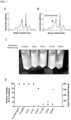
- Fig. 7C depicts the results of acid precipitated floc formation with polymer (SMA 2000 TM ) detergent mixtures.
- Each tested detergent forms a differently sized micelle (0.8kDa, 4kDa, 8kDa, 17kDa and 72kDa as indicated in example 11).
- the results show that Nanonets prepared with micelles of 0.8kDa, 4kDa, and 8kDa, show no significant improvement in visible turbidity.
- the Nanonet prepared with a micelle of 17kDa shows a minor improvement in visible turbidity and the Nanonet prepared with a micelle of 72 kDa shows a massive improvement in flocculation and hence removes turbidity.
- Fig. 7D depicts graphically the relationship between floc agglomeration (stimulated by light centrifugation) of 8 different polymer mixtures (SMA 2000 TM +: no detergent (i.e. SMA 2000 TM only), Sodium Cholate (Cholate), Sodium Deoxycholate (DOC), beta-octyl glucoside (Beta-OG), Lauryl dimethylamine n-oxide (LDAO), Octylphenol Ethoxylate (TX-305), n-Dodecyl beta-D-maltoside (DDM) and Sodium Oleate (Oleate).
- the circles in the graph relate starting micelle size and the squares in the graph relate to relative turbidity. Note that the circle and the square of the polymer+TX-305 are in approximately the same place and on top of each other. Only Nanonet forming mixtures show increased floc agglomeration.
Landscapes
- Chemical & Material Sciences (AREA)
- Organic Chemistry (AREA)
- Chemical Kinetics & Catalysis (AREA)
- Analytical Chemistry (AREA)
- Engineering & Computer Science (AREA)
- Life Sciences & Earth Sciences (AREA)
- Hydrology & Water Resources (AREA)
- Environmental & Geological Engineering (AREA)
- Water Supply & Treatment (AREA)
- Medicinal Chemistry (AREA)
- Polymers & Plastics (AREA)
- Health & Medical Sciences (AREA)
- Detergent Compositions (AREA)
- Sealing Material Composition (AREA)
Claims (15)
- Absonderungswirkstoff zur Absonderung von Teilchen, die nicht Wasser sind, aus einer wässrigen Lösung enthaltend:a. ein Tensid, das eine Mizelle, die eine Größe von nicht weniger als 10 kDa hat, formen kann, wobei das Tensid ausgewählt ist aus der Gruppe bestehend aus: O-[4-(1,1,3,3-Tetramethylbutyl)phenoxy]polyethoxyethanol, das die chemische Formel
 b. ein Polymer, das ein Molekulargewicht in der Spanne von etwa 3000 g/mol bis etwa 25000 g/mol hat, das zur Stabilisierung des Formens einer Tensidmizelle einsatzfähig ist, wobei das Polymer verursacht, dass das Tensid und das Polymer sich selbst in ein Nanonetz organisieren, wenn sie der wässrigen Lösung ausgesetzt sind, wobei das Polymer ausgewählt ist aus der Gruppe bestehend aus: Styrolmaleinsäure (SMA), Diisobutylmaleinsäure, und Mischungen davon.
 - Absonderungswirkstoff nach Anspruch 1, weiter enthaltend ein Niederschlagswirkstoff, wobei der Niederschlagswirkstoff ausgewählt ist aus der Gruppe bestehend aus: Essigsäure, Maleinsäure, Zitronensäure, Tartarsäure, Fumarsäure, Milchsäure, Salzsäure, Schwefelsäure, Phosphorsäure, und Mischungen davon.
- Kit zur Absonderung von Teilchen, die nicht Wasser sind, aus einer wässrigen Lösung, wobei das Kit enthält:a. ein Tensid, das eine Mizelle, die eine Größe von nicht weniger als 10 kDa hat, formen kann, wobei das Tensid ausgewählt ist aus der Gruppe bestehend aus: O-[4-(1,1,3,3-Tetramethylbutyl)phenoxy]polyethoxyethanol, das die chemische Formel
 b. ein Polymer, das ein Molekulargewicht in der Spanne von etwa 3000 g/mol bis etwa 25000 g/mol hat, das zur Stabilisierung des Formens einer Tensidmizelle einsatzfähig ist, wobei das Polymer verursacht, dass das Tensid und das Polymer sich selbst in ein Nanonetz organisieren, wenn sie der wässrigen Lösung ausgesetzt sind, wobei das Polymer ausgewählt ist aus der Gruppe bestehend aus: Styrolmaleinsäure (SMA), Diisobutylmaleinsäure, und Mischungen davon; undc. ein Niederschlagswirkstoff, der ausgewählt ist aus der Gruppe bestehend aus: Essigsäure, Maleinsäure, Zitronensäure, Tartarsäure, Fumarsäure, Milchsäure, Salzsäure, Schwefelsäure, und Phosphorsäure und Mischungen davon.
 - Absonderungswirkstoff oder Kit nach einem der Ansprüche 1 bis 3, wobei das Tensid ein nicht-ionisches oberflächenwirksames Tensid ist.
- Absonderungswirkstoff oder Kit nach einem der Ansprüche 1 bis 4, wobei das Polymer ein Molekulargewicht von etwa 22000 g/mol hat.
- Absonderungswirkstoff oder Kit nach einem der Ansprüche 1 bis 5, wobei das Polymer wasserlöslich, ober biologisch abbaubar, oder wasserlöslich und biologisch abbaubar ist.
- Absonderungswirkstoff oder Kit nach einem der Ansprüche 1 bis 6, wobei der Quotient aus Tensid:Polymer in einer Spanne von etwa 1:0,5 bis etwa 1:1,3 ist.
- Absonderungswirkstoff oder Kit nach einem der Ansprüche 1 bis 6, wobei der Quotient aus Tensid:Polymer in einer Spanne von etwa 1:0,5 bis etwa 1:1,0 ist.
- Absonderungswirkstoff oder Kit nach einem der Ansprüche 1 bis 6, wobei der Quotient aus Tensid:Polymer in einer Spanne von etwa 1:0,6 bis etwa 1:0,8 ist.
- Absonderungswirkstoff oder Kit nach einem der Ansprüche 1 bis 6, wobei der Quotient aus Tensid:Polymer etwa 1:0,7 ist.
- Absonderungswirkstoff oder Kit nach einem der Ansprüche 1 bis 10, wobei das Tensid Mizellen, die eine Größe von nicht weniger als etwa 40 kDa und nicht mehr als etwa 300 kDa haben, formen kann.
- Verfahren zur Absonderung eines Teilchens, das nicht Wasser ist, aus einer wässrigen Lösung, wobei das Verfahren das Hinzufügen eines Absonderungswirkstoffs nach einem der Ansprüche 1 bis 11 in eine wässrige Lösung, die ein Teilchen, das nicht Wasser ist, enthält, wodurch eine behandelte wässrige Lösung entsteht, gefolgt von dem Entfernen von Feststoffpartikeln aus der behandelten wässrigen Lösung.
- Verfahren nach Anspruch 12, weiter enthaltend ein Mischen vor dem Entfernen der Feststoffpartikel.
- Verfahren nach Anspruch 12 oder 13, wobei das Entfernen von Feststoffpartikeln mindestens eines aus der Gruppe bestehend aus Filtration, Schwerkraftabtrennung, Schwimmaufbereitung und elektromagnetischer Anziehung enthält.
- Verfahren nach Anspruch 14, wobei das Entfernen von Feststoffpartikeln elektromagnetische Anziehung enthält und wobei das Verfahren weiter das Hinzufügen von magnetischen Teilchen in die behandelte wässrige Lösung vor dem Entfernen der Feststoffpartikel enthält.
Priority Applications (1)
| Application Number | Priority Date | Filing Date | Title |
|---|---|---|---|
| EP23172965.8A EP4253333A1 (de) | 2017-06-02 | 2018-06-01 | Sequestriermittel, kits dafür und verfahren zur verwendung von sequestriermitteln und kits dafür |
Applications Claiming Priority (2)
| Application Number | Priority Date | Filing Date | Title |
|---|---|---|---|
| US201762514208P | 2017-06-02 | 2017-06-02 | |
| PCT/CA2018/050664 WO2018218374A1 (en) | 2017-06-02 | 2018-06-01 | Sequestering agents, kits therefor, and methods of using sequestering agents and kits therefor |
Related Child Applications (2)
| Application Number | Title | Priority Date | Filing Date |
|---|---|---|---|
| EP23172965.8A Division EP4253333A1 (de) | 2017-06-02 | 2018-06-01 | Sequestriermittel, kits dafür und verfahren zur verwendung von sequestriermitteln und kits dafür |
| EP23172965.8A Division-Into EP4253333A1 (de) | 2017-06-02 | 2018-06-01 | Sequestriermittel, kits dafür und verfahren zur verwendung von sequestriermitteln und kits dafür |
Publications (4)
| Publication Number | Publication Date |
|---|---|
| EP3630684A1 EP3630684A1 (de) | 2020-04-08 |
| EP3630684A4 EP3630684A4 (de) | 2021-01-27 |
| EP3630684C0 EP3630684C0 (de) | 2023-08-09 |
| EP3630684B1 true EP3630684B1 (de) | 2023-08-09 |
Family
ID=64454201
Family Applications (2)
| Application Number | Title | Priority Date | Filing Date |
|---|---|---|---|
| EP18810102.6A Active EP3630684B1 (de) | 2017-06-02 | 2018-06-01 | Sequestriermittel, kits dafür und verfahren zur verwendung von sequestriermitteln und kits dafür |
| EP23172965.8A Withdrawn EP4253333A1 (de) | 2017-06-02 | 2018-06-01 | Sequestriermittel, kits dafür und verfahren zur verwendung von sequestriermitteln und kits dafür |
Family Applications After (1)
| Application Number | Title | Priority Date | Filing Date |
|---|---|---|---|
| EP23172965.8A Withdrawn EP4253333A1 (de) | 2017-06-02 | 2018-06-01 | Sequestriermittel, kits dafür und verfahren zur verwendung von sequestriermitteln und kits dafür |
Country Status (9)
| Country | Link |
|---|---|
| US (2) | US11479485B2 (de) |
| EP (2) | EP3630684B1 (de) |
| CN (1) | CN110709356B (de) |
| CA (1) | CA3065594C (de) |
| ES (1) | ES2958068T3 (de) |
| IL (1) | IL270823B2 (de) |
| MX (1) | MX2019014395A (de) |
| PL (1) | PL3630684T3 (de) |
| WO (1) | WO2018218374A1 (de) |
Families Citing this family (2)
| Publication number | Priority date | Publication date | Assignee | Title |
|---|---|---|---|---|
| EP3630684B1 (de) | 2017-06-02 | 2023-08-09 | Carbonet Nanotechnologies Inc. | Sequestriermittel, kits dafür und verfahren zur verwendung von sequestriermitteln und kits dafür |
| HUE067059T2 (hu) | 2018-12-03 | 2024-09-28 | Carbonet Nanotechnologies Inc | Nanohálók szennyezések eltávolítására vizes oldatokból, az arra alkalmas kitek és alkalmazásaik |
Family Cites Families (46)
| Publication number | Priority date | Publication date | Assignee | Title |
|---|---|---|---|---|
| US3069370A (en) | 1958-12-22 | 1962-12-18 | Upjohn Co | Coacervation process for encapsulation of lipophilic materials |
| US3444151A (en) | 1965-09-07 | 1969-05-13 | Sinclair Research Inc | Styrene-maleic anhydride-amine polymers as emulsifiers in polymerization of vinyl monomers |
| US3415745A (en) | 1966-11-07 | 1968-12-10 | Sinclair Research Inc | Method of flocculating a water-borne oil slick |
| US3580891A (en) * | 1968-04-16 | 1971-05-25 | Seekay Chemical Co | Water-insoluble,cross-linked polymeric reaction product of ethylene diamine and nitrilotriacetic acid or derivative |
| US3687906A (en) | 1971-05-24 | 1972-08-29 | Dow Chemical Co | Anhydride polymer amination process |
| US3929635A (en) | 1972-02-17 | 1975-12-30 | Petrolite Corp | Use of polymeric quaternary ammonium betaines as water clarifiers |
| US3819589A (en) | 1972-02-17 | 1974-06-25 | Petrolite Corp | Polymeric quaternary ammonium betaines |
| US4251410A (en) | 1976-05-26 | 1981-02-17 | Sandoz Ltd. | Reaction products of a polyacrylamide formaldehyde, a secondary amine and an-nh group-containing functional derivative of an acid |
| US4618655A (en) | 1983-10-31 | 1986-10-21 | Atlantic Richfield Company | Process for preparation of polymers containing dicarboxylic acid cyclic imide units in a solid/liquid slurry |
| DE3580541D1 (de) | 1984-07-13 | 1990-12-20 | Monsanto Co | Verhuetung von kesselsteinbildung mittels eines maleatpolymers. |
| US4793942A (en) * | 1987-01-08 | 1988-12-27 | Ecolab Inc. | Detersive systems with a dispersed aqueous-organic softening agent for hardness removal |
| JP2558280B2 (ja) | 1987-05-22 | 1996-11-27 | 株式会社日本触媒 | 地熱水の処理方法 |
| CA1341392C (en) | 1987-09-15 | 2002-10-08 | John J. Waldmann | Use of inorganic-organic or organic adduct alloy polymers in the detackification of paint in a spray booth |
| WO1990014310A1 (en) | 1989-05-22 | 1990-11-29 | Commonwealth Scientific And Industrial Research Organisation | Effluent treatment |
| US5391300A (en) * | 1993-05-03 | 1995-02-21 | General Electric Company | Method for the removal of halogenated organic compounds from an environment |
| EP0861212A1 (de) | 1995-11-14 | 1998-09-02 | Cytec Technology Corp. | Hochleistungs-flockungsmittel auf polymerbasis |
| WO1998014490A1 (en) | 1996-10-03 | 1998-04-09 | Cytec Technology Corp. | Cationic water-soluble polymer precipitation in salt solutions |
| US5853596A (en) | 1996-12-09 | 1998-12-29 | Henkel Corporation | Method for reducing chemical oxygen demand of water containing organic material emulsified by a surfactant |
| FR2795076B1 (fr) | 1999-06-21 | 2001-08-10 | Atofina | Dispersions cationiques hydrophobes stabilisees par des copolymeres maleimides de faible masse moleculaire, pour le collage du papier |
| DE19932766A1 (de) * | 1999-07-14 | 2001-01-18 | Henkel Kgaa | Verfahren zur Behandlung des Umlaufwassers in Lackierkabinen |
| US6524485B1 (en) * | 1999-09-17 | 2003-02-25 | Advanced Research And Technology Institute, Inc. | Polymer-micelle complexes and methods of use thereof |
| JP4126931B2 (ja) | 2002-02-28 | 2008-07-30 | 東亞合成株式会社 | 高分子凝集剤及び汚泥の脱水方法 |
| DE60315241T2 (de) | 2002-12-09 | 2008-04-17 | Rohm And Haas Co. | Zusammensetzungen mehrstufiger Polymere mit ausgelöster Freisetzung |
| US20070093610A1 (en) | 2004-05-12 | 2007-04-26 | Kim Dong R | Method for preparing styrene and maleimide copolymer using super critical fluid |
| JP2007196222A (ja) | 2005-12-28 | 2007-08-09 | Yokohama Yushi Kogyo Kk | イオン性有機重合体による排水処理方法及び排水処理剤セット |
| US8115046B2 (en) | 2008-01-18 | 2012-02-14 | Rta Systems, Inc. | Micro encapsulation composition for hydrocarbons and detoxification of highly hazardous chemicals and substances |
| US20120037840A1 (en) * | 2008-02-25 | 2012-02-16 | Galen Stucky | Use of magnetic nanoparticles to remove environmental contaminants |
| WO2010117406A1 (en) | 2009-04-06 | 2010-10-14 | Antimicrobial Specialists & Associates, Inc. | Slow release tablet composition for treating industrial water systems |
| US9067807B2 (en) | 2009-10-20 | 2015-06-30 | Soane Energy, Llc | Treatment of wastewater |
| US20130085248A1 (en) | 2010-01-07 | 2013-04-04 | Isp Investments Inc. | Polymers prepared from mixtures of multifunctional n-vinylformamide and hybrid reactive n-vinylformamide crosslinking monomer moieties and uses thereof |
| IT1402865B1 (it) | 2010-11-05 | 2013-09-27 | Univ Roma | Procedimento per il trattamento di acqua contaminata |
| ES2536979T3 (es) | 2010-12-24 | 2015-06-01 | Unilever N.V. | Composición y procedimiento de clarificación de agua |
| CN103501677A (zh) * | 2011-03-17 | 2014-01-08 | 艺康美国股份有限公司 | 从再循环的洗涤溶液连续或间断除去污物的组合物和方法 |
| CN103597028B (zh) * | 2011-06-10 | 2016-11-02 | 陶氏环球技术有限责任公司 | 水性倾点下降剂分散体组合物 |
| US9441118B2 (en) | 2012-07-03 | 2016-09-13 | Hercules Incorporated | Water soluble polymer powders with improved dispersibility |
| WO2014018452A1 (en) * | 2012-07-24 | 2014-01-30 | Aquero Company, Llc | Process for reducing soluble organic content in recovered water |
| CN102872836B (zh) | 2012-09-11 | 2014-01-29 | 安徽理工大学 | 一种环糊精固载高分子聚合物及其制备方法与应用 |
| US8728454B1 (en) | 2012-10-30 | 2014-05-20 | The Clorox Company | Cationic micelles with anionic polymeric counterions compositions thereof |
| CN103483594B (zh) | 2013-09-12 | 2015-12-09 | 安徽理工大学 | 一种环糊精固载微交联高分子聚合物及其制备方法与应用 |
| GB201407384D0 (en) | 2014-04-28 | 2014-06-11 | Syngenta Participations Ag | Formulation |
| GB2532433A (en) | 2014-11-18 | 2016-05-25 | Isis Innovation | Removal and recovery of a charged species |
| WO2016142789A2 (en) | 2015-01-28 | 2016-09-15 | Mosmart International S.A. | Combination of flocculant with surfactant for wastewater treatment |
| GB201507479D0 (en) | 2015-04-30 | 2015-06-17 | Johnson Matthey Plc | Sustained release system for reservoir treatment and monitoring |
| US11760665B2 (en) | 2016-10-12 | 2023-09-19 | Rkm Ip Holding Llc | Effluent treatment mixture |
| EP3630684B1 (de) | 2017-06-02 | 2023-08-09 | Carbonet Nanotechnologies Inc. | Sequestriermittel, kits dafür und verfahren zur verwendung von sequestriermitteln und kits dafür |
| BR112020004551B1 (pt) | 2017-09-29 | 2023-11-07 | Kemira Oyj | Composição de tratamento de superfície para a aplicação em uma superfície de papel, papelão ou similar e seu uso |
-
2018
- 2018-06-01 EP EP18810102.6A patent/EP3630684B1/de active Active
- 2018-06-01 PL PL18810102.6T patent/PL3630684T3/pl unknown
- 2018-06-01 CA CA3065594A patent/CA3065594C/en active Active
- 2018-06-01 ES ES18810102T patent/ES2958068T3/es active Active
- 2018-06-01 EP EP23172965.8A patent/EP4253333A1/de not_active Withdrawn
- 2018-06-01 WO PCT/CA2018/050664 patent/WO2018218374A1/en not_active Ceased
- 2018-06-01 CN CN201880036003.7A patent/CN110709356B/zh active Active
- 2018-06-01 IL IL270823A patent/IL270823B2/en unknown
- 2018-06-01 US US16/618,556 patent/US11479485B2/en active Active
- 2018-06-01 MX MX2019014395A patent/MX2019014395A/es unknown
-
2022
- 2022-10-24 US US17/972,170 patent/US12221535B2/en active Active
Also Published As
| Publication number | Publication date |
|---|---|
| EP4253333A1 (de) | 2023-10-04 |
| BR112019025480A2 (pt) | 2020-06-23 |
| IL270823B2 (en) | 2024-02-01 |
| MX2019014395A (es) | 2020-02-10 |
| US20230150848A1 (en) | 2023-05-18 |
| EP3630684A1 (de) | 2020-04-08 |
| US12221535B2 (en) | 2025-02-11 |
| IL270823A (en) | 2020-01-30 |
| US11479485B2 (en) | 2022-10-25 |
| CN110709356A (zh) | 2020-01-17 |
| CN110709356B (zh) | 2025-05-13 |
| EP3630684C0 (de) | 2023-08-09 |
| IL270823B1 (en) | 2023-10-01 |
| WO2018218374A1 (en) | 2018-12-06 |
| US20200087176A1 (en) | 2020-03-19 |
| PL3630684T3 (pl) | 2024-02-19 |
| CA3065594C (en) | 2023-06-13 |
| CA3065594A1 (en) | 2018-12-06 |
| EP3630684A4 (de) | 2021-01-27 |
| ES2958068T3 (es) | 2024-01-31 |
Similar Documents
| Publication | Publication Date | Title |
|---|---|---|
| Bratskaya et al. | Heavy metals removal by flocculation/precipitation using N-(2-carboxyethyl) chitosans | |
| Özacar et al. | Evaluation of tannin biopolymer as a coagulant aid for coagulation of colloidal particles | |
| EP3250517A2 (de) | Kombination von flockungsmittel mit tensid zur abwasserbehandlung | |
| US12221535B2 (en) | Sequestering agents, kits therefor, and methods of using sequestering agents and kits therefor | |
| Ahmad et al. | Chitosan: a natural biopolymer for the adsorption of residue oil from oily wastewater | |
| Avazpour et al. | Enhancing the coagulation process for the removal of microplastics from water by anionic polyacrylamide and natural-based Moringa oleifera | |
| Tian et al. | Effects of electrostatic neutralization of Keggin Fe13 on the removal of micro and nano plastic | |
| JP2022165279A (ja) | 凝集膜ろ過処理方法 | |
| Vairamuthu et al. | Treatment of unregulated open dumping site soil by combined Aloe vera gel washing and electrocoagulation for the removal of microplastics and heavy metals | |
| Tian et al. | Novel covalently bound organic silicon-ferrum hybrid coagulant with excellent coagulation performance and bacteriostatic ability | |
| WO2018002365A1 (en) | Modified polymeric flocculants | |
| Lichtfouse et al. | Chitosan for direct bioflocculation processes | |
| CN104961189B (zh) | 一种处理含氯苯酚废水的方法 | |
| Zaki et al. | Assessing the efficacy of bentonite as a coagulant aid for raw water treatment | |
| JP2018153729A (ja) | 水処理剤、水処理方法及び水処理装置 | |
| Ghimici et al. | The separation of kreutzonit particles by cationic pullulan derivatives from model suspension | |
| Dawood et al. | Removal of Colloidal Suspension through Coagulation–Flocculation Process In Water Purification–A Review. | |
| CN110357393A (zh) | 一种针对污泥沉降的纳米絮凝剂及制备方法 | |
| Hassan et al. | Removal of boron from industrial wastewater by chitosan via chemical precipitation | |
| Fávere et al. | Use of chitosan microspheres as remedial material for acidity and iron (III) contents of coal mining wastewaters | |
| CN117486337A (zh) | 一种水处理剂及其制备方法 | |
| Wang et al. | Enhancement of sand filtration performance by titanium-chitosan micro-flocculation coupled with ferrate (VI) pre-oxidation | |
| AU2019430430B2 (en) | Method and process arrangement for removing Si based compounds from a leaching liquor and use | |
| BR112019025480B1 (pt) | Agentes sequestrantes, kit para os mesmos e métodos de uso de agentes e kits sequestrantes | |
| JP2017012956A (ja) | ヒ素含有土壌浄化方法 |
Legal Events
| Date | Code | Title | Description |
|---|---|---|---|
| STAA | Information on the status of an ep patent application or granted ep patent |
Free format text: STATUS: THE INTERNATIONAL PUBLICATION HAS BEEN MADE |
|
| PUAI | Public reference made under article 153(3) epc to a published international application that has entered the european phase |
Free format text: ORIGINAL CODE: 0009012 |
|
| STAA | Information on the status of an ep patent application or granted ep patent |
Free format text: STATUS: REQUEST FOR EXAMINATION WAS MADE |
|
| 17P | Request for examination filed |
Effective date: 20191218 |
|
| AK | Designated contracting states |
Kind code of ref document: A1 Designated state(s): AL AT BE BG CH CY CZ DE DK EE ES FI FR GB GR HR HU IE IS IT LI LT LU LV MC MK MT NL NO PL PT RO RS SE SI SK SM TR |
|
| AX | Request for extension of the european patent |
Extension state: BA ME |
|
| DAV | Request for validation of the european patent (deleted) | ||
| DAX | Request for extension of the european patent (deleted) | ||
| A4 | Supplementary search report drawn up and despatched |
Effective date: 20210114 |
|
| RIC1 | Information provided on ipc code assigned before grant |
Ipc: C02F 1/56 20060101AFI20201223BHEP Ipc: C02F 1/28 20060101ALI20201223BHEP Ipc: B01J 20/22 20060101ALI20201223BHEP Ipc: C02F 1/48 20060101ALN20201223BHEP Ipc: C02F 101/30 20060101ALN20201223BHEP Ipc: C02F 1/26 20060101ALI20201223BHEP Ipc: B01J 20/28 20060101ALI20201223BHEP Ipc: C02F 101/32 20060101ALN20201223BHEP Ipc: C09K 3/32 20060101ALI20201223BHEP Ipc: B01J 20/32 20060101ALI20201223BHEP Ipc: C02F 1/66 20060101ALN20201223BHEP |
|
| STAA | Information on the status of an ep patent application or granted ep patent |
Free format text: STATUS: EXAMINATION IS IN PROGRESS |
|
| 17Q | First examination report despatched |
Effective date: 20211208 |
|
| RIC1 | Information provided on ipc code assigned before grant |
Ipc: C02F 101/32 20060101ALN20220516BHEP Ipc: C02F 101/30 20060101ALN20220516BHEP Ipc: C02F 1/66 20060101ALN20220516BHEP Ipc: C02F 1/48 20060101ALN20220516BHEP Ipc: B01J 20/32 20060101ALI20220516BHEP Ipc: B01J 20/28 20060101ALI20220516BHEP Ipc: C09K 3/32 20060101ALI20220516BHEP Ipc: C02F 1/28 20060101ALI20220516BHEP Ipc: C02F 1/26 20060101ALI20220516BHEP Ipc: B01J 20/22 20060101ALI20220516BHEP Ipc: C02F 1/56 20060101AFI20220516BHEP |
|
| GRAP | Despatch of communication of intention to grant a patent |
Free format text: ORIGINAL CODE: EPIDOSNIGR1 |
|
| STAA | Information on the status of an ep patent application or granted ep patent |
Free format text: STATUS: GRANT OF PATENT IS INTENDED |
|
| RIC1 | Information provided on ipc code assigned before grant |
Ipc: C02F 101/32 20060101ALN20220614BHEP Ipc: C02F 101/30 20060101ALN20220614BHEP Ipc: C02F 1/66 20060101ALN20220614BHEP Ipc: C02F 1/48 20060101ALN20220614BHEP Ipc: B01J 20/32 20060101ALI20220614BHEP Ipc: B01J 20/28 20060101ALI20220614BHEP Ipc: C09K 3/32 20060101ALI20220614BHEP Ipc: C02F 1/28 20060101ALI20220614BHEP Ipc: C02F 1/26 20060101ALI20220614BHEP Ipc: B01J 20/22 20060101ALI20220614BHEP Ipc: C02F 1/56 20060101AFI20220614BHEP |
|
| INTG | Intention to grant announced |
Effective date: 20220718 |
|
| GRAJ | Information related to disapproval of communication of intention to grant by the applicant or resumption of examination proceedings by the epo deleted |
Free format text: ORIGINAL CODE: EPIDOSDIGR1 |
|
| STAA | Information on the status of an ep patent application or granted ep patent |
Free format text: STATUS: EXAMINATION IS IN PROGRESS |
|
| REG | Reference to a national code |
Ref country code: DE Ref legal event code: R079 Free format text: PREVIOUS MAIN CLASS: C02F0001520000 Ipc: C02F0001560000 Ref document number: 602018055108 Country of ref document: DE |
|
| INTC | Intention to grant announced (deleted) | ||
| RIC1 | Information provided on ipc code assigned before grant |
Ipc: C02F 101/32 20060101ALN20221128BHEP Ipc: C02F 101/30 20060101ALN20221128BHEP Ipc: C02F 1/66 20060101ALN20221128BHEP Ipc: C02F 1/48 20060101ALN20221128BHEP Ipc: B01J 20/32 20060101ALI20221128BHEP Ipc: B01J 20/28 20060101ALI20221128BHEP Ipc: C09K 3/32 20060101ALI20221128BHEP Ipc: C02F 1/28 20060101ALI20221128BHEP Ipc: C02F 1/26 20060101ALI20221128BHEP Ipc: B01J 20/22 20060101ALI20221128BHEP Ipc: C02F 1/56 20060101AFI20221128BHEP |
|
| GRAP | Despatch of communication of intention to grant a patent |
Free format text: ORIGINAL CODE: EPIDOSNIGR1 |
|
| STAA | Information on the status of an ep patent application or granted ep patent |
Free format text: STATUS: GRANT OF PATENT IS INTENDED |
|
| INTG | Intention to grant announced |
Effective date: 20230110 |
|
| GRAS | Grant fee paid |
Free format text: ORIGINAL CODE: EPIDOSNIGR3 |
|
| GRAA | (expected) grant |
Free format text: ORIGINAL CODE: 0009210 |
|
| STAA | Information on the status of an ep patent application or granted ep patent |
Free format text: STATUS: THE PATENT HAS BEEN GRANTED |
|
| AK | Designated contracting states |
Kind code of ref document: B1 Designated state(s): AL AT BE BG CH CY CZ DE DK EE ES FI FR GB GR HR HU IE IS IT LI LT LU LV MC MK MT NL NO PL PT RO RS SE SI SK SM TR |
|
| REG | Reference to a national code |
Ref country code: GB Ref legal event code: FG4D |
|
| REG | Reference to a national code |
Ref country code: CH Ref legal event code: EP |
|
| REG | Reference to a national code |
Ref country code: DE Ref legal event code: R096 Ref document number: 602018055108 Country of ref document: DE |
|
| REG | Reference to a national code |
Ref country code: IE Ref legal event code: FG4D |
|
| U01 | Request for unitary effect filed |
Effective date: 20230809 |
|
| U07 | Unitary effect registered |
Designated state(s): AT BE BG DE DK EE FI FR IT LT LU LV MT NL PT SE SI Effective date: 20230816 |
|
| REG | Reference to a national code |
Ref country code: NO Ref legal event code: T2 Effective date: 20230809 |
|
| PG25 | Lapsed in a contracting state [announced via postgrant information from national office to epo] |
Ref country code: GR Free format text: LAPSE BECAUSE OF FAILURE TO SUBMIT A TRANSLATION OF THE DESCRIPTION OR TO PAY THE FEE WITHIN THE PRESCRIBED TIME-LIMIT Effective date: 20231110 |
|
| PG25 | Lapsed in a contracting state [announced via postgrant information from national office to epo] |
Ref country code: IS Free format text: LAPSE BECAUSE OF FAILURE TO SUBMIT A TRANSLATION OF THE DESCRIPTION OR TO PAY THE FEE WITHIN THE PRESCRIBED TIME-LIMIT Effective date: 20231209 |
|
| PG25 | Lapsed in a contracting state [announced via postgrant information from national office to epo] |
Ref country code: RS Free format text: LAPSE BECAUSE OF FAILURE TO SUBMIT A TRANSLATION OF THE DESCRIPTION OR TO PAY THE FEE WITHIN THE PRESCRIBED TIME-LIMIT Effective date: 20230809 Ref country code: IS Free format text: LAPSE BECAUSE OF FAILURE TO SUBMIT A TRANSLATION OF THE DESCRIPTION OR TO PAY THE FEE WITHIN THE PRESCRIBED TIME-LIMIT Effective date: 20231209 Ref country code: HR Free format text: LAPSE BECAUSE OF FAILURE TO SUBMIT A TRANSLATION OF THE DESCRIPTION OR TO PAY THE FEE WITHIN THE PRESCRIBED TIME-LIMIT Effective date: 20230809 Ref country code: GR Free format text: LAPSE BECAUSE OF FAILURE TO SUBMIT A TRANSLATION OF THE DESCRIPTION OR TO PAY THE FEE WITHIN THE PRESCRIBED TIME-LIMIT Effective date: 20231110 |
|
| REG | Reference to a national code |
Ref country code: ES Ref legal event code: FG2A Ref document number: 2958068 Country of ref document: ES Kind code of ref document: T3 Effective date: 20240131 |
|
| PG25 | Lapsed in a contracting state [announced via postgrant information from national office to epo] |
Ref country code: SM Free format text: LAPSE BECAUSE OF FAILURE TO SUBMIT A TRANSLATION OF THE DESCRIPTION OR TO PAY THE FEE WITHIN THE PRESCRIBED TIME-LIMIT Effective date: 20230809 Ref country code: RO Free format text: LAPSE BECAUSE OF FAILURE TO SUBMIT A TRANSLATION OF THE DESCRIPTION OR TO PAY THE FEE WITHIN THE PRESCRIBED TIME-LIMIT Effective date: 20230809 Ref country code: CZ Free format text: LAPSE BECAUSE OF FAILURE TO SUBMIT A TRANSLATION OF THE DESCRIPTION OR TO PAY THE FEE WITHIN THE PRESCRIBED TIME-LIMIT Effective date: 20230809 Ref country code: SK Free format text: LAPSE BECAUSE OF FAILURE TO SUBMIT A TRANSLATION OF THE DESCRIPTION OR TO PAY THE FEE WITHIN THE PRESCRIBED TIME-LIMIT Effective date: 20230809 |
|
| REG | Reference to a national code |
Ref country code: DE Ref legal event code: R097 Ref document number: 602018055108 Country of ref document: DE |
|
| PLBE | No opposition filed within time limit |
Free format text: ORIGINAL CODE: 0009261 |
|
| STAA | Information on the status of an ep patent application or granted ep patent |
Free format text: STATUS: NO OPPOSITION FILED WITHIN TIME LIMIT |
|
| U20 | Renewal fee for the european patent with unitary effect paid |
Year of fee payment: 7 Effective date: 20240521 |
|
| 26N | No opposition filed |
Effective date: 20240513 |
|
| PG25 | Lapsed in a contracting state [announced via postgrant information from national office to epo] |
Ref country code: MC Free format text: LAPSE BECAUSE OF FAILURE TO SUBMIT A TRANSLATION OF THE DESCRIPTION OR TO PAY THE FEE WITHIN THE PRESCRIBED TIME-LIMIT Effective date: 20230809 |
|
| PG25 | Lapsed in a contracting state [announced via postgrant information from national office to epo] |
Ref country code: IE Free format text: LAPSE BECAUSE OF NON-PAYMENT OF DUE FEES Effective date: 20240601 |
|
| U20 | Renewal fee for the european patent with unitary effect paid |
Year of fee payment: 8 Effective date: 20250414 |
|
| PGFP | Annual fee paid to national office [announced via postgrant information from national office to epo] |
Ref country code: PL Payment date: 20250429 Year of fee payment: 8 |
|
| PGFP | Annual fee paid to national office [announced via postgrant information from national office to epo] |
Ref country code: GB Payment date: 20250414 Year of fee payment: 8 |
|
| PGFP | Annual fee paid to national office [announced via postgrant information from national office to epo] |
Ref country code: NO Payment date: 20250415 Year of fee payment: 8 |
|
| PGFP | Annual fee paid to national office [announced via postgrant information from national office to epo] |
Ref country code: TR Payment date: 20250527 Year of fee payment: 8 |
|
| PG25 | Lapsed in a contracting state [announced via postgrant information from national office to epo] |
Ref country code: CY Free format text: LAPSE BECAUSE OF FAILURE TO SUBMIT A TRANSLATION OF THE DESCRIPTION OR TO PAY THE FEE WITHIN THE PRESCRIBED TIME-LIMIT; INVALID AB INITIO Effective date: 20180601 |
|
| PGFP | Annual fee paid to national office [announced via postgrant information from national office to epo] |
Ref country code: ES Payment date: 20250701 Year of fee payment: 8 |
|
| PGFP | Annual fee paid to national office [announced via postgrant information from national office to epo] |
Ref country code: CH Payment date: 20250701 Year of fee payment: 8 |
|
| PG25 | Lapsed in a contracting state [announced via postgrant information from national office to epo] |
Ref country code: HU Free format text: LAPSE BECAUSE OF FAILURE TO SUBMIT A TRANSLATION OF THE DESCRIPTION OR TO PAY THE FEE WITHIN THE PRESCRIBED TIME-LIMIT; INVALID AB INITIO Effective date: 20180601 |