EP3628287B1 - A wound dressing - Google Patents
A wound dressing Download PDFInfo
- Publication number
- EP3628287B1 EP3628287B1 EP18196670.6A EP18196670A EP3628287B1 EP 3628287 B1 EP3628287 B1 EP 3628287B1 EP 18196670 A EP18196670 A EP 18196670A EP 3628287 B1 EP3628287 B1 EP 3628287B1
- Authority
- EP
- European Patent Office
- Prior art keywords
- wound
- wound dressing
- facing layer
- release sheet
- substrate
- Prior art date
- Legal status (The legal status is an assumption and is not a legal conclusion. Google has not performed a legal analysis and makes no representation as to the accuracy of the status listed.)
- Active
Links
Images



Classifications
-
- A—HUMAN NECESSITIES
- A61—MEDICAL OR VETERINARY SCIENCE; HYGIENE
- A61F—FILTERS IMPLANTABLE INTO BLOOD VESSELS; PROSTHESES; DEVICES PROVIDING PATENCY TO, OR PREVENTING COLLAPSING OF, TUBULAR STRUCTURES OF THE BODY, e.g. STENTS; ORTHOPAEDIC, NURSING OR CONTRACEPTIVE DEVICES; FOMENTATION; TREATMENT OR PROTECTION OF EYES OR EARS; BANDAGES, DRESSINGS OR ABSORBENT PADS; FIRST-AID KITS
- A61F13/00—Bandages or dressings; Absorbent pads
- A61F13/02—Adhesive bandages or dressings
- A61F13/0246—Adhesive bandages or dressings characterised by the skin-adhering layer
-
- A—HUMAN NECESSITIES
- A61—MEDICAL OR VETERINARY SCIENCE; HYGIENE
- A61F—FILTERS IMPLANTABLE INTO BLOOD VESSELS; PROSTHESES; DEVICES PROVIDING PATENCY TO, OR PREVENTING COLLAPSING OF, TUBULAR STRUCTURES OF THE BODY, e.g. STENTS; ORTHOPAEDIC, NURSING OR CONTRACEPTIVE DEVICES; FOMENTATION; TREATMENT OR PROTECTION OF EYES OR EARS; BANDAGES, DRESSINGS OR ABSORBENT PADS; FIRST-AID KITS
- A61F13/00—Bandages or dressings; Absorbent pads
- A61F13/00051—Accessories for dressings
- A61F13/00059—Accessories for dressings provided with visual effects, e.g. printed or colored
-
- A—HUMAN NECESSITIES
- A61—MEDICAL OR VETERINARY SCIENCE; HYGIENE
- A61F—FILTERS IMPLANTABLE INTO BLOOD VESSELS; PROSTHESES; DEVICES PROVIDING PATENCY TO, OR PREVENTING COLLAPSING OF, TUBULAR STRUCTURES OF THE BODY, e.g. STENTS; ORTHOPAEDIC, NURSING OR CONTRACEPTIVE DEVICES; FOMENTATION; TREATMENT OR PROTECTION OF EYES OR EARS; BANDAGES, DRESSINGS OR ABSORBENT PADS; FIRST-AID KITS
- A61F13/00—Bandages or dressings; Absorbent pads
- A61F13/00051—Accessories for dressings
- A61F13/00072—Packaging of dressings
- A61F13/00076—Packaging of adhesive dressings
- A61F13/0008—Packaging of adhesive dressings having means for facilitating the removal of the packaging and release liner
-
- A—HUMAN NECESSITIES
- A61—MEDICAL OR VETERINARY SCIENCE; HYGIENE
- A61F—FILTERS IMPLANTABLE INTO BLOOD VESSELS; PROSTHESES; DEVICES PROVIDING PATENCY TO, OR PREVENTING COLLAPSING OF, TUBULAR STRUCTURES OF THE BODY, e.g. STENTS; ORTHOPAEDIC, NURSING OR CONTRACEPTIVE DEVICES; FOMENTATION; TREATMENT OR PROTECTION OF EYES OR EARS; BANDAGES, DRESSINGS OR ABSORBENT PADS; FIRST-AID KITS
- A61F13/00—Bandages or dressings; Absorbent pads
- A61F13/02—Adhesive bandages or dressings
- A61F13/0246—Adhesive bandages or dressings characterised by the skin-adhering layer
- A61F13/0253—Adhesive bandages or dressings characterised by the skin-adhering layer characterized by the adhesive material
-
- A—HUMAN NECESSITIES
- A61—MEDICAL OR VETERINARY SCIENCE; HYGIENE
- A61F—FILTERS IMPLANTABLE INTO BLOOD VESSELS; PROSTHESES; DEVICES PROVIDING PATENCY TO, OR PREVENTING COLLAPSING OF, TUBULAR STRUCTURES OF THE BODY, e.g. STENTS; ORTHOPAEDIC, NURSING OR CONTRACEPTIVE DEVICES; FOMENTATION; TREATMENT OR PROTECTION OF EYES OR EARS; BANDAGES, DRESSINGS OR ABSORBENT PADS; FIRST-AID KITS
- A61F13/00—Bandages or dressings; Absorbent pads
- A61F13/02—Adhesive bandages or dressings
- A61F13/0259—Adhesive bandages or dressings characterised by the release liner covering the skin adhering layer
Definitions
- the silicone gel that is suitable for use in the present invention will generally be hydrophobic and is preferably tacky. Tacky silicone gels are preferred as they cause the wound dressing to be retained in position when applied, yet are non-adherent. Such silicone gels are of the kind often referred to as soft silicones.
- Gels having different properties may be produced by varying the proportions and/or nature of the components used in the reaction. For example, the molecular weights of the various components and/or their degree of substitution by reactive groups may be different.
- Suitable components for forming silicone gels for use in the dressing of the present disclosure are readily available.
- the first portion of the wound facing layer may be smaller (e.g. as much as 50% smaller) than the second portion of the wound facing layer.
- this will assist the nurse or caregiver to only have a correspondingly small "tacky portion" to adhere to the skin of the patient.
- the nurse or caregiver may then successively remove the second release sheet and slowly attach the remaining wound dressing to the patient's skin staring from the interface between the first and the second release sheet.
- first and/or the second release sheet may be subdivided into separate portions. Accordingly, in practice more than just a first and a second release sheet may be comprised with the wound dressing, e.g. depending on the size of the wound dressing. That is, in case of an in comparison large wound dressing it may be desirable to increase the number of release sheets from two to three or even further.
- the instruction may for example be printed or dyed at the upper surface of the substrate. That is, it may for example be possible to apply a "screen printing process" (or similar) for forming the printed or dyed, which in some embodiments may be preferred. At the same time, it should be understood that the instruction may be somewhat integrated with the substrate, for example formed at the manufacturing of the substrate.
- the direction of removal of the wound dressing may be formed by an arrow arranged in the removal direction for instructing the nurse or caregiver in what direction to remove the wound dressing.
- the wound may for example be a tear wound.
- applying the wound dressing to the wound comprises removing the first release sheet, thereby exposing the first portion of the wound facing layer, contacting, after removing the first release sheet, the first portion of the wound facing layer to the skin attached portion of the skin tear, removing, after contacting the first portion of the wound facing layer, the second release sheet, thereby exposing the second portion of the wound facing layer, and contacting, after removing the second release sheet, the second portion of the wound facing layer at least partly to an unwounded portion of the patients skin in a vicinity of the non-attached portion of the tear wound.
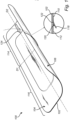
- the wound dressing 100 comprises a substrate 102, the substrate 102 having an upper surface 104 and a lower surface 106.
- the substrate 102 is preferably perforated, for example formed from a reinforced mesh, a perforated polyurethane film, or a net structure (not explicitly illustrated in Fig. 1 ).
- the wound dressing 100 is typically selected to have a size that correspond to the size of the wound. Accordingly, the size (area of the substrate 102) of the wound dressing 100 may be independently selected in line with the present disclosure. In addition, the wound dressing 100 must not necessarily be of a rectangular shape, but may also be differently formed, such as having a circular or elliptical shape.
- the wound dressing 100 further comprises a wound facing layer 108 (not explicitly illustrated in Fig. 1 ) arranged at the lower surface 106 of the substrate 102, i.e. at the side of the wound dressing 100 that is intended to be placed towards a patient's skin. It is desirable that the wound facing layer 108 is somewhat tacky to ensure that the wound dressing 100 stays at the patient's skin without falling off, e.g. when the patient is moving.
- the wound facing layer 108 may for example comprise a silicone gel.
- the strongly hydrophobic nature of the silicone gel prevents any wound fluid from penetrating out over e.g. healthy skin surrounding the wound and to loosen up skin tissue.
- the net-like structure of the wound dressing 100 allows for the surrounding, healthy area of the skin to which the dressing is affixed to be maintained airy and rich in oxygen.
- the perforated structure of the substrate 102 allows for the passage of excess wound exudate through the wound dressing 100.
- a dressing according to the present disclosure is preferably combined with an absorbent bandage applied over the wound dressing 100. In this manner excessive amounts of wound exudate will be sucked up at the same time as the absorbent bandage is kept spaced from the wound bed thereby preventing the bandage from sticking to the wound.
- a first 110 and a second 112 release sheet is respectively arranged to cover and protect a first 114 and a second 116 portion of the wound facing layer 108.
- the first portion 114 is arranged to have an essentially corresponding area as the second portion 116. It should however be understood that the areas may be different, such as for example an embodiment where the first portion 114 is in comparison smaller than the second portion 116.
- the first 110 and the second 112 release sheets are provided with release tabs 118, 120, respectively.
- the first release tab 118 is arranged to "hide" the second release tab 120, thereby making removal of the first tab 118 before the second release tab 120 an intuitive action for the nurse or caregiver when applying the wound dressing to the patient.
- the first portion 114 and the second portion 116 have one side facing each other, forming an interface 122 between the first and 114 and the second 116 portion.
- the interface is essentially straight, meaning that the sides of the first 114 and the second 116 portion facing each other are equally straight.
- the interface 122 may be slightly “wavy” or “jagged".
- an overall direction D1 of the interface 122 essentially "cuts through" the essentially rectangular wound dressing 100, seen as a normalized direction in case of the interface being wavy or jagged.
- the upper surface 104 of the wound dressing 100 is provided with a printed or dyed instruction 124 comprising a direction D2 of removal of the wound dressing 100.
- the printed or dyed instruction 124 is arranged to be visible at an upward facing side of the wound dressing 100, i.e. in the direction facing away from the patent skin when the wound dressing 100 has been applied thereto.
- the instruction 124 may be "integrated" with the substrate 102 or provided at the upper surface 104, such as e.g. by screen printing or any other present or future printing or dying method.
- the direction of the removal D2 of the wound dressing 100 is essentially perpendicular to the overall interface direction D1 and additionally directed, starting from the first portion 114, towards the second portion 116 of the wound facing layer 108. That is, the intended direction of removal D2 of the wound dressing 100 is to start with the first portion 114 of the wound dressing 100 and then to continue with the second portion 116 of the wound dressing 100 until the wound dressing 100 has been completely removed, as will be further elaborated below.
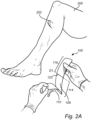
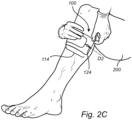
- Figs. 2A - 2D in conjunction with Fig. 3 , where it is illustrated an attachment and removal procedure of the wound dressing 100 to a patient 200.
- Fig. 2A it is illustrated a lower part of a leg of the patient 200.
- the patient has a so-called tear wound 202 (also referred to as a skin tear).
- a tear wound may for example be caused by shear, friction, and/or blunt force resulting in separation of skin layers, and may be partial-thickness (separation of the epidermis from the dermis) or full-thickness (separation of both the epidermis and dermis from underlying structures).
- tear wounds are traumatic wounds, which have a high probability of becoming complex chronic wounds, if not properly managed.
- the tear wound comprises a "skin attached portion” and a "non-attached portion” (e.g. comprising a so called skin flap), where the non-attached portion is the "loose” portion of the tear wound that is desirable to be “reattached”. It is, as understood from the above, desirable to always remove the wound dressing 100 with the skin flap, and not against it, to maintain flap viability, i.e. starting from the skin attached portion.
- wound dressing 100 typically following a wound cleansing process and an approximation of wound edges. Accordingly, in line with the present disclosure the wound dressing 100 is provided, where the wound dressing 100 is formed in line with the discussion as provided above.
- the nurse or caregiver has optionally performed the wound cleansing process and the approximation of wound edges, and is attaching the wound dressing 100 to the tear wound 202 of the patient 200 by first removing the first release sheet 110 (typically starting at the interface 122 using the release tab 118), thereby exposing the first portion 114 of the wound facing layer 108.
- the tacky surface of the first portion 114 of the wound facing layer 108 is then contacted, S2, with the to a skin attached portion of the skin tear 202.
- the nurse or caregiver will remove, S3, the second release sheet 112, thereby exposing the second portion 116 of the wound facing layer 108 and consequently contact, S4, the second portion 116 of the wound facing layer 108 at least partly to an unwounded portion of the patient's skin in a vicinity of the non-attached portion of the tear wound 202.
- the wound dressing 100 has been correctly attached to the patient 200 in relation to the "direction" of the tear wound 202, i.e. in relation to the attached and the non-attached portion of the tear wound 202, also the intended direction of removal D2 of the wound dressing 100 will be correct.
- the instruction of direction for removal D2 of the wound dressing 100 is visibly shown to the nurse or caregiver, meaning that the removal instruction of arranged to face upwards regarding the wound dressing 100, the upward facing side of the wound dressing arranged at the same side of the substrate 102 as the upper surface 104 of the substrate 102.
- Fig. 2D the wound dressing 100 has been completely removed, illustrating how the tear wound 202 has been at least partly healed.
Landscapes
- Health & Medical Sciences (AREA)
- Engineering & Computer Science (AREA)
- Biomedical Technology (AREA)
- Heart & Thoracic Surgery (AREA)
- Vascular Medicine (AREA)
- Life Sciences & Earth Sciences (AREA)
- Animal Behavior & Ethology (AREA)
- General Health & Medical Sciences (AREA)
- Public Health (AREA)
- Veterinary Medicine (AREA)
- Dermatology (AREA)
- Materials For Medical Uses (AREA)
Priority Applications (12)
| Application Number | Priority Date | Filing Date | Title |
|---|---|---|---|
| ES18196670T ES3013610T3 (en) | 2018-09-25 | 2018-09-25 | A wound dressing |
| EP18196670.6A EP3628287B1 (en) | 2018-09-25 | 2018-09-25 | A wound dressing |
| PCT/EP2019/074735 WO2020064406A1 (en) | 2018-09-25 | 2019-09-16 | A wound dressing |
| ES19769484T ES3060620T3 (en) | 2018-09-25 | 2019-09-16 | A wound dressing |
| CA3108843A CA3108843A1 (en) | 2018-09-25 | 2019-09-16 | A wound dressing |
| JP2021515598A JP7732892B2 (ja) | 2018-09-25 | 2019-09-16 | 創傷被覆材 |
| AU2019345899A AU2019345899B2 (en) | 2018-09-25 | 2019-09-16 | A wound dressing |
| US17/277,609 US12485044B2 (en) | 2018-09-25 | 2019-09-16 | Wound dressing |
| EP19769484.7A EP3856103B1 (en) | 2018-09-25 | 2019-09-16 | A wound dressing |
| BR112021003430-7A BR112021003430B1 (pt) | 2018-09-25 | 2019-09-16 | Curativo para ferida |
| CN201980057153.0A CN112638334A (zh) | 2018-09-25 | 2019-09-16 | 伤口敷料 |
| CN202311657554.4A CN117679252A (zh) | 2018-09-25 | 2019-09-16 | 伤口敷料 |
Applications Claiming Priority (1)
| Application Number | Priority Date | Filing Date | Title |
|---|---|---|---|
| EP18196670.6A EP3628287B1 (en) | 2018-09-25 | 2018-09-25 | A wound dressing |
Publications (3)
| Publication Number | Publication Date |
|---|---|
| EP3628287A1 EP3628287A1 (en) | 2020-04-01 |
| EP3628287B1 true EP3628287B1 (en) | 2024-11-27 |
| EP3628287C0 EP3628287C0 (en) | 2024-11-27 |
Family
ID=63685598
Family Applications (2)
| Application Number | Title | Priority Date | Filing Date |
|---|---|---|---|
| EP18196670.6A Active EP3628287B1 (en) | 2018-09-25 | 2018-09-25 | A wound dressing |
| EP19769484.7A Active EP3856103B1 (en) | 2018-09-25 | 2019-09-16 | A wound dressing |
Family Applications After (1)
| Application Number | Title | Priority Date | Filing Date |
|---|---|---|---|
| EP19769484.7A Active EP3856103B1 (en) | 2018-09-25 | 2019-09-16 | A wound dressing |
Country Status (8)
| Country | Link |
|---|---|
| US (1) | US12485044B2 (https=) |
| EP (2) | EP3628287B1 (https=) |
| JP (1) | JP7732892B2 (https=) |
| CN (2) | CN117679252A (https=) |
| AU (1) | AU2019345899B2 (https=) |
| CA (1) | CA3108843A1 (https=) |
| ES (2) | ES3013610T3 (https=) |
| WO (1) | WO2020064406A1 (https=) |
Families Citing this family (2)
| Publication number | Priority date | Publication date | Assignee | Title |
|---|---|---|---|---|
| WO2022084888A1 (en) * | 2020-10-21 | 2022-04-28 | 3M Innovative Properties Company | Packaged medical articles with reduced packaging |
| JP7333995B1 (ja) * | 2022-05-24 | 2023-08-28 | 株式会社東京メディカルテープ | 皮膚粘着シート |
Family Cites Families (22)
| Publication number | Priority date | Publication date | Assignee | Title |
|---|---|---|---|---|
| US4334530A (en) * | 1980-09-12 | 1982-06-15 | Hassell Donald S | Indicia-bearing adhesive bandages |
| JPH07500266A (ja) * | 1991-10-23 | 1995-01-12 | カミングス,ゲイリ、ウエイン | 傷手当システム |
| EP1117359A1 (en) * | 1998-10-02 | 2001-07-25 | JOHNSON & JOHNSON CONSUMER PRODUCTS, INC. | Decorative adhesive bandage kit |
| US7078582B2 (en) * | 2001-01-17 | 2006-07-18 | 3M Innovative Properties Company | Stretch removable adhesive articles and methods |
| US7205449B2 (en) * | 2001-12-04 | 2007-04-17 | Kenneth Martin Levin | Adhesive bandage indicating wound care instructions |
| GB0606661D0 (en) | 2006-04-03 | 2006-05-10 | Brightwake Ltd | Improvements relating to dressings |
| WO2008034897A1 (en) * | 2006-09-22 | 2008-03-27 | Coloplast A/S | A film dressing |
| EP2346459B1 (en) * | 2008-10-24 | 2015-11-25 | 3M Innovative Properties Company | Conformable wound dressing |
| AU2011366180B2 (en) * | 2011-04-21 | 2016-04-21 | Smith & Nephew Plc | Blockage management |
| US8887313B2 (en) * | 2012-03-30 | 2014-11-18 | Aaron McGuin | Wrap for human appendage |
| GB2512841B (en) * | 2013-04-08 | 2020-07-15 | Brightwake Ltd | Absorbent wound dressings |
| US20150073930A1 (en) * | 2013-09-12 | 2015-03-12 | Odette Perreault | Adhesive bandage |
| US10342708B2 (en) * | 2014-03-17 | 2019-07-09 | Medline Industries, Inc. | Decorative bandage and corresponding systems and methods |
| US10034799B2 (en) * | 2014-07-31 | 2018-07-31 | Johnson & Johnson Consumer Inc. | Two-stage wound dressing assembly |
| JP6678849B2 (ja) * | 2015-08-28 | 2020-04-08 | 有限会社東洋物療研究所 | 皮膚伸長テープ及びリラックス方法 |
| US20160193086A1 (en) * | 2015-01-07 | 2016-07-07 | Frank Castle | Bandages with symbols and methods of forming such bandages |
| TWM521451U (zh) * | 2016-01-18 | 2016-05-11 | Wen-Ho Tseng | 具有易剝離保護膜層的水凝膠敷料 |
| US20170231821A1 (en) | 2016-01-19 | 2017-08-17 | Kci Usa, Inc. | Silicone wound contact layer with silver |
| US20170252221A1 (en) * | 2016-02-25 | 2017-09-07 | Kim Scopelliti | Adhesive Bandage With Integral Sticker |
| CN205515888U (zh) * | 2016-03-25 | 2016-08-31 | 武汉大学 | 一种气管切开封口贴 |
| CN106137511A (zh) * | 2016-08-26 | 2016-11-23 | 苏州美迪斯医疗运动用品股份有限公司 | 急救固定包扎组合套装 |
| CN206995406U (zh) * | 2017-02-13 | 2018-02-13 | 江西维邦医疗器械有限公司 | 透明敷贴 |
-
2018
- 2018-09-25 EP EP18196670.6A patent/EP3628287B1/en active Active
- 2018-09-25 ES ES18196670T patent/ES3013610T3/es active Active
-
2019
- 2019-09-16 ES ES19769484T patent/ES3060620T3/es active Active
- 2019-09-16 EP EP19769484.7A patent/EP3856103B1/en active Active
- 2019-09-16 CA CA3108843A patent/CA3108843A1/en active Pending
- 2019-09-16 JP JP2021515598A patent/JP7732892B2/ja active Active
- 2019-09-16 US US17/277,609 patent/US12485044B2/en active Active
- 2019-09-16 CN CN202311657554.4A patent/CN117679252A/zh active Pending
- 2019-09-16 WO PCT/EP2019/074735 patent/WO2020064406A1/en not_active Ceased
- 2019-09-16 AU AU2019345899A patent/AU2019345899B2/en active Active
- 2019-09-16 CN CN201980057153.0A patent/CN112638334A/zh active Pending
Also Published As
| Publication number | Publication date |
|---|---|
| JP2022501120A (ja) | 2022-01-06 |
| ES3060620T3 (en) | 2026-03-27 |
| BR112021003430A2 (pt) | 2021-05-18 |
| CA3108843A1 (en) | 2020-04-02 |
| CN117679252A (zh) | 2024-03-12 |
| EP3856103A1 (en) | 2021-08-04 |
| US20220031521A1 (en) | 2022-02-03 |
| AU2019345899A1 (en) | 2021-02-25 |
| EP3628287C0 (en) | 2024-11-27 |
| ES3013610T3 (en) | 2025-04-14 |
| CN112638334A (zh) | 2021-04-09 |
| EP3856103C0 (en) | 2025-11-05 |
| WO2020064406A1 (en) | 2020-04-02 |
| EP3856103B1 (en) | 2025-11-05 |
| JP7732892B2 (ja) | 2025-09-02 |
| EP3628287A1 (en) | 2020-04-01 |
| US12485044B2 (en) | 2025-12-02 |
| AU2019345899B2 (en) | 2024-11-07 |
Similar Documents
| Publication | Publication Date | Title |
|---|---|---|
| JP6318169B2 (ja) | 接着性周縁部を有する創傷被覆材 | |
| US10940050B2 (en) | Wound dressing assembly | |
| US20100268144A1 (en) | Scar treatment silicone dressing | |
| EP3174507B1 (en) | Two-stage wound dressing assembly | |
| WO2020154106A1 (en) | Wound dressing with selective and dynamic transparency | |
| EP3856103B1 (en) | A wound dressing | |
| JP7710991B2 (ja) | 層状の有孔創傷被覆材、その製造工程及び有用な物品 | |
| JP7405866B2 (ja) | 皮膚代替物に対する接着性、伸縮性、及び適合性が向上した皮膚代替物 | |
| JP2015523161A (ja) | 固定用組立体 | |
| BR112021003430B1 (pt) | Curativo para ferida | |
| JP2011115513A (ja) | 救急絆創膏 | |
| HK40001900B (en) | Wound dressing assembly | |
| HK40001900A (en) | Wound dressing assembly | |
| JPH0617723U (ja) | 粘着性シート | |
| HK1237638B (en) | Two-stage wound dressing assembly | |
| HK1237638A1 (en) | Two-stage wound dressing assembly | |
| HK1237637A1 (en) | Wound dressing assembly | |
| HK1237637B (en) | Wound dressing assembly |
Legal Events
| Date | Code | Title | Description |
|---|---|---|---|
| PUAI | Public reference made under article 153(3) epc to a published international application that has entered the european phase |
Free format text: ORIGINAL CODE: 0009012 |
|
| STAA | Information on the status of an ep patent application or granted ep patent |
Free format text: STATUS: THE APPLICATION HAS BEEN PUBLISHED |
|
| AK | Designated contracting states |
Kind code of ref document: A1 Designated state(s): AL AT BE BG CH CY CZ DE DK EE ES FI FR GB GR HR HU IE IS IT LI LT LU LV MC MK MT NL NO PL PT RO RS SE SI SK SM TR |
|
| AX | Request for extension of the european patent |
Extension state: BA ME |
|
| STAA | Information on the status of an ep patent application or granted ep patent |
Free format text: STATUS: REQUEST FOR EXAMINATION WAS MADE |
|
| 17P | Request for examination filed |
Effective date: 20201001 |
|
| RBV | Designated contracting states (corrected) |
Designated state(s): AL AT BE BG CH CY CZ DE DK EE ES FI FR GB GR HR HU IE IS IT LI LT LU LV MC MK MT NL NO PL PT RO RS SE SI SK SM TR |
|
| STAA | Information on the status of an ep patent application or granted ep patent |
Free format text: STATUS: EXAMINATION IS IN PROGRESS |
|
| 17Q | First examination report despatched |
Effective date: 20210401 |
|
| P01 | Opt-out of the competence of the unified patent court (upc) registered |
Effective date: 20230629 |
|
| GRAP | Despatch of communication of intention to grant a patent |
Free format text: ORIGINAL CODE: EPIDOSNIGR1 |
|
| STAA | Information on the status of an ep patent application or granted ep patent |
Free format text: STATUS: GRANT OF PATENT IS INTENDED |
|
| INTG | Intention to grant announced |
Effective date: 20240628 |
|
| GRAS | Grant fee paid |
Free format text: ORIGINAL CODE: EPIDOSNIGR3 |
|
| GRAA | (expected) grant |
Free format text: ORIGINAL CODE: 0009210 |
|
| STAA | Information on the status of an ep patent application or granted ep patent |
Free format text: STATUS: THE PATENT HAS BEEN GRANTED |
|
| AK | Designated contracting states |
Kind code of ref document: B1 Designated state(s): AL AT BE BG CH CY CZ DE DK EE ES FI FR GB GR HR HU IE IS IT LI LT LU LV MC MK MT NL NO PL PT RO RS SE SI SK SM TR |
|
| REG | Reference to a national code |
Ref country code: GB Ref legal event code: FG4D |
|
| REG | Reference to a national code |
Ref country code: CH Ref legal event code: EP |
|
| REG | Reference to a national code |
Ref country code: DE Ref legal event code: R096 Ref document number: 602018076909 Country of ref document: DE |
|
| REG | Reference to a national code |
Ref country code: IE Ref legal event code: FG4D |
|
| U01 | Request for unitary effect filed |
Effective date: 20241212 |
|
| U07 | Unitary effect registered |
Designated state(s): AT BE BG DE DK EE FI FR IT LT LU LV MT NL PT RO SE SI Effective date: 20250108 |
|
| P04 | Withdrawal of opt-out of the competence of the unified patent court (upc) registered |
Free format text: CASE NUMBER: APP_148/2025 Effective date: 20250102 |
|
| PG25 | Lapsed in a contracting state [announced via postgrant information from national office to epo] |
Ref country code: HR Free format text: LAPSE BECAUSE OF FAILURE TO SUBMIT A TRANSLATION OF THE DESCRIPTION OR TO PAY THE FEE WITHIN THE PRESCRIBED TIME-LIMIT Effective date: 20241127 Ref country code: IS Free format text: LAPSE BECAUSE OF FAILURE TO SUBMIT A TRANSLATION OF THE DESCRIPTION OR TO PAY THE FEE WITHIN THE PRESCRIBED TIME-LIMIT Effective date: 20250327 |
|
| REG | Reference to a national code |
Ref country code: ES Ref legal event code: FG2A Ref document number: 3013610 Country of ref document: ES Kind code of ref document: T3 Effective date: 20250414 |
|
| PG25 | Lapsed in a contracting state [announced via postgrant information from national office to epo] |
Ref country code: NO Free format text: LAPSE BECAUSE OF FAILURE TO SUBMIT A TRANSLATION OF THE DESCRIPTION OR TO PAY THE FEE WITHIN THE PRESCRIBED TIME-LIMIT Effective date: 20250227 |
|
| PG25 | Lapsed in a contracting state [announced via postgrant information from national office to epo] |
Ref country code: GR Free format text: LAPSE BECAUSE OF FAILURE TO SUBMIT A TRANSLATION OF THE DESCRIPTION OR TO PAY THE FEE WITHIN THE PRESCRIBED TIME-LIMIT Effective date: 20250228 |
|
| PG25 | Lapsed in a contracting state [announced via postgrant information from national office to epo] |
Ref country code: PL Free format text: LAPSE BECAUSE OF FAILURE TO SUBMIT A TRANSLATION OF THE DESCRIPTION OR TO PAY THE FEE WITHIN THE PRESCRIBED TIME-LIMIT Effective date: 20241127 |
|
| PG25 | Lapsed in a contracting state [announced via postgrant information from national office to epo] |
Ref country code: RS Free format text: LAPSE BECAUSE OF FAILURE TO SUBMIT A TRANSLATION OF THE DESCRIPTION OR TO PAY THE FEE WITHIN THE PRESCRIBED TIME-LIMIT Effective date: 20250227 |
|
| PG25 | Lapsed in a contracting state [announced via postgrant information from national office to epo] |
Ref country code: SM Free format text: LAPSE BECAUSE OF FAILURE TO SUBMIT A TRANSLATION OF THE DESCRIPTION OR TO PAY THE FEE WITHIN THE PRESCRIBED TIME-LIMIT Effective date: 20241127 |
|
| PG25 | Lapsed in a contracting state [announced via postgrant information from national office to epo] |
Ref country code: SK Free format text: LAPSE BECAUSE OF FAILURE TO SUBMIT A TRANSLATION OF THE DESCRIPTION OR TO PAY THE FEE WITHIN THE PRESCRIBED TIME-LIMIT Effective date: 20241127 |
|
| PG25 | Lapsed in a contracting state [announced via postgrant information from national office to epo] |
Ref country code: CZ Free format text: LAPSE BECAUSE OF FAILURE TO SUBMIT A TRANSLATION OF THE DESCRIPTION OR TO PAY THE FEE WITHIN THE PRESCRIBED TIME-LIMIT Effective date: 20241127 |
|
| PLBE | No opposition filed within time limit |
Free format text: ORIGINAL CODE: 0009261 |
|
| STAA | Information on the status of an ep patent application or granted ep patent |
Free format text: STATUS: NO OPPOSITION FILED WITHIN TIME LIMIT |
|
| PGFP | Annual fee paid to national office [announced via postgrant information from national office to epo] |
Ref country code: GB Payment date: 20250923 Year of fee payment: 8 |
|
| U20 | Renewal fee for the european patent with unitary effect paid |
Year of fee payment: 8 Effective date: 20250925 |
|
| 26N | No opposition filed |
Effective date: 20250828 |
|
| PGFP | Annual fee paid to national office [announced via postgrant information from national office to epo] |
Ref country code: ES Payment date: 20251015 Year of fee payment: 8 |