EP3626682A1 - Materiau lithie - Google Patents
Materiau lithie Download PDFInfo
- Publication number
- EP3626682A1 EP3626682A1 EP19198438.4A EP19198438A EP3626682A1 EP 3626682 A1 EP3626682 A1 EP 3626682A1 EP 19198438 A EP19198438 A EP 19198438A EP 3626682 A1 EP3626682 A1 EP 3626682A1
- Authority
- EP
- European Patent Office
- Prior art keywords
- equal
- material according
- lithium
- powder
- stoichiometric coefficient
- Prior art date
- Legal status (The legal status is an assumption and is not a legal conclusion. Google has not performed a legal analysis and makes no representation as to the accuracy of the status listed.)
- Granted
Links
Images


Classifications
-
- C—CHEMISTRY; METALLURGY
- C01—INORGANIC CHEMISTRY
- C01G—COMPOUNDS CONTAINING METALS NOT COVERED BY SUBCLASSES C01D OR C01F
- C01G23/00—Compounds of titanium
- C01G23/002—Compounds containing titanium, with or without oxygen or hydrogen, and containing two or more other elements
-
- B—PERFORMING OPERATIONS; TRANSPORTING
- B22—CASTING; POWDER METALLURGY
- B22F—WORKING METALLIC POWDER; MANUFACTURE OF ARTICLES FROM METALLIC POWDER; MAKING METALLIC POWDER; APPARATUS OR DEVICES SPECIALLY ADAPTED FOR METALLIC POWDER
- B22F9/00—Making metallic powder or suspensions thereof
- B22F9/02—Making metallic powder or suspensions thereof using physical processes
- B22F9/04—Making metallic powder or suspensions thereof using physical processes starting from solid material, e.g. by crushing, grinding or milling
-
- H—ELECTRICITY
- H01—ELECTRIC ELEMENTS
- H01M—PROCESSES OR MEANS, e.g. BATTERIES, FOR THE DIRECT CONVERSION OF CHEMICAL ENERGY INTO ELECTRICAL ENERGY
- H01M4/00—Electrodes
- H01M4/02—Electrodes composed of, or comprising, active material
- H01M4/36—Selection of substances as active materials, active masses, active liquids
- H01M4/48—Selection of substances as active materials, active masses, active liquids of inorganic oxides or hydroxides
- H01M4/485—Selection of substances as active materials, active masses, active liquids of inorganic oxides or hydroxides of mixed oxides or hydroxides for inserting or intercalating light metals, e.g. LiTi2O4 or LiTi2OxFy
-
- H—ELECTRICITY
- H01—ELECTRIC ELEMENTS
- H01M—PROCESSES OR MEANS, e.g. BATTERIES, FOR THE DIRECT CONVERSION OF CHEMICAL ENERGY INTO ELECTRICAL ENERGY
- H01M4/00—Electrodes
- H01M4/02—Electrodes composed of, or comprising, active material
- H01M4/36—Selection of substances as active materials, active masses, active liquids
- H01M4/58—Selection of substances as active materials, active masses, active liquids of inorganic compounds other than oxides or hydroxides, e.g. sulfides, selenides, tellurides, halogenides or LiCoFy; of polyanionic structures, e.g. phosphates, silicates or borates
- H01M4/581—Chalcogenides or intercalation compounds thereof
- H01M4/5815—Sulfides
-
- B—PERFORMING OPERATIONS; TRANSPORTING
- B22—CASTING; POWDER METALLURGY
- B22F—WORKING METALLIC POWDER; MANUFACTURE OF ARTICLES FROM METALLIC POWDER; MAKING METALLIC POWDER; APPARATUS OR DEVICES SPECIALLY ADAPTED FOR METALLIC POWDER
- B22F9/00—Making metallic powder or suspensions thereof
- B22F9/02—Making metallic powder or suspensions thereof using physical processes
- B22F9/04—Making metallic powder or suspensions thereof using physical processes starting from solid material, e.g. by crushing, grinding or milling
- B22F2009/042—Making metallic powder or suspensions thereof using physical processes starting from solid material, e.g. by crushing, grinding or milling using a particular milling fluid
-
- B—PERFORMING OPERATIONS; TRANSPORTING
- B22—CASTING; POWDER METALLURGY
- B22F—WORKING METALLIC POWDER; MANUFACTURE OF ARTICLES FROM METALLIC POWDER; MAKING METALLIC POWDER; APPARATUS OR DEVICES SPECIALLY ADAPTED FOR METALLIC POWDER
- B22F2301/00—Metallic composition of the powder or its coating
- B22F2301/05—Light metals
- B22F2301/054—Alkali metals, i.e. Li, Na, K, Rb, Cs, Fr
-
- B—PERFORMING OPERATIONS; TRANSPORTING
- B22—CASTING; POWDER METALLURGY
- B22F—WORKING METALLIC POWDER; MANUFACTURE OF ARTICLES FROM METALLIC POWDER; MAKING METALLIC POWDER; APPARATUS OR DEVICES SPECIALLY ADAPTED FOR METALLIC POWDER
- B22F2302/00—Metal Compound, non-Metallic compound or non-metal composition of the powder or its coating
- B22F2302/45—Others, including non-metals
-
- C—CHEMISTRY; METALLURGY
- C01—INORGANIC CHEMISTRY
- C01P—INDEXING SCHEME RELATING TO STRUCTURAL AND PHYSICAL ASPECTS OF SOLID INORGANIC COMPOUNDS
- C01P2002/00—Crystal-structural characteristics
- C01P2002/30—Three-dimensional structures
-
- C—CHEMISTRY; METALLURGY
- C01—INORGANIC CHEMISTRY
- C01P—INDEXING SCHEME RELATING TO STRUCTURAL AND PHYSICAL ASPECTS OF SOLID INORGANIC COMPOUNDS
- C01P2002/00—Crystal-structural characteristics
- C01P2002/70—Crystal-structural characteristics defined by measured X-ray, neutron or electron diffraction data
- C01P2002/72—Crystal-structural characteristics defined by measured X-ray, neutron or electron diffraction data by d-values or two theta-values, e.g. as X-ray diagram
-
- H—ELECTRICITY
- H01—ELECTRIC ELEMENTS
- H01M—PROCESSES OR MEANS, e.g. BATTERIES, FOR THE DIRECT CONVERSION OF CHEMICAL ENERGY INTO ELECTRICAL ENERGY
- H01M10/00—Secondary cells; Manufacture thereof
- H01M10/05—Accumulators with non-aqueous electrolyte
- H01M10/052—Li-accumulators
- H01M10/0525—Rocking-chair batteries, i.e. batteries with lithium insertion or intercalation in both electrodes; Lithium-ion batteries
-
- Y—GENERAL TAGGING OF NEW TECHNOLOGICAL DEVELOPMENTS; GENERAL TAGGING OF CROSS-SECTIONAL TECHNOLOGIES SPANNING OVER SEVERAL SECTIONS OF THE IPC; TECHNICAL SUBJECTS COVERED BY FORMER USPC CROSS-REFERENCE ART COLLECTIONS [XRACs] AND DIGESTS
- Y02—TECHNOLOGIES OR APPLICATIONS FOR MITIGATION OR ADAPTATION AGAINST CLIMATE CHANGE
- Y02E—REDUCTION OF GREENHOUSE GAS [GHG] EMISSIONS, RELATED TO ENERGY GENERATION, TRANSMISSION OR DISTRIBUTION
- Y02E60/00—Enabling technologies; Technologies with a potential or indirect contribution to GHG emissions mitigation
- Y02E60/10—Energy storage using batteries
Definitions
- the present invention relates to a material based on lithium, titanium, sulfur and selenium intended to constitute at least partially a battery cathode.
- Lithium titanium sulfide of formula Li 2 TiS 3 , known in particular from EP 2 977 354 A1 and article A. Sakuda et al., "Rock-salt-type lithium metal sulphide as novel positive-electrode materials", Sci. Rep., Vol. 4, 4883 (2014 ), has a high reversible capacity, up to 400 mAh / g thanks to redox reactions with multiple electrons.
- the reversible capacity of a lithium-ion battery comprising a Li 2 TiS 3 cathode decreases rapidly when the number of charge / discharge cycles increases. In particular, after 10 cycles, the reversible capacity reaches only 80% of the maximum value generally reached in the first cycle. Lithium titanium sulfide therefore exhibits an unstable charge / discharge behavior.
- the phenomenon described above disappears, the reversible capacity of the lithium titanium sulfide then coming from the redox activity of the titanium.
- the lithium titanium sulfide is gradually degraded and loses a portion of the sulfur activity which it comprises, as the number of charge / discharge cycles increases.
- the structure is then modified, which also contributes to the instability of the charge / discharge behavior of lithium titanium sulfide.
- the instability of the charge / discharge behavior described above represents a brake on the industrialization of lithium-ion batteries containing lithium titanium sulfide.
- a user of a device powered electrically by a rechargeable battery expects that the reversible capacity of the battery will not decrease, or only slightly, with an increase in the number of charge / discharge cycles.
- the material according to the invention may have a reversible capacity lower than that of lithium titanium sulfide. However, within a battery, it has a reversible capacity which decreases relatively less rapidly, with an increase in the number of charge / discharge cycles, than that of lithium titanium sulfide. It therefore appears to exhibit a more stable charge / discharge behavior than the material of formula Li 2 TiS 3 .
- the inventors attribute the best stability of the material according to the invention to the high electronic conductivity of the metalloid element. Furthermore, the metalloid element has a larger ionic radius than sulfur. The credit goes to the inventors for having successfully introduced the metalloid element into the compact structure of the material according to the invention. An atom of the metalloid element occupies more space there than an atom of sulfur.
- the metalloid element A is selenium Se.
- Selenium has an electronic conductivity twenty times higher than that of sulfur.
- the stoichiometric coefficient x can be less than or equal to 2.0, or even less than or equal to 1.5. Preferably, it is less than or equal to 1.2, or even preferably less than or equal to 1.1. Preferably, it is equal to 1. In a variant, it can be equal to 2.
- the stoichiometric coefficient a can be greater than or equal to 1.0, or even greater than or equal to 1.2. Preferably, it is greater than or equal to 1.4, better still greater than or equal to 1.5. It can be less than or equal to 4.0, or even less than or equal to 3.0. Preferably, it is less than or equal to 2.5, or even less than or equal to 2.1, preferably less than or equal to 2.05.
- the stoichiometric coefficient a is equal to 2.
- the stoichiometric coefficient b can be greater than or equal to 0.95 and / or less than or equal to 1.05. Preferably, it is equal to 1.
- the stoichiometric coefficient c may be greater than or equal to 0.95 and / or less than or equal to 1.05. Preferably, it is equal to 1.
- the stoichiometric coefficient a can be equal to 2 and / or the stoichiometric coefficient b can be equal to 1 and / or the stoichiometric coefficient c can be equal to 1.
- the material according to the invention has the formula Li a Ti b Se x S 3-x with 1.5 ⁇ a ⁇ 2.05; 0.95 ⁇ b ⁇ 1.05 and preferably 0 ⁇ x ⁇ 1.2.
- the stoichiometric coefficient a is equal to 2
- the stoichiometric coefficient b is equal to 1
- the stoichiometric coefficient c is equal to 1.
- the material according to the invention has the formula Li 2 TiSe x S 3-x , preferably with x ⁇ 1.2.
- the material of formula Li 2 TiSe x S 3-x preferably has the same structure as the material of formula Li 2 TiS 3 , in which sulfur ions are substituted by selenium ions.
- the material according to the invention has the formula Li 2 TiSeS 2 . It then has optimal stability particularly suitable for forming a battery cathode, in particular a lithium-ion battery.
- the material according to the invention preferably has a crystallographic structure of the NaCl type.
- the lattice parameter of the NaCl type structure is between 5.10 ⁇ and 5.30 ⁇ , preferably between 5.10 ⁇ and 5.18 ⁇ , for example equal to 5.16 ⁇ . 1 ⁇ corresponds to 10 -10 m.
- a crystallographic structure "of NaCl type" is a cubic structure with centered face of space group Fm 3 m.
- the material according to the invention preferably has a maximum reversible capacity greater than 200 mAh.g -1 , or even greater than 230 mAh.g -1 , expressed per gram of material according to the invention.
- the reversible capacity is measured between 1, 8 V and 3.0 V vs Li + / Li according to a C / 10 regime.
- a C / y regime corresponds to a charge made in y hours
- the invention relates to a powder comprising, or even consisting of, particles formed from the material according to the invention.
- the particles of the powder according to the invention can be of various shapes.
- the particles are spherical or platelet-shaped.
- the particles can have a size between 20 nm and 5 ⁇ m, in particular less than 1 ⁇ m.
- the "size" of a particle is its largest dimension observable on a photograph taken, for example by means of a scanning electron microscope, in a direction perpendicular to the plane on which said particle rests.
- the particles can form agglomerates, for example having a size of the order of 30 ⁇ m.
- the invention relates to a battery cathode comprising, or even consisting of the material according to the invention.
- the cathode may in particular comprise the powder according to the invention dispersed within a binder.
- the invention also relates to a battery, chosen from a lithium battery and a lithium-ion battery, the battery comprising a cathode according to the invention.
- the battery may include an anode made from a material chosen from graphite, lithium or silicon or any other conversion material.
- the battery is a lithium-ion battery.
- the maximum reversible capacity of the lithium-ion battery is greater than 200 mAh.g -1 , or even greater than 230 mAh.g -1 , expressed per gram of material according to the invention.
- the maximum reversible capacity of the lithium-ion battery is the maximum value of the capacity measured over a succession of the first fifteen charge / discharge cycles of the battery, measured between 1.8 V and 3.0 V vs Li + / Li according to a C / 10 regime.
- a C / y regime corresponds to a charge made in y hours.
- the capacity retention at fifteen cycles of the lithium-ion battery corresponding to the ratio of the reversible capacity measured at the end of discharge in the fifteenth cycle to the reversible capacity measured at the end of discharge in the first cycle, is preferably greater or equal to 75%, preferably greater than or equal to 85%, better still greater than or equal to 90%.
- the invention finally relates to a process for manufacturing a material according to the invention, comprising a step of grinding raw materials, preferably in a humid medium in a solvent, the raw materials being chosen so as to obtain at the end of the step of grinding the material according to the invention.
- the material according to the invention it is possible to implement a step of grinding raw materials, the raw materials being chosen so as to obtain, at the end of the grinding step, the material according to the invention.
- the grinding can be carried out in a humid environment in a solvent.
- the solvent can be chosen from hexane, cyclohexane, a mixture of heptane, acetone and ethanol, and mixtures thereof.
- the solvent is hexane, preferably of purity greater than 99.5%, preferably greater than 99.9%.
- the raw materials are dispersed in the solvent.
- the raw materials are preferably in the form of powders.
- They can comprise at least two sources each providing at least one element chosen from lithium, sulfur, selenium and titanium.
- the raw materials comprise a powder of titanium particles comprising more than 95%, or even more than 99% by mass of titanium, and a powder of selenium particles comprising more than 95%, or even more than 99% by mass of selenium.
- They may contain a powder of lithium sulfide particles.
- they comprise a powder of lithium sulfide particles, a powder of titanium particles and a powder of selenium particles.
- the median size of each of said powders can be between 44 ⁇ m and 74 ⁇ m.
- the grinding step is carried out in a grinder, for example a planetary ball mill.
- a grinder for example a planetary ball mill.
- the invention is however not limited to such a type of mill, any other mill conventionally used in the field of the invention can be used.
- the raw materials can be poured into the grinder, before or during the grinding. They can be poured one after the other into the grinder. Alternatively, a particulate mixture can be formed by mixing the raw materials together prior to the grinding step. If necessary, the solvent can be introduced before, jointly or after the introduction of the raw materials into the mill.
- the duration of the grinding step is between 10 h and 50 h, preferably is between 20 h and 30 h.
- the grinding step can be carried out at a temperature between 10 ° C and 40 ° C, for example at room temperature.
- the grinding step is preferably carried out under a reducing or preferably neutral atmosphere, for example under argon.
- the material obtained at the end of the grinding step is in the form of a powder.
- the method can also include a drying step successive to the grinding step, so as to remove the solvent.
- the X-ray diffraction analyzes were carried out using a Bruker® brand D8 Advance diffractometer, and the powder particle sizes of the examples were measured by means of images obtained with a scanning electron microscope. LEO 1530 from Zeiss® brand.
- 0.4363 g of lithium sulfide and 1.0635 g of titanium sulfide are placed in a zirconia jar with a volume of 50 ml and containing 285 zirconia beads with a diameter equal to 5 mm. No solvent is added.
- the jar is then closed by means of a lid and mounted on a planetary ball mill of the Retsch® brand and reference PM 100.
- the bowl is loaded and unloaded in a glove box filled with argon.
- the grinding is then carried out for a period of 20 hours, the speed of rotation of the grinder being fixed at 510 revolutions per minute.
- a powder of Li 2 TiS 3 particles is thus obtained.
- a composition is then prepared comprising in percentages by mass, 10% of carbon Super P C65 sold by the company TIMCAL, 10% of polyvinylidene difluoride (PVDF) as binder, and 80% of the powder of particles of Li 2 TiS 3 . 0.400 ml of N-methyl-2-pyrrolidone (NMP) are added to the composition. The composition is then mixed for 5 minutes at 25 ° C. An ink is thus obtained. The ink is coated with a thickness of 100 ⁇ m using a doctor blade on an aluminum strip coated with a Teflon® substrate. The ink is dried under an argon atmosphere for 48 hours. An electrode is then cut from the aluminum strip covered with the dried ink. The electrode is then pressed under a pressure of 100 kN, cut into the form of a pellet with a diameter of 14 mm, then is dried under vacuum at 60 ° C for 48 hours.
- NMP N-methyl-2-pyrrolidone
- a battery in the form of a button cell in CR2032 format is manufactured and comprises the electrode forming the cathode and a metallic lithium (Li) counter electrode forming the anode.
- the electrodes, counter-electrode and separator are immersed in a volume of 150 ⁇ l of a liquid electrolyte LP100 consisting of a solvent formed, by volume, on the one hand of ethyl carbonate, on the part of propylene carbonate and three parts of dimethyl carbonate, in which is dissolved a lithium hexafluorophosphate salt (LiPF 6 ) at a concentration of 1 mol / 1.
- a liquid electrolyte LP100 consisting of a solvent formed, by volume, on the one hand of ethyl carbonate, on the part of propylene carbonate and three parts of dimethyl carbonate, in which is dissolved a lithium hexafluorophosphate salt (LiPF 6 ) at a concentration of 1 mol / 1.
- the battery is subjected to 15 cycles formed by a galvanostatic charge followed by a galvanostatic discharge, imposed at 25 ° C between a potential of 1.8 V and 3.0 V vs Li + / Li at a speed of C / 10 .
- the battery cycling system is Arbin Instruments® brand.
- 0.336 g of lithium sulfide, 0.410 g of titanium sulfide, 0.175 g of titanium and 0.578 g of selenium are placed in a zirconia jar with a volume of 50 ml and containing 285 zirconia balls with a diameter equal to 5 mm.
- High purity hexane (greater than 99.9%) is poured into the jar until it covers the zirconia beads.
- the pot is then closed by means of a lid and mounted on a planetary ball mill of the Retsch® brand and reference PM 100.
- the mill is placed in a glove box filled with argon. The grinding is then carried out for a period of 20 hours, the speed of rotation of the grinder being fixed at 510 revolutions per minute.
- a powder of particles of Li 2 TiSeS 2 is thus obtained.
- An electrode and a battery are produced according to the same operating mode as that described in Example 1, replacing the powder of Example 1 by the powder of Example 2.
- 0.274 g of lithium sulfide, 0.285 g of titanium and 0.940 g of selenium are placed in a zirconia jar with a volume of 50 ml and containing 285 zirconia balls with a diameter equal to 5 mm.
- High purity hexane (greater than 99.9%) is poured into the jar until it covers the zirconia beads.
- the jar is then closed by means of a lid and mounted on a planetary ball mill of the Retsch® brand and reference PM 100.
- the bowl is loaded and unloaded in a glove box filled with argon.
- the grinding is then carried out for a period of 20 hours, the speed of rotation of the grinder being fixed at 510 revolutions per minute.
- a powder of particles of Li 2 TiSe 2 S is thus obtained.
- An electrode and a battery are manufactured according to the same operating mode as that described in Example 1, replacing the powder of Example 1 by the powder of Example 3.
- the particles of Li 2 TiS 3 35 predominantly have a substantially spherical shape with a size less than 500 nm and form agglomerates 40.
- the particles of Li 2 TiSeS 2 50 and the particles of Li 2 TiSe 2 S 55 may have a different shape from the particles of Li 2 TiS 3 .
- they may have a platelet shape, with a size of the order of a micron.
- the figure 5 represents the evolution during the first charge-discharge cycle of the potential 60 of the positive electrode comprising the material of formula Li 2 TiSeS 2 as a function of the specific capacity 65 of the material.
- Li + ions are extracted and are deposited on the negative electrode, so that a material of formula Li a ' TiSeS 2 (with a' ⁇ 2) is formed.
- discharge 75 reverse redox reactions occur.
- a higher specific capacity of approximately 250 mAh / g is obtained.
- the figure 6 represents, for the batteries of examples 1 to 3, the respective evolution 81, 86 and 91 of the capacity retention 110, expressed in percent, as a function of the number 115 of cycles.
- Capacity retention corresponds to the ratio of the reversible capacity measured at the end of discharge of a charge / discharge cycle to the reversible capacity measured at the end of discharge in the first cycle.
- the retention capacity 81 of the battery of Example 1 decreases rapidly as a function of the number of cycles. It is only 80% in the tenth cycle and 71% in the fifteenth cycle.
- the batteries of Examples 2 and 3 respectively each have a more stable comprising the battery of Example 1, characterized by a higher capacity retention.
- the retention capacity 91 of the battery based on Li 2 TiSe 2 S of Example 3 is greater than 90% in the tenth cycle and 75% in the fifteenth cycle.
- the battery of example 2, based on Li 2 TiSeS 2 exhibits the charge / discharge behavior the most stable and is preferred. It has a retention capacity 86 greater than 95% in the tenth cycle and greater than 90% in the fifteenth cycle.
- the figure 7 illustrates the evolution during a charge followed by a discharge, of the evolution of the potential 120 as a function of the stoichiometric coefficient x of lithium 125 of a material of formula of formula Li x TiSe 2 S.
Landscapes
- Chemical & Material Sciences (AREA)
- Inorganic Chemistry (AREA)
- Organic Chemistry (AREA)
- General Chemical & Material Sciences (AREA)
- Chemical Kinetics & Catalysis (AREA)
- Electrochemistry (AREA)
- Engineering & Computer Science (AREA)
- Geology (AREA)
- General Life Sciences & Earth Sciences (AREA)
- Environmental & Geological Engineering (AREA)
- Life Sciences & Earth Sciences (AREA)
- Materials Engineering (AREA)
- Manufacturing & Machinery (AREA)
- Battery Electrode And Active Subsutance (AREA)
- Secondary Cells (AREA)
- Inorganic Compounds Of Heavy Metals (AREA)
Abstract
Description
- La présente invention concerne un matériau à base de lithium, titane, soufre et sélénium destiné à constituer au moins partiellement une cathode de batterie.
- Les cathodes à base de soufre présentent un fort potentiel pour des applications de batterie lithium-ion. Le sulfure de lithium titane, de formule Li2TiS3, connu notamment de
EP 2 977 354 A1 et de l'article A. Sakuda et al., « Rock-salt-type lithium metal sulphide as novel positive-electrode materials », Sci. Rep., vol. 4, 4883 (2014), présente une capacité réversible élevée, pouvant atteindre 400 mAh/g grâce à des réactions d'oxydo-réduction à multiples électrons. - Cependant, la capacité réversible d'une batterie lithium-ion comportant une cathode de Li2TiS3 décroît rapidement lorsque le nombre de cycles de charge/décharge augmente. Notamment, après 10 cycles, la capacité réversible atteint seulement 80 % de la valeur maximale atteinte généralement au premier cycle. Le sulfure de lithium titane présente donc un comportement de charge/décharge instable.
- Ce comportement peut être expliqué par un phénomène d'activité d'oxydoréduction du soufre lors de la première charge. Dans une batterie lithium-ion comportant une cathode en sulfure de lithium titane, des ions lithium sont introduits ou extraits de la cathode au cours des cycles de charge/décharge. Afin de maintenir l'équilibre de la charge électrique, un élément doit être oxydé et un autre élément doit être réduit. De tels éléments forment un « couple redox ». Cependant, lors de la première charge, le titane contenu dans le sulfure de lithium titane n'est pas disponible pour former un couple redox de manière à compenser le déséquilibre de charge résultant de l'extraction du lithium de la cathode. En effet, la structure du sulfure de lithium titane est stabilisée par des ions Ti4+, qui présentent l'état de valence le plus élevé du titane. Le titane ne peut donc pas être oxydé. En conséquence, seul le soufre est disponible lors de la première charge pour équilibrer la charge électrique.
- Au cours des charges ultérieures, le phénomène décrit ci-dessus disparaît, la capacité réversible du sulfure de lithium titane provenant alors de l'activité d'oxydoréduction du titane. Cependant, il est en outre observé que le sulfure de lithium titane est progressivement dégradé et perd une portion de l'activité du soufre qu'il comporte, au fur et à mesure que le nombre de cycles charge/décharge augmente. La structure est alors modifiée, ce qui participe aussi à l'instabilité du comportement de charge/décharge du sulfure de lithium titane.
- L'instabilité du comportement de charge/décharge décrite ci-dessus représente un frein à l'industrialisation de batteries lithium-ion contenant du sulfure de lithium titane.
- Un utilisateur d'un dispositif alimenté électriquement par une batterie rechargeable s'attend en effet à ce que la capacité réversible de la batterie ne diminue pas, ou peu, avec une augmentation du nombre de cycles de charge/décharge.
- Il existe donc un besoin pour un matériau ne présentant pas l'inconvénient précité.
- L'invention vise à satisfaire ce besoin, et propose un matériau de formule LiaTib(AxS3-x)c dans lequel A est un élément métalloïde choisi parmi le sélénium, le tellure et leurs mélanges, et les coefficients stœchiométriques a, b, c et x sont tels que
- ∘ 0 < x < 2,2 ;
- ∘ 0,4 ≤ a ≤ 4,5 ;
- ∘ 0,9 ≤ b ≤ 1,1 ; et
- ∘ 0,9 ≤ c ≤ 1,1.
- Le matériau selon l'invention peut présenter une capacité réversible inférieure à celle du sulfure de lithium titane. Cependant, au sein d'une batterie, il présente une capacité réversible qui décroit relativement moins rapidement, avec une augmentation du nombre de cycles charge/décharge, que celle du sulfure de lithium titane. Il s'avère donc présenter un comportement de charge/décharge plus stable que le matériau de formule Li2TiS3.
- Sans être liés par une quelconque théorie, les inventeurs attribuent la meilleure stabilité du matériau selon l'invention à la conductivité électronique élevée de l'élément métalloïde. Par ailleurs, l'élément métalloïde présente un rayon ionique plus grand que le soufre. Le mérite revient aux inventeurs d'avoir réussi à introduire l'élément métalloïde dans la structure compacte du matériau selon l'invention. Un atome de l'élément métalloïde y occupe plus de place qu'un atome de soufre.
- De préférence, l'élément métalloïde A est le sélénium Se. Le sélénium présente une conductivité électronique vingt fois plus élevée que celle du soufre.
- Le coefficient stœchiométrique x peut être inférieur ou égal à 2,0, voire inférieur ou égal à 1,5. De préférence, il est inférieur ou égal à 1,2, voire de préférence inférieur ou égal à 1,1. De préférence, il est égal à 1. Dans une variante, il peut être égal à 2.
- Le coefficient stœchiométrique a peut être supérieur ou égal à 1,0, voire supérieur ou égal à 1,2. De préférence, il est supérieur ou égal à 1,4, mieux supérieur ou égal à 1,5. Il peut être inférieur ou égal à 4,0, voire inférieur ou égal à 3,0. De préférence, il est inférieur ou égal à 2,5, voire inférieur ou égal à 2,1, de préférence inférieur ou égal à 2,05.
- De préférence, le coefficient stœchiométrique a est égal à 2.
- Le coefficient stœchiométrique b peut être supérieur ou égal à 0,95 et/ou inférieur ou égal à 1,05. De préférence, il est égal à 1.
- Le coefficient stœchiométrique c peut être supérieur ou égal à 0,95 et/ou inférieur ou égal à 1,05. De préférence, il est égal à 1.
- Le coefficient stœchiométrique a peut être égal à 2 et/ou le coefficient stœchiométrique b peut être égal à 1 et/ou le coefficient stœchiométrique c peut être égal à 1.
- De préférence, le matériau selon l'invention est de formule LiaTibSexS3-x avec 1,5 ≤ a ≤ 2,05 ; 0,95 ≤ b ≤ 1,05 et de préférence 0 ≤ x ≤ 1,2.
- De préférence, le coefficient stœchiométrique a est égal à 2, le coefficient stœchiométrique b est égal à 1 et le coefficient stœchiométrique c est égal à 1.
- Autrement dit, d'une façon préférée, le matériau selon l'invention est de formule Li2TiSexS3-x, de préférence avec x ≤ 1,2. Le matériau de formule Li2TiSexS3-x présente de préférence la même structure que le matériau de formule Li2TiS3, dans lequel des ions soufre sont substitués par des ions sélénium.
- De préférence, le matériau selon l'invention est de formule Li2TiSeS2. Il présente alors une stabilité optimale particulièrement adaptée à former une cathode de batterie, notamment d'une batterie lithium-ion.
- Le matériau selon l'invention présente de préférence une structure cristallographique de type NaCl. De préférence, le paramètre de maille de la structure de type NaCl est compris entre 5,10 Å et 5,30 Å, de préférence compris entre 5,10 Å et 5,18 Å, par exemple égal à 5,16 Å. 1 Å correspond à 10-10 m.
- Une structure cristallographique « de type NaCl » est une structure cubique à face centrée de groupe d'espace Fm
3 m. - Le matériau selon l'invention présente de préférence une capacité réversible maximale supérieure à 200 mAh.g-1, voire supérieure à 230 mAh.g-1, exprimée par gramme de matériau selon l'invention, La capacité réversible est mesurée entre 1,8 V et 3,0 V vs Li+/Li selon un régime C/10. Un régime C/y correspond à une charge effectuée en y heures
- Par ailleurs, l'invention concerne une poudre comportant, voire constituée par, des particules formées du matériau selon l'invention. Les particules de la poudre selon l'invention peuvent être de forme variée. Par exemple, les particules sont de forme sphérique ou plaquettaire. Les particules peuvent présenter une taille comprise entre 20 nm et 5 µm, notamment inférieure à 1 µm. La « taille » d'une particule est sa plus grande dimension observable sur un cliché pris, par exemple au moyen d'un microscope électronique à balayage, suivant une direction perpendiculaire au plan sur lequel repose ladite particule.
- Les particules peuvent former des agglomérats, présentant par exemple une taille de l'ordre de 30 µm.
- Par ailleurs, l'invention concerne une cathode de batterie comportant, voire constituée par le matériau selon l'invention. La cathode peut notamment comporter la poudre selon l'invention dispersée au sein d'un liant.
- L'invention concerne aussi une batterie, choisie parmi une batterie lithium et une batterie lithium-ion, la batterie comportant une cathode selon l'invention. La batterie peut comporter une anode en un matériau choisi parmi le graphite, le lithium ou le silicium ou tout autre matériau de conversion.
- De préférence la batterie est une batterie lithium-ion. La capacité réversible maximale de la batterie lithium-ion est supérieure à 200 mAh.g-1, voire supérieure à 230 mAh.g-1, exprimée par gramme de matériau selon l'invention. La capacité réversible maximale de la batterie lithium-ion est la valeur maximale de la capacité mesurée sur une succession des quinze premiers cycles de charge/décharge de la batterie, mesurée entre 1,8 V et 3,0 V vs Li+/Li selon un régime C/10. Un régime C/y correspond à une charge effectuée en y heures. Par ailleurs, la rétention de capacité à quinze cycles de la batterie lithium-ion, correspondant au rapport de la capacité réversible mesurée en fin de décharge au quinzième cycle sur la capacité réversible mesurée en fin de décharge au premier cycle, est de préférence, supérieure ou égale à 75%, de préférence supérieure ou égale à 85 %, mieux supérieure ou égale à 90 %.
- L'invention concerne enfin un procédé de fabrication d'un matériau selon l'invention, comportant une étape de broyage de matières premières, de préférence en milieu humide dans un solvant, les matières premières étant choisies de manière à obtenir en fin d'étape de broyage le matériau selon l'invention.
- D'autres avantages de l'invention apparaitront à la lecture de la description détaillée qui va suivre, et grâce au dessin annexé dans lequel :
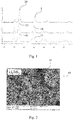
- la
figure 1 contient des diffractogrammes obtenus par diffraction des rayons X de matériaux de formule Li2TiS3, Li2TiSeS2 et Li2TiSe2S dans lesquels l'intensité de diffraction, en unité arbitraire, est exprimée en fonction de l'angle 2θ de diffraction, - les
figures 2 à 4 sont des photographies prises en microscopie électronique à balayage, de matériaux de formule Li2TiS3, Li2TiSeS2 et Li2TiSe2S respectivement, - la
figure 5 est un graphique représentant l'évolution du potentiel, en V vs Li+/Li, en fonction de la capacité, en mAh/g, lors du premier cycle de charge/décharge, d'une batterie comportant le matériau de formule Li2TiSeS2, - la
figure 6 est un graphique représentant l'évolution de la rétention de capacité de batteries comportant le matériau de formule Li2TiS3, Li2TiSeS2 et Li2TiSe2S respectivement, en fonction du nombre de cycles de charge/décharge, et - la
figure 7 est un graphique représentant l'évolution du potentiel, en V vs Li+/Li, en fonction du coefficient stœchiométrique x du lithium, d'un exemple de matériau selon l'invention. - Pour fabriquer le matériau selon l'invention, on peut mettre en œuvre une étape de broyage de matières premières, les matières premières étant choisies de manière à obtenir en fin d'étape de broyage le matériau selon l'invention.
- L'homme du métier sait adapter les quantités de chacune des matières premières de manière à obtenir en fin d'étape de broyage le matériau selon l'invention.
- Le broyage peut être conduit en milieu humide dans un solvant.
- Le solvant peut être choisi parmi l'hexane, le cyclohexane, un mélange d'heptane, d'acétone et d'éthanol, et leurs mélanges. De préférence, le solvant est l'hexane, de préférence de pureté supérieure à 99,5 %, de préférence supérieure à 99,9 %.
- De préférence, au cours du broyage, les matières premières sont dispersées dans le solvant.
- Les matières premières se présentent de préférence sous la forme de poudres.
- Elles peuvent comporter au moins deux sources apportant chacune au moins un élément choisi parmi le lithium, le soufre, le sélénium et le titane.
- De préférence, les matières premières comportent une poudre de particules de titane comportant plus de 95%, voire plus de 99% en masse de titane, et une poudre de particules de sélénium comportant plus de 95%, voire plus de 99% en masse de sélénium. Elles peuvent comporter une poudre de particules de sulfure de lithium. De préférence, elles comportent une poudre de particules de sulfure de lithium, une poudre de particules de titane et une poudre de particules de sélénium.
- La taille médiane de chacune desdites poudres peut être comprise entre 44 µm et 74 µm.
- L'étape de broyage est mise en œuvre au sein d'un broyeur, par exemple un broyeur planétaire à billes. L'invention n'est toutefois pas limitée à un tel type de broyeur, tout autre broyeur conventionnellement utilisé dans le domaine de l'invention pouvant être utilisé.
- Les matières premières peuvent être versées dans le broyeur, préalablement ou au cours du broyage. Elles peuvent être versées les unes à la suite des autres dans le broyeur. En variante, un mélange particulaire peut être formé en mélangeant ensemble les matières premières préalablement à l'étape de broyage. Le cas échéant, le solvant peut être introduit avant, conjointement ou après l'introduction des matières premières dans le broyeur.
- De préférence, la durée de l'étape de broyage est comprise entre 10 h et 50 h, de préférence est comprise entre 20 h et 30 h. Par ailleurs, l'étape de broyage peut être conduite à une température comprise entre 10 °C et 40 °C, par exemple à température ambiante.
- Pour limiter la corrosion des matières premières et du matériau en formation, l'étape de broyage est de préférence mise en œuvre sous une atmosphère réductrice ou de préférence neutre, par exemple sous argon.
- De préférence, le matériau obtenu en fin d'étape de broyage se présente sous forme d'une poudre.
- Le cas échéant, le procédé peut par ailleurs comporter une étape de séchage successive à l'étape de broyage, de manière à éliminer le solvant.
- Les exemples non limitatifs suivants sont donnés dans le but d'illustrer l'invention.
- Les matières premières suivantes sont utilisées pour réaliser les exemples suivants :
- poudre de particules de sulfure de lithium Li2S, commercialisée sous la référence 213241-10G par la société Sigma Aldrich,
- poudre de particules de sulfure de titane, commercialisée sous la référence 333492-10G par la société Sigma Aldrich,
- poudre de particules de titane, commercialisée sous la référence 36679.14 par la société Alfa Aesar,
- poudre de particules de sélénium, commercialisée sous la référence 36208.18 par la société Alfa Aesar.
- Par ailleurs, les analyses de diffraction par rayon X ont été réalisées au moyen d'un diffractomètre D8 Advance de marque Bruker®, et les tailles des particules des poudres des exemples ont été mesurées au moyen d'images obtenues avec un microscope électronique à balayage LEO 1530 de marque Zeiss®.
- 0,4363 g de sulfure de lithium et 1,0635 g de sulfure de titane sont placés dans un pot en zircone d'un volume de 50 ml et contenant 285 billes de zircone d'un diamètre égal à 5 mm. Aucun solvant n'est ajouté. Le pot est ensuite fermé au moyen d'un couvercle et monté sur un broyeur à billes planétaires de marque Retsch® et de référence PM 100. Le bol est chargé et déchargé dans une boite à gants emplie d'argon. Le broyage est alors réalisé pendant une durée de 20 heures, la vitesse de rotation du broyeur étant fixée à 510 tours par minutes.
- Une poudre de particules de Li2TiS3 est ainsi obtenue.
- Dans une boite à gants sous atmosphère d'argon, on prépare ensuite une composition comportant en pourcentages en masse, 10 % de carbone Super P C65 commercialisé par la société TIMCAL, 10 % de difluorure de polyvinylidène (PVDF) à titre de liant, et 80 % de la poudre de particules de Li2TiS3. 0,400 ml de N-méthyl-2-pyrrolidone (NMP) sont ajoutés à la composition. La composition est ensuite mélangée pendant 5 minutes à 25°C. On obtient ainsi une encre. On enduit une épaisseur de 100 µm de l'encre, au moyen d'une racle sur un feuillard d'aluminium revêtu d'un substrat de Téflon®. L'encre est séchée sous une atmosphère d'argon pendant 48 heures. Une électrode est ensuite découpée dans le feuillard d'aluminium recouvert de l'encre ayant séchée. L'électrode est ensuite pressée sous une pression de 100 kN, découpée sous la forme d'une pastille d'un diamètre de 14 mm, puis est séchée sous vide à 60°C pendant 48 heures.
- Une batterie se présentant sous la forme d'une pile bouton au format CR2032 est fabriquée et comporte l'électrode formant cathode et une contre-électrode de lithium (Li) métallique formant anode. Un séparateur sous forme d'une pastille d'un diamètre de 16 mm, constitué d'une membrane de marque Viledon de référence FS 2207-2- DA WA et d'une membrane Celgard 2400, est disposé entre l'électrode et la contre-électrode. Les électrodes, contre-électrode et séparateur sont immergés dans un volume de 150 µl d'un électrolyte liquide LP100 constitué d'un solvant formé, en volume, d'une part d'éthyl- carbonate, d'une part de propylène- carbonate et de trois parts de diméthyl- carbonate, dans lequel est dissous un sel d'hexafluorophosphate de lithium (LiPF6) à une concentration de 1 mol/1.
- La batterie est soumise à 15 cycles formés d'une charge galvanostatique suivie d'une décharge galvanostatique, imposés à 25°C entre un potentiel de 1,8 V et 3,0 V vs Li+/Li à un régime de C/10.
- Le système de cyclage de batterie est de marque Arbin Instruments®.
- 0,336 g de sulfure de lithium, 0,410 g de sulfure de titane, 0,175 g de titane et 0,578 g de sélénium sont placés dans un pot en zircone d'un volume de 50 ml et contenant 285 billes de zircone d'un diamètre égal à 5 mm. De l'hexane de haute pureté (supérieure à 99,9%) est versée dans le pot jusqu'à recouvrir les billes de zircone. Le pot est ensuite fermé au moyen d'un couvercle et monté sur un broyeur à billes planétaires de marque Retsch® et de référence PM 100. Le broyeur est disposé dans une boite à gants emplie d'argon. Le broyage est alors réalisé pendant une durée de 20 heures, la vitesse de rotation du broyeur étant fixée à 510 tours par minutes.
- Une poudre de particules de Li2TiSeS2 est ainsi obtenue.
- Une électrode et une batterie sont fabriquées selon le même mode opérationnel que celui décrit à l'exemple 1 en remplaçant la poudre de l'exemple 1 par la poudre de l'exemple 2.
- 0,274 g de sulfure de lithium, 0,285 g de titane et 0,940 g de sélénium sont placés dans un pot en zircone d'un volume de 50 ml et contenant 285 billes de zircone d'un diamètre égal à 5 mm. De l'hexane de haute pureté (supérieure à 99,9%) est versée dans le pot jusqu'à recouvrir les billes de zircone. Le pot est ensuite fermé au moyen d'un couvercle et monté sur un broyeur à billes planétaires de marque Retsch® et de référence PM 100. Le bol est chargé et déchargé dans une boite à gants emplie d'argon. Le broyage est alors réalisé pendant une durée de 20 heures, la vitesse de rotation du broyeur étant fixée à 510 tours par minutes.
- Une poudre de particules de Li2TiSe2S est ainsi obtenue.
- Une électrode et une batterie sont fabriquées selon le même mode opérationnel que celui décrit à l'exemple 1 en remplaçant la poudre de l'exemple 1 par la poudre de l'exemple 3.
- Des analyses par diffraction de rayons X des poudres de Li2TiS3, Li2TiSeS2 et Li2TiSe2S confirment que les matériaux constitutifs de ces poudres présentent une structure cristallographique de type NaCl, comme cela est confirmé par les diffractogrammes respectifs 5, 10 et 15 représentés sur la
figure 1 . - Un décalage des pics principaux 20, 25 et 30 de diffraction est observé aux faibles angles avec une augmentation de la quantité de sélénium dans la structure. Il est lié au fait que le sélénium présente un rayon ionique égal à 198 Å, plus élevé que celui du soufre, égal à 184 Å. Pour cette même raison, le paramètre de maille augmente avec une augmentation du coefficient stœchiométrique du sélénium, comme observé dans le tableau 1. Enfin, le décalage des pics principaux est d'autant plus élevé que le coefficient stœchiométrique du sélénium augmente.
Tableau 1 Exemple Matériau Paramètre de maille (Å) 1 Li2TiS3 5,0803 2 Li2TiSeS2 5,1671 3 Li2TiSe2S 5,2516 - Par ailleurs, comme cela est observé sur la
figure 2 , les particules de Li2TiS3 35 présentent majoritairement une forme sensiblement sphérique d'une taille inférieure à 500 nm et forment des agglomérats 40. - Comme observé sur les
figures 3 et 4 respectivement, les particules de Li2TiSeS2 50 et les particules de Li2TiSe2S 55 peuvent présenter une forme différente des particules de Li2TiS3. Notamment, elles peuvent présenter une forme plaquettaire, avec une taille de l'ordre du micron. - La
figure 5 représente l'évolution au cours du premier cycle de charge-décharge du potentiel 60 de l'électrode positive comportant le matériau de formule Li2TiSeS2 en fonction de la capacité spécifique 65 du matériau. Au cours de la charge 70, des ions Li+ sont extraits et sont déposés sur l'électrode négative, de sorte qu'un matériau de formule Lia'TiSeS2 (avec a'< 2) est formé. Au cours de la décharge 75, les réactions d'oxydoréduction inverses se produisent. Une capacité spécifique supérieure d'environ 250 mAh/g est obtenue. - La
figure 6 représente, pour les batteries des exemples 1 à 3, l'évolution 81, 86 et 91 respective de la rétention de capacité 110, exprimée en pourcents, en fonction du nombre 115 de cycles. La rétention de capacité correspond au rapport de la capacité réversible mesurée en fin de décharge d'un cycle de charge/décharge sur la capacité réversible mesurée en fin de décharge au premier cycle. - Comme cela est connu de l'art antérieur, la capacité de rétention 81 de la batterie de l'exemple 1, à base de Li2TiS3, décroit rapidement en fonction du nombre de cycles. Elle n'est que de 80 % au dixième cycle et de 71 % au quinzième cycle.
- Les batteries des exemples 2 et 3 respectivement présentent chacune un comportant plus stable que la batterie de l'exemple 1, caractérisé par une rétention de capacité plus élevée. La capacité de rétention 91 de la batterie à base de Li2TiSe2S de l'exemple 3 est supérieure à 90 % au dixième cycle et de 75 % au quinzième cycle. La batterie de l'exemple 2, à base de Li2TiSeS2 présente le comportement de charge/décharge le plus stable et est préférée. Elle présente une capacité de rétention 86 supérieure à 95 % au dixième cycle et supérieure à 90 % au quinzième cycle.
- La
figure 7 illustre l'évolution au cours d'une charge suivie d'une décharge, de l'évolution du potentiel 120 en fonction du coefficient stœchiométrique x du lithium 125 d'un matériau de formule de formule LixTiSe2S. - Le matériau de l'exemple 3 (x=2) est initialement placé en tant qu'électrode face à une contre-électrode de lithium. Au cours de la charge 130, du lithium est progressivement extrait du matériau jusqu'à ce que le coefficient stœchiométrique x atteigne une valeur de l'ordre de 0,7 pour un potentiel égal à 3 V. La décharge 135 est ensuite effectuée, et du lithium est alors introduit dans le matériau. Un coefficient stœchiométrique x égal à 4,17 est ainsi obtenu en fin de décharge pour un potentiel égal à 1,5 V.
- Bien entendu, l'invention n'est pas limitée aux modes de réalisation du produit et aux modes de mise en œuvre du procédé présentés dans la présente description.
- Par ailleurs, sauf indication contraire, une inégalité du type « A inférieur à B », aussi formulée comme « A < B », est considérée strictement. Il en va de même pour une inégalité du type « A supérieur à B », aussi formulée comme « A > B ». Autrement dit, l'égalité entre A et B est exclue.
Claims (15)
- Matériau de formule LiaTib(AxS3-x)c dans lequel A est un élément métalloïde choisi parmi le sélénium, le tellure et leurs mélanges, et les coefficients stœchiométriques a, b, c et x sont tels que∘ 0 < x < 2,2 ;∘ 0,4 ≤ a ≤ 4,5 ;∘ 0,9 ≤ b ≤ 1,1 ; et∘ 0,9 ≤ c ≤ 1,1.
- Matériau selon la revendication 1, dans lequel l'élément métalloïde A est le sélénium.
- Matériau selon l'une quelconque des revendications 1 et 2, dans lequel le coefficient stœchiométrique x est inférieur ou égal à 1,2.
- Matériau selon l'une quelconque des revendications précédentes, dans lequel le coefficient stœchiométrique x est égal à 1.
- Matériau selon l'une quelconque des revendications précédentes, dans lequel le coefficient stœchiométrique a est égal à 2 et/ou le coefficient stœchiométrique b est égal à 1 et/ou le coefficient stœchiométrique c est égal à 1, de préférence le coefficient stœchiométrique a est égal à 2 et le coefficient stœchiométrique b est égal à 1 et le coefficient stœchiométrique c est égal à 1.
- Matériau selon l'une quelconque des revendications précédentes, présentant une structure cristallographique de type NaCl.
- Matériau selon l'une quelconque des revendications précédentes, comportant une capacité réversible maximale supérieure à 200 mAh.g-1, voire supérieure à 230 mAh.g-1.
- Poudre comportant, voire constituée par, des particules formées du matériau selon l'une quelconque des revendications précédentes.
- Cathode de batterie comportant le matériau selon l'une quelconque des revendications précédentes, la cathode de batterie comportant notamment la poudre selon la revendication précédente dispersée dans un liant.
- Batterie, de préférence choisie parmi une batterie lithium-ion et une batterie lithium, comportant une cathode selon la revendication précédente.
- Batterie lithium-ion selon la revendication précédente, présentant une rétention de capacité à quinze cycles supérieure ou égale à 75%, de préférence supérieure ou égale à 85 %, mieux supérieure ou égale à 90 %.
- Procédé de fabrication d'un matériau selon l'une quelconque des revendications 1 à 7, comportant une étape de broyage de matières premières, les matières premières étant choisies de manière à obtenir en fin d'étape de broyage le matériau selon l'une quelconque des revendications précédentes.
- Procédé selon la revendication 12, dans lequel les matières premières comprennent une poudre de particules de titane, une poudre de particules de sélénium, et de préférence une poudre de particules de sulfure de lithium.
- Procédé selon l'une quelconque des revendications 12 et 13, l'étape de broyage étant conduite en milieu humide dans un solvant, de préférence le solvant étant de l'hexane, de préférence présentant une pureté supérieure à 99,5 %.
- Procédé selon l'une quelconque des revendications 12 à 14, l'étape de broyage étant mise en œuvre sous une atmosphère réductrice ou de préférence neutre, par exemple sous argon.
Applications Claiming Priority (1)
| Application Number | Priority Date | Filing Date | Title |
|---|---|---|---|
| FR1858478A FR3085950B1 (fr) | 2018-09-19 | 2018-09-19 | Materiau lithie |
Publications (2)
| Publication Number | Publication Date |
|---|---|
| EP3626682A1 true EP3626682A1 (fr) | 2020-03-25 |
| EP3626682B1 EP3626682B1 (fr) | 2021-04-21 |
Family
ID=65494279
Family Applications (1)
| Application Number | Title | Priority Date | Filing Date |
|---|---|---|---|
| EP19198438.4A Active EP3626682B1 (fr) | 2018-09-19 | 2019-09-19 | Materiau lithie |
Country Status (3)
| Country | Link |
|---|---|
| US (1) | US11535524B2 (fr) |
| EP (1) | EP3626682B1 (fr) |
| FR (1) | FR3085950B1 (fr) |
Citations (2)
| Publication number | Priority date | Publication date | Assignee | Title |
|---|---|---|---|---|
| GB2026762A (en) * | 1978-07-27 | 1980-02-06 | Western Electric Co | Rechargeable chalcogenide cell |
| EP2977354A1 (fr) | 2013-03-18 | 2016-01-27 | National Institute of Advanced Industrial Science and Technology | Sulfure de lithium et titane, sulfure de lithium et niobium, et sulfure de lithium-titane-niobium |
-
2018
- 2018-09-19 FR FR1858478A patent/FR3085950B1/fr not_active Expired - Fee Related
-
2019
- 2019-09-19 US US16/575,436 patent/US11535524B2/en active Active
- 2019-09-19 EP EP19198438.4A patent/EP3626682B1/fr active Active
Patent Citations (2)
| Publication number | Priority date | Publication date | Assignee | Title |
|---|---|---|---|---|
| GB2026762A (en) * | 1978-07-27 | 1980-02-06 | Western Electric Co | Rechargeable chalcogenide cell |
| EP2977354A1 (fr) | 2013-03-18 | 2016-01-27 | National Institute of Advanced Industrial Science and Technology | Sulfure de lithium et titane, sulfure de lithium et niobium, et sulfure de lithium-titane-niobium |
Non-Patent Citations (1)
| Title |
|---|
| A. SAKUDA ET AL.: "Rock-salt-type lithium métal sulphide as novel positive-electrode materials", SCI. REP., vol. 4, 2014, pages 4883 |
Also Published As
| Publication number | Publication date |
|---|---|
| FR3085950A1 (fr) | 2020-03-20 |
| EP3626682B1 (fr) | 2021-04-21 |
| US20200087159A1 (en) | 2020-03-19 |
| US11535524B2 (en) | 2022-12-27 |
| FR3085950B1 (fr) | 2020-09-25 |
Similar Documents
| Publication | Publication Date | Title |
|---|---|---|
| EP2242129B1 (fr) | Composition de matière active pour électrode négative d'accumulateur lithium-ion | |
| EP1784358B1 (fr) | Compose pulverulent d'oxyde mixte de titane et de lithium dense, procede de fabrication d'un tel compose et electrode comportant un tel compose | |
| EP2396841B1 (fr) | Procédé de préparation d'un mélange d'une poudre d'un composé actif d'électrode et d'une poudre d'un composé conducteur électronique, mélange ainsi obtenu, électrode, cellule et accumulateur | |
| EP3052441B1 (fr) | Électrode pour batterie de stockage d'énergie électrique comprenant un matériau composite graphite/silicium/fibres de carbone | |
| EP1828058B1 (fr) | Materiau d'electrode positive optimise pour accumulateurs au lithium, procede pour sa realisation, electrode, accumulateur et batterie mettant en oeuvre ce materiau | |
| WO2023099855A1 (fr) | Procédé d'obtention d'un oxyde à haute entropie | |
| WO2022223327A1 (fr) | Mélange de matières actives pour cathode d'élément lithium-ion | |
| EP2122720B1 (fr) | Nouveaux materiaux comprenant des elements du groupe 14 | |
| EP3626681A1 (fr) | Procede de synthese | |
| EP3626682B1 (fr) | Materiau lithie | |
| EP2895428A1 (fr) | Materiau d'electrode positive pour accumulateur lithium-ion | |
| FR3055893A1 (fr) | Procede de fabrication d'un materiau silicate de structure olivine | |
| EP3230207B1 (fr) | Materiau d'electrode de formule life(1-x)coxbo3, et son procede de preparation | |
| EP4593101B1 (fr) | Procédé de préparation d'un matériau de cathode pour batterie | |
| WO2014006600A1 (fr) | Produit fondu a base de lithium | |
| EP4173059A1 (fr) | Electrode négative hybride graphite/lithium | |
| EP3218306B1 (fr) | Materiau d'electrode de formule limnxco(1-x)bo3, et son procede de preparation | |
| FR3009438A1 (fr) | Procede de fabrication d'un materiau actif d'anode, materiau actif et anode obtenus par ce procede | |
| WO2024047396A1 (fr) | Matériau actif en oxyde mixte niobium titane substitué par du tungstène | |
| FR3166756A1 (fr) | Procédé de fabrication d’un matériau en alliage Fe-Si, Matériau afférent pour électrode d’accumulateur Li-ion. | |
| WO2023227439A1 (fr) | Matière active positive pour élément électrochimique lithium-ion | |
| WO2013079410A1 (fr) | Obtention d'un materiau a base de li4ti5o12 avec broyage en presence de carbone |
Legal Events
| Date | Code | Title | Description |
|---|---|---|---|
| PUAI | Public reference made under article 153(3) epc to a published international application that has entered the european phase |
Free format text: ORIGINAL CODE: 0009012 |
|
| STAA | Information on the status of an ep patent application or granted ep patent |
Free format text: STATUS: REQUEST FOR EXAMINATION WAS MADE |
|
| 17P | Request for examination filed |
Effective date: 20190919 |
|
| AK | Designated contracting states |
Kind code of ref document: A1 Designated state(s): AL AT BE BG CH CY CZ DE DK EE ES FI FR GB GR HR HU IE IS IT LI LT LU LV MC MK MT NL NO PL PT RO RS SE SI SK SM TR |
|
| AX | Request for extension of the european patent |
Extension state: BA ME |
|
| GRAP | Despatch of communication of intention to grant a patent |
Free format text: ORIGINAL CODE: EPIDOSNIGR1 |
|
| STAA | Information on the status of an ep patent application or granted ep patent |
Free format text: STATUS: GRANT OF PATENT IS INTENDED |
|
| RIC1 | Information provided on ipc code assigned before grant |
Ipc: H01M 4/58 20100101ALI20201023BHEP Ipc: C01G 23/00 20060101AFI20201023BHEP Ipc: H01M 10/0525 20100101ALI20201023BHEP |
|
| INTG | Intention to grant announced |
Effective date: 20201130 |
|
| GRAS | Grant fee paid |
Free format text: ORIGINAL CODE: EPIDOSNIGR3 |
|
| GRAA | (expected) grant |
Free format text: ORIGINAL CODE: 0009210 |
|
| STAA | Information on the status of an ep patent application or granted ep patent |
Free format text: STATUS: THE PATENT HAS BEEN GRANTED |
|
| AK | Designated contracting states |
Kind code of ref document: B1 Designated state(s): AL AT BE BG CH CY CZ DE DK EE ES FI FR GB GR HR HU IE IS IT LI LT LU LV MC MK MT NL NO PL PT RO RS SE SI SK SM TR |
|
| REG | Reference to a national code |
Ref country code: GB Ref legal event code: FG4D Free format text: NOT ENGLISH |
|
| REG | Reference to a national code |
Ref country code: CH Ref legal event code: EP |
|
| REG | Reference to a national code |
Ref country code: DE Ref legal event code: R096 Ref document number: 602019004050 Country of ref document: DE Ref country code: IE Ref legal event code: FG4D Free format text: LANGUAGE OF EP DOCUMENT: FRENCH |
|
| REG | Reference to a national code |
Ref country code: AT Ref legal event code: REF Ref document number: 1384454 Country of ref document: AT Kind code of ref document: T Effective date: 20210515 |
|
| REG | Reference to a national code |
Ref country code: LT Ref legal event code: MG9D |
|
| REG | Reference to a national code |
Ref country code: AT Ref legal event code: MK05 Ref document number: 1384454 Country of ref document: AT Kind code of ref document: T Effective date: 20210421 |
|
| REG | Reference to a national code |
Ref country code: NL Ref legal event code: MP Effective date: 20210421 |
|
| PG25 | Lapsed in a contracting state [announced via postgrant information from national office to epo] |
Ref country code: NL Free format text: LAPSE BECAUSE OF FAILURE TO SUBMIT A TRANSLATION OF THE DESCRIPTION OR TO PAY THE FEE WITHIN THE PRESCRIBED TIME-LIMIT Effective date: 20210421 Ref country code: AT Free format text: LAPSE BECAUSE OF FAILURE TO SUBMIT A TRANSLATION OF THE DESCRIPTION OR TO PAY THE FEE WITHIN THE PRESCRIBED TIME-LIMIT Effective date: 20210421 Ref country code: BG Free format text: LAPSE BECAUSE OF FAILURE TO SUBMIT A TRANSLATION OF THE DESCRIPTION OR TO PAY THE FEE WITHIN THE PRESCRIBED TIME-LIMIT Effective date: 20210721 Ref country code: HR Free format text: LAPSE BECAUSE OF FAILURE TO SUBMIT A TRANSLATION OF THE DESCRIPTION OR TO PAY THE FEE WITHIN THE PRESCRIBED TIME-LIMIT Effective date: 20210421 Ref country code: LT Free format text: LAPSE BECAUSE OF FAILURE TO SUBMIT A TRANSLATION OF THE DESCRIPTION OR TO PAY THE FEE WITHIN THE PRESCRIBED TIME-LIMIT Effective date: 20210421 Ref country code: FI Free format text: LAPSE BECAUSE OF FAILURE TO SUBMIT A TRANSLATION OF THE DESCRIPTION OR TO PAY THE FEE WITHIN THE PRESCRIBED TIME-LIMIT Effective date: 20210421 |
|
| PG25 | Lapsed in a contracting state [announced via postgrant information from national office to epo] |
Ref country code: GR Free format text: LAPSE BECAUSE OF FAILURE TO SUBMIT A TRANSLATION OF THE DESCRIPTION OR TO PAY THE FEE WITHIN THE PRESCRIBED TIME-LIMIT Effective date: 20210722 Ref country code: IS Free format text: LAPSE BECAUSE OF FAILURE TO SUBMIT A TRANSLATION OF THE DESCRIPTION OR TO PAY THE FEE WITHIN THE PRESCRIBED TIME-LIMIT Effective date: 20210821 Ref country code: PT Free format text: LAPSE BECAUSE OF FAILURE TO SUBMIT A TRANSLATION OF THE DESCRIPTION OR TO PAY THE FEE WITHIN THE PRESCRIBED TIME-LIMIT Effective date: 20210823 Ref country code: RS Free format text: LAPSE BECAUSE OF FAILURE TO SUBMIT A TRANSLATION OF THE DESCRIPTION OR TO PAY THE FEE WITHIN THE PRESCRIBED TIME-LIMIT Effective date: 20210421 Ref country code: SE Free format text: LAPSE BECAUSE OF FAILURE TO SUBMIT A TRANSLATION OF THE DESCRIPTION OR TO PAY THE FEE WITHIN THE PRESCRIBED TIME-LIMIT Effective date: 20210421 Ref country code: LV Free format text: LAPSE BECAUSE OF FAILURE TO SUBMIT A TRANSLATION OF THE DESCRIPTION OR TO PAY THE FEE WITHIN THE PRESCRIBED TIME-LIMIT Effective date: 20210421 Ref country code: PL Free format text: LAPSE BECAUSE OF FAILURE TO SUBMIT A TRANSLATION OF THE DESCRIPTION OR TO PAY THE FEE WITHIN THE PRESCRIBED TIME-LIMIT Effective date: 20210421 Ref country code: NO Free format text: LAPSE BECAUSE OF FAILURE TO SUBMIT A TRANSLATION OF THE DESCRIPTION OR TO PAY THE FEE WITHIN THE PRESCRIBED TIME-LIMIT Effective date: 20210721 |
|
| REG | Reference to a national code |
Ref country code: DE Ref legal event code: R097 Ref document number: 602019004050 Country of ref document: DE |
|
| PG25 | Lapsed in a contracting state [announced via postgrant information from national office to epo] |
Ref country code: SK Free format text: LAPSE BECAUSE OF FAILURE TO SUBMIT A TRANSLATION OF THE DESCRIPTION OR TO PAY THE FEE WITHIN THE PRESCRIBED TIME-LIMIT Effective date: 20210421 Ref country code: ES Free format text: LAPSE BECAUSE OF FAILURE TO SUBMIT A TRANSLATION OF THE DESCRIPTION OR TO PAY THE FEE WITHIN THE PRESCRIBED TIME-LIMIT Effective date: 20210421 Ref country code: EE Free format text: LAPSE BECAUSE OF FAILURE TO SUBMIT A TRANSLATION OF THE DESCRIPTION OR TO PAY THE FEE WITHIN THE PRESCRIBED TIME-LIMIT Effective date: 20210421 Ref country code: DK Free format text: LAPSE BECAUSE OF FAILURE TO SUBMIT A TRANSLATION OF THE DESCRIPTION OR TO PAY THE FEE WITHIN THE PRESCRIBED TIME-LIMIT Effective date: 20210421 Ref country code: CZ Free format text: LAPSE BECAUSE OF FAILURE TO SUBMIT A TRANSLATION OF THE DESCRIPTION OR TO PAY THE FEE WITHIN THE PRESCRIBED TIME-LIMIT Effective date: 20210421 Ref country code: SM Free format text: LAPSE BECAUSE OF FAILURE TO SUBMIT A TRANSLATION OF THE DESCRIPTION OR TO PAY THE FEE WITHIN THE PRESCRIBED TIME-LIMIT Effective date: 20210421 Ref country code: RO Free format text: LAPSE BECAUSE OF FAILURE TO SUBMIT A TRANSLATION OF THE DESCRIPTION OR TO PAY THE FEE WITHIN THE PRESCRIBED TIME-LIMIT Effective date: 20210421 |
|
| PLBE | No opposition filed within time limit |
Free format text: ORIGINAL CODE: 0009261 |
|
| STAA | Information on the status of an ep patent application or granted ep patent |
Free format text: STATUS: NO OPPOSITION FILED WITHIN TIME LIMIT |
|
| 26N | No opposition filed |
Effective date: 20220124 |
|
| REG | Reference to a national code |
Ref country code: BE Ref legal event code: MM Effective date: 20210930 |
|
| PG25 | Lapsed in a contracting state [announced via postgrant information from national office to epo] |
Ref country code: IS Free format text: LAPSE BECAUSE OF FAILURE TO SUBMIT A TRANSLATION OF THE DESCRIPTION OR TO PAY THE FEE WITHIN THE PRESCRIBED TIME-LIMIT Effective date: 20210821 Ref country code: MC Free format text: LAPSE BECAUSE OF FAILURE TO SUBMIT A TRANSLATION OF THE DESCRIPTION OR TO PAY THE FEE WITHIN THE PRESCRIBED TIME-LIMIT Effective date: 20210421 Ref country code: AL Free format text: LAPSE BECAUSE OF FAILURE TO SUBMIT A TRANSLATION OF THE DESCRIPTION OR TO PAY THE FEE WITHIN THE PRESCRIBED TIME-LIMIT Effective date: 20210421 |
|
| PG25 | Lapsed in a contracting state [announced via postgrant information from national office to epo] |
Ref country code: LU Free format text: LAPSE BECAUSE OF NON-PAYMENT OF DUE FEES Effective date: 20210919 Ref country code: IT Free format text: LAPSE BECAUSE OF FAILURE TO SUBMIT A TRANSLATION OF THE DESCRIPTION OR TO PAY THE FEE WITHIN THE PRESCRIBED TIME-LIMIT Effective date: 20210421 Ref country code: IE Free format text: LAPSE BECAUSE OF NON-PAYMENT OF DUE FEES Effective date: 20210919 Ref country code: BE Free format text: LAPSE BECAUSE OF NON-PAYMENT OF DUE FEES Effective date: 20210930 |
|
| REG | Reference to a national code |
Ref country code: CH Ref legal event code: PL |
|
| PG25 | Lapsed in a contracting state [announced via postgrant information from national office to epo] |
Ref country code: CY Free format text: LAPSE BECAUSE OF FAILURE TO SUBMIT A TRANSLATION OF THE DESCRIPTION OR TO PAY THE FEE WITHIN THE PRESCRIBED TIME-LIMIT Effective date: 20210421 |
|
| PG25 | Lapsed in a contracting state [announced via postgrant information from national office to epo] |
Ref country code: LI Free format text: LAPSE BECAUSE OF NON-PAYMENT OF DUE FEES Effective date: 20220930 Ref country code: HU Free format text: LAPSE BECAUSE OF FAILURE TO SUBMIT A TRANSLATION OF THE DESCRIPTION OR TO PAY THE FEE WITHIN THE PRESCRIBED TIME-LIMIT; INVALID AB INITIO Effective date: 20190919 Ref country code: CH Free format text: LAPSE BECAUSE OF NON-PAYMENT OF DUE FEES Effective date: 20220930 |
|
| PG25 | Lapsed in a contracting state [announced via postgrant information from national office to epo] |
Ref country code: MK Free format text: LAPSE BECAUSE OF FAILURE TO SUBMIT A TRANSLATION OF THE DESCRIPTION OR TO PAY THE FEE WITHIN THE PRESCRIBED TIME-LIMIT Effective date: 20210421 |
|
| GBPC | Gb: european patent ceased through non-payment of renewal fee |
Effective date: 20230919 |
|
| PG25 | Lapsed in a contracting state [announced via postgrant information from national office to epo] |
Ref country code: GB Free format text: LAPSE BECAUSE OF NON-PAYMENT OF DUE FEES Effective date: 20230919 |
|
| PG25 | Lapsed in a contracting state [announced via postgrant information from national office to epo] |
Ref country code: GB Free format text: LAPSE BECAUSE OF NON-PAYMENT OF DUE FEES Effective date: 20230919 |
|
| PG25 | Lapsed in a contracting state [announced via postgrant information from national office to epo] |
Ref country code: MT Free format text: LAPSE BECAUSE OF FAILURE TO SUBMIT A TRANSLATION OF THE DESCRIPTION OR TO PAY THE FEE WITHIN THE PRESCRIBED TIME-LIMIT Effective date: 20210421 |
|
| PGFP | Annual fee paid to national office [announced via postgrant information from national office to epo] |
Ref country code: DE Payment date: 20250919 Year of fee payment: 7 |
|
| PGFP | Annual fee paid to national office [announced via postgrant information from national office to epo] |
Ref country code: FR Payment date: 20250917 Year of fee payment: 7 |
|
| PG25 | Lapsed in a contracting state [announced via postgrant information from national office to epo] |
Ref country code: TR Free format text: LAPSE BECAUSE OF FAILURE TO SUBMIT A TRANSLATION OF THE DESCRIPTION OR TO PAY THE FEE WITHIN THE PRESCRIBED TIME-LIMIT Effective date: 20210421 |