EP3626449A1 - Laminate, kit, and method for producing laminate - Google Patents
Laminate, kit, and method for producing laminate Download PDFInfo
- Publication number
- EP3626449A1 EP3626449A1 EP18802652.0A EP18802652A EP3626449A1 EP 3626449 A1 EP3626449 A1 EP 3626449A1 EP 18802652 A EP18802652 A EP 18802652A EP 3626449 A1 EP3626449 A1 EP 3626449A1
- Authority
- EP
- European Patent Office
- Prior art keywords
- group
- formula
- compound represented
- laminate
- undercoat layer
- Prior art date
- Legal status (The legal status is an assumption and is not a legal conclusion. Google has not performed a legal analysis and makes no representation as to the accuracy of the status listed.)
- Granted
Links
- 0 *C(C(N*)=O)=C Chemical compound *C(C(N*)=O)=C 0.000 description 4
- IMSLGQOCCAJZID-UHFFFAOYSA-N C=CC(NCCN(CCNC(C=C)=O)C(C=C)=O)=O Chemical compound C=CC(NCCN(CCNC(C=C)=O)C(C=C)=O)=O IMSLGQOCCAJZID-UHFFFAOYSA-N 0.000 description 1
Classifications
-
- C—CHEMISTRY; METALLURGY
- C08—ORGANIC MACROMOLECULAR COMPOUNDS; THEIR PREPARATION OR CHEMICAL WORKING-UP; COMPOSITIONS BASED THEREON
- C08J—WORKING-UP; GENERAL PROCESSES OF COMPOUNDING; AFTER-TREATMENT NOT COVERED BY SUBCLASSES C08B, C08C, C08F, C08G or C08H
- C08J7/00—Chemical treatment or coating of shaped articles made of macromolecular substances
- C08J7/04—Coating
- C08J7/042—Coating with two or more layers, where at least one layer of a composition contains a polymer binder
-
- A—HUMAN NECESSITIES
- A61—MEDICAL OR VETERINARY SCIENCE; HYGIENE
- A61K—PREPARATIONS FOR MEDICAL, DENTAL OR TOILETRY PURPOSES
- A61K6/00—Preparations for dentistry
- A61K6/20—Protective coatings for natural or artificial teeth, e.g. sealings, dye coatings or varnish
-
- A—HUMAN NECESSITIES
- A61—MEDICAL OR VETERINARY SCIENCE; HYGIENE
- A61C—DENTISTRY; APPARATUS OR METHODS FOR ORAL OR DENTAL HYGIENE
- A61C13/00—Dental prostheses; Making same
- A61C13/01—Palates or other bases or supports for the artificial teeth; Making same
- A61C13/02—Palates or other bases or supports for the artificial teeth; Making same made by galvanoplastic methods or by plating; Surface treatment; Enamelling; Perfuming; Making antiseptic
-
- A—HUMAN NECESSITIES
- A61—MEDICAL OR VETERINARY SCIENCE; HYGIENE
- A61K—PREPARATIONS FOR MEDICAL, DENTAL OR TOILETRY PURPOSES
- A61K6/00—Preparations for dentistry
-
- B—PERFORMING OPERATIONS; TRANSPORTING
- B05—SPRAYING OR ATOMISING IN GENERAL; APPLYING FLUENT MATERIALS TO SURFACES, IN GENERAL
- B05D—PROCESSES FOR APPLYING FLUENT MATERIALS TO SURFACES, IN GENERAL
- B05D1/00—Processes for applying liquids or other fluent materials
- B05D1/36—Successively applying liquids or other fluent materials, e.g. without intermediate treatment
-
- B—PERFORMING OPERATIONS; TRANSPORTING
- B32—LAYERED PRODUCTS
- B32B—LAYERED PRODUCTS, i.e. PRODUCTS BUILT-UP OF STRATA OF FLAT OR NON-FLAT, e.g. CELLULAR OR HONEYCOMB, FORM
- B32B27/00—Layered products comprising a layer of synthetic resin
- B32B27/30—Layered products comprising a layer of synthetic resin comprising vinyl (co)polymers; comprising acrylic (co)polymers
-
- C—CHEMISTRY; METALLURGY
- C08—ORGANIC MACROMOLECULAR COMPOUNDS; THEIR PREPARATION OR CHEMICAL WORKING-UP; COMPOSITIONS BASED THEREON
- C08J—WORKING-UP; GENERAL PROCESSES OF COMPOUNDING; AFTER-TREATMENT NOT COVERED BY SUBCLASSES C08B, C08C, C08F, C08G or C08H
- C08J7/00—Chemical treatment or coating of shaped articles made of macromolecular substances
- C08J7/04—Coating
- C08J7/043—Improving the adhesiveness of the coatings per se, e.g. forming primers
-
- C—CHEMISTRY; METALLURGY
- C09—DYES; PAINTS; POLISHES; NATURAL RESINS; ADHESIVES; COMPOSITIONS NOT OTHERWISE PROVIDED FOR; APPLICATIONS OF MATERIALS NOT OTHERWISE PROVIDED FOR
- C09D—COATING COMPOSITIONS, e.g. PAINTS, VARNISHES OR LACQUERS; FILLING PASTES; CHEMICAL PAINT OR INK REMOVERS; INKS; CORRECTING FLUIDS; WOODSTAINS; PASTES OR SOLIDS FOR COLOURING OR PRINTING; USE OF MATERIALS THEREFOR
- C09D133/00—Coating compositions based on homopolymers or copolymers of compounds having one or more unsaturated aliphatic radicals, each having only one carbon-to-carbon double bond, and at least one being terminated by only one carboxyl radical, or of salts, anhydrides, esters, amides, imides, or nitriles thereof; Coating compositions based on derivatives of such polymers
- C09D133/04—Homopolymers or copolymers of esters
- C09D133/06—Homopolymers or copolymers of esters of esters containing only carbon, hydrogen and oxygen, the oxygen atom being present only as part of the carboxyl radical
- C09D133/10—Homopolymers or copolymers of methacrylic acid esters
-
- C—CHEMISTRY; METALLURGY
- C09—DYES; PAINTS; POLISHES; NATURAL RESINS; ADHESIVES; COMPOSITIONS NOT OTHERWISE PROVIDED FOR; APPLICATIONS OF MATERIALS NOT OTHERWISE PROVIDED FOR
- C09D—COATING COMPOSITIONS, e.g. PAINTS, VARNISHES OR LACQUERS; FILLING PASTES; CHEMICAL PAINT OR INK REMOVERS; INKS; CORRECTING FLUIDS; WOODSTAINS; PASTES OR SOLIDS FOR COLOURING OR PRINTING; USE OF MATERIALS THEREFOR
- C09D133/00—Coating compositions based on homopolymers or copolymers of compounds having one or more unsaturated aliphatic radicals, each having only one carbon-to-carbon double bond, and at least one being terminated by only one carboxyl radical, or of salts, anhydrides, esters, amides, imides, or nitriles thereof; Coating compositions based on derivatives of such polymers
- C09D133/04—Homopolymers or copolymers of esters
- C09D133/14—Homopolymers or copolymers of esters of esters containing halogen, nitrogen, sulfur or oxygen atoms in addition to the carboxy oxygen
-
- C—CHEMISTRY; METALLURGY
- C09—DYES; PAINTS; POLISHES; NATURAL RESINS; ADHESIVES; COMPOSITIONS NOT OTHERWISE PROVIDED FOR; APPLICATIONS OF MATERIALS NOT OTHERWISE PROVIDED FOR
- C09D—COATING COMPOSITIONS, e.g. PAINTS, VARNISHES OR LACQUERS; FILLING PASTES; CHEMICAL PAINT OR INK REMOVERS; INKS; CORRECTING FLUIDS; WOODSTAINS; PASTES OR SOLIDS FOR COLOURING OR PRINTING; USE OF MATERIALS THEREFOR
- C09D133/00—Coating compositions based on homopolymers or copolymers of compounds having one or more unsaturated aliphatic radicals, each having only one carbon-to-carbon double bond, and at least one being terminated by only one carboxyl radical, or of salts, anhydrides, esters, amides, imides, or nitriles thereof; Coating compositions based on derivatives of such polymers
- C09D133/24—Homopolymers or copolymers of amides or imides
- C09D133/26—Homopolymers or copolymers of acrylamide or methacrylamide
-
- C—CHEMISTRY; METALLURGY
- C09—DYES; PAINTS; POLISHES; NATURAL RESINS; ADHESIVES; COMPOSITIONS NOT OTHERWISE PROVIDED FOR; APPLICATIONS OF MATERIALS NOT OTHERWISE PROVIDED FOR
- C09D—COATING COMPOSITIONS, e.g. PAINTS, VARNISHES OR LACQUERS; FILLING PASTES; CHEMICAL PAINT OR INK REMOVERS; INKS; CORRECTING FLUIDS; WOODSTAINS; PASTES OR SOLIDS FOR COLOURING OR PRINTING; USE OF MATERIALS THEREFOR
- C09D135/00—Coating compositions based on homopolymers or copolymers of compounds having one or more unsaturated aliphatic radicals, each having only one carbon-to-carbon double bond, and at least one being terminated by a carboxyl radical, and containing at least another carboxyl radical in the molecule, or of salts, anhydrides, esters, amides, imides or nitriles thereof; Coating compositions based on derivatives of such polymers
-
- C—CHEMISTRY; METALLURGY
- C09—DYES; PAINTS; POLISHES; NATURAL RESINS; ADHESIVES; COMPOSITIONS NOT OTHERWISE PROVIDED FOR; APPLICATIONS OF MATERIALS NOT OTHERWISE PROVIDED FOR
- C09D—COATING COMPOSITIONS, e.g. PAINTS, VARNISHES OR LACQUERS; FILLING PASTES; CHEMICAL PAINT OR INK REMOVERS; INKS; CORRECTING FLUIDS; WOODSTAINS; PASTES OR SOLIDS FOR COLOURING OR PRINTING; USE OF MATERIALS THEREFOR
- C09D5/00—Coating compositions, e.g. paints, varnishes or lacquers, characterised by their physical nature or the effects produced; Filling pastes
-
- C—CHEMISTRY; METALLURGY
- C08—ORGANIC MACROMOLECULAR COMPOUNDS; THEIR PREPARATION OR CHEMICAL WORKING-UP; COMPOSITIONS BASED THEREON
- C08J—WORKING-UP; GENERAL PROCESSES OF COMPOUNDING; AFTER-TREATMENT NOT COVERED BY SUBCLASSES C08B, C08C, C08F, C08G or C08H
- C08J2333/00—Characterised by the use of homopolymers or copolymers of compounds having one or more unsaturated aliphatic radicals, each having only one carbon-to-carbon double bond, and only one being terminated by only one carboxyl radical, or of salts, anhydrides, esters, amides, imides, or nitriles thereof; Derivatives of such polymers
- C08J2333/04—Characterised by the use of homopolymers or copolymers of compounds having one or more unsaturated aliphatic radicals, each having only one carbon-to-carbon double bond, and only one being terminated by only one carboxyl radical, or of salts, anhydrides, esters, amides, imides, or nitriles thereof; Derivatives of such polymers esters
- C08J2333/06—Characterised by the use of homopolymers or copolymers of compounds having one or more unsaturated aliphatic radicals, each having only one carbon-to-carbon double bond, and only one being terminated by only one carboxyl radical, or of salts, anhydrides, esters, amides, imides, or nitriles thereof; Derivatives of such polymers esters of esters containing only carbon, hydrogen, and oxygen, the oxygen atom being present only as part of the carboxyl radical
- C08J2333/10—Homopolymers or copolymers of methacrylic acid esters
- C08J2333/12—Homopolymers or copolymers of methyl methacrylate
Definitions
- the present invention relates to a laminate, a kit, and a method for producing a laminate.
- JP2015-209421A describes "a dental composition containing (A) polymerizable monomer component that is zwitterionic, and (B) non-zwitterionic compound having a hydroxyl group and/or a non-zwitterionic compound capable of dissolving an inorganic salt".
- the present inventors have conducted studies on bacteria adhesion suppression performance of a laminate which is obtained by forming a coating layer on a base material imitating a denture base using the dental composition described in JP2015-209421A and thus clarified that there is room for improvement.
- an object of the present invention is to provide a laminate having excellent bacteria adhesion suppression performance. Another object of the present invention is to provide a kit and a method for producing a laminate.
- a laminate having excellent bacteria adhesion suppression performance (hereinafter, also referred to as “having the effect of the present invention”). According to the present invention, it is also possible to provide a kit and a method for producing a laminate.
- numeric ranges expressed using “to” in the present specification include numerical values described before and after “to” as the lower limit value and the upper limit value.
- (meth)acryl means acryl and methacryl.
- (meth)acryloyl means acryloyl and methacryloyl.
- the laminate comprises, in order, a base material, an undercoat layer formed of an undercoat layer forming composition containing a polymer containing a repeating unit containing a polymerizable group and a repeating unit containing a polar group, and a cured film formed of a curable composition containing at least one compound selected from the group consisting of a compound represented by Formula (I) described later, a compound represented by Formula (II) described later, a compound represented by Formula (IV) described later, and a compound represented by Formula (V) described later.
- the laminate has excellent bacteria adhesion suppression performance.
- the bacteria adhesion suppression performance means the performance of the laminate to be evaluated by the method described in Examples.
- the laminate In a case where the laminate is transplanted or arranged in a human living body and placed in the body, it is considered that the laminate is always placed in a wet environment.
- the base material of the laminate is a denture base
- the laminate is exposed to saliva, and food and drink.
- a part of the coating layer is peeled off in a wet environment, and expected bacteria adhesion suppression performance is not exhibited.
- the laminate according to the embodiment of the present invention has an undercoat layer having a predetermined structure between the cured film and the base material. Therefore, it is assumed that the cured film and the base material are further closely attached, the cured film is not easily peeled off even in a case where the laminate is placed in a wet environment, and as a result, the laminate has excellent bacteria adhesion suppression performance, specifically, excellent bacteria adhesion suppression performance to bacteria in the in the mouth, particularly, Candida, caries-causing bacteria, and periodontal bacteria (for example, Streptococcus mutans, Streptococcus sobrinus, Lactobacillus, and Actinomyces naeslundii), and periodontal disease bacteria (for example, Porphyromonas gingivalis, Tannerella forsythensis, Treponema denticola, Prevotella intermedia, Actinobacillus actinomycetemcomitans, Aggregatibacter actinomycetemcomitans,
- the base material is not particularly limited and a known base material can be used.
- Examples of the base material include inorganic materials, organic materials, and composite materials thereof.
- organic materials include (meth)acrylic resins, polyethylene sulfone resins, polyacetal resins, cycloolefin resins, silicone resins, polyamide resins, and polycarborate resins, and among these, from the viewpoint of having excellent durability and excellent workability, (meth)acrylic resins are preferable.
- inorganic materials include gold, platinum, palladium, copper, mangan, silicon, molybdenum, zinc, tin, iridium, cobalt, chromium, titanium, and alloys thereof, aluminum, zirconia,hydroxyapatite, ⁇ -tricalcium phosphate ( ⁇ -TCP), dicalcium phosphate dehydrate, octacalcium phosphate, and tetracalcium phosphate.
- the shape and size of the base material can be changed appropriately according to the application.
- the base material in a case where the base material is a denture base, the base material may be either a partial base or a whole base.
- the laminate comprises an undercoat layer formed of an undercoat layer forming composition containing a polymer containing a repeating unit containing a polymerizable group and a repeating unit containing a polar group on the base material.
- the undercoat layer has a function of closely attaching both the base material and a cured film described later therebetween.
- the undercoat layer included in the laminate according to the embodiment of the present invention is capable of stably closely attaching the base material and the cured film for a long period of time particularly even in a wet environment in a living body.
- the undercoat layer is formed of an undercoat layer forming composition.
- the undercoat layer is preferably formed by performing a curing treatment on the coating film of the undercoat layer forming composition (first coating film).
- the undercoat layer forming composition is applied to the base material to form a first coating film, a second coating film obtained by applying a curable composition described later is laminated on the first coating film, and energy (heat or light) is applied to the both coating films to cure the films.
- energy heat or light
- the thickness of the undercoat layer in the laminate is not particularly limited and can be determined appropriately according to the use of the laminate.
- the thickness of the undercoat layer is not particularly limited, and is preferably 0.1 to 10 ⁇ m.
- the undercoat layer forming composition contains a polymer containing a repeating unit containing a polymerizable group and a repeating unit containing a polar group.
- the content of the polymer in the undercoat layer forming composition is not particularly limited, and is preferably 0.001% to 99.9% by mass and more preferably 0.01% to 20% by mass with respect to the total mass of the undercoat layer forming composition.
- the polymer may be used alone or in combination of two or more kinds thereof. In a case where two or more kinds of polymers are used in combination, the total content is preferably within the above range.
- the polymer contains a repeating unit containing a polymerizable group (hereinafter, also referred to as a "unit A”) and a repeating unit containing a polar group (hereinafter, also referred to as a "unit B").
- the polymer may contain another unit (hereinafter, also referred to as a "unit C").
- the content of each repeating unit in polymer is not particularly limited and from the viewpoint that a laminate having the more excellent effect of the present invention can be obtained, the content of the unit A with respect to all the repeating units of the polymer is preferably 0.1% to 99.9% by mole and more preferably 5% to 99% by mole.
- the content of the unit B with respect to all the repeating units of the polymer is preferably 0.1% to 99.9% by mole and more preferably 1% to 95% by mole.
- the content of each unit is preferably within the above range.
- the content of the unit A with respect to all the repeating units of the polymer is preferably 0.1% to 99.8% by mole and more preferably 5.0% to 98% by mole
- the content of the unit B is preferably 0.1% to 99.8% by mole and more preferably 1.0% to 94% by mole
- the content of the unit C is preferably 0.1% to 99.8% by mole and more preferably 1.0% to 90% by mole.
- the content of each unit is preferably within the above range.
- the acid value and the hydroxyl number of the polymer are not particularly limited, and from the viewpoint that a laminate having the more excellent effect of the present invention can be obtained, the acid value or the hydroxyl number is preferably 5 mgKOH/g or more and more preferably 20 mgKOH/g or more.
- the upper limit of the acid value and the hydroxyl number is not particularly limited, and is preferably 200 mgKOH/g or less.
- the acid value and the hydroxyl number means an acid value and a hydroxyl number measured by the method described in JIS K0070. That is, the acid value is expressed in mg of potassium hydroxide (unit: mgKOH/g) required to neutralize the acid groups contained in 1 g of polymer. The hydroxyl number is expressed in mg of potassium hydroxide (mgKOH/g) required to neutralize acetic acid bonded to hydroxyl groups when 1 g of polymer is acetylated.
- the polymer contained in the undercoat layer forming composition can be separated by preparative gel permeation chromatography (GPC) method.
- the molecular weight of polymer is not particularly limited, and the weight-average molecular weight (Mw) is preferably 1000 to 1000000.
- Mw can be measured by the GPC method and can be obtained in terms of standard polystyrene.
- GPC HLC-8220 GPC (manufactured by Tosoh Corporation) is used, TSKgeL Super HZ4000 (manufactured by Tosoh Corporation, 4.6 mmID ⁇ 15 cm) is used as a column, and tetrahydrofuran (THF) is used as an eluent.
- THF tetrahydrofuran
- the sample concentration is 0.02% by mass
- the flow rate is 0.35 ml/min
- the sample injection amount is 10 ⁇ l
- the measurement temperature is 40°C
- an infrared (IR) detector is used.
- a calibration curve is prepared from 8 samples of "Standard Sample TSK standard, polystyrene” manufactured by Tosoh Corporation: "F-40", “F-20”, “F-4", “F-1”, “A-5000”, “A-2500”, “A-1000”, and "n-propylbenzene”.
- the double bond equivalent of the polymer is not particularly limited and from the viewpoint that a laminate having the more excellent effect of the present invention can be obtained, the double bond equivalent is preferably 4000 or less and more preferably 2000 or less.
- the lower limit of the double bond equivalent is not particularly limited, and is preferably 100 or more.
- the cured film is not easily peeled off even in a case where the laminate is placed in a wet environment (the undercoat layer has the more excellent adhesiveness).
- the double bond equivalent means the weight-average molecular weight of the polymer with respect to the number of double bonds contained in one molecule of the polymer.
- the weight-average molecular weight of the polymer is obtained by the above method.
- the method of separating the polymer from the undercoat layer forming composition is as described above.
- the polymerizable group contained in the unit A is not particularly limited, and examples thereof include addition polymerization reactive groups such as an alkenyl group and an alkynyl group.
- the alkenyl group include a vinyl group, a propenyl group, an allyl group, a butenyl group, and a dialkyl maleimide group.
- the alkynyl group include an acetylene group and an alkylacetylene group.
- a laminate having the more excellent effect of the present invention can be obtained, as the polymerizable group, a vinyl group, a propenyl group, an allyl group, an acryl group which is a derivative of a vinyl group, or a methacryl group which is a derivative of a propenyl group is preferable.
- the unit A is preferably represented by Formula (A1).
- R 1A , R 2A , and R 3A each independently represent one group selected from the group consisting of a hydrogen atom, an alkyl group having 1 to 6 carbon atoms, and a halogen atom
- R 4A to R 6A each independently represent one group selected from the group consisting of a hydrogen atom, an alkyl group having 1 to 6 carbon atoms, a halogen atom, an acyl group, and an acyloxy group
- R 4A and R 5A or R 5A and R 6A may each form a ring
- L represents one group selected from the group consisting of -CO-, -O-, -NH-, a divalent aliphatic group, a divalent aromatic group, and a divalent linking group obtained by combining these groups.
- the left side is bonded to the main chain of the polymer, and the right side is bonded to the ethylenically unsaturated bond.
- divalent aliphatic group examples include an alkylene group that may contain a substituent, an alkenylene group that may contain a substituent, and an alkynylene group that may contain a substituent.
- divalent aromatic group examples include an arylene group which may contain a substituent.
- a unit containing both a polymerizable group and a polar group described later corresponds to the unit A and does not correspond to the unit B.
- the polar group contained in the unit B is not particularly limited and known polar groups may be used. Examples thereof include an amino group, a carboxy group, and hydroxy. Among these, from the viewpoint that a laminate having the more excellent effect of the present invention can be obtained, an interactive group having an interaction with the base material is preferable. Examples of interactions include an ion bond, a hydrogen bond, a coordination bond, and a bond due to an intermolecular force between the base material and the interactive group.
- an acid group or an onium group can be used as an interactive group.
- an acid group a group having an acid dissociation constant (pKa) of 7 or less is preferable, and examples thereof include a carboxy group, -SO 3 H, -OSO 3 H, -PO 3 H 2 , -OPO 3 H 2 ,-CONHSO 2 -, and -SO 2 NHSO 2 -.
- pKa acid dissociation constant
- an onium group formed from an atom belonging to Group 5B (Group 15) or Group 6B (Group 16) of the periodic table may be used, and an onium group formed from a nitrogen atom, a phosphorus atom or a sulfur atom is preferable.
- a carboxy group a hydroxy group, -PO 3 H 2 , or -OPO 3 H 2 is preferable.
- the polymer may contain another unit C as a repeating unit other than the units A and B as long as the effect of the present invention is not impaired.
- the unit C intends a repeating unit different from both the unit A and the unit B.
- the unit C is not particularly limited, and from the viewpoint that a laminate having the more excellent effect of the present invention can be obtained, a repeating unit represented by Formula (C) below is preferable.
- each form of R 1A to R 3A is the same as each symbol in Formula (A1).
- L represents a single bond or one group selected from the group consisting of -CO-,-O-, -NH-, a divalent aliphatic group, a divalent aromatic group, and a divalent linking group obtained by combining these groups.
- the form of the divalent linking group is as described in Formula (Al).
- W represents a group represented by the following formula.
- M 1 represents an alkyl group, a metal atom, or an ammonium group.
- R 7 and R 8 each independently represent a hydrogen atom or a linear or branched alkyl group having 1 to 6 carbon atoms.
- R 9 represents a linear or branched alkylene group having 1 to 6 carbon atoms.
- R 10 represents a hydrogen atom or an alkyl group having 1 to 12 carbon atoms.
- n represents an integer from 1 to 100.
- x, y, and z represent the copolymerization ratios (% by mole).
- the undercoat layer forming composition may contain components other than the polymer.
- components other than the polymer include a solvent, and a polymerization initiator.
- the solvent is not particularly limited, and water, known organic solvents, or a mixture thereof can be used.
- organic solvents include methanol, ethanol, and methyl ethyl ketone.
- the solid content of the undercoat layer forming composition is not particularly limited, and from the viewpoint that the undercoat layer can be more easily formed, is preferably 0.001% to 99.9% by mass and more preferably 0.01% to 20% by mass.
- the solid content means a component that can form an undercoat layer and does not contain a solvent.
- the undercoat layer forming composition preferably contains a polymerization initiator.
- the content of the polymerization initiator in the undercoat layer composition is not particularly limited, and is preferably 0.01% to 50% by mass with respect to the total mass of the undercoat layer forming composition.
- the polymerization initiator may be used alone or in combination of two or more kinds thereof. In a case where two or more kinds of polymerization initiators are used in combination, the total content is preferably within the above range.
- a known polymerization initiator can be used and is not particularly limited.
- the polymerization initiator for example, the same polymerization initiator as that contained in the curable composition described later can be used.
- the laminate comprises a cured film on the undercoat layer.
- the cured film has excellent bacteria adhesion suppression performance.
- the thickness of the cured film in the laminate is not particularly limited and can be determined appropriately according to the use of the laminate.
- the thickness of the cured film is not particularly limited and is preferably 0.01 to 10 ⁇ m.
- the cured film is formed using a curable composition containing at least one compound (hereinafter, also referred to as a "specific compound") selected from the group consisting of a compound represented by Formula (I), a compound represented by Formula (II), a compound represented by Formula (IV), and a compound represented by Formula (V).
- a curable composition containing at least one compound (hereinafter, also referred to as a "specific compound") selected from the group consisting of a compound represented by Formula (I), a compound represented by Formula (II), a compound represented by Formula (IV), and a compound represented by Formula (V).
- a method of forming the cured film using the curable composition is not particularly limited and typically, the cured film can be obtained by applying the curable composition to the undercoat layer to form a curable composition layer, applying energy (heat or light) to the curable composition layer, and curing the layer.
- energy heat or light
- the curable composition contains a specific compound.
- the content of the specific compound in the curable composition is not particularly limited and is preferably 0.1% to 99.9% by mass, more preferably 1% to 99% by mass, and even more preferably 1% to 97% by mass with respect to the total solid content of the curable composition.
- the specific compound may be used alone or in combination of two or more kinds thereof. In a case where two or more kinds of specific compounds are used in combination, the total content is preferably within the above range.
- R represents a hydrogen atom or a methyl group
- a plurality of R's may be the same or different
- L represents one group selected from the group consisting of -O-, an alkylene group having 2 to 4 carbon atoms, or a divalent linking group obtained by combining these groups, and a plurality of L's may be the same or different.
- a carbon atom is preferably located at a position adjacent to the nitrogen atom in the amide group adjacent to L. That is, as the group adjacent to the nitrogen atom in the amide group, an alkylene group having 2 to 4 carbon atoms is preferably located.
- Examples of the "divalent linking group obtained by combining these groups” include an alkylene group having 2 to 4 carbon atoms and containing -O-, such as -OCH 2 CH 2 -,-OCH 2 CH 2 CH 2 -, -OCH 2 CH 2 CH 2 CH 2 -, -CH 2 OCH 2 -, -CH 2 OCH 2 CH 2 -, or -CH 2 OCH 2 CH 2 CH 2 -, and a group expressed by -(O-alkylene group (having 2 to 4 carbon atoms))n- (n represents an integer of 2 or more; the upper limit is not particularly limited, but may be about 100).
- n represents an integer of 2 or more; the upper limit is not particularly limited, but may be about 100.
- either of two bonding sites may be bonded to the amide group.
- L is preferably an alkylene group having 2 to 4 carbon atoms and containing -O-.
- R 1 represents a hydrogen atom or a methyl group
- R 2 and R 4 each independently represent one group selected from the group consisting of -O-, an alkylene group having 1 to 4 carbon atoms, and divalent linking group obtained by combining these groups.
- a carbon atom is located at a position adjacent to the nitrogen atom in the amide group adjacent to R 2 and R 4 .
- an alkylene group having 1 to 4 carbon atoms is preferably located.
- Examples of the "divalent linking group obtained by combining these groups” include an alkylene having 1 to 4 carbon atoms and containing -O- such as -OCH 2 -, -OCH 2 CH 2 -,-OCH 2 CH 2 CH 2 -, -OCH 2 CH 2 CH 2 CH 2 -, -CH 2 OCH 2 -, -CH 2 OCH 2 CH 2 -, or -CH 2 OCH 2 CH 2 CH 2 -; and -(O-alkylene group (having 1 to 4 carbon atoms))n- (n represents an integer of 2 or more; the upper limit is not particularly limited and is preferably 100 or less).
- n represents an integer of 2 or more; the upper limit is not particularly limited and is preferably 100 or less.
- either of two bonding sites may be bonded to the amide group.
- R 2 and R 4 an alkylene group having 1 to 4 carbon atoms or an alkylene group having 1 to 4 carbon atoms and containing -O- is preferable.
- R 3 represents one group selected from the group consisting of -O-, an alkylene group having 1 to 4 carbon atoms, a group represented by Formula (III), and a divalent linking group obtained by combining these groups.
- Examples of the "divalent linking group obtained by combining these groups” include the groups described as the R 2 and R 4 .
- the group represented by Formula (III) is combined with another group, it is preferable that an alkylene group having 1 to 4 carbon atoms is bonded to the nitrogen atom in the group represented by Formula (III).
- R 3 an alkylene group having 1 to 4 carbon atoms, an alkylene group having 1 to 4 carbon atoms and containing -O-, or the group represented by Formula (III) is preferable.
- L 1 and L 2 each independently represents a single bond or the group represented by Formula (III).
- both L 1 and L 2 preferably represent a single bond.
- R3 is a group represented by Formula (III)
- R 2 and R 4 each may represent an alkylene group having 1 to 4 carbon atoms and L 1 and L 2 may represent a single bond.
- L 1 and L 2 may represent the group represented by Formula (III), and R 2 and R 4 may each independently represent an alkylene group having 1 to 4 carbon atoms.
- L 1 and L 2 may represent a single bond
- R 2 and R 4 may each independently represent alkylene group having 1 to 4 carbon atoms and containing-O- (for example, -CH 2 OCH 2 CH 2 CH 2 -).
- R 31 represents a hydrogen atom or a methyl group, and * represents a bonding site. Usually, a carbon atom is located at *.
- betaine is a compound in which a positive charge and a negative charge are provided at positions not adjacent to each other in the same molecule, a hydrogen atom is not bonded to an atom having a positive charge, and the molecule as a whole has no charge (inner salt).
- R 41 represents one group selected from the group consisting of a methyl group, an ethyl group, an n-propyl group, and an i-propyl group, and a plurality of R 41 's may be the same or different.
- R 41 preferably represents the same substituent from the viewpoint of easier synthesis of the above compound.
- R 41 preferably represents a methyl group.
- R 42 represents a hydrogen atom or a methyl group
- R 43 represents -NH- or -O-.
- n 41 and n 42 each independently an integer of 1 to 4.
- M 4 is SO 3 -
- 4 is preferable as n 42 .
- M 4 is COO -
- 1 is preferable.
- a betaine monomer containing SO 3 - is sometimes referred to as a sulfobetaine monomer.
- a betaine monomer containing COO - is sometimes referred to as a carboxybetaine monomer.
- M 4 represents SO 3 - or COO - .
- the betaine monomer corresponds to a sulfobetaine monomer.
- the betaine monomer corresponds to a carboxybetaine monomer.
- Examples of the compound represented by Formula (IV) include N-(4-sulfoalkyl)-N-((meth)acryloylaminoalkyl)-N, N-dialkylammonium betaine such as N-(4-sulfobutyl)-N-(methacryloylaminopropyl)-N, or N-dimethylammonium betaine; and N-(4-sulfoalkyl)-N-((meth)acryloyloxyalkyl)-N, N-dialkylammonium betaine such as N-(3-sulfopropyl)-N-(methacryloxyethyl)-N, or N-dimethylammonium betaine.
- examples of the compound represented by Formula (IV) include compounds represented by the following formulae.
- R 51 represents one group selected from the group consisting of a methyl group, an ethyl group, an n-propyl group, and an i-propyl group, and a plurality of R 51 's may be the same or different. Among these, from the viewpoint of easier synthesis of the above compound, R 51 is preferably the same functional group, and R 51 is more preferably a methyl group.
- R 52 represents a hydrogen atom or a methyl group.
- n 5 represents an integer of 1 to 4. From the viewpoint that the compound has more excellent solubility, in a case where M 5 is SO 3 - in Formula (V), n 5 is preferably 3. In Formula (V), two ns's may be the same or different.
- L 51 represents a linear or branched alkylene group having 3 or 4 carbon atoms, and specifically includes the following structures (* represents a binding site). In addition, a plurality of L 51 's may be the same or different.
- L 51 is preferably an n-butylene group (L2).
- M 5 represents SO 3 - or COO - .
- two M 5 's may be the same or different.
- two M 5 's preferably represent SO 3 - .
- the compound represented by Formula (V) is preferably a compound represented by the following formula.
- the curable composition preferably contains at least one compound selected from the group consisting of the compound represented by Formula (IV) and a compound represented by Formula (V).
- the curable composition preferably contains at least one compound selected from the group consisting of the compound represented by Formula (I) and the compound represented by Formula (II), and at least one compound selected from the group consisting of the compound represented by Formula (IV) and the compound represented by Formula (V).
- the curable composition may contain components other than the components described above.
- Other components include a polymerization initiator, a solvent, and a monomer other than the specific compound, a filler, a silane coupling agent, a polymerization inhibitor, a fragrance, a colorant, a refreshing agent, a preservative, an antibacterial agent, a binder resin, a polyfunctional amine, a polyfunctional thiol, a plasticizer, a surface lubricant, a leveling agent, a softener, an antioxidant, an anti-aging agent, a light stabilizer, an ultraviolet absorber, and a surfactant.
- the curable composition preferably contains a polymerization initiator.
- the content of the polymerization initiator in the curable composition is not particularly limited and is preferably 0.01% to 50% by mass with respect to the total solid content of the curable composition.
- the polymerization initiator may be used alone or in combination of two or more kinds thereof. In a case where two or more kinds of polymerization initiators are used in combination, the total content is preferably within the above range.
- the polymerization initiator may be used in combination with a sensitizer and/or a reducing agent.
- polymerization initiator examples include a photopolymerization initiator and a thermal polymerization initiator. Of these, a photopolymerization initiator is preferable.
- photopolymerization initiators include an alkyl phenone-based photopolymerization initiator, a methoxy ketone-based photopolymerization initiator, an acylphosphine oxide-based photopolymerization initiator (for example, 2,4,6-trimethylbenzoyl-diphenyl-phosphine oxide and bis(2,4,6-trimethylbenzoyl)-phenylphosphine oxide), a hydroxy ketone-based photopolymerization initiator (for example, IRGACURE 184; 1,2- ⁇ -hydroxyalkylphenone), an amino ketone-based photopolymerization initiator (for example, 2-methyl-1-[4-(methylthio)phenyl]-2-morpholino-propane-1-one (IRGACURE (registered trademark) 907)), an oxime-based photopolymerization initiator, and an oxyphenyl ester acetate-based photopolymerization initiator (IRGACURE (registered trademark)
- a diketone compound for example, camphor quinone
- camphor quinone a diketone compound
- Examples of other initiators include an azo-based polymerization initiator (for example, V-50), a persulfate-based polymerization initiator, a persulfate material-based polymerization initiator, and a redox-based polymerization initiator.
- an azo-based polymerization initiator for example, V-50
- a persulfate-based polymerization initiator for example, V-50
- a persulfate material-based polymerization initiator a persulfate material-based polymerization initiator
- redox-based polymerization initiator for example, a redox-based polymerization initiator.
- the polymerization initiator is preferably contains the compound represented by Formula (VII) from the viewpoint that a laminate having more excellent effect of the present invention can be obtained. This compound functions as a so-called photopolymerization initiator.
- V 1 , V 2 , V 3 , and V 4 each independently represent a hydrogen atom or a substituent.
- the kind of the substituent is not particularly limited, and examples thereof include a halogen atom, an alkyl group, an alkoxy group, a hydroxy group, an alkylthio group, a mercapto group, an acyl group, and an amino group.
- n represents an integer of 1 to 5.
- the compound represented by Formula (VII) can be synthesized by, for example, the methods described in paragraphs 0067 to 0071 and 0112 to 0115 of JP2000-186242A .
- the curable composition preferably contains a solvent.
- the solvent include water; and organic solvents (for example, esters such as ethyl acetate and n-butyl acetate; aromatic hydrocarbons such as toluene and benzene; aliphatic hydrocarbons such as n-hexane and n-heptane; alicyclic hydrocarbons such as cyclohexane and methylcyclohexane; ketones such as methyl ethyl ketone and methyl isobutyl ketone; alcohols such as methanol and butanol; and the like).
- the solvents can be used alone or in combination of two or more kinds thereof.
- the solid content of the curable composition is not particularly limited and is preferably 0.1% to 99% by mass and more preferably 1% to 90% by mass with respect to the total mass of the curable composition.
- the solid content of the curable composition means a component that can form a cured film and does not include solvents.
- the curable composition may further contain a monomer other than the specific compound from the viewpoint that the obtained cured film has more excellent adhesiveness to the undercoat layer and the like.
- the content of the monomer other than the specific compound in the curable composition is not particularly limited, and is preferably 0.01% to 90% by mass, more preferably 20% to 80% by mass, and even more preferably 30% to 70% by mass with respect to the total solid content of the curable composition.
- the monomer other than the specific compound may be used alone or in combination of two or more kinds thereof. In a case where two or more kinds of polymerizable monomers are used in combination, the total content is preferably within the above range.
- monomers used in the dental field may be used and examples thereof include an aliphatic monofunctional polymerizable monomer, an aliphatic bifunctional polymerizable monomer, an aliphatic trifunctional or higher polymerizable monomer, an aromatic monofunctional polymerizable monomer, and an aromatic bifunctional polymerizable monomer.
- Examples of the aliphatic monofunctional polymerizable monomer include methyl (meth)acrylate, ethyl (meth)acrylate, propyl (meth)acrylate, butyl (meth)acrylate, isobutyl (meth)acrylate, lauryl (meth)acrylate, and 2-hydroxyethyl (meth)acrylate.
- Examples of the aliphatic bifunctional or higher polymerizable monomer include erythritol di(meth)acrylate, sorbitol di(meth)acrylate, mannitol di(meth)acrylate, pentaerythritol di(meth)acrylate, dipentaerythritol di(meth)acrylate, glycerol di(meth)acrylate, ethylene glycol di(meth)acrylate, diethylene glycol di(meth)acrylate, triethylene glycol di(meth)acrylate, polyethylene glycol di(meth)acrylate, propylene glycol di(meth)acrylate, butylene glycol di(meth)acrylate, and 2,2,4-trimethylhexamethylenebis(2-carbamoyloxyethyl)dimethacrylate.
- trifunctional or higher polymerizable monomer examples include trimethylolpropane tri(meth)acrylate, trimethylolethane tri(meth)acrylate, trimethylolmethane tri(meth)acrylate, tris(2-(meth)acryloxyethyl) isocyanulate, pentaerythritol tri(meth)acrylate, pentaerythritol tetra(meth)acrylate, dipentaerythritol tri(meth)acrylate, dipentaerythritol tetra(meth)acrylate, dipentaerythritol penta(meth)acrylate, and dipentaerythritol hexa(meth)acrylate.
- aromatic monofunctional polymerizable monomer examples include benzyl (meth)acrylate, phenoxyethyl (meth)acrylate, and phenoxydiethylene glycol (meth)acrylate.
- aromatic bifunctional polymerizable monomer examples include 2,2-bis[4-[2-hydroxy-3-(methacryloyloxy)propyloxy]phenyl]propane.
- hydrophobic monomers described in paragraphs 0035 to 0039 of JP2006-151850A can be used and the contents are incorporated in the present specification.
- the curable composition may contain a filler.
- the cured film formed of the curable composition containing a filler has more excellent mechanical strength and more excellent adhesiveness to the undercoat layer.
- the content of the filler in the curable composition is not particularly limited and is preferably 0.01% to 80% by mass, more preferably 0.05% to 50% by mass, and even more preferably 0.1% to 30% by mass with respect to the total solid content of the curable composition.
- the filler may be used alone or in combination of two or more kinds thereof. In a case where two or more kinds of filler are used in combination, the total content is preferably within the above range.
- the average particle diameter of the filler is not particularly limited and is preferably 0.01 to 500 ⁇ m, more preferably 0.05 to 100 ⁇ m, and even more preferably 0.1 to 50 ⁇ m.
- the average particle size of the filler in the present specification means the average particle size measured by the Coulter method.
- the filler examples include an organic filler, an inorganic filler, and a composite filler thereof.
- Examples of a material constituting an organic filler include polymethyl methacrylate, polyethyl methacrylate, methyl methacrylate-ethyl methacrylate copolymer, crosslinked polymethyl methacrylate, crosslinked polyethyl methacrylate, polyester, polyamide, polycarbonate, polyphenylene ether, polyoxymethylene, polyvinyl chloride, polystyrene, polyethylene, polypropylene, ethylene-vinyl acetate copolymer, and acrylonitrile-styrene copolymer.
- Examples of a material constituting an inorganic filler include lanthanum glass, borosilicate glass, soda glass, barium glass, strontium glass, glass ceramics, aluminosilicate glass, barium boroaluminosilicate glass, strontium boroaluminosilicate glass, fluoroaluminosilicate glass, calcium fluoroaluminosilicate glass, strontium fluoroaluminosilicate glass, barium fluoroaluminosilicate glass, and strontium calcium fluoroaluminosilicate glass.
- the inorganic filler may be used after being subjected to surface pretreatment with a known surface-treating agent such as a silane coupling agent.
- Examples of the surface-treating agent include vinyltrimethoxysilane, vinyltriethoxysilane, vinyltrichlorosilane, vinyltri(P-methoxyethoxy)silane, 3-methacryloyloxypropyltrimethoxysilane, 11-methacryloyloxyundecyltrimethoxysilane, 3-glycidoxypropyltrimethoxysilane, 3-mercaptopropyltrimethoxysilane, and 3-aminopropyltriethoxysilane.
- the surface-treating agent may be used alone or in combination of two or more kinds thereof.
- the composite filler is not particularly limited and examples thereof include those obtained by adding a monomer to the inorganic filler in advance, making the mixture into a paste state, and then polymerizing and pulverizing the resultant.
- Examples of the composite filler include a TMPT filler (obtained by mixing trimethylolpropane methacrylate and a silica filler and then polymerizing and pulverizing the mixture) and inorganic fine particles whose surface is modified by alkoxysilane having an unsaturated double bond described in JP2005-154312A .
- the curable composition may further contain a silane coupling agent.
- the content of the silane coupling agent in the curable composition is not particularly limited and is preferably 0.01% to 50% by mass, more preferably 0.05% to 30% by mass, and even more preferably 0.1% to 20% by mass with respect to the total solid content of the curable composition.
- the silane coupling agent may be used alone or in combination of two or more kinds thereof. In a case where two or more kinds of silane coupling agents are used in combination, the total content is preferably within the above range.
- the silane coupling agent is not particularly limited and a known silane coupling agent can be used.
- Examples of the silane coupling agent include silane coupling agents described in paragraph 0058 of JP2015-214514A , and the above contents are incorporated in the present specification.
- the laminate according to the embodiment of the present invention may comprises the base material, the undercoat layer, and the cured film in this order described above, and may further have other layers.
- Other layers are not particularly limited, but examples include mixed layers.
- the mixed layer is between the base material and the undercoat layer and/or between the undercoat layer and the cured film.
- the mixed layer is a layer formed by mixing the respective components of the base material and the undercoat layer, or the undercoat layer and the cured film described above.
- the adhesiveness between layers is further improved and as a result, the laminate has the more excellent effect of the present invention.
- the mixed layer may be a layer formed by mixing the components of two layers at the molecular level (in other words, a layer formed by compatibilizing two layers) or a layer formed by mixing the components of two layers in a state in which the components of the two layers are not compatible.
- the layer formed by mixing the components of two layers in a state in which the components of the two layers are not compatible may be a layer formed by incorporating the component of the other layer so as bite into unevenness formed of the component of one layer.
- a method for producing the laminate is not particularly limited and known production methods can be used. Among these, from the viewpoint that the base material, the undercoat layer, and the cured film are more closely attached and as a result, a laminate having the more excellent effect of the present invention can be easily obtained, the production method preferably has the following steps in the following order.
- the first coating film forming step is a step of forming a first coating film on the base material using an undercoat layer forming composition containing a predetermined polymer.
- the base material that can be used in the step is not particularly limited and a known base material can be used.
- the embodiment is as already described as the base material that laminate has.
- the form of the undercoat layer forming composition is as already described above.
- the method of forming the first coating film on the base material is not particularly limited and known methods can be used. Typically, the method of applying the undercoat layer forming composition to the base material to obtain the first coating film, and if required, removing a solvent from the first coating film may be used.
- the method of applying the undercoat layer forming composition to the base material is not particularly limited and known methods can be used. For example, bar coater coating, spin coating, spray coating, and curtain coating may be used.
- the undercoat layer forming composition contains a solvent
- the method of removing the solvent is not particularly limited and known methods can be used.
- a method of heating the first coating film may be used.
- the heating temperature is preferably 40°C to 120°C and the heating time is preferably 10 to 120 minutes.
- the curable composition layer forming step is a step of forming a second coating film on the first coating film using a curable composition containing a specific compound.
- the form of the curable composition is as already described above.
- the method of forming the second coating film on the first coating film is not particularly limited and known methods can be used.
- a method of applying a curable composition to the first coating film may be used.
- the method of applying the curable composition include roll coating, kiss roll coating, gravure coating, reverse coating, roll brushing, spray coating, dip roll coating, bar coating, knife coating, air knife coating, curtain coating, lip coating, and die coating.
- the second coating film may be heated.
- a method of heating the second coating film is not particularly limited and for example, a blast dryer, an oven, an infrared dryer or a heating drum can be used.
- the heating temperature is not particularly limited and is preferably 30°C to 150°C and more preferably 40°C to 120°C.
- the heating time is not particularly limited, and drying in the coating device is preferably 1 to 20 minutes.
- the energy applying step is a step of applying the first coating film and the second coating film and curing the films to obtain an undercoat layer and a cured film.
- the method of applying energy to the first coating film and the second coating film is not particularly limited, and known methods can be used. For example, heating and light irradiation can be used.
- the method of light irradiation is not particularly limited and for example, methods using a low pressure mercury lamp, a medium pressure mercury lamp, a high pressure mercury lamp, a metal halide lamp, deep ultraviolet light, a xenon lamp, a chemical lamp, and a carbon lamp can be used.
- the energy of light irradiation is not particularly limited, but is preferably 0.1 to 10 J/cm 2 .
- the heating temperature is preferably 50°C to 150°C and the heating time is preferably 10 to 180 minutes.
- the laminate is preferably used as a device used by being transplanted and arranged in a human living body placed in the body.
- Examples of the above device include artificial joints, artificial bones, artificial blood vessels, stents, dental implants, and denture bases, and among these, a denture base is preferable. That is, a laminate in which the base material is a denture base (a denture base with a coating layer) is preferable.
- the laminate Since the laminate has the undercoat layer and further has the cured film, which is a firm crosslinked film, on the surface, the laminate has excellent coloration resistance and excellent thermal cycling resistance.
- the laminate also has excellent properties that the cured film is not easily peeled off and the physical properties and the tone of the cured film are not easily changed.
- a kit according to an embodiment of the present invention is formed of the above-described undercoat layer forming composition and curable composition.
- the undercoat layer forming composition and the curable composition may be accommodated in separate containers. That is, the kit is preferably a kit containing a first container including a container, and the undercoat layer forming composition accommodated in the container, and a second container including a container separate from the above container and the curable composition accommodated in the other container.
- the container is not particularly limited, and a known container can be used.
- the capacity, shape, and the like of the container can be appropriately determined according to the use.
- the kit is preferably used to produce the laminate (in other words, provided to produce the laminate).
- the base material is a denture base
- a denture base with a coating layer having an undercoat layer and a cured film on the denture base can be easily obtained, and thus this case is preferable.
- the denture base with a coating layer has excellent bacteria adhesion suppression performance and the bacteria adhesion suppression performance is maintained for a long period of time.
- each of undercoat layer forming compositions 1 to 4 was adjusted with methyl ethyl ketone such that the content of each of the following polymers with respect to the total mass of the undercoat layer forming composition was 9.7% by mass, and the content of IRGACURE 2959 (BASF, "Irg 2959", hereinafter, corresponding to a polymerization initiator) with respect to the total mass of the undercoat layer forming composition was 0.3% by mass.
- the numerical value described in each repeating unit represents the copolymerization ratio (molar ratio).
- Each polymer was synthesized by the following method.
- Polymers A2 to A4 were synthesized in the same manner as the synthetization of the polymer A1 while changing the kinds of the repeating units and the compositional ratio of the repeating units.
- a polymethyl methacrylate (81503, manufactured by Sigma-Aldrich) was used.
- each of the following compounds was mixed with IRGACURE 2959 (BASF, hereinafter "Irg 2959", corresponding to the polymerization initiator) in the composition shown in Table 1 to prepare each curable composition.
- the numerical values in Table 1 represent the content (% by mass) of each component with respect to the total solid content of the curable composition.
- the solid content of each curable composition was adjusted to be 20% by mass with methanol.
- a denture base (corresponds to the base material) was prepared by a wet heating polymerization method usually performed using an acrylic resin for a denture base (ISO Resin ⁇ H, DENKEN-HIGHDENTAL Co., Ltd.).
- the undercoat layer forming composition was applied to the denture base so that the thickness of the undercoat layer was 1 ⁇ m, and the solvent was removed to obtain a denture base with a first coating film.
- the curable composition was applied to the denture base with the first coating film so that the thickness of the cured film was 3 ⁇ m, and a denture base with a second coating film was obtained.
- the denture base with the second coating film was exposed using an ultraviolet (UV) exposure machine "ECS-401G (product name)", manufactured by Eye Graphics Co., Ltd. (light source: a high pressure mercury lamp) at an exposure amount of 4 J/cm 2 and the first coating film and the second coating film were cured to obtain an undercoat layer and a cured film respectively.
- the denture base with a coating layer (corresponding to a laminate comprising an undercoat layer and a cured film on a base material in this order) was obtained.
- the denture base with the coating layer was immersed in a phosphate buffered saline (PBS) solution, and taken out after 24 hours had passed at 37°C to evaluate adhesiveness from the area of the coating layer remaining on the denture base.
- the area of the coating layer remaining on the denture base relative to the surface area of the denture base was expressed as a percentage as a coating rate and evaluated according to the following standards.
- test piece prepared in the adhesiveness test was cut into a 1 cm square and placed in a 24 well plate.
- test solution in which a yeast cell of C. albicans (JCM2085, JCM is an abbreviation for Japan Collection of Microorganisms) was inoculated in a yeast extract peptone dextrose (YPD) medium and the cell concentration was adjusted to be 970 cell/ml was put.
- YPD yeast extract peptone dextrose
- the 24 well plate containing the test piece and the test solution was cultured at 37°C for 36 hours under aerobic conditions.
- the number of bacteria adhering to the test piece was determined by a colorimetric determination method (XTT method; XTT is an abbreviation of 2,3-Bis-(2-Methoxy-4-Nitro-5-Sulfophenyl)-2H-Tetrazolium-5-Carboxanilide).
- XTT method is an abbreviation of 2,3-Bis-(2-Methoxy-4-Nitro-5-Sulfophenyl)-2H-Tetrazolium-5-Carboxanilide.
- the light absorbance of the base material having no undercoat layer and no cured film was set to a reference, and a difference in light absorbance with each test piece (reduction rate of light absorbance) was obtained and evaluated based on the following standards.
- Component of curable composition (% by mass) represents % by mass of each component with respect to the total solid content of the curable composition.
- Example 3 comprising the cured film formed of the curable composition including the specific compound formed of the compound represented by Formula (IV) had more excellent bacteria adhesion suppression performance compared to the laminate of Example 2 comprising the cured film formed of the curable composition including the specific compound formed of the compound represented by Formula (II).
- the laminate of Example 2 comprising the cured film formed of the curable composition in which the specific compound was formed of the compound represented by Formula (II) and R 3 in Formula (II) was an alkylene group having 1 to 4 carbon atoms and containing -O- had more excellent bacteria adhesion suppression performance compared to the laminate of Example 1.
- Example 1 comprising the undercoat layer formed of the undercoat layer forming composition in which double bond equivalent of the polymer was 2000 or less had more excellent adhesiveness compared to the laminate of Example 6.
- Example 7 comprising the cured film formed of the curable composition containing both the compound represented by Formula (II) and the compound represented by Formula (IV) had more excellent adhesiveness and bacteria adhesion suppression performance compared to the laminate of Example 1.
- a denture base with a coating layer (corresponding to a laminate in which an undercoat layer and a cured film are provided on the base material in this order) was obtained in the same manner as the test piece for the adhesiveness test.
Landscapes
- Chemical & Material Sciences (AREA)
- Health & Medical Sciences (AREA)
- Life Sciences & Earth Sciences (AREA)
- Organic Chemistry (AREA)
- Engineering & Computer Science (AREA)
- Wood Science & Technology (AREA)
- Materials Engineering (AREA)
- Oral & Maxillofacial Surgery (AREA)
- Public Health (AREA)
- Veterinary Medicine (AREA)
- Epidemiology (AREA)
- Animal Behavior & Ethology (AREA)
- General Health & Medical Sciences (AREA)
- Chemical Kinetics & Catalysis (AREA)
- Polymers & Plastics (AREA)
- Medicinal Chemistry (AREA)
- Dentistry (AREA)
- Addition Polymer Or Copolymer, Post-Treatments, Or Chemical Modifications (AREA)
- Laminated Bodies (AREA)
- Application Of Or Painting With Fluid Materials (AREA)
- Dental Preparations (AREA)
- Paints Or Removers (AREA)
Abstract
Description
- The present invention relates to a laminate, a kit, and a method for producing a laminate.
- As a device that is transplanted or arranged in a human living body and placed in the body, artificial joints, artificial bones, artificial blood vessels, stents, dental implants, and denture bases are known. Such devices are required to prevent adhesion of contaminants in the body. As such a technique,
JP2015-209421A - The present inventors have conducted studies on bacteria adhesion suppression performance of a laminate which is obtained by forming a coating layer on a base material imitating a denture base using the dental composition described in
JP2015-209421A - Therefore, an object of the present invention is to provide a laminate having excellent bacteria adhesion suppression performance. Another object of the present invention is to provide a kit and a method for producing a laminate.
- As a result of intensive studies to achieve the above-described objects, the present inventors have found that the above-described objects can be achieved by the following configurations.
- [1] A laminate comprising, in order: a base material; an undercoat layer formed of an undercoat layer forming composition containing a polymer containing a repeating unit containing a polymerizable group and a repeating unit containing a polar group; and
a cured film formed of a curable composition containing at least one compound selected from the group consisting of a compound represented by Formula (I) described later, a compound represented by Formula (II) described later, a compound represented by Formula (IV) described later, and a compound represented by Formula (V) described later. - [2] The laminate according to [1], in which a double bond equivalent of the polymer is 2000 or less.
- [3] The laminate according to [1] or [2], in which the repeating unit containing a polymerizable group is a repeating unit represented by Formula (A1) described later.
- [4] The laminate according to any one of [1] to [3], in which an acid value or a hydroxyl number of the polymer is 20 mgKOH/g or more.
- [5] The laminate according to any one of [1] to [4], in which the curable composition contains at least one compound selected from the group consisting of the compound represented by Formula (I) and the compound represented by Formula (II), and at least one compound selected from the group consisting of the compound represented by Formula (IV) and the compound represented by Formula (V).
- [6] The laminate according to [5], in which a content ratio of a total content of the compound represented by Formula (I) and the compound represented by Formula (II) with respect to a total content of the compound represented by Formula (IV) and the compound represented by Formula (V) is 10/90 to 90/10.
- [7] The laminate according to any one of [1] to [6], in which the curable composition further contains a polymerization initiator.
- [8] The laminate according to any one of [1] to [7], in which the base material is a denture base.
- [9] A kit formed of an undercoat layer forming composition containing a polymer containing a repeating unit containing a polymerizable group and a repeating unit containing a polar group, and a curable composition containing at least one compound selected from the group consisting of a compound represented by Formula (I), a compound represented by Formula (II), a compound represented by Formula (IV) and a compound represented by Formula (V).
- [10] A kit for producing the laminate according to any one of [1] to [8], which is formed of an undercoat layer forming composition containing a polymer containing a repeating unit containing a polymerizable group and a repeating unit containing a polar group, and a curable composition containing at least one compound selected from the group consisting of the compound represented by Formula (I), the compound represented by Formula (II), the compound represented by Formula (IV) and the compound represented by Formula (V).
- [11] A method for producing a laminate to produce the laminate according to any one of [1] to [8], the method comprising: a step of forming a first coating film on the base material using an undercoat layer forming composition containing a polymer containing a repeating unit containing a polymerizable group and a repeating unit containing a polar group; a step of forming a second coating film on the first coating film using a curable composition containing at least one compound selected from the group consisting of the compound represented by Formula (I), the compound represented by Formula (II), the compound represented by Formula (IV) and the compound represented by Formula (V); and a step of applying energy to the first coating film and the second coating film and curing the films to obtain an undercoat layer and a cured film.
- [12] The method for producing a laminate according to [11], in which the base material is a denture base.
- According to the present invention, it is possible to provide a laminate having excellent bacteria adhesion suppression performance (hereinafter, also referred to as "having the effect of the present invention"). According to the present invention, it is also possible to provide a kit and a method for producing a laminate.
- Hereinafter, the present invention will be described in detail.
- The description of configuration requirements described below is made based on representative embodiments of the present invention. However, the present invention is not limited to such embodiments.
- The numeric ranges expressed using "to" in the present specification include numerical values described before and after "to" as the lower limit value and the upper limit value.
- In addition, in the present specification, "(meth)acryl" means acryl and methacryl. Also, in the present invention, "(meth)acryloyl" means acryloyl and methacryloyl.
- The laminate comprises, in order, a base material, an undercoat layer formed of an undercoat layer forming composition containing a polymer containing a repeating unit containing a polymerizable group and a repeating unit containing a polar group, and a cured film formed of a curable composition containing at least one compound selected from the group consisting of a compound represented by Formula (I) described later, a compound represented by Formula (II) described later, a compound represented by Formula (IV) described later, and a compound represented by Formula (V) described later. The laminate has excellent bacteria adhesion suppression performance. In the present specification, the bacteria adhesion suppression performance means the performance of the laminate to be evaluated by the method described in Examples.
- The reason why the laminate has excellent bacteria adhesion suppression performance is not necessarily clear, but the present inventors assume as follows. The scope of the present invention is not limited by the following assumptions, and those that can obtain effects by mechanisms other than the following assumptions are also included in the scope of the present invention.
- In a case where the laminate is transplanted or arranged in a human living body and placed in the body, it is considered that the laminate is always placed in a wet environment. For example, in a case where the base material of the laminate is a denture base, the laminate is exposed to saliva, and food and drink. According to the studies by the present inventors, it has been found that in a case where a laminate is prepared by forming a coating layer on the base material imitating a denture base using the dental composition described in
JP2015-209421A - The laminate according to the embodiment of the present invention has an undercoat layer having a predetermined structure between the cured film and the base material. Therefore, it is assumed that the cured film and the base material are further closely attached, the cured film is not easily peeled off even in a case where the laminate is placed in a wet environment, and as a result, the laminate has excellent bacteria adhesion suppression performance, specifically, excellent bacteria adhesion suppression performance to bacteria in the in the mouth, particularly, Candida, caries-causing bacteria, and periodontal bacteria (for example, Streptococcus mutans, Streptococcus sobrinus, Lactobacillus, and Actinomyces naeslundii), and periodontal disease bacteria (for example, Porphyromonas gingivalis, Tannerella forsythensis, Treponema denticola, Prevotella intermedia, Actinobacillus actinomycetemcomitans, Aggregatibacter actinomycetemcomitans, and Fusobacterium nucleatum). Hereinafter, the members and components of the above laminate will be described.
- The base material is not particularly limited and a known base material can be used.
- Examples of the base material include inorganic materials, organic materials, and composite materials thereof.
- Examples of organic materials include (meth)acrylic resins, polyethylene sulfone resins, polyacetal resins, cycloolefin resins, silicone resins, polyamide resins, and polycarborate resins, and among these, from the viewpoint of having excellent durability and excellent workability, (meth)acrylic resins are preferable.
- Examples of inorganic materials include gold, platinum, palladium, copper, mangan, silicon, molybdenum, zinc, tin, iridium, cobalt, chromium, titanium, and alloys thereof, aluminum, zirconia,hydroxyapatite, β-tricalcium phosphate (β-TCP), dicalcium phosphate dehydrate, octacalcium phosphate, and tetracalcium phosphate.
- The shape and size of the base material can be changed appropriately according to the application. For example, in a case where the base material is a denture base, the base material may be either a partial base or a whole base.
- The laminate comprises an undercoat layer formed of an undercoat layer forming composition containing a polymer containing a repeating unit containing a polymerizable group and a repeating unit containing a polar group on the base material. The undercoat layer has a function of closely attaching both the base material and a cured film described later therebetween. The undercoat layer included in the laminate according to the embodiment of the present invention is capable of stably closely attaching the base material and the cured film for a long period of time particularly even in a wet environment in a living body.
- The undercoat layer is formed of an undercoat layer forming composition. The undercoat layer is preferably formed by performing a curing treatment on the coating film of the undercoat layer forming composition (first coating film).
- Although the details will be described in detail later, typically, the undercoat layer forming composition is applied to the base material to form a first coating film, a second coating film obtained by applying a curable composition described later is laminated on the first coating film, and energy (heat or light) is applied to the both coating films to cure the films. Thus, the undercoat layer is obtained from the first coating film.
- The thickness of the undercoat layer in the laminate is not particularly limited and can be determined appropriately according to the use of the laminate. For example, in a case where the base material is a denture base, the thickness of the undercoat layer is not particularly limited, and is preferably 0.1 to 10 µm.
- The undercoat layer forming composition contains a polymer containing a repeating unit containing a polymerizable group and a repeating unit containing a polar group.
- The content of the polymer in the undercoat layer forming composition is not particularly limited, and is preferably 0.001% to 99.9% by mass and more preferably 0.01% to 20% by mass with respect to the total mass of the undercoat layer forming composition. The polymer may be used alone or in combination of two or more kinds thereof. In a case where two or more kinds of polymers are used in combination, the total content is preferably within the above range.
- The polymer contains a repeating unit containing a polymerizable group (hereinafter, also referred to as a "unit A") and a repeating unit containing a polar group (hereinafter, also referred to as a "unit B").
In addition, the polymer may contain another unit (hereinafter, also referred to as a "unit C"). - The content of each repeating unit in polymer is not particularly limited and from the viewpoint that a laminate having the more excellent effect of the present invention can be obtained, the content of the unit A with respect to all the repeating units of the polymer is preferably 0.1% to 99.9% by mole and more preferably 5% to 99% by mole.
- In addition, from the viewpoint that a laminate having the more excellent effect of the present invention can be obtained, the content of the unit B with respect to all the repeating units of the polymer is preferably 0.1% to 99.9% by mole and more preferably 1% to 95% by mole.
- Particularly, in a case where the polymer formed of the unit A and the unit B, the content of each unit is preferably within the above range.
- In addition, in a case where the polymer contains the unit A, the unit B, and the unit C, from the viewpoint that a laminate having the more excellent effect of the present invention can be obtained, the content of the unit A with respect to all the repeating units of the polymer is preferably 0.1% to 99.8% by mole and more preferably 5.0% to 98% by mole, the content of the unit B is preferably 0.1% to 99.8% by mole and more preferably 1.0% to 94% by mole, and the content of the unit C is preferably 0.1% to 99.8% by mole and more preferably 1.0% to 90% by mole.
- Particularly, in a case where the polymer is formed of the unit A, the unit B, and the unit C, the content of each unit is preferably within the above range.
- The acid value and the hydroxyl number of the polymer are not particularly limited, and from the viewpoint that a laminate having the more excellent effect of the present invention can be obtained, the acid value or the hydroxyl number is preferably 5 mgKOH/g or more and more preferably 20 mgKOH/g or more. The upper limit of the acid value and the hydroxyl number is not particularly limited, and is preferably 200 mgKOH/g or less.
- In the present specification, the acid value and the hydroxyl number means an acid value and a hydroxyl number measured by the method described in JIS K0070. That is, the acid value is expressed in mg of potassium hydroxide (unit: mgKOH/g) required to neutralize the acid groups contained in 1 g of polymer. The hydroxyl number is expressed in mg of potassium hydroxide (mgKOH/g) required to neutralize acetic acid bonded to hydroxyl groups when 1 g of polymer is acetylated.
- The polymer contained in the undercoat layer forming composition can be separated by preparative gel permeation chromatography (GPC) method.
- The molecular weight of polymer is not particularly limited, and the weight-average molecular weight (Mw) is preferably 1000 to 1000000.
- In the present specification, Mw can be measured by the GPC method and can be obtained in terms of standard polystyrene. Specifically, for example, for GPC, HLC-8220 GPC (manufactured by Tosoh Corporation) is used, TSKgeL Super HZ4000 (manufactured by Tosoh Corporation, 4.6 mmID × 15 cm) is used as a column, and tetrahydrofuran (THF) is used as an eluent. In addition, as conditions, the sample concentration is 0.02% by mass, the flow rate is 0.35 ml/min, the sample injection amount is 10 µl, the measurement temperature is 40°C, and an infrared (IR) detector is used. In addition, a calibration curve is prepared from 8 samples of "Standard Sample TSK standard, polystyrene" manufactured by Tosoh Corporation: "F-40", "F-20", "F-4", "F-1", "A-5000", "A-2500", "A-1000", and "n-propylbenzene".
- The double bond equivalent of the polymer is not particularly limited and from the viewpoint that a laminate having the more excellent effect of the present invention can be obtained, the double bond equivalent is preferably 4000 or less and more preferably 2000 or less. The lower limit of the double bond equivalent is not particularly limited, and is preferably 100 or more.
- In a case where the double bond equivalent is 2000 or less, the cured film is not easily peeled off even in a case where the laminate is placed in a wet environment (the undercoat layer has the more excellent adhesiveness).
- In the present specification, the double bond equivalent means the weight-average molecular weight of the polymer with respect to the number of double bonds contained in one molecule of the polymer.
- First, the weight-average molecular weight of the polymer is obtained by the above method.
- Next, the number of double bonds is calculated according to the iodine value measurement method described in JIS K0070: 1992. That is, the weight-average molecular weight is obtained such a manner that the number of C=C bonds in the polymer is calculated from the mass of iodine added to the polymer. The method of separating the polymer from the undercoat layer forming composition is as described above. The double bond equivalent is expressed by the following equation.

- The polymerizable group contained in the unit A is not particularly limited, and examples thereof include addition polymerization reactive groups such as an alkenyl group and an alkynyl group. Examples of the alkenyl group include a vinyl group, a propenyl group, an allyl group, a butenyl group, and a dialkyl maleimide group. Examples of the alkynyl group include an acetylene group and an alkylacetylene group. Among these, from the viewpoint that a laminate having the more excellent effect of the present invention can be obtained, as the polymerizable group, a vinyl group, a propenyl group, an allyl group, an acryl group which is a derivative of a vinyl group, or a methacryl group which is a derivative of a propenyl group is preferable.
- The unit A is preferably represented by Formula (A1).

- In Formula (A1), R1A, R2A, and R3A each independently represent one group selected from the group consisting of a hydrogen atom, an alkyl group having 1 to 6 carbon atoms, and a halogen atom, R4A to R6A each independently represent one group selected from the group consisting of a hydrogen atom, an alkyl group having 1 to 6 carbon atoms, a halogen atom, an acyl group, and an acyloxy group, R4A and R5A or R5A and R6A may each form a ring, and L represents one group selected from the group consisting of -CO-, -O-, -NH-, a divalent aliphatic group, a divalent aromatic group, and a divalent linking group obtained by combining these groups.
- Specific examples of the "divalent linking group obtained by combining these groups" represented by L are shown below. In the examples below, the left side is bonded to the main chain of the polymer, and the right side is bonded to the ethylenically unsaturated bond.
- L1: -CO-NH-divalent aliphatic group-O-CO-
- L2: -CO-divalent aliphatic group-O-CO-
- L3: -CO-O-divalent aliphatic group-O-CO-
- L4: -divalent aliphatic group-O-CO-
- L5: -CO-NH-divalent aromatic group-O-CO-
- L6: -CO-divalent aromatic group-O-CO-
- L7: -divalent aromatic group-O-CO-
- L8: -CO-divalent aliphatic group-CO-O-divalent aliphatic group-O-CO-
- L9: -CO-divalent aliphatic group-O-CO-divalent aliphatic group-O-CO-
- L10: -CO-divalent aromatic group-CO-O-divalent aliphatic group-O-CO-
- L11: -CO-divalent aromatic group-O-CO-divalent aliphatic group-O-CO-
- L12: -CO-divalent aliphatic group-CO-O-divalent aromatic group-O-CO-
- L13: -CO-divalent aliphatic group-O-CO-divalent aromatic group-O-CO-
- L14: -CO-divalent aromatic group-CO-O-divalent aromatic group-O-CO-
- L15: -CO-divalent aromatic group-O-CO-divalent aromatic group-O-CO-
- L16: -CO-O-divalent aliphatic group-
- Examples of the divalent aliphatic group include an alkylene group that may contain a substituent, an alkenylene group that may contain a substituent, and an alkynylene group that may contain a substituent.
- Examples of the divalent aromatic group include an arylene group which may contain a substituent.
- In the present specification, a unit containing both a polymerizable group and a polar group described later corresponds to the unit A and does not correspond to the unit B.
- The polar group contained in the unit B is not particularly limited and known polar groups may be used. Examples thereof include an amino group, a carboxy group, and hydroxy. Among these, from the viewpoint that a laminate having the more excellent effect of the present invention can be obtained, an interactive group having an interaction with the base material is preferable. Examples of interactions include an ion bond, a hydrogen bond, a coordination bond, and a bond due to an intermolecular force between the base material and the interactive group.
- As an interactive group, for example, an acid group or an onium group can be used. As the acid group, a group having an acid dissociation constant (pKa) of 7 or less is preferable, and examples thereof include a carboxy group, -SO3H, -OSO3H, -PO3H2, -OPO3H2,-CONHSO2-, and -SO2NHSO2-.
- As the onium group, an onium group formed from an atom belonging to Group 5B (Group 15) or Group 6B (Group 16) of the periodic table may be used, and an onium group formed from a nitrogen atom, a phosphorus atom or a sulfur atom is preferable.
- As the interactive group, a carboxy group, a hydroxy group, -PO3H2, or -OPO3H2 is preferable.
- The polymer may contain another unit C as a repeating unit other than the units A and B as long as the effect of the present invention is not impaired. In the present specification, the unit C intends a repeating unit different from both the unit A and the unit B.
- The unit C is not particularly limited, and from the viewpoint that a laminate having the more excellent effect of the present invention can be obtained, a repeating unit represented by Formula (C) below is preferable.

- In Formula (C), each form of R1A to R3A is the same as each symbol in Formula (A1).
- L represents a single bond or one group selected from the group consisting of -CO-,-O-, -NH-, a divalent aliphatic group, a divalent aromatic group, and a divalent linking group obtained by combining these groups. The form of the divalent linking group is as described in Formula (Al).
- In Formula (C), W represents a group represented by the following formula.

- In the above formula, M1 represents an alkyl group, a metal atom, or an ammonium group. R7 and R8 each independently represent a hydrogen atom or a linear or branched alkyl group having 1 to 6 carbon atoms. R9 represents a linear or branched alkylene group having 1 to 6 carbon atoms. R10 represents a hydrogen atom or an alkyl group having 1 to 12 carbon atoms. n represents an integer from 1 to 100.
- Examples of the polymer are shown below, but the polymer contained in the undercoat layer included in the laminate according to the embodiment is not limited to the following. In the following formula, x, y, and z represent the copolymerization ratios (% by mole).
- In a case where x and y exist in the formula, 0 < x < 100, 0 < y < 100, and x + y = 100 (% by mole) are established. In a case where x, y, and z exist in the formula, 0 < x < 100, 0 < y < 100, 0 < z < 100, and x + y + z = 100 (% by mole) are established.


- The undercoat layer forming composition may contain components other than the polymer. Examples of components other than the polymer include a solvent, and a polymerization initiator.
- The solvent is not particularly limited, and water, known organic solvents, or a mixture thereof can be used. Examples of organic solvents include methanol, ethanol, and methyl ethyl ketone.
- The solid content of the undercoat layer forming composition is not particularly limited, and from the viewpoint that the undercoat layer can be more easily formed, is preferably 0.001% to 99.9% by mass and more preferably 0.01% to 20% by mass.
- The solid content means a component that can form an undercoat layer and does not contain a solvent.
- The undercoat layer forming composition preferably contains a polymerization initiator.
- The content of the polymerization initiator in the undercoat layer composition is not particularly limited, and is preferably 0.01% to 50% by mass with respect to the total mass of the undercoat layer forming composition. The polymerization initiator may be used alone or in combination of two or more kinds thereof. In a case where two or more kinds of polymerization initiators are used in combination, the total content is preferably within the above range.
- A known polymerization initiator can be used and is not particularly limited. As the polymerization initiator, for example, the same polymerization initiator as that contained in the curable composition described later can be used.
- The laminate comprises a cured film on the undercoat layer. The cured film has excellent bacteria adhesion suppression performance.
- The thickness of the cured film in the laminate is not particularly limited and can be determined appropriately according to the use of the laminate. For example, in a case where the base material is a denture base, the thickness of the cured film is not particularly limited and is preferably 0.01 to 10 µm.
- The cured film is formed using a curable composition containing at least one compound (hereinafter, also referred to as a "specific compound") selected from the group consisting of a compound represented by Formula (I), a compound represented by Formula (II), a compound represented by Formula (IV), and a compound represented by Formula (V).
- A method of forming the cured film using the curable composition is not particularly limited and typically, the cured film can be obtained by applying the curable composition to the undercoat layer to form a curable composition layer, applying energy (heat or light) to the curable composition layer, and curing the layer. Hereinafter, each component of the curable composition will be described.
- The curable composition contains a specific compound. The content of the specific compound in the curable composition is not particularly limited and is preferably 0.1% to 99.9% by mass, more preferably 1% to 99% by mass, and even more preferably 1% to 97% by mass with respect to the total solid content of the curable composition.
- The specific compound may be used alone or in combination of two or more kinds thereof. In a case where two or more kinds of specific compounds are used in combination, the total content is preferably within the above range.
-

- In Formula (I), R represents a hydrogen atom or a methyl group, a plurality of R's may be the same or different, L represents one group selected from the group consisting of -O-, an alkylene group having 2 to 4 carbon atoms, or a divalent linking group obtained by combining these groups, and a plurality of L's may be the same or different.
- A carbon atom is preferably located at a position adjacent to the nitrogen atom in the amide group adjacent to L. That is, as the group adjacent to the nitrogen atom in the amide group, an alkylene group having 2 to 4 carbon atoms is preferably located.
- Examples of the "divalent linking group obtained by combining these groups" include an alkylene group having 2 to 4 carbon atoms and containing -O-, such as -OCH2CH2-,-OCH2CH2CH2-, -OCH2CH2CH2CH2-, -CH2OCH2-, -CH2OCH2CH2-, or -CH2OCH2CH2CH2-, and a group expressed by -(O-alkylene group (having 2 to 4 carbon atoms))n- (n represents an integer of 2 or more; the upper limit is not particularly limited, but may be about 100). In addition, in each group exemplified as the "divalent linking group obtained by combining these groups", either of two bonding sites may be bonded to the amide group.
- Among these, from the viewpoint that a laminate having the more excellent effect of the present invention can be obtained, L is preferably an alkylene group having 2 to 4 carbon atoms and containing -O-.
-
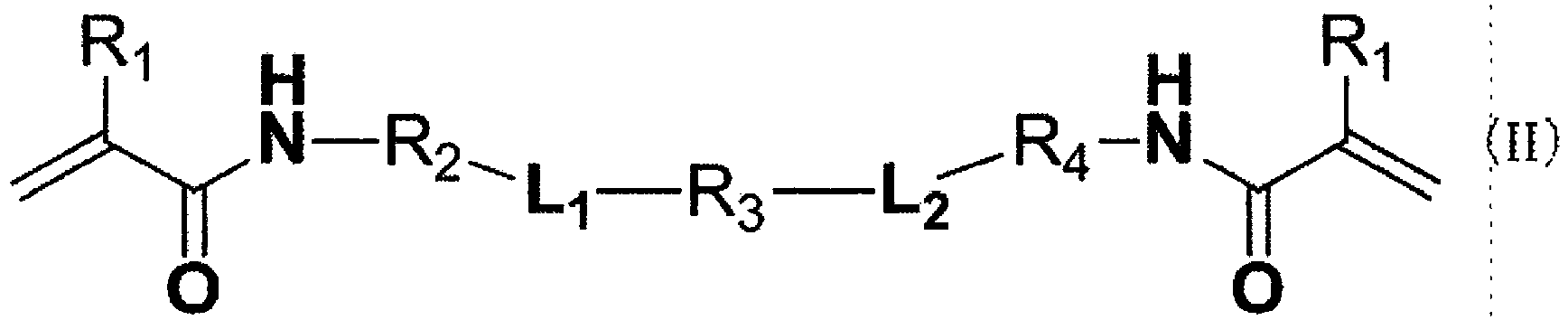
- In Formula (II), R1 represents a hydrogen atom or a methyl group, a plurality of R1 may be the same or different, R2 and R4 each independently represent one group selected from the group consisting of -O-, an alkylene group having 1 to 4 carbon atoms, and divalent linking group obtained by combining these groups. In addition, it is preferable that a carbon atom is located at a position adjacent to the nitrogen atom in the amide group adjacent to R2 and R4. As the group adjacent to the nitrogen atom in the amide group, an alkylene group having 1 to 4 carbon atoms is preferably located.
- Examples of the "divalent linking group obtained by combining these groups" include an alkylene having 1 to 4 carbon atoms and containing -O- such as -OCH2-, -OCH2CH2-,-OCH2CH2CH2-, -OCH2CH2CH2CH2-, -CH2OCH2-, -CH2OCH2CH2-, or -CH2OCH2CH2CH2-; and -(O-alkylene group (having 1 to 4 carbon atoms))n- (n represents an integer of 2 or more; the upper limit is not particularly limited and is preferably 100 or less). In addition, in each group exemplified as the "divalent linking group obtained by combining these groups", either of two bonding sites may be bonded to the amide group.
- Among these, from the viewpoint that a laminate having the more excellent effect of the present invention can be obtained, as R2 and R4, an alkylene group having 1 to 4 carbon atoms or an alkylene group having 1 to 4 carbon atoms and containing -O- is preferable.
- R3 represents one group selected from the group consisting of -O-, an alkylene group having 1 to 4 carbon atoms, a group represented by Formula (III), and a divalent linking group obtained by combining these groups.
- Examples of the "divalent linking group obtained by combining these groups" include the groups described as the R2 and R4. In a case where the group represented by Formula (III) is combined with another group, it is preferable that an alkylene group having 1 to 4 carbon atoms is bonded to the nitrogen atom in the group represented by Formula (III).
- Among these, from the viewpoint that a laminate having the more excellent effect of the present invention can be obtained, as R3, an alkylene group having 1 to 4 carbon atoms, an alkylene group having 1 to 4 carbon atoms and containing -O-, or the group represented by Formula (III) is preferable.
- L1 and L2 each independently represents a single bond or the group represented by Formula (III).
- In a case where R3 represents Formula (III), both L1 and L2 preferably represent a single bond.
- In a case where in Formula (II), R3 is a group represented by Formula (III), R2 and R4 each may represent an alkylene group having 1 to 4 carbon atoms and L1 and L2 may represent a single bond.
- In a case where R3 is an alkylene group having 1 to 4 carbon atoms, L1 and L2 may represent the group represented by Formula (III), and R2 and R4 may each independently represent an alkylene group having 1 to 4 carbon atoms.
- In a case where R3 represents an alkylene group having 1 to 4 carbon atoms and containing -O- (for example, -CH2OCH2-), L1 and L2 may represent a single bond, R2 and R4 may each independently represent alkylene group having 1 to 4 carbon atoms and containing-O- (for example, -CH2OCH2CH2CH2-).

- In Formula (III), R31 represents a hydrogen atom or a methyl group, and * represents a bonding site. Usually, a carbon atom is located at *.
- Specific examples of the compound represented by Formula (I) or (II) are shown below.


- As the compound represented by Formula (I) or (II), various commercially available products can be used, and the compound can be synthesized by the method described in public technical number 2013-502654.
- The compound represented by Formula (IV) and Formula (V) described later is generally called betaine. Generally, betaine is a compound in which a positive charge and a negative charge are provided at positions not adjacent to each other in the same molecule, a hydrogen atom is not bonded to an atom having a positive charge, and the molecule as a whole has no charge (inner salt).

- In Formula (IV), R41 represents one group selected from the group consisting of a methyl group, an ethyl group, an n-propyl group, and an i-propyl group, and a plurality of R41's may be the same or different. Among these, R41 preferably represents the same substituent from the viewpoint of easier synthesis of the above compound. Among these, R41 preferably represents a methyl group.
- R42 represents a hydrogen atom or a methyl group, and R43 represents -NH- or -O-.
- n41 and n42 each independently an integer of 1 to 4.
- From the viewpoint that the compound has more excellent solubility, in a case where M4 is SO3 -, 3 is preferable as n41. In a case where M4 is COO-, 2 is preferable as n41.
- Similarly, from the viewpoint that compound has more excellent solubility, in a case where M4 is SO3 -, 4 is preferable as n42. In a case where M4 is COO-, 1 is preferable.
- In the present specification, a betaine monomer containing SO3 - is sometimes referred to as a sulfobetaine monomer. In addition, a betaine monomer containing COO- is sometimes referred to as a carboxybetaine monomer.
- In Formula (IV), M4 represents SO3 - or COO-. In a case where M4 is SO3 -, the betaine monomer corresponds to a sulfobetaine monomer. In a case where M4 is COO-, the betaine monomer corresponds to a carboxybetaine monomer.
- Examples of the compound represented by Formula (IV) include N-(4-sulfoalkyl)-N-((meth)acryloylaminoalkyl)-N, N-dialkylammonium betaine such as N-(4-sulfobutyl)-N-(methacryloylaminopropyl)-N, or N-dimethylammonium betaine; and N-(4-sulfoalkyl)-N-((meth)acryloyloxyalkyl)-N, N-dialkylammonium betaine such as N-(3-sulfopropyl)-N-(methacryloxyethyl)-N, or N-dimethylammonium betaine.
- In addition, examples of the compound represented by Formula (IV) include compounds represented by the following formulae.


-

- In Formula (V), R51 represents one group selected from the group consisting of a methyl group, an ethyl group, an n-propyl group, and an i-propyl group, and a plurality of R51's may be the same or different. Among these, from the viewpoint of easier synthesis of the above compound, R51 is preferably the same functional group, and R51 is more preferably a methyl group.
- R52 represents a hydrogen atom or a methyl group.
- n5 represents an integer of 1 to 4. From the viewpoint that the compound has more excellent solubility, in a case where M5 is SO3 - in Formula (V), n5 is preferably 3. In Formula (V), two ns's may be the same or different.
- L51 represents a linear or branched alkylene group having 3 or 4 carbon atoms, and specifically includes the following structures (* represents a binding site). In addition, a plurality of L51's may be the same or different.


- From the viewpoint that a laminate has more excellent effect of the present invention, L51 is preferably an n-butylene group (L2).
- M5 represents SO3 - or COO-. In Formula (V), two M5's may be the same or different. In Formula (V), two M5's preferably represent SO3 -. The compound represented by Formula (V) is preferably a compound represented by the following formula.

- From the viewpoint that a laminate having more excellent effect of the present invention can be obtained, the curable composition preferably contains at least one compound selected from the group consisting of the compound represented by Formula (IV) and a compound represented by Formula (V).
- From the viewpoint that a laminate having further excellent effect of the present invention can be obtained, the curable composition preferably contains at least one compound selected from the group consisting of the compound represented by Formula (I) and the compound represented by Formula (II), and at least one compound selected from the group consisting of the compound represented by Formula (IV) and the compound represented by Formula (V).
- The content mass ratio of the total content of the compound represented by formula (I) and the compound represented by formula (II) with respect to the total content of the compound represented by formula (IV) and the compound represented by formula (V) is not particularly limited and from the viewpoint that a laminate having further excellent effect of the present invention can be obtained, the mass ratio is preferably 1/99 to 99/1 and more preferably 10/90 to 90/10.
- The curable composition may contain components other than the components described above. Other components include a polymerization initiator, a solvent, and a monomer other than the specific compound, a filler, a silane coupling agent, a polymerization inhibitor, a fragrance, a colorant, a refreshing agent, a preservative, an antibacterial agent, a binder resin, a polyfunctional amine, a polyfunctional thiol, a plasticizer, a surface lubricant, a leveling agent, a softener, an antioxidant, an anti-aging agent, a light stabilizer, an ultraviolet absorber, and a surfactant.
- The curable composition preferably contains a polymerization initiator. The content of the polymerization initiator in the curable composition is not particularly limited and is preferably 0.01% to 50% by mass with respect to the total solid content of the curable composition. The polymerization initiator may be used alone or in combination of two or more kinds thereof. In a case where two or more kinds of polymerization initiators are used in combination, the total content is preferably within the above range. The polymerization initiator may be used in combination with a sensitizer and/or a reducing agent.
- Examples of the polymerization initiator include a photopolymerization initiator and a thermal polymerization initiator. Of these, a photopolymerization initiator is preferable.
- Examples of photopolymerization initiators include an alkyl phenone-based photopolymerization initiator, a methoxy ketone-based photopolymerization initiator, an acylphosphine oxide-based photopolymerization initiator (for example, 2,4,6-trimethylbenzoyl-diphenyl-phosphine oxide and bis(2,4,6-trimethylbenzoyl)-phenylphosphine oxide), a hydroxy ketone-based photopolymerization initiator (for example, IRGACURE 184; 1,2-α-hydroxyalkylphenone), an amino ketone-based photopolymerization initiator (for example, 2-methyl-1-[4-(methylthio)phenyl]-2-morpholino-propane-1-one (IRGACURE (registered trademark) 907)), an oxime-based photopolymerization initiator, and an oxyphenyl ester acetate-based photopolymerization initiator (IRGACURE (registered trademark) 754).
- In addition, as the polymerization initiator, a diketone compound (for example, camphor quinone) is also preferable.
- Examples of other initiators (for example, a thermal polymerization initiator) include an azo-based polymerization initiator (for example, V-50), a persulfate-based polymerization initiator, a persulfate material-based polymerization initiator, and a redox-based polymerization initiator.
- The polymerization initiator is preferably contains the compound represented by Formula (VII) from the viewpoint that a laminate having more excellent effect of the present invention can be obtained. This compound functions as a so-called photopolymerization initiator.

- In Formula (VII), V1, V2, V3, and V4 each independently represent a hydrogen atom or a substituent. The kind of the substituent is not particularly limited, and examples thereof include a halogen atom, an alkyl group, an alkoxy group, a hydroxy group, an alkylthio group, a mercapto group, an acyl group, and an amino group. In Formula (VII), n represents an integer of 1 to 5.
- The compound represented by Formula (VII) can be synthesized by, for example, the methods described in paragraphs 0067 to 0071 and 0112 to 0115 of
JP2000-186242A - As the compound represented by Formula (VII), the compounds described in paragraphs 0063 to 0071 of
WO2017/018146A can be used, and the contents are incorporated in the present specification. - For the polymerization initiator, the description after paragraph 135 of
JP2010-106268A US2011/0124824A ), the description of paragraphs 0018 to 0025 ofJP2009-013115A JP2005-154312A - For the sensitizer, the description of paragraph 154 of
WO2017-086224A , and the description of paragraph 0024 ofJP2005-154312A - For the reducing agent, the description of paragraph 0025 of
JP2005-154312A - The curable composition preferably contains a solvent. Examples of the solvent include water; and organic solvents (for example, esters such as ethyl acetate and n-butyl acetate; aromatic hydrocarbons such as toluene and benzene; aliphatic hydrocarbons such as n-hexane and n-heptane; alicyclic hydrocarbons such as cyclohexane and methylcyclohexane; ketones such as methyl ethyl ketone and methyl isobutyl ketone; alcohols such as methanol and butanol; and the like). The solvents can be used alone or in combination of two or more kinds thereof.
- In a case where the curable composition contains the solvent, the solid content of the curable composition is not particularly limited and is preferably 0.1% to 99% by mass and more preferably 1% to 90% by mass with respect to the total mass of the curable composition.
- The solid content of the curable composition means a component that can form a cured film and does not include solvents.
- The curable composition may further contain a monomer other than the specific compound from the viewpoint that the obtained cured film has more excellent adhesiveness to the undercoat layer and the like.
- The content of the monomer other than the specific compound in the curable composition is not particularly limited, and is preferably 0.01% to 90% by mass, more preferably 20% to 80% by mass, and even more preferably 30% to 70% by mass with respect to the total solid content of the curable composition. The monomer other than the specific compound may be used alone or in combination of two or more kinds thereof. In a case where two or more kinds of polymerizable monomers are used in combination, the total content is preferably within the above range.
- As the monomer other than the specific compound, monomers used in the dental field may be used and examples thereof include an aliphatic monofunctional polymerizable monomer, an aliphatic bifunctional polymerizable monomer, an aliphatic trifunctional or higher polymerizable monomer, an aromatic monofunctional polymerizable monomer, and an aromatic bifunctional polymerizable monomer.
- Examples of the aliphatic monofunctional polymerizable monomer include methyl (meth)acrylate, ethyl (meth)acrylate, propyl (meth)acrylate, butyl (meth)acrylate, isobutyl (meth)acrylate, lauryl (meth)acrylate, and 2-hydroxyethyl (meth)acrylate.
- Examples of the aliphatic bifunctional or higher polymerizable monomer include erythritol di(meth)acrylate, sorbitol di(meth)acrylate, mannitol di(meth)acrylate, pentaerythritol di(meth)acrylate, dipentaerythritol di(meth)acrylate, glycerol di(meth)acrylate, ethylene glycol di(meth)acrylate, diethylene glycol di(meth)acrylate, triethylene glycol di(meth)acrylate, polyethylene glycol di(meth)acrylate, propylene glycol di(meth)acrylate, butylene glycol di(meth)acrylate, and 2,2,4-trimethylhexamethylenebis(2-carbamoyloxyethyl)dimethacrylate.
- Examples of the trifunctional or higher polymerizable monomer include trimethylolpropane tri(meth)acrylate, trimethylolethane tri(meth)acrylate, trimethylolmethane tri(meth)acrylate, tris(2-(meth)acryloxyethyl) isocyanulate, pentaerythritol tri(meth)acrylate, pentaerythritol tetra(meth)acrylate, dipentaerythritol tri(meth)acrylate, dipentaerythritol tetra(meth)acrylate, dipentaerythritol penta(meth)acrylate, and dipentaerythritol hexa(meth)acrylate.
- Examples of the aromatic monofunctional polymerizable monomer include benzyl (meth)acrylate, phenoxyethyl (meth)acrylate, and phenoxydiethylene glycol (meth)acrylate.
- Examples of the aromatic bifunctional polymerizable monomer include 2,2-bis[4-[2-hydroxy-3-(methacryloyloxy)propyloxy]phenyl]propane.
- In addition, as the monomer other than the specific compound, hydrophobic monomers described in paragraphs 0035 to 0039 of
JP2006-151850A - Further, the description in paragraphs 0018 to 0022 of
JP2005-154312A - The curable composition may contain a filler. The cured film formed of the curable composition containing a filler has more excellent mechanical strength and more excellent adhesiveness to the undercoat layer. The content of the filler in the curable composition is not particularly limited and is preferably 0.01% to 80% by mass, more preferably 0.05% to 50% by mass, and even more preferably 0.1% to 30% by mass with respect to the total solid content of the curable composition. The filler may be used alone or in combination of two or more kinds thereof. In a case where two or more kinds of filler are used in combination, the total content is preferably within the above range.
- The average particle diameter of the filler is not particularly limited and is preferably 0.01 to 500 µm, more preferably 0.05 to 100 µm, and even more preferably 0.1 to 50 µm. The average particle size of the filler in the present specification means the average particle size measured by the Coulter method.
- Examples of the filler include an organic filler, an inorganic filler, and a composite filler thereof.
- Examples of a material constituting an organic filler include polymethyl methacrylate, polyethyl methacrylate, methyl methacrylate-ethyl methacrylate copolymer, crosslinked polymethyl methacrylate, crosslinked polyethyl methacrylate, polyester, polyamide, polycarbonate, polyphenylene ether, polyoxymethylene, polyvinyl chloride, polystyrene, polyethylene, polypropylene, ethylene-vinyl acetate copolymer, and acrylonitrile-styrene copolymer.
- Examples of a material constituting an inorganic filler include lanthanum glass, borosilicate glass, soda glass, barium glass, strontium glass, glass ceramics, aluminosilicate glass, barium boroaluminosilicate glass, strontium boroaluminosilicate glass, fluoroaluminosilicate glass, calcium fluoroaluminosilicate glass, strontium fluoroaluminosilicate glass, barium fluoroaluminosilicate glass, and strontium calcium fluoroaluminosilicate glass.
- The inorganic filler may be used after being subjected to surface pretreatment with a known surface-treating agent such as a silane coupling agent.
- Examples of the surface-treating agent include vinyltrimethoxysilane, vinyltriethoxysilane, vinyltrichlorosilane, vinyltri(P-methoxyethoxy)silane, 3-methacryloyloxypropyltrimethoxysilane, 11-methacryloyloxyundecyltrimethoxysilane, 3-glycidoxypropyltrimethoxysilane, 3-mercaptopropyltrimethoxysilane, and 3-aminopropyltriethoxysilane. The surface-treating agent may be used alone or in combination of two or more kinds thereof.
- The composite filler is not particularly limited and examples thereof include those obtained by adding a monomer to the inorganic filler in advance, making the mixture into a paste state, and then polymerizing and pulverizing the resultant. Examples of the composite filler include a TMPT filler (obtained by mixing trimethylolpropane methacrylate and a silica filler and then polymerizing and pulverizing the mixture) and inorganic fine particles whose surface is modified by alkoxysilane having an unsaturated double bond described in
JP2005-154312A - The curable composition may further contain a silane coupling agent.
- The content of the silane coupling agent in the curable composition is not particularly limited and is preferably 0.01% to 50% by mass, more preferably 0.05% to 30% by mass, and even more preferably 0.1% to 20% by mass with respect to the total solid content of the curable composition. The silane coupling agent may be used alone or in combination of two or more kinds thereof. In a case where two or more kinds of silane coupling agents are used in combination, the total content is preferably within the above range.
- The silane coupling agent is not particularly limited and a known silane coupling agent can be used. Examples of the silane coupling agent include silane coupling agents described in paragraph 0058 of
JP2015-214514A - The laminate according to the embodiment of the present invention may comprises the base material, the undercoat layer, and the cured film in this order described above, and may further have other layers. Other layers are not particularly limited, but examples include mixed layers.
- In a case where the laminate has a mixed layer, it is preferable that the mixed layer is between the base material and the undercoat layer and/or between the undercoat layer and the cured film.
- The mixed layer is a layer formed by mixing the respective components of the base material and the undercoat layer, or the undercoat layer and the cured film described above. In a case where the laminate has the mixed layer, the adhesiveness between layers (between the base material and the undercoat layer, and/or between the undercoat layer and the cured film) is further improved and as a result, the laminate has the more excellent effect of the present invention.
- In the mixed layer, the form of mixing the components of two different layers is not particularly limited. The mixed layer may be a layer formed by mixing the components of two layers at the molecular level (in other words, a layer formed by compatibilizing two layers) or a layer formed by mixing the components of two layers in a state in which the components of the two layers are not compatible. The layer formed by mixing the components of two layers in a state in which the components of the two layers are not compatible may be a layer formed by incorporating the component of the other layer so as bite into unevenness formed of the component of one layer.
- A method for producing the laminate is not particularly limited and known production methods can be used. Among these, from the viewpoint that the base material, the undercoat layer, and the cured film are more closely attached and as a result, a laminate having the more excellent effect of the present invention can be easily obtained, the production method preferably has the following steps in the following order.
- Step of forming a first coating film on a base material using an undercoat layer forming composition containing a predetermined polymer (first coating film forming step)
- Step of forming a second coating film on the first coating film using a curable composition containing a specific compound (second coating film forming step)
- Step of applying energy to the first coating film and the second coating film and curing the films to obtain an undercoat layer and a cured film (energy applying step)
- Hereinafter, embodiments of each step will be described will be described.
- The first coating film forming step is a step of forming a first coating film on the base material using an undercoat layer forming composition containing a predetermined polymer.
- The base material that can be used in the step is not particularly limited and a known base material can be used. The embodiment is as already described as the base material that laminate has.
- The form of the undercoat layer forming composition is as already described above.
- The method of forming the first coating film on the base material is not particularly limited and known methods can be used. Typically, the method of applying the undercoat layer forming composition to the base material to obtain the first coating film, and if required, removing a solvent from the first coating film may be used.
- The method of applying the undercoat layer forming composition to the base material is not particularly limited and known methods can be used. For example, bar coater coating, spin coating, spray coating, and curtain coating may be used.
- In a case where the undercoat layer forming composition contains a solvent, it is preferable to remove the solvent from the first coating film. The method of removing the solvent is not particularly limited and known methods can be used. Typically, a method of heating the first coating film may be used. In a case of heating the first coating film, the heating temperature is preferably 40°C to 120°C and the heating time is preferably 10 to 120 minutes.
- The curable composition layer forming step is a step of forming a second coating film on the first coating film using a curable composition containing a specific compound.
- The form of the curable composition is as already described above. The method of forming the second coating film on the first coating film is not particularly limited and known methods can be used.
- Typically, a method of applying a curable composition to the first coating film may be used. Examples of the method of applying the curable composition include roll coating, kiss roll coating, gravure coating, reverse coating, roll brushing, spray coating, dip roll coating, bar coating, knife coating, air knife coating, curtain coating, lip coating, and die coating.
- The second coating film may be heated. A method of heating the second coating film is not particularly limited and for example, a blast dryer, an oven, an infrared dryer or a heating drum can be used.
- The heating temperature is not particularly limited and is preferably 30°C to 150°C and more preferably 40°C to 120°C. The heating time is not particularly limited, and drying in the coating device is preferably 1 to 20 minutes.
- The energy applying step is a step of applying the first coating film and the second coating film and curing the films to obtain an undercoat layer and a cured film.
- The method of applying energy to the first coating film and the second coating film is not particularly limited, and known methods can be used. For example, heating and light irradiation can be used.
- The method of light irradiation is not particularly limited and for example, methods using a low pressure mercury lamp, a medium pressure mercury lamp, a high pressure mercury lamp, a metal halide lamp, deep ultraviolet light, a xenon lamp, a chemical lamp, and a carbon lamp can be used. The energy of light irradiation is not particularly limited, but is preferably 0.1 to 10 J/cm2.
- In addition, in a case of heating, the heating temperature is preferably 50°C to 150°C and the heating time is preferably 10 to 180 minutes.
- The laminate is preferably used as a device used by being transplanted and arranged in a human living body placed in the body. Examples of the above device include artificial joints, artificial bones, artificial blood vessels, stents, dental implants, and denture bases, and among these, a denture base is preferable. That is, a laminate in which the base material is a denture base (a denture base with a coating layer) is preferable.
- Since the laminate has the undercoat layer and further has the cured film, which is a firm crosslinked film, on the surface, the laminate has excellent coloration resistance and excellent thermal cycling resistance.
- Therefore, particularly, in a case where the base material is a denture base, even in a case where the laminate is placed in the mouth for a long period of time, the laminate also has excellent properties that the cured film is not easily peeled off and the physical properties and the tone of the cured film are not easily changed.
- The coloration resistance represents properties that even in a case where coloring foods to eat and drink in daily life (for example, black tea, green tea, coffee, red wine, and curry) are repeatedly consumed, mainly, the tone of the surface of the laminate is not easily changed. In addition, the thermal cycling resistance represents properties that the physical properties of the laminate, such as adhesiveness and wear resistance, are not easily changed before and after the heat cycling test in response to the temperature change in the mouth associated with eating and drinking in daily life.
- A kit according to an embodiment of the present invention is formed of the above-described undercoat layer forming composition and curable composition.
- In the kit, the undercoat layer forming composition and the curable composition may be accommodated in separate containers. That is, the kit is preferably a kit containing a first container including a container, and the undercoat layer forming composition accommodated in the container, and a second container including a container separate from the above container and the curable composition accommodated in the other container.
- The container is not particularly limited, and a known container can be used. The capacity, shape, and the like of the container can be appropriately determined according to the use.
- The kit is preferably used to produce the laminate (in other words, provided to produce the laminate). Of these, in a case where the base material is a denture base, a denture base with a coating layer having an undercoat layer and a cured film on the denture base can be easily obtained, and thus this case is preferable.
- The denture base with a coating layer has excellent bacteria adhesion suppression performance and the bacteria adhesion suppression performance is maintained for a long period of time.
- Hereinafter, the present invention will be described in more detail based on examples. The materials, amounts used, ratios, treatment details, treatment procedures, and the like shown in the following examples can be changed as appropriate without departing from the spirit of the present invention. Therefore, the scope of the present invention should not be construed as being limited by the following examples.
- The content of each of undercoat layer forming compositions 1 to 4 was adjusted with methyl ethyl ketone such that the content of each of the following polymers with respect to the total mass of the undercoat layer forming composition was 9.7% by mass, and the content of IRGACURE 2959 (BASF, "Irg 2959", hereinafter, corresponding to a polymerization initiator) with respect to the total mass of the undercoat layer forming composition was 0.3% by mass. In addition, the numerical value described in each repeating unit represents the copolymerization ratio (molar ratio).
- Undercoat layer forming composition 1 (containing following polymer A1)

- Undercoat layer forming composition 2 (containing following polymer A2)

- Undercoat layer forming composition 3 (containing following polymer A3)
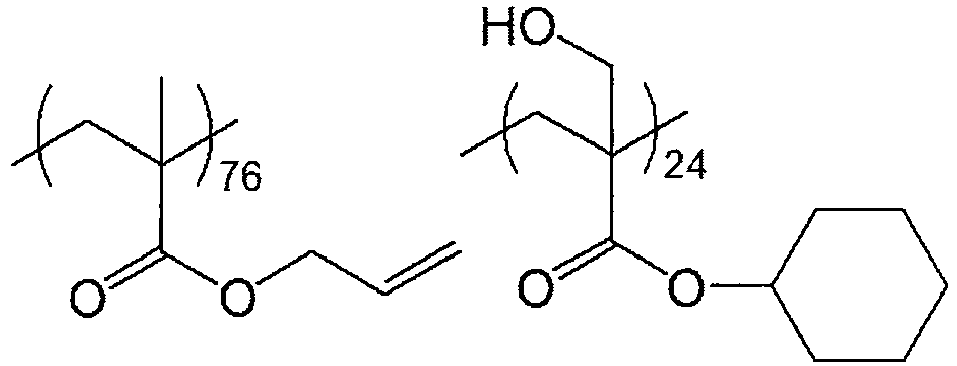
- Undercoat layer forming composition 4 (containing following polymer A4)

- Undercoat layer forming composition 5 (containing following polymer A5)

- Each polymer was synthesized by the following method.
- Into a 500 ml three-necked flask, 13.52 g of propylene glycol monomethyl ether (MFG) was poured and the internal temperature was set to 70°C. A monomer solution including 3.61 g of methacrylic acid, 24.98 g of allyl methacrylate, 7.63 g of N-isopropylmethacrylamide, 0.461 g of V-601 (radical polymerization initiator, manufactured by Wako Pure Chemical Corporation), and 54.08 g of MFG was prepared and added dropwise into the reaction container for 2 hours. After the completion of the dropwise addition of the monomer solution, the reaction solution was stirred for 2 hours, and the initiator was added (0.461 g of V-601). Next, immediately after the initiator was added, the temperature was raised to 85°C, the reaction solution was stirred for 2 hours, and then allowed to cool to obtain the desired polymer.
- Polymers A2 to A4 were synthesized in the same manner as the synthetization of the polymer A1 while changing the kinds of the repeating units and the compositional ratio of the repeating units.
- For a polymer A5, a polymethyl methacrylate (81503, manufactured by Sigma-Aldrich) was used.
- Each of the following compounds was mixed with IRGACURE 2959 (BASF, hereinafter "Irg 2959", corresponding to the polymerization initiator) in the composition shown in Table 1 to prepare each curable composition. The numerical values in Table 1 represent the content (% by mass) of each component with respect to the total solid content of the curable composition. In addition, the solid content of each curable composition was adjusted to be 20% by mass with methanol.
-

-

-

-

-

-

- As a base material imitating a denture base, a denture base (corresponds to the base material) was prepared by a wet heating polymerization method usually performed using an acrylic resin for a denture base (ISO Resin·H, DENKEN-HIGHDENTAL Co., Ltd.). Next, the undercoat layer forming composition was applied to the denture base so that the thickness of the undercoat layer was 1 µm, and the solvent was removed to obtain a denture base with a first coating film. Next, the curable composition was applied to the denture base with the first coating film so that the thickness of the cured film was 3 µm, and a denture base with a second coating film was obtained. Next, the denture base with the second coating film was exposed using an ultraviolet (UV) exposure machine "ECS-401G (product name)", manufactured by Eye Graphics Co., Ltd. (light source: a high pressure mercury lamp) at an exposure amount of 4 J/cm2 and the first coating film and the second coating film were cured to obtain an undercoat layer and a cured film respectively. The denture base with a coating layer (corresponding to a laminate comprising an undercoat layer and a cured film on a base material in this order) was obtained.
- Next, the denture base with the coating layer was immersed in a phosphate buffered saline (PBS) solution, and taken out after 24 hours had passed at 37°C to evaluate adhesiveness from the area of the coating layer remaining on the denture base. The area of the coating layer remaining on the denture base relative to the surface area of the denture base was expressed as a percentage as a coating rate and evaluated according to the following standards.
- A: The coating rate was 90% or higher.
- B: The coating rate was 70% or higher and lower than 90%.
- C: The coating rate was 50% or more and lower than 70%.
- D: The coating rate was lower than 50%.
- The test piece prepared in the adhesiveness test was cut into a 1 cm square and placed in a 24 well plate. In each well, 1 ml each of a test solution in which a yeast cell of C. albicans (JCM2085, JCM is an abbreviation for Japan Collection of Microorganisms) was inoculated in a yeast extract peptone dextrose (YPD) medium and the cell concentration was adjusted to be 970 cell/ml was put.
- Next, the 24 well plate containing the test piece and the test solution was cultured at 37°C for 36 hours under aerobic conditions. Next, after washing the test piece after cultivation with a phosphate buffered saline (PBS) buffer solution, the number of bacteria adhering to the test piece was determined by a colorimetric determination method (XTT method; XTT is an abbreviation of 2,3-Bis-(2-Methoxy-4-Nitro-5-Sulfophenyl)-2H-Tetrazolium-5-Carboxanilide). The light absorbance of the base material having no undercoat layer and no cured film was set to a reference, and a difference in light absorbance with each test piece (reduction rate of light absorbance) was obtained and evaluated based on the following standards.
- A: The difference from the reference was more than 30%.
- B: The difference from the reference was 20% or more and less than 30%.
- C: The difference from the reference was 10% or more and less than 20%.
- D: The difference from the reference was less than 10%.
- In the table, "Component of curable composition (% by mass)" represents % by mass of each component with respect to the total solid content of the curable composition.
- Also, "None" in the column "Undercoat layer forming composition" indicates that no undercoat layer was provided. In addition, the blank in the column "Curable composition" indicates that the corresponding component was not used. Further, "No evaluation" in the evaluation column "Adhesiveness" of Comparative Example 2 indicates that the Adhesiveness test could not be performed.
- From the results shown in Table 1, the laminates of Examples 1 to 10 had the effects of the present invention. On the other hand, the laminates of Comparative Examples 1 to 3 did not have the effect of the present invention.
- In addition, the laminate of Example 3 comprising the cured film formed of the curable composition including the specific compound formed of the compound represented by Formula (IV) had more excellent bacteria adhesion suppression performance compared to the laminate of Example 2 comprising the cured film formed of the curable composition including the specific compound formed of the compound represented by Formula (II).
- In addition, the laminate of Example 2 comprising the cured film formed of the curable composition in which the specific compound was formed of the compound represented by Formula (II) and R3 in Formula (II) was an alkylene group having 1 to 4 carbon atoms and containing -O- had more excellent bacteria adhesion suppression performance compared to the laminate of Example 1.
- Further, the laminate of Example 1 comprising the undercoat layer formed of the undercoat layer forming composition in which double bond equivalent of the polymer was 2000 or less had more excellent adhesiveness compared to the laminate of Example 6.
- The laminate of Example 7 comprising the cured film formed of the curable composition containing both the compound represented by Formula (II) and the compound represented by Formula (IV) had more excellent adhesiveness and bacteria adhesion suppression performance compared to the laminate of Example 1.
- A denture base with a coating layer (corresponding to a laminate in which an undercoat layer and a cured film are provided on the base material in this order) was obtained in the same manner as the test piece for the adhesiveness test.
- Next, using a microtribology testing machine (UMT-3) manufactured by Bruker AXS GmbH and a toothbrush ("G.U.M dental brush #191 (product name)") with "normal" hardness, a 2 ml PBS buffer solution was added dropwise to the toothbrush, and under the conditions that the gliding speed of 60 times/min, a load of 200 g, and a stroke width of 3 mm, each sample was brushed for 300 seconds, and the rub resistance was evaluated from the state of the coating layer on the denture base in the wet environment. The coating layer on the denture base was visually observed and evaluated according to the following standards. The results are shown in Table 2.
- A: Changes were not observed in the coating layer.
- B: Changes such as scratches were observed in the coating layer.
- From the results shown in Table 2, it was found that the laminates of Examples 1 to 6 and Examples 8 to 10 had excellent rub resistance in a wet environment. On the other hand, the laminates of Comparative Examples 1 and 3 did not have rub resistance in a wet environment.
| Undercoat layer | Cured film | Evaluation | ||||||||||||
| Undercoat layer forming composition | Polymer | Component of Curable composition (% by mass) | ||||||||||||
| Specific compound | Polymerization initiator | |||||||||||||
| Kind | Kind | Double bond equivalent | Acid value | Hydroxyl number | B1 | B2 | B3 | B4 | B5 | B6 | Irg 2959 | Adhesiveness | Bacteria adhesion suppression performance | |
| Example 1 | 1 | A1 | 183 | 62 | 97 | 3 | B | C | ||||||
| Example 2 | 1 | A1 | 183 | 62 | 97 | 3 | B | B | ||||||
| Example 3 | 1 | A1 | 183 | 62 | 97 | 3 | B | A | ||||||
| Example 4 | 2 | A2 | 359 | 45 | 97 | 3 | B | C | ||||||
| Example 5 | 3 | A3 | 184 | 96 | 97 | 3 | B | C | ||||||
| Example 6 | 4 | A4 | 2054 | 52 | 97 | 3 | C | C | ||||||
| Example 7 | 1 | A1 | 183 | 62 | 29.1 | 67.9 | 3 | A | A | |||||
| Example 8 | 1 | A1 | 183 | 62 | 97 | 3 | B | C | ||||||
| Example 9 | 1 | A1 | 183 | 62 | 97 | 3 | B | C | ||||||
| Example 10 | 1 | A1 | 183 | 62 | 97 | 3 | B | C | ||||||
| Comparative Example 1 | None | 97 | 3 | D | D | |||||||||
| Comparative Example 2 | None | No evaluation | D | |||||||||||
| Comparative Example 3 | 5 | A5 | 0 | 97 | 3 | D | D | |||||||
| Rub resistance test in wet environment | |
| Example 1 | A |
| Example 2 | A |
| Example 3 | A |
| Example 4 | A |
| Example 5 | A |
| Example 6 | A |
| Example 8 | A |
| Example 9 | A |
| Example 10 | A |
| Comparative Example 1 | B |
| Comparative Example 3 | B |
Claims (12)
- A laminate comprising, in order:a base material;an undercoat layer formed of an undercoat layer forming composition containing a polymer containing a repeating unit containing a polymerizable group and a repeating unit containing a polar group; anda cured film formed of a curable composition containing at least one compound selected from the group consisting of a compound represented by Formula (I), a compound represented by Formula (II), a compound represented by Formula (IV), and a compound represented by Formula (V),
 in Formula (I), R represents a hydrogen atom or a methyl group, a plurality of R's may be the same or different, L represents one group selected from the group consisting of -O-, an alkylene group having 2 to 4 carbon atoms, or a divalent linking group obtained by combining these groups, and a plurality of L's may be the same or different,
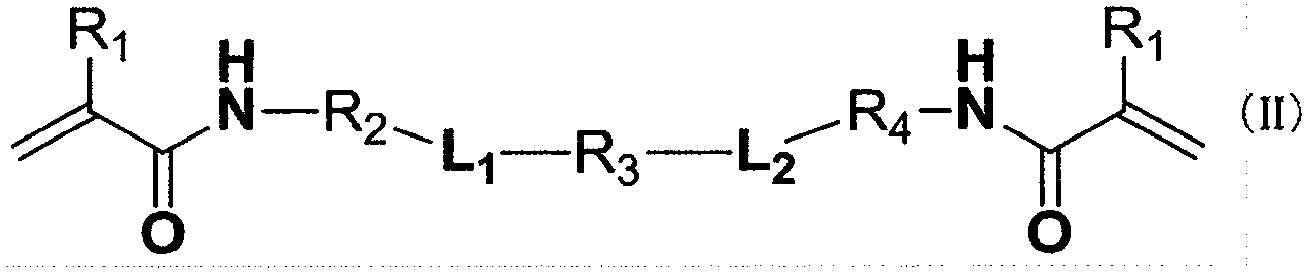 in Formula (II), R1 represents a hydrogen atom or a methyl group, a plurality of R1 may be the same or different, R2 and R4 each independently represent one group selected from the group consisting of -O-, an alkylene group having 1 to 4 carbon atoms, and a divalent linking group obtained by combining these groups, R3 represents one group selected from the group consisting of -O-, an alkylene group having 1 to 4 carbon atoms, a group represented by Formula (III), and a divalent linking group obtained by combining these groups, and L1 and L2 each independently represents a single bond or the group represented by Formula (III),
 in Formula (III), R31 represents a hydrogen atom or a methyl group, and * represents a bonding site,
 in Formula (IV), R41 represents one group selected from the group consisting of a methyl group, an ethyl group, an n-propyl group, and an i-propyl group, a plurality of R41's may be the same or different, R42 represents a hydrogen atom or a methyl group, R43 represents -NH- or -O-, n41 and n42 each independently represent an integer of 1 to 4, and M4 represents SO3 - or COO-, and
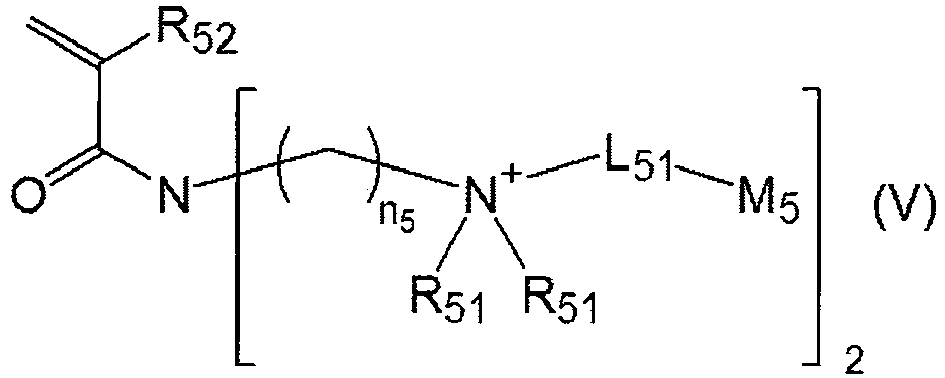 in Formula (V), R51 represents one group selected from the group consisting of a methyl group, an ethyl group, an n-propyl group, and an i-propyl group, a plurality of R51's may be the same or different, R52 represents a hydrogen atom or a methyl group, n5 represents an integer of 1 to 4, L51 represents a linear or branched alkylene group having 3 or 4 carbon atoms, and M5 represents SO3 - or COO-.
 - The laminate according to claim 1,
wherein a double bond equivalent of the polymer is 2000 or less. - The laminate according to claim 1 or 2,
wherein the repeating unit containing a polymerizable group is a repeating unit represented by Formula (A1),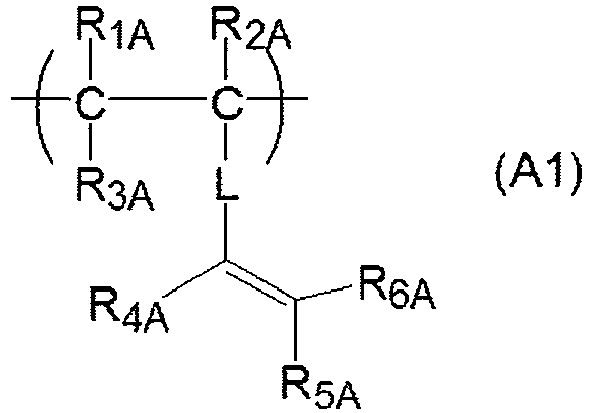
- The laminate according to any one of claims 1 to 3,
wherein an acid value or a hydroxyl number of the polymer is 20 mgKOH/g or more. - The laminate according to any one of claims 1 to 4,
wherein the curable composition contains at least one compound selected from the group consisting of the compound represented by Formula (I) and the compound represented by Formula (II), and at least one compound selected from the group consisting of the compound represented by Formula (IV) and the compound represented by Formula (V). - The laminate according to claim 5,
wherein a content ratio of a total content of the compound represented by Formula (I) and the compound represented by Formula (II) with respect to a total content of the compound represented by Formula (IV) and the compound represented by Formula (V) is 10/90 to 90/10. - The laminate according to any one of claims 1 to 6,
wherein the curable composition further contains a polymerization initiator. - The laminate according to any one of claims 1 to 7,
wherein the base material is a denture base. - A kit formed of an undercoat layer forming composition containing a polymer containing a repeating unit containing a polymerizable group and a repeating unit containing a polar group, and
a curable composition containing at least one compound selected from the group consisting of a compound represented by Formula (I), a compound represented by Formula (II), a compound represented by Formula (IV) and a compound represented by Formula (V),

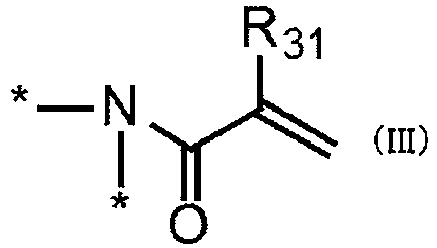


- A kit for producing the laminate according to any one of claims 1 to 8, which is formed of an undercoat layer forming composition containing a polymer containing a repeating unit containing a polymerizable group and a repeating unit containing a polar group, and
a curable composition containing at least one compound selected from the group consisting of the compound represented by Formula (I), the compound represented by Formula (II), the compound represented by Formula (IV) and the compound represented by Formula (V). - A method for producing a laminate to produce the laminate according to any one of claims 1 to 8, the method comprising:a step of forming a first coating film on the base material using an undercoat layer forming composition containing a polymer containing a repeating unit containing a polymerizable group and a repeating unit containing a polar group;a step of forming a second coating film on the first coating film using a curable composition containing at least one compound selected from the group consisting of the compound represented by Formula (I), the compound represented by Formula (II), the compound represented by Formula (IV) and the compound represented by Formula (V); anda step of applying energy to the first coating film and the second coating film and curing the films to obtain an undercoat layer and a cured film.
- The method for producing a laminate according to claim 11,
wherein the base material is a denture base.
Applications Claiming Priority (3)
| Application Number | Priority Date | Filing Date | Title |
|---|---|---|---|
| JP2017097090 | 2017-05-16 | ||
| JP2017250727 | 2017-12-27 | ||
| PCT/JP2018/018095 WO2018212061A1 (en) | 2017-05-16 | 2018-05-10 | Laminate, kit, and method for producing laminate |
Publications (3)
| Publication Number | Publication Date |
|---|---|
| EP3626449A1 true EP3626449A1 (en) | 2020-03-25 |
| EP3626449A4 EP3626449A4 (en) | 2020-05-13 |
| EP3626449B1 EP3626449B1 (en) | 2023-12-13 |
Family
ID=64274052
Family Applications (1)
| Application Number | Title | Priority Date | Filing Date |
|---|---|---|---|
| EP18802652.0A Active EP3626449B1 (en) | 2017-05-16 | 2018-05-10 | Laminate, kit, and method for producing laminate |
Country Status (4)
| Country | Link |
|---|---|
| US (1) | US11400026B2 (en) |
| EP (1) | EP3626449B1 (en) |
| JP (1) | JP6924826B2 (en) |
| WO (1) | WO2018212061A1 (en) |
Families Citing this family (7)
| Publication number | Priority date | Publication date | Assignee | Title |
|---|---|---|---|---|
| WO2018143051A1 (en) | 2017-01-31 | 2018-08-09 | 富士フイルム株式会社 | Denture base coating composition, coating film-bearing denture base, plate denture, and method for producing coating film-bearing denture base |
| EP3626449B1 (en) * | 2017-05-16 | 2023-12-13 | FUJIFILM Corporation | Laminate, kit, and method for producing laminate |
| WO2020066630A1 (en) * | 2018-09-27 | 2020-04-02 | 富士フイルム株式会社 | Method for manufacturing laminate, and laminate |
| JP2021054789A (en) * | 2019-03-26 | 2021-04-08 | 株式会社松風 | Low water-sensitive dental primer |
| KR102861380B1 (en) * | 2019-03-26 | 2025-09-17 | 소후 인코포레이티드 | Powder-liquid type resin-reinforced dental glass ionomer cement composition |
| WO2022209922A1 (en) * | 2021-03-31 | 2022-10-06 | 富士フイルム株式会社 | Curable composition, hardcoat film, and product, image display device, and flexible display including hardcoat film |
| WO2023176900A1 (en) * | 2022-03-16 | 2023-09-21 | Toto株式会社 | Member |
Family Cites Families (23)
| Publication number | Priority date | Publication date | Assignee | Title |
|---|---|---|---|---|
| DE3536076A1 (en) * | 1985-10-09 | 1987-04-09 | Muehlbauer Ernst Kg | POLYMERIZABLE CEMENT MIXTURES |
| DE3536077A1 (en) * | 1985-10-09 | 1987-04-09 | Muehlbauer Ernst Kg | POLYMERIZABLE ACID AND ACID DERIVATIVES COMPOUNDS, MIXTURES CONTAINING THE SAME AND THEIR USE |
| US4648845A (en) * | 1985-11-27 | 1987-03-10 | Scientific Pharmaceuticals, Inc. | Method for repairing of veneered dental cast restoration |
| JP3576862B2 (en) | 1998-04-28 | 2004-10-13 | キヤノン株式会社 | Ink, image forming method and photopolymerization initiator |
| US20040171716A1 (en) * | 2002-12-03 | 2004-09-02 | Uwe Walz | Dental compositions comprising bisacrylamides and use thereof |
| US20030069327A1 (en) * | 2001-08-09 | 2003-04-10 | Uwe Walz | Dental compostions comprising bisacrylamides and use thereof |
| WO2003013444A1 (en) * | 2001-08-10 | 2003-02-20 | Dentsply International Inc. | One-part self-priming dental adhesive |
| EP1454911A1 (en) * | 2003-03-07 | 2004-09-08 | DENTSPLY DETREY GmbH | A polymerizable phosphoric acid ester derivative and a dental composition employing it |
| JP4663225B2 (en) | 2003-11-21 | 2011-04-06 | 株式会社ジーシー | Photopolymerization type dental surface coating material |
| JP4931342B2 (en) | 2004-11-26 | 2012-05-16 | 株式会社トクヤマ | Denture base coating material |
| EP1749513B1 (en) * | 2005-08-01 | 2009-03-04 | Ivoclar Vivadent AG | Photopolymerisable dental material with bisacylphosphine oxides as initiator |
| JP2009013115A (en) | 2007-07-05 | 2009-01-22 | Kuraray Medical Inc | Dental restorative material |
| JP5340102B2 (en) | 2008-10-03 | 2013-11-13 | 富士フイルム株式会社 | Dispersion composition, polymerizable composition, light-shielding color filter, solid-state imaging device, liquid crystal display device, wafer level lens, and imaging unit |
| EP3357518B1 (en) * | 2011-10-03 | 2020-12-02 | Hyalex Orthopaedics, Inc. | Polymeric adhesive for anchoring compliant materials to another surface |
| WO2014194268A1 (en) * | 2013-05-30 | 2014-12-04 | The University Of Akron | Switchable antimicrobial and antifouling carboxybetaine-based hydrogels |
| JP2015209421A (en) | 2014-04-30 | 2015-11-24 | サンメディカル株式会社 | Dental composition |
| JP6371580B2 (en) | 2014-05-12 | 2018-08-08 | サンメディカル株式会社 | Dental composition |
| JP6438849B2 (en) * | 2015-06-09 | 2018-12-19 | 富士フイルム株式会社 | Curable composition, cured film |
| WO2017018146A1 (en) * | 2015-07-29 | 2017-02-02 | 富士フイルム株式会社 | Curable composition, coating, and laminate |
| EP3378875B1 (en) | 2015-11-20 | 2023-02-22 | FUJIFILM Corporation | Acylphosphine oxide compound, use of the acylphosphine oxide compound, producing method of a photopolymerization initiator, polymerizable composition, and ink jet recording method |
| WO2017135186A1 (en) * | 2016-02-01 | 2017-08-10 | 富士フイルム株式会社 | Root canal treatment material and kit for root canal treatment |
| WO2018143051A1 (en) * | 2017-01-31 | 2018-08-09 | 富士フイルム株式会社 | Denture base coating composition, coating film-bearing denture base, plate denture, and method for producing coating film-bearing denture base |
| EP3626449B1 (en) * | 2017-05-16 | 2023-12-13 | FUJIFILM Corporation | Laminate, kit, and method for producing laminate |
-
2018
- 2018-05-10 EP EP18802652.0A patent/EP3626449B1/en active Active
- 2018-05-10 JP JP2019519204A patent/JP6924826B2/en active Active
- 2018-05-10 WO PCT/JP2018/018095 patent/WO2018212061A1/en not_active Ceased
-
2019
- 2019-11-06 US US16/675,412 patent/US11400026B2/en active Active
Also Published As
| Publication number | Publication date |
|---|---|
| US11400026B2 (en) | 2022-08-02 |
| EP3626449B1 (en) | 2023-12-13 |
| US20200069531A1 (en) | 2020-03-05 |
| JPWO2018212061A1 (en) | 2020-03-12 |
| JP6924826B2 (en) | 2021-08-25 |
| WO2018212061A1 (en) | 2018-11-22 |
| EP3626449A4 (en) | 2020-05-13 |
Similar Documents
| Publication | Publication Date | Title |
|---|---|---|
| EP3626449B1 (en) | Laminate, kit, and method for producing laminate | |
| US10945928B2 (en) | Denture base coating composition, coating film-bearing denture base, plate denture, and method for producing coating film-bearing denture base | |
| Moszner et al. | A partially aromatic urethane dimethacrylate as a new substitute for Bis-GMA in restorative composites | |
| CA2001045A1 (en) | Dental compositions curable with visible light | |
| Kim et al. | Trifunctional methacrylate monomers and their photocured composites with reduced curing shrinkage, water sorption, and water solubility | |
| JP2010075366A (en) | Antibacterial artificial nail composition | |
| US20200214956A1 (en) | Photocurable composition to be used on fingernails or artificial nails, base coat agent containing same, cured article thereof, method for producing cured article thereof, method for detaching cured article thereof, method for coating by using same, and method for using same | |
| JP6734990B2 (en) | Adhesive monomer for dental materials | |
| WO2022163248A1 (en) | Photocurable resin composition for nails or artificial nails, cured product, and method for coating nails or artificial nails | |
| Huang et al. | A novel nerol-segmented waterborne polyurethane coating for the prevention of dental erosion | |
| US11278489B2 (en) | Cosmetic composition for nails, method of using same, and cosmetic resin for nails | |
| WO2005092991A1 (en) | Active energy ray-curable coating composition and molding thereof | |
| JP6874123B2 (en) | Phosphorus-containing compounds | |
| EP3305276B1 (en) | Skin adhesive sheet, and sheet-like external preparation for skin | |
| JP2007217516A (en) | Fluoroalkyl group-containing chain high polymer and dental composition comprising the same | |
| JP4171142B2 (en) | Water-based beauty nail | |
| EP4724420A1 (en) | Synthesis of functional and clinically practical ester-free vinyl monomers for applications in dentistry | |
| HK40006662A (en) | Cosmetic composition for nails, method of using same, and cosmetic resin for nails | |
| Shin | Synthesis of Mussel-Inspired Functional Materials for Surface Modification | |
| Kong | Catechol-Containing Copolymers As An Active Ingredient for Denture Adhesives | |
| JP2026058913A (en) | Photocurable resin composition, cured film, substrate with cured film, and method for producing the same. | |
| TW201641101A (en) | Skin adhesive sheet and sheet skin agent for external use | |
| JPS6391308A (en) | Plastic dental surface coating composition |
Legal Events
| Date | Code | Title | Description |
|---|---|---|---|
| STAA | Information on the status of an ep patent application or granted ep patent |
Free format text: STATUS: THE INTERNATIONAL PUBLICATION HAS BEEN MADE |
|
| PUAI | Public reference made under article 153(3) epc to a published international application that has entered the european phase |
Free format text: ORIGINAL CODE: 0009012 |
|
| STAA | Information on the status of an ep patent application or granted ep patent |
Free format text: STATUS: REQUEST FOR EXAMINATION WAS MADE |
|
| 17P | Request for examination filed |
Effective date: 20191106 |
|
| AK | Designated contracting states |
Kind code of ref document: A1 Designated state(s): AL AT BE BG CH CY CZ DE DK EE ES FI FR GB GR HR HU IE IS IT LI LT LU LV MC MK MT NL NO PL PT RO RS SE SI SK SM TR |
|
| AX | Request for extension of the european patent |
Extension state: BA ME |
|
| RAP1 | Party data changed (applicant data changed or rights of an application transferred) |
Owner name: FUJIFILM CORPORATION |
|
| A4 | Supplementary search report drawn up and despatched |
Effective date: 20200409 |
|
| RIC1 | Information provided on ipc code assigned before grant |
Ipc: B32B 27/30 20060101AFI20200403BHEP Ipc: C09D 4/02 20060101ALI20200403BHEP Ipc: C08J 7/043 20200101ALI20200403BHEP Ipc: C09D 5/00 20060101ALI20200403BHEP Ipc: B05D 1/36 20060101ALI20200403BHEP Ipc: C08J 7/04 20200101ALI20200403BHEP Ipc: A61K 6/00 20200101ALI20200403BHEP |
|
| DAV | Request for validation of the european patent (deleted) | ||
| DAX | Request for extension of the european patent (deleted) | ||
| RAP3 | Party data changed (applicant data changed or rights of an application transferred) |
Owner name: FUJIFILM CORPORATION |
|
| GRAP | Despatch of communication of intention to grant a patent |
Free format text: ORIGINAL CODE: EPIDOSNIGR1 |
|
| STAA | Information on the status of an ep patent application or granted ep patent |
Free format text: STATUS: GRANT OF PATENT IS INTENDED |
|
| INTG | Intention to grant announced |
Effective date: 20230821 |
|
| GRAS | Grant fee paid |
Free format text: ORIGINAL CODE: EPIDOSNIGR3 |
|
| GRAA | (expected) grant |
Free format text: ORIGINAL CODE: 0009210 |
|
| STAA | Information on the status of an ep patent application or granted ep patent |
Free format text: STATUS: THE PATENT HAS BEEN GRANTED |
|
| AK | Designated contracting states |
Kind code of ref document: B1 Designated state(s): AL AT BE BG CH CY CZ DE DK EE ES FI FR GB GR HR HU IE IS IT LI LT LU LV MC MK MT NL NO PL PT RO RS SE SI SK SM TR |
|
| REG | Reference to a national code |
Ref country code: GB Ref legal event code: FG4D |
|
| REG | Reference to a national code |
Ref country code: CH Ref legal event code: EP |
|
| REG | Reference to a national code |
Ref country code: DE Ref legal event code: R096 Ref document number: 602018062667 Country of ref document: DE |
|
| REG | Reference to a national code |
Ref country code: IE Ref legal event code: FG4D |
|
| PG25 | Lapsed in a contracting state [announced via postgrant information from national office to epo] |
Ref country code: GR Free format text: LAPSE BECAUSE OF FAILURE TO SUBMIT A TRANSLATION OF THE DESCRIPTION OR TO PAY THE FEE WITHIN THE PRESCRIBED TIME-LIMIT Effective date: 20240314 |
|
| REG | Reference to a national code |
Ref country code: LT Ref legal event code: MG9D |
|
| PG25 | Lapsed in a contracting state [announced via postgrant information from national office to epo] |
Ref country code: LT Free format text: LAPSE BECAUSE OF FAILURE TO SUBMIT A TRANSLATION OF THE DESCRIPTION OR TO PAY THE FEE WITHIN THE PRESCRIBED TIME-LIMIT Effective date: 20231213 |
|
| REG | Reference to a national code |
Ref country code: NL Ref legal event code: MP Effective date: 20231213 |
|
| PG25 | Lapsed in a contracting state [announced via postgrant information from national office to epo] |
Ref country code: ES Free format text: LAPSE BECAUSE OF FAILURE TO SUBMIT A TRANSLATION OF THE DESCRIPTION OR TO PAY THE FEE WITHIN THE PRESCRIBED TIME-LIMIT Effective date: 20231213 |
|
| PG25 | Lapsed in a contracting state [announced via postgrant information from national office to epo] |
Ref country code: LT Free format text: LAPSE BECAUSE OF FAILURE TO SUBMIT A TRANSLATION OF THE DESCRIPTION OR TO PAY THE FEE WITHIN THE PRESCRIBED TIME-LIMIT Effective date: 20231213 Ref country code: GR Free format text: LAPSE BECAUSE OF FAILURE TO SUBMIT A TRANSLATION OF THE DESCRIPTION OR TO PAY THE FEE WITHIN THE PRESCRIBED TIME-LIMIT Effective date: 20240314 Ref country code: ES Free format text: LAPSE BECAUSE OF FAILURE TO SUBMIT A TRANSLATION OF THE DESCRIPTION OR TO PAY THE FEE WITHIN THE PRESCRIBED TIME-LIMIT Effective date: 20231213 Ref country code: BG Free format text: LAPSE BECAUSE OF FAILURE TO SUBMIT A TRANSLATION OF THE DESCRIPTION OR TO PAY THE FEE WITHIN THE PRESCRIBED TIME-LIMIT Effective date: 20240313 |
|
| REG | Reference to a national code |
Ref country code: AT Ref legal event code: MK05 Ref document number: 1640146 Country of ref document: AT Kind code of ref document: T Effective date: 20231213 |
|
| PG25 | Lapsed in a contracting state [announced via postgrant information from national office to epo] |
Ref country code: NL Free format text: LAPSE BECAUSE OF FAILURE TO SUBMIT A TRANSLATION OF THE DESCRIPTION OR TO PAY THE FEE WITHIN THE PRESCRIBED TIME-LIMIT Effective date: 20231213 |
|
| PG25 | Lapsed in a contracting state [announced via postgrant information from national office to epo] |
Ref country code: SE Free format text: LAPSE BECAUSE OF FAILURE TO SUBMIT A TRANSLATION OF THE DESCRIPTION OR TO PAY THE FEE WITHIN THE PRESCRIBED TIME-LIMIT Effective date: 20231213 Ref country code: RS Free format text: LAPSE BECAUSE OF FAILURE TO SUBMIT A TRANSLATION OF THE DESCRIPTION OR TO PAY THE FEE WITHIN THE PRESCRIBED TIME-LIMIT Effective date: 20231213 Ref country code: NO Free format text: LAPSE BECAUSE OF FAILURE TO SUBMIT A TRANSLATION OF THE DESCRIPTION OR TO PAY THE FEE WITHIN THE PRESCRIBED TIME-LIMIT Effective date: 20240313 Ref country code: NL Free format text: LAPSE BECAUSE OF FAILURE TO SUBMIT A TRANSLATION OF THE DESCRIPTION OR TO PAY THE FEE WITHIN THE PRESCRIBED TIME-LIMIT Effective date: 20231213 Ref country code: LV Free format text: LAPSE BECAUSE OF FAILURE TO SUBMIT A TRANSLATION OF THE DESCRIPTION OR TO PAY THE FEE WITHIN THE PRESCRIBED TIME-LIMIT Effective date: 20231213 Ref country code: HR Free format text: LAPSE BECAUSE OF FAILURE TO SUBMIT A TRANSLATION OF THE DESCRIPTION OR TO PAY THE FEE WITHIN THE PRESCRIBED TIME-LIMIT Effective date: 20231213 |
|
| PG25 | Lapsed in a contracting state [announced via postgrant information from national office to epo] |
Ref country code: IS Free format text: LAPSE BECAUSE OF FAILURE TO SUBMIT A TRANSLATION OF THE DESCRIPTION OR TO PAY THE FEE WITHIN THE PRESCRIBED TIME-LIMIT Effective date: 20240413 |
|
| PG25 | Lapsed in a contracting state [announced via postgrant information from national office to epo] |
Ref country code: AT Free format text: LAPSE BECAUSE OF FAILURE TO SUBMIT A TRANSLATION OF THE DESCRIPTION OR TO PAY THE FEE WITHIN THE PRESCRIBED TIME-LIMIT Effective date: 20231213 Ref country code: CZ Free format text: LAPSE BECAUSE OF FAILURE TO SUBMIT A TRANSLATION OF THE DESCRIPTION OR TO PAY THE FEE WITHIN THE PRESCRIBED TIME-LIMIT Effective date: 20231213 |
|
| PG25 | Lapsed in a contracting state [announced via postgrant information from national office to epo] |
Ref country code: SK Free format text: LAPSE BECAUSE OF FAILURE TO SUBMIT A TRANSLATION OF THE DESCRIPTION OR TO PAY THE FEE WITHIN THE PRESCRIBED TIME-LIMIT Effective date: 20231213 |
|
| PG25 | Lapsed in a contracting state [announced via postgrant information from national office to epo] |
Ref country code: SM Free format text: LAPSE BECAUSE OF FAILURE TO SUBMIT A TRANSLATION OF THE DESCRIPTION OR TO PAY THE FEE WITHIN THE PRESCRIBED TIME-LIMIT Effective date: 20231213 Ref country code: SK Free format text: LAPSE BECAUSE OF FAILURE TO SUBMIT A TRANSLATION OF THE DESCRIPTION OR TO PAY THE FEE WITHIN THE PRESCRIBED TIME-LIMIT Effective date: 20231213 Ref country code: RO Free format text: LAPSE BECAUSE OF FAILURE TO SUBMIT A TRANSLATION OF THE DESCRIPTION OR TO PAY THE FEE WITHIN THE PRESCRIBED TIME-LIMIT Effective date: 20231213 Ref country code: IT Free format text: LAPSE BECAUSE OF FAILURE TO SUBMIT A TRANSLATION OF THE DESCRIPTION OR TO PAY THE FEE WITHIN THE PRESCRIBED TIME-LIMIT Effective date: 20231213 Ref country code: IS Free format text: LAPSE BECAUSE OF FAILURE TO SUBMIT A TRANSLATION OF THE DESCRIPTION OR TO PAY THE FEE WITHIN THE PRESCRIBED TIME-LIMIT Effective date: 20240413 Ref country code: EE Free format text: LAPSE BECAUSE OF FAILURE TO SUBMIT A TRANSLATION OF THE DESCRIPTION OR TO PAY THE FEE WITHIN THE PRESCRIBED TIME-LIMIT Effective date: 20231213 Ref country code: CZ Free format text: LAPSE BECAUSE OF FAILURE TO SUBMIT A TRANSLATION OF THE DESCRIPTION OR TO PAY THE FEE WITHIN THE PRESCRIBED TIME-LIMIT Effective date: 20231213 Ref country code: AT Free format text: LAPSE BECAUSE OF FAILURE TO SUBMIT A TRANSLATION OF THE DESCRIPTION OR TO PAY THE FEE WITHIN THE PRESCRIBED TIME-LIMIT Effective date: 20231213 |
|
| PG25 | Lapsed in a contracting state [announced via postgrant information from national office to epo] |
Ref country code: PL Free format text: LAPSE BECAUSE OF FAILURE TO SUBMIT A TRANSLATION OF THE DESCRIPTION OR TO PAY THE FEE WITHIN THE PRESCRIBED TIME-LIMIT Effective date: 20231213 Ref country code: PT Free format text: LAPSE BECAUSE OF FAILURE TO SUBMIT A TRANSLATION OF THE DESCRIPTION OR TO PAY THE FEE WITHIN THE PRESCRIBED TIME-LIMIT Effective date: 20240415 |
|
| PG25 | Lapsed in a contracting state [announced via postgrant information from national office to epo] |
Ref country code: PT Free format text: LAPSE BECAUSE OF FAILURE TO SUBMIT A TRANSLATION OF THE DESCRIPTION OR TO PAY THE FEE WITHIN THE PRESCRIBED TIME-LIMIT Effective date: 20240415 Ref country code: PL Free format text: LAPSE BECAUSE OF FAILURE TO SUBMIT A TRANSLATION OF THE DESCRIPTION OR TO PAY THE FEE WITHIN THE PRESCRIBED TIME-LIMIT Effective date: 20231213 |
|
| REG | Reference to a national code |
Ref country code: DE Ref legal event code: R097 Ref document number: 602018062667 Country of ref document: DE |
|
| PG25 | Lapsed in a contracting state [announced via postgrant information from national office to epo] |
Ref country code: DK Free format text: LAPSE BECAUSE OF FAILURE TO SUBMIT A TRANSLATION OF THE DESCRIPTION OR TO PAY THE FEE WITHIN THE PRESCRIBED TIME-LIMIT Effective date: 20231213 |
|
| PLBE | No opposition filed within time limit |
Free format text: ORIGINAL CODE: 0009261 |
|
| STAA | Information on the status of an ep patent application or granted ep patent |
Free format text: STATUS: NO OPPOSITION FILED WITHIN TIME LIMIT |
|
| PG25 | Lapsed in a contracting state [announced via postgrant information from national office to epo] |
Ref country code: SI Free format text: LAPSE BECAUSE OF FAILURE TO SUBMIT A TRANSLATION OF THE DESCRIPTION OR TO PAY THE FEE WITHIN THE PRESCRIBED TIME-LIMIT Effective date: 20231213 |
|
| PG25 | Lapsed in a contracting state [announced via postgrant information from national office to epo] |
Ref country code: SI Free format text: LAPSE BECAUSE OF FAILURE TO SUBMIT A TRANSLATION OF THE DESCRIPTION OR TO PAY THE FEE WITHIN THE PRESCRIBED TIME-LIMIT Effective date: 20231213 Ref country code: DK Free format text: LAPSE BECAUSE OF FAILURE TO SUBMIT A TRANSLATION OF THE DESCRIPTION OR TO PAY THE FEE WITHIN THE PRESCRIBED TIME-LIMIT Effective date: 20231213 |
|
| 26N | No opposition filed |
Effective date: 20240916 |
|
| REG | Reference to a national code |
Ref country code: CH Ref legal event code: PL |
|
| PG25 | Lapsed in a contracting state [announced via postgrant information from national office to epo] |
Ref country code: MC Free format text: LAPSE BECAUSE OF FAILURE TO SUBMIT A TRANSLATION OF THE DESCRIPTION OR TO PAY THE FEE WITHIN THE PRESCRIBED TIME-LIMIT Effective date: 20231213 |
|
| PG25 | Lapsed in a contracting state [announced via postgrant information from national office to epo] |
Ref country code: LU Free format text: LAPSE BECAUSE OF NON-PAYMENT OF DUE FEES Effective date: 20240510 |
|
| GBPC | Gb: european patent ceased through non-payment of renewal fee |
Effective date: 20240510 |
|
| PG25 | Lapsed in a contracting state [announced via postgrant information from national office to epo] |
Ref country code: MC Free format text: LAPSE BECAUSE OF FAILURE TO SUBMIT A TRANSLATION OF THE DESCRIPTION OR TO PAY THE FEE WITHIN THE PRESCRIBED TIME-LIMIT Effective date: 20231213 Ref country code: LU Free format text: LAPSE BECAUSE OF NON-PAYMENT OF DUE FEES Effective date: 20240510 Ref country code: CH Free format text: LAPSE BECAUSE OF NON-PAYMENT OF DUE FEES Effective date: 20240531 |
|
| REG | Reference to a national code |
Ref country code: BE Ref legal event code: MM Effective date: 20240531 |
|
| PG25 | Lapsed in a contracting state [announced via postgrant information from national office to epo] |
Ref country code: IE Free format text: LAPSE BECAUSE OF NON-PAYMENT OF DUE FEES Effective date: 20240510 |
|
| PG25 | Lapsed in a contracting state [announced via postgrant information from national office to epo] |
Ref country code: BE Free format text: LAPSE BECAUSE OF NON-PAYMENT OF DUE FEES Effective date: 20240531 |
|
| PG25 | Lapsed in a contracting state [announced via postgrant information from national office to epo] |
Ref country code: FR Free format text: LAPSE BECAUSE OF NON-PAYMENT OF DUE FEES Effective date: 20240531 |
|
| PG25 | Lapsed in a contracting state [announced via postgrant information from national office to epo] |
Ref country code: GB Free format text: LAPSE BECAUSE OF NON-PAYMENT OF DUE FEES Effective date: 20240510 |
|
| PGFP | Annual fee paid to national office [announced via postgrant information from national office to epo] |
Ref country code: DE Payment date: 20250402 Year of fee payment: 8 |
|
| PG25 | Lapsed in a contracting state [announced via postgrant information from national office to epo] |
Ref country code: CY Free format text: LAPSE BECAUSE OF FAILURE TO SUBMIT A TRANSLATION OF THE DESCRIPTION OR TO PAY THE FEE WITHIN THE PRESCRIBED TIME-LIMIT; INVALID AB INITIO Effective date: 20180510 |
|
| PG25 | Lapsed in a contracting state [announced via postgrant information from national office to epo] |
Ref country code: HU Free format text: LAPSE BECAUSE OF FAILURE TO SUBMIT A TRANSLATION OF THE DESCRIPTION OR TO PAY THE FEE WITHIN THE PRESCRIBED TIME-LIMIT; INVALID AB INITIO Effective date: 20180510 |
|
| PG25 | Lapsed in a contracting state [announced via postgrant information from national office to epo] |
Ref country code: FI Free format text: LAPSE BECAUSE OF FAILURE TO SUBMIT A TRANSLATION OF THE DESCRIPTION OR TO PAY THE FEE WITHIN THE PRESCRIBED TIME-LIMIT Effective date: 20231213 |