EP3624824B1 - Codon-optimized mrna encoding cftr for use in treating cystic fibrosis - Google Patents
Codon-optimized mrna encoding cftr for use in treating cystic fibrosis Download PDFInfo
- Publication number
- EP3624824B1 EP3624824B1 EP18730550.3A EP18730550A EP3624824B1 EP 3624824 B1 EP3624824 B1 EP 3624824B1 EP 18730550 A EP18730550 A EP 18730550A EP 3624824 B1 EP3624824 B1 EP 3624824B1
- Authority
- EP
- European Patent Office
- Prior art keywords
- composition
- mrna
- cftr
- lipid
- protein
- Prior art date
- Legal status (The legal status is an assumption and is not a legal conclusion. Google has not performed a legal analysis and makes no representation as to the accuracy of the status listed.)
- Active
Links
Images


Classifications
-
- A—HUMAN NECESSITIES
- A61—MEDICAL OR VETERINARY SCIENCE; HYGIENE
- A61K—PREPARATIONS FOR MEDICAL, DENTAL OR TOILETRY PURPOSES
- A61K38/00—Medicinal preparations containing peptides
- A61K38/16—Peptides having more than 20 amino acids; Gastrins; Somatostatins; Melanotropins; Derivatives thereof
- A61K38/17—Peptides having more than 20 amino acids; Gastrins; Somatostatins; Melanotropins; Derivatives thereof from animals; from humans
-
- A—HUMAN NECESSITIES
- A61—MEDICAL OR VETERINARY SCIENCE; HYGIENE
- A61K—PREPARATIONS FOR MEDICAL, DENTAL OR TOILETRY PURPOSES
- A61K38/00—Medicinal preparations containing peptides
- A61K38/16—Peptides having more than 20 amino acids; Gastrins; Somatostatins; Melanotropins; Derivatives thereof
- A61K38/17—Peptides having more than 20 amino acids; Gastrins; Somatostatins; Melanotropins; Derivatives thereof from animals; from humans
- A61K38/1703—Peptides having more than 20 amino acids; Gastrins; Somatostatins; Melanotropins; Derivatives thereof from animals; from humans from vertebrates
- A61K38/1709—Peptides having more than 20 amino acids; Gastrins; Somatostatins; Melanotropins; Derivatives thereof from animals; from humans from vertebrates from mammals
-
- A—HUMAN NECESSITIES
- A61—MEDICAL OR VETERINARY SCIENCE; HYGIENE
- A61K—PREPARATIONS FOR MEDICAL, DENTAL OR TOILETRY PURPOSES
- A61K47/00—Medicinal preparations characterised by the non-active ingredients used, e.g. carriers or inert additives; Targeting or modifying agents chemically bound to the active ingredient
- A61K47/06—Organic compounds, e.g. natural or synthetic hydrocarbons, polyolefins, mineral oil, petrolatum or ozokerite
- A61K47/26—Carbohydrates, e.g. sugar alcohols, amino sugars, nucleic acids, mono-, di- or oligo-saccharides; Derivatives thereof, e.g. polysorbates, sorbitan fatty acid esters or glycyrrhizin
-
- A—HUMAN NECESSITIES
- A61—MEDICAL OR VETERINARY SCIENCE; HYGIENE
- A61K—PREPARATIONS FOR MEDICAL, DENTAL OR TOILETRY PURPOSES
- A61K48/00—Medicinal preparations containing genetic material which is inserted into cells of the living body to treat genetic diseases; Gene therapy
- A61K48/0008—Medicinal preparations containing genetic material which is inserted into cells of the living body to treat genetic diseases; Gene therapy characterised by an aspect of the 'non-active' part of the composition delivered, e.g. wherein such 'non-active' part is not delivered simultaneously with the 'active' part of the composition
- A61K48/0025—Medicinal preparations containing genetic material which is inserted into cells of the living body to treat genetic diseases; Gene therapy characterised by an aspect of the 'non-active' part of the composition delivered, e.g. wherein such 'non-active' part is not delivered simultaneously with the 'active' part of the composition wherein the non-active part clearly interacts with the delivered nucleic acid
- A61K48/0041—Medicinal preparations containing genetic material which is inserted into cells of the living body to treat genetic diseases; Gene therapy characterised by an aspect of the 'non-active' part of the composition delivered, e.g. wherein such 'non-active' part is not delivered simultaneously with the 'active' part of the composition wherein the non-active part clearly interacts with the delivered nucleic acid the non-active part being polymeric
-
- A—HUMAN NECESSITIES
- A61—MEDICAL OR VETERINARY SCIENCE; HYGIENE
- A61K—PREPARATIONS FOR MEDICAL, DENTAL OR TOILETRY PURPOSES
- A61K48/00—Medicinal preparations containing genetic material which is inserted into cells of the living body to treat genetic diseases; Gene therapy
- A61K48/005—Medicinal preparations containing genetic material which is inserted into cells of the living body to treat genetic diseases; Gene therapy characterised by an aspect of the 'active' part of the composition delivered, i.e. the nucleic acid delivered
-
- A—HUMAN NECESSITIES
- A61—MEDICAL OR VETERINARY SCIENCE; HYGIENE
- A61K—PREPARATIONS FOR MEDICAL, DENTAL OR TOILETRY PURPOSES
- A61K48/00—Medicinal preparations containing genetic material which is inserted into cells of the living body to treat genetic diseases; Gene therapy
- A61K48/005—Medicinal preparations containing genetic material which is inserted into cells of the living body to treat genetic diseases; Gene therapy characterised by an aspect of the 'active' part of the composition delivered, i.e. the nucleic acid delivered
- A61K48/0066—Manipulation of the nucleic acid to modify its expression pattern, e.g. enhance its duration of expression, achieved by the presence of particular introns in the delivered nucleic acid
-
- A—HUMAN NECESSITIES
- A61—MEDICAL OR VETERINARY SCIENCE; HYGIENE
- A61K—PREPARATIONS FOR MEDICAL, DENTAL OR TOILETRY PURPOSES
- A61K48/00—Medicinal preparations containing genetic material which is inserted into cells of the living body to treat genetic diseases; Gene therapy
- A61K48/0075—Medicinal preparations containing genetic material which is inserted into cells of the living body to treat genetic diseases; Gene therapy characterised by an aspect of the delivery route, e.g. oral, subcutaneous
-
- A—HUMAN NECESSITIES
- A61—MEDICAL OR VETERINARY SCIENCE; HYGIENE
- A61K—PREPARATIONS FOR MEDICAL, DENTAL OR TOILETRY PURPOSES
- A61K9/00—Medicinal preparations characterised by special physical form
- A61K9/0012—Galenical forms characterised by the site of application
- A61K9/007—Pulmonary tract; Aromatherapy
- A61K9/0073—Sprays or powders for inhalation; Aerolised or nebulised preparations generated by other means than thermal energy
- A61K9/0078—Sprays or powders for inhalation; Aerolised or nebulised preparations generated by other means than thermal energy for inhalation via a nebulizer such as a jet nebulizer, ultrasonic nebulizer, e.g. in the form of aqueous drug solutions or dispersions
-
- A—HUMAN NECESSITIES
- A61—MEDICAL OR VETERINARY SCIENCE; HYGIENE
- A61K—PREPARATIONS FOR MEDICAL, DENTAL OR TOILETRY PURPOSES
- A61K9/00—Medicinal preparations characterised by special physical form
- A61K9/10—Dispersions; Emulsions
-
- A—HUMAN NECESSITIES
- A61—MEDICAL OR VETERINARY SCIENCE; HYGIENE
- A61K—PREPARATIONS FOR MEDICAL, DENTAL OR TOILETRY PURPOSES
- A61K9/00—Medicinal preparations characterised by special physical form
- A61K9/10—Dispersions; Emulsions
- A61K9/127—Synthetic bilayered vehicles, e.g. liposomes or liposomes with cholesterol as the only non-phosphatidyl surfactant
-
- A—HUMAN NECESSITIES
- A61—MEDICAL OR VETERINARY SCIENCE; HYGIENE
- A61K—PREPARATIONS FOR MEDICAL, DENTAL OR TOILETRY PURPOSES
- A61K9/00—Medicinal preparations characterised by special physical form
- A61K9/10—Dispersions; Emulsions
- A61K9/127—Synthetic bilayered vehicles, e.g. liposomes or liposomes with cholesterol as the only non-phosphatidyl surfactant
- A61K9/1271—Non-conventional liposomes, e.g. PEGylated liposomes or liposomes coated or grafted with polymers
- A61K9/1272—Non-conventional liposomes, e.g. PEGylated liposomes or liposomes coated or grafted with polymers comprising non-phosphatidyl surfactants as bilayer-forming substances, e.g. cationic lipids or non-phosphatidyl liposomes coated or grafted with polymers
-
- A—HUMAN NECESSITIES
- A61—MEDICAL OR VETERINARY SCIENCE; HYGIENE
- A61K—PREPARATIONS FOR MEDICAL, DENTAL OR TOILETRY PURPOSES
- A61K9/00—Medicinal preparations characterised by special physical form
- A61K9/14—Particulate form, e.g. powders, Processes for size reducing of pure drugs or the resulting products, Pure drug nanoparticles
- A61K9/19—Particulate form, e.g. powders, Processes for size reducing of pure drugs or the resulting products, Pure drug nanoparticles lyophilised, i.e. freeze-dried, solutions or dispersions
-
- A—HUMAN NECESSITIES
- A61—MEDICAL OR VETERINARY SCIENCE; HYGIENE
- A61K—PREPARATIONS FOR MEDICAL, DENTAL OR TOILETRY PURPOSES
- A61K9/00—Medicinal preparations characterised by special physical form
- A61K9/48—Preparations in capsules, e.g. of gelatin, of chocolate
- A61K9/50—Microcapsules having a gas, liquid or semi-solid filling; Solid microparticles or pellets surrounded by a distinct coating layer, e.g. coated microspheres, coated drug crystals
- A61K9/51—Nanocapsules; Nanoparticles
- A61K9/5107—Excipients; Inactive ingredients
- A61K9/5123—Organic compounds, e.g. fats, sugars
-
- A—HUMAN NECESSITIES
- A61—MEDICAL OR VETERINARY SCIENCE; HYGIENE
- A61P—SPECIFIC THERAPEUTIC ACTIVITY OF CHEMICAL COMPOUNDS OR MEDICINAL PREPARATIONS
- A61P11/00—Drugs for disorders of the respiratory system
- A61P11/12—Mucolytics
-
- C—CHEMISTRY; METALLURGY
- C07—ORGANIC CHEMISTRY
- C07K—PEPTIDES
- C07K14/00—Peptides having more than 20 amino acids; Gastrins; Somatostatins; Melanotropins; Derivatives thereof
- C07K14/435—Peptides having more than 20 amino acids; Gastrins; Somatostatins; Melanotropins; Derivatives thereof from animals; from humans
- C07K14/46—Peptides having more than 20 amino acids; Gastrins; Somatostatins; Melanotropins; Derivatives thereof from animals; from humans from vertebrates
- C07K14/47—Peptides having more than 20 amino acids; Gastrins; Somatostatins; Melanotropins; Derivatives thereof from animals; from humans from vertebrates from mammals
- C07K14/4701—Peptides having more than 20 amino acids; Gastrins; Somatostatins; Melanotropins; Derivatives thereof from animals; from humans from vertebrates from mammals not used
- C07K14/4712—Cystic fibrosis
-
- C—CHEMISTRY; METALLURGY
- C12—BIOCHEMISTRY; BEER; SPIRITS; WINE; VINEGAR; MICROBIOLOGY; ENZYMOLOGY; MUTATION OR GENETIC ENGINEERING
- C12N—MICROORGANISMS OR ENZYMES; COMPOSITIONS THEREOF; PROPAGATING, PRESERVING, OR MAINTAINING MICROORGANISMS; MUTATION OR GENETIC ENGINEERING; CULTURE MEDIA
- C12N15/00—Mutation or genetic engineering; DNA or RNA concerning genetic engineering, vectors, e.g. plasmids, or their isolation, preparation or purification; Use of hosts therefor
- C12N15/09—Recombinant DNA-technology
- C12N15/87—Introduction of foreign genetic material using processes not otherwise provided for, e.g. co-transformation
- C12N15/88—Introduction of foreign genetic material using processes not otherwise provided for, e.g. co-transformation using microencapsulation, e.g. using amphiphile liposome vesicle
Definitions
- Cystic fibrosis is an autosomal inherited disorder resulting from mutation of the CFTR gene, which encodes a chloride ion channel believed to be involved in regulation of multiple other ion channels and transport systems in epithelial cells. Loss of function of CFTR results in chronic lung disease, aberrant mucus production, and dramatically reduced life expectancy. See generally Rowe et al., New Engl. J. Med. 352, 1992-2001 (2005 ).
- CFTR cystic fibrosis
- Non-viral DNA vectors encounter the additional problem that the machinery of the nuclear pore complex does not ordinarily import DNA into the nucleus, where transcription would occur. Pearson, Nature 460, 164-69 (2009 ). US 2015/038556 A1 describes materials, formulations, production methods, and methods for delivery of CFTR mRNA for induction of CFTR expression, including in the mammalian lung.
- WO 2008/045548 A2 describes a synthetic hCFTR DNA sequence that has been developed that produces hCFTR mRNA and protein in dosed murine lungs and human cells in culture.
- Ruiz et al. (2001) describes a clinical inflammatory syndrome attributable to aerosolized lipid-DNA administration in cystic fibrosis.
- WO 2018/089790 describes compositions and methods of formulating nucleic acid-containing nanoparticles comprising no more than three distinct lipid components.
- the present invention provides a composition
- a composition comprising an mRNA codon-optimized for expression in human cells encoding a Cystic Fibrosis Transmembrane Conductance Regulator (CFTR) protein having the amino acid sequence of SEQ ID NO: 2, wherein the mRNA encoding the CFTR protein comprises a polynucleotide sequence at least 90% identical to SEQ ID NO: 1, and wherein the mRNA is at a concentration of at least 0.4 mg/mL, and wherein the composition further comprises a diluent selected from the group consisting of DMSO, ethylene glycol, glycerol, 2-Methyl-2,4-pentanediol (MPD), propylene glycol, sucrose, and trehalose, wherein said composition is for use in a method of treating cystic fibrosis (CF) in a subject and the step of administering the composition to the subject comprises inhalation.
- CFTR Cystic Fibrosis Transme
- the mRNA encoding CFTR is at a concentration of at least 0.5 mg/mL. In some embodiments, the mRNA encoding CFTR is at a concentration of at least 0.6 mg/mL. In some embodiments, the mRNA encoding CFTR is at a concentration ranging from 0.4 mg/mL to 0.8 mg/mL. In some embodiments, the dose is 24 mg or less per week of mRNA encoding CFTR. In some embodiments, the dose is 16 mg or less per week of mRNA encoding CFTR. In some embodiments, the dose is 8 mg or less per week of mRNA encoding CFTR.
- the mRNA encoding the CFTR protein comprises a polynucleotide sequence at least 90% identical to SEQ ID NO: 1. In some embodiments, the mRNA encoding the CFTR protein comprises a polynucleotide sequence at least 95% identical to SEQ ID NO: 1. In some embodiments, the mRNA encoding the CFTR protein comprises a polynucleotide sequence at least 99% identical to SEQ ID NO: 1. In some embodiments, the mRNA encoding the CFTR protein comprises a polynucleotide sequence identical to SEQ ID NO: 1.
- the mRNA encoding the CFTR protein is encapsulated within a nanoparticle.
- the nanoparticle is a liposome.
- the liposome comprises one or more cationic lipids, one or more non-cationic lipids, and one or more PEG-modified lipids.
- the liposome comprises no more than three distinct lipid components.
- one distinct lipid component is a sterol-based cationic lipid.
- the liposome has a size less than about 100 nm. In some embodiments, the liposome has a size ranging from 40 nm to 60 nm.
- the single-use vial comprises between 3.0 and 4.0 mL of the composition. In some embodiments, the single-use vial comprises between 3.2 mL of the composition.
- in vitro refers to events that occur in an artificial environment, e.g., in a test tube or reaction vessel, in cell culture, etc., rather than within a multi-cellular organism.
- in vivo refers to events that occur within a multi-cellular organism, such as a human and a non-human animal. In the context of cell-based systems, the term may be used to refer to events that occur within a living cell (as opposed to, for example, in vitro systems).
- Isolated refers to a substance and/or entity that has been (1) separated from at least some of the components with which it was associated when initially produced (whether in nature and/or in an experimental setting), and/or (2) produced, prepared, and/or manufactured by the hand of man. Isolated substances and/or entities may be separated from about 10%, about 20%, about 30%, about 40%, about 50%, about 60%, about 70%, about 80%, about 90%, about 91%, about 92%, about 93%, about 94%, about 95%, about 96%, about 97%, about 98%, about 99%, or more than about 99% of the other components with which they were initially associated.
- Isolated agents may be about 80%, about 85%, about 90%, about 91%, about 92%, about 93%, about 94%, about 95%, about 96%, about 97%, about 98%, about 99%, or more than about 99% pure.
- a substance is "pure” if it is substantially free of other components.
- calculation of percent purity of isolated substances and/or entities should not include excipients ( e.g. , buffer, solvent, water, etc. ).
- messenger RNA As used herein, the term "messenger RNA (mRNA)" refers to a polynucleotide that encodes at least one polypeptide. mRNA as used herein encompasses both modified and unmodified RNA. mRNA may contain one or more coding and non-coding regions. mRNA can be purified from natural sources, produced using recombinant expression systems and optionally purified, chemically synthesized, etc. Where appropriate, e.g. , in the case of chemically synthesized molecules, mRNA can comprise nucleoside analogs such as analogs having chemically modified bases or sugars, backbone modifications, etc. An mRNA sequence is presented in the 5' to 3' direction unless otherwise indicated.
- pharmaceutically acceptable refers to substances that, within the scope of sound medical judgment, are suitable for use in contact with the tissues of human beings and animals without excessive toxicity, irritation, allergic response, or other problem or complication, commensurate with a reasonable benefit/risk ratio.
- the term “substantially” refers to the qualitative condition of exhibiting total or near-total extent or degree of a characteristic or property of interest.
- One of ordinary skill in the biological arts will understand that biological and chemical phenomena rarely, if ever, go to completion and/or proceed to completeness or achieve or avoid an absolute result.
- the term “substantially” is therefore used herein to capture the potential lack of completeness inherent in many biological and chemical phenomena.
- CF patients develop severe, chronic lung disease related to airway obstruction partly due to increased levels of sulfated mucins, inflammation, and recurrent infections that are eventually lethal; the median predicted survival age in the US is 40.7 years. Cystic fibrosis is the most frequent lethal genetic disease in the white population.
- one or more symptoms of cystic fibrosis are assessed by Cystic Fibrosis Questionnaire Revise (CFQ-R) respiratory domain score.
- CFQ-R respiratory domain score is a measure of respiratory symptoms relevant to patients with CF such as cough, sputum production, and difficulty breathing.
- one or more symptoms of cystic fibrosis are assessed by relative risk of pulmonary exacerbation.
- one or more symptoms of cystic fibrosis are assessed by change in body weight.
- one or more symptoms of cystic fibrosis are assessed by change in sweat chloride (mmol/L).
- composition for use with the present invention is suitable for treatment of patients with various CFTR defects including, but not limited to, patients with different CFTR symptoms, mutations or classes described herein.
- the composition for use with the present invention may be used to treat patients carrying one or more, two or more, three or more, four or more, or five or more mutations from Class I (Defective Protein Synthesis) shown in Table 1. In some embodiments, the composition for use with the present invention may be used to treat patients carrying one or more, two or more, three or more, four or more, or five or more mutations from Class II (Abnormal Processing and Trafficking) shown in Table 1. In some embodiments, the composition for use with the present invention may be used to treat patients carrying one or more, two or more, three or more, four or more, or five or more mutations from Class III (Defective Chanel Regulation/Gating) shown in Table 1.
- the composition for use with the present invention may be used to treat patients carrying one or more, two or more, three or more, four or more, or five or more mutations from Class IV (Decreased Channel Conductance) shown in Table 1. In some embodiments, the composition for use with the present invention may be used to treat patients carrying one or more, two or more, three or more, four or more, or five or more mutations from Class V (Reduced Synthesis and/or Trafficking) shown in Table 1.
- An mRNA suitable for the present invention has a nucleotide sequence at least 90%, 91%, 92%, 93%, 94%, 95%, 96%, 97%, 98%, 99% or more identical SEQ ID NO: 1.
- mRNAs encoding CFTR include a 5' cap structure.
- a 5' cap is typically added as follows: first, an RNA terminal phosphatase removes one of the terminal phosphate groups from the 5' nucleotide, leaving two terminal phosphates; guanosine triphosphate (GTP) is then added to the terminal phosphates via a guanylyl transferase, producing a 5'5'5 triphosphate linkage; and the 7-nitrogen of guanine is then methylated by a methyltransferase.
- GTP guanosine triphosphate
- cap structures include, but are not limited to, m7G(5')ppp (5'(A,G(5')ppp(5')A and G(5')ppp(5')G. Additional cap structures are described in published US Application No. US 2016/0032356 and U.S. Provisional Application 62/464,327, filed February 27, 2017 .
- a CFTR mRNA may contain only naturally-occurring nucleotides (or unmodified nucleotides). In some embodiments, however, a suitable CFTR mRNA may contain backbone modifications, sugar modifications and/or base modifications.
- modified nucleotides may include, but not be limited to, modified purines (adenine (A), guanine (G)) or pyrimidines (thymine (T), cytosine (C), uracil (U)), and as modified nucleotides analogues or derivatives of purines and pyrimidines, such as e.g.
- Delivery vehicles can be formulated in combination with one or more additional nucleic acids, carriers, targeting ligands or stabilizing reagents, or in pharmacological compositions where it is mixed with suitable excipients. Techniques for formulation and administration of drugs may be found in " Remington's Pharmaceutical Sciences,” Mack Publishing Co., Easton, Pa ., latest edition. A particular delivery vehicle is selected based upon its ability to facilitate the transfection of a nucleic acid to a target cell.
- compositions of the present invention include a cationic lipid having the compound structure: or a pharmaceutically acceptable salt thereof.
- compositions of the present invention include a cationic lipid having the compound structure: or a pharmaceutically acceptable salt thereof.
- compositions of the present invention include a cationic lipid having the compound structure: and pharmaceutically acceptable salts thereof.
- the compositions of the present invention include a cationic lipid having the compound structure: and pharmaceutically acceptable salts thereof.
- the compositions of the present invention include a cationic lipid having the compound structure: and pharmaceutically acceptable salts thereof.
- the compositions of the present invention include a cationic lipid having the compound structure: and pharmaceutically acceptable salts thereof.
- the compositions of the present invention include a cationic lipid having the compound structure: and pharmaceutically acceptable salts thereof.
- the compositions of the present invention include a cationic lipid having the compound structure: and pharmaceutically acceptable salts thereof. In some embodiments, the compositions of the present invention include a cationic lipid having the compound structure: and pharmaceutically acceptable salts thereof. In some embodiments, the compositions of the present invention include a cationic lipid having the compound structure: and pharmaceutically acceptable salts thereof. In some embodiments, the compositions of the present invention include a cationic lipid having the compound structure: and pharmaceutically acceptable salts thereof. In some embodiments, the compositions of the present invention include a cationic lipid having the compound structure: and pharmaceutically acceptable salts thereof.
- the compositions of the present invention include a cationic lipid having the compound structure: and pharmaceutically acceptable salts thereof. In some embodiments, the compositions of the present invention include a cationic lipid having the compound structure: and pharmaceutically acceptable salts thereof. In some embodiments, the compositions of the present invention include a cationic lipid having the compound structure: and pharmaceutically acceptable salts thereof. In some embodiments, the compositions of the present invention include a cationic lipid having the compound structure: and pharmaceutically acceptable salts thereof. In some embodiments, the compositions of the present invention include a cationic lipid having the compound structure: and pharmaceutically acceptable salts thereof.
- compositions of the present invention include a cationic lipid having the compound structure: and pharmaceutically acceptable salts thereof. In some embodiments, the compositions of the present invention include a cationic lipid having the compound structure: and pharmaceutically acceptable salts thereof. In some embodiments, the compositions of the present invention include a cationic lipid having the compound structure: and pharmaceutically acceptable salts thereof.
- compositions of the present invention include the cationic lipids as described in International Patent Publication WO 2017/117528 .
- the compositions of the present invention include a cationic lipid having the compound structure: and pharmaceutically acceptable salts thereof.
- the compositions of the present invention include a cationic lipid having the compound structure: and pharmaceutically acceptable salts thereof.
- the compositions of the present invention include a cationic lipid having the compound structure: and pharmaceutically acceptable salts thereof.
- Suitable cationic lipids for use in the compositions of the invention include the cationic lipids as described in International Patent Publication WO 2017/049245 .
- the cationic lipids of the compositions of the present invention include a compound of one of the following formulas: and and pharmaceutically acceptable salts thereof.
- R 4 is independently selected from -(CH 2 ) n Q and -(CH 2 ) n CHQR;
- Q is selected from the group consisting of -OR, -OH, -O(CH 2 ) n N(R) 2 , -OC(O)R, -CX 3 , -CN, -N(R)C(O)R, -N(H)C(O)R, - N(R)S(O) 2 R, -N(H)S(O) 2 R, -N(H)S(O) 2 R, -N(R)C(O)N(R) 2 , -N(H)C(O)N(R) 2 , -N(H)C(O)N(H)(R), - N(R)C(S)N(R) 2 , -N(H)C(S)N(R) 2 , -N(H)C(S)N(H)(R), and a hetero
- compositions of the present invention include a cationic lipid having a compound structure of: and pharmaceutically acceptable salts thereof. In certain embodiments, the compositions of the present invention include a cationic lipid having a compound structure of: and pharmaceutically acceptable salts thereof. In certain embodiments, the compositions of the present invention include a cationic lipid having a compound structure of: and pharmaceutically acceptable salts thereof. In certain embodiments, the compositions of the present invention include a cationic lipid having a compound structure of: and pharmaceutically acceptable salts thereof.
- compositions of the present invention include a cationic lipid having a compound structure of: and pharmaceutically acceptable salts thereof.
- the compositions of the present invention include a cationic lipid having a compound structure of: and pharmaceutically acceptable salts thereof.
- the compositions of the present invention include a cationic lipid having a compound structure of: and pharmaceutically acceptable salts thereof.
- the compositions of the present invention include a cationic lipid having a compound structure of: and pharmaceutically acceptable salts thereof.
- the compositions of the present invention include a cationic lipid having a compound structure of: and pharmaceutically acceptable salts thereof.
- compositions of the present invention include cleavable cationic lipids as described in International Patent Publication WO 2012/170889 .
- the compositions of the present invention include a cationic lipid of the following formula: wherein R 1 is selected from the group consisting of imidazole, guanidinium, amino, imine, enamine, an optionally-substituted alkyl amino (e.g., an alkyl amino such as dimethylamino) and pyridyl; wherein R 2 is selected from the group consisting of one of the following two formulas: and wherein R 3 and R 4 are each independently selected from the group consisting of an optionally substituted, variably saturated or unsaturated C 6 -C 20 alkyl and an optionally substituted, variably saturated or unsaturated C 6 -C 20 acyl; and wherein n is zero or any positive integer (e.g., one, two, three, four, five, six
- Contemplated PEG-modified lipids include, but are not limited to, a polyethylene glycol chain of up to S kDa in length covalently attached to a lipid with alkyl chain(s) of C 6 -C 20 length.
- the addition of such components may prevent complex aggregation and may also provide a means for increasing circulation lifetime and increasing the delivery of the lipid-nucleic acid composition to the target tissues, ( Klibanov et al. (1990) FEBS Letters, 268 (1): 235-237 ), or they may be selected to rapidly exchange out of the formulation in vivo (see U.S. Pat. No. 5,885,613 ).
- the selection of cationic lipids, non-cationic lipids and/or PEG-modified lipids which comprise the lipid nanoparticle, as well as the relative molar ratio of such lipids to each other is based upon the characteristics of the selected lipid(s), the nature of the intended target cells, the characteristics of the mRNA to be delivered. Additional considerations include, for example, the saturation of the alkyl chain, as well as the size, charge, pH, pKa, fusogenicity and toxicity of the selected lipid(s). Thus the molar ratios may be adjusted accordingly.
- a suitable delivery vehicle is formulated using a polymer as a carrier, alone or in combination with other carriers including various lipids described herein.
- liposomal delivery vehicles as used herein, also encompass nanoparticles comprising polymers.
- Suitable polymers may include, for example, polyacrylates, polyalkycyanoacrylates, polylactide, polylactide-polyglycolide copolymers, polycaprolactones, dextran, albumin, gelatin, alginate, collagen, chitosan, cyclodextrins, protamine, PEGylated protamine, PLL, PEGylated PLL and polyethylenimine (PEI).
- PEI polyethylenimine
- a suitable liposome for use with the present invention may include one or more of any of the cationic lipids, non-cationic lipids, cholesterol lipids, PEG-modified lipids and/or polymers described herein at various ratios.
- a suitable liposome formulation may include a combination selected from cKK-E12, DOPE, cholesterol and DMG-PEG2K; C12-200, DOPE, cholesterol and DMG-PEG2K; HGT4003, DOPE, cholesterol and DMG-PEG2K; ICE, DOPE, cholesterol and DMG-PEG2K; or ICE, DOPE, and DMG-PEG2K.
- the ratio of cationic lipid(s) to non-cationic lipid(s) to cholesterol-based lipid(s) to PEG-modified lipid(s) may be between about 30-60:25-35:20-30:1-15, respectively. In some embodiments, the ratio of cationic lipid(s) to non-cationic lipid(s) to cholesterol-based lipid(s) to PEG-modified lipid(s) is approximately 40:30:20:10, respectively. In some embodiments, the ratio of cationic lipid(s) to non-cationic lipid(s) to cholesterol-based lipid(s) to PEG-modified lipid(s) is approximately 40:30:25:5, respectively.
- the ratio of cationic lipid(s) to non-cationic lipid(s) to cholesterol-based lipid(s) to PEG-modified lipid(s) is approximately 40:32:25:3, respectively. In some embodiments, the ratio of cationic lipid(s) to non-cationic lipid(s) to cholesterol-based lipid(s) to PEG-modified lipid(s) is approximately 50:25:20:5. In some embodiments, the ratio of sterol lipid(s) to non-cationic lipid(s) to PEG-modified lipid(s) is 50:45:5.
- the ratio of sterol lipid(s) to non-cationic lipid(s) to PEG-modified lipid(s) is 50:40: 10. In some embodiments, the ratio of sterol lipid(s) to non-cationic lipid(s) to PEG-modified lipid(s) is 55:40:5. In some embodiments, the ratio of sterol lipid(s) to non-cationic lipid(s) to PEG-modified lipid(s) is 55:35:10. In some embodiments, the ratio of sterol lipid(s) to non-cationic lipid(s) to PEG-modified lipid(s) is 60:35:5. In some embodiments, the ratio of sterol lipid(s) to non-cationic lipid(s) to PEG-modified lipid(s) is 60:30:10.
- a suitable liposome for use with the present invention comprises ICE and DOPE at an ICE:DOPE molar ratio of >1:1. In some embodiments, the ICE:DOPE molar ratio is ⁇ 2.5:1. In some embodiments, the ICE:DOPE molar ratio is between 1:1 and 2.5:1. In some embodiments, the ICE:DOPE molar ratio is approximately 1.5:1. In some embodiments, the ICE:DOPE molar ratio is approximately 1.7:1. In some embodiments, the ICE:DOPE molar ratio is approximately 2:1. In some embodiments, a suitable liposome for use with the present invention comprises ICE and DMG-PEG-2K at an ICE:DMG-PEG-2K molar ratio of >10:1.
- the ICE:DMG-PEG-2K molar ratio is ⁇ 16:1. In some embodiments, the ICE:DMG-PEG-2K molar ratio is approximately 12:1. In some embodiments, the ICE:DMG-PEG-2K molar ratio is approximately 14:1.
- a suitable liposome for use with the present invention comprises DOPE and DMG-PEG-2K at a DOPE: DMG-PEG-2K molar ratio of >5:1. In some embodiments, the DOPE: DMG-PEG-2K molar ratio is ⁇ 11:1. In some embodiments, the DOPE: DMG-PEG-2K molar ratio is approximately 7:1.
- the DOPE: DMG-PEG-2K molar ratio is approximately 10:1.
- a suitable liposome for use with the present invention comprises ICE, DOPE and DMG-PEG-2K at an ICE:DOPE:DMG-PEG-2K molar ratio of 50:45:5.
- a suitable liposome for use with the present invention comprises ICE, DOPE and DMG-PEG-2K at an ICE:DOPE:DMG-PEG-2K molar ratio of 50:40:10.
- the liposomal transfer vehicles for use in the invention can be prepared by various techniques which are presently known in the art. Various methods are described in published U.S. Application No. US 2011/0244026 , published U.S. Application No. US 2016/0038432 and provisional U.S. Application No. 62/580,155, filed November 1, 2017 and can be used to practice the present invention.
- the process of preparing CFTR-mRNA lipid nanoparticles includes a step of heating a first set of one or more solutions with a first set of one or more solutions (i.e., applying heat from a heat source to the solutions) to a temperature (or to maintain at a temperature) greater than ambient temperature.
- the first set of one more solutions can include a non-aqueous solution comprising the lipids used to form the lipid nanoparticle, and/or a solution comprising pre-formed lipid nanoparticles.
- the second set of one or more solutions can include an aqueous solution of the CFTR mRNA and/or a solution comprising the lipid nanoparticle encapsulated mRNA.
- the process includes a step of heating to a temperature (or to maintain at a temperature) greater than ambient temperature a first solution comprising pre-formed lipid nanoparticles with a second aqueous solution comprising CFTR mRNA
- the process includes the step of heating one or both of the mRNA solution and the pre-formed lipid nanoparticle solution, prior to the mixing step.
- the process includes heating one or more one or more of the solution comprising the pre-formed lipid nanoparticles, the solution comprising the mRNA and the solution comprising the lipid nanoparticle encapsulated mRNA, during the mixing step.
- the process includes the step of heating the lipid nanoparticle encapsulated mRNA, after the mixing step.
- the temperature to which one or more of the solutions is heated is or is greater than about 30 °C, 37 °C, 40 °C, 45 °C, 50 °C, 55 °C, 60 °C, 65 °C, or 70 °C. In some instances, the temperature to which one or more of the solutions is heated ranges from about 25-70 °C, about 30-70 °C, about 35-70 °C, about 40-70 °C, about 45-70 °C, about 50-70 °C, or about 60-70 °C. In some instances, the temperature greater than ambient temperature to which one or more of the solutions is heated is about 65 °C.
- a therapeutically effective amount is largely determined based on the total amount of the therapeutic agent contained in a pharmaceutical compositions. Generally, a therapeutically effective amount is sufficient to achieve a meaningful benefit to the subject (e.g., treating, modulating, curing, preventing and/or ameliorating cystic fibrosis). For example, a therapeutically effective amount may be an amount sufficient to achieve a desired therapeutic and/or prophylactic effect.
- the composition comprising an mRNA encoding CFTR comprises mRNA at a concentration of at least 0.4 mg/mL.
- the mRNA encoding a CFTR protein is at a concentration of at least 0.5 mg/mL.
- the mRNA encoding a CFTR protein is at a concentration of at least 0.6 mg/mL.
- the mRNA encoding a CFTR protein is at a concentration of at least 0.7 mg/mL.
- the mRNA encoding a CFTR protein is at a concentration of at least 0.8 mg/mL.
- the mRNA encoding a CFTR protein is at a concentration of at least 0.9 mg/mL. In some embodiments, the mRNA encoding a CFTR protein is at a concentration of at least 1.0 mg/mL. In some embodiments, the mRNA encoding a CFTR protein is at a concentration of at least 2.0 mg/mL. In some embodiments, the mRNA encoding a CFTR protein is at a concentration of at least 3.0 mg/mL. In some embodiments, the mRNA encoding a CFTR protein is at a concentration of at least 4.0 mg/mL.
- composition comprising the mRNA encoding CFTR is formulated with a diluent selected from the group consisting of DMSO, ethylene glycol, glycerol, 2-Methyl-2,4-pentanediol (MPD), propylene glycol, sucrose, and trehalose.
- a diluent selected from the group consisting of DMSO, ethylene glycol, glycerol, 2-Methyl-2,4-pentanediol (MPD), propylene glycol, sucrose, and trehalose.
- the formulation comprises 1%, 2%, 3%, 4%, 5%, 6%, 7%, 8%, 9%, 10%, 11%, 12%, 13%, 14%, 15%, 16%, 17%, 18%, 19% or 20% diluent.
- a CFTR mRNA for use with the present invention is formulated for pulmonary delivery.
- pulmonary delivery refers to delivery to lung via, e.g., nasal cavity, trachea, bronchi, bronchioles, and/or other pulmonary system.
- a CFTR mRNA is formulated for nebulization.
- the delivery vehicle may be in an aerosolized composition which can be inhaled.
- CFTR mRNA dry powder is formed by lyophilization of the mRNA-lipid complex (see U. S. patent 9,717,690 ).
- the lyophilized dry powder is suitable for long term storage. It can be reconstituted with purified water for administration to a subject in need thereof.
- an appropriate rehydration media e.g., purified water, deionized water, 5% dextrose, 10% trehalose and/or normal saline
- the reconstituted composition demonstrates pharmacological or biological activity comparable with that observed prior to lyophilization.
- the pharmaceutical compositions comprising lyophilized nanoparticles or lipid nanoparticle delivery vehicles are characterized as being stable (e.g., as stable as pharmaceutical compositions comprising an equivalent unlyophilized vehicles). Lyophilization of the lipid nanoparticles does not appreciably change or alter the particle size of the lipid nanoparticles following lyophilization and/or reconstitution.
- pharmaceutical compositions comprising lyophilized lipid delivery vehicles wherein upon reconstitution (e.g., with purified water) the lipid nanoparticles do not flocculate or aggregate, or alternatively demonstrated limited or negligible flocculation or aggregation (e.g., as determined by the particle size of the reconstituted lipid nanoparticles).
- the lipid nanoparticles upon reconstitution of a lyophilized lipid nanoparticle the lipid nanoparticles have a Dv50 of less than about 500 nm (e.g., less than about 300 nm, 200 nm, 150 nm, 125 nm, 120 nm, 100 nm, 75 nm, 50 nm, 25 nm, or smaller).
- the pharmaceutical compositions comprising lyophilized lipid delivery vehicles are characterized as having a polydispersion index of less than about 1 (e.g., less than 0.95, 0.9, 0.8, 0.75, 0.7, 0.6, 0.5, 0.4, 0.3, 0.25, 0.2, 0.1, 0.05, or less).
- the pharmaceutical compositions comprising lyophilized lipid delivery vehicles demonstrate a reduced tendency to flocculate or otherwise aggregate (e.g., during lyophilization or upon reconstitution).
- the lipid delivery vehicles may have an average particle size (Zave) of less than 500 nm (e.g., less than about 400 nm, 300 nm, 200 nm, 175 nm, 150 nm, 125 nm, 100 nm, 75 nm, 50 nm, 25 nm, or smaller in a PBS solution).
- Zave average particle size
- the lyophilized lipid delivery vehicles (e.g., lyophilized lipid nanoparticles) further comprise or are alternatively prepared using one or more lyoprotectants (e.g., sugars and/or carbohydrates).
- lyoprotectants e.g., sugars and/or carbohydrates.
- the inclusion of one or more lyoprotectants in the lipid nanoparticle may improve or otherwise enhance the stability of the lyophilized lipid delivery vehicles (e.g., under normal storage conditions) and/or facilitate reconstitution of the lyophilized lipid delivery vehicles using a rehydration media, thereby preparing an aqueous formulation.
- compositions for use in treating disease in a subject by administering an effective amount of pharmaceutical compositions comprising lyophilized CFTR mRNA- lipid delivery vehicles to a subject (e.g., upon reconstitution with a rehydrating media such as sterile water for injection).
- the formulation is administered by a metered-dose inhaler.
- Suitable CFTR mRNA formulation for nebulization may be stored as a frozen liquid, or sterile liquid, or lyophilized or dry powder and reconstituted prior to nebulization.
- the composition is stored in a single-use vial prior to nebulization.
- the single-use vial comprises 50 mL or less of the composition.
- the single-use vial comprises 40 mL or less of the composition.
- the single-use vial comprises 30 mL or less of the composition.
- the single-use vial comprises 20 mL or less of the composition.
- the single-use vial comprises 10 mL or less of the composition.
- the single-use vial comprises 9.0 mL or less of the composition. In some embodiments, the single-use vial comprises 8.0 mL or less of the composition. In some embodiments, the single-use vial comprises 7.0 mL or less of the composition. In some embodiments, the single-use vial comprises 6.0 mL or less of the composition. In some embodiments, the single-use vial comprises 5.0 mL or less of the composition. In some embodiments, the single-use vial comprises between 4.0 mL and 5.0 mL of the composition. In some embodiments, the single-use vial comprises 3.2 mL of the composition.
- pulmonary delivery involves inhalation (e.g., for nasal, tracheal, or bronchial delivery).
- the CFTR mRNA formulation is nebulized prior to inhalation. Nebulization can be achieved by any nebulizer known in the art. A nebulizer transforms a liquid to a mist so that it can be inhaled more easily into the lungs. Nebulizers are effective for infants, children and adults. Nebulizers are able to nebulize large doses of inhaled medications.
- nebulizer is a jet nebulizer, which comprises tubing connected to a compressor, which causes compressed air or oxygen to flow at a high velocity through a liquid medicine to turn it into an aerosol, which is then inhaled by the patient.
- ultrasonic wave nebulizer which comprises an electronic oscillator that generates a high frequency ultrasonic wave, which causes the mechanical vibration of a piezoelectric element, which is in contact with a liquid reservoir. The high frequency vibration of the liquid is sufficient to produce a vapor mist.
- Exemplary ultrasonic wave nebulizers are the Omron NF-Ul7 and the Beurer Nebulizer IH30.
- the nebulization volume is at a volume less than or equal to 36.0 mL. In some embodiments, the nebulization volume is at a volume less than or equal to 38.0 mL. In some embodiments, the nebulization volume is at a volume less than or equal to 40.0 mL. In some embodiments, the nebulization volume is at a volume less than or equal to 41.8 mL.
- a therapeutically effective dose of a CFTR mRNA is or greater than about 2 mg, 4 mg, 6 mg, 8 mg, 10 mg, 12 mg, 14 mg, 16 mg, 18 mg, 20 mg, 22 mg, 24 mg, 26 mg, 28 mg, 30 mg, 32 mg, 34 mg, 36 mg, 38 mg, or 40 mg per dose or equivalent thereof.
- This Example illustrates a study where hCFTR mRNA was transfected into cultured human bronchial epithelial cells, whereupon the protein expressed from transfected hCFTR mRNA provided a significant increase in chloride transport across the bronchial epithelial cell membrane compared to buffer, thereby demonstrating the functional efficacy of the transfected mRNA.
- the changes in chloride transport across the bronchial epithelial cell membrane was measured by short circuit current output in an Ussing epithelial voltage clamp apparatus (i.e., a Ussing chamber).
- the study in this example is designed to evaluate a CO-CFTR mRNA liposome composition in patients with cystic fibrosis.
- patients will have a confirmed diagnosis of CF as defined by all of the following: a sweat chloride value of ⁇ 60 mmol/L by quantitative pilocarpine iontophoresis (documented in the subject's medical record), a confirmed disease-causing CFTR mutation (genotype confirmed at the screening visit), and chronic sinopulmonary disease and/or gastrointestinal/nutritional abnormalities consistent with CF disease; clinically stable CF disease, e.g., FEVi ⁇ 50% and ⁇ 90% of the predicted normal for age, gender, and height at screening, resting oxygen saturation ⁇ 92% on room air (pulse oximetry), and body mass index ⁇ 17.5 kg/m 2 and weight ⁇ 40 kg.
- Subjects who are receiving lumacaftor/ivacaftor combination drug (ORKAMBI) will remain on it for the duration of the study preferably at a stable dose.
- Bronchial epithelial cells obtained during bronchoscopies will be prepared for quantification of exogenous CO-hCFTR mRNA and endogenous CFTR mRNA by qPCR, and for a qualitative assessment of CFTR protein by Western blot analysis.
- This example demonstrates CFTR protein expression to various lung tissues, including upper bronchial epithelium, lower bronchial epithelium, and alveolar tissue after inhalation administration of CFTR mRNA formulated in a lipid nanoparticle.
- This example further demonstrates through colocalization with the endogenous membrane tight junction protein, ZO-1, which is found in the cell membrane, that the CFTR protein expressed from the administered CFTR mRNA is localized in the cell membrane of lung tissue, including lung epithelial cells, such as upper airway bronchial epithelial cells and lower airway bronchial epithelial cells, as well in the cell membranes of alveolar cells.
- CFTR protein translated from administered CFTR mRNA is expressed in the upper respiratory tract in bronchial epithelial cells.
- CFTR mRNA-derived protein exhibited a dose-dependent expression and colocalized with endogenous membrane tight junction protein ZO1 in upper bronchial epithelial cell membrane.
- Figure 8A depicts representative microscopic images of bronchial epithelial cells from a control animal that received 10% trehalose alone, visualized for CFTR staining (left), ZO1staining (middle) and optical merge of CFTR and ZO1 staining (right).
- Example 8 CFTR colocalization with membrane protein in lower airway epithelial cells
- CFTR protein translated from administered CFTR mRNA was expressed in lower respiratory tract epithelial cells.
- CFTR mRNA-derived protein exhibited a dose-dependent expression and colocalization with endogenous membrane tight junction protein ZO1 protein in lower airway epithelial cell membrane.
- Figure 9A shows representative microscopic images of a tissue section from the lower airway epithelial cell membrane from a control animal that received 10% trehalose alone, visualized for CFTR staining (left), ZO1staining (middle) and optical merge of CFTR and ZO1 staining (right).
- Figure 9B shows representative microscopic images of a tissue section from the lower airway epithelial cell membrane of an animal that received low dose CFTR mRNA (500 ⁇ g/kg), visualized for CFTR staining (left), ZO1staining (middle) and optical merge of CFTR and ZO1 staining (right).
- Figure 9C shows representative microscopic images of a tissue section from the lower airway of an animal that received high dose CFTR mRNA (1000 ⁇ g/kg), visualized for CFTR staining (left), ZO1staining (middle) and optical merge of CFTR and ZO1 staining (right).
Landscapes
- Health & Medical Sciences (AREA)
- Life Sciences & Earth Sciences (AREA)
- Chemical & Material Sciences (AREA)
- Engineering & Computer Science (AREA)
- General Health & Medical Sciences (AREA)
- Medicinal Chemistry (AREA)
- Veterinary Medicine (AREA)
- Public Health (AREA)
- Animal Behavior & Ethology (AREA)
- Pharmacology & Pharmacy (AREA)
- Epidemiology (AREA)
- Bioinformatics & Cheminformatics (AREA)
- Genetics & Genomics (AREA)
- Molecular Biology (AREA)
- Biotechnology (AREA)
- Organic Chemistry (AREA)
- Zoology (AREA)
- Dispersion Chemistry (AREA)
- Pulmonology (AREA)
- Biochemistry (AREA)
- Gastroenterology & Hepatology (AREA)
- Proteomics, Peptides & Aminoacids (AREA)
- Biomedical Technology (AREA)
- Immunology (AREA)
- General Chemical & Material Sciences (AREA)
- Chemical Kinetics & Catalysis (AREA)
- Biophysics (AREA)
- Wood Science & Technology (AREA)
- General Engineering & Computer Science (AREA)
- Marine Sciences & Fisheries (AREA)
- Nuclear Medicine, Radiotherapy & Molecular Imaging (AREA)
- Otolaryngology (AREA)
- Physics & Mathematics (AREA)
- Plant Pathology (AREA)
- Microbiology (AREA)
- Optics & Photonics (AREA)
- Nanotechnology (AREA)
- Toxicology (AREA)
- Oil, Petroleum & Natural Gas (AREA)
- Medicines That Contain Protein Lipid Enzymes And Other Medicines (AREA)
Description
- Cystic fibrosis is an autosomal inherited disorder resulting from mutation of the CFTR gene, which encodes a chloride ion channel believed to be involved in regulation of multiple other ion channels and transport systems in epithelial cells. Loss of function of CFTR results in chronic lung disease, aberrant mucus production, and dramatically reduced life expectancy. See generally Rowe et al., New Engl. J. Med. 352, 1992-2001 (2005).
- Currently there is no cure for cystic fibrosis (CF). The literature has documented numerous difficulties encountered in attempting to induce expression of CFTR in the lung. For example, viral vectors comprising CFTR DNA triggered immune responses and CF symptoms persisted after administration. Conese et al., J. Cyst. Fibres. 10 Suppl 2, S114-28 (2011); Rosenecker et al., Curr. Opin. Mol. Ther. 8, 439-45 (2006). Non-viral delivery of DNA, including CFTR DNA, has also been reported to trigger immune responses. Alton et al., Lancet 353, 947-54 (1999); Rosenecker et al., J Gene Med. 5, 49-60 (2003). Furthermore, non-viral DNA vectors encounter the additional problem that the machinery of the nuclear pore complex does not ordinarily import DNA into the nucleus, where transcription would occur. Pearson, Nature 460, 164-69 (2009).
US 2015/038556 A1 describes materials, formulations, production methods, and methods for delivery of CFTR mRNA for induction of CFTR expression, including in the mammalian lung.WO 2008/045548 A2 describes a synthetic hCFTR DNA sequence that has been developed that produces hCFTR mRNA and protein in dosed murine lungs and human cells in culture. Ruiz et al. (2001) describes a clinical inflammatory syndrome attributable to aerosolized lipid-DNA administration in cystic fibrosis.WO 2018/089790 describes compositions and methods of formulating nucleic acid-containing nanoparticles comprising no more than three distinct lipid components. - The present invention is defined by the claims.
- The present invention provides a composition comprising an mRNA codon-optimized for expression in human cells encoding a Cystic Fibrosis Transmembrane Conductance Regulator (CFTR) protein having the amino acid sequence of SEQ ID NO: 2, wherein the mRNA encoding the CFTR protein comprises a polynucleotide sequence at least 90% identical to SEQ ID NO: 1, and wherein the mRNA is at a concentration of at least 0.4 mg/mL, and wherein the composition further comprises a diluent selected from the group consisting of DMSO, ethylene glycol, glycerol, 2-Methyl-2,4-pentanediol (MPD), propylene glycol, sucrose, and trehalose, wherein said composition is for use in a method of treating cystic fibrosis (CF) in a subject and the step of administering the composition to the subject comprises inhalation.
- In some embodiments, the mRNA encoding CFTR is at a concentration of at least 0.5 mg/mL. In some embodiments, the mRNA encoding CFTR is at a concentration of at least 0.6 mg/mL. In some embodiments, the mRNA encoding CFTR is at a concentration ranging from 0.4 mg/mL to 0.8 mg/mL. In some embodiments, the dose is 24 mg or less per week of mRNA encoding CFTR. In some embodiments, the dose is 16 mg or less per week of mRNA encoding CFTR. In some embodiments, the dose is 8 mg or less per week of mRNA encoding CFTR.
- The mRNA encoding the CFTR protein comprises a polynucleotide sequence at least 90% identical to SEQ ID NO: 1. In some embodiments, the mRNA encoding the CFTR protein comprises a polynucleotide sequence at least 95% identical to SEQ ID NO: 1. In some embodiments, the mRNA encoding the CFTR protein comprises a polynucleotide sequence at least 99% identical to SEQ ID NO: 1. In some embodiments, the mRNA encoding the CFTR protein comprises a polynucleotide sequence identical to SEQ ID NO: 1.
- In some embodiments, the composition is stored as a frozen, sterile suspension prior to administering. In some embodiments, the composition is stored in a single-use vial prior to administering. In some embodiments, the single-use vial comprises less than 5.0 mL of the composition. In some embodiments, the mRNA encoding the CFTR protein is at a dosage ranging from 8 mg to 24 mg.
- In some embodiments, the mRNA encoding the CFTR protein further comprises a 5' untranslated region (UTR) sequence of SEQ ID NO: 3. In some embodiments, the mRNA encoding the CFTR protein further comprises a 3' untranslated region (UTR) sequence of SEQ ID NO: 4 or SEQ ID NO: 5.
- In some embodiments, the mRNA encoding the CFTR protein is encapsulated within a nanoparticle. In some embodiments, the nanoparticle is a liposome. In some embodiments, the liposome comprises one or more cationic lipids, one or more non-cationic lipids, and one or more PEG-modified lipids. In some embodiments, the liposome comprises no more than three distinct lipid components. In some embodiments, one distinct lipid component is a sterol-based cationic lipid. In some embodiments, the liposome has a size less than about 100 nm. In some embodiments, the liposome has a size ranging from 40 nm to 60 nm. In some embodiments, the no more than three distinct lipid components are a cationic lipid, a non-cationic lipid and a PEG-modified lipid. In some embodiments, the liposome comprises imidazole cholesterol ester (ICE), 1,2-dioleoyl-sn-glycero-3-phosphoethanolamine (DOPE), and 1,2-dimyristoyl-sn-glycerol, methoxypolyethylene glycol (DMG-PEG-2K). In some embodiments, ICE and DOPE are present at a molar ratio of >1:1. In some embodiments, ICE and DMG-PEG-2K are present at a molar ratio of >10:1. In some embodiments, DOPE and DMG-PEG-2K are present at a molar ratio of >5:1.
- In some embodiments, the single-use vial comprises between 3.0 and 4.0 mL of the composition. In some embodiments, the single-use vial comprises between 3.2 mL of the composition.
- The drawings are for illustration purposes only not for limitation.
-
Figure 1 depicts the general structure of the composition comprising an mRNA encoding a CFTR protein and a simplified formulation process. -
Figure 2 depicts an exemplary graph of the number of copies of mRNA/gm in rat lung tissue after the rats were treated with hCFTR mRNA-loaded liposomes. -
Figure 3 depicts an exemplary graph of the number of copies of mRNA in primate (NHP) lung tissue after the NHPs were treated with hCFTR mRNA-loaded liposomes. -
Figure 4 depicts an exemplary graph showing increased chloride channel activity demonstrated after transfection with hCFTR mRNA-loaded liposomes. -
Figure 5 depicts exemplary IHC of hCFTR protein in lung tissue from a primate after a single dose of a composition comprising an mRNA encoding a CFTR protein. -
Figure 6 depicts an exemplary graph of fold-increase of copies of CO-hCFTR mRNA over endogenous levels of CFTR mRNA in primate lung tissue after a single dose of a composition comprising an mRNA encoding a CFTR protein. -
Figure 7 depicts an exemplary graph of percent of CO-hCFTR mRNA delivered to primate lung tissue as compared to airway tissue after a single dose of a composition comprising an mRNA encoding a CFTR protein. -
Figure 8A-C depicts expression of CFTR mRNA-derived protein in primate upper bronchial epithelial cells colocalized with endogenous membrane tight junction protein, ZO1 (which is present in the cell membrane), following treatment with nebulized CFTR mRNA encapsulated in a lipid nanoparticle, delivered by inhalation.Figure 8A depicts microscopic immunostaining images of upper bronchial epithelial cells from a primate treated with buffer (10% trehalose) as a control; showing mRNA-derived CFTR protein staining (left), endogenous ZO1 protein staining (middle) and optical merge of mRNA-derived CFTR protein staining and endogenous ZO1 protein staining (right), with no visible mRNA-derived CFTR protein present in the cell membranes of upper bronchial epithelial cells.Figure 8B depicts microscopic immunostaining images of upper bronchial epithelial cells from a primate treated with nebulized CFTR mRNA (500 µg/kg); showing mRNA-derived CFTR protein staining (left), endogenous ZO1 proten staining (middle) and optical merge of mRNA-derived CFTR protein staining and endogenous ZO1 protein staining (right), with mRNA-derived CFTR protein present in the cell membranes of upper bronchial epithelial cells.Figure 8C depicts representative microscopic immunostaining images of upper bronchial epithelial cells from a primate treated with nebulized CFTR mRNA (1000 µg/kg); showing mRNA-derived CFTR protein staining (left), endogenous ZO1 protein staining (middle) and optical merge of mRNA-derived CFTR protein staining and endogenous ZO1 protein staining (right) with mRNA-derived CFTR protein present in the cell membranes of upper bronchial epithelial cells. -
Figure 9A-C depicts expression of CFTR mRNA-derived protein in primate lower airway epithelial cells colocalized with endogenous membrane tight junction protein, ZO1 (which is present in the cell membrane), following treatment with nebulized CFTR mRNA encapsulated in a lipid nanoparticle, delivered by inhalation.Figure 9A depicts microscopic immunostaining images of lower airway epithelial cells from a primate treated with buffer (10% trehalose) as a control; showing mRNA-derived CFTR protein staining (left), endogenous ZO1 protein staining (middle) and optical merge of mRNA-derived CFTR protein and endogenous ZO1 protein staining (right), with no visible mRNA-derived CFTR protein present in the cell membranes of lower bronchial epithelial cells.Figure 9B depicts microscopic immunostaining images of lower airway epithelial cells from a primate treated with nebulized CFTR mRNA (500 µg/kg); showing mRNA-derived CFTR protein staining (left), endogenous ZO1protein staining (middle) and optical merge of mRNA-derived CFTR protein staining and endogenous ZO1 protein staining (right), with mRNA-derived CFTR protein present in the cell membranes of the lower bronchial epithelial cells.Figure 9C depicts representative microscopic immunostaining images of lower airway epithelial cells from a primate treated with nebulized CFTR mRNA (1000 µg/kg); showing mRNA-derived CFTR protein staining (left), endogenous ZO1protein staining (middle) and optical merge of mRNA-derived CFTR protein staining and endogenous ZO1 protein staining (right), with mRNA-derived CFTR protein present in the cell membranes of lower bronchial epithelial cells. -
Figure 10A-C depicts expression of CFTR mRNA-derived protein in cells of the alveolar region of a primate lung colocalized with endogenous membrane tight junction protein, ZO1 (which is present in the cell membrane), following treatment with nebulized CFTR mRNA encapsulated in a lipid nanoparticle, delivered by inhalation.Figure 10A depicts microscopic immunostaining images from a primate treated with buffer (10% trehalose) as a control; showing mRNA-derived CFTR protein staining (left), endogenous ZO1 protein staining (middle) and optical merge of mRNA-derived CFTR protein and endogenous ZO1 protein staining (right), with no mRNA-derived CFTR protein present in the cell membranes of alveolar cells.Figure 10B depicts microscopic immunostaining images from a primate treated with nebulized CFTR mRNA (500 µg/kg); showing mRNA-derived CFTR protein staining (left), endogenous ZO1protein staining (middle) and optical merge of mRNA-derived CFTR protein and endogenous ZO1 protein staining (right), with mRNA-derived CFTR protein present in the cell membranes of alveolar cells.Figure 10C shows representative microscopic immunostaining images from a primate treated with nebulized CFTR mRNA (1000 µg/kg); showing mRNA-derived CFTR protein staining (left), endogenous ZO1 protein staining (middle) and optical merge of mRNA-derived CFTR protein staining and endogenous ZO1 protein staining (right), with mRNA-derived CFTR protein present in the cell membranes of alveolar cells. - In order for the present invention to be more readily understood, certain terms are first defined below. Additional definitions for the following terms and other terms are set forth throughout the specification.
- Approximately or about: As used herein, the term "approximately" or "about," as applied to one or more values of interest, refers to a value that is similar to a stated reference value. The term "approximately" or "about" may refer to a range of values that fall within 25%, 20%, 19%, 18%, 17%, 16%, 15%, 14%, 13%, 12%, 11%, 10%, 9%, 8%, 7%, 6%, 5%, 4%, 3%, 2%, 1%, or less in either direction (greater than or less than) of the stated reference value unless otherwise stated or otherwise evident from the context (except where such number would exceed 100% of a possible value).
- Delivery: As used herein, the term "delivery" encompasses both local and systemic delivery. For example, delivery of mRNA encompasses situations in which an mRNA is delivered to a target tissue and the encoded protein is expressed and retained within the target tissue (also referred to as "local distribution" or "local delivery"), and situations in which an mRNA is delivered to a target tissue and the encoded protein is expressed and secreted into patient's circulation system (e.g., serum) and systematically distributed and taken up by other tissues (also referred to as "systemic distribution" or "systemic delivery). In some embodiments, delivery is pulmonary delivery, e.g., comprising nebulization.
- Encapsulation: As used herein, the term "encapsulation," or grammatical equivalent, refers to the process of confining an mRNA molecule within a nanoparticle.
- Expression: As used herein, "expression" of a nucleic acid sequence refers to translation of an mRNA into a polypeptide, assemble multiple polypeptides (e.g., heavy chain or light chain of antibody) into an intact protein (e.g., antibody) and/or post-translational modification of a polypeptide or fully assembled protein (e.g., antibody). In this application, the terms "expression" and "production," and grammatical equivalents, are used interchangeably.
- Functional: As used herein, a "functional" biological molecule is a biological molecule in a form in which it exhibits a property and/or activity by which it is characterized.
- Half-life: As used herein, the term "half-life" is the time required for a quantity such as nucleic acid or protein concentration or activity to fall to half of its value as measured at the beginning of a time period.
- Improve, increase, or reduce: As used herein, the terms "improve," "increase" or "reduce," or grammatical equivalents, indicate values that are relative to a baseline measurement, such as a measurement in the same individual prior to initiation of the treatment described herein, or a measurement in a control subject (or multiple control subject) in the absence of the treatment described herein. A "control subject" is a subject afflicted with the same form of disease as the subject being treated, who is about the same age as the subject being treated.
- In Vitro: As used herein, the term "in vitro" refers to events that occur in an artificial environment, e.g., in a test tube or reaction vessel, in cell culture, etc., rather than within a multi-cellular organism.
- In Vivo: As used herein, the term "in vivo" refers to events that occur within a multi-cellular organism, such as a human and a non-human animal. In the context of cell-based systems, the term may be used to refer to events that occur within a living cell (as opposed to, for example, in vitro systems).
- Isolated: As used herein, the term "isolated" refers to a substance and/or entity that has been (1) separated from at least some of the components with which it was associated when initially produced (whether in nature and/or in an experimental setting), and/or (2) produced, prepared, and/or manufactured by the hand of man. Isolated substances and/or entities may be separated from about 10%, about 20%, about 30%, about 40%, about 50%, about 60%, about 70%, about 80%, about 90%, about 91%, about 92%, about 93%, about 94%, about 95%, about 96%, about 97%, about 98%, about 99%, or more than about 99% of the other components with which they were initially associated. Isolated agents may be about 80%, about 85%, about 90%, about 91%, about 92%, about 93%, about 94%, about 95%, about 96%, about 97%, about 98%, about 99%, or more than about 99% pure. As used herein, a substance is "pure" if it is substantially free of other components. As used herein, calculation of percent purity of isolated substances and/or entities should not include excipients (e.g., buffer, solvent, water, etc.).
- messenger RNA (mRNA): As used herein, the term "messenger RNA (mRNA)" refers to a polynucleotide that encodes at least one polypeptide. mRNA as used herein encompasses both modified and unmodified RNA. mRNA may contain one or more coding and non-coding regions. mRNA can be purified from natural sources, produced using recombinant expression systems and optionally purified, chemically synthesized, etc. Where appropriate, e.g., in the case of chemically synthesized molecules, mRNA can comprise nucleoside analogs such as analogs having chemically modified bases or sugars, backbone modifications, etc. An mRNA sequence is presented in the 5' to 3' direction unless otherwise indicated.
- Nucleic acid: As used herein, the term "nucleic acid," in its broadest sense, refers to any compound and/or substance that is or can be incorporated into a polynucleotide chain. In some embodiments, a nucleic acid is a compound and/or substance that is or can be incorporated into a polynucleotide chain via a phosphodiester linkage. In some embodiments, "nucleic acid" refers to individual nucleic acid residues (e.g., nucleotides and/or nucleosides). In some embodiments, "nucleic acid" refers to a polynucleotide chain comprising individual nucleic acid residues. In some embodiments, "nucleic acid" encompasses RNA as well as single and/or double-stranded DNA and/or cDNA. Furthermore, the terms "nucleic acid," "DNA," "RNA," and/or similar terms include nucleic acid analogs, i.e., analogs having other than a phosphodiester backbone. For example, the so-called "peptide nucleic acids," which are known in the art and have peptide bonds instead of phosphodiester bonds in the backbone, are considered within the scope of the present disclosure. The term "nucleotide sequence encoding an amino acid sequence" includes all nucleotide sequences that are degenerate versions of each other and/or encode the same amino acid sequence. Nucleotide sequences that encode proteins and/or RNA may include introns. Nucleic acids can be purified from natural sources, produced using recombinant expression systems and optionally purified, chemically synthesized, etc. Where appropriate, e.g., in the case of chemically synthesized molecules, nucleic acids can comprise nucleoside analogs such as analogs having chemically modified bases or sugars, backbone modifications, etc. A nucleic acid sequence is presented in the 5' to 3' direction unless otherwise indicated. In some embodiments, a nucleic acid is or comprises natural nucleosides (e.g., adenosine, thymidine, guanosine, cytidine, uridine, deoxyadenosine, deoxythymidine, deoxyguanosine, and deoxycytidine); nucleoside analogs (e.g., 2-aminoadenosine, 2-thiothymidine, inosine, pyrrolo-pyrimidine, 3-methyl adenosine, 5-methylcytidine, C-5 propynyl-cytidine, C-5 propynyl-uridine, 2-aminoadenosine, C5-bromouridine, C5-fluorouridine, C5-iodouridine, C5-propynyl-uridine, C5-propynyl-cytidine, C5-methylcytidine, 2-aminoadenosine, 7-deazaadenosine, 7-deazaguanosine, 8-oxoadenosine, 8-oxoguanosine, O(6)-methylguanine, and 2-thiocytidine); chemically modified bases; biologically modified bases (e.g., methylated bases); intercalated bases; modified sugars (e.g., 2'-fluororibose, ribose, 2'-deoxyribose, arabinose, and hexose); and/or modified phosphate groups (e.g., phosphorothioates and 5'-N-phosphoramidite linkages). In some embodiments, the present disclosure is specifically directed to "unmodified nucleic acids," meaning nucleic acids (e.g., polynucleotides and residues, including nucleotides and/or nucleosides) that have not been chemically modified in order to facilitate or achieve delivery. The nucleotides T and U are used interchangeably in sequence descriptions.
- Patient: As used herein, the term "patient" or "subject" refers to any organism to which a provided composition may be administered, e.g., for experimental, diagnostic, prophylactic, cosmetic, and/or therapeutic purposes. Typical patients include animals (e.g., mammals such as mice, rats, rabbits, primates, and/or humans). In some embodiments, a patient is a human.
- Pharmaceutically acceptable: The term "pharmaceutically acceptable" as used herein, refers to substances that, within the scope of sound medical judgment, are suitable for use in contact with the tissues of human beings and animals without excessive toxicity, irritation, allergic response, or other problem or complication, commensurate with a reasonable benefit/risk ratio.
- Subject: As used herein, the term "subject" refers to a human or any non-human animal (e.g., mouse, rat, rabbit, dog, cat, cattle, swine, sheep, horse or primate). In many embodiments, a subject is a human being. A subject can be a patient, which refers to a human presenting to a medical provider for diagnosis or treatment of a disease. The term "subject" is used herein interchangeably with "individual" or "patient." A subject can be afflicted with or is susceptible to a disease or disorder but may or may not display symptoms of the disease or disorder.
- Substantially: As used herein, the term "substantially" refers to the qualitative condition of exhibiting total or near-total extent or degree of a characteristic or property of interest. One of ordinary skill in the biological arts will understand that biological and chemical phenomena rarely, if ever, go to completion and/or proceed to completeness or achieve or avoid an absolute result. The term "substantially" is therefore used herein to capture the potential lack of completeness inherent in many biological and chemical phenomena.
- Treating: As used herein, the term "treat," "treatment," or "treating" refers to any method used to partially or completely alleviate, ameliorate, relieve, inhibit, prevent, delay onset of, reduce severity of and/or reduce incidence of one or more symptoms or features of a particular disease, disorder, and/or condition. Treatment may be administered to a subject who does not exhibit signs of a disease and/or exhibits only early signs of the disease for the purpose of decreasing the risk of developing pathology associated with the disease.
- The present invention provides a composition comprising an mRNA codon-optimized for expression in human cells encoding a Cystic Fibrosis Transmembrane Conductance Regulator (CFTR) protein having the amino acid sequence of SEQ ID NO: 2, wherein the mRNA encoding the CFTR protein comprises a polynucleotide sequence at least 90% identical to SEQ ID NO: 1, and wherein the mRNA is at a concentration of at least 0.4 mg/mL, and wherein the composition further comprises a diluent selected from the group consisting of DMSO, ethylene glycol, glycerol, 2-Methyl-2,4-pentanediol (MPD), propylene glycol, sucrose, and trehalose, wherein said composition is for use in a method of treating cystic fibrosis (CF) in a subject and the step of administering the composition to the subject comprises inhalation.
- Various aspects of the invention are described in detail in the following sections. The use of sections is not meant to be limiting. Each section can apply to any aspect.
- Cystic fibrosis, also known as mucoviscidosis, is an autosomal recessive genetic disorder that affects most critically the lungs, and also the pancreas, liver, and intestine (Gibson et al., Am J Respir Crit Care Med. (2003) 168(8):918-951; Ratjen et al., Lancet Lond Engl. (2003) 361(9358):681-689; O'Sullivan et al., Lancet Lond Engl. (2009) 373(9678):1891-1904). Cystic fibrosis is caused by mutations in the gene encoding for the cystic fibrosis transmembrane conductance regulator (CFTR) protein. This protein functions as a channel that transports chloride ions across the membrane of cells and is required to regulate the components of mucus, sweat, saliva, tears, and digestive enzymes. Disease-causing mutations in the CFTR protein cause dysfunction of its channel activity resulting in abnormal transport of chloride and sodium ions across the epithelium, leading to the thick, viscous secretions in the lung, pancreas and other organs characteristic of CF disease (O'Sulliven et al., Lancet Lond Engl. (2009) 373(9678): 1891-1904; Rowe et al., N Engl J Med. (2005) 352(19): 1992-2001). Most CF patients develop severe, chronic lung disease related to airway obstruction partly due to increased levels of sulfated mucins, inflammation, and recurrent infections that are eventually lethal; the median predicted survival age in the US is 40.7 years. Cystic fibrosis is the most frequent lethal genetic disease in the white population.
- Symptoms often appear in infancy and childhood, with respiratory symptoms the most frequent followed by failure to thrive, steatorrhea, and meconium ileus (Gibson et al., Am J Respir Crit Care Med. (2003) 168(8):918-951). The most common complications of CF are pulmonary related and include blockages of the narrow passages of affected organs with thickened secretions. These blockages lead to remodeling and infection in the lung, cause damage in the pancreas due to accumulated digestive enzymes, and blockages of the intestines. Diabetes is the most common non-pulmonary complication and is a distinct entity known as CF-related diabetes.
- The lungs of individuals with CF are colonized and infected by bacteria from an early age. This leads to chronic airway infection and inflammation, progressing to bronchiectasis, gas trapping, hypoxemia, and hypercarbia. Pulmonary insufficiency is responsible for 68.1% of CF-related deaths in the US. In the initial stage, common bacteria such as Staphylococcus aureus and Hemophilus influenzae colonize and infect the lungs. Eventually, Pseudomonas aeruginosa (and sometimes Burkholderia cepacia) dominates. By 18 years of age, 80% of patients with classic CF harbor P. aeruginosa, and 3.5% harbor B. cepacia. Once within the lungs, these bacteria adapt to the environment and develop resistance to commonly used antibiotics.
- The underlying defect causing CF is abnormal epithelial anion transport due to the lack of expression or dysfunction of the CFTR protein. The CFTR protein primarily functions as a chloride channel in epithelial cell membranes; however, it also involved in a number of other cellular membrane functions such as inhibition of sodium transport through the epithelial sodium channel, regulation of the outwardly rectifying chloride channel, and regulation of adenosine triphosphate (ATP) channels (O'Sullivan et al., Lancet Lond Engl. (2009) 373(9678): 1891-1904). CF is caused by mutations in the gene encoding for the CFTR protein, of which more than 1,500 disease-causing mutations have been identified (O'Sullivan et al., Lancet Lond Engl. (2009) 373(9678):1891-1904). The more common gene mutations result in the lack of synthesis of the CFTR protein (class I), defective processing and maturation of the CFTR protein (class II), or the expression of a CFTR protein defective in regulation, e.g., diminished ATP binding and hydrolysis (class III) (Rowe et al., N Engl J Med. (2005) 352(19):1992-2001). A deletion of phenylalanine at position 508 (F508del) is the most common CFTR mutation worldwide and is a class II defect in which the misfolded protein is rapidly degraded by the cell soon after synthesis (Rowe et al., N Engl J Med. (2005) 352(19): 1992-2001). The lack of a functional CFTR protein causes mucosal obstruction of exocrine glands in CF patients secondary to abnormal transport of chloride and sodium across the epithelium. In the lung, this leads to the development of thick, tenacious secretions that obstruct the airways and submucosal glands, which in turn leads to chronic bacterial infection and inflammation, as described above.
- Respiratory symptoms of cystic fibrosis include: a persistent cough that produces thick mucus (sputum), wheezing, breathlessness, exercise intolerance, repeated lung infections and inflamed nasal passages or a stuffy nose. Digestive symptoms of cystic fibrosis include: foul-smelling, greasy stools, poor weight gain and growth, intestinal blockage, particularly in newborns (meconium ileus), and severe constipation.
- There are several different methods for assessing symptoms of cystic fibrosis. In one instance, one or more symptoms of cystic fibrosis are assessed by forced expiratory volume (FEV), which measures how much air a person can exhale during a forced breath. In one instance, the amount of air exhaled in the first second of the forced breath is measured (FEV1). In one instance, the amount of air exhaled in the second of the forced breath is measured (FEV2). In one instance, the amount of air exhaled in the third second of the forced breath is measured (FEV3). In one instance, the forced vital capacity (FVC), which is the total amount of air exhaled during a FEV test, is measured. In one instance, one or more symptoms of cystic fibrosis are assessed by Cystic Fibrosis Questionnaire Revise (CFQ-R) respiratory domain score. CFQ-R respiratory domain score is a measure of respiratory symptoms relevant to patients with CF such as cough, sputum production, and difficulty breathing. In one instance, one or more symptoms of cystic fibrosis are assessed by relative risk of pulmonary exacerbation. In one instance, one or more symptoms of cystic fibrosis are assessed by change in body weight. In one instance, one or more symptoms of cystic fibrosis are assessed by change in sweat chloride (mmol/L).
- The composition for use with the present invention is suitable for treatment of patients with various CFTR defects including, but not limited to, patients with different CFTR symptoms, mutations or classes described herein.
- In some embodiments, the composition for use with the present invention may be used to treat patients carrying one or more, two or more, three or more, four or more, or five or more mutations from Class I (Defective Protein Synthesis) shown in Table 1. In some embodiments, the composition for use with the present invention may be used to treat patients carrying one or more, two or more, three or more, four or more, or five or more mutations from Class II (Abnormal Processing and Trafficking) shown in Table 1. In some embodiments, the composition for use with the present invention may be used to treat patients carrying one or more, two or more, three or more, four or more, or five or more mutations from Class III (Defective Chanel Regulation/Gating) shown in Table 1. In some embodiments, the composition for use with the present invention may be used to treat patients carrying one or more, two or more, three or more, four or more, or five or more mutations from Class IV (Decreased Channel Conductance) shown in Table 1. In some embodiments, the composition for use with the present invention may be used to treat patients carrying one or more, two or more, three or more, four or more, or five or more mutations from Class V (Reduced Synthesis and/or Trafficking) shown in Table 1. In some embodiments, the composition for use with the present invention may be used to treat patients carrying any combination of specific mutations selected from Table 1 (e.g., one or more, two or more, three or more, four or more, five or more, six or more, seven or more, eight or more, nine or more, or ten or more mutations from different classes shown in Table 1).
Table 1. Classification of CFTR Gene Mutations Category Mutation Specific mutations Class I Defective Protein Synthesis (nonsense, frameshift, aberrant splicing) 1078delT, 1154 insTC, 1525-2A > G, 1717-1G > A, 1898+1G > A, 2184delA, 2184 insA, 3007delG, 3120+1G > A, 3659delC, 3876delA, 3905insT, 394delTT, 4010del4, 4016insT, 4326delTC, 4374+1G > T, 441delA, 556delA, 621+1G > T, 621-1G > T, 711+1G > T, 875+1G > C, E1104X, E585X, E60X, E822X, G542X, G551D/R553X, Q493X, Q552X, Q814X, R1066C, R1162X, R553X, V520F, W1282X, Y1092X Class II Abnormal Processing and Trafficking A559T, D979A, ΔF508, ΔI507, G480C, G85E, N1303K, S549I, S549N, S549R Class III Defective Chanel Regulation/Gating G1244E, G1349D, G551D, G551S, G85E, H199R, I1072T, I48T, L1077P, R560T, S1255P, S549N (R75Q) Class IV Decreased Channel Conductance A800G, D1152H, D1154G, D614G, delM1140, E822K, G314E, G576A, G622D, G85E, H620Q, I1139V, I1234V, L1335P, M1137V, P67L, R117C, R117P, R117H, R334W, R347H, R347P, R347P/R347H, R792G, S1251N, V232D Class V Reduced Synthesis and/or Trafficking 2789+5G > A, 3120G > A, 3272-26A > G, 3849+10kbC > T, 5T variant, 621+3A > G, 711+3A > G, A445E, A455E, IVS8 poly T, P574H, 875+1G> C - In some embodiments, a patient in need of treatment is a male or female of 2 years or older, or of 3 years or older, or of 6 years or older, or of 7 years or older, or of 12 years or older, or of 13 years or older, or of 18 years or older, or of 19 years or older, or of 25 years or older, or of 25 years or older, or of 30 years or older, or of 35 years or older, or of 40 years or older, or of 45 years or older, or of 50 years or older. In some embodiments, a patient in need of treatment is less than 50 years old, or less than 45 years old, or less than 40 years old, or less than 35 years old, or less than 30 years old, or less than 25 years old, or less than 20 years old, or less than 19 years old, or less than 18 years old, or less than 13 years old, or less than 12 years old, or less than 7 years old, or less than 6 years old, or less than 3 years old, or less than 2 years old. In some embodiments, a patient in need of treatment is a male or female from 2 to 18 years old, or from 2 to 12 years old, or from 2 to 6 years old, or from 6 to 12 years old, or from 6 to 18 years old, or from 12 to 16 years old, or from 2 to 50 years old, or from 6 to 50 years old, or from 12 to 50 years old, or from 18 to 50 years old. In some embodiments, a patient in need of treatment is a female who is pregnant or who may become pregnant.
- In some embodiments, a patient in need of treatment has a sweat chloride value of ≥60 mmol/L, ≥65 mmol/L, ≥70 mmol/L, ≥75 mmol/L, ≥80 mmol/L, ≥85 mmol/L, ≥90 mmol/L, ≥95 mmol/L, ≥100 mmol/L, ≥110 mmol/L, ≥120 mmol/L, ≥130 mmol/L, ≥140 mmol/L or ≥150 mmol/L by quantitative pilocarpine iontophoresis (documented in the subject's medical record). In some embodiments, a patient in need of treatment has chronic sinopulmonary disease and/or gastrointestinal/nutritional abnormalities consistent with CF disease. In some embodiments, a patient in need of treatment has chronic sinopulmonary disease and/or gastrointestinal/nutritional abnormalities consistent with CF disease.
- In some embodiments, a patient in need of treatment has FEV1 ≥50% and ≤90% (e.g., ≤85%, ≤80%, ≤75%, ≤70%, ≤65%, ≤60%, or ≤55%) of the predicted normal (i.e., the average FEV of non-CF patients) based on the patient's age, gender, and height. In some embodiments, a patient in need of treatment has resting oxygen saturation ≥92% on room air (pulse oximetry). In some embodiments, a patient in need of treatment has a body mass index ≥17.5 kg/m2 and weight ≥40 kg.
- In some embodiments, a patient in need of treatment has received or is concurrently receiving other CF medications. For example, a patient in need of treatment may be receiving lumacaftor/ivacaftor combination drug (ORKAMBI) or may have been on this treatment for at least 28 days prior to commencement of a treatment with a composition according to the present invention. Other CF medications may include, but are not limited to, routine inhaled therapies directed at airway clearance and management of respiratory infections, such as bronchodilators, rhDNase (PULMOZYME), hypertonic saline, antibiotics, and steroids; and other routine CF-related therapies such as systemic antibiotics, pancreatic enzymes, multivitamins, and diabetes and liver medications.
- In some embodiments, a patient in need of treatment has been a non-smoker for a minimum of 2 years. In some embodiments, a patient in need of treatment does not receive inhaled rhDNase (PULMOZYME) treatment for 24 hours before and/or after administration of a composition comprising an mRNA encoding a CFTR protein according to the present invention.
- In some embodiments, a patient in need of treatment has been treated or is currently being treated with hormone replacement therapies, thyroid hormone replacement therapy, non-steroidal inflammatory drugs, and prescription dronabinol (MARINOL) during treatment.
- In some embodiments, a patient in need of treatment has discontinued use of one or more other cystic fibrosis treatments described herein. In some embodiments, the patient has discontinued use of one or more other cystic fibrosis treatments for at least 12 hours, at least 24 hours, at least 36 hours, at least 48 hours, at least 72 hours, at least 1 week, at least 2 weeks, at least 3 weeks, at least 4 weeks, at least 5 weeks, at least 6 weeks, at least 7 weeks, or at least 8 weeks prior to administration of a composition comprising a CFTR mRNA according to the present invention. In some embodiments, the patient has discontinued use of one or more other cystic fibrosis treatments for less than 12 hours, less than 24 hours, less than 36 hours, less than 48 hours, less than 72 hours, less than 1 week, less than 2 weeks, less than 3 weeks, less than 4 weeks, less than 5 weeks, less than 6 weeks, less than 7 weeks, less than 8 weeks, less than 9 weeks, or less than 10 weeks prior to administration of a composition comprising a CFTR mRNA according to the present invention.
- A suitable mRNA sequence is codon optimized for efficient expression human cells. An exemplary codon-optimized CFTR mRNA coding sequence and the corresponding amino acid sequence are shown in Table 2:
Table 2. Exemplary CFTR mRNA and Protein Sequences Codon-Optimized Human CFTR mRNA coding sequence 


Human CFTR Protein Sequence 

- A CFTR mRNA sequence suitable for use with the present invention shares at least 90%, 95%, 96%, 97%, 98%, or 99% identity to SEQ ID NO: 1 and encodes a CFTR protein having an amino acid sequence of SEQ ID NO:2. In one embodiment, a CFTR mRNA sequence includes SEQ ID NO: 1.
- In some embodiments, a CFTR mRNA suitable for the invention also contains 5' and 3' UTR sequences. Exemplary 5' and 3' UTR sequences are shown below:
- Exemplary 5' UTR Sequence

- Exemplary 3' UTR Sequence
OR


- Thus, in one embodiment, an exemplary full-length codon-optimized CFTR mRNA sequence suitable for the invention is:


- In another embodiment, an exemplary full-length codon-optimized CFTR mRNA sequence is:


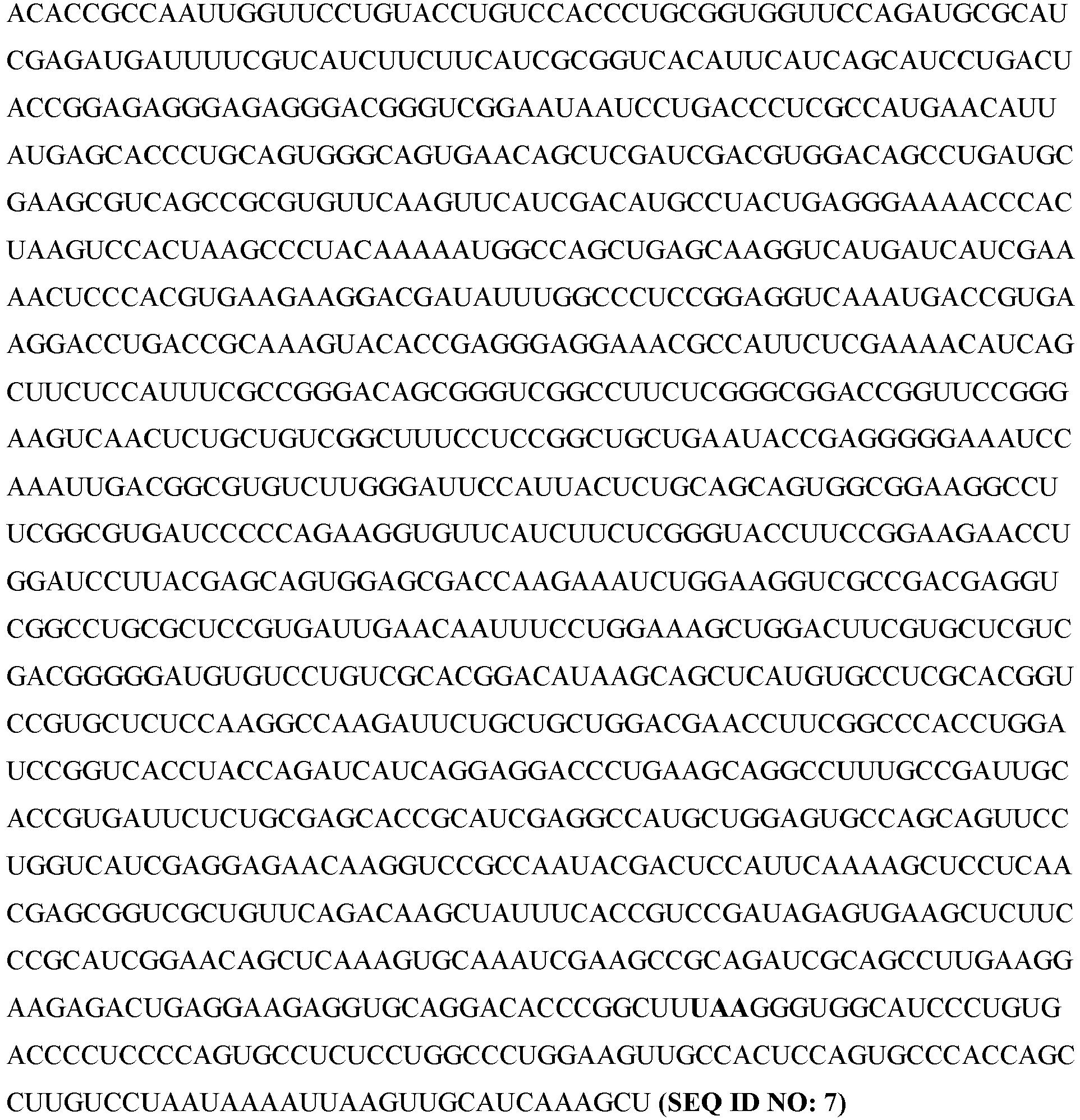
- An mRNA suitable for the present invention has a nucleotide sequence at least 90%, 91%, 92%, 93%, 94%, 95%, 96%, 97%, 98%, 99% or more identical SEQ ID NO: 1.
- mRNAs in the compositions for use according to the present invention may be synthesized according to any of a variety of known methods. For example, mRNAs may be synthesized via in vitro transcription (IVT). Briefly, IVT is typically performed with a linear or providing resistance to nucleases found in most eukaryotic cells. The presence of a "tail" serves to protect the mRNA from exonuclease degradation.
- Thus, mRNAs encoding CFTR include a 5' cap structure. A 5' cap is typically added as follows: first, an RNA terminal phosphatase removes one of the terminal phosphate groups from the 5' nucleotide, leaving two terminal phosphates; guanosine triphosphate (GTP) is then added to the terminal phosphates via a guanylyl transferase, producing a 5'5'5 triphosphate linkage; and the 7-nitrogen of guanine is then methylated by a methyltransferase. Examples of cap structures include, but are not limited to, m7G(5')ppp (5'(A,G(5')ppp(5')A and G(5')ppp(5')G. Additional cap structures are described in published
US Application No. US 2016/0032356 andU.S. Provisional Application 62/464,327, filed February 27, 2017 - Thus, mRNAs encoding CFTR include a 3' tail structure. Typically, a tail structure includes a poly(A) and/or poly(C) tail. A poly-A or poly-C tail on the 3' terminus of mRNA typically includes at least 50 adenosine or cytosine nucleotides, at least 150 adenosine or cytosine nucleotides, at least 200 adenosine or cytosine nucleotides, at least 250 adenosine or cytosine nucleotides, at least 300 adenosine or cytosine nucleotides, at least 350 adenosine or cytosine nucleotides, at least 400 adenosine or cytosine nucleotides, at least 450 adenosine or cytosine nucleotides, at least 500 adenosine or cytosine nucleotides, at least 550 adenosine or cytosine nucleotides, at least 600 adenosine or cytosine nucleotides, at least 650 adenosine or cytosine nucleotides, at least 700 adenosine or cytosine nucleotides, at least 750 adenosine or cytosine nucleotides, at least 800 adenosine or cytosine nucleotides, at least 850 adenosine or cytosine nucleotides, at least 900 adenosine or cytosine nucleotides, at least 950 adenosine or cytosine nucleotides, or at least 1 kb adenosine or cytosine nucleotides, respectively. In some embodiments, a poly-A or poly-C tail may be about 10 to 800 adenosine or cytosine nucleotides (e.g., about 10 to 200 adenosine or cytosine nucleotides, about 10 to 300 adenosine or cytosine nucleotides, about 10 to 400 adenosine or cytosine nucleotides, about 10 to 500 adenosine or cytosine nucleotides, about 10 to 550 adenosine or cytosine nucleotides, about 10 to 600 adenosine or cytosine nucleotides, about 50 to 600 adenosine or cytosine nucleotides, about 100 to 600 adenosine or cytosine nucleotides, about 150 to 600 adenosine or cytosine nucleotides, about 200 to 600 adenosine or cytosine nucleotides, about 250 to 600 adenosine or cytosine nucleotides, about 300 to 600 adenosine or cytosine nucleotides, about 350 to 600 adenosine or cytosine nucleotides, about 400 to 600 adenosine or cytosine nucleotides, about 450 to 600 adenosine or cytosine nucleotides, about 500 to 600 adenosine or cytosine nucleotides, about 10 to 150 adenosine or cytosine nucleotides, about 10 to 100 adenosine or cytosine nucleotides, about 20 to 70 adenosine or cytosine nucleotides, or about 20 to 60 adenosine or cytosine nucleotides) respectively. In some embodiments, a tail structure includes is a combination of poly(A) and poly(C) tails with various lengths described herein. In some embodiments, a tail structure includes at least 50%, 55%, 65%, 70%, 75%, 80%, 85%, 90%, 92%, 94%, 95%, 96%, 97%, 98%, or 99% adenosine nucleotides. In some embodiments, a tail structure includes at least 50%, 55%, 65%, 70%, 75%, 80%, 85%, 90%, 92%, 94%, 95%, 96%, 97%, 98%, or 99% cytosine nucleotides.
- A CFTR mRNA may contain only naturally-occurring nucleotides (or unmodified nucleotides). In some embodiments, however, a suitable CFTR mRNA may contain backbone modifications, sugar modifications and/or base modifications. For example, modified nucleotides may include, but not be limited to, modified purines (adenine (A), guanine (G)) or pyrimidines (thymine (T), cytosine (C), uracil (U)), and as modified nucleotides analogues or derivatives of purines and pyrimidines, such as e.g. 1-methyl-adenine, 2-methyl-adenine, 2-methylthio-N-6-isopentenyl-adenine, N6-methyl-adenine, N6-isopentenyl-adenine, 2-thio-cytosine, 3-methyl-cytosine, 4-acetyl-cytosine, 5-methyl-cytosine, 2,6-diaminopurine, 1-methyl-guanine, 2-methyl-guanine, 2,2-dimethyl-guanine, 7-methyl-guanine, inosine, 1-methyl-inosine, pseudouracil (5-uracil), dihydro-uracil, 2-thio-uracil, 4-thio-uracil, 5-carboxymethylaminomethyl-2-thio-uracil, 5-(carboxyhydroxymethyl)-uracil, 5-fluoro-uracil, 5-bromo-uracil, 5-carboxymethylaminomethyl-uracil, 5-methyl-2-thio-uracil, 5-methyl-uracil, N-uracil-5-oxyacetic acid methyl ester, 5-methylaminomethyl-uracil, 5-methoxyaminomethyl-2-thio-uracil, 5'-methoxycarbonylmethyl-uracil, 5-methoxy-uracil, uracil-5-oxyacetic acid methyl ester, uracil-5-oxyacetic acid (v), 1-methyl-pseudouracil, queosine, .beta.-D-mannosyl-queosine, wybutoxosine, and phosphoramidates, phosphorothioates, peptide nucleotides, methylphosphonates, 7-deazaguanosine, 5-methylcytosine and inosine. The preparation of such analogues is known to a person skilled in the art e.g., from the
U.S. Pat. No. 4,373,071 ,U.S. Pat. No. 4,401,796 ,U.S. Pat. No. 4,415,732 ,U.S. Pat. No. 4,458,066 ,U.S. Pat. No. 4,500,707 ,U.S. Pat. No. 4,668,777 ,U.S. Pat. No. 4,973,679 ,U.S. Pat. No. 5,047,524 ,U.S. Pat. No. 5,132,418 ,U.S. Pat. No. 5,153,319 ,U.S. Pat. Nos. 5,262,530 and5,700,642 . - In some embodiments, mRNAs encoding CFTR may contain RNA backbone modifications. Typically, a backbone modification is a modification in which the phosphates of the backbone of the nucleotides contained in the RNA are modified chemically. Exemplary backbone modifications typically include, but are not limited to, modifications from the group consisting of methylphosphonates, methylphosphoramidates, phosphoramidates, phosphorothioates (e.g. cytidine 5'-O-(1-thiophosphate)), boranophosphates, positively charged guanidinium groups etc., which means by replacing the phosphodiester linkage by other anionic, cationic or neutral groups.
- In some embodiments, mRNAs encoding CFTR may contain sugar modifications. A typical sugar modification is a chemical modification of the sugar of the nucleotides it contains including, but not limited to, sugar modifications chosen from the group consisting of 2'-deoxy-2'-fluoro-oligoribonucleotide (2'-fluoro-2'-deoxycytidine 5'-triphosphate, 2'-fluoro-2'-deoxyuridine 5'-triphosphate), 2'-deoxy-2'-deamine-oligoribonucleotide (2'-amino-2'-deoxycytidine 5'-triphosphate, 2'-amino-2'-deoxyuridine 5'-triphosphate), 2'-O-alkyloligoribonucleotide, 2'-deoxy-2'-C-alkyloligoribonucleotide (2'-O-methylcytidine 5'-triphosphate, 2'-methyluridine 5'-triphosphate), 2'-C-alkyloligoribonucleotide, and isomers thereof (2'-aracytidine 5'-triphosphate, 2'-arauridine 5'-triphosphate), or azidotriphosphates (2'-azido-2'-deoxycytidine 5'-triphosphate, 2'-azido-2'-deoxyuridine 5'-triphosphate).
- In some embodiments, mRNAs encoding CFTR are unmodified.
- According to the present invention, mRNA encoding a CFTR protein as described herein may be delivered as naked mRNA (unpackaged) or via delivery vehicles. As used herein, the terms "delivery vehicle," "transfer vehicle," "nanoparticle" or grammatical equivalent, are used interchangeably.
- Delivery vehicles can be formulated in combination with one or more additional nucleic acids, carriers, targeting ligands or stabilizing reagents, or in pharmacological compositions where it is mixed with suitable excipients. Techniques for formulation and administration of drugs may be found in "Remington's Pharmaceutical Sciences," Mack Publishing Co., Easton, Pa., latest edition. A particular delivery vehicle is selected based upon its ability to facilitate the transfection of a nucleic acid to a target cell.
- According to various embodiments, suitable delivery vehicles include, but are not limited to polymer based carriers, such as polyethyleneimine (PEI), lipid nanoparticles (LNPs) and liposomes, nanoliposomes, ceramide-containing nanoliposomes, proteoliposomes, both natural and synthetically-derived exosomes, natural, synthetic and semi-synthetic lamellar bodies, nanoparticulates, calcium phosphor-silicate nanoparticulates, calcium phosphate nanoparticulates, silicon dioxide nanoparticulates, nanocrystalline particulates, semiconductor nanoparticulates, poly(D-arginine), sol-gels, nanodendrimers, starch-based delivery systems, micelles, emulsions, niosomes, multi-domain-block polymers (vinyl polymers, polypropyl acrylic acid polymers, dynamic polyconjugates), dry powder formulations, plasmids, viruses, calcium phosphate nucleotides, aptamers, peptides and other vectorial tags.
- In some embodiments, a suitable delivery vehicle is a liposomal delivery vehicle, e.g., a lipid nanoparticle (LNP) or liposome. In some embodiments, liposomes may comprise one or more cationic lipids. In some embodiments, a liposome comprises one or more cationic lipids, one or more non-cationic lipids, one or more cholesterol-based lipids and one or more PEG-modified lipids. In some embodiments, a liposome comprises one or more cationic lipids, one or more non-cationic lipids, and one or more PEG-modified lipids. In some embodiments, a liposome comprises no more than four distinct lipid components. In some embodiments, a liposome comprises no more than three distinct lipid components. In some embodiments, one distinct lipid component is a sterol-based cationic lipid.
- As used herein, the term "cationic lipids" refers to any of a number of lipid and lipidoid species that have a net positive charge at a selected pH, such as at physiological pH. Several cationic lipids have been described in the literature, many of which are commercially available.
- Suitable cationic lipids for use in the compositions described herein include the cationic lipids as described in International Patent Publication
WO 2010/144740 . In certain embodiments, the compositions of the present invention include a cationic lipid, (6Z,9Z,28Z,31Z)-heptatriaconta-6,9,28,31-tetraen-19-yl 4-(dimethylamino) butanoate, having a compound structure of:
- Other suitable cationic lipids for use in the compositions of the present invention include ionizable cationic lipids as described in International Patent Publication
WO 2013/149140 . In some embodiments, the compositions of the present invention include a cationic lipid of one of the following formulas:


- Other suitable cationic lipids for use in the compositions of the invention include cationic lipids described as aminoalcohol lipidoids in International Patent Publication
WO 2010/053572 . In certain embodiments, the compositions of the present invention include a cationic lipid having a compound structure of:
- Other suitable cationic lipids for use in the compositions of the invention include the cationic lipids as described in International Patent Publication
WO 2016/118725 . In certain embodiments, the compositions of the present invention include a cationic lipid having a compound structure of:
- Other suitable cationic lipids for use in the compositions of the invention include the cationic lipids as described in International Patent Publication
WO 2016/118724 . In certain embodiments, the compositions of the present invention include a cationic lipid having a compound structure of:
- Other suitable cationic lipids for use in the compositions of the invention include a cationic lipid having the formula of 14,25-
ditridecyl 15,18,21,24-tetraaza-octatriacontane, and pharmaceutically acceptable salts thereof. - Other suitable cationic lipids for use in the compositions of the invention include the cationic lipids as described in International Patent Publications
WO 2013/063468 andWO 2016/205691 . In some embodiments, the compositions of the present invention include a cationic lipid of the following formula:


- Other suitable cationic lipids for use in the compositions of the invention include the cationic lipids as described in International Patent Publication
WO 2015/184256 . In some embodiments, the compositions of the present invention include a cationic lipid of the following formula:

- Other suitable cationic lipids for use in the compositions of the invention include the cationic lipids as described in
International Patent Publication WO 2016/004202 . In some embodiments, the compositions of the present invention include a cationic lipid having the compound structure:


- Other suitable cationic lipids for use in the compositions of the present invention include the cationic lipids as described in J. McClellan, M. C. King, Cell 2010, 141, 210-217 and in Whitehead et al., Nature Communications (2014) 5:4277. In certain embodiments, the cationic lipids of the compositions of the present invention include a cationic lipid having a compound structure of:

- Other suitable cationic lipids for use in the compositions of the invention include the cationic lipids as described in International Patent Publication
WO 2015/199952 . In some embodiments, the compositions of the present invention include a cationic lipid having the compound structure:


- Other suitable cationic lipids for use in the compositions of the invention include the cationic lipids as described in International Patent Publication
WO 2017/004143 . In some embodiments, the compositions of the present invention include a cationic lipid having the compound structure:
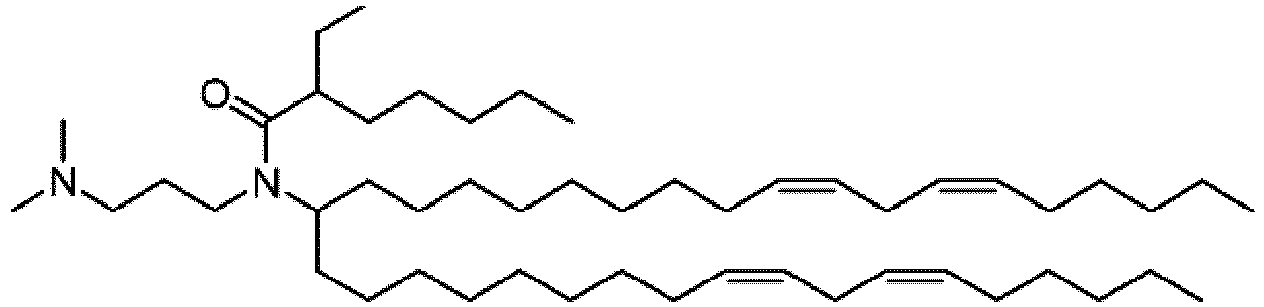


- Other suitable cationic lipids for use in the compositions of the invention include the cationic lipids as described in International Patent Publication
WO 2017/075531 . In some embodiments, the compositions of the present invention include a cationic lipid of the following formula:
- Other suitable cationic lipids for use in the compositions of the invention include the cationic lipids as described in International Patent Publication
WO 2017/117528 . In some embodiments, the compositions of the present invention include a cationic lipid having the compound structure:


- Other suitable cationic lipids for use in the compositions of the invention include the cationic lipids as described in International Patent Publication
WO 2017/049245 . In some embodiments, the cationic lipids of the compositions of the present invention include a compound of one of the following formulas:


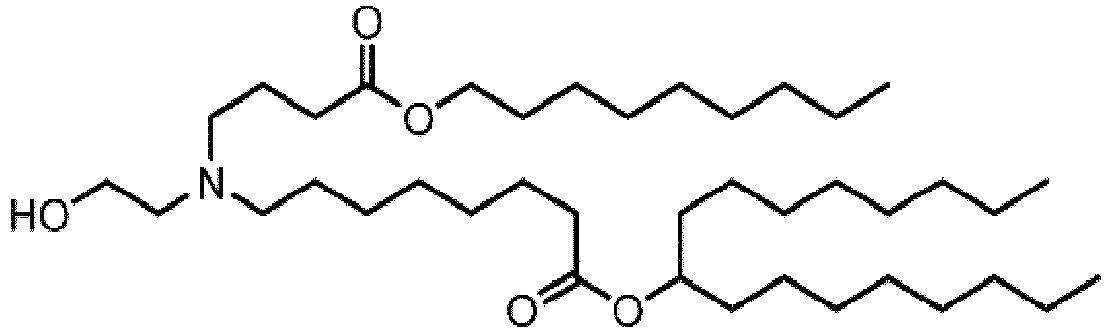
- Other suitable cationic lipids for use in the compositions of the invention include the cationic lipids as described in International Patent Publication
WO 2017/173054 andWO 2015/095340 . In certain embodiments, the compositions of the present invention include a cationic lipid having a compound structure of:


- Other suitable cationic lipids for use in the compositions of the present invention include cleavable cationic lipids as described in International Patent Publication
WO 2012/170889 . In some embodiments, the compositions of the present invention include a cationic lipid of the following formula:


- In some embodiments, the compositions of the present invention include the cationic lipid, N-[l-(2,3-dioleyloxy)propyl]-N,N,N-trimethylammonium chloride ("DOTMA"). (Feigner et al. (Proc. Nat'l Acad. Sci. 84, 7413 (1987);
U.S. Pat. No. 4,897,355 ). Other cationic lipids suitable for the compositions of the present invention include, for example, 5-carboxyspermylglycinedioctadecylamide ("DOGS"); 2,3-dioleyloxy-N-[2(spermine-carboxamido)ethyl]-N,N-dimethyl-1-propanaminium ("DOSPA") (Behr et al. Proc. Nat.'l Acad. Sci. 86, 6982 (1989),U.S. Pat. No. 5,171,678 ;U.S. Pat. No. 5,334,761 ); l,2-Dioleoyl-3-Dimethylammonium-Propane ("DODAP"); l,2-Dioleoyl-3-Trimethylammonium-Propane ("DOTAP"). - Additional exemplary cationic lipids suitable for the compositions of the present invention also include: l,2-distearyloxy-N,N-dimethyl-3-aminopropane ( "DSDMA"); 1,2-dioleyloxy-N,N-dimethyl-3-aminopropane ("DODMA"); 1 ,2-dilinoleyloxy-N,N-dimethyl-3-aminopropane ("DLinDMA"); l,2-dilinolenyloxy-N,N-dimethyl-3-aminopropane ("DLenDMA"); N-dioleyl-N,N-dimethylammonium chloride ("DODAC"); N,N-distearyl-N,N-dimethylarnrnonium bromide ("DDAB"); N-(l,2-dimyristyloxyprop-3-yl)-N,N-dimethyl-N-hydroxyethyl ammonium bromide ("DMRIE"); 3-dimethylamino-2-(cholest-5-en-3-beta-oxybutan-4-oxy)-l-(cis,cis-9,12-octadecadienoxy)propane ("CLinDMA"); 2-[5'-(cholest-5-en-3-beta-oxy)-3'-oxapentoxy)-3-dimethy l-l-(cis,cis-9', l-2'-octadecadienoxy)propane ("CpLinDMA"); N,N-dimethyl-3,4-dioleyloxybenzylamine ("DMOBA"); 1 ,2-N,N'-dioleylcarbamyl-3-dimethylaminopropane ("DOcarbDAP"); 2,3-Dilinoleoyloxy-N,N-dimethylpropylamine ("DLinDAP"); l,2-N,N'-Dilinoleylcarbamyl-3-dimethylaminopropane ("DLincarbDAP"); l ,2-Dilinoleoylcarbamyl-3-dimethylaminopropane ("DLinCDAP"); 2,2-dilinoleyl-4-dimethylaminomethyl-[l,3]-dioxolane("DLin-K-DMA"); 2-((8-[(3P)-cholest-5-en-3-yloxy]octyl)oxy)-N, N-dimethyl-3-[(9Z, 12Z)-octadeca-9, 12-dien-1 -yloxy]propane-1-amine ("Octyl-CLinDMA"); (2R)-2-((8-[(3beta)-cholest-5-en-3-yloxy]octyl)oxy)-N, N-dimethyl-3-[(9Z, 12Z)-octadeca-9, 12-dien-1-yloxy]propan-1 -amine ("Octyl-CLinDMA (2R)"); (2S)-2-((8-[(3P)-cholest-5-en-3-yloxy]octyl)oxy)-N, fsl-dimethyh3-[(9Z, 12Z)-octadeca-9, 12-dien-1 - yloxy]propan-1 -amine ("Octyl-CLinDMA (2S)"); 2,2-dilinoleyl-4-dimethylaminoethyl-[l,3]-dioxolane ("DLin-K-XTC2-DMA"); and 2-(2,2-di((9Z,12Z)-octadeca-9,l 2-dien- 1-yl)-l ,3-dioxolan-4-yl)-N,N-dimethylethanamine ("DLin-KC2-DMA") (see,
WO 2010/042877 ; Semple et al., Nature Biotech. 28: 172-176 (2010)). (Heyes, J., et al., J Controlled Release 107: 276-287 (2005); Morrissey, DV., et al., Nat. Biotechnol. 23(8): 1003-1007 (2005);International Patent Publication WO 2005/121348 ). In some embodiments, one or more of the cationic lipids comprise at least one of an imidazole, dialkylamino, or guanidinium moiety. - In some embodiments, one or more cationic lipids suitable for the compositions of the present invention include 2,2-Dilinoley1-4-dimethylaminoethy1-[1,3]-dioxolane ("XTC"); (3aR,5s,6aS)-N,N-dimethyl-2,2-di((9Z,12Z)-octadeca-9,12-dienyl)tetrahydro-3aH-cyclopenta[d] [1 ,3]dioxol-5-amine ("ALNY-100") and/or 4,7,13-tris(3-oxo-3-(undecylamino)propyl)-N1,N16-diundecyl-4,7,10,13-tetraazahexadecane-1,16-diamide ("NC98-5").
- In some embodiments, the compositions of the present invention include one or more cationic lipids that constitute at least about 5%, 10%, 20%, 30%, 35%, 40%, 45%, 50%, 55%, 60%, 65%, or 70%, measured by weight, of the total lipid content in the composition, e.g., a lipid nanoparticle. In some embodiments, the compositions of the present invention include one or more cationic lipids that constitute at least about 5%, 10%, 20%, 30%, 35%, 40%, 45%, 50%, 55%, 60%, 65%, or 70%, measured as a mol %, of the total lipid content in the composition, e.g., a lipid nanoparticle. In some embodiments, the compositions of the present invention include one or more cationic lipids that constitute about 30-70 % (e.g., about 30-65%, about 30-60%, about 30-55%, about 30-50%, about 30-45%, about 30-40%, about 35-50%, about 35-45%, or about 35-40%), measured by weight, of the total lipid content in the composition, e.g., a lipid nanoparticle. In some embodiments, the compositions of the present invention include one or more cationic lipids that constitute about 30-70 % (e.g., about 30-65%, about 30-60%, about 30-55%, about 30-50%, about 30-45%, about 30-40%, about 35-50%, about 35-45%, or about 35-40%), measured as mol %, of the total lipid content in the composition, e.g., a lipid nanoparticle
- In some embodiments, sterol-based cationic lipids may be use instead or in addition to cationic lipids described herein. Suitable sterol-based cationic lipids are dialkylamino-, imidazole-, and guanidinium-containing sterol-based cationic lipids. For example, certain embodiments are directed to a composition comprising one or more sterol-based cationic lipids comprising an imidazole, for example, the imidazole cholesterol ester or "ICE" lipid (3S, 10R, 13R, 17R)-10, 13-dimethyl-17-((R)-6-methylheptan-2-yl)-2, 3, 4, 7, 8, 9, 10, 11, 12, 13, 14, 15, 16, 17-tetradecahydro-1H-cyclopenta[a]phenanthren-3-yl 3-(1H-imidazol-4-yl)propanoate, as represented by structure (I) below. In certain embodiments, a lipid nanoparticle for delivery of RNA (e.g., mRNA) encoding a functional protein may comprise one or more imidazole-based cationic lipids, for example, the imidazole cholesterol ester or "ICE" lipid (3S, 10R, 13R, 17R)-10, 13-dimethyl-17-((R)-6-methylheptan-2-yl)-2, 3, 4, 7, 8, 9, 10, 11, 12, 13, 14, 15, 16, 17-tetradecahydro-1H-cyclopenta[a]phenanthren-3-yl 3-(1H-imidazol-4-yl)propanoate, as represented by the following structure:

- In some embodiments, the percentage of cationic lipid in a liposome may be greater than 10%, greater than 20%, greater than 30%, greater than 40%, greater than 50%, greater than 60%, or greater than 70%. In some embodiments, cationic lipid(s) constitute(s) about 30-50 % (e.g., about 30-45%, about 30-40%, about 35-50%, about 35-45%, or about 35-40%) of the liposome by weight. In some embodiments, the cationic lipid (e.g., ICE lipid) constitutes about 30%, about 35%, about 40 %, about 45%, or about 50% of the liposome by molar ratio.
- As used herein, the phrase "non-cationic lipid" refers to any neutral, zwitterionic or anionic lipid. As used herein, the phrase "anionic lipid" refers to any of a number of lipid species that carry a net negative charge at a selected H, such as physiological pH. Non-cationic lipids include, but are not limited to, distearoylphosphatidylcholine (DSPC), dioleoylphosphatidylcholine (DOPC), dipalmitoylphosphatidylcholine (DPPC), dioleoylphosphatidylglycerol (DOPG), dipalmitoylphosphatidylglycerol (DPPG), dioleoylphosphatidylethanolamine (DOPE), palmitoyloleoylphosphatidylcholine (POPC), palmitoyloleoyl-phosphatidylethanolamine (POPE), dioleoyl-phosphatidylethanolamine 4-(N-maleimidomethyl)-cyclohexane-l-carboxylate (DOPE-mal), dipalmitoyl phosphatidyl ethanolamine (DPPE), dimyristoylphosphoethanolamine (DMPE), distearoyl-phosphatidylethanolamine (DSPE), phosphatidylserine, sphingolipids, cerebrosides, gangliosides, 16-0-monomethyl PE, 16-O-dimethyl PE, 18-1-trans PE, l-stearoyl-2-oleoyl-phosphatidyethanolamine (SOPE), or a mixture thereof.
- In some embodiments, such non-cationic lipids may be used alone, but are preferably used in combination with other lipids, for example, cationic lipids. In some embodiments, the non-cationic lipid may comprise a molar ratio of about 5% to about 90%, or about 10 % to about 70% of the total lipid present in a liposome. In some embodiments, a non-cationic lipid is a neutral lipid, i.e., a lipid that does not carry a net charge in the conditions under which the composition is formulated and/or administered. In some embodiments, the percentage of non-cationic lipid in a liposome may be greater than 5%, greater than 10%, greater than 20%, greater than 30%, or greater than 40%.
- Suitable cholesterol-based cationic lipids include, for example, DC-Choi (N,N-dimethyl-N-ethylcarboxamidocholesterol), l,4-bis(3-N-oleylamino-propyl)piperazine (Gao, et al. Biochem. Biophys. Res. Comm. 179, 280 (1991); Wolf et al. BioTechniques 23, 139 (1997);
U.S. Pat. No. 5,744,335 ), or ICE. In some embodiments, the cholesterol-based lipid may comprise a molar ration of about 2% to about 30%, or about 5% to about 20% of the total lipid present in a liposome. In some embodiments, the percentage of cholesterol-based lipid in the lipid nanoparticle may be greater than 5%, greater than 10%, greater than 20%, greater than 30%, or greater than 40%. - The use of polyethylene glycol (PEG)-modified phospholipids and derivatized lipids such as derivatized cerarmides (PEG-CER), including N-Octanoyl-Sphingosine-1-[Succinyl(Methoxy Polyethylene Glycol)-2000] (C8 PEG-2000 ceramide) is also contemplated by the present invention, either alone or preferably in combination with other lipid formulations together which comprise the transfer vehicle (e.g., a lipid nanoparticle). Contemplated PEG-modified lipids include, but are not limited to, a polyethylene glycol chain of up to S kDa in length covalently attached to a lipid with alkyl chain(s) of C6-C20 length. The addition of such components may prevent complex aggregation and may also provide a means for increasing circulation lifetime and increasing the delivery of the lipid-nucleic acid composition to the target tissues, (Klibanov et al. (1990) FEBS Letters, 268 (1): 235-237), or they may be selected to rapidly exchange out of the formulation in vivo (see
U.S. Pat. No. 5,885,613 ). Particularly useful exchangeable lipids are PEG-ceramides having shorter acyl chains (e.g., C14 or C18). The PEG-modified phospholipid and derivitized lipids of the present invention may comprise a molar ratio from about 0% to about 20%, about 0.5% to about 20%, about 1% to about 15%, about 4% to about 10%, or about 2% of the total lipid present in the liposomal transfer vehicle. - According to various embodiments, the selection of cationic lipids, non-cationic lipids and/or PEG-modified lipids which comprise the lipid nanoparticle, as well as the relative molar ratio of such lipids to each other, is based upon the characteristics of the selected lipid(s), the nature of the intended target cells, the characteristics of the mRNA to be delivered. Additional considerations include, for example, the saturation of the alkyl chain, as well as the size, charge, pH, pKa, fusogenicity and toxicity of the selected lipid(s). Thus the molar ratios may be adjusted accordingly.
- In some embodiments, a suitable delivery vehicle is formulated using a polymer as a carrier, alone or in combination with other carriers including various lipids described herein. Thus, in some embodiments, liposomal delivery vehicles, as used herein, also encompass nanoparticles comprising polymers. Suitable polymers may include, for example, polyacrylates, polyalkycyanoacrylates, polylactide, polylactide-polyglycolide copolymers, polycaprolactones, dextran, albumin, gelatin, alginate, collagen, chitosan, cyclodextrins, protamine, PEGylated protamine, PLL, PEGylated PLL and polyethylenimine (PEI). When PEI is present, it may be branched PEI of a molecular weight ranging from 10 to 40 kDa, e.g., 25 kDa branched PEI (Sigma #408727).
- A suitable liposome for use with the present invention may include one or more of any of the cationic lipids, non-cationic lipids, cholesterol lipids, PEG-modified lipids and/or polymers described herein at various ratios. As non-limiting examples, a suitable liposome formulation may include a combination selected from cKK-E12, DOPE, cholesterol and DMG-PEG2K; C12-200, DOPE, cholesterol and DMG-PEG2K; HGT4003, DOPE, cholesterol and DMG-PEG2K; ICE, DOPE, cholesterol and DMG-PEG2K; or ICE, DOPE, and DMG-PEG2K.
- In various embodiments, cationic lipids (e.g., cKK-E12, C12-200, ICE, and/or HGT4003) constitute about 30-60 % (e.g., about 30-55%, about 30-50%, about 30-45%, about 30-40%, about 35-50%, about 35-45%, or about 35-40%) of the liposome by molar ratio. In some embodiments, the percentage of cationic lipids (e.g., cKK-E12, C12-200, ICE, and/or HGT4003) is or greater than about 30%, about 35%, about 40 %, about 45%, about 50%, about 55%, or about 60% of the liposome by molar ratio.
- In some embodiments, the ratio of cationic lipid(s) to non-cationic lipid(s) to cholesterol-based lipid(s) to PEG-modified lipid(s) may be between about 30-60:25-35:20-30:1-15, respectively. In some embodiments, the ratio of cationic lipid(s) to non-cationic lipid(s) to cholesterol-based lipid(s) to PEG-modified lipid(s) is approximately 40:30:20:10, respectively. In some embodiments, the ratio of cationic lipid(s) to non-cationic lipid(s) to cholesterol-based lipid(s) to PEG-modified lipid(s) is approximately 40:30:25:5, respectively. In some embodiments, the ratio of cationic lipid(s) to non-cationic lipid(s) to cholesterol-based lipid(s) to PEG-modified lipid(s) is approximately 40:32:25:3, respectively. In some embodiments, the ratio of cationic lipid(s) to non-cationic lipid(s) to cholesterol-based lipid(s) to PEG-modified lipid(s) is approximately 50:25:20:5. In some embodiments, the ratio of sterol lipid(s) to non-cationic lipid(s) to PEG-modified lipid(s) is 50:45:5. In some embodiments, the ratio of sterol lipid(s) to non-cationic lipid(s) to PEG-modified lipid(s) is 50:40: 10. In some embodiments, the ratio of sterol lipid(s) to non-cationic lipid(s) to PEG-modified lipid(s) is 55:40:5. In some embodiments, the ratio of sterol lipid(s) to non-cationic lipid(s) to PEG-modified lipid(s) is 55:35:10. In some embodiments, the ratio of sterol lipid(s) to non-cationic lipid(s) to PEG-modified lipid(s) is 60:35:5. In some embodiments, the ratio of sterol lipid(s) to non-cationic lipid(s) to PEG-modified lipid(s) is 60:30:10.
- In some embodiments, a suitable liposome for use with the present invention comprises ICE and DOPE at an ICE:DOPE molar ratio of >1:1. In some embodiments, the ICE:DOPE molar ratio is <2.5:1. In some embodiments, the ICE:DOPE molar ratio is between 1:1 and 2.5:1. In some embodiments, the ICE:DOPE molar ratio is approximately 1.5:1. In some embodiments, the ICE:DOPE molar ratio is approximately 1.7:1. In some embodiments, the ICE:DOPE molar ratio is approximately 2:1. In some embodiments, a suitable liposome for use with the present invention comprises ICE and DMG-PEG-2K at an ICE:DMG-PEG-2K molar ratio of >10:1. In some embodiments, the ICE:DMG-PEG-2K molar ratio is <16:1. In some embodiments, the ICE:DMG-PEG-2K molar ratio is approximately 12:1. In some embodiments, the ICE:DMG-PEG-2K molar ratio is approximately 14:1. In some embodiments, a suitable liposome for use with the present invention comprises DOPE and DMG-PEG-2K at a DOPE: DMG-PEG-2K molar ratio of >5:1. In some embodiments, the DOPE: DMG-PEG-2K molar ratio is <11:1. In some embodiments, the DOPE: DMG-PEG-2K molar ratio is approximately 7:1. In some embodiments, the DOPE: DMG-PEG-2K molar ratio is approximately 10:1. In some embodiments, a suitable liposome for use with the present invention comprises ICE, DOPE and DMG-PEG-2K at an ICE:DOPE:DMG-PEG-2K molar ratio of 50:45:5. In some embodiments, a suitable liposome for use with the present invention comprises ICE, DOPE and DMG-PEG-2K at an ICE:DOPE:DMG-PEG-2K molar ratio of 50:40:10. In some embodiments, a suitable liposome for use with the present invention comprises ICE, DOPE and DMG-PEG-2K at an ICE:DOPE:DMG-PEG-2K molar ratio of 55:40:5. In some embodiments, a suitable liposome for use with the present invention comprises ICE, DOPE and DMG-PEG-2K at an ICE:DOPE:DMG-PEG-2K molar ratio of 55:35:10. In some embodiments, a suitable liposome for use with the present invention comprises ICE, DOPE and DMG-PEG-2K at an ICE:DOPE:DMG-PEG-2K molar ratio of 60:35:5. In some embodiments, a suitable liposome for use with the present invention comprises ICE, DOPE and DMG-PEG-2K at an ICE:DOPE:DMG-PEG-2K molar ratio of 60:30: 10.
- The liposomal transfer vehicles for use in the invention can be prepared by various techniques which are presently known in the art. Various methods are described in published U.S. Application No.
US 2011/0244026 , published U.S. Application No.US 2016/0038432 and provisionalU.S. Application No. 62/580,155, filed November 1, 2017 - Briefly, the process of preparing CFTR-mRNA lipid nanoparticles includes a step of heating a first set of one or more solutions with a first set of one or more solutions (i.e., applying heat from a heat source to the solutions) to a temperature (or to maintain at a temperature) greater than ambient temperature. The first set of one more solutions can include a non-aqueous solution comprising the lipids used to form the lipid nanoparticle, and/or a solution comprising pre-formed lipid nanoparticles. The second set of one or more solutions can include an aqueous solution of the CFTR mRNA and/or a solution comprising the lipid nanoparticle encapsulated mRNA. In certain instances, the process includes a step of heating to a temperature (or to maintain at a temperature) greater than ambient temperature a first solution comprising pre-formed lipid nanoparticles with a second aqueous solution comprising CFTR mRNA In some instances, the process includes the step of heating one or both of the mRNA solution and the pre-formed lipid nanoparticle solution, prior to the mixing step. In some instances, the process includes heating one or more one or more of the solution comprising the pre-formed lipid nanoparticles, the solution comprising the mRNA and the solution comprising the lipid nanoparticle encapsulated mRNA, during the mixing step. In some instances, the process includes the step of heating the lipid nanoparticle encapsulated mRNA, after the mixing step. In some instances, the temperature to which one or more of the solutions is heated (or at which one or more of the solutions is maintained) is or is greater than about 30 °C, 37 °C, 40 °C, 45 °C, 50 °C, 55 °C, 60 °C, 65 °C, or 70 °C. In some instances, the temperature to which one or more of the solutions is heated ranges from about 25-70 °C, about 30-70 °C, about 35-70 °C, about 40-70 °C, about 45-70 °C, about 50-70 °C, or about 60-70 °C. In some instances, the temperature greater than ambient temperature to which one or more of the solutions is heated is about 65 °C.
- To facilitate expression of mRNA in vivo, delivery vehicles such as liposomes can be formulated in combination with one or more additional nucleic acids, carriers, targeting ligands or stabilizing reagents, or in pharmacological compositions where it is mixed with suitable excipients. Techniques for formulation and administration of drugs may be found in "Remington's Pharmaceutical Sciences," Mack Publishing Co., Easton, Pa., latest edition.
- As used herein, the term "therapeutically effective amount" is largely determined based on the total amount of the therapeutic agent contained in a pharmaceutical compositions. Generally, a therapeutically effective amount is sufficient to achieve a meaningful benefit to the subject (e.g., treating, modulating, curing, preventing and/or ameliorating cystic fibrosis). For example, a therapeutically effective amount may be an amount sufficient to achieve a desired therapeutic and/or prophylactic effect.
- In accordance with the invention, the composition comprising an mRNA encoding CFTR comprises mRNA at a concentration of at least 0.4 mg/mL. In some embodiments, the mRNA encoding a CFTR protein is at a concentration of at least 0.5 mg/mL. In some embodiments, the mRNA encoding a CFTR protein is at a concentration of at least 0.6 mg/mL. In some embodiments, the mRNA encoding a CFTR protein is at a concentration of at least 0.7 mg/mL. In some embodiments, the mRNA encoding a CFTR protein is at a concentration of at least 0.8 mg/mL. In some embodiments, the mRNA encoding a CFTR protein is at a concentration of at least 0.9 mg/mL. In some embodiments, the mRNA encoding a CFTR protein is at a concentration of at least 1.0 mg/mL. In some embodiments, the mRNA encoding a CFTR protein is at a concentration of at least 2.0 mg/mL. In some embodiments, the mRNA encoding a CFTR protein is at a concentration of at least 3.0 mg/mL. In some embodiments, the mRNA encoding a CFTR protein is at a concentration of at least 4.0 mg/mL. In some embodiments, the mRNA encoding a CFTR protein is at a concentration of at least 5.0 mg/mL. In some embodiments, the mRNA encoding a CFTR protein is at a concentration of at least 6.0 mg/mL. In some embodiments, the mRNA encoding a CFTR protein is at a concentration of at least 7.0 mg/mL. In some embodiments, the mRNA encoding a CFTR protein is at a concentration of at least 8.0 mg/mL. In some embodiments, the mRNA encoding a CFTR protein is at a concentration of at least 9.0 mg/mL. In some embodiments, the mRNA encoding a CFTR protein is at a concentration of at least 10.0 mg/mL. In some embodiments, the mRNA encoding a CFTR protein is at a concentration ranging from 0.1 mg/mL to 10.0 mg/mL.
- The composition comprising the mRNA encoding CFTR is formulated with a diluent selected from the group consisting of DMSO, ethylene glycol, glycerol, 2-Methyl-2,4-pentanediol (MPD), propylene glycol, sucrose, and trehalose. In some embodiments, the formulation comprises 1%, 2%, 3%, 4%, 5%, 6%, 7%, 8%, 9%, 10%, 11%, 12%, 13%, 14%, 15%, 16%, 17%, 18%, 19% or 20% diluent.
- A CFTR mRNA for use with the present invention is formulated for pulmonary delivery. As used herein, pulmonary delivery refers to delivery to lung via, e.g., nasal cavity, trachea, bronchi, bronchioles, and/or other pulmonary system. In particular embodiments, a CFTR mRNA is formulated for nebulization. In these embodiments, the delivery vehicle may be in an aerosolized composition which can be inhaled.
- In some embodiments, CFTR mRNA dry powder is formed by lyophilization of the mRNA-lipid complex (see
U. S. patent 9,717,690 - In certain embodiments, the pharmaceutical compositions comprising lyophilized nanoparticles or lipid nanoparticle delivery vehicles are characterized as being stable (e.g., as stable as pharmaceutical compositions comprising an equivalent unlyophilized vehicles). Lyophilization of the lipid nanoparticles does not appreciably change or alter the particle size of the lipid nanoparticles following lyophilization and/or reconstitution. For example, disclosed herein are pharmaceutical compositions comprising lyophilized lipid delivery vehicles, wherein upon reconstitution (e.g., with purified water) the lipid nanoparticles do not flocculate or aggregate, or alternatively demonstrated limited or negligible flocculation or aggregation (e.g., as determined by the particle size of the reconstituted lipid nanoparticles).
- Accordingly, in certain embodiments, upon reconstitution of a lyophilized lipid nanoparticle the lipid nanoparticles have a Dv50 of less than about 500 nm (e.g., less than about 300 nm, 200 nm, 150 nm, 125 nm, 120 nm, 100 nm, 75 nm, 50 nm, 25 nm, or smaller). Similarly, in certain embodiments, upon reconstitution of a lyophilized lipid nanoparticle the lipid nanoparticles have a Dv90 of less than about 750 nm (e.g., less than about 700 nm, 500 nm, 300 nm, 200 nm, 150 nm, 125 nm, 100 nm, 75 nm, 50 nm, 25 nm, or smaller).
- In other embodiments, the pharmaceutical compositions comprising lyophilized lipid delivery vehicles are characterized as having a polydispersion index of less than about 1 (e.g., less than 0.95, 0.9, 0.8, 0.75, 0.7, 0.6, 0.5, 0.4, 0.3, 0.25, 0.2, 0.1, 0.05, or less). In some embodiments, the pharmaceutical compositions comprising lyophilized lipid delivery vehicles demonstrate a reduced tendency to flocculate or otherwise aggregate (e.g., during lyophilization or upon reconstitution). For example, upon reconstitution the lipid delivery vehicles may have an average particle size (Zave) of less than 500 nm (e.g., less than about 400 nm, 300 nm, 200 nm, 175 nm, 150 nm, 125 nm, 100 nm, 75 nm, 50 nm, 25 nm, or smaller in a PBS solution).
- In some embodiments, the lyophilized lipid delivery vehicles (e.g., lyophilized lipid nanoparticles) further comprise or are alternatively prepared using one or more lyoprotectants (e.g., sugars and/or carbohydrates). In certain embodiments, the inclusion of one or more lyoprotectants in the lipid nanoparticle may improve or otherwise enhance the stability of the lyophilized lipid delivery vehicles (e.g., under normal storage conditions) and/or facilitate reconstitution of the lyophilized lipid delivery vehicles using a rehydration media, thereby preparing an aqueous formulation. For example, in certain embodiments, the lipid nanoparticles are prepared and prior to lyophilization the buffer present in the liposomal formulation may be replaced (e.g., via centrifugation) with a lyoprotectant such as a sucrose solution or suspension (e.g., an aqueous solution comprising between about 1-50% or 10-25% sucrose). In some embodiments, the lyoprotectant is trehalose. In some embodiments, the lyoprotectant comprises 10-50%, or 10-25% or 10-20% or 10-15% trehalose. Other lyoprotectants that may be used to prepare the lyophilized compositions described herein include, for example, dextran (e.g., 1.5 kDa, 5 kDa and/or 40 kDa) and inulin (e.g., 1.8 kDa and/or 4 kDa). The lyophilized lipid delivery vehicles have an encapsulation efficiency of greater than about 80%.
- A pharmaceutical composition comprising a lyophilized lipid nanoparticle comprising CFTR-encoding mRNA is stable at 4°C for at least 1 month, at least 2 months, at least 3 months, at least 4 months, at least 5 months, at least 6 months, or for at least 1 year. In some embodiments, the lyophilized lipid delivery vehicles may be stored under refrigeration and remain stable (e.g., as demonstrated by minimal or no losses in their intended pharmaceutical or biological activity) for extended periods of time (e.g., stable for at least about 1, 2, 3, 4, 5, 6, 9, 12, 18, 24, 36 months or longer upon storage at about 4°C). In other embodiments, the lyophilized lipid delivery vehicles may be stored without refrigeration and remain stable for extended periods of time (e.g., stable for at least about 1, 2, 3, 4, 5, 6, 9, 12, 18, 24, 36 months or longer upon storage at about 25°C).
- The pharmaceutical composition in lyophilized form can be stored in frozen condition for 1, 2, 3, 4, 5 or 10 years without loss of pharmacological or biological activity.
- Accordingly, also contemplated herein are compositions for use in treating disease in a subject by administering an effective amount of pharmaceutical compositions comprising lyophilized CFTR mRNA- lipid delivery vehicles to a subject (e.g., upon reconstitution with a rehydrating media such as sterile water for injection).
- In some embodiments, the formulation is administered by a metered-dose inhaler.
- In some embodiments, the formulation is administered by a nebulizer.
- Suitable CFTR mRNA formulation for nebulization may be stored as a frozen liquid, or sterile liquid, or lyophilized or dry powder and reconstituted prior to nebulization. In some embodiments, the composition is stored in a single-use vial prior to nebulization. In some embodiments, the single-use vial comprises 50 mL or less of the composition. In some embodiments, the single-use vial comprises 40 mL or less of the composition. In some embodiments, the single-use vial comprises 30 mL or less of the composition. In some embodiments, the single-use vial comprises 20 mL or less of the composition. In some embodiments, the single-use vial comprises 10 mL or less of the composition. In some embodiments, the single-use vial comprises 9.0 mL or less of the composition. In some embodiments, the single-use vial comprises 8.0 mL or less of the composition. In some embodiments, the single-use vial comprises 7.0 mL or less of the composition. In some embodiments, the single-use vial comprises 6.0 mL or less of the composition. In some embodiments, the single-use vial comprises 5.0 mL or less of the composition. In some embodiments, the single-use vial comprises between 4.0 mL and 5.0 mL of the composition. In some embodiments, the single-use vial comprises 3.2 mL of the composition.
- In this invention, pulmonary delivery involves inhalation (e.g., for nasal, tracheal, or bronchial delivery). In some embodiments, the CFTR mRNA formulation is nebulized prior to inhalation. Nebulization can be achieved by any nebulizer known in the art. A nebulizer transforms a liquid to a mist so that it can be inhaled more easily into the lungs. Nebulizers are effective for infants, children and adults. Nebulizers are able to nebulize large doses of inhaled medications. One type of nebulizer is a jet nebulizer, which comprises tubing connected to a compressor, which causes compressed air or oxygen to flow at a high velocity through a liquid medicine to turn it into an aerosol, which is then inhaled by the patient. Another type of nebulizer is the ultrasonic wave nebulizer, which comprises an electronic oscillator that generates a high frequency ultrasonic wave, which causes the mechanical vibration of a piezoelectric element, which is in contact with a liquid reservoir. The high frequency vibration of the liquid is sufficient to produce a vapor mist. Exemplary ultrasonic wave nebulizers are the Omron NF-Ul7 and the Beurer Nebulizer IH30. A third type of nebulizer comprises vibrating mesh technology (VMT). VMT comprises mesh/membrane with 1000-7000 holes that vibrates at the top of a liquid reservoir and thereby pressures out a mist of very fine droplets through the holes in the mesh/membrane. Exemplary VMT nebulizers include Pari eFlow, Respironics i-Neb, Beurer Nebulizer IH50, Aerogen Aeroneb and Philips InnoSpire Go.
- In some embodiments, the nebulization volume is at a volume ranging from 13.0 mL to 42.0 mL. In some embodiments, the nebulization volume is at a volume less than or equal to 13.9 mL. In some embodiments, the nebulization volume is at a volume less than or equal to 16.0 mL. In some embodiments, the nebulization volume is at a volume less than or equal to 18.0 mL. In some embodiments, the nebulization volume is at a volume less than or equal to 20.0 mL. In some embodiments, the nebulization volume is at a volume less than or equal to 22.0 mL. In some embodiments, the nebulization volume is at a volume less than or equal to 24.0 mL. In some embodiments, the nebulization volume is at a volume less than or equal to 26.0 mL. In some embodiments, the nebulization volume is at a volume less than or equal to 27.9 mL. In some embodiments, the nebulization volume is at a volume less than or equal to 30.0 mL. In some embodiments, the nebulization volume is at a volume less than or equal to 32.0 mL. In some embodiments, the nebulization volume is at a volume less than or equal to 34.0 mL. In some embodiments, the nebulization volume is at a volume less than or equal to 36.0 mL. In some embodiments, the nebulization volume is at a volume less than or equal to 38.0 mL. In some embodiments, the nebulization volume is at a volume less than or equal to 40.0 mL. In some embodiments, the nebulization volume is at a volume less than or equal to 41.8 mL.
- In some embodiments, the duration of nebulization ranges from 1 minute to 150 minutes. In some embodiments, the duration of nebulization is less than or equal to 1 minute. In some embodiments, the duration of nebulization is less than or equal to 2 minutes. In some embodiments, the duration of nebulization is less than or equal to 3 minutes. In some embodiments, the duration of nebulization is less than or equal to 6 minutes. In some embodiments, the duration of nebulization is less than or equal to 9 minutes. In some embodiments, the duration of nebulization is less than or equal to 12 minutes. In some embodiments, the duration of nebulization is less than or equal to 15 minutes. In some embodiments, the duration of nebulization is less than or equal to 18 minutes. In some embodiments, the duration of nebulization is less than or equal to 21 minutes. In some embodiments, the duration of nebulization is less than or equal to 24 minutes. In some embodiments, the duration of nebulization is less than or equal to 27 minutes. In some embodiments, the duration of nebulization is less than or equal to 30 minutes. In some embodiments, the duration of nebulization is less than or equal to 33 minutes. In some embodiments, the duration of nebulization is less than or equal to 36 minutes. In some embodiments, the duration of nebulization is less than or equal to 40 minutes. In some embodiments, the duration of nebulization is less than or equal to 45 minutes. In some embodiments, the duration of nebulization is less than or equal to 50 minutes. In some embodiments, the duration of nebulization is less than or equal to 55 minutes. In some embodiments, the duration of nebulization is less than or equal to 60 minutes. In some embodiments, the duration of nebulization is less than or equal to 67 minutes. In some embodiments, the duration of nebulization is less than or equal to 70 minutes. In some embodiments, the duration of nebulization is less than or equal to 80 minutes. In some embodiments, the duration of nebulization is less than or equal to 90 minutes. In some embodiments, the duration of nebulization is less than or equal to 100 minutes. In some embodiments, the duration of nebulization is less than or equal to 110 minutes. In some embodiments, the duration of nebulization is less than or equal to 120 minutes. In some embodiments, the duration of nebulization is less than or equal to 130 minutes. In some embodiments, the duration of nebulization is less than or equal to 140 minutes. In some embodiments, the duration of nebulization is less than or equal to 150 minutes.
- In some embodiments, the number of nebulizers used during a single nebulization session ranges from 2-8. In some embodiments, 1 nebulizer is used during a single nebulization session. In some embodiments, 2 nebulizers are used during a single nebulization session. In some embodiments, 3 nebulizers are used during a single nebulization session. In some embodiments, 4 nebulizers are used during a single nebulization session. In some embodiments, 5 nebulizers are used during a single nebulization session. In some embodiments, 6 nebulizers are used during a single nebulization session. In some embodiments, 7 nebulizers are used during a single nebulization session. In some embodiments, 8 nebulizers are used during a single nebulization session.
- According to the present invention, a CFTR mRNA is delivered to a CF patient in need of treatment at a therapeutically effective dose and an administration interval for a treatment period sufficient to improve, stabilize or reduce one or more symptoms of cystic fibrosis relative to a control. The terms "treat" or "treatment", as used in the context of cystic fibrosis herein, refers to amelioration of one or more symptoms associated with cystic fibrosis, prevention or delay of the onset of one or more symptoms of cystic fibrosis, and/or lessening of the severity or frequency of one or more symptoms of cystic fibrosis.
- In some embodiments, a therapeutically effective dose of a CFTR mRNA is or greater than about 2 mg, 4 mg, 6 mg, 8 mg, 10 mg, 12 mg, 14 mg, 16 mg, 18 mg, 20 mg, 22 mg, 24 mg, 26 mg, 28 mg, 30 mg, 32 mg, 34 mg, 36 mg, 38 mg, or 40 mg per dose or equivalent thereof. In some embodiments, a therapeutically effective dose of a CFTR mRNA is or less than about 50 mg, 48 mg, 46 mg, 44 mg, 42 mg, 40 mg, 38 mg, 36 mg, 34 mg, 32 mg, 30 mg, 28 mg, 26 mg, 24 mg, 22 mg, 20 mg, 18 mg, 16 mg, 14 mg, 12 mg, 10 mg, 8 mg, 6 mg or 4 mg per dose or equivalent thereof. In some embodiments, a therapeutically effective dose of a CFTR mRNA is about 2-50 mg, 4-45 mg, 4-40 mg, 6-40 mg, 6-38 mg, 6-36 mg, 6-34 mg, 6-32 mg, 6-30 mg, 6-28 mg, 6-26 mg, 6-24 mg, 6-22 mg, 6-20 mg, 6-18 mg, 6-16 mg, 8-50 mg, 8-45 mg, 8-40 mg, 8-38 mg, 8-36 mg, 8-34 mg, 8-32 mg, 8-30 mg, 8-28 mg, 8-26 mg, 8-24 mg, 8-22 mg, or 8-20 mg per dose or equivalent thereof.
- In some embodiments, a therapeutically effective dose of a CFTR mRNA is administered daily, twice a week, weekly, once every two weeks, once every three weeks, once every four weeks, monthly, once every two months, once every three months.
- In some embodiments, a therapeutically effective dose of a CFTR mRNA is administered for a period of at least two weeks, three weeks, four weeks, a month, two months, three months, four months, five months, six months, seven months, eight months, nine months, ten months, eleven months, twelve months, 1 year, 2 years, 3 years, 4 years, 5 years, or 10 years.
- In some embodiments, a CFTR mRNA is administered in combination with one or more CFTR potentiators and/or correctors. In some embodiments, a CFTR mRNA is administered in combination with one or more CFTR potentiators. In some embodiments, a CFTR mRNA is administered in combination with one or more CFTR correctors. Suitable CFTR potentiators and/or correctors include ivacaftor (trade name Kalydeco), lumacaftor (in a combination with ivacaftor sold under the trade name Orkambi) or the combination of ivacaftor and lumacaftor. Additional suitable correctors include tezacaftor, VX-659 and VX-445. In some embodiments, a CFTR mRNA is administered in combination with one or more other CF treatment such as hormone replacement therapies, thyroid hormone replacement therapy, non-steroidal inflammatory drugs, and prescription dronabinol (MARINOL) during treatment.
- In some embodiments, CFTR potentiators and/or correctors and/or other cystic fibrosis treatments may be administered prior to, concurrently or subsequent to the administration of a CFTR mRNA according to the present invention. For example, CFTR potentiators and/or correctors and/or other cystic fibrosis treatments may be administered at 1 hour or longer, at 2 hours or longer, at 4 hours or longer, at 6 hours or longer, at 8 hours or longer, at 10 hours or longer, at 12 hours or longer, at 18 hours or longer, at 24 hours or longer, at 36 hours or longer, at 48 hours or longer, at 72 hours or longer, at 1 week or longer, at 2 weeks or longer, at 3 weeks or longer, or at 1 month or longer prior to or following administration of a CFTR mRNA according to the invention.
- While certain compounds, compositions and methods of the present invention have been described with specificity in accordance with certain embodiments, the following examples serve only to illustrate the compounds of the invention and are not intended to limit the same.
- Codon-optimized Human Cystic Fibrosis Transmembrane Conductance Regulator (CFTR) messenger RNA was synthesized by in vitro transcription from a plasmid DNA template encoding the gene, which was followed by the addition of a 5' cap structure (Cap 1) (Fechter, P.; Brownlee, G.G. "Recognition of mRNA cap structures by viral and cellular proteins" J. Gen. Virology 2005, 86, 1239-1249) and a 3' poly(A) tail of approximately 250 nucleotides in length as determined by gel electrophoresis. The mRNA encoding CFTR protein also comprised 5' and 3' untranslated regions (UTRs).
- An aqueous-based solution comprising the exemplary mRNA encoding CFTR protein was combined with an ethanol-based lipid solution, isolated and dialyzed into the final formulation appropriate for storage at -80°C.
- The lipid solution contained three lipid components to form lipid nanoparticles. The three biodegradable components all contributed to the final drug product characteristics. The first component was the ionizable lipid, imidazole cholesterol ester (ICE). This afforded a positively charged environment at low pH which facilitates efficient encapsulation of the negatively charged mRNA. It may also play a key role in cell surface interaction to allow for cellular uptake. The second component of the LNP was 1,2-dioleoyl-sn-glycero-3-phosphoethanolamine (DOPE). DOPE is a zwitterionic lipid that has been reported to have fusogenic properties to enhance uptake and release of the drug payload. The final component was a PEGylated (i.e., PEG-modified) lipid known as 1,2-dimyristoyl-sn-glycerol, methoxypolyethylene glycol (DMG-PEG-2K). The addition of this PEGylated lipid provided control over particle size and stability of the nanoparticle and may provide enhanced mucopentrating properties for lung uptake. The nominal nitrogen/phosphorus (N/P) charge ratio of the LNP was 4 and the average particle size range for the mRNA encapsulated in the LNP was 40-60 nm.
- These studies evaluated a CFTR mRNA/liposome composition in a Sprague-Dawley rat model. No adverse effects on the central nervous system (CNS), cardiovascular (CV) system or respiration were observed.
- Neurobehavioral evaluations were performed on 6 males/group prior to dosing and on Day 1 (4 and 24 hours post-dosing). Temperature, humidity, noise level, and illumination of each room were measured and recorded to ensure that variations in environmental conditions were minimal during all evaluations. There were no effects on neurobehavior related to treatment with hCFTR mRNA-loaded ICE-based liposomes or ICE-based liposome vehicle control at inhaled doses up to 6.70 mg/kg hCFTR mRNA-loaded ICE-based liposomes.
- Male Sprague-Dawley rats (n=5/ group), which had previously been implanted with telemetry devices, were dosed via nose-only inhalation with hCFTR mRNA-loaded ICE-based liposomes for up to 6 hours at target doses of 0 (0.9% Saline control) or 0.7, 3.75 or 6.4 mg/kg of hCFTR mRNA-loaded ICE-based liposomes or ICE-based liposome vehicle control (non-mRNA containing LNP suspended in a solution containing 10% trehalose) (achieved doses of 0, 0.86, 3.52, 6.02 or 0 mg/kg, respectively). For target doses at 0.7 and 3.75 mg/kg, air was administered following the end of exposure to make the total restrained time equivalent among all doses. Each dose day was followed by a minimum 7-day washout period. All animals were returned to the colony upon completion of all evaluations.
- Telemetry parameters included cardiovascular parameters (systolic, diastolic, mean blood pressure, pulse pressure, heart rate and electrocardiographic parameters [PR, QRS, QT, QTc]), activity, and body temperature. Other parameters evaluated during the study were viability, clinical observations and body weight. Mean aerosol concentrations and estimated total delivered doses of hCFTR mRNA-loaded ICE-based liposomes and ICE-based liposome vehicle (total lipid) are summarized in Table 3.
Table 3. Mean hCFTR mRNA-Loaded Liposome and Liposome Aerosol Concentrations and Estimated Total Delivered Doses hCFTR mRNA-loaded Liposome Aerosol Concentration (pg/L) hCFTR mRNA-loaded Liposome Delivered Dose (mg/kg) Treatment Achieved Exposure Duration (mins) Mean Achieveda Control 0 360 0 Vehicle 0 360 0 Low 30.5 40 0.86 Mid 23.7 210 3.52 High 23.7 360 6.02 a Overall mean of each individual animal for each treatment group. This dose reflects the total delivered dose of hCFTR mRNA. - In addition to this study in rats, similar cardiovascular evaluations were also performed as repeat-dose studies in rats and monkeys. In those repeat-dose studies, no test article-related effects were observed on any CV parameters evaluated up to the highest doses evaluated (6.7 mg/kg in rats and 0.691 mg/kg in monkeys).
- Respiratory effects of hCFTR mRNA-loaded ICE-based liposomes were evaluated as part of the single-dose and repeat-dose studies in rats and monkeys. An increase in minute volume was observed after inhalation administration of hCFTR mRNA-loaded ICE-based liposomes to Sprague Dawley rats, as well as respiratory rate and tidal volume, in all dose groups up to 6.4 mg/kg hCFTR mRNA-loaded ICE-based liposomes, as well as in 10% trehalose controls.
- No effects were observed on respiratory parameters, including respiration rate, tidal volume and derived minute volume after inhalation administration of hCFTR mRNA-loaded ICE-based liposomes to Sprague-Dawley rats at repeat doses up to 6.7 mg/kg or cynomolgus monkeys at single or repeat doses up to 0.85 mg/kg or 0.691 mg/kg, respectively.
- There is minimal toxicological concern regarding ICE, DOPE, and DMG-
PEG 2000 as components of the composition developed for inhalation administration. In an in silico genotoxicity evaluation, ICE is predicted to be negative for bacterial mutagenicity. This is consistent with the negative mutagenicity/genotoxicity data that are available for imidazole and propionic acid, the 2 components of the imidazolepropionic acid moiety of ICE, and for cholesterol. DOPE is a variant of the glycerophospholipid, phosphatidylethanolamine, which is a component of lung surfactant. Degradation of DOPE would be expected to follow a similar path as for other glycerophospholipids, with the ultimate formation of ethanolamine and oleic acid, both of which are present in the circulation of infants and adults.DMG PEG 2000 is anticipated to have low toxicity based on information for the anticipated metabolicbreakdown products PEG 2000 and myristic acid. There is minimal concern for local or systemic toxicity based on data from studies with PEGs of various sizes, while myristic acid is a fatty acid that is present in most animal and vegetable fats and is present in the circulation of infants and adults. - In the study in this Example, Sprague-Dawley rats or monkeys were dosed for up to 6 hours (for rats) or for up to 2 hours (for monkeys) via inhalation with hCFTR mRNA-loaded ICE-based liposomes or with the ICE-based liposomes alone, and then sacrificed 24 hours later to measure the levels of hCFTR in various tissues. The target doses for are shown in Tables 4-6. The actual doses measured were 420, 630 and 850 µg/kg for hCFTR mRNA-loaded ICE-based liposomes administered to monkeys (corresponding to the target doses in the header of Table 4); 0.77, 4.05 and 6.70 mg/kg for hCFTR mRNA-loaded ICE-based liposomes administered to rats (corresponding to the target doses in the header of Table 5); and 0.77, 4.05 and 6.70 mg/kg for ICE-based liposomes administered to rats (corresponding to the target doses in the header of Table 6). Detailed tissue distribution results are presented below in Tables 4, 5, and 6.
Table 4. Mean Concentrations of hCFTR mRNA in Monkey Tissues and Blood 24 Hours Post-Inhalation of hCFTR mRNA-Loaded LiposomesMales Females Target Inhaled Dose Target Inhaled Dose 500 750 1000 500 750 Tissue a Vehicle µg/kg µg/kg µg/kg Vehicle ug/kg µg/ kg 1000 µg/kg Brain BQL 3.91 0.0968 BQL BQL 2.05 0.110 1.18 Heart BQL BQL 0.165 BQL BQL BQL BQL 0.537 Kidney BQL BQL BQL 0.0523 BQL BQL BQL 0.231 Larynx 0.166 BQL 5.54 1.87 BQL 5.15 3.37 2.59 Liver BQL BQL 0.0670 1.27 BQL 0.917 0.147 8.48 Lung (Average) 0.110 208 67.2 82.1 0.426 819 1390 1880 Spleen BQL 0.420 BQL BQL BQL BQL 0.307 1.85 Testis BQL BQL BQL 0.0912 -- -- -- -- Ovary -- -- -- -- BQL 0.596 BQL 0.976 Trachea BQL 0.176 0.993 1.65 0.0657 1.54 14.4 4.72 Tracheobronchial LN BQL 30.9 0.284 70.3 BQL 0.147 468 5.28 Blood 0.0501 BQL 0.0433 0.0120 0.0188 0.00351 0.385 0.0121 BQL: Below limit of quantification
a Levels in tissue expressed as 106 x copies /gm and levels in blood as 106 x copies/ mL, to express levels in comparable masses since 1mL of blood ~ 1gm.Table 5. Mean hCFTR mRNA Concentrations in Rat Tissues and Blood 24 hours Post hCFTR mRNA-Loaded Liposome Doses of 0.7, 3.75 or 6.4 mg/kgMales Females Tissue Vehicle 0.7 mg/kg 3.75 mg/kg 6.4 mg/kg Vehicle 0.7 mg/kg 3.75 mg/kg 6.4 mg/kg Brain BLQ BLQ BLQ 55.4 BLQ BLQ BLQ 32.4 Heart BLQ BLQ BLQ 17.0 BLQ BLQ BLQ 41.1 Kidney BLQ BLQ BLQ 0.37 BLQ BLQ BLQ 0.95 Larynx 0.20 BLQ BLQ 4178 BLQ BLQ BLQ 1410 Liver NC BLQ BLQ 2.3 BLQ BLQ BLQ 9.75 Lung .061 2057 59,094 156130 BLQ 1361 33,649 180,000 Nasal Turbinate .12 BLQ BLQ 792 BLQ BLQ BLQ 1450 Spleen BLQ BLQ BLQ 3.8 BLQ BLQ BLQ 1.09 Testis 0.08 BLQ BLQ 9.5 BLQ BLQ BLQ BLQ Ovary BLQ BLQ BLQ BLQ BLQ BLQ BLQ 6.99 Trachea BLQ BLQ BLQ 2980 BLQ BLQ BLQ 787 Tracheobronchial LN BLQ BLQ BLQ 108 BLQ BLQ BLQ 1.48 Blood 0.076 0.68 14.7 0.20 .016 0.29 133 1.48 BLQ: below level of quantitation
Concentrations in tissues (copies x 106/g)/concentrations in blood (copies x 106/mL), with the assumption that 1 mL of blood ≈ 1 g.Table 6. Mean ICE Concentrations in Rat Tissues (µg/g) and Blood (µg/mL) 24 hours Post-Inhalation Dosing with hCFTR mRNA-Loaded Liposomes (Doses of 0.7, 3.75 or 6.4 mg/kg) Males Females Tissue Vehicle 0.7 mg/kg 3.75 mg/kg 6.4 mg/kg Vehicle 0.7 mg/kg 3.75 mg/kg 6.4 mg/kg Brain BLQ BLQ BLQ BLQ BLQ BLQ BLQ BLQ Heart BLQ BLQ BLQ BLQ BLQ BLQ BLQ BLQ Kidney BLQ BLQ BLQ BLQ BLQ BLQ BLQ BLQ Larynx 1.57 2.61 BLQ 1.57 BLQ BLQ BLQ 1.41 Liver BLQ BLQ BLQ BLQ BLQ BLQ BLQ BLQ Lung 317 20.3 139 245 293 22.5 147 317 Nasal Turbinate 0.290 BLQ BLQ 0.796 BLQ BLQ BLQ 0.724 Spleen NA BLQ BLQ BLQ BLQ BLQ BLQ BLQ Testis BLQ BLQ BLQ BLQ BLQ BLQ BLQ BLQ Ovary BLQ BLQ BLQ BLQ BLQ BLQ BLQ BLQ Trachea 6.27 BLQ BLQ 3.65 BLQ BLQ BLQ 2.40 Tracheobronchia LN BLQ BLQ BLQ BLQ BLQ BLQ BLQ BLQ Blood BLQ BLQ BLQ BLQ BLQ BLQ BLQ BLQ BLQ: below level of quantitation
Concentrations in tissues (copies x 106/g)/concentrations in blood (copies x 106/mL), with the assumption that 1 mL of blood ≈ 1 g. - These data show high levels of mRNA in lung tissue and associated respiratory tract issues such as larynx, trachea, tracheobronchial lymph nodes, and nasal turbinates with lower or background levels in heart, brain, liver, kidney, spleen, testis, and ovary, particularly at lower doses of administration, with the highest dose showing hCFTR mRNA distribution across various tissues. Lung levels were high and dose-responsive in both rats and NHP, with the highest levels seen at 6.4 mg/kg in rats.
- Kinetics of lung clearance of mRNA was measured reliably in rats since more sacrifice times could be used than for monkeys.
Figure 2 indicates a single component exponential decay with a half-life of approximately 2-3 days. Only two data points were available for NHP (Figure 3 ) and these data appear consistent with the rat data in view of differences in dose. - As shown in Table 5, levels of mRNA in the lung were dose-dependent in a relatively linear manner. Lung tissue measurements made after a 28 day recovery period at the end of the 29-day study showed a decline in exposure of approximately 100-fold, similar to that seen 28 days after the single dose study.
- The toxicokinetics of ICE liposomes were also examined. There were no measurable levels of ICE liposomes in whole blood. There were, however, measurable and dose-responsive levels of ICE liposomes in the lung tissue in rats (Table 6).
- This Example illustrates a study where hCFTR mRNA was transfected into cultured human bronchial epithelial cells, whereupon the protein expressed from transfected hCFTR mRNA provided a significant increase in chloride transport across the bronchial epithelial cell membrane compared to buffer, thereby demonstrating the functional efficacy of the transfected mRNA. The changes in chloride transport across the bronchial epithelial cell membrane was measured by short circuit current output in an Ussing epithelial voltage clamp apparatus (i.e., a Ussing chamber). Specifically, using an established Ussing Chamber procedure (Charles River Laboratories), hCFTR mRNA encapsulated in a liposome comprising ICE, DOPE, and a PEG-modified lipid was incubated for 2 or 4 hours on the apical (mucosal) or basolateral (serosal) sides, or both sides, of human bronchial epithelial cells. A buffer blank also was included as a control, for example, to assess chloride transport by endogenous CFTR in the cells. Next, Forskolin-induced chloride channel activity was measured using the Ussing chamber assay. Following the measure of the current change as indicative of chloride transport across the bronchial epithelial cell membrane, a CFTR inhibitor was added to the samples to show that current change was due to CFTR activity.
- As shown in
Figure 4 , compared to the control group (A. Buffer Blank), treatment of the apical (mucosal) epithelial surface for 2 or 4 hours (Samples B and E, respectively) and the apical and basolateral (serosal) epithelial surfaces for 2 hours (Sample C) with hCFTR mRNA provided a significant increase in chloride channel activity. Additionally, the chloride activity in all groups was inhibited by the CFTR inhibitor-172. The results of this study show that the hCFTR mRNA delivered in a liposome to human bronchial epithelial cells produced active CFTR protein in those cells. It also shows that the active CFTR protein produced from the hCFTR mRNA provided significantly increased chloride transport, compared to endogenous CFTR protein, across the cell membranes of the transfected human bronchial epithelial cells. - In the study in this Example, non-human primates (NHPs) were treated with a single aerosol exposure of a CO-hCFTR mRNA/liposome composition. As shown in
Figure 5 , immunohistochemistry (IHC) staining of lung cross-sections demonstrate a dose-dependent increase in intensity for positive hCFTR protein detection. Additionally, when hCFTR mRNA was detected and quantified in tissues from the NHPs, widespread distribution was found throughout the lungs of the monkeys, with CO-hCFTR levels orders of magnitude (>200-fold) over endogenous CFTR (Figure 6 ). Additionally, the lungs of the monkeys, which were the target organs, received >90% of the CO-CFTR dose that entered the airway, when compared to other respiratory tract tissues that were tested (Figure 7 ). - The study in this example is designed to evaluate a CO-CFTR mRNA liposome composition in patients with cystic fibrosis.
- A CO-hCFTR mRNA liposome composition (CO-hCFTR composition) is administered by nebulization to subjects with cystic fibrosis. The CO-hCFTR composition is dosed based on its content of CO-hCFTR mRNA. A nebulizer will be used to administer the CO-hCFTR composition by nebulization at a flow rate of approximately 0.3 mL/minute. The CO-hCFTR composition will be administered to subjects at the following 3 dose levels: 8.0, 16.0, or 24.0 mg of CO-hCFTR mRNA (nominal dose levels) either once or once per week for five weeks. Other subjects will be dosed with placebo control.
- In order to receive treatment with administration of the CO-hCFTR composition, patients will have a confirmed diagnosis of CF as defined by all of the following: a sweat chloride value of ≥60 mmol/L by quantitative pilocarpine iontophoresis (documented in the subject's medical record), a confirmed disease-causing CFTR mutation (genotype confirmed at the screening visit), and chronic sinopulmonary disease and/or gastrointestinal/nutritional abnormalities consistent with CF disease; clinically stable CF disease, e.g., FEVi ≥50% and ≤90% of the predicted normal for age, gender, and height at screening, resting oxygen saturation ≥92% on room air (pulse oximetry), and body mass index ≥17.5 kg/m2 and weight ≥40 kg. Subjects who are receiving lumacaftor/ivacaftor combination drug (ORKAMBI) will remain on it for the duration of the study preferably at a stable dose.
- Procedures and tests that will be conducted both for screening subjects and during the study to evaluate the biological activity of the CO-CFTR mRNA liposome composition include: vital signs, pulse oximetry, physical examination, spirometry, clinical laboratory tests (serum chemistry, hematology, coagulation, urinalysis, CRP), ECG, chest x-ray, Cystic Fibrosis Questionnaire-Revised (CFQ-R), serum pregnancy test, AE and concomitant medication reporting, weight measurement, blood sampling for CO-hCFTR mRNA and ICE assays and blood sampling for immune response assays. Some subjects will also undergo bronchoscopy.
- Bronchial epithelial cells obtained during bronchoscopies will be prepared for quantification of exogenous CO-hCFTR mRNA and endogenous CFTR mRNA by qPCR, and for a qualitative assessment of CFTR protein by Western blot analysis.
- Additionally, during bronchoscopy, lower airway potential difference measurements will be performed to assess CFTR chloride channel activity in the bronchial epithelium. Potential difference measurements will be made at the lingula outlet of the left lung, as described by Dransfield et al. (Dransfield et al., Chest. (2013) 144:498-506). A stable potential with the mean value of a 10 second scoring interval after perfusion of each solution will recorded. CFTR activity will be estimated by the change in potential difference following perfusion with chloride-free isoproterenol.
- The Cystic Fibrosis Questionnaire-Revised (CFQ-R; version for adolescents and adults [patients 14 years old and older]) will be completed subjects at in order to achieve both a baseline score and scores during the study for comparison. The results of the respiratory domain of the CFQ-R will be of primary interest; the minimal change from baseline representing a clinically important improvement in the respiratory domain was determined to be ≥4 (Quittner et al., Chest. (2009) 135: 1610-8).
- This example demonstrates CFTR protein expression to various lung tissues, including upper bronchial epithelium, lower bronchial epithelium, and alveolar tissue after inhalation administration of CFTR mRNA formulated in a lipid nanoparticle. This example further demonstrates through colocalization with the endogenous membrane tight junction protein, ZO-1, which is found in the cell membrane, that the CFTR protein expressed from the administered CFTR mRNA is localized in the cell membrane of lung tissue, including lung epithelial cells, such as upper airway bronchial epithelial cells and lower airway bronchial epithelial cells, as well in the cell membranes of alveolar cells.
- Colocalization study protocol: The immunohistochemistry and colocalization study method described in this paragraph is common for Examples 7, 8 and 9. Lung delivery of the CFTR mRNA in primates was followed by immunohistochemistry to detect the protein expression and membrane colocalization in the upper airway bronchial cells and lower airway epithelial cells and deep alveolar lung. The primates in this study were grouped into five categories and were administered the following: (1) Control,
Trehalose 10% ; (2) Control, LNP vehicle; (3) CO-hCFTR low dose, 500 µg/kg, (4) CO-hCFTR medium dose, 750 µg/kg, (5) CO-hCFTR high dose, 1000 µg/kg. The mRNA-LNP formulation or controls (without mRNA) were administered daily. Accordingly, the animals were exposed for 60 minutes to the aerosol composition (Group 3, low dose, 500 µg/kg), 90 minutes of aerosol (Group 4, medium dose, 750 µg/kg), or 120 minutes of aerosol (Group 5, high dose) as described in Table 4. At the end of the study the animals were sacrificed and tissues collected for immunohistochemistry to detect the expression and localization of human CFTR protein in the lungs. For immunohistochemical detection of codon-optimized human CFTR protein, lung sections were incubated overnight at 4°C with a 1:250 dilution of each of mouse monoclonal anti-CFTR antibody (MAB 25031, R & D Systems), and rabbit anti-ZO1 antibody (Ab214228, Abcam); or with anti-CFTR alone; and anti-ZO1 alone. Following overnight incubation, the sections were blocked with first blocking agent containing hydrogen peroxide, incubated with the secondary antibody (anti-mouse DyLight 594 for CFTR antibody, and anti-rabbit DyLight 488 antibody) and followed by second blocking in a solution containing 3% horse serum and 3% BSA and subjected to confocal microscopy for colocalization. DyLight 594 emits red signal, and DyLight 488 emits green, and upon colocalization of the two signals (and therefore the proteins each bind to), the optical merge yields yellow signal. - As shown in
Figure 8A ,8B and8C , CFTR protein translated from administered CFTR mRNA is expressed in the upper respiratory tract in bronchial epithelial cells. In the exemplary study, CFTR mRNA-derived protein exhibited a dose-dependent expression and colocalized with endogenous membrane tight junction protein ZO1 in upper bronchial epithelial cell membrane.Figure 8A depicts representative microscopic images of bronchial epithelial cells from a control animal that received 10% trehalose alone, visualized for CFTR staining (left), ZO1staining (middle) and optical merge of CFTR and ZO1 staining (right).Figure 8B depicts representative microscopic images of bronchial epithelial cells of an animal that received low dose CFTR mRNA (500 µg/kg), visualized for CFTR staining (left), ZO1staining (middle) and optical merge of CFTR and ZO1 staining (right).Figure 8C depicts representative microscopic images of bronchial epithelial cells of an animal that received high dose CFTR mRNA (1000 µg/kg), visualized for CFTR staining (left), ZO1 staining (middle) and optical merge of CFTR and ZO1 staining (right). As indicated in the figure, the expression of CFTR was dose-dependent, that is, the immunostaining signal was stronger at the higher dose (Figure 8C left image) than that of the low dose (Figure 8B , left image). Also, as evident from the positioning of the CFTR and ZO1 signals, CFTR and ZO1 are expressed in the cell membrane of the epithelial cells. The two proteins colocalized yielding an intensified signal, which was yellow upon visual observation (Figure 8B and8C right image). No red signal corresponding to CFTR was observed inFigure 8A indicating the specificity of the staining. Also the merged optical signal was not intensified and monochromatic for ZO-1 signal alone. - For successful therapeutic effect, the administered CFTR mRNA has to be delivered to the lower lung. As shown in
Figure 9A ,9B and9C , CFTR protein translated from administered CFTR mRNA was expressed in lower respiratory tract epithelial cells. CFTR mRNA-derived protein exhibited a dose-dependent expression and colocalization with endogenous membrane tight junction protein ZO1 protein in lower airway epithelial cell membrane.Figure 9A shows representative microscopic images of a tissue section from the lower airway epithelial cell membrane from a control animal that received 10% trehalose alone, visualized for CFTR staining (left), ZO1staining (middle) and optical merge of CFTR and ZO1 staining (right).Figure 9B shows representative microscopic images of a tissue section from the lower airway epithelial cell membrane of an animal that received low dose CFTR mRNA (500 µg/kg), visualized for CFTR staining (left), ZO1staining (middle) and optical merge of CFTR and ZO1 staining (right).Figure 9C shows representative microscopic images of a tissue section from the lower airway of an animal that received high dose CFTR mRNA (1000 µg/kg), visualized for CFTR staining (left), ZO1staining (middle) and optical merge of CFTR and ZO1 staining (right). The intensity of the CFTR expression was higher in the high dose (Figure 9C , left image) compared to low dose (Figure 9B , left image). The merged image inFigure 9C was yellow indicating that the proteins colocalized, whereasFigure 9A had no signal for CFTR (left) as was expected of the control. - CFTR mRNA was successfully taken up by alveolar cells in the deep lung. As shown in
Figure 10A ,10B and10C , CFTR protein translated from administered CFTR mRNA was expressed in alveolar cell membranes and colocalized with endogenous membrane tight junction protein ZO1 protein in the alveolar cell membrane.Figure 10A shows representative microscopic images of a tissue section from the lower airway epithelial cell membrane from a control animal that received 10% trehalose alone, visualized for CFTR staining (left), ZO1staining (middle) and optical merge of CFTR and ZO1 staining (right).Figure 10B shows representative microscopic images of a tissue section from the lower airway epithelial cell membrane of an animal that received low dose CFTR mRNA (500 µg/kg), visualized for CFTR staining (left), ZO1 staining (middle) and optical merge of CFTR and ZO1 staining (right).Figure 10C shows representative microscopic images of a tissue section from the lower airway of an animal that received high dose CFTR mRNA (1000 µg/kg), visualized for CFTR staining (left), ZO1 staining (middle) and optical merge of CFTR and ZO1 staining (right). The intensity of the CFTR expression was higher in the high dose (Figure 10C , left image) compared to low dose (Figure 10B , left image). The merged image inFigures 10C was yellow indicating that the proteins colocalized, whereasFigure 10A had no signal for CFTR (left) as was expected for the control.
Claims (15)
- A composition comprising an mRNA codon-optimized for expression in human cells encoding a Cystic Fibrosis Transmembrane Conductance Regulator (CFTR) protein having the amino acid sequence of SEQ ID NO: 2, wherein the mRNA encoding the CFTR protein comprises a polynucleotide sequence at least 90% identical to SEQ ID NO: 1, and wherein the mRNA is at a concentration of at least 0.4 mg/mL, and wherein the composition further comprises a diluent selected from the group consisting of DMSO, ethylene glycol, glycerol, 2-Methyl-2,4-pentanediol (MPD), propylene glycol, sucrose, and trehalose, wherein said composition is for use in a method of treating cystic fibrosis (CF) in a subject and the step of administering the composition to the subject comprises inhalation.
- The composition for use according to claim 1, wherein the mRNA is at a concentrationi) of at least 0.5 mg/mL;ii) of at least 0.6 mg/mL; oriii) ranging from 0.4 mg/mL to 0.8 mg/mL.
- The composition for use according to any one of the preceding claims, wherein the polynucleotide sequence is at least 95% or at least 99% identical to SEQ ID NO: 1, or is identical to SEQ ID NO: 1.
- The composition for use according to any one of the preceding claims, wherein the polynucleotide sequence is 100% identical to SEQ ID NO: 6 or SEQ ID NO: 7.
- The composition for use according to any one of the preceding claims, wherein the composition is nebulized prior to inhalation.
- The composition for use according to claim 5, wherein the nebulization is achieved by a nebulizer comprising vibrating mesh technology (VMT), optionally wherein the VMT comprises a mesh or membrane with 1000-7000 holes that vibrates at the top of a liquid reservoir and thereby pressures out a mist of very fine droplets through the holes in the mesh or membrane.
- The composition for use according to any one of the preceding claims, wherein the composition isi) stored as a frozen, sterile suspension prior to administering; and/orii) stored in a single-use vial prior to administering, optionally wherein the single-use vial may comprise less than 5.0 mL of the composition, optionally wherein the single-use vial comprises between 3.0 and 4.0 mL of the composition; optionally wherein the single-use vial comprises 3.2 mL of the composition.
- The composition for use according to claims 1-4, wherein the pharmaceutical compositioni) is stored in lyophilized dry powder form; and/orii) is stable in lyophilized form in a frozen condition for 1, 2, 3, 4, 5 or 10 years without loss of pharmacological or biological activity of the mRNA encoding CFTR protein; and/oriii) in lyophilized form is further reconstituted in an aqueous solution prior to administration; optionally wherein the aqueous solution is purified water.
- The composition for use according to any one of the preceding claims, wherein the mRNA encoding the CFTR protein:i) is at a dosage ranging from 8 mg to 24 mg; and/orii) further comprises a 5' untranslated region (UTR) sequence of SEQ ID NO: 3; and/oriii) further comprises a 3' untranslated region (UTR) sequence of SEQ ID NO: 4 or SEQ ID NO: 5.
- The composition for use according to any one of the preceding claims, wherein the mRNA encoding the CFTR protein is encapsulated within a nanoparticle; optionally wherein the nanoparticle is a liposome.
- The composition for use according to claim 10, wherein the liposome comprises one or more cationic lipids, one or more non-cationic lipids, and one or more PEG-modified lipids.
- The composition for use according to claim 10, wherein the liposome comprises no more than three distinct lipid components.
- The composition for use according to claim 12, wherein one distinct lipid component is a sterol-based cationic lipid, or the no more than three distinct lipid components are a cationic lipid, a non-cationic lipid and a PEG-modified lipid.
- The composition for use according to claim 12 or 13, wherein the liposome comprises imidazole cholesterol ester (ICE), 1,2-dioleoyl-sn-glycero-3-phosphoethanolamine (DOPE), and 1,2-dimyristoyl-sn-glycerol, methoxypolyethylene glycol (DMG-PEG-2K); optionally whereinICE and DOPE are present at a molar ratio of >1:1;ICE and DMG-PEG-2K are present at a molar ratio of >10:1; orDOPE and DMG-PEG-2K are present at a molar ratio of >5:1.
- The composition for use according to any one of claims 10-14, wherein the liposome has a size less than about 100 nm; optionally wherein the liposome has a size ranging from 40 nm to 60 nm.
Applications Claiming Priority (6)
| Application Number | Priority Date | Filing Date | Title |
|---|---|---|---|
| US201762507061P | 2017-05-16 | 2017-05-16 | |
| US201762532301P | 2017-07-13 | 2017-07-13 | |
| US201762580782P | 2017-11-02 | 2017-11-02 | |
| US201762592238P | 2017-11-29 | 2017-11-29 | |
| US201862659053P | 2018-04-17 | 2018-04-17 | |
| PCT/US2018/033011 WO2018213476A1 (en) | 2017-05-16 | 2018-05-16 | Treatment of cystic fibrosis by delivery of codon-optimized mrna encoding cftr |
Publications (3)
| Publication Number | Publication Date |
|---|---|
| EP3624824A1 EP3624824A1 (en) | 2020-03-25 |
| EP3624824B1 true EP3624824B1 (en) | 2024-07-10 |
| EP3624824C0 EP3624824C0 (en) | 2024-07-10 |
Family
ID=62567807
Family Applications (1)
| Application Number | Title | Priority Date | Filing Date |
|---|---|---|---|
| EP18730550.3A Active EP3624824B1 (en) | 2017-05-16 | 2018-05-16 | Codon-optimized mrna encoding cftr for use in treating cystic fibrosis |
Country Status (9)
| Country | Link |
|---|---|
| US (2) | US11173190B2 (en) |
| EP (1) | EP3624824B1 (en) |
| AU (1) | AU2018268859B2 (en) |
| CA (1) | CA3063531A1 (en) |
| ES (1) | ES2993135T3 (en) |
| IL (1) | IL270631B2 (en) |
| MA (1) | MA49138A (en) |
| MX (1) | MX2019013752A (en) |
| WO (1) | WO2018213476A1 (en) |
Families Citing this family (33)
| Publication number | Priority date | Publication date | Assignee | Title |
|---|---|---|---|---|
| DK3336082T3 (en) | 2011-06-08 | 2020-04-27 | Translate Bio Inc | SPLITLY LIPIDS |
| MA45053A (en) | 2016-05-18 | 2019-03-27 | Modernatx Inc | POLYNUCLEOTIDES CODING FOR A CYSTIC FIBROSIS TRANSMEMBRANE CONDUCTANCE REGULATOR FOR THE TREATMENT OF CYSTIC FIBROSIS |
| AU2018224326B2 (en) * | 2017-02-27 | 2024-01-04 | Translate Bio, Inc. | Novel codon-optimized CFTR mRNA |
| MX2019013752A (en) * | 2017-05-16 | 2020-07-20 | Translate Bio Inc | Treatment of cystic fibrosis by delivery of codon-optimized mrna encoding cftr. |
| AU2019271132B2 (en) * | 2018-05-15 | 2026-02-05 | Translate Bio, Inc. | Subcutaneous delivery of messenger RNA |
| EP3883592A1 (en) * | 2018-11-21 | 2021-09-29 | Translate Bio, Inc. | Treatment of cystic fibrosis by delivery of nebulized mrna encoding cftr |
| EP4003397B1 (en) * | 2019-07-30 | 2025-02-26 | Translate Bio, Inc. | Treatment of cystic fibrosis by delivery of nebulized mrna encoding cftr |
| WO2021055609A1 (en) | 2019-09-20 | 2021-03-25 | Translate Bio, Inc. | Mrna encoding engineered cftr |
| KR20220142432A (en) | 2019-12-20 | 2022-10-21 | 트랜슬레이트 바이오 인코포레이티드 | Rectal delivery of messenger RNA |
| US12053551B2 (en) | 2019-12-20 | 2024-08-06 | Translate Bio, Inc. | Process of preparing mRNA-loaded lipid nanoparticles |
| WO2021142245A1 (en) | 2020-01-10 | 2021-07-15 | Translate Bio, Inc. | Compounds, pharmaceutical compositions and methods for modulating expression of muc5b in lung cells and tissues |
| WO2021173840A1 (en) | 2020-02-25 | 2021-09-02 | Translate Bio, Inc. | Improved processes of preparing mrna-loaded lipid nanoparticles |
| CN115996707A (en) * | 2020-04-20 | 2023-04-21 | 德克萨斯大学系统董事会 | Bioactive dry powder composition and methods of making and using the same |
| MX2022013462A (en) * | 2020-04-27 | 2022-11-16 | 4D Molecular Therapeutics Inc | Adeno-associated variants, formulations and methods for pulmonary delivery. |
| WO2021222222A1 (en) * | 2020-04-27 | 2021-11-04 | Mccray Jr Paul B | Compositions and methods for the treatment of cystic fibrosis |
| US12605399B2 (en) | 2020-05-07 | 2026-04-21 | Translate Bio, Inc. | Compositions for CFTR MRNA therapy |
| EP4149425A1 (en) | 2020-05-15 | 2023-03-22 | Translate Bio, Inc. | Lipid nanoparticle formulations for mrna delivery |
| WO2022076562A1 (en) | 2020-10-06 | 2022-04-14 | Translate Bio, Inc. | Improved process and formulation of lipid nanoparticles |
| US20220110884A1 (en) | 2020-10-12 | 2022-04-14 | Translate Bio, Inc. | Process of preparing mrna-loaded lipid nanoparticles |
| US20220133631A1 (en) | 2020-10-12 | 2022-05-05 | Translate Bio, Inc. | Process of preparing ice-based lipid nanoparticles |
| KR20230118715A (en) | 2020-10-14 | 2023-08-11 | 조지 메이슨 리서치 파운데이션 인코포레이티드 | Ionizable lipids and methods of making and using the same |
| AU2021373892A1 (en) | 2020-11-09 | 2023-07-06 | Translate Bio, Inc. | Improved compositions for delivery of codon-optimized mrna |
| WO2022204219A1 (en) | 2021-03-22 | 2022-09-29 | Recode Therapeutics, Inc. | Compositions and methods for targeted delivery to cells |
| KR20230175196A (en) | 2021-03-23 | 2023-12-29 | 리코드 테라퓨틱스, 인크. | Polynucleotide compositions, related agents, and methods of use thereof |
| IL307319A (en) * | 2021-03-31 | 2023-11-01 | Rejuvenation Tech Inc | Preparations and methods for transfer RNA |
| WO2022225918A1 (en) | 2021-04-19 | 2022-10-27 | Translate Bio, Inc. | Improved compositions for delivery of mrna |
| JP2024527541A (en) * | 2021-07-01 | 2024-07-25 | トランスレイト バイオ, インコーポレイテッド | Compositions for delivery of mRNA |
| CA3236675A1 (en) * | 2021-11-03 | 2023-05-11 | Carlos G. PEREZ-GARCIA | Lipid formulations containing nucleic acids and methods of treatment for cystic fibrosis |
| CN114557971B (en) * | 2022-04-25 | 2023-05-23 | 康希诺生物股份公司 | Freeze-drying protective agent for nucleic acid-lipid nano particles, and preparation method and application thereof |
| EP4630057A1 (en) | 2022-12-08 | 2025-10-15 | Recode Therapeutics, Inc. | Lipid nanoparticle compositions and uses thereof |
| WO2025111297A1 (en) * | 2023-11-21 | 2025-05-30 | Modernatx, Inc. | Polynucleotides encoding cystic fibrosis transmembrane conductance regulator for the treatment of cystic fibrosis |
| US12364773B2 (en) | 2023-12-01 | 2025-07-22 | Recode Therapeutics, Inc. | Lipid nanoparticle compositions and uses thereof |
| WO2026033123A1 (en) | 2024-08-08 | 2026-02-12 | Sanofi Pasteur Inc. | Lipid nanoparticle formulations for mrna delivery |
Family Cites Families (452)
| Publication number | Priority date | Publication date | Assignee | Title |
|---|---|---|---|---|
| US2647121A (en) | 1951-02-02 | 1953-07-28 | Ruth P Jacoby | Diamine-bis-acetamides |
| US2819718A (en) | 1953-07-16 | 1958-01-14 | Isidore H Goldman | Drainage tube |
| US2717909A (en) | 1953-09-24 | 1955-09-13 | Monsanto Chemicals | Hydroxyethyl-keryl-alkylene-ammonium compounds |
| US2844629A (en) | 1956-04-25 | 1958-07-22 | American Home Prod | Fatty acid amides and derivatives thereof |
| US3096560A (en) | 1958-11-21 | 1963-07-09 | William J Liebig | Process for synthetic vascular implants |
| FR1378382A (en) | 1962-12-01 | 1964-11-13 | Sandoz Sa | Amides of amino-propionic acid, usable in particular for the treatment of textile fibers |
| GB1072118A (en) | 1962-12-01 | 1967-06-14 | Sandoz Ag | Amides of aminopropionic acid |
| JPS5141663B1 (en) | 1966-03-12 | 1976-11-11 | ||
| NL143127B (en) | 1969-02-04 | 1974-09-16 | Rhone Poulenc Sa | REINFORCEMENT DEVICE FOR A DEFECTIVE HEART VALVE. |
| US3614954A (en) | 1970-02-09 | 1971-10-26 | Medtronic Inc | Electronic standby defibrillator |
| US3614955A (en) | 1970-02-09 | 1971-10-26 | Medtronic Inc | Standby defibrillator and method of operation |
| JPS5024216B1 (en) | 1970-12-29 | 1975-08-14 | ||
| US3945052A (en) | 1972-05-01 | 1976-03-23 | Meadox Medicals, Inc. | Synthetic vascular graft and method for manufacturing the same |
| US3805301A (en) | 1972-07-28 | 1974-04-23 | Meadox Medicals Inc | Tubular grafts having indicia thereon |
| JPS49127908A (en) | 1973-04-20 | 1974-12-07 | ||
| JPS5624664B2 (en) | 1973-06-28 | 1981-06-08 | ||
| US4013507A (en) | 1973-09-18 | 1977-03-22 | California Institute Of Technology | Ionene polymers for selectively inhibiting the vitro growth of malignant cells |
| JPS5123537A (en) | 1974-04-26 | 1976-02-25 | Adeka Argus Chemical Co Ltd | KASOZAISOSEIBUTSU |
| GB1527592A (en) | 1974-08-05 | 1978-10-04 | Ici Ltd | Wound dressing |
| US3995623A (en) | 1974-12-23 | 1976-12-07 | American Hospital Supply Corporation | Multipurpose flow-directed catheter |
| JPS5813576B2 (en) | 1974-12-27 | 1983-03-14 | アデカ ア−ガスカガク カブシキガイシヤ | Stabilized synthetic polymer composition |
| US4281669A (en) | 1975-05-09 | 1981-08-04 | Macgregor David C | Pacemaker electrode with porous system |
| DE2520814A1 (en) | 1975-05-09 | 1976-11-18 | Bayer Ag | Light stabilisation of polyurethanes - using polymeric tert. amines from aliphatic diamines and (meth)acrylic esters or amides |
| JPS5210847A (en) | 1975-07-16 | 1977-01-27 | Nippon Steel Corp | Pinch roll |
| US4096860A (en) | 1975-10-08 | 1978-06-27 | Mclaughlin William F | Dual flow encatheter |
| CA1069652A (en) | 1976-01-09 | 1980-01-15 | Alain F. Carpentier | Supported bioprosthetic heart valve with compliant orifice ring |
| US4134402A (en) | 1976-02-11 | 1979-01-16 | Mahurkar Sakharam D | Double lumen hemodialysis catheter |
| US4072146A (en) | 1976-09-08 | 1978-02-07 | Howes Randolph M | Venous catheter device |
| US4335723A (en) | 1976-11-26 | 1982-06-22 | The Kendall Company | Catheter having inflatable retention means |
| US4099528A (en) | 1977-02-17 | 1978-07-11 | Sorenson Research Co., Inc. | Double lumen cannula |
| US4140126A (en) | 1977-02-18 | 1979-02-20 | Choudhury M Hasan | Method for performing aneurysm repair |
| US4265745A (en) | 1977-05-25 | 1981-05-05 | Teijin Limited | Permselective membrane |
| US4182833A (en) | 1977-12-07 | 1980-01-08 | Celanese Polymer Specialties Company | Cationic epoxide-amine reaction products |
| US4180068A (en) | 1978-04-13 | 1979-12-25 | Motion Control, Incorporated | Bi-directional flow catheter with retractable trocar/valve structure |
| DE2960875D1 (en) | 1978-04-19 | 1981-12-10 | Ici Plc | A method of preparing a tubular product by electrostatic spinning |
| US4284459A (en) | 1978-07-03 | 1981-08-18 | The Kendall Company | Method for making a molded catheter |
| US4227533A (en) | 1978-11-03 | 1980-10-14 | Bristol-Myers Company | Flushable urinary catheter |
| US4375817A (en) | 1979-07-19 | 1983-03-08 | Medtronic, Inc. | Implantable cardioverter |
| US4500707A (en) | 1980-02-29 | 1985-02-19 | University Patents, Inc. | Nucleosides useful in the preparation of polynucleotides |
| US5132418A (en) | 1980-02-29 | 1992-07-21 | University Patents, Inc. | Process for preparing polynucleotides |
| US4458066A (en) | 1980-02-29 | 1984-07-03 | University Patents, Inc. | Process for preparing polynucleotides |
| DE3010841A1 (en) | 1980-03-21 | 1981-10-08 | Ulrich Dr.med. 6936 Haag Uthmann | CATHEDER |
| US4308085A (en) | 1980-07-28 | 1981-12-29 | Jenoptik Jena Gmbh | Process for the preparation of high molecular thermoplastic epoxide-amine-polyadducts |
| US4668777A (en) | 1981-03-27 | 1987-05-26 | University Patents, Inc. | Phosphoramidite nucleoside compounds |
| US4415732A (en) | 1981-03-27 | 1983-11-15 | University Patents, Inc. | Phosphoramidite compounds and processes |
| US4973679A (en) | 1981-03-27 | 1990-11-27 | University Patents, Inc. | Process for oligonucleo tide synthesis using phosphormidite intermediates |
| US4339369A (en) | 1981-04-23 | 1982-07-13 | Celanese Corporation | Cationic epoxide-amine reaction products |
| US4401796A (en) | 1981-04-30 | 1983-08-30 | City Of Hope Research Institute | Solid-phase synthesis of polynucleotides |
| US4373071A (en) | 1981-04-30 | 1983-02-08 | City Of Hope Research Institute | Solid-phase synthesis of polynucleotides |
| US4406656A (en) | 1981-06-01 | 1983-09-27 | Brack Gillium Hattler | Venous catheter having collapsible multi-lumens |
| US4475972A (en) | 1981-10-01 | 1984-10-09 | Ontario Research Foundation | Implantable material |
| US4401472A (en) | 1982-02-26 | 1983-08-30 | Martin Marietta Corporation | Hydraulic cement mixes and processes for improving hydraulic cement mixes |
| US4568329A (en) | 1982-03-08 | 1986-02-04 | Mahurkar Sakharam D | Double lumen catheter |
| US4546499A (en) | 1982-12-13 | 1985-10-15 | Possis Medical, Inc. | Method of supplying blood to blood receiving vessels |
| US4530113A (en) | 1983-05-20 | 1985-07-23 | Intervascular, Inc. | Vascular grafts with cross-weave patterns |
| US4647416A (en) | 1983-08-03 | 1987-03-03 | Shiley Incorporated | Method of preparing a vascular graft prosthesis |
| US4550447A (en) | 1983-08-03 | 1985-11-05 | Shiley Incorporated | Vascular graft prosthesis |
| US5104399A (en) | 1986-12-10 | 1992-04-14 | Endovascular Technologies, Inc. | Artificial graft and implantation method |
| US4571241A (en) | 1983-12-16 | 1986-02-18 | Christopher T Graham | Urinary catheter with collapsible urethral tube |
| US4710169A (en) | 1983-12-16 | 1987-12-01 | Christopher T Graham | Urinary catheter with collapsible urethral tube |
| US4737518A (en) | 1984-04-03 | 1988-04-12 | Takeda Chemical Industries, Ltd. | Lipid derivatives, their production and use |
| US4562596A (en) | 1984-04-25 | 1986-01-07 | Elliot Kornberg | Aortic graft, device and method for performing an intraluminal abdominal aortic aneurysm repair |
| US4782836A (en) | 1984-05-24 | 1988-11-08 | Intermedics, Inc. | Rate adaptive cardiac pacemaker responsive to patient activity and temperature |
| US4897355A (en) | 1985-01-07 | 1990-01-30 | Syntex (U.S.A.) Inc. | N[ω,(ω-1)-dialkyloxy]- and N-[ω,(ω-1)-dialkenyloxy]-alk-1-yl-N,N,N-tetrasubstituted ammonium lipids and uses therefor |
| US4662382A (en) | 1985-01-16 | 1987-05-05 | Intermedics, Inc. | Pacemaker lead with enhanced sensitivity |
| US4762915A (en) | 1985-01-18 | 1988-08-09 | Liposome Technology, Inc. | Protein-liposome conjugates |
| US4860751A (en) | 1985-02-04 | 1989-08-29 | Cordis Corporation | Activity sensor for pacemaker control |
| US5223263A (en) | 1988-07-07 | 1993-06-29 | Vical, Inc. | Liponucleotide-containing liposomes |
| CA1320724C (en) | 1985-07-19 | 1993-07-27 | Koichi Kanehira | Terpene amino alcohols and medicinal uses thereof |
| US4701162A (en) | 1985-09-24 | 1987-10-20 | The Kendall Company | Foley catheter assembly |
| US4737323A (en) | 1986-02-13 | 1988-04-12 | Liposome Technology, Inc. | Liposome extrusion method |
| US5153319A (en) | 1986-03-31 | 1992-10-06 | University Patents, Inc. | Process for preparing polynucleotides |
| DE3616824A1 (en) | 1986-05-17 | 1987-11-19 | Schering Ag | USE OF CURABLE RESIN MIXTURES FOR SURFACE COATINGS AND PRINTING INKS AND METHOD FOR THE PRODUCTION THEREOF |
| DE3780374D1 (en) | 1986-07-31 | 1992-08-20 | Irnich Werner | FREQUENCY ADAPTING HEART PACEMAKER. |
| US4960409A (en) | 1986-09-11 | 1990-10-02 | Catalano Marc L | Method of using bilumen peripheral venous catheter with adapter |
| JPH0829776B2 (en) | 1986-10-29 | 1996-03-27 | 東燃化学株式会社 | Synthetic resin container and mold for manufacturing the same |
| US4720517A (en) | 1986-11-24 | 1988-01-19 | Ciba-Geigy Corporation | Compositions stabilized with N-hydroxyiminodiacetic and dipropionic acids and esters thereof |
| US4920016A (en) | 1986-12-24 | 1990-04-24 | Linear Technology, Inc. | Liposomes with enhanced circulation time |
| DE3728917A1 (en) | 1987-08-29 | 1989-03-09 | Roth Hermann J | Novel lipids containing an asymmetrically substituted disulphide bridge, processes for their preparation, and their use as medicaments |
| US4946683A (en) | 1987-11-18 | 1990-08-07 | Vestar, Inc. | Multiple step entrapment/loading procedure for preparing lipophilic drug-containing liposomes |
| US5047540A (en) | 1987-12-17 | 1991-09-10 | Shionogi & Co., Ltd. | Lipid derivatives |
| US5138067A (en) | 1987-12-17 | 1992-08-11 | Shionogi & Co. Ltd. | Lipid derivatives |
| US4892540A (en) | 1988-04-21 | 1990-01-09 | Sorin Biomedica S.P.A. | Two-leaflet prosthetic heart valve |
| US5176661A (en) | 1988-09-06 | 1993-01-05 | Advanced Cardiovascular Systems, Inc. | Composite vascular catheter |
| US5024671A (en) | 1988-09-19 | 1991-06-18 | Baxter International Inc. | Microporous vascular graft |
| US5200395A (en) | 1988-10-18 | 1993-04-06 | Ajinomoto Company, Inc. | Pharmaceutical composition of BUF-5 for treating anemia |
| CA2001401A1 (en) | 1988-10-25 | 1990-04-25 | Claude Piantadosi | Quaternary amine containing ether or ester lipid derivatives and therapeutic compositions |
| US5262530A (en) | 1988-12-21 | 1993-11-16 | Applied Biosystems, Inc. | Automated system for polynucleotide synthesis and purification |
| US5047524A (en) | 1988-12-21 | 1991-09-10 | Applied Biosystems, Inc. | Automated system for polynucleotide synthesis and purification |
| US5703055A (en) | 1989-03-21 | 1997-12-30 | Wisconsin Alumni Research Foundation | Generation of antibodies through lipid mediated DNA delivery |
| US6214804B1 (en) | 1989-03-21 | 2001-04-10 | Vical Incorporated | Induction of a protective immune response in a mammal by injecting a DNA sequence |
| EP0737750B1 (en) | 1989-03-21 | 2003-05-14 | Vical, Inc. | Expression of exogenous polynucleotide sequences in a vertebrate |
| FR2645866B1 (en) | 1989-04-17 | 1991-07-05 | Centre Nat Rech Scient | NEW LIPOPOLYAMINES, THEIR PREPARATION AND THEIR USE |
| US5194654A (en) | 1989-11-22 | 1993-03-16 | Vical, Inc. | Lipid derivatives of phosphonoacids for liposomal incorporation and method of use |
| US5279833A (en) | 1990-04-04 | 1994-01-18 | Yale University | Liposomal transfection of nucleic acids into animal cells |
| US5101824A (en) | 1990-04-16 | 1992-04-07 | Siemens-Pacesetter, Inc. | Rate-responsive pacemaker with circuitry for processing multiple sensor inputs |
| US5264618A (en) | 1990-04-19 | 1993-11-23 | Vical, Inc. | Cationic lipids for intracellular delivery of biologically active molecules |
| US5405379A (en) | 1990-07-26 | 1995-04-11 | Lane; Rodney J. | Self expanding vascular endoprosthesis for aneurysms |
| US5693338A (en) | 1994-09-29 | 1997-12-02 | Emisphere Technologies, Inc. | Diketopiperazine-based delivery systems |
| AU633453B2 (en) | 1990-10-09 | 1993-01-28 | Cook Incorporated | Percutaneous stent assembly |
| EP0491082B1 (en) | 1990-12-19 | 1995-04-12 | Peter Dr. Ing. Osypka | Pacemaker lead with an inner duct and with an electrode head |
| US5116360A (en) | 1990-12-27 | 1992-05-26 | Corvita Corporation | Mesh composite graft |
| US5405363A (en) | 1991-03-15 | 1995-04-11 | Angelon Corporation | Implantable cardioverter defibrillator having a smaller displacement volume |
| US5330768A (en) | 1991-07-05 | 1994-07-19 | Massachusetts Institute Of Technology | Controlled drug delivery using polymer/pluronic blends |
| US5545449A (en) | 1991-10-02 | 1996-08-13 | Weyerhaeuser Company | Polyether-reinforced fiber-based materials |
| US5151105A (en) | 1991-10-07 | 1992-09-29 | Kwan Gett Clifford | Collapsible vessel sleeve implant |
| US5284491A (en) | 1992-02-27 | 1994-02-08 | Medtronic, Inc. | Cardiac pacemaker with hysteresis behavior |
| US5352461A (en) | 1992-03-11 | 1994-10-04 | Pharmaceutical Discovery Corporation | Self assembling diketopiperazine drug delivery system |
| SE9200951D0 (en) | 1992-03-27 | 1992-03-27 | Kabi Pharmacia Ab | PHARMACEUTICAL COMPOSITION CONTAINING A DEFINED LIPID SYSTEM |
| WO1993020079A1 (en) | 1992-04-06 | 1993-10-14 | Biosite Diagnostics Incorporated | Novel opiate derivatives and protein and polypeptide opiate derivative conjugates and labels |
| US6670178B1 (en) | 1992-07-10 | 2003-12-30 | Transkaryotic Therapies, Inc. | In Vivo production and delivery of insulinotropin for gene therapy |
| CA2141685A1 (en) | 1992-08-04 | 1994-02-17 | Koji Naito | Antiallergic composition |
| US5334761A (en) | 1992-08-28 | 1994-08-02 | Life Technologies, Inc. | Cationic lipids |
| US5461223A (en) | 1992-10-09 | 1995-10-24 | Eastman Kodak Company | Bar code detecting circuitry |
| US5300022A (en) | 1992-11-12 | 1994-04-05 | Martin Klapper | Urinary catheter and bladder irrigation system |
| US5496362A (en) | 1992-11-24 | 1996-03-05 | Cardiac Pacemakers, Inc. | Implantable conformal coil patch electrode with multiple conductive elements for cardioversion and defibrillation |
| US5552155A (en) | 1992-12-04 | 1996-09-03 | The Liposome Company, Inc. | Fusogenic lipsomes and methods for making and using same |
| US5716395A (en) | 1992-12-11 | 1998-02-10 | W.L. Gore & Associates, Inc. | Prosthetic vascular graft |
| AU6045094A (en) | 1993-02-19 | 1994-09-14 | Nippon Shinyaku Co. Ltd. | Drug composition containing nucleic acid copolymer |
| US5395619A (en) | 1993-03-03 | 1995-03-07 | Liposome Technology, Inc. | Lipid-polymer conjugates and liposomes |
| US5697953A (en) | 1993-03-13 | 1997-12-16 | Angeion Corporation | Implantable cardioverter defibrillator having a smaller displacement volume |
| US5624976A (en) | 1994-03-25 | 1997-04-29 | Dentsply Gmbh | Dental filling composition and method |
| US5314430A (en) | 1993-06-24 | 1994-05-24 | Medtronic, Inc. | Atrial defibrillator employing transvenous and subcutaneous electrodes and method of use |
| DE4325848A1 (en) | 1993-07-31 | 1995-02-02 | Basf Ag | Process for the preparation of N- (2-hydroxyethyl) piperazine |
| EP1062999A3 (en) | 1993-10-06 | 2001-03-14 | The Kansai Electric Power Co., Inc. | Method for removing carbon dioxide from combustion exhaust gas |
| US5609624A (en) | 1993-10-08 | 1997-03-11 | Impra, Inc. | Reinforced vascular graft and method of making same |
| SE9303481L (en) | 1993-10-22 | 1995-04-23 | Berol Nobel Ab | hygiene composition |
| AU1091095A (en) | 1993-11-08 | 1995-05-29 | Harrison M. Lazarus | Intraluminal vascular graft and method |
| NZ277614A (en) | 1993-11-24 | 1998-05-27 | Megabios Corp | Piperazine-containing amphiphiles and their use in liposomes for delivering genetic material intracellularly |
| US5595756A (en) | 1993-12-22 | 1997-01-21 | Inex Pharmaceuticals Corporation | Liposomal compositions for enhanced retention of bioactive agents |
| US5464924A (en) | 1994-01-07 | 1995-11-07 | The Dow Chemical Company | Flexible poly(amino ethers) for barrier packaging |
| US5844107A (en) | 1994-03-23 | 1998-12-01 | Case Western Reserve University | Compacted nucleic acids and their delivery to cells |
| AU689479B2 (en) | 1994-04-12 | 1998-04-02 | Transave, Inc. | Fusogenic liposomes and methods of making and using same |
| US5853717A (en) | 1994-07-20 | 1998-12-29 | Cytotherapeutics, Inc. | Methods and compositions of growth control for cells encapsulated within bioartificial organs |
| US5885613A (en) | 1994-09-30 | 1999-03-23 | The University Of British Columbia | Bilayer stabilizing components and their use in forming programmable fusogenic liposomes |
| US5820873A (en) | 1994-09-30 | 1998-10-13 | The University Of British Columbia | Polyethylene glycol modified ceramide lipids and liposome uses thereof |
| US5641665A (en) | 1994-11-28 | 1997-06-24 | Vical Incorporated | Plasmids suitable for IL-2 expression |
| US6071890A (en) | 1994-12-09 | 2000-06-06 | Genzyme Corporation | Organ-specific targeting of cationic amphiphile/DNA complexes for gene therapy |
| US5965434A (en) | 1994-12-29 | 1999-10-12 | Wolff; Jon A. | Amphipathic PH sensitive compounds and delivery systems for delivering biologically active compounds |
| US6485726B1 (en) | 1995-01-17 | 2002-11-26 | The Brigham And Women's Hospital, Inc. | Receptor specific transepithelial transport of therapeutics |
| US5830430A (en) | 1995-02-21 | 1998-11-03 | Imarx Pharmaceutical Corp. | Cationic lipids and the use thereof |
| EP0822835A1 (en) | 1995-04-17 | 1998-02-11 | Imarx Pharmaceutical Corp. | Hybrid magnetic resonance contrast agents |
| US5772694A (en) | 1995-05-16 | 1998-06-30 | Medical Carbon Research Institute L.L.C. | Prosthetic heart valve with improved blood flow |
| US5700642A (en) | 1995-05-22 | 1997-12-23 | Sri International | Oligonucleotide sizing using immobilized cleavable primers |
| US5783383A (en) | 1995-05-23 | 1998-07-21 | The Board Of Trustees Of The Leland Stanford Junior University | Method of detecting cytomegalovirus (CMV) |
| US5981501A (en) | 1995-06-07 | 1999-11-09 | Inex Pharmaceuticals Corp. | Methods for encapsulating plasmids in lipid bilayers |
| US7422902B1 (en) | 1995-06-07 | 2008-09-09 | The University Of British Columbia | Lipid-nucleic acid particles prepared via a hydrophobic lipid-nucleic acid complex intermediate and use for gene transfer |
| CA2222328C (en) | 1995-06-07 | 2012-01-10 | Inex Pharmaceuticals Corporation | Lipid-nucleic acid particles prepared via a hydrophobic lipid-nucleic acid complex intermediate and use for gene transfer |
| US5705385A (en) | 1995-06-07 | 1998-01-06 | Inex Pharmaceuticals Corporation | Lipid-nucleic acid particles prepared via a hydrophobic lipid-nucleic acid complex intermediate and use for gene transfer |
| US5609629A (en) | 1995-06-07 | 1997-03-11 | Med Institute, Inc. | Coated implantable medical device |
| US5607385A (en) | 1995-08-17 | 1997-03-04 | Medtronic, Inc. | Device and algorithm for a combined cardiomyostimulator and a cardiac pacer-carioverter-defibrillator |
| US5744335A (en) | 1995-09-19 | 1998-04-28 | Mirus Corporation | Process of transfecting a cell with a polynucleotide mixed with an amphipathic compound and a DNA-binding protein |
| FR2740978B1 (en) | 1995-11-10 | 1998-01-02 | Ela Medical Sa | IMPLANTABLE DEFIBRILLATOR / CARDIOVERVER ACTIVE MEDICAL DEVICE |
| US5874105A (en) | 1996-01-31 | 1999-02-23 | Collaborative Laboratories, Inc. | Lipid vesicles formed with alkylammonium fatty acid salts |
| ATE273320T1 (en) | 1996-04-11 | 2004-08-15 | Univ British Columbia | FUSOGENIC LIPOSOMES |
| US5935936A (en) | 1996-06-03 | 1999-08-10 | Genzyme Corporation | Compositions comprising cationic amphiphiles and co-lipids for intracellular delivery of therapeutic molecules |
| US5913848A (en) | 1996-06-06 | 1999-06-22 | Luther Medical Products, Inc. | Hard tip over-the-needle catheter and method of manufacturing the same |
| US5677124A (en) | 1996-07-03 | 1997-10-14 | Ambion, Inc. | Ribonuclease resistant viral RNA standards |
| US5736573A (en) | 1996-07-31 | 1998-04-07 | Galat; Alexander | Lipid and water soluble derivatives of drugs |
| US7288266B2 (en) | 1996-08-19 | 2007-10-30 | United States Of America As Represented By The Secretary, Department Of Health And Human Services | Liposome complexes for increased systemic delivery |
| PT941066E (en) | 1996-08-26 | 2004-03-31 | Transgene Sa | COMPLEXES OF CATIONIC LIPID - NUCLEIC ACID |
| ATE395904T1 (en) | 1996-09-13 | 2008-06-15 | Lipoxen Technologies Ltd | LIPOSOMES |
| TW520297B (en) | 1996-10-11 | 2003-02-11 | Sequus Pharm Inc | Fusogenic liposome composition and method |
| EP1003556B1 (en) | 1996-11-04 | 2006-03-01 | Qiagen GmbH | Cationic reagents for transfection |
| US6887665B2 (en) | 1996-11-14 | 2005-05-03 | Affymetrix, Inc. | Methods of array synthesis |
| US5985930A (en) | 1996-11-21 | 1999-11-16 | Pasinetti; Giulio M. | Treatment of neurodegenerative conditions with nimesulide |
| US6204297B1 (en) | 1996-11-26 | 2001-03-20 | Rhodia Inc. | Nonionic gemini surfactants |
| JPH10197978A (en) | 1997-01-09 | 1998-07-31 | Mitsubishi Paper Mills Ltd | Silver halide photographic material |
| EP0853123A1 (en) | 1997-01-10 | 1998-07-15 | Roche Diagnostics GmbH | Purification of DNA by 'cross-flow-filtration' |
| FR2760193B1 (en) | 1997-02-28 | 1999-05-28 | Transgene Sa | LIPIDS AND COMPLEXES OF CATIONIC LIPIDS AND ACTIVE SUBSTANCES, IN PARTICULAR FOR THE TRANSFECTION OF CELLS |
| US5837283A (en) | 1997-03-12 | 1998-11-17 | The Regents Of The University Of California | Cationic lipid compositions targeting angiogenic endothelial cells |
| US5945326A (en) | 1997-03-20 | 1999-08-31 | New England Biolabs, Inc. | Method for cloning and producing the Spel restriction endonuclease |
| US20030104044A1 (en) | 1997-05-14 | 2003-06-05 | Semple Sean C. | Compositions for stimulating cytokine secretion and inducing an immune response |
| US6835395B1 (en) | 1997-05-14 | 2004-12-28 | The University Of British Columbia | Composition containing small multilamellar oligodeoxynucleotide-containing lipid vesicles |
| WO1998051278A2 (en) | 1997-05-14 | 1998-11-19 | Inex Pharmaceuticals Corporation | High efficiency encapsulation of charged therapeutic agents in lipid vesicles |
| JPH115786A (en) | 1997-06-13 | 1999-01-12 | Pola Chem Ind Inc | New aminohydroxypropyl piperazine derivatives |
| US6067471A (en) | 1998-08-07 | 2000-05-23 | Cardiac Pacemakers, Inc. | Atrial and ventricular implantable cardioverter-defibrillator and lead system |
| JPH1180142A (en) | 1997-09-05 | 1999-03-26 | Pola Chem Ind Inc | Method for producing diphenylalkyl compound |
| WO1999014346A2 (en) | 1997-09-19 | 1999-03-25 | Sequitur, Inc. | SENSE mRNA THERAPY |
| US6165763A (en) | 1997-10-30 | 2000-12-26 | Smithkline Beecham Corporation | Ornithine carbamoyltransferase |
| US6096075A (en) | 1998-01-22 | 2000-08-01 | Medical Carbon Research Institute, Llc | Prosthetic heart valve |
| US6617171B2 (en) | 1998-02-27 | 2003-09-09 | The General Hospital Corporation | Methods for diagnosing and treating autoimmune disease |
| US6271209B1 (en) | 1998-04-03 | 2001-08-07 | Valentis, Inc. | Cationic lipid formulation delivering nucleic acid to peritoneal tumors |
| US6176877B1 (en) | 1998-04-20 | 2001-01-23 | St. Jude Medical, Inc. | Two piece prosthetic heart valve |
| DE19822602A1 (en) | 1998-05-20 | 1999-11-25 | Goldschmidt Ag Th | Process for the preparation of polyamino acid esters by esterification of acidic polyamino acids or transesterification of polyamino acid esters |
| NO313244B1 (en) | 1998-07-08 | 2002-09-02 | Crew Dev Corp | Process for the isolation and production of magnesite or magnesium chloride |
| US6055454A (en) | 1998-07-27 | 2000-04-25 | Cardiac Pacemakers, Inc. | Cardiac pacemaker with automatic response optimization of a physiologic sensor based on a second sensor |
| CA2340652C (en) | 1998-08-20 | 2013-09-24 | Cook Incorporated | Coated implantable medical device comprising paclitaxel |
| US6210892B1 (en) | 1998-10-07 | 2001-04-03 | Isis Pharmaceuticals, Inc. | Alteration of cellular behavior by antisense modulation of mRNA processing |
| US6656498B1 (en) | 1998-11-25 | 2003-12-02 | Vanderbilt University | Cationic liposomes for gene transfer |
| US6248725B1 (en) | 1999-02-23 | 2001-06-19 | Amgen, Inc. | Combinations and methods for promoting in vivo liver cell proliferation and enhancing in vivo liver-directed gene transduction |
| US6379698B1 (en) | 1999-04-06 | 2002-04-30 | Isis Pharmaceuticals, Inc. | Fusogenic lipids and vesicles |
| EP1173600A2 (en) | 1999-04-20 | 2002-01-23 | The University Of British Columbia | Cationic peg-lipids and methods of use |
| KR100642955B1 (en) | 1999-04-23 | 2006-11-10 | 알자 코포레이션 | Release bonds and compositions containing them |
| US6169923B1 (en) | 1999-04-23 | 2001-01-02 | Pacesetter, Inc. | Implantable cardioverter-defibrillator with automatic arrhythmia detection criteria adjustment |
| KR20020018197A (en) | 1999-05-19 | 2002-03-07 | 추후보정 | EXPRESSION AND EXPORT OF INTERFERON-ALPHA PROTEINS AS Fc FUSION PROTEINS |
| US6696424B1 (en) | 1999-05-28 | 2004-02-24 | Vical Incorporated | Cytofectin dimers and methods of use thereof |
| US6346382B1 (en) | 1999-06-01 | 2002-02-12 | Vanderbilt University | Human carbamyl phosphate synthetase I polymorphism and diagnostic methods related thereto |
| AU6105300A (en) | 1999-07-16 | 2001-02-05 | Purdue Research Foundation | Vinyl ether lipids with cleavable hydrophilic headgroups |
| PT1200578E (en) | 1999-07-23 | 2004-08-31 | Genentech Inc | METHOD FOR PURIFICATION OF PLASMIDE DNA WITHOUT ORGANIC AND ARNASE-FREE SOLVENTS USING TANGENTIAL FLOW FILTRATION |
| US6358278B1 (en) | 1999-09-24 | 2002-03-19 | St. Jude Medical, Inc. | Heart valve prosthesis with rotatable cuff |
| US6371983B1 (en) | 1999-10-04 | 2002-04-16 | Ernest Lane | Bioprosthetic heart valve |
| US7060291B1 (en) | 1999-11-24 | 2006-06-13 | Transave, Inc. | Modular targeted liposomal delivery system |
| CN101041079A (en) | 1999-12-30 | 2007-09-26 | 诺瓦提斯公司 | Novel colloid synthetic vectors for gene therapy |
| WO2001060414A2 (en) | 2000-02-17 | 2001-08-23 | Genzyme Corporation | Genetic modification of the lung as a portal for gene delivery |
| US6370434B1 (en) | 2000-02-28 | 2002-04-09 | Cardiac Pacemakers, Inc. | Cardiac lead and method for lead implantation |
| US6565960B2 (en) | 2000-06-01 | 2003-05-20 | Shriners Hospital Of Children | Polymer composite compositions |
| WO2002000870A2 (en) | 2000-06-26 | 2002-01-03 | Christian Plank | Method for transfecting cells using a magnetic field |
| IL138474A0 (en) | 2000-09-14 | 2001-10-31 | Epox Ltd | Highly branched water-soluble polyamine oligomers, process for their preparation and applications thereof |
| US6998115B2 (en) | 2000-10-10 | 2006-02-14 | Massachusetts Institute Of Technology | Biodegradable poly(β-amino esters) and uses thereof |
| US7427394B2 (en) | 2000-10-10 | 2008-09-23 | Massachusetts Institute Of Technology | Biodegradable poly(β-amino esters) and uses thereof |
| USRE43612E1 (en) | 2000-10-10 | 2012-08-28 | Massachusetts Institute Of Technology | Biodegradable poly(β-amino esters) and uses thereof |
| JP2004511572A (en) | 2000-10-25 | 2004-04-15 | ザ ユニバーシティ オブ ブリティッシュ コロンビア | Lipid formulations for targeted delivery |
| GB0028361D0 (en) | 2000-11-21 | 2001-01-03 | Glaxo Group Ltd | Method of separating extra chromosomal dna from other cellular components |
| US20020094528A1 (en) | 2000-11-29 | 2002-07-18 | Salafsky Joshua S. | Method and apparatus using a surface-selective nonlinear optical technique for detection of probe-target interations |
| JP2002167368A (en) | 2000-12-01 | 2002-06-11 | Nitto Denko Corp | Alkyl-substituted dendrimer and method for producing the same |
| US20050004058A1 (en) | 2000-12-07 | 2005-01-06 | Patrick Benoit | Sequences upstream of the carp gene, vectors containing them and uses thereof |
| DE10109897A1 (en) | 2001-02-21 | 2002-11-07 | Novosom Ag | Optional cationic liposomes and their use |
| US20020192721A1 (en) | 2001-03-28 | 2002-12-19 | Engeneos, Inc. | Modular molecular clasps and uses thereof |
| KR100823815B1 (en) | 2001-04-23 | 2008-04-21 | 신에쓰 가가꾸 고교 가부시끼가이샤 | New tertiary amine compound having ester structure and preparation method thereof |
| US6585410B1 (en) | 2001-05-03 | 2003-07-01 | The United States Of America As Represented By The Administrator Of The National Aeronautics And Space Administration | Radiant temperature nulling radiometer |
| EP1903054A3 (en) | 2001-06-05 | 2008-07-23 | CureVac GmbH | Pharmaceutical compound containing a stabilised mRNA which is optimised for translation in its coded areas |
| CA2462144C (en) | 2001-09-28 | 2016-09-20 | Max-Planck-Gesellschaft Zur Forderung Der Wissenschaften E.V. | Micro-rna molecules |
| WO2003040288A2 (en) | 2001-11-09 | 2003-05-15 | Bayer Healthcare Ag | Isotopically coded affinity markers 3 |
| DE10162480A1 (en) | 2001-12-19 | 2003-08-07 | Ingmar Hoerr | The application of mRNA for use as a therapeutic agent against tumor diseases |
| DE10207178A1 (en) | 2002-02-19 | 2003-09-04 | Novosom Ag | Components for the production of amphoteric liposomes |
| DE10214983A1 (en) | 2002-04-04 | 2004-04-08 | TransMIT Gesellschaft für Technologietransfer mbH | Nebulisable liposomes and their use for pulmonary application of active substances |
| US20030215395A1 (en) | 2002-05-14 | 2003-11-20 | Lei Yu | Controllably degradable polymeric biomolecule or drug carrier and method of synthesizing said carrier |
| US7601367B2 (en) | 2002-05-28 | 2009-10-13 | Mirus Bio Llc | Compositions and processes using siRNA, amphipathic compounds and polycations |
| EP1519714B1 (en) | 2002-06-28 | 2010-10-20 | Protiva Biotherapeutics Inc. | Method and apparatus for producing liposomes |
| DE10229872A1 (en) | 2002-07-03 | 2004-01-29 | Curevac Gmbh | Immune stimulation through chemically modified RNA |
| US20040028804A1 (en) | 2002-08-07 | 2004-02-12 | Anderson Daniel G. | Production of polymeric microarrays |
| CA2495535A1 (en) | 2002-08-22 | 2004-03-04 | Celltran Limited | Cell culture surface |
| MXPA05004762A (en) | 2002-11-04 | 2005-08-03 | Ge Bayer Silicones Gmbh & Co | COPYLIMEROS OF POLYAMINE AND / OR POLYAMONIO POLYAMONIO I LINEAR. |
| AU2003281978A1 (en) | 2002-11-22 | 2004-06-18 | Boehringer Ingelheim International Gmbh | 2,5-diketopiperazines for the treatment of obesity |
| US7169892B2 (en) | 2003-01-10 | 2007-01-30 | Astellas Pharma Inc. | Lipid-peptide-polymer conjugates for long blood circulation and tumor specific drug delivery systems |
| US8054291B2 (en) | 2003-01-20 | 2011-11-08 | Asahi Kasei Emd Corporation | Pointing device |
| WO2004078940A2 (en) | 2003-03-05 | 2004-09-16 | Senesco Technologies, Inc. | USE OF ANTISENSE OLIGONUCLEOTIDES OR siRNA TO SUPPRESS EXPRESSION OF eIF-5A1 |
| US20040224912A1 (en) | 2003-05-07 | 2004-11-11 | Isis Pharmaceuticals Inc. | Modulation of PAI-1 mRNA-binding protein expression |
| US7619017B2 (en) | 2003-05-19 | 2009-11-17 | Wacker Chemical Corporation | Polymer emulsions resistant to biodeterioration |
| EP1644479A4 (en) | 2003-06-16 | 2008-04-23 | Mark W Grinstaff | MACROMOLECULES AND FUNCTIONAL SYNTHETIC MOLECULES FOR GENES ADMINISTRATION |
| CN1882693B (en) | 2003-09-15 | 2012-08-15 | 普洛体维生物治疗公司 | Polyethylene glycol modified lipid compound and its application |
| EP1675943A4 (en) | 2003-09-15 | 2007-12-05 | Massachusetts Inst Technology | NANOLITRE SYNTHESIS OF BIOMATERIALS IN NETWORKS AND SCREENING THEREOF |
| US20050069590A1 (en) | 2003-09-30 | 2005-03-31 | Buehler Gail K. | Stable suspensions for medicinal dosages |
| EA010056B1 (en) | 2003-10-10 | 2008-06-30 | Паудерджект Вэксинс, Инк. | Nucleic acid constructs |
| WO2005037226A2 (en) | 2003-10-17 | 2005-04-28 | Georgia Tech Research Corporation | Genetically engineered enteroendocrine cells for treating glucose-related metabolic disorders |
| KR20060111471A (en) | 2003-11-10 | 2006-10-27 | 니폰 가야꾸 가부시끼가이샤 | Dimonium Salt Compounds and Uses thereof |
| US7022214B2 (en) | 2004-01-21 | 2006-04-04 | Bio-Rad Laboratories, Inc. | Carrier ampholytes of high pH range |
| US7556684B2 (en) | 2004-02-26 | 2009-07-07 | Construction Research & Technology Gmbh | Amine containing strength improvement admixture |
| US20060228404A1 (en) | 2004-03-04 | 2006-10-12 | Anderson Daniel G | Compositions and methods for treatment of hypertrophic tissues |
| ATE536418T1 (en) | 2004-06-07 | 2011-12-15 | Protiva Biotherapeutics Inc | LIPID ENCAPSULATED INTERFERENCE RNA |
| WO2005120152A2 (en) | 2004-06-07 | 2005-12-22 | Protiva Biotherapeutics, Inc. | Cationic lipids and methods of use |
| US7670595B2 (en) | 2004-06-28 | 2010-03-02 | Merck Patent Gmbh | Fc-interferon-beta fusion proteins |
| GB0418172D0 (en) | 2004-08-13 | 2004-09-15 | Ic Vec Ltd | Vector |
| DE102004042546A1 (en) | 2004-09-02 | 2006-03-09 | Curevac Gmbh | Combination therapy for immune stimulation |
| DE102004043342A1 (en) | 2004-09-08 | 2006-03-09 | Bayer Materialscience Ag | Blocked polyurethane prepolymers as adhesives |
| CA2586708A1 (en) | 2004-11-05 | 2006-05-11 | Novosom Ag | Improvements in or relating to pharmaceutical compositions comprising an oligonucleotide as an active agent |
| GB0502482D0 (en) | 2005-02-07 | 2005-03-16 | Glaxo Group Ltd | Novel compounds |
| WO2007086883A2 (en) | 2005-02-14 | 2007-08-02 | Sirna Therapeutics, Inc. | Cationic lipids and formulated molecular compositions containing them |
| WO2006105043A2 (en) | 2005-03-28 | 2006-10-05 | Dendritic Nanotechnologies, Inc. | Janus dendrimers and dendrons |
| EP2476756A1 (en) | 2005-06-15 | 2012-07-18 | Massachusetts Institute of Technology | Amine-containing lipids and uses thereof |
| HUE043492T2 (en) | 2005-08-23 | 2019-08-28 | Univ Pennsylvania | RNAs and methods for their use containing modified nucleosides |
| US9012219B2 (en) | 2005-08-23 | 2015-04-21 | The Trustees Of The University Of Pennsylvania | RNA preparations comprising purified modified RNA for reprogramming cells |
| WO2007031091A2 (en) | 2005-09-15 | 2007-03-22 | Santaris Pharma A/S | Rna antagonist compounds for the modulation of p21 ras expression |
| WO2007051303A1 (en) | 2005-11-02 | 2007-05-10 | Protiva Biotherapeutics, Inc. | MODIFIED siRNA MOLECULES AND USES THEREOF |
| US7238791B1 (en) | 2005-12-16 | 2007-07-03 | Roche Diagnostics Operations, Inc. | 6-monoacetylmorphine derivatives useful in immunoassay |
| US20090221684A1 (en) | 2005-12-22 | 2009-09-03 | Trustees Of Boston University | Molecules for Gene Delivery and Gene Therapy, and Methods of Use Thereof |
| CN100569877C (en) | 2005-12-30 | 2009-12-16 | 财团法人工业技术研究院 | Branched structure compound containing multiple UV crosslinking reactive groups and application thereof |
| WO2007120863A2 (en) | 2006-04-14 | 2007-10-25 | Epicentre Technologies | Kits and methods for generating 5' capped rna |
| US9085778B2 (en) | 2006-05-03 | 2015-07-21 | VL27, Inc. | Exosome transfer of nucleic acids to cells |
| US20070275923A1 (en) | 2006-05-25 | 2007-11-29 | Nastech Pharmaceutical Company Inc. | CATIONIC PEPTIDES FOR siRNA INTRACELLULAR DELIVERY |
| CA2654302A1 (en) | 2006-06-05 | 2007-12-13 | Massachusetts Institute Of Technology | Crosslinked, degradable polymers and uses thereof |
| US20090186805A1 (en) | 2006-07-06 | 2009-07-23 | Aaron Thomas Tabor | Compositions and Methods for Genetic Modification of Cells Having Cosmetic Function to Enhance Cosmetic Appearance |
| ES2293834B1 (en) | 2006-07-20 | 2009-02-16 | Consejo Superior Investig. Cientificas | COMPOSED WITH INHIBITING ACTIVITY OF UBC13-UEV INTERACTIONS, PHARMACEUTICAL COMPOSITIONS THAT INCLUDE IT AND ITS THERAPEUTIC APPLICATIONS. |
| WO2008011561A2 (en) | 2006-07-21 | 2008-01-24 | Massachusetts Institute Of Technology | End-modified poly(beta-amino esters) and uses thereof |
| WO2008042973A2 (en) | 2006-10-03 | 2008-04-10 | Alnylam Pharmaceuticals, Inc. | Lipid containing formulations |
| CA2665620A1 (en) | 2006-10-12 | 2008-04-17 | Copernicus Therapeutics Inc. | Codon optimized cftr |
| DE102006051516A1 (en) | 2006-10-31 | 2008-05-08 | Curevac Gmbh | (Base) modified RNA to increase the expression of a protein |
| WO2008140615A2 (en) | 2006-12-21 | 2008-11-20 | Novozymes, Inc. | Modified messenger rna stabilizing sequences for expressing genes in bacterial cells |
| DE102007001370A1 (en) | 2007-01-09 | 2008-07-10 | Curevac Gmbh | RNA-encoded antibodies |
| US8859229B2 (en) | 2007-02-02 | 2014-10-14 | Yale University | Transient transfection with RNA |
| WO2008113364A2 (en) | 2007-03-20 | 2008-09-25 | Recepticon Aps | Amino derivatives to prevent nephrotoxicity and cancer |
| JP5186126B2 (en) | 2007-03-29 | 2013-04-17 | 公益財団法人地球環境産業技術研究機構 | Novel triazine derivatives, their production and their use as gas separation membranes |
| WO2008131114A2 (en) | 2007-04-18 | 2008-10-30 | Cornerstone Pharmaceuticals, Inc. | Pharmaceutical formulations containing lipoic acid derivatives |
| WO2008137470A1 (en) | 2007-05-01 | 2008-11-13 | Pgr-Solutions | Multi-chain lipophilic polyamines |
| US20090163705A1 (en) | 2007-05-21 | 2009-06-25 | Alnylam Pharmaceuticals, Inc. | Cationic lipids |
| WO2009030254A1 (en) | 2007-09-04 | 2009-03-12 | Curevac Gmbh | Complexes of rna and cationic peptides for transfection and for immunostimulation |
| WO2009036280A1 (en) | 2007-09-12 | 2009-03-19 | Copernicus Therapeutics, Inc. | Long-term in vivo transgene expression |
| NZ584048A (en) | 2007-10-02 | 2012-08-31 | Marina Biotech Inc | Lipopeptides for delivery of nucleic acids |
| WO2009046739A1 (en) | 2007-10-09 | 2009-04-16 | Curevac Gmbh | Composition for treating prostate cancer (pca) |
| EP2500427B1 (en) | 2007-11-22 | 2014-07-30 | Japan Science and Technology Agency | Translation regulation system in cell or artifical cell model by using low-molecular-weight RNA |
| CN102006890A (en) | 2007-12-04 | 2011-04-06 | 阿尔尼拉姆医药品有限公司 | Targeting lipids |
| JP5697988B2 (en) | 2007-12-27 | 2015-04-08 | プロチバ バイオセラピューティクス インコーポレイティッド | Method for silencing polo-like kinase expression using interfering RNA |
| CA2710983A1 (en) | 2007-12-27 | 2009-10-01 | The Ohio State University Research Foundation | Lipid nanoparticle compositions and methods of making and using the same |
| US20110097720A1 (en) | 2008-01-02 | 2011-04-28 | Alnylam Pharmaceuticals, Inc. | Screening method for selected amino lipid-containing compositions |
| EP3604533A1 (en) | 2008-04-11 | 2020-02-05 | Arbutus Biopharma Corporation | Site-specific delivery of nucleic acids by combining targeting ligands with endosomolytic components |
| NZ588583A (en) | 2008-04-15 | 2012-08-31 | Protiva Biotherapeutics Inc | Novel lipid formulations for nucleic acid delivery |
| US20090263407A1 (en) | 2008-04-16 | 2009-10-22 | Abbott Laboratories | Cationic Lipids and Uses Thereof |
| WO2009127230A1 (en) | 2008-04-16 | 2009-10-22 | Curevac Gmbh | MODIFIED (m)RNA FOR SUPPRESSING OR AVOIDING AN IMMUNOSTIMULATORY RESPONSE AND IMMUNOSUPPRESSIVE COMPOSITION |
| US8222221B2 (en) | 2008-06-04 | 2012-07-17 | The Board Of Regents Of The University Of Texas System | Modulation of gene expression through endogenous small RNA targeting of gene promoters |
| US20100035249A1 (en) | 2008-08-05 | 2010-02-11 | Kabushiki Kaisha Dnaform | Rna sequencing and analysis using solid support |
| JP5492207B2 (en) | 2008-08-27 | 2014-05-14 | ライフ テクノロジーズ コーポレーション | Biological sample processing apparatus and processing method |
| WO2010037408A1 (en) | 2008-09-30 | 2010-04-08 | Curevac Gmbh | Composition comprising a complexed (m)rna and a naked mrna for providing or enhancing an immunostimulatory response in a mammal and uses thereof |
| JP5777519B2 (en) | 2008-10-09 | 2015-09-09 | テクミラ ファーマシューティカルズ コーポレイション | Improved aminolipid and nucleic acid delivery methods |
| EP2349210B1 (en) | 2008-10-16 | 2015-03-18 | Marina Biotech, Inc. | Processes and compositions for liposomal and efficient delivery of gene silencing therapeutics |
| US9080211B2 (en) | 2008-10-24 | 2015-07-14 | Epicentre Technologies Corporation | Transposon end compositions and methods for modifying nucleic acids |
| US20120009222A1 (en) | 2008-10-27 | 2012-01-12 | Massachusetts Institute Of Technology | Modulation of the immune response |
| MX2011004859A (en) | 2008-11-07 | 2011-08-03 | Massachusetts Inst Technology | Aminoalcohol lipidoids and uses thereof. |
| EP4241767B1 (en) | 2008-11-10 | 2024-10-23 | Arbutus Biopharma Corporation | Novel lipids and compositions for the delivery of therapeutics |
| EP2350296A4 (en) | 2008-11-17 | 2013-04-03 | Enzon Pharmaceuticals Inc | Branched cationic lipids for nucleic acids delivery system |
| WO2010083615A1 (en) | 2009-01-26 | 2010-07-29 | Protiva Biotherapeutics, Inc. | Compositions and methods for silencing apolipoprotein c-iii expression |
| US20100222489A1 (en) | 2009-02-27 | 2010-09-02 | Jiang Dayue D | Copolymer composition, membrane article, and methods thereof |
| AU2010223967B2 (en) | 2009-03-12 | 2015-07-30 | Alnylam Pharmaceuticals, Inc. | Lipid formulated compositions and methods for inhibiting expression of Eg5 and VEGF genes |
| WO2010114789A1 (en) | 2009-04-02 | 2010-10-07 | The Siemon Company | Telecommunications patch panel |
| EP2419144B1 (en) | 2009-04-17 | 2019-08-07 | Oxford University Innovation Limited | Composition for delivery of genetic material |
| US9220682B2 (en) | 2009-04-22 | 2015-12-29 | Emory University | Nanocarrier therapy for treating invasive tumors |
| SG176553A1 (en) | 2009-05-05 | 2012-01-30 | Muthiah Manoharan | Lipid compositions |
| TR201811076T4 (en) | 2009-06-10 | 2018-08-27 | Arbutus Biopharma Corp | Improved lipid formulation. |
| AU2010260148A1 (en) | 2009-06-15 | 2012-02-02 | Alnylam Pharmaceuticals, Inc. | Lipid formulated dsRNA targeting the PCSK9 gene |
| US9051567B2 (en) | 2009-06-15 | 2015-06-09 | Tekmira Pharmaceuticals Corporation | Methods for increasing efficacy of lipid formulated siRNA |
| US8569256B2 (en) | 2009-07-01 | 2013-10-29 | Protiva Biotherapeutics, Inc. | Cationic lipids and methods for the delivery of therapeutic agents |
| US8236943B2 (en) | 2009-07-01 | 2012-08-07 | Protiva Biotherapeutics, Inc. | Compositions and methods for silencing apolipoprotein B |
| US9018187B2 (en) | 2009-07-01 | 2015-04-28 | Protiva Biotherapeutics, Inc. | Cationic lipids and methods for the delivery of therapeutic agents |
| WO2011011447A1 (en) | 2009-07-20 | 2011-01-27 | Protiva Biotherapeutics, Inc. | Compositions and methods for silencing ebola virus gene expression |
| IN2012DN01378A (en) | 2009-07-30 | 2015-06-05 | Salvat Lab Sa | |
| EP3165234B1 (en) | 2009-07-31 | 2019-04-03 | ethris GmbH | Rna with a combination of unmodified and modified nucleotides for protein expression |
| DE102009043342A1 (en) | 2009-09-29 | 2011-03-31 | Bayer Technology Services Gmbh | Substances for self-organized carriers for the controlled release of an active substance |
| PL3338765T3 (en) | 2009-12-01 | 2019-06-28 | Translate Bio, Inc. | Steroid derivative for the delivery of mrna in human genetic diseases |
| KR101878502B1 (en) | 2009-12-07 | 2018-07-13 | 더 트러스티스 오브 더 유니버시티 오브 펜실바니아 | Rna preparations comprising purified modified rna for reprogramming cells |
| WO2011069529A1 (en) | 2009-12-09 | 2011-06-16 | Curevac Gmbh | Mannose-containing solution for lyophilization, transfection and/or injection of nucleic acids |
| EP3494963A1 (en) | 2009-12-18 | 2019-06-12 | The University of British Columbia | Methods and compositions for delivery of nucleic acids |
| EP2338520A1 (en) | 2009-12-21 | 2011-06-29 | Ludwig Maximilians Universität | Conjugate with targeting ligand and use of same |
| AU2010334911A1 (en) | 2009-12-23 | 2012-07-12 | Novartis Ag | Lipids, lipid compositions, and methods of using them |
| US20130123338A1 (en) | 2010-05-12 | 2013-05-16 | Protiva Biotherapeutics, Inc. | Novel cationic lipids and methods of use thereof |
| CA2800401C (en) | 2010-06-03 | 2020-09-15 | Alnylam Pharmaceuticals, Inc. | Biodegradable lipids for the delivery of active agents |
| CN101863544B (en) | 2010-06-29 | 2011-09-28 | 湖南科技大学 | Cyanuric acid-based heavy metal chelating flocculant and preparation method thereof |
| WO2012000104A1 (en) | 2010-06-30 | 2012-01-05 | Protiva Biotherapeutics, Inc. | Non-liposomal systems for nucleic acid delivery |
| US20130323269A1 (en) | 2010-07-30 | 2013-12-05 | Muthiah Manoharan | Methods and compositions for delivery of active agents |
| CA2807552A1 (en) | 2010-08-06 | 2012-02-09 | Moderna Therapeutics, Inc. | Engineered nucleic acids and methods of use thereof |
| WO2012019630A1 (en) | 2010-08-13 | 2012-02-16 | Curevac Gmbh | Nucleic acid comprising or coding for a histone stem-loop and a poly(a) sequence or a polyadenylation signal for increasing the expression of an encoded protein |
| US9193827B2 (en) | 2010-08-26 | 2015-11-24 | Massachusetts Institute Of Technology | Poly(beta-amino alcohols), their preparation, and uses thereof |
| ES3005233T3 (en) | 2010-10-01 | 2025-03-14 | Modernatx Inc | Modified nucleosides, nucleotides, and nucleic acids, and uses thereof |
| US8853377B2 (en) | 2010-11-30 | 2014-10-07 | Shire Human Genetic Therapies, Inc. | mRNA for use in treatment of human genetic diseases |
| WO2012113413A1 (en) | 2011-02-21 | 2012-08-30 | Curevac Gmbh | Vaccine composition comprising complexed immunostimulatory nucleic acids and antigens packaged with disulfide-linked polyethyleneglycol/peptide conjugates |
| US9238716B2 (en) | 2011-03-28 | 2016-01-19 | Massachusetts Institute Of Technology | Conjugated lipomers and uses thereof |
| JP2014511687A (en) | 2011-03-31 | 2014-05-19 | モデルナ セラピューティクス インコーポレイテッド | Engineered nucleic acid delivery and formulation |
| WO2012133737A1 (en) | 2011-03-31 | 2012-10-04 | 公益財団法人地球環境産業技術研究機構 | Crosslinkable amine compound, polymer membrane using crosslinkable amine compound, and method for producing polymer membrane |
| EP2705152B1 (en) | 2011-05-04 | 2017-10-25 | The Broad Institute, Inc. | Multiplexed genetic reporter assays and compositions |
| CN103687957A (en) | 2011-05-17 | 2014-03-26 | 现代治疗公司 | Engineered nucleic acids and methods for their use in non-human vertebrates |
| EP2532649B1 (en) | 2011-06-07 | 2015-04-08 | Incella GmbH | Amino lipids, their synthesis and uses thereof |
| DK3336082T3 (en) | 2011-06-08 | 2020-04-27 | Translate Bio Inc | SPLITLY LIPIDS |
| PT2717893T (en) | 2011-06-08 | 2019-08-20 | Translate Bio Inc | Lipid nanoparticle compositions and methods for mrna delivery |
| US9862926B2 (en) | 2011-06-27 | 2018-01-09 | Cellscript, Llc. | Inhibition of innate immune response |
| WO2013039857A1 (en) | 2011-09-12 | 2013-03-21 | modeRNA Therapeutics | Engineered nucleic acids and methods of use thereof |
| WO2013039861A2 (en) | 2011-09-12 | 2013-03-21 | modeRNA Therapeutics | Engineered nucleic acids and methods of use thereof |
| US9464124B2 (en) | 2011-09-12 | 2016-10-11 | Moderna Therapeutics, Inc. | Engineered nucleic acids and methods of use thereof |
| EP2763701B1 (en) | 2011-10-03 | 2018-12-19 | Moderna Therapeutics, Inc. | Modified nucleosides, nucleotides, and nucleic acids, and uses thereof |
| JP2014530602A (en) | 2011-10-05 | 2014-11-20 | プロティバ バイオセラピューティクス インコーポレイテッド | Compositions and methods for silencing aldehyde dehydrogenase |
| KR20150000461A (en) | 2011-10-27 | 2015-01-02 | 메사추세츠 인스티튜트 오브 테크놀로지 | Amino acid derivatives functionalized on the n-terminal capable of forming drug incapsulating microspheres |
| WO2013130161A1 (en) | 2011-12-14 | 2013-09-06 | modeRNA Therapeutics | Methods of responding to a biothreat |
| EP2791159A4 (en) | 2011-12-14 | 2015-10-14 | Moderna Therapeutics Inc | MODIFIED NUCLEIC ACIDS, AND SHORT-TERM CARE USES THEREOF |
| JP2015501844A (en) | 2011-12-16 | 2015-01-19 | モデルナ セラピューティクス インコーポレイテッドModerna Therapeutics,Inc. | Modified nucleosides, nucleotides and nucleic acid compositions |
| CN104968354A (en) | 2011-12-21 | 2015-10-07 | 现代治疗公司 | Methods of increasing the viability or longevity of an organ or organ explant |
| WO2013101690A1 (en) | 2011-12-29 | 2013-07-04 | modeRNA Therapeutics | Modified mrnas encoding cell-penetrating polypeptides |
| EP4721752A2 (en) | 2011-12-30 | 2026-04-08 | Cellscript, Llc | Herstellung und verwendung von in vitro-synthetisierter ssrna zur einführung in säugetierzellen zur induktion einer biologischen oder biochemischen wirkung |
| WO2013120497A1 (en) | 2012-02-15 | 2013-08-22 | Curevac Gmbh | Nucleic acid comprising or coding for a histone stem-loop and a poly(a) sequence or a polyadenylation signal for increasing the expression of an encoded therapeutic protein |
| DK2817287T3 (en) | 2012-02-24 | 2019-01-02 | Arbutus Biopharma Corp | TRIALKYL CATIONIC LIPID AND METHODS FOR USING IT |
| EP3865123A1 (en) | 2012-03-29 | 2021-08-18 | Translate Bio, Inc. | Lipid-derived neutral nanoparticles |
| ES2762873T3 (en) | 2012-03-29 | 2020-05-26 | Translate Bio Inc | Ionizable Cationic Lipids |
| US20140275229A1 (en) | 2012-04-02 | 2014-09-18 | Moderna Therapeutics, Inc. | Modified polynucleotides encoding udp glucuronosyltransferase 1 family, polypeptide a1 |
| WO2013151663A1 (en) | 2012-04-02 | 2013-10-10 | modeRNA Therapeutics | Modified polynucleotides for the production of membrane proteins |
| US20150050354A1 (en) | 2012-04-02 | 2015-02-19 | Moderna Therapeutics, Inc. | Modified polynucleotides for the treatment of otic diseases and conditions |
| US9572897B2 (en) | 2012-04-02 | 2017-02-21 | Modernatx, Inc. | Modified polynucleotides for the production of cytoplasmic and cytoskeletal proteins |
| US9254311B2 (en) | 2012-04-02 | 2016-02-09 | Moderna Therapeutics, Inc. | Modified polynucleotides for the production of proteins |
| CN108949772A (en) | 2012-04-02 | 2018-12-07 | 现代泰克斯公司 | For generating the modification polynucleotides of biological agent relevant to human diseases and protein |
| US9283287B2 (en) | 2012-04-02 | 2016-03-15 | Moderna Therapeutics, Inc. | Modified polynucleotides for the production of nuclear proteins |
| WO2013185067A1 (en) | 2012-06-08 | 2013-12-12 | Shire Human Genetic Therapies, Inc. | Nuclease resistant polynucleotides and uses thereof |
| US20150126589A1 (en) | 2012-06-08 | 2015-05-07 | Ethris Gmbh | Pulmonary Delivery of Messenger RNA |
| WO2013185069A1 (en) | 2012-06-08 | 2013-12-12 | Shire Human Genetic Therapies, Inc. | Pulmonary delivery of mrna to non-lung target cells |
| EP2882706A1 (en) | 2012-08-13 | 2015-06-17 | Massachusetts Institute of Technology | Amine-containing lipidoids and uses thereof |
| ES2921623T3 (en) | 2012-11-26 | 2022-08-30 | Modernatx Inc | terminally modified RNA |
| CA2893359C (en) * | 2012-12-05 | 2021-12-28 | Strategia Therapeutics, Inc. | Protein expression enhancing polypeptides |
| EP2929035A1 (en) | 2012-12-07 | 2015-10-14 | Shire Human Genetic Therapies, Inc. | Lipidic nanoparticles for mrna delivering |
| EP2931319B1 (en) | 2012-12-13 | 2019-08-21 | ModernaTX, Inc. | Modified nucleic acid molecules and uses thereof |
| US20150315541A1 (en) | 2012-12-13 | 2015-11-05 | Moderna Therapeutics, Inc. | Modified polynucleotides for altering cell phenotype |
| JP2016504050A (en) | 2013-01-17 | 2016-02-12 | モデルナ セラピューティクス インコーポレイテッドModerna Therapeutics,Inc. | Signal sensor polynucleotide for modification of cell phenotype |
| WO2014158795A1 (en) | 2013-03-12 | 2014-10-02 | Moderna Therapeutics, Inc. | Diagnosis and treatment of fibrosis |
| US20160024181A1 (en) | 2013-03-13 | 2016-01-28 | Moderna Therapeutics, Inc. | Long-lived polynucleotide molecules |
| EP2968586B1 (en) | 2013-03-14 | 2018-07-25 | Translate Bio, Inc. | Cftr mrna compositions and related methods and uses |
| ES2981185T3 (en) | 2013-03-14 | 2024-10-07 | Translate Bio Inc | Methods for purifying messenger RNA |
| EP2970940B1 (en) | 2013-03-14 | 2018-07-25 | Translate Bio, Inc. | Mrna therapeutic compositions and use to treat diseases and disorders |
| ES2680595T3 (en) | 2013-03-14 | 2018-09-10 | Translate Bio, Inc. | Quantitative evaluation for efficacy of messenger RNA to cover |
| ES2647832T3 (en) | 2013-03-14 | 2017-12-26 | Translate Bio, Inc. | Ribonucleic acids with 4-thio modified nucleotides and related procedures |
| EA201591286A1 (en) | 2013-03-14 | 2016-02-29 | Шир Хьюман Дженетик Терапис, Инк. | QUANTITATIVE ESTIMATION OF CEP EFFICIENCY OF MATRIX RNA |
| US10258698B2 (en) | 2013-03-14 | 2019-04-16 | Modernatx, Inc. | Formulation and delivery of modified nucleoside, nucleotide, and nucleic acid compositions |
| ES2882110T3 (en) | 2013-03-14 | 2021-12-01 | Translate Bio Inc | Methods and Compositions for Delivering mRNA-Encoded Antibodies |
| EP4614148A3 (en) | 2013-03-15 | 2025-12-17 | Translate Bio, Inc. | Synergistic enhancement of the delivery of nucleic acids via blended formulations |
| EP2971033B8 (en) | 2013-03-15 | 2019-07-10 | ModernaTX, Inc. | Manufacturing methods for production of rna transcripts |
| US8980864B2 (en) | 2013-03-15 | 2015-03-17 | Moderna Therapeutics, Inc. | Compositions and methods of altering cholesterol levels |
| EP2971161B1 (en) | 2013-03-15 | 2018-12-26 | ModernaTX, Inc. | Ribonucleic acid purification |
| US10077439B2 (en) | 2013-03-15 | 2018-09-18 | Modernatx, Inc. | Removal of DNA fragments in mRNA production process |
| WO2014144039A1 (en) | 2013-03-15 | 2014-09-18 | Moderna Therapeutics, Inc. | Characterization of mrna molecules |
| EP2983804A4 (en) | 2013-03-15 | 2017-03-01 | Moderna Therapeutics, Inc. | Ion exchange purification of mrna |
| WO2014144711A1 (en) | 2013-03-15 | 2014-09-18 | Moderna Therapeutics, Inc. | Analysis of mrna heterogeneity and stability |
| WO2014179562A1 (en) | 2013-05-01 | 2014-11-06 | Massachusetts Institute Of Technology | 1,3,5-triazinane-2,4,6-trione derivatives and uses thereof |
| US9895443B2 (en) | 2013-06-26 | 2018-02-20 | Massachusetts Institute Of Technology | Multi-tailed lipids and uses thereof |
| HUE056760T2 (en) | 2013-07-11 | 2022-03-28 | Modernatx Inc | Compositions comprising synthetic polynucleotides encoding crispr related proteins and synthetic sgrnas and methods of use |
| WO2015011633A1 (en) | 2013-07-23 | 2015-01-29 | Protiva Biotherapeutics, Inc. | Compositions and methods for delivering messenger rna |
| US20160194625A1 (en) | 2013-09-03 | 2016-07-07 | Moderna Therapeutics, Inc. | Chimeric polynucleotides |
| WO2015034925A1 (en) | 2013-09-03 | 2015-03-12 | Moderna Therapeutics, Inc. | Circular polynucleotides |
| WO2015048744A2 (en) | 2013-09-30 | 2015-04-02 | Moderna Therapeutics, Inc. | Polynucleotides encoding immune modulating polypeptides |
| WO2015051169A2 (en) | 2013-10-02 | 2015-04-09 | Moderna Therapeutics, Inc. | Polynucleotide molecules and uses thereof |
| WO2015051173A2 (en) | 2013-10-02 | 2015-04-09 | Moderna Therapeutics, Inc | Polynucleotide molecules and uses thereof |
| US20160243221A1 (en) | 2013-10-18 | 2016-08-25 | Moderna Therapeutics, Inc. | Compositions and methods for tolerizing cellular systems |
| MX2016005239A (en) | 2013-10-22 | 2016-08-12 | Shire Human Genetic Therapies | TREATMENT WITH MESSENGER RIBONUCLEIC ACID FOR PHENYLKETONURIA. |
| CA2928040A1 (en) | 2013-10-22 | 2015-04-30 | Shire Human Genetic Therapies, Inc. | Cns delivery of mrna and uses thereof |
| US11224642B2 (en) | 2013-10-22 | 2022-01-18 | Translate Bio, Inc. | MRNA therapy for argininosuccinate synthetase deficiency |
| WO2015085318A2 (en) | 2013-12-06 | 2015-06-11 | Moderna Therapeutics, Inc. | Targeted adaptive vaccines |
| US20150167017A1 (en) | 2013-12-13 | 2015-06-18 | Moderna Therapeutics, Inc. | Alternative nucleic acid molecules and uses thereof |
| PT3083556T (en) | 2013-12-19 | 2020-03-05 | Novartis Ag | Lipids and lipid compositions for the delivery of active agents |
| CN111304231A (en) | 2013-12-30 | 2020-06-19 | 库瑞瓦格股份公司 | artificial nucleic acid molecules |
| US20170002060A1 (en) | 2014-01-08 | 2017-01-05 | Moderna Therapeutics, Inc. | Polynucleotides for the in vivo production of antibodies |
| ES2754239T3 (en) | 2014-03-12 | 2020-04-16 | Curevac Ag | Combination of vaccination and OX40 agonists |
| DK3134131T3 (en) | 2014-04-23 | 2022-02-07 | Modernatx Inc | Nucleic acid vaccines |
| US10022455B2 (en) | 2014-05-30 | 2018-07-17 | Translate Bio, Inc. | Biodegradable lipids for delivery of nucleic acids |
| IL316479A (en) | 2014-06-25 | 2024-12-01 | Acuitas Therapeutics Inc | Novel lipids and lipid nanoparticle formulations for delivery of nucleic acids |
| WO2016004202A1 (en) | 2014-07-02 | 2016-01-07 | Massachusetts Institute Of Technology | Polyamine-fatty acid derived lipidoids and uses thereof |
| CA2953265C (en) | 2014-07-02 | 2023-09-26 | Shire Human Genetic Therapies, Inc. | Encapsulation of messenger rna |
| KR20170075742A (en) | 2014-10-02 | 2017-07-03 | 프로티바 바이오쎄라퓨틱스, 인코포레이티드 | Compositions and methods for silencing hepatitis b virus gene expression |
| WO2016071857A1 (en) | 2014-11-07 | 2016-05-12 | Protiva Biotherapeutics, Inc. | Compositions and methods for silencing ebola virus expression |
| EP3218508A4 (en) | 2014-11-10 | 2018-04-18 | Modernatx, Inc. | Multiparametric nucleic acid optimization |
| WO2016077125A1 (en) | 2014-11-10 | 2016-05-19 | Moderna Therapeutics, Inc. | Alternative nucleic acid molecules containing reduced uracil content and uses thereof |
| WO2016118724A1 (en) | 2015-01-21 | 2016-07-28 | Moderna Therapeutics, Inc. | Lipid nanoparticle compositions |
| EP3247398A4 (en) | 2015-01-23 | 2018-09-26 | Moderna Therapeutics, Inc. | Lipid nanoparticle compositions |
| CA2979998A1 (en) | 2015-03-20 | 2016-09-29 | Protiva Biotherapeutics, Inc. | Compositions and methods for treating hypertriglyceridemia |
| WO2016164762A1 (en) | 2015-04-08 | 2016-10-13 | Moderna Therapeutics, Inc. | Polynucleotides encoding low density lipoprotein receptor egf-a and intracellular domain mutants and methods of using the same |
| WO2016183366A2 (en) | 2015-05-12 | 2016-11-17 | Protiva Biotherapeutics, Inc. | Compositions and methods for silencing expression of hepatitis d virus rna |
| WO2016197133A1 (en) | 2015-06-04 | 2016-12-08 | Protiva Biotherapeutics, Inc. | Delivering crispr therapeutics with lipid nanoparticles |
| US20180245074A1 (en) | 2015-06-04 | 2018-08-30 | Protiva Biotherapeutics, Inc. | Treating hepatitis b virus infection using crispr |
| EP3307305A4 (en) | 2015-06-10 | 2019-05-22 | Modernatx, Inc. | Targeted adaptive vaccines |
| ES2949540T3 (en) | 2015-06-19 | 2023-09-29 | Massachusetts Inst Technology | Alkenyl substituted 2,5-piperazinediones and their use in compositions for delivering an agent to a subject or a cell |
| HUE067372T2 (en) | 2015-06-29 | 2024-10-28 | Acuitas Therapeutics Inc | Lipids and lipid nanoparticle formulations for delivery of nucleic acids |
| HK1248278A1 (en) | 2015-07-29 | 2018-10-12 | Arbutus Biopharma Corporation | Compositions and methods for silencing hepatitis b virus gene expression |
| SI3350333T1 (en) | 2015-09-17 | 2022-04-29 | ModernaTX,Inc. | Polynucleotides containing a stabilizing tail region |
| RS63030B1 (en) | 2015-09-17 | 2022-04-29 | Modernatx Inc | Compounds and compositions for intracellular delivery of therapeutic agents |
| WO2017049286A1 (en) | 2015-09-17 | 2017-03-23 | Moderna Therapeutics, Inc. | Polynucleotides containing a morpholino linker |
| WO2017049074A1 (en) | 2015-09-18 | 2017-03-23 | Moderna Therapeutics, Inc. | Polynucleotide formulations for use in the treatment of renal diseases |
| RS63986B1 (en) | 2015-10-28 | 2023-03-31 | Acuitas Therapeutics Inc | Novel lipids and lipid nanoparticle formulations for delivery of nucleic acids |
| EP3397613A1 (en) | 2015-12-30 | 2018-11-07 | Acuitas Therapeutics Inc. | Lipids and lipid nanoparticle formulations for delivery of nucleic acids |
| SI3436077T1 (en) | 2016-03-30 | 2025-07-31 | Intellia Therapeutics, Inc. | Lipid nanoparticle formulations for crispr/cas components |
| MX2019005470A (en) * | 2016-11-10 | 2019-11-21 | Translate Bio Inc | Improved ice-based lipid nanoparticle formulation for delivery of mrna. |
| MX2019013752A (en) * | 2017-05-16 | 2020-07-20 | Translate Bio Inc | Treatment of cystic fibrosis by delivery of codon-optimized mrna encoding cftr. |
-
2018
- 2018-05-16 MX MX2019013752A patent/MX2019013752A/en unknown
- 2018-05-16 EP EP18730550.3A patent/EP3624824B1/en active Active
- 2018-05-16 WO PCT/US2018/033011 patent/WO2018213476A1/en not_active Ceased
- 2018-05-16 ES ES18730550T patent/ES2993135T3/en active Active
- 2018-05-16 CA CA3063531A patent/CA3063531A1/en active Pending
- 2018-05-16 IL IL270631A patent/IL270631B2/en unknown
- 2018-05-16 US US15/981,757 patent/US11173190B2/en active Active
- 2018-05-16 MA MA049138A patent/MA49138A/en unknown
- 2018-05-16 AU AU2018268859A patent/AU2018268859B2/en active Active
-
2021
- 2021-10-01 US US17/449,679 patent/US20240299489A9/en active Pending
Also Published As
| Publication number | Publication date |
|---|---|
| MA49138A (en) | 2020-03-25 |
| US20240299489A9 (en) | 2024-09-12 |
| CA3063531A1 (en) | 2018-11-22 |
| AU2018268859B2 (en) | 2024-07-25 |
| EP3624824C0 (en) | 2024-07-10 |
| IL270631B1 (en) | 2023-11-01 |
| EP3624824A1 (en) | 2020-03-25 |
| AU2018268859A1 (en) | 2019-12-12 |
| ES2993135T3 (en) | 2024-12-23 |
| IL270631B2 (en) | 2024-03-01 |
| US20220160827A1 (en) | 2022-05-26 |
| US11173190B2 (en) | 2021-11-16 |
| IL270631A (en) | 2020-01-30 |
| US20180333457A1 (en) | 2018-11-22 |
| MX2019013752A (en) | 2020-07-20 |
| WO2018213476A1 (en) | 2018-11-22 |
Similar Documents
| Publication | Publication Date | Title |
|---|---|---|
| US12195505B2 (en) | Treatment of cystic fibrosis by delivery of nebulized mRNA encoding CFTR | |
| US11173190B2 (en) | Treatment of cystic fibrosis by delivery of codon-optimized mRNA encoding CFTR | |
| US12594245B2 (en) | Dry powder formulations for messenger RNA | |
| US12144871B2 (en) | Stable compositions of MRNA-loaded lipid nanoparticles and processes of making | |
| CN113272282B (en) | 2,5-Dioxopiperazine lipids with inserted ester, thioester, disulfide and anhydride moieties | |
| US20230372440A1 (en) | Improved process and formulation of lipid nanoparticles | |
| US20210353556A1 (en) | Lipid Nanoparticle Formulations for mRNA Delivery | |
| AU2014340083B2 (en) | mRNA therapy for phenylketonuria | |
| WO2020227085A1 (en) | Di-thioester cationic lipids | |
| US12370238B2 (en) | Composition and methods for treatment of primary ciliary dyskinesia | |
| US20220110884A1 (en) | Process of preparing mrna-loaded lipid nanoparticles | |
| US20220133631A1 (en) | Process of preparing ice-based lipid nanoparticles | |
| AU2020322014B2 (en) | Treatment of cystic fibrosis by delivery of nebulized mRNA encoding CFTR | |
| EA043901B1 (en) | TREATMENT OF CYSTIC FIBROSIS BY DELIVERY OF CODON-OPTIMIZED mRNA ENCODING CFTR | |
| WO2025117817A1 (en) | Lipid nanoparticle compositions and uses thereof |
Legal Events
| Date | Code | Title | Description |
|---|---|---|---|
| STAA | Information on the status of an ep patent application or granted ep patent |
Free format text: STATUS: UNKNOWN |
|
| STAA | Information on the status of an ep patent application or granted ep patent |
Free format text: STATUS: THE INTERNATIONAL PUBLICATION HAS BEEN MADE |
|
| PUAI | Public reference made under article 153(3) epc to a published international application that has entered the european phase |
Free format text: ORIGINAL CODE: 0009012 |
|
| STAA | Information on the status of an ep patent application or granted ep patent |
Free format text: STATUS: REQUEST FOR EXAMINATION WAS MADE |
|
| 17P | Request for examination filed |
Effective date: 20191216 |
|
| AK | Designated contracting states |
Kind code of ref document: A1 Designated state(s): AL AT BE BG CH CY CZ DE DK EE ES FI FR GB GR HR HU IE IS IT LI LT LU LV MC MK MT NL NO PL PT RO RS SE SI SK SM TR |
|
| AX | Request for extension of the european patent |
Extension state: BA ME |
|
| STAA | Information on the status of an ep patent application or granted ep patent |
Free format text: STATUS: EXAMINATION IS IN PROGRESS |
|
| 17Q | First examination report despatched |
Effective date: 20210113 |
|
| RAP3 | Party data changed (applicant data changed or rights of an application transferred) |
Owner name: TRANSLATE BIO, INC. |
|
| GRAP | Despatch of communication of intention to grant a patent |
Free format text: ORIGINAL CODE: EPIDOSNIGR1 |
|
| STAA | Information on the status of an ep patent application or granted ep patent |
Free format text: STATUS: GRANT OF PATENT IS INTENDED |
|
| INTG | Intention to grant announced |
Effective date: 20240222 |
|
| GRAS | Grant fee paid |
Free format text: ORIGINAL CODE: EPIDOSNIGR3 |
|
| GRAA | (expected) grant |
Free format text: ORIGINAL CODE: 0009210 |
|
| STAA | Information on the status of an ep patent application or granted ep patent |
Free format text: STATUS: THE PATENT HAS BEEN GRANTED |
|
| AK | Designated contracting states |
Kind code of ref document: B1 Designated state(s): AL AT BE BG CH CY CZ DE DK EE ES FI FR GB GR HR HU IE IS IT LI LT LU LV MC MK MT NL NO PL PT RO RS SE SI SK SM TR |
|
| REG | Reference to a national code |
Ref country code: CH Ref legal event code: EP |
|
| REG | Reference to a national code |
Ref country code: DE Ref legal event code: R096 Ref document number: 602018071562 Country of ref document: DE |
|
| U01 | Request for unitary effect filed |
Effective date: 20240807 |
|
| U07 | Unitary effect registered |
Designated state(s): AT BE BG DE DK EE FI FR IT LT LU LV MT NL PT SE SI Effective date: 20240821 |
|
| REG | Reference to a national code |
Ref country code: ES Ref legal event code: FG2A Ref document number: 2993135 Country of ref document: ES Kind code of ref document: T3 Effective date: 20241223 |
|
| PG25 | Lapsed in a contracting state [announced via postgrant information from national office to epo] |
Ref country code: NO Free format text: LAPSE BECAUSE OF FAILURE TO SUBMIT A TRANSLATION OF THE DESCRIPTION OR TO PAY THE FEE WITHIN THE PRESCRIBED TIME-LIMIT Effective date: 20241010 |
|
| PG25 | Lapsed in a contracting state [announced via postgrant information from national office to epo] |
Ref country code: GR Free format text: LAPSE BECAUSE OF FAILURE TO SUBMIT A TRANSLATION OF THE DESCRIPTION OR TO PAY THE FEE WITHIN THE PRESCRIBED TIME-LIMIT Effective date: 20241011 Ref country code: PL Free format text: LAPSE BECAUSE OF FAILURE TO SUBMIT A TRANSLATION OF THE DESCRIPTION OR TO PAY THE FEE WITHIN THE PRESCRIBED TIME-LIMIT Effective date: 20240710 |
|
| PG25 | Lapsed in a contracting state [announced via postgrant information from national office to epo] |
Ref country code: IS Free format text: LAPSE BECAUSE OF FAILURE TO SUBMIT A TRANSLATION OF THE DESCRIPTION OR TO PAY THE FEE WITHIN THE PRESCRIBED TIME-LIMIT Effective date: 20241110 |
|
| PG25 | Lapsed in a contracting state [announced via postgrant information from national office to epo] |
Ref country code: HR Free format text: LAPSE BECAUSE OF FAILURE TO SUBMIT A TRANSLATION OF THE DESCRIPTION OR TO PAY THE FEE WITHIN THE PRESCRIBED TIME-LIMIT Effective date: 20240710 |
|
| PG25 | Lapsed in a contracting state [announced via postgrant information from national office to epo] |
Ref country code: RS Free format text: LAPSE BECAUSE OF FAILURE TO SUBMIT A TRANSLATION OF THE DESCRIPTION OR TO PAY THE FEE WITHIN THE PRESCRIBED TIME-LIMIT Effective date: 20241010 |
|
| PG25 | Lapsed in a contracting state [announced via postgrant information from national office to epo] |
Ref country code: RS Free format text: LAPSE BECAUSE OF FAILURE TO SUBMIT A TRANSLATION OF THE DESCRIPTION OR TO PAY THE FEE WITHIN THE PRESCRIBED TIME-LIMIT Effective date: 20241010 Ref country code: PL Free format text: LAPSE BECAUSE OF FAILURE TO SUBMIT A TRANSLATION OF THE DESCRIPTION OR TO PAY THE FEE WITHIN THE PRESCRIBED TIME-LIMIT Effective date: 20240710 Ref country code: NO Free format text: LAPSE BECAUSE OF FAILURE TO SUBMIT A TRANSLATION OF THE DESCRIPTION OR TO PAY THE FEE WITHIN THE PRESCRIBED TIME-LIMIT Effective date: 20241010 Ref country code: IS Free format text: LAPSE BECAUSE OF FAILURE TO SUBMIT A TRANSLATION OF THE DESCRIPTION OR TO PAY THE FEE WITHIN THE PRESCRIBED TIME-LIMIT Effective date: 20241110 Ref country code: HR Free format text: LAPSE BECAUSE OF FAILURE TO SUBMIT A TRANSLATION OF THE DESCRIPTION OR TO PAY THE FEE WITHIN THE PRESCRIBED TIME-LIMIT Effective date: 20240710 Ref country code: GR Free format text: LAPSE BECAUSE OF FAILURE TO SUBMIT A TRANSLATION OF THE DESCRIPTION OR TO PAY THE FEE WITHIN THE PRESCRIBED TIME-LIMIT Effective date: 20241011 |
|
| PG25 | Lapsed in a contracting state [announced via postgrant information from national office to epo] |
Ref country code: SM Free format text: LAPSE BECAUSE OF FAILURE TO SUBMIT A TRANSLATION OF THE DESCRIPTION OR TO PAY THE FEE WITHIN THE PRESCRIBED TIME-LIMIT Effective date: 20240710 |
|
| PG25 | Lapsed in a contracting state [announced via postgrant information from national office to epo] |
Ref country code: CZ Free format text: LAPSE BECAUSE OF FAILURE TO SUBMIT A TRANSLATION OF THE DESCRIPTION OR TO PAY THE FEE WITHIN THE PRESCRIBED TIME-LIMIT Effective date: 20240710 |
|
| PG25 | Lapsed in a contracting state [announced via postgrant information from national office to epo] |
Ref country code: SK Free format text: LAPSE BECAUSE OF FAILURE TO SUBMIT A TRANSLATION OF THE DESCRIPTION OR TO PAY THE FEE WITHIN THE PRESCRIBED TIME-LIMIT Effective date: 20240710 |
|
| U20 | Renewal fee for the european patent with unitary effect paid |
Year of fee payment: 8 Effective date: 20250407 |
|
| PLBE | No opposition filed within time limit |
Free format text: ORIGINAL CODE: 0009261 |
|
| STAA | Information on the status of an ep patent application or granted ep patent |
Free format text: STATUS: NO OPPOSITION FILED WITHIN TIME LIMIT |
|
| VS25 | Lapsed in a validation state [announced via postgrant information from nat. office to epo] |
Ref country code: MD Free format text: LAPSE BECAUSE OF FAILURE TO SUBMIT A TRANSLATION OF THE DESCRIPTION OR TO PAY THE FEE WITHIN THE PRESCRIBED TIME-LIMIT Effective date: 20240710 |
|
| 26N | No opposition filed |
Effective date: 20250411 |
|
| PGFP | Annual fee paid to national office [announced via postgrant information from national office to epo] |
Ref country code: ES Payment date: 20250603 Year of fee payment: 8 |
|
| PGFP | Annual fee paid to national office [announced via postgrant information from national office to epo] |
Ref country code: CH Payment date: 20250601 Year of fee payment: 8 |
|
| PG25 | Lapsed in a contracting state [announced via postgrant information from national office to epo] |
Ref country code: MC Free format text: LAPSE BECAUSE OF FAILURE TO SUBMIT A TRANSLATION OF THE DESCRIPTION OR TO PAY THE FEE WITHIN THE PRESCRIBED TIME-LIMIT Effective date: 20240710 |
|
| PGFP | Annual fee paid to national office [announced via postgrant information from national office to epo] |
Ref country code: GB Payment date: 20260313 Year of fee payment: 9 |
|
| PG25 | Lapsed in a contracting state [announced via postgrant information from national office to epo] |
Ref country code: IE Free format text: LAPSE BECAUSE OF NON-PAYMENT OF DUE FEES Effective date: 20250516 |
|
| PG25 | Lapsed in a contracting state [announced via postgrant information from national office to epo] |
Ref country code: RO Free format text: LAPSE BECAUSE OF FAILURE TO SUBMIT A TRANSLATION OF THE DESCRIPTION OR TO PAY THE FEE WITHIN THE PRESCRIBED TIME-LIMIT Effective date: 20240710 |
|
| VS25 | Lapsed in a validation state [announced via postgrant information from nat. office to epo] |
Ref country code: MA Free format text: LAPSE BECAUSE OF FAILURE TO SUBMIT A TRANSLATION OF THE DESCRIPTION OR TO PAY THE FEE WITHIN THE PRESCRIBED TIME-LIMIT; INVALID AB INITIO Effective date: 20180516 |