EP3624621B1 - Garments - Google Patents
Garments Download PDFInfo
- Publication number
- EP3624621B1 EP3624621B1 EP18724893.5A EP18724893A EP3624621B1 EP 3624621 B1 EP3624621 B1 EP 3624621B1 EP 18724893 A EP18724893 A EP 18724893A EP 3624621 B1 EP3624621 B1 EP 3624621B1
- Authority
- EP
- European Patent Office
- Prior art keywords
- garment
- odour
- filtering material
- odour filtering
- sample
- Prior art date
- Legal status (The legal status is an assumption and is not a legal conclusion. Google has not performed a legal analysis and makes no representation as to the accuracy of the status listed.)
- Active
Links
Images



Classifications
-
- A—HUMAN NECESSITIES
- A41—WEARING APPAREL
- A41B—SHIRTS; UNDERWEAR; BABY LINEN; HANDKERCHIEFS
- A41B9/00—Undergarments
- A41B9/12—Protective undergarments
-
- A—HUMAN NECESSITIES
- A41—WEARING APPAREL
- A41D—OUTERWEAR; PROTECTIVE GARMENTS; ACCESSORIES
- A41D31/00—Materials specially adapted for outerwear
- A41D31/04—Materials specially adapted for outerwear characterised by special function or use
- A41D31/12—Hygroscopic; Water retaining
- A41D31/125—Moisture handling or wicking function through layered materials
-
- B—PERFORMING OPERATIONS; TRANSPORTING
- B32—LAYERED PRODUCTS
- B32B—LAYERED PRODUCTS, i.e. PRODUCTS BUILT-UP OF STRATA OF FLAT OR NON-FLAT, e.g. CELLULAR OR HONEYCOMB, FORM
- B32B5/00—Layered products characterised by the non- homogeneity or physical structure, i.e. comprising a fibrous, filamentary, particulate or foam layer; Layered products characterised by having a layer differing constitutionally or physically in different parts
- B32B5/02—Layered products characterised by the non- homogeneity or physical structure, i.e. comprising a fibrous, filamentary, particulate or foam layer; Layered products characterised by having a layer differing constitutionally or physically in different parts characterised by structural features of a fibrous or filamentary layer
-
- B—PERFORMING OPERATIONS; TRANSPORTING
- B32—LAYERED PRODUCTS
- B32B—LAYERED PRODUCTS, i.e. PRODUCTS BUILT-UP OF STRATA OF FLAT OR NON-FLAT, e.g. CELLULAR OR HONEYCOMB, FORM
- B32B5/00—Layered products characterised by the non- homogeneity or physical structure, i.e. comprising a fibrous, filamentary, particulate or foam layer; Layered products characterised by having a layer differing constitutionally or physically in different parts
- B32B5/02—Layered products characterised by the non- homogeneity or physical structure, i.e. comprising a fibrous, filamentary, particulate or foam layer; Layered products characterised by having a layer differing constitutionally or physically in different parts characterised by structural features of a fibrous or filamentary layer
- B32B5/024—Woven fabric
-
- B—PERFORMING OPERATIONS; TRANSPORTING
- B32—LAYERED PRODUCTS
- B32B—LAYERED PRODUCTS, i.e. PRODUCTS BUILT-UP OF STRATA OF FLAT OR NON-FLAT, e.g. CELLULAR OR HONEYCOMB, FORM
- B32B5/00—Layered products characterised by the non- homogeneity or physical structure, i.e. comprising a fibrous, filamentary, particulate or foam layer; Layered products characterised by having a layer differing constitutionally or physically in different parts
- B32B5/02—Layered products characterised by the non- homogeneity or physical structure, i.e. comprising a fibrous, filamentary, particulate or foam layer; Layered products characterised by having a layer differing constitutionally or physically in different parts characterised by structural features of a fibrous or filamentary layer
- B32B5/026—Knitted fabric
-
- B—PERFORMING OPERATIONS; TRANSPORTING
- B32—LAYERED PRODUCTS
- B32B—LAYERED PRODUCTS, i.e. PRODUCTS BUILT-UP OF STRATA OF FLAT OR NON-FLAT, e.g. CELLULAR OR HONEYCOMB, FORM
- B32B5/00—Layered products characterised by the non- homogeneity or physical structure, i.e. comprising a fibrous, filamentary, particulate or foam layer; Layered products characterised by having a layer differing constitutionally or physically in different parts
- B32B5/16—Layered products characterised by the non- homogeneity or physical structure, i.e. comprising a fibrous, filamentary, particulate or foam layer; Layered products characterised by having a layer differing constitutionally or physically in different parts characterised by features of a layer formed of particles, e.g. chips, powder or granules
-
- B—PERFORMING OPERATIONS; TRANSPORTING
- B32—LAYERED PRODUCTS
- B32B—LAYERED PRODUCTS, i.e. PRODUCTS BUILT-UP OF STRATA OF FLAT OR NON-FLAT, e.g. CELLULAR OR HONEYCOMB, FORM
- B32B5/00—Layered products characterised by the non- homogeneity or physical structure, i.e. comprising a fibrous, filamentary, particulate or foam layer; Layered products characterised by having a layer differing constitutionally or physically in different parts
- B32B5/22—Layered products characterised by the non- homogeneity or physical structure, i.e. comprising a fibrous, filamentary, particulate or foam layer; Layered products characterised by having a layer differing constitutionally or physically in different parts characterised by the presence of two or more layers which are next to each other and are fibrous, filamentary, formed of particles or foamed
- B32B5/24—Layered products characterised by the non- homogeneity or physical structure, i.e. comprising a fibrous, filamentary, particulate or foam layer; Layered products characterised by having a layer differing constitutionally or physically in different parts characterised by the presence of two or more layers which are next to each other and are fibrous, filamentary, formed of particles or foamed one layer being a fibrous or filamentary layer
- B32B5/26—Layered products characterised by the non- homogeneity or physical structure, i.e. comprising a fibrous, filamentary, particulate or foam layer; Layered products characterised by having a layer differing constitutionally or physically in different parts characterised by the presence of two or more layers which are next to each other and are fibrous, filamentary, formed of particles or foamed one layer being a fibrous or filamentary layer another layer next to it also being fibrous or filamentary
-
- B—PERFORMING OPERATIONS; TRANSPORTING
- B32—LAYERED PRODUCTS
- B32B—LAYERED PRODUCTS, i.e. PRODUCTS BUILT-UP OF STRATA OF FLAT OR NON-FLAT, e.g. CELLULAR OR HONEYCOMB, FORM
- B32B9/00—Layered products comprising a layer of a particular substance not covered by groups B32B11/00 - B32B29/00
- B32B9/04—Layered products comprising a layer of a particular substance not covered by groups B32B11/00 - B32B29/00 comprising such particular substance as the main or only constituent of a layer, which is next to another layer of the same or of a different material
- B32B9/047—Layered products comprising a layer of a particular substance not covered by groups B32B11/00 - B32B29/00 comprising such particular substance as the main or only constituent of a layer, which is next to another layer of the same or of a different material made of fibres or filaments
-
- A—HUMAN NECESSITIES
- A41—WEARING APPAREL
- A41B—SHIRTS; UNDERWEAR; BABY LINEN; HANDKERCHIEFS
- A41B17/00—Selection of special materials for underwear
-
- A—HUMAN NECESSITIES
- A41—WEARING APPAREL
- A41B—SHIRTS; UNDERWEAR; BABY LINEN; HANDKERCHIEFS
- A41B2400/00—Functions or special features of shirts, underwear, baby linen or handkerchiefs not provided for in other groups of this subclass
- A41B2400/34—Functions or special features of shirts, underwear, baby linen or handkerchiefs not provided for in other groups of this subclass antimicrobial or antibacterial
-
- A—HUMAN NECESSITIES
- A41—WEARING APPAREL
- A41B—SHIRTS; UNDERWEAR; BABY LINEN; HANDKERCHIEFS
- A41B2400/00—Functions or special features of shirts, underwear, baby linen or handkerchiefs not provided for in other groups of this subclass
- A41B2400/36—Deodorising or perfuming
-
- A—HUMAN NECESSITIES
- A41—WEARING APPAREL
- A41B—SHIRTS; UNDERWEAR; BABY LINEN; HANDKERCHIEFS
- A41B2400/00—Functions or special features of shirts, underwear, baby linen or handkerchiefs not provided for in other groups of this subclass
- A41B2400/60—Moisture handling or wicking function
- A41B2400/62—Moisture handling or wicking function through several layers
-
- A—HUMAN NECESSITIES
- A41—WEARING APPAREL
- A41D—OUTERWEAR; PROTECTIVE GARMENTS; ACCESSORIES
- A41D2400/00—Functions or special features of garments
- A41D2400/36—Deoderising or perfuming
-
- A—HUMAN NECESSITIES
- A41—WEARING APPAREL
- A41D—OUTERWEAR; PROTECTIVE GARMENTS; ACCESSORIES
- A41D31/00—Materials specially adapted for outerwear
- A41D31/04—Materials specially adapted for outerwear characterised by special function or use
- A41D31/30—Antimicrobial, e.g. antibacterial
-
- A—HUMAN NECESSITIES
- A41—WEARING APPAREL
- A41D—OUTERWEAR; PROTECTIVE GARMENTS; ACCESSORIES
- A41D31/00—Materials specially adapted for outerwear
- A41D31/04—Materials specially adapted for outerwear characterised by special function or use
- A41D31/30—Antimicrobial, e.g. antibacterial
- A41D31/305—Antimicrobial, e.g. antibacterial using layered materials
-
- B—PERFORMING OPERATIONS; TRANSPORTING
- B32—LAYERED PRODUCTS
- B32B—LAYERED PRODUCTS, i.e. PRODUCTS BUILT-UP OF STRATA OF FLAT OR NON-FLAT, e.g. CELLULAR OR HONEYCOMB, FORM
- B32B2250/00—Layers arrangement
- B32B2250/03—3 layers
-
- B—PERFORMING OPERATIONS; TRANSPORTING
- B32—LAYERED PRODUCTS
- B32B—LAYERED PRODUCTS, i.e. PRODUCTS BUILT-UP OF STRATA OF FLAT OR NON-FLAT, e.g. CELLULAR OR HONEYCOMB, FORM
- B32B2250/00—Layers arrangement
- B32B2250/40—Symmetrical or sandwich layers, e.g. ABA, ABCBA, ABCCBA
-
- B—PERFORMING OPERATIONS; TRANSPORTING
- B32—LAYERED PRODUCTS
- B32B—LAYERED PRODUCTS, i.e. PRODUCTS BUILT-UP OF STRATA OF FLAT OR NON-FLAT, e.g. CELLULAR OR HONEYCOMB, FORM
- B32B2262/00—Composition or structural features of fibres which form a fibrous or filamentary layer or are present as additives
- B32B2262/02—Synthetic macromolecular fibres
- B32B2262/0261—Polyamide fibres
-
- B—PERFORMING OPERATIONS; TRANSPORTING
- B32—LAYERED PRODUCTS
- B32B—LAYERED PRODUCTS, i.e. PRODUCTS BUILT-UP OF STRATA OF FLAT OR NON-FLAT, e.g. CELLULAR OR HONEYCOMB, FORM
- B32B2264/00—Composition or properties of particles which form a particulate layer or are present as additives
- B32B2264/10—Inorganic particles
- B32B2264/107—Ceramic
- B32B2264/108—Carbon, e.g. graphite particles
-
- B—PERFORMING OPERATIONS; TRANSPORTING
- B32—LAYERED PRODUCTS
- B32B—LAYERED PRODUCTS, i.e. PRODUCTS BUILT-UP OF STRATA OF FLAT OR NON-FLAT, e.g. CELLULAR OR HONEYCOMB, FORM
- B32B2307/00—Properties of the layers or laminate
- B32B2307/50—Properties of the layers or laminate having particular mechanical properties
- B32B2307/51—Elastic
-
- B—PERFORMING OPERATIONS; TRANSPORTING
- B32—LAYERED PRODUCTS
- B32B—LAYERED PRODUCTS, i.e. PRODUCTS BUILT-UP OF STRATA OF FLAT OR NON-FLAT, e.g. CELLULAR OR HONEYCOMB, FORM
- B32B2307/00—Properties of the layers or laminate
- B32B2307/50—Properties of the layers or laminate having particular mechanical properties
- B32B2307/54—Yield strength; Tensile strength
-
- B—PERFORMING OPERATIONS; TRANSPORTING
- B32—LAYERED PRODUCTS
- B32B—LAYERED PRODUCTS, i.e. PRODUCTS BUILT-UP OF STRATA OF FLAT OR NON-FLAT, e.g. CELLULAR OR HONEYCOMB, FORM
- B32B2307/00—Properties of the layers or laminate
- B32B2307/70—Other properties
- B32B2307/718—Weight, e.g. weight per square meter
-
- B—PERFORMING OPERATIONS; TRANSPORTING
- B32—LAYERED PRODUCTS
- B32B—LAYERED PRODUCTS, i.e. PRODUCTS BUILT-UP OF STRATA OF FLAT OR NON-FLAT, e.g. CELLULAR OR HONEYCOMB, FORM
- B32B2307/00—Properties of the layers or laminate
- B32B2307/70—Other properties
- B32B2307/732—Dimensional properties
-
- B—PERFORMING OPERATIONS; TRANSPORTING
- B32—LAYERED PRODUCTS
- B32B—LAYERED PRODUCTS, i.e. PRODUCTS BUILT-UP OF STRATA OF FLAT OR NON-FLAT, e.g. CELLULAR OR HONEYCOMB, FORM
- B32B2307/00—Properties of the layers or laminate
- B32B2307/70—Other properties
- B32B2307/758—Odour absorbent
-
- B—PERFORMING OPERATIONS; TRANSPORTING
- B32—LAYERED PRODUCTS
- B32B—LAYERED PRODUCTS, i.e. PRODUCTS BUILT-UP OF STRATA OF FLAT OR NON-FLAT, e.g. CELLULAR OR HONEYCOMB, FORM
- B32B2437/00—Clothing
-
- B—PERFORMING OPERATIONS; TRANSPORTING
- B32—LAYERED PRODUCTS
- B32B—LAYERED PRODUCTS, i.e. PRODUCTS BUILT-UP OF STRATA OF FLAT OR NON-FLAT, e.g. CELLULAR OR HONEYCOMB, FORM
- B32B2437/00—Clothing
- B32B2437/04—Caps, helmets
Definitions
- the present disclosure relates to a garment for filtering body odours, to use of the garment, and to activated carbon.
- Activated carbon is known as a filter in numerous industries for being very effective at adsorbing certain substances.
- Activated carbon fabric has been used to filter out the smells from flatulence, as disclosed in EP 224 9671 .
- underwear containing activated carbon fabric is available under the trade mark "Shreddies".
- the odour filtering material comprises a carbon fibre layer, laminated on each side with cotton mesh, whereby the odour filtering material has three layers. This odour filtering material is added as an insert between two panels of elastane and cotton mix material that form the inner and outer surfaces of the underwear, so that the garment has up to five layers, and at least 3 layers.
- the insert has a thickness of about 0.9 mm and the total thickness of the odour filtering part of the underwear including the insert and the two panels on each side thereof is about 1.9 mm.
- the rest of the underwear uses regular underwear materials (e.g. cotton).
- the underwear is sewn around the crotch area, where the elastane-cotton material joins to it.
- the inserted fabric layer for filtering out flatulence odours extends from the elastic waistband at the back to the front so that any gases produced by the wearer should have to pass through the activated carbon fabric before reaching the outside world.
- the activated carbon fabric is intended to adsorb the chemicals associated with the smell of flatulence and the underwear thereby aims to allow people to pass gas more discretely, saving embarrassment.
- the invention provides a garment for filtering body odour of a person, the garment comprising an odour filtering material forming the inside of the garment, the odour filtering material consisting of:
- odour filtering material with a thickness which is equal to or less than 0.8 mm it is possible for the garment to be very effective in filtering odours whilst still being comfortable and unobtrusive.
- the high extensibility is important for the comfort and usability of the garment. Having the three layers bonded together to form an activated carbon composite material improves the ease of handling and assembly of the garment (e.g. for stitching).
- the garment has a thickness of 0.7 mm and is configured to stretch by 40% or more in at least one direction when tested as described above.
- the garment may be made in numerous forms, including underwear, shorts, socks, a sports top, etc.
- the garment may be one of: a top, shorts, underwear, a sock, a sports bra, and a one-piece suit configured to cover from thigh to neck to upper arm of a wearer. It is envisaged that the garment will be particularly useful for use as sportswear.
- the odour filtering material may be used in a greater range of garments than are possible with materials used in existing underwear due to its ability to be made in a reduced thickness and with greater flexibility.
- the present material is suitable for garments that need to accommodate a wider range of movement than conventional underwear, e.g. sports tops.
- the mass per unit area of the odour filtering material may be equal to or less than 280 g/m 2 and preferably equal to or less than 250 gsm.
- a relatively low mass per unit area contributes to a high comfort level and low obtrusiveness.
- the odour filtering material is configured to stretch by 60% or less when tested as stated.
- it may stretch by between 20% and 60% when tested, more preferably by between 40% and 50%, and still more preferably, by between 45% and 50%.
- the odour filtering material forms the inside of the garment, there is no extra layer attached inwardly of the odour filtering material.
- This is in contrast with the known Shreddies TM underwear, in which the odour filtering material is enclosed in a protective pouch made from separate layers of cloth material, whereby the inner and outer layers and the odour filtering material must be aligned before stitching into a garment, and also with the result that any stretchiness of the odour filtering material may be negated by the presence of the inner and outer layers.
- the odour filtering material may form both the inside and the outside of the garment.
- the odour filtering material may form the only material between a user and the outside, making it suitable as a replacement for conventional underwear or sportswear, for example.
- the total thickness of the garment, from inside to outside, may thus be that of the odour filtering material, whereby a relatively thin and extensible garment is provided.
- the first and second fabric layers may be made of various different fabrics conventionally used for clothing.
- the first fabric layer may be a polyamide fabric layer, and/or the second fabric layer may be a polyamide fabric layer.
- Use of a polyamide as one or both of the fabric layers of the odour filtering material may result in a relatively thin and flexible and stretchable material, thereby improving garment comfort.
- the polyamide may be a nylon.
- the garment may comprise at least one elasticated portion for sealing the odour filtering material to the person's body. If the odour filtering material extends over substantially the entire garment then an elasticated portion may be provided at an edge of the garment, such as at a hole for a neck, an arm and/or a leg. If the odour filtering material is connected to another material forming part of the garment, such as a shoulder portion extending over a person's shoulder in the case of a top, then an elasticated portion may be provided between the odour filtering material and such other material.
- the garment may comprise a flexible fabric material connected to an edge of the odour filtering material, the flexible fabric material being configured to provide additional flexibility in a region of the garment.
- the region may be a shoulder region.
- the region may be an outer thigh region.
- the odour filtering material may make up more than 50% of the total surface area of the garment.
- the odour filtering material may make up more than 60% of the total surface area of the garment.
- the odour filtering material may make up more than 75% of the total surface area of the garment.
- the "total surface area of the garment" is intended to mean the area forming the outside of the garment.
- the garments can be suitable for wearing under clothing with minimal or no discomfort.
- the test in relation to the stretchability of the odour filtering material may be defined more specifically as follows.
- the 50 mm width by 100 mm length sample of odour filtering material is loaded up to a 2 kg load applied along the length of the sample in the length direction at a rate of 500 mm/min .
- the load is cycled down to zero at the same rate of 500 mm/min and then back up to the 2 kg load at the same rate of 500 mm/min.
- the elongation of the sample of the odour filtering material is measured and converted into a percentage based on the original sample length of 100 mm.
- the invention also provides a method of filtering body odour by using a garment as disclosed herein. Such a method can be viewed as a non-therapeutic method, for example when used to filter body odour caused by sports or other strenuous activity.
- TMAU Trimethylaminuria
- Type 1 which is genetic, and inherited - caused by FM03 enzyme deficiency -
- Type 2 which is mainly non-genetic, and can be caused by organ or gut dysfunction.
- TMAU is also known as "fish-odour syndrome" wherein the body odour of some sufferers has a distinct odour of rotting fish, though other sufferers complain of fecal or other unpleasant and/or offensive odours emanating from their bodies.
- TMAU Sufferers of TMAU often suffer severe psychological distress due to their odour, in particular receiving unpleasant comments in public spaces and being socially rejected. Some sufferers also have to adapt to a lifestyle involving showering several times per day, or find that they must live very isolated lives as a result of the disorder, which can have damaging effects on their mental and physical health, work life, home life, and ability to travel.
- the present garment does not prevent the production of body odour, but prevents the body odour from being noticed by either the patient or other people in the vicinity.
- body odour is used herein to denote the perception, by the wearer or by others, of odorous chemicals produced by the wearer's body.
- a reduction in body odour means a reduction in the perception of the odorous chemicals.
- the reduction of perception of body odour arises from the odorous chemicals being filtered by the activated carbon material, such that the concentration of said chemicals on the far side of the filter from the user's body is reduced.
- the concentration of odours chemicals is reduced to levels imperceptible to humans.
- the garments according to the present invention may help to mask.
- the following may all cause unpleasant smells that a person may wish to mask with a garment according to the present invention: bromhidrosis, infections of the skin (including tinea cruris/'jock itch' and tinea pedis/'athletes foot'), liver dysfunction or disease (such as fatty liver or cirrhosis) and gut dysbiosis (Type 2 TMAU usually occurs as a result of gut dysbiosis or liver disorders), post-surgical colon colostomies, and other organ deficiencies, such as kidney failure.
- Other liver enzyme deficiencies other than FM03, causal of TMAU may also result in body malodour conditions.
- Drug interactions may also cause body malodour (for example, sodium phenylbutryrate - used in urea cycle disorders - may be metabolised to butyrate in the body, and cause the odour of 'vomit' to emanate from a person).
- body malodour for example, sodium phenylbutryrate - used in urea cycle disorders - may be metabolised to butyrate in the body, and cause the odour of 'vomit' to emanate from a person).
- An aspect which does not form part of the present invention provides activated carbon for external use adjacent to the skin of a human to adsorb odour caused by a condition of elevated trimethylamine.
- the condition of elevated trimethylamine is trimethylaminuria (TMAU).
- TMAU can be a socially debilitating condition due to the strong negative reactions of others to the patient's body odour.
- Table 7 in a survey of 17 patients who tested positive for TMAU (column A) via urinalysis at Sheffield Children's Hospital: • (column B) 100% have been bullied in the workplace/school because of the disorder (even when colleagues know about the disorder) • (column C) 100% have found it very difficult to hold down full time, paid work • (column D) 94% of patient's careers have suffered • (column E) 94% have suffered moderate or severe depression because of the disorder • (column F) 95% have considered suicide as a direct result of the disorder • (column G) 100% feel socially isolated • (column H) 94% avoid public places and social situations due to the disorder • (column J) 88% have severe problems forming or maintaining personal relationships • (column K) 87% are NOT optimistic about the future if therapy is not developed to address their needs
- Embodiments of clothing made according to the invention were tested by 3 patients suffering from genetic TMAU who do not experience significant head or breath odour (i.e. odour was primarily coming from the patient's body). Each patient wore a top and a pair of shorts made according to the present invention, underneath their regular clothing.
- the patients were asked to rate the perceived efficacy of the clothing at supressing body odour.
- the patients rated the efficacy as 8 out of 10, where 1 is poor and 10 is extremely efficacious.
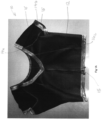
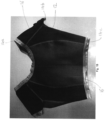
- the garment 10 has at least one panel of odour filtering material 12 made of three layers 22, 24, 26, as shown in Figure 3 .
- the odour filtering material 12 contains a layer of activated carbon 26 which filters out the chemicals associated with body odours by adsorbing the odours.
- the garment 10 may include one or more other panels of fabric 16 that do not have an activated carbon layer, connected to the odour filtering material 12 by suitable seems 15. These other panels of fabric 16 may be used to reduce the weight of the garment, or to influence how warm the garment is to wear, or to increase the flexibility of the garment in certain areas.
- the panels of fabric 16 are generally more flexible than the at least one panel of odour filtering material 12.
- the garment 10 should seal around one or more regions of the wearer's skin, so that all odours generated in that region can only reach the outside by passing through the activated carbon layer 26.
- imperfect sealing may be acceptable to a degree, so that most odours pass through the activated carbon layer 26.
- the wearer and those around the wearer may perceive some body odour, but nonetheless reduced compared to not wearing the garment or wearing other garments that do not contain activated carbon.
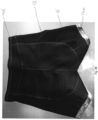
- the sealing is effected by elasticated material 14a-f, such as elastane or other standard elastic clothing material.
- the sealing is performed by elastic 14a-f on all edges of the garment.
- the elasticated edges are at the neckline 14a, the cuffs 14b around the arms (which could be around the wrists in a long sleeved top), and around the torso 14c, all for the prevention of the escape of odour.
- the seams 15 where the odour filtering material 12 is joined to the non-filtering material layers 16 may provide some additional sealing effect against the wearer's skin.
- the garment may have a zip 18 at an appropriate location to assist in putting on the garment.
- a zip 18 at an appropriate location to assist in putting on the garment.
- the top shown in Figure 1A has a zip 18 along the front.
- the top is made with the odour filtering material 12.
- flexible fabric material 16 at least, on the top part of the arm/shoulder region. This can improve the flexibility and comfort of the garment.
- the top of the shoulder is normally not a region producing much odour.
- the flexible fabric material 16 may comprise a mesh or the like. The incorporation of a flexible fabric material such as a mesh on the shoulder makes it much easier for the wearer to move more easily, whilst the odour filtering material 12 can serve the purpose of filtering odours, resulting in a synergy between the materials.
- a mesh material may be used, aimed at allowing ventilation and cooling rather than filtering odours.
- the important region for a top to filter odours is the underarm region.
- FIG 2 shows shorts according to an embodiment of the invention.
- the elasticated edges will be around the hips/waist 14d, and around each leg 14e.
- the elasticated edge 14f is around the ankle/leg and the remainder of the sock comprises the odour filtering material 12.
- the garment is in the form of a one-piece shape, for example having a configuration of a known "wetsuit" type.
- the one-piece garment may include a portion for at least partly covering the legs (optionally down to the ankles or to the mid-thigh) and a portion for covering the torso up to the neck and extending over the shoulders (optionally either to the wrists or to the mid upper-arm).
- a zip may be provided at the front or back to allow the user to put it on.
- this embodiment would be preferred for use by patients suffering from clinical body odour, such as patients having a condition of elevated trymethylamine, such as TMAU, as the such body odour is not necessarily limited to the under arm/groin as is more generally the case with normal body odours.
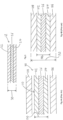
- Figures 4A and 4B show cross-sections of a known fabric panel 100 used in odour filtering underwear produced by Shreddies TM , for filtering flatulence odours.
- Figure 4A shows a fabric insert 110 positioned between two lycra cotton layers 106, 108 in a loose condition of normal use, with a gap between the fabric insert 110 and each of the outer layers 106, 108. The gaps occur because the fabric insert 110 is connected to the outer layers 106, 108 at its edges and otherwise the fabric insert and the outer layers are not connected to each other.
- Figure 4B shows the fabric panel 100 with the fabric insert 110 and the outer layers 106, 108 brought into contact with each other, with no gaps, so as to show the overall minimum thickness of the fabric panel.
- the known fabric panel 100 is formed of five layers.
- the central layer 26 is activated carbon.
- Mesh cotton fabric layers 102, 104 are laminated to each side of the activated carbon 26, to form the fabric insert 110 having a thickness 130.
- This insert 110 is sewn at its edges to the two lycra cotton layers 106, 108 so as to be positioned therebetween.
- the lycra layers 106, 108 protect the insert 110 which has a low extensibility before tearing.
- the thickness 130 of the insert 110 known from the prior art is about 0.9 mm.
- the insert 110 is received in a pouch provided by the two outer lycra cotton layers 106, 108, and the thickness 150 of the insert plus the pouch in which it sits is approximately 1.9 mm when measured under ISO 5084.
- Figure 3 shows a cross-sectional view of a panel of odour filtering material of a garment being an embodiment of the invention.
- the odour filtering material is made from three layers 22, 24, 26 having a total thickness 30 in a range of 0.4 to 0.8 mm.
- the inner layer is activated carbon 26.
- a polyamide layer 22, 24 is laminated to each side of the activated carbon 26.
- the odour filtering material 12 is appreciably thinner than the prior art fabric insert 110. Further, in the embodiments described herein, the odour filtering material 12 forms the entire thickness of the garment, being in contact with a user on its inside surface and forming the outside of the garment on its outside surface and the inside of the garment on its inside surface adjacent the wearer's skin. Thus the total thickness in the range of 0.4 to 0.8 mm is considerably less than the total thickness of the known insert plus pouch of 1.9 mm, shown as dimension 150 in Figure 4B . Thus a garment incorporating an odour filtering material as shown in Figure 3 is very effective at filtering odours whilst also being comfortable.
- the odour filtering material forms the inside of the garment.
- the garment has no further material inwardly of the odour filtering material.
- the odour filtering material forms the outside of the garment as well as forming the inside of the garment. These garments have no further material inwardly or outwardly of the odour filtering material.
- the odour filtering material may have a thickness of 0.49 ⁇ 0.009 mm when tested under the ISO 5084 standard for textiles.
- Standard BS 4952:1992 for testing elastic fabrics was used to test various odour filtering materials.
- the test used was one to determine extension at a specified force. Under this test, a 50 mm wide sample of odour filtering material is loaded up to a desired force at a rate of 500 mm/min. Once the desired force is reached, the load is cycled down to zero (at the same rate) and back up to the desired force (at the same rate). Then the elongation of the sample of the odour filtering material is measured and converted into a percentage based on the original sample length, which is 100 mm. The fabrics results herein were tested with a weight of 2 kg (i.e. 19.6 N).
- an example odour filtering material has an extension of 47.3 % under a 2 kg load in a first direction and an extension of 8.3 % under a 2 kg load in a second direction, perpendicular to the first direction.
- the high extensibility is particularly useful for a garment as it allows the garment to conform to the movements of the user, including during running or other exercise.
- the cross sectional area is 24.5 mm 2 .
- This data, combined with the extension and loading can be converted into a quasi-Young's modulus for the odour filtering material.
- This is a quasi-Young's modulus only and not a true Young's modulus because this test does not measure the Young's modulus of the fibres themselves, but measures a combination of the fibres and the fabric structure (such as the weave used and the amount of crimp).
- the quasi-Young's Modulus may be considered to be 0.17 kg/mm 2 for the odour filtering material in the first direction.
- the standard BS 4952:1992 also provides testing methods for residual extension. In fabrics, this is somewhat similar to plastic deformation (i.e. non-recoverable stretching) in e.g. metals; however this test differs as the deformation may not be permanent but may recover in time (longer than the time taken for testing).
- the test for residual extension begins by performing the test for determining extension at a specified force, as above. After that test has been performed, the specified load is maintained for 10 seconds and then the force is lowered to zero over 7.5 seconds. The sample is removed from the clamps and laid flat for 1 minute. After 1 minute has elapsed, the length of the sample is measured and compared to the original (pre-loading) sample length.
- the example odour filtering material shows a 5.2 % residual extension after 1 minute of load in the first direction and 0.8 % residual extension in the second direction. This data is shown in tabular form below. It is desirable in clothing for this value to be fairly low. Large values for residual extension would make the clothing feel "baggy" and loose as it would not return quickly (or possibly, not at all) to its original size after being stretched by movement of the wearer.
- F5/F3/P8/ST refers to various inner activated carbon knitted cloths.
- 'F5', 'F3' and 'ST' refer to activated carbon material made from viscose precursor material of 130 g/m2, 100 g/m2 and 130 g/m2 respectively;
- 'P8' refers to a synthetic inner activated carbon material, made from the precursor material PAN (Polyacrylonitrile, a synthetic polymer material) of 120 gsm.
- PAN Polyacrylonitrile, a synthetic polymer material
- + P3/T5/T5D - refers to outer cloths which are bonded to the inner carbon layer to form the overall composite material.
- ⁇ + P3' is a polyamide knit material
- + 'T5' is a polyester and polyamide mix knit material
- + 'T5D' is a polyester knit material. All the described outer cloths are within the range of 30-80 gsm.
- the material used in the Shreddies TM underwear is stored in a protective lyrca pouch such that the total thickness of the underwear is 1.9mm, which is particularly thick for clothing, particularly underwear. This is because the insert material is enclosed in the inner and outer layers forming the pouch, which inevitably adds to the minimum thickness of underwear made using this material. Whilst the pouch provides protection for the insert it affects the stretchability of the underwear in the region of the pouch. Thus the stretchability of the insert is not reflective of the stretchability of the combined insert and inner and outer layers of the pouch.
- the Zorflex FM 30K D1J1 material has a thickness of 0.37 mm and the Shreddies TM pyjamas material has a thickness of 0.61 mm when tested under the ISO 5084 standard for textiles. Whilst these materials are sufficiently thin to be useful in garments, it will be seen from the above test results that they lack the stretchability achieved in the example odour filtering material of the present invention.
- the example odour filtering material has a measured basis weight of 216 g/m 2 when measured under the BS 12127 standard for textiles.
- the additional examples of suitable odour filtering materials have measured basis weights in the range 240-280 g/m 2 when measured under the BS 12127 standard for textiles.
Landscapes
- Engineering & Computer Science (AREA)
- Textile Engineering (AREA)
- Life Sciences & Earth Sciences (AREA)
- Wood Science & Technology (AREA)
- Ceramic Engineering (AREA)
- Professional, Industrial, Or Sporting Protective Garments (AREA)
- Undergarments, Swaddling Clothes, Handkerchiefs Or Underwear Materials (AREA)
- Laminated Bodies (AREA)
Applications Claiming Priority (2)
| Application Number | Priority Date | Filing Date | Title |
|---|---|---|---|
| GBGB1707866.8A GB201707866D0 (en) | 2017-05-16 | 2017-05-16 | Garments |
| PCT/EP2018/062819 WO2018210976A1 (en) | 2017-05-16 | 2018-05-16 | Garments |
Publications (3)
| Publication Number | Publication Date |
|---|---|
| EP3624621A1 EP3624621A1 (en) | 2020-03-25 |
| EP3624621B1 true EP3624621B1 (en) | 2024-10-30 |
| EP3624621C0 EP3624621C0 (en) | 2024-10-30 |
Family
ID=59201545
Family Applications (1)
| Application Number | Title | Priority Date | Filing Date |
|---|---|---|---|
| EP18724893.5A Active EP3624621B1 (en) | 2017-05-16 | 2018-05-16 | Garments |
Country Status (8)
| Country | Link |
|---|---|
| US (1) | US20200079051A1 (enExample) |
| EP (1) | EP3624621B1 (enExample) |
| JP (1) | JP2020520421A (enExample) |
| CN (1) | CN110944535A (enExample) |
| AU (1) | AU2018268038B2 (enExample) |
| CA (1) | CA3063630A1 (enExample) |
| GB (2) | GB201707866D0 (enExample) |
| WO (1) | WO2018210976A1 (enExample) |
Families Citing this family (2)
| Publication number | Priority date | Publication date | Assignee | Title |
|---|---|---|---|---|
| EP3860379B1 (en) * | 2018-10-23 | 2024-12-18 | Clearview Systems, LLC | Athletic garment |
| US11375756B1 (en) | 2022-02-18 | 2022-07-05 | Stitches Medical, Inc. | Filter underwear |
Citations (1)
| Publication number | Priority date | Publication date | Assignee | Title |
|---|---|---|---|---|
| DE202006011163U1 (de) * | 2006-05-16 | 2007-07-19 | BLüCHER GMBH | Geruchsadsorbierende Bekleidung |
Family Cites Families (8)
| Publication number | Priority date | Publication date | Assignee | Title |
|---|---|---|---|---|
| US5383236A (en) * | 1991-11-25 | 1995-01-24 | Als Enterprises, Inc. | Odor absorbing clothing |
| JP3075130U (ja) * | 2000-07-25 | 2001-02-09 | ジャロックス株式会社 | 被 服 |
| DE102004032563B4 (de) * | 2004-07-05 | 2012-08-02 | BLüCHER GMBH | Textiles Verbundmaterial mit Aktivkohlefasern und Verfahren zu seiner Herstellung |
| GB0804538D0 (en) * | 2008-03-12 | 2008-04-16 | Leary Paul O | Underwear garment |
| EP2717973B1 (de) * | 2011-06-08 | 2015-08-05 | Blücher GmbH | Funktionelles schutzmaterial, insbesondere für die verwendung in einer schutzbekleidung |
| IL218083A0 (en) * | 2012-02-13 | 2012-03-29 | Nilit Ltd | Polyamide fabric enhancing body warming |
| JP6035870B2 (ja) * | 2012-05-24 | 2016-11-30 | 東洋紡株式会社 | 防護服用材料および防護服 |
| DE102016202546A1 (de) * | 2016-02-18 | 2017-08-24 | Deutsche Institute Für Textil- Und Faserforschung Denkendorf | Verbundstruktur für den Stichschutz, Verfahren zur Herstellung einer Verbundstruktur, Stichschutzeinlage sowie Schutztextil |
-
2017
- 2017-05-16 GB GBGB1707866.8A patent/GB201707866D0/en not_active Ceased
-
2018
- 2018-05-16 WO PCT/EP2018/062819 patent/WO2018210976A1/en not_active Ceased
- 2018-05-16 AU AU2018268038A patent/AU2018268038B2/en active Active
- 2018-05-16 US US16/612,915 patent/US20200079051A1/en not_active Abandoned
- 2018-05-16 CA CA3063630A patent/CA3063630A1/en not_active Abandoned
- 2018-05-16 JP JP2020514333A patent/JP2020520421A/ja active Pending
- 2018-05-16 EP EP18724893.5A patent/EP3624621B1/en active Active
- 2018-05-16 CN CN201880047440.9A patent/CN110944535A/zh active Pending
- 2018-05-16 GB GB1918545.3A patent/GB2576862B/en not_active Expired - Fee Related
Patent Citations (1)
| Publication number | Priority date | Publication date | Assignee | Title |
|---|---|---|---|---|
| DE202006011163U1 (de) * | 2006-05-16 | 2007-07-19 | BLüCHER GMBH | Geruchsadsorbierende Bekleidung |
Also Published As
| Publication number | Publication date |
|---|---|
| GB201707866D0 (en) | 2017-06-28 |
| EP3624621A1 (en) | 2020-03-25 |
| AU2018268038B2 (en) | 2024-05-16 |
| GB2576862B (en) | 2022-04-20 |
| WO2018210976A1 (en) | 2018-11-22 |
| AU2018268038A1 (en) | 2020-01-16 |
| CA3063630A1 (en) | 2018-11-22 |
| GB201918545D0 (en) | 2020-01-29 |
| GB2576862A (en) | 2020-03-04 |
| JP2020520421A (ja) | 2020-07-09 |
| EP3624621C0 (en) | 2024-10-30 |
| CN110944535A (zh) | 2020-03-31 |
| US20200079051A1 (en) | 2020-03-12 |
Similar Documents
| Publication | Publication Date | Title |
|---|---|---|
| US10750793B1 (en) | Undergarment suited for reducing the appearance of sweat | |
| US6817030B2 (en) | Articles of clothing providing increased air circulation | |
| US20110179555A1 (en) | Compression garment | |
| WO2016073598A1 (en) | Seamlessly transitioned, double layer, dual fabric garment | |
| CA3192896A1 (en) | Incontinence and menstrual apparel | |
| CN102325473A (zh) | 下肢矫正服装 | |
| JP7262961B2 (ja) | ショーツ | |
| EP3624621B1 (en) | Garments | |
| JP6017175B2 (ja) | 尾てい骨保護下着 | |
| WO2009123270A1 (ja) | 男性用パンツ | |
| JP2007131996A (ja) | ブリーフ | |
| WO2015158207A1 (zh) | 一种防风保暖裤 | |
| KR102395457B1 (ko) | 남성용 기능성 팬티 | |
| US20110179552A1 (en) | Casual exercise garment | |
| US20220142265A1 (en) | Clothing liner for aquatic environments | |
| WO2015177307A1 (en) | Article of clothing | |
| JP6821114B1 (ja) | 股下収納室付きパンツ | |
| KR101584444B1 (ko) | 남성용 팬티 | |
| JP2021080589A (ja) | ぽっちゃり体型の男性用下着 | |
| CN219962028U (zh) | 防压疮组件 | |
| JP3242687U (ja) | ズボン | |
| TW202529644A (zh) | 骨盆導椎保健塑身褲 | |
| JPH11158705A (ja) | ロングパンツ | |
| CN211241783U (zh) | 裤子 | |
| KR200258906Y1 (ko) | 복대가 구비된 남성용 거들 |
Legal Events
| Date | Code | Title | Description |
|---|---|---|---|
| STAA | Information on the status of an ep patent application or granted ep patent |
Free format text: STATUS: UNKNOWN |
|
| STAA | Information on the status of an ep patent application or granted ep patent |
Free format text: STATUS: THE INTERNATIONAL PUBLICATION HAS BEEN MADE |
|
| PUAI | Public reference made under article 153(3) epc to a published international application that has entered the european phase |
Free format text: ORIGINAL CODE: 0009012 |
|
| STAA | Information on the status of an ep patent application or granted ep patent |
Free format text: STATUS: REQUEST FOR EXAMINATION WAS MADE |
|
| 17P | Request for examination filed |
Effective date: 20191216 |
|
| AK | Designated contracting states |
Kind code of ref document: A1 Designated state(s): AL AT BE BG CH CY CZ DE DK EE ES FI FR GB GR HR HU IE IS IT LI LT LU LV MC MK MT NL NO PL PT RO RS SE SI SK SM TR |
|
| AX | Request for extension of the european patent |
Extension state: BA ME |
|
| DAV | Request for validation of the european patent (deleted) | ||
| DAX | Request for extension of the european patent (deleted) | ||
| GRAP | Despatch of communication of intention to grant a patent |
Free format text: ORIGINAL CODE: EPIDOSNIGR1 |
|
| STAA | Information on the status of an ep patent application or granted ep patent |
Free format text: STATUS: GRANT OF PATENT IS INTENDED |
|
| INTG | Intention to grant announced |
Effective date: 20240205 |
|
| GRAS | Grant fee paid |
Free format text: ORIGINAL CODE: EPIDOSNIGR3 |
|
| GRAA | (expected) grant |
Free format text: ORIGINAL CODE: 0009210 |
|
| STAA | Information on the status of an ep patent application or granted ep patent |
Free format text: STATUS: THE PATENT HAS BEEN GRANTED |
|
| AK | Designated contracting states |
Kind code of ref document: B1 Designated state(s): AL AT BE BG CH CY CZ DE DK EE ES FI FR GB GR HR HU IE IS IT LI LT LU LV MC MK MT NL NO PL PT RO RS SE SI SK SM TR |
|
| REG | Reference to a national code |
Ref country code: GB Ref legal event code: FG4D |
|
| REG | Reference to a national code |
Ref country code: CH Ref legal event code: EP |
|
| REG | Reference to a national code |
Ref country code: DE Ref legal event code: R096 Ref document number: 602018075963 Country of ref document: DE |
|
| REG | Reference to a national code |
Ref country code: IE Ref legal event code: FG4D |
|
| U01 | Request for unitary effect filed |
Effective date: 20241030 |
|
| U07 | Unitary effect registered |
Designated state(s): AT BE BG DE DK EE FI FR IT LT LU LV MT NL PT RO SE SI Effective date: 20241105 |
|
| PG25 | Lapsed in a contracting state [announced via postgrant information from national office to epo] |
Ref country code: IS Free format text: LAPSE BECAUSE OF FAILURE TO SUBMIT A TRANSLATION OF THE DESCRIPTION OR TO PAY THE FEE WITHIN THE PRESCRIBED TIME-LIMIT Effective date: 20250228 Ref country code: HR Free format text: LAPSE BECAUSE OF FAILURE TO SUBMIT A TRANSLATION OF THE DESCRIPTION OR TO PAY THE FEE WITHIN THE PRESCRIBED TIME-LIMIT Effective date: 20241030 |
|
| PG25 | Lapsed in a contracting state [announced via postgrant information from national office to epo] |
Ref country code: ES Free format text: LAPSE BECAUSE OF FAILURE TO SUBMIT A TRANSLATION OF THE DESCRIPTION OR TO PAY THE FEE WITHIN THE PRESCRIBED TIME-LIMIT Effective date: 20241030 |
|
| PG25 | Lapsed in a contracting state [announced via postgrant information from national office to epo] |
Ref country code: NO Free format text: LAPSE BECAUSE OF FAILURE TO SUBMIT A TRANSLATION OF THE DESCRIPTION OR TO PAY THE FEE WITHIN THE PRESCRIBED TIME-LIMIT Effective date: 20250130 |
|
| PG25 | Lapsed in a contracting state [announced via postgrant information from national office to epo] |
Ref country code: GR Free format text: LAPSE BECAUSE OF FAILURE TO SUBMIT A TRANSLATION OF THE DESCRIPTION OR TO PAY THE FEE WITHIN THE PRESCRIBED TIME-LIMIT Effective date: 20250131 |
|
| PG25 | Lapsed in a contracting state [announced via postgrant information from national office to epo] |
Ref country code: PL Free format text: LAPSE BECAUSE OF FAILURE TO SUBMIT A TRANSLATION OF THE DESCRIPTION OR TO PAY THE FEE WITHIN THE PRESCRIBED TIME-LIMIT Effective date: 20241030 |
|
| PG25 | Lapsed in a contracting state [announced via postgrant information from national office to epo] |
Ref country code: RS Free format text: LAPSE BECAUSE OF FAILURE TO SUBMIT A TRANSLATION OF THE DESCRIPTION OR TO PAY THE FEE WITHIN THE PRESCRIBED TIME-LIMIT Effective date: 20250130 |
|
| PG25 | Lapsed in a contracting state [announced via postgrant information from national office to epo] |
Ref country code: SM Free format text: LAPSE BECAUSE OF FAILURE TO SUBMIT A TRANSLATION OF THE DESCRIPTION OR TO PAY THE FEE WITHIN THE PRESCRIBED TIME-LIMIT Effective date: 20241030 |
|
| PG25 | Lapsed in a contracting state [announced via postgrant information from national office to epo] |
Ref country code: SK Free format text: LAPSE BECAUSE OF FAILURE TO SUBMIT A TRANSLATION OF THE DESCRIPTION OR TO PAY THE FEE WITHIN THE PRESCRIBED TIME-LIMIT Effective date: 20241030 |
|
| PG25 | Lapsed in a contracting state [announced via postgrant information from national office to epo] |
Ref country code: CZ Free format text: LAPSE BECAUSE OF FAILURE TO SUBMIT A TRANSLATION OF THE DESCRIPTION OR TO PAY THE FEE WITHIN THE PRESCRIBED TIME-LIMIT Effective date: 20241030 |
|
| PLBE | No opposition filed within time limit |
Free format text: ORIGINAL CODE: 0009261 |
|
| STAA | Information on the status of an ep patent application or granted ep patent |
Free format text: STATUS: NO OPPOSITION FILED WITHIN TIME LIMIT |
|
| 26N | No opposition filed |
Effective date: 20250731 |
|
| REG | Reference to a national code |
Ref country code: CH Ref legal event code: H13 Free format text: ST27 STATUS EVENT CODE: U-0-0-H10-H13 (AS PROVIDED BY THE NATIONAL OFFICE) Effective date: 20251223 |