EP3624469B1 - Verfahren und vorrichtungen zum senden und empfangen von daten und speichermedien - Google Patents
Verfahren und vorrichtungen zum senden und empfangen von daten und speichermedien Download PDFInfo
- Publication number
- EP3624469B1 EP3624469B1 EP19192985.0A EP19192985A EP3624469B1 EP 3624469 B1 EP3624469 B1 EP 3624469B1 EP 19192985 A EP19192985 A EP 19192985A EP 3624469 B1 EP3624469 B1 EP 3624469B1
- Authority
- EP
- European Patent Office
- Prior art keywords
- data packet
- data
- objects
- client device
- region
- Prior art date
- Legal status (The legal status is an assumption and is not a legal conclusion. Google has not performed a legal analysis and makes no representation as to the accuracy of the status listed.)
- Active
Links
Images






Classifications
-
- G—PHYSICS
- G05—CONTROLLING; REGULATING
- G05D—SYSTEMS FOR CONTROLLING OR REGULATING NON-ELECTRIC VARIABLES
- G05D1/00—Control of position, course, altitude or attitude of land, water, air or space vehicles, e.g. using automatic pilots
- G05D1/0011—Control of position, course, altitude or attitude of land, water, air or space vehicles, e.g. using automatic pilots associated with a remote control arrangement
- G05D1/0022—Control of position, course, altitude or attitude of land, water, air or space vehicles, e.g. using automatic pilots associated with a remote control arrangement characterised by the communication link
-
- H—ELECTRICITY
- H04—ELECTRIC COMMUNICATION TECHNIQUE
- H04W—WIRELESS COMMUNICATION NETWORKS
- H04W4/00—Services specially adapted for wireless communication networks; Facilities therefor
- H04W4/30—Services specially adapted for particular environments, situations or purposes
- H04W4/40—Services specially adapted for particular environments, situations or purposes for vehicles, e.g. vehicle-to-pedestrians [V2P]
-
- H—ELECTRICITY
- H04—ELECTRIC COMMUNICATION TECHNIQUE
- H04W—WIRELESS COMMUNICATION NETWORKS
- H04W4/00—Services specially adapted for wireless communication networks; Facilities therefor
- H04W4/30—Services specially adapted for particular environments, situations or purposes
- H04W4/40—Services specially adapted for particular environments, situations or purposes for vehicles, e.g. vehicle-to-pedestrians [V2P]
- H04W4/44—Services specially adapted for particular environments, situations or purposes for vehicles, e.g. vehicle-to-pedestrians [V2P] for communication between vehicles and infrastructures, e.g. vehicle-to-cloud [V2C] or vehicle-to-home [V2H]
-
- G—PHYSICS
- G05—CONTROLLING; REGULATING
- G05D—SYSTEMS FOR CONTROLLING OR REGULATING NON-ELECTRIC VARIABLES
- G05D1/00—Control of position, course, altitude or attitude of land, water, air or space vehicles, e.g. using automatic pilots
- G05D1/02—Control of position or course in two dimensions
- G05D1/021—Control of position or course in two dimensions specially adapted to land vehicles
- G05D1/0212—Control of position or course in two dimensions specially adapted to land vehicles with means for defining a desired trajectory
-
- G—PHYSICS
- G05—CONTROLLING; REGULATING
- G05D—SYSTEMS FOR CONTROLLING OR REGULATING NON-ELECTRIC VARIABLES
- G05D1/00—Control of position, course, altitude or attitude of land, water, air or space vehicles, e.g. using automatic pilots
- G05D1/02—Control of position or course in two dimensions
- G05D1/021—Control of position or course in two dimensions specially adapted to land vehicles
- G05D1/0268—Control of position or course in two dimensions specially adapted to land vehicles using internal positioning means
- G05D1/0272—Control of position or course in two dimensions specially adapted to land vehicles using internal positioning means comprising means for registering the travel distance, e.g. revolutions of wheels
-
- G—PHYSICS
- G06—COMPUTING OR CALCULATING; COUNTING
- G06V—IMAGE OR VIDEO RECOGNITION OR UNDERSTANDING
- G06V20/00—Scenes; Scene-specific elements
- G06V20/10—Terrestrial scenes
-
- G—PHYSICS
- G06—COMPUTING OR CALCULATING; COUNTING
- G06V—IMAGE OR VIDEO RECOGNITION OR UNDERSTANDING
- G06V20/00—Scenes; Scene-specific elements
- G06V20/50—Context or environment of the image
- G06V20/56—Context or environment of the image exterior to a vehicle by using sensors mounted on the vehicle
-
- H—ELECTRICITY
- H04—ELECTRIC COMMUNICATION TECHNIQUE
- H04L—TRANSMISSION OF DIGITAL INFORMATION, e.g. TELEGRAPHIC COMMUNICATION
- H04L1/00—Arrangements for detecting or preventing errors in the information received
- H04L1/0078—Avoidance of errors by organising the transmitted data in a format specifically designed to deal with errors, e.g. location
- H04L1/0079—Formats for control data
- H04L1/008—Formats for control data where the control data relates to payload of a different packet
-
- H—ELECTRICITY
- H04—ELECTRIC COMMUNICATION TECHNIQUE
- H04L—TRANSMISSION OF DIGITAL INFORMATION, e.g. TELEGRAPHIC COMMUNICATION
- H04L67/00—Network arrangements or protocols for supporting network services or applications
- H04L67/01—Protocols
- H04L67/12—Protocols specially adapted for proprietary or special-purpose networking environments, e.g. medical networks, sensor networks, networks in vehicles or remote metering networks
-
- H—ELECTRICITY
- H04—ELECTRIC COMMUNICATION TECHNIQUE
- H04W—WIRELESS COMMUNICATION NETWORKS
- H04W28/00—Network traffic management; Network resource management
- H04W28/02—Traffic management, e.g. flow control or congestion control
- H04W28/0226—Traffic management, e.g. flow control or congestion control based on location or mobility
-
- H—ELECTRICITY
- H04—ELECTRIC COMMUNICATION TECHNIQUE
- H04W—WIRELESS COMMUNICATION NETWORKS
- H04W4/00—Services specially adapted for wireless communication networks; Facilities therefor
- H04W4/02—Services making use of location information
- H04W4/023—Services making use of location information using mutual or relative location information between multiple location based services [LBS] targets or of distance thresholds
-
- H—ELECTRICITY
- H04—ELECTRIC COMMUNICATION TECHNIQUE
- H04W—WIRELESS COMMUNICATION NETWORKS
- H04W4/00—Services specially adapted for wireless communication networks; Facilities therefor
- H04W4/30—Services specially adapted for particular environments, situations or purposes
- H04W4/40—Services specially adapted for particular environments, situations or purposes for vehicles, e.g. vehicle-to-pedestrians [V2P]
- H04W4/46—Services specially adapted for particular environments, situations or purposes for vehicles, e.g. vehicle-to-pedestrians [V2P] for vehicle-to-vehicle communication [V2V]
-
- H—ELECTRICITY
- H04—ELECTRIC COMMUNICATION TECHNIQUE
- H04W—WIRELESS COMMUNICATION NETWORKS
- H04W52/00—Power management, e.g. Transmission Power Control [TPC] or power classes
- H04W52/04—Transmission power control [TPC]
- H04W52/18—TPC being performed according to specific parameters
- H04W52/24—TPC being performed according to specific parameters using SIR [Signal to Interference Ratio] or other wireless path parameters
- H04W52/245—TPC being performed according to specific parameters using SIR [Signal to Interference Ratio] or other wireless path parameters taking into account received signal strength
-
- H—ELECTRICITY
- H04—ELECTRIC COMMUNICATION TECHNIQUE
- H04W—WIRELESS COMMUNICATION NETWORKS
- H04W52/00—Power management, e.g. Transmission Power Control [TPC] or power classes
- H04W52/04—Transmission power control [TPC]
- H04W52/18—TPC being performed according to specific parameters
- H04W52/24—TPC being performed according to specific parameters using SIR [Signal to Interference Ratio] or other wireless path parameters
- H04W52/246—TPC being performed according to specific parameters using SIR [Signal to Interference Ratio] or other wireless path parameters where the output power of a terminal is based on a path parameter calculated in said terminal
-
- H—ELECTRICITY
- H04—ELECTRIC COMMUNICATION TECHNIQUE
- H04W—WIRELESS COMMUNICATION NETWORKS
- H04W52/00—Power management, e.g. Transmission Power Control [TPC] or power classes
- H04W52/04—Transmission power control [TPC]
- H04W52/18—TPC being performed according to specific parameters
- H04W52/28—TPC being performed according to specific parameters using user profile, e.g. mobile speed, priority or network state, e.g. standby, idle or non-transmission
- H04W52/283—Power depending on the position of the mobile
-
- H—ELECTRICITY
- H04—ELECTRIC COMMUNICATION TECHNIQUE
- H04W—WIRELESS COMMUNICATION NETWORKS
- H04W52/00—Power management, e.g. Transmission Power Control [TPC] or power classes
- H04W52/04—Transmission power control [TPC]
- H04W52/30—Transmission power control [TPC] using constraints in the total amount of available transmission power
- H04W52/32—TPC of broadcast or control channels
- H04W52/322—Power control of broadcast channels
-
- H—ELECTRICITY
- H04—ELECTRIC COMMUNICATION TECHNIQUE
- H04W—WIRELESS COMMUNICATION NETWORKS
- H04W4/00—Services specially adapted for wireless communication networks; Facilities therefor
- H04W4/02—Services making use of location information
- H04W4/021—Services related to particular areas, e.g. point of interest [POI] services, venue services or geofences
Definitions
- Implementations of the present disclosure generally relate to car networking and, more particularly, to methods and apparatuses for transmitting and receiving data, and computer storage mediums in car networking.
- V2X vehicle to everything
- the vehicle may communicate with a variety of external entities (e.g., collection devices, server devices, control centers, etc.) via V2X to exchange various information for assisting vehicle driving.
- external entities e.g., collection devices, server devices, control centers, etc.
- objects e.g., surrounding buildings, roads, vehicles, pedestrians, etc.
- collection devices may be deployed in the road environment to collect the above information, and the collected information is transmitted to the vehicle traveling to the vicinity of the server device via the server device connected to the collection device to assist in vehicle control.
- Vehicle control will greatly depend on the timely acquisition of such information.
- the communication bandwidth of existing V2X is limited, and delays may occur due to the influence of the surrounding environment or other factors when transmitting various information. Therefore, at this time, how to handle transmission and reception of data becomes a research hotspot.
- 3GPP " 3rd Generation Partnership Project; Technical Specification Group Services and System Aspects; Study on enhancement of 3GPP Support for 5G V2X Services (Release 15)", 3GPP TR 22.886 V15.1.0, 17 March 2017 (2017-03-17), pages 1-58, XP055625569 formulates the specifications of the third-generation technology based on the GSM core network and UTRA technology as the wireless interface, which can be applied to a field of urban driving and provides basic and general communication technical supports.
- solutions for transmitting data and receiving data is provided.
- a method of transmitting data is provided.
- a set of objects in a road environment is identified based on collection data associated with the road environment from a server device.
- the set of objects is divided into at least one subset based on a distance between each of the set of objects and server devices.
- a data packet is generated based on a portion of the collection data associated with objects in the subset.
- the generated data packet is transmitted to at least one client device, the at least one client device being located in a region associated with the first region where the objects in the subset are located.
- transmitting the data packet may include: determining a transmission power for broadcasting the data packet; and broadcasting the data packet based on the transmission power, such that the data packet is received by the at least one client device.
- determining the transmission power may include: determining a distance range between the at least one client device and the server device based on the region; and determining the transmission power based on the distance range.
- the first region is a subset of the region.
- determining the transmission power may include: obtaining a transmission factor of a broadcast signal transmitted in the road environment; determining a maximum distance value in the distance range; obtaining a receiving power threshold of the at least one client device; and determining the transmission power based on the transmission factor, the maximum distance value and the receiving power threshold.
- generating the data packet may include: collecting traffic command information associated with the road environment; and updating the data packet based on the traffic command information.
- the method also includes: classifying the objects in the subset into static objects and moving objects; generating a static data packet based on a portion of the collection data associated with the static objects, and generating a motion data packet based on a portion of the collection data associated with the moving objects; and transmitting the static data packet with a first transmission frequency and transmitting the motion data packet with a second transmission frequency, the first transmission frequency being lower than the second transmission frequency.
- an apparatus for transmitting data includes: one or more processors; a memory configured to store one or more programs, in which when the one or more programs are executed by the one or more processors, the one or more processors are configured to: identify a set of objects in a road environment based on collection data associated with the road environment from a server device; divide the set of objects into at least one subset based on a distance between each of the set of objects and the server device; generate, for a subset in the at least one subset, a data packet based on a portion of the collection data associated with objects in the subset; and transmit the data packet to at least one client device, the at least one client device being located in a region associated with a first region where the objects in the subset are located.
- the one or more processors transmit the data packet by performing acts of: determining a transmission power for broadcasting the data packet; and broadcasting the data packet based on the transmission power, such that the data packet is received by the at least one client device.
- the one or more processors determine the transmission power by performing acts of: determining a distance range between the at least one client device and the server device based on the region; and determining the transmission power based on the distance range.
- the first region is a subset of the region.
- the one or more processors determine the transmission power by performing acts of: obtaining a transmission factor of a broadcast signal transmitted in the road environment; determining a maximum distance value in the distance range; obtaining a receiving power threshold of the at least one client device; and determining the transmission power based on the transmission factor, the maximum distance value and the receiving power threshold.
- the one or more processors generate the data packet by performing acts of: collecting traffic command information associated with the road environment; and updating the data packet based on the traffic command information.
- the one or more processors are configured to: classify the objects in the subset into static objects and moving objects; generate a static data packet based on a portion of the collection data associated with the static objects, and to generate a motion data packet based on a portion of the collection data associated with the moving objects; and transmit the static data packet with a first transmission frequency and to transmit the motion data packet with a second transmission frequency, the first transmission frequency being lower than the second transmission frequency.
- a computer-readable storage medium has a computer program stored thereon, and the computer program is executed by a processor to implement the method for transmitting data proposed in the first aspect of embodiments of the present disclosure.
- a method for receiving data may include: receiving, at a client device, at least one data packet transmitted from a server device, a data packet in the at least one data packet being generated based on collection data associated with at least one object described by the data packet; selecting a data packet from the at least one data packet, the client device being located in a region associated with a first region where the at least one object described by the data packet selected is located; and parsing the data packet selected to obtain collection data associated with objects in the road environment within the first region.
- selecting the data packet may include selecting the data packet based on at least one of: a receiving signal intensity and a receiving time associated with the at least one data packet.
- the client device is deployed at a vehicle, and the method may also include: controlling traveling of the vehicle based on the collection data.
- an apparatus for receiving data includes: one or more processors; a memory configured to store one or more programs, in which when the one or more programs are executed by the one or more processors, the one or more processors are configured to: receive, at a client device, at least one data packet transmitted from a server device, a data packet in the at least one data packet being generated based on collection data associated with at least one object described by the data packet; select a data packet from the at least one data packet, the client device being located in a region associated with a first region where the at least one object described by the data packet selected is located; and parse the data packet selected to obtain collection data associated with objects in the road environment within the first region.
- the one or more processors are configured to select the data packet based on at least one of: a receiving signal intensity and a receiving time associated with the at least one data packet.
- the client device is deployed at a vehicle, and the one or more processors are configured to control traveling of the vehicle based on the collection data.
- a computer readable medium has a computer program stored thereon, the computer program being executed by a processor to implement the method for receiving data according to the fifth aspect of embodiments of the present disclosure.
- the term “comprise” and its equivalents are to be understood as an open “include” (a non-exclusive “include”), i.e., “include but is not limited to”.
- the term “based on” should be understood as “based at least in part (at least partially based on)”.
- the term “one embodiment” or “an embodiment” should be taken to mean “at least one embodiment”.
- the terms “first”, “second” and the like may refer to different or identical objects. Other explicit and implicit definitions may also be included in the followings.
- FIG. 1 schematically illustrates an illustration of an application environment 100 in which a technical solution in accordance with an exemplary implementation of the present disclosure may be employed.
- Fig. 1 shows an example of a road environment with an intersection, and a collection device 112 such as a camera, a laser radar or the like may be deployed near the intersection.
- the collection device 112 may acquire collection data of various objects in the vicinity. For example, data regarding a vehicle 120 or a bicycle 122 traveling on the road, traffic lights 124, roadside buildings 126, a lane line 128, and the like may be acquired.
- Fig. 1 only schematically shows a specific example of deploying the server device 110 and the collection device 112 in an intersection environment, in other application environments, the server device 110 and the collection device 112 may be deployed along the road or on moving objects such as collecting vehicles and unmanned aerial vehicles. It will be appreciated that the collection device 112 may be located in the server device 110, or the collection device 112 may be coupled to the server device 110, and the server device 110 may be used to transmit the collected collection data to the vehicle 130 traveling in the vicinity.
- a technical solution for transmitting collection data between a server device 110 and a client device 130 is provided.
- an exemplary implementation of the present disclosure will be generally described with reference to Fig. 2 .
- Fig. 2 schematically illustrates a block diagram 200 of a technical solution in accordance with an exemplary implementation of the present disclosure.
- Fig. 2 schematically shows an illustration of a peripheral region centered at the location 210 of the server device 110.
- the first region 220 having a radius ranging from 0 to R1 (for example, 50 m) is shown in a shaded circular region
- the second region 222 having a radius ranging from R1 to R2 for example, 100 m
- the shaded first region 220 represents a region having a radius ranging from 0 to 50 m from the position 210 of the server device 110
- the second region 222 represents a region having a radius ranging from 50 m to 100 m.
- regions 220 and 222 determined by radius R1 and R2 are shown schematically in Fig. 2 , there may be more scopes in accordance with an exemplary implementation of the present disclosure. For example, three regions may be determined in terms of distances of 0-50 m, 50 m-100 m, and 100 m-200 m.
- a set of objects 120, 122, 124, 126 may be based on distances between the location 210 and each in the set of objects 120, 122, 124, 126, 128 corresponding to the collection data, to divide the objects 122 and 124 (with the distances smaller than R1) to a first subset 232, and the objects 126, 120 and 128 (with the distances between R1 and R2) are divided to a second subset 230.
- related collection data of the objects included in each subset may be encapsulated into a corresponding data packet.
- the collection data of objects 122, 124 in the range of 0-50 m may be encapsulated into the first data packet 232, while the collection data of objects 126, 120, and 128 in the range of 50-100 m may be encapsulated into the second data packet 230.
- the particular data packet may then be broadcasted to at least one client device desiring to receive the particular data packet.
- a vehicle within a range 0-50 m from the server device 110 may only care about the content of the first data packet 232 (i.e., which objects are in the range of 0-50 m), and thus only the first data packet 232 may be sent to these vehicles, while the data packets of objects in the range beyond 50 m may not be sent to these vehicles.
- a vehicle within a range 50-100 m from the server device 110 may only care about the content of the second data packet 230 (i.e., which objects are in the range of 50 m-100 m), and thus only the second data packet 230 may be sent to these vehicles, the packets of objects within a range of 0-50 m may not be sent to these vehicles.
- data packets of objects in the subset may be transmitted.
- the bandwidth during transmission may be reduced, and the reliability and stability of data transmission are improved.
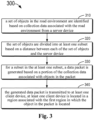
- Fig. 3 schematically illustrates a flow diagram of a method 300 for transmitting data in accordance with an exemplary implementation of the present disclosure.
- a set of objects in the road environment are identified based on collection data associated with the road environment from a server device 110.
- the collection data described herein may be data collected by the collection device 112 coupled to the server device 110.
- Fig. 4 schematically illustrates a block diagram 400 of a configuration at a server device 110 in accordance with an exemplary implementation of the present disclosure.
- the server device 110 may be coupled to multiple types of collection devices.
- the server device 110 may be coupled to: a laser radar 112-1, configured to acquire point cloud data associated with an object; a camera 112-2, configured to acquire image data associated with the object.
- the server device 110 may also be coupled to a GPS (Global Positioning System) collector 112-3, configured to obtain a location of server device 110, and the like.
- GPS Global Positioning System
- the set of objects are divided into at least one subset based on a distance between each of the set of objects and the server device 110.
- the server device 110 there are a set of objects 120, 122, 124, 126, and 128 around the server device 110, which may be divided into two subsets based on the distance between each of the set of objects and the location 210 of the server device 110.
- the objects 122 and 124 located within a range of distances 0 to R1 may be divided into a first subset 232, while the objects 126, 120and 128 located within a range of distances R1 to R2 (a second region 222) may be divided into a second subset 230.
- a data packet is generated based on a portion of the collection data associated with objects in the packet.
- the collection data may include content in various aspects.
- Fig. 5A schematically illustrates a block diagram 500A of a data structure of collection data 510A in accordance with an exemplary implementation of the present disclosure.
- the collection data 510A may include multiple fields: an object identifier 520A, an object location 522A, an object bounding box 524A, and an object classification 526A and the like.
- the object identifier 520A is used to uniquely identify the object.
- the object location 522A is used to indicate the location of the object.
- the local coordinate system used by the collection device 112 may be used to represent the object position 522A, or the world coordinate system may be used to indicate the position of the object.
- the object bounding box 524A is used to describe the space occupied by the object, for example, may be represented by the length, width, height of the object, or, the space range occupied by the object in the world coordinate system may be determined based on the object position 522A and the length, width and height of the object.
- object classification 526A may indicate which classification the object belongs to.
- a variety of classifications may be employed, for example, object classification 526A may include vehicles, bicycles, pedestrians, roadside buildings, and the like. As another example, object classification 526A may also simply include stationary objects and moving objects.
- Fig. 5A merely schematically illustrates an example of a data structure for the collected data 510A of an object, and in other implementations, the collection data 510A may also include more or fewer fields.
- the corresponding first data packet 232 and second data packet 230 may be generated for the objects in the first region 220 and the second region 222, respectively, as described above.
- the first data packet 232 may be generated based on the collection data about the objects 122 and 124
- the second data packet 230 may be generated based on the collection data about the objects 126, 120, and 128.
- data packets may be generated in a variety of ways.
- Fig. 5B schematically illustrates a block diagram 500B of a data structure of a data packet 510B in accordance with an exemplary implementation of the present disclosure.
- the data packet 510B may include collection data associated with various objects within a region. Suppose there is an object 1, an object 2, a ... in a certain region. Then, the data packet 510B for the region at this time may include the collection data 520B of the object 1, the collection data 522B of the object 2, and the like. It will be understood that although merely an example of combining collection data about individual objects to form a data packet 510B is schematically illustrated in Fig.
- the collection data may also be compressed to form the data package 510B.
- the amount of data during transmission may be reduced.
- the collection data may also be encrypted to transmit data in a more secure and reliable manner.
- the generated data packet is transmitted to at least one client device 130.
- at least one client device is located in a region associated with the first region in which the object in the packet is located.
- the term "associated region" refers to the region where the vehicle that expects to receive the data packet is located.
- the first data packet 232 includes collection data relating to objects 122 and 124 within the first region 220, where the associated region may be the first region 220, and thus the client device at the vehicle within the first region 220, will receive the first data packet 232.
- the second data packet 230 includes collection data relating to objects 126, 120, and 128 within the second region 222, where the associated region may be the first region 220, and thus the client device at the vehicle within the first region 222 will receive the second data packet 230.
- the region where the vehicle is located is the same as the region where the object is located.
- the region where the object is located may be larger than the region where the vehicle is located. In other words, the range where the vehicle is located may be smaller.
- an expansion may also be made at two boundaries of the second region 222, for example, the data package of the object in an annular region with the radius ranging from R1-d to R2+d may be sent to the vehicle located within the second region 222.
- the region where the object is located is larger than the region where the vehicle that is to receive the packet is located. In this way, it may be ensured that the client device 130 is able to receive information of objects that are larger than the region where itself locates. It is in turn ensured that the client device 130 located near the edge of each region may continuously receive information of objects within the interested region.
- a data packet may be transmitted in a broadcast manner, and a transmission power for broadcasting a data packet may be determined according to a range where the client device 130 that is expected to receive the data packet is located.
- the broadcasted data packet may be made to be received by at least one client device that desires to receive the data packet.
- the client device interested in the data packet may receive the transmitted data packet.
- the amount of data transmission per broadcast will be reduced, and thus the collection data may be transmitted with limited bandwidth and the situation of insufficient bandwidth may be alleviated.
- Fig. 6 schematically illustrates a block diagram 600 of a variation in received signal strength in accordance with an exemplary implementation of the present disclosure.
- the abscissa indicates the distance S (in m) between the client device 130 and the server device 110
- the ordinate indicates the received signal strength indicator RSSI (in dBm). Since each client device has its own resolvable signal strength threshold RSSIH, the transmission power of the server device 110 needs to ensure that the client device 130 in the interested region can receive the corresponding data packet.
- a range of distances between the at least one client device 130 and the server device 110 may be determined based on the region, and the transmission power may be determined based on the range of distances.
- a curve 610 represents the strength of the signal received within the interested region of the first data packet 232
- curve 620 represents the strength of the signal received within the interested region of the second data packet 230. It is necessary to ensure that the received signal strength at the point farthest from the server device 110 in each region of interest is greater than RSSIH.
- the transmission power since the transmission power is determined based on the distance between the client device 130 and the server device 110 that are expected to receive the data packet, the transmission power may ensure that the client device 130 may be at its own threshold. The collection data from the client device 110 is received.
- the transmission power may be determined based on a specific environment where a broadcast signal is transmitted.
- Equation 1 A represents the power of the received signal when the signal is transmitted 1 m; n represents a transmission factor of which the magnitude depends on a propagation environment of the wireless signal.
- the values of A and n may be obtained by calculation and data fitting, for example, the values may be updated in real time based on the current environment, and at this time, the updated value may be transmitted to the server device 110 and the client device 130 as configuration parameters.
- the received signal strengths for different regions may be determined, and the corresponding transmission power may be determined.
- the effects of various factors in the surrounding environment on the transmission may be considered. In particular, if the propagation conditions in the road environment are poor and the distance is long, the broadcast needs to be performed with a large power. If the propagation conditions to the environment are good and the distance is close, the broadcast may be performed with a small power.
- traffic command information associated with a road environment may also be collected and the data package may be updated based on traffic command information.
- the traffic command information may include indication information of traffic lights in the road environment, information at bulletin boards on both sides of the road, and the like.
- the above information may be obtained directly from the control device at the traffic signal or the bulletin board.
- the above information may also be obtained directly from the traffic command center.
- merely relevant information for traffic facilities located within a particular range may be obtained.
- the data of the traffic light may be acquired at this time and the data is added to the first data packet 232.
- the traffic bulletin board is included in the second region 222, the data of the traffic bulletin board may be acquired at this time and the data is added to the second data packet 230.
- rich traffic information may be added to the data package to assist in the driving behavior of the vehicle.
- objects in a subset may be divided into static objects and moving objects. Then, respective static data packets and moving data packets may be respectively generated based on the portions associated with the static objects and the moving objects in the collection data, respectively.
- a static object e.g., roadside building, lane lines, etc.
- the static data packet may be transmitted at a lower transmission frequency. Since the position and state of a moving object (for example, a vehicle, a bicycle, or a pedestrian on a road, etc.) are constantly changing, it is necessary to transmit the moving data packet at a higher transmission frequency.
- the potential recipient of the data packet is the client device 130 located at the moving vehicle 132, and when the vehicle 132 is traveling at high speed through the region covered by the server device 110, a low transmission frequency may cause that the vehicle 132 have passed through the coverage region before two adjacent broadcasts.
- a low transmission frequency may cause that the vehicle 132 have passed through the coverage region before two adjacent broadcasts.
- a static data packet may be broadcasted every 100 ms, or at other time intervals (e.g., 80 ms).
- the moving data packet may be broadcasted every 10 ms, or at other time intervals (e.g., 8 ms).
- a limited transmission bandwidth may be prioritized for transmitting data about moving objects. In this way, the transmission bandwidth may be further utilized efficiently.
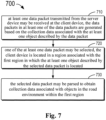
- Fig. 7 schematically illustrates a flow chart of a method 700 for receiving data in accordance with an exemplary implementation of the present disclosure.
- the client device 130 herein may be deployed at a variety of vehicles 132, for example, may be deployed at a vehicle driven by a general driver, at an automatically driven vehicle, or at a test vehicle configured to collect road environment conditions.
- the data packets in at least one of the data packets are generated based on the collection data associated with the at least one object described by the data packet.
- each data packet received by the client device 130 is generated based on the region in which the object described by the data packet is located. For example, the client device located in the first region 220 may receive the first data packet 232 and the second data packet 230, and the client device located in the second region 222 may receive the second data packet 230.
- the client devices in the three regions will receive different numbers of data packets.
- the client device located in the first region 220 may receive the first data packet 232, the second data packet 230, and the third data packet about the object located in the third region, and the client located in the second region 222 may receive the second data packet 230 and the third data packet, and the client device located in the third region may receive the third data packet.
- one of the at least one data packet may be selected.
- the client device is located in a region associated with the first region in which the at least one object described by the selected data packet is located. It will be understood that since the client device located in the vicinity of the server device 110 not only receives the data packet of interest to itself, but also receives the data packet out of interest for the farther region, and at this time, it is necessary to select the interested data packages therefrom. With the above exemplary implementation, for a vehicle located within a certain region, the client device deployed on the vehicle may select only collection data regarding objects within the region of interest. In this way, the computational resources and time overhead of processing the received broadcast data at the client device may be reduced.
- the client device 130 may select a data packet that matches the region where the client device 130 is located based on the signal strength associated with the at least one data packet. It will be appreciated that where the distance between the server device 130 and the client device 110 is constant, the greater the transmission power of the server device 110, the stronger the signal strength received at the client device 130. For the server device 110, when broadcasting a data packet to each of the surrounding regions, the transmission power is gradually increased in accordance with the distance between the region and the server device 110 from near to far. Assuming that the transmission powers of the first data packet 232 and the second data packet 230 are Power1 and Power2 respectively, then Power1 ⁇ Power2.
- the first data packet 232 and the second data packet 230 will be received.
- the relationship between the received signal strengths RSSI1 and RSSI2 for the first data packet 232 and the second data packet 230 at the client will be: RSSI1 ⁇ RSSI2.
- the data packet associated with the smaller strength of the received signal is the data packet of interest to the client device 130.
- the first data packet 232 does not reach the second region 222 because the transmission power of the first data packet 232 is low. Then, the client device located in the second region 222 may only receive the second data packet 230.
- the data packet of interest may be determined by simply comparing the received signal strength without parsing the contents of the packet.
- a data packet of interest may also be selected based on a reception time of a data packet. It will be appreciated that since the server device 110 transmits individual data packets at different points in time, the reception time of each data packet at the client device 130 also corresponds to the transmission time in the order of precedence. It is assumed that each data packet is transmitted one by one at the server device 110 in order from near to far, and waits for the next transmission time after all the data packets have been transmitted. At this time, at the client device 130, the first received data packet is the data packet of interest.
- the server device has transmitted the first data packet 232 and the second data packet 230 in succession.
- the client located in the first region 220 will first receive the first data packet 232 and then receive the second data packet 230.
- the first data packet 232 received first may be selected and the second data packet 230 received thereafter is discarded.
- the first data packet 232 does not reach the second region 222 because the transmit power of the first data packet 232 is low.
- the client device located in the second region 222 may only receive the second data packet 230.
- the data packet of interest may be determined by simply comparing the reception time without parsing the contents of the packet.
- Fig. 8 schematically illustrates a flow chart of a method 800 for adjusting a received power of a client device 130 in accordance with an exemplary implementation of the present disclosure.
- the client device 130 may continuously detect whether a broadcast signal may be received to determine whether to enter the coverage. Alternatively, a message on the coverage of the server device 110 may also be received from the central control device to determine whether to enter the coverage. If the determination is yes, the method 800 proceeds to block 820 to determine the distance between the client device 130 and the server device 110. Then, at block 830, the receiving power of the client device 130 may be adjusted based on the determined distance. With the above exemplary implementation, the received power of the client device 130 may be adjusted based on the distance between the client device and the server device to ensure that the client device 130 is configured to a receiving power suitable for receiving the broadcast of interest.
- the selected data packet may be parsed to obtain collection data associated with objects in the road environment within the first region.
- the client device 130 is deployed at the vehicle 132 such that the acquired collection data may be further used to control the travel of the vehicle 132.
- an auxiliary brake function may be activated, or a voice prompt of "Pay attention to the pedestrian ahead! or other prompt messages may be played to the driver.
- a speech prompt of "Attention to the front light!” or other prompt messages may be played to the driver.
- the collection data from server device 110 may be applied to automatic control of vehicle 132.
- the received collection data may be used with the data collected by the collection device located at the vehicle itself to control the driving state of the vehicle.
- the received data may assist the driver in judging the road conditions around the current vehicle, and then take corresponding measures.
- Fig. 9A schematically illustrates a block diagram of an apparatus 900A for transmitting collection data in accordance with an exemplary implementation of the present disclosure.
- the apparatus 900A includes an identifying module 910A configured to identify a set of objects in a road environment based on collection data associated with the road environment from a server device; and a dividing module 920A configured to divide the set of objects into at least one subset based on a distance between each of the set of objects and the server device; a generating module 930A configured to generate, for a subset in the at least one subset, a data packet based on a portion of the collection data associated with objects in the subset; and transmitting module 940A configured to transmit the data packet to at least one client device, the at least one client device being located in a region associated with a first region where the objects in the subset are located.
- the transmission module 940A includes a determining module configured to determine a transmission power for broadcasting the data packet, and a broadcasting module configured to broadcast the data packet based on the transmission power, such that the data packet is received by the at least one client device.
- the determining module includes: a distance determining module, configured to determine a distance range between the at least one client device and the server device based on the region; and a power determining module, configured to determine the transmission power based on the distance range.
- the first region is a subset of the region.
- the power determining module includes: a transmission factor obtaining module, configured to obtain a transmission factor of a broadcast signal transmitted in the road environment; a distance determining module, configured to determine a maximum distance value in the distance range; a threshold obtaining module, configured to obtain a receiving power threshold of the at least one client device; and a transmission power determining module, configured to determine the transmission power based on the transmission factor, the maximum distance value and the receiving power threshold.
- the generating module 930A includes a collecting module, configured to collect traffic command information associated with the road environment; and an updating module, configured to update the data packet based on the traffic command information.
- the apparatus 900A further includes: a classifying module, configured to classify the objects in the subset into static objects and moving objects; in which the generating module is further configured to generate a static data packet based on a portion of the collection data associated with the static objects, and to generate a motion data packet based on a portion of the collection data associated with the moving objects; and the transmitting module is further configured to transmit the static data packet with a first transmission frequency and to transmit the motion data packet with a second transmission frequency, the first transmission frequency being lower than the second transmission frequency.
- a classifying module configured to classify the objects in the subset into static objects and moving objects
- the generating module is further configured to generate a static data packet based on a portion of the collection data associated with the static objects, and to generate a motion data packet based on a portion of the collection data associated with the moving objects
- the transmitting module is further configured to transmit the static data packet with a first transmission frequency and to transmit the motion data packet with a second transmission frequency, the first transmission frequency being lower than the
- Fig. 9B schematically illustrates a block diagram of an apparatus 900B for transmitting collection data in accordance with an exemplary implementation of the present disclosure.
- the apparatus 900B includes a receiving module 910B configured to receive, at a client device, at least one data packet transmitted from a server device, a data packet in the at least one data packet being generated based on collection data associated with at least one object described by the data packet; a selecting module 920B configured to select a data packet from the at least one data packet, the client device being located in a region associated with a first region where the at least one object described by the data packet selected is located; and a parsing module 930B, configured to parse the data packet selected to obtain collection data associated with objects in the road environment within the first region.
- the selecting module 920B is configured to select the data packet based on at least one of: a receiving signal intensity and a receiving time associated with the at least one data packet.
- the client device is deployed at a vehicle, and the apparatus further comprises: a controlling module, configured to control traveling of the vehicle based on the collection data.
- Fig. 10 illustrates a block diagram of a computing device 1000 capable of implementing various implementations of the present disclosure.
- the device 1000 may be used to implement the methods described in Figs. 3 and 6 .
- the device 1000 includes a central processing unit (CPU) 1001 that may be loaded into a computer in random access memory (RAM) 1003 according to computer program instructions stored in read only memory (ROM) 1002 or computer program instructions loaded from storage unit 1008 to the RAM 1003, to perform various appropriate actions and processes.
- RAM 1003 various programs and data required for the operation of the device 1000 may also be stored.
- the CPU 1001, the ROM 1002, and the RAM 1003 are connected to each other via a bus 1004.
- An input/output (I/O) interface 1005 is also coupled to the bus 1004.
- a plurality of components in the device 1000 are connected to the I/O interface 1005, including: an input unit 1006, such as a keyboard, a mouse, etc.; an output unit 1007, such as various types of displays, speakers, etc.; a storage unit 1008, such as a disk, an optical disk etc.; and a communication unit 1009, such as a network card, a modem, a wireless communication transceiver, etc.
- the communication unit 1009 allows the device 1000 to exchange information/data with other devices via a computer network such as the Internet and/or various telecommunication networks.
- the processing unit 1001 performs various methods and processes described above, such as the methods 300 and 600.
- the methods 300 and 600 may be implemented as a computer software program that is tangibly included in a machine readable medium, such as a storage unit 1008.
- some or all of the computer program may be loaded and/or installed on the device 1000 via the ROM 1002 and/or the communication unit 1009.
- One or more steps of process 400 described above may be performed when a computer program is loaded into the RAM 1003 and executed by the CPU 1001.
- CPU 1001 may be configured to perform the methods 300 and 600 by any other suitable means (e.g., by means of firmware).
- a computer readable storage medium having a computer program stored thereon is provided.
- the method described in this disclosure is implemented when the program is executed by a processor.
- exemplary types of hardware logic components include: Field Programmable Gate Arlight (FPGA), Application Specific Integrated Circuit (ASIC), Application Specific Standard Product (ASSP), a system of System on Chip (SOC), Load Programmable Logic Device (CPLD) and the like.
- FPGA Field Programmable Gate Arlight
- ASIC Application Specific Integrated Circuit
- ASSP Application Specific Standard Product
- SOC system of System on Chip
- CPLD Load Programmable Logic Device
- Program codes for implementing the method of the present disclosure may be written in any combination of one or more programming languages.
- the program codes may be provided to a processor or controller of a general purpose computer, special purpose computer or other programmable data processing apparatus, such that the program code, when executed by the processor or controller, enables the functions/operations specified in the flowcharts and/or block diagrams being implemented.
- the program codes may be entirely or partly executed on a machine, partly executed as an independent software package on the machine, and partly executed on a remote machine or entirely executed on the remote machine or a server.
- a machine readable medium may be a tangible medium that may contain or store a program for use by an instruction execution system, apparatus or device or a combination thereof.
- the machine readable medium may be a machine readable signal medium or a machine readable storage medium.
- a machine-readable medium may include, but is not limited to, an electronic, magnetic, optical, electromagnetic, infrared, or semiconductor system, apparatus, or device, or any suitable combination thereof.
- machine readable storage medium may include electrical connections based on one or more wires, a portable computer disk, a hard disk, a random access memory (RAM), a read only memory (ROM), an erasable programmable read only memory (EPROM or flash memory), optical fiber, a portable compact disk read only memory (CD-ROM), an optical storage device, a magnetic storage device, or any suitable combination thereof.
- RAM random access memory
- ROM read only memory
- EPROM or flash memory erasable programmable read only memory
- CD-ROM compact disk read only memory
- magnetic storage device or any suitable combination thereof.
Landscapes
- Engineering & Computer Science (AREA)
- Computer Networks & Wireless Communication (AREA)
- Signal Processing (AREA)
- Physics & Mathematics (AREA)
- General Physics & Mathematics (AREA)
- Automation & Control Theory (AREA)
- Remote Sensing (AREA)
- Radar, Positioning & Navigation (AREA)
- Aviation & Aerospace Engineering (AREA)
- Multimedia (AREA)
- Theoretical Computer Science (AREA)
- Health & Medical Sciences (AREA)
- Computing Systems (AREA)
- General Health & Medical Sciences (AREA)
- Medical Informatics (AREA)
- Traffic Control Systems (AREA)
- Mobile Radio Communication Systems (AREA)
Claims (14)
- Verfahren zur Übertragung von Daten, das auf eine Server-Vorrichtung anwendbar ist, umfassend:Identifizieren (310) einer Menge von Objekten in einer Straßenumgebung auf Basis von mit der Straßenumgebung assoziierten Sammeldaten von einer Server-Vorrichtung;Aufteilen (320) der Menge von Objekten in Teilmengen auf Basis von Entfernungen zwischen den Objekten und der Server-Vorrichtung;Erzeugen (330) eines Datenpakets für jede Teilmenge auf Basis eines mit Objekten in der Teilmenge assoziierten Teils der Sammeldaten; undÜbertragen (340) des Datenpakets an mindestens eine Client-Vorrichtung, wobei sich die mindestens eine Client-Vorrichtung in einem Bereich befindet, der mit einem ersten Bereich assoziiert ist, in dem sich die Objekte in der Teilmenge befinden.
- Verfahren nach Anspruch 1, wobei das Übertragen des Datenpakets Folgendes umfasst:Bestimmen einer Übertragungsleistung zum Senden des Datenpakets; undSenden des Datenpakets auf Basis der Übertragungsleistung, so dass das Datenpaket von der mindestens einen Client-Vorrichtung empfangen wird.
- Verfahren nach Anspruch 2, wobei das Bestimmen der Übertragungsleistung Folgendes umfasst:Bestimmen einer Entfernungsspanne zwischen der mindestens einen Client-Vorrichtung und der Server-Vorrichtung auf Basis des Bereichs; undBestimmen der Übertragungsleitung auf Basis der Entfernungsspanne.
- Verfahren nach Anspruch 3, wobei der erste Bereich eine Teilmenge des Bereichs ist.
- Verfahren nach Anspruch 4, wobei das Bestimmen der Übertragungsleistung Folgendes umfasst:Erhalten eines Übertragungsfaktors eines in der Straßenumgebung übertragenen Sendesignals;Bestimmen eines Maximalentfernungswerts in der Entfernungsspanne;Erhalten einer Empfangsleistungsschwelle der mindestens einen Client-Vorrichtung; undBestimmen der Übertragungsleistung auf Basis des Übertragungsfaktors, des Maximalentfernungswerts und der Empfangsleistungsschwelle.
- Verfahren nach einem der Ansprüche 1 bis 5, wobei das Erzeugen des Datenpakets des Weiteren Folgendes umfasst:Sammeln von mit der Straßenumgebung assoziierten Verkehrsleitungsinformationen; undAktualisieren des Datenpakets auf Basis der Verkehrsleitungsinformationen.
- Verfahren nach einem der Ansprüche 1 bis 6, des Weiteren umfassend:Klassifizieren der Objekte in der Teilmenge in ruhende Objekte und bewegte Objekte;Erzeugen eines Ruhedatenpakets auf Basis eines mit den ruhenden Objekten assoziierten Teils der Sammeldaten und Erzeugen eines Bewegungsdatenpakets auf Basis eines mit den bewegten Objekten assoziierten Teils der Sammeldaten; undÜbertragen des Ruhedatenpakets mit einer ersten Übertragungsfrequenz und Übertragen des Bewegungsdatenpakets mit einer zweiten Übertragungsfrequenz, wobei die erste Übertragungsfrequenz geringer als die zweite Übertragungsfrequenz ist.
- Verfahren nach Anspruch 1, wobei eine Client-Vorrichtung dazu eingerichtet ist, Datenpakete zu empfangen, ein Datenpaket aus den Datenpaketen auszuwählen und das ausgewählte Datenpaket zu parsen, um mit Objekten in der Straßenumgebung innerhalb des ersten Bereichs assoziierte Sammeldaten zu erhalten.
- Verfahren nach Anspruch 8, wobei
die Client-Vorrichtung dazu eingerichtet ist, das Datenpaket anhand von mit den Datenpaketen assoziierten Empfangssignalintensitäten und/oder Empfangszeiten auszuwählen. - Verfahren nach Anspruch 9, wobei die Client-Vorrichtung an einem Fahrzeug eingesetzt wird und die Client-Vorrichtung dazu eingerichtet ist, einen Fahrbetrieb des Fahrzeugs auf Basis der Sammeldaten zu steuern.
- Vorrichtung zum Übertragen von Daten, die in einer Server-Vorrichtung eingerichtet ist, umfassend:ein Identifizierungsmodul (910A) zur Identifizierung einer Menge von Objekten in einer Straßenumgebung auf Basis von mit der Straßenumgebung assoziierten Sammeldaten von einer Server-Vorrichtung;ein Aufteilungsmodul (920A) zur Aufteilung der Menge von Objekten in Teilmengen auf Basis von Entfernungen zwischen den Objekten und der Server-Vorrichtung;ein Erzeugungsmodul (930A) zur Erzeugung eines Datenpakets für jede Teilmenge auf Basis eines mit Objekten in der Teilmenge assoziierten Teils der Sammeldaten;
undein Übertragungsmodul (940A) zur Übertragung des Datenpakets an mindestens eine Client-Vorrichtung, wobei sich die mindestens eine Client-Vorrichtung in einem Bereich befindet, der mit einem ersten Bereich assoziiert ist, in dem sich die Objekte in der Teilmenge befinden. - Vorrichtung nach Anspruch 11, wobei das Übertragungsmodul (940A) Folgendes umfasst:ein Bestimmungsmodul zur Bestimmung einer Übertragungsleistung zum Senden des Datenpakets; undein Sendemodul zum Senden des Datenpakets auf Basis der Übertragungsleistung, so dass das Datenpaket von der mindestens einen Client-Vorrichtung empfangbar ist.
- System zum Empfang von Daten, umfassend die Server-Vorrichtung nach einem der Ansprüche 11 bis 12 und eine Client-Vorrichtung, wobei die Client-Vorrichtung zum Empfang von Datenpaketen, zum Auswählen eines Datenpakets aus den Datenpaketen und zum Parsen des ausgewählten Datenpakets zum Zweck des Erhaltens von mit Objekten in der Straßenumgebung innerhalb des ersten Bereichs assoziierten Sammeldaten eingerichtet ist.
- Computerlesbares Speichermedium mit einem darauf gespeicherten Computerprogramm, wobei das Computerprogramm zur Implementierung des Verfahrens nach einem der Ansprüche 1 bis 10 durch einen Prozessor ausführbar ist.
Applications Claiming Priority (1)
| Application Number | Priority Date | Filing Date | Title |
|---|---|---|---|
| CN201811064053.4A CN110896530A (zh) | 2018-09-12 | 2018-09-12 | 传输和接收数据的方法、装置、设备和存储介质 |
Publications (2)
| Publication Number | Publication Date |
|---|---|
| EP3624469A1 EP3624469A1 (de) | 2020-03-18 |
| EP3624469B1 true EP3624469B1 (de) | 2023-07-26 |
Family
ID=67953522
Family Applications (1)
| Application Number | Title | Priority Date | Filing Date |
|---|---|---|---|
| EP19192985.0A Active EP3624469B1 (de) | 2018-09-12 | 2019-08-22 | Verfahren und vorrichtungen zum senden und empfangen von daten und speichermedien |
Country Status (4)
| Country | Link |
|---|---|
| US (1) | US20200081430A1 (de) |
| EP (1) | EP3624469B1 (de) |
| JP (1) | JP7208877B2 (de) |
| CN (1) | CN110896530A (de) |
Families Citing this family (3)
| Publication number | Priority date | Publication date | Assignee | Title |
|---|---|---|---|---|
| CN111983934B (zh) * | 2020-06-28 | 2021-06-01 | 中国科学院软件研究所 | 一种无人车仿真测试用例生成方法及系统 |
| US20240310472A1 (en) * | 2021-03-01 | 2024-09-19 | Pioneer Corporation | Information processing device, control method, program, and storage medium |
| JP7619891B2 (ja) * | 2021-06-02 | 2025-01-22 | 矢崎総業株式会社 | 接合装置 |
Family Cites Families (14)
| Publication number | Priority date | Publication date | Assignee | Title |
|---|---|---|---|---|
| US6862500B2 (en) * | 2003-05-12 | 2005-03-01 | Circumnav Networks, Inc. | Methods for communicating between elements in a hierarchical floating car data network |
| US8238259B2 (en) * | 2006-07-04 | 2012-08-07 | Hitachi, Ltd. | Method for building ad hoc network |
| JP2008288940A (ja) * | 2007-05-18 | 2008-11-27 | Sumitomo Electric Ind Ltd | 路側通信装置及び通信システム |
| US8315786B2 (en) * | 2008-06-27 | 2012-11-20 | Microsoft Corporation | Local decision policies about the sharing of sensed data that enhance privacy and lower communication costs for services that aggregate data from personal devices |
| CN102598081B (zh) * | 2009-11-10 | 2014-11-19 | 三菱电机株式会社 | 驾驶支援系统和方法 |
| US20110302214A1 (en) * | 2010-06-03 | 2011-12-08 | General Motors Llc | Method for updating a database |
| JP2012253498A (ja) * | 2011-06-01 | 2012-12-20 | Sumitomo Electric Ind Ltd | 無線送信機と、これに用いる送信制御方法及び送信制御プログラム |
| WO2015025046A1 (de) * | 2013-08-22 | 2015-02-26 | Continental Teves Ag & Co. Ohg | Empfangsdatenreduktion in einem v2x-netzwerk basierend auf empfangssignalstärke |
| DE102014216781A1 (de) * | 2013-08-22 | 2015-02-26 | Continental Teves Ag & Co. Ohg | Filterung weiterzuleitender Datenpakete im Car2X-Netzwerk |
| US10205670B2 (en) * | 2014-09-12 | 2019-02-12 | Qualcomm Incorporated | Selective storage and deletion in mobile content delivery networks |
| EP3131020B1 (de) * | 2015-08-11 | 2017-12-13 | Continental Automotive GmbH | System und verfahren zur zweistufigen objektdatenverarbeitung durch ein fahrzeug und server-datenbank zur erzeugung, aktualisierung und abgabe einer präzisen strasseneigenschaftsdatenbank |
| WO2017136001A1 (en) * | 2016-02-05 | 2017-08-10 | Intel IP Corporation | Apparatus, system and method of vehicular user equipment (ue) communication |
| JP6799805B2 (ja) * | 2016-05-25 | 2020-12-16 | パナソニックIpマネジメント株式会社 | 物体検出装置、プログラムおよび記録媒体 |
| US9893825B1 (en) * | 2016-12-20 | 2018-02-13 | Ford Global Technologies, Llc | System and method for sharing preset radio stations using a wireless network |
-
2018
- 2018-09-12 CN CN201811064053.4A patent/CN110896530A/zh active Pending
-
2019
- 2019-08-22 EP EP19192985.0A patent/EP3624469B1/de active Active
- 2019-09-10 US US16/566,205 patent/US20200081430A1/en not_active Abandoned
- 2019-09-12 JP JP2019166002A patent/JP7208877B2/ja active Active
Also Published As
| Publication number | Publication date |
|---|---|
| JP2020042823A (ja) | 2020-03-19 |
| US20200081430A1 (en) | 2020-03-12 |
| CN110896530A (zh) | 2020-03-20 |
| EP3624469A1 (de) | 2020-03-18 |
| JP7208877B2 (ja) | 2023-01-19 |
Similar Documents
| Publication | Publication Date | Title |
|---|---|---|
| US11715377B2 (en) | Safe passing system and method for vehicle | |
| US10665105B2 (en) | Dynamic-map constructing method, dynamic-map constructing system, and moving terminal | |
| CN113498011B (zh) | 车联网方法、装置、设备、存储介质及系统 | |
| US10531254B2 (en) | Millimeter wave vehicle-to-vehicle communication system for data sharing | |
| US11810407B2 (en) | Selecting V2X communications interface | |
| US20190138007A1 (en) | Methods and apparatus to update autonomous vehicle perspectives | |
| US11228869B2 (en) | Roadway communication system with multicast | |
| EP3624469B1 (de) | Verfahren und vorrichtungen zum senden und empfangen von daten und speichermedien | |
| KR102666327B1 (ko) | 정보 처리 장치, 정보 처리 방법, 및 서버 | |
| CN112583872B (zh) | 一种通信方法及装置 | |
| US11889341B2 (en) | Method and apparatus for managing roadside device in vehicle road cooperation, and cloud control platform system | |
| EP4095488A1 (de) | Positionierungsverfahren und -vorrichtung | |
| US20230316921A1 (en) | Collision warning based on intersection information from map messages | |
| US20220076578A1 (en) | System and method for location data fusion and filtering | |
| CN106408930A (zh) | 一种实现组建行驶车队的方法及装置 | |
| US20180132281A1 (en) | Method for internet of vehicles (iov) electric traffic sign information broadcast with quality of service (qos) guaranteed mechanism based on conflict detection | |
| CN118155401A (zh) | 一种道路拥堵位置识别方法、设备及装置 | |
| Chowduri et al. | Design, prototyping, and implementation of a vehicle-to-infrastructure (V2I) system for eco-approach and departure through connected and smart corridors | |
| CN113923625B (zh) | 一种基于v2x通信的信息处理方法和装置 | |
| Maaloul et al. | Evolution of use cases for intelligent transport systems | |
| US20250088832A1 (en) | Server device, information communication system, information communication method, and program | |
| JP7324914B2 (ja) | 情報処理装置、情報処理方法、及びサーバ | |
| CN114863711B (zh) | 一种车联网车辆定位方法及系统 | |
| KR20220159755A (ko) | 통신 네트워크 최적화 장치 및 방법 | |
| KR20250024603A (ko) | 차량 통신 환경에서의 통신 제어 시스템 및 방법 |
Legal Events
| Date | Code | Title | Description |
|---|---|---|---|
| PUAI | Public reference made under article 153(3) epc to a published international application that has entered the european phase |
Free format text: ORIGINAL CODE: 0009012 |
|
| STAA | Information on the status of an ep patent application or granted ep patent |
Free format text: STATUS: THE APPLICATION HAS BEEN PUBLISHED |
|
| AK | Designated contracting states |
Kind code of ref document: A1 Designated state(s): AL AT BE BG CH CY CZ DE DK EE ES FI FR GB GR HR HU IE IS IT LI LT LU LV MC MK MT NL NO PL PT RO RS SE SI SK SM TR |
|
| AX | Request for extension of the european patent |
Extension state: BA ME |
|
| STAA | Information on the status of an ep patent application or granted ep patent |
Free format text: STATUS: REQUEST FOR EXAMINATION WAS MADE |
|
| 17P | Request for examination filed |
Effective date: 20200916 |
|
| RBV | Designated contracting states (corrected) |
Designated state(s): AL AT BE BG CH CY CZ DE DK EE ES FI FR GB GR HR HU IE IS IT LI LT LU LV MC MK MT NL NO PL PT RO RS SE SI SK SM TR |
|
| STAA | Information on the status of an ep patent application or granted ep patent |
Free format text: STATUS: EXAMINATION IS IN PROGRESS |
|
| 17Q | First examination report despatched |
Effective date: 20210701 |
|
| RAP1 | Party data changed (applicant data changed or rights of an application transferred) |
Owner name: APOLLO INTELLIGENT CONNECTIVITY (BEIJING) TECHNOLOGY CO., LTD. |
|
| REG | Reference to a national code |
Ref country code: DE Ref legal event code: R079 Free format text: PREVIOUS MAIN CLASS: H04W0004020000 Ipc: H04W0052240000 Ref country code: DE Ref legal event code: R079 Ref document number: 602019033403 Country of ref document: DE Free format text: PREVIOUS MAIN CLASS: H04W0004020000 Ipc: H04W0052240000 |
|
| GRAP | Despatch of communication of intention to grant a patent |
Free format text: ORIGINAL CODE: EPIDOSNIGR1 |
|
| STAA | Information on the status of an ep patent application or granted ep patent |
Free format text: STATUS: GRANT OF PATENT IS INTENDED |
|
| RIC1 | Information provided on ipc code assigned before grant |
Ipc: H04W 52/28 20090101ALI20230116BHEP Ipc: H04W 4/021 20180101ALI20230116BHEP Ipc: H04W 4/02 20090101ALI20230116BHEP Ipc: H04W 4/44 20180101ALI20230116BHEP Ipc: H04W 52/32 20090101ALI20230116BHEP Ipc: H04W 52/24 20090101AFI20230116BHEP |
|
| INTG | Intention to grant announced |
Effective date: 20230213 |
|
| GRAS | Grant fee paid |
Free format text: ORIGINAL CODE: EPIDOSNIGR3 |
|
| GRAA | (expected) grant |
Free format text: ORIGINAL CODE: 0009210 |
|
| STAA | Information on the status of an ep patent application or granted ep patent |
Free format text: STATUS: THE PATENT HAS BEEN GRANTED |
|
| AK | Designated contracting states |
Kind code of ref document: B1 Designated state(s): AL AT BE BG CH CY CZ DE DK EE ES FI FR GB GR HR HU IE IS IT LI LT LU LV MC MK MT NL NO PL PT RO RS SE SI SK SM TR |
|
| REG | Reference to a national code |
Ref country code: CH Ref legal event code: EP |
|
| REG | Reference to a national code |
Ref country code: IE Ref legal event code: FG4D |
|
| REG | Reference to a national code |
Ref country code: DE Ref legal event code: R096 Ref document number: 602019033403 Country of ref document: DE |
|
| P01 | Opt-out of the competence of the unified patent court (upc) registered |
Effective date: 20230727 |
|
| REG | Reference to a national code |
Ref country code: LT Ref legal event code: MG9D |
|
| REG | Reference to a national code |
Ref country code: NL Ref legal event code: MP Effective date: 20230726 |
|
| REG | Reference to a national code |
Ref country code: AT Ref legal event code: MK05 Ref document number: 1593412 Country of ref document: AT Kind code of ref document: T Effective date: 20230726 |
|
| PG25 | Lapsed in a contracting state [announced via postgrant information from national office to epo] |
Ref country code: NL Free format text: LAPSE BECAUSE OF FAILURE TO SUBMIT A TRANSLATION OF THE DESCRIPTION OR TO PAY THE FEE WITHIN THE PRESCRIBED TIME-LIMIT Effective date: 20230726 |
|
| PG25 | Lapsed in a contracting state [announced via postgrant information from national office to epo] |
Ref country code: GR Free format text: LAPSE BECAUSE OF FAILURE TO SUBMIT A TRANSLATION OF THE DESCRIPTION OR TO PAY THE FEE WITHIN THE PRESCRIBED TIME-LIMIT Effective date: 20231027 |
|
| PG25 | Lapsed in a contracting state [announced via postgrant information from national office to epo] |
Ref country code: IS Free format text: LAPSE BECAUSE OF FAILURE TO SUBMIT A TRANSLATION OF THE DESCRIPTION OR TO PAY THE FEE WITHIN THE PRESCRIBED TIME-LIMIT Effective date: 20231126 |
|
| PG25 | Lapsed in a contracting state [announced via postgrant information from national office to epo] |
Ref country code: SE Free format text: LAPSE BECAUSE OF FAILURE TO SUBMIT A TRANSLATION OF THE DESCRIPTION OR TO PAY THE FEE WITHIN THE PRESCRIBED TIME-LIMIT Effective date: 20230726 Ref country code: RS Free format text: LAPSE BECAUSE OF FAILURE TO SUBMIT A TRANSLATION OF THE DESCRIPTION OR TO PAY THE FEE WITHIN THE PRESCRIBED TIME-LIMIT Effective date: 20230726 Ref country code: PT Free format text: LAPSE BECAUSE OF FAILURE TO SUBMIT A TRANSLATION OF THE DESCRIPTION OR TO PAY THE FEE WITHIN THE PRESCRIBED TIME-LIMIT Effective date: 20231127 Ref country code: NO Free format text: LAPSE BECAUSE OF FAILURE TO SUBMIT A TRANSLATION OF THE DESCRIPTION OR TO PAY THE FEE WITHIN THE PRESCRIBED TIME-LIMIT Effective date: 20231026 Ref country code: LV Free format text: LAPSE BECAUSE OF FAILURE TO SUBMIT A TRANSLATION OF THE DESCRIPTION OR TO PAY THE FEE WITHIN THE PRESCRIBED TIME-LIMIT Effective date: 20230726 Ref country code: LT Free format text: LAPSE BECAUSE OF FAILURE TO SUBMIT A TRANSLATION OF THE DESCRIPTION OR TO PAY THE FEE WITHIN THE PRESCRIBED TIME-LIMIT Effective date: 20230726 Ref country code: IS Free format text: LAPSE BECAUSE OF FAILURE TO SUBMIT A TRANSLATION OF THE DESCRIPTION OR TO PAY THE FEE WITHIN THE PRESCRIBED TIME-LIMIT Effective date: 20231126 Ref country code: HR Free format text: LAPSE BECAUSE OF FAILURE TO SUBMIT A TRANSLATION OF THE DESCRIPTION OR TO PAY THE FEE WITHIN THE PRESCRIBED TIME-LIMIT Effective date: 20230726 Ref country code: GR Free format text: LAPSE BECAUSE OF FAILURE TO SUBMIT A TRANSLATION OF THE DESCRIPTION OR TO PAY THE FEE WITHIN THE PRESCRIBED TIME-LIMIT Effective date: 20231027 Ref country code: FI Free format text: LAPSE BECAUSE OF FAILURE TO SUBMIT A TRANSLATION OF THE DESCRIPTION OR TO PAY THE FEE WITHIN THE PRESCRIBED TIME-LIMIT Effective date: 20230726 Ref country code: AT Free format text: LAPSE BECAUSE OF FAILURE TO SUBMIT A TRANSLATION OF THE DESCRIPTION OR TO PAY THE FEE WITHIN THE PRESCRIBED TIME-LIMIT Effective date: 20230726 |
|
| PG25 | Lapsed in a contracting state [announced via postgrant information from national office to epo] |
Ref country code: PL Free format text: LAPSE BECAUSE OF FAILURE TO SUBMIT A TRANSLATION OF THE DESCRIPTION OR TO PAY THE FEE WITHIN THE PRESCRIBED TIME-LIMIT Effective date: 20230726 |
|
| REG | Reference to a national code |
Ref country code: CH Ref legal event code: PL |
|
| PG25 | Lapsed in a contracting state [announced via postgrant information from national office to epo] |
Ref country code: LU Free format text: LAPSE BECAUSE OF NON-PAYMENT OF DUE FEES Effective date: 20230822 |
|
| PG25 | Lapsed in a contracting state [announced via postgrant information from national office to epo] |
Ref country code: ES Free format text: LAPSE BECAUSE OF FAILURE TO SUBMIT A TRANSLATION OF THE DESCRIPTION OR TO PAY THE FEE WITHIN THE PRESCRIBED TIME-LIMIT Effective date: 20230726 |
|
| REG | Reference to a national code |
Ref country code: DE Ref legal event code: R097 Ref document number: 602019033403 Country of ref document: DE |
|
| PG25 | Lapsed in a contracting state [announced via postgrant information from national office to epo] |
Ref country code: SM Free format text: LAPSE BECAUSE OF FAILURE TO SUBMIT A TRANSLATION OF THE DESCRIPTION OR TO PAY THE FEE WITHIN THE PRESCRIBED TIME-LIMIT Effective date: 20230726 Ref country code: RO Free format text: LAPSE BECAUSE OF FAILURE TO SUBMIT A TRANSLATION OF THE DESCRIPTION OR TO PAY THE FEE WITHIN THE PRESCRIBED TIME-LIMIT Effective date: 20230726 Ref country code: LU Free format text: LAPSE BECAUSE OF NON-PAYMENT OF DUE FEES Effective date: 20230822 Ref country code: ES Free format text: LAPSE BECAUSE OF FAILURE TO SUBMIT A TRANSLATION OF THE DESCRIPTION OR TO PAY THE FEE WITHIN THE PRESCRIBED TIME-LIMIT Effective date: 20230726 Ref country code: EE Free format text: LAPSE BECAUSE OF FAILURE TO SUBMIT A TRANSLATION OF THE DESCRIPTION OR TO PAY THE FEE WITHIN THE PRESCRIBED TIME-LIMIT Effective date: 20230726 Ref country code: DK Free format text: LAPSE BECAUSE OF FAILURE TO SUBMIT A TRANSLATION OF THE DESCRIPTION OR TO PAY THE FEE WITHIN THE PRESCRIBED TIME-LIMIT Effective date: 20230726 Ref country code: CZ Free format text: LAPSE BECAUSE OF FAILURE TO SUBMIT A TRANSLATION OF THE DESCRIPTION OR TO PAY THE FEE WITHIN THE PRESCRIBED TIME-LIMIT Effective date: 20230726 Ref country code: SK Free format text: LAPSE BECAUSE OF FAILURE TO SUBMIT A TRANSLATION OF THE DESCRIPTION OR TO PAY THE FEE WITHIN THE PRESCRIBED TIME-LIMIT Effective date: 20230726 Ref country code: MC Free format text: LAPSE BECAUSE OF FAILURE TO SUBMIT A TRANSLATION OF THE DESCRIPTION OR TO PAY THE FEE WITHIN THE PRESCRIBED TIME-LIMIT Effective date: 20230726 Ref country code: CH Free format text: LAPSE BECAUSE OF NON-PAYMENT OF DUE FEES Effective date: 20230831 |
|
| REG | Reference to a national code |
Ref country code: BE Ref legal event code: MM Effective date: 20230831 |
|
| REG | Reference to a national code |
Ref country code: IE Ref legal event code: MM4A |
|
| PG25 | Lapsed in a contracting state [announced via postgrant information from national office to epo] |
Ref country code: IT Free format text: LAPSE BECAUSE OF FAILURE TO SUBMIT A TRANSLATION OF THE DESCRIPTION OR TO PAY THE FEE WITHIN THE PRESCRIBED TIME-LIMIT Effective date: 20230726 |
|
| PLBE | No opposition filed within time limit |
Free format text: ORIGINAL CODE: 0009261 |
|
| STAA | Information on the status of an ep patent application or granted ep patent |
Free format text: STATUS: NO OPPOSITION FILED WITHIN TIME LIMIT |
|
| GBPC | Gb: european patent ceased through non-payment of renewal fee |
Effective date: 20231026 |
|
| 26N | No opposition filed |
Effective date: 20240429 |
|
| PG25 | Lapsed in a contracting state [announced via postgrant information from national office to epo] |
Ref country code: IE Free format text: LAPSE BECAUSE OF NON-PAYMENT OF DUE FEES Effective date: 20230822 |
|
| PG25 | Lapsed in a contracting state [announced via postgrant information from national office to epo] |
Ref country code: GB Free format text: LAPSE BECAUSE OF NON-PAYMENT OF DUE FEES Effective date: 20231026 |
|
| PG25 | Lapsed in a contracting state [announced via postgrant information from national office to epo] |
Ref country code: IE Free format text: LAPSE BECAUSE OF NON-PAYMENT OF DUE FEES Effective date: 20230822 Ref country code: GB Free format text: LAPSE BECAUSE OF NON-PAYMENT OF DUE FEES Effective date: 20231026 Ref country code: FR Free format text: LAPSE BECAUSE OF NON-PAYMENT OF DUE FEES Effective date: 20230926 Ref country code: SI Free format text: LAPSE BECAUSE OF FAILURE TO SUBMIT A TRANSLATION OF THE DESCRIPTION OR TO PAY THE FEE WITHIN THE PRESCRIBED TIME-LIMIT Effective date: 20230726 |
|
| PG25 | Lapsed in a contracting state [announced via postgrant information from national office to epo] |
Ref country code: BE Free format text: LAPSE BECAUSE OF NON-PAYMENT OF DUE FEES Effective date: 20230831 |
|
| PG25 | Lapsed in a contracting state [announced via postgrant information from national office to epo] |
Ref country code: BG Free format text: LAPSE BECAUSE OF FAILURE TO SUBMIT A TRANSLATION OF THE DESCRIPTION OR TO PAY THE FEE WITHIN THE PRESCRIBED TIME-LIMIT Effective date: 20230726 |
|
| PG25 | Lapsed in a contracting state [announced via postgrant information from national office to epo] |
Ref country code: BG Free format text: LAPSE BECAUSE OF FAILURE TO SUBMIT A TRANSLATION OF THE DESCRIPTION OR TO PAY THE FEE WITHIN THE PRESCRIBED TIME-LIMIT Effective date: 20230726 |
|
| PG25 | Lapsed in a contracting state [announced via postgrant information from national office to epo] |
Ref country code: CY Free format text: LAPSE BECAUSE OF FAILURE TO SUBMIT A TRANSLATION OF THE DESCRIPTION OR TO PAY THE FEE WITHIN THE PRESCRIBED TIME-LIMIT; INVALID AB INITIO Effective date: 20190822 |
|
| PG25 | Lapsed in a contracting state [announced via postgrant information from national office to epo] |
Ref country code: HU Free format text: LAPSE BECAUSE OF FAILURE TO SUBMIT A TRANSLATION OF THE DESCRIPTION OR TO PAY THE FEE WITHIN THE PRESCRIBED TIME-LIMIT; INVALID AB INITIO Effective date: 20190822 |
|
| PGFP | Annual fee paid to national office [announced via postgrant information from national office to epo] |
Ref country code: DE Payment date: 20250819 Year of fee payment: 7 |
|
| PG25 | Lapsed in a contracting state [announced via postgrant information from national office to epo] |
Ref country code: TR Free format text: LAPSE BECAUSE OF FAILURE TO SUBMIT A TRANSLATION OF THE DESCRIPTION OR TO PAY THE FEE WITHIN THE PRESCRIBED TIME-LIMIT Effective date: 20230726 |