EP3621569B1 - Composite foam in wound treatment - Google Patents
Composite foam in wound treatment Download PDFInfo
- Publication number
- EP3621569B1 EP3621569B1 EP18721075.2A EP18721075A EP3621569B1 EP 3621569 B1 EP3621569 B1 EP 3621569B1 EP 18721075 A EP18721075 A EP 18721075A EP 3621569 B1 EP3621569 B1 EP 3621569B1
- Authority
- EP
- European Patent Office
- Prior art keywords
- foam
- foam layer
- layer
- composite material
- aqueous mixture
- Prior art date
- Legal status (The legal status is an assumption and is not a legal conclusion. Google has not performed a legal analysis and makes no representation as to the accuracy of the status listed.)
- Active
Links
Images
Classifications
-
- A—HUMAN NECESSITIES
- A61—MEDICAL OR VETERINARY SCIENCE; HYGIENE
- A61F—FILTERS IMPLANTABLE INTO BLOOD VESSELS; PROSTHESES; DEVICES PROVIDING PATENCY TO, OR PREVENTING COLLAPSING OF, TUBULAR STRUCTURES OF THE BODY, e.g. STENTS; ORTHOPAEDIC, NURSING OR CONTRACEPTIVE DEVICES; FOMENTATION; TREATMENT OR PROTECTION OF EYES OR EARS; BANDAGES, DRESSINGS OR ABSORBENT PADS; FIRST-AID KITS
- A61F13/00—Bandages or dressings; Absorbent pads
- A61F13/01—Non-adhesive bandages or dressings
- A61F13/01008—Non-adhesive bandages or dressings characterised by the material
- A61F13/01017—Non-adhesive bandages or dressings characterised by the material synthetic, e.g. polymer based
-
- A—HUMAN NECESSITIES
- A61—MEDICAL OR VETERINARY SCIENCE; HYGIENE
- A61F—FILTERS IMPLANTABLE INTO BLOOD VESSELS; PROSTHESES; DEVICES PROVIDING PATENCY TO, OR PREVENTING COLLAPSING OF, TUBULAR STRUCTURES OF THE BODY, e.g. STENTS; ORTHOPAEDIC, NURSING OR CONTRACEPTIVE DEVICES; FOMENTATION; TREATMENT OR PROTECTION OF EYES OR EARS; BANDAGES, DRESSINGS OR ABSORBENT PADS; FIRST-AID KITS
- A61F13/00—Bandages or dressings; Absorbent pads
- A61F13/01—Non-adhesive bandages or dressings
- A61F13/01021—Non-adhesive bandages or dressings characterised by the structure of the dressing
- A61F13/01029—Non-adhesive bandages or dressings characterised by the structure of the dressing made of multiple layers
-
- A—HUMAN NECESSITIES
- A61—MEDICAL OR VETERINARY SCIENCE; HYGIENE
- A61F—FILTERS IMPLANTABLE INTO BLOOD VESSELS; PROSTHESES; DEVICES PROVIDING PATENCY TO, OR PREVENTING COLLAPSING OF, TUBULAR STRUCTURES OF THE BODY, e.g. STENTS; ORTHOPAEDIC, NURSING OR CONTRACEPTIVE DEVICES; FOMENTATION; TREATMENT OR PROTECTION OF EYES OR EARS; BANDAGES, DRESSINGS OR ABSORBENT PADS; FIRST-AID KITS
- A61F13/00—Bandages or dressings; Absorbent pads
- A61F13/00987—Apparatus or processes for manufacturing non-adhesive dressings or bandages
-
- A—HUMAN NECESSITIES
- A61—MEDICAL OR VETERINARY SCIENCE; HYGIENE
- A61F—FILTERS IMPLANTABLE INTO BLOOD VESSELS; PROSTHESES; DEVICES PROVIDING PATENCY TO, OR PREVENTING COLLAPSING OF, TUBULAR STRUCTURES OF THE BODY, e.g. STENTS; ORTHOPAEDIC, NURSING OR CONTRACEPTIVE DEVICES; FOMENTATION; TREATMENT OR PROTECTION OF EYES OR EARS; BANDAGES, DRESSINGS OR ABSORBENT PADS; FIRST-AID KITS
- A61F13/00—Bandages or dressings; Absorbent pads
- A61F13/01—Non-adhesive bandages or dressings
- A61F13/01034—Non-adhesive bandages or dressings characterised by a property
-
- A—HUMAN NECESSITIES
- A61—MEDICAL OR VETERINARY SCIENCE; HYGIENE
- A61F—FILTERS IMPLANTABLE INTO BLOOD VESSELS; PROSTHESES; DEVICES PROVIDING PATENCY TO, OR PREVENTING COLLAPSING OF, TUBULAR STRUCTURES OF THE BODY, e.g. STENTS; ORTHOPAEDIC, NURSING OR CONTRACEPTIVE DEVICES; FOMENTATION; TREATMENT OR PROTECTION OF EYES OR EARS; BANDAGES, DRESSINGS OR ABSORBENT PADS; FIRST-AID KITS
- A61F13/00—Bandages or dressings; Absorbent pads
- A61F13/01—Non-adhesive bandages or dressings
- A61F13/01034—Non-adhesive bandages or dressings characterised by a property
- A61F13/01042—Absorbency
-
- A—HUMAN NECESSITIES
- A61—MEDICAL OR VETERINARY SCIENCE; HYGIENE
- A61F—FILTERS IMPLANTABLE INTO BLOOD VESSELS; PROSTHESES; DEVICES PROVIDING PATENCY TO, OR PREVENTING COLLAPSING OF, TUBULAR STRUCTURES OF THE BODY, e.g. STENTS; ORTHOPAEDIC, NURSING OR CONTRACEPTIVE DEVICES; FOMENTATION; TREATMENT OR PROTECTION OF EYES OR EARS; BANDAGES, DRESSINGS OR ABSORBENT PADS; FIRST-AID KITS
- A61F13/00—Bandages or dressings; Absorbent pads
- A61F13/02—Adhesive bandages or dressings
- A61F13/0203—Adhesive bandages or dressings with fluid retention members
- A61F13/022—Adhesive bandages or dressings with fluid retention members having more than one layer with different fluid retention characteristics
-
- A—HUMAN NECESSITIES
- A61—MEDICAL OR VETERINARY SCIENCE; HYGIENE
- A61F—FILTERS IMPLANTABLE INTO BLOOD VESSELS; PROSTHESES; DEVICES PROVIDING PATENCY TO, OR PREVENTING COLLAPSING OF, TUBULAR STRUCTURES OF THE BODY, e.g. STENTS; ORTHOPAEDIC, NURSING OR CONTRACEPTIVE DEVICES; FOMENTATION; TREATMENT OR PROTECTION OF EYES OR EARS; BANDAGES, DRESSINGS OR ABSORBENT PADS; FIRST-AID KITS
- A61F13/00—Bandages or dressings; Absorbent pads
- A61F13/02—Adhesive bandages or dressings
- A61F13/0203—Adhesive bandages or dressings with fluid retention members
- A61F13/0223—Adhesive bandages or dressings with fluid retention members characterized by parametric properties of the fluid retention layer, e.g. absorbency, wicking capacity, liquid distribution
-
- A—HUMAN NECESSITIES
- A61—MEDICAL OR VETERINARY SCIENCE; HYGIENE
- A61L—METHODS OR APPARATUS FOR STERILISING MATERIALS OR OBJECTS IN GENERAL; DISINFECTION, STERILISATION OR DEODORISATION OF AIR; CHEMICAL ASPECTS OF BANDAGES, DRESSINGS, ABSORBENT PADS OR SURGICAL ARTICLES; MATERIALS FOR BANDAGES, DRESSINGS, ABSORBENT PADS OR SURGICAL ARTICLES
- A61L15/00—Chemical aspects of, or use of materials for, bandages, dressings or absorbent pads
- A61L15/16—Bandages, dressings or absorbent pads for physiological fluids such as urine or blood, e.g. sanitary towels, tampons
- A61L15/22—Bandages, dressings or absorbent pads for physiological fluids such as urine or blood, e.g. sanitary towels, tampons containing macromolecular materials
-
- A—HUMAN NECESSITIES
- A61—MEDICAL OR VETERINARY SCIENCE; HYGIENE
- A61L—METHODS OR APPARATUS FOR STERILISING MATERIALS OR OBJECTS IN GENERAL; DISINFECTION, STERILISATION OR DEODORISATION OF AIR; CHEMICAL ASPECTS OF BANDAGES, DRESSINGS, ABSORBENT PADS OR SURGICAL ARTICLES; MATERIALS FOR BANDAGES, DRESSINGS, ABSORBENT PADS OR SURGICAL ARTICLES
- A61L15/00—Chemical aspects of, or use of materials for, bandages, dressings or absorbent pads
- A61L15/16—Bandages, dressings or absorbent pads for physiological fluids such as urine or blood, e.g. sanitary towels, tampons
- A61L15/42—Use of materials characterised by their function or physical properties
- A61L15/425—Porous materials, e.g. foams or sponges
-
- C—CHEMISTRY; METALLURGY
- C08—ORGANIC MACROMOLECULAR COMPOUNDS; THEIR PREPARATION OR CHEMICAL WORKING-UP; COMPOSITIONS BASED THEREON
- C08G—MACROMOLECULAR COMPOUNDS OBTAINED OTHERWISE THAN BY REACTIONS ONLY INVOLVING UNSATURATED CARBON-TO-CARBON BONDS
- C08G18/00—Polymeric products of isocyanates or isothiocyanates
- C08G18/06—Polymeric products of isocyanates or isothiocyanates with compounds having active hydrogen
- C08G18/08—Processes
- C08G18/10—Prepolymer processes involving reaction of isocyanates or isothiocyanates with compounds having active hydrogen in a first reaction step
-
- C—CHEMISTRY; METALLURGY
- C08—ORGANIC MACROMOLECULAR COMPOUNDS; THEIR PREPARATION OR CHEMICAL WORKING-UP; COMPOSITIONS BASED THEREON
- C08G—MACROMOLECULAR COMPOUNDS OBTAINED OTHERWISE THAN BY REACTIONS ONLY INVOLVING UNSATURATED CARBON-TO-CARBON BONDS
- C08G18/00—Polymeric products of isocyanates or isothiocyanates
- C08G18/06—Polymeric products of isocyanates or isothiocyanates with compounds having active hydrogen
- C08G18/28—Polymeric products of isocyanates or isothiocyanates with compounds having active hydrogen characterised by the compounds used containing active hydrogen
- C08G18/40—High-molecular-weight compounds
- C08G18/42—Polycondensates having carboxylic or carbonic ester groups in the main chain
- C08G18/44—Polycarbonates
-
- C—CHEMISTRY; METALLURGY
- C08—ORGANIC MACROMOLECULAR COMPOUNDS; THEIR PREPARATION OR CHEMICAL WORKING-UP; COMPOSITIONS BASED THEREON
- C08G—MACROMOLECULAR COMPOUNDS OBTAINED OTHERWISE THAN BY REACTIONS ONLY INVOLVING UNSATURATED CARBON-TO-CARBON BONDS
- C08G18/00—Polymeric products of isocyanates or isothiocyanates
- C08G18/06—Polymeric products of isocyanates or isothiocyanates with compounds having active hydrogen
- C08G18/28—Polymeric products of isocyanates or isothiocyanates with compounds having active hydrogen characterised by the compounds used containing active hydrogen
- C08G18/40—High-molecular-weight compounds
- C08G18/62—Polymers of compounds having carbon-to-carbon double bonds
- C08G18/6216—Polymers of alpha-beta ethylenically unsaturated carboxylic acids or of derivatives thereof
- C08G18/622—Polymers of esters of alpha-beta ethylenically unsaturated carboxylic acids
- C08G18/6225—Polymers of esters of acrylic or methacrylic acid
-
- C—CHEMISTRY; METALLURGY
- C08—ORGANIC MACROMOLECULAR COMPOUNDS; THEIR PREPARATION OR CHEMICAL WORKING-UP; COMPOSITIONS BASED THEREON
- C08G—MACROMOLECULAR COMPOUNDS OBTAINED OTHERWISE THAN BY REACTIONS ONLY INVOLVING UNSATURATED CARBON-TO-CARBON BONDS
- C08G18/00—Polymeric products of isocyanates or isothiocyanates
- C08G18/06—Polymeric products of isocyanates or isothiocyanates with compounds having active hydrogen
- C08G18/70—Polymeric products of isocyanates or isothiocyanates with compounds having active hydrogen characterised by the isocyanates or isothiocyanates used
- C08G18/72—Polyisocyanates or polyisothiocyanates
- C08G18/73—Polyisocyanates or polyisothiocyanates acyclic
-
- C—CHEMISTRY; METALLURGY
- C08—ORGANIC MACROMOLECULAR COMPOUNDS; THEIR PREPARATION OR CHEMICAL WORKING-UP; COMPOSITIONS BASED THEREON
- C08G—MACROMOLECULAR COMPOUNDS OBTAINED OTHERWISE THAN BY REACTIONS ONLY INVOLVING UNSATURATED CARBON-TO-CARBON BONDS
- C08G18/00—Polymeric products of isocyanates or isothiocyanates
- C08G18/06—Polymeric products of isocyanates or isothiocyanates with compounds having active hydrogen
- C08G18/70—Polymeric products of isocyanates or isothiocyanates with compounds having active hydrogen characterised by the isocyanates or isothiocyanates used
- C08G18/72—Polyisocyanates or polyisothiocyanates
- C08G18/74—Polyisocyanates or polyisothiocyanates cyclic
- C08G18/76—Polyisocyanates or polyisothiocyanates cyclic aromatic
- C08G18/7614—Polyisocyanates or polyisothiocyanates cyclic aromatic containing only one aromatic ring
- C08G18/7621—Polyisocyanates or polyisothiocyanates cyclic aromatic containing only one aromatic ring being toluene diisocyanate including isomer mixtures
-
- C—CHEMISTRY; METALLURGY
- C08—ORGANIC MACROMOLECULAR COMPOUNDS; THEIR PREPARATION OR CHEMICAL WORKING-UP; COMPOSITIONS BASED THEREON
- C08G—MACROMOLECULAR COMPOUNDS OBTAINED OTHERWISE THAN BY REACTIONS ONLY INVOLVING UNSATURATED CARBON-TO-CARBON BONDS
- C08G18/00—Polymeric products of isocyanates or isothiocyanates
- C08G18/06—Polymeric products of isocyanates or isothiocyanates with compounds having active hydrogen
- C08G18/70—Polymeric products of isocyanates or isothiocyanates with compounds having active hydrogen characterised by the isocyanates or isothiocyanates used
- C08G18/72—Polyisocyanates or polyisothiocyanates
- C08G18/74—Polyisocyanates or polyisothiocyanates cyclic
- C08G18/76—Polyisocyanates or polyisothiocyanates cyclic aromatic
- C08G18/7614—Polyisocyanates or polyisothiocyanates cyclic aromatic containing only one aromatic ring
- C08G18/7628—Polyisocyanates or polyisothiocyanates cyclic aromatic containing only one aromatic ring containing at least one isocyanate or isothiocyanate group linked to the aromatic ring by means of an aliphatic group
- C08G18/7642—Polyisocyanates or polyisothiocyanates cyclic aromatic containing only one aromatic ring containing at least one isocyanate or isothiocyanate group linked to the aromatic ring by means of an aliphatic group containing at least two isocyanate or isothiocyanate groups linked to the aromatic ring by means of an aliphatic group having a primary carbon atom next to the isocyanate or isothiocyanate groups, e.g. xylylene diisocyanate or homologues substituted on the aromatic ring
-
- A—HUMAN NECESSITIES
- A61—MEDICAL OR VETERINARY SCIENCE; HYGIENE
- A61F—FILTERS IMPLANTABLE INTO BLOOD VESSELS; PROSTHESES; DEVICES PROVIDING PATENCY TO, OR PREVENTING COLLAPSING OF, TUBULAR STRUCTURES OF THE BODY, e.g. STENTS; ORTHOPAEDIC, NURSING OR CONTRACEPTIVE DEVICES; FOMENTATION; TREATMENT OR PROTECTION OF EYES OR EARS; BANDAGES, DRESSINGS OR ABSORBENT PADS; FIRST-AID KITS
- A61F13/00—Bandages or dressings; Absorbent pads
- A61F2013/00361—Plasters
- A61F2013/00544—Plasters form or structure
- A61F2013/00621—Plasters form or structure cast
- A61F2013/00634—Plasters form or structure cast foam
-
- C—CHEMISTRY; METALLURGY
- C08—ORGANIC MACROMOLECULAR COMPOUNDS; THEIR PREPARATION OR CHEMICAL WORKING-UP; COMPOSITIONS BASED THEREON
- C08G—MACROMOLECULAR COMPOUNDS OBTAINED OTHERWISE THAN BY REACTIONS ONLY INVOLVING UNSATURATED CARBON-TO-CARBON BONDS
- C08G2101/00—Manufacture of cellular products
-
- C—CHEMISTRY; METALLURGY
- C08—ORGANIC MACROMOLECULAR COMPOUNDS; THEIR PREPARATION OR CHEMICAL WORKING-UP; COMPOSITIONS BASED THEREON
- C08G—MACROMOLECULAR COMPOUNDS OBTAINED OTHERWISE THAN BY REACTIONS ONLY INVOLVING UNSATURATED CARBON-TO-CARBON BONDS
- C08G2110/00—Foam properties
- C08G2110/0083—Foam properties prepared using water as the sole blowing agent
Definitions
- the present invention relates to a composite foam material, which is of particular use in wound treatment, and to a method for producing the composite material.
- Wound dressings are used to heal and protect wounds.
- the capability of the wound dressing to absorb and retain exudate from the wound is of paramount importance for the healing process.
- the liquid handling capacity of a dressing also affects the frequency of dressing changes, which should be minimized to promote wound healing.
- hydrophilic materials are used in wound dressings to absorb and retain wound fluids, further particularly hydrophilic foams such as hydrophilic open-cell polyurethane foams.
- the wound pad in a wound dressing may preferably include a multiple-layer design, wherein each layer preferably is of a different material, in particular a different foam material, thus having different capabilities and functionalities.
- the layers are laminated by means of an adhesive and/or by mechanical lamination. This lamination is associated with several drawbacks.
- absorbent materials for example hydrophilic foams, may swell during use and thus expand when absorbing a liquid, thus stressing the bond between layers and/or increasing thickness, which may result in deformation, e.g. curling or cupping, of dressing and delamination of layers.
- US 7,759,537 discloses a multiple-layer wound dressing including inter alia a wound contacting layer and an absorbent core layer, wherein a "keying layer" of a polyamide web, which is a hot melt adhesive, is provided on the absorbent core layer to bind the absorbent core layer to the wound contact layer.
- a "keying layer” of a polyamide web which is a hot melt adhesive
- EP 2 659 865 relates to a multiple-layer wound dressing comprising inter alia a nonwoven layer sandwiched between two foam layers, wherein all layers are bonded together using heat activated bonding webs.
- Combining two polyurethane foams to result in a composite material is known, in principle, for example from bicolored foams, or to create a composite material with portions having different physical properties (for example different compression strength).
- the two foams are prepared separately, using different processing methods.
- WO 2013/000910 discloses a composite foam comprising a first foam and a second foam, which foams are at least partially directly connected.
- the composite foam of WO 2013/000910 is prepared by casting an aqueous emulsion (to obtain the second foam) on a pre-made first foam and cured in place.
- first foam as a casting substrate
- casting an emulsion containing greater than 40% by weight water onto a foam substrate results in either rapid absorption of water from the emulsion or absorption of the whole emulsion (due to inter alia the force of gravity) into the surface cells of the foam layer substrate.
- both phenomena result in a broad (greater than 500 ⁇ m) interfacial region that will impede fluid transfer between the foams.
- this laminate exhibits severe distortion from puckering that occurs from water absorption into the foam layer substrate.
- GB 2467554 discloses a wound dressing material comprising a solid substrate having interstitial spaces therein, wherein said interstitial spaces are at least partially filled by a hydrophilic polyurethane foam.
- WO 2017/019868 discloses methods for making foam materials and foam material products having a polyurethane foam matrix defining a plurality of pores, a hydrophilic agent retained within at least a portion of the pores for improving an absorption of the foam material, a salt retained within at least a portion of the pores in an amount sufficient to render the foam material isotonic, a surfactant retained within at least a portion of the pores in an amount sufficient to be released upon contact with a moist surface. Also provided herein are methods for making a multilayer foam by casting a second foam layer on a first foam layer substrate and compressing the second foam layer before the second layer is fully cured to form an interface layer in situ.
- US 2004/153040 discloses a multi-layered polyurethane foam dressing with cooling properties for use in body cavities, on damaged tissues, particularly burns, or for cosmetic use.
- the dressing includes: an optional outer layer of either a hydrogel formulated from a polyurethane or an adhesive elastomeric material; a hydrophilic polyurethane foam layer; a non-adherent surface-contacting cooling layer of a polyurethane hydrogel; and an optional protective cover-sheet.
- WO 2013/000910 discloses a composite foam comprising an absorption layer and a storage layer bonded directly to the absorption layer at least in some regions, the absorption layer comprising a polyurethane foam A) obtainable by mechanical foaming of an aqueous polyurethane dispersion a) and subsequent drying, and the storage layer comprising a polyurethane foam B) obtainable by reactive conversion of a least the following components: b) an isocyanate-functional prepolymer, c) water.
- US 2009/212454 discloses polyurethane shapes containing a core layer of a water soluble polymer such as polyethylene oxide (PEO) are produced by casting onto a surface an aqueous mixture containing a pre-polymer of a hydrophilic polyurethane as a first layer of uncured polyurethane, covering the uncured first layer with release paper and compressing the layer, uncovering the uncured first layer and distributing PEO on the uncured surface, applying a second layer of uncured polyurethane on top of the PEO while the polyurethane is still uncured, then covering the resulting mass with release paper and compressing it to form an integrated, layered shaped article containing a core region enriched in PEO that when wetted releases PEO over an extended period.
- PEO polyethylene oxide
- EP 2 659865 discloses a wound dressing comprising: (i) a core of a non-woven layer comprising gelling fibres and having first and second major faces, (ii) a first layer of an absorbent foam positioned with one face adjacent to the first face of the non-woven layer, (iii) a second layer of an absorbent foam positioned with one face thereof adjacent to the second face of the non-woven layer, (iv) an open material positioned against that face of the first absorbent foam layer remote from the non-woven layer; and (v) an open material or a continuous semi-permeable film positioned against that face of the second absorbent layer remote from the non-woven layer.
- the present invention is based on the realization that a composite material that comprises at least two different hydrophilic polyurethane foam materials, which are both realized as a layer, and which have different fluid absorbency and/or retention capacity, allows for increased flexibility in regard to the overall fluid management.
- hydrophilic is to be understood as defined in IUPAC: Compendium of Chemical Terminology, 2nd ed. (the “Gold Book”), compiled by A. D. McNaught and A. Wilkinson. Blackwell Scientific Publications, Oxford (1997), ISBN 0-9678550-9-8 , as generally referring to the capacity of a molecular entity or of a substituent to interact with polar solvents, in particular with water, or with other polar groups.
- hydrophilic generally refers to the water-permeability property of a material or the water-attracting property of a material. In the context of a material with pores (such as, for example, open-cell foams) or materials with through-holes, such a material is typically considered “hydrophilic” if the material takes up water.
- the hydrophilic polyurethane foam material making up a foam layer and comprising a first hydrophilic polymer may comprise additional polymer(s), in particular another polyurethane polymer and/or another (additional) polymer that is not a polyurethane polymer.
- additional polymer(s) in particular another polyurethane polymer and/or another (additional) polymer that is not a polyurethane polymer.
- more than two layers may be present in the composite material, in particular two or more foam layers.
- composite material is to be understood as defined in IUPAC: Compendium of Chemical Terminology, 2nd ed. (the “Gold Book”), compiled by A. D. McNaught and A. Wilkinson. Blackwell Scientific Publications, Oxford (1997), ISBN 0-9678550-9-8 , as generally referring to a multicomponent material comprising multiple, different (non-gaseous) phase domains, in which at least one type of phase domain is a continuous phase, preferably in which both phase domains are a continuous phase.
- a "layer” as used in accordance with the present invention should be understood to have a continuous extension in one plane (x and y direction) and a thickness perpendicular to said plane (z direction).
- the "fluid retention capacity” is defined as the capability of retaining Solution A having first absorbed a maximum amount of Solution A, according to EN 13726-1:2002, when exposed to a pressure of 40 mmHg for two minutes.
- the fluid retention capacity is herein expressed in the unit of mass (kg) of retained Solution A per volume (m 3 ) of foam material.
- Solution A as defined in EN 13726-1, consists of a sodium chloride and calcium chloride solution containing 142 mmol of sodium ions and 2,5 mmol of calcium ions as the chloride salts.
- This solution has an ionic composition comparable to human serum or wound exudate.
- Said solution is prepared by dissolving 8,298 g of sodium chloride and 0,368 g of calcium chloride dihydrate in deionized water up to the "1 L" marking in a volumetric flask.
- the thickness of the first foam layer is less than the thickness of the second foam layer, preferably wherein the thickness of the first layer is less than 40% of the total thickness of the composite material.
- the composite material may be comprised in a medical dressing (e.g. wound dressing), and the first foam layer may be adapted to function as the wound contact layer and/or the wound fluid acquisition layer, wherein the second foam layer may be adapted to function as the wound fluid retention layer.
- a medical dressing e.g. wound dressing
- the first foam layer may be adapted to function as the wound contact layer and/or the wound fluid acquisition layer
- the second foam layer may be adapted to function as the wound fluid retention layer.
- it is advantageous that fluid is rapidly absorbed into the first foam layer and subsequently transported into the second foam layer.
- the transportation of wound fluids through the first foam layer to the second foam layer may be optimized.
- the first foam layer has a thickness of from 0.5 mm to 2.5 mm, preferably from 1.0 mm to 2.0 mm, such as 1.5 mm.
- the second foam layer has a thickness of from 1.5 to 7.0 mm, preferably from 2.0 mm to 5.0 mm, such as 3.5 mm.
- the combined thickness of the first foam layer and the second foam layer is from 3 to 8 mm, preferably from 3 to 6 mm, such as 5 mm.
- the first foam layer is characterized by a free swell absorptive capacity, corresponding to the maximum absorptive capacity, of from 500 to 1200 kg/m 3 , preferably from 600 to 1000 kg/m 3 , as measured by EN 13726-1:2002.
- the second foam layer is characterized by a free swell absorptive capacity, corresponding to the maximum absorptive capacity, of from 800 to 2500 kg/m 3 as measured by EN 13726-1:2002.
- the second foam layer has a fluid retention capacity of at least 800 kg/m 3 , preferably at least 900 kg/m 3 , more preferably at least 1000 kg/m 3 .
- the second foam layer has a fluid retention capacity corresponding to at least 80%, preferably at least 85%, of its free swell absorptive capacity.
- the fluid retention capacity of the second foam layer is at least 30%, preferably at least 40%, greater than to the fluid retention capacity of the first foam layer. In embodiment of the invention, the fluid retention capacity of the second foam layer is at least 50%, preferably at least 100%, more preferably at least 150% greater than the fluid retention capacity of the first foam layer.
- the first foam layer has a fluid retention capacity corresponding to less than 80% of its free swell absorptive capacity
- the first foam layer has a speed of absorption of at least 10 ⁇ L /sec, preferably at least 20 or at least 30 ⁇ L /sec.
- the first foam layer has a speed of absorption of 10 to 40 ⁇ L /sec.
- the second foam layer has a speed of absorption of at least 1 ⁇ L /sec, preferably at least 3 ⁇ L /sec, or at least 5 ⁇ L /sec.
- the second foam layer has a speed of absorption of 1 to 20 ⁇ L /sec, such as 2 to 15 ⁇ L /sec.
- the term "speed of absorption” is defined as the speed of absorbing a given volume of a fluid (volume/ time) as measured according to TAPPI standard T558 OM-97 using 30 ⁇ L of Solution A according to EN 13726-1:2002, as test solution.
- the first foam layer has a speed of absorption that is at least 100%, preferably at least 200%, further preferably at least 300%, higher than the speed of absorption of the second foam layer.
- the speed of absorption is at least 400%, preferably at least 500% or 600%, higher than the speed of absorption of the second foam layer.
- At least one of the first and second foam layer comprising the first and second hydrophilic polyurethane foam material, respectively, is obtained or has been obtained by a process, in which an aqueous mixture comprising a prepolymer, leading to the hydrophilic polyurethane foam layer, comprises less than 40% of water, preferably less than 30% of water.
- the water content of said aqueous mixture is 10 to 30% w/w, such as 10 to 25% w/w
- the first and the second hydrophilic polyurethane foam material are selected from an open-cell porous hydrophilic foam having a density of 60 to 180 kg/m 3 as measured according to standard method ISO 845:2006.
- open-cell refers to the pore structure of the foam, wherein the pores in a pore structure are connected to each other and form an interconnected network with pathways for fluid flow through the foam material.
- the first hydrophilic polyurethane foam material and the second hydrophilic polyurethane foam material have a porosity of at least 70%, preferably at least 80%, wherein the pores represent an essentially open-cell pore structure.
- the composite according to the present invention may particularly advantageously be used in wound treatment to absorb and retain fluid (e.g. wound exudate) from a wound site.
- the first foam layer comprising a first hydrophilic polyurethane foam material which is typically arranged to be in contact with a wound site, may advantageously be adapted to have absorption properties that support comparatively rapid absorption, or wicking, of wound exudate into the composite material, wherein the second foam layer comprising the second hydrophilic polyurethane foam material (and typically arranged to be farther away from the wound) may advantageously be adapted to have comparatively high fluid (e.g. wound exudate) retention capacity such that wound exudate is retained therein.
- fluid e.g. wound exudate
- wound site or “wound” is to be understood as any open or closed wound, for example, including inter alia (but not limited to) chronic wounds, acute wounds, and post-operative wounds such as e.g. closed incisions and scar treatment.
- the first foam layer when the composite material is used in wound treatment, may advantageously be adapted be in contact with the wound site to facilitate such absorption and/or transfer of wound exudate from the wound site to the second foam layer.
- a composite material that comprises a first foam layer which is directly bonded to (e.g. by physical "adhesive" interaction), and thus in immediate contact with, a second foam layer.
- the need of providing "extraneous" bonding means to hold the first and the second layer together, e.g. by means of providing an adhesive layer between the foam layers, is obviated.
- Dispensing with a (separate) adhesive layer is advantageous with regard to, inter alia, fluid transport between the foam layers, since the presence of additional bonding means, such as an adhesive layer, may reduce or inhibit fluid transfer between bonded layers.
- At least one physical property of the material comprised in the interfacial bonding volume is different vis-à-vis the material making up the first foam layer and the second foam layer, respectively.
- the material within the interfacial bonding volume may have a higher density or different foam structure, e.g. different pore size, vis-à-vis first foam layer and the second foam layer, respectively.
- the "thickness", i.e. the extension of the interfacial bonding volume perpendicular to the xy-plane as defined by the first and the second foam layer, of the interfacial bonding volume between the first and the second foam layers is in the range of 25 to 200 ⁇ m, preferably 25 to 100 ⁇ m.
- Minimizing the interfacial bonding volume is advantageous as the absorption and/or retaining capacity of the materials may be reduced in the interfacial bonding volume.
- interfacial bonding volume i.e. the thickness thereof
- the transfer of fluid between layers is expected to be facilitated and improved.
- interfacial bonding volume as used in accordance with the present invention is understood to relate to a volume at the interfacial region between the first foam layer and the second foam layer, which volume comprises both (e.g. a mixture thereof) the first hydrophilic polyurethane foam material and the second hydrophilic polyurethane foam material, which materials are bonded together in said interfacial volume.
- the thickness of the interfacial volume refers to the thickness (or interfacial penetration depth) in the direction of the thickness of the foam layers.
- the interfacial bonding volume is a distinct phase within the overall composite material that can be distinguished from the "pure" first and second foam layer, respectively, for example by optical microscopy.
- the different phases can also be distinguished based on differences in physical properties, for example based on differences in density and/or differences in pore size and distribution.
- the fluid retention capacity of the second foam layer is at least 20%, preferably at least 25%, greater than the fluid retention capacity of said first foam layer, wherein said fluid retention capacity is defined as the capability of retaining Solution A having first absorbed a maximum amount of Solution A, according to EN 13726-1:2002, when exposed to a pressure of 40 mmHg for two minutes.
- the second foam layer has a fluid retention capacity of at least 800 kg/m 3 , preferably at least 900 kg/m 3 .
- the above-discussed and other objects are achieved through a method of making a composite material, said method comprising the steps of:
- the above described method further advantageously comprises a step (v) of drying the composite material.
- cure means formation of (cross-linking) bonds between the polymers of the prepolymer in the aqueous mixture, in particular the (cross-linking) bond is or comprises urethane bond formed through reaction between an hydroxyl group on a first polymer and an isocyanate (NCO) group on a second polymer, or a urea bond formed through reaction between an amine group on a first polymer and an isocyanate (NCO) group on a second polymer.
- NCO isocyanate
- the degree of curing of the aqueous mixture is between 50 to 90%, preferably 70 to 90%, at the stage of applying said layer of an already cured hydrophilic polyurethane foam layer in step (iii).
- the degree of curing of the aqueous mixture By adapting the degree of curing of the aqueous mixture, sufficient binding between the first and second foam layers can be achieved whilst concurrently and advantageously minimizing the interfacial bonding volume (i.e. the thickness thereof).
- the peel strength between the first foam layer and the second foam layer can thus be adapted such that it exceeds the (tensile) strength of the weakest foam layer, and a peel strength testing would lead to failure in one of the layers and not within the interfacial bonding volume.
- Steps (i)-(iii) are advantageously performed as immediately successive steps to ensure a desirable degree of curing in the aqueous mixture when the already cured foam layer is applied, thereby ensuring sufficient bonding between the foam layers (in the interfacial bonding volume thus created).
- degree of curing as used herein relates to the percentage of isocyanate groups that have reacted, as measured by Fourier Transform Infrared Spectroscopy (FTIR).
- FTIR Fourier Transform Infrared Spectroscopy
- a 100% degree of curing means that essentially all isocyanate (NCO) groups have reacted
- 0% degree of curing means that essentially no isocyanate (NCO) groups have reacted.
- the amount of NCO groups, and thus the corresponding degree of curing, at different stages of the method of producing the composite material can be monitored by FTIR.
- the number NCO groups corresponding to 0% degree of curing is measured before the prepolymer composition is mixed with water, i.e. before step step (i).
- the terms "completely cured” and “cure completely” as used in accordance with the present invention mean a degree of curing of 90-100%.
- a (already cured) foam layer comprising a hydrophilic foam material can advantageously be directly attached to another foam layer comprising a hydrophilic foam material, by applying the (already cured) foam layer on top of a curing aqueous prepolymer mixture of the other foam layer.
- the comparatively low water content in the aqueous prepolymer mixture in accordance with the present invention, avoids or minimizes the rapid absorption of aqueous prepolymer mixture into the other (already cured) foam, which absorption would otherwise create an undesirable large interfacial bonding volume (i.e. large thickness thereof) between layers and/or result in a composite material wherein the two foam materials are completely integrated.
- the step (i) of preparing an aqueous mixture comprising a prepolymer includes the step of mixing said prepolymer with water.
- the water content of said aqueous mixture is less than 30% w/w (relative to the total weight of the aqueous mixture), preferably less than 25% w/w. In embodiments of the invention, the water content of said aqueous mixture is 5 to 40% w/w. In embodiments of the invention, the water content of said aqueous mixture is 5 to 30% w/w. In embodiments of the invention, the water content of said aqueous mixture is from 5 to 25% w/w. In embodiments of the invention, the water content of said aqueous mixture is 5 to 20% w/w. In embodiments of the invention, the water content of said aqueous mixture is 10 to 40% w/w.
- the water content of said aqueous mixture is 10 to 30% w/w. In embodiments of the invention, the water content of said aqueous mixture is from 10 to 25% w/w. In embodiments of the invention, the water content of said aqueous mixture is 15 to 20% w/w.
- the water content in the aqueous mixture may advantageously be adapted such that the minimum amount of water required to produce a foam is used.
- Minimizing the use of water in the aqueous mixture is advantageous inter alia in the drying step (v) of the method as low amount of water in the composite material means a low shrinkage of the layers in the composite during the drying step, which thus reduces the stress on bonds between the layers.
- Minimizing the amount of water in the aqueous mixture provides for an aqueous mixture with a higher viscosity which is advantageous in order to minimize penetration of the aqueous mixture into the foam layer of the already cured foam.
- the thickness of the aqueous mixture as applied in step (ii) is from 0.5 mm to 5 mm.
- the aqueous mixture further comprises at least one surfactant, preferably a non-ionic surfactant.
- the applying (casting) step (ii) is preferably performed by the "coat hanger die” method, to leave the top surface of the aqueous mixture free for bonding of the second foam layer.
- step (iii) The already (completely) cured hydrophilic polyurethane foam is bonded on top of the aqueous mixture in application step (iii).
- Applying step (iii) can be implemented by all methods known to the skilled person, e.g. casting to thickness between carriers or cast thick and skived to dimension.
- the already cured hydrophilic foam is the first foam layer according to the invention, wherein the second foam layer is produced from said aqueous mixture.
- the foam layer with less retention capacity that is the first foam layer according to the first aspect of the invention, is applied to the curing aqueous mixture of the second foam layer (in step (iii)).
- a medical dressing in particular a wound dressing
- a wound dressing comprising the composite material according to the invention.
- the medical dressing further comprises at least one further layer, preferably a backing and/or an adhesive layer or coating, preferably two or more of these further layers.
- the medical dressing according to invention may comprise additional structural layer(s) in fluid communication with the composite material to further optimize desirable properties and/or to achieve additional functionalities.
- the first hydrophilic polyurethane foam material as used in all embodiments of the present invention described above. is obtained from a first prepolymer comprising or being an isocyanate-capped polyol or isocyanate-capped polyurethane, and/or wherein the second hydrophilic polyurethane foam material as used in all embodiments of the present invention described above is obtained from a second prepolymer comprising or being an isocyante-capped polyol or isocyanate-capped polyurethane.
- the first prepolymer and the second prepolymer are different.
- prepolymer is to be understood as defined in IUPAC: Compendium of Chemical Terminology, 2nd ed. (the “Gold Book”), compiled by A. D. McNaught and A. Wilkinson. Blackwell Scientific Publications, Oxford (1997), ISBN 0-9678550-9-8 , as generally referring to a polymer or oligomer the molecules of which are capable of entering, through reactive groups, into further polymerization and thereby contributing more than one structural unit to at least one type of chain of the final polymer.
- the first and/or the second prepolymer derive(s) from a reaction between a polyol and a diisocyanate compound selected from the group consisting of hexamethylene diisocyanate (HDI), toluene diisocyanate (TDI), methylene diphenyl diisocyanate (MDI), or isophorone diisocyanate (IPDI), or any mixture thereof.
- a diisocyanate compound selected from the group consisting of hexamethylene diisocyanate (HDI), toluene diisocyanate (TDI), methylene diphenyl diisocyanate (MDI), or isophorone diisocyanate (IPDI), or any mixture thereof.
- the polyol is selected from the group consisting of polyester polyols, polyacrylate polyols, polyurethane polyols, polycarbonate polyols, polyether polyols, polyesterpolyacrylate polyols, polyurethane polyacrylate polyols, polyurethane polyester polyols, polyurethane polyether polyols, polyurethane polycarbonate polyols and polyester polycarbonate polyols, among others, in particular polycondensates of di or optionally tri-, and tetraols as well as di or optionally tri- and tetracarboxylic acids or hydroxycarboxylic acids or lactones.
- Exemplary suitable diols are ethylene glycol, butylene glycol, diethylene glycol, triethylene glycol, polyalkylene glycols such as polyethylene glycol, and also 1,2-propanediol, 1,3-propanediol, 1,3-butanediol, 1,4-butanediol, 1,6-hexanediol and isomers, neopentyl glycol or neopentyl glycol hydroxypivalate,
- polyols such as trimethylolpropane, glycerol, erythritol, pentaerythritol, trimethylolbenzene or trishydroxyethyl isocyanurate are also within the scope of the present invention.
- the first and/or the second prepolymer derives from a reaction between a polyol and a diisocyanate compound that is aliphatic.
- the diisocyanate compound is or comprises hexamethylene diisocyanate (HDI).
- the first and/or the prepolymer is or comprises an hexamethylene isocyanate-capped polyol or hexamethylene isocyanate-capped polyurethane.
- the first and/or the second prepolymer is or comprises a hexamethylene isocyanate-capped polyethylene glycol.
- the first and/or the second prepolymer derives from a reaction between said polyol and a diisocyanate compound that is aromatic.
- the diisocyanate compound is or comprises toluene diisocyanate (TDI), methylene diphenyl diisocyanate (MDI).
- the first and/or the second prepolymer is or comprises a toluene isocyanate-capped polyol or a methylene diphenyl isocyanate-capped polyol or toluene isocyanate-capped polyurethane or methylene diphenyl isocyanate-capped polyurethane.
- the first and/or the second prepolymer is or comprises a toluene isocyanate-capped polyethylene glycol. In embodiments of the invention, the first and/or the second prepolymer is or comprises a methylene diphenyl isocyanate-capped polyethylene glycol.
- the first hydrophilic foam material is obtained from a first prepolymer that derives from a reaction between a first polyol and a first diisocyanate compound
- the second hydrophilic foam material is obtained from a second prepolymer that derives from a reaction between a second polyol and a second diisocyanate compound.
- the first and the second diisocyanate compounds are same, such as one of hexamethylene diisocyanate (HDI), toluene diisocyanate (TDI), methylene diphenyl diisocyanate (MDI), or isophorone diisocyanate (IPDI).
- the first and the second diisocyanate compounds are different, for example the first diisocyante compound may be toluene diisocyanate (TDI), wherein the second diisocyanate compound may be hexamethylene diisocyanate (HDI).
- the first and second polyol may be same, for example, the first and second polyol may be polyethylene glycol (polyethylene oxide).
- the first and the second polyol are different.
- the first prepolymer may be a toluene isocyanate-capped polyethylene glycol
- the second prepolymer may be hexamethylene isocyanate-capped polyethylene glycol or a methylene diphenyl isocyanate-capped polyethylene glycol.
- the first and/or the second foam layer comprise(s) an antimicrobial agent.
- the antimicrobial agent comprises silver.
- the silver is metallic silver.
- the silver is a silver salt.
- the silver salt is silver sulfate, silver chloride, silver nitrate, silver sulfadiazine, silver carbonate, silver phosphate, silver lactate, silver bromide, silver acetate, silver citrate, silver CMC, silver oxide.
- the silver salt is silver sulfate.
- the antimicrobial agent comprises a monoguanide or biguanide.
- the monoguanide or biguanide is chlorhexidine digluconate, chlorhexidine diacetate, chlorhexidine dihydrochloride, polyhexamethylene biguanide (PHMB) or a salt thereof, or polyhexamethylene monoguanide (PHMG) or a salt thereof.
- the biguanide is PHMB or a salt thereof.
- the antimicrobial agent comprises a quaternary ammonium compound.
- the quaternary ammonium compound is cetylpyridinium chloride, benzethonium chloride, or poly-DADMAC.
- the antimicrobial agent comprises triclosan, sodium hypochlorite, copper, hydrogen peroxide, xylitol, or honey.
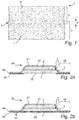
- Fig.1 illustrates an embodiment of a composite material 1 according to the invention.
- the composite material 1 comprises a first foam layer 2 comprising a first hydrophilic foam material of a hydrophilic polyurethane foam material 7; and a second foam layer 3 comprising a second hydrophilic foam material 8.
- an interfacial bonding volume 4 exists between the first foam layer 2 and the second foam layer 3, wherein - as generally applicable to all embodiments disclosed herein - the interfacial bonding volume 4 comprises no material other than the materials making up the first 2 and the second 3 foam layer, respectively.
- the first foam 3 and the second foam layer 2 are directly bonded to each other, at the interfacial bonding volume, by means of, e.g., physical interactions, thereby avoiding the need of additional bonding means, such as, for example, an additional adhesive layer between the foam layers 3, 4.
- additional bonding means such as, for example, an additional adhesive layer between the foam layers 3, 4.
- This is advantageous as such an additional adhesive layer may reduce the moisture vapor transmission rate (MVTR) through the composite material 1 and, in fact, trap the fluid (e.g. wound exudate if composite material is used as, or in, a medical dressing) in one of the foam layers.
- MVTR moisture vapor transmission rate
- any exudate absorbed by the first foam layer 2 can be transferred to the second foam layer 3 without having to pass through an additional adhesive layer.
- the thickness d of the interfacial bonding volume 4 is less than 200 ⁇ m, preferably less than 100 ⁇ m, more preferably less than 50 ⁇ m.
- the thickness d of the interfacial bonding volume 4 is in the range of 10 to 200 ⁇ m, such as 50 to 200 ⁇ m or 50 to 150 ⁇ m, or 50 to 100 ⁇ m.
- the thickness d of the interfacial bonding volume 4 is in the range of 10 to 100 ⁇ m, such as 10 to 60 ⁇ m.
- a minimum thickness d of the interfacial bonding volume 4 is advantageous as the absorption and/or retaining capacity of the materials may be impaired in the interfacial bonding volume 4, and a small thickness d of the interfacial bonding volume 4 facilitates fluid transfer between the foam layers 3, 4.
- the composite foam material 1 in accordance with the present invention allows to (more) strongly bond together two hydrophilic foam layers. Since no adhesive or other material that would be different from the material(s) making up the two layers is present at the interface between the two layers, according to the second aspect of the invention, fluid transfer from one layer to the other is optimized. Together with the possibility to adjust different functionalities in the two layers, this allows, in particular, to optimize absorption and retention in one overall foam material. This also allows to provide a multilayer, in particular bilayer, foam composite, which has an active ingredient, for example an antimicrobial agent, in only one layer, thus saving costs.
- an active ingredient for example an antimicrobial agent
- the present invention allows to provide a composite foam 1, in which the wound contact layer (e.g. the first foam layer) can be optimized for quick absorption and subsequent layers (e.g. the second foam layer) can be optimized to have a high fluid retention capacity.
- the present invention allows to incorporate an active substance (such as an anti-microbial compound) in the wound contact layer while still retaining a foam with good absorption and good overall foam retention otherwise.
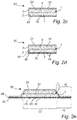
- Figs.2a-d illustrate exemplary embodiments of medical dressings 40, 50, 80, 90 comprising the composite material 1, as realized in the form of a sequence of layers, according to the invention.
- the medical dressings 40, 50, 80, 90 shown in Figs.2a-d thus comprise the first foam layer 2 comprising the first hydrophilic polyurethane foam material 7 and the second foam layer 3 comprising the second hydrophilic fiber foam material 8.
- the medical dressings 40, 50, 80, 90 further comprise a backing layer 21, 23 overlaying a top side 31 of the second foam layer 3, wherein the top side 31 being opposite to the side bonded to the first foam layer 2.
- the first foam layer 2 has a wound facing side 35 which can function as a direct or indirect wound contact layer, to absorb and retain wound exudate and/or transport wound exudate from the wound to the above second foam layer 3.
- the first foam layer 2 can advantageously be adapted to provide rapid absorption of wound exudate.
- the first foam layer 2 has a speed of absorption of at least 10 ⁇ L /sec, preferably at least 30 ⁇ L/sec.
- the backing layer 21 extends outside the peripheral portion of the layers of the composite material 1, to define a border portion 40 of the backing layer thus surrounding the peripheral portion of the layers of the composite material, thereby providing a so-called island dressing.
- Suitable backing layers 21, 23 are, for example, films, foils, foams, or membranes. Furthermore, it is advantageous if the backing layer has a thickness in the area of from ⁇ 5 ⁇ m up to ⁇ 80 ⁇ m, particularly preferred of from ⁇ 5 ⁇ m up to ⁇ 60 ⁇ m, and particularly preferred of from ⁇ 10 ⁇ m up to ⁇ 30 ⁇ m and/or that the backing layer has an elongation at break of more than 450%.
- the backing layer 21, 23 may be realized to be pervious to water vapor in accordance to DIN 53333 or DIN 54101.
- the backing layer 21, 23 may comprise a thermoplastic polymer, for example as a coating, or may consist thereof.
- a thermoplastic polymer at first, is to be understood as a polymer that remains thermoplastic if the same is repeatedly heated and cooled within a temperature that is typical for the respective processing or application conditions.
- Being thermoplastic is understood to be the property of a polymer material to repeatedly soften upon application of heat and to repeatedly harden when cooled down, within a temperature range that is typical for the respective material, wherein the material remains capable of being formed, in the softened stage, and repeatedly, by way of flowing, for example as a shaped article, extruded or otherwise.
- thermoplastic polymers are polyurethane, polyethylene, polypropylene, polyvinyl chloride, polystyrol, polyether, polyester, polyamide, polycarbonate, polyether polyamide copolymers, polyacrylate, polymethacrylate, and/or polymaleate.
- the thermoplastic polymers are elastomeric.
- the carrier foil comprises thermoplastic polyurethanes (TPU), or consists thereof.
- Thermoplastic polyurethanes selected from the group comprising aliphatic polyester polyurethanes, aromatic polyester polyurethanes, aliphatic polyether polyurethanes and/or aromatic polyether polyurethanes are particularly suitable.
- backing layers as breathable elastic membrane films. These are characterized by high flexibility and elasticity over a broad range of temperatures, also having advantageous sealing properties for (liquid) water while having a high water vapor permeability. These materials are further characterized by low noise, advantageous textile feel, resistance against washing and cleaning, very good chemical and mechanical resistance and the fact they are free of plasticizers.
- the backing layer that acts as a barrier for germs and has a high sealing capability against exudate emanating from the wound while, at the same time, being permeable for water vapor.
- the backing layer may, for example, be realized as a semipermeable membrane.
- the backing layer 21, 23 is preferably vapor permeable.
- the backing layer 21, 23 may be a plastic film, for example, comprising or consisting of polyurethane, polyethylene, or polypropylene.
- the backing layer 21, 23 is a polyurethane film having a thickness in the range of 10 to 100 ⁇ m, for example, 10 to 80 ⁇ m such as 10 to 50 ⁇ m, preferably from 10 ⁇ m to 30 ⁇ m.
- the medical dressings 40, 50, 80, 90 may include an adhesive layer or coating 41, 42, 43 to adhere the medical dressing to a wound and/or the surrounding skin surface.
- this wound-facing adhesive layer or coating 41, 42, 43 may be a silicone based adhesive or an acrylic based adhesive, preferably the adhesive layer or coating is a silicone based adhesive.
- coating should, in accordance with the present invention, be understood as essentially one continuous layer on a surface, or a discontinuous cover on a surface.
- the medical dressings 40, 50, 80, 90 may furthermore comprise a release layer (not shown) that is releasably connected to the adhesive layer or coating 41, 42, 43 and can be removed prior to application.
- Suitable release layers comprise or consist of materials that have limited adhesion to the adhesive of the adhesive layer, if brought in contact with the same. Examples for such release layers are release papers that comprise a non-adhesive silicone or polyolefin layer.
- the medical dressings 50, 90 include a perforated layer 44, for example made of a polyurethane film, wherein an adhesive coating 42 is provided on the non-perforated portions of the perforated layer 44.
- the perforated layer 44 includes a plurality of openings 45 (or through holes) of any desirable size and shape. The shape and size of the openings 45 may be adapted to achieve a desirable liquid transport from the wound to the above layers of the composite material 1.
- the perforated layer 44 with the adhesive coating 42 may be provided on the wound facing surface 35 of the first foam layer 2, wherein the perforated layer 44 extends outside the peripheral portion of the foam layers 2,3 of the composite material 1 and is attached to the border portion 40 of the backing layer 21.
- the footprint of the perforated layer 44 corresponds to the footprint of the composite material 1.
- the adhesive coating 43 is provided directly on the wound facing surface 35 of the first foam layer 2.
- an adhesive coating 41 is provided on a continuous plastic film 46, for example a polyurethane film as discussed above, which continuous plastic film 46 is arranged adjacent to a peripheral portion of the layers of the composite material 1, wherein the continuous film 46 extends away from said peripheral portion and is attached to the border portion 40 of the backing layer 21.
- adhesive coating may be provided directly on a skin facing surface of the border portion 40 of the backing layer 21.
- a first foam layer (for subsequent use in preparation of composite material) was prepared using the following steps (1-3): 1) An aqueous mixture was prepared (see table 1 for chemicals and concentrations); 2) the aqueous mixture was mixed with the selected prepolymer (see Table 1) at the specified ratio by weight (see Table 1) to give an emulsion mixture; 3) the emulsion mixture was poured onto and spread out on a casting paper (20x30 cm) and allowed to cure at standard condition (at room temperature) to give a foam thickness of about 3 mm (foam thickness is controlled by adapting the thickness of spread of the emulsion mixture in step 3).
- Chemicals used are commercially available as exemplified in the following: Baymedix® FP-505, HDI based prepolymer composition commercially available from Covestro; Trepol® B1, a TDI based prepolymer commercially available from Rynel Inc.; Carpenter 15050-7, commercially available from Carpenter; Polycat 77, commercially available from Air Products and Chemicals Inc.; Pluronic® L62, sodium bicarbonate and citric acid, are all commercially available from Sigma-Aldrich, Fisher Scientific, and/or BASF. Table 1 Single Foam Layer Aqueous mixture Prepolymer Ratio: Aqueous mix.
- Composite materials according to embodiments of the invention were prepared, at standard laboratory conditions (at room temperature unless otherwise stated), by the following sequential steps (1-6): 1) an aqueous mixture was prepared (see table 2); 2) the aqueous mixture was mixed with the selected prepolymer (see table 2) at the specified ratio by weight (see Table 2) to give an emulsion mixture; 3) the emulsion mixture was poured onto and spread out on a casting paper (20x30 cm); 4) a single foam layer (one of Foam A, Foam B, or Foam C) (20x30cm;) was applied on top of the emulsion; 5) the emulsion mixture was allowed to cure at standard condition (at room temperature) to give a foam thickness of about 3 mm (foam thickness is controlled by adapting the thickness of spread of the emulsion mixture in step 3); and 6) the resulting composite product was dried in an oven at 40 °C for 10 minutes per side.
- Steps 1 to 4 were performed in immediate sequential steps, wherein steps 1-4 should preferably be completed within less than 4 minutes to thereby ensure a desirable degree of curing (typically 50-90%, preferably 70-80%) in the emulsion mixture when step 4 is initiated.
- Test pieces were prepared by die-cutting the dried composite product to a size of approximately 10x10 cm.
- Table 2 Composite Prepolymer Aqueous mixture Aqueous mix.
- the thickness, or penetration depth, of the interfacial bonding volume was measured using a stereoscopic microscope with micrometer scale, that is, the interfacial bonding volume between the two foam layers was identified using the microscope and the thickness, corresponding to the depth of the interfacial bonding volume in the direction of the thickness of the layers/ composite material, was measured using the micrometer scale.
- the thickness of the interfacial bonding volume in Composite A, B, and C, as measured accordingly, were all determined to be in the range of 20 to 50 ⁇ m.
- the thickness of the interfacial bonding volume between the two foams is comparatively small (in particular less than 200 ⁇ m).
- the free swell absorptive (or maximum absorption) capacity was determined according to EN 13726-1:2002 with the following small modifications: a test piece with the size 10 x 10 cm (thickness ca. 3 mm) was used and the free swell absorptive capacity per volume unit of test piece was calculated, i.e. mass (kg) of retained Solution A per volume (m 3 ). Weight per volume provides a more relevant measure (as compared with e.g. weight by weight as suggested in EN 13726-1:2002) when comparing hydrophilic foams with different densities. The weight per volume values can readily be converted to weight per weight by dividing the weight per volume value with the respective density value of the sample.
- the free swell absorptive capacity values of the foam layers A, B, and C are presented in Table 3 below.
- fluid retention capacity is determined by first measuring the free swell absorptive (or maximum absorption) capacity according to EN 13726-1:2002.
- a rigid template approximately the same size as the sample (10 x 10 cm) with a mass equivalent to 40 mmHg, is subsequently applied to sample (now being soaked Solution A according to EN 13726-1:2002). After 2 minutes the rigid template is removed and the sample weight is again measured and amount of residual moisture (retained Solution A) is calculated.
- the fluid retention capacity is calculated by dividing the amount of retained Solution A (kg) with the volume (m 3 ) of the sample.
- the retention value of the foam layers A, B, and C are presented in Table 3 below.
- both Foam A and Foam C have higher fluid retention capacity than Foam B, wherein e.g. Foam A has 263% greater retention capacity as compared with Foam B, and can thus suitably function as fluid retention layer in a composite material, wherein Foam B can suitably function as a wound fluid acquisition layer, in particular as Foam B has a greater speed of absorption than Foam A and Foam C.
- the first foam layer may be embodied by foam layer B, and wherein the second foam layer may be embodied by foam layer A or foam layer C.
- speed of absorption is determined according to TAPPI standard T558 OM-97 (which method inter alia evaluates the absorptive properties of a surface, as the remaining liquid volume on top of the specimen surface is measured as a function of time), wherein the test solution used herein is the Solution A from EN 13726-1, and droplet volume is 30 ⁇ l.
- the speed of absorption of the Foam B in the Composite material A, B, and C i.e. the test solution was added to the Foam B of each of the Composite A, B, and C), was measured to be about 30 ⁇ l/sec.
- the speed of absorption of Foam A and Foam C was about 3 ⁇ l/sec and about 10 ⁇ l/sec, respectively.
Landscapes
- Health & Medical Sciences (AREA)
- Engineering & Computer Science (AREA)
- Chemical & Material Sciences (AREA)
- Life Sciences & Earth Sciences (AREA)
- Veterinary Medicine (AREA)
- Public Health (AREA)
- General Health & Medical Sciences (AREA)
- Animal Behavior & Ethology (AREA)
- Vascular Medicine (AREA)
- Heart & Thoracic Surgery (AREA)
- Biomedical Technology (AREA)
- Organic Chemistry (AREA)
- Polymers & Plastics (AREA)
- Medicinal Chemistry (AREA)
- Chemical Kinetics & Catalysis (AREA)
- Epidemiology (AREA)
- Materials Engineering (AREA)
- Hematology (AREA)
- Manufacturing & Machinery (AREA)
- Dispersion Chemistry (AREA)
- Materials For Medical Uses (AREA)
- Laminated Bodies (AREA)
- Medicinal Preparation (AREA)
Applications Claiming Priority (2)
| Application Number | Priority Date | Filing Date | Title |
|---|---|---|---|
| EP17170446 | 2017-05-10 | ||
| PCT/EP2018/061872 WO2018206578A1 (en) | 2017-05-10 | 2018-05-08 | Composite foam in wound treatment |
Publications (2)
| Publication Number | Publication Date |
|---|---|
| EP3621569A1 EP3621569A1 (en) | 2020-03-18 |
| EP3621569B1 true EP3621569B1 (en) | 2021-07-28 |
Family
ID=58701481
Family Applications (1)
| Application Number | Title | Priority Date | Filing Date |
|---|---|---|---|
| EP18721075.2A Active EP3621569B1 (en) | 2017-05-10 | 2018-05-08 | Composite foam in wound treatment |
Country Status (10)
| Country | Link |
|---|---|
| US (1) | US11628092B2 (enExample) |
| EP (1) | EP3621569B1 (enExample) |
| JP (1) | JP7069219B2 (enExample) |
| KR (1) | KR102555670B1 (enExample) |
| CN (2) | CN110612078B (enExample) |
| AU (1) | AU2018266750B2 (enExample) |
| CA (1) | CA3062733A1 (enExample) |
| DK (1) | DK3621569T3 (enExample) |
| ES (1) | ES2896175T3 (enExample) |
| WO (1) | WO2018206578A1 (enExample) |
Families Citing this family (36)
| Publication number | Priority date | Publication date | Assignee | Title |
|---|---|---|---|---|
| GB0808376D0 (en) | 2008-05-08 | 2008-06-18 | Bristol Myers Squibb Co | Wound dressing |
| GB0817796D0 (en) | 2008-09-29 | 2008-11-05 | Convatec Inc | wound dressing |
| GB201020236D0 (en) | 2010-11-30 | 2011-01-12 | Convatec Technologies Inc | A composition for detecting biofilms on viable tissues |
| CN103347562B (zh) | 2010-12-08 | 2016-08-10 | 康沃特克科技公司 | 伤口分泌液系统附件 |
| CA2819475C (en) | 2010-12-08 | 2019-02-12 | Convatec Technologies Inc. | Integrated system for assessing wound exudates |
| DK2648795T3 (da) | 2010-12-08 | 2023-03-27 | Convatec Technologies Inc | System til fjernelse af eksudater fra en sårposition |
| GB201115182D0 (en) | 2011-09-02 | 2011-10-19 | Trio Healthcare Ltd | Skin contact material |
| GB2497406A (en) | 2011-11-29 | 2013-06-12 | Webtec Converting Llc | Dressing with a perforated binder layer |
| MX2015007771A (es) | 2012-12-20 | 2015-09-04 | Convatec Technologies Inc | Procesamiento de fibras celulosicas quimicamente modificadas. |
| GB2543544A (en) | 2015-10-21 | 2017-04-26 | Brightwake Ltd | Wound dressing |
| JP7183146B2 (ja) | 2016-03-30 | 2022-12-05 | コンバテック・テクノロジーズ・インコーポレイテッド | 創傷における微生物感染の検出 |
| JP2019513238A (ja) | 2016-03-30 | 2019-05-23 | クオリザイム・ダイアグノスティクス・ゲゼルシャフト・ミット・ベシュレンクテル・ハフツング・ウント・コムパニー・コマンディットゲゼルシャフトQualizyme Diagnostics Gmbh And Co. Kg | 創傷における微生物感染の検出 |
| GB201608099D0 (en) | 2016-05-09 | 2016-06-22 | Convatec Technologies Inc | Negative pressure wound dressing |
| BR112019000284A2 (pt) | 2016-07-08 | 2019-04-16 | Convatec Technologies Inc. | aparelho de coleta de fluido |
| KR20190026858A (ko) | 2016-07-08 | 2019-03-13 | 컨바텍 테크놀러지스 인크 | 가요성 부압 시스템 |
| DK3481360T3 (da) | 2016-07-08 | 2022-03-28 | Convatec Technologies Inc | Fluidstrømningsmåling |
| US10583977B2 (en) | 2016-08-16 | 2020-03-10 | Mp Global Products, L.L.C. | Method of making an insulation material and an insulated mailer |
| US10442600B2 (en) | 2017-04-07 | 2019-10-15 | Pratt Retail Specialties, Llc | Insulated bag |
| US10800595B2 (en) | 2017-04-07 | 2020-10-13 | Pratt Retail Specialties, Llc | Box liner |
| US10551110B2 (en) | 2017-07-31 | 2020-02-04 | Pratt Retail Specialties, Llc | Modular box assembly |
| EP3710074B1 (en) | 2017-11-16 | 2024-03-20 | ConvaTec Limited | Fluid collection apparatus |
| US10507968B2 (en) | 2017-12-18 | 2019-12-17 | Pratt Retail Specialties, Llc | Modular box assembly |
| US11066228B2 (en) | 2018-11-13 | 2021-07-20 | Pratt Retail Specialties, Llc | Insulated box assembly and temperature-regulating lid therefor |
| US10875678B2 (en) | 2018-11-13 | 2020-12-29 | Pratt Retail Specialties, Llc | Box insert with vertical rails |
| US11491053B2 (en) * | 2019-03-28 | 2022-11-08 | Biodaptive Advanced Materials, Llc | Flexible absorbent bandage |
| US10882684B2 (en) | 2019-05-02 | 2021-01-05 | Pratt Retail Specialties, Llc | Box defining walls with insulation cavities |
| US11027875B2 (en) | 2019-05-02 | 2021-06-08 | Pratt Retail Specialties, Llc | Telescoping insulated boxes |
| CA3140199A1 (en) * | 2019-05-07 | 2020-11-12 | Aroa Biosurgery Limited | Negative pressure wound dressing |
| EP3962544B1 (en) | 2019-06-03 | 2023-11-08 | Convatec Limited | Methods and devices to disrupt and contain pathogens |
| EP3756850A1 (en) * | 2019-06-24 | 2020-12-30 | Mölnlycke Health Care AB | High throughput manufacture of polyurethane foam layers |
| US11331221B2 (en) | 2019-12-27 | 2022-05-17 | Convatec Limited | Negative pressure wound dressing |
| US11771819B2 (en) | 2019-12-27 | 2023-10-03 | Convatec Limited | Low profile filter devices suitable for use in negative pressure wound therapy systems |
| US11718464B2 (en) | 2020-05-05 | 2023-08-08 | Pratt Retail Specialties, Llc | Hinged wrap insulated container |
| US12270153B2 (en) * | 2021-02-11 | 2025-04-08 | Pratt Corrugated Holdings, Inc. | Starch-cellulose composite material |
| KR102790437B1 (ko) * | 2023-02-15 | 2025-04-04 | 바이오센서연구소 주식회사 | 피부 부착용 패치 제조방법 |
| CN121045635A (zh) * | 2024-05-31 | 2025-12-02 | 美国圣戈班性能塑料公司 | 多层复合物 |
Family Cites Families (21)
| Publication number | Priority date | Publication date | Assignee | Title |
|---|---|---|---|---|
| AU7355574A (en) * | 1974-09-20 | 1975-01-09 | Johnson & Johnson | Composite materials |
| US20030149406A1 (en) * | 2002-02-07 | 2003-08-07 | Lucie Martineau | Multi-layer dressing as medical drug delivery system |
| US20040153040A1 (en) | 2003-02-05 | 2004-08-05 | Lucie Martineau | Multi-layer synthetic dressing with cooling characteristics |
| DE602005022831D1 (de) | 2004-02-13 | 2010-09-23 | Convatec Technologies Inc | Mehrschichtiger wundverband |
| PL2254739T3 (pl) * | 2008-02-26 | 2012-02-29 | Eveready Battery Inc | Sposób wytwarzania zintegrowanych warstwowych wyrobów uretanowych |
| DE102008031183A1 (de) * | 2008-07-03 | 2010-01-07 | Paul Hartmann Ag | Wundauflage |
| US8454990B2 (en) | 2008-08-01 | 2013-06-04 | Milliken & Company | Composite article suitable for use as a wound dressing |
| CN102143770B (zh) | 2008-09-18 | 2015-08-12 | 凯希特许有限公司 | 用于在组织部位施加减压的层流敷料和系统 |
| GB2467554A (en) * | 2009-02-04 | 2010-08-11 | Systagenix Wound Man Ip Co Bv | A wound dressing material featuring polyurethane foam integrated into a solid substrate |
| SE533841C2 (sv) * | 2009-06-15 | 2011-02-01 | Moelnlycke Health Care Ab | Sårförband med hög vätskehanteringskapacitet |
| AU2010365058B2 (en) * | 2010-12-09 | 2015-07-23 | Colgate-Palmolive Company | Cleansing composition |
| WO2013000910A1 (de) * | 2011-06-29 | 2013-01-03 | Bayer Intellectual Property Gmbh | Verbundschaum für wundauflagen |
| GB201207852D0 (en) | 2012-05-04 | 2012-06-20 | Adv Med Solutions Ltd | Wound dressing |
| DE102014106518A1 (de) | 2014-05-09 | 2015-11-12 | Paul Hartmann Ag | Schaumwundauflage für die Unterdrucktherapie |
| CA2952284C (en) * | 2014-06-18 | 2023-03-28 | Smith & Nephew Plc | Wound dressing |
| EP2995287A1 (en) * | 2014-09-11 | 2016-03-16 | Mölnlycke Health Care AB | Medical dressing |
| EP3023083A1 (en) * | 2014-11-20 | 2016-05-25 | Mölnlycke Health Care AB | Wound dressings |
| WO2017011050A2 (en) * | 2015-04-23 | 2017-01-19 | University Of Florida Research Foundation, Inc. | Bilayered devices for enhanced healing |
| WO2017019868A1 (en) * | 2015-07-28 | 2017-02-02 | Curaline Inc. | Systems and methods for making hydrophilic foams |
| EP3359207A4 (en) * | 2015-10-05 | 2019-05-08 | 3M Innovative Properties Company | ABSORBENT ARTICLE WITH A FLEXIBLE POLYMER FOAM AND INTERMEDIATE PRODUCTS |
| EP3384882A1 (en) * | 2017-04-05 | 2018-10-10 | Mölnlycke Health Care AB | Composite material for fluid flow management |
-
2018
- 2018-05-08 JP JP2019561180A patent/JP7069219B2/ja active Active
- 2018-05-08 US US16/607,439 patent/US11628092B2/en active Active
- 2018-05-08 CA CA3062733A patent/CA3062733A1/en active Pending
- 2018-05-08 ES ES18721075T patent/ES2896175T3/es active Active
- 2018-05-08 CN CN201880030768.XA patent/CN110612078B/zh active Active
- 2018-05-08 DK DK18721075.2T patent/DK3621569T3/da active
- 2018-05-08 KR KR1020197033222A patent/KR102555670B1/ko active Active
- 2018-05-08 EP EP18721075.2A patent/EP3621569B1/en active Active
- 2018-05-08 AU AU2018266750A patent/AU2018266750B2/en active Active
- 2018-05-08 WO PCT/EP2018/061872 patent/WO2018206578A1/en not_active Ceased
- 2018-05-08 CN CN202210377078.XA patent/CN114795657B/zh active Active
Non-Patent Citations (1)
| Title |
|---|
| None * |
Also Published As
| Publication number | Publication date |
|---|---|
| DK3621569T3 (da) | 2021-11-01 |
| CN110612078A (zh) | 2019-12-24 |
| JP2020519337A (ja) | 2020-07-02 |
| KR102555670B1 (ko) | 2023-07-13 |
| AU2018266750A1 (en) | 2019-11-14 |
| US20200129338A1 (en) | 2020-04-30 |
| US11628092B2 (en) | 2023-04-18 |
| CN114795657B (zh) | 2023-07-14 |
| JP7069219B2 (ja) | 2022-05-17 |
| KR20200004812A (ko) | 2020-01-14 |
| CN110612078B (zh) | 2022-04-19 |
| WO2018206578A1 (en) | 2018-11-15 |
| BR112019023465A2 (pt) | 2020-06-30 |
| AU2018266750B2 (en) | 2023-05-25 |
| CN114795657A (zh) | 2022-07-29 |
| CA3062733A1 (en) | 2018-11-15 |
| ES2896175T3 (es) | 2022-02-24 |
| EP3621569A1 (en) | 2020-03-18 |
Similar Documents
| Publication | Publication Date | Title |
|---|---|---|
| EP3621569B1 (en) | Composite foam in wound treatment | |
| AU2018280743B2 (en) | Foam in wound treatment | |
| US11980693B2 (en) | Composite materials in wound treatment | |
| BR112019023465B1 (pt) | Material compósito, curativo médico e método para produzir um material compósito |
Legal Events
| Date | Code | Title | Description |
|---|---|---|---|
| STAA | Information on the status of an ep patent application or granted ep patent |
Free format text: STATUS: UNKNOWN |
|
| STAA | Information on the status of an ep patent application or granted ep patent |
Free format text: STATUS: THE INTERNATIONAL PUBLICATION HAS BEEN MADE |
|
| PUAI | Public reference made under article 153(3) epc to a published international application that has entered the european phase |
Free format text: ORIGINAL CODE: 0009012 |
|
| STAA | Information on the status of an ep patent application or granted ep patent |
Free format text: STATUS: REQUEST FOR EXAMINATION WAS MADE |
|
| 17P | Request for examination filed |
Effective date: 20191010 |
|
| AK | Designated contracting states |
Kind code of ref document: A1 Designated state(s): AL AT BE BG CH CY CZ DE DK EE ES FI FR GB GR HR HU IE IS IT LI LT LU LV MC MK MT NL NO PL PT RO RS SE SI SK SM TR |
|
| AX | Request for extension of the european patent |
Extension state: BA ME |
|
| DAV | Request for validation of the european patent (deleted) | ||
| DAX | Request for extension of the european patent (deleted) | ||
| STAA | Information on the status of an ep patent application or granted ep patent |
Free format text: STATUS: EXAMINATION IS IN PROGRESS |
|
| 17Q | First examination report despatched |
Effective date: 20200915 |
|
| GRAP | Despatch of communication of intention to grant a patent |
Free format text: ORIGINAL CODE: EPIDOSNIGR1 |
|
| STAA | Information on the status of an ep patent application or granted ep patent |
Free format text: STATUS: GRANT OF PATENT IS INTENDED |
|
| INTG | Intention to grant announced |
Effective date: 20210421 |
|
| GRAS | Grant fee paid |
Free format text: ORIGINAL CODE: EPIDOSNIGR3 |
|
| GRAA | (expected) grant |
Free format text: ORIGINAL CODE: 0009210 |
|
| STAA | Information on the status of an ep patent application or granted ep patent |
Free format text: STATUS: THE PATENT HAS BEEN GRANTED |
|
| AK | Designated contracting states |
Kind code of ref document: B1 Designated state(s): AL AT BE BG CH CY CZ DE DK EE ES FI FR GB GR HR HU IE IS IT LI LT LU LV MC MK MT NL NO PL PT RO RS SE SI SK SM TR |
|
| REG | Reference to a national code |
Ref country code: GB Ref legal event code: FG4D |
|
| REG | Reference to a national code |
Ref country code: CH Ref legal event code: EP |
|
| REG | Reference to a national code |
Ref country code: DE Ref legal event code: R096 Ref document number: 602018020803 Country of ref document: DE |
|
| REG | Reference to a national code |
Ref country code: AT Ref legal event code: REF Ref document number: 1414037 Country of ref document: AT Kind code of ref document: T Effective date: 20210815 |
|
| REG | Reference to a national code |
Ref country code: IE Ref legal event code: FG4D |
|
| REG | Reference to a national code |
Ref country code: DK Ref legal event code: T3 Effective date: 20211026 |
|
| REG | Reference to a national code |
Ref country code: LT Ref legal event code: MG9D |
|
| REG | Reference to a national code |
Ref country code: SE Ref legal event code: TRGR |
|
| REG | Reference to a national code |
Ref country code: NL Ref legal event code: FP |
|
| REG | Reference to a national code |
Ref country code: AT Ref legal event code: MK05 Ref document number: 1414037 Country of ref document: AT Kind code of ref document: T Effective date: 20210728 |
|
| PG25 | Lapsed in a contracting state [announced via postgrant information from national office to epo] |
Ref country code: NO Free format text: LAPSE BECAUSE OF FAILURE TO SUBMIT A TRANSLATION OF THE DESCRIPTION OR TO PAY THE FEE WITHIN THE PRESCRIBED TIME-LIMIT Effective date: 20211028 Ref country code: PT Free format text: LAPSE BECAUSE OF FAILURE TO SUBMIT A TRANSLATION OF THE DESCRIPTION OR TO PAY THE FEE WITHIN THE PRESCRIBED TIME-LIMIT Effective date: 20211129 Ref country code: BG Free format text: LAPSE BECAUSE OF FAILURE TO SUBMIT A TRANSLATION OF THE DESCRIPTION OR TO PAY THE FEE WITHIN THE PRESCRIBED TIME-LIMIT Effective date: 20211028 Ref country code: AT Free format text: LAPSE BECAUSE OF FAILURE TO SUBMIT A TRANSLATION OF THE DESCRIPTION OR TO PAY THE FEE WITHIN THE PRESCRIBED TIME-LIMIT Effective date: 20210728 Ref country code: LT Free format text: LAPSE BECAUSE OF FAILURE TO SUBMIT A TRANSLATION OF THE DESCRIPTION OR TO PAY THE FEE WITHIN THE PRESCRIBED TIME-LIMIT Effective date: 20210728 Ref country code: RS Free format text: LAPSE BECAUSE OF FAILURE TO SUBMIT A TRANSLATION OF THE DESCRIPTION OR TO PAY THE FEE WITHIN THE PRESCRIBED TIME-LIMIT Effective date: 20210728 Ref country code: FI Free format text: LAPSE BECAUSE OF FAILURE TO SUBMIT A TRANSLATION OF THE DESCRIPTION OR TO PAY THE FEE WITHIN THE PRESCRIBED TIME-LIMIT Effective date: 20210728 Ref country code: HR Free format text: LAPSE BECAUSE OF FAILURE TO SUBMIT A TRANSLATION OF THE DESCRIPTION OR TO PAY THE FEE WITHIN THE PRESCRIBED TIME-LIMIT Effective date: 20210728 |
|
| REG | Reference to a national code |
Ref country code: ES Ref legal event code: FG2A Ref document number: 2896175 Country of ref document: ES Kind code of ref document: T3 Effective date: 20220224 |
|
| PG25 | Lapsed in a contracting state [announced via postgrant information from national office to epo] |
Ref country code: PL Free format text: LAPSE BECAUSE OF FAILURE TO SUBMIT A TRANSLATION OF THE DESCRIPTION OR TO PAY THE FEE WITHIN THE PRESCRIBED TIME-LIMIT Effective date: 20210728 Ref country code: LV Free format text: LAPSE BECAUSE OF FAILURE TO SUBMIT A TRANSLATION OF THE DESCRIPTION OR TO PAY THE FEE WITHIN THE PRESCRIBED TIME-LIMIT Effective date: 20210728 Ref country code: GR Free format text: LAPSE BECAUSE OF FAILURE TO SUBMIT A TRANSLATION OF THE DESCRIPTION OR TO PAY THE FEE WITHIN THE PRESCRIBED TIME-LIMIT Effective date: 20211029 |
|
| REG | Reference to a national code |
Ref country code: DE Ref legal event code: R097 Ref document number: 602018020803 Country of ref document: DE |
|
| PG25 | Lapsed in a contracting state [announced via postgrant information from national office to epo] |
Ref country code: SM Free format text: LAPSE BECAUSE OF FAILURE TO SUBMIT A TRANSLATION OF THE DESCRIPTION OR TO PAY THE FEE WITHIN THE PRESCRIBED TIME-LIMIT Effective date: 20210728 Ref country code: SK Free format text: LAPSE BECAUSE OF FAILURE TO SUBMIT A TRANSLATION OF THE DESCRIPTION OR TO PAY THE FEE WITHIN THE PRESCRIBED TIME-LIMIT Effective date: 20210728 Ref country code: RO Free format text: LAPSE BECAUSE OF FAILURE TO SUBMIT A TRANSLATION OF THE DESCRIPTION OR TO PAY THE FEE WITHIN THE PRESCRIBED TIME-LIMIT Effective date: 20210728 Ref country code: EE Free format text: LAPSE BECAUSE OF FAILURE TO SUBMIT A TRANSLATION OF THE DESCRIPTION OR TO PAY THE FEE WITHIN THE PRESCRIBED TIME-LIMIT Effective date: 20210728 Ref country code: CZ Free format text: LAPSE BECAUSE OF FAILURE TO SUBMIT A TRANSLATION OF THE DESCRIPTION OR TO PAY THE FEE WITHIN THE PRESCRIBED TIME-LIMIT Effective date: 20210728 Ref country code: AL Free format text: LAPSE BECAUSE OF FAILURE TO SUBMIT A TRANSLATION OF THE DESCRIPTION OR TO PAY THE FEE WITHIN THE PRESCRIBED TIME-LIMIT Effective date: 20210728 |
|
| PLBE | No opposition filed within time limit |
Free format text: ORIGINAL CODE: 0009261 |
|
| STAA | Information on the status of an ep patent application or granted ep patent |
Free format text: STATUS: NO OPPOSITION FILED WITHIN TIME LIMIT |
|
| 26N | No opposition filed |
Effective date: 20220429 |
|
| REG | Reference to a national code |
Ref country code: BE Ref legal event code: MM Effective date: 20220531 |
|
| PG25 | Lapsed in a contracting state [announced via postgrant information from national office to epo] |
Ref country code: MC Free format text: LAPSE BECAUSE OF FAILURE TO SUBMIT A TRANSLATION OF THE DESCRIPTION OR TO PAY THE FEE WITHIN THE PRESCRIBED TIME-LIMIT Effective date: 20210728 Ref country code: LU Free format text: LAPSE BECAUSE OF NON-PAYMENT OF DUE FEES Effective date: 20220508 |
|
| PG25 | Lapsed in a contracting state [announced via postgrant information from national office to epo] |
Ref country code: IE Free format text: LAPSE BECAUSE OF NON-PAYMENT OF DUE FEES Effective date: 20220508 |
|
| PG25 | Lapsed in a contracting state [announced via postgrant information from national office to epo] |
Ref country code: BE Free format text: LAPSE BECAUSE OF NON-PAYMENT OF DUE FEES Effective date: 20220531 |
|
| PG25 | Lapsed in a contracting state [announced via postgrant information from national office to epo] |
Ref country code: MK Free format text: LAPSE BECAUSE OF FAILURE TO SUBMIT A TRANSLATION OF THE DESCRIPTION OR TO PAY THE FEE WITHIN THE PRESCRIBED TIME-LIMIT Effective date: 20210728 Ref country code: CY Free format text: LAPSE BECAUSE OF FAILURE TO SUBMIT A TRANSLATION OF THE DESCRIPTION OR TO PAY THE FEE WITHIN THE PRESCRIBED TIME-LIMIT Effective date: 20210728 |
|
| PG25 | Lapsed in a contracting state [announced via postgrant information from national office to epo] |
Ref country code: HU Free format text: LAPSE BECAUSE OF FAILURE TO SUBMIT A TRANSLATION OF THE DESCRIPTION OR TO PAY THE FEE WITHIN THE PRESCRIBED TIME-LIMIT; INVALID AB INITIO Effective date: 20180508 |
|
| PG25 | Lapsed in a contracting state [announced via postgrant information from national office to epo] |
Ref country code: TR Free format text: LAPSE BECAUSE OF FAILURE TO SUBMIT A TRANSLATION OF THE DESCRIPTION OR TO PAY THE FEE WITHIN THE PRESCRIBED TIME-LIMIT Effective date: 20210728 |
|
| PG25 | Lapsed in a contracting state [announced via postgrant information from national office to epo] |
Ref country code: MT Free format text: LAPSE BECAUSE OF FAILURE TO SUBMIT A TRANSLATION OF THE DESCRIPTION OR TO PAY THE FEE WITHIN THE PRESCRIBED TIME-LIMIT Effective date: 20210728 |
|
| PGFP | Annual fee paid to national office [announced via postgrant information from national office to epo] |
Ref country code: NL Payment date: 20250526 Year of fee payment: 8 |
|
| PGFP | Annual fee paid to national office [announced via postgrant information from national office to epo] |
Ref country code: DE Payment date: 20250528 Year of fee payment: 8 |
|
| PGFP | Annual fee paid to national office [announced via postgrant information from national office to epo] |
Ref country code: GB Payment date: 20250520 Year of fee payment: 8 Ref country code: ES Payment date: 20250612 Year of fee payment: 8 Ref country code: DK Payment date: 20250526 Year of fee payment: 8 |
|
| PGFP | Annual fee paid to national office [announced via postgrant information from national office to epo] |
Ref country code: IT Payment date: 20250522 Year of fee payment: 8 |
|
| PGFP | Annual fee paid to national office [announced via postgrant information from national office to epo] |
Ref country code: FR Payment date: 20250526 Year of fee payment: 8 |
|
| PGFP | Annual fee paid to national office [announced via postgrant information from national office to epo] |
Ref country code: CH Payment date: 20250601 Year of fee payment: 8 |
|
| PGFP | Annual fee paid to national office [announced via postgrant information from national office to epo] |
Ref country code: SE Payment date: 20250526 Year of fee payment: 8 |