EP3617337A1 - HIGH-Mn STEEL AND PRODUCTION METHOD THEREFOR - Google Patents
HIGH-Mn STEEL AND PRODUCTION METHOD THEREFOR Download PDFInfo
- Publication number
- EP3617337A1 EP3617337A1 EP18790123.6A EP18790123A EP3617337A1 EP 3617337 A1 EP3617337 A1 EP 3617337A1 EP 18790123 A EP18790123 A EP 18790123A EP 3617337 A1 EP3617337 A1 EP 3617337A1
- Authority
- EP
- European Patent Office
- Prior art keywords
- less
- steel
- content
- temperature
- steel plate
- Prior art date
- Legal status (The legal status is an assumption and is not a legal conclusion. Google has not performed a legal analysis and makes no representation as to the accuracy of the status listed.)
- Pending
Links
Classifications
-
- C—CHEMISTRY; METALLURGY
- C22—METALLURGY; FERROUS OR NON-FERROUS ALLOYS; TREATMENT OF ALLOYS OR NON-FERROUS METALS
- C22C—ALLOYS
- C22C38/00—Ferrous alloys, e.g. steel alloys
-
- C—CHEMISTRY; METALLURGY
- C21—METALLURGY OF IRON
- C21D—MODIFYING THE PHYSICAL STRUCTURE OF FERROUS METALS; GENERAL DEVICES FOR HEAT TREATMENT OF FERROUS OR NON-FERROUS METALS OR ALLOYS; MAKING METAL MALLEABLE, e.g. BY DECARBURISATION OR TEMPERING
- C21D8/00—Modifying the physical properties of ferrous metals or ferrous alloys by deformation combined with, or followed by, heat treatment
- C21D8/02—Modifying the physical properties of ferrous metals or ferrous alloys by deformation combined with, or followed by, heat treatment during manufacturing of plates or strips
-
- C—CHEMISTRY; METALLURGY
- C21—METALLURGY OF IRON
- C21D—MODIFYING THE PHYSICAL STRUCTURE OF FERROUS METALS; GENERAL DEVICES FOR HEAT TREATMENT OF FERROUS OR NON-FERROUS METALS OR ALLOYS; MAKING METAL MALLEABLE, e.g. BY DECARBURISATION OR TEMPERING
- C21D8/00—Modifying the physical properties of ferrous metals or ferrous alloys by deformation combined with, or followed by, heat treatment
- C21D8/02—Modifying the physical properties of ferrous metals or ferrous alloys by deformation combined with, or followed by, heat treatment during manufacturing of plates or strips
- C21D8/0221—Modifying the physical properties of ferrous metals or ferrous alloys by deformation combined with, or followed by, heat treatment during manufacturing of plates or strips characterised by the working steps
- C21D8/0226—Hot rolling
-
- C—CHEMISTRY; METALLURGY
- C21—METALLURGY OF IRON
- C21D—MODIFYING THE PHYSICAL STRUCTURE OF FERROUS METALS; GENERAL DEVICES FOR HEAT TREATMENT OF FERROUS OR NON-FERROUS METALS OR ALLOYS; MAKING METAL MALLEABLE, e.g. BY DECARBURISATION OR TEMPERING
- C21D9/00—Heat treatment, e.g. annealing, hardening, quenching or tempering, adapted for particular articles; Furnaces therefor
- C21D9/46—Heat treatment, e.g. annealing, hardening, quenching or tempering, adapted for particular articles; Furnaces therefor for sheet metals
-
- C—CHEMISTRY; METALLURGY
- C22—METALLURGY; FERROUS OR NON-FERROUS ALLOYS; TREATMENT OF ALLOYS OR NON-FERROUS METALS
- C22C—ALLOYS
- C22C38/00—Ferrous alloys, e.g. steel alloys
- C22C38/001—Ferrous alloys, e.g. steel alloys containing N
-
- C—CHEMISTRY; METALLURGY
- C22—METALLURGY; FERROUS OR NON-FERROUS ALLOYS; TREATMENT OF ALLOYS OR NON-FERROUS METALS
- C22C—ALLOYS
- C22C38/00—Ferrous alloys, e.g. steel alloys
- C22C38/002—Ferrous alloys, e.g. steel alloys containing In, Mg, or other elements not provided for in one single group C22C38/001 - C22C38/60
-
- C—CHEMISTRY; METALLURGY
- C22—METALLURGY; FERROUS OR NON-FERROUS ALLOYS; TREATMENT OF ALLOYS OR NON-FERROUS METALS
- C22C—ALLOYS
- C22C38/00—Ferrous alloys, e.g. steel alloys
- C22C38/005—Ferrous alloys, e.g. steel alloys containing rare earths, i.e. Sc, Y, Lanthanides
-
- C—CHEMISTRY; METALLURGY
- C22—METALLURGY; FERROUS OR NON-FERROUS ALLOYS; TREATMENT OF ALLOYS OR NON-FERROUS METALS
- C22C—ALLOYS
- C22C38/00—Ferrous alloys, e.g. steel alloys
- C22C38/02—Ferrous alloys, e.g. steel alloys containing silicon
-
- C—CHEMISTRY; METALLURGY
- C22—METALLURGY; FERROUS OR NON-FERROUS ALLOYS; TREATMENT OF ALLOYS OR NON-FERROUS METALS
- C22C—ALLOYS
- C22C38/00—Ferrous alloys, e.g. steel alloys
- C22C38/06—Ferrous alloys, e.g. steel alloys containing aluminium
-
- C—CHEMISTRY; METALLURGY
- C22—METALLURGY; FERROUS OR NON-FERROUS ALLOYS; TREATMENT OF ALLOYS OR NON-FERROUS METALS
- C22C—ALLOYS
- C22C38/00—Ferrous alloys, e.g. steel alloys
- C22C38/18—Ferrous alloys, e.g. steel alloys containing chromium
- C22C38/20—Ferrous alloys, e.g. steel alloys containing chromium with copper
-
- C—CHEMISTRY; METALLURGY
- C22—METALLURGY; FERROUS OR NON-FERROUS ALLOYS; TREATMENT OF ALLOYS OR NON-FERROUS METALS
- C22C—ALLOYS
- C22C38/00—Ferrous alloys, e.g. steel alloys
- C22C38/18—Ferrous alloys, e.g. steel alloys containing chromium
- C22C38/22—Ferrous alloys, e.g. steel alloys containing chromium with molybdenum or tungsten
-
- C—CHEMISTRY; METALLURGY
- C22—METALLURGY; FERROUS OR NON-FERROUS ALLOYS; TREATMENT OF ALLOYS OR NON-FERROUS METALS
- C22C—ALLOYS
- C22C38/00—Ferrous alloys, e.g. steel alloys
- C22C38/18—Ferrous alloys, e.g. steel alloys containing chromium
- C22C38/24—Ferrous alloys, e.g. steel alloys containing chromium with vanadium
-
- C—CHEMISTRY; METALLURGY
- C22—METALLURGY; FERROUS OR NON-FERROUS ALLOYS; TREATMENT OF ALLOYS OR NON-FERROUS METALS
- C22C—ALLOYS
- C22C38/00—Ferrous alloys, e.g. steel alloys
- C22C38/18—Ferrous alloys, e.g. steel alloys containing chromium
- C22C38/26—Ferrous alloys, e.g. steel alloys containing chromium with niobium or tantalum
-
- C—CHEMISTRY; METALLURGY
- C22—METALLURGY; FERROUS OR NON-FERROUS ALLOYS; TREATMENT OF ALLOYS OR NON-FERROUS METALS
- C22C—ALLOYS
- C22C38/00—Ferrous alloys, e.g. steel alloys
- C22C38/18—Ferrous alloys, e.g. steel alloys containing chromium
- C22C38/28—Ferrous alloys, e.g. steel alloys containing chromium with titanium or zirconium
-
- C—CHEMISTRY; METALLURGY
- C22—METALLURGY; FERROUS OR NON-FERROUS ALLOYS; TREATMENT OF ALLOYS OR NON-FERROUS METALS
- C22C—ALLOYS
- C22C38/00—Ferrous alloys, e.g. steel alloys
- C22C38/18—Ferrous alloys, e.g. steel alloys containing chromium
- C22C38/38—Ferrous alloys, e.g. steel alloys containing chromium with more than 1.5% by weight of manganese
-
- C—CHEMISTRY; METALLURGY
- C22—METALLURGY; FERROUS OR NON-FERROUS ALLOYS; TREATMENT OF ALLOYS OR NON-FERROUS METALS
- C22C—ALLOYS
- C22C38/00—Ferrous alloys, e.g. steel alloys
- C22C38/18—Ferrous alloys, e.g. steel alloys containing chromium
- C22C38/40—Ferrous alloys, e.g. steel alloys containing chromium with nickel
- C22C38/42—Ferrous alloys, e.g. steel alloys containing chromium with nickel with copper
-
- C—CHEMISTRY; METALLURGY
- C22—METALLURGY; FERROUS OR NON-FERROUS ALLOYS; TREATMENT OF ALLOYS OR NON-FERROUS METALS
- C22C—ALLOYS
- C22C38/00—Ferrous alloys, e.g. steel alloys
- C22C38/18—Ferrous alloys, e.g. steel alloys containing chromium
- C22C38/40—Ferrous alloys, e.g. steel alloys containing chromium with nickel
- C22C38/48—Ferrous alloys, e.g. steel alloys containing chromium with nickel with niobium or tantalum
-
- C—CHEMISTRY; METALLURGY
- C22—METALLURGY; FERROUS OR NON-FERROUS ALLOYS; TREATMENT OF ALLOYS OR NON-FERROUS METALS
- C22C—ALLOYS
- C22C38/00—Ferrous alloys, e.g. steel alloys
- C22C38/18—Ferrous alloys, e.g. steel alloys containing chromium
- C22C38/40—Ferrous alloys, e.g. steel alloys containing chromium with nickel
- C22C38/50—Ferrous alloys, e.g. steel alloys containing chromium with nickel with titanium or zirconium
-
- C—CHEMISTRY; METALLURGY
- C22—METALLURGY; FERROUS OR NON-FERROUS ALLOYS; TREATMENT OF ALLOYS OR NON-FERROUS METALS
- C22C—ALLOYS
- C22C38/00—Ferrous alloys, e.g. steel alloys
- C22C38/18—Ferrous alloys, e.g. steel alloys containing chromium
- C22C38/40—Ferrous alloys, e.g. steel alloys containing chromium with nickel
- C22C38/58—Ferrous alloys, e.g. steel alloys containing chromium with nickel with more than 1.5% by weight of manganese
Definitions
- the disclosure relates to high-Mn steel that is suitable for structural steel used in an extremely low-temperature environment such as a storage tank of liquefied gas, in particular, high-Mn steel excellent in toughness at low temperature, and a production method therefor.
- the steel plate needs to have high strength and excellent toughness at extremely low temperature because the structure is used at extremely low temperature.
- excellent toughness needs to be guaranteed at the boiling point of the liquefied natural gas, that is, -164 °C or lower.
- a steel material has poor low-temperature toughness, the safety as a structure for an extremely low temperature storage tank may not be maintained.
- steel materials with improved low-temperature toughness that are applied to such a structure.
- austenitic stainless steel which has austenite as a structure of a steel plate, the austenite showing no brittleness at extremely low temperature, 9 % Ni steel, or five thousand series aluminum alloys have been conventionally used.
- the alloy cost and production cost are high, and thus there is a demand for steel materials which are inexpensive and excellent in extremely low-temperature toughness.
- JP 2016-196703 A proposes using, as structural steel used in an extremely low temperature environment, high-Mn steel added with a large amount of Mn which is relatively inexpensive and an austenite-stabilizing element.
- PTL 1 proposes a technique of properly controlling the austenite grain size to prevent carbides generated in crystal grain boundaries from becoming an origin of fracture and a propagation path of cracks.
- the technique may provide high-Mn steel which exhibits excellent low-temperature toughness in a base metal and a heat-affected zone after welding.
- the high-Mn steel material of PTL 1 has a thickness of about 15 mm to 50 mm, but for example, in an application such as a longitudinal member, the thickness is required to be less than 15 mm, in particular 10 mm or less.
- the "exhibiting excellent low-temperature toughness" means that the absorbed energy vE -196 °C in a Charpy impact test at -196 °C is 100 J or more.
- high-Mn steel excellent in low-temperature toughness and ductility.
- both a base metal and a heat-affected zone have excellent low-temperature toughness. Therefore, our high-Mn steel largely contributes to the improvement of the safety and the service life of a steel structure used in an extremely low temperature environment such as a tank for a storage tank of liquefied gas, and has industrially significant effects. Further, our production method does not decrease productivity or increase the production cost, and thus is excellent in economic efficiency.
- the C content is an inexpensive austenite-stabilizing element, and an important element to obtain austenite. To obtain this effect, the C content needs to be 0.30 % or more. On the other hand, a C content beyond 0.90 % generates excessive Cr carbides, deteriorating low-temperature toughness. Therefore, the C content is set to 0.30 % or more and 0.90 % or less.
- the lower limit of the C content is preferably 0.36 %, and more preferably 0.40 %.
- the upper limit of the C content is preferably 0.80 %, and more preferably 0.66 %.
- the upper limits and the lower limits can be arbitrarily combined.
- the C content is preferably set to 0.36 % or more and 0.80 % or less, and more preferably 0.40 % or more and 0.80 % or less.
- Si 0.05 % or more and 1.0 % or less
- the Si acts as a deoxidizer, is necessary for steelmaking, and is effective at increasing hardness of a steel plate by solid solution strengthening when dissolved in steel. To obtain such an effect, the Si content needs to be 0.05 % or more. On the other hand, a Si content beyond 1.0 % deteriorates weldability. Therefore, the Si content is set to 0.05 % or more and 1.0 % or less. In particular, from the perspective of obtaining a steel plate with increased hardness, the lower limit of the Si content is preferably 0.07 %, more preferably 0.23 %, further preferably 0.26 %, and still further preferably 0.51 %.
- the upper limit of the Si content is set to 0.8 %, more preferably 0.7 %, further preferably 0.6 %, and still further preferably 0.5 %.
- the upper limit and the lower limit can be combined.
- the Si content is preferably set to 0.07 % or more and 0.8 % or less, 0.23 % or more and 0.7 % or less, and more preferably 0.26 % or more and 0.6 % or less.
- the Si content is preferably 0.07 % or more and 0.5 % or less.
- Mn 15.0 % or more and 30.0 % or less
- Mn is a relatively inexpensive austenite-stabilizing element.
- Mn is an important element for achieving both strength and extremely low-temperature toughness.
- the Mn content needs to be 15.0 % or more.
- a Mn content beyond 30.0 % does not increase the effect of improving extremely low-temperature toughness, but increases alloy cost. Further, such a high Mn content deteriorates weldability and cuttability, and further promotes segregation as well as the occurrence of stress corrosion cracking. Therefore, the Mn content is set to 15.0 % or more and 30.0 % or less.
- the lower limit of the Mn content is preferably 16.0 %, more preferably 18.0 %, and further preferably 19.0 %.
- the upper limit of the Mn content is preferably 29.0 %, and more preferably 28.0 %.
- the Mn content is preferably set to 16.0 % or more and 29.0 % or less, and more preferably 18.0 % or more and 28.0 % or less.
- the upper limit of the P content is 0.030 %, and desirably, the P content is kept as small as possible. Therefore, the P content is set to 0.030 % or less. Further, from the perspective of decreasing the origin of stress corrosion cracking, the upper limit of the P content is preferably 0.028 % or less, and more preferably 0.024 % or less. Excessively reducing P, however, involves high refining cost and is economically disadvantageous. Therefore, the lower limit of the P content is preferably set to 0.002 %, and more preferably 0.005 %.
- the upper limit of the S content is 0.0070 %, and desirably, the S content is kept as small as possible. Therefore, the S content is set to 0.0070 % or less. From the perspective of preventing deterioration in base metal low-temperature toughness and ductility, the upper limit of the S content is preferably 0.0060 % or less. Excessively reducing S, however, involves high refining cost and is economically disadvantageous. Therefore, the lower limit of the S content is preferably set to 0.001 % or more. The S content is preferably set to 0.0020 % or more and 0.0060 % or less.
- Al 0.01 % or more and 0.07 % or less
- the Al acts as a deoxidizer and is used most commonly in molten steel deoxidizing processes to obtain a steel plate. To obtain such an effect, the Al content needs to be 0.01 % or more. On the other hand, when the Al content is beyond 0.07 %, Al is mixed into a weld metal portion during welding, deteriorating toughness of the weld metal. Therefore, the Al content is set to 0.07 % or less. Therefore, the Al content is set to 0.01 % or more and 0.07 % or less. In particular, from the perspective of obtaining an effect as a deoxidizer, the lower limit of the Al content is preferably 0.02 %, more preferably 0.046 %, and further preferably 0.052 %.
- the upper limit of the Al content is preferably set to 0.065 %, and more preferably 0.06 %.
- the upper limit and the lower limit can be combined.
- the Al content is preferably set to 0.02 % or more and 0.06 % or less.
- the Cr content is an element which stabilizes austenite with an appropriate amount of addition and is effective at improving extremely low-temperature toughness and base metal strength. To obtain such effects, the Cr content needs to be 0.5 % or more. On the other hand, a Cr content beyond 7.0 % generates Cr carbides, deteriorating low-temperature toughness and stress corrosion cracking resistance. Therefore, the Cr content is set to 0.5 % or more and 7.0 % or less. In particular, from the perspective of improving extremely low-temperature toughness and base metal strength, the lower limit of the Cr content is preferably 1 % or more, more preferably 1.2 %, and further preferably 2.0 %.
- the upper limit of the Cr content is preferably set to 6.7 % or less, more preferably 6.5 % or less, and further preferably 6.0 %.
- the upper limits and the lower limits can be arbitrarily combined.
- the Cr content is preferably set to 1.0 % or more and 6.7 % or less, and more preferably 1.2 % or more and 6.5 % or less.
- the Cr content is further preferably 2.0 % or more and 6.0 % or less.
- N 0.0050 % or more and 0.0500 % or less
- N is an austenite-stabilizing element and an element which is effective at improving extremely low-temperature toughness. To obtain such an effect, the N content needs to be 0.0050 % or more. On the other hand, the N content beyond 0.0500 % coarsens nitrides or carbonitrides, deteriorating toughness. Therefore, the N content is set to 0.0050 % or more and 0.0500 % or less. In particular, from the perspective of improving extremely low-temperature toughness, the lower limit of the N content is preferably 0.0060 % or more, more preferably 0.0355 %, and further preferably 0.0810 %.
- the upper limit of the N content is preferably set to 0.0450 % or less, and more preferably 0.0400 % or less.
- the upper limits and the lower limits of the N content can be arbitrarily combined.
- the N content is preferably set to 0.0060 % or more and 0.0400 % or less.
- the O content is set to 0.0050 % or less.
- the upper limit of the O content is preferably 0.0045 % or less.
- the lower limit of the O content is preferably 0.0023 % or more.
- the upper limits and the lower limits of the O content can be arbitrarily combined.
- the O content is preferably set to 0.0023 % or more and 0.0050 % or less.
- Ti and Nb form carbonitrides with a high melting point in steel to prevent coarsening of crystal grains, then becoming an origin of fracture and a propagation path of cracks.
- Ti and Nb hinder structure control for enhancing low-temperature toughness and improving ductility, and thus, need to be intentionally limited.
- Ti and Nb are components which is inevitably mixed from raw materials into steel, and Ti of 0.005 % or more and 0.010 % or less and Nb of 0.005 % or more and 0.010 % or less are typically mixed.
- each Ti and Nb By limiting the content of each Ti and Nb to less than 0.005 % to eliminate the adverse effect of carbonitrides, excellent low-temperature toughness and ductility can be guaranteed. Therefore, from the perspective of excellent low-temperature toughness and ductility, the content of each Ti and Nb is preferably set to 0.004 % or less, and more preferably 0.003 % or less.
- the balance other than the aforementioned components includes Fe and inevitable impurities.
- the inevitable impurities include H, and a total content of 0.01 % may be allowed.
- the steel material When a steel material has a body centered cubic (bcc) crystal structure, the steel material may cause brittle fracture in a low temperature environment, and thus, is not suitable for use in a low temperature environment.
- the steel material When the steel material is assumed to be used in a low temperature environment, the steel material is required to have, as its matrix phase, an austenite structure which has a face centered cubic (fcc) crystal structure.
- austenite as its matrix phase means that area ratio of austenite phase is 90 % or more. When area ratio of austenite phase is 90 % or more, low-temperature toughness can be guaranteed.
- the balance other than austenite phase is ferrite or martensite phase.
- volume fraction of ⁇ martensite is preferably less than 1.0 %, more preferably less than 0.5 %, and further preferably less than 0.1 %.
- a type means sulfide inclusions
- B type means cluster-type inclusions
- C type means granular oxide inclusions.
- coarsening of crystal grains is effective at guaranteeing low-temperature toughness in austenite steel.
- the biggest crystal grain size of the microstructure needs to be 50 ⁇ m or more, which is achieved by using high-Mn steel satisfying the aforementioned requirements.
- the following elements can be contained as necessary. At least one of Cu: 0.01 % or more and 1.00 % or less, Ni: 0.01 % or more and 1.00 % or less, Mo: 2.0 % or less, V: 2.0 % or less, W: 2.0 % or less, Ca: 0.0005 % or more and 0.0050 % or less, Mg: 0.0005 % or more and 0.0050 % or less, and REM: 0.0010 % or more and 0.0200 % or less.
- Cu, Ni, Mo, V, and W stabilize austenite and improve base metal strength.
- Cu and Ni are each preferably contained in an amount of 0.01% or more
- Mo, V, and W are each preferably contained in an amount of 0.001 % or more.
- the content of each Cu and Ni is beyond 1.00 %, or the content of each Mo, V, and W is beyond 2.0 %, coarse carbonitrides are generated, which may become an origin of fracture, and additionally increase production cost. Therefore, when these alloying elements are contained, the content of each Cu and Ni is preferably 1.00 % or less, and the content of each Mo, V, and W is preferably 2.0 % or less.
- the content of each Cu and Ni is more preferably 0.05 % or more and 0.70 % or less.
- the content of each Mn, V, and W is more preferably 0.003 % or more and 1.7 % or less.
- Ca, Mg, and REM are elements useful for morphological control of inclusions, and can be contained as necessary.
- the morphological control of inclusions means granulating elongated sulfide-based inclusions.
- the morphological control of inclusions improves ductility, toughness, and sulfide stress corrosion cracking resistance.
- Ca and Mg are preferably contained in an amount of 0.0005 % or more and REM is preferably contained in an amount of 0.0010 % or more.
- these elements are contained in a large amount, not only the amount of nonmetallic inclusions may be increased, ending up deteriorating ductility, toughness, and sulfide stress corrosion cracking resistance, but also an economic disadvantage may be entailed.
- the content of each element is set to 0.0005 % or more and 0.0050 % or less.
- the content is set to 0.0010 % or more and 0.0200 % or less.
- the Ca content is set to 0.0010 % or more and 0.0040 % or less
- the Mg content is set to 0.0010 % or more and 0.0040 % or less
- the REM content is set to 0.0020 % or more and 0.0150 % or less.
- Our high-Mn steel can be obtained from molten steel having the aforementioned chemical composition which is prepared by steelmaking using a publicly-known method such as using a converter and an electric heating furnace.
- the high-Mn steel may also be subjected to secondary refinement in a vacuum degassing furnace.
- secondary refinement to limit the contents of Ti and Nb which hinder suitable structure control within the aforementioned range, it is necessary to prevent Ti and Nb from being inevitably mixed from raw materials or the like into steel and decrease the contents of Ti and Nb. For example, by decreasing the basicity of slag in the refining stage, these alloy elements are concentrated in the slag to be discharged, thus decreasing Ti and Nb concentrations in a final slab product.
- a method may be used in which oxygen is injected for oxidation, floating and separating alloy of Ti and Nb during circulation. Subsequently, it is preferable to make the steel into a steel material such as a slab having a determined size by a publicly-known steel making method such as continuous casting or ingot casting and blooming.
- production conditions are defined to make the aforementioned steel material into a steel material exhibiting excellent low-temperature toughness.
- Heating temperature of a steel material 1100 °C or more and 1300 °C or less
- the heating temperature before hot rolling is set to 1100 °C or more. Further, when the lower limit of the heating temperature of the steel material is less than 1100 °C, the amount of nonmetallic inclusions in steel is increased, thus deteriorating extremely low-temperature toughness and ductility. However, the heating temperature beyond 1300 °C may trigger local melting. Thus, the upper limit of the heating temperature is set to 1300 °C. The temperature is controlled based on surface temperature of the steel material.
- Rolling finish temperature 800 °C or more and less than 950 °C
- a steel ingot or a billet is heated and subsequently subjected to hot rolling.
- To make coarse crystal grains it is preferable to increase the cumulative rolling reduction at high temperature.
- the crystal grains become excessively coarse in a temperature range of 950 °C or more, and thus desired yield stress cannot be obtained. Therefore, final finish rolling of at least one pass at less than 950 °C is necessary.
- hot rolling at low temperature refines the microstructure and excessively introduces working strain, thus deteriorating low-temperature toughness. Therefore, the lower limit of the rolling finishing temperature is set to 800 °C.
- the upper limit of cooling start temperature is set to 900 °C.
- the average rate of cooling a surface of the steel plate from a temperature at or above (rolling finish temperature - 100 °C) to a temperature range of 300 °C or more and 650 °C or less is set to 1.0 °C/s or more.
- the cooling rate is 1 °C/s or more.
- tempering treatment may be performed to adjust strength of the steel plate.
- Steel slabs having the chemical compositions listed in Table 1 were made by a process for refining with converter and ladle and continuous casting. Next, the obtained steel slabs were charged into a heating furnace and heated to 1150 °C, and subsequently, hot rolled into steel plates having a thickness of 10 mm to 30 mm. Tensile properties and toughness of the steel plates were evaluated as described below.
- JIS NO. 5 tensile test pieces were collected from each steel plate. Then, the test pieces were subjected to a tensile test in conformity with JIS Z 2241 (1998) to investigate tensile test properties.
- a test piece had a yield stress of 400 MPa or more and a tensile strength of 800 MPa or more, the corresponding steel plate was determined to have excellent tensile properties. Further, when a test piece had a total elongation of 30 % or more upon breakage, the corresponding steel plate was determined to have excellent ductility.
- Charpy V-notch test pieces were collected from each steel plate having a plate thickness of more than 20 mm at a 1/4 position of the plate thickness or from each steel plate having a plate thickness of 20 mm or less at a 1/2 position of the plate thickness, in a direction orthogonal to the rolling direction in conformity with JIS Z 2202 (1998). Then, the test pieces were subjected to Charpy impact test in conformity with JIS Z 2242 (1998), where three test pieces were used for each steel plate, to determine absorbed energy at -196 °C and evaluate base metal toughness. When the three test pieces had an average absorbed energy (vE- 196 ) of 100 J or more, the corresponding steel plate was determined to have good base steel toughness.
- High-Mn steel of the disclosure was confirmed to satisfy the aforementioned desired performance (a base metal yield stress of 400 MPa or more, a total elongation upon breakage of 30 % or more, an average of absorbed energy (vE- 196 ) of 100 J or more for low-temperature toughness).
- a base metal yield stress of 400 MPa or more a total elongation upon breakage of 30 % or more, an average of absorbed energy (vE- 196 ) of 100 J or more for low-temperature toughness.
- comparative examples out of the scope of the disclosure did not satisfy the aforementioned desired performance in terms of any one or more of total elongation, yield stress, and low-temperature toughness.
- the steel materials were subjected to heat cycle treatment under conditions of peak temperature of 1400 °C and a cooling rate of 10 °C/s.
- the results are listed in Table 2.
- the steel materials according to the disclosure were excellent in welded portion toughness as well as in base metal toughness at low temperature. Specifically, in welding which gave input heat of 0.5 kJ/cm to 5 kJ/cm, the maximum crystal grain size was 50 ⁇ m or more, and the absorbed energy in Charpy impact test at -196 °C was 100 J or more.
Landscapes
- Chemical & Material Sciences (AREA)
- Engineering & Computer Science (AREA)
- Materials Engineering (AREA)
- Mechanical Engineering (AREA)
- Metallurgy (AREA)
- Organic Chemistry (AREA)
- Physics & Mathematics (AREA)
- Thermal Sciences (AREA)
- Crystallography & Structural Chemistry (AREA)
- Heat Treatment Of Steel (AREA)
Abstract
Description
- The disclosure relates to high-Mn steel that is suitable for structural steel used in an extremely low-temperature environment such as a storage tank of liquefied gas, in particular, high-Mn steel excellent in toughness at low temperature, and a production method therefor.
- To use a hot-rolled steel plate in a structure for a storage tank of liquefied gas, the steel plate needs to have high strength and excellent toughness at extremely low temperature because the structure is used at extremely low temperature. For example, when the hot-rolled steel plate is used for a storage tank of liquefied natural gas, excellent toughness needs to be guaranteed at the boiling point of the liquefied natural gas, that is, -164 °C or lower. When a steel material has poor low-temperature toughness, the safety as a structure for an extremely low temperature storage tank may not be maintained. Thus, there is a growing demand for steel materials with improved low-temperature toughness that are applied to such a structure.
- In view of the demand, austenitic stainless steel which has austenite as a structure of a steel plate, the austenite showing no brittleness at extremely low temperature, 9 % Ni steel, or five thousand series aluminum alloys have been conventionally used. However, the alloy cost and production cost are high, and thus there is a demand for steel materials which are inexpensive and excellent in extremely low-temperature toughness.
- As new steel materials replacing conventional steel for extremely low temperature, for example,
JP 2016-196703 A - PTL 1 proposes a technique of properly controlling the austenite grain size to prevent carbides generated in crystal grain boundaries from becoming an origin of fracture and a propagation path of cracks. The technique may provide high-Mn steel which exhibits excellent low-temperature toughness in a base metal and a heat-affected zone after welding.
- PTL 1:
JP 2016-196703 A - In an application such as the aforementioned structure for a storage tank of liquefied gas, it is important to guarantee ductility in addition to low-temperature toughness. Specifically, when such a structure is made, steel materials to be used in the structure need to have high workability. Additionally, excellent ductility is required in such an application. The technique of PTL 1, however, does not verify ductility. Further, the high-Mn steel material of PTL 1 has a thickness of about 15 mm to 50 mm, but for example, in an application such as a longitudinal member, the thickness is required to be less than 15 mm, in particular 10 mm or less. When such a thin plate is produced, the technique exemplified in paragraph 0040 of PTL 1 in which hot rolling at 950 °C or more and subsequent accelerated cooling are performed tends to cause deflection and strain in an obtained steel plate, which requires an extra process such as shape adjustment, thus deteriorating productivity.
- It could thus be helpful to propose a method of further imparting excellent ductility to high-Mn steel exhibiting excellent low-temperature toughness of base metal and heat-affected zone. Further, it could be helpful to propose a method of producing a thin plate of such high-Mn steel without deflection or strain. As used herein, the "exhibiting excellent low-temperature toughness" means that the absorbed energy vE-196 °C in a Charpy impact test at -196 °C is 100 J or more.
- To achieve the aforementioned objects, we conducted extensive study on high-Mn steel as to various factors determining the chemical composition of a steel plate and a production method therefor to discover the following:
- a. High-Mn austenite steel has no occurrence of brittle fracture at extremely low temperature. Such fracture occurs from grain boundaries. This suggests that for improving low-temperature toughness of high-Mn steel, it is effective to coarsen crystal grains to thereby decrease grain boundaries which become an origin of fracture and a propagation path.
- b. Further, we newly discovered that nonmetallic inclusions become an origin of fracture and a propagation path of cracks to thus adversely affect low-temperature toughness and ductility. Thus, by properly controlling the Cr content added to high-Mn steel, and limiting the contents of Ti and Nb that are inevitably mixed, the increase in crystal grain boundaries and the formation of excessive nonmetallic inclusions that become an origin of fracture are avoid.
- c. On the other hand, simply coarsening of crystal grains deteriorates yield stress. Further, when a thin plate with a thickness of less than 15 mm is produced, an obtained steel plate tends to have deflection and strain. Therefore, to sufficiently guarantee yield stress as structural steel and leave no deflection or strain in a steel plate, it is necessary to properly control hot rolling conditions in producing a steel plate.
- This disclosure is based on these discoveries and further investigation conducted by the inventors. The primary features of this disclosure are as follows.
- 1. High-Mn steel comprising:
- a chemical composition containing (consisting of), in mass%,
- C: 0.30 % or more and 0.90 % or less,
- Si: 0.05 % or more and 1.0 % or less,
- Mn: 15 % or more and 30 % or less,
- P: 0.030 % or less,
- S: 0.0070 % or less,
- Al: 0.01 % or more and 0.07 % or less,
- Cr: 0.5 % or more and 7.0 % or less,
- N: 0.0050 % or more and 0.0500 % or less, and
- O: 0.0050 % or less,
- Ti: less than 0.005 %, and
- Nb: less than 0.005 %, with the balance being Fe and inevitable impurities;
- a microstructure containing austenite as a matrix phase and nonmetallic inclusions with an area fraction of less than 5.0 %; and
- a yield stress of 400 MPa or more and an absorbed energy (vE-196) of 100 J or more.
The nonmetallic inclusions are nonmetallic inclusions in a structure test of JIS G0202, and specifically refer to A type inclusions, B type inclusions, and C type inclusions that are described in JIS G0202. - 2. The high-Mn steel according to 1., wherein the chemical composition further contains, in mass %, at least one selected from
- Cu: 0.01 % or more and 1.00 % or less,
- Ni: 0.01 % or more and 1.00 % or less,
- Mo: 2.0 % or less,
- V: 2.0 % or less,
- W: 2.0 % or less,
- Ca: 0.0005 % or more and 0.0050 % or less,
- Mg: 0.0005 % or more and 0.0050 % or less, and
- REM: 0.0010 % or more and 0.0200 % or less.
- 3. A production method of high-Mn steel comprising: heating a steel material having the chemical composition according to 1. or 2. to a temperature range of 1100 °C or more and 1300 °C or less; hot rolling the steel material with a rolling finish temperature of 800 °C or more and less than 950 °C to obtain a hot-rolled steel plate; and then subjecting the hot-rolled steel plate to cooling treatment at an average cooling rate of 1.0 °C/s or more from a temperature at or above (the rolling finish temperature - 100 °C) to a temperature range of 300 °C or more and 650 °C or less.
Each temperature range is a surface temperature of the steel material or the steel plate. - 4. The production method of high-Mn steel according to 3. comprising: after the cooling treatment, heating the steel plate to a temperature range of 300 °C or more and 650 °C or less and then cooling the steel plate.
- According to the present disclosure, it is possible to provide high-Mn steel excellent in low-temperature toughness and ductility. When the high-Mn steel is welded, both a base metal and a heat-affected zone have excellent low-temperature toughness. Therefore, our high-Mn steel largely contributes to the improvement of the safety and the service life of a steel structure used in an extremely low temperature environment such as a tank for a storage tank of liquefied gas, and has industrially significant effects. Further, our production method does not decrease productivity or increase the production cost, and thus is excellent in economic efficiency.
- Our high-Mn steel will be described in detail below.
- The chemical composition of our high-Mn steel and the reasons for the limitations thereof are described first. In the description of the chemical composition, "%" denotes "mass%" unless otherwise noted.
- C is an inexpensive austenite-stabilizing element, and an important element to obtain austenite. To obtain this effect, the C content needs to be 0.30 % or more. On the other hand, a C content beyond 0.90 % generates excessive Cr carbides, deteriorating low-temperature toughness. Therefore, the C content is set to 0.30 % or more and 0.90 % or less. In particular, from the perspective of stabilizing austenite, the lower limit of the C content is preferably 0.36 %, and more preferably 0.40 %. Further, from the perspective of preventing deterioration in low-temperature toughness, the upper limit of the C content is preferably 0.80 %, and more preferably 0.66 %. For the preferable C content, the upper limits and the lower limits can be arbitrarily combined. Thus, for example, the C content is preferably set to 0.36 % or more and 0.80 % or less, and more preferably 0.40 % or more and 0.80 % or less.
- Si acts as a deoxidizer, is necessary for steelmaking, and is effective at increasing hardness of a steel plate by solid solution strengthening when dissolved in steel. To obtain such an effect, the Si content needs to be 0.05 % or more. On the other hand, a Si content beyond 1.0 % deteriorates weldability. Therefore, the Si content is set to 0.05 % or more and 1.0 % or less. In particular, from the perspective of obtaining a steel plate with increased hardness, the lower limit of the Si content is preferably 0.07 %, more preferably 0.23 %, further preferably 0.26 %, and still further preferably 0.51 %. Further, from the perspective of preventing deterioration in weldability, the upper limit of the Si content is set to 0.8 %, more preferably 0.7 %, further preferably 0.6 %, and still further preferably 0.5 %. For the preferable Si content, the upper limit and the lower limit can be combined. Thus, for example, the Si content is preferably set to 0.07 % or more and 0.8 % or less, 0.23 % or more and 0.7 % or less, and more preferably 0.26 % or more and 0.6 % or less. Further, the Si content is preferably 0.07 % or more and 0.5 % or less.
- Mn is a relatively inexpensive austenite-stabilizing element. In the disclosure, Mn is an important element for achieving both strength and extremely low-temperature toughness. To obtain such effects, the Mn content needs to be 15.0 % or more. On the other hand, a Mn content beyond 30.0 % does not increase the effect of improving extremely low-temperature toughness, but increases alloy cost. Further, such a high Mn content deteriorates weldability and cuttability, and further promotes segregation as well as the occurrence of stress corrosion cracking. Therefore, the Mn content is set to 15.0 % or more and 30.0 % or less. In particular, from the perspective of stabilizing austenite, the lower limit of the Mn content is preferably 16.0 %, more preferably 18.0 %, and further preferably 19.0 %. Further, from the perspective of preventing deterioration in the low-temperature toughness, the upper limit of the Mn content is preferably 29.0 %, and more preferably 28.0 %. For the preferable Mn content, the upper limits and the lower limits can be arbitrarily combined. Thus, for example, the Mn content is preferably set to 16.0 % or more and 29.0 % or less, and more preferably 18.0 % or more and 28.0 % or less.
- When a P content is beyond 0.030 %, P segregates to grain boundaries and becomes an origin of stress corrosion cracking. Therefore, the upper limit of the P content is 0.030 %, and desirably, the P content is kept as small as possible. Therefore, the P content is set to 0.030 % or less. Further, from the perspective of decreasing the origin of stress corrosion cracking, the upper limit of the P content is preferably 0.028 % or less, and more preferably 0.024 % or less. Excessively reducing P, however, involves high refining cost and is economically disadvantageous. Therefore, the lower limit of the P content is preferably set to 0.002 %, and more preferably 0.005 %.
- S deteriorates base metal low-temperature toughness and ductility. Therefore, the upper limit of the S content is 0.0070 %, and desirably, the S content is kept as small as possible. Therefore, the S content is set to 0.0070 % or less. From the perspective of preventing deterioration in base metal low-temperature toughness and ductility, the upper limit of the S content is preferably 0.0060 % or less. Excessively reducing S, however, involves high refining cost and is economically disadvantageous. Therefore, the lower limit of the S content is preferably set to 0.001 % or more. The S content is preferably set to 0.0020 % or more and 0.0060 % or less.
- Al acts as a deoxidizer and is used most commonly in molten steel deoxidizing processes to obtain a steel plate. To obtain such an effect, the Al content needs to be 0.01 % or more. On the other hand, when the Al content is beyond 0.07 %, Al is mixed into a weld metal portion during welding, deteriorating toughness of the weld metal. Therefore, the Al content is set to 0.07 % or less. Therefore, the Al content is set to 0.01 % or more and 0.07 % or less. In particular, from the perspective of obtaining an effect as a deoxidizer, the lower limit of the Al content is preferably 0.02 %, more preferably 0.046 %, and further preferably 0.052 %. Further, from the perspective of toughness of weld metal, the upper limit of the Al content is preferably set to 0.065 %, and more preferably 0.06 %. For the Al content, the upper limit and the lower limit can be combined. Thus, for example, the Al content is preferably set to 0.02 % or more and 0.06 % or less.
- Cr is an element which stabilizes austenite with an appropriate amount of addition and is effective at improving extremely low-temperature toughness and base metal strength. To obtain such effects, the Cr content needs to be 0.5 % or more. On the other hand, a Cr content beyond 7.0 % generates Cr carbides, deteriorating low-temperature toughness and stress corrosion cracking resistance. Therefore, the Cr content is set to 0.5 % or more and 7.0 % or less. In particular, from the perspective of improving extremely low-temperature toughness and base metal strength, the lower limit of the Cr content is preferably 1 % or more, more preferably 1.2 %, and further preferably 2.0 %. Further, from the perspective of low-temperature toughness and stress corrosion cracking resistance, the upper limit of the Cr content is preferably set to 6.7 % or less, more preferably 6.5 % or less, and further preferably 6.0 %. For the preferable Cr content, the upper limits and the lower limits can be arbitrarily combined. Thus, for example, the Cr content is preferably set to 1.0 % or more and 6.7 % or less, and more preferably 1.2 % or more and 6.5 % or less. To further improve stress corrosion cracking resistance, the Cr content is further preferably 2.0 % or more and 6.0 % or less.
- N is an austenite-stabilizing element and an element which is effective at improving extremely low-temperature toughness. To obtain such an effect, the N content needs to be 0.0050 % or more. On the other hand, the N content beyond 0.0500 % coarsens nitrides or carbonitrides, deteriorating toughness. Therefore, the N content is set to 0.0050 % or more and 0.0500 % or less. In particular, from the perspective of improving extremely low-temperature toughness, the lower limit of the N content is preferably 0.0060 % or more, more preferably 0.0355 %, and further preferably 0.0810 %. Further, from the perspective of preventing deterioration in toughness, the upper limit of the N content is preferably set to 0.0450 % or less, and more preferably 0.0400 % or less. For the preferable N content, the upper limits and the lower limits of the N content can be arbitrarily combined. Thus, for example, the N content is preferably set to 0.0060 % or more and 0.0400 % or less.
- O deteriorates extremely low-temperature toughness because of the formation of oxides. Therefore, the O content is set to 0.0050 % or less. From the perspective of preventing deterioration in toughness, the upper limit of the O content is preferably 0.0045 % or less. Further, the lower limit of the O content is preferably 0.0023 % or more. For the preferable O content, the upper limits and the lower limits of the O content can be arbitrarily combined. Thus, for example, the O content is preferably set to 0.0023 % or more and 0.0050 % or less.
- Ti and Nb form carbonitrides with a high melting point in steel to prevent coarsening of crystal grains, then becoming an origin of fracture and a propagation path of cracks. In particular, in high-Mn steel, Ti and Nb hinder structure control for enhancing low-temperature toughness and improving ductility, and thus, need to be intentionally limited. Specifically, Ti and Nb are components which is inevitably mixed from raw materials into steel, and Ti of 0.005 % or more and 0.010 % or less and Nb of 0.005 % or more and 0.010 % or less are typically mixed. Thus, according to the method described below, it is necessary to avoid inevitable mixing of Ti and Nb and limit the content of each Ti and Nb to less than 0.005 %. By limiting the content of each Ti and Nb to less than 0.005 % to eliminate the adverse effect of carbonitrides, excellent low-temperature toughness and ductility can be guaranteed. Therefore, from the perspective of excellent low-temperature toughness and ductility, the content of each Ti and Nb is preferably set to 0.004 % or less, and more preferably 0.003 % or less.
- The balance other than the aforementioned components includes Fe and inevitable impurities. The inevitable impurities include H, and a total content of 0.01 % may be allowed.
- When a steel material has a body centered cubic (bcc) crystal structure, the steel material may cause brittle fracture in a low temperature environment, and thus, is not suitable for use in a low temperature environment. When the steel material is assumed to be used in a low temperature environment, the steel material is required to have, as its matrix phase, an austenite structure which has a face centered cubic (fcc) crystal structure. As used herein, "have austenite as its matrix phase" means that area ratio of austenite phase is 90 % or more. When area ratio of austenite phase is 90 % or more, low-temperature toughness can be guaranteed. The balance other than austenite phase is ferrite or martensite phase. However, even a small amount of ε martensite deteriorates low-temperature toughness. Thus, as the microstructure which has austenite as a matrix phase according to the disclosure, a structure is preferable which substantially has no ε martensite phase. Specifically, to guarantee low-temperature toughness, volume fraction of ε martensite is preferably less than 1.0 %, more preferably less than 0.5 %, and further preferably less than 0.1 %.
- As to nonmetallic inclusions, A type means sulfide inclusions, B type means cluster-type inclusions, and C type means granular oxide inclusions. When a large amount of these nonmetallic inclusions exist in steel, they become an origin of fracture, deteriorating extremely low-temperature toughness and ductility. Therefore, area fraction of the inclusions in total needs to be limited to 5 % or less, and preferably 4 % or less. Accordingly, the control of the chemical composition as stated above and the following production method need to be performed.
- Further, when area ratio of austenite phase is 90 % or more and area fraction of nonmetallic inclusions is less than 5.0 %, steel exhibiting extremely low-temperature toughness and good ductility can be provided.
- When the above requirements are satisfied, properties desired in the disclosure can be obtained. For example, when high-Mn steel is subjected to welding treatment, low-temperature toughness of a heat-affected zone is particularly a matter of concern. However, when high-Mn steel satisfying the aforementioned requirements is used, the microstructure of the heat-affected zone has austenite as its matrix phase, and the grain size of the austenite is an equivalent circular diameter of 50 µm or more. Thus, low-temperature toughness is guaranteed in the heat-affected zone.
- Specifically, coarsening of crystal grains is effective at guaranteeing low-temperature toughness in austenite steel. The same applies to a heat-affected zone. For example, to obtain a value of 100 J or more as an absorbed energy of a Charpy impact test at -196 °C, the biggest crystal grain size of the microstructure needs to be 50 µm or more, which is achieved by using high-Mn steel satisfying the aforementioned requirements.
- In the disclosure, to further improve strength and low-temperature toughness, in addition to the essential elements described above, the following elements can be contained as necessary.
At least one of Cu: 0.01 % or more and 1.00 % or less, Ni: 0.01 % or more and 1.00 % or less, Mo: 2.0 % or less, V: 2.0 % or less, W: 2.0 % or less, Ca: 0.0005 % or more and 0.0050 % or less, Mg: 0.0005 % or more and 0.0050 % or less, and REM: 0.0010 % or more and 0.0200 % or less. - Cu, Ni, Mo, V, and W stabilize austenite and improve base metal strength. To obtain such an effect, Cu and Ni are each preferably contained in an amount of 0.01% or more, and Mo, V, and W are each preferably contained in an amount of 0.001 % or more. On the other hand, when the content of each Cu and Ni is beyond 1.00 %, or the content of each Mo, V, and W is beyond 2.0 %, coarse carbonitrides are generated, which may become an origin of fracture, and additionally increase production cost. Therefore, when these alloying elements are contained, the content of each Cu and Ni is preferably 1.00 % or less, and the content of each Mo, V, and W is preferably 2.0 % or less. The content of each Cu and Ni is more preferably 0.05 % or more and 0.70 % or less. The content of each Mn, V, and W is more preferably 0.003 % or more and 1.7 % or less.
- Ca, Mg, and REM are elements useful for morphological control of inclusions, and can be contained as necessary. The morphological control of inclusions means granulating elongated sulfide-based inclusions. The morphological control of inclusions improves ductility, toughness, and sulfide stress corrosion cracking resistance. To obtain such effects, Ca and Mg are preferably contained in an amount of 0.0005 % or more and REM is preferably contained in an amount of 0.0010 % or more. On the other hand, when these elements are contained in a large amount, not only the amount of nonmetallic inclusions may be increased, ending up deteriorating ductility, toughness, and sulfide stress corrosion cracking resistance, but also an economic disadvantage may be entailed.
- Therefore, when Ca and Mg are contained, the content of each element is set to 0.0005 % or more and 0.0050 % or less. When REM is contained, the content is set to 0.0010 % or more and 0.0200 % or less. Preferably, the Ca content is set to 0.0010 % or more and 0.0040 % or less, the Mg content is set to 0.0010 % or more and 0.0040 % or less, and the REM content is set to 0.0020 % or more and 0.0150 % or less.
- Our high-Mn steel can be obtained from molten steel having the aforementioned chemical composition which is prepared by steelmaking using a publicly-known method such as using a converter and an electric heating furnace. In addition, the high-Mn steel may also be subjected to secondary refinement in a vacuum degassing furnace. During the secondary refinement, to limit the contents of Ti and Nb which hinder suitable structure control within the aforementioned range, it is necessary to prevent Ti and Nb from being inevitably mixed from raw materials or the like into steel and decrease the contents of Ti and Nb. For example, by decreasing the basicity of slag in the refining stage, these alloy elements are concentrated in the slag to be discharged, thus decreasing Ti and Nb concentrations in a final slab product. Further, a method may be used in which oxygen is injected for oxidation, floating and separating alloy of Ti and Nb during circulation. Subsequently, it is preferable to make the steel into a steel material such as a slab having a determined size by a publicly-known steel making method such as continuous casting or ingot casting and blooming.
- Further, production conditions are defined to make the aforementioned steel material into a steel material exhibiting excellent low-temperature toughness.
- To coarsen crystal grains of the microstructure of the steel material, the heating temperature before hot rolling is set to 1100 °C or more. Further, when the lower limit of the heating temperature of the steel material is less than 1100 °C, the amount of nonmetallic inclusions in steel is increased, thus deteriorating extremely low-temperature toughness and ductility. However, the heating temperature beyond 1300 °C may trigger local melting. Thus, the upper limit of the heating temperature is set to 1300 °C. The temperature is controlled based on surface temperature of the steel material.
- A steel ingot or a billet is heated and subsequently subjected to hot rolling. To make coarse crystal grains, it is preferable to increase the cumulative rolling reduction at high temperature. However, the crystal grains become excessively coarse in a temperature range of 950 °C or more, and thus desired yield stress cannot be obtained. Therefore, final finish rolling of at least one pass at less than 950 °C is necessary. On the other hand, hot rolling at low temperature refines the microstructure and excessively introduces working strain, thus deteriorating low-temperature toughness. Therefore, the lower limit of the rolling finishing temperature is set to 800 °C.
- Average cooling rate from a temperature at or above (rolling finish temperature - 100 °C) to a temperature range of 300 °C or more and 650 °C or less: 1.0 °C/s or more
- After the hot rolling, cooling is immediately performed. Slowly cooling of the steel plate after the hot rolling promotes formation of precipitates, thus deteriorating low-temperature toughness. Cooling the steel plate at a cooling rate of 1 °C/s or more can prevent formation of these precipitates. Further, excessive cooling distorts the steel plate, deteriorating productivity. Therefore, the upper limit of cooling start temperature is set to 900 °C. For the aforementioned reasons, in the cooling after the hot rolling, the average rate of cooling a surface of the steel plate from a temperature at or above (rolling finish temperature - 100 °C) to a temperature range of 300 °C or more and 650 °C or less is set to 1.0 °C/s or more. In the case of air cooling a thick steel plate having a thickness of 10 mm or less, the cooling rate is 1 °C/s or more. By air cooling a steel plate having a thickness of 10 mm or less, the steel plate can be free from strain.
- Further, after the cooling treatment, treatment of heating to a temperature range of 300 °C or more and 650 °C or less and then cooling can be added as necessary. Specifically, tempering treatment may be performed to adjust strength of the steel plate.
- The present disclosure will be described in further detail below by way of Examples. Note that the present disclosure is not limited to the following Example.
- Steel slabs having the chemical compositions listed in Table 1 were made by a process for refining with converter and ladle and continuous casting. Next, the obtained steel slabs were charged into a heating furnace and heated to 1150 °C, and subsequently, hot rolled into steel plates having a thickness of 10 mm to 30 mm. Tensile properties and toughness of the steel plates were evaluated as described below.
- JIS NO. 5 tensile test pieces were collected from each steel plate. Then, the test pieces were subjected to a tensile test in conformity with JIS Z 2241 (1998) to investigate tensile test properties. In the disclosure, when a test piece had a yield stress of 400 MPa or more and a tensile strength of 800 MPa or more, the corresponding steel plate was determined to have excellent tensile properties. Further, when a test piece had a total elongation of 30 % or more upon breakage, the corresponding steel plate was determined to have excellent ductility.
- Charpy V-notch test pieces were collected from each steel plate having a plate thickness of more than 20 mm at a 1/4 position of the plate thickness or from each steel plate having a plate thickness of 20 mm or less at a 1/2 position of the plate thickness, in a direction orthogonal to the rolling direction in conformity with JIS Z 2202 (1998). Then, the test pieces were subjected to Charpy impact test in conformity with JIS Z 2242 (1998), where three test pieces were used for each steel plate, to determine absorbed energy at -196 °C and evaluate base metal toughness. When the three test pieces had an average absorbed energy (vE-196) of 100 J or more, the corresponding steel plate was determined to have good base steel toughness.
- The above-described evaluation results are listed in Table 2.

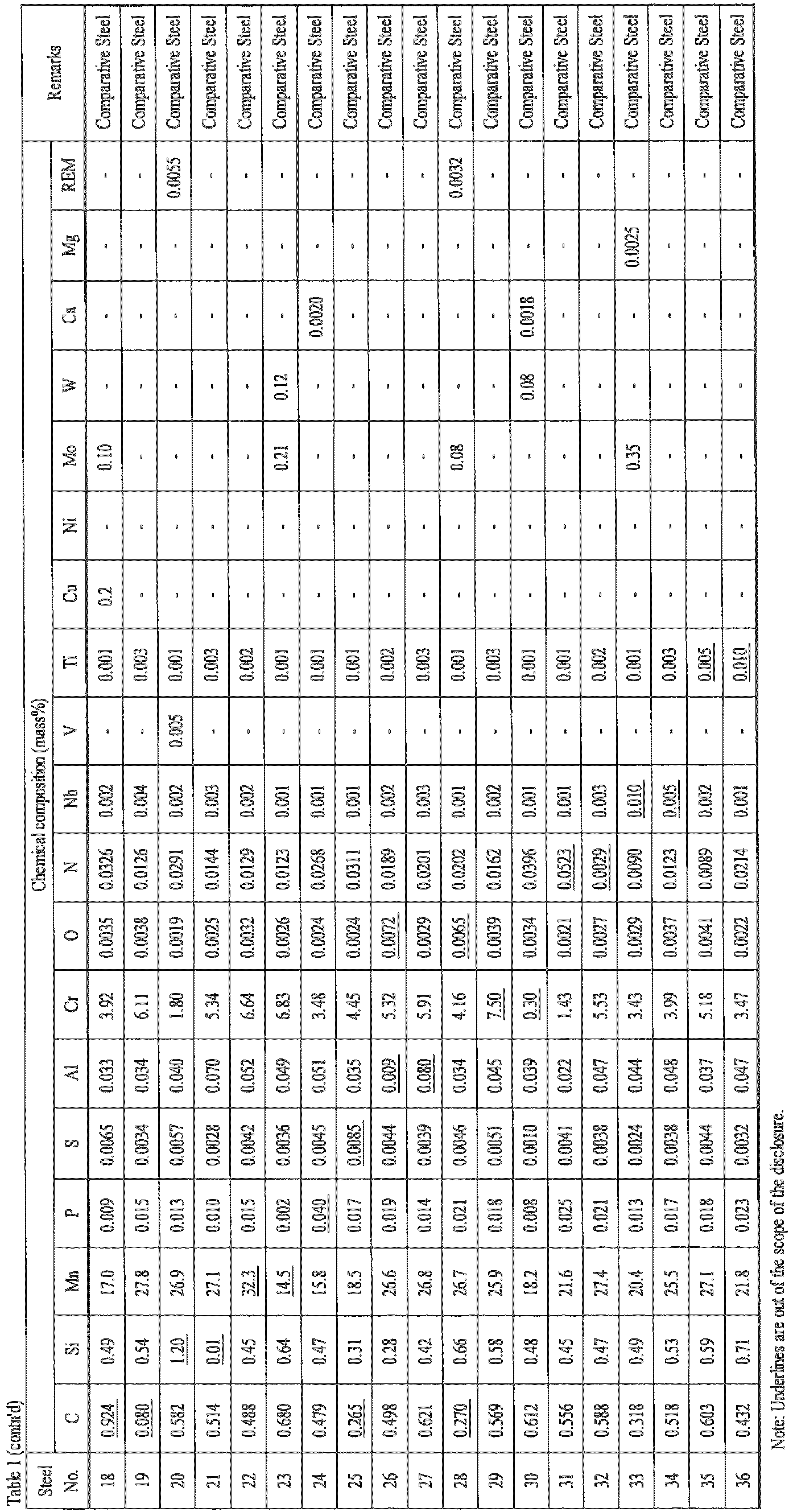
Table 2 Sample No. Steel No. Sheet thickness Production method Base metal properties Base metal toughness HAZ portion Remarks Slab heating temperature Rolling finish temperature Cooling start temperature Cooling rate (*) Re-hcatmg temperatire Area ratio of inclusions Volume fraction of ε martensie Yield stress Tensile strength Total elongation Absorbed energy at -196 °C (vE-196°C) Absorbed energy at -196 °C (vE-196°C) Largest grain size (mm) (°C) (°C) (°C) (°C/s) (°C) (%) (%) (MPa) (MPa) (%) (J) (J) (µm) 1 1 10 1110 945 872 13 450 0.2 0.0 480 912 60 100 145 165 Example 2 2 15 1110 835 768 7 - 4.0 0.0 510 934 62 108 100 175 Example 3 3 20 1100 890 815 12 - 2.0 0.0 487 912 61 113 112 150 Example 4 4 25 1100 910 845 10 - 0.2 0.0 446 891 61 124 134 187 Example 5 5 10 1150 860 795 12 500 0.2 0.1 467 905 62 125 121 50 Example 6 6 15 1150 890 808 5 550 0.3 0.0 442 899 61 133 129 102 Example 7 7 20 1150 825 785 7 - 0.2 0.0 445 903 61 122 128 100 Example 8 8 5 1200 825 740 4 - 1.0 0.0 598 987 51 106 108 50 Example 9 9 10 1200 810 730 10 450 0.1 0.0 484 858 65 112 115 100 Example 10 10 15 1200 870 798 10 - 0.3 0.0 466 884 64 127 124 150 Example 11 11 15 1250 860 795 9 500 20 0.0 487 840 66 114 106 100 Example 12 12 20 1250 915 860 13 550 0.5 0.0 435 850 67 113 113 168 Example 13 13 25 1250 860 805 6 - 1.5 0.2 441 852 65 109 110 125 Example 14 14 30 1250 815 744 3 300 0.1 0.0 426 853 61 132 127 109 Example 15 15 10 1300 870 821 1 - 0.1 0.0 422 874 61 104 108 115 Example 16 16 15 1300 954 784 7 450 1.0 0.0 501 926 57 116 114 89 Example 17 17 20 1300 884 810 20 - 1.5 0.0 512 934 52 112 116 97 Example 18 18 10 1150 895 810 5 - 2.0 0.0 512 922 58 56 61 125 Comparative Example 19 19 15 1150 815 735 15 - 0.1 1.0 471 879 57 121 61 95 Comparative Example 20 20 20 1150 862 805 5 - 0.5 0.0 361 701 51 45 44 80 Comparative Example 21 21 25 1150 871 820 13 - 0.1 0.0 425 871 61 24 26 80 Comparative Example 22 22 10 1150 900 815 10 - 4.0 0.0 497 922 34 46 48 105 Comparative Example 23 23 15 1150 850 815 5 - 0.2 0.5 455 906 60 51 53 65 Comparative Example 24 24 20 1200 840 770 11 - 0.2 0.0 375 716 61 78 65 60 Comparative Example 25 25 5 1200 920 850 10 - 5.5 0.0 467 900 30 42 41 126 Comparative Example 26 26 10 1200 875 805 5 - 4.5 0.0 525 927 54 67 68 78 Comparative Example 27 27 15 1200 855 790 12 - 0.3 0.0 511 916 58 65 41 65 Comparative Example 28 28 15 1150 896 853 5 - 3.5 0.0 456 897 29 70 66 100 Comparative Example 29 29 15 1150 916 848 4 - 0.5 0.0 432 875 25 43 46 125 Comparative Example 30 30 15 1150 898 805 9 - 0.1 0.0 465 912 60 60 58 110 Comparative Example 31 31 15 1150 908 821 11 - 0.2 0.0 448 905 35 47 51 105 Comparative Example 32 32 15 1150 850 785 4 - 0.1 0.0 487 932 55 79 68 75 Comparative Example 33 33 15 1150 806 726 6 - 0.2 0.2 512 936 45 59 61 35 Comparative Example 34 34 15 1150 827 768 4 0.2 0.0 487 909 45 78 76 40 Comparative Example 35 35 15 1150 878 804 3 - 0.1 0.0 439 887 51 69 69 40 Comparative Example 36 36 15 1150 851 776 7 - 0.1 0.0 466 889 43 51 51 35 Comparative Example 37 1 20 1050 815 724 8 - 5.5 0.0 560 1064 42 78 91 165 Comparative Example 38 2 25 1250 960 885 9 - 3.5 0.1 367 724 61 116 108 175 Comparative Example 39 3 30 1250 780 695 14 - 2.0 0.0 598 987 52 54 81 150 Comparative Example 40 4 10 1250 835 715 10 - 0.2 0.0 437 879 28 65 70 187 Comparative Example 41 5 10 1250 975 889 8 - 0.2 0.0 375 786 64 126 124 50 Comparative Example 42 6 15 1250 850 800 0.5 - 0.3 0.0 412 861 28 55 67 102 Comparative Example 43 7 20 1250 915 865 9 800 0.2 0.0 316 704 45 119 112 100 Comparative Example Note: Underlies are out of the scope of the disclosure.
(*) an average cooling rate from a temperature at or above (rolling finish temperature - 100 °C) to a temperature range of 300 °C or more and 650 °C or less - High-Mn steel of the disclosure was confirmed to satisfy the aforementioned desired performance (a base metal yield stress of 400 MPa or more, a total elongation upon breakage of 30 % or more, an average of absorbed energy (vE-196) of 100 J or more for low-temperature toughness). On the other hand, comparative examples out of the scope of the disclosure did not satisfy the aforementioned desired performance in terms of any one or more of total elongation, yield stress, and low-temperature toughness.
- Further, to evaluate impact absorbed properties of a welded portion, the steel materials were subjected to heat cycle treatment under conditions of peak temperature of 1400 °C and a cooling rate of 10 °C/s. The results are listed in Table 2. As illustrated in Table 2, the steel materials according to the disclosure were excellent in welded portion toughness as well as in base metal toughness at low temperature. Specifically, in welding which gave input heat of 0.5 kJ/cm to 5 kJ/cm, the maximum crystal grain size was 50 µm or more, and the absorbed energy in Charpy impact test at -196 °C was 100 J or more.
- The present disclosure claims priority to
JP 2017-087702 A filed on April 26, 2017
Claims (4)
- High-Mn steel comprising:a chemical composition containing, in mass%,C: 0.30 % or more and 0.90 % or less,Si: 0.05 % or more and 1.0 % or less,Mn: 15 % or more and 30 % or less,P: 0.030 % or less,S: 0.0070 % or less,Al: 0.01 % or more and 0.07 % or less,Cr: 0.5 % or more and 7.0 % or less,N: 0.0050 % or more and 0.0500 % or less, andO: 0.0050 % or less,Ti: less than 0.005 %, andNb: less than 0.005 %, with the balance being Fe and inevitable impurities;a microstructure containing austenite as a matrix phase and nonmetallic inclusions with an area fraction of less than 5.0 %; anda yield stress of 400 MPa or more and an absorbed energy (vE-196) of 100 J or more.
- The high-Mn steel according to claim 1, wherein the chemical composition further contains, in mass %, at least one selected fromCu: 0.01 % or more and 1.00 % or less,Ni: 0.01 % or more and 1.00 % or less,Mo: 2.0 % or less,V: 2.0 % or less,W: 2.0 % or less,Ca: 0.0005 % or more and 0.0050 % or less,Mg: 0.0005 % or more and 0.0050 % or less, andREM: 0.0010 % or more and 0.0200 % or less.
- A production method of high-Mn steel comprising:heating a steel material having the chemical composition according to claim 1 or 2 to a temperature range of 1100 °C or more and 1300 °C or less;hot rolling the steel material with a rolling finish temperature of 800 °C or more and less than 950 °C to obtain a hot-rolled steel plate; andthen subjecting the hot-rolled steel plate to cooling treatment at an average cooling rate of 1.0 °C/s or more from a temperature at or above (the rolling finish temperature - 100 °C) to a temperature range of 300 °C or more and 650 °C or less.
- The production method of high-Mn steel according to claim 3 comprising:
after the cooling treatment, heating the steel plate to a temperature range of 300 °C or more and 650 °C or less, and then cooling the steel plate.
Applications Claiming Priority (2)
| Application Number | Priority Date | Filing Date | Title |
|---|---|---|---|
| JP2017087702 | 2017-04-26 | ||
| PCT/JP2018/016764 WO2018199145A1 (en) | 2017-04-26 | 2018-04-25 | HIGH-Mn STEEL AND PRODUCTION METHOD THEREFOR |
Publications (2)
| Publication Number | Publication Date |
|---|---|
| EP3617337A1 true EP3617337A1 (en) | 2020-03-04 |
| EP3617337A4 EP3617337A4 (en) | 2020-03-25 |
Family
ID=63919677
Family Applications (1)
| Application Number | Title | Priority Date | Filing Date |
|---|---|---|---|
| EP18790123.6A Pending EP3617337A4 (en) | 2017-04-26 | 2018-04-25 | Mn-RICH STEEL AND PROCESS FOR PRODUCING THE SAME |
Country Status (9)
| Country | Link |
|---|---|
| EP (1) | EP3617337A4 (en) |
| JP (1) | JP6460292B1 (en) |
| KR (1) | KR102331032B1 (en) |
| CN (1) | CN110573642A (en) |
| MY (1) | MY202645A (en) |
| PH (1) | PH12019501995A1 (en) |
| SG (1) | SG11201907930QA (en) |
| TW (1) | TWI641706B (en) |
| WO (1) | WO2018199145A1 (en) |
Cited By (5)
| Publication number | Priority date | Publication date | Assignee | Title |
|---|---|---|---|---|
| US20220275489A1 (en) * | 2019-08-21 | 2022-09-01 | Jfe Steel Corporation | Steel and method of producing same |
| EP4089196A4 (en) * | 2020-03-11 | 2024-12-18 | JFE Steel Corporation | Steel material, manufacturing method therefor, and tank |
| EP4455326A4 (en) * | 2021-12-21 | 2026-01-14 | Posco Co Ltd | AUSTENITIC STEEL WITH EXCELLENT RESISTANCE TO EXTREMELY LOW TEMPERATURES IN HEAT-EXPOSED WELDING ZONE AND MANUFACTURING METHOD FOR IT |
| EP4455348A4 (en) * | 2021-12-21 | 2026-01-14 | Posco Co Ltd | AUSTENITIC STEEL WITH EXCELLENT RESISTANCE TO EXTREMELY LOW TEMPERATURES IN THE HEAT INFLUENCE ZONE AND METHOD FOR PRODUCING IT |
| EP4455349A4 (en) * | 2021-12-21 | 2026-01-21 | Posco Co Ltd | AUSTENITIC STEEL WITH EXCELLENT RESISTANCE TO EXTREMELY LOW TEMPERATURES IN HEAT-EXPOSED WELDING ZONE AND MANUFACTURING METHOD FOR IT |
Families Citing this family (13)
| Publication number | Priority date | Publication date | Assignee | Title |
|---|---|---|---|---|
| WO2019156179A1 (en) * | 2018-02-07 | 2019-08-15 | Jfeスチール株式会社 | HIGH-Mn STEEL AND PRODUCTION METHOD THEREFOR |
| WO2019168172A1 (en) * | 2018-03-02 | 2019-09-06 | Jfeスチール株式会社 | HIGH Mn STEEL AND METHOD FOR PRODUCING SAME |
| EP3889276B1 (en) | 2019-01-25 | 2024-06-26 | JFE Steel Corporation | Method for manufacturing high-manganese steel cast slab and method for manufacturing high-manganese steel slab or steel sheet |
| SG11202108594QA (en) * | 2019-02-12 | 2021-11-29 | Jfe Steel Corp | High-mn steel and manufacturing method therefor |
| KR20210105418A (en) * | 2019-03-19 | 2021-08-26 | 제이에프이 스틸 가부시키가이샤 | Manufacturing method of high manganese steel slab, manufacturing method of high manganese steel slab and high manganese steel sheet |
| KR102714307B1 (en) * | 2019-08-21 | 2024-10-07 | 제이에프이 스틸 가부시키가이샤 | Steel and method of manufacturing the same |
| CN120818755A (en) * | 2020-08-25 | 2025-10-21 | 华为技术有限公司 | Fe-Mn-Al-C series lightweight steel and preparation method thereof, terminal, steel structure and electronic equipment |
| CN111961805B (en) * | 2020-09-16 | 2021-04-27 | 燕山大学 | High manganese steel liquid purification method, product and application |
| JP7338792B2 (en) * | 2021-02-08 | 2023-09-05 | Jfeスチール株式会社 | Steel material and manufacturing method thereof, tank and manufacturing method thereof |
| CN116926443B (en) * | 2022-04-07 | 2025-12-16 | 南京钢铁股份有限公司 | Ultralow-temperature steel and heat treatment process and application thereof |
| CN115261743A (en) * | 2022-06-22 | 2022-11-01 | 河钢股份有限公司 | Low-cost high-manganese steel plate and production method thereof |
| KR20250065516A (en) * | 2023-11-03 | 2025-05-13 | 주식회사 포스코 | Austenitic steel material and manufacturing method for the same |
| CN120006183B (en) * | 2025-03-03 | 2025-12-16 | 华北理工大学 | A high-manganese austenitic low-temperature steel plate for liquid hydrogen storage tanks and its preparation method |
Family Cites Families (13)
| Publication number | Priority date | Publication date | Assignee | Title |
|---|---|---|---|---|
| JPS56258A (en) * | 1979-06-12 | 1981-01-06 | Sumitomo Metal Ind Ltd | No-nickel high-manganese-content steel for low temperature |
| JPS5623259A (en) * | 1979-08-03 | 1981-03-05 | Sumitomo Metal Ind Ltd | Nickel-free high manganese cast steel for low temperature use |
| JPH0215148A (en) * | 1988-07-02 | 1990-01-18 | Sumitomo Metal Ind Ltd | High mn nonmagnetic steel having excellent corrosion resistance |
| JPH04143213A (en) * | 1990-10-05 | 1992-05-18 | Kobe Steel Ltd | Production of high mn nonmagnetic steel excellent in local deformability |
| FR2857980B1 (en) * | 2003-07-22 | 2006-01-13 | Usinor | PROCESS FOR MANUFACTURING HIGH-STRENGTH FERRO-CARBON-MANGANESE AUSTENITIC STEEL SHEET, EXCELLENT TENACITY AND COLD SHAPINGABILITY, AND SHEETS THUS PRODUCED |
| CN100519809C (en) * | 2006-03-27 | 2009-07-29 | 宝山钢铁股份有限公司 | Thick steel plate for low temperature use and capable of being welded in superhigh energy and its production process |
| JP5437482B2 (en) * | 2009-04-28 | 2014-03-12 | ヒュンダイ スチール カンパニー | High strength and high softness steel plate with high manganese nitrogen content and manufacturing method thereof |
| KR101543916B1 (en) * | 2013-12-25 | 2015-08-11 | 주식회사 포스코 | Steels for low temperature services having superior deformed surface quality and method for production thereof |
| JP6645103B2 (en) * | 2014-10-22 | 2020-02-12 | 日本製鉄株式会社 | High Mn steel material and method for producing the same |
| KR101665821B1 (en) * | 2014-12-24 | 2016-10-13 | 주식회사 포스코 | Low temperature steels having superior surface quality and method for production thereof |
| JP6693217B2 (en) | 2015-04-02 | 2020-05-13 | 日本製鉄株式会社 | High Mn steel for cryogenic temperatures |
| JP6589535B2 (en) * | 2015-10-06 | 2019-10-16 | 日本製鉄株式会社 | Low temperature thick steel plate and method for producing the same |
| JP2017087702A (en) | 2015-11-17 | 2017-05-25 | 矢崎総業株式会社 | Apparatus for molding wire protection member with mold portion |
-
2018
- 2018-04-25 WO PCT/JP2018/016764 patent/WO2018199145A1/en not_active Ceased
- 2018-04-25 TW TW107114070A patent/TWI641706B/en active
- 2018-04-25 MY MYPI2019006189A patent/MY202645A/en unknown
- 2018-04-25 KR KR1020197031996A patent/KR102331032B1/en active Active
- 2018-04-25 SG SG11201907930QA patent/SG11201907930QA/en unknown
- 2018-04-25 JP JP2018544293A patent/JP6460292B1/en active Active
- 2018-04-25 EP EP18790123.6A patent/EP3617337A4/en active Pending
- 2018-04-25 CN CN201880026635.5A patent/CN110573642A/en active Pending
-
2019
- 2019-08-30 PH PH12019501995A patent/PH12019501995A1/en unknown
Cited By (6)
| Publication number | Priority date | Publication date | Assignee | Title |
|---|---|---|---|---|
| US20220275489A1 (en) * | 2019-08-21 | 2022-09-01 | Jfe Steel Corporation | Steel and method of producing same |
| US12486558B2 (en) * | 2019-08-21 | 2025-12-02 | Jfe Steel Corporation | Steel and method of producing same |
| EP4089196A4 (en) * | 2020-03-11 | 2024-12-18 | JFE Steel Corporation | Steel material, manufacturing method therefor, and tank |
| EP4455326A4 (en) * | 2021-12-21 | 2026-01-14 | Posco Co Ltd | AUSTENITIC STEEL WITH EXCELLENT RESISTANCE TO EXTREMELY LOW TEMPERATURES IN HEAT-EXPOSED WELDING ZONE AND MANUFACTURING METHOD FOR IT |
| EP4455348A4 (en) * | 2021-12-21 | 2026-01-14 | Posco Co Ltd | AUSTENITIC STEEL WITH EXCELLENT RESISTANCE TO EXTREMELY LOW TEMPERATURES IN THE HEAT INFLUENCE ZONE AND METHOD FOR PRODUCING IT |
| EP4455349A4 (en) * | 2021-12-21 | 2026-01-21 | Posco Co Ltd | AUSTENITIC STEEL WITH EXCELLENT RESISTANCE TO EXTREMELY LOW TEMPERATURES IN HEAT-EXPOSED WELDING ZONE AND MANUFACTURING METHOD FOR IT |
Also Published As
| Publication number | Publication date |
|---|---|
| CN110573642A (en) | 2019-12-13 |
| PH12019501995B1 (en) | 2020-06-01 |
| TWI641706B (en) | 2018-11-21 |
| SG11201907930QA (en) | 2019-09-27 |
| JPWO2018199145A1 (en) | 2019-06-27 |
| PH12019501995A1 (en) | 2020-06-01 |
| KR102331032B1 (en) | 2021-11-24 |
| KR20190134704A (en) | 2019-12-04 |
| WO2018199145A1 (en) | 2018-11-01 |
| EP3617337A4 (en) | 2020-03-25 |
| JP6460292B1 (en) | 2019-01-30 |
| TW201839152A (en) | 2018-11-01 |
| BR112019022088A2 (en) | 2020-05-05 |
| MY202645A (en) | 2024-05-13 |
Similar Documents
| Publication | Publication Date | Title |
|---|---|---|
| EP3617337A1 (en) | HIGH-Mn STEEL AND PRODUCTION METHOD THEREFOR | |
| EP2272994B1 (en) | High-tensile strength steel and manufacturing method thereof | |
| JP5846311B2 (en) | Thick high-strength steel excellent in welding heat affected zone CTOD characteristics and method for producing the same | |
| EP3677700B1 (en) | High-mn steel and production method therefor | |
| EP3722448B1 (en) | High-mn steel and method for manufacturing same | |
| EP3831973A1 (en) | High-mn steel and method for producing same | |
| EP3533891A1 (en) | Steel for high heat input welding | |
| KR102628769B1 (en) | HIGH-Mn STEEL AND MANUFACTURING METHOD THEREFOR | |
| JP6245352B2 (en) | High-tensile steel plate and manufacturing method thereof | |
| EP3686306A1 (en) | Steel plate and method for manufacturing same | |
| JP6856083B2 (en) | High Mn steel and its manufacturing method | |
| KR20200064511A (en) | High-strength steel sheet having excellent ductility and low-temperature toughness and method for manufacturing thereof | |
| CN111051555B (en) | Steel sheet and method for producing same | |
| WO2019168172A1 (en) | HIGH Mn STEEL AND METHOD FOR PRODUCING SAME | |
| JP2020033584A (en) | steel sheet | |
| EP3835445B1 (en) | Steel plate and method of producing same | |
| JP7273298B2 (en) | Steel plates for pressure vessels with excellent low-temperature toughness | |
| EP4265795A1 (en) | Ultrathick steel plate having excellent low-temperature impact toughness and method for manufacturing same |
Legal Events
| Date | Code | Title | Description |
|---|---|---|---|
| STAA | Information on the status of an ep patent application or granted ep patent |
Free format text: STATUS: THE INTERNATIONAL PUBLICATION HAS BEEN MADE |
|
| PUAI | Public reference made under article 153(3) epc to a published international application that has entered the european phase |
Free format text: ORIGINAL CODE: 0009012 |
|
| STAA | Information on the status of an ep patent application or granted ep patent |
Free format text: STATUS: REQUEST FOR EXAMINATION WAS MADE |
|
| REG | Reference to a national code |
Ref country code: DE Ref legal event code: R079 Free format text: PREVIOUS MAIN CLASS: C22C0038000000 Ipc: C22C0038380000 |
|
| 17P | Request for examination filed |
Effective date: 20190830 |
|
| AK | Designated contracting states |
Kind code of ref document: A1 Designated state(s): AL AT BE BG CH CY CZ DE DK EE ES FI FR GB GR HR HU IE IS IT LI LT LU LV MC MK MT NL NO PL PT RO RS SE SI SK SM TR |
|
| AX | Request for extension of the european patent |
Extension state: BA ME |
|
| A4 | Supplementary search report drawn up and despatched |
Effective date: 20200226 |
|
| RIC1 | Information provided on ipc code assigned before grant |
Ipc: C21D 9/46 20060101ALI20200220BHEP Ipc: C22C 38/26 20060101ALI20200220BHEP Ipc: C22C 38/22 20060101ALI20200220BHEP Ipc: C22C 38/00 20060101ALI20200220BHEP Ipc: C22C 38/02 20060101ALI20200220BHEP Ipc: C22C 38/24 20060101ALI20200220BHEP Ipc: C22C 38/38 20060101AFI20200220BHEP Ipc: C21D 8/02 20060101ALI20200220BHEP Ipc: C22C 38/20 20060101ALI20200220BHEP Ipc: C22C 38/48 20060101ALI20200220BHEP Ipc: C22C 38/50 20060101ALI20200220BHEP Ipc: C22C 38/28 20060101ALI20200220BHEP Ipc: C22C 38/58 20060101ALI20200220BHEP Ipc: C22C 38/42 20060101ALI20200220BHEP Ipc: C22C 38/06 20060101ALI20200220BHEP |
|
| DAV | Request for validation of the european patent (deleted) | ||
| DAX | Request for extension of the european patent (deleted) | ||
| STAA | Information on the status of an ep patent application or granted ep patent |
Free format text: STATUS: EXAMINATION IS IN PROGRESS |
|
| 17Q | First examination report despatched |
Effective date: 20230720 |
|
| RIN1 | Information on inventor provided before grant (corrected) |
Inventor name: HASE, KAZUKUNI Inventor name: UEDA, KEIJI Inventor name: IZUMI, DAICHI Inventor name: ARAO, RYO |