EP3614829B1 - Schwimmende einzelstücke für die hydroponische pflanzenkultur und verfahren zur hydroponischen pflanzenkultur - Google Patents
Schwimmende einzelstücke für die hydroponische pflanzenkultur und verfahren zur hydroponischen pflanzenkultur Download PDFInfo
- Publication number
- EP3614829B1 EP3614829B1 EP18726219.1A EP18726219A EP3614829B1 EP 3614829 B1 EP3614829 B1 EP 3614829B1 EP 18726219 A EP18726219 A EP 18726219A EP 3614829 B1 EP3614829 B1 EP 3614829B1
- Authority
- EP
- European Patent Office
- Prior art keywords
- tray
- bulb
- piece
- seedling
- cultivated
- Prior art date
- Legal status (The legal status is an assumption and is not a legal conclusion. Google has not performed a legal analysis and makes no representation as to the accuracy of the status listed.)
- Active
Links
Images




Classifications
-
- A—HUMAN NECESSITIES
- A01—AGRICULTURE; FORESTRY; ANIMAL HUSBANDRY; HUNTING; TRAPPING; FISHING
- A01G—HORTICULTURE; CULTIVATION OF VEGETABLES, FLOWERS, RICE, FRUIT, VINES, HOPS OR SEAWEED; FORESTRY; WATERING
- A01G31/00—Soilless cultivation, e.g. hydroponics
- A01G31/02—Special apparatus therefor
-
- A—HUMAN NECESSITIES
- A01—AGRICULTURE; FORESTRY; ANIMAL HUSBANDRY; HUNTING; TRAPPING; FISHING
- A01G—HORTICULTURE; CULTIVATION OF VEGETABLES, FLOWERS, RICE, FRUIT, VINES, HOPS OR SEAWEED; FORESTRY; WATERING
- A01G31/00—Soilless cultivation, e.g. hydroponics
- A01G31/02—Special apparatus therefor
- A01G31/06—Hydroponic culture on racks or in stacked containers
-
- A—HUMAN NECESSITIES
- A01—AGRICULTURE; FORESTRY; ANIMAL HUSBANDRY; HUNTING; TRAPPING; FISHING
- A01G—HORTICULTURE; CULTIVATION OF VEGETABLES, FLOWERS, RICE, FRUIT, VINES, HOPS OR SEAWEED; FORESTRY; WATERING
- A01G31/00—Soilless cultivation, e.g. hydroponics
- A01G31/02—Special apparatus therefor
- A01G31/024—Hydroponic cultivation wherein the roots are totally immersed in the nutritive solution, e.g. cultivation on floating rafts or deep-water culture
-
- A—HUMAN NECESSITIES
- A01—AGRICULTURE; FORESTRY; ANIMAL HUSBANDRY; HUNTING; TRAPPING; FISHING
- A01G—HORTICULTURE; CULTIVATION OF VEGETABLES, FLOWERS, RICE, FRUIT, VINES, HOPS OR SEAWEED; FORESTRY; WATERING
- A01G9/00—Cultivation in receptacles, forcing-frames or greenhouses; Edging for beds, lawn or the like
- A01G9/02—Receptacles, e.g. flower-pots or boxes; Glasses for cultivating flowers
- A01G9/028—Multi-compartmented pots
-
- Y—GENERAL TAGGING OF NEW TECHNOLOGICAL DEVELOPMENTS; GENERAL TAGGING OF CROSS-SECTIONAL TECHNOLOGIES SPANNING OVER SEVERAL SECTIONS OF THE IPC; TECHNICAL SUBJECTS COVERED BY FORMER USPC CROSS-REFERENCE ART COLLECTIONS [XRACs] AND DIGESTS
- Y02—TECHNOLOGIES OR APPLICATIONS FOR MITIGATION OR ADAPTATION AGAINST CLIMATE CHANGE
- Y02P—CLIMATE CHANGE MITIGATION TECHNOLOGIES IN THE PRODUCTION OR PROCESSING OF GOODS
- Y02P60/00—Technologies relating to agriculture, livestock or agroalimentary industries
- Y02P60/20—Reduction of greenhouse gas [GHG] emissions in agriculture, e.g. CO2
- Y02P60/21—Dinitrogen oxide [N2O], e.g. using aquaponics, hydroponics or efficiency measures
Definitions
- the present disclosure relates to the apparatus used for hydroponic cultivation and more particularly to a single-piece floating tray for hydroponic cultivation.
- Hydroponic cultivation is a technique for performing soilless cultivation where the plants to be cultivated are irrigated with a nutritive chemical solution composed of water and the compounds needed to provide all the elements indispensable for normal mineral nutrition.
- a nutritive chemical solution composed of water and the compounds needed to provide all the elements indispensable for normal mineral nutrition.
- the plants are placed on a support arranged on the surface of the water or above it, the support being provided with holes through which the roots of the plant protrude so as to be immersed in the water.
- EP0167638A1 which illustrates a floating support for hydroponic cultivation, having a pad of hydrophobic material provided with through-holes, for allowing the roots which are growing to protrude, having small dimensions so as to favour capillary attraction.
- the Applicant has noted a drawback of this support and of other known supports for hydroponic cultivation which consists in the fact that these supports are not suitable for housing bulbs or seedlings for the time needed for them to become completely mature plants. More particularly, the Applicant has noted that on the market today there exist floating supports, mainly for seed boxes, in which the bulb is in direct contact with the aqueous solution. As the plant grows and gains weight, the bulb becomes immersed in the said solution, with a considerable increase in the risk of rotting. In fact it has been noted that often it is required to remove the plants from these supports before they reach maturity in order to avoid the risk of rotting.
- these supports are made as one piece and can be preferably stacked on top of each other.
- a method for hydroponic cultivation whereby the plants or bulbs to be cultivated are housed inside housings of a single-piece floating tray so as to keep the roots of the plants at a minimum distance from the surface of the water and allow venting of the carbon dioxide produced by the roots.
- a single-piece tray is provided, said tray being able to keep the plant at a distance from the water, and also a venting system for the carbon dioxide is provided between the plant and the surface of the water.
- each single-piece tray is realized by means of blow-moulding.
- the tray therefore has the form of a storage tank or closed casing.
- a first embodiment of a single-piece tray 100 for hydroponic cultivation according to the present disclosure is shown in Figures 1 to 9 . It is shaped so as to define a plurality of identical cultivation cells 1.
- each cell 1 has a housing 2 which defines a raised plane 7 and is configured to receive and support a bulb or a seedling to be grown.
- the housing 2 has a hole 3 with dimensions such as to support the bulb or plant to be grown without allowing it to fall through, keeping it suspended so that the roots may protrude below the tray 100 and, while growing, may become immersed in the water on which the tray 100 is floating.
- each cultivation cell has a buoyant portion 4 which defines a lowered plane 5 intended to sink below the waterline.
- the buoyant portions 4 are connected to the overlying housings 2 by means of side walls 6 which connect the lowered plane 5 to the raised plane 7.
- the side walls 6 extend as far as at least one free edge of the single-piece tray 100, defining a channel 8 which communicates with the space outside the tray 100.
- both the side walls 6 extend as far as the perimetral edges of the single-piece tray 100.
- the side walls 6 are not confined to the buoyant portions 4, nor do they enclose the buoyant portion so as to form a cavity confined within the single piece on all sides.
- the side walls 6 define a channel 8 which communicates directly with the space outside that subtended by the tray 100, i.e. the channel 8 extends as far as an edge, or more preferably extends between opposite walls or edges of the single-piece tray, and is not limited by opposite outer walls of the tray 100.
- the channel is an indentation on the side where the lowered plane is situated.
- the indentation extends as far as the perimeter or free edge of the tray.
- each buoyant portion for each single cultivation cell defines:
- the floating tray 100 may be used for the entire duration of the cultivation without the risk of the plant rotting.
- the water since the housing 2 in which the plant is placed always remains above the waterline, the water does not manage to occupy the entire volume subtended by the channel 8. In other words, the water does not close up the channel, but a gap or free space remains between the waterline and the housing 2. The channel 8 is therefore not filled completely by the water. In this way, it is possible to provide a passage for gas or a vent between each housing 2 and a space outside the floating tray 100.
- the channel 8 communicates directly with the outside, i.e. is not further confined by the outer walls of the tray 100, the carbon dioxide produced by the plant roots is continuously vented.
- this reduces the risk of rotting or suffocation of the plant roots and improves oxygenation of the water.
- the housings 2 of the cultivation cells 1 are surmounted at the top by respective shelves 9 provided with holes and grooves 10.
- the grooves 10 of each shelf 9 with holes are arranged radially around the hole 3 of the respective housing 2 and define a slope so as to convey water sprayed on top of the cell and cause it to fall above the hole 3, irrigating the bulb or seedling placed on it.
- each bulb or seedling is irrigated from above, this increasing the cultivation costs.
- the roots grow, they will be immersed directly in the water on which the tray 100 is floating: irrigation from above will then be interrupted since the plant will obtain its nutrition from the roots immersed in the water.
- the distance between the raised plane 7 of a housing 2 and the lowered plane 5 of the respective buoyant portion 4, which corresponds to the height of the side walls 6, is calculated so as to keep the hole 3 as close as possible to the surface of the water, in order to reduce as far as possible the irrigation time, such that the plant, when fully mature, is not drowned in water.
- the dimensions of the housings 2 of the cultivation cells 1 will be determined depending on the surface area needed for the bulb or seedling to be grown. The distance between the housings 2 may depend on the product which is to be matured and this will limit the maximum number of cultivations cells 1 in each tray 100.
- the first "bottomside” height h 1 will be between 6 mm and 8 mm and preferably equal to about 7 mm; the second "waterline" height h 2 will be determined so that the sum of said height with the first "bottomside” height h 1 will be between 20 mm and 40 mm and preferably equal to 29 mm; the third "topside” height h 3 of the tray 100 will be between 6 mm and 8 mm and preferably will be equal to about 6.5 mm.
- each cultivation cell 1 there is defined an empty space between the raised plane of the housing 2 and the lowered plane 4 of the buoyant portion, which is sufficiently broad to allow aeration of the plant roots.
- the buoyant portions 4 of the cultivation cells 1 will be aligned in a row so as to create, underneath the holes 3, channels 8 which cross the tray 100 from one side to the other, allowing circulation of the air when the tray is floating on the water.
- the width of these channels is between 60 mm and 90 mm and preferably it is equal to 75 mm.
- the hole 3 of the housing 2 intended to receive the plant until it matures has a substantially circular shape with a peripheral notch 11.
- This notch 11 forms a further vent for facilitating the dispersion of carbon dioxide which the roots produce naturally, preventing the risk of suffocation of the plant.
- FIGS 11-13 show a second embodiment of the single-piece tray 100 according to the present disclosure.
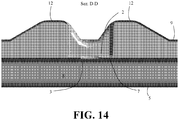
- This second embodiment differs from the first embodiment in that each housing 2 is also at least partially enclosed between protruding elements 12 which extend upwards from the surface 9 with holes of the tray 100.
- the protruding elements 12 are preferably separated, i.e. spaced, from each other so as to allow direct access to the housing 2 laterally and so as to allow the water from the grooves 10 to reach the hole 3 inside the housing 2. Even more preferably the protruding elements 12 are situated opposite each other relative to the housing 2 so as to retain and support the bulb or the seedling during the whole growth period.
- the inner walls 13 of the protruding elements are substantially perpendicular to the raised plane 7.
- the inner walls 13 of the protruding elements 12 may comprise vertical grooves 14 inside which, during use, the operator is able to insert a finger when the clod is placed inside the housing 2.
- Figures 14 and 15 show the three heights h 1 , h 2 , h 3 with reference to the second embodiment.
- the distance between the holes 3 of the housings 2 for the bulbs and seedlings to be grown will be conveniently calculated so as to optimize fully the useful spaces, considering also the fact that the tray 100 according to the present invention is designed to accommodate different plants.
- the holes 3 of the housings 2 are spaced so that, once the plants reached maturity, they are sufficiently spaced from each other so as not to hinder their natural growth.
- the tray 100 for hydroponic cultivation may be easily provided with dimensions such that it can be used for different types of plant, including those which are characterized by final weights which are substantially different from each other, namely when the plants are mature and ready for harvesting. Depending on the expected final weight of the mature plant, the amount by which the trays 100 will sink below the waterline will be estimated and the height of the walls 6 determined accordingly so that the plants are not drowned in water and do not rot.
- the single-piece floating tray 100 will be preferably made using a process for blow-moulding non-toxic plastic suitable for coming into direct contact with food, such as HDPE, PP, LDPE, etc.
- a process for blow-moulding non-toxic plastic suitable for coming into direct contact with food such as HDPE, PP, LDPE, etc.
- the blow-moulding technique it is possible to obtain, at a lower cost compared to alternative techniques (such as rotational moulding), a single-piece body in the form of a closed tank or closed casing which is internally hollow and has a broad outer surface.
- the single-piece floating tray 100 thus obtained is an internally hollow body, namely only air is present inside it.
- the blow-moulding technique it is also possible to obtain walls of the single-piece tray which have a thickness of between about 1 mm and about 4 mm.
Landscapes
- Life Sciences & Earth Sciences (AREA)
- Environmental Sciences (AREA)
- Hydroponics (AREA)
Claims (17)
- Eine einteilige Schale (100) für Hydrokultur, bestehend aus einem Kunststoff, der so geformt ist, dass er in der Schalen mehrere identische Pflanzzellen (1) bildet, wobei jede Pflanzzelle (1) über Folgendes verfügt:- ein Gehäuse (2), welches eine erhöhte Ebene (7) bildet, die so geformt ist, dass sie die Zwiebel oder den Setzling aufnimmt und hält, die bzw. der kultiviert werden soll, wobei das Gehäuse (2) ein Loch (3) mit einer Größe hat, die gewährleistet, dass die Zwiebel oder die Pflanze, die kultiviert werden soll, gehalten wird, ohne durch das Loch zu fallen, während es den Wurzeln ermöglicht, unter aus der Schale herauszuragen;- einen schwimmfähigen Bereich (4), welcher eine abgesenkte Ebene (5) bildet, die dafür gedacht ist, unter die Wasseroberfläche (Wasserlinie) zu sinken, wenn die Schale auf dem Wasser platziert wird, wobei dieser Bereich von den Seitenwänden (6) begrenzt ist, welche von der abgesenkten Ebene (5) nach oben reichen und mit der oben genannten erhöhten Ebene (7) verbunden sind, wobei jeder schwimmfähige Bereich (4) Folgendes definiert:- ein erstes inneres Volumen mit einer ersten Höhe (h1), welches so gestaltet ist, dass es unter der Wasserlinie bleibt, sobald die Zwiebel oder der Setzling, die bzw. der kultiviert wird, in der Pflanzzelle positioniert wird,- ein zweites inneres Volumen mit einer zweiten Höhe (h2), welches so gestaltet ist, dass es über der Wasserlinie bleibt, wenn die Zwiebel oder der Setzling, die bzw. der kultiviert wird, in der Pflanzzelle positioniert wird, und komplett unter die Wasserlinie sinkt, wenn die Zwiebel oder der Setzling, die bzw. der kultiviert wird, eine reife Pflanze geworden ist,- ein drittes inneres Volumen mit einer dritten Höhe (h3), welches so gestaltet ist, dass es über der Wasserlinie bleibt, wenn die Zwiebel oder der Setzling, die bzw. der kultiviert wird, eine reife Pflanze geworden ist;- die Summe der ersten Höhe (h1), der zweiten Höhe (h2) und der dritten Höhe (h3) entspricht der Höhe der Seitenwände (6) zwischen der oben genannten erhöhten Ebene (7) und der oben genannten abgesenkten Ebene (5), wobei die oben genannten Seitenwände (6) mindestens bis zu einer freien Kante der einteiligen Schale 100 reichen und einen Kanal (8) bilden, der mit der Umgebung der einteiligen Schale (100) in Verbindung steht.
- Die einteilige Schale (100) gemäß Anspruch 1, wobei die Seitenwände (6) zu den jeweils gegenüberliegenden Kanten der Schale reichen und der oben genannte Kanal (8) sich zwischen zwei gegenüberliegenden freien Kanten einer einteiligen Schale (100) erstreckt.
- Die einteilige Schale (100) gemäß Anspruch 1 oder 2, wobei die schwimmfähigen Bereiche (4) der Pflanzzellen (1) in einer Reihe angeordnet sind, sodass sich unterhalb der Löcher (3) Kanäle (8) bilden, welche die Schale (100) von einer Seite zur anderen durchqueren.
- Die einteilige Schale (100) gemäß einem der vorhergehenden Ansprüche, wobei der Kanal (8) eine Breite von 60 mm bis 90 mm hat.
- Die einteilige Schale (100) gemäß Anspruch 3, wobei der Kanal (8) eine Breite von ca. 75 mm hat.
- Die einteilige Schale (100) gemäß einem der vorhergehenden Ansprüche, wobei das Gehäuse (2) der oben genannten Pflanzzellen (1) von einer Abdeckung (9) mit Löchern und Rinnen (10) umgeben ist, welche sternförmig um das Loch (3) angeordnet sind, wobei die oben genannten Rinnen (10) ein Gefälle aufweisen, sodass sie das Wasser, das auf die Abdeckung (9) mit Löchern gesprüht wird, aus den umliegenden Bereichen der Zelle (1) zum Loch (3) des jeweiligen Gehäuses (2) leiten.
- Die einteilige Schale (100) gemäß einem der vorhergehenden Ansprüche, wobei das oben genannte Loch (3) jeder Pflanzzelle (1) eine im wesentlichen runde Form mit einer Aussparung (11) am Umfang hat.
- Die einteilige Schale (100) gemäß einem der vorhergehenden Ansprüche in Kombination mit Anspruch 5, wobei das Gehäuse (2) zumindest teilweise von vorstehenden Elementen (12) umgeben ist, die von der Abdeckungsoberfläche (9) mit Löchern der Schale (1) aufragen.
- Die einteilige Schale (100) gemäß Anspruch 8, wobei die vorstehenden Elemente (12) voneinander getrennt sind.
- Die einteilige Schale (100) gemäß Anspruch 9, wobei die vorstehenden Elemente (12) bezogen auf das Gehäuse (2) gegenüberliegend angeordnet sind.
- Die einteilige Schale (100) gemäß einem der vorhergehenden Ansprüche, ausgeführt als ein Kunststoffteil aus einem Stück mit dem Blasformprozess.
- Die einteilige Schale (100) gemäß einem der vorhergehenden Ansprüche, wobei der oben genannte Kanal (8) von einer Einbuchtung oder Einrückung oder Nische definiert wird, welche von der Seite der oben genannten abgesenkten Ebene (5) vom Gehäuse (2) zur Kante der einteiligen Schale (100) reicht.
- Die einteilige Schale (100) gemäß einem der vorhergehenden Ansprüche, wobei die oben genannte einteilige Schale ein Körper ist, der die Form eines geschlossenen Behälters hat.
- Die einteilige Schale (100) gemäß einem der vorhergehenden Ansprüche, wobei die Abmessungen der Gehäuse (2) der Pflanzzelle (1) anhand der Fläche festgelegt werden, die von der Zwiebel oder dem Setzling, die bzw. der kultiviert werden soll, benötigt wird; u/o wobei der Abstand zwischen den Gehäusen (2) vom kultivierten Produkt abhängt, was die maximale Anzahl an Pflanzzellen (1) pro Schale ~ (100) begrenzt; ~ u/o wobei der Abstand zwischen den Löchern (3) der Gehäuse (2) für die Zwiebeln und Setzlinge, die kultiviert werden, zweckdienlich so berechnet wird, dass der nutzbare Platz in vollem Umfang optimiert wird, auch unter Berücksichtigung der Tatsache, dass die Schale (100) darauf ausgelegt ist, unterschiedliche Pflanzen aufzunehmen; u/o wobei der Abstand der Löcher (3) der Gehäuse (2) gewährleistet, dass der Abstand zwischen den Pflanzen, wenn diese ihre Reife erreicht haben, ausreichend groß ist, sodass sie sich gegenseitig nicht in ihrem natürlichen Wachstum behindern.
- Die einteilige Schale (100) gemäß einem der vorhergehenden Ansprüche, wobei die Schale (100) für Hydrokultur über Abmessungen verfügt, die die Schale für die Verwendung für verschiedene Pflanzenarten geeignet machen, auch für Pflanzen, deren Endgewicht sich deutlich unterscheidet, das heißt dann, wenn die Pflanzen reif sind und geerntet werden können.
- Verwendung einer einteiligen Schale (100) gemäß einem der vorhergehenden Ansprüche 1 bis 15 für die Hydrokultur auf eine Weise, sodass bei Platzieren der Schale auf dem Wasser:- ein erstes inneres Volumen der einteiligen Schale (100) unter der Wasserlinie bleibt, sobald die Zwiebel oder der Setzling, die bzw. der kultiviert wird, in der Pflanzzelle positioniert wird,- ein zweites inneres Volumen der einteiligen Schale (100) über der Wasserlinie bleibt, wenn die Zwiebel oder der Setzling, die bzw. der kultiviert wird, in der Pflanzzelle positioniert wird,- und unter die Wasserlinie sinkt, wenn die Zwiebel oder der Setzling, die bzw. der kultiviert wird, eine reife Pflanze geworden ist,- ein drittes inneres Volumen der einteiligen Schale (100) über der Wasserlinie bleibt, wenn die Zwiebel oder der Setzling, die bzw. der kultiviert wird, eine reife Pflanze geworden ist;- und die Entlüftung des Kohlendioxids im Kanal (8) gewährleistet ist.
- Hydrokulturverfahren, bei dem die Setzlinge oder Zwiebeln, die kultiviert werden, in Pflanzzellen (1) in einer einteiligen Schale (100) positioniert sind, wobei jede Pflanzzelle (1) ein Gehäuse (2) und einen schwimmfähigen Bereich (4) umfasst, wobei jedes Gehäuse (2) eine erhöhte Ebene (7) bildet und darauf ausgelegt ist, die Zwiebel oder den Setzling aufzunehmen, die bzw. der kultiviert werden soll, wobei das Gehäuse (2) ein Loch (3) mit einer Größe hat, die gewährleistet, dass die Zwiebel oder der Setzling, die bzw. der kultiviert werden soll, gehalten wird, ohne durch das Loch zu fallen, während es den Wurzeln ermöglicht, unter aus der einteiligen Schale herauszuragen; und wobei der schwimmfähige Bereich (4) eine abgesenkte Ebene (5) bildet und von Seitenwänden (6) begrenzt ist, welche von der abgesenkten Ebene (5) nach oben reichen und mit der oben genannten erhöhten Ebene (7) verbunden sind, und wobei das Verfahren vorsieht, dass die oben genannte einteilige Schale (100) in einem Behälter mit Wasser positioniert wird, sodass:- ein erstes inneres Volumen der einteiligen Schale (100) mit einer ersten Höhe (h1) unter der Wasserlinie bleibt, wenn die Zwiebel oder der Setzling, die bzw. der kultiviert wird, in der Pflanzzelle positioniert wird,- ein zweites inneres Volumen der einteiligen Schale (100) mit einer zweiten Höhe (h2) über der Wasserlinie bleibt, wenn die Zwiebel oder der Setzling, die bzw. der kultiviert wird, in der Pflanzzelle positioniert wird, und komplett unter die Wasserlinie sinkt, wenn die Zwiebel oder der Setzling, die bzw. der kultiviert wird, eine reife Pflanze geworden ist,- ein drittes inneres Volumen der einteiligen Schale (100) mit einer dritten Höhe (h3) über der Wasserlinie bleibt, wenn die Zwiebel oder der Setzling, die bzw. der kultiviert wird, eine reife Pflanze geworden ist;wobei die Summe der ersten Höhe (h1), der zweiten Höhe (h2) und der dritten Höhe (h3) der Höhe der Seitenwände (6) einer einteiligen Schale (100) zwischen der oben genannten erhöhten Ebene (7) und der oben genannten abgesenkten Ebene (5) entspricht, wobei die oben genannten Seitenwände (6) einen Kanal (8) bilden, welcher den Durchlass für Gas oder eine Entlüftung zwischen den einzelnen Gehäusen (3) und der Umgebung der einteiligen Schale erlaubt.
Applications Claiming Priority (2)
| Application Number | Priority Date | Filing Date | Title |
|---|---|---|---|
| IT102017000045518A IT201700045518A1 (it) | 2017-04-27 | 2017-04-27 | Vassoio galleggiante monoblocco per coltura idroponica |
| PCT/IB2018/052857 WO2018198035A1 (en) | 2017-04-27 | 2018-04-24 | Single-piece floating tray for hydroponic cultivation |
Publications (2)
| Publication Number | Publication Date |
|---|---|
| EP3614829A1 EP3614829A1 (de) | 2020-03-04 |
| EP3614829B1 true EP3614829B1 (de) | 2021-10-27 |
Family
ID=59811848
Family Applications (1)
| Application Number | Title | Priority Date | Filing Date |
|---|---|---|---|
| EP18726219.1A Active EP3614829B1 (de) | 2017-04-27 | 2018-04-24 | Schwimmende einzelstücke für die hydroponische pflanzenkultur und verfahren zur hydroponischen pflanzenkultur |
Country Status (5)
| Country | Link |
|---|---|
| US (1) | US20200045900A1 (de) |
| EP (1) | EP3614829B1 (de) |
| CA (1) | CA3060031A1 (de) |
| IT (1) | IT201700045518A1 (de) |
| WO (1) | WO2018198035A1 (de) |
Families Citing this family (9)
| Publication number | Priority date | Publication date | Assignee | Title |
|---|---|---|---|---|
| IT201700118846A1 (it) * | 2017-10-20 | 2019-04-20 | Travaglini S P A | Vassoio per la coltura di prodotti agricoli, particolarmente per vertical farm |
| NL2022517B1 (en) * | 2019-02-05 | 2020-08-19 | Cultivation Systems B V | Floating panel and method of growing plants therewith |
| NL2022594B1 (en) * | 2019-02-18 | 2020-08-31 | A Van Der Stoel Holding B V | An assembly for hydroculture of plants |
| JP7329461B2 (ja) * | 2019-02-26 | 2023-08-18 | 株式会社ファームシップ | 栽培パレット、栽培システム及び栽培方法 |
| NL2024292B1 (en) * | 2019-11-22 | 2021-08-26 | Belua Beheer B V | Plant growing system |
| US12356906B2 (en) * | 2020-03-23 | 2025-07-15 | Brightfarms, Inc. | Hydroponic high density grow board for deep water culture |
| CN113439626A (zh) * | 2020-03-26 | 2021-09-28 | 长春市秀辉米业有限责任公司 | 一种水稻种植方法 |
| US20250151685A1 (en) * | 2022-02-15 | 2025-05-15 | Pure Impact Fzco | Specialized trays with cups and process for plant transplantation |
| GB2636031A (en) * | 2023-06-13 | 2025-06-11 | International Plant Propagation Tech Ltd | Hydroponic plant-growing tray |
Family Cites Families (10)
| Publication number | Priority date | Publication date | Assignee | Title |
|---|---|---|---|---|
| JPH086445Y2 (ja) * | 1991-03-08 | 1996-02-28 | 積水化成品工業株式会社 | 水耕栽培用栽培物保持器 |
| SE9501686L (sv) * | 1995-05-08 | 1996-11-09 | Perstorp Ab | Flytande odlingsbricka |
| JPH10155378A (ja) * | 1996-12-04 | 1998-06-16 | Sekisui Plastics Co Ltd | 水耕栽培方法および水耕栽培装置 |
| AU2003261601A1 (en) * | 2003-09-12 | 2005-04-06 | Yamane-Noubokujo Inc. | Nursery pot for hydroponic culture, floating panel for nursery pot, floating nursery system, and hydroponic culture method using the system |
| US20080120903A1 (en) * | 2006-11-27 | 2008-05-29 | Wvp Acquisition Corporation | Floatable growth tray |
| NL2002527C2 (nl) * | 2009-02-13 | 2010-08-16 | Cultivation Systems B.V. | Werkwijze voor het kweken van een gewas alsmede plaat of drijver. |
| ES2811310T3 (es) * | 2012-11-13 | 2021-03-11 | Jalmaja Holding B V | Sistema de cultivo y método para el cultivo de plantas en el agua |
| NL2011089C2 (nl) * | 2013-07-04 | 2015-01-06 | Viscon B V | Teeltsysteem voor telen op water in een bassin en drijfbakken daarvoor. |
| US20160270303A1 (en) * | 2015-03-16 | 2016-09-22 | Beltwide, Inc. | Floating plant propagation tray |
| US9756792B2 (en) * | 2015-06-05 | 2017-09-12 | Kenneth C. Miller | Floating garden structure |
-
2017
- 2017-04-27 IT IT102017000045518A patent/IT201700045518A1/it unknown
-
2018
- 2018-04-24 WO PCT/IB2018/052857 patent/WO2018198035A1/en not_active Ceased
- 2018-04-24 CA CA3060031A patent/CA3060031A1/en active Pending
- 2018-04-24 EP EP18726219.1A patent/EP3614829B1/de active Active
- 2018-04-24 US US16/605,788 patent/US20200045900A1/en not_active Abandoned
Also Published As
| Publication number | Publication date |
|---|---|
| IT201700045518A1 (it) | 2018-10-27 |
| CA3060031A1 (en) | 2018-11-01 |
| EP3614829A1 (de) | 2020-03-04 |
| US20200045900A1 (en) | 2020-02-13 |
| WO2018198035A1 (en) | 2018-11-01 |
Similar Documents
| Publication | Publication Date | Title |
|---|---|---|
| EP3614829B1 (de) | Schwimmende einzelstücke für die hydroponische pflanzenkultur und verfahren zur hydroponischen pflanzenkultur | |
| US9357714B2 (en) | Method for cultivating plants as well as a floating carrier | |
| US20160270303A1 (en) | Floating plant propagation tray | |
| JP5476500B1 (ja) | 水耕栽培キット | |
| US9439362B2 (en) | System and method for growing plants | |
| US20210267148A1 (en) | Methods systems and apparatus for cultivating densely seeded crops | |
| US20200170194A1 (en) | Container and plant tray | |
| JP6981707B1 (ja) | イチゴ苗の生育システム及び生育方法 | |
| GB2538583A (en) | Floating plant propagation tray | |
| US20210345568A1 (en) | Hydroponic System for Bulb Horticulture | |
| JP7004370B1 (ja) | イチゴ苗の生育システム及び生育方法 | |
| JP6286262B2 (ja) | ハイドロカルチャー用植物育成トレイ | |
| KR20220002616U (ko) | 수경재배의 작물재배용 베드 | |
| KR101540258B1 (ko) | 이중 용기로 된 구근식물용 컨테이너 | |
| KR200459222Y1 (ko) | 화분 | |
| KR101727113B1 (ko) | 장수 화분 및 상기 장수 화분용 호기성 미생물 배양기 | |
| JP7126294B1 (ja) | イチゴ苗の生育方法 | |
| CN211267889U (zh) | 一种农业种植培育装置 | |
| CN211185165U (zh) | 育苗床与育苗系统 | |
| KR200207883Y1 (ko) | 버섯 종균 배양 케이스 포장용 상자 | |
| KR20200144866A (ko) | 공기의 대류를 이용한 인삼 수경재배 용기 | |
| JPH0135615B2 (de) |
Legal Events
| Date | Code | Title | Description |
|---|---|---|---|
| STAA | Information on the status of an ep patent application or granted ep patent |
Free format text: STATUS: UNKNOWN |
|
| STAA | Information on the status of an ep patent application or granted ep patent |
Free format text: STATUS: THE INTERNATIONAL PUBLICATION HAS BEEN MADE |
|
| PUAI | Public reference made under article 153(3) epc to a published international application that has entered the european phase |
Free format text: ORIGINAL CODE: 0009012 |
|
| STAA | Information on the status of an ep patent application or granted ep patent |
Free format text: STATUS: REQUEST FOR EXAMINATION WAS MADE |
|
| 17P | Request for examination filed |
Effective date: 20191126 |
|
| AK | Designated contracting states |
Kind code of ref document: A1 Designated state(s): AL AT BE BG CH CY CZ DE DK EE ES FI FR GB GR HR HU IE IS IT LI LT LU LV MC MK MT NL NO PL PT RO RS SE SI SK SM TR |
|
| AX | Request for extension of the european patent |
Extension state: BA ME |
|
| DAV | Request for validation of the european patent (deleted) | ||
| DAX | Request for extension of the european patent (deleted) | ||
| GRAP | Despatch of communication of intention to grant a patent |
Free format text: ORIGINAL CODE: EPIDOSNIGR1 |
|
| STAA | Information on the status of an ep patent application or granted ep patent |
Free format text: STATUS: GRANT OF PATENT IS INTENDED |
|
| INTG | Intention to grant announced |
Effective date: 20210506 |
|
| GRAS | Grant fee paid |
Free format text: ORIGINAL CODE: EPIDOSNIGR3 |
|
| GRAA | (expected) grant |
Free format text: ORIGINAL CODE: 0009210 |
|
| STAA | Information on the status of an ep patent application or granted ep patent |
Free format text: STATUS: THE PATENT HAS BEEN GRANTED |
|
| AK | Designated contracting states |
Kind code of ref document: B1 Designated state(s): AL AT BE BG CH CY CZ DE DK EE ES FI FR GB GR HR HU IE IS IT LI LT LU LV MC MK MT NL NO PL PT RO RS SE SI SK SM TR |
|
| REG | Reference to a national code |
Ref country code: GB Ref legal event code: FG4D |
|
| REG | Reference to a national code |
Ref country code: CH Ref legal event code: EP |
|
| REG | Reference to a national code |
Ref country code: DE Ref legal event code: R096 Ref document number: 602018025684 Country of ref document: DE |
|
| REG | Reference to a national code |
Ref country code: AT Ref legal event code: REF Ref document number: 1441003 Country of ref document: AT Kind code of ref document: T Effective date: 20211115 |
|
| REG | Reference to a national code |
Ref country code: IE Ref legal event code: FG4D |
|
| REG | Reference to a national code |
Ref country code: NL Ref legal event code: FP |
|
| REG | Reference to a national code |
Ref country code: LT Ref legal event code: MG9D |
|
| REG | Reference to a national code |
Ref country code: AT Ref legal event code: MK05 Ref document number: 1441003 Country of ref document: AT Kind code of ref document: T Effective date: 20211027 |
|
| PG25 | Lapsed in a contracting state [announced via postgrant information from national office to epo] |
Ref country code: RS Free format text: LAPSE BECAUSE OF FAILURE TO SUBMIT A TRANSLATION OF THE DESCRIPTION OR TO PAY THE FEE WITHIN THE PRESCRIBED TIME-LIMIT Effective date: 20211027 Ref country code: LT Free format text: LAPSE BECAUSE OF FAILURE TO SUBMIT A TRANSLATION OF THE DESCRIPTION OR TO PAY THE FEE WITHIN THE PRESCRIBED TIME-LIMIT Effective date: 20211027 Ref country code: FI Free format text: LAPSE BECAUSE OF FAILURE TO SUBMIT A TRANSLATION OF THE DESCRIPTION OR TO PAY THE FEE WITHIN THE PRESCRIBED TIME-LIMIT Effective date: 20211027 Ref country code: BG Free format text: LAPSE BECAUSE OF FAILURE TO SUBMIT A TRANSLATION OF THE DESCRIPTION OR TO PAY THE FEE WITHIN THE PRESCRIBED TIME-LIMIT Effective date: 20220127 Ref country code: AT Free format text: LAPSE BECAUSE OF FAILURE TO SUBMIT A TRANSLATION OF THE DESCRIPTION OR TO PAY THE FEE WITHIN THE PRESCRIBED TIME-LIMIT Effective date: 20211027 |
|
| PG25 | Lapsed in a contracting state [announced via postgrant information from national office to epo] |
Ref country code: IS Free format text: LAPSE BECAUSE OF FAILURE TO SUBMIT A TRANSLATION OF THE DESCRIPTION OR TO PAY THE FEE WITHIN THE PRESCRIBED TIME-LIMIT Effective date: 20220227 Ref country code: SE Free format text: LAPSE BECAUSE OF FAILURE TO SUBMIT A TRANSLATION OF THE DESCRIPTION OR TO PAY THE FEE WITHIN THE PRESCRIBED TIME-LIMIT Effective date: 20211027 Ref country code: PT Free format text: LAPSE BECAUSE OF FAILURE TO SUBMIT A TRANSLATION OF THE DESCRIPTION OR TO PAY THE FEE WITHIN THE PRESCRIBED TIME-LIMIT Effective date: 20220228 Ref country code: PL Free format text: LAPSE BECAUSE OF FAILURE TO SUBMIT A TRANSLATION OF THE DESCRIPTION OR TO PAY THE FEE WITHIN THE PRESCRIBED TIME-LIMIT Effective date: 20211027 Ref country code: NO Free format text: LAPSE BECAUSE OF FAILURE TO SUBMIT A TRANSLATION OF THE DESCRIPTION OR TO PAY THE FEE WITHIN THE PRESCRIBED TIME-LIMIT Effective date: 20220127 Ref country code: LV Free format text: LAPSE BECAUSE OF FAILURE TO SUBMIT A TRANSLATION OF THE DESCRIPTION OR TO PAY THE FEE WITHIN THE PRESCRIBED TIME-LIMIT Effective date: 20211027 Ref country code: HR Free format text: LAPSE BECAUSE OF FAILURE TO SUBMIT A TRANSLATION OF THE DESCRIPTION OR TO PAY THE FEE WITHIN THE PRESCRIBED TIME-LIMIT Effective date: 20211027 Ref country code: GR Free format text: LAPSE BECAUSE OF FAILURE TO SUBMIT A TRANSLATION OF THE DESCRIPTION OR TO PAY THE FEE WITHIN THE PRESCRIBED TIME-LIMIT Effective date: 20220128 Ref country code: ES Free format text: LAPSE BECAUSE OF FAILURE TO SUBMIT A TRANSLATION OF THE DESCRIPTION OR TO PAY THE FEE WITHIN THE PRESCRIBED TIME-LIMIT Effective date: 20211027 |
|
| REG | Reference to a national code |
Ref country code: DE Ref legal event code: R097 Ref document number: 602018025684 Country of ref document: DE |
|
| PG25 | Lapsed in a contracting state [announced via postgrant information from national office to epo] |
Ref country code: SM Free format text: LAPSE BECAUSE OF FAILURE TO SUBMIT A TRANSLATION OF THE DESCRIPTION OR TO PAY THE FEE WITHIN THE PRESCRIBED TIME-LIMIT Effective date: 20211027 Ref country code: SK Free format text: LAPSE BECAUSE OF FAILURE TO SUBMIT A TRANSLATION OF THE DESCRIPTION OR TO PAY THE FEE WITHIN THE PRESCRIBED TIME-LIMIT Effective date: 20211027 Ref country code: RO Free format text: LAPSE BECAUSE OF FAILURE TO SUBMIT A TRANSLATION OF THE DESCRIPTION OR TO PAY THE FEE WITHIN THE PRESCRIBED TIME-LIMIT Effective date: 20211027 Ref country code: EE Free format text: LAPSE BECAUSE OF FAILURE TO SUBMIT A TRANSLATION OF THE DESCRIPTION OR TO PAY THE FEE WITHIN THE PRESCRIBED TIME-LIMIT Effective date: 20211027 Ref country code: DK Free format text: LAPSE BECAUSE OF FAILURE TO SUBMIT A TRANSLATION OF THE DESCRIPTION OR TO PAY THE FEE WITHIN THE PRESCRIBED TIME-LIMIT Effective date: 20211027 Ref country code: CZ Free format text: LAPSE BECAUSE OF FAILURE TO SUBMIT A TRANSLATION OF THE DESCRIPTION OR TO PAY THE FEE WITHIN THE PRESCRIBED TIME-LIMIT Effective date: 20211027 |
|
| PLBE | No opposition filed within time limit |
Free format text: ORIGINAL CODE: 0009261 |
|
| STAA | Information on the status of an ep patent application or granted ep patent |
Free format text: STATUS: NO OPPOSITION FILED WITHIN TIME LIMIT |
|
| 26N | No opposition filed |
Effective date: 20220728 |
|
| PG25 | Lapsed in a contracting state [announced via postgrant information from national office to epo] |
Ref country code: AL Free format text: LAPSE BECAUSE OF FAILURE TO SUBMIT A TRANSLATION OF THE DESCRIPTION OR TO PAY THE FEE WITHIN THE PRESCRIBED TIME-LIMIT Effective date: 20211027 |
|
| PG25 | Lapsed in a contracting state [announced via postgrant information from national office to epo] |
Ref country code: SI Free format text: LAPSE BECAUSE OF FAILURE TO SUBMIT A TRANSLATION OF THE DESCRIPTION OR TO PAY THE FEE WITHIN THE PRESCRIBED TIME-LIMIT Effective date: 20211027 |
|
| REG | Reference to a national code |
Ref country code: CH Ref legal event code: PL |
|
| REG | Reference to a national code |
Ref country code: BE Ref legal event code: MM Effective date: 20220430 |
|
| PG25 | Lapsed in a contracting state [announced via postgrant information from national office to epo] |
Ref country code: MC Free format text: LAPSE BECAUSE OF FAILURE TO SUBMIT A TRANSLATION OF THE DESCRIPTION OR TO PAY THE FEE WITHIN THE PRESCRIBED TIME-LIMIT Effective date: 20211027 Ref country code: LU Free format text: LAPSE BECAUSE OF NON-PAYMENT OF DUE FEES Effective date: 20220424 Ref country code: LI Free format text: LAPSE BECAUSE OF NON-PAYMENT OF DUE FEES Effective date: 20220430 Ref country code: CH Free format text: LAPSE BECAUSE OF NON-PAYMENT OF DUE FEES Effective date: 20220430 |
|
| PG25 | Lapsed in a contracting state [announced via postgrant information from national office to epo] |
Ref country code: BE Free format text: LAPSE BECAUSE OF NON-PAYMENT OF DUE FEES Effective date: 20220430 |
|
| PG25 | Lapsed in a contracting state [announced via postgrant information from national office to epo] |
Ref country code: IT Free format text: LAPSE BECAUSE OF FAILURE TO SUBMIT A TRANSLATION OF THE DESCRIPTION OR TO PAY THE FEE WITHIN THE PRESCRIBED TIME-LIMIT Effective date: 20211027 |
|
| PG25 | Lapsed in a contracting state [announced via postgrant information from national office to epo] |
Ref country code: MK Free format text: LAPSE BECAUSE OF FAILURE TO SUBMIT A TRANSLATION OF THE DESCRIPTION OR TO PAY THE FEE WITHIN THE PRESCRIBED TIME-LIMIT Effective date: 20211027 Ref country code: CY Free format text: LAPSE BECAUSE OF FAILURE TO SUBMIT A TRANSLATION OF THE DESCRIPTION OR TO PAY THE FEE WITHIN THE PRESCRIBED TIME-LIMIT Effective date: 20211027 |
|
| PG25 | Lapsed in a contracting state [announced via postgrant information from national office to epo] |
Ref country code: HU Free format text: LAPSE BECAUSE OF FAILURE TO SUBMIT A TRANSLATION OF THE DESCRIPTION OR TO PAY THE FEE WITHIN THE PRESCRIBED TIME-LIMIT; INVALID AB INITIO Effective date: 20180424 |
|
| PG25 | Lapsed in a contracting state [announced via postgrant information from national office to epo] |
Ref country code: TR Free format text: LAPSE BECAUSE OF FAILURE TO SUBMIT A TRANSLATION OF THE DESCRIPTION OR TO PAY THE FEE WITHIN THE PRESCRIBED TIME-LIMIT Effective date: 20211027 |
|
| PG25 | Lapsed in a contracting state [announced via postgrant information from national office to epo] |
Ref country code: MT Free format text: LAPSE BECAUSE OF FAILURE TO SUBMIT A TRANSLATION OF THE DESCRIPTION OR TO PAY THE FEE WITHIN THE PRESCRIBED TIME-LIMIT Effective date: 20211027 |
|
| PGFP | Annual fee paid to national office [announced via postgrant information from national office to epo] |
Ref country code: NL Payment date: 20250424 Year of fee payment: 8 |
|
| PGFP | Annual fee paid to national office [announced via postgrant information from national office to epo] |
Ref country code: DE Payment date: 20250428 Year of fee payment: 8 |
|
| PGFP | Annual fee paid to national office [announced via postgrant information from national office to epo] |
Ref country code: GB Payment date: 20250422 Year of fee payment: 8 |
|
| PGFP | Annual fee paid to national office [announced via postgrant information from national office to epo] |
Ref country code: FR Payment date: 20250424 Year of fee payment: 8 |
|
| PGFP | Annual fee paid to national office [announced via postgrant information from national office to epo] |
Ref country code: IE Payment date: 20250417 Year of fee payment: 8 |