EP3613714A1 - Composition for artificial marble, and artificial marble - Google Patents
Composition for artificial marble, and artificial marble Download PDFInfo
- Publication number
- EP3613714A1 EP3613714A1 EP18788445.7A EP18788445A EP3613714A1 EP 3613714 A1 EP3613714 A1 EP 3613714A1 EP 18788445 A EP18788445 A EP 18788445A EP 3613714 A1 EP3613714 A1 EP 3613714A1
- Authority
- EP
- European Patent Office
- Prior art keywords
- artificial marble
- meth
- composition
- acrylate
- weight
- Prior art date
- Legal status (The legal status is an assumption and is not a legal conclusion. Google has not performed a legal analysis and makes no representation as to the accuracy of the status listed.)
- Granted
Links
Images

Classifications
-
- C—CHEMISTRY; METALLURGY
- C04—CEMENTS; CONCRETE; ARTIFICIAL STONE; CERAMICS; REFRACTORIES
- C04B—LIME, MAGNESIA; SLAG; CEMENTS; COMPOSITIONS THEREOF, e.g. MORTARS, CONCRETE OR LIKE BUILDING MATERIALS; ARTIFICIAL STONE; CERAMICS; REFRACTORIES; TREATMENT OF NATURAL STONE
- C04B26/00—Compositions of mortars, concrete or artificial stone, containing only organic binders, e.g. polymer or resin concrete
- C04B26/02—Macromolecular compounds
- C04B26/04—Macromolecular compounds obtained by reactions only involving carbon-to-carbon unsaturated bonds
- C04B26/06—Acrylates
-
- C—CHEMISTRY; METALLURGY
- C08—ORGANIC MACROMOLECULAR COMPOUNDS; THEIR PREPARATION OR CHEMICAL WORKING-UP; COMPOSITIONS BASED THEREON
- C08F—MACROMOLECULAR COMPOUNDS OBTAINED BY REACTIONS ONLY INVOLVING CARBON-TO-CARBON UNSATURATED BONDS
- C08F20/00—Homopolymers and copolymers of compounds having one or more unsaturated aliphatic radicals, each having only one carbon-to-carbon double bond, and only one being terminated by only one carboxyl radical or a salt, anhydride, ester, amide, imide or nitrile thereof
- C08F20/02—Monocarboxylic acids having less than ten carbon atoms, Derivatives thereof
- C08F20/10—Esters
- C08F20/12—Esters of monohydric alcohols or phenols
- C08F20/16—Esters of monohydric alcohols or phenols of phenols or of alcohols containing two or more carbon atoms
- C08F20/18—Esters of monohydric alcohols or phenols of phenols or of alcohols containing two or more carbon atoms with acrylic or methacrylic acids
-
- C—CHEMISTRY; METALLURGY
- C08—ORGANIC MACROMOLECULAR COMPOUNDS; THEIR PREPARATION OR CHEMICAL WORKING-UP; COMPOSITIONS BASED THEREON
- C08L—COMPOSITIONS OF MACROMOLECULAR COMPOUNDS
- C08L33/00—Compositions of homopolymers or copolymers of compounds having one or more unsaturated aliphatic radicals, each having only one carbon-to-carbon double bond, and only one being terminated by only one carboxyl radical, or of salts, anhydrides, esters, amides, imides or nitriles thereof; Compositions of derivatives of such polymers
- C08L33/04—Homopolymers or copolymers of esters
- C08L33/06—Homopolymers or copolymers of esters of esters containing only carbon, hydrogen and oxygen, which oxygen atoms are present only as part of the carboxyl radical
- C08L33/08—Homopolymers or copolymers of acrylic acid esters
-
- C—CHEMISTRY; METALLURGY
- C04—CEMENTS; CONCRETE; ARTIFICIAL STONE; CERAMICS; REFRACTORIES
- C04B—LIME, MAGNESIA; SLAG; CEMENTS; COMPOSITIONS THEREOF, e.g. MORTARS, CONCRETE OR LIKE BUILDING MATERIALS; ARTIFICIAL STONE; CERAMICS; REFRACTORIES; TREATMENT OF NATURAL STONE
- C04B2103/00—Function or property of ingredients for mortars, concrete or artificial stone
- C04B2103/0045—Polymers chosen for their physico-chemical characteristics
- C04B2103/0046—Polymers chosen for their physico-chemical characteristics added as monomers or as oligomers
-
- C—CHEMISTRY; METALLURGY
- C04—CEMENTS; CONCRETE; ARTIFICIAL STONE; CERAMICS; REFRACTORIES
- C04B—LIME, MAGNESIA; SLAG; CEMENTS; COMPOSITIONS THEREOF, e.g. MORTARS, CONCRETE OR LIKE BUILDING MATERIALS; ARTIFICIAL STONE; CERAMICS; REFRACTORIES; TREATMENT OF NATURAL STONE
- C04B2103/00—Function or property of ingredients for mortars, concrete or artificial stone
- C04B2103/0045—Polymers chosen for their physico-chemical characteristics
- C04B2103/0065—Polymers characterised by their glass transition temperature (Tg)
-
- C—CHEMISTRY; METALLURGY
- C04—CEMENTS; CONCRETE; ARTIFICIAL STONE; CERAMICS; REFRACTORIES
- C04B—LIME, MAGNESIA; SLAG; CEMENTS; COMPOSITIONS THEREOF, e.g. MORTARS, CONCRETE OR LIKE BUILDING MATERIALS; ARTIFICIAL STONE; CERAMICS; REFRACTORIES; TREATMENT OF NATURAL STONE
- C04B2111/00—Mortars, concrete or artificial stone or mixtures to prepare them, characterised by specific function, property or use
- C04B2111/54—Substitutes for natural stone, artistic materials or the like
- C04B2111/542—Artificial natural stone
- C04B2111/545—Artificial marble
Definitions
- the present disclosure relates to a composition for artificial marble and the artificial marble.
- artificial marble can be produced by curing a resin comprising a natural ore powder or a synthetic inorganic material powder as a filler, and then molding it with a compression press.
- a thermoplastic resin may be used as a resin material for such artificial marble, and may be molded into various shapes by heat, such that it may be applied to various fields such as tables, circular columns, wall materials, furniture, various interior materials, indirect lighting panels, interior accessories, and the like.
- composition for an artificial marble which has improved elongation, thereby exhibiting an excellent high-temperature moldability, and at the same time an excellent tensile strength.
- an artificial marble which has improved elongation, thereby exhibiting an excellent high-temperature moldability, and at the same time an excellent tensile strength.
- composition for artificial marble including a bifunctional (meth)acrylate-based monomer, a bifunctional (meth)acrylate-based oligomer, or both.
- Another embodiment of the present disclosure provides an artificial marble formed by thermosetting the composition for artificial marble.
- composition for artificial marble and the artificial marble have improved elongation to achieve an excellent high-temperature moldability and at the same time an excellent tensile strength.
- Fig. 1 is a photograph showing an artificial marble molded using a composition for artificial marble according to an embodiment of the present disclosure.
- the thicknesses are enlarged to clearly indicate multiple layers and regions. Further, in the drawings, for the convenience of description, the thicknesses of some layers and regions are exaggerated.
- any structure when any structure is formed on an upper (or lower) part of a substrate, it means not only that any structure is formed in contact with an upper (or lower) surface of a substrate, but also that there is no other structure between the substrate and any structure formed on (or under) the substrate.
- composition for artificial marble including a bifunctional (meth)acrylate-based monomer, a bifunctional (meth)acrylate-based oligomer, or both.
- the inventive composition for artificial marble includes a bifunctional (meth)acrylate-based monomer, a bifunctional (meth)acrylate-based oligomer, or both, as a crosslinking agent.
- the artificial marble made from the composition for artificial marble can effectively prevent cracking or breakage on the surface even when the artificial marble is molded into a three-dimensional shape.
- the artificial marble made from the composition for artificial marble can have a high tensile strength.
- bifunctional indicates that there are a certain group containing a double bond capable of forming a bond during a curing reaction, such as, two acrylate groups.
- the bifunctional (meth)acrylate-based monomer may have a glass transition temperature in the range of -25°C to 55°C.
- the glass transition temperature may be measured by differential scanning calorimetry (DSC).
- the monomer is mixed with a thermal initiator (Luperox 10M75), and then slowly cured at a low temperature of 60 degrees or lower to obtain a homopolymer.
- the homopolymer thus obtained may be placed in DSC (DSC8000, Perkin Elmer) to measure Tg as a thermal transition temperature.
- the elongation can be sufficiently improved, and the artificial marble made from the composition for artificial marble can realize excellent surface appearance without cracking or breakage on the surface even when molded into a three-dimensional shape under high temperature conditions.
- the bifunctional (meth)acrylate-based monomer may have a molecular weight of from 330 g/mole to 1,500 g/mole.
- cure shrinkage may be increased and elongation is not sufficient even when heat is applied.
- bubbles may be generated inside the artificial marble.
- the bifunctional (meth)acrylate-based monomer may include, but is not limited to 1,2-ethylene glycol diacrylate, 1,12-dodecanediol acrylate, 1,4-butanediol di(meth)acrylate, 1,6-hexanediol di(meth)acrylate, neopentyl glycol di(meth)acrylate, polyethylene glycol 200 di(meth)acrylate, polyethylene glycol 400 di(meth)acrylate, polyethylene glycol 600 di(meth)acrylate, neopentyl glycol adipate di(meth)acrylate, hydroxyl pivalic acid neopentyl glycol di(meth) acrylate, dicyclopentanyl di(meth)acrylate, caprolactone modified dicyclopentenyl di(meth)acrylate, ethylene oxide modified di(meth)acrylate, di(meth)acryloxyethyl isocyanurate, allylated cyclo
- the bifunctional (meth)acrylate-based oligomer may have a glass transition temperature in the rage of 45°C to 105°C.
- the glass transition temperature may be measured by differential scanning calorimetry (DSC) (DSC8000, Perkin Elmer).
- the elongation can be sufficiently improved, and the artificial marble made from the composition for artificial marble can realize excellent surface appearance without cracking or breakage on the surface even when molded into a three-dimensional shape under high temperature conditions.
- the marble may have a lower hardness and feel rubbery.
- the glass transition temperature is higher than the above range, bending and post-deformation of the artificial marble, which is a cured product of the composition, may occur.
- the bifunctional (meth)acrylate-based oligomer may have a weight average molecular weight in the range of 20,000g/mole to 120,000g/mole.
- the weight average molecular weight may be measured by gel permeation chromatography (GPC, alliance 2695, Waters).
- GPC gel permeation chromatography
- the weight average molecular weight of the bifunctional (meth)acrylate oligomer is less than the above range, the viscosity is lowered and nonuniformity occurs due to a precipitation of the inorganic substance.
- the weight average molecular weight exceeds the above range, internal bubbles are generated by a boiling of the oligomer during the thermoforming.
- the bifunctional (meth)acrylate-based oligomer may include, for example, at least one selected from the group consisting of a polymethyl methacrylate-based oligomer, a polyethyl methacrylate-based oligomer, a polypropyl methacrylate-based oligomer, a polymethyl dimethacrylate-based oligomer, a polyethyl dimethacrylate-based oligomer, a polydimethyl methacrylate-based oligomer, a polydiethyl methacrylate-based oligomer, a polyethylene glycol di(meth)acrylate-based oligomer, a polyurethane-based oligomer, and combinations thereof.
- the composition may include 0.18% to 0.7% by weight of the bifunctional (meth)acrylate-based monomer.
- the artificial marble composition includes the bifunctional (meth)acrylate-based monomer in a content within the above range, so that the thermosetting reaction can be sufficiently promoted, and the immigration phenomenon occurring when unreacted monomers are present in the artificial marble produced from the composition for artificial marble can be effectively prevented.
- unreacted monomers when unreacted monomers are present in the artificial marble composition, yellowing may occur on the surface of the artificial marble produced from the artificial marble composition over time, resulting in color difference, and reduced quality in the artificial marble.
- composition may include 0.18% to 1% by weight of the bifunctional (meth)acrylate-based oligomer.
- the artificial marble composition includes the bifunctional (meth)acrylate-based oligomer in a content within the above range, so that the thermosetting reaction can be sufficiently promoted, and the immigration phenomenon occurring when unreacted oligomers are present in the artificial marble produced from the composition for artificial marble can be effectively prevented.
- the composition for artificial marble includes both the bifunctional (meth)acrylate-based monomer and the bifunctional (meth)acrylate-based oligomer
- the bifunctional (meth)acrylate-based monomer and the bifunctional (meth)acrylate oligomer may be included in an amount of from about 0.36% to about 1.7% by weight as a whole.
- the relative ratio of the bifunctional (meth)acrylate-based monomer to the bifunctional (meth)acrylate-based oligomer may be in the range of about 1:13 to about 1:105.
- the content of the bifunctional (meth)acrylate-based monomer exceeds the above range, the viscosity becomes too low, and the composition for artificial marble comprising the same may easily boil up when curing, making molding difficult.
- the content of the bifunctional (meth)acrylate-based oligomer is in excess of the above range, a large amount of air bubbles is generated in the process of producing artificial marble from the composition for artificial marble comprising the same, and the specific gravity and density of the artificial marble are lowered and the mechanical properties such as flexural strength may be lowered.
- composition for artificial marble may further include at least one selected from the group consisting of (meth)acrylic resin syrup, a thermal initiator, an inorganic filler, a crosslinking agent, a defoaming agent, a coupling agent, and combinations thereof.
- the (meth) acrylic resin syrup can be formed by subjecting a composition for a syrup comprising a (meth)acrylic monomer to thermal polymerization or photopolymerization reaction, wherein the (meth)acrylic monomer may include alkyl group-containing (meth)acrylate-based monomer, hydroxy-containing (meth)acrylate-based monomer, carboxyl group-containing (meth)acrylate-based monomer, nitrogen-containing (meth)acrylate-based monomer, and combinations thereof.
- composition for syrup may further include, for example, a thermal initiator, a photoinitiator, an organic solvent, and the like.
- the resin composition for syrup may include, but is not limited to, about 0.2 part to about 0.4 part by weight of a thermal initiator or photoinitiator, based on 100 parts by weight of the (meth)acrylic monomer.
- the (meth)acrylic resin syrup may be included in an amount of 32% to 38% by weight.
- the content of the (meth)acrylic resin syrup is less than about 32% by weight, cracks may occur in the artificial marble as a cured product.
- the content exceeds about 38% by weight the surface quality such as a surface feeling like a plastic product may be lowered.
- the (meth)acrylic resin syrup may have a conversion rate of about 80% to about 95%, and the conversion rate refers to a polymerization conversion ratio of the monomer contained in the composition for syrup.
- the conversion rate may be obtained by dropping 10,000 g of (meth)acrylic resin syrup into tetrahydrofuran (THF) as a solvent, shaking the solution with Wisshaker (SHO-2D) for 24 hours, filtering (meth) acrylic polymer precipitated in the solvent, drying in a vacuum oven at 60°C for 24 hours, and then drying to measure the mass of the solid formed.
- the (meth)acrylic resin syrup may include a (meth)acrylic polymer having a polydispersity index (PDI) of about 1.4 to about 1.6.
- PDI polydispersity index
- the polydispersity index refers to a weight average molecular weight divided by a number average molecular weight (Mw/Mn).
- Mw/Mn number average molecular weight
- the polydispersity index may be measured using gel permeation chromatography (GPC).
- GPC gel permeation chromatography
- the instrument used for the analysis is Alliance Waters E2695. 4 mg of M2 is extracted from the dried solid and transferred into a 10 mL volumetric flask, and then the flask is filled with tetrahydrofuran (THF). This solution is filtered with a 5 ⁇ m Teflon filter to inject 200 ⁇ L of the solution into the Waters E2695 to measure both the weight average molecular weight and the number average molecular weight.
- THF
- the composition for artificial marble may have proper physical properties for producing artificial marble by including a polymer having a polydispersity index within the above range while having (meth) acrylic syrup with the conversion rate within the above range.
- the inorganic filler may be included in an amount of 160 parts to 190 parts by weight, based on 100 parts by weight of the (meth)acrylic resin syrup. If the content of the inorganic filler is less than the above range, the cost is increased, and the artificial marble may have a plastic surface feel, which may deteriorate the surface quality. When the content of the inorganic filler is more than the above range, the elongation is greatly decreased and cracks may occur in the process of producing the artificial marble.
- the inorganic filler may include, but is not limited to, at least one selected from the group consisting of calcium carbonate, aluminum hydroxide, magnesium hydroxide, silica, and combinations thereof.
- the inorganic filler may include particles having an average particle diameter of from about 10 ⁇ m to about 80 ⁇ m.
- the average particle diameter may be measured using, for example, SEM/TEM equipment.
- the average particle diameter of the inorganic filler is less than the above range, the monomer absorption rate is increased due to the roughness of the surface of the inorganic filler, and the viscosity is increased, so that product formation is difficult.
- the average particle diameter exceeds the above range, the viscosity is lowered, resulting in a non-uniform state of the product due to precipitation and separation of the inorganic particles and the resin.
- an artificial marble formed by thermosetting the composition for artificial marble.
- the composition for artificial marble is as described above in the above embodiments.
- Fig. 1 is a photograph showing an artificial marble molded using a composition for artificial marble according to an embodiment of the present disclosure. It can be seen that a deep and round molding is delicately and specifically expressed without cracks or breakage during the molding.
- the artificial marble formed with the composition for artificial marble can simultaneously realize excellent high-temperature moldability and excellent tensile strength.
- the artificial marble may be formed by thermosetting the artificial marble composition. Specifically, the artificial marble may be formed by curing the artificial marble composition at about 25°C to about 50°C using a room temperature curing agent.
- the artificial marble may be formed by thermosetting at about 40°C to about 95°C, thereby increasing the production rate of the artificial marble and facilitating the mass production.
- the artificial marble is thermoset under high temperature conditions within the above-mentioned range, the molding can smoothly proceed without cracks or breakage on the surface.
- the artificial marble may have an elongation of, for example, from about 80% to about 200%.
- the elongation may be measured according to the measurement conditions under ASTM E 21.
- the artificial marble has a high elongation in the above range, so that the artificial marble can be thermoformed into a molded article having a three-dimensional shape such as a wash basin having a square shape or a deep depth, a rounded corner column, and the like.
- the artificial marble has a high elongation in the above range, so that the bending angle of the artificial marble can be formed with a uniform forming angle of about 1R. Accordingly, the artificial marble can be formed in a delicate and concrete shape with an excellent mold forming angle.
- the forming angle of the mold is obtained by designing with CAD2017, and then forming MDF mold by using a CNC milling machine to make a three-dimensional mold, followed by directly pressing a plate heated at 180°C for 10 minutes.
- the artificial marble has a high elongation, and even if it contains a high content of inorganic filler, the surface may not crack or break during the heat curing under high temperature conditions.
- the artificial marble may have a flexural strength of about 6.5 Mpa to about 8.5 Mpa.
- the flexural strength may be measured according to the measurement conditions under ASTM D 790.
- the artificial marble may have a specific gravity of about 1.6 to about 1.7.
- a resin composition for syrup containing 28% by weight of polymethylmethacrylate was mixed with 72% by weight of methyl methacrylate, followed by stirring at 60°C for 30 minutes to prepare a (meth)acrylic resin syrup.
- composition for artificial marble comprising 0.5% by weight of a polyethylene glycol di(meth)acrylate oligomer having a glass transition temperature of 45°C to 55°C and a weight average molecular weight of 53,000, 61% by weight of an inorganic filler, and 0.3% by weight of a thermal initiator was mixed with 38% by weight of the (meth)acrylic resin syrup, and stirred to prepare an artificial marble in an oven at 75°C.
- a resin composition for syrup containing 28% by weight of polymethylmethacrylate was mixed with 72% by weight of methyl methacrylate, followed by stirring at 60°C for 30 minutes to prepare a (meth)acrylic resin syrup.
- composition for artificial marble comprising 0.5% by weight of a polyethylene glycol 400 di(meth)acrylate having a glass transition temperature of -25°C to 30°C and a molecular weight of 598, 61% by weight of an inorganic filler, and 0.3% by weight of a thermal initiator was mixed with 38% by weight of the (meth)acrylic resin syrup, and stirred to prepare an artificial marble in an oven at 75°C.
- a resin composition for syrup containing 28% by weight of polymethylmethacrylate was mixed with 72% by weight of methyl methacrylate, followed by stirring at 60°C for 30 minutes to prepare a (meth)acrylic resin syrup.
- composition for artificial marble comprising 0.8% by weight of a poly dimethyl methacrylate oligomer having a glass transition temperature of 45°C to 55°C and a weight average molecular weight of greater than or equal to 100,000, 61% by weight of an inorganic filler, and 0.3% by weight of a thermal initiator was mixed with 38% by weight of the (meth)acrylic resin syrup, and stirred to prepare an artificial marble in an oven at 75°C.
- a resin composition for syrup containing 28% by weight of polymethylmethacrylate was mixed with 72% by weight of methyl methacrylate, followed by stirring at 60°C for 30 minutes to prepare a (meth)acrylic resin syrup.
- composition for artificial marble comprising 0.5% by weight of an ethylene glycol dimethacrylate monomer having a glass transition temperature of 45 °C to 55°C and a molecular weight of 198, 61% by weight of an inorganic filler, and 0.3% by weight of a thermal initiator was mixed with 38% by weight of the (meth)acrylic resin syrup, and stirred to prepare an artificial marble in an oven at 75°C.
- a resin composition for syrup containing 28% by weight of polymethylmethacrylate was mixed with 72% by weight of methyl methacrylate, followed by stirring at 60°C for 30 minutes to prepare a (meth)acrylic resin syrup.
- composition for artificial marble comprising 0.5% by weight of a trimethylolpropane trimethacrylate monomer having a glass transition temperature of 25°C to 45°C and a molecular weight of 338, 61% by weight of an inorganic filler, and 0.3% by weight of a thermal initiator was mixed with 38% by weight of the (meth)acrylic resin syrup, and stirred to prepare an artificial marble in an oven at 75°C.
- compositions for the respective artificial marbles according to Examples 1 to 3 and Comparative Examples 1 and 2 were thermally cured at 75°C to prepare an artificial marble with a thickness of 12 mm. Then, the high-temperature moldability, elongation, and tensile strength for the artificial marbles were evaluated. The results are shown in Table 1 below.
- Each of the artificial marbles prepared from the respective compositions for artificial marble according to Examples 1 and 3 and Comparative Examples 1 and 2 was heated at 180°C for 10 minutes. Drawing process was then performed with a predetermined curvature radius under the conditions of 25°C and 70 MPa using 1-ton press apparatus, and then each of the marbles was placed on a wooden molding with a rectangular barrel shape having four round portions and pressed. Specifically, the depth formed in each of the above molded products was 150 mm, and the horizontal axis inner curvature radius (Rh) and the vertical axis inner curvature radius (Rv) for the round portion were 23 mm, respectively.
- Each of the artificial marbles prepared from the compositions for artificial marble according to Examples 1 and 3 and Comparative Examples 1 and 2 was made into a specimen of 120 mm x 10 mm x 1.5 mm with a CNC engraver (TinyCNC-6012).
- Fig. 1 is an artificial marble prepared from an exemplary composition. It can be seen from Fig. 1 that a deep and round molding is delicately and specifically expressed without cracks or breakage during the molding process. That is, the artificial marble formed from the composition for artificial marble, which is excellent with a molding angle of 4R or less, such as about 1R, can simultaneously realize excellent high-temperature moldability and excellent tensile strength.
Landscapes
- Chemical & Material Sciences (AREA)
- Chemical Kinetics & Catalysis (AREA)
- Organic Chemistry (AREA)
- Health & Medical Sciences (AREA)
- Medicinal Chemistry (AREA)
- Polymers & Plastics (AREA)
- Engineering & Computer Science (AREA)
- Ceramic Engineering (AREA)
- Materials Engineering (AREA)
- Structural Engineering (AREA)
- Compositions Of Macromolecular Compounds (AREA)
Abstract
Description
- The present disclosure relates to a composition for artificial marble and the artificial marble.
- In general, artificial marble can be produced by curing a resin comprising a natural ore powder or a synthetic inorganic material powder as a filler, and then molding it with a compression press. A thermoplastic resin may be used as a resin material for such artificial marble, and may be molded into various shapes by heat, such that it may be applied to various fields such as tables, circular columns, wall materials, furniture, various interior materials, indirect lighting panels, interior accessories, and the like.
- However, conventional artificial marbles that are currently widely used are not sufficiently high in elongation. Therefore, when a wash basin having a square shape or a deep depth is molded, cracks or breakage may occur during thermoforming of a resin for producing a three-dimensional shape, such as a round column.
- In one aspect of the present disclosure, there is provided a composition for an artificial marble, which has improved elongation, thereby exhibiting an excellent high-temperature moldability, and at the same time an excellent tensile strength.
- In another aspect of the present disclosure, there is provided an artificial marble, which has improved elongation, thereby exhibiting an excellent high-temperature moldability, and at the same time an excellent tensile strength.
- The above aspects and other aspects and features of the present disclosure will become apparent to those of ordinary skill in the art upon review of the following description of specific embodiments.
- One embodiment of the present disclosure provides a composition for artificial marble including a bifunctional (meth)acrylate-based monomer, a bifunctional (meth)acrylate-based oligomer, or both.
- Another embodiment of the present disclosure provides an artificial marble formed by thermosetting the composition for artificial marble.
- The composition for artificial marble and the artificial marble have improved elongation to achieve an excellent high-temperature moldability and at the same time an excellent tensile strength.
-
Fig. 1 is a photograph showing an artificial marble molded using a composition for artificial marble according to an embodiment of the present disclosure. - Hereinafter, embodiments of the present invention will be described in detail with reference to the accompanying drawings. It should be understood that the present invention is not limited to the following embodiments, and that the embodiments are provided for illustrative purposes only. The scope of the invention should be defined only by the accompanying claims and equivalents thereof.
- For clarity of the present disclosure, parts that are not relevant to the description are omitted, and the same or similar components are denoted by the same reference numerals throughout the specification.
- In the drawings, the thicknesses are enlarged to clearly indicate multiple layers and regions. Further, in the drawings, for the convenience of description, the thicknesses of some layers and regions are exaggerated.
- As used herein, when any structure is formed on an upper (or lower) part of a substrate, it means not only that any structure is formed in contact with an upper (or lower) surface of a substrate, but also that there is no other structure between the substrate and any structure formed on (or under) the substrate.
- In one embodiment of the present disclosure, there is provided a composition for artificial marble including a bifunctional (meth)acrylate-based monomer, a bifunctional (meth)acrylate-based oligomer, or both.
- Conventional artificial marbles that are currently widely used are in general not sufficiently high in elongation. Therefore, when a wash basin having a square shape or a deep depth, round column, or the like is molded, cracks or broken parts may occur during thermoforming of a resin for producing a three-dimensional shape.
- To this end, in one embodiment of the present disclosure, the inventive composition for artificial marble includes a bifunctional (meth)acrylate-based monomer, a bifunctional (meth)acrylate-based oligomer, or both, as a crosslinking agent. Thereby, improved elongation and excellent high-temperature moldability can be realized.
- Accordingly, the artificial marble made from the composition for artificial marble can effectively prevent cracking or breakage on the surface even when the artificial marble is molded into a three-dimensional shape. At the same time, the artificial marble made from the composition for artificial marble can have a high tensile strength.
- In the present specification, as used herein, the term "bifunctional" indicates that there are a certain group containing a double bond capable of forming a bond during a curing reaction, such as, two acrylate groups.
- The bifunctional (meth)acrylate-based monomer may have a glass transition temperature in the range of -25°C to 55°C. The glass transition temperature may be measured by differential scanning calorimetry (DSC).
- The monomer is mixed with a thermal initiator (Luperox 10M75), and then slowly cured at a low temperature of 60 degrees or lower to obtain a homopolymer. The homopolymer thus obtained may be placed in DSC (DSC8000, Perkin Elmer) to measure Tg as a thermal transition temperature.
- Within the glass transition temperature range, the elongation can be sufficiently improved, and the artificial marble made from the composition for artificial marble can realize excellent surface appearance without cracking or breakage on the surface even when molded into a three-dimensional shape under high temperature conditions.
- The bifunctional (meth)acrylate-based monomer may have a molecular weight of from 330 g/mole to 1,500 g/mole. When the bifunctional (meth)acrylate-based monomer having a molecular weight of less than the above-mentioned molecular weight is used, cure shrinkage may be increased and elongation is not sufficient even when heat is applied. When the molecular weight is exceeded, bubbles may be generated inside the artificial marble.
- The bifunctional (meth)acrylate-based monomer may include, but is not limited to 1,2-ethylene glycol diacrylate, 1,12-dodecanediol acrylate, 1,4-butanediol di(meth)acrylate, 1,6-hexanediol di(meth)acrylate, neopentyl glycol di(meth)acrylate, polyethylene glycol 200 di(meth)acrylate, polyethylene glycol 400 di(meth)acrylate, polyethylene glycol 600 di(meth)acrylate, neopentyl glycol adipate di(meth)acrylate, hydroxyl pivalic acid neopentyl glycol di(meth) acrylate, dicyclopentanyl di(meth)acrylate, caprolactone modified dicyclopentenyl di(meth)acrylate, ethylene oxide modified di(meth)acrylate, di(meth)acryloxyethyl isocyanurate, allylated cyclohexyl di(meth)acrylate, tricyclodecane dimethanol (meth)acrylate, dimethylol dicyclopentane di(meth)acrylate, ethylene oxide modified hexahydrophthalic acid di(meth)acrylate, tricyclodecane dimethanol (meth)acrylate, neopentyl glycol modified trimethylpropane di(meth)acrylate, adamantane di(meth)acrylate, 9,9-bis[4-(2-acryloyloxyethoxy)phenyl]fluorine, and combinations thereof.
- The bifunctional (meth)acrylate-based oligomer may have a glass transition temperature in the rage of 45°C to 105°C. The glass transition temperature may be measured by differential scanning calorimetry (DSC) (DSC8000, Perkin Elmer).
- Within the glass transition temperature range, the elongation can be sufficiently improved, and the artificial marble made from the composition for artificial marble can realize excellent surface appearance without cracking or breakage on the surface even when molded into a three-dimensional shape under high temperature conditions. When the glass transition temperature is lower than the above range, the marble may have a lower hardness and feel rubbery. When the glass transition temperature is higher than the above range, bending and post-deformation of the artificial marble, which is a cured product of the composition, may occur.
- The bifunctional (meth)acrylate-based oligomer may have a weight average molecular weight in the range of 20,000g/mole to 120,000g/mole. The weight average molecular weight may be measured by gel permeation chromatography (GPC, alliance 2695, Waters). When the weight average molecular weight of the bifunctional (meth)acrylate oligomer is less than the above range, the viscosity is lowered and nonuniformity occurs due to a precipitation of the inorganic substance. When the weight average molecular weight exceeds the above range, internal bubbles are generated by a boiling of the oligomer during the thermoforming.
- The bifunctional (meth)acrylate-based oligomer may include, for example, at least one selected from the group consisting of a polymethyl methacrylate-based oligomer, a polyethyl methacrylate-based oligomer, a polypropyl methacrylate-based oligomer, a polymethyl dimethacrylate-based oligomer, a polyethyl dimethacrylate-based oligomer, a polydimethyl methacrylate-based oligomer, a polydiethyl methacrylate-based oligomer, a polyethylene glycol di(meth)acrylate-based oligomer, a polyurethane-based oligomer, and combinations thereof.
- The composition may include 0.18% to 0.7% by weight of the bifunctional (meth)acrylate-based monomer.
- The artificial marble composition includes the bifunctional (meth)acrylate-based monomer in a content within the above range, so that the thermosetting reaction can be sufficiently promoted, and the immigration phenomenon occurring when unreacted monomers are present in the artificial marble produced from the composition for artificial marble can be effectively prevented. For example, when unreacted monomers are present in the artificial marble composition, yellowing may occur on the surface of the artificial marble produced from the artificial marble composition over time, resulting in color difference, and reduced quality in the artificial marble.
- In addition, the composition may include 0.18% to 1% by weight of the bifunctional (meth)acrylate-based oligomer.
- The artificial marble composition includes the bifunctional (meth)acrylate-based oligomer in a content within the above range, so that the thermosetting reaction can be sufficiently promoted, and the immigration phenomenon occurring when unreacted oligomers are present in the artificial marble produced from the composition for artificial marble can be effectively prevented.
- When the composition for artificial marble includes both the bifunctional (meth)acrylate-based monomer and the bifunctional (meth)acrylate-based oligomer, the bifunctional (meth)acrylate-based monomer and the bifunctional (meth)acrylate oligomer may be included in an amount of from about 0.36% to about 1.7% by weight as a whole.
- For example, when the composition for artificial marble includes both the bifunctional (meth)acrylate-based monomer and the bifunctional (meth)acrylate-based oligomer, the relative ratio of the bifunctional (meth)acrylate-based monomer to the bifunctional (meth)acrylate-based oligomer may be in the range of about 1:13 to about 1:105.
- For example, when the content of the bifunctional (meth)acrylate-based monomer exceeds the above range, the viscosity becomes too low, and the composition for artificial marble comprising the same may easily boil up when curing, making molding difficult. When the content of the bifunctional (meth)acrylate-based oligomer is in excess of the above range, a large amount of air bubbles is generated in the process of producing artificial marble from the composition for artificial marble comprising the same, and the specific gravity and density of the artificial marble are lowered and the mechanical properties such as flexural strength may be lowered.
- The composition for artificial marble may further include at least one selected from the group consisting of (meth)acrylic resin syrup, a thermal initiator, an inorganic filler, a crosslinking agent, a defoaming agent, a coupling agent, and combinations thereof.
- The (meth) acrylic resin syrup can be formed by subjecting a composition for a syrup comprising a (meth)acrylic monomer to thermal polymerization or photopolymerization reaction, wherein the (meth)acrylic monomer may include alkyl group-containing (meth)acrylate-based monomer, hydroxy-containing (meth)acrylate-based monomer, carboxyl group-containing (meth)acrylate-based monomer, nitrogen-containing (meth)acrylate-based monomer, and combinations thereof.
- Further, the composition for syrup may further include, for example, a thermal initiator, a photoinitiator, an organic solvent, and the like.
- The resin composition for syrup may include, but is not limited to, about 0.2 part to about 0.4 part by weight of a thermal initiator or photoinitiator, based on 100 parts by weight of the (meth)acrylic monomer.
- The (meth)acrylic resin syrup may be included in an amount of 32% to 38% by weight. When the content of the (meth)acrylic resin syrup is less than about 32% by weight, cracks may occur in the artificial marble as a cured product. When the content exceeds about 38% by weight, the surface quality such as a surface feeling like a plastic product may be lowered.
- The (meth)acrylic resin syrup may have a conversion rate of about 80% to about 95%, and the conversion rate refers to a polymerization conversion ratio of the monomer contained in the composition for syrup.
- The conversion rate may be obtained by dropping 10,000 g of (meth)acrylic resin syrup into tetrahydrofuran (THF) as a solvent, shaking the solution with Wisshaker (SHO-2D) for 24 hours, filtering (meth) acrylic polymer precipitated in the solvent, drying in a vacuum oven at 60°C for 24 hours, and then drying to measure the mass of the solid formed. Specifically, the conversion rate can be measured according to the following formula 1 using the mass of the solid:
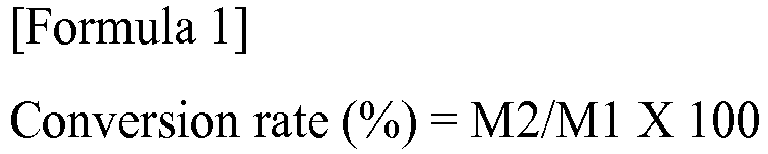
- Further, the (meth)acrylic resin syrup may include a (meth)acrylic polymer having a polydispersity index (PDI) of about 1.4 to about 1.6. As used herein, the polydispersity index refers to a weight average molecular weight divided by a number average molecular weight (Mw/Mn). The polydispersity index may be measured using gel permeation chromatography (GPC). The instrument used for the analysis is Alliance Waters E2695. 4 mg of M2 is extracted from the dried solid and transferred into a 10 mL volumetric flask, and then the flask is filled with tetrahydrofuran (THF). This solution is filtered with a 5 µm Teflon filter to inject 200 µL of the solution into the Waters E2695 to measure both the weight average molecular weight and the number average molecular weight.
- As described above, the composition for artificial marble may have proper physical properties for producing artificial marble by including a polymer having a polydispersity index within the above range while having (meth) acrylic syrup with the conversion rate within the above range.
- The inorganic filler may be included in an amount of 160 parts to 190 parts by weight, based on 100 parts by weight of the (meth)acrylic resin syrup. If the content of the inorganic filler is less than the above range, the cost is increased, and the artificial marble may have a plastic surface feel, which may deteriorate the surface quality. When the content of the inorganic filler is more than the above range, the elongation is greatly decreased and cracks may occur in the process of producing the artificial marble.
- The inorganic filler may include, but is not limited to, at least one selected from the group consisting of calcium carbonate, aluminum hydroxide, magnesium hydroxide, silica, and combinations thereof.
- In addition, the inorganic filler may include particles having an average particle diameter of from about 10 µm to about 80 µm. The average particle diameter may be measured using, for example, SEM/TEM equipment.
- When the average particle diameter of the inorganic filler is less than the above range, the monomer absorption rate is increased due to the roughness of the surface of the inorganic filler, and the viscosity is increased, so that product formation is difficult. When the average particle diameter exceeds the above range, the viscosity is lowered, resulting in a non-uniform state of the product due to precipitation and separation of the inorganic particles and the resin.
- In another embodiment of the present disclosure, there is provided an artificial marble formed by thermosetting the composition for artificial marble. The composition for artificial marble is as described above in the above embodiments.
-
Fig. 1 is a photograph showing an artificial marble molded using a composition for artificial marble according to an embodiment of the present disclosure. It can be seen that a deep and round molding is delicately and specifically expressed without cracks or breakage during the molding. - The artificial marble formed with the composition for artificial marble can simultaneously realize excellent high-temperature moldability and excellent tensile strength.
- The artificial marble may be formed by thermosetting the artificial marble composition. Specifically, the artificial marble may be formed by curing the artificial marble composition at about 25°C to about 50°C using a room temperature curing agent.
- Further, the artificial marble may be formed by thermosetting at about 40°C to about 95°C, thereby increasing the production rate of the artificial marble and facilitating the mass production. Although the artificial marble is thermoset under high temperature conditions within the above-mentioned range, the molding can smoothly proceed without cracks or breakage on the surface.
- In other embodiments, the artificial marble may have an elongation of, for example, from about 80% to about 200%. The elongation may be measured according to the measurement conditions under ASTM E 21.
- The artificial marble has a high elongation in the above range, so that the artificial marble can be thermoformed into a molded article having a three-dimensional shape such as a wash basin having a square shape or a deep depth, a rounded corner column, and the like. Specifically, the artificial marble has a high elongation in the above range, so that the bending angle of the artificial marble can be formed with a uniform forming angle of about 1R. Accordingly, the artificial marble can be formed in a delicate and concrete shape with an excellent mold forming angle. The forming angle of the mold is obtained by designing with CAD2017, and then forming MDF mold by using a CNC milling machine to make a three-dimensional mold, followed by directly pressing a plate heated at 180°C for 10 minutes.
- The artificial marble has a high elongation, and even if it contains a high content of inorganic filler, the surface may not crack or break during the heat curing under high temperature conditions.
- Further, the artificial marble may have a flexural strength of about 6.5 Mpa to about 8.5 Mpa. When the flexural strength of the artificial marble is less than the above range, it may be broken easily during the processing. The flexural strength may be measured according to the measurement conditions under ASTM D 790.
- The artificial marble may have a specific gravity of about 1.6 to about 1.7.
- Hereinafter, specific examples of the present disclosure will be described. It is to be understood, however, that the examples described below are only for illustrative purposes or to illustrate the present disclosure, and the present disclosure should not be construed as being limited thereto.
- A resin composition for syrup containing 28% by weight of polymethylmethacrylate was mixed with 72% by weight of methyl methacrylate, followed by stirring at 60°C for 30 minutes to prepare a (meth)acrylic resin syrup.
- Then, a composition for artificial marble comprising 0.5% by weight of a polyethylene glycol di(meth)acrylate oligomer having a glass transition temperature of 45°C to 55°C and a weight average molecular weight of 53,000, 61% by weight of an inorganic filler, and 0.3% by weight of a thermal initiator was mixed with 38% by weight of the (meth)acrylic resin syrup, and stirred to prepare an artificial marble in an oven at 75°C.
- A resin composition for syrup containing 28% by weight of polymethylmethacrylate was mixed with 72% by weight of methyl methacrylate, followed by stirring at 60°C for 30 minutes to prepare a (meth)acrylic resin syrup.
- Then, a composition for artificial marble comprising 0.5% by weight of a polyethylene glycol 400 di(meth)acrylate having a glass transition temperature of -25°C to 30°C and a molecular weight of 598, 61% by weight of an inorganic filler, and 0.3% by weight of a thermal initiator was mixed with 38% by weight of the (meth)acrylic resin syrup, and stirred to prepare an artificial marble in an oven at 75°C.
- A resin composition for syrup containing 28% by weight of polymethylmethacrylate was mixed with 72% by weight of methyl methacrylate, followed by stirring at 60°C for 30 minutes to prepare a (meth)acrylic resin syrup.
- Then, a composition for artificial marble comprising 0.8% by weight of a poly dimethyl methacrylate oligomer having a glass transition temperature of 45°C to 55°C and a weight average molecular weight of greater than or equal to 100,000, 61% by weight of an inorganic filler, and 0.3% by weight of a thermal initiator was mixed with 38% by weight of the (meth)acrylic resin syrup, and stirred to prepare an artificial marble in an oven at 75°C.
- A resin composition for syrup containing 28% by weight of polymethylmethacrylate was mixed with 72% by weight of methyl methacrylate, followed by stirring at 60°C for 30 minutes to prepare a (meth)acrylic resin syrup.
- Then, a composition for artificial marble comprising 0.5% by weight of an ethylene glycol dimethacrylate monomer having a glass transition temperature of 45 °C to 55°C and a molecular weight of 198, 61% by weight of an inorganic filler, and 0.3% by weight of a thermal initiator was mixed with 38% by weight of the (meth)acrylic resin syrup, and stirred to prepare an artificial marble in an oven at 75°C.
- A resin composition for syrup containing 28% by weight of polymethylmethacrylate was mixed with 72% by weight of methyl methacrylate, followed by stirring at 60°C for 30 minutes to prepare a (meth)acrylic resin syrup.
- Then, a composition for artificial marble comprising 0.5% by weight of a trimethylolpropane trimethacrylate monomer having a glass transition temperature of 25°C to 45°C and a molecular weight of 338, 61% by weight of an inorganic filler, and 0.3% by weight of a thermal initiator was mixed with 38% by weight of the (meth)acrylic resin syrup, and stirred to prepare an artificial marble in an oven at 75°C.
- The compositions for the respective artificial marbles according to Examples 1 to 3 and Comparative Examples 1 and 2 were thermally cured at 75°C to prepare an artificial marble with a thickness of 12 mm. Then, the high-temperature moldability, elongation, and tensile strength for the artificial marbles were evaluated. The results are shown in Table 1 below.
- Each of the artificial marbles prepared from the respective compositions for artificial marble according to Examples 1 and 3 and Comparative Examples 1 and 2 was heated at 180°C for 10 minutes. Drawing process was then performed with a predetermined curvature radius under the conditions of 25°C and 70 MPa using 1-ton press apparatus, and then each of the marbles was placed on a wooden molding with a rectangular barrel shape having four round portions and pressed. Specifically, the depth formed in each of the above molded products was 150 mm, and the horizontal axis inner curvature radius (Rh) and the vertical axis inner curvature radius (Rv) for the round portion were 23 mm, respectively.
- When the round portion of the molded product was visually observed, it was evaluated as being excellent in high-temperature moldability and indicated as "o" in the case where no cracks or broken parts appear on the surface, and it was evaluated as being poor in high temperature moldability and indicated as "X" in the case where cracks or broken parts appear on the surface.
- Each of the artificial marbles prepared from the compositions for artificial marble according to Examples 1 and 3 and Comparative Examples 1 and 2 was made into a specimen of 120 mm x 10 mm x 1.5 mm with a CNC engraver (TinyCNC-6012).
- The elongation of each specimen was measured using a tensile machine (Instron 8872, equipped with 160°C heating chamber). The prepared specimen was mounted on Instron 8872, and then the chamber was closed, and then heated at 160°C for 10 minutes. At this time, the temperature should stabilize at 160°C within 10 minutes. Subsequently, the specimen was pulled with the tensile machine and the % elongation of the extended length from the initial length was measured.
Table 1 High temperature moldability Elongation (%) Ex. 1 ○ 85 ∼ 102% Ex. 2 ○ 100 ∼ 120% Ex. 3 ○ 128 ∼ 148% C. Ex. 1 X 26 ∼ 32% C. Ex. 2 X 28 ∼ 42% - As shown in Table 1, it can be seen that the artificial marble prepared from the artificial marble composition of the examples shows high elongation and excellent high-temperature moldability.
Fig. 1 is an artificial marble prepared from an exemplary composition. It can be seen fromFig. 1 that a deep and round molding is delicately and specifically expressed without cracks or breakage during the molding process. That is, the artificial marble formed from the composition for artificial marble, which is excellent with a molding angle of 4R or less, such as about 1R, can simultaneously realize excellent high-temperature moldability and excellent tensile strength.
Claims (14)
- A composition for artificial marble comprising a bifunctional (meth)acrylate-based monomer, a bifunctional (meth)acrylate-based oligomer, or both.
- The composition for artificial marble according to claim 1, wherein the bifunctional (meth)acrylate-based monomer has a glass transition temperature of from - 25°C to 55°C.
- The composition for artificial marble according to claim 1, wherein the bifunctional (meth)acrylate-based monomer has a molecular weight of from 330 g/mole to 1,500 g/mole.
- The composition for artificial marble according to claim 1, wherein the bifunctional (meth)acrylate-based oligomer has a glass transition temperature of from 45 °C to 105°C.
- The composition for artificial marble according to claim 1, wherein the bifunctional (meth)acrylate-based oligomer has a weight average molecular weight of from 20,000g/mole to 120,000g/mole.
- The composition for artificial marble according to claim 1, comprising 0.18% by weight to 0.7% by weight of the bifunctional (meth)acrylate-based monomer.
- The composition for artificial marble according to claim 1, comprising 0.18% by weight to 1.0% by weight of the bifunctional (meth)acrylate-based oligomer.
- The composition for artificial marble according to claim 1, further comprising at least one selected from the group consisting of (meth)acrylic resin syrup, a thermal initiator, an inorganic filler, a crosslinking agent, a defoaming agent, a coupling agent, and combinations thereof.
- The composition for artificial marble according to claim 8, wherein the (meth) acrylic resin syrup has a conversion rate of 80% to 95%.
- The composition for artificial marble according to claim 8, wherein the (meth)acrylic resin syrup comprises a (meth)acrylic polymer having a polydispersity index (PDI) of 1.4 to 1.6.
- The composition for artificial marble according to claim 8, wherein the (meth)acrylic resin syrup is contained in an amount of 32% by weight to 38% by weight.
- The composition for artificial marble according to claim 8, wherein the inorganic filler is contained in an amount of 160 parts to 190 parts by weight based on 100 parts by weight of the (meth)acrylic resin syrup.
- An artificial marble formed by thermosetting a composition for artificial marble according to any one of claims 1 to 12.
- The artificial marble according to claim 13, having an elongation of 80% and 200%.
Applications Claiming Priority (2)
| Application Number | Priority Date | Filing Date | Title |
|---|---|---|---|
| KR1020170049987A KR102171641B1 (en) | 2017-04-18 | 2017-04-18 | Composition for artificial marble and artificial marble |
| PCT/KR2018/003796 WO2018194292A1 (en) | 2017-04-18 | 2018-03-30 | Composition for artificial marble, and artificial marble |
Publications (3)
| Publication Number | Publication Date |
|---|---|
| EP3613714A1 true EP3613714A1 (en) | 2020-02-26 |
| EP3613714A4 EP3613714A4 (en) | 2020-05-13 |
| EP3613714B1 EP3613714B1 (en) | 2023-03-22 |
Family
ID=63855955
Family Applications (1)
| Application Number | Title | Priority Date | Filing Date |
|---|---|---|---|
| EP18788445.7A Active EP3613714B1 (en) | 2017-04-18 | 2018-03-30 | Composition for artificial marble, and artificial marble |
Country Status (3)
| Country | Link |
|---|---|
| EP (1) | EP3613714B1 (en) |
| KR (1) | KR102171641B1 (en) |
| WO (1) | WO2018194292A1 (en) |
Cited By (2)
| Publication number | Priority date | Publication date | Assignee | Title |
|---|---|---|---|---|
| JP2021014523A (en) * | 2019-07-12 | 2021-02-12 | タカラスタンダード株式会社 | Thermosetting (meth)acrylic resin composition and molded article of the same |
| EP3838936A1 (en) * | 2019-12-19 | 2021-06-23 | Arkema France | Curable compositions comprising multistage polymers |
Family Cites Families (10)
| Publication number | Priority date | Publication date | Assignee | Title |
|---|---|---|---|---|
| US3663493A (en) * | 1969-12-29 | 1972-05-16 | Monsanto Co | Process for the production of marbleized reinforced polyacrylic compositions |
| CN1119378C (en) * | 1996-04-19 | 2003-08-27 | 三菱丽阳株式会社 | Acrylic resin composition, acrylic premix, method for producing acrylic artificial marble, and thickener |
| WO1999021692A1 (en) * | 1997-10-28 | 1999-05-06 | Mitsubishi Rayon Co., Ltd. | Acrylic smc or bmc, processes for the preparation of the same, process for the production of acrylic synthetic marble, and thickening agent |
| WO1999055633A1 (en) * | 1998-04-28 | 1999-11-04 | Mitsubishi Rayon Co., Ltd. | Acrylic premix, acrylic artificial marble, and process for producing the same |
| KR100528236B1 (en) * | 2003-07-29 | 2005-11-15 | 주식회사 엘지화학 | Artificial marble reutilizing waste materials and preparation thereof |
| KR100796437B1 (en) * | 2005-06-29 | 2008-01-21 | 주식회사 엘지화학 | Artificial marble with quartz effect using transparent chip and its manufacturing method |
| US20120178850A1 (en) * | 2010-06-01 | 2012-07-12 | Lg Hausys, Ltd. | Artificial marble and method of manufacturing the same |
| JP2015030636A (en) * | 2013-08-01 | 2015-02-16 | パナソニック株式会社 | Method for manufacturing artificial marble |
| KR101657453B1 (en) * | 2014-10-31 | 2016-09-30 | 김재영 | Manufacturing method of anti-scratch artificial marble |
| KR101997581B1 (en) * | 2015-10-01 | 2019-10-02 | 주식회사 엘지화학 | Method for producing (meta)acrylic syrup and (meta)acrylic syrup |
-
2017
- 2017-04-18 KR KR1020170049987A patent/KR102171641B1/en active Active
-
2018
- 2018-03-30 WO PCT/KR2018/003796 patent/WO2018194292A1/en not_active Ceased
- 2018-03-30 EP EP18788445.7A patent/EP3613714B1/en active Active
Cited By (3)
| Publication number | Priority date | Publication date | Assignee | Title |
|---|---|---|---|---|
| JP2021014523A (en) * | 2019-07-12 | 2021-02-12 | タカラスタンダード株式会社 | Thermosetting (meth)acrylic resin composition and molded article of the same |
| EP3838936A1 (en) * | 2019-12-19 | 2021-06-23 | Arkema France | Curable compositions comprising multistage polymers |
| WO2021123413A1 (en) * | 2019-12-19 | 2021-06-24 | Arkema France | Curable compositions comprising multistage polymers |
Also Published As
| Publication number | Publication date |
|---|---|
| EP3613714A4 (en) | 2020-05-13 |
| WO2018194292A1 (en) | 2018-10-25 |
| EP3613714B1 (en) | 2023-03-22 |
| KR20180116982A (en) | 2018-10-26 |
| KR102171641B1 (en) | 2020-10-29 |
Similar Documents
| Publication | Publication Date | Title |
|---|---|---|
| EP3613714B1 (en) | Composition for artificial marble, and artificial marble | |
| KR20120134832A (en) | Impact modifier for polymethylmetacrylate resin having excellent impact strength and transparency and method of preparing the same | |
| KR970001248B1 (en) | Artificial stone molded body and process for fabrication thereof | |
| KR20080024537A (en) | Polymerizable compositions containing solid fillers, articles made from them and methods of making | |
| KR101996941B1 (en) | Acrylic resin syrup for artificial marble and artificial marble containing the same | |
| JP2000510190A (en) | Thermoformable acrylic sheet with uniform distribution of colored and inorganic fillers | |
| KR20190048455A (en) | Manufacturing Method of Artificial Marble With Superior High Temperature Elongation | |
| CN107848161A (en) | Resin plate and its manufacture method and products formed and its manufacture method with pearly-lustre decorative pattern | |
| KR20190012683A (en) | Core-shell copolymer, method for preparing the copolymer and thermoplastic resin composition comprising the copolymer | |
| US6794439B1 (en) | Acrylic polymer composition | |
| KR102641983B1 (en) | Artificial marble and method for manufacturing thereof | |
| KR102645811B1 (en) | Artificial marble and method for manufacturing thereof | |
| KR102598236B1 (en) | Compatibilizer for organic-inorganic composite material | |
| KR20200056810A (en) | Artificial marble and method for manufacturing thereof | |
| KR102894789B1 (en) | Artificial marble and method for manufacturing thereof | |
| AU2002254058B2 (en) | Solid surface sheet materials containing synthetic MICA | |
| KR102280427B1 (en) | Artificial marble and method for manufacturing thereof | |
| JP2001038724A (en) | Acrylic sheet molding compound (SMC), acrylic resin molded article using the SMC, and method of manufacturing the same | |
| JP2019011427A (en) | Acrylic resin composition | |
| JP4077893B2 (en) | Methyl methacrylate resin extruded plate and molded product | |
| WO2001098429A1 (en) | Thickening agent, thickening composition and process for producing the same, sheet molding compound or bulk molding compound and process for producing the same, and molded resin and process for producing the same | |
| KR101943341B1 (en) | Calendering process additives for improving smoothness | |
| KR102641984B1 (en) | Artificial marble and method for manufacturing thereof | |
| KR102485388B1 (en) | Artificial marble and method for manufacturing thereof | |
| EP4667437A1 (en) | Composition for artificial marble and artificial marble manufactured from same |
Legal Events
| Date | Code | Title | Description |
|---|---|---|---|
| STAA | Information on the status of an ep patent application or granted ep patent |
Free format text: STATUS: THE INTERNATIONAL PUBLICATION HAS BEEN MADE |
|
| PUAI | Public reference made under article 153(3) epc to a published international application that has entered the european phase |
Free format text: ORIGINAL CODE: 0009012 |
|
| STAA | Information on the status of an ep patent application or granted ep patent |
Free format text: STATUS: REQUEST FOR EXAMINATION WAS MADE |
|
| 17P | Request for examination filed |
Effective date: 20191113 |
|
| AK | Designated contracting states |
Kind code of ref document: A1 Designated state(s): AL AT BE BG CH CY CZ DE DK EE ES FI FR GB GR HR HU IE IS IT LI LT LU LV MC MK MT NL NO PL PT RO RS SE SI SK SM TR |
|
| AX | Request for extension of the european patent |
Extension state: BA ME |
|
| A4 | Supplementary search report drawn up and despatched |
Effective date: 20200415 |
|
| RIC1 | Information provided on ipc code assigned before grant |
Ipc: C04B 111/54 20060101ALI20200407BHEP Ipc: C08F 20/18 20060101ALI20200407BHEP Ipc: C08L 33/08 20060101ALI20200407BHEP Ipc: C04B 103/00 20060101ALI20200407BHEP Ipc: C04B 26/06 20060101AFI20200407BHEP |
|
| DAV | Request for validation of the european patent (deleted) | ||
| DAX | Request for extension of the european patent (deleted) | ||
| STAA | Information on the status of an ep patent application or granted ep patent |
Free format text: STATUS: EXAMINATION IS IN PROGRESS |
|
| 17Q | First examination report despatched |
Effective date: 20210406 |
|
| GRAP | Despatch of communication of intention to grant a patent |
Free format text: ORIGINAL CODE: EPIDOSNIGR1 |
|
| STAA | Information on the status of an ep patent application or granted ep patent |
Free format text: STATUS: GRANT OF PATENT IS INTENDED |
|
| INTG | Intention to grant announced |
Effective date: 20221026 |
|
| GRAS | Grant fee paid |
Free format text: ORIGINAL CODE: EPIDOSNIGR3 |
|
| GRAA | (expected) grant |
Free format text: ORIGINAL CODE: 0009210 |
|
| STAA | Information on the status of an ep patent application or granted ep patent |
Free format text: STATUS: THE PATENT HAS BEEN GRANTED |
|
| AK | Designated contracting states |
Kind code of ref document: B1 Designated state(s): AL AT BE BG CH CY CZ DE DK EE ES FI FR GB GR HR HU IE IS IT LI LT LU LV MC MK MT NL NO PL PT RO RS SE SI SK SM TR |
|
| REG | Reference to a national code |
Ref country code: GB Ref legal event code: FG4D |
|
| REG | Reference to a national code |
Ref country code: CH Ref legal event code: EP |
|
| REG | Reference to a national code |
Ref country code: IE Ref legal event code: FG4D |
|
| REG | Reference to a national code |
Ref country code: DE Ref legal event code: R096 Ref document number: 602018047521 Country of ref document: DE |
|
| REG | Reference to a national code |
Ref country code: AT Ref legal event code: REF Ref document number: 1555228 Country of ref document: AT Kind code of ref document: T Effective date: 20230415 |
|
| REG | Reference to a national code |
Ref country code: LT Ref legal event code: MG9D |
|
| REG | Reference to a national code |
Ref country code: NL Ref legal event code: MP Effective date: 20230322 |
|
| PG25 | Lapsed in a contracting state [announced via postgrant information from national office to epo] |
Ref country code: RS Free format text: LAPSE BECAUSE OF FAILURE TO SUBMIT A TRANSLATION OF THE DESCRIPTION OR TO PAY THE FEE WITHIN THE PRESCRIBED TIME-LIMIT Effective date: 20230322 Ref country code: NO Free format text: LAPSE BECAUSE OF FAILURE TO SUBMIT A TRANSLATION OF THE DESCRIPTION OR TO PAY THE FEE WITHIN THE PRESCRIBED TIME-LIMIT Effective date: 20230622 Ref country code: LV Free format text: LAPSE BECAUSE OF FAILURE TO SUBMIT A TRANSLATION OF THE DESCRIPTION OR TO PAY THE FEE WITHIN THE PRESCRIBED TIME-LIMIT Effective date: 20230322 Ref country code: LT Free format text: LAPSE BECAUSE OF FAILURE TO SUBMIT A TRANSLATION OF THE DESCRIPTION OR TO PAY THE FEE WITHIN THE PRESCRIBED TIME-LIMIT Effective date: 20230322 Ref country code: HR Free format text: LAPSE BECAUSE OF FAILURE TO SUBMIT A TRANSLATION OF THE DESCRIPTION OR TO PAY THE FEE WITHIN THE PRESCRIBED TIME-LIMIT Effective date: 20230322 |
|
| REG | Reference to a national code |
Ref country code: AT Ref legal event code: MK05 Ref document number: 1555228 Country of ref document: AT Kind code of ref document: T Effective date: 20230322 |
|
| PG25 | Lapsed in a contracting state [announced via postgrant information from national office to epo] |
Ref country code: SE Free format text: LAPSE BECAUSE OF FAILURE TO SUBMIT A TRANSLATION OF THE DESCRIPTION OR TO PAY THE FEE WITHIN THE PRESCRIBED TIME-LIMIT Effective date: 20230322 Ref country code: NL Free format text: LAPSE BECAUSE OF FAILURE TO SUBMIT A TRANSLATION OF THE DESCRIPTION OR TO PAY THE FEE WITHIN THE PRESCRIBED TIME-LIMIT Effective date: 20230322 Ref country code: GR Free format text: LAPSE BECAUSE OF FAILURE TO SUBMIT A TRANSLATION OF THE DESCRIPTION OR TO PAY THE FEE WITHIN THE PRESCRIBED TIME-LIMIT Effective date: 20230623 Ref country code: FI Free format text: LAPSE BECAUSE OF FAILURE TO SUBMIT A TRANSLATION OF THE DESCRIPTION OR TO PAY THE FEE WITHIN THE PRESCRIBED TIME-LIMIT Effective date: 20230322 |
|
| PG25 | Lapsed in a contracting state [announced via postgrant information from national office to epo] |
Ref country code: SM Free format text: LAPSE BECAUSE OF FAILURE TO SUBMIT A TRANSLATION OF THE DESCRIPTION OR TO PAY THE FEE WITHIN THE PRESCRIBED TIME-LIMIT Effective date: 20230322 Ref country code: RO Free format text: LAPSE BECAUSE OF FAILURE TO SUBMIT A TRANSLATION OF THE DESCRIPTION OR TO PAY THE FEE WITHIN THE PRESCRIBED TIME-LIMIT Effective date: 20230322 Ref country code: PT Free format text: LAPSE BECAUSE OF FAILURE TO SUBMIT A TRANSLATION OF THE DESCRIPTION OR TO PAY THE FEE WITHIN THE PRESCRIBED TIME-LIMIT Effective date: 20230724 Ref country code: ES Free format text: LAPSE BECAUSE OF FAILURE TO SUBMIT A TRANSLATION OF THE DESCRIPTION OR TO PAY THE FEE WITHIN THE PRESCRIBED TIME-LIMIT Effective date: 20230322 Ref country code: EE Free format text: LAPSE BECAUSE OF FAILURE TO SUBMIT A TRANSLATION OF THE DESCRIPTION OR TO PAY THE FEE WITHIN THE PRESCRIBED TIME-LIMIT Effective date: 20230322 Ref country code: AT Free format text: LAPSE BECAUSE OF FAILURE TO SUBMIT A TRANSLATION OF THE DESCRIPTION OR TO PAY THE FEE WITHIN THE PRESCRIBED TIME-LIMIT Effective date: 20230322 |
|
| REG | Reference to a national code |
Ref country code: CH Ref legal event code: PL |
|
| REG | Reference to a national code |
Ref country code: DE Ref legal event code: R082 Ref document number: 602018047521 Country of ref document: DE Representative=s name: KANDLBINDER, MARKUS, DIPL.-PHYS., DE |
|
| PG25 | Lapsed in a contracting state [announced via postgrant information from national office to epo] |
Ref country code: SK Free format text: LAPSE BECAUSE OF FAILURE TO SUBMIT A TRANSLATION OF THE DESCRIPTION OR TO PAY THE FEE WITHIN THE PRESCRIBED TIME-LIMIT Effective date: 20230322 Ref country code: PL Free format text: LAPSE BECAUSE OF FAILURE TO SUBMIT A TRANSLATION OF THE DESCRIPTION OR TO PAY THE FEE WITHIN THE PRESCRIBED TIME-LIMIT Effective date: 20230322 Ref country code: IS Free format text: LAPSE BECAUSE OF FAILURE TO SUBMIT A TRANSLATION OF THE DESCRIPTION OR TO PAY THE FEE WITHIN THE PRESCRIBED TIME-LIMIT Effective date: 20230722 |
|
| REG | Reference to a national code |
Ref country code: BE Ref legal event code: MM Effective date: 20230331 |
|
| PG25 | Lapsed in a contracting state [announced via postgrant information from national office to epo] |
Ref country code: LU Free format text: LAPSE BECAUSE OF NON-PAYMENT OF DUE FEES Effective date: 20230330 |
|
| REG | Reference to a national code |
Ref country code: DE Ref legal event code: R097 Ref document number: 602018047521 Country of ref document: DE |
|
| PG25 | Lapsed in a contracting state [announced via postgrant information from national office to epo] |
Ref country code: MC Free format text: LAPSE BECAUSE OF FAILURE TO SUBMIT A TRANSLATION OF THE DESCRIPTION OR TO PAY THE FEE WITHIN THE PRESCRIBED TIME-LIMIT Effective date: 20230322 |
|
| REG | Reference to a national code |
Ref country code: IE Ref legal event code: MM4A |
|
| PLBE | No opposition filed within time limit |
Free format text: ORIGINAL CODE: 0009261 |
|
| STAA | Information on the status of an ep patent application or granted ep patent |
Free format text: STATUS: NO OPPOSITION FILED WITHIN TIME LIMIT |
|
| PG25 | Lapsed in a contracting state [announced via postgrant information from national office to epo] |
Ref country code: SI Free format text: LAPSE BECAUSE OF FAILURE TO SUBMIT A TRANSLATION OF THE DESCRIPTION OR TO PAY THE FEE WITHIN THE PRESCRIBED TIME-LIMIT Effective date: 20230322 Ref country code: MC Free format text: LAPSE BECAUSE OF FAILURE TO SUBMIT A TRANSLATION OF THE DESCRIPTION OR TO PAY THE FEE WITHIN THE PRESCRIBED TIME-LIMIT Effective date: 20230322 Ref country code: LI Free format text: LAPSE BECAUSE OF NON-PAYMENT OF DUE FEES Effective date: 20230331 Ref country code: IE Free format text: LAPSE BECAUSE OF NON-PAYMENT OF DUE FEES Effective date: 20230330 Ref country code: DK Free format text: LAPSE BECAUSE OF FAILURE TO SUBMIT A TRANSLATION OF THE DESCRIPTION OR TO PAY THE FEE WITHIN THE PRESCRIBED TIME-LIMIT Effective date: 20230322 Ref country code: CZ Free format text: LAPSE BECAUSE OF FAILURE TO SUBMIT A TRANSLATION OF THE DESCRIPTION OR TO PAY THE FEE WITHIN THE PRESCRIBED TIME-LIMIT Effective date: 20230322 Ref country code: CH Free format text: LAPSE BECAUSE OF NON-PAYMENT OF DUE FEES Effective date: 20230331 |
|
| 26N | No opposition filed |
Effective date: 20240102 |
|
| GBPC | Gb: european patent ceased through non-payment of renewal fee |
Effective date: 20230622 |
|
| PG25 | Lapsed in a contracting state [announced via postgrant information from national office to epo] |
Ref country code: BE Free format text: LAPSE BECAUSE OF NON-PAYMENT OF DUE FEES Effective date: 20230331 |
|
| PG25 | Lapsed in a contracting state [announced via postgrant information from national office to epo] |
Ref country code: GB Free format text: LAPSE BECAUSE OF NON-PAYMENT OF DUE FEES Effective date: 20230622 |
|
| PG25 | Lapsed in a contracting state [announced via postgrant information from national office to epo] |
Ref country code: IT Free format text: LAPSE BECAUSE OF FAILURE TO SUBMIT A TRANSLATION OF THE DESCRIPTION OR TO PAY THE FEE WITHIN THE PRESCRIBED TIME-LIMIT Effective date: 20230322 Ref country code: FR Free format text: LAPSE BECAUSE OF NON-PAYMENT OF DUE FEES Effective date: 20230522 |
|
| PG25 | Lapsed in a contracting state [announced via postgrant information from national office to epo] |
Ref country code: BG Free format text: LAPSE BECAUSE OF FAILURE TO SUBMIT A TRANSLATION OF THE DESCRIPTION OR TO PAY THE FEE WITHIN THE PRESCRIBED TIME-LIMIT Effective date: 20230322 |
|
| PG25 | Lapsed in a contracting state [announced via postgrant information from national office to epo] |
Ref country code: BG Free format text: LAPSE BECAUSE OF FAILURE TO SUBMIT A TRANSLATION OF THE DESCRIPTION OR TO PAY THE FEE WITHIN THE PRESCRIBED TIME-LIMIT Effective date: 20230322 |
|
| PG25 | Lapsed in a contracting state [announced via postgrant information from national office to epo] |
Ref country code: CY Free format text: LAPSE BECAUSE OF FAILURE TO SUBMIT A TRANSLATION OF THE DESCRIPTION OR TO PAY THE FEE WITHIN THE PRESCRIBED TIME-LIMIT; INVALID AB INITIO Effective date: 20180330 |
|
| PG25 | Lapsed in a contracting state [announced via postgrant information from national office to epo] |
Ref country code: HU Free format text: LAPSE BECAUSE OF FAILURE TO SUBMIT A TRANSLATION OF THE DESCRIPTION OR TO PAY THE FEE WITHIN THE PRESCRIBED TIME-LIMIT; INVALID AB INITIO Effective date: 20180330 |
|
| PG25 | Lapsed in a contracting state [announced via postgrant information from national office to epo] |
Ref country code: TR Free format text: LAPSE BECAUSE OF FAILURE TO SUBMIT A TRANSLATION OF THE DESCRIPTION OR TO PAY THE FEE WITHIN THE PRESCRIBED TIME-LIMIT Effective date: 20230322 |
|
| PGFP | Annual fee paid to national office [announced via postgrant information from national office to epo] |
Ref country code: DE Payment date: 20251208 Year of fee payment: 9 |