EP3609948B2 - Verfahren zur herstellung einer aktivierten ligninzusammensetzung - Google Patents
Verfahren zur herstellung einer aktivierten ligninzusammensetzung Download PDFInfo
- Publication number
- EP3609948B2 EP3609948B2 EP18728245.4A EP18728245A EP3609948B2 EP 3609948 B2 EP3609948 B2 EP 3609948B2 EP 18728245 A EP18728245 A EP 18728245A EP 3609948 B2 EP3609948 B2 EP 3609948B2
- Authority
- EP
- European Patent Office
- Prior art keywords
- lignin
- formaldehyde
- phenol
- activation
- range
- Prior art date
- Legal status (The legal status is an assumption and is not a legal conclusion. Google has not performed a legal analysis and makes no representation as to the accuracy of the status listed.)
- Active
Links
Images



Classifications
-
- C—CHEMISTRY; METALLURGY
- C08—ORGANIC MACROMOLECULAR COMPOUNDS; THEIR PREPARATION OR CHEMICAL WORKING-UP; COMPOSITIONS BASED THEREON
- C08L—COMPOSITIONS OF MACROMOLECULAR COMPOUNDS
- C08L97/00—Compositions of lignin-containing materials
- C08L97/005—Lignin
-
- C—CHEMISTRY; METALLURGY
- C07—ORGANIC CHEMISTRY
- C07G—COMPOUNDS OF UNKNOWN CONSTITUTION
- C07G1/00—Low-molecular-weight derivatives of lignin
-
- B—PERFORMING OPERATIONS; TRANSPORTING
- B29—WORKING OF PLASTICS; WORKING OF SUBSTANCES IN A PLASTIC STATE IN GENERAL
- B29C—SHAPING OR JOINING OF PLASTICS; SHAPING OF MATERIAL IN A PLASTIC STATE, NOT OTHERWISE PROVIDED FOR; AFTER-TREATMENT OF THE SHAPED PRODUCTS, e.g. REPAIRING
- B29C70/00—Shaping composites, i.e. plastics material comprising reinforcements, fillers or preformed parts, e.g. inserts
- B29C70/04—Shaping composites, i.e. plastics material comprising reinforcements, fillers or preformed parts, e.g. inserts comprising reinforcements only, e.g. self-reinforcing plastics
- B29C70/26—Non-fibrous reinforcements only
-
- C—CHEMISTRY; METALLURGY
- C08—ORGANIC MACROMOLECULAR COMPOUNDS; THEIR PREPARATION OR CHEMICAL WORKING-UP; COMPOSITIONS BASED THEREON
- C08H—DERIVATIVES OF NATURAL MACROMOLECULAR COMPOUNDS
- C08H6/00—Macromolecular compounds derived from lignin, e.g. tannins, humic acids
-
- C—CHEMISTRY; METALLURGY
- C08—ORGANIC MACROMOLECULAR COMPOUNDS; THEIR PREPARATION OR CHEMICAL WORKING-UP; COMPOSITIONS BASED THEREON
- C08J—WORKING-UP; GENERAL PROCESSES OF COMPOUNDING; AFTER-TREATMENT NOT COVERED BY SUBCLASSES C08B, C08C, C08F, C08G or C08H
- C08J5/00—Manufacture of articles or shaped materials containing macromolecular substances
- C08J5/24—Impregnating materials with prepolymers which can be polymerised in situ, e.g. manufacture of prepregs
- C08J5/245—Impregnating materials with prepolymers which can be polymerised in situ, e.g. manufacture of prepregs using natural fibres
-
- C—CHEMISTRY; METALLURGY
- C09—DYES; PAINTS; POLISHES; NATURAL RESINS; ADHESIVES; COMPOSITIONS NOT OTHERWISE PROVIDED FOR; APPLICATIONS OF MATERIALS NOT OTHERWISE PROVIDED FOR
- C09J—ADHESIVES; NON-MECHANICAL ASPECTS OF ADHESIVE PROCESSES IN GENERAL; ADHESIVE PROCESSES NOT PROVIDED FOR ELSEWHERE; USE OF MATERIALS AS ADHESIVES
- C09J197/00—Adhesives based on lignin-containing materials
- C09J197/005—Lignin
-
- B—PERFORMING OPERATIONS; TRANSPORTING
- B29—WORKING OF PLASTICS; WORKING OF SUBSTANCES IN A PLASTIC STATE IN GENERAL
- B29K—INDEXING SCHEME ASSOCIATED WITH SUBCLASSES B29B, B29C OR B29D, RELATING TO MOULDING MATERIALS OR TO MATERIALS FOR MOULDS, REINFORCEMENTS, FILLERS OR PREFORMED PARTS, e.g. INSERTS
- B29K2001/00—Use of cellulose, modified cellulose or cellulose derivatives, e.g. viscose, as moulding material
-
- B—PERFORMING OPERATIONS; TRANSPORTING
- B29—WORKING OF PLASTICS; WORKING OF SUBSTANCES IN A PLASTIC STATE IN GENERAL
- B29K—INDEXING SCHEME ASSOCIATED WITH SUBCLASSES B29B, B29C OR B29D, RELATING TO MOULDING MATERIALS OR TO MATERIALS FOR MOULDS, REINFORCEMENTS, FILLERS OR PREFORMED PARTS, e.g. INSERTS
- B29K2311/00—Use of natural products or their composites, not provided for in groups B29K2201/00 - B29K2309/00, as reinforcement
- B29K2311/12—Paper, e.g. cardboard
- B29K2311/126—Impregnated
-
- B—PERFORMING OPERATIONS; TRANSPORTING
- B29—WORKING OF PLASTICS; WORKING OF SUBSTANCES IN A PLASTIC STATE IN GENERAL
- B29L—INDEXING SCHEME ASSOCIATED WITH SUBCLASS B29C, RELATING TO PARTICULAR ARTICLES
- B29L2009/00—Layered products
-
- C—CHEMISTRY; METALLURGY
- C08—ORGANIC MACROMOLECULAR COMPOUNDS; THEIR PREPARATION OR CHEMICAL WORKING-UP; COMPOSITIONS BASED THEREON
- C08J—WORKING-UP; GENERAL PROCESSES OF COMPOUNDING; AFTER-TREATMENT NOT COVERED BY SUBCLASSES C08B, C08C, C08F, C08G or C08H
- C08J2397/00—Characterised by the use of lignin-containing materials
Definitions
- the present invention relates to a method for manufacturing a high pressure laminate comprising a step of preparing a core layer and a step of pressing said core layer in a press using an elevated temperature and an elevated pressure, wherein said step of preparing said core layer comprises impregnating a paper with a resin mixture and constructing a stack of resin impregnated papers, said resin mixture comprises an activated lignin composition, especially an activated lignin composition containing methylol functional groups.
- the present invention also relates to a method for further processing the thus activated lignin composition in a method for preparing a lignin-phenol formaldehyde resin.
- a lignin-phenol formaldehyde resin is used in the manufacturing of laminates by replacing the traditional synthetic phenol formaldehyde resin.
- Laminates are products that are comprised of multiple layers of semi-finished material (either impregnated papers or prepregs), that are then compressed and fused together.
- laminate products typically contain about 55-80 wt. % wood derived material (e.g. fibres or paper) and about 20-45 wt. % thermosetting resin.
- the fusing of the compressed stack of layered semi-finished material is brought about by the condensation (or polymerisation reaction) of the thermosetting resin; which is normally driven by the application of heat, and by such means taken to a desired degree of final curing. This can be achieved using discontinuous or continuous processing methods.
- a common discontinuous method is the use of a multi-daylight press wherein stacks of layered semi-finished material are placed within the daylights of the press and then subjected to a program of pressurised compression and applied heat, which result in a laminate product.
- a general product definition for such laminates is "High Pressure Laminate” or "HPL”.
- An example of a continuous method is the use of a continuous press; wherein the semi-finished material is continually fed into the press from multiple feeds, they are then compressed and heated to form a laminate product.
- a general product definition for such laminates is "Continuous Pressure Laminate” or alternatively “Continuous Pressed Laminate” both of which can be abbreviated to "CPL".
- the product norm or standard EN438 has a general definition for laminates termed as HPL or CPL, however in this document the definition of laminates as described is somewhat wider.
- Decorative laminates are generally composed of a core layer or stack of core layers, with a decorative layer either on one or both sides. Laminates of this type are employed for interior or exterior uses in the building industry, being used as cladding panels or self-supporting units, depending on their thickness.
- Decorative high-pressure compact laminates manufactured by the present applicant are known for outdoor applications.
- Such laminates consist of layers of wood-based fibres (paper and/or wood) impregnated with thermosetting resins and surface layer(s) on one or both sides, having decorative colours or designs.
- a transparent topcoat can be added to the surface layer(s) and cured to enhance weather and light protecting properties.
- These components are bonded together with simultaneous application of heat and high specific pressure to obtain a homogeneous non-porous material with increased density and integral decorative surface.
- These laminates have been disclosed in, inter alia, US Patent No. 4,801,495 , US 4,789,604 , US Patent application 2013/0078437 .
- the present application is not restricted only to exterior compact laminates, but the scope of this application also includes interior laminates, which can be either thin or compact.
- Lignin is a natural polymer, which can be extracted from for example wood.
- lignin is a natural biopolymer
- its use as a component in resins instead of synthetic materials is a way to come up with a more environmentally friendly resin composition.
- Lignin is an aromatic polymer and a major constituent in wood, and has been extensively investigated as a suitable substitute for phenol during production of phenol-formaldehyde resins. These are used during manufacturing of structural wood products such as plywood, oriented strand board and fibreboard.
- lignin partially replacing phenol
- formaldehyde is reacted with formaldehyde in the presence of either basic or acidic catalyst to form a highly cross-linked aromatic resins; termed novolacs (when utilizing acidic catalysts), or resoles (when utilizing basic catalysts).
- novolacs when utilizing acidic catalysts
- resoles when utilizing basic catalysts.
- the amounts of the phenol that can be replaced by lignin are, inter alia, determined by the lower reactivity of lignin.
- International application WO 2016/157141 relates to a method for the making an activated lignin composition
- a lignin such as an alkaline lignin
- aqueous or water soluble dispersant(s) such as water
- aqueous or water soluble dispersant(s) such as water
- an alkali metal-based such as NaOH
- International application WO2015123781 relates to a method for preparing a cross-linkable resin, the method comprising the step of: (i) converting a hexose to 5-hydroxymethyl furfural (HMF) in the presence of a phenolic compound and a catalyst that promotes formation of covalent bonds between a carbon atom of the aromatic ring of the phenolic compound and the carbon of the formyl group of the HMF to form the resin, wherein the phenolic compound is selected from unsubstituted phenol, cardanol and combinations thereof, especially wherein the phenolic compound is obtained from a lignocellulosic biomass.
- the biomass is one or more of pyrolysis oil, liquefied biomass, lignin, de-polymerized lignin, phenolated de-polymerized lignin, and liquefied lignin.
- International application WO2013144454 relates to a method for increasing the reactivity of lignin, comprising the following steps: a) forming, under heating at a temperature of 30 - 70 °C, an aqueous dispersion comprising alkali and lignin, wherein the alkali comprises a hydroxide of an alkali metal; and b) heating the dispersion formed in step a) at a temperature of 50 - 95 °C for producing alkylated lignin, wherein step b) is carried out for 15 minutes - 24 hours, and wherein the method comprises, before step a) , the step i) of reacting lignin with a compound selected from the class of phenols.
- WO2013144454 uses the term "alkylated lignin” and that would imply the covalent bonding of a carbon chain to the lignin. On the basis of the disclosure it means lignin dissolved in alkali, rather than an alkylation reaction whereby a hydrocarbon chain is covalently bonded to the lignin.
- One embodiment of WO2013144454 is to provide a methylolated lignin (termed as "hydroxymethylated lignin” in WO2013144454 ) obtained by the reaction of formaldehyde with lignin, which is then used to make a binder by the addition of phenol, further formaldehyde and further sodium hydroxide.
- International application WO2015079107 relates to a method for treating lignin, comprising the following steps: a) dissolving lignin into an aqueous composition, which contains a compound selected from the class of phenols and alkali, while keeping the temperature of the composition at 40 - 85 °C, wherein the alkali comprises a hydroxide of an alkali metal; and b) heating the composition at a temperature, which is higher than the temperature of the composition in step a), with the proviso that the temperature of the composition does not exceed 100 °C, while keeping the pH of the composition at a pH value of 6 - 14.
- alkali is added to the composition in step b), thus alkali is added to the composition in step a) and in step b).
- This publication mentions that dissolving lignin into a composition of phenol, alkali and water, at the specific temperature used affects the time needed to dissolve lignin into the composition.
- International application WO2016207493 relates to a method for recovering lignin from alkaline lignin containing feedstock by a thermal treatment, wherein the method comprises a simultaneous activation and precipitation of the lignin in the feedstock by a thermal treatment being carried out without added demethylation and demethoxylation enhancing agent, by applying temperature between 200 and 250 °C and a retention time between 0.5 and 10 hours to the feedstock, wherein the alkaline lignin containing feedstock is from alkaline pulping process, e.g. kraft black liquor. After the activation and precipitation, the lignin material is purified by acidic washing.
- International application WO2017006215 relates to a method for increasing the reactivity of lignin, a resin composition comprising said lignin and use of said resin composition.
- the method comprises the following steps: providing a mixture comprising lignin and an alkali solution wherein the concentration of the alkali solution of the mixture is between 5-50% by weight, storing said mixture for a period of at least 1 day whereby the reactivity of the lignin is increased, wherein the storage is done at room temperature, i.e. at a temperature of 20 - 30 °C.
- the mixture comprises 10-80% by weight of lignin.
- German Offenlegungsschrift DE 43 31 656 relates to a binder mixture containing 45 to 85% by weight of methylol-modified lignin, 5 to 25% by weight of resole and 10 to 30% by weight of a di- or polyisocyanate, wherein the methylol group-modified lignin and the resol are in aqueous solution, further containing 1 to 15% by weight of ester, e.g. triacetin, as accelerator.
- ester e.g. triacetin
- WO2007124400 relates to a method for the production of a modified renewable aromatic material with lower softening temperature or increased reactivity in a thermoset system comprising subjecting a renewable aromatic material to a chemo-thermo- mechanical (CTM) treatment under mechanical shear, at a maximum temperature of about 100 - 220[deg.]C and a pressure of about 0.5 - 10 atmospheres in the presence of an additive which lowers the softening point of the renewable aromatic material or an additive that enhances reactivity of the renewable aromatic material to produce a modified renewable aromatic material with lower softening temperature or increased reactivity, wherein the renewable aromatic material is lignin, tannin or cardanol or a combination thereof.
- CTM chemo-thermo- mechanical
- Lignin Phenol Formaldehyde (LPF) binders described by the prior art, the lignin has been co-condensed with the phenol formaldehyde or simply post added. This aspect will generally result in binders that are too viscous for the desired application.
- phenol in the presence of an alkali can form a phenolate ion. This can undergo resonance and form three structures, thus giving rise to active hydrogens at the two ortho positions and the para position. Any of these are capable of reacting with formaldehyde and forming a methylol group.
- This methylolation reaction can be identified as the first reaction step in making a phenolic resin.
- the methylolated phenol thus formed can react with a further two molecules of formaldehyde to form dimethylolated phenol and trimethylolated phenol and these methylolated phenol species can react with themselves to form larger oligomer units via condensation reactions. The methylolation and condensation reactions can occur simultaneously.
- lignin consists of aromatic units, some of which are analogous to phenol, with a phenolic OH group and a free ortho position, it has long been thought that it can partake in the above reactions as a phenol substitute.
- these active sites are relatively rare (in terms of reactive sites divided by molecular weight of lignin macromolecule), or may be sterically hindered. Consequently, the success of lignin phenol formaldehyde resins has been somewhat limited. Indeed, if one were to react a mixture of phenol, formaldehyde and lignin together; it is found that the formaldehyde reacts preferentially with the phenol.
- the object of the present invention is to provide a method for preparing an activated lignin composition.
- Another object of the present invention is to provide a process on basis of lignin wherein the above discussed methylolation reaction is favoured over the condensation reaction.
- Another object of the present invention is to provide an activated lignin composition that has improved functionality towards reaction with phenol formaldehyde reaction species and the consequent oligomers.
- Another object of the present invention is to provide a method for preparing a lignin-phenol formaldehyde resin on the basis of an activated lignin composition.
- Another object of the present invention is to provide a lignin-phenol formaldehyde resin that can be used in the manufacturing of laminates.
- the present invention thus relates to a method for manufacturing a high pressure laminate comprising a step of preparing a core layer and a step of pressing said core layer in a press using an elevated temperature and an elevated pressure, wherein said step of preparing said core layer consists of impregnating a paper with a resin mixture and constructing a stack of resin impregnated papers, characterized in that said resin mixture comprises a lignin-phenol formaldehyde resin prepared with lignin methylolation and phenol methylolation steps, said step of lignin methylolation comprises:
- the present inventors found that one or more of the above identified objects of the present invention can be achieved by the method steps i) -iv) as recited above.
- the liquid lignin, with free active hydrogen positions is reacted with formaldehyde under alkali conditions, and at temperatures that favour the methylolation reaction over the condensation reaction.
- the mixture is held at a temperature favouring the methylolation reaction - but not the condensation reaction - for a period of time. This will result in an activated lignin that has improved functionality towards reaction with phenol-formaldehyde reaction species and the consequent oligomers.
- the methylolation reaction and the condensation reaction will be discussed later in this document.
- the term "stoichiometric excess ratio of >1:1" is to be read as relative to the lignin's free active hydrogen positions.
- the present invention specifically differs from WO2013144454 in that the formaldehyde added to methylolate the lignin is in stoichiometric excess to the active hydrogens present (of which there are two on every p-hydroxyphenyl unit and one on every guaiacyl unit, providing that these units are not in a condensed state within the lignin macromolecule); this can be determined by NMR. Therefore this approach gives the maximum methylolation or functionalisation of the lignin to other reactive phenolic resin species. Furthermore the present process conditions are uniquely optimised to give a high yield of methylol functionalisation without significant loss via condensation reactions of these groups with one another or with those of a co-synthesised phenol-formaldehyde resin. The methylolation and condensation reactions are separated into specific process steps by the present invention. This has not been done, nor suggested in WO2013144454 .
- the present invention is specifically applicable to the industrial impregnation of paper which can be pressed to form laminates.
- the liquid lignin as mentioned in step i) can be prepared from commercially sourced kraft lignin.
- any lignin could in principle be used providing that it results in a homogeneous liquid containing the lignin and is suitable for the activation step described by the present invention. Therefore the lignin could be sourced from hardwood, softwood or annual plants (e.g. grasses or crop residues), or a blend thereof. It could be natural lignin, or one that has undergone a process to separate it from the rest of the bio-mass; e.g.
- the lignin may be modified from the natural state by either the process used to separate it from the bio-mass and/or by a desired chemical modification.
- the chemical functionality of the lignin could be changed by, for example, alterations in the distribution of naturally occurring lignin functional groups and linkages (e.g. aliphatic OH, aromatic OH, carboxylic acids, ⁇ -O-4 etc.), the introduction of new chemical functional groups brought about by the bio-mass separation process (e.g. sulphonic acid groups in lignosulphonate lignin), further chemical modification of the lignin brought about by reaction with a reagent or catalyst that is not formaldehyde or a form of formaldehyde (e.g. paraformaldehyde, 1,3,5-Trioxane).
- a reagent or catalyst that is not formaldehyde or a form of formaldehyde (e.g. paraformaldehyde, 1,3,5-Trioxane).
- modification with formaldehyde and its various forms is in the scope of the present invention, it follows also that modification with dialdehydes such as glyoxal, glutaraldehyde, butyraldehyde, etc. is covered here as well.
- dialdehydes such as glyoxal, glutaraldehyde, butyraldehyde, etc.
- further chemical modification of the lignin refers to a reaction with a reagent or a catalyst that is not formaldehyde, and includes, but is not be limited by: esterification, sulphonation and epoxidation.
- the liquid lignin having free active hydrogen positions has a pH range of at least 6, preferably a pH in a range of 6 - 13, more preferably in a range of 8-12, even more preferably in a range of 9-11.
- the present inventors found that below pH 6 the reaction of formaldehyde with active hydrogens on lignin to form methylol groups on lignin (i.e. lignin-Ch 2 OH) is too slow. Also at even lower pH's (and assuming it is a lignin that is still soluble at low pH's), an alternative undesired reaction is possible. Namely this is the acidic condensation reaction with formaldehyde.
- the temperature according to step ii) is in a range of 60 °C - 85 °C, preferably in a range of 65 °C - 80 °C. These temperature ranges are to optimise the methylolation reaction over that of the condensation reaction. Consequently the liquid lignin needs to be adjusted to this optimal temperature range prior to the addition of the formaldehyde. If it were too high then condensation would occur whilst the formaldehyde is being added. At temperatures below 60°C there is little reaction.
- the temperature according to step iv) is in a range of 60 °C - 85 °C, preferably in a range of 65 °C - 80 °C. These temperature ranges are to optimise the methylolation reaction over that of the condensation reaction.
- the period of time according to step iv) in an embodiment of the present method for preparing an activated lignin composition is in a range of 15 minutes - 4 hours, preferably in the range 30 minutes to 2 hours.
- the addition of formaldehyde to the heated liquid lignin is carried out on a continuous base.
- the present inventors found that such a dose regime offers improved control over the reaction. In addition, it helps to avoid overheating to a temperature range wherein the condensation becomes significant.
- the formaldehyde can be dosed in one or more charges.
- the amount of formaldehyde added to the heated liquid lignin is in a range suitable for reacting with the lignin based upon the mass of dry lignin that the mixture contains and more specifically, the moles of active hydrogen sites that the said lignin contains.
- the formaldehyde is added in a stoichiometric excess i.e. >1:1- so as to aid the reaction kinetics and to optionally provide a certain amount of pre-dosing of formaldehyde prior to the phenol addition.
- the term "stoichiometric excess ratio of >1:1" means relative to the lignin's free active hydrogen positions.
- the processing steps according to the present invention result in an activated lignin.
- the present inventors found that it only marginally increases in molecular weight, but that it does indeed consume significant formaldehyde.
- 2D NMR studies have shown marked decreases in the G5, H3 and H5 signals and the appearance of strong signals related to -CH 2 OH (i.e. the methylol functionality from the reaction, lignin + formaldehyde).
- activated liquid lignin obtained according to the present process step is well functionalised to react into a 3D polymer network together with phenol formaldehyde oligomers.
- a method for preparing an intermediate type of lignin-phenol formaldehyde resin comprises the following steps:
- the aim of this method for preparing an intermediate type of lignin-phenol formaldehyde resin is to enable a low molecular weight lignin phenol formaldehyde resin with good impregnation properties and low free monomers, i.e. low free formaldehyde and low free phenol, to be made.
- For the preparation of the lignin-phenol formaldehyde resin as such one or more additional process steps of, inter alia, are needed, e.g. methylolation step, condensation step, dilution step and addition of additives.
- the present invention also relates to a situation wherein the method for preparing an activated lignin composition could be carried out at one facility and transported to another for resin synthesis.
- the method for preparing an activated lignin composition and the method for preparing a lignin-phenol formaldehyde resin can be carried out at different locations and/or by different firms.
- step c) uses a phenol solution, which has a lower freezing point than pure phenol. Therefore the lower boundary of the temperature range in step b) could be lowered in accordance or even eliminated for practical purposes. This may be of use if the activated lignin in step a) has come from storage or via transport and is at a lower temperature.
- the step of heating is optional.
- the present method for preparing an intermediate type of lignin-phenol formaldehyde resin can be carried out by combining the present activated lignin composition and phenol and adjusting the temperature of the mixture such that it is in the range of 60 °C - 90 °C, preferably at an upper temperature range of 85 °C .
- the starting materials may be at room temperature.
- the present activated lignin composition is heated to a temperature in a range of 50°C - 90 °C, preferably at an upper temperature range of 85 °C, and phenol is added to the heated activated lignin composition. After mixing the temperature of the mixture is adjusted such that it is in the range of 60 °C - 90 °C, preferably at an upper temperature range of 85 °C.
- step b) and d) is carried out in a temperature in a range of 65-80°C.
- the addition of formaldehyde according to step e) is carried out on a continuous base.
- the formaldehyde can also be charged in one or in several doses, but is preferred to dose continuously for reasons of temperature control. Furthermore with the good temperature control made possible by continuous dosing, it is possible to keep the batch in a temperature range that favours the phenol formaldehyde methylolation reaction over that of the phenol formaldehyde condensation reaction; thus helping to keep the molecular weight distribution of the resin components low.
- step e) the addition of formaldehyde according to step e) takes place in a period of time between 20 and 150 minutes, preferably 30 minutes and 90 minutes.
- the temperature during step e) is maintained in a range of 60 °C - 90 °C, preferably 65-80°C, even more preferably at an upper temperature range of 85 °C.
- the present inventors found that this temperature range favours the methylolation reaction and not the condensation reaction.
- the amount of formaldehyde added according to step e) is related to the amount of phenol added according to step c) and the amount of residual free formaldehyde in the activated lignin.
- step e) The combination of the amount of formaldehyde added in step e) together with the amount of formaldehyde residual in the activated lignin should give, when compared with the amount of phenol charged in step c), a molar ratio P:F in the range of 1.0:0.9 - 2.0, preferably in a range of 1.0:1.0 - 1.5.
- step f) is carried out, said step f) being carried out after step e).
- the material obtained after step e) is further processed in a step f), i.e. a step f) that, according to the present invention, can be identified as methylolation.
- the methylolation step comprises heating and maintaining the mixture of step e) at a temperature in a range 50 - 80°C, more preferably in a range of 60 - 80°C and most preferably 65 °C - 80 °C during a period of time of at least 10 minutes, but preferably of at least 30 minutes.
- the present inventors found that according to an embodiment some condensation can take place in the high temperature range of the methylolation step resulting in the final lignin-phenol formaldehyde resin.
- the product thus obtained can be diluted with solvent and one or more additives, if necessary.
- the advantage of the methylolation stage (batch temperature held between 50°C and 80°C, preferably between 60°C and 80°C) is that the methylolation reaction is favoured over the condensation reaction, this leads to a lower free formaldehyde and lower free phenol for a given degree of condensation later on.
- the length of time for the methylolation stage can be subject to the particular requirements of the resin.
- the methylolation stage should be at least 10 minutes, but preferably of at least 30 minutes, and more preferably between 40 minutes and 120 minutes, and even more preferably between 40 minutes and 70 minutes.
- step e) is followed by step f) and step f) is followed by step g).
- step e) is followed by step f) and step f) is followed by step g).
- the methylolation step is carried out at a temperature in a range 50 °C - 80°C, preferably 60 °C - 80°C, and most preferably 65 °C - 80 °C during a period of time of at least 10 minutes but preferably of at least 30 minutes, and more preferably between 40 minutes and 120 minutes, and even more preferably between 40 minutes and 70 minutes; and that the condensation step is carried out at temperatures over 80°C, but preferably in the range of 85°C to 95°C.
- the lignin phenol formaldehyde resin product thus obtained can be diluted with solvent and one or more additives, if necessary.
- the condensation stage [step g)] allows the resin to advance further in molecular weight as a polymer, which may aid classification of the resin as a polymer, or to reach required free monomer concentration specifications.
- Dilution with a solvent, and optionally also with additional water can reduce the viscosity, and also the surface tension, of the resin. This can enable a better impregnation of paper by the resin; the resin up-take of the paper is mainly driven by the capillary action capabilities of the paper.
- the solvent used to dilute the resin should be added safely to the batch.
- the batch temperature for mixing and homogenizing the batch with the solvent following its addition is preferably below 50°C, more preferably in the temperature range of 20°C to 50°C.
- the solvent charge may be used as a means to cool the batch following the desired resin synthesis step, perhaps in addition to other measures such as cooling coils.
- the solvent can be dosed in one charge.
- the amount of solvent to be charged is between 2 wt.% and 15 wt.%, but preferably between 4 wt.% and 12 wt.%, and more preferably between 6 wt.% and 10 wt.%, based on the total weight of the resin.
- the viscosity range is preferably between 3 mPa.s and 50 mPa.s, more preferably between 5 and 30 mPa.s, and even more preferably between 5 and 20 mPa.s.
- the solvent comprises molecules having an alcohol group (i.e. R-OH), such as methanol, ethanol, propanol, isopropanol, butanol, isobutanol, pentanol, iso-pentanol, plus higher alcohols and their isomers.
- R-OH alcohol group
- diols such as mono ethylene glycol, triols such as glycerol, or glycol ethers such as diethylene glycol can be used.
- methanol it should be charged to the resin batch at temperatures below 40°C.
- the solvent can be added at the liquid lignin preparation, lignin activation, or resin synthesis steps.
- an additive or additive mixture is added to the resin, for example after dilution with solvent as discussed above, or this can be dosed into the resin batch just before impregnation.
- a possible aim of the additive addition is to ensure a good wettability of the paper, i.e. enabling a good impregnating of the resin into the paper. Alternatively it may assist with foaming issues on the impregnation line.
- the additive may also serve to provide modified flow properties and plasticize the resin on final curing and pressing.
- the resin temperature during dosing of the additive or additive mixture is preferably in a range of 20°C to 50°C, more preferably a temperature between 25°C and 35°C.
- the additive or additive mixture is dosed in one charge.
- the amount of additive or additive mixture to be charged is between 0.0 wt.% and 5 wt.%, preferably between 0.5wt% and 4wt%, and more preferably between 1.5 wt.% and 2.5 wt.%, based on the resin.
- the additive or additive mixture lowers the surface tension (or interfacial tension) between a liquid and a solid thereby promoting a better transfer of resin into the paper.
- the resin mixture obtained according to the present invention will be used to impregnate an impregnation paper.
- This paper has a basis weight of preferably between 100 g/m 2 and 250 g/m 2 , more preferably between 128 g/m 2 and 215 g/m 2 .
- the average moisture percentage of impregnation papers is in a range of 2.5 to 5wt%.
- the present invention relates to the use of the above-described resin mixture which is used to impregnate an impregnation paper.
- the so called semi-finished material will be composed into a stacked package and used in a pressing operation to form laminates.
- the pressing operation will be carried out using an elevated temperature and an elevated pressure.
- a decorative layer is provided prior to or after the pressing operation.
- the present invention is also suitable for the production of CPL ("Continuous Pressure Laminates” or alternatively “Continuous Pressed Laminates”).
- CPL Continuous Pressure Laminates
- CPL lines were run with pressure in the range of 20 - 50 bar, but modern CPL lines are capable of achieving pressures in the range of 70 - 80 bar.
- HPL High Pressure Laminate
- the present invention also covers the Double Belt Press (DBP) for the production of CPL.
- CPL typically has decorative paper impregnated with resins, which is fused under heat and high pressure with resin impregnated backer(s).
- Laminate properties are similar to standard HPL and a typical thickness range is between 0.4 mm to 1 mm.
- Flexible CPL is decorative paper impregnated with flexible thermosetting resins and fused under heat and high pressure with resin-impregnated backer(s).
- heat for example ⁇ 120° C, and high specific pressure (> 7 MPa)
- a homogeneous non-porous panel with increased density and integral decorative surface is obtained.
- a stationary press possibly a multi daylight press, is used for pressing and suitably curing the impregnation paper impregnated with the present resin mixture into laminate products.
- a continuous press is used for such a pressing operation.
- the laminates thus obtained preferably have a thickness varying from 0.2 mm to 50 mm, but in particular from 0.5 mm to 25 mm.
- the laminates obtained according to the present invention can be used indoors as well as outdoors.
- the application in the construction area relates to the cladding of buildings, for example interior walls, exterior walls, ceilings and facades.
- the indoor application relates to the manufacturing of furniture, worktops and table tops, storage compartments such as lockers and various other products.
- furniture are table tops, laboratory tables, kitchen work tops, nightstands, hot plates, countertops, benches, chairs, or stools, as well as tables, such as coffee tables, dining tables, cocktail tables, conference tables, side tables, picnic tables, or outdoor tables.
- the present invention relates to a method for manufacturing a laminate comprising of preparing a core layer and pressing said core layer in a press using an elevated temperature and an elevated pressure, wherein a resin mixture comprising a lignin-phenol formaldehyde resin obtained as discussed above is used for impregnating said core layer.
- the core layer comprises of a stack of resin impregnated papers, wherein said papers are preferably made with saturation base kraft papers.
- the core layer is combined with one or more decorative layers, wherein said decorative layer is positioned on one side or on both side of core-layers.
- one or more decorative layers are based on decorative paper saturated using thermosetting resin like melamine-formaldehyde resin.
- one or more decorative layers are coated using acrylic resin hardened using either UV-curable or EB-curable system.
- Samples were adjusted to 20°C and their pH was measured by inserting a calibrated pH electrode/meter.
- the sample was accurately weighed out (200 mg) into a 50 ml volumetric flask and made up to the mark with methanol. Once dissolved and a homogeneous solution is formed, 2 ml are then pipette to a second 50 ml volumetric flask. This was then approximately half filled with distilled water and 2 ml of DNPH (2,4-dinitrophenolhydrazine) solution were then added. It was then filled to the mark with more distilled water and homogenised. The DNPH reacts with formaldehyde to form a derivative that is chromophoric. A small amount (circa 4 ml) is removed and passed through a 0.2 ⁇ m filter before being readied for injection onto the HPLC column. (NB: the first 2 ml of filtrate or so go to waste, whilst the remainder goes into a sample vial that is loaded onto the HPLC carousel).
- the HPLC used a waters Nova-Pak C18, 4 ⁇ m 3.9x20mm pre-column, and a waters Nova-Pak C18, 4 ⁇ m 4.6x150mm main-column.
- the eluent was isocratic, 70% methanol:30% aqueous sodium formate buffer pH 4.5.
- the aqueous buffer consists of 4.3 g of sodium hydroxide plus 4.75 ml of formic acid in 2.5 litres of HPLC grade water. Both the methanol and the pH 4.5 aqueous buffer were degassed before being used as an eluent. After running the samples, the chromatograms were then evaluated and the free formaldehyde of the sample was then calculated. For each sample the determination is done twice. Note standards with formaldehyde and DNPH were also prepared and run for calibration purposes.
- the sample was accurately weighed out (200mg) into a 50ml volumetric flask and made up to the mark with methanol. Once dissolved and a homogeneous solution is formed, a small amount (circa 4ml) is removed and passed through a 0.2 ⁇ m filter before being readied for injection onto the HPLC column. (NB: the first 2ml of filtrate or so go to waste, whilst the remainder goes into a sample vial that is loaded onto the HPLC carousel).
- the HPLC used a waters Nova-Pak C18, 4 ⁇ m 3.9x20mm pre-column, and a waters Nova-Pak C18, 4 ⁇ m 4.6x150mm main-column.
- the elution program was as described in Table 1.
- the aqueous buffer consists of 4.3 g of sodium hydroxide plus 4.75 ml of formic acid in 2.5 litres of HPLC grade water. Both the methanol and the pH 4.5 aqueous buffer were degassed before being used as an eluent. After running the samples, the chromatograms were then evaluated and the free phenol of the sample was then calculated. For each sample the determination is done twice. Note standards with phenol were also prepared and run for calibration purposes.
- the SEC measurements were performed in 0.1 M NaOH eluent using PSS MCX 1000 & 100000 ⁇ columns with a precolumn. The samples were diluted with 0.1 M NaOH solution and filtered (0.45 ⁇ m) prior to measurement. Molar mass distributions were calculated with the use of polystyrene sulphonate standards. A photo diode array set at 280nm was used as the detector.
- a 3000 ml glass reactor configured for reflux under atmospheric conditions was used. It also had an electric motor and anchor stirrer that was set to a stirring rate of 400rpm. Furthermore the reactor was double walled, so that heating could be provided by a recirculating thermostatically controlled oil bath. The reactor also had cooling coils through which cold water could pass. This arrangement allowed good control of the experiment's temperature.
- Table 2 Preparation of liquid lignin Step 1: Liquid Lignin Preparation Example 4 5 6 7 8 9 10 Target pH 10.0 9.0 11.0 8.0 12.0 6.0 13.0 Raw Material A Demineralised water [1] 1207.68 1243.60 1207.68 1243.68 1207.68 1267.68 1207.68 B KOH 47% [1] 76.00 40.00 76.00 40.00 76.00 16.00 76.00 C Kraft Lignin 67.22% 565.32 565.32 565.32 565.32 565.32 565.32 565.32 565.32 565.32 565.32 565.32 565.32 565.32 D KOH 47% [2] 0.00 7.28 34.39 2.03 83.87 0.00 120.10 E Demineralised water [2] 151.00 143.72 116.61 148.97 67.13 151.00 30.90 Table 3: lignin activation Step 2:
- Examples 11 to 15 are in line with the experimental procedures of Example 4 but with different hold temperatures for the 2 nd step - lignin activation.
- Step 1 the liquid lignin preparation is performed as in Example 4, with a target pH of 10.
- the temperature is then adjusted to that specified in Table 4 and a retained "liquid lignin sample” is taken.
- the formalin charge (F ) is then calculated and dosed to the reactor; again this is based on 96.3% liquid lignin preparation and 3.7% formalin 55%.
- a timer is started, the specified temperature maintained, and samples taken at 10 min, 30 min, 60 min, 120 min, and 240 min. The samples were further characterised and analysed.
- Example 16 The experimental procedures in Example 16 are similar to those mentioned in Example 4 but with the kraft lignin substituted by sodium Lignosulphonate.
- Example 17 is a repeat of 16, but without the KOH addition; thus giving an example with lower pH. For both, the same reactor and experimental steps were used as in the previous examples. The materials used are specified in Tables 5 and 6.
- Table 5 Raw materials for Step 1 - liquid lignin preparation Step 1: Liquid Lignin Preparation Example 16 17 Target pH 10.0 8.4 Raw Material A Demineralised water [1] 1360.6 7 1360.67 B KOH 47% [1] 0.00 0.00 C Sodium lignosulphonate 92.16% 412.33 412.33 D KOH 47% [2] 7.34 0.00 E Demineralised water [2] 219.66 227.00
- Table 6 Raw materials for Step 2 - lignin activation Step 2: Lignin Activation Example 16 17 Target pH 10.0 9.0 Raw Material Liquid Lignin (after removal of retained sample) 1874.32 1851.14 F Formalin 55% 71.94 71.05
- Example 16 The following procedure was used for Example 16. To the reactor, (A) demineralised water [1] is charged. The temperature was then adjusted to 75°C, where upon (C) the sodium lignosulphonate powder was charged. This was allowed to dissolve over 1hr at 75°C. A 100 g sample was then taken, weighed and cooled to 20°C in an ice bath. The pH of the sample was measured, and then adjusted by the dropwise addition of KOH 47% under stirring - the amount of KOH 47% needed for this was noted and used to calculate the amounts for materials (D) KOH 47% [2] and (E) demineralised water [2]. The adjusted sample was returned to the reactor and materials (D) and (E) were then charged. The mixture was then allowed to stir at 75°C for a further 1 hr.
- (F) Formalin 55% was then charged to the reactor, and a timer is started. Note the formalin charge is based on 96.3% step 1 liquid lignin preparation and 3.7% formalin 55%. The temperature is maintained for 4 hr and samples are taken at 10 min, 30 min, 60 min, 120 min, and 240 min. The samples were further characterised and analysed. These analyses and their results will discussed hereafter.
- Example 17 no KOH was added. Since sodium lignosulphonate is soluble in water its natural pH was taken for the experiment - this happened to be 8.4.
- Table 7 Raw materials for Step 1 - liquid lignin preparation Step 1: Liquid Lignin Preparation Example 18 Target pH 10.0 Raw Material A Demineralised water [1] 1207.68 B KOH 47% [1] 76.00 C Kraft Lignin 67.22% 565.324 D KOH 47% [2] 0.0 E Demineralised water [2] 151.00
- Table 8 Raw materials for Step 2 - lignin activation Step 2: Lignin Activation Example 18 Target pH 10.0 Raw Material Liquid Lignin (after removal of retained sample) 1907.82 F Formalin 55% 54.92
- a second charge of demineralised water 147 g was then charged to the reactor, and the temperature readjusted to 75°C. The batch was then held for a further 1 hr, after which time a 92.34 g sample, "liquid lignin retained sample" was taken. This meant that 1907.66 g of liquid lignin remained in the reactor.
- a second charge of demineralised water 147 g was then charged to the reactor, and the temperature readjusted to 75°C. The batch was then held for a further 1 hr, after which time a 123.93 g sample, "liquid lignin retained sample" was taken. This meant that 1876.07 g of liquid lignin remained in the reactor.
- a second charge of demineralised water 147 g was then charged to the reactor, and the temperature readjusted to 75°C. The batch was then held for a further 1 hr, after which time a 100.00 g sample, "liquid lignin retained sample” was taken. This meant that 1900.00 g of liquid lignin remained in the reactor.
- the batch was sampled (i.e. "End of Methylolation Step") and then heated to 90°C and held there for the condensation step.
- the batch was sampled at the beginning of the condensation and then again every ten minutes, until a total condensation time of 80 minutes had elapsed.
- the batch was then cooled and discharged from the reactor.
- LPF Lignin Formaldehyde Resin
- Example 24 The same recipe was repeated, but without the "lignin activation step” and without “the phenol methylolation” step. In effect all ingredients were charged and the batch was taken to the condensation phase. This was Example 24.
- Examples 23 and 24 are analogous to Examples 22 (10 minutes condensation) and 20 (30 minutes condensation) respectively, but with proprietary recipe details. They therefore had similar free phenol and free formaldehyde.
- Examples 23 and 24 were used to impregnate kraft paper, using an impregnation line facility, to give comparable nominal target grammages and volatiles. These impregnated papers were then used to make 6mm thick HPL compact panels using a laboratory press and our normal proprietary press cycle.
- Example 9 below provides an overview of the Examples; 4-18, & 20-22. Table 9 - an overview of the laboratory examples and the samples taken.
- Example number Example type Target pH Target T°C CH20 (g)/ Lignin (g) pH Viscosity (cP) Free-Formaldehyde (%wt.) - HPLC Free-Formaldehyde if no reaction (%Wt.)- Calc. Additional Comments 4
- Lignin Activation Kraft lignin 10.0 75.0 119 - - - - Mw Dist. (SEC) and NMR (2D HSQC) on samples; Liquid Lignin, 60 min Activation, and 120min Activation.
- activation 6 Lignin Activation: Kraft lignin 11.0 75.0 119 - - - - Liquid lignin 11.23 17.4 ⁇ 0.05% 0.00% 10 min. activation 11.04 16.8 1.07% 2.03% 30 min. activation 10.98 18.0 0.91% 2.03% 60 min. activation 10.96 19.2 0.75% 2.03% 120 min. activation 10.90 22.2 0.60% 2.03% 240 min. activation 7 Lignin Activation: Kraft lignin 8.0 75.0 1/9 - - - - Liquid lignin 8.11 12.0 ⁇ 0.05% 0.00% 10 min. activation 8.01 12.6 1.65% 2.03% 30 min. activation 7.98 12.0 1.65% 2.03% 60 min.
- activation 11 Lignin Activation: Kraft lignin 10.0 98.0 1/9 - - - Liquid lignin 10.2 18.0 ⁇ 0.05% 0.00% 10 min. activation 9.93 20.4 1.18% 2.03% 30 min. activation 9.9 28.2 0.82% 2.03% 60 min. activation 9.84 58.2 0.66% 2.03% 120 min. activation 9.72 805.2 0.47% 2.03% 240 min. activation 12 Lignin Activation: Kraft lignin 10.0 1/9 - - - - Liquid lignin 85.0 10.2 17.4 0.07% 0.00% 10 min. activation 10.01 19.2 1.54% 2.03% 30 min. activation 9.92 22.8 1.30% 2.03% 60 min.
- Lignin Activation Sodium Lignosulphonate 10.0 75.0 1/9 - - - - Mw Dist. (SEC) and NMR (2D HSQC) on samples; Liquid Lignin, 60 min Activation, and 120min Activation. Liquid lignin 9.61 9.0 ⁇ 0.05% 0.00% 10 min. activation 9.48 9.6 1.64% 2.03% 30 min. activation 9.38 9.6 1.58% 2.03% 60 min. activation 9.26 9.0 1.54% 2.03% 120 min. activation 8.98 9.0 1.44% 2.03% 240 min.
- condensation 8.76 55.2 1.13% 5.71% 5.17% 30min.condensation S.79 64.8 0.90% 5.71% 4.71% 40 min. condensation 8.79 76.2 0.71% 5.71% 4.33% 50 min. condensation 8.77 79.8 0.60% 5.71% 3.98% 60 mm. condensation 8.77 81.6 0.49% 5.71 % 3.71% 70 min. condensation 8.78 76.8 0.43% 5.71% 3.36% 80 min. condensation 8.75 B2.8 0.34% 5.71% 3.19% *Samples from LPF Resin examples 20- 22 that had their Mw distributions measured (SEC analysis). They were selected based on a free phenol normalisation 5.7%
- Example 23 Lignin activation and methylolation steps
- Example 24 No lignin activation and no methylolation step Resistance to immersion in boiling water Thickness Increase ⁇ 2% Significantly below 2% Above 2% Mass increase ⁇ 2% Significantly below 2% Above 2% Visual ⁇ 4 5 4
- the examples with higher charges of alkali are less preferred since with higher pH's it can lead to fast reaction kinetics, not only for the lignin activation but also for the methylolation and condensation reactions with phenol and formaldehyde. It is then more difficult to control the degree of condensation, and there is a greater risk of over condensing the resin. With such an over condensed resin it is then more difficult to impregnate kraft paper due to the higher molecular weight. Furthermore even if the paper is successfully impregnated, its activity is perhaps higher than desired, leading to excessive advancement of the resin curing in the impregnation line's drying section.
- alkali e.g. potassium hydroxide
- alkali e.g. potassium hydroxide
- water resistance tests for example swelling during submergence in boiling water.
- the lignin activation at temperatures that are advantageous to methylolation but not to condensation polymerization; i.e. between 60°C and 85°C, and even more preferably between 65°C and 80°C.
- Example 16 had its pH adjusted to ⁇ 10 so that it can be compared to Example 4.
- Table 9 lists the results of the samples taken from Examples 4, 16 & 17.
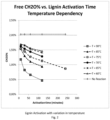
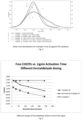
- Figure 3 illustrates their change in formaldehyde concentration during the activation step.
- the Kraft lignin has a lower molecular weight distribution than the sodium lignosulphonate.
- the signal for the methylol group (-CH 2 OH) is absent from the spectra of the two liquid lignins (i.e. kraft [Example 4] and Sodium lignosulphonate [Example 16]). Then after the addition of formaldehyde (1g CH 2 O on 9g dry lignin) and after holding at 75°C, pH10 for 1hour, the methylol group (-CH 2 OH) signal can be seen with both lignin types (i.e. kraft [Example 4] and Sodium lignosulphonate [Example 16]).Furthermore, by holding at 75°C, pH 10 for an additional hour it was observed with both lignin types that the methylol group signal strengthened.
- the stoichiometry of formaldehyde to lignin can be based on the mass of dry lignin that the mixture contains; and more specifically - the moles of active hydrogen sites that the said lignin contains.
- the formaldehyde is added in a stoichiometric excess i.e. >1:1 relative to the lignin's free active hydrogen positions so as to aid the reaction kinetics and to optionally provide a certain amount pre-dosing of formaldehyde prior phenol addition.
- Example 18 is an example wherein the formaldehyde has been added in a stoichiometric 1:1 molar ratio with active hydrogens.
- Example 20 has the lowest Mn, Mw and polydispersity, whilst Example 22 has the highest Mn, Mw and polydispersity. This initially would seem to suggest that the example with the lignin activation step and the phenol methylolation step would have the worst behaviour regarding HPL / CPL laminate applications.
- Block arrow "1" indicates a region of low molecular weight phenol formaldehyde resin species. However in this region it can be seen that Example22 (with the lignin activation and phenol methylolation steps) has an asymmetric peak dominated by the lowest molecular weight species, whereas Example 20 has a broader more symmetric peak indicating a shift to higher molecular weight PF species.
- Block arrow "2" we see a region indicative of medium molecular weight PF species. This is more differentiated, even though it is a shoulder on the area assigned to lignin. It shows that Example 22 has less medium molecular weight PF species than Example 20. Therefore, it can be stated that with respect to phenol formaldehyde resin species, Example 20 is higher Mw than Example 21, which is in turn higher than Example 22.
- Block arrow "3" indicates the region of kraft lignin.
- Example 22 shows that the lignin component has a shift to higher Mw compared to that from Example 20. Compare this with the results from Examples 4 - "liquid lignin”, “activated lignin 60min” and “activated lignin 120min” - they look very similar.
- the lignin in Example 20 has not had time to react with the formaldehyde and so has not been activated; the resin will perform poorly since the lignin is only a filler.
- the activation step the kraft lignin is methylolated and increases marginally in Mw. This can be seen with Example 21 and even more so in Example 22, since lignin activation continues to occur also during the phenol methylolation step. This resin will perform much better in application, because the lignin is now a reactive component.
- Block arrow "4" indicates the region of highest Mw species from the lignin - clearly as with block arrow "3" the lignin activation causes a shift to higher molecular weight due to functionalization and possibly by reaction of the lignin methylol groups with small PF resin species, which would also give rise to a cluster of reactive sites on the lignin macromolecule.
- the laminates were tested according to EN-438. This comprises of several tests, of which one of the most demanding tests is the "resistance to immersion in boiling water". This is a good test for laminates, since failure can indicate; lack of crosslinking and cure, poor resin flow between papers on pressing, and poor impregnation of the paper.
- Example 23 (LPF with lignin activation and phenol methylolation steps) successfully passed this test, whilst Example 24 (LPF no lignin activation or phenol methylolation steps) failed. Furthermore, Example 23 fulfilled all requirements of EN-438, such as dimensional stability at higher temperatures, flexural strength, flexural modulus and density.
- lignin active hydrogens:formaldehyde 1: >1.
- the fully methylolated lignin is then better at reacting with the other phenolic resin species and forming an infusible polymer within the laminate during final pressing; evidenced by resistance to the boiling water test.
- This optimal methylolation of lignin by use of the excess stoichiometric ratio also allows for maximum use of lignin within the resin recipe whilst still fulfilling the requirements of the EN-438 Norm.
Landscapes
- Chemical & Material Sciences (AREA)
- Engineering & Computer Science (AREA)
- Organic Chemistry (AREA)
- Materials Engineering (AREA)
- Health & Medical Sciences (AREA)
- Chemical Kinetics & Catalysis (AREA)
- Medicinal Chemistry (AREA)
- Polymers & Plastics (AREA)
- Manufacturing & Machinery (AREA)
- Composite Materials (AREA)
- Mechanical Engineering (AREA)
- Life Sciences & Earth Sciences (AREA)
- Biochemistry (AREA)
- Phenolic Resins Or Amino Resins (AREA)
- Laminated Bodies (AREA)
- Paper (AREA)
- Treatments Of Macromolecular Shaped Articles (AREA)
- Compositions Of Macromolecular Compounds (AREA)
- Reinforced Plastic Materials (AREA)
Claims (13)
- Verfahren zur Herstellung eines Hochdrucklaminats, umfassend einen Schritt der Herstellung einer Kernschicht und einen Schritt des Pressens der Kernschicht in einer Presse unter Verwendung einer erhöhten Temperatur und eines erhöhten Drucks, wobei der Schritt der Herstellung der Kernschicht aus Imprägnieren eines Papiers mit einem Harzgemisch und Aufbauen eines Stapels von harzimprägnierten Papieren besteht, dadurch gekennzeichnet, dass das Harzgemisch ein Lignin-Phenol-Formaldehyd-Harz umfasst, hergestellt über Ligninmethylolierungs- und Phenolmethylolierungsschritte, wobei der Schritt der Ligninmethylolierung umfasst:i) Bereitstellen eines flüssigen Lignins mit Positionen von freiem aktivem Wasserstoff;ii) Erhitzen des flüssigen Lignins auf eine Temperatur in einem Bereich von 60 °C bis 85 °C;iii) Zugeben von Formaldehyd zu dem erhitzten flüssigen Lignin unter Bedingungen mit Rühren, wobei das Formaldehyd in einem stöchiometrischen Überschussverhältnis von > 1:1 bezogen auf die Positionen von freiem aktivem Wasserstoff des Lignins zugegeben wird;iv) Halten der Temperatur des Gemischs gemäß iii) in einem Bereich von 60 °C bis 85 °C über einen Zeitraum von wenigstens 10 Minuten, um dadurch eine aktivierte Ligninzusammensetzung zu erhalten,
wobei der Schritt der Phenolmethylolierung umfasst:v) gegebenenfalls Erhitzen der aktivierten Ligninzusammensetzung von Schritt iv) auf eine Temperatur in einem Bereich von 50 °C bis 90 °C;vi) Zugeben von Phenol zu der aktivierten Ligninzusammensetzung;vii) Einstellen der Temperatur des Gemischs von Schritt vi) auf innerhalb des Bereichs von 60 °C bis 90 °C;viii) Zugeben von Formaldehyd zu dem Gemisch von Schritt vii);ix) umfassend Erhitzen des Gemischs von Schritt viii) auf eine und Halten bei einer Temperatur in einem Bereich von 50 °C bis 80 °C über einen Zeitraum von wenigstens 10 Minuten, um das Lignin-Phenol-Formaldehyd-Harz zu erhalten. - Verfahren gemäß Anspruch 1, wobei Schritt v) in einem Bereich von 50 °C bis 85 °C durchgeführt wird, insbesondere wobei Schritt v) bei einer Temperatur in einem Bereich von 65 °C bis 80 °C durchgeführt wird.
- Verfahren gemäß einem oder mehreren der vorstehenden Ansprüche, wobei Schritt vii) in einem Bereich von 60 °C bis 85 °C durchgeführt wird.
- Verfahren gemäß einem oder mehreren der vorstehenden Ansprüche, wobei Schritt ix) bei 60 °C bis 80 °C und vorzugsweise 65 °C bis 80 °C durchgeführt wird, insbesondere wobei Schritt ix) für wenigstens 30 Minuten durchgeführt wird, oder wobei Schritt ix) der Methylolierung während eines Zeitraums von zwischen 40 Minuten und 120 Minuten, vorzugsweise zwischen 40 Minuten und 70 Minuten, durchgeführt wird.
- Verfahren gemäß einem oder mehreren der vorstehenden Ansprüche, wobei das flüssige Lignin mit Positionen von freiem aktivem Wasserstoff einen pH-Wert von wenigstens 6, vorzugsweise einen pH-Wert in einem Bereich von 6-13, bevorzugter in einem Bereich von 8-12, noch bevorzugter in einem Bereich von 9-11, aufweist.
- Verfahren gemäß einem oder mehreren der vorstehenden Ansprüche, wobei die Temperatur bei Schritt ii) in einem Bereich von 65 °C bis 80 °C liegt.
- Verfahren gemäß einem oder mehreren der vorstehenden Ansprüche, wobei die Temperatur bei Schritt iv) in einem Bereich von 65 °C bis 80 °C liegt, insbesondere wobei der Zeitraum bei Schritt iv) in einem Bereich von 15 Minuten bis 4 Stunden liegt, vorzugsweise in einem Bereich von 30 Minuten bis 2 Stunden.
- Verfahren gemäß einem oder mehreren der vorstehenden Ansprüche, wobei das Zugeben von Formaldehyd zu dem erhitzten flüssigen Lignin bei Schritt iii) auf einer kontinuierlichen Basis über einen Zeitraum hinweg oder durch eine oder mehrere Dosen von Formaldehyd durchgeführt wird.
- Verfahren gemäß einem oder mehreren der vorstehenden Ansprüche, wobei das Zugeben von Formaldehyd bei Schritt viii) auf einer kontinuierlichen Basis über einen Zeitraum hinweg oder alternativ durch schrittweise Zugabe von zwei oder mehr Dosen von Formaldehyd durchgeführt wird, insbesondere wobei das Zugeben von Formaldehyd bei Schritt viii) über einen Zeitraum von zwischen 20 und 150 Minuten, vorzugsweise zwischen 30 Minuten und 90 Minuten, erfolgt, insbesondere wobei die Temperatur bei Schritt viii) in einem Bereich von 60 °C bis 85 °C, vorzugsweise in einem Bereich von 65 °C bis 80 °C, gehalten wird.
- Verfahren gemäß einem oder mehreren der vorstehenden Ansprüche, wobei die bei Schritt viii) zugegebene Menge an Formaldehyd mit der Menge an bei Schritt vi) zugegebenem Phenol und der Menge an restlichem freiem Formaldehyd in dem aktivierten Lignin in Beziehung steht, wobei die Kombination der Menge an bei Schritt viii) zugegebenen Formaldehyd zusammen mit der Menge an Formaldehydrest in dem aktivierten Lignin gegenüber der Menge an bei Schritt vi) zugeführtem Phenol ein Phenol:Formaldehyd-Molverhältnis in dem Bereich von 1,0:0,9-2,0, vorzugsweise in einem Bereich von 1,0:1,0-1,5, ergibt.
- Verfahren gemäß einem oder mehreren der vorstehenden Ansprüche, wobei das nach Schritt ix) erhaltene Gemisch gekühlt wird.
- Verfahren gemäß einem oder mehreren der vorstehenden Ansprüche, wobei die Lignin-Phenol-Formaldehyd-Harz-imprägnierten Papiere mit Kraft-Papieren auf Sättigungsbasis hergestellt sind.
- Verfahren gemäß einem oder mehreren der vorstehenden Ansprüche, wobei die Kernschicht mit einer oder mehreren Dekorationsschichten kombiniert wird, wobei die Dekorationsschicht an einer Seite oder an beiden Seiten der Kernschichten angeordnet wird, insbesondere wobei die eine oder mehreren Dekorationsschichten auf der Grundlage von mit Duroplastharz, wie z. B. MelaminFormaldehyd-Harz, gesättigten Dekorationspapier(en) stehen und/oder wobei die eine oder mehreren Dekorationsschichten unter Verwendung eines Acrylharzes beschichtet und unter Verwendung von UV-härtbarem oder EB-härtbarem System gehärtet sind.
Priority Applications (2)
| Application Number | Priority Date | Filing Date | Title |
|---|---|---|---|
| PL18728245.4T PL3609948T5 (pl) | 2017-04-14 | 2018-04-16 | Sposób przygotowania kompozycji aktywowanej ligniny |
| SI201830317T SI3609948T2 (sl) | 2017-04-14 | 2018-04-16 | Postopek za pripravo aktiviranega ligninskega sestavka |
Applications Claiming Priority (2)
| Application Number | Priority Date | Filing Date | Title |
|---|---|---|---|
| NL2018722A NL2018722B1 (en) | 2017-04-14 | 2017-04-14 | A method for preparing an activated lignin composition |
| PCT/NL2018/050235 WO2018190720A1 (en) | 2017-04-14 | 2018-04-16 | A method for preparing an activated lignin composition |
Publications (3)
| Publication Number | Publication Date |
|---|---|
| EP3609948A1 EP3609948A1 (de) | 2020-02-19 |
| EP3609948B1 EP3609948B1 (de) | 2021-06-09 |
| EP3609948B2 true EP3609948B2 (de) | 2024-07-17 |
Family
ID=62455802
Family Applications (1)
| Application Number | Title | Priority Date | Filing Date |
|---|---|---|---|
| EP18728245.4A Active EP3609948B2 (de) | 2017-04-14 | 2018-04-16 | Verfahren zur herstellung einer aktivierten ligninzusammensetzung |
Country Status (12)
| Country | Link |
|---|---|
| US (1) | US12012428B2 (de) |
| EP (1) | EP3609948B2 (de) |
| JP (1) | JP7334121B2 (de) |
| AU (1) | AU2018252547B2 (de) |
| CA (1) | CA3059877A1 (de) |
| ES (1) | ES2877628T5 (de) |
| FI (1) | FI3609948T4 (de) |
| LT (1) | LT3609948T (de) |
| NL (1) | NL2018722B1 (de) |
| PL (1) | PL3609948T5 (de) |
| SI (1) | SI3609948T2 (de) |
| WO (1) | WO2018190720A1 (de) |
Families Citing this family (10)
| Publication number | Priority date | Publication date | Assignee | Title |
|---|---|---|---|---|
| NL2018722B1 (en) * | 2017-04-14 | 2018-10-24 | Trespa Int Bv | A method for preparing an activated lignin composition |
| KR102508349B1 (ko) * | 2019-12-27 | 2023-03-13 | 무림피앤피 주식회사 | 리그닌으로부터 유래된 반복단위를 포함하는 열경화성 수지 및 이를 이용한 복합재 |
| EP4001376A1 (de) * | 2020-11-13 | 2022-05-25 | Wilsonart LLC | Mehrteiliges ligninbasiertes harzsystem für dekorative laminate |
| US20240228849A9 (en) * | 2021-02-04 | 2024-07-11 | Board Of Trustees Of Michigan State University | Lignin-formaldehyde resins, related compositions, and related methods |
| KR102947859B1 (ko) * | 2021-11-03 | 2026-04-02 | 코오롱인더스트리 주식회사 | 내화물용 페놀 수지, 내화물용 페놀 수지의 제조방법 및 이를 포함하는 내화물 |
| US12473410B2 (en) * | 2022-05-03 | 2025-11-18 | Wilsonart Llc | Depolymerized lignosulfonate and lignin as extender for phenolic resin |
| CN116377757B (zh) * | 2023-02-28 | 2024-10-11 | 天津科技大学 | 一种高稳定性阳离子木质素松香施胶剂、制备方法和应用 |
| EP4427922B1 (de) | 2023-03-06 | 2025-12-31 | Trespa International B.V. | Paneel mit einem stapel aus mehreren zwischen einer dekorschicht und einer rückseitenschicht eingebetteten kernschichten |
| FI131407B1 (en) * | 2023-10-02 | 2025-04-07 | Prefere Resins Holding Gmbh | Lignin-phenol-formaldehyde resin for impregnation of kraft paper |
| NL2037838B1 (en) | 2024-05-31 | 2025-12-18 | Trespa Int Bv | A resin formulation on basis of a lignin based resin. |
Citations (7)
| Publication number | Priority date | Publication date | Assignee | Title |
|---|---|---|---|---|
| US4113675A (en) † | 1976-01-13 | 1978-09-12 | Canadian Patents And Development Limited | Methylolated kraft lignin polymer resin |
| US4514462A (en) † | 1983-04-14 | 1985-04-30 | Westinghouse Electric Corp. | Warp resistant laminates having a core impregnated with a mixture of phenolix resin and alkyl substituted phenol |
| WO1994024192A1 (en) † | 1993-04-09 | 1994-10-27 | Alcell Technologies Inc. | Lignin-based formulations for wood composites |
| US5866642A (en) † | 1991-06-13 | 1999-02-02 | Georgia-Pacific Resins, Inc. | Reactive phenolic resin modifier |
| WO2012106808A1 (en) † | 2011-02-11 | 2012-08-16 | Fpinnovations Inc. | Phenol-formaldehyde and lignin-phenol-formaldehyde adhesive polymers with carbon black, and method of making same |
| WO2013144454A1 (en) † | 2012-03-29 | 2013-10-03 | Upm-Kymmene Corporation | A method for increasing the reactivity of lignin |
| WO2014124541A1 (en) † | 2013-02-15 | 2014-08-21 | Fpinnovations | Cellulose nanocrystals - thermoset resin systems, applications thereof and articles made therefrom |
Family Cites Families (18)
| Publication number | Priority date | Publication date | Assignee | Title |
|---|---|---|---|---|
| US3444732A (en) * | 1967-06-06 | 1969-05-20 | Albert L Robbins | Method and apparatus for determining optimum bonding parameters for thermoplastic material |
| CA1149714A (en) * | 1979-05-28 | 1983-07-12 | Cyanamid Of Canada Limited | Lignosulfonate extended phenolic resin |
| US4476193A (en) * | 1982-09-14 | 1984-10-09 | Westinghouse Electric Corp. | Sulfur containing lignin modified alkaline earth treated phenolic impregnating resins for core layers of humidity resistant laminates |
| DE3418282A1 (de) | 1984-05-17 | 1985-11-21 | Hoechst Ag, 6230 Frankfurt | Dekorative platte mit verbesserten oberflaecheneigenschaften |
| DE3533737A1 (de) | 1985-09-21 | 1987-03-26 | Hoechst Ag | Dekorative platte mit verbesserten oberflaecheneigenschaften |
| CA1251603A (en) * | 1988-03-18 | 1989-03-28 | Roger A. Crawford | Saturating grade paper |
| DE4331656C2 (de) | 1993-03-12 | 1999-01-14 | Bakelite Ag | Bindemittelgemisch |
| NL1030913C2 (nl) * | 2006-01-13 | 2007-07-17 | Trespa Int Bv | Werkwijze voor het door middel van curtain coating aanbrengen van een of meer lagen op een ondergrond, alsmede decoratieve folie. |
| EP2013253A2 (de) | 2006-04-21 | 2009-01-14 | Greenvalue S.A. | Verfahren zur herstellung modifizierter und erneuerbarer aromatischer materialien und zusammensetzungen daraus |
| US9273238B2 (en) | 2011-02-23 | 2016-03-01 | Yaolin ZHANG | Process for fungal modification of lignin and preparing wood adhesives with the modified lignin and wood composites made from such adhesives |
| NL2007494C2 (nl) | 2011-09-28 | 2013-04-02 | Trespa Int Bv | Werkwijze ter vervaardiging van een decoratieve film alsmede een decorpaneel. |
| FI126736B (en) * | 2013-11-26 | 2017-04-28 | Upm Kymmene Corp | Process for treating lignin and preparing a binder composition |
| FI126737B (en) | 2013-11-26 | 2017-04-28 | Upm Kymmene Corp | A process for treating lignin and preparing a binder composition |
| WO2015123781A1 (en) | 2014-02-20 | 2015-08-27 | The University Of Western Ontario | Formaldehyde-free phenolic resins, downstream products, their synthesis and use |
| JP6853786B2 (ja) | 2015-04-02 | 2021-03-31 | ストラ エンソ オーワイジェイ | 活性化リグニン組成物、その製造方法及びその使用 |
| FI129778B (en) | 2015-06-26 | 2022-08-31 | Teknologian Tutkimuskeskus Vtt Oy | Procedure for activation and precipitation of lignin |
| SE539543C2 (en) | 2015-07-03 | 2017-10-10 | Stora Enso Oyj | A method for increasing the reactivity of lignin by storage |
| NL2018722B1 (en) * | 2017-04-14 | 2018-10-24 | Trespa Int Bv | A method for preparing an activated lignin composition |
-
2017
- 2017-04-14 NL NL2018722A patent/NL2018722B1/en active
-
2018
- 2018-04-16 FI FIEP18728245.4T patent/FI3609948T4/fi active
- 2018-04-16 JP JP2019556264A patent/JP7334121B2/ja active Active
- 2018-04-16 WO PCT/NL2018/050235 patent/WO2018190720A1/en not_active Ceased
- 2018-04-16 US US16/604,781 patent/US12012428B2/en active Active
- 2018-04-16 CA CA3059877A patent/CA3059877A1/en active Pending
- 2018-04-16 AU AU2018252547A patent/AU2018252547B2/en active Active
- 2018-04-16 SI SI201830317T patent/SI3609948T2/sl unknown
- 2018-04-16 PL PL18728245.4T patent/PL3609948T5/pl unknown
- 2018-04-16 ES ES18728245T patent/ES2877628T5/es active Active
- 2018-04-16 LT LTEPPCT/NL2018/050235T patent/LT3609948T/lt unknown
- 2018-04-16 EP EP18728245.4A patent/EP3609948B2/de active Active
Patent Citations (7)
| Publication number | Priority date | Publication date | Assignee | Title |
|---|---|---|---|---|
| US4113675A (en) † | 1976-01-13 | 1978-09-12 | Canadian Patents And Development Limited | Methylolated kraft lignin polymer resin |
| US4514462A (en) † | 1983-04-14 | 1985-04-30 | Westinghouse Electric Corp. | Warp resistant laminates having a core impregnated with a mixture of phenolix resin and alkyl substituted phenol |
| US5866642A (en) † | 1991-06-13 | 1999-02-02 | Georgia-Pacific Resins, Inc. | Reactive phenolic resin modifier |
| WO1994024192A1 (en) † | 1993-04-09 | 1994-10-27 | Alcell Technologies Inc. | Lignin-based formulations for wood composites |
| WO2012106808A1 (en) † | 2011-02-11 | 2012-08-16 | Fpinnovations Inc. | Phenol-formaldehyde and lignin-phenol-formaldehyde adhesive polymers with carbon black, and method of making same |
| WO2013144454A1 (en) † | 2012-03-29 | 2013-10-03 | Upm-Kymmene Corporation | A method for increasing the reactivity of lignin |
| WO2014124541A1 (en) † | 2013-02-15 | 2014-08-21 | Fpinnovations | Cellulose nanocrystals - thermoset resin systems, applications thereof and articles made therefrom |
Non-Patent Citations (7)
| Title |
|---|
| "Dubbel - Taschenbuch für den Maschinenbau", 1 January 2011, SPRINGER, article GROTE K. H., FELDHUSEN J.: "Duroplaste", pages: E74 † |
| ANONYMOUS: "Herstellung von Dekorativen Schichtstoff- platten", FACHGRUPPE DEKORATIVE SCHICHTSTOFFPLATTEN- TECHNISCHES MERKBLATT, 1 January 2007 (2007-01-01), pages 1 - 13, [retrieved on 20220321] † |
| HU LIHONG, PAN HUI, ZHOU YONGHONG, ZHANG MENG: "Methods to improve lignin's reactivity as a phenol sub- stitute and as a replacement for other phenolic compounds: a brief review", BIORESOURCES, vol. 6, no. 3, 1 January 2011 (2011-01-01), pages 3515 - 3525 † |
| MALUTAN THEODOR, RALUCA NICO, VALENTIN I. POPA: "Contribution to the Study of Hydroxymetylation Reaction of alkali Lignin", BIORESOURCES, vol. 3, no. 1, 1 January 2008 (2008-01-01), pages 13 - 20 † |
| N. S. CETIN ET AL.: "Studies on Lignin-Based Adhesives for Particleboard Panels", TURK J. AGRIC FOR, vol. 27, 2013, pages 183 - 189 † |
| R K GOTHWAL, MOHAN M K, GHOSH P: "Synthesis of low cost adhesives from pulp & paper industry waste", JOURNAL OF SCIENTIFIC & INDUSTRIAL RESEARCH, vol. 69, 1 May 2010 (2010-05-01), pages 390 - 395 † |
| S. S. MANKAR ET AL.: "Lignin-phenol-formaldehyde adhesives", INTERNATIONAL JOURNAL OF KNOWLEDGE AND ENGINEERING, vol. 3, no. 1, 2012, pages 116 - 118 † |
Also Published As
| Publication number | Publication date |
|---|---|
| JP2020516503A (ja) | 2020-06-11 |
| LT3609948T (lt) | 2021-07-12 |
| US20210009618A1 (en) | 2021-01-14 |
| ES2877628T3 (es) | 2021-11-17 |
| JP7334121B2 (ja) | 2023-08-28 |
| AU2018252547A1 (en) | 2019-11-28 |
| AU2018252547B2 (en) | 2022-01-13 |
| AU2018252547A2 (en) | 2019-12-05 |
| SI3609948T1 (sl) | 2021-09-30 |
| US12012428B2 (en) | 2024-06-18 |
| PL3609948T3 (pl) | 2021-10-25 |
| FI3609948T4 (fi) | 2024-08-13 |
| PL3609948T5 (pl) | 2024-09-09 |
| EP3609948B1 (de) | 2021-06-09 |
| SI3609948T2 (sl) | 2024-10-30 |
| NL2018722B1 (en) | 2018-10-24 |
| WO2018190720A1 (en) | 2018-10-18 |
| EP3609948A1 (de) | 2020-02-19 |
| ES2877628T5 (es) | 2024-11-21 |
| CA3059877A1 (en) | 2018-10-18 |
Similar Documents
| Publication | Publication Date | Title |
|---|---|---|
| EP3609948B1 (de) | Verfahren zur herstellung einer aktivierten ligninzusammensetzung | |
| Younesi-Kordkheili et al. | Improving urea formaldehyde resin properties by glyoxalated soda bagasse lignin | |
| FI126737B (en) | A process for treating lignin and preparing a binder composition | |
| KR102770675B1 (ko) | 레졸 페놀 수지, 상기 수지의 합성 방법 및 이의 용도 | |
| Li et al. | A sustainable tannin-citric acid wood adhesive with favorable bonding properties and water resistance | |
| Jahanshaei et al. | Eco‐friendly tannin‐phenol formaldehyde resin for producing wood composites | |
| EP2758457B1 (de) | Verfahren zur erhöhung der lignin-reaktivität | |
| Thébault et al. | Effect of phenolation, lignin-type and degree of substitution on the properties of lignin-modified phenol-formaldehyde impregnation resins: Molecular weight distribution, wetting behavior, rheological properties and thermal curing profiles | |
| Yang et al. | Hydrodeoxygenation of condensed lignins followed by acid-mediated methylolation enables preparation of lignin-based wood adhesives | |
| US10781280B2 (en) | Method for producing thermosetting phenolic resins and phenolic resins obtainable by the method | |
| EP3612586A1 (de) | Phenolfreies imprägnierharz | |
| CA3030361C (en) | Lignin-based phenolic resin | |
| Xu et al. | Lignin-based phenol–formaldehyde (LPF) resins/adhesives | |
| US5847058A (en) | Alkylresorcinol modified phenol-aldehyde resol resin and binder system, and method of making same | |
| Park et al. | Differential scanning calorimetry of urea–formaldehyde adhesive resins, synthesized under different pH conditions | |
| JP2021506631A (ja) | 改質木材製品及び前記製品の製造方法 | |
| Liu et al. | Formaldehyde free tannin-based adhesive with epoxy as hardener for plywood | |
| Shishlov et al. | Synthesis of cardanol-containing resols for producing phenolic films: protective coatings for wood composites | |
| Nafisah et al. | The role of lignin in enhancing adhesion performance and reducing formaldehyde emissions of phenol–resorcinol–formaldehyde resin adhesives | |
| EP1592725B1 (de) | Farblos aushärtende farblose phenolformaldehydharze | |
| EP3925775B1 (de) | Herstellung von querbeschichtetem sperrholz | |
| EP2905295B1 (de) | Synthetische Harzzusammensetzung mit Vinasse | |
| WO2025250015A1 (en) | A resin formulation on basis of a lignin based resin | |
| KR820001056B1 (ko) | 페놀-알데히드형 수지의 제조방법 | |
| Amen-Chen | Softwood bark vacuum pyrolysis oils-phenol-formaldehyde resols for bonding oriented strandboard (OSB) |
Legal Events
| Date | Code | Title | Description |
|---|---|---|---|
| STAA | Information on the status of an ep patent application or granted ep patent |
Free format text: STATUS: UNKNOWN |
|
| STAA | Information on the status of an ep patent application or granted ep patent |
Free format text: STATUS: THE INTERNATIONAL PUBLICATION HAS BEEN MADE |
|
| PUAI | Public reference made under article 153(3) epc to a published international application that has entered the european phase |
Free format text: ORIGINAL CODE: 0009012 |
|
| STAA | Information on the status of an ep patent application or granted ep patent |
Free format text: STATUS: REQUEST FOR EXAMINATION WAS MADE |
|
| 17P | Request for examination filed |
Effective date: 20191111 |
|
| AK | Designated contracting states |
Kind code of ref document: A1 Designated state(s): AL AT BE BG CH CY CZ DE DK EE ES FI FR GB GR HR HU IE IS IT LI LT LU LV MC MK MT NL NO PL PT RO RS SE SI SK SM TR |
|
| AX | Request for extension of the european patent |
Extension state: BA ME |
|
| DAV | Request for validation of the european patent (deleted) | ||
| DAX | Request for extension of the european patent (deleted) | ||
| STAA | Information on the status of an ep patent application or granted ep patent |
Free format text: STATUS: EXAMINATION IS IN PROGRESS |
|
| 17Q | First examination report despatched |
Effective date: 20210211 |
|
| GRAP | Despatch of communication of intention to grant a patent |
Free format text: ORIGINAL CODE: EPIDOSNIGR1 |
|
| STAA | Information on the status of an ep patent application or granted ep patent |
Free format text: STATUS: GRANT OF PATENT IS INTENDED |
|
| GRAS | Grant fee paid |
Free format text: ORIGINAL CODE: EPIDOSNIGR3 |
|
| INTG | Intention to grant announced |
Effective date: 20210324 |
|
| GRAA | (expected) grant |
Free format text: ORIGINAL CODE: 0009210 |
|
| STAA | Information on the status of an ep patent application or granted ep patent |
Free format text: STATUS: THE PATENT HAS BEEN GRANTED |
|
| AK | Designated contracting states |
Kind code of ref document: B1 Designated state(s): AL AT BE BG CH CY CZ DE DK EE ES FI FR GB GR HR HU IE IS IT LI LT LU LV MC MK MT NL NO PL PT RO RS SE SI SK SM TR |
|
| REG | Reference to a national code |
Ref country code: GB Ref legal event code: FG4D |
|
| REG | Reference to a national code |
Ref country code: CH Ref legal event code: EP Ref country code: AT Ref legal event code: REF Ref document number: 1400466 Country of ref document: AT Kind code of ref document: T Effective date: 20210615 |
|
| REG | Reference to a national code |
Ref country code: FI Ref legal event code: FGE |
|
| REG | Reference to a national code |
Ref country code: NL Ref legal event code: FP |
|
| REG | Reference to a national code |
Ref country code: DE Ref legal event code: R096 Ref document number: 602018018423 Country of ref document: DE |
|
| REG | Reference to a national code |
Ref country code: NO Ref legal event code: T2 Effective date: 20210609 |
|
| REG | Reference to a national code |
Ref country code: IE Ref legal event code: FG4D |
|
| REG | Reference to a national code |
Ref country code: SE Ref legal event code: TRGR |
|
| REG | Reference to a national code |
Ref country code: EE Ref legal event code: FG4A Ref document number: E021012 Country of ref document: EE Effective date: 20210622 |
|
| REG | Reference to a national code |
Ref country code: GR Ref legal event code: EP Ref document number: 20210401630 Country of ref document: GR Effective date: 20210813 |
|
| PG25 | Lapsed in a contracting state [announced via postgrant information from national office to epo] |
Ref country code: HR Free format text: LAPSE BECAUSE OF FAILURE TO SUBMIT A TRANSLATION OF THE DESCRIPTION OR TO PAY THE FEE WITHIN THE PRESCRIBED TIME-LIMIT Effective date: 20210609 Ref country code: BG Free format text: LAPSE BECAUSE OF FAILURE TO SUBMIT A TRANSLATION OF THE DESCRIPTION OR TO PAY THE FEE WITHIN THE PRESCRIBED TIME-LIMIT Effective date: 20210909 |
|
| REG | Reference to a national code |
Ref country code: ES Ref legal event code: FG2A Ref document number: 2877628 Country of ref document: ES Kind code of ref document: T3 Effective date: 20211117 |
|
| PG25 | Lapsed in a contracting state [announced via postgrant information from national office to epo] |
Ref country code: RS Free format text: LAPSE BECAUSE OF FAILURE TO SUBMIT A TRANSLATION OF THE DESCRIPTION OR TO PAY THE FEE WITHIN THE PRESCRIBED TIME-LIMIT Effective date: 20210609 |
|
| PG25 | Lapsed in a contracting state [announced via postgrant information from national office to epo] |
Ref country code: SK Free format text: LAPSE BECAUSE OF FAILURE TO SUBMIT A TRANSLATION OF THE DESCRIPTION OR TO PAY THE FEE WITHIN THE PRESCRIBED TIME-LIMIT Effective date: 20210609 Ref country code: SM Free format text: LAPSE BECAUSE OF FAILURE TO SUBMIT A TRANSLATION OF THE DESCRIPTION OR TO PAY THE FEE WITHIN THE PRESCRIBED TIME-LIMIT Effective date: 20210609 Ref country code: PT Free format text: LAPSE BECAUSE OF FAILURE TO SUBMIT A TRANSLATION OF THE DESCRIPTION OR TO PAY THE FEE WITHIN THE PRESCRIBED TIME-LIMIT Effective date: 20211011 Ref country code: RO Free format text: LAPSE BECAUSE OF FAILURE TO SUBMIT A TRANSLATION OF THE DESCRIPTION OR TO PAY THE FEE WITHIN THE PRESCRIBED TIME-LIMIT Effective date: 20210609 Ref country code: CZ Free format text: LAPSE BECAUSE OF FAILURE TO SUBMIT A TRANSLATION OF THE DESCRIPTION OR TO PAY THE FEE WITHIN THE PRESCRIBED TIME-LIMIT Effective date: 20210609 |
|
| REG | Reference to a national code |
Ref country code: DE Ref legal event code: R026 Ref document number: 602018018423 Country of ref document: DE |
|
| PLBI | Opposition filed |
Free format text: ORIGINAL CODE: 0009260 |
|
| PLAX | Notice of opposition and request to file observation + time limit sent |
Free format text: ORIGINAL CODE: EPIDOSNOBS2 |
|
| REG | Reference to a national code |
Ref country code: FI Ref legal event code: MDE Opponent name: PETERSEN, FRANK |
|
| 26 | Opposition filed |
Opponent name: PETERSEN, FRANK Effective date: 20220308 |
|
| PG25 | Lapsed in a contracting state [announced via postgrant information from national office to epo] |
Ref country code: DK Free format text: LAPSE BECAUSE OF FAILURE TO SUBMIT A TRANSLATION OF THE DESCRIPTION OR TO PAY THE FEE WITHIN THE PRESCRIBED TIME-LIMIT Effective date: 20210609 |
|
| PG25 | Lapsed in a contracting state [announced via postgrant information from national office to epo] |
Ref country code: AL Free format text: LAPSE BECAUSE OF FAILURE TO SUBMIT A TRANSLATION OF THE DESCRIPTION OR TO PAY THE FEE WITHIN THE PRESCRIBED TIME-LIMIT Effective date: 20210609 |
|
| PLBB | Reply of patent proprietor to notice(s) of opposition received |
Free format text: ORIGINAL CODE: EPIDOSNOBS3 |
|
| REG | Reference to a national code |
Ref country code: AT Ref legal event code: UEP Ref document number: 1400466 Country of ref document: AT Kind code of ref document: T Effective date: 20210609 |
|
| PG25 | Lapsed in a contracting state [announced via postgrant information from national office to epo] |
Ref country code: MC Free format text: LAPSE BECAUSE OF FAILURE TO SUBMIT A TRANSLATION OF THE DESCRIPTION OR TO PAY THE FEE WITHIN THE PRESCRIBED TIME-LIMIT Effective date: 20210609 Ref country code: LU Free format text: LAPSE BECAUSE OF NON-PAYMENT OF DUE FEES Effective date: 20220416 Ref country code: FR Free format text: LAPSE BECAUSE OF NON-PAYMENT OF DUE FEES Effective date: 20220430 |
|
| PG25 | Lapsed in a contracting state [announced via postgrant information from national office to epo] |
Ref country code: IE Free format text: LAPSE BECAUSE OF NON-PAYMENT OF DUE FEES Effective date: 20220416 |
|
| P01 | Opt-out of the competence of the unified patent court (upc) registered |
Effective date: 20230525 |
|
| PG25 | Lapsed in a contracting state [announced via postgrant information from national office to epo] |
Ref country code: MK Free format text: LAPSE BECAUSE OF FAILURE TO SUBMIT A TRANSLATION OF THE DESCRIPTION OR TO PAY THE FEE WITHIN THE PRESCRIBED TIME-LIMIT Effective date: 20210609 Ref country code: CY Free format text: LAPSE BECAUSE OF FAILURE TO SUBMIT A TRANSLATION OF THE DESCRIPTION OR TO PAY THE FEE WITHIN THE PRESCRIBED TIME-LIMIT Effective date: 20210609 |
|
| PG25 | Lapsed in a contracting state [announced via postgrant information from national office to epo] |
Ref country code: HU Free format text: LAPSE BECAUSE OF FAILURE TO SUBMIT A TRANSLATION OF THE DESCRIPTION OR TO PAY THE FEE WITHIN THE PRESCRIBED TIME-LIMIT; INVALID AB INITIO Effective date: 20180416 |
|
| PUAH | Patent maintained in amended form |
Free format text: ORIGINAL CODE: 0009272 |
|
| STAA | Information on the status of an ep patent application or granted ep patent |
Free format text: STATUS: PATENT MAINTAINED AS AMENDED |
|
| PG25 | Lapsed in a contracting state [announced via postgrant information from national office to epo] |
Ref country code: TR Free format text: LAPSE BECAUSE OF FAILURE TO SUBMIT A TRANSLATION OF THE DESCRIPTION OR TO PAY THE FEE WITHIN THE PRESCRIBED TIME-LIMIT Effective date: 20210609 |
|
| 27A | Patent maintained in amended form |
Effective date: 20240717 |
|
| AK | Designated contracting states |
Kind code of ref document: B2 Designated state(s): AL AT BE BG CH CY CZ DE DK EE ES FI FR GB GR HR HU IE IS IT LI LT LU LV MC MK MT NL NO PL PT RO RS SE SI SK SM TR |
|
| REG | Reference to a national code |
Ref country code: DE Ref legal event code: R102 Ref document number: 602018018423 Country of ref document: DE |
|
| REG | Reference to a national code |
Ref country code: NL Ref legal event code: FP |
|
| REG | Reference to a national code |
Ref country code: EE Ref legal event code: LD4A Ref document number: E021012 Country of ref document: EE |
|
| REG | Reference to a national code |
Ref country code: SE Ref legal event code: RPEO |
|
| PG25 | Lapsed in a contracting state [announced via postgrant information from national office to epo] |
Ref country code: MT Free format text: LAPSE BECAUSE OF FAILURE TO SUBMIT A TRANSLATION OF THE DESCRIPTION OR TO PAY THE FEE WITHIN THE PRESCRIBED TIME-LIMIT Effective date: 20210609 |
|
| REG | Reference to a national code |
Ref country code: GR Ref legal event code: EP Ref document number: 20240401721 Country of ref document: GR Effective date: 20241007 |
|
| REG | Reference to a national code |
Ref country code: ES Ref legal event code: DC2A Ref document number: 2877628 Country of ref document: ES Kind code of ref document: T5 Effective date: 20241121 |
|
| PGFP | Annual fee paid to national office [announced via postgrant information from national office to epo] |
Ref country code: SI Payment date: 20250403 Year of fee payment: 8 |
|
| PGFP | Annual fee paid to national office [announced via postgrant information from national office to epo] |
Ref country code: NL Payment date: 20250418 Year of fee payment: 8 |
|
| PGFP | Annual fee paid to national office [announced via postgrant information from national office to epo] |
Ref country code: FI Payment date: 20250424 Year of fee payment: 8 |
|
| PGFP | Annual fee paid to national office [announced via postgrant information from national office to epo] |
Ref country code: DE Payment date: 20250422 Year of fee payment: 8 |
|
| PGFP | Annual fee paid to national office [announced via postgrant information from national office to epo] |
Ref country code: ES Payment date: 20250530 Year of fee payment: 8 |
|
| PGFP | Annual fee paid to national office [announced via postgrant information from national office to epo] |
Ref country code: NO Payment date: 20250424 Year of fee payment: 8 |
|
| PGFP | Annual fee paid to national office [announced via postgrant information from national office to epo] |
Ref country code: BE Payment date: 20250418 Year of fee payment: 8 Ref country code: IT Payment date: 20250424 Year of fee payment: 8 |
|
| PGFP | Annual fee paid to national office [announced via postgrant information from national office to epo] |
Ref country code: LV Payment date: 20250417 Year of fee payment: 8 |
|
| PGFP | Annual fee paid to national office [announced via postgrant information from national office to epo] |
Ref country code: EE Payment date: 20250425 Year of fee payment: 8 |
|
| PGFP | Annual fee paid to national office [announced via postgrant information from national office to epo] |
Ref country code: GR Payment date: 20250423 Year of fee payment: 8 |
|
| PGFP | Annual fee paid to national office [announced via postgrant information from national office to epo] |
Ref country code: CH Payment date: 20250501 Year of fee payment: 8 |
|
| PGFP | Annual fee paid to national office [announced via postgrant information from national office to epo] |
Ref country code: AT Payment date: 20250423 Year of fee payment: 8 |
|
| PGFP | Annual fee paid to national office [announced via postgrant information from national office to epo] |
Ref country code: SE Payment date: 20250429 Year of fee payment: 8 |
|
| PGFP | Annual fee paid to national office [announced via postgrant information from national office to epo] |
Ref country code: GB Payment date: 20260306 Year of fee payment: 9 Ref country code: LT Payment date: 20260323 Year of fee payment: 9 |
|
| PGFP | Annual fee paid to national office [announced via postgrant information from national office to epo] |
Ref country code: PL Payment date: 20260324 Year of fee payment: 9 |
|
| REG | Reference to a national code |
Ref country code: CH Ref legal event code: U11 Free format text: ST27 STATUS EVENT CODE: U-0-0-U10-U11 (AS PROVIDED BY THE NATIONAL OFFICE) Effective date: 20260501 |