EP3609237B1 - Verfahren zur übertragung von downlink-steuerungsinformationen, detektionsverfahren, basisstation und benutzergerät - Google Patents
Verfahren zur übertragung von downlink-steuerungsinformationen, detektionsverfahren, basisstation und benutzergerät Download PDFInfo
- Publication number
- EP3609237B1 EP3609237B1 EP19177397.7A EP19177397A EP3609237B1 EP 3609237 B1 EP3609237 B1 EP 3609237B1 EP 19177397 A EP19177397 A EP 19177397A EP 3609237 B1 EP3609237 B1 EP 3609237B1
- Authority
- EP
- European Patent Office
- Prior art keywords
- aggregation level
- resource block
- detected
- block set
- mapping
- Prior art date
- Legal status (The legal status is an assumption and is not a legal conclusion. Google has not performed a legal analysis and makes no representation as to the accuracy of the status listed.)
- Active
Links
Images


Classifications
-
- H—ELECTRICITY
- H04—ELECTRIC COMMUNICATION TECHNIQUE
- H04L—TRANSMISSION OF DIGITAL INFORMATION, e.g. TELEGRAPHIC COMMUNICATION
- H04L5/00—Arrangements affording multiple use of the transmission path
- H04L5/003—Arrangements for allocating sub-channels of the transmission path
- H04L5/0053—Allocation of signalling, i.e. of overhead other than pilot signals
-
- H—ELECTRICITY
- H04—ELECTRIC COMMUNICATION TECHNIQUE
- H04W—WIRELESS COMMUNICATION NETWORKS
- H04W48/00—Access restriction; Network selection; Access point selection
- H04W48/16—Discovering, processing access restriction or access information
-
- H—ELECTRICITY
- H04—ELECTRIC COMMUNICATION TECHNIQUE
- H04W—WIRELESS COMMUNICATION NETWORKS
- H04W48/00—Access restriction; Network selection; Access point selection
- H04W48/08—Access restriction or access information delivery, e.g. discovery data delivery
- H04W48/12—Access restriction or access information delivery, e.g. discovery data delivery using downlink control channel
-
- H—ELECTRICITY
- H04—ELECTRIC COMMUNICATION TECHNIQUE
- H04W—WIRELESS COMMUNICATION NETWORKS
- H04W72/00—Local resource management
- H04W72/20—Control channels or signalling for resource management
- H04W72/23—Control channels or signalling for resource management in the downlink direction of a wireless link, i.e. towards a terminal
Definitions
- the present invention relates to the field of communications, and in particular to a method for transmitting downlink control information, a detecting method, a base station and a user equipment.
- a long term evolution (Long Term Evolution, LTE) system has two types of frame structures, wherein frame structure type 1 (Type 1) is applicable to frequency division full duplex (Frequency Division Duplex, FDD) and frequency division half duplex.
- Each wireless frame has a length of 10 ms and consists of 20 time slots, and each time slot is 0.5 ms and is numbered from 0 to 19.
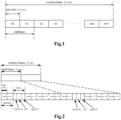
- Fig. 1 is a frame structural schematic diagram of an FDD mode, and as shown in Fig. 1 , one subframe consists of two continuous time slots, for example, subframe i consists of two continuous slots 2i and 2i + 1.
- Frame structure type 2 (Type 2) is applicable to time division duplex (TDD, Time Division Duplex).
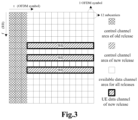
- Fig. 2 is a frame structural schematic diagram of a TDD mode, and as shown in Fig. 2 , one wireless frame has a length of 10 ms and consists of two half frames with a length of 5 ms. One half frame consists of five subframes with a length of 1 ms.
- a subframe is divided into a normal subframe and a special subframe, wherein the special subframe consists of a downlink pilot time slot (DwPTS), a guard period (GP) and an uplink pilot time slot (UpPTS), and the total length is 1 ms.
- Each subframe i consists of two time slots 2i and 2i + 1 with a length of 0.5 ms.
- DCI Downlink Control Information
- DCI format DCI format
- DCI format 1A DCI format 1A
- DCI format 1B DCI format 1C
- DCI format 1D DCI format 2A
- DCI format 2B DCI format 2C
- DCI format 3 DCI format 3A
- a physical layer control channel Physical Downlink Control channel, PDCCH
- PDCCH Physical Downlink Control channel
- N OFDM orthogonal Frequency Division Multiplexing
- Available transmission resources of the first control signalling transmission area are divided into multiple CCE resource elements, and resources occupied by control information are allocated in the unit of CCE, and the resource element CCE herein also can be further divided into multiple REGs; one CCE consists of multiple discontinuous REGs, and usually one CCE consists of 9 REGs, and further, each REG consists of 4 basic resource elements, wherein one basic resource element bears one modulation symbol, and when QPSK modulation is sampled, one CCE can bear 72 bits.
- One PDCCH has four aggregation levels, and the four aggregation levels respectively correspond to one PDCCH occupying 1, 2, 4 or 8 CCEs, being called as aggregation level 1, aggregation level 2, aggregation level 4 and aggregation level 8, also correspond to four formats of the PDCCH, that is to say, aggregation level represents physical resource size occupied by physical downlink control channel.
- Each aggregation level corresponds to g candidate sets, i.e. g positions which can transmit the PDCCH.
- a UE would blindly detect said four aggregation levels on a candidate set position corresponding to each aggregation level of the first control signalling transmission area so as to determine whether the PDCCH is transmitted, thereby acquiring corresponding downlink control information.
- control signalling transmission resources of the same UE can be continuous time frequency resources so as to support a closed-loop precoding technology and improve transmission performance of control information.
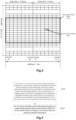
- Control signalling areas of new and old releases are as shown in Fig. 3 , and control signalling of the new release divides part of transmission resources in a PDSCH transmission area of original R8/9/10 for using same in a second control signalling transmission area so as to support the closed-loop precoding technology when the control signalling is transmitted and improve the capacity of control signalling to support control signalling of more users.
- DMRS dedicated demodulation pilot
- the second control signalling transmission area is in the unit of RB and can better perform interference coordination.
- DMRS also can support open-loop diversity technology, such as SFBC technology or open-loop precoding technology.
- one resource element (RE) of an LTE is one sub-carrier on one OFDM symbol
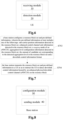
- a downlink physical resource block (Resource Block, RB) consists of continuous 12 sub-carriers and continuous 14 (12 when an extended cyclic prefix is used) OFDM symbols, and is 180 kHz on a frequency domain and has a time length of a normal time slot on a time domain, i.e. 1 ms, as shown in Fig. 4 (a 5M system).
- the CCE is likewise required to be redefined, i.e. eCCE; several opinions about the definition of the size of the CCE are as follows: one is to still keep the definition of R8, i.e. 36 resource elements, and another one is 1/n of resource elements being contained in 1 physical resource block.
- the size of the second control signalling area is restricted by the size of a first control signalling area, and other signals, such as CRS, PSS/SSS, PBCH, PRS, CSI-RS, DM-RS and PRS may be transmitted in the second control signalling area, which will result in the decrease of the amount of valid bits of the downlink control information which may actually transmitted in the eCCE, thereby resulting in the increase of valid code rate of an ePDCCH, even the code rate exceeding 1, causing the downlink control information not decoding correctly; therefore, if a UE still performs blind detection fixedly according to four aggregation levels defined in an LTE system, a large amount of blind detection waste may exist, and the expanding of searching space is restricted, and scheduling blocking rate of the downlink control information is increased.
- other signals such as CRS, PSS/SSS, PBCH, PRS, CSI-RS, DM-RS and PRS may be transmitted in the second control signalling area, which will result in the decrease of the amount of valid bits
- Huawei et al "UE-specific search space for ePDCCH", R1-120998, relates to search space addressing and the need to support of semi-static and dynamic allocation. Further, it relates to support both distributed and localized ePDCCH transmissions.
- LG Electronics “Blind decoding reduction methods", R1-102709, relates to blind decoding in the cross-carrier scheduling. In particular, it relates to a downlink control information format size adaptation method.
- the present invention provides a downlink control information transmitting method, a detecting method, a base station and a UE so as to at least solve the problem of detecting resource waste of a UE caused by the above-mentioned existing downlink control information mapping mode.
- the UE is agilely indicated to detect the downlink control information borne by the ePDCCH in the corresponding physical resource block according to the resource block set and the pre-defined information configured by a base station, so as to save resources of space detected and searched by the UE, thus scheduling efficient of the system is improved.
- Fig. 5 shows a flowchart of a method for detecting downlink control information according to an embodiment of the disclosure. As shown in Fig. 5 , the flowchart comprises the following steps:
- the UE is agilely indicated to detect the downlink control information borne by the ePDCCH in the corresponding physical resource block according to the resource block set and the pre-defined information configured by a base station, so as to save resources of space detected and searched by the UE, thus scheduling efficient of the system is improved.
- the amount of resource blocks contained in the resource block set may be 2, 4, 6, 8, 12 and 16, but is not limited to the above-mentioned values; position information in the resource block set comprises sub-carrier position information in the resource block set; the mapping mode of the ePDCCH comprises continuous mapping and discrete mapping; candidate set configuration comprises the amount of candidate sets corresponding to aggregation levels in a user dedicated search space; and aggregation level configuration information comprises configuration information about the aggregation levels in the user dedicated search space.
- the UE determines an aggregation level configuration to be detected according to the amount of valid resource elements contained in one eCCE of detected eCCEs and/or a detected downlink control information format.
- the aggregation level configuration comprises configuration 1 and/or configuration 2, wherein configuration 1 is: (aggregation level a1, aggregation level a2, aggregation level a3 and aggregation level a4), and a1, a2, a3 and a4 are respectively 1, 2, 4 and 8; configuration 2 is: (aggregation level b1, aggregation level b2, aggregation level b3 and aggregation level b4) or (aggregation level a2, aggregation level a3 and aggregation level a4), and b1, b2, b3 and b4 are respectively 2, 4, 8 and 16 or are respectively 2, 4, 8 and 12.
- the UE determines an aggregation level configuration to be detected according to the amount of valid resource elements contained in one eCCE of detected eCCEs and/or a detected downlink control information format, comprising the following modes:
- the UE determines an aggregation level configuration to be detected according to a valid code rate of an eCCE of detected eCCEs transmitting downlink control information.
- a valid code rate When the valid code rate is more than X, configuration 2 is used; and when the valid code rate is less than or equal to X, configuration 1 is used; and X is 0.93 or 1.
- the aggregation level to be detected is configuration 1
- the aggregation level to be detected is configuration 2
- the aggregation level to be detected is configuration 2
- an aggregation level to be detected is configuration 1; when the UE detects that the downlink control information format is format 2C, the aggregation level to be detected is configuration 2.
- Fig. 6 shows a structure diagram of a UE according to an embodiment of the disclosure.
- the UE includes: a receiving module 10, configured to receive a resource block set and pre-defined information configured by a base station, wherein the pre-defined information at least comprises one of the following : sub-carrier position information detected in the resource block set, enhanced control channel unit information detected in the resource block set, a mapping mode of the ePDCCH, aggregation level configuration information detected in the resource block set, the amount of candidate set corresponding to the detected aggregation level in the resource block set and a downlink control information format; and a detection module 20, configured to detect downlink control information borne by an enhanced physical downlink control channel (ePDCCH) on a resource block according to the resource block set and the pre-defined information.
- ePDCCH enhanced physical downlink control channel
- the UE is agilely indicated to detect the downlink control information borne by the ePDCCH in the corresponding physical resource block according to the resource block set and the pre-defined information configured by a base station, so as to save resources of space detected and searched by the UE, thus scheduling efficient of the system is improved.
- Fig. 7 shows a flowchart of a method for transmitting downlink control information according to an embodiment of the disclosure. As shown in Fig. 7 , the flowchart includes the following steps:
- the UE is agilely indicated to detect the downlink control information borne by the ePDCCH in the corresponding physical resource block according to the resource block set and the pre-defined information configured by a base station, so as to save resources of space detected and searched by the UE, thus scheduling efficient of the system is improved.
- Fig. 8 shows a structural block diagram of a base station according to an embodiment of the disclosure.
- the base station includes: a configuration module 30, configured to configure a resource block set and pre-defined information, wherein the pre-defined information at least comprises one of the following : sub-carrier position information detected in the resource block set, enhanced control channel unit information detected in the resource block set, a mapping mode of the ePDCCH, aggregation level configuration information detected in the resource block set and the amount of candidate set and a downlink control information format corresponding to the detected aggregation level in the resource block set; and a transmitting module 40, configured to transmit the resource block set and pre-defined information to a UE so as to instruct the UE to detect downlink control information borne by an enhanced physical downlink control channel (ePDCCH) on a resource block.
- ePDCCH enhanced physical downlink control channel
- the UE is agilely indicated to detect the downlink control information borne by the ePDCCH in the corresponding physical resource block according to the resource block set and the pre-defined information configured by a base station, so as to save resources of space detected and searched by the UE, thus scheduling efficient of the system is improved.
- a UE detects downlink control information borne by an enhanced physical downlink control channel (ePDCCH) in a resource block according to a resource block set and pre-defined information configured by a base station, wherein the pre-defined information includes one of the following information or a combination thereof: sub-carrier position information detected in a resource block set, enhanced control channel unit information detected in the resource block set, a mapping mode of the ePDCCH, aggregation level configuration information detected in the resource block set and the amount of candidate set and a downlink control information format corresponding to the detected aggregation level in the resource block set.
- ePDCCH enhanced physical downlink control channel
- the amount of resource blocks contained in the resource block set may be 2, 4, 6, 8, 12, 16 and 32, but is not limited to the above-mentioned values; when the amount of resource blocks contained in the resource block set is more than 4, the UE selects 2 or 4 resource blocks as a detected resource block set, and the specific selection mode is as follows: the UE may select 2 or 4 resource blocks from the resource block set as a detected resource block set according to a UE dedicated configuration; 2 or 4 resource blocks selected from the resource block set by each subframe may be the same, also may be different; and the UE dedicated configuration may be a selection resource block with equal intervals, and each UE is configured with a dedicated starting position.
- aggregation levels are 1, 2, 4 and 8, wherein values of q may be 1, 2, 4, 8, or 1, 2, 4, or 2, 4, 8, or 2, 4, or 1, or 2, or 4, or 8; when q is 2, then 1 and 2 are of continuous mapping, and 4 and 8 are of discrete mapping; and when q is 4, then 1, 2 and 4 are of continuous mapping and 8 is of discrete mapping.
- Different cyclic prefix types (a normal cyclic prefix, an extended cyclic prefix) define different aggregation levels.
- the normal cyclic prefix and extended cyclic prefix define sizes of different eCCEs
- the normal cyclic prefixes are 2, 4, 8 and 16, and the extended cyclic prefixes are 1, 2, 4 and 8
- the normal cyclic prefixes are 2, 4 and 8
- the extended cyclic prefixed are 1, 2, 4 and 8.
- a UE detects sets of different aggregation levels on a special subframe and a normal subframe, for example:
- the UE determines a set of detected aggregation levels according to a configuration of the special subframe.
- Modes for the UE to determine detecting aggregation levels comprise at least one of the following :
- aggregation levels required to be detected by the UE are: configuration 1 (aggregation level a1, aggregation level a2, aggregation level a3 and aggregation level a4), configuration 2 (aggregation level b1, aggregation level b2, aggregation level b3 and aggregation level b4); or configuration 1 (aggregation level a1, aggregation level a2, aggregation level a3 and aggregation level a4), and configuration 2 (aggregation level a2, aggregation level a3 and aggregation level a4).
- a1, a2, a3 and a4 can be 1, 2, 4 and 8, which is only an example and is not limited to the values; b1, b2, b3 and b4 can be 2, 4, 8 and 16, or 2, 4, 8 and 12, which is only an example and is not limited to the values.
- the UE determines an aggregation level configuration to be detected according to the amount of valid resource elements contained in one eCCE of detected eCCEs and/or a detected downlink control information format (the bit amount contained by downlink control information), specifically comprising the following modes:
- the aggregation levels detected by the UE are aggregation level a1, aggregation level a2, aggregation level a3 and aggregation level a4, and the amount of candidate sets corresponding to each aggregation level is c1, c2, c3 and c4, then when the UE only detects aggregation level a2, aggregation level a3 and aggregation level a4, the amount of candidate sets corresponding to each aggregation level is c2, c3 and c4, or the amount of candidate sets corresponding to each aggregation level is d2, d3 and d4, wherein d2 + d3 + d4 is less than or equal to c1 + c2 + c3 + c4; specific applications are as follows:
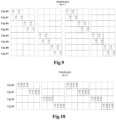
- a resource block set comprises 4 resource blocks, and each resource block includes 4 enhanced control channel units, and each enhanced control channel unit includes 2 resource groups, and all resource groups are numbered from #0 to #31, and aggregation level a means that resources corresponding to the ePDCCH are a enhanced control channel units, then when the mapping mode is discrete mapping, the sub-carrier position information detected in the resource block set is at least one of the following : As shown in Figs.
- the sub-carrier position information detected in the resource block set is one of ⁇ (#0, #16), (#2, #18) ⁇ , ⁇ (#1, #17), (#3, #19) ⁇ , ⁇ (#4, #20), (#6, #22) ⁇ , ⁇ (#5, #21), (#7, #23) ⁇ , ⁇ (#8, #24), (#10, #26) ⁇ , ⁇ (#9, #25), (#11, #27) ⁇ , ⁇ (#12, #28), (#14, #30) ⁇ , ⁇ (#13, #29), (#15, #31) ⁇ , ⁇ (#0, #16), (#1, #17), (#2, #18), (#3, #19) ⁇ , ⁇ (#4, #20), (#5, #21), (#6, #22), (#7, #23) ⁇ , ⁇ (#8, #24), (#9, #25), (#10, #26), (#11, #27) ⁇ and ⁇ (#12, #28),
- the sub-carrier position information detected in the resource block set is one of ⁇ (#0, #1, #16, #17), (#2, #3, #18, #19) ⁇ , ⁇ (#4, #5, #20, #21), (#6, #7, #22, #23) ⁇ , ⁇ (#8, #9, #24, #25), (#10, #11, #26, #27) ⁇ , ⁇ (#12, #13, #28, #29), (#14, #15, #30, #31) ⁇ , ⁇ (#0, #8, #16, #24), ((#2, #10, #18, #26)) ⁇ , ⁇ (#1, #9, #17, #25), ((#3, #11, #19, #27)) ⁇ , ⁇ (#4, #12, #20, #28), ((#6, #14, #22, #30)) ⁇ , ⁇ (#5, #13, #21, #29), ((#7, #15, #23, #31)) ⁇ or a sub-carrier corresponding to
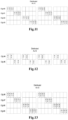
- the resource block set comprises 2 resource blocks, each resource block includes 4 enhanced control channel units, and all enhanced control channel units are numbered from #0 to #7, and aggregation level a means that resources corresponding to the ePDCCH are a enhanced control channel units, then enhanced control channel unit information detected in the resource block set is at least one of the following :
- the resource block set comprises 2 resource blocks, each resource block includes 4 enhanced control channel units, and all enhanced control channel units are numbered from #0 to #7, and aggregation level a means that resources corresponding to the ePDCCH are a enhanced control channel units, then enhanced control channel unit information detected in said resource block set is at least one of the following :
- a specific search space is defined as follows: the search space is defined in the unit of PRB, and different UEs perform detecting on the same PRB according to the same preset combination, for example: the search space of the UE is defined by two PRBs (determining according to PRB set).
- the resource block set comprises 4 resource blocks, each resource block includes 4 enhanced control channel units, and all enhanced control channel units are numbered from #0 to #15, and aggregation level a means that resources corresponding to the ePDCCH are a enhanced control channel units, then enhanced control channel unit information detected in the resource block set is at least one of the following :
- the search space is defined in the unit of PRB, and different UEs can perform detecting on the same PRB according to different preset combinations; and aggregation level 1 and aggregation level 2 correspond to different resources so as to decrease the simultaneous blocking probability of different aggregation levels. (determining according to PRB set and pattern Index).
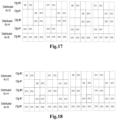
- Fig. 16 two configurations are defined as shown in Fig. 16 , and each one is configured with 14 candidate sets which are indicated by L1 to L14.
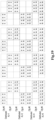
- Figs. 17 and 18 two configurations as shown in Figs. 17 and 18 also can be defined, and each one with configured with 8 candidate sets which are indicated by D9 to D15; or two configurations as shown in Figs. 19 and 20 , each one is configured with 16 candidate sets which are indicated by D1 to D16.
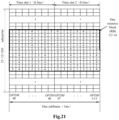
- resources are divided in accordance with 1 (or 2) resource element being granularity, which is specifically as follows: one resource block is divided into 4 eCCEs, as shown in Fig. 21 ; different numbers represent different eCCEs.
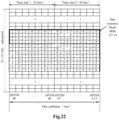
- Groups are divided according to frequency domain sub-carriers, and different groups correspond to different resource dividing; one resource block is divided into 8 eREGs (enhanced resource group), and in the unit of 4 sub-carriers, resource blocks are divided into 3 groups, and relevant positions in different groups corresponding to the same eREG number are different, and as shown in Fig. 22 , different numbers represent different eREGs.
- a storage medium stores the above-mentioned software, and the storage medium comprises but is not limited to an optical disk, a soft disk, a hard disk, an erasable storage, etc.
- the UE is agilely indicated to detect the downlink control information borne by the ePDCCH in the corresponding physical resource block according to the resource block set and the pre-defined information configured by a base station, so as to save resources of space detected and searched by the UE, thus scheduling efficient of the system is improved.
- each of the mentioned modules or steps of the disclosure can be realized by universal computing devices; the modules or steps can be focused on single computing device, or distributed on the network formed by multiple computing devices; selectively, they can be realized by the program codes which can be executed by the computing device; thereby, the modules or steps can be stored in the storage device and executed by the computing device; and under some circumstances, the shown or described steps can be executed in different orders, or can be independently manufactured as each integrated circuit module, or multiple modules or steps thereof can be manufactured to be single integrated circuit module, thus to be realized. In this way, the present invention is not restricted to any particular hardware and software combination.
Landscapes
- Engineering & Computer Science (AREA)
- Signal Processing (AREA)
- Computer Networks & Wireless Communication (AREA)
- Computer Security & Cryptography (AREA)
- Mobile Radio Communication Systems (AREA)
Claims (15)
- Verfahren zum Erfassen von Abwärtsstrecken-Steuerinformationen, das aufweist:
durch eine Benutzereinrichtung, UE, Empfangen eines Ressourcenblocksatzes von durch eine Basisstation konfigurierten vordefinierten Informationen und Erfassen (S504) von durch einen erweiterten physikalischen Abwärtsstrecken-Steuerkanal, ePDCCH, übertragenen Abwärtsstrecken-Steuerinformationen in einem Ressourcenblock gemäß dem Ressourcenblocksatz und den durch eine Basisstation konfigurierten vordefinierten Informationen, wobei die vordefinierten Informationen das Folgende aufweisen (S502):einen Abbildungsmodus des ePDCCH, Konfigurationsinformationen über Aggregationsebenen in einem benutzerspezifischen Suchraum, die im Ressourcenblocksatz erfasst werden sollen, wobei der Abbildungsmodus des ePDCCH eine kontinuierliche Abbildung und/oder eine diskrete Abbildung aufweist,eine Menge von Kandidatensätzen, die der erfassten Aggregationsebene im Ressourcenblocksatz entsprechen, undein Abwärtsstrecken-Steuerinformationsformat. - Verfahren zum Übertragen von Abwärtsstrecken-Steuerinformationen, das aufweist:Konfigurieren (S702) durch eine Basisstation eines Ressourcenblocksatzes und von vordefinierten Informationen;Senden (S704) durch die Basisstation der vordefinierten Informationen und Senden von Abwärtsstrecken-Steuerinformationen in einem erweiterten physikalischen Abwärtsstrecken-Steuerkanal, ePDCCH, auf einem Ressourcenblock gemäß dem konfigurierten Ressourcenblocksatz und den vordefinierten Informationen (S702) an eine UE, wobei die vordefinierten Informationen das Folgende aufweisen:einen Abbildungsmodus des ePDCCH, Konfigurationsinformationen über Aggregationsebenen in einem benutzerspezifischen Suchraum, die im Ressourcenblocksatz erfasst werden sollen, wobei der Abbildungsmodus des ePDCCH eine kontinuierliche Abbildung und/oder eine diskrete Abbildung aufweist,eine Menge von Kandidatensätzen, die der erfassten Aggregationsebene im Ressourcenblocksatz entsprechen, undein Abwärtsstrecken-Steuerinformationsformat.
- Verfahren nach Anspruch 1 oder 2, dadurch gekennzeichnet, dass die Menge der Ressourcenblöcke in dem Ressourcenblocksatz eine der folgenden ist: 2, 4, 6, 8, 12 und 16; oder das Abwärtsstrecken-Steuerinformationsformat gemäß einem Abbildungsmodus von Daten bestimmt wird, die den Abwärtsstrecken-Steuerinformationen entsprechen.
- Verfahren nach Anspruch 3, dadurch gekennzeichnet, dass das UE 2 oder 4 Ressourcenblöcke als einen erfassten Ressourcenblocksatz auswählt, wenn die Menge der im Ressourcenblocksatz enthaltenen Ressourcenblöcke größer als 4 ist.
- Verfahren nach Anspruch 3, dadurch gekennzeichnet, dass ePDCCHs derselben Aggregationsebene konfiguriert sind, zum selben Abbildungsmodus zu gehören;gemäß der Größe einer Ressource, die einer Aggregationsebene entspricht, und gemäß einer aufsteigenden Reihenfolge alle Aggregationsebenen als Ni, N2, ... Np eingestuft werden, wobei p eine positive ganze Zahl ist, wobei ePDCCHs, die den Aggregationsebenen Ni, N2, Nq entsprechen, konfiguriert sind, eine kontinuierliche Abbildung zu sein, und ePDCCHs, die den Aggregationsebenen Nq + 1, ..., Np entsprechen, konfiguriert sind, eine diskrete Abbildung zu sein, und q eine positive ganze Zahl ist;q von der Basisstation konfiguriert wird, oder q ein fester Wert ist, oder hinsichtlich Unterrahmen unterschiedlicher zyklischer Präfixtypen unterschiedliche q-Werte definiert sind, wobei die zyklischen Präfixe ein normales zyklisches Präfix und ein erweitertes zyklisches Präfix aufweisen.
- Verfahren nach Anspruch 1, dadurch gekennzeichnet, dass hinsichtlich eines TDD-Systems die UE Sätze unterschiedlicher Aggregationsebenen auf einem speziellen Unterrahmen und einem normalen Unterrahmen erfasst;
wobei auf dem speziellen Unterrahmen die UE einen Satz erfasster Aggregationsebenen gemäß einer Konfiguration des speziellen Unterrahmens bestimmt. - Verfahren nach Anspruch 1 oder 2, dadurch gekennzeichnet, dass unterschiedliche zyklische Präfixe unterschiedlichen Aggregationsebenen entsprechen oder unterschiedliche zyklische Präfixe unterschiedlichen Mengen von Kandidatensätzen entsprechen.
- Basisstation, die aufweist:
ein Konfigurationsmodul (30), das konfiguriert ist, einen Ressourcenblocksatz und vordefinierte Informationen zu konfigurieren (S702), wobei die vordefinierten Informationen das Folgende aufweisen:einen Abbildungsmodus eines erweiterten physikalischen Abwärtsstrecken-Steuerkanals, ePDCCH, Konfigurationsinformationen über Aggregationsebenen in einem benutzerspezifischen Suchraum, die im Ressourcenblocksatz erfasst werden sollen, wobei der Abbildungsmodus des ePDCCH eine kontinuierliche Abbildung und/oder eine diskrete Abbildung aufweist,eine Menge von Kandidatensätzen, die der erfassten Aggregationsebene im Ressourcenblocksatz entsprechen, und ein Abwärtsstrecken-Steuerinformationsformat;wobei der Abbildungsmodus des ePDCCH eine kontinuierliche Abbildung und/oder eine diskrete Abbildung aufweist; undein Sendemodul (40), das konfiguriert ist, die vordefinierten Informationen zu senden und die Abwärtsstrecken-Steuerinformationen in dem ePDCCH auf einem Ressourcenblock gemäß dem Ressourcenblocksatz und den vordefinierten Informationen an ein UE zu senden. - Benutzereinrichtung, UE, die aufweist:
ein Empfangsmodul (10), das konfiguriert ist, einen Ressourcenblocksatz und durch eine Basisstation konfigurierte vordefinierte Informationen zu empfangen (S502), wobei die vordefinierten Informationen das Folgende aufweisen:einen Abbildungsmodus eines erweiterten physikalischen Abwärtsstrecken-Steuerkanals, ePDCCH, Konfigurationsinformationen über Aggregationsebenen in einem benutzerspezifischen Suchraum, die im Ressourcenblocksatz erfasst werden sollen, wobei der Abbildungsmodus des ePDCCH eine kontinuierliche Abbildung und/oder eine diskrete Abbildung aufweist,eine Menge von Kandidatensätzen, die der erfassten Aggregationsebene im Ressourcenblocksatz entsprechen, undein Abwärtsstrecken-Steuerinformationsformat; undein Erfassungsmodul (20), das konfiguriert ist, vom ePDCCH in einem Ressourcenblock übertragene Abwärtsstrecken-Steuerinformationen gemäß dem Ressourcenblocksatz und den vordefinierten Informationen zu erfassen (S504). - UE nach Anspruch 9, dadurch gekennzeichnet, dass das UE konfiguriert ist, die erfassten Aggregationsebenen in einem der folgenden Modi zu bestimmen:Modus 1: die UE ist konfiguriert, eine zu erfassende Aggregationsebenen-Konfiguration gemäß einer gültigen Coderate eines erweiterten Kanalsteuerelements, eCCE, von erfassten eCCEs zu bestimmen, die Abwärtsstrecken-Steuerinformationen übertragen, wobei die gültige Coderate bewirkt, dass die Abwärtsstrecken-Steuerinformationen korrekt decodiert werden;Modus 2: die UE ist konfiguriert, eine zu erfassende Aggregationsebenen-Konfiguration gemäß einer maximalen Bitmenge zu bestimmen, die tatsächlich von einem eCCE von erfassten eCCEs übertragen wird;Modus 3: die UE ist konfiguriert, eine zu erfassende Aggregationsebenen-Konfiguration gemäß der Kategorie des erfassten Abwärtsstrecken-Steuerinformationsformats zu bestimmen; undModus 4: die UE ist konfiguriert, eine Aggregationsebene gemäß einer Konfiguration von der Basisstation zu bestimmen.
- UE nach Anspruch 10, dadurch gekennzeichnet, dass die von der UE zu erfassende Aggregationsebenen-Konfiguration die Konfiguration 1 und/oder die Konfiguration 2 aufweist, wobei die Konfiguration 1 die Aggregationsebene a1, die Aggregationsebene a2, die Aggregationsebene a3 und die Aggregationsebene a4 aufweist und die Konfiguration 2 die Aggregationsebene b1, die Aggregationsebene b2, die Aggregationsebene b3 und die Aggregationsebene b4 aufweist; oder die Konfiguration 2 die Aggregationsebene a2, die Aggregationsebene a3 und die Aggregationsebene a4 aufweist, wobei a1, a2, a3 und a4 jeweils 1, 2, 4 und 8 sind; und b1, b2, b3 und b4 jeweils 2, 4, 8 und 16 sind oder jeweils 2, 4, 8 und 12 sind.
- UE nach Anspruch 11, dadurch gekennzeichnet, dasswenn der Modus zum Bestimmen der erfassten Aggregationsebene der Modus 1 ist, wenn die gültige Coderate größer als X ist, die Konfiguration 2 verwendet wird, und wenn die gültige Coderate kleiner oder gleich X ist, die Konfiguration 1 verwendet wird; und X ein voreingestellter Schwellenwert ist;und wenn der Modus zum Bestimmen der erfassten Aggregationsebene der Modus 2 ist, wenn die von der eCCE übertragene maximale Bitmenge kleiner ist als die in den Abwärtsstrecken-Steuerinformationen enthaltene Bitmenge, die zu erfassende Aggregationsebene die Konfiguration 1 ist, und wenn eine von der eCCE übertragene maximale Bitmenge größer ist als die in den Abwärtsstrecken-Steuerinformationen enthaltene Bitmenge, die zu erfassende Aggregationsebene die Konfiguration 2 ist.
- UE nach Anspruch 8, dadurch gekennzeichnet, dassdie von der UE erfassten Aggregationsebenen die Aggregationsebene a1, die Aggregationsebene a2, die Aggregationsebene a3 und die Aggregationsebene a4 sind und die Menge der Kandidatensätze, die jeder Aggregationsebene entsprechen, jeweils c1, c2, c3 und c4 ist, und wenn die UE nur die Aggregationsebene a2, die Aggregationsebene a3 und die Aggregationsebene a4 erfasst die Menge der Kandidatensätze, die jeder Aggregationsebene entsprechen, c2, c3 und c4 ist, oder die Menge der Kandidatensätze, die jeder Aggregationsebene entsprechen, d2, d3 und d4 ist, wobei d2 + d3 + d4 kleiner oder gleich c1 + c2 + c3 + c4 ist, und a1, a2, a3, a4, c1, c2, c3, c4, d2, d3 und d4 alle positive ganze Zahlen sind; oderdie von dem UE erfassten Aggregationsebenen die Aggregationsebene a1, die Aggregationsebene a2, die Aggregationsebene a3 und die Aggregationsebene a4 sind, und die Menge der Kandidatensätze, die jeder Aggregationsebene entsprechen, jeweils c1, c2, c3 und c4 ist, wobei c1, c2, c3 und c4 jeweils 6, 6, 2 und 2 sind, oder jeweils 8, 4, 2 und 2 sind, oder jeweils 4, 8, 2 und 2 sind, oder jeweils 4, 4, 4 und 4 sind, oder jeweils 4, 6, 4 und 2 sind, und a1, a2, a3 und a4 positive ganze Zahlen sind.
- UE nach Anspruch 8, dadurch gekennzeichnet, dass der Ressourcenblocksatz 4 Ressourcenblöcke aufweist, und jeder Ressourcenblock 4 erweiterte Steuerkanaleinheiten aufweist, und jede erweiterte Steuerkanaleinheit 2 Ressourcengruppen aufweist, und alle Ressourcengruppen von #0 bis #31 nummeriert sind, und die Aggregationsebene a bedeutet, dass Ressourcen, die dem ePDCCH entsprechen, erweiterte Steuerkanaleinheiten sind, und wenn der Abbildungsmodus eine diskrete Abbildung ist, die im Ressourcenblocksatz erfassten Unterträger-Positionsinformationen mindestens eine der folgenden sind:wenn die Aggregationsebene 1 ist, sind die im Ressourcenblocksatz erfassten Unterträger-Positionsinformationen eine von {(#0, #16), (#2, #18)}, {(#1, #17), (#3, #19)}, {(#4, #20), (#6, #22)}, {(#5, #21), (#7, #23)}, {(#8, #24), (#10, #26)}, {(#9, #25), (#11, #27)}, {(#12, #28), (#14, #30)}, {(#13, #29), (#15, #31)}, {(#0, #16), (#1, #17), (#2, #18), (#3, #19)}, {(#4, #20), (#5, #21), (#6, #22), (#7, #23)}, {(#8, #24), (#9, #25), (#10, #26), (#11, #27)} und {(#12, #28), (#13, #29), (#14, #30), (#15, #31)} oder ein Unterträger, der einer kombinierten Ressourcengruppe entspricht;oder, wenn die Aggregationsebene 2 ist, sind die im Ressourcenblocksatz erfassten Unterträger-Positionsinformationen eine von {(#0, #1, #16, #17), (#2, #3, #18, #19)}, {(#4, #5, #20, #21), (#6, #7, #22, #23)}, {(#8, #9, #24, #25), (#10, #11, #26, #27)}, {(#12, #13, #28, #29), (#14, #15, #30, #31)}, {(#0, #8, #16, #24), ((#2, #10, #18, #26))}, {(#1, #9, #17, #25), ((#3, #11, #19, #27))}, {(#4, #12, #20, #28), ((#6, #14, #22, #30))}, {(#5, #13, #21, #29), ((#7, #15, #23, #31))} oder ein Unterträger, der einer kombinierten Ressourcengruppe entspricht; oderder Ressourcenblocksatz 2 Ressourcenblöcke aufweist, wobei jeder Ressourcenblock 4 erweiterte Steuerkanaleinheiten aufweist und alle erweiterten Steuerkanaleinheiten von #0 bis #7 nummeriert sind, und die Aggregationsebene a bedeutet, dass die dem ePDCCH entsprechenden Ressourcen a erweiterte Steuerkanaleinheiten sind, und die im Ressourcenblocksatz erfassten erweiterten Steuerkanaleinheits-Informationen mindestens eine der folgenden sind:wenn der Abbildungsmodus eine kontinuierliche Abbildung ist und die Aggregationsebene 1 ist, sind die im Ressourcenblocksatz erfassten erweiterten Steuerkanaleinheits-Informationen von #0 bis #7;oder, wenn der Abbildungsmodus eine kontinuierliche Abbildung ist und die Aggregationsebene 2 ist, sind die im Ressourcenblocksatz erfassten erweiterten Steuerkanaleinheits-Informationen {#0, #1}, {#2, #3}, {#4, #5} und {#6, #7};oder, wenn der Abbildungsmodus eine kontinuierliche Abbildung ist und die Aggregationsebene 4 ist, sind die in der Ressourcenblockmenge erfassten erweiterten Steuerkanaleinheits-Informationen {#0, #1, #2, #3} und {#4, #5, #6, #7};oder, wenn der Abbildungsmodus eine diskrete Abbildung ist und die Aggregationsebene 2 ist, sind die im Ressourcenblocksatz erfassten erweiterten Steuerkanaleinheits-Informationen {#0, #4}, {#1, #5}, {#2, #6} und {#3, #7};oder, wenn der Abbildungsmodus eine diskrete Abbildung ist und die Aggregationsebene 4 ist, sind die in dem Ressourcenblocksatz erfassten erweiterten Steuerkanaleinheits-Informationen {#0, #2, #4, #6} und {#1, #3, #5, #7}; oderder Ressourcenblocksatz 4 Ressourcenblöcke aufweist, und jeder Ressourcenblock 4 erweiterte Steuerkanaleinheiten aufweist, und alle erweiterten Steuerkanaleinheiten von #0 bis #15 nummeriert sind, und Aggregationsebene a bedeutet, dass die dem ePDCCH entsprechenden Ressourcen a erweiterte Steuerkanaleinheiten sind, und die im Ressourcenblocksatz erfassten erweiterten Steuerkanaleinheits-Informationen mindestens eine der folgenden sind:wenn der Abbildungsmodus eine kontinuierliche Abbildung ist und die Aggregationsebene 1 ist, sind die im Ressourcenblocksatz erfassten erweiterten Steuerkanaleinheits-Informationen {#0, #2, #4, #6, #8, #10, #12, #14} oder {#1, #3, #5, #7, #9, #11, #13, #15};oder, wenn der Abbildungsmodus eine kontinuierliche Abbildung ist und die Aggregationsebene 2 ist, sind die im Ressourcenblocksatz erfassten erweiterten Steuerkanaleinheits-Informationen {(#0, #1), (#4, #5), (#8, #9), (#12, #13)} oder {(#2, #3), (#6, #7), (#10, #11), (#14, #15)};oder, wenn der Abbildungsmodus eine kontinuierliche Abbildung ist und die Aggregationsebene 4 ist, sind die im Ressourcenblocksatz erfassten erweiterten Steuerkanaleinheits-Informationen {(#0, #1, #2, #3), (#8, #9, #10, #11)} oder {(#4, #5, #6, #7), (#12, #13, #14, #15)};oder, wenn der Abbildungsmodus eine diskrete Abbildung ist und die Aggregationsebene 2 ist, sind die im Ressourcenblocksatz erfassten erweiterten Steuerkanaleinheits-Informationen {(#0, #8), (#2, #10), (#4, #12), (#6, #14)} oder {(#1, #9), (#3, #11), (#5, #13), (#7, #15)};oder, wenn der Abbildungsmodus eine diskrete Abbildung ist und die Aggregationsebene 4 ist, sind die im Ressourcenblocksatz erfassten erweiterten Steuerkanaleinheits-Informationen {(#0, #4, #8, #12), (#2, #6, #10, #14)} oder {(#1, #5, #9, #13), (#3, #7, #11, #15)};oder, wenn der Abbildungsmodus eine diskrete Abbildung ist und die Aggregationsebene 8 ist, sind die im Ressourcenblocksatz erfassten erweiterten Steuerkanaleinheits-Informationen {(#0, #2, #4, #6, #8, #10, #12, #14), (#1, #3, #5, #7, #8, #9, #11, #13)}.
- UE nach Anspruch 12, dadurch gekennzeichnet, dass unterschiedliche zyklische Präfixe unterschiedlichen Aggregationsebenen entsprechen, oder unterschiedliche zyklische Präfixe unterschiedlichen Mengen von Kandidatensätzen entsprechen.
Applications Claiming Priority (3)
| Application Number | Priority Date | Filing Date | Title |
|---|---|---|---|
| CN201210146408.0A CN103391563B (zh) | 2012-05-11 | 2012-05-11 | 下行控制信息发送方法、检测方法、基站及用户设备 |
| PCT/CN2012/087515 WO2013166847A1 (zh) | 2012-05-11 | 2012-12-26 | 下行控制信息发送方法、检测方法、基站及用户设备 |
| EP12876473.5A EP2854455B1 (de) | 2012-05-11 | 2012-12-26 | Verfahren zum senden von downlink-steuerinformationen, erkennungsverfahren, basisstation und benutzervorrichtung |
Related Parent Applications (2)
| Application Number | Title | Priority Date | Filing Date |
|---|---|---|---|
| EP12876473.5A Division EP2854455B1 (de) | 2012-05-11 | 2012-12-26 | Verfahren zum senden von downlink-steuerinformationen, erkennungsverfahren, basisstation und benutzervorrichtung |
| EP12876473.5A Division-Into EP2854455B1 (de) | 2012-05-11 | 2012-12-26 | Verfahren zum senden von downlink-steuerinformationen, erkennungsverfahren, basisstation und benutzervorrichtung |
Publications (2)
| Publication Number | Publication Date |
|---|---|
| EP3609237A1 EP3609237A1 (de) | 2020-02-12 |
| EP3609237B1 true EP3609237B1 (de) | 2024-08-28 |
Family
ID=49535703
Family Applications (2)
| Application Number | Title | Priority Date | Filing Date |
|---|---|---|---|
| EP19177397.7A Active EP3609237B1 (de) | 2012-05-11 | 2012-12-26 | Verfahren zur übertragung von downlink-steuerungsinformationen, detektionsverfahren, basisstation und benutzergerät |
| EP12876473.5A Active EP2854455B1 (de) | 2012-05-11 | 2012-12-26 | Verfahren zum senden von downlink-steuerinformationen, erkennungsverfahren, basisstation und benutzervorrichtung |
Family Applications After (1)
| Application Number | Title | Priority Date | Filing Date |
|---|---|---|---|
| EP12876473.5A Active EP2854455B1 (de) | 2012-05-11 | 2012-12-26 | Verfahren zum senden von downlink-steuerinformationen, erkennungsverfahren, basisstation und benutzervorrichtung |
Country Status (8)
| Country | Link |
|---|---|
| US (1) | US9532351B2 (de) |
| EP (2) | EP3609237B1 (de) |
| JP (1) | JP6320370B2 (de) |
| CN (2) | CN103391563B (de) |
| BR (1) | BR112014028088B1 (de) |
| DK (1) | DK3609237T3 (de) |
| RU (1) | RU2630747C2 (de) |
| WO (1) | WO2013166847A1 (de) |
Families Citing this family (29)
| Publication number | Priority date | Publication date | Assignee | Title |
|---|---|---|---|---|
| US9312993B2 (en) | 2011-06-29 | 2016-04-12 | Lg Electronics Inc. | Method and apparatus for transmitting control information in wireless communication system |
| CN109995494B (zh) * | 2013-06-28 | 2021-11-19 | 华为技术有限公司 | 一种发送控制信息、接收控制信息的方法和装置 |
| CN104754741B (zh) * | 2013-12-31 | 2018-08-14 | 上海诺基亚贝尔股份有限公司 | 一种确定搜索空间的方法 |
| CN104811263A (zh) * | 2014-01-24 | 2015-07-29 | 中兴通讯股份有限公司 | 控制信息的传输方法及装置 |
| CN104202828B (zh) * | 2014-03-21 | 2019-09-10 | 中兴通讯股份有限公司 | 控制信息的传输、接收方法、装置及系统 |
| CN104202115B (zh) * | 2014-05-09 | 2019-05-07 | 中兴通讯股份有限公司 | 高阶编码的调制处理方法及装置、基站、终端 |
| CN105471791A (zh) * | 2014-09-05 | 2016-04-06 | 中兴通讯股份有限公司 | 循环前缀类型的配置方法及装置 |
| CN105471561A (zh) * | 2014-09-05 | 2016-04-06 | 中兴通讯股份有限公司 | 一种信道复用的方法和装置 |
| CN104219036B (zh) * | 2014-09-30 | 2017-11-14 | 北京北方烽火科技有限公司 | Epdcch盲检测方法、资源映射方法及装置 |
| CN105577317A (zh) * | 2014-10-15 | 2016-05-11 | 中兴通讯股份有限公司 | 下行控制消息dci检测方法及装置 |
| CN111277394B (zh) * | 2014-11-07 | 2021-11-30 | 华为技术有限公司 | 一种物理下行控制信道的传输方法、基站设备及用户设备 |
| EP3297352B1 (de) * | 2015-06-23 | 2023-08-23 | Huawei Technologies Co., Ltd. | Sendeverfahren und detektionsverfahren von steuerungsinformationen, basisstation und benutzergerät |
| WO2017132955A1 (zh) * | 2016-02-04 | 2017-08-10 | 华为技术有限公司 | 控制信息传输方法及基站与终端 |
| US10091609B2 (en) * | 2016-03-28 | 2018-10-02 | Qualcomm Incorporated | Enhancing PRS searches via runtime conditions |
| CN107343317B (zh) * | 2016-04-29 | 2022-12-30 | 华为技术有限公司 | 一种子帧配置方法和装置 |
| WO2017193377A1 (zh) * | 2016-05-13 | 2017-11-16 | 华为技术有限公司 | 下行控制信息的发送方法、检测方法和设备 |
| CN107889250A (zh) * | 2016-09-30 | 2018-04-06 | 中兴通讯股份有限公司 | 下行资源粒度的确定方法、装置及系统 |
| WO2018112983A1 (en) * | 2016-12-24 | 2018-06-28 | Huawei Technologies Co., Ltd. | Blind detection of code rates for codes with incremental shortening |
| CN108271259B (zh) * | 2016-12-30 | 2023-10-24 | 华为技术有限公司 | 控制信道的资源指示方法、用户设备和网络设备 |
| WO2018143325A1 (ja) * | 2017-02-03 | 2018-08-09 | 株式会社Nttドコモ | ユーザ端末及び無線通信方法 |
| CN108401294B (zh) * | 2017-02-04 | 2021-10-26 | 华为技术有限公司 | 控制信息的发送和接收方法、接入网设备和终端设备 |
| CN109391361B (zh) * | 2017-08-11 | 2021-02-26 | 华为技术有限公司 | 检测下行控制信道的方法、终端设备和网络设备 |
| CN109495221B (zh) * | 2017-09-10 | 2021-11-19 | 华为技术有限公司 | 搜索空间确定方法和装置 |
| CN109586860B (zh) * | 2017-09-28 | 2020-05-26 | 展讯通信(上海)有限公司 | 一种资源复用方法及装置、存储介质、终端、基站 |
| CN109688625B (zh) | 2017-10-19 | 2021-01-15 | 中国移动通信有限公司研究院 | 一种控制信息的发送方法、检测方法、网络设备及终端 |
| CN110022609B (zh) | 2018-01-09 | 2023-06-23 | 华为技术有限公司 | 一种通信方法及装置 |
| CN110876185B (zh) | 2018-08-31 | 2021-07-09 | 中国移动通信有限公司研究院 | 指示信令的传输、接收方法、装置、网络侧设备及终端 |
| US11184132B2 (en) * | 2018-11-14 | 2021-11-23 | Mediatek Inc. | Transmission configuration indication (TCI)—state indication for non-coherent joint transmission (NCJT) channel state information (CSI) reporting |
| WO2025236128A1 (en) * | 2024-05-11 | 2025-11-20 | Shenzhen Tcl New Technology Co., Ltd. | Downlink converage enhancement method for base station and user equipment |
Family Cites Families (22)
| Publication number | Priority date | Publication date | Assignee | Title |
|---|---|---|---|---|
| RU2428815C2 (ru) * | 2006-01-18 | 2011-09-10 | Нтт Досомо, Инк. | Передатчик, приемник и способ связи |
| US10044532B2 (en) * | 2006-03-20 | 2018-08-07 | Texas Instruments Incorporated | Pre-coder selection based on resource block grouping |
| US8724636B2 (en) * | 2008-03-31 | 2014-05-13 | Qualcomm Incorporated | Methods of reliably sending control signal |
| CN101478808B (zh) * | 2009-01-21 | 2014-03-19 | 中兴通讯股份有限公司 | 一种下行控制信息的发送及检测方法 |
| WO2010141611A1 (en) * | 2009-06-02 | 2010-12-09 | Research In Motion Limited | System and method for reducing blind decoding for carrier aggregation |
| EP2296408A1 (de) * | 2009-09-14 | 2011-03-16 | Alcatel Lucent | Verfahren zur zeitlichen Einplanung von Übertragungen zwischen einer Basisstation und Teilnehmergeräten und Kommunikationsnetz dafür |
| CN101714892B (zh) * | 2009-11-02 | 2014-12-31 | 中兴通讯股份有限公司 | 一种下行控制信息的传输方法及系统 |
| JP5395641B2 (ja) * | 2009-11-30 | 2014-01-22 | シャープ株式会社 | 通信システム及び移動局装置及び基地局装置及び処理方法 |
| CN101790190B (zh) * | 2010-01-08 | 2014-12-10 | 中兴通讯股份有限公司 | 下行控制信息的检测方法和装置 |
| KR101915271B1 (ko) * | 2010-03-26 | 2018-11-06 | 삼성전자 주식회사 | 무선 통신 시스템에서 자원 할당을 위한 하향링크 제어 지시 방법 및 장치 |
| KR101684867B1 (ko) * | 2010-04-07 | 2016-12-09 | 삼성전자주식회사 | 공간 다중화 이득을 이용한 제어 정보 송수신 방법 |
| CN102255688B (zh) * | 2011-07-06 | 2013-04-10 | 合肥东芯通信股份有限公司 | Ltepdcch盲检控制方法和装置 |
| CN102291736B (zh) * | 2011-08-08 | 2017-11-24 | 中兴通讯股份有限公司 | 下行控制信道的检测方法、用户设备及基站 |
| CN102355340B (zh) * | 2011-08-12 | 2017-02-08 | 中兴通讯股份有限公司 | 下行控制信息发送、接收方法及装置 |
| CN102355732A (zh) | 2011-08-12 | 2012-02-15 | 电信科学技术研究院 | 一种下行控制信息传输方法及装置 |
| US9252918B2 (en) * | 2011-08-15 | 2016-02-02 | Google Technology Holdings LLC | Method and apparatus for control channel transmission and reception |
| CN102316595B (zh) * | 2011-09-30 | 2017-04-12 | 中兴通讯股份有限公司 | 大带宽系统物理上行控制信道资源确定方法及装置 |
| CN102395204B (zh) * | 2011-11-01 | 2014-07-02 | 新邮通信设备有限公司 | 移动通信中扩展物理层控制信道资源数量的方法和系统 |
| US9113463B2 (en) * | 2011-11-04 | 2015-08-18 | Qualcomm Incorporated | Resource management for enhanced PDCCH |
| CN102420685B (zh) * | 2011-11-07 | 2014-08-06 | 电信科学技术研究院 | 一种传输控制信息的方法及装置 |
| CN102368871B (zh) | 2011-11-10 | 2014-06-04 | 电信科学技术研究院 | 一种pdcch资源的配置应用方法及装置 |
| US8971881B2 (en) * | 2012-03-23 | 2015-03-03 | Google Technology Holdings LLC | Radio link monitoring in a wireless communication device for an enhanced control channel |
-
2012
- 2012-05-11 CN CN201210146408.0A patent/CN103391563B/zh active Active
- 2012-05-11 CN CN201810084790.4A patent/CN107979456B/zh active Active
- 2012-12-26 RU RU2014149857A patent/RU2630747C2/ru active
- 2012-12-26 US US14/400,008 patent/US9532351B2/en active Active
- 2012-12-26 EP EP19177397.7A patent/EP3609237B1/de active Active
- 2012-12-26 DK DK19177397.7T patent/DK3609237T3/da active
- 2012-12-26 WO PCT/CN2012/087515 patent/WO2013166847A1/zh not_active Ceased
- 2012-12-26 JP JP2015510609A patent/JP6320370B2/ja active Active
- 2012-12-26 BR BR112014028088-6A patent/BR112014028088B1/pt active IP Right Grant
- 2012-12-26 EP EP12876473.5A patent/EP2854455B1/de active Active
Also Published As
| Publication number | Publication date |
|---|---|
| JP2015516128A (ja) | 2015-06-04 |
| BR112014028088B1 (pt) | 2022-05-10 |
| RU2630747C2 (ru) | 2017-09-12 |
| US9532351B2 (en) | 2016-12-27 |
| DK3609237T3 (da) | 2024-09-09 |
| CN107979456A (zh) | 2018-05-01 |
| CN103391563A (zh) | 2013-11-13 |
| EP2854455A1 (de) | 2015-04-01 |
| RU2014149857A (ru) | 2016-07-10 |
| WO2013166847A1 (zh) | 2013-11-14 |
| BR112014028088A2 (pt) | 2017-06-27 |
| EP2854455A4 (de) | 2015-08-05 |
| US20150117354A1 (en) | 2015-04-30 |
| HK1208586A1 (en) | 2016-03-04 |
| CN103391563B (zh) | 2018-06-08 |
| EP3609237A1 (de) | 2020-02-12 |
| EP2854455B1 (de) | 2020-05-27 |
| JP6320370B2 (ja) | 2018-05-09 |
| CN107979456B (zh) | 2021-01-22 |
Similar Documents
| Publication | Publication Date | Title |
|---|---|---|
| EP3609237B1 (de) | Verfahren zur übertragung von downlink-steuerungsinformationen, detektionsverfahren, basisstation und benutzergerät | |
| KR102033442B1 (ko) | 공통 검색 공간 및 ue 특정 검색 공간을 블라인드 검출하기 위한 방법 및 장치 | |
| EP2168298B1 (de) | Vorrichtungen, verfahren und computerprogrammprodukte zur bereitstellung eines gemeinsamen signalisierungseingangs für eine modulare steuerkanalstruktur | |
| CN113692059B (zh) | 无线通信系统中的方法和设备 | |
| KR102177065B1 (ko) | Harq 지시 정보를 전송하는 방법 및 장치 | |
| KR102094739B1 (ko) | ePDCCH 검색 공간 설계 | |
| CA2886245C (en) | Control channel detection method and user equipment | |
| CN111030792B (zh) | 一种配置下行控制信道的搜索空间的方法及设备 | |
| EP2975895A1 (de) | Basisstation, endgerät, kommunikationssystem, kommunikationsverfahren und integrierte schaltung | |
| CN102395205B (zh) | 一种扩展物理层控制信道资源数量的方法和系统 | |
| CN102395204B (zh) | 移动通信中扩展物理层控制信道资源数量的方法和系统 | |
| CN103313273A (zh) | 一种信道发送方法、检测方法、基站及终端 | |
| US9313006B2 (en) | Methods and apparatus for resource element mapping | |
| HK1208586B (en) | Method for transmitting downlink control information, detecting method, base station and user equipment | |
| EP2982072B1 (de) | Verfahren und vorrichtung zur steuerkanalressourcenzuweisung in eingeschränkten und uneingeschränkten teilrahmen in einem drahtloskommunikationsnetzwerk | |
| EP2750464B1 (de) | E-pdcch-übertragungsverfahren und vorrichtung |
Legal Events
| Date | Code | Title | Description |
|---|---|---|---|
| PUAI | Public reference made under article 153(3) epc to a published international application that has entered the european phase |
Free format text: ORIGINAL CODE: 0009012 |
|
| STAA | Information on the status of an ep patent application or granted ep patent |
Free format text: STATUS: THE APPLICATION HAS BEEN PUBLISHED |
|
| AC | Divisional application: reference to earlier application |
Ref document number: 2854455 Country of ref document: EP Kind code of ref document: P |
|
| AK | Designated contracting states |
Kind code of ref document: A1 Designated state(s): AL AT BE BG CH CY CZ DE DK EE ES FI FR GB GR HR HU IE IS IT LI LT LU LV MC MK MT NL NO PL PT RO RS SE SI SK SM TR |
|
| STAA | Information on the status of an ep patent application or granted ep patent |
Free format text: STATUS: REQUEST FOR EXAMINATION WAS MADE |
|
| 17P | Request for examination filed |
Effective date: 20200812 |
|
| RBV | Designated contracting states (corrected) |
Designated state(s): AL AT BE BG CH CY CZ DE DK EE ES FI FR GB GR HR HU IE IS IT LI LT LU LV MC MK MT NL NO PL PT RO RS SE SI SK SM TR |
|
| STAA | Information on the status of an ep patent application or granted ep patent |
Free format text: STATUS: EXAMINATION IS IN PROGRESS |
|
| 17Q | First examination report despatched |
Effective date: 20210114 |
|
| GRAP | Despatch of communication of intention to grant a patent |
Free format text: ORIGINAL CODE: EPIDOSNIGR1 |
|
| STAA | Information on the status of an ep patent application or granted ep patent |
Free format text: STATUS: GRANT OF PATENT IS INTENDED |
|
| INTG | Intention to grant announced |
Effective date: 20240422 |
|
| GRAS | Grant fee paid |
Free format text: ORIGINAL CODE: EPIDOSNIGR3 |
|
| GRAA | (expected) grant |
Free format text: ORIGINAL CODE: 0009210 |
|
| STAA | Information on the status of an ep patent application or granted ep patent |
Free format text: STATUS: THE PATENT HAS BEEN GRANTED |
|
| AC | Divisional application: reference to earlier application |
Ref document number: 2854455 Country of ref document: EP Kind code of ref document: P |
|
| AK | Designated contracting states |
Kind code of ref document: B1 Designated state(s): AL AT BE BG CH CY CZ DE DK EE ES FI FR GB GR HR HU IE IS IT LI LT LU LV MC MK MT NL NO PL PT RO RS SE SI SK SM TR |
|
| REG | Reference to a national code |
Ref country code: GB Ref legal event code: FG4D |
|
| REG | Reference to a national code |
Ref country code: CH Ref legal event code: EP |
|
| REG | Reference to a national code |
Ref country code: DK Ref legal event code: T3 Effective date: 20240905 |
|
| REG | Reference to a national code |
Ref country code: DE Ref legal event code: R096 Ref document number: 602012081034 Country of ref document: DE |
|
| REG | Reference to a national code |
Ref country code: IE Ref legal event code: FG4D |
|
| REG | Reference to a national code |
Ref country code: LT Ref legal event code: MG9D |
|
| REG | Reference to a national code |
Ref country code: AT Ref legal event code: MK05 Ref document number: 1719266 Country of ref document: AT Kind code of ref document: T Effective date: 20240828 |
|
| PG25 | Lapsed in a contracting state [announced via postgrant information from national office to epo] |
Ref country code: NL Free format text: LAPSE BECAUSE OF FAILURE TO SUBMIT A TRANSLATION OF THE DESCRIPTION OR TO PAY THE FEE WITHIN THE PRESCRIBED TIME-LIMIT Effective date: 20240828 Ref country code: FI Free format text: LAPSE BECAUSE OF FAILURE TO SUBMIT A TRANSLATION OF THE DESCRIPTION OR TO PAY THE FEE WITHIN THE PRESCRIBED TIME-LIMIT Effective date: 20240828 Ref country code: GR Free format text: LAPSE BECAUSE OF FAILURE TO SUBMIT A TRANSLATION OF THE DESCRIPTION OR TO PAY THE FEE WITHIN THE PRESCRIBED TIME-LIMIT Effective date: 20241129 Ref country code: PT Free format text: LAPSE BECAUSE OF FAILURE TO SUBMIT A TRANSLATION OF THE DESCRIPTION OR TO PAY THE FEE WITHIN THE PRESCRIBED TIME-LIMIT Effective date: 20241230 Ref country code: PL Free format text: LAPSE BECAUSE OF FAILURE TO SUBMIT A TRANSLATION OF THE DESCRIPTION OR TO PAY THE FEE WITHIN THE PRESCRIBED TIME-LIMIT Effective date: 20240828 |
|
| PG25 | Lapsed in a contracting state [announced via postgrant information from national office to epo] |
Ref country code: BG Free format text: LAPSE BECAUSE OF FAILURE TO SUBMIT A TRANSLATION OF THE DESCRIPTION OR TO PAY THE FEE WITHIN THE PRESCRIBED TIME-LIMIT Effective date: 20240828 |
|
| PG25 | Lapsed in a contracting state [announced via postgrant information from national office to epo] |
Ref country code: LV Free format text: LAPSE BECAUSE OF FAILURE TO SUBMIT A TRANSLATION OF THE DESCRIPTION OR TO PAY THE FEE WITHIN THE PRESCRIBED TIME-LIMIT Effective date: 20240828 |
|
| REG | Reference to a national code |
Ref country code: NL Ref legal event code: MP Effective date: 20240828 |
|
| PG25 | Lapsed in a contracting state [announced via postgrant information from national office to epo] |
Ref country code: AT Free format text: LAPSE BECAUSE OF FAILURE TO SUBMIT A TRANSLATION OF THE DESCRIPTION OR TO PAY THE FEE WITHIN THE PRESCRIBED TIME-LIMIT Effective date: 20240828 Ref country code: IS Free format text: LAPSE BECAUSE OF FAILURE TO SUBMIT A TRANSLATION OF THE DESCRIPTION OR TO PAY THE FEE WITHIN THE PRESCRIBED TIME-LIMIT Effective date: 20241228 |
|
| PG25 | Lapsed in a contracting state [announced via postgrant information from national office to epo] |
Ref country code: HR Free format text: LAPSE BECAUSE OF FAILURE TO SUBMIT A TRANSLATION OF THE DESCRIPTION OR TO PAY THE FEE WITHIN THE PRESCRIBED TIME-LIMIT Effective date: 20240828 |
|
| PG25 | Lapsed in a contracting state [announced via postgrant information from national office to epo] |
Ref country code: ES Free format text: LAPSE BECAUSE OF FAILURE TO SUBMIT A TRANSLATION OF THE DESCRIPTION OR TO PAY THE FEE WITHIN THE PRESCRIBED TIME-LIMIT Effective date: 20240828 Ref country code: RS Free format text: LAPSE BECAUSE OF FAILURE TO SUBMIT A TRANSLATION OF THE DESCRIPTION OR TO PAY THE FEE WITHIN THE PRESCRIBED TIME-LIMIT Effective date: 20241128 |
|
| PG25 | Lapsed in a contracting state [announced via postgrant information from national office to epo] |
Ref country code: RS Free format text: LAPSE BECAUSE OF FAILURE TO SUBMIT A TRANSLATION OF THE DESCRIPTION OR TO PAY THE FEE WITHIN THE PRESCRIBED TIME-LIMIT Effective date: 20241128 Ref country code: PT Free format text: LAPSE BECAUSE OF FAILURE TO SUBMIT A TRANSLATION OF THE DESCRIPTION OR TO PAY THE FEE WITHIN THE PRESCRIBED TIME-LIMIT Effective date: 20241230 Ref country code: PL Free format text: LAPSE BECAUSE OF FAILURE TO SUBMIT A TRANSLATION OF THE DESCRIPTION OR TO PAY THE FEE WITHIN THE PRESCRIBED TIME-LIMIT Effective date: 20240828 Ref country code: NL Free format text: LAPSE BECAUSE OF FAILURE TO SUBMIT A TRANSLATION OF THE DESCRIPTION OR TO PAY THE FEE WITHIN THE PRESCRIBED TIME-LIMIT Effective date: 20240828 Ref country code: LV Free format text: LAPSE BECAUSE OF FAILURE TO SUBMIT A TRANSLATION OF THE DESCRIPTION OR TO PAY THE FEE WITHIN THE PRESCRIBED TIME-LIMIT Effective date: 20240828 Ref country code: IS Free format text: LAPSE BECAUSE OF FAILURE TO SUBMIT A TRANSLATION OF THE DESCRIPTION OR TO PAY THE FEE WITHIN THE PRESCRIBED TIME-LIMIT Effective date: 20241228 Ref country code: HR Free format text: LAPSE BECAUSE OF FAILURE TO SUBMIT A TRANSLATION OF THE DESCRIPTION OR TO PAY THE FEE WITHIN THE PRESCRIBED TIME-LIMIT Effective date: 20240828 Ref country code: GR Free format text: LAPSE BECAUSE OF FAILURE TO SUBMIT A TRANSLATION OF THE DESCRIPTION OR TO PAY THE FEE WITHIN THE PRESCRIBED TIME-LIMIT Effective date: 20241129 Ref country code: FI Free format text: LAPSE BECAUSE OF FAILURE TO SUBMIT A TRANSLATION OF THE DESCRIPTION OR TO PAY THE FEE WITHIN THE PRESCRIBED TIME-LIMIT Effective date: 20240828 Ref country code: ES Free format text: LAPSE BECAUSE OF FAILURE TO SUBMIT A TRANSLATION OF THE DESCRIPTION OR TO PAY THE FEE WITHIN THE PRESCRIBED TIME-LIMIT Effective date: 20240828 Ref country code: BG Free format text: LAPSE BECAUSE OF FAILURE TO SUBMIT A TRANSLATION OF THE DESCRIPTION OR TO PAY THE FEE WITHIN THE PRESCRIBED TIME-LIMIT Effective date: 20240828 Ref country code: AT Free format text: LAPSE BECAUSE OF FAILURE TO SUBMIT A TRANSLATION OF THE DESCRIPTION OR TO PAY THE FEE WITHIN THE PRESCRIBED TIME-LIMIT Effective date: 20240828 |
|
| PG25 | Lapsed in a contracting state [announced via postgrant information from national office to epo] |
Ref country code: SM Free format text: LAPSE BECAUSE OF FAILURE TO SUBMIT A TRANSLATION OF THE DESCRIPTION OR TO PAY THE FEE WITHIN THE PRESCRIBED TIME-LIMIT Effective date: 20240828 Ref country code: RO Free format text: LAPSE BECAUSE OF FAILURE TO SUBMIT A TRANSLATION OF THE DESCRIPTION OR TO PAY THE FEE WITHIN THE PRESCRIBED TIME-LIMIT Effective date: 20240828 |
|
| P01 | Opt-out of the competence of the unified patent court (upc) registered |
Free format text: CASE NUMBER: APP_12742/2025 Effective date: 20250314 |
|
| PG25 | Lapsed in a contracting state [announced via postgrant information from national office to epo] |
Ref country code: EE Free format text: LAPSE BECAUSE OF FAILURE TO SUBMIT A TRANSLATION OF THE DESCRIPTION OR TO PAY THE FEE WITHIN THE PRESCRIBED TIME-LIMIT Effective date: 20240828 |
|
| PG25 | Lapsed in a contracting state [announced via postgrant information from national office to epo] |
Ref country code: CZ Free format text: LAPSE BECAUSE OF FAILURE TO SUBMIT A TRANSLATION OF THE DESCRIPTION OR TO PAY THE FEE WITHIN THE PRESCRIBED TIME-LIMIT Effective date: 20240828 |
|
| PG25 | Lapsed in a contracting state [announced via postgrant information from national office to epo] |
Ref country code: IT Free format text: LAPSE BECAUSE OF FAILURE TO SUBMIT A TRANSLATION OF THE DESCRIPTION OR TO PAY THE FEE WITHIN THE PRESCRIBED TIME-LIMIT Effective date: 20240828 Ref country code: SK Free format text: LAPSE BECAUSE OF FAILURE TO SUBMIT A TRANSLATION OF THE DESCRIPTION OR TO PAY THE FEE WITHIN THE PRESCRIBED TIME-LIMIT Effective date: 20240828 |
|
| REG | Reference to a national code |
Ref country code: DE Ref legal event code: R097 Ref document number: 602012081034 Country of ref document: DE |
|
| PLBE | No opposition filed within time limit |
Free format text: ORIGINAL CODE: 0009261 |
|
| STAA | Information on the status of an ep patent application or granted ep patent |
Free format text: STATUS: NO OPPOSITION FILED WITHIN TIME LIMIT |
|
| PG25 | Lapsed in a contracting state [announced via postgrant information from national office to epo] |
Ref country code: MC Free format text: LAPSE BECAUSE OF FAILURE TO SUBMIT A TRANSLATION OF THE DESCRIPTION OR TO PAY THE FEE WITHIN THE PRESCRIBED TIME-LIMIT Effective date: 20240828 |
|
| REG | Reference to a national code |
Ref country code: CH Ref legal event code: PL |
|
| 26N | No opposition filed |
Effective date: 20250530 |
|
| PG25 | Lapsed in a contracting state [announced via postgrant information from national office to epo] |
Ref country code: SE Free format text: LAPSE BECAUSE OF FAILURE TO SUBMIT A TRANSLATION OF THE DESCRIPTION OR TO PAY THE FEE WITHIN THE PRESCRIBED TIME-LIMIT Effective date: 20240828 |
|
| PG25 | Lapsed in a contracting state [announced via postgrant information from national office to epo] |
Ref country code: CH Free format text: LAPSE BECAUSE OF NON-PAYMENT OF DUE FEES Effective date: 20241231 |
|
| PG25 | Lapsed in a contracting state [announced via postgrant information from national office to epo] |
Ref country code: IE Free format text: LAPSE BECAUSE OF NON-PAYMENT OF DUE FEES Effective date: 20241226 |
|
| PGFP | Annual fee paid to national office [announced via postgrant information from national office to epo] |
Ref country code: DE Payment date: 20250930 Year of fee payment: 14 |
|
| PGFP | Annual fee paid to national office [announced via postgrant information from national office to epo] |
Ref country code: GB Payment date: 20251001 Year of fee payment: 14 |
|
| PGFP | Annual fee paid to national office [announced via postgrant information from national office to epo] |
Ref country code: NO Payment date: 20251210 Year of fee payment: 14 |
|
| PGFP | Annual fee paid to national office [announced via postgrant information from national office to epo] |
Ref country code: DK Payment date: 20251212 Year of fee payment: 14 |
|
| PGFP | Annual fee paid to national office [announced via postgrant information from national office to epo] |
Ref country code: LU Payment date: 20251215 Year of fee payment: 14 Ref country code: FR Payment date: 20251110 Year of fee payment: 14 |
|
| PGFP | Annual fee paid to national office [announced via postgrant information from national office to epo] |
Ref country code: BE Payment date: 20251003 Year of fee payment: 14 |