EP3607035B1 - Reinigungszusammensetzung mit einer zweiten dispergierten phase - Google Patents
Reinigungszusammensetzung mit einer zweiten dispergierten phase Download PDFInfo
- Publication number
- EP3607035B1 EP3607035B1 EP18711945.8A EP18711945A EP3607035B1 EP 3607035 B1 EP3607035 B1 EP 3607035B1 EP 18711945 A EP18711945 A EP 18711945A EP 3607035 B1 EP3607035 B1 EP 3607035B1
- Authority
- EP
- European Patent Office
- Prior art keywords
- cell wall
- wall material
- primary cell
- cleaning composition
- defibrillated
- Prior art date
- Legal status (The legal status is an assumption and is not a legal conclusion. Google has not performed a legal analysis and makes no representation as to the accuracy of the status listed.)
- Active
Links
Images

Classifications
-
- C—CHEMISTRY; METALLURGY
- C11—ANIMAL OR VEGETABLE OILS, FATS, FATTY SUBSTANCES OR WAXES; FATTY ACIDS THEREFROM; DETERGENTS; CANDLES
- C11D—DETERGENT COMPOSITIONS; USE OF SINGLE SUBSTANCES AS DETERGENTS; SOAP OR SOAP-MAKING; RESIN SOAPS; RECOVERY OF GLYCEROL
- C11D3/00—Other compounding ingredients of detergent compositions covered in group C11D1/00
- C11D3/16—Organic compounds
- C11D3/20—Organic compounds containing oxygen
- C11D3/22—Carbohydrates or derivatives thereof
- C11D3/222—Natural or synthetic polysaccharides, e.g. cellulose, starch, gum, alginic acid or cyclodextrin
-
- C—CHEMISTRY; METALLURGY
- C11—ANIMAL OR VEGETABLE OILS, FATS, FATTY SUBSTANCES OR WAXES; FATTY ACIDS THEREFROM; DETERGENTS; CANDLES
- C11D—DETERGENT COMPOSITIONS; USE OF SINGLE SUBSTANCES AS DETERGENTS; SOAP OR SOAP-MAKING; RESIN SOAPS; RECOVERY OF GLYCEROL
- C11D1/00—Detergent compositions based essentially on surface-active compounds; Use of these compounds as a detergent
- C11D1/02—Anionic compounds
- C11D1/12—Sulfonic acids or sulfuric acid esters; Salts thereof
- C11D1/14—Sulfonic acids or sulfuric acid esters; Salts thereof derived from aliphatic hydrocarbons or mono-alcohols
- C11D1/146—Sulfuric acid esters
-
- C—CHEMISTRY; METALLURGY
- C11—ANIMAL OR VEGETABLE OILS, FATS, FATTY SUBSTANCES OR WAXES; FATTY ACIDS THEREFROM; DETERGENTS; CANDLES
- C11D—DETERGENT COMPOSITIONS; USE OF SINGLE SUBSTANCES AS DETERGENTS; SOAP OR SOAP-MAKING; RESIN SOAPS; RECOVERY OF GLYCEROL
- C11D17/00—Detergent materials or soaps characterised by their shape or physical properties
- C11D17/0008—Detergent materials or soaps characterised by their shape or physical properties aqueous liquid non soap compositions
- C11D17/0017—Multi-phase liquid compositions
-
- C—CHEMISTRY; METALLURGY
- C11—ANIMAL OR VEGETABLE OILS, FATS, FATTY SUBSTANCES OR WAXES; FATTY ACIDS THEREFROM; DETERGENTS; CANDLES
- C11D—DETERGENT COMPOSITIONS; USE OF SINGLE SUBSTANCES AS DETERGENTS; SOAP OR SOAP-MAKING; RESIN SOAPS; RECOVERY OF GLYCEROL
- C11D3/00—Other compounding ingredients of detergent compositions covered in group C11D1/00
- C11D3/0005—Other compounding ingredients characterised by their effect
- C11D3/0094—High foaming compositions
-
- C—CHEMISTRY; METALLURGY
- C11—ANIMAL OR VEGETABLE OILS, FATS, FATTY SUBSTANCES OR WAXES; FATTY ACIDS THEREFROM; DETERGENTS; CANDLES
- C11D—DETERGENT COMPOSITIONS; USE OF SINGLE SUBSTANCES AS DETERGENTS; SOAP OR SOAP-MAKING; RESIN SOAPS; RECOVERY OF GLYCEROL
- C11D3/00—Other compounding ingredients of detergent compositions covered in group C11D1/00
- C11D3/16—Organic compounds
- C11D3/38—Products with no well-defined composition, e.g. natural products
- C11D3/382—Vegetable products, e.g. soya meal, wood flour, sawdust
-
- C—CHEMISTRY; METALLURGY
- C11—ANIMAL OR VEGETABLE OILS, FATS, FATTY SUBSTANCES OR WAXES; FATTY ACIDS THEREFROM; DETERGENTS; CANDLES
- C11D—DETERGENT COMPOSITIONS; USE OF SINGLE SUBSTANCES AS DETERGENTS; SOAP OR SOAP-MAKING; RESIN SOAPS; RECOVERY OF GLYCEROL
- C11D3/00—Other compounding ingredients of detergent compositions covered in group C11D1/00
- C11D3/43—Solvents
Definitions
- the present invention relates to a cleaning composition.
- the invention relates to a cleaning composition comprising detergent surfactant, defibrillated primary cell wall material comprising microfibrils and a second (typically liquid) dispersed phase which is a water-immiscible oil-based phase (i.e., phase may be liquid or semi-solid).
- the invention also provides a method for preparing a cleaning composition and a composition obtainable by that method.
- Cleaning compositions comprising detergent surfactants are well-known in many fields of application, for instance for hard surface cleaning, dishwashing, laundry washing, skin care, scalp and hair care, oral care. Most surfactant compositions have a tendency to foam, in particular once they are diluted upon application. In many such applications, especially where consumers prepare suds or lathers from the cleaning composition themselves, such foaming is perceived as a sign of detergency. Often it is even perceived as a prerequisite for detergency. Therefore, good foam formation is a very desirable characteristic for many cleaning compositions.
- Foam formation and stabilisation is particularly difficult in the presence of a second water immiscible oil-based component such as liquid mineral, silicon, etheric or triglyceride oils.
- Oils are known to act as antifoaming agents - they destroy the foam and make it extremely difficult to create foam from emulsions [see N. D. Denkov, Mechanisms of Foam Destruction by Oil-Based Antifoams, Langmuir, 2004, 20 (22), pp 9463-9505 .] It is especially desirable that the foamy or frothy layer, once formed, does not disappear readily but remains in place for the consumer to observe. It is especially desirable in cases when a water insoluble second disperse phase is present (e.g. as conditioning or moisturising agent).
- optimising a formulation to provide such optimal foaming may negatively affect other characteristics.
- a well-known way to enhance foaming is by using a larger quantity of surfactant present in a formulation. From a sustainability point of view, using more surfactant is very undesirable. Therefore, it would be desirable to provide an alternative way of enhancing the stability of the foam formed from cleaning compositions.
- WO 2014/142651 discloses use of particulate cellulose material (for instance from sugar beet pulp) for keeping gas bubbles suspended in a fluid water-based composition.
- the cellulose particles have a volume-weighted median major dimension within the range of 25-75 ⁇ m, as measured by laser light diffractometry and should not be defibrillated.
- WO 2014/017913 discloses a liquid detergent product comprising the same type of non-defibrillated particulate cellulose material.
- WO 2012/52306 relates to externally structured aqueous liquid detergent compositions, in which non-defibrillated citrus fibre is used to suspend particulates.
- WO 2013/160024 relates to similar compositions in which the tendency of activated citrus fibre to form visible residues on the wall of a container is overcome by the addition of polyacrylates.
- WO 2014/82951 discloses a dentifrice comprising calcium carbonate particles and non-defibrillated citrus fibre to improve the cleaning efficacy of those particles.
- US 2008/0108714 discloses surfactant-thickened systems comprising microfibrous cellulose (bacterial cellulose) to improve the suspending properties of the system. It particularly discloses the combination of bacterial cellulose, xanthan gum and carboxymethyl cellulose is such systems.
- US 6 241 812 relates to sanitisers and disinfectants. It discloses the combination of reticulated bacterial cellulose with cationic surfactant and a co-agent (such as cationic hydroxyethyl cellulose, pregelatinized cationic starch, conventional cationic starch, cationic guar gum, gum tragacanth and chitosan) to prepare acid-stable cellulose fibre dispersions, with reduced precipitation and flocculation of the cellulose fibres.
- a co-agent such as cationic hydroxyethyl cellulose, pregelatinized cationic starch, conventional cationic starch, cationic guar gum, gum tragacanth and chitosan
- WO2017/009042 relates to liquid cleaning compositions comprising one or more surfactants.
- the invention provides cleaning compositions comprising water, one or more detergent surfactants, electrolytes, abrasive particles and defibrillated primary cell wall material comprising microfibrils.
- US 5 998 349 discloses descaling formulations comprising between 0.05 and 1.5 wt. % of cellulose microfibrils having at least 80% of cells with primary walls, a pH of less than or equal to 2 and at least one detergent surfactant.
- the cellulose fibre is used to provide a pseudoplastic rheological profile, which is stable over time.
- GB2245281 relates to a detergent composition comprising a sulfosuccinate surfactant and a hydroxysulphobetaine surfactant at a specific ratio.
- microfibers or microfibrils e.g., microfiber cellulose, or "MFC" having a microstructure as required by our invention. This is defined by specific parameters describing how homogeneous is the network of fibers or microfibrils. Only when criteria defined by our invention are met (i.e., degree of disentanglement defined by CHP, FHP, FDP herein) are there seen significant enhancement of foam stabilization.
- the present invention provides cleaning compositions that provide enhanced sensory properties to the consumer because of the presence of functional water immiscible liquid or semisolid oil based phase. It also is an object of the present invention to provide cleaning compositions with enhanced foam stability, without increasing the amount of detergent surfactants. Desirably, the enhanced foam stability is provided upon dilution of the cleaning composition when it is used. It is another object of the invention to provide such cleaning compositions that display enhanced foam stability, without negatively affecting other desirable properties of the composition, such as their detergent efficacy, their physical appearance and/or other sensory attributes. It is yet another object of the invention to provide cleaning compositions that have a reduced environmental impact, without affecting other desirable properties. It is a further object of the invention to provide a method for preparing such cleaning compositions.
- the invention provides a cleaning composition, comprising
- the second dispersed phase is typically a liquid or semisolid oil based phase
- the dispersed phase may be low viscosity oil (e.g., volatile silicone oil, etheric oil); or semi-liquid like dispersed phase (e.g., petroleum jelly, gelled silicone oil, structured fat). All language and claims directed to "immiscible oil-based phase" encompass the dispersed phase whether in melted liquid or more semi-solid form.
- the oil based phase is present in an amount of from 1 to 70 wt%.
- the amount is from 2 to 50 wt%, or from 3 to 40 wt% or that the maximum amount is 30 wt% or even 20 wt%.
- the oil-based phase includes, preferably is, petrolatum; natural wax; partially or fully hydrogenated triglyceride oils; and mixtures thereof.
- Preferred triglyceride oils include soybean oil or sunflower oil.
- Semi-solid oil based dispersed phase can also be oleogel ( Edible Oleogels Structure and Health Implications, Edited by: Alejandro G. Marangoni and Nissim Garti ) or particle structured oils.
- the invention provides a cleaning composition, comprising
- the invention provides a cleaning composition, comprising
- the cleaning compositions of the present invention are typically in a liquid, gel or paste format. Liquids are a preferred format.
- the present invention provides a method for preparing a cleaning composition, wherein the cleaning composition comprises
- the invention provides a method for preparing a cleaning composition, wherein the cleaning composition comprises
- the methods according to the invention yield cleaning compositions displaying desirable properties, including the aforementioned enhanced foam stability. Therefore, according to a sixth aspect, the invention also provides a cleaning composition obtainable by the method according to the fourth and/or the fifth aspect of the invention.
- the invention provides use of defibrillated cell wall material comprising microfibrils to increase the foam stability of a cleaning composition comprising water and 0.1 to 70 wt. % of one or more detergent surfactants, wherein the composition has a composition homogeneity parameter CHP in the aqueous phase of at least 0.030.
- the invention provides use of defibrillated cell wall material comprising microfibrils to increase the foam stability of a cleaning composition comprising water and 0.1 to 70 wt. % of one or more detergent surfactants, wherein the composition has a fibre defibrillation parameter FDP of at least 0.010 Hz.
- the cleaning composition according to any aspect of the invention is a composition intended to aid in cleaning, typically in a domestic environment.
- the cleaning composition preferably is in a liquid, gel or paste format, more preferably it is in a liquid format.
- the cleaning composition according to the present invention is a liquid cleaning composition.
- the precise format and formulation of the composition can suitably be adapted to the intended type of application, as is generally known by the skilled person.
- a preferred format would be a hand dishwash composition, or a hard surface cleaning composition.
- other types of cleaning compositions are also contemplated.
- the cleaning composition comprises water, one or more detergent surfactants and defibrillated primary cell wall material.
- the cleaning composition may suitably comprise other ingredients that are typical for such cleaning compositions.
- the composition may also comprise non-detergent surfactants, preservatives, etcetera.
- the detergent surfactant may be one type of surfactant, or a mixture of two or more surfactants. Synthetic surfactants preferably form a major part of the one or more detergent surfactants.
- the one or more detergent surfactants are preferably selected from one or more of anionic surfactants, cationic surfactants, non-ionic surfactants, amphoteric surfactants and zwitterionic surfactants. More preferably, the one or more detergent surfactants are anionic, nonionic, or a combination of anionic and nonionic surfactants.
- Mixtures of synthetic anionic and nonionic surfactants, or a wholly anionic mixed surfactant system or admixtures of anionic surfactants, nonionic surfactants and amphoteric or zwitterionic surfactants may all be used according to the choice of the formulator for the required cleaning duty and the required dose of the cleaning composition.
- the surfactants may be chosen from the surfactants described in well-known textbooks like " Surface Active Agents” Vol. 1, by Schwartz & Perry , Interscience 1949, Vol. 2 by Schwartz, Perry & Berch , Interscience 1958 , and/or the current edition of " McCutcheon's Emulsifiers and Detergents” published by Manufacturing Confectioners Company or in " Tenside-Taschenbuch", H. Stache, 2nd Edn., Carl Hauser Verlag, 1981 ; " Handbook of Industrial Surfactants” (4th Edn.) by Michael Ash and Irene Ash ; Synapse Information Resources, 2008 .
- the anionic surfactant may include soap (salt of fatty acid).
- a preferred soap is made by neutralisation of hydrogenated coconut fatty acid, for example Prifac® 5908 (ex Croda). Mixtures of saturated and unsaturated fatty acids may also be used.
- Nonionic detergent surfactants are well-known in the art.
- a preferred nonionic surfactant is a C12-C18 ethoxylated alcohol, comprising 3 to 9 ethylene oxide units per molecule. More preferred are C12-C15 primary, linear ethoxylated alcohols with on average 5 to 9 ethylene oxide groups, more preferably on average 7 ethylene oxide groups.
- Suitable synthetic anionic surfactants include sodium lauryl sulphate, sodium lauryl ether sulphate, ammonium lauryl sulphosuccinate, ammonium lauryl sulphate, ammonium lauryl ether sulphate, sodium cocoyl isethionate, sodium lauroyl isethionate, and sodium N-lauryl sarcosinate.
- the synthetic anionic surfactants comprise the synthetic anionic surfactant linear alkylbenzene sulphonate (LAS).
- Another synthetic anionic surfactant suitable in the present invention is sodium alcohol ethoxy-ether sulphate (SAES), preferably comprising high levels of sodium C12 alcohol ethoxy-ether sulphate (SLES). It is preferred for the composition to comprise LAS.
- the one or more detergent surfactants preferably comprises synthetic anionic with nonionic detergent active materials and optionally amphoteric surfactant, including amine oxide.
- the one or more detergent surfactants comprise two different anionic surfactants, preferably linear alkyl benzene sulphonate and a sulphate, for example LAS and SLES.
- Synthetic anionic surfactants can be present, for example, in amounts in the range from about 5% to about 70 wt. % of the one or more detergent surfactants.
- the cleaning compositions may further comprise an amphoteric surfactant, wherein the amphoteric surfactant is present in a concentration of 1 to 20 wt. %, preferably 2 to 15 wt. % more preferably 3 to 12 wt. % of the one or more surfactants.
- suitable amphoteric and zwitterionic surfactants are alkyl betaines, alkylamido betaines, amine oxides, aminopropionates, aminoglycinates, amphoteric imidazolinium compounds, alkyldimethylbetaines or alkyldipolyethoxybetaines.
- the cleaning composition according to any aspect of the invention comprises 0.01 to 70 wt. % of one or more detergent surfactants.
- the cleaning composition preferably comprises at least 0.2 wt. %, more preferably at least 0.5 wt. %, even more preferably at least 1 wt. %, even more preferably at least 5 wt. %, still more preferably at least 10 wt. %, and yet more preferably at least 15 wt. % of the one or more detergent surfactants.
- the cleaning composition preferably comprises up to 60 wt. %, more preferably up to 50 wt. %, even more preferably up to 40 wt. %, still more preferably up to 35 wt.
- the cleaning composition preferably comprises from 0.2 to 60 wt. %, more preferably from 0.5 to 50 wt. %, even more preferably from 1 to 40 wt. %, still more preferably from 5 to 35 wt. %, still more preferably from 10 to 30 wt. % and yet more preferably from 15 to 25 wt. % of the one or more surfactants.
- primary cell wall material is defined as the cell wall material from which essentially all cold water soluble components have been removed, i.e. at a temperature of around 20 degrees Celsius. This can easily be achieved by washing with water.
- the primary cell wall material is sourced (i.e. prepared) from plant parenchymal tissue.
- the microfibrils in the cleaning composition according to the invention are microfibrils obtained from primary cell wall material.
- the source of the plant parenchyma cells may be any plant that contains plant parenchyma cells having a cellulose skeleton.
- a plant cell wall typically contains cellulose and hemicellulose, pectin and in many cases lignin. This contrasts with the cell walls of fungi (which are made of chitin), and of bacteria, which are made of peptidoglycan.
- Primary plant cell walls contain lignin only in minor amounts, if at all.
- the primary cell wall material used in the cleaning composition according to the invention may comprise some lignin, like less than 10 wt. % calculated on total amount of cell wall material, but preferably does not contain substantial amounts of lignified tissue.
- the primary cell wall material consists essentially of non-lignified tissue as understood by the skilled person in the area of plant biology.
- the source of primary cell wall material is selected from parenchymal tissue from fruits, roots, bulbs, tubers, seeds, leaves and combination thereof; more preferably is selected from citrus fruit, tomato fruit, peach fruit, pumpkin fruit, kiwi fruit, apple fruit, mango fruit, sugar beet, beet root, turnip, parsnip, maize, oat, wheat, peas and combinations thereof; and even more preferably is selected from citrus fruit, tomato fruit and combinations thereof.
- a most preferred source of primary cell wall material is parenchymal tissue from citrus fruit.
- the primary cell wall material may optionally have undergone several pre-treatment steps before it is brought in the defibrillated state.
- pre-treatments include but are not limited to heating, cooking, washing, refining, depectinating, as long as the defibrillated cell wall material comprising microfibrils is present in the cleaning composition as required by the present invention.
- the parenchymal tissue may for instance also be provided in the form of a puree.
- the microfibrils present in or derived from the primary cell wall material are the strongly self-associated fibrous structures typically found in plant cell walls. In the native plant tissue, they are conventionally present in the form of aggregates from a few tens of nanometres to a few micrometres. These aggregates consist of the elementary microfibrils. These elementary microfibrils are well-known.
- a typical microfibril generally comprises about 36 aligned beta-1-4-glucose polymer chains.
- the cleaning composition according to the invention comprises 0.1 to 4 wt. % of defibrillated primary cell wall material comprising microfibrils.
- the wt. % of the total composition is based on the dry weight of the primary cell wall material from which essentially all cold water soluble components have been removed (i.e. the insoluble fraction, which is also understood as the fibre fraction).
- the amount of defibrillated cell wall material may suitably be selected to obtain the desired effect and depends on the overall product format. It may for instance also depend on the typical level of dilution upon application and the amount of defibrillated cell wall material required in the lather upon its formation to provide the enhanced foam stability to the lather.
- the amount of defibrillated cell wall material in the cleaning composition according to the invention is from 0.2 to 3 wt. %, more preferably from 0.3 to 2 wt. %, more preferably from 0.5 to 1.5 wt. % and even more preferably from 0.7 to 1.2 wt. %.
- the microfibrils are obtained from the primary cell wall material by removing soluble and unbound sugars, protein, polysaccharides, oil soluble oils, waxes and phytochemicals (e.g. carotenoids, lycopene). This is suitably achieved using well-known techniques including cutting up the cell wall material, cooking, washing, centrifugation, decanting and drying as is well-known to the skilled person.
- the primary cell wall material comprises at least 50 wt. % of microfibrils, more preferably at least 60 wt. %, even more preferably at least 70 wt. %, still more preferably at least 80 wt. %, even still more preferably at least 90 wt. % and most preferably the primary cell wall material consists essentially of microfibrils.
- the wt. % is based on the dry weight of the primary cell wall material and the microfibrils.
- Plant cell walls, especially in parenchymal tissue contain hemicelluloses and pectin in addition to cellulose.
- the microfibrils in the primary cell wall material may typically comprise cellulose, hemicellulose, and pectin.
- the primary cell wall material of the invention does not necessarily contain hemicellulose and/or pectin.
- the hemicellulose or part thereof may have been removed when the primary cell wall material is prepared from the plant parenchymal tissue. Therefore, the primary cell wall material of the invention optionally comprises hemicellulose, like for example in an amount of 0 to 40 wt. %.
- the primary cell wall material comprises hemicelluloses, preferably in an amount of up to 40 wt. %, like for example from 5 to 40 wt. %, and more preferably in an amount from 10 to 30 wt. %.
- the primary cell wall material of the invention optionally comprises pectin, like for example in an amount of 0 to 30 wt. %.
- the primary cell wall material comprises pectin, preferably in an amount of up to 30 wt. %, like for example from 5 to 30 wt. %, and more preferably in an amount from 10 to 20 wt. %.
- the primary cell wall material of the invention comprises hemicelluloses and pectin.
- the primary cell wall material in the cleaning composition of the invention comprises defibrillated cell wall material, i.e. the microfibrils that make up the fibers present in the primary cell wall are at least partially disentangled without breaking them. It is the degree of disentanglement that provides the cleaning composition of the present invention with its surprising properties. The, CHP, FHP and FDP parameters all correlate to this degree of disentanglement.
- the average length of the microfibrils from the defibrillated primary cell wall material is more than 1 micrometer and preferably more than 5 micrometers.
- At least 80 wt. % of the microfibrils is smaller than 50 nm in diameter.
- Preferably at least 80 wt. % of the microfibrils is smaller than 40 nm in diameter, more preferably smaller than 30 nm, even more preferably smaller than 20 nm and still more preferably smaller than 10 nm.
- the microfibril diameter can be suitably determined using the method described in the Examples section below.
- the primary cell wall material is suitably defibrillated by subjecting it to mechanical energy and/or cavitation thereby disentangling the cellulose-containing microfibrils. This can be done as part of the process for obtaining the microfibrils from the primary cell wall material, thus resulting in isolated defibrillated cell wall material comprising microfibrils.
- the primary cell wall material can be combined with one or more of the other ingredients of the cleaning composition (including for example the surfactant) wherein the resulting mixture is subjected to mechanical energy and/or cavitation thereby disentangling the microfibrils in the cellulose fibers.
- the required level defibrillation can also be arrived at by a succession of various such disentanglement treatments, for example by first subjecting a dispersion of the primary cell wall material to a high shear treatment, and at later stage subjecting a premix of the cleaning composition to another high shear treatment.
- a dispersion of the primary cell wall material to a high shear treatment
- a premix of the cleaning composition to another high shear treatment.
- the manufacturing steps in which the primary cell wall material is combined with the other constituents of the cleaning composition include only mixing steps of relatively low shear.
- the cellulose in the microfibrils in the defibrillated primary cell wall material in any of the compositions of the present invention preferably has an average degree of crystallinity of less than 50%.
- the average degree of crystallinity of the cellulose in the microfibrils is less than 40%, more preferably less than 35% and even more preferably less than 30%.
- the table below shows the average degree of crystallinity of typical sources of cellulose microfibrils. It shows that the cellulose in primary cell wall material sourced from plant parenchymal tissue typically has a degree of crystallinity of less than 50 wt. %.
- Table 1 Average degree of crystallinity of cellulose (all polymorph cellulose I) Source Average degree of crystallinity (%) Tomato fibers 32 Citrus fiber (Citrus Fiber AQ+N) 29 Nata de Coco 74 Cotton 72 Wood pulp fiber (Meadwestvaco) 61 Sugar beet fibre (Nordix Fibrex) 21 Pea fibres (PF200vitacel) 42 Oat fibres (780 Sunopta) 43 Corn hull (Z-trim) 48 Sugar cane Fiber (Ultracel) 49
- the average degree of crystallinity can be suitably determined according to the method described in the Examples section below.
- the cleaning composition has a composition homogeneity parameter CHP of at least 0.030.
- the CHP provides a measure for the extent to which the primary cell wall material has been defibrillated, based on confocal scanning laser microscopy (CSLM) performed on a standardised sample comprising the defibrillated cell wall material.
- the CHP of the cleaning composition is established by the following protocol.
- the protocol to establish the parameter includes three parts: sample preparation, CSLM microscopy to obtain micrographs of the sample, and digital image analysis to calculate the CHP value.
- the protocol includes the sample preparation steps of
- step c for example, 2 mL of the standardised sample is contacted with 20 ⁇ l of the Congo Red solution. In order to ensure even distribution of the dye throughout the sample, it may for instance be gently shaken.
- the sample holder of step d suitably includes two cover slides separated by a spacer comprising a bore of sufficient volume to enable the recording of sufficient micrographs for digital image analysis as described below.
- the protocol includes the following step: e. imaging the dyed standardised sample with a confocal scanning laser microscope equipped with a diode-pumped solid state laser emitting at a wavelength of 561 nm and operated at a fixed laser power, using a 10x objective with a numerical aperture of 0.40, and thereby recording at least 25 independent micrographs at a resolution of 1024 ⁇ 1024 pixels where each pixel represents a sample size of within the range of 1490 by 1490 nm to 15400 by 1540 nm, adjusting the intensity and gain settings such that in every image between 0.1 and 5% of the pixels are saturated and recording the micrographs at a colour depth of at least 8 bits per pixel.
- the CHP is a measure relating to the primary cell wall material. Therefore, micrographs should be recorded whilst avoiding imaging of air bubbles or the sample edge. Likewise, care should be taken to avoid imaging other objects of macroscopic dimensions that do not originate from the defibrillated primary cell wall material. This may conveniently be accomplished for instance by removing such objects of macroscopic dimensions during sample preparation in step a or by avoiding them in the sample whilst collecting micrographs.
- one or more photomultiplier tubes are used as the light detectors in the microscope.
- the microscope is equipped with three photomultiplier tubes (PMTs).
- PMTs photomultiplier tubes
- Independent micrographs are micrographs that are non-overlapping, both in the x-y plane and in the z-direction.
- the micrographs may suitably be recorded at a colour depth higher than 8 bits (for instance at 24 bit RGB), since this can easily be converted to a lower colour depth by well-known means.
- the digital image analysis part of the protocol involves the following steps:
- the digital image analysis steps may suitably be carried out using well-known image analysis software including for instance ImageJ.
- image analysis software including for instance ImageJ.
- the result of step f should be that the image is of a format wherein the intensity for each pixel is expressed as a single value. This is for instance the case if the image is a "grey-scale" image.
- images in RGB format or a related format having three intensity values per pixel should be converted. This is easily achieved by well-known operations in the field of digital image analysis.
- An example of a suitable output format would be a grey-scale image with 8bits per pixel.
- step g is generally known as a histogram stretch operation or a contrast stretch operation.
- the normalisation is performed by allowing a small percentage of pixels in the image to become saturated.
- saturation includes both the minimum and maximum value for the given colour depth.
- the minimum value would be 0 and typically displayed as black, whilst the maximum value would be 255 and typically displayed as white.
- the image histogram of step h is a well-known property for digital images, representing the distribution of the pixels over the possible intensities, by providing the pixel count for each intensity channel.
- the value for a particular channel is considered a spike if it is considerably higher than the values of the adjacent channels, typically at least a factor of 1.5 higher.
- the lower half-maximum channel in step i corresponds to the channel containing a count of half the maximum count that is furthest away from the maximum channel on the low-intensity side of the maximum channel.
- the upper half-maximum channel corresponds to the channel containing a count of half the maximum count that is furthest away from the maximum channel on the high-intensity side of the maximum channel.
- the FWHM that is obtained in step i will be a value between 0 and 1.
- a preferred way of establishing the CHP for the cleaning composition is by following the protocol in the way described in the Examples section below.
- the above protocol and the Examples provide methods of measuring the CHP.
- the CHP may also be determined by a different protocol, as long as that protocol would lead to the same physical result, i.e. it would yield the same CHP for a particular cleaning composition as the above protocol.
- the cleaning composition preferably has a composition homogeneity parameter CHP of at least 0.031, more preferably at least 0.032, even more preferably at least 0.033, even more preferably at least 0.040 and still more preferably at least 0.050.
- the cleaning composition has a CHP of at most 0.20, more preferably at most 0.15, and even more preferably at most 0.10.
- the degree of defibrillation of the primary cell wall material in the cleaning composition is suitably characterised by the fibre homogeneity parameter FHP.
- the FHP is measured based on analysis of CSLM micrographs, but differs in the way the sample is prepared.
- the FHP is defined for the defibrillated primary cell wall material dispersed in water. That is, the FHP is determined for the separate primary cell wall material, not for the formulated cleaning composition.
- the defibrillated primary cell wall material of the cleaning composition according to the fourth aspect of the invention has a fibre homogeneity parameter FHP of at least 0.022.
- the defibrillated primary cell wall material preferably has a fibre homogeneity parameter FHP of at least 0.025, more preferably at least 0.030, even more preferably at least 0.035, still more preferably at least 0.040, yet more preferably at least 0.045 and still more preferably at least 0.050.
- the defibrillated primary cell wall material preferably has a fibre defibrillation parameter FHP of at most 0.20, more preferably at most 0.15 and even more preferably at most 0.10.
- the protocol to establish the FHP includes three parts: sample preparation, CSLM microscopy to obtain micrographs of the sample, and digital image analysis to calculate the FHP value, analogous to the protocol to establish the CHP.
- the protocol includes the sample preparation steps of
- the standardised sample of the defibrillated primary cell wall material may be prepared in different ways, which may be appropriately selected depending on the preparation conditions of the defibrillated primary cell wall material and/or the cleaning composition.
- the standardised sample may suitably be prepared by using a dispersion consisting essentially of the defibrillated primary cell wall material dispersed in water, wherein the dispersion results from a defibrillation process. This is particularly useful, if the primary cell wall material is subjected to a defibrillation step before it is contacted with other constituents of the cleaning composition.
- a possible alternative is to separate the primary cell wall material from the other constituents of the cleaning composition, after the latter has been prepared.
- the protocol includes the following step: e. imaging the dyed standardised sample with a confocal scanning laser microscope equipped with a diode-pumped solid state laser emitting at a wavelength of 561 nm and operated at a fixed laser power, using an oil-immersed 40x objective with a numerical aperture of 1.25, and thereby recording at least 25 independent micrographs at a resolution of 1024 ⁇ 1024 pixels where each pixel represents a sample size of within the range of 350 by 350 to 400 by 400nm, adjusting the intensity and gain settings such that in every image between 0.1 and 5% of the pixels are saturated and recording the micrographs at a colour depth of at least 8 bits per pixel.
- the objective lens i.e. an oil-immersed 40x objective
- the CHP i.e. a 10x objective
- the further parts of the protocol to determine the FHP - namely the digital image analysis follows the same steps as steps f to j of the protocol described hereinabove for the determination of the CHP, with the proviso that in step j, the fibre homogeneity parameter FHP is calculated as the average of the FWHM values obtained for the individual micrographs.
- a preferred way of establishing the FHP for the cleaning composition is by following the protocol in the way described in the Examples section below for the CHP, whilst taking into account the above differences between the methods to measure the CHP and the FHP.
- the above protocol and the Examples provide methods of measuring the FHP.
- the FHP may also be determined by a different protocol, as long as that protocol would lead to the same physical result, i.e. it would yield the same FHP for a particular cleaning composition as the above protocol.
- the fibre defibrillation parameter FDP The fibre defibrillation parameter FDP
- the degree of defibrillation of the primary cell wall material in the cleaning composition is suitably characterised by the fibre defibrillation parameter FDP.
- the FDP provides a measure for the extent to which the primary cell wall material has been defibrillated, based on an NMR (nuclear magnetic resonance) method performed on a standardised sample comprising the defibrillated cell wall material.
- NMR nuclear magnetic resonance
- the FDP is defined for the defibrillated primary cell wall material dispersed in water. That is, the FDP is determined for the separate primary cell wall material, not for the fully formulated cleaning composition.
- the defibrillated primary cell wall material of the cleaning composition according to the third aspect of the invention has a fibre defibrillation parameter FDP of at least 0.10 Hz.
- the defibrillated primary cell wall material preferably has a fibre defibrillation parameter FDP of at least 0.11 Hz, more preferably at least 0.12 Hz, even more preferably at least 0.13 Hz, even more preferably at least 0.15 Hz and still more preferably at least 0.18 Hz.
- the defibrillated primary cell wall material preferably has a fibre defibrillation parameter FDP of at most 0.50 Hz, more preferably at most 0.40 Hz, even more preferably at most 0.30 Hz and still more preferably at most 0.20 Hz.
- the protocol to establish the fibre defibrillation parameter FDP includes three parts: sample preparation, NMR measurement to collect CPMG relaxation decay data, and data analysis to calculate the FDP value.
- the protocol includes the sample preparation steps of
- the standardised sample of the defibrillated primary cell wall material may be prepared in different ways, which may be appropriately selected depending on the preparation conditions of the defibrillated primary cell wall material and/or the cleaning composition.
- the standardised sample may suitably be prepared by using a dispersion consisting essentially of the defibrillated primary cell wall material dispersed in water, wherein the dispersion results from a defibrillation process.
- This way of preparing the standardised sample is preferred and is particularly useful if the primary cell wall material is subjected to a defibrillation step before it is contacted with other constituents of the cleaning composition.
- a possible alternative is to separate the primary cell wall material from the other constituents of the cleaning, after the latter has been prepared.
- the distributing step b is intended to provide an even distribution of the microfibril material over the sample volume, whilst having a limited and controlled effect on the level of defibrillation of the sample.
- the pH is suitably standardised with the aid of citric acid.
- the optimal fill height in step d may depend on the type of NMR spectrometer used, as known by the skilled person. It will typically be about 1 cm.
- the concentration- and pH-standardised sample will be referred to as the standardised sample.
- the protocol also includes the step of: e. preparing a matrix reference sample by centrifuging an aliquot of the standardised sample in a 2 ml Eppendorf cup at a relative centrifugation force of 15000 for 10 minutes and transferring the supernatant to a flat-bottom NMR tube of 10 mm diameter, ensuring a fill height such that upon placement of the sample in the NMR spectrometer of step h, the fill height is within the region where the radio frequent field of the coil of the NMR spectrometer is homogeneous.
- the protocol includes the steps of:
- the CPMG T 2 relaxation pulse sequence is well-known in the field of NMR spectroscopy (See Effects of diffusion on free precession in nuclear magnetic resonance experiments, Carr, H.Y., Purcell, E.M., Physical Review, Volume 94, Issue 3, 1954, Pages 630-638 / Modified spin-echo method for measuring nuclear relaxation times, Meiboom, S., Gill, D., Review of Scientific Instruments, Volume 29, Issue 8, 1958, Pages 688-691 )
- Suitable time domain NMR spectrometers are well-known to perform this type of spectroscopy are well-known.
- the usual measures to ensure the recording of reliable data are well-known in the field of time domain NMR spectroscopy.
- the field should be sufficiently homogeneous at the locus where the sample volumes are placed.
- the field homogeneity can be checked by verifying whether a reference sample of pure water, yields a T 2 * (T-two-star) for water protons of more than 2 milliseconds.
- the inverse Laplace transformation of step i may suitably be carried out using a non-negative least square constraints algorithm Isqnonneg ( Lawson, C.L. and R.J. Hanson, Solving Least Squares Problems, Prentice-Hall, 1974, Chapter 23, p. 161 ), with the regularisation parameter lambda set to 0.2.
- Software packages suitable for implementing the algorithm and carrying out the transform are well-known, Matlab being an example of such software.
- the peak that is selected in the T 2 distribution curve of the standardised sample typically is the dominant peak, if the system is sufficiently homogeneous.
- the peak that should be selected in the T 2 distribution curve is that corresponding to water protons of which the T 2 is averaged by diffusion and chemical exchange between bulk and surface sites of the defibrillated primary cell wall material. This peak is particularly well-defined if the defibrillated primary cell wall material is evenly distributed over the standardised sample. In most typical cases, there will be only one such peak, as can be seen in the examples in the Examples section below.
- the weighted average T 2 in step I is for example suitably calculated by the summation ⁇ I T 2 ⁇ T 2 ⁇ I T 2
- I (T 2 ) is the intensity at value T 2 and both summations are over the width of the peak.
- a preferred way of establishing the FDP for the cleaning composition is by following the protocol in the way described in the Examples section below for the FDP.
- the above protocol and the Examples provide methods of measuring the FDP.
- the FDP may also be determined by a different protocol, as long as that protocol would lead to the same physical result, i.e. it would yield the same FDP for a particular cleaning composition as the above protocol.
- Cleaning compositions wherein the above-specified requirements for the CHP, FHP, and FDP are simultaneously satisfied for more than one of the CHP, FHP, and FDP are also contemplated.
- a cleaning composition wherein the composition homogeneity parameter CHP has a value as specified hereinabove and simultaneously a fibre defibrillation parameter FDP as defined hereinabove is preferred.
- a cleaning composition wherein the fibre homogeneity parameter FHP has a value as specified hereinabove and simultaneously a fibre defibrillation parameter FDP as defined hereinabove is also preferred.
- compositions of the invention also comprise a second dispersed phase which is an oil-based phase immiscible in aqueous phase.
- This may comprise, for example, liquid mineral oil, silicone oil, etheric oil or triglycerides and their oleogels.
- the dispersed oil-based phase may be a low viscosity oil (e.g., volatile silicone); or semi-liquid like dispersed phase (e.g., gelled silicone oil).
- Semi-liquid may also include oleogels or particle structured oils.
- the oil based phase may comprise 1 to 70 wt. %, preferably 1 to 40 wt. %, more preferably 1 to 30% by wt. or 1 to 10% by wt. of the composition.
- the invention is directed to the fact that unexpectedly good foam level is maintained even in the presence of such oil based phase. This is because of the presence of defibrillated primary cell wall material comprising microfibrils, wherein primary cell wall material, microfibrils, and other parameters (e.g., CHP, FHP, FDP) are as defined.
- the invention relates to methods for preparing a cleaning composition as defined hereinabove.
- a cleaning composition made according to the present methods surprisingly provides enhanced foam stability, in particular if the composition is diluted to form suds or a lather.
- the methods according to the invention are methods wherein the cleaning composition comprises water, one or more detergent surfactants, and defibrillated primary cell wall material comprising microfibrils.
- the method according to any aspect of the invention is preferably a method for preparing a cleaning composition according to the invention as described hereinabove.
- the method preferably is a method for preparing a cleaning composition in a form suitable for domestic use (including for example hand dish wash formulations).
- it is preferred that it is a method for preparing a cleaning composition according to the first aspect of the invention, or according to the second aspect of the invention, or according to the third aspect of the invention.
- the primary cell wall material is preferably sourced as indicated for the cleaning composition above. It is particularly preferred that the primary cell wall material includes citrus fibre.
- Step ii of the method according the fourth aspect of the invention involves dispersing the primary cell wall material in an aqueous phase. Any method to disperse the primary cell wall material is considered, as long as it yields a dispersion that is suitable for the treatment in step iii.
- the dispersion step may involve stirring, mixing, or another treatment of relatively low shear, such as treatment with an overhead or inline Silverson mixer.
- the aqueous dispersion of step ii comprises between 0.1 and 1 wt. % of the primary cell wall material. Preferably, it comprises between 0.1 and 3 wt. %, more preferably between 0.5 and 1.5 wt. % of the primary cell wall material.
- the treatment of step iii to obtain a dispersion comprising defibrillated primary cell wall material involves subjecting the primary cell wall material to mechanical shearing and/or cavitation.
- the treatment includes a high shear treatment step selected from high pressure homogenisation at a pressure of between 500 and 2000 bar and microfluidising at a pressure of between 500 and 2000 bar.
- the high shear treatment step is high pressure homogenisation as specified, more preferably, it is high pressure homogenisation at a pressure of between 500 and 1000 bar, and even more preferably at a pressure of between 600 and 800 bar.
- the aqueous phase of step ii comprises between 0.2 and 1 wt. % of the primary cell wall material and the high shear treatment step of step iii is high pressure homogenisation at a pressure of between 600 and 800 bar.
- the precise pressure and the number of passes and/or stages of the treatment - be it high pressure homogenisation or microfluidisation - that is required to obtain the benefits of the present invention may depend for instance on the concentration of the primary cell wall material present and on its level of comminution/pre-treatment before this step, but is easily determined by experimentation.
- the treatment in step iii is such that upon this treatment the fibre homogeneity parameter FHP of the defibrillated primary cell wall material is at least 0.022.
- the fibre defibrillation parameter FHP is defined and determined as described above.
- the defibrillated primary cell wall material preferably has a fibre homogeneity parameter FHP of at least 0.025, more preferably at least 0.030, even more preferably at least 0.035, still more preferably at least 0.040, yet more preferably at least 0.045 and still more preferably at least 0.050.
- the defibrillated primary cell wall material preferably has a fibre defibrillation parameter FHP of at most 0.20, more preferably at most 0.15 and even more preferably at most 0.10.
- the treatment in step iii is preferably such that upon this treatment the fibre defibrillation parameter FDP of the defibrillated primary cell wall material is at least 0.10 Hz.
- the fibre defibrillation parameter FDP is defined and determined as described above.
- the defibrillated primary cell wall material preferably has a fibre defibrillation parameter FDP of at least 0.11 Hz, more preferably at least 0.12 Hz, even more preferably at least 0.13 Hz, even more preferably at least 0.15 Hz and still more preferably at least 0.18 Hz.
- the defibrillated primary cell wall material preferably has a fibre defibrillation parameter FDP of at most 0.50 Hz, more preferably at most 0.40 Hz, even more preferably at most 0.30 Hz and still more preferably at most 0.20 Hz.
- the FHP and/or FDP can in particular be conveniently determined if the aqueous dispersion consists substantially of water and primary cell wall material, since in that case, the sample preparation step of the protocols to determine the FDP and/or FHP are relatively straight-forward.
- Constituents of the cleaning composition other than the primary cell wall material are independently mixed into the aqueous phase before step ii, between steps ii and iii, between steps iii and iv or after step iv.
- These constituents include the one or more detergent surfactants.
- the other constituents can be mixed at the stage that is most convenient and/or efficient depending on the type of constituents and the product format as will be known and appreciated by the skilled person. However, care should be taken that the aqueous dispersion in step iii is suitable for the treatment it is subjected to.
- the method according to the invention may suitably involve other routine steps and equipment that are usual and well-known in the field of manufacture of cleaning compositions, in particular with regard to cleaning compositions for domestic use.
- step iii typically involves one or more high-shear treatments selected from high pressure homogenisation and microfluidising.
- any number and order of such treatment steps is contemplated as long as the requirements of the FDP and/or FHP are met for the resulting cleaning composition.
- Other steps may be present in between such multiple shearing steps, including for example the mixing in of other ingredients.
- the treatment of step iii is such that that the fibre defibrillation parameter FDP of the defibrillated primary cell wall material is at least 0.10 Hz or the fibre homogeneity parameter FHP of the defibrillated primary cell wall material is at least 0.022.
- the treatment is such that the fibre defibrillation parameter FDP is at least 0.11 Hz, more preferably at least 0.12 Hz, even more preferably at least 0.13 Hz, even more preferably at least 0.15 Hz and still more preferably at least 0.18 Hz.
- the fibre defibrillation parameter FDP preferably is at most 0.50 Hz, more preferably at most 0.40 Hz, even more preferably at most 0.30 Hz and still more preferably at most 0.20 Hz.
- the defibrillated primary cell wall material preferably has a fibre homogeneity parameter FHP of at least 0.025, more preferably at least 0.030, even more preferably at least 0.035, still more preferably at least 0.040, yet more preferably at least 0.045 and still more preferably at least 0.050.
- the defibrillated primary cell wall material preferably has a fibre defibrillation parameter FHP of at most 0.20, more preferably at most 0.15 and even more preferably at most 0.10.
- the present invention relates to a cleaning composition obtainable by a method according to the invention, because the method according to the invention yields cleaning compositions exhibiting desirable properties, including enhanced foam stability by virtue of the particular structure that results from this method.
- the cleaning composition is obtainable by the method according to the fourth aspect of the invention wherein the aqueous dispersion of step ii comprises between 0.1 and 1.0 wt. % of the primary cell wall material and the high shear treatment step of step iii is high pressure homogenisation at a pressure of between 700 and 1000 bar.
- the cleaning composition is obtainable by the method according to the fourth or the fifth aspect of the invention, wherein the treatment in step iii is such that upon this treatment the fibre defibrillation parameter FDP of the defibrillated primary cell wall material is at least 0.10 Hz.
- the fibre defibrillation parameter FDP is defined and determined as described above.
- the defibrillated primary cell wall material preferably has a fibre defibrillation parameter FDP of at least 0.11 Hz, more preferably at least 0.12 Hz, even more preferably at least 0.13 Hz, even more preferably at least 0.15 Hz and still more preferably at least 0.18 Hz.
- the defibrillated primary cell wall material preferably has a fibre defibrillation parameter FDP of at most 0.50 Hz, more preferably at most 0.40 Hz, even more preferably at most 0.30 Hz and still more preferably at most 0.20 Hz.
- cleaning composition is obtainable by the method according to the fourth or the fifth aspect of the invention, wherein the treatment in step iii is such that upon this treatment the fibre homogeneity parameter FHP of the defibrillated primary cell wall material is at least 0.022.
- the defibrillated primary cell wall material preferably has a fibre homogeneity parameter FHP of at least 0.025, more preferably at least 0.030, even more preferably at least 0.035, still more preferably at least 0.040, yet more preferably at least 0.045 and still more preferably at least 0.050.
- the defibrillated primary cell wall material preferably has a fibre defibrillation parameter FHP of at most 0.20, more preferably at most 0.15 and even more preferably at most 0.10.
- the invention also relates to use of defibrillated cell wall material comprising microfibrils to increase the foam stability of a cleaning composition comprising water and 0.01 to 70 wt%, preferably 0.1 to 70 wt. % of one or more detergent surfactants, wherein the cleaning composition has a composition homogeneity parameter CHP of at least 0.030.
- the CHP is defined and determined as described above.
- the cleaning composition preferably has a composition homogeneity parameter CHP of at least 0.031, more preferably at least 0.032, even more preferably at least 0.033, even more preferably at least 0.040 and still more preferably at least 0.050.
- the cleaning composition has a CHP of at most 0.20, more preferably at most 0.15, and even more preferably at most 0.10
- the invention also relates to use of defibrillated cell wall material comprising microfibrils to increase the foam stability of a cleaning composition comprising water and 0.01 to 70 wt%, preferably 0.1 to 70 wt. % of one or more detergent surfactants, wherein the defibrillated cell wall material has a fibre defibrillation parameter FDP of at least 0.010 Hz.
- the fibre defibrillation parameter FDP is defined and determined as described above.
- the defibrillated primary cell wall material preferably has a fibre defibrillation parameter FDP of at least 0.11 Hz, more preferably at least 0.12 Hz, even more preferably at least 0.13 Hz, even more preferably at least 0.15 Hz and still more preferably at least 0.18 Hz.
- the defibrillated primary cell wall material preferably has a fibre defibrillation parameter FDP of at most 0.50 Hz, more preferably at most 0.40 Hz, even more preferably at most 0.30 Hz and still more preferably at most 0.20 Hz.
- the invention also relates to use of defibrillated cell wall material comprising microfibrils to increase the foam stability of a cleaning composition comprising water and 0.1 to 70 wt. % of one or more detergent surfactants, wherein the cleaning composition has a composition homogeneity parameter FHP of at least 0.022.
- the defibrillated primary cell wall material preferably has a fibre homogeneity parameter FHP of at least 0.025, more preferably at least 0.030, even more preferably at least 0.035, still more preferably at least 0.040, yet more preferably at least 0.045 and still more preferably at least 0.050.
- the defibrillated primary cell wall material preferably has a fibre defibrillation parameter FHP of at most 0.20, more preferably at most 0.15 and even more preferably at most 0.10.
- Wide angle X-ray scattering is used to determine the degree of crystallinity, using the following protocol.
- the measurements were performed on a Bruker D8 Discover X-ray diffractometer with GADDS (General Area Detector Diffraction System) (From Bruker-AXS, Delft, NL) (Part No: 882-014900 Serial No: 02-826) in a theta/theta configuration.
- GADDS General Area Detector Diffraction System
- a copper anode was used, and the K- alpha radiation with wavelength 0.15418 nm was selected.
- the instrumental parameters as used are shown in the table below.
- Table 2 D8 Discover instrumental parameters for WAXS measurements 2 ⁇ (9 - 42°) Theta 1 10.000 Theta 2 10.000 / 25.000 Detector Bias (kV / mA) 40 / 40 Time (sec) 300 Collimator (mm) 0.3 Detector distance (cm) 25 Tube Anode Cu
- the areas of the diffraction lines of the crystalline phase were separated from the area of the amorphous phase by using the Bruker EVA software (version 12.0).
- TEM Transmission electron microscopy
- Microfibrillated cellulose (MFC) suspension from citrus fibre (CF), containing about 50% cellulose was prepared as follows. 2% CF was allowed to swell while stirring using a Silverson high speed mixer at 5000 RPM for 10 minutes. To the 2 wt. % suspension the preservative potassium sorbate was added. Then the dispersion was processed through a microfluidizer at 1200 bar (1 pass). Finally, the pH of the MFC was adjusted to 2 by using 1M HCl (for extra preservation).
- the MFC was diluted with Milli-pore water to the appropriate concentration prior to use. All MFC stock suspensions with varying concentration (0.3 wt. %, 0.6 wt. %, 1 wt. %), obtained from dilution of the 2 wt. % MFC, were adjusted to the same pH ( ⁇ 7) and ionic strength (I ⁇ 0.02 M). The pH of the suspensions was adjusted using sodium hydroxide (NaOH, Fisher); the ionic strength of the suspensions was adjusted using potassium sorbate (Acros Organics). The diluted MFC dispersion was passed through the Colloid Mill module of the IKA Magic Lab at a speed of approximate 10,000 rpm for 10 minutes.
- the sodium dodecyl sulphate (SDS) was purchased from Sigma Aldrich and the solution was prepared by dissolving 2 gram in Milli-pore water with total volume of 20 ml.
- the soybean oil was purchased from MP Biomedicals and used directly.
- the volume ratio between MFC dispersion and SDS solution is kept at 8:2, so that the MFC concentration in aqueous phase is always 80% of the initial concentration and SDS concentration is always 2 wt. % in aqueous phase.
- Foam was generated through aeration of the pre-blended mixture at 15,000 rpm for 1 minute, with keeping the lid of the blender slightly open.
- Foam Characterization Subsequent to the aeration step, foam was poured into sealed graduated (measuring) plastic cylinders and the volume of the foam was monitored over time. Initial foam volume was immediately noted after transfer from the blender into the graduated cylinder. The volume of the foam was monitored over time using the volume markers on the graduated cylinder.
- Foams prepared at higher MFC concentration appear to be creamier and are more difficult to pour from the blender into the testing cylinder.
- Foams initially contain one phase of well mixed air-water-oil-solid and are general white in colour.
- the air bubbles in the foam are spherical in shape.
- Figure 1 shows water drains fast within first 400 minutes and slows down afterwards.
- the amount of water drainage up to 500 minutes is 82 ml, which is near to the total aqueous volume before blending, i.e. 90 ml.
- the amount of water drainage reduces, While not wishing to be bound by theory, this is believed to be due to the increased local viscosity through the formation of a structured MFC network in the interstitial liquid film between the foam bubbles.
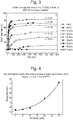
- Foams were prepared at 2 wt. % SDS, 0.48 wt. % MFC (in aqueous phase) and varying soybean oil fraction: 0.5 wt. %, 10 wt. %, 20 wt. %, 30 wt. %, 40 wt. %, 50 wt. %, 60 wt. %, and 70 wt. % oil. It has been quite surprisingly found that foams become denser and creamier with increasing oil fraction since increased oil is normally associated with decreased foam. Up to 60 wt. %, the foam is still fluid-like and, at 70 wt. %, the foam becomes a creamy paste.
- Figure 3 shows water drains fast within first 200-400 minutes and slows down afterwards.
- the amount of water drainage up to 1500 minutes is 80 ml, which is lower than the total aqueous volume before blending, 100 ml, while at the same time foam volume is around zero ( Figure 3 ). This is believed to occur because oil creams and packs water closely in between.
- the amount of water drainage reduces and, after 900 minutes, there is still water remaining in the network.
- the percentage of water drainage up to 900 minutes in Figure 3 is approximately 80%, 70%, 65%, 50%, 30%, 10% and 0% for foam containing 0 wt. %, 5 wt. %, 10 wt.
- the fitted characteristic decay time of the change in water drainage is close to that obtained from the fitting of foam volume (see Figure 4 ).
Landscapes
- Chemical & Material Sciences (AREA)
- Life Sciences & Earth Sciences (AREA)
- Engineering & Computer Science (AREA)
- Wood Science & Technology (AREA)
- Chemical Kinetics & Catalysis (AREA)
- Oil, Petroleum & Natural Gas (AREA)
- Organic Chemistry (AREA)
- Health & Medical Sciences (AREA)
- Molecular Biology (AREA)
- Emergency Medicine (AREA)
- Detergent Compositions (AREA)
- Cosmetics (AREA)
Claims (13)
- Reinigungszusammensetzung, umfassenda. Wasser;b. 0,01 bis 70 Gew.-% eines oder mehrerer Waschmitteltenside; undc. 1-70 Gew.-% einer mit Wasser nicht mischbaren zweiten Phase auf Öl-Basis; undd. 0,1 bis 6 Gew.-% defibrilliertes primäres Zellwandmaterial, umfassend Mikrofibrillen in der wässrigen Phase, wobei die Defibrillation durchgeführt wird, indem das primäre Zellwandmaterial einer starken Scherung unterworfen wird, ausgewählt unter einer Hochdruckhomogenisierung bei einem Druck zwischen 500 und 2000 bar und einer Mikrofluidisierung bei einem Druck zwischen 500 und 2000 bar;wobei das primäre Zellwandmaterial von pflanzlichem Parenchymgewebe stammt und mindestens 80 Gew.-% der Mikrofibrillen im Durchmesser kleiner als 50 nm sind.
- Reinigungszusammensetzung nach Anspruch 1, wobei diese einen Zusammensetzungshomogenitätsparameter CHP von mindestens 0,031, vorzugsweise von mindestens 0,032, bevorzugter von mindestens 0,033, sogar bevorzugter von mindestens 0,040 und noch bevorzugter vom mindestens 0,050, aufweist.
- Zusammensetzung nach irgendeinem der Ansprüche 1 oder 2, umfassend von 0,2 bis 60 Gew.-%, bevorzugter von 0,5 bis 50 Gew.-%, sogar bevorzugter von 1 bis 40 Gew.-%, noch bevorzugter von 5 bis 35 Gew.-%, noch bevorzugter von 10 bis 30 Gew.-% und sogar noch bevorzugter von 15 bis 25 Gew.-% des einen oder der mehreren Tenside.
- Reinigungszusammensetzung nach irgendeinem der Ansprüche 1 bis 3, wobei das eine oder die mehreren Waschmitteltenside unter einem oder mehreren anionischen Tensiden, kationischen Tensiden, nicht-ionischen Tensiden, amphoteren Tensiden und zwitterionischen Tensiden ausgewählt sind.
- Reinigungszusammensetzung nach irgendeinem der vorhergehenden Ansprüche, umfassend von 0,2 bis 1,0 Gew.-% des defibrillierten primären Zellwandmaterials.
- Reinigungszusammensetzung nach irgendeinem der vorhergehenden Ansprüche, wobei die nicht-mischbare Phase auf Öl-Basis flüssig ist und aus der Gruppe, bestehend aus Silikonöl, Triglyceridöl, Mineralöl, ätherischen Ölen und Mischungen davon, ausgewählt ist.
- Reinigungszusammensetzung nach irgendeinem der vorhergehenden Ansprüche, wobei die nicht-mischbare Phase auf Öl-Basis fest ist und aus der Gruppe, bestehend aus gelierten Ölen, strukturierten Ölen und Mischungen davon, ausgewählt ist.
- Verfahren zur Herstellung einer Reinigungszusammensetzung, wobei die Reinigungszusammensetzung umfassta. Wasser;b. 0,01 bis 70 Gew.-% eines oder mehrerer Waschmitteltenside; undc. 0,1 bis 6 Gew.-% defibrilliertes primäres Zellwandmaterial, umfassend Mikrofibrillen in der wässrigen Phase;d. 1-70 Gew.-% einer mit Wasser nicht mischbaren Phase auf Öl-Basis;und wobei
das primäre Zellwandmaterial von pflanzlichem Parenchymgewebe stammt, wobei mindestens 80 Gew.-% der Mikrofibrillen im Durchmesser kleiner als 50 nm sind; und wobei das Verfahren die Schritte umfasst:i. Bereitstellen einer Quelle von primärem Zellwandmaterial;ii. Dispergieren des primären Zellwandmaterials in einer wässrigen Phase, um dadurch eine wässrige Dispersion zu bilden, umfassend zwischen 0,1 und 6 Gew.-% des primären Zellwandmaterials;iii. Behandeln der wässrigen Dispersion, um eine Dispersion zu erhalten, umfassend defibrilliertes primäres Zellwandmaterial, wobei die Behandlung einen Behandlungsschritt mit hoher Scherung umfasst, ausgewählt unter einer Hochdruckhomogenisierung bei einem Druck zwischen 500 und 2000 bar und einer Mikrofluidisierung bei einem Druck zwischen 500 und 2000 bar;wobei andere Bestandteile der Reinigungszusammensetzung unabhängig voneinander vor dem Schritt ii, zwischen den Schritten ii und iii und nach dem Schritt iii in die wässrige Phase gemischt werden. - Verfahren nach Anspruch 8, wobei der Behandlungsschritt der hohen Scherung eine Hochdruckhomogenisierung bei einem Druck zwischen 500 und 1000 bar, bevorzugter zwischen 600 und 800 bar, ist.
- Verfahren nach Anspruch 8 oder 9, wobei die Behandlung im Schritt iii derartig ist, dass nach dieser Behandlung der Faserhomogenitätsparameter FHP des defibrillierten primären Zellwandmaterials mindestens 0,022 beträgt.
- Verfahren nach irgendeinem der Ansprüche 8 bis 10, wobei die Behandlung im Schritt iii derartig ist, dass nach der Behandlung der Faserdefibrillationsparameter FDP des defibrillierten primären Zellwandmaterials mindestens 0,10 Hz beträgt.
- Reinigungszusammensetzung, erhältlich durch das Verfahren nach mindestens einem der Ansprüche 8 bis 11.
- Verwendung eines defibrillierten Zellwandmaterials, umfassend Mikrofibrillen, wobei die Defibrillation, wie im Anspruch 1 bezeichnet, durchgeführt wird, und eine mit Wasser nicht mischbare Phase auf Öl-Basis, um die Schaumstabilität einer Reinigungszusammensetzung, umfassend Wasser, 1 bis 70 Gew.-% der mit Wasser nicht mischbaren Phase auf Öl-Basis und 0,01 bis 70 Gew.-% eines oder mehrerer Waschmitteltenside, zu steigern , wobei eine wässrige Phase der Reinigungszusammensetzung einen Zusammensetzungshomogenitätsparameter CHP von mindestens 0,030 aufweist.
Applications Claiming Priority (2)
| Application Number | Priority Date | Filing Date | Title |
|---|---|---|---|
| EP17165453 | 2017-04-07 | ||
| PCT/EP2018/056869 WO2018184824A1 (en) | 2017-04-07 | 2018-03-19 | Cleaning composition with a second dispersed phase |
Publications (2)
| Publication Number | Publication Date |
|---|---|
| EP3607035A1 EP3607035A1 (de) | 2020-02-12 |
| EP3607035B1 true EP3607035B1 (de) | 2020-07-29 |
Family
ID=58501351
Family Applications (1)
| Application Number | Title | Priority Date | Filing Date |
|---|---|---|---|
| EP18711945.8A Active EP3607035B1 (de) | 2017-04-07 | 2018-03-19 | Reinigungszusammensetzung mit einer zweiten dispergierten phase |
Country Status (6)
| Country | Link |
|---|---|
| US (1) | US11421184B2 (de) |
| EP (1) | EP3607035B1 (de) |
| CN (1) | CN110494542B (de) |
| BR (1) | BR112019020034B1 (de) |
| MX (1) | MX378956B (de) |
| WO (1) | WO2018184824A1 (de) |
Families Citing this family (1)
| Publication number | Priority date | Publication date | Assignee | Title |
|---|---|---|---|---|
| EP3757196B1 (de) | 2019-06-28 | 2025-07-16 | The Procter & Gamble Company | Flüssige handspülmittelzusammensetzung |
Family Cites Families (26)
| Publication number | Priority date | Publication date | Assignee | Title |
|---|---|---|---|---|
| US4374702A (en) * | 1979-12-26 | 1983-02-22 | International Telephone And Telegraph Corporation | Microfibrillated cellulose |
| GB2245281B (en) | 1990-05-29 | 1993-03-31 | Kao Corp | Less irritative detergent composition |
| EP0799292A4 (de) | 1994-12-03 | 2000-03-08 | Procter & Gamble | Reinigungsmittel |
| GB9510837D0 (en) | 1995-05-27 | 1995-07-19 | Procter & Gamble | Cleansing compositions |
| FR2739394B1 (fr) | 1995-10-03 | 1997-12-05 | Rhone Poulenc Chimie | Formulations detartrantes et nettoyantes a base de microfibrilles de cellulose |
| EP1053282A1 (de) | 1998-02-06 | 2000-11-22 | Monsanto Company | Säurestabile und kationisch-veträgliche zellulosezusammensetzungen und verfahren zur herstellung |
| FR2824265A1 (fr) | 2001-05-03 | 2002-11-08 | Oreal | Creme cosmetique moussante contenant des fibres |
| US9045716B2 (en) | 2006-11-08 | 2015-06-02 | Cp Kelco U.S., Inc. | Surfactant thickened systems comprising microfibrous cellulose and methods of making same |
| US7776807B2 (en) * | 2008-07-11 | 2010-08-17 | Conopco, Inc. | Liquid cleansing compositions comprising microfibrous cellulose suspending polymers |
| EP2196186A1 (de) | 2008-12-15 | 2010-06-16 | KPSS-Kao Professional Salon Services GmbH | Reinigungsmittelzusammensetzung |
| US8697041B2 (en) | 2010-08-10 | 2014-04-15 | Conopco, Inc. | Anti-dandruff compositions with citrus fibers |
| IN2013MN00618A (de) | 2010-10-22 | 2015-06-12 | Unilever Plc | |
| FR2969925B1 (fr) | 2011-01-04 | 2012-12-28 | Oreal | Composition anhydre moussante |
| WO2013016031A1 (en) * | 2011-07-27 | 2013-01-31 | The Procter & Gamble Company | Multiphase liquid detergent composition |
| US20140378362A1 (en) | 2012-01-18 | 2014-12-25 | Conopco, Inc., D/B/A Unilever | Hair treatment composition |
| BR112014026429B1 (pt) | 2012-04-23 | 2022-02-01 | Unilever Ip Holdings B.V. | Composição detergente líquida isotrópica aquosa externamente estruturada |
| ES2615274T3 (es) | 2012-07-27 | 2017-06-06 | Koninklijke Coöperatie Cosun U.A. | Agente estructurante para detergente y productos de cuidado personal líquidos |
| KR20150040308A (ko) * | 2012-07-31 | 2015-04-14 | 허큘레스 인코포레이티드 | 안정화된 다상 수성 조성물 |
| BR112015011842A2 (pt) | 2012-11-27 | 2017-07-11 | Unilever Nv | composição de tratamento oral, dentifrício e método de limpeza das superfícies da cavidade oral. |
| WO2014142651A1 (en) | 2013-03-15 | 2014-09-18 | Koninklijke Coöperatie Cosun U.A. | Stabilization of suspended solid particles and/or gas bubbles in aqueous fluids |
| EP2824169A1 (de) | 2013-07-12 | 2015-01-14 | The Procter & Gamble Company | Strukturierte Textilpflegemittel |
| WO2016107793A1 (en) | 2014-12-31 | 2016-07-07 | Unilever N.V. | Cleaning composition |
| MY188687A (en) * | 2015-07-14 | 2021-12-22 | Unilever Plc | Cleaning composition |
| US20170015949A1 (en) * | 2015-07-16 | 2017-01-19 | The Procter & Gamble Company | Cleaning compositions containing a cyclic amine and an encapsulated perfume |
| US10421931B2 (en) * | 2016-07-21 | 2019-09-24 | The Procter & Gamble Company | Cleaning composition with insoluble quaternized cellulose particles and an external structurant |
| US10266793B2 (en) * | 2016-09-30 | 2019-04-23 | Novaflux, Inc. | Compositions for cleaning and decontamination |
-
2018
- 2018-03-19 WO PCT/EP2018/056869 patent/WO2018184824A1/en not_active Ceased
- 2018-03-19 CN CN201880023495.6A patent/CN110494542B/zh active Active
- 2018-03-19 EP EP18711945.8A patent/EP3607035B1/de active Active
- 2018-03-19 US US16/499,885 patent/US11421184B2/en active Active
- 2018-03-19 MX MX2019011921A patent/MX378956B/es unknown
- 2018-03-19 BR BR112019020034-7A patent/BR112019020034B1/pt active IP Right Grant
Non-Patent Citations (1)
| Title |
|---|
| None * |
Also Published As
| Publication number | Publication date |
|---|---|
| EP3607035A1 (de) | 2020-02-12 |
| WO2018184824A1 (en) | 2018-10-11 |
| US11421184B2 (en) | 2022-08-23 |
| CN110494542A (zh) | 2019-11-22 |
| BR112019020034B1 (pt) | 2023-09-26 |
| US20200115658A1 (en) | 2020-04-16 |
| BR112019020034A2 (pt) | 2020-04-28 |
| MX2019011921A (es) | 2019-11-25 |
| MX378956B (es) | 2025-03-11 |
| CN110494542B (zh) | 2021-05-07 |
Similar Documents
| Publication | Publication Date | Title |
|---|---|---|
| US10752863B2 (en) | Cleaning composition | |
| EP3322792B1 (de) | Reinigungszusammensetzung | |
| Yang et al. | Effects of sucrose addition on the rheology and microstructure of κ-carrageenan gel | |
| DE69216955T2 (de) | Flüssiges Wäschewaschmittel | |
| Zhang et al. | Facile isolation of cellulose nanofibrils from agro-processing residues and its improved stabilization effect on gelatin emulsion | |
| US11421184B2 (en) | Cleaning composition with a second dispersed phase and microfibrillated cellulose | |
| Den Ouden et al. | Particle size distribution in tomato concentrate and effects on rheological properties | |
| CN107105705A (zh) | 冷冻甜点 | |
| EP3439621B1 (de) | Wässrige schäumende reinigungszusammensetzungen enthaltend n-acyl salze von polycarbonsäuren und pflanzliche mikrofasern | |
| EP3558018B1 (de) | Zusammensetzung mit einer strukturierten kontinuierlichen ölphase | |
| EP3558016B1 (de) | Wasser-in-öl-emulsion | |
| BR112019016510B1 (pt) | Concentrado comestível contínuo em óleo, produtoalimentício particulado para sabor, processo depreparação de um concentrado comestível e uso | |
| EP3558017B1 (de) | Zusammensetzung mit einer strukturierten kontinuierlichen ölphase | |
| US20200054037A1 (en) | Composition comprising a structured continuous oil phase | |
| CN112545935A (zh) | 一种纳米包裹表面活性剂组合物及其制备方法 |
Legal Events
| Date | Code | Title | Description |
|---|---|---|---|
| STAA | Information on the status of an ep patent application or granted ep patent |
Free format text: STATUS: UNKNOWN |
|
| STAA | Information on the status of an ep patent application or granted ep patent |
Free format text: STATUS: THE INTERNATIONAL PUBLICATION HAS BEEN MADE |
|
| PUAI | Public reference made under article 153(3) epc to a published international application that has entered the european phase |
Free format text: ORIGINAL CODE: 0009012 |
|
| STAA | Information on the status of an ep patent application or granted ep patent |
Free format text: STATUS: REQUEST FOR EXAMINATION WAS MADE |
|
| 17P | Request for examination filed |
Effective date: 20190911 |
|
| AK | Designated contracting states |
Kind code of ref document: A1 Designated state(s): AL AT BE BG CH CY CZ DE DK EE ES FI FR GB GR HR HU IE IS IT LI LT LU LV MC MK MT NL NO PL PT RO RS SE SI SK SM TR |
|
| AX | Request for extension of the european patent |
Extension state: BA ME |
|
| GRAP | Despatch of communication of intention to grant a patent |
Free format text: ORIGINAL CODE: EPIDOSNIGR1 |
|
| STAA | Information on the status of an ep patent application or granted ep patent |
Free format text: STATUS: GRANT OF PATENT IS INTENDED |
|
| DAV | Request for validation of the european patent (deleted) | ||
| DAX | Request for extension of the european patent (deleted) | ||
| INTG | Intention to grant announced |
Effective date: 20200320 |
|
| GRAS | Grant fee paid |
Free format text: ORIGINAL CODE: EPIDOSNIGR3 |
|
| GRAA | (expected) grant |
Free format text: ORIGINAL CODE: 0009210 |
|
| STAA | Information on the status of an ep patent application or granted ep patent |
Free format text: STATUS: THE PATENT HAS BEEN GRANTED |
|
| AK | Designated contracting states |
Kind code of ref document: B1 Designated state(s): AL AT BE BG CH CY CZ DE DK EE ES FI FR GB GR HR HU IE IS IT LI LT LU LV MC MK MT NL NO PL PT RO RS SE SI SK SM TR |
|
| REG | Reference to a national code |
Ref country code: CH Ref legal event code: EP |
|
| REG | Reference to a national code |
Ref country code: AT Ref legal event code: REF Ref document number: 1295806 Country of ref document: AT Kind code of ref document: T Effective date: 20200815 |
|
| REG | Reference to a national code |
Ref country code: IE Ref legal event code: FG4D |
|
| REG | Reference to a national code |
Ref country code: DE Ref legal event code: R096 Ref document number: 602018006493 Country of ref document: DE |
|
| REG | Reference to a national code |
Ref country code: LT Ref legal event code: MG4D |
|
| REG | Reference to a national code |
Ref country code: NL Ref legal event code: MP Effective date: 20200729 |
|
| REG | Reference to a national code |
Ref country code: AT Ref legal event code: MK05 Ref document number: 1295806 Country of ref document: AT Kind code of ref document: T Effective date: 20200729 |
|
| PG25 | Lapsed in a contracting state [announced via postgrant information from national office to epo] |
Ref country code: NO Free format text: LAPSE BECAUSE OF FAILURE TO SUBMIT A TRANSLATION OF THE DESCRIPTION OR TO PAY THE FEE WITHIN THE PRESCRIBED TIME-LIMIT Effective date: 20201029 Ref country code: FI Free format text: LAPSE BECAUSE OF FAILURE TO SUBMIT A TRANSLATION OF THE DESCRIPTION OR TO PAY THE FEE WITHIN THE PRESCRIBED TIME-LIMIT Effective date: 20200729 Ref country code: PT Free format text: LAPSE BECAUSE OF FAILURE TO SUBMIT A TRANSLATION OF THE DESCRIPTION OR TO PAY THE FEE WITHIN THE PRESCRIBED TIME-LIMIT Effective date: 20201130 Ref country code: LT Free format text: LAPSE BECAUSE OF FAILURE TO SUBMIT A TRANSLATION OF THE DESCRIPTION OR TO PAY THE FEE WITHIN THE PRESCRIBED TIME-LIMIT Effective date: 20200729 Ref country code: ES Free format text: LAPSE BECAUSE OF FAILURE TO SUBMIT A TRANSLATION OF THE DESCRIPTION OR TO PAY THE FEE WITHIN THE PRESCRIBED TIME-LIMIT Effective date: 20200729 Ref country code: GR Free format text: LAPSE BECAUSE OF FAILURE TO SUBMIT A TRANSLATION OF THE DESCRIPTION OR TO PAY THE FEE WITHIN THE PRESCRIBED TIME-LIMIT Effective date: 20201030 Ref country code: SE Free format text: LAPSE BECAUSE OF FAILURE TO SUBMIT A TRANSLATION OF THE DESCRIPTION OR TO PAY THE FEE WITHIN THE PRESCRIBED TIME-LIMIT Effective date: 20200729 Ref country code: BG Free format text: LAPSE BECAUSE OF FAILURE TO SUBMIT A TRANSLATION OF THE DESCRIPTION OR TO PAY THE FEE WITHIN THE PRESCRIBED TIME-LIMIT Effective date: 20201029 Ref country code: HR Free format text: LAPSE BECAUSE OF FAILURE TO SUBMIT A TRANSLATION OF THE DESCRIPTION OR TO PAY THE FEE WITHIN THE PRESCRIBED TIME-LIMIT Effective date: 20200729 Ref country code: AT Free format text: LAPSE BECAUSE OF FAILURE TO SUBMIT A TRANSLATION OF THE DESCRIPTION OR TO PAY THE FEE WITHIN THE PRESCRIBED TIME-LIMIT Effective date: 20200729 |
|
| PG25 | Lapsed in a contracting state [announced via postgrant information from national office to epo] |
Ref country code: IS Free format text: LAPSE BECAUSE OF FAILURE TO SUBMIT A TRANSLATION OF THE DESCRIPTION OR TO PAY THE FEE WITHIN THE PRESCRIBED TIME-LIMIT Effective date: 20201129 Ref country code: PL Free format text: LAPSE BECAUSE OF FAILURE TO SUBMIT A TRANSLATION OF THE DESCRIPTION OR TO PAY THE FEE WITHIN THE PRESCRIBED TIME-LIMIT Effective date: 20200729 Ref country code: RS Free format text: LAPSE BECAUSE OF FAILURE TO SUBMIT A TRANSLATION OF THE DESCRIPTION OR TO PAY THE FEE WITHIN THE PRESCRIBED TIME-LIMIT Effective date: 20200729 Ref country code: LV Free format text: LAPSE BECAUSE OF FAILURE TO SUBMIT A TRANSLATION OF THE DESCRIPTION OR TO PAY THE FEE WITHIN THE PRESCRIBED TIME-LIMIT Effective date: 20200729 |
|
| PG25 | Lapsed in a contracting state [announced via postgrant information from national office to epo] |
Ref country code: NL Free format text: LAPSE BECAUSE OF FAILURE TO SUBMIT A TRANSLATION OF THE DESCRIPTION OR TO PAY THE FEE WITHIN THE PRESCRIBED TIME-LIMIT Effective date: 20200729 |
|
| PG25 | Lapsed in a contracting state [announced via postgrant information from national office to epo] |
Ref country code: IT Free format text: LAPSE BECAUSE OF FAILURE TO SUBMIT A TRANSLATION OF THE DESCRIPTION OR TO PAY THE FEE WITHIN THE PRESCRIBED TIME-LIMIT Effective date: 20200729 Ref country code: SM Free format text: LAPSE BECAUSE OF FAILURE TO SUBMIT A TRANSLATION OF THE DESCRIPTION OR TO PAY THE FEE WITHIN THE PRESCRIBED TIME-LIMIT Effective date: 20200729 Ref country code: CZ Free format text: LAPSE BECAUSE OF FAILURE TO SUBMIT A TRANSLATION OF THE DESCRIPTION OR TO PAY THE FEE WITHIN THE PRESCRIBED TIME-LIMIT Effective date: 20200729 Ref country code: DK Free format text: LAPSE BECAUSE OF FAILURE TO SUBMIT A TRANSLATION OF THE DESCRIPTION OR TO PAY THE FEE WITHIN THE PRESCRIBED TIME-LIMIT Effective date: 20200729 Ref country code: RO Free format text: LAPSE BECAUSE OF FAILURE TO SUBMIT A TRANSLATION OF THE DESCRIPTION OR TO PAY THE FEE WITHIN THE PRESCRIBED TIME-LIMIT Effective date: 20200729 Ref country code: EE Free format text: LAPSE BECAUSE OF FAILURE TO SUBMIT A TRANSLATION OF THE DESCRIPTION OR TO PAY THE FEE WITHIN THE PRESCRIBED TIME-LIMIT Effective date: 20200729 |
|
| REG | Reference to a national code |
Ref country code: DE Ref legal event code: R097 Ref document number: 602018006493 Country of ref document: DE |
|
| PG25 | Lapsed in a contracting state [announced via postgrant information from national office to epo] |
Ref country code: AL Free format text: LAPSE BECAUSE OF FAILURE TO SUBMIT A TRANSLATION OF THE DESCRIPTION OR TO PAY THE FEE WITHIN THE PRESCRIBED TIME-LIMIT Effective date: 20200729 |
|
| PLBE | No opposition filed within time limit |
Free format text: ORIGINAL CODE: 0009261 |
|
| STAA | Information on the status of an ep patent application or granted ep patent |
Free format text: STATUS: NO OPPOSITION FILED WITHIN TIME LIMIT |
|
| PG25 | Lapsed in a contracting state [announced via postgrant information from national office to epo] |
Ref country code: SK Free format text: LAPSE BECAUSE OF FAILURE TO SUBMIT A TRANSLATION OF THE DESCRIPTION OR TO PAY THE FEE WITHIN THE PRESCRIBED TIME-LIMIT Effective date: 20200729 |
|
| 26N | No opposition filed |
Effective date: 20210430 |
|
| REG | Reference to a national code |
Ref country code: DE Ref legal event code: R081 Ref document number: 602018006493 Country of ref document: DE Owner name: UNILEVER GLOBAL IP LIMITED, WIRRAL, GB Free format text: FORMER OWNER: UNILEVER N.V., ROTTERDAM, NL |
|
| PG25 | Lapsed in a contracting state [announced via postgrant information from national office to epo] |
Ref country code: MC Free format text: LAPSE BECAUSE OF FAILURE TO SUBMIT A TRANSLATION OF THE DESCRIPTION OR TO PAY THE FEE WITHIN THE PRESCRIBED TIME-LIMIT Effective date: 20200729 |
|
| REG | Reference to a national code |
Ref country code: CH Ref legal event code: PL |
|
| REG | Reference to a national code |
Ref country code: BE Ref legal event code: MM Effective date: 20210331 |
|
| PG25 | Lapsed in a contracting state [announced via postgrant information from national office to epo] |
Ref country code: LU Free format text: LAPSE BECAUSE OF NON-PAYMENT OF DUE FEES Effective date: 20210319 Ref country code: IE Free format text: LAPSE BECAUSE OF NON-PAYMENT OF DUE FEES Effective date: 20210319 Ref country code: LI Free format text: LAPSE BECAUSE OF NON-PAYMENT OF DUE FEES Effective date: 20210331 Ref country code: CH Free format text: LAPSE BECAUSE OF NON-PAYMENT OF DUE FEES Effective date: 20210331 |
|
| REG | Reference to a national code |
Ref country code: GB Ref legal event code: 732E Free format text: REGISTERED BETWEEN 20220127 AND 20220202 |
|
| PG25 | Lapsed in a contracting state [announced via postgrant information from national office to epo] |
Ref country code: BE Free format text: LAPSE BECAUSE OF NON-PAYMENT OF DUE FEES Effective date: 20210331 |
|
| P01 | Opt-out of the competence of the unified patent court (upc) registered |
Effective date: 20230428 |
|
| PG25 | Lapsed in a contracting state [announced via postgrant information from national office to epo] |
Ref country code: CY Free format text: LAPSE BECAUSE OF FAILURE TO SUBMIT A TRANSLATION OF THE DESCRIPTION OR TO PAY THE FEE WITHIN THE PRESCRIBED TIME-LIMIT Effective date: 20200729 |
|
| PG25 | Lapsed in a contracting state [announced via postgrant information from national office to epo] |
Ref country code: HU Free format text: LAPSE BECAUSE OF FAILURE TO SUBMIT A TRANSLATION OF THE DESCRIPTION OR TO PAY THE FEE WITHIN THE PRESCRIBED TIME-LIMIT; INVALID AB INITIO Effective date: 20180319 |
|
| PG25 | Lapsed in a contracting state [announced via postgrant information from national office to epo] |
Ref country code: SI Free format text: LAPSE BECAUSE OF FAILURE TO SUBMIT A TRANSLATION OF THE DESCRIPTION OR TO PAY THE FEE WITHIN THE PRESCRIBED TIME-LIMIT Effective date: 20200729 |
|
| PG25 | Lapsed in a contracting state [announced via postgrant information from national office to epo] |
Ref country code: MK Free format text: LAPSE BECAUSE OF FAILURE TO SUBMIT A TRANSLATION OF THE DESCRIPTION OR TO PAY THE FEE WITHIN THE PRESCRIBED TIME-LIMIT Effective date: 20200729 |
|
| PG25 | Lapsed in a contracting state [announced via postgrant information from national office to epo] |
Ref country code: TR Free format text: LAPSE BECAUSE OF FAILURE TO SUBMIT A TRANSLATION OF THE DESCRIPTION OR TO PAY THE FEE WITHIN THE PRESCRIBED TIME-LIMIT Effective date: 20200729 |
|
| PG25 | Lapsed in a contracting state [announced via postgrant information from national office to epo] |
Ref country code: MT Free format text: LAPSE BECAUSE OF FAILURE TO SUBMIT A TRANSLATION OF THE DESCRIPTION OR TO PAY THE FEE WITHIN THE PRESCRIBED TIME-LIMIT Effective date: 20200729 |
|
| PGFP | Annual fee paid to national office [announced via postgrant information from national office to epo] |
Ref country code: GB Payment date: 20260324 Year of fee payment: 9 |
|
| PGFP | Annual fee paid to national office [announced via postgrant information from national office to epo] |
Ref country code: DE Payment date: 20260319 Year of fee payment: 9 |
|
| PGFP | Annual fee paid to national office [announced via postgrant information from national office to epo] |
Ref country code: FR Payment date: 20260320 Year of fee payment: 9 |