EP3606906B1 - Heterogeneous catalysts for the direct carbonylation of nitro aromatic compounds to isocyanates - Google Patents
Heterogeneous catalysts for the direct carbonylation of nitro aromatic compounds to isocyanates Download PDFInfo
- Publication number
- EP3606906B1 EP3606906B1 EP18713991.0A EP18713991A EP3606906B1 EP 3606906 B1 EP3606906 B1 EP 3606906B1 EP 18713991 A EP18713991 A EP 18713991A EP 3606906 B1 EP3606906 B1 EP 3606906B1
- Authority
- EP
- European Patent Office
- Prior art keywords
- rhsb
- metallic material
- mixture
- range
- multi metallic
- Prior art date
- Legal status (The legal status is an assumption and is not a legal conclusion. Google has not performed a legal analysis and makes no representation as to the accuracy of the status listed.)
- Active
Links
Images

Classifications
-
- C—CHEMISTRY; METALLURGY
- C07—ORGANIC CHEMISTRY
- C07C—ACYCLIC OR CARBOCYCLIC COMPOUNDS
- C07C263/00—Preparation of derivatives of isocyanic acid
- C07C263/14—Preparation of derivatives of isocyanic acid by catalytic reaction of nitro compounds with carbon monoxide
-
- B—PERFORMING OPERATIONS; TRANSPORTING
- B01—PHYSICAL OR CHEMICAL PROCESSES OR APPARATUS IN GENERAL
- B01J—CHEMICAL OR PHYSICAL PROCESSES, e.g. CATALYSIS OR COLLOID CHEMISTRY; THEIR RELEVANT APPARATUS
- B01J23/00—Catalysts comprising metals or metal oxides or hydroxides, not provided for in group B01J21/00
- B01J23/38—Catalysts comprising metals or metal oxides or hydroxides, not provided for in group B01J21/00 of noble metals
- B01J23/54—Catalysts comprising metals or metal oxides or hydroxides, not provided for in group B01J21/00 of noble metals combined with metals, oxides or hydroxides provided for in groups B01J23/02 - B01J23/36
- B01J23/56—Platinum group metals
- B01J23/62—Platinum group metals with gallium, indium, thallium, germanium, tin or lead
-
- B—PERFORMING OPERATIONS; TRANSPORTING
- B01—PHYSICAL OR CHEMICAL PROCESSES OR APPARATUS IN GENERAL
- B01J—CHEMICAL OR PHYSICAL PROCESSES, e.g. CATALYSIS OR COLLOID CHEMISTRY; THEIR RELEVANT APPARATUS
- B01J23/00—Catalysts comprising metals or metal oxides or hydroxides, not provided for in group B01J21/00
- B01J23/38—Catalysts comprising metals or metal oxides or hydroxides, not provided for in group B01J21/00 of noble metals
- B01J23/54—Catalysts comprising metals or metal oxides or hydroxides, not provided for in group B01J21/00 of noble metals combined with metals, oxides or hydroxides provided for in groups B01J23/02 - B01J23/36
- B01J23/56—Platinum group metals
- B01J23/62—Platinum group metals with gallium, indium, thallium, germanium, tin or lead
- B01J23/622—Platinum group metals with gallium, indium, thallium, germanium, tin or lead with germanium, tin or lead
- B01J23/626—Platinum group metals with gallium, indium, thallium, germanium, tin or lead with germanium, tin or lead with tin
-
- B—PERFORMING OPERATIONS; TRANSPORTING
- B01—PHYSICAL OR CHEMICAL PROCESSES OR APPARATUS IN GENERAL
- B01J—CHEMICAL OR PHYSICAL PROCESSES, e.g. CATALYSIS OR COLLOID CHEMISTRY; THEIR RELEVANT APPARATUS
- B01J23/00—Catalysts comprising metals or metal oxides or hydroxides, not provided for in group B01J21/00
- B01J23/38—Catalysts comprising metals or metal oxides or hydroxides, not provided for in group B01J21/00 of noble metals
- B01J23/54—Catalysts comprising metals or metal oxides or hydroxides, not provided for in group B01J21/00 of noble metals combined with metals, oxides or hydroxides provided for in groups B01J23/02 - B01J23/36
- B01J23/56—Platinum group metals
- B01J23/62—Platinum group metals with gallium, indium, thallium, germanium, tin or lead
- B01J23/622—Platinum group metals with gallium, indium, thallium, germanium, tin or lead with germanium, tin or lead
- B01J23/628—Platinum group metals with gallium, indium, thallium, germanium, tin or lead with germanium, tin or lead with lead
-
- B—PERFORMING OPERATIONS; TRANSPORTING
- B01—PHYSICAL OR CHEMICAL PROCESSES OR APPARATUS IN GENERAL
- B01J—CHEMICAL OR PHYSICAL PROCESSES, e.g. CATALYSIS OR COLLOID CHEMISTRY; THEIR RELEVANT APPARATUS
- B01J23/00—Catalysts comprising metals or metal oxides or hydroxides, not provided for in group B01J21/00
- B01J23/38—Catalysts comprising metals or metal oxides or hydroxides, not provided for in group B01J21/00 of noble metals
- B01J23/54—Catalysts comprising metals or metal oxides or hydroxides, not provided for in group B01J21/00 of noble metals combined with metals, oxides or hydroxides provided for in groups B01J23/02 - B01J23/36
- B01J23/56—Platinum group metals
- B01J23/64—Platinum group metals with arsenic, antimony, bismuth, vanadium, niobium, tantalum, polonium, chromium, molybdenum, tungsten, manganese, technetium or rhenium
- B01J23/644—Arsenic, antimony or bismuth
- B01J23/6445—Antimony
-
- B—PERFORMING OPERATIONS; TRANSPORTING
- B01—PHYSICAL OR CHEMICAL PROCESSES OR APPARATUS IN GENERAL
- B01J—CHEMICAL OR PHYSICAL PROCESSES, e.g. CATALYSIS OR COLLOID CHEMISTRY; THEIR RELEVANT APPARATUS
- B01J23/00—Catalysts comprising metals or metal oxides or hydroxides, not provided for in group B01J21/00
- B01J23/38—Catalysts comprising metals or metal oxides or hydroxides, not provided for in group B01J21/00 of noble metals
- B01J23/54—Catalysts comprising metals or metal oxides or hydroxides, not provided for in group B01J21/00 of noble metals combined with metals, oxides or hydroxides provided for in groups B01J23/02 - B01J23/36
- B01J23/56—Platinum group metals
- B01J23/64—Platinum group metals with arsenic, antimony, bismuth, vanadium, niobium, tantalum, polonium, chromium, molybdenum, tungsten, manganese, technetium or rhenium
- B01J23/656—Manganese, technetium or rhenium
- B01J23/6562—Manganese
-
- B—PERFORMING OPERATIONS; TRANSPORTING
- B01—PHYSICAL OR CHEMICAL PROCESSES OR APPARATUS IN GENERAL
- B01J—CHEMICAL OR PHYSICAL PROCESSES, e.g. CATALYSIS OR COLLOID CHEMISTRY; THEIR RELEVANT APPARATUS
- B01J23/00—Catalysts comprising metals or metal oxides or hydroxides, not provided for in group B01J21/00
- B01J23/70—Catalysts comprising metals or metal oxides or hydroxides, not provided for in group B01J21/00 of the iron group metals or copper
- B01J23/76—Catalysts comprising metals or metal oxides or hydroxides, not provided for in group B01J21/00 of the iron group metals or copper combined with metals, oxides or hydroxides provided for in groups B01J23/02 - B01J23/36
- B01J23/84—Catalysts comprising metals or metal oxides or hydroxides, not provided for in group B01J21/00 of the iron group metals or copper combined with metals, oxides or hydroxides provided for in groups B01J23/02 - B01J23/36 with arsenic, antimony, bismuth, vanadium, niobium, tantalum, polonium, chromium, molybdenum, tungsten, manganese, technetium or rhenium
- B01J23/889—Manganese, technetium or rhenium
- B01J23/8892—Manganese
-
- B—PERFORMING OPERATIONS; TRANSPORTING
- B01—PHYSICAL OR CHEMICAL PROCESSES OR APPARATUS IN GENERAL
- B01J—CHEMICAL OR PHYSICAL PROCESSES, e.g. CATALYSIS OR COLLOID CHEMISTRY; THEIR RELEVANT APPARATUS
- B01J37/00—Processes, in general, for preparing catalysts; Processes, in general, for activation of catalysts
- B01J37/02—Impregnation, coating or precipitation
- B01J37/0215—Coating
-
- B—PERFORMING OPERATIONS; TRANSPORTING
- B01—PHYSICAL OR CHEMICAL PROCESSES OR APPARATUS IN GENERAL
- B01J—CHEMICAL OR PHYSICAL PROCESSES, e.g. CATALYSIS OR COLLOID CHEMISTRY; THEIR RELEVANT APPARATUS
- B01J37/00—Processes, in general, for preparing catalysts; Processes, in general, for activation of catalysts
- B01J37/02—Impregnation, coating or precipitation
- B01J37/03—Precipitation; Co-precipitation
- B01J37/031—Precipitation
- B01J37/035—Precipitation on carriers
-
- B—PERFORMING OPERATIONS; TRANSPORTING
- B01—PHYSICAL OR CHEMICAL PROCESSES OR APPARATUS IN GENERAL
- B01J—CHEMICAL OR PHYSICAL PROCESSES, e.g. CATALYSIS OR COLLOID CHEMISTRY; THEIR RELEVANT APPARATUS
- B01J37/00—Processes, in general, for preparing catalysts; Processes, in general, for activation of catalysts
- B01J37/08—Heat treatment
-
- B—PERFORMING OPERATIONS; TRANSPORTING
- B01—PHYSICAL OR CHEMICAL PROCESSES OR APPARATUS IN GENERAL
- B01J—CHEMICAL OR PHYSICAL PROCESSES, e.g. CATALYSIS OR COLLOID CHEMISTRY; THEIR RELEVANT APPARATUS
- B01J37/00—Processes, in general, for preparing catalysts; Processes, in general, for activation of catalysts
- B01J37/16—Reducing
-
- C—CHEMISTRY; METALLURGY
- C07—ORGANIC CHEMISTRY
- C07C—ACYCLIC OR CARBOCYCLIC COMPOUNDS
- C07C265/00—Derivatives of isocyanic acid
- C07C265/12—Derivatives of isocyanic acid having isocyanate groups bound to carbon atoms of six-membered aromatic rings
-
- C—CHEMISTRY; METALLURGY
- C07—ORGANIC CHEMISTRY
- C07C—ACYCLIC OR CARBOCYCLIC COMPOUNDS
- C07C265/00—Derivatives of isocyanic acid
- C07C265/14—Derivatives of isocyanic acid containing at least two isocyanate groups bound to the same carbon skeleton
Definitions
- the present invention relates to a process for the direct carbonylation of nitro aromatic compounds to aromatic isocyanates and to the use of a heterogeneous catalyst for the direct carbonylation of nitro aromatic compounds to aromatic.
- a catalyst employed for the carbonylation of 2,4-dinitrotoluene comprising a mixture of a palladium complex with isoquinoline and Fe 2 Mo 7 O 24 , as disclosed in DE 2165355 .
- 2,4-toluylendiisocyanate is obtained in a maximum yield of 70% at a 100% conversion of the starting compound 2,4-dinitrotoluene.
- pyridine is used instead of isoquinoline, the yield is 21-76 % at 83-100 % conversion of the starting compound, as disclosed in FR 2,120,110 .
- Step 1 Production of nitrocreasenes corresponding to Step 1 (Scheme 1), which can be also seen as selective reduction of nitrobenzene to nitrosobenzene, is possible with Mn-containing catalysts.
- DE1810828 discloses catalysts systems of general formula M x Mn y O z , wherein M is Co, Fe, Pb or Ag, as selective reduction catalyst for nitrobenzene to nitrosobenzene.
- the oxidic compound comprising Mn and Pb in the ratio of 70/30 provides yields of 4.53% of nitrosobenzene per hour of reaction.
- GB 1 315 813 A describes the heterogeneously catalyzed carbonylation of nitroso- and nitroaromatic compounds to isocyanates in the presence of physical mixtures of M x Mn y O z , wherein M is Fe, Ag or Pb, with platinum group metals selected form Pd, Ru and Rh supported on carriers such as carbon or pumice.
- Nitrobenzene is carbonylated to phenyl isocyanate in the presence of a physical mixture of Pb x Mn y O z , and 5% Rh on carbon.
- the reported isocyanate yield is 4.5% after 2 h at 190°C.
- the object of the present invention is to provide heterogeneous catalysts having high activity and selectivity for the heterogeneously catalysed process enabling synthesis of isocyanates via direct carbonylation.
- Direct carbonylation in the sense of the present invention is to be understood as carrying out reaction steps 1 and 2 in a one pot manner without isolation of intermediates.
- the intermediates like nitroso compounds or partially carbonylated nitro aromatic compounds may be obtained as a result of an incomplete reaction.
- the goal of the present invention is to provide a process for the carbonylation of nitroaromatic compounds to the corresponding isocyanate showing significant improvement in activity and selectivity.
- the object of the invention is solved by a process for preparing an aromatic isocyanate by direct carbonylation of a nitro aromatic compound by reacting the nitro aromatic compound with carbon monoxide in the presence of a catalyst, characterized in that the catalyst contains a multi metallic material comprising one or more binary intermetallic phases of the general formula A x B y wherein:
- the process according to the invention is performed as a heterogeneous catalyzed process
- the catalyst and reactant(s)/product(s) are in different phases, which are in contact with each other.
- the reactant(s)/product(s) are in the liquid phase and gas phase, whereas the catalyst will be in a solid phase.
- the reaction will take place at the interphase between liquid phase, gas phase and solid phase.
- the process according to the invention is carried out in the presence of a catalyst.
- the catalyst comprises a multi metallic material comprising one or more binary intermetallic phases of the general formula A x B y wherein
- Examples for intermetallic phases according to this invention are RhPb, RhPb 2 , Rh 4 Pb 5 , Rh 2 Sn, RhSn, RhSn 2 , RhSn 4 , Rh 2 Sb, RhSb, RhSb 2 , RhSb 3 , wherein RhPb, RhPb 2 , RhSb, Rh 2 Sb, RhSb 2 and Rh 2 Sn are the preferred ones.
- zeolite-supports as specified below. This includes supports comprising one or more zeolites, microporous molecular sieves, alumosilicates and alumophosphates as well as mixtures of zeolites with binary, polynary and or non-stoichiometric oxides.
- alloys solid solution alloys, partial solution alloys and intermetallic compounds are also included as well as compounds referred to be metal compounds in terms of this invention.
- group of supports are binary and polynary oxidic supports comprising one or more elements from the main groups (excluding noble gases and halides), transition elements and or lanthanides in combination with Oxygen and their respective modifications.
- the support material can be provided as powder, dispersion, colloid, granulates, shaped bodies like rings, spheres, extrudates, pellets and other shaped bodies known to the skilled in the art.
- Preferred support materials are carbon,binary and polynary oxides and mixtures of binary and polynary oxides.
- the object of the invention is solved by a process for preparing an aromatic isocyanate by direct carbonylation of a nitroaromatic compound by reacting the nitroaromatic compound with carbon monoxide in the presence of a catalyst, characterized in that the catalyst contains a multi metallic material as specified hereinbefore comprising one or more of binary intermetallic phases of the general formula A x B y with or without a component C.
- the present invention provides a process for synthesis of isocyanates from nitro aromatics and carbon monoxide comprising the following steps:
- the concentration of component D in mixture M1 is in the range of from 40 wt.-% to 99,99 wt.-%, more preferred in the range of from 50wt.-% to 99,9 wt.-%, and further preferred in the range of from 60 wt.-% to 99 wt.-%.
- Suitable nitroaromatic compounds (or nitroaromatics) to be reacted according to this invention are single or polyaromatic compounds with one or more nitro groups like nitrobenzene, dinitrobenzene, nitrotoluene, dinitrotoluene, trinitrotoluene, nitronaphthaline, nitroanthracene, nitrodiphenyl, bis(nitrophenyl)methane and further single and polyaromatic compounds having one or more nitro groups.
- the nitroaromatic compounds may also contain other functional groups.
- functional groups are substituents connected to the aromatic ring. Functional groups can contain one or more heteroatoms selected from the group consisting of H, B, C, N, P, O, S, F, Cl, Br and I.
- nitroorganic compounds containing one or more nitro groups bonded to an aliphatic chain or side chain or ring such as 1,6-dinitrohexene or nitrocyclohexene, nitrocyclo-pentene, nitromethane, nitrooctane, and bis-(nitrocyclohexyl)-methane.
- the reagent stream M1 may contain one or more components D comprising solvents S, additives X and inert gases G.
- Suitable solvents S are aprotic organic solvents like arenes and substituted arenes such as chlorobenzene, dichlorobenzene, benzene, toluene, 1,2-diphenylebenzene, 1,2-dimethylnaphthalin, hexadecylbenzene, Solvesso 150 ND and Solvesso 200 ND.
- the solvent can also be an Isocyanate corresponding to the respective nitroaromatic compound.
- the invention is conducted in batch reactors, cascade of batch reactors, semibatch reactors or continuous reactors.
- Suitable reactors are stirred tank reactors, loop reactors, loop-venturi-reactors, loop reactors with reversed flow, oscillatory flow reactors, tube reactors, slurry reactors, packed bed reactors, trickle bed reactors, moving bed reactors, rotary bed reactors, other reactor types known to those skilled in the art and combinations of different reactor types.
- the catalysts comprise one or more binary intermetallic phases of the general formula A x B y wherein
- the multi metallic material is deposited on a support material, in general a crystalline or amorphous support material.
- the support material comprises carbon, graphite, graphene or an intercalation compound.
- the support material comprises a carbide, nitride, boride, silicide, phosphide, antimonide, arsenide, sulfide, selenide or telluride.
- the support material comprises one or more of binary and polynary oxides like MgO, CaO, ZnO, CeO 2 , SiO 2 , Al 2 O 3 .
- the multi metallic material and the catalyst containing the multi metallic material according to any of the previous embodiments are used for the direct carbonylation of nitroaromatics to isocyanates.
- the production of isocyanates is carried out at a temperature in the range from 50 to 250 °C, preferably from 80 to 190 °C, more preferably from 100 to 170 °C.
- the production of isocyanates is carried out at a total pressure in the range from 1 to 200 bar, preferably from 10 to 150 bar and more preferably from 15 to 100 bar.
- the carbon monoxide partial pressure is in general from 1 to 150 bar, preferably from 1 to 120 bar and more preferably from 1 to 100 bar.
- reaction mixture M2 the partial pressure of carbon monoxide is in the range of from 1 to 150 bar, preferably in the range of from 1 to 120 bar and more preferably in the range of from 1 to 100 bar.
- the preparation of the comparative examples D to G was done by preparing single metal solutions as described in step (i) and impregnating the solutions on an activated carbon support as described in step (ii).
- the impregnation technique that was followed was incipient wetness impregnation.
- a drying Step (iia) at 80°C was performed after the impregnation.
- the amount of metal deposited on the support was 5 wt% of the support mass.
- the respective metal containing components and solvents can be taken from Table 1.
- the amount of metal B was calculated according to the sum formula.
- the composite material was suspended in polyethylene glycol (polyol) and received a reductive treatment as described in step (iii). The reduction was done for 20 minutes at 200°C using a 1000 W microwave oven and N 2 atmosphere. The reduced composite material was separated from the polyol and received a thermal treatment as described in step (iv) for 5 h at 500°C using a muffle furnace and N 2 atmosphere.
- the respective support masses, concentrations and volumes can be taken from Table 3.
- the metal containing components and solvents can be taken from Table 1.
- Rutile 2 Amount of support material [g]. 3: Concentration of solution containing metal A [mol/L]. 4: Total volume of solution containing metal A used for impregnation [ml]. 5: Number of impregnation steps for solution containing metal A. 6: Concentration of solution containing metal B [mol/L]. 7: Total volume of solution containing metal B used for impregnation [ml]. 8: Number of impregnation steps for solution containing metal B. 9: Heating Method. a) Muffle Furnace 500°C; 5h; N 2 atmosphere. b) Microwave oven (1000W) 200°C; 20 minutes; N 2 atmosphere
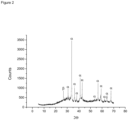
- Figure 2 shows the PXRD pattern of sample J, proving that the multimetallic catalyst consists of the intermetallic compound RhPb 2 ( ⁇ ) on an amorphous carbon support.
- RhPb 2 intermetallic compound
- the reactor used were a tube reactor with a length of 40cm an inner diameter of 0.4 cm. Inside the reactor 1 ml of the respective catalyst sieved to a fraction size of 125-160 ⁇ m was loaded. SiOz was used as pre- and post-bed inert material.
- the reactor was heated to 160°C in N 2 atmosphere for at least 12 h to remove residual water. After that the reactor temperature was set to the desired value.
- reaction mixture was mixed with CO or a mixture of CO & N 2 and fed to the reactor.
- the Liquid flow (LHSV) was set to be between 1 h -1 and 4 h -1 .
- gas flow (GHSV) was set to be between 500 & 3500 h -1 .
- the respective product spectrum was analyzed via a GC-MS unit (GC-MS from Agilent Technologies) equipped with FID, MS and TCD detectors.
- the total conversion of each reaction was calculated as difference of the reactor inlet (feed) concentration of the nitro aromatic compound and the concentration of the nitroaromatic compound in the product mixture divided by the starting concentration of the nitroaromatic compound.
- the concentration of the respective products in the product mixture was identified by GC analytic by using the respective response factors.
- the yield was determined by dividing the respective product concentration (in mmol/kg) by the concentration of the nitroaromatic compound (in mmol/kg) and multiplying the resulting value by the mol(s) of starting nitroaromatic compound needed to generate a mol of the respective product.
- Polymer comprises the products formed which could not be analyzed by the applied GC-method.
- the preparation of the patent examples H to BI was done by preparing separate single metal solutions as described step (i). After that a mixture was prepared from these solutions. The concentration of the single solutions and the respective volume used to prepare the mixture is shown in Table 5. The mixture was impregnated on various supports as described in step (ii). The impregnation technique that was followed was incipient wetness impregnation and a drying Step (iia) was performed at 80°C after each impregnation step.
- the support was prepared from mixture of two oxides.
- the oxides have been mixed physically using a hand mill.
- the obtained oxidic mixture was calcined at 500°C prior to the impregnation.
- the amount of metal A deposited on the support was aimed to be between 1 and 5wt% of the supports mass.
- the amount of metal B was calculated according to the sum formula.
- the composite materials of patent examples H to BI received a reductive & thermal treatment for 5h at 500°C (steps iii & iv) using a muffle furnace and N 2 atmosphere.
- the respective support masses, concentrations and volumes can be taken from Table 5.
- the metal containing components and solvents can be taken from Table 1. Table 5: No.
Landscapes
- Chemical & Material Sciences (AREA)
- Organic Chemistry (AREA)
- Chemical Kinetics & Catalysis (AREA)
- Engineering & Computer Science (AREA)
- Materials Engineering (AREA)
- Physics & Mathematics (AREA)
- Thermal Sciences (AREA)
- Organic Low-Molecular-Weight Compounds And Preparation Thereof (AREA)
- Catalysts (AREA)
- Low-Molecular Organic Synthesis Reactions Using Catalysts (AREA)
Description
- The present invention relates to a process for the direct carbonylation of nitro aromatic compounds to aromatic isocyanates and to the use of a heterogeneous catalyst for the direct carbonylation of nitro aromatic compounds to aromatic.
- The direct carbonylation of nitro aromatic compounds to the corresponding aromatic isocyanates with homogeneous catalysts is reported in the literature. PdCl2(pyridine)2 and Fe(Cyclopentadienyl)2as co-catalyst achieved a selectivity to toluylendiisocyanate (TDI) of 9 to 67% at a dinitrotoluene (DNT) conversion of 82% to 100% as described in (
DE19635723A1 . Major problems that prevent a commercial use are low turnover numbers, difficult catalyst separation, drastic reaction conditions (T=250°C, p=200-300barg), the formation of by-products and the polymerization of TDI. - Known in the art is a catalyst employed for the carbonylation of 2,4-dinitrotoluene comprising a mixture of a palladium complex with isoquinoline and Fe2Mo7O24, as disclosed in
DE 2165355 . 2,4-toluylendiisocyanate is obtained in a maximum yield of 70% at a 100% conversion of the starting compound 2,4-dinitrotoluene. When pyridine is used instead of isoquinoline, the yield is 21-76 % at 83-100 % conversion of the starting compound, as disclosed inFR 2,120,110 US3,823,174 , andUS3,828,089 , respectively. A further homogeneous-heterogeneous catalyst for the synthesis of aromatic monoisocyanates, in particular phenyl isocyanate, is PdCl2 / V2O5, as disclosed inUS 3,523,964 and RhCl3 / germanium powder, as disclosed inUS 3,523,966 . In stark contrast to the current invention the systems described in the aforementioned documents are not truly heterogeneous and correspond to a hybrid system comprising homogenous and heterogeneous components. The drawback is that palladium chloride is present in the liquid phase, which necessitates a complicated system for its separation and regeneration. - Only few heterogeneous catalysts for the carbonylation of DNT to TDI are reported in the literature.
US 4,207,212 reports PdO/MoO3/ZnO as a highly active and selective catalyst for DNT carbonylation. All examples of this patent were carried out in the presence of pyridine as additive. This fact leads to the assumption that the formation of pyridine complexes is needed for achieving the carbonylation of the nitroarenes using these catalysts. - Besides direct conversion of nitroaromatics into isocyanates an indirect conversion with nitro-soaromatic as separable intermediate is also known. The conversion of nitroarenes into nitrosoarenes as well as the conversion of nitrosoarenes into aromatic isocyanates in the presence of carbon monoxide is reported in the literature as two separate reactions. This is also the case if the parent nitroarene has more than one nitro-group. Since the current invention enables direct synthesis of isocyanates, but also the indirect synthesis of isocyanates with nitrosoaromatics as stable intermediates. The corresponding literature is cited below.

- Production of nitrosoarenes corresponding to Step 1 (Scheme 1), which can be also seen as selective reduction of nitrobenzene to nitrosobenzene, is possible with Mn-containing catalysts.
DE1810828 discloses catalysts systems of general formula MxMnyOz, wherein M is Co, Fe, Pb or Ag, as selective reduction catalyst for nitrobenzene to nitrosobenzene. The oxidic compound comprising Mn and Pb in the ratio of 70/30 provides yields of 4.53% of nitrosobenzene per hour of reaction. - Conversion of nitrosobenzene into isocyanate corresponding to Step 2 (Scheme 1) with the same Mn-containing system is not reported. Carbonylation of nitrosoarenes to aromatic isocyanates corresponding to the reaction 2 (Scheme 1) can be carried out with heterogeneous catalyst comprising one or more of Pd, Rh and Ir supported on Al2O3, as reported in
US 3,979,427 . -
GB 1 315 813 A - The object of the present invention is to provide heterogeneous catalysts having high activity and selectivity for the heterogeneously catalysed process enabling synthesis of isocyanates via direct carbonylation. Direct carbonylation in the sense of the present invention is to be understood as carrying out reaction steps 1 and 2 in a one pot manner without isolation of intermediates. However, the intermediates like nitroso compounds or partially carbonylated nitro aromatic compounds may be obtained as a result of an incomplete reaction.
- The goal of the present invention is to provide a process for the carbonylation of nitroaromatic compounds to the corresponding isocyanate showing significant improvement in activity and selectivity.
- The object of the invention is solved by a process for preparing an aromatic isocyanate by direct carbonylation of a nitro aromatic compound by reacting the nitro aromatic compound with carbon monoxide in the presence of a catalyst, characterized in that the catalyst contains a multi metallic material comprising one or more binary intermetallic phases of the general formula AxBy wherein:
- A is Rh,
- B is one or more element selected from Sn, Sb and Pb,
- x is in the
range 0,1 - 10, - y is in the
range 0,1 - 10. - The process according to the invention is performed as a heterogeneous catalyzed process In such a heterogeneous catalyzed process the catalyst and reactant(s)/product(s) are in different phases, which are in contact with each other. The reactant(s)/product(s) are in the liquid phase and gas phase, whereas the catalyst will be in a solid phase. The reaction will take place at the interphase between liquid phase, gas phase and solid phase.
- The process according to the invention is carried out in the presence of a catalyst. The catalyst comprises a multi metallic material comprising one or more binary intermetallic phases of the general formula AxBy wherein
- A is Rh,
- B is one or more elements selected from Sn, Sb and Pb,
- x in AxBy is in the
range 0,1 - 10, preferably from 0,2 to 5, more preferably from 0,5 to 2, - y in AxBy is in the
range 0,1 - 10, preferably from 0,2 to 5, more preferably from 0,5 to 2. - The object of the invention is further solved by providing a continuous, heterogeneous process using a liquid and gas feed together with the multi metallic material.
- In general, a multi metallic material can contain or consist of one or more binary intermetallic phases as of the general formula AxBy as specified hereinbefore. Furthermore, a multi metallic material is defined as a material comprising at least two different metals in a macroscopically homogeneous phase. In general, multi metallic materials contain at least 85 wt.-%, preferably at least 90 wt.-% and more preferably 95 wt.-% of one or more intermetallic phases of the general formula AxBy. The multi metallic material can contain one or more other components C wherein component C can consist of or contain A and/or B not being part of the intermetallic compound AxBy. Component C can also comprise or consist of one or more metallic or non-metallic elements. Preferably component C comprises O, N, C, H, Li, Na, K, Rb, Cs, Mg, Ca, Sr, Ba, Ti,Mn, Fe, Co, Ni, Zn, Ga. In a more preferred embodiment component C comprises O, N, C, H, Mg, Ca, Mn, Fe, Co, Ni, Zn, Ga.
- An intermetallic phase or intermetallic compound in terms of this invention is a compound made from at least two different metals in an ordered or partially ordered structure with defined stoichiometry. The structure can be similar or different to the structure of the pure constituent metals. Examples for intermetallic compounds are ordered, partially ordered and eutectic alloys, Laves-phases, Zintl-phases, Heussler-phases, Hume-Rothary-phases, and other intermetallic phases known to the skilled in the art. Also included are compounds comprising elements belonging to the group of semimetals, like selenides, tellurides, arsenides, antimonides, silizides, germanides and borides.
- Examples for intermetallic phases according to this invention are RhPb, RhPb2, Rh4Pb5, Rh2Sn, RhSn, RhSn2, RhSn4, Rh2Sb, RhSb, RhSb2, RhSb3, wherein RhPb, RhPb2, RhSb, Rh2Sb, RhSb2 and Rh2Sn are the preferred ones.
- The presence of intermetallic phases within the multi metallic material can be detected by standard methods for characterizing solids, like for example electron microscopy, solid state NMR or Powder X-Ray Diffraction (PXRD), wherein PXRD-analysis is preferred.
- In general, the form in which the multi metallic material is provided is not limited.
- The multi metallic material can be used as single compound or in ad mixture with other compounds, wherein deposition on a support by methods comprising shallow bed impregnation, spray impregnation, incipient wetness impregnation, melt impregnation and other impregnation methods known to the skilled in the art are preferred. A description how to deposit a multi metallic material on a support is given below.
- A support material in terms of this invention can be a crystalline or amorphous oxidic material. This includes binary and polynary oxides alike. Examples for suitable binary oxides are: Al2O3, CaO, CeO2, Ce2O3, Fe2O3, La2O3, MgO, MnOz, Mn2O3, SiO2, TiO2, Ti2O3, ZrO2 and ZnO. This specially includes non-stoichiometric or mixed valent oxides wherein the non-oxygen element is present in more than one oxidation state like: CeO2-x, WOx, Fe0,95O Mn3O4, Fe3O4, Ti4O7 and other non-stoichiometric oxides known to the expert. Also included are polynary oxides like for example MgAl2O4, LaAlO3, CaTiO3, CeZrO4 H2Al14Ca12O34. Also included are physical mixtures of binary, polynary and non-stoichiometric oxides.
- Also embodied in the group of oxidic supports are zeolite-supports as specified below. This includes supports comprising one or more zeolites, microporous molecular sieves, alumosilicates and alumophosphates as well as mixtures of zeolites with binary, polynary and or non-stoichiometric oxides. Generally, it is conceivable that the zeolitic framework type is one of ABW, ACO, AEI, AEL, AEN, AET, AFG, AFI, AFN, AFO, AFR, AFS, AFT, AFV, AFX, AFY, AHT, ANA, APC, APD, AST, ASV, ATN, ATO, ATS, ATT, ATV, AVL, AWO, AWW, BCT, BEA, BEC, BIK, BOF, BOG, BOZ, BPH, BRE, BSV, CAN, CAS, CDO, CFI, CGF, CGS, CHA, -CHI, -CLO, CON, CSV, CZP, DAC, DDR, DFO, DFT, DOH, DON, EAB, EDI, EEI, EMT, EON, EPI, ERI, ESV, ETR, EUO, *-EWT, EZT, FAR, FAU, FER, FRA, GIS, GIU, GME, GON, GOO, HEU, IFO, IFR, -IFU, IFW, IFY, IHW, IMF, IRN, IRR, -IRY, ISV, ITE, ITG, ITH, *-ITN, ITR, ITT, -ITV, ITW, IWR, IWS, IWV, IWW, JBW, JNT, JOZ, JRY, JSN, JSR, JST, JSW, KFI, LAU, LEV, LlO, -LIT, LOS, LOV, LTA, LTF, LTJ, LTL, LTN, MAR, MAZ, MEI, MEL, MEP, MER, MFI, MFS, MON, MOR, MOZ, *MRE, MSE, MSO, MTF, MTN, MTT, MTW, MVY, MWF, MWW, NAB, NAT, NES, NON, NPO, NPT, NSI, OBW, OFF, OKO, OSI, OSO, OWE, -PAR, PAU, PCR, PHI, PON, POS, PSI, PUN, RHO, -RON, RRO, RSN, RTE, RTH, RUT, RWR, RWY, SAF, SAO, SAS, SAT, SAV, SBE, SBN, SBS, SBT, SEW, SFE, SFF, SFG, SFH, SFN, SFO, SFS, *SFV, SFW, SGT, SIV, SOD, SOF, SOS, SSF, *-SSO, SSY, STF, STI, *STO, STT, STW, -SVR, SVV, SZR, TER, THO, TOL, TON, TSC, TUN, UEI, UFI, UOS, UOV, UOZ, USI, UTL, UWY, VET, VFI, VNI, VSV, WEI, -WEN, YUG, ZON, or a mixed type of two or more thereof. More preferably, the zeolitic material comprises, more preferably is, one or more of zeolitic materials having a framework structure of type MFI, MOR, BEA, and FAU.
- Further examples for supports are carbon or carbon-like materials like activated carbon, graphite or graphene. Also included are modified carbon-based materials like intercalation compounds and carbides like W-C, B-C, Si-C. Also included are nitrides, borides, silicides, phosphides, antimonides, arsenids, sulfides, selenides and tellurides.
- Also included are alloys, solid solution alloys, partial solution alloys and intermetallic compounds are also included as well as compounds referred to be metal compounds in terms of this invention. Also included in the group of supports are binary and polynary oxidic supports comprising one or more elements from the main groups (excluding noble gases and halides), transition elements and or lanthanides in combination with Oxygen and their respective modifications.
- The support material can be provided as powder, dispersion, colloid, granulates, shaped bodies like rings, spheres, extrudates, pellets and other shaped bodies known to the skilled in the art. Preferred support materials are carbon,binary and polynary oxides and mixtures of binary and polynary oxides.
- The catalyst used according to the invention can be prepared by a method comprising the steps in the order (i) to (iv):
- (i) providing a metal precursor preferably in the form of a solution;
- (ii) deposition of the metal precursor on a support material, optionally followed by drying;
- (iii) reductive treatment of the composite material;
- (iv) thermal treatment of the composite material.
- (i) This step comprises the preparation of the metal precursor by dissolving or diluting a metal containing component like metal salts, colloidal metals or metal organic compounds in a suitable solvent like water, alcohols, polyols, acids, bases and other solvents known to the skilled in the art. This solution can either be prepared as single metal containing solution of A or B or as a multi metal solution containing any concentration of A and B. In a special embodiment an additional solution is prepared containing the promotor component C. In very special embodiment the promotor component can be part of the single metal solution containing A or B or a part of the multi metal solution containing A and B.
- (ii) The metal solution(s) prepared in step (i) are brought onto the support material using standard techniques like shallow bed impregnation, spray impregnation, incipient wetness impregnation, melt impregnation and other impregnation methods known to the skilled in the art. The impregnation can be done in a single step using single or multi metal solutions or mixtures of single and multi-metal solutions. The impregnation can also be done in multiple steps using single or multi metal solutions or mixtures of single and multi-metal solutions in multiple steps. The invention also encloses precipitation techniques wherein the carrier is prepared in situ from the metal solutions or in a separate step. This step also includes one or more drying steps (iia). The product of step (ii) or respectively step (iia) is a composite material.
- (iii) The reductive treatment involves exposing the composite material obtained in step (ii) or respectively step (iia) to a reducing agent or reducing the composite material by thermal reduction. This reducing agent can be provided in solid, liquid or gaseous form. The reducing step can be carried out with or without performing step (iia) before. Reducing agents in terms of this invention are gases like for example H2, CO and gaseous hydrocarbons like CH4, C2H4 and other reducing gases known to the skilled worker, liquid reducing agents like alcohols, hydrocarbons and amines like for example polyols and hydrazine as well as reducing agents provided in solid form like for example metal powder.
- (iv) The thermal treatment of the reduced composite material is done by heating the reduced composite material taken from step (iii) to a desired temperature under chemically inert conditions wherein the gas mixture present does not contain any reactive components that can undergo chemical reaction with the composite material. Particularly the mixture should not comprise oxidizing agents like for example oxygen, water, NOx, halides or there like. The heating can be performed by any method suited to heat solids or wet solids like heating in muffle furnaces, microwaves, rotary kilns, tube furnaces, fluidized bed and other heating devices known to the person skilled in the art.
- In a particular embodiment, steps (iii) and (iv) can be combined into a single step by thermal treatment of the composite material in the presence of a reducing agent or at a temperature where thermal reduction occurs.
- The object of the invention is solved by a process for preparing an aromatic isocyanate by direct carbonylation of a nitroaromatic compound by reacting the nitroaromatic compound with carbon monoxide in the presence of a catalyst, characterized in that the catalyst contains a multi metallic material as specified hereinbefore comprising one or more of binary intermetallic phases of the general formula AxBy with or without a component C.
- The Process can be carried out discontinuously or continuously.
- The present invention provides new catalytic materials able to catalyse reaction steps 1 and 2 of the overall reaction. The catalytic material is not a physical mixture of two separate catalysts, each of which is able to catalyse only one of the two consecutive reaction steps, as disclosed in
GB1315813A - In the document
GB 1 315 813 A - Furthermore, the present invention provides a process for synthesis of isocyanates from nitro aromatics and carbon monoxide comprising the following steps:
- a) providing a reagent mixture M1 comprising nitroaromatics and at least one additional component D wherein D comprises a suitable solvent;
- b1) providing a reagent mixture M2 comprising reagent mixture M1 and carbon monoxide or a mixture of carbon monoxide and inert gas G, and/or
- b2) providing a reaction mixture R1 comprising the reagent mixture M1 and a carbonylation catalyst comprising the multi metallic material which is described in detail above;
- c) contacting the reagent mixture M2 with a carbonylation catalyst comprising preferably consisting of the multi metallic material I) which is described in detail above; and/or
- d) contacting the reagent mixture R1 with carbon monoxide or a mixture of carbon monoxide and inert gas G;
- e) obtaining a reaction mixture comprising isocyanates.
- The above steps may be carried out using either step b1) or b2) or both.
- Preferably the concentration of nitroaromatics in the mixture M1 is in the range in the range of from 0,01wt.-% to 60 wt.-%, more preferred in the range of from 0,1 wt.-% to 50 wt.-%, further preferred in the range of from 1 wt.-% to 40 wt.-%.
- Preferably the concentration of component D in mixture M1 is in the range of from 40 wt.-% to 99,99 wt.-%, more preferred in the range of from 50wt.-% to 99,9 wt.-%, and further preferred in the range of from 60 wt.-% to 99 wt.-%.
- Suitable nitroaromatic compounds (or nitroaromatics) to be reacted according to this invention are single or polyaromatic compounds with one or more nitro groups like nitrobenzene, dinitrobenzene, nitrotoluene, dinitrotoluene, trinitrotoluene, nitronaphthaline, nitroanthracene, nitrodiphenyl, bis(nitrophenyl)methane and further single and polyaromatic compounds having one or more nitro groups. The nitroaromatic compounds may also contain other functional groups. In terms of this invention functional groups are substituents connected to the aromatic ring. Functional groups can contain one or more heteroatoms selected from the group consisting of H, B, C, N, P, O, S, F, Cl, Br and I.
- Examples for functional groups are hydroxyl groups, halogens, aliphatic side chains, carbonyl groups, isocyanate groups, nitroso groups, carboxyl groups and amino groups.
- Also included are nitroorganic compounds containing one or more nitro groups bonded to an aliphatic chain or side chain or ring, such as 1,6-dinitrohexene or nitrocyclohexene, nitrocyclo-pentene, nitromethane, nitrooctane, and bis-(nitrocyclohexyl)-methane.
- A suitable source of nitroaromatics is any source containing at least partially nitroaromatics. The source can be a nitroaromatic freshly provided into the reagent stream M1. Furthermore, nitroaromatics might be an unreacted nitroaromatic that after separation from the product stream is recycled after one or more reprocessing steps. A nitroaromatic can also be a compound which contains at least one nitro and/or at least one nitroso group which is being recycled after its partial conversion with carbon monoxide. A combination of a freshly provided nitroaromatic and a recycled nitroaromatic can be also utilized. Application of nitroaromatic adducts or precursors as for example nitrosoaromatics is also possible.
- Suitable source of carbon monoxide is also any source containing at least partially carbon monoxide. The source can be carbon monoxide freshly provided into the reagent stream M1. Furthermore, carbon monoxide might be an unreacted carbon monoxide that after separation from the product stream is recycled after one or more reprocessing steps. A combination of a freshly provided carbon monoxide and recycled carbon monoxide can be also utilized. Application of carbon monoxide adducts or precursors as for example formic acid is also possible.
- In addition to nitroaromatics and optionally carbon monoxide the reagent stream M1 may contain one or more components D comprising solvents S, additives X and inert gases G.
- Suitable solvents S are aprotic organic solvents like arenes and substituted arenes such as chlorobenzene, dichlorobenzene, benzene, toluene, 1,2-diphenylebenzene, 1,2-dimethylnaphthalin, hexadecylbenzene, Solvesso 150 ND and Solvesso 200 ND.
- Other suitable aprotic solvents are (cyclo)alkanes and substituted (cyclo)alkanes such as n-alkanes, cycloalkanes, chloroform, dichloromethane, diphenylmethane, dibenzyl.
- Other suitable solvents are open chain and cyclic ethers such as dioctylether or THF.
- Preferred solvents with a boiling point in range from 50°C to 300°C, more preferred from 100°C to 275°C, and further preferred from 125° to 255°C.
- The solvent can also be an Isocyanate corresponding to the respective nitroaromatic compound.
- Suitable inert gases G comprise gases such as nitrogen, helium, neon, argon or carbon dioxide from which nitrogen, argon and carbon dioxide are preferred.
- The carbonylation is generally carried out at a temperature in the range of from 50 to 250 °C, preferably in the range of from 80 to 190 °C, and more preferably in the range of from 100 to 170 °C.
- Total pressure during the reaction is in the range of from 1 to 200 bar, preferably from 10 to 150 bar and more preferably in the range of from 15 to 100 bar.
- The partial pressure of carbon monoxide is in the range of from 1 to 150 bar, preferably in the range of from 1 to 120 bar and more preferably in the range of from 1 to 100 bar.
- In general contacting of the reaction mixture M1 with the catalyst comprising preferably consisting of the multi metallic material and with carbon monoxide can be carried out in a continuous or discontinuous manner.
- Preferably the invention is conducted in batch reactors, cascade of batch reactors, semibatch reactors or continuous reactors. Suitable reactors are stirred tank reactors, loop reactors, loop-venturi-reactors, loop reactors with reversed flow, oscillatory flow reactors, tube reactors, slurry reactors, packed bed reactors, trickle bed reactors, moving bed reactors, rotary bed reactors, other reactor types known to those skilled in the art and combinations of different reactor types.
- In one set up the reaction comprises the following reaction steps:
- a) providing a reagent mixture M1 comprising nitroaromatics and at least one additional component D wherein D comprises a suitable solvent;
- b) providing a reaction mixture R1 comprising the reagent mixture M1 and a carbonylation catalyst comprising the multi metallic material which is described in detail above;
- c) contacting the reaction mixture R1 with carbon monoxide or a mixture of carbon monoxide and inert gas G;
- d) obtaining a reaction mixture comprising isocyanates.
- In an alternative set up the reaction steps can also be follows:
- a) providing a reagent mixture M1 comprising nitroaromatics and at least one additional component D wherein D comprises a suitable solvent;
- b) providing a reagent mixture M2 comprising reagent mixture M1 and carbon monoxide or a mixture of carbon monoxide and inert gas G, to obtain reagent mixture M2;
- c) contacting the reagent mixture M2 with a carbonylation catalyst comprising preferably consisting the multi metallic material I) which is described in detail above;
- d) obtaining a reaction mixture comprising isocyanates.
- In general reaction mixture R1 contains the carbonylation catalyst comprising the multi metallic material. The concentration of the carbonylation catalyst is in the range of from 0.1 to 10 wt.-%, preferably in the range of 0.1 to 7.5 wt.-%, and more preferably in the range of 0.1 to 5 wt.-%.
- In general, the reaction mixture R1 is contacted with carbon monoxide from 0.5 to 24 h, preferably from 2 to 20 h, and more preferably from 4 to 12 h.
- In general, within reaction mixture M2 the partial pressure of carbon monoxide is in the range of from 1 to 150 bar, preferably in the range of from 1 to 120 bar and more preferably in the range of from 1 to 100 bar.
- The catalysts comprise one or more binary intermetallic phases of the general formula AxBy wherein
- A is Rh;
- B is one of more elements selected from the group consisting of Pb, Sn and Sb.
- Preferably, the multi metallic material consist to at least 85 wt.-%, more preferably to at least 90 wt.-% and even more preferably to at least 95 wt.-% of one or more of intermetallic phases AxBy.
- In one embodiment, the multi metallic material contains one or more components C, wherein component C consist or contains A and/or B not being part of the intermetallic compound AxBy. In a further embodiment, the multi metallic material contains one or more components C, wherein component C comprise or consists of one or more elements selected from the group consisting of O, N, C, H, Li, Na, K, Rb, Cs, Mg, Ca, Sr and Ba, Ti, Mn, Fe, Co, Ni, Zn, Ga preferably one or more elements from the group consisting of O, N, C, H, Mg, Ca, Mn, Fe, Co, Ni, Zn and Ga.
- Preferably, the multi metallic material is deposited on a support material, in general a crystalline or amorphous support material. In a first preferred embodiment, the support material comprises carbon, graphite, graphene or an intercalation compound. In a second preferred embodiment, the support material comprises a carbide, nitride, boride, silicide, phosphide, antimonide, arsenide, sulfide, selenide or telluride. In a third preferred embodiment, the support material comprises one or more of binary and polynary oxides like MgO, CaO, ZnO, CeO2, SiO2, Al2O3. TiO2, ZrO2, Mn2O3, Fe2O3, Fe3O4, MgAl2O4, LaAlO3, CaTiO3, CeZrO4 H2Al14Ca12O34 and other binary and polynary oxides known to the skilled in the art in their respective modifications. In a fourth preferred embodiment, the support material comprises, preferably consist of one or more zeolitic materials, wherein the zeolitic material preferably has a framework structure of the type ZSM, MFI, MOR, BEA or FAU.
- The support material can be provided in a form comprising powders, dispersions, colloids, granulates, shaped bodies like rings, spheres, extrudates or pellets.
- The multimetallic material preferably comprises one or more intermetallic crystalline phases selected from RhPb, RhPb2, Rh4Pb5, Rh2Sn, RhSn, RhSn2, RhSn4, Rh2Sb, RhSb, RhSb2 and RhSb3. Particularly multi metallic materials contain one or more intermetallic crystalline phases selected from RhPb, RhPb2, RhSb, Rh2Sb, RhSb2 and Rh2Sn.
- The multimetallic material of any of the previous embodiments is obtainable by a method comprising the steps (i) to (iv):
- (i) providing a metal precursor preferably in the form of a solution;
- (ii) deposition of the metal precursor on a support material;
(iia) optional drying step; - (iii) reductive treatment of the composite material;
- (iv) thermal treatment of the composite material.
- In step (i), a mixture comprising a solvent and one or more sources for A, B and C is prepared wherein the solvent comprises one or more of water, alcohols, polyols, acids and bases.
- In step (ii), the mixture prepared according to step (i) is brought into contact with the support material using a method selected from shallow bed impregnation, spray impregnation, incipient wetness impregnation and melt impregnation. For solvent removal, a method selected from evaporation, heating or freeze drying is preferably used. Also included are precipitation techniques wherein the carrier material is prepared in situ from the metal solutions or in a separate step. This technique also includes an optional drying step.
- The reductive treatment step and thermal treatment steps (iii) and (iv) preferably comprise
- (iii) contacting the material obtained in step (ii) with one or more of reducing agent or wherein the reducing agent can be provided in solid, liquid or gaseous form and comprise alcohols, hydrocarbons, amines, polyols, Zn-powder, H2, CO, CH4 and C2H4;
- (iv) reducing the material obtained in step (iii) by thermal reduction under chemically inert conditions.
- The thermal treatment comprises heating the material prepared under chemically inert conditions, preferably under inert gases like gases like nitrogen, argon and helium. The heating can be carried out in muffle furnaces, microwaves, rotary kilns, tube furnaces and fluidized beds.
- The multi metallic material and the catalyst containing the multi metallic material according to any of the previous embodiments are used for the direct carbonylation of nitroaromatics to isocyanates.
- In general, the process for the synthesis of isocyanates from nitroaromatics and carbon monoxide comprises steps a) to d):
- a) providing a reagent mixture M1 comprising nitroaromatics and at least one additional component D wherein D comprises a suitable solvent;
- b1) providing a reagent mixture M2 comprising reagent mixture M1 and carbon monoxide or a mixture of carbon monoxide and inert gas G, and/or
- b2) providing a reaction mixture R1 comprising the reagent mixture M1 and a carbonylation catalyst comprising the multi metallic material which is described in detail above;
- c) contacting the reagent mixture M2 with a carbonylation catalyst comprising preferably consisting of the multi metallic material I) which is described in detail above; and/or
- d) contacting the reagent mixture R1 with carbon monoxide or a mixture of carbon monoxide and inert gas G;
- e) obtaining a reaction mixture comprising isocyanates.
- The concentration of nitroaromatics in the mixture M1 is in general in the range of from 0,01 wt.-% to 60 wt.-%, more preferred in the range of from 0.1 wt.-% to 50 wt.-%, and further preferred in the range of from 0,1wt.-% to 40 wt.-%. The concentration of component D in mixture M1 is in general in the range of from 40 wt.-% to 99 wt.-%, more preferred in the range of from 50 wt.-% to 99 wt.-%, and further preferred in the range of from 60 wt.-% to 99 wt.-%.
- Suitable nitro aromatic compounds comprise single or polyaromatic compounds with one or more nitro groups: nitrobenzene, dinitrobenzene, nitrotoluene, dinitrotoluene trinitrotoluene, nitronaphthaline, nitroanthracene, nitrodiphenyl, bis(nitrophenyl)methane and further single and polyaromatic compounds having one or more nitro groups. The nitro aromatic compounds may also contain other functional groups. In terms of this invention functional groups are substituents connected to the aromatic ring. Functional groups can contain one or more heteroatoms selected from the group consisting of H, B, C, N, P, O, S, F, Cl, Br and I. Examples for functional groups are hydroxyl groups, halogens, aliphatic side chains, carbonyl groups, isocyanate groups, nitroso groups, carboxyl groups and amino groups.
- Also included are nitro organic compounds containing one or more nitro groups bonded to an aliphatic chain,side chain or ring, such as 1,6-dinitrohexene or nitrocyclohexene, nitrocyclopen-tene, nitromethane, nitrooctane, Bis-(nitrocyclohexyl)-methane.
- In preferred embodiments, the nitroaromatic is provided in one or more of aprotic organic solvents selected from chlorobenzene, dichlorobenzene, benzene, toluene, THF, dioctylether, chloroform, dichloromethane, n-alkanes, cycloalkanes, 1,2-diphenylebenzene, 1-phenylnaphthalin, dibenzyl, 1,2-dimethylnaphthalin, diphenylmethane, hexadecylbenzene, tetradecylbenzene dodecylbenzene or Solvesso 150 ND and Solvesso 200 ND..
- In general, the boiling point of the one or more aprotic organic solvents is in the range from 50°C to 300°C, preferably from 100°C to 275°C, more preferably from 125° to 255°C.
- In a particular embodiment the solvent can be the isocyanate corresponding to the respective nitroaromatic compound.
- In general, the production of isocyanates is carried out at a temperature in the range from 50 to 250 °C, preferably from 80 to 190 °C, more preferably from 100 to 170 °C. In general, the production of isocyanates is carried out at a total pressure in the range from 1 to 200 bar, preferably from 10 to 150 bar and more preferably from 15 to 100 bar. The carbon monoxide partial pressure is in general from 1 to 150 bar, preferably from 1 to 120 bar and more preferably from 1 to 100 bar.
- In a first embodiment, the isocyanates are produced discontinuously in a batch comprising the steps:
- a) providing a reagents mixture M1 comprising nitroaromatic compounds and at least one additional component D wherein D comprise a suitable solvent;
- b) providing a reaction mixture R1 comprising the reagents mixture M1 and a carbonylation catalyst comprising the multi metallic material which is described above;
- c) contacting the reaction mixture R1 with carbon monoxide or a mixture of carbon monoxide and inert gas G;
- d) obtaining a reaction mixture comprising isocyanates.
- In general, the concentration of the carbonylation catalyst the reaction mixture R1 is in the range of from 0.1 to 10 wt.-%, preferably in the range of 0.1 to 7.5 wt.-%, more preferably in the range of 0.2 to 5 wt.-%. The reaction times are in general in the range from 0.5 to 24 h, preferably from 2 to 20 h and more preferably from 4 to 12 h.
- In a second embodiment, the isocyanates are produced continuously in a process comprising the steps:
- a) providing a reagent mixture M1 comprising nitroaromatics and at least one additional component D wherein D comprises a suitable solvent;
- b) providing a reagent mixture M2 comprising reagent mixture M1 and carbon monoxide or a mixture of carbon monoxide or a mixture of carbon monoxide and inert gas G, to obtain reagent mixture M2.
- c) contacting the reagent mixture M2 with a carbonylation catalyst comprising preferably consisting the multi metallic material I) which is described in details above
- d) obtaining a reaction mixture comprising isocyanates.
- In general, within reaction mixture M2 the partial pressure of carbon monoxide is in the range of from 1 to 150 bar, preferably in the range of from 1 to 120 bar and more preferably in the range of from 1 to 100 bar.
-
Figure 1 shows the catalytic results for example catalysts H, I, J according to Table 2. -
Figure 2 shows the PXRD pattern of sample J α: Reflexes of RhPb2. β: Reflex of graphite. -
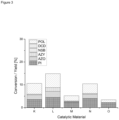
Figure 3 shows the catalytic results for example catalysts K to O, according to Table 3. - For X-Ray powder diffraction (XRPD) data were collected on a Bruker AXS D8 Advance. Cu Kα radiation was used in the data collection. The beam was narrowed using a collimator for line focus (Soller Slit, 2.5°) and a motorized divergence slit. Generator settings of 40 kV and 40 mA were used. Samples were gently ground in a mortar with a pestle and then packed in a round mount. The data collection from the round mount covered a 20 range from 5° to 70° using a step scan with a step size of 0.02° and a count time of 0.2 s per step. DIFFRAC.EVA Software was used for all steps of the data analysis. The phases present in each sample were identified by search and match of the data available from International Centre for Diffraction Data (ICDD, Version 2015).
- Screening in batch reactor was carried out in a series of single experiments, using batch autoclaves made from hastelloy C276. The general experimental procedure for each screening experiment was as follows:
In a first step a reaction mixture was prepared by dissolving nitrobenzene in chlorobenzene. The concentration of nitrobenzene in the reaction mixture was set to be between 1 wt% and 5 wt%. The respective amount of catalyst was placed into the empty reactor and heated to 160°C and 10-1 bar for at least 12 h. In a second step the reaction mixture was charged into the reactor without lowering the temperature or opening the reactor using a specialized charging device. After charging the reaction mixture, the autoclave was heated or cooled to the desired temperature. In a final step the autoclave was pressurized with CO gas and nitrogen gas to the desired total pressure. The reaction mixture was stirred with 1000 rpm for the respective time. - The respective product spectrum was analyzed via a GC-MS unit (GC-MS from Agilent Technologies) equipped with FID, MS and TCD detectors. The total conversion of the reaction was calculated as the difference in starting and end concentration of the nitroaromatic compound divided by the starting concentration of the nitroaromatic compound. The concentration of the respective products in the reaction mixture was identified by GC analytic by using the respective response factors. The yield was determined by dividing the respective product concentration (in mmol/kg) by the starting concentration of the nitroaromatic compound (in mmol/kg) and multiplying the resulting value by the mol(s) of starting nitroaromatic compound needed to generate a mol of the respective product.
- The difference between the combined yields of all products and the total calculated conversion is represented by the term "polymer". "Polymer" comprises the products formed which could not be analyzed by the applied GC-method.
- For the preparation of the samples with a Mn : Pb ratio of 0.7 : 0.3, 0.1752 mol Mn as Mn(NO3)2x6H2O and 0.075 mol Pb as Pb(NO3)2 were dissolved in 1L of DI water under stirring. After the nitrates were dissolved, DI water was added up to 2.5 L. 1.04 mol activated carbon was added to the solution. The pH was adjusted to 10 by adding 8 wt% of a NaOH solution. The product precipitated, and the suspension was stirred for 30 minutes for aging.
- The liquid was separated from the solids by decantation. DI water was added to the solids and stirred for 15 minutes. The procedure was repeated until the pH value was identical to the used DI water. The solids were separated by filtration and dried at 100°C overnight.
- For the preparation of the MnFe samples with a Mn : Fe ratio of 0.8 : 0.2, the above described recipe was applied except the sources for Mn and Fe were not nitrates but chlorides (0.2 mol Mn as MnCl2x4H2O and 0.05 mol Fe as FeCl3x6H2O).
- 1:1 physical mixtures of oxides with 5 wt% Rh or Pd impregnated on activated carbon were prepared according to
GB1315813 A - The preparation of the comparative examples D to G was done by preparing single metal solutions as described in step (i) and impregnating the solutions on an activated carbon support as described in step (ii). The impregnation technique that was followed was incipient wetness impregnation. A drying Step (iia) at 80°C was performed after the impregnation. The amount of metal deposited on the support was 5 wt% of the support mass. The respective metal containing components and solvents can be taken from Table 1.
Table 1 Metal Metal containing component Solvent Rh Rh(NO3)3 H2O Pb Pb(NO3)3 H2O Sb Sb(CH3COO)3 Tataric acid (4M) Sn SnC2O4 Nitric acid (35%) Pd Pd(NO3)2 Nitric acid (35%) In In(NO3)3 H2O Ni Ni(NO3)2 H2O Ga Ga(NO3)3 H2O - Comparative examples A to G were catalytically tested. Table 2 shows the yields of the reduction of nitrobenzene (step 1) and the insertion of CO into nitrosobenzene to form phenyl isocyanate (step 2). For the mixtures of (A) 5 wt% Pd@C and Pb0.3Mn0.7Ox, (B) 5 wt% Rh@C and Pb0.3Mn0.7Ox and (C) 5 wt% Rh@C and Fe0.2Mn0.8Ox the reaction conditions were p = 100 barg, T = 190°C and 6 h reaction time. The physical mixture of (A) 5 wt.% Pd@C and PbxMnyOz yielded no phenyl isocyanate at all, but the formation of nitrosobenzene, azo- and azoxybenzene was observed. However, the other two tested systems, (B) 5 wt% Rh@C and PbxMnyOz and (C) 5 wt% Rh@C and FexMnyOz, yielded the formation of Phenyl isocyanate, azo- and azoxybenzene as well as "polymer".
- For the single metal catalysts D to G, the reaction conditions were p = 100 barg, T = 160°C and 4 h reaction time. No single metal catalysts yield any phenylisocyanate.
Table 2: Results of the comparative examples. PI = Phenyl isocyanate; AZO = Azobenzene; AZY = Azoxybenzene; NSB = Nitrosobenzene; DCD = Diphenylcarbodiamide; POL = Polymer No. Composition PI [%] AZO [%] AZY [%] NSB [%] DCD [%] POL [%] A Pd@C + Pb0,3Mn0,7Ox 0 1.79 20.16 1.50 0 0 B Rh@C + Pb0,3Mn0,7Ox 0.34 5.92 0.42 0 0 9.88 C Rh@C + Fe0,2Mn0,8Ox 3.69 0.92 0.31 0 0 4.58 D 5 wt% Rh@C 0 0 0 0 0 0 E 5 wt% Pb@C 0 0 0.12 0 0 0.3 F 5 wt% Sb@C 0 0 0 0 0 0 G 5 wt% Sn@C 0 0 0 0 0 0 - The results of comparative examples B and C indicate that both steps of the reaction occurred in a one pot synthesis by combining the functionalities of two catalysts, the oxide responsible for step 1 of the reaction and the base metal responsible for step 2 of the reaction.
- The preparation of the patent examples H to J was done by preparing two separate single metal solutions as described step (i). After that a mixture was prepared from these solutions. The concentration of the single solutions and the respective volume used to prepare the mixture is shown in Table 3. The mixture was impregnated on an activated carbon support as described in step (ii). The impregnation technique that was followed was incipient wetness impregnation and a drying Step (iia) was performed at 80°C after each impregnation step.
- The amount of metal A deposited on the support was aimed to be 5 wt% of the supports mass. The amount of metal B was calculated according to the sum formula. After the drying step the composite materials of patent examples H to J received a combined reductive & thermal treatment for 5h at 500°C (steps iii & iv) using a muffle furnace and N2 atmosphere. The respective support masses, concentrations and volumes can be taken from Table 3. The metal containing components and solvents can be taken from Table 1.
- The preparation of the patent examples K to O was done by preparing single metal solutions as described in step (i) and impregnating the solutions consecutively on an oxidic support as described in step (ii). The impregnation technique that was followed was incipient wetness impregnation. For the examples K, L and M the single metal solution containing metal A was impregnated first. For the examples N and O the single metal solution containing metal B was impregnated first. In case of example N and O multiple impregnations for every solution were needed (see Table 3 for details). A drying Step (iia) was performed at 80°C after each impregnation step. The amount of metal A deposited on the support was aimed to be 5wt% of the support mass. The amount of metal B was calculated according to the sum formula. After the final drying step, the composite material was suspended in polyethylene glycol (polyol) and received a reductive treatment as described in step (iii). The reduction was done for 20 minutes at 200°C using a 1000 W microwave oven and N2 atmosphere. The reduced composite material was separated from the polyol and received a thermal treatment as described in step (iv) for 5 h at 500°C using a muffle furnace and N2 atmosphere.
- The respective support masses, concentrations and volumes can be taken from Table 3. The metal containing components and solvents can be taken from Table 1.
Table 3 No. Composition AxBy 1 2 3 4 5 6 7 8 9 H Rh2Sn C 2.5 1.16 1.07 1 1 6.32 1 a I RhSb C 2.5 1.16 1.11 1 1 1.29 1 a J RhPb2 C 2.5 1.16 1.32 1 1 3.04 1 a K RhPb Al2O3 *) 3 1.15 1.41 1 1 1.62 1 b L RhPb2 Al2O3 *) 3 1.15 1.59 1 1 3.65 1 b M RhPb2 Al2O3 **) 3 1.15 1.59 1 1 3.65 1 b N RhPb2 Mn2O3 33.5 1.148 17.75 3 1.5 27.17 5 b O RhSb TiO2 ***) 2.5 1.16 1.11 2 1 1.30 2 b 1: Support material. *) specific surface area: 100 m2
**) specific surface area: 5 m2
***) Rutile
2: Amount of support material [g].
3: Concentration of solution containing metal A [mol/L].
4: Total volume of solution containing metal A used for impregnation [ml].
5: Number of impregnation steps for solution containing metal A.
6: Concentration of solution containing metal B [mol/L].
7: Total volume of solution containing metal B used for impregnation [ml].
8: Number of impregnation steps for solution containing metal B.
9: Heating Method. a)Muffle Furnace 500°C; 5h; N2 atmosphere.
b) Microwave oven (1000W) 200°C; 20 minutes; N2 atmosphere - Table 4and
figure 1 show the results of the reduction of nitrobenzene and insertion of CO in nitrosobenzene. Reaction conditions were p = 100 barg, T = 160°C and 4 h reaction time.Table 4: Results of examples H to O No. Composition PI [%] AZO [%] AZY [%] NSB [%] DCD [%] POL [%] H Rh2Sn@C 2.45 0.40 0 0 0 0.95 I RhSb@C 14.27 0.89 1.87 0 0.30 18.43 J RhPb2@C 26.57 3.21 5.08 0 2.55 20.29 K RhPb@Al2O3 3.60 1.98 0.34 0 0 4.68 L RhPb2@Al2O3 4.50 2.60 1.69 0 0 6.09 M RhPb2@Al2O3 2.46 0.14 0.35 0 0 2.24 N RhPb2@Mn2O3 4.07 1.75 0.39 0 0 4.22 O RhSb@TiO2 2.26 0 0 0 0 1.18 - The results show that - contrary to the single metal catalysts - the multi metallic catalysts yielded phenyl isocyanate as a product.
-
Figure 2 shows the PXRD pattern of sample J, proving that the multimetallic catalyst consists of the intermetallic compound RhPb2 (α) on an amorphous carbon support. However, some traces of graphite (β) coming from the carbon support have been identified, too. In addition, the reflexes of graphite appeared as a consequence of the thermal treatment step. - Screening in a continuous reactor was carried out in a series of experiments, using a trickle bed reactor system. The general experimental procedure for each screening experiment was as follows:
In a first step a reaction mixture was prepared by dissolving nitrobenzene or dinitrotoluene in chlorobenzene. The concentration of the respective nitroaromatic compound in the reaction mixture was set to be between 1 wt% and 3 wt%. - The reactor used were a tube reactor with a length of 40cm an inner diameter of 0.4 cm. Inside the reactor 1 ml of the respective catalyst sieved to a fraction size of 125-160µm was loaded. SiOz was used as pre- and post-bed inert material.
- The reactor was heated to 160°C in N2 atmosphere for at least 12 h to remove residual water. After that the reactor temperature was set to the desired value.
- In a following step the reaction mixture was mixed with CO or a mixture of CO & N2 and fed to the reactor. The Liquid flow (LHSV) was set to be between 1 h-1 and 4 h-1. While the Gas flow (GHSV) was set to be between 500 & 3500 h-1.
- The obtained product mixture was collected over time and analyzed by GC. All experimental details are summarized in Table 6.
- The respective product spectrum was analyzed via a GC-MS unit (GC-MS from Agilent Technologies) equipped with FID, MS and TCD detectors. The total conversion of each reaction was calculated as difference of the reactor inlet (feed) concentration of the nitro aromatic compound and the concentration of the nitroaromatic compound in the product mixture divided by the starting concentration of the nitroaromatic compound. The concentration of the respective products in the product mixture was identified by GC analytic by using the respective response factors. The yield was determined by dividing the respective product concentration (in mmol/kg) by the concentration of the nitroaromatic compound (in mmol/kg) and multiplying the resulting value by the mol(s) of starting nitroaromatic compound needed to generate a mol of the respective product.
- The difference between the combined yields of all products and the total calculated conversion of the nitroaromatic compounds is represented by the term "polymer". "Polymer" comprises the products formed which could not be analyzed by the applied GC-method.
- The preparation of the patent examples H to BI was done by preparing separate single metal solutions as described step (i). After that a mixture was prepared from these solutions. The concentration of the single solutions and the respective volume used to prepare the mixture is shown in Table 5. The mixture was impregnated on various supports as described in step (ii). The impregnation technique that was followed was incipient wetness impregnation and a drying Step (iia) was performed at 80°C after each impregnation step.
- In some examples the support was prepared from mixture of two oxides. In this case the oxides have been mixed physically using a hand mill. The obtained oxidic mixture was calcined at 500°C prior to the impregnation.
- The amount of metal A deposited on the support was aimed to be between 1 and 5wt% of the supports mass. The amount of metal B was calculated according to the sum formula. After the drying step the composite materials of patent examples H to BI received a reductive & thermal treatment for 5h at 500°C (steps iii & iv) using a muffle furnace and N2 atmosphere. The respective support masses, concentrations and volumes can be taken from Table 5. The metal containing components and solvents can be taken from Table 1.
Table 5: No. Composition AxBy 1 2 3 4 5 6 7 8 9 H Rh2Sn C 2,5 0 1.16 1.07 1 1 6.32 1 I RhSb C 2,5 0 1.16 1.11 1 1 1.29 1 J RhPb2 C 2,5 0 1.16 1.32 1 1 3.04 1 O RhSb TiO2**) 2,5 0 1.16 1.11 2 1 1.30 2 P Rh2Sn TiO2**) 2,5 0 1.16 1.07 2 1 6.32 2 Q RhGa TiO2**) 8 0 1,15 3,38 2 2 1,94 2 R Rhln TiO2**) 8 0 1,15 3,38 3 1 3,89 3 S Pd5Sb2 TiO2**) 5 0 3,63 0,65 1 1 0,94 1 T Pd8Sb3 TiO2**) 5 0 3,63 0,65 1 1 0,88 1 U PdPb2 TiO2**) 5 0 3,41 0,69 1 1,5 3,13 2 V RhSb TiO2**) 21,2 0 1,16 1,78 1 1 2,05 1 W RhSb TiO2**) + 5% ZnO 3,8 0,2 1 0,39 1 1 0,33 1 X RhSb TiO2**) + 10% ZnO 10,5 1,17 1 1,14 1 1 1,14 1 Y RhSb TiO2**) + 20% ZnO 3,2 0,8 1 0,39 1 1 0,33 1 Z RhSb TiO2**) + 30% ZnO 2,8 1,2 1 0,39 1 1 0,33 1 AA RhSb TiO2**) + 40% ZnO 2,4 1,6 1 0,39 1 1 0,33 1 AB RhSb TiO2**) + 50% ZnO 1,75 1,75 1 0,34 1 1 0,29 1 AD RhSb TiO2**) + 67% ZnO 0,85 1,65 1 0,24 1 1 0,21 1 AE RhSb ZnO 0 10 1 0,97 1 1 0,97 1 AF RhSb TiO2*) + 10% CaO 3,51 0,39 1,13 0,33 1 1 0,38 1 AG RhSb TiO2**) + 10% CaO 6,08 0,68 1,13 0,58 1 1 0,65 1 AH RhSb TiO2*) + 10% MgO 3,89 0,43 1,13 0,37 1 1 0,42 1 Al RhSb TiO2**) + 10% MgO 5,04 0,56 1,13 0,48 1 1 0,54 1 AJ RhSb TiO2*) +10% V2O5 5,54 0,62 1,13 0,53 1 1 0,6 1 AK RhSb Mn2O3 0 12,2 1,13 1,05 1 1 1,19 1 AL RhSb Mn2O3 + 10% CaO 5,49 0,61 1,13 0,52 1 1 0,59 1 AM RhSb Mn2O3 + 45% Fe2O3 7, 55 6,17 1,13 1,19 1 1 1,35 1 AN RhSb Mn2O3 + 35% Fe2O3 8,99 4,84 1,13 1,19 1 1 1,34 1 AO RhSb Mn2O3 + 25% Fe2O3 10,4 3,48 1,13 1,19 1 1 1,35 1 AP RhSb Mn2O3 + 10% MgO 5,03 0,56 1,13 0,48 1 1 0,54 1 AQ RhSb Mn2O3 + 30% PbO 12,3 5,28 1,13 1,51 1 1 1,71 1 AR RhSb Mn2O3 + 10% ZnO 6,44 0,72 1,13 0,61 1 1 0,69 1 AS RhSb MoO3 7,54 0 1,13 0,65 2 1 0,73 2 AT RhSb MoO3 +10% CaO 5,49 0,61 1,13 0,52 1 1 0,59 1 AU RhSb MoO3 +10% MgO 6,80 0,76 1,13 0,65 1 1 0,73 1 AV RhSb MoO3 +10% ZnO 7,25 0,81 1,13 0,69 1 1 0,78 1 AW RhSb C 3,52 0 1,16 0,29 1 1 0,34 1 AX RhSb Elorit 2 0 1,15 0,89 1 1 1,03 1 AY RhSb Bi2O3 18,2 0 1,13 1,56 2 1 1,77 2 AZ RhSb CaO 10,0 0 1 0,97 1 1 0,97 1 BA RhSb Co2O3 14,6 0 1,13 1,26 2 1 1,42 2 BB RhSb Cr2O3 8,58 0 1,13 0,74 1 1 0,83 1 BC RhSb Fe2O3 7,17 0 1,13 0,62 1 1 0,69 1 BD RhSb Fe3O4 7,39 0 1,13 0,63 1 1 0,71 1 BE RhSb V2O5 5,7 0 1,13 0,49 2 1 0,55 2 BF RhSb WO3 12,6 0 1,13 1,09 1 1 1,23 1 BG RhSb ZrO2 1 0 1,13 0,09 1 1 0,1 1 BH RhSb ZrO2 1 0 1,13 0,09 1 1 0,1 1 BI RhSb ZrWOx 5,79 0 1,13 0,5 1 1 0,56 1 1: Support material. *) specific surface area: >5m2
**) Rutile
2: Amount of support material I [g].
3: Amount of support material II [g].
4: Concentration of solution containing metal A [mol/L].
5: Total volume of solution containing metal A used for impregnation [ml].
6: Number of impregnation steps for solution containing metal A.
7: Concentration of solution containing metal B [mol/L].
8: Total volume of solution containing metal B used for impregnation [ml].
9: Number of impregnation steps for solution containing metal B.Table 6: Overview about experimental parameters. # 1a 2a 3a 4a 5a 6a 7a 8a a NB 1 160 100 100 0 4 2000 b NB 1 120 100 100 0 4 2000 c NB 1 80 100 100 0 4 2000 d 2,4-DNT 1 60 100 100 0 4 2000 e 2,4-DNT 1 80 100 100 0 4 2000 f 2,4-DNT 1 100 100 100 0 4 2000 g 2,4-DNT 1 120 100 100 0 4 2000 h 2,4-DNT 1 80 100 100 0 1 2000 i 2,4-DNT 1 80 100 100 0 4 500 j 2,4-DNT 1 80 100 100 0 1 500 k 2,4-DNT 1 120 100 100 0 1 2000 I 2,4-DNT 1 120 100 100 0 4 500 m 2,4-DNT 1 120 100 100 0 1 500 n 2,4-DNT 1 130 100 100 0 4 2000 o 2,4-DNT 1 140 100 100 0 4 2000 p 2,4-DNT 1 120 100 100 0 1 2750 q 2,4-DNT 1 120 100 100 0 1 3500 r 2,4-DNT 1 140 100 100 0 3 2000 s 2,4-DNT 1 140 100 100 0 2 2000 t 2,4-DNT 1 140 100 100 0 1 2000 v 2,4 DNT & 2,6 DNT 3 140 50 100 0 1 2000 1a: Feed stock
· NB) Nitrobenzene
· 2,4-DNT) 2,4 -Dinitrotoluene
. 2,4-DNT & 2,6-DNT) Mixture of 20 wt% 2,6-DNT & 80wt% 2,4-DNT
2a: Feed concentration [wt%]
3a: Temperature [°C]
4a: Total Pressure [bar]
5a: Concentration of CO [vol%]
6a: Concentration of N2 [vol%]
7a: LHSV (Liquid hourly space velocity) [h-1]
8a: GHSV (Gas hourly space velocity) [h-1]Table 7: Results of catalytic tests in trickle bed set up with nitro benzene: PI = Phenyl isocyanate; AZO = Azobenzene; AZY = Azoxybenzene; NSB = Nitrosobenzene; DCD = Diphenylcarbodiamide; POL = Polymer. X = Total conversion. No. # PI [%] AZO [%] AZY [%] NSB [%] DCD [%] POL [%] I a 32,01 1,71 0,00 0 1,09 65,20 J a 1,67 1,69 18,78 0 0,03 58,53 O a 49,07 2,31 0,00 0 4,10 44,53 H b 7,54 0,30 0,48 0 0,01 10,43 O b 72,20 2,32 1,73 0 1,02 18,96 H c 0,79 0,03 0,09 0 0 2,77 O c 9,93 0,73 0,51 0 0 5,31 - The results show, that isocynates can be produced from nitro aromatic compounds in a continuous process.
Table 8: Results of catalytic tests in trickle bed set up with DNT Feed stock: TDI = 2,4-Toluenediisocyanate; TNI = Toluenenitroisocyanates, AZOC = Azo compounds; AZYC = Azoxy compounds; NSC = Nitroso compounds; AC = Amine compounds; POL = Polymer. No # TDI [%] TNI [%] AZOC [%] AZYC [%] NSC [%] AC [%] POL [%] O d 0,05 11,43 2,01 2,75 0,06 1,01 1,43 O e 0,15 16,65 1,57 2,74 0,15 0,97 1,25 O f 0,89 33,85 1,54 3,60 0,39 1,08 3,10 O g 3,31 55,68 0,99 2,59 0,69 1,05 1,15 O h 0,48 25,22 1,03 1,55 0,19 1,01 1,62 O i 0,00 4,88 0,83 0,32 0,20 0,81 2,79 O j 0,04 6,17 0,81 0,43 0,18 0,84 6,82 O k 35,57 48,82 0,27 0,98 0,41 0,16 10,67 O l 2,73 48,11 0,80 2,03 0,76 1,02 1,23 O m 4,28 48,85 0,76 1,95 0,68 0,93 1,23 O n 5,02 56,79 0,70 2,12 0,78 0,89 8,99 O o 12,90 71,06 0,48 2,09 0,98 0,74 1,20 O p 14,16 70,82 0,40 1,58 0,54 0,68 3,60 O q 14,55 72,89 0,42 1,66 0,55 0,76 1,45 O r 0,00 2,29 0,65 0,36 0,32 0,74 3,51 O s 19,26 69,01 0,28 1,35 0,72 0,69 3,99 O t 47,52 36,47 0,19 0,71 0,36 0,20 14,68 P d 0,04 5,87 0,95 1,28 0,00 1,73 1,26 P e 0,04 5,03 1,40 1,14 0,31 1,44 2,17 P f 0,11 8,75 1,81 1,53 0,89 1,53 5,71 P g 0,12 7,44 1,50 0,66 1,34 1,48 5,15 P h 0,00 1,09 1,40 0,31 0,48 1,43 4,02 P i 0,00 0,14 0,77 0,00 0,14 0,80 1,59 P j 0,00 0,31 0,94 0,09 0,21 1,01 5,70 P k 0,40 9,74 1,48 1,55 1,75 2,54 17,54 P l 0,00 2,35 1,06 0,21 1,00 1,12 4,34 P m 0,08 4,41 1,21 0,44 1,27 1,34 5,76 P n 0,08 4,54 1,21 0,49 1,53 1,31 18,32 P o 0,15 7,65 1,54 0,75 2,13 1,60 7,80 P p 0,15 4,70 2,81 0,77 1,24 3,69 11,38 P q 0,14 4,29 3,02 0,83 1,08 4,01 12,78 P r 0,00 0,04 0,60 0,00 0,00 0,76 2,17 P s 0,16 5,42 1,87 0,66 1,69 2,32 8,43 P t 0,27 7,66 2,41 1,14 1,29 3,24 18,15 - The results show, that nitroaromatic compounds containing multiple nitrogroups can be converted into isocyanates directly. Since the number of structural isomers is increasing with the number of nitro groups the yields are presented as group yields.
- As stated above, the intermediates like nitroso compounds or partially carbonylated nitro aromatic compounds like Toluenenitroisocyanates (TNI) may be obtained as a result of an incomplete reaction, but is still considered as a successful outcome in terms of this invention.
Table 9: Results of catalytic tests in trickle bed set up with DNT Feed stock: TDI = 2,4+2.6-Toluenediisocyanate; TNI = (isomers of Toluenenitroisocyanate, Byproducts = Azo compounds, Azoxy compounds, Nitroso compounds, Amine compounds, Polymer. No # TDI TNI Byproducts Q v 0,00 0,08 7,02 R v 0,06 2,04 17,47 S v 0,00 1,57 11,66 T v 0,00 2,24 5,15 U v 0,00 0,12 5,17 V v 7,00 41,03 20,4 W v 8,48 42,88 44,37 X v 33,81 59,80 5,81 Y v 16,91 39,11 40,35 Z v 19,11 42,01 35,71 AA v 23,51 40,92 32,51 AB v 11,34 58,96 23,51 AD v 19,80 47,35 29,94 AE v 1,68 29,90 43,88 AF v 12,38 61,52 16,15 AG v 18,12 71,15 5,18 AH v 10,09 60,85 13,53 Al v 23,67 64,83 10,08 AJ v 5,73 44,05 28,61 AK t 4,11 45,56 23,93 AL v 18,21 73,10 3,70 AM v 2,34 46,49 9,53 AN v 2,05 43,53 8,41 AO v 2,05 44,31 8,37 AP v 1,77 37,36 17,05 AQ v 0,00 0,21 15,97 AR v 13,60 57,68 17,72 AS v 0,02 2,03 3,84 AT v 0,00 3,36 9,63 AU v 1,65 38,77 8,90 AV v 0,33 16,63 11,89 AW v 5,56 32,18 51,16 AX v 0,19 12,07 12,19 AY v 0,00 0,17 13,84 AZ v 0,00 15,81 25,41 BA v 1,98 34,08 17,09 BB v 0,00 0,24 12,38 BC v 1,72 35,88 15,64 BD v 1,27 31,77 13,40 BE v 0,00 1,91 6,57 BF v 3,30 46,46 14,42 BG v 0,50 16,21 30,92 BH v 0,01 3,07 22,84 BI v 0,00 0,00 8,61
Claims (13)
- A process for preparing an aromatic isocyanate by direct carbonylation of a nitro aromatic compound by reacting the nitro aromatic compound with carbon monoxide in the presence of a catalyst, characterized in that the catalyst contains a multi metallic material comprising one or more binary intermetallic phases of the general formula AxBy wherein:A is Rh,B is one or more element selected from Sn, Sb and Pb,x is in the range 0,1 - 10,y is in the range 0,1 - 10.
- The process according to claim 1, characterized in that the multi metallic material comprises one or more components C, wherein component C contains or consists of A or B not being part of an intermetallic phase AxBy.
- The process according to claim 1 or 2, characterized in that the multi metallic material comprises one or more components C, wherein component C contains or consists of one or more elements selected from O, N, C, H, Mg, Ca, Mn, Fe, Co, Ni, Zn and Ga.
- The process according to any one of claims 1 to 3, characterized in that the multi metallic material is deposited on a carrier material.
- The process according to any one of claims 1 to 4, characterized in that the nitroaromatic compound is selected from nitrobenzene, dinitrobenzene, nitrotoluene, dinitrotoluene, trinitrotoluene, nitronaphthaline, nitroanthracene, nitrodiphenyl, bis(nitrophenyl)methane and further single and polyaromatic compounds having one or more nitro groups.
- The process according to any one of claims 1 to 5, characterized in that it is carried out discontinuously.
- The process according to any one of claims 1 to 6, characterized in that it is carried out continuously.
- Use of a catalyst for the direct carbonylation of a nitroaromatic compound to the corresponding aromatic isocyanate containing a multi metallic material comprising one or more binary intermetallic phases of the general formula AxBy wherein:A is Rh,B is one or more element selected from Sn, Sb and Pb,x is in the range 0,1 - 10.y is in the range 0,1 - 10.
- The use according to claim 8, characterized in that the multi metallic material comprises one or more components C, wherein component C contains or consists of A or B not being part of the intermetallic compound AxBy.
- The use according to claim 8 or 9, characterized in that the multi metallic material comprises one or more components C, wherein component C contains or consists of one or more elements selected from O, N, C, H, Li, Na, K, Rb, Cs, Mg, Ca, Sr, Ba, Ti, Mn, Fe, Co, Ni, Zn and Ga.
- The use according to any one of claims 8 to 10, characterized in that the multi metallic material comprises one or more binary intermetallic crystalline phases selected from RhPb, RhPb2, Rh4Pb5, Rh2Sn, RhSn, RhSn2, RhSn4, Rh2Sb, RhSb, RhSb2 and RhSb3.
- The use according to claim 11, characterized in that the multimetallic material comprises one or more binary intermetallic crystalline phases selected from RhPb, RhPb2, RhSb, Rh2Sb, RhSb2 and Rh2Sn.
- The use according to any one of claims 8 to 12 characterized in that the multi metallic material is deposited on a carrier material.
Applications Claiming Priority (2)
| Application Number | Priority Date | Filing Date | Title |
|---|---|---|---|
| EP17165019 | 2017-04-05 | ||
| PCT/EP2018/058616 WO2018185168A1 (en) | 2017-04-05 | 2018-04-04 | Heterogeneous catalysts for the direct carbonylation of nitro aromatic compounds to isocyanates |
Publications (3)
| Publication Number | Publication Date |
|---|---|
| EP3606906A1 EP3606906A1 (en) | 2020-02-12 |
| EP3606906C0 EP3606906C0 (en) | 2023-12-27 |
| EP3606906B1 true EP3606906B1 (en) | 2023-12-27 |
Family
ID=58578829
Family Applications (1)
| Application Number | Title | Priority Date | Filing Date |
|---|---|---|---|
| EP18713991.0A Active EP3606906B1 (en) | 2017-04-05 | 2018-04-04 | Heterogeneous catalysts for the direct carbonylation of nitro aromatic compounds to isocyanates |
Country Status (10)
| Country | Link |
|---|---|
| US (2) | US11512046B2 (en) |
| EP (1) | EP3606906B1 (en) |
| JP (1) | JP7098653B2 (en) |
| KR (1) | KR102742970B1 (en) |
| CN (1) | CN110719905B (en) |
| CA (1) | CA3059089A1 (en) |
| ES (1) | ES2974887T3 (en) |
| HU (1) | HUE065816T2 (en) |
| SA (1) | SA519410243B1 (en) |
| WO (1) | WO2018185168A1 (en) |
Cited By (1)
| Publication number | Priority date | Publication date | Assignee | Title |
|---|---|---|---|---|
| US12415780B2 (en) | 2017-04-05 | 2025-09-16 | Basf Se | Heterogeneous catalysts for the direct carbonylation of nitro aromatic compounds to isocyanates |
Families Citing this family (12)
| Publication number | Priority date | Publication date | Assignee | Title |
|---|---|---|---|---|
| CN111393328A (en) * | 2020-04-07 | 2020-07-10 | 西安近代化学研究所 | Waste TNT conversion and recycling process |
| CN113231060B (en) * | 2021-05-10 | 2023-03-10 | 中国科学技术大学 | A kind of intermetallic compound composite material and its preparation method and application |
| WO2024008726A1 (en) | 2022-07-05 | 2024-01-11 | Basf Se | A process for producing one or more polymers selected from the group consisting of polyurethanes, polyurethane ureas, polyisocyanurates, and a mixture of two or more thereof, from a solid material w |
| WO2025016860A1 (en) | 2023-07-14 | 2025-01-23 | Basf Se | Process for recycling polyurethane foams |
| WO2025016900A1 (en) | 2023-07-14 | 2025-01-23 | Basf Se | Process for recycling polyurethane waste through remonomerization by hydro ammonolysis |
| CN121666421A (en) | 2023-07-14 | 2026-03-13 | 巴斯夫欧洲公司 | Recovery of polyesterols from polyesterol-based polyurethanes by hydrolysis and recondensation |
| WO2025016920A1 (en) | 2023-07-14 | 2025-01-23 | Basf Se | Process for autocatalytic hydroglycolytic or hydrolytic cleavage of waste streams containing polyurethane |
| CN121487992A (en) | 2023-07-14 | 2026-02-06 | 巴斯夫欧洲公司 | Recycling of PU-soft foam containing grafted polyol contents |
| WO2025190721A1 (en) | 2024-03-13 | 2025-09-18 | Basf Se | Method for recycling a polymer material from a vehicle scrap material |
| WO2025262151A2 (en) | 2024-06-19 | 2025-12-26 | Basf Se | Process for recycling polyurethane waste through remonomerization by hydroaminolysis |
| WO2025262140A1 (en) | 2024-06-19 | 2025-12-26 | Basf Se | Process for recycling waste material |
| WO2026068450A1 (en) | 2024-09-24 | 2026-04-02 | Basf Se | Process for preparing a polyisocyanate mixture comprising methylene diphenyl diisocyanate (mdi) |
Family Cites Families (32)
| Publication number | Priority date | Publication date | Assignee | Title |
|---|---|---|---|---|
| US3523966A (en) * | 1966-04-01 | 1970-08-11 | Olin Corp | Process for preparing aromatic isocyanates |
| US3523964A (en) | 1967-04-10 | 1970-08-11 | Olin Corp | Preparation of aromatic isocyanates |
| DE1810828A1 (en) | 1967-11-24 | 1969-07-10 | Ici Ltd | Reduction process |
| GB1205521A (en) * | 1968-01-10 | 1970-09-16 | Ici Ltd | Production of aromatic isocyanates |
| US3979427A (en) | 1969-01-21 | 1976-09-07 | Olin Corporation | Conversion of nitroso compounds to isocyanates |
| GB1315813A (en) * | 1969-06-04 | 1973-05-02 | Ici Ltd | Manufacture of organic isocyanates from nitro and nitroso compounds |
| US3663278A (en) | 1970-11-30 | 1972-05-16 | Ncr Co | Thermal transfer medium for producing scratch and smudge resistant marks |
| US3719699A (en) | 1970-12-31 | 1973-03-06 | Shell Oil Co | Process for the production of polyisocyanates |
| US3828089A (en) | 1972-12-01 | 1974-08-06 | Olin Corp | Preparation of aromatic isocyanates in fixed bed reactor |
| US3823174A (en) | 1972-12-18 | 1974-07-09 | Olin Corp | Process for preparation of aromatic isocyanates |
| US4207212A (en) | 1979-03-12 | 1980-06-10 | Balabanov Georgy P | Catalyst for carbonylation of aromatic nitrocompounds |
| FR2470115A1 (en) | 1979-11-27 | 1981-05-29 | Ugine Kuhlmann | PROCESS FOR THE MANUFACTURE OF AROMATIC ISOCYANATES BY CARBONYLATION OF NITER DERIVATIVES IN THE PRESENCE OF ZEOLITHS CONTAINING AN ACTIVE METAL |
| FR2515640A1 (en) * | 1981-11-03 | 1983-05-06 | Ugine Kuhlmann | PROCESS FOR THE MANUFACTURE OF AROMATIC ISOCYANATES BY CARBONYLATION OF NITER DERIVATIVES IN THE PRESENCE OF SUPPORTED CATALYSTS PREPARED FROM HETEROPOLYMETALLIC COMPLEXES |
| CN86104807A (en) * | 1985-06-17 | 1987-02-25 | 催化剂公司 | Carbonylation method |
| US4683329A (en) | 1986-04-16 | 1987-07-28 | E. I. Dupont De Nemours And Company | Beneficial use of water in catalytic conversion of formamides to isocyanates |
| DE19635723A1 (en) | 1996-09-03 | 1998-03-05 | Basf Ag | Catalyst composition giving high conversion and selectivity |
| JP3718790B2 (en) | 1998-12-24 | 2005-11-24 | 石原薬品株式会社 | Silver and silver alloy plating bath |
| JP4284740B2 (en) | 1999-03-09 | 2009-06-24 | 東ソー株式会社 | Method for preparing palladium-antimony alloy catalyst |
| JP2000281621A (en) | 1999-03-31 | 2000-10-10 | Tosoh Corp | Method for producing phenyl ester |
| US20020031800A1 (en) | 2000-09-05 | 2002-03-14 | Zhenya Li | Isolated human transporter proteins, nucleic acid molecules encoding human transporter proteins, and uses thereof |
| AU2003259288A1 (en) | 2002-07-29 | 2004-02-16 | Cornell Research Foundation, Inc. | Intermetallic compounds for use as catalysts and catalytic systems |
| EP1834939A1 (en) * | 2006-03-15 | 2007-09-19 | MPG Max-Planck-Gesellschaft zur Förderung der Wissenschaften e.V. | Hydrogenation process using catalyst comprising ordered intermetallic compound |
| EP2039669A1 (en) * | 2007-09-19 | 2009-03-25 | Max-Planck-Gesellschaft zur Förderung der Wissenschaften e.V. | Use of a mixture of an ordered intermetallic compound and an inert material as a catalyst and corresponding hydrogenation processes |
| WO2012122057A2 (en) * | 2011-03-04 | 2012-09-13 | Felix Studt | Catalysts for the reduction of carbon dioxide to methanol |
| US9755229B2 (en) * | 2011-06-14 | 2017-09-05 | Brookhaven Science Associates, Llc | Intermetallic M—Sn5 (M=Fe, Cu, Co, Ni) compound and a method of synthesis thereof |
| CN104383918B (en) * | 2014-11-20 | 2017-03-15 | 旭阳化学技术研究院有限公司 | A kind of carbon monoxide-olefin polymeric, its preparation method and the method for preparing methyl propionate using the carbon monoxide-olefin polymeric |
| WO2017029165A1 (en) * | 2015-08-17 | 2017-02-23 | Basf Se | Ternary intermetallic x2yz compound catalyst |
| US11512046B2 (en) | 2017-04-05 | 2022-11-29 | Basf Se | Heterogeneous catalysts for the direct carbonylation of nitro aromatic compounds to isocyanates |
| US10486141B2 (en) * | 2017-12-01 | 2019-11-26 | U.S. Department Of Energy | Solid catalysts for producing alcohols and methods of making the same |
| WO2020048852A1 (en) * | 2018-09-07 | 2020-03-12 | Basf Se | Process for the preparation of alpha, beta unsaturated aldehydes by oxidation of alcohols in the presence of a liquid phase |
| JP7726502B2 (en) | 2018-12-03 | 2025-08-20 | 株式会社川島製作所 | Predictive maintenance device and predictive maintenance method for driving equipment |
| JP7429922B2 (en) | 2020-06-30 | 2024-02-09 | 株式会社竹中工務店 | storage system |
-
2018
- 2018-04-04 US US16/499,686 patent/US11512046B2/en active Active
- 2018-04-04 KR KR1020197032271A patent/KR102742970B1/en active Active
- 2018-04-04 HU HUE18713991A patent/HUE065816T2/en unknown
- 2018-04-04 ES ES18713991T patent/ES2974887T3/en active Active
- 2018-04-04 JP JP2019554962A patent/JP7098653B2/en active Active
- 2018-04-04 WO PCT/EP2018/058616 patent/WO2018185168A1/en not_active Ceased
- 2018-04-04 EP EP18713991.0A patent/EP3606906B1/en active Active
- 2018-04-04 CN CN201880036897.XA patent/CN110719905B/en active Active
- 2018-04-04 CA CA3059089A patent/CA3059089A1/en active Pending
-
2019
- 2019-10-03 SA SA519410243A patent/SA519410243B1/en unknown
-
2022
- 2022-11-03 US US17/979,955 patent/US12415780B2/en active Active
Non-Patent Citations (4)
| Title |
|---|
| FURUKAWA SHINYA ET AL: "Chemoselective Hydrogenation of Nitrostyrene to Aminostyrene over Pd- and Rh-Based Intermetallic Compounds", ACS CATALYSIS, vol. 4, no. 5, 9 April 2014 (2014-04-09), US, pages 1441 - 1450, XP093012819, ISSN: 2155-5435, DOI: 10.1021/cs500082g * |
| FURUKAWA SHINYA ET AL: "Selective Hydrogenation of Functionalized Alkynes to ( E )-Alkenes, Using Ordered Alloys as Catalysts", ACS CATALYSIS, vol. 6, no. 3, 4 March 2016 (2016-03-04), US, pages 2121 - 2125, XP093012082, ISSN: 2155-5435, DOI: 10.1021/acscatal.5b02953 * |
| FURUKAWA SHINYA ET AL: "Supporting Information Selective Hydrogenation of Functionalized Alkynes to (E)-Alkenes Using Ordered Alloys as Catalysts", ACS CATALYSIS, 4 March 2016 (2016-03-04), XP093012725 * |
| TAKAYUKI KOMATSU ET AL: "Intermetallic Compound Nanoparticles Dispersed on the Surface of Oxide Support as Active and Selective Catalysts", MATERIALS TRANSACTIONS, 20 February 2015 (2015-02-20), XP055398126, Retrieved from the Internet <URL:https://www.jstage.jst.go.jp/article/matertrans/56/4/56_MF201408/_pdf> [retrieved on 20170811], DOI: 10.2320/matertrans.MF201408 * |
Cited By (1)
| Publication number | Priority date | Publication date | Assignee | Title |
|---|---|---|---|---|
| US12415780B2 (en) | 2017-04-05 | 2025-09-16 | Basf Se | Heterogeneous catalysts for the direct carbonylation of nitro aromatic compounds to isocyanates |
Also Published As
| Publication number | Publication date |
|---|---|
| JP2020516614A (en) | 2020-06-11 |
| EP3606906C0 (en) | 2023-12-27 |
| CN110719905A (en) | 2020-01-21 |
| KR102742970B1 (en) | 2024-12-13 |
| US12415780B2 (en) | 2025-09-16 |
| KR20190135037A (en) | 2019-12-05 |
| SA519410243B1 (en) | 2023-11-19 |
| WO2018185168A1 (en) | 2018-10-11 |
| US11512046B2 (en) | 2022-11-29 |
| RU2019135065A (en) | 2021-05-05 |
| RU2019135065A3 (en) | 2021-07-09 |
| ES2974887T3 (en) | 2024-07-02 |
| US20230131205A1 (en) | 2023-04-27 |
| CA3059089A1 (en) | 2018-10-11 |
| CN110719905B (en) | 2022-10-28 |
| HUE065816T2 (en) | 2024-06-28 |
| BR112019020254A2 (en) | 2020-04-22 |
| EP3606906A1 (en) | 2020-02-12 |
| JP7098653B2 (en) | 2022-07-11 |
| US20210002210A1 (en) | 2021-01-07 |
Similar Documents
| Publication | Publication Date | Title |
|---|---|---|
| US12415780B2 (en) | Heterogeneous catalysts for the direct carbonylation of nitro aromatic compounds to isocyanates | |
| CA1153386A (en) | Process for the preparation of urethanes | |
| JP4523275B2 (en) | Supported catalysts for the hydrogenation of nitroaromatic compounds. | |
| US4224248A (en) | Process for the depyrophorization of pyrophoric metal catalysts and uses thereof | |
| US20080146846A1 (en) | Direct Amination of Hydrocarbons | |
| RU2777912C2 (en) | Heterogenous catalysts for direct carbonylation of nitroaromatic compounds into isocyanates | |
| US3737445A (en) | Catalytic carbonylation of aromatic nitroso compounds to prepare corresponding isocyanates | |
| KR20080040021A (en) | Process for the preparation of amines using catalysts containing platinum, nickel and additional metals | |
| US6818720B2 (en) | Supported hydrogenating catalyst in powder form | |
| EP3277423B1 (en) | Direct amination of hydrocarbons | |
| BR112019020254B1 (en) | PROCESS FOR PREPARING AN AROMATIC ISOCYANATE | |
| US4262130A (en) | Process for the production of urethanes | |
| US4600793A (en) | Process for the preparation of urethanes | |
| JP2000281631A (en) | Method for catalytic hydrogenation of dinitrotoluene, and catalyst | |
| US3585231A (en) | Preparation of aromatic isocyanates | |
| US3523966A (en) | Process for preparing aromatic isocyanates | |
| US3923850A (en) | Preparation of aromatic isocyanates | |
| KR940009279B1 (en) | Process for the preparation of urethanes | |
| US3600419A (en) | Preparation of aromatic isocyanates | |
| WO1985001285A1 (en) | Process for the preparation of urethanes | |
| CN111212827A (en) | Enhancement of catalyst selectivity in continuous hydrogenation of nitro compounds by addition of ammonia | |
| JP2003267932A (en) | Method for producing dinitronaphthalene isomer mixture and 1,5-diaminonaphthalene | |
| JPS585903B2 (en) | Production method of aromatic isocyanate | |
| JPH023656A (en) | Production of aromatic carbamic ester | |
| JPS58126855A (en) | Preparation of aromatic urethane compound |
Legal Events
| Date | Code | Title | Description |
|---|---|---|---|
| STAA | Information on the status of an ep patent application or granted ep patent |
Free format text: STATUS: UNKNOWN |
|
| STAA | Information on the status of an ep patent application or granted ep patent |
Free format text: STATUS: THE INTERNATIONAL PUBLICATION HAS BEEN MADE |
|
| PUAI | Public reference made under article 153(3) epc to a published international application that has entered the european phase |
Free format text: ORIGINAL CODE: 0009012 |
|
| STAA | Information on the status of an ep patent application or granted ep patent |
Free format text: STATUS: REQUEST FOR EXAMINATION WAS MADE |
|
| 17P | Request for examination filed |
Effective date: 20191105 |
|
| AK | Designated contracting states |
Kind code of ref document: A1 Designated state(s): AL AT BE BG CH CY CZ DE DK EE ES FI FR GB GR HR HU IE IS IT LI LT LU LV MC MK MT NL NO PL PT RO RS SE SI SK SM TR |
|
| AX | Request for extension of the european patent |
Extension state: BA ME |
|
| DAV | Request for validation of the european patent (deleted) | ||
| DAX | Request for extension of the european patent (deleted) | ||
| STAA | Information on the status of an ep patent application or granted ep patent |
Free format text: STATUS: EXAMINATION IS IN PROGRESS |
|
| 17Q | First examination report despatched |
Effective date: 20230116 |
|
| GRAP | Despatch of communication of intention to grant a patent |
Free format text: ORIGINAL CODE: EPIDOSNIGR1 |
|
| STAA | Information on the status of an ep patent application or granted ep patent |
Free format text: STATUS: GRANT OF PATENT IS INTENDED |
|
| INTG | Intention to grant announced |
Effective date: 20230714 |
|
| GRAS | Grant fee paid |
Free format text: ORIGINAL CODE: EPIDOSNIGR3 |
|
| GRAA | (expected) grant |
Free format text: ORIGINAL CODE: 0009210 |
|
| STAA | Information on the status of an ep patent application or granted ep patent |
Free format text: STATUS: THE PATENT HAS BEEN GRANTED |
|
| AK | Designated contracting states |
Kind code of ref document: B1 Designated state(s): AL AT BE BG CH CY CZ DE DK EE ES FI FR GB GR HR HU IE IS IT LI LT LU LV MC MK MT NL NO PL PT RO RS SE SI SK SM TR |
|
| REG | Reference to a national code |
Ref country code: GB Ref legal event code: FG4D |
|
| REG | Reference to a national code |
Ref country code: CH Ref legal event code: EP |
|
| REG | Reference to a national code |
Ref country code: DE Ref legal event code: R096 Ref document number: 602018063173 Country of ref document: DE |
|
| REG | Reference to a national code |
Ref country code: IE Ref legal event code: FG4D |
|
| U01 | Request for unitary effect filed |
Effective date: 20240110 |
|
| U07 | Unitary effect registered |
Designated state(s): AT BE BG DE DK EE FI FR IT LT LU LV MT NL PT SE SI Effective date: 20240118 |
|
| U1N | Appointed representative for the unitary patent procedure changed after the registration of the unitary effect |
Representative=s name: BASF IP ASSOCIATION; DE |
|
| PG25 | Lapsed in a contracting state [announced via postgrant information from national office to epo] |
Ref country code: GR Free format text: LAPSE BECAUSE OF FAILURE TO SUBMIT A TRANSLATION OF THE DESCRIPTION OR TO PAY THE FEE WITHIN THE PRESCRIBED TIME-LIMIT Effective date: 20240328 |
|
| PG25 | Lapsed in a contracting state [announced via postgrant information from national office to epo] |
Ref country code: GR Free format text: LAPSE BECAUSE OF FAILURE TO SUBMIT A TRANSLATION OF THE DESCRIPTION OR TO PAY THE FEE WITHIN THE PRESCRIBED TIME-LIMIT Effective date: 20240328 |
|
| PG25 | Lapsed in a contracting state [announced via postgrant information from national office to epo] |
Ref country code: RS Free format text: LAPSE BECAUSE OF FAILURE TO SUBMIT A TRANSLATION OF THE DESCRIPTION OR TO PAY THE FEE WITHIN THE PRESCRIBED TIME-LIMIT Effective date: 20231227 Ref country code: NO Free format text: LAPSE BECAUSE OF FAILURE TO SUBMIT A TRANSLATION OF THE DESCRIPTION OR TO PAY THE FEE WITHIN THE PRESCRIBED TIME-LIMIT Effective date: 20240327 Ref country code: HR Free format text: LAPSE BECAUSE OF FAILURE TO SUBMIT A TRANSLATION OF THE DESCRIPTION OR TO PAY THE FEE WITHIN THE PRESCRIBED TIME-LIMIT Effective date: 20231227 |
|
| U20 | Renewal fee for the european patent with unitary effect paid |
Year of fee payment: 7 Effective date: 20240430 |
|
| REG | Reference to a national code |
Ref country code: HU Ref legal event code: AG4A Ref document number: E065816 Country of ref document: HU |
|
| PG25 | Lapsed in a contracting state [announced via postgrant information from national office to epo] |
Ref country code: IS Free format text: LAPSE BECAUSE OF FAILURE TO SUBMIT A TRANSLATION OF THE DESCRIPTION OR TO PAY THE FEE WITHIN THE PRESCRIBED TIME-LIMIT Effective date: 20240427 |
|
| REG | Reference to a national code |
Ref country code: ES Ref legal event code: FG2A Ref document number: 2974887 Country of ref document: ES Kind code of ref document: T3 Effective date: 20240702 |
|
| PG25 | Lapsed in a contracting state [announced via postgrant information from national office to epo] |
Ref country code: CZ Free format text: LAPSE BECAUSE OF FAILURE TO SUBMIT A TRANSLATION OF THE DESCRIPTION OR TO PAY THE FEE WITHIN THE PRESCRIBED TIME-LIMIT Effective date: 20231227 |
|
| PG25 | Lapsed in a contracting state [announced via postgrant information from national office to epo] |
Ref country code: SK Free format text: LAPSE BECAUSE OF FAILURE TO SUBMIT A TRANSLATION OF THE DESCRIPTION OR TO PAY THE FEE WITHIN THE PRESCRIBED TIME-LIMIT Effective date: 20231227 |
|
| PG25 | Lapsed in a contracting state [announced via postgrant information from national office to epo] |
Ref country code: SM Free format text: LAPSE BECAUSE OF FAILURE TO SUBMIT A TRANSLATION OF THE DESCRIPTION OR TO PAY THE FEE WITHIN THE PRESCRIBED TIME-LIMIT Effective date: 20231227 Ref country code: SK Free format text: LAPSE BECAUSE OF FAILURE TO SUBMIT A TRANSLATION OF THE DESCRIPTION OR TO PAY THE FEE WITHIN THE PRESCRIBED TIME-LIMIT Effective date: 20231227 Ref country code: RO Free format text: LAPSE BECAUSE OF FAILURE TO SUBMIT A TRANSLATION OF THE DESCRIPTION OR TO PAY THE FEE WITHIN THE PRESCRIBED TIME-LIMIT Effective date: 20231227 Ref country code: IS Free format text: LAPSE BECAUSE OF FAILURE TO SUBMIT A TRANSLATION OF THE DESCRIPTION OR TO PAY THE FEE WITHIN THE PRESCRIBED TIME-LIMIT Effective date: 20240427 Ref country code: CZ Free format text: LAPSE BECAUSE OF FAILURE TO SUBMIT A TRANSLATION OF THE DESCRIPTION OR TO PAY THE FEE WITHIN THE PRESCRIBED TIME-LIMIT Effective date: 20231227 |
|
| PG25 | Lapsed in a contracting state [announced via postgrant information from national office to epo] |
Ref country code: PL Free format text: LAPSE BECAUSE OF FAILURE TO SUBMIT A TRANSLATION OF THE DESCRIPTION OR TO PAY THE FEE WITHIN THE PRESCRIBED TIME-LIMIT Effective date: 20231227 |
|
| PG25 | Lapsed in a contracting state [announced via postgrant information from national office to epo] |
Ref country code: PL Free format text: LAPSE BECAUSE OF FAILURE TO SUBMIT A TRANSLATION OF THE DESCRIPTION OR TO PAY THE FEE WITHIN THE PRESCRIBED TIME-LIMIT Effective date: 20231227 |
|
| REG | Reference to a national code |
Ref country code: DE Ref legal event code: R097 Ref document number: 602018063173 Country of ref document: DE |
|
| PLBE | No opposition filed within time limit |
Free format text: ORIGINAL CODE: 0009261 |
|
| STAA | Information on the status of an ep patent application or granted ep patent |
Free format text: STATUS: NO OPPOSITION FILED WITHIN TIME LIMIT |
|
| PG25 | Lapsed in a contracting state [announced via postgrant information from national office to epo] |
Ref country code: MC Free format text: LAPSE BECAUSE OF FAILURE TO SUBMIT A TRANSLATION OF THE DESCRIPTION OR TO PAY THE FEE WITHIN THE PRESCRIBED TIME-LIMIT Effective date: 20231227 |
|
| PG25 | Lapsed in a contracting state [announced via postgrant information from national office to epo] |
Ref country code: MC Free format text: LAPSE BECAUSE OF FAILURE TO SUBMIT A TRANSLATION OF THE DESCRIPTION OR TO PAY THE FEE WITHIN THE PRESCRIBED TIME-LIMIT Effective date: 20231227 |
|
| REG | Reference to a national code |
Ref country code: CH Ref legal event code: PL |
|
| 26N | No opposition filed |
Effective date: 20240930 |
|
| U1N | Appointed representative for the unitary patent procedure changed after the registration of the unitary effect |
Representative=s name: BASF IP ASSOCIATION; DE |
|
| GBPC | Gb: european patent ceased through non-payment of renewal fee |
Effective date: 20240404 |
|
| PG25 | Lapsed in a contracting state [announced via postgrant information from national office to epo] |
Ref country code: GB Free format text: LAPSE BECAUSE OF NON-PAYMENT OF DUE FEES Effective date: 20240404 |
|
| PG25 | Lapsed in a contracting state [announced via postgrant information from national office to epo] |
Ref country code: GB Free format text: LAPSE BECAUSE OF NON-PAYMENT OF DUE FEES Effective date: 20240404 Ref country code: CH Free format text: LAPSE BECAUSE OF NON-PAYMENT OF DUE FEES Effective date: 20240430 |
|
| PG25 | Lapsed in a contracting state [announced via postgrant information from national office to epo] |
Ref country code: IE Free format text: LAPSE BECAUSE OF NON-PAYMENT OF DUE FEES Effective date: 20240404 |
|
| U20 | Renewal fee for the european patent with unitary effect paid |
Year of fee payment: 8 Effective date: 20250430 |
|
| PGFP | Annual fee paid to national office [announced via postgrant information from national office to epo] |
Ref country code: ES Payment date: 20250513 Year of fee payment: 8 |
|
| PGFP | Annual fee paid to national office [announced via postgrant information from national office to epo] |
Ref country code: HU Payment date: 20250331 Year of fee payment: 8 |
|
| PG25 | Lapsed in a contracting state [announced via postgrant information from national office to epo] |
Ref country code: CY Free format text: LAPSE BECAUSE OF FAILURE TO SUBMIT A TRANSLATION OF THE DESCRIPTION OR TO PAY THE FEE WITHIN THE PRESCRIBED TIME-LIMIT; INVALID AB INITIO Effective date: 20180404 |
|
| PG25 | Lapsed in a contracting state [announced via postgrant information from national office to epo] |
Ref country code: TR Free format text: LAPSE BECAUSE OF FAILURE TO SUBMIT A TRANSLATION OF THE DESCRIPTION OR TO PAY THE FEE WITHIN THE PRESCRIBED TIME-LIMIT Effective date: 20231227 |