EP3603799A1 - Organic matter decomposition catalyst, organic matter decomposition aggregate, and organic matter decomposition device - Google Patents
Organic matter decomposition catalyst, organic matter decomposition aggregate, and organic matter decomposition device Download PDFInfo
- Publication number
- EP3603799A1 EP3603799A1 EP18915784.5A EP18915784A EP3603799A1 EP 3603799 A1 EP3603799 A1 EP 3603799A1 EP 18915784 A EP18915784 A EP 18915784A EP 3603799 A1 EP3603799 A1 EP 3603799A1
- Authority
- EP
- European Patent Office
- Prior art keywords
- organic matter
- matter decomposition
- catalyst
- decomposition
- aggregate
- Prior art date
- Legal status (The legal status is an assumption and is not a legal conclusion. Google has not performed a legal analysis and makes no representation as to the accuracy of the status listed.)
- Pending
Links
Images


Classifications
-
- B—PERFORMING OPERATIONS; TRANSPORTING
- B01—PHYSICAL OR CHEMICAL PROCESSES OR APPARATUS IN GENERAL
- B01J—CHEMICAL OR PHYSICAL PROCESSES, e.g. CATALYSIS OR COLLOID CHEMISTRY; THEIR RELEVANT APPARATUS
- B01J23/00—Catalysts comprising metals or metal oxides or hydroxides, not provided for in group B01J21/00
- B01J23/70—Catalysts comprising metals or metal oxides or hydroxides, not provided for in group B01J21/00 of the iron group metals or copper
- B01J23/76—Catalysts comprising metals or metal oxides or hydroxides, not provided for in group B01J21/00 of the iron group metals or copper combined with metals, oxides or hydroxides provided for in groups B01J23/02 - B01J23/36
- B01J23/84—Catalysts comprising metals or metal oxides or hydroxides, not provided for in group B01J21/00 of the iron group metals or copper combined with metals, oxides or hydroxides provided for in groups B01J23/02 - B01J23/36 with arsenic, antimony, bismuth, vanadium, niobium, tantalum, polonium, chromium, molybdenum, tungsten, manganese, technetium or rhenium
- B01J23/889—Manganese, technetium or rhenium
- B01J23/8892—Manganese
-
- A—HUMAN NECESSITIES
- A61—MEDICAL OR VETERINARY SCIENCE; HYGIENE
- A61L—METHODS OR APPARATUS FOR STERILISING MATERIALS OR OBJECTS IN GENERAL; DISINFECTION, STERILISATION OR DEODORISATION OF AIR; CHEMICAL ASPECTS OF BANDAGES, DRESSINGS, ABSORBENT PADS OR SURGICAL ARTICLES; MATERIALS FOR BANDAGES, DRESSINGS, ABSORBENT PADS OR SURGICAL ARTICLES
- A61L9/00—Disinfection, sterilisation or deodorisation of air
-
- A—HUMAN NECESSITIES
- A61—MEDICAL OR VETERINARY SCIENCE; HYGIENE
- A61L—METHODS OR APPARATUS FOR STERILISING MATERIALS OR OBJECTS IN GENERAL; DISINFECTION, STERILISATION OR DEODORISATION OF AIR; CHEMICAL ASPECTS OF BANDAGES, DRESSINGS, ABSORBENT PADS OR SURGICAL ARTICLES; MATERIALS FOR BANDAGES, DRESSINGS, ABSORBENT PADS OR SURGICAL ARTICLES
- A61L9/00—Disinfection, sterilisation or deodorisation of air
- A61L9/01—Deodorant compositions
-
- A—HUMAN NECESSITIES
- A61—MEDICAL OR VETERINARY SCIENCE; HYGIENE
- A61L—METHODS OR APPARATUS FOR STERILISING MATERIALS OR OBJECTS IN GENERAL; DISINFECTION, STERILISATION OR DEODORISATION OF AIR; CHEMICAL ASPECTS OF BANDAGES, DRESSINGS, ABSORBENT PADS OR SURGICAL ARTICLES; MATERIALS FOR BANDAGES, DRESSINGS, ABSORBENT PADS OR SURGICAL ARTICLES
- A61L9/00—Disinfection, sterilisation or deodorisation of air
- A61L9/015—Disinfection, sterilisation or deodorisation of air using gaseous or vaporous substances, e.g. ozone
- A61L9/02—Disinfection, sterilisation or deodorisation of air using gaseous or vaporous substances, e.g. ozone using substances evaporated in the air by heating or combustion
- A61L9/03—Apparatus therefor
-
- B—PERFORMING OPERATIONS; TRANSPORTING
- B01—PHYSICAL OR CHEMICAL PROCESSES OR APPARATUS IN GENERAL
- B01D—SEPARATION
- B01D53/00—Separation of gases or vapours; Recovering vapours of volatile solvents from gases; Chemical or biological purification of waste gases, e.g. engine exhaust gases, smoke, fumes, flue gases, aerosols
- B01D53/34—Chemical or biological purification of waste gases
- B01D53/74—General processes for purification of waste gases; Apparatus or devices specially adapted therefor
- B01D53/86—Catalytic processes
-
- B—PERFORMING OPERATIONS; TRANSPORTING
- B01—PHYSICAL OR CHEMICAL PROCESSES OR APPARATUS IN GENERAL
- B01D—SEPARATION
- B01D53/00—Separation of gases or vapours; Recovering vapours of volatile solvents from gases; Chemical or biological purification of waste gases, e.g. engine exhaust gases, smoke, fumes, flue gases, aerosols
- B01D53/34—Chemical or biological purification of waste gases
- B01D53/74—General processes for purification of waste gases; Apparatus or devices specially adapted therefor
- B01D53/86—Catalytic processes
- B01D53/8643—Removing mixtures of carbon monoxide or hydrocarbons and nitrogen oxides
- B01D53/8646—Simultaneous elimination of the components
- B01D53/865—Simultaneous elimination of the components characterised by a specific catalyst
-
- B—PERFORMING OPERATIONS; TRANSPORTING
- B01—PHYSICAL OR CHEMICAL PROCESSES OR APPARATUS IN GENERAL
- B01D—SEPARATION
- B01D53/00—Separation of gases or vapours; Recovering vapours of volatile solvents from gases; Chemical or biological purification of waste gases, e.g. engine exhaust gases, smoke, fumes, flue gases, aerosols
- B01D53/34—Chemical or biological purification of waste gases
- B01D53/74—General processes for purification of waste gases; Apparatus or devices specially adapted therefor
- B01D53/86—Catalytic processes
- B01D53/8668—Removing organic compounds not provided for in B01D53/8603 - B01D53/8665
-
- B—PERFORMING OPERATIONS; TRANSPORTING
- B01—PHYSICAL OR CHEMICAL PROCESSES OR APPARATUS IN GENERAL
- B01D—SEPARATION
- B01D53/00—Separation of gases or vapours; Recovering vapours of volatile solvents from gases; Chemical or biological purification of waste gases, e.g. engine exhaust gases, smoke, fumes, flue gases, aerosols
- B01D53/34—Chemical or biological purification of waste gases
- B01D53/74—General processes for purification of waste gases; Apparatus or devices specially adapted therefor
- B01D53/86—Catalytic processes
- B01D53/8678—Removing components of undefined structure
- B01D53/8687—Organic components
-
- B—PERFORMING OPERATIONS; TRANSPORTING
- B01—PHYSICAL OR CHEMICAL PROCESSES OR APPARATUS IN GENERAL
- B01D—SEPARATION
- B01D53/00—Separation of gases or vapours; Recovering vapours of volatile solvents from gases; Chemical or biological purification of waste gases, e.g. engine exhaust gases, smoke, fumes, flue gases, aerosols
- B01D53/34—Chemical or biological purification of waste gases
- B01D53/74—General processes for purification of waste gases; Apparatus or devices specially adapted therefor
- B01D53/86—Catalytic processes
- B01D53/8696—Controlling the catalytic process
-
- B—PERFORMING OPERATIONS; TRANSPORTING
- B01—PHYSICAL OR CHEMICAL PROCESSES OR APPARATUS IN GENERAL
- B01D—SEPARATION
- B01D53/00—Separation of gases or vapours; Recovering vapours of volatile solvents from gases; Chemical or biological purification of waste gases, e.g. engine exhaust gases, smoke, fumes, flue gases, aerosols
- B01D53/34—Chemical or biological purification of waste gases
- B01D53/92—Chemical or biological purification of waste gases of engine exhaust gases
- B01D53/94—Chemical or biological purification of waste gases of engine exhaust gases by catalytic processes
-
- B—PERFORMING OPERATIONS; TRANSPORTING
- B01—PHYSICAL OR CHEMICAL PROCESSES OR APPARATUS IN GENERAL
- B01J—CHEMICAL OR PHYSICAL PROCESSES, e.g. CATALYSIS OR COLLOID CHEMISTRY; THEIR RELEVANT APPARATUS
- B01J21/00—Catalysts comprising the elements, oxides, or hydroxides of magnesium, boron, aluminium, carbon, silicon, titanium, zirconium, or hafnium
- B01J21/02—Boron or aluminium; Oxides or hydroxides thereof
- B01J21/04—Alumina
-
- B—PERFORMING OPERATIONS; TRANSPORTING
- B01—PHYSICAL OR CHEMICAL PROCESSES OR APPARATUS IN GENERAL
- B01J—CHEMICAL OR PHYSICAL PROCESSES, e.g. CATALYSIS OR COLLOID CHEMISTRY; THEIR RELEVANT APPARATUS
- B01J21/00—Catalysts comprising the elements, oxides, or hydroxides of magnesium, boron, aluminium, carbon, silicon, titanium, zirconium, or hafnium
- B01J21/06—Silicon, titanium, zirconium or hafnium; Oxides or hydroxides thereof
- B01J21/066—Zirconium or hafnium; Oxides or hydroxides thereof
-
- B—PERFORMING OPERATIONS; TRANSPORTING
- B01—PHYSICAL OR CHEMICAL PROCESSES OR APPARATUS IN GENERAL
- B01J—CHEMICAL OR PHYSICAL PROCESSES, e.g. CATALYSIS OR COLLOID CHEMISTRY; THEIR RELEVANT APPARATUS
- B01J23/00—Catalysts comprising metals or metal oxides or hydroxides, not provided for in group B01J21/00
- B01J23/002—Mixed oxides other than spinels, e.g. perovskite
-
- B—PERFORMING OPERATIONS; TRANSPORTING
- B01—PHYSICAL OR CHEMICAL PROCESSES OR APPARATUS IN GENERAL
- B01J—CHEMICAL OR PHYSICAL PROCESSES, e.g. CATALYSIS OR COLLOID CHEMISTRY; THEIR RELEVANT APPARATUS
- B01J23/00—Catalysts comprising metals or metal oxides or hydroxides, not provided for in group B01J21/00
- B01J23/16—Catalysts comprising metals or metal oxides or hydroxides, not provided for in group B01J21/00 of arsenic, antimony, bismuth, vanadium, niobium, tantalum, polonium, chromium, molybdenum, tungsten, manganese, technetium or rhenium
- B01J23/32—Manganese, technetium or rhenium
- B01J23/34—Manganese
-
- B—PERFORMING OPERATIONS; TRANSPORTING
- B01—PHYSICAL OR CHEMICAL PROCESSES OR APPARATUS IN GENERAL
- B01J—CHEMICAL OR PHYSICAL PROCESSES, e.g. CATALYSIS OR COLLOID CHEMISTRY; THEIR RELEVANT APPARATUS
- B01J23/00—Catalysts comprising metals or metal oxides or hydroxides, not provided for in group B01J21/00
- B01J23/38—Catalysts comprising metals or metal oxides or hydroxides, not provided for in group B01J21/00 of noble metals
- B01J23/54—Catalysts comprising metals or metal oxides or hydroxides, not provided for in group B01J21/00 of noble metals combined with metals, oxides or hydroxides provided for in groups B01J23/02 - B01J23/36
- B01J23/66—Silver or gold
- B01J23/68—Silver or gold with arsenic, antimony, bismuth, vanadium, niobium, tantalum, polonium, chromium, molybdenum, tungsten, manganese, technetium or rhenium
- B01J23/688—Silver or gold with arsenic, antimony, bismuth, vanadium, niobium, tantalum, polonium, chromium, molybdenum, tungsten, manganese, technetium or rhenium with manganese, technetium or rhenium
-
- B—PERFORMING OPERATIONS; TRANSPORTING
- B01—PHYSICAL OR CHEMICAL PROCESSES OR APPARATUS IN GENERAL
- B01J—CHEMICAL OR PHYSICAL PROCESSES, e.g. CATALYSIS OR COLLOID CHEMISTRY; THEIR RELEVANT APPARATUS
- B01J23/00—Catalysts comprising metals or metal oxides or hydroxides, not provided for in group B01J21/00
- B01J23/70—Catalysts comprising metals or metal oxides or hydroxides, not provided for in group B01J21/00 of the iron group metals or copper
- B01J23/76—Catalysts comprising metals or metal oxides or hydroxides, not provided for in group B01J21/00 of the iron group metals or copper combined with metals, oxides or hydroxides provided for in groups B01J23/02 - B01J23/36
- B01J23/78—Catalysts comprising metals or metal oxides or hydroxides, not provided for in group B01J21/00 of the iron group metals or copper combined with metals, oxides or hydroxides provided for in groups B01J23/02 - B01J23/36 with alkali- or alkaline earth metals
-
- B—PERFORMING OPERATIONS; TRANSPORTING
- B01—PHYSICAL OR CHEMICAL PROCESSES OR APPARATUS IN GENERAL
- B01J—CHEMICAL OR PHYSICAL PROCESSES, e.g. CATALYSIS OR COLLOID CHEMISTRY; THEIR RELEVANT APPARATUS
- B01J35/00—Catalysts, in general, characterised by their form or physical properties
- B01J35/50—Catalysts, in general, characterised by their form or physical properties characterised by their shape or configuration
- B01J35/55—Cylinders or rings
-
- B—PERFORMING OPERATIONS; TRANSPORTING
- B01—PHYSICAL OR CHEMICAL PROCESSES OR APPARATUS IN GENERAL
- B01J—CHEMICAL OR PHYSICAL PROCESSES, e.g. CATALYSIS OR COLLOID CHEMISTRY; THEIR RELEVANT APPARATUS
- B01J35/00—Catalysts, in general, characterised by their form or physical properties
- B01J35/60—Catalysts, in general, characterised by their form or physical properties characterised by their surface properties or porosity
- B01J35/61—Surface area
- B01J35/612—Surface area less than 10 m2/g
-
- B—PERFORMING OPERATIONS; TRANSPORTING
- B01—PHYSICAL OR CHEMICAL PROCESSES OR APPARATUS IN GENERAL
- B01J—CHEMICAL OR PHYSICAL PROCESSES, e.g. CATALYSIS OR COLLOID CHEMISTRY; THEIR RELEVANT APPARATUS
- B01J35/00—Catalysts, in general, characterised by their form or physical properties
- B01J35/60—Catalysts, in general, characterised by their form or physical properties characterised by their surface properties or porosity
- B01J35/63—Pore volume
- B01J35/633—Pore volume less than 0.5 ml/g
-
- B—PERFORMING OPERATIONS; TRANSPORTING
- B01—PHYSICAL OR CHEMICAL PROCESSES OR APPARATUS IN GENERAL
- B01J—CHEMICAL OR PHYSICAL PROCESSES, e.g. CATALYSIS OR COLLOID CHEMISTRY; THEIR RELEVANT APPARATUS
- B01J35/00—Catalysts, in general, characterised by their form or physical properties
- B01J35/60—Catalysts, in general, characterised by their form or physical properties characterised by their surface properties or porosity
- B01J35/64—Pore diameter
- B01J35/647—2-50 nm
-
- B—PERFORMING OPERATIONS; TRANSPORTING
- B01—PHYSICAL OR CHEMICAL PROCESSES OR APPARATUS IN GENERAL
- B01J—CHEMICAL OR PHYSICAL PROCESSES, e.g. CATALYSIS OR COLLOID CHEMISTRY; THEIR RELEVANT APPARATUS
- B01J35/00—Catalysts, in general, characterised by their form or physical properties
- B01J35/60—Catalysts, in general, characterised by their form or physical properties characterised by their surface properties or porosity
- B01J35/64—Pore diameter
- B01J35/651—50-500 nm
-
- B—PERFORMING OPERATIONS; TRANSPORTING
- B01—PHYSICAL OR CHEMICAL PROCESSES OR APPARATUS IN GENERAL
- B01J—CHEMICAL OR PHYSICAL PROCESSES, e.g. CATALYSIS OR COLLOID CHEMISTRY; THEIR RELEVANT APPARATUS
- B01J35/00—Catalysts, in general, characterised by their form or physical properties
- B01J35/60—Catalysts, in general, characterised by their form or physical properties characterised by their surface properties or porosity
- B01J35/64—Pore diameter
- B01J35/653—500-1000 nm
-
- B—PERFORMING OPERATIONS; TRANSPORTING
- B01—PHYSICAL OR CHEMICAL PROCESSES OR APPARATUS IN GENERAL
- B01J—CHEMICAL OR PHYSICAL PROCESSES, e.g. CATALYSIS OR COLLOID CHEMISTRY; THEIR RELEVANT APPARATUS
- B01J35/00—Catalysts, in general, characterised by their form or physical properties
- B01J35/60—Catalysts, in general, characterised by their form or physical properties characterised by their surface properties or porosity
- B01J35/64—Pore diameter
- B01J35/657—Pore diameter larger than 1000 nm
-
- C—CHEMISTRY; METALLURGY
- C01—INORGANIC CHEMISTRY
- C01G—COMPOUNDS CONTAINING METALS NOT COVERED BY SUBCLASSES C01D OR C01F
- C01G45/00—Compounds of manganese
- C01G45/12—Complex oxides containing manganese and at least one other metal element
- C01G45/1207—Permanganates ([MnO4)-] or manganates ([MnO4)2-]
-
- C—CHEMISTRY; METALLURGY
- C01—INORGANIC CHEMISTRY
- C01G—COMPOUNDS CONTAINING METALS NOT COVERED BY SUBCLASSES C01D OR C01F
- C01G45/00—Compounds of manganese
- C01G45/12—Complex oxides containing manganese and at least one other metal element
- C01G45/1221—Manganates or manganites with trivalent manganese, tetravalent manganese or mixtures thereof
- C01G45/125—Manganates or manganites with trivalent manganese, tetravalent manganese or mixtures thereof of the type (MnO3)n-, e.g. CaMnO3
-
- C—CHEMISTRY; METALLURGY
- C01—INORGANIC CHEMISTRY
- C01G—COMPOUNDS CONTAINING METALS NOT COVERED BY SUBCLASSES C01D OR C01F
- C01G51/00—Compounds of cobalt
- C01G51/40—Complex oxides containing cobalt and at least one other metal element
- C01G51/66—Complex oxides containing cobalt and at least one other metal element containing alkaline earth metals, e.g. SrCoO3
-
- C—CHEMISTRY; METALLURGY
- C01—INORGANIC CHEMISTRY
- C01G—COMPOUNDS CONTAINING METALS NOT COVERED BY SUBCLASSES C01D OR C01F
- C01G53/00—Compounds of nickel
- C01G53/40—Complex oxides containing nickel and at least one other metal element
- C01G53/66—Complex oxides containing nickel and at least one other metal element containing alkaline earth metals, e.g. SrNiO3 or SrNiO2
-
- B—PERFORMING OPERATIONS; TRANSPORTING
- B01—PHYSICAL OR CHEMICAL PROCESSES OR APPARATUS IN GENERAL
- B01D—SEPARATION
- B01D2255/00—Catalysts
- B01D2255/10—Noble metals or compounds thereof
- B01D2255/104—Silver
-
- B—PERFORMING OPERATIONS; TRANSPORTING
- B01—PHYSICAL OR CHEMICAL PROCESSES OR APPARATUS IN GENERAL
- B01D—SEPARATION
- B01D2255/00—Catalysts
- B01D2255/20—Metals or compounds thereof
- B01D2255/204—Alkaline earth metals
- B01D2255/2042—Barium
-
- B—PERFORMING OPERATIONS; TRANSPORTING
- B01—PHYSICAL OR CHEMICAL PROCESSES OR APPARATUS IN GENERAL
- B01D—SEPARATION
- B01D2255/00—Catalysts
- B01D2255/20—Metals or compounds thereof
- B01D2255/204—Alkaline earth metals
- B01D2255/2047—Magnesium
-
- B—PERFORMING OPERATIONS; TRANSPORTING
- B01—PHYSICAL OR CHEMICAL PROCESSES OR APPARATUS IN GENERAL
- B01D—SEPARATION
- B01D2255/00—Catalysts
- B01D2255/20—Metals or compounds thereof
- B01D2255/206—Rare earth metals
- B01D2255/2061—Yttrium
-
- B—PERFORMING OPERATIONS; TRANSPORTING
- B01—PHYSICAL OR CHEMICAL PROCESSES OR APPARATUS IN GENERAL
- B01D—SEPARATION
- B01D2255/00—Catalysts
- B01D2255/20—Metals or compounds thereof
- B01D2255/206—Rare earth metals
- B01D2255/2063—Lanthanum
-
- B—PERFORMING OPERATIONS; TRANSPORTING
- B01—PHYSICAL OR CHEMICAL PROCESSES OR APPARATUS IN GENERAL
- B01D—SEPARATION
- B01D2255/00—Catalysts
- B01D2255/20—Metals or compounds thereof
- B01D2255/207—Transition metals
- B01D2255/20707—Titanium
-
- B—PERFORMING OPERATIONS; TRANSPORTING
- B01—PHYSICAL OR CHEMICAL PROCESSES OR APPARATUS IN GENERAL
- B01D—SEPARATION
- B01D2255/00—Catalysts
- B01D2255/20—Metals or compounds thereof
- B01D2255/207—Transition metals
- B01D2255/20715—Zirconium
-
- B—PERFORMING OPERATIONS; TRANSPORTING
- B01—PHYSICAL OR CHEMICAL PROCESSES OR APPARATUS IN GENERAL
- B01D—SEPARATION
- B01D2255/00—Catalysts
- B01D2255/20—Metals or compounds thereof
- B01D2255/207—Transition metals
- B01D2255/2073—Manganese
-
- B—PERFORMING OPERATIONS; TRANSPORTING
- B01—PHYSICAL OR CHEMICAL PROCESSES OR APPARATUS IN GENERAL
- B01D—SEPARATION
- B01D2255/00—Catalysts
- B01D2255/20—Metals or compounds thereof
- B01D2255/207—Transition metals
- B01D2255/20738—Iron
-
- B—PERFORMING OPERATIONS; TRANSPORTING
- B01—PHYSICAL OR CHEMICAL PROCESSES OR APPARATUS IN GENERAL
- B01D—SEPARATION
- B01D2255/00—Catalysts
- B01D2255/20—Metals or compounds thereof
- B01D2255/207—Transition metals
- B01D2255/20746—Cobalt
-
- B—PERFORMING OPERATIONS; TRANSPORTING
- B01—PHYSICAL OR CHEMICAL PROCESSES OR APPARATUS IN GENERAL
- B01D—SEPARATION
- B01D2255/00—Catalysts
- B01D2255/20—Metals or compounds thereof
- B01D2255/207—Transition metals
- B01D2255/20753—Nickel
-
- B—PERFORMING OPERATIONS; TRANSPORTING
- B01—PHYSICAL OR CHEMICAL PROCESSES OR APPARATUS IN GENERAL
- B01D—SEPARATION
- B01D2255/00—Catalysts
- B01D2255/20—Metals or compounds thereof
- B01D2255/207—Transition metals
- B01D2255/20792—Zinc
-
- B—PERFORMING OPERATIONS; TRANSPORTING
- B01—PHYSICAL OR CHEMICAL PROCESSES OR APPARATUS IN GENERAL
- B01D—SEPARATION
- B01D2255/00—Catalysts
- B01D2255/20—Metals or compounds thereof
- B01D2255/209—Other metals
- B01D2255/2092—Aluminium
-
- B—PERFORMING OPERATIONS; TRANSPORTING
- B01—PHYSICAL OR CHEMICAL PROCESSES OR APPARATUS IN GENERAL
- B01D—SEPARATION
- B01D2255/00—Catalysts
- B01D2255/20—Metals or compounds thereof
- B01D2255/209—Other metals
- B01D2255/2094—Tin
-
- B—PERFORMING OPERATIONS; TRANSPORTING
- B01—PHYSICAL OR CHEMICAL PROCESSES OR APPARATUS IN GENERAL
- B01D—SEPARATION
- B01D2255/00—Catalysts
- B01D2255/40—Mixed oxides
- B01D2255/402—Perovskites
-
- B—PERFORMING OPERATIONS; TRANSPORTING
- B01—PHYSICAL OR CHEMICAL PROCESSES OR APPARATUS IN GENERAL
- B01D—SEPARATION
- B01D2255/00—Catalysts
- B01D2255/90—Physical characteristics of catalysts
- B01D2255/92—Dimensions
- B01D2255/9202—Linear dimensions
-
- B—PERFORMING OPERATIONS; TRANSPORTING
- B01—PHYSICAL OR CHEMICAL PROCESSES OR APPARATUS IN GENERAL
- B01D—SEPARATION
- B01D2255/00—Catalysts
- B01D2255/90—Physical characteristics of catalysts
- B01D2255/92—Dimensions
- B01D2255/9207—Specific surface
-
- B—PERFORMING OPERATIONS; TRANSPORTING
- B01—PHYSICAL OR CHEMICAL PROCESSES OR APPARATUS IN GENERAL
- B01D—SEPARATION
- B01D2257/00—Components to be removed
- B01D2257/70—Organic compounds not provided for in groups B01D2257/00 - B01D2257/602
- B01D2257/702—Hydrocarbons
- B01D2257/7027—Aromatic hydrocarbons
-
- B—PERFORMING OPERATIONS; TRANSPORTING
- B01—PHYSICAL OR CHEMICAL PROCESSES OR APPARATUS IN GENERAL
- B01D—SEPARATION
- B01D2258/00—Sources of waste gases
- B01D2258/01—Engine exhaust gases
-
- B—PERFORMING OPERATIONS; TRANSPORTING
- B01—PHYSICAL OR CHEMICAL PROCESSES OR APPARATUS IN GENERAL
- B01D—SEPARATION
- B01D2258/00—Sources of waste gases
- B01D2258/02—Other waste gases
-
- B—PERFORMING OPERATIONS; TRANSPORTING
- B01—PHYSICAL OR CHEMICAL PROCESSES OR APPARATUS IN GENERAL
- B01J—CHEMICAL OR PHYSICAL PROCESSES, e.g. CATALYSIS OR COLLOID CHEMISTRY; THEIR RELEVANT APPARATUS
- B01J21/00—Catalysts comprising the elements, oxides, or hydroxides of magnesium, boron, aluminium, carbon, silicon, titanium, zirconium, or hafnium
- B01J21/16—Clays or other mineral silicates
-
- B—PERFORMING OPERATIONS; TRANSPORTING
- B01—PHYSICAL OR CHEMICAL PROCESSES OR APPARATUS IN GENERAL
- B01J—CHEMICAL OR PHYSICAL PROCESSES, e.g. CATALYSIS OR COLLOID CHEMISTRY; THEIR RELEVANT APPARATUS
- B01J2523/00—Constitutive chemical elements of heterogeneous catalysts
-
- B—PERFORMING OPERATIONS; TRANSPORTING
- B01—PHYSICAL OR CHEMICAL PROCESSES OR APPARATUS IN GENERAL
- B01J—CHEMICAL OR PHYSICAL PROCESSES, e.g. CATALYSIS OR COLLOID CHEMISTRY; THEIR RELEVANT APPARATUS
- B01J37/00—Processes, in general, for preparing catalysts; Processes, in general, for activation of catalysts
- B01J37/009—Preparation by separation, e.g. by filtration, decantation, screening
-
- C—CHEMISTRY; METALLURGY
- C01—INORGANIC CHEMISTRY
- C01P—INDEXING SCHEME RELATING TO STRUCTURAL AND PHYSICAL ASPECTS OF SOLID INORGANIC COMPOUNDS
- C01P2002/00—Crystal-structural characteristics
- C01P2002/30—Three-dimensional structures
- C01P2002/34—Three-dimensional structures perovskite-type (ABO3)
-
- C—CHEMISTRY; METALLURGY
- C01—INORGANIC CHEMISTRY
- C01P—INDEXING SCHEME RELATING TO STRUCTURAL AND PHYSICAL ASPECTS OF SOLID INORGANIC COMPOUNDS
- C01P2002/00—Crystal-structural characteristics
- C01P2002/50—Solid solutions
-
- C—CHEMISTRY; METALLURGY
- C01—INORGANIC CHEMISTRY
- C01P—INDEXING SCHEME RELATING TO STRUCTURAL AND PHYSICAL ASPECTS OF SOLID INORGANIC COMPOUNDS
- C01P2002/00—Crystal-structural characteristics
- C01P2002/70—Crystal-structural characteristics defined by measured X-ray, neutron or electron diffraction data
- C01P2002/72—Crystal-structural characteristics defined by measured X-ray, neutron or electron diffraction data by d-values or two theta-values, e.g. as X-ray diagram
-
- C—CHEMISTRY; METALLURGY
- C01—INORGANIC CHEMISTRY
- C01P—INDEXING SCHEME RELATING TO STRUCTURAL AND PHYSICAL ASPECTS OF SOLID INORGANIC COMPOUNDS
- C01P2002/00—Crystal-structural characteristics
- C01P2002/70—Crystal-structural characteristics defined by measured X-ray, neutron or electron diffraction data
- C01P2002/77—Crystal-structural characteristics defined by measured X-ray, neutron or electron diffraction data by unit-cell parameters, atom positions or structure diagrams
-
- C—CHEMISTRY; METALLURGY
- C01—INORGANIC CHEMISTRY
- C01P—INDEXING SCHEME RELATING TO STRUCTURAL AND PHYSICAL ASPECTS OF SOLID INORGANIC COMPOUNDS
- C01P2006/00—Physical properties of inorganic compounds
- C01P2006/12—Surface area
-
- C—CHEMISTRY; METALLURGY
- C01—INORGANIC CHEMISTRY
- C01P—INDEXING SCHEME RELATING TO STRUCTURAL AND PHYSICAL ASPECTS OF SOLID INORGANIC COMPOUNDS
- C01P2006/00—Physical properties of inorganic compounds
- C01P2006/14—Pore volume
-
- C—CHEMISTRY; METALLURGY
- C01—INORGANIC CHEMISTRY
- C01P—INDEXING SCHEME RELATING TO STRUCTURAL AND PHYSICAL ASPECTS OF SOLID INORGANIC COMPOUNDS
- C01P2006/00—Physical properties of inorganic compounds
- C01P2006/16—Pore diameter
Definitions
- the present invention relates to an organic matter decomposition catalyst used for decomposing an organic matter, an organic matter decomposition aggregate that is an aggregate of the organic matter decomposition catalyst, and an organic matter decomposition apparatus in which the organic matter decomposition aggregate is placed.
- An organic matter decomposition apparatus for an organic matter-containing gas.
- One is a "direct combustion type” apparatus in which an organic matter is subjected to oxidative combustion directly at a high temperature of 800°C or more by a burner or a heater.
- the other is a “catalytic combustion type” apparatus in which an organic matter is subjected to oxidative combustion at a low temperature less than 500°C using oxidation action of a catalyst.
- the catalyst activity degrades through a long period of use in a catalytic combustion type organic matter decomposition apparatus.
- One of causes of the degradation is heat degradation due to exposure of the catalyst to a high temperature.
- the reason for the heat degradation is considered to be a decrease in the number of active sites caused by the progress of sintering or aggregation of the catalyst material.
- active site means a site where a reaction molecule of an organic matter is oxidized on the surface of the catalyst.
- a degraded catalyst needs to be replaced with new one. From the viewpoint of extending the replacement life of the catalyst, the catalyst is desired to have good heat resistance.
- the aforementioned organic matter decomposition apparatus can be used as a deodorization device.
- a hybrid type deodorization device is known in which a catalytic combustion type organic matter decomposition apparatus is placed in a subsequent stage of a direct combustion type organic matter decomposition apparatus for higher deodorization efficiency.
- a cooling mechanism such as an air mixing fan and a heat exchanger is usually placed in front of the catalytic combustion type apparatus.
- the cooling mechanism is, however, desired to be omitted from the viewpoint of the installation space, cost, and the like. Therefore, the catalyst used in the catalytic combustion type organic matter decomposition apparatus in the subsequent stage is desired to be a heat resistant catalyst that can resist the heat of the exhaust gas from the direct combustion type organic matter decomposition apparatus in the preceding stage.
- the deodorization device is formed as an integrated hybrid device in which the catalyst is put into the direct combustion type organic matter decomposition apparatus directly, more advantages can be expected in the aspect of the installation space, cost, and the like. In that case, however, the catalyst is exposed to a high temperature of a burner and the like, so that higher heat resistance is required of the catalyst.
- Patent Document 1 discloses a catalyst that has good heat resistance, and hardly degrades even after a heat treatment at 800°C for 100 hours.
- Patent Document 1 Japanese Patent Application Laid-Open No. 2015-229137
- a catalyst is, however, also expected to be used at a temperature higher than 800°C, so that the development of a catalyst that hardly degrades in a heat treatment at a high temperature is desired.
- the present invention is to solve the aforementioned problem, and an object of the present invention is to provide a catalyst that hardly degrades in a heat treatment at a high temperature, an organic matter decomposition aggregate that is an aggregate of the catalyst, and an organic matter decomposition apparatus in which the organic matter decomposition aggregate is placed.
- A contains 90 at% or more of at least one element selected from the group consisting of Ba and Sr
- B contains 80 at% or more of Zr
- M is at least one element selected from the group consisting of Mn, Co, Ni, and Fe
- x, y, and z satisfy relationships of y + z 1, x > 1, and z ⁇ 0.4
- x may satisfy a relationship of x ⁇ 1.1.
- z may satisfy a relationship of z > 0.02.
- x and z respectively may satisfy relationships of 1.001 ⁇ x ⁇ 1.05 and 0.05 ⁇ z ⁇ 0.2 .
- A may contain at least one element selected from the group consisting of Y, La, Lu, Ca, and Ag.
- B may contain at least one element selected from the group consisting of Mg, Zn, Al, Ga, Sc, In, Ge, Ti, Hf, Sn, Nb, and Ta.
- An organic matter decomposition aggregate according to the present invention is an organic matter decomposition aggregate of the aforementioned organic matter decomposition catalyst, and has a specific surface area of 6 m 2 /g or more.
- x may satisfy a relationship of x ⁇ 1.005.
- An organic matter decomposition apparatus includes:
- the control unit may control the heating unit so that the area heated by the heating unit may have a temperature of 700°C or more.
- the control unit may control the heating unit so that the organic matter decomposition aggregate may have a temperature of 700°C or more.
- the control unit may control the heating unit so that the organic matter decomposition aggregate may have a temperature of 1500°C or less.
- the degradation of the composition can be suppressed in a heat treatment at a high temperature of, for example, more than 1000°C.
- the organic matter decomposition aggregate according to the present invention is an organic matter decomposition aggregate of the aforementioned organic matter decomposition catalyst, and has a specific surface area of 6 m 2 /g or more, so that the organic matter decomposition aggregate can reduce the degradation in a heat treatment at a high temperature of, for example, more than 1000°C and improve the decomposition rate of the organic matter.
- the aforementioned organic matter decomposition aggregate is placed, so that the replacement cycle of the organic matter decomposition aggregate can be lengthened by using the organic matter decomposition aggregate that hardly degrades in a heat treatment at a high temperature of, for example, more than 1000°C.
- an organic matter decomposition catalyst according to the present invention satisfies the following requirements (hereinafter referred to as the "requirements of the present invention"). That is, the organic matter decomposition catalyst according to the present invention contains a perovskite type complex oxide represented by general formula A x B y M z O w , wherein A contains 90 at% or more of at least one element selected from the group consisting of Ba and Sr, B contains 80 at% or more of Zr, and M is at least one element selected from the group consisting of Mn, Co, Ni, and Fe.
- w is a positive value that satisfies electrical neutrality.
- the resulting perovskite type complex oxide to which an organic binder and pure water were added, was wet-mixed with a ZrO 2 boulder to obtain a slurry.
- the slurry was dried with a dryer at 120°C and then ground. After that, the resulting matter was molded using a compression molding machine into a cylinder having a diameter of 8.5 mm and a thickness of 8 mm.
- the resulting molded body was fired under the conditions of 1050°C for 2 hours and then ground with a mortar and classified to obtain a particulate organic matter decomposition catalyst having a size of 0.5 mm or more and 0.6 mm or less.
- a part of the resulting organic matter decomposition catalyst was subjected to a high temperature heat treatment in an electric furnace under the conditions of 1200°C for 3 hours, 1300°C for 3 hours, and 1400°C for 3 hours.
- FIG. 1 is a diagram that shows a schematic constitution of a test apparatus 10 used in the test to evaluate the organic matter decomposition performance of the organic matter decomposition catalyst.
- the test apparatus 10 includes a tube 1 in which an organic matter flows, a heating unit 2 that heats the organic matter flowing in the tube 1, and a control unit 3 that controls the heating unit 2.
- the organic matter decomposition aggregate that is an aggregate of the organic matter decomposition catalyst produced by the aforementioned method is placed in an area heated by the heating unit 2 inside the tube 1.
- a gas supply tube 4 is connected to the upstream side of the tube 1.
- an oxygen supply line 43 to supply oxygen (O 2 ) are connected to the tube 1 to the gas supply tube 4. That is, the tube 1 is supplied with a gas to be treated containing toluene, nitrogen, and oxygen via the gas supply tube 4.
- a gas exhaust tube 5 to exhaust the treated gas which is obtained after the decomposition of the organic matter in the tube 1 to the outside of the system, is connected.
- a sampling line 51 to sample the treated gas is connected.
- the gas exhaust tube 5 and the sampling line 51 are configured to analyze the toluene concentration in the treated gas by a gas chromatograph.
- the control unit 3 is configured to control the heating unit 2 so that the area heated by the heating unit 2 may have a temperature of, for example, 700°C or more and 1500°C or less.
- the control unit 3 is also configured to control the heating unit 2 so that the organic matter decomposition aggregate may have a temperature of 700°C or more and 1500°C or less.
- the heating unit 2 so that the organic matter decomposition aggregate may have the temperature of 700°C or more, the catalyst activity of the organic matter decomposition aggregate can be enhanced.
- the heating unit 2 so that the organic matter decomposition aggregate may have the temperature of 1500°C or less, the degradation of the organic matter decomposition aggregate can be suppressed.
- the central portion of the tube 1 in the test apparatus 10 shown in FIG. 1 was filled with the organic matter decomposition aggregate that is the aggregate of the aforementioned organic matter decomposition catalyst, and the tube 1 was continuously supplied with the gas to be treated containing toluene, nitrogen, and oxygen to perform the toluene decomposition test.
- the composition of the gas to be treated was 50 ppm of toluene (C 7 H 8 ) , 80 vol% of nitrogen (N 2 ), and 20 vol% of oxygen (O 2 ), the gas flow velocity in the measurement was 0.4 m/s, the space velocity (SV) was 150000 (/h), and the catalyst temperature was 300°C.
- the treated gas was sampled at the outlet of the sampling line 51, and the toluene concentration was determined by analysis using a gas chromatograph.
- the toluene decomposition rates of the organic matter decomposition catalysts represented by sample numbers 1 to 35 are shown in Table 1.
- the toluene decomposition rates were determined using the organic matter decomposition catalysts before the high temperature heat treatment, after the high temperature heat treatment at 1200°C for 3 hours, after the high temperature heat treatment at 1300°C for 3 hours, and after the high temperature heat treatment at 1400°C for 3 hours.
- the BET specific surface area (SSA) (m 2 /g) of each of the organic matter decomposition aggregates was measured using a full automatic BET specific surface area analyzer (Macsorb HM model-1201 manufactured by Mountech Co., Ltd.) under a degassing condition of 400°C for 20 minutes.
- the BET specific surface areas (SSA) were measured using the organic matter decomposition aggregates before the high temperature heat treatment, after the high temperature heat treatment at 1200°C for 3 hours, after the high temperature heat treatment at 1300°C for 3 hours, and after the high temperature heat treatment at 1400°C for 3 hours.
- a degradation rate was calculated based on the following formula (2) using the toluene decomposition rate of the organic matter decomposition catalyst before the high temperature heat treatment and the toluene decomposition rate of the organic matter decomposition catalyst after the high temperature heat treatment at 1400°C for 3 hours.
- Degradation rate % 100 ⁇ 100 ⁇ toluene decomposition rate after high temperature heat treatment at 1400 ° C / toluene decomposition rate before high temperature heat treatment
- Samples represented by the sample numbers 1, 2, 11, 15, 16, 20, 21, 25, 26, 30, 31, and 35 with * mark shown in Table 1 are organic matter decomposition catalysts that do not satisfy the requirements of the present invention.
- the organic matter decomposition catalysts represented by the sample numbers without * mark which satisfy the requirements of the present invention, had high toluene decomposition rates before the high temperature heat treatment, after the high temperature heat treatment at 1200°C for 3 hours, after the high temperature heat treatment at 1300°C for 3 hours, and after the high temperature heat treatment at 1400°C for 3 hours. Moreover, the degradation rates were lower than 10%.
- organic matter decomposition catalysts represented by the sample numbers with * mark which do not satisfy the requirements of the present invention, had low toluene decomposition rates especially after the high temperature heat treatment at 1400°C for 3 hours, and the degradation rates are 10% or higher.
- the organic matter decomposition catalyst according to the present invention has a high toluene decomposition rate even after the high temperature heat treatment at 1400°C for 3 hours, and is prevented from the heat degradation.
- A is Ba
- B Zr
- M is Mn
- y 0.9
- z 0.1
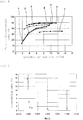
- FIG. 2 is a graph that shows a relationship between heat treatment conditions and the toluene decomposition rate of the organic matter decomposition catalysts represented by sample numbers 1 to 7.
- FIG. 3 is a graph that shows a relationship between heat treatment conditions and the BET specific surface area (SSA) of the organic matter decomposition catalysts represented by sample numbers 1 to 7, and
- FIG. 4 is a graph that shows a relationship between the BET specific surface area (SSA) and the toluene decomposition rate.
- FIG. 5 is a graph that shows a relationship between the Ba content rate x and the degradation rate of the organic matter decomposition catalysts represented by sample numbers 1 to 7.
- the toluene decomposition rates of the organic matter decomposition catalysts represented by sample numbers 3 to 7, which satisfy the requirements of the present invention did not decrease so much and retained high values even after the high temperature heat treatment at 1200°C or more.
- the toluene decomposition rates of the organic matter decomposition catalysts represented by sample numbers 1 and 2 which do not satisfy the requirements of the present invention, largely decreased after the high temperature heat treatment at 1200°C or more, and the toluene decomposition rates were lower than 80% especially after the high temperature heat treatment at 1400°C or more.
- the specific surface area be 6 m 2 /g or more because the toluene decomposition rate is high as shown in FIG. 4 .
- the degradation rate was 4.2% or less, whereas when the Ba content rate x was 1.000 or less, which does not satisfy the requirements of the present invention, the degradation rate was 13.8% or more. It is especially preferred that the Ba content rate x be 1.005 or more because a degradation rate of 1.9% or less is achieved.
- the organic matter decomposition catalysts represented by sample numbers 3 to 7 that satisfy the requirements of the present invention, the organic matter decomposition catalysts represented by sample numbers 3 to 6 satisfy the relationships of 1.001 ⁇ x ⁇ 1.05 and 0.05 ⁇ z ⁇ 0.2. These catalysts had toluene decomposition rates of 93.3% or more before the high temperature heat treatment. In contrast, the organic matter decomposition catalyst represented by sample number 7 that does not satisfy the relationships had a toluene decomposition rate as low as 87.5% before the high temperature heat treatment.
- the organic matter decomposition catalysts represented by sample numbers 2, 5, and 6 were finely ground with a mortar before the high temperature heat treatment, and the resulting powders were analyzed by X-ray diffractometry.
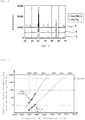
- FIG. 6 is a graph that shows analysis results by X-ray diffractometry. As shown in FIG. 6 , it was confirmed that the main component of the organic matter decomposition catalysts was a perovskite type complex oxide that is BaZrMnO 3 .
- the organic matter decomposition catalyst represented by sample number 5 was finely ground with a mortar before the high temperature heat treatment, and the composition analysis of the resulting powder was performed by X-ray fluorescence analysis (XRF analysis).
- XRF analysis X-ray fluorescence analysis
- a quantitative analysis was performed using a fundamental parameter method.
- the standard sample used in the quantitative analysis was the powder that was obtained in the aforementioned step in which the perovskite type complex oxide was produced to produce the organic matter decomposition catalyst represented by sample number 5, that is, the powder that was obtained by drying the slurry by a dryer.
- the quantitative analysis results are shown in Table 2. [Table 2] Sample number XRF analysis results Ba (x) Zr (y) Mn (z) 5 1. 010 0.900 0. 100
- the organic matter decomposition catalysts represented by sample numbers 8 to 10 that satisfy the requirements of the present invention have low degradation rates compared with the organic matter decomposition catalyst represented by sample number 11 that does not satisfy the requirements of the present invention.
- the organic matter decomposition catalyst represented by sample number 8 does not satisfy the relationships of 1.001 ⁇ x ⁇ 1.05 and 0.05 ⁇ z ⁇ 0.2.
- This catalyst had a low toluene decomposition rate before the high temperature heat treatment compared with the organic matter decomposition catalysts represented by sample numbers 9 and 10 that satisfy the relationships of 1.001 ⁇ x ⁇ 1.05 and 0.05 ⁇ z ⁇ 0.2.
- A is Ba
- B is Zr
- M is Mn
- x 1.050
- Table 1 the organic matter decomposition catalysts represented by sample numbers 12 to 14 that satisfy the requirements of the present invention have low degradation rates compared with the organic matter decomposition catalyst represented by sample number 15 that does not satisfy the requirements of the present invention.
- the catalyst represented by sample number 12 does not satisfy the relationships of 1.001 ⁇ x ⁇ 1.05 and 0.05 ⁇ z ⁇ 0.2.
- This catalyst had a low toluene decomposition rate before the high temperature heat treatment compared with the organic matter decomposition catalysts represented by sample numbers 13 and 14 that satisfy the relationships of 1.001 ⁇ x ⁇ 1.05 and 0.05 ⁇ z ⁇ 0.2.
- the organic matter decomposition catalysts represented by sample numbers 16 to 20 contain a perovskite type complex oxide represented by A x B y M z O w , wherein A is Ba, B is Zr, and M is Co. As shown in Table 1, the organic matter decomposition catalysts represented by sample numbers 17 to 19 that satisfy the requirements of the present invention have high toluene decomposition rates and low degradation rates even after the high temperature heat treatment at 1400°C compared with the organic matter decomposition catalysts represented by sample numbers 16 and 20 that do not satisfy the requirements of the present invention.
- the organic matter decomposition catalysts represented by sample numbers 21 to 25 contain a perovskite type complex oxide represented by A x B y M z O w , wherein A is Ba, B is Zr, and M is Mn, Co, Ni, and Fe. As shown in Table 1, the organic matter decomposition catalysts represented by sample numbers 22 to 24 that satisfy the requirements of the present invention have low degradation rates compared with the organic matter decomposition catalysts represented by sample numbers 21 and 25 that do not satisfy the requirements of the present invention.
- the organic matter decomposition catalysts represented by sample numbers 26 to 30 contain a perovskite type complex oxide represented by A x B y M z O w , wherein A is Sr, B is Zr, and M is Mn. As shown in Table 1, the organic matter decomposition catalysts represented by sample numbers 27 to 29 that satisfy the requirements of the present invention have low degradation rates compared with the organic matter decomposition catalysts represented by sample numbers 26 and 30 that do not satisfy the requirements of the present invention.
- the organic matter decomposition catalysts represented by sample numbers 31 to 35 contain a perovskite type complex oxide represented by A x B y M z O w , wherein A contains Ba and Sr, B is Zr, and M is Mn, Co, Ni, and Fe. As shown in Table 1, the organic matter decomposition catalysts represented by sample numbers 32 to 34 that satisfy the requirements of the present invention have low degradation rates compared with the organic matter decomposition catalysts represented by sample numbers 31 and 35 that do not satisfy the requirements of the present invention.
- the relationship is considered between the temperature of the heat treatment and the time required for the toluene decomposition rate before the heat treatment to decrease by 10% after the heat treatment.
- the horizontal axis shows the reciprocal of the temperature of the heat treatment
- the vertical axis shows the time required for the toluene decomposition rate to decrease by 10% by the heat treatment.
- the vertical axis is logarithmic.
- the temperature is lower than 700°C. That is, when the organic matter decomposition catalyst represented by sample number 2 that does not satisfy the requirements of the present invention is continuously subjected to the heat treatment at 700°C, the toluene decomposition rate decreases by 10% in a shorter period than 2 years, that is, the general life of a catalyst.
- the temperature is higher than 900°C. That is, the toluene decomposition rate of the organic matter decomposition catalyst represented by sample number 5 that satisfies the requirements of the present invention decreases by less than 10% not only when the organic matter decomposition catalyst undergoes the heat treatment at 700°C for 2 years but also when the organic matter decomposition catalyst undergoes a heat treatment at 900°C for 2 years.
- the organic matter decomposition catalyst that satisfies the requirements of the present invention has a high toluene decomposition rate and minimal heat degradation even when the organic matter decomposition catalyst undergoes the heat treatment at a high temperature, for example, a temperature higher than 1000°C.
- the degradation rate represented by formula (2) is less than 10%, and the organic matter decomposition catalyst has good heat resistance.
- the degradation can be suppressed even after a heat treatment for a long period, for example, after a heat treatment at 700°C for 2 years.
- An organic matter decomposition catalyst that satisfies the requirements of the present invention and the relationships about x and z of x ⁇ 1.1 and z > 0.02 is more preferable as a heat resistant catalyst than an organic matter decomposition catalyst that does not satisfy the aforementioned relationships about x and z because the former has a higher toluene decomposition rate before the high temperature heat treatment.
- An organic matter decomposition catalyst that satisfies the requirements of the present invention and the relationships about x and z of 1.001 ⁇ x ⁇ 1.05 and 0.05 ⁇ z ⁇ 0.2 is more preferable as a heat resistant catalyst than an organic matter decomposition catalyst that does not satisfy the aforementioned relationships about x and z because the former has a higher toluene decomposition rate before the high temperature heat treatment.
- High purity powders of Ag 2 O, CaCO 3 , Y 2 O 3 , La(OH) 3 , Lu 2 O 3 , MgCO 3 , ZnO, Al 2 O 3 , Ga 2 O 3 , Sc 2 O 3 , In 2 O 3 , GeO 2 , TiO 2 , HfO 2 , SnO 2 , Nb 2 O 5 , and Ta 2 O 5 were prepared in addition to the high purity powders of BaCO 3 , SrCO 3 , ZrO 2 , MnCO 3 , Co 3 0 4 , NiO, and Fe 2 O 3 used in Example 1.
- the powders were weighed so as to have the composition shown in Table 3, pure water was added to the resulting mixture, and the mixture was wet-mixed with a ZrO 2 boulder to obtain a slurry.
- the slurry was dried with a dryer at 120°C, and then the resulting powder was heat-treated under the conditions of 1100°C for 2 hours to obtain a target perovskite type complex oxide.
- the resulting perovskite type complex oxide to which an organic binder and pure water were added, was wet-mixed with a ZrO 2 boulder to obtain a slurry.
- the slurry was dried with a dryer at 120°C and then ground. After that, the resulting matter was molded using a compression molding machine into a cylinder having a diameter of 8.5 mm and a thickness of 8 mm.
- the resulting molded body was fired under the conditions of 1050°C for 2 hours and then ground with a mortar and classified to obtain a particulate organic matter decomposition catalyst having a size of 0.5 mm or more and 0.6 mm or less.
- a part of the resulting organic matter decomposition catalyst was subjected to a high temperature heat treatment in an electric furnace under the conditions of 1400°C for 3 hours.
- the organic matter decomposition catalysts represented by sample numbers 36 to 52 shown in Table 3 are the catalysts that satisfy the requirements of the present invention.
- the organic matter decomposition catalysts represented by sample numbers 36 to 40 have a structure in which a part of Ba in the perovskite type complex oxide that is contained in the organic matter decomposition catalyst represented by sample number 5 is substituted with at least one element selected from the group consisting of Sr, Ag, Ca, Y, La, and Lu.
- a in the perovskite type complex oxide represented by A x B y M z O w contains 90 at% or more of at least one element selected from the group consisting of Ba and Sr.
- the elements that A contains in the range of 10 at% or less are not limited to the aforementioned at least one element selected from the group consisting of Ag, Ca, Y, La, and Lu. That is, A may contain different elements as impurities or substitutes as long as the degradation rate does not deteriorate.
- the aforementioned elements generally have an ionic valence as in Ag + , Ca 2+ , Y 3+ , La 3+ , and Lu 3+ and the ions have a six-coordination ionic radius in a range of 0.86 ⁇ or more and 1.15 ⁇ or less (see Table 4)
- examples of the different elements or ions that A can contain include elements or ions that have a six-coordination ionic radius in the range of 0.86 ⁇ or more and 1.15 ⁇ or less.
- Presence site of ion Ionic species Ionic radius ( ⁇ ) A Ba2+ 1.35 Sr2+ 1.
- the catalysts represented by sample numbers 41 to 52 have a structure in which a part of Zr in the perovskite type complex oxide that is contained in the catalyst represented by sample number 5 is substituted with at least one element selected from the group consisting of Mg, Zn, Al, Ga, Sc, In, Ge, Ti, Hf, Sn, Nb, and Ta in a range of 20 at% or less. That is, B in the perovskite type complex oxide represented by A x B y M z O w contains 80 at% or more of Zr and at least one element selected from the group consisting of Mg, Zn, Al, Ga, Sc, In, Ge, Ti, Hf, Sn, Nb, and Ta.
- the elements that B contains in the range of 20 at% or less are not limited to the aforementioned at least one element selected from the group consisting of Mg, Zn, Al, Ga, Sc, In, Ge, Ti, Hf, Sn, Nb, and Ta. That is, A may contain different elements as impurities or substitutes as long as the degradation rate does not deteriorate.
- the aforementioned elements generally have an ionic valence as in Mg 2+ , Zn 2+ , Al 3+ , Ga 3+ , Sc 3+ , In 3+ , Ge 4+ , Ti 4+ , Hf 4+ , Sn 4+ , Nb 5+ , and Ta5 + and the ions have a six-coordination ionic radius in a range of 0.53 ⁇ or more and 0.80 ⁇ or less (see Table 4), examples of the different elements or ions that B can contain include elements or ions that have a six-coordination ionic radius in the range of 0.53 ⁇ or more and 0.80 ⁇ or less.
- the organic matter decomposition catalyst that satisfies the requirements of the present invention has a high toluene decomposition rate even when the organic matter decomposition catalyst undergoes the heat treatment at a high temperature, for example, a temperature higher than 1000°C.
- the degradation rate represented by formula (2) is less than 2.1%, that is, the heat degradation is minimized, and the organic matter decomposition catalyst has good heat resistance.
- control unit 3 controls the heating unit 2 so that the area heated by the heating unit 2 may have a temperature of 700°C or more and 1500°C or less
- the controlled temperature is not limited to the aforementioned temperature. That is, the temperature of the environment in which the organic matter decomposition catalyst according to the present invention is used is not limited to the range of 700°C or more and 1500°C or less.
Landscapes
- Chemical & Material Sciences (AREA)
- Engineering & Computer Science (AREA)
- Organic Chemistry (AREA)
- Chemical Kinetics & Catalysis (AREA)
- Materials Engineering (AREA)
- Environmental & Geological Engineering (AREA)
- Health & Medical Sciences (AREA)
- Biomedical Technology (AREA)
- Analytical Chemistry (AREA)
- General Chemical & Material Sciences (AREA)
- Oil, Petroleum & Natural Gas (AREA)
- Inorganic Chemistry (AREA)
- Life Sciences & Earth Sciences (AREA)
- General Life Sciences & Earth Sciences (AREA)
- Geology (AREA)
- Epidemiology (AREA)
- Animal Behavior & Ethology (AREA)
- General Health & Medical Sciences (AREA)
- Public Health (AREA)
- Veterinary Medicine (AREA)
- Combustion & Propulsion (AREA)
- Catalysts (AREA)
- Nanotechnology (AREA)
- Exhaust Gas Treatment By Means Of Catalyst (AREA)
Abstract
Description
- The present invention relates to an organic matter decomposition catalyst used for decomposing an organic matter, an organic matter decomposition aggregate that is an aggregate of the organic matter decomposition catalyst, and an organic matter decomposition apparatus in which the organic matter decomposition aggregate is placed.
- Two types of apparatus are known conventionally as an organic matter decomposition apparatus for an organic matter-containing gas. One is a "direct combustion type" apparatus in which an organic matter is subjected to oxidative combustion directly at a high temperature of 800°C or more by a burner or a heater. The other is a "catalytic combustion type" apparatus in which an organic matter is subjected to oxidative combustion at a low temperature less than 500°C using oxidation action of a catalyst.
- In general, the catalyst activity degrades through a long period of use in a catalytic combustion type organic matter decomposition apparatus. One of causes of the degradation is heat degradation due to exposure of the catalyst to a high temperature. The reason for the heat degradation is considered to be a decrease in the number of active sites caused by the progress of sintering or aggregation of the catalyst material. The word "active site" means a site where a reaction molecule of an organic matter is oxidized on the surface of the catalyst.
- A degraded catalyst needs to be replaced with new one. From the viewpoint of extending the replacement life of the catalyst, the catalyst is desired to have good heat resistance.
- The aforementioned organic matter decomposition apparatus can be used as a deodorization device. Recently, a hybrid type deodorization device is known in which a catalytic combustion type organic matter decomposition apparatus is placed in a subsequent stage of a direct combustion type organic matter decomposition apparatus for higher deodorization efficiency. In such a hybrid type deodorization device, it is necessary that the catalyst used in the catalytic combustion type organic matter decomposition apparatus in the subsequent stage be protected from the heat of the exhaust gas from the direct combustion type organic matter decomposition apparatus in the preceding stage. For the reason, a cooling mechanism such as an air mixing fan and a heat exchanger is usually placed in front of the catalytic combustion type apparatus.
- The cooling mechanism is, however, desired to be omitted from the viewpoint of the installation space, cost, and the like. Therefore, the catalyst used in the catalytic combustion type organic matter decomposition apparatus in the subsequent stage is desired to be a heat resistant catalyst that can resist the heat of the exhaust gas from the direct combustion type organic matter decomposition apparatus in the preceding stage.
- When the deodorization device is formed as an integrated hybrid device in which the catalyst is put into the direct combustion type organic matter decomposition apparatus directly, more advantages can be expected in the aspect of the installation space, cost, and the like. In that case, however, the catalyst is exposed to a high temperature of a burner and the like, so that higher heat resistance is required of the catalyst.
- Because an oxidation decomposition reaction of an organic matter is generally exothermic, it is not enough to consider only the temperature of the environment where the catalyst is placed, but it is necessary to consider the rise in the catalyst temperature caused by the decomposition of an organic matter-containing gas at a high concentration. From this point of view, a heat resistant catalyst that hardly degrades at high temperatures is desired.
- As aforementioned, high heat resistance is required of a catalyst, and
Patent Document 1 discloses a catalyst that has good heat resistance, and hardly degrades even after a heat treatment at 800°C for 100 hours. - Patent Document 1: Japanese Patent Application Laid-Open No.
2015-229137 - A catalyst is, however, also expected to be used at a temperature higher than 800°C, so that the development of a catalyst that hardly degrades in a heat treatment at a high temperature is desired.
- The present invention is to solve the aforementioned problem, and an object of the present invention is to provide a catalyst that hardly degrades in a heat treatment at a high temperature, an organic matter decomposition aggregate that is an aggregate of the catalyst, and an organic matter decomposition apparatus in which the organic matter decomposition aggregate is placed.
- An organic matter decomposition catalyst according to the present invention is an organic matter decomposition catalyst used for decomposing an organic matter and contains a perovskite type complex oxide represented by general formula AxByMzOw, wherein
A contains 90 at% or more of at least one element selected from the group consisting of Ba and Sr,
B contains 80 at% or more of Zr,
M is at least one element selected from the group consisting of Mn, Co, Ni, and Fe,
x, y, and z satisfy relationships of y + z = 1, x > 1, and z < 0.4, and
w is a positive value that satisfies electrical neutrality. - x may satisfy a relationship of x < 1.1.
- z may satisfy a relationship of z > 0.02.
- x and z respectively may satisfy relationships of


- A may contain at least one element selected from the group consisting of Y, La, Lu, Ca, and Ag.
- B may contain at least one element selected from the group consisting of Mg, Zn, Al, Ga, Sc, In, Ge, Ti, Hf, Sn, Nb, and Ta.
- An organic matter decomposition aggregate according to the present invention is an organic matter decomposition aggregate of the aforementioned organic matter decomposition catalyst, and has a specific surface area of 6 m2/g or more.
- In the aforementioned organic matter decomposition aggregate, x may satisfy a relationship of x ≥ 1.005.
- An organic matter decomposition apparatus according to the present invention includes:
- a tube in which an organic matter flows;
- a heating unit that heats the organic matter flowing in the tube; and
- a control unit that controls the heating unit, and in the apparatus, the aforementioned organic matter decomposition aggregate is placed in an area heated by the heating unit inside the tube.
- The control unit may control the heating unit so that the area heated by the heating unit may have a temperature of 700°C or more.
- The control unit may control the heating unit so that the organic matter decomposition aggregate may have a temperature of 700°C or more.
- The control unit may control the heating unit so that the organic matter decomposition aggregate may have a temperature of 1500°C or less.
- The organic matter decomposition catalyst according to the present invention contains a perovskite type complex oxide represented by general formula AxByMzOw, wherein A contains 90 at% or more of at least one element selected from the group consisting of Ba and Sr, B contains 80 at% or more of Zr, M is at least one element selected from the group consisting of Mn, Co, Ni, and Fe, x, y, and z satisfy relationships of y + z = 1, x > 1, and z < 0.4, and w is a positive value that satisfies electrical neutrality. The degradation of the composition can be suppressed in a heat treatment at a high temperature of, for example, more than 1000°C.
- The organic matter decomposition aggregate according to the present invention is an organic matter decomposition aggregate of the aforementioned organic matter decomposition catalyst, and has a specific surface area of 6 m2/g or more, so that the organic matter decomposition aggregate can reduce the degradation in a heat treatment at a high temperature of, for example, more than 1000°C and improve the decomposition rate of the organic matter.
- In the organic matter decomposition apparatus according to the present invention, the aforementioned organic matter decomposition aggregate is placed, so that the replacement cycle of the organic matter decomposition aggregate can be lengthened by using the organic matter decomposition aggregate that hardly degrades in a heat treatment at a high temperature of, for example, more than 1000°C.
-
-
FIG. 1 is a diagram that shows a schematic constitution of a test apparatus used in a test to evaluate organic matter decomposition performance. -
FIG. 2 is a graph that shows a relationship between heat treatment conditions and the toluene decomposition rate of catalysts represented bysample numbers 1 to 7. -
FIG. 3 is a graph that shows a relationship between heat treatment conditions and the BET specific surface area (SSA) of catalysts represented bysample numbers 1 to 7. -
FIG. 4 is a graph that shows a relationship between the BET specific surface area (SSA) and the toluene decomposition rate of catalysts represented bysample numbers 1 to 7. -
FIG. 5 is a graph that shows a relationship between the Ba content rate x and the degradation rate of catalysts represented bysample numbers 1 to 7. -
FIG. 6 is a graph that shows analysis results by X-ray diffractometry of powders of catalysts represented bysample numbers -
FIG. 7 is a graph that shows a relationship between a reciprocal of the temperature of the heat treatment and the time required for the toluene decomposition rate to decrease by 10% by the heat treatment. - Features of the present invention will be specifically described below with reference to an embodiment of the present invention.
- An organic matter decomposition catalyst according to the present invention satisfies the following requirements (hereinafter referred to as the "requirements of the present invention"). That is, the organic matter decomposition catalyst according to the present invention contains a perovskite type complex oxide represented by general formula AxByMzOw, wherein A contains 90 at% or more of at least one element selected from the group consisting of Ba and Sr, B contains 80 at% or more of Zr, and M is at least one element selected from the group consisting of Mn, Co, Ni, and Fe. x, y, z, and w in general formula AxByMzOw satisfy the following relationships.


- w is a positive value that satisfies electrical neutrality.
- High purity powders of BaCO3, SrCO3, ZrO2, MnCO3, Co3O4, NiO, and Fe2O3 were weighed so as to have the composition shown in Table 1, pure water was added to the resulting mixture, and the mixture was wet-mixed with a ZrO2 boulder to obtain a slurry. The slurry was dried with a dryer at 120°C, and then the resulting powder was heat-treated under the conditions of 1100°C for 2 hours to obtain a target perovskite type complex oxide.
- The resulting perovskite type complex oxide, to which an organic binder and pure water were added, was wet-mixed with a ZrO2 boulder to obtain a slurry. The slurry was dried with a dryer at 120°C and then ground. After that, the resulting matter was molded using a compression molding machine into a cylinder having a diameter of 8.5 mm and a thickness of 8 mm.
- The resulting molded body was fired under the conditions of 1050°C for 2 hours and then ground with a mortar and classified to obtain a particulate organic matter decomposition catalyst having a size of 0.5 mm or more and 0.6 mm or less.
- A part of the resulting organic matter decomposition catalyst was subjected to a high temperature heat treatment in an electric furnace under the conditions of 1200°C for 3 hours, 1300°C for 3 hours, and 1400°C for 3 hours.
- By the aforementioned steps, organic matter decomposition catalysts before and after the high temperature heat treatment, the catalysts respectively having compositions represented by
sample numbers 1 to 35 shown in Table 1, were obtained.
-
FIG. 1 is a diagram that shows a schematic constitution of atest apparatus 10 used in the test to evaluate the organic matter decomposition performance of the organic matter decomposition catalyst. Thetest apparatus 10 includes atube 1 in which an organic matter flows, aheating unit 2 that heats the organic matter flowing in thetube 1, and acontrol unit 3 that controls theheating unit 2. - The organic matter decomposition aggregate that is an aggregate of the organic matter decomposition catalyst produced by the aforementioned method is placed in an area heated by the
heating unit 2 inside thetube 1. - A
gas supply tube 4 is connected to the upstream side of thetube 1. To thegas supply tube 4, atoluene supply line 41 to supply toluene (an organic matter), anitrogen supply line 42 to supply nitrogen (N2), and anoxygen supply line 43 to supply oxygen (O2) are connected. That is, thetube 1 is supplied with a gas to be treated containing toluene, nitrogen, and oxygen via thegas supply tube 4. - To the downstream side of the
tube 1, agas exhaust tube 5 to exhaust the treated gas, which is obtained after the decomposition of the organic matter in thetube 1 to the outside of the system, is connected. To thegas exhaust tube 5, asampling line 51 to sample the treated gas is connected. Thegas exhaust tube 5 and thesampling line 51 are configured to analyze the toluene concentration in the treated gas by a gas chromatograph. - The
control unit 3 is configured to control theheating unit 2 so that the area heated by theheating unit 2 may have a temperature of, for example, 700°C or more and 1500°C or less. - The
control unit 3 is also configured to control theheating unit 2 so that the organic matter decomposition aggregate may have a temperature of 700°C or more and 1500°C or less. By controlling theheating unit 2 so that the organic matter decomposition aggregate may have the temperature of 700°C or more, the catalyst activity of the organic matter decomposition aggregate can be enhanced. Moreover, by controlling theheating unit 2 so that the organic matter decomposition aggregate may have the temperature of 1500°C or less, the degradation of the organic matter decomposition aggregate can be suppressed. - The central portion of the
tube 1 in thetest apparatus 10 shown inFIG. 1 was filled with the organic matter decomposition aggregate that is the aggregate of the aforementioned organic matter decomposition catalyst, and thetube 1 was continuously supplied with the gas to be treated containing toluene, nitrogen, and oxygen to perform the toluene decomposition test. The composition of the gas to be treated was 50 ppm of toluene (C7H8) , 80 vol% of nitrogen (N2), and 20 vol% of oxygen (O2), the gas flow velocity in the measurement was 0.4 m/s, the space velocity (SV) was 150000 (/h), and the catalyst temperature was 300°C. - The treated gas was sampled at the outlet of the
sampling line 51, and the toluene concentration was determined by analysis using a gas chromatograph. The toluene decomposition rate was determined based on the following formula (1).
- The toluene decomposition rates of the organic matter decomposition catalysts represented by
sample numbers 1 to 35 are shown in Table 1. The toluene decomposition rates were determined using the organic matter decomposition catalysts before the high temperature heat treatment, after the high temperature heat treatment at 1200°C for 3 hours, after the high temperature heat treatment at 1300°C for 3 hours, and after the high temperature heat treatment at 1400°C for 3 hours. - Then, the BET specific surface area (SSA) (m2/g) of each of the organic matter decomposition aggregates was measured using a full automatic BET specific surface area analyzer (Macsorb HM model-1201 manufactured by Mountech Co., Ltd.) under a degassing condition of 400°C for 20 minutes. The BET specific surface areas (SSA) were measured using the organic matter decomposition aggregates before the high temperature heat treatment, after the high temperature heat treatment at 1200°C for 3 hours, after the high temperature heat treatment at 1300°C for 3 hours, and after the high temperature heat treatment at 1400°C for 3 hours.
- Then, to determine the heat resistance, a degradation rate was calculated based on the following formula (2) using the toluene decomposition rate of the organic matter decomposition catalyst before the high temperature heat treatment and the toluene decomposition rate of the organic matter decomposition catalyst after the high temperature heat treatment at 1400°C for 3 hours.

- Samples represented by the
sample numbers - As shown in Table 1, the organic matter decomposition catalysts represented by the sample numbers without * mark, which satisfy the requirements of the present invention, had high toluene decomposition rates before the high temperature heat treatment, after the high temperature heat treatment at 1200°C for 3 hours, after the high temperature heat treatment at 1300°C for 3 hours, and after the high temperature heat treatment at 1400°C for 3 hours. Moreover, the degradation rates were lower than 10%.
- In contrast, the organic matter decomposition catalysts represented by the sample numbers with * mark, which do not satisfy the requirements of the present invention, had low toluene decomposition rates especially after the high temperature heat treatment at 1400°C for 3 hours, and the degradation rates are 10% or higher.
- That is, the organic matter decomposition catalyst according to the present invention has a high toluene decomposition rate even after the high temperature heat treatment at 1400°C for 3 hours, and is prevented from the heat degradation.
- Among the organic matter decomposition catalysts represented by
sample numbers 1 to 35, the organic matter decomposition catalysts represented bysample numbers 1 to 7 contain a perovskite type complex oxide represented by AxByMzOw, wherein A is Ba, B is Zr, M is Mn, y = 0.9, and z = 0.1. In particular, concerning the organic matter decomposition catalysts represented bysample numbers 1 to 7, relationships were checked among the conditions in the high temperature heat treatment, the BET specific surface area, and the toluene decomposition rate. -
FIG. 2 is a graph that shows a relationship between heat treatment conditions and the toluene decomposition rate of the organic matter decomposition catalysts represented bysample numbers 1 to 7.FIG. 3 is a graph that shows a relationship between heat treatment conditions and the BET specific surface area (SSA) of the organic matter decomposition catalysts represented bysample numbers 1 to 7, andFIG. 4 is a graph that shows a relationship between the BET specific surface area (SSA) and the toluene decomposition rate.FIG. 5 is a graph that shows a relationship between the Ba content rate x and the degradation rate of the organic matter decomposition catalysts represented bysample numbers 1 to 7. - As shown in
FIG. 2 , the toluene decomposition rates of the organic matter decomposition catalysts represented bysample numbers 3 to 7, which satisfy the requirements of the present invention, did not decrease so much and retained high values even after the high temperature heat treatment at 1200°C or more. In contrast, the toluene decomposition rates of the organic matter decomposition catalysts represented bysample numbers - It is known that the specific surface area of a catalytic powder generally decreases after a high temperature heat treatment (see
FIG. 3 ), so that the toluene decomposition rate also decreases. By checking the relationship between the specific surface area of the catalytic powder and the toluene decomposition rate, however, concerning the organic matter decomposition catalysts represented bysample numbers 3 to 7 that have a Ba content rate x of 1.001 or more, it was revealed that even when the specific surface area decreases, the toluene decomposition rate does not decrease so much as shown inFIG. 4 . Meanwhile, in the case of the organic matter decomposition catalysts represented bysample numbers - It is preferred that the specific surface area be 6 m2/g or more because the toluene decomposition rate is high as shown in
FIG. 4 . - As shown in
FIG. 5 , when the Ba content rate x was 1.001 or more, the degradation rate was 4.2% or less, whereas when the Ba content rate x was 1.000 or less, which does not satisfy the requirements of the present invention, the degradation rate was 13.8% or more. It is especially preferred that the Ba content rate x be 1.005 or more because a degradation rate of 1.9% or less is achieved. - Among the organic matter decomposition catalysts represented by
sample numbers 3 to 7 that satisfy the requirements of the present invention, the organic matter decomposition catalysts represented bysample numbers 3 to 6 satisfy the relationships of 1.001 ≤ x ≤ 1.05 and 0.05 ≤ z ≤ 0.2. These catalysts had toluene decomposition rates of 93.3% or more before the high temperature heat treatment. In contrast, the organic matter decomposition catalyst represented bysample number 7 that does not satisfy the relationships had a toluene decomposition rate as low as 87.5% before the high temperature heat treatment. - The organic matter decomposition catalysts represented by
sample numbers FIG. 6 is a graph that shows analysis results by X-ray diffractometry. As shown inFIG. 6 , it was confirmed that the main component of the organic matter decomposition catalysts was a perovskite type complex oxide that is BaZrMnO3. - The organic matter decomposition catalyst represented by
sample number 5 was finely ground with a mortar before the high temperature heat treatment, and the composition analysis of the resulting powder was performed by X-ray fluorescence analysis (XRF analysis). A quantitative analysis was performed using a fundamental parameter method. The standard sample used in the quantitative analysis was the powder that was obtained in the aforementioned step in which the perovskite type complex oxide was produced to produce the organic matter decomposition catalyst represented bysample number 5, that is, the powder that was obtained by drying the slurry by a dryer. The quantitative analysis results are shown in Table 2.[Table 2] Sample number XRF analysis results Ba (x) Zr (y) Mn (z) 5 1. 010 0.900 0. 100 - It is understood from Table 2 that the organic matter decomposition catalyst having the desired composition was obtained.
- The organic matter decomposition catalysts represented by
sample numbers 8 to 11 contain a perovskite type complex oxide represented by AxByMzOw, wherein A is Ba, B is Zr, M is Mn, x = 1.001, and the numbers of z are different from each other while the relationship of y + z = 1.0 is satisfied. As shown in Table 1, the organic matter decomposition catalysts represented bysample numbers 8 to 10 that satisfy the requirements of the present invention have low degradation rates compared with the organic matter decomposition catalyst represented by sample number 11 that does not satisfy the requirements of the present invention. - Among the organic matter decomposition catalysts represented by
sample numbers 8 to 10 that satisfy the requirements of the present invention, the organic matter decomposition catalyst represented bysample number 8 does not satisfy the relationships of 1.001 ≤ x ≤ 1.05 and 0.05 ≤ z ≤ 0.2. This catalyst had a low toluene decomposition rate before the high temperature heat treatment compared with the organic matter decomposition catalysts represented bysample numbers 9 and 10 that satisfy the relationships of 1.001 ≤ x ≤ 1.05 and 0.05 ≤ z ≤ 0.2. - The organic matter decomposition catalysts represented by
sample numbers 12 to 15 contain a perovskite type complex oxide represented by AxByMzOw, wherein A is Ba, B is Zr, M is Mn, x = 1.050, and the numbers of z are different from each other while the relationship of y + z = 1.0 is satisfied. As shown in Table 1, the organic matter decomposition catalysts represented bysample numbers 12 to 14 that satisfy the requirements of the present invention have low degradation rates compared with the organic matter decomposition catalyst represented by sample number 15 that does not satisfy the requirements of the present invention. - Among the organic matter decomposition catalysts represented by
sample numbers 12 to 14 that satisfy the requirements of the present invention, the catalyst represented bysample number 12 does not satisfy the relationships of 1.001 ≤ x ≤ 1.05 and 0.05 ≤ z ≤ 0.2. This catalyst had a low toluene decomposition rate before the high temperature heat treatment compared with the organic matter decomposition catalysts represented bysample numbers 13 and 14 that satisfy the relationships of 1.001 ≤ x ≤ 1.05 and 0.05 ≤ z ≤ 0.2. - The organic matter decomposition catalysts represented by
sample numbers 16 to 20 contain a perovskite type complex oxide represented by AxByMzOw, wherein A is Ba, B is Zr, and M is Co. As shown in Table 1, the organic matter decomposition catalysts represented by sample numbers 17 to 19 that satisfy the requirements of the present invention have high toluene decomposition rates and low degradation rates even after the high temperature heat treatment at 1400°C compared with the organic matter decomposition catalysts represented bysample numbers - The organic matter decomposition catalysts represented by sample numbers 21 to 25 contain a perovskite type complex oxide represented by AxByMzOw, wherein A is Ba, B is Zr, and M is Mn, Co, Ni, and Fe. As shown in Table 1, the organic matter decomposition catalysts represented by sample numbers 22 to 24 that satisfy the requirements of the present invention have low degradation rates compared with the organic matter decomposition catalysts represented by
sample numbers 21 and 25 that do not satisfy the requirements of the present invention. - The organic matter decomposition catalysts represented by sample numbers 26 to 30 contain a perovskite type complex oxide represented by AxByMzOw, wherein A is Sr, B is Zr, and M is Mn. As shown in Table 1, the organic matter decomposition catalysts represented by sample numbers 27 to 29 that satisfy the requirements of the present invention have low degradation rates compared with the organic matter decomposition catalysts represented by
sample numbers 26 and 30 that do not satisfy the requirements of the present invention. - The organic matter decomposition catalysts represented by sample numbers 31 to 35 contain a perovskite type complex oxide represented by AxByMzOw, wherein A contains Ba and Sr, B is Zr, and M is Mn, Co, Ni, and Fe. As shown in Table 1, the organic matter decomposition catalysts represented by sample numbers 32 to 34 that satisfy the requirements of the present invention have low degradation rates compared with the organic matter decomposition catalysts represented by
sample numbers 31 and 35 that do not satisfy the requirements of the present invention. - Here, with reference to
FIG. 7 , concerning the organic matter decomposition catalysts represented bysample numbers FIG. 7 , the horizontal axis shows the reciprocal of the temperature of the heat treatment, and the vertical axis shows the time required for the toluene decomposition rate to decrease by 10% by the heat treatment. The vertical axis is logarithmic. - As shown in
FIG. 7 , when the toluene decomposition rate of the organic matter decomposition catalyst represented bysample number 2 that does not satisfy the requirements of the present invention decreases by 10% by a heat treatment over 2 years, the temperature is lower than 700°C. That is, when the organic matter decomposition catalyst represented bysample number 2 that does not satisfy the requirements of the present invention is continuously subjected to the heat treatment at 700°C, the toluene decomposition rate decreases by 10% in a shorter period than 2 years, that is, the general life of a catalyst. - On the other hand, when the toluene decomposition rate of the organic matter decomposition catalyst represented by
sample number 5 that satisfies the requirements of the present invention decreases by 10% by a heat treatment over 2 years, the temperature is higher than 900°C. That is, the toluene decomposition rate of the organic matter decomposition catalyst represented bysample number 5 that satisfies the requirements of the present invention decreases by less than 10% not only when the organic matter decomposition catalyst undergoes the heat treatment at 700°C for 2 years but also when the organic matter decomposition catalyst undergoes a heat treatment at 900°C for 2 years. - As aforementioned, the organic matter decomposition catalyst that satisfies the requirements of the present invention has a high toluene decomposition rate and minimal heat degradation even when the organic matter decomposition catalyst undergoes the heat treatment at a high temperature, for example, a temperature higher than 1000°C. In particular, the degradation rate represented by formula (2) is less than 10%, and the organic matter decomposition catalyst has good heat resistance. In addition, the degradation can be suppressed even after a heat treatment for a long period, for example, after a heat treatment at 700°C for 2 years.
- An organic matter decomposition catalyst that satisfies the requirements of the present invention and the relationships about x and z of x < 1.1 and z > 0.02 is more preferable as a heat resistant catalyst than an organic matter decomposition catalyst that does not satisfy the aforementioned relationships about x and z because the former has a higher toluene decomposition rate before the high temperature heat treatment.
- An organic matter decomposition catalyst that satisfies the requirements of the present invention and the relationships about x and z of 1.001 ≤ x ≤ 1.05 and 0.05 ≤ z ≤ 0.2 is more preferable as a heat resistant catalyst than an organic matter decomposition catalyst that does not satisfy the aforementioned relationships about x and z because the former has a higher toluene decomposition rate before the high temperature heat treatment.
- High purity powders of Ag2O, CaCO3, Y2O3, La(OH)3, Lu2O3, MgCO3, ZnO, Al2O3, Ga2O3, Sc2O3, In2O3, GeO2, TiO2, HfO2, SnO2, Nb2O5, and Ta2O5 were prepared in addition to the high purity powders of BaCO3, SrCO3, ZrO2, MnCO3,
Co 304, NiO, and Fe2O3 used in Example 1. The powders were weighed so as to have the composition shown in Table 3, pure water was added to the resulting mixture, and the mixture was wet-mixed with a ZrO2 boulder to obtain a slurry. The slurry was dried with a dryer at 120°C, and then the resulting powder was heat-treated under the conditions of 1100°C for 2 hours to obtain a target perovskite type complex oxide. - The resulting perovskite type complex oxide, to which an organic binder and pure water were added, was wet-mixed with a ZrO2 boulder to obtain a slurry. The slurry was dried with a dryer at 120°C and then ground. After that, the resulting matter was molded using a compression molding machine into a cylinder having a diameter of 8.5 mm and a thickness of 8 mm.
- The resulting molded body was fired under the conditions of 1050°C for 2 hours and then ground with a mortar and classified to obtain a particulate organic matter decomposition catalyst having a size of 0.5 mm or more and 0.6 mm or less.
- A part of the resulting organic matter decomposition catalyst was subjected to a high temperature heat treatment in an electric furnace under the conditions of 1400°C for 3 hours.
- By the aforementioned steps, organic matter decomposition catalysts before and after the high temperature heat treatment, the catalysts respectively having compositions represented by sample numbers 36 to 52 shown in Table 3, were obtained. Then, the toluene decomposition rates were determined before and after the high temperature heat treatment, and the degradation rates were calculated in the same manner as in Example 1.

- The organic matter decomposition catalysts represented by sample numbers 36 to 52 shown in Table 3 are the catalysts that satisfy the requirements of the present invention.
- The organic matter decomposition catalysts represented by sample numbers 36 to 40 have a structure in which a part of Ba in the perovskite type complex oxide that is contained in the organic matter decomposition catalyst represented by
sample number 5 is substituted with at least one element selected from the group consisting of Sr, Ag, Ca, Y, La, and Lu. However, A in the perovskite type complex oxide represented by AxByMzOw contains 90 at% or more of at least one element selected from the group consisting of Ba and Sr. - As shown in Table 3, even when A contains at least one element selected from the group consisting of Ag, Ca, Y, La, and Lu in a range of 10 at% or less, the toluene decomposition rates were high after the high temperature heat treatment at 1400°C, and the degradation rates were as low as 2.0% or less.
- The elements that A contains in the range of 10 at% or less are not limited to the aforementioned at least one element selected from the group consisting of Ag, Ca, Y, La, and Lu. That is, A may contain different elements as impurities or substitutes as long as the degradation rate does not deteriorate. Because the aforementioned elements generally have an ionic valence as in Ag+, Ca2+, Y3+, La3+, and Lu3+ and the ions have a six-coordination ionic radius in a range of 0.86 Å or more and 1.15 Å or less (see Table 4), examples of the different elements or ions that A can contain include elements or ions that have a six-coordination ionic radius in the range of 0.86 Å or more and 1.15 Å or less.
[Table 4] Presence site of ion Ionic species Ionic radius (Å) A Ba2+ 1.35 Sr2+ 1. 18 Ca2+ 1.00 Y3+ 0.90 La3+ 1.03 Lu3+ 0.86 Ag+ 1.15 B Zr4+ 0.72 Mg2+ 0.72 Zn2+ 0.74 Al3+ 0.54 Ga3+ 0.62 Sc3+ 0.75 In3+ 0.80 Ge4+ 0.53 Ti4+ 0.61 Hf4+ 0.71 Sn4+ 0.69 Nb5+ 0.64 Ta5+ 0.64 - The catalysts represented by
sample numbers 41 to 52 have a structure in which a part of Zr in the perovskite type complex oxide that is contained in the catalyst represented bysample number 5 is substituted with at least one element selected from the group consisting of Mg, Zn, Al, Ga, Sc, In, Ge, Ti, Hf, Sn, Nb, and Ta in a range of 20 at% or less. That is, B in the perovskite type complex oxide represented by AxByMzOw contains 80 at% or more of Zr and at least one element selected from the group consisting of Mg, Zn, Al, Ga, Sc, In, Ge, Ti, Hf, Sn, Nb, and Ta. - As shown in Table 3, even when B contains at least one element selected from the group consisting of Mg, Zn, Al, Ga, Sc, In, Ge, Ti, Hf, Sn, Nb, and Ta in a range of 20 at% or less in addition to 80 at% or more of Zr, the toluene decomposition rates were high after the high temperature heat treatment at 1400°C, and the degradation rates were as low as 2.1% or less.
- The elements that B contains in the range of 20 at% or less are not limited to the aforementioned at least one element selected from the group consisting of Mg, Zn, Al, Ga, Sc, In, Ge, Ti, Hf, Sn, Nb, and Ta. That is, A may contain different elements as impurities or substitutes as long as the degradation rate does not deteriorate. Because the aforementioned elements generally have an ionic valence as in Mg2+, Zn2+, Al3+, Ga3+, Sc3+, In3+, Ge4+, Ti4+, Hf4+, Sn4+, Nb5+, and Ta5+ and the ions have a six-coordination ionic radius in a range of 0.53 Å or more and 0.80 Å or less (see Table 4), examples of the different elements or ions that B can contain include elements or ions that have a six-coordination ionic radius in the range of 0.53 Å or more and 0.80 Å or less.
- As aforementioned, also in Example 2, the organic matter decomposition catalyst that satisfies the requirements of the present invention has a high toluene decomposition rate even when the organic matter decomposition catalyst undergoes the heat treatment at a high temperature, for example, a temperature higher than 1000°C. In particular, the degradation rate represented by formula (2) is less than 2.1%, that is, the heat degradation is minimized, and the organic matter decomposition catalyst has good heat resistance.
- The present invention is not to be considered limited to the embodiment described above, but various applications and modifications can be made within the scope of the invention. For example, although it is described that the
control unit 3 controls theheating unit 2 so that the area heated by theheating unit 2 may have a temperature of 700°C or more and 1500°C or less, the controlled temperature is not limited to the aforementioned temperature. That is, the temperature of the environment in which the organic matter decomposition catalyst according to the present invention is used is not limited to the range of 700°C or more and 1500°C or less. -
- 1:
- Tube
- 2:
- Heating unit
- 3:
- Control unit
- 4:
- Gas supply tube
- 5:
- Gas exhaust tube
- 10:
- Test apparatus
- 41:
- Toluene supply line
- 42:
- Nitrogen supply line
- 43:
- Oxygen supply line
- 51:
- Sampling line
Claims (12)
- An organic matter decomposition catalyst used for decomposing an organic matter, the organic matter decomposition catalyst comprising a perovskite type complex oxide represented by general formula AxByMzOw, wherein
A contains 90 at% or more of at least one element selected from the group consisting of Ba and Sr,
B contains 80 at% or more of Zr,
M is at least one element selected from the group consisting of Mn, Co, Ni, and Fe,
x, y, and z satisfy relationships of y + z = 1, x > 1, and z < 0.4, and
w is a positive value that satisfies electrical neutrality. - The organic matter decomposition catalyst according to claim 1, wherein x satisfies a relationship of x < 1.1.
- The organic matter decomposition catalyst according to claim 1 or 2, wherein z satisfies a relationship of z > 0.02.
- The organic matter decomposition catalyst according to any one of claims 1 to 3, wherein x and z respectively satisfy relationships of


- The organic matter decomposition catalyst according to any one of claims 1 to 4, wherein A contains at least one element selected from the group consisting of Y, La, Lu, Ca, and Ag.
- The organic matter decomposition catalyst according to any one of claims 1 to 5, wherein B contains at least one element selected from the group consisting of Mg, Zn, Al, Ga, Sc, In, Ge, Ti, Hf, Sn, Nb, and Ta.
- An organic matter decomposition aggregate that is an aggregate of the organic matter decomposition catalyst according to any one of claims 1 to 6, the organic matter decomposition aggregate having a specific surface area of 6 m2/g or more.
- The organic matter decomposition aggregate according to claim 7, wherein x satisfies a relationship of x ≥ 1.005.
- An organic matter decomposition apparatus comprising:a tube in which an organic matter flows;a heating unit that heats the organic matter flowing in the tube; anda control unit that controls the heating unit, whereinthe organic matter decomposition aggregate according to claim 7 or 8 is placed in an area heated by the heating unit inside the tube.
- The organic matter decomposition apparatus according to claim 9, wherein the control unit controls the heating unit so that the area heated by the heating unit has a temperature of 700°C or more.
- The organic matter decomposition apparatus according to claim 9, wherein the control unit controls the heating unit so that the organic matter decomposition aggregate has a temperature of 700°C or more.
- The organic matter decomposition apparatus according to claim 9 or 11, wherein the control unit controls the heating unit so that the organic matter decomposition aggregate has a temperature of 1500°C or less.
Applications Claiming Priority (2)
| Application Number | Priority Date | Filing Date | Title |
|---|---|---|---|
| JP2018092386 | 2018-05-11 | ||
| PCT/JP2018/045261 WO2019215951A1 (en) | 2018-05-11 | 2018-12-10 | Organic matter decomposition catalyst, organic matter decomposition aggregate, and organic matter decomposition device |
Publications (2)
| Publication Number | Publication Date |
|---|---|
| EP3603799A1 true EP3603799A1 (en) | 2020-02-05 |
| EP3603799A4 EP3603799A4 (en) | 2020-12-23 |
Family
ID=68466928
Family Applications (2)
| Application Number | Title | Priority Date | Filing Date |
|---|---|---|---|
| EP18915784.5A Pending EP3603799A4 (en) | 2018-05-11 | 2018-12-10 | Catalyst for the decomposition of organic materials, aggregate for the decomposition of organic materials and device for the decomposition of organic materials |
| EP19799238.1A Pending EP3769839A4 (en) | 2018-05-11 | 2019-03-05 | SUPPORTED CATALYST FOR ORGANIC MATTER ANALYSIS AND ORGANIC MATTER ANALYSIS DEVICE |
Family Applications After (1)
| Application Number | Title | Priority Date | Filing Date |
|---|---|---|---|
| EP19799238.1A Pending EP3769839A4 (en) | 2018-05-11 | 2019-03-05 | SUPPORTED CATALYST FOR ORGANIC MATTER ANALYSIS AND ORGANIC MATTER ANALYSIS DEVICE |
Country Status (5)
| Country | Link |
|---|---|
| US (5) | US11529613B2 (en) |
| EP (2) | EP3603799A4 (en) |
| JP (5) | JP6725084B2 (en) |
| CN (6) | CN110785229B (en) |
| WO (5) | WO2019215951A1 (en) |
Cited By (1)
| Publication number | Priority date | Publication date | Assignee | Title |
|---|---|---|---|---|
| EP3960290A4 (en) * | 2019-06-06 | 2022-12-14 | Murata Manufacturing Co., Ltd. | CATALYST AND DEVICE FOR DECOMPOSITION OF ORGANIC MATERIALS |
Families Citing this family (7)
| Publication number | Priority date | Publication date | Assignee | Title |
|---|---|---|---|---|
| EP4098357A1 (en) * | 2016-11-14 | 2022-12-07 | Research Triangle Institute | Perovskite three-way catalyst and use thereof |
| JP7192989B2 (en) | 2019-06-26 | 2022-12-20 | 株式会社村田製作所 | Organic substance decomposition catalyst and organic substance decomposition device |
| JP7437242B2 (en) * | 2020-06-12 | 2024-02-22 | 堺化学工業株式会社 | Manganese-added barium zirconate particles and organic matter decomposition catalyst containing them |
| CN113996174B (en) * | 2021-10-29 | 2022-07-15 | 南京工业大学 | A kind of organic matter polluted soil thermal desorption circulating medium and its preparation method and application |
| IL319288A (en) | 2022-09-02 | 2025-04-01 | Universit?T Z?Rich | Injection device |
| CN115888746B (en) * | 2022-09-07 | 2025-07-25 | 北京石油化工学院 | Renewable catalyst and preparation method thereof |
| CN117983262B (en) * | 2023-12-19 | 2026-03-20 | 淮阴工学院 | Preparation methods and applications of Ti3C2/Ag2O/La(OH)3 nanocomposites |
Family Cites Families (49)
| Publication number | Priority date | Publication date | Assignee | Title |
|---|---|---|---|---|
| US3644147A (en) | 1969-04-24 | 1972-02-22 | Exxon Research Engineering Co | Mixed valency transition metal perovskites as cathodic reduction catalysts |
| JPS58142995A (en) * | 1982-02-22 | 1983-08-25 | 日本鉱業株式会社 | Manufacture of metal soap bar |
| JPS58157697A (en) | 1982-03-11 | 1983-09-19 | 株式会社キト− | Lever type small-sized hoisting combined tracking device |
| JPS58156350A (en) * | 1982-03-12 | 1983-09-17 | Matsushita Electric Ind Co Ltd | Apparatus for purifying exhaust gas |
| JPH04118050A (en) * | 1990-09-07 | 1992-04-20 | Nippon Shokubai Co Ltd | Catalyst for decomposing nox |
| JP3099392B2 (en) * | 1991-03-22 | 2000-10-16 | 松下電器産業株式会社 | Exhaust gas purification catalyst |
| EP0532024B1 (en) | 1991-09-12 | 1998-08-12 | Sakai Chemical Industry Co., Ltd., | Catalyst for catalytic reduction of nitrogen oxide |
| JP3406001B2 (en) | 1992-03-09 | 2003-05-12 | ダイハツ工業株式会社 | Exhaust gas purification catalyst |
| JPH0780310A (en) * | 1993-06-29 | 1995-03-28 | Idemitsu Kosan Co Ltd | Process for producing perovskite-type or perovskite-like oxide-supported catalyst |
| US6060420A (en) | 1994-10-04 | 2000-05-09 | Nissan Motor Co., Ltd. | Composite oxides of A-site defect type perovskite structure as catalysts |
| EP0788828B1 (en) * | 1996-02-09 | 2003-11-12 | Isuzu Motors, Ltd. | NOx decomposition catalyst and exhaust gas purifier using said catalyst |
| EP0968763A4 (en) * | 1997-10-14 | 2002-06-12 | Isuzu Ceramics Res Inst | EXHAUST GAS PURIFICATION CATALYST |
| JP2000051700A (en) * | 1998-08-11 | 2000-02-22 | Nissan Motor Co Ltd | Exhaust gas purification catalyst and method for producing the same |
| CA2281123A1 (en) * | 1998-09-03 | 2000-03-03 | Gaz De France | Thermally stable, highly active perovskite catalysts for complete oxidation at high temperatures, and the process for their preparation |
| AUPP607298A0 (en) * | 1998-09-21 | 1998-10-15 | University Of Queensland, The | Catalyst and process for steam reforming of hydrocarbons |
| JP3919407B2 (en) | 1999-11-18 | 2007-05-23 | 日野自動車株式会社 | Exhaust purification device |
| JP4445659B2 (en) * | 2000-11-07 | 2010-04-07 | 三井造船株式会社 | Exhaust gas treatment catalyst |
| JPWO2004096436A1 (en) | 2003-05-02 | 2006-07-13 | 独立行政法人産業技術総合研究所 | Catalyst material made of transition metal oxide |
| WO2005058490A1 (en) * | 2003-12-17 | 2005-06-30 | Daihatsu Motor Co.,Ltd. | Catalyst composition |
| JP4953813B2 (en) * | 2004-03-22 | 2012-06-13 | ダイハツ工業株式会社 | Perovskite complex oxide, catalyst composition, and method for producing perovskite complex oxide |
| CN1714931A (en) * | 2004-06-14 | 2006-01-04 | 中国科学院生态环境研究中心 | Rare-earth perovskite-type composite oxide catalyst for catalytic decomposition of NOx under oxygen-enriched conditions |
| JP4552940B2 (en) * | 2004-10-01 | 2010-09-29 | 株式会社村田製作所 | Hybrid lens using translucent ceramic |
| JP2006231280A (en) | 2005-02-28 | 2006-09-07 | Mitsubishi Heavy Ind Ltd | Solid oxidation catalyst for combustion |
| JP2006346603A (en) | 2005-06-16 | 2006-12-28 | Cataler Corp | Catalyst composition |
| JP2006347825A (en) * | 2005-06-16 | 2006-12-28 | Daihatsu Motor Co Ltd | Method for producing composite oxide |
| JP4969843B2 (en) * | 2005-12-09 | 2012-07-04 | 新日鉄マテリアルズ株式会社 | Exhaust gas purification catalyst and exhaust gas purification catalyst member |
| EP1847311A1 (en) * | 2006-04-19 | 2007-10-24 | Universität Hannover | Composite Membrane |
| JP5076377B2 (en) | 2006-07-03 | 2012-11-21 | トヨタ自動車株式会社 | Exhaust gas purification catalyst |
| CN100431693C (en) * | 2006-11-10 | 2008-11-12 | 北京工业大学 | Process for preparing catalyst contg. La(1-x)SrxMO3 used for removing volatile organic matter |
| JP4954761B2 (en) * | 2007-03-26 | 2012-06-20 | 東京瓦斯株式会社 | Tar cracking catalyst |
| KR100931792B1 (en) | 2007-05-25 | 2009-12-11 | 주식회사 엘지화학 | Catalyst for pyrolysis of hydrocarbon steam, preparation method thereof and preparation method of olefin using the same |
| JP5460969B2 (en) * | 2008-03-03 | 2014-04-02 | 国立大学法人 岡山大学 | Catalyst production method and catalyst |
| WO2010010714A1 (en) * | 2008-07-23 | 2010-01-28 | 新日鉄マテリアルズ株式会社 | Oxygen storage material, catalyst for exhaust gas purification, and honeycomb catalyst structure for exhaust gas purification |
| CN102159314B (en) * | 2008-09-17 | 2016-08-03 | 株式会社日本触媒 | Ammonia decomposition catalyzer and preparation method thereof and ammonia treatment method |
| US20100139152A1 (en) | 2008-12-08 | 2010-06-10 | Dennis Hucul | Heterogeneous catalysts for mono-alkyl ester production, method of making, and method of using same |
| EP2441517B1 (en) * | 2009-06-12 | 2022-04-13 | Murata Manufacturing Co., Ltd. | Hydrocarbon gas reforming catalyst, method for producing same, and method for producing synthetic gas |
| CN101745405B (en) * | 2009-12-17 | 2012-01-25 | 汕头大学 | Perovskite type composite oxide catalyst for purifying tail gas of internal combustion engine |
| EP2374526A1 (en) | 2010-03-29 | 2011-10-12 | Centre National de la Recherche Scientifique (C.N.R.S) | Solid composite membrane exhibiting both oxygen conductivity and a substrate catalyst interface |
| JP2012110864A (en) * | 2010-11-26 | 2012-06-14 | Nippon Steel Materials Co Ltd | Oxide carrier for exhaust gas purifying catalyst, method for producing the same, exhaust gas purifying catalyst and structure for exhaust gas purification |
| WO2012153762A1 (en) * | 2011-05-11 | 2012-11-15 | 株式会社村田製作所 | Reverse shift reaction catalyst, and method for producing synthetic gas using same |
| JP2013244479A (en) * | 2012-05-29 | 2013-12-09 | Nippon Steel & Sumikin Materials Co Ltd | Exhaust gas purifying catalyst, method for producing the same, and exhaust gas purifying catalyst member |
| WO2014038294A1 (en) * | 2012-09-10 | 2014-03-13 | 日産自動車株式会社 | Exhaust gas purification catalyst, exhaust gas purification monolith catalyst, and method for producing exhaust gas purification catalyst |
| JP6036276B2 (en) | 2012-12-25 | 2016-11-30 | 日産自動車株式会社 | Exhaust purification catalyst and method for producing exhaust purification catalyst |
| JP2014223587A (en) * | 2013-05-16 | 2014-12-04 | 新日鉄住金マテリアルズ株式会社 | Exhaust gas purification catalyst carrier, manufacturing method of exhaust gas purification catalyst carrier, exhaust gas purification catalyst, and manufacturing method of exhaust gas purification catalyst |
| US9708946B2 (en) * | 2013-05-22 | 2017-07-18 | Mitsui Mining & Smelting Co., Ltd. | Diesel particulate filter and exhaust gas purification device |
| JP6303834B2 (en) | 2014-06-05 | 2018-04-04 | 株式会社村田製作所 | Organic substance decomposition catalyst |
| KR20170020337A (en) * | 2014-06-19 | 2017-02-22 | 오츠카 가가쿠 가부시키가이샤 | Exhaust gas purifying catalyst, exhaust gas purification device and filter, and method for producing said catalyst |
| CN104998655A (en) * | 2015-07-22 | 2015-10-28 | 中国科学院过程工程研究所 | Integral cordierite catalyst and preparation method and application thereof |
| CN106944093B (en) | 2017-04-24 | 2019-11-05 | 北京三聚环保新材料股份有限公司 | A kind of Ca-Ti ore type honeycomb monolith methane catalytic combustion catalyst and preparation method thereof |
-
2018
- 2018-12-10 CN CN201880042390.5A patent/CN110785229B/en active Active
- 2018-12-10 WO PCT/JP2018/045261 patent/WO2019215951A1/en not_active Ceased
- 2018-12-10 JP JP2019547719A patent/JP6725084B2/en active Active
- 2018-12-10 EP EP18915784.5A patent/EP3603799A4/en active Pending
-
2019
- 2019-03-05 EP EP19799238.1A patent/EP3769839A4/en active Pending
- 2019-03-05 CN CN202311108847.7A patent/CN116899385A/en not_active Withdrawn
- 2019-03-05 JP JP2020518162A patent/JP7001153B2/en active Active
- 2019-03-05 CN CN201980016529.3A patent/CN111801161B/en active Active
- 2019-03-05 CN CN201980027237.XA patent/CN112004596B/en active Active
- 2019-03-05 WO PCT/JP2019/008592 patent/WO2019216009A1/en not_active Ceased
- 2019-03-05 JP JP2020518161A patent/JP6908185B2/en active Active
- 2019-03-05 WO PCT/JP2019/008593 patent/WO2019216010A1/en not_active Ceased
- 2019-04-09 WO PCT/JP2019/015483 patent/WO2019216090A1/en not_active Ceased
- 2019-04-09 CN CN201980016536.3A patent/CN111801159B/en active Active
- 2019-04-09 JP JP2020518203A patent/JP7021699B2/en active Active
- 2019-04-25 JP JP2020518260A patent/JP7021700B2/en active Active
- 2019-04-25 CN CN201980016576.8A patent/CN111818998B/en active Active
- 2019-04-25 WO PCT/JP2019/017674 patent/WO2019216240A1/en not_active Ceased
- 2019-11-08 US US16/678,078 patent/US11529613B2/en active Active
-
2020
- 2020-09-11 US US17/018,869 patent/US11571683B2/en active Active
- 2020-09-11 US US17/018,666 patent/US11383226B2/en active Active
- 2020-10-06 US US17/063,855 patent/US11648537B2/en active Active
- 2020-11-10 US US17/093,849 patent/US11642661B2/en active Active
Cited By (2)
| Publication number | Priority date | Publication date | Assignee | Title |
|---|---|---|---|---|
| EP3960290A4 (en) * | 2019-06-06 | 2022-12-14 | Murata Manufacturing Co., Ltd. | CATALYST AND DEVICE FOR DECOMPOSITION OF ORGANIC MATERIALS |
| US12280358B2 (en) | 2019-06-06 | 2025-04-22 | Murata Manufacturing Co., Ltd. | Organic material decomposition catalyst and organic material decomposition apparatus |
Also Published As
Similar Documents
| Publication | Publication Date | Title |
|---|---|---|
| US11529613B2 (en) | Organic matter decomposition catalyst, organic matter decomposition aggregate, and organic matter decomposition apparatus | |
| JPH0986928A (en) | A-site deficient perovskite composite oxide and catalyst using the same | |
| CN1263480A (en) | Storage catalyst | |
| JP6303834B2 (en) | Organic substance decomposition catalyst | |
| DE19744316C2 (en) | Oxygen sensitive resistance material | |
| Dai et al. | Mixed potential NH3 sensor based on Ag-Doped La2NiO4+ δ sensing electrode | |
| US12296321B2 (en) | Organic substance decomposition catalyst and organic substance decomposition apparatus | |
| Graham et al. | Investigation of La3+-modified Al2O3supported CeO2 | |
| Zhang et al. | Highly sensitive formic acid detection at low temperatures using Co-doped CuO cocklebur-like nanostructures | |
| Ravindranath et al. | Preparation and characterization zirconium and samarium co-doped ceria solid electrolytes for IT-SOFC applications | |
| US12436125B2 (en) | Composition for gas sensor, gas sensor including the composition, and method for manufacturing the same | |
| US12280358B2 (en) | Organic material decomposition catalyst and organic material decomposition apparatus | |
| CN116297693A (en) | Ag/AgCl Modified Cobalt Tetroxide Nanocomposite Material and Method | |
| JP3471890B2 (en) | Porous sintered body, heat-resistant electrode and solid oxide fuel cell | |
| US12179177B2 (en) | Exhaust-gas purification catalyst and exhaust-gas treatment apparatus | |
| Shcheglov et al. | Phase Formation, Structural Features and Electrical Properties of Praseodymium Molybdate Pr4MoO9+ δ Synthesized by Solid-State and Sol–Gel Routes | |
| JP4273893B2 (en) | Gas purification catalyst | |
| WO2002094418A1 (en) | Method and apparatus for electrochemical reduction of nitrogen oxides in a mixture of nitrogen oxides and oxygen | |
| KR20260004321A (en) | Method for producing lithium metal composite oxide | |
| Lee et al. | Electrical conductivity of the solid solutions xCeO2+(1-x) Dy2O3; 0.01⩽ x⩽ 0.10 | |
| DE102022101291A1 (en) | PRODUCTION DEVICE FOR METAL OXIDE SINGLE CRYSTAL | |
| CN117049874A (en) | A type of bismuth vanadate-based medium-low entropy oxygen ion conductor material and preparation method thereof | |
| Richter et al. | VII. Oxidation States of Praseodymium and Manganese in Pr1-xSrxMn1-yInyO3-δ Perovskites | |
| Yang et al. | High-Performance Sn2+-Doped Cufe2o4-Based Gas Sensor for the Detection of Sarin Simulant Dmmp |
Legal Events
| Date | Code | Title | Description |
|---|---|---|---|
| STAA | Information on the status of an ep patent application or granted ep patent |
Free format text: STATUS: UNKNOWN |
|
| STAA | Information on the status of an ep patent application or granted ep patent |
Free format text: STATUS: THE INTERNATIONAL PUBLICATION HAS BEEN MADE |
|
| PUAI | Public reference made under article 153(3) epc to a published international application that has entered the european phase |
Free format text: ORIGINAL CODE: 0009012 |
|
| STAA | Information on the status of an ep patent application or granted ep patent |
Free format text: STATUS: REQUEST FOR EXAMINATION WAS MADE |
|
| 17P | Request for examination filed |
Effective date: 20191029 |
|
| AK | Designated contracting states |
Kind code of ref document: A1 Designated state(s): AL AT BE BG CH CY CZ DE DK EE ES FI FR GB GR HR HU IE IS IT LI LT LU LV MC MK MT NL NO PL PT RO RS SE SI SK SM TR |
|
| AX | Request for extension of the european patent |
Extension state: BA ME |
|
| A4 | Supplementary search report drawn up and despatched |
Effective date: 20201119 |
|
| RIC1 | Information provided on ipc code assigned before grant |
Ipc: B01J 23/78 20060101ALI20201113BHEP Ipc: B01J 23/66 20060101ALI20201113BHEP Ipc: B01J 23/00 20060101ALI20201113BHEP Ipc: B01J 23/14 20060101ALI20201113BHEP Ipc: B01J 23/08 20060101ALI20201113BHEP Ipc: B01J 23/34 20060101AFI20201113BHEP Ipc: B01J 23/20 20060101ALI20201113BHEP Ipc: B01J 23/06 20060101ALI20201113BHEP |
|
| DAV | Request for validation of the european patent (deleted) | ||
| DAX | Request for extension of the european patent (deleted) | ||
| STAA | Information on the status of an ep patent application or granted ep patent |
Free format text: STATUS: EXAMINATION IS IN PROGRESS |
|
| 17Q | First examination report despatched |
Effective date: 20230217 |