EP3599918B1 - Nursing garment - Google Patents
Nursing garment Download PDFInfo
- Publication number
- EP3599918B1 EP3599918B1 EP18716537.8A EP18716537A EP3599918B1 EP 3599918 B1 EP3599918 B1 EP 3599918B1 EP 18716537 A EP18716537 A EP 18716537A EP 3599918 B1 EP3599918 B1 EP 3599918B1
- Authority
- EP
- European Patent Office
- Prior art keywords
- inner layer
- outer layer
- garment
- layer
- sleeve openings
- Prior art date
- Legal status (The legal status is an assumption and is not a legal conclusion. Google has not performed a legal analysis and makes no representation as to the accuracy of the status listed.)
- Active
Links
Images



Classifications
-
- A—HUMAN NECESSITIES
- A41—WEARING APPAREL
- A41D—OUTERWEAR; PROTECTIVE GARMENTS; ACCESSORIES
- A41D1/00—Garments
- A41D1/21—Maternity clothing; Clothing specially adapted for persons caring for infants
- A41D1/215—Nursing clothing, e.g. for breastfeeding
Definitions
- the present disclosure relates generally to garments suitable for nursing.
- Nursing garments which provide access to the breasts by lifting an overlapping front part of the garment are known from e.g. US2009/0265831 , EP1127499 , DE102004006597 , US2008/0276346 and ES1058947U .
- the nursing garment described in US2009/0265831 has an outer bodice which is adapted for pulling up to uncover an inner bodice with round breast-feeding openings.
- the nursing garment described in EP1127499 has an upper portion and a lower portion at the front which define an overlapping opening that is horizontally arranged in level with the bosom and defined at the sides by vertical seams.
- a similar nursing garment is shown in DE102004006597 .
- the nursing garments described in US2008/0276346 and ES1058947U each have a top piece and a bottom piece at the front with a horizontal access opening, where the bottom piece is fastened at the neck on the inside of the top piece and has recesses for the breasts.
- a further nursing garment is described in US 2005/028243 A1 .
- Said nursing garment comprises an outer layer and an inner layer which are attached to each other above and below the sleeve openings of the inner layer.
- a chest panel of the inner layer has to be pulled downwardly beneath the breast in order to make the breast accessible.
- the nursing garment described in US2009/0265831 has an integrated bra-like function, and could not be used together with a separate bra, because it would in that case not be possible to access the breasts. This nursing garment would thus only be suitable for women of a certain breast size.
- the nursing garments described in EP1127499 , DE102004006597 , US2008/0276346 and ES1058947U all comprise double layers at the front of the garment, where the breasts are accessed by lifting the upper layer. However, since both the upper layer and the lower layer of the front part are attached to the back part, the breasts can only be accessed through the opening formed at the front between the upper layer and the lower layer.
- the nursing garments described in EP1127499 and DE102004006597 have the further disadvantage that the lower portion may begin to sag after repeated use, since there is nothing that holds it up in the middle.
- the nursing garments described in US2008/0276346 , ES1058947U and US2009/0265831 have the further disadvantage that the breasts are not covered by the lower layer for warmth.
- the above described problems are addressed by the claimed garment, which comprises a garment according to claim 1.
- the claimed garment facilitates breastfeeding, since an outer layer which is not attached to the inner layer below the sleeve openings but instead hangs freely is easy to lift in order to access a breast through one of the sleeve openings of the inner layer.
- the inner layer is preferably sleeveless, since this enables easier access to a breast through one of the sleeve openings of the inner layer.
- the inner layer front section and the inner layer back section are also attached to each other along the shoulders. In this way, a complete inner layer which could be separately worn is created, and the inner layer and the outer layer do not have to be attached to each other along the shoulders.
- the outer layer front section and the outer layer back section are also attached to each other along the shoulders. In this way, a complete outer layer which could be separately worn is created, and the inner layer and the outer layer do not have to be attached to each other along the shoulders.
- the inner layer and the outer layer are attached to each other along at least a part of the shoulders. This connects the layers well together and makes the garment easy to put on without having to adjust the inner layer.
- the inner layer and the outer layer are attached to each other around at least a part of the neckline. This may ensure that the inner layer will not show through the neckline of the outer layer.
- both the inner layer and the outer layer are arranged to cover the breasts when the garment is worn. This may ensure that the breasts are kept warm.
- the sleeve openings of the inner layer are larger at the front than at the back, for easier access to the breasts.
- the lower edge of the outer layer is arranged a suitable, preferably short distance below the lowermost edges of the sleeve openings of the inner layer.
- the distance between the lowermost edges of the sleeve openings of the inner layer and the lower edge of the outer layer at least at one of the sides is 2-15 cm, or 10 cm or less, or 5 cm or less.
- the lower edge of the outer layer follows a straight horizontal line.
- the lower edge of the outer layer may however instead follow a curved or asymmetrical line, so that the outer layer is longer and/or shorter at some points along the circumference than at other points along the circumference.
- the claimed method manufactures a garment that facilitates breastfeeding, since an outer layer which is not attached to the inner layer below the sleeve openings but instead hangs freely is easy to lift in order to access a breast through one of the sleeve openings of the inner layer.
- the inner layer is preferably sleeveless, since this enables easier access to a breast through one of the sleeve openings of the inner layer.
- the method further comprises attaching the inner layer front section and the inner layer back section to each other also along the shoulders. In this way, a complete inner layer which could be separately worn is created, and the inner layer and the outer layer do not have to be attached to each other along the shoulders.
- the method further comprises attaching the outer layer front section and the outer layer back section to each other also along the shoulders. In this way, a complete outer layer which could be separately worn is created, and the inner layer and the outer layer do not have to be attached to each other along the shoulders.
- the method further comprises attaching the inner layer and the outer layer to each other along at least a part of the shoulders. This connects the layers well together and makes the garment easy to put on without having to adjust the inner layer.
- the method further comprises attaching the inner layer and the outer layer to each other around at least a part of the neckline. This may ensure that the inner layer will not show through the neckline of the outer layer.
- the method further comprises manufacturing the inner layer using an inner layer front section that is arranged to cover the breasts when the garment is worn. This may ensure that the breasts are kept warm.
- the method further comprises manufacturing the inner layer using an inner layer front section with sleeve openings that are larger at the front than at the back, for easier access to the breasts.
- the method further comprises attaching the inner layer and the outer layer to each other in such a way that the distance between the lowermost edges of the sleeve openings of the inner layer and the lower edge of the outer layer at least at one of the sides is 2-15 cm, or 10 cm or less, or 5 cm or less.
- the method further comprises manufacturing the outer layer using an outer layer front section and an outer layer back section each of which follows a straight horizontal line.
- the method may however instead comprise manufacturing the outer layer using an outer layer front section and/or an outer layer back section which follows a curved or asymmetrical line, so that the outer layer becomes longer and/or shorter at some points along the circumference than at other points along the circumference.
- the inner layer front section and the inner layer back section are not necessarily physically separated pieces - they may e.g. constitute a single piece which is connected at the shoulders before being folded over so that the inner layer front section and the inner layer back section can be attached to each other at the sides, or a single piece which is connected at one of the sides before being folded over so that the inner layer front section and the inner layer back section can be attached to each other at the other side, and possibly also along the shoulders.
- the outer layer front section and the outer layer back section are not necessarily physically separated pieces - they may e.g. constitute a single piece which is connected at the shoulders before being folded over so that the outer layer front section and the outer layer back section can be attached to each other at the sides, or a single piece which is connected at one of the sides before being folded over so that the outer layer front section and the outer layer back section can be attached to each other at the other side, and possibly also along the shoulders.
- inner layer front section, the inner layer back section, the outer layer front section and the outer layer back section may be manufactured from any number of physical pieces.
- the inner layer preferably defines the length of the garment, since it extends below the outer layer and is thus preferably also longer than the outer layer.
- the terms above, below, lowermost, etc. in this application all refer to a garment as it is worn, with the shoulders and/or the neck being the highest parts.
- the feature that the inner layer and the outer layer are attached to each other in at least one point above the lowermost edges of the sleeve openings of the inner layer thus means that the inner layer and the outer layer are attached to each other in at least one point between the lowermost edges of the sleeve openings of the inner layer and the upper edge of the garment (usually the shoulders or the neckline, unless the garment is off-shoulder).
- the present disclosure relates generally to garments suitable for nursing. Embodiments of the disclosed solution are presented in more detail in connection with the figures.
- Figure 1 illustrates use of a garment 100 suitable for nursing in accordance with one or more embodiments described herein.
- the garment 100 comprises an inner layer 120 and an outer layer 110, where the lower edge 111 of the outer layer 110 may be lifted in order to access a breast through one of the sleeve openings 121 of the inner layer 120.
- Figures 2a-2d illustrate different views of the garment 100 shown in figure 1 .
- Figures 2a and 2b illustrate a front view and a back view, respectively, of the garment 100 with the inner layer 120 illustrated in grey
- figures 2c and 2d illustrate a front view and a back view, respectively, of the physical outlines of the garment 100.
- the lower edge 111 of the outer layer 110 follows a straight horizontal line and is arranged a short distance below the lowermost edges 122 of the sleeve openings 121 of the inner layer 120.
- the outer layer 110 completely covers the sleeve openings 121 of the inner layer 120, so that the breasts are shielded from view, but it is at the same time desirable for the outer layer 110 not to extend too far below the lowermost edges 122 of the sleeve openings 121 of the inner layer 120, because this will make it unnecessarily cumbersome to lift the lower edge 111 of the outer layer 110 in order to access a breast through one of the sleeve openings 121 of the inner layer 120.
- the distance between the lowermost edges 122 of the sleeve openings 121 of the inner layer 120 and the lower edge 111 of the outer layer 110 may e.g. be 2-15 cm, or 10 cm or less, or 5 cm or less.
- the inner layer 120 and the outer layer 110 of the garment 100 are attached to each other in at least one point above the lowermost edges 122 of the sleeve openings 121 of the inner layer 120.
- the inner layer 120 and the outer layer 110 of the garment 100 may be attached to each other e.g. along at least a part of the shoulders, which connects the layers well together and makes the garment 100 easy to put on without having to adjust the inner layer 120.
- the inner layer 120 and the outer layer 110 of the garment 100 may also, or alternatively, be attached to each other e.g. around at least a part of the neckline. This may ensure that the inner layer 120 will not show through the neckline of the outer layer 110.
- the inner layer 120 and the outer layer 110 of the garment 100 may also, or alternatively, be attached to each other e.g. along a part of the sleeve openings.
- Figures 3a-3b illustrate the inner layer front section 123 and the inner layer back section 124, respectively, of the garment 100 shown in figure 1 and figures 2a-2d .
- the inner layer 120 of the garment 100 is formed by attaching the inner layer front section 123 and the inner layer back section 124 to each other at least at the sides. If they are attached to each other also along the shoulders, this creates a complete inner layer 120 which could be separately worn, and where the inner layer 120 and the outer layer 110 do not have to be attached to each other along the shoulders.
- the inner layer 120 is preferably sleeveless.
- the inner layer 120 may define the length of the garment 100, since it extends below the outer layer 110.
- the sleeve openings 121 of the inner layer front section 123 may be larger than the sleeve openings of the inner layer back section 124, to create an inner layer 120 with sleeve openings 121 which are larger at the front than at the back, for easier access to the breasts.
- Figures 4a-4b illustrate the outer layer front section 113 and the outer layer back section 114, respectively, of the garment 100 shown in figure 1 and figures 2a-2d .
- the outer layer 110 of the garment 100 is formed by attaching the outer layer front section 113 and the outer layer back section 114 to each other at least at the sides. If they are attached to each other also along the shoulders, this creates a complete outer layer 110 which could be separately worn, and where the inner layer 120 and the outer layer 110 do not have to be attached to each other along the shoulders.
- the length of the outer layer 110 is selected so that it completely covers the sleeve openings 121 of the inner layer 120, so that the breasts are shielded from view, but at the same time does not extend too far below the lowermost edges 122 of the sleeve openings 121 of the inner layer 120, because this will make it unnecessarily cumbersome to lift the lower edge 111 of the outer layer 110 in order to access a breast through one of the sleeve openings 121 of the inner layer 120.
- Figures 5a-5d illustrate different views of a garment 200 in accordance with one or more embodiments described herein.
- Figures 5a and 5b illustrate a front view and a back view, respectively, of the garment 200 with the inner layer 220 illustrated in grey
- figures 5c and 5d illustrate a front view and a back view, respectively, of the physical outlines of the garment 200.
- the lower edge 211 of the outer layer 210 is at one side arranged a short distance below the lowermost edges 222 of the sleeve openings 221 of the inner layer 220, but at the other side arranged much further below the lowermost edges 222 of the sleeve openings 221 of the inner layer 220.
- the lower edge 211 of the outer layer 210 of the garment 200 thus follows a curved or asymmetrical line, so that the outer layer 210 is longer and/or shorter at some points along the circumference than at other points along the circumference. It is desirable that the outer layer 210 completely covers the sleeve openings 221 of the inner layer 220, so that the breasts are shielded from view, but it is at the same time desirable for the outer layer 210 not to extend too far below the lowermost edges 222 of the sleeve openings 221 of the inner layer 220, because this will make it unnecessarily cumbersome to lift the lower edge 211 of the outer layer 210 in order to access a breast through the sleeve opening 221 of the inner layer 220.
- the lower edge 211 of the outer layer 210 may be asymmetrical and not extend the same distance below the lowermost edges 222 of the sleeve openings 221 of the inner layer 220 at all points around the circumference of the garment 200.
- the lower edge 211 of the outer layer 210 may also be asymmetrical in other ways than what is shown in figures 5a-5d , e.g.
- the distance between the lowermost edges 222 of the sleeve openings 221 of the inner layer 220 and the lower edge 211 of the outer layer 210 may e.g. be 2-15 cm, or 10 cm or less, or 5 cm or less at the shortest point.
- the distance may be longer than 15 cm at certain points along the circumference, as long as the outer layer 210 is still short enough for it not to be too cumbersome to lift the lower edge 211 of the outer layer 210 in order to access a breast through one of the sleeve openings 221 of the inner layer 220.
- the inner layer 220 and the outer layer 210 of the garment 200 are attached to each other in at least one point above the lowermost edges 222 of the sleeve openings 221 of the inner layer 220.
- the inner layer 220 and the outer layer 210 of the garment 200 may be attached to each other e.g. along at least a part of the shoulders, which connects the layers well together and makes the garment 200 easy to put on without having to adjust the inner layer 220.
- the inner layer 220 and the outer layer 210 of the garment 200 may also, or alternatively, be attached to each other e.g. around at least a part of the neckline. This may ensure that the inner layer 220 will not show through the neckline of the outer layer 210.
- the inner layer 220 and the outer layer 210 of the garment 200 may also, or alternatively, be attached to each other e.g. along a part of the sleeve openings.
- the outer layer 110 and the inner layer 120 of the garment 100 shown in figure 1 and figures 2a-2d , and the outer layer 210 and the inner layer 220 of the garment 200 shown in figures 5a-5d , are attached to each other both along the shoulders and around the neckline.
- the outer layer and the inner layer of the garment do not have to be attached to each other in this way, as long as they are attached to each other in at least one point above the lowermost edges of the sleeve openings of the inner layer. They may be attached to each other along a part of the shoulders, along a part of the neckline, and/or at some other point, such as along the top of the sleeve openings.
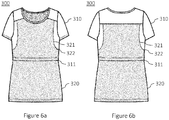
- Figures 6a-6b illustrate different views of a garment 300 in accordance with one or more embodiments described herein.
- Figures 6a and 6b illustrate a front view and a back view, respectively, of the garment 300 with the inner layer 320 illustrated in grey.
- the lower edge 311 of the outer layer 310 follows a straight horizontal line and is arranged a short distance below the lowermost edges 322 of the sleeve openings 321 of the inner layer 320.
- the outer layer 310 completely covers the sleeve openings 321 of the inner layer 320, so that the breasts are shielded from view, but it is at the same time desirable for the outer layer 310 not to extend too far below the lowermost edges 322 of the sleeve openings 321 of the inner layer 320, because this will make it unnecessarily cumbersome to lift the lower edge 311 of the outer layer 310 in order to access a breast through one of the sleeve openings 321 of the inner layer 320.
- the distance between the lowermost edges 322 of the sleeve openings 321 of the inner layer 320 and the lower edge 311 of the outer layer 310 may e.g. be 2-15 cm, or 10 cm or less, or 5 cm or less.
- Figures 7a-7b illustrate the inner layer front section 323 and the inner layer back section 324, respectively, of the garment 300 shown in figures 6a-6b .
- the inner layer 320 of the garment 300 is formed by attaching the inner layer front section 323 and the inner layer back section 324 to each other at least at the sides.
- the inner layer 320 is preferably sleeveless.
- the inner layer 320 may define the length of the garment, since it extends below the outer layer.
- the sleeve openings 321 of the inner layer front section 323 may be larger than the sleeve openings of the inner layer back section 324, to create an inner layer 320 with sleeve openings 321 which are larger at the front than at the back, for easier access to the breasts.
- Figures 8a-8b illustrate the outer layer front section 313 and the outer layer back section 314, respectively, of the garment 300 shown in figures 6a-6b .
- the outer layer 310 of the garment 300 may be formed by attaching the outer layer front section 313 and the outer layer back section 314 to each other at the sides and along the shoulders.
- the length of the outer layer 310 is selected so that it completely covers the sleeve openings 321 of the inner layer 320, so that the breasts are shielded from view, but at the same time does not extend too far below the lowermost edges 322 of the sleeve openings 321 of the inner layer 320, because this will make it unnecessarily cumbersome to lift the lower edge 311 of the outer layer 310 in order to access a breast through one of the sleeve openings 321 of the inner layer 320.
- the inner layer 320 of the garment 300 differs from the inner layer 120 of the garment 100 in that the inner layer 320 does not extend all the way up to the shoulders of the garment 300, but instead the inner layer front section 323 is attached to the outer layer front section 313, and the inner layer back section 324 is attached to the outer layer back section 314.
- the inner layer 310 of the garment 300 thus cannot be separately worn.
- the garment 300 may alternatively comprise an outer layer 310 which does not extend all the way up to the shoulders of the garment 300, and where instead the inner layer front section 323 is attached to the outer layer front section 313, and the inner layer back section 324 is attached to the outer layer back section 314.
- the outer layer 310 could not be separately worn.
- neither of the inner layer 320 and the outer layer 310 extends all the way up to the shoulders of the garment 300, but the garment is off-shoulder.
- the inner layer 320 and the outer layer 310 of the garment 300 are attached to each other in at least one point above the lowermost edges 322 of the sleeve openings 321 of the inner layer 320.
- the inner layer 320 and the outer layer 310 of the garment 300 may be attached to each other e.g. along a part of the garment 300 below the shoulders, which connects the layers well together and makes the garment 300 easy to put on without having to adjust the inner layer 320.
- the inner layer 320 and the outer layer 310 of the garment 300 may also, or alternatively, be attached to each other e.g. around at least a part of the neckline. This may ensure that the inner layer 320 will not show through the neckline of the outer layer 310.
- the inner layer 320 and the outer layer 310 of the garment 300 may also, or alternatively, be attached to each other e.g. along a part of the sleeve openings.
- the garment 300 shown in figures 6a-6b comprises an outer layer 310 which may be made from a number of different physical pieces.
- the outer layer front section 313 and the outer layer back section 314 may thus e.g. be made from a total of three different physical pieces, where one of the physical pieces overlaps between the front and the back of the outer layer 310.
- the outer layer front section 313 and the outer layer back section 314 thus do not have to be physically separated pieces, and they may be made from any number of different physical pieces.
- the garment 100, 200, 300 comprises an outer layer 110, 210, 310 and an inner layer 120, 220, 320 extending below the outer layer 110, 210, 310, wherein the inner layer 120, 220, 320 comprises an inner layer front section 123, 323 and an inner layer back section 124, 324 that are attached to each other at least at the sides, and the outer layer 110, 210, 310 comprises an outer layer front section 113, 313 and an outer layer back section 114, 314 that are attached to each other at least at the sides, and wherein the inner layer 120, 220, 320 and the outer layer 110, 210, 310 are attached to each other in at least one point above the lowermost edges 122, 222, 322 of the sleeve openings 121, 221, 321 of the inner layer 120, 220, 320, and the outer layer 110, 210, 310 comprises a lower edge 111, 211, 311 arranged below the lowermost edges 122, 222, 322
- the garment 100, 200, 300 may be manufactured by manufacturing the inner layer 120, 220, 320 by attaching the inner layer front section 123, 323 and the inner layer back section 124, 324 to each other at least at the sides, manufacturing the outer layer 110, 210, 310 by attaching the outer layer front section 113, 313 and the outer layer back section 114, 314 to each other at least at the sides, and attaching the inner layer 120, 220, 320 and the outer layer 110, 210, 310 to each other in at least one point above the lowermost edges 122, 222, 322 of the sleeve openings 121, 221, 321 of the inner layer 120, 220, 320, so that a breast can be accessed through one of the sleeve openings 121, 221, 321 of the inner layer 120, 220, 320 by lifting the lower edge 111, 211, 311 of the outer layer 110, 210, 310.
- the inner layer front section 123 and the inner layer back section 124 of the garment 100, 200, 300 are preferably attached to each other along the shoulders, but this may be done when the inner layer 120, 220, 320 and the outer layer 110, 210, 310 are attached to each other, if they are attached to each other along the shoulders. It is thus not necessary to attach the inner layer front section 123, 323 and the inner layer back section 124, 324 to each other along the shoulders when the inner layer is manufactured.
- the garment 100, 200, 300 differs from prior art nursing garments in that the garment 100, 200, 300 comprises an inner layer 120, 220, 320 and an outer layer 110, 210, 310 which are not attached to each other at the sides.
- the garment 100, 200, 300 facilitates breastfeeding, since an outer layer 110, 210, 310 which is not attached to the inner layer 120, 220, 320 below the sleeve openings 121, 221, 321 but instead hangs freely is easy to lift in order to access a breast through one of the sleeve openings 121, 221, 321 of the inner layer 120, 220, 320.
- the garment may be any type of garment that covers the breasts of the user. It may e.g. be a t-shirt, a jumper, a blouse, or a dress of any length, and it may have long sleeves, short sleeves or be entirely sleeveless.
- the inner layer is preferably sleeveless, but may comprise a short sleeve, or a sleeve which is not attached to the sleeve opening around the lower edge of the sleeve opening.
- a garment having sleeves may have a sleeveless outer layer and an inner layer having sleeves, although the opposite is preferred.
- the lower edge of the inner layer does not have to be hanging freely, but may e.g. be arranged around the crotch of the user.
- the garment may thus also be e.g. a body, a bathing suit or a jumpsuit.
- the garment may be made from any material, and it may be made from a number of different materials.
- the outer layer and the inner layer do not have to be made from the same material, and the material in any of the layers may comprise different layers in itself.
- the material of the garment is preferably elastic, but this is not necessary as long as the outer layer is wide enough to be easily lifted anyhow if the material of the outer layer is not elastic.
- the inner layer and the outer layer may be attached to each other at any point above the lowermost edges of the sleeve openings of the inner layer.
- the outer layer and the inner layer may e.g. be attached to each other along the shoulders, or a part of the shoulders.
- the outer layer and the inner layer may e.g. also or alternatively be attached to each other around the neckline, or a part of the neckline, but this is not necessary if a nice look can be ascertained in other ways.
- the outer layer and the inner layer may e.g. also or alternatively be attached to each other along a part of the sleeve openings.
- the neckline of the garment may have any shape. It may be round, as shown in the figures, but it may alternatively be any other shape, such as e.g. v-shaped.
- the inner layer may in this case e.g. have a collar sticking out of the v-shaped neckline of the outer layer.
- the garment may comprise any number of additional pieces or sections, in addition to the pieces and sections described above.
Landscapes
- Health & Medical Sciences (AREA)
- Nursing (AREA)
- Epidemiology (AREA)
- Public Health (AREA)
- General Health & Medical Sciences (AREA)
- Pediatric Medicine (AREA)
- Engineering & Computer Science (AREA)
- Textile Engineering (AREA)
- Prostheses (AREA)
- Professional, Industrial, Or Sporting Protective Garments (AREA)
- Corsets Or Brassieres (AREA)
Applications Claiming Priority (2)
| Application Number | Priority Date | Filing Date | Title |
|---|---|---|---|
| SE1750359A SE541579C2 (en) | 2017-03-27 | 2017-03-27 | Nursing garment |
| PCT/EP2018/057533 WO2018177960A2 (en) | 2017-03-27 | 2018-03-23 | Nursing garment |
Publications (2)
| Publication Number | Publication Date |
|---|---|
| EP3599918A2 EP3599918A2 (en) | 2020-02-05 |
| EP3599918B1 true EP3599918B1 (en) | 2020-12-16 |
Family
ID=63674301
Family Applications (1)
| Application Number | Title | Priority Date | Filing Date |
|---|---|---|---|
| EP18716537.8A Active EP3599918B1 (en) | 2017-03-27 | 2018-03-23 | Nursing garment |
Country Status (5)
| Country | Link |
|---|---|
| US (1) | US11344072B2 (cg-RX-API-DMAC7.html) |
| EP (1) | EP3599918B1 (cg-RX-API-DMAC7.html) |
| CN (1) | CN110520006B (cg-RX-API-DMAC7.html) |
| SE (1) | SE541579C2 (cg-RX-API-DMAC7.html) |
| WO (1) | WO2018177960A2 (cg-RX-API-DMAC7.html) |
Cited By (1)
| Publication number | Priority date | Publication date | Assignee | Title |
|---|---|---|---|---|
| FR3119969A1 (fr) | 2021-02-19 | 2022-08-26 | Amamantra | Vêtement destiné à l’allaitement |
Families Citing this family (5)
| Publication number | Priority date | Publication date | Assignee | Title |
|---|---|---|---|---|
| US11564423B2 (en) * | 2019-10-18 | 2023-01-31 | SheFeeds LLC | Nursing garment |
| USD935740S1 (en) * | 2019-11-05 | 2021-11-16 | Anthony Michael Cardenas | Nursing garment |
| US11771148B2 (en) * | 2020-06-26 | 2023-10-03 | Hb Innovations, Inc. | Combination nursing article |
| USD961192S1 (en) * | 2021-05-06 | 2022-08-23 | Celina Margarita Villarreal Saldivar | Women's nursing garment |
| US20240122784A1 (en) * | 2022-10-12 | 2024-04-18 | Sarah Catherine Roberts | Fashionable and discreet deep pressure therapy garments |
Family Cites Families (18)
| Publication number | Priority date | Publication date | Assignee | Title |
|---|---|---|---|---|
| US4528699A (en) | 1983-03-24 | 1985-07-16 | Hughes Stephanie D | Clothing for breast feeding |
| SE524562E (sv) | 2000-02-23 | 2012-12-27 | Boob Ab | Klädesplagg för underlättande av amning |
| DE102004006597A1 (de) | 2003-02-12 | 2005-02-03 | Nicole Schwarz-Steinbrich | Modische und funktionsoptimierte Bekleidung für stillende Mütter |
| US6854132B1 (en) * | 2003-08-06 | 2005-02-15 | Sarah Polzin | Nursing garment |
| SE525708C2 (sv) | 2003-11-05 | 2005-04-12 | Anna Thunstedt | Klädesplagg för damer |
| ES1058947Y (es) | 2003-11-14 | 2005-06-16 | Silva-Ledesma Elsa Rodriguez | Prenda para lactancia materna |
| DE102004060597A1 (de) | 2004-12-09 | 2006-06-14 | Ex-Cell-O Gmbh | Verfahren zur Herstellung eines Bauteils mit einer mechanischen Gebereinrichtung und Bauteil mit einer mechanischen Gebereinrichtung |
| US7340780B2 (en) * | 2005-04-14 | 2008-03-11 | Levy Edward M | Sports garment |
| SE531350C2 (sv) * | 2007-07-12 | 2009-03-03 | Cecilija Simic | Amningströja |
| US7878881B2 (en) | 2008-04-24 | 2011-02-01 | Destination Maternity Corporation | Pull up nursing garment |
| RU2408239C1 (ru) * | 2009-12-02 | 2011-01-10 | Оксана Сергеевна Рыжик | УЗЕЛ-СЕКРЕТ "Mаmmalia" ОДЕЖДЫ ДЛЯ КОРМЛЕНИЯ ГРУДЬЮ |
| RU2417717C1 (ru) * | 2010-03-23 | 2011-05-10 | Оксана Сергеевна Рыжик | УЗЕЛ ИЗДЕЛИЯ "Mammalia light" ДЛЯ КОРМЛЕНИЯ ГРУДЬЮ |
| US9022833B2 (en) | 2011-08-24 | 2015-05-05 | Katelyn Anne Deming | Garment for a patient undergoing radiation therapy or other uses |
| CN204232330U (zh) * | 2014-08-07 | 2015-04-01 | 郑晓彬 | 哺乳衣 |
| CN204635120U (zh) | 2015-05-18 | 2015-09-16 | 范坚文 | 一种哺乳衣 |
| US20160366953A1 (en) * | 2015-06-19 | 2016-12-22 | Jerome Watts | Article of clothing having additional coverings for a single individual |
| CN205072117U (zh) | 2015-09-23 | 2016-03-09 | 广东都市丽人实业有限公司 | 一种假两件带罩杯肩带可调节的孕期哺乳期两用家居服 |
| ES1156933Y (es) * | 2016-05-04 | 2016-08-17 | Martín Ana María González | Prenda de lactancia |
-
2017
- 2017-03-27 SE SE1750359A patent/SE541579C2/en unknown
-
2018
- 2018-03-23 WO PCT/EP2018/057533 patent/WO2018177960A2/en not_active Ceased
- 2018-03-23 CN CN201880020693.7A patent/CN110520006B/zh active Active
- 2018-03-23 EP EP18716537.8A patent/EP3599918B1/en active Active
- 2018-03-23 US US16/497,913 patent/US11344072B2/en active Active
Non-Patent Citations (1)
| Title |
|---|
| None * |
Cited By (1)
| Publication number | Priority date | Publication date | Assignee | Title |
|---|---|---|---|---|
| FR3119969A1 (fr) | 2021-02-19 | 2022-08-26 | Amamantra | Vêtement destiné à l’allaitement |
Also Published As
| Publication number | Publication date |
|---|---|
| EP3599918A2 (en) | 2020-02-05 |
| US11344072B2 (en) | 2022-05-31 |
| SE541579C2 (en) | 2019-11-05 |
| CN110520006B (zh) | 2022-01-07 |
| US20200383398A1 (en) | 2020-12-10 |
| WO2018177960A2 (en) | 2018-10-04 |
| CN110520006A (zh) | 2019-11-29 |
| SE1750359A1 (cg-RX-API-DMAC7.html) | 2018-09-28 |
| WO2018177960A3 (en) | 2018-11-15 |
Similar Documents
| Publication | Publication Date | Title |
|---|---|---|
| EP3599918B1 (en) | Nursing garment | |
| US20150208734A1 (en) | Tops and Dresses with Hidden Control Lining | |
| CA2813666C (en) | Nursing garment | |
| US20180049483A1 (en) | Breastfeeding apparel with concealable openings | |
| US7878880B2 (en) | Nursing garment | |
| US1254043A (en) | Combined corset-cover and brassiere. | |
| US7878881B2 (en) | Pull up nursing garment | |
| US8568195B1 (en) | Multi-fabric garment | |
| US9155339B2 (en) | Garments for a nursing woman | |
| US20100031418A1 (en) | Nursing Undergarment That Attaches To Bra | |
| US20160073703A1 (en) | Nursing garments | |
| US11445768B1 (en) | Women's tank top with built-in breast support | |
| US11096431B1 (en) | Nursing garment with integral privacy flap for use while breastfeeding in public | |
| US20210274858A1 (en) | Nursing Garment with magnetic opening/closure | |
| EP2891417B1 (en) | Breastfeeding attire | |
| US20100325775A1 (en) | Garments and Apparel | |
| US6883179B1 (en) | Composite garment and method to manufacture same | |
| US9655386B2 (en) | Nursing garments | |
| JP2007510819A (ja) | 女性用衣服 | |
| WO2009033028A1 (en) | Nursing garment with sleeves | |
| GB2246947A (en) | Garment | |
| JP3110811U (ja) | 授乳用衣服 | |
| JP2016121415A (ja) | ブラジャー | |
| US20200359712A1 (en) | Composite garment and method to manufacture same | |
| JP6443904B1 (ja) | 授乳用衣服 |
Legal Events
| Date | Code | Title | Description |
|---|---|---|---|
| STAA | Information on the status of an ep patent application or granted ep patent |
Free format text: STATUS: UNKNOWN |
|
| STAA | Information on the status of an ep patent application or granted ep patent |
Free format text: STATUS: THE INTERNATIONAL PUBLICATION HAS BEEN MADE |
|
| PUAI | Public reference made under article 153(3) epc to a published international application that has entered the european phase |
Free format text: ORIGINAL CODE: 0009012 |
|
| STAA | Information on the status of an ep patent application or granted ep patent |
Free format text: STATUS: REQUEST FOR EXAMINATION WAS MADE |
|
| 17P | Request for examination filed |
Effective date: 20191016 |
|
| AK | Designated contracting states |
Kind code of ref document: A2 Designated state(s): AL AT BE BG CH CY CZ DE DK EE ES FI FR GB GR HR HU IE IS IT LI LT LU LV MC MK MT NL NO PL PT RO RS SE SI SK SM TR |
|
| AX | Request for extension of the european patent |
Extension state: BA ME |
|
| DAV | Request for validation of the european patent (deleted) | ||
| DAX | Request for extension of the european patent (deleted) | ||
| GRAP | Despatch of communication of intention to grant a patent |
Free format text: ORIGINAL CODE: EPIDOSNIGR1 |
|
| STAA | Information on the status of an ep patent application or granted ep patent |
Free format text: STATUS: GRANT OF PATENT IS INTENDED |
|
| INTG | Intention to grant announced |
Effective date: 20200929 |
|
| GRAS | Grant fee paid |
Free format text: ORIGINAL CODE: EPIDOSNIGR3 |
|
| GRAA | (expected) grant |
Free format text: ORIGINAL CODE: 0009210 |
|
| STAA | Information on the status of an ep patent application or granted ep patent |
Free format text: STATUS: THE PATENT HAS BEEN GRANTED |
|
| AK | Designated contracting states |
Kind code of ref document: B1 Designated state(s): AL AT BE BG CH CY CZ DE DK EE ES FI FR GB GR HR HU IE IS IT LI LT LU LV MC MK MT NL NO PL PT RO RS SE SI SK SM TR |
|
| REG | Reference to a national code |
Ref country code: GB Ref legal event code: FG4D |
|
| REG | Reference to a national code |
Ref country code: DE Ref legal event code: R096 Ref document number: 602018010900 Country of ref document: DE |
|
| REG | Reference to a national code |
Ref country code: IE Ref legal event code: FG4D |
|
| REG | Reference to a national code |
Ref country code: AT Ref legal event code: REF Ref document number: 1344763 Country of ref document: AT Kind code of ref document: T Effective date: 20210115 |
|
| PG25 | Lapsed in a contracting state [announced via postgrant information from national office to epo] |
Ref country code: FI Free format text: LAPSE BECAUSE OF FAILURE TO SUBMIT A TRANSLATION OF THE DESCRIPTION OR TO PAY THE FEE WITHIN THE PRESCRIBED TIME-LIMIT Effective date: 20201216 Ref country code: RS Free format text: LAPSE BECAUSE OF FAILURE TO SUBMIT A TRANSLATION OF THE DESCRIPTION OR TO PAY THE FEE WITHIN THE PRESCRIBED TIME-LIMIT Effective date: 20201216 Ref country code: NO Free format text: LAPSE BECAUSE OF FAILURE TO SUBMIT A TRANSLATION OF THE DESCRIPTION OR TO PAY THE FEE WITHIN THE PRESCRIBED TIME-LIMIT Effective date: 20210316 Ref country code: GR Free format text: LAPSE BECAUSE OF FAILURE TO SUBMIT A TRANSLATION OF THE DESCRIPTION OR TO PAY THE FEE WITHIN THE PRESCRIBED TIME-LIMIT Effective date: 20210317 |
|
| REG | Reference to a national code |
Ref country code: AT Ref legal event code: MK05 Ref document number: 1344763 Country of ref document: AT Kind code of ref document: T Effective date: 20201216 |
|
| REG | Reference to a national code |
Ref country code: NL Ref legal event code: MP Effective date: 20201216 |
|
| PG25 | Lapsed in a contracting state [announced via postgrant information from national office to epo] |
Ref country code: SE Free format text: LAPSE BECAUSE OF FAILURE TO SUBMIT A TRANSLATION OF THE DESCRIPTION OR TO PAY THE FEE WITHIN THE PRESCRIBED TIME-LIMIT Effective date: 20201216 Ref country code: LV Free format text: LAPSE BECAUSE OF FAILURE TO SUBMIT A TRANSLATION OF THE DESCRIPTION OR TO PAY THE FEE WITHIN THE PRESCRIBED TIME-LIMIT Effective date: 20201216 Ref country code: BG Free format text: LAPSE BECAUSE OF FAILURE TO SUBMIT A TRANSLATION OF THE DESCRIPTION OR TO PAY THE FEE WITHIN THE PRESCRIBED TIME-LIMIT Effective date: 20210316 |
|
| PG25 | Lapsed in a contracting state [announced via postgrant information from national office to epo] |
Ref country code: NL Free format text: LAPSE BECAUSE OF FAILURE TO SUBMIT A TRANSLATION OF THE DESCRIPTION OR TO PAY THE FEE WITHIN THE PRESCRIBED TIME-LIMIT Effective date: 20201216 Ref country code: HR Free format text: LAPSE BECAUSE OF FAILURE TO SUBMIT A TRANSLATION OF THE DESCRIPTION OR TO PAY THE FEE WITHIN THE PRESCRIBED TIME-LIMIT Effective date: 20201216 |
|
| REG | Reference to a national code |
Ref country code: LT Ref legal event code: MG9D |
|
| PG25 | Lapsed in a contracting state [announced via postgrant information from national office to epo] |
Ref country code: RO Free format text: LAPSE BECAUSE OF FAILURE TO SUBMIT A TRANSLATION OF THE DESCRIPTION OR TO PAY THE FEE WITHIN THE PRESCRIBED TIME-LIMIT Effective date: 20201216 Ref country code: PT Free format text: LAPSE BECAUSE OF FAILURE TO SUBMIT A TRANSLATION OF THE DESCRIPTION OR TO PAY THE FEE WITHIN THE PRESCRIBED TIME-LIMIT Effective date: 20210416 Ref country code: LT Free format text: LAPSE BECAUSE OF FAILURE TO SUBMIT A TRANSLATION OF THE DESCRIPTION OR TO PAY THE FEE WITHIN THE PRESCRIBED TIME-LIMIT Effective date: 20201216 Ref country code: SK Free format text: LAPSE BECAUSE OF FAILURE TO SUBMIT A TRANSLATION OF THE DESCRIPTION OR TO PAY THE FEE WITHIN THE PRESCRIBED TIME-LIMIT Effective date: 20201216 Ref country code: SM Free format text: LAPSE BECAUSE OF FAILURE TO SUBMIT A TRANSLATION OF THE DESCRIPTION OR TO PAY THE FEE WITHIN THE PRESCRIBED TIME-LIMIT Effective date: 20201216 Ref country code: EE Free format text: LAPSE BECAUSE OF FAILURE TO SUBMIT A TRANSLATION OF THE DESCRIPTION OR TO PAY THE FEE WITHIN THE PRESCRIBED TIME-LIMIT Effective date: 20201216 Ref country code: CZ Free format text: LAPSE BECAUSE OF FAILURE TO SUBMIT A TRANSLATION OF THE DESCRIPTION OR TO PAY THE FEE WITHIN THE PRESCRIBED TIME-LIMIT Effective date: 20201216 |
|
| PG25 | Lapsed in a contracting state [announced via postgrant information from national office to epo] |
Ref country code: AT Free format text: LAPSE BECAUSE OF FAILURE TO SUBMIT A TRANSLATION OF THE DESCRIPTION OR TO PAY THE FEE WITHIN THE PRESCRIBED TIME-LIMIT Effective date: 20201216 Ref country code: PL Free format text: LAPSE BECAUSE OF FAILURE TO SUBMIT A TRANSLATION OF THE DESCRIPTION OR TO PAY THE FEE WITHIN THE PRESCRIBED TIME-LIMIT Effective date: 20201216 |
|
| REG | Reference to a national code |
Ref country code: DE Ref legal event code: R097 Ref document number: 602018010900 Country of ref document: DE |
|
| PG25 | Lapsed in a contracting state [announced via postgrant information from national office to epo] |
Ref country code: IS Free format text: LAPSE BECAUSE OF FAILURE TO SUBMIT A TRANSLATION OF THE DESCRIPTION OR TO PAY THE FEE WITHIN THE PRESCRIBED TIME-LIMIT Effective date: 20210416 |
|
| PLBE | No opposition filed within time limit |
Free format text: ORIGINAL CODE: 0009261 |
|
| STAA | Information on the status of an ep patent application or granted ep patent |
Free format text: STATUS: NO OPPOSITION FILED WITHIN TIME LIMIT |
|
| PG25 | Lapsed in a contracting state [announced via postgrant information from national office to epo] |
Ref country code: MC Free format text: LAPSE BECAUSE OF FAILURE TO SUBMIT A TRANSLATION OF THE DESCRIPTION OR TO PAY THE FEE WITHIN THE PRESCRIBED TIME-LIMIT Effective date: 20201216 Ref country code: IT Free format text: LAPSE BECAUSE OF FAILURE TO SUBMIT A TRANSLATION OF THE DESCRIPTION OR TO PAY THE FEE WITHIN THE PRESCRIBED TIME-LIMIT Effective date: 20201216 Ref country code: AL Free format text: LAPSE BECAUSE OF FAILURE TO SUBMIT A TRANSLATION OF THE DESCRIPTION OR TO PAY THE FEE WITHIN THE PRESCRIBED TIME-LIMIT Effective date: 20201216 |
|
| REG | Reference to a national code |
Ref country code: CH Ref legal event code: PL |
|
| 26N | No opposition filed |
Effective date: 20210917 |
|
| PG25 | Lapsed in a contracting state [announced via postgrant information from national office to epo] |
Ref country code: DK Free format text: LAPSE BECAUSE OF FAILURE TO SUBMIT A TRANSLATION OF THE DESCRIPTION OR TO PAY THE FEE WITHIN THE PRESCRIBED TIME-LIMIT Effective date: 20201216 |
|
| REG | Reference to a national code |
Ref country code: BE Ref legal event code: MM Effective date: 20210331 |
|
| PG25 | Lapsed in a contracting state [announced via postgrant information from national office to epo] |
Ref country code: CH Free format text: LAPSE BECAUSE OF NON-PAYMENT OF DUE FEES Effective date: 20210331 Ref country code: LI Free format text: LAPSE BECAUSE OF NON-PAYMENT OF DUE FEES Effective date: 20210331 Ref country code: LU Free format text: LAPSE BECAUSE OF NON-PAYMENT OF DUE FEES Effective date: 20210323 Ref country code: IE Free format text: LAPSE BECAUSE OF NON-PAYMENT OF DUE FEES Effective date: 20210323 Ref country code: ES Free format text: LAPSE BECAUSE OF FAILURE TO SUBMIT A TRANSLATION OF THE DESCRIPTION OR TO PAY THE FEE WITHIN THE PRESCRIBED TIME-LIMIT Effective date: 20201216 |
|
| PG25 | Lapsed in a contracting state [announced via postgrant information from national office to epo] |
Ref country code: SI Free format text: LAPSE BECAUSE OF FAILURE TO SUBMIT A TRANSLATION OF THE DESCRIPTION OR TO PAY THE FEE WITHIN THE PRESCRIBED TIME-LIMIT Effective date: 20201216 |
|
| PG25 | Lapsed in a contracting state [announced via postgrant information from national office to epo] |
Ref country code: IS Free format text: LAPSE BECAUSE OF FAILURE TO SUBMIT A TRANSLATION OF THE DESCRIPTION OR TO PAY THE FEE WITHIN THE PRESCRIBED TIME-LIMIT Effective date: 20210416 |
|
| PG25 | Lapsed in a contracting state [announced via postgrant information from national office to epo] |
Ref country code: BE Free format text: LAPSE BECAUSE OF NON-PAYMENT OF DUE FEES Effective date: 20210331 |
|
| PG25 | Lapsed in a contracting state [announced via postgrant information from national office to epo] |
Ref country code: CY Free format text: LAPSE BECAUSE OF FAILURE TO SUBMIT A TRANSLATION OF THE DESCRIPTION OR TO PAY THE FEE WITHIN THE PRESCRIBED TIME-LIMIT Effective date: 20201216 |
|
| PG25 | Lapsed in a contracting state [announced via postgrant information from national office to epo] |
Ref country code: HU Free format text: LAPSE BECAUSE OF FAILURE TO SUBMIT A TRANSLATION OF THE DESCRIPTION OR TO PAY THE FEE WITHIN THE PRESCRIBED TIME-LIMIT; INVALID AB INITIO Effective date: 20180323 |
|
| PG25 | Lapsed in a contracting state [announced via postgrant information from national office to epo] |
Ref country code: MK Free format text: LAPSE BECAUSE OF FAILURE TO SUBMIT A TRANSLATION OF THE DESCRIPTION OR TO PAY THE FEE WITHIN THE PRESCRIBED TIME-LIMIT Effective date: 20201216 |
|
| PG25 | Lapsed in a contracting state [announced via postgrant information from national office to epo] |
Ref country code: TR Free format text: LAPSE BECAUSE OF FAILURE TO SUBMIT A TRANSLATION OF THE DESCRIPTION OR TO PAY THE FEE WITHIN THE PRESCRIBED TIME-LIMIT Effective date: 20201216 |
|
| PG25 | Lapsed in a contracting state [announced via postgrant information from national office to epo] |
Ref country code: MT Free format text: LAPSE BECAUSE OF FAILURE TO SUBMIT A TRANSLATION OF THE DESCRIPTION OR TO PAY THE FEE WITHIN THE PRESCRIBED TIME-LIMIT Effective date: 20201216 |
|
| PGFP | Annual fee paid to national office [announced via postgrant information from national office to epo] |
Ref country code: GB Payment date: 20260313 Year of fee payment: 9 |
|
| PGFP | Annual fee paid to national office [announced via postgrant information from national office to epo] |
Ref country code: DE Payment date: 20260309 Year of fee payment: 9 |
|
| PGFP | Annual fee paid to national office [announced via postgrant information from national office to epo] |
Ref country code: FR Payment date: 20260312 Year of fee payment: 9 |