EP3598447B1 - Produktübergreifende, erweiterte und harmonische transposition - Google Patents
Produktübergreifende, erweiterte und harmonische transposition Download PDFInfo
- Publication number
- EP3598447B1 EP3598447B1 EP19171999.6A EP19171999A EP3598447B1 EP 3598447 B1 EP3598447 B1 EP 3598447B1 EP 19171999 A EP19171999 A EP 19171999A EP 3598447 B1 EP3598447 B1 EP 3598447B1
- Authority
- EP
- European Patent Office
- Prior art keywords
- subband
- analysis
- synthesis
- frequency
- signal
- Prior art date
- Legal status (The legal status is an assumption and is not a legal conclusion. Google has not performed a legal analysis and makes no representation as to the accuracy of the status listed.)
- Active
Links
Images







Classifications
-
- G—PHYSICS
- G10—MUSICAL INSTRUMENTS; ACOUSTICS
- G10L—SPEECH ANALYSIS TECHNIQUES OR SPEECH SYNTHESIS; SPEECH RECOGNITION; SPEECH OR VOICE PROCESSING TECHNIQUES; SPEECH OR AUDIO CODING OR DECODING
- G10L21/00—Speech or voice signal processing techniques to produce another audible or non-audible signal, e.g. visual or tactile, in order to modify its quality or its intelligibility
- G10L21/02—Speech enhancement, e.g. noise reduction or echo cancellation
-
- G—PHYSICS
- G10—MUSICAL INSTRUMENTS; ACOUSTICS
- G10L—SPEECH ANALYSIS TECHNIQUES OR SPEECH SYNTHESIS; SPEECH RECOGNITION; SPEECH OR VOICE PROCESSING TECHNIQUES; SPEECH OR AUDIO CODING OR DECODING
- G10L19/00—Speech or audio signals analysis-synthesis techniques for redundancy reduction, e.g. in vocoders; Coding or decoding of speech or audio signals, using source filter models or psychoacoustic analysis
- G10L19/04—Speech or audio signals analysis-synthesis techniques for redundancy reduction, e.g. in vocoders; Coding or decoding of speech or audio signals, using source filter models or psychoacoustic analysis using predictive techniques
- G10L19/08—Determination or coding of the excitation function; Determination or coding of the long-term prediction parameters
-
- G—PHYSICS
- G10—MUSICAL INSTRUMENTS; ACOUSTICS
- G10L—SPEECH ANALYSIS TECHNIQUES OR SPEECH SYNTHESIS; SPEECH RECOGNITION; SPEECH OR VOICE PROCESSING TECHNIQUES; SPEECH OR AUDIO CODING OR DECODING
- G10L19/00—Speech or audio signals analysis-synthesis techniques for redundancy reduction, e.g. in vocoders; Coding or decoding of speech or audio signals, using source filter models or psychoacoustic analysis
- G10L19/04—Speech or audio signals analysis-synthesis techniques for redundancy reduction, e.g. in vocoders; Coding or decoding of speech or audio signals, using source filter models or psychoacoustic analysis using predictive techniques
- G10L19/26—Pre-filtering or post-filtering
- G10L19/265—Pre-filtering, e.g. high frequency emphasis prior to encoding
-
- G—PHYSICS
- G10—MUSICAL INSTRUMENTS; ACOUSTICS
- G10L—SPEECH ANALYSIS TECHNIQUES OR SPEECH SYNTHESIS; SPEECH RECOGNITION; SPEECH OR VOICE PROCESSING TECHNIQUES; SPEECH OR AUDIO CODING OR DECODING
- G10L19/00—Speech or audio signals analysis-synthesis techniques for redundancy reduction, e.g. in vocoders; Coding or decoding of speech or audio signals, using source filter models or psychoacoustic analysis
- G10L19/02—Speech or audio signals analysis-synthesis techniques for redundancy reduction, e.g. in vocoders; Coding or decoding of speech or audio signals, using source filter models or psychoacoustic analysis using spectral analysis, e.g. transform vocoders or subband vocoders
-
- G—PHYSICS
- G10—MUSICAL INSTRUMENTS; ACOUSTICS
- G10L—SPEECH ANALYSIS TECHNIQUES OR SPEECH SYNTHESIS; SPEECH RECOGNITION; SPEECH OR VOICE PROCESSING TECHNIQUES; SPEECH OR AUDIO CODING OR DECODING
- G10L19/00—Speech or audio signals analysis-synthesis techniques for redundancy reduction, e.g. in vocoders; Coding or decoding of speech or audio signals, using source filter models or psychoacoustic analysis
- G10L19/02—Speech or audio signals analysis-synthesis techniques for redundancy reduction, e.g. in vocoders; Coding or decoding of speech or audio signals, using source filter models or psychoacoustic analysis using spectral analysis, e.g. transform vocoders or subband vocoders
- G10L19/0204—Speech or audio signals analysis-synthesis techniques for redundancy reduction, e.g. in vocoders; Coding or decoding of speech or audio signals, using source filter models or psychoacoustic analysis using spectral analysis, e.g. transform vocoders or subband vocoders using subband decomposition
- G10L19/0208—Subband vocoders
-
- G—PHYSICS
- G10—MUSICAL INSTRUMENTS; ACOUSTICS
- G10L—SPEECH ANALYSIS TECHNIQUES OR SPEECH SYNTHESIS; SPEECH RECOGNITION; SPEECH OR VOICE PROCESSING TECHNIQUES; SPEECH OR AUDIO CODING OR DECODING
- G10L21/00—Speech or voice signal processing techniques to produce another audible or non-audible signal, e.g. visual or tactile, in order to modify its quality or its intelligibility
- G10L21/02—Speech enhancement, e.g. noise reduction or echo cancellation
- G10L21/038—Speech enhancement, e.g. noise reduction or echo cancellation using band spreading techniques
- G10L21/0388—Details of processing therefor
-
- G—PHYSICS
- G10—MUSICAL INSTRUMENTS; ACOUSTICS
- G10L—SPEECH ANALYSIS TECHNIQUES OR SPEECH SYNTHESIS; SPEECH RECOGNITION; SPEECH OR VOICE PROCESSING TECHNIQUES; SPEECH OR AUDIO CODING OR DECODING
- G10L25/00—Speech or voice analysis techniques not restricted to a single one of groups G10L15/00 - G10L21/00
- G10L25/90—Pitch determination of speech signals
Definitions
- EP 13164569.9 is itself a European divisional application of Euro-PCT patent application EP 10701342.7 (reference: D08072EP01), filed 15 January 2010 and granted as EP 2380172 on 24 July 2013 .
- the present invention relates to audio coding systems which make use of a harmonic transposition method for high frequency reconstruction (HFR).
- HFR high frequency reconstruction
- HFR technologies such as the Spectral Band Replication (SBR) technology, allow to significantly improve the coding efficiency of traditional perceptual audio codecs.
- SBR Spectral Band Replication
- AAC MPEG-4 Advanced Audio Coding
- HFR technology can be combined with any perceptual audio codec in a back and forward compatible way, thus offering the possibility to upgrade already established broadcasting systems like the MPEG Layer-2 used in the Eureka DAB system.
- HFR transposition methods can also be combined with speech codecs to allow wide band speech at ultra low bit rates.
- HRF The basic idea behind HRF is the observation that usually a strong correlation between the characteristics of the high frequency range of a signal and the characteristics of the low frequency range of the same signal is present. Thus, a good approximation for the representation of the original input high frequency range of a signal can be achieved by a signal transposition from the low frequency range to the high frequency range.
- a low bandwidth signal is presented to a core waveform coder and the higher frequencies are regenerated at the decoder side using transposition of the low bandwidth signal and additional side information, which is typically encoded at very low bit-rates and which describes the target spectral shape.
- additional side information typically encoded at very low bit-rates and which describes the target spectral shape.
- harmonic transposition For low bit-rates, where the bandwidth of the core coded signal is narrow, it becomes increasingly important to recreate a high band, i.e. the high frequency range of the audio signal, with perceptually pleasant characteristics.
- Two variants of harmonic frequency reconstruction methods are mentioned in the following, one is referred to as harmonic transposition and the other one is referred to as single sideband modulation.
- harmonic transposition defined in WO 98/57436 is that a sinusoid with frequency ⁇ is mapped to a sinusoid with frequency T ⁇ where T > 1 is an integer defining the order of the transposition.
- An attractive feature of the harmonic transposition is that it stretches a source frequency range into a target frequency range by a factor equal to the order of transposition, i.e. by a factor equal to T .
- the harmonic transposition performs well for complex musical material.
- harmonic transposition exhibits low cross over frequencies, i.e. a large high frequency range above the cross over frequency can be generated from a relatively small low frequency range below the cross over frequency.
- a single sideband modulation (SSB) based HFR maps a sinusoid with frequency ⁇ to a sinusoid with frequency ⁇ + ⁇ ⁇ where ⁇ ⁇ is a fixed frequency shift. It has been observed that, given a core signal with low bandwidth, a dissonant ringing artifact may result from the SSB transposition. It should also be noted that for a low cross-over frequency, i.e. a small source frequency range, harmonic transposition will require a smaller number of patches in order to fill a desired target frequency range than SSB based transposition.
- harmonic transposition has drawbacks for signals with a prominent periodic structure.
- signals are superimpositions of harmonically related sinusoids with frequencies ⁇ ,2 ⁇ ,3 ⁇ ,..., where ⁇ is the fundamental frequency.
- Frequency domain transposition comprises the step of mapping nonlinearly modified subband signals from an analysis filter bank into selected subbands of a synthesis filter bank.
- the nonlinear modification comprises a phase modification or phase rotation which in a complex filter bank domain can be obtained by a power law followed by a magnitude adjustment.
- prior art transposition modifies one analysis subband at a time separately
- the present invention teaches to add a nonlinear combination of at least two different analysis subbands for each synthesis subband.
- the spacing between the analysis subbands to be combined may be related to the fundamental frequency of a dominant component of the signal to be transposed.
- This effect is obtained by modifying the phases of K suitably chosen subband signals by the factors T 1 ,T 2 ...,T K and recombining the result into a signal with phase equal to the sum of the modified phases. It is important to note that all these phase operations are well defined and unambiguous since the individual transposition orders are integers, and that some of these integers could even be negative as long as the total transposition order satisfies T ⁇ 1.
- Fig. 1 illustrates the operation of an HFR enhanced audio decoder.
- the core audio decoder 101 outputs a low bandwidth audio signal which is fed to an upsampler 104 which may be required in order to produce a final audio output contribution at the desired full sampling rate.
- Such upsampling is required for dual rate systems, where the band limited core audio codec is operating at half the external audio sampling rate, while the HFR part is processed at the full sampling frequency. Consequently, for a single rate system, this upsampler 104 is omitted.
- the low bandwidth output of 101 is also sent to the transposer or the transposition unit 102 which outputs a transposed signal, i.e. a signal comprising the desired high frequency range. This transposed signal may be shaped in time and frequency by the envelope adjuster 103.
- the final audio output is the sum of low bandwidth core signal and the envelope adjusted transposed signal.
- Fig. 2 illustrates the operation of a harmonic transposer 201, which corresponds to the transposer 102 of Fig. 1 , comprising several transposers of different transposition order T .
- a transposition order T max 3 suffices for most audio coding applications.
- the contributions of the different transposers 201-2, 201-3, ... , 201-T max are summed in 202 to yield the combined transposer output. In a first embodiment, this summing operation may comprise the adding up of the individual contributions.
- the contributions are weighted with different weights, such that the effect of adding multiple contributions to certain frequencies is mitigated.
- the third order contributions may be added with a lower gain than the second order contributions.
- the summing unit 202 may add the contributions selectively depending on the output frequency. For instance, the second order transposition may be used for a first lower target frequency range, and the third order transposition may be used for a second higher target frequency range.
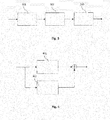
- Fig. 3 illustrates the operation of a frequency domain (FD) harmonic transposer, such as one of the individual blocks of 201, i.e. one of the transposers 201-T of transposition order T.
- An analysis filter bank 301 outputs complex subbands that are submitted to nonlinear processing 302, which modifies the phase and/or amplitude of the subband signal according to the chosen transposition order T.
- the modified subbands are fed to a synthesis filterbank 303 which outputs the transposed time domain signal.
- some filter bank operations may be shared between different transposers 201-2, 201-3, ... , 201-T max .
- the sharing of filter bank operations may be done for analysis or synthesis.
- the summing 202 can be performed in the subband domain, i.e. before the synthesis 303.
- Fig. 4 illustrates the operation of cross term processing 402 in addition to the direct processing 401.
- the cross term processing 402 and the direct processing 401 are performed in parallel within the nonlinear processing block 302 of the frequency domain harmonic transposer of Fig. 3 .
- the transposed output signals are combined, e.g. added, in order to provide a joint transposed signal.
- This combination of transposed output signals may consist in the superposition of the transposed output signals.
- the selective addition of cross terms may be implemented in the gain computation.
- Fig. 5 illustrates in more detail the operation of the direct processing block 401 of Fig. 4 within the frequency domain harmonic transposer of Fig. 3 .
- Single-input-single-output (SISO) units 401-1, ... , 401-n, ... , 401-N map each analysis subband from a source range into one synthesis subband in a target range.
- SISO single-input-single-output
- 401-n maps each analysis subband from a source range into one synthesis subband in a target range.
- an analysis subband of index n is mapped by the SISO unit 401-n to a synthesis subband of the same index n.
- the frequency range of the subband with index n in the synthesis filter bank may vary depending on the exact version or type of harmonic transposition. In the version or type illustrated in Fig.
- the frequency spacing of the analysis bank 301 is a factor T smaller than that of the synthesis bank 303.
- the index n in the synthesis bank 303 corresponds to a frequency, which is T times higher than the frequency of the subband with the same index n in the analysis bank 301.
- an analysis subband [( n ⁇ 1) ⁇ , n ⁇ ] is transposed into a synthesis subband [( n ⁇ 1) T ⁇ , nT ⁇ ] .
- Fig. 6 illustrates the direct nonlinear processing of a single subband contained in each of the SISO units of 401-n.
- the nonlinearity of block 601 performs a multiplication of the phase of the complex subband signal by a factor equal to the transposition order T .
- the optional gain unit 602 modifies the magnitude of the phase modified subband signal.
- phase of the complex subband signal x is multiplied by the transposition order T and the amplitude of the complex subband signal x is modified by the gain parameter g.
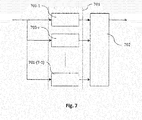
- Fig. 7 illustrates the components of the cross term processing 402 for an harmonic transposition of order T .
- T -1 cross term processing blocks in parallel 701-1, ..., 701-r, ... 701-(T-1), whose outputs are summed in the summing unit 702 to produce a combined output.
- two subbands from the analysis filter bank 301 are to be mapped to one subband of the high frequency range.
- this mapping step is performed in the cross term processing block 701-r.
- Each output subband 803 is obtained in a multiple-input-single-output (MISO) unit 800-n from two input subbands 801 and 802.
- MISO multiple-input-single-output
- the two inputs of the MISO unit 800-n are subbands n ⁇ p 1 , 801, and n + p 2 , 802, where p 1 and p 2 are positive integer index shifts, which depend on the transposition order T , the variable r , and the cross product enhancement pitch parameter ⁇ .
- the pitch parameter ⁇ does not have to be known with high precision, and certainly not with better frequency resolution than the frequency resolution obtained by the analysis filter bank 301.
- the underlying cross product enhancement pitch parameter ⁇ is not entered in the decoder at all. Instead, the chosen pair of integer index shifts ( p 1 ,p 2 ) is selected from a list of possible candidates by following an optimization criterion such as the maximization of the cross product output magnitude, i.e. the maximization of the energy of the cross product output.
- the applied index shifts ( p 1 ,p 2 ) are the same for a certain range of output subbands, e.g. synthesis subbands (n-1), n and (n+1) are composed from analysis subbands having a fixed distance p 1 + p 2 , this need not be the case.
- the index shifts ( p 1 ,p 2 ) may differ for each and every output subband. This means that for each subband n a different value ⁇ of the cross product enhancement pitch parameter may be selected.
- Fig. 9 illustrates the nonlinear processing contained in each of the MISO units 800-n.
- the product operation 901 creates a subband signal with a phase equal to a weighted sum of the phases of the two complex input subband signals and a magnitude equal to a generalized mean value of the magnitudes of the two input subband samples.
- the optional gain unit 902 modifies the magnitude of the phase modified subband samples.
- y ⁇ u 1 u 2 ⁇ u 1 u 1 T ⁇ r u 2 u 2 T , where ⁇ (
- the phase of the complex subband signal u 1 is multiplied by the transposition order T - r and the phase of the complex subband signal u 2 is multiplied by the transposition order r .
- the sum of those two phases is used as the phase of the output y whose magnitude is obtained by the magnitude generation function.
- the magnitude generation function is expressed as the geometric mean of magnitudes modified by the gain parameter g, that is ⁇ (
- ) g ⁇
- the synthesis filter bank 303 is assumed to achieve perfect reconstruction from a corresponding complex modulated analysis filter bank 301 with a real valued symmetric window function or prototype filter w(t ).
- the synthesis filter bank will often, but not always, use the same window in the synthesis process.
- the modulation is assumed to be of an evenly stacked type, the stride is normalized to one and the angular frequency spacing of the synthesis subbands is normalized to ⁇ .
- formula (3) is a normalized continuous time mathematical model of the usual operations in a complex modulated subband analysis filter bank, such as a windowed Discrete Fourier Transform (DFT), also denoted as a Short Time Fourier Transform (STFT).
- DFT windowed Discrete Fourier Transform
- STFT Short Time Fourier Transform
- QMF complex modulated Quadrature Mirror Filterbank
- CMDCT Complexified Modified Discrete Cosine Transform
- the subband index n runs through all nonnegative integers for the continuous time case.
- the time variable t is sampled at step 1/ N , and the subband index n is limited by N , where N is the number of subbands in the filter bank, which is equal to the discrete time stride of the filter bank.
- a normalization factor related to N is also required in the transform operation if it is not incorporated in the scaling of the window.
- the corresponding algorithmic steps for the synthesis filter bank are well known for those skilled in the art, and consist of synthesis modulation, synthesis windowing, and overlap add operations.
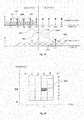
- Fig. 19 illustrates the position in time and frequency corresponding to the information carried by the subband sample y n ( k ) for a selection of values of the time index k and the subband index n.
- the subband sample y 5 (4) is represented by the dark rectangle 1901.
- Fig. 20 depicts the typical appearance of a window w, 2001, and its Fourier transform ⁇ ,2002.
- Fig. 21 illustrates the analysis of a single sinusoid corresponding to formula (4).
- the subbands that are mainly affected by the sinusoid at frequency ⁇ are those with index n such that n ⁇ ⁇ ⁇ is small.
- the shading of those three subbands reflects the relative amplitude of the complex sinusoids inside each subband obtained from formula (4). A darker shade means higher amplitude.
- the synthesis subband signals y n (k) can also be determined as a result of the analysis filter bank 301 and the non-linear processing, i.e. harmonic transposer 302 illustrated in Fig. 3 .
- the analysis subband signals x n ( k ) may be represented as a function of the source signal z ( t ) .
- a complex modulated analysis filter bank with window w T ( t ) w ( t / T )/ T, a stride one, and a modulation frequency step, which is T times finer than the frequency step of the synthesis bank, is applied on the source signal z ( t ).
- Fig. 22 illustrates the appearance of the scaled window w T 2201 and its Fourier transform ⁇ T 2202. Compared to Fig. 20 , the time window 2201 is stretched out and the frequency window 2202 is compressed.
- a harmonic transposition of order T of the sinusoidal source signal z ( t ) is obtained.
- the phase evolution of the output subband signal 803 of the MISO system 800-n follows the phase evolution of an analysis of a sinusoid of frequency T ⁇ + r ⁇ . This holds independently of the choice of the index shifts p 1 and p 2 .
- the subband signal (9) is fed into a subband channel n corresponding to the frequency T ⁇ + r ⁇ , that is if n ⁇ ⁇ T ⁇ + r ⁇ , then the output will be a contribution to the generation of a sinusoid at frequency T ⁇ + r ⁇ .
- index shifts p 1 and p 2 can be derived in order for the complex magnitude M ( n, ⁇ ) of (10) to approximate ⁇ (n ⁇ ⁇ ( T ⁇ + r ⁇ )) for a range of subbands n, in which case the final output will approximate a sinusoid at the frequency T ⁇ + r ⁇ .
- a first consideration on main lobes imposes all three values of ( n ⁇ p 1 ) ⁇ ⁇ T ⁇ , ( n + p 2 ) ⁇ ⁇ T ( ⁇ + ⁇ ) , n ⁇ ⁇ ( T ⁇ + r ⁇ ) to be small simultaneously, which leads to the approximate equalities p 1 ⁇ r ⁇ ⁇ and p 2 ⁇ T ⁇ r ⁇ ⁇ .
- the index shifts may be approximated by fomula (11), thereby allowing a simple selection of the analysis subbands.
- a more thorough analysis of the effects of the choice of the index shifts p 1 and p 2 according to formula (11) on the magnitude of the parameter M ( n, ⁇ ) according to formula (10) can be performed for important special cases of window functions w(t) such as the Gaussian window and a sine window.
- window functions w(t) such as the Gaussian window and a sine window.
- the relation (11) is calibrated to the exemplary situation where the analysis filter bank 301 has an angular frequency subband spacing of ⁇ / T .
- the resulting interpretation of (11) is that the cross term source span p 1 + p 2 is an integer approximating the underlying fundamental frequency ⁇ , measured in units of the analysis filter bank subband spacing, and that the pair ( p 1 , p 2 ) is chosen as a multiple of ( r,T ⁇ r ) .
- phase modification of the subband signals u 1 and u 2 is performed with a weighting ( T ⁇ r ) and r , respectively, but the subband index distance p 1 and p 2 are chosen proportional to r and ( T ⁇ r ) , respectively.
- the closest subband to the synthesis subband n receives the strongest phase modification.
- the addition of cross terms for different values r is preferably done independently, since there may be a risk of adding content to the same subband several times.
- the fundamental frequency ⁇ is used for selecting the subbands as in mode 1 or if only a narrow range of subband index distances are permitted as may be the case in mode 2, this particular issue of adding content to the same subband several times may be avoided.
- an additional decoder modification of the cross product gain g may be beneficial.
- the input subband signals u 1 , u 2 to the cross products MISO unit given by formula (2) and the input subband signal x to the transposition SISO unit given by formula (1).
- the direct processing 401 and the cross product processing 402 provide components for the same output synthesis subband, it may be desirable to set the cross product gain g to zero, i.e. the gain unit 902 of Fig.
- x is the analysis subband sample for the direct term processing which leads to an output at the same synthesis subband as the cross product under consideration. This may be a precaution in order to not enhance further a harmonic component that has already been furnished by the direct transposition.
- the top diagram 1001 depicts the partial frequency components of the original signal by vertical arrows positioned at multiples of the fundamental frequency ⁇ . It illustrates the source signal, e.g. at the encoder side.
- the diagram 1001 is segmented into a left sided source frequency range with the partial frequencies ⁇ ,2 ⁇ ,3 ⁇ ,4 ⁇ ,5 ⁇ and a right sided target frequency range with partial frequencies 6 ⁇ ,7 ⁇ ,8 ⁇ .
- the source frequency range will typically be encoded and transmitted to the decoder.
- the right sided target frequency range which comprises the partials 6 ⁇ ,7 ⁇ ,8 ⁇ above the cross over frequency 1005 of the HFR method, will typically not be transmitted to the decoder. It is an object of the harmonic transposition method to reconstruct the target frequency range above the cross-over frequency 1005 of the source signal from the source frequency range. Consequently, the target frequency range, and notably the partials 6 ⁇ ,7 ⁇ ,8 ⁇ in diagram 1001 are not available as input to the transposer.
- the bottom diagram 1002 shows the output of the transposer in the right sided target frequency range.
- Such transposer may e.g. be placed at the decoder side.
- the target partial at 7 ⁇ is missing. This target partial at 7 ⁇ can not be generated using the underlying prior art harmonic transposition method.
- a transposer is used to generate the partials 6 ⁇ ,7 ⁇ ,8 ⁇ in the target frequency range above the cross-over frequency 1105 in the lower diagram 1102 from the partials ⁇ 2, ⁇ ,3 ⁇ ,4 ⁇ ,5 ⁇ in the source frequency range below the cross-over frequency 1105 of diagram 1101.
- the partial frequency component at 7 ⁇ is regenerated from a combination of the source partials at 3 ⁇ and 4 ⁇ .
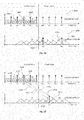
- Fig. 12 illustrates a possible implementation of a prior art second order harmonic transposer in a modulated filter bank for the spectral configuration of Fig. 10 .
- the stylized frequency responses of the analysis filter bank subbands are shown by dotted lines, e.g. reference sign 1206, in the top diagram 1201.
- the subbands are enumerated by the subband index, of which the indexes 5, 10 and 15 are shown in Fig. 12 .
- the fundamental frequency ⁇ is equal to 3.5 times the analysis subband frequency spacing. This is illustrated by the fact that the partial ⁇ in diagram 1201 is positioned between the two subbands with subband index 3 and 4.
- the partial 2 ⁇ is positioned in the center of the subband with subband index 7 and so forth.
- Fig. 13 illustrates a possible implementation of an additional cross term processing step in the modulated filter bank of Fig. 12 .
- the cross-term processing step corresponds to the one described for periodic signals with the fundamental frequency ⁇ in relation to Fig. 11 .
- the upper diagram 1301 illustrates the analysis subbands, of which the source frequency range is to be transposed into the target frequency range of the synthesis subbands in the lower diagram 1302.
- the particular case of the generation of the synthesis subbands 1315 and 1316, which are surrounding the partial 7 ⁇ , from the analysis subbands is considered.
- T 2
- a synthesis subband with the subband index n may be generated from the cross-term product of the analysis subbands with the subband index ( n ⁇ p 1 ) and ( n + p 2 ) . Consequently, for the synthesis subband with subband index 12, i.e.
- This process of cross-product generation is symbolized by the diagonal dashed/dotted arrow pairs, i.e. reference sign pairs 1308, 1309 and 1306, 1307, respectively.
- the top diagram 1401 depicts the partial frequency components of the original signal by vertical arrows positioned at multiples of the fundamental frequency ⁇ .
- the partials 6 ⁇ ,7 ⁇ ,8 ⁇ ,9 ⁇ are in the target range above the cross over frequency 1405 of the HFR method and therefore not available as input to the transposer.
- the aim of the harmonic transposition is to regenerate those signal components from the signal in the source range.
- the bottom diagram 1402 shows the output of the transposer in the target frequency range.
- the partials at frequencies 6 ⁇ , i.e. reference sign 1407, and 9 ⁇ , i.e. reference sign 1410, have been regenerated from the partials at frequencies 2 ⁇ , i.e.
- reference sign 1406, and 3 ⁇ i.e. reference sign 1409.
- the target partials at 7 ⁇ and 8 ⁇ are missing.
- the effect of the cross product addition is depicted by the dashed arrows 1510 and 1511.
- Fig. 16 illustrates a possible implementation of a prior art third order harmonic transposer in a modulated filter bank for the spectral situation of Fig. 14 .
- the stylized frequency responses of the analysis filter bank subbands are shown by dotted lines in the top diagram 1601.
- the subbands are enumerated by the subband indexes 1 through 17 of which the subbands 1606, with index 7, 1607, with index 10 and 1608, with index 11, are referenced in an exemplary manner.
- the fundamental frequency ⁇ is equal to 3.5 times the analysis subband frequency spacing ⁇ ⁇ .
- the bottom diagram 1602 shows the regenerated partial frequency superimposed with the stylized frequency responses of selected synthesis filter bank subbands.
- the subbands 1609, with subband index 7, 1610, with subband index 10 and 1611, with subband index 11 are referenced.
- the frequency responses are scaled accordingly.
- the result of this direct term processing for subbands 6 to 11 is the regeneration of the two target partial frequencies 6 ⁇ and 9 ⁇ from the source partials at frequencies 2 ⁇ and 3 ⁇ .
- the main contribution to the target partial 6 ⁇ comes from subband with index 7, i.e. reference sign 1606, and the main contributions to the target partial 9 ⁇ comes from subbands with index 10 and 11, i.e. reference signs 1607 and 1608, respectively.
- the relative distance i.e.
- the synthesis subband with index 8 i.e. reference sign 1710
- the synthesis subband with index 9 i.e.
- the set of arrows illustrate the pairs under consideration.
- the analysis subband signals x n ( k ) given by formula (6) and x' n (k) given by formula (8) are good approximations of the analysis of the input signal z(t) where the approximation is valid in different subband regions. It follows from a comparison of the formulas (6) and (8-10) that a harmonic phase evolution along the frequency axis of the input signal z(t) will be extrapolated correctly by the present invention. This holds in particular for a pure pulse train. For the output audio quality, this is an attractive feature for signals of pulse train like character, such as those produced by human voices and some musical instruments.
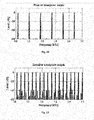
- the signal has a fundamental frequency 282.35 Hz and its magnitude spectrum in the considered target range of 10 to 15 kHz is depicted in Fig. 25 .
- a filter bank of N 512 subbands is used at a sampling frequency of 48 kHz to implement the transpositions.
- every third harmonic is reproduced with high fidelity as predicted by the theory outlined above, and the perceived pitch will be 847 Hz, three times the original one.
- Fig. 27 shows the output of a transposer applying cross term products.
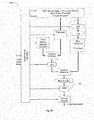
- Fig. 28 and Fig. 29 illustrate an exemplary encoder 2800 and an exemplary decoder 2900, respectively, for unified speech and audio coding (USAC).
- USAC unified speech and audio coding
- the general structure of the USAC encoder 2800 and decoder 2900 is described as follows: First there may be a common pre/postprocessing consisting of an MPEG Surround (MPEGS) functional unit to handle stereo or multi-channel processing and an enhanced SBR (eSBR) unit 2801 and 2901, respectively, which handles the parametric representation of the higher audio frequencies in the input signal and which may make use of the harmonic transposition methods outlined in the present document.
- MPEGS MPEG Surround
- eSBR enhanced SBR
- AAC Advanced Audio Coding
- LPC linear prediction coding
- the enhanced Spectral Band Replication (eSBR) unit 2801 of the encoder 2800 may comprise the high frequency reconstruction systems outlined in the present document.
- the eSBR unit 2801 may comprise an analysis filter bank 301 in order to generate a plurality of analysis subband signals.
- This analysis subband signals may then be transposed in a non-linear processing unit 302 to generate a plurality of synthesis subband signals, which may then be inputted to a synthsis filter bank 303 in order to generate a high frequency component.
- a set of information may be determined on how to generate a high frequency component from the low frequency component which best matches the high frequency component of the original signal.
- This set of information may comprise information on signal characteristics, such as a predominant fundamental frequency ⁇ , on the spectral envelope of the high frequency component, and it may comprise information on how to best combine analysis subband signals, i.e. information such as a limited set of index shift pairs ( p 1 , p 2 ).
- Encoded data related to this set of information is merged with the other encoded information in a bitstream multiplexer and forwarded as an encoded audio stream to a corresponding decoder 2900.
- the decoder 2900 shown in Fig. 29 also comprises an enhanced Spectral Bandwidth Replication (eSBR) unit 2901.
- This eSBR unit 2901 receives the encoded audio bitstream or the encoded signal from the encoder 2800 and uses the methods outlined in the present document to generate a high frequency component of the signal, which is merged with the decoded low frequency component to yield a decoded signal.
- the eSBR unit 2901 may comprise the different components outlined in the present document. In particular, it may comprise an analysis filter bank 301, a non-linear processing unit 302 and a synthesis filter bank 303.
- the eSBR unit 2901 may use information on the high frequency component provided by the encoder 2800 in order to perform the high frequency reconstruction. Such information may be a fundamental frequency ⁇ of the signal, the spectral envelope of the original high frequency component and/or information on the analysis subbands which are to be used in order to generate the synthesis subband signals and ultimately the high frequency component of the decoded signal
- FIGs. 28 and 29 illustrate possible additional components of a USAC encoder/decoder, such as:
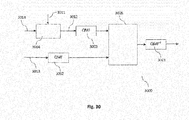
- Fig. 30 illustrates an embodiment of the eSBR units shown in Figs. 28 and 29 .
- the eSBR unit 3000 will be described in the following in the context of a decoder, where the input to the eSBR unit 3000 is the low frequency component, also known as the lowband, of a signal and possible additional information regarding specific signal characteristics, such as a fundamental frequency ⁇ , and/or possible index shift values (p 1 ,p 2 ).
- the input to the eSBR unit will typically be the complete signal, whereas the output will be additional information regarding the signal characteristics and/or index shift values.
- the low frequency component 3013 is fed into a QMF filter bank, in order to generate QMF frequency bands. These QMF frequency bands are not be mistaken with the analysis subbands outlined in this document.
- the QMF frequency bands are used for the purpose of manipulating and merging the low and high frequency component of the signal in the frequency domain, rather than in the time domain.
- the low frequency component 3014 is fed into the transposition unit 3004 which corresponds to the systems for high frequency reconstruction outlined in the present document.
- the transposition unit 3004 may also receive additional information 3011, such as the fundamental frequency ⁇ of the encoded signal and/or possible index shift pairs (p 1 ,p 2 ) for subband selection.
- the transposition unit 3004 generates a high frequency component 3012, also known as highband, of the signal, which is transformed into the frequency domain by a QMF filter bank 3003. Both, the QMF transformed low frequency component and the QMF transformed high frequency component are fed into a manipulation and merging unit 3005.
- This unit 3005 may perform an envelope adjustment of the high frequency component and combines the adjusted high frequency component and the low frequency component.
- the combined output signal is re-transformed into the time domain by an inverse QMF filter bank 3001.
- the QMF filter banks comprise 64 QMF frequency bands. It should be noted, however, that it may be beneficial to down-sample the low frequency component 3013, such that the QMF filter bank 3002 only requires 32 QMF frequency bands. In such cases, the low frequency component 3013 has a bandwidth of ⁇ s /4, where ⁇ s is the sampling frequency of the signal. On the other hand, the high frequency component 3012 has a bandwidth of ⁇ s /2.
- the method and system described in the present document may be implemented as software, firmware and/or hardware. Certain components may e.g. be implemented as software running on a digital signal processor or microprocessor. Other component may e.g. be implemented as hardware and or as application specific integrated circuits.
- the signals encountered in the described methods and systems may be stored on media such as random access memory or optical storage media. They may be transferred via networks, such as radio networks, satellite networks, wireless networks or wireline networks, e.g. the internet. Typical devices making use of the method and system described in the present document are set-top boxes or other customer premises equipment which decode audio signals.
- the method and system may be used in broadcasting stations, e.g. in video headend systems.
- the present document outlined a method and a system for performing high frequency reconstruction of a signal based on the low frequency component of that signal.
- the method and system allow the reconstruction of frequencies and frequency bands which may not be generated by transposition methods known from the art.
- the described HTR method and system allow the use of low cross over frequencies and/or the generation of large high frequency bands from narrow low frequency bands.
Landscapes
- Engineering & Computer Science (AREA)
- Physics & Mathematics (AREA)
- Multimedia (AREA)
- Health & Medical Sciences (AREA)
- Audiology, Speech & Language Pathology (AREA)
- Human Computer Interaction (AREA)
- Signal Processing (AREA)
- Acoustics & Sound (AREA)
- Computational Linguistics (AREA)
- Quality & Reliability (AREA)
- Spectroscopy & Molecular Physics (AREA)
- Compression, Expansion, Code Conversion, And Decoders (AREA)
- Stereophonic System (AREA)
- Fats And Perfumes (AREA)
- Superconductors And Manufacturing Methods Therefor (AREA)
- Carbon And Carbon Compounds (AREA)
- Auxiliary Devices For Music (AREA)
Claims (12)
- System zum Decodieren eines Audiosignals, das System umfasst:einen Kerndecodierer (101) zum Decodieren einer Niederfrequenzkomponente des Audiosignals;eine Analysefilterdatenbank (301) zum Bereitstellen einer Vielzahl von Analyseteilbandsignalen der Niederfrequenzkomponente des Audiosignals;eine Teilbandauswahlempfangseinheit zum Empfangen von Informationen, die mit einer Grundfrequenz Ω des Audiosignals verknüpft sind, und zum Auswählen, in Antwort auf die Informationen, eines ersten (801) und eines zweiten (802) Analyseteilbandsignals aus der Vielzahl von Analyseteilbandsignalen, aus denen ein Syntheseteilbandsignal (803) generiert wird;eine nichtlineare Verarbeitungseinheit (302) zum Generieren des Syntheseteilbandsignals mit einer Synthesefrequenz, einer Magnitude und einer Phase durch:Bestimmen der Magnitude des Syntheseteilbandsignals aus einem verallgemeinerten Mittelwert der Magnituden des ersten und des zweiten Analyseteilbandsignals; undBestimmen der Phase des Syntheseteilbandsignals aus einer gewichteten Summe der Phasen des ersten und des zweiten Analyseteilbandsignals; undeine Synthesefilterbank (303) zum Generieren einer Hochfrequenzkomponente des Audiosignals aus dem Syntheseteilbandsignal;wobei die mit einer Grundfrequenz Ω des Audiosignals verknüpften Informationen in einem codierten Bitstrom empfangen werden.
- System nach Anspruch 1, wobeidie Analysefilterbank (301) N Analyseteilbänder mit einem im Wesentlichen konstanten Teilbandabstand von Δω aufweist;ein Analyseteilband mit einem Analyseteilbandindex n verknüpft ist, wobei n∈{1,...,N};die Synthesefilterbank (303) ein Syntheseteilband aufweist;das Syntheseteilband mit einem Syntheseteilbandindex n verknüpft ist; unddas Syntheseteilband und das Analyseteilband mit Index n jeweils Frequenzbereiche umfassen, die über einen Faktor T zusammenhängen.
- System nach Anspruch 2, ferner umfassend:ein Analysefenster (2001), das ein vordefiniertes Zeitintervall der Niederfrequenzkomponente um einen vordefinierten Zeitpunkt k herum isoliert; undein Synthesefenster (2201), das ein vordefiniertes Zeitintervall der Hochfrequenzkomponente um den vordefinierten Zeitpunkt k herum isoliert.
- System nach Anspruch 3, wobei das Synthesefenster (2201) eine zeitskalierte Version des Analysefensters (2001) ist.
- System nach Anspruch 1, ferner umfassend:einen Aufwärtsabtaster (104) zum Ausführen einer Aufwärtsabtastung der Niederfrequenzkomponente, um eine aufwärtsabgetastete Niederfrequenzkomponente zu ergeben;eine Hüllkurvenanpassungsvorrichtung (103), um die Hochfrequenzvorrichtung zu formen; undeine Komponentensummierungseinheit, um ein decodiertes Audiosignal als die Summe der aufwärtsabgetasteten Niederfrequenzkomponente und der angepassten Hochfrequenzkomponente zu bestimmen.
- System nach Anspruch 5, ferner umfassend eine Hüllkurvenempfangseinheit, um Informationen bezüglich der Hüllkurve der Hochfrequenzkomponente des Audiosignals zu empfangen.
- System nach Anspruch 6, ferner umfassend:eine Eingabeeinheit zum Empfangen des Audiosignals, das die Niederfrequenzkomponente umfasst; undeine Ausgabeeinheit zum Bereitstellen des decodierten Audiosignals, das die Nieder- und die generierte Hochfrequenzkomponente umfasst.
- System nach Anspruch 1, wobei die nicht lineare Verarbeitungseinheit (302) eine Einheit (800-n) mit mehreren Eingängen und einem einzigen Ausgang einer ersten und zweiten Transpositionsordnung zum Generieren des Syntheseteilbandsignals (803) mit der Synthesefrequenz aus den ersten (801) und den zweiten (802) Analyseteilbandsignalen jeweils mit einer ersten und einer zweiten Analysefrequenz umfasst; wobei die Synthesefrequenz der ersten Analysefrequenz, die mit der ersten Transpositionsordnung multipliziert ist, zuzüglich der zweiten Analysefrequenz, die mit der zweiten Transpositionsordnung multipliziert ist, entspricht.
- System nach Anspruch 8, wobei:die erste Analysefrequenz ω ist;die zweite Analysefrequenz (ω+Ω) ist;die erste Transpositionsordnung (T-r) ist;die zweite Transpositionsordnung r ist;T>1; und1≤r<T;so dass die Synthesefrequenz (T-r)·ω+r·(ω+Ω) ist.
- System nach Anspruch 1, wobei die Analysefilterbank (301) einen Frequenzabstand aufweist, der mit der Grundfrequenz Ω des Audiosignals verknüpft ist.
- Verfahren zum Decodieren eines Audiosignals, wobei das Verfahren umfasst:Decodieren einer Niederfrequenzkomponente des Audiosignals;Bereitstellen einer Vielzahl von Analyseteilbandsignalen der Niederfrequenzkomponente des Audiosignals;Empfangen von Informationen, die mit einer Grundfrequenz Ω des Audiosignals verknüpft sind, welche die Auswahl eines ersten (801) und eines zweiten (802) Analyseteilbandsignals aus der Vielzahl von Analyseteilbandsignalen ermöglichen;Generieren eines Syntheseteilbandsignals mit einer Synthesefrequenz, einer Magnitude und einer Phase durch:Bestimmen der Magnitude des Syntheseteilbandsignals aus einem Mittelwert der Magnituden des ersten und des zweiten Analyseteilbandsignals; undBestimmen der Phase des Syntheseteilbandsignals aus einer gewichteten Summe der Phasen des ersten und des zweiten Analyseteilbandsignals; undGenerieren (303) einer Hochfrequenzkomponente des Audiosignals aus dem Syntheseteilbandsignal;wobei die mit einer Grundfrequenz Ω des Audiosignals verknüpften Informationen in einem codierten Bitstrom empfangen werden.
- Speichermedium, das ein Software-Programm umfasst, das zur Ausführung auf einem Prozessor und zum Ausführen der Verfahrensschritte von Anspruch 11 geeignet ist, wenn es auf einer Computervorrichtung durchgeführt wird.
Priority Applications (1)
| Application Number | Priority Date | Filing Date | Title |
|---|---|---|---|
| PL19171999T PL3598447T3 (pl) | 2009-01-16 | 2010-01-15 | Transpozycja harmonicznych rozszerzona o iloczyn wektorowy |
Applications Claiming Priority (4)
| Application Number | Priority Date | Filing Date | Title |
|---|---|---|---|
| US14522309P | 2009-01-16 | 2009-01-16 | |
| PCT/EP2010/050483 WO2010081892A2 (en) | 2009-01-16 | 2010-01-15 | Cross product enhanced harmonic transposition |
| EP10701342.7A EP2380172B1 (de) | 2009-01-16 | 2010-01-15 | Durch kreuzprodukt erweiterte harmonische transposition |
| EP13164569.9A EP2620941B1 (de) | 2009-01-16 | 2010-01-15 | Durch Kreuzprodukt erweiterte harmonische Transposition |
Related Parent Applications (2)
| Application Number | Title | Priority Date | Filing Date |
|---|---|---|---|
| EP13164569.9A Division EP2620941B1 (de) | 2009-01-16 | 2010-01-15 | Durch Kreuzprodukt erweiterte harmonische Transposition |
| EP10701342.7A Division EP2380172B1 (de) | 2009-01-16 | 2010-01-15 | Durch kreuzprodukt erweiterte harmonische transposition |
Publications (2)
| Publication Number | Publication Date |
|---|---|
| EP3598447A1 EP3598447A1 (de) | 2020-01-22 |
| EP3598447B1 true EP3598447B1 (de) | 2021-12-01 |
Family
ID=42077387
Family Applications (11)
| Application Number | Title | Priority Date | Filing Date |
|---|---|---|---|
| EP25151658.9A Active EP4517749B1 (de) | 2009-01-16 | 2010-01-15 | Produktübergreifende verbesserte harmonische transposition |
| EP10701342.7A Active EP2380172B1 (de) | 2009-01-16 | 2010-01-15 | Durch kreuzprodukt erweiterte harmonische transposition |
| EP13164569.9A Active EP2620941B1 (de) | 2009-01-16 | 2010-01-15 | Durch Kreuzprodukt erweiterte harmonische Transposition |
| EP25159062.6A Active EP4535354B1 (de) | 2009-01-16 | 2010-01-15 | Produktübergreifende verbesserte harmonische transposition |
| EP19171998.8A Active EP3598446B1 (de) | 2009-01-16 | 2010-01-15 | Produktübergreifende, erweiterte und harmonische transposition |
| EP19171999.6A Active EP3598447B1 (de) | 2009-01-16 | 2010-01-15 | Produktübergreifende, erweiterte und harmonische transposition |
| EP25180486.0A Active EP4586249B1 (de) | 2009-01-16 | 2010-01-15 | Produktübergreifende verbesserte harmonische transposition |
| EP23210729.2A Active EP4300495B1 (de) | 2009-01-16 | 2010-01-15 | Produktübergreifende verbesserte harmonische transposition |
| EP21209274.6A Active EP3992966B1 (de) | 2009-01-16 | 2010-01-15 | Produktübergreifende, erweiterte und harmonische transposition |
| EP19171997.0A Active EP3598445B1 (de) | 2009-01-16 | 2010-01-15 | Produktübergreifende, erweiterte und harmonische transposition |
| EP22199586.3A Active EP4145446B1 (de) | 2009-01-16 | 2010-01-15 | Produktübergreifende verbesserte harmonische transposition |
Family Applications Before (5)
| Application Number | Title | Priority Date | Filing Date |
|---|---|---|---|
| EP25151658.9A Active EP4517749B1 (de) | 2009-01-16 | 2010-01-15 | Produktübergreifende verbesserte harmonische transposition |
| EP10701342.7A Active EP2380172B1 (de) | 2009-01-16 | 2010-01-15 | Durch kreuzprodukt erweiterte harmonische transposition |
| EP13164569.9A Active EP2620941B1 (de) | 2009-01-16 | 2010-01-15 | Durch Kreuzprodukt erweiterte harmonische Transposition |
| EP25159062.6A Active EP4535354B1 (de) | 2009-01-16 | 2010-01-15 | Produktübergreifende verbesserte harmonische transposition |
| EP19171998.8A Active EP3598446B1 (de) | 2009-01-16 | 2010-01-15 | Produktübergreifende, erweiterte und harmonische transposition |
Family Applications After (5)
| Application Number | Title | Priority Date | Filing Date |
|---|---|---|---|
| EP25180486.0A Active EP4586249B1 (de) | 2009-01-16 | 2010-01-15 | Produktübergreifende verbesserte harmonische transposition |
| EP23210729.2A Active EP4300495B1 (de) | 2009-01-16 | 2010-01-15 | Produktübergreifende verbesserte harmonische transposition |
| EP21209274.6A Active EP3992966B1 (de) | 2009-01-16 | 2010-01-15 | Produktübergreifende, erweiterte und harmonische transposition |
| EP19171997.0A Active EP3598445B1 (de) | 2009-01-16 | 2010-01-15 | Produktübergreifende, erweiterte und harmonische transposition |
| EP22199586.3A Active EP4145446B1 (de) | 2009-01-16 | 2010-01-15 | Produktübergreifende verbesserte harmonische transposition |
Country Status (21)
| Country | Link |
|---|---|
| US (10) | US8818541B2 (de) |
| EP (11) | EP4517749B1 (de) |
| JP (2) | JP5237465B2 (de) |
| KR (2) | KR101589942B1 (de) |
| CN (2) | CN103632678B (de) |
| AU (1) | AU2010205583B2 (de) |
| BR (3) | BR122019023704B1 (de) |
| CA (8) | CA3009237C (de) |
| CL (1) | CL2011001717A1 (de) |
| ES (10) | ES3023486T3 (de) |
| HU (3) | HUE072698T2 (de) |
| MX (1) | MX2011007563A (de) |
| MY (7) | MY208222A (de) |
| PL (9) | PL2620941T3 (de) |
| RU (5) | RU2495505C2 (de) |
| SG (1) | SG172976A1 (de) |
| TR (1) | TR201910073T4 (de) |
| TW (2) | TWI430264B (de) |
| UA (1) | UA99878C2 (de) |
| WO (1) | WO2010081892A2 (de) |
| ZA (1) | ZA201105923B (de) |
Families Citing this family (75)
| Publication number | Priority date | Publication date | Assignee | Title |
|---|---|---|---|---|
| ES3023486T3 (en) | 2009-01-16 | 2025-06-02 | Dolby Int Ab | Cross product enhanced harmonic transposition |
| WO2010086461A1 (en) | 2009-01-28 | 2010-08-05 | Dolby International Ab | Improved harmonic transposition |
| PL3751570T3 (pl) | 2009-01-28 | 2022-03-07 | Dolby International Ab | Ulepszona transpozycja harmonicznych |
| EP2239732A1 (de) * | 2009-04-09 | 2010-10-13 | Fraunhofer-Gesellschaft zur Förderung der Angewandten Forschung e.V. | Vorrichtung und Verfahren zur Erzeugung eines synthetischen Audiosignals und zur Kodierung eines Audiosignals |
| RU2452044C1 (ru) | 2009-04-02 | 2012-05-27 | Фраунхофер-Гезелльшафт цур Фёрдерунг дер ангевандтен Форшунг Е.Ф. | Устройство, способ и носитель с программным кодом для генерирования представления сигнала с расширенным диапазоном частот на основе представления входного сигнала с использованием сочетания гармонического расширения диапазона частот и негармонического расширения диапазона частот |
| US11657788B2 (en) | 2009-05-27 | 2023-05-23 | Dolby International Ab | Efficient combined harmonic transposition |
| TWI591625B (zh) | 2009-05-27 | 2017-07-11 | 杜比國際公司 | 從訊號的低頻成份產生該訊號之高頻成份的系統與方法,及其機上盒、電腦程式產品、軟體程式及儲存媒體 |
| US8971551B2 (en) | 2009-09-18 | 2015-03-03 | Dolby International Ab | Virtual bass synthesis using harmonic transposition |
| TWI404050B (zh) * | 2009-06-08 | 2013-08-01 | Mstar Semiconductor Inc | 多聲道音頻信號解碼方法與裝置 |
| EP2306456A1 (de) * | 2009-09-04 | 2011-04-06 | Thomson Licensing | Verfahren zur Decodierung eines Audiosignals mit einer Basisschicht und einer Erweiterungsschicht |
| KR101405022B1 (ko) | 2009-09-18 | 2014-06-10 | 돌비 인터네셔널 에이비 | 입력 신호를 전위시키기 위한 시스템 및 방법, 상기 방법을 수행하는 소프트웨어 프로그램 및 컴퓨터 프로그램 제품을 포함하는 저장 매체 |
| JP5754899B2 (ja) | 2009-10-07 | 2015-07-29 | ソニー株式会社 | 復号装置および方法、並びにプログラム |
| ES3051141T3 (en) * | 2009-10-21 | 2025-12-26 | Dolby Int Ab | Oversampling in a combined transposer filter bank |
| CA3107943C (en) | 2010-01-19 | 2022-09-06 | Dolby International Ab | Improved subband block based harmonic transposition |
| JP5850216B2 (ja) | 2010-04-13 | 2016-02-03 | ソニー株式会社 | 信号処理装置および方法、符号化装置および方法、復号装置および方法、並びにプログラム |
| JP5652658B2 (ja) | 2010-04-13 | 2015-01-14 | ソニー株式会社 | 信号処理装置および方法、符号化装置および方法、復号装置および方法、並びにプログラム |
| JP5609737B2 (ja) * | 2010-04-13 | 2014-10-22 | ソニー株式会社 | 信号処理装置および方法、符号化装置および方法、復号装置および方法、並びにプログラム |
| US12002476B2 (en) | 2010-07-19 | 2024-06-04 | Dolby International Ab | Processing of audio signals during high frequency reconstruction |
| ES2484795T3 (es) | 2010-07-19 | 2014-08-12 | Dolby International Ab | Procesamiento de señales de audio durante la reconstrucción de alta frecuencia |
| US8924222B2 (en) | 2010-07-30 | 2014-12-30 | Qualcomm Incorporated | Systems, methods, apparatus, and computer-readable media for coding of harmonic signals |
| JP6075743B2 (ja) | 2010-08-03 | 2017-02-08 | ソニー株式会社 | 信号処理装置および方法、並びにプログラム |
| US9208792B2 (en) | 2010-08-17 | 2015-12-08 | Qualcomm Incorporated | Systems, methods, apparatus, and computer-readable media for noise injection |
| AU2015202647B2 (en) * | 2010-09-16 | 2017-05-11 | Dolby International Ab | Cross product enhanced subband block based harmonic transposition |
| IL317702A (en) * | 2010-09-16 | 2025-02-01 | Dolby Int Ab | Method and system for harmonic, block, subchannel, and enhanced transposition by rhetorical multiplication |
| JP5707842B2 (ja) | 2010-10-15 | 2015-04-30 | ソニー株式会社 | 符号化装置および方法、復号装置および方法、並びにプログラム |
| US8675881B2 (en) * | 2010-10-21 | 2014-03-18 | Bose Corporation | Estimation of synthetic audio prototypes |
| US9078077B2 (en) | 2010-10-21 | 2015-07-07 | Bose Corporation | Estimation of synthetic audio prototypes with frequency-based input signal decomposition |
| BR112013020324B8 (pt) | 2011-02-14 | 2022-02-08 | Fraunhofer Ges Forschung | Aparelho e método para supressão de erro em fala unificada de baixo atraso e codificação de áudio |
| WO2012110448A1 (en) | 2011-02-14 | 2012-08-23 | Fraunhofer-Gesellschaft zur Förderung der angewandten Forschung e.V. | Apparatus and method for coding a portion of an audio signal using a transient detection and a quality result |
| MY165853A (en) | 2011-02-14 | 2018-05-18 | Fraunhofer Ges Forschung | Linear prediction based coding scheme using spectral domain noise shaping |
| KR101699898B1 (ko) | 2011-02-14 | 2017-01-25 | 프라운호퍼 게젤샤프트 쭈르 푀르데룽 데어 안겐반텐 포르슝 에. 베. | 스펙트럼 영역에서 디코딩된 오디오 신호를 처리하기 위한 방법 및 장치 |
| EP2676267B1 (de) | 2011-02-14 | 2017-07-19 | Fraunhofer-Gesellschaft zur Förderung der angewandten Forschung e.V. | Kodierung und dekodierung von impulspositionen von spuren eines audiosignals |
| TWI564882B (zh) | 2011-02-14 | 2017-01-01 | 弗勞恩霍夫爾協會 | 利用重疊變換之資訊信號表示技術(一) |
| CN104916290B (zh) * | 2011-02-18 | 2018-11-06 | 株式会社Ntt都科摩 | 语音解码装置、语音编码装置、语音解码方法以及语音编码方法 |
| EP3279895B1 (de) | 2011-11-02 | 2019-07-10 | Telefonaktiebolaget LM Ericsson (publ) | Toncodierung auf basis einer effizienten darstellung von auto-regressiven koeffizienten |
| USRE48258E1 (en) | 2011-11-11 | 2020-10-13 | Dolby International Ab | Upsampling using oversampled SBR |
| US20130162901A1 (en) * | 2011-12-22 | 2013-06-27 | Silicon Image, Inc. | Ringing suppression in video scalers |
| US8917197B2 (en) * | 2012-01-03 | 2014-12-23 | Nucript LLC | System and method for improving performance of photonic samplers |
| EP3288033B1 (de) * | 2012-02-23 | 2019-04-10 | Dolby International AB | Verfahren und systeme zur effizienten wiederherstellung von hochfrequenz-audioinhalten |
| CN103368682B (zh) * | 2012-03-29 | 2016-12-07 | 华为技术有限公司 | 信号编码和解码的方法和设备 |
| EP2907324B1 (de) * | 2012-10-15 | 2016-11-09 | Dolby International AB | System und verfahren zur reduzierung der latenzzeit in transposerbasierten virtuellen basssystemen |
| CN105551497B (zh) * | 2013-01-15 | 2019-03-19 | 华为技术有限公司 | 编码方法、解码方法、编码装置和解码装置 |
| SG10201608613QA (en) * | 2013-01-29 | 2016-12-29 | Fraunhofer Ges Forschung | Decoder For Generating A Frequency Enhanced Audio Signal, Method Of Decoding, Encoder For Generating An Encoded Signal And Method Of Encoding Using Compact Selection Side Information |
| WO2014185569A1 (ko) | 2013-05-15 | 2014-11-20 | 삼성전자 주식회사 | 오디오 신호의 부호화, 복호화 방법 및 장치 |
| ES2836194T3 (es) | 2013-06-11 | 2021-06-24 | Fraunhofer Ges Forschung | Dispositivo y procedimiento para la extensión de ancho de banda para señales acústicas |
| EP2830054A1 (de) | 2013-07-22 | 2015-01-28 | Fraunhofer Gesellschaft zur Förderung der angewandten Forschung e.V. | Audiocodierer, Audiodecodierer und zugehörige Verfahren unter Verwendung von Zweikanalverarbeitung in einem intelligenten Lückenfüllkontext |
| JP6531649B2 (ja) | 2013-09-19 | 2019-06-19 | ソニー株式会社 | 符号化装置および方法、復号化装置および方法、並びにプログラム |
| FR3015754A1 (fr) * | 2013-12-20 | 2015-06-26 | Orange | Re-echantillonnage d'un signal audio cadence a une frequence d'echantillonnage variable selon la trame |
| KR102356012B1 (ko) | 2013-12-27 | 2022-01-27 | 소니그룹주식회사 | 복호화 장치 및 방법, 및 프로그램 |
| DE102014003057B4 (de) * | 2014-03-10 | 2018-06-14 | Ask Industries Gmbh | Verfahren zur Rekonstruierung hoher Frequenzen bei verlustbehafteter Audiokomprimierung |
| US9306606B2 (en) * | 2014-06-10 | 2016-04-05 | The Boeing Company | Nonlinear filtering using polyphase filter banks |
| EP2963646A1 (de) | 2014-07-01 | 2016-01-06 | Fraunhofer-Gesellschaft zur Förderung der angewandten Forschung e.V. | Decodierer und Verfahren zur Decodierung eines Audiosignals, Codierer und Verfahren zur Codierung eines Audiosignals |
| EP2980794A1 (de) | 2014-07-28 | 2016-02-03 | Fraunhofer-Gesellschaft zur Förderung der angewandten Forschung e.V. | Audiocodierer und -decodierer mit einem Frequenzdomänenprozessor und Zeitdomänenprozessor |
| EP2980795A1 (de) | 2014-07-28 | 2016-02-03 | Fraunhofer-Gesellschaft zur Förderung der angewandten Forschung e.V. | Audiokodierung und -decodierung mit Nutzung eines Frequenzdomänenprozessors, eines Zeitdomänenprozessors und eines Kreuzprozessors zur Initialisierung des Zeitdomänenprozessors |
| EP2980798A1 (de) * | 2014-07-28 | 2016-02-03 | Fraunhofer-Gesellschaft zur Förderung der angewandten Forschung e.V. | Harmonizitätsabhängige Steuerung eines harmonischen Filterwerkzeugs |
| EP2980792A1 (de) | 2014-07-28 | 2016-02-03 | Fraunhofer-Gesellschaft zur Förderung der angewandten Forschung e.V. | Vorrichtung und Verfahren zur Erzeugung eines verbesserten Signals mit unabhängiger Rausch-Füllung |
| WO2016142002A1 (en) | 2015-03-09 | 2016-09-15 | Fraunhofer-Gesellschaft Zur Foerderung Der Angewandten Forschung E.V. | Audio encoder, audio decoder, method for encoding an audio signal and method for decoding an encoded audio signal |
| TWI879690B (zh) | 2015-03-13 | 2025-04-01 | 瑞典商杜比國際公司 | 音訊處理單元、用於將經編碼的音訊位元流解碼之方法以及非暫態電腦可讀媒體 |
| WO2016180704A1 (en) | 2015-05-08 | 2016-11-17 | Dolby International Ab | Dialog enhancement complemented with frequency transposition |
| US9837089B2 (en) * | 2015-06-18 | 2017-12-05 | Qualcomm Incorporated | High-band signal generation |
| US10847170B2 (en) * | 2015-06-18 | 2020-11-24 | Qualcomm Incorporated | Device and method for generating a high-band signal from non-linearly processed sub-ranges |
| US9311924B1 (en) | 2015-07-20 | 2016-04-12 | Tls Corp. | Spectral wells for inserting watermarks in audio signals |
| US9454343B1 (en) | 2015-07-20 | 2016-09-27 | Tls Corp. | Creating spectral wells for inserting watermarks in audio signals |
| US10115404B2 (en) | 2015-07-24 | 2018-10-30 | Tls Corp. | Redundancy in watermarking audio signals that have speech-like properties |
| US9626977B2 (en) | 2015-07-24 | 2017-04-18 | Tls Corp. | Inserting watermarks into audio signals that have speech-like properties |
| TWI873683B (zh) | 2017-03-23 | 2025-02-21 | 瑞典商都比國際公司 | 用於音訊信號之高頻重建的諧波轉置器的回溯相容整合 |
| US10573326B2 (en) * | 2017-04-05 | 2020-02-25 | Qualcomm Incorporated | Inter-channel bandwidth extension |
| CN108108333B (zh) * | 2017-05-02 | 2021-10-19 | 大连民族大学 | 一种伪双谱分离具有相同谐波频率成分信号的方法 |
| US11771779B2 (en) | 2018-01-26 | 2023-10-03 | Hadasit Medical Research Services & Development Limited | Non-metallic magnetic resonance contrast agent |
| IL313348B2 (en) * | 2018-04-25 | 2025-08-01 | Dolby Int Ab | Integration of high frequency reconstruction techniques with reduced post-processing delay |
| IL313391B2 (en) | 2018-04-25 | 2025-05-01 | Dolby Int Ab | Integrating high-frequency audio restoration techniques |
| CN109003621B (zh) * | 2018-09-06 | 2021-06-04 | 广州酷狗计算机科技有限公司 | 一种音频处理方法、装置及存储介质 |
| CN109036457B (zh) | 2018-09-10 | 2021-10-08 | 广州酷狗计算机科技有限公司 | 恢复音频信号的方法和装置 |
| CN110244290A (zh) * | 2019-06-17 | 2019-09-17 | 电子科技大学 | 一种距离扩展目标的检测方法 |
| CN114627882B (zh) * | 2022-04-12 | 2025-06-06 | 腾讯音乐娱乐科技(深圳)有限公司 | 音频处理方法、电子设备及计算机可读存储介质 |
Family Cites Families (69)
| Publication number | Priority date | Publication date | Assignee | Title |
|---|---|---|---|---|
| US4048443A (en) | 1975-12-12 | 1977-09-13 | Bell Telephone Laboratories, Incorporated | Digital speech communication system for minimizing quantizing noise |
| US4998072A (en) | 1990-02-20 | 1991-03-05 | John Fluke Mfg. Co., Inc. | High resolution direct digital synthesizer |
| SE501305C2 (sv) | 1993-05-26 | 1995-01-09 | Ericsson Telefon Ab L M | Förfarande och anordning för diskriminering mellan stationära och icke stationära signaler |
| KR100289733B1 (ko) | 1994-06-30 | 2001-05-15 | 윤종용 | 디지탈 오디오 부호화 방법 및 장치 |
| JP3606388B2 (ja) | 1994-10-31 | 2005-01-05 | ソニー株式会社 | オーデイオデータ再生方法及びオーデイオデータ再生装置 |
| US5781880A (en) * | 1994-11-21 | 1998-07-14 | Rockwell International Corporation | Pitch lag estimation using frequency-domain lowpass filtering of the linear predictive coding (LPC) residual |
| TW303410B (en) | 1996-04-19 | 1997-04-21 | Kok Hua Liow | Improved construction products and methods |
| US6252965B1 (en) | 1996-09-19 | 2001-06-26 | Terry D. Beard | Multichannel spectral mapping audio apparatus and method |
| RU2256293C2 (ru) | 1997-06-10 | 2005-07-10 | Коудинг Технолоджиз Аб | Усовершенствование исходного кодирования с использованием дублирования спектральной полосы |
| SE512719C2 (sv) * | 1997-06-10 | 2000-05-02 | Lars Gustaf Liljeryd | En metod och anordning för reduktion av dataflöde baserad på harmonisk bandbreddsexpansion |
| US5856674A (en) | 1997-09-16 | 1999-01-05 | Eaton Corporation | Filament for ion implanter plasma shower |
| SE9903553D0 (sv) | 1999-01-27 | 1999-10-01 | Lars Liljeryd | Enhancing percepptual performance of SBR and related coding methods by adaptive noise addition (ANA) and noise substitution limiting (NSL) |
| US6978236B1 (en) * | 1999-10-01 | 2005-12-20 | Coding Technologies Ab | Efficient spectral envelope coding using variable time/frequency resolution and time/frequency switching |
| EP1147514B1 (de) | 1999-11-16 | 2005-04-06 | Koninklijke Philips Electronics N.V. | Breitbandiges audio-übertragungssystem |
| GB0003954D0 (en) | 2000-02-18 | 2000-04-12 | Radioscape Ltd | Method of and apparatus for converting a signal between data compression formats |
| US7742927B2 (en) | 2000-04-18 | 2010-06-22 | France Telecom | Spectral enhancing method and device |
| SE0001926D0 (sv) * | 2000-05-23 | 2000-05-23 | Lars Liljeryd | Improved spectral translation/folding in the subband domain |
| DE60000185T2 (de) | 2000-05-26 | 2002-11-28 | Lucent Technologies Inc., Murray Hill | Verfahren und Vorrichtung zur Audiokodierung und -dekodierung mittels Verschachtelung geglätteter Hüllkurven kritischer Bänder höherer Frequenzen |
| US7003467B1 (en) | 2000-10-06 | 2006-02-21 | Digital Theater Systems, Inc. | Method of decoding two-channel matrix encoded audio to reconstruct multichannel audio |
| EP1199711A1 (de) * | 2000-10-20 | 2002-04-24 | Telefonaktiebolaget Lm Ericsson | Kodierung von Audiosignalen unter Verwendung von Vergrösserung der Bandbreite |
| SE0004163D0 (sv) | 2000-11-14 | 2000-11-14 | Coding Technologies Sweden Ab | Enhancing perceptual performance of high frequency reconstruction coding methods by adaptive filtering |
| SE0004187D0 (sv) | 2000-11-15 | 2000-11-15 | Coding Technologies Sweden Ab | Enhancing the performance of coding systems that use high frequency reconstruction methods |
| SE0004818D0 (sv) | 2000-12-22 | 2000-12-22 | Coding Technologies Sweden Ab | Enhancing source coding systems by adaptive transposition |
| US6889182B2 (en) * | 2001-01-12 | 2005-05-03 | Telefonaktiebolaget L M Ericsson (Publ) | Speech bandwidth extension |
| US7013269B1 (en) * | 2001-02-13 | 2006-03-14 | Hughes Electronics Corporation | Voicing measure for a speech CODEC system |
| FR2821475B1 (fr) | 2001-02-23 | 2003-05-09 | France Telecom | Procede et dispositif de reconstruction spectrale de signaux a plusieurs voies, notamment de signaux stereophoniques |
| FR2821501B1 (fr) | 2001-02-23 | 2004-07-16 | France Telecom | Procede et dispositif de reconstruction spectrale d'un signal a spectre incomplet et systeme de codage/decodage associe |
| SE0101175D0 (sv) | 2001-04-02 | 2001-04-02 | Coding Technologies Sweden Ab | Aliasing reduction using complex-exponential-modulated filterbanks |
| JP4106624B2 (ja) | 2001-06-29 | 2008-06-25 | 株式会社ケンウッド | 信号の周波数成分を補間するための装置および方法 |
| SE0202159D0 (sv) | 2001-07-10 | 2002-07-09 | Coding Technologies Sweden Ab | Efficientand scalable parametric stereo coding for low bitrate applications |
| EP1351401B1 (de) * | 2001-07-13 | 2009-01-14 | Panasonic Corporation | Audiosignaldecodierungseinrichtung und audiosignalcodierungseinrichtung |
| US7333929B1 (en) | 2001-09-13 | 2008-02-19 | Chmounk Dmitri V | Modular scalable compressed audio data stream |
| JP3926726B2 (ja) * | 2001-11-14 | 2007-06-06 | 松下電器産業株式会社 | 符号化装置および復号化装置 |
| PT1423847E (pt) | 2001-11-29 | 2005-05-31 | Coding Tech Ab | Reconstrucao de componentes de frequencia elevada |
| US7065491B2 (en) | 2002-02-15 | 2006-06-20 | National Central University | Inverse-modified discrete cosine transform and overlap-add method and hardware structure for MPEG layer3 audio signal decoding |
| BRPI0305710B1 (pt) * | 2002-08-01 | 2017-11-07 | Panasonic Corporation | "apparatus and method of decoding of audio" |
| JP3879922B2 (ja) | 2002-09-12 | 2007-02-14 | ソニー株式会社 | 信号処理システム、信号処理装置および方法、記録媒体、並びにプログラム |
| US20040083094A1 (en) | 2002-10-29 | 2004-04-29 | Texas Instruments Incorporated | Wavelet-based compression and decompression of audio sample sets |
| KR100501930B1 (ko) | 2002-11-29 | 2005-07-18 | 삼성전자주식회사 | 적은 계산량으로 고주파수 성분을 복원하는 오디오 디코딩방법 및 장치 |
| RU2244386C2 (ru) | 2003-03-28 | 2005-01-10 | Корпорация "Самсунг Электроникс" | Способ восстановления высокочастотной составляющей аудиосигнала и устройство для его реализации |
| SE0301272D0 (sv) | 2003-04-30 | 2003-04-30 | Coding Technologies Sweden Ab | Adaptive voice enhancement for low bit rate audio coding |
| DE602004032587D1 (de) * | 2003-09-16 | 2011-06-16 | Panasonic Corp | Codierungsvorrichtung und Decodierungsvorrichtung |
| US7447317B2 (en) | 2003-10-02 | 2008-11-04 | Fraunhofer-Gesellschaft Zur Foerderung Der Angewandten Forschung E.V | Compatible multi-channel coding/decoding by weighting the downmix channel |
| EP1672618B1 (de) * | 2003-10-07 | 2010-12-15 | Panasonic Corporation | Verfahren zur entscheidung der zeitgrenze zur codierung der spektro-hülle und frequenzauflösung |
| CN101556800B (zh) | 2003-10-23 | 2012-05-23 | 松下电器产业株式会社 | 音频频谱编解码方法和装置、声音信号发送和接收装置 |
| US7668711B2 (en) * | 2004-04-23 | 2010-02-23 | Panasonic Corporation | Coding equipment |
| JP4977471B2 (ja) | 2004-11-05 | 2012-07-18 | パナソニック株式会社 | 符号化装置及び符号化方法 |
| US8260611B2 (en) * | 2005-04-01 | 2012-09-04 | Qualcomm Incorporated | Systems, methods, and apparatus for highband excitation generation |
| WO2006126844A2 (en) | 2005-05-26 | 2006-11-30 | Lg Electronics Inc. | Method and apparatus for decoding an audio signal |
| US8311840B2 (en) * | 2005-06-28 | 2012-11-13 | Qnx Software Systems Limited | Frequency extension of harmonic signals |
| KR101171098B1 (ko) | 2005-07-22 | 2012-08-20 | 삼성전자주식회사 | 혼합 구조의 스케일러블 음성 부호화 방법 및 장치 |
| US20070121953A1 (en) | 2005-11-28 | 2007-05-31 | Mediatek Inc. | Audio decoding system and method |
| KR100717058B1 (ko) | 2005-11-28 | 2007-05-14 | 삼성전자주식회사 | 고주파 성분 복원 방법 및 그 장치 |
| JP2007171339A (ja) * | 2005-12-20 | 2007-07-05 | Kenwood Corp | オーディオ信号処理装置 |
| JP4548348B2 (ja) | 2006-01-18 | 2010-09-22 | カシオ計算機株式会社 | 音声符号化装置及び音声符号化方法 |
| CN101089951B (zh) * | 2006-06-16 | 2011-08-31 | 北京天籁传音数字技术有限公司 | 频带扩展编码方法及装置和解码方法及装置 |
| US20070299655A1 (en) | 2006-06-22 | 2007-12-27 | Nokia Corporation | Method, Apparatus and Computer Program Product for Providing Low Frequency Expansion of Speech |
| US20080109215A1 (en) | 2006-06-26 | 2008-05-08 | Chi-Min Liu | High frequency reconstruction by linear extrapolation |
| JP2008033269A (ja) | 2006-06-26 | 2008-02-14 | Sony Corp | デジタル信号処理装置、デジタル信号処理方法およびデジタル信号の再生装置 |
| JP4999846B2 (ja) | 2006-08-04 | 2012-08-15 | パナソニック株式会社 | ステレオ音声符号化装置、ステレオ音声復号装置、およびこれらの方法 |
| KR101435893B1 (ko) * | 2006-09-22 | 2014-09-02 | 삼성전자주식회사 | 대역폭 확장 기법 및 스테레오 부호화 기법을 이용한오디오 신호의 부호화/복호화 방법 및 장치 |
| US20080243518A1 (en) | 2006-11-16 | 2008-10-02 | Alexey Oraevsky | System And Method For Compressing And Reconstructing Audio Files |
| US8363842B2 (en) | 2006-11-30 | 2013-01-29 | Sony Corporation | Playback method and apparatus, program, and recording medium |
| TWI308740B (en) | 2007-01-23 | 2009-04-11 | Ind Tech Res Inst | Method of a voice signal processing |
| US20080208575A1 (en) | 2007-02-27 | 2008-08-28 | Nokia Corporation | Split-band encoding and decoding of an audio signal |
| JP4905241B2 (ja) * | 2007-04-27 | 2012-03-28 | ヤマハ株式会社 | 高調波生成装置、低音増強装置、およびコンピュータプログラム |
| US7886303B2 (en) * | 2007-05-18 | 2011-02-08 | Mediatek Inc. | Method for dynamically adjusting audio decoding process |
| CN101105940A (zh) | 2007-06-27 | 2008-01-16 | 北京中星微电子有限公司 | 音频编解码的量化方法、反变换方法及音频编解码装置 |
| ES3023486T3 (en) * | 2009-01-16 | 2025-06-02 | Dolby Int Ab | Cross product enhanced harmonic transposition |
-
2010
- 2010-01-15 ES ES23210729T patent/ES3023486T3/es active Active
- 2010-01-15 EP EP25151658.9A patent/EP4517749B1/de active Active
- 2010-01-15 EP EP10701342.7A patent/EP2380172B1/de active Active
- 2010-01-15 CA CA3009237A patent/CA3009237C/en active Active
- 2010-01-15 PL PL13164569T patent/PL2620941T3/pl unknown
- 2010-01-15 PL PL19171998T patent/PL3598446T3/pl unknown
- 2010-01-15 ES ES10701342T patent/ES2427278T3/es active Active
- 2010-01-15 TR TR2019/10073T patent/TR201910073T4/tr unknown
- 2010-01-15 CN CN201310292414.1A patent/CN103632678B/zh active Active
- 2010-01-15 MX MX2011007563A patent/MX2011007563A/es active IP Right Grant
- 2010-01-15 BR BR122019023704-2A patent/BR122019023704B1/pt active IP Right Grant
- 2010-01-15 EP EP13164569.9A patent/EP2620941B1/de active Active
- 2010-01-15 PL PL23210729.2T patent/PL4300495T3/pl unknown
- 2010-01-15 ES ES21209274T patent/ES2938858T3/es active Active
- 2010-01-15 KR KR1020127034420A patent/KR101589942B1/ko active Active
- 2010-01-15 RU RU2011133894/08A patent/RU2495505C2/ru active
- 2010-01-15 KR KR1020117018965A patent/KR101256808B1/ko active Active
- 2010-01-15 MY MYPI2024005852A patent/MY208222A/en unknown
- 2010-01-15 MY MYPI2011003320A patent/MY180550A/en unknown
- 2010-01-15 ES ES25151658T patent/ES3039286T3/es active Active
- 2010-01-15 ES ES19171999T patent/ES2901735T3/es active Active
- 2010-01-15 ES ES13164569T patent/ES2734361T3/es active Active
- 2010-01-15 EP EP25159062.6A patent/EP4535354B1/de active Active
- 2010-01-15 ES ES19171997T patent/ES2885804T3/es active Active
- 2010-01-15 CA CA2748003A patent/CA2748003C/en active Active
- 2010-01-15 TW TW099101097A patent/TWI430264B/zh active
- 2010-01-15 ES ES19171998T patent/ES2904373T3/es active Active
- 2010-01-15 HU HUE25151658A patent/HUE072698T2/hu unknown
- 2010-01-15 PL PL19171997T patent/PL3598445T3/pl unknown
- 2010-01-15 JP JP2011545750A patent/JP5237465B2/ja active Active
- 2010-01-15 CN CN2010800047648A patent/CN102282612B/zh active Active
- 2010-01-15 CA CA3084938A patent/CA3084938C/en active Active
- 2010-01-15 ES ES25159062T patent/ES3037981T3/es active Active
- 2010-01-15 TW TW102147225A patent/TWI523005B/zh active
- 2010-01-15 CA CA3124108A patent/CA3124108C/en active Active
- 2010-01-15 MY MYPI2024004042A patent/MY205241A/en unknown
- 2010-01-15 EP EP19171998.8A patent/EP3598446B1/de active Active
- 2010-01-15 CA CA2926491A patent/CA2926491C/en active Active
- 2010-01-15 PL PL25151658.9T patent/PL4517749T3/pl unknown
- 2010-01-15 WO PCT/EP2010/050483 patent/WO2010081892A2/en not_active Ceased
- 2010-01-15 EP EP19171999.6A patent/EP3598447B1/de active Active
- 2010-01-15 PL PL21209274.6T patent/PL3992966T3/pl unknown
- 2010-01-15 EP EP25180486.0A patent/EP4586249B1/de active Active
- 2010-01-15 CA CA3231911A patent/CA3231911C/en active Active
- 2010-01-15 MY MYPI2024005849A patent/MY208584A/en unknown
- 2010-01-15 ES ES22199586T patent/ES2966639T3/es active Active
- 2010-01-15 EP EP23210729.2A patent/EP4300495B1/de active Active
- 2010-01-15 MY MYPI2024004040A patent/MY205240A/en unknown
- 2010-01-15 SG SG2011050895A patent/SG172976A1/en unknown
- 2010-01-15 AU AU2010205583A patent/AU2010205583B2/en active Active
- 2010-01-15 MY MYPI2024004041A patent/MY207442A/en unknown
- 2010-01-15 BR BRPI1007050-8A patent/BRPI1007050B1/pt active IP Right Grant
- 2010-01-15 PL PL22199586.3T patent/PL4145446T3/pl unknown
- 2010-01-15 HU HUE23210729A patent/HUE071093T2/hu unknown
- 2010-01-15 PL PL25159062.6T patent/PL4535354T3/pl unknown
- 2010-01-15 EP EP21209274.6A patent/EP3992966B1/de active Active
- 2010-01-15 EP EP19171997.0A patent/EP3598445B1/de active Active
- 2010-01-15 HU HUE25159062A patent/HUE072314T2/hu unknown
- 2010-01-15 CA CA3162807A patent/CA3162807C/en active Active
- 2010-01-15 CA CA3244147A patent/CA3244147A1/en active Pending
- 2010-01-15 MY MYPI2020003999A patent/MY203757A/en unknown
- 2010-01-15 PL PL19171999T patent/PL3598447T3/pl unknown
- 2010-01-15 BR BR122019023684-4A patent/BR122019023684B1/pt active IP Right Grant
- 2010-01-15 UA UAA201109990A patent/UA99878C2/ru unknown
- 2010-01-15 EP EP22199586.3A patent/EP4145446B1/de active Active
- 2010-01-15 US US13/144,346 patent/US8818541B2/en active Active
-
2011
- 2011-07-14 CL CL2011001717A patent/CL2011001717A1/es unknown
- 2011-08-12 ZA ZA2011/05923A patent/ZA201105923B/en unknown
-
2013
- 2013-03-28 JP JP2013068151A patent/JP5597738B2/ja active Active
- 2013-04-29 RU RU2013119725A patent/RU2638748C2/ru active
-
2014
- 2014-06-17 US US14/306,529 patent/US9799346B2/en active Active
-
2017
- 2017-09-20 US US15/710,021 patent/US10192565B2/en active Active
- 2017-10-05 RU RU2017135312A patent/RU2646314C1/ru active
-
2018
- 2018-01-24 RU RU2018102743A patent/RU2667629C1/ru active
- 2018-08-22 RU RU2018130424A patent/RU2765618C2/ru active
- 2018-12-07 US US16/212,958 patent/US10586550B2/en active Active
-
2020
- 2020-03-05 US US16/810,756 patent/US11031025B2/en active Active
-
2021
- 2021-06-03 US US17/338,431 patent/US11682410B2/en active Active
-
2023
- 2023-05-03 US US18/311,542 patent/US11935551B2/en active Active
-
2024
- 2024-02-12 US US18/439,616 patent/US12165666B2/en active Active
- 2024-02-12 US US18/439,631 patent/US12119011B2/en active Active
- 2024-10-31 US US18/933,766 patent/US20250054507A1/en active Pending
Also Published As
Similar Documents
| Publication | Publication Date | Title |
|---|---|---|
| US12165666B2 (en) | Cross product enhanced harmonic transposition | |
| HK40098914A (en) | Cross product enhanced harmonic transposition | |
| HK40098914B (en) | Cross product enhanced harmonic transposition | |
| HK40081534B (en) | Cross product enhanced harmonic transposition | |
| HK40065442B (en) | Cross product enhanced harmonic transposition | |
| HK40120575A (en) | Cross product enhanced harmonic transposition | |
| HK40120575B (en) | Cross product enhanced harmonic transposition | |
| HK40120576A (en) | Cross product enhanced harmonic transposition | |
| HK40021957A (en) | Cross product enhanced harmonic transposition | |
| HK40021957B (en) | Cross product enhanced harmonic transposition | |
| HK40021958B (en) | Cross product enhanced harmonic transposition | |
| HK40021959A (en) | Cross product enhanced harmonic transposition | |
| HK40021959B (en) | Cross product enhanced harmonic transposition | |
| HK40021958A (en) | Cross product enhanced harmonic transposition | |
| HK1186566A (en) | Cross product enhanced harmonic transposition | |
| HK1162735B (en) | Cross product enhanced harmonic transposition | |
| HK1186566B (en) | Cross product enhanced harmonic transposition |
Legal Events
| Date | Code | Title | Description |
|---|---|---|---|
| PUAI | Public reference made under article 153(3) epc to a published international application that has entered the european phase |
Free format text: ORIGINAL CODE: 0009012 |
|
| STAA | Information on the status of an ep patent application or granted ep patent |
Free format text: STATUS: THE APPLICATION HAS BEEN PUBLISHED |
|
| AC | Divisional application: reference to earlier application |
Ref document number: 2380172 Country of ref document: EP Kind code of ref document: P Ref document number: 2620941 Country of ref document: EP Kind code of ref document: P |
|
| AK | Designated contracting states |
Kind code of ref document: A1 Designated state(s): AT BE BG CH CY CZ DE DK EE ES FI FR GB GR HR HU IE IS IT LI LT LU LV MC MK MT NL NO PL PT RO SE SI SK SM TR |
|
| STAA | Information on the status of an ep patent application or granted ep patent |
Free format text: STATUS: REQUEST FOR EXAMINATION WAS MADE |
|
| 17P | Request for examination filed |
Effective date: 20200722 |
|
| RBV | Designated contracting states (corrected) |
Designated state(s): AT BE BG CH CY CZ DE DK EE ES FI FR GB GR HR HU IE IS IT LI LT LU LV MC MK MT NL NO PL PT RO SE SI SK SM TR |
|
| REG | Reference to a national code |
Ref country code: HK Ref legal event code: DE Ref document number: 40021957 Country of ref document: HK |
|
| STAA | Information on the status of an ep patent application or granted ep patent |
Free format text: STATUS: EXAMINATION IS IN PROGRESS |
|
| 17Q | First examination report despatched |
Effective date: 20201209 |
|
| GRAP | Despatch of communication of intention to grant a patent |
Free format text: ORIGINAL CODE: EPIDOSNIGR1 |
|
| STAA | Information on the status of an ep patent application or granted ep patent |
Free format text: STATUS: GRANT OF PATENT IS INTENDED |
|
| RIC1 | Information provided on ipc code assigned before grant |
Ipc: G10L 25/90 20130101ALN20210812BHEP Ipc: G10L 21/0388 20130101AFI20210812BHEP |
|
| RIC1 | Information provided on ipc code assigned before grant |
Ipc: G10L 25/90 20130101ALN20210824BHEP Ipc: G10L 21/0388 20130101AFI20210824BHEP |
|
| INTG | Intention to grant announced |
Effective date: 20210910 |
|
| GRAS | Grant fee paid |
Free format text: ORIGINAL CODE: EPIDOSNIGR3 |
|
| GRAA | (expected) grant |
Free format text: ORIGINAL CODE: 0009210 |
|
| STAA | Information on the status of an ep patent application or granted ep patent |
Free format text: STATUS: THE PATENT HAS BEEN GRANTED |
|
| AC | Divisional application: reference to earlier application |
Ref document number: 2380172 Country of ref document: EP Kind code of ref document: P Ref document number: 2620941 Country of ref document: EP Kind code of ref document: P |
|
| AK | Designated contracting states |
Kind code of ref document: B1 Designated state(s): AT BE BG CH CY CZ DE DK EE ES FI FR GB GR HR HU IE IS IT LI LT LU LV MC MK MT NL NO PL PT RO SE SI SK SM TR |
|
| REG | Reference to a national code |
Ref country code: GB Ref legal event code: FG4D |
|
| REG | Reference to a national code |
Ref country code: AT Ref legal event code: REF Ref document number: 1452568 Country of ref document: AT Kind code of ref document: T Effective date: 20211215 Ref country code: CH Ref legal event code: EP |
|
| REG | Reference to a national code |
Ref country code: IE Ref legal event code: FG4D |
|
| REG | Reference to a national code |
Ref country code: DE Ref legal event code: R096 Ref document number: 602010067885 Country of ref document: DE |
|
| REG | Reference to a national code |
Ref country code: SE Ref legal event code: TRGR |
|
| REG | Reference to a national code |
Ref country code: NL Ref legal event code: FP |
|
| REG | Reference to a national code |
Ref country code: NO Ref legal event code: T2 Effective date: 20211201 |
|
| REG | Reference to a national code |
Ref country code: ES Ref legal event code: FG2A Ref document number: 2901735 Country of ref document: ES Kind code of ref document: T3 Effective date: 20220323 |
|
| REG | Reference to a national code |
Ref country code: LT Ref legal event code: MG9D |
|
| PG25 | Lapsed in a contracting state [announced via postgrant information from national office to epo] |
Ref country code: LT Free format text: LAPSE BECAUSE OF FAILURE TO SUBMIT A TRANSLATION OF THE DESCRIPTION OR TO PAY THE FEE WITHIN THE PRESCRIBED TIME-LIMIT Effective date: 20211201 Ref country code: FI Free format text: LAPSE BECAUSE OF FAILURE TO SUBMIT A TRANSLATION OF THE DESCRIPTION OR TO PAY THE FEE WITHIN THE PRESCRIBED TIME-LIMIT Effective date: 20211201 Ref country code: BG Free format text: LAPSE BECAUSE OF FAILURE TO SUBMIT A TRANSLATION OF THE DESCRIPTION OR TO PAY THE FEE WITHIN THE PRESCRIBED TIME-LIMIT Effective date: 20220301 |
|
| RAP4 | Party data changed (patent owner data changed or rights of a patent transferred) |
Owner name: DOLBY INTERNATIONAL AB |
|
| PG25 | Lapsed in a contracting state [announced via postgrant information from national office to epo] |
Ref country code: LV Free format text: LAPSE BECAUSE OF FAILURE TO SUBMIT A TRANSLATION OF THE DESCRIPTION OR TO PAY THE FEE WITHIN THE PRESCRIBED TIME-LIMIT Effective date: 20211201 Ref country code: HR Free format text: LAPSE BECAUSE OF FAILURE TO SUBMIT A TRANSLATION OF THE DESCRIPTION OR TO PAY THE FEE WITHIN THE PRESCRIBED TIME-LIMIT Effective date: 20211201 Ref country code: GR Free format text: LAPSE BECAUSE OF FAILURE TO SUBMIT A TRANSLATION OF THE DESCRIPTION OR TO PAY THE FEE WITHIN THE PRESCRIBED TIME-LIMIT Effective date: 20220302 |
|
| PG25 | Lapsed in a contracting state [announced via postgrant information from national office to epo] |
Ref country code: SM Free format text: LAPSE BECAUSE OF FAILURE TO SUBMIT A TRANSLATION OF THE DESCRIPTION OR TO PAY THE FEE WITHIN THE PRESCRIBED TIME-LIMIT Effective date: 20211201 Ref country code: SK Free format text: LAPSE BECAUSE OF FAILURE TO SUBMIT A TRANSLATION OF THE DESCRIPTION OR TO PAY THE FEE WITHIN THE PRESCRIBED TIME-LIMIT Effective date: 20211201 Ref country code: RO Free format text: LAPSE BECAUSE OF FAILURE TO SUBMIT A TRANSLATION OF THE DESCRIPTION OR TO PAY THE FEE WITHIN THE PRESCRIBED TIME-LIMIT Effective date: 20211201 Ref country code: PT Free format text: LAPSE BECAUSE OF FAILURE TO SUBMIT A TRANSLATION OF THE DESCRIPTION OR TO PAY THE FEE WITHIN THE PRESCRIBED TIME-LIMIT Effective date: 20220401 Ref country code: EE Free format text: LAPSE BECAUSE OF FAILURE TO SUBMIT A TRANSLATION OF THE DESCRIPTION OR TO PAY THE FEE WITHIN THE PRESCRIBED TIME-LIMIT Effective date: 20211201 Ref country code: CZ Free format text: LAPSE BECAUSE OF FAILURE TO SUBMIT A TRANSLATION OF THE DESCRIPTION OR TO PAY THE FEE WITHIN THE PRESCRIBED TIME-LIMIT Effective date: 20211201 |
|
| PG25 | Lapsed in a contracting state [announced via postgrant information from national office to epo] |
Ref country code: MC Free format text: LAPSE BECAUSE OF FAILURE TO SUBMIT A TRANSLATION OF THE DESCRIPTION OR TO PAY THE FEE WITHIN THE PRESCRIBED TIME-LIMIT Effective date: 20211201 |
|
| REG | Reference to a national code |
Ref country code: DE Ref legal event code: R097 Ref document number: 602010067885 Country of ref document: DE |
|
| PG25 | Lapsed in a contracting state [announced via postgrant information from national office to epo] |
Ref country code: IS Free format text: LAPSE BECAUSE OF FAILURE TO SUBMIT A TRANSLATION OF THE DESCRIPTION OR TO PAY THE FEE WITHIN THE PRESCRIBED TIME-LIMIT Effective date: 20220401 |
|
| PLBE | No opposition filed within time limit |
Free format text: ORIGINAL CODE: 0009261 |
|
| STAA | Information on the status of an ep patent application or granted ep patent |
Free format text: STATUS: NO OPPOSITION FILED WITHIN TIME LIMIT |
|
| PG25 | Lapsed in a contracting state [announced via postgrant information from national office to epo] |
Ref country code: LU Free format text: LAPSE BECAUSE OF NON-PAYMENT OF DUE FEES Effective date: 20220115 Ref country code: DK Free format text: LAPSE BECAUSE OF FAILURE TO SUBMIT A TRANSLATION OF THE DESCRIPTION OR TO PAY THE FEE WITHIN THE PRESCRIBED TIME-LIMIT Effective date: 20211201 |
|
| 26N | No opposition filed |
Effective date: 20220902 |
|
| REG | Reference to a national code |
Ref country code: DE Ref legal event code: R081 Ref document number: 602010067885 Country of ref document: DE Owner name: DOLBY INTERNATIONAL AB, IE Free format text: FORMER OWNER: DOLBY INTERNATIONAL AB, AMSTERDAM, NL Ref country code: DE Ref legal event code: R081 Ref document number: 602010067885 Country of ref document: DE Owner name: DOLBY INTERNATIONAL AB, NL Free format text: FORMER OWNER: DOLBY INTERNATIONAL AB, AMSTERDAM, NL |
|
| PG25 | Lapsed in a contracting state [announced via postgrant information from national office to epo] |
Ref country code: SI Free format text: LAPSE BECAUSE OF FAILURE TO SUBMIT A TRANSLATION OF THE DESCRIPTION OR TO PAY THE FEE WITHIN THE PRESCRIBED TIME-LIMIT Effective date: 20211201 |
|
| REG | Reference to a national code |
Ref country code: BE Ref legal event code: PD Owner name: DOLBY INTERNATIONAL AB; IE Free format text: DETAILS ASSIGNMENT: CHANGE OF OWNER(S), OTHER; FORMER OWNER NAME: DOLBY INTERNATIONAL AB Effective date: 20221207 |
|
| PG25 | Lapsed in a contracting state [announced via postgrant information from national office to epo] |
Ref country code: IT Free format text: LAPSE BECAUSE OF NON-PAYMENT OF DUE FEES Effective date: 20220115 Ref country code: IE Free format text: LAPSE BECAUSE OF NON-PAYMENT OF DUE FEES Effective date: 20220115 |
|
| REG | Reference to a national code |
Ref country code: DE Ref legal event code: R081 Ref document number: 602010067885 Country of ref document: DE Owner name: DOLBY INTERNATIONAL AB, IE Free format text: FORMER OWNER: DOLBY INTERNATIONAL AB, DP AMSTERDAM, NL |
|
| PG25 | Lapsed in a contracting state [announced via postgrant information from national office to epo] |
Ref country code: IT Free format text: LAPSE BECAUSE OF NON-PAYMENT OF DUE FEES Effective date: 20220115 |
|
| PGRI | Patent reinstated in contracting state [announced from national office to epo] |
Ref country code: IT Effective date: 20220531 |
|
| P01 | Opt-out of the competence of the unified patent court (upc) registered |
Effective date: 20230512 |
|
| REG | Reference to a national code |
Ref country code: AT Ref legal event code: UEP Ref document number: 1452568 Country of ref document: AT Kind code of ref document: T Effective date: 20211201 |
|
| PG25 | Lapsed in a contracting state [announced via postgrant information from national office to epo] |
Ref country code: MK Free format text: LAPSE BECAUSE OF FAILURE TO SUBMIT A TRANSLATION OF THE DESCRIPTION OR TO PAY THE FEE WITHIN THE PRESCRIBED TIME-LIMIT Effective date: 20211201 Ref country code: CY Free format text: LAPSE BECAUSE OF FAILURE TO SUBMIT A TRANSLATION OF THE DESCRIPTION OR TO PAY THE FEE WITHIN THE PRESCRIBED TIME-LIMIT Effective date: 20211201 |
|
| PG25 | Lapsed in a contracting state [announced via postgrant information from national office to epo] |
Ref country code: HU Free format text: LAPSE BECAUSE OF FAILURE TO SUBMIT A TRANSLATION OF THE DESCRIPTION OR TO PAY THE FEE WITHIN THE PRESCRIBED TIME-LIMIT; INVALID AB INITIO Effective date: 20100115 |
|
| PG25 | Lapsed in a contracting state [announced via postgrant information from national office to epo] |
Ref country code: MT Free format text: LAPSE BECAUSE OF FAILURE TO SUBMIT A TRANSLATION OF THE DESCRIPTION OR TO PAY THE FEE WITHIN THE PRESCRIBED TIME-LIMIT Effective date: 20211201 |
|
| PGFP | Annual fee paid to national office [announced via postgrant information from national office to epo] |
Ref country code: GB Payment date: 20251220 Year of fee payment: 17 |
|
| PGFP | Annual fee paid to national office [announced via postgrant information from national office to epo] |
Ref country code: NO Payment date: 20251218 Year of fee payment: 17 |
|
| PGFP | Annual fee paid to national office [announced via postgrant information from national office to epo] |
Ref country code: FR Payment date: 20251218 Year of fee payment: 17 Ref country code: NL Payment date: 20251217 Year of fee payment: 17 |
|
| PGFP | Annual fee paid to national office [announced via postgrant information from national office to epo] |
Ref country code: BE Payment date: 20251217 Year of fee payment: 17 |
|
| PGFP | Annual fee paid to national office [announced via postgrant information from national office to epo] |
Ref country code: SE Payment date: 20251217 Year of fee payment: 17 |
|
| PGFP | Annual fee paid to national office [announced via postgrant information from national office to epo] |
Ref country code: PL Payment date: 20251219 Year of fee payment: 17 |
|
| REG | Reference to a national code |
Ref country code: CH Ref legal event code: U11 Free format text: ST27 STATUS EVENT CODE: U-0-0-U10-U11 (AS PROVIDED BY THE NATIONAL OFFICE) Effective date: 20260201 |
|
| PGFP | Annual fee paid to national office [announced via postgrant information from national office to epo] |
Ref country code: ES Payment date: 20260202 Year of fee payment: 17 |
|
| PGFP | Annual fee paid to national office [announced via postgrant information from national office to epo] |
Ref country code: DE Payment date: 20251217 Year of fee payment: 17 |
|
| PGFP | Annual fee paid to national office [announced via postgrant information from national office to epo] |
Ref country code: AT Payment date: 20251218 Year of fee payment: 17 |
|
| PGFP | Annual fee paid to national office [announced via postgrant information from national office to epo] |
Ref country code: IT Payment date: 20260107 Year of fee payment: 17 |
|
| PGFP | Annual fee paid to national office [announced via postgrant information from national office to epo] |
Ref country code: TR Payment date: 20260106 Year of fee payment: 17 |
|
| PGFP | Annual fee paid to national office [announced via postgrant information from national office to epo] |
Ref country code: CH Payment date: 20260201 Year of fee payment: 17 |