EP3594882A1 - Kreditkarte mit chromogenen merkmalen - Google Patents
Kreditkarte mit chromogenen merkmalen Download PDFInfo
- Publication number
- EP3594882A1 EP3594882A1 EP19185076.7A EP19185076A EP3594882A1 EP 3594882 A1 EP3594882 A1 EP 3594882A1 EP 19185076 A EP19185076 A EP 19185076A EP 3594882 A1 EP3594882 A1 EP 3594882A1
- Authority
- EP
- European Patent Office
- Prior art keywords
- credit card
- chromogenic
- account identifier
- feature
- ink
- Prior art date
- Legal status (The legal status is an assumption and is not a legal conclusion. Google has not performed a legal analysis and makes no representation as to the accuracy of the status listed.)
- Withdrawn
Links
Images







Classifications
-
- G—PHYSICS
- G06—COMPUTING OR CALCULATING; COUNTING
- G06Q—INFORMATION AND COMMUNICATION TECHNOLOGY [ICT] SPECIALLY ADAPTED FOR ADMINISTRATIVE, COMMERCIAL, FINANCIAL, MANAGERIAL OR SUPERVISORY PURPOSES; SYSTEMS OR METHODS SPECIALLY ADAPTED FOR ADMINISTRATIVE, COMMERCIAL, FINANCIAL, MANAGERIAL OR SUPERVISORY PURPOSES, NOT OTHERWISE PROVIDED FOR
- G06Q20/00—Payment architectures, schemes or protocols
- G06Q20/38—Payment protocols; Details thereof
- G06Q20/382—Payment protocols; Details thereof insuring higher security of transaction
-
- G—PHYSICS
- G06—COMPUTING OR CALCULATING; COUNTING
- G06K—GRAPHICAL DATA READING; PRESENTATION OF DATA; RECORD CARRIERS; HANDLING RECORD CARRIERS
- G06K19/00—Record carriers for use with machines and with at least a part designed to carry digital markings
- G06K19/06—Record carriers for use with machines and with at least a part designed to carry digital markings characterised by the kind of the digital marking, e.g. shape, nature, code
- G06K19/067—Record carriers with conductive marks, printed circuits or semiconductor circuit elements, e.g. credit or identity cards also with resonating or responding marks without active components
- G06K19/07—Record carriers with conductive marks, printed circuits or semiconductor circuit elements, e.g. credit or identity cards also with resonating or responding marks without active components with integrated circuit chips
- G06K19/077—Constructional details, e.g. mounting of circuits in the carrier
-
- G—PHYSICS
- G06—COMPUTING OR CALCULATING; COUNTING
- G06K—GRAPHICAL DATA READING; PRESENTATION OF DATA; RECORD CARRIERS; HANDLING RECORD CARRIERS
- G06K19/00—Record carriers for use with machines and with at least a part designed to carry digital markings
- G06K19/06—Record carriers for use with machines and with at least a part designed to carry digital markings characterised by the kind of the digital marking, e.g. shape, nature, code
- G06K19/06187—Record carriers for use with machines and with at least a part designed to carry digital markings characterised by the kind of the digital marking, e.g. shape, nature, code with magnetically detectable marking
- G06K19/06196—Constructional details
-
- B—PERFORMING OPERATIONS; TRANSPORTING
- B42—BOOKBINDING; ALBUMS; FILES; SPECIAL PRINTED MATTER
- B42D—BOOKS; BOOK COVERS; LOOSE LEAVES; PRINTED MATTER CHARACTERISED BY IDENTIFICATION OR SECURITY FEATURES; PRINTED MATTER OF SPECIAL FORMAT OR STYLE NOT OTHERWISE PROVIDED FOR; DEVICES FOR USE THEREWITH AND NOT OTHERWISE PROVIDED FOR; MOVABLE-STRIP WRITING OR READING APPARATUS
- B42D25/00—Information-bearing cards or sheet-like structures characterised by identification or security features; Manufacture thereof
- B42D25/20—Information-bearing cards or sheet-like structures characterised by identification or security features; Manufacture thereof characterised by a particular use or purpose
- B42D25/23—Identity cards
-
- B—PERFORMING OPERATIONS; TRANSPORTING
- B42—BOOKBINDING; ALBUMS; FILES; SPECIAL PRINTED MATTER
- B42D—BOOKS; BOOK COVERS; LOOSE LEAVES; PRINTED MATTER CHARACTERISED BY IDENTIFICATION OR SECURITY FEATURES; PRINTED MATTER OF SPECIAL FORMAT OR STYLE NOT OTHERWISE PROVIDED FOR; DEVICES FOR USE THEREWITH AND NOT OTHERWISE PROVIDED FOR; MOVABLE-STRIP WRITING OR READING APPARATUS
- B42D25/00—Information-bearing cards or sheet-like structures characterised by identification or security features; Manufacture thereof
- B42D25/30—Identification or security features, e.g. for preventing forgery
- B42D25/36—Identification or security features, e.g. for preventing forgery comprising special materials
-
- B—PERFORMING OPERATIONS; TRANSPORTING
- B42—BOOKBINDING; ALBUMS; FILES; SPECIAL PRINTED MATTER
- B42D—BOOKS; BOOK COVERS; LOOSE LEAVES; PRINTED MATTER CHARACTERISED BY IDENTIFICATION OR SECURITY FEATURES; PRINTED MATTER OF SPECIAL FORMAT OR STYLE NOT OTHERWISE PROVIDED FOR; DEVICES FOR USE THEREWITH AND NOT OTHERWISE PROVIDED FOR; MOVABLE-STRIP WRITING OR READING APPARATUS
- B42D25/00—Information-bearing cards or sheet-like structures characterised by identification or security features; Manufacture thereof
- B42D25/30—Identification or security features, e.g. for preventing forgery
- B42D25/36—Identification or security features, e.g. for preventing forgery comprising special materials
- B42D25/378—Special inks
-
- B—PERFORMING OPERATIONS; TRANSPORTING
- B42—BOOKBINDING; ALBUMS; FILES; SPECIAL PRINTED MATTER
- B42D—BOOKS; BOOK COVERS; LOOSE LEAVES; PRINTED MATTER CHARACTERISED BY IDENTIFICATION OR SECURITY FEATURES; PRINTED MATTER OF SPECIAL FORMAT OR STYLE NOT OTHERWISE PROVIDED FOR; DEVICES FOR USE THEREWITH AND NOT OTHERWISE PROVIDED FOR; MOVABLE-STRIP WRITING OR READING APPARATUS
- B42D25/00—Information-bearing cards or sheet-like structures characterised by identification or security features; Manufacture thereof
- B42D25/40—Manufacture
- B42D25/405—Marking
- B42D25/415—Marking using chemicals
- B42D25/42—Marking using chemicals by photographic processes
-
- G—PHYSICS
- G06—COMPUTING OR CALCULATING; COUNTING
- G06K—GRAPHICAL DATA READING; PRESENTATION OF DATA; RECORD CARRIERS; HANDLING RECORD CARRIERS
- G06K19/00—Record carriers for use with machines and with at least a part designed to carry digital markings
-
- G—PHYSICS
- G06—COMPUTING OR CALCULATING; COUNTING
- G06K—GRAPHICAL DATA READING; PRESENTATION OF DATA; RECORD CARRIERS; HANDLING RECORD CARRIERS
- G06K19/00—Record carriers for use with machines and with at least a part designed to carry digital markings
- G06K19/06—Record carriers for use with machines and with at least a part designed to carry digital markings characterised by the kind of the digital marking, e.g. shape, nature, code
- G06K19/06009—Record carriers for use with machines and with at least a part designed to carry digital markings characterised by the kind of the digital marking, e.g. shape, nature, code with optically detectable marking
- G06K19/06046—Constructional details
- G06K19/0614—Constructional details the marking being selective to wavelength, e.g. color barcode or barcodes only visible under UV or IR
-
- G—PHYSICS
- G06—COMPUTING OR CALCULATING; COUNTING
- G06K—GRAPHICAL DATA READING; PRESENTATION OF DATA; RECORD CARRIERS; HANDLING RECORD CARRIERS
- G06K19/00—Record carriers for use with machines and with at least a part designed to carry digital markings
- G06K19/06—Record carriers for use with machines and with at least a part designed to carry digital markings characterised by the kind of the digital marking, e.g. shape, nature, code
- G06K19/067—Record carriers with conductive marks, printed circuits or semiconductor circuit elements, e.g. credit or identity cards also with resonating or responding marks without active components
- G06K19/07—Record carriers with conductive marks, printed circuits or semiconductor circuit elements, e.g. credit or identity cards also with resonating or responding marks without active components with integrated circuit chips
- G06K19/077—Constructional details, e.g. mounting of circuits in the carrier
- G06K19/0772—Physical layout of the record carrier
-
- G—PHYSICS
- G06—COMPUTING OR CALCULATING; COUNTING
- G06K—GRAPHICAL DATA READING; PRESENTATION OF DATA; RECORD CARRIERS; HANDLING RECORD CARRIERS
- G06K19/00—Record carriers for use with machines and with at least a part designed to carry digital markings
- G06K19/06—Record carriers for use with machines and with at least a part designed to carry digital markings characterised by the kind of the digital marking, e.g. shape, nature, code
- G06K19/08—Record carriers for use with machines and with at least a part designed to carry digital markings characterised by the kind of the digital marking, e.g. shape, nature, code using markings of different kinds or more than one marking of the same kind in the same record carrier, e.g. one marking being sensed by optical and the other by magnetic means
- G06K19/10—Record carriers for use with machines and with at least a part designed to carry digital markings characterised by the kind of the digital marking, e.g. shape, nature, code using markings of different kinds or more than one marking of the same kind in the same record carrier, e.g. one marking being sensed by optical and the other by magnetic means at least one kind of marking being used for authentication, e.g. of credit or identity cards
- G06K19/16—Record carriers for use with machines and with at least a part designed to carry digital markings characterised by the kind of the digital marking, e.g. shape, nature, code using markings of different kinds or more than one marking of the same kind in the same record carrier, e.g. one marking being sensed by optical and the other by magnetic means at least one kind of marking being used for authentication, e.g. of credit or identity cards the marking being a hologram or diffraction grating
-
- G—PHYSICS
- G06—COMPUTING OR CALCULATING; COUNTING
- G06K—GRAPHICAL DATA READING; PRESENTATION OF DATA; RECORD CARRIERS; HANDLING RECORD CARRIERS
- G06K19/00—Record carriers for use with machines and with at least a part designed to carry digital markings
- G06K19/06—Record carriers for use with machines and with at least a part designed to carry digital markings characterised by the kind of the digital marking, e.g. shape, nature, code
- G06K19/08—Record carriers for use with machines and with at least a part designed to carry digital markings characterised by the kind of the digital marking, e.g. shape, nature, code using markings of different kinds or more than one marking of the same kind in the same record carrier, e.g. one marking being sensed by optical and the other by magnetic means
- G06K19/10—Record carriers for use with machines and with at least a part designed to carry digital markings characterised by the kind of the digital marking, e.g. shape, nature, code using markings of different kinds or more than one marking of the same kind in the same record carrier, e.g. one marking being sensed by optical and the other by magnetic means at least one kind of marking being used for authentication, e.g. of credit or identity cards
- G06K19/18—Constructional details
-
- G—PHYSICS
- G06—COMPUTING OR CALCULATING; COUNTING
- G06Q—INFORMATION AND COMMUNICATION TECHNOLOGY [ICT] SPECIALLY ADAPTED FOR ADMINISTRATIVE, COMMERCIAL, FINANCIAL, MANAGERIAL OR SUPERVISORY PURPOSES; SYSTEMS OR METHODS SPECIALLY ADAPTED FOR ADMINISTRATIVE, COMMERCIAL, FINANCIAL, MANAGERIAL OR SUPERVISORY PURPOSES, NOT OTHERWISE PROVIDED FOR
- G06Q20/00—Payment architectures, schemes or protocols
- G06Q20/30—Payment architectures, schemes or protocols characterised by the use of specific devices or networks
- G06Q20/34—Payment architectures, schemes or protocols characterised by the use of specific devices or networks using cards, e.g. integrated circuit [IC] cards or magnetic cards
- G06Q20/347—Passive cards
-
- G—PHYSICS
- G07—CHECKING-DEVICES
- G07F—COIN-FREED OR LIKE APPARATUS
- G07F7/00—Mechanisms actuated by objects other than coins to free or to actuate vending, hiring, coin or paper currency dispensing or refunding apparatus
- G07F7/08—Mechanisms actuated by objects other than coins to free or to actuate vending, hiring, coin or paper currency dispensing or refunding apparatus by coded identity card or credit card or other personal identification means
- G07F7/086—Mechanisms actuated by objects other than coins to free or to actuate vending, hiring, coin or paper currency dispensing or refunding apparatus by coded identity card or credit card or other personal identification means by passive credit-cards adapted therefor, e.g. constructive particularities to avoid counterfeiting, e.g. by inclusion of a physical or chemical security-layer
-
- B—PERFORMING OPERATIONS; TRANSPORTING
- B41—PRINTING; LINING MACHINES; TYPEWRITERS; STAMPS
- B41M—PRINTING, DUPLICATING, MARKING, OR COPYING PROCESSES; COLOUR PRINTING
- B41M3/00—Printing processes to produce particular kinds of printed work, e.g. patterns
- B41M3/14—Security printing
Definitions
- the present disclosure generally relates to credit cards with chromogenic features.
- a credit card user leaves his card on a restaurant table, indicating he is ready to pay the bill.
- any passer-by including the restaurant staff, can easily copy the essential credit card information such as the account identifier, expiration date, users' address, security code, etc. This snooping can be accomplished without the user ever being aware.
- a snooping thief may steal and copy credit card information by merely copying the displayed user information. Then a card issuer may discover a credit card simultaneous used in unrelated and distant places. Fraud may be detected, but the card issuer may have problems determining the correct card versus the stolen card. Additionally, the card issuer will likely need to utilize resources not previously required, either for fraudulent charge liability or card reissuance.
- Disclosed embodiments include a credit card with an obscurable account identifier.
- the credit card comprises a substrate defining a first surface with a chromogenic feature wherein the chromogenic feature is capable of changing from a first state and a second state based on an activating trigger.
- the chromogenic feature appears with a first optical property that obscures the account identifier
- the chromogenic feature appears with a second optical property that reveals the account identifier.
- Embodiments further include a credit card with an obscurable account identifier comprising a substrate composed of a chromogenic material defining a first surface.
- the account identifier is printed on the first surface, wherein the chromogenic material is capable of changing from a first state to a second state based on an activating trigger.
- the chromogenic material appears with a first optical property that obscures the account identifier.
- the chromogenic material appears with a second optical property that reveals the account identifier.
- Another embodiment further includes a credit card with an obscurable account identifier.
- the card comprises a first substrate comprised of a first chromogenic material defining a first surface, and a second substrate comprised of a second chromogenic material attached to a portion of the first substrate and defining a second surface on a parallel plane to the first surface.
- the first material is capable of changing from a first state to a second state based on a first activating trigger
- the second chromogenic material is capable of changing from a third state to a fourth state based on a second activating trigger.
- the account identifier When the first chromogenic material is in the first state and the second material is in the third state, the account identifier is obscured, and when the first material is in the second state and the second material is in the fourth state, the account identifier is revealed.
- the first trigger and the second trigger are different; in some embodiments, the first trigger and the second trigger are identical (i.e., the same trigger activates the change in both the first and second chromogenic materials).
- Disclosed embodiments further include a method of providing a credit card with an obscurable account identifier.
- the method comprises printing a background on at least a portion of a first surface of a substrate and printing an account identifier for a user account on a portion of the background in thermochromic ink, where the ink is configured to transition between a first optical appearance and a second optical appearance when the thermochromic ink is heated above an activation temperature.
- Disclosed embodiments also include a method of providing a credit card with an obscurable account identifier.
- the method comprises printing an account identifier for a user account on the surface of the credit card in thermochromic ink, where the ink is configured to transition between a first optical appearance and a second optical appearance when the thermochromic ink is heated above an activation temperature.
- the method further comprises covering the printed account identifier with a photochromic feature configured to transition between a first optical appearance and a second optical appearance when the photochromic feature is radiated by light wavelengths.
- the wavelength of the activating light is between about 0.29 ⁇ m and about 3.2 ⁇ m.
- the activation trigger is mechanical friction (e.g., tribochromism).
- Chromogenic materials are a class of smart materials which are also called “intelligent,” “responsive,” or “functional.” Smart materials have properties that significantly change in an unconventional way based on external stimuli. A smart material's properties will change in an unconventional way after sufficient exposure to external stimuli, i.e. an "activation point” (sometimes called a "hysteresis loop”). For instance, a conventional metal merely compresses when undergoing compression forces, but a smart metal (e.g., a piezoelectric metal) may change its surrounding electricity field when exposed to triggering compression beyond an activation point, in addition to compressing.
- an activation point sometimes called a "hysteresis loop”
- Smart materials are grouped together based on their unusual responses to various external stimuli triggers. For example, piezoelectric materials produce a voltage when stress is applied, and, conversely, application of a voltage across a piezoelectric material produces stress forces within the material. Thus, suitable designs can be made with piezoelectric materials to bend, expand, or contract a component by merely applying a voltage across that component. Further, the smart materials can be designed with various triggering activation point. So, for example, one component containing a piezoelectric material could be designed to bend, expand, or contract at voltage x, and another component containing a second piezoelectric material could be designed to bend, expand, or contract at voltage y.
- Other smart materials include shape-memory alloys (material deforms based on temperature stimuli); photomechanical materials (change shape under exposure to light); photovoltaic materials (convert light to electric current); halochromic materials (change color as a result of acidic stimuli); and chromogenic materials (change color in response to various stimuli) to name a few.
- Chromogenic materials change their optical properties in response to an external stimulus.
- the triggering chromism is based on a change in the electron states, in particular the ⁇ - or d -electron states.
- the triggering chromism is often induced by an external stimuli altering the electron density for a given electron state, and thus, altering the chromogenic material's optical properties.
- the change in optical properties is not limited to the light spectrum, but encompasses the entire Electro-Magnetic ("EM”) spectrum radiation.
- the change in optical properties may be evident by a stimulated (reversible) color change, an absorption of light, a reflection of light, a transparency to light, or even the absorption/reflection/transparency of any EM radiation (with wavelengths, ⁇ , in ⁇ m).
- Some chromogenic materials may react to radiation (e.g., react to UV waves), while others may emit radiation (e.g., emit UV waves).
- Chromogenic materials include photochromism features (optical property change caused by light); thermochromism features (optical property change caused by heat); electrochromism features (optical property change caused by an electric current); halochromism features (optical property change caused by a change in acidity); mechanochromism features (optical property change caused by mechanical actions); tribochromism features (optical property change caused by friction); piezochromism features (optical property change caused by mechanical pressure); and radiochromism features (optical property change caused by radiation), to name a few.
- Chromogenic materials are often produced as thin films or dyes that can be applied on surfaces, generally the exterior surface exposed to the external triggering stimuli. Chromogenic dyes may also be added to a substrate; such as in a liquid mixture or within gels and encapsulated by the substrate.
- the disclosed embodiments are directed to cards, for example, credit cards, and methods for obscuring identifiers on card surfaces. While some solutions exist for preventing credit card theft, none provide the elegance and simplicity discussed here.
- a credit card with sensitive information displayed with chromogenic materials presents a solution that prevents credit card theft. For instance, a credit card with a chromogenic feature, without any triggering activation (such as a user's body heat), obscures the account identifier. Thus, a snooping thief is unable to see and copy the account identifier.
- the user is still able to access their account identifier, when needed to make a valid purchase, by merely applying body heat to, e.g., swiping their thumb across, the account identifier.
- the user's body applies the triggering heat to the chromogenic feature, thus revealing the account identifier information.
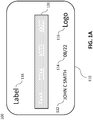
- FIGs. 1A-D illustrative views of embodiments, of a credit card 100 in accordance with the principles of the invention, are depicted.
- Credit card 100 is depicted as a credit card, but similar methods may be used for other types of cards, e.g., identification cards, passports, etc.
- Credit card 100 may be any suitable material such as, for example, a somewhat rigid yet flexible material similar to that commonly used for identification cards, credit cards, etc.
- credit card 100 is a substantially planar member formed of paper, cardstock, plastic (e.g., polycarbonate, polystyrene, polyvinyl chloride, acrylonitrile butadiene styrene, polyethylene terephthalate, Teslin, polyactide, and acrylic, to name a few), or other suitable material.
- credit card 100 is formed of injection molded plastic or cut from sheet-stock plastic material.
- the overall dimensions of credit card 100 are about 8.5 cm by about 5.5 cm wide with a thickness of less than about 1 mm.
- Credit card 100 can be formed in any other suitable planar or non-planar configuration as will be apparent to those of skill in the art upon reading this application.
- Credit card 100 comprises one or more substrates as represented by front surface 110.
- front surface 110 On front surface 110, there is printed a text portion, like a conventional credit card, comprising the credit card's associated account holder name 112, card expiration date 114, card branding 116, and financial service provider (FSP) label 118.
- FSP financial service provider
- Less information or additional information or indicia may also appear on the surface of a credit card, e.g., a "member since" indicator.
- FSP financial service provider
- Account identifier 120 may also be printed on front surface 110.
- credit card 100 also comprises a back surface 130 (not depicted) that may likewise contain the some or all of the same information and/or other information or indicia.
- Back surface 130 may also contain a magnetic strip 132 (not depicted) and/or an electronic chip 134 (not depicted).
- Strip 132 and chip 134 may be used to store the same kind of information that is commonly stored in credit cards. However, it should be noted that non-conventional types of information may be stored on strip 132 or chip 134 and strip 132 or chip 134 may be located at any position on the back surface 130 or front surface 110.
- Printed information or indicia on credit card 100 may be printed with conventional ink through conventional means, such as depicted by elements 112-118. Additionally, printed information or indicia on credit card 100 may be printed with chromogenic features through means suitable for applying chromogenic features. For instance, Fig. 1A depicts account identifier 120 printed in thermochromic ink. As heat is applied to account identifier 120, the account identifier changes its optical properties, e.g., from transparent, i.e. see-through, to visible if a reflecting ink is used or from one color to another. Fig.
- 1B illustrates the triggering heat activation of the last four digits of account identifier 120, section 122, such that section 122 becomes visible after the application of heat (where it was transparent before the application of heat).
- Fig. 1C illustrates the triggering heat activation of the first twelve digits of account identifier 120, section 122, section 124, and section 126, such that sections 122-126 are visible after the application of heat to them.
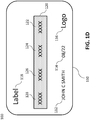
- 1D illustrates the triggering heat activation of the entire sixteen digits of account identifier 120, section 122, section 124, section 126, and section 128, such that sections 122-128 are visible after the application of heat.
- account identifier 120 can comprise of any data identifying an account and is not limited to a sixteen digit number.
- Figures 1B-1D indicate heat activation revealing account identifier 120 in four-digit sections, it is to be understood that any section or portion of account identifier 120 may be rendered visible based on the application of triggering heat.
- the heat activation temperature for the thermochromic ink may be uniform, or the heat activation temperature for different portions may be customized.
- the same thermochromic ink may be printed on sections 122-128 so that the entire account identifier 120 may be triggered at room temperature (approximately 23°C) or body temperature (approximately 37°C) such that the ink is transparent below the triggering temperature and reflective above the temperature.
- different thermochromic inks may be used to print various portions of account identifier 120 so, for example, sections 122-126 are triggered at room temperature but section 128 is triggered at body temperature.
- thermochromic ink printed on sections 122-128 may be designed such that the triggered changing optical property vary from ink to ink.
- the printed thermochromic ink on sections 122-128 may change optical properties from transparency to reflection, absorption, or selective reflection/absorption (such that only certain wavelengths are reflected and/or certain other wavelengths are absorbed).
- the thermochromic ink on sections 122-128 may be designed to change from reflecting/absorbing to transparent at the triggering activation temperature.
- the printed thermochromic ink on sections 122-128 may be designed and altered with respect to the features discussed throughout this specification.
- the thermochromic inks will revert back to the original optical properties upon the removal of the activating trigger.
- sections 122-128 discussed above with an activation trigger at room temperature could be reflective above room temperature, and conversely, the material would revert back to its original state, transparent, below room temperature.
- account identifier 120 can be printed with different thermochromic inks or different chromogenic features.
- section 122 could be printed with a first thermochromic ink with a heat activation temperature of l
- section 124 with a second thermochromic ink with a heat activation temperature of m
- section 126 with a third thermochromic ink with a heat activation temperature of n
- section 128 with a fourth thermochromic ink with a heat activation temperature of p
- section 122 could incorporate a thermochromic feature
- section 124 and 126 could incorporate a photochromic feature
- section 128 could be incorporate a tribochromic feature.
- account identifier 120 can be obscured (and only revealed by particular triggers) through various combinations incorporating properties of front surface 110 and the chromogenic features of account identifier 120.
- the chromogenic features of account identifier 120 are be reversible upon the removal of the external stimuli.
- credit card 100 may contrast the natural color of front surface 110 with the trigger-activated color of chromogenic feature on account identifier 120 to obscure account identifier 120 when the trigger is not applied but to render account identifier 120 visible when the trigger is applied.
- front surface 110 may be black and the thermogenic ink of account identifier 120 may be black when untriggered but white when triggered.
- the black ink of account identifier 120 is not visible against the black color of front surface 110, but when the activation trigger is applied, the white ink of account identifier 120 is visible against front surface 110.
- credit card 100 can be further designed to obscure (and reveal) the account identifier 120 through optical property gradients, such as an increase in application of an activating trigger causes more account revealed (i.e. 20°C versus 35°C), or more activating triggers applied in particular locations causes more account revealed (i.e. rubbing lightly versus rubbing hard).
- Obscuring account identifier 120 is not limited to the methods discussed in Figs. 1A-D .
- FIGs. 2A-G illustrative views of credit card 200, another embodiment of a credit card in accordance with the principles of the invention, are depicted.
- credit card 100 shown in Figs. 2A-E also comprises front surface 220 and back surface 230 (not depicted). Additionally, substrate 210 is embedded in front surface 220.
- Credit card 200 also comprises 222, 224, 226, and 228. Additionally, credit card 200 may comprise magnetic strip 132 (not depicted) and/or an electronic chip 134 (not depicted) as described above.
- Credit card 200 may comprise transparent substrate 210.
- credit card 200 in addition to the suitable materials discussed above for credit card 100, credit card 200 in some embodiments may further comprise the transparent substrate 210 with a material that is also rigid yet flexible. More specifically, in one embodiment, transparent substrate 210 is a substantially planar substrate formed of a transparent plastic discussed here within. Additionally, transparent substrate 210 may contain a chromogenic feature within or any of its surfaces.
- the overall dimensions of credit card 200 are about 8.5 cm by about 5.5 cm wide a thickness of less than about 1 mm.
- Credit card 200 can be formed in any other suitable planar or non-planar configuration as will be apparent to those of skill in the art upon reading this application.
- Printed information or indicia on credit card 200 may be printed with conventional ink through conventional means. Additionally, printed information or indicia on credit card 200 may be printed with chromogenic features through means suitable for applying chromogenic features. Moreover, account identifier 240, in one embodiment, may be printed in a chromogenic feature, such as thermochromic ink, on top of transparent substrate 210.
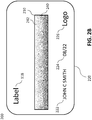
- Fig. 2A depicts the account identifier 240 printed in thermochromic ink on top of transparent substrate 210.
- Fig. 2B illustrates the triggering heat activation of the last four digits of account identifier 240, section 242, such that section 242 becomes visible after the application of heat (where it was transparent before the application of heat).
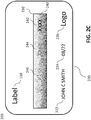
- Fig. 2C illustrates the triggering heat activation of the first twelve digits of account identifier 240, section 242, section 244, and section 246, such that sections 242-246 are visible after the application of heat to them.
- Fig. 2A depicts the account identifier 240 printed in thermochromic ink on top of transparent substrate 210.
- Fig. 2B illustrates the triggering heat activation of the last four digits of account identifier 240, section 242, such that section 242 becomes visible after the application of heat (where it was transparent before the application of heat).
- Fig. 2C illustrates the triggering heat activation of the first twelve digits of account identifie
- FIG. 2D illustrates the triggering heat activation of the entire sixteen digits of account identifier 240, section 242, section 244, section 246, and section 248, such that sections 242-248 are visible after the application of heat.
- account identifier 240 can comprise of any data identifying an account and is not limited to a sixteen-digit number.
- Figures 2B-2E indicate heat activation revealing account identifier 240 in four-digit sections, it is to be understood that any section or portion of account identifier 240 may be rendered visible based on the application of triggering heat.
- thermochromic ink printed on sections 242-248 may be customized for particular circumstances.
- thermochromic ink printed on sections 242-248 may be designed to trigger at room temperature (approximately 23°C) or alternatively at body temperature (approximately 37°C), such that the ink is transparent below the triggering temperature and reflective above the temperature.
- the thermochromic ink printed on sections 242-248 may be designed such that the triggered changing optical property vary from ink to ink.
- the printed thermochromic ink on sections 242-248 may change optical properties from transparency to reflection, absorption, or selective (such that only certain color wavelengths are reflected and others are absorbed).
- the thermochromic ink on sections 242-248 may be designed to change from reflecting/absorbing to transparent at the triggering activation temperature.
- the printed thermochromic ink on sections 242-248 may be designed and altered with respect to the features discussed throughout this specification.
- account identifier 240 can be printed with different thermochromic inks or different chromogenic features.
- section 242 could be printed with a first thermochromic ink with a heat activation temperature of l
- section 244 with a second thermochromic ink with a heat activation temperature of m
- section 246 with a third thermochromic ink with a heat activation temperature of n
- section 248 with a fourth thermochromic ink with a heat activation temperature of p
- section 242 could incorporate a thermochromic feature
- section 244 and 246 could incorporate a photochromic feature
- section 248 could incorporate a tribochromic feature.
- Fig. 2E further illustrates an embodiment where transparent substrate 210 comprises a chromogenic feature.
- Transparent substrate 210 may change optical properties from transparent to opaque based on an external stimulus.
- substrate 210 may comprise a photochromic feature such that exposure to sunlight changes substrate 210 from transparent to opaque.
- substrate 210 may comprise a thermochromic feature that changes from transparent to opaque at a particular temperature.
- sections 242-248 may be printed with chromogenic features, such as thermochromic ink, or alternatively, they may be printed in conventional ink.
- substrate 210 chromogenic feature may be designed to change optical properties such that application of the trigger results in the substrate 210 obscuring the conventional ink sections 242-248 (e.g., sections 242-248 and substrate 210 appear the same color when the trigger is applied).
- a chromogenic feature may be beneficial, for example, when a user's credit card is left on a restaurant table in the sun too long. In this embodiment, snooping thieves will be deprived of access to the account identifier 240 because it is obscured in the sunlight.
- thermochromic ink where sections 242-248 are printed in thermochromic ink, substrate 210 may be designed to change optical properties such that above its triggering activation point, substrate 210 matches the thermochromic ink sections 242-248 above their respective activation temperatures (e.g., sections 242-248 and substrate 210 appear the same color above all respective triggering activation points).
- sections 242-248 are printed in thermochromic ink, and sections 242-248 and substrate 210 chromogenic feature have the same triggering activation point such that above the respective activation temperature sections 242-248 and substrate 210 all appear in different colors.
- sections 242-248 are printed in thermochromic ink
- sections 242-248 my have be triggered by the same activation stimulus (e.g., heat) and substrate 210 activated by a different stimulus (e.g., friction), such that the account identifier 240 is visible upon the triggering of both activation points.
- activation stimulus e.g., heat
- substrate 210 activated by a different stimulus (e.g., friction)
- account identifier may be obscured by multiple means, either with combinations of chromogenic features on sections 242-248 or from substrate 210.
- account identifier 240 can be obscured (and only revealed by particular triggers) through various combinations incorporating front surface 220, the chromogenic features of substrate 210, and the chromogenic features printed on account identifier 240.
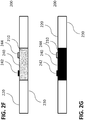
- Figs. 2F-G illustrates one such pairing.
- credit card 200 utilizes the natural color of front surface 220, the chromogenic feature of substrate 210, and the chromogenic feature account identifier 240 to obscure and/or reveal account identifier 240 (e.g., creating a black/white or positive/negative space.
- the front surface 220 may be black, and in the unactivated state, the substrate 210 may be transparent. Additionally, in the unactivated state the chromogenic ink for section 244 is transparent; whereas, the commercial ink for section 242 appears black. Thus, in the unactivated state, only portions of account identifier 240, i.e. section 242, are visible. In the activated state, shown in Fig. 2G , the front surface 220 and section 242 remain black. The substrate 210 may be opaque (i.e. black) in the activated state, thus obscuring section 242.
- Section 244 remains transparent until it is activated and turns to a color other than black, thus becoming visible against activated substrate 210 (opaque). Additionally, in another embodiment, the optical property pairings could be arranged such that section 242 is visible on top of substrate 210 at one state, and 244 is obscured; while, in another state, section 242 is obscured and section 244 is visible.
- credit card 200 can be further designed to obscure (and reveal) the account identifier 240 through optical property gradients, such as an increase in application of an activating trigger causes more account revealed (i.e. 20°C versus 35°C), or more activating triggers applied in particular locations causes more account revealed (i.e. rubbing lightly versus rubbing hard).
- Obscuring account identifier 240 is not limited to the methods discussed in Figs. 2A-G .
- a substrate is provided.
- the provided substrate may be any suitable material, such as a somewhat rigid yet flexible material similar to those commonly used for identification cards, credit cards, etc. More specifically, in one embodiment, the substrate is a substantially planar member formed of paper, cardstock, plastic (e.g. polycarbonate, polystyrene, polyvinyl chloride, acrylonitrile butadiene styrene, polyethylene terephthalate, Teslin, polyactide, and acrylic, to name a few), or other suitable material.
- the substrate may be reflective, transparent, or absorbing of EM spectrum energy.
- background indicia are applied on top of a front surface of the substrate provided in step 310.
- the background indicia may cover the entire front surface of the substrate provided in step 310 or only portions of the front substrate surface.
- the background indicia may consist of multiple indicia covering the entire front surface of the substrate, or only portions of the front substrate surface.
- second background indicia may be applied to the back surface of the substrate provided in step 310.
- the second background indicia may be the same as or different from the first background indicia.
- a chromogenic material having a chromogenic feature is applied to the front surface, on top of the background indicia applied in step 320.
- the chromogenic material may cover the entire indicia applied in step 310 or only portions of the indicia.
- the chromogenic material may consist of multiple chromogenic materials covering the entire indicia or only portions of the indicia.
- the chromogenic materials may comprise of any the chromogenic materials described herein and cured by their normal means.
- another chromogenic material having a chromogenic feature may be applied to the back surface of the provided substrate, covering any applied background indicia from step 320.
- a transparent protective film may be applied. This protective film may be applied on top of the chromogenic feature applied in step 330 and cover the indicia applied in step 310, such that the protective film covers the entire front surface of card. Additionally, another protective film may be applied to the back surface of the provided substrate, covering any applied background indicia from step 320 and/or any chromogenic materials applied from step 330.
- a first substrate is provided.
- the first provided substrate may be any suitable material, that is somewhat rigid yet flexible, that also contains a first chromogenic feature.
- the chromogenic feature may be any consist of any chromogenic material discussed in this specification.
- a second substrate comprising a first chromogenic material is embedded into the first substrate.
- the embedded second substrate is flush with the first substrate such that the first substrate front surface is adjacent to and appears continuous with the top of the second substrate surface, and the back surface of the first substrate surface is adjacent to and appears continuous with the back surface of the second substrate surface.
- the second substrate is not flush with the first substrate at the back surface but is embedded into the first substrate, such that only the first substrate front surface is adjacent to and appears continuous with the top of the second substrate surface, and the back surface comprises the first substrate but not the second substrate.
- the second substrate may be any suitable material such it is somewhat rigid yet flexible material similar to that commonly used for identification cards, credit cards, etc.
- the substrate is a substantially planar member formed of paper, cardstock, plastic (e.g. polycarbonate, polystyrene, polyvinyl chloride, acrylonitrile butadiene styrene, polyethylene terephthalate, Teslin, polyactide, and acrylic, to name a few), or other suitable material.
- plastic e.g. polycarbonate, polystyrene, polyvinyl chloride, acrylonitrile butadiene styrene, polyethylene terephthalate, Teslin, polyactide, and acrylic, to name a few
- the second substrate may be reflective, transparent, or absorbing of EM spectrum energy.
- a background indicia is applied on the front surface of card, i.e., over the front surfaces of one or both the first and second substrates.
- the background indicia may cover the entire front surfaces of the first and second substrates, only a portion of the front surfaces of the first and second substrates, only the front surface of first substrate, only the front surface of the second substrate, only a portion of the front surface of the first substrate, or only a portion of the front surface of the second substrate.
- the background indicia may consist of multiple indicia.
- second background indicia may be applied to the back surface of the card, similar to the application of the background indicia to the front surface.
- a second chromogenic material is applied to the front surface of the card.
- the second chromogenic material may be applied anywhere on the surface, for example, it may be applied to a portion of the second substrate.
- the second chromogenic material may cover the entire indicia applied in step 430, only portions of the indicia, or may be directly applied to the substrate (e.g., if no indicia were applied to the portion where the second chromogenic material is to be applied). Additionally, the second chromogenic material may comprise any the chromogenic materials described herein.
- chromogenic materials may be embedded and/or applied to the card, consistent with the embodiments described herein.
- a credit card may contain multiple embedded substrates with chromogenic features and may contain multiple applied chromogenic materials.
- the chromogenic materials may be applied anywhere on the surface of the card (e.g., directly to the first substrate, directly to a second or subsequent embedded substrate, onto a background indicia, etc.).
- the chromogenic feature of the embedded substrates and the applied chromogenic materials may be the same or different; they may have the same activating triggers or different; and even for the same activating triggers they may have degrees of activation points.
- a transparent protective film may be applied.
- This protective film is applied to the front surface of the card, i.e., on top of any second chromogenic features applied in step 440, any indicia applied in step 430, and any substrate provided in steps 410-420. Additionally, protective film may be applied to the back surface of the card, i.e., on top of any second chromogenic feature, indicia, or substrate.
Landscapes
- Engineering & Computer Science (AREA)
- Physics & Mathematics (AREA)
- General Physics & Mathematics (AREA)
- Theoretical Computer Science (AREA)
- Business, Economics & Management (AREA)
- Accounting & Taxation (AREA)
- Microelectronics & Electronic Packaging (AREA)
- Computer Hardware Design (AREA)
- Strategic Management (AREA)
- General Business, Economics & Management (AREA)
- Computer Security & Cryptography (AREA)
- Computer Networks & Wireless Communication (AREA)
- Chemical & Material Sciences (AREA)
- Chemical Kinetics & Catalysis (AREA)
- General Chemical & Material Sciences (AREA)
- Manufacturing & Machinery (AREA)
- Finance (AREA)
- Credit Cards Or The Like (AREA)
Applications Claiming Priority (2)
| Application Number | Priority Date | Filing Date | Title |
|---|---|---|---|
| US16/031,053 US10354177B1 (en) | 2018-07-10 | 2018-07-10 | Credit card with chromogenic features |
| US16/039,835 US10417544B1 (en) | 2018-07-10 | 2018-07-19 | Credit card with chromogenic features |
Publications (1)
| Publication Number | Publication Date |
|---|---|
| EP3594882A1 true EP3594882A1 (de) | 2020-01-15 |
Family
ID=67220467
Family Applications (1)
| Application Number | Title | Priority Date | Filing Date |
|---|---|---|---|
| EP19185076.7A Withdrawn EP3594882A1 (de) | 2018-07-10 | 2019-07-08 | Kreditkarte mit chromogenen merkmalen |
Country Status (4)
| Country | Link |
|---|---|
| US (4) | US10354177B1 (de) |
| EP (1) | EP3594882A1 (de) |
| CN (1) | CN110705673A (de) |
| CA (1) | CA3048944A1 (de) |
Families Citing this family (8)
| Publication number | Priority date | Publication date | Assignee | Title |
|---|---|---|---|---|
| US10243088B1 (en) * | 2017-12-21 | 2019-03-26 | Capital One Services, Llc | Transaction card for transferring solar power |
| US10354177B1 (en) * | 2018-07-10 | 2019-07-16 | Capital One Services, Llc | Credit card with chromogenic features |
| USD1006104S1 (en) * | 2021-04-22 | 2023-11-28 | Capital One Services, Llc | Transaction card |
| US11416727B1 (en) | 2021-07-02 | 2022-08-16 | Block, Inc. | Thermo-sensitive payment card |
| US20230345252A1 (en) * | 2022-04-20 | 2023-10-26 | Capital One Services, Llc | Proximity-based and multi-time-based deactivation and/or activation related to a token |
| US11893439B2 (en) | 2022-05-09 | 2024-02-06 | Capital One Services, Llc | Systems and methods for a mechanical transaction card with privacy features |
| US11488106B1 (en) * | 2022-05-19 | 2022-11-01 | West Pak Avocado, LLC | Supply chain management system and method |
| CN114936860A (zh) * | 2022-05-27 | 2022-08-23 | 中国银行股份有限公司 | 防盗刷信用卡及其制作方法 |
Citations (4)
| Publication number | Priority date | Publication date | Assignee | Title |
|---|---|---|---|---|
| GB2201376A (en) * | 1987-01-13 | 1988-09-01 | Liquid Crystal Devices Ltd | Security documents |
| GB2229189A (en) * | 1989-02-14 | 1990-09-19 | Rue Company P L C De | Ink composition for security documents |
| US20090322070A1 (en) * | 2006-12-27 | 2009-12-31 | Jay Reichelsheimer | Method and system for hiding information |
| EP2863353A1 (de) * | 2013-10-15 | 2015-04-22 | Gemalto SA | Zahlungskarte, die mit einem visuellen Kryptogramm ausgestattet ist |
Family Cites Families (31)
| Publication number | Priority date | Publication date | Assignee | Title |
|---|---|---|---|---|
| US4673657A (en) * | 1983-08-26 | 1987-06-16 | The Regents Of The University Of California | Multiple assay card and system |
| US4708931A (en) * | 1984-06-01 | 1987-11-24 | Regents Of University Of California | Laminated rod having alternating detection and spacer layers for binding assays |
| US5282651A (en) | 1991-04-15 | 1994-02-01 | Frank Alonso | Trading cards and method of concealing and revealing information thereon |
| US5289547A (en) * | 1991-12-06 | 1994-02-22 | Ppg Industries, Inc. | Authenticating method |
| US5492559A (en) * | 1994-10-19 | 1996-02-20 | Xerox Corporation | Liquid crystalline microemulsion ink compositions |
| US5593486A (en) * | 1995-12-05 | 1997-01-14 | Xerox Corporation | Photochromic hot melt ink compositions |
| JPH10183112A (ja) * | 1996-12-27 | 1998-07-14 | Sony Corp | 電界発光素子 |
| US6451607B1 (en) * | 1998-05-07 | 2002-09-17 | Litmus Concepts, Inc. | External dried-reagent control for analytical test devices |
| US7151626B2 (en) * | 1999-11-03 | 2006-12-19 | Optodot Corporation | Reflective organic layers |
| US7715095B2 (en) * | 1999-11-03 | 2010-05-11 | Steven Allen Carlson | Reflective organic layers |
| US6803344B2 (en) * | 2001-12-21 | 2004-10-12 | Ncr Corporation | Thermal paper with preprinted indicia |
| GB0202646D0 (en) * | 2002-02-05 | 2002-03-20 | Optaglio Ltd | Secure hidden data protection optically variable label |
| US7347382B2 (en) | 2004-02-06 | 2008-03-25 | T-Ink, Llc | System for securing personal cards |
| DE102004022080A1 (de) * | 2004-05-05 | 2005-11-24 | Giesecke & Devrient Gmbh | Wertdokument mit visuell erkennbaren Kennzeichnungen |
| US7262150B2 (en) * | 2004-06-21 | 2007-08-28 | Appleton Papers Inc. | Secure thermally imaged documents susceptible to rapid information destruction by induction |
| US7571856B2 (en) * | 2006-11-01 | 2009-08-11 | Lo Allen K | Counterfeit-proof labels having an optically concealed, invisible universal product code and an online verification system using a mobile phone |
| US7806343B2 (en) * | 2006-11-01 | 2010-10-05 | Allen Kwok Wah Lo | Counterfeit proof label having optically concealed security safety features and clues for consumer's self identification |
| US7684997B2 (en) * | 2006-12-27 | 2010-03-23 | Pitney Bowes Inc. | Machine readable colored envelopes |
| US7628336B2 (en) * | 2007-05-25 | 2009-12-08 | Target Brands, Inc. | Transaction card with thermochromic feature |
| US9471862B2 (en) * | 2010-12-30 | 2016-10-18 | Chromera, Inc. | Intelligent label device and method |
| EP2196950A1 (de) * | 2008-12-15 | 2010-06-16 | Gemalto SA | Datenträger mit Chip, der ein aktives Sicherheitselement umfasst |
| US8740087B2 (en) * | 2009-09-28 | 2014-06-03 | Matthew Lawyer | Transaction card with three-dimensional tipping guide |
| GB2474903B (en) * | 2009-10-30 | 2012-02-01 | Rue De Int Ltd | Improvements in security devices |
| DE102009052749A1 (de) * | 2009-11-11 | 2011-06-09 | Giesecke & Devrient Gmbh | Kartenförmiger Datenträger |
| WO2012030742A2 (en) * | 2010-08-30 | 2012-03-08 | Funfare, Llc | Color changing toys, games and devices |
| US9302197B2 (en) * | 2010-08-30 | 2016-04-05 | Funfare, Llc | Color changing toys, games and devices |
| US9418282B2 (en) * | 2010-12-22 | 2016-08-16 | U-Nica Technology Ag | Method and device for authenticating documents marked with photochromic systems |
| CN106503776A (zh) * | 2016-11-15 | 2017-03-15 | 南通芯电物联网科技有限责任公司 | 一种确认电子标签识别状态的方法及其所用的电子标签 |
| US20180290178A1 (en) * | 2017-04-06 | 2018-10-11 | Barry LEVITT | Cleaning system for toilet plunger |
| CN107742148A (zh) * | 2017-10-23 | 2018-02-27 | 星汉智能科技股份有限公司 | 一种集成电致变色器件的智能卡及其工作方法 |
| US10354177B1 (en) * | 2018-07-10 | 2019-07-16 | Capital One Services, Llc | Credit card with chromogenic features |
-
2018
- 2018-07-10 US US16/031,053 patent/US10354177B1/en active Active
- 2018-07-19 US US16/039,835 patent/US10417544B1/en active Active
-
2019
- 2019-07-08 EP EP19185076.7A patent/EP3594882A1/de not_active Withdrawn
- 2019-07-09 CA CA3048944A patent/CA3048944A1/en active Pending
- 2019-07-10 CN CN201910619250.6A patent/CN110705673A/zh active Pending
- 2019-08-12 US US16/537,893 patent/US10824929B2/en active Active
-
2020
- 2020-08-26 US US17/003,316 patent/US11216711B2/en active Active
Patent Citations (4)
| Publication number | Priority date | Publication date | Assignee | Title |
|---|---|---|---|---|
| GB2201376A (en) * | 1987-01-13 | 1988-09-01 | Liquid Crystal Devices Ltd | Security documents |
| GB2229189A (en) * | 1989-02-14 | 1990-09-19 | Rue Company P L C De | Ink composition for security documents |
| US20090322070A1 (en) * | 2006-12-27 | 2009-12-31 | Jay Reichelsheimer | Method and system for hiding information |
| EP2863353A1 (de) * | 2013-10-15 | 2015-04-22 | Gemalto SA | Zahlungskarte, die mit einem visuellen Kryptogramm ausgestattet ist |
Also Published As
| Publication number | Publication date |
|---|---|
| US20200394482A1 (en) | 2020-12-17 |
| CN110705673A (zh) | 2020-01-17 |
| US10417544B1 (en) | 2019-09-17 |
| US10824929B2 (en) | 2020-11-03 |
| US11216711B2 (en) | 2022-01-04 |
| CA3048944A1 (en) | 2020-01-10 |
| US20200019828A1 (en) | 2020-01-16 |
| US10354177B1 (en) | 2019-07-16 |
Similar Documents
| Publication | Publication Date | Title |
|---|---|---|
| US11216711B2 (en) | Credit card with chromogenic features | |
| US7070112B2 (en) | Transparent transaction device | |
| US4536014A (en) | Indentification of articles using liquid crystal identity cards | |
| RU2470370C1 (ru) | Элемент, содержащий по меньшей мере два микроэлектронных устройства бесконтактного обмена данными | |
| ES2364444T3 (es) | Documento de seguridad que comprende un dispositivo rfid. | |
| JP2009076057A (ja) | 取引カード | |
| WO2000036560A1 (en) | Electronic ink display media for security and authentication | |
| US3668795A (en) | Identification means | |
| JP4273754B2 (ja) | 偽造防止転写箔、偽造防止シール、及び、偽造防止媒体ならびにその製造方法 | |
| US20170262829A1 (en) | Financial Transaction Medium | |
| EP3423287A1 (de) | Sicherheitselemente und sicherheitsdokumente | |
| CN103177654B (zh) | 带有光学防伪膜的防伪膜标签的制作方法、防伪标签以及由防伪标签生成的防伪码 | |
| US4462039A (en) | Plastic identification card having an improved signature panel | |
| US6177176B1 (en) | Information recording medium readable from a side edge | |
| JP2006142576A (ja) | 真偽判定用媒体、真偽判定用媒体ラベル、真偽判定用媒体転写シート、真偽判定可能なシート、および真偽判定可能な情報記録体 | |
| JP2001202491A (ja) | 偽造防止効果を高めたicカード | |
| KR200338090Y1 (ko) | 거울 기능을 갖는 플라스틱 카드 | |
| RU2557620C1 (ru) | Многослойная полимерная структура и способ ее изготовления | |
| JP2024068680A (ja) | 個人認証媒体 | |
| JP7331494B2 (ja) | カード | |
| US9743733B2 (en) | Card identity concealment device | |
| TW200406317A (en) | Document | |
| US20250353037A1 (en) | Laminated card comprising a thermochromic pattern and method for manufacturing such a card | |
| WO1993008513A1 (en) | Method of producing anti-reproduction coatings for documents | |
| CN207924716U (zh) | 可感温显示不同图案的交易卡 |
Legal Events
| Date | Code | Title | Description |
|---|---|---|---|
| PUAI | Public reference made under article 153(3) epc to a published international application that has entered the european phase |
Free format text: ORIGINAL CODE: 0009012 |
|
| AK | Designated contracting states |
Kind code of ref document: A1 Designated state(s): AL AT BE BG CH CY CZ DE DK EE ES FI FR GB GR HR HU IE IS IT LI LT LU LV MC MK MT NL NO PL PT RO RS SE SI SK SM TR |
|
| AX | Request for extension of the european patent |
Extension state: BA ME |
|
| STAA | Information on the status of an ep patent application or granted ep patent |
Free format text: STATUS: THE APPLICATION IS DEEMED TO BE WITHDRAWN |
|
| 18D | Application deemed to be withdrawn |
Effective date: 20200716 |