EP3594660B1 - Verfahren zur infrarot-spektroskopiespektrenanalyse von fasern auf der basis von polyacrylonitril - Google Patents
Verfahren zur infrarot-spektroskopiespektrenanalyse von fasern auf der basis von polyacrylonitril Download PDFInfo
- Publication number
- EP3594660B1 EP3594660B1 EP18893602.5A EP18893602A EP3594660B1 EP 3594660 B1 EP3594660 B1 EP 3594660B1 EP 18893602 A EP18893602 A EP 18893602A EP 3594660 B1 EP3594660 B1 EP 3594660B1
- Authority
- EP
- European Patent Office
- Prior art keywords
- polyacrylonitrile
- peak height
- infrared spectroscopy
- inspection target
- total reflection
- Prior art date
- Legal status (The legal status is an assumption and is not a legal conclusion. Google has not performed a legal analysis and makes no representation as to the accuracy of the status listed.)
- Active
Links
Images


Classifications
-
- G—PHYSICS
- G01—MEASURING; TESTING
- G01N—INVESTIGATING OR ANALYSING MATERIALS BY DETERMINING THEIR CHEMICAL OR PHYSICAL PROPERTIES
- G01N21/00—Investigating or analysing materials by the use of optical means, i.e. using sub-millimetre waves, infrared, visible or ultraviolet light
- G01N21/17—Systems in which incident light is modified in accordance with the properties of the material investigated
- G01N21/25—Colour; Spectral properties, i.e. comparison of effect of material on the light at two or more different wavelengths or wavelength bands
- G01N21/31—Investigating relative effect of material at wavelengths characteristic of specific elements or molecules, e.g. atomic absorption spectrometry
- G01N21/35—Investigating relative effect of material at wavelengths characteristic of specific elements or molecules, e.g. atomic absorption spectrometry using infrared light
- G01N21/3563—Investigating relative effect of material at wavelengths characteristic of specific elements or molecules, e.g. atomic absorption spectrometry using infrared light for analysing solids; Preparation of samples therefor
-
- G—PHYSICS
- G01—MEASURING; TESTING
- G01N—INVESTIGATING OR ANALYSING MATERIALS BY DETERMINING THEIR CHEMICAL OR PHYSICAL PROPERTIES
- G01N21/00—Investigating or analysing materials by the use of optical means, i.e. using sub-millimetre waves, infrared, visible or ultraviolet light
- G01N21/17—Systems in which incident light is modified in accordance with the properties of the material investigated
- G01N21/25—Colour; Spectral properties, i.e. comparison of effect of material on the light at two or more different wavelengths or wavelength bands
- G01N21/31—Investigating relative effect of material at wavelengths characteristic of specific elements or molecules, e.g. atomic absorption spectrometry
- G01N21/35—Investigating relative effect of material at wavelengths characteristic of specific elements or molecules, e.g. atomic absorption spectrometry using infrared light
-
- G—PHYSICS
- G01—MEASURING; TESTING
- G01N—INVESTIGATING OR ANALYSING MATERIALS BY DETERMINING THEIR CHEMICAL OR PHYSICAL PROPERTIES
- G01N21/00—Investigating or analysing materials by the use of optical means, i.e. using sub-millimetre waves, infrared, visible or ultraviolet light
- G01N21/17—Systems in which incident light is modified in accordance with the properties of the material investigated
- G01N21/55—Specular reflectivity
- G01N21/552—Attenuated total reflection
-
- G—PHYSICS
- G01—MEASURING; TESTING
- G01N—INVESTIGATING OR ANALYSING MATERIALS BY DETERMINING THEIR CHEMICAL OR PHYSICAL PROPERTIES
- G01N21/00—Investigating or analysing materials by the use of optical means, i.e. using sub-millimetre waves, infrared, visible or ultraviolet light
- G01N21/84—Systems specially adapted for particular applications
-
- G—PHYSICS
- G01—MEASURING; TESTING
- G01N—INVESTIGATING OR ANALYSING MATERIALS BY DETERMINING THEIR CHEMICAL OR PHYSICAL PROPERTIES
- G01N21/00—Investigating or analysing materials by the use of optical means, i.e. using sub-millimetre waves, infrared, visible or ultraviolet light
- G01N21/84—Systems specially adapted for particular applications
- G01N2021/8444—Fibrous material
-
- G—PHYSICS
- G01—MEASURING; TESTING
- G01N—INVESTIGATING OR ANALYSING MATERIALS BY DETERMINING THEIR CHEMICAL OR PHYSICAL PROPERTIES
- G01N21/00—Investigating or analysing materials by the use of optical means, i.e. using sub-millimetre waves, infrared, visible or ultraviolet light
- G01N21/17—Systems in which incident light is modified in accordance with the properties of the material investigated
- G01N21/25—Colour; Spectral properties, i.e. comparison of effect of material on the light at two or more different wavelengths or wavelength bands
- G01N21/31—Investigating relative effect of material at wavelengths characteristic of specific elements or molecules, e.g. atomic absorption spectrometry
- G01N21/35—Investigating relative effect of material at wavelengths characteristic of specific elements or molecules, e.g. atomic absorption spectrometry using infrared light
- G01N21/3577—Investigating relative effect of material at wavelengths characteristic of specific elements or molecules, e.g. atomic absorption spectrometry using infrared light for analysing liquids, e.g. polluted water
-
- G—PHYSICS
- G01—MEASURING; TESTING
- G01N—INVESTIGATING OR ANALYSING MATERIALS BY DETERMINING THEIR CHEMICAL OR PHYSICAL PROPERTIES
- G01N2201/00—Features of devices classified in G01N21/00
- G01N2201/06—Illumination; Optics
- G01N2201/063—Illuminating optical parts
- G01N2201/0636—Reflectors
Definitions
- the present invention relates to a method for analyzing an infrared spectroscopy spectrum of a polyacrylonitrile-based fiber, the method having a reduced error.
- carbon fibers are being widely used in various industrial fields from aerospace to construction industries, including civil engineering and construction.
- Such fields include construction materials concrete structures, earth-quake reinforcements, alternative energy and green energy fields such as CNG tanks, wind power generation blades, centrifugal rotors, flywheels, high-speed transportation apparatus fields, such as ships, vehicles, ocean development and deep sea oilfield development, high performance apparatus, medical welfare apparatuses, electricity conduction applications, ultra heat resistance, and the like.
- Carbon fiber is widening its application as a third general-purpose material forming a basis for new era that is capable of replacing iron, aluminum, or the like by virtue the unparalleled characteristics thereof.
- the carbon fiber will be employed as a component material for aircrafts such as the Boeing 787 and Airbus 380, which are ultrasonic aircraft, and thus the amount of carbon fiber used in various advanced material fields will increase.
- PAN fiber Polyacrylonitrile-based precursor fiber (hereinafter, referred to as PAN fiber) known as most suitable precursors in producing carbon fiber is converted into a carbon fiber or graphite fiber via a series of stabilization or oxidation and carbonization, and selectively via a graphitizing process stage and a series of surface treatment and sizing process stages.
- the PAN fiber is the largest weight of about 43%, and hence in order to obtain a carbon fiber with excellent physical properties, it is essential to secure the PAN fiber technology.
- As a way of securing PAN fiber technology it is necessary to accurately understand the molecular structure of PAN fiber, and to use this well-understood molecular structure to produce PAN fiber having excellent physical properties.
- Infrared spectroscopy is a technology with which spectra are measured over an infrared wavelength range, and from the measurement results, and an energy level distribution of a material, transitions between energy levels (transition from a low vibration energy level to a higher vibration energy level) can be analyzed.
- intra-molecule functional groups or the like may be analyzed on the basis of energy absorbed when molecular bonds in a compound is in bending vibration or stretching vibration.
- determining the molecular structure of a compound, for example, a polymer is an important issue in science and industry, and infrared spectroscopy is being advantageously used in various industries.
- IR-ATR infrared spectroscopy spectrum analysis method using an attenuated total reflection method
- IT-ATR is a technique in which the spectrum of an inspection target contacting an ATR crystal while light passes through the crystal is measured, and is advantageously applicable to various inspection samples.
- IT-ATR is useful for accurately obtaining chemical information of the surface of the inspection target, and being capable of measuring without preprocessing.
- IR-ATR performs measurements through contact between the inspection target and the crystal, and the spectrum strength may vary according to the contact degree (or contact pressure).
- the contact degree between the inspection target and the crystal serves as an important factor for analysis accuracy.
- PATIL SUNIL A ET AL "Electrospun carbon nanofibers from polyacrylonitrile blended with activated or graphitized carbonaceous materials for improving anodic bioelectrocatalysis", BIORESOURCE TECHNOLOGY, ELSEVIER, AMSTERDAM, NL, vol.
- a A Stolov ET AL "Application of micro-attenuated total reflectance infrared spectroscopy to quantitative analysis of optical fiber coatings: effects of optical contact", Applied Spectroscopy, 31 January 2006 (2006-01-31), pages 29-38 discloses the application of micro-attenuated total reflectance infrared spectroscopy as being one of the few methods applicable for an in situ analysis of polymer coatings.
- the present invention is defined in claim 1 and provides a method for analyzing an infrared spectroscopy spectrum of a polyacrylonitrile-based fiber with reduced error by correcting a contact degree between an attenuated total reflection crystal and an inspection target.
- a 0 , A 1 , A 2 , B 1 and B 2 are respective measured peak height values of the infrared spectroscopy spectrum
- a 0 is a C-H peak height of a nonvolatile liquid material
- a 1 is a C-H peak height of a polyacrylonitrile-based fiber
- a 2 is a C-H peak height of the polyacrylonitrile-based fiber infiltrated by the nonvolatile liquid material
- the nonvolatile liquid material is one or more selected from among paraffin oil, aliphatic ester compounds, aliphatic ether compounds, and aliphatic alcoholic compounds,wherein
- step 1) above the infrared spectroscopy spectrum is obtained for each of a total of three inspection targets by measuring with an attenuated total reflection method using an infrared spectrometer, and
- the inspection targets are a first inspection target sampled from a polyacrylonitrile-based fiber, a second inspection target obtained by infiltrating a nonvolatile liquid material into the first inspection target, and a third inspection target which is a nonvolatile liquid material, respectively;
- the infrared spectroscopy spectrum is obtained by bringing the inspection targets into contact with an attenuated total reflection crystal, irradiating the inspection targets with light, and then detecting and measuring the light reflected from the attenuated total reflection crystal.
- the contact degree between an inspection target and an attenuated total reflection crystal is predicted through Equation 2 and is applied to Equation 1 to correct a spectrum peak height, and thus, the peak height of an infrared spectroscopy spectrum may be measured with repeatability.
- the present invention provides a method for analyzing an infrared spectroscopy spectrum for a polyacrylonitrile-based fiber with a reduced error by correcting a contact degree between an attenuated total reflection crystal and an inspection target.
- a 0 , A 1 , A 2 , B 1 and B 2 are respective measured peak height values of the infrared spectroscopy spectrum
- a 0 is the C-H peak height of a nonvolatile liquid material
- a 1 is the C-H peak height of a polyacrylonitrile-based fiber
- a 2 is the C-H peak height of the polyacrylonitrile-based fiber infiltrated by the nonvolatile liquid material
- B 2 is the C ⁇ N peak height of the polyacrylonitrile-based fiber infiltrated by the nonvolatile liquid material
- the nonvolatile liquid material is one or more selected from among paraffin oil, an aliphatic ester compound, an aliphatic ether compounds, and an aliphatic alcoholic compound, wherein
- step 1) above the infrared spectroscopy spectrum is obtained for each of a total of three inspection targets by measuring with an attenuated total reflection method using an infrared spectrometer, and
- the inspection targets are a first inspection target sampled from a polyacrylonitrile-based fiber, a second inspection target obtained by infiltrating a nonvolatile liquid material into the first inspection target, and a third inspection target which is a nonvolatile liquid material, respectively;
- the infrared spectroscopy spectrum is obtained by bringing the inspection targets into contact with an attenuated total reflection crystal, irradiating the inspection targets with light, and then detecting and measuring the light reflected from the attenuated total reflection crystal.
- the aliphatic ester compound may be vegetable oil such as soybean oil or corn oil, dioctyl adipate, dioctyl sebacate, or dioctyl azelate
- the ether compound may be dioctylether, dihexylether, or dibutylether
- the aliphatic alcoholic compound may be octanol, hexanol, or butanol.
- Step 1 is a step for irradiating an inspection target with light and measuring an infrared spectroscopy spectrum in which an attenuated total reflection method is applied.
- the infrared spectroscopy spectrum is obtained by using infrared spectrometers to the respective total of three inspection targets, and each of the inspection targets may be a first inspection target sampled from a polyacrylonitrile-based fiber, a second inspection target in which the first inspection target is infiltrated by a nonvolatile liquid material, and a third inspection target which is a nonvolatile liquid material.
- the nonvolatile liquid material may specifically be paraffin oil.
- the infrared spectroscopy spectrum is obtained by bringing the inspection target into contact with an attenuated total reflection crystal, irradiating the inspection target with light through the attenuated total reflection crystal, and detecting the light emitted from the attenuated total reflection crystal, and the attenuated total reflection crystal may be, for example, germanium.
- the infrared spectroscopy spectrum of the third inspection target may be obtained by directly applying (dropping) the third inspection target to the attenuated total reflection crystal to bring the attenuated total reflection crystal and the third inspection target into contact with each other.
- the infrared spectroscopy spectrum according to an embodiment of the present invention may be obtained by an infrared spectrometer through an attenuated total reflection method at a resolution of about 8 cm -1 and the number of scans of about 64 within a wave number range of about 600 cm -1 to about 4,000 cm -1 .
- the infrared spectroscopy spectrum was measured such that a microscopic infrared spectrometer (made by Bruker Co.) is used for the inspection target by selecting a resolution of about 8 cm -1 , the number of scans of about 64, and an ATR tip pressure of medium.
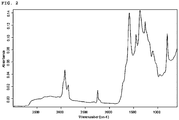
- the C-H peak height was measured at about 2,923 cm -1
- a baseline was selected as a straight line at about 2, 600 cm -1 and about 3,155 cm -1
- the C ⁇ N peak height was measured at about 2,243 cm -1
- the baseline was selected as a straight line at about 2,100 cm -1 and about 2,280 cm -1 .
- the attenuated total reflection method is method for measuring a change occurring in the internally reflected light when infrared light contacts an inspection target. Specifically, when the inspection target and a transparent material with a high refractive index are brought into contact with each other, and incident light is applied from the transparent material side, a total reflection occurs. However, since the reflected light is absorbed by very slight portion of inspection target adjacent to a contact surface, the absorption characteristic of the inspection target should be reflected, and a method for spectroscopy measurement using this phenomenon is referred to as an attenuated total reflection method.
- Step 2 is a step for correcting the peak height of the infrared spectroscopy spectrum through Equations 1 and 2 using the infrared spectroscopy spectrum to which the attenuated total reflection method is applied.
- Equations 1 and 2 are equations derived such that five sample pieces are obtained from a single polyacrylonitrile-based fiber.
- the first inspection target is sampled from the polyacrylonitrile-based fiber
- the second inspection target is an inspection target infiltrated by a nonvolatile liquid material
- the third inspection target is a nonvolatile liquid material
- the polyacrylonitrile-based fiber may be any one among a polyacrylonitrile-based precursor fiber and a polyacrylonitrile-based stabilized fiber, and here, the polyacrylonitrile-based precursor fiber represents a fibrosis polyacrylonitrile-based copolymer, and the polyacrylonitrile-based stabilized fiber may be manufactured by stabilizing and reacting the polyacrylonitrile-based precursor fiber.
- the polyacrylonitrile-based precursor fiber may be a fibrosis polyacrylonitrile-based copolymer which is manufactured such that a polyacrylonitrile-based copolymer is manufactured by polymerizing, for example, an acrylonitrile-based monomer and a carboxylic acid-based comonomer, and the manufactured copolymer is subjected to fibrosis.
- the acrylonitrile-based monomer may be acrylonitrile
- the carboxylic acid-based comonomer may be one or more selected from, or selected from the group consisting of acrylic acid, methacrylic acid, ethacrilic acid, itaconic acid, crotonic acid, citraconic acid, maleic acid, and mesaconic acid.
- the polyacrylonitrile-based copolymer may include: about 95 wt% to about 99 wt% of repeating units derived from the acrylonitrile-based monomer; and about 1 wt% to about 5 wt% of repeating units derived from the carboxylic acid-based comonomer.
- the fibrosis polyacrylonitrile-based copolymer may be manufactured by applying the polyacrylonitrile-based copolymer to a spinning process or the like so as to have a fiber shape.
- a spinning solution is prepared by dissolving the polyacrylonitrile-based copolymer into a solvent, which can dissolve the polyacrylonitrile-based copolymer, and is spun through a dry spinning, wet spinning, or dry and wet spinning to manufacture the fibrosis polyacrylonitrile-based copolymer.
- the solvent which can dissolve the polyacrylonitrile-based copolymer, is not particularly limited, and may be, for example, dimethylsulfoxide, dimethylformamide, or dimethylacetamide.
- the spinning solution may be manufactured by adjusting the concentration of the fibrosis polyacrylonitrile-based copolymer to be about 10 wt% to about 40 wt%.
- wet spinning or the dry and wet spinning may be initiated by adding a spinning raw solution into a solidification tank and solidifying, and the solidification tank may contain the solvent of the spinning raw solution and a solidification promoter.
- a water cleaning process and an elongation process may be performed, and these two processes may be sequentially or continuously performed, or may be performed in the reverse order.
- processes such as drying and heat treatment or steam elongation may further be performed, and through this, the fibrosis polyacrylonitrile-based copolymer may be manufactured.
- the polyacrylonitrile-based stabilized fiber may be manufactured by stabilizing the polyacrylonitrile-based precursor fiber.
- the stabilization is a process for imparting heat resistance to the polyacrylonitrile-based precursor fiber, may be performed through heat treatment performed within a temperature range of about 180°C to about 350°C while applying a constant tension under an oxidative or air atmosphere.
- low molecular materials among the components constituting the polyacrylonitrile-based precursor fiber are removed and change of chemical structure occurs, and the polyacrylonitrile-based stabilized fiber to which heat resistance is imparted may be manufactured.
- the polyacrylonitrile-based fiber was polyacrylonitrile-based stabilized fiber stabilized with a product of Jilin co. containing about 96 wt% of acrylonitrile, about 3 wt% of methylmethacrylate, and about 1 wt% of itaconic acid.
- an infrared spectroscopy spectrum was obtained to which an attenuated total reflection method was applied by using a microscopic infrared spectrometer (made by Bruker Co.) and using three inspection targets, as described below. Specifically, a resolution of about 8 cm -1 , 64 scans, an ATR tip pressure of medium was selected, and spectroscopy performed.
- a C-H peak height was measured at 2,923 cm -1 with a base line selected as a straight line between about 2,600 cm -1 , and about 3,155 cm -1
- a C ⁇ N peak height was measured at 2,243 cm -1 with a baseline selected as a straight line between about 2,100 cm -1 , and about 2,280 cm -1 .
- a first inspection target a sample sampled from the fiber.
- a second inspection target a sample prepared by infiltrating paraffin oil into the first inspection target.
- a third inspection target a sample to which paraffin oil is applied (dropped) onto an attenuated total reflection crystal.
- each of the inspection targets was brought into contact with the attenuated total reflection crystal (germanium (Ge)), the inspection targets were irradiated by light, and then, the light reflected from the crystal was detected and measured.
- Ge attenuated total reflection crystal
- C N Peak height after correction
- Example 1 0.0203 0.689 0.0295
- Example 2 0.0152 0.496 0.0306
- Example 3 0.0232 0.783 0.0296
- Example 4 0.0216 0.712 0.0303
- Example 5 0.0231 0.771 0.0300
- a 0 , A 1 , A 2 , B 1 and B 2 are respective measured peak height values of the infrared spectroscopy spectrum
- a 0 is the C-H peak height of a nonvolatile liquid material
- a 1 is the C-H peak height of the first inspection target
- a 2 is the C-H peak height of the second inspection target
Landscapes
- Physics & Mathematics (AREA)
- Spectroscopy & Molecular Physics (AREA)
- Health & Medical Sciences (AREA)
- Life Sciences & Earth Sciences (AREA)
- Chemical & Material Sciences (AREA)
- Analytical Chemistry (AREA)
- Biochemistry (AREA)
- General Health & Medical Sciences (AREA)
- General Physics & Mathematics (AREA)
- Immunology (AREA)
- Pathology (AREA)
- Investigating Or Analysing Materials By Optical Means (AREA)
Claims (4)
- Verfahren zum Analysieren eines Infrarot-Spektroskopie-Spektrums einer Polyacrylnitril-basierten Faser, wobei das Verfahren umfasst:1) Messen eines Infrarot-Spektroskopie-Spektrums eines Inspektionsobjects, an das ein Verfahren in abgeschwächter Totalreflektion beaufschlagt wird, gekennzeichnet durch2) Korrigieren einer C≡N-Peakhöhe in dem Infrarot-Spektroskopie-Spektrum durch Gleichungen 1 und 2 unten unter Verwendung des gemessenen Spektrums:

 A0, A1, A2, B1 und B2 entsprechende gemessene Peakhöhenwerte des Infrarot-Spektroskopie-Spektrums sind,A0 eine C-H-Peakhöhe eines nicht-flüchtigen flüssigen Materials ist,A1 eine C-H-Peakhöhe einer Polyacrylnitril-basierten Faser ist,A2 eine C-H-Peakhöhe der Polyacrylnitril-basierten Faser infiltriert durch das nicht-flüchtige flüssige Material ist,B1 ein C≡N-Peakhöhe der Polyacrylnitril-basierten Faser ist, undB2 eine C≡N-Peakhöhe der Polyacrylnitril-basierten Faser infiltriert durch das nicht-flüchtige flüssige Material ist,wobei das nicht-flüchtige flüssige Material eines oder mehrere ist, ausgewählt aus: Paraffinöl, aliphatischen Esterverbindungen, aliphatischen Etherverbindungen und aliphatischen alkoholischen Verbindungen,wobeiin Schritt 1) oben das Infrarot-Spektroskopie-Spektrum erhalten wird für jedes einer Gesamtzahl von drei Inspektionsobjekten durch Messen mit einem Verfahren in abgeschwächter Totalreflektion unter Verwendung eines Infrarotspektrometers, unddie Inspektionsobjekte ein erstes Inspektionsobjekt, als Probe entnommen von einer Polyacrylnitril-basierten Faser, ein zweites Inspektionsobjekt, erhalten durch Infiltrieren eines nicht-flüchtigen flüssigen Materials in das erste Inspektionsobjekt, und ein drittes Inspektionsobjekt, welches ein nicht-flüchtiges flüssiges Material ist, sind; undwobei das Infrarot-Spektroskopie-Spektrum erhalten wird durch Inkontaktbringen der Inspektionsobjekte mit einem Kristall mit abgeschwächter Totalreflektion, Bestrahlen der Inspektionsobjekte mit Licht und dann Detektieren und Messen des Lichts, das von dem Kristall mit abgeschwächter Totalreflektion reflektiert wird.
 - Verfahren nach Anspruch 1, wobei das nicht-flüchtige, flüssige Material Paraffinöl ist.
- Verfahren nach Anspruch 1, wobei das Infrarot-Spektroskopie-Spektrum erhalten wird durch Messen mit dem Verfahren in abgeschwächter Totalreflektion bei einem Wellenzahlbereich von etwa 600 cm-1 bis etwa 4.000 cm-1, einer Auflösung von etwa 8 cm-1 und einer Anzahl von Scans von etwa 64, unter Verwendung eines Infrarotspektrometers.
- Verfahren nach Anspruch 1, wobei der Kristall mit abgeschwächter Totalreflektion Germanium ist.
Applications Claiming Priority (2)
| Application Number | Priority Date | Filing Date | Title |
|---|---|---|---|
| KR1020170179770A KR102109834B1 (ko) | 2017-12-26 | 2017-12-26 | 폴리아크릴로니트릴계 섬유의 적외선 분광 스펙트럼 분석방법 |
| PCT/KR2018/016395 WO2019132429A1 (ko) | 2017-12-26 | 2018-12-20 | 폴리아크릴로니트릴계 섬유의 적외선 분광 스펙트럼 분석방법 |
Publications (3)
| Publication Number | Publication Date |
|---|---|
| EP3594660A1 EP3594660A1 (de) | 2020-01-15 |
| EP3594660A4 EP3594660A4 (de) | 2020-04-15 |
| EP3594660B1 true EP3594660B1 (de) | 2021-11-10 |
Family
ID=67067692
Family Applications (1)
| Application Number | Title | Priority Date | Filing Date |
|---|---|---|---|
| EP18893602.5A Active EP3594660B1 (de) | 2017-12-26 | 2018-12-20 | Verfahren zur infrarot-spektroskopiespektrenanalyse von fasern auf der basis von polyacrylonitril |
Country Status (6)
| Country | Link |
|---|---|
| US (1) | US10989655B2 (de) |
| EP (1) | EP3594660B1 (de) |
| JP (1) | JP6808852B2 (de) |
| KR (1) | KR102109834B1 (de) |
| CN (1) | CN110520712B (de) |
| WO (1) | WO2019132429A1 (de) |
Families Citing this family (1)
| Publication number | Priority date | Publication date | Assignee | Title |
|---|---|---|---|---|
| GB2619247B (en) * | 2021-03-26 | 2026-03-25 | Hamamatsu Photonics Kk | Attenuated total reflectance spectroscopy apparatus, and attenuated total reflectance spectroscopy method |
Family Cites Families (10)
| Publication number | Priority date | Publication date | Assignee | Title |
|---|---|---|---|---|
| EP1450152A4 (de) * | 2001-11-28 | 2009-11-25 | Panasonic Eco Technology Ct Co | Kunststoffidentifizierungsverfahren |
| KR20040026868A (ko) * | 2002-09-26 | 2004-04-01 | 현대자동차주식회사 | Abs계 수지의 정량 분석방법 |
| JP2004250837A (ja) * | 2003-02-21 | 2004-09-09 | Teijin Ltd | 単繊維切れ検出方法とその装置、並びにそれを用いた繊維製造工程の管理方法とその装置 |
| JP5176562B2 (ja) | 2008-01-22 | 2013-04-03 | 株式会社リコー | 固体表面付着物の存在量評価方法、および保護剤塗布装置の評価方法 |
| CN101797481B (zh) * | 2010-04-28 | 2013-03-20 | 哈尔滨工业大学 | 功能化壳带状二氧化硅纳米纤维膜的制备方法 |
| CN102478508B (zh) * | 2010-11-26 | 2013-09-04 | 中国蓝星(集团)股份有限公司 | 一种聚丙烯腈预氧丝氰基残余分数的测试方法 |
| KR20130020868A (ko) * | 2011-08-19 | 2013-03-04 | 현대자동차주식회사 | 감쇠 전반사 적외선 분광법을 이용한 폴리카보네이트 아크릴로니트릴-스티렌-아크릴고무 복합소재 내 폴리카보네이트 함량비 산출 방법 |
| JP2015197364A (ja) * | 2014-04-01 | 2015-11-09 | 三菱電機株式会社 | 赤外分光装置および赤外分光測定方法 |
| KR102323207B1 (ko) | 2014-09-29 | 2021-11-08 | 삼성전자주식회사 | 광 흡수 스펙트럼 보정장치 및 그 제조방법과 광 흡수 스펙트럼 보정방법 |
| CN105527253B (zh) * | 2015-12-01 | 2018-05-04 | 广东生益科技股份有限公司 | 衰减全反射红外测试方法 |
-
2017
- 2017-12-26 KR KR1020170179770A patent/KR102109834B1/ko active Active
-
2018
- 2018-12-20 CN CN201880025249.4A patent/CN110520712B/zh active Active
- 2018-12-20 US US16/604,080 patent/US10989655B2/en active Active
- 2018-12-20 EP EP18893602.5A patent/EP3594660B1/de active Active
- 2018-12-20 WO PCT/KR2018/016395 patent/WO2019132429A1/ko not_active Ceased
- 2018-12-20 JP JP2019555960A patent/JP6808852B2/ja active Active
Also Published As
| Publication number | Publication date |
|---|---|
| KR102109834B1 (ko) | 2020-05-12 |
| JP6808852B2 (ja) | 2021-01-06 |
| US20200393370A1 (en) | 2020-12-17 |
| EP3594660A4 (de) | 2020-04-15 |
| US10989655B2 (en) | 2021-04-27 |
| EP3594660A1 (de) | 2020-01-15 |
| CN110520712A (zh) | 2019-11-29 |
| KR20190078068A (ko) | 2019-07-04 |
| CN110520712B (zh) | 2022-02-08 |
| JP2020516899A (ja) | 2020-06-11 |
| WO2019132429A1 (ko) | 2019-07-04 |
Similar Documents
| Publication | Publication Date | Title |
|---|---|---|
| Xie et al. | Improving carbon fiber adhesion to polyimide with atmospheric pressure plasma treatment | |
| EP3168334A1 (de) | Kohlenstofffaserbündel und verfahren zur herstellung davon | |
| Mattsson et al. | Degradation of a fuel cell membrane, as revealed by micro-Raman spectroscopy | |
| EP2080775B1 (de) | Polyacrylnitrilpolymer, verfahren zur herstellung des polymers, verfahren zur herstellung einer vorläuferfaser für eine kohlenstofffaser und verfahren zur herstellung der kohlenstofffaser | |
| CN101793678B (zh) | 等腰直角形横截面样品池的散射物质光谱测量装置与方法 | |
| WO2009125832A1 (ja) | 炭素繊維前駆体繊維および炭素繊維とその製造方法 | |
| Choi et al. | Optimization of the carbonization process based on the evolution of microstructural components of polyacrylonitrile (PAN)-based fibers | |
| Golkarnarenji et al. | Development of a predictive model for study of skin-core phenomenon in stabilization process of PAN precursor | |
| Sun et al. | Toward practical non-contact optical strain sensing using single-walled carbon nanotubes | |
| US10989655B2 (en) | Method for analyzing infrared spectroscopy spectrum of polyacrylonitrile-based fiber | |
| Goh et al. | Raman spectroscopy | |
| EP3081678B1 (de) | Kohlenstoffasern und herstellungsverfahren dafür | |
| Young et al. | Application of raman microscopy to the analysis of high modulus polymer fibres and composites | |
| Brown et al. | Effect of tension during sulfonation stabilization for UHMWPE-derived carbon fibers | |
| CN112881334B (zh) | 一种检测聚(丙烯腈-衣康酸)中衣康酸含量的方法 | |
| KR20190078069A (ko) | 폴리아크릴로니트릴계 내염화 섬유 | |
| Chollon et al. | Raman microspectroscopy study of a C/C composite | |
| Rezaul | Effect of process variables on the uncured handleability and formability of stretch broken carbon fiber | |
| CN109596556A (zh) | 利用槲皮素快速简单测定废水中铅离子浓度的方法 | |
| Cheng et al. | Impact of heating on the nanostructure of Red pine studied by small angle X-ray scattering | |
| Insiyanda et al. | Detection of Polytetrafluoroethylene Coating Deposition in Carbon Composite Paper Surface PEMFC Using FTIR-ATR | |
| Mahendran et al. | Chemical process monitoring and the detection of moisture ingress in composites | |
| Chehat et al. | Effect of ultra-violet (UV) degradation on polyvinyl fluoride (PVF) films: investigating structural, thermal, surface, and mechanical properties | |
| Young | Carbon Fibre Composites: Deformation Micromechanics Analysed using Raman Spectroscopy | |
| Akdere et al. | Simulation Model for Stabilization of Carbon Fibres |
Legal Events
| Date | Code | Title | Description |
|---|---|---|---|
| STAA | Information on the status of an ep patent application or granted ep patent |
Free format text: STATUS: THE INTERNATIONAL PUBLICATION HAS BEEN MADE |
|
| PUAI | Public reference made under article 153(3) epc to a published international application that has entered the european phase |
Free format text: ORIGINAL CODE: 0009012 |
|
| STAA | Information on the status of an ep patent application or granted ep patent |
Free format text: STATUS: REQUEST FOR EXAMINATION WAS MADE |
|
| 17P | Request for examination filed |
Effective date: 20191010 |
|
| AK | Designated contracting states |
Kind code of ref document: A1 Designated state(s): AL AT BE BG CH CY CZ DE DK EE ES FI FR GB GR HR HU IE IS IT LI LT LU LV MC MK MT NL NO PL PT RO RS SE SI SK SM TR |
|
| AX | Request for extension of the european patent |
Extension state: BA ME |
|
| RIN1 | Information on inventor provided before grant (corrected) |
Inventor name: DO, JONG SOO Inventor name: OH, SUNG JOON |
|
| A4 | Supplementary search report drawn up and despatched |
Effective date: 20200317 |
|
| RIC1 | Information provided on ipc code assigned before grant |
Ipc: G01N 21/552 20140101ALI20200311BHEP Ipc: G01N 21/3577 20140101ALN20200311BHEP Ipc: G01N 21/35 20140101AFI20200311BHEP |
|
| DAV | Request for validation of the european patent (deleted) | ||
| DAX | Request for extension of the european patent (deleted) | ||
| GRAP | Despatch of communication of intention to grant a patent |
Free format text: ORIGINAL CODE: EPIDOSNIGR1 |
|
| STAA | Information on the status of an ep patent application or granted ep patent |
Free format text: STATUS: GRANT OF PATENT IS INTENDED |
|
| RIC1 | Information provided on ipc code assigned before grant |
Ipc: G01N 21/35 20140101AFI20210601BHEP Ipc: G01N 21/552 20140101ALI20210601BHEP Ipc: G01N 21/3577 20140101ALN20210601BHEP |
|
| INTG | Intention to grant announced |
Effective date: 20210618 |
|
| GRAS | Grant fee paid |
Free format text: ORIGINAL CODE: EPIDOSNIGR3 |
|
| GRAA | (expected) grant |
Free format text: ORIGINAL CODE: 0009210 |
|
| STAA | Information on the status of an ep patent application or granted ep patent |
Free format text: STATUS: THE PATENT HAS BEEN GRANTED |
|
| AK | Designated contracting states |
Kind code of ref document: B1 Designated state(s): AL AT BE BG CH CY CZ DE DK EE ES FI FR GB GR HR HU IE IS IT LI LT LU LV MC MK MT NL NO PL PT RO RS SE SI SK SM TR |
|
| REG | Reference to a national code |
Ref country code: GB Ref legal event code: FG4D |
|
| REG | Reference to a national code |
Ref country code: AT Ref legal event code: REF Ref document number: 1446526 Country of ref document: AT Kind code of ref document: T Effective date: 20211115 Ref country code: CH Ref legal event code: EP |
|
| REG | Reference to a national code |
Ref country code: DE Ref legal event code: R096 Ref document number: 602018026659 Country of ref document: DE |
|
| REG | Reference to a national code |
Ref country code: IE Ref legal event code: FG4D |
|
| REG | Reference to a national code |
Ref country code: LT Ref legal event code: MG9D |
|
| REG | Reference to a national code |
Ref country code: NL Ref legal event code: MP Effective date: 20211110 |
|
| REG | Reference to a national code |
Ref country code: AT Ref legal event code: MK05 Ref document number: 1446526 Country of ref document: AT Kind code of ref document: T Effective date: 20211110 |
|
| PG25 | Lapsed in a contracting state [announced via postgrant information from national office to epo] |
Ref country code: RS Free format text: LAPSE BECAUSE OF FAILURE TO SUBMIT A TRANSLATION OF THE DESCRIPTION OR TO PAY THE FEE WITHIN THE PRESCRIBED TIME-LIMIT Effective date: 20211110 Ref country code: LT Free format text: LAPSE BECAUSE OF FAILURE TO SUBMIT A TRANSLATION OF THE DESCRIPTION OR TO PAY THE FEE WITHIN THE PRESCRIBED TIME-LIMIT Effective date: 20211110 Ref country code: FI Free format text: LAPSE BECAUSE OF FAILURE TO SUBMIT A TRANSLATION OF THE DESCRIPTION OR TO PAY THE FEE WITHIN THE PRESCRIBED TIME-LIMIT Effective date: 20211110 Ref country code: BG Free format text: LAPSE BECAUSE OF FAILURE TO SUBMIT A TRANSLATION OF THE DESCRIPTION OR TO PAY THE FEE WITHIN THE PRESCRIBED TIME-LIMIT Effective date: 20220210 Ref country code: AT Free format text: LAPSE BECAUSE OF FAILURE TO SUBMIT A TRANSLATION OF THE DESCRIPTION OR TO PAY THE FEE WITHIN THE PRESCRIBED TIME-LIMIT Effective date: 20211110 |
|
| PG25 | Lapsed in a contracting state [announced via postgrant information from national office to epo] |
Ref country code: IS Free format text: LAPSE BECAUSE OF FAILURE TO SUBMIT A TRANSLATION OF THE DESCRIPTION OR TO PAY THE FEE WITHIN THE PRESCRIBED TIME-LIMIT Effective date: 20220310 Ref country code: SE Free format text: LAPSE BECAUSE OF FAILURE TO SUBMIT A TRANSLATION OF THE DESCRIPTION OR TO PAY THE FEE WITHIN THE PRESCRIBED TIME-LIMIT Effective date: 20211110 Ref country code: PT Free format text: LAPSE BECAUSE OF FAILURE TO SUBMIT A TRANSLATION OF THE DESCRIPTION OR TO PAY THE FEE WITHIN THE PRESCRIBED TIME-LIMIT Effective date: 20220310 Ref country code: PL Free format text: LAPSE BECAUSE OF FAILURE TO SUBMIT A TRANSLATION OF THE DESCRIPTION OR TO PAY THE FEE WITHIN THE PRESCRIBED TIME-LIMIT Effective date: 20211110 Ref country code: NO Free format text: LAPSE BECAUSE OF FAILURE TO SUBMIT A TRANSLATION OF THE DESCRIPTION OR TO PAY THE FEE WITHIN THE PRESCRIBED TIME-LIMIT Effective date: 20220210 Ref country code: NL Free format text: LAPSE BECAUSE OF FAILURE TO SUBMIT A TRANSLATION OF THE DESCRIPTION OR TO PAY THE FEE WITHIN THE PRESCRIBED TIME-LIMIT Effective date: 20211110 Ref country code: LV Free format text: LAPSE BECAUSE OF FAILURE TO SUBMIT A TRANSLATION OF THE DESCRIPTION OR TO PAY THE FEE WITHIN THE PRESCRIBED TIME-LIMIT Effective date: 20211110 Ref country code: HR Free format text: LAPSE BECAUSE OF FAILURE TO SUBMIT A TRANSLATION OF THE DESCRIPTION OR TO PAY THE FEE WITHIN THE PRESCRIBED TIME-LIMIT Effective date: 20211110 Ref country code: GR Free format text: LAPSE BECAUSE OF FAILURE TO SUBMIT A TRANSLATION OF THE DESCRIPTION OR TO PAY THE FEE WITHIN THE PRESCRIBED TIME-LIMIT Effective date: 20220211 Ref country code: ES Free format text: LAPSE BECAUSE OF FAILURE TO SUBMIT A TRANSLATION OF THE DESCRIPTION OR TO PAY THE FEE WITHIN THE PRESCRIBED TIME-LIMIT Effective date: 20211110 |
|
| PG25 | Lapsed in a contracting state [announced via postgrant information from national office to epo] |
Ref country code: SM Free format text: LAPSE BECAUSE OF FAILURE TO SUBMIT A TRANSLATION OF THE DESCRIPTION OR TO PAY THE FEE WITHIN THE PRESCRIBED TIME-LIMIT Effective date: 20211110 Ref country code: SK Free format text: LAPSE BECAUSE OF FAILURE TO SUBMIT A TRANSLATION OF THE DESCRIPTION OR TO PAY THE FEE WITHIN THE PRESCRIBED TIME-LIMIT Effective date: 20211110 Ref country code: RO Free format text: LAPSE BECAUSE OF FAILURE TO SUBMIT A TRANSLATION OF THE DESCRIPTION OR TO PAY THE FEE WITHIN THE PRESCRIBED TIME-LIMIT Effective date: 20211110 Ref country code: EE Free format text: LAPSE BECAUSE OF FAILURE TO SUBMIT A TRANSLATION OF THE DESCRIPTION OR TO PAY THE FEE WITHIN THE PRESCRIBED TIME-LIMIT Effective date: 20211110 Ref country code: DK Free format text: LAPSE BECAUSE OF FAILURE TO SUBMIT A TRANSLATION OF THE DESCRIPTION OR TO PAY THE FEE WITHIN THE PRESCRIBED TIME-LIMIT Effective date: 20211110 Ref country code: CZ Free format text: LAPSE BECAUSE OF FAILURE TO SUBMIT A TRANSLATION OF THE DESCRIPTION OR TO PAY THE FEE WITHIN THE PRESCRIBED TIME-LIMIT Effective date: 20211110 |
|
| REG | Reference to a national code |
Ref country code: CH Ref legal event code: PL |
|
| REG | Reference to a national code |
Ref country code: DE Ref legal event code: R097 Ref document number: 602018026659 Country of ref document: DE |
|
| PG25 | Lapsed in a contracting state [announced via postgrant information from national office to epo] |
Ref country code: MC Free format text: LAPSE BECAUSE OF FAILURE TO SUBMIT A TRANSLATION OF THE DESCRIPTION OR TO PAY THE FEE WITHIN THE PRESCRIBED TIME-LIMIT Effective date: 20211110 |
|
| PLBE | No opposition filed within time limit |
Free format text: ORIGINAL CODE: 0009261 |
|
| STAA | Information on the status of an ep patent application or granted ep patent |
Free format text: STATUS: NO OPPOSITION FILED WITHIN TIME LIMIT |
|
| REG | Reference to a national code |
Ref country code: BE Ref legal event code: MM Effective date: 20211231 |
|
| 26N | No opposition filed |
Effective date: 20220811 |
|
| PG25 | Lapsed in a contracting state [announced via postgrant information from national office to epo] |
Ref country code: LU Free format text: LAPSE BECAUSE OF NON-PAYMENT OF DUE FEES Effective date: 20211220 Ref country code: IE Free format text: LAPSE BECAUSE OF NON-PAYMENT OF DUE FEES Effective date: 20211220 Ref country code: AL Free format text: LAPSE BECAUSE OF FAILURE TO SUBMIT A TRANSLATION OF THE DESCRIPTION OR TO PAY THE FEE WITHIN THE PRESCRIBED TIME-LIMIT Effective date: 20211110 |
|
| PG25 | Lapsed in a contracting state [announced via postgrant information from national office to epo] |
Ref country code: SI Free format text: LAPSE BECAUSE OF FAILURE TO SUBMIT A TRANSLATION OF THE DESCRIPTION OR TO PAY THE FEE WITHIN THE PRESCRIBED TIME-LIMIT Effective date: 20211110 Ref country code: BE Free format text: LAPSE BECAUSE OF NON-PAYMENT OF DUE FEES Effective date: 20211231 |
|
| PG25 | Lapsed in a contracting state [announced via postgrant information from national office to epo] |
Ref country code: LI Free format text: LAPSE BECAUSE OF NON-PAYMENT OF DUE FEES Effective date: 20211231 Ref country code: CH Free format text: LAPSE BECAUSE OF NON-PAYMENT OF DUE FEES Effective date: 20211231 |
|
| PG25 | Lapsed in a contracting state [announced via postgrant information from national office to epo] |
Ref country code: IT Free format text: LAPSE BECAUSE OF FAILURE TO SUBMIT A TRANSLATION OF THE DESCRIPTION OR TO PAY THE FEE WITHIN THE PRESCRIBED TIME-LIMIT Effective date: 20211110 |
|
| PG25 | Lapsed in a contracting state [announced via postgrant information from national office to epo] |
Ref country code: CY Free format text: LAPSE BECAUSE OF FAILURE TO SUBMIT A TRANSLATION OF THE DESCRIPTION OR TO PAY THE FEE WITHIN THE PRESCRIBED TIME-LIMIT Effective date: 20211110 |
|
| PG25 | Lapsed in a contracting state [announced via postgrant information from national office to epo] |
Ref country code: HU Free format text: LAPSE BECAUSE OF FAILURE TO SUBMIT A TRANSLATION OF THE DESCRIPTION OR TO PAY THE FEE WITHIN THE PRESCRIBED TIME-LIMIT; INVALID AB INITIO Effective date: 20181220 |
|
| PG25 | Lapsed in a contracting state [announced via postgrant information from national office to epo] |
Ref country code: MK Free format text: LAPSE BECAUSE OF FAILURE TO SUBMIT A TRANSLATION OF THE DESCRIPTION OR TO PAY THE FEE WITHIN THE PRESCRIBED TIME-LIMIT Effective date: 20211110 |
|
| PG25 | Lapsed in a contracting state [announced via postgrant information from national office to epo] |
Ref country code: TR Free format text: LAPSE BECAUSE OF FAILURE TO SUBMIT A TRANSLATION OF THE DESCRIPTION OR TO PAY THE FEE WITHIN THE PRESCRIBED TIME-LIMIT Effective date: 20211110 |
|
| PG25 | Lapsed in a contracting state [announced via postgrant information from national office to epo] |
Ref country code: MT Free format text: LAPSE BECAUSE OF FAILURE TO SUBMIT A TRANSLATION OF THE DESCRIPTION OR TO PAY THE FEE WITHIN THE PRESCRIBED TIME-LIMIT Effective date: 20211110 |
|
| PGFP | Annual fee paid to national office [announced via postgrant information from national office to epo] |
Ref country code: DE Payment date: 20251120 Year of fee payment: 8 |
|
| PGFP | Annual fee paid to national office [announced via postgrant information from national office to epo] |
Ref country code: GB Payment date: 20251120 Year of fee payment: 8 |
|
| PGFP | Annual fee paid to national office [announced via postgrant information from national office to epo] |
Ref country code: FR Payment date: 20251125 Year of fee payment: 8 |