EP3587395A1 - Mit ethylenisch ungesättigten gruppen modifiziertes diphenylguanidin - Google Patents
Mit ethylenisch ungesättigten gruppen modifiziertes diphenylguanidin Download PDFInfo
- Publication number
- EP3587395A1 EP3587395A1 EP19180422.8A EP19180422A EP3587395A1 EP 3587395 A1 EP3587395 A1 EP 3587395A1 EP 19180422 A EP19180422 A EP 19180422A EP 3587395 A1 EP3587395 A1 EP 3587395A1
- Authority
- EP
- European Patent Office
- Prior art keywords
- rubber
- aryl
- halogen
- radicals
- compound according
- Prior art date
- Legal status (The legal status is an assumption and is not a legal conclusion. Google has not performed a legal analysis and makes no representation as to the accuracy of the status listed.)
- Granted
Links
- XTUHBLLPUGBWLB-UHFFFAOYSA-N CN(C(Nc1ccc(C=C)cc1)=N)c1ccc(C=C)cc1 Chemical compound CN(C(Nc1ccc(C=C)cc1)=N)c1ccc(C=C)cc1 XTUHBLLPUGBWLB-UHFFFAOYSA-N 0.000 description 1
Classifications
-
- C—CHEMISTRY; METALLURGY
- C07—ORGANIC CHEMISTRY
- C07C—ACYCLIC OR CARBOCYCLIC COMPOUNDS
- C07C279/00—Derivatives of guanidine, i.e. compounds containing the group, the singly-bound nitrogen atoms not being part of nitro or nitroso groups
- C07C279/18—Derivatives of guanidine, i.e. compounds containing the group, the singly-bound nitrogen atoms not being part of nitro or nitroso groups having nitrogen atoms of guanidine groups bound to carbon atoms of six-membered aromatic rings
-
- B—PERFORMING OPERATIONS; TRANSPORTING
- B60—VEHICLES IN GENERAL
- B60C—VEHICLE TYRES; TYRE INFLATION; TYRE CHANGING; CONNECTING VALVES TO INFLATABLE ELASTIC BODIES IN GENERAL; DEVICES OR ARRANGEMENTS RELATED TO TYRES
- B60C1/00—Tyres characterised by the chemical composition or the physical arrangement or mixture of the composition
-
- C—CHEMISTRY; METALLURGY
- C08—ORGANIC MACROMOLECULAR COMPOUNDS; THEIR PREPARATION OR CHEMICAL WORKING-UP; COMPOSITIONS BASED THEREON
- C08J—WORKING-UP; GENERAL PROCESSES OF COMPOUNDING; AFTER-TREATMENT NOT COVERED BY SUBCLASSES C08B, C08C, C08F, C08G or C08H
- C08J3/00—Processes of treating or compounding macromolecular substances
- C08J3/24—Crosslinking, e.g. vulcanising, of macromolecules
-
- C—CHEMISTRY; METALLURGY
- C08—ORGANIC MACROMOLECULAR COMPOUNDS; THEIR PREPARATION OR CHEMICAL WORKING-UP; COMPOSITIONS BASED THEREON
- C08J—WORKING-UP; GENERAL PROCESSES OF COMPOUNDING; AFTER-TREATMENT NOT COVERED BY SUBCLASSES C08B, C08C, C08F, C08G or C08H
- C08J3/00—Processes of treating or compounding macromolecular substances
- C08J3/24—Crosslinking, e.g. vulcanising, of macromolecules
- C08J3/247—Heating methods
-
- C—CHEMISTRY; METALLURGY
- C08—ORGANIC MACROMOLECULAR COMPOUNDS; THEIR PREPARATION OR CHEMICAL WORKING-UP; COMPOSITIONS BASED THEREON
- C08K—Use of inorganic or non-macromolecular organic substances as compounding ingredients
- C08K3/00—Use of inorganic substances as compounding ingredients
- C08K3/34—Silicon-containing compounds
- C08K3/36—Silica
-
- C—CHEMISTRY; METALLURGY
- C08—ORGANIC MACROMOLECULAR COMPOUNDS; THEIR PREPARATION OR CHEMICAL WORKING-UP; COMPOSITIONS BASED THEREON
- C08K—Use of inorganic or non-macromolecular organic substances as compounding ingredients
- C08K5/00—Use of organic ingredients
- C08K5/16—Nitrogen-containing compounds
- C08K5/29—Compounds containing one or more carbon-to-nitrogen double bonds
- C08K5/31—Guanidine; Derivatives thereof
-
- C—CHEMISTRY; METALLURGY
- C08—ORGANIC MACROMOLECULAR COMPOUNDS; THEIR PREPARATION OR CHEMICAL WORKING-UP; COMPOSITIONS BASED THEREON
- C08J—WORKING-UP; GENERAL PROCESSES OF COMPOUNDING; AFTER-TREATMENT NOT COVERED BY SUBCLASSES C08B, C08C, C08F, C08G or C08H
- C08J2321/00—Characterised by the use of unspecified rubbers
-
- C—CHEMISTRY; METALLURGY
- C08—ORGANIC MACROMOLECULAR COMPOUNDS; THEIR PREPARATION OR CHEMICAL WORKING-UP; COMPOSITIONS BASED THEREON
- C08K—Use of inorganic or non-macromolecular organic substances as compounding ingredients
- C08K2201/00—Specific properties of additives
- C08K2201/019—Specific properties of additives the composition being defined by the absence of a certain additive
Definitions
- the present invention relates to a diphenylguanidine modified with ethylenically unsaturated groups, to a rubber mixture comprising this modified diphenylguanidine, to a process for producing a rubber vulcanizate from this rubber mixture and the corresponding rubber vulcanizate, and to a rubber product containing this vulcanizate.
- the present invention further relates to the use of the modified diphenylguanidine as a secondary accelerator in the vulcanization of rubber compounds.
- the vulcanization process is of central importance in the manufacture of rubber products such as rubber articles or tires. It has long been known that the vulcanization process can be accelerated by adding basic organic compounds. For this purpose, piperidine, aniline and other nitrogen-containing organic compounds such as hexamethylenetetramine or thiocarbanilide were first proposed as accelerators. Today, on the other hand, accelerators based on sulfur are mainly used. These generally offer the advantage that the use of different accelerators and their combinations enables the product and processing properties (in particular the induction period and the reaction speed during vulcanization) to be set over a wide range.
- So-called secondary accelerators can be added to the rubber mixtures to further regulate the induction and vulcanization times.
- the most common are the guanidine accelerators and especially diphenylguanidine (DPG). These not only allow the vulcanization behavior to be adjusted, but also improve other relevant material properties of the rubber mixture (in particular the Mooney viscosity) and the vulcanizate obtained therefrom (in particular the elongation at break and the tensile strength).
- Filler-containing rubber mixtures in particular, ie rubber mixtures which contain, for example, a filler based on silica or silica or carbon black and which are used for tires, have high Mooney viscosities, which makes processing considerably more difficult.
- the guanidine accelerators have the general disadvantage that volatile organic amine compounds are released during vulcanization; when using the most widely used guanidine accelerator DPG, for example, aniline is released.
- DPG is considered to be toxic and can cause contact dermatitis, and aniline is considered to be carcinogenic, there is a general effort to avoid using DPG as a second accelerator.
- the present invention is therefore based on the object to provide a replacement for diphenylguanidine (DPG), when used as a second accelerator in the Vulcanization the release of aniline is reduced or avoided and at the same time no fundamental adaptation of the vulcanization process is necessary.
- DPG diphenylguanidine
- the compound of general formula (I) according to the invention is a diphenylguanidine which is modified with at least one ethylenically unsaturated group.
- the compound according to the invention is therefore also referred to below as modified diphenylguanidine, in contrast to the unmodified diphenylguanidine (DPG) known from the prior art, in which R 1 -R 10 in the general formula (I) is in each case hydrogen.
- DPG unmodified diphenylguanidine
- the compounds according to the invention have the advantage that they do not release any significant amounts of aniline when used in the vulcanization process. This is because the cleavage products contain at least one ethylenically unsaturated residue which can react during vulcanization and crosslink with the polymer. In this way, the fission products are integrated into the network of the vulcanizate during vulcanization, so that there is no or a reduced release of potentially health and environmentally harmful fission products during and after the vulcanization.
- Halogen can be fluorine, chlorine, Be bromine or iodine.
- the halogen is preferably fluorine or chlorine.
- the cleavage products of the compounds according to the invention can also be incorporated into the network of the vulcanizate during vulcanization via the sulfur-containing residues.
- the silane-containing radicals contain at least one condensable group OR 15 which, after hydrolysis, can bind to any silica present in the rubber mixture to be vulcanized and in this way can incorporate the cleavage products of the compounds according to the invention into the network of the vulcanizate.
- X, Y and Z are each independently a single bond, C 1 -C 6 alkylene, C 2 -C 6 alkenylene or C 2 -C 6 alkynylene.
- Preferred C 1 -C 6 alkylene is - (CH 2 ) - (methylene) and - (CH 2 CH 2 ) - (ethylene).
- Preferred C 2 -C 6 alkynylene is -C ⁇ C-.
- X, Y and Z are a single bond, - (CH 2 ) - (methylene) or - (CH 2 CH 2 ) - (ethylene).
- the radical R 11 is straight-chain or branched C 1 -C 12 alkyl, C 3 -C 8 cycloalkyl, C 6 -C 12 aryl or C 5 -C 12 heteroaryl.
- C 1 -C 12 alkyl is, for example, methyl, ethyl, propyl, isopropyl, butyl, isobutyl, tert-butyl, pentyl, hexyl, heptyl, octyl, nonyl, decyl, undecyl or dodecyl.
- C 1 -C 12 alkyl is methyl, ethyl, propyl, isopropyl, butyl, pentyl, hexyl, heptyl or octyl.
- C 3 -C 8 cycloalkyl is, for example, cyclopropyl, cyclobutyl, cyclopentyl, cyclohexyl, cycloheptyl or cyclooctyl.
- C 3 -C 8 cycloalkyl is cyclohexyl.
- C 6 -C 12 aryl or C 5 -C 12 heteroaryl are, for example, phenyl, naphthyl, furanyl, imidazolyl, pyrazolyl or pyridinyl.
- C 6 -C 12 aryl or C 5 -C 12 heteroaryl are preferably phenyl, imidazolyl or pyridinyl.
- the above-mentioned substituents may optionally be substituted with one or more substituents selected from the group consisting of halogen, hydroxyl, cyano, nitro, aryl and benzyl.
- Halogen can be fluorine, chlorine, bromine or iodine.
- the halogen is preferably fluorine or chlorine.
- Aryl is preferably C 6 -C 12 aryl and includes, for example, phenyl and naphthyl.
- the preferred aryl is phenyl.
- the radical R 11 is methyl, ethyl, propyl, isopropyl, butyl, pentyl, hexyl, heptyl or octyl.
- R 12 , R 13 and R 14 are each independently hydrogen, halogen, straight-chain or branched C 1 -C 12 alkyl, C 3 -C 8 cycloalkyl, C 6 -C 12 aryl or C 5 -C 12 heteroaryl ,
- Halogen can be fluorine, chlorine, bromine or iodine.
- the halogen is preferably fluorine or chlorine.
- C 1 -C 12 alkyl is, for example, methyl, ethyl, propyl, isopropyl, butyl, isobutyl, tert-butyl, pentyl, hexyl, heptyl, octyl, nonyl, decyl, undecyl or dodecyl.
- C 1 -C 12 alkyl is methyl, ethyl, propyl, isopropyl, butyl, pentyl, hexyl, heptyl or octyl.
- C 3 -C 8 cycloalkyl is, for example, cyclopropyl, cyclobutyl, cyclopentyl, cyclohexyl, cycloheptyl or cyclooctyl.
- Preferably C 3 -C 8 cycloalkyl is cyclohexyl.
- C 6 -C 12 aryl or C 5 -C 12 heteroaryl are, for example, phenyl, naphthyl, furanyl, imidazolyl, pyrazolyl or pyridinyl.
- C 6 -C 12 aryl or C 5 -C 12 heteroaryl are preferably phenyl, imidazolyl or pyridinyl.
- substituents C 1 -C 12 alkyl, C 3 -C 8 cycloalkyl, C 6 -C 12 aryl or C 5 -C 12 heteroaryl can optionally with one or more substituents selected from the group consisting of Halogen, hydroxyl, cyano, nitro, aryl and benzyl.
- Halogen can be fluorine, chlorine, bromine or iodine. It is preferably the halogen is fluorine or chlorine.
- Aryl is preferably C 6 -C 12 aryl and includes, for example, phenyl and naphthyl. The preferred aryl is phenyl.
- the radicals R 12 , R 13 and R 14 are each independently selected from hydrogen, methyl, ethyl, propyl, isopropyl, butyl, pentyl, hexyl, heptyl or octyl.
- R 15 and R 16 are each, independently of one another, straight-chain or branched C 1 -C 12 alkyl, C 3 -C 8 cycloalkyl, C 6 -C 12 aryl or C 5 -C 12 heteroaryl.
- Straight-chain or branched C 1 -C 12 alkyl, C 3 -C 8 cycloalkyl, C 6 -C 12 aryl or C 5 -C 12 heteroaryl are as defined above for R 11 .
- These radicals can optionally be substituted with one or more substituents selected from the group consisting of halogen, cyano, nitro, aryl and benzyl, where halogen and aryl are also defined as in R 11 above.
- Y is a single bond and the radicals R 12 , R 13 and R 14 are each independently selected from hydrogen, methyl, ethyl, propyl, isopropyl, butyl, pentyl, hexyl, heptyl or octyl.
- X is a single bond and R 11 is straight-chain or branched C 1 -C 12 alkyl, preferably methyl, ethyl, propyl, isopropyl, butyl, pentyl, hexyl, heptyl or octyl.
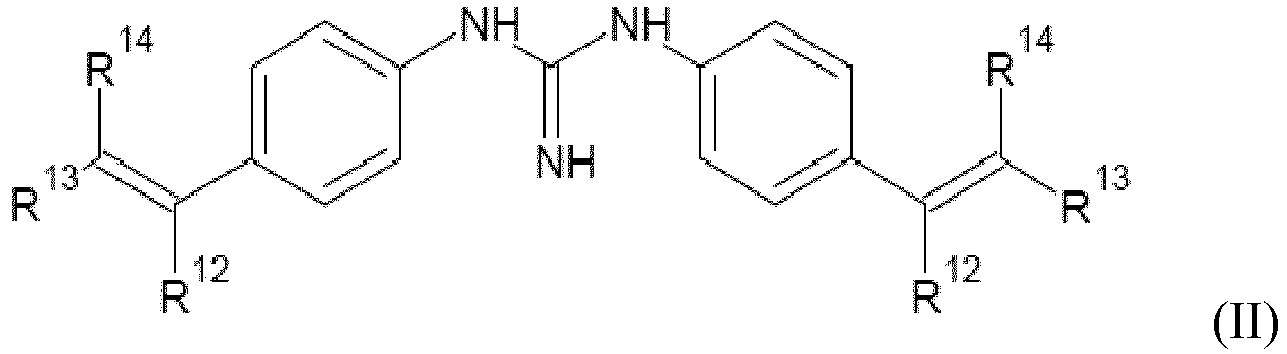
- These compounds can, for example, be symmetrical, ie the ethylenically unsaturated radical is in both rings in the para position (general formula (II)), ortho position (general formula (III)) or meta position (general formula (IV) ):
- radicals R 12 , R 13 and R 14 can each be the same or different.
- the radicals R 12 , R 13 and R 14 are preferably identical in both substituents, where R 12 is selected from hydrogen or methyl and R 13 and R 14 are hydrogen.
- the compound according to the invention has the general formula (II), (III) or (IV). It is particularly preferred that R 12 is selected from hydrogen or methyl and R 13 and R 14 are hydrogen (formulas (II-1), (III-1), (III-2) and (IV-1)):
- the symmetrical compounds of the general formulas (II) to (IV) can be prepared, for example, from a suitable vinylaniline.
- a suitable vinylaniline for example, 4-vinylaniline is reacted with imidazole and cyanogen bromide to form the diphenylguanidine substituted with ethylenically unsaturated groups:
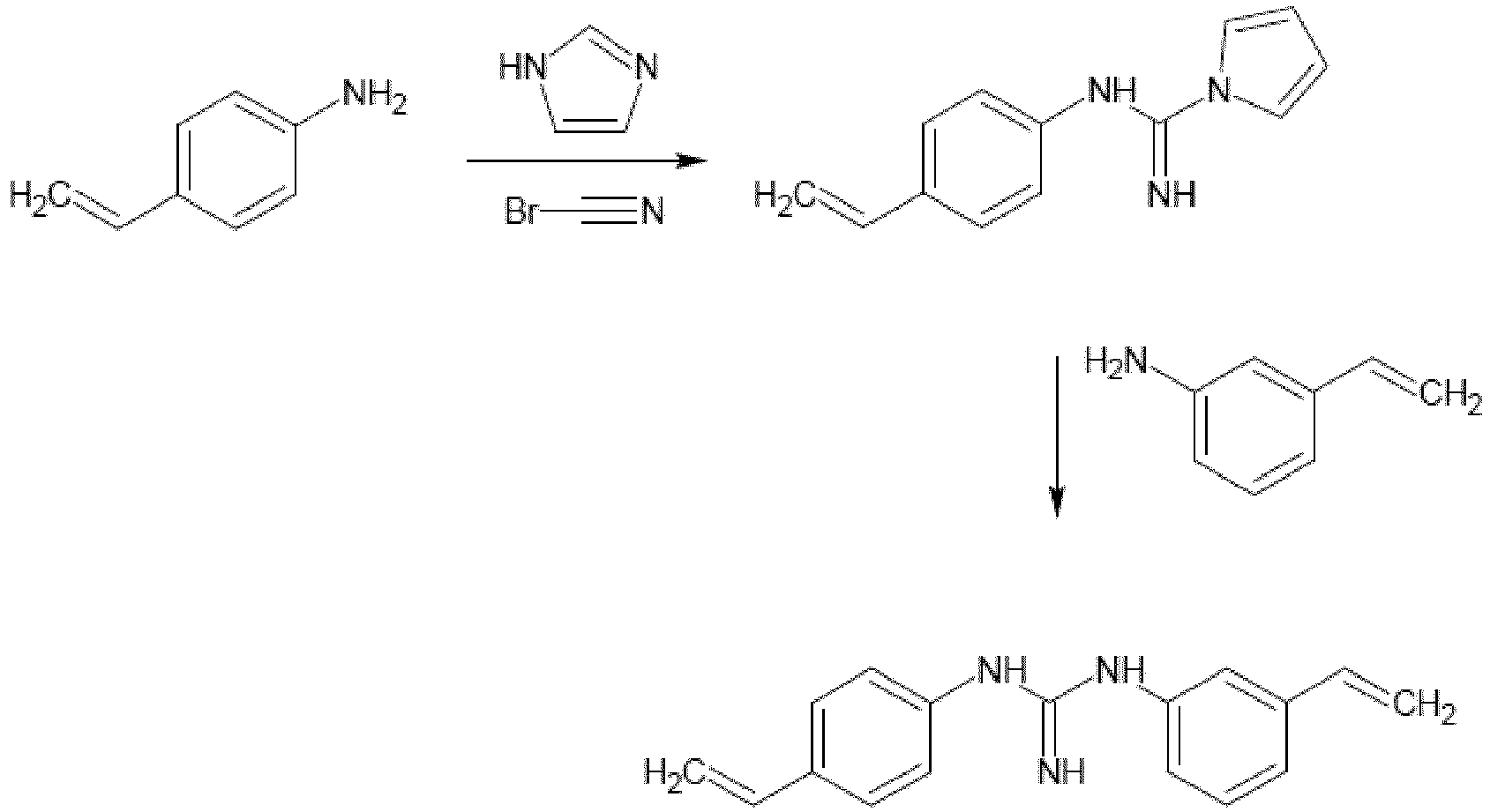
- the asymmetrical compounds of the general formulas (V) to (VII) can be prepared in a corresponding, but two-stage manner, which is possible by suitable adaptation of the stoichiometries.
- the first vinyl-substituted phenyl ring is inserted in a first step, followed by the separate introduction of the second vinyl-substituted phenyl ring in a second step:
- radicals R 12 , R 13 and R 14 can also be varied in a suitable manner by selecting suitable reagents known to the person skilled in the art. In this way, monosubstituted derivatives are also accessible, namely by using aniline instead of vinylaniline in one of the two reaction steps.
- symmetrical and / or asymmetrical compounds of the para, - ortho and meta substituted diphenylguanidines can be prepared in the following way:
- the present invention further relates to a rubber mixture comprising a rubber, a silica-based filler and / or carbon black, and at least one compound according to the invention, i.e. at least one modified diphenylguanidine.
- the rubber mixture can contain any suitable rubber or any suitable rubber component.
- Preferred rubbers are, in particular, an ethylene-propylene copolymer (EPM), an ethylene-propylene-diene copolymer (EPDM), (partially) hydrogenated nitrile rubber (HNBR), chloroprene rubber (CR), fluorine rubber (FKM), natural rubber (NR ), Styrene-butadiene rubber (SBR), a butadiene / acrylic acid C 1-4 alkyl ester copolymer (ABR), polyisoprene (IR), an isobutyl-isoprene copolymer (IIR) or butadiene rubber (BR).
- EPM ethylene-propylene copolymer
- EPDM ethylene-propylene-diene copolymer
- HNBR hydrogenated nitrile rubber
- CR chloroprene rubber
- FKM fluorine rubber
- NR natural rubber
- SBR Styrene-buta
- the rubber comprises an ethylene / propylene copolymer (EPM), an ethylene / propylene / diene copolymer (EPDM) or a blend of an ethylene / propylene copolymer (EPM) and an ethylene / propylene / diene copolymer (EPDM). (also known as EPM / EPDM blend).
- any suitable silica-based filler can be used according to the invention.
- Preferred silica-based fillers are silica (in particular precipitated silica or pyrogenic silica), synthetic silicates (in particular aluminum silicate or alkaline earth metal silicates) and natural silicates (in particular kaolin).
- any suitable carbon blacks can be used as fillers.
- Preferred carbon blacks are carbon blacks produced by the flame black, furnace or gas black process, which have BET surface areas (determined in accordance with ASTM D 3663-78) of 20 to 200 m 2 / g.
- the rubber mixture according to the invention preferably contains 5 to 200 phr ("parts per hundred rubber"), particularly preferably 30 to 150 phr, of silica-based fillers.
- the total proportion of additional fillers, in particular carbon blacks in the rubber mixture is typically from 0 to 160 phr, preferably 1 to 100 phr, particularly preferably 5 to 80 phr. If the rubber mixture contains carbon black and fillers based on silica, the total amount of these two types of filler is preferably 20 to 160 phr, particularly preferably 25 to 140 phr.
- the weight ratio between carbon black-based fillers and silica-based fillers is less than 1, preferably less than 0.5.
- the rubber mixture according to the invention can furthermore contain any suitable mixture ingredients. These preferably comprise at least one crosslinking agent, with sulfur-containing silanes, sulfur-based or peroxidic crosslinking agents being preferred and sulfur-based crosslinking agents being particularly preferred. Further mixing ingredients are usually still a processing aid and / or a plasticizer and / or an anti-aging agent and, if appropriate, further additives, for example fibers and color pigments. In this regard, reference is made to the general state of the art of rubber compounding technology.
- the content of the modified diphenylguanidine according to the invention in the rubber mixture according to the invention is usually 0.01 to 10 phr, preferably 0.03 to 3 phr, particularly preferably 0.1 to 1 phr and very particularly preferably 0.2 to 0.5 phr.
- the rubber mixture according to the invention is essentially free of unmodified diphenylguanidine (DPG), since this can lead to the release of aniline during vulcanization.
- DPG diphenylguanidine
- such rubber mixtures are to be understood as essentially free of unmodified diphenylguanidine, which comprise less than 0.1 phr diphenylguanidine.
- the rubber mixture particularly preferably contains no unmodified diphenylguanidine. According to the invention, this means that the rubber mixture contains less than 0.01 phr of diphenylguanidine.
- the present invention further relates to a method for producing a rubber vulcanizate, comprising vulcanizing the above-described rubber mixture according to the invention at a temperature in the range from 100 to 250 ° C., preferably at a temperature in the range from 130 to 180 ° C., optionally with a pressure of 10 to 200 bar can be applied.
- the present invention relates to a vulcanizate which can be obtained by vulcanizing the rubber mixture according to the invention described above.
- the present invention further relates to a rubber product containing the vulcanizate according to the invention described above.
- a rubber product containing the vulcanizate according to the invention described above.
- It can be any suitable rubber product.
- This is preferably a rubber article (in particular a technical rubber article) or a tire.
- Other suitable rubber products are, for example, tire components (in particular for tire treads, subtreads, carcasses, sidewalls or reinforced sidewalls for run-flat tires) or technical rubber articles such as damping elements, roller coverings, coverings on conveyor belts, belts, seals, golf ball cores, shoe soles, etc.
- This is particularly preferred Rubber product a tire or a drive belt (in particular a flat belt, V-belt, V-ribbed belt, toothed belt, clutch belt or elevator belt).
- the present invention relates to the use of the modified diphenylguanidine according to the invention as a secondary accelerator in the vulcanization of a rubber mixture.
Landscapes
- Chemical & Material Sciences (AREA)
- Organic Chemistry (AREA)
- Health & Medical Sciences (AREA)
- Chemical Kinetics & Catalysis (AREA)
- Medicinal Chemistry (AREA)
- Polymers & Plastics (AREA)
- Engineering & Computer Science (AREA)
- Mechanical Engineering (AREA)
- Compositions Of Macromolecular Compounds (AREA)
- Organic Low-Molecular-Weight Compounds And Preparation Thereof (AREA)
Abstract
Description
- Die vorliegende Erfindung betrifft ein mit ethylenisch ungesättigten Gruppen modifiziertes Diphenylguanidin, eine dieses modifizierte Diphenylguanidin umfassende Kautschukmischung, ein Verfahren zur Herstellung eines Kautschukvulkanisats aus dieser Kautschukmischung sowie das entsprechende Kautschukvulkanisat, und ein dieses Vulkanisat enthaltendes Kautschukprodukt. Die vorliegende Erfindung betrifft ferner die Verwendung des modifizierten Diphenylguanidins als Sekundärbeschleuniger bei der Vulkanisation von Kautschukmischungen.
- Das Verfahren der Vulkanisation ist bei der Herstellung von Kautschukprodukten wie beispielsweise Gummiartikeln oder Reifen von zentraler Bedeutung. Es ist seit Langem bekannt, dass der Vulkanisationsvorgang durch Zugabe basischer organischer Verbindungen beschleunigt werden kann. Dazu wurden zunächst beispielsweise Piperidin, Anilin und andere stickstoffhaltige organische Verbindungen wie Hexamethylentetramin oder Thiocarbanilid als Beschleuniger vorgeschlagen. Heute kommen hingegen vor allem Beschleuniger auf Schwefelbasis zum Einsatz. Diese bieten generell den Vorteil, dass durch die Verwendung unterschiedlicher Beschleuniger und deren Kombinationen die Produkt- und Verarbeitungseigenschaften (insbesondere die Induktionsperiode sowie die Reaktionsgeschwindigkeit bei der Vulkanisation) über einen weiten Bereich eingestellt werden können.
- Zur weiteren Regulierung der Induktions- und Vulkanisationszeit können den Kautschukmischungen sogenannte Zweitbeschleuniger zugesetzt werden. Am weitesten verbreitet sind dabei die Guanidin-Beschleuniger und insbesondere Diphenylguanidin (DPG). Diese erlauben nicht nur eine Einstellung des Vulkanisationsverhaltens, sondern verbessern ebenfalls weitere relevante Stoffeigenschaften der Kautschukmischung (insbesondere die Mooney-Viskosität) sowie des daraus erhaltenen Vulkanisats (insbesondere die Bruchdehnung und die Zugfestigkeit). Gerade füllstoffhaltige Kautschukmischungen, also Kautschukmischungen, die beispielsweise einen Füllstoff auf Basis von Kieselsäure bzw. Silica oder Ruß enthalten und die für Reifen eingesetzt werden, weisen hohe Mooney-Viskositäten auf, was die Verarbeitung deutlich erschwert. Durch die Zugabe von Zweitbeschleunigern auf Guanidin-Basis zu diesen Kautschukmischungen kann die Mooney-Viskosität herabgesetzt und so die Verarbeitung erleichtert werden.
- Die Guanidin-Beschleuniger haben aber den generellen Nachteil, dass bei der Vulkanisation leichtflüchtige organische Aminverbindungen freigesetzt werden; bei der Verwendung des am weitesten verbreiteten Guanidin-Beschleunigers DPG wird beispielsweise Anilin freigesetzt. Da aber DPG als toxisch gilt und Kontaktdermatitis hervorrufen kann, und Anilin als kanzerogen gilt, besteht das allgemeine Bestreben, auf DPG als Zweitbeschleuniger zu verzichten.
- Daher wurde beispielsweise in der internationalen Patentanmeldung
WO 2016/030469 vorgeschlagen, DPG in Kautschukmischungen, die einen Kieselsäure-basierten Füllstoff und/oder Ruß enthalten, durch Polyethylenimin zu ersetzen. In G. Heinrich et al., KGK Rubberpoint 2013, 1-2, 25 wird der Einsatz der natürlich vorkommenden Aminosäure L-Cystin und deren Derivat L-Cystin-Dimethylesterdihydrochlroid als umweltfreundliche Zweitbeschleuniger bei der Vulkanisation von Silica-gefüllten Lösungs-Styrol-Butadien-Kautschuken beschrieben. - Diese Ersatzstoffe für DPG weisen aber den Nachteil auf, dass sie chemisch völlig verschieden von DPG sind. Wenn diese großtechnisch als Ersatz für DPG eingesetzt werden sollen, erfordert dies daher eine grundlegende Anpassung des zuvor mit DPG durchgeführten Vulkanisationsverfahrens.
- Der vorliegenden Erfindung liegt somit die Aufgabe zugrunde, einen Ersatz für Diphenylguanidin (DPG) bereitzustellen, bei dessen Einsatz als Zweitbeschleuniger in der Vulkanisation die Freisetzung von Anilin verringert oder vermieden wird und gleichzeitig keine grundlegende Anpassung des Vulkanisationsverfahrens notwendig ist.
- Diese Aufgabe wird durch die in den Ansprüchen gekennzeichneten Ausführungsformen gelöst.
- Insbesondere wird erfindungsgemäß eine Verbindung mit der allgemeinen Formel (I)

- bereitgestellt, wobei die Reste R1 bis R10 unabhängig voneinander aus der Gruppe, bestehend aus Wasserstoff, Halogen, -X-S-C(=O)(R11), -Y-C(R12)=C(R13)(R14) und -Z-Si(OR15)n(R16)3-n, ausgewählt sind,
- mit der Maßgabe, dass mindestens einer der Reste R1 bis R10 -Y-C(R12)=C(R13)(R14) ist,
wobei - X, Y und Z jeweils unabhängig voneinander eine Einfachbindung, C1-C6-Alkylen, C2-C6-Alkenylen oder C2-C6-Alkinylen ist,
- R11 geradkettiges oder verzweigtes C1-C12-Alkyl, C3-C8-Cycloalkyl, C6-C12-Aryl oder C5-C12-Heteroaryl ist, welche optional mit einem oder mehreren Substituenten, ausgewählt aus der Gruppe, bestehend aus Halogen, Hydroxyl, Cyano, Nitro, Aryl und Benzyl, substituiert sein können,
- R12, R13 und R14 jeweils unabhängig voneinander Wasserstoff, Halogen, geradkettiges oder verzweigtes C1-C12-Alkyl, C3-C8-Cycloalkyl, C6-C12-Aryl oder C5-C12-Heteroaryl ist,
- wobei das geradkettige oder verzweigte C1-C12-Alkyl, C3-C8-Cycloalkyl, C6-C12-Aryl und C5-C12-Heteroaryl optional mit einem oder mehreren Substituenten, ausgewählt aus der Gruppe, bestehend aus Halogen, Hydroxyl, Cyano, Nitro, Aryl und Benzyl, substituiert sein kann,
- R15 und R16 jeweils unabhängig voneinander geradkettiges oder verzweigtes C1-C12-Alkyl, C3-C8-Cycloalkyl, C6-C12-Aryl oder C5-C12-Heteroaryl ist, welche optional mit einem oder mehreren Substituenten, ausgewählt aus der Gruppe, bestehend aus Halogen, Cyano, Nitro, Aryl und Benzyl, substituiert sein können, und
- n eine ganze Zahl von 1 bis 3 ist.
- Bei der erfindungsgemäßen Verbindung gemäß der allgemeinen Formel (I) handelt es sich um ein Diphenylguanidin, welches mit zumindest einer ethylenisch ungesättigten Gruppe modifiziert ist. Daher wird die erfindungsgemäße Verbindung nachfolgend auch als modifiziertes Diphenylguanidin bezeichnet, in Abgrenzung zum aus dem Stand der Technik bekannten unmodifizierten Diphenylguanidin (DPG), bei dem R1-R10 in der allgemeinen Formel (I) jeweils Wasserstoff ist.
- Die erfindungsgemäßen Verbindungen haben den Vorteil, dass diese bei Verwendung im Vulkanisationsprozess keine nennenswerten Mengen an Anilin freisetzen. Die Spaltprodukte enthalten nämlich zumindest einen ethylenisch ungesättigten Rest, der während der Vulkanisation abreagieren und mit dem Polymer vernetzen kann. Auf diese Weise werden die Spaltprodukte bei der Vulkanisation in das Netzwerk des Vulkanisats eingebunden, so dass es zu keiner bzw. zu einer verringerten Freisetzung potentiell gesundheits- und umweltschädlicher Spaltprodukte während und nach der Vulkanisation kommt.
- Das modifizierte Guanidin gemäß der allgemeinen Formel (I) weist die Reste R1 bis R10 auf. Diese sind unabhängig voneinander aus der Gruppe, bestehend aus Wasserstoff, Halogen, -X-S-C(=O)(R11), -Y-C(R12)=C(R13)(R14) und -Z-Si(OR15)n(R16)3-n, ausgewählt. Vorzugsweise sind die Reste R1 bis R10 unabhängig voneinander aus Wasserstoff und -Y-C(R12)=C(R13)(R14) ausgewählt. Halogen kann dabei Fluor, Chlor, Brom oder Iod sein. Vorzugsweise handelt es sich bei dem Halogen um Fluor oder Chlor. Um die vorstehend beschriebenen Vorteile der erfindungsgemäßen Verbindungen zu erzielen, ist zumindest einer der Reste R1 bis R10 ein ethylenisch ungesättigter Rest -Y-C(R12)=C(R13)(R14). Weitere Reste können weitere ethylenisch ungesättigte Reste -Y-C(R12)=C(R13)(R14), schwefelhaltige Reste -X-S-C(=O)(R11) oder silanhaltige Reste mit kondensationsfähigen Gruppen -Z-Si(OR15)n(R16)3-n mit n = 1 bis 3 sein. Über die schwefelhaltigen Reste können die Spaltprodukte der erfindungsgemäßen Verbindungen ebenfalls während der Vulkanisation in das Netzwerk des Vulkanisats eingebunden werden. Die silanhaltigen Reste enthalten mindestens eine kondensationsfähige Gruppe OR15, die nach Hydrolyse an gegebenenfalls in der zu vulkanisierenden Kautschukmischung vorhandenem Silica anbinden und auf diese Weise die Spaltprodukte der erfindungsgemäßen Verbindungen in das Netzwerk des Vulkanisats einbinden kann.
- Enthält die erfindungsgemäße Verbindung mehrere ethylenisch ungesättigte Reste -Y-C(R12)=C(R13)(R14), können diese Reste jeweils gleich oder verschieden sein, d.h. Y, R12, R13 und R14 können jeweils gleich oder verschieden sein. Gleiches gilt für die weiteren möglichen Reste Halogen, die schwefelhaltigen Reste sowie die silanhaltigen Reste mit kondensationsfähigen Gruppen.
- X, Y und Z sind jeweils unabhängig voneinander eine Einfachbindung, C1-C6-Alkylen, C2-C6-Alkenylen oder C2-C6-Alkinylen. C2-C6-Alkylen ist eine verbrückende Gruppe und umfasst -(CH2)m- mit m = 1 bis 6, aber auch entsprechende verzweigte Gruppen. Bevorzugtes C1-C6-Alkylen ist -(CH2)- (Methylen) und -(CH2CH2)- (Ethylen). C2-C6-Alkenylen ist eine verbrückende Gruppe mit mindestens einer Doppelbindung und umfasst beispielsweise -CH=CH-(CH2)p- mit p = 0 bis 4, aber auch entsprechende verzweigte und/oder mehrfach ungesättigte Gruppen. Bevorzugtes C2-C6-Alkenylen ist -CH=CH-. C2-C6-Alkinylen ist eine verbrückende Gruppe mit mindestens einer Dreifachbindung und umfasst beispielsweise -C≡C-(CH2)q- mit q = 0 bis 4, aber auch entsprechende verzweigte und/oder mehrfach ungesättigte Gruppen. Bevorzugtes C2-C6-Alkinylen ist -C≡C-. Gemäß einer bevorzugten Ausführungsform der vorliegenden Erfindung sind X, Y und Z eine Einfachbindung, -(CH2)- (Methylen) oder -(CH2CH2)- (Ethylen).
- Der Rest R11 ist geradkettiges oder verzweigtes C1-C12-Alkyl, C3-C8-Cycloalkyl, C6-C12-Aryl oder C5-C12-Heteroaryl. C1-C12-Alkyl ist beispielsweise Methyl, Ethyl, Propyl, iso-Propyl, Butyl, iso-Butyl, tert-Butyl, Pentyl, Hexyl, Heptyl, Octyl, Nonyl, Decyl, Undecyl oder Dodecyl. Vorzugsweise ist C1-C12-Alkyl Methyl, Ethyl, Propyl, iso-Propyl, Butyl, Pentyl, Hexyl, Heptyl oder Octyl. C3-C8-Cycloalkyl ist beispielsweise Cyclopropyl, Cyclobutyl, Cyclopentyl, Cyclohexyl, Cycloheptyl oder Cyclooctyl. Vorzugsweise ist C3-C8-Cycloalkyl Cyclohexyl. C6-C12-Aryl oder C5-C12-Heteroaryl sind beispielsweise Phenyl, Naphthyl, Furanyl, Imidazolyl, Pyrazolyl oder Pyridinyl. Vorzugsweise sind C6-C12-Aryl oder C5-C12-Heteroaryl Phenyl, Imidazolyl oder Pyridinyl. Die vorstehend genannten Substituenten können optional mit einem oder mehreren Substituenten, ausgewählt aus der Gruppe, bestehend aus Halogen, Hydroxyl, Cyano, Nitro, Aryl und Benzyl, substituiert sein. Halogen kann dabei Fluor, Chlor, Brom oder Iod sein. Vorzugsweise handelt es sich bei dem Halogen um Fluor oder Chlor. Aryl ist vorzugsweise C6-C12-Aryl und umfasst beispielsweise Phenyl und Naphthyl. Bevorzugtes Aryl ist Phenyl. Gemäß einer bevorzugten Ausführungsform der vorliegenden Erfindung ist der Rest R11 Methyl, Ethyl, Propyl, iso-Propyl, Butyl, Pentyl, Hexyl, Heptyl oder Octyl.
- R12, R13 und R14 sind jeweils unabhängig voneinander Wasserstoff, Halogen, geradkettiges oder verzweigtes C1-C12-Alkyl, C3-C8-Cycloalkyl, C6-C12-Aryl oder C5-C12-Heteroaryl. Halogen kann dabei Fluor, Chlor, Brom oder Iod sein. Vorzugsweise handelt es sich bei dem Halogen um Fluor oder Chlor. C1-C12-Alkyl ist beispielsweise Methyl, Ethyl, Propyl, iso-Propyl, Butyl, iso-Butyl, tert-Butyl, Pentyl, Hexyl, Heptyl, Octyl, Nonyl, Decyl, Undecyl oder Dodecyl. Vorzugsweise ist C1-C12-Alkyl Methyl, Ethyl, Propyl, iso-Propyl, Butyl, Pentyl, Hexyl, Heptyl oder Octyl. C3-C8-Cycloalkyl ist beispielsweise Cyclopropyl, Cyclobutyl, Cyclopentyl, Cyclohexyl, Cycloheptyl oder Cyclooctyl. Vorzugsweise ist C3-C8-Cycloalkyl Cyclohexyl. C6-C12-Aryl oder C5-C12-Heteroaryl sind beispielsweise Phenyl, Naphthyl, Furanyl, Imidazolyl, Pyrazolyl oder Pyridinyl. Vorzugsweise sind C6-C12-Aryl oder C5-C12-Heteroaryl Phenyl, Imidazolyl oder Pyridinyl. Die vorstehend genannten Substituenten C1-C12-Alkyl, C3-C8-Cycloalkyl, C6-C12-Aryl oder C5-C12-Heteroaryl können optional mit einem oder mehreren Substituenten, ausgewählt aus der Gruppe, bestehend aus Halogen, Hydroxyl, Cyano, Nitro, Aryl und Benzyl, substituiert sein. Halogen kann dabei Fluor, Chlor, Brom oder Iod sein. Vorzugsweise handelt es sich bei dem Halogen um Fluor oder Chlor. Aryl ist vorzugsweise C6-C12-Aryl und umfasst beispielsweise Phenyl und Naphthyl. Bevorzugtes Aryl ist Phenyl. Gemäß einer bevorzugten Ausführungsform der vorliegenden Erfindung sind die Reste R12, R13 und R14 jeweils unabhängig voneinander aus Wasserstoff, Methyl, Ethyl, Propyl, iso-Propyl, Butyl, Pentyl, Hexyl, Heptyl oder Octyl ausgewählt.
- R15 und R16 sind jeweils unabhängig voneinander geradkettiges oder verzweigtes C1-C12-Alkyl, C3-C8-Cycloalkyl, C6-C12-Aryl oder C5-C12-Heteroaryl. Geradkettiges oder verzweigtes C1-C12-Alkyl, C3-C8-Cycloalkyl, C6-C12-Aryl oder C5-C12-Heteroaryl sind wie vorstehend für R11 definiert. Diese Reste können optional mit einem oder mehreren Substituenten, ausgewählt aus der Gruppe, bestehend aus Halogen, Cyano, Nitro, Aryl und Benzyl, substituiert sein, wobei Halogen und Aryl ebenfalls wie vorstehend bei R11 definiert sind.
- Gemäß einer bevorzugten Ausführungsform der vorliegenden Erfindung ist Y eine Einfachbindung und die Reste R12, R13 und R14 sind jeweils unabhängig voneinander aus Wasserstoff, Methyl, Ethyl, Propyl, iso-Propyl, Butyl, Pentyl, Hexyl, Heptyl oder Octyl ausgewählt. Gemäß einer weiteren bevorzugten Ausführungsform ist X eine Einfachbindung und R11 ist geradkettiges oder verzweigtes C1-C12-Alkyl, vorzugsweise Methyl, Ethyl, Propyl, iso-Propyl, Butyl, Pentyl, Hexyl, Heptyl oder Octyl. Gemäß einer weiteren bevorzugten Ausführungsform ist Z eine Einfachbindung, n=3 und R15 Methyl, Ethyl oder iso-Propyl.
- Gemäß einer weiteren bevorzugten Ausführungsform der vorliegenden Erfindung ist einer der Reste R1 bis R5 sowie einer der Reste R6 bis R10 -Y-C(R12)=C(R13)(R14), wobei Y jeweils eine Einfachbindung ist und die verbleibenden Reste von R1 bis R10 Wasserstoff sind. Diese Verbindungen können beispielsweise symmetrisch sein, d.h. der ethylenisch ungesättigte Rest befindet sich in beiden Ringen jeweils in para-Position (allgemeine Formel (II)), ortho-Position (allgemeine Formel (III)) oder meta-Position (allgemeine Formel (IV)):


- Es ist aber ebenso möglich, dass die erfindungsgemäßen Verbindungen unsymmetrisch sind, d.h. der ethylenisch ungesättigte Rest befindet sich in den beiden Ringen an unterschiedlichen Positionen (allgemeine Formeln (V) bis (VII)):


- Die Reste R12, R13 und R14 können jeweils gleich oder verschieden sein. Vorzugsweise sind die Reste R12, R13 und R14 in beiden Substituenten jeweils identisch, wobei R12 aus Wasserstoff oder Methyl ausgewählt ist und R13 und R14 Wasserstoff sind.
- Gemäß einer besonders bevorzugten Ausführungsform weist die erfindungsgemäße Verbindung die allgemeine Formel (II), (III) oder (IV) auf. Dabei ist es insbesondere bevorzugt, dass R12 aus Wasserstoff oder Methyl ausgewählt ist und R13 und R14 Wasserstoff sind (Formeln (II-1), (III-1), (III-2) und (IV-1)):


- Die erfindungsgemäßen Verbindungen sind durch herkömmliche, dem Fachmann bekannte Verfahren zugänglich.
- Die symmetrischen Verbindungen der allgemeinen Formeln (II) bis (IV) können beispielsweise ausgehend von einem geeigneten Vinylanilin hergestellt werden. Zur Herstellung der Verbindung (II-1) wird zum Beispiel 4-Vinylanilin mit Imidazol und Bromcyan unter Bildung des mit ethylenisch ungesättigten Gruppen substituierten Diphenylguanidins umgesetzt:

- Das gleiche Reaktionsschema kann auch in entsprechender Weise zur Herstellung der ortho- und meta-substituierten Diphenylguanidine verwendet werden. Dazu wird nicht 4-Vinylanilin, sondern 2-Vinylanilin oder 3-Vinylanilin als Edukt verwendet.
- Ferner kann die Verbindung gemäß Formel (II-1) auch durch die folgenden schematisch dargestellten Syntheseabläufe hergestellt werden:

- Die unsymmetrischen Verbindungen der allgemeinen Formeln (V) bis (VII) können in entsprechender, aber zweistufiger Weise hergestellt werden, was über eine geeignete Anpassung der Stöchiometrien möglich ist. Dabei wird in einem ersten Schritt der erste vinylsubstituierte Phenylring eingefügt, gefolgt von der separaten Einführung des zweiten vinylsubstituierten Phenylringes in einem zweiten Schritt:
- In entsprechender Weise können auch weitere unsymmetrisch substituierte Diphenylguanidine erhalten werden. Durch Wahl geeigneter, dem Fachmann bekannter Reagentien können auch die Reste R12, R13 und R14 in geeigneter Weise variiert werden. Auf diese Weise sind ebenso monosubstituierte Derivate zugänglich, nämlich durch Verwendung von Anilin anstelle eines Vinylanilins in einem der beiden Reaktionsschritte.
- Ferner können symmetrische und/oder unsymmetrische der Verbindungen der para,- ortho- und meta-substituierten Diphenylguanidine auf folgende Weise hergestellt werden:

- Die vorliegende Erfindung betrifft weiterhin eine Kautschukmischung, umfassend einen Kautschuk, einen Kieselsäure-basierten Füllstoff und/oder Ruß, und mindestens eine erfindungsgemäße Verbindung, d.h. mindestens ein modifiziertes Diphenylguanidin.
- Erfindungsgemäß kann die Kautschukmischung jedweden geeigneten Kautschuk bzw. jedwede geeignete Kautschukkomponente enthalten. Bevorzugte Kautschuke sind insbesondere ein Ethylen-Propylen-Mischpolymerisat (EPM), ein Ethylen-Propylen-Dien-Mischpolymerisat (EPDM), (teil)hydrierter Nitrilkautschuk (HNBR), ChloroprenKautschuk (CR), Fluor-Kautschuk (FKM), Naturkautschuk (NR), Styrol-Butadien-Kautschuk (SBR), ein Butadien/Acrylsäure-C1-4-Alkylester-Copolymerisat (ABR), Polyisopren (IR), ein Isobutyl-Isopren-Copolymerisat (IIR) oder Butadien-Kautschuk (BR). Diese können unverschnitten oder mit wenigsten einer weiteren Kautschukkomponente, insbesondere mit einem der vorgenannten Kautschuktypen, verschnitten eingesetzt werden, beispielsweise in Form eines EPM/EPDM- oder SBR/BR-Verschnittes. Gemäß einer besonders bevorzugten Ausführungsform umfasst der Kautschuk Ethylen-Propylen-Mischpolymerisat (EPM), Ethylen-Propylen-Dien-Mischpolymerisat (EPDM) oder einen Blend aus Ethylen-Propylen-Mischpolymerisat (EPM) und Ethylen-Propylen-Dien-Mischpolymerisat (EPDM) (auch als EPM/EPDM-Verschnitt bezeichnet).
- Weiterhin kann erfindungsgemäß jedweder geeignete Kieselsäure-basierte Füllstoff verwendet werden. Bevorzugte Kieselsäure-basierte Füllstoffe sind Kieselsäure (insbesondere Fällungskieselsäure oder pyrogene Kieselsäure), synthetische Silikate (insbesondere Aluminiumsilikat oder Erdalkalisilikate) sowie natürliche Silikate (insbesondere Kaolin). Zusätzlich zu oder anstelle von den Kieselsäure-basierten Füllstoffen können jedwede geeignete Ruße als Füllstoffe verwendet werden. Bevorzugte Ruße sind nach dem Flammruß-, Furnace- oder Gasruß-Verfahren hergestellte Ruße, welche BET-Oberflächen (bestimmt nach ASTM D 3663-78) von 20 bis 200 m2/g aufweisen.
- Die erfindungsgemäße Kautschukmischung enthält vorzugsweise 5 bis 200 phr ("parts per hundred rubber"), besonders bevorzugt 30 bis 150 phr an Kieselsäure-basierten Füllstoffen. Der Gesamtanteil an zusätzlichen Füllstoffen, insbesondere Rußen in der Kautschukmischung beträgt typischerweise von 0 bis 160 phr, vorzugsweise 1 bis 100 phr, besonders bevorzugt 5 bis 80 phr. Sofern die Kautschukmischung Ruß und kieselsäurebasierende Füllstoffe enthält, so beträgt die Gesamtmenge dieser beiden Füllstoffarten vorzugsweise 20 bis 160 phr, besonders bevorzugt 25 bis 140 phr. In einer bevorzugten Ausführungsform ist das Gewichtsverhältnis zwischen Ruß-basierten Füllstoffen und Kieselsäure-basierten Füllstoffen kleiner als 1, vorzugsweise kleiner als 0,5.
- Die erfindungsgemäße Kautschukmischung kann weiterhin jedwede geeignete Mischungsingredienzien enthalten. Diese umfassen vorzugweise wenigstens einen Vernetzer, wobei schwefelhaltige Silane, Schwefel-basierte oder peroxidische Vernetzer bevorzugt und Schwefel-basierte Vernetzer besonders bevorzugt sind. Weitere Mischungsingredienzien sind zumeist noch ein Verarbeitungshilfsmittel und/oder ein Weichmacher und/oder ein Alterungsschutzmittel sowie gegebenenfalls weitere Zusatzstoffe, beispielsweise Fasern und Farbpigmente. Diesbezüglich wird auf den allgemeinen Stand der Kautschukmischungstechnologie verwiesen.
- Der Gehalt des erfindungsgemäßen, modifizierten Diphenylguanidins in der erfindungsgemäßen Kautschukmischung beträgt üblicherweise 0,01 bis 10 phr, vorzugsweise 0,03 bis 3 phr, besonders bevorzugt 0,1 bis 1 phr und ganz besonders bevorzugt 0,2 bis 0,5 phr.
- Die erfindungsgemäße Kautschukmischung ist im Wesentlichen frei von unmodifiziertem Diphenylguanidin (DPG), da dieses bei der Vulkanisation zur Freisetzung von Anilin führen kann. Im Rahmen der vorliegenden Erfindung sind solche Kautschukmischungen als im Wesentlichen frei von unmodifiziertem Diphenylguanidin zu verstehen, die weniger als 0,1 phr Diphenylguanidin umfassen. Besonders bevorzugt enthält die Kautschukmischung kein unmodifiziertes Diphenylguanidin. Dies bedeutet erfindungsgemäß, dass in der Kautschukmischung weniger als 0,01 phr Diphenylguanidin enthalten sind.
- Die vorliegende Erfindung betrifft ferner ein Verfahren zur Herstellung eines Kautschukvulkanisats, umfassend das Vulkanisieren der vorstehend beschriebenen erfindungsgemäßen Kautschukmischung bei einer Temperatur im Bereich von 100 bis 250°C, vorzugsweise bei einer Temperatur im Bereich von 130 bis 180°C, wobei gegebenenfalls ein Druck von 10 bis 200 bar angewendet werden kann.
- Darüber hinaus betrifft die vorliegende Erfindung ein Vulkanisat, welches durch Vulkanisation der vorstehend beschriebenen, erfindungsgemäßen Kautschukmischung erhältlich ist.
- Die vorliegende Erfindung betrifft ferner ein Kautschukprodukt, enthaltend das vorstehend beschriebene, erfindungsgemäße Vulkanisat. Dabei kann es sich um jedwedes geeignete Kautschukprodukt handelt. Vorzugsweise ist dieses ein Gummiartikel (insbesondere ein technischer Gummiartikel) oder ein Reifen. Weitere geeignete Kautschukprodukte stellen beispielsweise Reifenbauteile (insbesondere für Reifenlaufflächen, Subtreads, Karkassen, Seitenwände oder verstärkte Seitenwände für Notlaufreifen) oder technische Gummiartikel wie Dämpfungselemente, Walzenbeläge, Beläge von Förderbändern, Riemen, Dichtungen, Golfballkernen, Schuhsohlen, etc. dar. Besonders bevorzugt ist das Kautschukprodukt ein Reifen oder ein Antriebsriemen (insbesondere ein Flachriemen, Keilriemen, Keilrippenriemen, Zahnriemen, Kupplungsriemen oder Aufzugsriemen).
- Die vorliegende Erfindung betrifft schließlich die Verwendung des erfindungsgemäßen modifizierten Diphenylguanidins als Sekundärbeschleuniger bei der Vulkanisation einer Kautschukmischung.
- Im Folgenden soll die Erfindung anhand von zwei Synthesebeispielen der Verbindung gemäß Formel (II-1) verdeutlicht werden:
-

- Unter Stickstoff wurden in 60 mL trockenem Toluol 7.00 g (1.0 Äq) 4-Bromstyrol gelöst und nacheinander 1.46 g (0.2 Äquivalente (Äq)) Kupferiodid, 1.35 g (0.4 Äq) N,N'-Diemthylethylendiamin sowie 11.46 g (2.0 Äq) Natriumiodid zugegeben. Es wurde für 22 Stunden bei 110 °C gerührt. Anschließend wurde auf Raumtemperatur (RT) gekühlt und das Lösungsmittel entfernt. Der Rückstand wurde in Dichlormethan (DCM) aufgenommen und mit verd. Ammoniaklösung, Wasser sowie gesättigter Kochsalzlösung ausgeschüttelt. Die organischen Phasen wurden vereinigt und über Natriumsulfat getrocknet. Die Salze wurden abfiltriert, das Lösungsmittel im Vakuum entfernt und der Rückstand säulenchromatographisch an Kieselgel aufgereinigt (Cyclohexan). Es wurde ein Gemisch aus 4-Iodstyrol und 4-Bromstyrol (70:30) erhalten, welches ohne weitere Aufreinigung in der nächsten Synthesestufe eingesetzt wurde. Weißer Feststoff; Ausbeute 3.15 g (36% d.Th., bezogen auf Iodstyrol).
1H-NMR (engl. "nuclear magnetic resonance") (500 MHz, CDCl3) δ = 7.70 (d, J = 8.4 Hz, 2H), 7.18 (d, J = 8.4 Hz, 2H), 6.75-6.65 (m, 1H), 5.82 (d, J = 17.6 Hz, 2H), 5.31 (d, J = 10.9 Hz, 2H). -

- Unter Stickstoff wurden in 68.5 mL trockenem Acetonitril (ACN) 3.15 g (1.0 Äq) reines 4-Iodstyrol oder entsprechend eine Mischung aus 4-Iodstyrol und 4-Bromstyrrol vorgelegt, dass diese Mischung der reinen Menge von 3.15 g 4-Iodstyrol entspricht. Anschließend wurden 1.67 g (1.0 Äq) Guanindiniumnitrat, 17.44 g (6.0 Äq) Kaliumphosphat, 0.24 g (0.2 Äq) Sarcosin und 0.26 g (0.1 Äq) Kupferiodid zugefügt. Die Suspension wurde für 12 Stunden am Rückfluss erhitzt und danach auf RT abkühlen gelassen. Die anorganischen Anteile wurden per Filtration abgetrennt und das Lösungsmittel im Vakuum entfernt. Das Rohprodukt wurde säulenchromatographisch an Kieselgel aufgereinigt (Essigester/Cyclohexan 4:1 plus 1% TEA). Weißer Feststoff; Ausbeute 2.00 g (93 % d.Th.).
1H-NMR (500 MHz, ACN-d6) δ = 7.39 (d, J = 8.5 Hz, 4H), 7.20 (d, J = 8.2 Hz, 4H), 6.72 (dd, J = 17.6, 10.9 Hz, 2H), 5.70 (dd, J = 17.7, 1.1 Hz, 2H), 5.15 (dd, J = 10.9 Hz, 2H).
13C-NMR (125 MHz, ACN-d6) 8 = 148.1, 145.3, 131.1, 126.8, 121.0, 117.3, 111.0.
ESI-MS (Elektrosprayionisation Massenspektrometrie) [M+H]+ = 264. -

- 598 mg (1.0 Äq) 1,1'-Thiocarbonyldiimidazol wurden in 30 mL trockenem Tetrahydrofuran (THF) gelöst und 1.00 g 4-Vinylstyrol (1.0 Äq) langsam zugegeben. Es wurde 24 Stunden in der Siedehitze gerührt und im Anschluss das Lösungsmittel entfernt.
- Der Rückstand wurde aus einem 2:1-Gemisch Cyclohexan/Essigester umkristallisiert. Es wurde ein brauner Feststoff erhalten, der in DCM aufgenommen und mit 1M HCl (1molare Salzsäure) sowie gesättigter NaHCO3-Lösung gewaschen wurde. Blass gelber Feststoff; Ausbeute 560 mg (60 % d.Th.).
1H-NMR (500 MHz, DMSO-d6) δ = 9.87 (s, 2H), 7.49 (d, J = 8.7 Hz, 4H), 7.44 (d, J = 8.6 Hz, 4H), 6.71 (dd, J = 17.6, 10.9 Hz, 2H), 5.78 (dd, J = 17.6, 1.1 Hz, 2H), 5.22 (dd, J = 10.9, 1.0 Hz, 2H).
ESI-MS [M+H]+ = 281. -

- Unter Stickstoff wurden 250 mg (1.0 Äq) 1,3-Bis(4-vinylphenyl)thioharnstoff in 20 mL trockenem DMF gelöst und auf 0 °C gekühlt. Im Anschluss wurden 114 µL (2.0 Äq) wässrige Ammoniaklösung sowie 497 µL (4.0 Äq) Triethylamin zugtropft. Die gelbe Suspension wurde zwei Stunden lang bei 0 °C und über Nacht bei RT gerührt. Es erfolgte der Farbumschlag nach schwarz (HgS-Bildung). Die entstandenen Feststoffe wurden abfiltriert und das Filtrat zur Trockne eingeengt. Weißer Feststoff; Ausbeute 759 mg (85 % d. Th.).
1H-NMR (500 MHz, ACN-d6) δ = 7.39 (d, J = 8.5 Hz, 4H), 7.20 (d, J = 8.2 Hz, 4H), 6.72 (dd, J = 17.6, 10.9 Hz, 2H), 5.70 (dd, J = 17.7, 1.1 Hz, 2H), 5.15 (dd, J = 10.9 Hz, 2H).
13C-NMR (125 MHz, ACN-d6) 8 = 148.1, 145.3, 131.1, 126.8, 121.0, 117.3, 111.0.
ESI-MS [M+H]+ = 264.
Claims (14)
- Verbindung mit der allgemeinen Formel (I)
 wobei die Reste R1 bis R10 unabhängig voneinander aus der Gruppe, bestehend aus Wasserstoff, Halogen, -X-S-C(=O)(R11), -Y-C(R12)=C(R13)(R14) und -Z-Si(OR15)n(R16)3-n, ausgewählt sind,mit der Maßgabe, dass mindestens einer der Reste R1 bis R10 -Y-C(R12)=C(R13)(R14) ist,
wobeiX, Y und Z jeweils unabhängig voneinander eine Einfachbindung, C1-C6-Alkylen, C2-C6-Alkenylen oder C2-C6-Alkinylen ist,R11 geradkettiges oder verzweigtes C1-C12-Alkyl, C3-C8-Cycloalkyl, C6-C12-Aryl oder C5-C12-Heteroaryl ist, welche optional mit einem oder mehreren Substituenten, ausgewählt aus der Gruppe, bestehend aus Halogen, Hydroxyl, Cyano, Nitro, Aryl und Benzyl, substituiert sein können,R12, R13 und R14 jeweils unabhängig voneinander Wasserstoff, Halogen, geradkettiges oder verzweigtes C1-C12-Alkyl, C3-C8-Cycloalkyl, C6-C12-Aryl oder C5-C12-Heteroaryl ist, wobei das geradkettige oder verzweigte C1-C12-Alkyl, C3-C8-Cycloalkyl, C6-C12-Aryl und C5-C12-Heteroaryl optional mit einem oder mehreren Substituenten, ausgewählt aus der Gruppe, bestehend aus Halogen, Hydroxyl, Cyano, Nitro, Aryl und Benzyl, substituiert sein kann,R15 und R16 jeweils unabhängig voneinander geradkettiges oder verzweigtes C1-C12-Alkyl, C3-C8-Cycloalkyl, C6-C12-Aryl oder C5-C12-Heteroaryl ist, welche optional mit einem oder mehreren Substituenten, ausgewählt aus der Gruppe, bestehend aus Halogen, Cyano, Nitro, Aryl und Benzyl, substituiert sein können, undn eine ganze Zahl von 1 bis 3 ist. - Verbindung nach Anspruch 1, wobei Y eine Einfachbindung ist und die Reste R12, R13 und R14 jeweils unabhängig voneinander aus Wasserstoff, Methyl, Ethyl, Propyl, iso-Propyl, Butyl, Pentyl, Hexyl, Heptyl oder Octyl ausgewählt sind.
- Verbindung nach Anspruch 1 oder 2, wobei X eine Einfachbindung ist und R11 geradkettiges oder verzweigtes C1-C12-Alkyl ist, vorzugsweise Methyl, Ethyl, Propyl, iso-Propyl, Butyl, Pentyl, Hexyl, Heptyl oder Octyl.
- Verbindung nach einem der Ansprüche 1 bis 3, wobei Z eine Einfachbindung, n=3 und R15 Methyl, Ethyl oder iso-Propyl ist.
- Verbindung nach Anspruch 1 oder 2, wobei einer der Reste R1 bis R5 sowie einer der Reste R6 bis R10 -Y-C(R12)=C(R13)(R14) ist, dabei Y jeweils eine Einfachbindung ist und die verbleibenden Reste von R1 bis R10 Wasserstoff sind.
- Verbindung nach Anspruch 5 mit der allgemeinen Formel (II):

- Verbindung nach Anspruch 5 oder 6, wobei die Reste R12, R13 und R14 in beiden Substituenten jeweils identisch sind und R12 aus Wasserstoff oder Methyl ausgewählt ist und R13 und R14 Wasserstoff sind.
- Kautschukmischung, umfassend einen Kautschuk, einen Kieselsäure-basierten Füllstoff und/oder Ruß, und mindestens eine Verbindung gemäß einem der Ansprüche 1 bis 7.
- Kautschukmischung nach Anspruch 8, wobei der Gehalt der mindestens einen Verbindung gemäß einem der Ansprüche 1 bis 7 0,01 bis 10 phr beträgt.
- Kautschukmischung nach Anspruch 8 oder 9, welche kein unmodifiziertes Diphenylguanidin enthält.
- Verfahren zur Herstellung eines Kautschukvulkanisats, umfassend das Vulkanisieren der Kautschukmischung nach einem der Ansprüche 8 bis 10 bei einer Temperatur im Bereich von 100 bis 250°C.
- Vulkanisat, erhältlich durch Vulkanisation der Kautschukmischung nach einem der Ansprüche 8 bis 10.
- Kautschukprodukt, vorzugsweise ein Gummiartikel oder Reifen, enthaltend das Vulkanisat nach Anspruch 12.
- Verwendung der Verbindung nach einem der Ansprüche 1 bis 7 als Sekundärbeschleuniger bei der Vulkanisation einer Kautschukmischung.
Applications Claiming Priority (1)
| Application Number | Priority Date | Filing Date | Title |
|---|---|---|---|
| DE102018210095.0A DE102018210095A1 (de) | 2018-06-21 | 2018-06-21 | Mit ethylenisch ungesättigten Gruppen modifiziertes Diphenylguanidin |
Publications (2)
| Publication Number | Publication Date |
|---|---|
| EP3587395A1 true EP3587395A1 (de) | 2020-01-01 |
| EP3587395B1 EP3587395B1 (de) | 2023-08-09 |
Family
ID=66912611
Family Applications (1)
| Application Number | Title | Priority Date | Filing Date |
|---|---|---|---|
| EP19180422.8A Active EP3587395B1 (de) | 2018-06-21 | 2019-06-17 | Mit ethylenisch ungesättigten gruppen modifiziertes diphenylguanidin |
Country Status (2)
| Country | Link |
|---|---|
| EP (1) | EP3587395B1 (de) |
| DE (1) | DE102018210095A1 (de) |
Citations (3)
| Publication number | Priority date | Publication date | Assignee | Title |
|---|---|---|---|---|
| US20030135006A1 (en) * | 2001-12-21 | 2003-07-17 | Materne Thierry Florent Edme | Rubber composition with silica reinforcement obtained with an amino acid or amino acid-containing protein based activator and use thereof in tires |
| WO2016030469A1 (de) | 2014-08-29 | 2016-03-03 | Lanxess Deutschland Gmbh | Diphenylguanidin-freie kautschukmischungen enthaltend polyethylenimin |
| DE102015214731A1 (de) * | 2015-08-03 | 2017-02-09 | Continental Reifen Deutschland Gmbh | Kautschukmischung und Fahrzeugreifen |
-
2018
- 2018-06-21 DE DE102018210095.0A patent/DE102018210095A1/de not_active Withdrawn
-
2019
- 2019-06-17 EP EP19180422.8A patent/EP3587395B1/de active Active
Patent Citations (3)
| Publication number | Priority date | Publication date | Assignee | Title |
|---|---|---|---|---|
| US20030135006A1 (en) * | 2001-12-21 | 2003-07-17 | Materne Thierry Florent Edme | Rubber composition with silica reinforcement obtained with an amino acid or amino acid-containing protein based activator and use thereof in tires |
| WO2016030469A1 (de) | 2014-08-29 | 2016-03-03 | Lanxess Deutschland Gmbh | Diphenylguanidin-freie kautschukmischungen enthaltend polyethylenimin |
| DE102015214731A1 (de) * | 2015-08-03 | 2017-02-09 | Continental Reifen Deutschland Gmbh | Kautschukmischung und Fahrzeugreifen |
Non-Patent Citations (2)
| Title |
|---|
| IN G. HEINRICH ET AL., KGK RUBBERPOINT, vol. 1-2, 2013, pages 25 |
| SCHERZ M W ET AL: "SYNTHESIS AND STRUCTURE-ACTIVITY RELATIONSHIPS ON N,N'DI-O- TOLYGUANIDINE ANALOGUES, HIGH-AFFINITY LIGANDS FOR THE HALOPERIDOL-SENSITIVE ALPHA RECEPTOR", JOURNAL OF MEDICINAL CHEMISTRY, AMERICAN CHEMICAL SOCIETY, US, vol. 33, no. 9, 1 January 1990 (1990-01-01), pages 2421 - 2429, XP000652226, ISSN: 0022-2623, DOI: 10.1021/JM00171A016 * |
Also Published As
| Publication number | Publication date |
|---|---|
| DE102018210095A1 (de) | 2019-12-24 |
| EP3587395B1 (de) | 2023-08-09 |
Similar Documents
| Publication | Publication Date | Title |
|---|---|---|
| EP0488931B1 (de) | Kautschukvulkanisate mit verbessertem Hysterese-Verhalten | |
| DE3875272T2 (de) | Mit hydroxy-benzimidazoloxiden modifizierte kautschukmischungen. | |
| DE19844607A1 (de) | Sulfanylsilane | |
| EP1505126A2 (de) | Organische Thiocyanatgruppen enthaltender Russ | |
| DE10163945C1 (de) | Geblockte Mercaptosilane, ein Verfahren zu ihrer Herstellung sowie ihre Verwendung | |
| EP2724870A1 (de) | Polysulfidmischungen, Verfahren zu ihrer Herstellung und Verwendung der Polysulfidmischungen in Kautschukmischungen | |
| DD240203A5 (de) | Verfahren zur herstellung von bis-(2-ethylamino-4-diethylamino-s-triazin-6-yl)tetrasulfid | |
| DE3875271T2 (de) | Mit benzimidazolinonen modifizierte kautschukmischungen. | |
| EP2897814B1 (de) | Polysulfid-additive, verfahren zu deren herstellung und deren verwendung in kautschukmischungen | |
| EP3587395B1 (de) | Mit ethylenisch ungesättigten gruppen modifiziertes diphenylguanidin | |
| DE102013019004B4 (de) | Alkoxysilylgruppe enthaltende Azoverbindung und Gummizusammensetzung unter Verwendung derselben | |
| EP4112624A1 (de) | Organosilylpolysulfide und diese enthaltende kautschukmischungen | |
| WO2022069002A1 (de) | Verbindung, kautschukmischung enthaltend die verbindung, fahrzeugreifen, der die kautschukmischung in wenigstens einem bauteil aufweist, verfahren zur herstellung der verbindung sowie verwendung der verbindung als alterungsschutzmittel und/oder antioxidationsmittel und/oder antiozonant und/oder farbstoff | |
| DD284007A5 (de) | Verfahren zur herstellung von gemischen, bestehend aus n,n'-substituierter bis-(2,4-diamino-s-triakin-6-yl)-oligo-sulfiden | |
| EP2727907A1 (de) | Polysulfidmischung, Verfahren zu ihrer Herstellung und Verwendung der Polysulfidmischung in Kautschukmischungen | |
| DE2425310A1 (de) | Verbesserte vulkanisierbare kautschukmischungen | |
| EP0432406B1 (de) | Polysulfidderivate, Verfahren zu ihrer Herstellung und Verwendung zur Vernetzung von Natur- und Synthesekautschuken | |
| EP4373677A1 (de) | Verbindung, kautschukmischung enthaltend die verbindung, fahrzeugreifen, der die kautschukmischung in wenigstens einem bauteil aufweist, verfahren zur herstellung der verbindung sowie verwendung der verbindung als alterungsschutzmittel und/oder ozonschutzmittel und/oder farbstoff | |
| EP4112625A1 (de) | Organosilylpolysulfide und diese enthaltende kautschukmischungen | |
| DE2323466C3 (de) | Vulkanisierbare Kautschukmasse | |
| DE102018216158A1 (de) | Mit einer schwefelhaltigen Gruppe modifiziertes 4,4'-Methylenbis(anilin) | |
| DE102018210093A1 (de) | Mit silanhaltigen Gruppen modifiziertes Diphenylguanidin | |
| DE102018210092A1 (de) | Mit schwefelhaltigen Gruppen modifiziertes Diphenylguanidin | |
| EP0347524B1 (de) | Bis(2,4-organylthio-s-triazin-6-yl)polysulfane, Verfahren zu ihrer Herstellung und sie enthaltende vulkanisierbare Kautschukmischungen | |
| DE4233197A1 (de) | Neue, zur Einführung von polaren Substituenten geeignete Vulkanisationsbeschleuniger |
Legal Events
| Date | Code | Title | Description |
|---|---|---|---|
| PUAI | Public reference made under article 153(3) epc to a published international application that has entered the european phase |
Free format text: ORIGINAL CODE: 0009012 |
|
| STAA | Information on the status of an ep patent application or granted ep patent |
Free format text: STATUS: THE APPLICATION HAS BEEN PUBLISHED |
|
| AK | Designated contracting states |
Kind code of ref document: A1 Designated state(s): AL AT BE BG CH CY CZ DE DK EE ES FI FR GB GR HR HU IE IS IT LI LT LU LV MC MK MT NL NO PL PT RO RS SE SI SK SM TR |
|
| AX | Request for extension of the european patent |
Extension state: BA ME |
|
| STAA | Information on the status of an ep patent application or granted ep patent |
Free format text: STATUS: REQUEST FOR EXAMINATION WAS MADE |
|
| 17P | Request for examination filed |
Effective date: 20200701 |
|
| RBV | Designated contracting states (corrected) |
Designated state(s): AL AT BE BG CH CY CZ DE DK EE ES FI FR GB GR HR HU IE IS IT LI LT LU LV MC MK MT NL NO PL PT RO RS SE SI SK SM TR |
|
| RAP1 | Party data changed (applicant data changed or rights of an application transferred) |
Owner name: CONTINENTAL REIFEN DEUTSCHLAND GMBH |
|
| STAA | Information on the status of an ep patent application or granted ep patent |
Free format text: STATUS: EXAMINATION IS IN PROGRESS |
|
| 17Q | First examination report despatched |
Effective date: 20220321 |
|
| GRAP | Despatch of communication of intention to grant a patent |
Free format text: ORIGINAL CODE: EPIDOSNIGR1 |
|
| STAA | Information on the status of an ep patent application or granted ep patent |
Free format text: STATUS: GRANT OF PATENT IS INTENDED |
|
| INTG | Intention to grant announced |
Effective date: 20230223 |
|
| GRAS | Grant fee paid |
Free format text: ORIGINAL CODE: EPIDOSNIGR3 |
|
| GRAA | (expected) grant |
Free format text: ORIGINAL CODE: 0009210 |
|
| STAA | Information on the status of an ep patent application or granted ep patent |
Free format text: STATUS: THE PATENT HAS BEEN GRANTED |
|
| P01 | Opt-out of the competence of the unified patent court (upc) registered |
Effective date: 20230621 |
|
| AK | Designated contracting states |
Kind code of ref document: B1 Designated state(s): AL AT BE BG CH CY CZ DE DK EE ES FI FR GB GR HR HU IE IS IT LI LT LU LV MC MK MT NL NO PL PT RO RS SE SI SK SM TR |
|
| REG | Reference to a national code |
Ref country code: GB Ref legal event code: FG4D Free format text: NOT ENGLISH |
|
| REG | Reference to a national code |
Ref country code: CH Ref legal event code: EP |
|
| REG | Reference to a national code |
Ref country code: IE Ref legal event code: FG4D Free format text: LANGUAGE OF EP DOCUMENT: GERMAN |
|
| REG | Reference to a national code |
Ref country code: DE Ref legal event code: R096 Ref document number: 502019008840 Country of ref document: DE |
|
| REG | Reference to a national code |
Ref country code: LT Ref legal event code: MG9D |
|
| REG | Reference to a national code |
Ref country code: NL Ref legal event code: MP Effective date: 20230809 |
|
| PG25 | Lapsed in a contracting state [announced via postgrant information from national office to epo] |
Ref country code: GR Free format text: LAPSE BECAUSE OF FAILURE TO SUBMIT A TRANSLATION OF THE DESCRIPTION OR TO PAY THE FEE WITHIN THE PRESCRIBED TIME-LIMIT Effective date: 20231110 |
|
| PG25 | Lapsed in a contracting state [announced via postgrant information from national office to epo] |
Ref country code: IS Free format text: LAPSE BECAUSE OF FAILURE TO SUBMIT A TRANSLATION OF THE DESCRIPTION OR TO PAY THE FEE WITHIN THE PRESCRIBED TIME-LIMIT Effective date: 20231209 |
|
| PG25 | Lapsed in a contracting state [announced via postgrant information from national office to epo] |
Ref country code: SE Free format text: LAPSE BECAUSE OF FAILURE TO SUBMIT A TRANSLATION OF THE DESCRIPTION OR TO PAY THE FEE WITHIN THE PRESCRIBED TIME-LIMIT Effective date: 20230809 Ref country code: RS Free format text: LAPSE BECAUSE OF FAILURE TO SUBMIT A TRANSLATION OF THE DESCRIPTION OR TO PAY THE FEE WITHIN THE PRESCRIBED TIME-LIMIT Effective date: 20230809 Ref country code: PT Free format text: LAPSE BECAUSE OF FAILURE TO SUBMIT A TRANSLATION OF THE DESCRIPTION OR TO PAY THE FEE WITHIN THE PRESCRIBED TIME-LIMIT Effective date: 20231211 Ref country code: NO Free format text: LAPSE BECAUSE OF FAILURE TO SUBMIT A TRANSLATION OF THE DESCRIPTION OR TO PAY THE FEE WITHIN THE PRESCRIBED TIME-LIMIT Effective date: 20231109 Ref country code: NL Free format text: LAPSE BECAUSE OF FAILURE TO SUBMIT A TRANSLATION OF THE DESCRIPTION OR TO PAY THE FEE WITHIN THE PRESCRIBED TIME-LIMIT Effective date: 20230809 Ref country code: LV Free format text: LAPSE BECAUSE OF FAILURE TO SUBMIT A TRANSLATION OF THE DESCRIPTION OR TO PAY THE FEE WITHIN THE PRESCRIBED TIME-LIMIT Effective date: 20230809 Ref country code: LT Free format text: LAPSE BECAUSE OF FAILURE TO SUBMIT A TRANSLATION OF THE DESCRIPTION OR TO PAY THE FEE WITHIN THE PRESCRIBED TIME-LIMIT Effective date: 20230809 Ref country code: IS Free format text: LAPSE BECAUSE OF FAILURE TO SUBMIT A TRANSLATION OF THE DESCRIPTION OR TO PAY THE FEE WITHIN THE PRESCRIBED TIME-LIMIT Effective date: 20231209 Ref country code: HR Free format text: LAPSE BECAUSE OF FAILURE TO SUBMIT A TRANSLATION OF THE DESCRIPTION OR TO PAY THE FEE WITHIN THE PRESCRIBED TIME-LIMIT Effective date: 20230809 Ref country code: GR Free format text: LAPSE BECAUSE OF FAILURE TO SUBMIT A TRANSLATION OF THE DESCRIPTION OR TO PAY THE FEE WITHIN THE PRESCRIBED TIME-LIMIT Effective date: 20231110 Ref country code: FI Free format text: LAPSE BECAUSE OF FAILURE TO SUBMIT A TRANSLATION OF THE DESCRIPTION OR TO PAY THE FEE WITHIN THE PRESCRIBED TIME-LIMIT Effective date: 20230809 |
|
| PG25 | Lapsed in a contracting state [announced via postgrant information from national office to epo] |
Ref country code: PL Free format text: LAPSE BECAUSE OF FAILURE TO SUBMIT A TRANSLATION OF THE DESCRIPTION OR TO PAY THE FEE WITHIN THE PRESCRIBED TIME-LIMIT Effective date: 20230809 |
|
| RAP4 | Party data changed (patent owner data changed or rights of a patent transferred) |
Owner name: CONTINENTAL REIFEN DEUTSCHLAND GMBH |
|
| REG | Reference to a national code |
Ref country code: DE Ref legal event code: R081 Ref document number: 502019008840 Country of ref document: DE Owner name: CONTINENTAL REIFEN DEUTSCHLAND GMBH, DE Free format text: FORMER OWNER: CONTINENTAL REIFEN DEUTSCHLAND GMBH, 30165 HANNOVER, DE |
|
| PG25 | Lapsed in a contracting state [announced via postgrant information from national office to epo] |
Ref country code: ES Free format text: LAPSE BECAUSE OF FAILURE TO SUBMIT A TRANSLATION OF THE DESCRIPTION OR TO PAY THE FEE WITHIN THE PRESCRIBED TIME-LIMIT Effective date: 20230809 |
|
| PG25 | Lapsed in a contracting state [announced via postgrant information from national office to epo] |
Ref country code: SM Free format text: LAPSE BECAUSE OF FAILURE TO SUBMIT A TRANSLATION OF THE DESCRIPTION OR TO PAY THE FEE WITHIN THE PRESCRIBED TIME-LIMIT Effective date: 20230809 Ref country code: RO Free format text: LAPSE BECAUSE OF FAILURE TO SUBMIT A TRANSLATION OF THE DESCRIPTION OR TO PAY THE FEE WITHIN THE PRESCRIBED TIME-LIMIT Effective date: 20230809 Ref country code: ES Free format text: LAPSE BECAUSE OF FAILURE TO SUBMIT A TRANSLATION OF THE DESCRIPTION OR TO PAY THE FEE WITHIN THE PRESCRIBED TIME-LIMIT Effective date: 20230809 Ref country code: EE Free format text: LAPSE BECAUSE OF FAILURE TO SUBMIT A TRANSLATION OF THE DESCRIPTION OR TO PAY THE FEE WITHIN THE PRESCRIBED TIME-LIMIT Effective date: 20230809 Ref country code: DK Free format text: LAPSE BECAUSE OF FAILURE TO SUBMIT A TRANSLATION OF THE DESCRIPTION OR TO PAY THE FEE WITHIN THE PRESCRIBED TIME-LIMIT Effective date: 20230809 Ref country code: CZ Free format text: LAPSE BECAUSE OF FAILURE TO SUBMIT A TRANSLATION OF THE DESCRIPTION OR TO PAY THE FEE WITHIN THE PRESCRIBED TIME-LIMIT Effective date: 20230809 Ref country code: SK Free format text: LAPSE BECAUSE OF FAILURE TO SUBMIT A TRANSLATION OF THE DESCRIPTION OR TO PAY THE FEE WITHIN THE PRESCRIBED TIME-LIMIT Effective date: 20230809 |
|
| REG | Reference to a national code |
Ref country code: DE Ref legal event code: R097 Ref document number: 502019008840 Country of ref document: DE |
|
| PG25 | Lapsed in a contracting state [announced via postgrant information from national office to epo] |
Ref country code: IT Free format text: LAPSE BECAUSE OF FAILURE TO SUBMIT A TRANSLATION OF THE DESCRIPTION OR TO PAY THE FEE WITHIN THE PRESCRIBED TIME-LIMIT Effective date: 20230809 |
|
| PLBE | No opposition filed within time limit |
Free format text: ORIGINAL CODE: 0009261 |
|
| STAA | Information on the status of an ep patent application or granted ep patent |
Free format text: STATUS: NO OPPOSITION FILED WITHIN TIME LIMIT |
|
| 26N | No opposition filed |
Effective date: 20240513 |
|
| PG25 | Lapsed in a contracting state [announced via postgrant information from national office to epo] |
Ref country code: SI Free format text: LAPSE BECAUSE OF FAILURE TO SUBMIT A TRANSLATION OF THE DESCRIPTION OR TO PAY THE FEE WITHIN THE PRESCRIBED TIME-LIMIT Effective date: 20230809 |
|
| PG25 | Lapsed in a contracting state [announced via postgrant information from national office to epo] |
Ref country code: BG Free format text: LAPSE BECAUSE OF FAILURE TO SUBMIT A TRANSLATION OF THE DESCRIPTION OR TO PAY THE FEE WITHIN THE PRESCRIBED TIME-LIMIT Effective date: 20230809 |
|
| PG25 | Lapsed in a contracting state [announced via postgrant information from national office to epo] |
Ref country code: BG Free format text: LAPSE BECAUSE OF FAILURE TO SUBMIT A TRANSLATION OF THE DESCRIPTION OR TO PAY THE FEE WITHIN THE PRESCRIBED TIME-LIMIT Effective date: 20230809 |
|
| PG25 | Lapsed in a contracting state [announced via postgrant information from national office to epo] |
Ref country code: MC Free format text: LAPSE BECAUSE OF FAILURE TO SUBMIT A TRANSLATION OF THE DESCRIPTION OR TO PAY THE FEE WITHIN THE PRESCRIBED TIME-LIMIT Effective date: 20230809 |
|
| REG | Reference to a national code |
Ref country code: CH Ref legal event code: PL |
|
| PG25 | Lapsed in a contracting state [announced via postgrant information from national office to epo] |
Ref country code: LU Free format text: LAPSE BECAUSE OF NON-PAYMENT OF DUE FEES Effective date: 20240617 |
|
| GBPC | Gb: european patent ceased through non-payment of renewal fee |
Effective date: 20240617 |
|
| PG25 | Lapsed in a contracting state [announced via postgrant information from national office to epo] |
Ref country code: IE Free format text: LAPSE BECAUSE OF NON-PAYMENT OF DUE FEES Effective date: 20240617 |
|
| PG25 | Lapsed in a contracting state [announced via postgrant information from national office to epo] |
Ref country code: BE Free format text: LAPSE BECAUSE OF NON-PAYMENT OF DUE FEES Effective date: 20240630 Ref country code: CH Free format text: LAPSE BECAUSE OF NON-PAYMENT OF DUE FEES Effective date: 20240630 |
|
| PG25 | Lapsed in a contracting state [announced via postgrant information from national office to epo] |
Ref country code: GB Free format text: LAPSE BECAUSE OF NON-PAYMENT OF DUE FEES Effective date: 20240617 |
|
| REG | Reference to a national code |
Ref country code: BE Ref legal event code: MM Effective date: 20240630 |
|
| PGFP | Annual fee paid to national office [announced via postgrant information from national office to epo] |
Ref country code: DE Payment date: 20250630 Year of fee payment: 7 |
|
| PGFP | Annual fee paid to national office [announced via postgrant information from national office to epo] |
Ref country code: FR Payment date: 20250626 Year of fee payment: 7 |
|
| REG | Reference to a national code |
Ref country code: AT Ref legal event code: MM01 Ref document number: 1597402 Country of ref document: AT Kind code of ref document: T Effective date: 20240617 |
|
| PG25 | Lapsed in a contracting state [announced via postgrant information from national office to epo] |
Ref country code: AT Free format text: LAPSE BECAUSE OF NON-PAYMENT OF DUE FEES Effective date: 20240617 |
|
| PG25 | Lapsed in a contracting state [announced via postgrant information from national office to epo] |
Ref country code: CY Free format text: LAPSE BECAUSE OF FAILURE TO SUBMIT A TRANSLATION OF THE DESCRIPTION OR TO PAY THE FEE WITHIN THE PRESCRIBED TIME-LIMIT; INVALID AB INITIO Effective date: 20190617 |
|
| PG25 | Lapsed in a contracting state [announced via postgrant information from national office to epo] |
Ref country code: HU Free format text: LAPSE BECAUSE OF FAILURE TO SUBMIT A TRANSLATION OF THE DESCRIPTION OR TO PAY THE FEE WITHIN THE PRESCRIBED TIME-LIMIT; INVALID AB INITIO Effective date: 20190617 |